A DoE-Driven Framework for Validating Biosensor Specificity: Mitigating Interference in Complex Samples
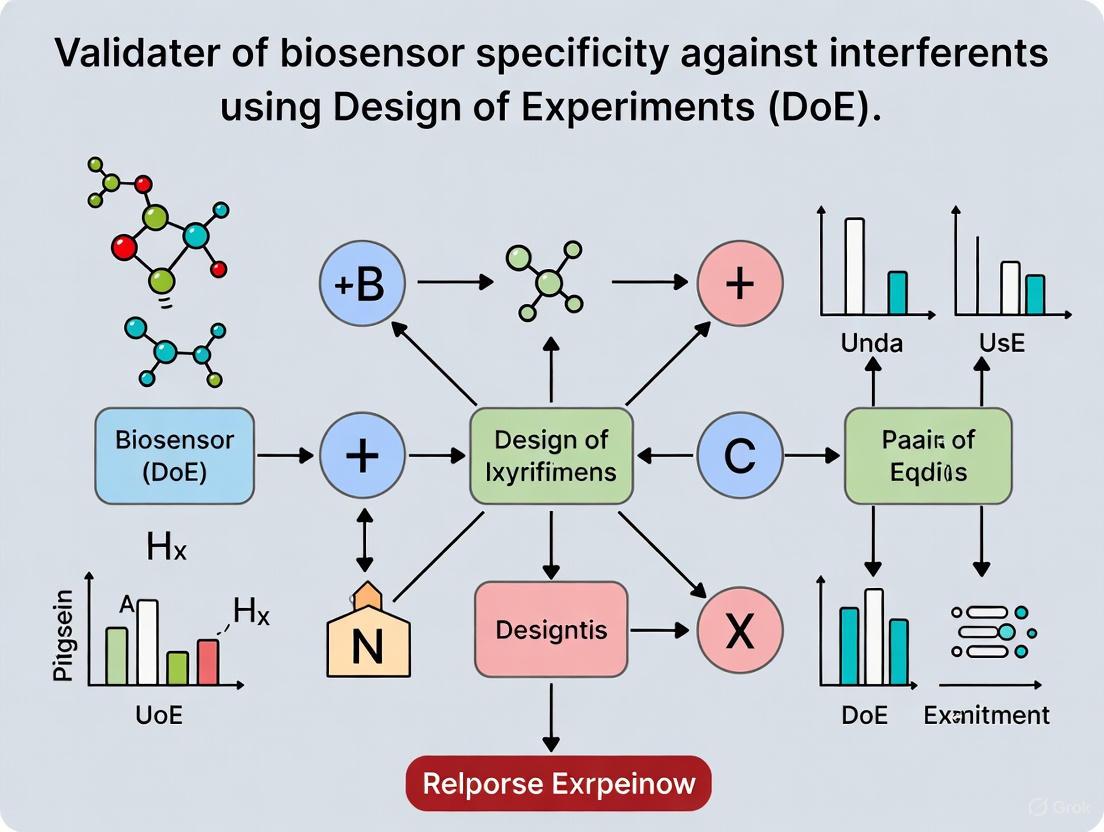
This article provides a comprehensive guide for researchers and development professionals on applying Design of Experiments (DoE) to rigorously validate biosensor specificity against chemical interferents.
A DoE-Driven Framework for Validating Biosensor Specificity: Mitigating Interference in Complex Samples
Abstract
This article provides a comprehensive guide for researchers and development professionals on applying Design of Experiments (DoE) to rigorously validate biosensor specificity against chemical interferents. It covers the foundational principles of biosensor components and interference mechanisms, explores the strategic application of DoE screening and optimization designs, addresses common troubleshooting scenarios, and establishes robust validation protocols. By integrating DoE methodologies, scientists can systematically identify and control for confounding variables, enhance biosensor reliability, and accelerate the development of robust diagnostic and monitoring tools for clinical and biomedical applications.
Biosensor Fundamentals and the Critical Challenge of Analytical Interference
Biosensors are analytical devices that integrate a biological recognition element with a transducer to convert a biological event into a measurable signal [1] [2]. The core components work in concert to provide specific, quantitative, or semi-quantitative analytical information about target analytes present in complex matrices [1]. The biorecognition element provides specificity by interacting with a particular target, while the transducer converts this interaction into a quantifiable output, typically electrical or optical [3] [2].
The performance of these core components directly determines a biosensor's analytical validity, particularly its specificity against interferents. This guide objectively compares the performance characteristics of different biorecognition elements and transducers, with experimental data framed within a Design of Experiments (DoE) research methodology. DoE provides a systematic, statistically sound framework for optimizing biosensor fabrication and operation by accounting for both individual variable effects and their interactions [4]. For researchers and drug development professionals, understanding these components and their optimization is crucial for developing reliable biosensors for clinical diagnostics, bioprocess monitoring, and therapeutic development.
Core Component I: Biorecognition Elements
Biorecognition elements are the biological or biomimetic components that confer specificity to the biosensor. Their primary function is to selectively capture target analytes from a sample matrix [1]. The choice of bioreceptor influences key performance parameters including sensitivity, specificity, stability, and operational lifetime.
Table 1: Comparison of Major Biorecognition Elements
| Biorecognition Element | Key Features | Typical Targets | Stability | Development & Production Cost |
|---|---|---|---|---|
| Enzymes [1] [5] | High catalytic activity; substrate specificity | Small molecules, metabolites (e.g., glucose) | Moderate (subject to denaturation) | Moderate |
| Antibodies [1] [6] [2] | Very high affinity and specificity | Proteins, viruses, cells (larger analytes) | High (robust immunoglobulin) | High |
| Nucleic Acids/Aptamers [1] [7] [2] | Chemical stability; customizable sequences | Ions, small molecules, proteins, cells | High (robust DNA/RNA) | Low to Moderate |
| Whole Cells [8] [2] | Provide complex, functional responses | Toxins, metabolic status, bioactive compounds | Low (viability must be maintained) | Variable |
| Molecularly Imprinted Polymers (MIPs) [1] | High chemical/thermal stability; synthetic | Small molecules, peptides, proteins | Very High | Low |
Experimental Focus: Optimizing Bioreceptor Specificity Against Interferents
A critical challenge in biosensor development is that biorecognition elements can exhibit different selectivity in complex biological matrices compared to controlled conditions, potentially leading to cross-reactivity [1]. The following experiment illustrates a systematic approach to evaluating and validating specificity.
- Experimental Objective: To evaluate the specificity of a third-generation glucose biosensor based on the enzyme Cellobiose Dehydrogenase (CDH) against known electroactive interferents [5].
- Protocol:
- Sensor Fabrication: The enzyme CDH was adsorbed on a carbon working electrode and covalently bound by cross-linking with poly(ethylene glycol) diglycidyl ether [5].
- Interferent Testing: The response of the CDH-modified electrodes was measured via chronoamperometry and flow-injection analysis in the presence of glucose and potential interfering substances (e.g., ascorbic acid, acetaminophen, uric acid) at physiologically relevant concentrations [5].
- Signal Measurement: The current output was measured at a low polarization potential of -100 mV vs. Ag/AgCl. Specificity was quantified as the percentage signal deviation caused by the interferent compared to the glucose signal [5].
- Key Data & DoE Insight: The study, following principles akin to a factorial DoE, tested multiple variables (enzyme immobilization, interferent type, concentration) systematically. The CDH-based biosensor showed excellent specificity, with most electroactive interferents causing <5% signal deviation, significantly lower than what is often observed with earlier generation biosensors [5]. This highlights how the choice of bioreceptor (CDH) and operational parameters (low potential) can be optimized to minimize interference.
Core Component II: Transducers
The transducer is the component that converts the biorecognition event into a measurable physical signal. The transduction mechanism defines the fundamental readout principle of the biosensor and is a major determinant of its sensitivity, detection limits, and potential for miniaturization.
Table 2: Comparison of Major Transduction Mechanisms
| Transducer Type | Detection Principle | Key Advantages | Typical LOD | Example Application |
|---|---|---|---|---|
| Electrochemical [1] [7] [2] | Measures changes in current, potential, or impedance from electron transfer. | High sensitivity, low cost, easy miniaturization, portable. | nM - pM | Continuous glucose monitors [1]. |
| Optical [1] [9] [2] | Measures changes in light properties (absorbance, fluorescence, SPR). | High sensitivity, potential for multiplexing, real-time kinetics. | pM - fM | SERS-based detection of cancer biomarkers [9]. |
| Piezoelectric/Acoustic [2] | Measures mass changes on a sensor surface via resonance frequency shift. | Label-free, real-time monitoring. | Varies with system | Gas phase sensing. |
| Thermal [2] | Measures heat released/absorbed by a biochemical reaction. | Versatile with various bioreceptors. | Varies with system | Detection of pollutants. |
Experimental Focus: Evaluating Transducer Performance with DoE
Selecting the optimal transducer material and configuration is complex, as performance emerges from the interaction of multiple factors. A DoE approach is ideal for this multi-parameter optimization.
- Experimental Objective: To evaluate the efficacy of three different gold-finish transducer configurations for use in an aptamer-based electrochemical biosensor for cardiac troponin I (cTnI) [7].
- Protocol:
- Transducer Fabrication: Three electrode types were fabricated: (I) Silicon-based with a patterned gold layer; (II) Polyethylene naphthalate (PEN) with inkjet-printed gold; and (III) Polyethylene terephthalate (PET) with screen-printed gold [7].
- Functionalization: All electrodes were cleaned and functionalized with thiolated aptamers specific to cTnI [7].
- Electrochemical Characterization: Electrodes were characterized using Electrochemical Impedance Spectroscopy (EIS) and Cyclic Voltammetry (CV) in a solution containing a redox marker
[Fe(CN)₆]³⁻/⁴⁻. Key parameters like charge-transfer resistance (Rct) and peak current were measured before and after aptamer immobilization and target binding [7].
- Key Data & DoE Insight: A full-factorial DoE could systematically vary factors like substrate type, gold deposition method, and sintering conditions. The study found that PEN-based electrodes demonstrated superior biosensor properties, including lower initial Rct and a greater change in Rct upon aptamer immobilization, which correlated with a higher number of immobilized bioreceptors [7]. This provides quantitative, data-driven support for selecting a transducer material that maximizes signal response.
The Scientist's Toolkit: Essential Research Reagents & Materials
The following table details key reagents and materials essential for the development and validation of biosensor components, as featured in the cited experiments.
Table 3: Key Research Reagent Solutions for Biosensor Development
| Item Name | Function/Application | Brief Explanation |
|---|---|---|
| Cellobiose Dehydrogenase (CDH) [5] | Biorecognition Element for 3rd-gen biosensors. | An enzyme enabling Direct Electron Transfer (DET), allowing operation at low potential to reduce interference. |
| Thiolated Aptamers [7] | Biorecognition Element for affinity sensors. | Single-stranded DNA/RNA molecules that bind targets; thiol group allows for self-assembly on gold surfaces. |
| Biotinylated Antibodies [6] | Biorecognition Element for immunosensors. | Antibodies labeled with biotin; exploit strong biotin-streptavidin interaction for stable, reproducible sensor surface. |
| Poly(ethylene glycol) diglycidyl ether [5] | Cross-linker for immobilization. | A homobifunctional cross-linker used to covalently immobilize bioreceptors (e.g., enzymes) on sensor surfaces. |
Redox Marker ([Fe(CN)₆]³⁻/⁴⁻) [7] |
Probe for electrochemical transduction. | A common redox couple used in EIS and CV to monitor changes in electrode surface properties upon biorecognition. |
| 6-Mercapto-1-hexanol (MCH) [7] | Surface blocking agent. | Used to create a well-ordered self-assembled monolayer on gold, minimizing non-specific adsorption. |
Integrated Workflow and Signaling Pathways
The process of biosensing, from sample introduction to result interpretation, involves a coordinated sequence of events across the device's components. The following diagram illustrates a generalized workflow for an electrochemical biosensor, highlighting the signaling pathway.
The signaling pathway begins when the target Analyte selectively binds to the Biorecognition Element immobilized on the transducer surface [1]. This binding event causes a Physicochemical Change at the transducer interface. In electrochemical sensors, this often involves a change in electron transfer kinetics or charge distribution, which is converted by the Transducer into a raw electrical signal [7] [2]. Finally, the Signal Processor amplifies, filters, and converts this raw signal into a user-interpretable Quantifiable Signal [2].
A critical methodology for optimizing this entire workflow is Design of Experiments (DoE). The following diagram outlines how a DoE cycle is applied to biosensor development.
This iterative Design-Build-Test-Learn (DBTL) cycle is key to systematic optimization [8] [4]. Researchers first Design an experiment by defining critical factors (e.g., bioreceptor density, transducer material). They then Build the biosensor variants, Test them to collect performance data (e.g., sensitivity to target and interferents), and Learn by building a data-driven model to identify optimal factor combinations [4]. This approach efficiently accounts for complex interactions between variables, which are often missed when optimizing one variable at a time [4].
Common Interferents in Biological and Environmental Samples
The validation of biosensor specificity against chemical and biological interferents is a critical challenge in transforming laboratory prototypes into reliable analytical tools for drug development and environmental monitoring. Biosensors, which combine a biological recognition element with a physicochemical detector, are prized for their potential in point-of-care diagnostics and on-site environmental analysis [10] [11]. However, their analytical performance is frequently compromised in complex sample matrices such as blood, urine, wastewater, and food extracts, where non-target substances can cause false positives or negatives by mimicking the target analyte, fouling the sensor surface, or inhibiting the biorecognition element [11] [12]. This challenge is acutely observed in the detection of low-concentration biomarkers in serum or pesticides in agricultural runoff, where interferents can be orders of magnitude more concentrated than the analyte of interest.
Addressing these challenges requires more than incremental optimization; it demands a systematic framework for identifying, quantifying, and mitigating interference. Design of Experiments (DoE) has emerged as a powerful methodology for this purpose, moving beyond traditional one-variable-at-a-time approaches to efficiently explore complex factor interactions that affect biosensor specificity [13] [14]. By applying structured experimental designs and statistical analysis, researchers can simultaneously evaluate multiple potential interferents and their interactions, leading to robust biosensor designs capable of reliable performance in real-world samples. This review explores common interferents across biological and environmental contexts and demonstrates how DoE-driven research provides a pathway to validated biosensor specificity.
Fundamental Biosensor Principles and Interference Mechanisms
Biosensors integrate a biorecognition element (enzyme, antibody, nucleic acid, or whole cell) with a transducer (electrochemical, optical, piezoelectric, or thermal) to produce a measurable signal proportional to analyte concentration [10] [15]. This signal transduction can be disrupted through several mechanisms: competitive binding (interferents with structural similarity to the target compete for binding sites), surface fouling (non-specific adsorption of proteins or other macromolecules onto the sensor surface), matrix effects (sample components alter physicochemical properties like pH or ionic strength), and signal crossover (interferents generate a similar analytical signal to the target) [11] [15].
The susceptibility to these interference mechanisms varies significantly with the choice of biorecognition element and transducer. Table 1 summarizes the primary biosensor types, their working principles, and their characteristic vulnerability profiles to common interference mechanisms.
Table 1: Major Biosensor Types, Principles, and Characteristic Interference Vulnerabilities
| Biosensor Type | Biorecognition Element | Working Principle | Primary Interference Mechanisms |
|---|---|---|---|
| Enzyme-based | Enzyme (e.g., acetylcholinesterase, glucose oxidase) | Catalytic transformation, inhibition, or activation of the enzyme by the analyte [10]. | Enzyme inhibitors/activators in sample; pH/temperature shifts; electroactive compounds [11] [12]. |
| Immunosensor | Antibody (IgG, IgM, etc.) | Specific antigen-antibody binding, detected via label (e.g., fluorescence) or label-free (e.g., impedance) methods [10]. | Cross-reactivity with structurally similar antigens; non-specific protein adsorption [11]. |
| Aptasensor | Synthetic DNA or RNA aptamer | Folding into 2D/3D structures upon target binding via π-π stacking, van der Waals forces, hydrogen bonding [10]. | Degradation by nucleases; non-specific binding to major groove/minor groove of aptamer; ionic strength effects [10]. |
| Whole Cell-based | Microorganism (bacteria, yeast, algae) | Response via metabolic activity, stress responses, or genetic regulation upon exposure to analyte [10]. | General toxins affecting cell viability; nutrients in sample altering basal metabolism [10]. |
Common Interferents in Biological Samples
Biological fluids such as serum, plasma, urine, and saliva present a particularly challenging environment for biosensing due to their complex and variable composition. Key interferents in these matrices include:
Proteins and Lipids: Serum albumin, immunoglobulins, and lipoproteins can non-specifically adsorb to sensor surfaces, a process known as fouling, which can block access to recognition elements and alter the physicochemical properties of the sensor interface [15]. This fouling is a primary cause of signal drift in implantable and continuous monitoring biosensors.
Electroactive Chemicals: In electrochemical biosensors, which dominate the point-of-care diagnostics market, substances such as ascorbic acid (vitamin C), uric acid, and acetaminophen are major concerns [14]. These compounds can be oxidized or reduced at similar potentials to the target analyte, generating a non-specific faradaic current that obscures the signal of interest.
Endogenous Metabolites: Metabolites like lactate, glutathione, and bilirubin can interfere either by direct interaction with the biorecognition element or by altering the local microenvironment. For instance, a recent study optimizing a glucose biosensor found that variations in lactate concentration significantly impacted signal output, an effect that was only revealed through multi-factor DoE analysis [14].
Pharmaceutical Excipients and Co-administered Drugs: For therapeutic drug monitoring biosensors, compounds commonly found in pharmaceutical formulations or other medications taken by patients can cross-react. This is particularly problematic for immunosensors, where antibody specificity may not be absolute.
Table 2 summarizes experimental data on the effects of common biological interferents, highlighting how systematic evaluation reveals critical performance impacts.
Table 2: Experimentally Observed Effects of Common Biological Interferents
| Interferent | Biosensor Type / Target | Observed Impact | Experimental Context |
|---|---|---|---|
| Ascorbic Acid | Electrochemical enzymatic biosensor | Significant anodic peak overlap with target analyte, causing false positive current [14]. | Analysis in spiked buffer solution; resolved using permselective membrane. |
| Uric Acid | Electrochemical glucose biosensor | Oxidation signal interferes with H₂O₂ detection at +0.35V working potential [14]. | DoE study identified applied potential as critical factor for selectivity. |
| Serum Albumin | Optical SPR-based immunosensor | Non-specific adsorption caused baseline drift and reduced assay sensitivity by ~15% [15]. | Testing in 10% serum vs. buffer; required surface blocking with BSA or PEG. |
| Lactate | Amperometric enzyme biosensor | 20% signal suppression at physiologically high levels (10 mM) due to microenvironment change [14]. | Identified via Definitive Screening Design (DSD) of biological interferents. |
Case Study: DoE for an RNA Biosensor in Complex Matrices
The critical role of systematic optimization is exemplified by a 2025 study that used an iterative DoE approach to enhance the performance of an in vitro RNA integrity biosensor for mRNA vaccine quality control [13]. The researchers faced challenges with the biosensor's dynamic range and sensitivity in complex sample matrices.
Experimental Protocol:
- Initial Screening: A Definitive Screening Design (DSD) was employed to efficiently test multiple factors simultaneously, including reporter protein concentration, poly-dT oligonucleotide concentration, DTT concentration, and RNA sample amount.
- Iterative Optimization: Subsequent rounds of DoE were conducted based on initial results to refine the optimal conditions.
- Validation: The optimized biosensor was validated by comparing its performance in discriminating between capped and uncapped RNA against standard methods, even at lower RNA concentrations.
The DoE approach revealed non-intuitive optimal conditions, such as a requirement for lower concentrations of reporter protein and poly-dT oligonucleotide than initially expected, and highlighted the importance of a reducing environment (achieved by increasing DTT) for optimal functionality [13]. This systematic method led to a 4.1-fold increase in dynamic range and reduced the required RNA concentration by one-third, significantly enhancing the biosensor's robustness for analyzing RNA in complex biological samples [13].
Common Interferents in Environmental Samples
Environmental monitoring presents a distinct set of challenges, where biosensors must detect trace-level contaminants (e.g., pesticides, nitrites, heavy metals) in matrices like surface water, groundwater, and soil extracts that contain diverse natural and anthropogenic compounds. Key interferents include:
Humic and Fulvic Acids: These natural organic matter compounds, resulting from the decomposition of plant and animal materials, are ubiquitous in surface waters and soil. They can foul sensor surfaces through non-specific adsorption and, in optical biosensors, absorb or fluoresce at wavelengths used for detection, creating high background signals [12].
Heavy Metal Ions: Ions such as Cu²⁺, Fe³⁺, Hg²⁺, and Pb²⁺ can interfere with biosensor function by inhibiting enzymes (e.g., by binding to thiol groups in acetylcholinesterase used in pesticide detection), displacing the target analyte in aptamer binding pockets, or affecting the metabolic activity of whole-cell biosensors [10] [12].
Nutrient Salts and Ionic Species: High concentrations of nitrates, phosphates, and chlorides, commonly found in agricultural runoff, can alter the ionic strength and pH of the sample, disrupting the stability of biorecognition elements like aptamers and antibodies, or causing signal suppression in electrochemical transducers [16].
Co-occurring Pesticides and Industrial Chemicals: In multi-residue analysis, non-target pesticides or pollutants with similar chemical structures can cross-react with the bioreceptor. For instance, an acetylcholinesterase-based biosensor cannot easily distinguish between different organophosphate pesticides, and a biosensor for a specific herbicide might also respond to its metabolites or structurally analogous compounds [11] [12].
Table 3 summarizes specific interference effects documented in environmental biosensing applications, providing a quantitative perspective on these challenges.
Table 3: Experimentally Observed Effects of Common Environmental Interferents
| Interferent | Biosensor Type / Target | Observed Impact | Experimental Context |
|---|---|---|---|
| Humic Acid | Optical microfiber biosensor | Significant baseline drift and signal attenuation at concentrations >5 mg/L [17]. | Testing in lake water samples; required filtration or dilution pre-treatment. |
| Copper Ions (Cu²⁺) | Acetylcholinesterase pesticide biosensor | 40% enzyme inhibition at 1 mg/L, mimicking pesticide effect and causing false positives [12]. | Tested in simulated groundwater; addressed by adding chelating agents. |
| Nitrate (NO₃⁻) | Electrochemical nitrite biosensor | 25% signal enhancement at high (50 mg/L) levels due to partial reduction on electrode surface [16]. | Analysis in wastewater; required selective membrane or sample dilution. |
| Co-occurring Pesticides | Whole-cell pyrethroid biosensor | 15% cross-response from non-target organophosphates at ecologically relevant concentrations [10]. | Identified via a full-factorial DoE study on pesticide mixtures. |
Experimental Protocol: Evaluating Pesticide Biosensor Interference
A robust protocol for assessing interferents in environmental analysis involves spiking and recovery tests in progressively complex matrices.
Preparation of Samples:
- Prepare the target analyte (e.g., a specific pesticide) in pure buffer to establish a baseline calibration.
- Spike the same concentration of the target analyte into a sample of matrix (e.g., river water, soil extract) that has been previously confirmed to be free of the target (or use a standard reference material).
- Prepare negative controls (matrix without target) and potential interferent solutions (e.g., solutions of humic acid, other pesticide classes, or metal ions).
Analysis and Calculation:
- Measure the sensor response for all prepared samples.
- Calculate the % recovery in the spiked matrix:
(Measured Concentration in Spiked Matrix / Known Spiked Concentration) × 100%. - A recovery of 85-115% typically indicates minimal interference. Significant deviation suggests matrix interference.
- Test individual and combined interferents in a DoE framework (e.g., a DSD or full factorial design) to identify and quantify synergistic or antagonistic effects [12].
Mitigation Strategies:
- Based on the results, implement mitigation strategies such as:
- Sample pre-treatment: Filtration, dilution, or solid-phase extraction to remove interferents.
- Surface modification: Use of blocking agents (e.g., BSA, casein) or antifouling polymers (e.g., PEG, zwitterionic coatings) on the sensor.
- Sensor design: Incorporation of selective membranes (e.g., Nafion for excluding anions) or the use of differential measurement techniques that subtract background signals [11] [15].
- Based on the results, implement mitigation strategies such as:
The DoE Framework for Specificity Validation
Design of Experiments is a statistical methodology that enables the efficient and systematic evaluation of multiple factors (variables) that could influence a process or product. In the context of biosensor validation against interferents, it provides a framework superior to the traditional one-variable-at-a-time (OVAT) approach, as it can identify interaction effects—where the impact of one interferent depends on the level of another [13] [14].
The core stages of a DoE workflow for biosensor specificity validation are illustrated in the following diagram, which outlines the iterative process from problem definition to final model deployment.
Diagram 1: DoE Workflow for Biosensor Specificity Validation. This iterative process systematically identifies critical interferents and optimizes biosensor design and operation for robustness. DSD: Definitive Screening Design.
A key application of DoE is the creation of a definitive screening design, which allows for the efficient testing of multiple factors with a minimal number of experimental runs. For example, a recent study used a machine learning framework to optimize an electrochemical biosensor, testing 26 different regression algorithms to model the complex, non-linear relationships between fabrication parameters (e.g., enzyme amount, crosslinker concentration, pH) and the sensor's response to interferents [14]. This data-driven approach successfully identified key parameter interactions and provided accurate performance predictions, significantly reducing the experimental burden required for optimization.
The Scientist's Toolkit: Key Reagents and Materials
The development and validation of interferent-resistant biosensors rely on a suite of specialized reagents and materials. The following table details essential components for building robust sensing platforms and mitigating interference.
Table 4: Key Research Reagent Solutions for Interference Mitigation
| Reagent/Material | Primary Function | Justification |
|---|---|---|
| Poly(ethylene glycol) (PEG) | Anti-fouling coating | Forms a hydration layer that minimizes non-specific adsorption of proteins and other biomolecules on sensor surfaces [15]. |
| Nafion | Cation-exchange membrane | Coated on electrochemical sensors to repel anionic interferents (e.g., ascorbate, urate) while allowing permeation of neutral targets (e.g., H₂O₂) [14]. |
| Bovine Serum Albumin (BSA) | Blocking agent | Used to occupy non-specific binding sites on sensor surfaces after immobilization of the biorecognition element, reducing background signal [11]. |
| Ethylenediaminetetraacetic acid (EDTA) | Chelating agent | Added to sample buffers to sequester heavy metal ions (e.g., Cu²⁺, Hg²⁺) that can inhibit enzymes or disrupt nucleic acid structures [12]. |
| Standard Reference Materials | Matrix-matched calibration | Certified materials (e.g., NIST urine, ERM water) are essential for validating sensor accuracy and quantifying matrix effects in complex samples [12] [16]. |
The pervasive challenge of interference in biological and environmental samples represents a significant barrier to the commercialization and widespread adoption of biosensor technology. A deep understanding of characteristic interferents—from ascorbic acid in serum to humic substances in river water—provides the foundational knowledge needed for rational biosensor design. However, knowledge alone is insufficient. As demonstrated by the case studies presented, a systematic, DoE-driven research framework is indispensable for efficiently navigating the complex interplay between multiple interferents and sensor parameters. By integrating DoE into the validation workflow, researchers can transform biosensor development from an artisanal craft into a robust engineering discipline, accelerating the delivery of reliable, specific, and interference-resistant biosensors to the front lines of drug development and environmental protection.
Biosensor technology has become a cornerstone of modern diagnostics, therapeutic monitoring, and biomedical research, yet achieving reliable specificity against interferents remains a fundamental challenge [18] [19]. Non-specific binding (NSB) and signal overlap constitute two primary mechanisms of interference that compromise assay accuracy by generating false positives or obscuring true specific binding events [20] [21]. NSB occurs when analytes, matrix components, or detection reagents adhere to sensor surfaces through interactions unrelated to the intended molecular recognition, while signal overlap arises when multiple analytes or environmental factors produce indistinguishable responses in the transducer [22] [18]. These interference mechanisms persistently limit biosensor performance across diverse platforms, from clinical point-of-care devices to environmental monitoring systems [18] [21].
The validation of biosensor specificity against such interferents requires systematic investigation frameworks, with Design of Experiments (DoE) emerging as a powerful methodology for efficiently exploring multiple variables and their interactions [20] [8]. This guide objectively compares emerging technologies and strategies that specifically address NSB and signal overlap, providing researchers with experimental data and protocols to advance biosensor validation in drug development and diagnostic applications.
Comparative Analysis of Interference Mitigation Technologies
The table below summarizes quantitative performance data for four advanced approaches to interference mitigation, highlighting their operational principles and demonstrated efficacy.
Table 1: Performance Comparison of Biosensor Interference Mitigation Technologies
| Technology Platform | Core Mechanism | Analyte Model | Limit of Detection (LOD) | Interference Suppression | Key Performance Metric |
|---|---|---|---|---|---|
| Bimodal Optical Fiber [22] | Simultaneous SPR/FPI measurement | DNA hybridization | Not specified | Distinguishes BRI from SRI changes; ≤3.7% RSD in complex media | Decouples environmental RI from target-induced RI changes |
| Single-Molecule Colocalization (SiMCA) [23] | Two-color TIRF microscopy colocalization | TNF-α | 7.6 ± 1.9 pM | Eliminates non-colocalized detection antibody signals | 3-fold LOD improvement vs conventional assay; consistent in serum/blood |
| Conducting Polymer Chemiresistor [21] | Specific binding-induced negative ΔR vs positive ΔR for NSB | Biotin/Avidin | Not specified | Machine learning classification of binding response | 75% accuracy in predicting biotin presence in dual-protein solutions |
| FdeR Whole-Cell Biosensor [8] | Context-aware genetic circuit optimization | Naringenin | Not specified | DoE-based tuning of genetic parts for specific response | Maintained performance across 16 media/supplement conditions |
Table 2: Experimental Conditions and Matrix Performance
| Technology Platform | Testing Matrices | Optimal Assay Conditions | Specificity Validation Approach | Key Interferents Tested |
|---|---|---|---|---|
| Bimodal Optical Fiber [22] | FBS environment | Dual-mode signal decoupling matrix | BRI/SRI response differentiation | Background refractive index changes |
| Single-Molecule Colocalization (SiMCA) [23] | Buffer, 70% serum, 70% whole blood | 50 nM detection antibody; cAb normalization | Colocalization counting eliminates non-specific dAb binding | Serum proteins, blood components |
| Conducting Polymer Chemiresistor [21] | PBS with competing proteins | 950 µA constant current; 30 min measurement | Opposite resistance response for specific vs non-specific binding | Gliadin, Casein in dual-protein solutions |
| FdeR Whole-Cell Biosensor [8] | M9, SOB media with glucose, glycerol, acetate supplements | Promoter P3 with specific RBS combinations | DoE-optimized genetic circuit context-dependence | Metabolic variations, nutritional supplements |
Experimental Protocols for Specificity Validation
Dual-Modal Optical Biosensor Fabrication and Testing
This protocol enables distinction between bulk refractive index (BRI) interference and specific binding-induced surface refractive index (SRI) changes [22].
Sensor Fabrication: Begin with a few-mode fiber (20μm/125μm core/cladding). Employ two-photon polymerization 3D printing with SU-8 3050 photoresist to fabricate a bimodal waveguide structure optimized to 15μm radius and 60μm height. Functionalize the sensor surface with 11-mercaptoundecanoic acid (10mM in ethanol) followed by 1-(3-dimethylaminopropyl)-3-ethylcarbodiimide hydrochloride (4mM) and N-hydroxysuccinimide (6mM) in DI water for 30 minutes. Immobilize probe DNA (1μM in PBS) for 3 hours, then deactivate with 6-mercapto-1-hexanol (1mM) [22].
Dual-Mode Measurement: Perform simultaneous surface plasmon resonance (SPR) and Fabry-Perot interference (FPI) measurements. SPR responds to SRI changes from specific biomolecular binding, while FPI responds to environmental BRI changes. Establish a decoupling matrix to differentiate signal sources [22].
Validation Testing: Test with sodium chloride solutions of varying concentrations to characterize BRI response. Validate with DNA hybridization in FBS-containing environments. Apply the decoupling matrix to accurately quantify both sample BRI and target DNA concentration despite complex matrix effects [22].
Single-Molecule Colocalization Assay (SiMCA)
This protocol eliminates non-specific background in immunoassays by requiring colocalization of capture and detection antibodies [23].
Surface Preparation: Passivate coverslips with a mixture of PEG and PEG-biotin to minimize non-specific binding. Immobilize biotinylated capture antibodies (cAb) onto neutravidin-coated surfaces, ensuring proper orientation of antigen-binding domains. Label cAb with Alexa-546 and site-specifically tag with biotin [23].
Detection System Preparation: Label detection antibodies (dAb) with Alexa-647. Incubate coverslips with a mixture of target analyte and dAb (50nM optimal concentration to minimize NSB) overnight [23].
Imaging and Analysis: Employ two-color total internal reflection fluorescence (TIRF) microscopy with sequential 532nm and 635nm laser excitation. Acquire 128 fields of view (51.2μm × 25.6μm) per coverslip. Use automated image segmentation and registration to count single-color dAb signals versus colocalized binding events. Normalize colocalized dAb counts to cAb counts in each FOV to account for surface heterogeneity [23].
Conducting Polymer-Based Specificity Discrimination
This protocol distinguishes specific from non-specific binding through characteristic electrical response patterns in chemiresistive biosensors [21].
Sensor Fabrication: Utilize vapor-phase polymerization to deposit an interpenetrating network of P(EDOT-3TE) on polypropylene-cellulose fabric. Soak fabric in 40wt% Iron(III) p-toluenesulfonate hexahydrate in butanol, then expose to EDOT monomer at 70°C for 1 hour. Rinse in ethanol, then expose to 3-thiopheneethanol at 70°C for 1 hour [21].
Surface Functionalization: Covalently attach capture molecules (e.g., avidin) to the polymer-coated fabric via (3-Glycidyloxypropyl)trimethoxysilane linker at 120°C for 2 hours. Block with successive washes in 1:1 BSA to PBS solution to minimize non-specific protein adsorption [21].
Measurement and Analysis: Submerge functionalized sensor in PBS and apply constant DC current of 950μA. Monitor resistance over 30 minutes, adding analyte at 15-minute mark. Calculate percent change in resistance using: ΔR% = [(R₀ - R₁)/R₁] × 100, where R₁ is resistance before analyte addition and R₀ is final resistance. Employ machine learning classifiers (e.g., random forest) to identify characteristic negative ΔR for specific binding versus positive ΔR for non-specific binding [21].
Signaling Pathways and Experimental Workflows
The Scientist's Toolkit: Essential Research Reagents and Materials
Table 3: Key Research Reagents for Specificity Validation
| Reagent/Material | Function in Specificity Validation | Example Application |
|---|---|---|
| PEG/PEG-biotin [23] | Surface passivation to minimize non-specific adsorption | Creating low-fouling surfaces for single-molecule imaging |
| Bovine Serum Albumin (BSA) [21] | Blocking agent for unoccupied binding sites | Reducing non-specific protein adsorption on sensor surfaces |
| SU-8 3050 Photoresist [22] | Polymer for 3D fabrication of waveguide structures | Creating bimodal optical fiber sensors with precise geometry |
| 11-mercaptoundecanoic acid [22] | Self-assembled monolayer for surface functionalization | Providing carboxyl groups for biomolecule immobilization |
| EDC/NHS Chemistry [22] | Carbodiimide crosslinking for covalent attachment | Immobilizing probe DNA or antibodies on sensor surfaces |
| Fe(PTS)₃ Oxidant [21] | Oxidizing agent for vapor-phase polymerization | Synthesizing PEDOT-based conducting polymer sensors |
| GOPS Linker [21] | Covalent attachment of biomolecules to surfaces | Anchoring avidin to polymer-coated fabrics for biotin detection |
| Alexa Fluor Dyes (546/647) [23] | Fluorophore tags for two-color colocalization | Labeling capture and detection antibodies for SiMCA |
The systematic validation of biosensor specificity against non-specific binding and signal overlap requires integrated approaches that combine advanced sensing modalities, careful experimental design, and appropriate data analysis strategies. The technologies compared herein demonstrate that interference mitigation can be achieved through fundamentally different mechanisms—whether through physical signal discrimination, single-molecule verification, electrical signature recognition, or context-aware design optimization. The DoE framework emerges as a particularly powerful methodology for efficiently exploring the complex parameter spaces that govern biosensor specificity, enabling researchers to develop robust assays that maintain performance across diverse application environments. For drug development professionals and researchers, adopting these comparative frameworks and validation protocols can accelerate the development of reliably specific biosensors capable of functioning in the complex matrices essential for both clinical diagnostics and therapeutic monitoring.
The Scientist's Toolkit: Core DoE Designs for Biosensor Research
The systematic optimization of biosensors, particularly for validating specificity against interferents, relies on several foundational Design of Experiments (DoE) approaches. The table below compares the primary DoE types used in this field.
Table 1: Key DoE Designs for Biosensor Development and Validation
| DoE Design Type | Primary Application Stage | Key Strengths | Typical Experimental Runs Required | Model Equation |
|---|---|---|---|---|
| Full Factorial [24] [25] | Screening, Refinement & Iteration | Investigates all possible combinations of factors and levels; identifies all main effects and interactions. | 2k (for k factors at 2 levels) | Y = b₀ + b₁X₁ + b₂X₂ + b₁₂X₁X₂ [24] |
| Fractional Factorial [25] | Screening (with many factors) | Screens a large number of factors with fewer runs; assumes higher-order interactions are negligible. | 2(k-p) (a fraction of full factorial) | - |
| Response Surface Methodology (RSM) [25] | Optimization, Robustness | Models curvature and finds optimal conditions; ideal for fine-tuning. | Varies (e.g., Central Composite, Box-Behnken) | Second-Order (Quadratic) |
Experimental Protocols for Biosensor Specificity Validation
Protocol: Screening for Critical Interferents using a 2kFactorial Design
This protocol is designed to efficiently identify which potential chemical interferents significantly impact biosensor signal.
- Define Factors and Levels: Select
kpotential chemical interferents as factors. For each factor, set two levels: a baseline concentration (-1) and a physiologically or environmentally relevant high concentration (+1) [24]. - Construct Experimental Matrix: Create a matrix defining all 2k experimental runs. For a 3-factor design (Interferents A, B, C), this results in 8 unique combinations [24].
- Randomize and Execute: Randomize the order of the 8 experimental runs to mitigate confounding from lurking variables [26] [27]. For each run, spike the biosensor sample with the specified combination of interferents and measure the output signal (Response Y).
- Statistical Analysis: Use Analysis of Variance (ANOVA) to calculate the significance of each main effect and interaction term. A high F-statistic and a low p-value (typically <0.05) indicate a significant effect [27].
Table 2: Example 2³ Factorial Design Matrix for Interferent Screening
| Standard Order | Interferent A | Interferent B | Interferent C | Measured Response Y |
|---|---|---|---|---|
| 1 | -1 | -1 | -1 | Y₁ |
| 2 | +1 | -1 | -1 | Y₂ |
| 3 | -1 | +1 | -1 | Y₃ |
| 4 | +1 | +1 | -1 | Y₄ |
| 5 | -1 | -1 | +1 | Y₅ |
| 6 | +1 | -1 | +1 | Y₆ |
| 7 | -1 | +1 | +1 | Y₇ |
| 8 | +1 | +1 | +1 | Y₈ |
Protocol: Optimizing Specificity using Response Surface Methodology (RSM)
After screening, RSM is used to model the response surface and find factor levels that minimize interference.
- Select Factors: Choose the 2-4 most significant interferents identified from the factorial design.
- Choose a RSM Design: A Central Composite Design (CCD) is common. It augments a 2k factorial design with center points and axial points to allow estimation of curvature [24] [25].
- Run Experiments and Model: Execute the designed experiments and fit a second-order polynomial model to the data [24]. The model will have the form:
Y = β₀ + ΣβᵢXᵢ + ΣβᵢᵢXᵢ² + ΣβᵢⱼXᵢXⱼ. - Define the Design Space: The model allows for the creation of a "design space," which is the multidimensional combination of interferent concentrations where the biosensor's response remains within specified quality limits, thus ensuring specificity [28].
Research Reagent Solutions for DoE in Biosensor Validation
Table 3: Essential Materials for Biosensor Specificity Experiments
| Research Reagent / Material | Function in DoE Context |
|---|---|
| Allosteric Transcription Factor (TF) [8] | Serves as the core biorecognition element in whole-cell biosensors; its specificity is the primary target for optimization against interferents. |
| Target Analyte Standard | The pure compound of the intended biomarker; used to establish the baseline biosensor response and signal in the absence of interferents. |
| Chemical Interferent Library | A panel of compounds with structural or functional similarity to the target, or compounds known to be present in the sample matrix, used as factors in the DoE. |
| Reporter Gene System (e.g., GFP) [8] | Provides a quantifiable output (e.g., fluorescence) that serves as the response (Y) measured for each experimental run in the DoE matrix. |
| Culture Media & Supplements [8] | Environmental factors that can significantly influence biosensor performance; these can be included as context-dependent factors in the DoE to ensure robustness. |
Visualizing the DoE Workflow for Biosensor Validation
The following diagram illustrates the sequential, iterative process of applying DoE to optimize biosensor specificity.
Figure 1: The Iterative DoE Workflow
The core principle of DoE analysis, even in complex designs, often rests on the statistical comparison of means, as visualized below for a simple two-level factor.
Figure 2: Basis of Analysis: Comparing Means
In the field of biosensor development, three critical quality attributes—specificity, sensitivity, and limit of detection (LOD)—serve as fundamental benchmarks for evaluating performance. These parameters collectively determine a biosensor's reliability in distinguishing target analytes from interferents, its ability to generate a measurable signal in response to low analyte concentrations, and its ultimate utility in real-world applications. Specificity ensures that a biosensor responds exclusively to its intended target, even in complex matrices containing structurally similar compounds or unrelated interferents. Sensitivity quantifies the magnitude of signal change per unit change in analyte concentration, determining how effectively a biosensor can detect physiological variations. The LOD defines the lowest analyte concentration that can be reliably distinguished from a blank sample, establishing the detection boundary for the analytical system [29] [30].
The validation of these attributes cannot be performed in isolation; rather, it requires a systematic approach that accounts for the complex interplay between multiple variables. This is particularly true when assessing biosensor specificity against potential interferents, where traditional one-variable-at-a-time approaches often fail to capture interactive effects. The implementation of Design of Experiments (DoE) methodology provides a structured framework for efficiently evaluating these multidimensional relationships, enabling researchers to optimize biosensor performance while comprehensively characterizing its limitations [4]. This guide examines how DoE-driven research facilitates the rigorous validation of biosensor specificity, sensitivity, and LOD, providing comparison data across various biosensor platforms and detailed experimental protocols for quality attribute assessment.
Theoretical Foundations of Key Analytical Parameters
Defining the Critical Quality Attributes
The analytical performance of biosensors is characterized by three interconnected yet distinct parameters. Specificity refers to a biosensor's ability to measure solely the intended analyte in the presence of other components that may be expected to be present in the sample matrix. This attribute is challenged by cross-reacting substances, matrix effects, and structurally similar compounds that may generate false positive signals. High specificity is achieved through careful selection of biorecognition elements and optimal sensor design [31] [32]. Sensitivity, often expressed as the slope of the calibration curve, represents the change in sensor response per unit change in analyte concentration. A highly sensitive biosensor produces a significant signal shift even with minimal changes in analyte concentration, enabling precise quantification within the dynamic range [29]. The LOD is defined as the lowest amount of analyte that can be reliably detected under stated experimental conditions, though not necessarily quantified with exact precision. According to IUPAC definition, LOD represents the smallest solute concentration that an analytical system can distinguish with reasonable reliability from a sample without analyte [29].
The mathematical determination of LOD typically follows the formula: CLoD = k × sB / a Where k is a numerical factor chosen according to the desired confidence level (typically 3, corresponding to 99.7% confidence), sB is the standard deviation of the blank measurements, and a is the analytical sensitivity (slope of the calibration curve) [29]. This statistical approach ensures that the detected signal significantly exceeds the background noise, minimizing false positives.
Interrelationships and Trade-offs Between Attributes
Critical quality attributes in biosensors often exhibit complex interrelationships and trade-offs. Excessive focus on achieving ultra-low LOD may compromise specificity, as enhanced sensitivity can amplify signals from non-target compounds [30]. Similarly, modifications to improve specificity through additional membranes or blocking agents may reduce overall sensitivity by introducing diffusion barriers or limiting analyte access to recognition elements [32]. The dynamic range of a biosensor—the interval between the lowest and highest analyte concentrations that can be measured—also interacts with both LOD and sensitivity, creating design constraints that must be balanced according to the intended application [29] [30].
Table 1: Interrelationships Between Critical Quality Attributes in Biosensor Design
| Quality Attribute | Effect on Other Attributes | Common Trade-offs |
|---|---|---|
| High Specificity | May reduce sensitivity to target analyte; can limit dynamic range | Additional membranes or blocking agents may increase LOD |
| High Sensitivity | May decrease specificity through signal amplification from interferents | Ultra-sensitive detection may narrow usable dynamic range |
| Low LOD | Requires high sensitivity but may compromise specificity | Focus on extreme sensitivity can reduce robustness and reproducibility |
The implementation of Design of Experiments (DoE) methodology is particularly valuable for navigating these complex interactions. DoE enables systematic evaluation of multiple variables and their interactive effects on biosensor performance, moving beyond the limitations of one-variable-at-a-time approaches. Through factorial designs and response surface methodology, researchers can identify optimal conditions that balance competing quality attributes while comprehensively characterizing biosensor performance [4].
Comparative Analysis of Biosensor Platforms
Performance Metrics Across Biosensor Technologies
Different biosensor platforms exhibit distinct performance characteristics in terms of specificity, sensitivity, and LOD, making them uniquely suited to particular applications. The following comparison summarizes published performance data for major biosensor categories, highlighting their relative strengths and limitations for specific use cases.
Table 2: Comparison of Biosensor Platform Performance Characteristics
| Biosensor Platform | Reported LOD | Specificity Challenges | Optimal Applications |
|---|---|---|---|
| FRET-based Biosensors [31] | Not specified | Requires controls for donor-acceptor interference; specific for Rho GTPases | Intracellular protein activity monitoring; live-cell imaging |
| SPR-PCF Multi-channel [33] | Wavelength sensitivity: 35,900-49,800 nm/RIU | Multi-channel design reduces interference; selective for specific RI changes | Simultaneous multi-analyte detection; biological binding studies |
| ELISA [34] [35] | C-peptide: 0.09 μg/L [35]; DON: 233-458 μg/kg [34] | Subject to fibrinogen interference in plasma samples; requires heterophilic antibody controls | Clinical diagnostics; high-throughput screening |
| Optical Cavity-Based [36] | Streptavidin: 27 ng/mL (optimized) | APTES functionalization critical for specificity; minimized non-specific binding | Label-free detection; medical diagnostics |
The LOD Paradox: When Lower Isn't Always Better
The relentless pursuit of lower LOD in biosensor research warrants critical examination. While ultra-sensitive detection capabilities represent significant technical achievements, they do not necessarily translate to improved practical utility. A biosensor capable of detecting picomolar concentrations of a biomarker provides no practical advantage if the clinically relevant range occurs in the nanomolar region [30]. This "LOD paradox" highlights the importance of aligning sensor performance with application requirements rather than pursuing technical specifications indiscriminately.
In clinical diagnostics, the clinical cut-off value—the concentration threshold with diagnostic significance—should guide LOD targets rather than the absolute lowest detectable concentration. For example, a C-peptide ELISA with an LOD of 0.09 μg/L is more than adequate for clinical monitoring of pancreatic function, as this value falls well below physiologically relevant concentrations [35]. Similarly, a deoxynivalenol (DON) biosensor with an LOD of 233 μg/kg appropriately targets the regulatory limit of 1250 μg/kg established by European Commission regulations [34]. These examples illustrate the importance of designing biosensors with application-appropriate sensitivity rather than universally pursuing the lowest possible LOD.
Experimental Design for Specificity Validation Against Interferents
Systematic Optimization Using Design of Experiments
The implementation of Design of Experiments (DoE) provides a structured framework for comprehensively evaluating biosensor specificity against potential interferents. Unlike one-variable-at-a-time approaches, DoE methodologies enable researchers to efficiently examine multiple variables and their interactions, significantly enhancing the robustness of specificity validation [4]. Full factorial designs, which investigate all possible combinations of factor levels, are particularly valuable for identifying significant variables affecting biosensor specificity. For example, a 2^k factorial design can efficiently evaluate k variables at two levels (high and low) using 2^k experiments, providing a comprehensive assessment of individual and interactive effects on specificity [4].
Central composite designs extend this approach by adding center and axial points to factorial designs, enabling modeling of quadratic response surfaces and identification of optimal conditions for maximizing specificity. This methodology is especially valuable when dealing with complex sample matrices where multiple interferents may simultaneously affect biosensor response. Through systematic variation of factors such as pH, ionic strength, blocking agent concentration, and interferent levels, researchers can build mathematical models that predict biosensor behavior across a wide experimental domain, identifying conditions that maximize specificity while maintaining adequate sensitivity and LOD [4].
Key Experimental Protocols for Specificity Assessment
Protocol 1: Cross-Reactivity Testing Using DoE Methodology
- Select Potential Interferents: Identify structurally similar compounds, metabolites, and common matrix components that may cross-react with the biorecognition element [32] [34].
- Design Experimental Matrix: Implement a fractional factorial design to efficiently evaluate multiple interferents at clinically relevant concentrations simultaneously [4].
- Prepare Spiked Samples: Generate samples containing target analyte at critical concentrations (e.g., near the LOD and clinical decision point) with varying levels of each potential interferent according to the experimental design.
- Measure Biosensor Response: Analyze all samples using the biosensor protocol, including appropriate controls (donor-only, acceptor-only, and non-specific regulator controls for FRET biosensors) [31].
- Quantify Cross-Reactivity: Calculate percentage cross-reactivity as (measured apparent concentration of analyte in presence of interferent / actual concentration of interferent) × 100% [34].
- Statistical Analysis: Use analysis of variance (ANOVA) to identify significant interferents and interaction effects between multiple interferents [4].
Protocol 2: Matrix Effect Evaluation in Complex Samples
- Sample Collection: Obtain relevant biological matrices (serum, plasma, urine, etc.) from multiple sources to account for biological variability [34] [35].
- Standard Addition Preparation: Spike known concentrations of target analyte into at least five different matrix samples covering expected physiological variations [35].
- DoE Implementation: Employ a mixture design to evaluate the effect of varying matrix composition on biosensor response, particularly when dealing with samples of different origins or processing methods [4].
- Recovery Calculation: Determine percentage recovery as (measured concentration / spiked concentration) × 100% for each sample [34].
- Acceptance Criteria: Establish specificity validation criteria (e.g., <10% cross-reactivity for similar compounds, 80-120% recovery in different matrices) based on intended use requirements [35].
Case Studies in Biosensor Validation
Specificity Optimization Through Surface Functionalization
A recent study demonstrating LOD improvement in an optical cavity-based biosensor (OCB) highlights the intrinsic connection between surface functionalization, specificity, and detection limits. Researchers systematically compared three different 3-aminopropyltriethoxysilane (APTES) functionalization methods—ethanol-based, methanol-based, and vapor-phase—for streptavidin detection. Through meticulous optimization of the APTES layer, which serves as the foundation for biotin immobilization, they achieved a threefold improvement in LOD (27 ng/mL) compared to previous implementations [36].
This enhancement resulted directly from improved specificity through reduced non-specific binding and more uniform presentation of biotin receptors. Atomic force microscopy and contact angle measurements confirmed that the methanol-based protocol (0.095% APTES) produced a superior monolayer quality, emphasizing how surface chemistry optimization directly influences both specificity and LOD. This case study illustrates how DoE methodology could be applied to further optimize the multiple parameters in surface functionalization (APTES concentration, reaction time, solvent composition, temperature) to simultaneously maximize specificity and sensitivity [36] [4].
Multi-channel Sensing for Enhanced Specificity
The development of a multi-channel photonic crystal fiber (PCF) sensor showcases an architectural approach to enhancing specificity through parallel detection. This sensor incorporated four independent channels coated with different metal films (gold or silver) and plasmonic materials (titanium dioxide, thallium pentoxide, or graphene), each tuned to detect refractive index changes in the range of 1.34 to 1.42 [33].
The multi-channel design enabled simultaneous detection of multiple analytes while effectively reducing interference between channels. Specificity was enhanced through material diversity and dual-polarization detection, which compensated for the limitation of single-material sensors in distinguishing similar refractive indices. This approach achieved remarkable wavelength sensitivity (35,900-49,800 nm/RIU across channels) while maintaining channel independence, demonstrating how sophisticated sensor design can address specificity challenges in complex samples [33]. For such multi-parameter systems, DoE methodologies are particularly valuable for optimizing the numerous design variables and their interactive effects on overall sensor performance [4].
Essential Research Reagents and Materials
Successful validation of biosensor specificity, sensitivity, and LOD requires careful selection of research reagents and materials. The following table summarizes key components used in the referenced studies, along with their critical functions in biosensor development and validation.
Table 3: Essential Research Reagents for Biosensor Validation
| Reagent/Material | Function | Application Examples |
|---|---|---|
| APTES [36] | Surface functionalization; forms amine-terminated linker for bioreceptor immobilization | Optical cavity biosensors; surface plasmon resonance platforms |
| SU-8 Photoresist [36] | Microfabrication of microfluidic channels and optical cavity structures | Optical cavity-based biosensors; lab-on-chip devices |
| Nafion Membranes [32] | Permselective membrane to exclude common anionic interferents (ascorbate, urate) | Electrochemical biosensors; second-generation biosensors |
| Bovine Serum Albumin (BSA) [36] | Blocking agent to reduce non-specific binding | ELISA; surface-based biosensors; general immunoassays |
| Heterophilic Antibody Blockers [35] | Suppress interference from heterophilic antibodies in immunoassays | Clinical immunoassays; serum/plasma testing |
| Specific Biolayers [33] [4] | Biorecognition elements (antibodies, aptamers, enzymes) for target specificity | All biosensor platforms; determines fundamental specificity |
The rigorous definition and validation of critical quality attributes—specificity, sensitivity, and LOD—represent fundamental requirements in biosensor development. As demonstrated through the comparative data and case studies presented, these attributes are interconnected and must be balanced according to the biosensor's intended application. The implementation of Design of Experiments methodologies provides a powerful framework for efficiently optimizing these parameters while comprehensively characterizing performance against potential interferents. By moving beyond one-variable-at-a-time approaches and embracing systematic optimization strategies, researchers can develop biosensors that not only achieve impressive technical specifications but also deliver reliable performance in real-world applications. The continuing advancement of biosensor technology will depend on this rigorous, systematic approach to quality attribute validation, ensuring that new platforms meet the stringent requirements of modern diagnostic, environmental, and research applications.
Strategic DoE Implementation for Interferent Screening and Model Building
In the field of biosensor development, researchers routinely face the challenge of optimizing complex systems with numerous potential factors that can influence sensor performance. When the goal is to validate biosensor specificity against a background of potential interferents, efficiently identifying the few critical factors from many candidates is paramount. Traditional Design of Experiments (DoE) approaches often require sequential studies: initial screening to identify vital factors, followed by more detailed optimization designs. Definitive Screening Designs (DSDs) emerge as a powerful, efficient alternative to this multi-step process. DSDs are a modern class of experimental designs that combine characteristics of screening, factorial, and response surface designs into a single, definitive study [37]. This guide provides an objective comparison of DSDs against traditional DoE alternatives, with a specific focus on applications in biosensor research, such as ensuring specificity against interferents.
What is a Definitive Screening Design?
A Definitive Screening Design is a three-level experimental design that enables the study of main effects, two-factor interactions, and quadratic effects simultaneously. Its structure is highly efficient, requiring a number of experimental runs that is just one more than twice the number of factors being investigated (e.g., 13 runs for 6 factors) [37]. Key structural features include:
- Fold-Over Pairs: Most runs are organized in mirrored pairs where all factor signs are systematically changed. This construction ensures that no two-factor interaction is aliased with any main effect [37].
- Center and Axial Points: The design includes a single center point and rows that function as axial points, which enable the detection of curvature from quadratic effects [37]. DSDs are considered "definitive" because they aim to provide an exhaustive, all-purpose solution within a single experimental suite, potentially eliminating the need for sequential studies [37].
DSD vs. Traditional DoE Alternatives: A Comparative Analysis
The table below provides a quantitative comparison of DSDs against other common design strategies used in screening and optimization phases.
Table 1: Quantitative Comparison of Definitive Screening Designs with Traditional DoE Approaches
| Design Type | Typical Number of Runs for 6 Factors | Model Terms That Can Be Estimated | Key Aliasing/Confounding Properties | Primary Use Case |
|---|---|---|---|---|
| Definitive Screening Design (DSD) | 13 [37] | Main effects, 2FI, Quadratic effects [37] | Main effects are clear; 2FI and quadratic effects are partially confounded [37] | All-purpose screening and initial optimization |
| Plackett-Burman Screening Design | 12 (for example) [38] | Main effects only [38] [37] | Assumes interactions are negligible [38] | Screening a large number of factors to find the vital few |
| Resolution IV Fractional Factorial | 16 (2^(6-2)) [38] | Main effects, 2FI (confounded with each other) [38] | Main effects are clear; 2FI are aliased with other 2FI [38] [39] | Screening when 2FI are suspected but not the primary focus |
| Full Factorial (2-Level) | 64 (2^6) [38] | Main effects, all 2FI, higher-order interactions [38] | No aliasing/confounding | Building a comprehensive model when run count is not a constraint |
| Central Composite Design (CCD) | ~54 (for 6 factors) [40] | Full quadratic model (Main, 2FI, Quadratic) [40] | No aliasing for the full quadratic model | Response surface optimization after key factors are known |
Key Advantages and Limitations in Practice
Advantages of DSDs:
- Efficiency and Comprehensiveness: DSDs can screen many factors and model curvature with a minimal number of runs, a significant advantage when experimental runs are costly or time-consuming [39] [37].
- Main Effect Protection: All main effects are independent of two-factor interactions and quadratic effects, making their identification robust [37].
- Sequential Elimination: The "projective" property of DSDs means that if many factors turn out to be insignificant, the data can often be analyzed as a full factorial or response surface design in the remaining significant factors without requiring additional experiments [37].
Limitations of DSDs:
- Detection Power for Curvature: With only one center point, the power to detect weak quadratic effects is lower compared to dedicated response surface designs like Central Composite Designs (CCDs), which include multiple center points for better pure error estimation [37].
- Complex Analysis: DSDs are often fully saturated designs, meaning there are more model terms than runs. This necessitates the use of stepwise regression or other variable selection techniques to identify significant effects, making the analysis more complex than for traditional factorial designs [40] [37].
- Sparsity Assumption: DSDs work best when the "sparsity principle" applies—that is, only a relatively small number of the many potential factors and interactions are truly active [37].
Experimental Protocols and Data Analysis for DSDs
Typical Workflow for Conducting a DSD
The following diagram illustrates the generalized workflow for planning, executing, and analyzing a Definitive Screening Design.
Detailed Methodology for Analysis
Once data from a DSD is collected, the analysis typically follows these steps [40] [37]:
- Variable Selection via Stepwise Regression: Due to the design being saturated, analysts must use a stepwise procedure (e.g., in Minitab or JMP) to select the most significant terms. This process iteratively adds or removes model terms based on their statistical significance (p-values) [37].
- Model Interpretation with Heredity Considerations: A strong hierarchical model is often assumed. This means an interaction term (X1*X2) is only considered if at least one of its parent main effects (X1 or X2) is significant. Similarly, a quadratic term (X1²) is considered if the main effect (X1) is significant. This principle helps in building more interpretable and robust models [40].
- Handling High-Dimensional Data: For more complex DSDs with many factors, advanced regression methods like bootstrapped Partial Least Squares (PLS) regression can be employed. This method is particularly useful as it handles the covariance between factors directly and provides more stable coefficient estimates through resampling, leading to improved model performance [40].
Table 2: Key Research Reagent Solutions for DoE in Biosensor Development
| Reagent / Material | Function in Experimental Context | Example from Literature |
|---|---|---|
| Oligonucleotide Probes | Biological recognition element; tethered to surface to capture complementary DNA/RNA targets. | Used in planar magnetic (GMR) biosensors for specific DNA detection; design relies on thermodynamic properties [41]. |
| Functionalized Gold Nanoparticles | Signal amplification and transduction; provide high surface area for biomolecule immobilization. | Key component in electrochemical immunosensors for signal enhancement (e.g., BRCA-1 detection) [42] [19]. |
| Magnetic Nanoparticles (MNPs) | Label for magnetic biosensors; bound to targets for detection via GMR or Hall effect. | Streptavidin-coated MNPs used in GMR biosensors to quantify DNA hybridization events [41]. |
| Specific Bioreceptors (Antibodies, Enzymes) | Provide high specificity for the target analyte (protein, small molecule, ion). | Glucose oxidase in electrochemical glucose biosensors; antibodies in immunosensors for protein biomarkers [19]. |
| SU-8 Photoresist & Isopropanol | Materials for microfabrication and 3D printing of sensor structures via two-photon polymerization. | Used to create a bimodal optical fiber biosensor with integrated SPR and FPI structures for anti-interference detection [22]. |
Case Study: DSD Application in Anti-Interference Biosensor Development
A recent study developing a bimodal optical fiber biosensor exemplifies the principles of effective screening, directly aligning with the thesis context of validating biosensor specificity against interferents [22]. While the original study may not have explicitly used a DSD, its core challenge and solution logic perfectly illustrate the problems that DSDs are designed to address.
The Interference Problem: The biosensor's signal was susceptible to interference from changes in the Background Refractive Index (BRI) of the sample medium, a common issue when detecting specific biomolecules in complex, variable biological fluids [22]. A single signal could not distinguish between a true positive (target binding) and a false positive (change in background medium).
The Screening and Modeling Solution: The researchers engineered a dual-mode sensor that produced two different signals: one sensitive to both BRI and Surface Refractive Index (SRI) from biomolecules (SPR), and another sensitive primarily to BRI (FPI) [22]. The relationship between these signals and the interference sources can be conceptualized as follows:
Connecting to DSDs: In the development of such a biosensor, a researcher must screen numerous factors (e.g., probe density, flow rate, temperature, buffer ionic strength, presence of specific interferents) to understand which ones significantly affect the signal and the sensor's specificity. A Definitive Screening Design would be the ideal choice for this initial investigation because it can efficiently:
- Screen all these potential factors with a minimal number of experimental runs.
- Identify which factors have a main effect on the signal outputs.
- Detect any critical interactions (e.g., between temperature and ionic strength).
- Uncover any quadratic effects, indicating an optimal level for a factor.
This single DSD study would provide a comprehensive model, guiding further optimization and robustly validating the biosensor's specificity by explicitly accounting for and quantifying the effect of interferents.
Definitive Screening Designs represent a significant advancement in the statistical toolkit for researchers developing and validating complex systems like biosensors. Their primary strength lies in their ability to provide a wealth of information—screening for important main effects while also uncovering interactions and curvature—with a highly efficient experimental effort.
When to use a DSD is recommended:
- In the early stages of process or product characterization when numerous factors are involved, and the goal is to reduce the factor space decisively.
- When the experimental runs are expensive, time-consuming, or resource-intensive, making run efficiency a top priority.
- When factors are quantitative and you suspect that some might exhibit curvature (quadratic effects), but you lack the knowledge to use a dedicated response surface design.
Stick with traditional designs when:
- The number of factors is very small (e.g., 2 or 3), where a full factorial or CCD is already highly efficient.
- The goal is pure screening of a very large number of factors with no immediate concern for optimization, where a Plackett-Burman design might be sufficient for identifying active main effects only.
- The system is known to be highly complex with many active interactions and strong curvatures, where the higher power of a dedicated response surface design is necessary.
For the biosensor scientist focused on validating specificity against interferents, the DSD offers a powerful, efficient strategy to systematically assess and model the impact of multiple potential interfering factors and process variables in a single, definitive experiment.
In the development of robust biosensors, particularly for critical applications in drug development and clinical diagnostics, validating specificity against interferents is paramount. The complex and often unpredictable nature of biological samples means that a biosensor's performance can be significantly influenced by its environmental and genetic context. Design of Experiments (DoE) emerges as a powerful statistical framework that moves beyond traditional one-factor-at-a-time approaches, enabling researchers to systematically identify and test the critical input variables that affect biosensor specificity, sensitivity, and dynamic range [8]. This guide synthesizes current research to provide a structured approach for selecting these variables and their appropriate testing ranges, ensuring that biosensor validation is both efficient and comprehensive. By adopting a DoE methodology, scientists can not only uncover critical interactions between factors that might otherwise be missed but also build a predictive understanding of biosensor performance under a wide array of conditions, thereby de-risking the path from laboratory prototype to a validated analytical tool.
Critical Factor Categories for Biosensor Performance
The performance of a biosensor is governed by a complex interplay of factors that can be categorized into internal genetic components and external environmental conditions. The table below summarizes these key categories, their specific examples, and their impact on biosensor function, particularly in the context of specificity and interference.
Table 1: Critical Factor Categories in Biosensor Design and Validation
| Category | Specific Factors | Impact on Biosensor Performance | Considerations for Specificity/Interferents |
|---|---|---|---|
| Genetic Circuit Components | Promoter strength, Ribosome Binding Site (RBS) strength, Terminator, Transcription Factor (TF) expression level [8] | Determines the baseline sensitivity, dynamic range, and output intensity of the biosensor [8]. | Mismatched TF expression can lead to non-specific binding or failure to activate, causing false positives/negatives. |
| Environmental Conditions | Growth media composition (e.g., M9, SOB), Carbon source (e.g., Glucose, Glycerol, Acetate) [8] | Directly affects cellular metabolism and gene expression, thereby altering biosensor response dynamics and signal intensity [8]. | Complex media components can contain molecules that act as interferents, activating the sensor non-specifically or quenching the signal. |
| Sample Matrix | Presence of background flora, non-target biomolecules, salts, and pH buffers [43] | Can cause fouling, non-specific binding, or physical blockage of the sensing interface, reducing accuracy [43]. | The primary source of interferents; validation requires testing within the intended matrix. |
| Physical & Operational Parameters | Incubation time, temperature, pH, flow rate (for fluidic systems) | Optimizes the kinetics of the binding reaction and signal generation, impacting the limit of detection and signal-to-noise ratio. | Sub-optimal parameters can amplify noise or reduce specific signal strength, compromising specificity. |
Experimental Data and Case Studies
Case Study: Context-Dependent Performance of a Naringenin Biosensor
A comprehensive study on FdeR-based naringenin biosensors in E. coli provides a clear example of how genetic and environmental factors quantitatively influence performance. Researchers constructed a combinatorial library of 17 biosensors by varying promoters and RBSs and tested them under different media and carbon sources [8].
Table 2: Experimental Performance Data from a Naringenin Biosensor Library [8]
| Factor Category | Tested Variable | Tested Range / Options | Observed Impact on Normalized Fluorescence | Key Finding |
|---|---|---|---|---|
| Promoter Strength | 4 Different Promoters | P1, P2, P3, P4 | Highest Output: P1 and P3Lowest Output: P4 | Promoter choice is a primary determinant of signal intensity. |
| Carbon Source (Supplement) | 3 Different Supplements | S0 (Glucose), S1 (Glycerol), S2 (Sodium Acetate) | Highest Signal: S2 (Acetate)Lowest Signal: S0 (Glucose) | Cellular metabolic state significantly alters biosensor output. |
| Growth Media | 4 Different Media | M0 (M9), M1, M2 (SOB), M3 | Highest Signal: M0 and M2 | Media composition introduces context-dependent variability. |
The study revealed that the biosensor's output was not a simple function of a single factor but was determined by complex interactions. For instance, promoter P3 consistently produced higher fluorescence across various RBSs, media, and supplements [8]. Furthermore, a D-optimal Design of Experiments was used to select an initial set of 32 experiments to efficiently explore these multi-factor interactions, demonstrating a practical application of DoE to map the biosensor's design space [8].
Case Study: AI-Enhanced Biosensor Specificity
The integration of Artificial Intelligence (AI) and machine learning offers a powerful method to model complex factor interactions and optimize biosensor design for enhanced specificity. In one application, an XGBoost regression model was used to optimize a graphene metasurface biosensor, achieving a perfect correlation (R² = 100%) between predicted and experimental performance parameters [44]. This demonstrates how machine learning can accurately model the non-linear relationships between a sensor's physical parameters and its output.
In the realm of foodborne pathogen detection, AI models are being used to overcome challenges related to complex sample matrices. ML algorithms can process complex signal data from electrochemical or optical biosensors to distinguish between specific pathogen binding and non-specific interference from background flora or food components, with some models reporting classification accuracies exceeding 95% [43]. This is critical for validating specificity against interferents commonly found in real-world samples like meat, dairy, and fresh produce [43].
Experimental Protocols for DoE-Based Validation
Protocol: DBTL Pipeline for Genetic Circuit Optimization
This protocol outlines a biology-guided Design-Build-Test-Learn (DBTL) cycle for tuning biosensor performance, as demonstrated in the naringenin biosensor study [8].
Design:
- Define Objective: Specify the desired biosensor performance criteria (e.g., dynamic range, sensitivity, expression threshold).
- Select Variable Ranges: Choose a library of genetic parts with diverse strengths (e.g., 4-5 promoters and 4-5 RBSs of varying strengths) [8].
- Plan Experiments: Use a statistical DoE approach, such as D-optimal design, to select the most informative subset of genetic constructs and environmental conditions to test, minimizing experimental effort while maximizing information gain [8].
Build:
- Assembly: Use automated biofoundry techniques or standard molecular biology to assemble the combinatorial library of biosensor constructs (e.g., combining FdeR TF modules with a GFP reporter module) [8].
- Transformation: Introduce the constructed plasmids into the microbial chassis (e.g., E. coli).
Test:
- Cultivation: Grow the biosensor strains in the predefined environmental conditions (media, carbon sources) in microtiter plates.
- Induction & Measurement: Expose the biosensors to a range of target analyte concentrations (e.g., 400 µM naringenin) and relevant potential interferents.
- Data Collection: Quantify the output (e.g., fluorescence) dynamically over a sufficient period (e.g., 7 hours) to capture response kinetics [8].
Learn:
- Data Analysis: Fit the dynamic response data to a mechanistic model of the biosensor circuit.
- Model Calibration & Prediction: Use the experimental data to calibrate the model parameters. This biology-guided model can then be paired with machine learning to predict optimal combinations of genetic parts and conditions for a desired biosensor behavior, closing the DBTL loop [8].
Protocol: Validating Specificity Against Interferents in Complex Matrices
This protocol is tailored for testing biosensor specificity, a critical step for applications in drug development or food safety [43].
Sample Preparation:
- Spiked Samples: Prepare samples of the intended matrix (e.g., blood plasma, food homogenate) spiked with a known concentration of the target analyte.
- Interferent Controls: Prepare identical matrix samples spiked with:
- Non-target analytes with structural similarity to the target.
- Molecules known to be present in the matrix at high concentrations (e.g., albumin in serum, fats in food).
- A combination of the target and these interferents to check for signal masking or enhancement.
Biosensor Assay:
- Exposure: Incubate the biosensor with the prepared samples and appropriate negative (matrix only) and positive (target in buffer) controls.
- Signal Acquisition: Measure the output signal (optical, electrochemical, etc.) according to the biosensor's standard operating procedure.
Data Analysis and Specificity Calculation:
- Signal Comparison: The signal from the interferent-only control should be statistically indistinguishable from the negative control. A significant signal change indicates non-specific interference.
- Recovery Test: For the sample containing both the target and interferents, calculate the percentage recovery of the target signal compared to the target in a clean buffer. A recovery of 80-120% is often considered acceptable, depending on the application.
- AI-Assisted Analysis: Use trained machine learning models (e.g., convolutional neural networks for optical sensors) to classify signals and distinguish specific responses from non-specific background noise [43].
Workflow Visualization
The following diagram illustrates the integrated experimental and computational workflow for biosensor design and validation, incorporating the DBTL cycle and AI-enhanced optimization.
The Scientist's Toolkit: Essential Research Reagents and Materials
Table 3: Key Reagent Solutions for Biosensor Development and Validation
| Reagent / Material | Function in Biosensor Development | Example from Literature |
|---|---|---|
| Combinatorial Genetic Part Libraries | Provides modular DNA components (promoters, RBSs) to systematically tune genetic circuit performance and create a diverse set of biosensor variants for testing [8]. | Library of 4 promoters and 5 RBSs used to build 17 distinct FdeR biosensor constructs in E. coli [8]. |
| Allosteric Transcription Factors (TFs) | Serves as the core biorecognition element; binds a specific ligand (analyte) and undergoes a conformational change to regulate reporter gene expression. | FdeR TF, activated by naringenin, used in whole-cell biosensors [8]. |
| Reporter Genes (e.g., GFP) | Produces a measurable signal (e.g., fluorescence) in response to TF activation, allowing for quantification of biosensor performance. | GFP used as the output for the naringenin biosensor library [8]. |
| Defined Growth Media & Supplements | Creates controlled environmental contexts to study how metabolism and external conditions influence biosensor behavior and specificity. | M9 and SOB media, supplemented with glucose, glycerol, or acetate, used to test context-dependency [8]. |
| Analytes and Potential Interferents | Used to challenge the biosensor and rigorously test its specificity. Interferents are structurally similar or matrix-relevant molecules that could cause false signals. | For foodborne pathogen sensors, non-target bacteria and complex food components are used as interferents [43]. |
| Machine Learning Algorithms (e.g., XGBoost) | Analyzes complex performance data to model factor interactions, predict optimal designs, and enhance signal interpretation to distinguish specific signals from noise. | XGBoost used to optimize a graphene metasensor design [44]; ML models used for pathogen classification in food [43]. |
The integrity of RNA is a critical quality attribute for the efficacy and safety of RNA-based therapeutics and vaccines. Conventional RNA quality control methods, such as liquid chromatography-mass spectrometry (LC-MS), often require specialized equipment and expertise, limiting their applicability for high-throughput testing or use in resource-limited settings [45]. Biosensors that provide a simple colorimetric output present a compelling alternative, but their performance must be rigorously optimized and validated to ensure reliability.
This case study examines how Iterative Design of Experiments (DoE) was used to systematically enhance the performance of an in vitro RNA integrity biosensor. The optimization focused on improving the biosensor's dynamic range and specificity while reducing its sample consumption, providing a benchmark for validating biosensor specificity against potential interferents within a structured development framework [45] [13].
Biosensor Operating Principle and Initial Challenge
The biosensor in this case study is designed to simultaneously recognize the 5' m7G cap and the 3' polyA tail of intact RNA molecules. It employs a chimeric reporter protein (B4E, a fusion of murine eIF4E and β-lactamase) that binds the 5' cap, and biotinylated poly-dT oligonucleotides attached to streptavidin-coated magnetic beads that capture the polyA tail. When a full-length RNA molecule bridges these two components, the reporter enzyme is brought into proximity with a colorimetric substrate (nitrocefin), producing a measurable color change [45].
A key limitation of the original biosensor was its decreased signal with longer RNA molecules, necessitating higher RNA concentrations and compromising its utility for quality control of vaccine mRNAs. Overcoming this via a systematic optimization, rather than a one-variable-at-a-time approach, was the primary objective [45].
Diagram 1: RNA biosensor signaling mechanism.
The Iterative DoE Optimization Strategy
Systematic Approach with Definitive Screening Design (DSD)
The optimization employed an Iterative Definitive Screening Design (DSD), a three-level factor design that efficiently identifies main effects and second-order interactions while minimizing the number of experimental runs. This approach is particularly powerful for screening a large number of factors (eight were evaluated here) when the optimal region of the experimental space is unknown [45] [24].
- First Iteration: An initial DSD was used to screen the eight critical process parameters (CPPs), which included concentrations of the reporter protein, poly-dT oligonucleotide, DTT, KCl, MgCl2, HEPES buffer, BSA, and Tween-20. A stepwise model with a Bayesian information criterion (BIC) stopping rule was used to fit the regression model, ensuring a robust and predictive model [45].
- Subsequent Iterations: The results from the initial DSD informed a refined experimental domain. A second DSD was then conducted to hone in on the optimum conditions. This iterative process allowed researchers to move efficiently toward a performance maximum without the prohibitive resource requirements of a full factorial design [45] [24].
Key Factors Influencing Biosensor Specificity
The DoE analysis revealed that several factors were critical for maximizing the signal-to-noise ratio, a key indicator of biosensor specificity:
- Reporter Protein (B4E) and Poly-dT Concentration: Counterintuitively, reducing the concentrations of these two core components significantly increased the biosensor's dynamic range. This suggested that lower concentrations minimized non-specific background binding, a common source of interference and false-positive signals [45] [13].
- DTT Concentration: Increasing the concentration of DTT (a reducing agent) was found to be beneficial, indicating that a reducing environment is crucial for the optimal functionality and stability of the reporter protein, potentially by preventing oxidation and maintaining its active conformation [45].
- Interaction Effects: The DoE model was able to account for interaction effects between variables, which would have been missed in a univariate optimization. This was critical for identifying a truly global optimum for the system [24] [4].
Diagram 2: Iterative DoE optimization workflow.
Performance Comparison: Original vs. Optimized Biosensor
The iterative DoE approach led to a dramatically improved biosensor. The table below summarizes the key performance metrics before and after optimization, demonstrating a direct comparison with the original "alternative" configuration.
Table 1: Performance Comparison of Original vs. Optimized RNA Biosensor
| Performance Metric | Original Biosensor | Optimized Biosensor | Fold Change |
|---|---|---|---|
| Dynamic Range | Baseline | 4.1-fold increase | 4.1x |
| RNA Concentration Required | Baseline | Reduced by one-third | 0.67x |
| Key Assay Modifications | - | ↓ Reporter Protein, ↓ Poly-dT, ↑ DTT | - |
| Cap vs. No-Cap Discrimination | Maintained at high RNA | Maintained at lower RNA concentrations | - |
Data derived from [45] and [13].
The optimized biosensor retained its fundamental specificity, effectively discriminating between capped (intact) and uncapped (compromised) RNA molecules even at the lower RNA concentrations, a critical requirement for a reliable quality control tool [45] [13].
Experimental Protocol for DoE-Optimized Biosensor
The following methodology details the key steps for executing the optimized RNA biosensor assay, as refined through the DoE process.
RNA Sample Preparation and Refolding
- In vitro transcription: Generate capped and uncapped RNA controls using a commercial kit (e.g., HiScribe T7 ARCA kit) and linearized plasmid DNA template [45].
- Purification: Purify RNA using a commercial clean-up kit (e.g., RNA Clean & Concentrator-25) to remove enzymes, salts, and residual NTPs. Verify purity via spectrophotometry and gel electrophoresis [45].
- Refolding: Dilute RNA to the required concentration in Buffer A (50 mM HEPES, 100 mM KCl, pH 7.4). Incubate at 80°C for 2 minutes, then at 60°C for 2 minutes. Add MgCl₂ to a final concentration of 1 mM and incubate at 37°C for 30 minutes. Store on ice until use [45].
Biosensor Assay Execution
- Component Mixing: In a reaction tube, combine the following components at their DoE-optimized concentrations:
- Refolded RNA sample
- Purified B4E reporter protein (reduced concentration)
- Biotinylated poly-dT oligonucleotide (reduced concentration) pre-bound to streptavidin magnetic beads
- Assay buffer (HEPES, KCl, MgCl₂, BSA, Tween-20)
- DTT (increased concentration)
- Nitrocefin substrate [45].
- Incubation and Measurement: Incubate the reaction mixture at room temperature to allow complex formation and enzymatic turnover. Monitor the colorimetric change by measuring the absorbance at 486 nm using a plate reader or suitable spectrophotometer [45].
The Scientist's Toolkit: Key Research Reagent Solutions
Table 2: Essential Reagents for the RNA Biosensor Assay
| Reagent | Function in the Assay |
|---|---|
| B4E Chimeric Protein | Engineered reporter protein that recognizes the 5' m7G cap of RNA and provides enzymatic signal generation via β-lactamase [45]. |
| Biotinylated Poly-dT Oligonucleotide | Binds the 3' polyA tail of target RNA; tethered to beads to capture RNA and complete the biosensor complex [45]. |
| Streptavidin Magnetic Beads (e.g., Dynabeads MyOne T1) | Solid support for immobilizing the biotinylated poly-dT probe, enabling separation and concentration of the target complex [45]. |
| Nitrocefin | Colorimetric substrate for β-lactamase; cleavage results in a visible color shift from yellow to red, providing the assay output [45]. |
| Dithiothreitol (DTT) | Reducing agent critical for maintaining a reducing environment, which was found to be essential for optimal biosensor performance [45] [13]. |
| HEPES Buffer with KCl and MgCl₂ | Provides a stable pH and ionic environment for RNA structure, protein function, and ribozyme activity (if applicable) [45]. |
This case study demonstrates that Iterative DoE is a powerful strategy for moving beyond basic functionality to achieve a robustly optimized and validated biosensor. The systematic exploration of factor interactions led to non-intuitive but highly effective modifications, such as lowering the concentration of core components, which ultimately enhanced specificity and dynamic range [45] [24].
The result was a biosensor with a 4.1-fold increase in dynamic range that requires one-third less RNA, all while maintaining its critical ability to discriminate between intact and degraded RNA. This level of performance validation against key interferents (like uncapped RNA) provides a high degree of confidence for deploying the biosensor in demanding applications, from bioprocess development to point-of-care quality control of mRNA vaccines [45] [13]. The principles of iterative DoE applied here serve as a robust framework for the development and validation of a wide range of analytical biosensors.
In the critical field of biosensor development, ensuring specificity against chemical interferents is a fundamental challenge. Traditional one-factor-at-a-time (OFAT) experimental approaches, where a single variable is altered while others are held constant, are inefficient and incapable of detecting interactions between factors [46] [47]. This limitation can lead to biosensor designs that perform well under controlled lab conditions but fail in complex, real-world samples where multiple interferents coexist.
Design of Experiments (DoE) provides a powerful, systematic alternative. DoE is a branch of applied statistics that deals with planning, conducting, analyzing, and interpreting controlled tests to evaluate the factors that control the value of a parameter or group of parameters [46]. Its primary advantage in biosensor validation is the ability to not only quantify the individual impact of each potential interferent (main effects) but also to discover and quantify interaction effects—situations where the effect of one interferent on the biosensor's signal depends on the concentration of another [48]. By building predictive models that incorporate these interactions, researchers can develop biosensors with robustly validated specificity, significantly de-risking the path to commercial application.
Core Concepts: Main Effects and Interactions in DoE
Understanding the following key concepts is essential for interpreting DoE data and building accurate predictive models for biosensor specificity.
- Main Effect: This is the average change in the response variable (e.g., biosensor signal) caused by changing a single factor from its low to high level, averaged across all levels of other factors [49]. For a biosensor, a main effect would describe how much the signal changes, on average, when the concentration of a specific interferent is increased.
- Interaction Effect: An interaction occurs when the effect of one factor on the response depends on the setting of another factor [48]. In a biosensor context, an interaction between Interferent A and Interferent B would mean that the signal distortion caused by Interferent A is different at high levels of Interferent B compared to low levels. These effects are visualized using interaction plots, where non-parallel lines indicate a potential interaction [48].
The table below summarizes these concepts and their implications for biosensor validation.
Table 1: Key DoE Concepts for Biosensor Specificity Analysis
| Concept | Description | Interpretation in Biosensor Validation |
|---|---|---|
| Main Effect | The average individual impact of a single factor on the response [49]. | Quantifies the average interfering effect of a single substance on the biosensor signal. |
| Two-Way Interaction | The combined effect of two factors, where the impact of one depends on the level of the other [48]. | Reveals whether the effect of one interferent is amplified or diminished by the presence of a second interferent. |
| Experimental Run | A single set of conditions where all factors are set to specific levels and the response is measured [46]. | Represents one measurement of the biosensor's signal under a specific cocktail of interferents. |
| Factor Level | The specific settings or values for a factor (e.g., low/high concentration) [47]. | Defines the tested concentration range for each potential interferent (e.g., 0 mM and 5 mM). |
Experimental Protocol: A DoE Workflow for Biosensor Specificity
This section outlines a detailed methodology for applying a full factorial DoE to validate biosensor specificity against multiple interferents. The following diagram illustrates the complete workflow from problem definition to a validated predictive model.
Diagram 1: DoE Workflow for Biosensor Validation
Define the Problem and Select Factors
The first step is to define the objective: to build a predictive model for biosensor signal output in the presence of a defined set of chemical interferents. Based on the biosensor's intended application (e.g., serum glucose monitoring), select 3-4 critical interfering substances as factors (e.g., Ascorbic Acid, Uric Acid, Acetaminophen). For each factor, define a realistic "low" and "high" concentration level representing their expected physiological range [47].
Construct the Experimental Design
A 2³ full factorial design is ideal for this initial investigation, requiring only 8 experimental runs to study all possible combinations of three interferents at two levels each [46]. The design matrix, including a coded (+1, -1) representation, is shown in the table below. This design comprehensively covers the experimental space and allows for the estimation of all main effects and two-way and three-way interactions.
Table 2: 2³ Full Factorial Design Matrix for Three Interferents
| Experimental Run | Ascorbic Acid (Coded) | Uric Acid (Coded) | Acetaminophen (Coded) | Measured Biosensor Signal (Y) |
|---|---|---|---|---|
| 1 | -1 | -1 | -1 | Y₁ |
| 2 | +1 | -1 | -1 | Y₂ |
| 3 | -1 | +1 | -1 | Y₃ |
| 4 | +1 | +1 | -1 | Y₄ |
| 5 | -1 | -1 | +1 | Y₅ |
| 6 | +1 | -1 | +1 | Y₆ |
| 7 | -1 | +1 | +1 | Y₇ |
| 8 | +1 | +1 | +1 | Y₈ |
Execute Experiments and Analyze Data
Conduct the experiments in a randomized order to minimize the effects of uncontrolled variables [46]. Measure the biosensor's signal for each combination of interferents. The main and interaction effects can be calculated manually from the results [46] or, more efficiently, using statistical software. The analysis will quantify the size and significance (via p-values) of each effect, identifying which interferents and which interactions have a statistically meaningful impact on the signal.
Build and Validate the Predictive Model
The significant effects are used to construct a multiple linear regression model [49]. For three factors, the model takes the form: γ = β₀ + β₁X₁ + β₂X₂ + β₃X₃ + β₁₂X₁X₂ + β₁₃X₁X₃ + β₂₃X₂X₃ + ε Where γ is the predicted signal, β₀ is the intercept, β₁, β₂, β₃ are the main effect coefficients, β₁₂, etc., are the interaction coefficients, and X are the coded factor levels [49]. The model's predictive accuracy must be confirmed by running additional experimental points not in the original design and comparing the measured signal with the model's prediction [47].
Data Analysis and Interpretation: From Numbers to Knowledge
The power of DoE is fully realized in the analysis phase. Consider the following hypothetical results from a biosensor specificity study.
Table 3: Hypothetical DoE Results and Calculated Effects for a Biosensor
| Effect Type | Factor(s) | Calculated Effect (Signal, nA) | p-value | Interpretation |
|---|---|---|---|---|
| Main Effect | Ascorbic Acid | +45.2 | 0.001 | Significant positive interference. |
| Main Effect | Uric Acid | +12.5 | 0.105 | Not statistically significant. |
| Main Effect | Acetaminophen | +8.7 | 0.205 | Not statistically significant. |
| Two-Way Interaction | Ascorbic Acid * Uric Acid | +22.3 | 0.015 | Significant synergistic interaction. |
| Two-Way Interaction | Ascorbic Acid * Acetaminophen | -5.1 | 0.401 | Not statistically significant. |
The data shows that while Uric Acid and Acetaminophen alone are not significant interferents, the presence of Ascorbic Acid has a strong individual effect. Crucially, the significant interaction between Ascorbic Acid and Uric Acid indicates a synergistic effect; the combined impact of these two substances is greater than the sum of their individual effects. This critical insight, invisible to OFAT testing, would inform the final predictive model and biosensor design strategy. The interaction can be visualized to aid interpretation.
Diagram 2: Non-parallel lines show an interaction effect. The impact of Ascorbic Acid on the signal is much stronger when Uric Acid is also present at a high level.
Advanced Integration with Machine Learning
For highly complex biosensor systems with many factors, modern approaches combine mechanistic DoE with machine learning (ML) to create powerful predictive tools. A recent study on whole-cell biosensors exemplifies this "biology-guided machine learning" approach. Researchers first built a library of biosensors and characterized their dynamic responses under different conditions (a DoE process) [8]. This data was used to calibrate an ensemble of mechanistic models, the parameters of which then trained a deep learning model. This hybrid framework can predict optimal biosensor performance and guide dynamic regulation, demonstrating how DoE provides the foundational data for sophisticated ML predictive models [8].
Another comprehensive framework evaluated 26 regression algorithms for predicting electrochemical biosensor responses, finding that ensemble models like Random Forests and Gradient Boosting, as well as Artificial Neural Networks (ANNs), delivered superior predictive accuracy for complex, non-linear data. The study emphasized that beyond raw accuracy, ML models provide interpretability through tools like SHAP (SHapley Additive exPlanations), which can uncover complex interaction effects that might be missed in standard DoE analysis [14].
The Scientist's Toolkit: Essential Reagents and Materials
Table 4: Key Research Reagent Solutions for DoE-based Biosensor Validation
| Reagent / Material | Function in Experiment |
|---|---|
| Target Analyte Standard | Serves as the primary signal source; used to calibrate the biosensor and establish baseline performance. |
| Chemical Interferents | Substances known or suspected to cause non-specific signals; these are the "factors" in the DoE to test specificity. |
| Buffer Salts (e.g., PBS) | Maintains a stable and physiologically relevant pH throughout all experimental runs, a critical controlled parameter. |
| Reference Electrode | Provides a stable potential reference in electrochemical biosensors, ensuring measurement consistency across runs. |
| Functionalized Transducer | The core biosensor element (e.g., CNT-FET, electrode) where recognition events occur and the signal is generated [50]. |
| Statistical Software | Used to randomize the experimental run order, perform ANOVA, calculate effects, and build the regression model. |
Analyzing interaction effects through Design of Experiments is not merely a statistical exercise; it is a fundamental practice for building predictive models that accurately reflect the complex reality in which biosensors must operate. By systematically testing interferents in combination, researchers can move from a fragile, incomplete understanding of specificity to a robust, quantified model. This model definitively identifies which interactions are statistically significant, allowing developers to focus mitigation strategies (e.g., membrane coatings, data algorithms) on the most critical interference pathways. Integrating these DoE principles with modern machine learning paves the way for the next generation of intelligent, self-calibrating biosensors capable of maintaining high specificity even in the most challenging analytical environments.
For researchers, scientists, and drug development professionals working on biosensors, validating specificity against interferents is a critical challenge. The complex interplay of factors in biosensor development—from biorecognition elements to surface chemistry—demands a structured approach to experimentation. Design of Experiments (DoE) provides a systematic framework for this process, enabling the efficient identification of critical factors and their interactions that affect biosensor performance. By moving beyond traditional one-factor-at-a-time approaches, DoE allows for the development of robust analytical methods while significantly reducing experimental time and costs [51].
Contour plots serve as an essential visualization tool within this framework, transforming complex, multidimensional data into actionable insights. These plots represent three-dimensional relationships on a two-dimensional plane by plotting constant Z slices (the response variable) against two independent variables (X and Y), creating iso-response lines called contours [52]. In biosensor development, this capability is invaluable for visualizing response surfaces and identifying optimal experimental conditions that maximize specificity while minimizing interference effects.
Essential Software Toolkit for DoE and Data Visualization
The selection of appropriate software directly impacts the efficiency and depth of DoE and data analysis. The table below summarizes key specialized software tools that facilitate the design, execution, and visualization of experiments, particularly in complex fields like biosensor development.
Table 1: Comparison of Design of Experiments (DoE) and Statistical Analysis Software
| Software | Pricing Information | Platform Support | Key Features Relevant to Biosensor Development |
|---|---|---|---|
| SafetyCulture | Free for up to 10 users; Premium: $24/seat/month [53] | Mobile (iOS, Android), Web-based [53] | Quality control checklists, real-time data collection via sensors, integration capabilities [53] |
| Minitab | Contact vendor; Free trial available [53] | Web, On-premise, iOS, Android [53] | Comprehensive statistical analysis, predictive analytics, machine learning [53] |
| JMP | Contact vendor [53] | On-premise [53] | Advanced statistical modeling, data exploration and visualization, automated workflows [53] |
| Design-Expert | Starts at $1,085/user/year [53] | On-premise [53] | Specialized in DoE, response surface methods, design wizards, power calculations [53] |
| Quantum XL | Starts at $649/user [53] | On-premise [53] | Runs within Excel, control charts, reliability modeling [53] |
| MODDE | Custom pricing [53] | Web, On-premise [53] | Automated analysis wizard, optimum identification with risk estimate, tailored for biopharma [53] |
| Quantum Boost | Starts at $95/month [53] | Web [53] | AI-powered analytics, adaptive goals and factors, cloud-based collaboration [53] |
| Statistica | Information Not Provided | Information Not Provided | Advanced contour plots, non-linear surface fitting, specialized for central composite designs [54] |
| SPR-Soft | Information Not Provided | PC-based Standalone Application [55] | Simulates Surface Plasmon Resonance biosensors, computes sensitivity/FOM, real-time visualization [55] |
For contour plot generation specifically, general-purpose statistical and mathematical software typically provides these capabilities, with features ranging from basic contour lines over a rectangular grid to advanced color-filled contours and specialized DOE contour plots [52]. High-performance charting frameworks like LightningChart further enhance this by offering advanced features such as custom color mapping, data smoothing, and contour labeling to improve plot clarity and interpretability [56].
Experimental Protocol: Validating Biosensor Specificity Using a DoE Framework
This protocol outlines a systematic approach, from experimental design to data visualization, to validate biosensor specificity against potential interferents.
Phase 1: Screening Design to Identify Critical Factors
Objective: To identify which factors (e.g., pH, concentration of biorecognition element, temperature, and interferent levels) significantly impact biosensor specificity and response. Recommended Design: A fractional factorial or Plackett-Burman design is ideal for efficiently screening a large number of factors with a minimal number of experimental runs [53]. Workflow: The experimental workflow for the screening phase is methodically designed to identify critical variables.
Phase 2: Response Surface Modeling for Optimization
Objective: To model the relationship between the critical factors identified in Phase 1 and the biosensor's response, in order to find optimal conditions that maximize specificity. Recommended Design: A Central Composite Design (CCD) is highly suitable for building a second-order (quadratic) response surface model without requiring a prohibitively large number of runs [54]. Workflow: This phase focuses on modeling and visualizing the complex relationships between factors to pinpoint optimal conditions.
Data Collection and Contour Plot Generation
For each experimental run, measure the primary response (e.g., signal for the target analyte) and the interference response (e.g., signal from non-target interferents). A key metric for analysis is the Specificity Index, which can be defined as the ratio of the target signal to the interferent signal.
The data is then modeled using a surface function (e.g., a quadratic polynomial) fitted to the experimental data [54]. This fitted model allows for the creation of a contour plot, where:
- X-axis: Represents one critical factor (e.g., pH).
- Y-axis: Represents a second critical factor (e.g., concentration of a blocking agent).
- Contour Lines: Connect points with an identical predicted Specificity Index (Z-value) [52].
The optimal region for biosensor operation—where the Specificity Index is maximized—is easily identified on the plot as the area with the highest contour values.
Key Research Reagent Solutions for Biosensor Development
The performance of a biosensor is fundamentally linked to the quality and selection of its constituent materials. The following table details essential reagents and components, their functions, and key selection criteria based on recent research.
Table 2: Essential Reagents and Components for Biosensor Development and Validation
| Reagent/Component | Function | Examples & Selection Criteria |
|---|---|---|
| Biorecognition Probes | Provides specificity by binding to the target analyte [51]. | Natural: Antibodies, enzymes. Synthetic: Aptamers (offer higher stability than antibodies) [51] [57]. The choice dictates sensor specificity and lifespan. |
| Signaling Labels | Generates a detectable signal upon analyte binding [51]. | Metallic: Gold nanoparticles (AuNPs) for colorimetric or electrochemical signal amplification [57]. Non-Metallic: Fluorescent dyes, enzymes like HRP [51]. |
| Membrane | Serves as the solid support for the assay, enabling fluid flow and reagent immobilization [51]. | Nitrocellulose is most common. Key properties: Porosity (affects flow rate and sensitivity), Protein-binding capacity, and Uniformity [51]. |
| Blocking Agents | Prevents non-specific binding of biomolecules to the membrane or sensor surface, reducing background noise [51]. | Bovine Serum Albumin (BSA), casein, or synthetic polymers. Optimal type and concentration must be determined empirically [51]. |
| Detergents/Surfactants | Enhances sample flow, improves biorecognition efficiency, and reduces non-specific interactions [51]. | Tween 20, Triton X-100. Concentration is critical, as too much can disrupt specific binding [51]. |
Comparative Analysis of Software Performance in a Biosensor Case Study
Consider a study optimizing a gold-silver alloy-based SPR biosensor. The DoE software is used to design experiments varying alloy composition and incident light angle, with the goal of maximizing sensitivity and specificity. The contour plots generated from the response surface model would directly visualize the combination of factors that yield peak performance.
In this context, the capabilities of different software tools can be objectively compared based on key metrics:
Table 3: Software Capability Comparison for Biosensor DoE and Visualization
| Software Feature | Basic Statistical Packages | Advanced DoE Software (e.g., JMP, Design-Expert) | Specialized Biosensor Tools (e.g., SPR-Soft) |
|---|---|---|---|
| DoE Design Generation | Limited to basic full-factorial designs | Comprehensive (Fractional Factorial, CCD, RSM) [53] | May not include native DoE, focuses on simulation from predefined parameters [55] |
| Surface Fitting for Contours | Linear or simple polynomial functions | Advanced non-linear smoothing (e.g., distance-weighted least squares) to uncover complex relationships [54] | High-precision physical models (e.g., Transfer Matrix Method for SPR) [55] |
| Automated Metric Calculation | Manual calculation or scripting required | Integrated analysis of effects, p-values, and model fit [53] | Automated computation of key biosensing metrics (Sensitivity, FOM, DA) [55] |
| Real-time Visualization | Typically static plots | Interactive contour plots allowing for real-time adjustment and exploration [56] | Live visualization of reflectivity curves and performance metrics [55] |
The integration of structured DoE methodologies with powerful contour plot visualization represents a paradigm shift in biosensor validation. This synergistic approach moves beyond costly and time-consuming empirical guesswork, enabling researchers to efficiently build robust, predictive models of biosensor performance. By leveraging the specialized software tools and experimental protocols outlined in this guide, scientists and drug development professionals can systematically navigate complex factor relationships, definitively validate specificity against interferents, and accelerate the development of reliable diagnostic tools. The result is a more efficient, data-driven path to innovation in biosensor technology.
Troubleshooting Specificity Issues and Refining Biosensor Performance
Diagnosing and Resolving Common Interference Problems
Biosensor performance is critically dependent on specificity, where interference from non-target molecules poses a significant challenge to accurate detection. Interferents can originate from various sources, including oxidizable species in biological samples, residual proteins like fibrinogen in plasma, or structurally similar compounds that cross-react with biorecognition elements [32]. These interferents reduce diagnostic accuracy by generating false-positive readings, elevating baseline noise, and obscuring low-concentration analyte signals, ultimately compromising the limit of detection (LOD) and clinical reliability [58] [59]. For biosensors deployed in complex matrices such as blood, serum, or saliva, interference management becomes paramount for point-of-care applicability.
The systematic validation of biosensor specificity against these interferents requires sophisticated research approaches. Design of Experiments (DoE) has emerged as a powerful chemometric tool that enables systematic, statistically-rooted optimization of biosensor fabrication and operational parameters [4]. Unlike traditional one-variable-at-a-time approaches, DoE methodologies account for both individual variable effects and their interactions, providing a comprehensive framework for identifying and mitigating interference sources while maximizing sensor performance. This article examines common interference problems through the lens of DoE research, providing comparative data on resolution strategies and detailed experimental protocols for validating biosensor specificity.
Common Interferents and Their Biosensing Impact
Biosensor interference manifests through multiple mechanisms, each requiring specific diagnostic and resolution strategies. Understanding these common interferents is essential for developing effective mitigation protocols.
Table 1: Common Biosensor Interferents and Their Effects
| Interferent Category | Specific Examples | Mechanism of Interference | Primary Biosensor Types Affected |
|---|---|---|---|
| Endogenous Biochemicals | Ascorbate, Urate | Direct oxidation at electrode surface | Electrochemical, Amperometric |
| Pharmaceuticals | Paracetamol (Acetaminophen) | Charge transfer with mediators | Second-generation electrochemical biosensors |
| Plasma Proteins | Fibrinogen | Non-specific adsorption/binding | Immunosensors, Serum protein detection |
| Heavy Metals | Hg²⁺, Cu²⁺ | Binding to functional groups of proteins | Whole-cell biosensors, Optical biosensors |
| Structural Analogs | Similar metabolites/molecules | Cross-reactivity with biorecognition element | Enzyme-based biosensors, Immunosensors |
Electrochemical biosensors are particularly vulnerable to oxidizable species such as ascorbate and urate, which can generate current signals indistinguishable from the target analyte [32]. Similarly, common pharmaceuticals like paracetamol can interact with redox mediators in second-generation biosensors, producing erroneous readings. In optical platforms, biological noise from non-target molecules can be amplified alongside the target signal, increasing vulnerability to false positives [60]. For immunosensors, fibrinogen—an acute phase reactant that may persist in plasma samples from patients with coagulation disorders or on anticoagulation therapy—can migrate similarly to monoclonal proteins during electrophoretic analysis, leading to potential misidentification [32].
Liquid crystal (LC)-based biosensors demonstrate specific interference profiles against environmental contaminants. Heavy metals such as mercury (Hg²⁺) and copper (Cu²⁺) ions can bind to protein functional groups or DNA thymine bases, disrupting sensor function [32]. Research shows that even volatile organic compounds like dimethyl methylphosphonate (DMMP) and nitrogen dioxide (NO₂) can trigger orientational transitions in LCs, though well-designed LC platforms can maintain selectivity against potential interferents like nitric oxide, carbon dioxide, oxygen, sulfur dioxide, or hydrogen sulfide [32].
Experimental Design for Interference Analysis
DoE Principles for Specificity Validation
Design of Experiments provides a structured methodology for efficiently evaluating multiple interference factors and their interactions. The DoE approach shifts from traditional univariate optimization to a model-based strategy that explores the entire experimental domain through a predetermined grid of experiments [4]. This enables researchers to construct mathematical models that describe the relationship between biosensor performance metrics and potential interference variables, capturing complex interactions that would escape one-variable-at-a-time approaches.
Full factorial designs represent the foundational DoE approach for initial interference screening. These orthogonal first-order designs require 2^k experiments, where k represents the number of variables being studied [4]. Each factor is tested at two levels (coded as -1 and +1), enabling efficient mapping of the experimental domain. For example, a 2^2 factorial design investigating both ascorbate and urate concentrations would comprise four experimental conditions, systematically evaluating each variable's main effects and their potential interaction. This approach is particularly valuable for identifying which interferents among many candidates exert statistically significant effects on biosensor response.
When interference effects may exhibit curvature or non-linear relationships with sensor response, second-order models become necessary. Central composite designs augment initial factorial designs with additional points to estimate quadratic terms, enhancing model predictive capability [4]. The iterative nature of DoE means that an initial design rarely culminates in final process optimization; rather, data gathered from preliminary experiments inform variable selection, domain redefinition, or model adjustment before subsequent DoE cycles [4]. This sequential approach ensures efficient resource allocation while comprehensively characterizing interference effects.
DoE Workflow for Interference Testing
Table 2: DoE Experimental Protocol for Interference Testing
| Experimental Phase | Key Activities | DoE Tool/Design | Expected Output |
|---|---|---|---|
| Factor Screening | Identify potential interferents; Define experimental ranges | 2^k Full Factorial Design | Significant interference factors |
| Response Modeling | Characterize interference magnitude and interactions | Central Composite Design | Mathematical model of interference effects |
| Mitigation Optimization | Evaluate resolution strategies (membranes, materials) | Mixture Design (for component optimization) | Optimal interference suppression formula |
| Robustness Validation | Verify performance under noise conditions | Response Surface Methodology | Validated operating conditions |
The experimental workflow begins with comprehensive factor identification, where all potential interferents with suspected causality relationships to biosensor response are cataloged. Subsequently, experimental ranges are established based on physiological or environmental relevance, and the distribution of experiments across this domain is determined [4]. For each predetermined experimental condition, biosensor response is measured, with particular attention to signal deviation from interferent-free controls. Response data are used to construct mathematical models through linear regression, elucidating the relationship between interference conditions and biosensor output [4]. Model adequacy is verified through residual analysis, examining discrepancies between measured and predicted responses.
The inverse-designed waveguide biosensor exemplifies how DoE principles can be applied to optimize specificity. Researchers combined computational "inverse design" with high-contrast probe cleavage detection (HCCD) to create a sensor that maintains high target sensitivity while demonstrating resilience against noise from non-target molecules [60]. This approach systematically balanced multiple competing design constraints to achieve optimal performance.
Resolution Strategies for Interference Problems
Permselective Membranes and Surface Engineering
The application of permselective membranes represents one of the most established approaches for mitigating electrochemical interference. These membranes function as molecular filters, selectively excluding interferents based on charge or size while permitting target analyte passage. Nafion stands as the most common permselective material, with cellulose acetate and polyvinyl chloride also demonstrating effectiveness [32]. These materials preferentially block anionic interferents like ascorbate and urate, significantly improving biosensor specificity in complex biological matrices.
Surface engineering through advanced materials offers complementary interference suppression. Carbon-based nanostructures with innate antifouling properties have emerged as particularly promising, reducing non-specific adsorption without the electron transfer limitations associated with applied coatings [59]. These materials provide high surface-to-volume ratios, improved electron mobility, and tunable surface chemistry, simultaneously addressing multiple noise sources while enhancing sensitivity. Novel carbon nanomaterials like Gii specifically designed for biosensing applications combine high conductivity with inherent anti-fouling characteristics, demonstrating performance comparable to noble metals and graphene with superior reproducibility and scalability [59].
Recognition Element Optimization and Mediator Selection
For second-generation biosensors experiencing interference from compounds like paracetamol, mediator substitution can effectively resolve specificity issues. As noted in research on common interferents, "Should interference occur, one solution is to change the mediator used" [32]. Different mediators exhibit varying redox potentials and electron transfer mechanisms, providing opportunities to select systems less susceptible to interaction with specific interferents.
Biorecognition element engineering offers another pathway to enhanced specificity. The development of context-aware biosensors through biology-guided machine learning represents a cutting-edge approach to interference management. Researchers have created predictive models that account for how biosensor behavior varies under different environmental conditions, enabling rational design of constructs with optimized specificity [8]. Through Design-Build-Test-Learn (DBTL) pipelines, biosensor libraries can be systematically characterized under diverse conditions, identifying constructs that maintain target recognition while rejecting interferents across operational contexts.
Comparative Performance of Resolution Methods
Table 3: Quantitative Comparison of Interference Resolution Strategies
| Resolution Method | Interferent Type | Reported Efficacy | Implementation Complexity | Impact on Sensitivity |
|---|---|---|---|---|
| Nafion Membrane | Anionic compounds (Ascorbate, Urate) | >90% signal reduction from 0.1mM ascorbate [32] | Low | Minimal (when optimized) |
| Cellulose Acetate Membrane | Anionic compounds, Proteins | >85% signal reduction from 0.1mM urate [32] | Low | Moderate (can reduce signal) |
| Mediator Replacement | Pharmaceutical compounds (Paracetamol) | Problem-specific; requires screening | Medium | Variable |
| Carbon Nanomaterials | Multiple (non-specific binding) | Innate antifouling; ~70% noise reduction [59] | Medium-High | Enhanced (increased surface area) |
| Inverse Design Optimization | Biological noise (non-target molecules) | 20.06-fold transmission contrast [60] | High | Significantly enhanced |
The comparative data reveal distinct trade-offs between implementation complexity and performance across resolution strategies. Membrane-based approaches offer straightforward implementation with demonstrated efficacy against specific interferent classes, but may impose diffusion limitations that modestly impact sensitivity. Material-based solutions using advanced carbon nanomaterials address multiple interference mechanisms simultaneously while potentially enhancing sensitivity through increased surface area, though they present greater fabrication challenges. Computational design approaches achieve remarkable specificity and signal contrast but require specialized expertise and resources.
The optimal interference mitigation strategy depends on the specific biosensor platform, target analyte, and operational environment. For electrochemical glucose sensors deployed in blood, a permselective membrane may provide sufficient interference rejection with minimal complexity. In contrast, advanced diagnostic platforms requiring ultra-high specificity in complex matrices may benefit from material engineering combined with computational optimization. DoE methodologies are particularly valuable for navigating these trade-offs, enabling systematic evaluation of multiple resolution parameters and their interactions to identify optimal configurations for specific applications.
Research Reagent Solutions for Interference Studies
Table 4: Essential Research Reagents for Interference Experiments
| Reagent/Category | Specific Examples | Research Function | Application Notes |
|---|---|---|---|
| Common Interferents | Ascorbic acid, Uric acid, Paracetamol | Positive controls for interference studies | Prepare fresh solutions; use physiological concentrations |
| Permselective Polymers | Nafion, Cellulose acetate, Polyvinyl chloride | Molecular filtration membranes | Thickness optimization critical for performance |
| Electrochemical Mediators | Ferrocene derivatives, Organic dyes, Quantum dots | Alternative electron transfer pathways | Screen multiple options for interference susceptibility |
| Surface Passivation Agents | Bovine Serum Albumin (BSA), Polyethylene glycol (PEG) | Reduce non-specific binding | Balance passivation with analyte accessibility |
| Carbon Nanomaterials | Graphene, Carbon nanotubes, Gii | Low-noise transducer materials | Innate antifouling properties advantageous |
| CRISPR-cas Components | Cas enzymes, Guide RNA | Biological amplification in HCCD | Programmable for different targets |
The selection of appropriate research reagents is fundamental to rigorous interference studies. Common interferents should include both endogenous compounds (ascorbate, urate) and exogenous molecules (pharmaceuticals like paracetamol) relevant to the intended biosensor application [32]. These serve as positive controls during specificity validation. Permselective polymers like Nafion represent crucial reagents for developing mitigation strategies, with different polymer formulations offering distinct exclusion characteristics.
Advanced materials categories have expanded the reagent toolkit for interference management. Carbon nanomaterials with engineered properties provide both transduction capabilities and inherent interference suppression, while CRISPR-cas components enable biological amplification approaches that enhance specificity through programmable recognition [60] [59]. When designing interference experiments, researchers should incorporate relevant biological matrices such as serum, plasma, or saliva substitutes that reflect the complex interference environment of real-world applications, including both defined interferents and undefined matrix effects.
Interference problems present multifaceted challenges to biosensor reliability, demanding systematic approaches for diagnosis and resolution. Through integrated strategies combining permselective barriers, advanced materials, recognition element engineering, and computational design, researchers can significantly enhance biosensor specificity without compromising sensitivity. The structured methodology provided by Design of Experiments offers a powerful framework for efficiently navigating the complex variable interactions inherent in interference phenomena, enabling data-driven optimization of mitigation strategies. As biosensor technology advances toward increasingly complex applications in personalized medicine and environmental monitoring, rigorous interference validation will remain indispensable for transforming innovative sensing concepts into clinically and analytically reliable tools.
Optimizing Biorecognition Element Immobilization and Orientation
The performance of a biosensor is fundamentally dictated by the careful immobilization and precise orientation of its biorecognition elements. These factors directly control the density, accessibility, and activity of binding sites, influencing key analytical parameters such as sensitivity, specificity, and limit of detection (LOD) [61] [4]. Within the rigorous framework of biosensor validation, demonstrating robust specificity against a background of potential interferents is paramount. This article compares prominent immobilization strategies and, utilizing a Design of Experiments (DoE) research approach, provides experimental data and protocols to validate biosensor specificity systematically.
Biorecognition Elements and Immobilization Strategies: A Comparative Guide
The choice of biorecognition element—such as antibodies, enzymes, or aptamers—and its method of attachment to the transducer surface create distinct performance trade-offs. The following table compares the primary immobilization strategies.
Table 1: Comparison of Biorecognition Element Immobilization Strategies
| Immobilization Strategy | Mechanism of Attachment | Key Advantages | Key Limitations | Ideal for Biosensor Type |
|---|---|---|---|---|
| Physical Adsorption | Non-covalent interactions (e.g., hydrophobic, ionic) to a substrate [61] | Simple procedure, cost-effective, no chemical modification required [61] | Random orientation, potential desorption and denaturation, low stability [61] | Short-term or disposable biosensors (e.g., lateral flow tests) |
| Covalent Attachment | Formation of stable covalent bonds between functional groups on the biomaterial surface and the biorecognition element [61] | High stability, robust sensor lifetime, controlled surface density [61] | Requires specific surface chemistries, risk of damaging the biorecognition element or altering its active site [61] | Reusable biosensors requiring long-term stability (e.g., continuous monitoring sensors) |
| Affinity-Based | High-affinity interactions between tags on the biorecognition element and a surface-captured ligand (e.g., Protein A/G for antibodies) [61] | Ensures proper orientation, preserves bioactivity, can be reversible [62] | More complex and expensive, requires genetic or chemical tagging of the biorecognition element [62] | High-sensitivity immunosensors and DNA sensors where maximum analyte capture is critical |
| Entrapment | Encapsulation within a polymer matrix or membrane (e.g., hydrogel, silica) [61] | Protects the biorecognition element from harsh environments, high loading capacity [61] | Can slow diffusion and response time, potential for leaching [61] | Enzyme-based biosensors and whole-cell sensors |
Validating Specificity Using Design of Experiments (DoE)
A systematic approach to optimization is crucial for isolating a biosensor's specific signal from non-specific interference. Traditional one-variable-at-a-time (OVAT) methods are inefficient and can miss critical interactions between factors. In contrast, Design of Experiments (DoE) is a powerful chemometric tool that allows for the simultaneous variation of multiple parameters to build a predictive model of biosensor performance [4].
Experimental Protocol: A DoE for Specificity Validation
This protocol outlines how to use a factorial design to optimize immobilization conditions and rigorously test for specificity against interferents.
1. Define the Objective and Response Variables:
- Primary Response: Biosensor signal for the target analyte (e.g., current in µA, wavelength shift in nm).
- Secondary Response: Biosensor signal for one or more known interferents. The signal difference between target and interferent is a direct measure of specificity.
2. Select Factors and Experimental Ranges: Choose factors related to the immobilization process that could influence specificity. For an antibody-based immunosensor, key factors might be:
- Factor A (X₁): Antibody Concentration (µg/mL) – tested between 10 and 50 µg/mL.
- Factor B (X₂): Immobilization pH – tested between 6.5 and 8.5.
- Factor C (X₃): Concentration of a blocking agent (e.g., BSA %) – tested between 1% and 5%, used to minimize non-specific adsorption (NSA) [61].
3. Choose and Execute a DoE: A 2³ full factorial design is ideal for this scenario, requiring only 8 experiments to study the main effects and interactions of the three factors [4]. The experimental matrix below (coded values: -1 for low level, +1 for high level) defines the experiment runs.
Table 2: 2³ Full Factorial Design Matrix for Immobilization Optimization
| Experiment Run | X₁: Antibody Conc. | X₂: pH | X₃: Blocking Agent % | Signal to Target (µA) | Signal to Interferent (µA) | Specificity (Signal Ratio) |
|---|---|---|---|---|---|---|
| 1 | -1 (10 µg/mL) | -1 (6.5) | -1 (1%) | 1.2 | 0.4 | 3.0 |
| 2 | +1 (50 µg/mL) | -1 (6.5) | -1 (1%) | 4.1 | 1.8 | 2.3 |
| 3 | -1 (10 µg/mL) | +1 (8.5) | -1 (1%) | 1.8 | 0.3 | 6.0 |
| 4 | +1 (50 µg/mL) | +1 (8.5) | -1 (1%) | 5.2 | 0.9 | 5.8 |
| 5 | -1 (10 µg/mL) | -1 (6.5) | +1 (5%) | 0.9 | 0.1 | 9.0 |
| 6 | +1 (50 µg/mL) | -1 (6.5) | +1 (5%) | 3.5 | 0.4 | 8.8 |
| 7 | -1 (10 µg/mL) | +1 (8.5) | +1 (5%) | 1.5 | 0.1 | 15.0 |
| 8 | +1 (50 µg/mL) | +1 (8.5) | +1 (5%) | 4.8 | 0.3 | 16.0 |
4. Analyze Data and Build a Predictive Model:
The results can be analyzed to fit a first-order model with interaction terms:
Specificity = β₀ + β₁X₁ + β₂X₂ + β₃X₃ + β₁₂X₁X₂ + β₁₃X₁X₃ + β₂₃X₂X₃
Analysis of the data in Table 2 would likely reveal that a high concentration of blocking agent (Factor C) has a strong positive effect on specificity by reducing interferent signal. An interaction between pH (Factor B) and blocking agent (Factor C) may also be evident, where the benefits of high pH are only fully realized with sufficient blocking.
5. Validate the Model and Confirm Optimal Conditions: The model predicts that run #8 (high antibody, high pH, high blocking) provides the highest specificity. This condition should be validated with replicate experiments. To further refine the optimum, a second-order design like a Central Composite Design (CCD) could be employed [4].
Visualizing the DoE Workflow for Biosensor Optimization
The following diagram illustrates the iterative, model-based process of using DoE to optimize a biosensor, from initial factor selection to final validation.
The Scientist's Toolkit: Essential Reagents for Immobilization
Successful immobilization and blocking require a set of core chemical reagents and materials.
Table 3: Key Research Reagent Solutions for Biorecognition Element Immobilization
| Reagent / Material | Function in Experiment | Example Use Case |
|---|---|---|
| EDC/NHS Chemistry | Crosslinker system for covalent attachment; activates carboxyl groups to form amide bonds with primary amines [61]. | Covalently immobilizing antibodies on a gold surface modified with a self-assembled monolayer (SAM) containing terminal carboxyl groups. |
| Self-Assembled Monolayers (SAMs) | Create a well-defined, functionalized surface on transducer materials (e.g., gold) for subsequent biomolecule attachment [61]. | Using 11-mercaptoundecanoic acid on a gold electrode to provide a surface rich in carboxyl groups for EDC/NHS chemistry. |
| Blocking Agents (e.g., BSA, Casein) | Adsorb to unused surface sites to minimize non-specific adsorption (NSA) of interferents, thereby enhancing specificity [61]. | Incubating the sensor surface with a 1-5% BSA solution after antibody immobilization to block any remaining reactive sites. |
| Affinity Ligands (Protein A/G) | Binds the Fc region of antibodies, ensuring a uniform, correctly oriented immobilization that maximizes antigen-binding site availability [62] [61]. | Pre-immobilizing Protein A on a sensor chip to capture antibodies in the optimal orientation for antigen binding. |
| PEG-based Linkers | Used as a spacer or to create anti-fouling surfaces that resist non-specific protein adsorption [61]. | Incorporating PEG-thiol in a mixed SAM to reduce background noise and improve signal-to-noise ratio in complex samples like serum. |
The journey toward a highly specific and reliable biosensor is multifaceted. As demonstrated, the choice of immobilization strategy presents a clear trade-off between simplicity, stability, and performance, with affinity-based and well-optimized covalent methods offering the best path to controlled orientation. Critically, moving beyond traditional OVAT optimization to a structured DoE framework is not merely an improvement—it is a necessity for efficiently navigating complex variable spaces and building a statistically sound, predictive understanding of biosensor behavior. By integrating these strategic choices—informed by the comparative data and experimental protocols provided—researchers can systematically enhance biorecognition element presentation and rigorously validate biosensor specificity, accelerating the development of robust diagnostic tools for drug development and clinical application.
Using DoE Response Surface Methodology (RSM) for Fine-Tuning
For researchers and drug development professionals, validating biosensor specificity against chemical interferents is a critical challenge. Response Surface Methodology (RSM) provides a powerful statistical framework for this task, enabling the systematic optimization of biosensor performance by modeling and fine-tuning the complex interactions between multiple input variables and response outputs [63] [64]. This guide objectively compares RSM's performance against alternative optimization approaches, providing experimental data and protocols to underscore its efficacy in enhancing biosensor specificity and robustness against matrix effects.
RSM belongs to the broader Design of Experiments (DoE) framework and uses mathematical models to map the relationship between input factors and responses, typically employing regression analysis to fit quadratic models that can identify optimal operational conditions [65] [63] [64]. When applied to biosensor development, this approach is exceptionally well-suited for "fine-tuning" because it can efficiently navigate complex factor spaces—such as pH, temperature, incubation time, and interferent concentrations—to find parameter combinations that maximize target signal while simultaneously suppressing interference.
Comparative Analysis of Experimental Design Strategies
Fundamental Methodologies
The strategic selection of an experimental design directly impacts the efficiency and validity of biosensor optimization. The table below compares the three primary designs used in RSM for structuring experiments and building predictive models.
| Design Type | Key Characteristics | Typical Run Count | Optimal Use Case in Biosensor Development |
|---|---|---|---|
| Central Composite Design (CCD) [65] [63] [64] | Includes factorial points, center points, and axial (star) points; can estimate linear, interaction, and quadratic effects; often rotatable. | 13 or more (for 3 factors) [65] | General optimization of biosensor parameters; provides excellent coverage of the experimental region. |
| Box-Behnken Design (BBD) [65] [63] | A spherical design with all points lying on a radius of √2 from the center; does not have points at the extremes (cube vertices). | 13 (for 3 factors) [65] [63] | Efficient optimization when studying factors in a safe operating range, avoiding extreme combinations. |
| Full Factorial Design [65] [66] | Studies all possible combinations of the factor levels. | 27 (for 3 factors at 3 levels) [65] | Initial screening to identify all potential main effects and interactions with a small number of factors. |
| Optimal Design (D-Optimal) [67] | Computer-generated to maximize the determinant of the information matrix (X'X); ideal for handling constraints or categorical factors. | User-specified (e.g., 36 for 3 numeric + 1 categoric factor) [67] | Incorporating categorical variables (e.g., different suppliers or sensor batches) or working with non-standard experimental regions. |
Quantitative Performance Comparison
The effectiveness of these methodologies is demonstrated through their application in real-world research. The following table summarizes experimental data and outcomes from case studies in analytical chemistry and materials science, highlighting the models' predictive power.
| Field & Objective | Design Used | Key Factors | Reported Model Performance | Experimental Outcome |
|---|---|---|---|---|
| ALP Biosensor [68] | Central Composite Design (CCD) | Experimental parameters (e.g., concentration, pH) | LS-SVM algorithm provided best performance | Biosensor was long-term stable, repeatable, reproducible, sensitive, and selective for blood analysis. |
| SnO₂ Thin Film Deposition [66] | 2³ Full Factorial | Suspension concentration, substrate temperature, deposition height | R² = 0.9908, Low standard deviation (12.53) | Identified concentration as most influential factor; achieved optimal process settings. |
| Packaging Seal Process [67] | Optimal Design (D-Optimal) | Temperature, Pressure, Speed, Supplier (categorical) | Excellent ANOVA statistics, insignificant lack-of-fit (p>0.1) | Achieved target peel strength for individual suppliers; identified process setups for supplier combinations. |
Comparison with One-Variable-at-a-Time (OVAT) Approach
The One-Variable-at-a-Time (OVAT) approach serves as a traditional baseline for comparison. A study on SnO₂ thin film deposition highlighted OVAT's critical limitations: it is "inefficient, time-consuming, and incapable of detecting interaction effects between variables, which are often critical in complex deposition processes" [66]. In contrast, RSM designs like factorial and CCD efficiently quantify these interactions with fewer experimental runs, providing a comprehensive model of the system. For instance, in the same study, a full factorial design successfully identified not only main effects but also significant two- and three-factor interactions [66].
Experimental Protocols for Biosensor Specificity Validation
Workflow for RSM-Based Biosensor Optimization
The following diagram illustrates the logical workflow for applying RSM to the fine-tuning and validation of biosensor specificity, from initial problem definition through to final model validation and deployment.
Protocol: Central Composite Design for an Electrochemical Biosensor
This protocol is adapted from methodologies used in developing a machine-learning-aided electrochemical biosensor and an alkaline phosphatase (ALP) biosensor [69] [68].
Step 1: Problem Definition and Factor Selection
- Objective: Maximize biosensor signal for the target analyte while minimizing response from known interferents (e.g., ascorbic acid, uric acid, similar molecules).
- Response Variables: (1) Peak current/voltage for target analyte, (2) Peak current/voltage for primary interferent, (3) Signal-to-Interference Ratio (SIR).
- Key Factors: Identify 3-4 critical continuous factors. Example factors include:
- pH of the assay buffer
- Incubation time of the sample
- Working potential (for electrochemical biosensors)
- Concentration of a key reagent or nanomaterial in the sensor
Step 2: Experimental Design and Execution
- Design Selection: A Central Composite Design (CCD) is recommended for 3-4 factors due to its ability to model curvature and estimate pure error [63] [64].
- Factor Ranges: Define low and high levels for each factor based on preliminary experiments.
- Replication: Include at least 3-5 center point replicates to estimate experimental error.
- Execution: Perform amperometric or voltammetric measurements according to the randomized run order specified by the design matrix. Measure the response for both the pure analyte and the analyte in the presence of interferents.
Step 3: Model Fitting and Analysis
- Model Equation: Fit a second-order polynomial model to each response. For three factors (x₁, x₂, x₃), the model is [65]:
y = β₀ + β₁x₁ + β₂x₂ + β₃x₃ + β₁₁x₁² + β₂₂x₂² + β₃₃x₃² + β₁₂x₁x₂ + β₁₃x₁x₃ + β₂₃x₂x₃ + ε - Software: Use statistical software (e.g., Design-Expert, JMP, R) to perform multiple regression.
- Model Diagnostics: Check for significance of model terms (p < 0.05) and model adequacy using Analysis of Variance (ANOVA), lack-of-fit tests, and R² values (both R² and adjusted R²) [65] [64] [70].
- Model Equation: Fit a second-order polynomial model to each response. For three factors (x₁, x₂, x₃), the model is [65]:
Step 4: Optimization and Validation
- Multi-Response Optimization: Use a desirability function or overlaid contour plots to find factor settings that simultaneously maximize the target analyte signal and minimize the interferent signal [63] [64].
- Confirmatory Runs: Conduct 3-5 additional experimental runs at the predicted optimal conditions. Compare the observed responses with the model predictions. A successful validation requires the observed values to fall within the prediction intervals of the model.
The Scientist's Toolkit: Essential Research Reagent Solutions
The table below details key materials and reagents commonly used in RSM-optimized biosensor experiments, along with their critical functions.
| Item | Function in Experiment |
|---|---|
| Multi-walled Carbon Nanotubes (MWCNTs) [68] | Used to modify electrode surfaces; enhance electron transfer and increase electroactive surface area, improving sensor sensitivity. |
| Ionic Liquids (ILs) [68] | Serves as a binder and conductive medium in electrode modification; improves stability and can enhance selectivity. |
| Enzyme Substrates (e.g., pNPP) [68] | Critical for biocatalytic and affinity-based biosensors; the enzymatic reaction (e.g., hydrolysis) generates a measurable electrochemical signal. |
| Electrochemical Probe (e.g., [Ru(NH₃)₅Cl]²⁺) [68] | A redox-active molecule used to generate or amplify the electrochemical signal (e.g., amperometric or voltammetric response). |
| Buffer Solutions | Maintain a consistent pH throughout the experiment, which is often a critical factor influencing biosensor specificity and signal intensity. |
| Nanoparticles (Metallic/Carbon) [69] | Used to enhance sensor performance by providing a large surface area, catalytic properties, and improved conductivity. |
| Statistical Software (e.g., Design-Expert, JMP, R) [67] [64] | Essential for generating optimal experimental designs, performing regression analysis, ANOVA, and conducting numerical optimization. |
The experimental data and protocols presented demonstrate that Response Surface Methodology is a superior approach for the fine-tuning of biosensor specificity. Its ability to efficiently model complex interactions and nonlinear effects with a minimal number of experiments provides a clear advantage over the traditional OVAT method. The comparative success of CCD and Optimal Designs in real-world case studies, yielding highly predictive models (R² > 0.99) and robust operational conditions, underscores RSM's value in a rigorous validation thesis. For researchers aiming to develop biosensors that are not only sensitive but also highly specific and resilient to matrix effects, RSM offers a structured, data-driven, and statistically defensible path to achievement.
Enhancing Signal-to-Noise Ratio with Advanced Materials and Labels
In the field of biosensing, the signal-to-noise ratio (SNR) is a pivotal metric that directly determines the accuracy, sensitivity, and reliability of a device. A high SNR is essential for detecting low-abundance biomarkers, enabling early disease diagnosis, precise monitoring of therapeutic agents, and ensuring robust performance in complex biological matrices. The strategic incorporation of advanced materials and specialized labels has emerged as a powerful methodology to significantly amplify the desired signal while simultaneously suppressing inherent noise. This guide objectively compares the performance of various advanced material platforms and labeling technologies in enhancing biosensor SNR, framing the analysis within the critical context of validating biosensor specificity against interferents using a structured Design of Experiments (DoE) research approach. The data and protocols presented herein are designed to inform the choices of researchers, scientists, and drug development professionals in selecting and optimizing biosensor configurations for specific applications.
Fundamental Principles of SNR in Biosensing
In biosensors, SNR is defined as the ratio of the power of the specific analytical signal to the power of the background noise. A higher SNR translates to a lower limit of detection (LOD), a wider dynamic range, and increased robustness against environmental fluctuations [71].
- Signal: Originates from the specific biorecognition event (e.g., antigen-antibody binding, enzyme-substrate reaction, DNA hybridization) and is subsequently transduced into a measurable electrical or optical output.
- Noise: Stems from various sources, including electrical (thermal noise, flicker noise), optical (ambient light fluctuations), thermal (Johnson noise), and environmental (non-specific binding, matrix effects) factors [71].
For optical biosensors dealing with DC signals, SNR can be calculated from the average and standard deviation of the signal, such as ADC counts: SNR = (Mean Signal / Standard Deviation of Signal) [71]. It is crucial to recognize that simply cranking up signal generation (e.g., by increasing LED power in an optical sensor) to improve SNR often comes at the cost of significantly higher power consumption, making it an unsustainable strategy for wearable or portable devices [71]. The optimal path is to engineer the sensor interface itself for maximal signal transduction and minimal noise.
Comparative Analysis of Advanced Materials for SNR Enhancement
The choice of material for the transducer element is a primary determinant of baseline SNR. Advanced materials offer superior physical and chemical properties that directly enhance signal generation and reduce noise.
Table 1: Comparison of Advanced Transducer Materials for Biosensor SNR
| Material Class | Key Advantages for SNR | Reported Performance Gains | Common Biosensor Formats | Notable Challenges |
|---|---|---|---|---|
| 2D Materials (Graphene, MoS₂) | Ultra-high surface-to-volume ratio, excellent charge carrier mobility, high electrical conductivity, tunable electronic properties [72]. | Detection limits down to femtomolar (fM) to attomolar (aM) levels; enhanced charge modulation for highly sensitive Bio-FETs [72]. | Bio-FETs, Electrochemical biosensors | Reproducible mass production, long-term operational stability in physiological environments [72]. |
| Noble Metal Nanoparticles (Au, Ag, Pt) | Large surface area for bioreceptor immobilization, excellent catalysis and electron transfer abilities, strong localized surface plasmon resonance (LSPR) [73]. | Significant signal amplification; 6x higher electroactivity for gold nanowire arrays vs. standard gold electrodes; enables colorimetric detection with low LOD [73]. | Electrochemical, Optical (SPR, Colorimetric), Piezoelectric | Potential aggregation; need for dissolution in some electrochemical assays, adding steps [73]. |
| Carbon Nanotubes (CNTs) | High aspect ratio, act as "electron wires" to facilitate electron transfer from redox reactions to the electrode surface [72] [73]. | Lower overpotential and higher currents in electrochemical detection (e.g., for H₂O₂, nitrite) [73]. | Electrochemical biosensors, Bio-FETs | Control over chirality and metallic/semiconducting fraction [72]. |
| Hybrid & Composite Materials | Synergistic effects; e.g., CNTs or metal NPs in hydrogels combine high conductivity with biocompatibility and scaffold properties [74]. | Enables real-time, continuous monitoring in wearable formats; improved sensitivity for trace metal detection (e.g., Zn²⁺ in sweat) [74]. | Wearable sweat sensors, Flexible electrochemical patches | Complexity in fabrication and ensuring uniform material properties [74]. |
DoE-Based Optimization of Biosensor Performance and Specificity
Achieving high SNR is not solely about material selection; it requires systematic optimization of the entire assay system. Design of Experiments (DoE) is a powerful statistical framework for efficiently exploring multiple variables and their interactions to maximize performance metrics like SNR and dynamic range while rigorously testing specificity against interferents.
Experimental Protocol: Iterative DoE for Biosensor Optimization
The following protocol, adapted from studies on RNA and naringenin biosensors, outlines a general DoE workflow [13] [8].
- Objective Definition: Clearly define the target performance indicators (e.g., dynamic range, LOD, SNR, specificity).
- Factor Selection: Identify critical factors to optimize. These can include:
- Biochemical Factors: Concentrations of reporter proteins, oligonucleotides (e.g., poly-dT), enzymes, antibodies; concentration of reducing agents (e.g., DTT); buffer composition (pH, ionic strength); blocking agents [13] [51].
- Physical Factors: Membrane porosity in lateral flow assays, sample volume, flow time, incubation time and temperature [51].
- Genetic Factors (for whole-cell biosensors): Promoter strength, ribosome binding site (RBS) sequences, transcription factor expression levels [8].
- Experimental Design Selection:
- Screening Design: Start with a Definitive Screening Design (DSD) to efficiently identify the most influential factors from a long list with a minimal number of experimental runs [13].
- Optimization Design: For the critical factors identified, employ a response surface methodology (e.g., Central Composite Design) to model the response landscape and find the optimum combination.
- Validation: Confirm the predicted optimal conditions with experimental validation runs.
- Specificity Testing: At the optimized conditions, rigorously challenge the biosensor with a panel of potential interferents (structurally similar molecules, high-abundance proteins in serum, etc.) to validate specificity. This data is a key output of the DoE framework for the thesis context.
Table 2: Key Research Reagent Solutions for Biosensor Development and DoE
| Reagent / Material | Function in Biosensor | Application Examples |
|---|---|---|
| Noble Metal Nanoparticles (Gold, Silver) | Label for optical signal generation (colorimetric, LSPR); catalyst for electron transfer in electrochemical sensors [73] [51]. | Conjugated to antibodies in lateral flow immunoassays (LFAs); used to modify electrode surfaces [73]. |
| Blocking Agents (BSA, Casein, Sucrose) | Reduce non-specific binding (NSB) of biomolecules to the sensor surface, a major source of background noise [51]. | Added to sample pads and conjugation pads in LFAs; used to block transducer surfaces in electrochemical biosensors [51]. |
| Detergents / Surfactants (Tween-20, Triton X-100) | Improve wetting and flow consistency; further reduce NSB by preventing hydrophobic interactions [51]. | Standard component of running buffers in LFAs and other membrane-based biosensors [51]. |
| Stabilizers / Preservatives (Trehalose, Sucrose, Sodium Azide) | Maintain long-term stability of biorecognition elements (e.g., enzymes, antibodies) conjugated to labels or immobilized on surfaces [51]. | Included in conjugate pads and reagent formulations to extend shelf-life [51]. |
| FdeR Transcription Factor | Biological recognition element for the flavonoid naringenin in whole-cell biosensors [8]. | Used in genetic circuits in E. coli for dynamic regulation or screening in metabolic engineering [8]. |
The diagram below illustrates the logical workflow of a DoE-driven biosensor optimization cycle, highlighting the iterative "Design-Build-Test-Learn" (DBTL) pipeline.
Case Study: DoE in RNA Biosensor Optimization
A 2025 study on an RNA integrity biosensor provides a compelling case of DoE application. Researchers used iterative rounds of a Definitive Screening Design (DSD) to systematically explore assay conditions. The optimization, which included reducing reporter protein and poly-dT concentrations and increasing DTT, resulted in a 4.1-fold increase in dynamic range and reduced the required RNA concentration by one-third. Crucially, the optimized biosensor retained its ability to discriminate between target (capped) and non-target (uncapped) RNA even at lower concentrations, demonstrating enhanced specificity—a key validation point for a thesis [13].
Advanced Labels and Signaling Strategies
Beyond the transducer material, the label used for detection plays a critical role in signal amplification.
- Noble Metal Nanoparticles as Labels: Gold nanoparticles (AuNPs) are extensively used in lateral flow immunoassays (LFAs) for their strong colorimetric signal. They can be functionalized with antibodies or aptamers. In electrochemical sensors, they act as "electron wires" and catalysts, significantly amplifying the Faradaic current [73].
- Enzyme-based Labels: Enzymes like Horseradish Peroxidase (HRP) and Alkaline Phosphatase (ALP) provide massive signal amplification by catalyzing the conversion of a substrate into a colored, fluorescent, or electrochemically active product. They are a cornerstone of ELISA and are used in advanced electrochemical and optical biosensors.
- Fluorescent and Chemiluminescent Labels: Organic dyes and quantum dots offer high sensitivity for optical detection. Newer approaches involve photoelectrochemical sensors, where a light source excites a label, generating an electrical current that is measured, often combining low background noise with high signal amplification.
The signaling pathway in a nanoparticle-enhanced biosensor can be visualized as follows:
The strategic integration of advanced materials and sophisticated labels provides a direct and powerful pathway to enhance the SNR of biosensors. As demonstrated, materials like 2D semiconductors and noble metal nanoparticles offer intrinsic properties that push detection limits to unprecedented levels. However, achieving optimal performance and, crucially, validating specificity against a background of potential interferents, requires a systematic approach. The adoption of a Design of Experiments framework moves biosensor development from a traditional, one-factor-at-a-time empirical process to a rigorous, data-driven methodology. This structured approach is indispensable for researchers aiming to build a compelling thesis on biosensor validation, as it provides statistical confidence that the observed high-signal, low-noise performance is a result of specific analyte recognition rather than matrix artifacts or non-specific interactions. The future of high-SNR biosensing lies in the continued innovation of nanomaterials combined with intelligent, model-guided optimization cycles.
Strategies for Buffer Optimization and Surface Blocking
In the development of reliable biosensors, the optimization of buffer systems and surface blocking strategies is not merely a procedural step but a fundamental determinant of analytical accuracy. Non-specific binding (NSB), the adsorption of non-target molecules to the sensor surface, represents a primary source of false-positive signals and reduced sensitivity, critically undermining biosensor performance in complex matrices like blood, urine, or saliva [75]. The central thesis of this guide is that a systematic, Design of Experiments (DoE) approach to validating biosensor specificity against interferents is indispensable for transitioning from promising research prototypes to robust, reliable analytical tools. This is particularly crucial for applications where a 15-20% error margin is unacceptable, such as in cancer prognosis, as opposed to the more forgiving tolerance of glucometers [75]. This guide objectively compares the performance of common blocking agents and optimized buffers, providing the experimental data and protocols necessary to engineer superior biosensor specificity.
Comparative Analysis of Blocking Agent Performance
Blocking agents function by occupying reactive sites on the sensor surface, thereby preventing the non-specific adsorption of interferents. The effectiveness of a blocking agent is contingent on the sensor's surface chemistry, the sample matrix, and the nature of the target analyte. The following section provides a data-driven comparison of commonly employed agents.
Table 1: Key Blocking Agents and Their Performance Characteristics
| Blocking Agent | Mechanism of Action | Reported Performance Gains | Advantages | Limitations/Disadvantages |
|---|---|---|---|---|
| Bovine Serum Albumin (BSA) | Protein-based; physically adsorbs to surface, shielding reactive sites. | - 10-fold signal enhancement in SPR biosensor [75]- 10-fold signal enhancement in microcantilever DNA biosensor [75] | - Conventional, widely used- Effective for blocking proteins on medium/high binding surfaces | - Potential cross-reactivity against hapten-conjugates [75] |
| Polyethylene Glycol (PEG) | Polymer-based; forms a dense, hydrophilic, protein-repellent monolayer. | - 5-fold increase in sensitivity in an aptamer-based thrombin biosensor [75] | - Non-ionic and water-soluble- Densely packed monolayers (shorter chains) resist protein adsorption | - Longer chains may undergo bending, reducing effectiveness [75] |
| Casein | Milk-derived protein; functions similarly to BSA via surface adsorption. | - Commonly used to reduce NSB in ELISA and other solid-phase assays [75] | - Effective at preventing NSB of proteins | - Can be less consistent than BSA; potential for background in some applications |
| 6-Mercapto-1-hexanol (MCH) | Thiol-terminated alkane; used on gold surfaces to displace non-specifically adsorbed molecules and create a hydrophilic monolayer. | - Used as a passivation step in aptamer-based sensor functionalization [76] | - Creates a well-ordered, self-assembled monolayer- Can improve orientation of capture probes | - Primarily applicable to gold surfaces and thiolated recognition elements |
| Surfactants (e.g., Tween 20) | Reduce surface tension and disrupt hydrophobic interactions that drive NSB. | - 1% BSA in Tween 20 exhibited good blocking characteristics [75] | - Often used in combination with other blockers in buffer formulations | - Generally not used alone as a primary blocking agent |
Table 2: Quantitative Biosensor Performance with Optimized Blocking
| Biosensor Platform | Target Analyte | Optimized Blocking Strategy | Key Performance Metric | Reference |
|---|---|---|---|---|
| Electrochemical DNA Biosensor | Ovarian Cancer miRNA (miR204) | 1% Gelatin in PBS | Achieved reliable quantification in 50% FBS; ~98% recovery in interference analysis [75] | [75] |
| SPR Biosensor | Interleukin-6 | Bovine Serum Albumin (BSA) | 10-fold increase in sensitivity by improving signal-to-noise ratio [75] | [75] |
| Aptamer-based Biosensor | Thrombin | Polyethylene Glycol (PEG) | 5-fold increase in sensitivity compared to unblocked sensor [75] | [75] |
| Microring Resonator (MRR) | Thrombin / CRP / SARS-CoV-2 Spike | Aptamer immobilization with MCH passivation | Successful target recognition; protocol limits in real measurement conditions identified [76] | [76] |
Experimental Protocols for Optimization and Validation
A systematic approach to protocol development is essential for achieving robust biosensor performance. The following methodologies provide a framework for optimizing surface blocking and validating specificity.
Protocol: Optimization of Blocking Buffers for Electrochemical Biosensors
This protocol, adapted from a study on an ovarian cancer miRNA biosensor, outlines a structured method for identifying the most effective blocking buffer formulation [75].
1. Surface Functionalization: Begin with a fabricated sensor surface. For the cited carbon screen-printed electrode (SPE), this involved sequential modification with cysteamine hydrochloride (CysHCl), gold nanoparticles (AuNps), and probe single-stranded DNA (ssDNA) [75].
2. Preparation of Blocking Buffer Candidates: Prepare a matrix of blocking buffer candidates by varying the type and concentration of the blocking agent and surfactant. The referenced study tested 12 combinations using BSA, gelatin, and PEG with different molecular weights, combined with surfactants like Tween 20 in phosphate-buffered saline (PBS) [75].
3. Application of Blocking Buffers: Apply each candidate blocking buffer to the functionalized sensor surface. Incubate for a defined period (e.g., 1 hour) under controlled conditions.
4. Chronoamperometric Interference Analysis: Challenge the blocked sensors with a complex sample matrix. The study used 50% Fetal Bovine Serum (FBS) spiked with a fixed concentration of the target (miR204) along with potential interferents like other miRNAs, DNA, and proteins. The current response is measured [75].
5. Data Analysis and Selection: Calculate the percent recovery for the target analyte. The optimal blocking buffer is the one that yields a recovery closest to 100% (e.g., 98.3% for 1% Gelatin in PBS), indicating minimal signal suppression from NSB [75].
Protocol: Surface Functionalization for Optical Biosensors
This protocol details a robust method for functionalizing silicon-based optical biosensors (e.g., microring resonators) using aptamers and mercaptosilane chemistry, a strategy shown to enhance performance [76].
1. Surface Cleaning and Activation: Treat the sensor surface (e.g., silicon nitride) with an argon plasma. This step cleans the surface of carbon contamination and activates it by generating silanol (Si-OH) groups for subsequent silanization [76].
2. Silanization: Immerse the activated substrate in an anhydrous toluene solution containing 1% v/v of an organosilane—3-mercaptopropyltrimethoxysilane (MPTMS). This forms a covalent silane layer, presenting terminal thiol (-SH) groups on the surface [76].
3. Aptamer Immobilization: Covalently link thiol-modified aptamers to the MPTMS-coated surface. The optimized protocol suggests using a 1 µM aptamer solution and an immobilization time of 3 hours. This creates a dense layer of oriented recognition elements [76].
4. Surface Passivation: Implement a passivation step by treating the surface with 6-mercapto-1-hexanol (MCH). This crucial step displaces any non-specifically adsorbed aptamers and passivates unreacted thiol sites on the gold surface, further minimizing NSB [76].
5. Validation in Real Measurement Conditions: The finalized protocol must be validated using the actual biosensor platform (e.g., the MRR) and complex samples to identify any limitations before deployment [76].
The Scientist's Toolkit: Essential Research Reagent Solutions
Table 3: Key Reagents for Buffer and Surface Optimization
| Reagent / Material | Function / Purpose | Example Use Case |
|---|---|---|
| Bovine Serum Albumin (BSA) | Protein-based blocking agent; adsorbs to surfaces to prevent NSB of proteins. | Blocking in SPR biosensors, ELISA plates, and electrochemical platforms [75]. |
| Polyethylene Glycol (PEG) | Non-ionic polymer blocking agent; forms a hydrophilic, protein-resistant monolayer. | Enhancing sensitivity in aptamer-based biosensors; coating hydrophobic surfaces [75]. |
| Tween 20 | Non-ionic surfactant; reduces NSB by disrupting hydrophobic interactions. | Component of wash and blocking buffers (e.g., with BSA or gelatin) to improve performance [75] [51]. |
| 3-mercaptopropyltrimethoxysilane (MPTMS) | Organosilane; provides a thiol-functionalized surface for covalent aptamer or antibody immobilization. | Creating a homogeneous layer on silicon-based photonic biosensors for aptamer conjugation [76]. |
| 6-Mercapto-1-hexanol (MCH) | Alkane thiol; used for passivation on gold and other surfaces to create a self-assembled monolayer. | Displacing nonspecifically adsorbed aptamers and blocking unreacted sites on a functionalized surface [76]. |
| Cysteamine Hydrochloride (CysHCl) | Aminothiol; used to functionalize electrode surfaces with amine groups for further modification. | Creating an ionic layer on carbon screen-printed electrodes for subsequent nanoparticle attachment [75]. |
| Design of Experiments (DoE) Software | Statistical tool for efficient, multivariate optimization of assay conditions (e.g., buffers, concentrations). | Iterative optimization of biosensor conditions (e.g., reporter protein, poly-dT, DTT) to increase dynamic range [13]. |
Implementing a DoE Framework for Specificity Validation
The complexity of biosensor development, with its multiple interacting variables, makes one-factor-at-a-time (OFAT) experimentation inefficient and prone to missing optimal conditions. A Design of Experiments (DoE) approach is a statistically powerful methodology that systematically explores the effects of multiple factors and their interactions simultaneously [51] [13].
A compelling case study involved the optimization of an in vitro RNA biosensor. Researchers employed an iterative Definitive Screening Design (DSD) to systematically explore different assay conditions. This data-driven approach led to a 4.1-fold increase in dynamic range and reduced the required RNA concentration by one-third. The model identified that reducing reporter protein and poly-dT oligonucleotide concentrations while increasing DTT concentration were key modifications for optimal functionality [13]. This demonstrates how DoE can uncover non-intuitive optimal conditions that would be difficult to find otherwise.
For specificity validation, a DoE would treat the type and concentration of blocking agents, surfactant concentration, and incubation time as key input factors. The output responses would be quantitative metrics of specificity, such as signal from known interferents, percent recovery in spike-and-recovery experiments, and the final signal-to-noise ratio in the target assay. This generates a predictive model that allows researchers to identify a "design space" where biosensor performance is guaranteed to be robust against interferents [51].
The journey from a biosensor prototype to a validated, reliable analytical tool is paved with meticulous optimization of surface chemistry and buffer systems. As the comparative data demonstrates, the choice of blocking agent—whether BSA, PEG, or gelatin—has a profound impact on sensitivity and specificity, with performance gains of five to ten-fold readily achievable [75]. The presented experimental protocols provide a roadmap for systematically tackling the challenge of non-specific binding. Ultimately, integrating these strategies within a rigorous Design of Experiments framework represents the state of the art. This approach efficiently navigates the complex multivariate landscape of biosensor development, ensuring that the final product delivers not only high sensitivity but also the robust specificity required for critical applications in clinical diagnostics and drug development.
Robust Validation Protocols and Comparative Analysis with Gold-Standard Methods
The establishment of a robust validation framework is paramount for ensuring the reliability, accuracy, and regulatory acceptance of biosensors in research and clinical applications. Validation provides the critical evidence that a biosensor consistently performs as intended under specified conditions, particularly concerning its specificity against potential interferents. Within the pharmaceutical and diagnostic industries, biosensors are increasingly employed for diverse applications ranging from monitoring cell cultures to serving as clinical investigation endpoints [77] [78]. The framework for validating these sophisticated tools is built upon guidelines from authoritative bodies including the International Organization for Standardization (ISO), the American Society for Testing and Materials (ASTM), and the U.S. Food and Drug Administration (FDA). This guide objectively compares the approaches outlined by these organizations, contextualized within a broader thesis on validating biosensor specificity using Design of Experiments (DoE) research.
A key challenge in biosensor development is that their behavior is often highly dependent on the environmental and genetic context in which they operate [8]. Factors such as media composition, gene expression elements, and the presence of confounding molecules can significantly impact performance. A validation framework must therefore systematically account for these variables, a task for which DoE is exceptionally well-suited. For regulatory submissions, developers must demonstrate that their biosensors are accurate and reliable, defining performance characteristics such as accuracy, precision, sensitivity, specificity, linearity, and stability [78].
Core Principles of Validation: Accuracy, Precision, and Specificity
The validation of any measurement method, including biosensors, rests on fundamental metrological concepts defined in standards such as ISO 5725. Understanding these concepts is essential for designing appropriate validation studies.
- Accuracy and Trueness: According to ISO 5725, the accuracy of a measurement method is described by its "trueness" and "precision" [79]. Trueness refers to the closeness of agreement between the average value obtained from a large series of test results and an accepted reference value. It indicates the absence of systematic bias.
- Precision: Precision describes the closeness of agreement between independent test results obtained under stipulated conditions [79]. It is a measure of random error and is typically characterized at two levels:
- Repeatability: Precision under conditions where independent test results are obtained with the same method on identical test items in the same laboratory by the same operator using the same equipment within short intervals of time.
- Reproducibility: Precision under conditions where test results are obtained with the same method on identical test items in different laboratories with different operators using different equipment.
- Specificity: For biosensors, specificity is the ability to unequivocally assess the target analyte in the presence of other components, including interferents, metabolites, or matrix components that may be expected to be present [51] [80]. This is a critical performance characteristic, as non-specific binding or signal interference can lead to false positives or inflated results.
Table 1: Key Validation Metrics and Their Definitions
| Validation Metric | Definition | ISO 5725 Reference |
|---|---|---|
| Accuracy | Closeness of agreement between a test result and an accepted reference value. | Section 3.7 [79] |
| Trueness | Closeness of agreement between the average of test results and the reference value. | Section 3.8 [79] |
| Precision | Closeness of agreement between independent test results. | Section 3.9 [79] |
| Repeatability | Precision under the same operating conditions over a short time. | Section 3.12 [79] |
| Reproducibility | Precision under different laboratories, operators, and equipment. | Section 3.13 [79] |
Comparative Analysis of Guidelines and Standards
Different standardization and regulatory bodies provide complementary guidance for the validation of biosensors and related measurement methods. The following section compares the frameworks provided by ISO, ASTM, and the FDA.
ISO Standards Framework
The ISO provides foundational standards for assessing the accuracy of measurement methods and results.
- ISO 5725 Series: This series, particularly ISO 5725-2:2019, provides the basic method for determining the repeatability and reproducibility of a standard measurement method [79]. It outlines rigorous statistical procedures for interlaboratory studies to quantify these precision measures. The standard allows for the use of modern statistical methods and provides guidance on the number of laboratories required for a robust precision study.
- Application to Biosensors: The principles in ISO 5725 are directly applicable to the analytical validation of biosensors. They provide a standardized, statistically sound approach for characterizing the fundamental performance metrics of a biosensor, which forms the bedrock of any regulatory submission.
FDA Regulatory Framework
The FDA regulates biosensors that meet the definition of a medical device, providing guidance on the evidence required for regulatory approval.
- Device Classification and Guidance: The FDA classifies many biosensors as Digital Health Technologies (DHTs) and has issued specific guidance documents, such as "Digital Health Technologies for Remote Data Acquisition in Clinical Investigations" [78]. This guidance emphasizes that for biosensor data to be used in regulatory submissions, the devices must be validated to demonstrate accuracy, precision, sensitivity, specificity, and stability.
- Human Factors and Usability: A critical differentiator of the FDA framework is its strong emphasis on human factors and usability engineering, as detailed in "Applying Human Factors and Usability Engineering to Medical Devices" [78]. The FDA recommends that usability evaluations demonstrate that the intended user population can operate the biosensor correctly without errors, which is crucial for ensuring patient safety and data integrity in clinical trials and clinical use.
ASTM International Standards
While the provided search results do not explicitly cite specific ASTM standards, ASTM International is a key developer of technical standards for a wide range of materials, products, and systems, including those related to biotechnology and medical devices. In practice, ASTM standards often provide detailed test methods for specific technologies or materials, which can complement the broader frameworks of ISO and FDA.
Table 2: Comparison of Guideline Focus from Different Organizations
| Organization | Primary Focus | Key Outputs / Requirements | Typical Application Context |
|---|---|---|---|
| ISO | Fundamental metrological principles for measurement methods. | Quantification of trueness, precision, repeatability, reproducibility. | Analytical method validation; foundational performance assessment. |
| FDA | Safety, efficacy, and usability of medical devices for regulatory approval. | Evidence of analytical and clinical validity; human factors validation data; regulatory submissions (IND, IDE). | Clinical investigations; in-vitro diagnostics; digital health technologies. |
| ASTM | Specific test methods and performance specifications for materials and products. | Standardized test procedures; material performance specifications. | Material properties; specific technical performance criteria (inferred). |
Validating Specificity Against Interferents Using Design of Experiments (DoE)
Validating biosensor specificity against a background of potential interferents is a complex, multivariate problem. A Design of Experiments (DoE) approach is the most efficient and scientifically rigorous methodology to address this challenge, moving beyond traditional one-factor-at-a-time (OFAT) testing.
The Role of DoE in Biosensor Validation
The application of DoE allows researchers to systematically investigate the effects of multiple factors and their interactions on biosensor performance. As demonstrated in the development of naringenin biosensors, an optimal experimental design (e.g., D-optimal design) can be used to plan a set of experiments that provide the most informative data on biosensor response under a wide range of conditions, including the presence of various interferents [8]. This approach is vital for understanding context-dependent behavior and for optimizing biosensor design to maintain specificity in complex matrices like cell culture media or clinical samples [8] [77].
Experimental Protocol for Specificity Validation Using DoE
The following workflow, adapted from synthetic biology and analytical science practices, provides a detailed protocol for validating specificity using DoE [8] [51].
- Identify Critical Factors and Interferents: Define the list of potential interferents relevant to the biosensor's application. These may include structurally similar molecules, media components, salts, metabolites (e.g., lactate, glutamate), or co-administered drugs [77] [51]. Also, include operational factors such as pH, temperature, and ionic strength.
- Select a DoE Model: Choose an appropriate experimental design. A screening design (e.g., Plackett-Burman) is useful for identifying the most influential interferents from a long list. For a detailed study of key factors, a response surface design (e.g., Central Composite Design) is optimal for modeling complex interactions and nonlinear effects.
- Execute the DoE and Perform Experiments: Prepare samples containing the target analyte at a fixed concentration (e.g., near the EC50 or clinical decision point) and vary the concentrations of the selected interferents according to the experimental design matrix. Run the biosensor assay for all sample combinations in a randomized order to minimize bias.
- Measure Response and Analyze Data: The primary response variable is the biosensor's output signal (e.g., fluorescence, electrochemical current). Statistical analysis software is used to fit a model to the data (e.g., a linear or quadratic model) and perform Analysis of Variance (ANOVA). The model identifies which interferents have a statistically significant effect on the signal and quantifies any interaction effects between interferents.
- Define Acceptance Criteria and Assess Specificity: Establish acceptance criteria for specificity a priori—for example, the signal in the presence of the highest expected concentration of an interferent should not deviate by more than ±10-15% from the signal of the pure analyte. The model predictions are used to verify that the biosensor's response remains within these specified limits across the defined design space.
Figure 1: DoE Workflow for Specificity Validation. This diagram outlines the key stages in using Design of Experiments to validate biosensor specificity against interferents.
The Scientist's Toolkit: Essential Research Reagent Solutions
The development and validation of biosensors rely on a suite of critical reagents and materials. The following table details key components and their functions in the context of building and testing biosensors, particularly those based on immunoassay or genetic circuit principles [8] [51].
Table 3: Key Research Reagents for Biosensor Development and Validation
| Reagent / Material | Function in Biosensor Development |
|---|---|
| Biorecognition Probes (e.g., antibodies, enzymes, nucleic acids, transcription factors like FdeR) | The core element that provides specificity by binding to the target analyte. Selection is critical for sensitivity and minimizing cross-reactivity [8] [51]. |
| Labels (e.g., fluorescent proteins (GFP), enzymes, metallic nanoparticles (gold)) | Generate a detectable signal (optical, electrochemical) upon analyte binding. Nanomaterial labels can enhance signal intensity and lower detection limits [8] [51]. |
| Blocking Agents (e.g., BSA, casein, synthetic blockers) | Coat unused binding sites on the sensor surface to minimize non-specific binding and reduce background noise [51]. |
| Detergents/Surfactants (e.g., Tween 20, Triton X-100) | Improve wetting and flow characteristics, reduce non-specific hydrophobic interactions, and stabilize biorecognition elements [51]. |
| Membranes (e.g., Nitrocellulose, PVDF) | Serve as the solid support for immobilizing capture reagents in lateral flow and other strip-based biosensors. Pore size and flow rate are key parameters [51]. |
| Stabilizers (e.g., sugars, trehalose, glycerol) | Protect the activity and longevity of biological components (enzymes, antibodies) during storage and shipment [51]. |
Advanced Considerations and Future Outlook
As biosensor technology evolves, so too must the validation frameworks that support them.
- Broad-Spectrum Biosensors: Technologies capable of identifying diverse organisms or analytes using a single, universal process (e.g., 16S rRNA sequencing) present a validation challenge. A new paradigm is emerging where these are validated using representative subsets of analytes to characterize performance across the entire intended breadth of coverage, rather than exhaustively testing every possible target [80].
- Computational Modeling and Automation: The integration of computational modeling and automated, high-throughput DoE is revolutionizing biosensor optimization. These approaches can predict the impact of various factors on performance and rapidly identify optimal conditions, thereby reducing the experimental burden and enhancing the robustness of the final validation [8] [51].
- Multiplexing and Data Security: For biosensors that measure multiple analytes simultaneously (multiplexing), validation must demonstrate not only individual assay performance but also a lack of cross-talk [51]. Furthermore, when biosensors are used in clinical trials or as DHTs, data security and privacy become critical components of the overall system validation [78] [81].
In conclusion, establishing a validation framework for biosensors requires a multi-faceted approach that integrates the foundational metrology of ISO, the patient-focused regulatory requirements of the FDA, and the systematic, efficient experimentation offered by DoE. By adopting this comprehensive strategy, researchers and drug development professionals can robustly demonstrate biosensor specificity against interferents, ensuring the generation of reliable, high-quality data for both research and regulatory decision-making.
The transition of a biosensor from a research prototype to a reliable tool for clinical or environmental analysis hinges on its rigorously demonstrated performance with real samples. While sensitivity and selectivity are often the initial focus, the true benchmarks of a robust analytical method are its accuracy, precision, and recovery when applied to complex biological matrices like serum, plasma, or saliva. These parameters directly determine whether a biosensor can deliver trustworthy data for critical decision-making in drug development and diagnostic applications. This guide examines the experimental approaches for quantifying these essential performance criteria, objectively compares the validation strategies across different biosensing platforms, and frames them within a modern Design of Experiments (DoE) framework to efficiently optimize specificity against interferents.
Core Performance Metrics: Definitions and Experimental Protocols
For researchers and scientists, a clear understanding of how to measure and interpret accuracy, precision, and recovery is fundamental. The following sections detail the standard experimental protocols for these tests.
Accuracy and Precision
Accuracy refers to the closeness of agreement between a measured value and a known reference or true value. Precision describes the closeness of agreement between independent measurements obtained under specified conditions [82].
- Experimental Protocol for Precision (Precision): Precision is typically evaluated at multiple levels, including repeatability (within-run) and intermediate precision (between-run, between-days, between-operators). A minimum of three replicates at low, medium, and high analyte concentrations within the assay's range should be analyzed. The results are expressed as the Coefficient of Variation (CV = Standard Deviation / Mean × 100%). For example, a duplex digital PCR assay for viral copy number was qualified by determining its precision, reporting CV values to demonstrate acceptable reproducibility [83]. In a fully automated digital immunoassay for Alzheimer's biomarkers, precision was verified across multiple instruments and reagent lots following Clinical and Laboratory Standards Institute (CLSI) protocols [84].
- Experimental Protocol for Accuracy (Bias): Accuracy is assessed by measuring samples with known concentrations (e.g., spiked samples or certified reference materials) and comparing the measured value to the accepted true value. The results are often expressed as % Recovery ((Measured Concentration / True Concentration) × 100%) or as percent bias [83] [82]. For instance, in the validation of the Simoa p-Tau 217 assay, accuracy and agreement with comparator methods (e.g., PET scans) were calculated, with performance exceeding 90% in clinical cohorts [84].
Recovery
The recovery test specifically evaluates the proportion of an analyte that can be successfully extracted and measured from a complex sample matrix. It is a direct indicator of the method's accuracy and a critical check for matrix effects.
- Experimental Protocol for Recovery: The standard protocol involves fortifying (spiking) a known amount of the pure analyte into a blank or native sample matrix. The sample is then processed through the entire analytical procedure.
- Calculation: % Recovery = (Measured concentration in spiked sample / Expected concentration) × 100%
- Matrix Considerations: Recovery should be tested in a representative panel of matrices relevant to the assay's intended use (e.g., serum, plasma, saliva, urine) [82]. The amount of analyte spiked should cover the assay's dynamic range, including low, medium, and high concentrations. A recovery of 100% indicates no matrix interference, but acceptable ranges are typically method-dependent. The viral copy-number ddPCR assay used % recovery to demonstrate its accuracy [83].
Table 1: Interpretation of Performance Metric Results
| Metric | Target Value | Acceptable Range | Commonly Used In |
|---|---|---|---|
| Accuracy (% Recovery) | 100% | Typically 80-120% (method-dependent) | All quantitative biosensors and assays [83] [82] |
| Precision (CV%) | 0% | < 15% (often < 10% for stricter assays) | All quantitative biosensors and assays [83] [84] |
| Recovery (%) | 100% | Typically 80-120% (matrix and analyte dependent) | ELISA, Digital PCR, Biosensors for complex samples [83] [82] |
Comparative Analysis of Biosensor Validation
Different biosensing platforms employ varied validation strategies to ensure their results are reliable. The table below compares the approaches of several established and emerging technologies.
Table 2: Comparison of Validation Strategies Across Biosensing Platforms
| Technology / Assay | Target Analyte | Accuracy & Precision Data | Method for Addressing Interferences |
|---|---|---|---|
| Duplex Droplet Digital PCR (ddPCR) [83] | Viral Copy Number (VCN) | - CV showed precision- % Recovery showed accuracy | Use of a hybrid amplicon (WPRE-RPP30) as a reference standard to qualify assay robustness against variable conditions. |
| Third-Generation Electrochemical Biosensor [5] | Glucose | - Sensitivity of 0.21 μA mM−1 cm−2- Stable signal after stabilization | Direct Electron Transfer (DET) principle, operating at low potential (-100 mV) to minimize oxidation of interferents (e.g., ascorbic acid, acetaminophen); showed <5% signal deviation. |
| Photonic Ring Resonator (Label-Free) [85] | IL-17A, CRP | - Linearity and accuracy used to score controls- Framework for optimal control selection | Systematic use of negative control probes (e.g., BSA, isotype antibodies) on a reference channel to subtract nonspecific binding (NSB) signals from complex media like serum. |
| Fully Automated Digital Immunoassay (Simoa) [84] | Plasma p-Tau 217 | - Clinical sensitivity/specificity >90%- Robust analytical validation per CLSI guidelines | Use of heterophilic blockers in sample diluent and rigorous reagent quality control to minimize nonspecific binding and ensure specificity. |
| Aggregation-Induced Emission ECL Aptasensor [86] | Malathion | - Wide linear range (1.0 × 10⁻¹³ – 1.0 × 10⁻⁸ mol·L−1)- Low detection limit (0.219 fM) | Specificity is inherent from the aptamer biorecognition element; the signal-off/on mechanism further enhances selectivity against matrix components. |
The Role of Experimental Design (DoE) in Optimizing Specificity
A one-variable-at-a-time (OVAT) approach to optimization is inefficient and often fails to reveal interactions between factors. The Design of Experiments (DoE) methodology is a powerful chemometric tool that allows for the systematic and statistically sound optimization of biosensor parameters, including those critical for minimizing interference and maximizing accuracy [4].
- Why DoE for Specificity? Factors such as immobilization pH, bioreceptor density, and buffer ionic strength can interact in complex ways to influence nonspecific binding. DoE can model these interactions, which are frequently missed in OVAT approaches [4].
- Practical Application: For example, a 2k factorial design can be used to screen which factors (e.g., concentration of a blocking agent (X1), pH of the assay buffer (X2), and concentration of a surfactant in the wash buffer (X3)) most significantly impact a response like the signal-to-noise ratio. A central composite design can then be employed to find the optimal levels of these critical factors to maximize specificity [4].
The following diagram illustrates a generalized workflow for employing DoE in the development and validation of a biosensor, from initial screening to final validation.
The Scientist's Toolkit: Essential Research Reagent Solutions
The following table details key reagents and materials essential for conducting rigorous accuracy, precision, and recovery tests.
Table 3: Essential Reagents and Materials for Assay Validation
| Item / Reagent | Function in Validation | Application Example |
|---|---|---|
| Reference Standards / Controls | Serves as a known reference for determining accuracy and precision. | Synthetic DNA hybrid amplicon for ddPCR [83]; purified peptide calibrators for Simoa immunoassay [84]. |
| Negative Control Probes | Used to measure and subtract nonspecific binding (NSB) in label-free biosensors. | Bovine Serum Albumin (BSA), isotype control antibodies on a reference channel in photonic biosensors [85]. |
| Heterophilic Blockers | Added to sample diluents to prevent false-positive signals from heterophilic antibodies in immunoassays. | Included in the sample diluent formulation for the Simoa p-Tau 217 assay to ensure specificity in clinical plasma samples [84]. |
| Complex Assay Diluents | Mimics the biological matrix to test for matrix effects and validate recovery. | Fetal Bovine Serum (FBS) diluted in buffer [85]; artificial Gingival Crevicular Fluid [86]. |
| Functionalization Chemistry | Enables covalent and stable immobilization of biorecognition elements onto the sensor surface. | Poly(ethylene glycol) diglycidyl ether used to cross-link enzymes on electrodes [5]; epoxide silanes for antibody immobilization on silica nanochannel films [86]. |
Validating a biosensor's performance with real samples through accuracy, precision, and recovery tests is a non-negotiable step in its development. As demonstrated, methodologies vary from platform to platform, but the underlying principles remain consistent: benchmarking against known standards and systematically accounting for matrix effects. Integrating these validation protocols with a structured Design of Experiments approach provides a powerful strategy to not only optimize for sensitivity but also to proactively engineer robust specificity against interferents. This holistic and systematic path from development to validation is key to delivering reliable biosensing technologies that can be trusted in critical research and clinical settings.
Comparative Performance Analysis Against LC-MS and Immunoassays
The validation of biosensor specificity against chemical interferents represents a significant challenge in their development for clinical and pharmaceutical applications. This guide provides a objective performance comparison between biosensors, liquid chromatography-mass spectrometry (LC-MS), and immunoassays, framing the analysis within the context of a broader thesis on using Design of Experiments (DoE) research to rigorously validate biosensor specificity. As biosensors continue to emerge as promising alternatives for analytical testing, understanding their performance characteristics relative to established gold-standard methods becomes crucial for researchers, scientists, and drug development professionals. The systematic optimization of biosensors through experimental design offers a powerful methodology for enhancing their performance and reliability, particularly for ultrasensitive detection requiring sub-femtomolar limits of detection [4]. This comparison examines the analytical capabilities, limitations, and appropriate applications of each technology, with particular emphasis on experimental protocols and quantitative performance data to inform method selection for specific research and development needs.
Performance Comparison Tables
| Parameter | Biosensors | LC-MS/MS | Immunoassays |
|---|---|---|---|
| Sensitivity | Variable; can achieve sub-femtomolar LOD with optimization [4] | High (e.g., pmol/L for 1,25(OH)2D) [87] | High (e.g., pmol/L for 1,25(OH)2D) [87] |
| Specificity | Can be engineered; dependent on biorecognition element | High due to chromatographic separation and mass detection | Subject to cross-reactivity with similar compounds [87] |
| Analysis Time | Minutes to hours [88] | Longer due to sample preparation and separation | Rapid (automated platforms) [89] |
| Multiplexing Capability | Developing for broad-spectrum detection [80] | Limited without specialized methods | Limited to single analytes per test |
| Cost Efficiency | Higher for single-use; potential for low-cost platforms [88] | Higher equipment and maintenance costs | Moderate (reagent costs) |
| Throughput | Moderate to high | Low to moderate | High on automated systems |
| Metabolite Detection | Limited unless designed for specific metabolites | Excellent; can simultaneously detect parent compounds and metabolites [89] | Poor; often cannot distinguish metabolites [89] |
Table 2: Quantitative Comparison Data from Validation Studies
| Analysis Target | Methods Compared | Correlation (r²/CCC) | Observed Bias | Clinical Significance |
|---|---|---|---|---|
| Valproic Acid (VPA) | LC-MS/MS vs. CMIA | CCC = 0.9700 [89] | Positive bias of 1.2 μg/mL for CMIA [89] | Overestimation by CMIA showed no clinical significance [89] |
| 1,25(OH)2D in Adults | LC-MS/MS vs. DiaSorin LIAISON XL | r² = 0.9331, CCC = 0.959 [87] | -1.6 (±14.3) pmol/L [87] | Strong correlation between methods |
| 1,25(OH)2D in Pediatric | LC-MS/MS vs. DiaSorin LIAISON XL | r² = 0.6536, CCC = 0.782 [87] | -9.8 (±23.4) pmol/L [87] | Weaker correlation; likely due to vitamin D metabolites |
| Immunosuppressive Drugs | LC-MS/MS vs. CMIA | Organ-dependent variation [90] | Variation in blood cyclosporine A concentrations [90] | Clinical interpretation affected by method choice |
Experimental Protocols for Key Comparisons
Protocol 1: LC-MS/MS vs. Chemiluminescent Microparticle Immunoassay for Valproic Acid
Objective: To compare the performance of LC-MS/MS with chemiluminescent microparticle immunoassay (CMIA) for determination of valproic acid (VPA) in epilepsy patients, with particular focus on metabolites' hepatotoxicity [89].
Sample Collection and Preparation:
- Plasma samples collected from epilepsy patients
- Samples analyzed using both LC-MS/MS and CMIA methods
- Parallel LO2 cell experiments (normal human hepatic cells) conducted to confirm VPA metabolites' hepatotoxicity
Analysis Parameters:
- Regression equation analysis performed: LC-MS/MS = 1.0094 CMIA - 1.8937
- Concordance correlation coefficient calculated: 0.9700
- CUSUM test performed to evaluate linearity deviation
- Hepatotoxicity assessed using AST, ALT, and LDH levels in cell culture supernate as indices
Key Findings:
- CMIA compared to LC-MS/MS gave a positive bias of 1.2 μg/mL
- Metabolites 3-OH-VPA and 5-OH-VPA demonstrated statistically significant damage to LO2 cells (P<0.05)
- LC-MS/MS enabled simultaneous determination of VPA and its metabolites
- Methods showed consistency in analytical time and quantification ability [89]
Protocol 2: LC-MS/MS vs. Immunoassay for 1,25-Dihydroxyvitamin D
Objective: To examine disagreement between automated immunoassays and LC-MS/MS methods for measuring 1,25-dihydroxyvitamin D (1,25(OH)2D) in clinical settings [87].
Study Populations:
- Cohort 1: 80 healthy young adults (mean age 21.7 years)
- Cohort 2: 422 pediatric samples (mean age 7.3 years)
Methodology:
- Serum concentrations of 1,25(OH)2D3/D2 measured by DiaSorin LIAISON XL immunoassay
- Comparison with LC-MS/MS method with immunoaffinity enrichment and DAPTAD derivation
- Both assays demonstrated intra/inter-assay imprecision of ≤9.4% across respective assay ranges
- DEQAS proficiency testing conducted from April 2020 to January 2024 (n=80)
Sample Preparation for LC-MS/MS:
- Immunoaffinity step using 100 μL of 1,25(OH)2D antibody slurry with 300 μL of test samples
- Carbon-13 labelled 1,25(OH)2D3-25,26,27-13C3 used as internal standard
- Derivatization with DAPTAD reagent for enhanced detection [87]
DoE Framework for Biosensor Validation
Experimental Design for Biosensor Optimization
Design of Experiments (DoE) provides a systematic methodology for optimizing biosensor performance parameters, particularly for addressing specificity challenges against interferents. DoE approaches enable researchers to efficiently explore multiple variables and their interactions, which consistently elude detection in customary one-variable-at-a-time approaches [4].
Key DoE Strategies for Biosensor Validation:
Factorial Designs: 2^k factorial designs are first-order orthogonal designs requiring 2^k experiments, where k represents the number of variables being studied. Each factor is assigned two levels coded as -1 and +1, corresponding to the variable's selected range [4].
Central Composite Designs: These augment initial factorial designs for estimation of quadratic terms, enhancing the predictive capacity of the model when response follows a quadratic function [4].
Mixture Designs: Used when the combined total of all components must equal 100%. These designs account for the inherent constraint that components cannot be altered independently [4].
Application to Biosensor Specificity Validation:
- DoE enables systematic optimization of biosensor design to improve biochemical transduction and amplification
- Critical parameters include detection interface formulation, immobilization strategy of biorecognition elements, and detection conditions
- DoE considers potential interactions among variables, which is crucial when evaluating interferent effects [4]
DoE Workflow for Biosensor Validation
DoE Implementation for Specificity Testing
The application of DoE to biosensor specificity validation involves several critical stages:
Initial Factor Identification:
- Selection of potential interferents based on application environment
- Definition of experimental ranges for each interferent concentration
- Establishment of primary response metrics (sensitivity, specificity, signal-to-noise ratio)
Experimental Matrix Development:
- Construction of grid experiments covering the entire experimental domain
- Allocation of experiments to efficiently explore factor space
- Consideration of resource constraints while maintaining statistical power
Model Building and Validation:
- Development of mathematical models through linear regression
- Analysis of residuals to assess model adequacy
- Iterative refinement of experimental design based on initial results [4]
Research Reagent Solutions
Table 3: Essential Materials for Biosensor Validation Studies
| Reagent/Material | Function | Example Application |
|---|---|---|
| Immunoaffinity Slurry | Selective extraction of target analytes | 1,25(OH)2D extraction in LC-MS/MS [87] |
| Carbon-13 Labelled Internal Standards | Quantification standardization | 1,25(OH)2D3-25,26,27-13C3 for LC-MS/MS [87] |
| DAPTAD Derivatization Reagent | Enhances detection sensitivity | Derivatization of 1,25(OH)2D for LC-MS/MS [87] |
| Cell Culture Models (LO2 cells) | Assessment of metabolite toxicity | Hepatotoxicity evaluation of VPA metabolites [89] |
| Enzyme Markers (AST, ALT, LDH) | Cell damage assessment | Hepatotoxicity indices in LO2 cell experiments [89] |
| Selective Culture Media (ASM) | Bacterial growth and detection | Staphylococcus aureus detection in biosensor [88] |
| Design of Experiments Software | Statistical experimental planning | Optimization of biosensor fabrication parameters [4] |
Signaling Pathways and Experimental Workflows
Biosensor Validation Pathway Against Gold Standard Methods
Biosensor Validation Workflow
This comparative analysis demonstrates that each analytical platform offers distinct advantages and limitations for specific applications in research and drug development. LC-MS/MS provides superior specificity and metabolite detection capability, while immunoassays offer rapid, automated analysis suitable for high-throughput clinical settings. Biosensors present emerging alternatives with potential for point-of-care testing, though they require rigorous validation against established methods. The application of Design of Experiments methodologies provides a systematic framework for optimizing biosensor performance and validating specificity against interferents, addressing a critical challenge in biosensor development. As biosensor technologies continue to evolve, their performance characteristics relative to gold standard methods must be continually reassessed through rigorous comparative studies employing appropriate statistical frameworks like DoE to ensure reliable analytical performance in complex matrices.
Demonstrating Robustness and Reproducibility Across Sample Batches
For researchers and scientists in drug development, establishing the robustness and reproducibility of biosensor data is paramount for decision-making in the discovery pipeline. A core challenge in this endeavor is validating biosensor specificity against interferents present in complex biological matrices across different sample batches. Traditional one-variable-at-a-time (OVAT) experimental approaches often fail to detect interactions between critical factors, leading to assays that perform well under controlled conditions but fail in real-world applications. This guide objectively compares how a Design of Experiments (DoE)-driven strategy for biosensor development stacks up against alternative approaches, providing a framework for achieving reliable, reproducible results. DoE is a powerful, model-based chemometric tool that enables the systematic and statistically reliable optimization of biosensor parameters by simultaneously studying multiple variables and their interactions, a capability that OVAT methods lack [4]. This systematic approach is essential for mitigating false positives/negatives and variable results stemming from non-specific interactions—common challenges in drug discovery assays [91].
Comparative Analysis of Biosensor Development Approaches
The table below summarizes a high-level comparison between a DoE-based approach and two other common methodologies in biosensor development.
Table 1: Comparison of Biosensor Development and Validation Strategies
| Aspect | DoE-Driven Approach | One-Variable-at-a-Time (OVAT) | Standard Protocol Adoption |
|---|---|---|---|
| Core Philosophy | Systematic, model-based optimization accounting for variable interactions [4]. | Sequential optimization of individual parameters. | Use of established, non-customized procedures. |
| Experimental Efficiency | High; identifies optimal conditions with minimal experimental runs via predefined grids (e.g., factorial designs) [4]. | Low; requires numerous experiments, which is time-consuming and resource-intensive. | High for a single application, but low if re-optimization is needed. |
| Handling of Interactions | Explicitly models and detects interactions between variables (e.g., reagent concentration vs. pH) [4]. | Fails to detect interactions, creating a high risk of suboptimal conditions. | Not applicable. |
| Robustness & Reproducibility | High; produces a design space, ensuring performance is maintained despite minor variations in sample batches or conditions [4]. | Unreliable; optimized conditions may be fragile and not transferable across sample batches. | Variable; depends on the match between the protocol and the specific sample matrix. |
| Data & Model Output | Generates a predictive, data-driven model for response optimization [4]. | Provides only a single optimal point without predictive capability. | No model is generated. |
DoE in Action: Experimental Protocols for Specificity Validation
DoE Workflow for Biosensor Development
The following diagram illustrates the iterative, model-based cycle that is central to a DoE approach for developing robust biosensors.
Case Study: Optimizing Reference Probes to Counter Nonspecific Binding
Objective: To systematically identify the optimal reference (negative control) probe for a label-free biosensor assay to accurately subtract nonspecific binding (NSB) signals in complex media like serum [85].
Protocol:
- Factor Selection: The critical factor under investigation is the choice of reference probe. A panel of seven candidate proteins is selected, including isotype-matched control antibodies, non-matched isotypes, bovine serum albumin (BSA), anti-fluorescein isothiocyanate (anti-FITC), and cytochrome c [85].
- Experimental Design: The biosensor chip (a photonic microring resonator, or PhRR) is functionalized with either an anti-interleukin-17A (anti-IL-17A) or an anti-C-Reactive Protein (anti-CRP) capture probe. Each capture probe is paired with the different negative control proteins immobilized on the same chip [85].
- Response Measurement: The functionalized sensors are exposed to samples containing the target analyte in a complex medium. The signal from the reference channel is subtracted from the capture probe channel. The performance of each reference-control pair is evaluated based on the bioanalytical parameters of the resulting calibration curve: linearity, accuracy, and selectivity [85].
- Data Analysis and Model Output: The performance of each reference probe is scored. The results demonstrate that the "best" control is analyte-specific. For the IL-17A assay, BSA scored highest (83%), while for the CRP assay, a rat IgG1 isotype control scored highest (95%) [85]. This data-driven finding challenges the common assumption that an isotype-matched control is always optimal.
Case Study: Tuning Whole-Cell Biosensor Performance with Context
Objective: To optimize the dynamic response of a FdeR-based naringenin biosensor in E. coli for different applications (e.g., screening vs. dynamic regulation) by accounting for genetic and environmental context [8].
Protocol:
- Factor Selection: Factors include genetic parts (promoters and RBSs of varying strengths) and environmental conditions (media and carbon sources) [8].
- Experimental Design: A combinatorial library of biosensors is built by assembling different promoter-RBS combinations for the FdeR transcription factor with a GFP reporter module. An initial set of experiments (e.g., 32 combinations) is selected via D-optimal design of experiments (DoE) to efficiently explore the design space [8].
- Response Measurement: The dynamic fluorescence response of each construct is characterized under different media and supplement conditions (e.g., M9 with glucose, glycerol, or acetate) over time [8].
- Data Analysis and Model Output: A biology-guided machine learning model is calibrated using the experimental data. This model predicts the biosensor's dynamic behavior, allowing researchers to select the optimal combination of genetic parts and growth conditions to achieve a desired biosensor performance specification for a given application [8].
Performance Benchmarking: DoE vs. Alternative Platforms
The table below compares the performance outcomes of the DoE-driven biosensor development detailed in the case studies against data from other established biosensor platforms.
Table 2: Quantitative Performance Comparison Across Biosensor Platforms
| Platform / Strategy | Key Performance Insight | Reproducibility & Robustness Evidence |
|---|---|---|
| DoE-Optimized PhRR (Reference Probe) | Identified optimal reference probe for specific analytes (e.g., BSA at 83% for IL-17A vs. rat IgG1 at 95% for CRP) [85]. | Prevents over- or under-correction of NSB, ensuring accurate signal reporting across complex sample batches like serum [85]. |
| DoE-Tuned Whole-Cell Biosensor | Enabled prediction of optimal genetic/environmental context for desired dynamic range [8]. | Model accounts for context-dependency, maintaining biosensor function and performance reliability under varying conditions [8]. |
| Biacore T100 (SPR) | Excellent data quality and consistency [92]. | High reproducibility, but at the cost of lower sample throughput [92]. |
| Octet RED384 (BLI) | High flexibility and throughput [92]. | Demonstrates high throughput with compromises in data accuracy and reproducibility compared to SPR [92]. |
The Scientist's Toolkit: Essential Reagents and Materials
The following table details key reagents and materials used in the featured DoE experiments, which are fundamental for researchers aiming to implement these protocols.
Table 3: Key Research Reagent Solutions for Biosensor Validation
| Reagent / Material | Function in the Experiment | Example from Case Study |
|---|---|---|
| Isotype Control Antibodies | Serves as a reference probe to quantify and subtract nonspecific binding signals [85]. | Mouse IgG1, IgG2a, IgG2b; Rat IgG1 [85]. |
| Non-Immune Proteins | Alternative reference probes to control for nonspecific binding from abundant serum proteins or as a blocking agent [85]. | Bovine Serum Albumin (BSA), Cytochrome c [85]. |
| Capture Probe | The biological element (e.g., antibody) that specifically binds the target analyte. | Anti-IL-17A, Anti-CRP [85]. |
| Complex Assay Medium | A diluent that mimics the real-sample matrix to test biosensor performance under realistic conditions and challenge its specificity. | Fetal Bovine Serum (FBS) diluted in Extracellular Growth Medium-2 (EGM-2) [85]. |
| Genetic Parts Library | Provides variability in genetic circuit components to tune the performance of whole-cell biosensors. | A library of promoters and Ribosome Binding Sites (RBS) with different strengths [8]. |
For drug development professionals, the choice of biosensor development strategy has a direct impact on the quality, reliability, and speed of research outcomes. The experimental data and comparisons presented in this guide demonstrate that a DoE-driven approach is not merely an optimization tool but a comprehensive framework for demonstrating robustness and reproducibility. By systematically accounting for variable interactions and environmental context, DoE moves biosensor validation beyond finding a single optimal point to defining a robust operational design space. This ensures that biosensor performance, particularly specificity against interferents, remains consistent across the inevitable variations encountered in sample batches, ultimately de-risking the drug discovery process.
Reporting Standards for DoE-Optimized Biosensor Validation
The validation of biosensor specificity against interferents is a fundamental requirement for their adoption in clinical and pharmaceutical settings. Traditional one-variable-at-a-time (OVAT) optimization approaches often fail to detect critical interactions between experimental parameters, potentially leading to suboptimal sensor performance and false conclusions about sensor specificity [24]. The Design of Experiments (DoE) methodology provides a statistically rigorous framework that systematically evaluates multiple parameters and their interactions simultaneously, enabling researchers to develop more robust and reliable biosensors with validated interference rejection [51]. This approach is particularly crucial for ultrasensitive biosensing platforms with sub-femtomolar detection limits, where challenges like enhancing the signal-to-noise ratio and ensuring specificity are most pronounced [24].
The systematic nature of DoE allows for the creation of data-driven models that connect variations in input parameters (e.g., materials properties, fabrication parameters, detection conditions) to sensor outputs, providing a comprehensive understanding of the factors affecting biosensor performance [24] [4]. By employing structured experimental designs such as full factorial, central composite, and mixture designs, researchers can not only optimize biosensor sensitivity but also quantitatively validate specificity against known interferents, establishing reliable performance boundaries for diagnostic applications [24].
Comparative Analysis of Biosensor Platforms and Interference Rejection
Performance Comparison of Major Biosensor Technologies
Table 1: Performance Comparison of DoE-Optimized Biosensor Platforms for Specificity Validation
| Biosensor Platform | Transduction Mechanism | Key Interferents Tested | Interference Rejection Performance | DoE Approach Employed | Validation Outcome |
|---|---|---|---|---|---|
| CDH-Based Electrochemical Biosensor [5] | Direct electron transfer (3rd generation) | Ascorbic acid, acetaminophen, uric acid, dopamine | <5% signal deviation for all tested interferents | Not explicitly stated (implied parameter optimization) | High specificity for glucose confirmed; operates at low potential (-100 mV vs Ag/AgCl) |
| Planar Hall Resistance (PHR) Biosensor [93] | Magnetic detection (self-field mode) | Non-specific binding of magnetic labels | High SNR in β-amyloid detection | Sensor optimization through parameter variation | Reliable detection of Alzheimer's biomarker in sandwich assay |
| Ultrasonic Pyrolytic SnO₂ Films [66] | Structural characterization (XRD intensity) | Process parameter interactions | Identified significant factor interactions | 2³ full factorial design | Concentration most influential factor; model R² = 0.9908 |
| Optofluidic Biosensor [94] | Fluorescence detection | Background noise, alignment variations | Improved SNR with 3D hydrodynamic focusing | Model-based parameter optimization | Side-illumination with 3DHF produced strongest, most consistent signal |
Analysis of Comparative Performance Data
The comparative data reveals that different biosensor platforms employ distinct strategies for interference rejection. Third-generation biosensors utilizing direct electron transfer, such as the CDH-based platform, achieve high specificity through fundamental operational principles (low polarization potential) rather than through secondary rejection layers [5]. This approach demonstrates that proper biorecognition element selection can intrinsically minimize interference without requiring complex membrane systems.
Magnetic-based detection systems like the PHR biosensor achieve specificity through physical separation of the detection mechanism (magnetic stray fields) from chemical interferents, showing particular promise for complex biological samples where electroactive compounds are prevalent [93]. The self-field mode operation further enhances rejection of external magnetic interference, enabling compact designs suitable for point-of-care testing.
The systematic optimization of fabrication parameters, as demonstrated in the SnO₂ thin film study, indirectly enhances specificity by ensuring consistent sensor-to-sensor performance, thereby reducing false positives/negatives arising from manufacturing variations [66]. This highlights how DoE methodologies contribute to specificity validation through improved manufacturing reproducibility.
Experimental Protocols for DoE-Optimized Biosensor Validation
Detailed Methodology for CDH-Based Biosensor Interference Testing
Biorecognition Element Immobilization: Graphite working electrodes were prepared by cutting and polishing spectroscopic graphite rods on wet emery paper. After sonication for 10 minutes and rinsing with high-quality water, electrodes were dried under a nitrogen stream. The enzyme solution (4 μL of 11.9 mg/mL CDH, 54.3 U/mL) was combined with 1 μL of poly(ethylene glycol) diglycidyl ether solution (10 mg/mL) as a cross-linker, then deposited on the electrode surface and stored overnight at 4°C to complete immobilization. The immobilized amount and activity of CDH per electrode was 0.048 mg and 0.22 U, respectively [5].
Flow Injection Analysis Protocol: Interference testing was conducted using a three-electrode flow-through amperometric wall-jet cell connected to a single line flow injection system. A constant carrier flow of 0.5 mL/min was maintained by a peristaltic pump. Samples (80 μL injection volume) were automatically injected using a Kontron 460 autosampler. The cell incorporated a reference electrode (Ag/AgCl) and a counter electrode block connected to a Gamry Reference 600 potentiostat. A polarization potential of -100 mV versus Ag/AgCl was applied until a stable background current was obtained before injections commenced [5].
Interference Testing Methodology: The influence of interfering substances was measured by comparing the currents of alternate injections of glucose (90 mg/dL) and the potentially interfering substance dissolved in the same glucose solution at clinically relevant concentrations, following Clinical and Laboratory Standards Institute (CLSI) document EP7-P guidelines. Each interference test was performed using three consecutive injections across three independently prepared electrodes to ensure statistical significance [5].
DoE Optimization Protocol for Ultrasonic Pyrolytic Deposition
Experimental Design Structure: A 2³ full factorial design with two replicates (total of 16 experimental runs) was implemented to optimize SnO₂ thin film deposition. The three critical factors investigated were suspension concentration (0.001-0.002 g/mL), substrate temperature (60-80°C), and deposition height (10-15 cm). The response variable was defined as the net intensity of the principal diffraction peak in the X-ray diffraction profiles, serving as a metric for deposited phase quality [66].
Film Deposition Procedure: SnO₂ powder suspensions were prepared at concentrations of 0.001 and 0.002 g/mL using distilled water as the liquid agent. The suspension was homogenized using a planetary micro ball mill with a 12 mL agate container and six agate balls (10 mm diameter). Milling parameters were set to a rotational speed of 300 rpm with 11 cycles (5 minutes each with direction reversal), resulting in 60 minutes of effective milling time. Deposition was performed at a constant spray rate of 50 mL/h, working power of 2 W, and frequency of 108 kHz. SiO₂ substrates (25 × 75 × 1.3 mm) were used under the varying temperature and height conditions specified by the experimental design [66].
Characterization and Statistical Analysis: XRD analyses were performed using a PANalytical Empyrean diffractometer in grazing incidence mode with CoKα radiation (λ=1.78901 Å) at 40 kV and 40 mA. Data collection covered a 2θ range of 20-100° with an omega angle of 0.2°, step size of 0.02°, and counting time of 10 s per step. Statistical analysis included ANOVA, Pareto and half-normal plots, and response surface methodology to identify significant factors and interactions, with model adequacy verified through coefficient of determination (R² = 0.9908) and standard deviation (12.53) calculations [66].
Visualization of DoE-Optimized Biosensor Validation Workflow
DoE-Optimized Biosensor Development and Validation Workflow
Biosensor Specificity Validation Pathway
Essential Research Reagent Solutions for Biosensor Validation
Table 2: Key Research Reagents and Materials for DoE-Optimized Biosensor Validation
| Reagent/Material | Function in Validation | Specific Application Example | Critical Parameters |
|---|---|---|---|
| Cellobiose Dehydrogenase (CDH) [5] | Biorecognition element for glucose sensing | Third-generation electrochemical biosensors | Enzyme activity (54.3 U/mL), immobilization method (cross-linking) |
| Streptavidin-Coated Magnetic Nanoparticles [93] | Signal labels for magnetic detection | Planar Hall Resistance biosensor for β-amyloid | Particle size (100 nm), surface functionalization, magnetic susceptibility |
| Poly(ethylene glycol) diglycidyl ether [5] | Cross-linking agent for enzyme immobilization | CDH-based biosensor electrode preparation | Concentration (10 mg/mL), cross-linking density, biocompatibility |
| SnO₂ Powder [66] | Semiconductor material for thin film biosensors | Ultrasonic pyrolytic deposition optimization | Purity, particle size distribution, suspension concentration (0.001-0.002 g/mL) |
| Phosphate Buffered Saline (PBS) [93] | Matrix for biochemical reactions | Baseline measurements and interferent testing | pH (7.4), ionic strength, osmolarity |
| Amyloid-β Peptide Antigens [93] | Target biomarkers for neurological diseases | Alzheimer's disease biosensor validation | Specific epitopes (Aβ 1-42), purity, structural integrity |
| Monoclonal Antibodies [93] | Capture and detection elements | Sandwich immunoassay configurations | Specificity, affinity, cross-reactivity profile, biotinylation |
The implementation of systematic DoE methodologies provides a robust framework for optimizing biosensor performance and establishing comprehensive validation protocols for specificity against interferents. The comparative analysis demonstrates that different biosensor platforms achieve interference rejection through distinct mechanisms—from intrinsic operational principles (e.g., low potential operation in CDH-based sensors) to physical separation strategies (e.g., magnetic detection in PHR sensors). The structured experimental protocols outlined for both electrochemical and material-optimized biosensors provide researchers with validated methodologies for implementing DoE-based validation in their own biosensor development workflows.
The essential reagent solutions table serves as a practical resource for selecting appropriate materials with specified critical parameters that significantly impact validation outcomes. When combined with the visualized workflows for DoE implementation and specificity validation, these components create a comprehensive toolkit for researchers developing next-generation biosensors with rigorously validated performance characteristics. This systematic approach to biosensor validation ensures reliable operation in complex sample matrices—a critical requirement for clinical diagnostics and pharmaceutical applications where interference rejection can determine diagnostic accuracy and patient outcomes.
Conclusion
The integration of a structured Design of Experiments (DoE) approach provides a powerful, systematic framework for validating biosensor specificity against interferents, moving beyond traditional one-factor-at-a-time methods. This methodology enables researchers to efficiently screen for critical factors, model complex interactions, and optimize assay conditions to mitigate interference, thereby enhancing biosensor reliability and performance. As demonstrated in recent studies, this strategy can lead to significant improvements in dynamic range and reduce sample requirements. The future of biosensor development lies in combining DoE with emerging technologies like AI-driven data analysis and novel nanomaterials to create next-generation, clinically translatable diagnostic tools that are both highly specific and robust for use in point-of-care settings.
References
- 1. Transformative biomedical devices to overcome biomatrix ... [https://www.sciencedirect.com/science/article/abs/pii/S0956566325002477]
- 2. A Closer Look at Biosensors: A Practical Tutorial for ... [https://www.spectroscopyonline.com/view/a-closer-look-at-biosensors-a-practical-tutorial-for-spectroscopists]
- 3. Recent advances in biosensors: structure, principles ... [https://www.sciencedirect.com/science/article/abs/pii/S1046202325001665]
- 4. Perspectives on systematic optimization of ultrasensitive ... [https://pubs.rsc.org/en/content/articlehtml/2024/tc/d4tc02131b]
- 5. Substrate Specificity and Interferences of a Direct-Electron- ... [https://pmc.ncbi.nlm.nih.gov/articles/PMC3869135/]
- 6. Reports on the sensitivity enhancement in interferometric ... [https://www.sciencedirect.com/science/article/pii/S2405844023103318]
- 7. Evaluation of Transducer Elements Based on Different ... [https://www.mdpi.com/2079-6374/14/7/341]
- 8. Context-Aware Biosensor Design Through Biology-Guided ... [https://pmc.ncbi.nlm.nih.gov/articles/PMC12186671/]
- 9. Biosensors, Volume 15, Issue 9 (September 2025) [https://www.mdpi.com/2079-6374/15/9]
- 10. A Review on the Application of Biosensors for Monitoring ... [https://pmc.ncbi.nlm.nih.gov/articles/PMC12390133/]
- 11. Sensors and Biosensors as Viable Alternatives in the ... [https://www.mdpi.com/2227-9040/13/8/299]
- 12. Harnessing the power of biosensors for environmental ... [https://link.springer.com/article/10.1007/s00253-025-13461-x]
- 13. Enhancing the performance of an in vitro RNA biosensor ... [https://pubmed.ncbi.nlm.nih.gov/40071731/]
- 14. Machine learning-based prediction and interpretation of ... [https://www.sciencedirect.com/science/article/abs/pii/S0026265X25030048]
- 15. Critical assessment of relevant methods in the field ... [https://link.springer.com/article/10.1007/s00216-020-02581-0]
- 16. Advances in the chemical analysis of nitrite in environmental ... [https://pubs.rsc.org/en/content/articlehtml/2025/na/d5na00503e]
- 17. PMC Search Update - PubMed Central - NIH [https://pmc.ncbi.nlm.nih.gov/articles/PMC12025059/]
- 18. Innovations in Biosensor Technologies for Healthcare ... [https://www.mdpi.com/1424-8220/24/16/5143]
- 19. Advancing protein biosensors: redefining detection through ... [https://pubs.rsc.org/en/content/articlehtml/2025/ra/d4ra06791f]
- 20. Overcoming Non-Specific Binding in Biolayer ... [https://www.sartorius.com/en/products/biolayer-interferometry/bli-resources/overcoming-non-specific-binding-in-bli-article]
- 21. Isolating Specific vs. Non-Specific Binding Responses in ... [https://pmc.ncbi.nlm.nih.gov/articles/PMC8512428/]
- 22. Bimodal Optical Fiber Biosensor with High Anti- ... [https://www.sciencedirect.com/science/article/abs/pii/S0956566325008280]
- 23. Improved immunoassay sensitivity and specificity using ... [https://www.nature.com/articles/s41467-022-32796-x]
- 24. Perspectives on systematic optimization of ultrasensitive ... [https://pmc.ncbi.nlm.nih.gov/articles/PMC11403992/]
- 25. 3 main types of Design of Experiments (DOE) designs [https://www.synthace.com/blog/types-of-doe-design-a-users-guide]
- 26. Design of experiments [https://en.wikipedia.org/wiki/Design_of_experiments]
- 27. Design of Experiments [https://www.moresteam.com/toolbox/design-of-experiments]
- 28. Biosensor-Based Process Validation and Verification ... [https://www.linkedin.com/advice/0/what-some-effective-biosensor-based-process-validation-rgame]
- 29. On the Determination of Uncertainty and Limit of Detection in ... [https://pmc.ncbi.nlm.nih.gov/articles/PMC6068557/]
- 30. When lower isn't always better in biosensor research and ... [https://www.sciencedirect.com/science/article/abs/pii/S0956566324006766]
- 31. A high content assay for biosensor validation and ... [https://pmc.ncbi.nlm.nih.gov/articles/PMC4324324/]
- 32. Common Interferents - an overview | ScienceDirect Topics [https://www.sciencedirect.com/topics/engineering/common-interferents]
- 33. Highly Sensitive Multi-Channel Biosensor for Low- ... [https://pmc.ncbi.nlm.nih.gov/articles/PMC9865792/]
- 34. Comparison of Enzyme-Linked Immunosorbent Assay ... [https://pmc.ncbi.nlm.nih.gov/articles/PMC4848629/]
- 35. Validation of an enzyme-linked immunosorbent assay for C ... [https://www.sciencedirect.com/science/article/abs/pii/S0168822712003658]
- 36. Improvement of the optical cavity-based biosensor's limit ... [https://www.nature.com/articles/s41598-025-92151-0]
- 37. Besides Traditional Designs, Definitive Screening ... [https://blog.minitab.com/en/blog/bruno-scibilia/definitive-screening-designs-for-products-and-processes-optimization]
- 38. Screening DOE: Efficient Factorial Designs for Identifying ... [https://www.6sigma.us/six-sigma-in-focus/screening-doe/]
- 39. DOE - Advice on Definitive Screening Design vs. half or full ... [https://community.jmp.com/t5/Discussions/DOE-Advice-on-Definitive-Screening-Design-vs-half-or-full/td-p/714380]
- 40. Interpretation of high dimensional definitive screening ... [https://www.sciencedirect.com/science/article/abs/pii/S0169743924001588]
- 41. Design and Validation of Specific Oligonucleotide Probes ... [https://pmc.ncbi.nlm.nih.gov/articles/PMC12588398/]
- 42. Biosensors, Volume 15, Issue 5 (May 2025) – 69 articles [https://www.mdpi.com/2079-6374/15/5]
- 43. Integration of Artificial Intelligence in Biosensors for Enhanced ... [https://pmc.ncbi.nlm.nih.gov/articles/PMC12564411/]
- 44. Graphene metasurfaces biosensor for COVID-19 detection ... [https://www.nature.com/articles/s41598-025-92991-w]
- 45. Enhancing the performance of an in vitro RNA biosensor ... [https://pmc.ncbi.nlm.nih.gov/articles/PMC12348311/]
- 46. What Is Design of Experiments (DOE)? [https://asq.org/quality-resources/design-of-experiments?srsltid=AfmBOoonh9GUaHGlOQviPSl8SgoIIm5SLjzL9d9LpxM3YOlcuzgWtr0N]
- 47. Using Design of Experiments (DoE) in Method Development [https://www.labmanager.com/using-design-of-experiments-doe-in-method-development-34251]
- 48. Interaction: See the Effects on Your DOE [https://www.isixsigma.com/dictionary/interaction/]
- 49. Main Effects and Interactions [https://learning.acsgcipr.org/process-design/design-of-experiments/main-effects-and-interactions/]
- 50. Carbon Nanotube-Based Field-Effect Transistor Biosensors ... [https://pmc.ncbi.nlm.nih.gov/articles/PMC12109531/]
- 51. Review Biosensors and lateral flow immunoassays [https://www.sciencedirect.com/science/article/abs/pii/S0009898125001512]
- 52. 1.3.3.10. Contour Plot - Information Technology Laboratory [https://www.itl.nist.gov/div898/handbook/eda/section3/contour.htm]
- 53. 7 Best Design of Experiments Software of 2025 [https://safetyculture.com/apps/design-of-experiments-software]
- 54. Conceptual Overviews - Contour Plots [https://docs.tibco.com/pub/stat/14.0.0/doc/html/UsersGuide/GUID-01F5C411-B2CA-4B04-856F-9CBEC6554C59.html]
- 55. Development of a Standalone Software Application for the ... [https://www.sciencedirect.com/science/article/pii/S2666351125000270]
- 56. Contour Plot Essentials: a full data visualization guide [https://lightningchart.com/blog/contour-plot-essentials/]
- 57. Research Progress of Electrochemical Biosensors for ... [https://pmc.ncbi.nlm.nih.gov/articles/PMC12024860/]
- 58. Biosensors, Artificial Intelligence Biosensors, False Results ... [https://pmc.ncbi.nlm.nih.gov/articles/PMC12025796/]
- 59. A guide to reducing noise and increasing sensitivity in ... [https://blog.igii.uk/a-guide-to-reducing-noise-and-increasing-sensitivity-in-biosensors]
- 60. Inverse-designed waveguide-based biosensor for high -sensitivity... [https://www.degruyterbrill.com/document/doi/10.1515/nanoph-2022-0012/html]
- 61. A review of biomaterials for developing high-performance ... [https://www.sciencedirect.com/science/article/abs/pii/S0165993625002110]
- 62. Guide to Selecting a Biorecognition Element for Biosensors [https://pmc.ncbi.nlm.nih.gov/articles/PMC6416154/]
- 63. Response Surface Methodology - Overview & Applications [https://www.neuralconcept.com/post/response-surface-methodology-overview-applications]
- 64. Response Surface Methodology (RSM) in Design of ... [https://www.6sigma.us/six-sigma-in-focus/response-surface-methodology-rsm/]
- 65. A Study of the Response Surface Methodology Model with ... [https://www.mdpi.com/2571-5577/8/4/99]
- 66. Design of Experiments (DoE) Approach for Optimizing the ... [https://www.mdpi.com/2504-477X/9/10/555]
- 67. v25.0 » Tutorials » RSM with Categoric Factors [https://www.statease.com/docs/v25.0/tutorials/multifactor-rsm-adding/]
- 68. Smart chemometrics-assisted electrochemical biosensor ... [https://www.sciencedirect.com/science/article/pii/S1452398125002494]
- 69. Machine‐Learning‐Aided Advanced Electrochemical ... [https://pmc.ncbi.nlm.nih.gov/articles/PMC12369699/]
- 70. DOE and RSM: Graph & Goodness of Fit Table & Chart [https://www.mr-cfd.com/doe-and-rsm-graph-goodness-of-fit-table-chart/]
- 71. Signal-to-Noise Ratio as a Quantitative Measure for Optical ... [https://www.analog.com/en/resources/design-notes/signaltonoise-ratio-as-a-quantitative-measure-for-optical-biosensors.html]
- 72. Advanced Materials for Biological Field‐Effect Transistors (Bio ... [https://pmc.ncbi.nlm.nih.gov/articles/PMC12083444/]
- 73. Noble metal nanoparticles in biosensors: recent studies ... [https://pmc.ncbi.nlm.nih.gov/articles/PMC5766271/]
- 74. Advances in materials for wearable biosensors [https://www.sciencedirect.com/science/article/abs/pii/S1877117325000754]
- 75. An optimization of blocking agents for designing reliable ... [https://www.sciencedirect.com/science/article/abs/pii/S2214785323023866]
- 76. Optimization of Surface Functionalizations for Ring ... [https://www.mdpi.com/1424-8220/24/10/3107]
- 77. Design, development, and validation of an in-situ ... [https://pubmed.ncbi.nlm.nih.gov/24906082/]
- 78. Validation of DHTs (Digital Health Technologies) for use in ... [https://improvita.com/validation-of-dhts/]
- 79. ISO 5725-2:2019 - Accuracy Method For Repeatability [https://blog.ansi.org/ansi/iso-5725-2-2019-accuracy-method-repeatability/]
- 80. The value and validation of broad spectrum biosensors for ... [https://pmc.ncbi.nlm.nih.gov/articles/PMC3925709/]
- 81. Leveraging biosensors in clinical and research settings [https://www.nature.com/articles/s44277-025-00037-w]
- 82. An overview of ELISA: a review and update on best laboratory ... [https://pmc.ncbi.nlm.nih.gov/articles/PMC11808753/]
- 83. A method to validate viral copy-number assay involving a ... [https://www.sciencedirect.com/science/article/pii/S2329050125000786]
- 84. Analytical and clinical validation of a high accuracy fully ... [https://www.frontiersin.org/journals/neurology/articles/10.3389/fneur.2025.1568971/full]
- 85. Everything's under Control: Maximizing Biosensor ... [https://pmc.ncbi.nlm.nih.gov/articles/PMC11840803/]
- 86. Biosensors, Volume 15, Issue 1 (January 2025) – 64 articles [https://www.mdpi.com/2079-6374/15/1]
- 87. Measurement of 1,25-dihydroxyvitamin D in serum by LC - MS /MS... [https://www.degruyterbrill.com/document/doi/10.1515/cclm-2024-1032/html]
- 88. Biosensor for Bacterial Detection Through Color Change in ... [https://pmc.ncbi.nlm.nih.gov/articles/PMC12384555/]
- 89. of Comparison - LC / MS chemiluminescent microparticle... MS vs [https://pubmed.ncbi.nlm.nih.gov/28205314/]
- 90. of Comparison - LC /MS and chemiluminescent MS for... immunoassays [https://researchportal.helsinki.fi/en/publications/comparison-of-lc-msms-and-chemiluminescent-immunoassays-for-immun]
- 91. Boosting Accuracy and Efficiency: Assay Development ... [https://dispendix.com/blog/boosting-accuracy-and-efficiency-assay-development-and-validation-process-for-drug-discovery]
- 92. Comparison of biosensor platforms in the evaluation ... [https://www.sciencedirect.com/science/article/pii/S0003269716301592]
- 93. Performance Validation of a Planar Hall Resistance ... [https://www.mdpi.com/1424-8220/20/2/434]
- 94. Performance Comparison of Flow-Through Optofluidic ... [https://pmc.ncbi.nlm.nih.gov/articles/PMC8301811/]