Advanced Low NSA Coatings for SPR Sensor Chips: Enhancing Sensitivity and Specificity in Biomedical Analysis
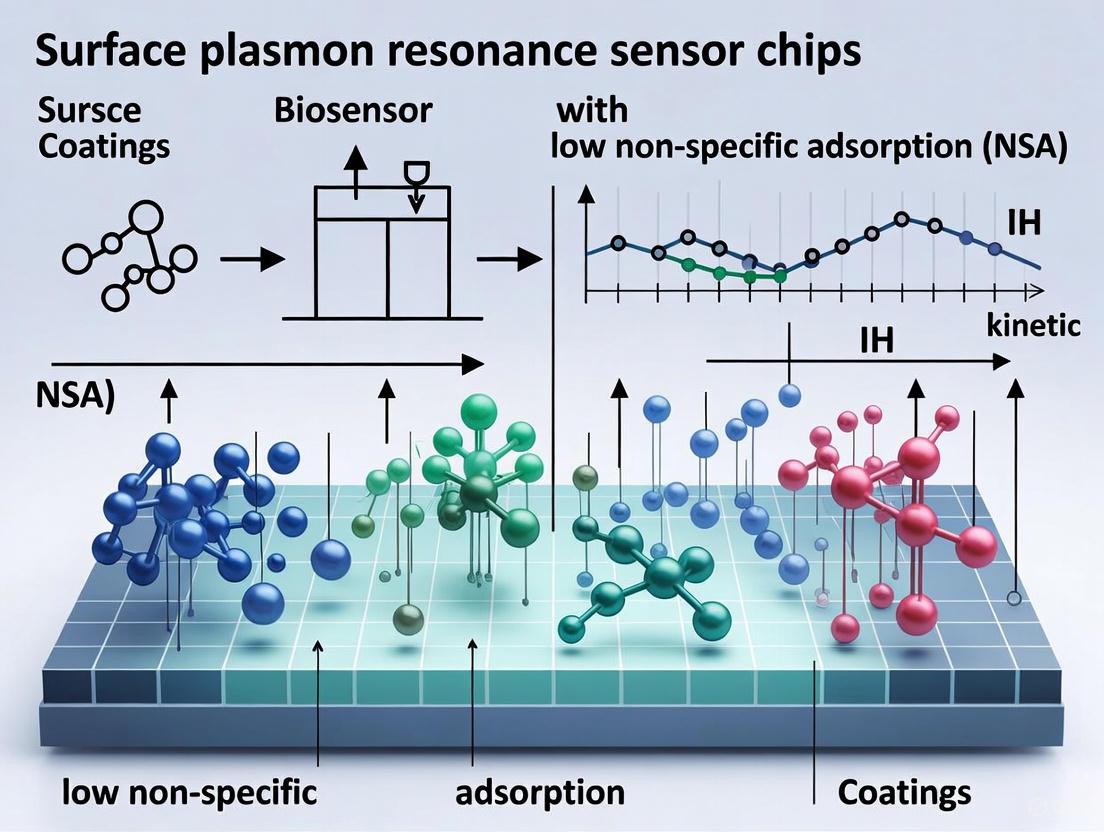
Surface Plasmon Resonance (SPR) biosensors are powerful label-free tools for real-time biomolecular interaction analysis, but their performance in complex media is severely hampered by non-specific adsorption (NSA).
Advanced Low NSA Coatings for SPR Sensor Chips: Enhancing Sensitivity and Specificity in Biomedical Analysis
Abstract
Surface Plasmon Resonance (SPR) biosensors are powerful label-free tools for real-time biomolecular interaction analysis, but their performance in complex media is severely hampered by non-specific adsorption (NSA). This article provides a comprehensive overview for researchers and drug development professionals on the latest strategies to combat NSA in SPR sensing. We explore the fundamental mechanisms of NSA and its detrimental impact on analytical signals. The review details innovative passive and active NSA reduction methods, including novel antifouling coatings and engineered surface architectures. Furthermore, we cover advanced optimization techniques, such as algorithm-assisted design and nanomaterial signal amplification, and critically evaluate sensor performance through validation protocols and comparative analysis of real-world applications in clinical diagnostics and drug screening.
Understanding and Combating Non-Specific Adsorption in SPR Biosensing
Non-specific adsorption (NSA) represents a fundamental barrier impeding the reliable application of surface plasmon resonance (SPR) biosensors in complex biological samples. NSA refers to the undesirable accumulation of non-target matrix components—such as proteins, lipids, and other biomolecules—onto the biosensing interface [1]. This fouling phenomenon severely compromises analytical performance by generating false-positive signals, obscuring genuine target-binding events, and reducing the functional stability of immobilized bioreceptors [1] [2]. In clinical and pharmaceutical contexts, where samples like blood serum, plasma, and cell lysates contain interfering proteins at concentrations of 40-80 mg/mL, the challenge is particularly acute [3]. The primary consequence of NSA is a diminished correlation between the measured SPR signal and the true concentration of the target analyte, ultimately leading to inaccurate data interpretation and unreliable diagnostic or research outcomes [1] [4]. This Application Note delineates the mechanisms of NSA, presents quantitative evaluations of antifouling strategies, and provides standardized protocols to characterize and mitigate surface fouling, thereby enabling more robust SPR-based analyses in real-world samples.
Mechanisms and Impact of Non-Specific Adsorption
Fundamental Mechanisms of NSA
NSA occurs through a combination of physicochemical interactions between the sensor surface and the myriad components present in complex samples. The primary driving forces include electrostatic interactions between charged surface groups and biomolecules, hydrophobic interactions, hydrogen bonding, and van der Waals forces [1]. The absence of a sufficiently repellent and inert interface allows these interactions to prevail, leading to the progressive passivation of the sensor surface. The impact of this fouling is twofold: firstly, nonspecifically adsorbed molecules directly contribute to the local refractive index change measured by SPR, creating a signal that is indistinguishable from specific binding; and secondly, these molecules can sterically hinder the target analyte's access to the immobilized bioreceptor, potentially causing false negatives at low analyte concentrations [1].
Visualizing the Impact of NSA on Sensorgram Data
The following diagram illustrates how NSA manifests in a typical SPR sensorgram, differentiating the signal contributions from specific binding versus non-specific fouling.
Quantitative Comparison of Antifouling Surface Chemistries
Performance Benchmarking in Complex Media
Evaluating the efficacy of antifouling coatings requires exposure to biologically relevant matrices. The table below summarizes the measured non-specific adsorption levels of various surface chemistries when challenged with bovine serum containing 76 mg/mL of total protein [3] [5].
Table 1: Quantitative Comparison of Antifouling Surface Performance in Complex Media
| Surface Chemistry | Composition/Sequence | NSA Level (Response Units) | Key Characteristics |
|---|---|---|---|
| Afficoat | Zwitterionic peptide SAM [3] | ~50 RU | Proprietary thiol-terminated peptide, hydrophilic, zwitterionic |
| PEG | Polyethylene glycol [3] | ~400 RU | Well-established polymer, hydrophilic |
| CM-Dextran | Carboxymethylated dextran [3] | ~1100 RU | Hydrogel matrix, common in commercial chips |
| Surface-Initiated Polymerization (SIP) | Polymer brush layer [5] | Low (specific data not shown) | High sensitivity, minimal NSA per study |
| Dextran Hydrogel | Cross-linked polysaccharide [5] | Moderate (specific data not shown) | Common commercial surface |
| α-Cyclodextrin | Cyclic oligosaccharide [5] | High (specific data not shown) | Macrocyclic structure |
Peptide-Based SAMs: Sequence-Specific Performance
Zwitterionic peptides have emerged as highly effective antifouling materials. Research has systematically evaluated how sequence variation influences NSA, identifying an optimal pattern that minimizes fouling from crude serum [3].
Table 2: Influence of Peptide Sequence on Non-Specific Adsorption from Serum
| Sequence ID | Peptide Sequence Pattern | Relative NSA Level |
|---|---|---|
| Sequence #5 (Afficoat) | Cys-X-Y-Z-Z-Y-X (Specific AA pattern) [3] | Lowest |
| Sequence #1 | Cys-X-X-X-X | Higher |
| Sequence #2 | Cys-X-Y-X-Y | High |
| Sequence #3 | Cys-X-Y-Z-Y-X | Moderate |
| Sequence #4 | Cys-X-Y-Z-Z-Y-X (Different AA pattern) | Moderate-High |
| 3-MPA Reference | 3-Mercaptopropionic Acid | Highest |
Experimental Protocols for NSA Evaluation and Mitigation
Standardized Protocol for Quantifying NSA on SPR Sensor Chips
Objective: To quantitatively evaluate the non-specific adsorption resistance of a modified SPR sensor chip against complex biological samples.
Materials:
- SPR Instrument: Configured in Kretschmann geometry (e.g., Affinité P4SPR or BI-4500) [6] [3] [7].
- Running Buffer: Phosphate Buffered Saline (PBS), pH 7.4, filtered and degassed.
- Foulant Solution: Crude bovine serum (76 mg/mL total protein) or cell lysate in running buffer [3] [5].
- Sensor Chips: Gold chips functionalized with candidate antifouling coatings (e.g., Afficoat, PEG, dextran).
Procedure:
- Surface Pre-Conditioning: Dock the sensor chip and prime the fluidic system with running buffer until a stable baseline is achieved (± 1 RU/min).
- Initial Baseline: Record the baseline signal in running buffer for at least 5 minutes.
- Sample Exposure: Inject the foulant solution (crude serum or cell lysate) over the sensor surface for 20 minutes at a constant flow rate (e.g., 30 μL/min).
- Wash Phase: Switch back to running buffer and monitor the signal for an additional 10-15 minutes to remove loosely adsorbed material.
- Signal Quantification: Calculate the total NSA level as the difference between the final stable signal after washing and the initial baseline. Express the result in Resonance Units (RU).
- Surface Regeneration (Optional): For reusability testing, apply a regeneration solution (e.g., 10 mM glycine-HCl, pH 2.0) and monitor signal return to baseline.
Protocol for Functional Validation of Immobilized Bioreceptors
Objective: To confirm that the antifouling coating allows for proper orientation and functionality of immobilized bioreceptors after exposure to complex media.
Materials:
- His-tagged protein (e.g., human dihydrofolate reductase - hDHFR).
- NTA analog and Copper (II) sulfate solution.
- Specific binding partner (e.g., IgG for a His-tagged maltose binding protein).
- Serial concentrations of binding analyte for kinetic analysis.
Procedure:
- Surface Functionalization: Immobilize the His-tagged protein onto the Afficoat-modified chip via NTA-Cu²⁺ coordination chemistry [3].
- Activity Assay (Optional for enzymes): Inject enzyme substrate and quantify turnover, comparing activity to the solution-phase equivalent.
- Binding Kinetics: Inject serial dilutions of the specific binding partner over the functionalized surface.
- Data Analysis: Fit the resulting sensorgrams to a 1:1 binding model to determine the association (kₐ) and dissociation (kd) rate constants, and calculate the equilibrium dissociation constant (KD).
- Validation Criterion: A K_D value consistent with literature reports (e.g., ~9.6 nM for a maltose binding protein-IgG interaction) confirms retained bioreceptor functionality [3].
Workflow for Developing Low-NSA SPR Assays
The following flowchart outlines a systematic approach for developing, evaluating, and validating a low-fouling SPR biosensor for complex sample analysis.
The Scientist's Toolkit: Essential Reagents and Materials
Successful implementation of low-NSA SPR biosensing requires carefully selected materials and reagents. The following table catalogs key solutions utilized in the development and evaluation of antifouling interfaces.
Table 3: Essential Research Reagent Solutions for Low-NSA SPR
| Reagent/Material | Function & Utility | Application Notes |
|---|---|---|
| Afficoat Coating | Zwitterionic peptide SAM for gold surfaces; provides ultralow fouling while allowing bioreceptor immobilization [3]. | Ideal for analysis in serum, plasma, and cell lysate; compatible with amine and His-tag coupling. |
| PEG-Based Thiols | Alkanethiols with polyethylene glycol terminal groups; create hydrophilic, protein-repellent surfaces [5]. | A well-established option; functional end groups (e.g., -COOH, -OH) allow for various conjugation chemistries. |
| Dextran Hydrogel Chips | 3D carboxymethylated dextran matrix; common commercial surface offering high ligand loading [2] [5]. | Can exhibit significant NSA in complex media; requires optimization for specific applications. |
| Tris-NTA Sensor Chips | For capturing His-tagged proteins; enables oriented immobilization, which can help minimize NSA [7]. | Useful for membrane proteins like GPCRs; requires control over metal ion chelation. |
| Mixed SAM Kits | Pre-mixed solutions of functional and backfill thiols (e.g., DSP/MCH) to control surface density and minimize steric hindrance [2]. | Reduces non-specific interactions and maintains bioreceptor accessibility. |
| Regeneration Solutions | Low pH buffers (e.g., Glycine-HCl) or surfactants to remove strongly adsorbed foulants for surface re-use. | Must be validated to ensure they do not damage the antifouling layer or immobilized bioreceptor. |
Non-specific adsorption remains a critical challenge that must be systematically addressed to advance SPR biosensing into routine use with complex biological samples. As demonstrated, the selection and optimization of the sensor interface chemistry—such as zwitterionic peptide SAMs like Afficoat—is paramount to achieving ultralow fouling surfaces [3]. The quantitative data and standardized protocols provided herein furnish researchers with a framework to rigorously evaluate NSA and develop robust, reliable SPR assays. By adopting these detailed methodologies and leveraging the listed research tools, scientists can better navigate the complexities of analyzing serum, cell lysates, and other challenging matrices. This progression is essential for unlocking the full potential of SPR in transformative applications such as clinical diagnostics, therapeutic drug monitoring, and fundamental biomolecular interaction studies.
Non-specific adsorption (NSA) is a fundamental challenge that impacts the performance of surface-based biosensors, including surface plasmon resonance (SPR) sensors. It refers to the undesirable accumulation of atoms, ions, or molecules from a gas, liquid, or dissolved solid onto a sensing surface, leading to elevated background signals, false positives, reduced sensitivity, and compromised selectivity and reproducibility [1] [8]. For SPR sensor chips, which detect changes in the refractive index at a metal-dielectric interface, NSA can obscure the specific binding signal of interest, drastically limiting their reliability in drug development and clinical diagnostics [9] [10]. The mechanisms driving NSA are primarily rooted in physisorption, facilitated by a combination of electrostatic interactions, hydrophobic forces, and van der Waals forces [1] [8]. Understanding and controlling these interactions is therefore critical for developing SPR sensor chips with low NSA coatings. This Application Note details the core mechanisms of NSA and provides validated protocols for characterizing and mitigating its effects.
Theoretical Foundations of NSA Mechanisms
Physisorption: The Overarching Framework
NSA is predominantly governed by physisorption, a type of physical adsorption characterized by weaker intermolecular forces, as opposed to chemisorption, which involves the formation of chemical bonds [8]. Physisorption is reversible and can occur on any surface, but its impact is particularly detrimental in biosensing due to the difficulty in distinguishing its signal from that of a specific binding event.
Table 1: Key Interactions in Physisorption-Based NSA
| Interaction Type | Driving Force | Common Occurrence in Biosensing |
|---|---|---|
| Electrostatic | Attraction between oppositely charged surfaces and molecules [11] [1] | Adsorption of serum proteins on a charged sensor surface in buffer solutions [11]. |
| Hydrophobic | Interaction between non-polar surfaces and molecules in an aqueous environment [1] [8] | Adsorption of lipoproteins or denatured proteins on hydrophobic gold films [8]. |
| van der Waals | Weak, short-range forces between atomic dipoles [1] [8] | Ubiquitous in all adsorption processes, contributing to the initial adherence of molecules. |
Electrostatic Interactions
Electrostatic interactions occur between charged functional groups on the sensor surface and ions or polar molecules in the analyte solution. The strength of these interactions is described by Coulomb's law and is highly dependent on the surface charge (zeta potential) of the sensor chip and the ionic strength and pH of the buffer. For instance, a negatively charged citrate-stabilized silver surface will strongly attract cationic analytes, while anionic analytes may be repelled [11]. This principle was clearly demonstrated in a SERS study where the intensity of the signal for a charged porphyrin molecule correlated strongly with the oppositely charged functional group on the substrate, to the point of complete signal disappearance when the charges were not complementary [11].
Hydrophobic Interactions
In aqueous environments, hydrophobic interactions drive the association of non-polar regions on the sensor surface with non-polar domains of analyte molecules to minimize the energetically unfavorable contact with water. These interactions are a major contributor to the fouling of bare metal surfaces like gold, which are inherently hydrophobic. The adsorption is entropically driven, as the release of ordered water molecules from the hydrophobic interfaces increases the system's entropy [8].
The Combined Effect
In practice, NSA is rarely the result of a single interaction. Instead, it is typically the cumulative effect of electrostatic, hydrophobic, and van der Waals forces [1]. A protein, for example, may initially approach a surface via long-range electrostatic attraction, followed by short-range hydrophobic interactions that strengthen the adhesion.
Figure 1: Mechanisms and Impacts of NSA. Diagram illustrating how different physical interactions contribute to non-specific adsorption and its detrimental effects on biosensor performance.
Experimental Protocols for Investigating NSA
Protocol 1: Evaluating NSA via Real-Time SPR Monitoring
This protocol uses an SPR biosensor to quantify NSA by monitoring reflectivity changes upon exposure to a complex sample.
1. Materials and Reagents
- SPR Instrument: Kretschmann-configured SPR biosensor with a flow cell [12] [10].
- Sensor Chip: Bare gold chip (e.g., 45 nm Au on 2 nm Cr adhesion layer on glass) [12] [10].
- Buffers: Phosphate Buffered Saline (PBS), 10 mM, pH 7.4.
- NSA Sample: 10% (v/v) Fetal Bovine Serum (FBS) in PBS or undiluted human serum.
- Blocking Solution: 1% (w/v) Bovine Serum Albumin (BSA) in PBS.
- Regeneration Solution: 10 mM Glycine-HCl, pH 2.0.
2. Procedure 1. Baseline Establishment: Prime the SPR system and flow cell with PBS at a constant flow rate (e.g., 20 µL/min) until a stable baseline is achieved. 2. NSA Challenge: Switch the inlet to the 10% FBS solution and monitor the SPR angle shift for 15-20 minutes. The rapid increase in signal corresponds to the non-specific adsorption of serum proteins onto the gold surface. 3. Washing: Revert to PBS flow. A persistent signal after washing indicates irreversible NSA. 4. Data Analysis: Calculate the total angular shift (in Resonance Units, RU) between the stable PBS baseline and the plateau after PBS washing. This value quantifies the level of NSA on the bare sensor chip.
3. Antifouling Coating Test 1. Chip Functionalization: Repeat the experiment with a sensor chip coated with an antifouling polymer (e.g., carboxymethyl chitosan) [12]. 2. Comparison: The reduction in the angular shift upon FBS exposure, compared to the bare gold chip, directly demonstrates the efficacy of the low-NSA coating.
Protocol 2: Probing Electrostatic Interactions via Zeta Potential and SERS
This protocol investigates the role of electrostatic interactions by systematically varying the surface charge of a plasmonic substrate.
1. Materials and Reagents
- Substrate: Silver nanoparticle (Ag NP) film immobilized on a glass slide [11].
- Functionalization Thiols:
- Negative Charge: Sodium 2-mercaptoethyl sulfonate.
- Positive Charge: 2-(dimethylamino)ethanethiol hydrochloride.
- Neutral: 2-mercaptoethanol.
- Probe Analytes:
- Cationic: Copper(II) tetrakis(4-N-methylpyridyl) porphine (CuTMpyP4).
- Anionic: Copper(II) 5,10,15,20-tetrakis(4-sulfonatophenyl)porphine (CuTSPP4) [11].
- Instrument: Raman spectrometer.
2. Procedure 1. Surface Charge Modification: Immerse the Ag NP films in 1 mM ethanolic solutions of the different thiols for 2 hours to form self-assembled monolayers (SAMs). Rinse thoroughly with ethanol and water, then dry under a nitrogen stream. 2. Zeta Potential Measurement: Characterize the surface charge of each functionalized film using a zeta potential analyzer. 3. SERS Measurement: - Apply a 10 µL droplet of the cationic probe (CuTMpyP4) onto the differently charged substrates. - Acquire SERS spectra using identical laser power and integration times. - Repeat with the anionic probe (CuTSPP4). 4. Data Analysis: Compare the intensity of the characteristic porphyrin Raman peaks. The strongest SERS signal is expected when the substrate and analyte charges are opposite (e.g., cationic analyte on a negatively charged surface), demonstrating the critical role of electrostatic interactions in promoting or preventing adsorption [11].
Table 2: Expected SERS Intensity Based on Electrostatic Interaction
| Substrate Surface Charge | Cationic Analyte (CuTMpyP4) SERS Signal | Anionic Analyte (CuTSPP4) SERS Signal |
|---|---|---|
| Negative | Strong [11] | Weak/Absent [11] |
| Positive | Weak/Absent | Strong |
| Neutral | Moderate | Moderate |
The Scientist's Toolkit: Research Reagent Solutions
Table 3: Essential Materials for NSA Mechanism Research and Mitigation
| Reagent / Material | Function / Role in NSA Context | Example Application |
|---|---|---|
| Gold Sensor Chip | The standard plasmonic substrate for SPR sensing; inherently prone to NSA due to hydrophobicity. | Serves as the baseline control for NSA experiments [12] [10]. |
| Functional Thiols | Form self-assembled monolayers (SAMs) to present defined terminal charges (-NH₃⁺, -SO₃⁻, -OH) on gold. | Used to systematically study the effect of electrostatic interactions on NSA [11]. |
| Bovine Serum Albumin (BSA) | A "blocker" protein used to passivate uncovered hydrophobic surfaces on a sensor chip. | Reduces NSA by physically occupying vacant sites [8]. |
| Carboxymethyl Chitosan | A hydrophilic polymer coating that creates a hydrated layer, resisting protein adsorption. | Applied as a spin-coated film to create an antifouling surface on SPR chips [12]. |
| Amino Acid-Derived Carbon Dots | Nanomaterial that provides electric-field enhancement and adsorption sites; can be functionalized. | Used to modify SPR chips, enhancing signal and providing functional groups for specific binding [12]. |
| Polyethylenimine (PEI) | A cationic polymer that can invert the surface charge of a substrate. | Promotes adsorption of negatively charged analytes (e.g., oligonucleotides) by electrostatic attraction [11]. |
| Multicharged Metal Ions (e.g., Cu²⁺) | Act as ionic cross-linkers; can neutralize or invert the charge of anionic analytes. | Added to analyte solution to facilitate the detection of negatively charged molecules on Ag surfaces [11]. |
The mechanisms of non-specific adsorption—physisorption driven by electrostatic, hydrophobic, and van der Waals interactions—pose a significant barrier to the accuracy of SPR biosensors. A deep understanding of these forces is not merely academic; it provides the foundational knowledge required to design effective mitigation strategies. The experimental protocols outlined herein allow for the systematic investigation and quantification of NSA. By employing tailored low-NSA coatings, such as hydrophilic polymers and strategically charged monolayers, researchers can significantly enhance the signal-to-noise ratio, specificity, and overall reliability of SPR sensor chips. This advancement is crucial for applications in drug development, where the precise quantification of biomolecular interactions is paramount.
Non-specific adsorption (NSA) remains a principal barrier to the reliable application of biosensors in clinical and pharmaceutical settings. NSA refers to the accumulation of non-target molecules (e.g., proteins, lipids, cells) from a sample matrix onto the biosensing interface [1]. This fouling critically compromises analytical performance by causing false positives, reducing sensitivity, and inducing signal drift, which can lead to erroneous diagnostic or research conclusions [1]. For researchers developing surface plasmon resonance (SPR) sensor chips with low NSA coatings, a deep understanding of these impacts and the methodologies to evaluate them is essential. This document details the quantitative effects of NSA, provides validated experimental protocols for its assessment, and highlights promising antifouling strategies.
Quantitative Impact of NSA on Biosensor Performance
The following tables summarize the specific performance degradations caused by NSA, as evidenced by recent research.
Table 1: Documented Impacts of NSA on Biosensor Analytical Performance
| Performance Metric | Impact of NSA | Consequence | Supporting Evidence |
|---|---|---|---|
| False Positive Rate | Increased | Non-target molecules generate a signal mimicking the specific analyte, leading to incorrect positive results [1]. | SPR immunosensors show indistinguishable reflectivity changes from specific binding and fouling [1]. |
| Sensitivity / LOD | Reduced | Fouling molecules sterically hinder analyte access to bioreceptors or passivate the transducer surface [1] [13]. | Electrochemical aptamer-based (E-AB) biosensors experience restricted conformational changes, dampening signal [1]. |
| Signal Stability | Drift | Progressive accumulation of foulants causes a continuous baseline shift over time, complicating signal interpretation [1]. | E-AB biosensors exhibit signal degradation over longer timescales, which cannot be corrected by algorithms alone [1]. |
| Selectivity | Compromised | Signal from adsorbed interferents masks the specific biorecognition event [1]. | In EC enzyme biosensors, electrochemical transformation of adsorbed species can overshadow the enzymatic signal [1]. |
Table 2: Performance of Biosensors Employing Antifouling Strategies in Complex Media
| Biosensor Type | Antifouling Strategy | Target Analyte | Complex Matrix | Key Performance Outcome |
|---|---|---|---|---|
| Electrochemical [13] | Silane-based interfacial chemistry (MEG-Cl) | Lysophosphatidic Acid (LPA) | Goat Serum | LOD of 0.7 µM achieved, demonstrating functionality in a fouling environment [13]. |
| SPR & EC-SPR [1] | Antifouling coatings (e.g., peptides, cross-linked proteins, hybrid materials) | Various | Blood, Serum, Milk | Wide range of materials developed with tunable conductivity, thickness, and functional groups to minimize NSA [1]. |
Experimental Protocols for NSA Evaluation
To rigorously assess the efficacy of low-NSA coatings for SPR chips, the following protocols, adapted from recent literature, are recommended.
Protocol: Evaluating NSA on SPR Chips using a Model Protein Solution
This protocol provides a method to quantify fouling on an SPR sensor surface.
- Objective: To measure the degree of non-specific adsorption of serum proteins onto a newly developed low-NSA SPR sensor chip.
- Materials:
- SPR instrument.
- Low-NSA SPR sensor chip.
- Control SPR sensor chip (e.g., bare gold or standard carboxymethyl dextran).
- Phosphate Buffered Saline (PBS), pH 7.4.
- Fetal Bovine Serum (FBS) or pure Bovine Serum Albumin (BSA) solution (1 mg/mL in PBS).
- Regeneration solution (e.g., 10 mM Glycine-HCl, pH 2.0).
- Workflow:
- Procedure:
- Surface Preparation: Dock the sensor chip and prime the SPR system with PBS at a constant flow rate (e.g., 20 µL/min) until a stable baseline is achieved.
- Initial Baseline: Record the stable baseline resonance unit (RU) value for at least 5 minutes.
- Sample Injection: Switch the flow to the FBS or BSA solution for a defined period (e.g., 10-15 minutes). Observe the rapid increase in RU signal.
- Wash Step: Switch the flow back to PBS for 10-15 minutes. The signal will drop slightly and then stabilize; the remaining RU change represents irreversibly adsorbed protein.
- Data Collection: Record the total RU change, calculated as the difference between the stabilized signal after the wash and the initial baseline. A lower value indicates superior antifouling performance.
- Surface Regeneration: Inject the regeneration solution to remove adsorbed proteins and prepare the surface for the next experiment.
- Data Analysis: Compare the final RU change for the low-NSA chip versus the control chip. A significant reduction (e.g., >80-90%) confirms the effectiveness of the antifouling coating.
Protocol: Assessing Biosensor Signal Drift due to Fouling
This protocol is designed to characterize the long-term signal stability of a biosensor in a complex matrix.
- Objective: To monitor and quantify signal drift in an electrochemical biosensor caused by prolonged exposure to serum.
- Materials:
- Functionalized electrochemical biosensor.
- Potentiostat.
- Goat serum or diluted human serum.
- PBS, pH 7.4.
- Target analyte at a known, fixed concentration.
- Workflow:
- Procedure:
- Initial Calibration: Measure the electrochemical signal (e.g., current, impedance) of the biosensor for a fixed, low concentration of its target analyte in PBS. This establishes the baseline sensitivity.
- Serum Exposure: Immerse the biosensor in a vial containing goat serum. Place the vial in a controlled environment (e.g., 37°C).
- Periodic Measurement: At predetermined intervals (e.g., every 30 minutes for 6 hours), remove the sensor from the serum, rinse it gently with PBS, and measure the signal for the same fixed concentration of the analyte in PBS.
- Data Collection: Record the signal value at each time point.
- Drift Analysis: Plot the measured signal against time. A stable coating will show a flat line, while a fouling-prone sensor will exhibit a trend (increasing or decreasing). The drift rate can be calculated as the percentage change in signal per hour.
- Data Analysis: A significant signal drift over time indicates that NSA is progressively altering the sensor's interface, affecting its analytical reliability. This is a critical test for sensors intended for continuous monitoring.
The Scientist's Toolkit: Key Reagents for Low-NSA Biosensor Research
Table 3: Essential Research Reagents for Developing and Testing Low-NSA Biosensors
| Reagent / Material | Function / Role | Application Example |
|---|---|---|
| Silane-based Linkers (e.g., MEG-Cl [13]) | Forms an antifouling self-assembled monolayer on metal oxides (e.g., steel, oxides on sensor surfaces), reducing NSA while providing functional groups for bioreceptor immobilization. | Used on stainless steel electrodes to create a low-fouling surface for detecting LPA in serum [13]. |
| Peptide-based Coatings [1] | Short amino acid sequences designed to form highly hydrated layers that resist protein adsorption through thermodynamic and steric repulsion. | Emerging as tunable, biocompatible antifouling layers for electrochemical and optical biosensors. |
| Cross-linked Protein Films (e.g., BSA) [1] | Creates a dense, hydrophilic network that acts as a physical and chemical barrier to the adsorption of other proteins. | A classic and widely used strategy to block non-specific binding sites on sensor surfaces and in immunoassays. |
| Hybrid Materials [1] | Combines organic polymers with inorganic nanoparticles to create coatings with tunable conductivity, thickness, and mechanical properties optimized for specific transducers (EC, SPR). | Future research focus for EC-SPR biosensors, aiming to meet dual requirements of conductivity (EC) and controlled thickness (SPR). |
| Model Foulants (e.g., FBS, BSA) [1] [13] | A complex protein mixture or a single high-abundance protein used to simulate the fouling potential of real-world samples like blood or serum in controlled experiments. | Essential for the initial screening and benchmarking of new antifouling coatings. |
NSA directly and detrimentally impacts critical biosensor performance parameters, including false positives, sensitivity, and signal stability. The protocols outlined herein for SPR and electrochemical platforms provide a standardized framework to quantitatively evaluate these effects and benchmark new low-NSA coatings. The ongoing development of advanced materials, such as engineered silanes, peptides, and hybrid films, holds significant promise for fabricating robust SPR sensor chips capable of reliable operation in complex biological matrices like blood and serum. Overcoming the challenge of NSA is a critical step toward the widespread adoption of biosensors in clinical diagnostics and drug development.
The Critical Role of Low NSA Coatings in Enabling Accurate Real-Time Detection
Non-specific adsorption (NSA) is a critical challenge that compromises the performance of surface plasmon resonance (SPR) biosensors, particularly in complex medical and pharmaceutical applications. NSA refers to the undesirable accumulation of non-target molecules (e.g., proteins, lipids, cells) from a sample matrix onto the biosensor surface. This fouling phenomenon leads to false-positive signals, reduced sensitivity, and inaccurate quantification of binding kinetics by generating background signals indistinguishable from specific analyte binding [1] [8]. For drug development professionals relying on SPR to characterize biomolecular interactions, NSA can obscure critical data on binding affinity (K_D), association rates (k_on), and dissociation rates (k_off), ultimately jeopardizing decision-making processes in therapeutic development pipelines.
The mechanisms driving NSA primarily involve physisorption through hydrophobic interactions, electrostatic forces, van der Waals forces, and hydrogen bonding between matrix components and the sensor surface [1] [8]. In complex biological matrices like blood serum, plasma, or milk, the high concentration of interfering proteins (e.g., albumin, immunoglobulins) creates a competitive environment for surface binding sites. Without effective countermeasures, these non-specific interactions can outweigh the specific signal from low-abundance analytes such as biomarkers, therapeutic proteins, or pathogens [1]. The implementation of low NSA coatings specifically engineered to minimize these interactions represents a foundational requirement for obtaining reliable analytical data from SPR biosensing platforms in real-world applications.
Strategies for Low NSA Surface Design
Passive Antifouling Coatings
Passive antifouling strategies aim to prevent NSA by creating a physicochemical barrier on the sensor surface that is repulsive to non-target molecules. These coatings function by forming a hydrated layer that presents a thermodynamically unfavorable environment for protein adsorption, effectively resisting fouling through steric repulsion and neutral surface charge [8].
Self-Assembled Monolayers (SAMs): Alkanethiols with specific terminal groups spontaneously form organized monolayers on gold surfaces. While simple SAMs like 11-mercaptoundecanoic acid (11-MUA) provide a foundation for bioreceptor immobilization, their antifouling performance can be enhanced by creating mixed SAMs that incorporate hydrophilic components such as 1-octane thiol or 6-mercapto-1-hexanol (MCH). These mixed layers reduce steric hindrance and create a more uniform non-fouling background [2].
Polymer-Based Coatings: Carboxymethylated dextran (CMD) remains a widely used hydrogel matrix that provides a hydrophilic, protein-resistant environment while offering abundant functional groups for ligand immobilization. However, emerging materials such as zwitterionic polymers have demonstrated superior antifouling performance in complex biological matrices. These polymers, containing both positive and negative charges within a single structural unit, create a strong hydration layer via electrostatic interactions that effectively resists protein adsorption [14] [1].
Biomimetic Peptides and Protein Films: Short peptide sequences and cross-linked protein films represent a newer class of antifouling materials. These biologically inspired coatings offer precise control over surface chemistry and can be engineered to present specific functional groups while maintaining resistance to NSA. Casein and milk proteins have been traditionally used as blocking agents, but more sophisticated engineered protein films now provide enhanced stability and reproducibility [1] [8].
Two-Dimensional Nanomaterials: The integration of 2D materials like graphene, MoS₂, WS₂, and WSe₂ into SPR sensor designs offers dual benefits of signal enhancement and fouling resistance. These materials can be functionalized to present atomically smooth, chemically inert surfaces while their high surface-to-volume ratio enables efficient biomolecular loading with minimal steric hindrance [15].
Table 1: Comparison of Antifouling Coating Materials for SPR Biosensors
| Material Class | Examples | Antifouling Mechanism | Advantages | Limitations |
|---|---|---|---|---|
| SAMs | 11-MUA, mixed SAMs with MCH | Hydrophilic barrier, steric repulsion | Easy preparation, well-defined structure | Limited long-term stability, potential oxidation |
| Polymer Hydrogels | CMD, zwitterionic polymers | Strong hydration layer, charge neutrality | High ligand loading capacity, tunable thickness | May cause steric hindrance for large analytes |
| Peptide/Protein Films | Cross-linked albumin, engineered peptides | Biomimetic surface passivation | Biocompatibility, customizable functionality | Batch-to-batch variability, potential immunogenicity |
| 2D Nanomaterials | Graphene, MoS₂, WS₂ | Atomically smooth surface, chemical inertness | Signal enhancement, high surface area | Complex fabrication, potential toxicity concerns |
Active NSA Removal Methods
Active NSA removal approaches employ external energy to disrupt and remove non-specifically bound molecules from the sensor surface after fouling has occurred. These methods are particularly valuable in continuous monitoring applications where passive coatings alone may be insufficient.
Electromechanical Removal: These techniques utilize piezoelectric transducers to generate surface acoustic waves or mechanical vibrations that create shear forces sufficient to dislodge weakly adsorbed biomolecules without affecting covalently immobilized receptors [8].
Acoustic Removal: Similar to electromechanical approaches but operating at different frequency ranges, acoustic methods induce nano-vibrations at the sensor-liquid interface that preferentially remove physisorbed molecules while leaving specifically bound analytes intact [8].
Hydrodynamic Removal: Leveraging controlled microfluidic flow conditions, this approach applies precisely calibrated shear forces to wash away non-specifically adsorbed components. Advanced microfluidic designs can create flow gradients that optimize the balance between NSA removal and retention of specifically bound analytes [8].
Quantitative Performance of Low NSA Coatings
The efficacy of antifouling strategies is quantitatively assessed through key performance metrics, including the reduction in non-specific signal, the retention of specific binding capacity, and the overall impact on sensor sensitivity. The table below summarizes representative data from recent studies demonstrating the performance of various low NSA coatings in SPR biosensing applications.
Table 2: Performance Metrics of Low NSA Coatings in SPR Biosensors
| Coating Strategy | Test Matrix | NSA Reduction (%) | Specific Signal Retention | Limit of Detection Improvement |
|---|---|---|---|---|
| Zwitterionic Polymer | Undiluted human serum | >95% | 92% | 10-fold vs. CMD chips |
| Mixed SAM (DSP/MCH) | Blood plasma (1:10 dilution) | 90% | 88% | 5-fold vs. single-component SAM |
| Peptide-based Coating | Milk (10% solution) | 87% | 85% | 8-fold vs. BSA-blocked surface |
| Graphene Oxide Hybrid | Artificial saliva | 92% | 90% | 12-fold vs. uncoated CSF tip [16] |
| Nitrilotriacetic Acid (NTA) | Cell lysate | 82% | 95% | 3-fold vs. traditional His-tag capture |
The data reveal that advanced coatings like zwitterionic polymers and graphene oxide hybrids consistently achieve >90% reduction in NSA while maintaining high specific binding capacity. This performance level is particularly notable in challenging matrices like undiluted serum and saliva, where traditional coatings often fail. The improvement in detection limits underscores the critical importance of low NSA coatings for measuring low-abundance analytes in complex samples—a common requirement in pharmaceutical research and medical diagnostics [14] [16] [1].
Experimental Protocols for NSA Evaluation
Protocol: Standardized NSA Assessment in Complex Matrices
Principle: This protocol provides a standardized methodology for quantitatively evaluating the antifouling performance of modified SPR sensor chips using complex biological samples. The approach measures both the degree of non-specific adsorption and the retention of specific binding capability.
Materials:
- SPR instrument with flow cell system
- Functionalized sensor chips with antifouling coatings
- Reference sensor chip (unmodified or standard CMD)
- Complex test matrices (e.g., undiluted fetal bovine serum, human plasma, synthetic saliva)
- Running buffer (e.g., 10 mM PBS with 0.05% Tween 20, pH 7.4)
- Specific binding pair (e.g., antibody-antigen for validation)
Procedure:
- Surface Preparation: If evaluating specific binding retention, immobilize the capture ligand (e.g., antibody) onto both test and reference chips using standard amine coupling chemistry.
- System Equilibration: Prime the SPR system with running buffer until a stable baseline is achieved (±1 RU/min for 5 minutes).
- Initial Baseline: Record the baseline signal in running buffer for 60 seconds to establish the reference point.
- Sample Injection: Inject the complex test matrix sample for 300 seconds at a flow rate of 30 μL/min to monitor the association phase.
- Dissociation Phase: Switch to running buffer for 600 seconds to monitor dissociation of weakly bound components.
- Surface Regeneration: If applicable, apply a regeneration solution (e.g., 10 mM glycine-HCl, pH 2.0) for 30 seconds to remove all bound material.
- Specific Binding Validation: For functional chips, inject a known concentration of specific analyte to verify binding capacity retention after NSA testing.
- Data Analysis: Calculate NSA as the response unit (RU) difference between the baseline and the stabilized signal after dissociation. Compare test chips against reference surfaces [1].
Protocol: Functionalization of SPR Chip with Zwitterionic Coating
Principle: This protocol describes the step-by-step functionalization of a gold SPR sensor chip with a zwitterionic polymer coating to achieve low NSA surfaces with maintained specific binding functionality.
Materials:
- Bare gold SPR sensor chips
- Piranha solution (3:1 H₂SO₄:H₂O₂) CAUTION: Highly corrosive
- Oxygen plasma cleaner (alternative to piranha)
- Zwitterionic polymer solution (e.g., poly(carboxybetaine methacrylate), 1 mg/mL in ultrapure water)
- EDC/NHS activation solution (0.4 M EDC/0.1 M NHS in water)
- Ethanolamine solution (1 M, pH 8.5)
- Phosphate buffered saline (PBS, 10 mM, pH 7.4)
Procedure:
- Surface Cleaning: Immerse gold chips in freshly prepared piranha solution for 5 minutes OR treat with oxygen plasma for 2 minutes at 100 W.
- Rinsing: Thoroughly rinse chips with copious amounts of ultrapure water and dry under nitrogen stream.
- Polymer Coating: Incubate cleaned chips in zwitterionic polymer solution for 16 hours at room temperature.
- Washing: Rinse modified chips with PBS to remove physically adsorbed polymer.
- Functional Group Activation (if needed for downstream immobilization): Inject EDC/NHS activation solution over the coated surface for 15 minutes.
- Ligand Immobilization: Immediately introduce the solution containing the bioreceptor (e.g., antibody, DNA probe) for covalent coupling.
- Quenching: Block remaining active esters with ethanolamine solution for 10 minutes.
- Final Washing: Rinse with PBS and store in buffer at 4°C until use [14] [2].
Research Reagent Solutions
Table 3: Essential Materials for Developing Low NSA SPR Biosensors
| Reagent/Material | Function | Application Notes |
|---|---|---|
| 11-Mercaptoundecanoic acid (11-MUA) | SAM formation with carboxyl termination | Foundation for mixed SAMs; enables EDC/NHS chemistry |
| 6-Mercapto-1-hexanol (MCH) | Hydrophilic co-adsorbent in mixed SAMs | Reduces NSA and steric hindrance when used with longer thiols |
| Carboxymethylated Dextran (CMD) | Hydrophilic polymer matrix | Traditional hydrogel coating; good balance of functionality and antifouling |
| Zwitterionic Polymers | Ultra-low fouling surface coating | Superior performance in blood/serum; requires optimization of immobilization chemistry |
| EDC/NHS Crosslinkers | Activation of carboxyl groups for ligand coupling | Standard chemistry for biomolecule immobilization on carboxylated surfaces |
| Casein and BSA | Traditional blocking agents | Effective for reducing NSA in purified systems; may leach in continuous flow |
| 2D Nanomaterials (Graphene, MoS₂) | Signal-enhanced antifouling layers | Provide dual benefits of sensitivity enhancement and fouling resistance |
| Piranha Solution | Gold surface cleaning and activation | Creates pristine surface for SAM formation; requires extreme caution in handling |
Schematic Representations
NSA Impact and Mitigation Mechanisms
SPR Chip Functionalization Workflow
The development and implementation of advanced low NSA coatings represent a critical enabling technology for expanding the applications of SPR biosensors in pharmaceutical research and medical diagnostics. The continued evolution of antifouling strategies—particularly zwitterionic polymers, 2D nanomaterials, and smart coatings that respond to environmental stimuli—promises to further enhance the reliability of real-time biomolecular interaction analysis in complex media.
Future directions in this field include the integration of artificial intelligence and machine learning for predictive modeling of coating performance, the development of multi-functional coatings that combine ultra-low fouling with enhanced signal transduction, and the creation of spatially patterned surfaces for multiplexed detection platforms [14] [1]. As these advanced coatings transition from research laboratories to commercial SPR platforms, they will undoubtedly accelerate drug discovery processes and improve the accuracy of diagnostic assays, ultimately contributing to the development of more effective therapeutics and personalized medicine approaches.
Innovative Materials and Functionalization Strategies for Low NSA SPR Chips
Non-specific adsorption (NSA) is a fundamental challenge that compromises the sensitivity, specificity, and reproducibility of surface plasmon resonance (SPR) biosensors [17]. NSA occurs when non-target molecules, such as proteins, physisorb onto the sensor surface through hydrophobic forces, ionic interactions, van der Waals forces, and hydrogen bonding, leading to elevated background signals and false positives [17] [1]. Passive NSA reduction methods, which involve coating the surface to create a non-fouling boundary layer, provide a critical strategy to mitigate this issue [17]. This application note details the use of self-assembled monolayers (SAMs) and advanced antifouling coatings within the context of developing high-performance SPR sensor chips for pharmaceutical research and diagnostic applications.
Core Principles of Passive NSA Reduction
Passive methods function by creating a thin, hydrophilic, and neutrally charged physical or chemical barrier on the sensor surface [17]. This barrier minimizes the intermolecular forces that drive the physisorption of non-target molecules, allowing them to be easily detached under low shear stresses such as washing [17]. The efficacy of a passive coating is determined by its ability to resist NSA while maintaining the functionality of immobilized bioreceptors.
Logical Workflow for Coating Selection and Evaluation The following diagram outlines a decision-making workflow for selecting and evaluating passive NSA reduction strategies for SPR sensor chips.
Key Antifouling Coating Strategies
The table below summarizes the primary classes of passive antifouling coatings used for SPR biosensing.
Table 1: Comparison of Antifouling Coating Strategies for SPR Biosensors
| Coating Type | Specific Examples | Immobilization Chemistry | Key Advantages | Key Limitations | Reported Performance |
|---|---|---|---|---|---|
| Self-Assembled Monayers (SAMs) | 11-Mercaptoundericanoic acid (11-MUA), mixed SAMs (e.g., DSP + MCH) [2] | Gold-thiol chemistry; terminal groups (-COOH, -OH, -NH2) for biomolecule conjugation [2] | Highly ordered structure; simple fabrication; tunable surface properties via terminal group [2] | Limited long-term stability; risk of thiol oxidation; time-consuming formation (>12 hrs) [2] | Mixed SAMs of DSP/MCH reduced steric hindrance and minimized NSA in an anti-thrombin immunosensor (LOD: 1.0–500.0 nM) [2] |
| Polymer Matrices | Carboxymethylated dextran (CMD), zwitterionic polymers, poly-L-lysine-polyethylene glycol (PLL-PEG) [14] [1] | Covalent coupling (e.g., EDC/NHS for CMD); electrostatic adsorption (PLL-PEG) [14] | High bioreceptor loading capacity (CMD); excellent hydrophilicity and antifouling performance (zwitterions) [14] | CMD can suffer from steric hindrance and significant NSA in complex matrices; thickness can affect SPR sensitivity [14] [1] | Zwitterionic coatings outperform traditional CMD in complex biological matrices [14]. PLL-PEG exhibits very low protein adsorption (<5 ng/cm²) [1]. |
| Hybrid & Nanomaterial Coatings | Nitrilotriacetic acid (NTA)-functionalized platforms, magnetic nanoparticles, 2D nanomaterials (e.g., MoS₂) [14] [2] | Varies by material; often used in conjunction with SAMs or polymers | Enhanced sensitivity; improved stability and reusability; some offer conductive properties [14] [2] | Fabrication complexity; potential for introducing new variability or background signals [2] | NTA platforms allow for oriented immobilization of His-tagged proteins, improving activity [14]. Nanomaterial integration boosts sensitivity and stability [2]. |
Experimental Protocols
Protocol: Gold Surface Activation and SAM Formation
This protocol is critical for preparing the SPR chip surface prior to the application of any functional coating or bioreceptor immobilization [2].
Research Reagent Solutions
- Piranha Solution: A mixture of concentrated sulfuric acid (H₂SO₄) and hydrogen peroxide (H₂O₂). Function: Vigorously removes organic and inorganic contaminants from the gold surface. Warning: Highly corrosive and explosive when in contact with organic solvents; handle with extreme care [2].
- O₂ Plasma: A low-pressure plasma generated from oxygen gas. Function: A less hazardous alternative to piranha for removing organic contaminants, resulting in a smoother, uniformly clean surface [2].
- 11-Mercaptoundecanoic Acid (11-MUA): A long-chain alkanethiol with a carboxylic acid terminal group. Function: Forms a stable SAM on gold, providing a carboxyl-functionalized surface for subsequent biomolecule immobilization via EDC/NHS chemistry [2].
- 6-Mercapto-1-hexanol (MCH): A short-chain, hydroxyl-terminated alkanethiol. Function: Used in mixed SAMs to dilute surface charge, reduce non-specific adsorption, and minimize steric hindrance from densely packed bioreceptors [2].
Procedure:
- Surface Cleaning: Immerse the bare gold sensor chip in a freshly prepared piranha solution (H₂SO₄:H₂O₂, 3:1 v/v) for 10-15 minutes at room temperature. Alternatively, treat the chip with O₂ plasma for 5-10 minutes [2].
- Rinsing: Immediately after cleaning, thoroughly rinse the chip with copious amounts of Milli-Q water and anhydrous ethanol. Dry under a stream of nitrogen or inert gas [2].
- SAM Formation: Immerse the clean, dry gold chip in a 1 mM ethanolic solution of the desired thiol (e.g., 11-MUA) for a minimum of 12 hours at room temperature, ensuring the chip is fully submerged and protected from light [2].
- SAM Rinsing & Drying: Remove the chip from the thiol solution and rinse extensively with pure ethanol to remove any physisorbed molecules. Dry under a stream of nitrogen [2].
Protocol: Bioreceptor Immobilization via EDC/NHS Chemistry on a SAM
This standard protocol covalently immobilizes biomolecules containing primary amines (e.g., antibodies, proteins) onto a carboxyl-terminated SAM.
Procedure:
- Surface Activation: Mount the SAM-functionalized chip in the SPR instrument. Prime the system with a running buffer (e.g., 10 mM HEPES, 150 mM NaCl, pH 7.4). Inject a fresh mixture of 0.4 M EDC and 0.1 M NHS (typically 1:1 v/v) over the sensor surface for 7-10 minutes to activate the carboxyl groups, forming reactive NHS esters [2].
- Ligand Coupling: Dilute the bioreceptor (e.g., antibody, protein) in a suitable low-salt buffer (e.g., 10 mM sodium acetate, pH 4.5-5.5) to optimize electrostatic preconcentration. Inject the ligand solution over the activated surface for a sufficient time to achieve the desired immobilization level (e.g., 5-15 minutes) [14].
- Surface Blocking: Inject a solution of 1 M ethanolamine-HCl (pH 8.5) for 5-7 minutes to deactivate any remaining NHS esters, thereby blocking unreacted sites and reducing potential NSA [14] [17].
Protocol: Evaluating NSA and Antifouling Performance
Validating the efficacy of an antifouling coating is a crucial step before analytical use.
Procedure:
- Baseline Establishment: Establish a stable baseline in the SPR instrument using an appropriate running buffer.
- Negative Control Injection: Inject a solution containing a high concentration of a non-target, fouling protein (e.g., 1 mg/mL Bovine Serum Albumin - BSA, or 10-50% blood serum/plasma) over the functionalized sensor surface for 5-10 minutes [1].
- Dissociation & Regeneration: Switch back to running buffer and monitor the signal for an additional 5-10 minutes to observe dissociation.
- Data Analysis: Quantify the level of NSA by measuring the total resonance unit (RU) shift or the residual RU after dissociation. A high-quality antifouling coating will show a minimal, rapidly reversible signal (low RU shift), indicating effective resistance to biofouling [17] [1].
The Scientist's Toolkit
Table 2: Essential Research Reagents for Passive NSA Reduction
| Reagent / Material | Function in NSA Reduction | Example Use Case |
|---|---|---|
| Alkanethiols (11-MUA, MCH) | Forms the foundational SAM on gold; creates a well-ordered monolayer with specific terminal groups for further functionalization and NSA control [2]. | Creating a carboxyl-functionalized surface for covalent antibody immobilization; forming mixed SAMs to reduce steric hindrance [2]. |
| EDC & NHS | Cross-linking agents that activate carboxyl groups on the SAM or polymer matrix, enabling covalent coupling of amine-containing bioreceptors [2]. | Immobilizing antibodies or proteins onto a carboxylated surface (e.g., 11-MUA SAM or CMD layer) [14] [2]. |
| Carboxymethylated Dextran (CMD) | A hydrophilic polymer matrix that provides a 3D scaffold with high binding capacity for bioreceptors; the standard coating for many commercial SPR chips [14]. | Used as the base hydrogel on sensor chips for immobilizing various ligands in kinetic and affinity studies [14]. |
| Zwitterionic Molecules | Creates an ultra-hydrophilic surface through strongly hydrated, neutrally charged groups, forming a physical and energetic barrier to protein adsorption [14] [1]. | Applied as a top coating or integrated into the polymer matrix to significantly enhance antifouling performance in complex media like serum [14]. |
| Ethanolamine | A small amine-containing molecule used to "block" or "cap" residual activated ester groups after ligand immobilization, reducing NSA by eliminating reactive sites [14] [17]. | Final step in EDC/NHS coupling protocols to quench unreacted NHS esters and passivate the surface [14]. |
| Bovine Serum Albumin (BSA) | Often used as a blocking agent to passivate uncoated hydrophobic surfaces; also serves as a standard challenge protein in NSA evaluation protocols [17] [1]. | Added to buffers or used in a separate injection to block free sites on a sensor surface; used at 1 mg/mL to test coating antifouling efficacy [1]. |
Surface plasmon resonance (SPR) sensors are powerful analytical tools that enable real-time, label-free monitoring of biomolecular interactions by detecting changes in the refractive index at a metal-dielectric interface [9]. The integration of two-dimensional (2D) materials such as graphene, molybdenum disulfide (MoS₂), and tungsten disulfide (WS₂) has revolutionized SPR technology by significantly enhancing sensor performance through their exceptional physicochemical properties [18] [19]. These materials address critical challenges in SPR biosensing, including limited sensitivity for low-molecular-weight analytes and non-specific adsorption (NSA) in complex biological matrices [1] [20].
Graphene, a single layer of carbon atoms arranged in a hexagonal lattice, exhibits remarkable electronic properties, high surface-to-volume ratio, and strong biocompatibility [21]. Its capacity for π-π stacking with aromatic molecules facilitates superior probe immobilization, while its efficient charge transfer to plasmonic metal layers enhances the local electric field [19]. Transition metal dichalcogenides (TMDCs) like MoS₂ and WS₂ possess tunable bandgaps that transition from indirect in bulk to direct in monolayer form, yielding strong light-matter interactions and exceptional optical characteristics beneficial for SPR signal amplification [18] [22]. When combined in hybrid structures, these 2D materials create synergistic effects that dramatically improve sensor performance, enabling detection sensitivity improvements of up to an order of magnitude compared to conventional SPR sensors [19].
Material Properties and Performance Mechanisms
Fundamental Characteristics of 2D Materials
The enhanced performance of 2D materials in SPR sensing stems from their unique structural and electronic properties. Graphene demonstrates the highest electrical conductivity among 2D materials, with a charge carrier mobility exceeding 200,000 cm²/V·s, enabling efficient plasmonic coupling at the metal-dielectric interface [21]. Its monolayer structure provides a large specific surface area of approximately 2630 m²/g, offering substantial capacity for biomolecular immobilization [21]. However, its light absorption is limited to 2.3% per monolayer, which can restrict complete light transfer to plasmonic resonance [19].
MoS₂ exhibits a layer-dependent bandgap that transitions from 1.2 eV (indirect) in bulk to 1.8 eV (direct) in monolayers, resulting in strong photoluminescence and enhanced interactions with visible light [18]. Its crystalline structure provides abundant edge sites for functionalization, while its high surface-to-volume ratio increases molecular adsorption capacity [20]. WS₂ shares similar structural characteristics with MoS₂ but demonstrates stronger spin-orbit coupling and larger excitonic binding energy due to the heavier tungsten atom [22]. This results in enhanced valley-selective circular dichroism and improved stability in biological environments [22].
Performance Enhancement Mechanisms
The integration of 2D materials enhances SPR sensitivity through multiple physical mechanisms. First, these materials increase the adsorption of target analyte molecules due to their large specific surface areas and strong covalent/non-covalent binding capabilities [23] [21]. Second, the efficient charge transfer between 2D materials and the metal layer (typically gold) enhances the local electric field intensity at the sensing interface [19]. Third, the optimal real and imaginary components of their complex refractive indices in the visible range promote stronger plasmon-exciton coupling, leading to more pronounced resonance shifts [18].
Table 1: Optical and Electronic Properties of 2D Materials for SPR Enhancement
| Material | Bandgap (monolayer) | Refractive Index (at 633 nm) | Charge Carrier Mobility | Key Enhancement Mechanism |
|---|---|---|---|---|
| Graphene | Zero-gap semiconductor | 3.0 + i1.149 [18] | ~200,000 cm²/V·s [21] | Efficient charge transfer, large surface area (2630 m²/g) [21] |
| MoS₂ | 1.8 eV (direct) [18] | 5.0805 + i1.1723 [18] | ~200 cm²/V·s [20] | Strong light-matter interaction, layer-dependent bandgap |
| WS₂ | 2.0 eV (direct) [22] | 4.8933 + i1.3041 [18] | ~100-200 cm²/V·s [22] | Strong spin-orbit coupling, high excitonic binding energy |
Table 2: Theoretical Sensitivity Enhancement with Different 2D Material Configurations
| Sensor Structure | Sensitivity (deg/RIU) | Enhancement Over Conventional SPR | Reference |
|---|---|---|---|
| Ag/MoS₂/Graphene | 190.83 [18] | >2× improvement [18] | [18] |
| Au/WS₂/Graphene | 1 order of magnitude [19] | ~10× improvement [19] | [19] |
| Au/Graphene/MXene | 163.63 [21] | Significant improvement over Au-only sensors [21] | [21] |
| Ag/BP/WS₂ | >2× improvement [18] | >2× improvement over conventional SPR [18] | [18] |
Experimental Protocols and Methodologies
Synthesis and Transfer of 2D Materials
Protocol 1: Mechanical Exfoliation of WS₂ and MoS₂ Monolayers
- Material Preparation: Obtain high-quality bulk WS₂ or MoS₂ crystals (commercially available from 2D Semiconductors, HQ Graphene, or similar suppliers).
- Exfoliation Process: Use Scotch tape or thermal release tape to repeatedly exfoliate bulk crystals until ultrathin flakes are obtained.
- Substrate Transfer: Press the tape with exfoliated flakes onto oxygen-plasma-treated SiO₂/Si substrates (300 nm oxide layer) or SPR gold chips.
- Identification: Characterize flake thickness and quality using optical microscopy (monolayer identification via contrast), Raman spectroscopy (characteristic peaks: WS₂ - 350 cm⁻¹ and 420 cm⁻¹; MoS₂ - 384 cm⁻¹ and 408 cm⁻¹), and atomic force microscopy (AFM) for thickness verification (~0.7 nm for monolayers) [22].
- Annealing: Anneal samples at 200-300°C in argon/hydrogen atmosphere (2 hours) to remove contaminants and improve adhesion.
Protocol 2: Chemical Vapor Deposition (CVD) of Large-Area Graphene
- Substrate Preparation: Clean copper foil (25 μm thick, 99.8% purity) in acetic acid solution, rinse with deionized water, and dry under nitrogen flow.
- CVD Growth: Place copper foil in quartz tube furnace, heat to 1000°C under hydrogen atmosphere (50 sccm, 20 minutes), then introduce methane (10 sccm) for 30 minutes for graphene growth.
- Cooling: Rapidly cool the system to room temperature under hydrogen and argon flow.
- Transfer to SPR Chip: Spin-coat polymethyl methacrylate (PMMA) on graphene/copper, etch copper in ammonium persulfate solution (0.1 M, 6 hours), transfer graphene onto target SPR substrate, and remove PMMA in acetone [21].
- Quality Assessment: Verify graphene quality and layer count using Raman spectroscopy (G peak ~1580 cm⁻¹, 2D peak ~2680 cm⁻¹, I₂D/IG ratio >2 for monolayers).
SPR Sensor Functionalization and Biointerface Engineering
Protocol 3: Surface Functionalization for Reduced NSA
- Substrate Cleaning: Clean SPR chips (prism/Au/2D material structure) in oxygen plasma (100 W, 1 minute) to create hydrophilic surface.
- Linker Molecule Attachment: Incubate chips in 1 mM solution of 1-pyrenebutanoic acid succinimidyl ester (in DMSO) for 2 hours to form π-π stacked self-assembled monolayer on 2D materials.
- Bioreceptor Immobilization: Incubate with specific biorecognition elements:
- Antibodies: 10-100 μg/mL in PBS, pH 7.4, 1 hour
- DNA aptamers: 1-5 μM in Tris-EDTA buffer, 2 hours
- Peptide probes: 50-200 μM in carbonate buffer, pH 8.5, 1 hour
- Passivation: Treat with 1 mM 6-mercapto-1-hexanol (for Au surfaces) or 1% bovine serum albumin (for protein-based probes) for 30 minutes to block non-specific binding sites [1].
- Validation: Characterize functionalized surfaces using SPR angular scan to verify successful immobilization and contact angle measurements to confirm surface wettability changes.
Protocol 4: Hybrid 2D Material Stack Fabrication
- Layer-by-Layer Assembly: Sequentially transfer CVD graphene, WS₂, and MoS₂ layers using deterministic transfer methods with polycarbonate stamps.
- Alignment: Use rotational stages to control crystal orientation between layers for optimal electronic coupling.
- Annealing: Thermally anneal the heterostructure at 200°C in forming gas (Ar/H₂) for 1 hour to improve interlayer contact and remove interfacial bubbles.
- Characterization: Verify heterostructure quality through Raman mapping, photoluminescence spectroscopy, and electrical measurements [19].
SPR Measurement and Data Analysis
Protocol 5: SPR Sensitivity Characterization
- Instrument Setup: Configure Kretschmann-type SPR instrument with angular interrogation using 633 nm laser source and high-resolution rotation stage (±0.001° accuracy) [18] [24].
- Refractive Index Calibration: Flow glycerol/water solutions with known refractive indices (1.33-1.36 RIU) through flow cell at constant temperature (25°C).
- Data Collection: Record reflectivity curves for each solution, identifying resonance angles with Lorentzian fitting.
- Sensitivity Calculation: Determine angular sensitivity (deg/RIU) from slope of resonance angle vs. refractive index plot.
- Figure of Merit (FOM): Calculate FOM as sensitivity divided by full width at half maximum (FWHM) of resonance curve [21].
Protocol 6: Real-Time Biomolecular Detection
- Baseline Establishment: Flow running buffer (e.g., PBS, pH 7.4) until stable baseline achieved (<0.001° angle shift over 5 minutes).
- Sample Injection: Introduce analyte solutions of varying concentrations (0-1000 nM) at constant flow rate (10-50 μL/min).
- Association Monitoring: Record SPR angle shifts during 10-15 minute association phase.
- Dissociation Monitoring: Switch to running buffer to monitor dissociation phase (10-15 minutes).
- Regeneration: If needed, apply regeneration solution (e.g., 10 mM glycine-HCl, pH 2.0) for 30 seconds to remove bound analyte without damaging biorecognition elements [20].
- Data Analysis: Fit binding curves to appropriate kinetic models (1:1 Langmuir, heterogeneous, etc.) to determine association/dissociation rate constants and equilibrium dissociation constants.
Addressing Non-Specific Adsorption (NSA) in Complex Matrices
Non-specific adsorption represents a significant challenge for SPR biosensors operating in complex biological samples such as serum, blood, and urine [1]. The high protein content and diverse molecular composition of these matrices can lead to fouling of the sensor surface, resulting in false positive signals and reduced detection accuracy [1] [20]. Advanced antifouling strategies combining material selection and surface chemistry are essential for reliable biosensing applications.
Polymer-Based Antifouling Coatings: Poly(ethylene glycol) (PEG) and its derivatives remain the gold standard for antifouling functionalization. PEGylated graphene surfaces demonstrate up to 95% reduction in non-specific protein adsorption compared to unmodified surfaces [1]. Zwitterionic polymers such as poly(carboxybetaine) and poly(sulfobetaine) provide superior resistance to fouling through strong hydration layers, with demonstrated efficacy in undiluted serum and blood [20].
Biomimetic Approaches: Peptide-based antifouling layers inspired by natural antifouling proteins offer biocompatible alternatives. Electrochemical-SPR (EC-SPR) studies have validated the NSA reduction capabilities of elastin-like polypeptides and mussel-inspired adhesive peptides on 2D material surfaces [1]. These coatings maintain their antifouling properties under physiological conditions while allowing specific biorecognition.
Cross-linked Protein Films: Albumin and casein layers cross-linked on functionalized 2D material surfaces provide effective blocking of non-specific interactions while preserving bioactivity. Recent EC-SPR investigations demonstrate that optimized cross-linking density (10-15 interchain connections per protein molecule) maximizes NSA reduction without compromising sensor sensitivity [1].
Table 3: Antifouling Strategies for 2D Material-Based SPR Sensors
| Antifouling Coating | Application Method | Reduction in NSA | Compatible 2D Materials |
|---|---|---|---|
| PEG Derivatives | Physisorption or covalent grafting | >90% in serum [1] | Graphene, MoS₂, WS₂ |
| Zwitterionic Polymers | Surface-initiated polymerization | >95% in blood [20] | Graphene, WS₂ |
| Peptide Monolayers | Self-assembly from solution | 85-90% in plasma [1] | MoS₂, Graphene |
| Cross-linked Protein Films | Adsorption and chemical cross-linking | 80-85% in serum [1] | All major 2D materials |
Research Reagent Solutions
Table 4: Essential Research Reagents for 2D Material-Based SPR Sensing
| Reagent/Chemical | Function | Example Suppliers | Usage Notes |
|---|---|---|---|
| High-Purity Bulk Crystals (WS₂, MoS₂) | Source material for exfoliation | HQ Graphene, 2D Semiconductors | Select crystals with minimal impurities for optimal device performance |
| CVD Graphene on Cu Foil | Large-area graphene growth | ACS Material, Graphene Supermarket | Verify monolayer coverage through Raman characterization before use |
| 1-Pyrenebutanoic Acid Succinimidyl Ester | Linker molecule for 2D material functionalization | Sigma-Aldrich, TCI Chemicals | Forms strong π-π interactions with graphene and TMDC surfaces |
| Specific Biorecognition Elements | Target capture and selectivity | Custom synthesis or commercial suppliers | Includes antibodies, aptamers, peptides with appropriate modifications |
| PEG-Based Antifouling Reagents | Reduction of non-specific binding | Creative PEGWorks, Laysan Bio | Various molecular weights and functional groups available |
| SPR-Compatible Substrates | Sensor chip foundation | XanTec, Nicoya, Platypus Technologies | Custom 2D material transfer may require specific metal layer thickness |
Visualization of Sensor Architectures and Workflows
The integration of graphene, MoS₂, and WS₂ into SPR sensor architectures represents a significant advancement in biosensing technology, offering substantial improvements in sensitivity and selectivity. The protocols and application notes presented herein provide researchers with comprehensive methodologies for leveraging these 2D materials in SPR-based detection systems. The combination of material optimization, surface functionalization, and antifouling strategies enables reliable operation in complex biological matrices essential for clinical diagnostics and drug development.
Future developments in this field will likely focus on several key areas: (1) the creation of more sophisticated heterostructures combining 2D materials with metallic nanoparticles and metal-organic frameworks for additional signal enhancement [23]; (2) the implementation of AI-assisted biosensing platforms for improved data analysis and pattern recognition in multiplexed detection scenarios [20]; (3) advances in miniaturization and point-of-care device integration through fiber-optic SPR configurations [20]; and (4) the development of standardized regeneration protocols for sensor reuse without performance degradation [20]. As these technologies mature, 2D material-enhanced SPR sensors are poised to become indispensable tools in biomedical research, clinical diagnostics, and pharmaceutical development.
Non-specific adsorption (NSA), or biofouling, remains a significant barrier to the accurate and reliable operation of surface plasmon resonance (SPR) biosensors, particularly when analyzing complex biological matrices such as blood, serum, or saliva [25] [8]. NSA occurs when proteins, lipids, cells, or other biomolecules physisorb onto the sensing surface, leading to elevated background signals, reduced sensitivity, false positives, and a decreased dynamic range [25] [1]. While passive antifouling coatings, such as poly(ethylene glycol) (PEG) and zwitterionic polymers, aim to prevent adhesion through hydration layers and steric hindrance, they cannot always fully eliminate fouling in undiluted, complex samples [26] [8].
Active removal methods represent a complementary and dynamic strategy to mitigate fouling. These approaches do not solely rely on preventing adhesion but instead apply external forces post-functionalization to shear away weakly adhered non-specific molecules [8]. This document details the application of electromechanical and hydrodynamic active removal methods, providing structured experimental protocols and data to guide their implementation in SPR research and drug development.
Active removal methods can be broadly categorized into transducer-based and fluid-based techniques. Electromechanical methods utilize transducers, such as piezoelectric elements, to generate surface-acoustic waves that create shear forces to dislodge foulants [8]. Hydrodynamic methods rely on the controlled, pressure-driven flow of fluid within microfluidic channels to generate shear forces that remove adsorbed molecules [8].
The following table summarizes the key characteristics of these methods for easy comparison.
Table 1: Comparison of Active Fouling Removal Methods for SPR Sensing
| Method | Fundamental Principle | Compatibility with SPR | Typical Scale of Operation | Key Advantages | Key Limitations |
|---|---|---|---|---|---|
| Electromechanical | Transducer-generated surface acoustic waves create interfacial shear forces [8] | High; can be integrated into chip design or flow cell | Micro- to Nano-scale | Can achieve high local shear forces; real-time application possible | May require specialized chip fabrication; potential for heating |
| Hydrodynamic | Pressure-driven flow in microchannels generates fluid shear stress [8] | Excellent; inherently compatible with flow-based SPR systems | Micro-scale | Simple implementation in any flow system; no chip modification required | Requires flow interruption; may need optimization for each analyte-receptor pair |
Experimental Protocols
Protocol for Hydrodynamic Fouling Control
This protocol describes a method to characterize and utilize hydrodynamic flow to reduce NSA in a standard SPR flow cell configuration [8].
Objective: To determine the critical shear stress required to remove non-specifically adsorbed proteins from an SPR sensor chip and to implement a periodic "washing pulse" to maintain signal fidelity during an assay.
Materials:
- SPR instrument with continuous flow capability (e.g., Biacore series)
- Sensor Chip (e.g., CM5, Gold)
- Running Buffer (e.g., HBS-EP: 10 mM HEPES, 150 mM NaCl, 3 mM EDTA, 0.05% v/v Surfactant P20, pH 7.4)
- Foulant Solution: 10% (v/v) fetal bovine serum (FBS) or 1 mg/mL BSA in running buffer
- Analyte of interest
Procedure:
- Surface Preparation: Functionalize the SPR sensor chip with your desired bioreceptor (e.g., antibody) using standard immobilization chemistry (e.g., EDC/NHS for carboxylated dextran surfaces) [2].
- Baseline Establishment: Pass running buffer over the sensor surface at a constant flow rate (e.g., 10 µL/min) until a stable baseline is achieved.
- Fouling Phase: Introduce the foulant solution (e.g., 10% FBS) over the sensor surface for a set period (e.g., 5-10 minutes) at a low flow rate (e.g., 5 µL/min). Observe the increase in resonance units (RU) corresponding to NSA.
- Shear Stress Investigation:
- After fouling, switch back to running buffer.
- Systematically increase the flow rate in steps (e.g., 10, 30, 50, 100 µL/min), maintaining each rate for 2-3 minutes.
- Record the corresponding drop in RU at each flow rate as weakly adsorbed molecules are removed.
- Plot the removed RU against the calculated wall shear stress to determine the critical shear required for effective cleaning.
- Integrated Assay with Active Removal:
- During a specific binding assay with the target analyte in a complex matrix, program the SPR instrument to periodically introduce a high-flow-rate "pulse" (e.g., 30 seconds at 100 µL/min) based on the critical shear determined in Step 4.
- Monitor the signal stability and specificity before and after the pulse to ensure the specific complex remains intact while NSA is reduced.
Data Interpretation:
- A significant, rapid drop in RU following a shear pulse indicates the successful removal of non-specifically bound material.
- The stability of the specific binding signal post-pulse confirms the higher binding strength of the target analyte compared to foulants.
Protocol for Electromechanical Fouling Control
This protocol outlines the integration of a surface-acoustic wave (SAW) device with an SPR sensor chip for active fouling control [8].
Objective: To integrate a piezoelectric SAW transducer with an SPR sensor chip and evaluate its efficacy in reducing NSA from complex samples in real-time.
Materials:
- SPR instrument
- Custom SPR flow cell with integrated Piezoelectric Transducer (PZT)
- Function Generator or RF Signal Source
- Sensor Chips (bare gold recommended for initial testing)
- Foulant and analyte solutions (as in Protocol 3.1)
Procedure:
- System Integration: Mount a bare gold SPR sensor chip into the custom flow cell that has a PZT element affixed to its underside. Ensure the PZT is connected to a function generator.
- Calibration: Establish a stable baseline with running buffer flowing through the cell. Apply a low-power, high-frequency AC signal (e.g., 10-100 MHz) to the PZT and observe the SPR signal for any baseline shift or noise, adjusting the frequency to find the optimal operational point.
- Fouling and Active Removal Test:
- Introduce the foulant solution (e.g., 1 mg/mL BSA) at a low flow rate and allow it to adsorb, monitoring the RU increase.
- While the foulant solution is still flowing or after switching to buffer, activate the PZT with a burst signal (e.g., 1-second pulses every 10 seconds).
- Observe the SPR sensorgram for a real-time reduction in the fouling signal as the generated SAWs create shear forces that displace adsorbed proteins.
- Performance Quantification: Compare the final, stabilized RU level after SAW treatment with the level reached just before activation. Calculate the percentage reduction in NSA.
- Specific Binding Validation: Repeat the experiment with a functionalized sensor chip and a target analyte in a foulant solution to confirm that the SAW treatment does not disrupt the specific biorecognition interaction.
Data Interpretation:
- A sharp decrease in RU coinciding with PZT activation confirms effective electromechanical fouling removal.
- The percentage reduction in NSA and the signal-to-noise ratio improvement are key performance metrics.
The Scientist's Toolkit
Table 2: Essential Research Reagent Solutions for Active Fouling Control Experiments
| Item | Function/Description | Example Application/Note |
|---|---|---|
| HBS-EP Buffer | Standard running buffer; surfactant P20 reduces NSA passively [8]. | Used as a baseline buffer and for sample dilution. |
| Fetal Bovine Serum (FBS) | Complex protein mixture for simulating challenging biofluids [8]. | A standard model for fouling in clinical sample analysis. |
| Bovine Serum Albumin (BSA) | Model protein for fouling studies due to its "sticky" nature. | Used for initial method development and optimization. |
| Piezoelectric (PZT) Transducer | Converts electrical energy into mechanical vibrations (SAWs) [8]. | Key component for electromechanical fouling control. |
| Microfluidic Flow System | Provides precise control over fluid flow and shear stress. | Integral to both hydrodynamic methods and standard SPR operation. |
| EDC/NHS Crosslinking Kit | Standard chemistry for covalent immobilization of ligands on sensor chips [2]. | Essential for preparing biospecific sensing surfaces. |
Conceptual Workflow and Signaling Pathways
The following diagram illustrates the logical decision-making process for implementing active removal methods within an SPR assay, considering the sample complexity and the surface coating used.
Diagram 1: Decision workflow for active fouling control
Integrating electromechanical and hydrodynamic active removal methods with advanced low-NSA coatings provides a robust defense against biofouling in SPR biosensing. The protocols and data presented herein offer a practical framework for researchers to characterize and implement these techniques, thereby enhancing the accuracy, sensitivity, and reliability of biomarker detection and drug development processes in complex biological media. Future work in this area will likely focus on the intelligent, automated application of these removal pulses based on real-time signal feedback, further minimizing human intervention and maximizing data quality.
Surface Plasmon Resonance (SPR) is a label-free, real-time optical sensing technique that detects biomolecular interactions by measuring changes in the refractive index at a metal surface, typically gold [27]. A central challenge in applying SPR to complex biological samples, such as serum or blood, is nonspecific adsorption (NSA), where non-target molecules adhere to the sensor surface [1]. NSA can obscure specific binding signals, reduce sensitivity, and lead to inaccurate results. The development of advanced sensor chips with low NSA coatings is therefore critical for enhancing the reliability and performance of SPR across its application domains. These antifouling coatings, which can include engineered peptides, cross-linked protein films, and hybrid materials, are designed to repel interfering molecules while allowing for the efficient immobilization of biorecognition elements [1]. This application note details how these advanced SPR biosensors are employed in three key areas: cancer biomarker detection, virus sensing, and therapeutic antibody profiling, providing structured data and detailed protocols to guide researchers.
Cancer Biomarker Detection
Background and Clinical Significance
The early detection of cancer is paramount for improving patient survival rates [28]. Cancer biomarkers are biological molecules found in blood, other body fluids, or tissues that indicate a normal or abnormal process, or a condition or disease [29] [30]. SPR biosensors allow for the sensitive, label-free, and real-time screening of a variety of circulating biomarkers, such as circulating tumor DNA (ctDNA), microRNA (miRNA), circulating tumor cells (CTCs), and proteins [31]. The application of low NSA coatings is particularly important here, as clinical samples like blood and serum are complex matrices prone to fouling the sensor surface [1].
Performance Data for Key Cancer Biomarkers
Table 1: Performance of SPR Biosensors in Detecting Selected Cancer Biomarkers.
| Biomarker | Biomarker Type | Cancer Type | LOD / Detection Range | Sample Matrix |
|---|---|---|---|---|
| Alpha-fetoprotein (AFP) | Protein | Hepatocellular Carcinoma | Sensitivity: 65% / Specificity: 89% [31] | Serum [31] |
| Carcinoembryonic Antigen (CEA) | Protein | Lung, Colorectal, Breast | 8.2 ng/mL [31] | Serum [31] |
| Cancer Antigen 125 (CA-125) | Glycoprotein | Ovarian Cancer | Sensitivity: 80% / Specificity: 99.6% [31] | Serum [31] |
| Folic Acid Protein (FAP) | Protein | Early-Stage Cancer | Femtomolar levels [31] | Not Specified |
| Circulating Tumor DNA (ctDNA) | Genetic | Various | Picomolar level [32] | Plasma / Serum |
Detailed Experimental Protocol: Detection of a Protein Biomarker
Objective: To immobilize a capture antibody against Carcinoembryonic Antigen (CEA) on a low NSA sensor chip and quantitatively detect CEA in a spiked serum sample.
Materials:
- SPR Instrument: Biacore X100, T200, or equivalent.
- Sensor Chip: Low NSA carboxymethyl dextran chip (e.g., CM3, CM5) [33] [1].
- Reagents: Anti-CEA monoclonal antibody, recombinant CEA antigen, HBS-EP buffer (10 mM HEPES, 150 mM NaCl, 3 mM EDTA, 0.005% v/v surfactant P20, pH 7.4), sodium acetate buffers (pH 4.5-5.5 for immobilization), 1-Ethyl-3-(3-dimethylaminopropyl)carbodiimide (EDC), N-hydroxysuccinimide (NHS), Ethanolamine-HCl.
- Sample Preparation: Dilute purified CEA in HBS-EP buffer or charcoal-stripped human serum for calibration curves.
Workflow:
- System Setup: Dock the sensor chip and prime the instrument with HBS-EP buffer at a flow rate of 10 µL/min. Maintain temperature at 25°C.
- Surface Activation: Inject a 1:1 mixture of 0.4 M EDC and 0.1 M NHS over the target flow cell for 7 minutes to activate the carboxyl groups on the dextran matrix.
- Antibody Immobilization: Dilute the anti-CEA antibody to 30 µg/mL in 10 mM sodium acetate, pH 5.0. Inject the antibody solution for 10 minutes, directing it over the activated surface. The amine groups on the antibody will form covalent amide bonds with the activated surface.
- Surface Blocking: Inject 1 M Ethanolamine-HCl, pH 8.5, for 7 minutes to deactivate any remaining NHS-esters and block the surface.
- Binding Assay (Kinetic Analysis):
- Dilute CEA antigen in HBS-EP or simulated serum to a series of concentrations (e.g., 0.1, 1, 10, 50, 100 nM).
- Inject each concentration over the anti-CEA surface for 3-5 minutes (association phase), followed by a 10-minute dissociation phase with HBS-EP buffer.
- Regenerate the surface with a 30-second pulse of 10 mM Glycine-HCl, pH 2.0, to remove bound antigen without damaging the immobilized antibody.
- Data Analysis: Subtract the signal from a reference flow cell. Fit the resulting sensorgrams globally to a 1:1 Langmuir binding model using the instrument's software to determine the association rate (ka), dissociation rate (kd), and equilibrium dissociation constant (KD = kd/ka).
Diagram 1: Workflow for SPR-based cancer biomarker detection.
Virus Sensing
Background and Principles
SPR biosensors are highly effective for virus detection, enabling the study of virus-protein interactions and the screening of therapeutic agents [27]. They have been used to detect whole viruses, viral proteins, and anti-viral antibodies. The real-time, label-free nature of SPR allows for the direct measurement of binding kinetics between a viral antigen and its receptor or a neutralizing antibody, which is crucial for understanding infectivity and for antibody profiling.
Performance Metrics in Viral Detection
SPR has been successfully applied to the detection of viruses such as HIV and influenza [27] [32]. For instance, SPR detection was employed in the selection of an RNA aptamer for human influenza virus, and aptamer-based SPR analyses have been used for the detection of the HIV-1 Tat protein [27]. The low NSA coatings are vital in these applications to prevent serum proteins or other components from complex samples from interfering with the specific virus-antibody signal.
Detailed Experimental Protocol: Profiling Anti-Viral Antibodies
Objective: To immobilize a viral antigen (e.g., SARS-CoV-2 Spike Protein S1 subunit) and characterize the binding kinetics of human anti-viral antibodies from serum.
Materials:
- SPR Instrument & Chip: As in Protocol 2.3.
- Reagents: Recombinant SARS-CoV-2 Spike S1 protein, human serum samples (patient and control), HBS-EP buffer, amine coupling reagents (EDC, NHS), sodium acetate.
- Capture Molecule: Goat anti-human IgG (Fc specific) antibody.
Workflow:
- Surface Preparation (Capture Assay): Immobilize the goat anti-human IgG antibody on the sensor chip using the standard amine coupling procedure described in steps 1-4 of Protocol 2.3.
- Capture of Antibody from Serum:
- Dilute the human serum sample 1:50 in HBS-EP buffer.
- Inject the diluted serum for 2 minutes. This will capture the human IgG (including any anti-viral antibodies) from the serum onto the surface via the immobilized anti-IgG.
- Viral Antigen Binding:
- Inject a solution of the SARS-CoV-2 Spike S1 protein (e.g., 50 nM) over the captured antibody surface for 3 minutes, followed by dissociation.
- The regeneration pulse (e.g., 10 mM Glycine, pH 1.7) will remove both the antigen and the captured antibody, refreshing the anti-IgG surface for the next cycle.
- Data Analysis: The response during step 3 is directly proportional to the level of antigen-specific antibodies in the serum. To obtain kinetics, the antigen can be injected over a surface with a defined level of a purified monoclonal antibody.
Therapeutic Antibody Profiling
Background and Importance in Drug Development
Therapeutic monoclonal antibodies (mAbs) are a major class of biologics. SPR is an indispensable tool throughout their discovery and development pipeline, from initial screening of candidate molecules to detailed characterization of their binding affinity, specificity, and concentration [33] [27]. The technology allows for the precise determination of kinetic rate constants (ka and kd) and affinity (KD), which are critical for predicting in vivo efficacy.
Addressing Surface Heterogeneity
A common challenge in SPR-based antibody profiling is the heterogeneity of immobilized surfaces, which can lead to a distribution of binding affinities and inaccurate kinetics [33]. The use of well-defined low NSA surfaces and optimized immobilization strategies, such as affinity capture (e.g., using Protein A or anti-Fc antibodies), helps to create a more uniform orientation of antibodies, minimizing this heterogeneity and yielding more reliable data [33].
Detailed Experimental Protocol: Kinetic Characterization of a Therapeutic Antibody
Objective: To determine the kinetic binding parameters of a therapeutic antibody against its soluble target antigen using an affinity capture format.
Materials:
- SPR Instrument & Chip: As above.
- Reagents: Therapeutic mAb, soluble target antigen, HBS-EP buffer, Protein A from Staphylococcus aureus.
- Coupling: Amine coupling reagents.
Workflow:
- Ligand Immobilization: Immobilize Protein A on the sensor chip surface using standard amine coupling.
- Antibody Capture:
- Inject a low concentration (e.g., 2 µg/mL) of the therapeutic mAb for 1 minute. This captures a consistent, low density of antibody onto the Protein A surface, ensuring minimal mass transport limitation and avidity effects.
- Analyte Binding:
- Inject a series of concentrations of the soluble target antigen (e.g., ranging from 0.5 nM to 100 nM) for 5 minutes association, followed by a 10-minute dissociation.
- Surface Regeneration: A two-step regeneration is used: a first pulse (e.g., 10 mM Glycine, pH 1.5) to dissociate the antigen, followed by a second, stronger pulse (e.g., 10 mM Glycine, pH 2.0) to release the captured antibody and regenerate the Protein A surface fully.
- Data Analysis: Reference subtract the sensorgrams (using a blank flow cell and a zero-concentration analyte injection). Fit the data to a 1:1 binding model. The capture format ensures the antibody is uniformly oriented, leading to more reliable kinetic parameters.
Diagram 2: Workflow for SPR-based therapeutic antibody profiling.
The Scientist's Toolkit: Research Reagent Solutions
Table 2: Essential Materials for SPR Experiments with Low NSA Coatings.
| Item Category | Specific Examples | Function in Experiment |
|---|---|---|
| Sensor Chips | CM5 (carboxymethyl dextran), CM3 (shorter dextran), C1 (flat matrix) [33] | Provides a substrate for ligand immobilization. Low NSA versions minimize fouling. |
| Immobilization Chemistry | EDC, NHS, Sodium Acetate Buffer, Ethanolamine-HCl [33] [34] | Enables covalent coupling of ligands (e.g., antibodies, proteins) to the sensor chip surface via amine groups. |
| Affinity Capture Ligands | Protein A, Protein G, Streptavidin [33] [34] | Provides a uniform orientation for captured antibodies (Protein A/G) or biotinylated molecules (Streptavidin). |
| Running & Dilution Buffer | HBS-EP (HEPES, NaCl, EDTA, Surfactant P20) [33] | Serves as the running buffer for system stability and as a diluent for samples and reagents. |
| Regeneration Solutions | Glycine-HCl (pH 1.5-3.0), NaOH, SDS [33] | Removes bound analyte from the immobilized ligand without damaging it, allowing for surface re-use. |
| Antifouling Additives | Surfactant P20, cross-linked bovine serum albumin (BSA) films, engineered peptides [1] | Added to running buffers or used as surface coatings to reduce nonspecific adsorption from complex samples. |
Optimizing SPR Chip Performance: Algorithms, Design, and Signal Amplification
Surface Plasmon Resonance (SPR) sensor chips, particularly those with low non-specific adsorption (NSA) coatings, are pivotal in modern drug development for enabling real-time, label-free analysis of biomolecular interactions. The performance of these sensors is highly dependent on the precise configuration of their multi-layer architecture. Algorithm-assisted optimization, specifically using Particle Swarm Optimization (PSO) and Differential Evolution (DE), has emerged as a powerful approach to efficiently determine the optimal structural parameters for maximizing sensor performance. This protocol details the application of these algorithms for tuning SPR sensor parameters, providing researchers and scientists with a structured methodology to enhance sensitivity, figure of merit, and detection limits beyond conventional design capabilities.
Theoretical Background
Surface Plasmon Resonance Sensing
Surface Plasmon Resonance is an optical phenomenon occurring at the interface between a metal and a dielectric medium. When polarized light strikes the metal film under total internal reflection conditions, it excites collective oscillations of electrons known as surface plasmons. This resonance is highly sensitive to changes in the refractive index at the metal surface, enabling detection of biomolecular binding events in real-time without labeling [35]. The resonance condition is characterized by a sharp dip in reflectivity, the angular or spectral position of which shifts in response to molecular adsorption.
Optimization Challenges in SPR Sensor Design
Traditional SPR sensor design relies on layer-by-layer optimization or fixed-parameter scanning methods, which become increasingly time-consuming and inefficient as the number of layers grows. Furthermore, these methods often fail to simultaneously optimize multiple performance parameters and can easily become trapped in local optima [36] [37]. The complex interactions between different layers in advanced SPR structures incorporating two-dimensional materials like MXene, graphene, and black phosphorus necessitate more sophisticated optimization approaches.
Algorithm Fundamentals
Particle Swarm Optimization (PSO)
PSO is a population-based stochastic optimization technique inspired by social behavior patterns such as bird flocking. In the context of SPR sensor optimization, each "particle" in the swarm represents a potential sensor configuration defined by its structural parameters (e.g., layer thicknesses). The particles move through the search space, updating their positions based on their own experience and the experience of neighboring particles [38].
The position update equations are:
- Velocity update: $v{i}^{t+1} = wv{i}^{t} + c{1}r{1}(pbest{i} - x{i}^{t}) + c{2}r{2}(gbest - x_{i}^{t})$
- Position update: $x{i}^{t+1} = x{i}^{t} + v_{i}^{t+1}$
Where $w$ is the inertia weight, $c{1}$ and $c{2}$ are acceleration coefficients, $r{1}$ and $r{2}$ are random values, $pbest_{i}$ is the particle's best position, and $gbest$ is the swarm's global best position.
Differential Evolution (DE)
DE is another population-based algorithm that utilizes differential operators for mutation and crossover. Compared to PSO, DE introduces mutation and crossover concepts into the position update, enabling better escape from local optima and more effective handling of numerous design parameters [36] [37]. The key operations in DE are:
- Mutation: $v{i}^{t} = x{r1}^{t} + F(x{r2}^{t} - x{r3}^{t})$
- Crossover: $u{i,j}^{t} = v{i,j}^{t}$ if $rand(0,1) \leq Cr$ else $x_{i,j}^{t}$
- Selection: $x{i}^{t+1} = u{i}^{t}$ if $f(u{i}^{t}) \leq f(x{i}^{t})$ else $x_{i}^{t}$
Where $F$ is the mutation scale factor and $Cr$ is the crossover probability.
Hybrid DEPSO Approach
The hybrid Differential Evolution Particle Swarm Optimization (DEPSO) combines the strengths of both algorithms. DEPSO uses PSO for its fast initial convergence while incorporating DE's mutation and crossover operations to maintain population diversity and prevent premature convergence to local optima [36]. This hybrid approach has demonstrated superior performance for complex SPR sensor optimization with multiple layers and constraints.
Experimental Protocols
SPR Sensor Configuration and Modeling
Purpose: To establish the theoretical model for SPR sensor performance evaluation. Materials:
- Transfer Matrix Method (TMM) implementation software (MATLAB, Python, or equivalent)
- Optical constants for all materials at relevant wavelengths
- Computer workstation with sufficient computational resources
Procedure:
- Define the multilayer SPR structure (e.g., BK7 prism/Ag/BlueP-TMDCs/Ag/MXene/sensing medium) [36]
- Implement the transfer matrix method for N-layer structures to compute reflectance:
- Characteristic matrix for each layer: $Mm = \begin{bmatrix} \cos\betam & -i\sin\betam/qm \ -iqm\sin\betam & \cos\betam \end{bmatrix}$
- Phase factor: $\betam = \frac{2\pi dm}{\lambda}(\varepsilonm - n0^2\sin^2\theta0)^{1/2}$
- Optical admittance: $qk = \frac{(\varepsilonk - n0^2\sin^2\theta0)^{1/2}}{\varepsilon_k}$ (TM wave)
- Calculate reflectance $Rp = |rp|^2$ and phase $\phip = \arg(rp)$ for p-polarized light
- For phase-sensitive detection, compute phase difference: $\phid = \phip - \phi_s$
- Define performance metrics: Sensitivity $S = \Delta\phid/\Delta n{sensing}$, Figure of Merit (FOM)
Single-Objective PSO Optimization Protocol
Purpose: To optimize SPR sensor for a single performance metric (e.g., sensitivity). Materials: SPR model from Protocol 4.1, PSO implementation
Procedure:
- Initialize parameters:
- Swarm size: 30-50 particles
- Maximum iterations: 150-200
- Inertia weight: $w = 0.9$ linearly decreasing to 0.4
- Acceleration coefficients: $c1 = c2 = 2.0$
- Parameter bounds: Define minimum and maximum thickness for each layer [38]
Define fitness function, e.g., for sensitivity optimization:
- Fitness = Phase sensitivity (deg/RIU) with constraint (reflectance < 0.01)
Optimization loop:
- For each particle, compute reflectance curve using TMM
- Calculate fitness value
- Update personal best ($pbest$) and global best ($gbest$)
- Update particle velocities and positions
- Repeat until convergence or maximum iterations
Validation:
- Verify optimal solution with high-resolution reflectance calculations
- Check electric field distribution at resonance condition
Multi-Objective PSO Optimization Protocol
Purpose: To simultaneously optimize multiple SPR performance metrics. Materials: SPR model, multi-objective PSO implementation
Procedure:
- Define multiple fitness functions:
- Sensitivity: $S = \Delta\theta{res}/\Delta n$ or $S = \Delta\phid/\Delta n$
- Figure of Merit: $FOM = S/FWHM$
- Depth of Resonant Dip (DRD) or Detection Accuracy (DA)
Implement weighted sum approach or Pareto optimization:
- Combined fitness: $F = w1\cdot S + w2\cdot FOM + w_3\cdot DRD$
- Normalize each metric to comparable scales
Optimization procedure similar to Protocol 4.2 but with multi-objective fitness evaluation
Post-optimization analysis:
- Identify trade-offs between different performance metrics
- Select optimal configuration based on application requirements [38]
Differential Evolution Optimization Protocol
Purpose: To optimize SPR sensor using DE for enhanced global search capability. Materials: SPR model, DE implementation
Procedure:
- Initialize parameters:
- Population size: 30-50 individuals
- Mutation factor: $F = 0.5-0.9$
- Crossover probability: $Cr = 0.7-0.9$
- Parameter bounds for each layer thickness
Define fitness function (similar to PSO protocols)
Optimization loop:
- For each generation, perform mutation and crossover operations
- Evaluate fitness for trial vectors
- Select individuals for next generation based on fitness
- Repeat until convergence
Performance comparison:
- Compare convergence speed with PSO
- Verify solution quality with high-fidelity simulations [37]
Hybrid DEPSO Optimization Protocol
Purpose: To combine advantages of PSO and DE for more robust optimization. Materials: SPR model, DEPSO implementation
Procedure:
- Initialize hybrid algorithm parameters:
- Population size: 30-50
- PSO parameters ($w$, $c1$, $c2$)
- DE parameters ($F$, $Cr$)
- Switching criterion (iteration interval or diversity measure)
Implement hybrid optimization:
- Run PSO for initial rapid convergence
- Periodically apply DE operations to maintain diversity
- Alternative: Use DE for exploitation and PSO for exploration
Convergence monitoring:
- Track global best fitness over iterations
- Monitor population diversity
- Adjust switching frequency based on convergence behavior [36]
Data Analysis and Interpretation
Performance Metrics Calculation
Sensitivity: Calculate as the shift in resonance angle or phase per refractive index unit (RIU):
- Angular sensitivity: $S\theta = \Delta\theta{SPR}/\Delta n$ (°/RIU)
- Phase sensitivity: $S\phi = \Delta\phid/\Delta n$ (°/RIU) [36]
Figure of Merit: Compute as $FOM = S/FWHM$, where FWHM is the full width at half maximum of the resonance dip.
Detection Limit: Determine as $DL = \Delta n{min} = \Delta\theta{noise}/S$, where $\Delta\theta_{noise}$ is the angular resolution of the detection system.
Validation Methods
Theoretical Validation:
- Compare optimized performance with literature values
- Verify electric field enhancement at interface
- Check for physical feasibility of optimized parameters
Experimental Correlation (when available):
- Fabricate optimized sensor structure
- Measure sensitivity using standard analyte solutions
- Compare with predicted performance from model
Applications and Case Studies
Case Study: DEPSO-Optimized Gas Sensor
A DEPSO-optimized SPR gas sensor with Ag-BlueP/TMDCs-Ag-MXene heterostructure achieved a phase sensitivity of 1.866 × 10⁶ deg/RIU, significantly outperforming conventional PSO (1.5 × 10⁶ deg/RIU) and layer-by-layer optimization methods. The optimization process efficiently determined the optimal thickness combination for all layers simultaneously, demonstrating the power of hybrid algorithms for complex multi-layer structures [36].
Case Study: Multi-Objective PSO for Biosensing
Multi-objective PSO optimization of an SPR biosensor demonstrated simultaneous enhancements of 230.22% in sensitivity, 110.94% in FOM, and 90.85% in DFOM compared to conventional designs. This optimized sensor achieved a detection limit of 54 ag/mL (0.36 aM) for mouse IgG, enabling single-molecule detection capabilities [38].
Case Study: IDE-Optimized Waterborne Bacteria Sensor
An Improved Differential Evolution (IDE) algorithm optimized an SPR biosensor with Ag-MXene-graphene structure for waterborne bacteria detection. The IDE achieved 246.6 °/RIU sensitivity in just three iterations, outperforming both fixed-parameter scanning (246.2 °/RIU) and standard DE algorithms in terms of efficiency and accuracy [37].
Table 1: Performance Comparison of Algorithm-Optimized SPR Sensors
| Algorithm | Sensor Structure | Sensitivity | FOM | Detection Limit | Reference |
|---|---|---|---|---|---|
| DEPSO | Ag-BlueP/WS₂-Ag-MXene | 1.866×10⁶ °/RIU (phase) | N/R | N/R | [36] |
| Multi-objective PSO | Au-Cr-Biosensing layer | 24,482.86 nm/RIU | 110.94% improvement | 54 ag/mL | [38] |
| IDE | Ag-MXene-Graphene | 246.6 °/RIU | N/R | N/R | [37] |
| Conventional PSO | Ag-BlueP/TMDCs-Ag-MXene | 1.5×10⁶ °/RIU (phase) | N/R | N/R | [36] |
Table 2: Key Optimization Parameters and Their Typical Ranges
| Parameter | Typical Range | Effect on Performance | Algorithm Consideration |
|---|---|---|---|
| Metal layer thickness (Ag, Au) | 40-65 nm | Plasmon excitation strength | Critical parameter with strong nonlinear effects |
| 2D material thickness (MXene, graphene, BP) | 0.3-1 nm per layer | Electric field enhancement, adsorption sites | Discrete layers may require integer constraints |
| Adhesion layer thickness (Cr, Ti) | 1-5 nm | Affects resonance quality | Thin layers require high precision |
| Incident angle | 50-80° | Resonance condition | Interacts with layer thicknesses |
The Scientist's Toolkit
Table 3: Essential Research Reagent Solutions for SPR Sensor Optimization
| Material/Reagent | Function in SPR Sensor | Optimization Consideration |
|---|---|---|
| BK7 glass prism | Optical coupling element | Fixed parameter in optimization |
| Silver (Ag) film | Plasmonic metal layer | Thickness optimized (typically 40-65 nm) |
| Gold (Au) film | Alternative plasmonic metal | Better stability, different optical properties |
| MXene (Ti₃C₂Tₓ) | 2D material for sensitivity enhancement | Number of layers and thickness critical |
| Graphene | Enhanced biomolecular adsorption | Monolayer or few-layer thickness optimized |
| Black Phosphorus (BP) | Anisotropic dielectric for field confinement | Thickness and orientation important |
| BlueP/TMDCs heterostructure | Hybrid 2D material for specialized applications | Complex optimization of multiple layers |
| Chromium (Cr) or Titanium (Ti) | Adhesion layer between prism and metal | Minimal thickness to reduce damping |
| PBS with surfactant (e.g., Tween 20) | Running buffer for biological samples | Reduces non-specific binding |
| Ethanolamine/HCl | Blocking agent for residual reactive groups | Standardized concentration in immobilization |
| Regeneration solutions (e.g., Gly-HCl) | Chip surface regeneration between cycles | Concentration and contact time optimized |
Workflow and Algorithm Diagrams
Diagram 1: SPR Sensor Optimization Workflow
Diagram 2: Algorithm Comparison and Applications
Troubleshooting and Optimization Guidelines
Common Optimization Issues
Premature Convergence:
- Symptom: Algorithm stagnates early with suboptimal solution
- Solution: Increase population size, adjust mutation rates (DE), or introduce diversity preservation mechanisms
Parameter Violation:
- Symptom: Optimized parameters physically unrealistic
- Solution: Implement constraint handling techniques or penalty functions
Slow Convergence:
- Symptom: Little improvement over many iterations
- Solution: Adjust algorithm parameters or implement adaptive schemes
Algorithm Selection Guidelines
- For sensors with ≤ 3 layers: Standard PSO sufficient
- For complex multi-layer structures (≥ 4 layers): DE or DEPSO recommended
- For multiple competing objectives: Multi-objective PSO with weighted sum
- When computation time critical: PSO with conservative parameter settings
Algorithm-assisted optimization using PSO, DE, and their hybrids represents a powerful methodology for enhancing SPR sensor performance beyond conventional design approaches. These protocols provide researchers with structured methods for implementing these optimization techniques, enabling the development of highly sensitive SPR sensors with low detection limits for advanced drug development applications. The case studies demonstrate significant performance improvements achievable through these methods, highlighting their value in pushing the boundaries of SPR sensing technology.
Surface Plasmon Resonance (SPR) biosensors have emerged as powerful, label-free analytical tools for the real-time monitoring of biomolecular interactions, playing an indispensable role in pharmaceutical research, medical diagnostics, and environmental monitoring [14] [9]. The sensing principle relies on detecting minute changes in the refractive index (RI) at the surface of a metallic film, typically gold, which occur when target analytes bind to immobilized bioreceptors [14] [39]. A significant challenge in applying this technology to complex biological samples is the issue of nonspecific adsorption (NSA), where non-target molecules accumulate on the sensing interface, potentially interfering with the signal and compromising accuracy [1]. The development of low-NSA coatings is, therefore, a critical focus in the field.
A promising strategy to enhance sensor performance while mitigating NSA involves nanomaterial-based signal amplification. This approach utilizes the unique properties of nanomaterials such as gold-coated magnetic nanoparticles (GMNPs) and quantum dots (QDs), including carbon dots (CDs), to significantly increase sensitivity and specificity [40] [41] [42]. GMNPs combine the magnetic properties of a core like iron oxide with the superior plasmonic characteristics and chemical stability of a gold shell [40]. CDs, a class of carbon-based quantum dots, offer excellent biocompatibility, tunable optical properties, and abundant functional groups for bioconjugation [41] [42]. This application note details the protocols and performance metrics for employing these nanomaterials to advance SPR sensing within the context of low-NSA biosensor research.
Application Notes & Performance Data
The integration of advanced nanomaterials onto SPR sensor chips leads to substantial gains in key performance metrics by enhancing the electromagnetic field at the sensor surface and increasing the capacity for target analyte capture.
Gold-Coated Magnetic Nanoparticles (GMNPs)
Gold-coated iron oxide (Fe₃O₄@Au) nanoparticles are core-shell structures that provide a multifunctional platform for SPR sensing. The gold shell ensures compatibility with biomolecular immobilization chemistry and exhibits strong plasmonic behavior, while the magnetic core allows for targeted concentration using external magnetic fields, improving sensitivity and reducing interference from complex sample matrices [40].
Table 1: Performance Data of Gold-Coated Magnetic Nanoparticles in Sensing Applications
| Application | Nanoparticle Type | Key Performance Metric | Result | Reference Context |
|---|---|---|---|---|
| Skin Cancer Hyperthermia | Fe₃O₄@Au MNPs | Tumor Damage Efficiency | 90-99% damage achieved | [40] |
| Mouse Melanoma Therapy | Fe₃O₄@Au + Laser + Magnet | Tumor Growth Inhibition (after 2 weeks) | Lowest tumor volume increase (7.7x vs control) | [40] |
| Radiotherapy Enhancement | Au@IONPs with Magnetic Targeting | Tumor Growth Reduction (after 21 days) | Highest reduction with EBRT + GMNPs | [40] |
Carbon Dots (CDs) and Quantum Dots
Carbon dots are zero-dimensional carbon nanomaterials that provide significant signal amplification in SPR sensors through a synergistic combination of electric-field enhancement and adsorption enhancement. Their abundant surface functional groups (-COOH, -OH, -NH₂) enable robust immobilization and provide numerous sites for target binding [41] [42].
Table 2: Performance Enhancement of SPR Sensors using Carbon Dots
| Parameter | SPR Sensor with Bare Gold Film | SPR Sensor with Amino Acid CDs | Enhancement | Citation |
|---|---|---|---|---|
| Electric Field Intensity | Baseline | 6.44 × 10⁵ V/m | 312% of baseline | [41] |
| Adsorption Capacity | Baseline | 335% higher than baseline | 235% increase | [41] |
| Detection Sensitivity (for NaCl) | Baseline | 167.28 a.u./RIU | 247.8% improvement | [41] |
| Mn²⁺ Detection Sensitivity | Not Applicable | 6.383 nm/lg(ppb) | High sensitivity in 0-200 ppb range | [42] |
| Mn²⁺ Detection Limit | Not Applicable | 0.3462 ppb | Ultra-low detection limit | [42] |
Experimental Protocols
Protocol 1: Functionalization of SPR Chip with Amino Acid Carbon Dots for Ionic Detection
This protocol describes the synthesis of glycine-derived carbon dots and their immobilization on a gold SPR chip via a chitosan (CS) matrix for the ultrasensitive detection of metal ions, such as Mn²⁺ [41] [42].
Reagents:
- Carboxybenzene (1 g) and Glycine (1.25 g)
- Chitosan (CS, medium molecular weight)
- Acetic acid (≥ 99.7%)
- Deionized water (18.2 MΩ·cm)
- SF10 glass substrate with 2 nm Cr adhesion layer and 45 nm Au film
Procedure:
- CDs Synthesis (Hydrothermal Method):
- Combine 1 g carboxybenzene and 1.25 g glycine in a Teflon-lined autoclave with 25 mL deionized water.
- Heat the autoclave at 200 °C for 48 hours under static conditions.
- After cooling to 25°C, collect the bright yellow solution and dialyze it against deionized water using a 500 Da dialysis bag for purification. The resulting solution contains the amino acid CDs [41].
Chip Preparation: a. CS Solution Preparation: Dissolve 400 mg of chitosan in 50 mL of 1% (v/v) acetic acid solution. Stir thoroughly and let stand overnight at room temperature. Use the supernatant as the CS solution [41]. b. CDs-CS Composite Preparation: Add 100 µL of the synthesized CD solution into 5 mL of the prepared CS solution. Stir the mixture for one hour until a uniform CDs-CS solution is formed [41]. c. Spin-Coating: Place the gold-coated SPR chip on a spin coater. Pipette 0.5 mL of the CDs-CS solution onto the chip surface and spin at 3000 rpm for 60 seconds to form a uniform film [41].
SPR Measurement:
- Assemble the functionalized chip into a Kretschmann-configuration SPR instrument with a microfluidic flow cell.
- Connect a silicone microtube to an injection pump to introduce sample solutions (e.g., NaCl or Mn²⁺ solutions at varying concentrations) into the flow channel over the sensor surface.
- Monitor the reflected light intensity in real-time using a CMOS camera and corresponding software. The binding of target analytes to the CDs will cause a shift in the resonance condition, which is recorded as a change in intensity [41].
Protocol 2: Application of Gold-Iron Oxide Nanoparticles for Magnetic Hyperthermia and Sensing
This protocol outlines the computational and experimental use of Fe₃O₄@Au core-shell nanoparticles for targeted therapy, a concept that can be adapted for magnetically-guided biosensing applications [40].
Reagents:
- Fe₃O₄@Au core-shell nanoparticle suspension
- Target cells or tumor model
Procedure:
- Nanoparticle Synthesis and Characterization:
- Synthesize Fe₃O₄@Au core-shell nanoparticles using methods described in literature, such as the reduction of gold onto pre-formed iron oxide nanoparticles [40].
- Characterize the resulting GMNPs using Transmission Electron Microscopy (TEM) to confirm core-shell morphology and size distribution.
Targeting and Activation: a. Magnetic Targeting: Apply a permanent magnet (e.g., 0.4 T) near the target site (e.g., a tumor in a mouse model or a specific region of a microfluidic channel) for a defined period (e.g., 2 hours) to concentrate the injected GMNP suspension [40]. b. External Field Application: Apply an external alternating (AC) magnetic field to the targeted region. The GMNPs will consume electromagnetic power and convert it into heat, leading to localized temperature increase [40].
Detection and Analysis:
- In a therapeutic context, monitor the damage to target cells (e.g., up to 90-99% damage in skin cancer models) [40].
- In a sensing context, the concentrated nanoparticles on the sensor surface would lead to a strong localized plasmonic effect, significantly amplifying the SPR signal for the detected analyte. The specific signal change (e.g., resonance angle or wavelength shift) should be recorded and calibrated against analyte concentration.
Workflow & Signaling Pathways
The following diagram illustrates the synergistic signal amplification mechanism of a carbon dots-enhanced SPR sensor, integrating both electric-field and adsorption enhancement effects.
Diagram 1: Signal amplification mechanism in a CDs-enhanced SPR sensor.
The Scientist's Toolkit: Research Reagent Solutions
Table 3: Essential Materials for Nanomaterial-Based SPR Signal Amplification
| Reagent/Material | Function/Description | Example Application |
|---|---|---|
| Amino Acid Carbon Dots (CDs) | Zero-dimensional nanomaterials providing electric-field and adsorption enhancement; abundant functional groups for binding. | Signal amplification layer for ion detection (e.g., Mn²⁺, NaCl) [41] [42]. |
| Gold-Coated Magnetic Nanoparticles (Fe₃O₄@Au) | Core-shell nanoparticles combining magnetic targeting with plasmonic signal enhancement. | Magnetically-concentrated sensing and hyperthermia applications [40]. |
| Chitosan (CS) | A biopolymer matrix used to form a stable, uniform film for immobilizing nanomaterials on the sensor surface. | Immobilization matrix for CDs on gold SPR chips [41]. |
| Cr/Au-coated SF10 Glass Substrate | Standard SPR substrate; Chromium (Cr) improves gold film adhesion, gold (Au) supports surface plasmon polaritons. | Base sensor chip for functionalization with nanomaterials [41]. |
| Glycine & Carboxybenzene | Precursors for the hydrothermal synthesis of amino-acid functionalized carbon dots. | Synthesis of specific carbon dots with enhanced properties [41]. |
The design of multilayer Surface Plasmon Resonance (SPR) biosensors is a sophisticated exercise in optimizing multiple, often competing, performance metrics. Sensitivity (S), the shift in resonance signal per unit change in the refractive index of the sensing medium, determines the sensor's ability to detect low analyte concentrations [43]. The Figure of Merit (FoM), defined as the ratio of sensitivity to the Full-Width at Half-Maximum (FWHM) of the resonance curve, quantifies the overall resolution and signal sharpness [43]. More recently, the Detection Figure of Merit (DFOM) has emerged as a composite metric that integrates sensitivity, FoM, and other factors like detection accuracy to provide a holistic assessment of biosensor performance, particularly in complex analytical scenarios [44]. Achieving an optimal balance between these parameters requires precise engineering of the material composition, thickness, and sequence of each layer in the plasmonic stack. This document provides detailed application notes and experimental protocols for designing, fabricating, and characterizing multilayer SPR biosensors, with a specific focus on maximizing analytical performance while minimizing non-specific adsorption (NSA) for applications in drug development and clinical diagnostics.
Quantitative Performance of Multilayer Architectures
The strategic selection and arrangement of materials in a multilayer stack directly govern the resultant sensor performance. The following tables summarize the quantified outputs of various configurations reported in recent literature, providing a benchmark for design goals.
Table 1: Performance Metrics of SPR Biosensors with 2D Material Integration
| Sensor Structure (Prism/Metal/2D Materials) | Target Analyte | Sensitivity (deg/RIU or nm/RIU) | FoM (RIU⁻¹) | DFOM/Other Metrics | Ref. |
|---|---|---|---|---|---|
| BK7/ZnO/Ag/Si3N4/WS2/Sensing Medium | Blood Cancer (Jurkat) | 342.14 deg/RIU | 124.86 | N/A | [45] |
| BK7/ZnO/Ag/Si3N4/WS2/Sensing Medium | Cervical Cancer (HeLa) | 322.86 deg/RIU | 117.89 | N/A | [45] |
| CaF2/Cu/Black Phosphorus/Graphene/Sensing Medium | SARS-CoV-2 Omicron | 410 deg/RIU | 91.87 | DA: 0.4713, QF: 94.25 | [44] |
| Ag-SiO2-Ag-Graphene (ML) | Breast Cancer | 1785 nm/RIU | N/A | N/A | [46] |
| BK7/Ag/MoS2/Graphene/Sensing Medium | General Bio-sensing | ~200 deg/RIU (est.) | N/A | N/A | [43] |
Table 2: Performance Comparison of SPR Biosensors with TMDCs and Alternative Architectures
| Sensor Configuration | Key Performance Feature | Reported Value | Ref. |
|---|---|---|---|
| Terahertz Biosensor with Defect Mode & Graphene | Peak Sensitivity | >2000 deg/RIU | [47] |
| Figure of Merit | 22,500 RIU⁻¹ | [47] | |
| SPR Biosensor with Au/ZnO Nanocomposite | Detection Limit (CA15-3 biomarker) | 0.025 U/mL | [45] |
| Fiber Optic SPR with Graphene | Detection Limit (BRCA genes) | < 50 nM | [45] |
| LSPR Biosensor with Au NPs (anti-PSA) | Calibration Sensitivity | 43.75 nm/(ng/mL) | [45] |
Experimental Protocols for Multilayer SPR Biosensor Fabrication and Characterization
Protocol 1: Substrate Functionalization and Low-NSA Coating
This protocol details the creation of a stable, low-fouling foundation for subsequent bioreceptor immobilization on the gold film.
Step 1: Gold Substrate Activation
- Clean the gold-coated sensor chip via immersion in a piranha solution (3:1 mixture of H₂SO₄ and H₂O₂) for 1-2 minutes at room temperature. Caution: Piranha solution is highly corrosive and must be handled with appropriate PPE. Alternatively, use O₂-plasma etching (100 W, 10 sccm O₂, 5 minutes) for a smoother surface finish [2].
- Rinse the chip thoroughly with absolute ethanol and deionized water, then dry under a stream of nitrogen gas.
Step 2: Formation of a Mixed Self-Assembled Monolayer (Mixed-SAM)
- Prepare a 1 mM ethanolic solution of a functional thiol (e.g., 11-mercaptoundecanoic acid, 11-MUA) and a diluent thiol (e.g., 1-octane thiol or 6-mercapto-1-hexanol) at a molar ratio between 1:3 and 1:5 to minimize steric hindrance [2].
- Immerse the cleaned gold chip in the mixed thiol solution for 12-24 hours at room temperature in a sealed container.
- Rinse the chip extensively with pure ethanol to remove physically adsorbed thiols and dry under nitrogen.
Step 3: Antifouling Polymer Coating (Alternative)
- For enhanced NSA resistance, graft a layer of cross-linked protein films (e.g., BSA) or hydrophilic polymers onto the SAM. This can be achieved via surface-initiated polymerization or chemical cross-linking [1].
- The final coating must be characterized for thickness (e.g., via ellipsometry, target <10 nm for optimal SPR response) and antifouling efficacy (e.g., by exposing the surface to 10% serum for 30 minutes and measuring the non-specific signal shift, which should be <5% of the specific signal) [1].
Protocol 2: Bioreceptor Immobilization via Covalent Coupling
This protocol describes the covalent attachment of aptamers onto the functionalized sensor surface.
Step 1: Surface Activation
- Prepare a fresh solution of 0.4 M EDC (1-Ethyl-3-(3-dimethylaminopropyl)carbodiimide) and 0.1 M NHS (N-hydroxysuccinimide) in deionized water.
- Inject the EDC/NHS solution over the carboxyl-terminated mixed-SAM surface (from Protocol 1, Step 2) and let it react for 10-15 minutes to form active NHS esters [2].
Step 2: Aptamer Immobilization
- Dilute the amino-modified aptamer to a concentration of 1-5 µM in an appropriate immobilization buffer (e.g., 10 mM phosphate buffer, pH 7.4).
- Immediately after the EDC/NHS activation step, inject the aptamer solution over the surface for 30-60 minutes. This will result in the covalent formation of an amide bond between the aptamer and the surface [48].
- A typical surface density target is 1-5 x 10¹² molecules/cm², which can be quantified from the SPR angular shift upon immobilization.
Step 3: Surface Deactivation and Stabilization
- Inject a 1 M ethanolamine hydrochloride solution (pH 8.5) for 5-10 minutes to deactivate any remaining NHS esters.
- Rinse the surface with the running buffer to be used in the assay. The sensor chip can now be used immediately or stored at 4°C for short-term use.
Protocol 3: Performance Characterization and Binding Kinetics
This protocol outlines the procedure for evaluating the finished biosensor's performance and its use in quantifying biomolecular interactions.
Step 1: System Setup and Refractive Index Calibration
- Use a Kretschmann-configured SPR instrument with a BK7 prism and a monochromatic light source (e.g., 633 nm) [43].
- Calibrate the system by flowing solutions with known refractive indices (e.g., NaCl solutions of varying concentrations) over an unmodified gold sensor chip. Plot the resonance angle shift against the refractive index change (Δn) to obtain the system's intrinsic sensitivity [45].
Step 2: Sensitivity and FoM Measurement
- Replace the chip with the functionalized biosensor chip (from Protocol 2).
- Flow a series of sucrose or glycerol solutions with precisely known, small refractive index increments (e.g., Δn = 0.001 to 0.01 RIU) over the sensor surface [43].
- For each solution, record the steady-state resonance angle shift (Δθ). Sensitivity (S) is the slope of the plot of Δθ vs. Δn (deg/RIU).
- For each measurement, record the full reflectance curve. The FoM is calculated as FoM = S / FWHM, where FWHM is the angular width of the resonance dip at half its minimum reflectance [43].
Step 3: Real-Time Binding Kinetics and Specificity Assessment
- Use a continuous flow system at a constant rate (e.g., 20-30 µL/min) to maintain a stable baseline with running buffer.
- For kinetic analysis, inject a series of concentrations of the target analyte (e.g., from 0 nM to 1000 nM) over the aptamer-functionalized surface, with each injection followed by a dissociation phase in running buffer [44].
- Regenerate the surface between cycles with a mild regeneration solution (e.g., 10 mM glycine-HCl, pH 2.0) if the binding is reversible.
- To assess specificity and NSA, repeat the injection of the target analyte in the presence of a complex matrix (e.g., 1% serum or plasma) and compare the signal to that obtained in pure buffer. A minimal signal difference indicates effective low-NSA design [1].
Workflow Visualization: Multilayer SPR Biosensor Design
The following diagram illustrates the logical workflow and critical decision points for designing an optimized multilayer SPR biosensor.
The Scientist's Toolkit: Essential Research Reagent Solutions
Successful implementation of the protocols requires specific, high-quality materials. The following table lists essential reagents and their functions.
Table 3: Essential Research Reagents for Multilayer SPR Biosensor Development
| Reagent/Material | Function/Application | Key Considerations |
|---|---|---|
| BK7 Prism | Optical coupler for Kretschmann configuration. | Refractive index of 1.5151 at 633 nm; ensures efficient plasmon excitation [43]. |
| Gold (Au) & Silver (Ag) Chips | Plasmonic metal film for SPR generation. | Ag offers sharper resonance; Au provides better chemical stability. Bimetallic layers (Ag protected by thin Au) are a common compromise [43]. |
| 11-Mercaptoundecanoic Acid (11-MUA) | Forms carboxyl-terminated SAM on gold for bioreceptor immobilization [2]. | Often used in a mixture with shorter-chain thiols (e.g., 1-octane thiol) to reduce steric hindrance and NSA [2]. |
| EDC / NHS Crosslinkers | Activates carboxyl groups on SAM for covalent coupling to amine-modified bioreceptors [2]. | Must be prepared fresh for each use to ensure high coupling efficiency. |
| Amino-Modified Aptamers | Biorecognition element for specific target binding. | Offer advantages over antibodies, including better stability, ease of production, and reversibility [48]. |
| Ethanolamine HCl | Quenches unreacted NHS-esters after immobilization, blocking residual active groups [2]. | Reduces NSA by preventing random covalent binding of sample proteins. |
| Black Phosphorus (BP) | 2D material enhancer; increases sensitivity due to tunable bandgap and high charge-carrier density [43]. | Sensitive to ambient degradation; requires handling in an inert atmosphere. |
| Transition Metal Dichalcogenides (WS₂, MoS₂) | 2D material enhancers; improve chemical stability and FoM [45]. | WS₂ has been shown to provide superior sensitivity for cancer cell detection compared to other TMDCs [45]. |
| Antifouling Polymers (e.g., PEG, Zwitterients) | Form a hydration layer to minimize Non-Specific Adsorption (NSA) from complex samples [1]. | The coating must be thin (<10 nm) to avoid dampening the SPR signal. |
Integrating Machine Learning for High-Throughput Material Screening and Sensor Design
Surface Plasmon Resonance (SPR) biosensors have established themselves as powerful analytical tools for real-time, label-free biomolecular interaction analysis. The integration of Machine Learning (ML) represents a paradigm shift, introducing unprecedented capabilities in high-throughput material screening and intelligent sensor design. This approach directly addresses critical challenges in developing next-generation SPR sensor chips with low non-specific adsorption (NSA) coatings, enabling researchers to rapidly identify optimal material combinations and structural parameters that maximize sensitivity while minimizing fouling.
ML algorithms excel at navigating complex, high-dimensional parameter spaces inherent to SPR sensor optimization. By learning from existing experimental and simulation data, these models can accurately predict sensor performance metrics—such as sensitivity, confinement loss, and figure of merit (FOM)—for novel material configurations without requiring extensive fabrication and testing cycles [49] [50]. This capability is particularly valuable for screening two-dimensional (2D) materials like graphene, MXene, and transition metal dichalcogenides, which exhibit exceptional promise for enhancing SPR response through their tunable optical properties and large surface areas [51] [10]. The resulting sensors achieve remarkable performance; for instance, designs incorporating MXene and graphene have demonstrated sensitivities up to 163.63 deg/RIU with FOM values of 17.52 RIU⁻¹ [10].
For drug development professionals, these advancements translate to more reliable and sensitive platforms for characterizing therapeutic interactions, detecting low-abundance biomarkers, and monitoring binding events in complex biological matrices. By systematically integrating ML throughout the sensor development pipeline, researchers can accelerate the design of specialized SPR chips tailored for specific applications, from cancer diagnostics to environmental monitoring, while ensuring robust performance through predictive modeling of NSA behavior and optimization of antifouling coatings [51] [1].
Machine Learning Approaches for Material Screening and Sensor Optimization
The application of machine learning in SPR sensor development encompasses multiple methodologies, each addressing distinct aspects of the design and optimization pipeline. These approaches collectively enable data-driven material selection and performance prediction.
Explainable AI for Design Parameter Optimization
Recent research has demonstrated the powerful combination of ML regression techniques with Explainable AI (XAI) to identify critical design parameters influencing SPR sensor performance. Algorithms including Random Forest, Gradient Boosting, and Extreme Gradient Boosting have been employed to predict key optical properties such as effective refractive index, confinement loss, and amplitude sensitivity with high accuracy [49]. The integration of SHapley Additive exPlanations (SHAP) provides crucial interpretability, revealing that parameters like wavelength, analyte refractive index, gold thickness, and pitch are among the most influential factors governing sensor performance [49] [52]. This approach significantly accelerates the optimization process by pinpointing which parameters require precise control, thereby reducing the parameter space that must be explored experimentally.
ANN and Hybrid ML Models for Performance Prediction
Artificial Neural Networks (ANNs) have emerged as particularly effective tools for modeling the complex relationships between SPR sensor geometries and their optical responses. These networks can be trained on data generated from finite element method (FEM) simulations to predict confinement loss and sensitivity for new design configurations without requiring additional computationally intensive simulations [50] [53]. Hybrid approaches that combine ANNs with Particle Swarm Optimization (PSO) or Genetic Algorithms (GAs) further enhance this capability by enabling global optimization of sensor designs toward specific performance targets, such as maximizing confinement loss or sensitivity across a defined refractive index range [50]. These models demonstrate remarkable predictive accuracy, with reported mean squared errors as low as 0.002 for key optical parameters [53].
High-Throughput Screening of 2D Materials and Hybrid Stacks
ML frameworks enable rapid virtual screening of emerging 2D materials and complex multilayer stacks for SPR enhancement. By training models on datasets encompassing various material properties—including dielectric constants, layer thicknesses, and electronic properties—researchers can predict the performance of novel material combinations before fabrication. This approach has identified promising configurations such as graphene-MXene heterostructures, MoS₂-graphene hybrids, and metal-ITO-graphene stacks that significantly enhance SPR signals compared to conventional gold-only sensors [10] [54]. The integration of these 2D materials improves sensitivity through multiple mechanisms, including enhanced charge transfer efficiency and increased surface area for biomolecular interactions [10].
Table 1: Machine Learning Models for SPR Sensor Optimization
| ML Technique | Application in SPR Development | Reported Performance/Outcome |
|---|---|---|
| Explainable AI (SHAP) | Identifying critical design parameters | Revealed wavelength, analyte RI, gold thickness, and pitch as most influential factors [49] |
| Random Forest/Gradient Boosting | Predicting optical properties (effective index, confinement loss) | High predictive accuracy for sensor properties; accelerates optimization [49] |
| Artificial Neural Networks (ANN) | Modeling relationship between sensor geometry and optical response | Mean squared errors of 0.002-0.003 for predicting confinement loss [53] |
| Genetic Algorithms (GA) | Global optimization of sensor designs | Maximizes target parameters (e.g., confinement loss) [50] |
| Particle Swarm Optimization (PSO) | Training ANN models for parameter prediction | Effectively predicts confinement loss for unknown geometric dimensions [50] |
Advanced SPR Sensor Architectures and Performance Metrics
Substantial progress has been made in developing sophisticated SPR sensor architectures that leverage insights from ML-driven optimization. These designs incorporate advanced materials and structural innovations to achieve unprecedented sensing capabilities, particularly for biomedical applications.
Photonic Crystal Fiber-based SPR (PCF-SPR) sensors represent a particularly promising architecture where ML has driven significant performance improvements. These sensors utilize precisely engineered air hole patterns in the fiber cladding to create highly sensitive platforms for refractive index detection. Recent ML-optimized PCF-SPR designs have demonstrated exceptional performance metrics, including wavelength sensitivity up to 125,000 nm/RIU, amplitude sensitivity of -1422.34 RIU⁻¹, and resolution of 8×10⁻⁷ RIU across a broad refractive index range (1.31-1.42) [49] [52]. The optimization of parameters such as pitch, air hole diameter, and plasmic metal thickness has been crucial to achieving these performance benchmarks [50].
Kretschmann-configured SPR sensors with 2D material enhancements have also seen remarkable advances through ML-guided design. The integration of materials such as MXene (Ti₃C₂Tₓ) and graphene with traditional gold films creates synergistic effects that significantly boost sensitivity. For example, a sensor architecture comprising BK7 prism/Au/graphene/Al₂O₃/MXene achieved a sensitivity of 163.63 deg/RIU and FOM of 17.52 RIU⁻¹ for carcinoembryonic antigen (CEA) detection, representing a substantial improvement over conventional designs [10]. These enhancements are attributed to the unique properties of 2D materials, including their high surface-to-volume ratios and efficient charge transfer characteristics.
Dual-channel and hybrid sensing structures have emerged as another innovation area benefiting from ML optimization. These designs incorporate multiple sensing modalities or reference channels to improve accuracy and compensate for environmental variations. The combination of electrochemical detection with SPR (EC-SPR) is particularly valuable for evaluating NSA, as it provides complementary information about interfacial binding events and fouling effects [1].
Table 2: Performance Metrics of ML-Optimized SPR Sensor Designs
| Sensor Architecture | Key Materials | Performance Metrics | Optimal Parameters Identified |
|---|---|---|---|
| PCF-SPR Biosensor | Gold, silica | Max wavelength sensitivity: 125,000 nm/RIUAmplitude sensitivity: -1422.34 RIU⁻¹Resolution: 8×10⁻⁷ RIU [49] | Gold thickness, pitch, analyte RI [49] |
| Dual-Core PCF-SPR | Silver, TiO₂ coating | Spectral sensitivity: 10,000 nm/RIUAmplitude sensitivity: 235,882 RIU⁻¹ [50] | Pitch, air hole diameter, silver thickness [50] |
| Kretschmann with 2D Materials | Au/graphene/Al₂O₃/MXene | Sensitivity: 163.63 deg/RIUFOM: 17.52 RIU⁻¹ [10] | Layer sequencing, thickness optimization [10] |
| Gold Nanowire PCF-SPR | Gold nanowires, silica | Wavelength sensitivity: 2,000-18,000 nm/RIUAmplitude sensitivity: 889.89 RIU⁻¹ [53] | Nanowire radius, arrangement [53] |
Experimental Protocols for ML-Enhanced SPR Sensor Development
Protocol 1: ML-Guided Sensor Design and Optimization Workflow
Objective: To establish a systematic workflow for developing and optimizing SPR sensor designs using machine learning approaches.
Materials and Software:
- COMSOL Multiphysics or equivalent FEM simulation software
- Python with scikit-learn, TensorFlow/PyTorch, and SHAP libraries
- Dataset of sensor parameters and performance metrics
Procedure:
- Parameter Space Definition: Identify critical design parameters (e.g., pitch, metal thickness, air hole diameters, material choices) and their feasible ranges based on fabrication constraints [49] [50].
Dataset Generation:
- Utilize Taguchi orthogonal arrays (e.g., L8(2⁵)) or full-factorial designs to define simulation points
- Perform FEM simulations to determine performance metrics (effective index, confinement loss, sensitivity) for each parameter combination
- Compile results into a structured dataset for ML training [50]
Model Development and Training:
- Implement multiple ML regression models (Random Forest, XGBoost, ANN)
- Split data into training/testing sets (typical ratio: 80/20)
- Train models to predict performance metrics from design parameters
- Evaluate model performance using R-squared, MAE, and MSE metrics [49]
Design Optimization:
Experimental Validation:
- Fabricate sensors based on optimal parameters identified through ML
- Perform experimental characterization of sensor performance
- Compare experimental results with ML predictions and refine models as needed
Troubleshooting Tips:
- If model accuracy is insufficient, expand the parameter space or increase dataset size
- If fabrication constraints prevent implementation of optimal designs, incorporate these constraints directly into the optimization algorithm
ML-Driven SPR Sensor Optimization Workflow
Protocol 2: High-Throughput Screening of Low-NSA Coating Materials
Objective: To implement an ML-assisted workflow for screening and evaluating low non-specific adsorption coating materials for SPR sensor chips.
Materials:
- SPR instrumentation with flow cell system
- Candidate antifouling materials (peptides, polymers, 2D materials)
- Complex test media (serum, blood, milk)
- Reference proteins (BSA, fibrinogen, lysozyme)
Procedure:
- Surface Functionalization:
- Prepare SPR chip surfaces with candidate antifouling coatings
- For electrochemical-SPR (EC-SPR) platforms, ensure coatings maintain adequate conductivity [1]
- Control coating thickness to optimize both SPR response and antifouling properties
NSA Testing Protocol:
- Establish baseline signal in appropriate buffer (e.g., PBS)
- Expose functionalized surface to complex media (e.g., 10-100% serum) for 30-60 minutes
- Monitor signal drift associated with nonspecific adsorption
- Regenerate surface and evaluate binding capacity for target analyte [1]
Multi-dimensional Data Collection:
- Quantify NSA levels through signal drift measurements
- Assess specific binding capacity using target analytes
- For EC-SPR, simultaneously monitor electrochemical impedance and SPR response [1]
ML Model Development for NSA Prediction:
- Extract features from material properties (hydrophobicity, charge, thickness)
- Train classification models to predict low/high NSA performance
- Develop regression models to estimate expected signal drift
Validation and Iteration:
- Test top-performing materials identified by ML in real-world samples
- Incorporate additional constraints (stability, reproducibility, cost)
- Refine models with experimental results for continuous improvement
Troubleshooting Tips:
- If coating integrity is compromised during regeneration, explore cross-linking strategies
- If ML predictions do not correlate with experimental results, expand feature set to include surface characterization data
The Scientist's Toolkit: Essential Research Reagents and Materials
Table 3: Key Research Reagent Solutions for SPR Sensor Development
| Category | Specific Examples | Function in SPR Development |
|---|---|---|
| Plasmonic Materials | Gold (Au), Silver (Ag) | Generate surface plasmon waves; Au preferred for chemical stability, Ag for higher conductivity [49] [55] |
| 2D Enhancement Materials | Graphene, MXene (Ti₃C₂Tₓ), MoS₂ | Enhance sensitivity through large surface area and efficient charge transfer; improve biomolecule adsorption [10] [54] |
| Antifouling Coatings | PEG-based polymers, peptides, hybrid materials | Minimize nonspecific adsorption in complex media; maintain biorecognition element functionality [1] |
| Sensor Chip Substrates | CM5 chips (carboxymethyl-dextran), C1 chips (flat surface) | Provide platform for ligand immobilization; C1 chips preferred for nanoparticle studies to minimize steric hindrance [55] |
| Coupling Architectures | Kretschmann prism, PCF platforms, MIM nanocup arrays | Enable efficient excitation of surface plasmons; offer different sensitivity/form factor tradeoffs [10] [56] |
Implementation and Validation Frameworks
Protocol 3: NSA Evaluation and Signal Deconvolution for Complex Media
Objective: To provide a standardized methodology for evaluating non-specific adsorption and deconvoluting specific signals from fouling effects in complex samples.
Materials:
- SPR biosensor with multi-channel capability
- Complex test samples (serum, plasma, milk)
- Reference channels with non-specific binding surfaces
- Data analysis software (Python, R, or specialized SPR software)
Procedure:
- Surface Preparation:
- Functionalize sensing channel with specific biorecognition elements (antibodies, aptamers)
- Prepare reference channel with non-specific surface (blocked without receptor)
- Ensure identical antifouling coatings on both channels [1]
Baseline Establishment:
- Equilibrate both channels with running buffer
- Record stable baseline for at least 5-10 minutes
Sample Exposure:
- Inject complex sample over both channels simultaneously
- Monitor binding response in real-time for 15-30 minutes
- Note differential response between specific and reference channels
Signal Processing:
- Subtract reference channel response from specific channel
- Apply drift correction algorithms to account for slow fouling processes
- Quantify specific binding response while minimizing NSA contributions [1]
Regeneration and Reusability Assessment:
- Apply regeneration conditions to remove bound material
- Evaluate signal return to baseline
- Test binding capacity retention over multiple cycles
Troubleshooting Tips:
- If reference and specific channels show identical responses, optimize bioreceptor density or specificity
- If regeneration does not return signal to baseline, develop milder regeneration protocols
NSA Evaluation Workflow for Complex Samples
Performance Validation in Real-World Applications
The ultimate validation of ML-optimized SPR sensors comes through performance testing in biologically relevant scenarios. For cancer diagnostic applications, sensors should be validated using clinically relevant biomarker concentrations. For instance, CEA detection should demonstrate reliable performance across the clinically relevant range of 0-5 ng/mL, with appropriate sensitivity at the diagnostic threshold of 5 ng/mL [10]. Similarly, sensors developed for viral detection (e.g., SARS-CoV-2) should achieve limits of detection compatible with early infection detection, ideally at or below 100 virus particles/mL [56].
Long-term stability assessments are particularly important for sensors incorporating novel 2D materials or nanostructures. These evaluations should include:
- Operational stability over multiple binding-regeneration cycles
- Storage stability under various conditions
- Reproducibility across different fabrication batches
- Performance in complex matrices without significant signal degradation
The integration of ML into the validation process itself enables more sophisticated performance prediction. By training models on the relationship between material properties, sensor design parameters, and long-term stability metrics, researchers can develop predictive tools for estimating sensor lifespan and performance maintenance under various operating conditions.
For drug development applications, ML-optimized SPR sensors must demonstrate robust performance in characterizing binding kinetics and affinity parameters. Correlation with established techniques (e.g., ITC, BLI) provides crucial validation of the accuracy and reliability of these next-generation biosensing platforms.
Benchmarking Low NSA SPR Sensors: Protocols, Performance, and Real-Sample Analysis
Quantitative NSA Evaluation Protocols for SPR and EC-SPR Biosensors
Non-specific adsorption (NSA) represents a fundamental challenge in the development of robust surface plasmon resonance (SPR) and electrochemical-SPR (EC-SPR) biosensors. NSA refers to the accumulation of non-target molecules on biosensing interfaces, which compromises signal integrity, reduces sensitivity, and can lead to false positives or negatives [1]. In EC-SPR biosensors, which combine electrochemical and optical transduction mechanisms, the requirements for antifouling coatings are particularly stringent as they must satisfy both conductivity (for EC detection) and appropriate thickness (for SPR detection) constraints [1]. The quantitative evaluation of NSA is therefore essential for validating biosensor performance, especially when analyzing complex biological matrices such as blood, serum, and milk that are central to clinical diagnostics and food safety monitoring [1].
This application note provides detailed protocols for the quantitative assessment of NSA in SPR and EC-SPR biosensors, framed within the broader context of developing sensor chips with advanced low-NSA coatings. The protocols are designed to enable researchers to systematically characterize antifouling performance using standardized metrics and experimental workflows.
Fundamental Principles of NSA in Biosensors
Mechanisms and Impacts of NSA
NSA occurs primarily through physisorption, driven by intermolecular forces including hydrophobic interactions, electrostatic attraction, hydrogen bonding, and van der Waals forces [1] [8]. The adsorption of foulant molecules onto biosensor interfaces produces several detrimental effects:
- Signal Interference: Non-specifically adsorbed molecules generate background signals that are often indistinguishable from specific binding events in SPR sensors [1] [8].
- Bioreceptor Occlusion: Adsorbed layers can sterically hinder analyte access to immobilized bioreceptors, reducing binding capacity and potentially causing false negatives [1].
- Interface Degradation: In EC-SPR systems, fouling can impair electron transfer kinetics at electrode surfaces and modify the optical properties of the plasmonic layer [1].
Table 1: Primary NSA Mechanisms and Their Characteristics in Biosensors
| Mechanism | Forces Involved | Impact on SPR Signal | Impact on EC Signal |
|---|---|---|---|
| Electrostatic Adsorption | Coulombic interactions between charged surfaces and proteins | Alters local refractive index | Changes interfacial capacitance |
| Hydrophobic Interaction | Entropic driving force from water exclusion | Mass accumulation at interface | Passivation layer formation |
| Hydrogen Bonding | Dipole-dipole interactions with surface groups | Thin hydration layer effects | Alters electron transfer kinetics |
| van der Waals Forces | Induced dipole interactions | Non-specific mass loading | Minor effect unless thick layer forms |
NSA Evaluation Metrics
Quantitative NSA assessment requires monitoring specific parameters that reflect fouling progression and its impact on biosensor function:
- Response Unit (RU) Shift: In SPR, the resonance angle shift measured in RU directly correlates with adsorbed mass on the sensor surface [1] [57].
- Signal-to-Noise Ratio (SNR): The ratio of specific binding signal to non-specific background signals [8].
- Fouling Resistance Coefficient (FRC): A derived parameter quantifying the effectiveness of antifouling coatings in complex media [1].
- Electrochemical Signal Attenuation: For EC-SPR, changes in voltammetric peak current or impedance provide complementary NSA metrics [1].
Quantitative NSA Evaluation Protocols
SPR-Based NSA Assessment Protocol
This protocol describes the quantitative evaluation of NSA using standard SPR instrumentation, with particular applicability to systems employing low-NSA coatings such as those functionalized with layered materials [58].
Materials and Equipment
Table 2: Essential Research Reagent Solutions for SPR NSA Evaluation
| Reagent/Material | Function | Example Formulations |
|---|---|---|
| Reference Proteins | Model foulants for controlled NSA studies | 1 mg/mL BSA in PBS; 0.1 mg/mL fibrinogen in PBS |
| Complex Media | Real-world fouling challenge | 10% blood serum in PBS; 1% milk in PBS |
| Running Buffer | Baseline measurement conditions | 10 mM PBS, pH 7.4 + 0.005% Tween-20 |
| Regeneration Solutions | Surface reset between measurements | 10 mM glycine-HCl, pH 2.5; 0.1% SDS |
| Low-NSA Coated Chips | Test surfaces for evaluation | Graphene-protected Au/Cu; carboxymethyl dextran |
Experimental Workflow
The following diagram illustrates the complete SPR NSA evaluation workflow:
SPR NSA Evaluation Workflow
Step-by-Step Procedure
Sensor Chip Preparation
- Mount low-NSA coated sensor chip (e.g., graphene-protected metal, functionalized dextran) in SPR instrument according to manufacturer specifications [58] [59].
- Prime the microfluidic system with running buffer (10 mM PBS, pH 7.4 + 0.005% Tween-20) until a stable baseline is established (±1 RU/min drift).
Baseline Establishment
- Flow running buffer at constant rate (typically 10-30 μL/min) until stable baseline is maintained for at least 5 minutes.
- Record baseline resonance unit (RU) value as reference point.
Foulant Injection
- Switch flow to foulant solution without introducing air bubbles.
- Inject foulant solution for predetermined period (5-30 minutes) while continuously monitoring RU.
- Use foulant solutions of varying complexity: single proteins (1 mg/mL BSA), protein mixtures, or diluted biological fluids (10% serum, 1% milk) [1].
Wash Phase
- Switch back to running buffer and monitor for additional 10-15 minutes.
- Observe RU stabilization to determine irreversible adsorption component.
Data Collection
- Record the following parameters:
- Maximum RU during foulant injection (RUmax)
- Steady-state RU after wash phase (RUsteady)
- Initial baseline slope (drift rate)
- Time to reach adsorption equilibrium
- Record the following parameters:
Surface Regeneration (If Required)
- For reusable sensor chips, apply regeneration solution (e.g., 10 mM glycine-HCl, pH 2.5) for 30-60 seconds.
- Verify return to baseline RU values before subsequent measurements.
Data Analysis and Interpretation
Calculate the following quantitative NSA parameters:
- Total Adsorption: ΔRUtotal = RUmax - RU_baseline
- Irreversible Adsorption: ΔRUirreversible = RUsteady - RU_baseline
- Reversible Component: ΔRUreversible = ΔRUtotal - ΔRU_irreversible
- Fouling Resistance Coefficient: FRC = 1 - (ΔRUsample/ΔRUreference)
Where ΔRU_reference represents adsorption on a non-antifouling control surface.
EC-SPR NSA Evaluation Protocol
This protocol extends NSA assessment to coupled electrochemical-SPR systems, which provide complementary information about interfacial fouling processes.
Specialized Materials and Equipment
- EC-SPR Flow Cell: Configured for simultaneous electrochemical and optical measurements
- Three-Electrode System: Integration of working, reference, and counter electrodes compatible with SPR optics [1]
- Potentiostat/Galvanostat: Synchronized with SPR data acquisition
- Redox Probes: 1 mM K₃[Fe(CN)₆]/K₄[Fe(CN)₆] in PBS for electron transfer assessment
Experimental Workflow
The EC-SPR evaluation involves parallel measurement streams as illustrated below:
EC-SPR NSA Evaluation Workflow
Step-by-Step Procedure
System Configuration
- Assemble EC-SPR flow cell with three-electrode system integrated with SPR optics.
- Align SPR excitation for optimal surface plasmon excitation on working electrode.
- Verify electrochemical functionality using standard redox couples.
Dual Baseline Establishment
- Establish SPR optical baseline in running buffer as described in Section 3.1.3.
- Simultaneously establish electrochemical baseline using cyclic voltammetry (CV) or electrochemical impedance spectroscopy (EIS).
- For CV: Scan from -0.1 to +0.5 V vs. reference at 50 mV/s using 1 mM Fe(CN)₆³⁻/⁴⁻ redox probe.
- For EIS: Apply 10 mV AC perturbation from 10⁵ to 0.1 Hz at formal potential of redox couple.
Pre-fouling Electrochemical Characterization
- Record CV and EIS spectra in triplicate to establish pre-fouling electron transfer parameters.
- Calculate charge transfer resistance (Rct) and double layer capacitance (Cdl) from EIS data.
Fouling Phase with Simultaneous Monitoring
- Introduce foulant solution while continuously monitoring both SPR response and electrochemical parameters.
- For electrochemical monitoring, employ intermittent pulse techniques to minimize interference with SPR measurements.
- Continue foulant exposure until stabilization in both measurement channels.
Post-fouling Electrochemical Characterization
- After wash phase, repeat comprehensive CV and EIS characterization.
- Compare pre- and post-fouling electrochemical parameters to quantify NSA impact.
Data Correlation
- Correlate temporal changes in SPR response with electrochemical parameter evolution.
- Establish quantitative relationships between adsorbed mass (from SPR) and electron transfer inhibition (from EC).
Data Analysis and Interpretation
Table 3: EC-SPR NSA Evaluation Parameters and Their Significance
| Parameter | Measurement Technique | NSA Significance | Calculation Method |
|---|---|---|---|
| ΔRU_steady | SPR | Total adsorbed mass | RUsteady - RUbaseline |
| ΔR_ct | EIS | Interface passivation | Rct(post-fouling) - Rct(pre-fouling) |
| ΔC_dl | EIS | Dielectric property changes | Cdl(post-fouling) - Cdl(pre-fouling) |
| ΔE_p | CV | Electron transfer kinetics | Ep(post-fouling) - Ep(pre-fouling) |
| %i_p decrease | CV | Signal attenuation | [1 - (ip,post/ip,pre)] × 100% |
| Correlation Coefficient | SPR-EC correlation | Fouling mechanism insight | Pearson correlation between ΔRU and ΔR_ct |
Advanced NSA Assessment Applications
High-Throughput Screening of Antifouling Coatings
SPR imaging (SPRi) technologies enable parallel screening of multiple coating formulations under identical conditions [57]. The Sierra SPR-24/32 Pro system with Hydrodynamic Isolation (HI) technology allows for simultaneous evaluation of up to 32 different coatings or conditions, significantly accelerating optimization of low-NSA surfaces [57].
Protocol for high-throughput NSA screening:
- Pattern multiple coating formulations on a single SPR sensor chip using automated spotters.
- Establish baseline for all spots simultaneously in running buffer.
- Expose entire chip to standardized foulant solution (e.g., 10% serum).
- Monitor NSA responses in parallel for all spots.
- Rank coatings by performance metrics (ΔRU, FRC, reversibility).
Complex Sample Analysis
For biosensors intended for real-world applications, NSA evaluation must progress from model protein solutions to biologically relevant matrices:
- Blood/Serum: Dilute 1:10 in running buffer to maintain physiological protein ratios while reducing viscosity [1].
- Milk: Dilute 1:100 in running buffer and centrifuge to remove fat content before analysis [1].
- Cell Lysates: Clarify by centrifugation and normalize by total protein concentration.
Quality Control Standards for Low-NSA Sensor Chips
Establish acceptance criteria for low-NSA sensor chips based on quantitative parameters:
- Maximum Allowable NSA: ΔRU_steady < 30 RU for 10% serum exposure (30 minutes)
- Signal Stability: Baseline drift < 0.5 RU/minute over 30 minutes in running buffer
- Regeneration Efficiency: >90% return to baseline after regeneration step
- Inter-batch Consistency: <15% coefficient of variation in NSA metrics across manufacturing batches
Troubleshooting and Optimization
Common Experimental Issues
- High Baseline Drift: Often indicates improper surface equilibration or buffer mismatch. Ensure temperature stabilization and adequate degassing of buffers.
- Inconsistent NSA Responses: May result from surface heterogeneity. Verify coating uniformity using SPR imaging.
- Poor Electrochemical Correlation: Can arise from spatial separation between SPR detection area and working electrode. Optimize cell design to ensure overlap.
Protocol Validation
Validate NSA evaluation protocols using reference surfaces with known antifouling properties:
- Positive Control: Bare gold surface (high NSA expected)
- Negative Control: Well-characterized antifouling coating (e.g., PEGylated surface)
- Reference Standard: Commercially available low-NSA sensor chips
The quantitative protocols described herein provide a comprehensive framework for evaluating NSA in SPR and EC-SPR biosensors. By implementing these standardized methodologies, researchers can objectively compare antifouling strategies, optimize coating formulations, and establish quality control parameters for low-NSA sensor chips. The integration of both optical and electrochemical assessment techniques offers complementary insights into fouling mechanisms and their functional consequences, supporting the development of robust biosensors for complex sample analysis.
As SPR technologies advance with incorporating novel materials like graphene and other layered structures [58] [60], these NSA evaluation protocols will remain essential for validating performance claims and guiding further innovation in biosensor design.
Comparative Analysis of Coating Efficacy in Serum, Blood, and Milk Matrices
Surface Plasmon Resonance (SPR) biosensors have emerged as powerful analytical tools for label-free, real-time monitoring of biomolecular interactions in pharmaceutical and clinical research [14]. A critical challenge in applying this technology directly to complex biological matrices lies in nonspecific adsorption (NSA), where non-target sample components accumulate on the biosensor interface, compromising signal accuracy and reliability [1]. This application note provides a systematic comparison of coating efficacy across three complex biological matrices—blood, serum, and milk—within the broader context of developing SPR sensor chips with advanced low-NSA coatings. We summarize quantitative performance data, detail experimental protocols for evaluating antifouling coatings, and provide visualization of key workflows to support researchers in developing robust SPR-based detection systems for complex samples.
Matrix-Specific Fouling Challenges and Coating Performance
The composition of complex biological matrices directly influences the extent and nature of fouling on biosensor surfaces. Blood presents perhaps the most challenging environment due to its high protein concentration, cellular components, and diverse molecular species. Serum, while lacking cellular components, still contains high concentrations of proteins like albumin and immunoglobulins that readily adsorb to sensing surfaces [1]. Milk represents a different challenge with its complex emulsion of fats, proteins, carbohydrates, and minerals, where casein proteins and fat globules contribute significantly to fouling [1].
Table 1: Comparison of Matrix Composition and Fouling Challenges
| Matrix | Key Fouling Components | Primary Fouling Mechanisms | Impact on SPR Signal |
|---|---|---|---|
| Blood | Cells, platelets, fibrinogen, albumin, immunoglobulins | Protein adsorption, cellular adhesion | Signal drift, passivation, reduced bioreceptor accessibility [1] |
| Serum | Albumin (35-50 mg/mL), immunoglobulins, transferrin | Hydrophobic interactions, electrostatic binding | Refractive index changes masquerading as specific signal [1] |
| Milk | Casein micelles (2.6 g/100mL), fat globules, whey proteins | Hydrophobic interactions, membrane adhesion | Signal interference, reduced diffusion to surface [61] [1] |
Advanced antifouling strategies have been developed to address these matrix-specific challenges. For blood and serum applications, zwitterionic coatings have demonstrated exceptional performance by creating a hydration layer that resists protein adsorption through strong electrostatic interactions [14] [1]. Carboxymethylated dextran (CMD) surfaces remain widely used but show limitations in complex matrices due to residual hydrophobic character that can attract nonspecific binding [14]. For milk analysis, specialized coatings that repel both proteins and lipids have been developed, with molecularly imprinted polymers showing particular promise for targeting specific analytes while resisting general fouling [61].
Table 2: Performance Comparison of Antifouling Coatings Across Matrices
| Coating Type | Blood (Response Reduction) | Serum (Response Reduction) | Milk (Response Reduction) | Mechanism of Action |
|---|---|---|---|---|
| Zwitterionic Polymers | 90-98% [1] | 92-99% [1] | 85-95% [1] | Hydrophilic, charge-balanced surface creating hydration barrier |
| CMD Matrix | 70-85% [14] | 75-88% [14] | 60-80% [14] | Hydrogel structure providing physical barrier |
| Peptide-based | 88-95% [1] | 90-96% [1] | 80-90% [1] | Self-assembled monolayers with protein-resistant motifs |
| Molecularly Imprinted Nanogels | N/A | N/A | >90% for BSA detection [61] | Synthetic receptors with tailored recognition cavities |
Experimental Protocols for Coating Evaluation
Standard Protocol for Coating Efficacy Assessment
This protocol provides a standardized methodology for evaluating the NSA resistance of novel SPR sensor chip coatings across different biological matrices.
Materials and Equipment:
- SPR instrument (e.g., Biacore T200, GE Healthcare)
- Sensor chips with test and reference coatings
- Running buffer: HBS-EP (10 mM HEPES, 150 mM NaCl, 3 mM EDTA, 0.05% surfactant P20, pH 7.4)
- Matrix samples: Pooled human blood (anticoagulated), blood serum, and whole milk
- Regeneration solution: 10 mM glycine-HCl, pH 2.0
- Microcentrifuges and 0.22 μm filters for sample preparation
Procedure:
- Surface Preparation: Install sensor chip in SPR instrument and equilibrate with running buffer at flow rate of 30 μL/min.
- Baseline Establishment: Monitor baseline stability until variation <0.1 RU/min.
- Sample Preparation:
- Blood: Centrifuge at 2,000 × g for 10 min, collect plasma, then recentrifuge at 10,000 × g for 5 min.
- Serum: Allow blood to clot 30 min at room temperature, centrifuge at 2,000 × g for 10 min.
- Milk: Centrifuge at 5,000 × g for 15 min to remove fat, filter through 0.22 μm membrane.
- NSA Measurement: Inject 100 μL of undiluted matrix over test and reference surfaces at 30 μL/min.
- Dissociation Monitoring: Observe signal stability for 300-600 s after injection complete.
- Surface Regeneration: Apply regeneration solution for 30-60 s to remove adsorbed material.
- Data Analysis: Calculate NSA as response difference between final dissociation level and initial baseline.
Matrix-Specific Methodological Considerations
Blood Analysis: Employ pre-centrifugation to remove cellular components that could physically block microfluidic channels [1]. Addition of mild detergents (0.01% Tween 20) to running buffer can reduce hydrophobic interactions without disrupting specific binding. For direct whole blood analysis, incorporate a pre-incubation step with protein-stabilizing agents.
Serum Applications: Utilize reference surfaces functionalized with non-specific antibodies or scrambled peptide sequences to distinguish specific from non-specific binding [62] [1]. Sample dilution (1:10 to 1:100) can reduce NSA while maintaining detectable analyte concentrations.
Milk Analysis: Implement extended centrifugation (20,000 × g for 30 min) to thoroughly separate fat components [61] [1]. Casein interference can be mitigated by adjusting pH to 7.5-8.0 or adding calcium chelators to disrupt micelle formation. For low-abundance analytes, pre-concentration methods may be necessary prior to SPR analysis.
Visualization of Experimental Workflow
Diagram 1: Experimental workflow for systematic evaluation of coating efficacy across blood, serum, and milk matrices, highlighting matrix-specific sample preparation steps.
The Scientist's Toolkit: Research Reagent Solutions
Table 3: Essential Materials for SPR Coating Research
| Category | Specific Examples | Function/Application | Key Characteristics |
|---|---|---|---|
| SPR Platforms | Biacore T200, FO-SPR systems [62] [63] | Signal transduction and real-time monitoring | Label-free detection, high sensitivity, real-time kinetics |
| Sensor Chips | CM5 (CMD), Gold films, NTA chips [14] [62] | Foundation for coating development | Tunable thickness, functional groups for immobilization |
| Antifouling Materials | Zwitterionic polymers, Peptide sequences, Hybrid composites [14] [1] | Minimize nonspecific binding | Hydrophilicity, charge balance, conformational stability |
| Coupling Chemistry | EDC/NHS, Thiol-maleimide, Streptavidin-biotin [14] [62] | Bioreceptor immobilization | Specificity, orientation control, binding capacity retention |
| Reference Materials | Non-specific antibodies, Scrambled peptides [1] | Distinguish specific from nonspecific binding | Structural similarity without target recognition |
| Regeneration Solutions | Glycine-HCl (pH 2.0-3.0), SDS (0.01-0.5%) [62] | Remove adsorbed material | Effective fouling removal without surface damage |
The development of low-NSA coatings for SPR biosensors requires matrix-specific optimization to address distinct fouling challenges in blood, serum, and milk. Zwitterionic coatings currently demonstrate superior performance across all three matrices, while specialized approaches like molecularly imprinted nanogels show exceptional promise for specific applications such as milk analysis [61]. The standardized protocols and comparative data presented here provide researchers with a framework for evaluating novel coating strategies in biologically relevant environments.
Future directions in low-NSA coating development include the integration of artificial intelligence for predictive modeling of coating-matrix interactions, the development of stimulus-responsive coatings that adapt to different matrix conditions, and the creation of multi-functional surfaces that combine exceptional antifouling properties with enhanced bioreceptor orientation and stability [14] [9]. As SPR technology continues to evolve toward point-of-care diagnostics and real-time monitoring applications, overcoming matrix-induced fouling through advanced coating strategies will remain a critical research frontier with significant implications for pharmaceutical development, clinical diagnostics, and food safety monitoring.
In the field of surface plasmon resonance (SPR) biosensing, quantitative performance metrics are essential for evaluating and comparing the capability of sensor chips, particularly those employing advanced low non-specific adsorption (NSA) coatings. These metrics—sensitivity, limit of detection (LOD), and figure of merit (FOM)—provide researchers with standardized parameters to objectively assess sensor performance [9] [45]. For SPR sensor chips with low NSA coatings, which are specifically engineered to minimize background interference while maximizing specific analyte capture, optimizing these metrics is crucial for achieving reliable detection in complex biological samples like serum, plasma, and cellular lysates [64]. The development of these advanced coatings represents a significant focus in SPR research, enabling more accurate biomarker detection and kinetic characterization in drug discovery and diagnostic applications [64] [65].
The fundamental principle of SPR sensing relies on tracking changes in the refractive index (RI) at the interface between a metal sensor surface (typically gold or silver) and the surrounding dielectric medium [9] [45]. When biomolecular binding events occur on specialized coatings functionalizing this interface, they induce localized RI changes, which are detected as shifts in the resonance angle, wavelength, or intensity [66]. Low NSA coatings enhance this signal by maximizing the specific binding signal relative to non-specific background, thereby improving the overall signal-to-noise ratio and pushing the boundaries of detection sensitivity [64]. This technical note provides a detailed experimental framework for quantifying and interpreting the key performance metrics that define state-of-the-art SPR biosensors.
Defining Key Performance Metrics
Sensitivity
In SPR biosensing, sensitivity refers to the magnitude of the sensor's output response per unit change in the input parameter being measured. For angular interrogation systems, this is defined as the shift in resonance angle (θ) per unit change in refractive index unit (RIU), expressed as deg/RIU [45]. For wavelength-interrogated systems, sensitivity is defined as the shift in resonance wavelength (λ) per RIU change, expressed as nm/RIU. The intrinsic sensitivity of an SPR sensor is governed by the properties of the plasmonic materials and the architecture of the sensing interface [9] [45].
Recent studies with advanced low NSA coatings incorporating two-dimensional (2D) materials like transition metal dichalcogenides (TMDCs) have demonstrated significantly enhanced sensitivity. For instance, an SPR configuration with a BK7/ZnO/Ag/Si3N4/WS2 layered structure achieved a sensitivity of 342.14 deg/RIU for detecting blood cancer cells (Jurkat), substantially outperforming conventional SPR setups [45]. This enhancement stems from the strong light-matter interactions and tailored surface chemistry of these nanomaterial-based coatings, which enhance the local electromagnetic field while providing optimized binding sites for target analytes.
Limit of Detection (LOD)
The limit of detection (LOD) represents the lowest concentration or mass of an analyte that can be reliably distinguished from zero, typically defined as a signal-to-noise ratio of 3:1 [9]. For SPR biosensors, LOD depends on both the intrinsic sensitivity of the platform and the level of system noise, making low NSA coatings particularly valuable for improving LOD by reducing non-specific background signals [64].
The exceptional sensitivity of localized surface plasmon resonance (LSPR) sensors at the nanoscale enables detection limits at the parts per billion (ppb) level for trace amounts of hazardous substances [9]. In clinical applications, SPR biosensors with advanced coatings have achieved remarkably low LODs for critical biomarkers, such as 0.025 U/mL for the breast cancer marker CA15-3, demonstrating the clinical utility of these optimized interfaces [45].
Figure of Merit (FOM)
The figure of merit (FOM) provides a comprehensive metric that incorporates both sensitivity and resonance curve width, offering a more complete assessment of sensor performance. The FOM is typically defined as the sensitivity divided by the full width at half maximum (FWHM) of the resonance curve, expressed in RIU⁻¹ [45].
A high FOM indicates not only strong responsiveness to refractive index changes but also a sharp resonance dip that enables more precise tracking of shifts. For example, the BK7/ZnO/Ag/Si3N4/WS2 sensor configuration demonstrated a FOM of 124.86 RIU⁻¹ for blood cancer detection, reflecting its excellent overall performance [45]. This metric is particularly valuable when comparing different SPR sensor architectures and coating strategies, as it accounts for both the magnitude of response and the measurement precision.
Table 1: Key Performance Metrics for SPR Biosensors with Advanced Coatings
| Sensor Configuration | Analyte | Sensitivity | FOM | Reference |
|---|---|---|---|---|
| BK7/ZnO/Ag/Si3N4/WS2 | Blood cancer cells (Jurkat) | 342.14 deg/RIU | 124.86 RIU⁻¹ | [45] |
| Ag/Ni/Al₂O₃/BlueP/WSe₂ | Chemical/biomedical applications | 298.55 deg/RIU | Not specified | [45] |
| BaF₂/Ag/Silicon/Graphene | Vibrio cholerae bacteria | 307.81 deg/RIU | Not specified | [45] |
| SPR with Au/ZnO nanocomposite | CA15-3 tumor marker | LOD: 0.025 U/mL | Not specified | [45] |
Experimental Protocols for Metric Characterization
Sensor Chip Fabrication and Functionalization
Objective: To fabricate an SPR sensor chip with low NSA coating and functionalize it for specific analyte capture.
Materials Required:
- SPR sensor chip (gold film ~50 nm on glass substrate)
- Low NSA coating materials (e.g., ZnO, Si3N4, TMDCs such as WS₂, MoS₂)
- Functionalization reagents (e.g., carboxymethyl dextran, PEG-based linkers)
- Coupling chemicals: N-ethyl-N'-(3-dimethylaminopropyl)carbodiimide (EDC), N-hydroxysuccinimide (NHS)
- Ligand solution (antibodies, receptors, or nucleic acid probes)
- Blocking buffers (e.g., BSA, casein, or specialized commercial blockers)
Procedure:
- Substrate Preparation: Clean the gold sensor surface with oxygen plasma treatment (5-10 minutes at 100 W) to remove organic contaminants and enhance coating adhesion.
Low NSA Coating Application:
- For metal oxide coatings (e.g., ZnO): Deposit via sputtering or atomic layer deposition to achieve precise thickness control (typically 5-20 nm).
- For 2D materials (e.g., WS₂): Transfer nanosheets onto the sensor surface using a direct transfer method or deposit via solution-based coating with subsequent annealing.
- Characterize coating thickness and uniformity using ellipsometry or atomic force microscopy.
Surface Functionalization:
- Activate the coating surface with a fresh mixture of EDC (0.4 M) and NHS (0.1 M) for 7 minutes to generate reactive ester groups.
- Immerse the chip in ligand solution (10-100 μg/mL in 10 mM sodium acetate buffer, pH 4.5-5.5) for 30-60 minutes to enable covalent coupling.
- Deactivate remaining active esters with 1 M ethanolamine-HCl (pH 8.5) for 10 minutes.
- Block non-specific sites with a suitable blocking buffer (e.g., 1% BSA) for 1 hour to minimize NSA.
Quality Control: Verify functionalization success by measuring a baseline SPR response and testing with a known positive control analyte.
Sensitivity Measurement Protocol
Objective: To quantitatively determine the sensitivity of an SPR biosensor through refractive index calibration.
Materials Required:
- SPR instrument with angular or wavelength interrogation capability
- Series of glycerol or sucrose solutions with known refractive indices (e.g., 0%, 5%, 10%, 20% glycerol in water)
- Refractometer for verifying solution RI values
- Flow system with precise temperature control (±0.1°C)
Procedure:
- System Setup: Install the functionalized sensor chip in the SPR instrument and establish a stable baseline with running buffer (e.g., PBS) at a constant flow rate (typically 10-30 μL/min).
Temperature Equilibration: Allow the system to thermally stabilize for at least 30 minutes until the baseline drift is less than 0.1 RU/sec.
RI Calibration Series:
- Sequentially inject at least five standard solutions with known refractive indices spanning a range of at least 0.01 RIU.
- For each solution, monitor the SPR response until a stable signal is achieved (typically 2-3 minutes).
- Record the resonance angle or wavelength shift for each solution relative to the baseline buffer.
Data Analysis:
- Plot the measured resonance shifts (Δθ or Δλ) against the corresponding refractive index values.
- Perform linear regression analysis to determine the slope of the best-fit line.
- The slope represents the sensitivity of the SPR sensor in deg/RIU or nm/RIU.
Validation: Repeat measurements three times to calculate the standard deviation and ensure measurement reproducibility.
Limit of Detection (LOD) Determination
Objective: To establish the lowest detectable concentration of a specific analyte for the functionalized SPR sensor.
Materials Required:
- Serial dilutions of target analyte in running buffer
- Negative control samples (analyte-free buffer)
- SPR instrument with precise fluid handling
Procedure:
- Baseline Establishment: Equilibrate the sensor chip with running buffer until a stable baseline is achieved.
Analyte Measurement Series:
- Inject at least five different analyte concentrations spanning the expected detection range, including concentrations near the anticipated LOD.
- For each concentration, monitor the binding response during association and dissociation phases.
- Include replicate injections (n≥3) of the lowest concentrations to assess variability.
- Run negative controls (buffer only) to determine background signal levels.
Signal Processing:
- Calculate the net response for each concentration by subtracting the background signal.
- Determine the standard deviation (σ) of the blank (zero analyte) measurements.
LOD Calculation:
- Generate a calibration curve by plotting net response versus analyte concentration.
- Perform linear regression on the lower concentration range.
- Calculate LOD as: LOD = 3.3 × σ / S, where S is the slope of the calibration curve in the low concentration range.
Figure of Merit (FOM) Calculation
Objective: To determine the comprehensive performance metric (FOM) that incorporates both sensitivity and resonance curve quality.
Materials Required:
- SPR response data from sensitivity measurements
- Analysis software capable of curve fitting
Procedure:
- Resonance Curve Acquisition: Obtain a high-resolution scan of the SPR resonance curve using a standardized refractive index solution.
Curve Fitting: Fit the resonance dip with an appropriate function (typically Lorentzian or polynomial) to determine the minimum resonance position and FWHM.
Parameter Extraction:
- Extract the FWHM of the resonance curve from the fitted parameters.
- Note the previously determined sensitivity value (S) for the sensor.
FOM Calculation: Compute the figure of merit using the formula: FOM = S / FWHM, where S is sensitivity and FWHM is the full width at half maximum of the resonance curve.
Table 2: Essential Research Reagents for SPR Performance Characterization
| Reagent Category | Specific Examples | Function in SPR Experiments |
|---|---|---|
| Sensor Substrates | Gold-coated glass chips, Silver films | Provide plasmon-active surface for SPR phenomenon |
| Low NSA Coatings | ZnO, Si₃N₄, WS₂, MoS₂, Graphene | Enhance sensitivity and reduce non-specific binding |
| Coupling Chemistry | EDC, NHS, Carboxymethyl dextran | Enable covalent immobilization of recognition elements |
| Blocking Agents | BSA, Casein, PEG-based blockers | Minimize non-specific adsorption to improve signal-to-noise |
| RI Calibration Standards | Glycerol solutions, Sucrose solutions | Establish sensitivity through known refractive index changes |
| Ligands | Antibodies, DNA probes, Receptors | Provide molecular recognition for specific analyte capture |
Advanced Applications and Performance Benchmarking
The enhanced performance enabled by low NSA coatings has expanded SPR applications across multiple domains. In cancer diagnostics, SPR biosensors can distinguish between cancerous and healthy cells with high sensitivity, as demonstrated by the detection of Jurkat (blood cancer), HeLa (cervical cancer), and Basal (skin cancer) cells using optimized sensor architectures [45]. In therapeutic antibody development, SPR plays a critical role in characterizing the influence of Fc N-glycosylation on IgG interactions with Fcγ receptors, which modulates immune response and is a critical quality attribute for biopharmaceuticals [64].
The drug discovery sector extensively utilizes SPR for target identification, ligand fishing in proteomics, assay validation for high-throughput screening, and detailed kinetics characterization of small molecule interactions with target proteins [65]. The market for SPR technology reflects these diverse applications, with an estimated value of USD 1,107.0 million in 2025 and projected growth to USD 1,720.3 million by 2032, driven largely by pharmaceutical and biotechnology applications [65].
Table 3: Performance Requirements for Different SPR Application Areas
| Application Domain | Typical Sensitivity Requirement | LOD Requirement | Key Challenges |
|---|---|---|---|
| Cancer Biomarker Detection | >200 deg/RIU | Sub-ng/mL range | Differentiating specific signals in complex media |
| Therapeutic Antibody Characterization | High kinetic resolution | Not primary focus | Accurate determination of association/dissociation rates |
| Pathogen Detection in Water | >250 deg/RIU | <100 CFU/mL | Sample matrix interference and biofouling |
| Drug Discovery Screening | Moderate with high throughput | μM to nM range | High-throughput compatibility and minimal false positives |
The systematic characterization of sensitivity, LOD, and FOM provides essential metrics for advancing SPR sensor chip technology, particularly for platforms incorporating innovative low NSA coatings. The experimental protocols outlined herein enable rigorous evaluation and benchmarking of sensor performance, facilitating the development of more sensitive and reliable detection systems. As SPR technology continues to evolve, with growing implementation in pharmaceutical research, clinical diagnostics, and environmental monitoring [65] [66], these standardized performance metrics will become increasingly important for comparing sensor architectures and driving innovation in surface chemistry and instrumentation. The integration of advanced nanomaterials like TMDCs with optimized low NSA coatings represents a promising direction for pushing the boundaries of detection sensitivity and specificity in complex biological samples.
Surface Plasmon Resonance (SPR) biosensing represents a powerful label-free technology for real-time monitoring of biomolecular interactions [66]. A significant challenge in applying SPR to complex biological samples is nonspecific adsorption (NSA), where non-target molecules adhere to the sensor surface, causing signal interference and reducing sensitivity [26] [1]. The development of low-NSA coatings is therefore crucial for advancing SPR applications in clinical diagnostics and drug development. This application note details two experimental cases demonstrating ultrasensitive detection of the cancer biomarker CD5 and anti-SARS-CoV-2 nucleocapsid protein mouse IgG, achieved through sophisticated signal amplification and optimized surface chemistry that mitigates fouling.
Experimental Protocols
Protocol 1: Ultrasensitive CD5 Detection Using Antibody-Functionalized mAuNPs
This protocol describes a sandwich immunoassay for the CD5 biomarker, utilizing gold-coated magnetic nanoparticles (mAuNPs) for signal amplification, achieving detection limits in the femtomolar range [67].
Sensor Chip and mAuNP Functionalization
- Self-Assembled Monolayer (SAM) Formation: A gold SPR sensor disk was immersed in a 1 mM ethanolic solution of 11-mercaptoundecanoic acid (11-MUA) for 12 hours to form a carboxyl-terminated SAM.
- Surface Activation: The SAM-coated sensor was treated with a fresh mixture of 0.4 M EDC and 0.1 M NHS in water for 15 minutes to activate the carboxyl groups.
- Immobilization of Capture Antibody: Anti-CD52A (monoclonal mouse IgG2A, clone #205919) at a concentration of 25 µg/mL in 10 mM sodium acetate buffer (pH 5.0) was injected over the activated surface for 20 minutes. Residual activated esters were blocked with 1 M ethanolamine-HCl (pH 8.5) for 10 minutes.
- Functionalization of mAuNPs: The gold shell of mAuNPs was similarly modified with an 11-MUA SAM. The carboxyl groups were activated with EDC/NHS, and incubation with anti-CD52B (monoclonal mouse IgG2B, clone #205910) was performed for 2 hours. The mAuNPs–anti-CD52B conjugates were separated and concentrated using an external magnetic field and resuspended in HBS-EP+ buffer (0.01 M HEPES, 0.15 M NaCl, 3 mM EDTA, 0.005% v/v Surfactant P20, pH 7.4).
Immunoassay Procedure
- Baseline Establishment: HBS-EP+ buffer was flowed over the anti-CD52A-modified sensor surface to establish a stable baseline.
- CD5 Binding: Recombinant human CD5 protein (carrier-free, 39.9 kDa) in HBS-EP+ buffer was injected over the surface for 15 minutes at a flow rate of 30 µL/min.
- Dissociation: Buffer flow was resumed for 10 minutes to remove unbound analyte.
- Signal Amplification: The mAuNPs–anti-CD52B conjugates were injected over the surface for 15 minutes, binding to the captured CD5 to form a sandwich complex.
- Surface Regeneration: The sensor surface was regenerated for the next analysis cycle by a 500-second injection of 10 mM glycine-HCl (pH 3.0).
Table 1: Key Reagents for CD5 Immunosensor
| Reagent / Material | Function / Role | Source / Details |
|---|---|---|
| 11-Mercaptoundecanoic acid (11-MUA) | Forms a carboxyl-terminated self-assembled monolayer (SAM) on gold surfaces for subsequent biomolecule immobilization. | 98% purity [67] |
| EDC & NHS | Cross-linking agents that activate carboxyl groups on the SAM for covalent coupling to primary amines. | EDC: ≥98.0%; NHS: 98% [67] |
| Anti-CD52A (Clone #205919) | Capture antibody; immobilized on the SPR sensor chip to specifically bind the CD5 biomarker. | Monoclonal mouse IgG2A; R&D Systems [67] |
| Anti-CD52B (Clone #205910) | Detection antibody; conjugated to mAuNPs for signal amplification in a sandwich assay format. | Monoclonal mouse IgG2B; R&D Systems [67] |
| Gold-Coated Magnetic Nanoparticles (mAuNPs) | Signal amplification tags; their high mass and plasmonic properties significantly enhance the SPR signal. | Magnetic core with a gold shell [67] |
Diagram 1: CD5 Sandwich Immunoassay Workflow
Protocol 2: Direct Detection of Mouse IgG against SARS-CoV-2 Nucleocapsid Protein
This protocol outlines a direct, label-free immunosensor for detecting specific antibodies, demonstrating the versatility of SPR for immunogenicity studies [68].
Sensor Surface Preparation
- Antigen Immobilization: The recombinant SARS-CoV-2 nucleocapsid protein (SCoV2-rN) was immobilized on an 11-MUA-modified SPR sensor chip using the same EDC/NHS chemistry described in Protocol 2.1.1. The immobilization was performed in 10 mM sodium acetate buffer (pH 5.0) to ensure a positive charge on the protein (pI > pH), facilitating electrostatic pre-concentration. A surface mass concentration of 3.61 ± 0.52 ng/mm² was achieved.
- Regeneration Optimization: Multiple regeneration solutions were tested. A 500-second injection of 10 mM NaOH containing 0.5% SDS was selected as the optimal regeneration condition, yielding 99.4% efficiency with high reproducibility.
Direct Assay Procedure
- Baseline: HBS-EP+ buffer was flowed over the SCoV2-rN-functionalized sensor.
- Antibody Binding: Monoclonal anti-SCoV2-rN antibodies in HBS-EP+ buffer were injected for 15 minutes.
- Dissociation: Buffer flow was resumed for 10 minutes.
- Regeneration: The surface was regenerated with 10 mM NaOH + 0.5% SDS for 500 seconds.
Table 2: Key Reagents for Direct IgG Immunosensor
| Reagent / Material | Function / Role | Source / Details |
|---|---|---|
| Recombinant SARS-CoV-2\nNucleocapsid Protein (SCoV2-rN) | The antigen immobilized on the sensor chip; it serves as the capture molecule for specific antibodies in solution. | >95% purity [68] |
| HEPES Buffered Saline (HBS-EP+) | Running buffer; provides a stable pH and ionic strength, and contains a surfactant to minimize nonspecific binding. | 0.01 M HEPES, 0.15 M NaCl, 3 mM EDTA, 0.005% Surfactant P20, pH 7.4 [68] |
| Sodium Hydroxide & SDS Solution | Regeneration solution; disrupts the antibody-antigen complex without damaging the immobilized antigen, allowing sensor re-use. | 10 mM NaOH + 0.5% SDS [68] |
Diagram 2: Direct IgG Detection Assay Workflow
Results and Performance
The developed immunosensors demonstrated high sensitivity, specificity, and robustness.
CD5 Immunosensor Performance
The mAuNPs amplification strategy resulted in an extraordinary improvement in sensitivity compared to direct detection [67].
Table 3: Performance Comparison of CD5 Detection Methods
| Parameter | Direct Detection (No mAuNPs) | Sandwich Assay (with mAuNPs) |
|---|---|---|
| Limit of Detection (LOD) | 1.04 nM | 8.31 fM |
| Limit of Quantification (LOQ) | 3.47 nM | 27.70 fM |
| Dynamic Range | Not specified | Not specified |
| Signal Enhancement | Baseline (1x) | >100-fold improvement |
| Detection in Serum | Not reported | 109.62% recovery of 1.04 pM spiked CD5 |
Anti-SCoV2-rN IgG Immunosensor Performance
The direct immunosensor showed excellent performance for antibody detection, suitable for serological studies [68].
Table 4: Performance of Direct Anti-SCoV2-rN IgG Immunosensor
| Parameter | Result |
|---|---|
| Linear Range | 0.5 to 50 nM |
| Limit of Detection (LOD) | 0.057 nM |
| Limit of Quantification (LOQ) | 0.19 nM |
| Affinity Constant (KD) | 6.49 × 10⁻⁸ M |
| Reproducibility | Good |
| Regeneration Cycles | Multiple (>100) |
The Scientist's Toolkit: Essential Materials
Table 5: Research Reagent Solutions for Low-Fouling SPR Biosensing
| Item Category | Specific Example | Function & Importance |
|---|---|---|
| Low-Fouling Coating | 11-Mercaptoundecanoic acid (11-MUA) SAM | Provides a functionalizable layer that minimizes nonspecific adsorption from complex samples like serum [67] [26] [1]. |
| Coupling Chemistry | EDC / NHS Crosslinkers | Activates carboxyl groups on the SAM for stable, covalent immobilization of proteins (antibodies, antigens) via primary amines [67] [68]. |
| Signal Amplification Tag | Gold-Coated Magnetic Nanoparticles (mAuNPs) | Enhances SPR signal via high mass and plasmonic coupling; magnetic core allows easy separation and concentration [67]. |
| Regeneration Solution | 10 mM NaOH + 0.5% SDS | Breaks antibody-antigen bonds effectively while preserving the activity of the immobilized ligand for multiple measurement cycles [68]. |
| Running Buffer | HBS-EP+ (with Surfactant P20) | Maintains optimal pH and ionic strength; surfactant further helps reduce nonspecific binding during analysis [68]. |
Conclusion
The integration of advanced low NSA coatings is pivotal for unlocking the full potential of SPR sensor chips in demanding biomedical applications. The synergy of novel antifouling materials, sophisticated algorithmic optimization, and nanomaterial-enhanced signal amplification has led to remarkable improvements in sensitivity, specificity, and reliability. These advancements enable the detection of ultra-low abundance biomarkers, pushing detection limits to the attomolar range and opening new avenues for early disease diagnosis and sophisticated drug development. Future progress will rely on the continued development of universal functionalization strategies, the application of machine learning for predictive material design, and the successful translation of these robust sensing platforms from research laboratories into routine clinical and point-of-care settings.
References
- 1. Promising Solutions to Address the Non-Specific ... [https://www.mdpi.com/2227-9040/13/3/92]
- 2. Strategies for Surface Design in Surface Plasmon ... [https://pmc.ncbi.nlm.nih.gov/articles/PMC10136606/]
- 3. Afficoat™ for Reducing Non-Specific Adsorption in SPR ... [https://www.affiniteinstruments.com/post/afficoat-for-reducing-non-specific-adsorption]
- 4. Exploiting the design of surface plasmon resonance ... [https://www.sciencedirect.com/science/article/pii/S0039914023007841]
- 5. Non-specific adsorption of serum and cell lysate on 3D ... [https://www.sciencedirect.com/science/article/pii/S1878535215002099]
- 6. Surface Plasmon Resonance: Material and Interface ... [https://pmc.ncbi.nlm.nih.gov/articles/PMC6041476/]
- 7. Application Note 164: Simultaneous Analysis of Binding ... [https://biosensingusa.com/application-notes/application-note-164-simultaneous-analysis-of-binding-interactions-using-multi-channel-spr/]
- 8. Non-Specific Adsorption Reduction Methods in Biosensing [https://pmc.ncbi.nlm.nih.gov/articles/PMC6603772/]
- 9. Advancements in surface plasmon resonance sensors for real ... [https://pubs.rsc.org/en/content/articlehtml/2025/tc/d4tc04890c]
- 10. Ultra-sensitive surface plasmon resonance sensor ... [https://www.nature.com/articles/s41598-025-97853-z]
- 11. Modification of a SERS-active Ag surface to promote ... [https://pmc.ncbi.nlm.nih.gov/articles/PMC8381809/]
- 12. The Synergistic Effect of Electric-Field and Adsorption ... [https://pmc.ncbi.nlm.nih.gov/articles/PMC12252244/]
- 13. Affinity-based electrochemical biosensor with antifouling ... [https://www.sciencedirect.com/science/article/abs/pii/S1567539423001032]
- 14. Review Surface plasmon resonance biosensor chips [https://www.sciencedirect.com/science/article/abs/pii/S0731708525003590]
- 15. Sensitivity Improvement of a Surface Plasmon Resonance ... [https://pmc.ncbi.nlm.nih.gov/articles/PMC7249196/]
- 16. Enhanced Sensitivity in Optical Sensors through Self- ... [https://pmc.ncbi.nlm.nih.gov/articles/PMC10857236/]
- 17. Non-Specific Adsorption Reduction Methods in Biosensing [https://www.mdpi.com/1424-8220/19/11/2488]
- 18. Sensitivity Improvement of a Surface Plasmon Resonance ... [https://www.mdpi.com/1424-8220/20/9/2445]
- 19. Two-Dimensional Nanomaterial-based Metasurfaces for ... [https://anr.fr/Project-ANR-17-CE09-0043]
- 20. State-of-the-art strategies of surface plasmon resonance ... [https://www.sciencedirect.com/science/article/abs/pii/S0010854524004958]
- 21. Ultra-sensitive surface plasmon resonance sensor integrating ... [https://pmc.ncbi.nlm.nih.gov/articles/PMC12009283/]
- 22. Synthesis of 2D Tungsten disulphide WS2 for biosensing [https://pmc.ncbi.nlm.nih.gov/articles/PMC12151925/]
- 23. Recent advances of surface plasmon resonance sensors ... [https://www.sciencedirect.com/science/article/abs/pii/S0039914025004989]
- 24. Highly-sensitive surface plasmon resonance optical sensor ... [https://link.springer.com/article/10.1007/s12596-025-02879-1]
- 25. Design and mechanisms of antifouling materials for surface ... [https://www.sciencedirect.com/science/article/abs/pii/S1742706116300782]
- 26. Low-Fouling Substrates for Plasmonic Sensing of ... [https://pmc.ncbi.nlm.nih.gov/articles/PMC7345924/]
- 27. Surface Plasmon Resonance: A Versatile Technique for ... [https://pmc.ncbi.nlm.nih.gov/articles/PMC4481982/]
- 28. Emerging biomarkers for early cancer detection and diagnosis [https://eurjmedres.biomedcentral.com/articles/10.1186/s40001-025-03003-6]
- 29. Biomarkers in Cancer Detection, Diagnosis, and Prognosis [https://pmc.ncbi.nlm.nih.gov/articles/PMC10780704/]
- 30. Tumor biomarkers for diagnosis, prognosis and targeted ... [https://www.nature.com/articles/s41392-024-01823-2]
- 31. Surface Plasmon Resonance (SPR) Sensor for Cancer ... [https://pmc.ncbi.nlm.nih.gov/articles/PMC10046379/]
- 32. Advances in surface plasmon resonance–based biosensor ... [https://www.sciencedirect.com/science/article/abs/pii/S0956566321008046]
- 33. A comparison of binding surfaces for SPR biosensing ... [https://pmc.ncbi.nlm.nih.gov/articles/PMC3840496/]
- 34. Quantitative Analysis of Small Molecule–Nucleic Acid ... [https://pmc.ncbi.nlm.nih.gov/articles/PMC2993496/]
- 35. 基于 表 技术分析蛋白之间结合活性的方法开发策略 Method... 面 等 离 子 共 振 [https://image.hanspub.org/Html/3-1560287_54313.htm]
- 36. Differential Evolution Particle Swarm Optimization for ... [https://pmc.ncbi.nlm.nih.gov/articles/PMC10611094/]
- 37. Improved Differential Evolution Algorithm for Sensitivity ... [https://www.mdpi.com/2079-6374/13/6/600]
- 38. Algorithm assisted comprehensive optimization of SPR ... [https://www.sciencedirect.com/science/article/abs/pii/S0956566325007225]
- 39. 2D Nanomaterial-Based Surface Plasmon Resonance ... [https://www.mdpi.com/2072-666X/11/8/779]
- 40. 3D Computational Modeling of Fe3O4@Au Nanoparticles in ... [https://pmc.ncbi.nlm.nih.gov/articles/PMC12002342/]
- 41. The Synergistic Effect of Electric-Field and Adsorption ... [https://www.mdpi.com/1424-8220/25/13/3903]
- 42. Carbon Dots-Based Surface Plasmon Resonance ... [https://link.springer.com/article/10.1007/s13320-025-0708-x]
- 43. Tunable Multilayer Surface Plasmon Resonance Biosensor ... [https://arxiv.org/html/2501.18179v1]
- 44. Multi-layer SPR biosensor for in-Situ Amplified monitoring ... [https://www.sciencedirect.com/science/article/pii/S2590137023001371]
- 45. On the sensing performance improvement in SPR ... [https://www.nature.com/articles/s41598-025-14131-8]
- 46. Enhancement and optimization of a graphene-based ... [https://www.nature.com/articles/s41598-025-20570-0]
- 47. High-Sensitivity Terahertz Biosensor Based on a Multi ... [https://www.mdpi.com/2079-6374/15/10/702]
- 48. Surface Plasmon Resonance Aptasensors: Emerging ... [https://pmc.ncbi.nlm.nih.gov/articles/PMC12190323/]
- 49. Design optimization of high-sensitivity PCF-SPR biosensor ... [https://journals.plos.org/plosone/article?id=10.1371/journal.pone.0330944]
- 50. Optimizing PCF-SPR sensor design through Taguchi ... [https://www.nature.com/articles/s41598-024-55817-9]
- 51. Advances in PCF-SPR sensors: a comprehensive review of ... [https://www.sciencedirect.com/science/article/abs/pii/S0263224125025850]
- 52. Design optimization of high-sensitivity PCF-SPR biosensor ... [https://pmc.ncbi.nlm.nih.gov/articles/PMC12435684/]
- 53. Machine learning-enhanced surface plasmon resonance ... [https://opg.optica.org/oe/fulltext.cfm?uri=oe-32-8-13369]
- 54. Graphene-Enhanced SPR Sensors in 2025 [https://www.linkedin.com/pulse/graphene-enhanced-spr-sensors-2025-smarter-biosensing-j1zoc]
- 55. Surface plasmon resonance as a high throughput method ... [https://pmc.ncbi.nlm.nih.gov/articles/PMC4656072/]
- 56. Applying Machine Learning with Localized Surface ... [https://www.mdpi.com/2079-6374/12/3/173]
- 57. Surface Plasmon Resonance for high-throughput analysis [https://www.bruker.com/en/products-and-solutions/surface-plasmon-resonance.html]
- 58. Layered material platform for surface plasmon resonance ... [https://www.nature.com/articles/s41598-019-56105-7]
- 59. Explained: Sensor Chips for Surface Plasmon Resonance ... [https://bitesizebio.com/34644/biosensor-chips-surface-plasmon-resonance/]
- 60. Design and simulation of a graphene-integrated SPR ... [https://www.frontiersin.org/journals/bioengineering-and-biotechnology/articles/10.3389/fbioe.2025.1580344/full]
- 61. Development of a plasmonic sensor based on imprinted ... [https://www.sciencedirect.com/science/article/pii/S0026265X25002048]
- 62. Development of a surface plasmon resonance biosensor ... [https://pmc.ncbi.nlm.nih.gov/articles/PMC9805936/]
- 63. FO-SPR biosensor calibrated with recombinant ... [https://pubmed.ncbi.nlm.nih.gov/33664936/]
- 64. On the Use of Surface Plasmon Resonance Biosensing to ... [https://pmc.ncbi.nlm.nih.gov/articles/PMC8235063/]
- 65. Surface Plasmon Resonance Market YoY Growth Rate, ... [https://www.coherentmarketinsights.com/market-insight/surface-plasmon-resonance-market-3283]
- 66. Surface plasmon resonance technology: Recent advances ... [https://www.sciencedirect.com/science/article/pii/S0165993623001668]
- 67. Surface Plasmon Resonance Immunosensor with Antibody ... [https://pmc.ncbi.nlm.nih.gov/articles/PMC9100489/]
- 68. Surface Plasmon Resonance Immunosensor for Direct ... [https://www.mdpi.com/1422-0067/25/16/8574]