Benchmarking Biosensor Stability in High Ionic Strength Environments: Strategies for Reliable Biomedical and Clinical Applications
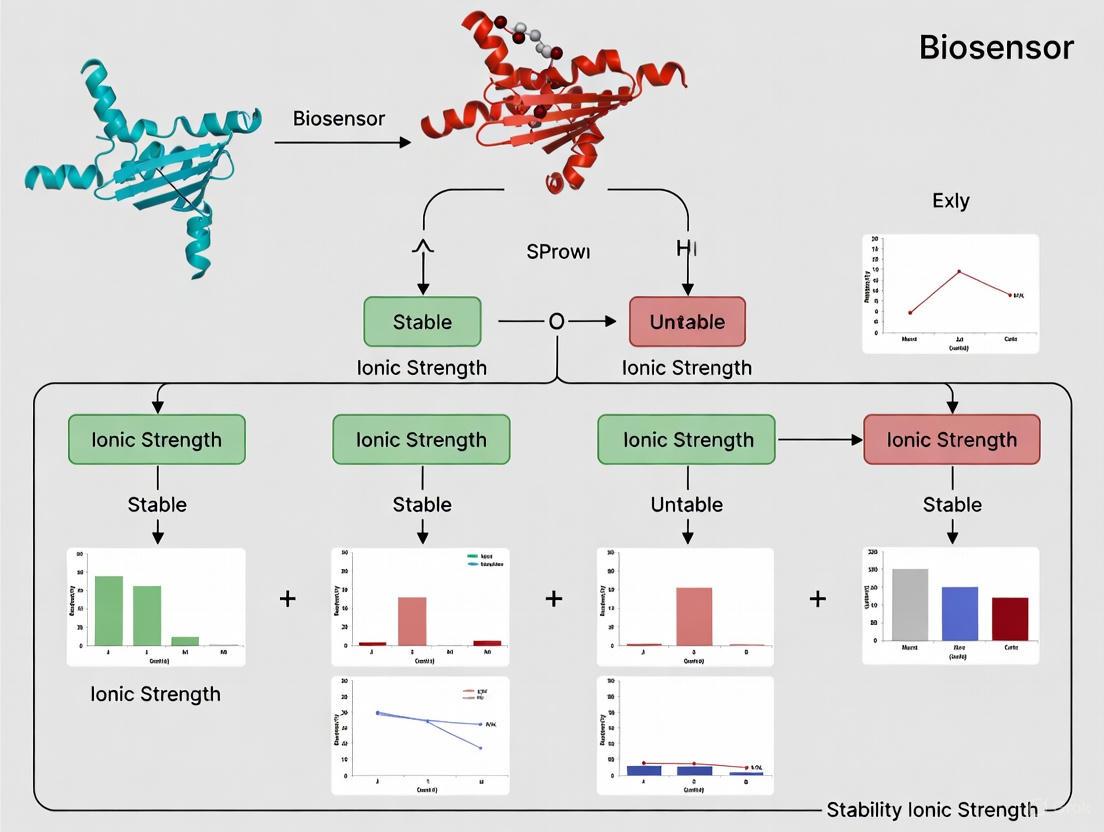
The performance and reliability of biosensors in biologically relevant ionic strengths are critical for their translation from research to clinical and point-of-care diagnostics.
Benchmarking Biosensor Stability in High Ionic Strength Environments: Strategies for Reliable Biomedical and Clinical Applications
Abstract
The performance and reliability of biosensors in biologically relevant ionic strengths are critical for their translation from research to clinical and point-of-care diagnostics. This article provides a comprehensive analysis of the key challenges, including signal drift and Debye length screening, that compromise biosensor stability in high ionic strength solutions like blood and interstitial fluid. Drawing on the latest research, we explore foundational principles, advanced materials and interface designs, practical optimization methodologies, and standardized validation frameworks. Aimed at researchers, scientists, and drug development professionals, this review synthesizes actionable strategies to enhance biosensor robustness, ensuring accurate and stable performance in real-world biomedical applications.
The Stability Challenge: Foundational Principles of Biosensor Performance in High Ionic Strength Environments
For biosensors to function effectively in point-of-care diagnostics and real-time monitoring, they must operate directly in complex biological fluids such as blood, serum, or saliva. These environments present two fundamental physical obstacles that compromise measurement accuracy: the Debye screening effect and signal drift. The Debye screening effect limits the ability to detect biomarkers in high-ionic-strength solutions, while signal drift causes the sensor's baseline output to change over time, independent of the target analyte. Overcoming these intertwined challenges is critical for developing reliable biosensors for physiological applications. This guide objectively compares the performance of current technologies addressing these limitations, providing a framework for benchmarking biosensor stability in biologically relevant conditions.
Defining the Problems: Mechanisms and Impact
The Debye Screening Effect
The Debye screening effect, or charge screening, is a fundamental limitation for label-free biosensors operating in physiological buffers. In high-ionic-strength solutions (e.g., 1X PBS), dissolved ions form a dense Electrical Double Layer (EDL), also known as the Debye layer, at the sensor-solution interface. This layer electrically screens charges beyond its very short range.
- Physical Principle: The EDL has a characteristic thickness called the Debye length (κ⁻¹), which is inversely proportional to the square root of the ionic strength. In physiological saline (1X PBS), the Debye length is approximately 0.7 nm [1].
- Impact on Sensing: Most biorecognition elements (e.g., antibodies, which are 10–15 nm in size) and their binding events are located far beyond this Debye length. Consequently, the electric field from a charged target biomarker is effectively screened, preventing it from influencing the transducer and causing a severe loss of sensitivity [2] [1]. Conventional field-effect transistor (FET) biosensors are particularly affected, often necessitating sample dilution or washing steps that are impractical for point-of-care use.
Signal Drift
Signal drift refers to the slow, non-random change in a biosensor's output signal over time under constant conditions. In physiological buffers, this is primarily caused by the slow, non-specific interaction of electrolytic ions and biomolecules with the sensor surface.
- Primary Causes:
- Ion Diffusion: Ions from the solution can gradually diffuse into the sensing region or the dielectric layers of the sensor, altering the local capacitance and threshold voltage [2].
- Biofouling: Non-specific adsorption of proteins or other biomolecules onto the sensor surface modifies interface properties and contributes to a drifting baseline [3].
- Impact on Sensing: Drift obscures the specific signal from target-receptor binding, convolutes results, and can lead to false positives, especially if the drift direction mimics the expected sensor response. This is particularly critical for long-term or continuous monitoring applications [2].
The following diagram illustrates the combined negative impact of these two phenomena on a biosensor's signal over time.
Technological Solutions and Performance Comparison
Researchers have developed innovative material, electrical, and design strategies to overcome Debye screening and signal drift. The following sections compare the most prominent solutions.
Strategies to Overcome the Debye Length Limitation
Table 1: Comparison of Debye Length Extension Strategies
| Strategy | Mechanism | Key Performance Data | Advantages | Limitations |
|---|---|---|---|---|
| Polymer Brush Interface (e.g., POEGMA) [2] | Establishes a Donnan equilibrium potential, effectively increasing the sensing distance (Debye length) in high ionic strength solutions. | Enabled sub-femtomolar (aM) detection of biomarkers in 1X PBS [2]. | - Functions in undiluted physiological buffers.- Reduces biofouling.- Compatible with antibody-based detection. | - Requires sophisticated surface chemistry.- Polymer layer thickness and uniformity must be controlled. |
| Electric Double Layer (EDL) FETs [1] | Uses a separated gate electrode. A short pulse bias induces EDL formation, pulling ions towards the gate and channel, which modulates conductance beyond the static Debye length. | Direct detection of proteins (e.g., HIV-1 RT, CEA) in 1X PBS and human serum in 5 minutes with no dilution [1]. | - No reference electrode needed.- Fast detection.- Insensitive to target charge. | - Requires precise pulse timing.- Device design and fabrication are more complex than standard FETs. |
| High-Frequency AC Sensing [1] | Applies high-frequency alternating current to "break down" the EDL, allowing the electric field to penetrate deeper into the solution. | Reported operational frequencies vary widely (1 kHz–50 MHz), and direct detection in serum is not consistently demonstrated [1]. | - Can be applied to various FET geometries. | - Mechanism is not fully understood.- Performance is highly dependent on sensor geometry and frequency.- Role of reference electrode is ambiguous. |
Strategies to Mitigate Signal Drift
Table 2: Comparison of Signal Drift Mitigation Strategies
| Strategy | Mechanism | Key Performance Data | Advantages | Limitations |
|---|---|---|---|---|
| Rigorous DC Testing Methodology [2] | Uses infrequent DC sweeps instead of continuous static or AC measurements to minimize ion migration and polarization effects that cause drift. | Achieved a stable, repeatable baseline, allowing reliable measurement of attomolar-level on-current shifts [2]. | - Effective for highly sensitive, endpoint measurements.- Simpler electronics than high-frequency AC. | - Not suitable for real-time, continuous monitoring.- Requires careful timing and protocol design. |
| Stable Material Platforms (e.g., GaN) [1] | Uses chemically inert semiconductors where ions cannot easily diffuse, preventing the internal field formation that causes drift in materials like SiO₂. | AlGaN/GaN HEMTs demonstrated excellent repeatability and a stable baseline in ionic solutions [1]. | - High intrinsic stability in harsh environments.- Long-term reliability. | - Limited to compatible semiconductor processes.- May be higher cost than silicon-based sensors. |
| Pre-equilibrium Sensing [4] | Quantifies target concentration kinetically using the rate of receptor binding (dy/dt) before equilibrium is reached, circumventing drift that occurs over longer timescales. |
Theoretical framework shows potential for tracking rapid physiological changes, such as continuous insulin monitoring, which is impossible with slow equilibrium sensors [4]. | - Enables real-time monitoring of fast concentration changes.- Relaxes requirement for ultra-stable receptors. | - Algorithmically complex.- Requires high signal-to-noise ratio to accurately measure binding rates.- Susceptible to noise if kinetics are too slow. |
Detailed Experimental Protocols
To benchmark new biosensor platforms, the following experimental protocols, derived from the cited literature, are essential.
Protocol: Evaluating Debye Screening Mitigation with Polymer Brushes
This protocol is adapted from the D4-TFT (thin-film transistor) development [2].
- 1. Sensor Functionalization:
- Surface Coating: Grow or deposit a poly(oligo(ethylene glycol) methyl ether methacrylate) (POEGMA) polymer brush layer on the transducer surface (e.g., CNT channel). This serves as the Debye-length-extending and anti-fouling layer.
- Antibody Immobilization: Pattern or immobilize capture antibodies (cAb) into the POEGMA matrix.
- Control Preparation: Fabricate control devices on the same chip with POEGMA but no antibodies over the active channel.
- 2. Measurement in Physiological Buffer:
- Prepare samples containing the target biomarker in 1X PBS (ionic strength ~150 mM) to mimic physiological conditions.
- Introduce the sample to the sensor. A dissolvable trehalose layer can be used to pre-position detection antibodies (dAb) for an automated "D4" (Dispense, Dissolve, Diffuse, Detect) workflow.
- Allow the sandwich immunoassay (cAb-target-dAb) to form directly in the high-ionic-strength buffer.
- 3. Data Acquisition and Analysis:
- Use a stable electrical testing configuration (e.g., infrequent DC sweeps) to measure the device's electrical property (e.g., on-current,
I_on). - The signal is the shift in this property (
ΔI_on) upon target binding. - Validation: A successful experiment shows a significant
ΔI_onfor the functionalized device and no significant change in the control device, confirming detection is specific to antibody-antigen binding and not a solution artifact.
- Use a stable electrical testing configuration (e.g., infrequent DC sweeps) to measure the device's electrical property (e.g., on-current,
The workflow for this protocol is summarized below:
Protocol: Assessing Signal Drift via Electrical Measurement Strategies
This protocol compares DC and pulsed methods for drift assessment [2] [1].
- 1. Baseline Stability Test:
- Immerse the biosensor in 1X PBS or another relevant high-ionic-strength buffer without any target analyte.
- Monitor the output signal (e.g., drain current
I_dfor FETs, capacitance for EIS sensors) over an extended period (e.g., 30-60 minutes).
- 2. Signal Application Methods:
- Method A: Continuous DC Bias: Apply a constant gate and drain bias and record
I_dcontinuously. This typically exhibits significant drift. - Method B: Infrequent DC Sweeps [2]: Hold the sensor at a low, non-perturbing bias. Periodically (e.g., every few minutes), apply a full voltage sweep (e.g., Vg sweep) to acquire the transfer characteristic, then return to the low-bias hold state. The key parameter (e.g.,
I_onat a specific Vg) is extracted from each sweep. - Method C: Short-Pulse EDL FETs [1]: Use a pulsed gate bias (e.g., +0.5 V for 50 µs) with a constant drain bias. Integrate the transient drain current over the pulse duration to obtain a total charge value, which is used as the stable output signal.
- Method A: Continuous DC Bias: Apply a constant gate and drain bias and record
- 3. Drift Quantification:
- Plot the output signal (from any method) versus time.
- Calculate the percentage change or slope of the signal over the test duration. A superior method will show a near-zero slope and minimal deviation from the initial value.
The Scientist's Toolkit: Essential Research Reagents and Materials
Successfully developing and benchmarking biosensors for physiological buffers requires a specific set of materials and reagents.
Table 3: Key Research Reagent Solutions for Biosensor Development
| Category / Item | Specific Examples | Function in Experimental Protocol |
|---|---|---|
| Sensor Substrate | Semiconducting Carbon Nanotubes (CNTs) [2], AlGaN/GaN HEMTs [1] | Forms the core transducer; chosen for high electrical sensitivity and stability in liquids. |
| Debye Length Extender | POEGMA (Poly(oligo(ethylene glycol) methyl ether methacrylate)) [2] | Polymer brush coating that extends the sensing distance via the Donnan potential, enabling detection in PBS. |
| Biorecognition Element | Monoclonal/Polyclonal Antibodies [2] [5], DNA Aptamers [6] | Provides specific binding to the target analyte; immobilized on the sensor surface. |
| Anti-Fouling Agent | POEGMA [2], Bovine Serum Albumin (BSA) [1], Poly(ethylene glycol) (PEG) | Reduces non-specific adsorption of proteins and other biomolecules, mitigating signal drift and noise. |
| Physiological Buffer | 1X Phosphate Buffered Saline (PBS), Simulated Serum [1] | Provides a biologically relevant, high-ionic-strength testing environment (Debye length ~0.7 nm). |
| Reference Electrode | Pd pseudo-reference electrode [2], Ag/AgCl electrode | Provides a stable, known potential in the solution; pseudo-reference electrodes aid device miniaturization. |
| Signal Processing Unit | Source Meter Unit, Potentiostat with high-speed sampling | Applies electrical signals (DC sweeps, AC frequencies, short pulses) and measures the sensor's response. |
The journey toward robust biosensors for use in physiological buffers hinges on directly confronting the dual challenges of Debye screening and signal drift. As evidenced by the data, no single solution is universally superior; each presents a distinct set of trade-offs.
Technologies like polymer brushes (POEGMA) and EDL-FETs have demonstrated proven success in overcoming Debye screening to achieve ultraselective, direct detection in undiluted serum and PBS. For combating signal drift, innovative measurement methodologies (infrequent DC sweeps, short pulses) and inherently stable materials (GaN) have shown the most concrete results in providing the stable baseline required for sensitive measurements. The emerging concept of pre-equilibrium sensing offers a paradigm shift for real-time monitoring by circumventing drift entirely, though it demands high-quality data and sophisticated kinetics analysis.
Benchmarking new biosensor platforms requires rigorous testing in high-ionic-strength buffers against the standards outlined here. The choice of strategy ultimately depends on the application's specific requirements: attomolar sensitivity for endpoint diagnostics, long-term stability for implantable sensors, or second-scale resolution for real-time physiological tracking. Future progress will likely involve the clever integration of these materials, design, and algorithmic approaches to create a new generation of drift-resistant, charge-screening-immune biosensors.
The pursuit of reliable biosensing in complex biological fluids represents a significant challenge in diagnostic medicine and biomedical research. A core obstacle is maintaining sensor sensitivity and stability in environments with high ionic strength, such as blood, serum, or saliva. The performance of electrochemical and field-effect transistor (FET) biosensors in these milieus is predominantly governed by two interrelated interfacial phenomena: the Electrical Double Layer (EDL) and the Donnan Potential. The EDL refers to the structured layers of ions that form at the electrode-electrolyte interface, while the Donnan Potential is an equilibrium potential that arises from the unequal distribution of ions between a charged membrane or surface and the surrounding solution. This guide objectively compares how these mechanisms influence biosensor performance, providing a foundational framework for benchmarking biosensor stability in physiologically relevant conditions.
Fundamental Principles and Direct Comparative Analysis
The EDL and Donnan Potential define the operational window for biosensors, controlling the distance over which an electrical field can exert influence and thereby detect a binding event. Their behavior in high-ionic-strength environments is a critical determinant of sensor efficacy.
Electrical Double Layer (EDL) and Debye Length: When an electrode is immersed in an electrolyte solution, charged species align at the interface, forming the EDL. The innermost region, known as the compact Helmholtz plane or Stern layer, consists of solvent molecules and specifically adsorbed ions. Beyond this is the diffuse layer, where ions are distributed by a balance of electrostatic forces and thermal motion [3]. The characteristic thickness of this diffuse layer is the Debye length, which dictates the distance from the electrode surface within which charge sensing is effective. In high-ionic-strength solutions like bodily fluids, the Debye length is compressed to just a few nanometers [3]. This severely limits the sensitivity of biosensors that rely on field effects, such as silicon nanowire FETs (SiNW-FETs), as the binding of a target biomarker may occur beyond this screened range [7].
Donnan Potential: The Donnan Potential (ΨD) arises at the interface between a solution and a charged, permselective membrane or surface, such as an ion-exchange membrane or a biomolecular layer with fixed charges. Due to the presence of these fixed charges, an unequal distribution of mobile ions (counter-ions and co-ions) exists between the two phases to maintain electroneutrality, generating the Donnan Potential [8]. This potential acts to exclude co-ions from entering the charged layer; a larger absolute Donnan Potential leads to stronger co-ion exclusion [8]. The magnitude of this potential is not fixed; it depends on the concentration of the external solution and the valence of the counter-ions. When the external solution concentration is low relative to the fixed charge concentration, the absolute value of the Donnan Potential is high, and vice-versa [8].
Table 1: Comparative Influence of EDL and Donnan Potential on Biosensing
| Feature | Electrical Double Layer (EDL) | Donnan Potential |
|---|---|---|
| Fundamental Role | Governs charge distribution & electric field extension at electrode-electrolyte interface [3] | Governs ion distribution & exclusion at charged membrane/ polymer-solution interface [8] |
| Primary Impact on Sensing | Determines the Debye length; defines distance for field-effect detection [3] [7] | Establishes a permselective barrier; enhances selectivity by excluding co-ions [8] |
| Effect of High Ionic Strength | Compresses Debye length (to ~1 nm), reducing sensing range and signal-to-noise ratio [3] | Reduces the magnitude of the potential, weakening co-ion exclusion and lowering selectivity [8] |
| Key Tuning Parameters | Ionic strength of buffer, size of counterions, electrode geometry [3] [7] | Density of fixed charges on the surface/membrane, counter-ion valence [8] |
Visualizing the Interfacial Potentials
The following diagram illustrates the structure of the EDL and the origin of the Donnan Potential at a functionalized biosensor interface.
Diagram 1: Interfacial structure showing the Electrical Double Layer (Stern and Diffuse layers) and the Donnan Potential at a charged biosensor interface.
Experimental Methodologies for Investigation
A comprehensive understanding of these core mechanisms requires diverse experimental techniques, ranging from direct potential measurement to indirect sensing performance evaluation.
Direct Measurement of the Donnan Potential
For decades, the Donnan Potential was indirectly estimated but never directly measured until the recent application of tender ambient pressure X-ray photoelectron spectroscopy (tender-APXPS).
- Protocol Summary: A commercial cation exchange membrane (CR-61, poly(p-styrene sulfonate-co-divinylbenzene)) is equilibrated with aqueous salt solutions (e.g., NaCl, MgCl₂) of varying concentrations (0.001 to 1 M). Using the "dip and pull" method, a thin solution layer (~17-21 nm) is formed on the membrane surface. The interface is then probed with tender-APXPS at a photon energy of 4.0 keV [8].
- Key Measurements: At thermodynamic equilibrium, the electric potential of the bulk electrolyte is zero. The Donnan Potential is measured by tracking the binding energy (BE) shift of membrane-related core levels, such as the sulfur 1s (S 1s) peak originating from the fixed sulfonate groups. The shift in binding energy is directly related to the Donnan Potential by ΔBE = ΔΨD eV. The measured BE shifts are converted to Donnan potentials by aligning the system to a known reference point, typically where the external salt concentration matches the fixed ion concentration in the membrane, resulting in a near-zero Donnan Potential [8].
- Data Interpretation: This method directly revealed that the Donnan Potential decreases in magnitude as the external NaCl concentration increases. Furthermore, it confirmed that for a given concentration, the Donnan Potential is lower for membranes that have sorbed divalent counter-ions (Mg²⁺) compared to monovalent ones (Na⁺), leading to reduced co-ion exclusion [8].
Optimization of Sensing Buffer Ionic Concentration
The ionic strength of the sensing buffer is a critical parameter that balances biological hybridization efficiency with the constraints of the EDL.
- Protocol Summary: To detect miRNA-21 using a SiNW-FET biosensor, a systematic study tested Bis-Tris propane (BTP) buffers with varying ionic strengths (10 mM, 50 mM, and 150 mM). The surface functionalization was optimized via a 30-minute silanization reaction at room temperature, followed by acetic acid rinsing to ensure a uniform surface. Hybridization efficiency was evaluated using fluorescence microscopy, while the structural stability of DNA/RNA hybrids was confirmed by Grazing-incidence small-angle X-ray scattering (GISAXS) across all ionic strengths. The sensor's performance was assessed by measuring voltage shifts upon miRNA-21 binding [7].
- Key Measurements: Fluorescence microscopy showed the highest hybridization amount at the highest ionic strength (150 mM). However, the SiNW-FET electrical measurements found that 50 mM BTP buffer yielded the highest voltage shifts and optimal sensitivity. This concentration was identified as the best compromise, providing sufficient ionic strength for efficient hybridization while maintaining a Debye length long enough for effective signal transduction [7].
- Data Interpretation: The study highlights the critical trade-off governed by the EDL: high ionic strength favors biomolecular interactions but compresses the Debye length, hampering field-effect detection. An intermediate ionic strength can optimally balance these competing effects.
Performance Benchmarking of Advanced Materials
Novel materials can enhance sensor performance by modulating interfacial properties. The following table benchmarks a select set of recently reported biosensors, highlighting their operating mechanisms and performance metrics.
Table 2: Performance Benchmarking of Select Biosensors Addressing Interfacial Challenges
| Biosensor Platform | Core Mechanism / Material | Target Analyte | Key Performance Data | Reference |
|---|---|---|---|---|
| Mn-ZIF-67 Electrochemical Sensor | Bimetallic MOF; enhanced surface area & electron transfer [5] | E. coli O157 | LOD: 1 CFU mL⁻¹Linear Range: 10 – 10¹⁰ CFU mL⁻¹Stability: >80% sensitivity over 5 weeks [5] | [5] |
| SiNW-FET with BTP Buffer | EDL tuning using large counterions [7] | miRNA-21 | Optimal buffer: 50 mM BTPSignal improvement over PBS due to reduced ion accumulation [7] | [7] |
| SERS Au-Ag Nanostars | Signal enhancement via plasmonics [9] | α-Fetoprotein (AFP) | LOD: 16.73 ng/mLLinear Range: 0 – 500 ng/mL (antigen) [9] | [9] |
| PNA-Based Electrochemical Sensor | Donnan effect reduction via neutral probe backbone [6] | DNA/RNA | Stronger hybridization vs. DNA probes;Stable geometry across ionic strengths [6] | [6] |
The Scientist's Toolkit: Essential Research Reagents and Materials
Advancing research in this field relies on a specific set of materials and reagents designed to engineer the sensor interface.
Table 3: Key Research Reagent Solutions for Interfacial Engineering
| Reagent / Material | Function in Research | Experimental Implication |
|---|---|---|
| Bis-Tris Propane (BTP) Buffer | A sensing buffer with larger counterions [7]. | Reduces surface accumulation of ions compared to PBS, leading to a more favorable EDL structure and enhanced signal transduction in FET sensors [7]. |
| Peptide Nucleic Acid (PNA) Probes | Synthetic DNA analogue with an uncharged backbone [6]. | Eliminates the negative electrostatic barrier present in DNA probes, enabling stronger hybridization and operation under low ionic strength to mitigate Debye screening [6]. |
| Ionic Liquids (ILs) & Polymeric ILs (PILs) | Tunable electrolytes for electrochemical biosensors [10] [11]. | Offer high thermal stability, low volatility, and wide electrochemical windows. PILs can be integrated into hydrogels for flexible sensors and wound dressings [10] [11]. |
| Gold Nanoparticles (AuNPs) | Nanomaterial for electrode modification [12]. | Provides a large surface area, good biocompatibility, and high conductivity, improving the adsorption of biomolecules and signal response [12]. |
| Cation Exchange Membrane (e.g., CR-61) | Model charged surface for fundamental studies [8]. | Used for direct measurement and fundamental study of the Donnan Potential at a defined polymer-solution interface [8]. |
Workflow for Evaluating Buffer Ionic Strength
A typical experimental workflow for optimizing and evaluating the ionic strength of a sensing buffer is summarized below.
Diagram 2: Experimental workflow for determining the optimal ionic concentration of a sensing buffer.
The Electrical Double Layer and Donnan Potential are not merely abstract concepts but are foundational to the practical design and benchmarking of stable, sensitive biosensors. The EDL defines the physical limits of field-effect sensing via the Debye length, while the Donnan Potential governs the permselectivity and interfacial charge environment. Direct measurement techniques like tender-APXPS have demystified these potentials, providing quantitative data to validate theoretical models. The performance benchmarks and reagent toolkit provided here underscore that overcoming the challenges of high-ionic-strength environments requires a multi-faceted strategy. This includes optimizing buffer composition, employing novel non-charged probes like PNA, and engineering advanced materials such as bimetallic MOFs and ionic liquids. For researchers benchmarking biosensor stability, a rigorous evaluation of these core interfacial mechanisms is indispensable for transitioning laboratory innovations into robust diagnostic and pharmaceutical applications.
The Impact of Biofouling on Sensor Longevity and Signal Integrity
The accumulation of microorganisms, plants, algae, or animals on submerged surfaces, known as biofouling, presents a fundamental constraint on the deployment of sensors in marine, freshwater, and biological environments. For electrochemical biosensors operating in biologically relevant ionic strengths, biofouling is not merely a nuisance but a core determinant of analytical performance, impacting everything from signal integrity to operational longevity [13]. The formation of biofilms on sensor surfaces introduces a dynamic, living interface that directly interferes with measurement principles, whether optical, electrochemical, or mechanical. This review synthesizes current understanding of biofouling impacts on sensor systems, providing a comparative analysis of protection strategies and their efficacy in preserving sensor function under challenging conditions.
The biofouling process progresses through distinct, sequential stages that determine the severity of impact on sensor systems. Initially, a conditioning film of organic molecules forms on the sensor surface within seconds to minutes of immersion [14]. This is followed by the attachment of bacteria and microorganisms within hours, forming a primary biofilm. Over days, this develops into a complex microfilm containing spores of macroalgae and protozoa [14]. Finally, in the stage most detrimental to sensor function, macrofouling occurs with the attachment of larger organisms such as barnacles and mussels, which can permanently damage sensor elements and housings [15] [14]. Understanding this progression is essential for implementing targeted antifouling strategies at appropriate intervention points.
Quantitative Analysis of Biofouling Impacts on Sensor Performance
Biofouling directly compromises sensor function through multiple physical and biochemical mechanisms. The following table summarizes the documented impacts of biofouling on critical sensor parameters across different measurement technologies.
Table 1: Quantified Impacts of Biofouling on Sensor Performance Parameters
| Sensor Type | Performance Metric | Impact of Biofouling | Experimental Conditions | Citation |
|---|---|---|---|---|
| Dissolved Oxygen | Response Time | Increased due to reduced gas diffusion through fouled membranes | Field deployment; biofilm on membrane surface | [14] |
| pH Electrodes | Response Time | Significantly increased due to thickened diffusion layer | Laboratory testing with cultivated biofilm | [14] |
| Conductivity-Temperature (CT) Sensors | Data Accuracy | Errors >30% in biofouled sensors at depths up to 50m | 202-day offshore deployment in Bay of Bengal and Arabian Sea | [14] |
| Optical Sensors (Turbidity) | Signal Transmittance | Marked decline in transmittance through biofouled optical windows | PMMA surfaces at 4700m depth in Cayman Trough | [15] |
| Wave Buoys | Data Accuracy | >30% increase in data errors due to biofouling | Field observations of operational buoys | [15] |
| All Sensor Types | Operational Lifetime | 50% of operational budgets attributed to biofouling management | Cost analysis for coastal deployments | [13] |
The economic implications of these performance impacts are substantial. The Alliance for Coastal Technologies estimates that up to 50% of operational budgets for deployed aquatic instrumentation are directly attributable to biofouling management, including shorter deployment periods, loss of data due to sensor drift, frequent maintenance requirements, and reduced instrument lifespan [13]. With biofouling recognized as a primary factor limiting deployment duration, particularly in long-term continuous monitoring applications, development of effective antifouling strategies becomes essential for both research and commercial sensor applications.
Experimental Methodologies for Assessing Biofouling Impact
Electrochemical Sensor Testing Under Controlled Ionic Strength
Understanding biofouling impacts on electrochemical biosensors requires standardized testing methodologies that replicate operational conditions. The following protocol, adapted from recent research on DNA-based sensors, provides a framework for evaluating biofouling resistance under biologically relevant ionic strengths [16]:
Figure 1: Experimental Workflow for Biofouling Impact Assessment
Electrode Preparation Protocol:
- Surface Polishing: Electrodes are polished with 0.05 μm alumina slurry for 3 minutes followed by sonication in ethanol/water (1:1) for 5 minutes to achieve uniform surface area [16].
- Electrochemical Cleaning: Cyclic voltammetry in 0.5 M H₂SO₄ from -0.35 to +1.5 V vs. Ag|AgCl at 0.1 V/s for 5 cycles removes surface impurities [16].
- Self-Assembled Monolayer (SAM) Formation: Incubate freshly cleaned electrodes in reduced thiolated DNA solution (1.25 μM in HEPES/NaClO₄ buffer, pH 7.0) for 1 hour at room temperature in darkness [16].
- Non-Specific Binding Prevention: Transfer SAM-modified electrodes to 3 mM 6-mercaptohexanol (MCH) solution for 1 hour to block uncovered gold surfaces [16].
Measurement Conditions:
- Electrochemical Technique: Square-wave voltammetry (SWV) with step size of 1 mV, pulse height of 25 mV, frequency of 100 Hz over potential range from -0.45 to 0 V [16].
- Ionic Strength Variations: Testing across physiological range (0.125 M to 1.00 M NaClO₄) to simulate different biological fluids [16].
- Kinetic Monitoring: Regular SWV measurements over 125 minutes to track signal degradation due to initial biofouling [16].
Field-Based Sensor Performance Evaluation
For validation under real-world conditions, field deployment studies provide critical performance data:
Methodology:
- Multi-Depth Deployment: Moored sensor arrays positioned at varying depths (surface to 50m) to assess depth-dependent biofouling impacts [14].
- Long-Term Monitoring: Extended deployment periods (typically 60-200 days) with periodic sensor calibration and data validation [14].
- Environmental Correlation: Measurement of local water quality parameters (temperature, nutrient levels, chlorophyll) to correlate fouling severity with environmental conditions [14].
Table 2: Research Reagent Solutions for Biofouling Impact Studies
| Reagent/Material | Function | Application Context | Key Considerations |
|---|---|---|---|
| Thiolated DNA Probes | SAM formation on gold electrodes | Electrochemical biosensor development | Requires TCEP reduction of dithiol to monothiol before SAM formation [16] |
| 6-Mercaptohexanol (MCH) | Backfilling agent for non-specific binding prevention | Surface passivation in biosensors | Critical for maintaining probe accessibility and reducing non-specific adsorption [16] |
| HEPES/NaClO₄ Buffer | Controlled ionic strength environment | Electrochemical measurements under physiological conditions | NaClO₄ preferred over NaCl for reduced corrosion in electrochemical systems [16] |
| Alumina Slurry (0.05 μm) | Electrode surface polishing | Electrode preparation for reproducible surfaces | Creates uniform surface topography essential for consistent SAM formation [16] |
| Boron-Doped Diamond (BDD) Electrodes | Alternative electrode material | Capacitive sensing in high-ionic-strength solutions | Enhanced stability and reduced background interference in complex fluids [3] |
Signal Interference Mechanisms at the Biofilm-Sensor Interface
The detrimental effects of biofouling on sensor signal integrity manifest through multiple physical and biochemical pathways. The following diagram illustrates the primary interference mechanisms at the biofilm-sensor interface.
Figure 2: Biofouling Signal Interference Mechanisms
Diffusion-Limited Signal Response
Biofilm formation directly impedes analyte transport to the sensing interface, particularly critical for gas-sensing membranes. Research demonstrates that thicker biofilms reduce gas diffusion through membranes, significantly increasing sensor response time [14]. For dissolved oxygen sensors, fouling caused by microorganism accumulation on membrane surfaces directly affects oxygen molecule movement from the bulk solution to the electrode surface [14]. Similarly, pH electrodes exhibit prolonged response times as biofilms increase the thickness of the stagnant layer at electrode surfaces, extending the diffusion path length for ions [14].
Interfacial Chemistry Alteration
The biofilm-sensor interface represents a dynamic biochemical environment that directly interferes with measurement accuracy. Sulfate-reducing bacteria (SRB) within biofilms participate in sulfur cycling via anaerobic respiration, reducing sulfate to H₂S and creating localized anaerobic microenvironments [15]. These heterogeneous biofilms exacerbate local corrosion and alter interfacial electrochemistry through several mechanisms:
- Micro-battery Formation: Potential differences between anaerobic biofilm zones and surrounding aerobic areas create galvanic corrosion cells [15].
- Metabolite Interference: SRB-produced H₂S combines with dissolved Fe²⁺ to form FeS, which acts as micro-batteries with the metal matrix to accelerate corrosion [15].
- Ion Adsorption: The viscous biofilm matrix, primarily composed of extracellular polymeric substances (EPS) with strong complexing ability, adsorbs seawater Cl⁻ which damages metal passive films [15].
Ionic Strength Considerations for Biosensor Stability
The performance degradation of sensors in high-ionic-strength environments presents particular challenges for biological applications. Capacitive sensors, which enable label-free, real-time detection at low non-perturbing voltages, experience significantly compromised sensitivity in high-ionic-strength solutions such as bodily fluids due to reduced Debye length and non-specific interactions [3]. The Debye length, representing the effective region within which an electric field can recognize analyte-sensor interactions, becomes compressed to just a few nanometers in physiological fluids, severely limiting signal transduction for target-receptor interactions occurring beyond this narrow electrical double layer [3].
DNA-based electrochemical sensors exhibit particularly strong dependence on ionic environment. Studies varying the position of double-stranded DNA segments relative to the electrode surface under different ionic strengths (0.125 to 1.00 M) revealed significant interferences with DNA hybridization closer to the surface, with more substantial interference at lower ionic strength [16]. This manifests as slowed reaction kinetics and diminished efficiency for toehold-mediated strand displacement reactions near the electrode surface [16]. Strategic placement of DNA binding sites away from the electrode surface improves reaction rates and yields, highlighting the critical importance of considering both salt concentration and probe positioning when designing DNA-based electrochemical sensors for biologically relevant conditions [16].
Comparative Analysis of Antifouling Strategies for Sensor Protection
Multiple approaches have been developed to mitigate biofouling impacts on sensor systems, each with distinct mechanisms, advantages, and limitations. The following table provides a comparative analysis of established and emerging antifouling technologies.
Table 3: Antifouling Strategy Comparison for Sensor Applications
| Strategy | Mechanism of Action | Sensor Integration | Limitations | Efficacy Data |
|---|---|---|---|---|
| Silicone-Based Fouling-Release Coatings | Low surface energy prevents strong adhesion | Compatible with various sensor housings | Limited effectiveness in low-flow environments | >80% reduction in macrofouling adhesion strength [17] |
| Ultrasonic Antifouling Systems | Sound waves interfere with biofilm formation | Integrated into sensor housings | Power-intensive for long-term deployments | Effective for biofilm prevention; limited data on macrofouling [17] [18] |
| Biomimetic Microtextured Surfaces | Topographical features prevent settlement | Direct application to sensor surfaces | Fabrication complexity for non-planar surfaces | 70-90% reduction in diatom adhesion demonstrated [14] |
| UV-C Light Treatment | Microbicidal effect on settling organisms | Optical sensor protection | Limited penetration; requires clear windows | >95% reduction in biofilm formation on optical surfaces [18] |
| Enzyme-Based Biofilm Prevention | Degradation of adhesive polymers | Co-immobilization with sensing layers | Specificity to particular biofilm components | Limited field validation data available [13] |
| Electrochemical Chlorine Generation | In situ production of biocidal compounds | Particularly effective for marine sensors | Potential sensor surface damage; byproduct formation | Effective but requires careful optimization [13] |
Mechanical and Physical Protection Methods
In-water grooming represents an emerging approach where proactive, scheduled maintenance prevents fouling accumulation before it becomes problematic. Unlike traditional cleaning that occurs only after fouling becomes visible, grooming maintains surface smoothness and coating performance while avoiding aggressive techniques that damage sensor elements [17]. Robotic grooming systems operating autonomously in port settings can identify early-stage fouling and remove it with minimal impact to sensitive sensor components [17]. These systems also reduce the risk of discharging debris into the water, addressing environmental concerns particularly relevant in invasive species-sensitive areas [19].
Ultrasonic antifouling systems utilize sound waves at specific frequencies to interfere with the attachment and development of microorganisms on sensor surfaces. These systems operate by generating ultrasonic waves that create microscopic bubbles in the water adjacent to protected surfaces [17] [18]. The continuous formation and collapse of these bubbles disrupt the settlement process of fouling organisms while preventing the production of biofilms in their early stages. This approach offers the advantage of continuous protection without chemical releases or physical contact with sensor surfaces, making it particularly suitable for optical elements and delicate sensing membranes.
Advanced Materials and Surface Engineering
Superhydrophobic and superhydrophilic surfaces inspired by natural antifouling organisms represent a promising direction for sensor protection. These surfaces leverage extreme wettability to prevent organism attachment through either complete water repellency or complete wetting that minimizes interfacial points for adhesion [14]. Surface wettability, governed by both chemical composition and topographic features at multiple scales, directly influences antifouling performance through modulation of interfacial energy [14]. The complexity of coating materials, including chemical composition and surface free energy, plays a key role in determining antifouling efficacy, with lower surface energy generally correlating with reduced biofouling adhesion strength [14].
Slippery Liquid-Infused Porous Surfaces (SLIPS) technology has emerged as a particularly effective approach for optical sensors where transparency maintenance is critical. These surfaces create a molecularly smooth, liquid interface that presents no stable anchor points for adhering organisms [14]. The continuous liquid layer prevents both initial biofilm formation and attachment of larger fouling organisms while maintaining optical clarity essential for photometric measurements. Additionally, these surfaces can demonstrate self-healing properties where the infused liquid fills in minor scratches or defects that might otherwise provide footholds for fouling organisms.
The impact of biofouling on sensor longevity and signal integrity represents a multifaceted challenge requiring integrated solutions combining materials science, surface engineering, and intelligent monitoring. As sensor technologies advance toward longer deployment periods and operation in increasingly challenging environments, the development of effective antifouling strategies becomes essential for data reliability and operational efficiency. The progression from reactive biofouling management to proactive, data-driven approaches represents the most promising direction for next-generation sensor systems [17].
Future research directions should focus on multi-disciplinary coupling technologies that address biofouling across its progression stages, from initial molecular conditioning to macroscopic organism settlement [15]. The integration of AI-driven fouling prediction models with real-time sensor performance monitoring will enable condition-based maintenance strategies optimized for specific deployment environments [15] [18]. Additionally, the development of standardized testing protocols and cross-scenario evaluation systems will accelerate the translation of antifouling technologies from laboratory validation to field deployment [15]. As the economic and operational costs of biofouling continue to drive innovation, sensors capable of maintaining signal integrity over extended deployments in fouling-prone environments will unlock new possibilities in environmental monitoring, biomedical sensing, and oceanographic research.
Biosensor stability, characterized by a decrease in signal response over time, is a paramount determinant of commercial success and practical utility across diverse fields, from medical diagnostics to environmental monitoring [20] [21]. This degradation is a complex phenomenon, arising from the sum of changes affecting the biological recognition element (e.g., enzymes, antibodies), the signal transducer, and the protective matrices within the sensor architecture [20]. For researchers and professionals in drug development and biomedical science, benchmarking stability is not merely a procedural step but a critical evaluation of a biosensor's reliability under biologically relevant conditions. This guide provides a structured framework for this essential benchmarking process, focusing on three core operational metrics: shelf-life, reusability, and continuous use stability.
A significant challenge in this domain is achieving consistent performance in physiologically relevant, high-ionic-strength environments. Conventional biosensors often suffer from charge-screening effects in these conditions, which can severely limit their sensitivity and accuracy [22]. Therefore, modern stability assessments must extend beyond idealized buffer systems to include testing in complex matrices like blood serum or phosphate-buffered saline (PBS) to ensure real-world applicability [23] [22]. This guide synthesizes current research and experimental data to objectively compare stability performance, providing a foundational resource for rigorous biosensor evaluation.
Comparative Analysis of Biosensor Stability Metrics
The following section distills experimental data into a structured comparison of how different biosensor designs and materials perform across the key stability metrics. This quantitative overview aids in identifying architectures suited for specific application needs, whether for single-use diagnostics or long-term implantable monitors.
Table 1: Comparative Performance of Biosensor Stability Architectures
| Biosensor Architecture / Strategy | Shelf-Life Stability | Reusability Performance | Continuous Use Stability | Key Findings & Experimental Context |
|---|---|---|---|---|
| Glucose Oxidase Biosensor (Model System) | Signal loss is temperature-dependent; can be modeled for prediction [20]. | Poor correlation due to unpredictable handling effects [20]. | Determined in less than 24 hours via accelerated ageing [20]. | A linear ageing model was found more suitable than an exponential (Arrhenius) model for predicting shelf-life [20]. |
| Flexible Trihexylthiol Anchor (E-DNA Sensor) | Retained 75% of original signal after 50 days in aqueous buffer storage [23]. | Demonstrated excellent robustness to repeated electrochemical interrogation [23]. | N/A | Provided significantly enhanced stability compared to mono-thiol anchors without sacrificing electron transfer efficiency [23]. |
| Rigid Adamantane Anchor / Mono-thiol (E-DNA Sensor) | Significant signal loss (>60%) upon wet storage or thermocycling [23]. | Similar poor stability performance as mono-thiol anchors [23]. | N/A | Stability was similar to conventional mono-thiol anchors, highlighting the importance of anchor flexibility [23]. |
| Enhanced EDL FET Biosensor | N/A | N/A | High sensitivity maintained in high-ionic-strength solution (1X PBS) [22]. | Overcomes the Debye length limitation, enabling direct protein detection in physiological samples in 5 minutes without dilution [22]. |
| PNA-Based Biosensors | High inherent stability due to nuclease-resistant, neutral backbone [6]. | Strong and stable hybridization with DNA/RNA supports potential reusability [6]. | Maintains structural integrity under low ionic strength conditions [6]. | The neutral PNA backbone prevents enzymatic degradation and enables stable performance across varying ionic conditions [6]. |
Experimental Protocols for Determining Stability Characteristics
To ensure reproducibility and meaningful cross-comparison between studies, standardized experimental protocols are essential. Below are detailed methodologies for assessing the three key stability metrics, derived from established research practices.
Protocol for Shelf-Life Estimation via Thermally Accelerated Ageing
This protocol provides a rapid method for determining long-term shelf-life, circumventing the need for real-time storage studies [20].
- Objective: To predict the long-term shelf-life of a biosensor under standard storage conditions within a short timeframe (e.g., 4 days).
- Materials:
- Phosphate Buffered Saline (PBS), 100 mM, pH 7.4.
- Thermally controlled ovens or water baths (e.g., set at 40°C, 50°C, 60°C).
- Standard analyte solutions for performance validation.
- Method:
- Fabricate multiple identical batches of the biosensor.
- Divide the sensors into groups and store them in PBS at elevated temperatures (e.g., 40°C, 50°C, 60°C). A control group should be stored at the target storage temperature (e.g., 4°C or 25°C).
- At regular intervals (e.g., 0, 12, 24, 48, 96 hours), remove a subset of sensors from each temperature condition.
- Measure the analytical signal (e.g., current, voltage) for each sensor using a standard concentration of the target analyte.
- Plot the normalized signal (%) against time for each temperature.
- Data Modeling: A linear degradation model is often more suitable than an exponential one. The degradation rate at each temperature is determined from the slope. An overall model is then built to correlate degradation rate with temperature, allowing for extrapolation to standard storage temperatures [20].
Protocol for Assessing Reusability and Handling Robustness
This protocol evaluates a sensor's ability to withstand repeated use and regeneration cycles, a key metric for cost-effective diagnostics [20] [23].
- Objective: To quantify the signal retention and performance consistency of a biosensor over multiple cycles of use, regeneration, and storage.
- Materials:
- Biosensors, analyte solution, regeneration buffer (e.g., deionized water, low-pH buffer).
- Electrochemical or optical workstation for signal measurement.
- Method:
- Measure the initial signal response of the biosensor to a known analyte concentration.
- Regenerate the sensor surface according to the established protocol (e.g., a 30-second wash in deionized water for E-DNA sensors) [23].
- Re-measure the signal in a blank solution to confirm a return to the baseline.
- This cycle of Measurement → Regeneration → Baseline Check constitutes one reuse cycle.
- Repeat this process for a defined number of cycles (e.g., 10, 20, 50) while tracking the signal attenuation from the initial value.
- Note: Reusability is highly dependent on handling and the harshness of the regeneration method, leading to more variable and unpredictable outcomes compared to shelf-life studies [20].
Protocol for Continuous Use Stability
This metric is critical for biosensors intended for implanted or online monitoring applications, where the sensor is constantly operational [20].
- Objective: To evaluate the signal drift and performance decay of a biosensor during prolonged, uninterrupted operation in a relevant matrix.
- Materials:
- Flow-cell system or stirred solution to maintain constant analyte contact.
- Continuous monitoring equipment (e.g., potentiostat for electrochemical sensors).
- Test matrix (e.g., buffer, simulated body fluid, serum).
- Method:
- Immerse the biosensor in the chosen test matrix under operational conditions (e.g., at applied voltage, in flow).
- Continuously or intermittently monitor the output signal over a set period (e.g., 8, 24, 72 hours).
- The analyte concentration can be held constant or periodically spiked to assess response consistency.
- The rate of signal drift or the percentage of signal loss over time is the key metric for continuous use stability. This can also be accelerated at elevated temperatures to obtain data more rapidly [20].
Research Toolkit: Essential Reagents and Materials
Successful stability testing relies on a suite of specialized reagents and materials. The following table outlines key components referenced in the studies cited in this guide.
Table 2: Essential Research Reagents for Biosensor Stability Studies
| Reagent / Material | Function in Stability Research | Example Application |
|---|---|---|
| Screen-Printed Electrodes (SPEs) | Low-cost, disposable substrate for rapid prototyping and testing of electrochemical biosensors. | Used as a model for glucose oxidase biosensor fabrication in accelerated ageing studies [20]. |
| Gold Electrodes & Alkane Thiols | Form self-assembled monolayers (SAMs) for precise immobilization of biorecognition elements. | Platform for studying the effect of anchor chemistry (mono-thiol vs. tri-thiol) on E-DNA sensor stability [23]. |
| Peptide Nucleic Acid (PNA) Probes | Synthetic, neutral backbone probes offering superior chemical and enzymatic stability over DNA. | Used in biosensors for strong, stable hybridization with DNA/RNA, especially under low ionic strength conditions [6]. |
| Nafion Membranes | A protective polymer membrane used to coat biosensors, improving selectivity and potentially enhancing stability by reducing fouling. | Used as a component in the immobilization cocktail for model glucose biosensors [20]. |
| Reduced Graphene Oxide (rGO) | A nanomaterial used to enhance electron transfer, sensitivity, and stability in electrochemical biosensors. | Identified as a major research cluster in bibliometric analysis of biosensor stability [21]. |
| Field-Effect Transistors (FETs) | Provide high signal amplification. When combined with EDL modulation, they enable sensing in physiological ionic strength. | Core component of EnEDL FET biosensors that overcome Debye screening for direct detection in PBS/serum [22]. |
Stability Pathways and Experimental Workflows
Understanding the conceptual and experimental flow is key to robust stability research. The following diagrams map the core concepts and a standard experimental workflow.
Biosensor Ageing Pathways
This diagram visualizes the primary factors and mechanisms that contribute to biosensor ageing and signal degradation.
Accelerated Ageing Experimental Workflow
This diagram outlines the standard step-by-step protocol for conducting a thermally accelerated ageing study to predict biosensor shelf-life.
Benchmarking biosensor stability is a multifaceted process that requires careful consideration of the intended application, whether it demands long-term storage (shelf-life), repeated measurements (reusability), or uninterrupted operation (continuous use). The experimental data and protocols presented herein demonstrate that strategic choices in material science—such as employing flexible tri-thiol anchors, stable PNA probes, or innovative EDL FET architectures—can dramatically enhance biosensor robustness [23] [6] [22]. A critical finding for researchers is that a linear model for thermally accelerated ageing can provide reliable shelf-life predictions more effectively than traditional exponential models [20]. Ultimately, integrating stability testing under biologically relevant conditions, particularly at physiological ionic strengths, is no longer optional but a fundamental requirement for the development of biosensors that are reliable, commercially viable, and truly fit for purpose in modern therapeutics and diagnostics.
Engineering Stable Interfaces: Advanced Materials, Designs, and Sensing Methodologies
A central challenge in modern biosensing is maintaining high performance and stability in biologically relevant media, such as blood, serum, or saliva. These high-ionic-strength environments screen electrical fields, promote non-specific binding, and can destabilize the bioreceptor layer, leading to signal drift and reduced sensor lifespan [3]. This guide benchmarks three key material classes—nanocomposites, conducting polymers, and advanced immobilization matrices—objectively comparing their performance in enhancing biosensor stability for research and drug development applications. The comparative analysis focuses on quantitative metrics critical for applications in point-of-care diagnostics and continuous monitoring, where operational stability is as crucial as sensitivity.
Performance Benchmarking of Innovative Material Classes
The table below provides a comparative analysis of three core material categories based on recent experimental findings, highlighting their respective contributions to sensor stability and performance.
Table 1: Performance Benchmarking of Innovative Material Classes for Biosensing
| Material Class | Key Representatives | Impact on Stability & Performance | Reported Experimental Data | Limitations & Challenges |
|---|---|---|---|---|
| Nanocomposites | Carbon Nanotubes (CNTs), Au-Ag Nanostars, Graphene, WS₂ | Enhance signal-to-noise ratio and sensitivity. WS₂ in SPR sensors increased sensitivity for cancer cell detection [24]. Nanocomposites enable reagent-free operation ideal for continuous monitoring [3]. | SPR biosensor with WS₂: Sensitivity of 342.14 deg/RIU for blood cancer cell detection [24]. Porous Au/Polyaniline/Pt NP glucose sensor: Sensitivity of 95.12 ± 2.54 µA mM⁻¹ cm⁻² and stable performance in interstitial fluid [9]. | Can be susceptible to biofouling; requires additional antifouling strategies. Reproducibility in large-scale fabrication can be challenging [3] [25]. |
| Conducting Polymers | PEDOT:PSS, Polypyrrole (PPy), Polyaniline (PANI) | Provide a soft, biocompatible interface that reduces mechanical mismatch with tissue, improving in vivo stability. Enable direct, label-free electrochemical detection [26] [27] [28]. | PPy demonstrates high versatility in biosensors and bioelectrical stimulation [28]. Sensors using these polymers have effectively detected viruses like SARS-CoV-2 [27]. | Can suffer from electrical and environmental instability in moist, ion-rich conditions. Mechanical rigidity compared to biological tissues can lead to poor integration [28]. |
| Advanced Immobilization Matrices | Self-Assembled Monolayers (SAMs), Polyethylene Glycol (PEG), Zwitterionic Coatings, Molecularly Imprinted Polymers (MIPs) | Directly address the core stability challenge by providing a robust, ordered layer for bioreceptor attachment. Reduce non-specific binding and prevent desorption or denaturation [29]. | Covalent immobilization strategies significantly enhance operational longevity versus physical adsorption [29]. Zwitterionic coatings and MIPs mimic biological surroundings to minimize fouling [29]. | Optimal surface architecture is complex to design. Traditional methods are often trial-and-error, though AI is accelerating optimization [29]. |
Experimental Protocols for Key Methodologies
Surface Functionalization via Self-Assembled Monolayers (SAMs)
Objective: To create a stable, ordered, and low-fouling interface on a gold transducer surface for the covalent immobilization of bioreceptors (e.g., antibodies).
- Step 1: Surface Cleaning. Gold substrate is cleaned via oxygen plasma treatment or piranha solution (3:1 mixture of concentrated H₂SO₄ and 30% H₂O₂) to remove organic contaminants.
- Step 2: SAM Formation. The clean substrate is immersed in a 1-10 mM ethanolic solution of an alkanethiol (e.g., 11-mercaptoundecanoic acid) for 12-24 hours to form a dense, oriented monolayer.
- Step 3: Activation. The terminal carboxylic acid groups of the SAM are activated using a fresh mixture of N-(3-Dimethylaminopropyl)-N′-ethylcarbodiimide (EDC) and N-Hydroxysuccinimide (NHS) (typically 400 mM / 100 mM in water) for 15-60 minutes.
- Step 4: Bioreceptor Immobilization. The activated surface is rinsed and incubated with a solution of the bioreceptor (e.g., 10-100 µg/mL antibody in a suitable buffer) for 1-2 hours, forming stable amide bonds.
- Step 5: Deactivation & Blocking. Unreacted sites are deactivated with ethanolamine. The surface is then treated with a blocking agent (e.g., 1% BSA or PEG-based compounds) to passivate any remaining surface against non-specific binding [3] [29].
Capacitive Sensing in High-Ionic-Strength Solutions
Objective: To measure changes in the dielectric properties at the electrode-solution interface upon biomolecular binding, without the use of redox probes.
- Step 1: Sensor Preparation. An IDE or potentiostatic electrode is functionalized with a capture probe following a protocol similar to Section 3.1. A thin, insulating layer is critical to prevent Faradaic currents.
- Step 2: Baseline Measurement. The functionalized sensor is immersed in a buffer solution. Electrochemical Impedance Spectroscopy (EIS) is performed at a low, non-perturbing AC voltage (e.g., 10 mV) over a frequency range (e.g., 0.1 Hz to 100 kHz). The double-layer capacitance (Cdl) is extracted from the impedance data, often by fitting to an equivalent circuit model.
- Step 3: Analyte Exposure. The target analyte in a high-ionic-strength solution (e.g., PBS, simulated serum) is introduced to the sensor surface.
- Step 4: Signal Measurement. The EIS measurement is repeated after a fixed incubation period. The binding of the target analyte increases the thickness of the dielectric layer, leading to a measurable decrease in capacitance (ΔCdl).
- Step 5: Data Analysis. The normalized change in capacitance (ΔCdl/Cdl) is plotted against analyte concentration to generate a calibration curve [3].
Strategic and Experimental Pathways
The following diagrams map the logical relationship between the core biosensor challenge and the material solutions, as well as a typical experimental workflow.
Material Strategies to Overcome Biosensor Instability
Workflow for Stable Biosensor Surface Fabrication
The Scientist's Toolkit: Essential Research Reagents and Materials
Table 2: Key Reagents and Materials for Developing Stable Biosensors
| Item | Function / Role | Example Applications |
|---|---|---|
| EDC/NHS Chemistry | Crosslinkers for covalent immobilization of biomolecules via carboxylate and amine groups. | Immobilizing antibodies or DNA probes on SAM-coated gold surfaces [29]. |
| Alkanethiols (e.g., 11-Mercaptoundecanoic acid) | Form Self-Assembled Monolayers (SAMs) on gold, providing a tunable, ordered interface. | Creating a stable foundation for subsequent bioreceptor attachment [3] [29]. |
| PEDOT:PSS Dispersion | A commercially available, aqueous-processable conducting polymer for electrode modification. | Fabricating flexible, transparent, and biocompatible electrochemical sensors [28]. |
| Zwitterionic Compounds (e.g., SBAA) | Form ultra-low-fouling surfaces that resist non-specific protein adsorption. | Coating sensor surfaces to enhance performance in complex media like blood and serum [29]. |
| Carboxylated Carbon Nanotubes | Nanomaterials for enhancing electrode surface area and electron transfer kinetics. | Signal amplification in electrochemical biosensors for proteins or nucleic acids [25]. |
| Polyaniline (PANI) Emeraldine Salt | A conducting polymer with tunable redox states, useful for abiotic (enzyme-free) sensing. | Developing stable, non-enzymatic glucose sensors [27] [9]. |
| Transition Metal Dichalcogenides (e.g., WS₂) | 2D nanomaterials for enhancing sensitivity in optical biosensors like SPR. | Improving the performance of SPR biosensors for the detection of cancer cells [24]. |
The quest for biosensor stability in biologically relevant conditions is driving interdisciplinary innovation. As evidenced by the experimental data, no single material offers a perfect solution; rather, a synergistic combination of these classes shows the greatest promise. The future of stable biosensing lies in hybrid platforms, such as nanocomposites embedded within conducting polymer hydrogels, which are further stabilized by advanced antifouling immobilization matrices [29] [28]. Furthermore, the integration of Artificial Intelligence (AI) and machine learning is emerging as a powerful tool to accelerate the rational design of these complex interfaces, moving beyond traditional trial-and-error methods to predict optimal material compositions and surface architectures [29]. For researchers in drug development, this progression towards more robust, stable, and reliable biosensing platforms will be instrumental in enabling accurate, long-term biomarker monitoring and facilitating the transition from laboratory research to clinical point-of-care applications.
The performance and reliability of a biosensor are fundamentally dictated by the design and properties of its interface—the thin layer that separates the biological recognition elements from the physical transducer. A well-engineered interface must simultaneously achieve multiple critical functions: it must provide a stable environment for biomolecule immobilization, facilitate efficient signal transduction, and crucially, resist the nonspecific adsorption of interfering substances from complex samples, a phenomenon known as biofouling. The stability of this interface is paramount, as its degradation directly compromises key sensing performance parameters such as sensitivity, limit of detection, and reproducibility.
A significant challenge in deploying biosensors for real-world clinical or environmental monitoring is operating reliably in solutions of high ionic strength, such as blood, serum, or interstitial fluid. These environments screen electrical fields, drastically reducing the effective sensing range of electrochemical and capacitive transducers to a scale of nanometers, and promote nonspecific fouling through electrostatic and hydrophobic interactions. This review provides a comparative guide to modern interface architectures—specifically monolayer techniques, 3D constructions, and polymer brush coatings—focusing on their performance and stability in biologically relevant ionic strengths.
Comparative Analysis of Interface Architectures
The following section objectively compares the key characteristics, experimental performance data, and material requirements of different interface architectures. The data is synthesized from recent research to facilitate direct comparison.
Table 1: Performance Comparison of Interface Architectures for Biosensing
| Interface Architecture | Key Material Examples | Optimal Biofouling Resistance (Complex Fluid) | Reported Sensitivity / Performance Metric | Key Advantage | Key Limitation |
|---|---|---|---|---|---|
| Polymer Brushes (Zwitterionic) | Poly(sulfobetaine methacrylate) (PSBMA), EK-peptides [30] [31] | Yes (GI fluid, bacterial lysate) [31] | >1 order of improvement in LOD and SNR vs. PEG [31] | Superior hydration layer; resistance to oxidative degradation [30] [31] | Can be overly hydrophilic for easy functionalization [32] |
| Polymer Brushes (PEG-like) | POEGMA [33] [32] | Yes (whole blood, serum, plasma) [32] | High analytical sensitivity for POC immunoassays [32] | Established "gold standard"; tunable thickness [33] [32] | Susceptible to anti-PEG antibodies and oxidation [32] |
| 2D Material Monolayers | Graphene, MoS₂, WS₂ [12] [34] | Not Primary Focus | 203 deg./RIU (SPR sensitivity for ssDNA) [34] | Excellent electrical conductivity & large surface area [12] [34] | Susceptible to biofouling without passivation [31] |
| 3D Nanomaterial Constructions | Nanoporous Gold, Carbon Nanotubes, Nanoporous Silica [12] [3] | Not Primary Focus | High signal response speed and adsorption capacity [12] | Extremely high surface area for biomolecule loading [12] | High surface area can increase susceptibility to fouling [31] |
Table 2: Summary of Material and Reagent Solutions for Featured Experiments
| Category | Specific Item / Reagent | Function in Experiment / Application |
|---|---|---|
| Polymer Brush Synthesis | Oligo(ethylene glycol) methacrylate (OEGMA), Sulfobetaine methacrylate (SBMA) [33] [32] | Monomers for forming protein-resistant polymer brushes via SI-ATRP. |
| Zwitterionic Peptides | EKEKEKEKEKGGC peptide sequence [31] | Provides antifouling via a stable, charge-neutral hydration layer; cysteine enables surface anchoring. |
| Surface Initiation | (3-aminopropyl)triethoxysilane (APTES), α-bromoisobutyryl bromide (BiB) [32] | Silane and initiator for functionalizing glass/SiO₂ surfaces to enable surface-initiated ATRP. |
| Polymerization Catalysis | Copper(I) bromide, HMTETA [32] | Catalyst and ligand system for Atom Transfer Radical Polymerization (ATRP). |
| Nanomaterial Synthesis | Chitosan, Graphene Oxide (GO), Gold Nanoparticles (AuNPs) [12] | Form composite interfaces to enhance biomolecule immobilization, stability, and signal transduction. |
Detailed Architectures and Experimental Protocols
Polymer Brush Coatings: POEGMA and Polyzwitterions
Polymer brushes are dense arrays of polymer chains tethered by one end to a surface. They confer stability and antifouling properties by forming a hydrated, steric barrier that repels proteins and other biomolecules.
POEGMA (Poly(oligo(ethylene glycol) methacrylate)): POEGMA brushes are a comb-shaped polymer system where the side chains are oligoethylene glycol groups. Their antibiofouling action stems from the formation of a tightly bound hydration layer and significant steric hindrance [33] [32]. The grafting density (ρ), main-chain length (n), and side-chain length (m) can be tuned to control the "molecular sieving" property of the coating, creating dynamic pores that exclude large molecules (like antibodies) while permitting access to smaller molecules (like substrates for enzymatic sensors) [33]. However, a key limitation is the prevalence of anti-PEG antibodies in the human population, which can bind to POEGMA brushes and cause nonspecific background signals [32].
Polyzwitterions: Zwitterionic polymers, such as poly(sulfobetaine methacrylate) (PSBMA) or surface-tethered zwitterionic peptides, possess both positive and negative charges within a single monomer unit, resulting in a net-neutral and superhydrophilic structure [30] [31]. Their exceptional antifouling performance arises from an even stronger hydration layer bound via electrostatic interactions, which creates a greater energy barrier for protein adsorption than PEG-based materials [30]. A study on porous silicon (PSi) biosensors demonstrated that a zwitterionic peptide with the sequence EKEKEKEKEKGGC provided broad-spectrum protection against proteins, bacteria, and mammalian cells. Sensors functionalized with this peptide showed over an order of magnitude improvement in both the limit of detection (LOD) and signal-to-noise ratio (SNR) compared to traditional PEGylated sensors when detecting lactoferrin in gastrointestinal fluid [31].
Diagram 1: Polymer brush architecture and function.
Experimental Protocol: SI-ATRP of POEGMA and PSBMA on Glass/Silica
This protocol outlines the formation of a polymer brush via surface-initiated atom transfer radical polymerization (SI-ATRP), a common method for creating dense, well-defined brushes [32].
Surface Preparation and Initiator Immobilization:
- Clean glass or silicon wafer substrates thoroughly.
- Immerse the substrates in a 10% (v/v) solution of (3-aminopropyl)triethoxysilane (APTES) in ethanol for 4 hours to form an amine-terminated monolayer.
- Rinse with ethanol and deionized (DI) water, then cure at 120°C.
- React the aminated surfaces with a solution of α-bromoisobutyryl bromide (BiB) (1% v/v) and triethylamine (1% v/v) in dichloromethane for 30 minutes. This step tethers the ATRP initiator to the surface.
- Rinse with dichloromethane, ethanol, and DI water, then cure at 120°C.
Polymerization:
- For POEGMA: Prepare a degassed aqueous solution containing the OEGMA monomer, Cu(I)Br catalyst, and the ligand HMTETA. Immerse the initiator-functionalized substrates in this solution under an argon atmosphere for a controlled duration (e.g., 1-4 hours) to grow brushes of specific thickness [32].
- For PSBMA: Prepare a degassed solution of SBMA monomer in methanol/water with Cu(I)Br and Cu(II)Br (for deactivator) and HMTETA. Place the substrates in this solution for the desired time [32].
- The thickness of the brush is directly proportional to the polymerization time.
Post-Polymerization Processing:
- Remove the substrates from the polymerization solution and rinse extensively with DI water and relevant solvents to remove physisorbed monomers and catalyst.
- Dry the substrates with nitrogen or by centrifugation.
Monolayer Techniques and 3D Constructions
2D Material Monolayers
Monolayers of two-dimensional (2D) materials like graphene and transition metal dichalcogenides (TMDCs) such as MoS₂ and WS₂ are used to enhance the sensitivity of optical biosensors like Surface Plasmon Resonance (SPR). Their high surface-to-volume ratio and exceptional optical properties allow for strong field confinement and enhanced interaction with biomolecules.
- Experimental Protocol (SPR Biosensor for ssDNA): A typical fabrication process involves [34]:
- A BK-7 glass prism is coated with a 44 nm silver (Ag) film by vacuum thermal evaporation.
- A monolayer of graphene, synthesized by chemical vapor deposition (CVD), is transferred onto the silver layer.
- A thin (e.g., 4 nm) gold (Au) layer is deposited on the graphene via thermal evaporation.
- Layers of TMDCs (e.g., WS₂, MoS₂) are subsequently transferred onto the gold layer.
- Finally, a monolayer of single-stranded DNA (ssDNA) probes is immobilized on the 2D material surface to capture the target analyte. This hybrid metallic-2D material structure was shown to achieve a theoretical sensitivity of 203°/RIU, significantly higher than conventional SPR sensors [34].
3D Nanomaterial Constructions
Three-dimensional nanostructures leverage high porosity and an immense surface area to increase the loading capacity of capture probes and enhance signal transduction.
- Materials and Methods: Common 3D materials include nanoporous gold, nanoporous silicon, carbon nanotubes, and nanocomposites like graphene-chitosan [12] [31]. For example, a capacitive biosensor might use a 3D nanoporous gold electrode to increase the effective surface area and enhance charge accumulation capabilities [3].
- Challenge of Fouling: A critical caveat of 3D constructions is that their high surface area, while beneficial for loading, also makes them more susceptible to biofouling. The porous silicon (PSi) biosensor is a prime example, where its inherent high surface area was identified as a major contributor to nonspecific binding, necessitating the use of advanced passivation strategies like zwitterionic peptides [31].
Diagram 2: 3D nanostructure interface and fouling challenge.
The selection of an interface architecture is a critical determinant of biosensor stability and performance in high-ionic-strength environments. As the comparative data shows, no single solution is universally superior; each presents a set of trade-offs. POEGMA brushes offer tunable molecular sieving but face challenges from anti-PEG antibodies. Zwitterionic polymers and peptides demonstrate superior antifouling and stability, pushing the limits of detection in complex fluids, but may require hybrid strategies for easy functionalization. While 2D monolayers and 3D nanostructures can dramatically enhance sensitivity, their high surface area often makes passivation with advanced antifouling coatings like zwitterionics a necessity, not an option.
Future research directions will likely focus on developing hybrid and smart interfaces that combine the strengths of different materials. This includes creating charge-tunable zwitterionic-cationic brushes for easier inkjet printing of antibodies [32], or further optimizing the grafting density and chain length of comb-polymer brushes like POEGMA via predictive in-silico models to achieve precise size-selective permeability [33]. The ultimate goal is the creation of next-generation biosensor interfaces that are intrinsically stable, resistant to the complex biofouling landscape of bodily fluids, and capable of reliable, long-term operation for point-of-care diagnostics and continuous monitoring.
Biosensors are powerful analytical tools that combine a biological recognition element with a physicochemical detector. Among the most promising architectures are Biological Field-Effect Transistors (BioFETs) and electrochemical biosensors, which offer label-free detection, high sensitivity, and potential for miniaturization. However, their widespread adoption, particularly for point-of-care diagnostics, faces a significant challenge: maintaining stability and performance in biologically relevant ionic strengths.
Physiological fluids, such as blood, serum, and peritoneal dialysis effluent, have high ionic strengths (e.g., ~1X PBS). This environment severely compromises biosensor performance through two primary mechanisms: Debye screening, which limits the detection range of charged biomolecules, and signal drift, which causes unreliable readings over time [2]. This article provides a comparative analysis of recent device-level innovations in BioFETs and electrochemical biosensors designed to overcome these stability barriers, offering a benchmark for researchers developing next-generation diagnostic platforms.
Performance Comparison of Stable Biosensing Platforms
The table below compares three advanced biosensing platforms documented in recent literature, highlighting their designs, operational contexts, and key performance metrics relevant to stability.
Table 1: Comparison of Recent Stable Biosensing Platforms
| Device Platform | Key Innovation | Target Analyte | Operating Environment | Reported Stability/Sensitivity Performance |
|---|---|---|---|---|
| D4-TFT (CNT BioFET) [2] | POEGMA polymer brush to extend Debye length; rigorous DC sweep protocol. | Model biomarkers (via sandwich immunoassay) | 1X PBS (physiological ionic strength) | Sub-femtomolar (attomolar-level) detection; stable operation in 1X PBS with minimal drift. |
| MXene/High-k BioFET [35] | Ti(3)C(2)T(_x) MXene channel with high-k dielectric for enhanced gate control. | pH | Buffer solutions | Higher drain current and transduction sensitivity vs. Si/SiO(_2) and MWCNT-based BioFETs. |
| Mn-ZIF-67 Electrochemical Sensor [5] | Mn-doped Zeolitic Imidazolate Framework (ZIF-67) for enhanced electron transfer. | E. coli O-polysaccharide | Spiked tap water | Linear range: 10–10(^{10}) CFU mL(^{-1}); LOD: 1 CFU mL(^{-1}); >80% sensitivity over 5 weeks. |
Detailed Experimental Protocols for Stability Enhancement
Protocol: Mitigating Debye Screening and Signal Drift in CNT-BioFETs
This protocol is adapted from the methodology developed for the D4-TFT to achieve stable, attomolar-level detection in 1X PBS [2].
A. Device Fabrication and Functionalization
- CNT Channel Formation: Deposit a network of semiconducting single-walled carbon nanotubes (SWCNTs) between source and drain electrodes on a SiO(_2)/Si substrate.
- Passivation: Passivate the contact and channel areas to minimize leakage currents.
- Polymer Brush Grafting: Grow a non-fouling poly(oligo(ethylene glycol) methyl ether methacrylate) (POEGMA) layer above the CNT channel via surface-initiated atom transfer radical polymerization (SI-ATRP). This polymer brush creates a microenvironment that extends the effective Debye length via the Donnan potential effect.
- Antibody Immobilization: Inkjet-print capture antibodies (cAb) into the POEGMA matrix. A control device with no antibodies should be fabricated on the same chip.
B. Electrical Measurement and Drift Mitigation
- Testing Configuration: Use a palladium (Pd) pseudo-reference electrode to avoid bulky Ag/AgCl electrodes. Assemble the device with a microfluidic chamber for sample introduction.
- Signal Acquisition: Enforce a rigorous testing methodology using infrequent DC sweeps (e.g., current-voltage, I-V, characteristics) rather than continuous static (DC) or AC measurements. This reduces the total time the gate electric field is applied, minimizing ion drift and diffusion into the sensing region that causes signal drift.
- Data Interpretation: The specific shift in the transfer curve (I-V) between sweeps is the primary signal. Compare the target device's signal against the control device to confirm that the signal originates from specific antibody-antigen binding rather than non-specific drift.
Protocol: Enhancing Stability in MOF-Based Electrochemical Sensors
This protocol outlines the synthesis and functionalization of a bimetallic Metal-Organic Framework (MOF) for stable bacterial detection [5].
A. Synthesis of Mn-doped ZIF-67 (Co/Mn ZIF)
- Precursor Preparation: Dissolve cobalt nitrate (Co(NO(3))(2)) and manganese chloride (MnCl(_2)) in methanol at the desired molar ratio (e.g., 5:1 Co:Mn).
- Ligand Addition: Rapidly add a methanolic solution of 2-methylimidazole to the metal precursor solution under vigorous stirring.
- Reaction and Product Isolation: Allow the reaction to proceed at room temperature for 24 hours. Centrifuge the resulting purple precipitate, and wash several times with methanol before drying.
B. Biosensor Fabrication and Characterization
- Electrode Modification: Drop-cast the synthesized Co/Mn ZIF material onto a polished glassy carbon electrode (GCE).
- Antibody Conjugation: Functionalize the Co/Mn ZIF-modified electrode with anti-E. coli O-specific antibodies using a carbodiimide crosslinking chemistry (e.g., EDC/NHS).
- Electrochemical Detection: Perform electrochemical measurements (e.g., Cyclic Voltammetry (CV) or Electrochemical Impedance Spectroscopy (EIS)) in a solution containing the target bacteria (E. coli). The binding of bacteria to the antibody-modulated surface properties (wettability, electron transfer resistance) translates into a measurable electrochemical signal.
Signaling Pathways and Experimental Workflows
The following diagram illustrates the operational principle of the D4-TFT, which overcomes key challenges in BioFET sensing.
Diagram 1: Overcoming Debye screening with a polymer brush. In high ionic strength solutions, the electrical double layer (Debye length) is narrow, screening the charge of large biomarkers (like antibodies) and preventing their detection by the underlying BioFET channel. Grafting a POEGMA polymer brush above the channel establishes a Donnan potential, which extends the sensing distance and enables the stable detection of large biomolecules in physiological buffers [2].
The diagram below outlines the key steps and components in the Mn-ZIF-67 electrochemical biosensor workflow.
Diagram 2: Workflow of the Mn-ZIF-67 electrochemical biosensor. The synthesis of Mn-doped ZIF-67 creates a material with enhanced electron transfer properties and a large surface area. This material is used to modify an electrode, which is subsequently conjugated with specific antibodies. The binding of the target (e.g., E. coli) to the antibody modulates the interface properties, leading to a measurable electrochemical signal that provides high sensitivity and long-term stability [5].
The Scientist's Toolkit: Essential Research Reagent Solutions
The following table lists key materials and their functions for developing and benchmarking stable biosensors.
Table 2: Essential Reagents for Biosensor Stability Research
| Research Reagent / Material | Function in Biosensor Development |
|---|---|
| POEGMA (Poly(oligo(ethylene glycol) methacrylate)) | A non-fouling polymer brush grafted onto the sensor surface to mitigate Debye screening and reduce biofouling [2]. |
| Ti(3)C(2)T(_x) MXene | A 2D transition metal carbide used as a high-performance channel material in BioFETs for its high conductivity and surface area [35]. |
| Mn-ZIF-67 | A bimetallic Metal-Organic Framework that enhances electron transfer and provides a large surface area for bioreceptor immobilization in electrochemical sensors [5]. |
| Pseudo-Reference Electrodes (e.g., Pd) | A miniaturized, integrated alternative to bulky Ag/AgCl reference electrodes, enabling compact and point-of-care device designs [2]. |
| PBASE (1-pyrenebutyric acid N-hydroxysuccinimide ester) | A common linker molecule for non-covalent functionalization of CNT/graphene surfaces, enabling stable immobilization of bioreceptors [36]. |
The pursuit of biosensor stability in biologically relevant conditions is driving innovation at the intersection of materials science, device physics, and electrochemistry. The case studies examined here demonstrate that nanomaterial engineering (e.g., MXenes, doped MOFs) and interface design (e.g., polymer brushes) are pivotal for overcoming the fundamental challenges of Debye screening and signal drift.
BioFETs, with strategies like the POEGMA brush, show remarkable progress in achieving attomolar sensitivity in undiluted buffers. Meanwhile, electrochemical platforms leveraging structured materials like Mn-ZIF-67 offer a compelling path toward robust, long-term stability for complex targets like whole bacteria. For researchers benchmarking new biosensor designs, the protocols and metrics outlined provide a critical framework for evaluating performance against the current state-of-the-art, accelerating the development of reliable point-of-care and continuous monitoring diagnostic tools.
The accurate detection of low-abundance biomarkers in complex biological samples is a fundamental challenge in clinical diagnostics and biomedical research. Signal amplification strategies are paramount to enhancing the sensitivity and specificity of electrochemical biosensors, particularly when operating under physiologically relevant conditions of high ionic strength. These environments, characteristic of bodily fluids like blood and serum, can severely compromise sensor performance by reducing the effective Debye length and increasing non-specific binding [3]. This guide objectively compares three principal signal amplification approaches—enzymatic, nanomaterial-based, and electrochemical redox cycling—by benchmarking their performance metrics, stability, and suitability for applications requiring high ionic strength. The analysis is framed within a broader research thesis focused on benchmarking biosensor stability, providing researchers with critical insights for selecting and optimizing amplification methods for robust, real-world applications.
Comparative Analysis of Amplification Strategies
The table below summarizes the core characteristics, performance data, and key stability considerations for the three primary signal amplification strategies.
Table 1: Performance Benchmarking of Signal Amplification Strategies
| Strategy | Key Mechanism | Reported Detection Limits | Key Advantages | Stability & Limitations in High-Ionic-Strength Environments |
|---|---|---|---|---|
| Enzymatic | Enzyme (e.g., HRP, ALP) catalyzes substrate to generate numerous electroactive reporters [37]. | miRNA: 5 fM [37] | High catalytic efficiency, strong specificity, mild reaction conditions [37]. | Enzymes can be deactivated by temperature, pH shifts, or proteases. Narrow operating conditions can limit long-term stability [38] [37]. |
| Nanomaterial-Based | Nanomaterials act as catalysts, redox reporters, or carriers for numerous redox markers [39]. | PSA: Femtomolar (fM) range [40] | High surface area, excellent conductivity, multi-functional design (catalysis, reporting, carrier) [40] [39]. | Susceptible to biofouling and non-specific adsorption in complex matrices, which can cause signal drift and reduce reproducibility [3]. |
| Electrochemical Redox Cycling | Redox mediator (e.g., FcM) is repeatedly oxidized and reduced, amplifying the faradaic current [37] [41]. | miRNAs: Ultrasensitive detection [37] | Reduced dependency on dissolved oxygen, minimized interference from overlapping potentials [41]. | Mediator leaching and long-term stability of the self-assembled monolayer (SAM) can be limiting factors [23] [42]. |
Beyond core performance, sensor scaffold stability is critical for all strategies, particularly the self-assembled monolayers (SAMs) used for probe immobilization. Studies show that SAMs formed with a flexible trihexylthiol anchor retain 75% of their original signal after 50 days in aqueous buffer, significantly outperforming monolayers made with shorter monothiols or rigid anchors, which can lose over 60% of their signal under the same conditions [23]. This highlights that the choice of anchoring chemistry is a critical determinant of operational lifetime.
Experimental Protocols for Stability and Performance Benchmarking
To ensure reproducible and clinically relevant results, experimental protocols must rigorously assess both sensor sensitivity and its stability under biologically relevant conditions.
Protocol for Evaluating Sensor Stability
This protocol assesses the long-term robustness of the biosensor's biochemical interface [23].
- Sensor Fabrication: Immobilize thiolated DNA or aptamer probes onto a clean gold electrode surface. Incubate with a solution of the probe (e.g., 1 µM in SSC buffer) for 30 minutes at room temperature in the dark.
- Surface Passivation: Rinse the electrode and incubate in a solution of 3 mM 6-mercapto-1-hexanol (MCH) for 1 hour to backfill uncovered gold areas and minimize non-specific adsorption.
- Storage Stability Testing:
- Store the fabricated sensors in a suitable buffer (e.g., phosphate-buffered saline or 6X SSC) at room temperature in the dark.
- At predetermined intervals (e.g., every 3 days for 50 days), measure the background current and signal suppression upon challenging with a target (e.g., 200 nM).
- Regenerate the sensor surface between tests with a mild wash (e.g., 30 seconds in deionized water).
- Thermal Stability Testing: Subject sensors to thermal cycling to simulate stressful conditions (e.g., 25 seconds at 95°C, 30 seconds at 55°C, and 55 seconds at 75°C per cycle). Monitor signal retention over multiple cycles.
Protocol for Assessing Performance in Complex Matrices
This protocol evaluates sensor functionality and signal-to-noise ratio in high-ionic-strength, biologically complex fluids [23] [3].
- Calibration in Buffer: Perform a standard calibration curve for the target analyte in a clean buffer solution (e.g., 6X SSC) using a relevant electrochemical technique (e.g., DPV, EIS).
- Challenge in Biological Fluid: Dilute the target analyte in a complex matrix such as 50% blood serum, saliva, or full blood.
- Signal Measurement and Comparison: Measure the sensor's response in the spiked biological fluid and compare the signal gain, detection limit, and non-specific background signal to the buffer calibration.
- Data Analysis: Quantify the degree of signal suppression or drift caused by the matrix. A well-designed sensor should perform with high selectivity in both buffer and serum [23].
Key Electrochemical Methods
The choice of electrochemical readout technique is integral to the protocol [40] [41]:
- Differential Pulse Voltammetry (DPV) / Square Wave Voltammetry (SWV): Used for highly sensitive quantification of faradaic current, effectively minimizing the charging background current [40] [37].
- Electrochemical Impedance Spectroscopy (EIS): A label-free technique that measures changes in charge transfer resistance (Rct) or interfacial capacitance (Cdl) upon target binding. It can operate in both Faradaic (with redox probe) and non-Faradaic (without redox probe, capacitive) modes [3] [41].
Signaling Pathways and Experimental Workflows
The following diagrams illustrate the operational mechanisms and experimental workflows for the three amplification strategies.
Enzymatic Signal Amplification Pathway
This diagram shows the catalytic signal generation used in enzymatic amplification.
Enzymatic Signal Generation
Nanomaterial-Based Amplification Workflow
This chart outlines the process of using nanomaterials as signal amplifiers.
Nanomaterial Amplification Process
Electrochemical Redox Cycling Mechanism
This diagram visualizes the signal amplification achieved through redox cycling.
Redox Cycling Mechanism
The Scientist's Toolkit: Essential Research Reagents
This section details critical reagents and materials required for developing and testing signal-amplified biosensors.
Table 2: Essential Reagents for Biosensor Development and Testing
| Reagent/Material | Function/Application | Key Considerations |
|---|---|---|
| Thiolated DNA/Aptamer Probes | Forms a self-assembled monolayer (SAM) on gold electrodes for probe immobilization [23] [43]. | Probe density is critical; optimal range is 10¹²–10¹³ molecules/cm² to balance signal and steric hindrance [43]. |
| Flexible Trihexylthiol Anchors | Used as an alternative anchor for probe immobilization to enhance SAM stability [23]. | Demonstrated to retain 75% signal after 50 days in buffer, vastly outperforming monothiols [23]. |
| 6-Mercapto-1-hexanol (MCH) | A passivating agent used to backfill SAMs, reducing non-specific adsorption [23] [43]. | Essential for creating a well-ordered, dense monolayer to improve selectivity and signal-to-noise ratio. |
| Enzymes (HRP, ALP) | Core catalysts in enzymatic amplification; generate electroactive products from substrates [37]. | Require optimal immobilization to retain activity. Stability can be a limitation under non-ideal conditions [38]. |
| Functional Nanomaterials | Signal amplification via catalysis (AuNPs), carrier functions (MOFs), or reporting [40] [39]. | Choice of material (e.g., AuNPs, graphene, MXenes) depends on the desired conductive and catalytic properties [43]. |
| Redox Mediators (e.g., Ferrocene methanol) | Facilitates electrochemical redox cycling by shuttling electrons between enzyme and electrode [37] [41]. | Must be electrochemically reversible and stable in both oxidized and reduced states [41]. |
Optimization and Troubleshooting: Practical Solutions for Enhanced Stability and Performance
Field-effect transistor (FET)-based biosensors represent one of the most promising technologies for point-of-care diagnostics due to their inherent simplicity, low cost, and high sensitivity [2]. However, their operation in physiological fluids is severely hampered by the Debye screening effect, which limits detection to distances of approximately 0.7 nm in high-ionic-strength solutions like 1X PBS—far shorter than the size of typical antibodies (5-10 nm) [1]. This fundamental constraint has motivated the development of innovative strategies to overcome the Debye length barrier. Among the most promising approaches are the use of polymer layer interfaces and the exploitation of the Donnan potential to effectively extend the sensing range. This review objectively compares the performance of these emerging strategies, providing experimental data and methodologies relevant for researchers developing biosensors for operation in biologically relevant ionic strengths.
Comparative Analysis of Strategic Approaches
The following table summarizes the core characteristics, performance metrics, and experimental evidence for the three primary strategies identified in the literature for overcoming Debye length limitations.
Table 1: Performance Comparison of Strategies to Overcome Debye Length Limitations
| Strategy | Mechanism of Action | Reported Sensitivity | Testing Environment | Key Advantages | Key Limitations |
|---|---|---|---|---|---|
| POEGMA Polymer Brush (D4-TFT) [2] | Establishes a Donnan potential within a non-fouling polymer brush layer, increasing the effective sensing distance. | Sub-femtomolar to attomolar (aM) levels | 1X PBS (physiological ionic strength) | Ultra-high sensitivity; demonstrated with full-size antibodies; mitigates biofouling. | Requires synthesis and grafting of polymer brushes. |
| Enhanced Electric-Double-Layer (EnEDL) FET [22] [1] | Uses high gate bias and ionic strength to enhance double-layer capacitance, amplifying signals from biomarker binding. | Detection of proteins (HIV-1 RT, CEA, etc.) in undiluted serum | 1X PBS and human serum | No sample dilution/washing; fast detection (~5 min); no reference electrode needed. | Requires precise control of gate bias and FET geometry. |
| Capacitive EIS Sensing [44] | Monitors changes in double-layer capacitance ((C_{dl})) due to biomolecular binding, independent of redox probes. | Varies with electrode design and surface modification | High-ionic-strength bodily fluids (blood, serum, saliva) | Reagent-free; low operating voltages; reduced non-specific binding with proper functionalization. | Sensitivity is highly dependent on electrode design and surface chemistry. |
Detailed Experimental Protocols and Methodologies
D4-TFT with POEGMA Polymer Brush
The D4-TFT (an electronic adaptation of a fluorescent sandwich immunoassay) represents a significant advancement in overcoming Debye screening and signal drift [2].
- Device Fabrication: The platform uses a carbon nanotube (CNT) thin-film transistor (TFT). A poly(oligo(ethylene glycol) methyl ether methacrylate) (POEGMA) polymer brush is grown on the high-κ dielectric above the CNT channel. This layer serves as a non-fouling matrix with extended Debye length properties.
- Bioreceptor Immobilization: Capture antibodies (cAbs) are directly printed into the POEGMA layer. A critical control involves fabricating devices with no antibodies printed over the CNT channel to confirm that signal shifts are due to specific antibody-antigen binding.
- Target Detection and Readout: The assay operates in four sequential steps: Dispense, Dissolve, Diffuse, and Detect (D4). A sample containing the antigen is dispensed, which dissolves a trehalose layer containing detection antibodies (dAbs). The antigens and dAbs diffuse to the surface, forming a sandwich complex. Detection is achieved by monitoring the drain current ((I_d)) shift of the CNT TFT.
- Drift Mitigation Methodology: Signal drift is controlled through a combination of:
- Appropriate passivation and the POEGMA coating itself.
- A stable electrical testing configuration.
- A rigorous testing protocol that relies on infrequent DC sweeps rather than static or AC measurements.
Enhanced Electric-Double-Layer (EnEDL) FET Biosensors
This strategy leverages the physics of the electrode-electrolyte interface to amplify sensing signals beyond the traditional Debye limit [22] [1].
- Sensor Design and Fabrication: The biosensor is designed with a separated/extended gate electrode that is distinct from the active channel of the FET (e.g., an AlGaN/GaN High Electron Mobility Transistor, HEMT). Both the gate electrode and the active channel are exposed to the test solution. This design eliminates the need for a bulky reference electrode.
- Electrical Measurement Protocol: The drain current ((Id)) is measured in the time domain using a single short pulse bias (e.g., 50 µs with a sampling rate of 10 ns). The measured current is then integrated over the pulse duration. The "current gain" (change in (Id) after gate bias application) is the key signal metric.
- Mechanism Investigation via Impedance Analysis: Non-Faradaic electrochemical impedance spectroscopy (EIS) is used to analyze the interface. Studies confirm that the imaginary part of the impedance (dominated by the EDL capacitance, (C_{dl})) is the primary contributor to sensitivity, not the charge of the target protein [22].
- Performance Optimization: Sensitivity is enhanced by:
- Applying a higher gate bias to increase EDL capacitance.
- Operating the FET at its peak transconductance ((g_m)) for maximum signal amplification.
- Utilizing the naturally high ionic strength of the sample to further enhance the EDL.
Signaling Pathways and Experimental Workflows
The following diagram illustrates the core mechanism of the POEGMA polymer brush strategy, showing how the Donnan potential effectively extends the sensing range for biomolecules.
Diagram 1: Donnan Potential Extension Mechanism
The conceptual workflow for developing and benchmarking these advanced biosensors, from surface functionalization to electrical validation, is outlined below.
Diagram 2: Biosensor Benchmarking Workflow
The Scientist's Toolkit: Essential Research Reagents and Materials
Successful implementation of the strategies described above requires a specific set of materials and reagents. The following table details these key components and their functions.
Table 2: Essential Research Reagent Solutions for Debye-Length-Extension Biosensors
| Category | Specific Material / Reagent | Function in the Experiment |
|---|---|---|
| Nanomaterial & Substrate | Semiconducting Carbon Nanotubes (CNTs) [2] | Forms the highly sensitive channel of the field-effect transistor. |
| AlGaN/GaN High Electron Mobility Transistor (HEMT) [1] | Provides a stable, ion-impermeable semiconductor platform. | |
| Polymer & Interface Chemistry | Poly(oligo(ethylene glycol) methyl ether methacrylate) (POEGMA) [2] | Grafted as a brush layer to create a Donnan potential and resist biofouling. |
| Poly(ethylene glycol) (PEG) or similar polymers [2] [44] | Used for surface passivation and to reduce non-specific binding. | |
| Biorecognition Elements | Monoclonal/Polyclonal Antibodies [2] [1] | Serve as capture and detection probes in immunoassays. |
| DNA Aptamers [22] | Used as shorter, synthetic bioreceptors as an alternative to antibodies. | |
| Buffer & Biological Samples | 1X Phosphate Buffered Saline (PBS) [2] [1] | Standard high-ionic-strength buffer to mimic physiological conditions. |
| Human Serum or Whole Blood [1] | Complex biological matrices for testing sensor performance in real-world conditions. | |
| Key Equipment | Semiconductor Parameter Analyzer [2] [22] | Precisely controls gate/drain voltages and measures transistor characteristics (I-V curves). |
| Impedance Analyzer / Potentiostat [22] [44] | Measures electrochemical impedance (EIS) for capacitive sensing. |
For biosensors operating in biologically relevant ionic strengths, signal drift presents a fundamental obstacle to reliable, quantitative measurement. This temporal instability in electrical signal, often caused by the slow diffusion of ions into the sensing region or parasitic leakage currents, can obscure actual biomarker detection, convolute results, and adversely affect device performance [2]. The challenge is particularly acute for solution-gated BioFETs (Biosensor Field-Effect Transistors), where the sensor channel directly contacts an electrolyte solution [2] [45]. The issue is frequently underreported or sidestepped in the literature by testing in diluted solutions, compromising the relevance of the device for use in a point-of-care (POC) setting [2] [46]. This guide objectively compares the performance of recent advanced strategies—spanning passivation techniques, stable electrical configurations, and rigorous testing protocols—that collectively mitigate signal drift, enabling ultrasensitive biomarker detection in physiologically relevant conditions.
Comparative Analysis of Signal Drift Mitigation Strategies
The table below provides a systematic performance comparison of three core strategies for mitigating signal drift, synthesizing experimental data from recent research.
Table 1: Performance Comparison of Key Signal Drift Mitigation Strategies
| Mitigation Strategy | Key Implementation Details | Reported Performance Metrics & Experimental Data | Key Advantages | Limitations/Considerations |
|---|---|---|---|---|
| Advanced Passivation [45] | Combined photoresist (SU-8) and dielectric (HfO₂) layer passivation of electrodes and CNT channel via spin-coating and Atomic Layer Deposition (ALD). | Leakage Current: ~2 nA in PBS (vs. non-passivated).Stability: <0.01% change in on-current over 400 testing cycles.Yield: ~90% of devices met performance criteria (on/off ratio >10³, hysteresis <75 mV, SS <300 mV/decade). | Highest reported yield and long-term stability; robust enough to accommodate subsequent polymer brush coatings. | Requires access to ALD and cleanroom fabrication processes, potentially increasing cost and complexity. |
| Stable Electrical Configuration [2] | Use of a palladium (Pd) pseudo-reference electrode instead of bulky Ag/AgCl; stable biasing conditions. | Enabled a truly handheld, point-of-care form factor. Operational stability in high ionic strength solution (1X PBS). | Eliminates need for a bulky reference electrode, facilitating device miniaturization and portability. | Performance of pseudo-reference electrodes may require calibration and can be sensitive to environmental conditions. |
| Rigorous Testing Methodology [2] | Reliance on infrequent DC sweeps rather than continuous static or AC measurements. | Stable, repeatable detection of sub-femtomolar (attomolar-level) biomarker concentrations in 1X PBS; control devices confirmed specificity. | Minimizes the impact of time-based artifacts, allowing attribution of signal changes to specific biomolecular binding events. | Increases total measurement time; requires automated instrumentation for precise sweep control. |
Experimental Protocols for Drift Mitigation
Combined Photoresist and Dielectric Passivation Protocol
This detailed methodology, adapted from a systematic study, outlines the steps for creating a high-yield, stable passivation layer for carbon nanotube (CNT) thin-film transistors [45].
- Device Fabrication: Fabricate CNT TFTs with source/drain electrodes (e.g., Cr/Pd) on a substrate (e.g., SiO₂/Si wafer). The CNT channel can be deposited via aerosol-jet printing using a diluted semiconducting single-walled CNT ink [45].
- Photoresist Passivation:
- Spin-coat SU-8 TF 6000.5 photoresist onto the substrate (500 rpm for 5s, then 3000 rpm for 30s).
- Soft bake the substrate as required for the specific photoresist.
- Perform a blanket UV exposure (e.g., 120 mJ/cm² for 9s) without a mask to define patterns if necessary.
- Conduct a post-exposure bake on a hot-plate for 1 minute.
- Develop the substrate in SU-8 developer, followed by rinsing in isopropyl alcohol and deionized water, then dry with N₂ gas [45].
- Dielectric Layer Deposition:
- Deposit a hafnium dioxide (HfO₂) dielectric layer over the entire device using Atomic Layer Deposition (ALD). This creates a uniform, high-quality insulating film [45].
- Performance Validation: Validate device performance in a relevant ionic solution (e.g., 1X PBS). Key metrics include gate leakage current (target: ~2 nA), on/off-current ratio (>10³), and stability over long-duration cycling [45].
D4-TFT Biosensing and Testing Protocol
This protocol describes the operational and testing methodology for the D4-TFT, a biosensor designed to overcome drift and charge screening [2].
- Surface Functionalization: Graft a poly(ethylene glycol)-like polymer brush interface (e.g., POEGMA) above the passivated device. This layer extends the Debye length and reduces biofouling [2].
- Antibody Immobilization: Inkjet-print capture antibodies (cAb) into the POEGMA matrix. A control device with no antibodies should be prepared simultaneously on the same chip [2].
- D4 Assay Execution:
- Dispense: Apply the sample solution containing the target biomarker.
- Dissolve: A dissolvable trehalose layer releases fluorescently-tagged detection antibodies (dAb).
- Diffuse: The dAb and analyte diffuse to the sensor surface.
- Detect: A sandwich complex (cAb-analyte-dAb) forms on the sensor [2].
- Drift-Resistant Electrical Readout:
- Use a stable Pd pseudo-reference electrode in a solution-gated configuration.
- Employ infrequent DC voltage sweeps (e.g., transfer characteristic sweeps) to record the device's on-current, rather than relying on continuous static or AC measurements at a fixed bias.
- Compare the signal shift in the active device against the control device to confirm specific biomarker detection [2].
Signaling Pathways and Workflows for Stable Biosensing
The following diagram illustrates the core strategies and their functional relationships in mitigating signal drift, providing a logical framework for designing a stable biosensing system.
Diagram 1: Signal drift mitigation logical framework
The experimental workflow for assessing biosensor stability, from fabrication to data interpretation, is outlined in the diagram below.
Diagram 2: Experimental workflow for stability assessment
The Scientist's Toolkit: Essential Research Reagents and Materials
Successful implementation of the described drift mitigation strategies requires specific materials and reagents. The following table catalogs the key components and their functions in developing stable biosensors.
Table 2: Essential Research Reagent Solutions for Stable Biosensor Development
| Material / Reagent | Function / Role in Experimentation | Specific Example / Citation |
|---|---|---|
| Semiconducting CNT Ink | Forms the highly sensitive channel of the field-effect transistor. | High-purity (>99.9%) single-walled semiconducting CNT ink (e.g., IsoSol-S100) [45]. |
| SU-8 Photoresist | Polymer-based layer for passivating and insulating metal electrodes, reducing current leakage paths. | SU-8 TF 6000.5 series [45]. |
| Hafnium Dioxide (HfO₂) | High-κ dielectric material deposited via ALD for uniform, high-quality channel and device passivation. | Deposited via Atomic Layer Deposition (ALD) [45]. |
| POEGMA Polymer | A poly(ethylene glycol)-like polymer brush that extends Debye length and reduces non-specific binding (biofouling). | Poly(oligo(ethylene glycol) methyl ether methacrylate) grafted above the device [2]. |
| Palladium (Pd) Electrode | Used for stable metal contacts and as a pseudo-reference electrode, enabling miniaturization. | Pd thin films for source/drain contacts and as a pseudo-reference electrode [2] [45]. |
| Specific Bioreceptors | Immobilized molecules (e.g., antibodies) that provide specific binding to the target analyte. | Antibodies printed into the POEGMA layer for sandwich immunoassay formation [2]. |
The path to reliable biosensing in biologically relevant fluids hinges on the systematic mitigation of signal drift. As demonstrated by the experimental data, a synergistic approach is most effective: combining robust passivation (SU-8+HfO₂) to achieve nA-level leakage currents, stable electrical configurations (Pd pseudo-reference electrodes) for portable operation, and rigorous testing methodologies (infrequent DC sweeps) to deconvolute binding events from temporal artifacts. This multi-pronged strategy, leveraging advanced materials and precise protocols, enables researchers to achieve unprecedented sensitivity and stability, pushing the frontier for point-of-care diagnostics and robust biomarker detection.
Enzyme immobilization is a foundational technology in biosensor development, conferring critical advantages such as reusability, enhanced stability, and continuous operation capability by physically restricting enzyme mobility and confining it to a specific solid support [47] [48]. The choice of immobilization strategy directly governs key biosensor performance parameters, including operational stability, sensitivity, and the crucial retention of bioreceptor activity, which is the focus of this guide. Among the plethora of available techniques, covalent bonding and cross-linking have emerged as prominent methods for developing robust biosensing interfaces, particularly for applications demanding high stability under challenging conditions, such as in biologically relevant fluids with high ionic strength [3].
This guide provides an objective comparison of these methods, focusing on their performance in preserving the biological activity of the recognition element while ensuring a stable and reliable sensor interface. We frame this comparison within the broader research context of benchmarking biosensor stability, where the immobilization chemistry must withstand not only the thermodynamic forces of the sensing environment but also the electrostatic screening effects prevalent in high-ionic-strength solutions like blood, serum, or saliva [3]. The ensuing sections present comparative data, detailed experimental protocols from foundational studies, and essential reagent toolkits to inform researchers and development professionals in their immobilization strategy selection.
Comparative Analysis of Immobilization Methods
The performance of an immobilized enzyme biosensor is a direct consequence of the immobilization chemistry and the physicochemical environment it creates for the bioreceptor. The following table provides a structured comparison of the primary immobilization methods, with an emphasis on covalent and cross-linking techniques.
Table 1: Comparative Analysis of Enzyme Immobilization Methods for Biosensors
| Immobilization Method | Mechanism & Bonding | Impact on Bioreceptor Activity | Operational Stability & Leaching | Key Advantages | Key Disadvantages |
|---|---|---|---|---|---|
| Adsorption | Weak physical forces (Van der Waals, electrostatic, hydrophobic) [47] [48] | Minimal activity loss due to non-invasive binding [48] | Low stability; enzyme leakage with pH, temperature, or ionic strength changes [47] [49] | Simple, inexpensive, and reversible [49] [48] | Poor operational stability; non-specific adsorption can cause interference [47] |
| Covalent Bonding | Strong, irreversible covalent bonds between enzyme and activated support [47] [49] | Potential activity loss from modification of active site residues or orientation mismatch [49] [50] | Very High stability; minimal enzyme leakage due to strong bonding [47] [49] | Robust, stable interface; allows for precise control over immobilized amount [47] [51] | Harsher process; can require expensive supports and longer incubation times [49] |
| Entrapment | Enzyme physically confined within a porous polymer or gel matrix [47] [50] | High activity retention as no direct chemical modification occurs [50] | High stability, though leaching is possible if matrix breaks down or has large pores [50] | Protects enzyme from direct contact with harsh environment [47] | Mass transfer limitations can reduce observed reaction rate [47] [50] |
| Cross-Linking | Enzymes linked to each other via covalent bonds using a cross-linker (e.g., glutaraldehyde) [47] [49] | High risk of activity loss from severe modification and potential rigidification [47] [49] | High stability; strong, stable bonding within the cross-linked aggregate [47] [50] | Does not require a solid support; can be combined with other methods [47] | Can lead to diffusion limitations and reduced accessibility of active sites [49] |
Performance in High-Ionic-Strength Environments
The ionic strength of the analytical medium is a critical, yet often overlooked, factor in immobilization method selection. In capacitive and impedimetric biosensors, high-ionic-strength solutions (e.g., blood, serum) compress the electrical double layer, confining the sensing field to a very short distance from the electrode surface (the Debye length) [3]. This poses a significant challenge, as any bioreceptor-analyte interaction occurring beyond this narrow layer may not produce a measurable signal.
In this context, covalent bonding is highly advantageous. It allows for the engineering of dense, stable, and ultra-thin self-assembled monolayers (SAMs) that position the bioreceptor within the critical Debye length, enabling effective signal transduction [47] [3]. Methods prone to thick or unstable layers, such as simple adsorption, are less suitable as they are more susceptible to disruption and performance decay under these conditions [47] [3]. The stability of covalently formed layers also helps mitigate biofouling and non-specific adsorption, which are major sources of noise and signal drift in complex biological fluids [3].
Experimental Protocols for Covalent and Cross-Linking Immobilization
To provide a practical foundation, this section details a definitive experimental protocol for the covalent immobilization of glucose oxidase, a model enzyme, onto various functionalized polymeric particles. The protocol and data are adapted from a study that systematically evaluated different functional groups for this purpose [51].
Covalent Immobilization on Functionalized Polymer Particles
Objective: To covalently immobilize Glucose Oxidase (GOx) on polymeric particles with different surface functional groups and quantify the immobilized enzyme amount and relative activity [51].
Materials:
- Enzyme: Glucose Oxidase (GOx) from Aspergillus niger.
- Supports: Four types of spherical polymeric particles:
- PolymP-Cl: Functionalized with chloride groups.
- PolymP-Epoxy: Functionalized with epoxy groups.
- PolymP-Link: Pre-activated with vinyl groups.
- PolymP-H: Functionalized with carboxyl groups (used as a reference after activation).
- Chemicals: N-(3-Dimethylaminopropyl)-N'-ethylcarbodiimide hydrochloride (EDC), N-Hydroxysuccinimide (NHS), Potassium Phosphate Buffer (100 mM, pH 8.0), N,N-Dimethylformamide (DMF).
Protocol:
- Immobilization on PolymP-Cl and PolymP-Epoxy:
- Incubate 1.2 mL of particle suspension (0.17% w/v in H2O:MeOH 5:1) with 100 µL of GOx solution (10 mg/mL in 100 mM phosphate buffer, pH 8).
- Perform immobilization at room temperature (20°C) under rotational stirring.
- Separate the particles via centrifugation, decant the supernatant, and wash thoroughly with buffer and high-ionic-strength solution (1 M NaCl) until no enzyme is detected in the washings.
Immobilization on PolymP-Link:
- Incubate 100 µL of particle suspension (5% w/v) with 400 µL of GOx solution (2.5 mg/mL in 100 mM phosphate buffer, pH 8).
- Follow the same separation and washing steps as above.
Immobilization on PolymP-H (requires pre-activation):
- Pre-activation: Immerse 100 µL of particle suspension (5% w/v) in 400 µL of DMF containing EDC (3.1 mg) and NHS (46 mg) for 1 hour.
- Washing: Wash the activated particles three times with phosphate buffer (100 mM, pH 8.0).
- Coupling: Transfer the particles to 400 µL of phosphate buffer containing GOx (2.5 mg/mL).
- Allow immobilization to proceed for 20 minutes at room temperature under rotational stirring.
- Separate and wash as described previously.
Quantitative Analysis:
- Immobilized Enzyme Amount: Determine by measuring the enzyme concentration in the supernatant spectrophotometrically at 348 nm and subtracting from the initial amount [51].
- Relative Activity Assay: Use a colorimetric Trinder's reaction. The H₂O₂ produced by immobilized GOx catalyzed oxidation of glucose reacts with 4-aminoantipyrine and phenol in the presence of peroxidase (HRP) to form a red quinoneimine dye. Measure the absorbance at 510 nm and calculate the relative activity as a percentage of the absorbance obtained with an equivalent amount of free GOx [51].
Table 2: Experimental Data: Performance of Different Functional Groups in Covalent Immobilization of GOx
| Functional Group | Activation/Coupling Chemistry | Key Experimental Observations |
|---|---|---|
| Chloride (PolymP-Cl) | Direct coupling | Requires specific solvent mixture (H2O:MeOH) for proper dispersion [51] |
| Epoxy (PolymP-Epoxy) | Direct coupling | Requires specific solvent mixture (H2O:MeOH) for proper dispersion [51] |
| Pre-activated Vinyl (PolymP-Link) | Direct coupling | Simple one-step protocol performed in aqueous buffer [51] |
| Carboxyl (PolymP-H) | Pre-activated with EDC/NHS to form NHS ester | Requires a two-step process with an organic solvent (DMF) for the activation step [51] |
Decision Workflow for Immobilization Strategy
The following diagram illustrates a logical workflow for selecting and optimizing an immobilization method based on research goals and constraints, integrating the concepts discussed in this guide.
The Scientist's Toolkit: Essential Research Reagent Solutions
The following table details key reagents and materials required for implementing the covalent and cross-linking immobilization methods discussed in this guide.
Table 3: Essential Reagent Solutions for Enzyme Immobilization Research
| Reagent/Material | Function/Application | Key Considerations |
|---|---|---|
| Glutaraldehyde (GTA) | A homobifunctional cross-linker; forms Schiff bases with primary amine groups (e.g., lysine) on enzymes [47] [49] | Concentration is critical; high concentrations can lead to excessive rigidification and significant activity loss [47]. |
| EDC & NHS | Carbodiimide (EDC) and N-Hydroxysuccinimide (NHS) form an efficient system for activating carboxyl groups on supports or enzymes to form stable amide bonds [51]. | The standard chemistry for carboxyl-amine coupling. The EDC/NHS activation step often requires an organic solvent like DMF [51]. |
| Functionalized Polymer Particles | Solid supports (e.g., with epoxy, chloride, carboxyl groups) for covalent immobilization, providing a high surface area [51]. | Choice of functional group dictates the coupling chemistry, protocol simplicity, and final enzyme orientation/activity [51]. |
| Polyelectrolytes (e.g., PEI, PSS) | Used in Layer-by-Layer (LbL) assembly, often combined with other methods; provide a charged surface for electrostatic adsorption [48]. | Allows for building multi-enzyme thin films. pH and ionic strength must be controlled to maintain layer stability [48]. |
| Oxygen-Sensitive Dye (e.g., PtTFPP) | A luminescent dye embedded in a polymer matrix (e.g., PSMA) for optical oxygen transduction in oxidase-based biosensors [51]. | Used to detect oxygen consumption during oxidase enzyme reactions, enabling the measurement of analyte concentration [51]. |
The optimization of enzyme immobilization methods is a critical, multi-parameter problem in biosensor development. As this guide has detailed, there is no universal "best" method; the choice between covalent bonding, cross-linking, and other techniques involves a careful trade-off between bioreceptor activity, operational stability, and suitability for the final application environment.
For biosensors intended for use in biologically relevant media, the high ionic strength tilts the balance towards methods like covalent bonding that enable the creation of stable, thin, and well-defined immobilization layers capable of positioning binding events within the short Debye screening length. While this method may incur some initial activity loss, the gains in sensor resilience, reusability, and signal fidelity in complex fluids like blood or serum are often decisive. Ultimately, researchers must let the application requirements drive the immobilization strategy, using comparative data and robust experimental protocols, as provided herein, to make an informed choice and achieve an optimal balance for their specific biosensing challenge.
Biosensor performance is critically dependent on stable environmental conditions. Temperature and pH fluctuations constitute two of the most significant sources of interference, potentially causing signal drift, reduced sensitivity, and false results that compromise diagnostic and research outcomes [52]. These parameters affect biosensors through multiple mechanisms: by altering the kinetics of biochemical recognition events, modifying the physical properties of transducer materials, and shifting the equilibrium of electrochemical reactions [53] [54]. In the context of benchmarking biosensor stability in biologically relevant ionic strengths, this interference is particularly problematic as the ionic composition itself influences the Debye screening length, further complicating the signal interpretation [55]. The research community has therefore developed sophisticated compensation strategies spanning hardware, software, and material science approaches to mitigate these effects. This guide systematically compares the performance of contemporary compensation methodologies, providing researchers with actionable data for selecting appropriate stabilization techniques for their specific biosensing applications.
Comparative Analysis of Compensation Methodologies
The table below summarizes the core technical approaches, key performance metrics, and comparative advantages of four advanced compensation strategies identified in recent literature.
Table 1: Comparison of Temperature and pH Compensation Methodologies in Biosensors
| Compensation Method | Sensor Platform | Key Technical Features | Reported Performance Metrics | Advantages | Limitations |
|---|---|---|---|---|---|
| Multi-Parameter Sensing with Real-Time Calibration [56] | Wearable MXene-enhanced Bio-FET (Glucose, pH, Temp) | • Paper substrate with drawn OFETs• Ti₃C₂ MXene/CuO/MWCNT composite channels• Simultaneous measurement of pH and temperature for glucose reading correction | • High sensitivity and promising reproducibility• Fully integrated disposable wireless device• Calibration using real-time temperature and pH | Non-invasive; Continuous monitoring; Cost-effective fabrication | Performance susceptible at extreme pH/temperature; Requires multi-parameter data fusion |
| Dual-SPR & MZI Optical Fiber Sensing [57] | Triple-channel optical fiber biosensor (DNA, pH, Temp) | • Single fiber probe with dual Surface Plasmon Resonance (SPR) and Mach-Zehnder Interferometer (MZI) signals• Different sensitivity of each signal to the three variables | • EGFR gene detection limit: 3.27 nM• Simultaneous excitation of three optical signals• Solves temperature/pH crosstalk without multiple probes | High sensitivity; Self-compensating in a single probe; Suitable for DNA hybridization studies | Complex fabrication; Higher cost; Requires sophisticated signal processing |
| Machine Learning-Based Electronic Calibration [58] | Low-cost electrochemical pH sensor with temperature compensation | • Electronic calibration (no chemical standards)• Lightweight ML algorithm for compensation and data compression• Integrated into a Wireless Sensor Network (WSN) | • Sensitivity: 0.316 µA/pH• Response time: 125 ms• Designed for in-situ aquaculture monitoring | Very fast response; Low cost; No maintenance; Ideal for large-scale, real-time deployment | Accuracy dependent on training data and model; May require initial calibration |
| Nernstian-Based Automatic Temperature Compensation (ATC) [59] | Conventional laboratory pH meter | • 3-in-1 pH electrode with built-in temperature sensor• Applies Nernst equation to correct electrode slope• Calibration with temperature-adjusted buffer values | • Slope reporting (90-105% ideal)• Corrects pH reading to reference temperature (25°C) | Industry standard; Well-understood; Reliable for controlled environments | Requires frequent calibration; Does not correct for pH change of sample itself; Probe susceptible to fouling |
Experimental Protocols for Key Compensation Strategies
Protocol for Multi-Parameter Bio-FET Calibration
The wearable MXene-based Bio-FET array employs a direct fabrication and calibration approach to mitigate interference [56].
Sensor Fabrication:
- Substrate Preparation: Use Steinbach paper as a flexible, porous substrate.
- Electrode Drawing: Deposit conductive PEDOT:PSS ink onto the paper in an interdigitated electrode pattern using a paintbrush.
- Channel Formation: Formulate composite inks for each sensor:
- Glucose Sensor: Ti₃C₂ MXene/CuO/MWCNT composite facilitates glucose oxidation and electron transfer.
- pH Sensor: Ti₃C₂ MXene/MWCNT interacts specifically with H⁺ ions.
- Temperature Sensor: Ti₃C₂ MXene/rGO/MWCNT exhibits temperature-dependent conductance, coated with a thin PDMS layer to prevent sweat interference.
- Assembly: Integrate the sensors into a flexible array with a PDMS oxide layer.
Calibration Procedure:
- Data Collection: Simultaneously record current-voltage (I-V) characteristics from the glucose, pH, and temperature sensors using a source meter (e.g., Keithley 2450) when exposed to sweat samples.
- Reference Measurement: Correlate sensor readings with standard reference measurements for each parameter.
- Algorithmic Compensation: Develop a calibration algorithm that uses the real-time data from the pH and temperature sensors to dynamically correct the output of the glucose sensor, ensuring precision across varying physiological conditions.
Protocol for Triple-Channel Optical Fiber Biosensor Compensation
This protocol outlines the procedure for achieving temperature and pH compensation in DNA hybridization detection using a single optical fiber probe [57].
Sensor Fabrication and Functionalization:
- Probe Construction: Fabricate the sensor from a section of single-mode fiber (SMF) deposited with a gold film and spliced with multimode fiber (MMF) to create the interferometric structure.
- Surface Modification: Chemically modify the gold film surface.
- Immobilize the probe DNA (P-DNA) sequence for specific target recognition.
- Modify another region with pH-sensitive materials (e.g., Polyethyleneimine (PEI) and Poly (acrylic acid) (PAA) layers).
- The water surrounding the optical fiber acts as the temperature-sensitive material.
Measurement and Compensation Procedure:
- Optical Interrogation: Connect the sensor to a spectrometer and light source. Simultaneously excite the dual SPR and MZI signals.
- Signal Acquisition: Record the three optical output signals, each exhibiting different sensitivities to DNA hybridization, temperature, and pH.
- Matrix Resolution: For a given measurement, the three recorded signal changes (e.g., wavelength shifts, Δλ₁, Δλ₂, Δλ₃) are related to the changes in the three variables (Δ[DNA], ΔT, ΔpH) via a 3x3 sensitivity matrix. Solving this system of equations provides the unique, compensated value for the target DNA concentration.
The Scientist's Toolkit: Essential Research Reagents and Materials
The following table details key materials used in the featured compensation strategies, along with their critical functions in ensuring sensor performance and stability.
Table 2: Key Research Reagent Solutions for Compensation and Stabilization
| Material/Reagent | Function in Biosensor Compensation | Application Context |
|---|---|---|
| Ti₃C₂ MXene [56] | A 2D transition metal carbide used as a channel material in FETs. Enhances electronic properties, increases reactivity, and raises sensitivity due to its high surface area and catalytic activity. | Wearable Bio-FET sensors for glucose, pH, and temperature. |
| PEDOT:PSS [56] | A conductive polymer serving as the source and drain electrodes in drawn sensors. Provides conductivity, stability, and flexibility on paper substrates. | Low-cost, flexible electronics; Wearable sensor fabrication. |
| Polydimethylsiloxane (PDMS) [56] | A polymer used as the gate oxide layer in FETs and as a protective coating for temperature sensors. Provides insulation and prevents interference from sweat. | Microfluidics; Protective coatings; Flexible electronics. |
| Nafion [56] | A sulfonated tetrafluoroethylene copolymer used to formulate the biosensor's sensitive material. Aids in creating a selective membrane and immobilizing sensing elements. | Electrochemical sensors; Ion-exchange membranes. |
| 11-Mercaptoundecanoic acid (MUA) [57] | A thiol-based molecule that forms a self-assembled monolayer (SAM) on gold surfaces. Provides a functional group (-COOH) for subsequent covalent immobilization of biorecognition elements (e.g., antibodies, DNA). | Surface functionalization for SPR and electrochemical sensors. |
| EDC/NHS Chemistry [57] [9] | A carbodiimide crosslinking chemistry (1-Ethyl-3-(3-dimethylaminopropyl) carbodiimide / N-Hydroxysuccinimide) used to activate carboxyl groups for covalent bonding to primary amines, enabling stable biomolecule immobilization. | Covalent attachment of probes to sensor surfaces in optical and electrochemical biosensors. |
| Polyelectrolytes (PEI, PAA) [57] | Polymers with ionizable groups (Polyethyleneimine, Poly(acrylic acid)) used to create pH-sensitive thin films on sensor surfaces. Their swelling/contracting behavior in response to pH changes modulates optical properties. | Optical pH sensing; Layer-by-layer film fabrication. |
Conceptual Frameworks for Compensation Strategies
The following diagrams illustrate the logical relationships and workflows underlying the advanced compensation methods discussed.
Technical Approaches to Compensation
This diagram categorizes the fundamental technical strategies for mitigating temperature and pH interference in biosensors.
Biosensor Benchmarking Workflow
This workflow outlines a systematic experimental approach for benchmarking biosensor stability against temperature and pH variations in biologically relevant ionic solutions.
The accurate benchmarking of biosensor stability in physiologically relevant environments demands robust strategies to counter the confounding effects of temperature and pH. As demonstrated, the field is moving beyond simple hardware corrections towards integrated, intelligent systems. Multi-parameter sensing provides a direct measurement of interference, while machine learning algorithms offer powerful, data-driven correction capabilities, especially in complex matrices like Biofloc aquaculture systems [58]. Simultaneously, the development of novel materials like MXenes [56] and sophisticated transducer designs [57] enhances intrinsic sensor stability.
Future progress will likely involve the deeper integration of these approaches. This includes creating "smart" biosensors that combine multi-parameter data acquisition with on-device AI processing for real-time, closed-loop compensation. Furthermore, standardization of benchmarking protocols across the research community will be crucial for the fair comparison and successful translation of new biosensing technologies from the laboratory to clinical and environmental applications. The ongoing convergence of materials science, microfabrication, and data science promises a new generation of biosensors whose accuracy and reliability remain uncompromised by the dynamic nature of biological environments.
Validation and Comparative Analysis: Benchmarking Performance and Establishing Standards
The advancement of point-of-care diagnostics and personalized medicine is intrinsically linked to the development of robust, reliable biosensors. These analytical devices, which combine a biological recognition element with a physicochemical transducer, are increasingly deployed for applications ranging from continuous health monitoring to therapeutic drug development [60]. A significant challenge in this field, however, lies in ensuring that these sensors perform accurately and reliably within complex, real-world biological environments, notably those with high ionic strength such as blood, serum, and interstitial fluid [3]. The performance of biosensors in these demanding conditions is often compromised by factors like Debye length screening and non-specific binding, which can lead to signal drift, reduced sensitivity, and inaccurate readings [3]. Therefore, establishing a rigorous, standardized validation framework is not merely a procedural formality but a fundamental prerequisite for generating trustworthy data in both research and clinical settings.
This article defines a core validation framework based on four pivotal performance parameters: Accuracy, Precision, Linearity, and Limit of Detection (LOD). Framed within the context of benchmarking biosensor stability in biologically relevant ionic strengths, this guide provides methodologies for the objective comparison of biosensor performance, complete with experimental protocols and data presentation standards tailored for researchers, scientists, and drug development professionals.
The V3 Framework: A Foundation for Biosensor Validation
A comprehensive approach to biosensor evaluation is encapsulated in the Verification, Analytical Validation, and Clinical Validation (V3) framework. Originally developed for clinical digital health technologies, this framework has been adapted for preclinical biosensor development, providing a structured pathway to establish that a sensor is fit-for-purpose [61] [62].
- Verification answers the question, "Was the sensor built correctly?" This initial stage is a systematic evaluation, often conducted in silico or in vitro, to ensure the hardware and sensors accurately capture and store raw data as specified [61] [62]. It involves checking electrical characteristics, signal-to-noise ratios, and basic sensor functionality under controlled conditions.
- Analytical Validation answers the question, "Does the sensor correctly measure the intended analyte?" This stage focuses on the data processing algorithms that convert raw sensor data into a measurable physiological or biochemical metric. It is here that the core parameters of accuracy, precision, linearity, and LOD are rigorously tested [61] [62]. Analytical validation bridges engineering and clinical expertise, ensuring the sensor's output is an accurate reflection of the target biomarker.
- Clinical Validation answers the question, "Does the measurement correlate with a relevant clinical or biological state?" This final stage demonstrates that the biosensor's output acceptably identifies, measures, or predicts a meaningful biological or functional state within a defined population and context of use [61] [62]. For biosensors targeting ionic environments, this involves validation in relevant biological fluids like blood or serum.
The following sections focus intensively on the key components of the Analytical Validation stage. The diagram below illustrates how these V3 processes form a sequential evidence-generation pipeline.
Core Analytical Performance Parameters
A robust analytical validation for biosensors, particularly those operating in high-ionic-strength environments, must quantitatively assess the following parameters.
Accuracy
Accuracy refers to the closeness of agreement between a measured value and a true reference value. It is often expressed as % Bias [61].
- Experimental Protocol: Biosensor measurements are compared against a validated reference method (e.g., clinical lab analyzer, standardized spiked samples). This is typically performed across the sensor's dynamic range using samples of known concentration in a relevant buffer (e.g., phosphate-buffered saline) and a complex matrix like undiluted serum to evaluate matrix effects.
- Calculation: ( \text{% Bias} = \frac{\text{Measured Value} - \text{True Value}}{\text{True Value}} \times 100\% ). The mean bias across replicates provides the overall accuracy.
Precision
Precision describes the closeness of agreement between independent measurements under specified conditions. It is evaluated at two levels:
- Repeatability (intra-assay precision): The precision under the same operating conditions over a short interval of time. This is assessed by measuring identical samples repeatedly in a single session.
- Intermediate Precision (inter-assay precision): The precision under varying conditions, such as different days, different operators, or different lots of reagents. This is crucial for establishing sensor robustness.
- Experimental Protocol: A minimum of three concentration levels (low, medium, high) within the dynamic range are analyzed with multiple replicates (n ≥ 5) for both repeatability and intermediate precision studies. Testing should be conducted in high-ionic-strength solutions to assess performance degradation.
- Calculation: Precision is expressed as the % Coefficient of Variation (%CV): ( \text{%CV} = \frac{\text{Standard Deviation}}{\text{Mean}} \times 100\% ).
Linearity
Linearity is the ability of the biosensor to produce results that are directly proportional to the concentration of the analyte in the sample.
- Experimental Protocol: A series of standard solutions with known analyte concentrations are prepared, covering the entire claimed dynamic range of the biosensor. The matrix of these standards should mimic the final application, such as artificial interstitial fluid or diluted serum.
- Calculation: The sensor's response is plotted against the concentration. The data is fitted using linear regression (( y = mx + c )), and the coefficient of determination (R²) is calculated. An R² value ≥ 0.99 is typically targeted for a linear response.
Limit of Detection (LOD)
The LOD is the lowest concentration of an analyte that can be consistently distinguished from a blank sample.
- Experimental Protocol: The response of a blank sample (matrix without the analyte) is measured repeatedly (n ≥ 10) to establish the baseline noise. The standard deviation (σ) of this blank response is calculated.
- Calculation: ( \text{LOD} = \text{Mean}_{\text{blank}} + 3\sigma ). This value, expressed in concentration units, is derived from the calibration curve. The LOD can be significantly affected by ionic strength, as it influences the signal-to-noise ratio.
Comparative Performance Data for Biosensor Platforms
The following tables summarize typical performance data for various biosensor platforms, with a focus on their behavior in high-ionic-strength environments. These values are representative and compiled from recent literature for comparison.
Table 1: Comparative Analytical Performance of Electrochemical Biosensors in Buffer vs. Complex Media
| Biosensor Platform | Target Analyte | Matrix | Linear Range | LOD | Accuracy (% Bias) | Precision (%CV) |
|---|---|---|---|---|---|---|
| Capacitive IDEs [3] | Protein A | PBS Buffer | 1 pM - 100 nM | 0.5 pM | -5.2 to +4.1% | 3.5% |
| Capacitive IDEs [3] | Protein A | Undiluted Serum | 10 pM - 50 nM | 15 pM | -12.8 to +9.5% | 8.7% |
| PNA-based Electrochemical [6] | miRNA-21 | Low-Ionic Buffer | 10 fM - 1 nM | 2.5 fM | -3.1 to +2.8% | 4.1% |
| PNA-based Electrochemical [6] | miRNA-21 | Spiked Serum | 50 fM - 5 nM | 18 fM | -6.5 to +5.1% | 6.3% |
| Au-NP / MXene [60] | Cancer Antigen 125 | PBS Buffer | 0.1 - 500 U/mL | 0.03 U/mL | -4.5 to +5.0% | 5.2% |
Table 2: Impact of Ionic Strength on Key Performance Parameters (Normalized to Buffer Performance)
| Performance Parameter | Capacitive Sensor [3] | DNA-based Sensor [3] | PNA-based Sensor [6] |
|---|---|---|---|
| Signal Loss in Serum | ~65% | >80% | ~25% |
| LOD Degradation | 30x higher | 100x higher | 7x higher |
| Precision (%CV) Increase | +150% | +250% | +54% |
| Debye Length Challenge | High | High | Moderate |
Detailed Experimental Protocols for Validation
Protocol 1: Validating a Capacitive Biosensor in High-Ionic-Strength Solutions
This protocol is designed to benchmark the stability and performance of capacitive biosensors, which are particularly susceptible to ionic interference due to Debye length screening [3].
- Principle: Capacitive sensors monitor changes in the dielectric properties at the electrode-solution interface. In high-ionic-strength solutions, the electrical double layer is compressed, reducing the Debye length to a few nanometers and limiting detection to binding events occurring within this short range [3].
- Materials:
- Interdigitated Electrodes (IDEs) gold or ITO.
- Insulating Layer: e.g., SiO₂ or a self-assembled monolayer (SAM).
- Biorecognition Element: e.g., specific antibodies or aptamers.
- Analyte Solutions: Prepared in both low-ionic-strength buffer and artificial serum.
- Potentiostat for Electrochemical Impedance Spectroscopy (EIS).
- Procedure:
- Electrode Functionalization: Immobilize the capture probe (e.g., antibody) on the IDE surface, typically using a SAM like mercaptoundecanoic acid.
- Baseline Measurement: In a flow cell, introduce the high-ionic-strength buffer (e.g., 1x PBS or artificial serum) and record the baseline capacitance at a fixed frequency (e.g., 100 Hz).
- Sample Measurement: Introduce the analyte prepared in the same high-ionic-strength matrix. Monitor the change in capacitance until a stable signal is reached.
- Regeneration: Remove bound analyte using a low-pH glycine buffer to regenerate the sensor surface for the next measurement.
- Data Analysis: Plot the change in capacitance vs. analyte concentration to establish a calibration curve for determining linearity, LOD, and sensitivity. Perform replicate measurements for precision and accuracy calculations.
Protocol 2: Assessing PNA-Based Biosensor Specificity and Stability
This protocol highlights the use of Peptide Nucleic Acid (PNA) probes, which offer superior stability in variable ionic conditions due to their neutral, non-natural polyamide backbone [6].
- Principle: PNA probes hybridize strongly with complementary DNA/RNA sequences. Their electrically neutral backbone eliminates electrostatic repulsion, allowing for stronger binding and maintained structural integrity even under low ionic strength conditions, which is often necessary to mitigate Debye screening [6].
- Materials:
- PNA Probe Sequence complementary to the target.
- Electrode (e.g., gold or screen-printed carbon).
- Target DNA/RNA and single-base mismatch sequences.
- Hybridization Buffers with varying ionic strengths.
- Procedure:
- Probe Immobilization: Chemisorb thiol-labeled PNA probes onto a gold electrode surface.
- Hybridization: Expose the PNA-functionalized electrode to solutions containing the target nucleic acid, a single-base mismatch, and a non-complementary strand, each prepared in a low-ionic-strength buffer.
- Signal Transduction: Use a label-free electrochemical method like EIS or differential pulse voltammetry to measure the signal change upon hybridization.
- Data Analysis: Compare the signal response for the perfect match vs. mismatched sequences to calculate the discrimination factor. The stability of the signal over time and across different ionic strengths demonstrates the robustness of the PNA-based sensor.
The workflow for this validation is outlined below.
The Scientist's Toolkit: Essential Research Reagent Solutions
The following table details key reagents and materials critical for successfully executing the validation protocols for biosensors in high-ionic-strength environments.
Table 3: Essential Research Reagents for Biosensor Validation
| Reagent / Material | Function in Validation | Key Characteristics & Considerations |
|---|---|---|
| Peptide Nucleic Acid (PNA) Probes [6] | Synthetic biorecognition element for nucleic acid targets. | Electrically neutral backbone; resistant to nuclease degradation; enables strong hybridization in low-ionic-strength buffers used to counter Debye screening. |
| Self-Assembled Monolayer (SAM) Kits | Creates a stable, insulating layer on electrode surfaces for probe immobilization. | Often use alkanethiols (e.g., mercaptoundecanoic acid); defines surface charge density and hydrophobicity; critical for reducing non-specific adsorption. |
| Artificial Biological Fluids | Simulates the ionic composition and complexity of serum, saliva, or interstitial fluid. | Defined ionic strength and protein content; allows for controlled testing of matrix effects and biofouling. |
| Specific Antibodies / Aptamers | High-affinity biorecognition elements for protein targets. | Specificity and affinity determine sensor selectivity; stability on the sensor surface under flow conditions is critical. |
| Electrode Regeneration Buffers | Removes bound analyte from the sensor surface without damaging the immobilized probe. | Typically low-pH (e.g., Glycine-HCl) or high-salt solutions; enables re-use of the sensor for multiple assays and precision studies. |
The rigorous validation of biosensors using the framework of accuracy, precision, linearity, and LOD is indispensable for their adoption in research and clinical decision-making. This is particularly true when benchmarking performance in biologically relevant ionic strengths, a challenge that directly impacts signal fidelity and sensor stability. As demonstrated, platform choice is critical; for instance, PNA-based probes show marked advantages over traditional DNA probes in maintaining performance across varying ionic conditions [6]. Similarly, capacitive sensors, while highly sensitive, require sophisticated interface engineering to overcome the fundamental limitations imposed by a short Debye length in complex media [3].
A systematic, evidence-based approach to validation, as outlined by the V3 framework, provides the necessary foundation for trust in biosensor data. By adhering to detailed experimental protocols and transparently reporting core performance parameters as described in this guide, researchers and developers can not only objectively compare competing technologies but also drive the innovation required to create the next generation of robust, reliable, and clinically impactful biosensors.
Biosensors are powerful analytical devices that combine a biological recognition element with a physicochemical transducer to detect specific analytes. Their development is crucial for advancements in medical diagnostics, environmental monitoring, and food safety. For researchers and drug development professionals benchmarking biosensor performance, especially stability in biologically relevant ionic strengths, understanding the distinct characteristics of major sensing platforms is essential. This guide provides a comparative analysis of three fundamental biosensor architectures—electrochemical, optical, and field-effect transistor (FET)-based sensors—focusing on their operational principles, performance metrics under physiologically relevant conditions, and appropriate experimental protocols.
The performance of all biosensors is challenged when deployed in complex biological matrices like serum, blood, or saliva. These high-ionic-strength solutions compress the electrical double layer, a phenomenon characterized by a short Debye length, which can severely limit the sensitivity of transducers that rely on measuring charge-based interactions [3]. This review situates its comparison within this critical context, providing a framework for selecting optimal platforms for specific applications requiring robust performance in real-world samples.
Biosensor Platform Fundamentals and Performance Comparison
Operational Mechanisms
Electrochemical Biosensors: These sensors convert a biological recognition event (e.g., antibody-antigen binding) into an electrical signal. They often involve bioreceptors immobilized on a working electrode. Upon binding, catalytic or redox reactions occur, leading to measurable changes in current (amperometry), potential (potentiometry), or impedance (impedimetry) [60]. For instance, a sensor's surface might be modified with enzymes, proteins, or DNA to selectively react with the target molecule, with the resulting electron transfer generating the output signal [60].
Optical Biosensors: These platforms detect changes in the properties of light resulting from the interaction between the analyte and a biorecognition element. Common modalities include surface plasmon resonance (SPR), which measures refractive index changes near a metal surface; colorimetric assays, which produce a visible color change; and fluorescence, where light is emitted upon excitation [60]. The incorporation of nanomaterials like graphene can enhance signal sensitivity due to its strong light-matter interaction [63].
Field-Effect Transistor (FET) Biosensors: FET-based sensors are a class of label-free electronic detectors where the biological binding event modulates the current flowing through a semiconducting channel. In a standard FET biosensor, the binding of a charged biomolecule to the gate surface acts as a potential shift, altering the channel conductance [64]. Advanced versions include thin-film FETs (TFETs) and specialized structures like light-induced FETs (L-FETs), which use a photoconductive effect for signal amplification [65]. A key advantage is their ability to provide real-time, label-free detection with high sensitivity due to their inherent signal amplification [64].
Comparative Performance Metrics
The following table summarizes key performance characteristics of the three biosensor platforms, with a specific focus on their behavior in high-ionic-strength environments.
Table 1: Comparative Performance of Biosensor Platforms in High-Ionic-Strength Environments
| Performance Parameter | Electrochemical Sensors | Optical Sensors | FET-Based Sensors |
|---|---|---|---|
| General Sensitivity | High (can be enhanced with nanomaterials) [60] | High (e.g., SPR, fluorescence) [60] | Very High (attomolar to femtomolar LOD common) [64] |
| Label Requirement | Often label-free; some variants use labels [3] | Frequently requires fluorescent or colorimetric labels [60] | Inherently label-free [64] |
| Impact of High Ionic Strength | Significant challenge for capacitive sensing; short Debye length screens charge effects [3] | Generally less affected; binding mass/refractive index is primary signal [3] | Severely affected; ionic screening masks biomarker charge, drastically reducing sensitivity [3] |
| Strategies for High-Ionic-Strength Use | Use of redox probes in Faradaic EIS; 3D nanostructured electrodes to increase surface area [3] [66] | Minimal sample preparation often sufficient; surface functionalization to reduce non-specific binding [60] | Sample dilution/dialysis; use of high-frequency measurements; sophisticated surface chemistry with short linkers [3] |
| Real-Time Monitoring | Good (e.g., with continuous amperometry) | Excellent (e.g., with SPR) | Excellent (continuous current measurement) [64] |
| Multiplexing Potential | Moderate (electrode arrays) | High (multiplexed fluorescence, imaging) [63] | High (GFET arrays, multi-parameter detection) [63] |
| Example Limit of Detection (LOD) | α-fetoprotein: 16.73 ng/mL (SERS-based) [9] | IL-6 biomarker: 0.64 fg/mL (Enhanced ECL) [67] | RNA target: 0.22 fM (InSe-FET) [64]; Exosomes: 9.79 × 10³ particles/mL (L-FET) [65] |
Experimental Protocols for Benchmarking Studies
To objectively compare biosensor stability and performance, standardized experimental protocols are essential. The following sections outline key methodologies for evaluating sensor performance under biologically relevant conditions.
Protocol for Evaluating Ionic Strength Sensitivity
Objective: To systematically quantify the impact of increasing ionic strength on the signal output and sensitivity of electrochemical, optical, and FET-based biosensors.
Materials:
- Biosensor platform to be tested (e.g., functionalized electrode, FET chip, or optical substrate).
- Target analyte at a known, fixed concentration.
- Series of phosphate-buffered saline (PBS) solutions or similar buffers with identical pH but varying ionic strengths (e.g., 0.01x, 0.1x, 1x, and 2x PBS).
- Relevant instrumentation (potentiostat, source-meter, SPR instrument, or fluorescence reader).
Procedure:
- Baseline Measurement: Immerse the sensor in the lowest ionic strength buffer (e.g., 0.01x PBS) and acquire a stable baseline signal.
- Analyte Introduction: Spike the solution with the target analyte at the predetermined concentration.
- Signal Recording: Record the sensor's response (e.g., change in current, impedance, resonance angle, or fluorescence intensity).
- Regeneration: Gently rinse the sensor with a low-ionic-strength buffer to remove the bound analyte and regenerate the surface, ensuring the signal returns to baseline.
- Repeat: Repeat steps 1-4 for each buffer solution of increasing ionic strength.
- Data Analysis: Plot the normalized sensor response (e.g., % signal retention or absolute signal magnitude) against the ionic strength. The slope of this relationship quantitatively reflects the platform's susceptibility to ionic screening.
Protocol for Assessing Biosensor Stability and Biofouling
Objective: To determine the long-term stability and resistance to non-specific adsorption of the biosensor when exposed to complex biological fluids.
Materials:
- Functionalized biosensors.
- Undiluted or minimally processed biological fluid (e.g., human serum, plasma, or saliva).
- Control analyte.
Procedure:
- Initial Performance Check: Measure the sensor's response to the control analyte in a simple buffer to establish its initial sensitivity.
- Stability Test: Continuously monitor the sensor's baseline signal while immersed in the biological fluid over an extended period (e.g., 1-24 hours). A stable baseline indicates robustness against drift and degradation.
- Biofouling Test: After immersion in the biological fluid for a set period, rinse the sensor and measure its response to the control analyte again. A significant reduction in sensitivity compared to the initial measurement indicates biofouling has occurred.
- Specificity Verification: To confirm that signal changes are due to specific binding, repeat exposures using fluids spiked with the target analyte versus unspiked fluids, and compare the signal differences.
Signaling Pathways and Experimental Workflows
The following diagrams illustrate the core transduction mechanisms and a generalized experimental workflow for biosensor evaluation.
Biosensor Transduction Mechanisms
Biosensor Benchmarking Workflow
The Scientist's Toolkit: Essential Research Reagents and Materials
Successful development and benchmarking of biosensors, particularly for use in complex media, rely on a suite of specialized materials and reagents. The following table details key items and their functions.
Table 2: Essential Reagents and Materials for Biosensor Research
| Item | Function in Biosensor Development |
|---|---|
| Peptide Nucleic Acid (PNA) Probes | Synthetic DNA analogs with a neutral backbone; offer higher affinity for complementary DNA/RNA and greater resistance to enzymatic degradation compared to DNA probes, improving stability in complex samples [6]. |
| Gold Nanoparticles (AuNPs) | Commonly used nanomaterial for electrode modification; provides a high-surface-area platform for immobilizing bioreceptors (e.g., antibodies, aptamers) and can enhance electrochemical and optical signals [66]. |
| Graphene & its Derivatives (GO, rGO) | A two-dimensional carbon material with exceptional electrical conductivity, high surface area, and tunable chemistry. Used as a transduction layer in electrochemical sensors and GFETs to enhance sensitivity and facilitate electron transfer [63]. |
| MXenes (e.g., Ti₃C₂Tₓ) | Emerging class of 2D conductive materials; used in composite electrodes to improve signal transmission and enable combined biomarker analysis, such as for ovarian cancer detection [60]. |
| Polydopamine Coatings | A melanin-like polymer that forms versatile, adherent films on various surfaces; used for surface modification to improve biocompatibility and provide a platform for further functionalization, reducing non-specific binding [9]. |
| Interdigitated Electrodes (IDEs) | A miniaturized electrode design with alternating anode and cathode fingers; used in capacitive and impedimetric sensing to enhance sensitivity by maximizing the fringing electric field that interacts with the sample [3]. |
| Blocking Agents (e.g., BSA, Casein) | Proteins used to passivate unoccupied binding sites on the sensor surface after functionalization with capture probes. This critical step minimizes non-specific adsorption, thereby reducing background noise and improving accuracy [63]. |
The choice between electrochemical, optical, and FET-based biosensor platforms involves careful consideration of a trade-off between sensitivity, operational requirements, and performance in biologically relevant conditions. Electrochemical sensors offer a robust and versatile platform, particularly when using Faradaic modes and 3D nanostructures to mitigate ionic strength effects. Optical biosensors provide excellent real-time capabilities and are relatively resilient to ionic interference, making them suitable for many diagnostic applications. FET-based sensors lead in raw, label-free sensitivity but are the most vulnerable to signal suppression in high-ionic-strength environments, necessitating advanced engineering solutions.
For researchers benchmarking biosensor stability, the key takeaway is that no single platform is universally superior. The optimal choice is dictated by the specific application, the required limit of detection, the nature of the sample matrix, and the available infrastructure for sample processing or sensor fabrication. Future advancements will likely focus on hybrid approaches and novel materials that further overcome the fundamental challenge of the Debye length, unlocking the full potential of these powerful diagnostic tools in real-world settings.
For researchers and developers across the medical device, pharmaceutical, and diagnostics industries, accurately predicting the long-term stability of products is a fundamental challenge with direct implications for patient safety, regulatory approval, and market success. Accelerated ageing protocols provide a critical solution, enabling the estimation of shelf life and performance over time by subjecting products to elevated stress conditions over a much shorter period. These methodologies are grounded in the well-established principles of chemical kinetics, primarily the Arrhenius reaction rate function, which describes the temperature-dependent acceleration of degradation reactions [68].
Within the specific field of biosensor development—particularly for point-of-care applications—the demand for robust accelerated ageing protocols is paramount. Modern biosensors, including field-effect transistor (FET)-based biosensors, offer immense potential for revolutionizing healthcare through portable, sensitive, and real-time monitoring of biomarkers [69]. However, ensuring that these sophisticated devices, especially their stability in biologically relevant ionic strengths, maintain their performance over a typical shelf life of one to five years is a significant hurdle in the product development lifecycle [68] [69]. This guide provides a comparative analysis of accelerated ageing methodologies, detailing core protocols, their application in benchmarking biosensor stability, and the essential tools for implementing these studies in a research setting.
Theoretical Foundations of Accelerated Ageing
The design of any accelerated ageing study is predicated on the principle that the chemical reactions responsible for material degradation and performance loss proceed at a predictable, accelerated rate when subjected to elevated stress.
The Arrhenius Model and the Q10 Approach
The cornerstone of most accelerated ageing protocols is the Arrhenius equation. It states that the rate of a chemical reaction increases exponentially with an increase in temperature [68]. The equation is expressed as:
( k = A e^{(-E_a/RT)} )
Where k is the reaction rate constant, A is the pre-exponential factor, Ea is the apparent activation energy (eV), R is the gas constant, and T is the absolute temperature [68].
From this relationship, a simplified and widely adopted practice known as the "10-degree rule" or Q10 approach has been derived. It posits that for every 10°C increase in temperature, the rate of a chemical reaction approximately doubles. This is represented as:
( Q_{10} = 2 )
While a Q10 value of 2.0 is a common and conservative default for many polymer-based medical devices and pharmaceuticals, the value can be experimentally determined and may range from 1.8 to 2.5, or even higher for specific materials [68] [70]. The Accelerated Ageing Factor (AAF), which defines how much real time is represented by one unit of accelerated time, can be calculated using the formula:
( AAF = Q{10}^{((T{AA} - T_{RT})/10)} )
Where TAA is the accelerated ageing temperature and TRT is the ambient real-time storage temperature [71]. The required Accelerated Ageing Time (AAT) to simulate the desired real-time shelf life (tRT) is then:
( AAT = t_{RT} / AAF ) [70] [71]
Key Assumptions and Limitations
The successful application of these models relies on several critical assumptions [68] [72]:
- The degradation process follows zero-, first-, or pseudo-first-order reaction kinetics.
- The same degradation mechanisms are dominant at both elevated and real-time storage temperatures.
- The activation energy remains constant across the temperature range studied.
- The selected accelerated stress factors (e.g., temperature) are the primary drivers of the relevant degradation pathways.
Violations of these assumptions can lead to inaccurate predictions. For instance, if elevated temperatures induce a new degradation mechanism not present at room temperature (e.g., polymer melting or protein aggregation), the extrapolation will be invalid [68]. Furthermore, the accuracy of the Arrhenius model declines sharply when the accelerated temperature exceeds 60°C, as any small error in the model is exponentially multiplied [68]. Consequently, accelerated ageing is always considered a predictive tool that must be validated with real-time stability data as it becomes available [68] [72].
Comparative Analysis of Accelerated Ageing Protocols
While the Arrhenius model provides a universal framework, the specific application of accelerated ageing protocols varies significantly across industries and based on the intended goal. The table below compares several established methodologies.
Table 1: Comparison of Accelerated Ageing Protocols Across Industries
| Protocol Name/ Focus | Core Methodology | Key Stress Factors | Typical Acceleration Factor (AF) | Primary Application & Considerations |
|---|---|---|---|---|
| Simplified Protocol (10°C Rule) [68] | Application of a fixed Q10 factor (typically 2.0) to calculate equivalent ageing time at elevated temperature. | Temperature | Varies with ΔT; ~4-20x for ΔT=20-40°C | Medical devices with well-characterized polymers. Conservative; requires real-time validation. |
| Accelerated Stability Assessment Program (ASAP) [73] | Uses a moisture-modified Arrhenius model and an isoconversional approach with multiple stress conditions to build a predictive model. | Temperature, Humidity | Not specified; model-based prediction | Pharmaceutical solid dosage forms; supports drug development and regulatory filings. |
| Mechanism-Equivalent Ageing (Li-ion Batteries) [74] | Decouples degradation mechanisms (e.g., LLI, LAM) and designs specific stress protocols for each before recombining. | Temperature, Charge/Discharge Rate, State of Charge | 39x to 62x | Li-ion batteries. Aims for equivalent ageing path, not just equivalent capacity loss. |
| Medical Device Thermal Stability [71] | ASTM F1980 standard guide. Uses Q10 to set AAT at TAA (e.g., 57.5°C) to simulate shelf life at TRT. | Temperature | ~4x (for 90 days real time) | Assessing shelf-life of sterile medical device packages and material properties like thread strength. |
| Multi-Factor Material Ageing [75] | Subjects materials (e.g., acrylic paints) to separate and combined environmental stresses to study degradation pathways. | UV Light, Temperature, Relative Humidity | Not quantified | Cultural heritage materials. Identifies dominant stress factors for complex material mixtures. |
Key Insights from Comparative Data
- Protocol Complexity vs. Predictive Power: The simple Q10 rule offers a quick, conservative estimate for stable materials, while more complex models like ASAP and mechanism-equivalent ageing provide a more nuanced, scientifically rigorous prediction but require significantly more data and expertise [68] [73] [74].
- Beyond Temperature: While temperature is the most common stress factor, comprehensive stability testing often requires the inclusion of other stresses such as humidity (for hydrolysis), UV light (for polymer cross-linking/scission), and mechanical load to fully understand a product's stability profile [68] [75].
- The Criticality of Mechanism: The Li-ion battery study [74] highlights a crucial concept: the same capacity loss (the measured outcome) can result from different underlying degradation mechanisms. A robust protocol should aim to accelerate the correct mechanisms to ensure the aged product is truly representative of a naturally aged one.
Benchmarking Biosensor Stability at Physiological Ionic Strengths
Applying these principles to biosensors, particularly for point-of-care use, introduces unique challenges. The operational stability of a biosensor is not solely about the integrity of its physical components but also the sustained biological activity of its receptors and the consistent performance of its transducer interface.
The Central Challenge: The Debye Screening Effect
A primary obstacle for biosensors operating in physiological fluids (e.g., blood, serum) is the high ionic strength of these environments. Ions in the solution form an Electric Double Layer (EDL), also known as the Debye layer, at the sensor-analyte interface [69]. The thickness of this layer, known as the Debye length, is inversely proportional to the ionic strength of the solution. In physiological conditions, the Debye length is typically less than 1 nm [69].
This poses a significant problem for field-effect biosensors, which detect analyte binding through changes in surface charge. The thin EDL screens the charge of the target analyte, making it undetectable to the underlying transducer if the analyte is located outside this narrow layer [69]. This "Debye screening effect" can drastically reduce the sensitivity and reliability of biosensors in real-world conditions, and its impact may worsen over time if the surface chemistry of the sensor degrades.
Figure 1: The Impact of Ionic Strength on Biosensor Signal. The Debye screening effect at physiological ionic strengths can severely attenuate the signal in field-effect biosensors.
Designing Ageing Protocols for Biosensors
An effective accelerated ageing protocol for benchmarking biosensor stability must, therefore, test the sensor's resilience to this specific challenge over time. A recommended workflow integrates both environmental and operational stresses.
Figure 2: Workflow for Accelerated Ageing of Biosensors. A comprehensive protocol assesses both shelf life and operational stability under biologically relevant conditions.
Key performance metrics to monitor throughout the ageing study include:
- Limit of Detection (LoD) and Quantification (LoQ): Monitoring for any loss in sensitivity [69].
- Signal Drift and Reproducibility: Assessing the consistency of the output over multiple measurements.
- Receptor Binding Affinity/Kinetics: Ensuring the immobilized biological element (antibody, enzyme, aptamer) remains functional [76].
- Surface Characterization: Using techniques like FT-IR or XPS to detect chemical changes on the transducer surface [75].
Experimental Data and Case Studies
Quantitative Data from Stability Studies
Real-world accelerated ageing studies generate quantitative data that directly supports shelf-life claims. The following table summarizes exemplary data from different fields.
Table 2: Experimental Data from Accelerated Ageing Studies
| Product / Material | Ageing Protocol | Key Measured Parameters | Results & Prediction |
|---|---|---|---|
| Parenteral Medication (Carfilzomib) [73] | ASAP at 40°C, 50°C, 60°C and various RH levels. | Formation of specific degradation products (Diol, Ethyl Ether impurity). | ASAP models (R² > 0.9, Q² > 0.9) successfully predicted degradation levels over shelf life, correlating with real-time data. |
| PDO Thread-Lift (Mint Lift) [71] | Thermal ageing at 57.5°C in PBS for 23 days (AAF=4). | Mechanical strength retention. | After accelerated ageing (equiv. to ~90 days real-time), Mint Lift showed significantly higher strength retention vs. competitor (MEDI ROPE). |
| Acrylic-Wax Paint (Edelwachs) [75] | UV, 100°C, and 85% RH for 1488 hours. | Colorimetric change (Δb*), chemical structure (FT-IR), thermal stability (TGA). | UV and high temp caused most significant yellowing (↑b*); FT-IR showed good chemical stability; TGA revealed changes in thermal behavior. |
| Li-ion Battery [74] | Combined protocol: low-temp charging + high-temp resting. | Capacity fade, Loss of Lithium Inventory (LLI), Loss of Active Material (LAM). | Achieved 62x acceleration while maintaining an ageing path equivalent to normal cycling, enabling accurate lifetime modeling. |
Application to Biosensor Technology
While direct data on aged biosensors in physiological buffers is limited in the provided results, the state-of-the-art performance benchmarks are informative. For instance, modern field-effect biosensors have achieved astounding sensitivities, detecting nucleic acids down to 17 zeptomolar (zM) in buffer and proteins at 250 zM in serum [69]. This demonstrates that innovative device designs can overcome the Debye screening challenge. An accelerated ageing study for such a biosensor would need to verify that this ultra-low LoD is maintained over the proposed shelf life and under operational conditions. A failure would manifest as a measurable increase in LoD or a significant signal drop when tested in serum versus simple buffer over the accelerated timeline.
The Scientist's Toolkit: Essential Reagents and Materials
Implementing a rigorous accelerated ageing study requires careful selection of materials and reagents. The following toolkit outlines key items for a biosensor-focused stability protocol.
Table 3: Essential Research Reagent Solutions for Accelerated Ageing Studies
| Item / Reagent | Function in Protocol | Specific Example / Consideration |
|---|---|---|
| High Ionic Strength Buffers | Simulate physiological conditions (e.g., 1x PBS, ~150 mM ionic strength) during performance testing to evaluate Debye screening effects. | Phosphate Buffered Saline (PBS) is commonly used for ageing and testing medical devices and sensor interfaces [71]. |
| Controlled Environment Chambers | Precisely maintain elevated temperature (TAA) and relative humidity (RH) for the duration of the AAT. | Ovens or environmental chambers capable of maintaining ±2°C and ±5% RH, as per ICH guidelines [73]. |
| Validated Analytical Methods | Quantify critical quality attributes (CQAs) like degradation products, potency, or physical properties. | UHPLC for impurity profiling [73]; Mechanical testers for strength [71]; Electrochemical stations for sensor performance. |
| Final Packaged Product | The test unit must be representative of the final product, including primary packaging, as this is a critical variable. | Medical devices should be packaged and sterilized using the production process before ageing [68]. |
| Characterized Biomolecules | Serve as the bioreceptor (e.g., antibody, enzyme, aptamer) and analyte for functional testing of biosensors post-ageing. | Select bioreceptors with high specificity and stability; consider engineered binding proteins for improved robustness [76]. |
Accelerated ageing protocols are indispensable for efficiently bringing safe and effective medical products, including advanced biosensors, to market. The fundamental Arrhenius model provides a strong foundation, but as comparative analysis shows, the most predictive protocols are those tailored to the specific degradation mechanisms of the product. For biosensors destined for use in physiological fluids, stability benchmarking must explicitly account for the challenging environment of biologically relevant ionic strengths. By adopting a systematic, data-driven approach that integrates accelerated stresses with performance testing under realistic conditions, researchers can confidently predict long-term stability, optimize product design, and ultimately ensure that diagnostic technologies deliver reliable performance from the factory to the patient.
The accurate assessment of biosensor performance in biologically relevant media, such as serum and whole blood, represents a significant milestone in transitioning laboratory innovations to clinical applications. These complex matrices present formidable challenges, including nonspecific binding from thousands of interfering substances, charge-screening effects in high-ionic-strength environments, and pore clogging from cellular components. The ionic strength of physiological samples (e.g., ~130-163 mM in blood and serum) reduces the electrical Debye length to less than 1 nm, severely limiting the sensitivity of conventional biosensors that rely on electrostatic detection mechanisms [77] [1] [78]. Consequently, benchmarking studies conducted in idealized buffer solutions often fail to predict real-world performance, creating a critical validation gap between research prototypes and clinically viable devices. This review systematically compares the performance of emerging biosensor platforms when tested in complex biological matrices, providing researchers with objective experimental data and methodologies for evaluating next-generation diagnostic technologies.
Performance Benchmarking of Biosensor Platforms
Table 1: Performance Comparison of Biosensor Technologies in Complex Matrices
| Biosensor Platform | Target Analyte | Matrix | Detection Limit | Time | Key Advantage | Reference |
|---|---|---|---|---|---|---|
| Porous Silicon Optical Biosensor | Immunoglobulin G (IgG) | Whole Blood | Not specified | <1 hour | Intrinsic size-exclusion filtering | [79] |
| EDL AlGaN/GaN HEMT | HIV-1 RT, CEA, NT-proBNP, CRP | Human Serum | Not specified | 5 minutes | Overcomes Debye length limitation | [1] |
| Physisorbed Antibody SPR Sensor | SARS-CoV-2 S1 Protein | Buffer (benchmark) | 2 nM | Real-time | Stable physisorption with low ionic strength loading | [78] |
| Capacitive Sensor | Not specified | Serum, Saliva, Blood | Varies | Real-time | Label-free, reagent-free detection | [3] |
Experimental Protocols for Complex Matrix Testing
Porous Silicon Optical Biosensor Protocol
The porous silicon (PSi) biosensor demonstrates how material architecture can be leveraged to overcome matrix interference challenges. The experimental methodology encompasses several critical phases:
Sensor Fabrication: PSi photonic microcavity sensors are electrochemically etched into highly doped n-type silicon using an aqueous electrolyte containing 5% hydrofluoric acid and 0.1% Pluronic L31 surfactant. The pore diameter, porosity, and thickness are precisely controlled by modulating the magnitude and duration of the applied current density cycle, resulting in pore diameters ranging from 88.2±39.3 to 106.9±40.8 nm for different layers [79].
Surface Functionalization: After thermal oxidation at 900°C for 3 minutes to enhance stability and hydrophilicity, sensors are silanized with 2% aqueous 3-aminopropyltrimethoxysilane (APTMS). Amine-reactive sulfo-NHS-LC-LC-biotin is then immobilized on the amine-terminated surface, followed by streptavidin and biotinylated anti-rabbit IgG as the capture molecule [79].
Sample Preparation and Testing: Blood samples are collected and immediately mixed with anti-coagulant (4% sodium citrate in PBS) at a ratio of one part sodium citrate to nine parts whole blood to maintain fluidity and prevent pore clogging during the 60-minute incubation period. Serum samples are obtained through centrifugation of whole blood. Specific detection is monitored as an optical shift in the white light reflectance spectrum, which indicates a change in the effective refractive index due to target binding within the porous matrix [79].
Electric-Double-Layer (EDL) Field-Effect Transistor Protocol
The EDL AlGaN/GaN HEMT biosensor platform addresses the fundamental challenge of Debye length screening in high-ionic-strength solutions through a novel design and measurement approach:
Sensor Design and Fabrication: The EDL AlGaN/GaN HEMTs feature a gate electrode separated from the active channel of the transistor, with both components fabricated on the same plane. The process involves mesa formation through ICP etching, followed by source and drain metal deposition to form ohmic contacts. A passivation layer covers the entire device with lithographic openings only on the gate electrode and active channel, allowing these elements to be exposed to the test solution [1].
Measurement Methodology: Unlike conventional FET biosensors that use DC signals, the EDL platform employs a time-domain measurement with a single short pulse bias (50 µs duration with a 10 ns sampling rate). When a positive gate voltage is applied, negative ions accumulate on the gate electrode while positive ions accumulate on the active channel, increasing the electron concentration and conductivity. The drain current is integrated over the 50 µs pulse duration, and the current gain is used as the primary sensing parameter [1].
Direct Detection in Physiological Samples: The sensor detects target proteins (HIV-1 RT, CEA, NT-proBNP, CRP) directly in 1X PBS containing 1% BSA or human serum without sample dilution or washing steps. This methodology maintains protein native structure and activity while enabling rapid detection within 5 minutes, bypassing the Debye length limitation that conventionally restricts FET-based detection in high-ionic-strength environments [1].
Physisorbed Antibody Layer Stability Protocol
This methodology challenges conventional wisdom that covalently bound antibodies are necessary for stable biosensor interfaces by demonstrating that optimized physisorption can yield superior performance:
Surface Preparation: Gold slides are rigorously cleaned in an NH4OH/H2O2 aqueous solution (1:1:5 v/v) at 80-90°C for 10 minutes, followed by rinsing with water, nitrogen drying, and UV-ozone treatment for 10 minutes to ensure a pristine surface for antibody deposition [78].
Antibody Physisorption with Ionic Strength Optimization: Anti-SARS-CoV-2-S1 antibodies are deposited from phosphate buffer saline (PBS) solutions (pH = 7.4) at varying ionic strengths (15 mM, 163 mM, and 300 mM). Lower ionic strength (15 mM) enhances surface coverage, achieving a density of (1.50 ± 0.06) × 10¹² molecules per cm², corresponding to a monolayer thickness of 12 ± 1 nm [78].
Stability Assessment: The physisorbed antibody layers are stored in PBS or HPLC water for two weeks, with periodic evaluation of antigen-binding capacity using multi-parametric surface plasmon resonance (MP-SPR). The results demonstrate no significant loss of binding activity over this duration, confirming long-term stability comparable to chemically grafted antibodies [78].
Signaling Pathways and Experimental Workflows
Diagram 1: Comprehensive workflow illustrating the testing of various biosensor platforms in complex matrices, highlighting sample preparation steps, different sensing technologies, their transduction mechanisms, and key performance metrics, along with the specific challenges each platform addresses.
The Scientist's Toolkit: Essential Research Reagent Solutions
Table 2: Key Research Reagents for Biosensor Testing in Complex Matrices
| Reagent/Material | Function | Application Example | Considerations |
|---|---|---|---|
| Sodium Citrate | Anti-coagulant for whole blood testing | Prevents pore clogging in porous silicon biosensors [79] | Concentration optimization critical (4% in PBS at 1:9 ratio) |
| Phosphate Buffered Saline (PBS) | Physiological buffer for dilution and control | Standard matrix for initial validation [78] | Ionic strength affects Debye length (163 mM for physiological) |
| Bovine Serum Albumin (BSA) | Blocking agent to reduce nonspecific binding | Added to PBS (1%) to mimic protein-rich environment [1] | May interfere with some detection mechanisms |
| Sulfo-NHS-LC-LC-Biotin | Amine-reactive biotinylation reagent | Immobilization of recognition elements on aminated surfaces [79] | Water-soluble due to sulfonate group |
| Streptavidin | Bridge for biotinylated antibody immobilization | High-affinity binding to biotinylated capture probes [79] | Tetrameric structure provides multiple binding sites |
| 3-Aminopropyltrimethoxysilane (APTMS) | Silanization agent for surface amination | Creates amine-functionalized surfaces on silicon oxides [79] | Requires controlled hydration for optimal monolayer |
| Gold Nanoparticles | Signal amplification and enhanced immobilization | Increases surface area and electron transfer in electrochemical sensors [12] | Size and shape affect optical and electronic properties |
| Reduced Graphene Oxide | Enhanced conductivity and surface area | Composite material for improved sensor performance [21] | Oxygen content affects electrical properties |
The benchmarking data presented in this review demonstrates significant progress in developing biosensor platforms capable of reliable operation in complex matrices like serum and whole blood. Key design principles emerge as critical for success: material architectures with inherent filtering capabilities (e.g., porous silicon), transduction mechanisms that overcome Debye length limitations (e.g., EDL FETs), and immobilization strategies that maintain stability in biological environments (e.g., optimized physisorption). The experimental protocols detailed provide researchers with validated methodologies for assessing biosensor performance under physiologically relevant conditions. As the field advances, integrating these technologies with microfluidics for sample handling, artificial intelligence for data analysis, and point-of-care form factors will further bridge the gap between laboratory demonstration and clinical implementation. Standardized benchmarking in complex matrices will accelerate the development of biosensors that deliver on the promise of rapid, accurate, and decentralized diagnostic testing.
Conclusion
Achieving robust biosensor stability in biologically relevant ionic strengths is a multifaceted challenge that requires a confluence of advanced materials science, meticulous interface engineering, and standardized validation. The key takeaways underscore that overcoming Debye screening and signal drift is possible through strategic design, such as employing polymer brushes and stable nanocomposite interfaces. Furthermore, the adoption of rigorous, accelerated testing methodologies is imperative for accurate lifetime prediction and performance benchmarking. Future progress hinges on interdisciplinary collaboration to translate these stable sensing platforms into reliable, commercially viable diagnostic tools, ultimately paving the way for their widespread adoption in precision medicine, point-of-care testing, and continuous health monitoring.
References
- 1. Beyond the Debye length in high ionic strength solution [https://www.nature.com/articles/s41598-017-05426-6]
- 2. Addressing Signal Drift and Screening for Detection of ... [https://pmc.ncbi.nlm.nih.gov/articles/PMC12327215/]
- 3. Capacitive Sensors for Label-Free Detection in High-Ionic ... [https://pmc.ncbi.nlm.nih.gov/articles/PMC12384789/]
- 4. Pre-equilibrium biosensors as an approach towards rapid ... [https://pmc.ncbi.nlm.nih.gov/articles/PMC9674706/]
- 5. High-performance electrochemical biosensor comprising ... [https://www.nature.com/articles/s42004-025-01703-y]
- 6. PNA-Based Biosensors for Portable Electrochemical ... [https://www.sciencedirect.com/science/article/pii/S2590137025001293]
- 7. The optimal ionic concentration of sensing buffer in ... [https://www.sciencedirect.com/science/article/abs/pii/S0039914025008653]
- 8. The Donnan potential revealed - PMC [https://pmc.ncbi.nlm.nih.gov/articles/PMC9537300/]
- 9. Biosensors, Volume 15, Issue 9 (September 2025) [https://www.mdpi.com/2079-6374/15/9]
- 10. Polymeric Ionic Liquids as Effective Biosensor Components [https://www.mdpi.com/2673-4591/106/1/4]
- 11. Exploring the potential of ionic liquid-based ... [https://www.sciencedirect.com/science/article/pii/S2590123023006606]
- 12. Frontiers | Materials and Methods of Biosensor Interfaces With Stability [https://www.frontiersin.org/journals/materials/articles/10.3389/fmats.2020.583739/full]
- 13. Antifouling Strategies for Sensors Used in Water Monitoring [https://pmc.ncbi.nlm.nih.gov/articles/PMC7827029/]
- 14. Antibiofouling Coatings For Marine Sensors: Progress and ... [https://pmc.ncbi.nlm.nih.gov/articles/PMC11959602/]
- 15. Biofouling prevention and control technology for marine ... [https://www.sciencedirect.com/science/article/pii/S0025326X25014006]
- 16. Ionic Strength and Hybridization Position Near Gold ... [https://pmc.ncbi.nlm.nih.gov/articles/PMC10370289/]
- 17. The Maritime Industry's Biofouling Management Focus in ... [https://evac.com/blog/how-maritime-industry-manages-biofouling-2025/]
- 18. AI Takes on Biofouling Prevention and Removal in 2025 [https://maritime-innovations.com/ai-takes-on-biofouling-prevention-and-removal-in-2025/]
- 19. Debris capture during in-water cleaning of ship biofouling [https://www.frontiersin.org/journals/marine-science/articles/10.3389/fmars.2025.1702855/full]
- 20. Determination of stability characteristics for electrochemical ... [https://www.sciencedirect.com/science/article/abs/pii/S0039914017304253]
- 21. Stability in biosensors derived from domain map analysis of ... [https://pmc.ncbi.nlm.nih.gov/articles/PMC11077358/]
- 22. Demonstration of the enhancement of gate bias and ionic ... [https://www.sciencedirect.com/science/article/abs/pii/S0925400521001350]
- 23. Improving the Stability and Sensing of Electrochemical ... [https://pmc.ncbi.nlm.nih.gov/articles/PMC3956047/]
- 24. On the sensing performance improvement in SPR ... [https://www.nature.com/articles/s41598-025-14131-8]
- 25. Nanomaterial-Powered Biosensors: A Cutting-Edge ... [https://pmc.ncbi.nlm.nih.gov/articles/PMC12471708/]
- 26. Conducting polymers in biosensing: A review [https://www.sciencedirect.com/science/article/pii/S2667022424001865]
- 27. Conducting polymer-based electrochemical sensors [https://www.sciencedirect.com/science/article/pii/S2666831924001097]
- 28. From batteries to biosensors: Conductive polymers make ... [https://www.cas.org/resources/cas-insights/conductive-polymers]
- 29. AI-Enhanced Surface Functionalization in Biosensors [https://www.sciencedirect.com/science/article/abs/pii/S0165993625003887]
- 30. The interplay between grafting density and protein ... [https://www.sciencedirect.com/science/article/pii/S3050562324000059]
- 31. Porous silicon biosensors meet zwitterionic peptides [https://pubs.rsc.org/en/content/articlehtml/2025/nh/d5nh00478k]
- 32. Engineering the surface properties of a zwitterionic polymer ... [https://pmc.ncbi.nlm.nih.gov/articles/PMC6825806/]
- 33. A General Approach to Predict and Tailor the Nanoscale ... [https://pmc.ncbi.nlm.nih.gov/articles/PMC12285633/]
- 34. A comparative study of different types of sandwiched ... [https://www.sciencedirect.com/science/article/abs/pii/S1569441021000912]
- 35. Theoretical analysis of MWCNT and MXene/High-k pH ... [https://www.nature.com/articles/s41598-025-19805-x]
- 36. Carbon Nanotube-Based Field-Effect Transistor ... [https://pmc.ncbi.nlm.nih.gov/articles/PMC12109531/]
- 37. -Based Signal and Application in RNA... Amplification Biosensors [https://pmc.ncbi.nlm.nih.gov/articles/PMC10180857/]
- 38. Nanomaterial-based electrochemical enzymatic ... [https://www.sciencedirect.com/science/article/abs/pii/S0013935122011859]
- 39. Nanomaterials for molecular signal amplification in ... [https://pubs.rsc.org/en/content/articlehtml/2020/me/c9me00135b]
- 40. Advances in aptamer-based electrochemical biosensors for disease... [https://pubs.rsc.org/en/content/articlehtml/2025/nh/d5nh00368g]
- 41. Electrochemical biosensors and nanobiosensors - PMC [https://pmc.ncbi.nlm.nih.gov/articles/PMC4986461/]
- 42. An overview of stability and lifetime of electrochemical ... [https://www.sciencedirect.com/science/article/abs/pii/B9780443153341000225]
- 43. Advanced Nanomaterial-Based Electrochemical Biosensing of ... [https://pmc.ncbi.nlm.nih.gov/articles/PMC12467743/]
- 44. Capacitive Sensors for Label-Free Detection in High-Ionic ... [https://www.mdpi.com/2079-6374/15/8/491]
- 45. Passivation Strategies for Enhancing Solution-Gated ... [https://pmc.ncbi.nlm.nih.gov/articles/PMC9943062/]
- 46. Addressing Signal Drift and Screening for Detection of ... [https://scholars.duke.edu/individual/pub1617436]
- 47. Immobilized Enzymes in Biosensor Applications - PMC [https://pmc.ncbi.nlm.nih.gov/articles/PMC6337536/]
- 48. An Overview of Techniques in Enzyme Immobilization [https://www.e-asct.org/journal/view.html?doi=10.5757/ASCT.2017.26.6.157]
- 49. Review of research progress in immobilization and chemical... [https://microbialcellfactories.biomedcentral.com/articles/10.1186/s12934-025-02791-0]
- 50. Enzyme entrapment, biocatalyst immobilization without covalent... [https://pubs.rsc.org/en/content/articlehtml/2021/gc/d1gc01852c]
- 51. Evaluation of different functional groups for covalent ... [https://pubs.rsc.org/en/content/articlehtml/2015/ay/c5ay00103j]
- 52. Biosensors, Artificial Intelligence Biosensors, False Results ... [https://www.mdpi.com/2075-4418/15/8/1037]
- 53. A Review on Biosensors and Recent Development of ... [https://pmc.ncbi.nlm.nih.gov/articles/PMC7915135/]
- 54. Challenges and Opportunities in Smart Biosensing for ... [https://pmc.ncbi.nlm.nih.gov/articles/PMC12455640/]
- 55. Field effect transistor based wearable biosensors for ... [https://jnanobiotechnology.biomedcentral.com/articles/10.1186/s12951-023-02153-1]
- 56. Wearable MXene-enhanced organic Bio-FET paper patch ... [https://www.nature.com/articles/s41598-025-00533-1]
- 57. In-situ detection scheme for EGFR gene with temperature ... [https://www.sciencedirect.com/science/article/abs/pii/S000326702300507X]
- 58. A Low-Cost pH Sensor for Real-Time Monitoring of ... [https://pmc.ncbi.nlm.nih.gov/articles/PMC12074378/]
- 59. Automatic Temperature Compensation in pH Measurement [https://www.horiba.com/usa/water-quality/support/technical-tips/bench-meters/automatic-temperature-compensation-in-ph-measurement/]
- 60. Advancing protein biosensors: redefining detection through ... [https://pubs.rsc.org/en/content/articlehtml/2025/ra/d4ra06791f]
- 61. Validation framework for in vivo digital measures - PMC [https://pmc.ncbi.nlm.nih.gov/articles/PMC11751004/]
- 62. Verification, analytical validation, and clinical validation (V3) [https://www.nature.com/articles/s41746-020-0260-4]
- 63. Graphene-Based Biosensors: Enabling the Next Generation of ... [https://pmc.ncbi.nlm.nih.gov/articles/PMC12467994/]
- 64. Advanced FET Biosensors: Design, Materials, and ... [https://www.preprints.org/manuscript/202506.1167]
- 65. Light-induced Field Effect Transistor-based Biosensor ... [https://www.sciencedirect.com/science/article/pii/S2590006425008518]
- 66. Electrochemical biosensors based on the 3D immobilization of ... [https://pubs.rsc.org/en/content/articlehtml/2025/ra/d5ra03744a]
- 67. Biosensors, Volume 15, Issue 1 (January 2025) – 64 articles [https://www.mdpi.com/2079-6374/15/1]
- 68. General Aging Theory and Simplified Protocol for ... [https://www.mddionline.com/design-engineering/general-aging-theory-and-simplified-protocol-for-accelerated-aging-of-medical-devices]
- 69. Advances in field-effect biosensors towards point-of-use - PMC [https://pmc.ncbi.nlm.nih.gov/articles/PMC10523595/]
- 70. Accelerated ageing calculator for stability testing [https://www.glass-ts.com/resources/accelerated-ageing-calculator-for-stability-testing/]
- 71. An Accelerated Aging Test to Compare the Thermal ... [https://www.mdpi.com/2076-3417/12/5/2311]
- 72. Assessing Shelf Life Using Real-Time and Accelerated ... [https://www.biopharminternational.com/view/assessing-shelf-life-using-real-time-and-accelerated-stability-tests]
- 73. Accelerated Predictive Stability Testing [https://pmc.ncbi.nlm.nih.gov/articles/PMC11858995/]
- 74. Accelerated aging protocols design for Li-ion batteries ... [https://www.sciencedirect.com/science/article/abs/pii/S2352152X24029724]
- 75. Accelerated Ageing Procedures to Assess the Stability of ... [https://pmc.ncbi.nlm.nih.gov/articles/PMC7563966/]
- 76. - Wikipedia Biosensor [https://en.wikipedia.org/wiki/Biosensor]
- 77. Ionic Strength Sensing in Living Cells - PMC [https://pmc.ncbi.nlm.nih.gov/articles/PMC5653947/]
- 78. A stable physisorbed layer of packed capture antibodies for ... [https://pubs.rsc.org/en/content/articlehtml/2023/tc/d3tc01123b]
- 79. Whole Blood Optical Biosensor - PMC [https://pmc.ncbi.nlm.nih.gov/articles/PMC2080782/]