Biorecognition Principles in Biosensors: Mechanisms, Applications, and Innovations for Specific Detection
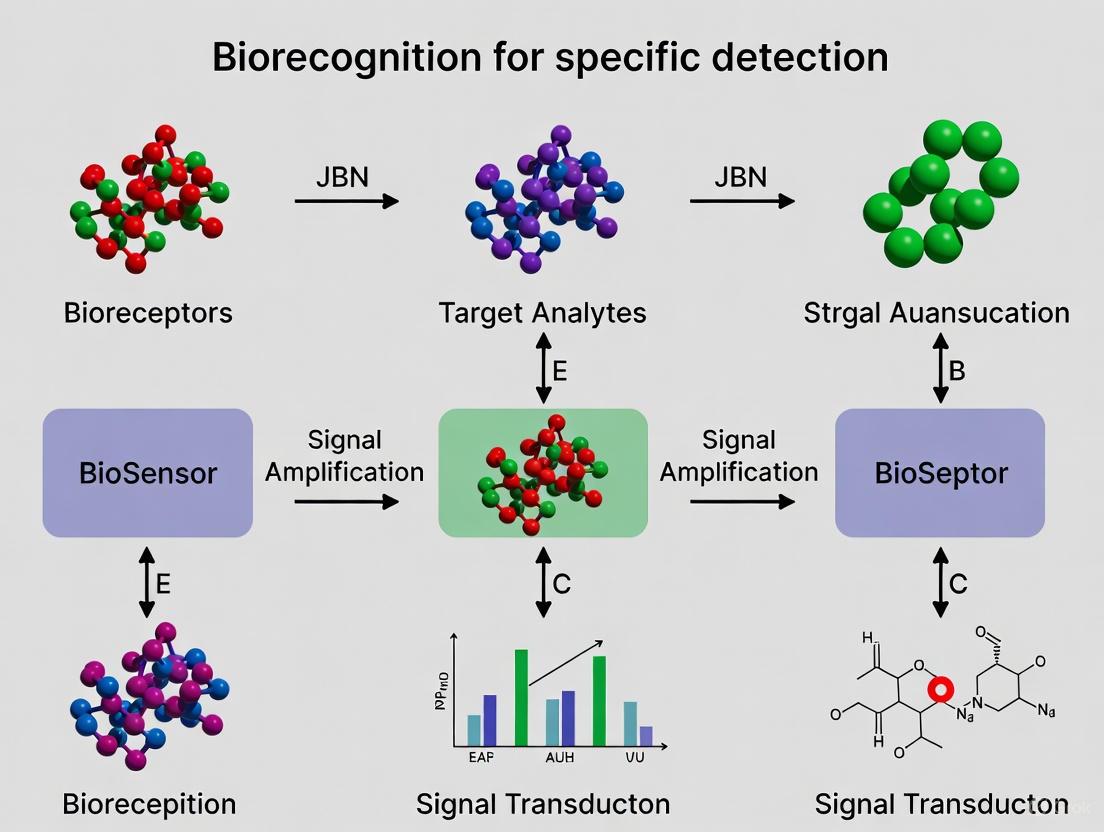
This article provides a comprehensive exploration of the fundamental principles of biorecognition that underpin the high specificity of modern biosensors.
Biorecognition Principles in Biosensors: Mechanisms, Applications, and Innovations for Specific Detection
Abstract
This article provides a comprehensive exploration of the fundamental principles of biorecognition that underpin the high specificity of modern biosensors. Tailored for researchers, scientists, and drug development professionals, it delves into the core mechanisms of molecular recognition, from traditional enzyme- and antibody-based elements to advanced aptamers and synthetic receptors. The scope spans methodological applications in disease diagnostics and biomanufacturing, addresses critical challenges in sensor optimization and stability, and offers a comparative analysis of transduction platforms. By synthesizing foundational knowledge with recent technological advances, this review serves as a strategic guide for the development of next-generation, high-fidelity detection systems for biomedical research and clinical translation.
The Molecular Basis of Biorecognition: Core Components and Specificity Mechanisms
Biorecognition is the fundamental process that confers specificity to a biosensor. It is defined as the process of signal generation—in the form of light, heat, pH, charge, or mass change, etc.—upon the specific interaction of a bioreceptor with a target analyte [1]. This specific binding event is the critical first step in biosensing, enabling the detection and measurement of a specific substance within a complex sample. The precision of this interaction determines the overall performance and reliability of the biosensing device, making the study of biorecognition principles paramount for advancements in diagnostic and monitoring technologies [1] [2].
The following diagram illustrates the core conceptual workflow of a biosensor, highlighting the central role of the biorecognition event.
Core Components of a Biosensor
A biosensor is an integrated system that translates a biological event into a measurable signal. Its functionality hinges on the coordinated operation of several key components [1] [3]:
- Analyte: The substance of interest that requires detection (e.g., glucose, a specific pathogen antigen, or a protein biomarker) [1].
- Bioreceptor: A biological molecule that specifically recognizes the analyte. Examples include antibodies, enzymes, DNA, aptamers, and cells. The bioreceptor is immobilized on the transducer surface [1].
- Transducer: The element that converts the energy from the biorecognition event into a measurable signal. This process, known as signalisation, typically results in optical or electrical signals proportional to the analyte-bioreceptor interaction [1].
- Electronics: The electronic circuitry that processes the transduced signal, performing tasks such as amplification and conversion from analog to digital form [1].
- Display: The user interface (e.g., LCD screen) that presents the quantified results in a user-friendly format such as numbers, graphs, or images [1].
Types of Bioreceptors and Their Mechanisms
Bioreceptors can be categorized based on their biological nature and mechanism of action. The selection of a bioreceptor is primarily driven by the required selectivity for the target analyte [1] [2].
Table 1: Common Types of Bioreceptors and Their Characteristics
| Bioreceptor Type | Mechanism of Biorecognition | Common Analytes | Key Advantage |
|---|---|---|---|
| Antibodies [1] [2] | High-affinity, lock-and-key binding to a specific antigenic epitope. | Pathogens, proteins, hormones | Excellent specificity and commercial availability. |
| Enzymes [1] | Catalytic conversion of a specific substrate, often producing a detectable product. | Metabolites (e.g., glucose, urea), toxins, ions | Signal amplification through catalytic activity. |
| Nucleic Acids (DNA/RNA) | Base-pair complementary hybridization with a specific gene sequence. | Genetic biomarkers, viral RNA, bacterial DNA | High specificity and ability to design for novel targets. |
| Aptamers [2] | Folding into a 3D structure that binds to a target molecule (proteins, ions, cells). | Proteins, small molecules, whole cells | In vitro selection (SELEX), high stability, modifiability. |
| Peptide Nucleic Acids (PNAs) [2] | DNA mimic with a peptide backbone; binds to complementary DNA/RNA with high affinity. | Specific gene sequences | Higher binding strength and stability than natural nucleic acids. |
| Whole Cells [1] | Cellular response (metabolic, photosynthetic) to the presence of an analyte. | Toxins, pollutants, biochemical oxygen demand | Provides functional/physiological information. |
The experimental workflow for developing and utilizing a biorecognition element, from selection to detection, is complex. The flowchart below details this multi-stage process.
Key Characteristics of an Effective Biorecognition System
The performance of a biorecognition system is quantitatively evaluated against several critical parameters [1] [3].
Table 2: Key Performance Characteristics of Biosensors
| Characteristic | Definition | Impact on Biosensor Performance | Typical Quantitative Goal |
|---|---|---|---|
| Selectivity [1] [2] | The ability of the bioreceptor to detect a specific analyte in a sample containing admixtures and contaminants. | Determines the false positive/negative rate; crucial for complex samples (e.g., blood, soil). | High specificity with minimal cross-reactivity. |
| Sensitivity (LOD) [1] | The minimum amount of analyte that can be reliably detected. | Enables detection of trace-level analytes (e.g., early disease biomarkers). | As low as ng/ml or fg/ml for some applications [1]. |
| Reproducibility [1] [3] | The ability to generate identical responses for a duplicated experimental setup. | Defines the reliability and robustness of the sensor's output. | High precision (repeatability) and accuracy (close to true value). |
| Stability [1] [3] | The degree of susceptibility to ambient disturbances and degradation over time. | Affects shelf-life and suitability for long-term monitoring applications. | Low signal drift; functional over hours to days for monitoring. |
| Linearity [1] | The accuracy of the measured response to a straight line (y=mc) over a concentration range. | Defines the working range and resolution for quantitative analysis. | High correlation coefficient (R²) over a wide dynamic range. |
Detailed Experimental Protocols for Biorecognition Studies
Protocol: Immobilization of a Bioreceptor on a Solid Surface
Objective: To covalently attach an antibody bioreceptor to a gold transducer surface for an electrochemical immunosensor [1].
- Surface Cleaning: The gold electrode is first cleaned with a piranha solution (3:1 mixture of concentrated sulfuric acid and 30% hydrogen peroxide) for 10 minutes, followed by thorough rinsing with deionized water and ethanol. (Caution: Piranha solution is highly corrosive and must be handled with extreme care.)
- Self-Assembled Monolayer (SAM) Formation: The clean, dry electrode is immersed in a 1 mM solution of 11-mercaptoundecanoic acid in ethanol for 12-18 hours at room temperature. This forms a SAM on the gold surface with exposed carboxyl groups.
- Carboxyl Group Activation: The SAM-modified electrode is rinsed with ethanol and placed in a solution containing 0.4 M EDC (1-Ethyl-3-(3-dimethylaminopropyl)carbodiimide) and 0.1 M NHS (N-Hydroxysuccinimide) in water for 1 hour. This activates the carboxyl groups to form amine-reactive NHS esters.
- Antibody Immobilization: The electrode is rinsed with a phosphate buffer saline (PBS, pH 7.4) and incubated in a solution containing the specific antibody (e.g., 50 µg/mL in PBS) for 2 hours at room temperature. The amine groups on the antibody form stable amide bonds with the activated surface.
- Surface Blocking: The electrode is treated with a blocking buffer, such as 1% Bovine Serum Albumin (BSA) in PBS, for 1 hour to passivate any remaining reactive sites and minimize non-specific binding.
- Storage: The functionalized biosensor is rinsed with PBS and can be stored in PBS at 4°C until use.
Protocol: Evaluating Biorecognition Selectivity
Objective: To confirm that a DNA aptamer bioreceptor selectively binds its target protein and not other similar proteins.
- Sensor Preparation: Prepare multiple identical biosensors with the DNA aptamer immobilized as per the protocol in section 5.1.
- Sample Exposure: Expose individual sensors to separate solutions containing:
- The target protein at a known concentration (positive control).
- A non-target protein with similar size and charge (e.g., BSA vs. lysozyme).
- A complex mixture (e.g., 10% serum in buffer) spiked with the target protein.
- The complex mixture without the target (negative control).
- Signal Measurement: Record the signal generated (e.g., change in electrochemical current or optical absorbance) for each sensor after a fixed incubation period and washing step.
- Data Analysis: Calculate the signal-to-noise ratio. A high signal for the target and minimal signal for non-targets indicates high selectivity. The response in the spiked mixture should be comparable to the positive control, corrected for the matrix effect.
The Scientist's Toolkit: Essential Research Reagent Solutions
The following table catalogs key reagents and materials essential for conducting biorecognition experiments and biosensor development [1] [2].
Table 3: Essential Reagents and Materials for Biorecognition Research
| Reagent / Material | Function / Role in Experimentation |
|---|---|
| Specific Bioreceptors (Antibodies, Aptamers, Enzymes) | The core recognition element that provides specificity for the target analyte. |
| Cross-linking Chemicals (EDC, NHS, Glutaraldehyde) | Facilitate the covalent immobilization of bioreceptors onto transducer surfaces. |
| Blocking Agents (BSA, Casein, Salmon Sperm DNA) | Passivate unmodified surfaces to prevent non-specific binding of non-target molecules. |
| Buffer Salts (PBS, HEPES, Tris-EDTA) | Maintain a stable and physiologically relevant pH and ionic strength for biorecognition. |
| Nanoparticles (Gold, Magnetic, Fluorescent) | Used as signal labels, for signal amplification, or as a immobilization platform. |
| Magnetic Beads | Enable separation and concentration of analyte-bioreceptor complexes from complex samples. |
| Microfluidic Chips / Cartridges | Provide a miniaturized platform for automating assay steps (mixing, separation, detection). |
Recent Advances and Future Perspectives
The field of biorecognition is evolving beyond naturally occurring elements. Novel engineered bioreceptors are being developed to address limitations of traditional antibodies, such as high cost and low stability [2]. These include:
- Aptamers: Selected in vitro via SELEX (Systematic Evolution of Ligands by EXponential enrichment), they offer robustness and design flexibility [2].
- Peptide Nucleic Acids (PNAs): These DNA mimics hybridize with high affinity and are resistant to enzymatic degradation, making them excellent for genetic detection [2].
- DNAzymes: Catalytic DNA molecules that can be selected to cleave RNA in the presence of a specific target, generating a detectable signal [2].
- CRISPR-Cas Systems: While renowned for gene editing, certain Cas proteins (e.g., Cas12a, Cas13a) exhibit collateral cleavage activity upon binding a specific nucleic acid target, enabling highly sensitive and specific detection [2].
Furthermore, the integration of nanomaterials and microfluidics into biosensor design is enhancing sensitivity and enabling the development of compact, automated point-of-care (POC) devices for rapid diagnosis in resource-limited settings [1] [2]. The future of biorecognition lies in the synergy of these advanced elements with miniaturized transduction systems to create next-generation diagnostic tools.
Biorecognition elements are the cornerstone of biosensor technology, providing the critical function of analyte specificity by leveraging biological interactions. These elements, also known as bioreceptors, possess a selective and potent affinity for target bioanalytes, enabling the development of powerful diagnostic tools for medical, environmental, and food safety applications [4] [2]. A biosensor is defined as an analytical device integrating a biological recognition element with a physicochemical transducer that converts a biochemical event into a measurable signal [5]. The selection of an appropriate biorecognition element is paramount during the preliminary design phase, as it directly influences key biosensor performance characteristics including sensitivity, selectivity, reproducibility, and reusability [4].
Biorecognition elements are broadly classified into categories based on their origin and structure. Naturally occurring elements, such as antibodies and enzymes, are biologically derived and utilize naturally-evolved physiological interactions. Synthetic elements, like molecularly imprinted polymers (MIPs), are artificially engineered. Pseudo-natural modalities, including aptamers, represent a hybrid approach, being artificially engineered from natural subunits [4]. This technical guide provides an in-depth examination of five core biorecognition elements—enzymes, antibodies, aptamers, nucleic acids, and whole cells—framed within the principles of biorecognition for specific detection research.
Core Biorecognition Elements: Mechanisms and Characteristics
Enzymes
Enzymes are biological catalysts, typically proteins, that achieve bioanalyte specificity through binding cavities within their three-dimensional structure. They utilize hydrogen-bonding, electrostatics, and other non-covalent interactions to form specific recognition patterns [4] [6]. Enzymatic biosensors are biocatalytic; the enzyme captures and catalytically converts the target bioanalyte into a measurable product [4]. This process involves the formation of an intermediate enzyme-substrate complex before the release of the detectable product [4]. A flagship application is the glucose biosensor, which uses the enzyme glucose oxidase (GOx). GOx catalyzes the oxidation of glucose to gluconolactone, simultaneously reducing its cofactor, FAD, to FADH₂. The cofactor is then regenerated by oxygen, producing hydrogen peroxide (H₂O₂), which can be electrochemically detected [7]. Enzymes are often embedded within surface structures to minimize diffusion pathways between the biorecognition element and the transducer [4].
Table 1: Key Characteristics of Enzyme Biorecognition Elements
| Characteristic | Description |
|---|---|
| Recognition Mechanism | Biocatalytic conversion of substrate [4] |
| Primary Transduction | Amperometric, electrochemical [4] [7] |
| Common Examples | Glucose oxidase, Horseradish peroxidase, Acetylcholinesterase [6] |
| Affinity & Specificity | High specificity for a substrate or a functional group/chemical bond [6] |
| Development Time | Varies; can be purified from biological sources [4] |
Antibodies
Antibodies, or immunoglobulins, are ~150 kDa glycoproteins produced by the immune system. They feature a characteristic "Y" shape formed by heavy and light chains, with analyte binding domains located at the arms' ends [4] [8]. Antibody-based biosensors (immunosensors) operate on an affinity-based mechanism, where the signal depends on the formation of an antibody-antigen immunocomplex [4]. This binding event is typically monitored using colorimetric, piezometric, or optical transduction methods [4] [9]. Antibodies are renowned for their high selectivity and binding affinity, making them the gold-standard biorecognition element for many pathogen detection applications [2] [6]. A significant limitation is their production, which requires animal experimentation, is costly and time-consuming, and can be challenging for targets that do not provoke a strong immune response, such as small molecules or toxins [4] [6] [8].
Diagram 1: Antibody structure and antigen binding
Aptamers
Aptamers are short, single-stranded DNA or RNA oligonucleotides (typically 100 base pairs) selected in vitro for their high affinity and specificity to a target molecule [4] [8]. They are developed through a combinatorial selection process called Systematic Evolution of Ligands by Exponential Enrichment (SELEX) [4] [8]. SELEX involves iterative cycles of incubation with the target, partitioning of bound sequences, and amplification of those sequences to enrich a pool of high-affinity binders [8]. Aptamers fold into defined three-dimensional structures that facilitate target binding through an "induced fit" mechanism [9]. Their key advantages include high stability, ease of chemical synthesis and modification, lower production costs compared to antibodies, and the ability to be selected against non-immunogenic targets, including metal ions, small molecules, proteins, and whole cells [4] [9] [8]. A drawback is the susceptibility of RNA aptamers to nuclease degradation in biological fluids [8].
Table 2: Aptamer vs. Antibody Comparison
| Feature | Aptamers | Antibodies |
|---|---|---|
| Molecular Weight | 5–15 kDa [8] | 150–170 kDa [8] |
| Selection/Production | In vitro (SELEX) [4] [8] | In vivo (Immune system) [4] [8] |
| Production Scalability | Highly scalable (chemical synthesis) [8] | Limited scalability [8] |
| Stability & Shelf Life | High; denaturation is reversible [8] | Sensitive to pH/temperature; irreversible denaturation [8] |
| Modification | Easily modified [9] [8] | Limited modification options [8] |
| Cost | Lower [8] | Higher [8] |
Nucleic Acids
Nucleic acid-based biosensors, or genosensors, exploit the fundamental principle of complementary base pairing for recognition [4]. A single-stranded DNA (ssDNA) fragment, designed to be complementary to a target sequence, is immobilized on the sensor surface. Specificity is achieved through hybridization between this probe and the target nucleic acid in the sample [4] [6]. Recent advances have led to the development of synthetic nucleic acid analogs like Peptide Nucleic Acids (PNA) and Locked Nucleic Acids (LNA). PNA, with its uncharged peptide backbone, and LNA, with a locked ribose conformation, both exhibit higher stability and binding affinity to complementary DNA or RNA compared to natural nucleic acids [4]. A primary limitation of nucleic acid biorecognition elements is their narrow application range, as they are optimally suited only for detecting complementary nucleic acid sequences [4] [6].
Whole Cells
Whole-cell biosensors utilize entire living microorganisms, such as bacteria, yeast, or bacteriophages, as the recognition element [6]. The primary advantage is the ability to report on functional outcomes, such as toxicity, bioavailability, or metabolic activity, which purified molecules cannot [6]. Bacteriophages (phages), being obligate parasites, offer exceptional host selectivity for detecting specific pathogenic bacteria [2] [6]. Whole cells can be genetically engineered to function as bioreporters by integrating reporter genes (e.g., for bioluminescence) that are activated upon encountering the target analyte [6]. Other benefits include not requiring purification of specific components, lower cost, and generally greater environmental stability than isolated enzymes or antibodies [6].
Experimental Protocols and Methodologies
SELEX Protocol for Aptamer Development
The Systematic Evolution of Ligands by Exponential Enrichment is the standard method for selecting target-specific aptamers [4] [8].
Materials:
- Synthetic Oligonucleotide Library: A large library (up to 10^14 different sequences) of ssDNA or RNA molecules with a central randomized region flanked by constant primer binding sites [4] [8].
- Immobilized Target: The purified target molecule (e.g., protein, small molecule) immobilized on a solid support like beads or a column.
- Binding Buffer: A buffer system with optimized pH, ionic strength, and cation composition (e.g., Mg²⁺ for RNA aptamers) to facilitate folding and binding.
- Wash Buffer: A buffer to remove weakly bound or unbound sequences.
- Elution Buffer: A solution that disrupts aptamer-target binding (e.g., denaturing conditions, elevated temperature, chelating agents).
- Enzymes for Amplification: DNA polymerase, primers, and dNTPs for PCR (for DNA libraries) or reverse transcriptase for RT-PCR (for RNA libraries) [8].
Procedure:
- Incubation: The oligonucleotide library is incubated with the immobilized target under selected binding conditions [8].
- Partitioning: The support is washed thoroughly with wash buffer to remove unbound sequences [8].
- Elution: Bound sequences are eluted from the target using the elution buffer.
- Amplification: The eluted sequences are amplified by PCR (or RT-PCR). For RNA or ssDNA libraries, a subsequent strand separation step is required to regenerate the single-stranded pool [8].
- Iteration: The amplified, enriched pool is used as the input for the next round of selection. Typically, 6 to 15 rounds are performed to stringently select for high-affinity binders [8].
- Cloning and Sequencing: After the final round, the enriched pool is cloned and sequenced to identify individual aptamer candidates [8].
- Characterization: The binding affinity (dissociation constant, Kd) and specificity of individual aptamer clones are characterized using techniques like surface plasmon resonance (SPR) or electrophoretic mobility shift assays (EMSAs) [8].
Diagram 2: SELEX workflow for aptamer development
Immobilization Techniques for Bioreceptors
Effective immobilization of the biorecognition element onto the transducer surface is critical for biosensor performance. The method must preserve the bioreceptor's activity and accessibility.
Common Immobilization Methods:
- Physical Adsorption: The simplest method, relying on weak forces (van der Waals, hydrophobic, ionic). It is easy to perform but can lead to leakage and denaturation [5].
- Covalent Attachment: The bioreceptor is linked to an activated sensor surface via stable covalent bonds. This method prevents leakage and enhances operational stability. Common chemistries involve coupling amines, thiols, or carboxyl groups on the biomolecule to the surface [5].
- Entrapment/Encapsulation: The bioreceptor is physically trapped within a porous matrix or polymer network (e.g., hydrogel, sol-gel). This protects the bioreceptor but can introduce diffusion barriers [4] [5].
- Affinity Binding: Uses high-affinity pairs like biotin-streptavidin or His-tag-Ni-NTA for specific and oriented immobilization, which can improve binding efficiency [5].
The Scientist's Toolkit: Essential Research Reagents
Table 3: Key Research Reagent Solutions for Biorecognition Research
| Reagent / Material | Function / Application | Key Considerations |
|---|---|---|
| Glucose Oxidase (GOx) | Model enzyme for electrochemical biosensing; catalyzes glucose oxidation [7]. | Used in first-, second-, and third-generation glucose sensors; requires consideration of oxygen dependence or use of mediators [7]. |
| Monoclonal Antibodies | High-specificity recognition for immunosensors; raised against a single epitope [6]. | Superior specificity and consistency vs. polyclonals; production requires hybridoma technology, is costly and time-consuming [6]. |
| Biotinylated Aptamers | Chemically synthesized aptamers for oriented immobilization on streptavidin-coated surfaces [5] [8]. | Enables controlled, oriented binding to sensor surfaces, enhancing reproducibility and binding capacity [5]. |
| Peptide Nucleic Acid (PNA) | Synthetic nucleic acid analog with a peptide backbone; used as a genosensor probe [4]. | Uncharged backbone confers higher binding affinity and stability against nucleases compared to DNA/RNA probes [4]. |
| Bacteriophages | Viruses that specifically infect bacteria; used as recognition elements for pathogens [2] [6]. | Offer high host selectivity and stability; can be engineered for improved binding or signal generation [6]. |
| Molecularly Imprinted Polymers (MIPs) | Synthetic polymeric receptors with templated cavities for a target molecule [4] [2]. | "Plastic antibodies"; offer high stability and reusability; alternative when biological receptors are unavailable or unstable [4] [6]. |
| N-Hydroxysuccinimide (NHS) / EDC | Crosslinking reagents for covalent immobilization of biomolecules via amine groups. | Standard chemistry for creating stable amide bonds on carboxyl-functionalized surfaces (e.g., gold, glass) [5]. |
The selection of an optimal biorecognition element is a foundational decision in the development of biosensors for specific detection research. Each element—enzymes, antibodies, aptamers, nucleic acids, and whole cells—offers a unique combination of advantages and limitations concerning specificity, sensitivity, stability, reproducibility, and cost [4]. While antibodies remain a gold standard in many applications due to their mature production protocols and high specificity, novel elements like aptamers are gaining prominence for their robustness, tunability, and cost-effectiveness [9] [8]. The choice is ultimately dictated by the intended application, target analyte, and operational environment. A deep understanding of the principles, binding mechanisms, and practical methodologies surrounding these core biorecognition elements is essential for driving innovation in diagnostics, drug development, and environmental monitoring. Future progress in the field will likely involve the integration of artificial intelligence to optimize bioreceptor design and the development of hybrid systems that combine the strengths of multiple recognition elements to create even more powerful and reliable biosensing platforms [10].
Molecular recognition, the specific and non-covalent interaction between two or more molecules, constitutes the fundamental basis of virtually all biological processes. This specific binding between receptors and ligands, such as antibodies and antigens or enzymes and substrates, governs cellular signaling, gene regulation, immune response, and pharmacological interventions [11] [4]. The precision of these interactions determines the fidelity of biological systems and the efficacy of therapeutic agents. For researchers and drug development professionals, a quantitative understanding of the principles governing these interactions—affinity, specificity, and binding kinetics—is indispensable for rational design in diagnostics, therapeutics, and biosensor development [4] [12].
This technical guide examines the core principles of molecular recognition from both theoretical and applied perspectives. We delve into the thermodynamic and kinetic frameworks that define binding interactions, present methodologies for their experimental characterization, and explore how these principles are applied in biotechnology and drug discovery through various biorecognition elements.
Core Principles and Thermodynamic Foundations
The Binding Equilibrium and Affinity
At its simplest, biomolecular recognition can be represented as a reversible reaction where an analyte (A) associates with a receptor (B) to form a complex (AB) [12]:
A + B ⇌ AB
The affinity describes the strength of this interaction, quantified by the equilibrium constant (K_a), or association constant, which is directly related to the Gibbs free energy change (ΔG) during binding [12]:
ΔG = -RT ln(K_a)
where R is the gas constant and T is the temperature. A higher affinity corresponds to a more negative ΔG value, indicating a more favorable binding interaction. The equilibrium constant can also be expressed in terms of the kinetic rate constants:
Ka = kon / k_off
where kon is the association rate constant (M⁻¹s⁻¹) and koff is the dissociation rate constant (s⁻¹) [12]. The inverse of Ka is the dissociation constant Kd, a crucial parameter representing the analyte concentration at which half of the receptor binding sites are occupied.
Table 1: Key Thermodynamic Parameters in Molecular Recognition
| Parameter | Symbol | Definition | Significance |
|---|---|---|---|
| Association Constant | K_a | [AB]/([A][B]) | Measures binding strength |
| Dissociation Constant | K_d | 1/K_a = [A][B]/[AB] | Lower value indicates higher affinity |
| Gibbs Free Energy | ΔG | -RT ln(K_a) | Overall spontaneity of binding |
| Enthalpy | ΔH | Heat change | Reflects bond formation/breakage |
| Entropy | ΔS | System disorder | Measures structural changes |
Specificity and Molecular Discrimination
Specificity refers to the ability of a biorecognition element to discriminate between its target analyte and other similar molecules in a complex mixture [11] [4]. While affinity measures binding strength, specificity determines binding accuracy. From a statistical perspective, the intrinsic specificity for biomolecular recognition measures the degree of discrimination of native versus non-native binding, quantified as the optimization of the ratio between the free energy gap separating the native state from the average of non-native states and the roughness of the free energy landscape [11].
High specificity requires both complementarity (structural and chemical compatibility between binding surfaces) and negative design (evolutionary selection against non-cognate binding) [13]. For transcription factors like the SRY protein, this involves not only searching genomic DNA for specific sequences but also avoiding energetic traps formed by semi-specific sites through sophisticated molecular recognition mechanisms [13].
Binding Kinetics and Energy Landscapes
Binding kinetics describe the time-dependent progression of the association and dissociation processes, characterized by the rate constants kon and koff [12]. These kinetic parameters are governed by the energy landscape of the binding interaction, particularly the activation energy barriers that must be overcome for the reaction to proceed.
The distribution of binding kinetics across different ligand-receptor pairs follows universal statistical laws: near the mean, kinetics follow a log-normal distribution, while at the tail, they follow a power law distribution [11]. The kinetic process often involves multiple steps:
- Diffusion: Initial approach of molecules through 3D space
- Conformational Selection: Sampling of compatible conformations
- Induced Fit: Mutual adaptation of binding partners
- Complex Stabilization: Formation of specific molecular contacts
For DNA-binding proteins, the search process incorporates one-dimensional diffusion along the DNA strand, involving both sliding and hopping mechanisms to locate specific binding sites among numerous non-specific alternatives [13]. Recent studies on SRY-DNA recognition reveal that conformational transitions in DNA can create energy barriers that slow recognition kinetics and increase unsuccessful binding events ("skipping events"), requiring additional search cycles and extending overall recognition time [13].
Experimental Characterization Methodologies
Measuring Binding Affinity and Thermodynamics
Several established techniques enable quantitative characterization of binding affinity and associated thermodynamic parameters:
Isothermal Titration Calorimetry (ITC) directly measures heat changes during binding interactions, providing simultaneous determination of K_a, ΔG, ΔH, and ΔS from a single experiment. This makes ITC particularly valuable for elucidating the driving forces behind molecular recognition.
Surface Plasmon Resonance (SPR) enables real-time monitoring of binding events without labeling requirements. SPR instruments measure changes in refractive index at a functionalized surface, allowing determination of both affinity (Kd) and kinetic parameters (kon and k_off) [12]. The methodology involves:
- Immobilization of one binding partner on a sensor chip
- Flowing the other partner in solution across the surface
- Monitoring association and dissociation phases
- Global fitting of sensorgram data to binding models
Microscale Thermophoresis (MST) quantifies binding by detecting changes in molecular movement in temperature gradients, requiring minimal sample volumes and applicable to diverse molecular classes.
Table 2: Experimental Methods for Characterizing Binding Parameters
| Method | Key Measurements | Sample Requirements | Throughput |
|---|---|---|---|
| Isothermal Titration Calorimetry (ITC) | K_d, ΔG, ΔH, ΔS | Moderate concentration, no labeling | Low |
| Surface Plasmon Resonance (SPR) | Kd, kon, k_off, specificity | One immobilized partner | Medium |
| Microscale Thermophoresis (MST) | K_d, binding stoichiometry | Low volume, minimal preparation | Medium-High |
| Fluorescence Polarization (FP) | K_d, competition assays | Fluorescent labeling required | High |
| Analytical Ultracentrifugation (AUC) | K_d, complex size, shape | High purity, various buffers | Low |
Characterizing Binding Kinetics
Advanced computational and experimental approaches are employed to study the dynamic aspects of molecular recognition:
Molecular Dynamics (MD) Simulations provide atomistic details of binding pathways and energy landscapes. For example, studies on β-cyclodextrin and its guests utilized MD simulations to compute binding enthalpy, solute entropy, and solvent entropy, illustrating all entropy and enthalpy components of binding in great detail [14]. Enhanced sampling algorithms like the "cell method" accelerate searching molecular conformations and ligand dissociation pathways [14].
Coarse-Grained (CG) Models balance computational efficiency with molecular insights, particularly valuable for studying complex systems like protein-DNA interactions. A recent CG study of SRY-DNA recognition implemented a model where:
- SRY was represented by 85 residues, each as a single bead at the Cα atom
- DNA consisted of three beads per nucleotide (phosphate, sugar, and base)
- The potential energy function combined bond, angle, dihedral, and non-bonded interaction terms
- Debye-Hückel potential accounted for electrostatic interactions [13]
This approach revealed how DNA conformational transitions impact recognition kinetics, showing that requirements for DNA bending correspond to higher energetic barriers and slower kinetics [13].
Biorecognition Elements and Their Applications
Classes of Biorecognition Elements
Multiple classes of biorecognition elements with distinct characteristics enable specific molecular recognition across various applications:
Antibodies are ~150 kDa glycoproteins with Y-shaped structures that provide high specificity through complementary determining regions forming unique recognition patterns for their antigens [4] [6]. While offering excellent affinity and specificity, their production requires animal immunization or hybridoma technology, resulting in batch-to-batch variation and limited stability in certain conditions [6].
Aptamers are single-stranded DNA or RNA oligonucleotides (typically <25 kDa) selected through Systematic Evolution of Ligands by Exponential Enrichment (SELEX) to bind diverse targets from ions to whole cells [4] [6]. Their "induced fit binding" mechanism provides high specificity with dissociation constants in the nanomolar range, along with advantages including thermal stability, ease of functionalization, and long shelf life [6].
Enzymes provide specificity through binding cavities that recognize substrates using hydrogen-bonding, electrostatics, and other non-covalent interactions [4] [6]. Enzymatic biosensors typically operate through biocatalytic mechanisms where the enzyme captures and converts the target analyte to a measurable product [4].
Nucleic Acids serve as biorecognition elements in genosensors through complementary base-pairing with target sequences [4] [6]. Modified nucleic acids including locked nucleic acids (LNA) and peptide nucleic acids (PNA) offer enhanced binding affinity and stability [4].
Molecularly Imprinted Polymers (MIPs) are synthetic receptors created by polymerizing functional monomers around template molecules, forming specific recognition cavities after template removal [4]. MIPs offer advantages of robustness, reusability, and stability under harsh conditions where biological receptors would denature [4].
Research Reagent Solutions
Table 3: Essential Research Reagents for Molecular Recognition Studies
| Reagent/Category | Function/Application | Key Characteristics |
|---|---|---|
| Monoclonal Antibodies | High-specificity recognition; immunosensors | Single epitope specificity; batch consistency |
| SELEX Library | Aptamer selection | Random 20-70 bp region flanked by primer sites |
| Phage Display Systems | Protein-based recognition element discovery | Random-peptide library for affinity selection |
| Molecularly Imprinted Polymers (MIPs) | Synthetic recognition elements | Tunable specificity; thermal/chemical stability |
| Horseradish Peroxidase (HRP) | Enzyme label for detection | High turnover number; colorimetric/chemiluminescent readout |
| Alkaline Phosphatase (ALP) | Enzyme label for detection | Broad substrate specificity; used in ELISA |
| Locked Nucleic Acids (LNA) | Enhanced nucleic acid binding | Ribose conformation "locked" for improved affinity |
| Peptide Nucleic Acids (PNA) | Enhanced nucleic acid binding | Uncharged peptide backbone for higher stability |
Visualization of Molecular Recognition Concepts
Thermodynamics and Kinetics of Binding
Diagram 1: Binding kinetics and equilibrium. The reversible binding reaction shows association (k_on) and dissociation (k_off) processes with the transition state energy barrier.
Biosensor Mechanism and Signal Transduction
Diagram 2: Biosensor signal transduction pathway. The core components show the sequence from analyte binding to measurable signal output.
Applications in Biosensing and Diagnostic Technologies
The principles of molecular recognition find critical application in biosensor technologies, where the selection of appropriate biorecognition elements determines key performance characteristics including sensitivity, selectivity, reproducibility, and reusability [4]. Optical biosensors leveraging these principles have shown significant utility in food safety monitoring, detecting contaminants including pathogens, toxins, antibiotics, and heavy metals through various transduction mechanisms including surface plasmon resonance (SPR), fiber optics, and fluorescence emissions [10].
In drug discovery, understanding the statistical distributions of binding parameters enables more effective screening strategies. The distribution of binding affinity across different ligands targeting a specific receptor is Gaussian around the mean and exponential in the tail, while equilibrium constants follow log-normal distributions near the mean and power law distributions in the tail [11]. These statistical insights guide the optimization of molecular recognition elements for therapeutic applications.
The integration of artificial intelligence and machine learning with biosensing technologies promises enhanced predictive capabilities for molecular recognition, potentially enabling more precise food safety monitoring systems and diagnostic platforms [10]. As our understanding of the fundamental principles deepens through continued research, the design and application of molecular recognition systems will continue to advance pharmaceutical development, diagnostic medicine, and biotechnology.
The evolution of diagnostic tools and specific detection research is fundamentally rooted in the principles of biorecognition—the specific sequestration of a target analyte by a complementary receptor. Traditional biosensors have relied on biological recognition elements, such as antibodies and enzymes, which provide high specificity but are limited by their fragility, limited shelf life, and requirement for carefully regulated operational conditions [4]. To overcome these limitations, the field has increasingly turned to synthetic receptors, engineered structures that mimic natural physiological interactions while offering enhanced robustness and tunability. Among the most promising of these are Molecularly Imprinted Polymers (MIPs) and Peptide Nucleic Acids (PNAs). MIPs are synthetic polymer networks with template-shaped cavities capable of recognizing both chemical and biological contaminants [15]. PNAs, conversely, are synthetic oligonucleotides with a neutral peptide-based backbone that confers exceptional stability and affinity for complementary nucleic acid sequences [4]. This whitepaper provides an in-depth technical guide to these two classes of synthetic receptors, detailing their working principles, fabrication methodologies, and application within a framework of advanced biorecognition research, ultimately framing them as powerful tools for researchers, scientists, and drug development professionals.
Molecularly Imprinted Polymers (MIPs): Biomimetic Synthetic Receptors
Fundamental Principles and Synthesis
Molecularly Imprinted Polymers (MIPs) are biomimetic synthetic receptors that employ a templated polymer matrix to achieve analyte specificity through patterns of non-covalent bonding, electrostatic interactions, or size inclusion/exclusion [4]. The core principle involves creating a three-dimensional polymer scaffold with specific recognition sites complementary to the target molecule (the template) in both shape and chemical functionality. The general synthesis procedure, as illustrated in Figure 1, involves several key stages [15]:
- Complexation: Functional monomers and the molecular template are dissolved in a suitable solvent (porogen). They self-assemble via intermolecular interactions (e.g., hydrogen bonding, van der Waals forces, ionic interactions).
- Polymerization: In the presence of a cross-linker and an initiator, the monomers undergo polymerization, freezing the template-monomer complex in place.
- Template Extraction: The template molecule is removed from the polymer matrix, leaving behind cavities that are complementary to the template in size, shape, and chemical functionality.
- Rebinding: These cavities can then selectively rebind the target analyte from a complex sample.
This process results in a robust, stable material that exhibits an affinity comparable to that of natural antibodies but with superior durability [15].
Figure 1. Workflow of Molecularly Imprinted Polymer (MIP) synthesis and application.
MIP Synthesis Methodologies
Various synthesis strategies have been developed to create MIPs tailored for different applications and templates. The choice of method significantly influences the material's physicochemical properties and performance [15].
- Bulk Imprinting: The oldest and simplest method, involving free radical polymerization to create a solid monolith, which is then ground and sieved to produce particles. While versatile and scalable, it suffers from polymer loss during grinding and potentially low binding kinetics [15].
- Precipitation Polymerization: This method uses an excess of solvent where the polymer is insoluble. As polymerization proceeds, polymer nuclei form and precipitate out as micro- or nano-spheres, yielding particles with controlled morphology without the need for grinding [15].
- Electropolymerization: This technique involves the oxidation of conjugated monomers to deposit a conductive polymer film directly onto a transducer substrate (e.g., an electrode). It allows for precise control over film thickness, topology, and morphology, facilitating direct integration into sensing platforms [15].
- Solid-Phase Synthesis: The initiator or template is immobilized on a solid support, enabling polymerization directly from the surface. This approach allows for the removal of low-affinity polymers and permits the use of controlled radical polymerization techniques (e.g., RAFT, ATRP) for more homogeneous polymer networks [15].
- Surface Imprinting (SIPs): For large templates like proteins or whole cells, recognition sites are created at or near the polymer surface. This strategy facilitates template removal and rebinding, which are challenging for macromolecules within the dense network of a bulk MIP [15].
Experimental Protocol: MIP Synthesis via Bulk Imprinting for a Small Molecule
Objective: To synthesize a MIP for the selective recognition of a small molecule target (e.g., a pesticide or drug residue) via bulk imprinting.
Materials:
- Template Molecule: The target analyte (e.g., 0.2 mmol).
- Functional Monomer: Selected to interact with the template (e.g., methacrylic acid, 0.8 mmol).
- Cross-linker: (e.g., ethylene glycol dimethacrylate, EGDMA, 4.0 mmol).
- Initiator: (e.g., azobisisobutyronitrile, AIBN, 0.1 mmol).
- Porogen: A suitable solvent (e.g., acetonitrile or toluene, 5 mL).
Procedure:
- Pre-polymerization Complex: Dissolve the template, functional monomer, and cross-linker in the porogen in a glass vial. Sonicate to ensure complete dissolution. Allow the mixture to pre-associate for 30-60 minutes.
- Initiation: Add the initiator (AIBN) to the mixture and sparge with nitrogen or argon for 5-10 minutes to remove oxygen, which inhibits free radical polymerization.
- Polymerization: Seal the vial and place it in a water bath or thermal block at 60°C for 12-24 hours to initiate polymerization.
- Grinding and Sieving: After polymerization, break the resulting rigid polymer monolith. Grind it mechanically using a mortar and pestle and sieve it to obtain particles of a desired size range (e.g., 25-50 μm).
- Template Extraction: Wash the particles repeatedly with a suitable washing solvent (often a mixture of methanol and acetic acid) to remove the template molecule. Monitor the washings via UV-Vis spectroscopy or HPLC until no template is detected.
- Drying: Dry the resulting MIP particles under vacuum overnight. Store in a desiccator.
- Control Polymer (NIP): Synthesize a non-imprinted polymer (NIP) following the identical procedure but in the absence of the template molecule. This serves as a critical control to account for non-specific binding.
Peptide Nucleic Acids (PNAs): High-Affinity Synthetic Probes
Structure and Binding Mechanism
Peptide Nucleic Acids are synthetic oligonucleotide analogues where the standard sugar-phosphate backbone found in DNA and RNA is replaced by an uncharged, flexible backbone composed of N-(2-aminoethyl)glycine units [4]. The nucleobases (adenine, guanine, cytosine, and thymine) are linked to this backbone through carbonyl methylene linkages. This structural modification confers several unique and advantageous properties, as illustrated in Figure 2.
The neutral PNA backbone eliminates electrostatic repulsion with complementary nucleic acid targets, which is a significant factor for natural, negatively charged DNA-DNA or DNA-RNA duplexes. This results in higher thermal stability and binding affinity (increased melting temperature, Tm) compared to equivalent DNA-DNA duplexes [4]. Furthermore, PNAs exhibit high biological stability because they are resistant to both nucleases and proteases, making them suitable for complex biological environments. Their structure also allows for superior sequence specificity, including an ability to distinguish single-base mismatches more effectively than DNA probes.
Figure 2. Structure and binding mechanism of a Peptide Nucleic Acid (PNA) probe with its complementary DNA target.
Experimental Protocol: PNA-Based Hybridization Assay for miRNA Detection
Objective: To detect a specific microRNA (miRNA) sequence using a PNA probe immobilized on a sensor surface, as part of a hybrid biosensor strategy [16].
Materials:
- PNA Probe: Custom-synthesized sequence complementary to the target miRNA.
- Target miRNA: The specific miRNA sequence of interest.
- Mismatched RNA Sequences: For specificity controls.
- Immobilization Substrate: e.g., a gold electrode for electrochemical detection or a functionalized glass slide for optical detection.
- Hybridization Buffer: Typically a low-salt buffer to minimize electrostatic repulsion and maximize hybridization stringency.
- Washing Buffers: e.g., Phosphate Buffered Saline (PBS) with Tween 20.
- Detection Reagents: e.g., a redox marker like Methylene Blue for electrochemical impedance spectroscopy (EIS) or a fluorescent label for optical detection.
Procedure:
- Surface Preparation: Clean and functionalize the transducer surface (e.g., electrochemically clean the gold electrode).
- PNA Immobilization: Immobilize the PNA probes onto the functionalized surface. This can be achieved via thiol-gold chemistry for gold surfaces, or through amide coupling to carboxylated surfaces using EDC/NHS chemistry. Incubate for several hours, then rinse thoroughly to remove unbound probes.
- Blocking: Incubate the surface with a blocking agent (e.g., bovine serum albumin or mercaptohexanol) to passivate any remaining reactive sites and minimize non-specific adsorption.
- Hybridization: Introduce the sample containing the target miRNA (diluted in hybridization buffer) to the PNA-functionalized surface. Incubate at a controlled temperature (often slightly below the calculated Tm of the PNA-miRNA duplex) for 30-60 minutes to allow for specific hybridization.
- Stringency Wash: Rinse the sensor surface with a warm, low-salt buffer to dissociate any non-specifically bound or mismatched sequences.
- Signal Transduction: Perform the measurement. For electrochemical detection, this involves measuring the change in impedance (EIS) or current before and after hybridization in the presence of a redox marker. The binding event causes a measurable change in the electrical signal.
- Data Analysis: Quantify the target concentration based on the signal change, using a calibration curve established with known concentrations of the target miRNA.
Comparative Analysis and Hybrid Applications
Characteristics and Performance Comparison
The distinct nature of MIPs and PNAs makes them suitable for different applications within the realm of specific detection. The following table summarizes their key characteristics, providing a guide for researchers in selecting the appropriate synthetic receptor.
Table 1: Comparative characteristics of MIPs and PNAs as synthetic receptors.
| Characteristic | Molecularly Imprinted Polymers (MIPs) | Peptide Nucleic Acids (PNAs) |
|---|---|---|
| Class | Synthetic Polymer | Synthetic Oligonucleotide |
| Target Range | Broad (small molecules, proteins, cells) [15] | Narrow (primarily nucleic acids) [4] |
| Affinity & Sensitivity | High affinity, comparable to antibodies; sensitivity depends on polymer design [15] | Very high affinity and sensitivity due to neutral backbone [4] |
| Selectivity | High for the imprinted template; cross-reactivity possible with similar structures | Exceptional sequence selectivity; can discriminate single-base mismatches [4] |
| Reproducibility | Moderate; can be challenging to achieve batch-to-batch consistency | High; solid-phase synthesis ensures precise, reproducible sequences |
| Reusability | High; robust and can often be regenerated for multiple uses [4] | Moderate; depends on immobilization stability and assay conditions |
| Stability & Shelf Life | Excellent; resistant to heat, pH, and organic solvents [15] | Excellent; resistant to nucleases and proteases [4] |
| Development Cost & Time | Relatively low-cost and rapid synthesis once protocol is established | Higher cost for custom synthesis; design is straightforward |
The Scientist's Toolkit: Essential Research Reagents
The development and application of MIPs and PNAs rely on a core set of reagents and materials. The following table details these essential components and their functions.
Table 2: Key research reagents and materials for working with MIPs and PNAs.
| Research Reagent / Material | Function | Primary Application |
|---|---|---|
| Functional Monomers | Forms interactions with the template; defines chemical complementarity (e.g., methacrylic acid for H-bonding). | MIP Synthesis |
| Cross-linker (e.g., EGDMA) | Creates a rigid 3D polymer network around the template, stabilizing the imprinted cavities. | MIP Synthesis |
| PNA Oligomer | Synthetic probe for specific, high-affinity hybridization with complementary DNA or RNA targets. | PNA Assays |
| Initator (e.g., AIBN) | Generates free radicals to initiate the polymerization reaction. | MIP Synthesis |
| EDC / NHS Chemistry | Activates carboxyl groups for covalent immobilization of PNA probes on sensor surfaces. | PNA Immobilization |
| Stringency Wash Buffer | Removes weakly bound, non-specific analytes; critical for achieving high selectivity. | Both MIP & PNA Assays |
Synergistic Integration: MIP-PNA Hybrid Biosensors
Emerging research demonstrates that the combination of MIPs and PNAs in a single platform can create powerful hybrid biosensors with enhanced capabilities. A prime example is a sensor developed for miRNA detection, which integrates PNA's superior nucleic acid recognition with the signal amplification provided by an electropolymerized MIP [16]. In such a design, the PNA probe ensures the specific capture of the target miRNA. Subsequently, an MIP layer is grown in situ around the formed PNA-miRNA duplex via electropolymerization. This MIP layer, now imprinted with the duplex, acts as an artificial receptor that amplifies the transduction signal, for instance, by increasing the impedance measured via electrochemical impedance spectroscopy. This synergy between the two synthetic receptors results in a sensor that is both highly specific and highly sensitive, pushing the boundaries of what is possible in diagnostic detection [16].
Molecularly Imprinted Polymers and Peptide Nucleic Acids represent two pillars of modern synthetic receptor technology, each addressing key limitations of biological recognition elements. MIPs offer unparalleled versatility and robustness for a wide range of targets, from small chemical contaminants to entire cells. PNAs provide exceptional affinity and specificity for nucleic acid detection, a critical function in genetic diagnostics and research. The choice between them is not a matter of superiority but of strategic application alignment. Furthermore, their integration into hybrid systems unveils a new frontier in biosensing, leveraging the unique strengths of each to create devices with superior analytical performance. As the principles of biorecognition continue to evolve, these synthetic receptors will undoubtedly play a central role in advancing specific detection research, paving the way for next-generation diagnostics, environmental monitoring, and therapeutic development.
The field of biosensing represents a powerful convergence of biochemistry, electrochemistry, and materials science, creating analytical devices that combine biological recognition with physicochemical transduction [17]. For researchers and drug development professionals, understanding this evolutionary pathway is crucial for designing the next generation of diagnostic and monitoring tools. The journey from initial enzyme electrodes to contemporary nanomaterial-based sensors illustrates a paradigm shift in analytical biotechnology, driven by persistent challenges in enhancing sensitivity, selectivity, and commercial viability [18]. This evolution is categorized into distinct generations, each marked by innovations in how the biological recognition event is translated into a quantifiable electrical signal [19]. Framed within the broader context of biorecognition principles, this technical guide examines the historical milestones, operational mechanisms, and future directions of biosensor technology, with particular emphasis on the transformative impact of nanomaterials that now enable direct electron transfer and femtomolar detection capabilities [17] [20].
The Foundation: First-Generation Biosensors
The Pioneering Enzyme Electrode
The conceptual foundation of modern biosensors was established in 1962 by Leland C. Clark Jr., who developed the first enzyme electrode by immobilizing glucose oxidase (GOx) on an oxygen electrode [17]. This revolutionary device functioned by measuring oxygen consumption during the enzymatic oxidation of glucose, thereby providing a quantitative relationship between oxygen depletion and glucose concentration [19]. Clark's innovation introduced the core architecture of all subsequent biosensors: a biological recognition element (the enzyme) integrated directly with a physical transducer (the electrode) [17].
Operational Principle and Limitations
First-generation biosensors operate on the principle of measuring the concentration of natural substrates or products of the enzymatic reaction [19]. In the case of the glucose enzyme electrode, the reaction is:
The transducer then measures the electroreduction of the consumed oxygen or the electrooxidation of the generated hydrogen peroxide [21]. This mediatorless, amperometric approach defined the first generation of biosensors [19]. A significant milestone followed in 1967 when Updike and Hicks created the first functional enzyme electrode by physically immobilizing glucose oxidase on an oxygen sensor, significantly improving its stability and operational simplicity [18] [19]. The subsequent commercialization of the first biosensor by Yellow Springs Instrument Co. in 1975 marked the transition of this technology from laboratory curiosity to practical analytical tool [17].
Despite their groundbreaking nature, first-generation biosensors faced inherent limitations. The reliance on dissolved oxygen as a natural mediator resulted in operational dependence on oxygen tension within the sample matrix [21]. Furthermore, the high applied potentials required for hydrogen peroxide detection often led to interference from other electroactive species in complex samples like blood or serum, compromising measurement accuracy [19].
Table 1: Key Milestones in First-Generation Biosensors
| Year | Developer(s) | Innovation | Significance |
|---|---|---|---|
| 1956 | Leland C. Clark Jr. | Clark oxygen electrode [19] | Established the fundamental transducer platform. |
| 1962 | Clark and Ann Lyons | Enzyme electrode for glucose [17] | Introduced the concept of enzyme immobilization on a transducer. |
| 1967 | Updike and Hicks | First functional enzyme electrode [18] | Demonstrated practical biosensor with immobilized GOx. |
| 1969 | Guilbault and Montalvo | First potentiometric enzyme electrode (Urea) [18] | Expanded biosensor concept to new analytes and transducers. |
| 1975 | Yellow Springs Instrument Co. | First commercial biosensor [17] | Commercialization of biosensor technology. |
The Mediator Era: Second-Generation Biosensors
Principle of Mediated Electron Transfer
To overcome the limitations of first-generation biosensors, the second generation introduced artificial redox mediators [19]. These synthetic molecules, such as ferrocene and its derivatives, quinones, and organic dyes, function as soluble electron shuttles [17]. They facilitate the transfer of electrons from the reduced active site of the oxidase enzyme directly to the surface of the working electrode, bypassing the need for oxygen as the natural electron acceptor [21].
The general reaction scheme for a mediated glucose biosensor is:
- Enzyme Reaction: Glucose + GOxₒₓ → Gluconolactone + GOxᵣₑd
- Mediator Regeneration: GOxᵣₑd + 2Mₒₓ → GOxₒₓ + 2Mᵣₑd
- Electrode Reaction: 2Mᵣₑd → 2Mₒₓ + 2e⁻
The resulting current from the re-oxidation of the reduced mediator (Mᵣₑd) at the electrode is proportional to the glucose concentration [19].
Advantages and Experimental Implementation
The use of mediators offered several critical advantages [19]:
- Lower Operating Potentials: Mediators are chosen for their low redox potential, allowing the working electrode to be held at a potential where interfering species in the sample are not electroactive, thereby significantly enhancing selectivity.
- Oxygen Independence: The reaction becomes largely independent of ambient oxygen concentration, improving accuracy in oxygen-limited environments.
- Improved Response Times: Electron transfer rates via mediators can be faster than with natural pathways.
A typical experimental protocol for constructing an early mediated biosensor involved:
- Electrode Preparation: Using a carbon-paste or screen-printed carbon electrode as the base platform [17].
- Enzyme/Mediator Immobilization: Physically mixing or adsorbing the enzyme (e.g., GOx) and the mediator (e.g., ferrocene) into the carbon paste, or depositing them together on the electrode surface within a polymer matrix like Nafion or cellulose acetate [19] [21].
- Membrane Application: Coating the modified electrode with a semi-permeable membrane (e.g., polycarbonate) to retain the enzyme and mediator while allowing the analyte (glucose) to diffuse in [19].
- Amperometric Measurement: Applying a constant potential (e.g., +0.2 V vs. Ag/AgCl for ferrocene) and measuring the steady-state current upon sample introduction [19].
The Modern Paradigm: Third-Generation and Nanomaterial-Based Biosensors
The Principle of Direct Electron Transfer
Third-generation biosensors represent a significant paradigm shift by achieving Direct Electron Transfer (DET) between the redox active site of an enzyme and the electrode surface without the need for any mediators [19] [21]. This is considered a more elegant and efficient design, as it simplifies the sensor architecture, reduces potential toxicity from synthetic mediators, and lowers costs [21]. Successful DET has been demonstrated for various peroxidases, laccases, and certain types of glucose oxidase that have their redox centers accessible enough for direct tunneling [19].
The Enabling Role of Nanomaterials
The practical realization of efficient DET and the general enhancement of biosensor performance have been made possible by the integration of nanomaterials [22] [18]. These materials, with at least one dimension in the 1-100 nm range, provide extraordinary properties that are ideal for biosensing [20]:
- High Surface-to-Volume Ratio: Creates a larger area for enzyme immobilization, increasing biocatalyst loading and signal intensity [18].
- Tunable Surface Chemistry: Facilitates controlled and stable immobilization of biorecognition elements while preserving their bioactivity [21].
- Excellent Electrical Conductivity: Enables efficient electron tunneling for DET and enhances the electrochemical response of the transducer [20].
- Biomimetic Properties: Some nanomaterials, like carbon nanotubes and graphene, exhibit nanozyme activity, mimicking natural enzymes [23].
Table 2: Key Nanomaterials in Third-Generation Biosensors
| Nanomaterial Class | Examples | Key Properties | Role in Biosensing |
|---|---|---|---|
| Carbon Nanomaterials [18] [20] | Carbon Nanotubes (CNTs), Graphene (Gii), Carbon Black | High conductivity, large surface area, chemical stability, antifouling properties [17] | Electrode modification for enhanced DET; platform for biomolecule immobilization. |
| Metal Nanoparticles [22] [21] | Gold, Silver, Platinum NPs | High conductivity, surface plasmon resonance, catalytic activity | Signal amplification; electron wiring; label for optical detection. |
| Metallic Oxide NPs [22] [18] | Zinc Oxide, Iron Oxide, Titanium Dioxide | Biocompatibility, isoelectric point suitable for enzyme binding, catalytic. | Enzyme immobilization; charge transfer facilitation. |
| Quantum Dots [18] [20] | CdSe, CdTe, Graphene QDs | Size-tunable fluorescence, high quantum yield, electrochemiluminescence. | Fluorescent labels in optical biosensors. |
| Nanocomposites [21] | CPs/MNPs, CNT/Polymer, Complex hybrids | Synergistic properties, enhanced stability and sensitivity. | Creates ideal 3D matrix for DET-based biosensors. |
Experimental Protocol: Fabricating a CNT-Based Glucose Biosensor
A common methodology for creating a third-generation glucose biosensor is outlined below [18] [21]:
Electrode Modification:
- Material: Multi-walled carbon nanotubes (MWCNTs).
- Preparation: Pristine MWCNTs are often acid-treated to introduce carboxyl groups, which improves their dispersion in aqueous solutions and provides functional groups for subsequent enzyme immobilization.
- Deposition: A well-dispersed suspension of MWCNTs in a solvent like dimethylformamide (DMF) is drop-cast onto the surface of a polished glassy carbon electrode and allowed to dry, forming a highly conductive, nanostructured network.
Enzyme Immobilization:
- Target Enzyme: Glucose Oxidase (GOx).
- Method: Cross-linking with Glutaraldehyde. The MWCNT-modified electrode is incubated in a solution containing GOx and a low concentration (e.g., 0.1-2.5%) of glutaraldehyde. Glutaraldehyde acts as a cross-linker, forming covalent bonds between amino groups of adjacent enzyme molecules and the functionalized CNT surface, creating a stable enzymatic layer.
Electrochemical Characterization and Detection:
- Technique: Cyclic Voltammetry (CV) and Amperometry.
- Procedure: The biosensor is immersed in a deaerated buffer solution (to eliminate oxygen interference). Using CV, a pair of well-defined, stable redox peaks corresponding to the FAD/FADH₂ cofactor of GOx confirms successful DET. For quantitative analysis, amperometry is performed by applying a constant potential near the formal potential of GOx and successive additions of glucose standard solution. The generated current response is plotted against concentration to create a calibration curve.
Diagram 1: Fabrication workflow for a nanomaterial-based biosensor.
The Scientist's Toolkit: Essential Research Reagents and Materials
The development and fabrication of advanced biosensors rely on a suite of specialized materials and reagents. The following table details key components for researchers in this field.
Table 3: Essential Research Reagent Solutions for Biosensor Development
| Category/Item | Specific Examples | Function/Purpose |
|---|---|---|
| Biorecognition Elements | ||
| Enzymes [21] | Glucose Oxidase (GOx), Lactate Oxidase, Horseradish Peroxidase (HRP) | Primary bio-recognition; catalyzes specific reaction with target analyte. |
| Antibodies [5] | Monoclonal, Polyclonal, IgG | High-affinity binding for specific antigens in immunosensors. |
| Nucleic Acids [5] | DNA, RNA, Aptamers | Recognition via hybridization (DNA sensors) or specific 3D structure (aptasensors). |
| Nanomaterials | ||
| Carbon Nanomaterials [17] [20] | Graphene (e.g., Gii), Carbon Nanotubes (SWCNT, MWCNT) | Transducer enhancement; provides high conductivity and surface area for DET. |
| Metal Nanoparticles [22] [21] | Gold Nanoparticles (AuNPs), Silver Nanoparticles (AgNPs) | Signal amplification; facilitates electron transfer; used in colorimetric assays. |
| Quantum Dots [18] [20] | CdSe/ZnS core/shell QDs, Graphene QDs | Highly bright fluorescent labels for optical transduction. |
| Immobilization Matrix | ||
| Conductive Polymers [21] | Polypyrrole, Poly(3,4-ethylenedioxythiophene) (PEDOT), Polyaniline | Provides a 3D, biocompatible matrix for entrapping biomolecules while maintaining electrical contact. |
| Cross-linkers [21] | Glutaraldehyde, 1-Ethyl-3-(3-dimethylaminopropyl)carbodiimide (EDC) | Forms stable covalent bonds between biomolecules and the sensor surface or between biomolecules. |
| Transducer Platforms | ||
| Electrode Systems [17] [21] | Screen-Printed Carbon Electrodes (SPCEs), Gold Disk Electrodes, Indium Tin Oxide (ITO) | The base physical transducer that converts the biochemical event into a measurable electrical signal. |
Performance Comparison and Future Outlook
The quantitative impact of the evolution through three generations of biosensors, particularly with the integration of nanomaterials, is evident in the dramatic improvement of key analytical performance metrics.
Table 4: Performance Evolution Across Biosensor Generations
| Biosensor Generation | Key Characteristic | Example Sensitivity | Example Detection Limit | Advantages | Disadvantages |
|---|---|---|---|---|---|
| First [19] | Relies on natural substrates/products (O₂, H₂O₂) | -- | -- | Simple concept; first to be commercialized. | Oxygen dependent; interfering signals; high operating potential. |
| Second [19] | Uses artificial redox mediators (e.g., Ferrocene) | -- | -- | Reduced interference; oxygen independent; lower potential. | Potential mediator toxicity/leaching; more complex design. |
| Third [20] [21] | Direct Electron Transfer (DET) using nanomaterials | Up to 510 μA mM⁻¹ cm⁻² [21] | As low as 0.29 μM for glucose [21] | No mediator; ideal for in vivo sensing; cost-effective. | DET is challenging for many enzymes; nanomaterial reproducibility. |
| Nanomaterial-Enhanced [17] [23] | Nanostructured transduction surface | LOD for viruses: 0.05 PFU/mL [23] | Femtomolar sensitivity achievable [17] | Very high sensitivity and low LOD; label-free detection; multiplexing. | Batch-to-batch variability; biofouling; complex fabrication [17]. |
The historical evolution of biosensors is a testament to interdisciplinary innovation. The field continues to advance by addressing existing challenges such as nanomaterial reproducibility, biofouling in complex matrices, and the scalability of manufacturing [17]. Future directions point toward the development of multifunctional, wearable, and implantable sensors, the integration of artificial intelligence for data analysis, and the creation of highly multiplexed platforms for comprehensive diagnostic panels [20] [5]. For researchers focused on biorecognition principles, the ongoing refinement of nanomaterial interfaces and immobilization techniques promises to unlock even more sophisticated and reliable biosensing systems for drug development and clinical diagnostics.
Diagram 2: Evolutionary pathway of electrochemical biosensors.
Translating Recognition into Signals: Transduction Methods and Real-World Applications
The precise detection of biological and chemical analytes is fundamental to advancements in medical diagnostics, environmental monitoring, and pharmaceutical development. Biosensors, which integrate a biological recognition element with a transducer, serve as indispensable tools in these fields. The core principle of a biosensor lies in its ability to convert a specific biological interaction into a quantifiable signal, a process known as signal transduction [24]. The effectiveness of this process is critically dependent on the biorecognition element, which provides specificity by interacting with the target analyte, and the transducer, which converts this interaction into a measurable output [2] [6]. This guide provides an in-depth technical examination of the four primary signal transduction mechanisms—electrochemical, optical, thermal, and piezoelectric—framed within the essential principles of biorecognition for specific detection research. Recent innovations, particularly the integration of nanomaterials such as gold nanoparticles (AuNPs), graphene, and quantum dots (QDs), have revolutionized the field, enabling the development of next-generation biosensors with significantly enhanced sensitivity, specificity, and portability for point-of-care (POC) applications [24] [25].
Biorecognition Elements: The Foundation of Specificity
The biorecognition element is the cornerstone of any biosensor, defining its selectivity and partly its sensitivity. These elements are biological or biomimetic materials that selectively bind to the target analyte. The choice of biorecognition element is paramount and is dictated by the specific application requirements. The following table summarizes the key types of biorecognition elements and their characteristics.
Table 1: Key Biorecognition Elements in Biosensor Design
| Biorecognition Element | Composition | Mechanism of Action | Key Advantages | Common Challenges |
|---|---|---|---|---|
| Antibodies [6] | Glycoproteins (Immunoglobulins) | High-affinity binding to specific antigens (e.g., surface structures, toxins). | High selectivity and affinity; well-established commercial use. | High production cost; batch-to-batch variation; instability in certain conditions. |
| Aptamers [2] [6] | Single-stranded DNA or RNA oligonucleotides. | Folding into 3D structures that bind targets via "induced fit binding". | High specificity; in vitro selection (SELEX); stability over wide temperature range; ease of functionalization. | Susceptibility to nuclease degradation (RNA aptamers). |
| Enzymes [6] | Proteins (or rarely, RNA) | Catalyzing a specific biochemical reaction, with the analyte as substrate or inhibitor. | High catalytic activity; signal amplification. | Specificity may be for a functional group, not a single compound; stability issues. |
| Nucleic Acids [25] | Single-stranded DNA or RNA | Hybridization with a complementary sequence. | Exceptional sequence specificity; useful for genetic mutation and pathogen detection. | Difficulty in differentiating between live and dead cells via genetic targets. |
| Whole Cells / Bacteriophages [6] | Microorganisms (bacteria, yeast) or viruses. | Utilizing inherent metabolic pathways or host selectivity for detection. | Low cost; stable; no purification needed; can be genetically engineered as bioreporters. | Longer response times; less specific than molecular recognition. |
| Membrane Receptors [6] [25] | Transmembrane or intracellular proteins. | Binding a ligand (target molecule) to elicit a signal transduction cascade. | High specificity; provides functional information on ligand-receptor interactions. | Difficult to isolate and stabilize in functional form. |
The immobilization of these biorecognition elements onto the transducer surface is a critical step in biosensor fabrication. Methods must preserve the biological activity of the element while ensuring proximity and efficient coupling to the transducer. Common techniques include physical adsorption, covalent bonding, affinity-based binding (e.g., biotin-streptavidin), and entrapment within polymeric matrices [6].
Signal Transduction Mechanisms
Electrochemical Transduction
Electrochemical biosensors operate by measuring electrical changes—current, potential, or impedance—resulting from the biorecognition event on an electrode surface. The biological interaction often triggers a redox reaction, whose electrons are transferred to or from the electrode, generating a measurable signal [24] [25]. In these sensors, the surface of metal and carbon electrodes is modified with biorecognition elements. A known voltage is applied to measure the redox potential, and the resulting change in current is recorded by a read-out device [25]. The incorporation of nanomaterials like graphene, carbon nanotubes (CNTs), and metal nanoparticles has been pivotal in enhancing signal transmission due to their large surface area and faster electron transfer rates [24] [25].
Table 2: Modes of Electrochemical Transduction
| Transduction Mode | Measured Quantity | Principle | Example Application |
|---|---|---|---|
| Amperometric | Current | Measurement of current generated by oxidation/reduction of an electroactive species at a constant applied potential. | Glucose meters measuring hydrogen peroxide production [25]. |
| Potentiometric | Potential | Measurement of the potential difference between a working electrode and a reference electrode at zero current. | Ion-selective electrodes for pH or specific ions. |
| Impedimetric | Impedance | Measurement of the opposition to current flow (resistance and capacitance) in a system, often tracking binding-induced changes. | Label-free detection of pathogen adhesion [6]. |
| Voltammetric | Current vs. Potential | Measurement of current while the potential between electrodes is varied. The resulting current-potential plot provides quantitative and qualitative data. | Detection of metal ions and specific DNA sequences. |
Figure 1: Electrochemical Transduction Workflow. The diagram illustrates the key components and process flow, from the biorecognition event on the working electrode to the final electrical readout.
Optical Transduction
Optical biosensors detect changes in the properties of light resulting from the biorecognition event. These changes can include intensity, phase, wavelength, or polarization [24] [26]. Optical biosensing offers advantages such as high sensitivity, real-time monitoring, and label-free detection capabilities, and is inherently immune to electromagnetic interference [26]. Nanomaterials like AuNPs and QDs are frequently employed to enhance optical signals due to their unique plasmonic and fluorescent properties [24].
Table 3: Common Optical Transduction Methods
| Method | Principle | Key Nanomaterials | Typical Performance (LOD) |
|---|---|---|---|
| Surface Plasmon Resonance (SPR/LSPR) [24] | Measures refractive index change near a metal surface upon biomolecule binding. Localized SPR (LSPR) uses nanoparticles. | AuNPs, AgNPs. | pM (picomolar) level sensitivity for cancer biomarkers [24]. |
| Fluorescence [24] [26] | Measures emission light from a fluorophore after excitation. Binding events can quench or enhance fluorescence. | Quantum Dots (QDs), fluorescent dyes. | Enables multiplexed biomarker detection [24]. |
| Surface-Enhanced Raman Spectroscopy (SERS) [24] | Dramatically enhances Raman scattering signals of molecules adsorbed on nanostructured metal surfaces. | AuNPs, AgNPs. | Single-molecule detection possible. |
| Chemiluminescence [26] | Light emission as a result of a chemical reaction, often used in lateral flow assays. | Luminol, acridinium esters. | High sensitivity, no light source needed. |
| Optical Fiber Sensing [26] | Uses optical fibers to guide light; binding events alter the light's properties within the fiber. | Various coatings for functionalization. | Suitable for wearable and remote sensing. |
Figure 2: Generalized Optical Transduction Pathway. The biorecognition event on the transducer surface modulates the properties of the input light, which is precisely measured by the detector.
Thermal Transduction
Thermometric biosensors, or calorimetric biosensors, function by detecting the enthalpy change (heat) associated with a biochemical reaction. Many recognition events, particularly enzyme-catalyzed reactions, are exothermic or endothermic. The sensor measures the temperature change in the reaction chamber using highly sensitive thermistors, which is proportional to the analyte concentration [24]. A primary advantage is that they do not require the optical or electrochemical labeling of the analyte. However, a key challenge is the need for efficient thermal insulation to prevent heat loss to the environment and ensure accurate measurement. While thermal sensors are a well-established transduction method, they can lag in stability and ease of integration with modern nanomaterials compared to optical and electrochemical methods [24].
Piezoelectric Transduction
Piezoelectric biosensors are based on materials that generate an electrical potential when subjected to mechanical stress, and vice-versa. The most common configuration is the Quartz Crystal Microbalance (QCM), where a quartz crystal is made to oscillate at its resonant frequency. The biorecognition element is immobilized on the crystal surface. When the target analyte binds, it increases the mass on the crystal surface, leading to a measurable decrease in the resonant frequency of the crystal. This mass sensitivity allows for real-time, label-free tracking of binding interactions with molecular precision [24] [25]. More recently, the development of flexible piezoelectric materials has expanded the potential for wearable sensing applications. A noted limitation is that these systems can be sensitive to non-specific binding and may require careful control of the experimental environment, such as constant temperature and viscosity [24].
Comparative Analysis of Transduction Mechanisms
The selection of an appropriate transduction mechanism is a critical decision in biosensor design, impacting performance, cost, and applicability. The following table provides a consolidated quantitative comparison to guide researchers in this selection process.
Table 4: Comparative Performance of Biosensor Transduction Mechanisms [24]
| Transduction Mechanism | Limit of Detection (LOD) | Selectivity | Stability | Ease of Miniaturization & Integration | Key Advantages | Key Limitations |
|---|---|---|---|---|---|---|
| Electrochemical | fM (femtomolar) - pM (picomolar) | High | High | Excellent | Low cost; portable; high signal-to-noise ratio; works with turbid samples. | Can be susceptible to electromagnetic interference. |
| Optical | fM - pM | High | Good | Good | High sensitivity; real-time monitoring; multiplexing capability. | Can be affected by ambient light; instrumentation can be bulky/expensive. |
| Piezoelectric | ng - pg level mass change | Good | Good | Moderate | Label-free; real-time; highly sensitive to mass changes. | Sensitive to temperature/viscosity; prone to non-specific binding. |
| Thermal | µM - mM | Moderate | Moderate | Moderate | Label-free; universal detector for reactions with enthalpy change. | Requires thermal insulation; less sensitive than optical/electrochemical. |
Experimental Protocols for Biosensor Development
Protocol: Fabrication of a Nanomaterial-Enhanced Electrochemical Biosensor
This protocol outlines the steps for creating a glucose biosensor using a graphene-based working electrode functionalized with glucose oxidase (GOx), representative of enzymatic electrochemical biosensors [24] [25].
- Electrode Preparation: Polish a glassy carbon electrode (GCE) with alumina slurry (0.05 µm) to a mirror finish. Rinse thoroughly with deionized water and ethanol, then dry under a nitrogen stream.
- Nanomaterial Modification: Prepare a dispersion of graphene oxide (GO) in distilled water via ultrasonication. Drop-cast a precise volume (e.g., 5 µL) of the GO dispersion onto the clean GCE surface and allow it to dry. Electrochemically reduce the GO to reduced graphene oxide (rGO) by performing cyclic voltammetry (e.g., from 0 to -1.5 V) in a suitable buffer solution to enhance conductivity.
- Enzyme Immobilization: Prepare a solution of GOx (e.g., 10 mg/mL) in a phosphate buffer (pH 7.4). Mix the GOx solution with a crosslinking agent, such as a solution of N-(3-Dimethylaminopropyl)-N′-ethylcarbodiimide (EDC) and N-Hydroxysuccinimide (NHS), to activate carboxyl groups for binding. Drop-cast the GOx mixture onto the rGO/GCE and incubate in a humid chamber at 4°C for 2 hours. This step forms stable amide bonds between the enzyme and the nanomaterial.
- Sensor Assembly: Rinse the modified electrode gently with buffer to remove unbound enzyme. Integrate the working electrode with a counter electrode (e.g., Platinum wire) and a reference electrode (e.g., Ag/AgCl) into a three-electrode cell system.
- Calibration and Measurement: Connect the electrode system to a potentiostat. Perform amperometric measurements by applying a constant potential (e.g., +0.7 V vs. Ag/AgCl) and recording the steady-state current upon successive additions of standard glucose solutions. Plot the current response against glucose concentration to obtain a calibration curve.
Protocol: Development of an LSPR-based Optical Biosensor for Cancer Biomarkers
This protocol details the process for detecting a cancer-specific protein (e.g., HER2) using an LSPR biosensor with AuNPs [24].
- AuNP Synthesis and Characterization: Synthesize spherical AuNPs (e.g., ~40 nm diameter) via the citrate reduction of tetrachloroauric acid (HAuCl₄). Confirm the size, shape, and monodispersity of the nanoparticles using Transmission Electron Microscopy (TEM). Measure the UV-Vis absorption spectrum to determine the LSPR peak wavelength.
- Surface Functionalization: Incubate the AuNP colloid with a heterobifunctional linker, such as DSP (Dithiobis(succinimidyl propionate)), which has a thiol group for binding to gold and an NHS ester for reacting with amines. Purify the functionalized AuNPs via centrifugation.
- Antibody Conjugation: Incubate the functionalized AuNPs with a monoclonal antibody specific to the target cancer biomarker (e.g., anti-HER2). The primary amines on the antibody will react with the NHS ester on the AuNP surface. Block any remaining active sites with a blocking agent like Bovine Serum Albumin (BSA) or ethanolamine to minimize non-specific adsorption.
- Assay Procedure: Mix the antibody-conjugated AuNPs with samples containing varying concentrations of the target antigen. Allow the antigen-antibody binding to proceed for a fixed time.
- Signal Detection and Quantification: Measure the UV-Vis absorption spectrum of the mixture. The binding of the target biomarker to the AuNP surface will cause a shift in the LSPR peak wavelength and/or a change in absorbance intensity due to the change in local refractive index. Correlate the magnitude of this shift to the analyte concentration using a pre-established calibration curve.
The Scientist's Toolkit: Essential Research Reagents and Materials
The following table lists key reagents, materials, and instruments critical for research and development in the field of biosensing, as derived from the cited experimental contexts.
Table 5: Key Research Reagent Solutions for Biosensor Development
| Item Name | Function / Application | Technical Specification / Example |
|---|---|---|
| Gold Nanoparticles (AuNPs) [24] | Plasmonic enhancer in optical (SPR, LSPR, SERS) biosensors; can also be used in electrochemical sensors. | ~10-100 nm diameter; functionalized with thiolated linkers. |
| Graphene & Derivatives [24] | Electrode material for electrochemical biosensors; high surface area and excellent conductivity. | Graphene oxide (GO), reduced GO (rGO); used in glucose monitoring. |
| Carbon Nanotubes (CNTs) [24] | Nanomaterial for enhancing electron transfer in electrochemical sensors; also for environmental contaminant detection. | Single-walled or multi-walled; functionalized with carboxyl groups. |
| Quantum Dots (QDs) [24] | Fluorescent labels for optical biosensors; size-tunable emission for multiplexed detection. | CdSe/ZnS core/shell; can be conjugated to antibodies or aptamers. |
| Polydimethylsiloxane (PDMS) [26] | Flexible polymer substrate for wearable and implantable optical biosensors. | Optically transparent, biocompatible, used in microfluidics. |
| Heterobifunctional Crosslinkers [6] | Immobilizing biorecognition elements onto transducer surfaces. | EDC/NHS chemistry for carboxyl-to-amine coupling; DSP for thiol-gold binding. |
| Specific Biorecognition Elements | Providing analytical specificity. | Glucose Oxidase (GOx) [25], Anti-HER2 antibodies [24], DNA aptamers against VEGF [2]. |
| Potentiostat/Galvanostat | Instrument for controlling and measuring electrochemical reactions in electrochemical biosensors. | Used for techniques like Cyclic Voltammetry and Amperometry. |
| Spectrophotometer / Microplate Reader | Instrument for measuring optical signals (absorbance, fluorescence) in optical biosensors. | Capable of measuring in UV-Vis range and specific fluorescence wavelengths. |
The field of biosensing is characterized by a dynamic interplay between biorecognition elements and sophisticated transduction mechanisms. Electrochemical and optical methods currently lead in sensitivity and integration for POC devices, while piezoelectric and thermal methods offer valuable label-free alternatives for specific applications. The integration of nanomaterials has been a game-changer, pushing detection limits to the fM and even aM (attomolar) range [24]. Future progress hinges on addressing challenges in reproducibility, scalability, and long-term stability. The convergence of biosensor technology with artificial intelligence for data analytics, advanced flexible materials for wearables, and sustainable manufacturing practices will undoubtedly pave the way for intelligent, decentralized diagnostic systems that revolutionize personalized medicine and global health [24] [26] [25].
The performance of a biosensor is fundamentally governed by the effective integration of its two core components: the biorecognition element, which confers specificity, and the transducer, which converts the biological interaction into a quantifiable signal [2] [27]. Bioreceptor immobilization—the process of attaching these biological recognition elements onto a solid substrate or transducer surface—is a critical step that directly impacts the analytical performance, stability, and reproducibility of the biosensing platform [28] [29]. A well-executed immobilization strategy preserves the bioreceptor's biological activity, ensures optimal orientation for target binding, and minimizes non-specific interactions, thereby enhancing the sensor's overall sensitivity and reliability [29]. Within the context of specific detection research, the choice of immobilization technique is a foundational principle that bridges the design of the biorecognition event with the practical efficacy of the diagnostic device [2].
Biorecognition elements are diverse, encompassing antibodies, enzymes, aptamers, nucleic acids, and whole cells, each with unique structural and functional characteristics [6]. This diversity necessitates tailored immobilization approaches. For instance, immobilizing an antibody requires consideration of its Fc and Fab domains to ensure the antigen-binding sites remain accessible, whereas enzyme immobilization must prioritize preserving the catalytic active site [30] [28]. The three techniques of focus—covalent bonding, entrapment, and adsorption—represent cornerstone methodologies, each offering a distinct set of advantages and compromises between stability, activity retention, and procedural simplicity [28].
Core Principles of Immobilization Techniques
The selection of an immobilization method is a strategic decision based on the nature of the bioreceptor, the transducer surface chemistry, and the intended application of the biosensor. The core principles of the three primary techniques are detailed below.
Covalent Bonding
Covalent bonding involves the formation of stable, irreversible chemical bonds between functional groups on the bioreceptor and reactive residues on the activated solid support [28] [29]. This method is renowned for producing exceptionally stable immobilization, as the covalent linkages prevent the bioreceptor from leaching into the solution, even under variable pH or ionic strength conditions [28]. A key advantage is the potential for controlled orientation, particularly for protein-based receptors like antibodies. By using specific cross-linkers that target particular amino acid residues (e.g., lysine), it is possible to influence how the molecule is displayed on the surface, thereby enhancing the accessibility of its active sites [30].
The process typically requires prior functionalization of the substrate surface. Common strategies include the use of self-assembled monolayers (SAMs) or polymer coatings terminated with reactive groups such as amine, carboxyl, or epoxy [29]. These groups are then activated using cross-linking agents.
- Glutaraldehyde: A homobifunctional cross-linker that reacts primarily with primary amine groups (e.g., lysine residues) to form Schiff bases, effectively bridging the support and the bioreceptor [29].
- Carbodiimides (e.g., EDC, DIC): These reagents activate carboxyl groups to form an intermediate that can subsequently react with a primary amine, forming a stable amide bond. This is often used in conjunction with N-hydroxysuccinimide (NHS) to improve the efficiency and stability of the reaction intermediate [31] [29].
A potential drawback of covalent bonding is the risk of compromising the bioreceptor's native conformation and activity if the covalent attachment occurs at or near the active site. The chemical reactions involved may also be complex, requiring careful optimization of conditions such as pH, temperature, and reaction time [28].
Entrapment
Entrapment, also referred to as encapsulation, confines bioreceptors within a porous matrix or membrane, such as a polymer hydrogel, sol-gel, or nanostructured material [28] [29]. The bioreceptor is not directly bound to the matrix but is physically restrained from diffusing into the bulk solution. The porosity of the matrix is designed to be small enough to retain the bioreceptor while allowing the free diffusion of the target analyte and reaction products [28]. This method is particularly advantageous for immobilizing delicate biomolecules, such as enzymes, as it avoids harsh chemical treatments that could lead to denaturation. The surrounding matrix can mimic a natural microenvironment, often enhancing the stability and operational lifetime of the entrapped bioreceptor [28].
Entrapment is also highly suitable for immobilizing multiple bioreceptors or even whole cells, facilitating the design of multi-analyte sensors or complex biocatalytic pathways [6]. However, a significant challenge is mass transfer limitation; the diffusion of the substrate to the bioreceptor and the product away from it can be slowed down by the matrix, potentially reducing the sensor's response time and absolute signal [28]. The stability of the entrapment is contingent on the structural integrity of the matrix itself, which may be susceptible to degradation over time or under specific operational conditions.
Adsorption
Adsorption is the simplest immobilization technique, relying on non-covalent interactions—such as hydrophobic forces, electrostatic interactions, van der Waals forces, and hydrogen bonding—to attach the bioreceptor to the transducer surface [29]. The process is straightforward, often requiring only the incubation of the support with a solution containing the bioreceptor under conditions that favor adhesion, followed by a rinsing step to remove unbound molecules [29].
The major strength of adsorption is its simplicity and the fact that it avoids potentially denaturing chemical modifications, as no covalent bonds are formed. This can result in high initial activity of the immobilized bioreceptor. However, the binding is weak and reversible, making the immobilization highly susceptible to changes in pH, ionic strength, and temperature. This can lead to significant leaching (desorption) of the bioreceptor during use, resulting in a gradual loss of sensor signal and poor operational stability [28] [29]. Furthermore, adsorption is generally non-specific regarding orientation, which can lead to random attachment and the blocking of active sites, thereby reducing the density of functional bioreceptors on the surface [30].
Table 1: Comparative Analysis of Bioreceptor Immobilization Techniques
| Feature | Covalent Bonding | Entrapment | Adsorption |
|---|---|---|---|
| Binding Force | Strong, covalent bonds | Physical confinement within a matrix | Weak, non-covalent interactions |
| Stability | Very High; resistant to leaching | Moderate to High; depends on matrix integrity | Low; susceptible to leaching |
| Bioreceptor Activity | Risk of activity loss due to harsh chemistry | Generally well-preserved | High initial activity |
| Orientation Control | Possible with specific chemistries [30] | Not applicable | Random |
| Procedure Complexity | High | Moderate | Low |
| Cost | High (specialized reagents) | Moderate | Low |
| Mass Transfer | Minimal limitation | Can be significantly limited | Minimal limitation |
| Best Suited For | Long-term, stable biosensors; oriented antibody immobilization | Delicate enzymes, multi-receptor systems, whole cells | Rapid prototyping, low-cost, disposable sensors |
Experimental Protocols for Key Immobilization Methods
This section provides detailed, executable protocols for implementing the discussed immobilization techniques, serving as a guide for researchers to replicate and build upon established methodologies.
Protocol: Covalent Immobilization of an Enzyme on an Extended-Gate Electrode
This protocol, adapted from biosensor research using organic field-effect transistors (OFETs), details the covalent attachment of an enzyme (e.g., nitrate reductase) onto a gold extended-gate electrode using a self-assembled monolayer (SAM) and cross-linkers [29].
Research Reagent Solutions & Essential Materials
| Item | Function/Description |
|---|---|
| Gold-coated electrode/substrate | The transducer surface for immobilization and signal generation. |
| 2-Aminoethanethiol | Forms a self-assembled monolayer (SAM) on gold, presenting amine groups. |
| N-methyl-N′-(carboxyethyl)-4,4′-bipyridine (BP) | Positively charged electron-transfer mediator. |
| N-(3-Dimethylaminopropyl)-N′-ethylcarbodiimide (EDC) | Activates carboxyl groups for covalent coupling. |
| 1-Hydroxybenzotriazole (HOBt) | Forms a stable active ester with carboxyl groups, improving coupling efficiency. |
| Glutaraldehyde | A homobifunctional cross-linker that reacts with amine groups. |
| Nitrate Reductase Enzyme | The biorecognition element that catalyzes the reduction of nitrate. |
| HEPES Buffer | Provides a stable pH environment for the immobilization reactions. |
Methodology:
- SAM Formation: Immerse the gold electrode in an aqueous solution of 2-aminoethanethiol for several hours to form a SAM, resulting in a surface rich in primary amine groups (-NH₂). Rinse thoroughly with water and dry under a nitrogen stream [29].
- Electron Mediator Coupling: Prepare a HEPES buffer solution containing BP, HOBt, and EDC. Immerse the amine-functionalized electrode in this solution. EDC will first activate the carboxyl group of BP, and HOBt will react to form a stable active ester. This ester will then covalently link to the primary amine of the SAM via an amidation reaction, immobilizing the BP mediator onto the surface [29].
- Enzyme Cross-Linking: Incubate the modified electrode with a solution of nitrate reductase and glutaraldehyde. The glutaraldehyde will react with primary amine groups on the enzyme's surface, forming Schiff base linkages that tether it to the amine-presenting surface, thus completing the covalent immobilization [29].
- Washing and Storage: Rinse the prepared biosensor thoroughly with a suitable buffer (e.g., PBS pH 7.4) to remove any unbound enzyme and cross-linker. The sensor should be stored in a buffered solution at 4°C when not in use.
Protocol: Entrapment of Glucose Oxidase in a Chitosan Matrix
This protocol exemplifies a gentle entrapment method using chitosan, a natural biopolymer, ideal for immobilizing oxidases like glucose oxidase (GOx) or pyran oxidase (POx) on electrode surfaces [29].
Research Reagent Solutions & Essential Materials
| Item | Function/Description |
|---|---|
| Chitosan | Natural biopolymer matrix for entrapment; non-toxic and biocompatible. |
| Acetic Acid Solution | Solvent for dissolving chitosan. |
| Glucose Oxidase (GOx) | The model enzyme bioreceptor. |
| Graphite Ink with Prussian Blue (PB) | Working electrode material; PB acts as an electron mediator. |
| PET substrate with gold film | Flexible and robust base for the electrode. |
Methodology:
- Chitosan Solution Preparation: Dissolve chitosan in a dilute acetic acid solution (pH < 6) to create a clear, viscous solution [29].
- Enzyme-Polymer Mixing: Mix the GOx enzyme solution thoroughly with the chitosan solution. Ensure a homogeneous distribution of the enzyme within the polymer matrix.
- Electrode Coating and Entrapment: Coat the surface of the prepared electrode (e.g., a gold film coated with graphite/PB ink) with the enzyme-chitosan mixture. The entrapment is achieved as the chitosan film forms, physically encapsulating the GOx molecules within its porous network.
- Curing and Stabilization: Allow the coated electrode to dry or cure under mild conditions to form a stable film. The chitosan matrix will solidify, securely entrapping the enzyme while remaining permeable to the analyte (glucose) and reaction products [29].
Protocol: Physical Adsorption of Antibodies for Immunosensing
This is a generic protocol for the adsorption of antibodies onto polymer-coated surfaces or hydrogels, commonly used in the fabrication of immunosensors and lateral flow assays [30] [6].
Research Reagent Solutions & Essential Materials
| Item | Function/Description |
|---|---|
| Antibody (Polyclonal/Monoclonal) | The biorecognition element that specifically binds the target antigen. |
| Polymer-coated slide (e.g., PEG-hydrogel) | The solid support with a surface conducive to protein adsorption. |
| Phosphate Buffered Saline (PBS) | A neutral pH buffer for preparing antibody solutions. |
| Blocking Agent (e.g., BSA, casein) | Used to passivate unused surface areas to minimize non-specific binding. |
| Tween 20 (in washing buffer) | A detergent that reduces non-specific interactions during washing steps. |
Methodology:
- Surface Preparation: If necessary, clean the polymer-coated substrate (e.g., a commercial amine-reactive slide) to ensure a uniform surface.
- Antibody Adsorption: Prepare a solution of the antibody in an appropriate buffer (e.g., PBS, pH 7.4). Apply the solution to the substrate surface and incubate for a defined period (e.g., 1-2 hours at room temperature or overnight at 4°C) to allow for physical adsorption to occur.
- Washing: Rinse the surface extensively with PBS, optionally containing a low concentration of Tween 20 (e.g., 0.05%), to remove any loosely adsorbed antibodies.
- Blocking: Incubate the surface with a solution of a blocking protein, such as Bovine Serum Albumin (BSA) or casein, to cover any remaining protein-binding sites on the surface. This critical step minimizes subsequent non-specific adsorption of other components during the assay.
- Final Wash and Storage: Perform a final wash with buffer. The prepared immunosensor can be stored dried or in a buffered solution at 4°C.
Visualization of Immobilization Workflows and Performance Factors
The following diagrams, generated using DOT language, illustrate the logical workflows and key considerations for each immobilization technique.
Diagram 1: Covalent Bonding Workflow for Antibody Orientation
This diagram outlines the strategic process of using Protein A to achieve a controlled "tails-up" orientation for antibodies, enhancing antigen-binding efficiency [30].
Diagram 2: Performance Factor Analysis
This diagram maps the primary advantages and challenges associated with each core immobilization technique, based on comparative data [28] [29].
The strategic selection and meticulous optimization of an immobilization technique are foundational to the success of any biosensing platform focused on specific detection. As detailed in this guide, the choice between covalent bonding, entrapment, and adsorption involves a critical balance between the required stability, the need to preserve bioreceptor activity, and practical constraints such as cost and complexity. Covalent bonding offers robust, oriented attachment crucial for quantitative and reproducible assays. Entrapment provides a protective microenvironment for delicate bioreceptors, while adsorption remains a valuable tool for rapid prototyping and disposable formats. The ongoing integration of these methods with advanced materials science and protein engineering promises to yield even more sophisticated and reliable biosensors. Future developments will likely focus on creating smarter, more modular immobilization interfaces that can self-assemble, regenerate, or respond to external stimuli, further pushing the boundaries of detection research in diagnostics, environmental monitoring, and drug development.
Biosensors are analytical devices that integrate a biological recognition element with a physicochemical transducer to convert a biological event into a measurable signal [5]. The core principle of biorecognition involves specific molecular interactions between a target analyte and a biological element, such as an antibody, enzyme, nucleic acid, or aptamer. This interaction is then transduced into quantifiable electrical, optical, or electrochemical signals for analytical purposes [32] [33]. The fundamental architecture of all biosensors consists of three key components: a biorecognition element responsible for target specificity, a transducer that converts the biological interaction into a measurable signal, and a signal processing system that interprets the output [5]. The selectivity of a biosensor is primarily determined by the biological recognition element, while the sensitivity is influenced by both the biorecognition element and the transducer efficiency [5].
The field of medical diagnostics has witnessed significant transformation through biosensor technology, particularly in the detection of infectious diseases, cancer biomarkers, and the development of point-of-care testing (POCT) platforms [32]. These advancements address critical limitations of traditional diagnostic methods, such as enzyme-linked immunosorbent assay (ELISA) or polymerase chain reaction (PCR), which often require sophisticated laboratory infrastructure, trained personnel, and extended processing times [32] [33]. Biosensor technology offers rapid, cost-effective, and portable solutions that can deliver highly sensitive and specific detection of analytes, making them particularly valuable for resource-limited settings and real-time monitoring applications [34] [32].
Table 1: Core Components of Biosensors and Their Functions
| Component | Description | Examples |
|---|---|---|
| Biorecognition Element | Biological molecule that specifically interacts with the target analyte | Antibodies, enzymes, nucleic acids, aptamers, whole cells [5] |
| Transducer | Converts the biological interaction into a quantifiable signal | Electrochemical (electrodes), optical (photodetectors), piezoelectric (crystals) [5] [33] |
| Signal Processor | Interprets and displays the signal from the transducer | Potentiostats, readers, software algorithms, including machine learning integration [32] [35] |
Biosensor Architectures and Biorecognition Elements
Classification by Biorecognition Elements
The specificity of biosensors is determined by their biorecognition elements, which can be broadly categorized into biological and biomimetic receptors. Antibodies are immunoglobulins that exhibit high specificity for binding target antigens through epitope recognition, making them valuable for detecting pathogens and cancer biomarkers [36]. While antibodies offer exceptional sensitivity and specificity, their production is resource-intensive, and they may exhibit batch-to-batch variability [36]. Enzymes function as recognition elements by selectively binding targets and catalyzing biochemical reactions that generate detectable products [36]. For instance, glucose oxidase is extensively used in electrochemical glucose biosensors, catalyzing the oxidation of glucose to produce hydrogen peroxide, which generates a measurable current [32] [36].
Nucleic acids (DNA/RNA) serve as versatile biorecognition elements through programmable hybridization and structural switching. Aptamers are single-stranded oligonucleotides selected through Systematic Evolution of Ligands by Exponential Enrichment (SELEX) to bind specific targets with high affinity, offering advantages such as thermal stability, batch-to-batch consistency, and the ability to be chemically synthesized [32] [36]. Functional DNA structures, including DNAzymes (catalytic DNA) and aptamer-based probes, have enabled significant applications in detecting small molecules, proteins, and nucleic acid biomarkers for cancer and infectious diseases [36]. Additionally, whole cells and tissue-based biosensors provide complex responses useful for toxin detection and metabolic profiling, though they may have longer response times and reduced stability compared to molecular recognition elements [5].
Table 2: Characteristics of Key Biorecognition Elements
| Biorecognition Element | Advantages | Limitations | Primary Applications |
|---|---|---|---|
| Antibodies | High specificity and sensitivity; well-established conjugation methods | Resource-intensive production; batch-to-batch variability; stability issues | Immunosensors for pathogens, cancer biomarkers [36] |
| Enzymes | Catalytic amplification; high turnover number; versatile substrates | Environmental sensitivity (temperature, pH); cost of purification and immobilization | Metabolic monitoring (e.g., glucose), toxin detection [32] [36] |
| Nucleic Acids (Aptamers) | High stability; chemical synthesis; programmable recognition | Susceptibility to nuclease degradation; requires optimized binding conditions | Detection of small molecules, proteins, ions; gene mutation analysis [36] |
| Whole Cells | Functional response; no need for component purification; pathway analysis | Longer response times; viability maintenance; lower stability | Toxin screening, environmental monitoring, drug discovery [5] |
Transduction Mechanisms in Biosensing
The transduction mechanism is critical for converting biorecognition events into analyzable signals. Electrochemical transducers dominate clinical diagnostics due to their simplicity, sensitivity, and compatibility with miniaturization [32] [33]. These systems utilize working, reference, and counter electrodes to measure changes in current (amperometry), potential (potentiometry), or impedance (electrochemical impedance spectroscopy) resulting from biological interactions [32]. For instance, the binding of a target analyte to an electrode-immobilized bioreceptor can alter the electron transfer resistance, which is quantifiable via EIS [32].
Optical biosensors rely on photonic signal transduction mechanisms, detecting changes in absorbance, fluorescence, luminescence, refractive index, or surface plasmon resonance (SPR) [32] [33]. These sensors offer advantages such as high sensitivity, resistance to electromagnetic interference, and potential for multiplexing [32]. Fluorescent biosensors, in particular, enable single-molecule sensitivity and real-time monitoring, which are essential for cell-based assays and drug discovery [5]. Piezoelectric biosensors detect mass changes on surfaces through resonance frequency shifts, while thermal biosensors monitor heat exchange from biochemical reactions [5].
Detection of Infectious Diseases
The COVID-19 pandemic highlighted the critical need for rapid, accurate, and accessible diagnostic tools for infectious disease management [32]. Biosensors have emerged as promising alternatives to traditional methods like culturing, ELISA, or PCR, which often require advanced infrastructure and trained personnel [32] [33]. Point-of-care (POC) biosensors for infectious disease diagnosis adhere to the REASSURED criteria: Real-time connectivity, Ease of sample collection, Affordable, Sensitive, Specific, User-friendly, Rapid and robust, Equipment-free, and Deliverable to end-users [32].
Electrochemical biosensors have been extensively developed for detecting pathogens such as COVID-19, HIV, tuberculosis, and malaria due to their high sensitivity, low cost, simplicity, and POC compatibility [32] [33]. These platforms often employ antibodies or nucleic acids as biorecognition elements to capture pathogen-specific antigens or genetic material. For instance, SARS-CoV-2 immunosensors utilize immobilized antibodies targeting viral spike or nucleocapsid proteins, with detection achieved through amperometric or impedimetric measurements [32]. Similarly, nucleic acid-based biosensors for HIV employ complementary DNA probes to hybridize with viral RNA, followed by electrochemical detection using redox indicators or label-free approaches [33].
Optical biosensors have also gained prominence in infectious disease diagnosis due to their high accuracy and potential for rapid, noninvasive monitoring [32]. Surface plasmon resonance (SPR) and fluorescence-based biosensors enable real-time, label-free detection of pathogens by monitoring refractive index changes or fluorescence signals resulting from pathogen binding to immobilized bioreceptors [32] [33]. These platforms are particularly valuable for high-throughput screening and multiplexed detection of co-infections.
Experimental Protocol: Electrochemical Impedimetric Immunosensor for Pathogen Detection
Principle: This protocol describes the development of an electrochemical impedimetric immunosensor for detecting bacterial pathogens (e.g., Salmonella or E. coli) in clinical samples. The binding of bacterial cells to antibodies immobilized on the electrode surface increases the charge transfer resistance (Rct), which is quantified using electrochemical impedance spectroscopy (EIS) [32].
Materials and Reagents:
- Screen-printed gold or carbon electrodes - Serve as the transduction platform
- Thiolated antibodies specific to the target pathogen - Biorecognition element for bacterial capture
- Ethanolamine or bovine serum albumin (BSA) - Blocking agents to minimize nonspecific binding
- Phosphate buffered saline (PBS) - Running buffer for electrochemical measurements
- Potassium ferrocyanide/ferricyanide redox couple - Electroactive probe for EIS measurements
- Electrochemical workstation with impedance capability - Signal processing and data acquisition
Procedure:
- Electrode pretreatment: Clean screen-printed gold electrodes via electrochemical cycling in sulfuric acid or plasma treatment for carbon electrodes to ensure a clean surface.
- Antibody immobilization: Incubate electrodes with thiolated pathogen-specific antibodies (e.g., 10 µg/mL in PBS) for 12-16 hours at 4°C to form a self-assembled monolayer (SAM) via gold-thiol chemistry.
- Blocking: Treat the functionalized electrodes with 1M ethanolamine or 1% BSA for 1 hour to block unreacted sites and prevent nonspecific adsorption.
- Sample incubation: Expose the immunosensor to clinical samples (e.g., serum, urine) or spiked buffer containing the target pathogen for 30 minutes at room temperature.
- EIS measurement: Perform electrochemical impedance spectroscopy in PBS containing 5mM K₃[Fe(CN)₆]/K₄[Fe(CN)₆] (1:1 mixture) across a frequency range of 0.1 Hz to 100 kHz with a 10mV amplitude.
- Data analysis: Fit the obtained Nyquist plots to a Randles equivalent circuit to extract the charge transfer resistance (Rct). The percentage increase in Rct is proportional to the pathogen concentration.
Validation: Compare results with conventional culture methods or PCR to establish correlation and determine the limit of detection (LOD), which can reach as low as 10-100 CFU/mL for optimized platforms [32].
Detection of Cancer Biomarkers
Cancer biomarkers are biological molecules indicative of pathological processes in oncological diseases. These include proteins, nucleic acids, metabolites, and extracellular vesicles that can be detected in blood, tissue, or other bodily fluids [35]. Biosensors for cancer biomarker detection offer significant advantages over traditional immunohistochemistry or ELISA, including higher sensitivity, multiplexing capability, and potential for real-time monitoring [35].
Electrochemical biosensors have been developed for detecting protein cancer biomarkers such as prostate-specific antigen (PSA), carcinoembryonic antigen (CEA), and cancer-associated cytokines [35]. These platforms often employ antibody-functionalized electrodes or aptamer-based receptors for specific biomarker capture. For instance, a sandwich-type amperometric immunosensor for PSA might utilize a primary anti-PSA antibody immobilized on a gold nanoparticle-modified electrode, with a secondary antibody conjugated with horseradish peroxidase (HRP) for enzymatic signal amplification [35]. The addition of hydrogen peroxide and a mediator such as tetramethylbenzidine (TMB) generates a measurable current proportional to the PSA concentration.
Nucleic acid-based biosensors have been designed to detect cancer-specific genetic alterations, including mutations, methylation patterns, and non-coding RNAs [35] [36]. These sensors employ complementary DNA or RNA probes to hybridize with target sequences, with detection achieved through electrochemical, optical, or piezoelectric transduction. For example, electrochemical DNA sensors for detecting BRCA1 gene mutations utilize ferrocene-labeled probe DNA that undergoes conformational changes upon hybridization, altering electron transfer efficiency measurable via square wave voltammetry [36].
Research Reagent Solutions for Cancer Biomarker Detection
Table 3: Essential Reagents for Cancer Biomarker Biosensors
| Reagent/Material | Function | Application Example |
|---|---|---|
| Gold nanoparticles (AuNPs) | Signal amplification; enhance electron transfer; increase surface area for bioreceptor immobilization | Electrochemical detection of PSA; colorimetric aptasensors [32] [35] |
| Graphene and carbon nanotubes | Improve electrical conductivity; increase electrode surface area; enhance biomolecule loading | Field-effect transistor (FET) biosensors for extracellular vesicles [32] |
| Horseradish peroxidase (HRP) | Enzyme label for signal amplification via catalytic turnover | Sandwich immunoassays; electrochemical detection of CEA [32] |
| Thiolated DNA/antibodies | Spontaneous formation of self-assembled monolayers (SAMs) on gold surfaces | Immobilization of probes on electrode surfaces [32] |
| Fluorescent dyes (e.g., Cy3, FITC) | Signal generation in optical biosensors | Fluorescence-based detection of microRNAs [5] |
Point-of-Care Testing Applications
Point-of-care testing (POCT) brings diagnostic capabilities closer to the patient, enabling rapid clinical decision-making and potentially improving health outcomes [32]. Biosensors are ideally suited for POCT applications due to their potential for miniaturization, portability, and user-friendly operation [32] [33]. The convergence of biosensor technology with microfluidics, nanomaterials, and digital health platforms has accelerated the development of sophisticated POC diagnostic devices [32] [35].
Electrochemical biosensors dominate the POC diagnostics market, with glucose monitoring being the most successful example [32] [35]. These systems typically employ enzyme-based (e.g., glucose oxidase) detection on screen-printed electrodes integrated with handheld readers [32]. Recent advancements have focused on non-invasive or minimally invasive glucose monitoring using interstitial fluid, tears, or sweat, with some systems incorporating wireless connectivity for continuous monitoring and data sharing with healthcare providers [35].
Infectious disease POCT has gained significant attention, particularly during the COVID-19 pandemic [32]. Lateral flow immunoassays (LFAs) represent a simple form of optical biosensors that provide rapid, equipment-free detection of pathogens or host antibodies. While traditional LFAs offer qualitative results, recent developments incorporate electrochemical detection or smartphone-based readout for quantitative analysis [32] [33]. For instance, smartphone-connected electrochemical sensors for HIV detection utilize microfluidic chips for sample processing and electrode arrays for multiplexed detection of viral antigens and antibodies, providing laboratory-quality results in resource-limited settings [32].
Experimental Protocol: Microfluidic Paper-based Electrochemical Biosensor for POC Cardiac Biomarker Detection
Principle: This protocol describes the fabrication of a disposable, microfluidic paper-based electrochemical device (μPED) for detecting cardiac biomarkers such as C-reactive protein (CRP) in serum or whole blood. The device integrates paper-based microfluidics for sample transport with screen-printed electrodes for electrochemical detection [34] [32].
Materials and Reagents:
- Whatman chromatography paper - Porous substrate for microfluidic channels
- Screen-printed carbon electrodes (SPCEs) - Miniaturized electrochemical cell
- Wax printer or wax pen - Patterning of hydrophobic barriers to define fluidic paths
- CRP-specific aptamer or antibody - Biorecognition element
- Methylene blue - Redox reporter for electrochemical detection
- Portable potentiostat - Compact instrument for electrochemical measurements
Procedure:
- Device fabrication: Design microfluidic channels using CAD software and print wax patterns on chromatography paper using a wax printer. Heat the paper at 130°C for 2 minutes to allow wax penetration, creating hydrophobic barriers.
- Electrode integration: Attach SPCEs to the paper device so that the working electrode aligns with the detection zone.
- Bioreceptor immobilization: Drop-cast thiolated CRP-specific aptamer solution (1 µM in PBS) onto the working electrode and incubate overnight at 4°C. For antibody-based detection, immobilize anti-CRP antibodies via covalent attachment using EDC/NHS chemistry.
- Blocking: Treat the functionalized electrode with 1% BSA for 1 hour to block nonspecific binding sites.
- Sample application: Apply 50 µL of serum or blood sample to the sample inlet zone. The paper network transports the sample to the detection zone via capillary action.
- Detection: After 15-minute incubation, add 20 µL of 1mM methylene blue solution. Perform square wave voltammetry (SWV) from -0.5 V to 0 V using a portable potentiostat. The current decrease due to methylene blue intercalation or steric hindrance is inversely proportional to the CRP concentration.
Performance: This μPED can achieve a detection limit of approximately 0.5 ng/mL for CRP, covering the clinically relevant range for cardiovascular risk assessment (1-10 μg/mL) [34]. The entire process, from sample application to result, takes less than 20 minutes, making it suitable for POC testing.
Emerging Trends and Future Perspectives
The field of biosensing is rapidly evolving, driven by advancements in nanotechnology, artificial intelligence, and materials science. Nanomaterial-enhanced biosensors continue to push the limits of detection sensitivity through the integration of gold nanostructures, graphene, carbon nanotubes, and metal oxide nanoparticles [32]. These nanomaterials increase the active surface area, improve electrical conductivity, and enhance biomolecule loading, leading to significant performance improvements [32]. For instance, 3D gold nano/microislands (NMIs) and graphene-polymer composites have demonstrated orders of magnitude improvement in detection limits for various biomarkers [32].
Artificial intelligence (AI) and machine learning (ML) are revolutionizing biosensor data analysis and interpretation [35]. These technologies enhance data handling, anomaly detection, and sensor performance optimization amidst complex biological matrices and interfering substances [32] [35]. AI algorithms can process multidimensional data from sensor arrays to identify subtle patterns indicative of specific diseases or conditions, potentially surpassing human diagnostic capabilities [35]. Furthermore, ML approaches are being employed to optimize biosensor design parameters and predict performance characteristics, accelerating development cycles [35].
The integration of biosensors with digital health technologies and the Internet of Things (IoT) enables continuous health monitoring and remote patient management [35]. Wearable biosensors for measuring metabolites, electrolytes, and vital signs are becoming increasingly sophisticated, with capabilities for real-time data transmission to healthcare providers [35]. These systems facilitate early intervention and personalized treatment strategies, particularly for chronic conditions requiring continuous monitoring [35].
Despite these advancements, challenges remain in achieving fully integrated, miniaturized platforms capable of real-time, multianalyte detection [32]. Issues related to clinical translation, scalability, regulatory approval, and integration with existing healthcare infrastructure need to be addressed to realize the full potential of biosensor technology in medical diagnostics [32] [35]. Future research directions will likely focus on increasing diagnostic accuracy, accessibility, and global health impact through innovative approaches and interdisciplinary collaborations [32].
Biosensors have emerged as transformative analytical tools in biomanufacturing, enabling real-time monitoring of critical process parameters that traditional methods cannot provide. These devices integrate biological recognition elements with transducers to convert biochemical responses into quantifiable electrical signals, offering unprecedented capabilities for dynamic control of fermentation processes. This whitepaper examines the fundamental principles of biorecognition underpinning biosensor technology, explores their diverse classifications and mechanisms, and details their practical implementation in industrial biomanufacturing. By facilitating precise, real-time monitoring of metabolites, nutrients, and product concentrations, biosensors address significant scalability and efficiency challenges in bioprocess development. The integration of these tools with advanced control systems represents a paradigm shift toward intelligent, data-driven biomanufacturing platforms that enhance productivity, consistency, and cost-effectiveness across pharmaceutical, food, and chemical industries.
Biosensors represent a convergent technology that blends biology, chemistry, and engineering to create analytical devices capable of detecting specific biological or chemical analytes. The core concept, first introduced by Professor Clark in 1956 with the development of the enzyme electrode, has evolved through three distinct generations of technological advancement [37]. The first generation relied on natural biological molecules like enzymes and antibodies with oxygen or pH electrodes, offering sensitivity at the μM level. The second generation incorporated non-oxygen mediators to create an "enzyme-mediator-electrode" system, improving sensitivity to the nM level. The current third generation leverages nanomaterials and molecular engineering to achieve direct electron transfer with sensitivity exceeding the fM level, while integrating microfluidic chips and AI algorithms for enhanced functionality [37].
A biosensor is formally defined as "an independently integrated receptor transducer device, which is capable of providing selective quantitative or semiquantitative analytical information using a biological recognition element" [38]. The fundamental architecture of all biosensors comprises three essential components:
- Biological Recognition Element: Provides selectivity through specific interaction with the target analyte
- Transducer: Converts the biological response into a measurable signal
- Signal Processing System: Amplifies, processes, and displays the output [38]
This integrated architecture enables biosensors to perform highly sensitive and specific analyses of target substances in complex matrices like fermentation broth, making them particularly valuable for biomanufacturing applications where real-time monitoring of process parameters is essential for optimizing yield and quality [37].
Biorecognition Elements: Fundamental Principles for Specific Detection
The biorecognition element defines both the selectivity and partial sensitivity of biosensors, serving as the molecular interface that specifically identifies and binds target analytes [6]. These elements leverage specific biological interactions—such as enzyme-substrate, antibody-antigen, or receptor-ligand binding—to provide the molecular basis for selective detection. The choice of biorecognition element depends on the target analyte, required specificity, stability, and operational environment.
Table 1: Major Classes of Biorecognition Elements and Their Characteristics
| Biorecognition Element | Sensing Principle | Advantages | Limitations | Primary Applications in Biomanufacturing |
|---|---|---|---|---|
| Enzymes | Catalytic activity converting substrate to measurable product | High specificity to substrates/functional groups; reusable | Stability issues; may require cofactors; limited target range | Metabolite monitoring (glucose, lactate, glutamate) [38] |
| Antibodies | Specific antigen binding | High affinity and specificity; wide range of targets | Production complexity; stability limitations; high cost | Pathogen detection; product quality control [6] [2] |
| Aptamers | Folding into 3D structures for target binding | Chemical stability; tunable affinity; synthetic production | Limited awareness of off-target effects; selection process complexity | Small molecule detection; process analytical technology [6] [2] |
| Transcription Factors | Natural ligand-binding domains regulating gene expression | Native biological relevance; genetic encodability | Limited dynamic range; host-dependent performance | Dynamic regulation of synthetic metabolic pathways [39] |
| Whole Cells | Metabolic activity or reporter gene expression | Functional sensing capability; detects bioavailability | Response time; maintenance requirements; complexity | Toxicity screening; pathway activity monitoring [6] |
| Nucleic Acids | Sequence-specific hybridization | Programmable; high stability; predictable binding | Differentiation of live/dead cells challenging | Pathogen detection; genetic component monitoring [6] [2] |
The selection and engineering of biorecognition elements constitute a critical research focus in biosensor development, particularly for biomanufacturing applications where robustness, stability, and performance under industrial conditions are essential. Recent advances include the use of directed evolution to improve sensor characteristics and the development of synthetic biology approaches to create novel recognition elements not found in nature [39].
Biosensor Classification and Transduction Mechanisms
Biosensors can be categorized according to their transduction mechanism, biological recognition element, or application context. The transduction principle defines how the biological recognition event is converted into a measurable signal, with each approach offering distinct advantages for specific biomanufacturing scenarios.
Table 2: Biosensor Classification by Transduction Mechanism and Performance Characteristics
| Transduction Principle | Measurable Parameter | Detection Limit | Response Time | Key Applications in Biomanufacturing |
|---|---|---|---|---|
| Electrochemical | Current, potential, or impedance changes | nM to fM [37] | Seconds to minutes [38] | Glucose, lactate, amino acid monitoring [40] |
| Optical | Light absorption, emission, or refraction | pM to fM [37] | Seconds to minutes | Protein interactions, cellular metabolism [41] [42] |
| Thermal | Temperature changes from reactions | Variable with insulation | Minutes | Enzyme activity, microbial viability [38] |
| Piezoelectric | Mass changes on resonant frequency | ng-level mass detection | Minutes to hours | Biomass monitoring, biofilm formation [41] |
| Field-Effect Transistor (FET) | Electrical field changes from surface binding | Single molecule [37] | Seconds | Rapid pathogen detection, toxin monitoring [37] |
Electrochemical Biosensors
Electrochemical biosensors dominate industrial applications due to their simplicity, cost-effectiveness, and compatibility with miniaturization. They operate through three primary techniques:
- Potentiometric: Measure electrical potential under zero-current conditions
- Amperometric: Detect current produced by applying a known potential
- Impedimetric: Monitor changes in impedance, conductance, or capacitance [38]
In biomanufacturing, amperometric biosensors are particularly valuable for continuous monitoring. For example, glucose biosensors typically use glucose oxidase immobilized on an electrode surface. The enzyme catalyzes glucose oxidation, producing hydrogen peroxide that is electrochemically oxidized at an applied potential, generating a current proportional to glucose concentration [40].
Optical Biosensors
Optical biosensors utilize various light-matter interactions for detection, including:
- Absorbance: Measurement of light absorption by reactants or products
- Fluorescence: Detection of light emission from excited molecules
- Surface Plasmon Resonance (SPR): Monitoring refractive index changes near a metal surface [41]
Advanced optical biosensors incorporate FRET (Förster Resonance Energy Transfer) pairs with engineered interfaces between fluorescent proteins and fluorescently labeled HaloTag to achieve near-quantitative FRET efficiencies (≥94%), enabling unprecedented dynamic ranges for metabolites like ATP and NAD+ [42]. These sophisticated designs allow real-time monitoring of intracellular metabolite dynamics with high spatial and temporal resolution.
Diagram 1: Optical biosensor signal transduction pathway
Biosensor Applications in Biomanufacturing and Fermentation Monitoring
Biosensors address critical monitoring challenges in biomanufacturing, where traditional analytical methods like HPLC struggle to provide real-time data for process control. Their implementation spans multiple aspects of fermentation processes, from basic research to industrial production.
Metabolic Monitoring and Control
Real-time monitoring of key metabolites enables precise control of fermentation processes, optimizing yield and productivity:
Glucose Monitoring: As a major carbon source in many fermentations, glucose concentration directly influences microbial growth and product formation. Automated electrochemical biosensor platforms can detect glucose concentrations up to 150 mM in complex fermentation broth, providing results in <5 minutes compared to hours for conventional HPLC analysis [40]. These systems can be integrated into flow-through cells for continuous monitoring, with demonstrated mechanical stability in direct contact with fermentation medium.
Amino Acid Detection: Biosensors for amino acids like glutamate typically use amino acid oxidases (e.g., glutamate oxidase) co-immobilized with complementary enzymes on electrode surfaces. For instance, glutamate biosensors employ glutamate oxidase on platinum electrodes, where enzyme-catalyzed reactions produce hydrogen peroxide that is electrochemically oxidized at an applied potential [38]. Such sensors are commercially available and widely used in fermentation processes.
Organic Acids and Alcohols: Lactate, acetate, and ethanol concentrations provide critical insights into metabolic status during fermentation. Biosensors for these metabolites typically employ specific oxidases or dehydrogenases coupled with electrochemical detection.
Dynamic Metabolic Regulation
Beyond simple monitoring, biosensors enable dynamic regulation of synthetic metabolic pathways—a capability particularly valuable in metabolic engineering. Natural metabolic pathways feature intricate regulation that enables robust performance in dynamic environments, while traditional metabolic engineering often overlooks this regulatory dimension [39].
Biosensors serve as key components in genetic circuits that incorporate dynamic regulatory mechanisms, improving reliability, scalability, and stability of cell factories. For example, transcription factor-based biosensors can detect intracellular metabolite levels and regulate gene expression accordingly, allowing engineered systems to sense environmental or intracellular changes and adjust pathway fluxes [39]. This dynamic control is especially critical in therapeutic contexts, where genetic circuits must respond precisely to disease-relevant signals and control therapeutic output temporally.
High-Throughput Strain Screening
Biosensors enable high-throughput screening of strain libraries by linking metabolite production to measurable outputs like fluorescence. Transcription factor-based biosensors, in particular, allow rapid identification of high-producing strains from combinatorial libraries, significantly accelerating strain development cycles [39]. This application is especially valuable in industrial settings where traditional analytical methods create bottlenecks in the design-build-test-learn cycle.
Experimental Protocols and Implementation Frameworks
Successful implementation of biosensors in biomanufacturing requires careful consideration of integration strategies, validation protocols, and operational parameters. The following section outlines key methodological approaches.
Electrochemical Glucose Biosensor Platform for Fermentation Monitoring
A commercially available electrochemical biosensor platform demonstrates a validated approach for glucose monitoring in fermentation processes [40]:
Materials and Equipment:
- Biosensor chip B.LV5 (extended range sensor, operational pH range 5-9)
- Potentiostat with customized biosensor connection (SIX transmitter)
- bioMON software for system operation
- Peristaltic pump for sample handling (e.g., Ismatec Reglo ICC)
- Tubing system with luer fittings for fluidic connections
Experimental Protocol:
System Configuration: Connect the biosensor chip to the potentiostat and integrate with the pumping system using appropriate tubing and luer connectors.
Calibration Procedure:
- Prepare standard glucose solutions across the expected concentration range (0-150 mM)
- Flow standards through the biosensor while measuring current response
- Generate a calibration curve correlating glucose concentration to current
Sample Analysis:
- For at-line monitoring: Manually withdraw samples from bioreactor and inject into biosensor flow system
- For on-line monitoring: Integrate biosensor directly into bioreactor sampling loop
- Record steady-state current response after system stabilization
Data Processing:
- Convert current measurements to concentration values using calibration curve
- Apply blank subtraction using signals from non-enzyme coated electrodes
- Account for temperature and pH variations if necessary
Validation Metrics:
- Linear range: 0-150 mM glucose
- Response time: <5 minutes per sample
- Correlation with reference methods: R² > 0.99 compared to HPLC
- Operational stability: >100 samples without significant degradation
Diagram 2: Biosensor experimental implementation workflow
Integration Strategies for Biomanufacturing
Effective biosensor integration requires addressing several practical considerations:
Sampling Systems: For on-line monitoring, automated sampling systems must provide representative samples while maintaining sterility. This may include filtration systems for cell separation or direct immersion probes for in situ measurements.
Signal Stability: Long-term operational stability requires appropriate immobilization methods for biological elements and stable transducer interfaces. Nanomaterial-enhanced surfaces can improve both stability and sensitivity.
Multiplexing Capability: Multi-analyte monitoring through sensor arrays provides comprehensive process understanding. Recent platforms incorporate multiple working electrodes for simultaneous detection of glucose, lactate, glutamine, and other key metabolites [40].
Data Integration: Modern biosensor platforms interface with process control systems, enabling real-time adjustment of feeding strategies, aeration, or other process parameters based on analyte concentrations.
The Scientist's Toolkit: Essential Research Reagents and Materials
Table 3: Key Research Reagent Solutions for Biosensor Implementation
| Reagent/Material | Function | Example Applications | Technical Considerations |
|---|---|---|---|
| Glucose Oxidase (GOx) | Biorecognition element for glucose | Glucose monitoring in fermentation broth | Oxygen dependence; stability at process conditions [40] |
| L-Amino Acid Oxidase | Biorecognition element for L-amino acids | Monitoring amino acid consumption/production | Substrate specificity; interference rejection [38] |
| Transcription Factor-based Biosensors | Genetic elements for metabolite sensing | Dynamic regulation of synthetic pathways | Host compatibility; dynamic range optimization [39] |
| Nafion Polymer | Permselective membrane | Interference rejection in electrochemical sensors | Coating uniformity; impact on response time [38] |
| Screen-printed Electrodes | Disposable transducer platforms | Low-cost, mass-produced sensor strips | Manufacturing consistency; surface functionalization [40] |
| FRET Pairs (e.g., ChemoG5) | High-dynamic-range optical sensing | Intracellular metabolite monitoring | Spectral compatibility; expression optimization [42] |
| HaloTag Fusion Systems | Chemogenetic sensor platform | Modular biosensor design with synthetic fluorophores | Labeling efficiency; cell permeability of ligands [42] |
| Magnetic Nanoparticles | Signal amplification and separation | Enhanced detection limits; sample preparation | Functionalization chemistry; aggregation prevention [2] |
Future Perspectives and Concluding Remarks
The evolution of biosensor technology continues to address critical challenges in biomanufacturing, with several emerging trends shaping future development:
Integration with Intelligent Systems: The combination of biosensors with AI algorithms and machine learning enables predictive process control and anomaly detection. These systems can identify patterns in complex data that escape human observation, allowing preemptive adjustment of process parameters to maintain optimal production conditions [39] [37].
Miniaturization and Multiplexing: Advances in microfluidics and nanofabrication support the development of compact, multi-analyte sensor arrays capable of monitoring numerous process variables simultaneously. This trend aligns with the industry's need for comprehensive process understanding without increasing the physical footprint of monitoring systems [37].
Advanced Biorecognition Elements: Synthetic biology approaches are creating novel biorecognition elements with enhanced properties, including improved stability, specificity, and dynamic range. De novo designed proteins, nucleic acid aptamers, and engineered cells expand the repertoire of detectable analytes and operating conditions [39] [2].
Standardization and Commercialization: As biosensor technology matures, standardization of performance metrics and validation protocols becomes increasingly important for widespread adoption. Commercial platforms that offer plug-and-play functionality with existing bioreactor systems will accelerate implementation across the industry [39] [40].
In conclusion, biosensors represent a cornerstone technology for advancing biomanufacturing toward more efficient, controlled, and intelligent processes. By providing real-time insights into critical process parameters, these tools enable precisely controlled fermentation processes that maximize productivity while minimizing waste and variability. As research continues to address challenges related to stability, integration, and scalability, biosensors will play an increasingly vital role in the bioeconomy, bridging fundamental research with industrial application to create more sustainable and efficient manufacturing paradigms.
Closed-loop biosensor-integrated drug delivery systems represent a transformative advancement in the management of chronic diseases. These systems, often described as an "artificial pancreas" for diabetes care, synergize continuous physiological monitoring with automated therapeutic intervention. By leveraging sophisticated biorecognition elements and transducers, they enable real-time biomarker detection and responsive drug release, creating a self-regulating therapeutic environment. This whitepaper examines the core principles, components, and efficacy of these systems, with a specific focus on their application in diabetes and potential expansion to other chronic conditions. Framed within the broader context of biorecognition research, we provide detailed experimental protocols, quantitative performance data, and essential reagent solutions to guide ongoing research and development in this rapidly evolving field.
The management of chronic diseases such as diabetes demands continuous monitoring and precise intervention to maintain physiological homeostasis. Traditional approaches, reliant on periodic testing and patient-administered medication, introduce significant delays and variability into treatment regimens. For the nearly half a billion adults globally with diabetes, this often translates to suboptimal control and an elevated risk of severe complications including neuropathy, cardiovascular disease, and retinopathy [43].
Closed-loop systems overcome these limitations by integrating two critical components: a biosensor for continuous biomarker monitoring and a drug delivery actuator. This integration creates a feedback-controlled system that mimics biological processes, such as the glucose-responsive release of insulin by pancreatic beta cells [7]. The core of this technology lies in its sophisticated biorecognition elements—biological or bio-inspired molecules that confer high specificity and selectivity for target analytes. The ensuing sections detail the principles, performance, and practical research methodologies underpinning these innovative therapeutic platforms.
Core System Components and Principles of Biorecognition
A closed-loop system functions through the coordinated operation of four key components: the biorecognition element, the transducer, the drug delivery actuator, and the control algorithm. The specificity of the entire system is fundamentally determined by the initial biorecognition event.
Biorecognition Elements: The Foundation of Specificity
Biorecognition elements are molecules capable of specific, high-affinity binding to a target analyte. The choice of element is paramount for defining both the selectivity and sensitivity of the biosensor [6].
- Antibodies: Glycoproteins produced by the immune system, antibodies are the gold-standard biorecognition element due to their high affinity and selectivity for specific antigens. Their drawbacks include complex production processes, batch-to-batch variability, and inherent instability that can limit sensor shelf-life [2] [6].
- Aptamers: These are single-stranded DNA or RNA oligonucleotides selected in vitro via the Systematic Evolution of Ligands by Exponential Enrichment (SELEX) process. Aptamers rival antibodies in specificity and affinity, offering advantages of superior stability, ease of functionalization, and production without animal models [2] [6]. They are increasingly used in electrochemical biosensors for pathogen and biomarker detection.
- Enzymes: Biological catalysts like glucose oxidase are widely used in biosensors. Their application can be direct, where the reaction product is measured, or indirect, where they are used as labels in secondary binding steps. Enzymes specific to a chemical bond or functional group can sometimes lack absolute analyte specificity [7] [6].
- Whole Cells and Bacteriophages: Utilizing entire microbial cells or bacteriophages (viruses that infect bacteria) as recognition elements avoids the need for molecule purification. Genetically engineered cells can act as bioreporters, producing a detectable signal in the presence of the target analyte [6].
Transduction and Actuation: From Signal to Delivery
Following biorecognition, the physicochemical change must be converted into a usable signal.
- Transducers transform the biorecognition event into a quantifiable electrical or optical signal. Electrochemical transducers are predominant in continuous glucose monitoring (CGM), where the oxidation of
H₂O₂(a product of the glucose oxidase reaction) generates an amperometric signal correlating to glucose concentration [7]. - Drug Delivery Actuators release the therapeutic agent in response to the processed signal. This can be achieved through:
- Stimuli-Responsive "Smart" Polymers: Hydrogels that swell or shrink in response to specific stimuli (e.g., pH changes from glucose oxidation) to modulate drug release [7].
- BioMEMS (Bio-Microelectromechanical Systems): Miniaturized implanted devices that use electrical or mechanical components to release drugs based on sensor feedback [7].
- Nanoparticle-Based Systems: Nanocarriers that release their drug payload upon specific biomarker binding or environmental changes [44].
The logical and functional relationships between these core components are summarized in the diagram below.
Quantitative Efficacy and Performance Data
The clinical performance of closed-loop systems, particularly for diabetes management, has been rigorously evaluated. The table below summarizes key efficacy outcomes from a recent meta-analysis comparing AI-driven closed-loop systems to standard control treatments [43].
Table 1: Efficacy Outcomes of AI-Based Closed-Loop Systems in Diabetes Management
| Performance Metric | AI-Based Closed-Loop System Performance | Standard Control Performance | Statistical Significance | Clinical Implications |
|---|---|---|---|---|
| Time in Range (TIR)(70-180 mg/dL) | Significantly Increased | Baseline Level | SMD = 0.90(95% CI: 0.69 to 1.10)P < 0.001 | Reduced long-term complication risk; primary efficacy endpoint. |
| Time Above Range (TAR)(>180 mg/dL) | Significantly Reduced | Baseline Level | Reported as significant(P < 0.001) | Reduced hyperglycemia and associated symptoms. |
| Time Below Range (TBR)(<70 mg/dL) | Significantly Reduced | Baseline Level | Reported as significant(P < 0.001) | Mitigated risk of severe hypoglycemic events; key safety endpoint. |
| Glycated Hemoglobin (HbA1c) | Reduced | Baseline Level | Consistent reduction across studies | Improved long-term glycemic control. |
| Safety (Severe Hypoglycemia) | Low Incidence | Comparable or Higher | No significant increase reported | Demonstrated system safety and reliability. |
Beyond diabetes, biosensor performance is quantified by sensitivity, specificity, and detection limits. The following table compiles performance metrics for various biosensor types from preclinical and clinical studies.
Table 2: Performance Metrics of Advanced Biosensor Platforms
| Biosensor Platform | Target Analyte / Application | Detection Limit | Sensitivity / Specificity | Key Features & Clinical Relevance |
|---|---|---|---|---|
| Electrochemical (Aptamer-based) | Cancer Biomarkers (CEA, HER2/neu) | Femtomolar (fM) level | >90% | High specificity; potential for early cancer detection [44]. |
| Wearable / AI-POC | Circulating miRNAs, ctDNA, exosomes | N/A (Continuous Monitoring) | High | Enables continuous monitoring of cancer progression and treatment response [44]. |
| Nucleic Acid-Based | microRNA (miRNA) for early-stage cancer | As low as 8 fg/mL (clinical samples) | High specificity | Critical for detecting cancer-associated miRNAs (e.g., miR-150) [44]. |
| Quantum Dot Nano-Biosensors | Circulating miRNAs | Remarkably high | High accuracy | Promising avenue for non-invasive, early-stage cancer detection [44]. |
Experimental Protocols for Closed-Loop System Development
For researchers developing closed-loop systems, the following detailed methodologies are foundational. This protocol outlines the creation of a glucose-responsive insulin delivery system using a smart hydrogel, a classic example of a closed-loop design.
Detailed Protocol: Fabrication and Testing of a Glucose-Responsive Hydrogel
Objective: To synthesize and characterize a hydrogel that releases insulin in response to physiologically relevant glucose concentrations.
Principle: The hydrogel incorporates the enzyme Glucose Oxidase (GOx). As glucose diffuses into the hydrogel, GOx catalyzes its conversion to gluconic acid, lowering the local pH. This pH drop triggers the swelling of a pH-sensitive polymer matrix, thereby enabling the release of encapsulated insulin.
Workflow Overview: The experimental process for developing and validating the glucose-responsive system involves multiple stages, from material synthesis to functional testing, as illustrated below.
Materials & Reagents:
- pH-sensitive polymer: e.g., Poly(Methacrylic acid) (PMAA) or its copolymers.
- Cross-linker: e.g., N,N'-Methylenebis(acrylamide) (MBAAm).
- Glucose Oxidase (GOx): Lyophilized powder, from Aspergillus niger.
- Therapeutic Agent: Recombinant human insulin.
- Initiation System: e.g., Ammonium persulfate (APS) and Tetramethylethylenediamine (TEMED) for free-radical polymerization.
- Buffer Solutions: Phosphate Buffered Saline (PBS) at various pH levels (e.g., 6.0, 7.4).
- Glucose Stock Solutions: Prepared in PBS at concentrations simulating hypoglycemia (e.g., 50 mg/dL), normoglycemia (100 mg/dL), and hyperglycemia (200-400 mg/dL).
Procedure:
Hydrogel Fabrication:
- Prepare an aqueous solution containing the monomer (e.g., methacrylic acid), cross-linker (MBAAm, 1-3 mol%), and initiator system (APS/TEMED).
- Degas the solution with nitrogen or argon for 10 minutes to remove dissolved oxygen, which inhibits polymerization.
- Pour the solution into a mold of the desired shape and size (e.g., between glass plates with a Teflon spacer).
- Allow polymerization to proceed at 37°C for 12-24 hours.
Enzyme Immobilization and Drug Loading:
- Post-polymerization method: Soak the synthesized hydrogel in a solution containing GOx (e.g., 10 mg/mL) and insulin (e.g., 5 mg/mL) in PBS for 48 hours. The molecules will physically entrap within the polymer network.
- In-situ method (alternative): Add GOx and insulin directly to the monomer solution prior to polymerization. This can lead to more uniform distribution but may expose biomolecules to harsh conditions during the reaction.
In Vitro Swelling Studies:
- Cut hydrogel discs to a uniform size and dry them completely.
- Weigh the dry hydrogels (W_dry).
- Incubate the discs in PBS solutions of varying pH (6.0 and 7.4) at 37°C with gentle shaking.
- At predetermined time intervals, remove the hydrogels, blot excess surface buffer, and record the wet weight (W_wet).
- Calculate the Swelling Ratio (SR) as:
SR = (W_wet - W_dry) / W_dry.
In Vitro Insulin Release Kinetics:
- Load the functionalized hydrogel with insulin as described.
- Immerse the hydrogel in release medium (PBS) containing different glucose concentrations (0 mg/dL, 100 mg/dL, 400 mg/dL) at 37°C.
- At regular intervals, withdraw a sample of the release medium and replace it with fresh buffer to maintain sink conditions.
- Quantify the released insulin using a validated analytical method, such as High-Performance Liquid Chromatography (HPLC) or an ELISA kit.
- Plot the cumulative insulin release versus time to establish release profiles for each glucose condition.
The Scientist's Toolkit: Essential Research Reagents
Table 3: Key Research Reagents for Closed-Loop System Development
| Reagent / Material | Function / Role | Specific Example & Notes |
|---|---|---|
| Glucose Oxidase (GOx) | Biorecognition & Signal Generation | From Aspergillus niger; catalyzes glucose to gluconic acid, providing the primary stimulus for response [7]. |
| pH-Sensitive Polymers | Smart Matrix / Actuator | Poly(Methacrylic acid) or Chitosan-derivatives; swell/contract in response to pH changes to control drug release [7]. |
| Aptamers | High-Affinity Biorecognition | Single-stranded DNA/RNA selected via SELEX; used for specific biomarker (e.g., miRNAs, proteins) detection; offer stability over antibodies [2] [6]. |
| Cross-linkers (e.g., MBAAm) | Hydrogel Formation | Creates covalent bonds between polymer chains, determining mesh size, mechanical strength, and diffusion rate of analytes/drugs. |
| Recombinant Human Insulin | Model Therapeutic Payload | Therapeutically active agent for diabetes-focused research; purity and stability are critical for release studies. |
| Electrochemical Transducers | Signal Conversion | Gold or carbon-based electrodes; detect current (amperometric) from H₂O₂ oxidation or charge (potentiometric) from pH changes [7]. |
| Fluorescent Tags / Dyes | Tracking & Visualization | Used to label drugs (e.g., insulin) or biomolecules for easy quantification and imaging during release and localization studies. |
Biosensor-integrated closed-loop drug delivery systems mark a significant leap toward autonomous, personalized medicine. By mastering the principles of biorecognition—employing elements from antibodies and aptamers to enzymes—these systems achieve the specific detection necessary for precise therapeutic intervention. Robust quantitative evidence, particularly in diabetes care, demonstrates their superior efficacy in maintaining physiological targets and improving patient outcomes compared to conventional methods.
Future progress hinges on overcoming translational challenges related to long-term biocompatibility, sensor fouling (biofouling), and stable power supply for implantable devices [45]. The integration of artificial intelligence for predictive analytics and the development of novel biorecognition elements against a wider array of biomarkers will further expand the scope of these systems beyond diabetes to cancer management, cardiovascular diseases, and regenerative medicine [43] [44]. As this field advances, the continuous collaboration between material scientists, molecular biologists, and clinical researchers will be paramount in translating these sophisticated laboratory prototypes into mainstream clinical solutions.
Overcoming Practical Hurdles: Stability, Sensitivity, and Interference Challenges
Addressing Non-Specific Adsorption and Background Signal Interference
In the pursuit of specific detection within complex biological samples, non-specific adsorption (NSA) and background signal interference present formidable challenges. These phenomena can severely compromise the sensitivity, accuracy, and reliability of biosensors and other analytical devices. NSA occurs when non-target molecules inadvertently adhere to the sensing interface, while background interference stems from instrumental or environmental noise, or inherent limitations of the signal transduction mechanism. Within the broader thesis on principles of biorecognition, mastering the suppression of these factors is paramount. Effective biorecognition hinges not only on the specific affinity for the target analyte but also on the ability to reject all non-target interactions and to distinguish the specific signal from a noisy background. This guide details advanced strategies and methodologies to achieve this critical goal, enabling more precise and trustworthy analytical results for researchers, scientists, and drug development professionals.
Advanced Material and Interface Engineering
Engineering the interface between the sensor and the sample is a primary line of defense against non-specific adsorption. The goal is to create a surface that is inherently resistant to the physisorption or chemisorption of proteins, lipids, and other biomolecules present in complex matrices like serum, plasma, or cell lysates.
Biomimetic Antifouling Interfaces
Leveraging natural cell membranes, particularly the red blood cell membrane (RBCM), has emerged as a powerful strategy. RBCMs exhibit strong hydrophilicity and biocompatibility, making them excellent antifouling materials. Their lipid bilayer structure can be functionalized with recognition elements while resisting the adsorption of interfering species [46].
A key innovation involves stabilizing the RBCM with a conductive polymer network to overcome inherent limitations like poor conductivity and mechanical instability. For instance, depositing a layer of polyaniline nanowires (PANI NWs) on the electrode surface before introducing the RBCM creates a uniform, dispersed composite. The PANI NWs provide a high-conductivity pathway that promotes electron transfer and reinforces the structural integrity of the cell membrane, preventing its collapse. This hybrid interface, combining the antifouling properties of a natural membrane with the electrical and mechanical advantages of a synthetic nanowire network, significantly improves sensor performance and lifespan [46].
Diagram 1: Biomimetic RBCM-based antifouling interface.
Synthetic Polymer-Based Strategies
Synthetic polymers offer a highly tunable platform for creating antifouling surfaces. Among them, Molecularly Imprinted Polymers (MIPs) are widely used as "plastic antibodies" for their high selectivity and stability. However, a major challenge with MIPs is non-specific adsorption to non-imprinted regions of the polymer matrix [47] [48].
Innovative approaches have been developed to eliminate this NSA. One method for MIMs (Molecularly Imprinted Membranes) uses sodium alginate as a functional polymer and membrane matrix. After cross-linking with calcium ions and removing the template molecule, the membrane is exposed to phosphate ions. This process chelates any remaining reactive sites, effectively "blocking" unreacted groups and preventing them from participating in non-specific binding. This treatment can dramatically improve the imprinting factor, with non-imprinted membranes (NIMs) showing near-zero adsorption after treatment [47].
For electrochemical sensors based on conductive polymers like polypyrrole (PPy) and polyaniline (PANI), integrating charged surfactants such as sodium dodecyl sulfate (SDS) into the polymer network can effectively suppress NSA. The surfactant molecules modify the surface charge and properties, reducing the driving force for non-target molecules to adsorb. Similarly, for non-conductive polymers like polydopamine and poly(o-phenylenediamine), optimizing the polymerization parameters (e.g., the number of cyclic voltammetry scans) allows for the creation of a denser, more uniform polymer layer with fewer defects for non-specific binding [48].
Signal Amplification and Background Suppression Strategies
Beyond material design, sophisticated biochemical and nucleic acid-based assays can be engineered to inherently minimize background and amplify the specific signal.
Ratiometric Sensing
The ratiometric approach is a powerful self-referencing strategy that cancels out variations from non-specific environmental changes, instrument instability, or operational differences. It employs two signals: one that responds to the target analyte and a second, internal reference signal that remains constant. The analytical output is the ratio between these two signals [46].
A practical implementation is found in electrochemiluminescence (ECL) biosensors. For example, a sensor for circulating tumor cells (CTCs) might use luminol conjugated to a detection antibody as the reporting signal. Simultaneously, a material like C3N4 is introduced to provide a stable internal ECL signal. Fluctuations in the background or instrumental efficiency will affect both signals proportionally, but when their ratio is calculated, these interferences are normalized. This self-calibration greatly improves detection accuracy and reliability, allowing for trace analysis in complex media [46].
Cascade Amplification with Primer Exchange Reaction (PER) and CRISPR/Cas12a
Nucleic acid-based systems offer exquisite programmability for background suppression. A robust method involves a cascade amplification system combining Primer Exchange Reaction (PER) and CRISPR/Cas12a (PCSA) for detecting enzymes like Flap endonuclease 1 (FEN1) [49].
In this system, the target FEN1 enzyme cleaves a customized substrate DNA (SH), which self-supplies the primers for the subsequent PER amplification. This eliminates the need for external primers, a common source of background amplification. The PER reaction, powered by Bst DNA polymerase, then generates long single-stranded DNA (ssDNA) products. A single molecule of this ssDNA can be recognized by multiple Cas12a/crRNA complexes, activating the trans-cleavage activity of each Cas12a protein. This cascade results in a massive amplification of the signal. The background is inherently suppressed because the signal generation requires three specific, sequential events: FEN1 cleavage, PER amplification, and Cas12a/crRNA recognition. The absence of any one component results in negligible signal, making the system exceptionally specific and low-noise [49].
Diagram 2: Cascade amplification with PER and CRISPR/Cas12a.
Label-Free Optical Detection
Label-free techniques avoid the potential steric hindrance and non-specific binding associated with fluorescent or other tags. Interference-based microscopy, such as Interference Scattering Microscopy (iSCAT), detects biomolecules by measuring the interference between light scattered by the molecule and a reference light wave [50]. This allows for the direct observation of biomolecules, like single proteins, in their native state, providing quantitative information such as mass and enabling real-time tracking of interactions without label-induced artifacts [50].
Plasmonic sensing, particularly using single metal nanoparticles, is another powerful label-free method. It operates on refractometric principles: when a molecule binds to the nanoparticle surface, it changes the local refractive index, causing a shift in the plasmon resonance peak. The small probing volume of individual nanoparticles (~10 times shorter field extension than traditional Surface Plasmon Resonance) makes this technique highly sensitive and capable of monitoring biomolecular interactions at the single-particle, and potentially single-molecule, level without labels [50].
Experimental Protocols and Performance Data
Protocol: Construction of a Ratiometric ECL Biosensor with an RBCM Antifouling Interface
Key Materials:
- Electrode: Gold or glassy carbon electrode.
- PANI NWs Synthesis: Aniline monomer, acidic solution (e.g., HCl), oxidant (e.g., ammonium persulfate).
- RBCM Extraction: Rabbit red blood cells, phosphate-buffered saline (PBS), ethylenediaminetetraacetic acid (EDTA) [46].
- Biorecognition Elements: Folate antibody (Ab1, capture probe), epithelial cell adhesion molecule antibody (Ab2, detection probe) conjugated to luminol.
- Internal Standard: C3N4 nanosheets.
Procedure:
- PANI NWs Modification: Electrodeposit or drop-cast the synthesized PANI NWs suspension onto a thoroughly cleaned electrode surface. Dry to form a stable, conductive network [46].
- RBCM Coating: Extract RBCM from rabbit red blood cells using a low-temperature osmotic shock method. Purify the membrane via centrifugation and resuspend in PBS-EDTA. Immobilize the RBCM onto the PANI NWs-modified electrode [46].
- Antibody Functionalization: Conjugate the folate antibody (Ab1) to the RBCM surface via hydrophobic interactions with 1,2-distearoyl-sn-glycerol-3-phosphoethanolamine (DSPE) incorporated into the lipid bilayer [46].
- Sensor Assembly: Introduce the internal standard (C3N4) to the system.
- Detection: Incubate the sensor with the sample (e.g., serum containing MCF-7 cells). The captured cells are then recognized by the Ab2-luminol signal probe. Measure the ECL signals from both luminol (response signal) and C3N4 (reference signal) and calculate their ratio for quantitative analysis [46].
Protocol: Preparation of a Non-Specific Adsorption-Free Molecularly Imprinted Membrane
Key Materials:
- Polymer Matrix: Sodium alginate.
- Cross-linker: Calcium chloride (CaCl₂).
- Template: Target analyte (e.g., Tetracycline).
- Blocking Solution: Phosphate buffer.
Procedure:
- MIM Formation: Dissolve sodium alginate and the template molecule (e.g., tetracycline) in water. Cast the solution and cross-link it with CaCl₂ to form the membrane [47].
- Template Removal: Wash the membrane extensively with appropriate solvents to remove the embedded template molecules, leaving behind specific recognition cavities [47].
- NSA Suppression: Expose the template-free membrane to a phosphate solution. The phosphate ions chelate residual calcium ions and block unreacted anionic groups (e.g., carboxylate) on the sodium alginate polymer chain that would otherwise contribute to non-specific binding [47].
- Validation: Test the NSA-free MIM against a non-imprinted membrane (NIM) prepared similarly but without the template. The effectiveness is confirmed when the NIM shows near-zero adsorption (Q_(NIM) ≈ 0 mg/g) [47].
Quantitative Performance of Featured Strategies
Table 1: Performance comparison of advanced NSA and background suppression methods.
| Strategy | Target Analyte | Sample Matrix | Key Performance Metric | Reported Result |
|---|---|---|---|---|
| Ratiometric ECL with RBCM/PANI [46] | MCF-7 Circulating Tumor Cells | Human Serum | Detection Limit | 3 cells mL⁻¹ |
| NSA-Free MIM [47] | Tetracycline | Milk & Honey | Recovery (vs. 114-122% before NSA suppress) | 86 - 101% |
| PER-Cas12a Cascade (PCSA) [49] | Flap Endonuclease 1 (FEN1) | Diluted Serum / Cell Lysate | Background Suppression | Effectively eliminates non-specific amplification via triple cascade recognition. |
| Conductive MIP with SDS [48] | Tryptophan / Tyramine | Aqueous Buffer | NSA Suppression | Significant reduction in NSA confirmed via electrochemical validation. |
The Scientist's Toolkit: Essential Research Reagents
Table 2: Key reagents and materials for implementing featured strategies.
| Item | Function / Role | Example Application |
|---|---|---|
| Red Blood Cell Membrane (RBCM) | Natural lipid bilayer providing a biocompatible and hydrophilic antifouling interface. | Coating for biosensors in complex biological fluids [46]. |
| Polyaniline Nanowires (PANI NWs) | Conductive polymer nanostructure that enhances electron transfer and provides structural support. | Stabilizing RBCM on electrode surfaces in ECL sensors [46]. |
| Sodium Alginate | A natural anionic polymer used as a matrix for creating molecularly imprinted membranes. | Base material for NSA-free MIMs [47]. |
| Sodium Dodecyl Sulfate (SDS) | Anionic surfactant used to modify surface charge and properties of polymers. | Integrating into conductive MIPs (PANI, PPy) to minimize NSA [48]. |
| Bst DNA Polymerase | Thermostable enzyme with strand-displacement activity. | Catalyzing the Primer Exchange Reaction (PER) in cascade amplification [49]. |
| Cas12a Enzyme & crRNA | CRISPR-associated protein and its guiding RNA for specific nucleic acid recognition. | Providing secondary amplification and specificity in nucleic acid-based sensors [49]. |
| Luminol | An ECL luminophore that emits light upon electrochemical excitation. | Serving as the reporting signal probe in ratiometric ECL biosensors [46]. |
Strategies for Enhancing Sensor Stability and Operational Lifespan
In the field of biorecognition-based sensing, the stability and operational lifespan of sensors are not merely performance metrics but are fundamental to their practical utility in research, diagnostics, and therapeutic drug monitoring. Electrochemical biosensors, which combine the high specificity of biological recognition elements with the sensitivity of electrochemical transducers, are particularly vulnerable to degradation. This degradation can stem from the inherent instability of biological elements like antibodies and aptamers, fouling of electrode surfaces in complex biological matrices, and the physical stress imposed on miniaturized systems. For researchers and drug development professionals, sensor failure or drift can compromise critical data on biomarker kinetics, drug-target interactions, and treatment efficacy, leading to costly delays and erroneous conclusions. This whitepaper provides an in-depth technical guide to the principal strategies for mitigating these challenges, thereby ensuring the generation of reliable, reproducible data in specific detection research framed within the principles of biorecognition.
Core Principles of Sensor Degradation and Stabilization
Understanding the mechanisms of sensor failure is the first step toward developing effective stabilization strategies. The operational lifespan of a biosensor is determined by the stability of its two core components: the biorecognition layer and the physicochemical transducer.
The biorecognition layer, comprising elements such as antibodies, aptamers, enzymes, or molecularly imprinted polymers (MIPs), is often the most labile part of the system. Its degradation pathways include:
- Denaturation: The loss of three-dimensional structure in proteins (antibodies, enzymes) due to thermal stress or incompatible chemical environments, rendering them unable to bind their target.
- Deactivation: The loss of catalytic function in enzymes, often linked to denaturation or the poisoning of active sites by inhibitors present in the sample matrix.
- Leaching: The physical detachment of biorecognition elements from the sensor surface, leading to a continuous decline in signal intensity over time.
The transducer surface, typically an electrode, suffers from:
- Biofouling: The non-specific adsorption of proteins, lipids, or cells from biological samples (e.g., blood serum, plasma) onto the electrode surface. This fouls the surface, increasing impedance, reducing electron transfer efficiency, and potentially masking binding sites.
- Chemical Passivation: The formation of insulating oxide layers or the adsorption of environmental contaminants that impede electrochemical reactions.
Stabilization, therefore, must be a multi-faceted effort targeting each of these vulnerabilities through advanced materials, careful sensor design, and appropriate operational protocols.
Material and Nanomaterial-Based Enhancement Strategies
The integration of advanced materials, particularly nanomaterials, has provided the most significant leaps in enhancing sensor stability and performance. These materials improve stability by providing a more robust and biocompatible environment for immobilizing biorecognition elements, enhancing electrical conductivity to amplify signals, and creating physical or chemical barriers to fouling.
Table 1: Nanomaterials for Enhancing Sensor Stability and Function
| Material Class | Specific Examples | Key Stabilizing Functions | Demonstrated Performance |
|---|---|---|---|
| Noble Metal Nanomaterials | Gold Nanoparticles (AuNPs), Silver Nanoparticles (AgNPs) | High surface area for stable biomolecule immobilization; excellent conductivity for signal amplification; catalytic activity [51] [52]. | AuNF-modified electrodes significantly enhanced electron transfer efficiency, improving device sensitivity for protein detection [52]. |
| Carbon-Based Nanomaterials | Graphene, Carbon Nanotubes (CNTs), Doped Graphene | High electrical conductivity; mechanical strength; tunable surface chemistry for stable bioconjugation [52]. | Fe/N-doped graphene improved electron transfer and provided functional groups to enhance active site exposure and analyte interactions [52]. |
| Conductive Polymers | PEDOT:PSS | Flexibility and stretchability for wearables; biocompatibility; efficient ion-to-electron transduction [53]. | Cross-linking with GOPS created water-insoluble, humidity-resistant films ideal for stable operation in wearable applications [53]. |
| Porous Materials & Composites | Metal-Organic Frameworks (MOFs), MOF/Ag-CNT Nanohybrids | Extremely high surface area for biomolecule loading; synergistic effects in composites for enhanced signal amplification and stability [51] [52]. | MOF/AgNP composites provided exceptional electrochemical activity and stable immobilization for signal probes [52]. |
Experimental Protocol: Cross-linking PEDOT:PSS for Stable Wearable Sensors
The following methodology details the enhancement of PEDOT:PSS stability for wearable applications, a critical consideration for continuous monitoring in clinical trials or patient health tracking [53].
Objective: To synthesize a water-insoluble, stable PEDOT:PSS ink for fabricating humidity-resistant temperature sensors on fabric substrates.
Materials:
- Polymer Solution: 1.3% w/v aqueous PEDOT:PSS solution.
- Cross-linker: (3-glycidyloxypropyl)trimethoxysilane (GOPS).
- Additives: Ethylene glycol (EG), dodecylbenzene sulfonic acid (DBSA).
- Substrates: Knitted 100% polyester fabric, glass slides (for benchmark).
- Electrodes: Silver ink or sewn silver threads.
Procedure:
- Ink Formulation: Incorporate 1 wt% ethylene glycol (EG) and 0.1 wt% dodecylbenzene sulfonic acid (DBSA) into the commercial PEDOT:PSS aqueous solution. EG enhances conductivity and film morphology, while DBSA improves jettability.
- Cross-linking: Add 1 wt% of GOPS to the solution and mix thoroughly. GOPS cross-links with the hydrophilic PSS units, creating a stable, water-insoluble network that prevents dissolution and delamination.
- Filtration: Filter the final ink to remove any agglomerated particles that could clog printing nozzles.
- Sensor Fabrication:
- Create electrode channels on the substrate (extrusion printing of silver ink for glass; sewing Ag threads for fabric).
- Deposit the modified PEDOT:PSS ink into the channel areas using a piezoelectric drop-on-demand (DOD) inkjet printer.
- Curing and Testing: Cure the sensor and validate stability by measuring electrical resistance across a temperature range (e.g., 23–40 °C) and after exposure to humid conditions. The cross-linked sensor demonstrates maintained sensitivity and resistance to moisture [53].
Sensor Design and System Engineering Strategies
Beyond materials, the fundamental design of the sensor and its integration into larger systems play a pivotal role in determining longevity. Key approaches include the selection of recognition elements and engineering the sensor's operational environment.
Biorecognition Element Selection: While antibodies are widely used for their high specificity, their stability can be a limitation. Aptamers (single-stranded DNA or RNA oligonucleotides) offer a superior alternative in many aspects. They are chemically synthesized, offering better batch-to-batch reproducibility, and can be engineered for enhanced thermal and chemical stability without losing affinity for their target, such as CRP [51]. Molecularly Imprinted Polymers (MIPs) provide a fully synthetic "plastic antibody" alternative, offering exceptional robustness and shelf life, though sometimes at the cost of lower specificity compared to biological elements [51].
Immobilization Chemistry: The method used to tether biorecognition elements to the transducer surface is critical. Stable covalent attachment (e.g., using EDC-NHS chemistry for carboxyl-amine coupling) is preferred over physical adsorption, which is prone to leaching. Strategies that use multi-point attachment can further enhance the stability of the immobilized biological layer.
Microfabrication and Packaging: For sensors operating in harsh or variable environments, such as those for in-field diagnostics, robust packaging is essential. This includes the use of protective membranes that are selective against foulants while allowing analyte permeation, and hermetic sealing to protect electronic components from moisture and chemical corrosion [54]. Microfabrication techniques enable the creation of consistent, miniaturized sensor structures that are less prone to performance variations.
Diagram: Strategic Framework for Enhancing Sensor Lifespan
The following diagram illustrates the multi-level, interconnected strategies required to enhance sensor stability and lifespan, from fundamental materials to system-level management.
Strategic Framework for Enhanced Sensor Lifespan
Experimental Protocols for Stability Assessment
Rigorous and standardized testing is required to quantify the improvements in sensor stability claimed by any new material or design strategy.
Protocol 1: Assessing Operational Stability (Cycling)
- Objective: To determine the sensor's ability to withstand repeated use.
- Method: The sensor is exposed to cycles of sample measurement followed by regeneration (if applicable) or a buffer wash. The signal response to a standard concentration of the target analyte is recorded for each cycle.
- Data Analysis: The number of cycles until the signal degrades to 80-90% of its initial value is reported. A high number of cycles (>50-100) indicates excellent operational stability for re-usable sensors [51].
Protocol 2: Assessing Shelf-Life Stability (Long-term)
- Objective: To determine the sensor's longevity when stored under defined conditions.
- Method: Multiple identical sensors are fabricated and stored under different conditions (e.g., 4°C in dry air, room temperature in a desiccator, room temperature with ambient humidity). At regular intervals (e.g., weekly for the first month, then monthly), a sensor is retrieved and its performance is tested against a fresh calibration standard.
- Data Analysis: The signal response over time is plotted. The time at which the signal falls below a specified threshold (e.g., 90% of day-1 signal) defines the shelf life for that storage condition.
Protocol 3: Assessing Anti-Fouling Performance
- Objective: To quantify the sensor's resistance to biofouling in complex matrices.
- Method: The sensor is incubated in a challenging biological fluid (e.g., 50-100% blood serum, plasma) for an extended period (e.g., 1-24 hours). Electrochemical impedance spectroscopy (EIS) is measured before and after incubation. The increase in charge-transfer resistance (Rct) is a direct indicator of the degree of fouling.
- Data Analysis: A smaller change in Rct indicates superior anti-fouling properties. This can be correlated with the subsequent accuracy of a target analyte measurement in the same fouled medium.
The Scientist's Toolkit: Essential Reagents for Stable Biosensor Development
Table 2: Research Reagent Solutions for Enhanced Sensor Stability
| Reagent / Material | Function in Stabilization | Specific Example & Rationale |
|---|---|---|
| Cross-linking Agents | Forms stable covalent bonds within sensitive layers and with substrate surfaces, preventing dissolution and leaching. | (3-glycidyloxypropyl)trimethoxysilane (GOPS): Cross-links PEDOT:PSS grains to create water-insoluble, humidity-resistant films for wearable sensors [53]. |
| High-Stability Bioreceptors | Provides the target recognition function with superior chemical and thermal resilience compared to traditional antibodies. | DNA Aptamers for CRP: Selected for specific binding to CRP; offer better batch reproducibility and resistance to denaturation [51]. |
| Nanomaterial Composites | Serves as a high-surface-area scaffold for biomolecule immobilization and enhances signal transduction. | MOF/Ag-Nanoparticle Hybrids: Provides exceptional electrochemical activity and stable platforms for immobilizing thiol-modified signal probes [52]. |
| Dopants for Metal Oxides | Modifies the electronic structure and surface chemistry of semiconductor sensors to improve response and longevity. | Praseodymium (Pr) for In₂O₃: Introduces active sites via 4f electron orbitals, enhancing stability and response for gas sensors, a concept transferable to electrochemical systems [55]. |
| Conductive Polymer Inks | Forms the core sensing layer in flexible and wearable devices, requiring stability against sweat and mechanical flexing. | PEDOT:PSS with EG/DBSA: Provides a biocompatible, conductive, and jettable ink base that can be modified for environmental stability [53]. |
The pursuit of enhanced sensor stability and operational lifespan is a multi-disciplinary endeavor that sits at the heart of translating biorecognition principles into reliable analytical tools. As summarized in this guide, there is no single solution; rather, a synergistic combination of advanced nanomaterials, rational biorecognition element selection, robust immobilization and fabrication protocols, and intelligent system-level management is required. For researchers and drug development professionals, adopting these strategies is crucial for generating high-quality, reproducible data in areas such as biomarker validation, pharmacokinetic studies, and point-of-care diagnostics. The future of biosensing lies in creating devices that are not only highly sensitive and specific but also inherently stable and trustworthy over their intended operational lifetime, thereby unlocking new possibilities in personalized medicine and biomedical research.
Nanomaterial Integration for Signal Amplification and Improved Sensitivity
The integration of nanomaterials into biosensing platforms represents a paradigm shift in detection science, directly enhancing signal amplification and analytical sensitivity. This enhancement is crucial within the framework of biorecognition principles, where the specific interaction between a probe (e.g., antibody, DNA strand) and a target analyte (e.g., protein, nucleic acid) must be transduced into a measurable signal with high fidelity. Conventional detection methods, such as the polymerase chain reaction (PCR), while highly sensitive, are often time-consuming and require complex instrumentation, limiting their application for rapid, on-site testing [56]. Nanomaterials address these limitations by leveraging their unique physical and chemical properties, including high surface-to-volume ratios, exceptional electrical conductivity, and tunable optical characteristics, to synergistically improve biorecognition events [56] [57]. This technical guide details the mechanisms, experimental methodologies, and practical applications of nanomaterial integration for advancing specific detection research.
The core principle involves using nanomaterials as transducers, signal amplifiers, or high-density platforms for immobilizing capture agents. Their nanoscale dimensions and quantum effects lead to properties not seen in bulk materials, which can be harnessed to amplify the signal generated from a biorecognition event. This allows for the detection of low-abundance biomarkers, which is essential for the early diagnosis of diseases, monitoring of treatment effects, and environmental monitoring [56] [58] [59]. For instance, in the detection of nucleic acid biomarkers, inorganic nanomaterials (INMs) can significantly increase the loading of signal tags, thereby lowering the detection limit and enabling highly sensitive and specific detection [56].
Core Mechanisms of Signal Amplification
Nanomaterials enhance biosensor signals through several well-defined physical and chemical mechanisms. The choice of mechanism depends on the type of nanomaterial and the readout method of the biosensor (e.g., optical, electrochemical).
Optical Signal Amplification
Metal-Enhanced Fluorescence (MEF) utilizes the intense localized electromagnetic fields generated by plasmonic nanoparticles (e.g., gold and silver) upon excitation at their surface plasmon resonance wavelength. This field enhances the excitation rate and quantum yield of nearby fluorophores, leading to a dramatic increase in fluorescence intensity [59]. The efficiency of MEF is highly dependent on the distance between the fluorophore and the metallic surface, with an optimal separation of approximately 7–8 nm [59]. Closer proximity can cause quenching via non-radiative energy transfer. Precise distance control is often achieved using dielectric spacers like silica or molecular linkers such as DNA or polyethylene glycol (PEG) [59].
Surface-Enhanced Raman Scattering (SERS) relies on the same plasmonic principles to amplify the inherently weak Raman signals of molecules adsorbed onto a roughened noble metal surface or nanostructures like Au-ordered arrays. The electromagnetic enhancement can increase Raman scattering intensities by factors of up to 10^10–10^11, enabling single-molecule detection [57] [59]. This provides a unique "fingerprint" for analytes, allowing for highly specific multiplexed detection in complex matrices like e-liquids or biological fluids [57].
Electrochemical Signal Amplification
In electrochemical biosensors, nanomaterials act as superior conductors and catalysts. Their high electrical conductivity facilitates faster electron transfer between the biorecognition element and the electrode surface. Furthermore, their large specific surface area allows for the immobilization of a high density of enzymes or redox molecules, which catalyze reactions and amplify the electrochemical signal [56] [60]. For example, hybrid nanostructures like α-Fe₂O₃-ZnO have been engineered for enzymeless nitrite detection, achieving a remarkable sensitivity of 18.10 µA µM⁻¹ cm⁻² and a low detection limit of 0.16 µM [57].
Mass-Based and Controlled Capture Amplification
Magnetic nanomaterials enable signal amplification through controlled concentration and separation. Under an applied magnetic field, these particles can efficiently capture and isolate target analytes from complex samples, effectively pre-concentrating the analyte for detection [57]. Studies have demonstrated up to 84% capture efficiency of magnetic nanoparticles using ferromagnetic nanostructures under microfluidic conditions, showcasing their potential for high-sensitivity biosensing and filtration [57].
Table 1: Core Amplification Mechanisms and Corresponding Nanomaterials
| Amplification Mechanism | Key Nanomaterials | Primary Effect | Typical Signal Enhancement |
|---|---|---|---|
| Metal-Enhanced Fluorescence (MEF) | Gold nanospheres/rods/stars, Silver nanoparticles | Increased fluorophore excitation & quantum yield | >1,000-fold fluorescence increase [59] |
| Surface-Enhanced Raman Scattering (SERS) | Au/Ag ordered arrays, Nanodisk-on-mirror structures | Enhanced electromagnetic field at "hotspots" | Up to 10^10–10^11 factor for Raman signal [57] [59] |
| Electrochemical Catalysis | Metal oxides (e.g., α-Fe₂O₃-ZnO), Carbon nanomaterials, Quantum dots | Facilitated electron transfer, high catalyst loading | Sensitivity of 18.10 µA µM⁻¹ cm⁻² [57] |
| Magnetic Capture & Concentration | Iron oxide nanoparticles, Ferromagnetic composites | Pre-concentration of analyte from sample | Up to 84% capture efficiency [57] |
Experimental Protocols and Methodologies
This section provides detailed protocols for key experiments demonstrating nanomaterial integration for signal amplification.
Protocol: SERS-Based Detection of a Small Molecule Using an Au Ordered Array
This protocol outlines the process for developing a SERS substrate for sensitive and reproducible detection, as demonstrated for etomidate in e-liquids [57].
1. Substrate Fabrication:
- Materials: Silicon or glass wafer, gold target for sputtering, photoresist, etching reagents.
- Procedure: Employ nanolithography techniques (e.g., electron-beam lithography or nanoimprinting) to create a periodic nanoscale pattern on the wafer. Deposit a thin gold film via sputtering or thermal evaporation onto the patterned wafer to form the Au ordered array. The uniformity of the array is critical for generating consistent electromagnetic hotspots.
2. Analyte Exposure and Measurement:
- Materials: Target analyte solution (e.g., etomidate in e-liquid), Raman spectrometer.
- Procedure: Apply a small volume (e.g., 1-2 µL) of the sample onto the surface of the Au ordered array substrate and allow it to dry. Place the substrate under a Raman microscope. Acquire SERS spectra using a laser excitation wavelength optimized for the Au array (often 785 nm or 633 nm). Use a low laser power and short integration time to prevent sample degradation.
3. Data Analysis:
- Identify the characteristic Raman fingerprint peaks of the target analyte.
- For quantification, plot the intensity of a specific, strong Raman peak against the logarithm of the analyte concentration to generate a calibration curve. The uniform hotspots of the ordered array provide superior reproducibility for quantitative analysis compared to aggregated nanoparticle substrates [57].
Protocol: Electrochemical Detection Using an Enzymeless Hybrid Nanostructure
This protocol describes the construction of a sensor for nitrite ions using a metal oxide hybrid nanostructure [57].
1. Synthesis of α-Fe₂O₃-ZnO Hybrid Nanostructure:
- Materials: Iron salt (e.g., FeCl₃), zinc salt (e.g., Zn(NO₃)₂), precipitating agent (e.g., NaOH), autoclave.
- Procedure: Use a hydrothermal method. Dissolve the iron and zinc salts in a molar ratio (e.g., 1:1) in deionized water. Adjust the pH with NaOH solution under vigorous stirring. Transfer the solution to a Teflon-lined autoclave and heat at a defined temperature (e.g., 120–180 °C) for several hours. Collect the resulting precipitate by centrifugation, wash thoroughly, and anneal at high temperature (e.g., 400–500 °C) to crystallize the α-Fe₂O₃-ZnO composite.
2. Electrode Modification:
- Materials: Glassy carbon electrode (GCE), Nafion solution, alumina polishing powder.
- Procedure: Polish the GCE with alumina slurry to a mirror finish and sonicate in water and ethanol. Disperse the synthesized α-Fe₂O₃-ZnO powder in a mixture of water and Nafion (e.g., 5:1 v/v) to form an ink. Drop-cast a precise volume (e.g., 5 µL) of the ink onto the clean GCE surface and allow it to dry at room temperature.
3. Electrochemical Measurement:
- Setup: Use a standard three-electrode system with the modified GCE as the working electrode, Pt wire as the counter electrode, and Ag/AgCl as the reference electrode.
- Procedure: Perform amperometric i-t measurements. Add successive aliquots of nitrite standard solution into a stirred buffer solution (e.g., 0.1 M PBS, pH 7.4) at a constant applied potential. Record the steady-state current response after each addition. The change in current is proportional to the nitrite concentration. The hybrid structure provides superior catalytic activity, leading to high sensitivity and a low detection limit [57].
Protocol: Activation-Based Signal Amplification for Small Molecules
For detecting small molecules that are too tiny to bridge macromolecules, an activation-based strategy can be employed [61].
1. Probe Design and Surface Immobilization:
- Materials: Affinity-switchable biotin (ASB) probe, streptavidin-enzyme conjugate (e.g., horseradish peroxidase, HRP).
- Procedure: Design a biotin derivative (ASB probe) that has low binding affinity for streptavidin. Immobilize this probe on a solid surface (e.g., microplate well, electrode).
2. Analyte-Specific Activation and Detection:
- Procedure: Expose the immobilized ASB probe to the sample containing the target analyte (e.g., F⁻ or O₂⁻). The analyte chemically transforms the ASB probe into native biotin. Wash the surface to remove unreacted species. Incubate with a streptavidin-enzyme conjugate. The activated biotin on the surface will bind streptavidin, anchoring the enzyme.
- Signal Generation: Add an enzyme substrate to generate a detectable signal (colorimetric, fluorescent, or electrochemical). The signal is amplified by the catalytic turnover of the enzyme and is directly correlated to the target analyte concentration [61].
Performance Data and Comparative Analysis
The integration of nanomaterials leads to quantifiable enhancements in biosensor performance. The following table summarizes key performance metrics from recent applications.
Table 2: Performance Comparison of Selected Nanomaterial-Enhanced Biosensors
| Target Analyte | Nanomaterial Used | Biosensing Platform | Detection Limit | Sensitivity / Enhancement | Ref. |
|---|---|---|---|---|---|
| Nitrite Ion | α-Fe₂O₃-ZnO hybrid | Amperometric Sensor | 0.16 µM | 18.10 µA µM⁻¹ cm⁻² | [57] |
| Hepatitis B Virus DNA | Silver Nanoparticle Aggregates | Fluorescence Microarray | 50 fM | >1,500-fold signal amplification | [59] |
| Etomidate | Au Ordered Array | SERS | Not Specified | Enabled precise identification in complex matrix | [57] |
| Ethylene Glycol | Imine-linked Covalent Organic Framework | Chemiresistive Gas Sensor | 40 ppb | High selectivity vs. 20 interfering gases | [57] |
| Magnetic Nanoparticles | Ferromagnetic Nanostructures | Microfluidic Capture | N/A | 84% capture efficiency | [57] |
The Scientist's Toolkit: Essential Research Reagents and Materials
Successful implementation of these technologies requires a suite of specialized reagents and materials.
Table 3: Essential Research Reagents and Materials for Nanomaterial-Enhanced Sensing
| Item | Function / Application | Key Considerations |
|---|---|---|
| Gold Nanoparticles (Spheres, Rods, Stars) | Plasmonic core for MEF and SERS; platform for bioconjugation. | Size, shape, and surface chemistry dictate LSPR wavelength and enhancement factor [59]. |
| Silver Nanoparticles | Superior plasmonic material for high electromagnetic field generation in SERS and MEF. | Higher conductivity than Au but prone to oxidation; may require protective coating [59]. |
| Graphene Oxide (GO) & MXenes | 2D platforms for biomolecule adsorption; quenchers in fluorescence assays; conductive components in electrochemical sensors. | High surface area; tunable surface functional groups [58] [59]. |
| Magnetic Nanoparticles (e.g., Fe₃O₄) | Sample preparation: separation, concentration, and purification of targets in complex matrices. | Core-shell structure often needed for stability and functionalization [56] [57]. |
| Affinity-Switchable Biotin (ASB) Probe | Core recognition element for small molecule detection via activation strategy. | Probe must be designed for low streptavidin affinity until activated by the specific target [61]. |
| Nafion Solution | Ionomer used to create stable films on electrodes, encapsulating nanomaterials. | Prevents leaching of nanomaterials from the electrode surface; provides ionic conductivity. |
| Streptavidin-Conjugated Reporters | Universal signal amplification tool (enzyme, fluorophore) for biotinylated probes. | High affinity bond provides stable and specific coupling for signal generation [61]. |
Implementation Workflow and Data-Driven Optimization
Integrating nanomaterials into a biosensing platform follows a logical workflow from design to data analysis. The diagram below illustrates this process, highlighting key decision points and optimization cycles.
Workflow for Nanomaterial Integration
A critical modern approach to optimizing nanomaterial synthesis, such as controlling particle size—a key parameter affecting biodistribution and sensitivity—is the use of data-driven models. The Prediction Reliability Enhancing Parameter (PREP) method is a latent variable modeling-based design approach that significantly reduces the number of experimental iterations needed to achieve target nanoparticle properties [62]. This method is particularly useful when dealing with interdependent synthesis parameters (e.g., monomer concentration, surfactant type, temperature) and has been successfully demonstrated to achieve target particle sizes in only two iterations for both polymerization-based and self-assembly-based nanoparticle systems [62].
Challenges and Future Perspectives
Despite significant progress, several challenges remain for the widespread clinical adoption of nanomaterial-based biosensors. Key issues include:
- Toxicity and Biocompatibility: The long-term toxicity and environmental impact of many nanomaterials, particularly heavy-metal quantum dots and some inorganic nanoparticles, are not fully understood and require comprehensive assessment [60].
- Manufacturing and Scalability: Reproducible, large-scale synthesis of nanomaterials with uniform size, shape, and surface properties is a "mammoth challenge." Batch-to-batch variability and high costs of Good Manufacturing Practice (GMP)-compliant synthesis hinder clinical translation [60].
- Regulatory Hurdles: The path to regulatory approval for nano-diagnostics is complex and lengthy, often due to a lack of standardized protocols and the need for robust multi-center clinical validations [60].
Future research will likely focus on the development of multifunctional nanocomposites for simultaneous detection of multiple analytes, the integration of machine learning algorithms with sensor data to improve pattern recognition, and the exploration of sustainable, biocompatible nanomaterials [57] [63]. Bridging the gap between laboratory prototypes and commercial devices will require intensified collaboration across materials science, engineering, and data science disciplines [57].
Optimization of Bioreceptor Density and Surface Functionalization
Within the framework of biorecognition principles for specific detection research, the interface between a biosensor's physical transducer and its biological recognition element is paramount. The processes of bioreceptor immobilization and surface functionalization are not merely preliminary steps but are fundamental determinants of the final analytical performance of a biosensing device [64] [65]. A well-executed functionalization protocol yields a uniform, robust, and dense layer of bioreceptors, which directly enhances assay sensitivity, specificity, and stability. Conversely, an inefficient protocol can lead to inadequate receptor orientation, low density, and non-specific binding, ultimately truncating the biosensor's potential [66] [65]. This guide details the core principles, optimization methodologies, and practical protocols essential for controlling bioreceptor density and surface chemistry, thereby enabling the development of superior biosensors for research and diagnostic applications.
Core Principles of Surface Functionalization
Surface functionalization involves the chemical modification of a transducer's surface to create a reactive interface for the subsequent covalent or high-affinity immobilization of biorecognition elements such as antibodies, aptamers, or enzymes. The primary objective is to create a homogeneous, well-packed layer that presents the bioreceptors in a consistent and accessible orientation [64].
- Surface Activation: The process typically begins with the activation of an inert surface, such as silicon dioxide (SiO₂), to generate reactive hydroxyl groups. This is commonly achieved through oxygen plasma treatment [65].
- Silane Chemistry: For SiO₂ and other silicon-based transducers, silane chemistry is a cornerstone technique. Alkoxysilane compounds react with surface hydroxyl groups to form a covalent -Si-O-Si- bond, creating a stable monolayer. The choice of silane is critical; aminosilanes like (3-Aminopropyl)triethoxysilane (APTES) are widely used but can polymerize, leading to inhomogeneous layers. Alternatives like (3-Ethoxydimethylsilyl)propylamine (APDMS), which possesses a single ethoxy group, have demonstrated superior performance in forming ordered, reproducible monolayers with minimal fouling [65].
- Linker Chemistry: The terminal functional group of the silane monolayer (e.g., amine, carboxyl, aldehyde) is then used to conjugate the bioreceptor via a suitable crosslinker. For antibody immobilization on an amine-terminated surface, linkers such as glutaraldehyde or EDC/NHS (1-Ethyl-3-(3-dimethylaminopropyl)carbodiimide / N-Hydroxysuccinimide) chemistry are employed to form stable amide bonds with the antibody's carboxyl groups, helping to control its orientation [65].
Quantitative Optimization Using Design of Experiments (DoE)
Optimizing multiple interacting variables through a traditional one-variable-at-a-time (OVAT) approach is inefficient and can miss critical interaction effects. Design of Experiments (DoE) provides a systematic, statistically sound framework for this purpose [67].
A basic yet powerful DoE approach is the 2^k factorial design, where k is the number of factors being studied. Each factor is tested at two levels (e.g., high and low, coded as +1 and -1). This design requires 2^k experiments and allows for the fitting of a first-order model that includes main effects and interaction effects [67].
For example, a 2^2 factorial design investigating silane concentration (X1) and incubation time (X2) would use the following experimental matrix and model [67]:
Table: Experimental Matrix for a 2^2 Factorial Design
| Test Number | X1 (Silane Concentration) | X2 (Incubation Time) |
|---|---|---|
| 1 | -1 | -1 |
| 2 | +1 | -1 |
| 3 | -1 | +1 |
| 4 | +1 | +1 |
The postulated mathematical model is [67]: Y = b₀ + b₁X₁ + b₂X₂ + b₁₂X₁X₂ Where Y is the response (e.g., fluorescence signal), b₀ is the global mean, b₁ and b₂ are the main effect coefficients, and b₁₂ is the two-factor interaction coefficient.
When curvature in the response is suspected, a Central Composite Design (CCD) can be employed. This augments the factorial design with axial and center points, enabling the estimation of a more accurate second-order (quadratic) model [67].
The following diagram illustrates the iterative workflow for applying DoE to biosensor optimization.
Detailed Experimental Protocols
Protocol: APDMS-Based Functionalization of SiO₂ for Immunosensing
This protocol outlines the functionalization of SiO₂ surfaces using APDMS silane for the immobilization of antibodies, optimized for label-free optical biosensing [65].
Materials:
- SiO₂ substrates (e.g., 1x1 cm chips with 660 nm thermal oxide)
- Acetone, Ethanol, Dichloromethane (DCM)
- (3-Ethoxydimethylsilyl)propylamine (APDMS)
- Dry Toluene
- Anhydrous Argon gas
- Target antibody (e.g., anti-MMP9)
- Phosphate Buffered Saline (PBS)
- Bovine Serum Albumin (BSA)
Procedure:
Surface Cleaning and Hydroxylation:
- Sonicate the SiO₂ chips sequentially in acetone, ethanol, and DCM for 10 minutes each.
- Dry the chips using a stream of argon.
- Place the chips in a plasma cleaner and treat with oxygen plasma for 15 minutes (0.5 sccm O₂ flow, 29.6 W power, 0.2 mbar pressure) to generate a uniform, hydroxyl-terminated surface [65].
APDMS Monolayer Formation:
- Immediately after plasma activation, place the substrates in a solution of 1% (v/v) APDMS in dry toluene.
- Stir the reaction mixture overnight under an argon atmosphere to prevent moisture-induced polymerization.
- The following day, sonicate the substrates for 1 hour to remove any physisorbed or polymerized silane.
- Rinse with toluene and dry under a stream of nitrogen.
- Cure the silanized surfaces in an oven at 110°C for 1 hour to consolidate the siloxane bonds [65].
Antibody Immobilization:
- Activate the amine-functionalized surface. This typically involves using a homo-bifunctional crosslinker like glutaraldehyde or a carbodiimide crosslinker (EDC) with NHS.
- Incubate the activated surface with a solution of the target antibody (e.g., 50 µg/mL in PBS) for a specified period to allow covalent coupling.
- Rinse the surface thoroughly with PBS to remove unbound antibodies.
- To minimize non-specific binding, block the remaining reactive sites on the surface by incubating with a solution of BSA (e.g., 1% w/v) [65].
Protocol: Three-Dimensional (3D) Immobilization for Enhanced Sensitivity
Employing 3D scaffolds for probe immobilization significantly increases the surface area available for binding, thereby enhancing the sensitivity of electrochemical and optical biosensors [68].
Materials and Strategies:
Table: Materials for 3D Probe Immobilization
| Material Class | Specific Examples | Key Properties and Functions |
|---|---|---|
| Metal Nanoparticles | Gold Nanoparticles (AuNPs) | High conductivity, facile functionalization via thiol chemistry, enhances electron transfer in electrochemical sensors [68]. |
| Carbon-Based Materials | Graphene Oxide, Carbon Nanotubes | Large surface area, excellent electrical conductivity, can be functionalized with oxygen-containing groups [68]. |
| Framework Materials | Metal-Organic Frameworks (MOFs), Covalent Organic Frameworks (COFs) | Ultra-high porosity, tunable pore size, and functionality; provides a structured 3D environment for probe loading and signal enhancement [68]. |
| Hydrogels | Polyacrylamide, Polyethylene Glycol | Biocompatible, high water content, creates a native-like environment for biomolecule retention [68]. |
Immobilization Techniques:
- Electrodeposition: A precise method for depositing conductive materials like AuNPs directly onto electrode surfaces. By applying a specific electrical potential, metal ions are reduced to form a nanostructured layer on the transducer [68].
- Layer-by-Layer (LbL) Assembly: A versatile technique for constructing thin, multi-layered films with controlled thickness and composition. Alternating layers of polyelectrolytes and bioreceptors are assembled through electrostatic interactions [68].
- Spin Coating & Dip Coating: Simple methods for creating uniform thin films of materials like graphene oxide or polymers onto flat substrates [68].
Characterization and Performance Validation
Rigorous characterization is essential to validate each step of the functionalization process and correlate it with biosensor performance.
Surface Characterization Techniques:
Table: Techniques for Characterizing Functionalized Surfaces
| Technique | Information Provided | Application Example |
|---|---|---|
| Contact Angle (CA) | Measures surface wettability, indicating changes in surface energy and functional groups. | Confirming the successful replacement of a hydrophilic hydroxylated surface with a more hydrophobic aminosilane layer [65]. |
| X-ray Photoelectron Spectroscopy (XPS) | Provides elemental and chemical state composition of the top few nanometers of the surface. | Detecting the presence of nitrogen (N1s peak) after aminosilane functionalization, confirming monolayer formation [66] [65]. |
| Ellipsometry | Measures the thickness of thin films on a surface with angstrom-level precision. | Verifying the formation of a monolayer (~1-2 nm) after silanization and a thicker layer after antibody immobilization [65]. |
| Atomic Force Microscopy (AFM) | Generates high-resolution 3D topography images of the surface. | Assessing the homogeneity and roughness of the functionalized layer; identifying undesirable silane polymerization [66]. |
| Fluorescence Microscopy | Visualizes the distribution and density of immobilized bioreceptors. | After immobilizing a fluorescently labeled antibody, a uniform fluorescence signal indicates a homogeneous coating [65]. |
Performance Metrics: The ultimate validation of the functionalization protocol is the performance of the biosensor in detecting its target analyte. Key metrics include [67] [68]:
- Sensitivity: The change in signal per unit change in analyte concentration.
- Limit of Detection (LOD): The lowest analyte concentration that can be reliably distinguished from background noise.
- Dynamic Range: The range of analyte concentrations over which the sensor provides a quantifiable response.
- Specificity: The ability to distinguish the target analyte from potential interferents.
- Reproducibility: The consistency of the sensor response across different batches.
The Scientist's Toolkit: Essential Research Reagents
Successful surface functionalization requires a suite of specialized reagents and materials. The following table details key components for a standard silane-based protocol.
Table: Essential Reagents for Surface Functionalization
| Reagent/Material | Function | Example & Notes |
|---|---|---|
| Alkoxysilanes | Forms a covalent monolayer on SiO₂ surfaces, introducing functional groups for bioconjugation. | APDMS: Preferred for forming ordered monolayers. APTES: Common but prone to polymerization [65]. |
| Crosslinkers | Creates a covalent bridge between the functionalized surface and the bioreceptor. | Glutaraldehyde: Links amine to amine groups. EDC/NHS: Activates carboxyl groups to form amide bonds with amines [65]. |
| Blocking Agents | Passivates unused reactive sites on the surface to minimize non-specific binding. | Bovine Serum Albumin (BSA), casein, or synthetic blockers [65]. |
| 3D Scaffolds | Increases surface area for probe immobilization, enhancing signal and sensitivity. | Gold Nanoparticles, Graphene Oxide, Hydrogels, MOFs/COFs [68]. |
| Characterization Tools | Validates the success and quality of each functionalization step. | XPS, Ellipsometry, Contact Angle Goniometry, AFM [66] [65]. |
The optimization of bioreceptor density and surface functionalization is a critical, multi-faceted endeavor in biosensor development. It requires a deep understanding of surface chemistry, a strategic approach to optimization using tools like DoE, and rigorous validation through a suite of characterization techniques. By moving beyond rudimentary protocols and embracing structured methodologies—such as the use of advanced silanes like APDMS and the integration of 3D immobilization matrices—researchers can consistently fabricate biosensing interfaces with superior performance. Mastering these principles is indispensable for advancing the next generation of diagnostic tools, enabling higher sensitivity, greater reliability, and broader application in research and clinical settings.
Mitigating Biofouling and Matrix Effects in Complex Biological Samples
The pursuit of specific detection in fields ranging from medical diagnostics to environmental monitoring relies fundamentally on the principles of biorecognition. This process depends on the specific interaction between a biological recognition element (bioreceptor) and its target analyte [2] [6]. However, the reliability and accuracy of these sophisticated assays are perpetually challenged by two significant, often concurrent, obstacles: biofouling and matrix effects.
Biofouling refers to the undesirable adhesion and accumulation of microorganisms, organic molecules, and other biological materials on surfaces [69] [70]. In the context of sensors and diagnostic equipment, fouling can obstruct sensor faces, degrade signal quality, cause mechanical malfunctions, and ultimately lead to data loss and equipment failure [69] [71]. Matrix effects present a more insidious analytical challenge, where co-existing substances in a complex sample alter the detector's response to the target analyte, leading to suppressed, enhanced, or otherwise skewed signals and compromising quantitative accuracy [72] [73] [74].
This technical guide explores the mechanisms of these pervasive challenges and details advanced mitigation strategies, providing a framework for developing robust and reliable biorecognition-based assays and systems.
Understanding and Controlling Biofouling
Biofouling is a multi-stage process that begins with the rapid formation of a conditioning film of organic molecules, followed by the adhesion of microorganisms and the subsequent development of complex biofilms [69]. The economic and operational impacts are profound, leading to increased energy consumption, accelerated material corrosion, and costly unplanned maintenance [69] [70].
Impacts Across Engineering Systems
The specific manifestations of biofouling vary significantly depending on the application, as summarized in Table 1.
Table 1: Operational Impacts of Biofouling Across Different Systems
| System Type | Key Operational Impacts of Biofouling |
|---|---|
| Marine Vessels | Increased hydrodynamic resistance and fuel consumption (9-84% additional shaft power); ~40% rise in fuel consumption in severe cases [69]. |
| Offshore Platforms | Increased structural weight and load; shift in center of gravity; acceleration of corrosion; up to 54% reduction in fatigue life [69]. |
| Marine Renewable Energy | Disruption of hydrodynamic performance; reduced lift coefficient (up to 15%) and lift-to-drag ratios (up to 90%) on turbine blades [69]. |
| Underwater Sensors & Robots | Signal distortion and data inaccuracy (e.g., >30% error in wave buoys); mechanical jamming of thrusters and propellers; attenuated optical signals [69]. |
| Membrane Bioreactors (MBRs) | Reduced membrane permeability; increased transmembrane pressure and energy consumption; frequent chemical cleaning; compromised effluent quality [70]. |
Emerging Biofouling Control Strategies
Moving beyond traditional biocides, which raise environmental concerns, research has focused on innovative, eco-friendly strategies.
2.2.1 Quorum Quenching (QQ) in MBRs Quorum sensing (QS) is a microbial communication process that coordinates collective behaviors, including biofilm formation [70]. Quorum quenching disrupts this process by degrading or blocking the signaling molecules (autoinducers). In MBRs, QQ is implemented by entrapping QQ enzymes or bacteria within the system, which prevents the formation of the microbial cake layer on the membrane surface, thereby significantly reducing biofouling [70].
2.2.2 Electrochemical MBRs (EMBRs) The integration of an electric field within an MBR system offers a multi-faceted approach to biofouling control. The applied potential can induce electrocoagulation (aggregating foulants for easier removal), electrooxidation (degrading organic foulants and inactivating microbes), and can alter microbial communities to favor those that form less persistent biofilms [70].
2.2.3 Mechanically Imposed Membrane Shear (MIMS) This strategy uses physical movement of the membrane modules—such as vibration, reciprocation, or rotation—to create high shear forces at the membrane-liquid interface [70]. This hydrodynamic stress effectively limits microbial adhesion and removes accumulated biofilms, offering a chemical-free method for fouling control [70].
2.2.4 Enzymatic and Biological Coatings Durable biological coatings incorporating enzymes are being developed as eco-friendly antifouling solutions for marine equipment. These enzymes target the adhesive structures of fouling organisms or disrupt the foundational biofilms. Research confirms that such enzymatic coatings can alter the microbial community population on treated surfaces, reducing diversity and preventing the establishment of robust fouling communities [75].
The following workflow diagram illustrates the strategic decision-making process for selecting and implementing these advanced biofouling mitigation strategies.
Overcoming Matrix Effects in Bioanalysis
Matrix effects represent a critical challenge in the accurate quantification of analytes within complex biological samples using techniques like liquid chromatography-mass spectrometry (LC-MS) [72] [74]. These effects occur when co-eluting substances from the sample matrix alter the ionization efficiency of the target analyte, most commonly causing signal suppression in electrospray ionization (ESI) [72] [74].
The sample matrix encompasses all components of the sample other than the analyte, including the mobile phase [74]. Key phenomena leading to matrix effects include:
- Ionization Suppression/Enhancement (MS Detection): Co-eluting matrix components compete with the analyte for available charge during the ESI process, directly impacting signal intensity [74].
- Fluorescence Quenching: Matrix components can reduce the quantum yield of fluorescent analytes [74].
- Solvatochromism (UV/Vis Detection): The chemical environment can shift the absorptivity of an analyte [74].
Diagnosing matrix effects is a crucial first step. A common approach is the post-column infusion experiment, where a constant stream of analyte is introduced into the MS effluent. Regions of signal depression or enhancement in the chromatogram indicate the elution of matrix interferents [74]. Another method involves comparing calibration curves prepared in a pure solvent versus the biological matrix (e.g., plasma, urine) to detect slope differences [74].
Advanced Mitigation and Correction Strategies
3.2.1 Sample Preparation and Dilution A fundamental strategy is to reduce the concentration of interfering matrix components through sample clean-up (e.g., solid-phase extraction, protein precipitation) or by simply diluting the sample [72]. The appropriate Relative Enrichment Factor (REF) must be determined to balance matrix effect reduction with the required analytical sensitivity [72].
3.2.2 The Internal Standard Method The use of internal standards (IS) is one of the most potent techniques for compensating for matrix effects, as well as for correcting for instrumental drift and variations in injection volume [72] [74]. The ideal internal standard is a stable isotope-labeled (SIL) analogue of the analyte, which has nearly identical chemical properties and co-elutes with the analyte, experiencing the same matrix-induced ionization effects [74].
3.2.3 Individual Sample-Matched Internal Standard (IS-MIS) Normalization For highly variable samples, such as urban runoff, a novel strategy called IS-MIS has been developed to correct for residual matrix effects [72]. This method involves analyzing each individual sample at multiple dilutions (REFs) and using this data to optimally match features (detected compounds) with internal standards based on their real, sample-specific behavior, rather than relying on a single, pooled sample for matching. This approach has been shown to consistently outperform established correction methods, achieving a relative standard deviation (RSD) of <20% for 80% of features compared to only 70% with the pooled sample method [72].
The workflow below details the experimental protocol for implementing the IS-MIS strategy for superior matrix effect correction.
The Scientist's Toolkit: Research Reagent Solutions
Successful experimentation in this domain requires a suite of specialized reagents and materials. The following table catalogs key solutions for developing robust assays resistant to biofouling and matrix effects.
Table 2: Essential Research Reagents for Mitigating Biofouling and Matrix Effects
| Reagent / Material | Primary Function | Key Applications & Considerations |
|---|---|---|
| Quorum Quenching Enzymes (e.g., Acylase) [70] | Degrades microbial signaling molecules (autoinducers), disrupting biofilm formation. | Biofouling control in MBRs; often immobilized in hollow fiber membranes or entrapping beads for long-term stability [70]. |
| Isotopically Labeled Internal Standards (SIL-IS) [72] [74] | Compensates for analyte loss during preparation and matrix effects during detection. | LC-MS/MS quantitation; ideal IS is a stable isotope-labeled version of the analyte for co-elution and matched matrix effects [74]. |
| Solid-Phase Extraction (SPE) Sorbents (e.g., HLB, ENVI-Carb) [72] | Selectively retains target analytes or removes matrix interferents during sample clean-up. | Reducing matrix complexity prior to LC-MS analysis; multilayer SPE can target a wider range of contaminants [72]. |
| Enzymatic Coating Formulations [75] | Eco-friendly biological coating that degrades biofilms or adhesive structures of fouling organisms. | Anti-biofouling coatings for marine sensors and equipment; UV resistance is a critical property for outdoor suitability [75]. |
| Internal Standard Mix (ISMix) [72] | A cocktail of isotopically labeled compounds covering a range of polarities and functionalities. | Non-target screening (NTS); provides correction standards for a broad array of unknown analytes in suspect screening [72]. |
The integrity of research and diagnostics based on biorecognition is fundamentally linked to the effective management of biofouling and matrix effects. While these challenges are persistent, the strategies outlined in this guide—from quorum quenching and electrochemical systems to sophisticated internal standard methods like IS-MIS—provide a powerful arsenal for ensuring data accuracy and system reliability. The continued development and intelligent application of these mitigation principles are essential for advancing specific detection research across medical, environmental, and industrial fields.
Benchmarking Performance: Analytical Validation and Comparative Platform Analysis
In the field of biorecognition and specific detection research, the performance of an analytical method is quantitatively described by its Figures of Merit (FOM). These parameters provide the foundational metrics for evaluating, validating, and comparing the capability of biosensing platforms [76]. For devices designed to detect biological interactions, such as biosensors, four FOMs are particularly critical: the Limit of Detection (LOD), Sensitivity, Selectivity, and Linear Range [1] [77]. A rigorous understanding of these parameters is essential for researchers and drug development professionals to design robust experiments, interpret data correctly, and develop assays that are not only technically proficient but also clinically relevant [78]. This guide provides an in-depth examination of these core analytical concepts, framed within the principles of biorecognition, and includes detailed protocols for their determination.
Core Definitions and Theoretical Framework
Foundational Concepts in Biorecognition
Biosensors function by coupling a biorecognition element with a physicochemical transducer [1]. The biorecognition element (e.g., an enzyme, antibody, aptamer, or nucleic acid) is responsible for the specific interaction with the target analyte [77]. This interaction generates a physicochemical change that the transducer converts into a quantifiable signal, typically optical or electrical [1] [77]. The analytical FOMs describe how well this entire process performs from the initial molecular interaction to the final readout.
The diagram below illustrates the core analytical workflow of a biosensor and the stage at which each key figure of merit is primarily evaluated.
Detailed Definitions of Key Figures of Merit
The following table summarizes the core definitions and significance of the four key figures of merit.
Table 1: Core Analytical Figures of Merit in Biorecognition Research
| Figure of Merit | Technical Definition | Role in Analytical Performance |
|---|---|---|
| Limit of Detection (LOD) | The lowest concentration of an analyte that can be reliably distinguished from a blank sample [79] [78]. | Defines the ultimate sensitivity of the method and its ability to detect trace-level analytes, crucial for early disease diagnosis [78]. |
| Sensitivity | The slope of the analytical calibration curve ((m)), representing the change in instrument response per unit change in analyte concentration [76]. | Determates the method's ability to discriminate between small differences in analyte concentration. A steeper slope indicates higher sensitivity. |
| Selectivity | The ability of the biorecognition element to detect a specific analyte in a sample containing other admixtures and contaminants [1]. | Ensures that the measured signal originates from the target analyte, not from interfering substances in a complex matrix (e.g., blood, urine) [1]. |
| Linear Range | The range of analyte concentrations over which the sensor's response changes linearly, typically represented as (y = mc + b), where (c) is the concentration [1]. | Defines the span of concentrations that can be quantified without dilution or concentration, directly impacting the method's practical utility. |
Experimental Determination and Protocols
Determining Limit of Detection (LOD) and Limit of Quantification (LOQ)
The LOD is not a single value but is statistically derived from the measurement of blank and low-concentration samples. The Limit of Quantification (LOQ) is a related parameter, defined as the lowest concentration at which the analyte can not only be reliably detected but also quantified with acceptable precision and accuracy [79].
Table 2: Statistical Definitions for LOD and LOQ
| Parameter | Sample Type | Calculation Formula | Interpretation |
|---|---|---|---|
| Limit of Blank (LoB) | Sample containing no analyte [79] | ( \text{LoB} = \text{mean}{\text{blank}} + 1.645 \times \text{SD}{\text{blank}} ) [79] | Establishes the background signal level; 95% of blank measurements fall below this value. |
| Limit of Detection (LOD) | Sample with low analyte concentration [79] | ( \text{LOD} = \text{LoB} + 1.645 \times \text{SD}_{\text{low concentration sample}} ) [79] | The lowest concentration reliably distinguished from the blank; 95% of measurements at this level will exceed the LoB. |
| Limit of Quantification (LOQ) | Sample at or above the LOD [79] | ( \text{LOQ} \geq \text{LOD} ) | The lowest concentration meeting predefined goals for bias and imprecision (e.g., ≤20% CV) [79]. |
Experimental Protocol for LOD/LOQ Determination:
- Preparation: Prepare a minimum of 20 replicates of a blank sample (matrix without analyte) and 20 replicates of a sample containing a low concentration of the analyte [79].
- Measurement: Analyze all replicates using the proposed biosensing method under standardized conditions.
- Calculation:
- Calculate the mean and standard deviation (SD) of the signals from the blank samples.
- Calculate the LoB using the formula in Table 2.
- Calculate the mean and SD of the signals from the low-concentration sample.
- Calculate the LOD using the formula in Table 2.
- Verification: Confirm the LOD by analyzing several samples at the calculated LOD concentration. If more than 5% of the results fall below the LoB, the LOD estimate should be revised upward [79].
Establishing Sensitivity and Linear Range
The relationship between signal response and analyte concentration is foundational for quantification.
Experimental Protocol for Calibration Curve:
- Standard Preparation: Prepare a series of standard solutions with known analyte concentrations, spanning from below the expected LOD to above the expected upper limit of detection.
- Analysis: Analyze each standard solution in triplicate using the biosensing method. The order of analysis should be randomized to account for instrument drift.
- Data Fitting: Plot the mean response ((y)) against the concentration ((c)). Perform linear regression analysis on the data points that visually form a straight line to obtain the equation (y = mc + b), where (m) is the sensitivity [76].
- Assessment: The linear range is the concentration interval over which the correlation coefficient ((R^2)) is >0.99 and the residuals are randomly distributed [1].
Evaluating Selectivity and Specificity
Selectivity is validated by challenging the biosensor with potential interfering substances that are likely to be present in the sample matrix.
Experimental Protocol for Selectivity Assessment:
- Identify Interferents: Compile a list of structurally similar compounds, metabolites, and common matrix components (e.g., proteins in serum, salts in urine).
- Spike and Measure: Measure the signal from the target analyte at a known concentration (e.g., near the LOQ). Then, measure the signal from samples spiked with both the target analyte and a high concentration of each potential interferent.
- Calculate Interference: The influence of an interferent is often reported as the percentage change in the signal relative to the signal from the pure analyte. A change of less than 10-15% is typically considered acceptable, depending on the application.
Advanced Considerations and Current Research Trends
The LOD Paradox: When Lower Isn't Always Better
A significant trend in biosensor research is the critical evaluation of the relentless pursuit of ultra-low LODs. While a low LOD is technically impressive and essential for detecting early-stage disease biomarkers, it is not always clinically necessary [78]. This is known as the LOD paradox.
For example, a biosensor capable of detecting a biomarker at picomolar concentrations is redundant if the biomarker's clinically relevant cut-off value is in the nanomolar range [78]. An excessive focus on LOD can come at the expense of other critical attributes like the dynamic range, robustness, usability, and cost-effectiveness [78]. Researchers are therefore encouraged to design biosensors with the end-use in mind, balancing sensitivity with practical applicability.
The Impact of Nanomaterials and Surface Engineering
The integration of nanomaterials (e.g., nanoparticles, quantum dots, graphene) has been a key driver in enhancing biosensor FOMs [80]. Nanomaterials contribute to:
- Improved LOD and Sensitivity: By providing a high surface-to-volume ratio for immobilizing more biorecognition elements and enhancing catalytic activity or signal transduction [80].
- Miniaturization: Enabling the development of portable, point-of-care devices without sacrificing performance [1] [80]. Furthermore, surface engineering is critical for achieving a reproducible and stable sensing surface, ensuring efficient analyte-biorecognition interaction, and reducing non-specific fouling in complex biological solutions [80].
The Scientist's Toolkit: Essential Reagents and Materials
The development and validation of a robust biorecognition assay rely on a suite of specialized reagents and materials.
Table 3: Key Research Reagent Solutions for Biorecognition Assay Development
| Reagent/Material | Function and Rationale |
|---|---|
| Biorecognition Elements (Antibodies, Aptamers, Enzymes) | The core of the sensor's selectivity. Antibodies offer high-affinity binding; aptamers (synthetic oligonucleotides) are produced via SELEX for high stability and specificity [77]. |
| Molecularly Imprinted Polymers (MIPs) | Synthetic polymer matrices with templated cavities that mimic natural recognition sites. They offer a stable and customizable alternative to biological receptors [77]. |
| Nanomaterials (Gold Nanoparticles, Graphene Oxide, Quantum Dots) | Used to functionalize transducer surfaces to increase surface area, enhance signal transduction (e.g., via plasmonic effects), and improve biocompatibility [80]. |
| Blocking Agents (BSA, Casein, Synthetic Blockers) | Applied to the sensor surface after immobilizing the bioreceptor to passivate unused binding sites, thereby minimizing non-specific adsorption and background noise [76]. |
| CRM and Spiked Matrices | Certified Reference Materials (CRMs) and in-house spiked biological matrices (e.g., plasma, urine) are essential for validating method accuracy, precision, and selectivity during development [79]. |
The analytical figures of merit—LOD, sensitivity, selectivity, and linear range—form the essential vocabulary for communicating the performance and reliability of biorecognition methods. A deep understanding of their theoretical basis and practical determination is non-negotiable for developing assays that are fit-for-purpose, whether for fundamental research, drug discovery, or clinical diagnostics. The field is evolving towards a more holistic view of performance, where achieving an ultra-low LOD is balanced against the practical demands of robustness, cost, and real-world applicability. By adhering to rigorous validation protocols and leveraging advanced materials, researchers can continue to push the boundaries of specific detection, enabling new breakthroughs in science and medicine.
The selection of an optimal biorecognition element is a fundamental determinant in the performance of enzymatic biosensors. This whitepaper presents a systematic, comparative evaluation of two oxidase-based biorecognition systems—pyruvate oxidase (POx) and glutamate oxidase (GlOx)—for the detection of alanine aminotransferase (ALT), a key biomarker for liver health. Within the context of specific detection research, we delineate the trade-offs between sensitivity, robustness, and versatility inherent to each enzymatic pathway. The data reveal that the POx-based biosensor demonstrates superior analytical sensitivity, while the GlOx-based configuration offers enhanced stability in complex matrices and reduced assay cost. This analysis provides a critical framework for the rational design of biosensors, guiding researchers and drug development professionals in matching biorecognition element properties to specific clinical or research application requirements.
Biosensors are analytical devices that integrate a biological recognition element (bioreceptor) with a transducer to produce a measurable signal proportional to the concentration of a target analyte [18]. The biorecognition element is the cornerstone of biosensor specificity, functioning as the molecular interface that selectively interacts with the target of interest. Common biorecognition elements include enzymes, antibodies, nucleic acids, and cells [81]. Enzymes, as biocatalysts, are particularly powerful due to their specific catalytic action and high turnover rates, which can enable sensitive detection [81].
The analytical performance of a biosensor is profoundly influenced by the choice of biorecognition element and its integration within the sensing platform. This principle is aptly illustrated in the detection of alanine aminotransferase (ALT). ALT is an intracellular enzyme that catalyzes the reversible transamination between L-alanine and α-ketoglutarate, producing pyruvate and L-glutamate [82]. As a sensitive and relatively specific biomarker for liver damage, elevated ALT levels in blood can indicate conditions such as hepatitis, liver cirrhosis, or fatty liver disease [82]. However, ALT itself lacks strong electroactive properties, making its direct electrochemical detection challenging. Consequently, its activity is typically measured indirectly by detecting the reaction products—pyruvate or glutamate—using secondary oxidase enzymes that generate an electrochemically detectable signal, such as hydrogen peroxide (H₂O₂) [82].
This technical guide provides a comparative case study of two primary biorecognition pathways for ALT detection: one employing pyruvate oxidase (POx) and the other employing glutamate oxidase (GlOx). We present a detailed, side-by-side examination of their fabrication protocols, analytical parameters, and operational characteristics, supported by original experimental data and methodologies. The objective is to offer an in-depth resource that elucidates the critical design considerations for selecting and optimizing biorecognition elements for specific diagnostic applications.
Biosensor Design Principles and Signaling Pathways
A typical biosensor comprises five key components: the analyte (substance to be detected), the bioreceptor (biological recognition element), the transducer (device that converts the biological response into a measurable signal), the electronics that process the signal, and the display [18]. In enzymatic biosensors, the bioreceptor is an enzyme that catalyzes a specific reaction involving the analyte or a proxy thereof.
In the case of ALT detection, the core strategy involves coupling the ALT transamination reaction to a secondary oxidase reaction that produces H₂O₂, which is then detected amperometrically at a platinum electrode. The two distinct signaling pathways are summarized below.
Signaling Pathways for ALT Detection
Pathway A: Pyruvate Oxidase (POx)-Based Detection
- ALT Reaction: L-alanine + α-ketoglutarate → Pyruvate + L-glutamate (catalyzed by ALT)
- POx Biorecognition: Pyruvate + Phosphate + O₂ → Acetyl phosphate + CO₂ + H₂O₂ (catalyzed by POx)
- Transduction: H₂O₂ → O₂ + 2H⁺ + 2e⁻ (oxidation at Pt electrode, +0.6 V vs. Ag/AgCl)
Pathway B: Glutamate Oxidase (GlOx)-Based Detection
- ALT Reaction: L-alanine + α-ketoglutarate → Pyruvate + L-glutamate (catalyzed by ALT)
- GlOx Biorecognition: L-glutamate + O₂ + H₂O → α-ketoglutarate + NH₃ + H₂O₂ (catalyzed by GlOx)
- Transduction: H₂O₂ → O₂ + 2H⁺ + 2e⁻ (oxidation at Pt electrode, +0.6 V vs. Ag/AgCl)
The following diagram visualizes these two parallel pathways and their shared transduction mechanism.
Experimental Protocols and Methodologies
A direct comparative study was conducted by constructing two amperometric biosensors using identical instrumentation, electrodes, and buffers to isolate the performance characteristics attributable to the biorecognition elements [82].
Materials and Equipment
Amperometric Equipment: A PalmSens potentiostat with an 8-channel multiplexer was used with a standard three-electrode system: platinum disc working electrodes, a platinum counter electrode, and an Ag/AgCl reference electrode [82].
Key Research Reagent Solutions: The following table details essential materials and their functions in the biosensor fabrication and operation.
Table 1: Key Research Reagent Solutions for ALT Biosensor Development
| Reagent | Function/Description | Source |
|---|---|---|
| Pyruvate Oxidase (POx) | Biorecognition element for the detection of pyruvate. Catalyzes the production of H₂O₂ from pyruvate. | Aerococcus viridans; Sigma-Aldrich [82] |
| Glutamate Oxidase (GlOx) | Biorecognition element for the detection of glutamate. Catalyzes the production of H₂O₂ from glutamate. | Streptomyces sp.; Yamasa Corporation [82] |
| Alanine Aminotransferase (ALT) | Target analyte; used for calibration and validation of the biosensors. | Porcine heart; Sigma-Aldrich [82] |
| PVA-SbQ | Photo-crosslinkable polymer used for the entrapment immobilization of POx. | Toyo Gosei Kogyo Co. Ltd. [82] |
| Glutaraldehyde (GA) | Homobifunctional crosslinker used for covalent immobilization of GlOx. | Sigma-Aldrich [82] |
| meta-Phenylenediamine | Monomer for electropolymerization of a permselective membrane to block electrochemical interferences. | Sigma-Aldrich [82] |
| Thiamine Pyrophosphate (TPP) | Cofactor for Pyruvate Oxidase. | Sigma-Aldrich [82] |
| HEPES Buffer | Buffer solution for maintaining optimal pH during immobilization and measurements. | Sigma-Aldrich [82] |
Biosensor Fabrication Protocols
Step 1: Electrode Pre-treatment and Interference Blocking Both biosensor types shared a common initial step to enhance selectivity. The platinum working electrodes were polished and cleaned, then modified with a semi-permeable poly(meta-phenylenediamine) (PPD) membrane. This membrane was electrochemically deposited by cyclic voltammetry (0–0.9 V, 0.02 V/s) in a solution of 5 mM meta-phenylenediamine. The PPD membrane allows the diffusion of small H₂O₂ molecules while blocking larger, electroactive interferents like ascorbic acid present in serum samples [82].
Step 2: Bioselective Membrane Immobilization The key differentiator between the two biosensors was the method of enzyme immobilization, which was optimized for each specific oxidase.
Protocol for POx-based Biosensor:
- Immobilization Method: Entrapment within a photopolymerizable polyvinyl alcohol (PVA-SbQ) matrix.
- Procedure: An enzyme gel was prepared containing glycerol, BSA, and 4.86 U/µL POx in HEPES buffer (pH 7.4). This gel was mixed in a 1:2 ratio with 19.8% PVA-SbQ photopolymer. The final mixture (0.15 µL per electrode) was applied to the electrode surface and photopolymerized under UV light (365 nm) for approximately 8 minutes. The resulting membrane contained 1.62 U/µL POx and 13.2% PVA-SbQ [82].
Protocol for GlOx-based Biosensor:
- Immobilization Method: Covalent crosslinking with glutaraldehyde (GA).
- Procedure: An enzyme gel was prepared in phosphate buffer (pH 6.5) containing glycerol, BSA, and 8% GlOx. It was mixed with a 0.5% GA solution in a 1:2 ratio. The final mixture (0.05 µL per electrode) was deposited on the electrode and air-dried for 35 minutes. The resulting membrane contained 2.67% GlOx and 0.3% GA [82].
Step 3: Measurement Methodology ALT activity measurements were conducted in a stirred 2 mL cell at room temperature. A constant potential of +0.6 V vs. Ag/AgCl was applied to the working electrode. The addition of an ALT-containing sample initiates the coupled enzymatic reactions, leading to H₂O₂ production. The oxidation current of H₂O₂ at the electrode, measured in nA/min, is directly proportional to the ALT activity in the sample [82]. The following workflow diagram summarizes the complete fabrication and measurement process.
Comparative Performance Analysis
A systematic evaluation of the two biosensors revealed distinct advantages and limitations for each configuration. The key analytical parameters are summarized in the table below.
Table 2: Comparative Analytical Performance of POx-based and GlOx-based ALT Biosensors
| Analytical Parameter | POx-Based Biosensor | GlOx-Based Biosensor |
|---|---|---|
| Linear Range | 1 – 500 U/L | 5 – 500 U/L |
| Limit of Detection (LOD) | 1 U/L | 1 U/L |
| Sensitivity (at 100 U/L ALT) | 0.75 nA/min | 0.49 nA/min |
| Immobilization Method | Entrapment (PVA-SbQ) | Covalent Crosslinking (Glutaraldehyde) |
| Optimal Immobilization pH | 7.4 | 6.5 |
| Key Advantage | Higher sensitivity, wider linear range | Greater stability in complex solutions, lower cost (simpler working solution) |
| Key Limitation | --- | Potential cross-reactivity with AST (aspartate aminotransferase) due to shared product (glutamate) |
Analysis of Results:
- Sensitivity and Detection Limit: The POx-based biosensor demonstrated a higher sensitivity (0.75 nA/min vs. 0.49 nA/min) and a wider linear range, extending down to 1 U/L, which is crucial for detecting sub-clinical elevations of ALT [82]. Both biosensors achieved an impressively low limit of detection of 1 U/L.
- Robustness and Cost: The GlOx-based biosensor exhibited greater stability in complex solutions, which is a critical attribute for analyzing real-world samples like serum. Furthermore, the working solution for the GlOx-based assay is simpler, leading to reduced assay costs [82].
- Specificity: A notable limitation of the GlOx-based system is its potential vulnerability to interference from aspartate aminotransferase (AST) activity in samples. AST also produces glutamate, which could lead to overestimation of ALT levels. Conversely, the POx-based system is uniquely suited for ALT determination, as pyruvate is the specific product of the ALT reaction [82].
Discussion and Implications for Biorecognition Research
The comparative data highlights a fundamental trade-off in biosensor design between sensitivity and robustness/cost. The POx-system, with its superior sensitivity, is ideally suited for applications where detecting very low analyte concentrations is paramount. The GlOx-system, with its stability in complex matrices and lower operational cost, presents a more practical solution for routine screening or point-of-care testing where very high sensitivity may be secondary to reliability and affordability.
This case study underscores several core principles of biorecognition element selection:
- Cascaded Reaction Specificity: The choice of a secondary enzyme in a coupled assay must consider the entire metabolic pathway in the sample. The potential for GlOx to be activated by glutamate from sources other than ALT (e.g., AST) is a key selectivity constraint [82].
- Immobilization Chemistry: The optimal immobilization strategy is enzyme-dependent. The entrapment method used for POx preserved its activity effectively, while the covalent crosslinking with glutaraldehyde provided a robust and stable GlOx layer. The immobilization process itself is a critical variable determining final biosensor performance.
- Fitness for Purpose: There is no universally "best" biorecognition element. The choice between POx and GlOx must be guided by the specific requirements of the application, balancing the need for sensitivity, specificity, stability, and cost-effectiveness.
This technical guide has provided a detailed comparative analysis of two biorecognition elements for ALT detection. The POx-based biosensor emerges as the platform of choice for high-sensitivity applications, while the GlOx-based biosensor offers a more robust and cost-effective alternative for use in complex media. The experimental protocols and performance data presented herein serve as a practical framework for researchers and professionals in drug development and diagnostic biosensing. The decision-making process illustrated—weighing analytical performance against practical constraints—is universally applicable to the selection and optimization of biorecognition elements for specific detection research. Future development in this field will likely focus on further optimizing immobilization matrices, exploring nanostructured materials to enhance signal transduction, and engineering enzymes for improved stability and specificity.
The fundamental goal of biosensing is to transduce a specific biological recognition event into a measurable signal. The choice of detection strategy—whether label-free or label-based—profoundly influences the sensitivity, specificity, and fundamental nature of the information obtained. This decision is central to research in biomarker discovery, drug development, and diagnostic assay design. Label-based detection relies on molecular tags, such as fluorescent dyes, enzymes, or nanoparticles, which are attached to the analyte or a reporting molecule to generate a signal. In contrast, label-free techniques directly measure the physical or chemical changes that occur when a biorecognition event takes place, such as a change in mass, refractive index, or electrical impedance [83] [84]. The selection between these paradigms involves a critical trade-off between the potentially superior sensitivity of labels and the desire to observe biomolecules in their native, unperturbed state. This guide provides an in-depth technical comparison of these approaches, framing them within the overarching principles of biorecognition for specific detection research.
Fundamental Mechanisms and Technical Principles
Label-Based Detection Mechanisms
Label-based methods dominate many applications due to their high sensitivity and capacity for signal amplification.
- Fluorescent Labeling: This is the most common and convenient technique, using probes such as small organic dyes, quantum dots, or fluorescent proteins. The signal is generated when the fluorophore is excited by light of a specific wavelength [84]. Advanced techniques like Fluorescence Resonance Energy Transfer (FRET) and Fluorescence Correlation Spectroscopy (FCS) provide deeper insights into molecular interactions and dynamics, albeit with lower throughput in some cases [84].
- Electrochemically Active Probes: These labels enable detection through changes in current, voltage, or impedance. Enzymes like horseradish peroxidase (HRP) are frequently used to generate an electroactive product, leading to significant signal amplification [83] [85].
- Nanoparticle Labels: Nanoparticles, particularly those made of gold or other metals, serve as excellent labels due to their unique optical and electrical properties. They can be used for signal enhancement in both optical and electrochemical biosensors [83] [86].
- Isotopic & Chemiluminescent Labeling: Radioisotopes, while highly sensitive, pose safety concerns and are less commonly used today. Chemiluminescence, which generates light through a chemical reaction, offers high sensitivity and is often amplified using complexes like poly-horseradish peroxidase (polyHRP) [84].
Label-Free Detection Mechanisms
Label-free techniques transduce the biorecognition event without any auxiliary tags, leveraging intrinsic molecular properties.
- Electrochemical Transducers: These measure changes in the electrical properties of the sensor interface upon analyte binding. The primary techniques include:
- Voltammetry/Amperometry: Applies a potential to measure resulting current from oxidation/reduction reactions [83] [85].
- Potentiometry: Measures the potential difference between electrodes when no current flows [83].
- Impedance Spectroscopy: Monitors changes in resistance and capacitance at the electrode surface upon biomolecular binding [83].
- Optical Transducers: These methods detect changes in the characteristics of light.
- Surface Plasmon Resonance (SPR) & Localized SPR (LSPR): SPR measures changes in the refractive index near a metal surface (typically gold) when molecules bind. LSPR utilizes individual metal nanoparticles, offering a smaller probing volume and the potential for single-molecule resolution [50] [84].
- Interference-Based Microscopy: Techniques like Interference Scattering Microscopy (iSCAT) leverage the interference between light scattered by a biomolecule and a reference wave to detect particles down to the single-protein level, effectively acting as an optical mass-measuring device [50].
- Reflectometric Methods: Methods such as Anomalous Reflection (AR) from gold surfaces also detect binding-induced refractive index changes [84].
- Mass-Sensitive Transducers:
- Microcantilevers: These detect binding events by measuring the mechanical bending (static mode) or change in resonant frequency (dynamic mode) of a tiny cantilever beam due to the added mass of bound analyte [84].
- Quartz Crystal Microbalance (QCM): Measures the change in resonance frequency of a quartz crystal oscillator when a mass, such as a bound protein, is added to its surface [84].
The following diagram illustrates the core logical relationship between the biorecognition event and the resultant signal in both detection paradigms.
The choice between label-free and label-based methods is multi-faceted, requiring researchers to weigh key performance and practical metrics against their specific project goals. The table below provides a structured, quantitative comparison.
Table 1: A comparative overview of label-free and label-based detection methodologies.
| Feature | Label-Based Detection | Label-Free Detection |
|---|---|---|
| Fundamental Principle | Signal from a synthetic label (e.g., fluorophore, enzyme) [83] [84] | Signal from intrinsic analyte property (mass, RI) or binding-induced change [83] [50] [84] |
| Typical Sensitivity | Very high (capable of single-molecule with fluorescence) [50] | High (single-protein detection possible with iSCAT, LSPR) [50] |
| Risk of Molecular Perturbation | High (label can alter affinity and native dynamics) [50] | Low (analytes observed in native state) [50] |
| Sample Throughput | High (well-suited for multiplexing) [84] | Variable (SPR is high; microcantilevers are low) [84] |
| Quantitative Capability | Excellent (e.g., intensity-based proteomics) [87] [88] | Excellent (e.g., real-time kinetics with SPR) [84] |
| Assay Complexity & Cost | Higher (multiple labeling/washing steps, reagent cost) [87] | Lower (fewer steps, no label cost) [87] |
| Information Depth | Primarily endpoint/concentration | Real-time kinetics, affinity, concentration [84] |
| Key Applications | Multiplexed biomarker screening, cellular imaging, flow cytometry [83] [84] | Biomolecular interaction analysis, lead discovery, kinetic profiling [83] [50] [84] |
In the specific field of quantitative proteomics, this comparison translates into distinct workflows and performance characteristics, as summarized below.
Table 2: Comparison of quantitative proteomics approaches, adapted from [87] [88].
| Parameter | Label-Based (e.g., iTRAQ, TMT, SILAC) | Label-Free (Intensity/Spectral Counting) |
|---|---|---|
| Multiplexing Capacity | Limited by number of tags (e.g., 2 for SILAC, 11-18 for TMT) [87] | Virtually unlimited samples [87] [88] |
| Sample Throughput | High identification, limited by tags [88] | High, scales with sample number [87] |
| Quantitative Accuracy/Precision | High (internal standard from isotope) [87] | Lower, requires more replicates [87] |
| Detection of Low-Abundance Proteins | Good | More challenging [87] |
| Experimental Error | Introduced during labeling [88] | No labeling error, but higher run-to-run variability [87] [88] |
| Typical Application | Targeted, high-precision comparative studies [87] | Large-scale discovery studies, biomarker screening [87] [88] |
Advanced Experimental Protocols
Protocol: Label-Free Electrochemical Impedance Spectroscopy (EIS) for Protein Detection
This protocol is ideal for studying biomolecular interactions, such as antibody-antigen binding, in real-time without labels [83] [85].
Sensor Surface Functionalization:
- Clean the working electrode (e.g., gold, screen-printed carbon) thoroughly.
- Immerse the electrode in a solution containing a specific capture probe (e.g., an antibody, aptamer, or peptide) to form a self-assembled monolayer or covalently immobilized layer.
- Block the non-specific sites on the electrode surface with a non-reactive protein like Bovine Serum Albumin (BSA) or casein to minimize background signal.
Baseline Measurement:
- Place the functionalized electrode in an electrochemical cell with a suitable redox probe, such as ferro/ferricyanide ([Fe(CN)₆]³⁻/⁴⁻).
- Using an electrochemical workstation, apply a small amplitude AC voltage (e.g., 10 mV) over a frequency range (e.g., 0.1 Hz to 100 kHz) superimposed on a DC potential.
- Measure the impedance spectra to establish a baseline. The electron transfer resistance (Rₑₜ) is a key parameter derived from this measurement.
Analyte Binding and Measurement:
- Introduce the sample containing the target analyte (e.g., a protein biomarker) to the sensor surface.
- Allow binding to occur for a defined period.
- Rinse the sensor surface gently to remove unbound molecules.
- Re-measure the EIS spectrum in a fresh solution of the same redox probe.
Data Analysis:
- Fit the impedance data to an equivalent electrical circuit model.
- The increase in Rₑₜ is directly correlated to the degree of analyte binding, as the bound biomolecules hinder the electron transfer of the redox probe to the electrode surface. A calibration curve can be constructed to quantify the target analyte.
Protocol: Intensity-Based Label-Free Quantitative Proteomics
This mass spectrometry-based protocol is widely used for large-scale protein quantification across multiple biological samples [89] [87] [90].
Sample Preparation:
- Lyse cells or tissue and extract the total protein content.
- Reduce, alkylate, and digest the protein mixture into peptides using an enzyme like trypsin.
Liquid Chromatography-Mass Spectrometry (LC-MS/MS) Analysis:
- Separately analyze each sample using high-performance liquid chromatography (HPLC) coupled online to a high-resolution mass spectrometer (e.g., Orbitrap, Time-of-Flight).
- The mass spectrometer operates in a Data-Dependent Acquisition (DDA) mode: it continuously performs a full MS1 scan (surveying all intact peptide ions) followed by MS2 scans (fragmenting the most abundant ions from the MS1 scan for peptide identification).
Computational Data Processing:
- Peptide/Feature Detection: Software algorithms detect peptide signals (features) in the MS1 data by identifying isotopic patterns and reconstructing their chromatographic elution peaks across the retention time dimension [89] [90].
- Map Alignment & Correspondence: Peptide features from multiple LC-MS runs are aligned and matched based on their mass-to-charge (m/z) and retention time coordinates [90].
- Intensity Extraction & Normalization: The quantitative value for each peptide is derived from the integrated peak area or height of its MS1 signal. Sophisticated normalization is applied to remove systematic artifacts between runs [89] [87] [90].
- Protein Identification & Quantification: MS2 spectra are used to identify the peptide sequences and infer the parent proteins. The quantitative data for all peptides belonging to a protein are aggregated to determine its relative abundance across samples.
The workflow for this protocol, including the critical computational steps, is visualized below.
Essential Research Reagent Solutions
Successful implementation of detection assays requires a suite of reliable reagents and materials. The following table details key components for both label-free and label-based platforms.
Table 3: The Scientist's Toolkit: Key reagents and materials for detection assays.
| Reagent/Material | Function | Application Context |
|---|---|---|
| High-Affinity Capture Probes (Antibodies, Aptamers, Engineered peptides) | Specifically binds the target analyte; the foundation of biorecognition [83] [86]. | Universal |
| Electrochemical Redox Probes ([Fe(CN)₆]³⁻/⁴⁻, [Ru(NH₃)₆]³⁺) | Generates a measurable current; binding-induced changes in electron transfer are monitored [83] [85]. | Label-Free Electrochemical |
| Functionalized Sensor Chips (Gold films, carbon electrodes, SPR chips) | Solid support for immobilizing capture probes; serves as the transducer [83] [84]. | Label-Free (SPR, Electrochemical) |
| Fluorescent Dyes & Quantum Dots | Emit light upon excitation; serve as the signal generator for the detection of bound molecules [84]. | Label-Based (Optical) |
| Enzyme-Labeled Reporters (e.g., Horseradish Peroxidase - HRP) | Catalyzes a reaction to produce a colored, fluorescent, or electroactive product for signal amplification [83] [84]. | Label-Based (Colorimetric, Chemiluminescent, Electrochemical) |
| Stable Isotope Labels (SILAC, iTRAQ, TMT) | Incorporates "heavy" isotopes into peptides for precise relative quantification by mass spectrometry [87] [84]. | Label-Based Proteomics |
| Nanoparticle Labels (Gold, Silver, Magnetic NPs) | Enhances signal via unique optical, electrical, or magnetic properties [83] [86] [84]. | Label-Based (Various) |
| Surface Chemistry Kits | Facilitates the stable and oriented immobilization of capture probes on the sensor surface [84]. | Universal |
The dichotomy between label-free and label-based detection is a defining element of modern biorecognition research. Label-free methods offer the compelling advantage of observing biomolecules in their native state, providing unperturbed kinetic and affinity data with generally simpler and more cost-effective workflows. Conversely, label-based approaches frequently deliver superior sensitivity and the power of multiplexity, albeit at the risk of altering the very system under investigation. The optimal path is not to declare one superior to the other, but to make a strategic selection based on the research question. Label-free techniques are indispensable for detailed interaction analysis and lead discovery, while label-based methods are paramount for high-sensitivity multiplexed detection and cellular imaging. Future advancements will continue to push the boundaries of both paradigms, with label-free techniques aiming for greater sensitivity and robustness, and label-based methods striving for minimalistic tags that cause less perturbation. The convergence of these approaches, guided by a deep understanding of their inherent trade-offs, will continue to drive innovation in specific detection research.
Evaluating Electrochemical, Optical, and Plasmonic Transduction Platforms
Biosensors are analytical devices that integrate a biorecognition element with a transducer to detect specific analytes. The transduction mechanism is a critical component that converts the biological binding event into a quantifiable signal. Within the context of a broader thesis on the principles of biorecognition for specific detection research, this whitepaper provides a technical evaluation of three prominent transduction platforms: electrochemical, optical, and plasmonic. Each platform offers distinct operating principles, advantages, and limitations that researchers must consider when developing assays for drug discovery, clinical diagnostics, and environmental monitoring. Recent advances, particularly the integration of multiple transduction methods into single platforms, are pushing the boundaries of sensitivity, multiplexing, and real-time analysis capabilities. This guide examines the core principles, performance metrics, and experimental methodologies of these platforms to inform researchers and drug development professionals in selecting and implementing the most appropriate sensing strategies for their specific applications.
Core Principles of Transduction Platforms
The fundamental operation of each biosensor platform hinges on its unique mechanism for detecting the biorecognition event.
Electrochemical Transduction relies on the detection of changes in electrical properties (e.g., current, potential, or impedance) at an electrode surface resulting from a biorecognition event [91]. When a target analyte binds to an immobilized biorecognition element (e.g., an antibody or DNA strand), it can alter the electron transfer kinetics of a redox reporter, such as methylene blue, leading to a measurable change in faradaic current during techniques like cyclic voltammetry or square-wave voltammetry [92]. The sensitivity is inherently linked to the proximity of the redox reporter to the electrode surface, with efficient electron transfer typically occurring within 1–2 nm [92].
Optical Transduction encompasses a family of techniques that measure changes in the properties of light, including intensity, wavelength, phase, or polarization, induced by the binding of an analyte. Common optical biosensors exploit phenomena such as fluorescence, chemiluminescence, or absorbance. These sensors often require labels, such as fluorescent dyes or enzymes, to generate a detectable signal upon target binding.
Plasmonic Transduction, a subset of optical biosensors, utilizes surface plasmons—coherent oscillations of free electrons at a metal-dielectric interface. The most established technique is Surface Plasmon Resonance (SPR), which measures changes in the refractive index in the immediate vicinity of a thin metal (typically gold) film [93]. Biomolecular binding events increase the mass on the sensor surface, causing a proportional change in the refractive index and a measurable shift in the resonance angle or wavelength of the reflected light [94]. The propagation of the surface plasmon decays over distances of ∼200 nm from the surface, making SPR sensitive to larger molecules [92]. Recent innovations include localized surface plasmon resonance (LSPR) using nanostructured metals and even self-illuminating plasmonic sensors with embedded quantum tunnel junctions that eliminate the need for external light sources [95].
Comparative Performance Analysis
The selection of a transduction platform is guided by its analytical performance in key metrics. The table below summarizes the characteristics of the three platforms based on recent research.
Table 1: Comparative Analysis of Biosensor Transduction Platforms
| Performance Metric | Electrochemical | Optical (General) | Plasmonic (SPR/LSPR) |
|---|---|---|---|
| Limit of Detection (LOD) | Very high (nanomolar to picomolar) [91] | High | Comparable to electrochemical for DNA >20 bp (4-96 nM observed) [92] |
| Sensitivity | High for small molecules [92] | Variable | High for large molecules; enhanced by metasurfaces [95] |
| Label Requirement | Often uses redox reporters (e.g., Methylene Blue) [92] | Frequently requires labels (e.g., fluorophores) | Label-free [93] |
| Multiplexing Potential | High with micro-fabricated electrode arrays | High with imaging systems | Moderate with imaging SPR or arrayed nanostructures [93] |
| Real-time Kinetics | Possible, but less common | Yes | Excellent for monitoring binding events in real-time [94] |
| Sample Matrix Tolerance | Good with proper surface engineering | Can suffer from background interference | Sensitive to non-specific binding in complex matrices [93] |
| Throughput | Moderate | High | Moderate |
| Cost & Portability | Low-cost, portable systems possible [2] | Often requires bulky, expensive equipment | Traditionally bulky; moving towards miniaturization [95] |
A direct comparison study between electrochemical and SPR transduction for DNA hybridization revealed that despite their different physical principles, both methods can yield surprisingly comparable analytical performance for sequences longer than 20 base pairs, with similar limits of detection and signal change dependencies [92]. This suggests that for many biomolecular targets, the choice of platform may be dictated by factors beyond sheer sensitivity.
Advanced and Hybrid Platforms
To overcome the limitations of individual platforms, significant research is focused on developing hybrid systems.
- Electrochemical-Surface Plasmon Resonance (eSPR): This hybrid approach combines the two techniques for concomitant surface interrogation on a single platform [92] [93]. The electrochemical component can modulate the interfacial properties, which in turn influences the plasmonic signal. This allows for the discrimination between specific and non-specific binding events and can enhance the analytical capabilities of SPR, particularly in complex matrices [92] [96].
- Self-Illuminating Plasmonic Biosensors: A disruptive innovation involves embedding a source of light within the plasmonic sensor itself using quantum tunnel junctions [95]. A metal-insulator-metal structure, with a plasmonic metasurface as the top contact, generates light via inelastic electron tunneling. This emitted light is then used for refractometric sensing, eliminating the need for bulky external light sources and boosting integrability for point-of-care applications [95].
- Dual-Mode and Multimodal Sensors: These sensors combine more than one complementary modality, such as electrochemical-SERS (Surface-Enhanced Raman Spectroscopy) or ECL-electrochemical, to enhance reliability, sensitivity, and versatility. The hybrid design mitigates the limitations of individual techniques and can lower detection limits, which is critical for monitoring trace levels of substances like anticancer drugs [91].
Experimental Protocols and Methodologies
Protocol 1: Combined eSPR for DNA Hybridization
This protocol, adapted from Fontaine et al. (2025), details the fabrication of a sensor and the concomitant measurement of electrochemical and plasmonic signals [92].
Research Reagent Solutions & Materials
Table 2: Key Reagents for eSPR DNA Sensing
| Item | Function |
|---|---|
| BK7 Dove Prisms | Substrate for depositing thin gold film plasmonic surface. |
| Gold Target | Source for sputtering a 50 nm Au layer to act as working electrode and plasmonic surface. |
| Methylene Blue-modified DNA Probes | Biorecognition element with an integrated redox reporter for electrochemical readout. |
| 6-Mercaptohexanol | Alkanethiol used to passivate the gold surface and reduce non-specific adsorption. |
| Complementary DNA (cDNA) Target | The analyte of interest for the DNA hybridization assay. |
| Phosphate Buffered Saline (PBS) | Buffer for DNA dilution and hybridization. |
Workflow Description:
- Sensor Fabrication: BK7 Dove prisms are coated with a 50 nm gold layer via sputtering. The gold film is rigorously cleaned using an oxygen plasma oven and electrochemical cleaning cycles [92].
- Surface Functionalization: The gold surface is sequentially functionalized. First, ~75% of the surface is modified with methylene blue-modified DNA sequences of varying lengths. The remaining ~25% is functionalized with 6-mercaptohexanol to create a reference channel [92].
- eSPR Interrogation: The modified prism is mounted in a fluidic chamber. Buffered solutions with increasing concentrations of complementary DNA are circulated over the sensor surface.
- Concomitant Measurement:
- Electrochemical: Square-wave voltammetry is performed. DNA hybridization causes a measurable decrease in the methylene blue reduction peak current.
- Plasmonic: The shift in the resonance angle (refractive index) is monitored in real-time. Hybridization causes a positive plasmonic shift.
- Data Analysis: The peak current and plasmonic shift are plotted against the target concentration to generate sigmoidal binding curves from which limits of detection (LOD) and dissociation constants (KD) are calculated [92].
Protocol 2: Electrochemical-Plasmonic Endotoxin Immunosensing
This protocol, based on a 2025 study, describes a highly sensitive strategy for detecting gram-negative endotoxins in whole blood using an electrochemically modulated surface plasmon wave (EC-SPW) immunosensor [96].
Research Reagent Solutions & Materials
Table 3: Key Reagents for EC-SPW Endotoxin Sensing
| Item | Function |
|---|---|
| Bilayered Ag/Au-coated Substrate | Serves as both the working electrode for electrochemistry and the plasmonic surface. |
| 3-Mercaptopropionic Acid (MPA) | Forms a self-assembled monolayer (SAM) on gold for subsequent antibody immobilization. |
| EDC and NHS | Cross-linking agents that activate carboxyl groups on the SAM for covalent antibody coupling. |
| Anti-Endotoxin Monoclonal Antibody | Capture biorecognition element immobilized on the sensor surface. |
| Polyclonal Anti-LPS Antibody | Secondary detection antibody. |
| Methylene Blue Ester | Redox reporter conjugated to the secondary antibody; its redox cycling modulates the optical signal. |
Workflow Description:
- Surface Activation: A clean bilayered Ag/Au substrate is functionalized with a SAM of 3-mercaptopropionic acid (MPA). The terminal carboxyl groups of the SAM are then activated with a mixture of EDC and NHS [96].
- Antibody Immobilization: A monoclonal antibody specific to gram-negative endotoxins is covalently immobilized onto the activated SAM surface via amide bond formation.
- Sandwich Assay:
- The sample (e.g., whole blood) containing endotoxin is introduced. The LPS antigen is captured by the surface-immobilized antibody.
- A secondary polyclonal anti-LPS antibody, pre-conjugated with methylene blue (MB), is introduced to form a sandwich complex.
- AC Voltammetric Detection: The sensor is subjected to an alternating current (AC) potential modulation. The redox cycling of MB between its oxidized and reduced states induces a reversible change in the local refractive index.
- Signal Transduction: This periodic refractive index change modulates the surface plasmon wave, resulting in an AC-modulated optical signal. This signal is detected by a power meter and isolated using a lock-in amplifier, providing exceptional sensitivity and noise rejection, achieving a detection limit of 0.048 EU/ml in whole blood [96].
The Scientist's Toolkit: Biorecognition Elements
The specificity of a biosensor is determined by its biorecognition element. The choice of element impacts the sensor's selectivity, stability, and cost.
Table 4: Common Biorecognition Elements in Biosensing
| Biorecognition Element | Composition | Key Features | Best Use Cases |
|---|---|---|---|
| Antibodies [6] [2] | Proteins (Immunoglobulins) | High affinity and specificity; well-established immobilization protocols. | Immunosensors for pathogens, proteins, and hormones. |
| Aptamers [6] [2] | Single-stranded DNA or RNA | Selected in vitro (SELEX); stable, reusable, and amenable to chemical modification. | Targets where antibody production is difficult; portable sensors. |
| Nucleic Acid Probes [92] | DNA or RNA strands | Specificity through base-pairing; predictable hybridization thermodynamics. | Genetic testing, mutation detection, and gene expression analysis. |
| Enzymes [6] | Proteins | Catalytic amplification of signal; specificity for a substrate or inhibitor. | Detection of small molecules, metabolites, and enzyme inhibitors. |
| Peptide Nucleic Acids (PNAs) [2] | DNA mimic with peptide backbone | Neutral backbone; higher affinity and stability than DNA; resistant to nucleases. | Direct detection of unamplified DNA/RNA in complex matrices. |
| Molecularly Imprinted Polymers (MIPs) [2] | Synthetic polymers | High stability, reusable, and cost-effective; "plastic antibodies." | Detection of small molecules in harsh environments where biomolecules degrade. |
Electrochemical, optical, and plasmonic transduction platforms each offer a unique set of capabilities for biorecognition-based detection. Electrochemical sensors provide high sensitivity and are well-suited for miniaturized, portable devices. Plasmonic sensors, particularly SPR, excel at providing label-free, real-time kinetic data for biomolecular interactions. Optical sensors offer versatility and high throughput. The convergence of these technologies into hybrid platforms, such as eSPR and self-illuminating plasmonic sensors, represents the cutting edge of biosensor development, offering enhanced functionality, robustness, and sensitivity. The choice of an optimal platform is multifaceted, requiring researchers to balance the analytical requirements of their specific application—such as required detection limit, sample matrix, need for portability, and information depth (e.g., concentration vs. kinetics)—against practical constraints like cost and throughput. Future directions in the field will likely involve greater integration of nanotechnology, artificial intelligence for data analysis, and the continued development of robust, multiplexed, and point-of-care diagnostic tools that translate the principles of biorecognition from the laboratory into real-world applications.
Clinical Validation Frameworks and Regulatory Considerations for Commercial Translation
Clinical validation is a foundational pillar in the translation of biorecognition technologies from research concepts to commercially viable clinical tools. Within the context of specific detection research, validation ensures that a test or system reliably measures the intended biological or chemical analyte with the requisite sensitivity, specificity, and accuracy for its clinical purpose. The core principle of biorecognition—the specific interaction between a probe (e.g., an antibody, oligonucleotide, or enzyme) and its target (e.g., a protein, nucleic acid, or metabolite)—must be rigorously demonstrated in a clinically relevant setting. This process moves beyond analytical performance in a lab, proving that the test provides clinically actionable information that improves patient outcomes. A successful clinical validation framework is therefore not merely a regulatory hurdle; it is a comprehensive strategy that de-risks development, builds confidence among end-users, and ultimately facilitates the successful adoption of a technology into the clinical workflow [97].
The transition from a research-grade assay to a commercially approved diagnostic is governed by a complex landscape of regulations and standards. Regulatory bodies, such as the U.S. Food and Drug Administration (FDA) and the European Medicines Agency (EMA), require robust evidence of a test's safety and effectiveness. This evidence is generated through a structured validation process that encompasses every aspect of the system, from its technical performance and software algorithms to its usability and operational stability in the clinical environment. Adherence to established frameworks, such as those outlined by the International Organization for Standardization (ISO), provides a structured pathway for demonstrating compliance with these regulatory requirements [98].
Core Framework for Clinical Validation
A robust clinical validation framework is built upon a series of interconnected studies designed to answer critical questions about the test's performance and utility. The framework must be tailored to the test's intended use, as this defines the clinical claims being made and the associated risk level.
Key Validation Metrics and Performance Characteristics
The performance of a biorecognition-based test is quantitatively assessed using a standard set of statistical metrics. These metrics are derived from a clinical study that compares the results of the new index test to those of an established reference method (the "gold standard") in a well-defined patient population.
Table 1: Essential Clinical Performance Metrics for Biorecognition Tests
| Metric | Calculation Formula | Interpretation in Clinical Context |
|---|---|---|
| Sensitivity | (True Positives / (True Positives + False Negatives)) × 100 | The test's ability to correctly identify individuals with the disease or condition. A high sensitivity is critical for rule-out tests. |
| Specificity | (True Negatives / (True Negatives + False Positives)) × 100 | The test's ability to correctly identify individuals without the disease or condition. A high specificity is critical for rule-in tests. |
| Positive Predictive Value (PPV) | (True Positives / (True Positives + False Positives)) × 100 | The probability that a patient with a positive test result actually has the disease. Dependent on disease prevalence. |
| Negative Predictive Value (NPV) | (True Negatives / (True Negatives + False Negatives)) × 100 | The probability that a patient with a negative test result truly does not have the disease. Dependent on disease prevalence. |
| Accuracy | ((True Positives + True Negatives) / Total Patients) × 100 | The overall proportion of correct test results. Provides a summary measure of performance. |
| Area Under the Curve (AUC) | Area under the Receiver Operating Characteristic (ROC) curve | A single measure of the test's overall ability to discriminate between diseased and non-diseased states across all possible thresholds. An AUC of 1.0 represents perfect discrimination. |
Experimental Protocol for a Clinical Validation Study
The following protocol outlines a generalized methodology for conducting a key experiment in clinical validation: a method-comparison study against a reference standard.
Objective: To determine the clinical sensitivity, specificity, PPV, and NPV of the novel biorecognition-based assay for the detection of [Target Analyte] in [Specimen Type].
Materials and Reagents:
- Index Test: The novel biorecognition assay kit, including all reagents, buffers, and detection components.
- Reference Standard: The clinically accepted comparator method (e.g., an FDA-approved ELISA, PCR assay, or mass spectrometry).
- Clinical Specimens: A minimum of [e.g., 200] residual, de-identified human specimens from an IRB-approved biobank. The population should be selected to reflect the intended use population, including relevant demographics and disease stages.
- Equipment: [List specific instruments, e.g., microplate reader, qPCR instrument, automated staining platform].
- Research Reagent Solutions: (See Section 5.1 for a detailed list).
Procedure:
- Study Powering and Design: Prior to initiation, perform a statistical power calculation to determine the minimum sample size required to demonstrate a pre-specified difference or equivalence with sufficient power (typically 80-90%) and a significance level (e.g., α=0.05).
- Specimen Acquisition and Handling: Acquire remnant specimens collected under a standardized protocol. Ensure all specimens are aliquoted and stored at appropriate temperatures to preserve analyte integrity. Document any freeze-thaw cycles.
- Blinded Testing: Assign a unique, de-identified study number to each specimen. Test all specimens using both the index test and the reference standard in a blinded manner. The personnel performing the index test should be blinded to the results of the reference standard, and vice-versa, to prevent bias.
- Assay Execution: Perform the index test and reference standard assays strictly according to their respective manufacturers' instructions or validated laboratory protocols. Include all recommended quality controls (positive, negative, internal) in each run.
- Data Collection: Record all raw data, instrument outputs, and final interpreted results for both methods in a secure, controlled database.
- Data Analysis: Construct a 2x2 contingency table comparing the index test results to the reference standard results. Calculate the performance metrics listed in Table 1 along with their 95% confidence intervals. Generate a ROC curve if the test produces a continuous output.
Regulatory Pathways and Considerations
Navigating the regulatory landscape is a critical component of the commercial translation process. The specific pathway depends on the test's intended use, risk classification, and the target market.
Key Regulatory Submission Documents
Regulatory submissions require a comprehensive dossier that presents a compelling case for the test's safety and effectiveness. The core of this dossier is built upon well-designed validation studies.
Table 2: Core Components of a Regulatory Submission Dossier
| Document Component | Description | Relevant Validation Data |
|---|---|---|
| Intended Use Statement | A precise description of the test's purpose, including the analyte, specimen type, and target patient population. | Defines the scope and design of all clinical validation studies. |
| Technical Performance Report | Summary of analytical studies (e.g., precision, accuracy, linearity, limit of detection). | Demonstrates the test's robustness and reliability under controlled conditions [97]. |
| Clinical Performance Report | Detailed summary of the clinical validation study, including protocols, statistical analysis, and results. | Contains the sensitivity, specificity, PPV, NPV, and other data from Table 1. |
| Biocompatibility & Safety Data | Evidence that all patient-contact components are safe for use. | Required for tests involving swabs, collection tubes, or other physical components. |
| Software Validation Report | Documentation for any algorithm used to interpret results, including design controls and verification testing. | Critical for tests with automated readouts or complex data analysis [99]. |
| Quality Management System (QMS) | Evidence of design and manufacturing under an appropriate QMS (e.g., ISO 13485). | Ensures consistent production quality and is a mandatory requirement. |
| Labeling | Proposed instructions for use (IFU), package insert, and user manual. | Must be clear and validated through human factors/usability engineering studies [98]. |
Human Factors and Usability Engineering
For in-vitro diagnostic (IVD) devices, regulatory agencies require validation of the user interface through human factors engineering (also known as usability engineering). The goal is to demonstrate that the device can be used safely and effectively by the intended users (e.g., laboratory technicians, nurses) in the intended use environment. A summative usability study is conducted with a representative user group performing critical tasks. The study must show that any use errors that occur are not serious and do not result from design flaws that could be corrected. This process is integral to the clinical validation framework as it ensures the test's performance in the real world is not compromised by operator error [97].
Advanced Topics: AI/ML in Biorecognition and Validation
The integration of Artificial Intelligence and Machine Learning (AI/ML) into biorecognition systems, particularly for image analysis or complex signal interpretation, introduces additional layers to the validation framework. These "black box" algorithms must be validated with extra rigor.
- Algorithm Locking: For a regulatory submission, the algorithm must be "locked" or frozen. Any changes post-validation would require re-validation and potentially a new regulatory submission.
- Bias and Generalizability: The clinical validation dataset must be representative of the intended use population to ensure the algorithm performs equitably across different demographic groups (e.g., race, ethnicity, sex, age). Failure to use diverse datasets can lead to biased performance and inaccurate results for underrepresented populations [97].
- Explainability: There is a growing regulatory expectation that AI/ML outputs be interpretable or "explainable" to the clinician. Validation should include an assessment of how well the algorithm's decision-making process can be understood and trusted by the end-user.
Diagram 1: Clinical Validation and Regulatory Pathway Workflow
The Scientist's Toolkit
Research Reagent Solutions
The following table details key materials and reagents essential for developing and validating a biorecognition-based assay.
Table 3: Essential Research Reagents for Biorecognition Assay Development
| Reagent / Material | Function / Role in Validation | Key Considerations |
|---|---|---|
| High-Affinity Capture Probe | The core biorecognition element (e.g., monoclonal antibody, aptamer) that specifically binds the target analyte. | Specificity (cross-reactivity profile) and affinity (Kd) must be characterized. Critical for test sensitivity. |
| Detection Probe with Label | A second binding molecule or reagent that generates a measurable signal (e.g., conjugated antibody, molecular beacon). | Signal-to-noise ratio and compatibility with the capture probe are key. |
| Positive & Negative Control Materials | Used in every run to verify the assay is performing within established parameters. | Positive control should be a stable material with a defined concentration near the clinical decision point. |
| Calibrators & Reference Standards | A series of samples with known analyte concentrations used to generate the standard curve for quantification. | Traceability to an international standard (when available) is crucial for comparability. |
| Clinical Specimen Panels | Well-characterized human samples used for clinical validation. | Must be representative of the intended use population in terms of demographics and disease spectrum [97]. |
| Matrix-specific Diluents & Buffers | Used to dilute samples or reconstitute reagents while minimizing matrix interference. | Essential for achieving accurate results in complex biological fluids like serum or plasma. |
Logical Framework for Test Result Interpretation
The final output of a validated biorecognition system must be translated into a clinically useful result. This logic can be visualized as a decision tree, which is often embedded in the test's software or instructions for use.
Diagram 2: Assay Result Interpretation Logic
Conclusion
The principles of biorecognition form the indispensable foundation for specific detection across the vast landscape of biosensing technology. The journey from foundational molecular interactions to validated clinical and industrial applications demonstrates a clear trajectory toward greater sensitivity, miniaturization, and intelligence. Key takeaways include the critical role of novel nanomaterials and synthetic biology in creating robust bioreceptors, the importance of integrated system design for real-world application, and the necessity of rigorous comparative validation. Future progress will be driven by the convergence of AI-powered data analytics, the development of sustainable manufacturing processes, and deeper integration with IoT for decentralized diagnostics. For researchers and drug developers, mastering these principles is paramount for pioneering the next wave of precision medicine tools, intelligent biomanufacturing, and personalized therapeutic monitoring systems that will redefine global healthcare.
References
- 1. Introduction to biosensors - PMC [https://pmc.ncbi.nlm.nih.gov/articles/PMC4986445/]
- 2. Novel Biorecognition Elements against Pathogens in the ... [https://pmc.ncbi.nlm.nih.gov/articles/PMC8615483/]
- 3. Introduction to biosensors - Zimmer & Peacock [https://www.zimmerpeacocktech.com/2022/01/14/introduction-to-biosensors/]
- 4. Guide to Selecting a Biorecognition Element for Biosensors [https://pmc.ncbi.nlm.nih.gov/articles/PMC6416154/]
- 5. A Closer Look at Biosensors: A Practical Tutorial for ... [https://www.spectroscopyonline.com/view/a-closer-look-at-biosensors-a-practical-tutorial-for-spectroscopists]
- 6. Biorecognition Element - an overview [https://www.sciencedirect.com/topics/engineering/biorecognition-element]
- 7. Biosensor-Integrated Drug Delivery Systems as New ... [https://pmc.ncbi.nlm.nih.gov/articles/PMC9496590/]
- 8. Nucleic Acid Aptamer-Based Biosensors: A Review - PMC [https://pmc.ncbi.nlm.nih.gov/articles/PMC10741014/]
- 9. Aptamers and antibodies in optical biosensing [https://link.springer.com/article/10.1007/s44371-025-00094-2]
- 10. Emerging applications of biorecognition elements-based ... [https://link.springer.com/article/10.1007/s44397-025-00003-3]
- 11. The Universal Statistical Distributions of the Affinity , Equilibrium... [https://journals.plos.org/ploscompbiol/article?id=10.1371/journal.pcbi.1004212]
- 12. A Review on Perception of Binding Kinetics in Affinity ... [https://pmc.ncbi.nlm.nih.gov/articles/PMC11822510/]
- 13. Skipping events impose repeated binding attempts: profound kinetic ... [https://pmc.ncbi.nlm.nih.gov/articles/PMC11229352/]
- 14. Modeling Molecular From Thermodynamics to Recognition ... Kinetics [https://escholarship.org/uc/item/1tc7k8sc]
- 15. Imprinted Polymers as Synthetic Receptors in Sensors for ... [https://pmc.ncbi.nlm.nih.gov/articles/PMC7916965/]
- 16. A novel hybrid biosensor for miRNA detection based on ... [https://www.sciencedirect.com/science/article/pii/S1567539425000672]
- 17. A brief history of biosensing [https://blog.igii.uk/a-brief-history-of-biosensing]
- 18. A Review on Biosensors and Recent Development of ... [https://pmc.ncbi.nlm.nih.gov/articles/PMC7915135/]
- 19. Amperometric enzyme biosensors: Past, present and future [https://www.sciencedirect.com/science/article/abs/pii/S1297956207001258]
- 20. Nanomaterial-Powered Biosensors: A Cutting-Edge ... [https://pmc.ncbi.nlm.nih.gov/articles/PMC12471708/]
- 21. Composites-based electrodes in enzymatic ... [https://www.sciencedirect.com/science/article/abs/pii/S157266572500579X]
- 22. Nanomaterials-based biosensor and their applications [https://www.sciencedirect.com/science/article/pii/S2405844023071372]
- 23. Nanomaterial-based sensors for microbe detection: a review [https://pmc.ncbi.nlm.nih.gov/articles/PMC11289191/]
- 24. Advances in nanomaterial-based biosensors [https://www.sciencedirect.com/science/article/abs/pii/S235249282501846X]
- 25. Advancing protein biosensors: redefining detection through ... [https://pubs.rsc.org/en/content/articlehtml/2025/ra/d4ra06791f]
- 26. Recent Advances in Flexible Materials for Wearable ... [https://pmc.ncbi.nlm.nih.gov/articles/PMC12467128/]
- 27. Bioreceptor modified electrochemical biosensors for the ... [https://pmc.ncbi.nlm.nih.gov/articles/PMC11378029/]
- 28. A Comprehensive Guide to Enzyme Immobilization : All You Need to... [https://pubmed.ncbi.nlm.nih.gov/40005249/]
- 29. Recent Advances in Immobilization Strategies for ... [https://link.springer.com/article/10.1007/s12209-020-00234-y]
- 30. Immobilized Antibody Orientation Analysis using ... [https://pmc.ncbi.nlm.nih.gov/articles/PMC2854834/]
- 31. Comparison of methods for quantitative biomolecular ... [https://pmc.ncbi.nlm.nih.gov/articles/PMC8748344/]
- 32. Point-of-care biosensors for infectious disease diagnosis [https://pmc.ncbi.nlm.nih.gov/articles/PMC12377050/]
- 33. Point-of-care biosensors for infectious disease diagnosis: recent... [https://pubs.rsc.org/en/content/articlehtml/2025/ra/d5ra03897a]
- 34. -based electrochemical sensors for highly sensitive... Biorecognition [https://pubmed.ncbi.nlm.nih.gov/39938854/]
- 35. AI-Assisted Detection of Biomarkers by Sensors and ... [https://pmc.ncbi.nlm.nih.gov/articles/PMC11274923/]
- 36. Frontiers | Advanced biosensor technology for mycotoxin detection [https://www.frontiersin.org/journals/nutrition/articles/10.3389/fnut.2025.1596690/full]
- 37. Recent advances in biosensors: structure, principles ... [https://www.sciencedirect.com/science/article/abs/pii/S1046202325001665]
- 38. Biosensors in Fermentation Applications [https://www.intechopen.com/chapters/52219]
- 39. Challenges and Opportunities in Smart Biosensing for ... [https://pmc.ncbi.nlm.nih.gov/articles/PMC12455640/]
- 40. Automated Electrochemical Glucose Biosensor Platform as ... [https://www.frontiersin.org/journals/bioengineering-and-biotechnology/articles/10.3389/fbioe.2020.00436/full]
- 41. Biosensors in Microbial Ecology: Revolutionizing Food ... [https://pmc.ncbi.nlm.nih.gov/articles/PMC12300841/]
- 42. A general method for the development of multicolor ... [https://pmc.ncbi.nlm.nih.gov/articles/PMC10449634/]
- 43. Effectiveness and safety of AI-driven closed-loop systems ... [https://pmc.ncbi.nlm.nih.gov/articles/PMC12183835/]
- 44. From detection to drug delivery: innovations in cancer ... [https://biotechsustainablematerials.biomedcentral.com/articles/10.1186/s44316-025-00040-3]
- 45. Implantable biosensors: Advancements and applications [https://www.sciencedirect.com/science/article/pii/S1877117325000870]
- 46. Biosensors and Bioelectronics [https://www.sciencedirect.com/science/article/abs/pii/S0956566325002325]
- 47. Elimination of non-specific adsorption in the molecularly ... [https://pubmed.ncbi.nlm.nih.gov/40011245/]
- 48. Improving MIP-based electrochemical sensors by ... [https://www.sciencedirect.com/science/article/abs/pii/S0026265X25024634]
- 49. An ultrasensitive biosensor with suppressed background ... [https://www.sciencedirect.com/science/article/abs/pii/S0925400523019123]
- 50. Label-free single-molecule optical detection | npj Biosensing [https://www.nature.com/articles/s44328-025-00048-9]
- 51. Review Biorecognition-based electrochemical sensors for ... [https://www.sciencedirect.com/science/article/abs/pii/S0141813025013789]
- 52. Research Progress of Electrochemical Biosensors for ... [https://pmc.ncbi.nlm.nih.gov/articles/PMC12024860/]
- 53. a novel approach using inkjet printing - RSC Publishing [https://pubs.rsc.org/en/content/articlehtml/2025/lp/d5lp00036j]
- 54. Sensors Technologies International conference [https://www.setcor.org/conferences/sensors-2025/conference-topics]
- 55. Exceptional Enhancement of Response and Stability in ... [https://www.sciencedirect.com/science/article/abs/pii/S0925400525019240]
- 56. Recent applications and challenges of inorganic ... [https://www.sciencedirect.com/science/article/pii/S2773045X25000032]
- 57. Functional Nanomaterials for Sensing and Detection (2nd ... [https://www.mdpi.com/2079-4991/15/8/588]
- 58. Unlocking the potential of 2D nanomaterial-based biosensors ... [https://pubs.rsc.org/en/content/articlehtml/2025/ma/d4ma00546e]
- 59. Multiplexed Optical Nanobiosensing Technologies for ... [https://pmc.ncbi.nlm.nih.gov/articles/PMC12562344/]
- 60. Electrochemical detection techniques and usage of ... [https://link.springer.com/article/10.1007/s44373-025-00066-2]
- 61. Signal Amplification and Detection of Small Molecules via ... [https://pubmed.ncbi.nlm.nih.gov/31461623/]
- 62. Data-driven optimization of nanoparticle size using the ... [https://pubs.rsc.org/en/content/articlehtml/2025/nr/d5nr01664a]
- 63. Nanotechnology and machine learning: a promising ... [https://www.sciencedirect.com/science/article/pii/S2666521225000717]
- 64. Functionalization protocols of silicon micro/nano- ... [https://pubmed.ncbi.nlm.nih.gov/23918332/]
- 65. Efficient Chemical Surface Modification Protocol on SiO2 ... [https://www.mdpi.com/1424-8220/21/23/8156]
- 66. Strategy to optimize the surface functionalization of ... [https://www.sciencedirect.com/science/article/pii/S0169433225012449]
- 67. Perspectives on systematic optimization of ultrasensitive ... [https://pmc.ncbi.nlm.nih.gov/articles/PMC11403992/]
- 68. Electrochemical biosensors based on the 3D immobilization of ... [https://pubs.rsc.org/en/content/articlehtml/2025/ra/d5ra03744a]
- 69. Biofouling prevention and control technology for marine ... [https://www.sciencedirect.com/science/article/pii/S0025326X25014006]
- 70. Emerging biofouling control strategies in MBR systems [https://www.sciencedirect.com/science/article/abs/pii/S2214714425007561]
- 71. Biofouling Preventatives on Surface Mooring Instrumentation [https://oceanobservatories.org/2025/04/biofouling-preventatives-on-surface-mooring-instrumentation/]
- 72. Overcoming Matrix Effects in Non-Target Screening [https://pmc.ncbi.nlm.nih.gov/articles/PMC12224152/]
- 73. Matrix effects influence biochemical signatures and metabolite ... [https://sciety-discovery.elifesciences.org/articles/by?article_doi=10.1101/2025.07.22.666056]
- 74. Matrix Effects on Quantitation in Liquid Chromatography [https://www.chromatographyonline.com/view/matrix-effects-on-quantitation-in-liquid-chromatography-sources-and-solutions]
- 75. Development of durable, potent biologicals to mitigate the ... [https://maisrc.umn.edu/research/28]
- 76. Analytical evaluation of sensor measurements [https://link.springer.com/article/10.1007/s00216-017-0624-z]
- 77. Biosensing Basics [https://www.intechopen.com/chapters/89025]
- 78. When lower isn't always better in biosensor research and ... [https://www.sciencedirect.com/science/article/abs/pii/S0956566324006766]
- 79. Limit of Blank, Limit of Detection and Limit of Quantitation [https://pmc.ncbi.nlm.nih.gov/articles/PMC2556583/]
- 80. Biosensor nanoengineering: Design, operation, and ... [https://www.sciencedirect.com/science/article/pii/S2666351120300401]
- 81. Advances in biosensors: Principle, architecture and ... [https://www.sciencedirect.com/science/article/abs/pii/S1214021X13000082]
- 82. Development and Comparative Evaluation of Two Enzyme ... [https://pmc.ncbi.nlm.nih.gov/articles/PMC12566202/]
- 83. Label-free and label-based electrochemical detection of ... [https://pmc.ncbi.nlm.nih.gov/articles/PMC11289512/]
- 84. Label and Label-Free Detection Techniques for Protein ... - PMC [https://pmc.ncbi.nlm.nih.gov/articles/PMC4996399/]
- 85. Label-free and label-based electrochemical detection of ... [https://pub.iapchem.org/ojs/index.php/admet/article/view/2162]
- 86. Nanotechnology driven biorecognition element and label ... [https://www.sciencedirect.com/science/article/abs/pii/S2213343724023492]
- 87. Label-Free vs. Label-Based Quantitative Proteomics [https://silantes.com/label-vs-label-free-quantitative-proteomics/]
- 88. Label-Free Quantification Technique [https://www.creative-proteomics.com/resource/label-free-quantification-technique.htm]
- 89. Tools for Label-free Peptide Quantification[image] - PMC [https://pmc.ncbi.nlm.nih.gov/articles/PMC3591650/]
- 90. Label-free quantification [https://en.wikipedia.org/wiki/Label-free_quantification]
- 91. Review Frontiers in nano-biosensors for drug monitoring [https://www.sciencedirect.com/science/article/abs/pii/S1385894725068779]
- 92. Electrochemical and plasmonic detection methods yield ... [https://pubs.rsc.org/en/content/articlehtml/2025/an/d5an00741k]
- 93. Combining plasmonic and electrochemical biosensing ... [https://www.sciencedirect.com/science/article/abs/pii/S0956566324001039]
- 94. Biosensor-surface plasmon resonance methods for ... - PubMed [https://pubmed.ncbi.nlm.nih.gov/17964928/]
- 95. Plasmonic biosensor enabled by resonant quantum ... [https://pmc.ncbi.nlm.nih.gov/articles/PMC12411226/]
- 96. Electrochemical plasmonic sensing strategy for sensitive ... [https://opg.optica.org/boe/abstract.cfm?uri=boe-16-10-4118]
- 97. 生物识别身份验证系统指南 [https://www.complycube.com/zh/%E7%94%9F%E7%89%A9%E8%AF%86%E5%88%AB%E8%BA%AB%E4%BB%BD%E9%AA%8C%E8%AF%81%E7%B3%BB%E7%BB%9F/]
- 98. 监管类文件翻译:适配各类申报、审查场景,严守每个截止日期 [https://www.lionbridge.com/zh-hans/life-sciences/regulatory-translation/]
- 99. 生物识别框架概述- Win32 apps [https://learn.microsoft.com/zh-cn/windows/win32/secbiomet/biometric-framework-overview]