Biosensor Signal Drift from Fouling: Mechanisms, Antifouling Strategies, and Clinical Translation
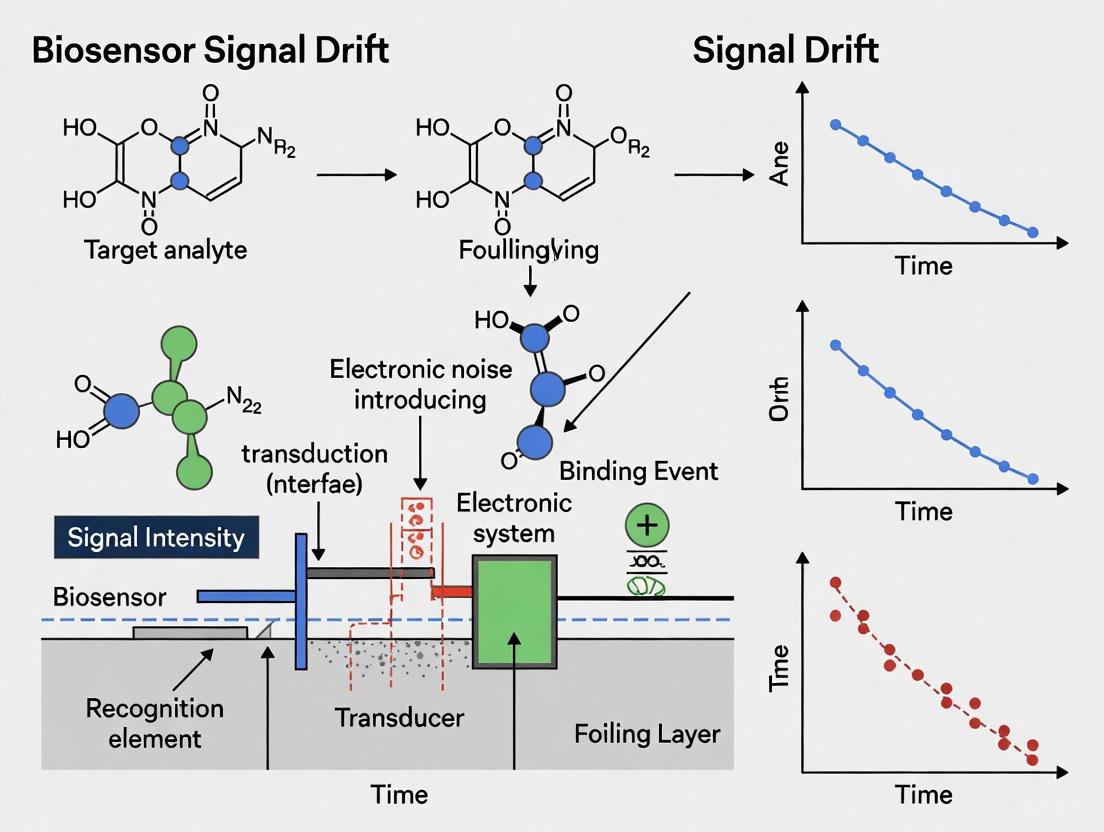
This article provides a comprehensive analysis of biosensor signal drift caused by fouling in complex biological media, a critical challenge for researchers and drug development professionals.
Biosensor Signal Drift from Fouling: Mechanisms, Antifouling Strategies, and Clinical Translation
Abstract
This article provides a comprehensive analysis of biosensor signal drift caused by fouling in complex biological media, a critical challenge for researchers and drug development professionals. It explores the fundamental mechanisms of fouling, including protein adsorption and biofilm formation, and details advanced antifouling strategies employing novel materials and surface chemistries. The content further covers optimization techniques for sensor stability and performance, alongside validation methodologies essential for translating laboratory biosensors into reliable clinical tools. By synthesizing current research, this resource aims to equip scientists with the knowledge to develop robust, fouling-resistant biosensors for accurate in vivo and point-of-care applications.
Deconstructing Signal Drift: The Core Mechanisms of Biosensor Fouling
Biofouling, the non-specific accumulation of biological material on surfaces, represents a fundamental barrier to the reliability and deployment of biosensors in complex media. This uncontrolled adsorption of proteins, cells, and other biomolecules leads to signal drift, performance degradation, and ultimately, device failure. This whitepaper examines the mechanisms of biofouling, its direct impact on biosensor signal integrity, and the experimental methodologies essential for its quantification and mitigation. Framed within broader research on biosensor signal drift, this guide provides researchers and drug development professionals with the technical foundation to address this pervasive challenge.
The Biofouling Phenomenon and Its Impact on Biosensors
When a biosensor is introduced into a complex biological medium—such as blood, serum, or interstitial fluid—its surface immediately encounters a barrage of biological components. The uncontrolled adsorption of these components, known as biofouling, initiates a cascade of detrimental effects [1].
The formation of an adsorbed protein layer is often the first step, which can mask the sensor's recognition elements, increase background noise, and impede the diffusion of the target analyte to the sensing interface. This non-specific binding directly contributes to signal drift, a temporal change in the baseline signal that is unrelated to target binding, thereby compromising measurement accuracy and long-term stability [2] [1]. Left unchecked, this process can progress to the adhesion and activation of host cells or bacteria, potentially leading to thrombus formation, fibrotic encapsulation, or biofilm-associated infections that result in a complete loss of sensor function [1].
Quantitative Foundations of Biofouling
Understanding biofouling requires quantifying its progression and the efficacy of mitigation strategies. The following parameters are critical for a rigorous assessment.
Table 1: Key Quantitative Parameters in Biofouling Studies
| Parameter | Description | Measurement Significance |
|---|---|---|
| Protein Adsorption Density | Mass of protein adsorbed per unit area (e.g., ng/cm²) | Quantifies the primary fouling layer; levels as low as 10 ng/cm² of fibrinogen can trigger cell adhesion [1]. |
| Relative Pressure Drop | The percentage increase in pressure drop across a flow channel due to fouling. | Indicates the change in channel geometry from fouling accumulation; a 100% increase often signifies a critical need for cleaning [3]. |
| Biofouling Index | The inverse of the time required to reach a 100% relative pressure drop. | Provides a single value representing the fouling rate or required cleaning frequency, allowing for comparison across different conditions [3]. |
| Cellular Production Rate | The rate at which new microbial cells are produced within a biofilm. | In marine biofilms, this rate can be 1.5 times greater than the settlement rate of new cells, highlighting the contribution of growth to accumulation [4]. |
| Dispersal vs. Grazing Rate | The ratio of cells dispersing from a biofilm to those being consumed by grazers. | Loss processes are critical; dispersal rates can be 2.7 times greater than grazing mortality, influencing the net accumulation rate [4]. |
Essential Experimental Protocols for Biofouling Assessment
Protein Adsorption Experiments
Objective: To quantify the amount and identity of proteins that non-specifically adsorb to a material surface from a biofluid.
- Protocol: Incubate the material test coupon (e.g., coated sensor surface) in the chosen protein solution or biofluid (e.g., 1-80 mg/mL concentration range in buffer, or undiluted serum) under controlled temperature and pH [1].
- Critical Parameters: Protein concentration, source, and solution ionic strength significantly impact results. Fluorescently labeled proteins (often used at 0.1-10 mg/mL) facilitate detection but can alter protein hydrophobicity and behavior [1].
- Characterization: After incubation and rinsing, analyze the surface using techniques like fluorescence microscopy for labeled proteins, Surface Plasmon Resonance (SPR), or Quartz Crystal Microbalance (QCM) to determine adsorbed mass [1].
Image-Based Biofouling Quantification
Objective: To quantify the spatial coverage and volume of fouling organisms on a surface.
- Protocol: For filamentous algal cultures, this involves dispersing biomass on a microscope slide, acquiring high-resolution images, and using automated image analysis software [5]. The principle is adaptable to other surfaces.
- Critical Parameters: Focus on quantifying the fouled area per unit of sample rather than the count of individual organisms, especially with diverse contaminant morphologies [5].
- Characterization: The software segments the image to distinguish the target material from the fouling organisms, calculating the percentage of area covered by contaminants. This method has been demonstrated with error rates below 2% [5].
Feed Channel Pressure Drop Monitoring
Objective: To assess the operational impact of biofouling in flow systems, such as in membrane filtration or microfluidic sensors.
- Protocol: Utilize a membrane fouling simulator or custom flow cell equipped with pressure sensors. Monitor the pressure drop across the channel over time under constant flow conditions while exposing the system to a nutrient-containing feed water [3].
- Critical Parameters: Crossflow velocity and nutrient concentration must be controlled and reported, as they directly influence the fouling rate [3].
- Characterization: Calculate the Relative Pressure Drop (RPD) as
(ΔP_t - ΔP_0) / ΔP_0, whereΔP_0is the initial pressure drop andΔP_tis at time t. The Biofouling Index is then calculated as1 / t_100, wheret_100is the time to reach 100% RPD [3].
Visualizing Biofouling Mechanisms and Experimental Workflows
Diagram 1: Biofouling mechanism cascade impacting sensor performance.
Diagram 2: Experimental workflow for biofouling assessment.
Mitigation Strategies and the Researcher's Toolkit
A primary strategy for combating biofouling and its associated signal drift is surface engineering to create low-fouling interfaces. Immobilizing non-fouling polymer brushes, such as poly(oligo(ethylene glycol) methyl ether methacrylate) (POEGMA), above a sensor's transducing element has been shown to effectively mitigate biofouling. This approach not only resists non-specific adsorption but, through the Donnan potential effect, can also extend the sensing distance (Debye length) in solutions of high ionic strength, overcoming a key limitation for biosensors operating in physiological fluids like blood or 1X PBS [2].
Table 2: Research Reagent Solutions for Biofouling Studies
| Reagent/Material | Function in Biofouling Research |
|---|---|
| POEGMA (Polymer Brush) | Coating that resists non-specific protein adsorption and can extend the Debye length, enabling sensing in high-ionic-strength solutions [2]. |
| Phospholipids (e.g., from microbes) | Used as molecular proxies to quantify microbial biomass accumulation and growth rates on test surfaces in situ [4]. |
| Copper-Based Antifouling Coatings | Ablative coatings that release bioactive copper ions to deter the settlement and growth of fouling organisms [4]. |
| Silicone-Based Fouling-Release Coatings | Biologically benign coatings with low surface energy that reduce the adhesion strength of fouling organisms, promoting their release under hydrodynamic force [4]. |
| Optical Coherence Tomography (OCT) | Non-invasive imaging technique used to quantify the 3D structure, volume, and thickness of biofouling layers in flow channels [3]. |
| Fluorescently Labeled Proteins | Allow for visualization and quantification of protein adsorption onto material surfaces, though labels may influence protein behavior [1]. |
Biofouling is an inescapable challenge that lies at the heart of biosensor signal drift and failure in complex media. A comprehensive understanding of its mechanisms—from initial protein adsorption to mature biofilm formation—is essential. By employing rigorous quantitative parameters, standardized experimental protocols, and advanced low-fouling materials, researchers can systematically diagnose, quantify, and mitigate its effects. Mastering the control of biofouling is a critical prerequisite for the successful translation of biosensors from controlled laboratory settings into reliable, real-world clinical and environmental applications.
Electrochemical biosensors represent a powerful tool for the real-time monitoring of specific analytes in clinical and research settings. A significant challenge impeding their widespread adoption, particularly for long-term in vivo applications, is signal drift—a phenomenon where the sensor's signal decreases over time. Within the complex environment of the body, this drift primarily stems from the inherent instability of the sensor's molecular components. This technical guide delves into two core mechanisms of this instability: the desorption of self-assembled monolayers (SAMs) from electrode surfaces and the degradation of redox reporters. Framed within a broader thesis on biosensor signal drift, this document provides an in-depth analysis of these failure mechanisms, supported by experimental data and protocols, to inform the development of more robust sensing platforms for researchers and drug development professionals.
Fundamental Mechanisms of Signal Drift
Signal drift in electrochemical biosensors, such as electrochemical aptamer-based (EAB) sensors, is a critical obstacle that limits measurement duration and accuracy. When deployed in harsh environments like whole blood, the sensor signal typically exhibits a biphasic loss: an initial, rapid exponential decrease followed by a slower, linear decline [6]. This biphasic behavior indicates that at least two distinct mechanisms are responsible for signal degradation. Research has identified four primary proposed mechanisms: (1) desorption of the alkane-thiolate SAM from the gold electrode surface; (2) irreversible redox reactions that degrade the reporter molecule; (3) enzymatic degradation of the DNA or RNA recognition element; and (4) surface fouling from the adsorption of blood cells, proteins, and other interferents [6]. Systematic studies have revealed that the initial exponential phase is predominantly driven by biological factors like fouling, whereas the subsequent linear phase is largely due to electrochemical processes, specifically SAM desorption [6].
The Role of Self-Assembled Monolayer (SAM) Desorption
The SAM forms the critical foundation for many biosensors, providing a structured interface for immobilizing biorecognition elements and insulating the electrode against nonspecific interactions. However, the stability of the gold-thiol bond is compromised under electrochemical interrogation.
- Electrochemically-Driven Desorption: The stability of the gold-thiol bond is highly dependent on the applied electrochemical potential. Thiol-on-gold monolayers undergo reductive desorption at potentials below approximately -0.5 V and oxidative desorption at potentials above about 1.0 V [6]. This means that the voltage swings required for many electrochemical measurements, such as square-wave voltammetry, can directly break the anchor that holds the sensing monolayer to the electrode.
- Experimental Evidence: Investigations using a simplified EAB-like proxy in phosphate-buffered saline (PBS) at 37°C have demonstrated that the linear signal drift phase is directly caused by repeated electrochemical scanning. The rate of signal loss increases significantly when the positive potential limit exceeds 0.0 V (promoting oxidative desorption) or when the negative limit falls below -0.4 V (promoting reductive desorption) [6]. When the potential window is constrained to a narrow, stable range (-0.4 V to -0.2 V), signal loss is minimized to only about 5% after 1500 scans, confirming that potential-induced SAM desorption is a primary contributor to long-term drift [6].
- Impact of Surface Morphology: Studies using surface-sensitive techniques like scanning tunneling microscopy (STM) have shown that SAM nucleation and growth begin at high-energy defect sites on the Au(111) surface, such as the "herringbone" turns of the surface reconstruction [7]. Desorption processes, whether thermal or laser-induced, are also influenced by surface structure and can involve complex reactions like dimerization during desorption [7] [8]. This underscores that the microscopic condition of the electrode surface plays a crucial role in the macroscopic stability of the sensor.
The Role of Redox Reporter Degradation
The redox reporter (e.g., methylene blue) is responsible for generating the measurable electrochemical signal. Its degradation directly diminishes the signal amplitude.
- Irreversible Reactions: Many redox reporters can undergo irreversible chemical side reactions during their cycling between oxidized and reduced states. These reactions can alter the reporter's chemical structure, rendering it electrochemically silent and leading to a permanent loss of signal [6].
- Interaction with Potential Windows: The degradation of the redox reporter is intrinsically linked to the SAM desorption mechanism. The stability of a SAM constrains the usable electrochemical potential window. For instance, methylene blue (E⁰ ≈ -0.25 V vs. Ag/AgCl at pH 7.5) is often used because its redox potential falls within the narrow window where alkane-thiol-on-gold SAMs are stable [6]. Sensors employing reporters with redox potentials outside this stable window have been shown to be far less stable, as measuring them requires applying potentials that drive SAM desorption [6].
Fouling as an Exacerbating Factor
While SAM desorption and reporter degradation are direct causes of signal loss, surface fouling acts as a significant exacerbating factor. Fouling occurs when blood components like proteins and cells adsorb to the sensor surface, forming an insulating layer [6] [9]. This fouling layer reduces the electron transfer rate of the redox reporter, as evidenced by a decrease in the optimal square-wave voltammetry frequency [6]. This type of signal loss can be partially recovered by washing with denaturants like urea, confirming its physical nature [6]. Furthermore, fouling is a dominant cause of the initial exponential drift phase in whole blood, as even enzyme-resistant oligonucleotide constructs (e.g., 2'O-methyl RNA) show this rapid signal decay [6].
Experimental Analysis and Protocols
To systematically dissect the contributions of SAM desorption and redox reporter degradation, controlled experiments are essential. The following section outlines key methodologies and presents the associated quantitative findings.
Key Experimental Protocols
1. Protocol for Isolating Electrochemical vs. Biological Drift Mechanisms
- Objective: To determine whether signal drift originates from electrochemical processes (SAM desorption, reporter degradation) or biological interactions (fouling, enzymatic degradation).
- Methodology:
- Sensor Fabrication: Immobilize a thiolated, redox-tagged (e.g., methylene blue) DNA sequence onto a gold disk electrode via SAM formation.
- Testing Environments: Challenge the sensor in two separate conditions:
- Whole Blood: Undiluted whole blood at 37°C.
- Buffer Control: Phosphate Buffered Saline (PBS) at 37°C.
- Interrogation: Perform continuous square-wave voltammetry (SWV) with a fixed potential window and frequency over several hours.
- Analysis: Compare the signal decay profiles. The absence of the initial exponential phase in PBS indicates it is blood-specific (fouling/enzymatic), while the persistence of a linear phase in both environments points to a fundamental electrochemical mechanism [6].
2. Protocol for Establishing Potential-Dependent SAM Desorption
- Objective: To confirm that SAM desorption is a primary driver of electrochemical drift and to identify a stable potential window.
- Methodology:
- Sensor Setup: Use a simplified DNA-modified sensor in a stable environment like PBS at 37°C to isolate electrochemical effects.
- Variable Potential Windows: Systematically vary the SWV scanning window:
- Fix the negative potential limit and incrementally increase the positive limit.
- Fix the positive potential limit and incrementally decrease the negative limit.
- Control Experiment: Perform scans within a narrow window believed to be stable (e.g., -0.4 V to -0.2 V).
- Measurement: Record the rate of signal loss over hundreds of scans for each potential window.
- Analysis: A strong correlation between signal loss rate and the width of the potential window, especially as limits approach the known desorption potentials, confirms the role of electrochemically driven SAM desorption [6].
3. Protocol for Differentiating Fouling from Enzymatic Degradation
- Objective: To determine the relative contribution of surface fouling versus enzymatic DNA cleavage to signal drift.
- Methodology:
- Sensor Comparison: Test two sensor types in parallel in whole blood:
- Standard DNA Sensor.
- Nuclease-Resistant Sensor: Uses a modified backbone (e.g., 2'O-methyl RNA) [6].
- Post-Test Treatment: After a period of operation in blood, wash the standard DNA sensor with a concentrated urea solution or a strong detergent (e.g., SDS).
- Measurement: Monitor signal recovery after washing.
- Analysis: Significant signal recovery after washing indicates that fouling is a major contributor. Similar exponential drift profiles for both standard and nuclease-resistant sensors further confirm that fouling, not enzymatic degradation, dominates the initial rapid signal loss [6].
- Sensor Comparison: Test two sensor types in parallel in whole blood:
The following tables consolidate key experimental data from the investigation of these drift mechanisms.
Table 1: Impact of Electrochemical Potential Window on Signal Stability in PBS at 37°C [6]
| Fixed Potential Limit (V) | Varied Potential Limit (V) | Signal Loss After 1500 Scans | Inferred Mechanism |
|---|---|---|---|
| Negative limit fixed at -0.4 V | Positive limit increased to +0.2 V | > 80% | Oxidative SAM desorption |
| Positive limit fixed at -0.2 V | Negative limit decreased to -0.6 V | > 80% | Reductive SAM desorption |
| Negative limit fixed at -0.4 V | Positive limit fixed at -0.2 V | ~5% | Stable operation |
Table 2: Analysis of Exponential Drift Phase in Whole Blood at 37°C [6]
| Experimental Condition | Result on Exponential Drift Phase | Conclusion |
|---|---|---|
| Testing in PBS vs. Whole Blood | Exponential phase absent in PBS | Phase is blood-specific |
| Washing with urea after 2.5h in blood | ~80% signal recovery | Fouling is a major, reversible component |
| Using 2'O-methyl RNA (nuclease-resistant) | Exponential phase still present | Fouling dominates over enzymatic degradation |
Visualizing Drift Mechanisms and Experimental Workflows
The following diagrams illustrate the core concepts and experimental pathways for studying electrochemical instability.
Core Mechanisms of EAB Sensor Signal Drift
Workflow for Investigating Drift Mechanisms
The Scientist's Toolkit: Research Reagent Solutions
Addressing sensor instability requires a multifaceted approach. The table below outlines key materials and strategies documented in recent research to mitigate SAM desorption, reporter degradation, and fouling.
Table 3: Research Reagents and Strategies for Enhancing Sensor Stability
| Reagent / Strategy | Function / Rationale | Key Outcome / Reference |
|---|---|---|
| Methylene Blue Reporter | Its redox potential (-0.25 V) falls within the stable window of alkanethiol-on-gold SAMs, minimizing desorption during scanning. | Superior stability compared to reporters with potentials outside the stable window [6]. |
| Nuclease-Resistant Oligonucleotides (2'O-methyl RNA, Spieglemers) | Modified backbones resist enzymatic degradation by nucleases present in biological fluids. | Confirms that initial exponential drift in blood is dominated by fouling, not enzymatic decay [6]. |
| Polymer Brush Coatings (e.g., POEGMA) | Creates a hydrophilic, non-fouling layer that reduces protein/cell adsorption; can extend Debye length for FET sensors. | Mitigates biofouling, improves signal stability in complex fluids like blood [2]. |
| Optimized Electrochemical Protocol | Using infrequent DC sweeps instead of continuous/AC measurements; employing a narrow, stable potential window. | Reduces rate of SAM desorption and ion drift, mitigating long-term signal decay [6] [2]. |
| Stable Pseudo-Reference Electrodes (e.g., Pd) | Alternative to bulky Ag/AgCl electrodes; integrated into miniaturized systems for stable potential control. | Enables stable operation in point-of-care form factors without bulky components [2]. |
| Gold Nanoparticle (AuNP) Composites | Provide high surface area for probe immobilization, can enhance electron transfer, and stabilize sensing interfaces. | Used in pendulum-type sensors for drift-resistant, real-time protein monitoring [10]. |
The journey toward robust, long-term electrochemical biosensing hinges on a fundamental understanding of material instability. This guide has detailed how signal drift arises not from a single failure, but from the interplay of core mechanisms: the electrochemically triggered desorption of the SAM foundation and the degradation of the redox reporter, both exacerbated by surface fouling. The experimental data unequivocally shows that tailoring the electrochemical protocol, particularly by restricting the potential window to a "safe" range, can drastically reduce the linear drift from SAM desorption. Meanwhile, strategies employing non-fouling polymers and nuclease-resistant biologics target the initial exponential drift. For researchers and drug developers, these insights provide a clear roadmap. Future work must focus on engineering even more stable electrode interfaces, developing redox reporters with ideal potential and durability, and integrating these advances into closed-loop systems that can autonomously correct for residual drift, thereby unlocking the full potential of in vivo biosensing.
Biological fouling, the nonspecific adsorption of proteins, cells, and other biomolecules onto sensor surfaces, represents a fundamental barrier to the reliable long-term operation of biosensors in complex biological environments [11]. In clinical diagnostics and drug development, the ability to monitor biomarkers, drugs, and metabolites directly in the body would revolutionize personalized medicine [6]. However, when biosensors are deployed in the challenging conditions found in vivo or in undiluted biological fluids, their signal invariably drifts over time, compromising measurement accuracy and longevity [6] [11]. This signal drift manifests as a gradual decrease in sensor response, which can arise from multiple fouling mechanisms acting in concert [6]. For electrochemical aptamer-based (EAB) sensors, this drift is characterized by an initial exponential signal loss followed by a slower, linear decrease, indicating at least two distinct degradation mechanisms at work [6]. Understanding these underlying processes—protein adsorption, cell adhesion, and enzymatic degradation—is crucial for developing effective antifouling strategies and enabling the next generation of robust, long-term implantable biosensors for biomedical research and therapeutic monitoring.
Mechanisms of Biosensor Fouling
Protein Adsorption
Protein adsorption is the most prevalent and immediately problematic form of biosensor fouling. When a sensor surface is exposed to biological fluids like blood, serum, or saliva, proteins rapidly adsorb onto the interface, forming a conditioning film that can passivate the sensor and impede analyte access [12] [13]. This nonspecific protein adsorption occurs through various interactions, including hydrophobic interactions, electrostatic forces, hydrogen bonding, and van der Waals forces [11]. The adsorbed protein layer not only physically blocks the sensor surface but can also undergo conformational changes that further strengthen adhesion and promote additional fouling [13]. In electrochemical biosensors, this protein layer can dramatically affect the characteristics of the sensing interface and electron transfer rates, leading to significant signal drift and reduced sensitivity [11]. The fouling impact is particularly pronounced in wearable sweat sensors, where proteins combine with keratinocytes and sebaceous oils to form insulating layers that disrupt electrical contact and cause signal drift [14].
Cell Adhesion and Biofilm Formation
Beyond protein adsorption, microorganisms and mammalian cells can adhere to sensor surfaces, potentially leading to biofilm formation—a structured community of microbial cells enclosed in a self-produced polymeric matrix [12]. Biofilm formation on biosensing interfaces is particularly problematic as it can permanently disable sensor function and is extremely difficult to remove once established [12]. In membrane-based systems, cell adhesion and biofilm formation significantly reduce permeability and increase operational expenses [15]. The formation of a fouling layer comprising cells and extracellular polymeric substances creates a diffusion barrier that limits analyte access to the sensor surface while simultaneously competing with the specific biorecognition event [11]. This phenomenon is not limited to microbial cells; in wearable sensors, adhesion of shed keratinocytes from the epidermal environment contributes substantially to biofouling and signal disruption [14].
Enzymatic Degradation
For biosensors utilizing biological recognition elements such as DNA, RNA, or proteins, enzymatic degradation presents a significant challenge to operational longevity [6]. Nucleases present in biological fluids can degrade DNA- or RNA-based sensing elements, while proteases can break down protein-based receptors [6]. Research on electrochemical aptamer-based sensors has demonstrated that signal drift can occur through enzymatic cleavage of the DNA backbone, though this mechanism typically saturates before complete signal loss due to the relative inaccessibility of some DNA strands on microscopically rough surfaces [6]. Interestingly, studies comparing enzyme-resistant oligonucleotide analogs (such as 2'O-methyl RNA) to their DNA counterparts have shown that significant signal drift still occurs even with nuclease-resistant backbones, suggesting that fouling rather than enzymatic degradation may dominate the initial exponential drift phase in many practical scenarios [6].
Table 1: Primary Fouling Mechanisms and Their Impacts on Biosensor Performance
| Fouling Mechanism | Key Fouling Agents | Impact on Biosensor Function | Temporal Characteristics |
|---|---|---|---|
| Protein Adsorption | Serum proteins (albumin, fibrinogen), antibodies, enzymes | Passivation of electrode surface, reduced electron transfer, analyte blocking | Rapid initial phase (minutes-hours), often exponential decay |
| Cell Adhesion | Bacteria, keratinocytes, eukaryotic cells | Physical barrier formation, biofilm development, signal occlusion | Slower progression (hours-days), can lead to irreversible fouling |
| Enzymatic Degradation | Nucleases, proteases, esterases | Degradation of biological recognition elements (aptamers, antibodies, enzymes) | Continuous process, often saturates due to limited accessibility |
Quantitative Analysis of Fouling-Induced Signal Drift
Systematic studies of biosensor performance in biologically relevant conditions have yielded important quantitative insights into fouling dynamics. For electrochemical aptamer-based sensors challenged in undiluted whole blood at 37°C, signal loss follows a distinct biphasic pattern: an initial exponential decrease occurring over approximately 1.5 hours, followed by a slower linear decrease that persists for the duration of deployment [6]. This trajectory suggests multiple distinct mechanisms contributing to signal degradation on different timescales. The initial exponential phase is abolished when sensors are tested in phosphate-buffered saline instead of whole blood, indicating this rapid signal loss arises from blood-specific biological mechanisms rather than electrochemical processes [6].
The position of redox reporters along DNA chains significantly impacts the rate of exponential signal drift, with reporters placed closer to the electrode surface exhibiting different fouling sensitivity compared to those positioned more distally [6]. This position-dependent effect provides evidence that fouling alters the dynamics with which redox reporters approach the electrode surface for electron transfer rather than completely blocking electron transfer entirely. Measurements of electron transfer rates during the exponential drift phase in whole blood show a three-fold decrease, further supporting the hypothesis that fouling creates a barrier that slows the approach of redox species to the electrode surface [6].
Table 2: Experimental Characterization of Fouling-Induced Signal Drift in EAB Sensors
| Parameter | Experimental Findings | Experimental Conditions | Implications |
|---|---|---|---|
| Signal Loss Pattern | Biphasic: exponential decay (∼1.5 h) followed by linear decrease | 37°C in undiluted whole blood | Multiple distinct drift mechanisms operating on different timescales |
| Electron Transfer Rate | Decreased by factor of 3 during exponential phase | Square-wave voltammetry frequency optimization | Fouling creates barrier slowing redox reporter approach to electrode |
| Reporter Position Effect | Strong monotonic dependence on MB position along DNA chain | Equal-length ssDNA with varied MB positions | Fouling affects reporter dynamics rather than completely blocking electron transfer |
| Potential Window Effect | Degradation rate increases when positive window exceeds 0.0V or negative window falls below -0.4V | Varied square-wave potential windows in PBS | Electrochemically driven SAM desorption contributes to linear drift phase |
Experimental Protocols for Fouling Analysis
Electrochemical Assessment of Signal Drift
Protocol Objective: Quantify signal drift of electrochemical biosensors in biologically relevant conditions.
Materials and Reagents:
- Electrochemical biosensors (e.g., EAB sensors with methylene blue redox reporter)
- Undiluted whole blood or target biological fluid
- Phosphate buffered saline (PBS, pH 7.4) for control experiments
- Potentiostat with square-wave voltammetry capability
- Temperature-controlled fluid chamber maintained at 37°C
Experimental Procedure:
- Initialize electrochemical sensors in PBS buffer to establish baseline performance.
- Acquire initial square-wave voltammetry scans in PBS across the potential window of -0.4V to -0.2V versus Ag/AgCl reference electrode.
- Transition sensors to undiluted whole blood maintained at 37°C while continuing electrochemical interrogation.
- Perform continuous square-wave voltammetry measurements using identical parameters established in PBS.
- Record peak current values for the redox reporter at regular intervals (e.g., every 5 minutes initially).
- Continue measurements for at least 10 hours to capture both exponential and linear drift phases.
- For control experiments, maintain separate sensors in PBS at 37°C with identical electrochemical interrogation.
Data Analysis:
- Normalize current values to initial signal in blood.
- Plot normalized signal versus time to identify exponential and linear drift phases.
- Fit exponential decay component to quantify time constant of initial rapid drift.
- Calculate linear drift rate from later time points.
- Compare drift profiles in blood versus PBS to differentiate biological versus electrochemical drift mechanisms.
Fouling Layer Characterization via 3ω Method
Protocol Objective: Monitor fouling layer formation and properties using thermal sensing.
Materials and Reagents:
- 20 µm diameter platinum wire
- Ceramic ultrafiltration membrane
- Fouling solutions (e.g., diluted milk, polymer core-shell particles)
- 3ω measurement system with AC current source and voltage detection
- Membrane filtration module with crossflow capability
Experimental Procedure:
- Attach platinum wire to membrane surface serving as both heater and temperature sensor.
- Apply AC current at angular frequency (ω) through the wire.
- Measure third harmonic voltage (3ω) across the wire using lock-in amplification.
- Establish baseline 3ω signal in clean DI water with and without crossflow.
- Initiate fouling by introducing test solution (e.g., diluted milk) to feed stream.
- Monitor 3ω signal continuously during fouling layer formation.
- Vary AC frequency to probe different thermal penetration depths.
- Correlate 3ω signal changes with hydraulic resistance measurements.
Data Analysis:
- Normalize 3ω signal with voltage across wire to obtain temperature-independent Ù3ω.
- Correlate increasing Ù3ω with fouling layer formation and properties.
- Use frequency-dependent measurements to estimate fouling layer thickness and thermal conductivity.
- Relate signal changes to known thermal conductivities of foulants (e.g., fat: 0.21 W m⁻¹ °C⁻¹, casein: 0.20 W m⁻¹ °C⁻¹, water: 0.598 W m⁻¹ °C⁻¹).
Antifouling Coating Efficacy Assessment
Protocol Objective: Evaluate the performance of antifouling coatings in complex biological media.
Materials and Reagents:
- Biosensors with and without antifouling coatings
- Complex biological fluids (human serum, saliva, sweat)
- Fluorescence microscope for visualization of adsorbed proteins
- Quartz crystal microbalance with dissipation (QCM-D) monitoring
- Electrochemical impedance spectroscopy (EIS) setup
Experimental Procedure:
- Functionalize sensor surfaces with antifouling coatings (e.g., zwitterionic peptides, PEG-based polymers).
- Incubate coated sensors in target biological fluid (serum, saliva, or sweat) for predetermined time periods.
- For optical assessment, label proteins with fluorescent tags and visualize adsorption on sensor surface.
- For mass-based quantification, use QCM-D to measure frequency and dissipation shifts associated with protein adsorption.
- Perform electrochemical impedance spectroscopy to assess electron transfer resistance changes due to fouling.
- Test self-cleaning capabilities where applicable (e.g., UV-triggered cleaning of TiO₂-containing coatings).
- Compare results against uncoated control sensors.
Data Analysis:
- Quantify protein adsorption density from fluorescence intensity or QCM-D frequency shifts.
- Calculate percentage signal retention compared to baseline measurements.
- Determine antifouling efficacy by reduction in nonspecific adsorption relative to controls.
- Assess long-term stability through repeated fouling/cleaning cycles.
Visualization of Fouling Mechanisms and Experimental Approaches
Biosensor Fouling Mechanisms and Mitigation Pathways
Experimental Workflow for Fouling Analysis
Research Reagent Solutions for Fouling Mitigation
Table 3: Key Research Reagents and Materials for Fouling Studies and Mitigation
| Reagent/Material | Function/Application | Key Characteristics | Representative Examples |
|---|---|---|---|
| Zwitterionic Peptides | Antifouling surface coating | Forms hydration layer via electrostatic interactions; resistant to protein adsorption | EKEKEKEK sequences; multifunctional branched peptides with antifouling, antibacterial, and recognition domains [12] |
| PEG-Based Polymers | Non-fouling surface modification | Highly hydrophilic; forms hydration barrier through hydrogen bonding | Poly(ethylene glycol) (PEG); poly(oligo(ethylene glycol) methyl ether methacrylate) (POEGMA) brushes [2] [13] |
| Conducting Polymers | Antifouling electrode modification | Combined electronic conductivity with fouling resistance | PEDOT:PSS; PEGylated polyaniline (PANI/PEG) nanofibers [13] |
| Self-Cleaning Materials | Active fouling removal | Photocatalytic degradation of adsorbed foulants | TiO₂ nanoparticles generating ROS under UV light [14] |
| Enzyme-Resistant Oligonucleotides | Nuclease-stable recognition elements | Reduced susceptibility to enzymatic degradation | 2'O-methyl RNA analogs; spiegelmers [6] |
| Thermal Sensing Wires | Fouling layer characterization | Measures thermal conductivity changes due to fouling | 20 µm platinum wire for 3ω measurements [15] |
Biological fouling through protein adsorption, cell adhesion, and enzymatic degradation remains a significant challenge for reliable long-term biosensor operation in complex biological environments. The systematic characterization of these processes has revealed distinct temporal patterns and mechanisms underlying signal drift, with an initial exponential phase dominated by fouling from biological components and a subsequent linear phase often associated with electrochemical degradation processes. Advanced analytical techniques, including the 3ω method and electrochemical impedance spectroscopy, provide powerful tools for quantifying fouling layer formation and properties. The development of innovative antifouling strategies—including zwitterionic materials, PEG-based polymers, self-cleaning surfaces, and enzyme-resistant bioreceptors—offers promising pathways to mitigate these effects. As these technologies mature, they will ultimately enable a new generation of robust, long-term implantable biosensors capable of reliable operation in the challenging environments found in living systems, thereby advancing both biomedical research and clinical practice through precise, real-time molecular monitoring.
Signal drift presents a fundamental challenge in the deployment of biosensors for clinical diagnostics and drug development. For electrochemical biosensors operating in complex biological environments, this drift often manifests as a progressive signal loss that compromises measurement accuracy and sensor longevity [6]. Understanding the kinetic profiles of signal degradation is not merely an academic exercise but a critical requirement for developing robust biosensing platforms capable of reliable operation in real-world applications. This technical analysis examines the distinct temporal phases of signal drift—exponential and linear—which operate on different time scales and originate from different physiological and electrochemical mechanisms [6]. By elucidating these pathways and their underlying causes, researchers can implement targeted strategies to mitigate signal loss, thereby enhancing the stability and reliability of biosensors for continuous monitoring applications in biomedical research and therapeutic development.
Mechanistic Analysis of Signal Drift Phases
Characteristics and Origins of Biphasic Signal Loss
When electrochemical aptamer-based (EAB) sensors are deployed in biologically relevant environments such as whole blood at 37°C, signal degradation typically follows a biphasic pattern characterized by an initial exponential decay followed by a subsequent linear decline [6]. The exponential phase occurs rapidly over approximately 1.5 hours and demonstrates a strong dependence on biological factors present in whole blood. In contrast, the linear phase manifests over extended timeframes and persists even in controlled environments like phosphate-buffered saline (PBS), indicating its origin in electrochemical rather than biological processes [6].
Table 1: Key Characteristics of Exponential and Linear Drift Phases
| Characteristic | Exponential Phase | Linear Phase |
|---|---|---|
| Time Course | ~1.5 hours | Extended duration (>10 hours) |
| Primary Drivers | Biological (fouling) | Electrochemical (SAM desorption) |
| Signal Loss Profile | Rapid initial decay | Slow, consistent decline |
| Dependence on Environment | Blood-specific | Persistent in PBS |
| Electron Transfer Rate | Decreases significantly | Minimal change |
| Potential Remediation | Antifouling coatings | Optimized potential windows |
Exponential Phase: Biological Fouling Mechanisms
The exponential signal loss phase originates predominantly from biofouling phenomena in complex biological fluids. Fouling occurs when blood components such as proteins, cells, and other biomolecules non-specifically adsorb to the sensor surface, creating a physical barrier that impedes electron transfer kinetics [6]. This mechanism was demonstrated experimentally through washing experiments with concentrated urea, which successfully recovered at least 80% of the initial signal by solubilizing adsorbed biomolecules [6]. The fouling hypothesis was further supported by experiments showing that the electron transfer rate of the redox reporter decreases by a factor of 3 during the exponential phase, indicating that fouling materials physically restrict the approach of the methylene blue reporter to the electrode surface for electron transfer [6].
Researchers have confirmed the predominance of fouling in the exponential phase through controlled experiments with enzyme-resistant oligonucleotide backbones. When a 2'O-methyl RNA analog—resistant to nuclease degradation—was tested, it still exhibited a significant exponential drift phase comparable to standard DNA constructs [6]. This finding demonstrates that fouling rather than enzymatic degradation represents the primary driver of initial signal loss, a conclusion further supported by recent work with other enzyme-resistant oligonucleotides [6].
The impact of fouling on signal loss is highly dependent on the spatial configuration of the sensing elements. Studies with equal-length single-stranded DNAs featuring methylene blue reporters at various internal positions revealed that the rate and magnitude of exponential drift increase monotonically as the reporter is positioned farther from the electrode surface [6]. This positional dependence provides additional evidence that fouling interferes with the conformational dynamics necessary for electron transfer rather than permanently damaging the sensing elements.
Linear Phase: Electrochemical Desorption Mechanisms
The linear phase of signal drift stems primarily from electrochemical-driven processes, specifically the desorption of the self-assembled monolayer (SAM) from the electrode surface [6]. This mechanism was isolated through experiments in PBS, where the exponential phase was abolished but the linear signal loss persisted with similar magnitude to that observed in whole blood [6]. The electrochemical nature of this phase was further confirmed by experiments demonstrating that signal degradation stops when electrochemical interrogation is paused [6].
The critical evidence supporting SAM desorption as the primary mechanism comes from potential window experiments. Thiol-on-gold monolayers undergo reductive desorption at potentials below -0.5V and oxidative desorption at potentials above approximately 1V [6]. When researchers systematically varied the potential window during square-wave scanning, they observed a strong correlation between the applied potential and the rate of signal degradation [6]. Specifically, when the negative side of the potential window was fixed at -0.4V, the degradation rate remained low until the positive side exceeded 0.0V [6]. Conversely, with the positive side fixed at -0.2V, the degradation rate increased as the negative side fell below -0.4V [6]. Most significantly, when the potential window was constrained to -0.4V to -0.2V—a range that avoids the threshold for SAM desorption—only 5% signal loss occurred after 1500 scans [6].
This potential-dependent degradation explains why methylene blue demonstrates superior stability compared to other redox reporters—its formal potential (E⁰ = -0.25V at pH 7.5) falls within the narrow window where alkane-thiol-on-gold monolayers remain stable [6]. In contrast, nearly all other common redox reporters operate at potentials outside this stable range, resulting in accelerated signal degradation [6].
Experimental Approaches for Drift Analysis
Methodologies for Isolating Drift Mechanisms
Researchers have developed specialized experimental protocols to distinguish between the various contributions to signal drift in biosensors. These methodologies enable systematic investigation of each mechanism independently, facilitating the development of targeted countermeasures.
Table 2: Experimental Protocols for Drift Mechanism Isolation
| Experimental Approach | Protocol Details | Mechanism Investigated |
|---|---|---|
| Environment Comparison | Compare signal loss in whole blood vs. PBS at 37°C | Biological vs. electrochemical drift |
| Potential Window Screening | Systematic variation of positive and negative potential limits | SAM desorption dependence |
| Interrogation Pausing | Temporarily halt electrochemical measurements | Reversibility of drift processes |
| Backbone Modification | Use enzyme-resistant (2'O-methyl RNA) constructs | Enzymatic degradation contribution |
| Positional Dependence | Vary reporter position along DNA sequence | Fouling impact on electron transfer dynamics |
| Chemical Washing | Apply urea or detergent solutions after drift | Reversibility of fouling |
A fundamental methodology for distinguishing drift mechanisms involves comparing sensor performance across different environments. By testing sensors in whole blood versus PBS at 37°C, researchers can isolate biologically mediated processes from inherent electrochemical instability [6]. This approach definitively demonstrated that the exponential phase requires biological components absent in PBS, while the linear phase persists regardless of environment [6].
Potential window experiments provide crucial evidence for SAM desorption mechanisms. These studies systematically vary the applied potentials during square-wave voltammetry to identify thresholds for accelerated degradation [6]. The protocol involves fixing either the positive or negative potential limit while varying the opposite limit, then measuring degradation rates across these conditions [6]. This approach identified the stable potential window between -0.4V and -0.2V where minimal SAM desorption occurs [6].
Chemical washing experiments after signal drift can determine the reversibility of fouling. After exposing sensors to whole blood for 2.5 hours (using a narrow potential window to minimize electrochemical degradation), treatment with concentrated urea successfully reverses approximately 80% of signal loss [6]. This protocol confirms that fouling represents a physical barrier rather than permanent sensor damage and helps quantify the contribution of reversible fouling to overall signal loss.
Advanced Sensing Architectures for Drift Mitigation
Beyond fundamental mechanistic studies, researchers have developed sophisticated sensing architectures that inherently resist drift through material innovation. These approaches include antifouling coatings, specialized polymers, and multimodal sensing strategies that compensate for drift rather than preventing it entirely.
Polymer brush interfaces represent a promising approach for extending sensor stability in biological fluids. The D4-TFT platform incorporates poly(oligo(ethylene glycol) methyl ether methacrylate) (POEGMA) as a non-fouling polymer layer that simultaneously reduces biofouling and modulates the Debye length for improved sensitivity [2]. This architecture demonstrates attomolar-level detection in 1X PBS (equivalent ionic strength to physiological fluids) while maintaining stable performance through a combination of optimized passivation, stable electrical testing configurations, and infrequent DC sweeps rather than continuous measurement [2].
Multifunctional peptide coatings integrate antifouling properties with specific recognition capabilities. One innovative design incorporates a branched peptide with three distinct functional elements: a zwitterionic antifouling sequence (EKEKEKEK), an antibacterial sequence (KWKWKWKW), and a specific recognition aptamer [12]. This integrated approach addresses multiple degradation pathways simultaneously, demonstrating excellent resistance to non-specific protein adsorption while maintaining specific binding capability for target analytes in complex media like saliva [12].
Hydrogel-based sensors leverage water-retentive properties to create antifouling barriers. A wearable cortisol sensor combines conducting polyaniline (PANI) hydrogel with hydrophilic polypeptides to prevent nonspecific adsorption in human sweat [16]. The hydrogel's three-dimensional structure and water storage characteristics create a physical barrier against fouling while maintaining electrochemical sensitivity, enabling reliable detection across a concentration range from 10⁻¹⁰ to 10⁻⁶ g/mL with a detection limit of 33 pg/mL [16].
Molecularly imprinted polymers (MIPs) with antifouling coatings enable direct measurement in complex media. A glucose biosensor incorporates a nickel-based metal-organic framework (Ni₃(HITP)₂-MOF) with MIP recognition and a phase-transition bovine serum albumin (PTB) antifouling layer [17]. This architecture permits direct glucose detection in whole blood without sample pretreatment, achieving a detection range of 1 μM to 100 mM with a limit of detection of 0.31 μM while resisting interference from blood components [17].
Research Reagent Solutions
Table 3: Essential Research Reagents for Drift Kinetics Studies
| Reagent/Category | Specific Examples | Primary Function in Drift Analysis |
|---|---|---|
| Electrode Materials | Gold electrodes with thiol-gold chemistry | Foundation for SAM formation and study of desorption mechanisms |
| SAM Components | Alkane-thiolate self-assembled monolayers | Create ordered interface; study potential-dependent desorption |
| Redox Reporters | Methylene blue | Electron transfer probe; stable in optimal potential window |
| Antifouling Polymers | POEGMA, zwitterionic peptides, PANI hydrogel | Resist nonspecific adsorption; extend functional lifetime |
| Biological Matrices | Whole blood, artificial sweat, saliva | Physiologically relevant environments for drift studies |
| Control Oligonucleotides | 2'O-methyl RNA, spiegelmers | Enzyme-resistant backbones to isolate degradation mechanisms |
| Characterization Tools | Square-wave voltammetry, EIS, SEM | Quantify signal changes and visualize surface phenomena |
Diagram: Signal Drift Mechanisms and Experimental Workflow
The following diagram illustrates the sequential phases of signal drift and the experimental approaches used to investigate each mechanism:
The systematic distinction between exponential and linear signal loss phases provides a crucial framework for addressing biosensor stability in physiologically relevant environments. The exponential phase, driven predominantly by biofouling mechanisms, requires interfacial engineering strategies such as antifouling polymers, zwitterionic peptides, and hydrogel coatings that resist nonspecific adsorption [6] [16] [12]. In contrast, the linear phase, originating from electrochemical desorption of self-assembled monolayers, demands optimization of operational parameters—particularly potential windows—and the selection of redox reporters with formal potentials that fall within the stable range for SAM integrity [6]. This mechanistic understanding enables targeted approaches to sensor design that address each degradation pathway specifically rather than relying on generic stabilization methods. For researchers developing biosensors for biomedical applications, incorporating these insights during the initial design phase rather than as post-hoc corrections will accelerate the creation of robust, reliable sensing platforms capable of extended operation in complex biological environments.
Building a Defense: Advanced Materials and Antifouling Methodologies
Biosensor signal drift due to biofouling represents a significant challenge in the development of reliable diagnostic and monitoring devices. This phenomenon occurs when nonspecific adsorption of proteins, cells, and other biomolecules accumulates on the sensor surface, effectively shielding the transducer from the target analyte and leading to progressively inaccurate readings. Such fouling is particularly problematic in complex biological fluids like blood, serum, and saliva, where high ionic strength and diverse biomolecular content accelerate surface contamination [18]. The foreign body response (FBR) to implanted devices further exacerbates this issue, beginning with immediate protein adsorption and escalating to inflammatory cell infiltration and eventual fibrous encapsulation of the implant [19]. For electrochemical biosensors, this fouling can insulate electrode surfaces, increase impedance, and ultimately cause device failure [20].
To combat these challenges, hydrophilic materials have emerged as critical components in biosensor design. These materials function by creating a physical and thermodynamic barrier at the sensor-fluid interface that minimizes nonspecific interactions. Among these, poly(ethylene glycol) (PEG) has served as a traditional gold standard, while zwitterionic polymers represent a more recent advancement with potentially superior performance characteristics [21]. This technical review examines the operational principles, comparative performance, and implementation methodologies for these hydrophilic shield technologies within the context of biosensor stabilization and signal integrity preservation.
Fundamental Principles of Antifouling Materials
The Hydration Layer Mechanism
The antifouling performance of both PEG and zwitterionic polymers stems from their ability to form robust hydration layers at the biosensor interface. These layers create a thermodynamic barrier that makes protein adsorption and cell adhesion energetically unfavorable. However, the underlying molecular mechanisms differ significantly between these material classes:
PEG-based Hydration: PEG resists fouling primarily through hydrogen bonding with water molecules, forming a hydrated layer that sterically excludes larger biomolecules. This hydration creates an energy barrier requiring protein dehydration prior to adsorption, which is thermodynamically unfavorable [21]. The effectiveness of PEG depends on factors including molecular weight, grafting density, and chain conformation.
Zwitterionic Hydration: Zwitterionic polymers, containing both positive and negative charged groups within the same monomer unit, exhibit exceptionally strong electrostatic interactions with water molecules. These materials typically contain 6-11 non-freezing and 4-11 intermediate water molecules per monomer unit, forming a stronger and thicker hydration layer than PEG [22]. This dense hydration layer significantly increases the Gibbs energy required for foulant adsorption, providing superior resistance to biofouling in aqueous environments [22].
Zwitterionic Polymer Architectures
Zwitterionic polymers are characterized by their molecular structures and charged functional groups:
Table 1: Common Zwitterionic Polymer Types and Their Properties
| Polymer Type | Chemical Groups | Key Characteristics | Representative Applications |
|---|---|---|---|
| Poly(sulfobetaine methacrylate) | Quaternary ammonium cation, sulfonate anion | Antipolyelectrolyte effect, high hydration capacity | Implantable glucose sensors, water treatment membranes [19] [22] |
| Poly(carboxybetaine methacrylate) | Quaternary ammonium cation, carboxylate anion | pH-responsive behavior, functionalizable groups | Medical devices, drug delivery systems [19] |
| Poly(2-methacryloyloxyethyl phosphorylcholine) | Phosphorylcholine mimics cell membranes | Excellent biocompatibility, reduced foreign body response | Enzyme electrode coatings, implantable biosensors [20] |
The "antipolyelectrolyte effect" exhibited by zwitterionic polymers is particularly noteworthy. Unlike typical polyelectrolytes that collapse at high ionic strengths, zwitterionic polymers expand in high-salt environments due to charge screening effects that reduce intra- and interchain dipole-dipole interactions [22]. This property makes them exceptionally well-suited for biosensing applications in physiological fluids where ionic strength is high.
Performance Comparison and Quantitative Assessment
Direct Performance Metrics
Comparative studies demonstrate distinct performance advantages between PEG and zwitterionic polymers across multiple fouling parameters:
Table 2: Antifouling Performance Comparison of PEG and Zwitterionic Polymers
| Performance Parameter | PEG-Based Coatings | Zwitterionic Polymer Coatings | Experimental Context |
|---|---|---|---|
| Fibrinogen Adsorption | ~50% reduction relative to uncoated surfaces [19] | Up to 95% reduction; >80% reduction across broad cross-link densities [19] | Fluorescently labeled fibrinogen on coated PDMS |
| Macrophage Adhesion | Moderate reduction | 30-fold reduction compared to uncoated surfaces [19] | Cell culture on modified surfaces |
| Fibroblast Adhesion | ~50% reduction | 10-fold reduction compared to uncoated surfaces [19] | Cell culture on modified surfaces |
| Sensor Sensitivity | Decreased sensitivity in glucose biosensors [20] | 1.5-fold increase in sensitivity over uncoated controls [20] | Amperometric glucose biosensor testing |
| Stability in Complex Fluids | Subject to oxidative degradation | Maintains performance in serum, GI fluid, bacterial lysate [23] | Porous silicon biosensors in biological fluids |
Beyond these direct comparisons, machine learning approaches have provided deeper insights into the structure-property relationships of zwitterionic polymers. Analysis of 123 data samples revealed that polymer density has a greater influence on protein adsorption resistance than molecular weight [22]. This understanding enables more precise engineering of zwitterionic coatings for optimal biosensor performance.
Advanced Zwitterionic Formulations
Recent research has explored modified zwitterionic structures with enhanced properties:
Zwitterionic Peptides: Covalently immobilized peptides with glutamic acid (E) and lysine (K) repeating motifs (e.g., EKEKEKEKEKGGC) demonstrate superior antibiofouling properties compared to conventional PEG coatings. When applied to porous silicon (PSi) aptasensors, these peptides improved the limit of detection and signal-to-noise ratio by more than an order of magnitude compared to PEG-passivated sensors [23].
Cross-linked Zwitterionic Networks: Varying poly(ethylene glycol) dimethacrylate (PEGDMA) cross-linker concentration (0-100% of total monomer) enables tuning of mechanical properties while maintaining antifouling performance. Optimal cross-link densities balance swelling behavior, compressive modulus, and lubricity with biological performance [19].
Implementation Methodologies and Experimental Protocols
Surface Modification Workflows
The successful implementation of hydrophilic shields requires precise control over surface chemistry and polymer immobilization. The following diagram illustrates the decision pathway for selecting and applying antifouling coatings:
Detailed Experimental Protocols
Photografting of Zwitterionic Thin Films on Polydimethylsiloxane (PDMS)
This protocol, adapted from [19], describes the process for creating durable zwitterionic coatings on PDMS substrates:
Substrate Preparation: Prepare Sylgard 184 PDMS using 10:1 base to curing agent ratio (mass basis). Degas under vacuum for 1 hour and cure at 90°C for 1 hour. Cut samples to desired dimensions (typically 23×23 mm).
Benzophenone Functionalization: Soak PDMS substrates in 50 g/L benzophenone solution in acetone for 1 hour. Remove and evaporate residual solvent under nitrogen stream. Place functionalized substrates under vacuum for 1 hour to ensure complete acetone removal.
Monomer Solution Preparation: Prepare aqueous monomer solution with 35 wt% total monomer concentration in deionized water. For zwitterionic coatings, use [2-(methacryloyloxy)ethyl]dimethyl-(3-sulfopropyl)ammonium hydroxide (SBMA) or 3-{[2-(methacryloyloxy)ethyl]dimethylammonio}propionate (CBMA). Include PEGDMA cross-linker (0.5-5% of total monomer) and 0.05 wt% Irgacure 2959 photoinitiator.
Photografting Process: Pipette 20 μL monomer solution onto benzophenone-functionalized PDMS. Disperse via capillary action using a 25×25 mm coverslip. Expose to 365 nm UV light at 30 mW/cm² for appropriate duration (typically 2-5 minutes).
Post-Processing: Rinse grafted surfaces with copious deionized water to remove unreacted monomers. Sterilize if needed for biological applications.
Zwitterionic Peptide Immobilization on Porous Silicon
This protocol, based on [23], details the covalent immobilization of zwitterionic peptides on porous silicon biosensors:
Surface Activation: Clean PSi surfaces with oxygen plasma treatment. Functionalize with aminopropyltriethoxysilane (APTES) to create amine-terminated surface.
Peptide Synthesis and Preparation: Synthesize zwitterionic peptide sequences (e.g., EKEKEKEKEKGGC) using standard Fmoc solid-phase peptide synthesis. Purify by HPLC and verify by mass spectrometry. Prepare peptide solution (1 mM) in appropriate buffer (e.g., phosphate buffer, pH 7.4).
Immobilization Reaction: Incubate activated PSi surfaces with peptide solution for 4-12 hours at room temperature. For directed coupling, use heterobifunctional cross-linkers (e.g., SMCC) to link surface amines to cysteine residues in the peptide sequence.
Blocking and Washing: Block any remaining reactive groups with ethanolamine or similar small molecule. Wash surfaces sequentially with buffer, deionized water, and ethanol.
Characterization: Verify peptide coating using ellipsometry, X-ray photoelectron spectroscopy (XPS), or fluorescence tagging. Confirm antifouling performance with protein adsorption assays using fluorescently labeled fibrinogen or serum proteins.
The Scientist's Toolkit: Essential Research Reagents
Table 3: Key Reagents for Hydrophilic Shield Research
| Reagent/Category | Function | Examples & Specifications |
|---|---|---|
| Zwitterionic Monomers | Primary coating materials providing antifouling properties | SBMA, CBMA, MPC; >98% purity for reproducible polymerizations [19] |
| Cross-linkers | Control mechanical properties and stability of hydrogels | PEGDMA (Mn = 400-1000 g/mol); concentration typically 0.5-5% of total monomer [19] |
| Photoinitiators | Enable photografting processes | Irgacure 2959, Benzophenone; 0.05-0.1 wt% in monomer solution [19] |
| Zwitterionic Peptides | Sequence-specific antifouling coatings | Custom synthesized (E/K motifs) with C-terminal cysteine for immobilization [23] |
| Surface Activation Agents | Create reactive surfaces for covalent bonding | APTES, TMSPM; anhydrous conditions for silane chemistry [23] [24] |
Emerging Innovations and Future Directions
Stimuli-Responsive and Self-Cleaning Systems
Advanced hydrophilic shield technologies now incorporate stimuli-responsive capabilities for enhanced functionality:
Thermoresponsive Polymer Systems: Copolymers of N-isopropylacrylamide (NIPAAm) and N-vinyl pyrrolidone (NVP) demonstrate temperature-addressable permeability and self-cleaning behavior. By adjusting NVP content from 0-47.62%, the lower critical solution temperature (LCST) can be tuned from 25°C to 40°C, enabling self-cleaning at physiological temperatures [24]. These systems allow thermal triggering of surface properties to repel adsorbed proteins through conformational remodeling.
Machine Learning-Optimized Designs: ML approaches analyzing 123 data samples with 12 descriptors (including polymer density, molecular weight, ionic strength, and protein characteristics) have identified optimal zwitterionic brush structures that minimize protein adsorption [22]. These models demonstrate that polymer density exerts greater influence on antifouling performance than molecular weight.
Integration with Advanced Biosensing Platforms
The convergence of hydrophilic shields with emerging biosensor technologies presents promising avenues for future development:
Graphene-Based Wearable Biosensors: Zwitterionic polymers combined with graphene substrates create synergistic systems leveraging graphene's exceptional electrical properties and zwitterionic antifouling capabilities [25]. These platforms enable continuous monitoring in complex biofluids like sweat, tears, and interstitial fluid.
Artificial Intelligence-Enhanced Biosensing: Integration of machine learning algorithms with antifouling sensor platforms enables improved signal interpretation, drift correction, and predictive maintenance through pattern recognition in fouling progression [26].
The following diagram illustrates how these advanced components integrate into a comprehensive biosensing system:
Hydrophilic shields based on PEG and zwitterionic polymers represent essential components in the mitigation of biosensor signal drift caused by biofouling. While PEG has established a strong foundation as an antifouling material, zwitterionic polymers demonstrate superior performance in high-ionic-strength biological environments, offering enhanced hydration capacity, reduced foreign body response, and in many cases, improved sensor sensitivity. The continued refinement of these materials—through optimized cross-linking strategies, sequence-defined zwitterionic peptides, and intelligent stimuli-responsive systems—promises to further advance biosensor reliability in real-world applications. As biosensing technologies evolve toward continuous monitoring platforms and implantable devices, the role of engineered hydrophilic interfaces will become increasingly critical to achieving long-term stability and accurate measurement in complex biological milieus.
Biofouling, the nonspecific adsorption of biomolecules, cells, or organisms to surfaces, presents a fundamental barrier to reliable biosensor operation. In electrochemical and field-effect transistor (BioFET) biosensors, fouling at the sensing interface directly causes signal drift, reduced sensitivity, and inaccurate readings by altering the electrical double layer, increasing background noise, and blocking target analyte binding sites [2] [27]. This signal drift is particularly debilitating in complex biological fluids such as blood, sweat, or seawater, where high ionic strength and diverse fouling species accelerate performance degradation [2] [28]. For example, CNT-based BioFETs operating in physiological-strength solution (1X PBS) can suffer from debilitating signal drift that obscures actual biomarker detection and convolutes results [2].
Traditional antifouling strategies often rely on toxic biocides or environmentally harmful materials, raising significant ecological concerns and limiting their application in medical devices [28] [29]. In response, researchers are increasingly turning to biomimetic approaches inspired by natural systems that effectively prevent fouling through non-toxic mechanisms. Among these, glycosaminoglycans (GAGs) and antifouling peptides represent two particularly promising classes of biomolecules that can be engineered into sophisticated surface coatings to combat fouling in biosensing applications [27] [30]. This technical guide examines the mechanisms, fabrication methodologies, and performance characteristics of these biomimetic antifouling strategies, with particular emphasis on their application for stabilizing biosensor signal output.
Glycosaminoglycans: Structure and Antifouling Mechanisms
Chemical Diversity and Structural Properties
Glycosaminoglycans are a class of linear, negatively charged polysaccharides ubiquitous in the human body and essential for numerous biological functions [31] [32]. Their innate chemical properties make them particularly suitable for antifouling applications in biomedical devices. The GAG family includes sulfated species—heparan sulfate (HS), chondroitin sulfate (CS), dermatan sulfate (DS), and keratan sulfate (KS)—as well as non-sulfated hyaluronic acid (HA) [31]. These molecules exhibit tremendous structural diversity based on their disaccharide repeat units, sulfation patterns, and carbohydrate conformation (Table 1).
Table 1: Structural Characteristics and Properties of Major Glycosaminoglycans
| GAG Type | Repeat Disaccharide Units | Sulfation Pattern | Charge Density | Key Functional Properties |
|---|---|---|---|---|
| Heparan Sulfate | GlcNAc/GlcNS (α1-4) GlcA/IdoA (β1-4) | N-, 2-O, 6-O, 3-O | High | Growth factor binding, anticoagulation, charge-based repulsion |
| Chondroitin Sulfate | GalNAc (β1-4) GlcA (β1-3) | 4-O, 6-O | Moderate | ECM structure, hydration, steric hindrance |
| Hyaluronic Acid | GlcNAc (β1-4) GlcA (β1-3) | None | Low | Hydration layer formation, steric exclusion |
| Keratan Sulfate | Gal (β1-4) GlcNAc (β1-3) | 6-O (GlcNAc, Gal) | Moderate to High | Diverse sulfation domains, sensory functions |
The antifouling properties of GAGs derive from their polyelectrolyte behavior, creating a highly hydrated interface that thermodynamically disfavors protein adsorption [31]. Specifically, GAG-protein interactions are governed by: (1) specific sulfation patterns that create recognition epitopes; (2) carbohydrate conformation and flexibility; and (3) net negative charge density that enables electrostatic repulsion of negatively charged proteins [31]. The extent of GAG sulfation directly influences protein binding, with highly sulfated GAGs like heparin demonstrating stronger interactions with positively charged growth factors through a combination of electrostatic and specific sequence-based interactions [31].
Molecular Mechanisms of Fouling Resistance
GAGs prevent biofouling through multiple concurrent mechanisms. First, their strong hydrophilicity and water absorption capacity create a continuous hydration layer that presents a physical and thermodynamic barrier to protein adsorption. The molecular mechanism involves water structuring at the polymer-solution interface, where extensive hydrogen bonding with water molecules creates an energy penalty for protein displacement during the adsorption process [29]. Second, the negative charge density of sulfated GAGs generates electrostatic repulsion against similarly charged regions of most proteins at physiological pH, particularly in high ionic strength environments where charge screening occurs [31]. Third, the flexible carbohydrate chains of GAGs can undergo conformational changes to optimize surface coverage and present a dynamic barrier to approaching foulants [31].
The biosynthesis of GAGs is precisely controlled, with the specific type of GAG (HS or CS) attached to core proteins determined by the selective action of initiating enzymes. EXTL3 selectively initiates HS biosynthesis on specific protein sequences, while CSGALNACTs modify glycopeptide substrates more broadly, establishing CS as the "default" GAG modification that must be overridden by EXTL3 to produce HS [33]. This biosynthetic specificity can be exploited in biomimetic surface design by selecting GAG types with particular sulfation patterns optimized for antifouling in specific application environments.
Antifouling Peptides: Design Principles and Mechanisms
Molecular Structure and Composition
Antifouling peptides are short amino acid sequences, typically hydrophilic and electrically neutral, that prevent nonspecific protein adsorption through formation of hydrated barriers. The most effective antifouling peptides combine several key structural features: high flexibility, strong hydrophilicity, and functional groups that promote water structuring at interfaces [27]. These peptides often contain repeated sequences of polar amino acids such as serine, threonine, asparagine, and glutamine, which provide extensive hydrogen bonding capacity with water molecules without creating net charge that might attract foulants through electrostatic interactions.
In a notable application demonstrating their effectiveness, hydrophilic antifouling peptides were combined with conducting polyaniline (PANI) hydrogel to create a wearable electrochemical sensor for cortisol detection in sweat [27]. The PANI hydrogel's water storage capability combined with numerous attached antifouling peptides effectively prevented nonspecific adsorption in the complex sweat environment, significantly enhancing detection accuracy [27]. This configuration achieved reliable cortisol detection across a concentration range from 10⁻¹⁰ to 10⁻⁶ g/mL with a detection limit of 33 pg/mL, while demonstrating outstanding selectivity, stability, and reproducibility—critical performance metrics for biosensor applications where signal drift must be minimized [27].
Mechanisms of Fouling Resistance
Antifouling peptides prevent biofouling primarily through the formation of a dense hydration layer via hydrogen bonding with water molecules. The molecular mechanism involves creating a thermodynamic barrier where the energy required to dehydrate the peptide layer and disrupt the organized water structure exceeds the energy gained from protein adsorption [27] [29]. Additionally, the steric hindrance provided by the peptide chains presents a physical barrier to larger foulants, while the chemical homogeneity of the surface minimizes hydrophobic or charged patches that could initiate fouling.
Peptide-based antifouling strategies offer significant advantages for biosensor applications, including precise control over surface density through genetic engineering or synthetic chemistry, compatibility with various substrate materials, and the ability to incorporate specific biorecognition elements without compromising antifouling properties [27]. These characteristics make peptide-modified surfaces particularly valuable for long-term biosensing applications where signal stability is paramount.
Experimental Protocols and Methodologies
Fabrication of GAG-Based Antifouling Coatings
Surface Modification with Heparan Sulfate Mimetics
- Materials Preparation: Prepare a 10 mM HEPES buffer solution (pH 7.4) containing 150 mM NaCl. Dissolve heparan sulfate or heparin at 2 mg/mL in this buffer. For surface activation, prepare a 1% (v/v) (3-aminopropyl)triethoxysilane (APTES) solution in ethanol for silica surfaces, or a 1 mM dopamine solution in 10 mM Tris buffer (pH 8.5) for various substrates [31].
- Surface Activation: Clean the substrate (gold, silicon, or glass) with oxygen plasma treatment for 5 minutes at 100 W. Incubate the activated surface in the APTES solution for 2 hours at room temperature for silanization, or in the dopamine solution for 30 minutes to form a polydopamine adhesion layer. Rinse thoroughly with deionized water and dry under nitrogen stream [31].
- GAG Immobilization: Incubate the activated surface with the HS solution for 12 hours at 4°C. For covalent immobilization, crosslinkers such as EDC/NHS chemistry can be used to form amide bonds between carboxyl groups on the GAG and amine groups on the surface. Rinse with buffer solution to remove unbound GAG molecules [31] [30].
- Quality Control: Verify GAG surface density using quartz crystal microbalance with dissipation (QCM-D) or surface plasmon resonance (SPR). Characterize surface wettability by water contact angle measurement, expecting significant decrease (typically <20°) indicating successful hydrophilic coating application [31].
Integration of GAGs into Hydrogel Matrices
- Polymer Preparation: Dissolve hyaluronic acid (1% w/v) or other GAGs in deionized water. Add 0.1% (w/w) photoinitiator (Irgacure 2959) and mix thoroughly. For composite hydrogels, blend with synthetic polymers like polyethylene glycol diacrylate (PEGDA) at appropriate ratios [29].
- Coating Application: Deposit the GAG-polymer solution onto the biosensor surface by spin-coating (2000 rpm, 30 seconds) or dip-coating. Cure under UV light (365 nm, 10 mW/cm²) for 5-10 minutes to form crosslinked networks [29].
- Post-treatment: Wash the coated surface with phosphate-buffered saline (PBS, pH 7.4) for 24 hours to remove unreacted monomers and swell the hydrogel to its equilibrium state [29].
Implementation of Antifouling Peptide Coatings
Peptide Synthesis and Functionalization
- Peptide Design: Design peptides with alternating hydrophilic amino acids (e.g., Ser, Thr, Asn, Gln) and functional groups for surface attachment. Include a C-terminal cysteine residue for thiol-based conjugation to gold surfaces, or lysine residues for amine-reactive chemistry [27].
- Solid-Phase Synthesis: Synthesize peptides using standard Fmoc solid-phase peptide synthesis protocols. Cleave from resin using trifluoroacetic acid (TFA) with appropriate scavengers. Purify by reverse-phase HPLC and verify by mass spectrometry [27].
- Surface Conjugation: For gold surfaces, incubate clean substrates with 1 mM peptide solution in degassed PBS for 12 hours at 4°C to form self-assembled monolayers via thiol-gold bonds. For other surfaces, use appropriate conjugation chemistry (e.g., silane chemistry for silica, EDC/NHS for carboxyl-terminated surfaces) [27].
Co-characterization with Biosensor Platforms
- Electrochemical Sensor Integration: Modify electrode surfaces by drop-casting 5 μL of peptide solution (1 mM in PBS) and incubating for 12 hours. Rinse thoroughly to remove physically adsorbed peptides. Characterize using electrochemical impedance spectroscopy (EIS) in ferri/ferrocyanide solution [27].
- BioFET Functionalization: Form a mixed self-assembled monolayer with antifouling peptides and specific biorecognition elements (antibodies, aptamers) at optimized ratios. Backfill any defects with shorter-chain alkane thiols to maximize coverage [2].
Performance Evaluation Methodologies
Antifouling Efficacy Assessment
- Protein Adsorption Tests: Incubate modified surfaces with fluorescently labeled fibrinogen (0.1 mg/mL in PBS) for 1 hour at 37°C. Rinse thoroughly and quantify fluorescence intensity using a microplate reader or fluorescence microscope. Compare against unmodified controls [27].
- Complex Fluid Challenge: Expose surfaces to 100% human serum or plasma for 24 hours at 37°C. Elute adsorbed proteins with 1% SDS solution and quantify using bicinchoninic acid (BCA) assay. Effective coatings should reduce protein adsorption by >90% compared to unmodified surfaces [27].
- Marine Biofouling Evaluation: Perform static immersion tests in natural seawater for 30-90 days. Monitor biofilm formation by microscopy, chlorophyll-a measurement for algal growth, and visual inspection for macrofouling settlement [28] [29].
Biosensor Performance Metrics
- Signal Drift Quantification: Monitor baseline signal in relevant biological fluid (e.g., artificial sweat, serum) over 24-72 hours. Calculate percent signal change per hour. High-performance coatings should maintain drift <1%/hour [2] [27].
- Sensitivity Retention: Measure calibration curves before and after extended exposure (24 hours) to complex media. Calculate percentage retention of original sensitivity [2].
- Detection Limit Stability: Compare limits of detection in buffer versus complex media. Effective antifouling coatings should show minimal degradation (<50% increase in LOD) [2] [27].
Biomimetic Air-Layer Surfaces for Fouling Control
Inspired by natural surfaces like lotus leaves and Salvinia species, engineered air-layer surfaces represent an alternative physical antifouling approach with applications in aquatic environments. These surfaces utilize micro/nanostructured superhydrophobic coatings to entrap stable air layers that function as physical barriers against fouling organism settlement (Table 2) [34].
Table 2: Comparison of Biomimetic Air-Layer Surface Fabrication Techniques
| Fabrication Method | Resolution Capability | Scalability | Key Parameters | Stability Performance |
|---|---|---|---|---|
| Photolithography | Sub-micron | Moderate | Feature size, aspect ratio, pattern design | Moderate to high (weeks) depending on coating durability |
| Electrostatic Flocking | Micron-scale | High | Fiber density, length, orientation | Moderate (days to weeks) |
| Femtosecond Laser Processing | Nano-scale | Low | Laser power, scan speed, pulse frequency | High (months) due to monolithic structures |
| 3D Printing | 10-100 microns | Moderate to High | Layer thickness, ink composition, print resolution | Variable, depends on material properties |
| Chemical Deposition | Molecular to Nano-scale | High | Precursor concentration, reaction time, temperature | Moderate, can degrade over time |
The stability of these air layers is governed by fundamental physicochemical principles, primarily the Cassie-Baxter wetting state, where the apparent contact angle (θcb) is described by:
cosθcb = fscosθ + fs - 1
where fs represents the fractional area of the solid in contact with the liquid, and θ is the intrinsic Young's contact angle [34]. Maintaining this metastable Cassie state is essential for persistent air layer stability and effective antifouling performance. External pressures beyond the critical collapse pressure (Pc) can trigger transition to the fully wetted Wenzel state, resulting in air layer collapse and antifouling failure [34].
The Scientist's Toolkit: Essential Research Reagents and Materials
Table 3: Key Research Reagent Solutions for Antifouling Surface Development
| Reagent/Material | Function/Application | Key Characteristics | Representative Examples |
|---|---|---|---|
| Heparan Sulfate | GAG-based coating, charge-mediated repulsion | High sulfation degree, specific protein binding sequences | Heparan sulfate from bovine kidney (Sigma H7640) |
| Hyaluronic Acid | Hydrogel matrix, hydration layer formation | Non-sulfated, excellent water retention, biocompatible | Hyaluronic acid sodium salt from Streptococcus (Sigma 53747) |
| Poly(ethylene glycol)-based Polymers | Polymer brush coatings, steric hindrance | High flexibility, strong hydration, tunable chemistry | mPEG-Thiol (MW 5000) for gold surface conjugation |
| POEGMA Brushes | Debye length extension in BioFETs | Establishes Donnan potential, reduces charge screening | Poly(oligo(ethylene glycol) methyl ether methacrylate) |
| Zwitterionic Peptides | Antifouling peptide coatings | Balanced charge, superhydrophilicity, non-cytotoxic | EK (Glu-Lys) repeat peptides, SBMA-based peptides |
| PANI Hydrogel | Conducting hydrogel matrix | Combined conductivity and antifouling, wearable sensors | Polyaniline-hydrogel composites with peptide modifiers |
| Silane Coupling Agents | Surface priming for covalent attachment | Bifunctional reactivity, various terminal groups | (3-Aminopropyl)triethoxysilane (APTES) |
| Dopamine Hydrochloride | Universal surface adhesion layer | Surface-independent coating, secondary reactivity | Polydopamine adhesion layer for various substrates |
Signaling Pathways and Molecular Interactions
The following diagram illustrates the molecular decision-making process in GAG biosynthesis, which determines whether heparan sulfate or chondroitin sulfate modifications occur on core proteins—a critical consideration when engineering GAG-based antifouling surfaces:
GAG Biosynthesis Pathway Regulation
The experimental workflow for developing and evaluating biomimetic antifouling surfaces typically follows a systematic approach from design to performance validation:
Antifouling Surface Development Workflow
Biomimetic surfaces incorporating glycosaminoglycans and antifouling peptides represent a promising approach to mitigating biofouling-induced signal drift in biosensors. The structural complexity and innate biological functions of GAGs provide multiple mechanisms for fouling resistance, including electrostatic repulsion, hydration layer formation, and steric hindrance. Similarly, antifouling peptides create effective thermodynamic and physical barriers against nonspecific adsorption through dense hydration and molecular flexibility.
Future research directions should focus on developing multifunctional coatings that combine the advantages of both GAGs and peptides with emerging biomimetic strategies, such as air-layer surfaces and zwitterionic polymers. Additionally, greater emphasis on long-term stability testing under realistic operational conditions will be essential for translating these antifouling strategies from laboratory demonstrations to commercial biosensor applications. As our understanding of the molecular mechanisms governing biofouling improves, so too will our ability to design increasingly sophisticated biomimetic surfaces that maintain signal stability without compromising biosensor sensitivity or specificity.
Biofouling, the non-specific adsorption of proteins, cells, and other biological materials onto sensor surfaces, presents a formidable challenge in electrochemical biosensing, particularly for long-term in vivo monitoring and measurements in complex biological matrices like blood, serum, and cultivation media. This fouling layer insulates the electrode surface, significantly degrading sensor performance by causing signal drift, reduced sensitivity, and inaccurate readings. The development of robust electrode materials that intrinsically resist biofouling is therefore a critical research frontier in biosensor technology. Among the most promising candidates are boron-doped diamond (BDD) and advanced nanocarbon surfaces, which leverage exceptional electrochemical properties, chemical inertness, and the potential for sophisticated surface engineering to maintain signal stability.
BDD electrodes are synthesized by incorporating boron atoms into the diamond crystal lattice during chemical vapor deposition (CVD), transforming the intrinsically insulating diamond into a semiconducting or metallic conductor depending on the doping level [35]. This material possesses a unique combination of properties highly desirable for bioelectrochemistry: an exceptionally wide potential window in aqueous solutions, low background currents, high hardness, and robust chemical stability [35] [36]. Furthermore, its inherent biocompatibility and noted resistance to fouling make it an ideal substrate for interfacing with biological systems [37] [35]. Concurrently, other nanocarbon surfaces, such as graphene nanoplatelets and functionalized carbon nanomaterials, offer high electrical conductivity, large surface areas, and versatile chemistry for biomolecule attachment, providing complementary pathways for constructing fouling-resistant interfaces [38].
This technical guide delves into the fundamental characteristics, operational mechanisms, and experimental protocols for utilizing BDD and nanocarbon surfaces to mitigate signal drift in biosensing. It is structured to provide researchers and drug development professionals with a comprehensive toolkit for implementing these materials in their fouling research, supported by quantitative performance data and detailed methodologies.
Fundamental Properties and Antifouling Mechanisms
The resistance of BDD and nanocarbon surfaces to fouling is not the result of a single property but rather a synergistic combination of physical, chemical, and electrical characteristics.
Boron-Doped Diamond (BDD) Electrodes
BDD's performance is highly tunable based on several key factors: boron doping level, surface orientation ((100) vs. (111) facets), and surface termination (hydrogen or oxygen) [35]. The boron doping concentration, typically expressed in parts per million (ppm), directly governs electrical conductivity. Higher doping levels enhance conductivity but can slightly narrow the electrochemical potential window [35]. The surface termination is particularly critical for fouling resistance. Hydrogen-terminated BDD surfaces are hydrophobic, while oxygen-terminated surfaces (achieved via anodic activation or chemical treatment) are hydrophilic [37] [36]. This surface chemistry significantly influences the adsorption of biomolecules and the kinetics of electron transfer for certain redox reactions [37].
The antifouling mechanism of BDD is multi-faceted. Its exceptional electrochemical stability stems from the strong sp³ carbon bonds in the diamond lattice, which resist corrosive degradation and oxidative damage even at extreme potentials [35] [36]. This inertness translates to a reduced tendency for passive oxide layer formation or irreversible adsorption of reaction products that plague other carbon electrodes. The material's inherent biocompatibility minimizes inflammatory responses and unwanted cellular interactions, which is crucial for implantable sensors [35]. Studies have demonstrated that while fouling can still occur in protein-rich environments like neuron cultivation media, BDD electrodes maintain functionality better than many alternatives, and their performance can be recovered through simple electrochemical cleaning cycles [37].
Nanocarbon Surfaces
Nanocarbon surfaces, including graphene nanoplatelets (GNP) and functionalized carbon nanomaterials, combat fouling through different strategies. Their primary advantage is the ability to create highly tailored surfaces that are both electrically conductive and biopassive. For instance, a Nanocarbon Induced Graphene Platelet Suspension (NanoGPS) was developed as a dopant-free carbon nanomaterial suspension to improve the electrical properties and homogeneity of paper-based biosensing platforms [38]. This approach avoids the surface inhomogeneity often introduced by conventional dopants, which can become focal points for fouling.
Another powerful strategy involves forming composite hydrogels or 3D polymer matrices. One study integrated bovine serum albumin (BSA) cross-linked with two-dimensional g-C₃N4 nanosheets and bismuth tungstate to create a 3D porous antifouling coating [39]. This structure provides a robust functional material that enhances ion chelation and capture while its porous, cross-linked nature filters and resists nonspecific binding from complex media like human plasma and serum, retaining over 90% of its signal after one month [39]. Similarly, a multilayer "filtering-sensing sandwich patch" uses a hydrophilic membrane to filter out large cells and bacteria, while a polypeptide composite hydrogel on the electrode provides a strong, hydrophilic, and electrically neutral layer to further resist fouling for cortisol detection in human blood [40].
Table 1: Comparative Properties of Fouling-Resistant Electrode Materials
| Material Property | Boron-Doped Diamond (BDD) | Functionalized Nanocarbon Surfaces |
|---|---|---|
| Electrical Conductivity | Tunable from semiconductor to metal-like via boron doping [35] | Inherently high; can be modified with functional groups [38] |
| Potential Window | Very wide (~3 V) [35] [36] | Moderate, similar to other sp² carbon materials |
| Fouling Resistance | High intrinsic resistance due to chemical inertness; surface termination dependent [37] [36] | Engineered via surface functionalization (e.g., hydrogels, BSA matrices) [39] |
| Mechanical Robustness | Extremely high hardness and durability [35] | Varies; generally good but dependent on substrate and integration |
| Typical Surface Engineering | Hydrogen/oxygen termination; nanostructuring [37] [35] | Cross-linked polymer/protein matrices; functionalization with -COOH, -NH₂ [40] [39] |
| Performance in Complex Media | Maintains low detection limits (e.g., 2 µM for dopamine) in defined media; fouling observed in protein-rich supplements, but amperometric detection remains possible [37] | Retains >90% signal after 1 month in untreated human plasma/serum [39]; effective in whole blood with filtering strategies [40] |
Experimental Protocols and Performance Validation
Synthesis and Functionalization of BDD Electrodes
Protocol 1: Fabrication of a Polycrystalline BDD Electrode via Hot-Filament CVD (HFCVD) This protocol is adapted from methods used to create robust BDD coatings for sensor protection [41] [42].
- Substrate Preparation: Begin with a suitable substrate (e.g., silicon wafer, Invar alloy). Clean ultrasonically in acetone for 15 minutes and dry under a nitrogen stream.
- Seeding: Immerse the substrate in a nanodiamond suspension (e.g., 2 g in 100 mL ethanol) for 15 minutes to deposit diamond nucleation seeds.
- HFCVD Growth: Place the seeded substrate in an HFCVD reactor. Use a gas mixture typically consisting of hydrogen (H₂) and a carbon source (e.g., ethanol vapor), with a boron precursor such as trimethoxyborane introduced to the gas phase. The boron-to-Carbon (B/C) ratio in the gas phase is a key parameter controlling the doping level.
- Growth Parameters: Maintain the filament temperature at ~2000°C and the substrate temperature between 700-900°C. The deposition time (e.g., 4-8 hours) and the Ar/H₂ ratio in the gas mixture (e.g., 80-90% Ar) can be adjusted to control the film morphology, including the creation of micro-nano structures inspired by fish scales for enhanced oleophobicity [41] [42].
- Surface Termination: After deposition, the surface can be terminated. For a hydrogen-terminated surface, maintain the H₂ plasma until cooling. For an oxygen-terminated surface, perform anodic polarization in acidic medium (e.g., 0.5 M H₂SO₄) by applying a positive potential (e.g., +2.5 V vs. Ag/AgCl) for 15-30 minutes.
Protocol 2: Surface Functionalization of Nanocarbon Electrodes with an Antifouling Composite Hydrogel This protocol is based on strategies for creating robust, nonfouling electrochemical biosensors [40] [39].
- Preparation of Precursor Solution: Prepare a solution containing the functional monomers. This may include Bovine Serum Albumin (BSA, 10 mg/mL) as a base polymer and a conductive nanomaterial like g-C₃N4 or amine-reduced graphene oxide (NH₂-rGO) dispersed via ultrasonication.
- Addition of Cross-linker: Introduce a cross-linking agent, such as glutaraldehyde (GA), to the precursor solution at an appropriate ratio to initiate the formation of a 3D polymer matrix.
- Electrode Modification: Drop-cast the pre-polymerization solution onto a pre-cleaned electrode surface (e.g., screen-printed gold or carbon electrode).
- Film Formation: Allow the film to polymerize and cross-link at room temperature, forming a stable, porous hydrogel coating on the electrode surface. The resulting composite matrix, for instance, BSA/g-C₃N4/GA, integrates antifouling properties with enhanced electron transfer capabilities [39].
Quantitative Performance Validation
The efficacy of these fouling-resistant materials must be validated using standardized electrochemical tests and exposure to complex biological matrices. Key metrics include signal retention, detection limits, and long-term stability.
Table 2: Quantitative Fouling Resistance Performance of Different Electrode Materials
| Electrode Material & Configuration | Test Medium | Key Performance Metric | Reported Result | Citation |
|---|---|---|---|---|
| Polished BDD (p-BDD) | Neat Neurobasal neuron culture medium | Limit of Detection (LOD) for Dopamine | 2 µM | [37] |
| Polished BDD (p-BDD) | Neat Neurobasal neuron culture medium | LOD for Serotonin | 0.2 µM | [37] |
| BSA/Bi₂WO₆/g-C₃N₄/GA Composite | Untreated human plasma, serum, wastewater | Signal Retention (after 1 month) | > 90% | [39] |
| Fluorinated BDD (FBDD) Film | Simulated well fluid (water, crude oil, debris) | Wear Rate | 5.1 × 10⁻⁷ mm³/(N·mm) | [41] [42] |
| Fluorinated BDD (FBDD) Film | Simulated well fluid (water, crude oil, debris) | Corrosion Rate | 3.581 × 10⁻³ mm/a | [41] [42] |
| BDD in Peptide-Containing Neurobasal | Neuron cultivation medium with supplements | Amperometric Detection of neurotransmitter spikes | Possible at 1–2 µM levels | [37] |
The experimental workflow for validating fouling resistance, from material preparation to data analysis, is summarized in the following diagram:
Diagram 1: Fouling Resistance Validation Workflow.
The Scientist's Toolkit: Essential Research Reagents and Materials
Successfully implementing BDD and nanocarbon-based fouling research requires a specific set of materials and reagents. The table below details key items and their functions.
Table 3: Essential Research Reagents and Materials for Fouling-Resistant Biosensor Development
| Item | Function/Application | Technical Notes |
|---|---|---|
| Trimethoxyborane | Boron precursor for BDD synthesis during CVD. | The B/C ratio in the gas phase is a critical parameter for controlling electrical conductivity. [41] |
| Perfluorooctyltrimethylsilane | Fluorination agent for creating oleophobic BDD (FBDD) surfaces. | Imparts amphiphobic properties (oil- and water-repellent) inspired by fish scales. [41] [42] |
| Bovine Serum Albumin (BSA) | Key monomer for forming cross-linked, 3D antifouling hydrogel matrices on electrodes. | When cross-linked with glutaraldehyde, it creates a porous, bio-inert layer that resists non-specific adsorption. [39] |
| g-C₃N4 Nanosheets | Two-dimensional conductive nanomaterial used in composite antifouling coatings. | Enhances electron transfer within the hydrogel matrix and contributes to the fouling-resistant nanostructure. [39] |
| Glutaraldehyde (GA) | Cross-linking agent for polymers like BSA. | Creates a stable, porous 3D network that encapsulates functional materials and provides size-exclusion properties. [39] |
| Neurobasal Medium | A complex, protein-containing neuron cultivation medium for testing fouling in biologically relevant conditions. | Used to evaluate sensor performance and biofouling in the presence of amino acids, vitamins, and protein supplements. [37] |
| 1-Pyrenebutyric Acid N-Hydroxysuccinimide Ester (PBASE) | A linker molecule for functionalizing carbon nanotubes (CNTs) and graphene surfaces with biomolecules. | The pyrene group adsorbs strongly onto sp² carbon surfaces via π-π stacking, while the NHS ester reacts with amine groups on proteins or aptamers. [43] |
Boron-doped diamond and engineered nanocarbon surfaces represent a powerful arsenal in the fight against biosensor signal drift caused by biofouling. BDD offers a robust, inherently stable platform with tunable electrochemistry, while nanocarbon composites provide highly customizable surfaces that can be engineered to actively repel interfering species. The choice between these materials depends on the specific application, required detection limits, and the complexity of the biological matrix. The experimental protocols and performance data summarized in this guide provide a foundation for researchers to select, fabricate, and validate these fouling-resistant electrodes. As the field advances, the integration of these materials with sophisticated biomolecular recognition elements and miniaturized device architectures will be key to developing the next generation of reliable, long-lasting biosensors for advanced research and clinical diagnostics.
Biosensor technology holds transformative potential for medical diagnostics, environmental monitoring, and drug development. However, its reliable application in real-world biological samples is perpetually challenged by two intertwined phenomena: biofouling and biomolecule degradation. Biofouling refers to the non-specific adsorption of proteins, cells, and other biomolecules onto the sensor surface, which passivates the interface, increases background noise, and causes signal drift, ultimately compromising detection accuracy and reliability [44] [45]. Concurrently, the immobilized biological recognition elements, such as aptamers, are often susceptible to enzymatic degradation in complex biofluids, leading to a gradual loss of sensor sensitivity and operational lifetime [44] [46].
This technical guide delves into two pivotal innovation fronts combating these challenges: the development of enzyme-resistant aptamers and the engineering of smart polymer coatings. These strategies are critically examined within the overarching context of mitigating biosensor signal drift. By creating robust, fouling-resistant interfaces and stabilizing molecular recognition events, these advances are paving the way for biosensors that deliver consistent, accurate, and long-term performance in clinically and industrially relevant environments.
Enzyme-Resistant Aptamers: Engineering Biomolecular Stability
Aptamers, single-stranded DNA or RNA oligonucleotides, are prized for their high specificity and affinity towards diverse targets. Their susceptibility to nuclease degradation in biological fluids, however, has been a significant bottleneck. Chemical modification of the aptamer backbone has emerged as a primary strategy to confer enzymatic resistance.
Phosphorothioate Modification: Mechanism and Efficacy
A prominent approach is the synthesis of phosphorothioate-modified aptamers (PS-Apt). This modification involves substituting a non-bridging oxygen atom in the phosphate backbone with a sulfur atom [44]. This structural alteration confers nuclease resistance because the enzymes that typically hydrolyze the phosphodiester bonds in native aptamers cannot efficiently process the phosphorothioate linkage [44].
The efficacy of this strategy was demonstrated in an electrochemical biosensor for the SARS-CoV-2 spike RBD protein. Researchers found that the PS-modified aptamer retained its function and stability in human serum, enabling the biosensor to achieve a detection limit of 2.40 fg/mL with a wide linear range from 0.01 pg/mL to 1.0 ng/mL. The sensor's performance was attributed to the PS-Apt's enhanced stability against enzymatic cleavage, which preserved the integrity of the sensing interface during detection in complex media [44].
Table 1: Quantitative Performance of Biosensors Employing Enzyme-Resistant Aptamers and Polymer Coatings
| Sensor Innovation | Target Analyte | Detection Limit | Linear Range | Key Performance Metric |
|---|---|---|---|---|
| Phosphorothioate Aptamer (PS-Apt) [44] | SARS-CoV-2 RBD protein | 2.40 fg/mL | 0.01 pg/mL - 1.0 ng/mL | Stable detection in human serum |
| Arched-Peptide Coating [44] | SARS-CoV-2 RBD protein | 2.40 fg/mL | 0.01 pg/mL - 1.0 ng/mL | Superior antifouling in serum |
| Zwitterionic Peptide (EKEKEKEKEKGGC) [45] | Lactoferrin | Not Specified | Clinically relevant range | >1 order of magnitude improvement in LOD/SNR vs. PEG |
| POEGMA Polymer Brush [2] | Model Biomarker | Sub-femtomolar | Not Specified | Attomolar detection in 1X PBS |
Experimental Protocol: Fabrication of a PS-Aptamer Biosensor
Objective: To construct an electrochemical biosensor utilizing a phosphorothioate aptamer for stable detection of a protein biomarker in serum.
Materials:
- Phosphorothioate Aptamer: Synthesized with sulfur substitutions at desired positions.
- Electrode: Glassy carbon electrode (GCE).
- Polymer Matrix: Polyaniline (PANI) for electropolymerization.
- Antifouling Layer: Arched-peptide (e.g., CPPPPSESKSESKSESKPPPPC).
- Chemical Reagents: EDC/NHS for coupling, ethanolamine for blocking, and electrochemical probes like [Fe(CN)₆]³⁻/⁴⁻.
Procedure:
- Electrode Pretreatment: Polish the GCE and clean it to ensure a fresh surface.
- PANI Electrodeposition: Electropolymerize aniline onto the GCE to form a conductive PANI film.
- Aptamer Immobilization: Covalently immobilize the PS-Apt onto the PANI-modified electrode using EDC/NHS chemistry.
- Antifouling Coating: Co-immobilize the arched-peptide to create a mixed layer that resists nonspecific adsorption.
- Remaining Site Blocking: Treat the surface with ethanolamine to block any unreacted functional groups.
- Electrochemical Characterization: Use Cyclic Voltammetry (CV) and Electrochemical Impedance Spectroscopy (EIS) in a [Fe(CN)₆]³⁻/⁴⁻ solution to confirm each modification step.
- Target Detection: Perform detection using Differential Pulse Voltammetry (DPV) in buffer and spiked serum samples to assess sensitivity and antifouling capability [44].
Smart Polymer Coatings: Creating a Non-Fouling Interface
Smart polymer coatings are engineered to form a physical and energetic barrier that minimizes nonspecific interactions. Their "smart" nature often lies in their ability to form a strong hydration layer via chemical functional groups that interact favorably with water molecules.
Zwitterionic Peptides and Arched Designs
Zwitterionic materials, which bear an equal number of positively and negatively charged groups, are exceptionally effective at resisting fouling. Their net neutral charge minimizes electrostatic interactions with biomolecules, while the opposing charges tightly bind water molecules via ionic solvation, creating a robust hydration barrier [44] [45].
A recent innovation involves the design of arched-peptides (APEP), such as the sequence CPPPPSESKSESKSESKPPPPC. This peptide is designed to attach to the surface at both ends, forming an arch structure. This configuration not only presents a dense layer of hydrophilic, zwitterionic motifs (ESKS) to the solution but also enhances stability against proteolytic hydrolysis compared to linear peptides [44]. In a systematic study on porous silicon (PSi) biosensors, a zwitterionic peptide with the sequence EKEKEKEKEKGGC was identified as superior to conventional polyethylene glycol (PEG) coatings. This peptide prevented nonspecific adsorption from complex biofluids like gastrointestinal fluid and bacterial lysate, and when applied to a lactoferrin-detecting aptasensor, it improved the limit of detection and signal-to-noise ratio by more than an order of magnitude compared to PEG-passivated sensors [45].
Polymer Brushes for Debye Length Extension
In transistor-based biosensors (BioFETs), a major challenge is the Debye screening effect in high-ionic-strength solutions (e.g., PBS or serum), which limits the sensing distance to a few nanometers. A promising strategy to overcome this is grafting a polymer brush layer, such as poly(oligo(ethylene glycol) methyl ether methacrylate) (POEGMA), onto the sensor channel. This hydrophilic, non-fouling layer extends the sensing distance by establishing a Donnan equilibrium potential, effectively increasing the Debye length within the polymer matrix. This allows for the detection of larger biomolecules, such as antibodies, whose binding events would otherwise occur outside the sensing zone of a bare BioFET [2]. This approach has been instrumental in achieving attomolar-level detection in 1X PBS, a biologically relevant ionic strength [2].
Experimental Protocol: Evaluating Antifouling Performance with Zwitterionic Peptides
Objective: To functionalize a biosensor surface with a zwitterionic peptide and quantitatively assess its resistance to biofouling.
Materials:
- Sensor Substrate: Porous silicon (PSi) interferometer or gold electrode.
- Zwitterionic Peptide: e.g.,
EKEKEKEKEKGGCwith a terminal cysteine for thiol-based conjugation. - Control Surfaces: PEG-modified surface and/or a bare substrate.
- Fouling Solutions: Pure protein solutions (e.g., BSA), bacterial lysate, or relevant biofluids (e.g., serum, GI fluid).
- Characterization Instrument: Reflectometric interference spectroscopy (RIfS) setup or EIS station.
Procedure:
- Surface Activation: For PSi, perform thermal hydrosilylation to create a reactive hydride-terminated surface. For gold, clean the electrode to ensure a pristine surface.
- Peptide Immobilization: Incubate the substrate with the zwitterionic peptide solution. The cysteine thiol group will covalently bind to the surface, orienting the EK-rich chain outward.
- Characterization of Monolayer: Use water contact angle measurements to confirm increased hydrophilicity and X-ray photoelectron spectroscopy (XPS) to verify peptide presence.
- Quantitative Fouling Test:
- Mount the functionalized sensor in a flow cell connected to the RIfS or EIS instrument.
- Establish a stable baseline with a buffer like PBS.
- Introduce the fouling solution and monitor the spectral shift (RIfS) or charge transfer resistance (EIS) in real-time.
- Continue the flow for a set duration (e.g., 1 hour).
- Rinse with buffer to remove loosely adsorbed material and measure the final signal change.
- Data Analysis: Compare the signal change (indicative of adsorbed mass) on the zwitterionic peptide surface to that on the control PEG and bare surfaces. A lower signal change indicates superior antifouling performance [45].
The Scientist's Toolkit: Essential Research Reagents and Materials
Table 2: Key Research Reagent Solutions for Advanced Biosensor Development
| Reagent/Material | Function | Specific Example |
|---|---|---|
| Phosphorothioate Aptamer (PS-Apt) | Nuclease-resistant recognition element for stable sensing in biofluids. | Sequence for SARS-CoV-2 RBD detection [44]. |
| Zwitterionic Peptides | Forms a strong hydration layer to prevent nonspecific protein/cell adhesion. | EKEKEKEKEKGGC or arched CPPPPSESKSESKSESKPPPPC [44] [45]. |
| POEGMA Polymer Brush | Extends Debye length and resists fouling on BioFET surfaces. | Grafted from a carbon nanotube (CNT) channel for detection in 1X PBS [2]. |
| Polyaniline (PANI) | Conducting polymer matrix for electrode modification and biomolecule immobilization. | Electrodeposited on glassy carbon electrodes [44]. |
The synergistic integration of enzyme-resistant biomolecular probes and advanced smart polymer coatings represents a powerful paradigm for overcoming the persistent challenges of biofouling and signal drift in biosensor design. The empirical data and protocols outlined in this guide demonstrate that phosphorothioate aptamers and zwitterionic arched-peptides can significantly enhance sensor stability and accuracy in complex media like human serum. Furthermore, innovations such as POEGMA brushes not only mitigate fouling but also address fundamental physicochemical limitations like Debye screening. As research continues to refine these materials and explore new combinations, the path forward for the field lies in the development of multifunctional, adaptive coatings and the rigorous, standardized evaluation of long-term sensor stability under physiologically relevant conditions. These efforts are crucial for translating sophisticated biosensing platforms from the research laboratory into reliable clinical and commercial applications.
Optimizing for Stability: Strategies to Mitigate and Correct for Drift
The deployment of electrochemical biosensors in complex biological environments, such as serum or whole blood, is significantly hampered by signal drift—a phenomenon characterized by a continuous decrease in sensor signal over time. This drift ultimately limits sensor longevity, measurement accuracy, and practical clinical utility [6]. Within the broader context of biosensor signal drift research, fouling—the non-specific adsorption of proteins, cells, and other biomolecules onto the electrode surface—represents a major challenge. However, fouling is not the sole contributor to signal degradation. A critical, often overlooked source of signal loss stems from the electrochemical interrogation process itself. The repeated application of electrical potentials, essential for sensor operation, can inadvertently damage the sensor's molecular architecture [6] [47]. This technical guide elucidates the mechanism of electrochemically-induced sensor damage and provides detailed protocols for optimizing potential windows to maximize biosensor stability.
Mechanisms of Electrochemically-Induced Sensor Damage
Electrochemical biosensors, particularly electrochemical aptamer-based (EAB) sensors, often rely on self-assembled monolayers (SAMs) of alkane-thiolate molecules chemisorbed onto a gold electrode surface. This monolayer serves as a foundational layer for attaching probe molecules and insulating the electrode from faradaic processes. Research has quantitatively demonstrated that the stability of this SAM is highly dependent on the electrochemical potentials applied during sensor interrogation [6].
The primary mechanism of potential-induced damage is electrochemically driven desorption of the SAM. This occurs when the applied potential window ventures into regions that trigger either reductive desorption at excessively negative potentials or oxidative desorption at excessively positive potentials [6] [47].
- Reductive Desorption: This process involves the breaking of the gold-sulfur bond at negative potentials, typically below approximately -0.5 V versus a common reference, leading to the detachment of thiolated molecules from the electrode surface [6].
- Oxidative Desorption: At positive potentials above approximately 1.0 V, the thiolate molecules can oxidize, also resulting in their desorption from the gold electrode .
A landmark study systematically investigating this phenomenon revealed that the rate of signal degradation in a phosphate-buffered saline (PBS) model solution is strongly dependent on the width of the potential window scan [6]. When the potential window was constrained to a narrow, optimal range (-0.4 V to -0.2 V), the sensor exhibited exceptional stability, with only 5% signal loss observed after 1500 scans. Conversely, expanding the window beyond these thresholds led to a rapid, linear increase in signal loss attributable to the desorption of the SAM [6]. This electrochemical degradation operates independently of, and concurrently with, biofouling mechanisms, together contributing to the overall signal drift observed in complex media.
Quantitative Data on Potential Window Effects
The following table synthesizes key experimental data quantifying the impact of the applied potential window on the stability of electrochemical biosensors.
Table 1: Impact of Applied Potential Window on Sensor Signal Degradation
| Fixed Potential Limit (V) | Scanned Potential Limit (V) | Observed Degradation Rate | Experimental Conditions | Source |
|---|---|---|---|---|
| Negative side fixed at -0.4 V | Positive side varied from -0.2 V to +0.2 V | Low degradation until positive limit exceeded 0.0 V | PBS at 37°C, EAB-like proxy | [6] |
| Positive side fixed at -0.2 V | Negative side varied from -0.4 V to -0.6 V | Rate increased as negative limit fell below -0.4 V | PBS at 37°C, EAB-like proxy | [6] |
| -0.4 V to -0.2 V (constrained) | N/A | ~5% signal loss after 1500 scans | PBS at 37°C, EAB-like proxy | [6] |
| N/A (Optimized for stability) | N/A (Optimized for stability) | Week-long operation achieved | Bovine serum at 37°C, EAB sensor | [47] |
A critical finding from this data is the identification of a "stability window"—a specific range of potentials within which the gold-thiol bond remains stable. For a model EAB sensor employing a methylene blue (MB) redox reporter (E⁰ ≈ -0.25 V), this window was identified as being between approximately -0.4 V and 0.0 V [6]. This explains why MB-based sensors often demonstrate superior stability compared to those using other reporters; its formal potential fortuitously lies within this stable window, allowing for effective interrogation without damaging the SAM [6].
Table 2: Comparison of Degradation Mechanisms and Their Characteristics
| Degradation Mechanism | Primary Cause | Signal Loss Pattern | Potential Dependence | Potential-Independent Mitigation Strategies |
|---|---|---|---|---|
| Electrochemical Desorption | Applied potential outside stable window | Linear over time | Strong | Increase SAM chain length for enhanced van der Waals interactions [47] |
| Biofouling | Non-specific adsorption of biomolecules | Exponential, saturating over time | Weak | Zwitterionic coatings (e.g., PEDOT-PC) [48], PEG brushes [49], porous nanocomposite coatings [50] |
Experimental Protocols for Optimization
To systematically optimize the electrochemical interrogation parameters for a given biosensor, the following experimental protocols are recommended. These procedures enable the precise determination of the stable potential window and the validation of sensor longevity.
Protocol 1: Determining the Stable Potential Window
Objective: To empirically identify the upper and lower potential limits that minimize SAM desorption for a specific sensor-electrolyte system.
Materials:
- Potentiostat: Standard three-electrode system.
- Working Electrode: Fabricated biosensor with SAM.
- Electrolyte: Target biological fluid or a representative proxy (e.g., PBS for initial studies, undiluted serum for applied conditions).
- Control Solution: Deoxygenated PBS.
Method:
- Initial Signal Acquisition: Place the sensor in the electrolyte and perform repeated square-wave voltammetry (SWV) scans using a broad initial potential window (e.g., -0.5 V to +0.5 V) to establish a baseline signal decay rate.
- Systematic Variation: Systematically narrow the potential window, fixing one limit while varying the other. For example:
- Fix the negative limit at -0.4 V and incrementally increase the positive limit from -0.2 V to +0.2 V.
- Fix the positive limit at -0.2 V and incrementally decrease the negative limit from -0.4 V to -0.6 V.
- Monitor Degradation: For each window configuration, record the sensor over several hundred scans while maintained at the target temperature (e.g., 37°C).
- Data Analysis: Plot the normalized signal (e.g., peak SWV current) against the number of scans for each window. The stable window is defined by the range where the linear degradation rate is minimized. The thresholds are identified by a marked increase in the signal loss rate [6].
Protocol 2: Long-Term Stability Assessment
Objective: To validate sensor performance and stability over an extended duration using the optimized potential window.
Materials:
- Potentiostat and Electrodes: As in Protocol 1.
- Environment Chamber: For maintaining a constant 37°C.
- Biofluid Reservoir: Undiluted whole blood or serum.
Method:
- Sensor Preparation: Fabricate and characterize sensors according to standard protocols.
- Deployment: Immerse sensors in the biofluid and initiate automated SWV measurements using the optimized, narrow potential window.
- Data Collection: Collect data intermittently or continuously over days to weeks.
- Performance Metrics: Track key parameters over time:
- Signal Magnitude: The absolute peak current of the redox reporter.
- Signal-to-Noise Ratio (SNR): To assess measurement quality.
- Sensor Response: The change in signal upon introduction of a target analyte (e.g., % signal change) [47].
- Endpoint Analysis: Compare the long-term performance to controls scanned with suboptimal potential windows.
Diagram 1: Workflow for potential window optimization.
The Scientist's Toolkit: Essential Reagents and Materials
The following table details key materials and reagents employed in the studies cited within this guide, along with their critical functions.
Table 3: Key Research Reagents and Materials for Sensor Optimization
| Reagent/Material | Function in Research | Technical Notes |
|---|---|---|
| Gold Electrodes | Platform for thiol-on-gold self-assembled monolayer (SAM) formation. | Microscopic roughness can influence defect size and SAM stability [47]. |
| Alkane-thiolates | Form the insulating SAM. | Longer chains (e.g., C11) increase van der Waals interactions, enhancing stability against desorption [47]. |
| Methylene Blue (MB) | Redox reporter for aptamer-based sensors. | Preferred due to its formal potential (E⁰ ≈ -0.25 V) falling within the SAM's stable window [6]. |
| Zwitterionic Materials | Form antifouling coatings to resist non-specific adsorption. | Phosphorylcholine (PC) polymers and other zwitterions create a hydration layer via electrostatic interactions [48] [49]. |
| PEDOT-based Polymers | Conducting polymer substrate for low-impedance, biocompatible electrodes. | Can be copolymerized with zwitterionic groups (e.g., PEDOT-PC) to integrate antifouling and conductive properties [48]. |
| Porous Albumin Nanocomposite | Thick (μm) antifouling coating with interconnected pores. | Formed via emulsion templating; allows analyte diffusion while blocking fouling, enhancing sensitivity and longevity [50]. |
| Square-Wave Voltammetry (SWV) | Primary electrochemical interrogation technique. | Optimized by using a narrow potential window and potentially less frequent scanning to reduce electrical stress [6] [47]. |
Integrated Anti-Fouling and Interrogation Strategies
Achieving long-term sensor stability requires a multi-faceted approach that combines optimal electrochemical interrogation with advanced materials science to mitigate fouling. Signal drift in complex biofluids is often biphasic: a rapid, exponential initial loss dominated by biofouling, followed by a slower, linear loss dominated by electrochemical desorption [6]. Therefore, an integrated strategy must address both phenomena simultaneously.
- Synergistic Material and Electrical Design: The sensor's operational lifetime can be extended by first applying a robust antifouling coating and then using an electrochemical protocol that minimizes SAM damage. For instance, one study achieved week-long operation in serum at 37°C by combining zwitterionic antifouling chemistry with optimized electrochemical scanning parameters that reduced both alkylthiolate oxidation and electric-field-induced desorption [47].
- Advanced Coating Technologies: Innovations in coating design are crucial. For example, a micrometer-thick porous nanocomposite coating made from cross-linked albumin and gold nanowires has been shown to provide exceptional antifouling properties while maintaining electroconductivity for over a month in clinical samples [50]. Such coatings protect the underlying SAM from fouling agents without significantly impeding electron transfer.
- Holistic System Optimization: The overall sensing strategy, including the choice of reference electrode, can impact stability. The use of stable pseudo-reference electrodes (e.g., Palladium) instead of traditional bulky Ag/AgCl references contributes to a more robust and point-of-care-compatible system with reduced drift [2].
Diagram 2: Integrated strategies to combat signal drift.
Tuning the electrochemical potential window represents a critical, high-return strategy for mitigating a fundamental source of biosensor signal drift: electrochemically driven damage to the sensor's molecular interface. By constraining operational potentials within a narrow, empirically determined stability window—typically between -0.4 V and 0.0 V for common gold-thiol SAM systems—researchers can dramatically reduce the rate of signal loss attributable to monolayer desorption. This electrochemical optimization is not a standalone solution but a foundational component of an integrated stability strategy. When combined with advanced antifouling materials such as zwitterionic polymers and porous nanocomposites, it paves the way for the development of robust, long-lasting electrochemical biosensors capable of reliable operation in the challenging environments found within the living body. This synergy between electrochemical protocol optimization and materials engineering is essential for transforming biosensors from laboratory tools into practical clinical devices.
Signal Processing and Normalization Techniques for Empirical Drift Correction
Signal drift presents a fundamental challenge in the deployment of electrochemical biosensors for long-term monitoring applications in biological environments. This gradual deviation of sensor output from its calibrated baseline significantly compromises measurement accuracy and reliability over time. Within the specific context of biosensor fouling research, drift correction becomes paramount for extracting meaningful biological data from sensors exposed to complex matrices such as whole blood, serum, or interstitial fluid.
Empirical drift correction employs mathematical normalization techniques to stabilize sensor signals without requiring complete understanding of the underlying drift mechanisms. Rather than preventing drift entirely, these approaches apply signal processing algorithms to identify and compensate for systematic signal changes, thereby extending the functional lifespan of biosensor deployments. The development of robust normalization strategies is particularly crucial for applications in therapeutic drug monitoring and biomarker tracking, where measurement precision directly impacts clinical decision-making [6].
Research demonstrates that biosensor signal degradation in biological environments typically follows a biphasic pattern characterized by an initial exponential decay phase followed by a slower linear decline. Studies investigating electrochemical aptamer-based (EAB) sensors in whole blood at 37°C have quantified this phenomenon, revealing that the initial exponential phase occurs over approximately 1.5 hours, while the subsequent linear decrease persists throughout sensor operation [6]. Understanding this temporal pattern is essential for developing effective normalization strategies that address both short-term and long-term drift components.
Core Mechanisms of Biosensor Drift
Fundamental Drift Mechanisms in Biological Environments
Biosensor signal drift originates from multiple interdependent mechanisms that vary in their relative contributions depending on sensor design, operational parameters, and the biological environment. Systematic investigation has identified four primary mechanisms responsible for signal degradation:
Electrochemically Driven Desorption: The self-assembled monolayer (SAM) forming the foundation of many electrochemical biosensors undergoes potential-dependent desorption from the electrode surface. Research demonstrates that this mechanism strongly depends on the applied potential window, with significant signal loss occurring when the positive potential exceeds 0.0 V or the negative potential falls below -0.4 V [6]. Interestingly, limiting the potential window to between -0.4 V and -0.2 V reduces signal loss to only 5% after 1500 scans, confirming the electrochemical nature of this degradation pathway [6].
Surface Fouling: The non-specific adsorption of blood components (proteins, cells) to the sensor surface represents a major contributor to the initial exponential drift phase. This fouling layer reduces the electron transfer rate by physically impeding the approach of redox reporters to the electrode surface. Investigations show that the rate of exponential signal loss is strongly dependent on the position of the redox reporter along the DNA chain, with reporters positioned closer to the electrode experiencing less fouling-induced attenuation [6].
Enzymatic Degradation: Nucleases present in biological fluids can degrade DNA-based recognition elements, though studies employing enzyme-resistant oligonucleotides (2'O-methyl RNA) demonstrate that fouling dominates the exponential drift phase [6]. This suggests that enzymatic degradation plays a secondary role in signal loss compared to fouling and SAM desorption.
Redox Reporter Degradation: Irreversible side reactions involving the redox reporter molecule (e.g., methylene blue) can contribute to signal decay, though this mechanism appears less significant than fouling and desorption in well-designed systems [6].
Quantitative Analysis of Drift Components
Table 1: Relative Contributions of Different Drift Mechanisms in Whole Blood at 37°C
| Drift Mechanism | Primary Phase | Time Scale | Magnitude of Effect | Potential Mitigation Strategies |
|---|---|---|---|---|
| Surface Fouling | Exponential | Initial 1.5 hours | Up to 80% signal loss | Urea washing, non-fouling coatings |
| SAM Desorption | Linear | Persistent throughout operation | ~5% loss with optimized potential window | Potential window optimization, SAM engineering |
| Enzymatic Degradation | Exponential | Initial phase | Minor compared to fouling | Enzyme-resistant oligonucleotides |
| Redox Reporter Degradation | Linear | Persistent throughout operation | Varies by reporter | Redox reporter selection |
Table 2: Effect of Potential Window on Drift Rate in PBS at 37°C
| Positive Potential Limit (V) | Negative Potential Limit (V) | Signal Loss After 1500 Scans | Dominant Degradation Mechanism |
|---|---|---|---|
| +0.2 | -0.4 | >50% | SAM oxidative desorption |
| -0.2 | -0.4 | ~5% | Minimal degradation |
| -0.2 | -0.6 | >50% | SAM reductive desorption |
Signal Processing and Normalization Techniques
Fundamental Normalization Approaches
Empirical drift correction employs mathematical transformations to stabilize sensor signals against temporal degradation. These techniques can be broadly categorized into several conceptual frameworks:
Reference-Based Normalization: This approach leverages auxiliary signals generated from the same sensor to correct for drift effects. For electrochemical aptamer-based sensors, normalization to a standardizing signal generated at a second square-wave frequency has proven effective in maintaining measurement precision over multi-hour deployments [6]. The fundamental assumption is that drift affects both primary and reference signals similarly, allowing for computation of a stable normalized output.
Multi-Calibration Ensemble Methods: Advanced computational approaches utilize past sensor measurements with known ground truth as "pseudo-calibration" samples to build regression models that predict target analyte concentrations. These models incorporate both current sensor measurements and the history of prior pseudo-calibration samples, effectively learning a non-linear model of sensor drift [51]. This approach increases the effective training data quadratically and can reduce prediction variance through ensemble averaging.
Credibility-Weighted Signal Aggregation: Inspired by truth discovery algorithms in social sensing, this method employs multiple redundant sensors measuring the same analyte, with outputs aggregated based on dynamically estimated credibility indices. Using Maximum Likelihood Estimation, the system simultaneously estimates the true signal and the credibility of each sensor, progressively down-weighting unreliable sensors [52]. Historical credibility information enables robust performance even when the majority of sensors become unreliable.
Advanced Computational Frameworks
Recent research has produced increasingly sophisticated algorithms for drift compensation:
Incremental Domain-Adversarial Networks (IDAN): These deep learning architectures integrate domain-adversarial learning principles with incremental adaptation mechanisms to manage temporal variations in sensor data. By learning domain-invariant features, IDAN systems can effectively compensate for severe drift while maintaining classification accuracy [53].
Probabilistic Sensor Drift Correction: Gaussian Process Regression provides a fundamental approach to modeling sensor response with inherent uncertainty quantification. This probabilistic framework delivers mean squared error reductions of up to 90% for dissolved oxygen sensors and enables uncertainty-driven calibration scheduling [54].
Iterative Random Forest Correction: This machine learning approach leverages collective data from multiple sensor channels to identify and rectify abnormal sensor responses in real-time. The framework operates through iterative model training and online error correction, dynamically compensating for drift and outliers [53].
Normalization Workflow
Diagram 1: Empirical drift correction workflow illustrating the sequential process from raw signal acquisition to validated corrected output. The feedback loop enables continuous adaptation to changing drift characteristics.
Experimental Protocols for Drift Characterization
In Vitro Drift Assessment in Biological Media
Objective: To quantitatively characterize the mechanisms and kinetics of signal drift in electrochemical biosensors exposed to biological media.
Materials:
- Electrochemical biosensors (e.g., EAB sensors with methylene blue reporter)
- Whole blood collection and maintenance system
- Potentiostat with temperature control
- Phosphate buffered saline (PBS) for control experiments
- Urea solution (concentrated) for fouling reversal studies
Methodology:
Sensor Preparation:
- Fabricate sensors using standard thiol-on-gold chemistry with appropriate DNA or RNA sequences.
- Condition sensors in PBS prior to blood exposure to establish baseline performance.
Blood Exposure Protocol:
- Maintain whole blood at 37°C with continuous gentle mixing to prevent sedimentation.
- Immerse sensors in whole blood while applying continuous square-wave voltammetry scans.
- Record current response at primary peak potential throughout experiment.
Control Experiments:
- Perform parallel experiments in PBS at 37°C to isolate electrochemical from biological drift mechanisms.
- Systematically vary potential window to identify optimal parameters for minimizing SAM desorption.
Fouling Characterization:
- After 2.5 hours of operation in blood, wash sensors with concentrated urea solution.
- Measure signal recovery to quantify reversible fouling component.
- Compare DNA-based sensors with enzyme-resistant analogs (2'O-methyl RNA) to assess enzymatic degradation contribution.
Electron Transfer Kinetics:
- Determine square-wave voltammetry frequency for maximum charge transfer throughout experiment.
- Calculate electron transfer rate constant as function of exposure time.
Data Analysis:
Fit signal decay curve to biphasic exponential-linear model: I(t) = A·exp(-k·t) + B·t + C where I(t) is current at time t, A and k characterize exponential phase, B represents linear drift rate, and C is offset.
Quantify fouling contribution as percentage of signal recovered after urea wash.
Calculate correlation between redox reporter position and exponential drift rate.
Redundancy-Based Reliability Assessment
Objective: To validate credibility-weighted signal aggregation for drift compensation in sensor arrays.
Materials:
- Array of minimally 5-10 sensors targeting same analyte
- Data acquisition system with synchronous sampling capability
- Ground truth measurement system (e.g., reference analytical instrument)
Methodology:
Sensor Deployment:
- Deploy sensor array in target environment with varying degrees of intentional degradation.
- Introduce controlled faults including constant bias, sensitivity loss, and random fluctuations.
Data Processing:
- Divide continuous sensor outputs into time windows (e.g., 5-10 minute intervals).
- Apply Maximum Likelihood Estimation to simultaneously compute:
- Credibility weights for each sensor
- Estimated true signal value
Historical Credibility Integration:
- Initialize each time window with average credibility from previous windows.
- Update credibility estimates based on agreement with emerging consensus.
Performance Validation:
- Compare MLE-estimated signal with ground truth measurements.
- Calculate root mean square error (RMSE) for MLE approach versus individual sensors.
Data Analysis:
Track credibility indices of sensors throughout deployment period.
Quantify estimation accuracy under conditions where majority of sensors become unreliable.
Assess transmission cost reduction achievable by suppressing low-credibility sensors.
The Scientist's Toolkit: Research Reagent Solutions
Table 3: Essential Research Reagents for Biosensor Drift Studies
| Reagent/Chemical | Function in Drift Research | Specific Application Examples |
|---|---|---|
| Methylene Blue | Redox reporter for electron transfer monitoring | EAB sensor signal generation with E⁰ ≈ -0.25 V at pH 7.5 [6] |
| Thiolated DNA/Oligonucleotides | Molecular recognition and surface attachment | Formation of self-assembled monolayers on gold electrodes [6] |
| 2'O-Methyl RNA | Enzyme-resistant nucleic acid analog | Differentiating enzymatic vs. fouling degradation mechanisms [6] |
| Urea Solution | Protein denaturant for fouling reversal | Quantifying reversible fouling component (≥80% signal recovery) [6] |
| Phosphate Buffered Saline (PBS) | Control medium for electrochemical studies | Isolating electrochemical drift mechanisms from biological effects [6] |
| Six-Vapor Chemical Standards | Reference analytes for sensor characterization | Gas Sensor Array Drift dataset generation [53] |
| Hydrogel-Based Composites | Magnetoelastic sensing material | Bioreactor integration for continuous monitoring [51] |
Implementation Considerations for Different Sensing Modalities
Matrix-Specific Drift Correction Strategies
The optimal drift correction strategy varies significantly depending on the biological matrix and sensor platform:
Blood-Contacting Sensors:
- Experience rapid exponential fouling phase followed by linear electrochemical drift
- Benefit from combined approach: reference signal normalization for short-term stability plus periodic recalibration for long-term deployment
- Maximum usable lifetime typically limited to hours due to cumulative fouling effects
Wearable Sweat Sensors:
- Face variable ionic strength and pH fluctuations rather than severe biofouling
- Require compliant, porous, and anti-fouling interfaces (e.g., graphene/LIG, MXene-based composites, MOFs)
- Implement internal reference signals for real-time correction of matrix effects [55]
Gas-Sensing Arrays:
- Exhibit gradual baseline drift due to material aging and poisoning effects
- Employ domain adaptation techniques to maintain classification accuracy over months to years
- Utilize transfer learning to compensate for batch-to-batch variability [53]
Computational Requirements and Optimization
Table 4: Computational Approaches for Different Drift Correction Scenarios
| Application Context | Recommended Algorithm | Computational Load | Implementation Complexity |
|---|---|---|---|
| Real-time Wearable Monitoring | Reference signal normalization | Low | Low |
| Embedded Bioreactor Sensors | Multi-calibration ensemble | Medium | Medium |
| Research-Grade Characterization | Maximum Likelihood Estimation with historical credibility | High | High |
| Long-term Environmental Monitoring | Incremental Domain-Adversarial Networks | High | High |
| Resource-Constrained IoT Devices | Probabilistic Gaussian Process Regression | Medium | Medium |
Empirical drift correction through signal processing and normalization represents a powerful approach to extending the functional lifespan of biosensors in fouling-prone biological environments. The biphasic nature of signal decay—comprising initial exponential fouling followed by linear electrochemical degradation—necessitates tailored correction strategies that address both temporal phases. Through systematic characterization of drift mechanisms and implementation of appropriate normalization techniques, researchers can significantly enhance biosensor reliability for applications in therapeutic monitoring, biomarker tracking, and continuous health assessment. The experimental protocols and computational frameworks presented herein provide a foundation for developing robust drift correction strategies tailored to specific biosensor platforms and deployment environments.
The in vivo deployment of biosensors for real-time monitoring of drugs, metabolites, and biomarkers is fundamentally constrained by signal drift and performance degradation in complex biological environments. This drift, characterized by a progressive decrease in signal output over time, limits measurement duration and reliability for applications in biomedical research and personalized medicine [6]. A primary contributor to this signal loss is biofouling, the non-specific adsorption of proteins, cells, and other biomolecules onto the sensor surface [56] [6]. This fouling alters the interface dynamics and reduces the electron transfer rate, thereby diminishing the sensor signal [6]. This technical guide examines two core molecular engineering strategies—reporter positioning and backbone modifications—to mitigate these challenges and construct robust, drift-resistant biosensing architectures.
Strategic Reporter Positioning for Optimal Electron Transfer
The spatial location of the redox reporter within a molecular recognition probe is a critical design parameter that directly influences signal stability. The electron transfer rate between the reporter and the electrode surface is highly sensitive to fouling, which can be mitigated by strategically placing the reporter to minimize its exposure to the fouling layer [6].
Quantitative Impact of Reporter Position on Signal Drift
Research on single-stranded DNA probes immobilized on gold electrodes via thiol-gold chemistry has systematically quantified how the position of a methylene blue (MB) redox reporter affects signal loss in whole blood. The findings demonstrate a strong and monotonic dependence of the exponential drift phase on the reporter's placement along the DNA chain [6].
Table 1: Impact of Methylene Blue Reporter Position on Signal Drift [6]
| Reporter Position | Relative Rate of Exponential Drift Phase | Magnitude of Exponential Drift |
|---|---|---|
| Near Electrode Surface | Slowest | Smallest |
| Mid-Chain | Moderate | Moderate |
| Distal from Electrode | Fastest | Largest |
The data indicates that reporters positioned closer to the electrode surface, and thus more shielded within the molecular layer, experience slower and less severe signal decay. In contrast, reporters placed more distally are more accessible to the fouling environment, leading to faster signal degradation [6]. This positional effect supports the hypothesis that fouling reduces the electron transfer rate by physically impeding the reporter's approach to the electrode surface [6].
Experimental Protocol: Characterizing Position-Dependent Drift
Objective: To evaluate the stability of biosensor constructs with a redox reporter placed at different positions along the oligonucleotide backbone when challenged in biologically relevant conditions [6].
- Probe Design and Synthesis: Design a series of single-stranded DNA oligonucleotides of equal length. Conjugate the MB redox reporter at specific, predefined nucleotide positions (e.g., terminal vs. internal positions such as T7, T13, T19, T25, T31).
- Sensor Fabrication: Immobilize the thiol-modified probe sequences onto a clean gold electrode surface via self-assembled monolayer (SAM) formation.
- Stability Challenge: Incubate the functionalized electrodes in undiluted whole blood at 37°C under continuous or frequent electrochemical interrogation.
- Signal Monitoring: Monitor the square-wave voltammetry (SWV) peak current of the MB reporter over a period of several hours.
- Data Analysis: Fit the signal decay over time to a model (e.g., biphasic exponential and linear decay). Quantify the rate and magnitude of the initial exponential drift phase for each reporter position construct.
Backbone Modifications for Enhanced Stability and Affinity
The native phosphodiester backbone of DNA and peptide structures is susceptible to enzymatic degradation and offers limited structural control, driving the development of synthetic backbones with superior properties.
Peptide Nucleic Acid (PNA) Backbones
PNA features an electrically neutral N-(2-aminoethyl)glycine backbone, which replaces the negatively charged sugar-phosphate backbone of DNA [57].
- Enzymatic Resistance: The synthetic backbone is not recognized by nucleases or proteases, conferring high resistance to enzymatic degradation in biological fluids [57].
- Strong and Stable Hybridization: The neutrality of the PNA backbone eliminates electrostatic repulsion with complementary DNA or RNA targets, leading to higher thermal stability and stronger hybridization affinity compared to native DNA probes [57].
- Structural Integrity: PNA probes maintain geometric consistency and hybridization efficiency across a wide range of ionic strength conditions, unlike DNA, which is highly dependent on salt concentration, thereby improving signal stability [57].
Engineered Peptide and Oligonucleotide Backbones
- Trifunctional Branched-Cyclopeptide (TBCP) Scaffolds: These structures can be engineered to integrate multiple functions, including molecular recognition, antifouling properties, and protease resistance. Their stability on electrode surfaces can be dramatically enhanced by using robust immobilization chemistries, such as Pt-S interactions, which are significantly more stable than traditional Au-S bonds [56].
- 2'-O-Methyl RNA and Other Analogs: Replacing DNA with nuclease-resistant analogs like 2'-O-methyl RNA is an effective strategy to mitigate enzymatic degradation. Experimental evidence shows that such constructs retain a significant exponential signal drift phase in whole blood, indicating that while enzymatic resistance is beneficial, fouling remains a dominant challenge that must be addressed concurrently [6].
Experimental Protocol: Evaluating Backbone Stability
Objective: To compare the stability of sensors fabricated with different probe backbones (e.g., DNA vs. PNA) under enzymatically active and fouling conditions.
- Sensor Preparation: Fabricate parallel sensors using conventional DNA probes and their modified counterparts (e.g., PNA, 2'-O-methyl RNA). Ensure identical reporter positions and immobilization chemistry.
- Controlled Challenge:
- Enzymatic Degradation: Expose sensors to a solution containing DNase I or serum nucleases.
- Fouling Challenge: Expose sensors to undiluted blood plasma or serum.
- Combined Challenge: Expose sensors to whole blood at 37°C.
- Stability Assessment: Periodically measure the SWV signal or the interfacial electron transfer rate. For fouling challenges, include a step where electrodes are washed with a denaturant (e.g., concentrated urea) to assess signal recovery, indicating reversible fouling versus irreversible degradation [6].
- Post-Hoc Analysis: Use techniques like fluorescence microscopy or gel electrophoresis to analyze the integrity of the probes recovered from the sensor surface.
Visualizing Sensor Architectures and Drift Mechanisms
The following diagrams illustrate the core concepts and experimental workflows discussed in this guide.
Sensor Engineering Strategies
Stability Assessment Workflow
The Scientist's Toolkit: Essential Research Reagents
Table 2: Key Reagents and Materials for Constructing Stable Biosensors
| Reagent/Material | Function/Description | Key Advantage |
|---|---|---|
| Methylene Blue (MB) | Redox reporter for electrochemical signaling. | Functions within a narrow potential window that minimizes destructive reductive/oxidative desorption of SAMs [6]. |
| PNA Monomers | Building blocks for synthesizing peptide nucleic acid probes. | Confers enzymatic resistance and strong, stable hybridization to DNA/RNA targets [57]. |
| 2'-O-Methyl RNA | Nuclease-resistant oligonucleotide analog. | Provides stability against enzymatic degradation while maintaining base-pairing properties [6]. |
| Trifunctional Branched-Cyclopeptides | Multifunctional scaffold for biosensor interfaces. | Integrates recognition, antifouling, and robust surface attachment (e.g., via Pt-S bonds) [56]. |
| POEGMA Polymer | Poly(oligo(ethylene glycol) methyl ether methacrylate) brush layer. | Acts as a non-fouling coating and Debye length extender for detection in physiological solutions [2]. |
| RedoxSensor Green | Fluorogenic redox indicator for flow cytometry. | Measures cellular redox potential (metabolic activity) of microbes in fouling studies [58]. |
| Platinum Nanoparticles | Nano-structured electrode coating. | Provides a surface for robust Pt-S bond formation with thiolated probes, offering superior stability over Au-S [56]. |
The performance and reliability of biosensors, particularly those intended for point-of-care (POC) diagnostics and continuous monitoring, are critically undermined by the dual challenges of signal drift and biofouling. Biofouling refers to the non-specific accumulation of biomolecules (e.g., proteins, cells) or organisms on the sensor surface, which can severely compromise sensor function by reducing sensitivity, selectivity, and long-term stability [59] [60]. In complex biological fluids like blood, plasma, or saliva, this fouling layer acts as a physical barrier, impeding the interaction between the target analyte and the biorecognition element, and can be a primary contributor to signal drift—a temporal change in the baseline signal that is unrelated to the target analyte concentration [2]. This drift convolutes data interpretation and can lead to false positives or negatives, presenting a significant barrier to the commercialization of robust biosensing devices [59] [61]. Overcoming this limitation requires a shift from single-mode antifouling approaches to integrated solutions that combine multiple strategies to create synergistic, high-performance, and robust sensing interfaces. This review examines the mechanisms of fouling and signal drift and details the integrated antifouling strategies that are paving the way for the next generation of reliable biosensors.
Fouling Mechanisms and Impact on Signal Drift
The Biofouling Process in Complex Biofluids
Upon exposure to complex biofluids, a biosensor surface undergoes a rapid, non-specific adsorption of a conditioning film comprised of proteins, polysaccharides, and other organic molecules [62]. This film subsequently facilitates the adhesion of cells and other fouling organisms, leading to the formation of a biofilm. This biofilm presents a significant challenge as it introduces an uncontrolled and variable physical and diffusion barrier on the sensor surface [60].
In electrochemical biosensors, this fouling layer can negatively impact sensor function in several key ways:
- Reduced Electron Transfer: The biofilm can foul the electrode surface, hampering electron transfer and reducing the Faradaic current, which directly diminishes signal amplitude [60].
- Debye Screening: In field-effect transistor (FET)-based biosensors, the high ionic strength of physiological fluids (e.g., 1X PBS) causes the formation of an electrical double layer (EDL) with a very short Debye length (on the order of angstroms to a few nanometers). This EDL screens the charge of target biomarkers beyond this distance, such as antibodies which are typically ~10 nm in size, making them undetectable [2].
- Signal Drift: The gradual diffusion of electrolytic ions into the sensing region over time can alter the gate capacitance and threshold voltage of transistor-based biosensors, causing a time-dependent signal drift that obscures the true biomarker signal [2].
Table 1: Key Fouling-Related Challenges in Electrochemical Biosensors
| Challenge | Underlying Mechanism | Impact on Biosensor Performance |
|---|---|---|
| Protein & Macromolecule Adsorption | Non-specific binding of proteins from biofluids (e.g., serum, blood) to the sensor surface. | Passivates the surface, reduces sensitivity and selectivity, causes signal instability and drift [60]. |
| Debye Length Screening | Formation of a thin electrical double layer in high-ionic-strength solutions that screens charges. | Prevents detection of large charged biomarkers (e.g., proteins) in undiluted physiological samples [2]. |
| Cellular/Bacterial Fouling | Adhesion of cells or bacteria from the sample matrix onto the sensor interface. | Creates a diffusion barrier, consumes analytes, and can lead to complete sensor failure [62]. |
| Signal Drift | Slow diffusion of ions into the sensing region and/or progressive surface fouling. | Creates time-dependent artifacts that can be mistaken for a true signal, compromising accuracy in continuous monitoring [2]. |
Quantifying the Impact: The Economic and Performance Toll
The repercussions of biofouling are not merely technical but also economic. In marine industries, the costs associated with increased fuel consumption and maintenance due to biofouling on vessels are estimated to be 35-50% of total operating costs [62]. While more difficult to quantify in biosensing, the costs associated with failed clinical trials, unreliable diagnostic results, and the inability to commercialize long-term implantable sensors are undoubtedly significant. The failure of thermal evaporation systems in industrial wastewater treatment due to fouling can be as high as 90%, illustrating the catastrophic operational impact unmitigated fouling can have [63]. In biosensors, achieving a sensitivity of 2 pg/mL for a cancer biomarker in whole blood or attomolar detection limits in unprocessed saliva has only been made possible through the deliberate engineering of advanced antifouling interfaces [59] [2].
Integrated Antifouling Strategies for Next-Generation Biosensors
A single antifouling tactic is often insufficient to ensure long-term sensor operation in complex media. The most successful platforms combine strategies that address fouling at multiple levels, integrating material design, chemical modification, and operational protocols.
Polymer Brushes as Multifunctional Interfacial Layers
The modification of sensor surfaces with polymer brushes has emerged as a powerful, multi-modal strategy to combat fouling. These brushes create a hydrated, physicochemically resistant barrier that prevents non-specific adsorption.
- Poly(Ethylene Glycol) and Derivatives: Poly(ethylene glycol) (PEG) and oligo(ethylene glycol) (OEG) are considered the "gold standard" antifouling materials. They form a dense, hydrophilic brush that resists protein adsorption through steric repulsion and water structuring [60]. Recent advances have moved towards more robust alternatives like poly(oligo(ethylene glycol) methyl ether methacrylate) (POEGMA), which not only provides excellent antifouling properties but also can extend the Debye length via the Donnan potential effect. This dual function allows for the sensitive detection of large protein biomarkers in undiluted physiological saline (1X PBS) by effectively moving the sensing plane further into the solution [2].
- Zwitterionic Polymers: Materials such as peptides and peptoids mimic the antifouling properties of cell membranes and offer high biocompatibility, tunable structures, and simple synthesis. These can be arranged in binary or ternary mixed monolayers on electrode surfaces to achieve superior passivation and probe orientation compared to traditional binary monolayers, leading to better performance in complex biofluids [60].
Synergy of Nanomaterials and Surface Topography
The integration of nanomaterials leverages their unique electrical and physical properties to enhance both sensing and antifouling performance.
- Carbon Nanotubes (CNTs): Semiconducting CNTs are prized in FET-based biosensors for their high electrical sensitivity. When combined with a polymer brush like POEGMA, CNT-based biosensors (e.g., the D4-TFT platform) can overcome Debye screening and biofouling to achieve attomolar-level detection in 1X PBS. The CNTs provide the transduction, while the polymer brush handles antifouling and Debye extension, creating a synergistic effect [2].
- Low-Surface-Energy Coatings: Inspired by marine antifouling coatings, creating superhydrophobic surfaces with low surface energy reduces the adhesion strength of fouling agents, making it easier for them to be removed by shear forces. This principle, widely used in fouling-release coatings for ships, is equally applicable to biosensors where fluid flow is present [63] [62]. A lower surface energy directly correlates with a reduced degree of fouling adhesion [63].
Operational and Design Integration for Drift Mitigation
Beyond surface chemistry, operational methodologies are critical for distinguishing signal drift from a true analytical signal.
- Stable Electrical Configurations: The use of stable pseudo-reference electrodes (e.g., Palladium) instead of bulky Ag/AgCl electrodes facilitates miniaturization and improves stability for POC devices [2].
- Rigorous Testing Protocols: To mitigate drift, a methodology that relies on infrequent DC sweeps rather than continuous static or AC measurements can be employed. This reduces the exposure time and potential electrolytic effects that contribute to drift [2].
- Stimuli-Responsive Surfaces: Emerging "smart" surfaces that can change their properties in response to external triggers (e.g., light, pH, electric field) offer the potential for on-demand biosensing and easy regeneration of the sensing interface by triggering the release of the fouling layer [59].
Table 2: Performance of Integrated Antifouling Strategies in Advanced Biosensors
| Integrated Strategy | Key Components | Target Analyte / Matrix | Achieved Performance |
|---|---|---|---|
| D4-TFT Platform [2] | CNT transistor + POEGMA brush + Pd pseudo-reference electrode + infrequent DC sweeps. | Biomarkers / 1X PBS (physiological ionic strength). | Sub-femtomolar to attomolar detection; stable, drift-free operation. |
| Ternary DNA Monolayers [60] | Thiolated ss-DNA + MCH + mercaptopropionic acid (MPA) on gold electrode. | Nucleic acids / complex biofluids. | Higher hybridization efficiency & significantly reduced non-specific adsorption vs. binary monolayers. |
| Polymer-Based Coatings [64] | Synthetic polymers (e.g., PEG, Zwitterions) on submerged surfaces. | General fouling / marine environment (model for biofluids). | Significant reduction in bio-fouling attachment; lower maintenance costs. |
| Debye-Length Extension [2] | POEGMA polymer brush on high-κ dielectrics. | SARS-CoV-2 S1 spike protein / unprocessed saliva. | Single molecule detection limits in unprocessed saliva. |
Experimental Protocols for Evaluating Integrated Antifouling Strategies
To validate the efficacy of combined antifouling strategies, researchers must employ a suite of rigorous experimental tests that simulate real-world operating conditions.
Protocol for Assessing Antifouling Performance in Complex Biofluids
Objective: To quantify the reduction in non-specific adsorption (biofouling) on a modified sensor surface after exposure to a complex protein solution.
- Surface Preparation: Modify the working electrode (e.g., gold, glassy carbon) with the integrated antifouling strategy (e.g., POEGMA brush, ternary monolayer).
- Baseline Measurement: Immerse the modified electrode in a standard electrochemical cell containing a clean, high-ionic-strength buffer (e.g., 1X PBS, pH 7.4). Perform electrochemical impedance spectroscopy (EIS) in a non-Faradaic mode or cyclic voltammetry (CV) using a redox probe like [Fe(CN)₆]³⁻/⁴⁻ to establish a baseline electron transfer resistance (Rₑₜ) or peak current.
- Fouling Challenge: Incubate the electrode in a concentrated protein solution (e.g., 10% fetal bovine serum, 1 mg/mL bovine serum albumin in PBS) for a prolonged period (e.g., 1-24 hours) at 37°C to simulate biofouling.
- Post-Fouling Measurement: Gently rinse the electrode with PBS to remove loosely adsorbed material and repeat the EIS or CV measurement in the same clean buffer as in Step 2.
- Data Analysis: Calculate the percentage change in Rₑₜ or peak current. A superior antifouling surface will show a minimal change (< 5-10%) after the fouling challenge, indicating successful resistance to non-specific protein adsorption [60].
Protocol for Quantifying Signal Drift in BioFETs
Objective: To characterize the temporal stability and signal drift of a transistor-based biosensor (BioFET) under continuous operational conditions.
- Device Biasing: Set up the BioFET in a solution-gated configuration with a stable reference electrode. Apply a constant drain-source voltage (VDS) and a fixed gate voltage (VG) near the device's operating point.
- Stabilization: Allow the device to stabilize in the measurement buffer (1X PBS) for a predetermined period (e.g., 30 minutes) while continuously monitoring the drain current (I_D).
- Drift Measurement: Record the I_D over a prolonged period (e.g., 1-2 hours) in the pure buffer, without introducing any analyte. The sampling should be done using infrequent DC sweeps rather than a constant static measurement to minimize external perturbation [2].
- Data Analysis: Plot ID as a function of time. The drift rate can be quantified as the percentage change in ID per hour. A stable device ready for sensitive biosensing will exhibit a very low, linear, and predictable drift rate, which can potentially be subtracted computationally [2].
The Scientist's Toolkit: Essential Reagents and Materials
The implementation of the integrated strategies discussed above relies on a specific set of research-grade reagents and materials.
Table 3: Key Research Reagent Solutions for Integrated Antifouling Biosensors
| Reagent/Material | Function | Application Example |
|---|---|---|
| POEGMA | A non-fouling polymer brush that extends the Debye length via the Donnan potential and resists protein adsorption. | Coating on CNT-based BioFETs to enable detection in undiluted serum and saliva [2]. |
| Thiolated Capture Probes (SHCP) | Allows for covalent anchoring of DNA or antibody probes onto gold surfaces via gold-thiol self-assembled monolayers (SAMs). | Foundation for creating ternary mixed monolayers for electrochemical nucleic acid biosensors [60]. |
| Mercaptohexanol (MCH) | A backfilling agent in SAMs that displaces non-specifically adsorbed probes and passivates the gold surface against non-specific binding. | Used in conjunction with SHCP and other diluents (e.g., MPA) to create well-ordered, antifouling ternary monolayers [60]. |
| Mercaptopropionic Acid (MPA) | A diluent molecule in ternary SAMs that enhances passivation via hydrogen bonding and helps orient probe strands perpendicular to the surface. | Co-immobilized with SHCP and MCH to achieve higher hybridization efficiency and superior antifouling properties [60]. |
| Carbon Nanotubes (CNTs) | A nanomaterial with high electrical sensitivity and surface-to-volume ratio, acting as the transduction channel in FET biosensors. | Printed as a thin film to create the high-sensitivity channel in D4-TFT immunoassays [2]. |
| Palladium (Pd) Pseudo-Reference Electrode | Provides a stable, miniaturizable reference potential for electrochemical measurements without the bulk of traditional Ag/AgCl electrodes. | Integrated into POC BioFET devices to enable stable operation in a handheld form factor [2]. |
Visualizing Integrated Strategies and Workflows
The following diagrams illustrate the key concepts and experimental workflows for developing and validating integrated antifouling biosensors.
Integrated Antifouling Mechanism of a Polymer-Modified BioFET
Diagram 1: Integrated antifouling and sensing interface. The nanostructured transducer provides sensitivity, while the polymer brush provides a dual function: it repels fouling agents from the complex biofluid and extends the Debye length, enabling the detection of large biomarkers beyond the native screening distance.
Workflow for Drift Characterization and Antifouling Validation
Diagram 2: Sequential workflow for the comprehensive evaluation of an integrated biosensor. The protocol independently characterizes electrical stability (signal drift) and antifouling performance before final validation in a complex biosensing assay.
The path to realizing the full potential of biosensors for continuous, real-time health monitoring and robust point-of-care diagnostics lies in the intelligent integration of multiple antifouling strategies. As this review has detailed, the most successful platforms no longer rely on a single silver bullet but synergistically combine advanced materials like POEGMA brushes, nanostructured transducers, and engineered surface chemistries with robust operational protocols. This multi-pronged approach simultaneously addresses the distinct but interrelated challenges of biofouling, Debye screening, and signal drift. Future research will likely focus on further enhancing the sophistication of these interfaces through the development of stimuli-responsive "smart" coatings that can be regenerated on-demand [59], the incorporation of biodegradable and environmentally friendly polymer components [65], and the deeper integration of machine learning algorithms to dynamically correct for residual drift and fouling effects. By continuing to innovate at the intersection of materials science, electrochemistry, and biomedical engineering, the research community can overcome the persistent barrier of biofouling, unlocking a new era of accurate, reliable, and commercially viable biosensing technologies.
From Bench to Bedside: Validating Sensor Performance in Real-World Scenarios
The accurate detection and quantification of analytes in complex biofluids such as blood, urine, and saliva are fundamental to advancements in therapeutic drug monitoring, clinical diagnostics, and personalized medicine. Analytical performance in these matrices is primarily governed by three interdependent parameters: sensitivity, which defines the lowest detectable concentration of an analyte; selectivity, the ability to distinguish the target analyte from interfering substances; and the limit of detection (LOD), the lowest concentration that can be reliably distinguished from background noise [66]. Achieving robust performance in these areas is particularly challenging due to the complex nature of biofluids, which contain proteins, salts, lipids, and other endogenous compounds that can interfere with detection mechanisms [67].
A significant, often-overlooked factor that critically impacts these performance metrics is biosensor signal drift due to fouling. Biofouling refers to the non-specific adsorption of proteins and other biological molecules onto sensor surfaces, which can alter sensor response, reduce sensitivity, and lead to inaccurate measurements over time [68]. This drift introduces substantial uncertainty in quantification, potentially rendering a biosensor unreliable for extended in vivo monitoring or repeated in vitro measurements. This guide provides an in-depth technical examination of strategies to enhance sensitivity and selectivity while mitigating the confounding effects of drift and fouling, thereby ensuring the reliability of analytical data derived from biofluid analysis.
Key Challenges in Biofluid Analysis
The path to achieving high analytical performance in biofluids is obstructed by several inherent challenges. First, the matrix effect presents a major hurdle. Biofluids are complex, protein-rich mixtures that can cause significant interference. In separation-based techniques like chromatography, proteins can denature on columns, leading to increased backpressure and altered analyte retention times [67]. For biosensors, these matrix components cause biofouling, where proteins nonspecifically adsorb to the sensing surface, masking recognition elements and leading to signal drift [2] [68].
A second critical challenge is the Debye screening effect, which particularly plagues field-effect transistor (BioFET)-based biosensors. In solutions with high ionic strength, such as blood or phosphate-buffered saline (PBS), the electrical double layer (EDL) that forms at the sensor-solution interface is compressed to a distance of only a few nanometers [2]. This effectively screens the charge of larger biomarkers (like antibodies, which are ~10 nm in size) beyond this Debye length, preventing their detection by the underlying transducer. Many biosensing demonstrations circumvent this issue by diluting the buffer, but this compromises the clinical relevance of the analysis [2].
Finally, signal drift poses a major obstacle to reliable quantification, especially for continuous monitoring. Drift can originate from the slow diffusion of ions into the sensing region, altering gate capacitance and threshold voltage over time [2]. This temporal instability can mimic or obscure a true biosensing signal, leading to false positives or inaccurate quantification. As noted in recent research, "the issue remains that biosensing demonstrations in the literature commonly present stability testing well before (or separate from) biosensing demonstrations... or even ignore stability testing altogether" [2]. Distinguishing genuine analyte binding from time-based artifacts remains a significant challenge in the field.
Strategies for Enhancing Sensitivity and Selectivity
Enhancing the sensitivity and selectivity of analytical methods for biofluids requires a multi-faceted approach, combining advanced sample preparation, innovative sensor design, and careful materials science.
Sample Preparation and Pre-Concentration
Sample preparation is a critical first step for achieving the required sensitivity and selectivity. It serves to isolate the target analyte from the complex biofluid matrix, reduce interferences, and often pre-concentrate the analyte to levels above the LOD.
Solid-Phase Extraction (SPE) and Microextraction: These techniques are workhorses for sample clean-up and enrichment. SPE utilizes cartridges with various functionalized sorbents (e.g., C18, ion-exchange) to selectively bind and concentrate analytes from a sample [67]. Solid-Phase Microextraction (SPME) offers a solvent-free alternative, integrating extraction, concentration, and introduction into a single step [67]. A more recent innovation is Slug Flow Microextraction (SFME), where a biofluid sample and an immiscible organic solvent are injected as adjacent plugs into a capillary. Tilting the capillary creates slug flows that dramatically increase the liquid-liquid interfacial area, promoting efficient analyte extraction. This method has been used to achieve LODs as low as 0.03 ng/mL for methamphetamine in urine with a sample volume of only 5 μL [69].
Derivatization: This process involves chemically modifying an analyte to improve its detectability. For instance, steroids have low proton affinity and are difficult to ionize for mass spectrometry. Reacting them with hydroxylamine converts them into derivatives with significantly improved ionization efficiency, thereby enhancing sensitivity. This approach can be integrated directly into workflows like SFME-nanoESI by including a plug of derivatizing reagent [69].
Table 1: Sensitivity Enhancement Techniques and Their Performance
| Technique | Mechanism | Example Application | Reported LOD |
|---|---|---|---|
| Solid-Phase Microextraction (SPME) [67] | Adsorption onto coated fiber, desorption into instrument | Pre-concentration of pharmaceuticals from plasma | Varies by analyte |
| Slug Flow Microextraction (SFME) [69] | Enhanced liquid-liquid extraction via interfacial flows | Methamphetamine in urine | 0.03 ng/mL |
| Chemical Derivatization [69] [67] | Chemical modification to improve ionization/detection | Epitestosterone in urine via hydroxylamine | 0.7 ng/mL |
| Polymer Brush Coating [2] | Increases sensing distance from surface (Debye length extension) | Antibody-based biomarker detection in 1X PBS | Sub-femtomolar |
Sensor Design and Surface Engineering
The design of the biosensor itself and the modification of its surface are paramount for operating directly in complex biofluids.
Mitigating the Debye Screening Effect: The D4-TFT biosensor platform addresses charge screening by grafting a non-fouling polymer brush layer, poly(oligo(ethylene glycol) methyl ether methacrylate) (POEGMA), above the carbon nanotube (CNT) channel. This polymer layer establishes a Donnan equilibrium potential that effectively extends the Debye length, allowing for the detection of large antibodies in undiluted, high-ionic-strength solutions like 1X PBS [2].
Combating Biofouling and Signal Drift: The SENSBIT system takes inspiration from the human gut, which protects its receptors in the presence of the microbiome [68]. Its design features a 3D nanoporous gold surface that emulates intestinal microvilli, sequestering molecular recognition elements. This structure is further protected by a coating of hyperbranched polymer molecules that mimic mucosal glycans, insulating the sensor from degradation and fouling. This bioinspired design allowed the sensor to retain over 60% of its signal after a week implanted in the blood vessels of live rats, significantly outperforming previous technologies [68].
Furthermore, a rigorous electrical testing methodology can mitigate drift. For the D4-TFT, this involves maximizing sensitivity through appropriate passivation, using a stable electrical testing configuration, and relying on infrequent DC sweeps rather than static or AC measurements to track the signal [2].
Experimental Protocols for Key Techniques
Protocol: Slug Flow Microextraction (SFME) with NanoESI-MS
This protocol details a direct method for analyzing drugs in biofluids with minimal sample preparation [69].
- Capillary Preparation: Use a disposable glass capillary (0.8 mm i.d.) with a pulled tip to serve as the nanoESI emitter.
- Sample and Solvent Loading: Sequentially inject 5 μL of organic solvent (e.g., ethyl acetate) and 5 μL of the biofluid sample (e.g., urine or blood) into the capillary, forming two adjacent liquid plugs.
- Slug Flow Extraction: Facilitate extraction by tilting the capillary repeatedly (e.g., 5 times) or by applying push-and-pull air pressure. This action induces slug flows inside the capillary, dramatically increasing the interfacial area between the two phases and enhancing analyte transfer from the biofluid into the organic solvent.
- NanoESI-MS Analysis: Push the organic solvent plug to the tip of the capillary. Insert a stainless steel wire through the biofluid sample to contact the organic solvent. Apply a high voltage to generate a nanoelectrospray for direct mass spectrometry analysis.
Protocol: D4-TFT Biosensor Operation for Ultrasensitive Detection
This protocol outlines the steps for using the D4-TFT platform to achieve stable, drift-mitigated detection in high-ionic-strength solution [2].
- Sensor Fabrication: Fabricate a thin-film transistor using semiconducting carbon nanotubes (CNTs). Modify the surface by growing a POEGMA polymer brush layer above the CNT channel.
- Antibody Printing: Immobilize capture antibodies into the POEGMA matrix.
- D4 Assay Execution:
- Dispense: Apply the liquid sample containing the target biomarker to the sensor.
- Dissolve: A dissolvable trehalose layer, pre-printed with detection antibodies, dissolves upon contact with the sample.
- Diffuse: The target biomarker and detection antibodies diffuse to the sensor surface.
- Detect: A sandwich immunoassay forms on the polymer brush, and the binding event is transduced as a shift in the on-current of the CNT transistor.
- Drift-Controlled Measurement: Perform electrical readout using infrequent DC sweeps (rather than continuous static measurement) to minimize the influence of signal drift. Simultaneously test a control device with no antibodies to confirm specificity.
Visualization of Concepts and Workflows
Biosensor Fouling and Signal Drift Relationship
The following diagram illustrates the logical relationship between biofouling, its consequences on sensor performance, and the resulting signal drift that confounds accurate measurement.
D4-TFT Sensor Workflow with Drift Mitigation
This workflow details the operational steps and key design features of the D4-TFT platform that enable it to overcome Debye screening and signal drift.
The Scientist's Toolkit: Research Reagent Solutions
Table 2: Essential Materials and Reagents for Advanced Biofluid Analysis
| Item | Function/Description | Key Application |
|---|---|---|
| POEGMA Polymer Brush [2] | A non-fouling polymer layer grafted onto sensor surfaces; extends Debye length via Donnan potential and reduces biofouling. | Enables antibody-based detection in undiluted PBS for BioFETs. |
| Polymeric SPE Sorbents [67] | Solid-phase extraction materials with enhanced selectivity and capacity for clean-up and pre-concentration of analytes from biofluids. | Sample preparation for HPLC/UHPLC analysis of drugs in plasma. |
| Isotope-Labeled Internal Standards [70] | Synthetic molecules (e.g., 13C28-Bongkrekic Acid) chemically identical to the analyte but with different mass; correct for matrix effects and losses. | Quantitative UHPLC-MS/MS for accurate toxin/drug measurement. |
| Hyperbranched Polymer Coating [68] | A bioinspired coating that mimics mucosal glycans, forming a protective layer on sensor surfaces to insulate against degradation and fouling. | Long-term in vivo biosensing (e.g., SENSBIT system). |
| Ethyl Acetate (MS Grade) [69] | A weak polarity, MS-compatible organic solvent immiscible with biofluids. Used as the extraction phase in SFME. | Liquid-liquid microextraction of organic compounds from blood/urine for direct MS analysis. |
The rigorous assessment of sensitivity, selectivity, and LOD is the cornerstone of reliable biofluid analysis. As this guide has detailed, achieving high performance in these areas requires a concerted strategy that addresses the twin challenges of complex matrix effects and temporal signal instability. The integration of advanced sample preparation techniques like SFME, innovative sensor designs featuring antifouling polymer brushes (e.g., POEGMA), and bioinspired protective coatings (e.g., SENSBIT) represents the forefront of this field. Furthermore, the adoption of rigorous testing methodologies that explicitly account for and mitigate signal drift is no longer optional but essential for validating biosensor performance. By systematically implementing these strategies, researchers can develop analytical platforms that deliver not only exceptional sensitivity and selectivity but also the stability required for trustworthy application in clinical diagnostics, therapeutic drug monitoring, and extended in vivo sensing.
Validation of analytical methods in complex matrices such as whole blood, serum, and food samples represents a significant challenge in analytical chemistry and biosensor development. The presence of interfering substances—including proteins, lipids, carbohydrates, and salts—can substantially impact method accuracy, precision, and reliability. In the specific context of biosensor research, these matrix effects are a primary contributor to signal drift and biofouling, compromising the validity of experimental data and the practicality of diagnostic devices. Complex biological and food matrices can trigger fouling through the non-specific adsorption of components onto sensor surfaces, leading to decreased sensitivity and inaccurate readings over time. This technical guide provides a comprehensive framework for validating analytical methods in these challenging environments, with particular emphasis on addressing signal drift within biosensor applications.
The fundamental challenge in analyzing complex matrices lies in their heterogeneous composition. Food samples like spices, herbs, and coffee contain numerous natural components such as carotenoids, flavonoids, polyphenols, essential oils, and lipids that can interfere with analyte detection [71]. Similarly, biological samples like serum and whole blood present complications from proteins, cells, and metabolic byproducts. During biosensor operation, these components can adhere to sensing surfaces, causing signal drift effects that obscure true biomarker detection and create false positives [2]. Overcoming these limitations requires rigorous validation approaches that account for matrix-specific effects while ensuring method reliability.
Key Validation Parameters for Complex Matrices
When validating methods for complex matrices, specific parameters must be evaluated to ensure analytical competence. The validation must demonstrate that the method is unaffected by small, deliberate variations in method parameters and remains reliable when applied to actual samples. Key parameters include precision, accuracy, selectivity, sensitivity, linearity, and robustness, each requiring careful assessment in the context of matrix effects.
Table 1: Essential Validation Parameters and Acceptance Criteria for Complex Matrices
| Validation Parameter | Definition | Recommended Acceptance Criteria | Considerations for Complex Matrices |
|---|---|---|---|
| Precision | Degree of agreement among individual test results | Intra- and inter-assay CV <15-20% [72] | Matrix components can increase variability; should be tested at multiple concentrations |
| Accuracy/Recovery | Closeness of measured value to true value | Recovery of 85-115% [71] [73] | Assess using standard addition or matrix-matched calibration to account for effects |
| Selectivity/Specificity | Ability to measure analyte accurately in presence of interferences | No significant interference from matrix components | Critical for biosensors to avoid false positives from non-specific binding |
| Linearity | Method's ability to produce results proportional to analyte concentration | R² > 0.98 [73] | Test across expected concentration range in matrix, not just in clean solutions |
| Limit of Detection (LOD) | Lowest analyte concentration detectable | Signal-to-noise ratio ≥ 3:1 | Matrix may increase background noise, affecting LOD |
| Limit of Quantification (LOQ) | Lowest analyte concentration quantifiable with acceptable precision and accuracy | Signal-to-noise ratio ≥ 10:1; precision and accuracy within ±20% [71] | Must be below regulatory limits for compliance monitoring [74] |
| Robustness | Capacity to remain unaffected by small variations in method conditions | Consistent performance with deliberate parameter changes | Particularly important for point-of-care biosensors facing variable sample conditions |
For biosensors specifically, additional validation considerations include surface stability and regeneration capacity. The stability of the immobilized ligand must be monitored through both baseline stability and binding capacity assessments. The number of regeneration cycles that can be employed before surface exhaustion must be predetermined during validation [72]. For broad-spectrum biosensors capable of identifying diverse organisms, validation approaches must differ from traditional single-analyte methods, using representative subsets of detectable analytes to establish performance characteristics [75].
Methodologies and Experimental Protocols
Sample Preparation Techniques
Effective sample preparation is critical for accurate analysis in complex matrices. The QuEChERS (Quick, Easy, Cheap, Effective, Rugged, and Safe) method has emerged as a widely adopted approach for multiresidue determination in food matrices [71]. Originally developed for pesticides in fruits and vegetables, it has been successfully adapted for complex matrices including spices, herbs, and coffee.
Standard QuEChERS Protocol for Food Matrices:
- Extraction: Homogenize sample and extract with acetonitrile after water addition
- Partitioning: Add salts (MgSO₄ and NaCl) to induce phase separation
- Clean-up: Perform dispersive solid-phase extraction (d-SPE) with adsorbents to remove co-extractives
- Analysis: Analyze cleaned extract via appropriate instrumentation (GC-MS/MS or LC-MS/MS)
For complex food matrices, modifications often include:
- Enhanced clean-up using graphitized carbon black, EMR-Lipid, or other selective adsorbents [71]
- Adjustment of extraction solvent composition (e.g., ethyl acetate or ethyl acetate/hexane mixtures)
- Implementation of standard addition for accurate quantification without matrix-matched calibration [71]
For biological samples like serum or whole blood, protein precipitation, solid-phase extraction (SPE), and immunoaffinity cleanup are commonly employed. In biosensor applications, sample preparation may be minimal to maintain point-of-care practicality, necessitating alternative approaches to manage matrix effects.
Chromatographic Methods with Mass Spectrometry
Liquid chromatography coupled with tandem mass spectrometry (LC-MS/MS) has become the gold standard for quantifying analytes in complex matrices due to its superior sensitivity and specificity [73]. A validated LC-MS/MS method for phytohormones in tomato fruits demonstrates optimal parameters for complex food analysis [73]:
Chromatographic Conditions:
- Column: C18 reverse-phase column
- Mobile Phase: LC-MS grade methanol/water with formic or acetic acid modifiers
- Separation: Gradient elution for optimal resolution of multiple analytes
- Detection: Triple quadrupole mass spectrometry in Multiple Reaction Monitoring (MRM) mode
Validation Performance:
- Linearity: R² > 0.98 across calibration range
- Recovery: 85-95% for target analytes
- LOD: As low as 0.05 ng/mL for specific compounds
- Precision: Meets FDA and EC 2021/808 guidelines [73]
Similar approaches have been successfully applied to mycotoxin detection in plant-based meat alternatives using UHPLC-QTRAP-MS/MS, demonstrating LOQ values below regulatory limits despite matrix complexity [74].
Biosensor-Specific Methodologies
Biosensor validation requires specialized approaches to address unique challenges like signal drift and biofouling. The D4-TFT (thin-film transistor) platform represents an advanced biosensor architecture that successfully mitigates these issues [2]:
Key Implementation Strategies:
- Polymer Brush Interface: Implementation of poly(oligo(ethylene glycol) methyl ether methacrylate) (POEGMA) above the device to extend Debye length and reduce biofouling
- Stable Electrical Configuration: Appropriate passivation alongside polymer brush coating to maximize sensitivity
- Rigorous Testing Methodology: Use of infrequent DC sweeps rather than static or AC measurements to mitigate drift effects
- Control Integration: Simultaneous testing of control devices with no antibodies to confirm specific detection
This approach enables attomolar-level detection in 1X PBS (equivalent to physiological ionic strength) while maintaining signal stability—critical for reliable biosensor operation in real-world samples [2].
Diagram 1: Biosensor workflow incorporating drift mitigation strategies at critical points to enhance validation reliability in complex matrices.
Addressing Signal Drift and Matrix Effects in Biosensors
Signal drift presents a particularly challenging issue in biosensor applications, potentially leading to false results and unreliable data. This phenomenon occurs when electrolytic ions from solution slowly diffuse into the sensing region, altering gate capacitance, drain current, and threshold voltage over time [2]. In complex matrices, this effect is exacerbated by biofouling—the non-specific adsorption of matrix components to sensor surfaces.
Strategic Approaches to Minimize Signal Drift
Polymer Interface Engineering: Implementation of non-fouling polymer layers like POEGMA (poly(oligo(ethylene glycol) methyl ether methacrylate) serves dual purposes: extending the Debye length for improved detection sensitivity and creating a physical barrier against non-specific binding [2]. This polymer brush establishes a Donnan equilibrium potential that effectively increases the sensing distance in solution, overcoming charge screening limitations that typically plague biosensors in biological solutions.
Optimal Measurement Configuration: The D4-TFT platform demonstrates that a combination of stable electrical testing configurations and infrequent DC sweeps rather than continuous measurements significantly reduces drift artifacts [2]. This approach, coupled with appropriate passivation techniques, maintains sensitivity while enhancing signal stability.
Reference Integration: Incorporating internal controls and reference sensors without capture antibodies enables distinction between true biomarker detection and non-specific drift effects [2]. This validation step is crucial for confirming that signal changes result from specific binding events rather than matrix interactions.
Table 2: Research Reagent Solutions for Biosensor Validation in Complex Matrices
| Reagent/Category | Specific Examples | Function in Validation | Application Notes |
|---|---|---|---|
| Polymer Coatings | POEGMA [2] | Extends Debye length, reduces biofouling | Forms non-fouling brush layer on sensor surfaces |
| Extraction Sorbents | Graphitized carbon black, EMR-Lipid [71] | Removes interfering matrix components | Modified QuEChERS protocols for complex foods |
| Binding Elements | Capture antibodies, aptamers [2] [75] | Provides analyte specificity | Antibody fragments or aptamers may improve penetration |
| Reference Materials | Certified reference materials, stable isotope-labeled standards [73] | Quantification and recovery assessment | Essential for accurate method validation |
| Regeneration Solutions | 10 mM HCl + 1 M NaCl [72] | Regenerates biosensor surfaces | Must be validated for each immobilized ligand |
| Stabilization Additives | Carboxymethyl dextran [72] | Stabilizes immobilized ligands | Maintains binding capacity through multiple cycles |
Validation of Broad-Spectrum Biosensors
For broad-spectrum biosensors capable of detecting multiple analytes, traditional validation paradigms requiring exhaustive testing of each potential target become impractical [75]. An alternative approach involves:
Representative Subset Validation: Using carefully selected representative analytes across the detectable range to establish general performance characteristics [75]. This strategy acknowledges that detection biochemistry is consistent across targets, while identification specificity resides in bioinformatic signature matching.
Database-Dependent Performance: Recognizing that the breadth of detectable analytes is limited primarily by the reference database rather than the core detection technology [75]. Validation should therefore include assessment of database completeness and accuracy.
Modular Claim Structure: Establishing detection capabilities generally while limiting specific identification claims to validated targets, allowing for expansion as additional validation data is collected [75].
Diagram 2: Signal drift mechanisms in complex matrices and corresponding mitigation strategies that should be addressed during method validation.
Implementation and Best Practices
Successful validation of methods for complex matrices requires careful planning and execution. The following best practices emerge from current research:
Matrix-Matched Calibration: When analyzing complex samples, employ matrix-matched calibration curves or standard addition methods to account for suppression or enhancement effects [71]. This approach is particularly important for mass spectrometric methods where ion suppression can significantly impact results.
Comprehensive Specificity Testing: Verify method specificity by analyzing blank matrix samples from multiple sources to identify potential interferences. For biosensors, this includes testing against structurally similar compounds and matrix components that might cause cross-reactivity [72].
Stability Assessment Under Realistic Conditions: Evaluate analyte stability in the matrix under conditions mimicking sample storage and handling. For biosensors, this includes assessing surface stability through multiple regeneration cycles and operational periods [72].
Robustness Testing: Deliberately introduce small variations in method parameters (pH, temperature, timing) to establish method robustness, particularly important for point-of-care devices that may be used in non-laboratory settings [73].
Rigorous Documentation: Maintain comprehensive validation records including all experimental data, acceptance criteria, and deviation management. This documentation is essential for regulatory submissions and method transfer between laboratories.
By implementing these validation strategies, researchers can develop robust analytical methods and biosensors capable of reliable performance in complex matrices, thereby advancing both scientific research and clinical diagnostic applications.
Comparative Analysis of Antifouling Materials and Their Efficacy
Biofouling, the undesirable accumulation of organisms, proteins, and other biological materials on submerged surfaces, presents a critical challenge across biomedical and marine industries. In the specific context of biosensors, fouling is a primary contributor to signal drift, a phenomenon where the sensor's output degrades over time, compromising measurement accuracy and longevity [76]. This whitepaper provides a comparative analysis of modern antifouling materials, evaluating their mechanisms, efficacy, and applicability for mitigating signal drift in biosensing platforms. The performance of these materials is scrutinized through quantitative metrics to guide researchers and drug development professionals in selecting and developing robust sensing interfaces for complex biological environments.
Mechanisms of Biofouling and Signal Drift
The Biofouling Process
Biofouling is a complex, multi-stage process that begins immediately upon a surface's exposure to a biological environment. The stages are generally classified as follows [29] [77]:
- Conditioning Layer Formation: Within minutes to hours, organic macromolecules (e.g., glycoproteins, polysaccharides, lipids) spontaneously adsorb onto the surface, forming a conditioning film [77].
- Biofilm Development: Hours to days later, bacteria and micro-organisms colonize the conditioned surface, excreting extracellular polymeric substances (EPS) to create a biological matrix [78] [29].
- Macrofouling Settlement: Finally, soft and hard macro-fouling eukaryotes (e.g., algae, barnacle larvae) attach to the surface, leading to mature fouling that can take days to weeks to develop [29] [77].
Impact on Biosensor Signal Integrity
For electrochemical biosensors, fouling directly leads to signal drift through two primary mechanisms, as elucidated by studies on Electrochemical Aptamer-Based (E-AB) sensors [76] [6]:
- Fouling-Induced Electron Transfer Hindrance: The attachment of proteins and cells on the sensor electrode forms a physical barrier. This barrier reduces the rate at which the redox reporter (e.g., Methylene Blue) approaches the electrode surface to transfer electrons, directly diminishing the Faradaic signal. This manifests as a rapid, initial exponential signal decay [6].
- Electrochemically Driven Desorption: The repeated electrochemical interrogation of the sensor, particularly when using potential windows that are too wide, can drive the reductive or oxidative desorption of the self-assembled monolayer (SAM) that anchors the sensing elements to the gold electrode. This results in a slower, linear signal loss over time [6].
The following diagram illustrates the logical relationship between the fouling process, its impact on sensor components, and the resulting signal drift.
Antifouling Material Classes and Mechanisms
Advanced antifouling strategies have moved beyond traditional biocidal approaches to focus on materials that prevent adhesion through surface chemistry and physics. The following table compares the primary classes of antifouling materials.
Table 1: Comparative Analysis of Antifouling Material Classes
| Material Class | Key Materials | Primary Mechanism | Advantages | Limitations / Challenges |
|---|---|---|---|---|
| Zwitterionic Polymers | Poly-sulfobetaine methacrylate (SBMA), phosphorylcholine [79] [29] | Forms a dense, hydrophilic hydration layer via electrostatic interactions; creates a steric barrier that repels biomolecules [29]. | High hydrophilicity; significant reduction in non-specific protein adsorption; demonstrated stability in complex fluids [79]. | Requires precise synthesis and grafting; long-term mechanical stability under flow can be a concern. |
| Polymer Hydrogels | Polyethylene glycol (PEG), Albumin-based composites, Silicone elastomers [50] [29] | Creates a physical and energetic barrier through high hydration; foulants are unable to strongly adhere to the slippery, water-rich interface [29]. | Well-established chemistry; can be highly effective against protein adsorption; fouling-release capabilities [29]. | Can be prone to oxidative degradation; thickness may limit mass transport of analytes in sensing applications [50]. |
| Porous Nanocomposites | Albumin cross-linked with gold nanowires (AuNWs) [50] | Combines a physical porous barrier with conductive pathways. Interconnected pores control capillary forces and enhance analyte diffusion, while conductive elements preserve electron transfer [50]. | Superior antifouling and electroconducting properties; enhanced sensor sensitivity due to increased surface area; maintains electron transfer [50]. | Complex fabrication process (e.g., nozzle printing); ensuring uniformity and mechanical integrity of the porous layer. |
| Biocidal & Controlled-Release | Copper compounds (Cu2O, CuNPs), Zinc pyrithione, Silver nanoparticles [77] | Releases toxic ions (e.g., Cu²⁺) that disrupt cellular processes of fouling organisms, such as interfering with cell membranes and ATP synthesis [77]. | Broad-spectrum efficacy; long history of use; effective against a wide range of organisms [77]. | Significant environmental toxicity concerns; potential for bioaccumulation; regulated use; not suitable for implantable biosensors. |
| Superhydrophobic & Low Energy Surfaces | Fluoropolymers, Silicone oils, Polydimethylsiloxane (PDMS) [29] [77] | Minimizes surface area available for adhesion; creates fouling-release surfaces where attached organisms are easily removed by shear forces [77]. | Effective against macrofouling; low drag properties; fouling-release without chemicals. | Microtopography can be vulnerable to damage; limited effectiveness against microfouling and slime [77]. |
Quantitative Efficacy Analysis
The efficacy of antifouling materials is quantified through specific performance metrics in experimental settings. The data below is synthesized from recent high-impact studies.
Table 2: Quantitative Efficacy of Antifouling Materials in Recent Studies
| Material / Coating | Test Environment | Key Performance Metrics | Reported Efficacy | Study Reference |
|---|---|---|---|---|
| SBMA@PDA Zwitterionic Coating | Diverse biological fluids; Artificial interstitial fluid (ISF) | Signal retention; Signal drift reduction; Robustness to pH/temperature/mechanical stress | High sensitivity & low signal noise across fluids; Enabled vancomycin detection in wearable microneedle patch [79]. | [79] |
| Micrometer-thick Porous Albumin/AuNW Coating | Serum; Nasopharyngeal secretions | Signal retention over time; Sensitivity enhancement; Electron transfer kinetics | Maintained rapid electron transfer for >1 month; 3.75 to 17-fold sensitivity enhancement for different biomolecules [50]. | [50] |
| Control (Unmodified E-AB Sensor) | Whole Blood at 37°C | Signal loss over time; Electron transfer rate reduction | Biphasic signal loss: ~50% rapid exponential loss in 1.5h, followed by slower linear decay; Electron transfer rate decreased by a factor of 3 [6]. | [6] |
| Copper Nanoparticles (NPs) in PDMS | Marine Environment (Protein & carbohydrate absorption) | Reduction in slime and biomass adsorption | NPs absorbed less protein/carbohydrates compared to micro and bulk copper forms [77]. | [77] |
| Machine Learning-Assisted Image Analysis | Seawater (on various materials) | Fouling coverage quantification via image segmentation | Generated regression models of biofouling growth; enabled ranking of materials by antifouling performance [80]. | [80] |
Detailed Experimental Protocols
To aid in the replication and critical evaluation of antifouling material research, this section outlines the methodologies from key cited studies.
Protocol: Assessing Signal Drift Mechanisms in Whole Blood
This protocol is adapted from Leung et al. (2021) for elucidating the mechanisms of E-AB sensor signal drift [6].
- Objective: To systematically determine the contributions of electrochemical desorption and biological fouling to signal drift in whole blood.
- Sensor Fabrication: Gold disk electrodes are polished and cleaned. A thiol-modified DNA strand (lacking significant secondary structure) with a terminal Methylene Blue (MB) redox reporter is immobilized onto the gold surface to form a self-assembled monolayer (SAM).
- Experimental Setup:
- Drift in Whole Blood: The sensor is immersed in undiluted whole blood at 37°C and interrogated continuously using Square-Wave Voltammetry (SWV).
- Drift in PBS Control: A second sensor is immersed in phosphate buffered saline (PBS) at 37°C under identical electrochemical interrogation to isolate electrochemical effects.
- Potential Window Variation: In PBS, the SWV potential window is systematically varied (e.g., fixing the negative limit and varying the positive limit, and vice versa) to probe the stability of the gold-thiol bond.
- Fouling Reversibility Test: A sensor subjected to whole blood for 2.5 hours is washed with a concentrated urea solution to remove non-covalently adsorbed foulants, and the signal recovery is measured.
- Data Analysis: Signal decay is modeled as biphasic. The exponential phase is attributed to biofouling, confirmed by its absence in PBS and partial reversibility with urea wash. The linear phase is attributed to SAM desorption, confirmed by its presence in PBS and dependence on the applied potential window [6].
Protocol: Nozzle-Printing of Thick Porous Nanocomposite Coating
This protocol is adapted from the method described in Nature Communications (2024) for creating a highly effective, thick antifouling coating [50].
- Objective: To fabricate a micrometer-thick, porous, and conductive nanocomposite coating on a specific electrode with superior antifouling properties.
- Emulsion Preparation:
- Create an oil-in-water emulsion by ultrasonicating an oil phase (e.g., hexadecane) with a water phase containing Bovine Serum Albumin (BSA) and Gold Nanowires (AuNWs) in phosphate buffer saline.
- Optimize sonication time (e.g., 25 minutes) to achieve a stable emulsion with small, uniform oil droplet size (~325 nm) and high zeta potential (<-75 mV) [50].
- Coating Fabrication:
- Add glutaraldehyde (GA) to the emulsion as a cross-linker immediately before printing.
- Use a high-precision nozzle printer to deposit the emulsion exclusively onto the working electrode of a multiplexed sensor array.
- Heat the printed electrode to initiate BSA cross-linking and evaporate the oil phase, resulting in a ~1 μm thick coating with interconnected pores and embedded AuNWs [50].
- Performance Validation:
- Antifouling: Immerse coated sensors in complex fluids (e.g., serum, nasopharyngeal secretions) for extended periods (e.g., one month) and monitor non-specific adsorption or signal degradation.
- Sensitivity: Test the sensitivity for detecting target biomolecules (e.g., nucleic acids, antigens) and compare against sensors with thinner coatings or no coating [50].
The following workflow visualizes the key steps in creating and testing this advanced coating.
The Scientist's Toolkit: Key Research Reagents & Materials
The following table catalogues essential materials and reagents used in the development and testing of advanced antifouling coatings, as featured in the cited research.
Table 3: Essential Research Reagents and Materials for Antifouling Studies
| Item Name | Function / Application | Key Characteristics / Rationale | Example Use Case |
|---|---|---|---|
| Sulfobetaine Methacrylate (SBMA) | Zwitterionic monomer for creating non-fouling hydrogels [79]. | Balanced charge; forms a strong hydration layer; reduces non-specific protein adsorption [79] [29]. | Grafted with polydopamine (PDA) to enhance E-AB sensor stability in biological fluids [79]. |
| Gold Nanowires (AuNWs) | Conductive nanomaterial embedded in polymer matrices [50]. | Provides electrical conductivity within a porous, insulating antifouling layer; maintains electron transfer to the underlying electrode [50]. | Impregnated in a cross-linked BSA matrix to create a conductive, antifouling nanocomposite [50]. |
| Bovine Serum Albumin (BSA) | Protein base for biocompatible and antifouling matrices [50]. | Readily available; can be cross-linked to form a robust, protein-repellent hydrogel; effective at reducing non-specific binding [50] [29]. | Used as the primary component in emulsion-templated porous coatings for sensors [50]. |
| Polydopamine (PDA) | Versatile adhesive polymer for surface priming and functionalization [79]. | Exhibits strong adhesion to diverse surfaces; enables subsequent grafting of other polymers (e.g., SBMA) via its reactive groups [79]. | Serves as an intermediate layer to robustly anchor zwitterionic polymers to electrode surfaces [79]. |
| Methylene Blue (MB) | Redox reporter for electrochemical biosensors [6]. | Stable redox activity; its formal potential falls within the stable window of gold-thiol SAMs, minimizing desorption-induced drift [6]. | Terminally attached to DNA in E-AB sensors to generate a quantifiable electrochemical signal [6]. |
| Modified Fouling Index (MFI) | Analytical metric for quantifying fouling potential of water samples [81]. | More accurate than SDI; uses UF membranes to gauge fouling potential of smaller colloids and organic matter [81]. | Predicting irreversible membrane fouling in forward osmosis processes by wastewater effluent [81]. |
| Machine Learning Image Segmentation (Fiji/WEKA) | Software tool for quantitative biofouling analysis [80]. | Enables rapid, cost-effective quantification of fouling coverage and type from images of submerged materials [80]. | Generating regression models of biofouling growth and ranking material performance [80]. |
The mitigation of biosensor signal drift is intrinsically linked to the effective management of biofouling. This analysis demonstrates that no single material offers a perfect solution; rather, the selection is dictated by the specific application environment and performance requirements. Zwitterionic coatings and PEG-based hydrogels offer excellent resistance to protein adsorption, making them strong candidates for implantable sensors. For applications where maintaining high signal sensitivity is paramount, the emerging class of thick, porous nanocomposites presents a promising direction, successfully decoupling antifouling from electron transfer. Future research will likely focus on intelligent combinations of these materials—hybrid systems that leverage multiple antifouling mechanisms—and the development of "smart" coatings that can actively respond to their environment. The experimental frameworks and quantitative metrics outlined herein provide a foundation for researchers to rigorously evaluate new materials, ultimately accelerating the development of reliable, long-lasting biosensors for critical applications in therapeutic drug monitoring and personalized medicine.
The transition of biosensors from research prototypes to clinically adopted tools is fraught with unique challenges, particularly for devices susceptible to signal drift due to biofouling. For researchers and drug development professionals, understanding the intricate pathway through regulatory landscapes and clinical validation is paramount. Signal drift, the undesirable degradation of sensor signal over time, often stems from biofouling—the non-specific adsorption of proteins, cells, or other biological materials onto the sensor surface—and electrochemical instability [6]. This technical barrier directly impacts the regulatory strategy and clinical adoption potential of a biosensor, as stability and reliability are fundamental requirements of regulatory bodies worldwide. This guide provides a comprehensive technical framework for navigating these hurdles, integrating the latest research on mitigating signal drift with clear regulatory pathways and validation protocols essential for successful commercialization.
The Global Regulatory Landscape for Biosensors
Regulatory approval is the first major gateway to commercialization. Regulations are fundamentally risk-based, with classification and requirements varying by jurisdiction based on the device's intended use and potential for patient harm.
Regulatory Framework Comparison
The table below summarizes the key regulatory frameworks across major markets.
Table 1: Comparative Summary of Biosensor Regulatory Frameworks
| Region | Regulatory Authority | Governing Regulations | Risk Classification | Key Focus Areas |
|---|---|---|---|---|
| United States | Food and Drug Administration (FDA) | Food, Drug & Cosmetics Act [82] | Class I (Low) to Class III (High) [82] [83] | Premarket approval (PMA)/510(k), Post-market surveillance, Quality Systems (GMP) [82] |
| European Union | Notified Bodies | Medical Device Regulation (MDR), In Vitro Diagnostic Regulation (IVDR), AI Act [82] [83] | Class I (Low) to Class III (High) [82] | Clinical evidence, Unique Device Identification (UDI), Lifecycle tracking [82] [83] |
| India | Central Drugs Standard Control Organization (CDSCO) | Medical Device Rules (MDR 2017) [82] | Class A (Low) to Class D (High) [82] | Manufacturer registration, import/control licensing, performance validation [82] |
The Growing Role of AI and Software Regulation
For biosensors incorporating artificial intelligence (AI) or machine learning (ML), the regulatory landscape is evolving rapidly. The EU's AI Act classifies many medical AI systems as "high-risk," layering additional requirements on top of the MDR [84] [83]. The FDA has also issued guidance on AI/ML-enabled devices, emphasizing predetermined change control plans to manage future algorithm modifications without requiring a new submission for each update [84]. This is particularly relevant for adaptive algorithms designed to compensate for signal drift.
Technical Hurdles: Signal Drift and Biofouling
Overcoming technical hurdles related to signal stability is a prerequisite for regulatory success. A deep understanding of the underlying mechanisms is essential for developing effective mitigation strategies.
Mechanisms of Signal Drift
Research has elucidated several primary mechanisms contributing to signal degradation in complex biological environments like whole blood:
- Electrochemically Driven Monolayer Desorption: The gold-thiolate self-assembled monolayer (SAM), commonly used to tether recognition elements (e.g., DNA aptamers) to electrodes, can desorb under applied electrical potentials. This degradation is strongly dependent on the electrochemical potential window and is a key source of long-term, linear signal drift [6].
- Biofouling: The non-specific adsorption of proteins, blood cells, and other interferents onto the sensor surface can physically block the sensing interface and reduce the electron transfer rate of redox reporters. This typically causes an initial, exponential signal loss [6].
- Enzymatic Degradation: Nucleases in biological fluids can degrade DNA-based recognition elements, such as those used in electrochemical aptamer-based (EAB) sensors [6].
- Irreversible Redox Reactions: The redox reporter molecule itself can degrade through irreversible side reactions during repeated electrochemical interrogation [6].
Table 2: Primary Mechanisms of Signal Drift and Their Characteristics
| Mechanism | Impact on Signal | Primary Drivers | Evidence from Research |
|---|---|---|---|
| Monolayer Desorption | Linear decrease over time [6] | Applied potential window during testing [6] | Signal loss ceases when electrochemical interrogation is paused [6]. |
| Biofouling | Initial exponential decrease [6] | Exposure to proteins, cells in blood/plasma [6] | ~80% signal recovery after urea wash; reduced electron transfer rate [6]. |
| Enzymatic Degradation | Saturation-limited decrease [6] | Presence of nucleases (e.g., DNAse I) [6] | Enzyme-resistant oligonucleotide backbones show similar initial drift, implicating fouling as dominant [6]. |
Material and Interface Solutions
Innovative materials and interface engineering are at the forefront of combating fouling and drift.
- Antifouling Polymer Brushes: The D4-TFT biosensor uses a poly(oligo(ethylene glycol) methyl ether methacrylate) (POEGMA) polymer brush layer. This coating serves a dual purpose: it acts as a Debye length extender via the Donnan potential effect, enabling detection in physiological ionic strength solutions, and provides a robust, non-fouling matrix for antibody immobilization [2].
- Conductive Hydrogels: A wearable cortisol sensor successfully employed a conducting polyaniline (PANI) hydrogel combined with hydrophilic antifouling peptides. The hydrogel's water retention and three-dimensional structure effectively prevent non-specific adsorption in complex sweat samples [16].
- Nanomaterial-Enhanced Interfaces: Covalent organic frameworks (COFs) and graphene foams are being explored for their high surface area, excellent stability, and tunable functionality. They can be used as electrode modifiers or carriers for recognition elements, improving sensitivity and stability. For instance, a COOH-functionalized 3D graphene foam was used to develop an immunosensor for the Alzheimer's biomarker tau-441, achieving a detection limit of 0.14 fM [85].
- Electrochemical Optimization: The stability of the SAM can be dramatically improved by using a narrow potential window for interrogation. One study demonstrated that limiting the window to -0.4 V to -0.2 V (vs. a relevant reference) resulted in only 5% signal loss after 1500 scans, as it avoids the potentials that trigger reductive or oxidative desorption [6].
Diagram 1: Signal Drift Mechanisms and Mitigation
Experimental Protocols for Validation
Robust, standardized experimental protocols are critical for generating the data required for regulatory submissions and to convince clinical adopters of the device's reliability.
Protocol for Quantifying Fouling and Drift Mechanisms
This protocol is adapted from rigorous mechanistic studies [6].
- Objective: To systematically determine the contributions of fouling and electrochemical desorption to overall signal drift.
- Materials:
- Biosensor prototypes.
- Potentiostat for electrochemical measurement.
- Undiluted whole blood or artificial biofluid (e.g., artificial sweat, plasma) maintained at 37°C.
- Phosphate Buffered Saline (PBS), pH 7.4, at 37°C.
- Concentrated urea solution (e.g., 6-8 M).
- Method:
- Baseline Measurement: In PBS, perform repeated square-wave voltammetry (SWV) scans (e.g., 300 scans) to establish a stable baseline and check for inherent electrochemical stability.
- Whole Blood Challenge:
- Immerse the sensor in undiluted whole blood at 37°C.
- Perform frequent SWV scans (e.g., every 5-10 minutes for the first 2-3 hours, then less frequently).
- Plot signal (e.g., peak current) versus time. A biphasic decay is typically observed.
- Mechanism Disruption:
- Fouling Check: After ~2.5 hours in blood, gently rinse the sensor and immerse it in concentrated urea solution for a set period. Subsequently, return the sensor to PBS and measure the SWV signal. Significant signal recovery implicates fouling as a major mechanism [6].
- Electrochemical Desorption Check: In a separate experiment, challenge the sensor in PBS at 37°C using different applied potential windows. A significantly reduced drift rate when using a narrow window (e.g., -0.4 V to -0.2 V) confirms the role of potential-driven desorption [6].
- Data Analysis: Fit the signal decay curves from step 2 to exponential and linear models to quantify the rate and magnitude of each phase of drift.
Protocol for Biosensing in High Ionic Strength Solutions
This protocol is based on the successful demonstration of the D4-TFT platform [2].
- Objective: To validate biosensor performance in biologically relevant ionic strength solutions (e.g., 1X PBS) by overcoming Debye screening.
- Materials:
- CNT-based TFT or equivalent transducer.
- POEGMA polymer brush solution for surface grafting.
- Capture antibodies (cAb).
- Target analyte and detection antibodies (dAb).
- 1X PBS buffer.
- Method:
- Interface Engineering: Graft a POEGMA polymer brush layer onto the transducer surface. This layer creates a hydrogel-like environment that extends the sensing distance via the Donnan equilibrium potential [2].
- Bioreceptor Immobilization: Inkjet-print or chemically conjugate cAbs into the POEGMA matrix.
- Stable Electrical Testing: Employ a stable testing configuration (e.g., using a Pd pseudo-reference electrode) and a rigorous methodology that relies on infrequent DC sweeps rather than continuous static measurements to minimize inherent drift [2].
- Controlled Detection: In 1X PBS, introduce the target analyte followed by dAbs. Monitor the shift in on-current (for FETs) to confirm sandwich complex formation. The use of a control device with no cAbs on the same chip is critical to confirm specificity [2].
The Scientist's Toolkit: Key Research Reagent Solutions
Selecting the right materials is fundamental to developing stable biosensors. The following table details essential reagents and their functions in combating drift and fouling.
Table 3: Research Reagent Solutions for Stable Biosensor Interfaces
| Reagent / Material | Function / Application | Key Benefit | Exemplar Use Case |
|---|---|---|---|
| POEGMA Polymer Brush | Antifouling coating; Debye length extender [2] | Enables detection in physiological fluids; reduces nonspecific binding [2] | D4-TFT immunoassay for attomolar detection in 1X PBS [2] |
| PANI Hydrogel with Peptides | Antifouling conductive matrix for wearables [16] | Prevents fouling in complex sweat; maintains electrochemical activity [16] | Wearable electrochemical cortisol sensor in sweat [16] |
| COOH-Functionalized Graphene Foam | High-surface-area electrode material [85] | Preserves conductivity while allowing biomolecule immobilization [85] | Immunosensor for Tau-441 protein with sub-femtomolar LOD [85] |
| Covalent Organic Frameworks (COFs) | Crystalline porous material for electrode modification [85] | High surface area, designable pores, excellent stability [85] | Signal amplifiers or enzyme carriers in immunoassays [85] |
| Methylene Blue Redox Reporter | Redox tag for electrochemical biosensors [6] | Operates in a narrow potential window compatible with stable SAMs [6] | EAB sensors with reduced electrochemical drift [6] |
| 2'O-Methyl RNA / Spiegelmers | Enzyme-resistant oligonucleotide backbone [6] | Reduces nuclease-driven degradation of DNA/RNA probes [6] | Improved longevity of in vivo aptamer sensors [6] |
Diagram 2: From Research to Commercialization Pathway
Integrating Technical and Regulatory Strategies for Clinical Adoption
Success in clinical adoption hinges on aligning technical development with regulatory and clinical requirements from the earliest stages.
- Leverage Real-World Evidence (RWE): Regulatory agencies are increasingly accepting RWE. The EU's DARWIN project collects data from wearables to support approvals [83]. Designing sensors for seamless integration into clinical workflows and Electronic Health Record (EHR) systems facilitates RWE generation.
- Design for Post-Market Surveillance: Proactively plan for post-market monitoring. This includes implementing a Unique Device Identification (UDI) system and establishing channels to track performance data and adverse events, as required by MDR and FDA [82] [83].
- Address Cybersecurity Proactively: For connected wearables, the FDA now requires encryption and penetration testing [83]. Building these features into the design phase is more efficient than retrofitting.
- Demonstrate Clinical Utility: Beyond analytical performance, sponsors must demonstrate how the biosensor improves patient outcomes or streamlines clinical workflows. Sensor technology can revolutionize clinical trials by providing continuous, objective data, reducing sample sizes and trial durations [86]. This value proposition is key for both regulators and healthcare payers.
By methodically addressing the sources of signal drift, designing robust validation protocols, and navigating the regulatory pathway with a strategic understanding of its requirements, researchers and developers can significantly enhance the likelihood of their biosensors achieving successful commercialization and meaningful clinical impact.
Conclusion
Addressing biosensor signal drift due to fouling is paramount for their successful translation from research laboratories to clinical and point-of-care settings. A multifaceted approach is essential, combining a fundamental understanding of fouling mechanisms with the strategic application of advanced antifouling materials and intelligent sensor design. Future progress hinges on developing more robust, calibration-free biosensors capable of long-term, real-time operation in the body. Collaborative efforts between material scientists, electrochemists, and clinicians will be crucial to overcome validation and regulatory challenges, ultimately fulfilling the promise of biosensors in revolutionizing personalized medicine and diagnostic healthcare.
References
- 1. Controlling Experimental Parameters to Improve ... [https://pmc.ncbi.nlm.nih.gov/articles/PMC7759637/]
- 2. Addressing Signal Drift and Screening for Detection of ... [https://pmc.ncbi.nlm.nih.gov/articles/PMC12327215/]
- 3. Improved quantitative evaluation of the fouling potential in ... [https://www.sciencedirect.com/science/article/abs/pii/S037673882300056X]
- 4. Quantitative exploration of the contribution of settlement, ... [https://pmc.ncbi.nlm.nih.gov/articles/PMC3935016/]
- 5. Image-based analysis and quantification of biofouling in ... [https://link.springer.com/article/10.1007/s10811-022-02884-y]
- 6. Elucidating the Mechanisms Underlying the Signal Drift of ... [https://pmc.ncbi.nlm.nih.gov/articles/PMC12038169/]
- 7. Adsorption and desorption processes of self-assembled ... [https://www.sciencedirect.com/science/article/abs/pii/0968567796000284]
- 8. Thermo-kinetics study of laser-induced desorption of self ... [https://pubmed.ncbi.nlm.nih.gov/16852480/]
- 9. The challenge of long-term stability for nucleic acid-based ... [https://www.sciencedirect.com/science/article/pii/S2451910321002167]
- 10. A pendulum-type electrochemical aptamer-based sensor ... [https://www.sciencedirect.com/science/article/pii/S0039914023007774]
- 11. Promising Solutions to Address the Non-Specific ... [https://www.mdpi.com/2227-9040/13/3/92]
- 12. A low-fouling electrochemical biosensor based on ... [https://www.sciencedirect.com/science/article/abs/pii/S0925400524000510]
- 13. Antifouling (Bio)materials for Electrochemical (Bio)sensing [https://www.mdpi.com/1422-0067/20/2/423]
- 14. An Electrochemical Sensor with Both Antifouling and Self ... [https://www.sciencedirect.com/science/article/abs/pii/S0003267025010359]
- 15. Membrane fouling monitoring by 3ω sensing [https://www.nature.com/articles/s41598-023-42337-1]
- 16. A wearable electrochemical biosensor based on ... [https://www.sciencedirect.com/science/article/pii/S1001841725000713]
- 17. A novel molecularly imprinted electrochemical biosensor ... [https://www.sciencedirect.com/science/article/abs/pii/S0925400525008044]
- 18. Capacitive Sensors for Label-Free Detection in High-Ionic ... [https://pmc.ncbi.nlm.nih.gov/articles/PMC12384789/]
- 19. Antifouling and Mechanical Properties of Photografted ... [https://pmc.ncbi.nlm.nih.gov/articles/PMC8441969/]
- 20. Tethering zwitterionic polymer coatings to mediated ... [https://www.sciencedirect.com/science/article/pii/S0956566322008557]
- 21. Surface hydration: Principles and applications toward low ... [https://www.sciencedirect.com/science/article/pii/S0032386110006968]
- 22. Machine-Learning-Aided Understanding of Protein ... [https://pmc.ncbi.nlm.nih.gov/articles/PMC11103666/]
- 23. Porous silicon biosensors meet zwitterionic peptides [https://pubs.rsc.org/en/content/articlelanding/2025/nh/d5nh00478k]
- 24. Self-cleaning sensors based on thermoresponsive ... [https://www.sciencedirect.com/science/article/abs/pii/S1385894723046636]
- 25. Wearable biosensors for health monitoring: advances in ... [https://pubs.rsc.org/en/content/articlehtml/2025/nh/d5nh00141b]
- 26. Integration of Artificial Intelligence in Biosensors for Enhanced ... [https://pmc.ncbi.nlm.nih.gov/articles/PMC12564411/]
- 27. A wearable electrochemical biosensor based on ... [https://www.sciencedirect.com/science/article/abs/pii/S1001841725000713]
- 28. Strategies for Biofouling Control: A Review from an ... [https://www.mdpi.com/2079-6412/15/10/1185]
- 29. Polymers for anti-fouling applications: a review - RSC Publishing [https://pubs.rsc.org/en/content/articlehtml/2025/va/d5va00034c]
- 30. Glycosaminoglycans, Instructive Biomolecules That ... [https://www.mdpi.com/1422-0067/26/6/2554]
- 31. Molecular engineering of glycosaminoglycan chemistry for ... [https://pmc.ncbi.nlm.nih.gov/articles/PMC3960340/]
- 32. A review on an imperative by-product: Glycosaminoglycans [https://www.sciencedirect.com/science/article/pii/S2666893922000901]
- 33. Molecular mechanism of decision-making in ... [https://www.nature.com/articles/s41467-023-42236-z]
- 34. Biomimetic Innovations: Exploring Bubble-Trapping ... [https://pmc.ncbi.nlm.nih.gov/articles/PMC12562271/]
- 35. Revolutionizing Electrochemical Sensing with ... [https://www.mdpi.com/2227-9040/13/5/183]
- 36. Boron-Doped Diamond Electrodes for Toxins Sensing in ... [https://www.mdpi.com/1424-8220/25/7/2339]
- 37. Biofouling and performance of boron-doped diamond ... [https://www.sciencedirect.com/science/article/abs/pii/S1567539424000756]
- 38. Nanocarbon induced graphene platelet suspension for ... [https://www.sciencedirect.com/science/article/pii/S2214180425001722]
- 39. Antifouling bismuth composite for robust electrochemical ... [https://www.nature.com/articles/s43246-025-00990-1]
- 40. A robust nonfouling electrochemical biosensor with both ... [https://www.sciencedirect.com/science/article/abs/pii/S1001841725007806]
- 41. Inspired Fluorinated BDD Film for Multifunctional Protection ... [https://pmc.ncbi.nlm.nih.gov/articles/PMC12609872/]
- 42. Inspired Fluorinated BDD Film for Multifunctional Protection ... [https://www.mdpi.com/2079-4991/15/21/1647]
- 43. Carbon Nanotube-Based Field-Effect Transistor ... [https://www.mdpi.com/2079-6374/15/5/296]
- 44. A Non-fouling and Highly Stable Electrochemical ... [https://www.sciencedirect.com/science/article/abs/pii/S0925400525011608]
- 45. Porous silicon biosensors meet zwitterionic peptides [https://pubs.rsc.org/en/content/articlehtml/2025/nh/d5nh00478k]
- 46. Advances in aptamer-based electrochemical biosensors for ... [https://pubs.rsc.org/en/content/articlehtml/2025/nh/d5nh00368g?page=search]
- 47. Week-long operation of electrochemical aptamer sensors [https://pmc.ncbi.nlm.nih.gov/articles/PMC10443649/]
- 48. Quantitatively Elucidating the Trade-Off between ... [https://pmc.ncbi.nlm.nih.gov/articles/PMC11636210/]
- 49. Anti-Fouling Strategies of Electrochemical Sensors for ... [https://www.mdpi.com/1424-8220/23/11/5202]
- 50. Micrometer-thick and porous nanocomposite coating for ... [https://www.nature.com/articles/s41467-024-44822-1]
- 51. On-line drift compensation for continuous monitoring with ... [https://www.sciencedirect.com/science/article/abs/pii/S0925400522007225]
- 52. A new paradigm of reliable sensing with field-deployed ... [https://www.nature.com/articles/s41598-022-25920-w]
- 53. Real-Time Correction and Long-Term Drift Compensation ... [https://www.mdpi.com/2072-666X/16/9/991]
- 54. Drift correction and calibration scheduling for the IoT [https://arxiv.org/abs/2506.09186]
- 55. Advances in Electrochemical Nanobiosensors for ... [https://www.mdpi.com/1424-8220/25/23/7255]
- 56. An electrochemical biosensor with enhanced antifouling ... [https://www.sciencedirect.com/science/article/abs/pii/S0925400524010517]
- 57. PNA-Based Biosensors for Portable Electrochemical ... [https://www.sciencedirect.com/science/article/pii/S2590137025001293]
- 58. Flow cytometric approach to evaluate the impact of hydro- ... [https://link.springer.com/article/10.1007/s10661-021-09481-5]
- 59. Recent advances in surface modification and antifouling ... [https://www.sciencedirect.com/science/article/pii/S2451910323001126]
- 60. Beyond Sensitive and Selective Electrochemical Biosensors [https://www.mdpi.com/1424-8220/20/12/3376]
- 61. Device integration of electrochemical biosensors - PMC [https://pmc.ncbi.nlm.nih.gov/articles/PMC9951169/]
- 62. Development of Antifouling Strategies for Marine Applications [https://pmc.ncbi.nlm.nih.gov/articles/PMC10305701/]
- 63. A critical review on fouling influence factors and antifouling ... [https://www.sciencedirect.com/science/article/abs/pii/S0011916423001364]
- 64. Polymers for anti-fouling applications: a review [https://www.sciencedirect.com/org/science/article/pii/S2754700025000239]
- 65. Research progress of environmentally friendly degradable ... [https://www.sciencedirect.com/science/article/pii/S2468013325000580]
- 66. Recent advances in the development of portable technologies ... [https://jcannabisresearch.biomedcentral.com/articles/10.1186/s42238-024-00216-0]
- 67. Sensitivity Enhancement for Separation-Based Analytical ... [https://www.mdpi.com/2297-8739/10/6/351]
- 68. Synthetic Biosensor Monitors Drugs In Vivo Over Time [https://www.genengnews.com/topics/translational-medicine/synthetic-biosensor-monitors-drug-molecules-in-vivo-over-extended-time-period/]
- 69. Direct Mass Spectrometry Analysis of Biofluid Samples ... [https://pmc.ncbi.nlm.nih.gov/articles/PMC4469778/]
- 70. Development and validation of an analytical method for ... [https://pmc.ncbi.nlm.nih.gov/articles/PMC12510690/]
- 71. Multi-residue pesticides determination in complex food ... [https://www.sciencedirect.com/science/article/abs/pii/S0308814623023051]
- 72. Validation parameters for a novel biosensor assay which ... [https://www.sciencedirect.com/science/article/abs/pii/S0022175997001403]
- 73. Development and Validation of an LC–MS/MS Method for ... [https://www.mdpi.com/2304-8158/14/23/4040]
- 74. Validation of a multi-mycotoxin detection method for plant ... [https://pubmed.ncbi.nlm.nih.gov/41231111/]
- 75. The value and validation of broad spectrum biosensors for ... [https://pmc.ncbi.nlm.nih.gov/articles/PMC3925709/]
- 76. Elucidating the Mechanisms Underlying the Signal Drift of ... [https://pubmed.ncbi.nlm.nih.gov/34491055/]
- 77. Materials Selection for Antifouling Systems in Marine ... [https://pmc.ncbi.nlm.nih.gov/articles/PMC9182286/]
- 78. Quantitative analysis of biological effect on membrane ... [https://pubmed.ncbi.nlm.nih.gov/16003956/]
- 79. Antifouling zwitterionic coating enhances electrochemical ... [https://www.sciencedirect.com/science/article/pii/S1748013225002646]
- 80. Establishment of an antifouling performance index derived ... [https://www.sciencedirect.com/science/article/pii/S0048969723026803]
- 81. Quantitative analysis of the irreversible membrane fouling ... [https://www.sciencedirect.com/science/article/abs/pii/S0376738819329308]
- 82. Biosensors in wearable medical devices: Regulatory ... [https://www.sciencedirect.com/science/article/pii/S0003450925000380]
- 83. Navigating the Regulatory Landscape for Biosensors in ... [https://www.azosensors.com/article.aspx?ArticleID=3173]
- 84. AI Medical Devices: 2025 Status, Regulation & Challenges [https://intuitionlabs.ai/articles/ai-medical-devices-regulation-2025]
- 85. Biosensors, Volume 15, Issue 7 (July 2025) – 74 articles [https://www.mdpi.com/2079-6374/15/7]
- 86. Enhancing Clinical Research with Advanced Sensor ... [https://www.pharmaadvancement.com/drug-development/clinical-trials/enhancing-clinical-research-with-advanced-sensor-technology/]