Biosensor Technologies for Therapeutic Drug Monitoring: A Comprehensive Review for Researchers and Developers
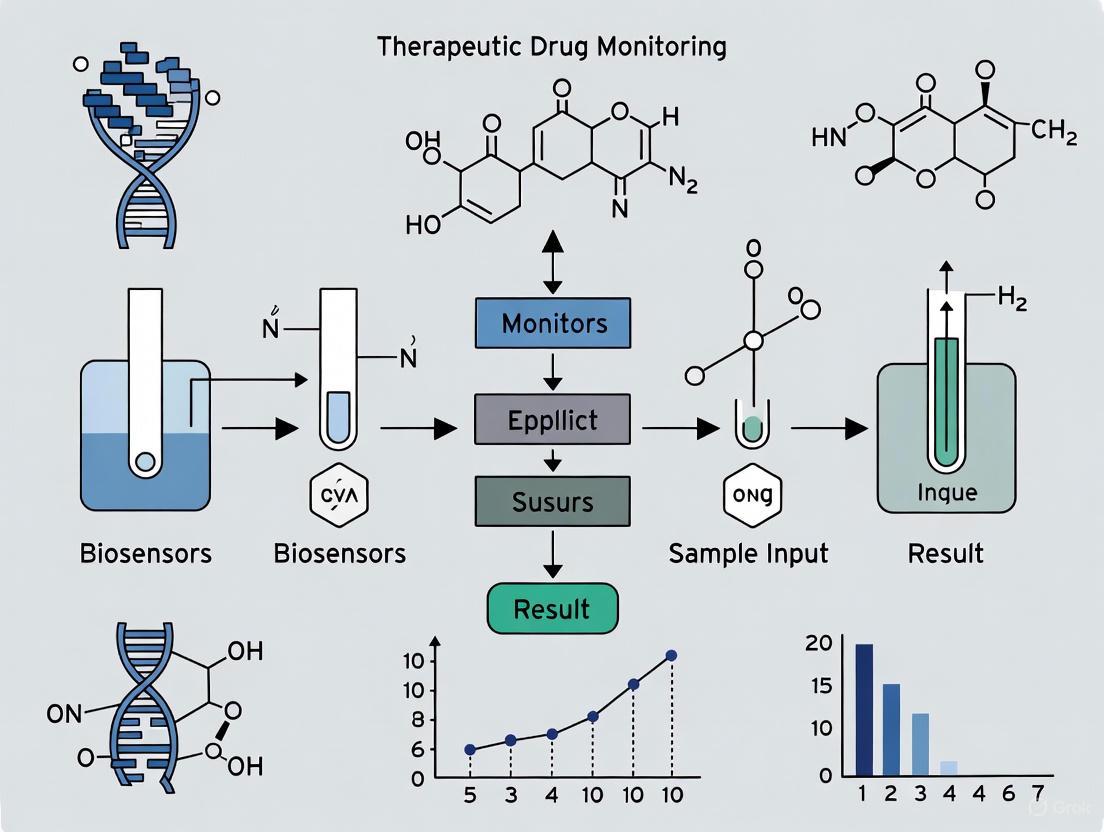
This article provides a comprehensive analysis of the transformative role of biosensors in therapeutic drug monitoring (TDM), a critical process for optimizing drug efficacy and minimizing toxicity.
Biosensor Technologies for Therapeutic Drug Monitoring: A Comprehensive Review for Researchers and Developers
Abstract
This article provides a comprehensive analysis of the transformative role of biosensors in therapeutic drug monitoring (TDM), a critical process for optimizing drug efficacy and minimizing toxicity. Tailored for researchers, scientists, and drug development professionals, it explores the foundational principles of TDM and the limitations of conventional techniques. The scope encompasses the latest methodological advances in electrochemical, optical, and nano-enhanced biosensors, detailing their application for monitoring anticancer drugs, antibiotics, and immunosuppressants. It further addresses key challenges in sensor optimization, biocompatibility, and signal accuracy, while evaluating validation frameworks, the integration of artificial intelligence, and comparative performance against gold-standard methods. The review concludes by synthesizing future research directions and the profound implications of these technologies for precision medicine and personalized dosing regimens.
The Foundation of TDM: From Traditional Assays to Biosensor Revolution
Therapeutic Drug Monitoring (TDM) is a critical clinical and pharmacological process defined as the measurement of drug concentrations in blood, plasma, or other biological samples to determine the optimal drug dosing regimen for an individual patient [1]. The fundamental premise of TDM is that for a specific subset of medications, a clear relationship exists between the plasma/blood drug concentration and the clinical efficacy or toxicity, enabling clinicians to personalize dosing for improved therapeutic outcomes [1] [2].
Traditional TDM methodologies, predominantly relying on techniques like high-performance liquid chromatography (HPLC) and immunoassays, have been hampered by limitations such as high costs, prolonged turnaround times, and the inability to provide real-time, continuous data [1] [2]. The emergence of biosensor technology is poised to revolutionize this field. Biosensors are analytical devices that convert a biological response into an electrical signal, typically comprising a bio-recognition element and a transducer [3] [4]. Their inherent specificity, potential for miniaturization, and capacity for real-time analysis offer a transformative pathway for TDM, facilitating precision medicine strategies that tailor drug treatments to individual patient profiles [1] [5].
Core Principles of Therapeutic Drug Monitoring
The clinical implementation of TDM is not appropriate for all medications. It is typically reserved for drugs that meet specific criteria, as outlined in the table below.
Table 1: Key Criteria for Initiating Therapeutic Drug Monitoring
| Criterion | Description | Clinical Rationale |
|---|---|---|
| Narrow Therapeutic Window | The range between the minimum effective concentration and the minimum toxic concentration is small. | Prevents sub-therapeutic dosing or harmful over-dosing [1]. |
| Significant Inter-Subject PK Variability | Pharmacokinetics (absorption, distribution, metabolism, excretion) vary greatly between patients. | Fixed dosing can lead to highly variable and unpredictable blood levels [1]. |
| Established Exposure-Response Relationship | A clear correlation exists between drug concentration and clinical response/toxicity. | Concentration is a more reliable predictor of effect than dose alone [1]. |
| Unpredictable Pharmacodynamics (PD) | The drug's effect on the body is difficult to monitor clinically. | TDM provides a surrogate marker for drug activity when direct effect measurement is complex [1]. |
| Availability of a Defined Target Concentration Range | A validated range of drug concentrations associated with efficacy and safety is known. | Provides a clinical target for dosage adjustment [1]. |
TDM is particularly crucial for managing drugs used in treating conditions such as epilepsy, cardiac arrhythmias, cancer, and infections, as well as immunosuppressants used in transplant patients [1] [2]. The primary goal is to maximize therapeutic efficacy while minimizing the risk of adverse drug reactions, thereby improving the overall safety and success of pharmacotherapy.
The Role of Biosensors in Advancing TDM
Biosensors offer a paradigm shift from traditional, intermittent TDM to a dynamic, continuous, and patient-centric model. Their application aligns with the growing emphasis on precision medicine and N-of-1 clinical trials, where treatment is optimized for a single individual [1].
Operational Advantages of Biosensor-Based TDM
The integration of biosensors into TDM protocols provides several distinct advantages:
- Real-Time and Continuous Monitoring: Unlike single-point measurements, certain biosensors can provide continuous data, capturing intra-individual PK variability and enabling immediate dosing feedback [1] [6].
- Miniaturization and Portability: Technologies like lab-on-a-chip (LOC) and wearable biosensors decentralize testing, facilitating point-of-care (POC) applications and remote patient monitoring [7] [5].
- High Specificity and Sensitivity: The use of advanced biorecognition elements (e.g., enzymes, antibodies, aptamers) ensures accurate detection of target analytes even in complex biological matrices [3] [5].
- Closed-Loop Systems: Biosensors can be integrated with drug delivery devices to create automated systems that adjust drug administration in response to real-time concentration data, exemplified by the artificial pancreas for diabetes management [4] [8].
Types of Biosensors in TDM Research
Biosensors for TDM are categorized based on their transduction mechanism. The following table summarizes prominent biosensor types and their applications in drug monitoring.
Table 2: Biosensor Platforms for Therapeutic Drug Monitoring
| Biosensor Type | Transduction Principle | Example Analytes Detected | Key Advantages |
|---|---|---|---|
| Electrochemical | Measures changes in electrical properties (current, potential, impedance) due to a biorecognition event [1] [5]. | Levodopa, antibiotics (e.g., beta-lactams), Paracetamol [2]. | High sensitivity, portability, low cost, and compatibility with miniaturization [1] [4]. |
| Optical | Detects changes in light properties (wavelength, intensity, polarization) upon analyte interaction [3] [1]. | Infliximab, antibiotics, Amikacin [2]. | High specificity and potential for multiplexing [1]. |
| Surface-Enhanced Raman Spectroscopy (SERS) | Enhances Raman scattering signals by molecules adsorbed on nanostructured metal surfaces, providing unique molecular fingerprints [9]. | Various drugs and metabolites (preclinical focus) [9]. | Ultra-high sensitivity, minimal sample consumption, and non-destructive analysis [9]. |
| Piezoelectric | Measures changes in the resonance frequency of a crystal due to mass changes from analyte binding [3]. | Phenytoin [2]. | Label-free detection and real-time monitoring capability [3]. |
| Wearable Biosensors | A platform (e.g., patches, wristbands) that often integrates electrochemical or optical sensing for non-invasive, continuous monitoring [6]. | Levodopa (in sweat), glucose, lactate [2] [6]. | Enables longitudinal data collection and remote patient monitoring [8] [6]. |
Experimental Protocols for Biosensor-Based TDM
This section provides a generalized yet detailed experimental workflow for developing and validating an electrochemical biosensor for TDM, a common platform in current research.
Protocol: Fabrication and Validation of an Electrochemical Aptamer-Based (E-AB) Sensor
Objective: To develop a selective and sensitive electrochemical biosensor for the quantification of a target drug (e.g., an antibiotic or anticancer agent) in human serum.
Principle: The protocol relies on an electrode-immobilized DNA or RNA aptamer that undergoes a conformational change upon binding the target drug. This change alters the electron transfer efficiency of a redox tag attached to the aptamer, producing a measurable electrochemical signal (e.g., via square wave voltammetry) proportional to the drug concentration [1] [2].
Materials Required:
Table 3: Research Reagent Solutions for E-AB Sensor Development
| Item/Category | Specific Examples & Specifications | Function in the Protocol |
|---|---|---|
| Transducer | Gold disk working electrode (2 mm diameter), Pt counter electrode, Ag/AgCl reference electrode. | Serves as the solid support for the bioreceptor and converts the biological event into an electrical signal [5]. |
| Bioreceptor | Thiol-modified DNA aptamer, sequence specific to the target drug (e.g., ~30-50 nucleotides). | The biological element that provides high specificity and affinity for the target drug molecule [1] [5]. |
| Redox Reporter | Methylene Blue. | An electrochemical tag that produces a measurable current change when the aptamer changes conformation upon target binding [2]. |
| Chemical Reagents | 6-Mercapto-1-hexanol (MCH), Ethanol, Phosphate Buffered Saline (PBS, pH 7.4). | MCH is used to block non-specific binding sites on the gold electrode. PBS is the electrolyte and dilution buffer [5]. |
| Sample Matrix | Pooled human serum, filtered and characterized. | The complex biological fluid used to simulate real-world conditions and test sensor specificity and matrix effects. |
| Instrumentation | Potentiostat, Three-electrode electrochemical cell. | The electronic system that applies potentials and measures the resulting currents for quantitative analysis [5]. |
Step-by-Step Procedure:
- Electrode Pretreatment: Clean the gold working electrode by polishing with 0.05 μm alumina slurry, followed by sequential sonication in ethanol and deionized water for 5 minutes each. Electrochemically clean in 0.5 M H₂SO₄ via cyclic voltammetry (CV) between -0.2 and +1.5 V until a stable CV profile is obtained.
- Aptamer Immobilization: Incubate the clean gold electrode with a 1 μM solution of the thiol-modified aptamer in PBS buffer for 16 hours at 4°C. This allows a self-assembled monolayer to form via gold-thiol bonding.
- Surface Blocking: Rinse the electrode with PBS and subsequently incubate in a 1 mM solution of 6-Mercapto-1-hexanol (MCH) for 1 hour at room temperature. This step is critical to passivate the remaining gold surface and minimize non-specific adsorption.
- Baseline Electrochemical Measurement: Place the functionalized electrode in an electrochemical cell containing a blank PBS buffer. Perform Square Wave Voltammetry (SWV) scans (e.g., from -0.5 to -0.1 V) to record the baseline signal of the redox tag.
- Analyte Detection: Spike the human serum samples with known concentrations of the target drug. Incubate the functionalized electrode in the spiked serum samples for a fixed period (e.g., 10-20 minutes). Rinse gently with PBS to remove unbound molecules.
- Post-Exposure Measurement: Perform SWV again in a clean PBS buffer. The binding of the target drug to the aptamer causes a conformational change, leading to a measurable change (often a decrease) in the peak current.
- Calibration and Quantification: Plot the percentage change in peak current (or peak height) against the logarithm of the drug concentration. Fit the data to a suitable model (e.g., sigmoidal) to create a calibration curve for quantifying unknown samples.
Validation Parameters:
- Sensitivity: Determine the Limit of Detection (LOD) and Limit of Quantification (LOQ).
- Selectivity: Test against common co-administered drugs and endogenous serum components.
- Reproducibility: Assess the inter- and intra-electrode coefficient of variation (%CV).
- Stability: Evaluate sensor signal retention over time and after multiple uses.
Clinical Necessity and Future Perspectives
The clinical necessity of TDM is unequivocal for a specific class of drugs, as it directly addresses the challenge of inter-individual variability in drug response, which can be influenced by genetics, comorbidities, lifestyle, and polypharmacy [1]. The traditional "one-size-fits-all" dosing approach can lead to therapeutic failure or adverse drug reactions in a significant proportion of patients. TDM provides an objective tool to navigate this variability, ensuring that each patient receives a dose that achieves the desired therapeutic target.
The future of TDM is inextricably linked to the advancement of biosensor technologies. Key emerging trends include:
- Integration with Wearable Technology: The development of wearable biosensors for non-invasive TDM (e.g., using sweat, saliva, or interstitial fluid) will enable continuous, real-time monitoring and facilitate remote patient management [6] [5].
- Multi-Analyte Panels: Future biosensors will likely move beyond single-drug detection to simultaneous monitoring of a drug and its key metabolites, or multiple drugs in cases of polypharmacy, providing a more comprehensive pharmacokinetic profile [7].
- Artificial Intelligence and Data Integration: The vast longitudinal data generated by continuous biosensors will be integrated with AI algorithms to predict individual dosing needs, identify adherence issues, and provide personalized alerts, ultimately forming the basis for sophisticated digital twins in healthcare [1] [6].
- Point-of-Care Testing (POCT): The miniaturization and simplification of biosensors will make robust TDM feasible in community clinics, pharmacies, and even home settings, democratizing access to personalized dosing [9] [5].
In conclusion, while the core principles of TDM—ensuring drug concentrations within a therapeutic window to maximize efficacy and minimize toxicity—remain a clinical necessity, the paradigm is shifting. Biosensor technology is the key driver of this transformation, promising a future where TDM is no longer a sporadic, lab-bound test, but a continuous, integrated, and accessible component of personalized therapeutic management.
Therapeutic Drug Monitoring (TDM) represents a cornerstone of precision medicine, enabling the optimization of drug dosage regimens by measuring their concentrations in patient blood [10]. The ultimate goal is to maintain drug levels within a therapeutic window—the concentration range below which treatment is ineffective and above which toxicity risks increase [10]. For decades, conventional analytical techniques including immunoassays, high-performance liquid chromatography (HPLC), and liquid chromatography-tandem mass spectrometry (LC-MS/MS) have formed the analytical backbone of TDM services in clinical laboratories worldwide [1] [11]. These technologies have proven indispensable for monitoring drugs with narrow therapeutic indices, such as immunosuppressants, antiepileptics, and certain antibiotics [10] [12].
Despite their widespread implementation, these conventional methods present significant limitations that can compromise their utility in modern personalized healthcare. These challenges span analytical performance, operational efficiency, and clinical applicability. As TDM expands beyond traditional domains to encompass broader precision medicine initiatives, including N-of-1 clinical trials and dynamic dosing regimens, these limitations become increasingly consequential [1]. This application note systematically evaluates the constraints of established TDM technologies while framing them within the emerging context of biosensor-based solutions that promise to overcome these hurdles.
Technological Limitations of Conventional TDM Platforms
The conventional TDM analytical spectrum is dominated by three principal technologies: immunoassays, HPLC, and LC-MS/MS. Each platform exhibits distinct limitations that impact their suitability for contemporary TDM applications.
Immunoassays: Specificity and Flexibility Constraints
Immunoassays, including enzyme-linked immunosorbent assays (ELISAs), chemiluminescence immunoassays (CLIAs), and radioimmunoassays (RIAs), are commonly used for TDM due to their high throughput and relatively simple operational workflows [10]. However, they suffer from several critical limitations:
- Low Specificity: Antibody-based methods frequently demonstrate significant imprecision due to cross-reactivity with drug metabolites or structurally similar compounds, potentially leading to interference and false-positive results [10]. This is particularly problematic for drugs with multiple active metabolites that contribute to overall pharmacological activity.
- Limited Multiplexing Capability: Traditional immunoassays typically measure only a single analyte per test, restricting their efficiency for patients on multiple medications where polypharmacy is common [10].
- Reagent Dependency: Immunoassays require specialized antibodies for each drug target, making them unsuitable for monitoring new or uncommon medications where commercial reagents may be unavailable [12].
High-Performance Liquid Chromatography: Sensitivity and Throughput Barriers
HPLC with ultraviolet (UV) detection offers improved specificity over immunoassays but introduces different constraints:
- Compromised Sensitivity: HPLC-UV methods often lack the sensitivity required for monitoring drugs present at ultralow concentrations (e.g., below ng/mL), limiting their application for many modern therapeutics [12].
- Limited Resolution: Complex biological matrices can lead to co-elution of interfering substances with the target analyte, compromising accuracy without sophisticated sample preparation [12] [13].
- Moderate Throughput: Traditional HPLC systems typically require longer run times per sample compared to immunoassays, creating bottlenecks in high-volume clinical laboratories [12]. While ultra-high-pressure liquid chromatography (UHPLC) improves speed and resolution, it necessitates significant capital investment and operational expertise [13].
Table 1: Comparative Limitations of Conventional TDM Analytical Platforms
| Platform | Key Limitations | Impact on TDM Services |
|---|---|---|
| Immunoassays | Low specificity due to cross-reactivity [10]; Limited multiplexing capability [10]; Inflexibility for new drugs [12] | Potential for inaccurate dosing decisions; Inefficient for polypharmacy patients; Limited application scope |
| HPLC-UV | Moderate sensitivity [12]; Limited resolution in complex matrices [12]; Throughput constraints [12] | Restricted to drugs with higher therapeutic concentrations; Potential matrix interference; Analytical bottlenecks |
| LC-MS/MS | High instrumentation and maintenance costs [11] [14]; Requirement for specialized expertise [11] [14]; Labor-intensive sample preparation [11] [14]; Lack of standardization [11] [14] | Limited accessibility for smaller laboratories; Personnel training challenges; Pre-analytical variability; Result comparability issues |
LC-MS/MS: Operational and Economic Challenges
LC-MS/MS is widely regarded as the "gold standard" for TDM due to its exceptional sensitivity, specificity, and multiplexing capabilities [11]. Despite these advantages, significant limitations impede its universal adoption:
- Substantial Economic Barriers: The high initial capital investment for LC-MS/MS instrumentation, coupled with ongoing maintenance costs and the need for specialized laboratory infrastructure, creates prohibitive economic barriers for many clinical settings [11] [14].
- Expertise Dependency: LC-MS/MS operation requires highly trained personnel with specialized expertise in mass spectrometry, method development, and troubleshooting—a resource not readily available in all clinical laboratories [11] [14].
- Labor-Intensive Workflows: Most LC-MS/MS methods require extensive sample preparation, including protein precipitation, liquid-liquid extraction, or solid-phase extraction, creating pre-analytical bottlenecks and introducing variability [11] [14].
- Standardization Deficits: The predominance of laboratory-developed tests (LDTs) in LC-MS/MS results in a lack of standardization across facilities, potentially compromising the comparability of results between laboratories [11] [14].
Experimental Protocols for Conventional TDM Methods
Protocol: HPLC-UV for Anticonvulsant Drug Monitoring
This protocol exemplifies a standardized HPLC-UV method for simultaneous quantification of multiple anticonvulsant drugs (carbamazepine, phenytoin, and lamotrigine) in human serum, adapted from validated clinical methods [12].
Principle: Drugs are extracted from serum via solid-phase extraction (SPE), separated by reversed-phase chromatography, and detected by UV absorption at optimized wavelengths.
Materials and Reagents:
- HPLC System: Hitachi Chromaster system or equivalent with diode-array detector [12]
- Chromatographic Column: Chromolith HighResolution RP-18 column (100 mm × 4.6 mm i.d.) [12]
- SPE Cartridges: MonoSpin C18 monolithic silica disk cartridges (GL Sciences) [12]
- Mobile Phase: Acetonitrile and ammonium acetate buffer (20 mM, pH adjusted) [12]
- Reference Standards: Carbamazepine, phenytoin, and lamotrigine certified reference materials [12]
- Sample Material: Human serum or plasma samples [12]
Procedure:
- Sample Preparation: Centrifuge patient whole blood samples to obtain clear serum or plasma.
- Solid-Phase Extraction:
- Condition MonoSpin C18 cartridge with 500 µL acetonitrile followed by 500 µL purified water via centrifugation at 5,000 rpm for 1 minute each [12].
- Load 150 µL filtered serum onto conditioned cartridge and centrifuge at 5,000 rpm for 3 minutes [12].
- Wash with 500 µL water (centrifuge at 5,000 rpm for 2 minutes) [12].
- Elute with 150 µL aqueous 50% acetonitrile (centrifuge at 5,000 rpm for 1 minute) and collect eluate for analysis [12].
- HPLC-UV Analysis:
- Quantification: Generate calibration curves using spiked serum standards (1-50 µg/mL) and quantify unknowns via peak area comparison [12].
Technical Notes:
- Method validation should demonstrate linearity (R² > 0.99), precision (CV < 15%), and accuracy (85-115% recovery) [12].
- Retention time stability is critical for reliable identification; system suitability tests must be performed daily [12].
- This platform approach allows unification of HPLC conditions for multiple drugs, simplifying method implementation [12].
Protocol: LC-MS/MS for Immunosuppressant Drug Monitoring
This protocol outlines a representative LC-MS/MS method for quantifying immunosuppressant drugs (tacrolimus, sirolimus, everolimus, cyclosporine A) in whole blood, reflecting current practices in specialized TDM laboratories [14].
Principle: Drugs are extracted from whole blood via protein precipitation, separated by UHPLC, and detected by tandem mass spectrometry using multiple reaction monitoring (MRM).
Materials and Reagents:
- LC-MS/MS System: Triple quadrupole mass spectrometer with electrospray ionization source [11]
- Chromatographic Column: C18 column (50 × 2.1 mm, 1.7-2.5 µm) [14]
- Internal Standards: Deuterated analogs for each target drug (e.g., d₃-everolimus) [14]
- Extraction Solvent: Zinc sulfate in acetonitrile/methanol [14]
- Mobile Phase: Methanol and water, both with 0.1% formic acid [14]
- Sample Material: EDTA whole blood samples [14]
Procedure:
- Sample Preparation:
- Aliquot 100 µL EDTA whole blood into microcentrifuge tube
- Add 25 µL internal standard working solution
- Precipitate proteins with 300 µL ice-cold extraction solvent
- Vortex mix vigorously for 60 seconds and centrifuge at 15,000 × g for 10 minutes
- Transfer supernatant to autosampler vial for analysis
- UHPLC Conditions:
- Column temperature: 50°C
- Flow rate: 0.5 mL/min
- Gradient program: 70-100% methanol over 3 minutes
- Injection volume: 5-10 µL
- MS/MS Detection:
- Ionization mode: Positive electrospray ionization
- MRM transitions: Tacrolimus (821.5→768.5), Sirolimus (931.6→864.5), Everolimus (975.6→908.5), Cyclosporine A (1219.9→1203.0)
- Collision energy: Optimized for each compound
- Quantification:
- Generate eight-point calibration curve (1-100 ng/mL) using drug-free blood spiked with standards
- Use internal standard method for quantification with quadratic regression
Technical Notes:
- Sample collection and handling must be standardized; EDTA whole blood is recommended for immunosuppressants [14].
- Hemolysis must be controlled as it affects drug recovery [14].
- Signal summing of multiple transitions can enhance detection limits for problematic analytes like everolimus [14].
- Method validation should include tests for matrix effects and extraction efficiency [11].
The Scientist's Toolkit: Essential Research Reagents and Materials
Table 2: Key Research Reagent Solutions for Conventional TDM Method Development
| Reagent/Material | Function in TDM Analysis | Application Notes |
|---|---|---|
| MonoSpin C18 SPE Cartridges [12] | Rapid extraction and purification of analytes from biological matrices | Monolithic silica disk design enables efficient extraction with minimal solvent consumption; suitable for HPLC-UV platforms |
| Deuterated Internal Standards [14] | Correction for matrix effects and variability in sample preparation | Essential for LC-MS/MS quantification; should be structurally analogous to target analytes (e.g., d₃-everolimus for everolimus) |
| Chromolith RP-18e Columns [12] | High-efficiency chromatographic separation | Monolithic structure provides high flow rates with low backpressure; ideal for rapid HPLC analysis of multiple drugs |
| Molecularly Imprinted Polymers (MIPs) [5] | Synthetic antibody mimics for selective analyte recognition | Emerging as robust alternative to biological receptors in biosensor applications; enhance stability and reduce costs |
| Anti-idiotype Antibodies [15] | Specific recognition of therapeutic monoclonal antibodies | Enable development of immunosensors for complex biotherapeutics; critical for emerging TDM applications |
Critical Analysis Workflow: From Sample to Result
The following diagram illustrates the complex workflow and associated limitations of conventional TDM methods, highlighting critical pain points where analytical errors may be introduced:
Conventional TDM Workflow Limitations
The workflow illustrates how limitations permeate each stage of conventional TDM analysis. Pre-analytical variability introduces significant errors during sample collection, transport, and storage, particularly problematic for unstable analytes [14]. Labor-intensive procedures dominate the sample preparation phase, creating bottlenecks and introducing inter-operator variability [11]. The core analysis requires specialized instrumentation that demands substantial capital investment and technical expertise [11] [14]. Complex data interpretation necessitates highly trained personnel, while the cumulative time requirements result in delayed clinical reporting, ultimately impacting the timeliness of therapeutic interventions [14].
Conventional TDM platforms, including immunoassays, HPLC, and LC-MS/MS, provide the historical foundation for personalized dosing but present significant limitations in specificity, efficiency, accessibility, and operational complexity. These constraints become increasingly problematic as TDM expands into new therapeutic areas and embraces precision medicine paradigms requiring rapid, decentralized analysis.
The limitations documented herein establish a compelling rationale for the development of innovative biosensor technologies that can potentially overcome these challenges. Biosensors offer prospects for real-time monitoring, point-of-care testing, enhanced accessibility, and simplified operational workflows [1] [15] [16]. Future research should focus on bridging the technological gaps between conventional methods and emerging biosensing platforms to advance the next generation of TDM solutions that truly align with the objectives of personalized medicine.
Core Components of a Biosensor
Biosensors are analytical devices that convert a biological response into a quantifiable electrical or optical signal. The core structure of a typical biosensor consists of four key integrated components [17]:
- Analyte: The substance of interest that needs to be detected (e.g., glucose, a specific drug, or a protein) [17].
- Bioreceptor: A biological molecular recognition element that specifically interacts with the target analyte. Examples include enzymes, antibodies, nucleic acids (DNA/RNA), aptamers, or whole cells [17] [2]. The process of signal generation upon interaction is termed bio-recognition.
- Transducer: The element that converts the biological recognition event into a measurable signal. This process is known as signalisation. Most transducers produce optical or electrical signals proportional to the amount of analyte-bioreceptor interaction [17].
- Signal Processing System: This includes the electronics that process the transduced signal (e.g., amplification, conversion) and the display that presents the final output in a user-interpretable form, such as numbers or graphs [17].
Table 1: Core Components of a Biosensor and Their Functions
| Component | Description | Function | Examples |
|---|---|---|---|
| Analyte | Substance of interest | Target molecule to be detected | Glucose, antibiotics, viruses, hormones [17] [2] |
| Bioreceptor | Biological recognition element | Binds specifically to the analyte | Enzymes, antibodies, aptamers, nucleic acids, cells [17] [2] |
| Transducer | Signal conversion element | Converts bio-recognition event into a measurable signal | Electrode, optical fiber, piezoelectric crystal [17] |
| Signal Processor | Electronics and display unit | Processes, conditions, and displays the output signal | Amplifier, analog-to-digital converter, LCD screen [17] |
Working Principles and Biosensor Classification
The operational principle of a biosensor is based on the specific binding of the bioreceptor to the target analyte, which generates a physicochemical change. This change is detected by the transducer and converted into an electronic signal whose magnitude is proportional to the analyte concentration [18].
Biosensors are broadly classified based on their bioreceptor type or their transduction method [18]. The choice of transduction principle is a critical design factor.
Table 2: Common Transduction Principles in Biosensors
| Transduction Principle | Working Basis | Measured Signal | Common Applications |
|---|---|---|---|
| Electrochemical | Measures electrical changes due to bio-recognition event [19] | Current (amperometric), potential (potentiometric), impedance (impedimetric) [2] | Glucose monitoring, detection of antibiotics, heart failure markers [20] [2] |
| Optical | Measures changes in light properties [19] | Light intensity, wavelength, phase, or polarization [20] | Surface Plasmon Resonance (SPR), fiber-optic sensors, colorimetric assays [20] [21] [2] |
| Piezoelectric | Measures mass change on the sensor surface | Resonance frequency shift | Gas detection, real-time study of binding events [2] |
| Thermometric | Measures heat change from a biochemical reaction | Temperature change | Enzyme-based reactions, metabolite detection [18] |
Figure 1: The generalized workflow of a biosensor, from sample introduction to result display.
Biosensors in Therapeutic Drug Monitoring (TDM): An Application Context
Therapeutic Drug Monitoring (TDM) is a clinical practice used to individualize drug dosage by maintaining drug concentrations in a patient's blood or plasma within a target therapeutic range. This is crucial for drugs with a narrow therapeutic index (NTI), where small concentration variations can lead to sub-therapeutic effects or dangerous toxicity [20]. TDM is commonly applied to antibiotics (e.g., aminoglycosides), anticonvulsants (e.g., phenytoin), anti-cancer drugs (e.g., methotrexate), and immunosuppressants (e.g., cyclosporine) [20].
Traditional TDM methods like high-performance liquid chromatography (HPLC) or immunoassays, while sensitive and specific, are time-consuming, require centralized laboratories, and are not suitable for real-time, point-of-care monitoring [20] [2]. Biosensors offer a promising alternative by enabling rapid, simple, and inexpensive drug quantification at the patient's bedside, facilitating personalized medicine [20] [19].
Experimental Protocol: SPR-Based Biosensor for TDM of Antibiotics
Principle: Surface Plasmon Resonance (SPR) is an optical technique that detects changes in the refractive index on a sensor surface. When a bioreceptor (e.g., an antibody) immobilized on the sensor chip captures the target drug (analyte), the mass on the surface increases, causing a shift in the SPR angle that can be measured in real-time [20] [22].
Objective: To quantitatively detect an antibiotic (e.g., amikacin) in human plasma samples using an SPR biosensor functionalized with an anti-amikacin antibody [2].
Materials:
- SPR instrument (e.g., Biacore series)
- Sensor chip (e.g., carboxymethyl dextran gold chip)
- Anti-amikacin monoclonal antibody
- Amikacin standard solutions
- Patient plasma samples
- Coupling reagents: N-ethyl-N'-(3-dimethylaminopropyl)carbodiimide (EDC), N-hydroxysuccinimide (NHS)
- Running buffer: 10 mM phosphate-buffered saline (PBS), pH 7.4
- Regeneration solution: 10 mM Glycine-HCl, pH 2.0
Procedure:
- Chip Activation: Inject a mixture of EDC and NHS over the sensor chip surface to activate the carboxyl groups.
- Antibody Immobilization: Dilute the anti-amikacin antibody in sodium acetate buffer (pH 5.0) and inject it over the activated surface until the desired immobilization level is achieved. Block any remaining activated groups with ethanolamine.
- Calibration Curve:
- Inject a series of known amikacin standard solutions (e.g., 0, 0.1, 1, 10, 100 ng/mL) prepared in running buffer over the functionalized sensor surface.
- Monitor the SPR signal (Response Units, RU) in real-time.
- After each sample injection, regenerate the surface with a short pulse of glycine-HCl to remove bound analyte without damaging the antibody.
- Plot the maximum RU shift versus amikacin concentration to generate a calibration curve.
- Sample Analysis:
- Dilute patient plasma samples in running buffer.
- Inject the diluted samples over the sensor chip and record the RU response.
- Determine the amikacin concentration in the sample by interpolating the response from the calibration curve.
Data Analysis: The binding response is directly proportional to the analyte concentration. The equilibrium dissociation constant (KD) and kinetic parameters (association rate, kon; dissociation rate, koff) can be determined through kinetic analysis of the sensorgram data [22].
The Scientist's Toolkit: Key Research Reagent Solutions
Table 3: Essential Reagents and Materials for Biosensor Development in TDM
| Item / Reagent | Function / Application | Example in TDM Context |
|---|---|---|
| Gold Nanoparticles (Au NPs) | Signal amplification in optical (LSPR, colorimetric) biosensors [21] [2] | LSPR-based nanobiosensor for digoxin detection [2] |
| Specific Antibodies | High-affinity biorecognition elements for immunosensors [2] | Anti-digoxin antibody for digoxin TDM; anti-infliximab antibody for infliximab TDM [2] |
| Aptamers | Synthetic single-stranded DNA/RNA oligonucleotides as bioreceptors; offer high stability [20] | TFV-aptamer for Tenofovir detection in an electrochemical biosensor [2] |
| Screen-Printed Electrodes | Low-cost, disposable transducers for electrochemical biosensors [2] | Wearable sweat sensor for levodopa monitoring [2] |
| Enzymes (e.g., β-lactamase, Tyrosinase) | Biorecognition elements that catalyze a reaction with the target analyte [2] | β-lactamase enzyme for detecting beta-lactam antibiotics [2] |
| Ion-Selective Membranes | Used in potentiometric sensors for ion detection [2] | Valinomycin-PVC membrane for potassium ion detection in a FET-based sensor [2] |
Figure 2: Key components and technologies in the biosensor development toolkit for TDM.
Therapeutic Drug Monitoring (TDM) represents a cornerstone of precision medicine, enabling clinicians to individualize drug regimens by maintaining serum concentrations within a narrow therapeutic window. Traditional TDM methodologies relying on centralized laboratories face significant limitations including prolonged turnaround times, high costs, and logistical complexities that preclude real-time dosage adjustments. Point-of-care (POC) biosensors are poised to revolutionize this field by decentralizing TDM through technological innovations that offer rapid, cost-effective, and continuous monitoring capabilities. This paradigm shift addresses critical unmet needs across clinical and research settings, particularly for drugs with narrow therapeutic indices where suboptimal dosing can lead to therapeutic failure or severe toxicity.
The global TDM market, valued at USD 1.36 billion in 2025 and projected to reach USD 2.11 billion by 2030, reflects a compound annual growth rate (CAGR) of 9.12% [23]. This expansion is largely driven by technological advancements in biosensing platforms, rising adoption of precision medicine programs, and expanding applications in oncology, infectious diseases, and immunosuppressant management. Concurrently, the global biosensors market demonstrates parallel growth, projected to increase from USD 30.78 billion in 2025 to USD 48.10 billion by 2032 at a CAGR of 9.2% [24], underscoring the synergistic expansion of these interconnected fields.
Market Context and Clinical Need
Quantitative Market Landscape
The TDM market analysis reveals distinct segmental growth patterns driven by technological and clinical demands. The tables below summarize key market dimensions and growth trajectories across technologies, drug classes, and end-user segments.
Table 1: Therapeutic Drug Monitoring Market Size and Projections
| Metric | 2024/2025 Value | 2030/2032 Projection | CAGR |
|---|---|---|---|
| Global TDM Market Size | USD 1.36 billion (2025) [23] | USD 2.11 billion (2030) [23] | 9.12% [23] |
| Global Biosensors Market Size | USD 30.78 billion (2025) [24] | USD 48.10 billion (2032) [24] | 9.2% [24] |
| Biosensor-based TDM Platforms | Not specified | Not specified | 9.87% [23] |
| TDM Point-of-Care Segment | Not specified | Not specified | 10.15% [23] |
Table 2: Therapeutic Drug Monitoring Market Share and Growth by Segment
| Segment | 2024 Market Share | Highest Growth Segment | Projected CAGR |
|---|---|---|---|
| Technology | Immunoassays (59.37%) [23] | Biosensor Platforms [23] | 9.87% [23] |
| Drug Class | Antiepileptic Drugs (32.17%) [23] | Oncology Therapeutics [23] | 9.65% [23] |
| End User | Hospital Laboratories (55.62%) [23] | Point-of-Care Sites [23] | 10.15% [23] |
| Geography | North America (42.17%) [23] | Asia-Pacific [23] | 10.44% [23] |
Clinical Drivers and Applications
The transition to POC-TDM is clinically driven by several critical factors. First, the rising prevalence of conditions requiring complex drug regimens—including cancer, HIV/AIDS, and autoimmune disorders—necessitates precise dosing of therapeutics with narrow therapeutic indices [23]. Small-molecule kinase inhibitors and monoclonal antibodies in oncology protocols, for instance, create narrow therapeutic margins that mandate precise serum-level control to avoid suboptimal tumor inhibition or dose-limiting toxicity [23]. Second, the expansion of clinical trials and companion-diagnostic mandates now require dose-optimization evidence across diverse genotypes, firmly embedding TDM into study protocols [23]. Furthermore, the growing emphasis on personalized medicine and pharmacogenomics underscores the need for dynamic monitoring tools that can adapt to individual patient metabolism and response profiles.
Experimental Protocols: Biosensor Platforms for TDM
Smartphone-Based Electrochemical and Colorimetric Detection
Recent research demonstrates the viability of smartphone-integrated biosensors for TDM applications. A 2025 study developed a dual-approach system for quantifying paracetamol (acetaminophen) in artificial saliva using a custom smartphone application ("MediMeter") [25]. This protocol is particularly relevant for drugs like paracetamol which exhibit a strong correlation between saliva and blood concentrations, establishing saliva as a promising, non-invasive medium for drug level monitoring [25].
Table 3: Performance Comparison of Smartphone-Based Biosensing Methods
| Parameter | Colorimetric Method | Electrochemical Method |
|---|---|---|
| Detection Principle | Prussian Blue reaction with RGB profiling [25] | Direct electrochemical oxidation [25] |
| Linear Range (Paracetamol) | 0.01–0.05 mg/mL [25] | 0.01–0.05 mg/mL [25] |
| Correlation Coefficient (R²) | 0.939 [25] | 0.988 [25] |
| Precision (Standard Deviation) | Not specified | 0.1041 mg/mL [25] |
| Analysis Time | Several minutes | ~1 minute [25] |
| Key Advantage | Simplicity, lower cost [25] | Better precision and speed [25] |
Protocol 1: Colorimetric Detection of Paracetamol
- Sample Preparation: Artificial saliva spiked with paracetamol across the concentration range of 0.01–0.05 mg/mL [25].
- Reaction Setup: A paper template is used to constrain the reaction space. The optimized Prussian Blue reaction is performed on this paper substrate [25].
- Detection and Analysis:
- The reaction product is imaged using the smartphone camera.
- The "MediMeter" application performs Red, Green, Blue (RGB) profiling on the image.
- The application translates increasing color intensities to corresponding paracetamol concentrations based on a pre-established calibration curve [25].
Protocol 2: Electrochemical Detection of Paracetamol
- Equipment Setup: The system utilizes a KickStat potentiostat, chosen for its cost-effectiveness, compact form, low operational voltage, and high resolution [25].
- Sensor Preparation: The working electrode is appropriately modified for paracetamol detection. The specific modification protocol was optimized to minimize external interferences [25].
- Measurement Procedure:
- The artificial saliva sample is applied to the electrochemical cell.
- The KickStat potentiostat applies the optimized potential waveform.
- The resulting current, proportional to paracetamol concentration, is measured.
- Data is transmitted to the smartphone via connectivity (e.g., Bluetooth) and processed by the "MediMeter" app to display the concentration result within approximately one minute [25].
Continuous Intravascular Monitoring
For critical care applications, intravascular biosensors represent a groundbreaking approach for real-time monitoring. These devices are designed to operate within the human circulatory system, enabling unparalleled opportunities for continuous parameter assessment [16].
Protocol 3: Intravascular Glucose Monitoring in Critically Ill Patients
- Sensor System: The GluCath System, an intravascular continuous glucose monitoring (CGM) system that uses a chemical fluorescence quenching mechanism for optical blood glucose measurement [16].
- Sensor Placement: The sensor is inserted into the radial artery or directly into a peripheral vein via an indwelling catheter [16].
- Operation and Data Acquisition:
- The sensor, integrated into the catheter, continuously measures glucose levels in the blood via fluorescence quenching.
- Optical signals are transduced to electronic readouts.
- Data is displayed at the bedside, allowing for real-time clinical decision-making. The system demonstrated acceptable accuracy during 48-hour placement in post-cardiac surgery patients in intensive care units [16].
The Scientist's Toolkit: Key Research Reagent Solutions
Successful development of POC-TDM biosensors relies on specialized materials and reagents. The following table details essential components and their functions in biosensor fabrication and operation.
Table 4: Essential Research Reagents and Materials for POC-TDM Biosensor Development
| Reagent/Material | Function/Application | Research Context |
|---|---|---|
| Graphene & Carbon Nanotubes | Enhance electrical conductivity and surface area for superior sensitivity in electrochemical sensors [26]. | Nanomaterial-based biosensors for healthcare application [27]. |
| Glucose Oxidase (GOx) | Biological recognition element for glucose biosensors; catalyzes reaction producing measurable signal [28]. | Enzymatic mediator-free glucose biosensors [28]. |
| Molecularly Imprinted Polymers (MIPs) | Synthetic receptors that provide high selectivity for target analytes like cortisol [28]. | Wearable electrochemical sensor for cortisol in sweat [28]. |
| KickStat Potentiostat | Affordable, compact potentiostat for electrochemical measurements with smartphone integration [25]. | Low-cost electrochemical detection of paracetamol [25]. |
| Dendritic Gold Nanostructures | Nanostructured electrode coating to increase surface area and enhance signal response [28]. | Platform for glucose biosensor development [28]. |
| Prussian Blue Reagents | Colorimetric reaction agent for detection of analytes like paracetamol [25]. | Smartphone-based colorimetric quantification [25]. |
| Nanocomposite Coating (BSA-rGO) | Prevents biofouling and foreign body response, improving longevity of implantable sensors [28]. | Coating for implantable biosensors to enable continuous monitoring [28]. |
| Biotinylated Primers | Used with streptavidin-coated magnetic nanoparticles for magnetically localized detection of amplified DNA (PCR, LAMP) [28]. | Quantitative nucleic acid detection for infectious disease diagnostics [28]. |
Workflow and Technology Integration Diagrams
The integration of advanced materials, sensing modalities, and data processing defines the operational framework of modern POC-TDM systems. The following diagrams visualize key workflows and technological relationships.
POC-TDM Biosensor Development Workflow
POC-TDM Biosensor Technology Ecosystem
The integration of advanced biosensing technologies into point-of-care platforms is fundamentally transforming the paradigm of therapeutic drug monitoring. The experimental protocols and research tools detailed in this application note provide a framework for developing systems that address the critical needs for portability, cost-effectiveness, and real-time analysis. The growing market traction and significant CAGR projections for both TDM and biosensor markets underscore the economic and clinical viability of these technologies.
Future advancements will be shaped by several key trends: the convergence of biosensors with artificial intelligence for enhanced data interpretation, with AI algorithms already shown to increase diagnostic accuracy by 18% in some systems [26]; the development of robust anti-biofouling coatings such as novel nanocomposites to improve the longevity and stability of implantable sensors [28]; and the expansion of multiplexing capabilities for simultaneous monitoring of multiple drugs or biomarkers [26]. Furthermore, the regulatory landscape is evolving to accommodate these innovations, with the U.S. FDA having approved approximately 1,016 AI/ML-enabled medical devices as of March 2025, many relying on biosensor inputs [26]. As these technologies mature, POC-TDM will increasingly become the standard of care for managing complex drug therapies, ultimately realizing the promise of personalized precision medicine.
Therapeutic Drug Monitoring (TDM) represents a critical component of precision medicine, enabling the optimization of drug dosage to maintain plasma or blood concentrations within a target therapeutic range [29]. For drugs with a narrow therapeutic index (NTI), small variations in concentration can lead to therapeutic failure or severe toxic side effects [20]. TDM is particularly crucial for managing anticancer agents, antibiotics, and antiepileptic drugs, where inter-patient pharmacokinetic variability is significant and clinical outcomes are directly correlated with drug exposure [29] [30] [31]. This article details the application of advanced analytical techniques, with a specific focus on biosensor technology, for TDM of these key drug classes within a research context aimed at advancing personalized treatment protocols.
Key Drug Classes Requiring TDM
Anticancer Agents
Anticancer drugs often exhibit severe, dose-related toxicities, and their therapeutic windows are frequently narrow. For instance, drugs like methotrexate, imatinib, and paclitaxel require careful monitoring to balance efficacy with adverse effects such as hematological, cardiac, and neurotoxicities [29] [32]. Global cancer incidence exceeded 20 million new cases in 2022, underscoring the massive population that could benefit from optimized chemotherapy dosing [29]. TDM for anticancer drugs is complex due to factors like combination therapies and significant inter-individual pharmacokinetic variability, but it holds great promise for personalizing treatment and improving safety [32].
Antibiotics
In critically ill patients, antibiotics such as vancomycin, aminoglycosides, and β-lactams are prime candidates for TDM [30]. These patients often experience rapid physiological changes that alter drug pharmacokinetics, leading to unpredictable plasma concentrations. Subtherapeutic levels can result in treatment failure and antimicrobial resistance, while supratherapeutic levels cause toxicity (e.g., nephrotoxicity, neurotoxicity) [30] [33]. The correlation between drug concentration and clinical efficacy/toxicity is a fundamental criterion for TDM implementation [1].
Antiepileptic Drugs (AEDs)
AEDs require TDM due to their NTIs, non-linear pharmacokinetics, and the critical need to maintain seizure control without provoking side effects such as dizziness, ataxia, or cognitive impairment [31]. Both older generation drugs (e.g., phenobarbital, phenytoin) and newer generation antiseizure medications (e.g., lacosamide, perampanel) demonstrate high inter-individual variability in drug concentration and concentration-to-dose ratios, making TDM essential for dose personalization [31] [34]. Large-scale TDM data from over 450 patient samples reveals that a significant proportion of patients (up to 53%) can have subtherapeutic drug levels, highlighting the challenge of empirical dosing [34].
Table 1: Key Characteristics of Major Drugs Requiring TDM
| Drug Class | Example Drugs | Primary Toxicity Concerns | Therapeutic Range (Example) |
|---|---|---|---|
| Anticancer Agents | Methotrexate, Imatinib, Doxorubicin, Paclitaxel | Myelosuppression, Cardiotoxicity, Neurotoxicity | Variable; drug-specific [29] [32] |
| Antibiotics | Vancomycin, Aminoglycosides, β-lactams | Nephrotoxicity, Neurotoxicity | Vancomycin: AUC/MIC 400-600 [30] |
| Antiepileptic Drugs | Phenytoin, Valproic Acid, Carbamazepine, Lacosamide | Neurotoxicity, Hepatotoxicity, Dizziness/Ataxia | Phenytoin: 10-20 mg/L [20] [31] |
Established Analytical Methods for TDM
Traditional TDM relies on techniques like liquid chromatography-tandem mass spectrometry (LC-MS/MS) and immunoassays [30] [20]. LC-MS/MS is considered the gold standard for its high sensitivity, specificity, and ability to multiplex (e.g., simultaneously quantifying 6 new-generation antiseizure medications) [34]. However, these methods are burdened by high costs, complex sample preparation, long turnaround times, and the need for centralized laboratories and skilled personnel, which limits their utility for real-time, point-of-care dose adjustment [29] [30] [33].
Biosensors as Next-Generation TDM Tools
Biosensors are analytical devices that combine a biological recognition element (e.g., antibody, enzyme, aptamer) with a transducer (electrochemical, optical) to produce a measurable signal proportional to the target analyte concentration [2]. They offer a paradigm shift for TDM by enabling rapid, cost-effective, and decentralized monitoring, with the potential for real-time, continuous measurement [29] [30].
Biosensor Types and Mechanisms
- Electrochemical Biosensors: These measure changes in current, potential, or impedance resulting from the interaction between the target drug and the biorecognition element. Techniques like cyclic voltammetry (CV) and differential pulse voltammetry (DPV) are commonly used. For example, doxorubicin has been detected using sensors with nanomaterials like vertically-ordered mesoporous silica films [29].
- Optical Biosensors: These detect changes in light properties (e.g., absorbance, fluorescence, refractive index). Surface Plasmon Resonance (SPR) and Localized Surface Plasmon Resonance (LSPR) are prominent label-free optical techniques used for monitoring drugs like digoxin and methotrexate [20] [2].
- Thermometric Biosensors: Devices like the enzyme thermistor utilize enzymes (e.g., β-lactamase) that generate heat upon metabolizing the target drug, allowing for quantification. An NDM-1 biosensor has been successfully used to detect β-lactam antibiotic concentrations in patient plasma [33].
Advanced Biosensing Modalities
Research is advancing towards dual-mode and multimodal biosensors that combine complementary techniques (e.g., electrochemical-SERS) to enhance reliability and sensitivity [29]. The integration of Artificial Intelligence (AI) and Machine Learning (ML) is also being explored to manage high-throughput screening data, identify patterns in drug response, and improve the predictive power of TDM [29] [1].
Detailed Experimental Protocols for Biosensor-Based TDM
This section provides a generalized, modular protocol for developing and applying electrochemical and optical biosensors for TDM of NTI drugs. The protocol can be adapted for specific drug targets.
Protocol 1: Fabrication of an Electrochemical Aptamer-Based Biosensor
Principle: An electrode-bound, redox-tagged aptamer undergoes a conformational change upon target binding, altering electron transfer efficiency and generating a measurable signal (e.g., via EIS or DPV) [30].
Materials:
- Working Electrode: Glassy carbon electrode (GCE), gold disk electrode, or screen-printed carbon electrode.
- Aptamer Probe: Synthetic oligonucleotide specific to the target drug (e.g., tenofovir aptamer [2]), modified with a thiol group at one end and a redox reporter (e.g., Methylene Blue) at the other.
- Nanomaterials: (Optional) Graphene oxide, metal nanoparticles (e.g., Pt NPs), or carbon nanotubes to enhance surface area and electron transfer [29].
- Electrochemical Cell: Potentiostat for performing CV, EIS, and DPV.
Procedure:
- Electrode Pretreatment: Polish the GCE with alumina slurry (0.05 µm) and rinse thoroughly with deionized water. Perform electrochemical cleaning in a standard buffer solution (e.g., 0.5 M H₂SO₄) via cyclic voltammetry until a stable voltammogram is obtained.
- Nanomaterial Modification (Optional): Deposit the nanomaterial suspension (e.g., reduced graphene oxide/Pt NPs [29]) onto the electrode surface and allow to dry under an infrared lamp.
- Aptamer Immobilization: Incubate the modified electrode with a solution of the thiolated, redox-tagged aptamer (e.g., 1 µM in PBS) for 12-16 hours at 4°C. This allows self-assembly of a monolayer via Au-S bonds on a gold electrode or via π-π stacking on carbon-based materials.
- Surface Blocking: Treat the electrode with a passivating agent (e.g., 6-mercapto-1-hexanol for gold surfaces) for 1 hour to block non-specific binding sites.
- Electrochemical Measurement & Calibration:
- Perform EIS or DPV measurements in a blank buffer solution to establish the baseline signal.
- Incubate the biosensor with a series of standard solutions of the target drug with known concentrations.
- After each incubation, measure the electrochemical signal. The signal change (e.g., increase in charge transfer resistance, Rct, in EIS) is proportional to the drug concentration.
- Construct a calibration curve (signal vs. log[concentration]).
- Sample Analysis: Apply a diluted plasma or serum sample to the biosensor and measure the signal. Interpolate the signal against the calibration curve to determine the unknown drug concentration.
Protocol 2: Development of an Optical LSPR-Based Nanobiosensor
Principle: The binding of the target drug to a capture element on a metallic nanoparticle (e.g., gold) causes a local change in the refractive index, leading to a measurable shift in the LSPR extinction peak wavelength [2].
Materials:
- LSPR Substrate: Gold nanoparticles (AuNPs) immobilized on a glass slide or in solution.
- Capture Molecule: Antibody or high-affinity protein (e.g., anti-digoxin antibody, human dihydrofolate reductase for methotrexate [2]).
- Optical Setup: UV-Vis spectrophotometer or a dedicated LSPR reader.
- Microfluidics (Optional): For automated sample handling.
Procedure:
- Substrate Functionalization: Immobilize AuNPs on a clean glass substrate. Treat the substrate with a linker molecule (e.g., 11-MUA) to form a self-assembled monolayer presenting carboxyl groups.
- Capture Molecule Immobilization: Activate the carboxyl groups with a mixture of EDC and NHS. Subsequently, incubate with the capture molecule (e.g., antibody) to form stable amide bonds.
- Surface Blocking: Block any remaining active sites with a non-interacting protein (e.g., BSA).
- Optical Measurement & Calibration:
- Acquire the LSPR extinction spectrum of the functionalized biosensor in a buffer to establish the initial peak wavelength (λ₀).
- Introduce standard solutions of the target drug and monitor the redshift (Δλ) of the LSPR peak upon binding.
- Plot Δλ against drug concentration to generate a calibration curve.
- Sample Analysis: Introduce the clinical sample (e.g., filtered plasma to reduce matrix effects [33]) to the biosensor chamber. Measure the resultant LSPR shift and determine the concentration from the calibration curve.
Table 2: The Scientist's Toolkit: Key Reagents for Biosensor Development
| Reagent Category | Specific Examples | Function in Biosensor |
|---|---|---|
| Biorecognition Elements | Aptamers (e.g., for tenofovir), Enzymes (e.g., β-lactamase, glucose oxidase), Antibodies (e.g., anti-digoxin, anti-infliximab) | Molecular recognition; binds specifically to the target drug [30] [2] [33] |
| Transducer Materials | Gold & Platinum electrodes, Carbon nanomaterials (graphene, CNTs), Metal nanoparticles (Au, Ag NPs), Quantum Dots | Signal transduction; converts binding event into measurable electrical/optical signal [29] [2] |
| Signal Reporters | Redox markers (Methylene Blue, Ferrocene), Fluorescent dyes, Enzymatic labels (Horseradish Peroxidase) | Generates the detectable signal (current, light) [30] |
| Surface Chemistry Tools | Thiolated DNA/aptamers, Cross-linkers (EDC/NHS), Self-Assembled Monolayers (e.g., 11-MUA) | Immobilizes biorecognition element onto transducer surface [2] |
Biosensor technology is poised to reshape the landscape of TDM for NTI drugs, moving it from centralized laboratories to the point-of-care and enabling continuous, real-time monitoring [29] [30]. The translation of these devices from research to clinical practice, however, requires overcoming challenges related to long-term stability in complex biological matrices, clinical validation in large, diverse patient cohorts, and securing regulatory approval [29] [1]. The future integration of biosensors with wearable technology, IoT platforms, and AI-driven data analytics promises to create closed-loop systems for autonomous drug dosing, ultimately realizing the full potential of personalized precision medicine [1] [2].
Advanced Biosensing Modalities and Their Clinical Applications
Therapeutic Drug Monitoring (TDM) represents a critical component of modern precision medicine, enabling the optimization of drug dosage regimens based on individual patient response [1]. Electrochemical biosensors have emerged as transformative tools for TDM, offering rapid, cost-effective, and highly sensitive detection of drug concentrations in biological fluids [35] [36]. These devices function by transducing biochemical events into quantifiable electrical signals, typically measuring changes in current, voltage, or impedance resulting from the interaction between a target analyte and a biological recognition element immobilized on an electrode surface [37] [38]. The significance of electrochemical biosensors in TDM is particularly evident for drugs with narrow therapeutic windows, such as vancomycin and various antiepileptic and anticancer agents, where maintaining serum concentrations within a specific range is crucial for both efficacy and patient safety [1] [36]. The integration of advanced materials, miniaturization technologies, and sophisticated electrochemical techniques has positioned these biosensors as promising alternatives to traditional analytical methods like chromatography and immunoassays, facilitating the transition toward personalized dosing and improved clinical outcomes [37] [35].
Fundamental Principles and Key Components
Electrochemical biosensors operate on the principle of converting a biological recognition event into an electrical signal through a transducer system. The core architecture consists of four essential components: the analyte (target molecule), bioreceptor (biological recognition element), transducer (electrode system), and readout system [37]. The bioreceptor, which can include enzymes, antibodies, aptamers, or whole cells, provides specificity toward the target analyte [37] [38]. This interaction generates a biochemical signal that the transducer converts into a measurable electrical parameter.
A typical electrochemical biosensor employs a three-electrode system: a working electrode where the biochemical recognition occurs, a reference electrode to maintain a stable potential, and a counter electrode to complete the electrical circuit [36]. Electrode materials range from conventional glassy carbon and noble metals to screen-printed electrodes, often modified with nanomaterials such as graphene, carbon nanotubes, gold nanoparticles, or metal-organic frameworks (MOFs) to enhance sensitivity, stability, and biocompatibility [38] [36]. These modifications increase the electroactive surface area, improve electron transfer kinetics, and provide suitable matrices for immobilizing biorecognition elements [38] [36].
Electrochemical biosensors are categorized into different generations based on their electron transfer mechanisms. First-generation biosensors rely on the natural cosubstrate (e.g., oxygen) for signal generation, while second-generation systems employ artificial redox mediators to shuttle electrons between the biorecognition element and the electrode [38] [4]. Third-generation biosensors achieve direct electron transfer between the immobilized biomolecule and the electrode surface, offering superior selectivity and reagentless operation [38] [4].
Diagram 1: Fundamental architecture of an electrochemical biosensor showing core components and signal pathways.
Core Electrochemical Techniques
Cyclic Voltammetry (CV)
Cyclic Voltammetry is a powerful potentiostatic technique that provides comprehensive information about the redox behavior of electroactive species. In CV, the potential of the working electrode is scanned linearly between two set limits (initial and switching potentials) while measuring the resulting current [39]. The potential is applied in a triangular waveform, creating forward and reverse scans that reveal oxidation and reduction peaks characteristic of the analyte. Key parameters obtained from CV include peak potentials (Epa for oxidation, Epc for reduction), peak currents (ipa, ipc), and the formal potential (E°), which is calculated as the average of the anodic and cathodic peak potentials [39].
The peak separation (ΔEp = Epa - Epc) provides valuable insights into the reversibility of the redox reaction. For a reversible system with fast electron transfer kinetics, ΔEp is approximately 59 mV for a one-electron transfer process, while larger separations indicate slower kinetics. The magnitude of the peak current is proportional to the concentration of the electroactive species, the electrode area, and the square root of the scan rate, following the Randles-Ševčík equation [39]. CV is particularly valuable for characterizing modified electrode surfaces, studying reaction mechanisms, and determining the stability of electroactive species in biosensing applications.
Protocol: Standard Cyclic Voltammetry Experiment
- Electrode Preparation: Polish the working electrode (typically glassy carbon) with alumina slurry (0.05 μm) on a microcloth pad. Rinse thoroughly with deionized water and dry [39] [38].
- Electrode Modification: Deposit nanomaterials or biorecognition elements via drop-casting, electrodeposition, or self-assembly. For polymer modification, use potential cycling in monomer solution (e.g., 0.0-1.4 V vs. Ag/AgCl for 10 cycles at 100 mV/s) [39].
- Bioreceptor Immobilization: Immobilize enzymes, antibodies, or aptamers via cross-linking with glutaraldehyde, physical adsorption, or covalent bonding. Incubate for 1-2 hours, then rinse to remove unbound molecules [39] [38].
- Experimental Setup: Use a three-electrode system in an electrochemical cell containing supporting electrolyte (e.g., 0.1 M phosphate buffer, pH 7.0). Dec oxygenate with inert gas if necessary [39].
- Parameter Setting: Set initial and switching potentials appropriate for the target analyte. Typical scan rates range from 10-500 mV/s. Allow 10-15 seconds equilibration time before scanning [39].
- Data Acquisition: Run CV scans for blank solution and samples with increasing analyte concentrations. Record current responses at characteristic potentials [39].
Differential Pulse Voltammetry (DPV)
Differential Pulse Voltammetry offers significantly enhanced sensitivity and lower detection limits compared to CV, making it particularly suitable for trace-level determinations in complex matrices like biological fluids [39] [40]. In DPV, small potential pulses (typically 10-100 mV) are superimposed on a linear staircase ramp. The current is measured twice for each pulse—just before the pulse application and at the end of the pulse—and the difference between these measurements is recorded as the analytical signal [39] [40]. This differential current measurement effectively minimizes contributions from capacitive currents, resulting in improved signal-to-noise ratios and lower detection limits.
The pulsed potential waveform in DPV creates peak-shaped voltammograms where the peak height is directly proportional to analyte concentration, and the peak potential corresponds to the formal potential of the redox couple. DPV has demonstrated exceptional performance in biosensing applications, with one study reporting a wide linear range of 1-200 μM for epinephrine detection with detection limits as low as 0.18 nM, significantly outperforming chronoamperometry which exhibited a narrower linear range (10-200 μM) and higher detection limit (125 nM) for the same analyte [39] [40].
Protocol: Differential Pulse Voltammetry Analysis
- Sensor Preparation: Fabricate biosensor as described in CV protocol, ensuring proper bioreceptor immobilization on the electrode surface [39].
- Parameter Optimization: Set pulse amplitude (typically 50 mV), pulse width (50-100 ms), and step potential (1-10 mV). The step time is typically 0.1-0.5 s [39] [40].
- Potential Window: Define the potential window based on the redox characteristics of the target analyte. For catecholamines like epinephrine, a range of -0.2 to +0.6 V vs. Ag/AgCl is appropriate [39].
- Sample Preparation: Dilute biological samples (blood, serum) with supporting electrolyte (e.g., 0.1 M phosphate buffer, pH 7.0) to minimize matrix effects. Typical dilution factors range from 10-50 times [39] [36].
- Calibration and Measurement: Record DPV responses for standard solutions of known concentrations to establish a calibration curve. Measure unknown samples under identical conditions [39] [40].
- Data Analysis: Measure peak currents and plot against concentration. Determine unknown concentrations from the calibration curve [39].
Electrochemical Impedance Spectroscopy (EIS)
Electrochemical Impedance Spectroscopy is a powerful non-destructive technique that characterizes the electrical properties of electrode-electrolyte interfaces and monitors binding events in biosensing applications. In EIS, a small amplitude alternating potential (typically 5-10 mV) is applied over a wide frequency range (e.g., 0.1 Hz to 100 kHz), and the system's response is measured in terms of impedance (Z) and phase shift [38]. The resulting data are commonly presented as Nyquist plots, where the imaginary component of impedance (-Z'') is plotted against the real component (Z').
EIS is particularly sensitive to surface modifications and binding events that affect charge transfer resistance (Rct). In biosensor applications, the gradual immobilization of biorecognition elements and subsequent binding of target analytes typically increase Rct, which can be quantified by fitting the impedance data to equivalent circuit models. The most common model used for biosensor interfaces is the Randles circuit, which includes solution resistance (Rs), charge transfer resistance (Rct), constant phase element (CPE, representing double-layer capacitance), and Warburg impedance (Zw, related to diffusion) [38]. EIS has been successfully employed in hydrogel-based biosensors for glucose detection and various affinity-based biosensors where direct electron transfer does not occur [38].
Protocol: Electrochemical Impedance Spectroscopy
- Electrode Modification: Prepare biosensor following standard immobilization protocols. Ensure consistent surface modification across all electrodes [38].
- Experimental Setup: Use a three-electrode system in equilibrium conditions at the formal potential of the redox probe, typically in the presence of 5 mM K₃[Fe(CN)₆]/K₄[Fe(CN)₆] in supporting electrolyte [38].
- Parameter Setting: Set frequency range from 0.1 Hz to 100 kHz with an AC amplitude of 5-10 mV. Use 5-10 points per frequency decade for adequate resolution [38].
- Initial Measurement: Record EIS spectrum in pure supporting electrolyte with redox probe to establish baseline impedance [38].
- Sample Analysis: Measure EIS after incubation with analyte solutions. Incubation times typically range from 10-30 minutes [38].
- Data Fitting: Analyze Nyquist plots using equivalent circuit modeling software to extract parameters, particularly charge transfer resistance (Rct) [38].
Table 1: Comparison of Key Electrochemical Techniques for Biosensing Applications
| Parameter | Cyclic Voltammetry (CV) | Differential Pulse Voltammetry (DPV) | Electrochemical Impedance Spectroscopy (EIS) |
|---|---|---|---|
| Principle | Linear potential sweep with reversal | Small pulses on staircase potential | AC potential over frequency spectrum |
| Measured Signal | Faradaic current | Difference in current before/after pulse | Impedance magnitude and phase |
| Sensitivity | Moderate (μM-mM) | High (nM-μM) [39] [40] | High (pM-nM) |
| Detection Limit | ~1 μM | ~0.18 nM [39] [40] | ~0.1 nM |
| Information Obtained | Redox potentials, reaction kinetics | Quantitative concentration, redox potentials | Surface modifications, binding events, interfacial properties |
| Applications | Mechanism studies, electrode characterization | Trace analysis in complex matrices [39] [40] | Affinity biosensors, kinetics studies, corrosion monitoring |
| Advantages | Rich information content, simple implementation | Low detection limit, minimized charging current | Label-free detection, non-destructive, sensitive to surface events |
| Limitations | Lower sensitivity, capacitive current interference | Slower scan speed | Complex data interpretation, requires modeling |
Biosensor Designs for Specific Drug Targets
Vancomycin Monitoring
Vancomycin, a glycopeptide antibiotic essential for treating methicillin-resistant Staphylococcus aureus (MRSA) infections, exemplifies the critical need for TDM in clinical practice. With a narrow therapeutic window (10-20 μg mL⁻¹) and significant nephrotoxicity risks at trough concentrations exceeding 15 μg mL⁻¹, precise monitoring of vancomycin levels is imperative [36]. Traditional methods like chromatography and immunoassays present limitations in cost, turnaround time, and sometimes sensitivity, driving the development of electrochemical biosensors as viable alternatives [36].
Recent advances in vancomycin biosensing include graphene oxide-modified glassy carbon electrodes that exploit π-π interactions and hydrogen bonding for vancomycin detection, achieving a sensitivity of 0.8 μA μM⁻¹ and a detection limit of 0.2 μM in diluted blood samples using square wave voltammetry [36]. Metal-organic frameworks (MOFs), particularly poly(acrylic acid)-modified Cu-MOFs (P-HKUST-1), have demonstrated exceptional performance with detection limits as low as 1 nM and remarkable sensitivity of 496.429 μA μM⁻¹ cm⁻² via differential pulse voltammetry [36]. These nanostructured materials provide high surface areas and abundant active sites, enhancing both loading capacity and electron transfer efficiency. Aptamer-based recognition systems have also shown promise, offering high specificity through tailored molecular recognition sequences that bind vancomycin with high affinity [36].
Protocol: Vancomycin Detection Using MOF-Modified Electrode
- MOF Synthesis: Prepare HKUST-1 (copper benzene tricarboxylic acid) via hydrothermal synthesis. Functionalize with poly(acrylic acid) to enhance dispersion and vancomycin affinity [36].
- Electrode Modification: Drop-cast 5 μL of P-HKUST-1 suspension (1 mg/mL in ethanol) onto polished glassy carbon electrode. Dry at room temperature [36].
- Sample Preparation: Dilute blood samples 10-fold with 0.1 M phosphate buffer (pH 7.0) to minimize matrix effects [36].
- DPV Measurements: Conduct DPV in 0.1 M PBS containing 5 mM K₃[Fe(CN)₆]/K₄[Fe(CN)₆] as redox probe. Apply potential from 0.4 to 1.0 V vs. Ag/AgCl [36].
- Quantification: Monitor decrease in oxidation current of ferricyanide due to vancomycin-MOF complex formation. Plot ΔI vs. vancomycin concentration [36].
- Interference Test: Validate specificity by testing against common blood components and metal ions, particularly Mg²⁺ which may affect binding affinity [36].
Neurotransmitter and Metabolite Detection
Electrochemical biosensors have demonstrated significant utility in monitoring neurotransmitters and metabolites, both as endogenous biomarkers and as indicators of drug pharmacokinetics. Enzyme-based biosensors employing tyrosinase, for instance, have been successfully developed for epinephrine detection with high selectivity in the presence of common interferents like ascorbic acid, uric acid, and dopamine [39] [40]. The strategic selection of electrochemical techniques profoundly impacts biosensor performance, as evidenced by comparative studies showing DPV's superiority over chronoamperometry for epinephrine quantification, with wider linear ranges and lower detection limits [39] [40].
Multi-analyte detection platforms represent another advancement in this domain. Origami paper-based coulometric biosensors have been developed for simultaneous determination of lactate, cholesterol, and glucose using a single electrode [41]. These devices integrate screen-printed electrodes with foldable paper tabs pre-loaded with specific oxidases, creating a versatile, low-cost platform suitable for point-of-care testing in resource-limited settings [41]. Coulometry, which involves complete electrolysis of the target analyte, offers distinctive advantages including calibration-free operation and immunity to kinetic variations, making it particularly suitable for decentralized testing environments [41].
Table 2: Performance Comparison of Electrochemical Biosensors for Different Drug Targets
| Drug Target | Biosensor Design | Electrochemical Technique | Linear Range | Detection Limit | Application Matrix |
|---|---|---|---|---|---|
| Vancomycin | PAA-Cu-MOF/GCE [36] | DPV | Not specified | 1 nM | Diluted blood (10x) |
| Vancomycin | Graphene oxide/GCE [36] | SWV | Not specified | 0.2 μM | Diluted blood (50x) |
| Epinephrine | Poly-thiophene/Tyrosinase [39] [40] | DPV | 1-200 μM | 0.18 nM | Pharmaceutical samples |
| Epinephrine | Poly-thiophene/Tyrosinase [39] [40] | Chronoamperometry | 10-200 μM | 125 nM | Pharmaceutical samples |
| Glucose | Origami paper biosensor [41] | Coulometry | 1-20 mM | Not specified | Aqueous solution |
| Lactate | Origami paper biosensor [41] | Coulometry | 1-25 mM | Not specified | Aqueous solution |
| Cholesterol | Origami paper biosensor [41] | Coulometry | 1-10 mM | Not specified | Aqueous solution |
Research Reagent Solutions
Table 3: Essential Materials and Reagents for Electrochemical Biosensor Development
| Reagent/Category | Specific Examples | Function/Purpose | Application Notes |
|---|---|---|---|
| Electrode Materials | Glassy carbon electrode (GCE), Gold electrode, Screen-printed electrode (SPE) [39] [38] | Solid support for biomolecule immobilization and electron transfer | GCE offers wide potential window; SPE enables disposable, low-cost devices |
| Nanomaterials | Graphene oxide, Carbon nanotubes, Gold nanoparticles, Metal-organic frameworks (MOFs) [38] [36] | Enhance surface area, improve electron transfer, increase bioreceptor loading | Graphene provides high conductivity; MOFs offer tunable porosity and functionality |
| Biorecognition Elements | Tyrosinase, Glucose oxidase, Antibodies, Aptamers [39] [38] [36] | Provide specificity toward target analytes | Enzymes offer catalytic amplification; aptamers provide thermal stability |
| Immobilization Reagents | Glutaraldehyde, Nafion, Chitosan, Self-assembled monolayers (SAMs) [39] [38] | Secure biorecognition elements to electrode surface | Cross-linkers like glutaraldehyde prevent bioreceptor leaching |
| Electrochemical Probes | Potassium ferricyanide/ferrocyanide, Methylene blue, Ruthenium hexamine [38] [36] | Act as redox mediators in electron transfer | Ferricyanide/ferrocyanide couple is common for EIS and voltammetry |
| Buffer Systems | Phosphate buffer (PBS), Acetate buffer, Tris-HCl [39] [36] | Maintain optimal pH and ionic strength | PBS (0.1 M, pH 7.4) mimics physiological conditions |
| Polymer Matrices | Polyaniline (PANI), Polythiophene, Polypyrrole [39] [38] | Facilitate electron transfer, provide functional groups for immobilization | Conducting polymers can be synthesized electrochemically on electrode surfaces |
Advanced Applications and Integration Strategies
The evolution of electrochemical biosensors extends beyond conventional monitoring to encompass integrated systems that combine sensing and therapeutic functions. Biosensor-integrated drug delivery systems represent a cutting-edge advancement, particularly for managing chronic conditions like diabetes, cardiovascular diseases, and cancer [4]. These closed-loop systems typically employ stimulus-responsive materials (e.g., glucose-oxidase-containing hydrogels that swell or shrink in response to blood glucose levels) to automatically regulate drug release, mimicking physiological feedback mechanisms [4]. The integration of bio-microelectromechanical systems (bioMEMS) with electrochemical sensing capabilities has further enabled the development of implantable devices capable of continuous monitoring and controlled drug administration [4].
Miniaturization and portability have been crucial drivers in the field, with research focused on developing compact electrochemical cells that minimize sample volume requirements while maintaining analytical performance [37]. This trend aligns with the growing emphasis on point-of-care testing (POCT) applications, where rapid, on-site analysis offers significant advantages over centralized laboratory testing [41]. Origami paper-based devices exemplify this direction, combining wax-printed paper substrates with screen-printed electrodes to create inexpensive, disposable biosensors suitable for resource-limited settings [41].
The application of machine learning and artificial intelligence for biosensor signal processing represents another frontier, enabling enhanced pattern recognition, multivariate data analysis, and predictive modeling [42]. These computational approaches facilitate the extraction of meaningful information from complex, high-dimensional datasets generated by electrochemical biosensors, potentially improving accuracy and reliability in real-world applications where multiple interferents may be present [42].
Diagram 2: Integrated approach to therapeutic drug monitoring showing advanced materials, biosensor technologies, and device platforms.
Electrochemical biosensors represent a dynamically evolving field with significant potential to transform therapeutic drug monitoring practices. The strategic selection of electrochemical techniques—CV for characterization, DPV for sensitive detection, and EIS for label-free binding studies—enables researchers to address diverse analytical challenges in TDM. Coupled with advancements in nanomaterials, biorecognition elements, and device integration, these analytical tools offer promising pathways toward personalized medicine through precise, point-of-care drug monitoring. Future developments will likely focus on enhancing multiplexing capabilities, improving in vivo stability, and integrating artificial intelligence for advanced data interpretation, ultimately fulfilling the promise of truly personalized pharmacotherapy.
Therapeutic Drug Monitoring (TDM) is crucial for optimizing drug efficacy and preventing toxicity, especially for medications with a narrow therapeutic index. Optical biosensors have emerged as powerful tools for TDM, offering real-time, label-free, and highly sensitive detection of drug concentrations in biological fluids. These devices consist of a biological recognition element integrated with an optical transducer system that converts a biological interaction into a quantifiable optical signal [43]. The most commercially important application of this technology is the hand-held glucose meter used by diabetics, but its applications have expanded significantly to include monitoring of various drugs, including anticancer agents, antivirals, and analgesics [44] [29].
The global biosensors market reached USD 26.8 billion in 2022, with projections indicating steady growth, fueled by demands in healthcare, environmental monitoring, and the biotechnology industry [45]. Optical biosensors, in particular, offer distinct advantages over traditional analytical techniques like HPLC or LC-MS, which require centralized facilities, costly equipment, and skilled personnel [29]. In contrast, optical biosensors provide rapid analysis, high specificity, cost-effectiveness, and portability for point-of-care diagnostics [43]. This document details the principles, applications, and protocols for three prominent optical biosensing platforms: Surface Plasmon Resonance (SPR), Localized Surface Plasmon Resonance (LSPR), and Fluorescence-Based detection systems, with a specific focus on their application in TDM research.
Optical biosensors for TDM can be broadly classified into label-free and label-based systems. Label-free biosensors, such as SPR and LSPR, detect binding events directly by measuring changes in the refractive index or other intrinsic optical properties at the sensor surface. Label-based biosensors, such as fluorescence-based assays, rely on signals from fluorescent markers attached to the target molecules [43].
Surface Plasmon Resonance (SPR) exploits the evanescent wave phenomenon. In the most common Kretschmann configuration, a thin metal film (typically gold) is coated on a prism. When polarized light hits this film under total internal reflection conditions, it generates an evanescent field that excites surface plasmons (oscillations of free electrons) in the metal film. The resonance angle at which this occurs is exquisitely sensitive to changes in the refractive index at the metal surface, such as those caused by the binding of a drug molecule to an immobilized receptor [46] [43]. This allows for real-time, quantitative monitoring of binding events with high sensitivity and a broad dynamic range, from millimolar to picomolar concentrations [43].
Localized Surface Plasmon Resonance (LSPR) is the nanoscale counterpart to SPR. It occurs in noble metal nanoparticles (e.g., gold or silver) when incident light interacts with the confined free electrons, generating a strong, localized electromagnetic field and a distinct absorption or scattering spectrum [46]. The LSPR spectral position is highly dependent on the size, shape, composition, and local dielectric environment of the nanoparticles. Binding events on or near the nanoparticle surface cause shifts in this resonance spectrum, enabling detection. LSPR-based systems can be more compact than SPR as they do not require a prism for light coupling [46].
Fluorescence-Based Biosensors utilize the sensitivity of fluorescence detection. A common foundational bioassay is the Enzyme-Linked Immunosorbent Assay (ELISA), where an enzyme-linked antibody binds to the captured target and reacts with a substrate to generate a fluorescent signal [47]. Advanced fluorescence techniques include:
- FRET (Förster Resonance Energy Transfer): Measures energy transfer between two fluorophores (a donor and an acceptor) when they are in close proximity (1-10 nm), often due to a binding-induced conformational change [47].
- SIMOA (Single Molecule Array): A digital immunoassay that isolates individual paramagnetic beads coated with capture antibodies into microwells, allowing for ultrasensitive, digital counting of target molecules with femtomolar sensitivity [47].
- CRISPR-Based Biosensors: Utilize the specific trans-cleavage activity of Cas enzymes, which is activated upon binding to a target nucleic acid, to cleave fluorescently-labeled reporters and generate a measurable signal with attomolar sensitivity [47].
Table 1: Comparative Analysis of Optical Biosensing Platforms
| Feature | SPR | LSPR | Fluorescence-Based |
|---|---|---|---|
| Principle | Refractive index change on thin metal film | Refractive index change on nanoparticles | Fluorescence emission from labels |
| Sensitivity | Picomolar (pM) range [43] | Comparable or slightly lower than SPR | Femtomolar (fM) to attomolar (aM) range [47] |
| Multiplexing | Moderate (SPR imaging) | High (array-based) | High (multiplex ELISA, SIMOA) |
| Label Requirement | Label-free | Label-free | Requires fluorescent labels |
| Instrument Cost | High | Moderate | Low to High (depending on technique) |
| Throughput | Moderate | High | High |
| Key Applications in TDM | Kinetic analysis of drug-protein interactions [43] | Detection of small molecules, viral particles [46] | High-throughput drug screening, biomarker quantification [47] |
Experimental Protocols
Protocol: SPR-Based Kinetic Analysis of Drug-Target Binding
This protocol describes how to immobilize a protein target on an SPR sensor chip and analyze its binding kinetics with a small-molecule drug, suitable for TDM research [46] [43].
Research Reagent Solutions:
- Sensor Chip: CM5 carboxymethylated dextran chip.
- Running Buffer: HBS-EP (10 mM HEPES, 150 mM NaCl, 3 mM EDTA, 0.05% v/v Surfactant P20, pH 7.4).
- Immobilization Reagents: Amine-coupling kit containing 0.4 M EDC (N-Ethyl-N'-(3-dimethylaminopropyl)carbodiimide), 0.1 M NHS (N-hydroxysuccinimide), and 1.0 M ethanolamine-HCl, pH 8.5.
- Ligand: Purified recombinant target protein (e.g., a receptor or enzyme).
- Analyte: Drug molecule of interest, serially diluted in running buffer.
Methodology:
- System Setup: Prime the SPR instrument (e.g., Biacore series) with running buffer until a stable baseline is achieved.
- Surface Activation: Inject a 1:1 mixture of EDC and NHS over the target flow cell for 7 minutes to activate the carboxyl groups on the dextran matrix.
- Ligand Immobilization: Dilute the protein ligand to 10-100 µg/mL in sodium acetate buffer (pH 4.0-5.0) and inject it over the activated surface for 5-10 minutes until the desired immobilization level (Response Units, RU) is reached. A density of 5,000-10,000 RU is typical for kinetic studies.
- Blocking: Inject 1 M ethanolamine-HCl, pH 8.5, for 7 minutes to deactivate and block any remaining activated ester groups.
- Kinetic Analysis:
- Set the instrument temperature to 25°C.
- Inject a series of drug (analyte) concentrations (e.g., 0.1 nM to 1 µM) over the protein-immobilized surface and a reference surface for 2-3 minutes (association phase), followed by running buffer for 5-10 minutes (dissociation phase).
- Use a flow rate of 30 µL/min.
- Regeneration: After each cycle, regenerate the surface with a 30-second pulse of 10 mM glycine-HCl, pH 2.0, to remove all bound analyte without denaturing the immobilized protein.
- Data Analysis: Double-reference the sensorgrams (subtract responses from the reference flow cell and a blank buffer injection). Fit the processed data to a 1:1 Langmuir binding model using the instrument's software to determine the association rate constant (ka), dissociation rate constant (kd), and equilibrium dissociation constant (KD = kd/ka).
Protocol: LSPR-Based Detection of an Anticancer Drug
This protocol outlines the use of synthesized gold nanoparticles (AuNPs) for label-free detection of an anticancer drug like Doxorubicin via LSPR spectral shifts [46] [29].
Research Reagent Solutions:
- Nanoparticles: Citrate-capped spherical Gold Nanoparticles (AuNPs), 40-60 nm diameter.
- Biorecognition Element: Aptamer or antibody specific to the target drug.
- Immobilization Buffer: 10 mM phosphate buffer, pH 7.4.
- Sample: Serum or artificial saliva spiked with the anticancer drug.
Methodology:
- Functionalization: Incubate the AuNPs with the thiolated aptamer (or antibody) for 2 hours at room temperature to form a self-assembled monolayer on the nanoparticle surface. Purify the functionalized AuNPs via centrifugation to remove unbound molecules.
- Baseline Measurement: Dispense the functionalized AuNPs into a cuvette and acquire the UV-Vis absorption spectrum (400-800 nm) to record the baseline LSPR peak wavelength (λmax).
- Sample Incubation and Detection:
- Mix 100 µL of functionalized AuNPs with 100 µL of the sample containing the drug.
- Incubate the mixture for 15 minutes at room temperature.
- Measure the UV-Vis absorption spectrum again.
- Data Analysis: Calculate the shift in the LSPR peak wavelength (Δλ) between the baseline and post-sample measurements. Plot Δλ against the logarithm of drug concentration to generate a calibration curve. The limit of detection (LOD) for such sensors can reach sub-nanomolar levels for specific drugs [29].
Protocol: Fluorescence-Based (SIMOA) Ultrasensitive Drug Monitoring
This protocol describes the use of SIMOA technology for quantifying drugs at ultralow concentrations, which is critical for TDM of potent therapeutics [47].
Research Reagent Solutions:
- SIMOA HD-1 Analyzer and associated consumables.
- Reagent Kit: Paramagnetic beads coated with capture antibody, biotinylated detection antibody, streptavidin-β-galactosidase (SBG) enzyme conjugate, and resorufin β-D-galactopyranoside (RGP) substrate.
- Assay Buffer: Proprietary buffer provided in the kit.
- Standards and Samples: Drug standards of known concentration in the desired matrix (e.g., plasma, saliva) and unknown patient samples.
Methodology:
- Bead Incubation: Mix the paramagnetic beads with the sample or standard and the biotinylated detection antibody. Incubate with shaking for 30-60 minutes to form a sandwich complex on the beads.
- Washing: Magnetize the beads, remove the supernatant, and wash twice with wash buffer to remove unbound substances.
- Enzyme Labeling: Resuspend the beads in SBG conjugate and incubate for a defined period. Wash again to remove excess SBG.
- Compartmentalization and Imaging:
- Resuspend the beads in the RGP substrate solution.
- Load the bead suspension into the SIMOA disc, which contains >200,000 microwells. The system isolates single beads into individual wells using an oil layer.
- Incubate to allow the enzyme to convert the substrate to a fluorescent product (resorufin) within the sealed wells.
- Image the entire array using a fluorescence microscope to identify "on" wells (containing a bead with the target drug and thus fluorescence) and "off" wells (containing a bead without the target).
- Data Analysis: The instrument's software calculates the average enzymes per bead (AEB) and uses a calibration curve generated from the standards to determine the drug concentration in the unknown samples. This method can achieve detection limits in the femtomolar range [47].
Visualizing Biosensor Configurations and Workflows
Diagram 1: SPR kinetic analysis workflow.
Diagram 2: LSPR detection principle.
Diagram 3: Fluorescence-based biosensing techniques.
The Scientist's Toolkit: Essential Research Reagents
Table 2: Key Reagents for Optical Biosensor Development in TDM
| Reagent / Material | Function | Example Application |
|---|---|---|
| CM5 Sensor Chip (Dextran Matrix) | Provides a hydrogel surface for covalent immobilization of biomolecules via amine coupling. | SPR-based kinetic analysis of drug-protein interactions [43]. |
| Gold Nanoparticles (AuNPs) | Serve as the plasmonic nanomaterial that supports LSPR; functionalized with biorecognition elements. | LSPR-based aptasensor for detecting anticancer drugs [46] [29]. |
| Specific Aptamers | Synthetic single-stranded DNA/RNA molecules that bind targets with high affinity and specificity; used as bioreceptors. | Functionalizing AuNPs or sensor surfaces for selective drug capture in SPR/LSPR [29]. |
| Magnetic Beads (Paramagnetic) | Solid support for immobilizing capture antibodies; easily manipulated using magnets for washing steps. | SIMOA digital immunoassays for ultrasensitive drug quantification [47]. |
| Streptavidin-β-Galactosidase (SBG) | Enzyme conjugate that binds to biotinylated detection antibodies; catalyzes the conversion of substrate to a fluorescent product. | Signal generation in SIMOA and other enzyme-linked fluorescence assays [47]. |
| EDC/NHS Crosslinkers | Activate carboxyl groups on sensor surfaces (-COOH) for covalent coupling to primary amines (-NH₂) on proteins. | Immobilizing protein targets on SPR sensor chips [43]. |
Therapeutic Drug Monitoring (TDM) is a critical component of precision medicine, enabling the optimization of drug dosage to maximize efficacy and minimize toxicity [1] [48]. Traditional TDM methods, such as high-performance liquid chromatography and immunoassays, are often constrained by their inability to provide real-time data, requirement for skilled operators, and the discomfort they cause patients through frequent blood sampling [1] [48] [2]. The emergence of biosensor technology presents a transformative solution to these limitations, offering the potential for continuous, real-time monitoring of drug concentrations [2]. The integration of advanced nanomaterials—including graphene, carbon nanotubes (CNTs), metal-organic frameworks (MOFs), and quantum dots (QDs)—into these biosensing platforms has significantly enhanced their sensitivity, selectivity, and overall performance, paving the way for a new era in personalized medicine [49] [50].
Nanomaterial Properties and Comparative Advantages for TDM
The unique physicochemical properties of nanomaterials make them ideally suited for biosensing applications in TDM. Their high surface-area-to-volume ratio maximizes the interaction with target analytes, while their superior electrical conductivity and tunable surface chemistry facilitate sensitive and specific detection [49] [50]. The table below provides a comparative summary of the key attributes of these nanomaterials.
Table 1: Comparative Analysis of Nanomaterials for TDM Biosensors
| Nanomaterial | Key Properties | Advantages for TDM | Example TDM Applications |
|---|---|---|---|
| Graphene (Gr) | Extremely high electrical conductivity, exceptional mechanical strength, high surface area, atomic thickness [49] [51]. | Enhanced sensitivity for chemiresistive/FET sensing, ideal for label-free detection [49] [51]. | Detection of biomarkers, antibiotics, and anticancer drugs [49] [52]. |
| Carbon Nanotubes (CNTs) | High aspect ratio, excellent electrical conductivity, functionalizable surface [50] [53]. | Efficient electron transfer, ability to be integrated into various transducer designs [53]. | Glucose detection, virus sensing (e.g., dengue, influenza), DNA detection [53]. |
| Metal-Organic Frameworks (MOFs) | Ultra-high porosity, tunable pore size and chemistry, exceptional surface area [54]. | Selective adsorption and pre-concentration of target drug molecules, enhancing signal response [54]. | Sensing of gases, glucose, and volatile organic compounds indicative of diseases [54]. |
| Quantum Dots (QDs) | Size-tunable fluorescence, high photostability, broad excitation and narrow emission spectra [50]. | Highly sensitive optical tags for fluorescence-based bioassays [50]. | Used in optical sensing platforms for various biomarkers [50]. |
Different forms of graphene, such as graphene oxide (GrO) and reduced graphene oxide (rGrO), offer varied properties suitable for specific sensing niches. GrO's abundant oxygen-containing groups are ideal for immobilizing bioreceptors in saliva or tear sensing, while pristine graphene's high carrier mobility is excellent for breath sensing of volatile organic compounds (VOCs) [49].
Application Notes: Nanomaterial-Enabled Biosensing in TDM
Graphene-Based Biosensors
Graphene's versatility enables its use across multiple biosensing modalities critical for TDM. In electrochemical sensing, graphene-based electrodes facilitate rapid electron transfer, enabling techniques like amperometry and impedance spectroscopy to detect drug concentrations with high sensitivity [51]. Graphene Field-Effect Transistors (GFETs) leverage graphene's high carrier mobility for real-time, label-free detection. Analytes binding to the graphene channel modulate its conductivity, allowing for the direct monitoring of biomarkers and drugs [51]. Optical biosensors also benefit; for instance, graphene enhances Surface Plasmon Resonance (SPR) sensitivity and can be used in terahertz biosensors for detecting blood antigens like hemoglobin with ultra-high sensitivity [51] [52].
Carbon Nanotube (CNT) Biosensors
CNTs have been successfully harnessed for detecting a wide range of substances relevant to TDM and health monitoring. Their high surface area and electrical properties make them excellent for engineering highly sensitive biosensors. Key applications include:
- Glucose Monitoring: CNT electrodes functionalized with enzymes like glucose oxidase (GOx) are used in electrochemical sensors for managing diabetes [53].
- Virus Detection: CNT-based field-effect transistors (FETs) and affinity biosensors have been developed for detecting viruses such as dengue and influenza, which is crucial for early diagnosis [53].
- Drug and Metabolite Sensing: CNT-modified sensors can detect various substances, including the drug acetaminophen and neurotransmitters like dopamine, often showing enhanced response and properties due to the CNTs [53].
Metal-Organic Framework (MOF) Sensors
MOFs bring a new dimension to sensing through their molecular sieving capabilities. Their tunable porosity allows for the size-selective adsorption of specific drug molecules, concentrating them at the sensor surface and drastically improving the limit of detection [54]. This is particularly valuable for detecting drugs with narrow therapeutic windows. MOFs can be integrated into flexible, wearable substrates via techniques like inkjet printing and drop-casting, making them suitable for non-invasive TDM devices [54].
Quantum Dot (QD) Biosensors
While the provided search results offer less specific detail on QDs for TDM, they are recognized as powerful optical sensing materials [50]. Their primary application in TDM is anticipated in fluorescence-based bioassays, where they can act as highly bright and stable labels. By functionalizing QDs with specific bioreceptors, they can be used to tag and quantify drug molecules or relevant biomarkers through changes in fluorescence intensity, FRET, or other fluorescence phenomena.
Table 2: Experimental Performance of Selected Nanomaterial-Based Biosensors
| Target Analyte | Nanomaterial Used | Sensor Type | Detection Limit | Sample Matrix | Reference |
|---|---|---|---|---|---|
| Hemoglobin (C_Hb) | Graphene | LSPR-based Optical | - | Blood antigen simulation | [52] |
| Levodopa | Graphene / Enzyme | Wearable Electrochemical | 0.3 - 3 µM | Human Sweat | [48] |
| Infliximab | Gold Nanoparticles / Antibody | Fiber-Optic SPR | < 2 ng/mL | Dried Blood Spots | [2] |
| Digoxin | Gold Nanoparticles / Antibody | LSPR-based Optical | 2 ng/mL | PBS Buffer | [2] |
| Taxol | ds-DNA / Graphite | Electrochemical (DPV) | 8×10⁻⁸ M | Human Blood Serum, Urine | [2] |
Experimental Protocols
Protocol: Fabrication of a Wearable Graphene-Based Sweat Sensor for Levodopa Monitoring
This protocol outlines the development of an enzyme-based electrochemical biosensor for real-time detection of Levodopa (L-Dopa) in sweat, relevant for managing Parkinson's disease [48].
Principle: The enzyme tyrosinase is immobilized on a graphene-based working electrode. L-Dopa in sweat is oxidized by tyrosinase, generating an electrochemical signal that is measured amperometrically [48].
Materials:
- Substrate: Screen-printed carbon paste electrodes.
- Nanomaterial: Graphene ink (e.g., pristine graphene or rGrO dispersion).
- Bioreceptor: Tyrosinase enzyme.
- Immobilization Matrix: Glutaraldehyde, Nafion, or BSA.
- Sweat Collection: Hydrogel patch.
- Equipment: Potentiostat, electrochemical cell, data acquisition software.
Procedure:
- Electrode Pre-treatment: Clean the screen-printed carbon electrodes with phosphate-buffered saline (PBS) or acetone to remove contaminants [51].
- Graphene Modification: Drop-cast or electrodeposit the graphene ink onto the working electrode surface. Dry at room temperature or under mild heating.
- Enzyme Immobilization: Immobilize tyrosinase on the graphene-working electrode using a crosslinker like glutaraldehyde or by entrapping it within a Nafion membrane. Allow to cure.
- Blocking: Passivate the electrode surface with a blocking agent (e.g., BSA) to minimize non-specific binding [51].
- Integration: Attach a hydrogel layer over the sensor to collect sweat from the skin efficiently.
- Calibration & Validation: Calibrate the sensor using standard L-Dopa solutions in artificial sweat. Validate the pharmacokinetic profile against gold-standard methods (e.g., HPLC) using in-vivo or ex-vivo models [48].
Protocol: Synthesis of MOFs for Wearable Sensor Integration
This protocol describes common methods for synthesizing MOFs for subsequent integration into flexible sensor substrates [54].
Principle: Metal ions or clusters are coordinated with organic linkers under controlled conditions to form crystalline, porous structures.
Materials:
- Metal Salts: e.g., Zn(NO₃)₂, Cu(NO₃)₂, ZrCl₄.
- Organic Linkers: e.g., Terephthalic acid, 2-Methylimidazole.
- Solvents: Dimethylformamide (DMF), Ethanol, Water.
- Equipment: Autoclave (solvothermal/hydrothermal), microwave synthesizer, centrifuge, vacuum oven.
Procedure (Solvothermal Method):
- Dissolution: Dissolve the chosen metal salt and organic linker in a suitable solvent (e.g., DMF) in a Teflon-lined autoclave.
- Reaction: Seal the autoclave and heat it in an oven at a specific temperature (e.g., 100-120°C) for several hours to several days to allow for crystal growth.
- Collection: After cooling to room temperature, collect the crystalline MOF product by centrifugation.
- Activation: Wash the MOF crystals several times with fresh solvent (e.g., DMF, ethanol) to remove unreacted precursors. Activate the MOF by heating under vacuum to remove guest solvent molecules from the pores [54].
Integration into Wearable Substrates: The synthesized MOF powder can be integrated into sensors via:
- Inkjet Printing: Formulating a stable MOF ink and printing it onto flexible substrates [54].
- Drop-Casting: Depositing an MOF suspension directly onto the sensor electrode [54].
The Scientist's Toolkit: Essential Research Reagents and Materials
Table 3: Key Research Reagent Solutions for Nanomaterial-Based TDM Biosensor Development
| Reagent / Material | Function / Application | Examples / Notes |
|---|---|---|
| Graphene Inks | Conductive transduction layer in electrochemical and FET sensors. | Pristine graphene, GO, rGO; selected based on required conductivity vs. functionalization needs [49]. |
| Functionalized CNTs | Enhancing electron transfer, providing scaffold for bioreceptors. | SWCNTs or MWCNTs, often functionalized with -COOH or -NH₂ groups for biomolecule attachment [53]. |
| MOF Crystals | Selective analyte adsorption and pre-concentration. | ZIF-8, UiO-66, MIL-100; chosen for pore size compatibility with target drug molecule [54]. |
| Bioreceptors | Providing selective recognition for the target drug or biomarker. | Enzymes (e.g., Tyrosinase), Antibodies, Aptamers, DNA strands [48] [2] [53]. |
| Crosslinking Agents | Immobilizing bioreceptors onto nanomaterial surfaces. | Glutaraldehyde, EDC-NHS chemistry [48]. |
| Blocking Agents | Reducing non-specific binding to improve sensor accuracy. | Bovine Serum Albumin (BSA), casein [51]. |
| Flexible Substrates | Base for wearable and conformable sensor platforms. | Polyimide, Polyethylene terephthalate (PET), Ecoflex [49] [54]. |
| Electrochemical Probes | Generating measurable signals in electrochemical biosensors. | Ferricyanide/ferrocyanide ([Fe(CN)₆]³⁻/⁴⁻), Ruthenium hexamine [2]. |
Therapeutic Drug Monitoring (TDM) is a clinical procedure aimed at maintaining plasma drug concentrations within a specific therapeutic range to maximize pharmacological therapy's safety and efficacy [55]. Traditional TDM, reliant on intermittent blood draws and laboratory analysis, faces limitations including logistical complexity, delayed results, and an inability to capture real-time pharmacokinetic (PK) variability [55] [19]. Wearable and implantable biosensors represent a paradigm shift, enabling continuous, real-time TDM that facilitates truly personalized therapy [19]. These devices leverage biological recognition elements integrated with transducers to provide immediate insights into dynamic physiological processes, moving therapeutic management from a reactive to a proactive model [56].
This paradigm is particularly valuable in oncology, where many agents have a narrow therapeutic window and significant inter-individual PK variability [55] [19]. For drugs like imatinib and erlotinib, evidence suggests a strong correlation between drug exposure and treatment response, making them ideal candidates for biosensor-enabled TDM [55]. The integration of these biosensors with IoT systems and AI-driven analytics creates a closed-loop system for real-time assessment of drug responses and fine-tuning of doses, ultimately aiming to decrease adverse events, minimize toxicity, and improve therapeutic outcomes [57] [19].
Wearable and implantable biosensors can be categorized based on their technological principles and clinical applications. The core of any biosensor consists of a biological recognition system (or bioreceptor) that selectively identifies a target analyte and a transducer that converts the biochemical interaction into a quantifiable signal [57] [56]. Transducer types include electrochemical, optical, acoustic, piezoelectric, thermometric, and magnetic [57].
Table 1: Comparison of Biosensor Types for TDM
| Biosensor Type | Transduction Mechanism | Key Analytes Monitored | Advantages | Challenges |
|---|---|---|---|---|
| Electrochemical [19] [56] | Measures electrical signal (current, potential) proportional to analyte concentration. | Antibiotics (e.g., vancomycin), Antiepileptics, Glucose. | High sensitivity, portability, low cost, low power requirements. | Biofouling, calibration drift in complex biofluids. |
| Optical [57] [19] | Measures change in light properties (absorbance, fluorescence) upon biorecognition. | Antibiotics, Anticancer drugs, Therapeutic antibodies. | High specificity and sensitivity, potential for multiplexing. | Can be affected by ambient light, requires more complex instrumentation. |
| Implantable [58] [59] | Various (often electrochemical or optical) for continuous internal monitoring. | Glucose, Intraocular pressure, biomarkers for vascular disease. | Provides direct access to physiological compartments, real-time data from within the body. | Biocompatibility, long-term stability, and potential immune response. |
Key applications in personalized therapy include:
- Continuous Glucose Monitoring (CGM): Implantable or wearable biosensors (e.g., Abbott Freestyle Libre, Dexcom G6) use glucose oxidase to measure glucose in interstitial fluid, revolutionizing diabetes management [56] [59].
- Oncology TDM: Emerging biosensors are being developed for chemotherapeutics (e.g., paclitaxel) and targeted therapies (e.g., imatinib) to optimize dosing and minimize toxicity [55] [19].
- Cardiovascular Monitoring: Implantable biosensors integrated into stents or grafts are being researched to monitor for complications like neointimal hyperplasia, providing an early warning system for restenosis [58].
- Antibiotic Monitoring: Optical and electrochemical biosensors are in development for drugs like vancomycin to ensure efficacy and prevent resistance [19].
Experimental Protocols
Protocol: Development and Validation of an Electrochemical Biosensor for an Anticancer Drug
Objective: To fabricate and validate a wearable electrochemical patch for the continuous monitoring of a target anticancer drug (e.g., imatinib) in sweat or interstitial fluid.
Materials:
- Bioreceptor: Imatinib-specific aptamer or monoclonal antibody.
- Transducer: Screen-printed carbon electrode (SPCE) system.
- Substrate: Flexible polymer (e.g., PDMS, polyimide).
- Microfluidic component: Laser-engraved sweat collection channel.
- Potentiostat for electrochemical measurements.
- Data acquisition and transmission module (e.g., Bluetooth Low Energy).
Methodology:
- Bioreceptor Immobilization:
- Clean the SPCEs via electrochemical cycling.
- Functionalize the working electrode surface with a self-assembled monolayer of thiolated molecules (e.g., cysteamine).
- Covalently immobilize the imatinib-specific aptamer onto the functionalized electrode using EDC-NHS chemistry.
- Block non-specific binding sites with bovine serum albumin (BSA).
Sensor Assembly and Integration:
- Integrate the functionalized SPCE onto a flexible, skin-conformal PDMS patch.
- Attach a laser-engraved microfluidic layer to direct freshly supplied sweat over the electrode surface.
- Connect the electrode to a miniature potentiostat and a BLE-enabled microcontroller embedded in the patch.
In-Vitro Calibration and Validation:
- Calibrate the sensor by measuring the electrochemical response (e.g., differential pulse voltammetry) in artificial sweat spiked with imatinib across a clinically relevant concentration range (e.g., 0.1 – 10 µg/mL).
- Determine the limit of detection (LOD), sensitivity, and dynamic range.
- Assess selectivity by challenging the sensor with common interfering substances (e.g., urea, lactate, acetaminophen).
Ex-Vivo and Pre-Clinical Validation:
- Validate sensor performance using ex-vivo human skin models.
- Conduct a pilot animal study (e.g., rodent model) to correlate sensor readings in interstitial fluid with gold-standard plasma concentrations measured by LC-MS/MS.
Diagram 1: Biosensor Development and Validation Workflow.
Protocol: Integration of a TDM Biosensor with a Multi-Hop IoT Network
Objective: To establish a robust system for the real-time transmission of TDM data from a biosensor to a cloud server for remote patient monitoring.
Materials:
- Validated drug monitoring biosensor (from Protocol 3.1).
- Microcontrollers (e.g., Arduino MKR series, ESP32).
- Gateway device (e.g., Raspberry Pi).
- Secure cloud platform (e.g., AWS IoT Core, Google Cloud IoT).
- MQTT or CoAP communication protocol.
Methodology:
- Network Architecture Setup:
- Deploy the biosensors on a patient simulator or volunteer.
- Connect each biosensor to a dedicated microcontroller node.
- Configure these nodes to form a wireless sensor network (WSN) using a protocol like Zigbee or BLE, establishing a multi-hop communication path.
- Set up a central gateway (Raspberry Pi) as the network coordinator.
Data Transmission and Cloud Integration:
- Program the sensor nodes to transmit data packets containing drug concentration, timestamp, and device ID.
- Implement the MQTT protocol on the gateway for efficient communication with the cloud.
- Configure the gateway to transmit aggregated data to a secure cloud platform via Wi-Fi or cellular networks.
- Establish a cloud-based dashboard for real-time data visualization and set up alerts for drug concentrations falling outside the therapeutic window.
System Performance Evaluation:
- Quantify the end-to-end latency from sensor measurement to cloud storage.
- Measure the packet loss rate under different network conditions.
- Evaluate the power consumption of the sensor nodes to estimate battery life.
Diagram 2: Multi-Hop IoT System Architecture for TDM.
The Scientist's Toolkit: Research Reagent Solutions
Table 2: Essential Reagents and Materials for Biosensor Development in TDM
| Item Name | Function/Application | Specific Example |
|---|---|---|
| Biological Recognition Elements | Provides specificity for the target drug analyte. | Imatinib-specific aptamer; Anti-paclitaxel monoclonal antibody; Glucose oxidase enzyme [19] [56]. |
| Screen-Printed Electrodes (SPEs) | Low-cost, disposable electrochemical transducer platform. | Carbon, gold, or platinum working electrodes for electrochemical detection of antibiotics or anticancer drugs [19]. |
| Flexible Polymer Substrates | Provides conformal contact with skin for wearable sensors. | Polydimethylsiloxane (PDMS), polyimide, or polyethylene terephthalate (PET) [56]. |
| EDC/NHS Crosslinker Kit | Covalent immobilization of bioreceptors onto transducer surfaces. | Used to attach amine-terminated aptamers or antibodies to carboxylated electrode surfaces [56]. |
| Microfluidic Fabriction Materials | Controls and directs the flow of biofluid (e.g., sweat) to the sensor. | Laser-engraved double-sided adhesive or 3D-printed channels for passive sweat sampling [56]. |
| Enzyme-Linked Immunosorbent Assay (ELISA) Kits | Gold-standard validation of biosensor performance for target drug. | Commercial TDM ELISA kits for drugs like vancomycin or imatinib to correlate with new sensor readings [55]. |
Data Analysis and Integration with Precision Medicine
The continuous data streams from biosensors require sophisticated analysis tools. Artificial Intelligence (AI) and Machine Learning (ML) algorithms are crucial for transforming raw biosensor data into actionable insights, enabling real-time processing, pattern detection, and anomaly identification [57] [60]. These algorithms can account for individual patient variables to predict PK/PD relationships, moving towards a personalized dosing model.
This approach aligns with N-of-1 clinical trial designs, where each patient is treated as an independent study [19]. Continuous TDM data from a biosensor allows for the precise characterization of an individual's unique response to a drug, determining the most effective treatment and dosing regimen for that specific person. Data from multiple N-of-1 trials can subsequently be aggregated to build population-level models, thereby advancing precision medicine [19].
Diagram 3: Data-Driven Feedback for Personalized Dosing.
Application Notes
Core Principles and System Architecture
Closed-loop drug delivery systems, also known as "smart" therapeutic systems, represent a transformative approach in precision medicine by integrating real-time biosensing with automated drug administration. These systems create a feedback-controlled cycle that mimics the body's natural physiological regulation [4]. The fundamental architecture consists of three key components: a biosensor for continuous monitoring of specific biomarkers, a control algorithm that processes this data to calculate the required drug dosage, and an actuator that delivers the therapeutic agent on-demand [4] [61]. This integration enables dynamic, personalized drug delivery that responds to the patient's changing physiological state, offering significant advantages over conventional fixed-dose or patient-administered therapies [62].
The therapeutic efficacy of these systems hinges on their ability to maintain homeostasis by responding to biomarker fluctuations. For chronic conditions requiring continuous management, such as diabetes, these systems can automatically regulate blood glucose levels through glucose-responsive insulin delivery, substantially reducing the risk of both hyperglycemia and hypoglycemia [4]. Similar architectures are being developed for managing cardiovascular diseases (through cholesterol monitoring), cancer chemotherapy, and bladder diseases [63] [4] [61]. The closed-loop approach is particularly valuable for drugs with narrow therapeutic windows, as it minimizes systemic side effects by maintaining drug concentrations within the target range.
Key Quantitative Performance Parameters
The performance of closed-loop systems is evaluated against critical quantitative parameters that determine their clinical utility and reliability. The following table summarizes these essential metrics:
Table 1: Key Quantitative Performance Parameters for Closed-Loop Drug Delivery Systems
| Parameter | Target Value/Range | Clinical Significance |
|---|---|---|
| Sensor Response Time | Seconds to minutes [4] | Determines system's ability to rapidly detect biomarker fluctuations and initiate timely therapeutic intervention. |
| Drug Release Onset Time | Minutes [4] | Impacts speed of therapeutic action following biomarker detection; critical for acute management. |
| Biosensor Sensitivity | Varies by analyte (e.g., glucose: nM-μM) [4] [64] | Defines the lowest detectable concentration of the target biomarker; essential for early disease detection. |
| System Linear Range | Sufficient to cover physiological and pathological analyte ranges [4] | Ensures accurate measurement across all clinically relevant concentration levels. |
| Working Lifetime | Days to weeks for implantable systems [63] | Determines implantation frequency and long-term viability; critical for chronic disease management. |
| Target Contrast Ratio (Visual UI) | ≥ 4.5:1 (large text), ≥ 7:1 (small text) [65] | Ensures accessibility and readability of any associated displays or patient interfaces. |
Application-Specific System Configurations
Closed-loop systems are engineered with configurations tailored to specific therapeutic areas and anatomical sites:
- Diabetes Management: These are the most advanced closed-loop systems, utilizing subcutaneously implanted electrochemical biosensors to monitor glucose levels. The sensor data is processed by a control algorithm that directs an insulin pump to administer precise doses, effectively creating an "artificial pancreas" [4].
- Bladder Disease Therapy: Emerging systems for conditions like interstitial cystitis and bladder cancer use miniaturized, compliant devices placed within the bladder (intravesical devices). These systems integrate sensors to monitor biomarkers of inflammation or malignancy and couple them with on-demand, localized drug release mechanisms, thereby minimizing systemic side effects [63].
- Cardiovascular Disease Management: Systems in development aim to monitor biomarkers like cholesterol or cardiac troponins. Upon detecting levels indicative of elevated risk, they can release therapeutics such as statins or antiplatelet agents [61].
Experimental Protocols
Protocol: Development and Calibration of a Glucose-Responsive Closed-Loop System
Principle: This protocol details the fabrication and validation of a hydrogel-based closed-loop system for insulin delivery. The system functions by leveraging the glucose oxidase enzyme. When glucose is present, it is converted to gluconic acid, lowering the local pH. This pH drop triggers a conformational change in a pH-sensitive smart polymer, causing the hydrogel network to swell and release encapsulated insulin [4].
Materials: Reagent Solutions:
- pH-responsive polymer (e.g., poly(diethylaminoethyl methacrylate)): Serves as the backbone material that undergoes swelling/deswelling in response to pH changes.
- Glucose Oxidase (GOx) enzyme: The recognition element that catalyzes the oxidation of glucose to gluconic acid, generating the pH stimulus.
- Recombinant Human Insulin: The therapeutic payload.
- Cross-linking agent (e.g., N,N'-methylenebis(acrylamide)): Creates covalent bonds between polymer chains to form a stable hydrogel matrix.
- Phosphate Buffered Saline (PBS), pH 7.4: Provides a physiologically relevant medium for testing.
- Glucose standards: Solutions of known concentration for sensor calibration and release testing.
Equipment:
- Franz diffusion cell apparatus
- UV-Vis Spectrophotometer
- pH meter
- Amperometric setup (Potentiostat)
Procedure:
- Hydrogel Fabrication:
- Dissolve the pH-responsive polymer (100 mg) and Glucose Oxidase (20 U) in 1 mL of PBS.
- Add the cross-linking agent (5 mol% relative to polymer monomers) and mix thoroughly.
- Pour the solution into a mold and incubate at 60°C for 4 hours to complete the cross-linking reaction and form the hydrogel disk.
- Wash the resulting hydrogel extensively with PBS to remove any unreacted reagents.
Drug Loading:
- Soak the fabricated hydrogel in a 10 mg/mL insulin solution in PBS for 24 hours at 4°C to allow for passive diffusion and equilibrium loading of the drug into the polymer matrix.
- Remove the insulin-loaded hydrogel and gently blot the surface to remove excess solution.
In Vitro Release Testing:
- Mount the insulin-loaded hydrogel in a Franz diffusion cell.
- Fill the receptor chamber with PBS (pH 7.4) and maintain at 37°C with constant stirring.
- Introduce glucose at varying physiological concentrations (e.g., 50 mg/dL for normoglycemia, 200 mg/dL and 400 mg/dL for hyperglycemia) into the donor compartment.
- At predetermined time intervals, withdraw samples from the receptor chamber and analyze insulin concentration using UV-Vis spectrophotometry (measure absorbance at 276 nm).
Biosensor Calibration:
- To calibrate the sensing component, an amperometric sensor can be constructed separately.
- Immobilize GOx onto a platinum working electrode.
- Record the amperometric current (generated from the production of H₂O₂) in response to a series of glucose standard solutions.
- Plot current versus glucose concentration to generate a calibration curve.
Data Analysis:
- Calculate the cumulative insulin release percentage over time for each glucose concentration.
- Plot release kinetics and determine the response time (T~90%~, time to release 90% of the total payload).
- Use the calibration curve to determine the sensitivity and linear range of the biosensor component. The system's efficiency is evaluated based on its ability to release insulin rapidly and proportionally in response to increasing glucose concentrations.
Protocol: Implantable Bladder Sensor-Drug Delivery System
Principle: This protocol outlines the development of a closed-loop system designed for intravesical use. The device incorporates a soft, compliant strain sensor to monitor bladder volume or pressure changes associated with pathological conditions. Upon detecting a predefined threshold, the system activates a drug release mechanism (e.g., via a responsive polymer or micro-electromechanical system (MEMS) pump) to deliver therapeutics like analgesics or anti-inflammatories locally [63].
Materials: Reagent Solutions:
- Soft elastomer (e.g., Polydimethylsiloxane, PDMS): Serves as a biocompatible, flexible substrate and encapsulation material that can withstand bladder dynamics.
- Conductive nanomaterial (e.g., Carbon black/Gold nanowires): Creates a piezoresistive network within the elastomer, whose resistance changes with strain.
- Drug reservoir polymer (e.g., Poly(lactic-co-glycolic acid), PLGA): A biodegradable polymer that encapsulates the drug and provides controlled release.
- Therapeutic agent (e.g., Lidocaine for pain, or Mitomycin C for cancer): The drug payload for treating the specific bladder condition.
- Artificial urine: A solution mimicking the ionic composition and pH of human urine for in vitro testing.
Equipment:
- Uniaxial tensile testing system
- Electrochemical impedance analyzer
- UV-Vis Spectrophotometer
- Cell culture setup for biocompatibility testing (optional)
Procedure:
- Fabrication of Strain Sensor:
- Mix the conductive nanomaterial (e.g., 10% w/w carbon black) with the uncured elastomer (e.g., PDMS).
- Pour the mixture into a mold and cure to form a thin, flexible conductive film.
- Pattern and attach electrodes to the film to create a resistive strain gauge.
Device Assembly and Drug Loading:
- Microfabricate a miniature drug reservoir from the biodegradable polymer (PLGA) and load it with the therapeutic agent.
- Integrate the strain sensor and drug reservoir onto a single, flexible platform, ensuring the sensor is positioned to detect bladder wall deformation.
- Encapsulate the entire electronic components in a biocompatible, impermeable layer (e.g., cured PDMS), leaving only the sensor and drug release ports exposed.
System Calibration and Testing:
- Mount the device on a uniaxial tester and subject it to cyclic strain (e.g., 0-30%) to simulate bladder filling and emptying.
- Simultaneously, measure the electrical resistance of the strain sensor to establish a calibration curve between applied strain and sensor output.
- Immerse the device in artificial urine at 37°C. Apply strain cycles and collect release medium at intervals to quantify drug release via UV-Vis, verifying that release is triggered at the designated strain threshold.
Data Analysis:
- Correlate the sensor's resistance change with the applied strain to define the activation threshold for drug release.
- Quantify the amount of drug released per strain cycle or over time to establish the release profile and dosing consistency.
- Assess the long-term stability of the sensor's performance and drug release kinetics over repeated cycles to determine functional longevity.
Visualizations
System Architecture and Workflow
Closed-Loop System Workflow
Glucose-Sensing Mechanism
Glucose Oxidase Electrochemical Sensing
The Scientist's Toolkit
Table 2: Essential Research Reagents and Materials for Closed-Loop System Development
| Item | Function/Application | Examples & Notes |
|---|---|---|
| Smart Polymers | Acts as both sensor and drug release actuator; undergoes structural change in response to stimuli (pH, glucose). | pH-responsive polymers (e.g., PDEAEMA), glucose-responsive polymers with embedded GOx. Critical for building self-regulated systems. |
| Enzymes (Bio-recognition Element) | Provides high specificity for the target analyte in the biosensor component. | Glucose Oxidase (GOx), Cholesterol Oxidase. Converts biological signal (analyte concentration) into a chemical signal (H₂O₂, pH change). |
| Electrochemical Transducers | Converts the chemical signal produced by the bio-recognition element into a quantifiable electrical signal. | Gold, Platinum, or Carbon electrodes. Used in amperometric or potentiometric setups for continuous monitoring. |
| Microfabrication Materials | Creates the structural components, microfluidic channels, and drug reservoirs of implantable devices. | PDMS (for flexibility), SU-8 photoresist, PLGA (for biodegradable reservoirs). Enables miniaturization and biocompatibility. |
| Cross-linking Agents | Stabilizes hydrogel matrices for controlled drug release; defines mesh size and release kinetics. | N,N'-methylenebis(acrylamide), Glutaraldehyde. Concentration and type determine hydrogel stability and responsiveness. |
Overcoming Technical Hurdles: Biocompatibility, Stability, and Signal Integrity
Addressing Biofouling and Ensuring Long-Term Biostability In Vivo
For biosensors dedicated to therapeutic drug monitoring (TDM), biofouling presents a fundamental barrier to clinical adoption. This process involves the nonspecific adsorption of proteins, cells, and other biomolecules onto sensor surfaces upon exposure to complex biological media like blood, serum, or interstitial fluid [66]. The resulting biofilm layer adversely affects biosensor function by impairing both analytical performance and operational longevity. Specifically, biofouling can reduce sensitivity and specificity through signal attenuation, increase noise, and cause sensor drift, ultimately leading to inaccurate quantification of drug concentrations such as antibiotics, antiepileptics, and chemotherapeutic agents [1] [66] [29]. For TDM, where the goal is to optimize drug dosage based on the measurement of drug concentrations in the body to maximize efficacy and minimize toxicity, unreliable readings can directly impact patient treatment outcomes [1]. Ensuring long-term biostability in vivo is therefore not merely an engineering challenge but a clinical necessity for enabling precision medicine through continuous monitoring.
Key Antifouling Strategies and Mechanisms
A range of antifouling strategies has been developed to mitigate biofouling, each operating on a distinct mechanism. These can be broadly categorized into physical and chemical approaches, with emerging biomimetic strategies offering a hybrid solution.
Table 1: Overview of Key Antifouling Strategies and Mechanisms
| Strategy Category | Key Examples | Primary Mechanism of Action | Key Features for TDM Biosensors |
|---|---|---|---|
| Chemical Surface Modifications | Poly(ethylene glycol) (PEG) and its derivatives [66] | Forms a hydrated steric barrier that reduces protein adsorption via entropic repulsion and molecular mobility. | Well-established; effective resistance to non-specific adsorption. |
| Zwitterionic polymers [66] [67] | Creates a dense, electrostatically neutral hydration layer through strongly hydrated sulfobetaine or carboxybetaine groups. | Superior hydration leading to extremely low protein adsorption; enhanced in vivo stability [67]. | |
| Peptides and proteins [66] | Uses natural or engineered biomolecules that inherently resist fouling. | Potential for high biocompatibility. | |
| Physical Surface Topographies | Micro/nanostructured coatings [66] | Creates surface roughness that minimizes contact area and adhesion strength for fouling agents. | Can be combined with chemical methods for synergistic effects. |
| Hydrogels [68] | Presents a highly hydrated, soft, and slippery interface that is difficult for cells and proteins to adhere to. | Sustainable; releases minimal harmful substances; inspired by natural surfaces [68]. | |
| Biomimetic & Other Strategies | Biomimetic coatings [68] | Replicates the surface structures or chemical properties of naturally antifouling organisms (e.g., shark skin). | Eco-friendly alternative to traditional biocides. |
| Filtration membranes [66] | Physically blocks the approach of larger fouling organisms or cells. | More common in ex vivo or point-of-care sensors. |
The selection of an antifouling strategy is guided by the intended application. For instance, zwitterionic coatings have demonstrated particular promise for enhancing the performance of electrochemical aptamer-based (EAB) sensors used for TDM, enabling reliable operation in complex biofluids [67]. Similarly, the development of advanced antifouling hydrogels offers a sustainable path toward ocean conservation and can be adapted for implantable sensors, reducing environmental impact and improving biocompatibility [68].
Experimental Protocols for Antifouling Evaluation
Robust experimental validation is critical for assessing the efficacy of any antifouling strategy. The following protocols provide a framework for in vitro and in vivo testing.
Protocol: In Vitro Antifouling Performance in Complex Biofluids
This protocol evaluates the fouling resistance of a modified sensor surface by measuring its electrochemical signal stability after exposure to biologically relevant media.
- Sensor Functionalization: Modify the electrochemical biosensor (e.g., a gold electrode for an EAB sensor) with the chosen antifouling strategy. For a zwitterionic polymer coating, this may involve:
- Surface activation via plasma cleaning or thiol self-assembled monolayer (SAM) formation.
- Grafting-to or grafting-from polymerization of a zwitterionic monomer (e.g., sulfobetaine methacrylate) to form a dense polymer brush [67].
- Experimental Setup: Incubate the functionalized sensor and an unmodified control sensor in undiluted human serum, plasma, or whole blood at 37°C for a predetermined period (e.g., 1–24 hours) to simulate physiological conditions [66].
- Electrochemical Analysis:
- Use techniques such as Electrochemical Impedance Spectroscopy (EIS) to monitor the increase in charge-transfer resistance ((R_{ct})), which is indicative of biofilm formation.
- Alternatively, for EAB sensors, measure the signal attenuation of the drug-induced current change before and after exposure to the biofluid [67].
- Data Analysis: Quantify the percentage of signal retention for the antifouling sensor compared to the control. A successful coating will show minimal change in (R_{ct}) or high signal retention (>90% is often a target) after exposure.
Protocol: In Vivo Assessment of Biostability and Sensor Longevity
This protocol assesses the functional longevity and fouling resistance of an implanted biosensor in a live animal model.
- Sensor Preparation and Calibration: Prepare TDM biosensors (e.g., for an antibiotic like vancomycin) with the integrated antifouling coating. Perform in vitro calibration in PBS and serum to establish a baseline dose-response curve.
- Animal Implantation: Surgically implant the sensor into a target tissue (e.g., subcutaneous space, vein) of an animal model (e.g., rat, pig) following approved institutional animal care protocols.
- Continuous Monitoring:
- Connect the sensor to a potentiostat or wireless monitoring system to record continuous or frequent intermittent measurements of the sensor's signal (e.g., current) over days to weeks [1] [67].
- Periodically administer the target drug to the animal at therapeutic doses to generate pharmacokinetic profiles.
- Endpoint Analysis:
- Upon sacrifice, explant the sensor.
- Visually and microscopically (e.g., using SEM) inspect the sensor surface for biofilm accumulation.
- Chemically analyze the surface (e.g., using spectroscopy) to quantify the amount of adsorbed proteins and cells.
- Validation: Correlate the in vivo sensor readings with gold-standard measurements (e.g., LC-MS/MS) of blood samples drawn during the experiment to determine the accuracy and reliability of the sensor throughout the implantation period [29].
Visualization of Workflows and Mechanisms
The following diagrams illustrate the core concepts and experimental workflows for addressing biofouling.
Biosensor Biofouling and Defense Mechanisms
In Vivo Sensor Validation Workflow
The Scientist's Toolkit: Research Reagent Solutions
Successful research and development of antifouling biosensors for TDM rely on a specific set of materials and reagents.
Table 2: Essential Research Reagents for Antifouling Biosensor Development
| Reagent / Material | Function / Role | Specific Examples & Notes |
|---|---|---|
| Zwitterionic Monomers | Polymerizable units to create ultra-low fouling surface coatings. | Sulfobetaine methacrylate (SBMA), carboxybetaine acrylamide (CBAA). Form a strong hydration layer via electrostatic interactions [66] [67]. |
| PEG Derivatives | Form a steric hydration barrier to resist non-specific protein adsorption. | Thiol-PEG-alkyne (for gold surface conjugation), PEG-silane (for glass/oxide surfaces). A benchmark antifouling material [66]. |
| Self-Assembled Monolayer (SAM) Reagents | Provide a well-defined, thin organic layer for surface functionalization. | Alkanethiols (e.g., 11-mercaptoundecanoic acid) on gold. Serves as a foundation for attaching antifouling polymers or biorecognition elements [67]. |
| Electrochemical Sensor Substrates | The foundational platform for biosensor fabrication. | Gold, glassy carbon, or screen-printed carbon electrodes. Gold is preferred for thiol-based chemistry and aptamer attachment. |
| Therapeutic Drug Analytes | The target molecules for TDM, used for sensor calibration and testing. | Antibiotics (e.g., vancomycin), anticancer drugs (e.g., doxorubicin), antiepileptics (e.g., phenytoin). Critical for validating sensor specificity and dynamic range [1] [29]. |
| Biorecognition Elements | Provide specific molecular recognition of the target drug. | DNA or RNA aptamers (for EAB sensors), molecularly imprinted polymers (MIPs). Aptamers are often used with electrochemical transducers for continuous monitoring [29] [67]. |
| Complex Biological Media | Used for in vitro testing of antifouling efficacy and sensor performance. | Undiluted human serum, plasma, or whole blood. Represents the challenging in vivo environment for validation [66]. |
Strategies for Enhancing Selectivity and Minimizing Non-Specific Adsorption
The accuracy of biosensors used in therapeutic drug monitoring (TDM) is critically dependent on their ability to distinguish target analytes from complex biological matrices. Non-specific adsorption (NSA), the unwanted binding of interfering molecules to the sensor surface, remains a significant challenge that compromises sensitivity, specificity, and reliability [69]. This document details proven strategies and experimental protocols to enhance biosensor selectivity and suppress NSA, with a specific focus on applications in TDM for researchers and drug development professionals.
The fundamental components of a biosensor include the bioreceptor (e.g., antibodies, enzymes, aptamers) for molecular recognition and the transducer that converts the binding event into a measurable signal [69]. NSA occurs when molecules other than the target analyte interact with the bioreceptor or the sensor substrate, leading to false positives and inflated background signals. Within TDM, where measuring drug concentrations like vancomycin or anticancer agents in blood or saliva is essential for managing narrow therapeutic windows, controlling NSA is not merely an optimization step but a prerequisite for clinical validity [29] [70].
Core Strategies and Materials
Innovative approaches to suppress NSA and enhance selectivity have emerged, leveraging advanced materials and surface chemistry techniques. The strategies can be broadly categorized into passive methods, which create a physical or chemical barrier, and active methods that use external forces, alongside the design of highly specific synthetic receptors [69] [71].
Table 1: Strategies for Minimizing Non-Specific Adsorption
| Strategy | Mechanism of Action | Key Materials | Target Applications |
|---|---|---|---|
| Surface Blocking Agents | Passive; occupies binding sites and creates a steric hindrance [69]. | Bovine Serum Albumin (BSA), Polyethylene Glycol (PEG), casein [69]. | General biosensor functionalization; electrochemical and optical platforms [69] [72]. |
| Electrostatic Modification | Passive; modulates surface charge to repel interferents [71]. | Surfactants (e.g., Sodium Dodecyl Sulfate-SDS, Cetyl Trimethyl Ammonium Bromide-CTAB) [71]. | Molecularly Imprinted Polymers (MIPs); electrochemical sensors for antibiotics [71]. |
| Nanomaterial-Enhanced Surfaces | Passive/Active; provides high surface area and tailored chemistry [29]. | Graphene oxide, metal nanoparticles, metal-organic frameworks (MOFs) [29] [70]. | Voltammetric sensors for anticancer drugs and antibiotics [29] [70]. |
| Molecular Imprinting | Creates synthetic, biomimetic cavities with high shape/complementarity [69] [71]. | Molecularly Imprinted Polymers (MIPs) [69] [71]. | Affinity-based sensors for small molecules like sulfamethoxazole [71]. |
The following diagram illustrates the logical decision-making process for selecting an appropriate strategy based on the biosensor's design and application.
Detailed Experimental Protocols
Protocol: Suppressing NSA in Molecularly Imprinted Polymers (MIPs) via Surfactant Modification
This protocol is adapted from research demonstrating the effective elimination of non-specific adsorption in MIPs used for detecting sulfamethoxazole [71].
1. Principle: MIPs are synthetic receptors with specific cavities for a target molecule. However, functional groups outside these cavities can cause NSA. This protocol uses ionic surfactants to electrostatically mask these external groups, thereby suppressing non-specific binding while preserving the specific binding within the cavities [71].
2. Reagents and Materials:
- Synthesized MIP and Non-Imprinted Polymer (NIP) particles.
- Target analyte stock solution (e.g., Sulfamethoxazole - SMX).
- Surfactants: Sodium Dodecyl Sulfate (SDS) and Cetyl Trimethyl Ammonium Bromide (CTAB).
- Appropriate buffer (e.g., Phosphate Buffered Saline, PBS).
- Milk or water samples for recovery studies.
- Electrochemical cell and potentiostat (for electrochemical detection).
3. Procedure:
- Step 1: MIP Modification. Incubate the synthesized MIP particles with a solution of either SDS or CTAB (e.g., 1 mM) for a defined period (e.g., 30 minutes) under gentle agitation. This allows the surfactant to adsorb onto the MIP surface.
- Step 2: Binding Experiment. Expose the surfactant-modified MIP (MIP+SDS/CTAB) and an unmodified NIP to a series of standard solutions of the target analyte (SMX) in buffer. Perform parallel experiments with the original, unmodified MIP for comparison.
- Step 3: Analysis and Calibration. Measure the amount of analyte bound to each polymer. For electrochemical sensors, this could be signaled by a change in current. Construct calibration curves for the MIP+SDS and the original MIP.
- Step 4: Validation in Complex Media. Spike the analyte into real-world samples like milk or water. Process these samples using the MIP+SDS protocol to determine the recovery rate and assess the method's effectiveness in a complex matrix.
4. Expected Outcomes:
- The modified MIP+SDS/CTAB should show a significant reduction in binding signal when compared to the NIP, indicating suppressed NSA.
- The specific binding capacity of the MIP for the target analyte should be retained.
- The method should achieve a low limit of detection (e.g., 6 ng mL⁻¹ for SMX) and high recovery rates in spiked samples [71].
Protocol: Minimizing Interference in Electrochemical Biosensors using Nanomaterial-Functionalized Electrodes
This protocol outlines the development of a graphene-based working electrode for the selective detection of vancomycin in blood samples [70].
1. Principle: Nanomaterials like graphene oxide enhance electrode conductivity and provide a high surface area. They can be engineered to favor the adsorption and electron transfer of a specific target drug molecule over other blood components, thereby improving selectivity and sensitivity [29] [70].
2. Reagents and Materials:
- Glassy Carbon Electrode (GCE).
- Graphene oxide dispersion.
- N, N-Dimethylformamide (DMF).
- Vancomycin standard.
- Phosphate buffer (0.1 M, pH 7.0).
- Blood plasma/serum samples (diluted 50x in buffer).
- Electrochemical workstation with Square Wave Voltammetry (SWV) capability.
3. Procedure:
- Step 1: Electrode Fabrication. Drop-cast 3 µL of a graphene oxide dispersion in DMF onto the polished surface of the GCE. Allow the solvent to evaporate completely, forming a graphene-modified GCE (GR-GC).
- Step 2: Sample Preparation. Dilute blood plasma samples 50-fold using 0.1 M phosphate buffer (pH 7.0) to minimize matrix effects.
- Step 3: Electrochemical Measurement. Using a three-electrode system (GR-GC as working electrode), perform Square Wave Voltammetry (SWV) on the diluted sample containing vancomycin. The oxidation peak current of vancomycin is measured.
- Step 4: Selectivity Test. Record the SWV response of the GR-GC electrode in the presence of vancomycin and high concentrations of potential interferents (e.g., other blood components, metal ions) to confirm selectivity.
4. Expected Outcomes:
- The GR-GC electrode should yield a well-defined voltammetric peak for vancomycin.
- The sensor should demonstrate high sensitivity (e.g., 0.8 µA µM⁻¹) and a low detection limit (e.g., 0.2 µM) [70].
- The recovery of vancomycin from spiked blood samples should be close to 100%, with minimal interference from other substances.
Table 2: Performance Comparison of Selectivity-Enhanced Biosensors
| Analytical Platform | Target Analyte | Enhancement Strategy | Key Performance Metric | Result |
|---|---|---|---|---|
| MIP + SDS [71] | Sulfamethoxazole (SMX) | Electrostatic modification with surfactant | Limit of Detection (LOD) | 6 ng mL⁻¹ |
| Graphene-Modified GCE [70] | Vancomycin | Nanomaterial-functionalized surface | Sensitivity / LOD | 0.8 µA µM⁻¹ / 0.2 µM |
| Smartphone Electrochemical Sensor [72] | Paracetamol (in saliva) | Optimized electrode interface | Precision (Std Dev) | 0.1041 mg/mL |
The Scientist's Toolkit
Table 3: Essential Research Reagent Solutions for Enhancing Selectivity
| Reagent/Material | Function in Experimentation | Application Context |
|---|---|---|
| Bovine Serum Albumin (BSA) | A common blocking agent that passively adsorbs to surfaces, saturating non-specific binding sites and reducing background noise [69]. | Used in the final stages of biosensor preparation to "block" uncoated areas of a transducer surface before introducing the sample. |
| Polyethylene Glycol (PEG) | Forms a dense, hydrophilic layer that creates steric repulsion, preventing large biomolecules and particles from adsorbing to the sensor surface [69]. | Can be used as a co-polymer or grafted onto surfaces to create non-fouling, protein-resistant backgrounds. |
| Sodium Dodecyl Sulfate (SDS) | An anionic surfactant used for electrostatic modification of surfaces. It masks non-specific binding sites on synthetic receptors like MIPs, drastically reducing false-positive signals [71]. | Applied in a post-synthesis modification step for MIPs to neutralize non-specific functional groups outside the imprinted cavities. |
| Graphene Oxide | A nanomaterial that enhances electron transfer kinetics and provides a high surface area for immobilizing bioreceptors, improving both sensitivity and selectivity [70]. | Used as a modifying layer on glassy carbon electrodes for voltammetric detection of drugs like vancomycin. |
| Molecularly Imprinted Polymer (MIP) | A synthetic polymer containing cavities with shape, size, and functional group complementarity to a target molecule, serving as an artificial antibody [69] [71]. | Employed as the recognition element in affinity-based sensors for small molecule drugs, hormones, or toxins. |
Power and Data Transmission Challenges in Wearable and Implantable Sensors
Wearable and implantable biosensors represent a transformative advancement in therapeutic drug monitoring (TDM), enabling real-time, personalized management of drug regimens [29]. These devices are intricately designed to monitor physiological parameters and biochemical markers directly within the body, providing dynamic data essential for optimizing therapy, particularly for medications with narrow therapeutic indices, such as anticancer drugs [73] [29]. However, their practical implementation in clinical settings is constrained by significant challenges related to power supply and data transmission. This document details these challenges and provides structured application notes and experimental protocols to guide researchers and scientists in developing next-generation biosensing systems for TDM.
Power Supply Challenges and Emerging Solutions
The operational longevity and reliability of biosensors are fundamentally limited by their power sources. For implantable devices, the need for a reliable, long-lasting power supply is paramount, as frequent surgical replacements are impractical and pose risks to patients [73].
Key Challenges
- Limited Sensor Lifespan: The finite energy capacity of traditional batteries restricts the operational duration of implantable sensors, necessitating developments in energy-efficient designs [73].
- Biocompatibility and Size Constraints: Power sources must be biologically inert and miniaturized to integrate seamlessly within the body without causing adverse reactions [73].
- Energy Density and Efficiency: Achieving high energy density in a small form factor is critical for continuous, long-term monitoring without frequent recharging or replacement [6].
Emerging Power Solutions
Research is exploring several alternative power sources and energy-efficient strategies to overcome these limitations.
Table 1: Emerging Power Solutions for Biosensors
| Solution Type | Description | Key Advantages | Current Limitations | Potential TDM Application |
|---|---|---|---|---|
| Energy Harvesting | Converts body movements [6], heat [6], or light [6] into electrical energy. | Enables self-powered devices; extends operational life. | Low and inconsistent power output; depends on user activity/physiology. | Powering continuous drug release actuators in closed-loop systems. |
| Bio-Batteries | Utilizes biological fluids (e.g., glucose in blood) as a fuel source to generate electricity [73]. | Biocompatible fuel source; potential for continuous power. | Low power density; stability and longevity issues in physiological conditions. | Long-term implantable sensors for glucose or drug level monitoring. |
| Wireless Power Transfer | Uses external sources (e.g., specialized glasses for ocular implants) to transfer power transcutaneously [73]. | Eliminates need for internal batteries; enables indefinite operation. | Requires patient compliance with external charger; limited depth of penetration. | Recharging implantable sensors for chronic disease management. |
Experimental Protocol: Evaluating Piezoelectric Energy Harvesters for Wearable Patches
Objective: To characterize the voltage output and stability of a flexible piezoelectric nanogenerator under simulated physiological movements for powering a wearable drug monitoring sensor.
Materials:
- Research Reagent Solutions:
- Polydimethylsiloxane (PDMS): A flexible, biocompatible polymer substrate for the harvester [6].
- Lead Zirconate Titanate (PZT) Nanowires: High-performance piezoelectric material (Note: Biocompatible alternatives like ZnO should be considered for implants) [73].
- Silver Nanoparticle Ink: Used to print flexible and conductive electrodes on the PDMS substrate [6].
- Cyclic Fatigue Testing System: A mechanical actuator to simulate repetitive body movements (e.g., joint bending).
Methodology:
- Fabrication: Synthesize PZT nanowires via a hydrothermal method. Disperse them in a PDMS matrix and cast the mixture into a thin film (e.g., 100 µm thickness). Screen-print interdigitated electrodes using silver nanoparticle ink onto the film.
- Setup: Mount the fabricated piezoelectric patch onto a mechanical actuator programmed to simulate a specific physiological motion (e.g., 1 Hz frequency, 5% strain, mimicking wrist movement).
- Measurement: Connect the patch's electrodes to a sourcemeter or a high-impedance data acquisition system.
- Data Collection:
- Record the open-circuit voltage and short-circuit current generated per actuation cycle.
- Calculate the average power output over 100,000 cycles to assess performance stability and fatigue resistance.
- Interface the harvester with a low-power electrochemical sensor and microcontroller to demonstrate the successful operation of a sensing cycle (e.g., measurement and data transmission) solely from harvested energy.
Diagram 1: Workflow for evaluating a piezoelectric energy harvester.
Data Transmission and Security Challenges
For biosensors to be effective in TDM, the acquired data must be transmitted securely and reliably from the device to an external reader or healthcare information system for analysis and clinical decision-making [73].
Key Challenges
- Bandwidth and Energy Efficiency: High-data-rate transmission consumes significant power, which is a scarce resource in implantable and wearable devices [6].
- Signal Attenuation and Interference: The human body significantly attenuates radio frequency waves, making reliable in-to-out communication difficult. Signal interference in crowded wireless spectrums is also a concern [73] [6].
- Data Security and Privacy: Transmitting sensitive patient health data wirelessly requires robust encryption to prevent unauthorized access and ensure patient confidentiality [73].
Data Transmission Modalities
Different communication strategies are employed based on the device's location and power budget.
Table 2: Data Transmission Modalities for Biosensors
| Modality | Description | Best Suited For | Pros | Cons |
|---|---|---|---|---|
| Radio Frequency (RF) | Uses protocols like Bluetooth, NFC, or ZigBee [6]. | Wearables; short-range communication for implants. | Standardized; high data rates; good for continuous streaming. | High power consumption; significant signal attenuation by tissue. |
| Inductive Coupling | Data transfer via a magnetic field between two closely placed coils. | Implantable sensors (e.g., Continuous Glucose Monitors). | Low power; high security due to proximity. | Very short range (mm-cm); requires precise alignment. |
| Body-Coupled Communication | Uses the human body itself as a conductive medium for signal transmission. | Wearable sensor networks. | Lower power than RF; more secure. | Still an emerging technology; signal loss at body joints. |
Experimental Protocol: Optimizing Wireless Data Transmission for an Implantable Sensor
Objective: To benchmark the power consumption and data fidelity of different wireless protocols (e.g., Bluetooth Low Energy vs. Custom RF) for an implantable drug monitoring sensor in a tissue-simulating environment.
Materials:
- Research Reagent Solutions:
- Custom Implantable Sensor Prototype: Integrated with a microcontroller and multiple RF transceivers (e.g., BLE, ZigBee).
- Phantom Tissue Model: A gelatinous material with dielectric properties mimicking human muscle tissue at 2.4 GHz.
- Network Analyzer: To measure signal strength (RSSI) and packet loss.
- Precision Power Analyzer: To measure energy consumption per data packet transmitted.
Methodology:
- Setup: Embed the sensor prototype at a 2 cm depth within the phantom tissue model. Place the external receiver unit 0.5 meters away.
- Data Transmission Test: Program the sensor to transmit fixed data packets (e.g., simulating drug concentration readings) at a set interval (e.g., every minute) using one protocol at a time.
- Data Collection:
- Use the power analyzer to measure the total energy (in Joules) consumed per data packet for each protocol.
- Use the network analyzer and receiver logs to calculate the packet loss ratio and average Received Signal Strength Indicator (RSSI) over a 24-hour period.
- Analysis: Compare the energy efficiency (Joules/bit) versus data fidelity (packet loss %) for each protocol. The optimal protocol achieves a balance of low energy consumption and high reliability for the specific application.
Diagram 2: Workflow for optimizing wireless data transmission.
Application in Therapeutic Drug Monitoring (TDM)
The integration of advanced power and data systems is critical for the evolution of TDM, particularly for toxic drugs like chemotherapeutic agents [29]. Closed-loop systems, which monitor drug levels and automatically adjust delivery, represent the ultimate goal but are heavily dependent on overcoming power and data hurdles [73] [29].
Protocol: Developing a Nanomaterial-Based Sensor for Anticancer Drug Monitoring
Objective: To fabricate and validate an electrochemical biosensor with integrated nanomaterials for the sensitive and selective detection of an anticancer drug (e.g., Doxorubicin) in serum.
Materials:
- Research Reagent Solutions:
- Electrochemical Workstation: For performing Cyclic Voltammetry (CV) and Differential Pulse Voltammetry (DPV).
- Graphene Oxide (GO) & Gold Nanoparticles (AuNPs): Nanomaterials to enhance electrode surface area and electron transfer kinetics [29].
- Molecularly Imprinted Polymer (MIP): A synthetic biorecognition element selective for the target anticancer drug [29].
- Screen-Printed Carbon Electrodes (SPCEs): Disposable, low-cost substrates for sensor fabrication [29].
- Serum Samples: Spiked with known concentrations of the target anticancer drug.
Methodology:
- Sensor Fabrication:
- Drop-cast a suspension of GO onto the working electrode of an SPCE and allow it to dry.
- Electrodeposit AuNPs onto the GO-modified electrode by applying a constant potential in a HAuCl₄ solution.
- Synthesize the MIP by polymerizing functional monomers in the presence of the target drug (template). Remove the template to create specific binding cavities.
- Immobilize the MIP layer onto the GO/AuNP-modified electrode.
- Calibration:
- Incubate the sensor in standard solutions of the anticancer drug with known concentrations (e.g., 0.1 µM to 100 µM).
- For each concentration, perform DPV and record the peak current. Plot the peak current versus drug concentration to obtain a calibration curve.
- Validation:
- Test the sensor against spiked, deproteinized human serum samples with unknown concentrations (to the analyst).
- Calculate the concentration using the calibration curve and compare it to the known spiked value to determine accuracy and recovery.
- Evaluate sensor selectivity by challenging it with structurally similar molecules and common serum interferents (e.g., uric acid, ascorbic acid).
Table 3: Key Reagents for Anticancer Drug Biosensor Development
| Research Reagent | Function/Explanation | Example Use Case |
|---|---|---|
| Graphene Oxide (GO) | Provides a high surface area platform, improving sensor sensitivity and facilitating further nanomaterial decoration [29]. | Base layer for electrode modification in Doxorubicin detection [29]. |
| Gold Nanoparticles (AuNPs) | Enhance electrical conductivity and catalyze electrochemical reactions, leading to a stronger signal [29]. | Electrodeposited on GO to create a highly responsive sensing interface [29]. |
| Molecularly Imprinted Polymer (MIP) | Synthetic antibody mimic; creates selective cavities for the target drug, enabling specific recognition in complex biofluids [29]. | Recognition element for specific capture of anticancer drugs like Imatinib [29]. |
| Screen-Printed Electrodes (SPEs) | Enable low-cost, mass-producible, and disposable sensor platforms, ideal for point-of-care testing [29]. | Substrate for wearable or single-use TDM sensors. |
Calibration Drift and Ensuring Signal Accuracy in Complex Biological Matrices
For researchers in therapeutic drug monitoring (TDM), the promise of continuous, real-time measurement using implantable biosensors is tempered by the significant challenge of maintaining signal accuracy amid calibration drift in complex biological environments. Calibration drift—the gradual deviation of a biosensor's output from its true value over time—poses a critical barrier to the clinical adoption of in vivo biosensing technologies [16]. Electrochemical aptamer-based (EAB) sensors, which support high-frequency molecular measurements directly in undiluted bodily fluids, are particularly susceptible to environmental factors that alter their calibration parameters [74]. This application note details the sources of calibration drift and provides validated protocols for achieving measurement accuracy of better than ±10% for target analytes, a level of performance essential for clinical decision-making in TDM [74].
Quantitative Analysis of Calibration Drift Factors
Calibration drift in biological matrices arises from multiple interdependent factors. Understanding and quantifying these variables is the first step toward developing robust correction strategies. The following table summarizes the key parameters and their demonstrated impact on sensor response.
Table 1: Key Parameters and Their Impact on Calibration Drift
| Parameter | Impact on Sensor Response | Quantitative Effect | Consequence for Quantification |
|---|---|---|---|
| Temperature | Alters binding equilibrium coefficients and electron transfer rates [74]. | Up to 10% higher KDM signal at room temperature vs. body temperature in clinical range; shift in peak charge transfer location [74]. | Substantial concentration underestimation if room temperature calibration is applied to body temperature measurements [74]. |
| Matrix Age & Composition | Impacts signal gain, potentially due to cellular metabolism or component degradation [74]. | Lower signal gain in commercially sourced bovine blood vs. fresh whole blood; further signal decrease at supra-clinical concentrations in 14-day-old blood [74]. | Overestimation of target concentration if calibrated in old or non-representative proxy media [74]. |
| Biofouling | Accumulation of proteins, cells, or platelets on sensor surface, reducing analyte diffusion and altering signal [16]. | Not quantified in results, but noted as a critical challenge for long-term stability and signal accuracy in intravascular sensors [16]. | Progressive signal attenuation and drift, requiring advanced materials or correction algorithms. |
Experimental Protocol for Accurate In Vivo Sensor Calibration
This protocol provides a step-by-step methodology for calibrating electrochemical aptamer-based (EAB) sensors to achieve accurate in vivo measurements, using vancomycin as a model analyte [74].
Materials and Reagents
- Electrochemical Aptamer-Based Sensor: e.g., Vancomycin-detecting EAB sensor [74].
- Calibration Media: Freshly collected whole blood (rat or human). Note: Commercially sourced blood should be used with caution due to potential age-related effects on signal gain [74].
- Target Analyte: Pharmaceutical-grade standard (e.g., Vancomycin) [74].
- Instrumentation: Potentiostat capable of square wave voltammetry (SWV).
- Software: For data acquisition and analysis (e.g., custom scripts for KDM calculation and curve fitting).
Step-by-Step Procedure
Sensor Preparation: Prepare the EAB sensors according to established fabrication protocols. The sensor consists of a target-recognizing aptamer modified with a redox reporter and covalently attached to a gold electrode [74].
Calibration Media Preparation:
- Collect fresh whole blood using approved ethical procedures.
- Critical: Maintain the blood at 37°C (body temperature) using a heated water bath or incubator throughout the calibration process. Temperature mismatch is a major source of error [74].
- Divide the blood into aliquots for spiking with the target analyte.
Generating the Calibration Curve:
- Immerse the sensor in the fresh, temperature-controlled blood.
- Using SWV, interrogate the sensor at two frequencies: one that yields a "signal-on" response (current increases with target concentration) and one that yields a "signal-off" response (current decreases) [74].
- For each target concentration (e.g., a titration series covering the clinically relevant range), record voltammogram peak currents.
- Calculate the Kinetic Differential Measurement (KDM) value for each concentration to correct for drift and enhance gain [74]:
KDM = (I_signal-on(norm) - I_signal-off(norm)) / ((I_signal-on(norm) + I_signal-off(norm))/2)whereI(norm)is the peak current normalized to its initial value. - Fit the averaged KDM values to a Hill-Langmuir isotherm to generate the calibration curve [74]:
KDM = KDM_min + ( (KDM_max - KDM_min) * [Target]^nH ) / ( [Target]^nH + K_1/2^nH )whereKDM_minandKDM_maxare the minimum and maximum KDM values,nHis the Hill coefficient, andK_1/2is the binding curve midpoint.
In Vivo Measurement and Quantification:
- For in vivo measurements, collect KDM values from the implanted sensor under the same SWV interrogation frequencies used during calibration.
- Apply the parameters (
KDM_min,KDM_max,nH,K_1/2) derived from the calibration curve to convert the in vivo KDM signal into an estimated target concentration using the inverted equation [74]:[Target] = nH√( (K_1/2^nH * (KDM - KDM_min)) / (KDM_max - KDM) )
Validation and Quality Control
- Accuracy and Precision: Using this protocol with vancomycin EAB sensors, mean accuracy of 1.2% or better can be achieved over the clinical range (6-42 µM), with precision of 14% or better [74].
- Cross-Validation: Method robustness can be confirmed through cross-platform comparison, for instance, by analyzing quality control samples with complementary techniques like LC-MS/MS or NMR to verify assigned concentrations [75].
Visualization of Calibration Drift and Mitigation Strategy
The following diagram illustrates the interconnected factors causing calibration drift and the core strategy for its mitigation through environmentally-matched calibration.
Diagram: The pathway from sources of calibration drift to inaccurate readings, and the core mitigation strategy of matched calibration.
The Scientist's Toolkit: Essential Research Reagents and Materials
The following table lists key materials required for developing and calibrating biosensors for TDM applications, based on the methodologies discussed.
Table 2: Essential Research Reagents and Materials for TDM Biosensor Calibration
| Item | Function/Application | Protocol-Specific Notes |
|---|---|---|
| Fresh Whole Blood | The optimal calibration matrix for in vivo measurements [74]. | Should be freshly collected and used at body temperature (37°C) to minimize age- and temperature-related signal drift [74]. |
| Electrochemical Aptamer-Based Sensor | The sensing element for real-time, in situ molecular measurements [74]. | Requires selection of appropriate "signal-on" and "signal-off" square wave frequencies for KDM calculation [74]. |
| Potentiostat with SWV | Instrument for sensor interrogation and signal acquisition [74]. | Must be capable of applying multiple square wave frequencies sequentially to generate KDM values [74]. |
| Therapeutic Drug Standard | The target analyte for calibration (e.g., Vancomycin) [74]. | Used to prepare a titration series in calibration media for generating the Hill-Langmuir binding curve [74]. |
| Quality Control (QC) Samples | For validating method performance and monitoring instrument drift [75]. | Pooled serum or blood samples at high, medium, and low concentrations of the analyte should be run with experimental batches [75]. |
Material Selection and Surface Functionalization for Improved Performance
Therapeutic drug monitoring (TDM) represents a critical component of personalized medicine, enabling the optimization of drug dosage regimens based on individual patient metabolism [4]. Biosensors for TDM must exhibit exceptional sensitivity, specificity, and reliability in complex biological matrices. This application note details standardized protocols for material selection and surface functionalization strategies specifically optimized for TDM biosensors, enabling researchers to enhance analytical performance for precise drug concentration measurement in patient samples.
The performance of biosensing platforms for TDM hinges on two interdependent factors: the bulk materials constituting the sensor substrate and transducing elements, and the surface chemistry that interfaces with the biological environment [76] [77]. Proper material selection ensures mechanical compatibility with implantation sites or wearable form factors, while sophisticated surface functionalization dictates biorecognition element orientation, stability, and accessibility toward target analytes [78] [79].
Material Selection for TDM Biosensors
Substrate Materials
Table 1: Material substrates for flexible and implantable TDM biosensors
| Material | Key Properties | TDM Applications | Advantages | Limitations |
|---|---|---|---|---|
| Polyurethane (PU) | Flexibility, durability, hydrophobicity [78] | Wearable sweat sensors [78] | Customizable selectivity, compatible with screen-printing | Potential biofouling |
| Polyimide | Thermal/chemical stability, mechanical strength [76] | Implantable electrodes | Operational at >837 μm bend radius [76] | Higher rigidity than other polymers |
| Polyethylene glycol (PEG) | Biocompatibility, reduced protein adsorption [80] [78] | Coatings for implantable sensors | Enhanced biocompatibility, antifouling properties | May require crosslinking for stability |
| Polydimethylsiloxane (PDMS) | Flexibility, transparency, gas permeability [78] | Microfluidic channels, wearable patches | Excellent conformability to skin | Hydrophobic, may require surface treatment |
| Silk fibroin | Biocompatibility, biodegradability [78] | Temporary implantable sensors | Tunable degradation rates | Limited to short-term applications |
Nanomaterial-Based Transducers
Table 2: Functional nanomaterials for signal transduction in TDM
| Nanomaterial | Transduction Mechanism | Functionalization Approach | Target Drug Example |
|---|---|---|---|
| Gold nanoparticles (AuNPs) | Electrochemical, LSPR [80] [77] | Thiol-gold chemistry, physical adsorption [77] | Antibiotics [77] |
| Graphene/GO/rGO | Electrochemical (potentiometric, amperometric) [76] [78] | π-π stacking, EDC-NHS chemistry [77] | Multiple analytes [76] |
| Carbon nanotubes (CNTs) | Electrochemical, FET [80] | Covalent sidewall modification, physical adsorption [77] | Neurotransmitters [76] |
| MXenes | Electrochemical [77] | Gold coating for subsequent functionalization [77] | Not specified |
| Magnetic nanoparticles (Fe₃O₄) | Sample preparation, concentration [78] | Polymer encapsulation | Zinc ions [78] |
Surface Functionalization Strategies
Surface functionalization creates a biointerface that immobilizes biorecognition elements (antibodies, aptamers, enzymes) while minimizing non-specific binding [77]. The orientation, density, and stability of these immobilized elements directly determine TDM biosensor performance metrics including sensitivity, specificity, and operational lifetime [80] [79].
Functionalization Techniques
dot code for functionalization strategies diagram
Diagram 1: Surface functionalization strategies for TDM biosensors showing the pathway from substrate to biorecognition element immobilization.
Comparative Performance of Functionalization Methods
Table 3: Quantitative comparison of surface functionalization techniques
| Functionalization Method | Immobilization Chemistry | Surface Coverage Increase | Advantages | Limitations |
|---|---|---|---|---|
| PAMAM Dendrimers (G2) | Glutaraldehyde crosslinking [79] | ~40% vs. flat surfaces [79] | 3D structure, high density | Complexity of synthesis |
| Chitosan Networks | EDC-NHS or glutaraldehyde chemistry [79] | >50% vs. PAMAM G2 [79] | Dense aptamer packing, biocompatible | Batch-to-batch variability |
| Recombinant Protein A/G | Fc region binding [79] | ~60% vs. direct immobilization [79] | Antibody orientation, retained activity | Specific to antibodies |
| Boronic Acid | Glycan binding (Fc region) [79] | Comparable to direct immobilization [79] | Antibody orientation, mild conditions | Lower capacity than Protein A/G |
| Self-Assembled Monolayers (SAMs) | Gold-thiol chemistry [77] | Not quantified | Well-ordered layers, regenerable | Baseline signal drift possible [77] |
Experimental Protocols
Protocol 1: Aptamer Immobilization Using Chitosan Networks
dot code for aptamer immobilization workflow
Diagram 2: Experimental workflow for aptamer immobilization using chitosan networks on silicon-based substrates.
Materials:
- Silicon nitride (Si₃N₄) substrates
- (3-glycidyloxypropyl)triethoxysilane (GOPTS)
- Chitosan (medium molecular weight)
- Glutaraldehyde (2.5% in PBS, pH 7.4)
- Texas Red-conjugated aptamer specific to target drug
- Acetic acid solution (1% v/v)
Procedure:
- Substrate Cleaning: Sonicate silicon nitride substrates in sequential acetone and isopropanol baths for 10 minutes each. Dry under nitrogen stream [79].
- Surface Activation: Immerse substrates in 1M NaOH solution for 1 hour. Rinse thoroughly with deionized water (18 MΩ/cm resistivity) and dry with nitrogen gas [79].
- Silanization: Incubate substrates in GOPTS solution (2% v/v in anhydrous toluene) overnight at room temperature. Rinse with toluene and methanol, then dry under nitrogen [79].
- Chitosan Coating: Apply 0.5% (w/v) chitosan solution in acetic acid (1% v/v) to silanized surfaces and incubate overnight. Rinse with deionized water and dry [79].
- Crosslinking: Treat chitosan-functionalized surfaces with 2.5% (v/v) glutaraldehyde in PBS (pH 7.4) for 2 hours at room temperature. Rinse thoroughly with PBS buffer [79].
- Aptamer Immobilization: Apply Texas Red-conjugated aptamer solution (prepared in 10 mM phosphate buffer, pH 7.4, containing 10 mM KCl and 5.0 mM MgCl₂) to functionalized surfaces. Incubate overnight at 4°C. Remove unbound aptamers by rinsing with the same buffer [79].
- Validation: Quantify immobilized aptamer density using fluorescence microscopy with ImageJ software for fluorescence intensity analysis [79].
Protocol 2: Oriented Antibody Immobilization Using Recombinant Protein A/G
Materials:
- Recombinant Protein A/G (100 μg/mL in 10 mM carbonate buffer, pH 9.2)
- Silicon nitride substrates
- GOPTS
- Primary antibody (therapeutic drug-specific)
- Pierce Antibody Clean-up Kit
- Ethanolamine solution (10 mM in carbonate buffer, pH 9.2)
- Blocking solution (PBS 1× pH 7.4 with 0.5% Tween-20 and 1% BSA)
Procedure:
- Substrate Preparation: Follow steps 1-3 from Protocol 1 for cleaning and silanization of silicon nitride substrates [79].
- Protein A/G Immobilization: Apply recombinant Protein A/G solution (100 μg/mL in 10 mM carbonate buffer, pH 9.2) to silanized surfaces and incubate overnight at 4°C. Rinse with carbonate buffer [79].
- Antibody Purification: Remove BSA stabilizer from antibody solution using Pierce Antibody Clean-up Kit according to manufacturer's instructions [79].
- Antibody Immobilization: Apply purified antibody solution to Protein A/G-functionalized surfaces and incubate overnight at 4°C. Rinse with PBS 1× pH 7.4 [79].
- Surface Blocking: Incubate functionalized surfaces with 10 mM ethanolamine in carbonate buffer (pH 9.2) for 30 minutes. Rinse and subsequently incubate with blocking solution (PBS 1× pH 7.4 with 0.5% Tween-20 and 1% BSA) for 30 minutes [79].
- Validation: Assess antibody functionality through antigen binding capacity using fluorescence microscopy with appropriate secondary antibody conjugates [79].
The Scientist's Toolkit: Research Reagent Solutions
Table 4: Essential materials for TDM biosensor surface functionalization
| Category | Specific Reagents | Function | Application Notes |
|---|---|---|---|
| Substrates | Silicon nitride, Polyurethane, Polyimide | Mechanical support, flexibility | Choice depends on implantable vs. wearable application [76] [78] |
| Coupling Agents | GOPTS, APTES, Alkanethiols | Link surface to functional layers | GOPTS provides epoxy groups for nucleophilic attack [77] [79] |
| 3D Scaffolds | PAMAM dendrimers (G0-G3), Chitosan, Hyaluronic acid | Increase binding site density | Chitosan provides >50% higher aptamer density than PAMAM G2 [79] |
| Orientation Controllers | Recombinant Protein A/G, Aminophenyl boronic acid (APBA) | Optimize bioreceptor orientation | Protein A/G yields ~60% higher antibody loading than direct immobilization [79] |
| Crosslinkers | Glutaraldehyde, EDC/NHS, DSS | Covalent attachment of biomolecules | EDC/NHS for carboxyl-amine coupling; glutaraldehyde for amine-amine linkage [77] [79] |
| Blocking Agents | Ethanolamine, BSA, Dextran | Minimize non-specific binding | Dextran effective for boronic acid-functionalized surfaces [79] |
Strategic material selection and surface functionalization are paramount for developing high-performance biosensors for therapeutic drug monitoring. The protocols outlined herein provide researchers with standardized methodologies for creating optimized biointerfaces that maximize analyte capture efficiency while minimizing non-specific binding. Implementation of these approaches enables the fabrication of TDM biosensors with enhanced sensitivity, specificity, and operational stability, ultimately contributing to more effective personalized medicine through precise drug dosage optimization.
The integration of advanced materials including stimuli-responsive polymers and conductive hydrogels with sophisticated functionalization strategies such as polysaccharide networks and oriented immobilization approaches represents the future of TDM biosensor development [78] [81]. Furthermore, the emerging application of artificial intelligence and machine learning for predicting optimal surface architectures promises to accelerate the rational design of next-generation biointerfaces specifically tailored for therapeutic drug monitoring applications [80].
Validation Frameworks, AI Integration, and Comparative Performance Analysis
Clinical Validation Protocols and Regulatory Pathways for TDM Biosensors
Therapeutic Drug Monitoring (TDM) is essential for optimizing dosage regimens of drugs with narrow therapeutic indices, ensuring efficacy while minimizing toxicity. Biosensors represent a transformative technology for TDM, offering the potential for real-time, continuous monitoring that could enable personalized dosing strategies. These analytical devices integrate a biological recognition element (BRE) with a transducer to quantify specific analytes in biological samples [82]. The clinical translation of TDM biosensors requires rigorous validation protocols and successful navigation of regulatory pathways to demonstrate analytical reliability, clinical utility, and patient safety. This document outlines structured frameworks for validating TDM biosensors and navigating their regulatory approval processes, providing essential guidance for researchers and drug development professionals.
Analytical Validation of TDM Biosensors
Analytical validation establishes that the biosensor method is reliable, reproducible, and fit for its intended purpose. It focuses on the technical performance of the assay itself.
Key Performance Parameters and Acceptance Criteria
The following parameters must be systematically evaluated during analytical validation. Recommended acceptance criteria are based on industry standards for bioanalytical method validation.
Table 1: Core Analytical Performance Parameters and Target Acceptance Criteria for TDM Biosensors
| Performance Parameter | Experimental Protocol | Target Acceptance Criteria |
|---|---|---|
| Accuracy & Precision | Repeated analysis (n≥5) of quality control (QC) samples at low, medium, and high concentrations within the therapeutic range across multiple days and by multiple operators. | Accuracy: Mean value within ±15% of nominal concentration (±20% at LLOQ). Precision: Coefficient of variation (CV) ≤15% (≤20% at LLOQ). |
| Sensitivity (Limit of Detection, LOD) | Analyze blank sample (n≥10) and low-concentration samples. LOD = Meanblank + 3*(SDblank). | Signal-to-noise ratio ≥ 3. Should be sufficient to detect sub-therapeutic levels. |
| Lower Limit of Quantification (LLOQ) | The lowest concentration at which accuracy and precision meet criteria. Established using serially diluted samples. | Lowest point on the calibration curve with signal-to-noise ratio ≥ 5. Accuracy and precision within ±20%. |
| Working/Range | The span from LLOQ to the highest standard (ULOQ). Established by a calibration curve with ≥6 non-zero points. | Must encompass the entire clinical therapeutic range and expected toxic levels. |
| Selectivity/Specificity | Test potential interferents (e.g., endogenous compounds, structurally similar drugs, metabolites) in the biological matrix. | Accuracy and precision of the target analyte should remain within ±15% of nominal in the presence of interferents. |
| Matrix Effects | Compare analyte response in a clean solution vs. the biological matrix (e.g., saliva, plasma). | Signal suppression/enhancement ≤ 15%. |
| Stability | Evaluate analyte stability in the matrix under various conditions (e.g., short-term room temp, long-term frozen, freeze-thaw cycles). | Concentration deviation within ±15% of nominal. |
Experimental Protocol for Assessing Accuracy and Precision
This protocol provides a detailed methodology for establishing the accuracy and precision of a biosensor, a cornerstone of analytical validation.
- Objective: To determine the intra-day and inter-day accuracy and precision of a TDM biosensor for quantifying a target drug in artificial saliva.
- Materials:
- Biosensor system (e.g., electrochemical or colorimetric reader, such as the KickStat potentiostat) [72].
- Smartphone with proprietary app (e.g., MediMeter) for data acquisition and analysis [72].
- Drug stock solution and artificial saliva matrix.
- Quality Control (QC) samples prepared at three concentrations: Low QC (near LLOQ), Medium QC (mid-therapeutic range), and High QC (near ULOQ).
- Procedure:
- Calibration: Perform a fresh calibration curve using at least six non-zero standards spanning the intended range.
- Intra-day Assay: Analyze five replicates of each QC level (Low, Medium, High) in a single analytical run.
- Inter-day Assay: Repeat Step 2 on three separate days over a one-week period.
- Data Analysis: For each QC level, calculate the mean measured concentration, standard deviation (SD), and coefficient of variation (CV%). Accuracy is determined as (Mean Measured Concentration / Nominal Concentration) * 100%.
- Acceptance Criteria: Accuracy values should be within 85-115%, and precision (CV%) should be ≤15% for all QC levels, except at the LLOQ, where ±20% is acceptable.
Clinical Validation and Performance Evaluation
Clinical validation moves beyond analytical performance to assess how the biosensor performs in the intended patient population and clinical setting.
Key Clinical Study Design Elements
Table 2: Key Components of a Clinical Validation Study for a TDM Biosensor
| Study Element | Description | Considerations for TDM Biosensors |
|---|---|---|
| Study Population | Define the patient cohort for testing. | Patients receiving the target drug (e.g., antiepileptics, chemotherapeutics) [9]. Include relevant comorbidities. |
| Comparator Method | The reference standard against which the biosensor is compared. | Gold standard lab method (e.g., LC-MS/MS, HPLC-UV) [72]. Sample type (blood, saliva) must be consistent. |
| Sample Size | Number of participants required for statistical power. | Sufficient to establish clinical agreement (often n>100). Power analysis based on primary endpoint. |
| Sampling Strategy | Timing and frequency of sample collection. | Should capture trough, peak, and steady-state concentrations. Paired samples for biosensor and reference method. |
| Primary Endpoints | Metrics to determine clinical validity. | e.g., Bias (mean difference), Precision (SD of differences), and Concordance Correlation Coefficient (CCC) against reference. |
| Safety Endpoints | Monitoring of adverse device effects. | For intravascular biosensors, monitor for thrombosis, infection, or biocompatibility issues [16]. |
Protocol for a Method Comparison Clinical Study
This protocol outlines the steps for a clinical study comparing the biosensor's readings to an established reference method.
- Objective: To evaluate the clinical agreement between a novel salivary paracetamol biosensor and plasma concentrations measured by LC-MS/MS in a patient cohort.
- Materials:
- Validated TDM biosensor system (e.g., smartphone-based electrochemical/colorimetric device) [72].
- Equipment for paired sample collection (venipuncture kit, saliva collection kit).
- Access to LC-MS/MS facility for reference analysis.
- Procedure:
- Ethics and Consent: Obtain institutional review board (IRB) approval and informed consent from all participants.
- Participant Enrollment: Recruit a minimum of 40 patients receiving therapeutic paracetamol.
- Paired Sampling: Collect a venous blood sample and a simultaneous saliva sample from each participant at scheduled intervals post-dose.
- Sample Analysis:
- Analyze the saliva sample immediately with the TDM biosensor.
- Process the blood sample to plasma and analyze using the validated LC-MS/MS method.
- Data Analysis: Perform statistical analysis (e.g., Bland-Altman plot, Passing-Bablok regression, Concordance Correlation Coefficient) to assess the agreement between the two methods.
- Statistical Endpoints: The biosensor is deemed clinically valid if ≥95% of the results fall within the pre-defined clinical agreement limits (e.g., ±20% of the reference method value for paracetamol).
Regulatory Pathways and Submission Strategy
Navigating regulatory agencies is a critical step in bringing a TDM biosensor to market. A proactive strategy is essential.
Key Considerations for Regulatory Submissions
Table 3: Overview of Regulatory Considerations for TDM Biosensors
| Regulatory Aspect | Description | Evidence to Generate |
|---|---|---|
| Device Classification | Determines regulatory rigor (e.g., Class I, II, III). | Most TDM biosensors are Class II or III, depending on invasiveness and intended use. |
| Biocompatibility | Assessment of the device's interaction with the body. | For intravascular/implantable sensors, ISO 10993 testing is required [16]. |
| Software Validation | Verification of any embedded software or algorithms. | Required for smartphone apps and device firmware (e.g., MediMeter app) [72]. |
| Clinical Evidence | Data demonstrating safety and effectiveness. | Results from the clinical validation study (Section 3). |
| Quality Management System | Framework for design and manufacturing. | Compliance with ISO 13485 is typically required for market approval. |
| Labeling | Instructions for use, indications, and limitations. | Clearly state the intended use, target population, and any warnings. |
Roadmap to Regulatory Approval
The following diagram visualizes the key stages in the regulatory pathway for a TDM biosensor, from initial development to post-market surveillance.
The Scientist's Toolkit: Research Reagent Solutions
Successful development and validation of TDM biosensors rely on specialized reagents and materials.
Table 4: Essential Research Reagents and Materials for TDM Biosensor Development
| Reagent/Material | Function | Example in Context |
|---|---|---|
| Biological Recognition Element (BRE) | Provides specificity by binding the target drug. Includes enzymes, antibodies, aptamers, or molecularly imprinted polymers (MIPs) [82]. | An aptamer specific to an antiepileptic drug for a BioAff-BRE [82]. |
| Transducer | Converts the biological binding event into a measurable signal. | Electrode for electrochemical detection; photodetector for optical/SERS detection [9] [72]. |
| Nanomaterial Enhancers | Increase sensitivity and signal-to-noise ratio. | Gold nanoparticles or quantum dots used in SERS or electrochemical platforms to enhance signal [9] [83]. |
| Stable Drug Analytes | Used for preparing calibration standards and quality control samples in validation. | Pharmaceutical-grade chemical standards for drugs like paracetamol or antiepileptics [72]. |
| Artificial Biological Matrices | Mimic the complex environment of real samples during initial method development. | Artificial saliva or plasma for optimizing sensor performance before human studies [72]. |
| Surface Functionalization Reagents | Enable stable immobilization of the BRE onto the transducer surface. | Cross-linkers like EDC/NHS for covalent attachment of antibodies or enzymes to a sensor chip [83]. |
Therapeutic drug monitoring (TDM) is a critical clinical practice for optimizing drug dosage by measuring blood concentrations to ensure efficacy while minimizing toxicity [1]. For decades, gold-standard chromatographic methods like high-performance liquid chromatography (HPLC) have been the cornerstone of TDM in certified laboratories [1] [2]. However, the emerging field of precision medicine creates demand for decentralized, rapid monitoring, driving the development of biosensor technology for TDM [1] [6].
This application note provides a structured comparison of these analytical approaches, framing the evaluation within ongoing therapeutic drug monitoring research. We present performance benchmarks, detailed experimental protocols, and a forward-looking perspective on integrating biosensors into pharmacological research and clinical practice.
Performance Benchmarking: Analytical Figures of Merit
A side-by-side comparison of key analytical figures of merit reveals the complementary strengths and limitations of chromatographic and biosensor methods.
Table 1: Comparison of Analytical Performance for TDM Applications
| Analytical Figure of Merit | Gold-Standard Chromatographic Methods | Emerging Biosensor Platforms |
|---|---|---|
| Limit of Detection (LOD) | Very low (e.g., HPLC: pM-nM range) [84] | Ranges from nM to μM; improving with nanomaterials [2] [85] |
| Sensitivity | High and consistent | High but can vary with biorecognition element stability; enhanced by nanomaterials [85] |
| Selectivity/Specificity | High (physical separation) | High (molecular recognition); potential for cross-reactivity [85] |
| Measurement Time | Minutes to hours (including sample prep) | Seconds to minutes (real-time/continuous potential) [2] |
| Throughput | High (batch processing) | Rapid for single analytes; developing for multiplexing [1] |
| Portability | Low (lab-bound) | High (wearable, point-of-care formats) [6] [2] |
| Sample Volume | µL to mL | µL to nL (minimal consumption) [7] |
| Multiplexing Capacity | High (with advanced detectors) | Moderate; an area of active development [1] |
Experimental Insight: The choice between platforms depends on the application context. Chromatography remains superior for reference laboratory validation and multiplex panels. Biosensors offer clear advantages for dose titration at point-of-care, real-time pharmacokinetic studies, and personalized closed-loop systems [1] [6].
Experimental Protocols for Comparative Validation
Protocol: HPLC-UV Analysis of an Antiepileptic Drug
This protocol outlines the determination of a drug like phenytoin in human serum using HPLC-UV, a common TDM method [84].
- 1. Reagent Preparation:
- Mobile Phase: Prepare a mixture of acetonitrile and buffer (e.g., 10 mM phosphate buffer, pH 4.0) in a 30:70 (v/v) ratio. Filter through a 0.45 µm membrane and degas.
- Standard Solutions: Prepare stock solutions of the analyte and internal standard in methanol. Serially dilute with drug-free human serum to create calibration standards and quality controls.
- 2. Sample Preparation:
- Add 100 µL of serum sample, standard, or control to a microcentrifuge tube.
- Add 20 µL of internal standard solution.
- Precipitate proteins by adding 300 µL of acetonitrile. Vortex-mix for 60 seconds.
- Centrifuge at 14,000 × g for 10 minutes.
- Transfer the clear supernatant to an autosampler vial for injection.
- 3. Instrumental Analysis:
- HPLC System: Configure with a C18 reversed-phase column (e.g., 150 mm × 4.6 mm, 5 µm).
- Set the flow rate to 1.0 mL/min and column temperature to 40°C.
- Set the UV detector to the optimal wavelength (e.g., 220 nm for phenytoin).
- Inject 20 µL of the processed sample. A typical run time is 10-15 minutes.
- 4. Data Analysis:
- Plot the peak area ratio (analyte/internal standard) against the nominal concentration of calibration standards.
- Use the resulting linear calibration curve to calculate the concentration of unknown samples.
Protocol: Electrochemical Biosensor for Antibiotic Monitoring
This protocol describes the fabrication and use of an electrochemical aptasensor for detecting an antibiotic like tenofovir, illustrating a common biosensor configuration [2].
- 1. Electrode Functionalization:
- Clean a gold working electrode by polishing with alumina slurry and sonicating in ethanol and deionized water.
- Perform electrochemical cleaning in 0.5 M H₂SO₄ via cyclic voltammetry (CV).
- Immerse the electrode in a thiolated aptamer solution (e.g., 1 µM in PBS) overnight at 4°C to form a self-assembled monolayer.
- Rinse with buffer to remove unbound aptamers.
- Block non-specific sites by incubating with 1 mM 6-mercapto-1-hexanol for 1 hour.
- 2. Measurement Procedure:
- Setup: Use a standard three-electrode system (functionalized Au working electrode, Pt counter electrode, Ag/AgCl reference electrode) connected to a potentiostat.
- Binding Study: Incubate the functionalized electrode in a sample solution containing the target drug for a fixed time (e.g., 15-30 minutes).
- Signal Transduction: Perform electrochemical impedance spectroscopy (EIS) in a solution containing 5 mM [Fe(CN)₆]³⁻/⁴⁻. Scan frequencies from 0.1 Hz to 100 kHz at a fixed DC potential.
- 3. Data Analysis:
- The binding of the target drug to the surface-immobilized aptamer impedes electron transfer to the electrode surface.
- This increases the charge transfer resistance (Rₑₜ), which is derived from fitting the EIS data to a Randles equivalent circuit.
- Plot the normalized Rₑₜ (ΔRₑₜ/Rₑₜ,₀) against the logarithm of the target concentration to generate a calibration curve.
The Scientist's Toolkit: Essential Research Reagents and Materials
Successful development and deployment of TDM biosensors rely on a suite of specialized materials and reagents.
Table 2: Key Research Reagent Solutions for Biosensor Development
| Reagent/Material | Function/Application | Examples & Notes |
|---|---|---|
| Biorecognition Elements | Provides high specificity for the target analyte. | Antibodies [1], enzymes (e.g., β-lactamase) [2], DNA aptamers [2], whole cells [86]. |
| Nanomaterials | Enhances electrode surface area, electron transfer, and signal amplification. | Gold nanoparticles [85] [2], graphene, carbon nanotubes (CNTs) [85] [6], metal-organic frameworks (MOFs) [84]. |
| Transducer Materials | Converts biological recognition event into a quantifiable signal. | Gold electrodes [2], screen-printed carbon electrodes [2], glassy carbon electrodes [2], optical fibers [2]. |
| Polymers & Membranes | Used for enzyme immobilization, creating selectivity, and fabricating device housing. | Ion-selective polyvinyl chloride (PVC) membranes [2], polydimethylsiloxane (PDMS) for microfluidics [6], hydrogels [6]. |
| Signal-Generation Reagents | Produces a measurable output in optical or electrochemical assays. | Enzymatic substrates (e.g., H₂O₂ for horseradish peroxidase) [85], redox probes (e.g., [Fe(CN)₆]³⁻/⁴⁻) for EIS [2]. |
Chromatographic methods and biosensors are not mutually exclusive but are increasingly viewed as complementary. The future of TDM lies in leveraging the high precision of chromatography for validation and the high temporal resolution of biosensors for continuous monitoring [1].
Research is pushing biosensors toward multiplexed panels for polypharmacy scenarios and their integration into N-of-1 clinical trial designs [1]. The convergence of biosensors with wearable technology [6], microfluidics (Lab-on-a-Chip) [7], and artificial intelligence for data analysis will further catalyze the shift from reactive to proactive, truly personalized pharmacotherapy [1] [6]. This benchmarking confirms that while chromatography remains the definitive reference method, biosensors are poised to revolutionize how drug levels are monitored in both clinical and research settings.
The Role of Artificial Intelligence and Machine Learning in Data Analysis and Prediction
Application Notes: AI and ML in Biosensor-Driven Therapeutic Drug Monitoring
The integration of Artificial Intelligence (AI) and Machine Learning (ML) with biosensor technology is revolutionizing Therapeutic Drug Monitoring (TDM), enabling a shift from traditional, intermittent testing to continuous, predictive, and personalized patient management. These computational approaches enhance every stage of the data pipeline, from processing raw biosensor signals to predicting optimal drug doses, thereby improving the accuracy, speed, and utility of TDM in both clinical and point-of-care settings [87] [88].
AI/ML for Enhanced Biosensor Data Processing: Biosensors, particularly electrochemical and optical variants, generate complex, high-dimensional data that is often contaminated by noise, interference, and non-linear signal drift. ML algorithms, especially Deep Learning (DL), excel at extracting meaningful patterns from such noisy datasets. They perform critical tasks including signal denoising, feature extraction, and the classification or regression of analyte concentrations, significantly improving the sensitivity and specificity of biosensors beyond the capabilities of traditional analytical methods [87] [89]. For instance, convolutional neural networks (CNNs) can be applied to process signals from biosensor arrays, enabling the multiplexed detection of multiple biomarkers simultaneously—a key requirement for comprehensive TDM [87].
Predictive Analytics for Precision Dosing: A primary application of ML in TDM is the prediction of drug exposure and optimization of dosing regimens. Supervised learning models, such as extreme gradient boosting (XGBoost), have been demonstrated to predict drug exposures (e.g., for tacrolimus and mycophenolic acid) with accuracy comparable to or surpassing traditional maximum a posteriori Bayesian estimation. This capability allows for a potential reduction in the number of blood samples required for effective monitoring, easing the burden on patients [88]. Furthermore, the fusion of multimodal data—such as biosensor readings, electronic health records (EHRs), and wearable device metrics—using ML models provides a holistic view of the patient. This integration supports more robust predictions of drug pharmacokinetics and pharmacodynamics, facilitating true model-informed precision dosing (MIPD) [90] [88].
Overcoming Traditional TDM Challenges: The synergy of AI and biosensors addresses several limitations of conventional TDM. ML models can compensate for biosensor-specific issues like electrode fouling and variability between devices or testing conditions, ensuring reliable performance in real-world point-of-care applications [89]. AI-driven colorimetric analytics, often leveraging smartphone-based platforms, offer a scalable and cost-effective solution for resource-limited settings, making TDM more accessible [90]. By providing real-time, data-driven insights, AI-enhanced biosensor systems close the loop between drug concentration monitoring and clinical decision-making, paving the way for automated, personalized therapy adjustments [87] [89].
Table 1: Performance Comparison of ML Models in Predictive TDM Tasks
| Machine Learning Model | Application in TDM/Biosensing | Reported Advantage/Performance | Source Dataset |
|---|---|---|---|
| XGBoost | Prediction of tacrolimus exposure | Outperformed Bayesian estimation; allowed for reduced sampling (2-3 concentrations) | Large EHR-based TDM database [88] |
| OmicSense | Quantitative prediction from multi-omics data for biosensing | High prediction performance (r > 0.8); robust against background noise | Transcriptome, metabolome, and microbiome datasets [91] |
| Convolutional Neural Networks (CNNs) | Molecular interaction prediction for virtual screening | Identified drug candidates for Ebola in less than a day | Large chemical libraries [92] |
| Deep Learning (DL) | Signal processing for electrochemical biosensors | Improved sensitivity & specificity; compensated for electrode fouling & signal drift | Electrochemical signal data from complex samples [89] |
| Generative Adversarial Networks (GANs) | De novo molecular design & data augmentation | Accelerated drug design by generating novel compounds with desired properties | Known molecular structures and properties [92] |
Experimental Protocols
Protocol 1: Developing an ML Model for Drug Exposure Prediction from Biosensor Data
This protocol details the workflow for creating a machine learning model to predict drug exposure levels using data from electrochemical or optical biosensors, enabling precise dose adjustments.
1. Research Reagent Solutions
Table 2: Essential Reagents and Materials for ML-Enhanced TDM Biosensing
| Item Name | Function/Application |
|---|---|
| Nanomaterial-enhanced Electrochemical Biosensor | The sensing platform; improves signal-to-noise ratio and sensitivity for target drug analyte [89]. |
| Phosphate Buffered Saline (PBS) or Synthetic Biofluid | Matrix for preparing standard solutions and for sensor calibration [89]. |
| Drug Analytic Standards | Pure drug compounds used to create calibration curves for training the ML model. |
| Electronic Health Record (EHR) Data | Source of patient covariates (e.g., weight, renal function) for multimodal model integration [88]. |
| Software (Python/R, Scikit-learn, TensorFlow/PyTorch) | Programming environments and libraries for data preprocessing, model training, and validation [91] [88]. |
2. Step-by-Step Procedure
Step 1: Data Acquisition and Labeling
- Collect a large dataset of biosensor response signals (e.g., current, impedance, fluorescence intensity) from samples with known drug concentrations.
- For each sample, pair the biosensor signal with the ground-truth drug concentration (the "label"), measured via a gold-standard method like LC-MS/MS.
- If available, integrate relevant patient covariates from EHRs (e.g., age, serum creatinine, genotype) to create a multimodal dataset [88].
Step 2: Data Preprocessing and Feature Engineering
- Signal Denoising: Apply filters (e.g., Savitzky-Golay, low-pass) or wavelet transformations to remove high-frequency noise from the raw biosensor signals [87].
- Feature Extraction: For each biosensor response, extract relevant features such as peak current, peak potential, area under the curve, or rate of signal change. In DL approaches, this step may be automated by the network [87] [89].
- Data Normalization: Scale the features to a standard range (e.g., 0-1) to prevent models from being biased by variables with larger numerical ranges.
Step 3: Dataset Splitting
- Randomly split the preprocessed and labeled dataset into three subsets:
- Training Set (~70%): Used to train the ML model.
- Validation Set (~15%): Used to tune model hyperparameters and prevent overfitting.
- Test Set (~15%): Used for the final, unbiased evaluation of model performance.
- Randomly split the preprocessed and labeled dataset into three subsets:
Step 4: Model Selection and Training
- Test different supervised learning algorithms suitable for regression (predicting a continuous concentration value).
- Examples: XGBoost, Random Forest, Support Vector Regression (SVR), or Artificial Neural Networks (ANNs) [88].
- Train each model on the training set. Use the validation set to select the best-performing model and hyperparameter set based on performance metrics like Mean Absolute Error (MAE) or Root Mean Squared Error (RMSE).
- Test different supervised learning algorithms suitable for regression (predicting a continuous concentration value).
Step 5: Model Validation and Interpretation
- Evaluate the final chosen model on the held-out test set to report its real-world prediction error.
- Perform clinical validation by assessing the percentage of predictions that fall within a clinically acceptable range of the true values (e.g., ±20%) [88].
- Use model interpretation tools (e.g., SHAP plots) to identify which biosensor features or patient covariates are most influential in the prediction, adding a layer of explainability [90].
Protocol 2: Implementing AI-Driven Multimodal Data Fusion for Personalized Dosing
This protocol describes a methodology for integrating biosensor data with other clinical and biomarker data using ML to generate a holistic patient profile for personalized dosing recommendations.
1. Research Reagent Solutions
Table 3: Key Components for Multimodal Data Fusion in TDM
| Item Name | Function/Application |
|---|---|
| Wearable Biosensor | Provides continuous, real-time physiological data (e.g., heart rate, activity) and/or drug concentration levels. |
| Mobile Colorimetric Biosensing Platform | Enables low-cost, point-of-care measurement of specific biomarkers (e.g., cortisol, inflammatory markers) [90]. |
| Electronic Health Record (EHR) System | Repository for structured clinical data (diagnoses, lab results, prescriptions). |
| Cloud Computing/Edge Device | Infrastructure for data aggregation, storage, and running computationally intensive ML models [93]. |
2. Step-by-Step Procedure
Step 1: Multimodal Data Collection
- Gather data from multiple, heterogeneous sources simultaneously from the same patient cohort:
- Biosensors: Continuous or frequent drug level measurements from a wearable or point-of-care biosensor.
- Biomarkers: Data from mobile colorimetric assays for relevant biomarkers (e.g., creatinine for renal function) [90].
- Clinical Data: Extract data from EHRs, including demographics, comorbidities, and concurrent medications.
- Behavioral/Contextual Data: Optional data from patient-reported outcomes or activity trackers.
- Gather data from multiple, heterogeneous sources simultaneously from the same patient cohort:
Step 2: Data Alignment and Fusion
- Temporal Alignment: Synchronize all data streams onto a unified timeline, as data may be collected at different frequencies (e.g., continuous biosensor data vs. discrete lab tests).
- Fusion Strategy: Choose a data fusion level:
- Feature-Level Fusion: Concatenate features from all modalities into a single input vector for the ML model.
- Model-Level Fusion: Train separate models on different data modalities and then combine their predictions [90].
Step 3: Model Development for Dosing Recommendation
- Frame the problem as a classification task (e.g., "dose increase," "dose decrease," "maintain") or a regression task (e.g., "recommended dose in mg").
- Employ ML models capable of handling complex, multimodal data. Deep neural networks with cross-modal attention mechanisms are particularly effective for learning relationships between different data types [90] [93].
- Train the model using historical data where the optimal clinical outcome (or the dose that achieved it) is known.
Step 4: Clinical Implementation and Feedback Loop
- Integrate the trained model into a clinical decision support (CDS) system. The system should take new, multimodal patient data as input and output a dosing recommendation for clinician review [88].
- Implement a feedback loop where the outcomes of the clinician's actions (whether they followed the recommendation and the subsequent patient response) are recorded. This data is then used to periodically retrain and improve the model.
Multimodal and Dual-Mode Biosensors for Enhanced Reliability and Robustness
Therapeutic Drug Monitoring (TDM) represents a cornerstone of personalized medicine, enabling the optimization of drug dosage regimens to maximize efficacy while minimizing adverse effects. Traditional TDM methods, however, often rely on invasive blood sampling and laboratory-based analyses that are episodic, time-consuming, and fail to capture the dynamic pharmacokinetic profiles of medications in individual patients. Multimodal and dual-mode biosensing technologies are emerging as transformative solutions to these limitations, offering the potential for continuous, real-time monitoring of drug concentrations and corresponding physiological responses [94]. The integration of complementary sensing modalities—such as electrochemical and optical detection—creates systems with built-in cross-validation capabilities, significantly enhancing measurement accuracy and reliability for critical clinical decision-making [95].
The fundamental advantage of multimodal biosensing platforms lies in their ability to overcome the inherent limitations of single-mode systems. Where a single transduction mechanism might suffer from signal instability, susceptibility to environmental interference, or constrained dynamic range, dual-mode systems integrate complementary strengths to achieve enhanced analytical performance [95]. For TDM applications, this translates to biosensors capable of detecting a wider range of analyte concentrations with improved specificity in complex biological matrices like blood, serum, or interstitial fluid [95]. Recent advances in nanotechnology, microfluidics, and signal processing algorithms have accelerated the development of these sophisticated platforms, bringing them closer to clinical implementation for monitoring various therapeutic agents, including antidepressants [94], antimicrobials, and chemotherapeutic drugs.
Technological Foundations and Operating Principles
Single-Mode Biosensing Platforms
Electrochemical biosensors represent one of the most mature technologies for TDM applications, functioning by converting biochemical reactions into quantifiable electrical signals [95]. These platforms typically employ techniques such as amperometry, voltammetry, and impedimetry to detect target analytes with high sensitivity and specificity. For antidepressant monitoring, carbon-based nanomaterials—particularly graphene derivatives and carbon nanotubes—have markedly improved the detection of neurotransmitters like serotonin and dopamine through enhanced electron transfer kinetics and greater surface area [94]. Surface-modified electrodes using specialized nanomaterials such as gold nanoparticles and metal-organic frameworks have demonstrated capabilities for detecting trace amounts of antidepressants in various biological samples, overcoming challenges like electrode fouling and interference from other biomolecules in complex matrices [94].
Optical biosensors comprise another major category of transduction mechanisms, leveraging changes in light properties—including absorbance, fluorescence, or scattering—in response to analyte binding [95]. These systems are particularly valued for their real-time monitoring capabilities and visually interpretable outputs. Recent innovations in fluorescent biosensors have addressed historical limitations in dynamic range through novel approaches such as engineered FRET (Förster Resonance Energy Transfer) pairs with near-quantitative FRET efficiencies [96]. The development of chemogenetic FRET pairs, which combine fluorescent proteins with fluorescently labeled self-labeling protein tags, has enabled the creation of biosensors with unprecedented dynamic ranges, a critical advancement for monitoring drug concentrations that can vary significantly within the therapeutic window [96].
Dual-Mode and Multi-Modal Integration Strategies
Dual-modality biosensors integrate two or more distinct transduction mechanisms to create systems with superior analytical performance. A prominent example combines electrochemical and optical techniques, enabling cross-validation and significantly enhancing measurement reliability [95]. This integration allows the detection of a wider range of analyte concentrations while providing internal verification that reduces the risk of false positives or negatives—a critical consideration for TDM applications where clinical decisions hinge on accurate concentration measurements [95].
Advanced dual-mode systems continue to emerge with sophisticated designs. Recent research demonstrates a biosensing platform utilizing upconversion nanoparticles and quantum dots combined with catalytic hairpin assembly for signal amplification [97]. This approach achieved remarkable detection limits of 0.096 nM (upconversion luminescence) and 0.428 nM (fluorescence) for miRNA-21, showcasing the sensitivity potential for drug monitoring applications [97]. The incorporation of such signal amplification strategies is particularly valuable for monitoring drugs with narrow therapeutic indices where precise quantification at low concentrations is essential.
Table 1: Comparison of Biosensing Modalities for Therapeutic Drug Monitoring
| Sensing Modality | Key Advantages | Limitations | Exemplary Performance Metrics |
|---|---|---|---|
| Electrochemical | High sensitivity, cost-effectiveness, rapid detection, minimal sample volume [95] | Susceptibility to fouling, interference in complex matrices [95] | Dopamine detection limits of 0.435 nM; Serotonin detection with machine learning enhancement [94] |
| Optical | Real-time monitoring, visually interpretable outputs, high spatial resolution [95] | Limited dynamic range in conventional systems, potential photobleaching [96] | FRET-based biosensors with near-quantitative (>95%) efficiency; Dynamic ranges significantly improved with chemogenetic designs [96] |
| Dual-Mode (Electrochemical + Optical) | Internal validation, broader detection range, enhanced reliability, reduced false results [95] | Increased system complexity, multistep fabrication, potential signal interference [95] | miRNA detection limits of 0.096 nM (UCL) and 0.428 nM (FL); Recoveries of 99.3%-105.8% in serum samples [97] |
Experimental Protocols
Protocol 1: Development and Characterization of a Dual-Mode Biosensor Platform
Objective: To fabricate and characterize a dual-mode biosensor combining electrochemical and optical transduction mechanisms for therapeutic drug monitoring.
Materials:
- Screen-printed carbon electrodes or gold electrodes
- Functionalization reagents: specific biorecognition elements, cross-linkers
- Signal probes: upconversion nanoparticles, quantum dots, or enzyme labels
- Target analyte standards
- Buffer solutions
- Electrochemical workstation
- Spectrofluorometer
- Microfluidic flow cell (optional)
Procedure:
Electrode Modification:
- Clean electrode surfaces thoroughly according to established protocols.
- Immerse electrodes in biorecognition element solution for specified duration.
- Rinse with buffer to remove unbound elements.
- Block non-specific binding sites with blocking agent.
Nanomaterial Synthesis and Functionalization:
- Prepare upconversion nanoparticles and quantum dots.
- Functionalize with appropriate surface ligands.
- Conjugate with secondary recognition elements.
Assembly of Detection System:
- Integrate functionalized nanomaterials with electrode surface.
- Characterize assembly using techniques.
Dual-Mode Measurement:
- Electrochemical detection: Perform measurements in presence of target.
- Optical detection: Simultaneously monitor fluorescence.
- Record signals from both modalities.
Data Analysis:
- Correlate signals from both detection methods.
- Generate calibration curves for quantification.
Troubleshooting Tips:
- Optimize biorecognition element density if signal-to-noise ratio is suboptimal.
- If interference is observed, introduce additional washing steps.
- If signal inconsistency occurs between modalities, verify nanomaterial conjugation efficiency.
Protocol 2: Multi-Modal Biosensor Integration for Physiological Monitoring in TDM
Objective: To integrate data from multiple biosensing modalities for comprehensive therapeutic drug monitoring that combines direct drug concentration measurement with physiological response assessment.
Materials:
- Electrochemical biosensor for target drug quantification
- Wearable physiological sensors
- Data acquisition system
- Signal processing software
Procedure:
Sensor Calibration:
- Calibrate electrochemical biosensor.
- Validate physiological sensors.
Multi-Modal Data Collection:
- Deploy integrated sensor system.
- Collect continuous data streams.
Data Fusion and Analysis:
- Apply synchronization algorithms.
- Implement machine learning models.
- Generate integrated pharmacokinetic-pharmacodynamic profiles.
Validation:
- Compare results with gold-standard methods.
- Assess correlation between drug concentrations.
Troubleshooting Tips:
- If temporal alignment is challenging, implement timestamp synchronization.
- If data streams show discrepant patterns, verify sensor placement.
- If signal artifacts are present, apply appropriate filtering techniques.
The Scientist's Toolkit: Essential Research Reagents and Materials
Table 2: Key Research Reagent Solutions for Multimodal Biosensor Development
| Reagent/Material | Function/Application | Examples/Specific Uses |
|---|---|---|
| Carbon Nanomaterials | Electrode modification to enhance electron transfer and surface area [94] | Carbon nanotubes, graphene derivatives for neurotransmitter and antidepressant detection [94] |
| Metallic Nanoparticles | Signal amplification and enhanced conductivity in electrochemical sensing [94] | Gold nanoparticles for electrode modification to improve detection capabilities [94] |
| Upconversion Nanoparticles | Optical signal transduction with minimal background interference [97] | Near-infrared excitable probes for dual-mode detection with quantum dots [97] |
| Quantum Dots | Fluorescent labels with high quantum yield and photostability [97] | CdTe QDs as signal transducers in dual-mode biosensors [97] |
| Functionalized HaloTag | Chemogenetic FRET partner for tunable biosensor design [96] | Engineered interface with fluorescent proteins for high dynamic range biosensors [96] |
| Catalytic Hairpin Assembly Components | Signal amplification strategy for low-abundance analytes [97] | DNA hairpin structures for miRNA detection in dual-mode platforms [97] |
Visualizing Biosensor Architectures and Workflows
Logical Architecture of a Dual-Mode Biosensing Platform
Experimental Workflow for Dual-Mode Biosensor Development
Performance Metrics and Analytical Validation
Rigorous characterization of multimodal biosensors requires comprehensive assessment across multiple performance parameters. The integration of complementary detection modalities typically yields systems with enhanced reliability, broader dynamic range, and improved accuracy compared to single-mode platforms [95].
Table 3: Performance Metrics of Representative Multimodal Biosensing Platforms
| Biosensor Type | Target Analyte | Detection Modality | Linear Range | Detection Limit | Accuracy/Recovery |
|---|---|---|---|---|---|
| Electrochemical Nanosensor | Dopamine [94] | Electrochemical (Cyclic Voltammetry) | Not specified | 0.435 nM [94] | Not specified |
| Electrochemical Nanosensor | Serotonin [94] | Electrochemical (DNA-wrapped SWNT with NIR fluorescence) | Not specified | Not specified | Superior enzyme-specific responses with machine learning [94] |
| Dual-Mode Biosensor | miRNA-21 [97] | UCL/FL | Not specified | 0.096 nM (UCL)0.428 nM (FL) [97] | 99.3%-105.8% recovery in serum [97] |
| Multimodal Framework | ADL and Fall Activities [98] | RGB and Inertial Data Fusion | Not applicable | Not applicable | 97% accuracy (ADL)96% accuracy (Falls) [98] |
The enhanced reliability of dual-mode systems stems from their intrinsic cross-validation capability, where concordant signals from independent transduction mechanisms provide verification of measurement accuracy [95]. This feature is particularly valuable for TDM applications, where clinical decisions depend on precise quantification of drug concentrations. Furthermore, multi-modal biosensing frameworks that combine direct drug detection with physiological monitoring can provide insights into both pharmacokinetic and pharmacodynamic relationships, enabling more comprehensive therapeutic optimization [94] [98].
Multimodal and dual-mode biosensing platforms represent a significant advancement in therapeutic drug monitoring capabilities, offering enhanced reliability, broader dynamic range, and built-in verification mechanisms that address critical limitations of conventional single-mode systems. The integration of complementary transduction mechanisms—particularly electrochemical and optical modalities—creates robust sensing platforms capable of accurate quantification of drug concentrations in complex biological matrices [95]. These technologies align with the emerging paradigm of precision psychiatry and personalized medicine, where objective, continuous monitoring can guide individualized treatment decisions for conditions such as depression [94].
Future development in this field will likely focus on several key areas: further miniaturization and integration of sensing elements to create wearable or implantable monitoring systems; enhanced signal processing algorithms and machine learning approaches for sophisticated multi-modal data fusion; expanded application to broader classes of therapeutic agents; and comprehensive clinical validation to establish robust correlation between biosensor readings and therapeutic outcomes. As these technologies mature and address current translational challenges related to biocompatibility, long-term stability, and regulatory approval, they hold immense potential to transform therapeutic drug monitoring from episodic, invasive sampling to continuous, personalized optimization of pharmacotherapy.
Therapeutic Drug Monitoring (TDM) traditionally relies on infrequent blood draws and centralized laboratory analysis, creating delays in dosage adjustments and increasing healthcare costs. The integration of advanced biosensors into clinical workflows represents a paradigm shift towards real-time, data-driven precision medicine. These devices, particularly intravascular and wearable biosensors, enable continuous monitoring of drug concentrations and physiological parameters, facilitating immediate therapeutic interventions [16] [19]. This analysis examines the cost-effectiveness and practical integration pathways of biosensor-based TDM, providing a framework for its adoption in clinical and research settings.
Economic Analysis of Biosensor-Based TDM
The economic value of biosensor-driven TDM stems from its potential to improve patient outcomes while reducing long-term healthcare expenditures. Although initial costs may be higher than traditional methods, the benefits of continuous monitoring and early intervention contribute to overall cost-effectiveness.
Market Context and Implementation Costs
The biosensor market is experiencing significant growth, with an estimated value of USD 30.25 billion in 2024 and a projected compound annual growth rate (CAGR) of 8.7% from 2025 to 2034 [16]. This growth is driven by technological advancements and increasing demand for real-time health monitoring solutions. Key cost components for implementing biosensor-based TDM are outlined in the table below.
Table 1: Key Considerations for Biosensor TDM Implementation
| Cost Component | Traditional TDM | Biosensor-Based TDM | Economic & Workflow Implications |
|---|---|---|---|
| Testing Frequency | Intermittent (snapshots) | Continuous (real-time stream) | Prevents adverse events; enables proactive care [99] [19] |
| Result Turnaround | Hours to days | Seconds to minutes | Facilitates immediate clinical decision-making [99] |
| Labor & Resources | High (phlebotomy, lab processing) | Lower after initial setup | Shifts workload; reduces repetitive tasks [99] |
| Data Provided | Isolated concentration values | Longitudinal concentration data + trends | Supports personalized dosing regimens [19] |
Cost-Benefit Considerations
The primary economic advantage of biosensor TDM lies in its ability to prevent expensive clinical complications. For drugs with a narrow therapeutic window, continuous monitoring can drastically reduce the incidence of toxicity-related hospitalizations or sub-therapeutic dosing leading to treatment failure [19]. This is particularly relevant for managing medications like anti-epileptics, specific antibiotics, and chemotherapeutic agents [19]. Furthermore, the integration of biosensor data into electronic health records (EHRs) creates a closed-loop system for precise dosing, minimizing trial-and-error approaches and optimizing resource utilization in healthcare facilities [99].
Workflow Integration into Clinical Practice
Successful integration of biosensor-based TDM requires adapting existing clinical workflows and ensuring seamless data management. The following protocol details the steps for incorporating a continuous monitoring system for a drug like an antibiotic or anti-epileptic medication.
Experimental Protocol: Integrating a Continuous TDM Biosensor
Objective: To implement and validate a continuous intravascular or wearable biosensor for real-time TDM in a clinical or research setting.
Materials:
- Biosensor system (e.g., intravascular sensor integrated with a central venous catheter, or a subdermal implantable sensor).
- Data transmission unit (e.g., wearable transmitter, bedside monitor).
- Secure data storage and visualization platform (e.g., cloud-based dashboard, integrated clinical software).
- Calibration solutions specific to the target analyte (drug).
- Standard-of-care blood sampling equipment for validation (venipuncture kit, sample tubes).
- Reference laboratory equipment for gold-standard concentration measurement (e.g., LC-MS/MS).
Procedure:
- Sensor Calibration: Prior to deployment, calibrate the biosensor according to the manufacturer's instructions using the provided calibration solutions to establish a baseline signal-concentration relationship [16].
- Sensor Deployment:
- Intravascular: Aseptically place the sensor into a suitable vessel (e.g., via a radial artery or central venous catheter) [16].
- Subcutaneous/Wearable: Apply the wearable sensor or subdermal implant at the designated site.
- System Initiation: Activate the data transmission unit to establish a link with the visualization platform. Verify that real-time data is being displayed without lag, as delays can impact clinical decisions [99].
- Data Validation (Parallel Testing): During the initial 24-48 hours, collect periodic venous blood samples (e.g., every 6-8 hours) alongside the biosensor readings. Analyze these samples using the reference laboratory method to validate the accuracy of the biosensor output [19].
- Real-Time Monitoring: Once validated, rely on the continuous biosensor data stream. The clinical dashboard should visually highlight drug concentration trends and alert clinicians if levels approach pre-set therapeutic or toxic thresholds [99].
- Data Integration: Ensure the biosensor data is securely fed into the patient's Electronic Health Record (EHR), providing a comprehensive and longitudinal view for the care team [99] [100].
- Clinical Decision & Intervention: Use the real-time concentration data and trend analysis to make informed, timely decisions on dosage adjustments, following institutional protocols [19].
Workflow Visualization
The following diagram illustrates the integrated clinical workflow, from data acquisition to therapeutic action.
The Scientist's Toolkit: Research Reagent Solutions
The development and deployment of TDM biosensors rely on a suite of specialized materials and biological components. The table below details key reagents and their functions in biosensor operation.
Table 2: Essential Research Reagents for TDM Biosensor Development
| Reagent / Material | Function in Biosensor | Application Example |
|---|---|---|
| Recognition Elements (Aptamers, Antibodies) | Binds specifically to the target drug molecule, initiating the sensing event [19]. | DNA/RNA aptamers selected for binding antibiotics like vancomycin [19]. |
| Enzymes (e.g., Glucose Oxidase, Cytochrome P450) | Catalyzes a reaction with the target drug, producing a measurable signal (e.g., electrochemical current) [16] [19]. | Glucose oxidase used in continuous glucose monitoring for diabetic patients [16]. |
| Nanomaterials (Graphene, Au-Ag Nanostars, Quantum Dots) | Enhances signal transduction by providing high surface area, superior conductivity, or plasmonic properties [101] [16]. | Graphene in THz SPR biosensors for high sensitivity [101]; Quantum dots for fluorescent signal amplification [16]. |
| Polymer Membranes (e.g., Polydopamine) | Coats the sensor to improve biocompatibility, prevent fouling, and control diffusion of analytes [101] [16]. | Polydopamine coatings mimicking mussel adhesion for robust surface functionalization [101]. |
| Electrochemical Redox Mediators | Shuttles electrons between the recognition element and the electrode, amplifying the electrical signal [16]. | Ferrocene derivatives used in electrochemical biosensors for anti-cancer drugs [19]. |
Technological Synergy: AI and Advanced Sensing
The full potential of biosensor-based TDM is unlocked through integration with Artificial Intelligence (AI) and the Internet of Things (IoT). AI algorithms, particularly machine learning, are revolutionizing biosensor data processing by enhancing sensitivity, specificity, and multiplexing capabilities [102] [93]. These algorithms excel at intelligent signal processing, pattern recognition within complex data, and automated decision-making, which helps to minimize false positives/negatives and manage signal drift [93]. Furthermore, AI is accelerating the design of advanced materials for biosensing, reducing reliance on traditional trial-and-error methods [102].
When combined with IoT and cloud computing, AI-powered biosensors form a robust ecosystem for precision medicine. This synergy enables real-time data analytics, facilitates remote patient monitoring, and allows for the aggregation of population-level data to refine therapeutic models [93]. The convergence of these technologies paves the way for adaptive, closed-loop drug delivery systems that can autonomously adjust infusion rates based on real-time patient need [16] [93]. The logical flow of this technological integration is shown below.
Conclusion
Biosensor technology is poised to fundamentally reshape the landscape of therapeutic drug monitoring, transitioning it from a centralized, intermittent practice to a decentralized, continuous, and highly personalized process. The convergence of advanced nanomaterials, sophisticated transduction mechanisms, and intelligent data analytics has produced devices with remarkable sensitivity, specificity, and form factors suitable for point-of-care and home settings. Key takeaways include the demonstrated efficacy of electrochemical and optical biosensors for monitoring critical drugs, the growing potential of wearable and closed-loop systems for autonomous therapy management, and the pivotal role of AI in interpreting complex pharmacokinetic data. Future research must prioritize overcoming translational challenges, particularly long-term biocompatibility and robust clinical validation through innovative trial designs like aggregated N-of-1 studies. The ultimate implication is a new paradigm in precision medicine where biosensor-enabled TDM ensures that the right drug, at the right dose, is delivered to the right patient at the right time, thereby maximizing therapeutic outcomes and minimizing adverse effects.
References
- 1. Emerging therapeutic drug monitoring technologies [https://pmc.ncbi.nlm.nih.gov/articles/PMC10965556/]
- 2. Biosensors for therapeutic drug monitoring: a review. [https://f1000research.com/articles/12-171]
- 3. Biosensors and their applications – A review - PMC [https://pmc.ncbi.nlm.nih.gov/articles/PMC4862100/]
- 4. Biosensor-Integrated Drug Delivery Systems as New ... [https://pmc.ncbi.nlm.nih.gov/articles/PMC9496590/]
- 5. Innovations in Biosensor Technologies for Healthcare ... [https://www.mdpi.com/1424-8220/24/16/5143]
- 6. Advances in Wearable Biosensors for Healthcare [https://www.mdpi.com/2079-6374/14/11/560]
- 7. Lab-on-a-Chip Biosensors for Drug Safety and Health [https://esmed.org/lab-on-a-chip-biosensors-for-drug-safety-and-health/]
- 8. Biosensors: from personalised medicine to population health [https://pmc.ncbi.nlm.nih.gov/articles/PMC7118565/]
- 9. SERS-powered precision: revolutionizing therapeutic drug ... [https://pubmed.ncbi.nlm.nih.gov/41251787/]
- 10. Utility, promise, and limitations of liquid chromatography‐mass ... [https://pmc.ncbi.nlm.nih.gov/articles/PMC8597589/]
- 11. LC–MS/MS as a tool for TDM services: Where are we? [https://www.sciencedirect.com/science/article/abs/pii/S0009912016300479]
- 12. Evaluation of the clinical and quantitative performance ... [https://pmc.ncbi.nlm.nih.gov/articles/PMC10544152/]
- 13. The Essence of Modern HPLC: Advantages, Limitations ... [https://www.chromatographyonline.com/view/essence-modern-hplc-advantages-limitations-fundamentals-and-opportunities]
- 14. Considering mass spec for therapeutic drug monitoring? ... [https://www.tecan.com/blog/considering-mass-spec-for-therapeutic-drug-monitoring]
- 15. Challenges in realizing therapeutic antibody biosensing [https://pubmed.ncbi.nlm.nih.gov/40707337/]
- 16. Recent Advances in Micro- and Nano-Enhanced Intravascular ... [https://pmc.ncbi.nlm.nih.gov/articles/PMC12349352/]
- 17. Introduction to biosensors - PMC [https://pmc.ncbi.nlm.nih.gov/articles/PMC4986445/]
- 18. Recent advances in biosensors: structure, principles ... [https://www.sciencedirect.com/science/article/abs/pii/S1046202325001665]
- 19. Emerging therapeutic drug monitoring technologies [https://www.frontiersin.org/journals/pharmacology/articles/10.3389/fphar.2024.1348112/full]
- 20. Optical Biosensors for Therapeutic Drug Monitoring - PMC [https://pmc.ncbi.nlm.nih.gov/articles/PMC6955905/]
- 21. Colorimetric Biosensors: Advancements in Nanomaterials ... [https://pmc.ncbi.nlm.nih.gov/articles/PMC12190540/]
- 22. An Experimental Framework for Developing Point-of-Need ... [https://pmc.ncbi.nlm.nih.gov/articles/PMC9688365/]
- 23. Therapeutic Drug Monitoring Market Size, Trends & Growth ... [https://www.mordorintelligence.com/industry-reports/therapeutic-drug-monitoring-market]
- 24. Biosensors Market Outlook 2025-2032 [https://www.intelmarketresearch.com/biosensors-market-14738]
- 25. Smartphone Biosensors for Non-Invasive Drug Monitoring ... [https://pmc.ncbi.nlm.nih.gov/articles/PMC11940247/]
- 26. Biosensors Market Set to Reach Valuation of US$ 75.84 ... [https://finance.yahoo.com/news/biosensors-market-set-reach-valuation-140100928.html]
- 27. Wearable biosensors in modern healthcare: Emerging ... [https://www.sciencedirect.com/science/article/pii/S2666831925000888]
- 28. Biosensors, Volume 15, Issue 3 (March 2025) – 72 articles [https://www.mdpi.com/2079-6374/15/3]
- 29. Review Frontiers in nano-biosensors for drug monitoring [https://www.sciencedirect.com/science/article/abs/pii/S1385894725068779]
- 30. Real-Time Monitoring of Antibiotics in the Critically Ill Using ... [https://pmc.ncbi.nlm.nih.gov/articles/PMC10603738/]
- 31. Biosensors technology for anti-epileptic drugs [https://www.sciencedirect.com/science/article/abs/pii/S0009898122012177]
- 32. Targeted drug monitoring in oncology for personalized ... [https://link.springer.com/article/10.1007/s12672-025-03376-4]
- 33. The New Delhi metallo-β-lactamase-1 biosensor rapidly ... [https://www.sciencedirect.com/science/article/abs/pii/S092485792400147X]
- 34. Therapeutic Drug Monitoring of 6 New-Generation ... [https://pubmed.ncbi.nlm.nih.gov/38576184/]
- 35. Optical biosensors - Illuminating the path to personalized ... [https://www.sciencedirect.com/science/article/abs/pii/S0956566321003687]
- 36. Electrochemical biosensors for vancomycin monitoring in blood [https://pubs.rsc.org/en/content/articlehtml/2025/ra/d5ra07262j?page=search]
- 37. Electrochemical Biosensors: A Prospective Insight to ... [https://www.sciencedirect.com/science/article/abs/pii/S2451910325001358]
- 38. Multivariate Optimization of Electrochemical Biosensors for the ... [https://pmc.ncbi.nlm.nih.gov/articles/PMC10377565/]
- 39. Differential pulse voltammetry and chronoamperometry as ... [https://pmc.ncbi.nlm.nih.gov/articles/PMC9446417/]
- 40. Differential pulse voltammetry and chronoamperometry as ... [https://pubs.rsc.org/en/content/articlelanding/2022/ra/d2ra04045j]
- 41. High accuracy determination of multi metabolite by an ... [https://www.sciencedirect.com/science/article/abs/pii/S1572665720305853]
- 42. Machine learning for biosensor signal processing [https://www.sciencedirect.com/science/article/abs/pii/B9780443364341000380]
- 43. Optical Biosensor - an overview [https://www.sciencedirect.com/topics/nursing-and-health-professions/optical-biosensor]
- 44. Optical Biosensors: A Revolution Towards Quantum ... [https://pmc.ncbi.nlm.nih.gov/articles/PMC3205924/]
- 45. Structural design of biosensor: A review [https://jmpcr.samipubco.com/article_177586.html]
- 46. Surface Plasmon Resonance (SPR)- and Localized SPR ... [https://pmc.ncbi.nlm.nih.gov/articles/PMC8391291/]
- 47. Optical biosensors for diagnosing neurodegenerative ... [https://www.nature.com/articles/s44328-025-00040-3]
- 48. Exploring Wearable Sensors for Therapeutic Drug Monitoring ... [https://pmc.ncbi.nlm.nih.gov/articles/PMC10377150/]
- 49. A Review of Graphene-Integrated Biosensors for Non-Invasive ... [https://pmc.ncbi.nlm.nih.gov/articles/PMC12608150/]
- 50. Nanomaterial-Powered Biosensors: A Cutting-Edge ... [https://pmc.ncbi.nlm.nih.gov/articles/PMC12471708/]
- 51. Graphene-Based Biosensors: Enabling the Next ... [https://www.mdpi.com/2079-6374/15/9/586]
- 52. High sensitivity graphene based terahertz biosensor for ... [https://www.nature.com/articles/s41598-025-05806-3]
- 53. Carbon nanotubes assisted analytical detection – Sensing ... [https://www.sciencedirect.com/science/article/pii/S0165-9936(20)30295-8]
- 54. wearable sensors utilizing metal–organic frameworks [https://pubs.rsc.org/en/content/articlehtml/2023/sd/d3sd00214d]
- 55. Targeted drug monitoring in oncology for personalized ... [https://pmc.ncbi.nlm.nih.gov/articles/PMC12339818/]
- 56. for healthcare Wearable - PMC biosensors monitoring [https://pmc.ncbi.nlm.nih.gov/articles/PMC8183422/]
- 57. IoT-enabled biosensors for real-time monitoring and early ... [https://pmc.ncbi.nlm.nih.gov/articles/PMC11811615/]
- 58. Implantable Biosensors for Vascular Diseases: Directions ... [https://www.mdpi.com/2079-6374/15/3/147]
- 59. Implantable biosensors: Advancements and applications [https://pubmed.ncbi.nlm.nih.gov/40921538/]
- 60. Real-Time Remote Patient Monitoring: A Review of ... [https://www.mdpi.com/2076-3417/14/5/1876]
- 61. Integration of Biosensors and Drug Delivery Technologies ... [https://www.mdpi.com/1424-8220/13/6/7680]
- 62. Volume 3 Issue 10, October 2025 [https://www.nature.com/natrevbioeng/volumes/3/issues/10]
- 63. Close-loop therapy with continuous sensing and on- ... [https://link.springer.com/article/10.1007/s44258-025-00058-2]
- 64. Development and quantitative analysis of a biosensor ... [https://pmc.ncbi.nlm.nih.gov/articles/PMC8794804/]
- 65. Text has enhanced contrast | ACT Rule | WAI [https://www.w3.org/WAI/standards-guidelines/act/rules/09o5cg/]
- 66. Antifouling strategies for electrochemical sensing in complex biological... [https://pubmed.ncbi.nlm.nih.gov/38361136/]
- 67. Antifouling zwitterionic coating enhances electrochemical ... [https://www.sciencedirect.com/science/article/pii/S1748013225002646]
- 68. Advancements in Biofouling Technologies in Prevention – Ship... 2025 [https://www.shipuniverse.com/news/advancements-in-biofouling-prevention-technologies-in-2025/]
- 69. Innovations in Biosensor Technologies for Healthcare Diagnostics and... [https://pmc.ncbi.nlm.nih.gov/articles/PMC11360123/]
- 70. Electrochemical biosensors for vancomycin monitoring in blood... [https://pubs.rsc.org/en/content/articlehtml/2025/ra/d5ra07262j]
- 71. Innovative approaches to suppress non - specific ... | CoLab adsorption [https://colab.ws/articles/10.1016%2Fj.bios.2024.116053]
- 72. Smartphone Biosensors for Non-Invasive Drug Monitoring ... [https://www.mdpi.com/2079-6374/15/3/163]
- 73. Implantable biosensors: Advancements and applications [https://www.sciencedirect.com/science/article/abs/pii/S1877117325000870]
- 74. Improved calibration of electrochemical aptamer-based ... [https://www.nature.com/articles/s41598-022-09070-7]
- 75. 2.3. Method Validation [https://bio-protocol.org/exchange/minidetail?id=5336806&type=30]
- 76. The design, fabrication, and applications of flexible biosensing ... [https://pmc.ncbi.nlm.nih.gov/articles/PMC6310145/]
- 77. Surface-Functionalizing Strategies for Multiplexed ... [https://pmc.ncbi.nlm.nih.gov/articles/PMC11677728/]
- 78. Advances in materials for wearable biosensors [https://www.sciencedirect.com/science/article/abs/pii/S1877117325000754]
- 79. Apta- and Immuno-Sensors Performance Optimization [https://www.mdpi.com/2504-3900/2/13/847]
- 80. AI-Enhanced Surface Functionalization in Biosensors [https://www.sciencedirect.com/science/article/abs/pii/S0165993625003887]
- 81. Bioinks and biofabrication techniques for biosensors ... [https://www.sciencedirect.com/science/article/pii/S2590006424002461]
- 82. In-vivo continuous monitoring with biosensors based on ... [https://www.frontiersin.org/journals/sensors/articles/10.3389/fsens.2025.1579359/full]
- 83. Biosensors, Volume 15, Issue 5 (May 2025) – 69 articles [https://www.mdpi.com/2079-6374/15/5]
- 84. Electrochemical and chromatographic methods for the ... [https://www.sciencedirect.com/science/article/abs/pii/S0308814624041414]
- 85. Critical overview on the application of sensors and biosensors ... [https://pmc.ncbi.nlm.nih.gov/articles/PMC7112812/]
- 86. Biosensing in high-performance chemical separations [https://www.sciencedirect.com/science/article/abs/pii/S0165993604030936]
- 87. Advancement of machine learning algorithms in biosensors [https://www.sciencedirect.com/science/article/abs/pii/S000989812500556X]
- 88. Artificial Intelligence and Machine Learning Approaches to ... [https://pmc.ncbi.nlm.nih.gov/articles/PMC10378651/]
- 89. Machine‐Learning‐Aided Advanced Electrochemical ... [https://pmc.ncbi.nlm.nih.gov/articles/PMC12369699/]
- 90. AI-driven multimodal colorimetric analytics for biomedical and ... [https://pmc.ncbi.nlm.nih.gov/articles/PMC12166737/]
- 91. A quantitative prediction method utilizing whole omics data ... [https://www.nature.com/articles/s41598-024-84323-1]
- 92. Transformative Role of Artificial Intelligence in Drug ... [https://pmc.ncbi.nlm.nih.gov/articles/PMC12406033/]
- 93. Emerging trends in AI-integrated optical biosensors for point ... [https://pubs.rsc.org/en/content/articlehtml/2025/cc/d5cc04899k]
- 94. Integration of Multi-Modal Biosensing Approaches for ... [https://www.mdpi.com/1424-8220/25/15/4858]
- 95. Recent advancements in dual modality biosensors for ... [https://www.sciencedirect.com/science/article/abs/pii/S016599362500322X]
- 96. A general method for the development of multicolor ... [https://www.nature.com/articles/s41589-023-01350-1]
- 97. Dual-mode biosensors based on upconversion ... [https://pubmed.ncbi.nlm.nih.gov/41151177/]
- 98. Multimodal intelligent biosensors framework for fall disease ... [https://pmc.ncbi.nlm.nih.gov/articles/PMC12202392/]
- 99. Real-Time Biosensor Data Visualized for Insights [https://word-power.co.uk/real-time-biosensor-data-visualized-for-insights/]
- 100. Biosensor Data Management → Term [https://pollution.sustainability-directory.com/term/biosensor-data-management/]
- 101. Biosensors, Volume 15, Issue 9 (September 2025) [https://www.mdpi.com/2079-6374/15/9]
- 102. The Role of Artificial Intelligence in Advancing Biosensor ... [https://pubmed.ncbi.nlm.nih.gov/40522091/]