Conductive vs. Non-Conductive Antifouling Materials for Electrochemical Sensors: A Comprehensive Review for Biomedical Research
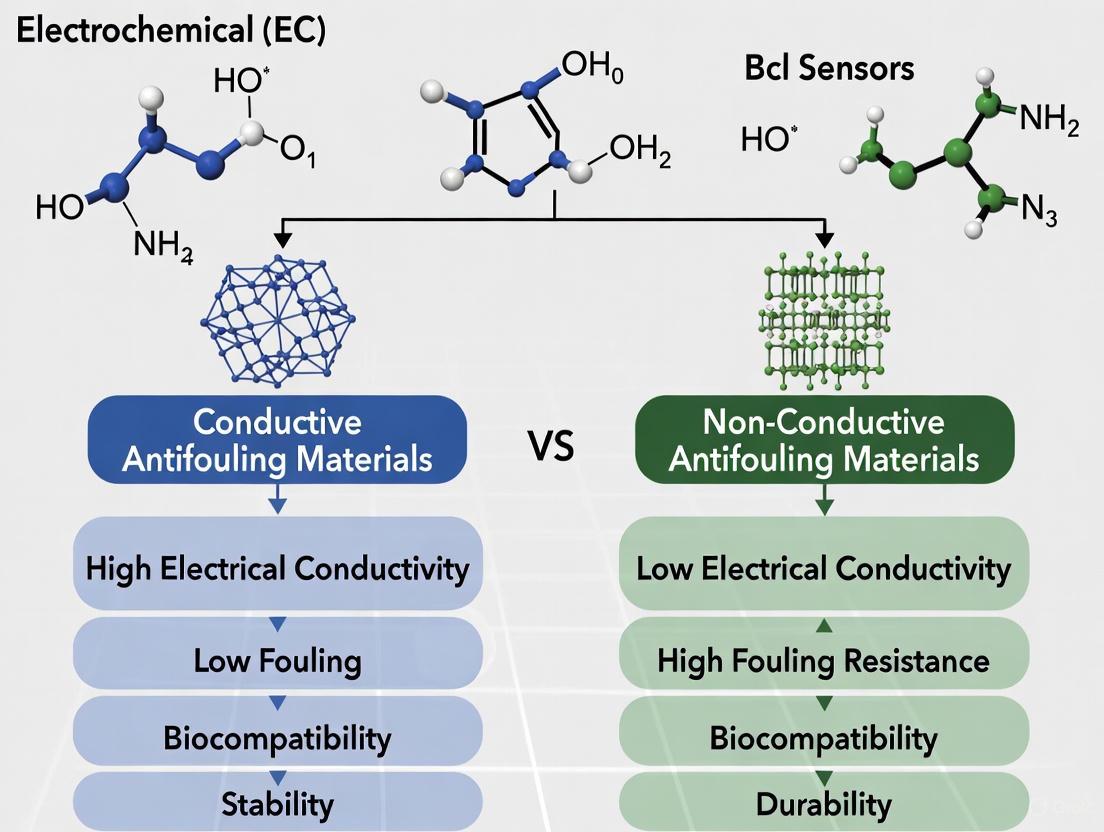
Electrochemical sensors are pivotal in biomedical diagnostics and drug development, but their reliability in complex biological fluids is severely compromised by biofouling.
Conductive vs. Non-Conductive Antifouling Materials for Electrochemical Sensors: A Comprehensive Review for Biomedical Research
Abstract
Electrochemical sensors are pivotal in biomedical diagnostics and drug development, but their reliability in complex biological fluids is severely compromised by biofouling. This article provides a systematic comparison of conductive and non-conductive antifouling materials, addressing a critical knowledge gap for researchers and scientists. We explore the fundamental mechanisms, from hydration layers to electron transfer, and present cutting-edge methodological applications for detecting biomarkers, drugs, and heavy metals. The review critically analyzes troubleshooting strategies for sensitivity loss and material instability, and offers a rigorous framework for validating performance in clinical serum, plasma, and other challenging matrices. By synthesizing foundational principles with advanced applications and comparative validation, this work serves as an essential guide for selecting and optimizing antifouling strategies to create robust, next-generation electrochemical sensors for healthcare.
Understanding the Battle Against Biofouling: Mechanisms and Material Fundamentals
Electrochemical (EC) sensors hold immense promise for direct monitoring in biomedical, environmental, and food safety applications. However, their reliable operation in complex biological media such as blood, serum, or wastewater remains a formidable challenge due to biofouling—the nonspecific adsorption of proteins, cells, and polymeric byproducts onto sensor surfaces [1] [2]. This fouling layer acts as a physical and energetic barrier, progressively passivating the electrode and severely compromising analytical performance through signal drift, reduced sensitivity, and poor reproducibility [1] [3]. The fouling process occurs in distinct stages, beginning with the rapid adsorption of a conditioning film of biomolecules, followed by bacterial attachment, microcolony formation, and ultimately, the development of a robust biofilm [3] [4]. For researchers and drug development professionals, mitigating this phenomenon is not merely an engineering concern but a critical prerequisite for developing deployable, reliable sensor technologies.
This guide provides a comparative analysis of two principal antifouling strategies: non-conductive coatings, which create a physical barrier to foulants, and conductive materials, which aim to combine fouling resistance with electronic signal transduction. We objectively evaluate their performance, supported by experimental data and detailed methodologies, to inform material selection for next-generation EC sensors.
Antifouling Mechanisms: A Comparative Framework
Antifouling strategies function through distinct mechanistic pathways, each with characteristic advantages and limitations. The following table summarizes the core mechanisms employed by conductive and non-conductive materials.
Table 1: Core Antifouling Mechanisms of Conductive and Non-Conductive Materials
| Material Class | Primary Mechanism | Key Materials | Impact on Sensor Function |
|---|---|---|---|
| Conductive | Electrostatic repulsion; Catalytic degradation of foulants; Conductive pathways maintained | Conducting Polymers (PANIs, PEDOT, Polypyrrole) [5] [1]; Conductive Composites (BSA/g-C₃N₄/Bi₂WO₆) [6] | Preserves electron transfer and sensor sensitivity; Enables active fouling control via applied potential |
| Non-Conductive | Formation of a hydration layer via hydrogen bonding; Steric hindrance; Fouling-release | PEG and its derivatives [1] [2]; Zwitterionic Polymers (pSBMA, pCBMA) [7] [1] [2]; Hydrogels [4] | Can create an insulating layer that increases impedance and diminishes electrochemical signal |
The logical relationship between material choice, antifouling mechanism, and sensor performance can be visualized as a decision pathway.
Performance Comparison: Conductive vs. Non-Conductive Materials
Direct comparison of experimental data reveals critical performance trade-offs. Conducting polymers and composites excel in maintaining signal integrity, while advanced non-conductive zwitterionic polymers demonstrate superior suppression of nonspecific adsorption.
Table 2: Experimental Performance Comparison of Antifouling Materials
| Material | Class | Test Medium | Key Performance Metric | Reported Result | Reference |
|---|---|---|---|---|---|
| PEDOT:PSS | Conductive Polymer | Gaseous TCP | Signal retention after 20 measurements | 85% of initial current | [1] |
| PANI/PEG Nanofibers | Conductive Composite | Undiluted human serum | Signal retention after incubation | 92.2% of initial current | [1] [2] |
| PANI/PES Membrane | Conductive Composite | NOM Solution (UF) | Flux Recovery Rate (FRR) | 90.1% | [8] |
| BSA/g-C₃N₄/Bi₂WO₆/GA | Conductive Composite | Human serum albumin | Signal retention after 1 day | 91% of initial current | [6] |
| PTMAO-SBMA | Non-Conductive Zwitterionic | Protein/carbohydrate solutions | Signal suppression | As low as 1.61% | [7] |
| pCBMA/pSBMA Microarray | Non-Conductive Zwitterionic | 100% bovine serum | Detection capability | BSA at 10 ng/mL | [1] [2] |
Detailed Experimental Protocols
To facilitate replication and further research, this section details the methodologies from key studies cited in the performance comparison.
Protocol 1: Fabrication and Testing of a Conductive PANI/PES Membrane
This protocol, adapted from the study demonstrating a 90.1% flux recovery rate, details the creation of a conductive, antifouling composite membrane [8].
- Materials Synthesis: Polyaniline (PANI) in its emeraldine salt form is incorporated as a conductive additive into a polyethersulfone (PES) matrix. The PANI and PES are dissolved in a suitable solvent (e.g., N-Methyl-2-pyrrolidone) with concentrations typically ranging from 0.25 to 2.00 wt.% PANI. The solution is cast onto a support and phase-inverted in a water bath to form the porous membrane.
- Surface Patterning: A surface-patterned version of the membrane is fabricated using 3D printing technology to create integrated porous feed spacer geometries directly on the membrane surface. This patterning induces turbulence to disrupt fouling layer formation.
- Antifouling Performance Test: The membrane is installed in an ultrafiltration cell. Pure water flux (Jw1) is measured first. The feed is then switched to a model natural organic matter (NOM) solution, and the flux decline is monitored during filtration. After fouling, the membrane is cleaned, and the pure water flux (Jw2) is measured again. The Flux Recovery Rate (FRR) is calculated as FRR (%) = (Jw2 / Jw1) × 100. The application of a low external electric field (e.g., 4 V) during filtration enhances antifouling performance via electrostatic repulsion.
Protocol 2: Developing a Zwitterionic PTMAO-SBMA Antifouling Aptasensor
This protocol outlines the creation of an electrochemical aptasensor with extreme fouling resistance, achieving as low as 1.61% signal suppression in complex media [7].
- Surface Engineering: A dual-block zwitterionic polymer (PTMAO-SBMA) is synthesized in-situ on a glassy carbon electrode (GCE) surface. The surface is first polished and cleaned. A mixture of the zwitterionic monomers (TMAOMA and SBMA at an 8:2 volume ratio), a photoinitiator, and highly conductive Ag-Cu nanodimers (Ag-Cu NDs) is prepared. A volume of 5 µL of this solution is drop-cast onto the GCE and polymerized under UV light (365 nm) for 5 minutes.
- Aptamer Immobilization: The synthesized Ag-Cu NDs facilitate the loading of a thiol-terminated aptamer via silver-sulfur bonds, creating the target-specific sensing interface.
- Antifouling Validation: The sensor is incubated in single-protein solutions (e.g., human serum albumin) and complex food matrices (e.g., honey, pork liver). The antifouling performance is quantified by the percentage of signal suppression, calculated by comparing electrochemical signals in the presence and absence of foulants. Molecular dynamics (MD) simulations can be employed to calculate hydrogen bond numbers and solvent-accessible surface area (SASA) to elucidate the stability of the hydration layer responsible for the antifouling effect.
The Scientist's Toolkit: Essential Research Reagents and Materials
Successful development of antifouling sensors relies on a core set of functional materials. The following table catalogs key reagents, their functions, and relevant examples from recent research.
Table 3: Essential Research Reagents for Antifouling Sensor Development
| Reagent Category | Function | Specific Examples |
|---|---|---|
| Conductive Polymers | Provide electrical conductivity and can repel foulants via electrostatic interactions. | Polyaniline (PANI) [8], Poly(3,4-ethylenedioxythiophene) (PEDOT) [5] [1], Polypyrrole (Ppy) [5] |
| Zwitterionic Monomers | Form highly hydrophilic, charge-balanced surfaces that bind water molecules to create a protective hydration barrier. | Sulfobetaine methacrylate (SBMA) [7], Carboxybetaine methacrylate (CBMA) [2], Trimethylamine N-oxide analogues (TMAOMA) [7] |
| Conductive Nanomaterials | Enhance electron transfer kinetics and can serve as scaffolds for biomolecule immobilization. | Ag-Cu Nanodimers (Ag-Cu NDs) [7], graphitic Carbon Nitride (g-C₃N₄) [6], Bismuth Tungstate (Bi₂WO₆) [6] |
| Cross-linkers | Stabilize 3D polymer matrices on the electrode surface, improving durability. | Glutaraldehyde (GA) [6] |
| Polymer Matrix Materials | Form the structural backbone of composite membranes and coatings. | Polyethersulfone (PES) [8], Bovine Serum Albumin (BSA) [6] |
The experimental workflow for developing and validating these antifouling surfaces integrates material synthesis, sensor fabrication, and performance testing, as shown below.
The choice between conductive and non-conductive antifouling materials is not a simple binary decision but a strategic trade-off centered on the specific application requirements. Conductive materials like PANI and PEDOT, along with innovative composites, offer an integrated solution by preserving signal integrity and enabling active fouling control, making them ideal for applications where high sensitivity and continuous monitoring are paramount [8] [6]. In contrast, advanced non-conductive materials, particularly zwitterionic polymers, currently set the benchmark for maximizing fouling resistance against complex biological media, achieving near-complete suppression of nonspecific adsorption [7].
The future of robust electrochemical sensing lies in the convergence of these strategies. Emerging research focuses on hybrid materials that combine the superior antifouling capacity of zwitterionic polymers with the electrical conductivity of metallic nanomaterials or conducting polymers [7]. Furthermore, the integration of surface patterning with conductive coatings presents a powerful approach to synergistically combat fouling through both physical and electrochemical mechanisms [8]. For researchers in drug development and diagnostics, these advanced material platforms pave the way for the creation of highly reliable sensors capable of direct operation in untapped complex media, from undiluted patient sera to industrial process streams.
Surface fouling poses a significant challenge to the reliability and longevity of biomedical devices, biosensors, and marine infrastructure. The nonspecific adsorption of proteins, cells, and other biological materials can severely compromise device functionality, leading to inaccurate readings for sensors, biofilm formation on implants, and increased drag on marine vessels. Within the context of electrochemical (EC) sensor research, fouling is particularly problematic as it passivates electrode surfaces, reduces electron transfer efficiency, and diminishes analytical sensitivity and specificity. While conductive antifouling materials integrate sensing and fouling resistance, non-conductive strategies form a physical and chemical barrier that prevents fouling agents from reaching the underlying substrate. This guide provides a comprehensive comparison of two primary non-conductive antifouling mechanisms—hydration layers and steric hindrance—as exemplified by zwitterionic polymers and poly(ethylene glycol) (PEG), respectively. We objectively evaluate their performance, supported by experimental data, to inform material selection for advanced antifouling applications.
Fundamental Antifouling Mechanisms
Hydration Layer Formation by Zwitterionic Materials
Zwitterionic polymers, such as poly(sulfobetaine methacrylate) (pSBMA) and poly(carboxybetaine methacrylate) (pCBMA), exhibit exceptional antifouling performance through the formation of a tightly bound surface hydration layer. These polymers contain both positive and negative charged groups within the same monomer unit, creating a superhydrophilic surface that strongly binds water molecules via electrostatic interactions. The resulting hydration layer forms a physical and energy barrier that foulants must disrupt to adsorb, a process that is thermodynamically unfavorable [9]. Molecular dynamics simulations reveal that zwitterionic polymers create an orderly packed, tightly bound hydration layer with restricted water mobility. This structured water barrier effectively prevents the initial adsorption of proteins and other fouling agents, which is the critical first step in biofouling processes [9]. Studies comparing different zwitterionic structures demonstrate that the specific chemical structure, particularly the anionic group, significantly influences hydration capacity and antifouling efficacy, with sulfobetaine-based polymers generally outperforming those with other charged groups [9].
Steric Hindrance and Hydration by PEG
Poly(ethylene glycol) (PEG) and its derivatives represent the historical "gold standard" for antifouling applications, operating through a combination of steric hindrance and hydration effects. PEG's antifouling mechanism is dual-faceted: first, each ethylene glycol unit in the polymer backbone strongly binds to a single water molecule via ether oxygen bridges, forming a highly hydrated layer around the polymer chains [1]. Second, when proteins or other foulants approach this hydrated layer, compression of the flexible PEG chains occurs, generating a repulsive steric barrier that physically prevents foulant contact with the underlying surface [1]. The protein resistance of PEG-modified interfaces is therefore attributed to both this hydration effect and the steric hindrance provided by the polymer chains. Unlike zwitterionic materials whose primary mechanism is electrostatic hydration, PEG relies more significantly on chain mobility and conformational entropy to create its antifouling barrier, with performance heavily dependent on surface packing density and polymer chain length [1].
Performance Comparison and Experimental Data
Quantitative Antifouling Performance
Table 1: Comparative Antifouling Performance of PEG and Zwitterionic Coatings
| Material | Coating Thickness | Test Fouling Agent | Performance Results | Reference |
|---|---|---|---|---|
| PMEN (Zwitterionic) | ~1.0 nm | Bovine Serum Albumin (BSA) | Much stronger resistance than PEG | [10] |
| PEG-OH | ~1.0 nm | Bovine Serum Albumin (BSA) | Lower resistance than PMEN | [10] |
| PMEN (Zwitterionic) | ~1.5-3.3 nm | Bovine Serum Albumin (BSA) | Resistance exceeded by PEG | [10] |
| PEG-OH | ~1.5-3.3 nm | Bovine Serum Albumin (BSA) | Superior resistance to PMEN | [10] |
| Both (Optimized) | ~3.6 nm | BSA & Fibrinogen (Fg) | Ultralow fouling by both proteins | [10] |
| PEG-COOH | ~3.6 nm | Proteins | 10-fold increase vs. PEG-OH | [10] |
| T4-SB (Zwitterionic) | N/A | Diatoms | 9/mm² (2% of control) | [9] |
| T4-SP (Anionic) | N/A | Diatoms | 15/mm² (4% of control) | [9] |
Table 2: Antifouling Performance in Electrochemical Sensing Applications
| Material/Strategy | Sensor Application | Detection Performance | Fouling Resistance | Reference |
|---|---|---|---|---|
| PEGylated PANI nanofibers | DNA biosensor (BRCA1 gene) | LOD: 0.0038 pM | Retained 92.17% current after serum incubation | [1] |
| Zwitterionic pCBMA microarrays | Protein detection (BSA) | Detection: 10 ng mL⁻¹ BSA | Excellent antifouling in 100% bovine serum | [1] |
| Double-conductive MXene hydrogel | CEA cancer biomarker | LOD: 0.41 pg/mL | Excellent antifouling in human serum | [11] |
| PEDOT:PSS | TCP gas sensor | Linear range: 50-300 ppb | 85% current retention vs. 30% for bare GCE | [1] |
The experimental data reveal a complex performance relationship between PEG and zwitterionic polymers that is highly dependent on coating thickness. At very thin thicknesses (~1 nm), zwitterionic PMEN coatings demonstrate superior resistance to bovine serum albumin adsorption compared to PEG coatings. However, as thickness increases to 1.5-3.3 nm, PEG coatings surpass zwitterionic materials in antifouling performance due to enhanced steric repulsion effects. At optimal thicknesses (~3.6 nm), both materials can achieve ultralow fouling against complex biofluids [10]. The chemical termination of PEG significantly influences its performance, with PEG-COOH exhibiting a 10-fold increase in protein adsorption compared to PEG-OH due to altered surface interactions [10].
In marine antifouling applications, zwitterionic polymers demonstrate remarkable effectiveness against diatom adhesion, with T4-SB and T4-SP reducing static diatom adsorption to 2% and 4% of control values, respectively [9]. This exceptional performance stems from the strong hydration layer that prevents the initial attachment of marine organisms.
Stability and Long-Term Performance
Zwitterionic polymers generally demonstrate superior stability and long-term performance compared to PEG-based coatings. PEG is susceptible to oxidative degradation, particularly in biologically relevant solutions, which can compromise its antifouling capabilities over extended periods [1]. This auto-oxidation phenomenon limits PEG's effectiveness for long-term applications. In contrast, zwitterionic polymers exhibit enhanced stability against oxidative damage and maintain their antifouling performance over prolonged durations [12]. The mechanical properties of zwitterionic nanogels have been shown to significantly influence their antifouling efficiency, with certain compositions maintaining stability superior to both positively and negatively charged nanogel coatings [12].
Molecular dynamics simulations provide insights into the structural basis for zwitterionic stability, revealing that the broad distribution of electrostatic potential on zwitterionic surfaces and the nature of anionic SO₃⁻ groups contribute to their robust antifouling performance and durability [9]. This fundamental understanding supports experimental observations of zwitterionic materials maintaining efficacy in challenging environments.
Experimental Protocols and Methodologies
Quantitative Coating Fabrication and Optimization
The surface plasmon resonance (SPR) technique provides a robust methodology for quantitative fabrication and optimization of antifouling coatings. This approach enables precise control and real-time monitoring of coating deposition and performance:
Substrate Preparation: Sensor chips are pre-coated with a polydopamine (PDA) intermediate layer via immersion in an aqueous dopamine solution (typically 2 mg/mL in Tris-HCl buffer, pH 8.5) for 30-60 minutes. The PDA layer acts as a universal adhesive, providing a versatile platform for subsequent polymer immobilization [10].
Polymer Immobilization: PEG or zwitterionic polymer solutions are introduced to the PDA-modified surface at controlled concentrations and flow rates. For zwitterionic coatings, random copolymers containing phosphorylcholine zwitterions and active ester side chains (PMEN) are commonly used, while carboxylic PEG derivatives serve for PEG coatings [10].
Thickness Control: Coating thickness is precisely manipulated by varying polymer concentration, immobilization time, and solution conditions. In situ SPR monitoring allows real-time thickness measurement during deposition [10].
Performance Quantification: Antifouling efficacy is evaluated by exposing the coated surfaces to protein solutions (e.g., bovine serum albumin at 1 mg/mL) while monitoring adsorption kinetics in real-time. The percentage reduction in protein adsorption compared to unmodified surfaces serves as the primary performance metric [10].
Coating Validation: Optimized coatings are duplicated on various substrates (e.g., TiO₂, Au, SiO₂) using the identical PDA chemistry and evaluated for stability and antifouling performance in complex media [10].
Molecular Dynamics Simulation of Hydration Layers
Molecular dynamics (MD) simulations provide atomic-level insights into hydration layer properties and antifouling mechanisms:
System Construction: Antifouling polymer membranes are built with a degree of polymerization of 15, replicated in x and y directions to create representative surface models. Common systems include polysulfobetaine methacrylate (T4-SB), poly(3-(methacryloyloxy)propane-1-sulfonate) (T4-SP), and poly(2-(dimethylamino)ethyl methacrylate) (T4-DM) [9].
Force Field Parameterization: Quantum mechanical calculations (e.g., B3LYP/def2SVP//B3LYP/def2TZVP level) determine partial atomic charges using the RESP method, while bond, angle, and dihedral parameters are derived from appropriate force fields (e.g., GROMOS 54a7) [9].
Hydration Analysis: Hydrated systems are constructed by solvating polymer membranes with water models (typically SPC), followed by energy minimization and equilibration. Key hydration properties analyzed include:
- Water dipole orientation distribution
- Water diffusion coefficients
- Water residence times
- Density profiles normal to the surface
- Radial distribution functions between polymer atoms and water [9]
Simulation Conditions: Simulations are performed under NPT ensemble (298 K, 1 atm) using thermostat algorithms (v-rescale) and barostat algorithms (Berendsen), with long-range electrostatics handled using particle mesh Ewald method [9].
MD Simulation Workflow
The Scientist's Toolkit: Essential Research Reagents
Table 3: Essential Reagents for Antifouling Research
| Reagent/Material | Function/Application | Key Characteristics | Reference |
|---|---|---|---|
| Polydopamine (PDA) | Universal adhesive layer | Enables substrate-independent coating deposition | [10] |
| Poly(ethylene glycol) diacrylate | PEG-based cross-linker | Forms hydrogel networks for antifouling applications | [4] |
| Sulfobetaine methacrylate (SBMA) | Zwitterionic monomer | Creates superhydrophilic surfaces with strong hydration | [12] [9] |
| Carboxybetaine methacrylate (CBMA) | Zwitterionic monomer | Alternative to SBMA with carboxylate groups | [1] |
| Bovine Serum Albumin (BSA) | Model fouling protein | Standard for initial antifouling efficacy tests | [10] |
| Fibrinogen (Fg) | Complex fouling protein | Tests performance in more challenging conditions | [10] |
| Glutaraldehyde | Cross-linking agent | Stabilizes protein-based antifouling matrices | [13] |
| Ti₃AlC₂ MAX phase | MXene precursor | Creates conductive framework for composite hydrogels | [11] |
Non-conductive antifouling strategies based on hydration layers (zwitterionic polymers) and steric hindrance (PEG) offer distinct advantages for different applications. Zwitterionic materials excel in forming tightly bound hydration layers that provide exceptional resistance to protein adsorption and marine fouling, particularly in thin film configurations. Their superior stability against oxidative degradation makes them favorable for long-term applications. PEG-based materials leverage steric repulsion effects that become increasingly effective at greater coating thicknesses, though they suffer from oxidative vulnerability. The choice between these mechanisms depends on specific application requirements, including desired coating thickness, operational environment, and durability needs. For electrochemical sensors where non-conductive coatings may impede electron transfer, recent advances in composite approaches that incorporate conductive elements while maintaining antifouling properties offer promising directions. Future research should focus on optimizing coating density, exploring novel polymer architectures, and developing multifunctional systems that combine the strengths of both mechanisms for enhanced antifouling performance.
Electrochemical (EC) sensors are pivotal in medical diagnostics, environmental monitoring, and bioprocess control. However, their performance and reliability are severely compromised by biofouling—the non-specific adsorption of proteins, cells, and other biological molecules onto the electrode surface. This fouling passivates the electrode, forming an impermeable layer that inhibits electron transfer, degrades sensitivity, and reduces sensor lifespan [14]. Antifouling strategies are therefore essential for practical sensor applications. Traditionally, these strategies have relied on non-conductive barriers that physically block foulants. A paradigm shift is underway with the development of conductive antifouling materials, which integrate the ability to repel foulants with the capacity for efficient electron transfer. This guide provides a comparative analysis of conductive versus non-conductive antifouling materials, focusing on their mechanisms, performance, and experimental validation for EC sensor research.
Fundamental Fouling Mechanisms and Antifouling Strategies
How Fouling Compromises Sensor Function
Electrode fouling occurs through several mechanisms, primarily driven by interactions between the foulant and the electrode surface:
- Hydrophobic Interactions: Electrodes with hydrophobic surfaces (e.g., diamond, carbon nanotubes) promote the adhesion of species with hydrophobic components, such as aromatic compounds and proteins. In aqueous electrolytes, these interactions are entropically favorable and often irreversible under mild conditions [14].
- Hydrophilic and Electrostatic Interactions: These are typically more reversible than hydrophobic binding. Fouling via this route involves polar, hydrophilic, or charged species, including many proteins and biological molecules [14].
- Polymer Formation: Some analytes, like phenols and neurotransmitters (e.g., dopamine), undergo electrochemical reactions that produce reactive intermediates. These can polymerize into insoluble, insulating films that precipitate directly onto the electrode surface [14].
Classical Non-Conductive Antifouling Strategies
Traditional antifouling approaches create a passive, non-conductive physical barrier.
- Principle: A non-conductive layer, such as a membrane, filter, or hydrophilic polymer (e.g., poly(ethylene glycol) - PEG), prevents fouling agents from reaching the electrode surface [14] [15].
- Key Limitation: This barrier invariably increases impedance and hinders the diffusion of target analytes to the electrode, leading to reduced sensitivity and longer response times. Furthermore, if the analyte itself is the fouling agent, this strategy is ineffective [14] [15].
Conductive Antifouling Mechanisms: A Synergistic Approach
Conductive antifouling materials merge fouling resistance with electronic functionality. They operate through several integrated mechanisms, as shown in the following conceptual framework.
Integrated Resistance and Release Mechanisms
A sophisticated approach involves constructing heterogeneous microdomains that combine fouling resistance with fouling release.
- Resistance Mechanism: Hydrophilic microdomains (e.g., from cyclodextrin) preferentially bind water molecules, forming a hydration shell that acts as a physical and energetic barrier to foulant adhesion [16].
- Release Mechanism: Adjacent low-surface-energy (LSE) microdomains (e.g., from polydimethylsiloxane - PDMS) reduce the adhesion strength of foulants that do manage to adsorb. Under environmental disturbances like tangential flow, these foulants are more easily released [16]. In advanced supramolecular systems, the dynamic motion of components (e.g., cyclodextrins sliding along a polymer chain) creates an unstable interface that actively prevents foulant accumulation, even in static conditions [16].
Conductive Hydration Barriers
Bionic designs mimic the excellent antifouling properties of natural cell membranes. These interfaces use conductive substrates (e.g., polyethylene glycol-Au gel) topped with phospholipids and ampholytes to form a highly hydrophilic, hydrated layer. This layer is physically robust and, crucially, conductive, allowing electron transfer to occur while effectively repelling biomolecules from complex fluids like blood and urine [17].
In-situ Electrochemical Cleaning
A unique advantage of conductive materials is the ability to apply electrochemical potentials to the membrane itself. This enables in situ electrochemical redox reactions that actively break down or desorb accumulated foulants, effectively "cleaning" the sensor surface and allowing for long-term operation without physical replacement or harsh chemical treatments [18].
Comparative Performance Analysis: Conductive vs. Non-Conductive Materials
The following tables summarize experimental data and characteristics of different antifouling strategies, highlighting the performance advantages of conductive materials.
Table 1: Experimental Performance Comparison of Antifouling Coatings
| Material Type | Coating Example | Test Medium | Key Performance Metric | Result | Reference |
|---|---|---|---|---|---|
| Conductive Nanocomposite | Cross-linked Albumin / Gold Nanowires | Human Plasma & Whole Blood | Signal Stability (over 1 week) | Stable signal generation | [19] |
| Sensitivity (vs. ELISA) | ≥50x more sensitive | [19] | |||
| Porous Conductive Nanocomposite | Emulsion-templated Albumin / AuNWs (~1 µm thick) | Serum & Nasopharyngeal Secretions | Electron Transfer Kinetics | Maintained for over 1 month | [15] |
| Sensitivity Enhancement (vs. thin coatings) | 3.75x to 17x higher | [15] | |||
| Supramolecular Conductive Membrane | Cyclodextrin/PDMS Polyrotaxane | BSA Solution | Flux Decline (at 550 L·m⁻²·h⁻¹) | Merely 14.2% | [16] |
| Conductive Polymer Membrane | Polyaniline (PANI) | Aqueous Solutions | Fouling Mitigation | In-situ electrochemical redox slows contaminant accumulation | [18] |
| Non-Conductive Hydrogel | PEG-based Hydrogel | Model Biological Fluids | Fouling Resistance | Effective as a physical barrier | [14] |
| Analyte Diffusion / Sensor Sensitivity | Significantly reduced | [14] [15] |
Table 2: Characteristics of Antifouling Material Classes
| Characteristic | Non-Conductive Materials (e.g., PEG) | Conductive Materials (e.g., PANI, PEDOT, Nanocomposites) |
|---|---|---|
| Primary Mechanism | Passive physical barrier | Active electron transfer + synergistic resistance/release |
| Impact on Electron Transfer | High impedance, obstructed | Unobstructed, often enhanced |
| Impact on Analyte Diffusion | Significantly hindered | Minimal hindrance, especially in porous designs |
| Sensitivity | Reduced | Maintained or enhanced |
| Long-term Stability in Biofluids | Limited by fouling and degradation | High, with potential for in-situ regeneration |
| Multi-functionality | Single function (fouling resistance) | Combined sensing, antifouling, and sometimes catalysis |
Experimental Protocols for Key Conductive Antifouling Systems
Ultrarapid Coating of Sensors with Conductive Nanomaterial
This protocol describes a method for creating a stable, conductive, and antifouling coating on EC sensors in less than one minute [19].
- Preparation of Coating Solution: A solution of cross-linked bovine serum albumin (BSA) infused with pentaamine-functionalized graphene particles is prepared. This solution can be stored at room temperature for at least 20 weeks.
- Sensor Coating: The EC sensor is simply dip-coated into the solution.
- Rapid Heating: The dipped sensor undergoes rapid heating (process duration < 1 minute) to form a stable cross-linked matrix on the electrode surface.
- Validation: The coated sensor can be tested in unprocessed human plasma and whole blood. Performance metrics include sensitivity (e.g., single-digit pg mL⁻¹ detection), signal stability over one week of storage, and correlation with clinical results from patient samples.
Fabrication of a Micrometer-Thick Porous Nanocomposite Coating
This method uses nozzle printing to create a thick, porous, and conductive coating with exceptional antifouling properties and enhanced sensitivity [15].
- Emulsion Formulation: An oil-in-water emulsion is prepared by ultrasonicating an oil phase (hexadecane) and a water phase (phosphate buffer saline containing BSA and gold nanowires - AuNWs). The sonication time is optimized (e.g., 25 minutes) to achieve a stable emulsion with a narrow droplet size distribution (~325 nm).
- Cross-linking: Glutaraldehyde (GA) is added to the emulsion immediately before printing to initiate cross-linking.
- Nozzle Printing: The emulsion is deposited onto the working electrode of a sensor array using a nozzle printer. This allows for precise, localized patterning without coating the reference and counter electrodes.
- Curing: The printed emulsion is heated to complete the cross-linking of BSA and evaporate the oil, resulting in a ~1 µm thick coating with interconnected pores.
- Validation: The coating's antifouling performance is tested by exposing it to complex biological fluids (serum, nasopharyngeal secretions) and monitoring electron transfer kinetics over one month. Sensitivity is compared to thinner coatings via standard electrochemical detection methods for target biomolecules.
Preparation of a Supramolecular Antifouling Membrane
This protocol details the creation of a dynamic antifouling surface using supramolecular chemistry for water treatment membranes, a concept transferable to sensor housings or systems [16].
- Synthesis of Polyrotaxane: Cyclodextrins (CDs, e.g., γ-CD) are threaded onto polydimethylsiloxane (PDMS) chains in a solvent like DMF to form a polyrotaxane (PR) structure. The molar ratio of CD to PDMS is a critical control parameter.
- Surface Grafting: The CD/PDMS PRs are grafted onto a membrane surface, typically via the end groups of the PDMS chains, fixing the structure.
- Mechanism Activation: The resulting surface presents dynamic hydrophilic microdomains (from the mobile CDs) alongside LSE microdomains (from PDMS). The Brownian motion of the CDs and their ability to slide along the chains create an active surface that resists fouling and facilitates water (or analyte) transport.
- Validation: Antifouling performance is evaluated by filtering a foulant solution like bovine serum albumin (BSA) under defined stirring conditions (e.g., 60 rpm) and measuring the flux decline over time. A low flux decline indicates exceptional antifouling performance.
The Scientist's Toolkit: Essential Research Reagents and Materials
Table 3: Key Reagents for Conductive Antifouling Research
| Reagent / Material | Function in Research | Example Application |
|---|---|---|
| Polyaniline (PANI) | A classic conductive polymer; provides a tunable conductive matrix with environmental stability. | Used in conductive membranes [18] and as a component in dual-conductive hydrogels for flexible sensors [20]. |
| Poly(3,4-ethylenedioxythiophene) (PEDOT) | A stable, high-conductivity polymer often used with poly(styrenesulfonate) (PSS). | Applied as a conductive antifouling coating to mitigate fouling from phenols and neurotransmitters [14]. |
| Gold Nanowires (AuNWs) | Conductive nanofillers; impart high conductivity and can enhance electrocatalytic properties within a porous matrix. | Impregnated into cross-linked albumin coatings to create conductive nanocomposites [15]. |
| Functionalized Graphene/Graphene Oxide | Provides high surface area, excellent conductivity, and functional groups for covalent binding. | Used as a conductive nanomaterial in ultrafast coating methods [19]. |
| Cyclodextrins (CDs) | Saccharide-based macrocycles; form hydrophilic microdomains and can be used to build dynamic supramolecular structures. | Threaded onto PDMS chains to create antifouling polyrotaxane coatings with synergistic resistance-release mechanisms [16]. |
| Polydimethylsiloxane (PDMS) | A polymer constituting Low-Surface-Energy (LSE) microdomains that promote fouling release. | Used as the backbone in supramolecular assemblies with CDs [16]. |
| Bovine Serum Albumin (BSA) | A model protein; when cross-linked, it forms a robust, hydrophilic, and biocompatible matrix that resists non-specific adsorption. | Serves as the base for cross-linked conductive nanocomposite coatings [19] [15]. |
| Glutaraldehyde (GA) | A common cross-linking agent; reacts with amine groups to create stable covalent bonds in protein-based matrices. | Used to cross-link BSA in emulsion-based coatings [15]. |
The integration of electron transfer with fouling resistance represents the future of high-performance electrochemical sensors. While non-conductive antifouling materials provide a basic defensive barrier, they do so at the cost of critical sensor metrics like sensitivity and response time. Conductive antifouling materials, particularly advanced nanocomposites, conductive polymers, and dynamic supramolecular systems, offer a superior synergistic approach. They enable long-term stability in complex biological media by actively repelling foulants, releasing adhered contaminants, and in some cases, electrochemically self-cleaning, all while maintaining excellent electrical communication with the target analyte. For researchers developing the next generation of diagnostic and monitoring tools, prioritizing these conductive strategies is paramount to achieving reliability in real-world applications.
The performance and reliability of electrochemical (EC) sensors are fundamentally dictated by the materials at the bio-interface. Among these, hydrogels, polymers, peptides, and self-assembled monolayers (SAMs) represent key material classes, each offering distinct mechanisms to combat the pervasive challenge of biofouling—the non-specific adsorption of proteins, cells, and other organisms that degrades sensor function. Within this context, a major strategic division exists between materials that employ conductive mechanisms (such as electrochemical repulsion) and those that rely on non-conductive properties (such as physical barriers or hydration layers) to prevent fouling. This guide provides a comparative framework for researchers and scientists, evaluating these material classes based on experimental data and performance within the specific requirements of EC sensor research. The objective is to inform material selection by highlighting the trade-offs between antifouling efficacy, electrical functionality, and practical scalability.
The following table summarizes the core characteristics, advantages, and limitations of the four key material classes in the context of conductive and non-conductive antifouling strategies.
Table 1: Comparative Overview of Key Material Classes for Antifouling EC Sensors
| Material Class | Core Antifouling Mechanism(s) | Key Advantages | Major Limitations |
|---|---|---|---|
| Hydrogels | Formation of a physical hydration barrier that prevents foulant adhesion; can be combined with conductive fillers for electrochemical repulsion [4] [21]. | High biocompatibility; tissue-like softness; tunable mechanical properties; high water content [22] [21]. | Can be mechanically weak; susceptible to dehydration; low intrinsic conductivity (requires composites) [22] [21]. |
| Polymers | Creation of non-stick, fouling-release surfaces (e.g., silicones); formation of hydrophilic or zwitterionic surfaces that resist protein adsorption; controlled release of biocides (less common in sensors) [4]. | Long-term durability in harsh environments; well-established synthesis and application methods; can be highly hydrophobic or hydrophilic [4]. | Many synthetic polymers are not biodegradable; achieving both high conductivity and antifouling can be challenging [4]. |
| Peptides | Molecular-level design of surfaces that are non-adhesive to cells and proteins; can form nanostructures that minimize contact area [23]. | High bio-inspiration and biocompatibility; ability to co-assemble for multi-functional surfaces; potential for ionic conductivity [23] [24]. | Complex and costly synthesis; structural stability can be a concern; sequence/function relationship is not fully predictable [23]. |
| Self-Assembled Monolayers (SAMs) | Formation of highly ordered, dense molecular films that present specific chemical terminal groups (e.g., ethylene glycol) to resist biomolecular adsorption [25]. | Ultimate surface control and precision; molecular-level uniformity; excellent for fundamental studies and creating model surfaces [25]. | Can lack long-term stability; limited to compatible substrates; difficult to scale up for large or complex sensor geometries [25]. |
The strategic choice between conductive and non-conductive materials is central to designing the sensor interface. The diagram below illustrates the primary antifouling mechanisms employed by these two approaches.
Performance Data: Conductive vs. Non-Conductive Materials
Experimental data is critical for evaluating the real-world efficacy of antifouling strategies. The following table compiles quantitative results from recent studies on both conductive and non-conductive materials, with a focus on applications relevant to sensors and interfaces.
Table 2: Experimental Antifouling Performance of Material Classes
| Material Class / Specific System | Type | Key Performance Metric | Result | Experimental Context |
|---|---|---|---|---|
| Polyaniline (PANI)/PES Composite Membrane [8] | Conductive | Flux Decline Reduction | 60.6% decline (vs. higher in controls) under 4V field | Ultrafiltration under electric field |
| Flux Recovery Ratio (FRR) | 90.1% (vs. lower in controls) | After fouling and cleaning | ||
| Electrical Conductivity | ≈130.5 mS/m | 1.00 wt.% PANI loading | ||
| Reduced Graphene Oxide-Hydrogel [26] | Conductive | Electrical Conductivity | ~3.5 S/m | Composite biomaterial |
| Wound Closure Rate | 40% improvement vs. control | Biomedical application | ||
| Polypyrrole-Graphene Composite [26] | Conductive | Young's Modulus | >18 kPa | Mechanical strength |
| Capacitance | >1000 F/g | Energy storage potential | ||
| Biocide-Free Amphiphilic Coating [27] | Non-Conductive | Corrosion Rate Reduction | ~90% over 50 weeks | Immersion in natural seawater |
| Operational Performance | 99% efficacy after 50 weeks | Field study in Greek waters | ||
| Polymer-Based Coatings (General) [4] | Non-Conductive | Fouling Reduction | Significant reduction reported | Laboratory & real-world marine trials |
Experimental Protocols for Key Antifouling Systems
Fabrication of Conductive Polyaniline (PANI) Composite Membranes
This protocol details the synthesis of electrically conductive membranes that exhibit antifouling properties under an applied electric field, a highly relevant system for EC sensors [8].
- Primary Reagents: Aniline monomer, Ammonium peroxydisulfate (APS), 1M HCl, 4-Dodecylbenzenesulfonic acid (DBSA), Polyethersulfone (PES), solvent (e.g., N-Methyl-2-pyrrolidone).
- Procedure:
- PANI Nanorod Synthesis: Dissolve 10 mmol of aniline in 80 mL of 1M HCl. In a separate container, dissolve 10 mmol of APS in 40 mL of distilled water. Rapidly add the APS solution to the aniline/HCl solution under vigorous stirring. Allow the reaction to proceed for 30 minutes, then let it stand for 12 hours to complete the polymerization [27].
- Composite Casting: Disperse the synthesized PANI nanorods and DBSA in a suitable solvent using ultrasonication. Incorporate this dispersion into a dissolved PES polymer solution. The mixture is stirred thoroughly to achieve homogeneity.
- Membrane Formation: The homogeneous PES/PANI solution is cast onto a clean glass plate using a doctor blade to control thickness. The cast film is then immersed in a coagulation bath (e.g., water) for phase inversion, resulting in a solid, porous composite membrane.
- Performance Evaluation:
- Antifouling Test: The membrane is placed in a filtration cell with a feed solution containing foulants (e.g., humic acid). The pure water flux is measured before and after fouling, both with and without an applied electric field (e.g., 4 V). Key metrics include Flux Decline and Flux Recovery Ratio (FRR) after cleaning [8].
- Conductivity Measurement: Electrical conductivity is typically measured using a four-point probe method or via impedance spectroscopy on a custom setup [8].
Evaluation of Non-Conductive Biocide-Free Coatings
This protocol outlines the static immersion testing used to evaluate the long-term anticorrosion and antifouling performance of non-conductive, polymer-based coatings [27].
- Primary Reagents: Coating formulation (e.g., silicone-based polymer, amphiphilic resin), naval steel or other relevant substrate, Artificial Seawater (ASW) per standard recipes.
- Procedure:
- Sample Preparation: Clean and dry substrate panels (e.g., naval steel). Apply the coating uniformly to achieve a specific dry film thickness. Include uncoated panels as controls.
- Static Immersion: Immerse the coated and uncoated panels in tanks containing ASW or deploy them in a natural marine environment (e.g., moored at a dock). Ensure panels are fully submerged for the duration of the test.
- Periodic Monitoring: Remove panels at predetermined intervals (e.g., 1, 2, 8, 17, 26, and 50 weeks). Gently rinse to remove loose salts and assess fouling.
- Performance Evaluation:
- Visual Inspection: Document the type and extent of fouling (e.g., soft fouling vs. hard fouling) and any visible corrosion using digital photography.
- Mass Change Measurements: Measure the mass of the panels before and after immersion (after careful cleaning) to quantify mass gain due to corrosion products or fouling, or mass loss due to coating degradation.
- Efficacy Calculation: The coating's operational performance can be quantified as a percentage based on the comparative fouling coverage on coated versus uncoated samples over time [27].
The Scientist's Toolkit: Essential Research Reagents
Table 3: Key Reagents and Materials for Antifouling Material Research
| Item | Function in Research | Example Context |
|---|---|---|
| Aniline Monomer | Precursor for synthesizing the conductive polymer Polyaniline (PANI) [27] [8]. | Fabrication of conductive composite membranes and coatings. |
| Ammonium Peroxydisulfate (APS) | Oxidizing agent used in the chemical polymerization of aniline [27]. | Synthesis of PANI nanorods and other conductive polymer structures. |
| Polyethylene Glycol (PEG) & Derivatives | A hydrophilic polymer used to create non-fouling surfaces via hydration layers and steric exclusion [4]. | Forming hydrogel coatings or modifying surfaces for anti-adhesion. |
| Zwitterionic Monomers | Molecules with balanced positive and negative charges that create a strong hydration layer, providing excellent resistance to protein adsorption [4]. | Crafting ultra-low fouling polymer brushes or hydrogels. |
| Silicon-based Polymers (e.g., PDMS) | Used to create elastomeric, hydrophobic surfaces with fouling-release properties [4] [27]. | Developing coatings from which adhered organisms easily detach. |
| Functionalized Carbon Nanotubes (MWCNTs) | Conductive fillers used to enhance the electrical conductivity and mechanical strength of composite materials [27]. | Creating conductive hydrogels or polymer nanocomposites. |
| Graphite Substrates (e.g., HOPG) | An atomically flat, crystalline surface used as a model substrate to study peptide and molecular self-assembly mechanisms [24]. | Fundamental research on peptide-solid interactions and SAM formation. |
| Artificial Seawater (ASW) | A standardized saline solution that simulates the chemical composition of ocean water [27]. | Laboratory-based accelerated testing of antifouling performance. |
The selection between conductive and non-conductive materials for antifouling EC sensors involves navigating a landscape of trade-offs. Conductive materials, such as PANI- or graphene-integrated hydrogels, offer the unique advantage of active fouling control through electrochemical means, which can be dynamically tuned. This is complemented by their inherent functionality for signal transduction in sensors. However, they often face challenges in long-term environmental stability and complex fabrication. In contrast, non-conductive materials, such as PEG-based hydrogels, silicone polymers, and SAMs, excel at providing a robust, passive barrier through physical and chemical surface properties. They are generally more durable and environmentally stable but lack the active rejection mechanism and integrated sensing capability of their conductive counterparts.
Future research directions will likely focus on hybrid approaches that merge the best of both worlds. This includes designing conductive hydrogels with superior stability, developing biomimetic peptide-based systems that offer both intelligently designed antifouling and nascent conductivity [23], and creating multi-functional coatings where different mechanisms operate synergistically. The ongoing refinement of these material classes promises to deliver more reliable, sensitive, and long-lasting EC sensors for applications from medical diagnostics to environmental monitoring.
The development of reliable electrochemical sensors for direct operation in complex biological and environmental samples represents a frontier in analytical chemistry. A fundamental conflict lies at the heart of this endeavor: the inherent trade-off between superior antifouling performance and high electrochemical sensitivity. Fouling—the non-specific adsorption of proteins, cells, carbohydrates, and other biological materials onto sensor surfaces—severely compromises analytical reliability by passivating the electrode, increasing background noise, and reducing signal-to-noise ratios [2]. While antifouling materials are essential to prevent this degradation, they often form barriers that impede electron transfer or mass transport, thereby diminishing the sensitivity of the detection system [28].
This comparative guide objectively analyzes the two primary material strategies employed to navigate this trade-off: non-conductive antifouling materials versus conductive antifouling composites. We examine their fundamental mechanisms, present experimental performance data, and detail methodologies to provide researchers with a framework for selecting and optimizing materials for specific sensing applications.
Material Classes: Mechanisms and Properties
Non-Conductive Antifouling Polymers
These materials form a physical and energetic barrier that prevents foulants from reaching the electrode surface. Their effectiveness stems from their ability to form a hydration layer via hydrogen bonding or ionic solvation, which acts as a repellent to biomolecules [7] [2].
- Zwitterionic Polymers: Materials like poly(sulfobetaine methacrylate) (pSBMA) and poly(carboxybetaine methacrylate) (pCBMA) contain both positive and negative charged groups. They create a tightly bound hydration layer through electrostatic interactions. Recent studies show that dual-block zwitterionic copolymers (e.g., PTMAO-SBMA) can enhance this effect by shortening the distance between charge groups, forming a more robust hydration layer [7].
- PEG-based Polymers: Poly(ethylene glycol) (PEG) is considered the "gold standard" antifouling polymer. Its ethylene glycol units bind water molecules, forming a hydrated steric barrier that repels biomolecules. Limitations include susceptibility to oxidative degradation and the creation of high-impedance layers that can diminish electron transfer [2] [1].
- pH-Responsive Polymers: Materials like commercial Eudragit polymers can change their conformation or solubility in response to pH shifts, potentially offering "on-demand" antifouling properties [1].
Conductive Antifouling Composites
This class of materials aims to integrate antifouling capability with electron-conducting pathways to preserve or enhance sensor sensitivity.
- Conducting Polymers: Intrinsically conductive polymers such as poly(3,4-ethylenedioxythiophene) poly(styrene sulfonate) (PEDOT:PSS) and polyaniline (PANI) provide both electronic conductivity and porosity. Their antifouling properties can arise from their amphiphilic nature or through conjugation with other antifouling agents [2] [1].
- Nanomaterial-Enhanced Composites: These incorporate conductive nanostructures within an antifouling matrix. Examples include:
- Gold Nanowires (AuNWs) in Albumin: A porous, cross-linked bovine serum albumin (BSA) matrix impregnated with AuNWs creates a micrometer-thick conductive coating with antifouling properties [28].
- Ag-Cu Nanodimers (NDs) in Zwitterionic Polymers: Highly conductive Ag-Cu NDs doped into a PTMAO-SBMA polymer facilitate signal conversion and enable aptamer loading while the polymer provides antifouling [7].
- Carbon Nanomaterials: Graphene, graphene oxide (GO), and carbon nanotubes can provide a combination of high surface area, conductivity, and inherent fouling resistance due to their hydrophobic nature or oxygen-rich functional groups [29].
Table 1: Comparative Analysis of Key Antifouling Material Classes
| Material Class | Antifouling Mechanism | Conductivity | Key Advantages | Inherent Limitations |
|---|---|---|---|---|
| Zwitterionic Polymers | Strong hydration layer via electrostatic solvation | Non-conductive | Excellent fouling resistance; high stability; tunable chemistry | Can insulate electrode; requires conductive additives |
| PEG-based Polymers | Hydration layer & steric hindrance | Non-conductive | Biocompatible; widely available; "gold standard" history | Oxidatively unstable; can form high-impedance layers |
| Conducting Polymers | Amphiphilicity; surface charge repulsion | Conductive | Inherent conductivity; porosity; stability in aqueous solutions | Complex synthesis; variable antifouling efficacy |
| Nanocomposites | Combination of physical barrier & hydration | Conductive | Synergistic effects; design flexibility; enhanced sensitivity | Complex fabrication; potential nanomaterial leaching |
Experimental Performance Comparison
Quantitative Antifouling and Sensitivity Metrics
The following table consolidates experimental data from recent studies, providing a direct comparison of performance metrics across different material strategies.
Table 2: Experimental Performance Data for Antifouling Strategies
| Material System | Test Matrix/Foulant | Antifouling Performance Metric | Sensitivity/Signal Retention | Ref. |
|---|---|---|---|---|
| PTMAO-SBMA + Ag-Cu NDs | Single protein/carbohydrate solutions | Signal suppression as low as 1.61% | LOD of 0.33 pg mL⁻¹ for CAP; 31.9% better signal than PSBMA | [7] |
| AuNWs/BSA Nanocomposite (1 μm) | Serum & nasopharyngeal secretions | Maintained electron transfer for >1 month | 3.75 to 17-fold sensitivity enhancement vs. thin coatings | [28] |
| "Zwitter-Repel" Copolymer | 1% HSA (1 hour incubation) | ~67% reduction in protein adsorption; 5% current decrease | Anodic current increased 5% post-incubation | [30] |
| Bare Gold Electrode | 1% HSA (1 hour incubation) | N/A (Baseline) | 83% decrease in anodic current | [30] |
| PEDOT:PSS | Cresol oxidation products (20 cycles) | 85% signal retention | Maintained continuous monitoring capability | [2] [1] |
| PANI/PEG Nanofibers | Undiluted human serum | N/A | Retained 92.17% of initial current after serum incubation | [1] |
Detailed Experimental Protocols
To ensure reproducibility and provide a clear technical foundation, we detail the key experimental methodologies from two representative high-performance studies.
Protocol: Fabrication of Dual-Block Zwitterionic Polymer with Ag-Cu NDs
This protocol from Ge et al. outlines the creation of a sensor interface balancing antifouling and conductivity [7].
- Surface Preparation: A glassy carbon electrode (GCE) is polished with 0.3 μmol L⁻¹ alumina powder, followed by sequential ultrasonic cleaning in ultrapure water and absolute ethanol, then dried under a nitrogen stream.
- Polymer Solution Preparation: A monomer solution is prepared containing TMAOMA and SBMA at an 8:2 volume ratio, with a total concentration of 200 mg mL⁻¹. The photoinitiator 2-hydroxy-2-methylpropiophenone (0.01%) is added.
- In-situ Photopolymerization: 5 μL of the monomer solution is drop-cast onto the clean GCE surface. Photoinitiation is performed under a 365 nm UV lamp for 10 minutes to form the cross-linked PTMAO-SBMA polymer network directly on the electrode.
- Nanomaterial Incorporation: Pre-synthesized Ag-Cu NDs (prepared via a seed-mediated method) are doped onto the PTMAO-SBMA/GCE surface. These NDs provide highly conductive domains for signal transduction and sites for thiolated aptamer immobilization via Ag-S bonds.
Protocol: Nozzle-Printing of Thick Porous Nanocomposite Coating
This protocol, adapted from the work on micrometer-thick coatings, describes a method for creating a durable, conductive antifouling layer with enhanced mass transport [28].
- Emulsion Formulation: An oil-in-water emulsion is prepared by ultrasonicating an oil phase (hexadecane) with a water phase containing BSA and AuNWs in phosphate buffer saline (PBS). The optimal sonication time of 25 minutes yields stable, nanoscale oil droplets (~325 nm diameter).
- Cross-linking: Glutaraldehyde (GA) is added to the emulsion immediately before the printing process to initiate cross-linking of the BSA matrix.
- Nozzle Printing: The emulsion is deposited onto the target working electrode using a high-resolution nozzle-printing system. This allows for precise, localized patterning, avoiding contamination of the reference and counter electrodes.
- Curing and Pore Formation: The printed coating is heated to simultaneously evaporate the hexadecane oil phase (creating interconnected nanopores) and complete the cross-linking of the BSA matrix, resulting in a structurally stable, ~1 μm thick porous nanocomposite.
Visualization of Trade-offs and Design Strategies
The following diagrams illustrate the core trade-off and a strategic framework for material design.
Diagram 1: The Core Design Challenge
Diagram 2: Composite Material Design
The Scientist's Toolkit: Essential Research Reagents
Table 3: Key Reagents and Materials for Antifouling Sensor Development
| Reagent/Material | Function | Example Application |
|---|---|---|
| Sulfobetaine Methacrylate (SBMA) | Zwitterionic monomer for creating ultra-low fouling polymer brushes | Base component in PTMAO-SBMA dual-block polymers and "Zwitter-Repel" coatings [7] [30] |
| Trimethylamine N-oxide analogue (TMAOMA) | Zwitterionic monomer with adjacent positive/negative charges for enhanced hydration | Co-monomer with SBMA to form high-performance PTMAO-SBMA copolymer [7] |
| Gold Nanowires (AuNWs) | Conductive filler to establish electron transfer pathways within insulating matrices | Impregnated in cross-linked BSA matrix to create conductive porous nanocomposite [28] |
| Ag-Cu Nanodimers (NDs) | Highly conductive nanomaterial with segregated domains for signal amplification | Doped into zwitterionic polymers to facilitate signal conversion and aptamer loading [7] |
| 2-hydroxy-2-methylpropiophenone | Photoinitiator for UV-induced radical polymerization | Initiates cross-linking of methacrylate-based polymers during in-situ photopolymerization [7] |
| Glutaraldehyde (GA) | Cross-linking agent for protein-based matrices | Stabilizes BSA matrix in emulsion-templated coatings [28] |
| Poly(ethylene glycol) Methyl Ether (mPEG) | Hydrophilic polymer for creating hydration barriers | Grafted onto polyaniline nanofibers for fouling-resistant DNA sensing [1] |
The critical trade-off between antifouling performance and electrochemical sensitivity remains a defining challenge in sensor science. Evidence from recent studies indicates that conductive nanocomposites represent the most promising path forward, successfully integrating the foul-repelling properties of zwitterionic or protein-based matrices with the electron-transfer capabilities of metallic nanomaterials [7] [28].
Key strategic insights for researchers include:
- For maximum fouling resistance in short-term or minimally fouling environments, simple zwitterionic polymers offer a robust and well-understood solution [30].
- For long-term stability in complex biological fluids, thick porous nanocomposites provide exceptional durability and sustained sensitivity by enhancing mass transport [28].
- For ultimate sensitivity in detecting trace analytes, nanomaterial-doped conductive composites like Ag-Cu NDs/PTMAO-SBMA offer superior signal amplification while maintaining adequate fouling protection [7].
Future research will likely focus on "smart" antifouling materials that respond to environmental triggers, the development of more sophisticated multi-functional nanocomposites, and the refinement of scalable fabrication techniques like nozzle printing to translate these advanced laboratory prototypes into robust, field-deployable sensors.
Building Robust Sensors: Material Synthesis and Real-World Applications
Electrochemical (EC) sensors are pivotal in biomedical diagnostics, environmental monitoring, and therapeutic drug tracking. However, their reliability is consistently challenged by biofouling—the nonspecific adsorption of proteins, cells, and other biological materials onto sensor surfaces. This fouling layer passivates the electrode, leading to signal drift, reduced sensitivity, and ultimately, sensor failure [2]. The development of effective antifouling strategies is therefore a cornerstone of robust EC sensor design.
Traditionally, antifouling materials have been categorized into non-conductive and conductive types. Non-conductive polymers, such as poly(ethylene glycol) (PEG) and zwitterionic materials, excel at forming a hydration barrier that repels biomolecules through steric hindrance and hydrophilic interactions [2]. While effective at fouling resistance, their insulating nature can impede electron transfer, compromising the electrochemical sensitivity of the sensor [31]. In contrast, conductive antifouling materials, including the advanced materials discussed in this guide, offer a dual function: they facilitate efficient electron transfer while simultaneously resisting biofouling. This synergy makes them particularly valuable for applications requiring long-term, continuous monitoring in complex biological fluids, such as therapeutic drug monitoring or implantable diagnostics [31]. This guide provides a comparative analysis of three leading conductive materials—MXene, PEDOT:PSS, and Gold Nanowires—for engineering next-generation antifouling conductive hydrogels.
Material Performance Comparison
The performance of conductive hydrogels is governed by the intrinsic properties of the fillers and their synergistic interactions with the hydrogel polymer network. The table below summarizes the key characteristics, advantages, and limitations of MXene, PEDOT:PSS, and Gold Nanowires.
Table 1: Comparative Analysis of Conductive Fillers for Antifouling Hydrogels
| Material | Conductive Type | Typical Conductivity Range | Key Advantages | Primary Limitations |
|---|---|---|---|---|
| MXene | 2D Transition Metal Carbide [32] | ~11.76 S/m [33] to 1.9 mS/cm [33] | High surface area, facilites electron transfer [32], can be integrated into zwitterionic antifouling coatings [31] | Susceptible to oxidation, can aggregate within the polymer matrix [32] |
| PEDOT:PSS | Conductive Polymer [32] | ~867 S/m [33] | High conductivity in aqueous environments, stability, amphiphilic nature can repel fouling agents [2] | Mechanical brittleness, requires secondary components to enhance film durability and adhesion [32] [2] |
| Gold Nanowires (AuNWs) | Metal Nanomaterial [32] | ~520 S/cm (in nanocomposite) [32] | Excellent inherent conductivity and stability, can form a stable percolation network under strain [32] | High cost, potential for nanoparticle aggregation and settling [33] |
The antifouling performance of these materials can be significantly enhanced through composite formation. For instance, a zwitterionic coating integrating MXene with poly-sulfobetaine methacrylate (SBMA) and polydopamine (PDA) demonstrated a substantial reduction in signal drift for continuous drug monitoring in diverse biological fluids [31]. Similarly, PEDOT:PSS's antifouling properties are derived from the amphiphilic nature of its PSS component, which helps repel the reaction products of fouling agents like tricresyl phosphate, retaining 85% of the initial signal after 20 repetitive measurements compared to 30% for a bare electrode [2].
Experimental Data and Performance Metrics
Quantitative data from experimental studies provides critical insight into the real-world performance of hydrogels incorporating these conductive fillers. The following table consolidates key performance metrics from recent research.
Table 2: Experimental Performance Metrics of Conductive Hydrogel Composites
| Conductive Filler | Hydrogel Matrix | Mechanical & Electrical Properties | Antifouling/Sensing Performance | Ref. |
|---|---|---|---|---|
| MXene/PEDOT:PSS | PNIPAM | Conductivity: 11.76 S/m [33] | - | [33] |
| PEDOT:PSS | PPy/PSS | Conductivity: 867 S/m [33] | - | [33] |
| Whiskered Au Nanosheets (Analogue to AuNWs) | Not Specified | Conductivity: ~520 S/cm, Stretchability: ~300% [32] | Stable percolation network under large deformations [32] | [32] |
| PEDOT:PSS | - (GCE modifier) | - | 85% signal retention after 20 measurements vs. 30% for bare GCE [2] | [2] |
| MXene in SBMA@PDA coating | - (Electrode coating) | - | Reduced signal drift; enabled vancomycin detection in artificial interstitial fluid [31] | [31] |
Detailed Experimental Protocols
To ensure reproducibility and provide a clear technical roadmap, this section outlines detailed methodologies for fabricating and characterizing advanced conductive hydrogels.
Protocol 1: Fabrication of a Zwitterionic MXene-Based Antifouling Coating
This protocol is adapted from studies on creating highly robust sensing interfaces for complex biofluids [31].
- Synthesis of MXene Nanosheets: Etch MAX phase precursors (e.g., Ti₃AlC₂) using a solution of lithium fluoride and hydrochloric acid. The etched layers are then exfoliated via ultrasonication in deionized water to obtain a colloidal suspension of single-layer MXene (Ti₃C₂Tₓ) nanosheets.
- Preparation of AuNPs/MXene Nanocomposite: Combine the MXene suspension with an aqueous solution of chloroauric acid (HAuCl₄). A reducing agent, such as sodium citrate, is added to nucleate and grow gold nanoparticles (AuNPs) directly on the MXene surface.
- Surface Priming with Polydopamine (PDA): Clean the electrode substrate (e.g., gold or glassy carbon). Immerse it in a weak alkaline solution (pH ~8.5) of dopamine. Allow the dopamine to self-polymerize, forming a thin, adherent PDA film on the electrode. This film acts as a universal adhesion layer.
- Grafting of Zwitterionic Polymer: Immerse the PDA-coated electrode into an aqueous solution containing the zwitterionic monomer sulfobetaine methacrylate (SBMA) and a photo-initiator. Expose the setup to UV light to initiate free-radical polymerization, grafting a cross-linked poly-SBMA (pSBMA) network onto the surface.
- Sensor Integration: Immobilize the specific biorecognition element (e.g., DNA aptamer) onto the modified electrode surface via covalent coupling to the underlying PDA layer or through electrostatic interactions.
Protocol 2: Incorporating Gold Nanowires into a Stretchable Hydrogel Network
This protocol details an approach for creating hydrogels with metallic conductivity and high stretchability [32].
- Synthesis of Gold Nanowires (AuNWs): Prepare AuNWs via a seeded growth method in an aqueous solution. Use hexadecyltrimethylammonium bromide (CTAB) as a structure-directing agent, along with gold seeds, chloroauric acid (HAuCl₄), and a mild reducing agent like ascorbic acid.
- Formation of the AuNW Network: Filter the AuNW suspension to form a free-standing porous network or mat. Alternatively, the AuNW suspension can be directly mixed with the hydrogel precursor solution.
- Preparation of Hydrogel Precursor Solution: Dissolve the hydrogel monomers (e.g., acrylamide for a PAAm network) and a chemical cross-linker (e.g., N,N'-methylenebisacrylamide, MBAA) in deionized water.
- Nanocomposite Formation: Integrate the pre-formed AuNW network into the monomer solution, ensuring full infiltration. Alternatively, mix the AuNW suspension thoroughly with the precursor solution.
- In-Situ Polymerization: Add an initiator (e.g., ammonium persulfate, APS) and an accelerator (e.g., N,N,N',N'-Tetramethylethylenediamine, TEMED) to the mixture to trigger free-radical polymerization. This embeds the conductive AuNW network within the forming hydrogel matrix.
- Characterization: The mechanical properties are typically characterized using universal testing machines, while electrical conductivity is measured via a four-point probe method or impedance spectroscopy.
Diagram 1: General workflow for conductive hydrogel fabrication.
Signaling Pathways and Antifouling Mechanisms
The effectiveness of conductive antifouling materials stems from their ability to interact with biological entities at the molecular level while maintaining electrical communication. The following diagram and explanation outline the primary mechanisms.
Diagram 2: Antifouling mechanism comparison of material types.
Non-Conductive Antifouling Mechanism: Materials like PEG and zwitterionic polymers create a physical and energetic barrier to fouling. They form a dense, hydrophilic layer that binds water molecules strongly via hydrogen bonding or ionic solvation. This creates a thermodynamically unfavorable "hydration barrier" that proteins and cells must disrupt to adsorb, effectively repelling them through steric hindrance [2]. While effective at preventing fouling, this layer is inherently insulating, which can attenuate the electrochemical signal and reduce sensor sensitivity.
Conductive Antifouling Mechanism: Materials like PEDOT:PSS and zwitterionic-MXene composites offer a synergistic mechanism. They also exhibit hydrophilic and electrostatic (zwitterionic) properties that resist biomolecular adsorption. For example, the PSS component in PEDOT:PSS is amphiphilic and can repel fouling agents [2]. Crucially, these materials simultaneously provide a pathway for charge transfer. Electrons can travel through the conjugated backbone of PEDOT or the metallic-like structure of MXene, ensuring that the antifouling property does not come at the cost of electrical conductivity [32] [31]. This dual functionality is key to stable, long-term sensing.
The Scientist's Toolkit: Essential Research Reagents
The following table details key materials and reagents essential for the synthesis and evaluation of advanced conductive hydrogels for antifouling applications.
Table 3: Essential Research Reagents for Conductive Antifouling Hydrogels
| Reagent / Material | Function / Role | Examples & Notes |
|---|---|---|
| Conductive Fillers | Provides electrical conductivity and can contribute to mechanical and antifouling properties. | MXene (Ti₃C₂Tₓ) [31], PEDOT:PSS dispersion [33] [2], Gold Nanowire (AuNW) suspension [32]. |
| Zwitterionic Monomers | Forms a strong hydration layer via electrostatic interactions, providing superior antifouling resistance. | Sulfobetaine methacrylate (SBMA) [31], Carboxybetaine methacrylate (CBMA) [2]. |
| Hydrogel Monomers & Polymers | Forms the flexible, hydrated 3D network that constitutes the hydrogel matrix. | Acrylamide (AAm) [33], Polyvinyl Alcohol (PVA) [32], Dopamine (for self-polymerization into PDA) [31]. |
| Cross-linkers | Creates covalent bonds between polymer chains, determining the mechanical strength and mesh size of the hydrogel. | N,N'-methylenebisacrylamide (MBAA) [32], Glutaraldehyde. |
| Initiation Systems | Initiates the free-radical polymerization reaction to form the hydrogel network. | Ammonium Persulfate (APS) with TEMED [32], UV light with a photo-initiator (e.g., Irgacure 2959) [31]. |
| Biorecognition Elements | Provides specificity for the target analyte in a biosensing application. | DNA aptamers [31], Enzymes, Antibodies. |
Electrochemical (EC) sensors are powerful tools for applications ranging from medical diagnostics to environmental monitoring. However, their performance in complex biological fluids (e.g., blood, serum, interstitial fluid) is severely compromised by biofouling—the nonspecific adsorption of proteins, cells, and other biomolecules onto the sensor surface [29] [2]. This fouling layer passivates the electrode, increasing signal noise, degrading sensitivity and specificity, and ultimately causing sensor failure [31] [29]. Designing effective antifouling coatings is therefore critical for reliable, long-term sensing. A central challenge in this field involves balancing exceptional antifouling resistance with efficient electron transfer. Highly hydrophilic, non-conductive antifouling layers can insulate the electrode, while conductive materials alone often lack sufficient fouling resistance [7] [13]. This guide compares two innovative approaches to designing zwitterionic polymer coatings—notably dual-block polymers and in-situ polymerization—situating them within the broader strategy of creating conductive antifouling interfaces for advanced EC sensors.
Zwitterionic Materials: Mechanisms and Material Classes
Zwitterionic polymers, which contain pairs of oppositely charged groups in their repeating units, represent a leading class of antifouling materials. Their effectiveness stems from their ability to form a strong hydration layer via ionic solvation. Water molecules bind tightly to the charged groups, creating a physical and energetic barrier that repels biomolecules and prevents their adhesion [34] [35]. This mechanism often results in superior antifouling performance compared to traditional poly(ethylene glycol) (PEG), which is prone to oxidative degradation and can elicit immune responses [34] [35].
Table 1: Common Zwitterionic Polymers and Their Characteristics
| Polymer Name | Chemical Class | Key Features | Typical Applications |
|---|---|---|---|
| Poly(sulfobetaine methacrylate) (pSBMA) | Sulfobetaine | Strong hydration, widely studied, commercial availability | Biosensors, blood-contacting devices [31] [35] |
| Poly(carboxybetaine methacrylate) (pCBMA) | Carboxybetaine | Functionalizable carboxyl groups, high hydrophilicity | Protein microarrays, implantable sensors [2] [35] |
| Poly(MPC) | Phosphorylcholine | Biomimetic (mimics cell membranes), excellent biocompatibility | Medical implants, drug delivery [34] [35] |
A significant limitation of pure zwitterionic hydrogels is their often poor mechanical properties, as strong hydration inhibits polymer chain entanglement [34]. Furthermore, their inherent non-conductivity can dampen electrochemical signals. The following sections explore strategies to overcome these limitations.
Coating Strategy 1: Dual-Block Zwitterionic Polymers
Concept and Rationale
Dual-block zwitterionic polymers are copolymers synthesized from two distinct zwitterionic monomers. This approach aims to create a synergistic effect, where the combined material exhibits superior properties—such as enhanced antifouling capability or improved stability—compared to either homopolymer alone [7]. The theory is that different zwitterions can interact with water molecules in complementary ways, potentially leading to a denser and more robust hydration layer.
Exemplary Protocol: PTMAO-SBMA Dual-Block Polymer
A prime example is the development of a dual-block polymer from trimethylamine N-oxide analogue (TMAOMA) and sulfobetaine methacrylate (SBMA), creating PTMAO-SBMA [7].
Experimental Workflow:
- Surface Preparation: A glassy carbon electrode (GCE) is polished with alumina powder and cleaned ultrasonically in water and ethanol.
- Monomer Solution Preparation: TMAOMA and SBMA monomers are mixed in an 8:2 volume ratio with a total concentration of 200 mg mL⁻¹. A photoinitiator (2-hydroxy-2-methylpropiophenone) is added at 0.01% concentration.
- In-Situ Polymerization: 5 µL of the monomer solution is dropped onto the prepared GCE surface. Photoinitiation with UV light is used to trigger the in-situ polymerization reaction directly on the electrode.
- Nanocomposite Integration: Highly conductive Ag-Cu nanodimers (NDs), synthesized via a seed-mediated method, are doped onto the polymerized PTMAO-SBMA surface. These NDs facilitate electron transfer and provide sites for aptamer immobilization via Ag-S bonds [7].
Table 2: Performance Data for PTMAO-SBMA vs. PSBMA Coatings
| Performance Metric | PTMAO-SBMA Coating | Common PSBMA Coating | Test Condition |
|---|---|---|---|
| Signal Suppression | As low as 1.61% | Not explicitly stated, but performance was "superior" | Single protein/carbohydrate solutions [7] |
| Relative Performance | ~31.9% reduction in signal suppression | Baseline performance | Simulated protein solutions [7] |
| Molecular Dynamics Insights | Higher number of H-bonds with water, longer bond lifetime, stable hydration layer | Lower H-bond count and shorter lifetime | Computational simulation [7] |
This experimental data demonstrates that the dual-block strategy can yield a measurable performance enhancement over a single-component zwitterionic coating.
Figure 1: Experimental workflow for creating a dual-block PTMAO-SBMA coating with conductive nanodimers.
Coating Strategy 2: In-Situ Polymerization for Robust Interfaces
Concept and Rationale
In-situ polymerization involves growing the polymer network directly from the electrode surface. This "grafting-from" technique typically results in a coating with higher grafting density and superior mechanical stability compared to "grafting-to" methods, where pre-formed polymers are attached to the surface [35]. A dense polymer brush is more effective at forming a continuous hydration layer and resisting deformation under mechanical stress, which is crucial for long-term sensor stability.
Exemplary Protocol: SBMA@PDA on Nanocomposite
Another approach combines in-situ polymerization with a nanocomposite base for enhanced conductivity.
Experimental Workflow:
- Nanocomposite Base: The sensor platform is first modified with a highly conductive nanocomposite, such as one containing Au nanoparticles (AuNPs) and MXene (a 2D conductive material) [31].
- Co-polymerization: A mixture of the zwitterionic monomer SBMA and dopamine is applied to the sensor surface. Under specific conditions, dopamine self-polymerizes to form polydopamine (PDA), simultaneously co-polymerizing with SBMA to create an SBMA@PDA coating [31].
- Integration and Testing: This coating is integrated into a wearable microneedle patch for continuous drug monitoring. The coating demonstrates high robustness to variations in pH, temperature, and mechanical stress [31].
This strategy leverages the strong adhesion properties of PDA and the antifouling capability of SBMA, while the underlying nanocomposite ensures high conductivity is maintained.
Comparative Analysis: Performance and Applications
The table below provides a direct comparison of the two zwitterionic coating strategies and contrasts them with a notable non-polymeric alternative.
Table 3: Comparison of Advanced Antifouling Coating Strategies for EC Sensors
| Coating Strategy | Key Materials | Antifouling Performance | Conductivity / Signal | Demonstrated Application & Performance |
|---|---|---|---|---|
| Dual-Block Polymer (PTMAO-SBMA) | TMAOMA, SBMA, Ag-Cu NDs [7] | Exceptional; 31.9% better than PSBMA [7] | Enhanced by highly conductive Ag-Cu NDs [7] | Chloramphenicol detection in food; LOD: 0.33 pg mL⁻¹ [7] |
| In-Situ Polymerization (SBMA@PDA) | SBMA, Polydopamine, AuNPs/MXene [31] | High; reduces signal drift in biological fluids [31] | Enhanced by AuNPs/MXene nanocomposite [31] | Wearable microneedle for vancomycin; detection in artificial ISF [31] |
| Thick Porous Nanocomposite (Non-Zwitterionic) | Bovine Serum Albumin (BSA), Au Nanowires [13] | Exceptional; maintains performance for >1 month in serum [13] | Enhanced by porous network of Au nanowires [13] | Multiplexed SARS-CoV-2 sensor; high sensitivity in clinical samples [13] |
The Scientist's Toolkit: Essential Research Reagents
Successful development of these advanced coatings relies on a specific set of reagents and materials.
Table 4: Key Reagent Solutions for Zwitterionic Coating Research
| Reagent / Material | Function / Role | Exemplary Use Case |
|---|---|---|
| Sulfobetaine Methacrylate (SBMA) | Zwitterionic monomer providing primary antifouling activity via hydration [31] [7] | Building block for pSBMA and PTMAO-SBMA polymers [31] [7] |
| Trimethylamine N-oxide (TMAO) Analogue | Zwitterionic monomer with adjacent charges for potentially stronger hydration [7] | Co-monomer in dual-block PTMAO-SBMA polymer [7] |
| Photoinitiator (e.g., 2-hydroxy-2-methylpropiophenone) | Initiates radical polymerization upon exposure to UV light [7] | Enables in-situ surface polymerization of dual-block polymers [7] |
| Conductive Nanomaterials (Ag-Cu NDs, AuNPs, MXene) | Enhance electron transfer, counteract insulation from polymer; can serve as anchor for biorecognition elements [31] [7] | Ag-Cu NDs in PTMAO-SBMA; AuNPs/MXene in SBMA@PDA [31] [7] |
| Polydopamine (PDA) | Forms adherent underlayer via self-polymerization; facilitates subsequent grafting [31] | Used as a co-polymer in SBMA@PDA composite coating [31] |
The pursuit of ideal antifouling coatings for electrochemical sensors is increasingly focused on multifunctional systems that integrate superior fouling resistance with high conductivity. Dual-block zwitterionic polymers, such as PTMAO-SBMA, offer a pathway to enhanced antifouling performance by leveraging synergistic effects between different zwitterionic monomers, as validated by both experimental data and molecular dynamics simulations [7]. Concurrently, in-situ polymerization techniques, exemplified by SBMA@PDA on conductive nanocomposites, provide a robust method for creating stable, dense polymer brushes that can withstand challenging operational environments [31]. Both strategies effectively merge the exceptional hydration of zwitterions with the signal-enhancing properties of conductive nanomaterials, charting a course for the next generation of reliable sensors for therapeutic drug monitoring, point-of-care diagnostics, and continuous health monitoring.
The performance and reliability of electrochemical (EC) sensors in biomedical diagnostics, environmental monitoring, and industrial applications are critically dependent on their ability to resist biofouling. Biofouling, the non-specific adsorption of proteins, cells, and other biological materials onto sensor surfaces, leads to signal degradation, reduced sensitivity, and shorter operational lifespans. A key strategy to mitigate this issue involves the application of specialized antifouling coatings. Within this field, a significant research focus compares the efficacy of conductive antifouling materials, which maintain electron transfer while resisting fouling, against non-conductive antifouling materials, which primarily act as physical or chemical barriers.
This guide objectively compares the performance of various porous nanocomposites, with a particular emphasis on emulsion-templated, cross-linked protein matrices. We provide a structured comparison of these materials against other alternatives, supported by experimental data and detailed methodologies, to inform researchers, scientists, and drug development professionals in their selection of antifouling strategies for EC sensor development.
Performance Comparison of Antifouling Materials
The choice of material for an antifouling coating significantly influences the sensitivity, stability, and overall functionality of an electrochemical sensor. The following table summarizes the key performance metrics of various conductive and non-conductive materials as demonstrated in recent experimental studies.
Table 1: Performance Comparison of Antifouling Materials for Electrochemical Sensors
| Material System | Key Components | Coating Thickness | Antifouling Performance | Conductivity / Electron Transfer | Key Advantages |
|---|---|---|---|---|---|
| Emulsion-Templated Albumin Composite [28] | BSA, Gold Nanowires (AuNWs), Glutaraldehyde | ~1 μm | Maintains electron transfer kinetics for over one month in serum & nasopharyngeal secretions. [28] | Enhanced sensitivity (3.75 to 17-fold increase for different biomolecules). [28] | Porous structure enhances mass transport; nozzle-printing allows precise local deposition. [28] |
| Conductive Polymer/CNT Coating [36] | Photoreactive copolymer, Carbon Nanotubes (CNTs) | Not Specified | Retained >90% of initial electroactive surface area after 1h in BSA solution. [36] | Electroactive surface area comparable to uncoated electrodes. [36] | Fast, scalable fabrication (<2 hours); suitable for mass manufacturing. [36] |
| Bismuth Composite [6] | BSA, g-C3N4, Bismuth Tungstate, Glutaraldehyde | >1 μm | Maintained ~90% of signal after one month in untreated human plasma, serum, and wastewater. [6] | Effective for heavy metal detection; stable electron transfer. [6] | Robust in complex matrices; excellent for environmental and biofluid sensing. [6] |
| Conductive Polymer Membrane [8] | Polyethersulfone (PES), Polyaniline (PANI) | Not Specified | Under 4V, showed lower flux decline (60.6%) and high flux recovery (90.1%). [8] | Electrical conductivity of ≈130.5 mS·m-1. [8] | Synergy between conductivity and surface patterning; effective for water treatment. [8] |
| UVC-Based System [37] | UVC-LEDs (275 nm) | N/A | Kept conductivity sensors within specifications for 237 days in Baltic Sea. [37] | N/A (Optical Method) | Highly effective for marine sensors; prevents biofilm formation. [37] |
Detailed Experimental Protocols
To facilitate the replication and validation of these antifouling strategies, this section details the key experimental protocols for fabricating and testing the highlighted material systems.
Emulsion Templating and Nozzle-Printing of Albumin Nanocomposite
The creation of a micrometer-thick, porous nanocomposite via emulsion templating involves a precise sequence of steps to form a stable, printable ink, which is then deposited onto the electrode surface. [28]
3.1.1 Emulsion Formulation and Optimization
- Procedure:
- Prepare Aqueous Phase: Dissolve Bovine Serum Albumin (BSA) in phosphate-buffered saline (PBS) and add Gold Nanowires (AuNWs).
- Create Oil-in-Water Emulsion: Mix the aqueous phase with an oil phase (e.g., hexadecane).
- Emulsify: Sonicate the mixture. Research indicates an optimal sonication time of 25 minutes, resulting in an average oil droplet size of ~325 nm, a narrow size distribution (PDI 0.165), and a high zeta-potential of -75.5 mV, which are critical for emulsion stability. [28]
- Add Crosslinker: Immediately before printing, add Glutaraldehyde (GA) to the emulsion to initiate cross-linking of the BSA matrix. [28]
3.1.2 Coating Deposition and Curing
- Procedure:
- Nozzle Printing: Deposit the emulsion precisely onto the working electrode of a multiplexed gold array using a nozzle printer. This method allows for localized coating without compromising the reference and counter electrodes. [28]
- Evaporation and Cross-linking: After printing, heat the coating to simultaneously evaporate the oil phase and promote the cross-linking of BSA by GA. This process results in a structurally stabilized, ~1 μm thick matrix with interconnected nanoscale pores and integrated AuNWs. [28]
Testing and Evaluation Protocols
Standardized electrochemical and fouling tests are used to evaluate the performance of the fabricated coatings.
3.2.1 Electrochemical Performance Assessment
- Procedure:
- Setup: Use a standard redox couple, such as potassium ferrocyanide/potassium ferricyanide ([Fe(CN)6]3−/4−).
- Cyclic Voltammetry (CV): Perform CV scans at varying rates (e.g., 30-90 mV/s).
- Analysis:
3.2.2 Antifouling Stability Assessment
- Procedure:
- Baseline Measurement: Record the initial EASA or redox current of the coated electrode.
- Exposure to Fouling Media: Incubate the electrode in a complex biological fluid (e.g., 40 mg/mL BSA solution, undiluted human serum, plasma, or wastewater) for a set duration, from one hour to over one month. [6] [36]
- Post-Exposure Measurement: Re-measure the EASA or redox current after rinsing the electrode.
- Calculation: Determine the percentage of signal retention or flux recovery ratio (FRR). A high retention percentage (e.g., >90%) indicates superior antifouling performance. [8] [36]
Table 2: Key Reagents and Materials for Antifouling Nanocomposite Research
| Research Reagent | Function in Experiment | Example Application |
|---|---|---|
| Bovine Serum Albumin (BSA) | Protein polymer matrix; provides antifouling properties when cross-linked. [28] [6] | Base material for emulsion-templated coatings and bismuth composites. [28] [6] |
| Gold Nanowires (AuNWs) | Conductive nanomaterial; enhances electron transfer through the insulating protein matrix. [28] | Incorporated into BSA emulsion to create a conductive, porous nanocomposite. [28] |
| Glutaraldehyde (GA) | Cross-linking agent; forms stable covalent bonds within the protein matrix, creating a robust 3D network. [28] [6] | Used to cross-link BSA in both emulsion-templated and bismuth composite coatings. [28] [6] |
| Carbon Nanotubes (CNTs) | Conductive nanomaterial; alternative to gold-based materials, providing conductivity at lower cost. [36] | Dispersed in a photoreactive polymer ink to create a fast-fabrication antifouling coating. [36] |
| Polyaniline (PANI) | Conductive polymer; imparts electrical conductivity to membranes for electrostatic foulant repulsion. [8] | Blended with Polyethersulfone (PES) to fabricate conductive ultrafiltration membranes. [8] |
| g-C3N4 | 2D conductive nanomaterial; facilitates electron transfer and can complex with target ions. [6] | Used in a BSA-based cross-linked matrix with bismuth tungstate for heavy metal detection. [6] |
Workflow and Material Design Logic
The development of effective antifouling materials follows a logical progression from design to validation, with specific considerations for incorporating conductivity. The diagram below illustrates the critical decision points and processes in creating these composite coatings.
Diagram 1: Antifouling Material Design and Validation Workflow. This chart outlines the key decision points and processes for developing conductive and non-conductive antifouling coatings, from material selection to performance validation.
The comparative analysis presented in this guide underscores a clear trend in antifouling material research for electrochemical sensors: the integration of conductivity within the antifouling matrix offers significant advantages for applications requiring high sensitivity and direct electron transfer. Emulsion-templated, cross-linked protein composites, especially those incorporating conductive nanomaterials like gold nanowires or carbon nanotubes, demonstrate a superior ability to combine robust, long-term biofouling resistance with enhanced sensor performance. These materials address the critical challenge of mass transport limitation by their interconnected porous structure.
While non-conductive strategies like UVC irradiation remain highly effective for specific applications like marine sensing, their utility is limited to scenarios where a physical barrier is sufficient and electron transfer is not a primary function of the coating. For the future development of point-of-care diagnostics, implantable devices, and environmental sensors, the synergy of conductivity and antifouling provided by porous nanocomposites presents a compelling path forward. Researchers can leverage the detailed protocols and performance data herein to select and optimize the appropriate material system for their specific sensing challenges.
Carcinoembryonic antigen (CEA) is a well-established glycoprotein biomarker critical for the diagnosis, monitoring, and prognosis of several malignancies, including colorectal, lung, breast, and pancreatic cancers [38]. In healthy individuals, CEA levels typically remain below 5 ng/mL, with elevated concentrations often indicating disease progression or recurrence [38] [39]. The accurate detection of CEA at ultralow concentrations is therefore essential for early-stage cancer diagnosis, where patient survival rates can exceed 90% with timely intervention [40].
Electrochemical aptasensors have emerged as powerful analytical tools for biomarker detection, combining the high specificity and affinity of aptamers with the sensitivity, portability, and cost-effectiveness of electrochemical transducers [40] [39]. Unlike antibodies, aptamers offer distinct advantages including easy chemical synthesis, simple modification, excellent stability, and low toxicity [40]. A significant challenge in applying these biosensors to complex biological samples like serum or blood, however, is biofouling—the nonspecific adsorption of proteins, cells, and other biomolecules onto the sensor surface. This fouling passivates the electrode, severely compromising detection sensitivity, accuracy, and operational lifespan [11] [2].
To address this challenge, research has diverged into two primary material strategies: conductive antifouling materials, which resist fouling while maintaining efficient electron transfer, and non-conductive antifouling materials, which create a physical barrier but often impede signal transduction. This guide provides a comparative analysis of recent experimental platforms implementing these strategies, evaluating their performance in ultrasensitive CEA detection to inform material selection for next-generation electrochemical biosensors.
Performance Comparison of Ultrasensitive CEA Aptasensors
The table below summarizes the experimental performance of recent CEA aptasensors, highlighting their core detection principles, antifouling strategies, and key analytical figures of merit.
Table 1: Performance Comparison of Recent Ultrasensitive CEA Aptasensors
| Detection Principle / Sensor Type | Antifouling Strategy & Material Type | Linear Detection Range | Limit of Detection (LOD) | Sample Matrix Tested | Key Advantages |
|---|---|---|---|---|---|
| Electrochemical Impedance Spectroscopy (EIS) Aptasensor [41] | Not specified (Label-free) | Not specified | 2.4 pg/mL (buffer)3.8 pg/mL (serum) | Buffer & human serum | Rapid measurement (<3 min post-incubation); High sensitivity; AFM validation of target capture |
| Double-Conductive Hydrogel-based Sensor [11] | MXene/PEDOT:PSS Hydrogel (Conductive) | 1 pg/mL ~ 1 μg/mL | 0.41 pg/mL | Human serum | Superior antifouling; Integration of antifouling & ratiometric sensing; Long operating life |
| Electric Field-Mediated Aptasensor [42] | Graphene-ZnO Nanorods (Conductive) | Not specified | 1 fg/mL | Human serum | Ultra-low LOD; Electric field enhances mass transport; Smartphone-compatible potentiostat |
| NanoMIPs-Aptamer Sandwich Assay [38] | Molecularly Imprinted Polymer Nanoparticles (Non-conductive) | 1 - 1,000 ng/mL | 1.4 ng/mL | Human serum | High selectivity; Room temperature stability; Low production cost |
| Label-free EIS Aptasensor [39] | AuNPs/Graphene Electrode (Conductive) | 0.2 - 15.0 ng/mL | 0.085 ng/mL | Not specified (Laboratory buffer) | Label-free detection; Simple operation; Integrated graphene electrode system |
Experimental Protocols for Key CEA Aptasensor Strategies
Sensor Fabrication with Double-Conductive Antifouling Hydrogel
This protocol outlines the construction of an ultrasensitive biosensor featuring a dual-conductive hydrogel, which integrates antifouling properties with a internal standard for highly accurate detection in complex media [11].
- Step 1: Synthesis of Conductive Framework. Begin by synthesizing single-layer MXene nanosheets via etching of Ti3AlC2 powder in a LiF/HCl solution at 45°C for 48 hours. Wash the resulting product repeatedly with ultrapure water and vacuum-dry to obtain the MXene nanosheets [11].
- Step 2: Loading of Internal Standard. Prepare MXene-COOH by reacting MXene with chloroacetic acid. Then, incubate the MXene-COOH with [Ru(NH3)6]³⁺ to adsorb the metal complex onto the large surface area of the nanosheets, creating the internal standard signal source [11].
- Step 3: Hydrogel Preparation. Synthesize the double-conductive antifouling hydrogel (KMPPH) by polymerizing a mixture containing the [Ru(NH3)6]³⁺-loaded MXene, KH570 (a silane coupling agent), PEDOT:PSS (conductive polymer), and other monomers (NIPAm, BIS). Initiate the polymerization using APS and TEMED [11].
- Step 4: Electrode Modification. Modify the surface of a glassy carbon electrode (GCE) with the synthesized KMPPH hydrogel to create a conductive, antifouling, and signal-correcting interface [11].
- Step 5: Aptamer Immobilization. Finally, immobilize the CEA-specific aptamer onto the modified electrode surface to serve as the capture probe, completing the biosensor assembly for "signal-on" detection of CEA [11].
Electric Field-Mediated Detection on a Flexible Substrate
This protocol describes the development of a point-of-care (PoC) aptasensor that uses an external electric field to enhance mass transport of the analyte, thereby achieving an exceptionally low detection limit [42].
- Step 1: Electrode Fabrication. Redesign screen-printed electrodes (SPEs) on a flexible polyethylene terephthalate (PET) substrate. Use dielectrophoresis (DEP) to achieve a localized, uniform, and controlled deposition of a graphene layer onto the working electrode [42].
- Step 2: Nanostructure Synthesis. Grow vertically-oriented ZnO nanorod arrays hydrothermally on the deposited graphene layer to form a high-surface-area graphene-ZnO nanorod hybrid heterostructure [42].
- Step 3: Surface Functionalization. Functionalize the ZnO nanorods with a silanization agent (e.g., (3-aminopropyl)triethoxysilane, APTES) to create an amine-terminated surface. Subsequently, immobilize DNA aptamers specific to CEA onto this activated surface [42].
- Step 4: Electric Field Application and Measurement. Integrate the functionalized sensor with a custom-built, smartphone-interfaced potentiostat. During the analyte capture phase, apply an optimized external electric field pulse (e.g., +0.8 V) to the reference electrode to actively enhance the transport of CEA molecules toward the sensor surface. Perform the final detection using electrochemical impedance spectroscopy (EIS) [42].
Diagram: Experimental Workflow for Electric Field-Mediated CEA Detection
The Scientist's Toolkit: Essential Research Reagents and Materials
The table below catalogs key reagents and materials critical for fabricating and operating advanced CEA aptasensors, as featured in the cited research.
Table 2: Essential Research Reagents and Materials for CEA Aptasensor Development
| Item Name | Function / Application | Exemplar Use Case |
|---|---|---|
| DNA Aptamer (e.g., 5'-SH-ATACCAGCTTATTCAATT-3') [41] [39] | Primary biorecognition element; Binds CEA with high specificity and affinity. | Immobilized on electrode surfaces via thiol-gold bonding for target capture in various sensor designs [41] [42] [39]. |
| MXene Nanosheets (Ti₃C₂Tₓ) [11] | Conductive 2D nanomaterial; Serves as a high-surface-area framework for hydrogel composites and signal probe loading. | Used as the conductive backbone in double-conductive hydrogels to enhance electron transfer and load [Ru(NH₃)₆]³⁺ internal standard [11]. |
| Conductive Polymer (PEDOT:PSS) [11] | Enhances conductivity and stability of composite materials in aqueous environments. | Incorporated into MXene-based hydrogels to create a double-conductive network, improving sensor stability and performance [11]. |
| Polyaniline (PANI) [8] | Conductive polymer additive; Imparts electrical conductivity and anti-fouling properties to membranes and composites. | Incorporated into polyethersulfone (PES) membranes to create electrically conductive, antifouling surfaces [8]. |
| Molecularly Imprinted Polymer Nanoparticles (nanoMIPs) [38] | Synthetic, polymer-based recognition elements; Provide selective binding sites for CEA as antibody alternatives. | Used as synthetic capture probes in a sandwich assay format for CEA detection, offering high stability and lower cost than antibodies [38]. |
| Metal-Organic Framework (UiO-66-NH₂) [38] | Nanoporous crystalline material; Serves as a substrate for high-loading of signal probes (e.g., metal ions) and aptamer functionalization. | Loaded with Pb²⁺ ions and functionalized with aptamers to create an electrochemical signal probe in a sandwich assay [38]. |
| Zinc Oxide Nanorods (ZnO NRs) [42] | Metal oxide semiconductor; Provides high surface area for aptamer immobilization and facilitates electron transfer in heterostructures. | Grown on graphene to form a hybrid nanostructure, leveraging its high isoelectric point for efficient biomolecule binding [42]. |
| Redox Probe ([Fe(CN)₆]³⁻/⁴⁻) [39] | Standard electrochemical redox couple; Used in label-free EIS and voltammetric detection to monitor changes in electron transfer resistance. | Employed as a solution-based probe to monitor impedance changes upon aptamer-CEA binding in label-free sensors [39]. |
Comparative Analysis: Conductive vs. Non-Conductive Antifouling Materials
The divergence between conductive and non-conductive antifouling strategies represents a fundamental trade-off between fouling resistance and signal integrity. Conductive materials like MXene/PEDOT:PSS hydrogels [11] and graphene-ZnO heterostructures [42] create a synergistic interface that actively repels nonspecific proteins while facilitating electron transfer. This dual functionality is critical for achieving ultra-low detection limits (fg/mL to pg/mL) in complex media like human serum, as it preserves the electrochemical signal from the target analyte. The integration of conductive materials with internal standards, as seen in the hydrogel sensor, further corrects for instrumental and environmental noise, pushing the boundaries of sensitivity and accuracy [11].
In contrast, traditional non-conductive polymers like poly(ethylene glycol) (PEG) form a physical hydration barrier that is highly effective at preventing fouling. However, their inherent electrical insulation can significantly increase impedance, dampening the electrochemical signal and limiting detection sensitivity [2]. While novel non-conductive synthetic receptors like nanoMIPs offer excellent selectivity and stability at low cost [38], their analytical performance in direct, label-free electrochemical detection may be constrained by this signal attenuation effect.
The choice between these material strategies must be guided by the specific application requirements. For point-of-care diagnostics demanding the ultimate sensitivity in blood or serum, conductive antifouling materials are currently the superior choice. For laboratory-based assays where extreme sensitivity is less critical than cost and operational stability, non-conductive materials like nanoMIPs present a viable and robust alternative. Future research will likely focus on hybrid materials that combine the best attributes of both approaches to further enhance the reliability of electrochemical biosensors in real-world applications.
The accurate detection of antibiotic and heavy metal contaminants is paramount for ensuring food and environmental safety. Electrochemical (EC) sensors have emerged as powerful tools for this purpose due to their high sensitivity, portability, and capacity for rapid analysis [43] [44]. However, their application in complex real-world matrices—such as food samples, wastewater, and biological fluids—is severely hampered by biofouling, the non-specific adsorption of proteins, carbohydrates, and other macromolecules onto the sensor surface [7] [29]. This fouling layer can obstruct electron transfer, reduce sensitivity, generate false signals, and significantly shorten the sensor's operational lifespan [29].
A critical strategic choice in developing robust electrochemical sensors is the selection of the antifouling material. This comparison guide objectively evaluates the performance of two predominant material classes: conductive antifouling materials and non-conductive antifouling materials. Conductive materials, such as certain nanocomposites and polymers, integrate signal transduction directly into the antifouling layer. In contrast, non-conductive materials, like zwitterionic polymers and hydrogels, primarily act as inert, protective barriers, relying on subsequent layers or strategies for signal generation [7] [13] [29]. Framed within the broader thesis of comparing these two approaches, this guide provides a detailed analysis of their mechanisms, experimental data, and protocols to inform researchers and scientists in the field.
Comparative Performance Data: Conductive vs. Non-Conductive Antifouling Materials
The following tables summarize experimental data from recent studies, highlighting the performance metrics of different antifouling materials in detecting antibiotics and heavy metals.
Table 1: Performance of Conductive Antifouling Materials in Contaminant Detection
| Material Composition | Target Analyte | Sample Matrix | Detection Technique | Limit of Detection (LOD) | Antifouling Performance | Ref. |
|---|---|---|---|---|---|---|
| Ag-Cu NDs / PTMAO-SBMA | Chloramphenicol (Antibiotic) | Honey, Pork liver | DPV | 0.33 pg mL⁻¹ | Signal suppression as low as 1.61% in protein/carbohydrate solutions | [7] |
| Porous Albumin/AuNW Nanocomposite | SARS-CoV-2 (Model for biofouling resistance) | Serum, Nasopharyngeal secretions | EIS, DPV | N/A (Demonstrated >1 month stability) | Maintained electron transfer for over 1 month in complex fluids | [13] |
| HCl-doped PANI/PDMS Coating | (General Antifouling) | Marine environment | N/A | N/A | Bacterial detachment rate of 45.35%; Diatom desorption rate of 54.62% | [45] |
Table 2: Performance of Non-Conductive Antifouling Materials and General Sensor Data
| Material Composition | Target Analyte | Sample Matrix | Detection Technique | Limit of Detection (LOD) | Antifouling Performance | Ref. |
|---|---|---|---|---|---|---|
| Biogenic AgNPs (BioAg-NCMs) | (General Biofouling) | Wastewater | N/A | N/A | Strong antibacterial properties, prevents bacterial adhesion and biofilm formation | [46] |
| Zwitterionic Polymers (General) | Various | Biological Fluids | N/A | N/A | Establish a hydration layer as a physical barrier to foulants | [7] [47] |
| Molecularly Imprinted Polymer (MIP) | Pefloxacin (Antibiotic) | Food Samples | DPV | Low nM range | High stability under varying pH and temperature | [43] |
| Aptamer-based Sensor | Tetracycline (Antibiotic) | - | SWV | Low nM range | High specificity, easily regenerated | [43] |
Detailed Experimental Protocols
To facilitate the replication and validation of these technologies, this section outlines detailed methodologies for key experiments cited in the performance tables.
Protocol 1: Construction of a Zwitterionic Polymer-based Aptasensor for Antibiotic Detection
This protocol is adapted from the development of an Ag-Cu NDs/PTMAO-SBMA sensor for chloramphenicol detection [7].
1. Electrode Pretreatment:
- Polish a glassy carbon electrode (GCE) sequentially with 0.3 and 0.05 µm alumina slurry.
- Rinse thoroughly with ultrapure water and ethanol in an ultrasonic cleaner.
- Dry under a stream of high-purity nitrogen gas.
2. In-situ Synthesis of Dual-Block Zwitterionic Polymer (PTMAO-SBMA):
- Prepare a monomer solution containing TMAOMA and SBMA at a volume ratio of 8:2, with a total concentration of 200 mg mL⁻¹.
- Add 0.01% (w/v) of the photoinitiator 2-hydroxy-2-methylpropiophenone to the solution.
- Drop 5 µL of the mixture onto the clean GCE surface.
- Initiate polymerization by exposing the electrode to ultraviolet light for 5 minutes to form the PTMAO-SBMA film.
3. Immobilization of Ag-Cu Nanodimers and Aptamer:
- Synthesize Ag-Cu NDs separately using a seed-mediated method.
- Drop-cast the Ag-Cu NDs suspension onto the PTMAO-SBMA/GCE surface and allow it to dry.
- Incubate the electrode with a solution of SH-terminated aptamer specific to the target antibiotic (e.g., chloramphenicol) to allow the formation of Ag-S bonds, creating the final aptasensor.
4. Electrochemical Measurement and Antifouling Assessment:
- Perform detection using Differential Pulse Voltammetry (DPV) in a solution containing the antibiotic standard or a real sample.
- Quantify the signal by measuring the current change.
- Assess antifouling performance by exposing the sensor to concentrated solutions of proteins (e.g., BSA) or carbohydrates and calculating the percentage of signal suppression after rinsing.
Protocol 2: Fabrication of a Micrometer-Thick Porous Nanocomposite Coating
This protocol details the nozzle-printing method for creating a highly fouling-resistant and conductive coating, as demonstrated for a multiplexed sensor [13].
1. Preparation of Oil-in-Water Emulsion:
- Create a water phase by dispersing Bovine Serum Albumin (BSA) and gold nanowires (AuNWs) in phosphate buffer saline (PBS).
- Mix the water phase with an oil phase (hexadecane).
- Sonicate the mixture for 25 minutes to form a stable emulsion with an average oil droplet size of ~325 nm.
- Add glutaraldehyde (GA) to the emulsion immediately before printing to initiate cross-linking.
2. Nozzle-Printing of the Emulsion:
- Use a nozzle-printing system to deposit the emulsion specifically onto the working electrode(s) of a gold electrode array.
- This localized deposition avoids coating the reference and counter electrodes, which is critical for signal reliability.
3. Curing and Pore Formation:
- Heat the printed electrode to evaporate the hexadecane oil and complete the cross-linking of the BSA matrix.
- This process results in a ~1 µm thick coating with interconnected nanoscale pores and embedded AuNWs.
4. Long-Term Performance Testing:
- Test the electrochemical activity of the coated electrode using EIS and DPV in complex fluids like serum or nasopharyngeal secretions over a period of one month.
- Monitor the retention of electron transfer kinetics and sensitivity compared to uncoated or thinly coated electrodes.
Signaling Pathways and Material Mechanisms
The efficacy of antifouling materials stems from their distinct interfacial interactions with water and foulants. The diagram below illustrates the operational mechanisms and logical relationships that differentiate conductive and non-conductive antifouling strategies.
The Scientist's Toolkit: Essential Research Reagents and Materials
Successful development of antifouling electrochemical sensors relies on a suite of specialized materials and reagents. The following table catalogues key components referenced in the featured studies.
Table 3: Essential Materials for Antifouling Electrochemical Sensor Research
| Item Name | Function / Application | Key Characteristics |
|---|---|---|
| Zwitterionic Monomers (e.g., SBMA, TMAOMA) | Synthesis of non-conductive antifouling polymer brushes and hydrogels. | High hydrophilicity, electroneutrality, form stable hydration layers via ionic solvation. |
| Gold Nanowires (AuNWs) | Conductive nanofiller in porous nanocomposite coatings. | High conductivity, imparts electrical connectivity while maintaining coating porosity. |
| Bovine Serum Albumin (BSA) | Protein matrix for biocompatible and fouling-resistant coatings. | Cross-linkable, can form porous structures, naturally resistant to non-specific adsorption. |
| Aptamers | Biorecognition element for specific target capture (e.g., antibiotics). | High specificity and stability, can be chemically synthesized and modified (e.g., thiol-terminated). |
| Screen-Printed Electrodes (SPEs) | Disposable, miniaturized platforms for portable sensor development. | Cost-effective, mass-producible, ideal for point-of-care testing. |
| Polyaniline (PANI) | Conductive polymer for composite antifouling coatings. | Tunable conductivity, can be doped with various acids, offers corrosion protection. |
| Molecularly Imprinted Polymers (MIPs) | Synthetic recognition elements for chemical contaminants. | High chemical stability, customizable for specific templates, robust in harsh conditions. |
The choice between conductive and non-conductive antifouling materials presents a strategic trade-off for researchers. Conductive materials, such as the Ag-Cu NDs/PTMAO-SBMA nanocomposite and the porous albumin/AuNW coating, offer an integrated solution where the antifouling layer actively participates in signal transduction [7] [13]. This integration is crucial for maintaining high sensitivity and fast response times, making them superior for applications requiring direct and sensitive detection in complex media. However, their synthesis can be complex, and the incorporation of conductive elements must be carefully optimized to not compromise antifouling integrity.
In contrast, non-conductive materials, primarily zwitterionic polymers and hydrogels, often provide exceptional, sometimes superior, fouling resistance by forming a perfect physical and energetic barrier [7] [47] [4]. Their primary advantage lies in their specialization as a passive shield. The limitation is the inherent need for a separate, underlying sensing layer, which can complicate sensor design and potentially create weak points for fouling at the interface.
Future research directions point toward hybrid and smart material systems. The ideal sensor may combine the best of both: a highly resistant non-conductive base with strategically embedded conductive pathways or a conductive material grafted with non-conductive polymer brushes. Advances in microfabrication, such as nozzle-printing, will be key to depositing these complex, multi-functional layers with precision, driving the next generation of robust, reliable, and field-deployable sensors for food and environmental safety [13].
Electrochemical (EC) sensors hold immense promise for advanced diagnostics, capable of detecting multiple disease biomarkers simultaneously. However, their reliable operation in complex biological fluids (e.g., serum, blood, nasopharyngeal secretions) is severely hampered by biofouling—the non-specific adsorption of proteins, cells, and other biomolecules onto the sensor surface. This fouling layer passivates the electrode, degrades electron transfer kinetics, and causes signal drift, ultimately compromising the sensor's accuracy, sensitivity, and long-term stability [1] [48]. To combat this, a central research focus has been the development of advanced antifouling coatings. A key dichotomy in this field lies in the choice between conductive and non-conductive antifouling materials. Conductive materials aim to integrate signal transduction with fouling resistance, while non-conductive materials prioritize creating a nearly perfect antifouling barrier, often at the potential cost of impaired electron transfer. This comparison guide objectively evaluates these two strategies, with a specific focus on an emerging advanced fabrication technique: the nozzle-printing of thick, porous nanocomposite coatings, which uniquely combines exceptional antifouling with enhanced electroconducting properties [13] [49].
Comparative Analysis: Conductive vs. Non-Conductive Antifouling Materials
The design of an effective antifouling interface involves balancing multiple, often competing, requirements: superior fouling resistance, efficient electron transfer, and high sensitivity. The table below provides a systematic comparison of the two primary material strategies based on recent research.
Table 1: Performance Comparison of Conductive and Non-Conductive Antifouling Materials
| Feature | Conductive Antifouling Materials | Non-Conductive Antifouling Materials |
|---|---|---|
| Core Principle | Integrate conductive elements (e.g., gold nanowires, conductive polymers) within a fouling-resistant matrix to facilitate electron transfer. | Form a hydration layer via hydrophilic, neutral chains (e.g., PEG, zwitterions) that acts as a physical and energetic barrier to foulants [1] [48]. |
| Representative Materials | Porous albumin nanocomposite with AuNWs [13] [49]; PEGylated polyaniline (PANI/PEG) nanofibers [1]; PEDOT:PSS [1]. | Polyethylene glycol (PEG) and its derivatives [1] [48]; Zwitterionic polymers (e.g., PSBMA, pCBMA) [7] [1] [48]; Antifouling peptides [1]. |
| Key Advantage | Maintains or enhances electron transfer kinetics; can improve sensor sensitivity; mitigates issues from insulating layers. | Well-established, high-efficacy fouling resistance; extensive literature and commercial availability for some materials (e.g., PEG) [1]. |
| Primary Limitation | Complex material synthesis and coating fabrication; potential for conductive elements to be obscured by the matrix. | Inherently insulative, which can increase impedance and diminish electrochemical signal [1] [48]. |
| Reported Fouling Resistance | Maintained rapid electron transfer for >1 month in serum and nasopharyngeal secretions [13] [49]. | PEG-based biosensor retained 92.17% current after incubation in undiluted human serum [1]. |
| Impact on Sensitivity | 3.75- to 17-fold enhancement in sensitivity for different target biomolecules compared to thinner coatings [13]. | Grafting long-chain polymers can cause high impedance, reducing sensitivity. Requires strategies like copolymerization with conductive polymers [1] [48]. |
Featured Technique: Nozzle-Printed Thick Porous Nanocomposite Coatings
A groundbreaking advancement in the conductive antifouling material domain is the development of a micrometer-thick, porous nanocomposite coating applied via nozzle printing [13] [49]. This approach directly addresses the limitations of both traditional conductive and non-conductive strategies.
Experimental Protocol and Workflow
The fabrication of this coating is a multi-step process that leverages emulsion templating and precise deposition.
Table 2: Key Research Reagents and Materials for Nozzle-Printed Coating
| Reagent/Material | Function in the Protocol |
|---|---|
| Bovine Serum Albumin (BSA) | Forms the primary, cross-linked structural matrix of the coating; provides inherent antifouling properties [13]. |
| Gold Nanowires (AuNWs) | Entangled within the BSA matrix to create conductive pathways, enabling efficient electron transfer [13] [49]. |
| Phosphate Buffered Saline (PBS) | Aqueous phase for the oil-in-water emulsion. |
| Hexadecane | Oil phase for creating the emulsion; evaporates after printing to form interconnected pores. |
| Glutaraldehyde (GA) | Cross-linking agent that stabilizes the BSA matrix upon heating. |
The experimental workflow is as follows:
- Emulsion Preparation: An oil-in-water emulsion is prepared by ultrasonicating an oil phase (hexadecane) with a water phase (PBS containing BSA and AuNWs). The sonication time is critically optimized (e.g., 25 minutes) to achieve nano-scale oil droplets (~325 nm) with a narrow size distribution, which ensures emulsion stability for several hours [13].
- Cross-linker Addition: Glutaraldehyde is added to the emulsion immediately before printing to initiate matrix stabilization.
- Nozzle Printing Deposition: The emulsion is deposited exclusively onto the working electrodes of a multiplexed sensor array using a high-resolution nozzle printer. This localized deposition is a key advantage, as it prevents the conductive coating from compromising the function of the reference and counter electrodes [13].
- Curing and Pore Formation: The printed structure is heated to complete the cross-linking of BSA and to evaporate the hexadecane oil droplets. This process results in a ~1 µm thick coating with a structurally stabilized, porous nanocomposite structure [13] [49].
Diagram 1: Nozzle Printing Coating Fabrication Workflow
Quantitative Performance Data
The performance of the nozzle-printed thick porous coating has been rigorously quantified against thinner coatings and in complex biological environments. The following table summarizes key experimental findings.
Table 3: Experimental Performance Data for Nozzle-Printed Porous Coating
| Performance Metric | Experimental Result | Comparison Context | Source |
|---|---|---|---|
| Coating Thickness | ~1 micrometer | 100x thicker than drop-casted nanocomposite (~10 nm). | [13] |
| Sensitivity Enhancement | 3.75 to 17-fold increase | Compared to a thinner (nanometer) antifouling coating of the same composition when testing three different target biomolecules. | [13] |
| Long-Term Stability | >1 month | Maintained rapid electron transfer kinetics when exposed directly to serum and nasopharyngeal secretions. | [13] [49] |
| Fouling Resistance | Exceptional antifouling | Demonstrated in complex biological fluids (serum, nasopharyngeal secretions). | [13] [49] |
| Application Performance | High sensitivity & specificity | Simultaneous multiplexed detection of SARS-CoV-2 nucleic acid, antigen, and host antibody in clinical specimens. | [13] |
Comparative Evaluation and Discussion
The data reveals a clear paradigm shift enabled by the thick porous coating approach. Traditional non-conductive coatings like PEG and zwitterionic polymers, while effective fouling barriers, often necessitate a trade-off between fouling resistance and signal strength. For instance, researchers must often copolymerize PEG with conductive polymers like PEDOT or PANI to mitigate the increased impedance, adding complexity to fabrication [1] [48].
The nozzle-printed conductive coating overcomes this trade-off by its unique architecture. The interconnected porous network facilitates the efficient diffusion of fluids, ions, and target analytes to the electrode surface, reducing response times. Simultaneously, the entangled gold nanowires maintain a highly conductive pathway for electrons. The 1 µm thickness provides a robust physical barrier that is more durable than thin films and offers a large surface area for biomolecular interactions, directly contributing to the significant sensitivity gains [13]. This integrative design results in a coating that is not merely a passive barrier but an active component that enhances sensor performance.
Diagram 2: Antifouling Strategy Comparison: Core Principles and Trade-offs
In the pursuit of reliable electrochemical sensors for complex biological applications, the choice of antifouling strategy is paramount. Non-conductive materials like PEG and zwitterionic polymers remain a viable option for applications where ultimate fouling resistance is the sole priority, albeit with potential sensitivity compromises. However, for next-generation multiplexed diagnostics requiring high sensitivity, long-term stability, and operation in the most challenging biofluids, the conductive nanocomposite coating fabricated via nozzle printing presents a superior alternative. By architecting a thick, porous, and conductive network, this advanced fabrication technique successfully breaks the traditional trade-off, offering a unified solution that excels in both antifouling and electroconducting properties. This technology holds significant promise for transforming point-of-care diagnostics, implantable devices, and other healthcare monitoring systems by enabling highly reliable and sensitive multiparameter detection directly in clinical samples.
Solving Practical Challenges: Stability, Sensitivity, and Scalability
Electrochemical (EC) sensors are pivotal in biomedical diagnostics, environmental monitoring, and drug development for their ability to detect specific analytes with high specificity and sensitivity. However, their performance in complex biological fluids like blood serum, plasma, or nasopharyngeal secretions is severely compromised by biofouling—the non-specific adsorption of proteins, cells, and other biomolecules onto the electrode surface [13] [36]. This fouling layer insulates the electrode, impedes electron transfer, and significantly reduces the electroactive surface area (EASA), leading to diminished sensitivity, signal drift, and unreliable readings [36]. Overcoming this challenge is critical for deploying EC sensors in real-world, point-of-care settings.
The core thesis of this guide is that while both conductive and non-conductive materials offer antifouling properties, integrating conductive nanomaterials into composite coatings provides a superior pathway to mitigating sensitivity loss. These composites synergize the excellent electrical properties of conductive elements with the fouling-resistance of insulating matrices, enabling the development of sensors that maintain high sensitivity and reliability even in challenging environments [13] [36]. This article objectively compares the performance of emerging conductive nanomaterial-based strategies against traditional and non-conductive alternatives, providing researchers with a data-driven foundation for material selection.
Comparative Performance of Antifouling Material Strategies
The selection of an antifouling strategy directly dictates the operational performance and longevity of an electrochemical sensor. The following table compares the key characteristics of non-conductive antifouling materials against modern conductive nanocomposites.
Table 1: Performance Comparison of Antifouling Material Strategies for Electrochemical Sensors
| Material Strategy | Key Materials | Antifouling Mechanism | Impact on Electrode Sensitivity | Typical Fabrication Process |
|---|---|---|---|---|
| Non-Conductive Polymers | Poly(ethylene glycol), Albumin (thin films) | Form a physical, hydrophilic barrier that repels biomolecules [13] | Often significantly reduces sensitivity by insulating the electrode and hindering electron transfer [36] | Simple dip-coating or spin-coating; often requires multiple steps and long incubation times [36] |
| Conductive Nanocomposites | Gold Nanowires (AuNWs), Carbon Nanotubes (CNTs), or conductive polymers like PANI/PPy within a cross-linked protein or polymer matrix [13] [36] [8] | The matrix resists fouling while embedded conductive nanomaterials provide percolation pathways for electron transfer [13] [36] | Preserves or enhances sensitivity; can retain >90% of initial EASA after protein exposure [13] [36] | Nozzle printing, drop-casting, or in-situ polymerization; modern methods aim for faster, scalable fabrication [13] [36] |
Quantitative data from recent studies underscores the advantage of conductive composites. For instance, a micrometer-thick porous coating of albumin with gold nanowires (AuNWs) retained its electron transfer kinetics for over a month in complex biological fluids and enhanced sensor sensitivities by 3.75- to 17-fold for different target biomolecules compared to thinner, non-conductive coatings [13]. In another study, a polymer/carbon nanotube (CNT) composite coating retained over 90% of its initial EASA after one hour of exposure to a concentrated bovine serum albumin solution, whereas uncoated electrodes dropped to less than 20% [36].
Experimental Protocols for Key Conductive Nanocomposites
To ensure reproducibility and facilitate adoption, this section details the experimental methodologies for fabricating and evaluating two prominent types of conductive antifouling coatings.
Nozzle-Printed, Porous Albumin/Gold Nanowire Nanocomposite
This protocol, adapted from a 2024 Nature Communications study, describes the creation of a thick, porous, and conductive coating [13].
- 1. Emulsion Formulation and Stabilization: Prepare an oil-in-water emulsion by ultrasonicating an oil phase (e.g., hexadecane) with a water phase containing Bovine Serum Albumin (BSA) and Gold Nanowires (AuNWs) in phosphate buffer saline. An optimal sonication time of 25 minutes yields a stable emulsion with a narrow droplet size distribution (average ~325 nm) and a high zeta potential of -75.5 mV, preventing phase separation [13].
- 2. Nozzle Printing and Cross-linking: Immediately prior to printing, add glutaraldehyde (GA) to the emulsion as a cross-linker. Use a nozzle printer to deposit the emulsion locally onto the working electrode surface. This printing method allows for precise patterning, preventing the coating from compromising the reference and counter electrodes [13].
- 3. Curing and Pore Formation: After printing, heat the deposited emulsion to initiate the cross-linking of BSA and promote the evaporation of the oil phase. This process results in a structurally stabilized, micrometer-thick coating with interconnected nanoscale pores [13].
- 4. Performance Evaluation:
- Antifouling Assessment: Expose the coated electrode to complex biological fluids (e.g., serum, nasopharyngeal secretions) for extended periods (e.g., one month) and monitor the electron transfer kinetics via techniques like Electrochemical Impedance Spectroscopy (EIS) [13].
- Sensitivity Testing: Functionalize the coating with capture probes (e.g., antibodies) and perform a sandwich immunoassay for specific targets (e.g., SARS-CoV-2 biomarkers) spiked into clinical specimens. Compare the sensitivity (e.g., lower detection limit, signal magnitude) to sensors with thinner or non-conductive coatings [13].
Photocrosslinked Polymer/Carbon Nanotube (CNT) Composite Coating
This protocol, based on a 2022 ACS Applied Materials & Interfaces study, outlines a rapid and scalable method for creating an antifouling conductive coating [36].
- 1. Ink Preparation: Disperse multi-walled CNTs (e.g., carboxyl-modified) and a photoreactive copolymer (e.g., poly(N,N-dimethylacrylamide-stat-methacryloyloxy-benzophenone)) in ethanol at a specific ratio (e.g., 1:10 CNT-to-polymer). Sonicate the mixture for 45 minutes to ensure homogeneous dispersion [36].
- 2. Electrode Coating and Cross-linking: Deposit a small volume (e.g., 0.5 µL) of the ink onto the working electrode of a screen-printed electrode. Dry under ambient conditions for 5 minutes. Cross-link the coating by illuminating with UV light (e.g., 254 nm, 2.3 mW/cm² for 434 seconds) to activate the benzophenone groups, forming a stable network [36].
- 3. Biofunctionalization (for biosensing): For biosensor applications, mix the capture biomolecule (e.g., antibody) with the polymer/CNT ink. Print this functional ink onto the electrode, followed by a second drying and UV illumination step to immobilize the biomolecule directly within the coating [36].
- 4. Performance Evaluation:
- Electroactive Surface Area (EASA) Measurement: Using Cyclic Voltammetry (CV), measure the electrode in a 10 mM potassium hexacyanoferrate(III) solution at different scan rates. Calculate the EASA using the Randles-Ševčík equation. A well-performing coating should have an EASA comparable to an uncoated electrode [36].
- Fouling Resistance Test: Measure the EASA before and after immersing the coated electrode in a concentrated protein solution (e.g., 40 mg/mL BSA) for 1 hour. Calculate the percentage of EASA retained. High-performance coatings retain >90% of initial EASA [36].
- Biosensing Demonstration: Use the functionalized electrode in a standard sandwich immunoassay with electrochemical readout to detect a target biomarker (e.g., C-reactive protein) spiked into undiluted human blood serum or plasma [36].
The following workflow diagram summarizes the fabrication and evaluation process for a conductive nanocomposite electrode.
Diagram 1: Fabrication and validation workflow for conductive nanocomposite sensors.
The Scientist's Toolkit: Essential Reagents and Materials
Successful implementation of conductive nanocomposite coatings relies on a specific set of materials. The table below catalogs the key research reagent solutions and their functions.
Table 2: Essential Research Reagents for Conductive Nanocomposite Coatings
| Category / Item | Specific Examples | Function in Experiment | Key Considerations |
|---|---|---|---|
| Conductive Nanomaterial | Gold Nanowires (AuNWs) [13], Carboxyl-modified Carbon Nanotubes (CNTs) [36], Polyaniline (PANI) [8] | Establishes electrical percolation pathways through the insulating antifouling matrix, enabling electron transfer. | AuNWs offer high conductivity but are costly; CNTs are cost-effective with high aspect ratio; PANI is a conductive polymer suitable for membrane integration [13] [36] [8]. |
| Antifouling Matrix Material | Bovine Serum Albumin (BSA) [13], Photoreactive copolymer (e.g., poly(DMA-stat-MABP)) [36] | Forms a hydrophilic, protein-repellent layer that prevents non-specific adsorption of biomolecules. | Must be cross-linkable to form a stable matrix. BSA is biologically inert; synthetic copolymers allow for photopatterning [13] [36]. |
| Cross-linker | Glutaraldehyde (GA) [13], UV Light (for photoreactive polymers) [36] | Stabilizes the 3D network of the matrix, entrapping nanomaterials and enhancing coating durability. | GA requires careful handling; UV cross-linking is fast and enables spatial control. |
| Substrate & Fabrication Tool | Screen-printed Carbon Electrodes [36], Gold Electrode Arrays [13], Nozzle Printer [13] | Provides the base transducer. Fabrication tools enable precise, scalable deposition of nanocomposite inks. | Nozzle printing allows for localized deposition on working electrodes, a key advantage over drop-casting [13]. |
| Characterization Reagents | Potassium Hexacyanoferrate(III) [36], Bovine Serum Albumin (BSA) for fouling tests [36], Target Biomarkers (e.g., CRP, SARS-CoV-2 antigens) [13] [36] | Used to quantify electroactive surface area (EASA), test fouling resistance, and validate biosensing performance. | Reagents should be of high purity for consistent and reproducible results. |
The integration of conductive nanomaterials into antifouling matrices represents a paradigm shift in designing robust electrochemical sensors. Quantitative data unequivocally shows that conductive nanocomposites, such as those incorporating AuNWs or CNTs, can dramatically enhance sensitivity and retain high electroactive surface areas in fouling environments, outperforming traditional non-conductive coatings [13] [36]. The choice between specific conductive materials often involves a trade-off between performance, cost, and fabrication complexity.
Future research will likely focus on optimizing the nanoarchitecture of these composites for enhanced mass transport and higher probe density, exploring novel conductive polymers and 2D materials, and further streamlining fabrication for cost-effective mass production [50]. The convergence of conductive nanomaterials with smart, stimuli-responsive materials that can change properties on demand also presents an exciting frontier for next-generation antifouling sensors [51]. As these strategies mature, they will undoubtedly unlock new possibilities in point-of-care diagnostics, implantable monitoring devices, and other critical healthcare applications.
The development of effective antifouling materials for electrochemical (EC) sensors, particularly for long-term biomedical and environmental monitoring, is a significant frontier in materials science. A central challenge lies in ensuring the long-term stability of these materials, which is often compromised by two critical failure modes: hydrogel delamination from the sensor substrate and polymer oxidation of the active material. These degradation pathways severely curtail the operational lifespan and reliability of sensors, especially those deployed in complex biological fluids or harsh environments. This guide provides a objective comparison between conductive and non-conductive antifouling materials, with a focused analysis on their intrinsic and engineered resistance to these stability challenges. The performance of these material classes is evaluated through the lens of experimental data, focusing on quantitative metrics such as adhesion strength, compression modulus, and long-term electrical performance.
Material Comparison: Conductive vs. Non-Conductive Antifouling Strategies
Antifouling materials function by creating a barrier that prevents the non-specific adsorption of proteins, cells, and other foulants. The mechanism of this protection, however, differs significantly between conductive and non-conductive materials, which in turn influences their susceptibility to delamination and oxidation.
Non-conductive antifouling strategies often rely on creating a physical and energetic barrier. A prime example is the use of zwitterionic polymers, which establish a stable hydration layer via hydrogen bonding or ionic solvation. This layer acts as a physical barrier to impede foulant adhesion [7]. Their antifouling performance is directly linked to the stability of this hydration layer.
Conductive antifouling strategies combine passive antifouling with active capabilities. Materials like polyaniline (PANI) and conductive hydrogels can leverage an applied electric field to electrostatically repel foulants, a mechanism that is absent in non-conductive materials [8] [45]. This dual functionality, however, introduces complexity in material design to maintain both conductivity and interfacial stability.
The table below summarizes the core characteristics and stability challenges of the two material classes.
Table 1: Core Characteristics and Stability Challenges of Antifouling Material Classes
| Feature | Conductive Antifouling Materials | Non-Conductive Antifouling Materials |
|---|---|---|
| Primary Antifouling Mechanism | Electrostatic repulsion (active) & hydration layer (passive) [8] [45]. | Formation of a physical hydration barrier via hydrogen bonding/ionic solvation [7]. |
| Key Advantages | Enables electrochemical signal transduction; can be actively "cleaned" [8]. | Simpler chemistry; often superior initial antifouling performance in complex media [7]. |
| Stability Challenges | Interfacial delamination; oxidative degradation of conjugated polymer chains. | Delamination due to poor adhesion; hydrolysis of polymer backbone [52]. |
| Typical Materials | Polyaniline (PANI), Polypyrrole (PPy), PEDOT:PSS, conductive hydrogels [53] [8] [54]. | Zwitterionic polymers (e.g., PSBMA, PTMAO-SBMA), Polyethylene glycol (PEG) [7] [29]. |
Quantitative Performance and Stability Data
Direct comparison of experimental data reveals how material composition and design influence key stability metrics. The following tables consolidate quantitative findings from recent research.
Table 2: Experimental Performance Data of Conductive Antifouling Materials
| Material | Key Stability & Performance Metrics | Experimental Context |
|---|---|---|
| Ag-Cu NDs/PTMAO-SBMA | Low signal suppression (1.61%); LOD of 0.33 pg mL⁻¹; recovery of 99.5-105.4% in food matrices [7]. | Electrochemical aptasensor for chloramphenicol detection in honey and pork liver [7]. |
| PANI/PES Membrane (1.00 wt.%) | Pure water flux: 107.2 ± 15.5 L·m⁻²·h⁻¹; Conductivity: ≈130.5 mS·m⁻¹; Flux recovery rate (FRR): 90.1 ± 2.15% (at 4V) [8]. | Filtration under electric field; surface patterning further enhanced FRR to 95.4% [8]. |
| Semidry Double-Layer Hydrogel | Stable impedance for 12h; compression modulus ~10-20 kPa; bonding toughness ~150 J/m² [55]. | EEG acquisition on human volunteers; withstood 7 days of recycled use [55]. |
| PANI-HCl/PDMS Coating | Surface energy: 17.17 mJ/m²; Elongation: 155%; Bacterial desorption rate: 45.35% [45]. | Marine bacteria and benthic diatom adhesion tests [45]. |
Table 3: Polymer Degradation Resistance Profile (Based on Standardized Testing) [52]
| Polymer Family | UV Resistance | Hydrolysis Resistance | Oxidation Resistance | Long-Term Elasticity |
|---|---|---|---|---|
| Silicone | Excellent | Excellent | Excellent | Excellent |
| Polyurethane (PORON) | Very Good | Excellent | Good | Excellent |
| Neoprene / Nitrile | Moderate | Poor | Low | Poor |
Experimental Protocols for Stability Assessment
To generate the comparative data presented, researchers employ standardized and novel experimental protocols. Below are detailed methodologies for key tests cited in this guide.
Protocol: Antifouling Performance and Flux Recovery Test
This protocol is used to evaluate the antifouling performance and cleaning efficacy of conductive membranes, as referenced in [8].
- Baseline Measurement: The pure water flux (J_w1) of the membrane is measured first.
- Fouling Challenge: The membrane is subjected to a filtration cycle using a model foulant solution (e.g., containing bovine serum albumin (BSA), sodium alginate, or natural organic matter).
- Performance Monitoring: The flux decline is monitored throughout the fouling challenge.
- Electrical Stimulation: A low-voltage electric field (e.g., 4 V) is applied across the conductive membrane for a set duration.
- Recovery Measurement: The pure water flux (J_w2) is measured again after the electrical cleaning.
- Calculation: The Flux Recovery Ratio (FRR) is calculated as: FRR (%) = (Jw2 / Jw1) × 100. A higher FRR indicates superior antifouling and self-cleaning performance.
Protocol: Assessing Hydrogel-Substrate Bonding Toughness
This method, derived from [55], quantifies the resistance of a hydrogel to delamination from its substrate.
- Sample Fabrication: The hydrogel is fabricated and bonded to a specific substrate (e.g., glass, plastic) that has been pre-treated with plasma and/or silane coupling agents to enhance adhesion.
- Mechanical Setup: The sample is mounted on a mechanical testing machine equipped with a 50 N load sensor.
- Peel Test: A controlled force is applied to peel the hydrogel away from the substrate at a constant rate (e.g., 5 mm/min).
- Data Analysis: The bonding toughness (energy required for delamination per unit area) is calculated from the force-displacement curve obtained during the peel test, with values around 150 J/m² indicating robust adhesion [55].
Protocol: Accelerated Aging for Polymer Oxidation
This protocol, based on ASTM standards outlined in [52], simulates long-term environmental degradation.
- Sample Preparation: Polymer samples are cut into standardized dimensions.
- Exposure: Samples are placed in a controlled aging chamber and subjected to prolonged exposure to specific stressors:
- Heat Aging (ASTM D573): Exposure to elevated temperatures (e.g., 70-150°C) to accelerate oxidative reactions.
- UV Aging (ASTM G154): Exposure to ultraviolet radiation in a cyclic manner, often including moisture, to simulate outdoor sunlight and evaluate UV degradation.
- Post-Test Analysis: After exposure, samples are evaluated for changes in mechanical properties (tensile strength, elongation at break), mass, and surface morphology (cracking, brittleness).
Visualization of Stability Strategies and Failure Pathways
Dual-Layer Hydrogel Electrode Architecture
This diagram illustrates the architecture of a semidry double-layer hydrogel, a design that successfully prevents delamination by incorporating a dedicated adhesive layer that forms a strong chemical anchor to the substrate, while the conductive layer maintains signal integrity [55].
Polymer Degradation Pathways and Protection
This chart outlines the primary environmental degradation pathways for polymers and connects them to established material-based defense strategies, such as using silicones for oxidation resistance and ether-based polymers for hydrolysis resistance [52].
The Scientist's Toolkit: Essential Reagents and Materials
Table 4: Key Research Reagents and Materials for Antifouling Sensor Development
| Reagent/Material | Function/Application | Key Stability Feature |
|---|---|---|
| Trimethylamine N-oxide analogue (TMAOMA) | Zwitterionic monomer for creating antifouling surfaces with a stable hydration layer [7]. | Short distance between charge centers promotes a dense, stable hydration layer, enhancing fouling resistance [7]. |
| Polyaniline (PANI) - Emeraldine Salt | Conductive polymer dopant for membranes and coatings; enables electrostatic antifouling [8] [45]. | High environmental stability and ease of synthesis; conductivity can be leveraged for electrochemical cleaning [8]. |
| PEDOT:PSS | Conductive polymer used in hydrogels to provide electronic conductivity and biocompatibility [55]. | Provides high conductivity and stability in hydrated environments, crucial for long-term electrophysiological sensing [55]. |
| (3-aminopropyl)triethoxysilane (APTES) | Silane coupling agent for surface functionalization [55]. | Promotes strong covalent bonding (chemical anchoring) between hydrogel layers and inorganic substrates, preventing delamination [55]. |
| PORON Polyurethane | A hydrolysis-resistant polymer for long-term sealing and cushioning [52]. | Specifically engineered with ether linkages for exceptional resistance to breakdown in humid/moist environments [52]. |
| Sodium Alginate (SA) | A natural polymer used as a base for forming hydrogels [55]. | Forms biocompatible and mechanically robust networks when cross-linked with calcium ions, providing a stable matrix [55]. |
The performance of electrochemical (EC) sensors in complex biological and environmental samples is critically dependent on their surface properties. Biofouling, the non-specific adsorption of proteins, cells, and other organisms, remains a primary challenge, often leading to signal degradation and sensor failure [37] [56]. While antifouling coatings are essential to mitigate this, they can inadvertently hinder sensor function by imposing a barrier to mass transport, the process by which analyte molecules move from the bulk solution to the active electrode surface [57] [13]. This guide objectively compares conductive and non-conductive antifouling materials, focusing on how the strategic optimization of coating thickness and porosity can resolve the inherent conflict between fouling resistance and analytical sensitivity, thereby enhancing analyte diffusion.
The core of the challenge lies in the three mechanisms of mass transport: diffusion, migration, and convection [57] [58]. In quiet (unstirred) solutions, diffusion—the spontaneous movement of molecules from regions of high concentration to low concentration—dominates. As stated in foundational electrochemistry resources, the flux of material (J) due to diffusion is quantitatively described by Fick's first law: ( Ji = -Di \frac{∂Ci}{∂x} ), where ( Di ) is the diffusion coefficient and ( ∂C_i/∂x ) is the concentration gradient [57]. A thick, non-porous antifouling layer can flatten this concentration gradient across the coating, drastically reducing the analyte flux and thus the measured current. Therefore, the ideal coating must simultaneously exhibit exceptional antifouling properties and possess a structure that facilitates, rather than restricts, the free movement of target analytes.
Comparative Analysis: Conductive vs. Non-Conductive Antifouling Materials
The choice between conductive and non-conductive materials presents a fundamental trade-off. Conductive composites aim to integrate sensing and antifouling functions, whereas non-conductive strategies focus on creating an inert physical barrier, requiring careful design to permit analyte passage.
Table 1: Comparison of Conductive and Non-Conductive Antifouling Materials
| Material Type | Specific Example | Key Advantage | Limitation | Reported Performance |
|---|---|---|---|---|
| Conductive Composite | AuNW/Albumin Nanocomposite (1 µm thick, porous) [13] | Superior sensitivity; maintains rapid electron transfer in complex fluids. | Complex synthesis and nozzle-printing required for precise application. | 3.75 to 17-fold sensitivity enhancement for different biomolecules; stable for over one month in serum. |
| Conductive Composite | Ag-Cu NDs/PTMAO-SBMA [7] | Combines robust hydration layer with high conductivity from Ag-Cu nanodimers. | Relies on specific aptamer functionalization for target capture. | LOD of 0.33 pg mL⁻¹ for chloramphenicol; >99.5% recovery in complex food matrices. |
| Conductive Composite | ZnS-CNT/PTB Matrix [59] | 3D porous structure prevents aggregation of active materials and facilitates mass transfer. | Primarily demonstrated for nitrite detection. | LOD of 0.73 nM for nitrite; effective antifouling in real soil suspensions. |
| Non-Conductive | Dual-Block Zwitterionic Polymer (PTMAO-SBMA) [7] | Excellent antifouling via a stable hydration layer; synergistic effect of two zwitterions. | Inherently non-conductive, requires doping with conductive nanomaterials. | Signal suppression as low as 1.61% in single protein/carbohydrate solutions. |
| Non-Conductive | UVC Illumination [37] | Physical, chemical-free antifouling action; effective against biofilm formation. | High energy consumption; limited to protecting optical windows or specific geometries. | Enabled conductivity readings within specifications for 237 days in Baltic Sea. |
Table 2: Impact of Coating Architecture on Mass Transport and Sensor Performance
| Coating Architecture | Impact on Analyte Diffusion | Impact on Fouling Resistance | Overall Effect on Signal |
|---|---|---|---|
| Thin, Dense Film (~10 nm) [13] | Can be a significant barrier to mass transport, leading to longer response times and reduced sensitivity. | Can be prone to degradation and physical shear stress over time, compromising long-term antifouling. | Stable but often low signal; potential for signal drift as coating degrades. |
| Thick, Porous Film (~1 µm) [13] | Interconnected pores create pathways for efficient fluid/ion/molecule diffusion, enhancing reaction kinetics. | Micrometer-scale thickness and porous structure provide a robust physical barrier to non-specific adsorption. | High and stable signal due to combined antifouling and enhanced mass transport. |
| Hydrogel/ Zwitterionic [7] | A well-hydrated, porous gel can allow for good analyte permeability, depending on cross-linking density. | Forms an extensive hydration layer via hydrogen bonding, acting as a physical and energetic barrier to foulants. | High signal stability in complex media, as the surface remains accessible to the target. |
Experimental Protocols for Key Antifouling Strategies
Protocol 1: Nozzle-Printing a Thick, Porous Conductive Nanocomposite
This protocol, adapted from a study in Nature Communications, details the creation of a micrometer-thick, porous albumin-based coating that combines antifouling and electroconducting properties [13].
- Objective: To locally deposit a 1 µm thick, porous, and conductive antifouling layer exclusively on the working electrode of a multiplexed sensor.
- Materials:
- Bovine Serum Albumin (BSA): Serves as the bioinert, cross-linkable matrix material.
- Gold Nanowires (AuNWs): Provide electrical conductivity throughout the porous network.
- Hexadecane & Phosphate Buffered Saline (PBS): Immiscible liquids for forming the oil-in-water emulsion.
- Glutaraldehyde (GA): Cross-linking agent to stabilize the BSA matrix.
- Methodology:
- Emulsion Preparation: Create an oil-in-water emulsion by ultrasonicating a mixture of hexadecane (oil phase) and PBS containing BSA and AuNWs (water phase) for 25 minutes to achieve a stable emulsion with an average oil droplet size of ~325 nm.
- Cross-linking Initiation: Add glutaraldehyde to the emulsion immediately prior to printing to initiate protein cross-linking.
- Nozzle Printing: Use a nozzle-printing system to deposit the emulsion exclusively onto the working electrode(s). The optimized rheological properties of the emulsion prevent clogging and ensure uniform patterning.
- Curing and Pore Formation: Heat the printed electrode to complete the cross-linking of BSA and simultaneously evaporate the hexadecane oil droplets. This process leaves behind a porous network of interconnected nanoscale pores where the oil droplets once were.
- Validation: The coating's effectiveness is validated by its ability to maintain rapid electron transfer kinetics and low biofouling after direct exposure to human serum and nasopharyngeal secretions for over one month.
Protocol 2: Constructing an Antifouling Surface with a Dual-Block Zwitterionic Polymer
This protocol, derived from a study on chloramphenicol detection, involves the in-situ polymerization of a highly fouling-resistant, dual-block zwitterionic polymer on a sensor surface, which is then doped with conductive nanodimers [7].
- Objective: To engineer an antifouling electrochemical surface with a robust hydration layer and high conductivity for sensing in complex food matrices.
- Materials:
- Zwitterionic Monomers: Trimethylamine N-oxide analogue (TMAOMA) and sulfobetaine methacrylate (SBMA).
- Photoinitiator: 2-hydroxy-2-methylpropiophenone.
- Conductive Nanomaterial: Silver-Copper Nanodimers (Ag-Cu NDs), synthesized via a seed-mediated method.
- SH-terminated aptamer: For specific target capture.
- Methodology:
- Surface Preparation: Polish and clean a glassy carbon electrode (GCE) to ensure a uniform surface.
- In-situ Polymerization: Dropcast a mixture of TMAOMA, SBMA (at an 8:2 volume ratio), and the photoinitiator onto the GCE. Subsequently, expose the surface to UV light to initiate the polymerization reaction, forming the PTMAO-SBMA copolymer directly on the electrode.
- DFT Validation: The feasibility of this copolymerization was verified a priori using Density Functional Theory (DFT) simulations, calculating electron density distributions to confirm successful polymer formation.
- Conductivity Enhancement: Dope the polymerized PTMAO-SBMA layer with the highly conductive Ag-Cu NDs. These nanodimers facilitate electron transfer and provide anchoring sites (via Ag-S bonds) for the SH-terminated aptamer.
- Validation: The antifouling performance was quantitatively assessed in single protein and carbohydrate solutions, showing minimal signal suppression (as low as 1.61%). Molecular dynamics simulations further validated the superiority of the dual-block polymer by calculating the number of hydrogen bonds and hydration layer stability.
Signaling Pathways and Conceptual Workflows
The following diagrams illustrate the core concepts of mass transport and the functional design of advanced antifouling coatings.
This diagram visualizes the fundamental challenge: an antifouling coating, acting as a physical barrier to foulants, can also impede the essential mass transport of analytes to the electrode surface, thereby creating a direct conflict with the sensor signal.
This workflow outlines the multi-pronged strategy to resolve the core conflict. By simultaneously engineering porosity (for mass transport), incorporating conductive elements (for electron transfer), and enhancing hydration (for fouling resistance), a synergistic effect is achieved that enables high sensor performance.
The Scientist's Toolkit: Essential Research Reagents and Materials
Table 3: Key Reagents for Developing Advanced Antifouling Coatings
| Reagent/Material | Function in Research | Example Application |
|---|---|---|
| Zwitterionic Monomers (e.g., SBMA, TMAOMA) [7] | Form highly hydrophilic, electroneutral polymers that create a robust hydration layer via hydrogen bonding, providing a physical barrier to foulants. | Synthesis of dual-block copolymers (PTMAO-SBMA) for ultra-low fouling surfaces. |
| Gold Nanowires (AuNWs) [13] | Impregnated into a non-conductive protein matrix to create conductive pathways, enabling electron transfer while maintaining antifouling properties. | Key conductive component in a 1 µm thick porous albumin nanocomposite. |
| Bovine Serum Albumin (BSA) [59] [13] | Serves as a bioinert, cross-linkable matrix material for creating 3D porous structures; also acts as a blocking agent to reduce non-specific adsorption. | Used in phase-transited amyloid formations and emulsion-templated porous coatings. |
| Silver-Copper Nanodimers (Ag-Cu NDs) [7] | Provide high electrical conductivity and catalytic activity; the silver domain allows for facile functionalization of thiolated biomolecules (e.g., aptamers). | Doped into a zwitterionic polymer to enhance signal conversion and enable bioreceptor immobilization. |
| Carbon Nanotubes (CNTs) [59] | Enhance electrochemical conductivity and prevent the aggregation of active materials (e.g., ZnS), while facilitating electron/ion transfer. | Forming a stable composite with ZnS for nitrite detection in soil. |
| Photoinitiators (e.g., 2-hydroxy-2-methylpropiophenone) [7] | Absorb UV light and generate reactive species to initiate the polymerization of monomers directly on the sensor surface. | Used for the in-situ photo-polymerization of zwitterionic monomers on a glassy carbon electrode. |
Non-specific binding (NSB) and biofouling present formidable challenges across electrochemical sensing, biomedical diagnostics, and marine instrumentation. These phenomena involve the undesirable adsorption of non-target molecules (e.g., proteins, carbohydrates, cells) onto surfaces, severely compromising analytical reliability. The core mechanisms driving NSB are governed by molecular interactions such as hydrophobic forces, charge interactions, and hydrogen bonding [60] [61]. Surface charge and hydrophilicity are fundamental material properties that can be engineered to mitigate these interactions. This guide provides a comparative analysis of conductive and non-conductive antifouling materials, focusing on their performance in preventing NSB, to inform the selection of optimal strategies for advanced sensor development.
Comparative Analysis: Antifouling Materials and Mechanisms
Antifouling materials function primarily by forming a robust hydration layer on the surface via hydrogen bonding or ionic solvation. This layer acts as a physical and energetic barrier, repelling the approach and adhesion of foulants [7] [48]. The efficacy of this barrier is determined by the material's intrinsic properties.
- Hydrophilic Surfaces resist NSB by strongly binding water molecules, creating a protective shield that foulants must displace to adsorb.
- Surface Charge Control minimizes unwanted electrostatic adsorption of charged biomolecules. Electroneutral surfaces are particularly effective in complex biological fluids [48].
The following table summarizes the key material classes and their operational principles.
Table 1: Comparison of Key Antifouling Material Classes
| Material Class | Main Antifouling Mechanism | Key Characteristics | Typical Applications |
|---|---|---|---|
| Zwitterionic Polymers (e.g., PSBMA, PTMAO-SBMA) | Forms a dense, stable hydration layer; overall electroneutrality [7] [48] | High hydrophilicity; charge balance can be fine-tuned | Electrochemical sensors for complex food & clinical samples [7] |
| PEG and Derivatives | Hydrophilicity; forms a hydration layer via hydrogen bonding [48] | Well-established history; can be prone to oxidation | Coating for electrodes and magnetic beads in immunoassays [48] |
| Conductive Polymers (e.g., PANI, PEDOT) | Can be combined with hydrophilic groups; electrostatic repulsion under applied potential [8] [62] | Inherent electrical conductivity; signal amplification | Conductive membranes, composite sensor surfaces [8] |
| Proteins & Surfactants (e.g., BSA, Tween 20) | Physical blocking of binding sites; disruption of hydrophobic interactions [60] [63] [61] | Easy to implement; used as buffer additives | Surface Plasmon Resonance (SPR), microfluidic systems [60] |
Performance Data: Conductive vs. Non-Conductive Materials
Direct comparison of experimental data reveals the performance trade-offs between different material strategies. The data below highlights how material choice directly impacts critical metrics such as fouling resistance, signal recovery, and detection sensitivity.
Table 2: Quantitative Performance Comparison of Antifouling Surfaces
| Material/Surface | Experimental Context | Key Performance Metrics | Result |
|---|---|---|---|
| PTMAO-SBMA (Zwitterionic Polymer) [7] | Electrochemical aptasensor in complex food matrices | Signal suppression in protein/carbohydrate solutions | As low as 1.61% |
| PTMAO-SBMA vs PSBMA [7] | Simulated protein solutions | Reduction in signal suppression | 31.9% superior |
| Pristine PES (Non-Conductive) [8] | Filtration membrane with Natural Organic Matter (NOM) | Flux Recovery Rate (FRR) | ~60-70% |
| PANI/PES Conductive Membrane (PN1) [8] | Filtration membrane with NOM under 4V electric field | Flux Recovery Rate (FRR) | 90.1 ± 2.15% |
| Surface-Patterned PANI/PES (PN1_Patterned) [8] | Filtration membrane with NOM | Flux Recovery Rate (FRR) | 95.4 ± 1.68% |
| BSA Coating on PMMA [63] | Microfluidic channel, pH 7.4 | Anti-protein adsorption effect | 87.6% |
| Plasma Cleaning on PMMA [63] | Microfluidic channel, pH 7.4 | Anti-protein adsorption effect | 86.1% |
Experimental Protocols for Key Studies
To ensure reproducibility and provide a deeper understanding of the methodology, this section details the experimental protocols for two high-performing surfaces from the comparison.
Protocol: Fabrication of a Dual-Block Zwitterionic Polymer Sensor
This protocol is adapted from the work on the PTMAO-SBMA/Ag-Cu NDs electrochemical aptasensor [7].
1. Surface Preparation: - Begin with a polished and cleaned glassy carbon electrode (GCE). 2. In-situ Polymerization: - Prepare a monomer solution containing TMAOMA and SBMA at an 8:2 volume ratio, with a total concentration of 200 mg mL⁻¹. - Add 0.01% of the photoinitiator 2-hydroxy-2-methylpropiophenone to the solution. - Drop-cast 5 μL of the mixture onto the prepared GCE. - Initiate polymerization by exposing the surface to ultraviolet light (365 nm) for 5 minutes to form the PTMAO-SBMA polymer brush. 3. Nanomaterial Integration and Aptamer Immobilization: - Synthesize Ag-Cu nanodimers (NDs) separately using a seed-mediated method. - Drop-cast the synthesized Ag-Cu NDs onto the PTMAO-SBMA/GCE surface. - Finally, immobilize SH-terminated aptamers onto the surface via Ag-S bonds to create the recognition layer.
Protocol: Fabrication of a Conductive PANI/PES Membrane
This protocol outlines the creation of the electrically conductive, antifouling membrane featuring polyaniline (PANI) [8].
1. Membrane Casting Solution Preparation: - Dissolve Polyethersulfone (PES) in a suitable solvent (e.g., N-Methyl-2-pyrrolidone, NMP). - Add PANI in its emeraldine salt form to the PES solution to achieve the desired concentration (e.g., 1.00 wt.% for optimal performance). - The solution may also include 4-Dodecylbenzenesulfonic acid (DBSA) as a dopant to enhance PANI's conductivity. 2. Membrane Fabrication: - Cast the prepared solution using a doctor blade to achieve a uniform thickness. - Induce phase separation by immersing the cast film into a water coagulation bath. This process forms the porous membrane structure. 3. Surface Patterning (Optional): - For enhanced performance, create a surface-patterned membrane with integrated feed spacer geometries using 3D printing technology.
Mechanisms and Workflow Visualization
The following diagrams illustrate the core mechanisms and experimental workflows for the featured antifouling strategies.
Antifouling Mechanism of Zwitterionic Polymers
Conductive Antifouling Membrane Workflow
The Scientist's Toolkit: Essential Research Reagents
This table lists key materials and their functions for researchers developing antifouling surfaces.
Table 3: Essential Reagents for Antifouling Surface Research
| Reagent/Material | Function in Research | Application Context |
|---|---|---|
| Sulfobetaine methacrylate (SBMA) | Zwitterionic monomer for creating super-hydrophilic polymer brushes [7]. | Non-conductive antifouling surfaces |
| Trimethylamine N-oxide analogue (TMAOMA) | Zwitterionic monomer with adjacent positive/negative charges for a stable hydration layer [7]. | High-performance copolymer surfaces |
| Polyaniline (PANI) - Emeraldine Salt | Conductive polymer additive to impart electrical conductivity and anti-fouling properties [8] [62]. | Conductive composite membranes & sensors |
| Bovine Serum Albumin (BSA) | Protein blocker used to passivate surfaces and prevent non-specific protein adsorption [60] [63] [61]. | Buffer additive; surface coating for SPR, microfluidics |
| Tween 20 | Non-ionic surfactant that disrupts hydrophobic interactions [60] [61]. | Buffer additive to reduce NSB |
| Ag-Cu Nanodimers (NDs) | Highly conductive nanomaterials for signal amplification and biorecognition element immobilization [7]. | Electrochemical sensor interfaces |
| Photoinitiator (e.g., 2-hydroxy-2-methylpropiophenone) | Initiates radical polymerization upon UV exposure for surface grafting [7]. | In-situ polymerization of polymer brushes |
The choice between conductive and non-conductive antifouling materials is not a simple binary decision but depends on the application's specific requirements. Zwitterionic polymers currently set the benchmark for superior non-conductive fouling resistance in complex media, making them ideal for passive shielding. However, for applications where electrochemical signal transduction is paramount, conductive polymers like PANI offer a compelling advantage. They enable the creation of active antifouling strategies through applied potentials and facilitate direct signal readout, albeit often with a trade-off in maximum fouling resistance compared to the best zwitterionic surfaces.
The future of this field lies in the intelligent integration of multiple strategies. The synergy between surface patterning and conductivity demonstrated by the PANI/PES membrane [8], and the combination of zwitterionic materials with highly conductive nanodimers [7], point toward next-generation materials. These hybrids will leverage the strengths of both conductive and non-conductive components, paving the way for highly robust, sensitive, and reliable sensors for the most challenging diagnostic and environmental monitoring applications.
Antifouling materials are crucial for the reliable operation of electrochemical (EC) sensors, particularly in complex biological or environmental samples. Biofouling—the nonspecific adsorption of proteins, cells, and other biological materials—passivates electrode surfaces, compromising sensitivity, accuracy, and long-term stability [2] [3]. The central challenge in transitioning from lab-scale innovation to commercial product lies in balancing exceptional antifouling performance with efficient electron transfer, all while ensuring the coating can be manufactured consistently, cost-effectively, and on a large scale. This guide objectively compares the two primary material strategies—conductive versus non-conductive antifouling materials—within this critical scaling context, providing researchers with a clear framework for evaluating their technology's commercial viability.
Material Comparison: Performance and Scaling Trade-Offs
The choice between conductive and non-conductive antifouling materials involves fundamental trade-offs between fouling resistance and signal transduction, which become more pronounced at scale.
- Conductive Antifouling Materials integrate fouling resistance with electron transfer capability. These materials, such as conductive polymers and nanocomposites, aim to minimize the inherent compromise between creating a barrier against foulants and allowing the target analyte to reach the electrode surface. However, their complex synthesis and incorporation of nanomaterials can raise cost and reproducibility concerns in manufacturing.
- Non-Conductive Antifouling Materials, such as zwitterionic polymers and polyethylene glycol (PEG), excel at forming a robust hydration layer that acts as a physical and energetic barrier to foulants [7] [2]. While they offer superb fouling resistance and are often easier to formulate, their insulating nature can hinder electron transfer, necessitating sophisticated design—like ultra-thin or porous formations—to maintain sensor sensitivity.
The tables below summarize the key characteristics and performance metrics of these material classes based on recent experimental studies.
Table 1: Characteristics of Conductive vs. Non-Conductive Antifouling Materials
| Material Class | Key Example Materials | Primary Antifouling Mechanism | Impact on Electron Transfer | Key Scaling Challenge |
|---|---|---|---|---|
| Conductive | Polyaniline (PANI) composites, Gold Nanowire (AuNW) composites, Ag-Cu Nanodimers | Electrostatic repulsion, fouling release, catalytic degradation | Enhances or maintains conductivity | High-cost raw materials (noble metals), nanomaterial dispersion control |
| Non-Conductive | Zwitterionic polymers (e.g., PTMAO-SBMA, pSBMA), PEG, Hydrogels | Hydration layer barrier, steric repulsion | Insulating, can impede electron transfer | Coating uniformity and thickness control to prevent signal loss |
Table 2: Experimental Performance Comparison
| Material | Type | Reported Antifouling Performance | Conductivity / Sensitivity | Test Medium & Duration |
|---|---|---|---|---|
| PTMAO-SBMA + Ag-Cu NDs [7] | Hybrid | Signal suppression as low as 1.61% in protein/carb solutions | LOD of 0.33 pg mL⁻¹ for CAP | Honey, pork liver |
| PANI/PES Membrane (PN1) [8] | Conductive | Flux Recovery (FRR) of 90.1% (4V field) | ≈130.5 mS·m⁻¹ | Natural Organic Matter (NOM) solution |
| Nozzle-Printed Albumin/AuNW [13] | Conductive | Maintained electron transfer for >1 month | 3.75 to 17-fold sensitivity enhancement | Serum, nasopharyngeal secretions |
| PEGylated PANI Nanofibers [2] | Hybrid | Retained 92.17% current after serum incubation | LOD of 0.0038 pM for DNA | Undiluted human serum |
Experimental Protocols for Critical Performance Validation
To ensure a fair comparison between material classes and validate performance for scale-up, standardized testing of both antifouling efficacy and electrochemical functionality is essential. The following protocols are derived from cited research.
Protocol 1: Antifouling Efficacy via Flux Recovery Test
This protocol is standard for evaluating antifouling membranes and coatings [8].
- Baseline Measurement: Measure the pure water flux (J_w1) of the newly fabricated membrane or coated sensor under a standard pressure.
- Fouling Challenge: Replace the water with a challenging foulant solution (e.g., 1 g/L bovine serum albumin (BSA) in phosphate buffer saline (PBS) or natural organic matter (NOM)) and measure the flux (J_p) under the same pressure for a set duration.
- Cleaning & Re-testing: Gently rinse the surface with pure water. Re-measure the pure water flux (J_w2).
- Calculation:
- Flux Decline Rate (FDR) =
(1 - J_p / J_w1) × 100% - Flux Recovery Rate (FRR) =
J_w2 / J_w1 × 100%A higher FRR indicates superior antifouling and self-cleaning properties. For example, a PANI/PES membrane achieved an FRR of 90.1% under an electric field [8].
- Flux Decline Rate (FDR) =
Protocol 2: Sensor Performance in Complex Media
This protocol tests the sensor's ability to function in real-world conditions [7] [13].
- Calibration: Calibrate the antifouling-coated sensor in a clean buffer to establish baseline sensitivity and limit of detection (LOD) for a target analyte (e.g., chloramphenicol, DNA, or a virus).
- Complex Matrix Incubation: Incubate the sensor in a complex, protein-rich medium such as undiluted blood serum, plasma, or food samples (e.g., honey, pork liver).
- Analytical Measurement: After incubation (which can range from hours to months), measure the sensor's response to the target analyte within the complex medium or after a gentle rinse.
- Key Metrics:
- Signal Retention: Compare the signal output to the initial calibration.
- LOD Shift: Determine any loss in sensitivity.
- Recovery Rate: For quantitative detection, calculate the accuracy (% recovery) of a known spiked concentration. The nozzle-printed albumin/AuNW coating, for instance, maintained sensitivity for over one month in clinical secretions [13].
Scaling Workflow and Material Selection Pathways
The journey from lab-scale synthesis to a commercial sensor coating involves critical decision points that dictate both performance and manufacturability. The workflow below maps this complex process, highlighting the divergent paths for conductive and non-conductive materials.
The Scientist's Toolkit: Essential Research Reagents and Materials
Successful development and testing of antifouling coatings require a specific set of materials and reagents. The following table details key items and their functions in the experimental process.
Table 3: Key Reagents and Materials for Antifouling Sensor Research
| Item Name | Function/Application | Example from Research |
|---|---|---|
| Sulfobetaine Methacrylate (SBMA) | A zwitterionic monomer used to create ultra-hydrophilic, antifouling polymer brushes. | Polymerized into PTMAO-SBMA dual-block polymer for exceptional antifouling [7]. |
| Polyaniline (PANI) Emeraldine Salt | A conductive polymer additive that imparts electrical conductivity to composite membranes and coatings. | Incorporated into PES membranes to achieve ≈130.5 mS·m⁻¹ conductivity and enhanced antifouling [8]. |
| Gold Nanowires (AuNWs) | Conductive nanomaterial used to create percolation networks within a porous matrix, enabling electron transfer. | Impregnated into a cross-linked albumin coating to provide conductivity while maintaining antifouling properties [13]. |
| Chloramphenicol (CAP) & Aptamer | A model antibiotic target and its corresponding oligonucleotide receptor for testing sensor specificity in food. | Used as a representative case to validate the performance of a zwitterionic polymer-based aptasensor in complex food matrices [7]. |
| Bovine Serum Albumin (BSA) Solutions | A standard protein used to simulate biofouling conditions and test nonspecific adsorption resistance. | Used in fouling challenges to measure flux decline and recovery of membranes and coatings [8] [2]. |
| Photoinitiator (e.g., 2-hydroxy-2-methylpropiophenone) | A chemical that generates reactive species upon UV light exposure to initiate polymerization. | Used for the in-situ photo-polymerization of TMAOMA and SBMA monomers on a sensor surface [7]. |
The path from a high-performing lab-scale antifouling coating to a commercially viable sensor component is fraught with challenges that demand careful material selection. Conductive materials like PANI composites and albumin/AuNW emulsions offer an integrated solution that maintains excellent electron transfer [8] [13], but their scaling is often constrained by the cost of noble metals and the difficulty of controlling nanomaterial dispersion in large batches. Non-conductive materials, particularly zwitterionic polymers, offer formidable fouling resistance and potentially simpler chemistry [7] [2], but require ingenious engineering to overcome their insulating nature without compromising their antifouling barrier.
The ultimate choice is application-dependent. For single-use, ultra-sensitive diagnostic sensors, the superior performance of a sophisticated conductive nanocomposite may justify its cost. For long-term, continuous monitoring sensors, the durability and stability of a robust non-conductive coating might be paramount. Future breakthroughs will likely come from hybrid systems and advanced manufacturing techniques, like nozzle printing [13], that can precisely architect multi-functional coatings at scale, finally bridging the gap between laboratory promise and industrial reality.
Benchmarking Performance: Rigorous Validation and Direct Comparisons
The performance and reliability of electrochemical (EC) sensors are critically dependent on their antifouling properties, particularly when deployed in complex biological or environmental media. Biofouling—the non-specific adsorption of proteins, cells, and other biomolecules onto sensor surfaces—severely compromises sensor sensitivity, selectivity, and operational lifespan [29]. The selection of antifouling materials, broadly categorized into conductive and non-conductive strategies, represents a central research focus. This guide provides a standardized comparison of these material classes, employing three core quantitative metrics—Signal Retention, Limit of Detection (LOD), and ΔEp (peak potential separation)—to objectively evaluate their performance. The following sections detail experimental data, methodologies, and material toolkits to inform researchers and development professionals in selecting optimal antifouling strategies for specific applications.
Comparative Performance Data: Conductive vs. Non-Conductive Antifouling Materials
The table below summarizes the performance of recently developed antifouling materials, highlighting their key metrics and target analytes.
Table 1: Performance Comparison of Antifouling Materials for Electrochemical Sensors
| Material Class & Example | Target Analyte | Signal Retention (%) | LOD | ΔEp (mV) | Key Antifouling Mechanism |
|---|---|---|---|---|---|
| Conductive: Ag-Cu NDs/PTMAO-SBMA [7] | Chloramphenicol (CAP) | >98.4 (in single protein/carbohydrate solutions) | 0.33 pg mL⁻¹ | Not Specified | Hydration layer via dual-block zwitterionic polymer; high conductivity |
| Conductive: Cu-PtNPs/N-BCF-2 [64] | Peroxynitrite (ONOO⁻) | High (Good recovery in BSA serum) | 9.900 × 10⁻³ nM | Not Specified | Hydrophilicity; nanoporous structure |
| Conductive: Mn-NiFe-MOF/NFF with Zwitterion [65] | Neomycin (NEO) | High (Antifouling in natural water) | 3.29 pM | Not Specified | Zwitterionic polymer; OER-generated ROS |
| Non-Conductive: PTMAO-SBMA (Zwitterionic Polymer) [7] | (Fouling Resistance) | 98.4 (vs. 66.5 for PSBMA in protein solutions) | Not Applicable | Not Specified | Robust hydration layer via hydrogen bonding and ionic solvation |
| Conductive: PANI-based Membrane [8] | (Water Foulants) | FRR: 95.4% (Patterned) | Not Applicable | Not Specified | Electrostatic repulsion under electric field; surface patterning |
Abbreviations: LOD: Limit of Detection; ΔEp: Peak Potential Separation; NDs: Nanodimers; PTMAO-SBMA: Poly(trimethylamine N-oxide analogue-sulfobetaine methacrylate); BSA: Bovine Serum Albumin; N-BCF: N-doped biomass porous carbon fibres; MOF: Metal-Organic Framework; NFF: Nickel-Iron Foam; OER: Oxygen Evolution Reaction; ROS: Reactive Oxygen Species; PANI: Polyaniline; FRR: Flux Recovery Ratio.
Experimental Protocols for Key Antifouling Strategies
Protocol 1: Construction of a Zwitterionic Polymer-based Aptasensor
This protocol outlines the creation of an antifouling electrochemical aptasensor using a dual-block zwitterionic polymer, a prominent non-conductive strategy [7].
- Surface Preparation: Polish a glassy carbon electrode (GCE) sequentially with 0.3 μm alumina powder. Clean via ultrasonication in ultrapure water and absolute ethanol, then dry under a stream of high-purity nitrogen.
- Polymer Solution Preparation: Prepare a monomer solution containing TMAOMA (trimethylamine N-oxide analogue) and SBMA (sulfobetaine methacrylate) at a volume ratio of 8:2, with a total concentration of 200 mg mL⁻¹. Add 0.01% 2-hydroxy-2-methylpropiophenone as a photoinitiator.
- In-Situ Polymerization: Drop-cast 5 μL of the monomer solution onto the cleaned GCE surface. Initiate the polymerization reaction by exposing the electrode to ultraviolet light for a defined period to form the PTMAO-SBMA film.
- Nanomaterial Integration and Aptamer Immobilization: Synthesize highly conductive Ag-Cu nanodimers (Ag-Cu NDs) separately using a seed-mediated method. Drop-cast the Ag-Cu NDs suspension onto the polymer-modified electrode (PTMAO-SBMA/GCE). Finally, immobilize SH-terminated aptamers onto the surface via Ag-S bonds to create the recognition interface.
The antifouling performance is validated by measuring signal retention in solutions of interfering proteins like bovine serum albumin (BSA) [7] [64].
Protocol 2: Fabrication of a Conductive PANI-Based Antifouling Membrane
This protocol describes the development of an electrically conductive, antifouling membrane for filtration, showcasing a conductive polymer approach [8].
- Membrane Casting Solution Preparation: Dissolve Polyethersulfone (PES) in a suitable solvent. Add PANI (emeraldine salt form) at varying concentrations (e.g., 0.25-2.00 wt.%) to the PES solution to create the conductive composite. The composite solution may also include 4-Dodecylbenzenesulfonic acid (DBSA) to enhance PANI's properties.
- Membrane Fabrication: Use the phase inversion technique to cast the PES/PANI solution into a thin film, forming the base conductive membrane.
- Surface Patterning (Optional): To further enhance antifouling performance, create surface patterns on the membrane using 3D printing technology. This integrates porous feed spacer geometries directly onto the membrane surface.
- Performance Evaluation: Test the pure water flux and hydraulic resistance of the fabricated membranes. Evaluate antifouling performance by filtering a model foulant solution (e.g., containing natural organic matter) and applying a low external electric field (e.g., 4 V). Key metrics include the Flux Recovery Ratio (FRR) and the rate of flux decline.
Signaling Pathways and Experimental Workflows
The following diagrams illustrate the core mechanisms and experimental workflows for conductive and non-conductive antifouling strategies.
Antifouling Mechanism Pathways
Diagram 1: Antifouling mechanism pathways for two material classes. Non-conductive zwitterionic polymers resist fouling by forming a physical hydration barrier, while conductive materials can actively repel foulants electrostatically.
Sensor Development Workflow
Diagram 2: Generalized workflow for building and validating an antifouling electrochemical sensor, from substrate preparation to final performance quantification.
The Scientist's Toolkit: Key Research Reagents & Materials
The table below lists essential materials used in the development of advanced antifouling electrochemical sensors.
Table 2: Essential Reagents and Materials for Antifouling Sensor Research
| Material/Reagent | Function in Research | Examples from Literature |
|---|---|---|
| Zwitterionic Monomers | Form non-conductive hydration layers to resist non-specific adsorption. | TMAOMA, SBMA [7] |
| Conductive Polymers | Provide electrical conductivity and can be used to create antifouling composite membranes. | Polyaniline (PANI) [8] |
| Metal Nanoparticles | Enhance electrical conductivity and electrocatalytic activity; serve as anchors for biomolecules. | Ag-Cu Nanodimers, Cu-Pt nanoparticles [7] [64] |
| Carbon Materials | Offer high surface area, conductivity, and can be functionalized or doped to enhance hydrophilicity. | N-doped biomass porous carbon fibres (N-BCF) [64] |
| Metal-Organic Frameworks (MOFs) | Act as porous catalysts or supports; can be engineered to enhance sensor signals and stability. | Mn-NiFe-MOF [65] |
| Photoinitiators | Facilitate the in-situ polymerization of antifouling polymers on sensor surfaces via UV light. | 2-hydroxy-2-methylpropiophenone [7] |
The development of advanced antifouling materials is crucial for enhancing the reliability and longevity of electrochemical (EC) sensors in complex biological environments. This guide provides a direct comparison between conductive and non-conductive antifouling material strategies, highlighting their mechanisms, performance, and optimal applications. The central thesis is that while traditional non-conductive materials excel at fouling resistance, emerging composite materials successfully integrate high conductivity with robust antifouling properties, enabling sensitive and stable sensing in real-world conditions.
Performance Comparison of Antifouling Material Classes
The table below summarizes the key characteristics and performance metrics of major conductive and non-conductive antifouling material classes.
Table 1: Direct Comparison of Antifouling Material Classes for Electrochemical Sensors
| Material Class | Specific Material Example | Antifouling Mechanism | Conductivity / Signal Transduction | Key Performance Metrics | Limitations |
|---|---|---|---|---|---|
| Zwitterionic Polymers | Dual-block PTMAO-SBMA copolymer [7] | Formation of a stable hydration layer via hydrogen bonding and ionic solvation [7] | Inherently non-conductive; requires doping with conductive nanomaterials (e.g., Ag-Cu NDs) for signal conversion [7] | Signal suppression as low as 1.61% in complex solutions; LOD of 0.33 pg mL⁻¹ for CAP [7] | Complex synthesis and optimization; performance depends on charge group proximity [7] |
| Conductive Polymer Nanocomposites | Porous Albumin/AuNW Emulsion Coating [13] | Micrometer-thick, porous network acts as a physical barrier; cross-linked albumin resists adsorption [13] | High; interconnected gold nanowires (AuNWs) provide exceptional electron transfer [13] | Maintains electron transfer for >1 month in serum & secretions; 3.75- to 17-fold sensitivity enhancement [13] | Thick coating could potentially slow mass transport; more complex fabrication (nozzle printing) [13] |
| Carbon Nanotube (CNT) Composites | COF TpPA-1-CNT Composites [66] | Hydrophilic Covalent Organic Framework (COF) with abundant functional groups repels foulants [66] | High; CNTs provide excellent electrocatalytic properties and high conductivity [66] | Accurate analysis of uric acid in real serum samples; good biofouling and chemical fouling resistance [66] | CNTs are hydrophobic and prone to agglomeration without dispersing agents (e.g., COFs) [66] |
| Polyethylene Glycol (PEG) | PEGylated Polyaniline (PANI/PEG) Nanofibers [2] | Highly hydrophilic polymer forms a hydration layer and causes steric repulsion [2] | Moderate; grafting to conductive polymers (e.g., PANI) helps overcome insulating limitations [2] | Retained 92.17% of initial current after incubation in undiluted human serum [2] | Susceptible to oxidative degradation; lower surface density can limit long-term efficacy [2] |
| Low-Fouling Hydrogels | Cross-linked Bovine Serum Albumin (BSA) [13] [2] | Hydrophilic 3D network that minimizes non-specific adsorption [2] | Typically non-conductive; requires incorporation of conductive elements (e.g., AuNWs, graphene oxide) [13] | Provides a biocompatible matrix; when made conductive, resists fouling in complex fluids [13] | Swelling can affect stability; electrical insulation is a major challenge without modification [13] |
Experimental Protocols for Key Antifouling Strategies
Protocol A: Fabrication of Conductive Porous Nanocomposite Coating
This protocol details the creation of a micrometer-thick, porous coating that combines exceptional antifouling and conductive properties, as demonstrated in a recent high-impact study [13].
- 1. Emulsion Preparation:
- Prepare the water phase by dissolving Bovine Serum Albumin (BSA) and suspending Gold Nanowires (AuNWs) in Phosphate Buffer Saline (PBS).
- Mix the water phase with an oil phase (e.g., hexadecane).
- Sonicate the mixture for 25 minutes to form a stable oil-in-water emulsion with an average droplet size of ~325 nm. Add glutaraldehyde (GA) as a cross-linker immediately before the next step [13].
- 2. Precision Coating Deposition:
- Use a nozzle-printing system to deposit the emulsion exclusively onto the working electrode(s) of the sensor array. This localized printing prevents compromising the reference and counter electrodes [13].
- 3. Curing and Pore Formation:
- Heat the printed emulsion to initiate BSA cross-linking and simultaneously evaporate the oil phase. This process results in a ~1 µm thick coating with an interconnected porous structure [13].
- 4. Validation and Performance Testing:
- Antifouling Test: Immerse the coated sensor in complex biological fluids (e.g., 100% serum, nasopharyngeal secretions) for extended periods (e.g., one month). Monitor the electron transfer kinetics using electrochemical impedance spectroscopy (EIS) or cyclic voltammetry (CV) to confirm stability [13].
- Sensitivity Test: Functionalize the coating for specific targets (e.g., nucleic acids, antigens). Compare the sensitivity (e.g., LOD, current response) against sensors with thinner (~10 nm) antifouling coatings or bare electrodes [13].
Protocol B: Engineering a Dual-Block Zwitterionic Polymer Surface
This protocol describes the development of an antifouling surface using a dual-block zwitterionic polymer, enhanced with conductive nanodimers for sensing [7].
- 1. Surface Preparation:
- Polish a glassy carbon electrode (GCE) with alumina slurry and clean via sonication in water and ethanol [7].
- 2. In-situ Polymerization:
- Prepare a monomer solution containing TMAOMA and SBMA at an 8:2 volume ratio, with a photoinitiator.
- Drop-cast the solution onto the cleaned GCE.
- Initiate polymerization via UV light exposure to form the cross-linked PTMAO-SBMA polymer network directly on the electrode surface [7].
- 3. Incorporation of Conductive Elements:
- Synthesize Ag-Cu nanodimers (Ag-Cu NDs) using a seed-mediated method.
- Dope the synthesized Ag-Cu NDs onto the polymer-modified electrode (Ag-Cu NDs/PTMAO-SBMA/GCE). These NDs provide electrical conductivity and serve as anchors for aptamer loading [7].
- 4. Analytical Validation:
- Antifouling Assessment: Challenge the sensor with single-protein solutions (e.g., BSA) and carbohydrates. Quantify performance by calculating the percentage of signal suppression. Validate the mechanism using Molecular Dynamics (MD) simulations to analyze hydrogen bonding and hydration layer stability [7].
- Real-Sample Detection: Use the sensor to detect a target analyte (e.g., antibiotic Chloramphenicol) in complex matrices like honey and pork liver. Calculate recovery rates and the limit of detection (LOD) to confirm accuracy and sensitivity [7].
Signaling Pathways and Material Design Logic
The following diagram illustrates the logical decision framework for selecting and designing antifouling materials based on the core principles derived from the reviewed research.
Diagram 1: A decision framework for selecting antifouling material strategies for electrochemical sensors, based on the core design principles identified in the literature.
The Scientist's Toolkit: Key Research Reagent Solutions
Table 2: Essential Reagents and Materials for Antifouling Sensor Development
| Reagent / Material | Function in Research | Specific Example from Literature |
|---|---|---|
| Zwitterionic Monomers | Form the basis of highly hydrophilic, charge-balanced polymers that create a robust hydration barrier. | TMAOMA (Trimethylamine N-oxide analogue) and SBMA (Sulfobetaine methacrylate) [7]. |
| Conductive Nanostructures | Impart electrical conductivity to non-conductive antifouling matrices and enhance electron transfer. | Gold Nanowires (AuNWs) [13] and Ag-Cu Nanodimers (Ag-Cu NDs) [7]. |
| Carbon Nanomaterials | Provide high electrocatalytic activity and conductivity; often require dispersion agents. | Carboxylic multi-walled Carbon Nanotubes (CNTs) [66]. |
| Cross-linking Agents | Stabilize the 3D structure of polymeric or protein-based antifouling coatings. | Glutaraldehyde (GA), used to cross-link Bovine Serum Albumin (BSA) [13]. |
| Covalent Organic Frameworks (COFs) | Act as porous, hydrophilic scaffolds that disperse CNTs and contribute to fouling resistance. | COF TpPA-1, used to form uniform composites with CNTs [66]. |
| Photoinitiators | Facilitate the in-situ polymerization of antifouling monomers on sensor surfaces under UV light. | 2-hydroxy-2-methylpropiophenone, used for polymerizing PTMAO-SBMA [7]. |
The accurate detection of analytes in complex biofluids is a fundamental challenge in the development of electrochemical (EC) biosensors. The performance of these sensors is critically dependent on their ability to maintain functionality when exposed to biological matrices such as whole blood, plasma, and serum, each presenting unique compositional characteristics and fouling propensities. This guide provides an objective comparison of biosensor performance across these biofluids, framed within the broader research context of conductive versus non-conductive antifouling materials. The selection of an appropriate biofluid, coupled with effective antifouling strategies, directly impacts key analytical parameters including sensitivity, specificity, and operational stability—parameters essential for researchers, scientists, and drug development professionals seeking to translate biosensing technologies from laboratory settings to clinical applications.
Comparative Analysis of Biofluid Matrices
The choice of biofluid matrix significantly influences biosensor performance due to variations in composition, viscosity, and fouling potential. Whole blood, plasma, and serum differ fundamentally in their cellular content and coagulation factors, which directly impact their interaction with sensor surfaces.
- Whole Blood: Contains erythrocytes, leukocytes, and platelets suspended in plasma. The presence of cellular components increases viscosity and complexity, often leading to more pronounced fouling on sensor surfaces.
- Plasma: The liquid component of blood remaining after anticoagulant addition and centrifugation, containing clotting factors, electrolytes, and proteins like fibrinogen.
- Serum: The liquid fraction obtained after blood coagulation, essentially plasma without fibrinogen and other clotting factors.
Research indicates that the detectable analyte concentration can vary significantly between matrices. A study on Candida detection using multiplex-tandem PCR demonstrated a higher DNA detection rate in serum (71%) and plasma (75%) compared to whole blood (54%), suggesting that the removal of cellular components can improve the accessibility of target molecules for sensing platforms [67]. Furthermore, comprehensive metabolomic analyses reveal that different anticoagulants used in plasma preparation (e.g., EDTA, lithium heparin, sodium citrate) can systematically influence the measured concentrations of small molecules, highlighting the importance of consistent sample processing for reliable analytical results [68].
Table 1: Characteristics of Major Biofluid Types for Biosensing Applications
| Biofluid Type | Key Components | Preparation Method | Advantages for Sensing | Limitations for Sensing |
|---|---|---|---|---|
| Whole Blood | Erythrocytes, leukocytes, platelets, plasma proteins | Direct collection with anticoagulant (e.g., EDTA) | Minimal sample processing; reflects in vivo conditions | High viscosity and cellular content promote fouling |
| Plasma | Fibrinogen, clotting factors, electrolytes, proteins | Centrifugation of anticoagulated blood | Retains clotting factors; higher yield of some analytes | Anticoagulants may interfere with some assays |
| Serum | Electrolytes, proteins, hormones, antibodies | Blood coagulation followed by centrifugation | Lacks clotting factors; reduced complexity | Longer processing time; potential analyte loss |
Antifouling Strategies for Complex Biofluids
Electrode fouling in complex biofluids occurs through non-specific adsorption of proteins, cells, and other biomolecules, forming an impermeable layer that passivates the sensor surface and severely degrades sensitivity, reproducibility, and stability [1]. Antifouling strategies are therefore essential for reliable operation, primarily achieved through surface modification with specialized materials.
Conductive Antifouling Materials
Conductive materials are particularly valuable as they can impart antifouling properties without compromising the electron transfer necessary for electrochemical signal transduction.
- Conducting Polymers: Polymers such as poly(3,4-ethylenedioxythiophene)-poly(styrene sulfonate) (PEDOT:PSS) and polyaniline (PANI) offer high electronic conductivity and porosity. Their antifouling capability can be enhanced by grafting with other polymers; for instance, PEGylated polyaniline (PANI/PEG) nanofibers have been used to develop DNA sensors that retain over 92% of their initial current after incubation in undiluted human serum [1].
- Carbon Nanomaterials: Carbon nanotubes (CNTs) and graphene are widely used. A key advancement is the creation of polymer/CNT composite coatings, where CNTs provide conductivity within an insulating antifouling polymer matrix. One study developed a screen-printed electrode coated with a photoreactive copolymer and CNTs that retained >90% of its electroactive surface area after exposure to concentrated protein solution, whereas uncoated electrodes dropped to <20% [36].
- Metallic Nanomaterials: Gold nanoparticles (AuNPs) and gold nanowires (AuNWs) can be embedded in antifouling hydrogels or protein layers (e.g., BSA) to create conductive composite films. These have been used to fabricate immunosensors capable of operating in whole blood and plasma [36].
Non-Conductive Antifouling Materials
Non-conductive materials create a physical or chemical barrier to prevent fouling agents from reaching the electrode surface.
- Poly(Ethylene Glycol) (PEG) and Derivatives: PEG is a "gold standard" non-conductive antifouling polymer. Its high hydrophilicity forms a hydration layer that repels proteins through steric hindrance. However, its non-conductive nature can increase impedance, and it is susceptible to oxidative degradation in long-term applications [1].
- Zwitterionic Polymers: Materials like polycarboxybetaine methacrylate (pCBMA) and polysulfobetaine methacrylate (pSBMA) have shown superior antifouling performance. Their zwitterionic groups create a strong hydration layer via electrostatic interactions, leading to extremely low protein adsorption. They are increasingly favored over PEG due to better stability and lower immunogenicity [1].
- Hydrogels: Cross-linked, hydrophilic polymer networks can absorb significant amounts of water, creating a low-fouling interface. Their effectiveness depends on the specific polymer composition and cross-linking density [1].
Table 2: Comparison of Antifouling Material Classes for Electrochemical Biosensing
| Material Class | Example Materials | Antifouling Mechanism | Key Advantages | Key Limitations |
|---|---|---|---|---|
| Conductive Polymers | PEDOT:PSS, PANI/PEG | Combination of conductivity & steric hindrance | Inherent conductivity; customizable synthesis | Complex fabrication; potential stability issues |
| Carbon Nanomaterials | CNTs, Graphene | Conductive network in antifouling matrix | High conductivity & surface area; robust | Dispersion challenges; potential cytotoxicity |
| Metallic Nanomaterials | AuNPs, AuNWs | Conductive percolation paths in matrix | Excellent conductivity; easy functionalization | High cost; heavier cleanroom processes often needed |
| Non-Conductive Polymers | PEG, Zwitterionic Polymers | Hydration layer formation | Proven effectiveness; widely available | Insulating, can reduce sensor sensitivity |
| Biomaterial Layers | BSA, Peptide monolayers | Blocking of binding sites | Simple deposition; biocompatible | Stability can be limited; requires cross-linking |
Experimental Protocols and Performance Data
Standardized Biofluid Processing Protocols
Consistent sample preparation is critical for obtaining reliable and reproducible data. Validated protocols for serum and plasma preparation are essential.
- Plasma Preparation: Draw blood into tubes containing an anticoagulant (e.g., EDTA, citrate, or heparin). Gently invert the tube 8-10 times for mixing. Centrifuge at 2000 × g for 20 minutes at room temperature with a medium brake. Carefully collect the supernatant (plasma) using a pipette, avoiding the buffy coat [69].
- Serum Preparation: Draw blood into a plain tube without anticoagulant. Allow the blood to coagulate for 30 minutes at room temperature. Centrifuge the clotted sample at 2000 × g for 10 minutes at room temperature with a medium brake. Carefully collect the supernatant (serum) [69] [68].
It is critical to note that centrifugation temperature and pre-centrifugation delay can significantly influence analytical results, particularly for microparticle counts, metabolomic, and circulating nucleic acid analyses [69].
Protocol: Fabrication of a Printed Polymer/CNT Antifouling Electrode
This protocol, adapted from a recent study, details the creation of a conductive antifouling coating on screen-printed electrodes [36].
- Ink Preparation: Prepare an ink by mixing a photoreactive copolymer (e.g., poly(N,N-dimethylacrylamide-stat-methacryloyloxybenzophenone)) with multi-walled carbon nanotubes (COOH-modified) in ethanol. A typical formulation uses both components at 9.12 mg/mL, mixed at a polymer/CNT ratio of 10:1. Disperse the CNTs by sonicating the mixture for 45 minutes.
- Coating Deposition: Pipette 0.5 μL of the prepared ink onto the working electrode of a screen-printed carbon electrode.
- Drying and Cross-linking: Allow the deposited ink to dry under ambient conditions for 5 minutes. Cross-link the coating by exposing it to UV light (254 nm) at an intensity of 2.3 mW/cm² for a total energy dose of 1 J (approximately 434 seconds).
- Functionalization (Optional): For specific sensing, an antibody can be immobilized by printing it onto the partially cross-linked coating, followed by a second drying and UV illumination step to complete the cross-linking and covalently anchor the biomolecule.
Performance Data Comparison
The effectiveness of antifouling strategies is quantitatively assessed by measuring the retention of electroactive surface area (EASA) after exposure to biofluids or protein solutions.
Table 3: Quantitative Performance of Selected Antifouling Strategies in Biofluids
| Antifouling Strategy | Sensor / Assay Type | Test Biofluid / Fouling Agent | Key Performance Metric | Result |
|---|---|---|---|---|
| PANI/PEG Nanofibers [1] | DNA Sensor (BRCA1) | Undiluted Human Serum | EASA Retention after serum incubation | 92.17% |
| Polymer/CNT Coating [36] | Immunosensor (CRP) | 40 mg/mL BSA Solution | EASA Retention after 1h exposure | >90% |
| Uncoated Electrode [36] | - | 40 mg/mL BSA Solution | EASA Retention after 1h exposure | <20% |
| PEDOT:PSS Modified GCE [1] | Gas Sensor (TCP) | Cresol Oxidation Products | Current Retention after 20 measurements | 85% (vs. 30% for bare GCE) |
| MT-PCR Platform [67] | Candida Detection | Whole Blood vs. Plasma/Serum | Pathogen Detection Rate | Whole Blood: 54%; Plasma: 75%; Serum: 71% |
The Scientist's Toolkit
The following table details key reagents and materials essential for working with complex biofluids and developing effective antifouling sensors.
Table 4: Essential Research Reagent Solutions for Biofluid Analysis and Antifouling
| Item Name | Function / Application | Specific Example / Note |
|---|---|---|
| Potassium EDTA Tubes | Anticoagulant for whole blood & plasma collection | Prevents coagulation by chelating calcium; preferred for nucleic acid studies [67]. |
| High Pure PCR Template Prep Kit | Nucleic acid extraction from whole blood | Used for DNA isolation from 1-3 mL blood samples for downstream PCR detection [67]. |
| Photoreactive Antifouling Copolymer | Matrix for conductive nanocomposite coatings | e.g., poly(N,N-dimethylacrylamide-stat-methacryloyloxybenzophenone); enables UV-crosslinking [36]. |
| Carboxylated Carbon Nanotubes | Conductive nanomaterial for composite coatings | Provides high conductivity in antifouling polymer matrices; requires dispersion via sonication [36]. |
| Zwitterionic Polymer (pCBMA) | High-performance non-fouling surface coating | Forms a strong hydration layer; used in protein microarrays for detection in 100% serum [1]. |
| Screen-Printed Carbon Electrodes | Disposable, miniaturized sensor platform | Provides a cost-effective and mass-producible substrate for biosensor development and testing [36]. |
| Bovine Serum Albumin | Model fouling agent for testing | Used at high concentrations (e.g., 40 mg/mL) for in vitro fouling challenge experiments [36]. |
Experimental and Conceptual Workflows
The following diagram illustrates the logical workflow for preparing and analyzing different blood-derived biofluids, highlighting the key decision points and processes that influence their composition and suitability for various sensing applications.
The diagram below outlines a generalized experimental workflow for developing and evaluating an electrochemical biosensor with an antifouling interface, from material selection to performance validation in complex biofluids.
The performance and reliability of electrochemical (EC) sensors in biomedical diagnostics are critically dependent on their surface coatings. These coatings must fulfill a dual mandate: providing exceptional antifouling properties to resist the nonspecific adsorption of proteins, cells, and other biomolecules in complex biological fluids, and maintaining efficient electron transfer for sensitive detection. Within this field, a significant comparative focus exists between thick porous nanocomposite coatings and thin film coatings, particularly concerning the use of conductive versus non-conductive antifouling materials.
This case study provides an objective, data-driven comparison of these two coating paradigms. It synthesizes current research to evaluate their structural properties, electrochemical performance, and antifouling efficacy, providing researchers and scientists with a clear framework for selecting coatings tailored to specific sensor applications.
Coating Architectures and Fabrication Protocols
The fundamental differences between the two coatings begin with their physical structure and methods of synthesis.
Thin Film Coatings
Traditional thin antifouling coatings are typically on the nanometer scale. A referenced protocol involves creating a ~10 nm thick film via drop-casting or spin-coating a solution of Bovine Serum Albumin (BSA) and conductive gold nanowires (AuNWs) onto a electrode surface, followed by cross-linking with glutaraldehyde (GA) to form a stable nanocomposite. [13] This method results in a dense, thin layer that provides a physical and charge-repulsion barrier against fouling.
Thick Porous Nanocomposite Coatings
An advanced approach produces a micrometer-thick, porous coating via nozzle printing of an oil-in-water emulsion. The process is as follows: [13]
- Emulsion Formulation: An oil-in-water emulsion is prepared by sonicating an oil phase (hexadecane) with a water phase (phosphate buffer saline containing BSA and AuNWs). An optimal sonication time of 25 minutes yields stable, nanoscale oil droplets with an average size of ~325 nm.
- Coating Deposition: Glutaraldehyde is added to the emulsion, which is then precisely deposited onto the working electrode using nozzle printing.
- Cross-linking and Pore Formation: The printed emulsion is heated, which simultaneously cross-links the BSA matrix and evaporates the oil phase. This process creates an interconnected, porous network within a ~1 μm thick coating.
A key advantage of nozzle printing is the ability to locally deposit the coating solely on the working electrode, preventing performance compromise of the reference and counter electrodes that can occur with blanket deposition techniques like drop-casting. [13]
Figure 1: Experimental workflows for fabricating thin film and thick porous nanocomposite coatings, highlighting key differences in deposition technique and final structure.
Performance Comparison: Quantitative Data Analysis
Direct experimental comparisons of these coatings reveal significant differences in their capabilities, particularly regarding sensitivity and long-term stability.
Table 1: Direct performance comparison between thick porous nanocomposite and thin film coatings on electrochemical sensors. [13]
| Performance Parameter | Thick Porous Nanocomposite (~1 µm) | Thin Film Coating (~10 nm) | Testing Conditions |
|---|---|---|---|
| Coating Thickness | ~1 micrometer | ~10 nanometers | Cross-sectional SEM analysis |
| Structural Porosity | Interconnected nanoscale pores | Dense, non-porous matrix | Electron microscopy |
| Sensitivity Enhancement | 3.75 to 17-fold increase | Baseline (1x) | Measurement of three different target biomolecules |
| Long-term Stability | >1 month | Limited (due to physical shear stress) | Continuous exposure to serum and nasopharyngeal secretions |
| Electron Transfer Kinetics | Maintained rapid kinetics | Maintained rapid kinetics (when intact) | Electrochemical impedance spectroscopy |
| Fouling Resistance | Consistent exceptional antifouling | Good initial antifouling, degrades over time | Complex biological fluids (e.g., serum, plasma) |
| Application Specificity | Localized deposition on working electrode | Covers entire electrode array | Nozzle-printing vs. drop-casting |
The data demonstrates that the thick porous coating's architecture confers a decisive advantage in sensitivity. The interconnected pores facilitate enhanced mass transport of analyte molecules to the electrode surface, leading to a 3.75 to 17-fold increase in signal depending on the target. [13] Furthermore, the mechanical robustness of the thicker, cross-linked matrix ensures that this superior antifouling and conductive performance is maintained for over one month in complex biological environments.
The Scientist's Toolkit: Essential Research Reagents and Materials
The fabrication of these advanced coatings requires a specific set of materials and reagents.
Table 2: Key reagents and materials for fabricating antifouling electrochemical sensor coatings. [13] [70]
| Item | Function/Description | Application in Coating Protocols |
|---|---|---|
| Bovine Serum Albumin (BSA) | Protein matrix former; provides antifouling backbone. | Base material for creating the cross-linked nanocomposite in both thin and thick coatings. [13] |
| Gold Nanowires (AuNWs) | Conductive nanomaterial. | Impregnated into the BSA matrix to provide electrical conductivity and enhance electron transfer. [13] |
| Glutaraldehyde (GA) | Cross-linking agent. | Stabilizes and hardens the BSA matrix by forming covalent cross-links between protein chains. [13] |
| Hexadecane | Oil phase template. | Used in the oil-in-water emulsion for the thick coating; evaporation leaves behind the porous structure. [13] |
| AlPO-5 Zeolite | Hierarchical porous nanofiller (alternative). | Functional filler with micro- and mesopores used in other TFN studies to enhance water flux and provide transport pathways. [70] |
| Trimesoyl Chloride (TMC) / Piperazine (PIP) | Monomers for interfacial polymerization. | Common monomers used in the creation of polyamide thin-film composite (TFC) and nanocomposite (TFN) membranes for filtration. [70] |
Antifouling and Conduction Mechanisms
The effectiveness of a coating is determined by the interplay between its ability to repel fouling agents and its electronic functionality.
Antifouling Performance
Both coating types utilize cross-linked BSA, which exhibits excellent charge repulsion activity against non-specific molecules. [13] However, the thick porous coating's performance is superior due to two synergistic factors:
- Surface Microarchitecture: The porous structure capitalizes on the interplay between small-scale physical features and the physicochemical properties of the biological fluid, optimizing hydrophobicity and diffusion to hinder biofouling. [13]
- Packing Density and Thickness: A surface coverage of over 80% is essential for stable resistance against non-specific adsorption. The thicker coating is more durable and maintains this high packing density over time, unlike thinner films which can be compromised by physical shear stress. [13]
Electrical Conduction Performance
The inclusion of conductive materials like AuNWs is critical for maintaining the sensor's electron transfer kinetics. A key challenge with thicker coatings is the potential to obscure active sites and impose a barrier to mass transport, reducing sensitivity. [13] The porous nanocomposite design directly addresses this:
- Interconnected Conductive Network: The AuNWs form a continuous conductive pathway through the porous BSA matrix, allowing for rapid electron transfer.
- Enhanced Mass Transport: The interconnected pores facilitate the efficient diffusion of fluids, ions, and target analyte molecules to the electrode surface. This reduces response times and is a primary reason for the observed orders-of-magnitude enhancement in sensitivity. [13]
Figure 2: Antifouling and conduction mechanisms. The thick porous coating combines charge repulsion with physical resistance to fouling agents, while its porous structure enhances analyte diffusion and electron transfer.
The choice between thick porous nanocomposite and thin film coatings for electrochemical sensors is not merely a matter of scale, but one of fundamental performance and application-specific requirements.
For applications demanding the highest possible sensitivity and long-term reliability in complex, fouling-prone environments like clinical diagnostics, the thick porous nanocomposite coating is superior. Its demonstrated 3.75 to 17-fold sensitivity enhancement and ability to maintain performance for over a month in biological fluids make it a transformative technology for point-of-care devices and implants. [13]
Conversely, thin film coatings remain a valuable and simpler alternative for applications where extreme sensitivity is not critical, the operational lifespan is shorter, or cost constraints are a primary driver.
This comparison underscores a central thesis in conductive antifouling material research: future advancements will rely on the rational design of coating microarchitecture. By engineering porosity, thickness, and conductive element distribution, researchers can continue to push the boundaries of what is possible with electrochemical sensing.
The development of reliable electrochemical (EC) sensors is fundamentally challenged by biofouling—the nonspecific adsorption of proteins, cells, and other biomolecules onto the sensor surface. This fouling severely compromises sensor performance by reducing sensitivity, selectivity, and operational lifespan, particularly in complex biological media such as blood or interstitial fluid [29]. For decades, poly(ethylene glycol) (PEG) has been the gold-standard antifouling material, used to create hydrophilic surfaces that resist biomolecular adhesion. However, the emergence of anti-PEG antibodies in a significant portion of the population has raised serious concerns about the long-term viability and safety of PEGylated medical devices and therapeutics [71].
Zwitterionic polymers, which bear both positive and negative charges within the same molecular unit, have emerged as a powerful alternative. Their super-hydrophilic nature enables the formation of a tightly bound hydration layer via ionic solvation, which acts as a physical and energetic barrier to foulants [7] [72]. This case study provides a objective comparison of these two material classes, with a specific focus on their application as conductive and non-conductive antifouling coatings for electrochemical sensor research.
Traditional PEG-Based Coatings
PEG operates through a steric exclusion mechanism. Its flexible polymer chains, functionalized with neutral, hydrophilic hydroxyl groups, form a hydrated layer that entropically discourages the approach and adhesion of biomolecules [72]. While effective, this hydration is weaker than that of zwitterionic materials, making PEG susceptible to oxidative degradation and loss of function over time [71] [72].
Zwitterionic Polymer Coatings
Zwitterionic polymers create a more robust electrostatic hydration layer. The positive and negative charges on the polymer backbone exert strong, synergistic forces on water molecules, forming an ultra-dense and stable hydration shell. This layer effectively shields the surface from interactions, making it highly resistant to fouling [7] [72]. Key classes include:
- Sulfobetaine (SB): e.g., Poly(sulfobetaine methacrylate) (PSBMA), known for high hydrophilicity and salt tolerance [72].
- Carboxybetaine (CB): e.g., Poly(carboxybetaine methacrylate) (PCBMA), which offers non-fouling properties and a functional group for further biomolecule conjugation [72].
- Phosphorylcholine (PC): e.g., Poly(2-methacryloyloxyethyl phosphorylcholine) (PMPC), which mimics biological membrane structures and exhibits excellent hemocompatibility [71] [72].
Table 1: Fundamental Comparison of Coating Materials
| Feature | Zwitterionic Polymers (e.g., PMPC, PSBMA) | Traditional PEG-Based Coatings |
|---|---|---|
| Primary Mechanism | Electrostatic hydration via ionic solvation [7] [72] | Steric hindrance and hydrogen bonding [72] |
| Hydration Strength | Strong, dense hydration shell [72] | Moderate, dynamic hydration layer [72] |
| Chemical Stability | High resistance to oxidative degradation [71] [72] | Susceptible to oxidation and degradation in vivo [71] [72] |
| Immunogenicity | Very low; minimal reactivity with anti-PEG antibodies [71] | High; can elicit and be targeted by anti-PEG antibodies [71] |
| Typical Charge | Electroneutral (net zero charge) [72] | Neutral [72] |
Performance Comparison in Sensor Applications
Quantitative data from recent studies highlight the distinct performance advantages of zwitterionic polymers.
Antifouling Efficacy
A direct comparison of a dual-block zwitterionic polymer (PTMAO-SBMA) and common PSBMA demonstrated the superior antifouling capability of advanced zwitterionic materials. In simulated protein solutions, the PTMAO-SBMA-based surface exhibited a 31.9% reduction in signal suppression compared to PSBMA, achieving an exceptionally low signal suppression of just 1.61% in various protein and carbohydrate solutions [7].
Immunogenicity and Biocompatibility
The immunogenic profile is a critical differentiator. A 2025 study showed that PMPC conjugation resulted in significantly lower reactivity with anti-PEG antibodies compared to both PEG and a PEG-like brush polymer (PTEGMA) [71]. This low immunogenic reactivity is crucial for ensuring the safety and efficacy of in-vivo sensors and therapeutics, avoiding accelerated clearance or allergic reactions.
In-Vivo Circulation Time
For sensor applications requiring systemic exposure, circulation time is vital. PMPC modification was shown to extend the blood circulation time of a DNA aptamer as long as, or longer than, a PEG modifier of similar molecular size. This confirms its capability to evade the immune system and resist fouling in complex biological environments, a key requirement for implantable sensors [71].
Table 2: Quantitative Performance Comparison in Key Metrics
| Performance Metric | Zwitterionic Polymer (PMPC) | Traditional PEG | Experimental Context |
|---|---|---|---|
| Reactivity to Anti-PEG Antibodies | Significantly lower [71] | High (baseline) | ELISA binding assay [71] |
| Blood Circulation Half-life | Equal or longer than PEG of similar size [71] | Baseline | In vivo pharmacokinetics study [71] |
| Signal Suppression in Complex Media | As low as 1.61% [7] | Not directly comparable (Inferior to PTMAO-SBMA) [7] | Electrochemical sensing in protein/carbohydrate solutions [7] |
Experimental Protocols for EC Sensor Fabrication
Fabrication of a Conductive Zwitterionic Antifouling Aptasensor
The following protocol, adapted from Ge et al., details the creation of an electrochemical aptasensor with a conductive, antifouling surface, ideal for detecting small molecules in complex food matrices [7].
1. Electrode Pretreatment:
- A glassy carbon electrode (GCE) is polished with 0.3 μm alumina powder slurry.
- The electrode is then ultrasonically cleaned sequentially in ultrapure water and absolute ethanol.
- It is dried under a stream of high-purity nitrogen gas [7].
2. Synthesis of Conductive Ag-Cu Nanodimers (Ag-Cu NDs):
- Ag-Cu NDs with segregated structural domains are synthesized using a seed-mediated method and a hydrothermal method to ensure high conductivity and catalytic activity [7].
3. In-situ Polymerization of Dual-Block Zwitterionic Polymer (PTMAO-SBMA):
- A monomer solution is prepared by mixing TMAOMA and SBMA at a volume ratio of 8:2, with a total monomer concentration of 200 mg mL⁻¹.
- A photoinitiator, 2-hydroxy-2-methylpropiophenone (0.01%), is added to the solution.
- 5 μL of the mixture is drop-cast onto the clean GCE surface.
- The electrode is exposed to UV light (365 nm) for 5 minutes to initiate polymerization, forming the PTMAO-SBMA layer on the electrode [7].
4. Immobilization of Ag-Cu NDs and Aptamer:
- The synthesized Ag-Cu NDs are doped onto the PTMAO-SBMA/GCE surface.
- SH-terminated aptamers specific to the target (e.g., chloramphenicol) are loaded onto the surface via silver-sulfur (Ag-S) bonds with the nanodimers, completing the sensor fabrication [7].
Protocol for Evaluating Immunogenicity of Polymer Modifiers
This protocol, based on the work of Cho et al., describes an enzyme-linked immunosorbent assay (ELISA) to assess the reactivity of polymer coatings with anti-PEG antibodies [71].
1. Polymer Coating:
- Prepare solutions of the polymers to be tested (e.g., PMPC, PTEGMA, PEG) at a concentration of 20 μg mL⁻¹ in phosphate-buffered saline (PBS).
- Coat the wells of a microtiter plate with the polymer solutions.
2. Antibody Binding:
- Add a horseradish peroxidase (HRP)-conjugated anti-PEG antibody (e.g., clone 1D9-6) to the polymer-coated wells.
- Incubate to allow for antibody binding.
3. Signal Detection:
- Add a colorimetric substrate, such as 3,3',5,5'-tetramethylbenzidine (TMB), to the wells.
- Measure the resulting color change, which is proportional to the amount of antibody bound to the polymer, using a plate reader [71].
Signaling Pathways and Experimental Workflows
The following diagram illustrates the fundamental antifouling mechanism of zwitterionic polymers, which is the formation of a protective hydration layer.
Diagram 1: Hydration Layer Formation on Zwitterionic Surfaces. The diagram depicts how the positive and negative charges on a zwitterionic polymer backbone strongly attract water molecules via ionic solvation. This collective interaction forms a dense and stable hydration layer that acts as a physical and energetic barrier, preventing the adhesion of foulants like proteins and cells [7] [72].
The workflow for fabricating and testing the described conductive zwitterionic aptasensor is summarized below.
Diagram 2: Conductive Zwitterionic Aptasensor Fabrication Workflow. This chart outlines the key steps in constructing the sensor, from surface preparation and nanomaterial synthesis to the polymerization of the zwitterionic layer and final functionalization for specific target capture [7].
The Scientist's Toolkit: Key Research Reagents
This section lists essential materials and their functions for researchers developing antifouling coatings based on the cited studies.
Table 3: Essential Reagents for Zwitterionic Coating Research
| Research Reagent | Function in Development | Reference |
|---|---|---|
| SBMA (Sulfobetaine methacrylate) | A fundamental methacrylate monomer for synthesizing sulfobetaine-based zwitterionic polymers. | [7] [72] |
| MPC (2-methacryloyloxyethyl phosphorylcholine) | A key monomer for creating phosphorylcholine-based polymers (e.g., PMPC) that mimic cell membranes. | [71] [72] |
| TMAOMA (Trimethylamine N-oxide analogue) | A zwitterionic monomer used to create dual-block copolymers with enhanced antifouling properties. | [7] |
| Ag-Cu Nanodimers (Ag-Cu NDs) | Conductive nanomaterials that enhance electron transfer in EC sensors and provide sites for aptamer immobilization. | [7] |
| 2-hydroxy-2-methylpropiophenone | A photoinitiator used to catalyze the UV-induced polymerization of methacrylate-based monomers on sensor surfaces. | [7] |
| SH-terminated DNA Aptamer | A biorecognition element that confers specificity to the sensor; binds to target analytes. | [7] [71] |
The evidence demonstrates that zwitterionic polymers are not merely a substitute for PEG but represent a significant advancement in antifouling material science. Their superior performance is rooted in a more robust electrostatic hydration mechanism, which translates to exceptional antifouling efficacy, enhanced chemical stability, and critically, low immunogenicity. The ability to engineer zwitterionic materials with conductive components, such as metal nanodimers, makes them particularly suited for developing the next generation of electrochemical sensors that require long-term stability in complex biological environments. While PEG remains a viable option for many applications, zwitterionic polymers offer a compelling and often superior alternative, especially for in-vivo diagnostic and therapeutic applications where minimal immune interaction is paramount.
Assessing Sensor Lifespan and Reusability in Prolonged Deployment
For researchers and scientists engaged in drug development and environmental monitoring, the longevity and reliability of electrochemical (EC) sensors are paramount. These sensors are critical for continuous data collection in applications ranging from water quality assessment to the detection of specific biomolecules in complex samples. A primary challenge jeopardizing their performance is biofouling, the unwanted adhesion of biological materials (such as proteins, bacteria, and algae) to sensor surfaces [73]. This fouling can drastically reduce sensitivity, cause signal drift, and shorten the operational lifespan of sensors, leading to costly maintenance and unreliable data [13].
A key strategic division in combating this issue lies in the choice of antifouling materials: conductive versus non-conductive strategies. Conductive materials offer the potential for active fouling control through electrochemical reactions and can sometimes integrate sensing functions, but may face challenges with long-term stability and mass transport. Non-conductive strategies often provide a robust physical or chemical barrier but can insulate the electrode and hinder electron transfer. This guide provides a objective comparison of these material classes, supported by experimental data and detailed methodologies, to inform the selection of optimal antifouling solutions for prolonged sensor deployment.
Comparative Analysis of Antifouling Material Performance
The following table summarizes the core characteristics, performance data, and trade-offs of leading conductive and non-conductive antifouling materials as identified in recent research.
Table 1: Performance Comparison of Antifouling Materials for Electrochemical Sensors
| Material Class & Example | Key Antifouling Mechanism | Reported Performance Data | Impact on Sensor Function | Reusability & Lifespan |
|---|---|---|---|---|
| Conductive: SSM/PPY(AOT) Composite [51] | Electro-responsive wettability switching; hydrophilic during filtration, hydrophobic for cleaning. | Maintained stable permeability for over 50 hours in synthetic wastewater; >80% flux recovery after cleaning in hydrophobic state. | Enables active fouling control without physical damage; may require external power. | High reusability due to reversible switching; lifespan tied to electrochemical stability. |
| Conductive: Porous Albumin/AuNW Nanocomposite [13] | Physico-chemical barrier (cross-linked albumin) + conductive network (gold nanowires). | Retained electron transfer kinetics for over 1 month in serum and nasopharyngeal secretions; 3.75 to 17-fold sensitivity enhancement. | Enhances sensitivity and protects active sites; porous structure facilitates analyte diffusion. | Exceptional long-term functionality demonstrated over one month in biofluids. |
| Non-Conductive: 3D Printed Antifouling Resin [74] | Controlled release of biocidal agents (Cu₂O). | Enabled stable pH monitoring for at least one month in marine environment; efficient prevention of bacterial and algal growth. | Risk of coating sensitive elements; biocides may interfere with some analytes. | Lifespan dependent on reservoir of biocides; potential for depletion. |
| Non-Conductive: Y-Shaped Glycopeptide [75] | Formation of a highly hydrated surface layer that resists non-specific adsorption. | Achieved 95.2% anti-protein adsorption; accurate AFB1 detection in complex food matrices (recoveries 100.3–111.5%). | Electrically insulating, requiring strategic integration (e.g., with Pt NPs for conductivity). | High chemical stability suggests good reusability; relies on structural integrity. |
Experimental Protocols for Key Studies
Protocol 1: Evaluation of Conductive Composite Membrane with Reversible Wettability
This methodology details the fabrication and testing of an electro-responsive antifouling membrane [51].
- Material Fabrication: The SSM/PPY(AOT) composite membrane was synthesized via in situ electro-polymerization. A stainless steel mesh (SSM) working electrode, a platinum plate counter electrode, and an Ag/AgCl reference electrode were immersed in an electrolyte solution containing 0.30 M pyrrole monomer, 0.1 M AOT dopant, and 0.2 mM FeCl₃ catalyst. Polymerization was initiated by applying a constant current density of 1.0 mA/cm² for 45 minutes using an electrochemical workstation, after which the membrane was rinsed with deionized water.
- Antifouling Performance Test: Fouling resistance was evaluated using a cross-flow filtration system. Two synthetic foulant solutions were prepared: Solution I contained 25 mg/L sodium alginate (SA), 15 mg/L humic acid (HA), and 8 mg/L bovine serum albumin (BSA); Solution II added 1 mM CaCl₂ and 0.5 mM MgCl₂ to simulate hardness ions. System performance was monitored by tracking permeability decline over time. The membrane's reusability was assessed by applying a positive potential to switch it to a hydrophobic state for cleaning, followed by measurement of the flux recovery rate.
Protocol 2: Development and Testing of a Micrometer-Thick Porous Nanocomposite Coating
This protocol outlines the creation and validation of a thick, porous, and conductive antifouling coating for multiplexed sensors [13].
- Coating Synthesis: A stable oil-in-water emulsion was formulated by sonicating an oil phase (hexadecane) with a water phase (phosphate buffer saline containing Bovine Serum Albumin (BSA) and gold nanowires (AuNWs)) for 25 minutes. Glutaraldehyde (GA) was added as a cross-linker immediately before deposition. The emulsion was then precisely deposited onto the working electrodes of a multiplexed gold array using a nozzle-printing technique. The printed coating was heated to cross-link the BSA matrix and evaporate the oil, resulting in a ~1 µm thick porous nanocomposite.
- Sensor Validation: The antifouling performance and electrochemical sensitivity of the coated sensors were tested by direct exposure to complex biological fluids, including undiluted serum and nasopharyngeal secretions, for over one month. Electron transfer kinetics were regularly monitored using standard redox probes. The coated multiplexed sensors were further functionalized to simultaneously detect SARS-CoV-2 RNA, antigen, and host antibody in clinical specimens, with sensitivity and specificity compared to controls.
Protocol 3: Assessing a Non-Conductive Y-Shaped Glycopeptide-Based Aptasensor
This procedure describes the design and application of a peptide-based antifouling sensor for food toxin detection [75].
- Surface Functionalization: A glassy carbon electrode was first electrodeposited with platinum nanoparticles (Pt NPs) to enhance conductivity. The novel Y-shaped glycopeptide (CPPPPEK[KS(Glc)RE]DER), designed to have a near-neutral charge and high hydration, was immobilized onto the Pt NP surface. Subsequently, a thiol-modified aptamer specific for Aflatoxin B1 (AFB1) was conjugated to the surface via Pt-S bonds to create the sensing interface.
- Antifouling and Sensing Evaluation: The antifouling performance was quantified by incubating the modified electrode in a 1 mg/mL BSA solution and measuring the percentage of anti-protein adsorption. For sensing, the aptasensor was incubated with AFB1-spiked real samples (soy sauce, milk powder, chestnuts). Detection was achieved via electrochemical impedance spectroscopy (EIS), where the binding of AFB1 increased electron transfer resistance. The recovery rates were calculated to validate accuracy in complex matrices.
Logical Workflow for Antifouling Sensor Assessment
The diagram below outlines the critical decision-making pathway and experimental workflow for evaluating antifouling strategies, from defining sensor needs to assessing reusability.
The Scientist's Toolkit: Essential Research Reagents and Materials
The following table catalogues key materials and reagents frequently employed in the development and testing of antifouling strategies for electrochemical sensors.
Table 2: Essential Research Reagents for Antifouling Sensor Development
| Reagent/Material | Core Function in Research | Specific Example & Rationale |
|---|---|---|
| Conductive Polymers | Form electro-active matrices that enable applied potential strategies (e.g., wettability switching, fouling degradation). | Polypyrrole (PPY) doped with AOT: Provides a stable, electro-responsive scaffold for composite membranes, allowing reversible fouling control [51]. |
| Nanostructured Conductive Fillers | Enhance electron transfer kinetics within a coating while maintaining porosity for analyte diffusion. | Gold Nanowires (AuNWs): Integrated into albumin nanocomposites to create a conductive, porous network that preserves sensor sensitivity [13]. |
| Antifouling Peptides | Create dense, highly hydrated surface layers that resist non-specific protein adsorption via steric hindrance and water structuring. | Y-shaped Glycopeptide (CPPPPEK[KS(Glc)RE]DER): The branched structure with grafted glucose molecules maximizes hydration, leading to superior antifouling performance [75]. |
| Biocidal Agents | Provide active, chemical defense against microbial adhesion and biofilm formation. | Cuprous Oxide (Cu₂O): Dispersed in 3D-printed resins to create a controlled-release antifouling device for long-term protection in marine environments [74]. |
| Model Foulants | Standardize the evaluation and comparison of antifouling efficacy under controlled laboratory conditions. | Bovine Serum Albumin (BSA), Sodium Alginate (SA), Humic Acid (HA): Represent proteins, polysaccharides, and natural organic matter to test fouling from key bio-molecules [51]. |
The choice between conductive and non-conductive antifouling materials is not a simple binary decision but a strategic trade-off tailored to the sensor's specific mission. Conductive materials, such as the SSM/PPY(AOT) composite and porous albumin/AuNW coating, offer dynamic control, enhanced sensitivity, and demonstrated long-term stability in excess of one month in challenging biofluids, making them ideal for high-value, continuous monitoring applications where active management is feasible [51] [13]. In contrast, non-conductive strategies, like the Y-shaped glycopeptide and 3D-printed biocidal resins, provide robust, passive protection, are often simpler to implement, and have shown effective lifespans of at least one month in environments like seawater, suiting them well for disposable sensors or deployments where power for active cleaning is unavailable [74] [75].
The path toward sensors with multi-year, maintenance-free lifespans lies in the intelligent integration of these approaches. Future research will likely focus on smart composite materials that combine the dynamic responsiveness of conductive elements with the relentless passive barrier of non-conductive chemistry. Furthermore, extending sensor lifespans is not solely a materials challenge; it is also an energy systems problem. The integration of energy harvesting techniques—such as solar, thermal, or piezoelectric systems—is critical to power active antifouling strategies and enable truly autonomous, long-term deployment [76]. By leveraging the comparative insights presented here, researchers can make informed decisions to design electrochemical sensors that are not only highly sensitive and specific but also durable and reliable over extended operational horizons.
Conclusion
The choice between conductive and non-conductive antifouling materials is not a simple binary but a strategic decision based on the specific application. Conductive materials like double-network hydrogels and nanocomposites excel where high sensitivity and direct electron transfer are paramount, effectively overcoming the historic trade-off between fouling resistance and signal strength. Non-conductive materials, particularly advanced zwitterionic polymers, remain unmatched for forming ultra-effective hydration barriers in extremely fouling environments. The future of electrochemical sensing lies in sophisticated hybrid and composite materials that leverage the strengths of both approaches. Emerging trends point toward smart, stimuli-responsive coatings, multifunctional materials that combine detection with fouling resistance, and scalable fabrication techniques like nozzle-printing. For biomedical researchers, these advancements promise a new generation of implantable sensors for continuous monitoring and highly reliable point-of-care diagnostics capable of direct operation in untreated clinical samples, ultimately accelerating drug development and personalized medicine.
References
- 1. Antifouling (Bio)materials for Electrochemical (Bio)sensing [https://pmc.ncbi.nlm.nih.gov/articles/PMC6358752/]
- 2. Antifouling (Bio)materials for Electrochemical (Bio)sensing [https://www.mdpi.com/1422-0067/20/2/423]
- 3. Antibiofouling Coatings For Marine Sensors: Progress and ... [https://pmc.ncbi.nlm.nih.gov/articles/PMC11959602/]
- 4. Polymers for anti-fouling applications: a review - RSC Publishing [https://pubs.rsc.org/en/content/articlehtml/2025/va/d5va00034c]
- 5. Conducting Polymers in the Design of Biosensors and ... [https://pmc.ncbi.nlm.nih.gov/articles/PMC7795957/]
- 6. Antifouling bismuth composite for robust electrochemical ... [https://www.nature.com/articles/s43246-025-00990-1]
- 7. An engineered antifouling electrochemical aptasensor ... [https://www.sciencedirect.com/science/article/abs/pii/S0925400525010615]
- 8. Electrically conductive membranes featuring integrated ... [https://www.nature.com/articles/s41545-025-00497-9]
- 9. Molecular Dynamics Study on Properties of Hydration ... [https://pmc.ncbi.nlm.nih.gov/articles/PMC9143230/]
- 10. Quantitative fabrication, performance optimization and ... [https://pubmed.ncbi.nlm.nih.gov/28663144/]
- 11. An efficient electrochemical biosensor based on double- ... [https://www.sciencedirect.com/science/article/abs/pii/S0925400524013558]
- 12. Tailoring antifouling performance of zwitterionic nanogels ... [https://www.sciencedirect.com/science/article/pii/S2468023025013367]
- 13. Micrometer-thick and porous nanocomposite coating for ... [https://www.nature.com/articles/s41467-024-44822-1]
- 14. Recent strategies to minimise fouling in electrochemical detection... [https://www.degruyterbrill.com/document/doi/10.1515/revac-2015-0008/html]
- 15. Micrometer-thick and porous nanocomposite... | Nature Communications [https://www.nature.com/articles/s41467-024-44822-1?error=cookies_not_supported&code=8c97293e-b902-413a-a165-8642c053fe24]
- 16. Supramolecular dynamics-enhanced synergistic antifouling ... [https://www.nature.com/articles/s41467-025-62231-w?error=cookies_not_supported&code=24b3ca16-7330-4dfb-9062-e133e27697ce]
- 17. Sensing Coating: A Bionic Design Inspired by... Conductive Antifouling [https://pubmed.ncbi.nlm.nih.gov/36709050/]
- 18. Preparation, modification and antifouling properties of polyaniline... [https://pubs.rsc.org/en/content/articlehtml/2024/ew/d3ew00709j]
- 19. Ultrarapid Method for Coating Electrochemical Sensors with... [https://pubmed.ncbi.nlm.nih.gov/34965031/]
- 20. A multifunctional flexible sensor with dual-conductive ... [https://www.sciencedirect.com/science/article/abs/pii/S0266353825000983]
- 21. Eco-Friendly Conductive Hydrogels: Towards Green ... [https://pmc.ncbi.nlm.nih.gov/articles/PMC12026593/]
- 22. Recent Advances in Conductive Composite Hydrogels for ... [https://pmc.ncbi.nlm.nih.gov/articles/PMC12562860/]
- 23. Tuning the Dimensionality of Protein–Peptide Coassemblies ... [https://pmc.ncbi.nlm.nih.gov/articles/PMC12060649/]
- 24. Molecular recognition characteristics of co-assembled ... [https://www.sciencedirect.com/science/article/abs/pii/S0021979724024731]
- 25. Simulation of Self-Assembled Monolayers of Polyalanine α [https://arxiv.org/html/2511.01596]
- 26. Graphene–hydrogel biointerfaces: Comparative design ... [https://www.sciencedirect.com/science/article/pii/S3050723525000057]
- 27. Corrosion and Antifouling Behavior of a New Biocide-Free ... [https://pmc.ncbi.nlm.nih.gov/articles/PMC12251351/]
- 28. Micrometer-thick and porous nanocomposite coating for ... [https://pmc.ncbi.nlm.nih.gov/articles/PMC10853525/]
- 29. Biofouling-resistant nanomaterials for non-enzymatic ... [https://pmc.ncbi.nlm.nih.gov/articles/PMC12020842/]
- 30. Zwitter-repel: An anti-fouling coating promoting ... [https://www.sciencedirect.com/science/article/pii/S1385894724050113]
- 31. Antifouling zwitterionic coating enhances electrochemical ... [https://www.sciencedirect.com/science/article/pii/S1748013225002646]
- 32. Design Strategies and Emerging Applications of Conductive ... [https://pmc.ncbi.nlm.nih.gov/articles/PMC12027214/]
- 33. Progress of Research on Conductive Hydrogels in Flexible ... [https://pmc.ncbi.nlm.nih.gov/articles/PMC10887588/]
- 34. Recent Advances in High-Strength Zwitterionic Polymer ... [https://link.springer.com/article/10.1007/s12209-025-00440-6]
- 35. Antifouling Zwitterionic Polymer Coatings for Blood-Bearing ... [https://pmc.ncbi.nlm.nih.gov/articles/PMC11823456/]
- 36. Printed Antifouling Electrodes for Biosensing Applications [https://pmc.ncbi.nlm.nih.gov/articles/PMC9802209/]
- 37. Optimized UVC-based antifouling system for moored ... [https://www.frontiersin.org/journals/marine-science/articles/10.3389/fmars.2025.1625587/full]
- 38. The sensitive and selective electrochemical detection of ... [https://www.nature.com/articles/s41598-025-22971-7]
- 39. Label-free Electrochemical Impedance Spectroscopy ... [https://www.frontiersin.org/journals/chemistry/articles/10.3389/fchem.2021.721008/full]
- 40. Recent Advances in Electrochemical Aptasensors for ... [https://pmc.ncbi.nlm.nih.gov/articles/PMC9412480/]
- 41. Rapid detection of carcinoembryonic antigen by means ... [https://www.sciencedirect.com/science/article/pii/S2589004224008599]
- 42. Label free, electric field mediated ultrasensitive ... [https://www.nature.com/articles/s41598-021-82580-y]
- 43. Recent advances in smart electrochemical sensors for ... [https://www.sciencedirect.com/science/article/abs/pii/S0924224425002456]
- 44. Electrochemical (Bio)Sensors for Toxins, Foodborne ... [https://pmc.ncbi.nlm.nih.gov/articles/PMC12293878/]
- 45. The Effect of Conductive Polyaniline on the Anti-Fouling ... [https://pmc.ncbi.nlm.nih.gov/articles/PMC10347209/]
- 46. A critical review of the anti-biofouling properties of biogenic ... [https://www.sciencedirect.com/science/article/pii/S1226086X25000930]
- 47. Development of Antibacterial and Antifouling Innovative and ... [https://pmc.ncbi.nlm.nih.gov/articles/PMC8774406/]
- 48. Anti-Fouling Strategies of Electrochemical Sensors for ... [https://pmc.ncbi.nlm.nih.gov/articles/PMC10256055/]
- 49. Micrometer-thick and porous nanocomposite coating for ... [https://pubmed.ncbi.nlm.nih.gov/38331881/]
- 50. Emerging nanomaterials for conductive electroactive and ... [https://www.sciencedirect.com/science/article/abs/pii/S0032386125011188]
- 51. Antifouling Conductive Composite Membrane with Reversible ... [https://pmc.ncbi.nlm.nih.gov/articles/PMC9231251/]
- 52. Expert Tips for Preventing Polymer Degradation in ... [https://www.rogerscorp.com/blog/2025/expert-tips-for-preventing-polymer-degradation-in-enclosure-applications]
- 53. Design Strategies of Conductive Hydrogel for Biomedical ... [https://pmc.ncbi.nlm.nih.gov/articles/PMC7698101/]
- 54. Sustainable hydrogels as conductive platforms for neural ... [https://www.sciencedirect.com/science/article/pii/S1381514825002792]
- 55. Hydrogel electrodes with conductive and substrate ... [https://www.nature.com/articles/s41378-023-00524-0]
- 56. Progress in anti-biofouling materials and coatings for the ... [https://www.sciencedirect.com/science/article/abs/pii/S1001074225003109]
- 57. 3: Mass Transport Mechanisms [https://chem.libretexts.org/Bookshelves/Analytical_Chemistry/Supplemental_Modules_(Analytical_Chemistry)/Analytical_Sciences_Digital_Library/Courseware/Analytical_Electrochemistry%3A_The_Basic_Concepts/03_Fundamentals_of_Electrochemistry/B%3A_The_Electrode_Process/03_Mass_Transport_Mechanisms]
- 58. Mass Transport [https://www.ceb.cam.ac.uk/research/groups/rg-eme/Edu/mass-transport]
- 59. 3D porous conductive matrix based on phase-transited ... [https://www.sciencedirect.com/science/article/abs/pii/S0304389424010719]
- 60. 4 Ways to Reduce Non-Specific Binding in SPR Experiments [https://nicoyalife.com/blog/4-ways-reduce-non-specific-binding-spr/]
- 61. 4 Ways To Reduce Non-specific Binding in Surface ... [https://www.technologynetworks.com/drug-discovery/news/4-ways-to-reduce-nonspecific-binding-in-surface-plasmon-resonance-experiments-184611]
- 62. Conductive polymers and derivatives as recognition ... [https://pmc.ncbi.nlm.nih.gov/articles/PMC11786671/]
- 63. Inhibition of non-specific protein adsorption on PMMA surface [https://www.sciencedirect.com/science/article/pii/S131961032300159X]
- 64. Antifouling ONOO− electrochemical sensor based on ... [https://www.sciencedirect.com/science/article/abs/pii/S0039914025000852]
- 65. An antifouling electrochemiluminescence sensor based on ... [https://www.sciencedirect.com/science/article/abs/pii/S1385894725074686]
- 66. Fouling-resistant electrode for electrochemical sensing ... [https://www.sciencedirect.com/science/article/abs/pii/S003991402300913X]
- 67. Comparison of Whole Blood, Serum, and Plasma for Early ... [https://pmc.ncbi.nlm.nih.gov/articles/PMC2832453/]
- 68. Global biochemical analysis of plasma, serum and whole ... [https://journals.plos.org/plosone/article?id=10.1371/journal.pone.0249797]
- 69. Method validation for preparing serum and plasma ... [https://pubmed.ncbi.nlm.nih.gov/25075813/]
- 70. Enhanced performance of thin-film nanocomposite ... [https://www.sciencedirect.com/science/article/abs/pii/S0376738823000613]
- 71. Zwitterionic polymer with minimal reactivity against PEG ... [https://pubs.rsc.org/en/content/articlehtml/2025/bm/d4bm01541j]
- 72. Hydrophilic Zwitterionic Coatings: Advanced Biomedical ... [https://hydromer.com/hydrophilic-zwitterionic-coatings-biomedical/]
- 73. Antifouling Strategies for Sensors Used in Water Monitoring [https://pmc.ncbi.nlm.nih.gov/articles/PMC7827029/]
- 74. A study on antifouling resin for protecting marine sensors [https://www.sciencedirect.com/science/article/abs/pii/S221486042300310X]
- 75. High-performance antifouling electrochemical aptsensor ... [https://www.sciencedirect.com/science/article/abs/pii/S0308814625038075]
- 76. Tackling the Energy Challenge in Environmental Sensors [https://pmc.ncbi.nlm.nih.gov/articles/PMC12473342/]