Electrical Double Layer Capacitance and Signal Drift: Mechanisms, Measurement, and Mitigation in Biomedical Sensors
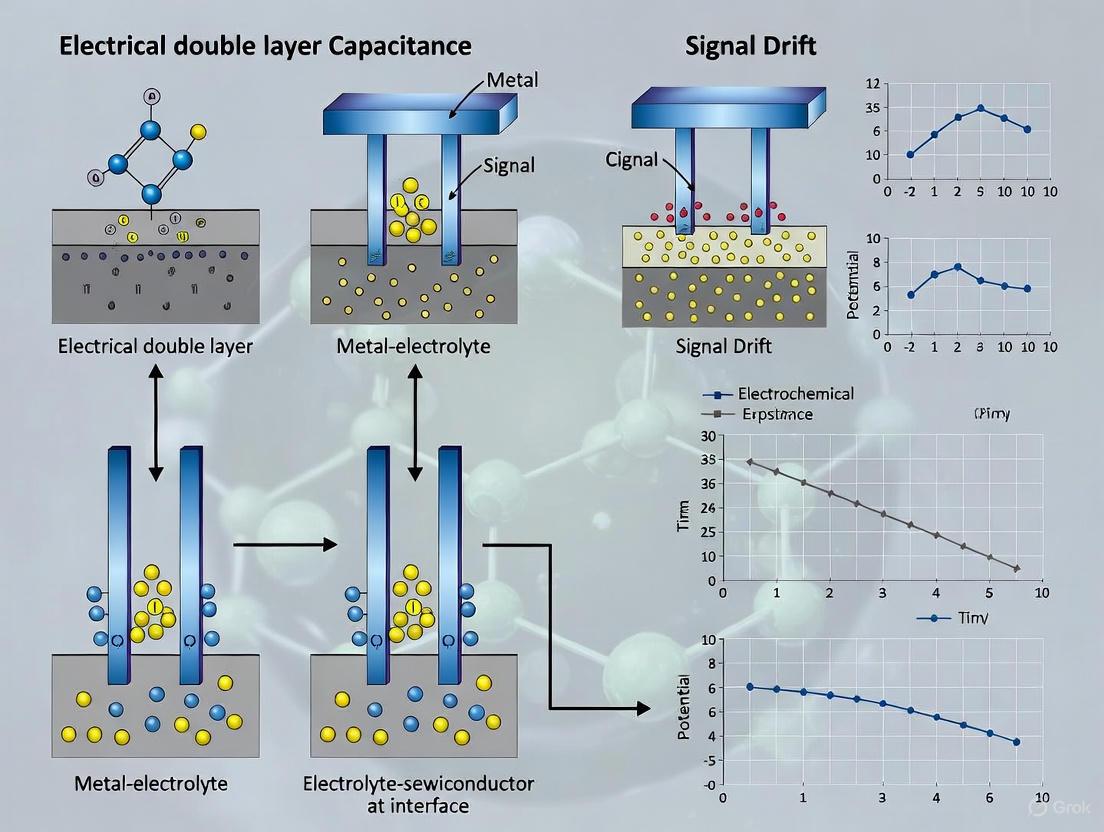
This article provides a comprehensive analysis of the intricate relationship between electrical double layer capacitance (Cdl) and signal drift in electrochemical and transistor-based biosensors.
Electrical Double Layer Capacitance and Signal Drift: Mechanisms, Measurement, and Mitigation in Biomedical Sensors
Abstract
This article provides a comprehensive analysis of the intricate relationship between electrical double layer capacitance (Cdl) and signal drift in electrochemical and transistor-based biosensors. Tailored for researchers and drug development professionals, it explores the fundamental principles of the electrode-electrolyte interface, details advanced measurement techniques like EIS and CV, and systematically investigates the primary mechanisms behind signal degradation, including monolayer desorption and biofouling. The content further presents targeted strategies for drift mitigation and stabilization, evaluates the performance of various materials and sensor architectures, and discusses the implications for developing reliable, long-term in vivo monitoring and point-of-care diagnostic devices.
The Electrical Double Layer: Fundamental Principles and Its Role in Sensor Stability
The electrode-electrolyte interface is a critical region in electrochemical systems where charge carriers transition between electrons in a solid electrode and ions in an electrolyte solution. This interface governs performance across fields including biomedical sensing, energy storage, and neurostimulation [1] [2]. When a voltage is applied, charge distribution at this junction forms the electrical double layer (EDL), creating a capacitive effect known as the double layer capacitance (Cdl) [1].
Understanding Cdl is paramount for managing signal drift and stability in electrochemical devices. This in-depth technical guide examines the interface's fundamental principles, equivalent circuit models, characterization methods, and recent research advancements, providing researchers with the foundational knowledge needed to address challenges in signal integrity and measurement accuracy.
Core Theoretical Concepts
The Electrode-Electrolyte Interface and Double Layer Formation
The interface represents a phase boundary where charge carrier types change: electrons carry current in the electrode, while ions carry current in the electrolyte [1]. This transition imposes an impedance on current flow. The characteristics of this interface are crucial for recording high-quality signals such as electrocardiograms (ECGs) and for the operation of sensors and energy storage devices [1].
When a voltage is applied, a double layer of charge forms at the interface [1]. This structure comprises:
- Inner Helmholtz Plane (IHP): A monolayer of solvent molecules and anions adsorbed directly onto the electrode surface [1].
- Outer Helmholtz Plane (OHP): A layer of solvated cations attracted to the negatively charged electrode through the IHP [1].
This charge separation creates a capacitive effect, storing energy electrostatically much like a conventional capacitor, with the IHP acting as the dielectric [1].
Equivalent Circuit Model
The electrochemical properties of the interface are commonly described using an equivalent circuit model, which includes the double layer capacitance and other key components [1] [3].
Circuit Components and Their Significance:
- Double Layer Capacitance (Cdl): Represents the electrostatic charge storage at the interface. Its value depends on the electrode material, surface area, and electrolyte composition [1].
- Charge Transfer Resistance (Rct): Quantifies the resistance to current flow due to electrochemical reactions (Faradaic processes) at the interface. A lower Rct indicates easier charge transfer [1] [3].
- Spreading/Electrolyte Resistance (Rs): The series resistance from the electrolyte solution, leads, and contacts [1] [3].
- Half-cell Potential (Erev): The intrinsic equilibrium potential of the electrode material, measured relative to a standard reference electrode like the Standard Hydrogen Electrode (SHE) [1].
Frequency-Dependent Behavior of Cdl
The capacitive nature of the interface makes its impedance highly frequency-dependent [1]. At higher frequencies, the capacitive reactance of Cdl decreases, allowing current to pass more easily through this capacitive path. At lower frequencies, the higher capacitive reactance forces more current to pass resistively through Rct, which can lead to signal distortion in lower-frequency waveforms [1].
Signal Drift and Instability Mechanisms
Signal drift manifests as a gradual, unwanted change in the measured electrical signal over time, undermining measurement accuracy. Understanding its origins is essential for developing stable electrochemical devices.
- Charge Trapping in Substrate Defects: A primary cause of drift in devices like electrolyte-gated graphene field-effect transistors (EG-gFETs) is the trapping and slow release of charges at defect sites within the substrate material (e.g., silicon oxide) [2]. These trapped charges dope the channel electrostatically, shifting transfer characteristics.
- Unstable Half-Cell Potential: Electrodes with high or unstable half-cell potentials are prone to baseline wander (drift) and distortion. Any potential difference between electrodes is amplified along with the desired signal [1].
- Faradaic Leakage and Residual Voltage: In neurostimulation, even charge-balanced biphasic current pulses can leave a residual voltage across the interface due to the presence of the Faradaic impedance (Rct). This residual voltage can lead to continued electrochemical reactions and tissue damage [3].
The Critical Link Between Cdl and Drift
The stability of Cdl is intrinsically linked to signal drift. Changes in the interface properties—such as adsorption of species, surface oxidation, or ion intercalation—directly alter Cdl. This variability introduces a time-dependent element into the equivalent circuit, causing the measured signal to drift. Furthermore, the parallel Rct path allows for slow, persistent Faradaic currents that contribute to long-term drift by discharging the double layer or inducing DC offset voltages [2] [3].
Experimental Characterization and Protocols
Accurately measuring the properties of the electrode-electrolyte interface, particularly Cdl and Rct, is fundamental to research and development. The following section outlines standard and advanced experimental protocols.
Standard Bench Tests (AAMI EC12)
For patient monitoring electrodes, the ANSI/AAMI EC12 standard defines key tests to be performed in a gel-to-gel configuration [1]. The table below summarizes the core requirements.
Table 1: AAMI EC12 Standard Key Test Requirements for ECG Electrodes [1]
| Test Parameter | Standard Conditions | Acceptance Criteria | Purpose |
|---|---|---|---|
| AC Impedance | 10 Hz sinusoidal current, ≤ 0.1 mA | Average of 12 pairs ≤ 2 kΩ; Single pair ≤ 3 kΩ | Ensures low interface impedance to minimize signal attenuation and interference. |
| DC Offset Voltage | - | - | Measures the steady-state potential difference between electrode pairs to predict baseline wander. |
| Combined Offset Instability & Internal Noise | - | - | Assesses low-frequency signal stability and inherent noise. |
| Defibrillation Overload Recovery | - | - | Verifies the electrode can recover functionality after a high-voltage defibrillation pulse. |
Electrochemical Impedance Spectroscopy (EIS)
Purpose: To characterize the electrode-electrolyte interface by measuring its impedance across a wide frequency range, enabling the extraction of circuit parameters like Cdl and Rct [1].
Detailed Protocol:
- Setup: Configure a standard three-electrode system (Working, Counter, and Reference electrodes) immersed in the electrolyte of interest.
- Measurement: Apply a small-amplitude AC voltage sinusoid (e.g., 10 mV) over a wide frequency range (e.g., 0.1 Hz to 1 MHz) and measure the phase and amplitude of the resulting current.
- Data Fitting: Fit the obtained impedance spectrum (often presented as a Nyquist or Bode plot) to the Randles circuit model [3]. The value of Cdl is a primary output of this fitting procedure. While the AAMI standard uses a single frequency (10 Hz), EIS provides a more in-depth analysis [1].
Protocol for Characterizing Drift in EG-gFETs
This protocol, adapted from research on electrolyte-gated graphene field-effect transistors, provides a method for quantifying drift [2].
Purpose: To comprehensively characterize the dynamic drift behavior of EG-gFETs under various measurement conditions.
Step-by-Step Workflow:
Key Parameters to Record:
- Primary Output: The Dirac point voltage (V_Dirac) from successive transfer curves [2].
- Environmental Factors: Temperature, electrolyte composition and pH [2].
- Electrical History: Gate voltage (V_GS) conditions and device's measurement history [2].
Advanced Research and Computational Methods
Overcoming the challenges of signal drift and interface instability requires advanced experimental and computational approaches.
Investigating Drift via Charge Trapping Models
Recent research on EG-gFETs demonstrates that charge trapping at substrate oxide defects is a dominant drift mechanism. Studies systematically rule out other factors (electrolyte type, surface functionalization, pH), pointing to electron transitions between graphene and oxide defects as the root cause [2]. This process is modeled using the non-radiative multiphonon (NPM) transition model, which accounts for how the graphene Fermi level, modulated by V_GS, influences electron capture/emission rates at defect sites [2].
Machine Learning-Accelerated Modeling
The HAML (Hybrid AIMD-MLP) framework combines ab initio molecular dynamics (AIMD) with machine learning potentials (MLP) to accurately simulate complex interface reactions over extended timescales that are prohibitively expensive for pure AIMD [4]. This method has been applied to model interfaces between Li metal and liquid/solid-state electrolytes, achieving speedups of over 10-20 times while maintaining high accuracy. This approach provides atomic-level insights into interfacial processes that drive drift and degradation [4].
The Scientist's Toolkit: Research Reagent Solutions
Table 2: Essential Materials and Reagents for Electrode-Electrolyte Interface Research
| Item | Function / Purpose | Example Use-Case |
|---|---|---|
| Silver/Silver Chloride (Ag/AgCl) Electrode | A common non-polarisable reference electrode with a stable, low half-cell potential [1]. | Used as a stable reference in three-electrode cell setups for EIS and other electrochemical measurements. |
| Sputtered Iridium Oxide Film (SIROF) Electrodes | A high-charge-capacity electrode material for electrical stimulation [3]. | Used in functional electrical stimulation of neural tissue (e.g., retinal implants) [3]. |
| Ionic Liquid Electrolytes | A medium with high ionic concentration, which can help reduce the half-cell potential and study drift mechanisms independent of evaporation [1] [2]. | Used in EG-gFET experiments to isolate charge trapping drift from other effects related to aqueous electrolytes [2]. |
| LPSC (Li₆PS₅Cl) Solid-State Electrolyte | A solid-state electrolyte for lithium metal batteries [4]. | Serves as a base material for studying the impact of element doping (Se, F, O) on interface stability and reaction kinetics in Li metal batteries [4]. |
| Phosphate Buffered Saline (PBS) | A standard, physiologically-relevant saline solution. | Used as a common electrolyte for testing biomedical sensors and simulating biological environments. |
The electrochemical interface, the boundary between an electrode and an ionic conductor such as an electrolyte, is characterized by a complex structural region where charge separation occurs. This region, known as the electrochemical double layer (EDL), is fundamental to numerous technological applications, including supercapacitors for energy storage, electrochemical sensors, and corrosion science [5] [6]. The operational conditions and performance of these devices are dictated by the physico-chemical phenomena taking place at this interface [6]. The EDL forms because charges on the electrode surface are balanced by a redistribution of ions in the electrolyte, creating a potential gradient that can exceed 10⁷ V cm⁻¹ [6]. Understanding the precise structure of this layer is critical for advancing research in electrical double layer capacitance and mitigating signal drift, a key challenge in precise electrochemical measurements and biosensor development.
The Grahame model, building upon earlier theories, provides the most comprehensive and widely accepted description of the EDL structure. This model is particularly indispensable for researchers, scientists, and drug development professionals who utilize electrochemical systems, as it defines the specific locations and environments of ions at the interface, which directly influence capacitive behavior and signal stability. This technical guide will delve into the core principles of the Grahame model, its historical context, and its practical implications for modern electrochemical research.
Classical Theories of the Electrochemical Double Layer
The quest to understand the EDL began in the nineteenth century with macroscopic measurements under equilibrium conditions. The earliest quantitative studies were performed on mercury electrodes, favored for their reproducible, contaminant-free surfaces [6]. These experiments measured interfacial tension and capacitance as functions of applied potential and electrolyte activity.
The fundamental thermodynamic treatment stems from the concept of the ideally polarizable electrode, where no charge transfer occurs [6]. The system obeys the Lippmann equation, which forms the basis of interfacial thermodynamics [6]: [ \frac{\partial \gamma}{\partial \phi} = -\sigma ] where ( \gamma ) is the interfacial tension, ( \sigma ) is the surface charge density, and ( \phi ) is the Galvani potential. Differentiating this equation with respect to potential gives the expression for the specific differential capacitance, ( C{\text{diff}} ), of the electrode [6]: [ C{\text{diff}} = \frac{\partial \sigma}{\partial \phi} = - \frac{\partial^2 \gamma}{\partial \phi^2} ] The relationship between interfacial tension and potential produces an electrocapillary curve, the maximum of which corresponds to the potential of zero charge (PZC), where the net surface charge is zero [6]. The PZC is a critical parameter characterizing both the electrode material and the solution composition.
The Helmholtz Model
The first model to introduce the EDL concept was proposed by Helmholtz [6]. He envisaged the interface as a simple molecular capacitor, where the charge on the electrode (( \sigma )) is balanced by a monolayer of ions of opposite charge located adjacent to the surface. This compact layer is known as the Helmholtz layer [6]. In this model, the capacitance, ( C ), is given by ( C = \varepsilon / 4\pi d ), where ( \varepsilon ) is the relative permittivity of the dielectric and ( d ) is the distance between the "plates" [6]. While foundational, the Helmholtz model fails to account for the diffuse nature of the ion distribution in the electrolyte, which becomes significant at lower electrolyte concentrations or lower surface charges.
The Gouy-Chapman Model
The Gouy-Chapman model addressed the limitations of the Helmholtz model by considering the thermal motion of ions, which leads to a diffuse layer of charge extending from the surface into the electrolyte [5]. This model successfully predicted that the differential capacitance should increase with electrolyte concentration and vary with surface potential. However, it treated ions as point charges and neglected ion size and specific ion-surface interactions, leading to unrealistic predictions of infinite ion concentration at high surface potentials.
The Grahame Model: A Synthesis
David C. Grahame, in the mid-20th century, integrated the Helmholtz and Gouy-Chapman models into a single, more sophisticated framework. The Grahame model divides the electrochemical double layer into two distinct regions, resolving the inaccuracies of its predecessors.
Table 1: Core Components of the Grahame Double Layer Model
| Layer Name | Alternative Name(s) | Spatial Extent | Primary Characteristics | Governing Forces |
|---|---|---|---|---|
| Inner Helmholtz Plane (IHP) | Helmholtz Layer, Stern Layer | ~0.3-0.5 nm from electrode surface | Plane of closest approach for specifically adsorbed ions (may be partially or fully dehydrated); location of solvent dipoles. | Chemical (short-range), electrostatic. |
| Outer Helmholtz Plane (OHP) | Stern Layer | ~0.5-1.0 nm from electrode surface | Plane of closest approach for non-specifically adsorbed, |
hydrated ions; defines the boundary between the compact and diffuse layers. | Purely electrostatic (long-range). | | Diffuse Layer | Gouy-Chapman Layer | Extends from OHP into bulk electrolyte (nm to μm) | Region where ion distribution is governed by electrostatic forces and thermal motion; concentration decays to bulk value. | Electrostatic & thermal (Boltzmann distribution). |
The Inner Helmholtz Plane (IHP)
The Inner Helmholtz Plane (IHP) is defined as the locus of points occupied by the centers of specifically adsorbed ions. These ions are not fully solvated and have lost part or all of their hydration shell to contact the electrode surface directly. Adsorption into the IHP is driven by specific chemical interactions that go beyond pure electrostatics, such as covalent bonding, van der Waals forces, or hydrogen bonding [6]. This means that an ion can be adsorbed into the IHP even if it has the same charge sign as the electrode (anionic adsorption on a negatively charged surface, or cationic adsorption on a positively charged surface). The nature and population of ions in the IHP are critical as they directly affect the PZC and the total capacitance of the interface.
The Outer Helmholtz Plane (OHP)
The Outer Helmholtz Plane (OHP) is the plane of closest approach for non-specifically adsorbed ions. These ions remain fully solvated and are attracted to the electrode surface solely by long-range electrostatic forces. They cannot approach the electrode as closely as specifically adsorbed ions because they are separated by their hydration shells. The OHP represents the boundary between the compact, organized part of the double layer (comprising the IHP and OHP) and the diffuse layer.
The Diffuse Layer
Beyond the OHP lies the diffuse layer, as described by Gouy and Chapman. In this region, the ion distribution is governed by the balance between electrostatic attraction/repulsion and the randomizing effect of thermal motion. The potential drops exponentially from its value at the OHP (( \psi_0 )) to zero in the bulk solution. The thickness of this layer is characterized by the Debye length (( \kappa^{-1} )), which decreases with increasing electrolyte concentration and ionic strength.
The following diagram illustrates the structure of the EDL as described by the Grahame model, showing the relative positions of the IHP, OHP, and the diffuse layer, along with the corresponding potential decay.
Diagram 1: The structure of the electrochemical double layer according to the Grahame model, showing the IHP, OHP, and diffuse layer.
Experimental Protocols for Probing the Double Layer
Validating the Grahame model and characterizing the EDL in real systems requires sophisticated experimental techniques. The following methodologies are central to this field of research.
Electrochemical Capacitance Measurements
The primary method for investigating the EDL is through measurement of the differential capacitance (( C_{\text{diff}} )) as a function of applied potential and electrolyte concentration.
- Objective: To determine the capacitance of the electrode-electrolyte interface and observe how it changes with potential (to find the PZC) and electrolyte concentration.
- Protocol:
- Cell Setup: A standard three-electrode electrochemical cell is used, comprising a Working Electrode (the material under study, e.g., graphene, Hg), a Counter Electrode (e.g., Pt wire), and a Reference Electrode (e.g., Ag/AgCl, SCE) [6].
- Electrolyte Preparation: Prepare a series of aqueous electrolyte solutions (e.g., KCl, Na₂SO₄) with precisely known concentrations, typically ranging from 0.001 M to 1.0 M. Ensure high-purity reagents and degassing to remove oxygen.
- Impedance Spectroscopy: Apply a small-amplitude AC potential perturbation (e.g., 10 mV rms) over a range of frequencies (e.g., 10,000 Hz to 0.1 Hz) at a series of DC bias potentials. The DC potential is typically scanned step-wise across the electrochemical window of the working electrode.
- Data Analysis: At each DC potential, the impedance data is fit to an equivalent circuit model. The simplest relevant model is a series resistance (solution resistance, ( Rs )) with a double-layer capacitance (( C{dl} )). The inverse of the imaginary impedance at high frequency can often be used to approximate ( C{\text{diff}} ). Plotting ( C{\text{diff}} ) versus the DC potential yields a capacitance curve.
- Expected Outcome: In a dilute electrolyte, the capacitance curve will often show a "V" or "U" shape, with a minimum at the PZC, reflecting the dominance of the diffuse layer. At high concentrations, the curve flattens, indicating the increasing dominance of the compact Helmholtz layer, consistent with the predictions of the Grahame model [6].
In Situ Spectroscopy and Surface Analysis
To move beyond purely electrical measurements and gain direct structural information, advanced spectroscopic techniques are employed.
- Objective: To identify the chemical nature and bonding of specifically adsorbed ions and solvent molecules at the IHP.
- Protocol (e.g., In Situ Surface-Enhanced Raman Spectroscopy):
- Electrode Preparation: Use a working electrode with a nano-roughened surface (e.g., Au or Ag nanoparticles) to enhance the Raman signal from the interface.
- Spectroelectrochemical Cell: Use a cell with an optically transparent window, allowing a laser to be focused on the electrode surface in contact with the electrolyte.
- Measurement: While holding the working electrode at a controlled potential, acquire Raman spectra. The potential is systematically varied to observe the adsorption/desorption of species.
- Data Analysis: Changes in the Raman peak positions, intensities, and widths are correlated with the applied potential to identify the vibrational fingerprints of specifically adsorbed ions and interfacial water molecules.
The workflow for a comprehensive investigation integrating these techniques is summarized below:
Diagram 2: A generalized experimental workflow for probing the structure of the electrochemical double layer.
Quantitative Data and Modeling
The Grahame model can be expressed mathematically. The total differential capacitance is considered as a series combination of the Helmholtz capacitance (( CH )) and the diffuse layer capacitance (( C{diff} )): [ \frac{1}{C{\text{total}}} = \frac{1}{CH} + \frac{1}{C{diff}} ] where ( CH ) is typically considered constant, and ( C{diff} ) is potential and concentration-dependent, as derived from Gouy-Chapman theory: [ C{diff} = \frac{\varepsilon \kappa}{4\pi} \cosh\left(\frac{z e \psi0}{2 kB T}\right) ] where ( \varepsilon ) is the permittivity, ( \kappa^{-1} ) is the Debye length, ( z ) is the ion valence, ( e ) is the elementary charge, ( \psi0 ) is the potential at the OHP, ( kB ) is Boltzmann's constant, and ( T ) is the temperature.
Table 2: Characteristic Parameters and Values in EDL Research
| Parameter | Symbol | Typical Range/Value | Experimental/Model Context |
|---|---|---|---|
| Potential of Zero Charge | PZC | Material and electrolyte specific (e.g., ~ -0.2 V vs. SCE for Hg in NaF) | Key output from electrocapillary or capacitance measurements [6]. |
| Helmholtz Capacitance | ( C_H ) | 10 - 40 μF cm⁻² | Represents the compact layer (IHP/OHP); relatively constant. |
| Debye Length | ( \kappa^{-1} ) | ~30 nm (0.001 M 1:1 electrolyte) to ~0.3 nm (1.0 M 1:1 electrolyte) | Characteristic thickness of the diffuse layer; dictates screening. |
| Diffuse Layer Capacitance | ( C_{diff} ) | Strongly dependent on potential and concentration. | Calculated from Gouy-Chapman theory; dominates total capacitance at low [ion] and near PZC. |
| Double Layer Capacitance | ( C_{dl} ) | 5 - 30 μF cm⁻² (for carbon materials) | Measured value; critical for supercapacitor energy storage calculations [5]. |
The Scientist's Toolkit: Essential Research Reagents and Materials
Table 3: Key Reagents and Materials for Double Layer Research
| Item Name | Function/Application | Critical Specifications | |
|---|---|---|---|
| Working Electrodes | The material whose interface is being studied. | Mercury: Historically ideal, atomically smooth [6]. Graphene: Modern 2D material, atomically smooth model surface [6]. Gold: For functionalized surfaces and in-situ spectroscopy. | |
| Inert Electrolytes | To study non-specific adsorption; provide ionic strength. | Alkali Metal Fluorides (e.g., NaF, KF): F⁻ ions show weak specific adsorption. Tetralkylammonium Salts (e.g., TBA PF₆): Large organic cations with low specific adsorption. | High purity, low water content for non-aqueous studies. |
| Specifically Adsorbing Electrolytes | To study chemical interactions at the IHP. | Halide Salts (e.g., KCl, NaBr): Cl⁻, Br⁻, I⁻ exhibit strong specific adsorption. | Concentration series to study adsorption isotherms. |
| Potentiostat/Galvanostat with EIS Module | The core instrument for applying potential/current and measuring electrochemical response. | Capability for Frequency Response Analysis (FRA), low-current measurement. | |
| Spectroelectrochemical Cell | Allows simultaneous electrochemical and spectroscopic measurement. | Optical transparency (e.g., quartz window), proper electrode alignment. |
The Grahame model, with its delineation of the IHP and OHP, remains the cornerstone of our understanding of the electrochemical double layer. It successfully integrates the concepts of specific chemical adsorption and electrostatic forces, providing a quantitative framework that accurately describes experimental observations from capacitance measurements and in-situ spectroscopy. For researchers focused on electrical double layer capacitance and signal drift, a deep understanding of this model is non-negotiable. Signal drift in sensors can often be traced to slow reorganization within the IHP or potential-dependent specific adsorption, highlighting the model's direct relevance. Future progress in this field, particularly with novel materials like graphene and ionic liquids, will rely on combining these classical theories with advanced computational simulations and high-resolution experimental techniques to further refine our atomic-level picture of the interface.
The interface between an electronic conductor (an electrode) and an ionic conductor (an electrolyte) is the site of all electrochemical processes. At this interface, a nanoscale region of separated charge forms, creating what is known as the Electrical Double Layer (EDL). The EDL is the electrochemical analogue of a capacitor, storing energy through the physical separation of charged species. Its structure and properties directly govern the performance of a vast array of technologies, from energy storage devices like batteries and supercapacitors to the latest generation of biosensors [7] [6]. A detailed understanding of the EDL as a nanoscale capacitor is therefore fundamental to advancements in electrochemistry and electronic device design.
This article establishes the theoretical basis of the EDL, framing it within the context of modern research challenges, particularly the critical issue of signal drift in sensitive electrochemical measurements. Accurate interpretation of the double-layer capacitance (C~dl~) is essential for distinguishing true analytical signals from temporal artifacts in applications such as field-effect transistor-based biosensors (BioFETs) [8] [7].
Classical Theoretical Models of the EDL
The evolution of EDL models represents a continuous effort to reconcile theoretical predictions with experimental electrochemical data. The following section outlines the key historical developments.
The Helmholtz Model
The simplest model, proposed by Helmholtz, envisions the double layer as a molecular dielectric capacitor [6]. In this concept, the charge on the electrode surface (σ) is balanced by a single layer of solvated ions of opposite charge located adjacent to the surface, known as the Helmholtz plane. The potential is predicted to drop linearly across this rigid, molecular layer.
- Capacitance Relationship: The Helmholtz capacitance (C~H~) is given by ( CH = \frac{\varepsilon \varepsilon0}{d} ), where ε is the relative permittivity of the dielectric, ε~0~ is the permittivity of free space, and d is the distance between the charge "plates," approximately equal to the ionic radius [6].
- Limitation: This model predicts a capacitance that is constant with applied potential, which contradicts experimental observations showing a strong potential dependence.
The Gouy-Chapman Model
The Gouy-Chapman model introduced a diffuse layer, accounting for the thermal motion of ions in the electrolyte. Instead of forming a rigid plane, the counter-ions are distributed diffusely in the solution, leading to a non-linear, exponential decay of potential with distance from the electrode.
- Capacitance Relationship: The diffuse layer capacitance (C~GC~) is described by ( C{GC} = \frac{\varepsilon \varepsilon0}{\lambdaD} \cosh\left(\frac{z e \psi0}{2 k_B T}\right) ), where λ~D~ is the Debye length, z is the ion valence, e is the elementary charge, ψ~0~ is the surface potential, k~B~ is Boltzmann's constant, and T is the temperature [6].
- Limitation: This model predicts a "V-shaped" capacitance curve and unrealistically high capacitance values at high potentials because it treats ions as point charges and ignores their finite size.
The Stern Model
Stern combined the two previous models, proposing that the EDL is composed of two distinct regions: an inner Helmholtz layer (including specifically adsorbed ions) and an outer Gouy-Chapman diffuse layer.
- Capacitance Relationship: The total differential capacitance (C~dl~) is treated as a series combination of the Helmholtz (C~H~) and Gouy-Chapman (C~GC~) capacitances: ( \frac{1}{C{dl}} = \frac{1}{CH} + \frac{1}{C_{GC}} ) [6].
- Significance: This hybrid model successfully explains the characteristic "U-shaped" capacitance curve observed for many electrode-electrolyte systems, with a minimum at the potential of zero charge (PZC).
The Grahame Model
Grahame further refined the Stern model by distinguishing between specifically adsorbed ions (which can contact the electrode surface by losing their solvation shell) in the Inner Helmholtz Plane (IHP), and non-specifically adsorbed ions that remain fully solvated in the Outer Helmholtz Plane (OHP) [9]. This model provides the most comprehensive classical description and is widely used as the basis for interpreting experimental data.
The following diagram illustrates the structure of the EDL and the corresponding potential decay according to the Grahame model:
Experimental Measurement of Double-Layer Capacitance
Accurately measuring C~dl~ is critical for characterizing the electrode-electrolyte interface. The most common techniques are Electrochemical Impedance Spectroscopy (EIS) and Cyclic Voltammetry (CV).
Electrochemical Impedance Spectroscopy (EIS)
EIS is a powerful AC method that probes the interface over a range of frequencies. The system's response is modeled using an Equivalent Circuit Model (ECM) [10] [9].
- Equivalent Circuit: For a simple blocking electrode, the ECM consists of the solution resistance (R~s~) in series with a constant phase element (CPE) representing the double layer [9].
- The Constant Phase Element (CPE): Real electrodes often exhibit frequency dispersion, where the capacitance is not ideal. This is modeled by a CPE, with an impedance defined as ( Z_{CPE} = 1 / [Q (iω)^n] ), where Q is the CPE pre-factor, ω is the angular frequency, and n is the CPE exponent (0 ≤ n ≤ 1). A perfect capacitor has n = 1 [10] [9].
- Capacitance Calculation: The double-layer capacitance can be calculated from the CPE parameters at the characteristic frequency (ω~c~) of the interface: ( C{dl} = Q (\omegac)^{n-1} ) [9].
Cyclic Voltammetry (CV)
CV is a DC technique where the potential is scanned linearly and the current response is measured.
- Methodology: In a potential window where no Faradaic (charge-transfer) reactions occur, the current is primarily capacitive. The capacitive current (i~c~) is related to the scan rate (ν) and C~dl~ by ( ic = C{dl} \cdot ν ) [9].
- Analysis: By measuring the current in a non-Faradaic region and knowing the scan rate, C~dl~ can be estimated. For more complex systems with Faradaic contributions, the current from forward and backward sweeps at the open-circuit potential can be used: ( (Ia - Ic)/2 = C_{dl} \cdot (dE/dt) ) [9].
Table 1: Comparison of EIS and CV for Capacitance Measurement (Example: Iron in 0.1 M HCl)
| Technique | Measurement Principle | Key Parameter | Calculated C~dl~ | Advantages |
|---|---|---|---|---|
| Electrochemical Impedance Spectroscopy (EIS) | AC frequency response | CPE: Q = 6.3 µF·s^(n-1), n = 0.84 | 5.2 µF [9] | Deconvolutes charge transfer; models interface with ECM |
| Cyclic Voltammetry (CV) | DC current during potential scan | Scan rate: 40 mV·s⁻¹ | 4.3 µF [9] | Simple, fast experiment; directly probes kinetics |
Advanced Considerations and Research Challenges
The Interplay of Capacitance and Signal Drift
The interpretation of C~dl~ is not always straightforward and is often complicated by factors that lead to signal drift, a major challenge for stable electrochemical devices like BioFETs [7].
- Adsorption (Pseudo)capacitance: On non-ideal electrodes like platinum, the adsorption of species such as H~ads~ or OH~ads~ from water dissociation contributes an additional, potential-dependent "pseudo-capacitance" (C~ads~). This makes it difficult to deconvolute the true double-layer capacitance from the total measured capacitance, and this effect varies with the crystal facet of the metal [8].
- Temporal Instability: Slow processes such as the diffusion of ions into the sensing region or changes in the interface morphology can alter the gate capacitance and threshold voltage over time, causing signal drift that can obscure genuine analytical signals [7]. This is particularly debilitating for point-of-care biosensors.
Insights from Battery Research: Monitoring SEI Formation
Research in Li-ion batteries provides a clear example of the sensitivity of C~dl~. The formation of a Solid Electrolyte Interphase (SEI)—a passivating layer on the anode—can be monitored in situ through changes in the double-layer capacitance [10].
- Principle: The SEI physically grows on the electrode surface, effectively increasing the distance (d) between the electrode and the ions in the electrolyte. Since capacitance is inversely proportional to this distance (( C \propto 1/d )), a continuous decrease in C~dl~ measured via EIS directly indicates the formation and growth of the SEI layer [10].
- Application: This approach allows researchers to track interface changes within a few atomic layers and screen the effectiveness of different electrolytes for forming stable SEIs [10].
The Scientist's Toolkit: Key Reagents and Materials
Table 2: Essential Research Reagents and Materials for EDL Studies
| Item | Function / Rationale | Example from Literature |
|---|---|---|
| Glassy Carbon Electrode | An atomically smooth, model electrode surface that provides reproducible and easily interpretable EIS data for fundamental studies [10]. | Used as a polished model electrode to study SEI formation in Li-ion batteries [10]. |
| Long-Chain Alkanethiols (e.g., 16-Mercaptohexadecanoic acid) | Used to form stable, self-assembled monolayers (SAMs) on gold electrodes. These layers act as well-defined insulating films for capacitive biosensors, minimizing signal drift [11]. | SAMs with ≥11 methylene groups showed significantly improved stability in aqueous solution and suppressed signal drift in capacitive sensors [11]. |
| Polymer Brushes (e.g., POEGMA) | A non-fouling polymer layer immobilized above a transistor channel. It extends the effective Debye length in high ionic strength solutions via the Donnan potential, enabling biomarker detection in physiological fluids [7]. | Used in D4-TFT BioFETs to overcome charge screening and detect sub-femtomolar biomarker concentrations in 1X PBS [7]. |
| Lithium Hexafluorophosphate (LiPF₆) in Carbonate Solvents | A standard, battery-grade electrolyte used to study electrochemical stability and SEI formation mechanisms on carbonaceous anodes [10]. | Used in combinations like EC-DMC to probe potential-dependent SEI formation on glassy carbon [10]. |
| Constant Phase Element (CPE) | A mathematical component used in equivalent circuit models to accurately fit the non-ideal, frequency-dependent capacitive behavior of real electrochemical interfaces [10] [9]. | Essential for extracting a meaningful capacitance value (C~dl~) from impedance data on real surfaces like iron [9]. |
The following workflow summarizes the key steps and decision points for characterizing the double layer as a nanoscale capacitor, integrating the core concepts and tools discussed.
From Ideal Capacitors to Constant Phase Elements (CPE) in Real Systems
In the realm of electrochemistry and biosensor development, the electrical double layer (EDL) is a fundamental concept governing the interaction between a conductive electrode and an ionic solution. The capacitance of this interface is central to the function of numerous devices, from supercapacitors for energy storage to transistor-based biosensors for biomarker detection [12] [7]. Theoretically, this interface is often modeled as an ideal capacitor, a component with a pure, frequency-independent capacitive impedance. However, in real-world systems, particularly in complex biological electrolytes, the EDL consistently deviates from this ideal behavior, exhibiting a phenomenon known as dispersion and behaving instead as a Constant Phase Element (CPE) [13]. This shift from ideal capacitive behavior to CPE-like response is not merely a theoretical curiosity; it has profound implications for the stability and accuracy of electrochemical measurements, directly impacting critical challenges such as signal drift in biosensing platforms [7]. Understanding this transition is therefore essential for researchers and scientists aiming to develop reliable point-of-care diagnostic tools and optimize energy storage systems. This guide frames the core principles of EDL capacitance and CPE within the context of ongoing research to mitigate signal drift, providing a technical foundation for drug development professionals and materials scientists navigating the complexities of interfacial electrochemistry.
Theoretical Foundations: The Electrical Double Layer and Its Capacitance
The Ideal Capacitor and the Electrical Double Layer
An ideal capacitor is a passive electrical component that stores energy in an electric field, characterized by a capacitance value, (C). Its impedance, (ZC), is purely imaginary and inversely proportional to frequency: [ ZC = \frac{1}{j\omega C} ] where (j) is the imaginary unit and (\omega) is the radial frequency [13]. In a perfect electrochemical capacitor, the EDL forms a rigid, atomic-scale charge separation at the electrode-electrolyte interface, akin to a perfect parallel-plate capacitor. This EDL stores electrostatic energy by modulating the spatial distribution of ions in the electrolytic solution [12]. The formation of the EDL is described by mean-field theories like Poisson-Bernst-Planck, which relate the electric potential (\phi(z,t)) to the ion densities (n_\pm(z,t)) [12]. For a symmetric electrolyte with ions of equal valence and diffusivity, the charging dynamics in the linear regime (small applied voltage) are well-understood, with characteristic relaxation times linked to the circuit's resistive-capacitive (RC) time constant [12].
The Constant Phase Element (CPE): Deviations from Ideality
In practice, the impedance of a real EDL rarely conforms to that of an ideal capacitor. Instead, it often behaves as a Constant Phase Element (CPE), an empirical circuit component whose impedance is given by: [ Z_{CPE} = \frac{1}{Q(j\omega)^\alpha} ] Here, (Q) is the CPE coefficient (in (S\cdot s^\alpha)), and (\alpha) is the CPE exponent (or phase angle), which is a dimensionless parameter between 0 and 1 [13]. The value of (\alpha) quantifies the degree of deviation from an ideal capacitor:
- (\alpha = 1): Ideal capacitor behavior.
- (\alpha = 0): Ideal resistor behavior.
- (0 < \alpha < 1): The system exhibits CPE behavior, characterized by a frequency-dependent phase angle that is constant, not equal to -90°.
This frequency dispersion results in a depressed semicircle on a Nyquist plot, rather than the perfect semicircle expected for a single ideal RC time constant [13]. The physical origins of CPE behavior are complex and multifaceted, often attributed to surface roughness, chemical heterogeneity, porosity, and non-uniform current distribution.
Signal Drift and Its Connection to Interfacial Instability
Signal drift is a pervasive challenge in solution-gated electrochemical devices, such as BioFETs. It manifests as a slow, undesired change in the measured signal (e.g., drain current or threshold voltage) over time, which can obscure the detection of target biomarkers [7]. This drift is intrinsically linked to the instability of the EDL. In high ionic strength solutions, electrolytic ions slowly diffuse into the sensing region, altering the gate capacitance and other interfacial properties over time [7]. The non-ideal, CPE-like nature of the EDL can exacerbate this issue, as the distributed time constants associated with surface heterogeneity create multiple, slow relaxation pathways. When a system is not at a steady state, standard impedance analysis tools can yield wildly inaccurate results, complicating the interpretation of sensor data and leading to false positives or negatives [13]. Therefore, mitigating signal drift requires strategies that address both the electrochemical stability of the interface and the underlying causes of CPE behavior.
Table 1: Key Parameters of an Ideal Capacitor vs. a Constant Phase Element
| Parameter | Ideal Capacitor | Constant Phase Element (CPE) |
|---|---|---|
| Impedance Formula | (Z = \frac{1}{j\omega C}) | (Z = \frac{1}{Q(j\omega)^\alpha}) |
| Phase Angle | Constant -90° | Constant (-(90 \times \alpha))° |
| Nyquist Plot | Perfect semicircle | Depressed semicircle |
| Physical Origin | Ideal charge separation | Surface roughness, heterogeneity, porosity |
| Impact on Drift | Predictable, minimal | Complex, can contribute to slow relaxations and drift |
Experimental Characterization and Analysis
Electrochemical Impedance Spectroscopy (EIS)
Electrochemical Impedance Spectroscopy (EIS) is the primary technique for characterizing the EDL and identifying CPE behavior. EIS involves applying a small amplitude AC potential excitation to an electrochemical cell and measuring the current response across a wide frequency range [13]. The system must be pseudo-linear and at a steady state for the measurement to be valid, a particular challenge in biological systems prone to drift and biofouling [13]. The impedance data is typically presented in two ways:
- Nyquist Plot: The imaginary component of impedance ((-Z'')) is plotted against the real component ((Z')). A system with a single time constant and ideal capacitance produces a perfect semicircle. The presence of a CPE results in a depressed, "squashed" semicircle [13].
- Bode Plot: The magnitude of the impedance ((|Z|)) and the phase shift ((\phi)) are plotted against log frequency. A CBE causes the phase angle to plateau at a value other than -90° and the magnitude to have a slope other than -1 on the log-log plot [13].
Equivalent Circuit Modeling
EIS data is commonly analyzed by fitting it to an equivalent electrical circuit model, whose elements have a basis in the system's physical electrochemistry [13]. A simple model for a bare electrode in solution is the Randles circuit, which includes the solution resistance ((Rs)) in series with a parallel combination of the double-layer capacitance ((C{dl})) and the charge-transfer resistance ((R{ct})). In real systems, (C{dl}) is almost always replaced by a CPE to account for the observed dispersion. The quality of the fit, judged by the chi-squared value, validates the model's appropriateness, allowing researchers to extract quantitative parameters like the CPE exponent (\alpha) and correlate them with surface properties or performance metrics like signal drift.
A Research Focus: Mitigating Drift in Biosensing via Interfacial Control
The challenges of CPE behavior and signal drift are acutely felt in the development of ultra-sensitive biosensors. For example, carbon nanotube (CNT)-based BioFETs suffer from debilitating signal drift and charge screening when operating in biologically relevant ionic strengths, which can obscure actual biomarker detection [7]. Research has shown that overcoming these limitations requires direct intervention at the electrode-electrolyte interface.
One promising approach is the use of a poly(ethylene glycol) (PEG)-like polymer brush interface, such as poly(oligo(ethylene glycol) methyl ether methacrylate) (POEGMA) [7]. This interface serves a dual function:
- It acts as a Debye length extender by establishing a Donnan equilibrium potential, allowing for the detection of large antibodies that would otherwise be screened out in high ionic strength solutions like 1X PBS [7].
- It provides a non-fouling, homogenized surface that can reduce the interfacial heterogeneity that contributes to CPE behavior and signal drift.
Simultaneously, a rigorous testing methodology is required to mitigate drift, including:
- Maximizing sensitivity through appropriate passivation alongside the polymer brush coating [7].
- Using a stable electrical testing configuration with a stable pseudo-reference electrode [7].
- Enforcing a rigorous testing methodology that relies on infrequent DC sweeps rather than static or AC measurements to minimize the impact of slow, drift-related relaxations [7].
Table 2: Key Experimental Parameters and Their Impact on EDL Behavior and Signal Drift
| Experimental Parameter | Impact on EDL/CPE | Connection to Signal Drift |
|---|---|---|
| Ionic Strength | Higher strength decreases Debye length, increasing CPE effects from screening. | Increased drift due to higher ion flux and stronger EDL compression [7]. |
| Applied Voltage | Large voltages induce non-linear effects and asymmetric ion dynamics [12]. | Can accelerate drift by driving Faradaic processes or ion adsorption. |
| Surface Morphology | Roughness and chemical heterogeneity directly increase CPE exponent (\alpha). | Heterogeneous sites create multiple energy states, leading to slow, distributed relaxations (drift). |
| Polymer Brush (e.g., POEGMA) | Extends Debye length, creates a more uniform interfacial environment. | Mitigates biofouling and reduces charge screening, stabilizing the signal [7]. |
The Scientist's Toolkit: Essential Reagents and Materials
Table 3: Research Reagent Solutions for EDL and Signal Drift Studies
| Reagent/Material | Function in Experiment |
|---|---|
| POEGMA (Poly(oligo(ethylene glycol) methyl ether methacrylate)) | A non-fouling polymer brush coating that extends the Debye length and creates a more homogeneous interface, reducing signal drift and CPE effects [7]. |
| PBS (Phosphate Buffered Saline) | A high ionic strength buffer (1X PBS) used to mimic physiological conditions, essential for testing drift and biosensor performance in relevant environments [7]. |
| PEG (Polyethylene Glycol) | Used in passivation layers to minimize non-specific binding and improve device stability, thereby reducing a source of signal drift [7]. |
| Palladium (Pd) Pseudo-Reference Electrode | Provides a stable, miniaturizable reference potential, bypassing the need for bulky Ag/AgCl electrodes in point-of-care device configurations [7]. |
| Carbon Nanotubes (CNTs) | A high-sensitivity nanomaterial used as the channel in BioFETs; its interface with the electrolyte is a primary site for EDL formation and signal drift [7]. |
Experimental Protocol: Characterizing CPE and Drift in a BioFET
The following protocol outlines a methodology for evaluating the CPE behavior and signal drift of a CNT-based BioFET, incorporating key strategies from recent research.
Objective: To measure the interfacial impedance of a CNT-based BioFET in 1X PBS, extract CPE parameters, and monitor signal stability over time.
Materials:
- Fabricated CNT-based BioFET device with and without POEGMA functionalization [7].
- 1X PBS solution (pH 7.4).
- Potentiostat/Galvanostat with EIS capability.
- Pd pseudo-reference electrode [7].
- Environmental chamber for temperature control (e.g., 25°C).
Methodology:
- Device Preparation: Immobilize the POEGMA polymer brush on the CNT channel of the test device via surface-initiated polymerization. A control device should remain unfunctionalized [7].
- System Stabilization: Place the device in a Faraday cage and connect it to the potentiostat using the Pd pseudo-reference electrode. Introduce 1X PBS and allow the system to stabilize for 1 hour to approach a steady state, a critical prerequisite for valid EIS [13].
- EIS Measurement: Apply a small sinusoidal potential excitation (10 mV RMS) at the open circuit potential. Sweep the frequency from 100 kHz to 10 mHz, measuring the impedance spectrum for both the test and control devices.
- Equivalent Circuit Fitting: Fit the obtained Nyquist plots to a modified Randles circuit where the capacitor is replaced by a CPE. Use fitting software to extract the values for (Rs), (Q), (\alpha), and (R{ct}).
- Signal Drift Assessment: With a constant drain-source voltage applied, monitor the drain current ((I_d)) over a period of 4-8 hours. Use infrequent DC sweeps (e.g., every 15 minutes) instead of continuous monitoring to distinguish drift from the target signal [7].
- Data Analysis: Correlate the CPE exponent (\alpha) from step 4 with the magnitude of signal drift observed in step 5. Compare the functionalized and control devices to assess the efficacy of the POEGMA interface in promoting ideal capacitive behavior and improving signal stability.
Visualizing Concepts and Workflows
EDL Capacitance Evolution and Impact
BioFET Drift Mitigation Workflow
The journey from the theoretical simplicity of an ideal capacitor to the complex reality of the Constant Phase Element is a central narrative in interfacial electrochemistry. This deviation, driven by physical and chemical heterogeneity at the electrode surface, is not a minor artifact but a fundamental characteristic that has a direct and consequential impact on the pressing issue of signal drift in sensitive electrochemical devices like BioFETs. Addressing these challenges requires a multi-faceted approach, combining advanced materials like non-fouling polymer brushes to homogenize the interface, rigorous electrochemical characterization via EIS, and robust testing protocols designed to deconvolute signal from noise. For researchers in drug development and biosensing, a deep understanding of CPE behavior is no longer an esoteric specialty but a practical necessity. It provides the foundational knowledge required to design next-generation diagnostic platforms that are not only ultrasensitive but also stable and reliable, thereby bringing the vision of accurate point-of-care detection closer to reality.
Linking Cdl Variability to the Onset of Sensor Signal Drift
In the field of electrochemical sensing, signal drift presents a fundamental challenge to obtaining reliable, long-term measurements. This phenomenon, characterized by a gradual change in sensor output unrelated to the target analyte, is particularly debilitating for applications requiring high precision, such as continuous molecular monitoring in interstitial fluid or point-of-care diagnostic devices [14] [7]. Emerging research increasingly points to the variability of the double layer capacitance (Cdl) as a critical and often overlooked factor initiating and propagating this drift. The electrical double layer (EDL), which forms at the interface between a sensor electrode and an electrolyte solution, governs the charge distribution and potential gradients that are fundamental to electrochemical signal transduction. This technical guide explores the mechanistic relationship between Cdl variability and the onset of sensor signal drift, framing this link within a broader thesis on interfacial stability. It provides researchers and drug development professionals with the theoretical foundation, experimental protocols, and analytical frameworks necessary to diagnose, quantify, and mitigate Cdl-induced drift in their sensor systems.
The Fundamental Role of Cdl in Sensor Stability
The double layer capacitance (Cdl) is not merely a passive circuit element in an electrochemical system; it is a dynamic, responsive component that directly dictates the stability of the sensor's electrical environment. It represents the capacitance arising from the charge separation at the electrode-electrolyte interface, forming what is known as the Electrical Double Layer (EDL). The stability of this interface is paramount for sensors that rely on measuring potential or current changes, such as potentiometric ion-selective electrodes (ISEs) and field-effect transistor (FET) based biosensors [15] [7].
When Cdl is stable, it provides a consistent charge buffer, effectively decoupling the sensing element from minor fluctuations in the electrochemical cell. However, when Cdl is variable, it introduces instability in this critical region. In solid-contact ion-selective electrodes (SC-ISEs), a high Cdl is desirable because it acts as an internal charge reservoir, making the electrode potential less sensitive to external disturbances, such as changes in the sample composition or electrical noise. A low Cdl, conversely, results in a system highly susceptible to these disturbances, leading to significant potential drift and poor long-term stability [15]. For BioFETs, the EDL governs the gate capacitance. Drift in Cdl directly modulates the channel's threshold voltage, creating a background signal that can obscure the specific binding of target biomarkers. This is a primary reason why many highly sensitive BioFETs demonstrate exceptional performance in short-term tests but fail in prolonged deployments in biologically relevant ionic strengths [7].
Mechanisms Linking Cdl Variability to Signal Drift
The variability of Cdl is not a singular event but a consequence of several interfacial processes, which in turn become direct pathways to signal drift.
- Ion Migration and Adsorption: In solutions at biologically relevant ionic strengths, electrolytic ions from the solution can slowly diffuse into and interact with the sensing region. The progressive adsorption of ions or the formation of surface layers alters the effective dielectric properties and the thickness of the double layer, leading to a direct change in Cdl. This manifests as a continuous drift in the open-circuit potential of potentiometric sensors or the baseline current of transistor-based sensors [7].
- Electrode Surface Reconstruction and Fouling: The exposure of sensor electrodes to complex matrices like blood plasma or interstitial fluid can lead to the non-specific adsorption of proteins and other biomolecules, a process known as biofouling. This deposits an insulating or charge-screening layer on the electrode surface, physically changing the structure of the double layer and reducing Cdl. This fouling is a major contributor to signal degradation and drift in implantable and in vivo sensors [14].
- Changes in Material Properties: The transducer materials themselves can undergo changes. For example, the redox state of a conducting polymer like PEDOT or polyaniline in a SC-ISE can change over time, affecting its ionic and electronic conductivity and, consequently, its interfacial capacitance [15]. Similarly, in carbon nanotube networks, contamination or oxidation can alter the quantum capacitance of the material, a component in series with the double layer capacitance, leading to overall Cdl variability.
Quantitative Analysis of Cdl Impact on Sensor Performance
The influence of Cdl on sensor metrics can be quantified through key electrochemical parameters. Research demonstrates a direct correlation between high, stable Cdl values and superior sensor performance, particularly in terms of potential drift and signal-to-noise ratio.
Table 1: Impact of Transducer Material on Cdl and Potentiometric Sensor Drift
| Transducer Material | Key Feature | Impact on Cdl | Reported Potential Drift (ΔE/Δt) |
|---|---|---|---|
| Multi-Walled Carbon Nanotubes (MWCNTs) | High surface area; electronic & ionic conductivity | Significantly increases double-layer capacitance [15] | 34.6 µV/s [15] |
| Conducting Polymer (PEDOT/PANi) | Mixed ionic/electronic conduction; redox capacitance | Provides high redox capacitance [15] | Varies with polymer stability |
| Ferreocene | Reversible redox couple | Provides redox capacitance [15] | Generally higher than MWCNTs |
| Bare electrode (No SC) | No ion-to-electron transduction | Low double-layer capacitance | High drift and poor reproducibility [15] |
The data in Table 1 underscores why nanostructured carbon materials like MWCNTs are so effective; they drastically increase the double-layer capacitance and the interfacial contact area without changing the sensor's geometric footprint, resulting in significantly lower potential drift [15].
Beyond potentiometric sensors, the drift caused by Cdl variability is a universal problem in analytical chemistry. In Liquid Chromatography-Mass Spectrometry (LC-MS), signal intensity drift over long analytical sequences is a well-recognized issue that compromises quantification accuracy. While the underlying physics differs from electrochemical sensors, the conceptual parallel is that instrumental baselines can drift, requiring sophisticated software tools like QuantyFey that employ quality control-based bracketing and drift correction algorithms to maintain data quality [16].
Table 2: Comparative Drift Challenges and Mitigation Strategies Across Sensor Types
| Sensor / Technology | Primary Drift Manifestation | Role of Cdl / Interfacial Stability | Common Mitigation Strategy |
|---|---|---|---|
| Solid-Contact ISEs | Potential drift over time (mV/hr) | Central; low Cdl leads to high impedance and drift [15] | Use of high-surface-area SC materials (e.g., MWCNTs) [15] |
| CNT-Based BioFETs | Baseline current drift in solution | Critical; ion diffusion into sensing region alters gate C [7] | Polymer brush interfaces (e.g., POEGMA); stable electrical testing [7] |
| LC-MS Signal | Signal intensity drift over long sequences | Analogous to changing detector baseline | QC-based drift correction; external calibration bracketing [16] |
| Weigh-in-Motion Sensors | Systematic error increase over time | N/A (primarily mechanical) | Regular calibration against known reference [17] |
Experimental Protocols for Characterizing Cdl and Drift
A rigorous and standardized experimental approach is essential to reliably link Cdl variability to observed signal drift. The following protocols provide a framework for this characterization.
Protocol 1: Determining Cdl via Scan Rate-Dependent Cyclic Voltammetry
Cyclic Voltammetry (CV) is a primary technique for determining Cdl by measuring the non-Faradaic current response in a potential window where no redox reactions occur.
Methodology:
- Experimental Setup: Use a standard three-electrode configuration with the sensor as the working electrode, a stable reference electrode (e.g., Ag/AgCl), and a counter electrode. Ensure the electrolyte solution (e.g., 0.1 M KCl or PBS) is deaerated if necessary and that the potential window is carefully selected to avoid Faradaic processes.
- Data Collection: Acquire cyclic voltammograms at a series of scan rates (e.g., 10, 25, 50, 75, 100 mV/s). It is critical to ensure the measurements are performed at a constant temperature, as Cdl can be temperature-sensitive [18].
- Data Processing:
- At a fixed potential within the capacitive window, plot the absolute value of the charging current (Ic) on the Y-axis against the scan rate (v) on the X-axis.
- The Cdl is determined from the slope of this plot, based on the equation for capacitive current: Ic = Cdl * v. The use of allometric regression has been proposed as a more suitable model than linear regression for certain non-ideal systems [19].
- Reliability Checks: Adhere to established best practices to avoid misestimation. As outlined in the "Seven steps to reliable cyclic voltammetry," factors such as measurement settings (e.g., IR compensation), data collection parameters, and data processing choices can lead to substantial errors—sometimes exceeding 60% [19].
Protocol 2: Assessing Sensor Signal Drift via Chronopotentiometry
Chronopotentiometry (CP) is a direct method for evaluating the potential stability of a sensor under zero-current conditions, making it ideal for studying drift in potentiometric sensors like SC-ISEs.
Methodology:
- Baseline Recording: Immerse the sensor and a reference electrode in a stable, well-stirred electrolyte solution. Measure the open-circuit potential (EMF) over an extended period (e.g., 1-2 hours) to establish a baseline drift profile [15].
- Drift Quantification: The potential drift is calculated as the slope of the potential vs. time plot (ΔE/Δt), typically reported in microvolts per second (µV/s) or millivolts per hour (mV/hr). A lower absolute value indicates a more stable sensor. For example, a MWCNT-based SC-ISE demonstrated a low potential drift of 34.6 µV/s, correlating with its high Cdl [15].
Protocol 3: Comprehensive Interface Analysis via Electrochemical Impedance Spectroscopy
Electrochemical Impedance Spectroscopy (EIS) is a powerful technique for deconvoluting the different resistive and capacitive components of an electrochemical interface, including the bulk resistance (Rb), charge transfer resistance (Rct), and Cdl.
Methodology:
- Measurement: Perform EIS over a wide frequency range (e.g., 100 kHz to 0.1 Hz) at the open-circuit potential with a small AC perturbation (e.g., 10 mV).
- Data Fitting: Fit the resulting Nyquist and Bode plots to an appropriate equivalent circuit model. A common model for a bare or solid-contact electrode is R(C(RW)), where the constant phase element (CPE) is often used instead of a pure capacitor to account for the non-ideal behavior of real surfaces.
- Extracting Cdl: The value of Cdl can be extracted from the fitted CPE parameters. By performing EIS over time on a sensor exposed to an operational environment, one can track the evolution of Cdl and directly correlate its increase or decrease with the onset of signal drift [15].
The Scientist's Toolkit: Research Reagent Solutions
A selection of key materials and their functions for developing drift-resistant electrochemical sensors is provided below.
Table 3: Essential Materials and Reagents for Drift-Resistant Sensor Development
| Research Reagent / Material | Function in Managing Cdl and Drift |
|---|---|
| Multi-Walled Carbon Nanotubes (MWCNTs) | High surface-area transducer material that significantly increases double-layer capacitance (Cdl), stabilizing potential [15]. |
| Conducting Polymers (PEDOT, PANi) | Provide mixed ionic/electronic conductivity and high redox capacitance, acting as an efficient ion-to-electron transducer [15]. |
| Poly(OEGMA) Polymer Brush | A polyethylene glycol-like brush layer that extends the Debye length in high ionic strength solutions and reduces biofouling, stabilizing the interface and mitigating Cdl drift in BioFETs [7]. |
| Potassium Chloride (KCl) / PBS | Standard electrolyte solutions for electrochemical characterization and calibration. Maintaining consistent ionic strength is critical for stable Cdl measurements. |
| Tetrahydrofuran (THF) & PVC | Common solvent and polymer for preparing ion-selective membranes in SC-ISEs. The membrane composition directly affects ion transport to the underlying solid contact [15]. |
| Poly(vinyl chloride) (PVC) | A common polymer used as the matrix for the ion-selective membrane in potentiometric sensors [15]. |
| 2-Nitrophenyl octyl ether (o-NPOE) | A plasticizer used in PVC-based ion-selective membranes to ensure proper ionophore mobility and membrane conductivity [15]. |
Visualizing the Relationship: From Cdl Variability to Signal Drift
The following diagram illustrates the cascading relationship between the initial causes of Cdl variability, the resulting changes at the electrode-electrolyte interface, and the final manifestation as sensor signal drift.
Figure 1: Cdl Variability to Signal Drift Pathway
Mitigation Strategies and Future Directions
Understanding the link between Cdl and drift enables the development of targeted mitigation strategies. A multi-pronged approach is often most effective.
- Material Innovation: The cornerstone of drift mitigation is the use of transducer materials with high and stable capacitance. As demonstrated in Table 1, MWCNTs and certain conducting polymers are excellent choices for potentiometric sensors due to their high surface area and redox capacitance, which buffer against charge fluctuations [15]. For BioFETs, surface modification with polymer brushes like POEGMA creates a stable, non-fouling interface that resists Cdl variability by establishing a Donnan potential and extending the Debye length [7].
- Interface Engineering and Passivation: Robust device design that includes proper encapsulation is critical to prevent leakage currents and protect the sensitive electrode interface from environmental variables like humidity and contaminants, which are known causes of drift [7] [18].
- Rigorous Measurement Methodologies: The adoption of stringent testing protocols is essential. For BioFETs, this means relying on infrequent DC sweeps rather than continuous static measurements to distinguish true biomarker signal from temporal drift artifacts [7]. In all electrochemical characterizations, following standardized steps for techniques like CV ensures accurate and reproducible determination of Cdl, preventing misestimation that can obscure drift analysis [19].
- Data Processing and Correction Algorithms: In applications where physical mitigation is insufficient, computational approaches can be employed. As seen in LC-MS, software tools can implement drift correction algorithms based on quality control samples or bracketing methods to post-process data and compensate for baseline instability [16].
Future research will likely focus on the integration of machine learning for real-time drift prediction and correction, as well as the development of novel composite materials that combine high capacitance with inherent self-passivating properties. By anchoring sensor design and validation in a deep understanding of Cdl's role, researchers can advance the frontier of robust, reliable, and drift-free electrochemical sensing.
Quantifying Capacitance and Monitoring Drift in Biosensing Platforms
Electrochemical Impedance Spectroscopy (EIS) for Cdl Determination
The electrical double layer (EDL) is a fundamental structure that forms at the interface between an electrode and an electrolyte. Its behavior is analogous to an electrical capacitor, leading to the concept of the double layer capacitance (Cdl) [9]. All electrochemical processes occur within this critical region, making accurate Cdl determination essential for understanding interface kinetics and properties [9]. The structure of this layer has been modeled by Helmholtz, Gouy-Chapman, Stern, and Grahame, describing it as two charged areas separated by a dielectric with a thickness corresponding to the ionic radius (approximately 50 nm) [9].
Electrochemical Impedance Spectroscopy (EIS) serves as a powerful analytical technique for probing this interface. EIS measures the impedance of an electrochemical system over a range of frequencies, generating data that can be modeled using equivalent electrical circuits [13]. These circuits typically represent the double layer with a capacitive element, but real-world systems often exhibit non-ideal behavior that complicates direct Cdl extraction. The technique requires the system to be linear, time-invariant, and causal, with measurements conducted using a small excitation signal (typically 1-10 mV) to ensure pseudo-linear system response [13].
Theoretical Foundations
Equivalent Circuit Modeling
In an ideal scenario, the electrode-electrolyte interface can be modeled by a simple equivalent circuit consisting of the solution resistance (Rs) in series with a parallel combination of the double layer capacitance (Cdl) and the charge transfer resistance (Rct) [9]. This configuration, known as the Randles circuit, produces a perfect semicircle in the Nyquist plot representation [9]. However, experimentally obtained impedance spectra rarely display this ideal behavior. Instead, they often exhibit a depressed semicircle, indicating non-ideal capacitive behavior and surface inhomogeneity [9].
To account for this frequency dispersion, the Constant Phase Element (CPE) replaces the ideal capacitor in equivalent circuit models [9] [20]. The impedance of a CPE is defined as:
- Z
CPE= 1 / (Q(jω)ⁿ) - Z
CPE= (jω)⁻ⁿ / Q (alternative definition used in some commercial software) [20]
Where:
Qis the CPE constant (in Ω⁻¹sⁿ)nis the CPE exponent (0 ≤ n ≤ 1)jis the imaginary unitωis the angular frequency
The CPE exponent n quantifies the system's deviation from ideal capacitive behavior. When n = 1, the CPE behaves as an ideal capacitor; n = 0 represents a pure resistor; and n = 0.5 indicates diffusion-controlled behavior [9].
From CPE to Cdl: Correction Formulas
A significant challenge in EIS analysis lies in extracting the meaningful Cdl value from CPE parameters obtained through circuit fitting. The CPE parameter Q does not directly represent capacitance and requires mathematical correction [20]. Different correction approaches have been developed depending on the circuit configuration.
For a parallel CPE-Rct combination, the most accurate Cdl value is obtained using the Brug's formula:
- C
dl= Q¹/ⁿ × (Rs⁻¹ + Rct⁻¹)⁽ⁿ⁻¹⁾/ⁿ [20]
For cases where Rct >> Rs, this simplifies to:
- C
dl= (Q × Rs⁽¹⁻ⁿ⁾)¹/ⁿ
An alternative approach by Hsu and Mansfeld utilizes the frequency (ωmax) at which the imaginary impedance component reaches its maximum:
- C
dl= Q¹/ⁿ × (Rct)⁽¹⁻ⁿ⁾/ⁿ [20]
Table 1: Cdl Correction Formulas for Different Circuit Configurations
| Circuit Configuration | Correction Formula | Applicability |
|---|---|---|
| Parallel CPE-R | Cdl = Q¹/ⁿ × (Rs⁻¹ + Rct⁻¹)⁽ⁿ⁻¹⁾/ⁿ |
General case (Brug's formula) [20] |
Rct >> Rs |
Cdl = (Q × Rs⁽¹⁻ⁿ⁾)¹/ⁿ |
Simplified case [20] |
| Hsu & Mansfeld | Cdl = Q¹/ⁿ × (Rct)⁽¹⁻ⁿ⁾/ⁿ |
Uses ωmax at -Z'' peak [20] |
The choice of correction formula significantly impacts the calculated Cdl value, with potential for substantial errors if inappropriate methods are applied [20]. The discrepancy between fitted and corrected values depends on both n and R values, emphasizing the need for careful formula selection based on the specific circuit configuration [20].
Experimental Protocols
Standard EIS Procedure for Cdl Determination
A typical EIS experiment for Cdl determination follows a systematic protocol to ensure reliable results. The measurement usually employs a three-electrode setup: a working electrode (the material under investigation), a counter electrode (typically platinum), and a reference electrode (e.g., Saturated Calomel Electrode or Ag/AgCl) [9] [21].
Step-by-step protocol:
System Stabilization: Allow the electrochemical cell to reach a stable open circuit potential (OCP) before initiating measurements [22].
Parameter Configuration:
- Frequency range: 100 kHz to 100 mHz (or lower for diffusion-controlled processes) [9]
- AC amplitude: 10 mV (standard), though amplitudes as low as 3 mV may be used for sensitive systems [22] [23]
- DC bias: Typically set at OCP unless potential-dependent studies are performed [23]
- Points per decade: 5-10 points for initial surveys [22]
Data Acquisition: Perform impedance measurements across the specified frequency range. Modern potentiostats typically employ Fourier Transform-based methods to extract impedance from time-domain signals [13].
Data Validation:
- Assess data quality using Kramers-Kronig relations to check for linearity, stability, and causality
- Identify and potentially exclude low-frequency data points if system drift is observed [9]
Circuit Modeling:
- Select an appropriate equivalent circuit (e.g., R
s+ CPE/Rct) - Perform nonlinear least squares fitting to obtain circuit parameters
- Evaluate fit quality through chi-squared values and residual analysis
- Select an appropriate equivalent circuit (e.g., R
Cdl Calculation: Apply the appropriate correction formula to convert CPE parameters to meaningful C
dlvalues [20].
Diagram 1: EIS Experimental Workflow for Cdl Determination
Complementary Technique: Cyclic Voltammetry
While EIS provides detailed frequency-domain information, Cyclic Voltammetry (CV) serves as a complementary technique for Cdl estimation [9]. The CV approach involves:
Experimental Setup: Using the same three-electrode configuration as EIS measurements [9].
Parameter Selection:
Data Analysis:
- Calculate the current difference (I
a- Ic) at the OCP from anodic and cathodic sweeps - Apply the formula: C
dl= (Ia- Ic) / (2 × scan rate) [9]
- Calculate the current difference (I
CV-derived Cdl values typically show good agreement with EIS results when both measurements are performed under comparable conditions [9].
Advanced Methodological Considerations
Addressing Signal Drift in EIS Measurements
A critical challenge in EIS analysis, particularly for Cdl determination, is system non-stationarity or drift [22]. EIS theory assumes a time-invariant system, but real electrochemical systems often exhibit drift due to factors like adsorption processes, temperature fluctuations, or evolving surface morphology [22].
Drift correction methodologies:
Frequency-Domain Compensation: Modern instrumentation implements drift correction using adjacent frequency components in the Fourier spectrum [22]:
- Re
corr(fm) = Re(fm) - [Re(fm+1) + Re(fm-1)]/2 - Im
corr(fm) = Im(fm) - [Im(fm+1) + Im(fm-1)]/2
- Re
Data Acquisition Strategies:
Experimental Design:
- Control temperature precisely
- Use freshly prepared electrolytes to minimize contamination effects
- Ensure adequate purging with inert gas to remove dissolved oxygen [21]
Table 2: Troubleshooting Common Issues in EIS Cdl Determination
| Problem | Indicators | Solutions |
|---|---|---|
| System Drift | Low-frequency scatter, poor Kramers-Kronig fit | Enable drift correction, exclude unstable data, ensure steady-state [22] |
| CPE Exponent n < 0.8 | Depressed semicircle, high fitting errors | Check surface roughness, heterogeneity; consider surface characterization [9] |
| Poor Circuit Fit | High chi-squared, systematic residuals | Validate circuit model, check for missing elements (Warburg, etc.) [24] |
| Inconsistent Cdl Values | Variable results between techniques/methods | Verify correction formula appropriateness, standardize experimental conditions [20] |
Novel Data Analysis Approaches
Recent advances in EIS data analysis offer promising alternatives to traditional equivalent circuit modeling:
The Loewner Framework (LF): This data-driven approach extracts the Distribution of Relaxation Times (DRT) directly from impedance data, facilitating identification of the most suitable equivalent circuit model without a priori assumptions [24]. The LF method provides unique DRTs that can distinguish between different circuit models yielding similar impedance spectra, addressing a fundamental challenge in traditional EIS analysis [24].
Time-Domain Modeling: Advanced computational approaches now enable modeling of CV responses using impedance-derived parameters through Fourier transformation [21]. This creates a bridge between frequency-domain and time-domain techniques, enhancing the consistency of Cdl values obtained through different methodologies [21].
Applications Across Research Fields
Battery Research
In lithium-ion battery systems, Cdl monitoring provides insights into electrode-electrolyte interface evolution, solid-electrolyte interphase (SEI) formation, and aging phenomena [25] [26]. EIS applications in emerging solid-state batteries (SSBs) face unique challenges due to different electrolyte properties and complex interface interactions [26]. Accurate Cdl determination helps characterize the anode/electrolyte and cathode/electrolyte interfaces critical for SSB performance [26].
Biomaterials and Drug Delivery
EIS serves as a non-destructive method for real-time monitoring of drug release from biomaterial matrices such as calcium phosphate cements [23]. Changes in Cdl values correlate with drug release profiles, enabling instant quantification without sample destruction [23]. This approach offers advantages over traditional techniques like HPLC or UV-Vis spectroscopy, including reduced material requirements and continuous monitoring capability [23].
Corrosion and Coating Studies
Cdl measurements track coating degradation and inhibitor performance by monitoring changes at the metal-electrolyte interface [27]. The technique successfully evaluates hydrolytic stability of polymer films like poly(ethyl 2-cyanoacrylate), with Cdl changes indicating water uptake and film deterioration [27].
The Scientist's Toolkit
Table 3: Essential Research Reagent Solutions and Materials
| Material/Reagent | Specifications | Function in Cdl Determination |
|---|---|---|
| Working Electrode | Polished gold, platinum, or material of interest; typical area: 0.78 cm² [21] | Provides controlled surface for double layer formation; defines interfacial area [21] |
| Reference Electrode | Ag/AgCl, Saturated Calomel Electrode (SCE) [9] | Maintains stable potential reference; essential for accurate potential control [9] |
| Counter Electrode | Platinum wire or coil [9] [21] | Completes electrical circuit; typically inert to avoid interference [9] |
| Electrolyte Solution | 0.1 M HCl, 0.1 M perchloric acid, or PBS pH 7.4 [9] [21] | Provides ionic conductivity; composition affects double layer structure [9] |
| Purging Gas | Argon or Nitrogen (50 mL/min) [21] | Removes dissolved oxygen to prevent interference from redox reactions [21] |
| Polishing Supplies | Diamond suspension (1 μm), alumina slurry [21] | Creates reproducible electrode surface; critical for minimizing CPE behavior [21] |
Diagram 2: From EIS Data to Cdl Value: Analysis Workflow
Electrochemical Impedance Spectroscopy provides a powerful methodology for determining the double layer capacitance, a critical parameter characterizing electrode-electrolyte interfaces. The technique's robustness stems from its ability to separate charge transfer and capacitive processes through frequency domain analysis. Successful Cdl determination requires careful experimental design, appropriate equivalent circuit modeling, and proper application of CPE correction formulas. Recent advances in data analysis, including the Loewner framework and drift correction algorithms, continue to enhance the accuracy and reliability of EIS-derived Cdl values across diverse applications from battery research to biomedicine. As EIS technology evolves, its integration with complementary techniques and implementation of standardized protocols will further solidify its role as an indispensable tool for interfacial characterization in electrochemical systems.
Cyclic Voltammetry (CV) Techniques for Capacitance Analysis
Cyclic Voltammetry (CV) is a pivotal electrochemical technique extensively used to investigate charge storage mechanisms in energy storage devices, particularly capacitors. This powerful method enables researchers to delve into the intricate electrochemical mechanisms underlying electrode materials, providing critical insights into their behavior during charge and discharge cycles [28]. By systematically varying the applied potential and measuring the resulting current, CV facilitates the characterization of charge storage processes and reaction kinetics at the electrode-electrolyte interface. For researchers focusing on electrical double-layer capacitance (EDLC) and signal drift, CV serves as an indispensable analytical tool for quantifying capacitive performance, distinguishing between different charge storage mechanisms, and identifying stability issues that manifest as potential drift over time.
The fundamental importance of CV in capacitance analysis stems from its ability to provide quantitative information about key performance parameters, including specific capacitance, charge storage mechanisms, reversibility, and long-term stability. When applied to EDLC systems, which store energy via electrostatic accumulation of ions at the electrode-electrolyte interface, CV curves exhibit characteristic rectangular shapes indicative of ideal capacitive behavior. However, in practical systems, deviations from this ideal behavior caused by signal drift, parasitic faradaic reactions, and resistive losses provide critical insights for material optimization and device development [28] [15].
Theoretical Foundations of CV for Capacitance Analysis
Fundamental Principles and Key Parameters
The operational principle of CV involves applying a linear potential sweep between designated upper and lower limits while measuring the resulting current. The potential is swept back and forth between these limits at a constant scan rate, creating a cyclic profile that gives the technique its name. For capacitor analysis, the current response (i) is directly related to the capacitance (C) and scan rate (v) through the fundamental equation:
[ i = C \times v ]
where i represents the current, C denotes the capacitance, and v is the potential scan rate. This relationship forms the basis for quantifying capacitance from CV measurements. The specific capacitance can be calculated from the CV data using the formula:
[ C = \frac{1}{2 \times v \times \Delta V} \int i(V) dV ]
where ΔV is the potential window, v is the scan rate, and the integral represents the area under the CV curve [28].
The shape of the CV curve provides immediate qualitative information about the charge storage mechanism. Electric double-layer capacitors (EDLCs) typically exhibit nearly rectangular CV curves, while pseudocapacitive materials show distinctive redox peaks with relatively small separation between anodic and cathodic peaks. Battery-type materials also display redox peaks but with significantly larger peak separations, indicating different underlying mechanisms [28].
Table 1: Interpretation of CV Curve Shapes for Different Energy Storage Mechanisms
| Energy Storage Mechanism | CV Curve Characteristics | Current-Potential Relationship | Peak Separation |
|---|---|---|---|
| Electric Double-Layer Capacitance (EDLC) | Rectangular shape | Current constant with potential | No peaks |
| Pseudocapacitance | Redox peaks present | Current peaks at specific potentials | Relatively small |
| Battery-type Behavior | Distinct redox peaks | Sharp current peaks | Large separation |
| Hybrid Behavior | Combination of rectangular shape with superimposed peaks | Mixed characteristics | Varies with dominant mechanism |
Advanced Theoretical Modeling
Recent advances in CV modeling have led to the development of sophisticated theoretical frameworks that capture non-ideal behaviors in complex systems. Innovative circuit-like models now clarify the complex interplay between diffusion and capacitive mechanisms within a single electrode, incorporating dynamic weight ratios to precisely capture the fluctuating contributions of capacitive and faradaic currents [28]. These models successfully simulate the CV response of hybrid supercapacitor electrodes and full-cell configurations, demonstrating excellent agreement with experimental data from systems such as NaCoO₂/GF and NaCoO₂ electrodes in three-electrode configurations [28] [29].
These models are particularly valuable for investigating signal drift phenomena, as they can define non-ideal behavior through dynamic weight ratios caused by proposed leakage phenomena on the EDLC surface. This capability makes them especially relevant for research addressing stability and signal drift in capacitive systems [28].
Experimental Methodologies for Capacitance Analysis
Standard CV Protocol for EDLC Characterization
A robust CV protocol for EDLC characterization involves several critical steps to ensure reliable and reproducible results. First, electrode preparation requires careful attention to material synthesis and fabrication. For conductive metal-organic frameworks (MOFs) such as Cu₃(HHTP)₂, composite films are typically prepared using traditional methods adapted from activated carbon film preparation, incorporating conductive additives like carbon black (10 wt%) and binders such as PTFE (5 wt%) to enhance electrical conductivity [30].
The electrochemical cell setup typically employs a three-electrode configuration for fundamental electrode characterization, consisting of a working electrode (the material under investigation), a reference electrode (e.g., Ag/AgCl), and a counter electrode (typically platinum). For full-cell analysis, a two-electrode symmetric configuration is used. The electrolyte selection depends on the operating voltage window, with organic electrolytes like 1 M NEt₄BF₄ in acetonitrile enabling operation up to 1 V, while aqueous electrolytes offer lower voltage windows but higher conductivity [30].
The CV measurement parameters must be optimized for the specific system under investigation. Initial scans should be conducted at moderate scan rates (typically 5-50 mV/s) within a voltage window determined through preliminary experiments to avoid decomposition. For Cu₃(HHTP)₂-based EDLCs, the stable double-layer voltage window is approximately 1 V, beyond which faradaic processes become significant [30].
Table 2: Key Parameters for CV Characterization of EDLC Materials
| Parameter | Typical Range | Considerations | Impact on Results |
|---|---|---|---|
| Scan Rate | 1-100 mV/s | Lower rates enhance capacitive current detection | Higher rates increase resistive effects |
| Potential Window | 0.8-1.2 V (organic) 0.6-1.0 V (aqueous) | Determined by electrolyte stability | Affects capacitance and cycle life |
| Cycle Number | 3-100 cycles | First cycles may show activation | Later cycles indicate stability |
| Electrode Mass Loading | 1-5 mg/cm² | Affects current response | Higher loading may limit rate capability |
| Temperature | 20-25°C (standard) | Controlled environment needed | Affects kinetics and conductivity |
Specialized Protocols for Signal Drift Investigation
For research specifically addressing signal drift in EDLC systems, modified CV protocols are necessary. These typically involve extended cycling experiments (e.g., 10,000-30,000 cycles) to monitor changes in capacitive current and potential window stability over time [30]. Additionally, complementary techniques such as chronopotentiometry (CP) and electrochemical impedance spectroscopy (EIS) provide crucial supplementary data for understanding drift mechanisms.
The CV drift analysis protocol should include:
- Initial characterization: 10 cycles at multiple scan rates to establish baseline performance
- Accelerated aging: Extended cycling at elevated voltage windows or temperature
- Periodic full characterization: CV at multiple scan rates after set cycle intervals
- Post-mortem analysis: Material characterization to identify structural or chemical changes
For Cu₃(HHTP)₂ EDLCs, capacitance retention of 81% over 30,000 cycles has been demonstrated, highlighting the importance of long-term stability assessment for practical applications [30].
Data Interpretation and Analysis Techniques
Quantitative Capacitance Calculation
The specific capacitance from CV data can be calculated using the integrated area under the CV curve according to the equation:
[ C = \frac{1}{2 \times v \times m \times \Delta V} \int i(V) dV ]
where m is the mass of active material, v is the scan rate, ΔV is the potential window, and the integral represents the total charge obtained by integrating the CV curve [30]. For conductive MOFs such as Cu₃(HHTP)₂, specific capacitance values of 110-114 F/g at current densities of 0.04-0.05 A/g have been reported using this method [30].
Scan rate dependence analysis provides insights into the charge storage mechanism. Ideally, EDLCs exhibit minimal capacitance decrease with increasing scan rate, as the storage mechanism is primarily surface-based. Significant capacitance reduction at higher scan rates suggests diffusion limitations or the presence of pseudocapacitive contributions with slower kinetics.
Distinguishing Charge Storage Mechanisms
CV analysis enables differentiation between various charge storage mechanisms through careful examination of curve shapes and their evolution with changing scan rates:
- Pure EDLC Behavior: Exhibits rectangular CV shape that maintains proportionality with scan rate. The current response follows i = C × v, with minimal peak formation.
- Pseudocapacitive Behavior: Displays broad redox peaks with relatively small separation (<100 mV) that shift minimally with increasing scan rate. The current response follows i = k₁v + k₂v¹/², indicating mixed surface and diffusion control.
- Battery-Type Behavior: Shows distinct redox peaks with large separation (>200 mV) that significantly shift with increasing scan rate, indicating diffusion-controlled faradaic processes.
- Hybrid Behavior: Combines features of both EDLC and pseudocapacitive mechanisms, exhibiting a nearly rectangular shape with superimposed redox peaks [28].
Recent modeling approaches have successfully captured these hybrid mechanisms within a single CV curve, demonstrating the combination of saturated current characteristic of EDLC and redox peaks associated with faradaic processes [28].
Research Reagent Solutions and Materials
Table 3: Essential Materials for CV Analysis of EDLC Systems
| Material/Reagent | Function | Application Notes | References |
|---|---|---|---|
| Conductive MOFs (e.g., Cu₃(HHTP)₂) | Electrode active material | High surface area (794 m²/g for Cu₃(HHTP)₂); intrinsic conductivity | [30] |
| Activated Carbon | Electrode active material | High surface area; cost-effective; well-established | [28] |
| Carbon Black | Conductive additive | Enhances electrical conductivity of composite electrodes (typically 10 wt%) | [30] |
| PTFE Binder | Electrode structural integrity | Binds active materials; typically used at 5 wt% loading | [30] |
| 1 M NEt₄BF₄ in Acetonitrile | Organic electrolyte | Enables ~1 V operating window; common for non-aqueous EDLCs | [30] |
| Aqueous electrolytes (KOH, H₂SO₄) | Aqueous electrolyte | Higher conductivity; lower voltage window; cost-effective | [28] |
| Ion-Selective Membranes | Selective ion transport | Enables investigation of specific ion effects | [15] |
| Multi-walled Carbon Nanotubes (MWCNTs) | Transduction material | Enhances double-layer capacitance; improves interfacial contact | [15] |
Recent Advances and Research Applications
Innovative Materials and Systems
Recent research has explored two-dimensional electrically conductive metal-organic frameworks (MOFs) as model electrodes for EDLC applications. These materials offer well-defined crystalline structures with high intrinsic electrical conductivities (up to 2500 S cm⁻¹) and substantial porosities (surface areas of 500-1400 m²/g), making them ideal for fundamental structure-property investigations [30]. Comparative studies between isostructural MOFs such as Cu₃(HHTP)₂ and Ni₃(HITP)₂ have revealed that capacitive performance is largely independent of metal node identity, suggesting that EDLC performance is uniquely defined by the 3D structure of the electrodes and the electrolyte [30].
Hybrid systems combining EDLC and pseudocapacitive mechanisms have demonstrated enhanced performance through synergistic effects. Theoretical models now effectively capture these hybrid mechanisms within single CV curves, showing excellent agreement with experimental data from systems like NaCoO₂/GF and NaCoO₂ electrodes [28]. Full-cell CV models based on charge balance principles have successfully introduced new E-Q curves that align well with experimental data for hybrid supercapacitor systems [28] [29].
Signal Drift Mitigation Strategies
Signal drift research has identified several key strategies for improving EDLC stability:
- Material Optimization: Enhancing the stability of conductive MOFs through improved synthesis methods and protective coatings
- Interface Engineering: Modifying the electrode-electrolyte interface to reduce side reactions and decomposition
- Voltage Window Optimization: Operating within stable potential ranges to minimize degradation
- Advanced Electrolytes: Developing more stable electrolyte formulations resistant to decomposition
For Cu₃(HHTP)₂ EDLCs, strategies to improve the limited stable double-layer voltage window of 1 V and modest capacitance retention of 81% over 30,000 cycles represent active research areas aimed at overcoming current limitations compared to state-of-the-art porous carbons [30].
Workflow and Conceptual Framework
The following diagram illustrates the integrated workflow for CV analysis of EDLC systems, from experimental setup to data interpretation and model validation:
CV Analysis Workflow for EDLC Systems
Cyclic Voltammetry remains an indispensable technique for comprehensive capacitance analysis, particularly for research focusing on electrical double-layer capacitance and signal drift. The ongoing development of sophisticated theoretical models that successfully simulate hybrid charge storage mechanisms represents a significant advancement in the field [28]. These models, coupled with standardized experimental protocols and advanced materials such as conductive MOFs, provide researchers with powerful tools to investigate and optimize capacitive energy storage systems.
Future directions in CV analysis for capacitance characterization will likely focus on improving measurement precision, developing more accurate models for complex hybrid systems, and establishing standardized protocols for assessing long-term stability and signal drift. As supercapacitor technologies continue to find expanding applications in areas ranging from consumer electronics to grid energy storage [31] [32], the role of CV in characterizing and optimizing these systems will remain critically important for both fundamental research and industrial development.
The ability to monitor biomarkers, drugs, and metabolites in real-time within the body or at the point-of-care represents a transformative capability for biomedical research and clinical practice. Two emerging technologies—Electrochemical Aptamer-Based (EAB) sensors and Biological Field-Effect Transistors (BioFETs)—show particular promise for these applications due to their ability to convert molecular recognition events into quantifiable electrical signals. However, both platforms face significant challenges related to the electrical double layer (EDL) at the electrode-electrolyte interface and signal drift that have hampered their translation from laboratory demonstrations to real-world applications [7] [33] [34].
The EDL, which forms at every electrode-electrolyte interface, creates a nanoscale capacitor that influences signal transduction in both platforms. In biological solutions at physiological ionic strengths, this layer is exceptionally thin (typically 1 nm or less in 1X PBS), creating a Debye screening effect that prevents charged biomolecules beyond this distance from influencing the sensor [7]. Simultaneously, signal drift—the gradual change in baseline signal over time—can obscure actual biomarker detection and convolute results, particularly for deployments lasting more than a few hours [7] [33]. This technical review examines how recent advances in both EAB sensors and BioFETs are addressing these fundamental challenges to enable reliable operation in real-world scenarios.
Fundamental Principles and Challenges
The Electrical Double Layer in Biosensing
The electrical double layer forms when a charged electrode surface interacts with ions in an electrolyte solution, creating two regions of ion distribution: a compact layer (consisting of the Inner and Outer Helmholtz Planes) and a diffuse layer [34]. This structure functions as a nanogap capacitor with exceptionally high capacitance values (1–100 μF·cm⁻²), enabling strong electric fields at the interface (up to 10⁷ V·cm⁻¹) [34]. In transistor-based sensors, this EDL capacitance can be harnessed for effective gating, leading to the development of EDL-based transistors (EDLTs) that operate at low voltages (<2 V) [34].
However, the EDL also creates significant constraints for biosensing:
Debye Length Screening: In high ionic strength solutions like blood or 1X PBS, the Debye length (the effective thickness of the EDL) shrinks to approximately 0.7-1 nm, creating a screening barrier that prevents charged biomolecules beyond this distance from influencing the sensor [7]. Since antibodies (∼10 nm) and other bioreceptors are substantially larger than this screening distance, this effect must be mitigated for successful detection.
Non-Specific Binding: The sensor interface is vulnerable to fouling by proteins, cells, and other biomolecules present in biological fluids, which can alter the EDL properties and cause signal degradation [33].
Signal Drift Mechanisms
Signal drift manifests as a gradual change in the baseline signal over time, potentially obscuring target detection and reducing sensor accuracy. The primary mechanisms differ between platforms but share common themes:
Table 1: Signal Drift Mechanisms in EAB Sensors and BioFETs
| Mechanism | Impact on EAB Sensors | Impact on BioFETs |
|---|---|---|
| Electrode Degradation | Desorption of thiol-based self-assembled monolayers [33] | Not a primary factor |
| Fouling | Protein/cell adsorption reduces electron transfer rate [33] | Biofouling alters interface properties [7] |
| Electrochemical Degradation | Irreversible redox reporter reactions [33] | Electrolytic ion diffusion into sensing region [7] |
| Bioreceptor Degradation | Enzymatic DNA cleavage [33] | Antibody denaturation (less studied) |
For EAB sensors, drift typically follows a biphasic pattern: an initial exponential decrease over approximately 1.5 hours followed by a slower linear decrease [33]. The initial phase is primarily driven by blood-specific biological mechanisms (fouling), while the linear phase is dominated by electrochemical mechanisms (monolayer desorption) [33].
Electrochemical Aptamer-Based (EAB) Sensors: Advances and Protocols
EAB sensors consist of an electrode-bound, redox reporter-modified DNA aptamer that undergoes a binding-induced conformational change when interacting with its target (Figure 1). This conformational change alters the electron transfer kinetics of the redox reporter (typically methylene blue), producing a measurable change in electrochemical signal [35] [36]. The platform's strengths include:
- Generalizability: Aptamers can be selected against a wide range of targets (drugs, metabolites, proteins) regardless of their chemical reactivity [35].
- Real-time Monitoring: Capable of seconds-resolved measurements using square wave voltammetry, chronoamperometry, or electrochemical impedance spectroscopy [35].
- Operation in Undiluted Biological Media: Demonstrated functionality in whole blood, serum, and in living animals [35].
Figure 1: EAB Sensor Mechanism. Target binding induces aptamer conformational change, altering electron transfer from the redox reporter.
Mitigating Drift in EAB Sensors
Experimental Protocol: Drift Mechanism Identification
To identify the sources of drift in EAB sensors, the following protocol can be employed [33]:
Sensor Fabrication: Thiol-modified DNA sequences (e.g., 37-base sequence "MB37") are co-immobilized with a passivating alkanethiol monolayer on gold electrodes. The DNA is modified with a methylene blue redox reporter at the distal end.
Electrochemical Interrogation: Perform continuous square-wave voltammetry (SWV) in undiluted whole blood at 37°C using a potentiostat. Typical parameters: frequency 1-300 Hz, amplitude 10-50 mV, potential window -0.4 V to -0.2 V (vs. Ag/AgCl).
Control Experiments:
- Repeat in PBS at 37°C to isolate electrochemical vs. biological mechanisms
- Vary potential windows to test monolayer stability
- Use enzyme-resistant oligonucleotides (2'O-methyl RNA) to assess enzymatic degradation
- Test constructs with different reporter positions along the DNA chain
Fouling Assessment: After 2.5 hours in blood, wash electrodes with concentrated urea (6-8 M) and measure signal recovery.
This protocol identified that fouling accounts for approximately 80% of the initial exponential drift phase, while electrochemically-driven monolayer desorption dominates the linear phase [33].
Drift Correction Using Kinetic Differential Measurement
The Kinetic Differential Measurement (KDM) technique corrects for drift by leveraging frequency-dependent signaling [36]:
Interrogation: Collect square-wave voltammograms at two frequencies—one producing a "signal-on" response (current increases with target) and one producing a "signal-off" response (current decreases with target).
Calculation:
where Isignal-on and Isignal-off are the normalized peak currents.
Drift Correction: Since both signals drift similarly but respond differently to target binding, their differential cancels drift while preserving target response.
This approach has enabled EAB sensors to achieve better than ±10% accuracy for vancomycin measurement in whole blood over several hours [36].
The Scientist's Toolkit: Essential Reagents for EAB Sensors
Table 2: Key Research Reagent Solutions for EAB Sensor Development
| Reagent/Category | Function | Examples & Notes |
|---|---|---|
| Electrode Materials | Signal transduction platform | Gold electrodes (polycrystalline or patterned); essential for thiol-gold chemistry [33] |
| Self-Assembled Monolayer (SAM) | Passivation & bioreceptor attachment | Alkanethiols (e.g., C6-OH); prevents non-specific binding and provides attachment point [33] [35] |
| Redox Reporters | Electron transfer source | Methylene blue (most stable); attached at 3' or 5' end or internally; choice affects stability [33] [35] |
| Aptamer Sequences | Molecular recognition | DNA or enzyme-resistant analogs (2'O-methyl RNA); selected via SELEX; typically 20-40 bases [35] [37] |
| Calibration Media | Sensor characterization & quantification | Fresh whole blood (species-matched); temperature control critical (37°C); avoid aged commercial blood [36] |
BioFETs: Advances and Protocols
BioFETs represent a different approach, adapting field-effect transistor technology to detect biomolecular interactions. In a typical configuration, the traditional gate electrode is replaced by a biological solution containing the target analyte, and bioreceptors (antibodies, aptamers) are immobilized on the semiconductor channel [7] [34]. When targets bind to these receptors, the resulting charge changes modulate the channel conductance. Recent advances include carbon nanotube (CNT)-based BioFETs, which offer high sensitivity and compatibility with diverse fabrication approaches [7].
The D4-TFT represents a significant advancement in BioFET technology, specifically addressing Debye screening and drift through several innovations [7]:
POEGMA Polymer Brush: A poly(oligo(ethylene glycol) methyl ether methacrylate) layer extends the Debye length via the Donnan potential effect, enabling antibody-based detection in 1X PBS.
Control Integration: Each chip includes control devices without antibodies to distinguish specific binding from non-specific effects.
Stabilized Measurement Protocol: Uses infrequent DC sweeps rather than static or AC measurements to minimize drift.
Overcoming Debye Screening in BioFETs
Experimental Protocol: D4-TFT Fabrication and Operation
The D4-TFT platform operates through four sequential steps (Dispense, Dissolve, Diffuse, Detect) [7]:
Device Fabrication:
- Create CNT thin-film transistors on appropriate substrate
- Functionalize with POEGMA polymer brush via surface-initiated atom transfer radical polymerization
- Pattern capture antibodies into the polymer brush using non-contact printing
Assay Operation:
- Dispense: Add sample containing target biomarker to device
- Dissolve: Dissolvable trehalose layer releases fluorescently-tagged detection antibodies
- Diffuse: Detection antibodies diffuse and bind to captured targets, forming sandwich complexes
- Detect: Measure electrical current changes in CNT channel
Signal Measurement:
- Use stabilized DC measurement configuration with palladium pseudo-reference electrode
- Perform infrequent DC sweeps (rather than continuous monitoring)
- Compare experimental devices with control devices (no antibodies)
This approach has achieved attomolar-level detection in 1X PBS, overcoming traditional Debye length limitations [7].
Figure 2: D4-TFT Operational Workflow. The four-step process enables automated biomarker detection in high-ionic-strength solutions.
Comparative Performance and Applications
Quantitative Performance Metrics
Table 3: Performance Comparison of Advanced EAB Sensors and BioFETs
| Parameter | EAB Sensors | D4-TFT BioFET |
|---|---|---|
| Detection Limit | Low nanomolar to picomolar [35] | Sub-femtomolar to attomolar [7] |
| Measurement Duration | Hours (4-12 h demonstrated) [35] | Not specified (endpoint measurements) [7] |
| Accuracy in Biological Media | ±10% in whole blood [36] | Not quantified (demonstrated in 1X PBS) [7] |
| Time Resolution | Seconds to sub-second [35] | Minutes (endpoint measurement) [7] |
| Target Scope | Drugs, metabolites, proteins [35] | Primarily demonstrated with protein biomarkers [7] |
| Debye Screening Solution | Not applicable (conformation-based signaling) | POEGMA polymer brush [7] |
| Primary Drift Mitigation | Kinetic Differential Measurement [36] | Infrequent DC sweeps + passivation [7] |
Real-World Application Case Studies
In Vivo Therapeutic Drug Monitoring with EAB Sensors
EAB sensors have enabled real-time monitoring of antibiotics (vancomycin, tobramycin) and chemotherapeutics in live rats [35] [36]. A typical protocol involves:
Sensor Calibration: Perform titrations in freshly collected whole blood at 37°C to generate calibration curves matching measurement conditions.
Sensor Deployment: Insert microneedle-style EAB sensors (∼1 μm diameter, 1-2 mm length) into vein or tissue.
Real-time Monitoring: Collect square-wave voltammetry every 5-30 seconds for several hours.
Drift Correction: Apply KDM in real-time to maintain measurement accuracy.
Data Application: Use real-time concentration measurements for pharmacokinetic studies or closed-loop drug delivery [35].
This approach has demonstrated hours-long monitoring with sufficient accuracy for clinical decision-making, achieving ±10% accuracy for vancomycin in its therapeutic range (6-42 μM) [36].
Ultrasensitive Point-of-Care Diagnostics with BioFETs
The D4-TFT platform addresses the need for ultrasensitive detection in point-of-care formats [7]. Key advances include:
Pseudo-Reference Electrode: Uses palladium instead of bulky Ag/AgCl references, enabling compact device design.
Printed Components: CNTs and antibodies are printed, supporting low-cost, scalable manufacturing.
Automated Operation: Integrated printed circuit board and software automate the entire testing process.
While in vivo demonstrations are not yet reported, the platform represents significant progress toward deployable BioFET sensors for attomolar-level biomarker detection.
Emerging Trends and Future Directions
Temperature Compensation Strategies
Temperature fluctuations significantly impact EAB sensor signaling, particularly because electron transfer kinetics are temperature-dependent [37]. Recent research has identified two compensation strategies:
Frequency Optimization: Selecting square-wave frequencies where temperature dependence is minimized—typically frequencies near the peak charge transfer [37].
Multi-Frequency Normalization: Using signals from multiple frequencies to internally reference temperature effects.
These approaches enable accurate measurements across the physiologically relevant range (22-37°C), essential for clinical applications [37].
Calibration-Free Operation
Future research directions focus on reducing or eliminating the need for sensor-specific calibration:
Standardized Calibration Curves: Research shows that "out-of-set" calibration (using curves from different sensors) can work nearly as well as individual sensor calibration [36].
Proxy Media Development: Identifying artificial media that mimic fresh blood's effects on sensor response, simplifying calibration [36].
Material Innovations
Both platforms benefit from material advances:
Enzyme-Resistant Oligonucleotides: 2'O-methyl RNA and other modified backbones reduce nuclease degradation in EAB sensors [33].
Polymer Brush Interfaces: POEGMA and similar polymers address Debye screening while resisting biofouling [7].
Stable Redox Reporters: New reporters with less pH dependence could expand EAB applications [35].
EAB sensors and BioFETs have progressed significantly toward real-world application by addressing fundamental challenges related to the electrical double layer and signal drift. EAB sensors excel in continuous, real-time monitoring within the living body, with demonstrated multihour operation and drift correction sufficient for clinical decision-making. BioFETs offer exceptional sensitivity at attomolar levels, with recent advances overcoming traditional Debye screening limitations. While challenges remain—particularly in extending measurement duration to days rather than hours—both platforms are positioned to enable new capabilities in personalized medicine, point-of-care diagnostics, and biomedical research. The continued integration of material science, electrochemical engineering, and biomedical insight will likely accelerate the translation of these technologies from research laboratories to clinical and commercial applications.
The electrical double layer (EDL) is a fundamental concept in electrochemistry, forming at the interface between an electrode and an electrolyte solution. Its structure is similar to an electrical capacitor, consisting of two charged areas separated by a dielectric of atomic-scale dimensions [9]. Understanding and accurately measuring the capacitance of this layer is critical for both fundamental research and applied technologies, including supercapacitors for energy storage and highly sensitive biosensors [12] [7].
A significant challenge in obtaining reliable EDL capacitance measurements is signal drift, where temporal instabilities in the electrochemical system can obscure results and lead to inaccurate data interpretation [7]. This case study provides an in-depth technical examination of EDL capacitance measurements for an iron electrode in acidic media (HCl), detailing experimental protocols, data analysis, and the critical context of signal drift mitigation. The methodologies presented serve as a framework for obtaining robust, reproducible data in electrochemical research.
Theoretical Background: The Electrical Double Layer
Model Evolution
Different models describe the EDL's structure, evolving from the simple Helmholtz model to the more comprehensive Gouy-Chapman, Stern, and Grahame models [9]. The Grahame model, schematized in Figure 1, provides a detailed view, distinguishing between the Inner Helmholtz Plane (IHP), which contains specifically adsorbed ions, and the Outer Helmholtz Plane (OHP), which marks the distance of closest approach for solvated ions [9].
Analogous Circuit and the Constant Phase Element
In an ideal scenario, the EDL can be modeled as a pure capacitor. However, for real systems like the iron/HCl interface, the impedance behavior often deviates from this ideal case. Instead of a perfect capacitor, a Constant Phase Element (CPE) is used in the equivalent circuit model [9]. The CPE accounts for the non-ideal, frequency-dependent capacitive behavior of the interface, which can be caused by surface roughness, inhomogeneity, or porosity. The impedance of a CPE is defined as ( Z_{CPE} = 1/(Q(j\omega)^\alpha) ), where ( Q ) is the CPE coefficient, and ( \alpha ) is an exponent ranging from 0 to 1 (with ( \alpha = 1 ) representing an ideal capacitor) [9].
Diagram 1: Equivalent circuit model (RΩ+R/Q) for a real electrochemical interface.
Experimental Setup and Research Reagent Solutions
Instrumentation and Electrochemical Cell
Investigations were performed using a VSP instrument driven by EC-Lab software in a three-electrode setup [9]. This configuration is essential for controlling the potential of the working electrode precisely.
The Scientist's Toolkit: Essential Research Reagents
Table 1: Key research reagents and materials used in the experiment.
| Item Name | Specification / Role | Function in the Experiment |
|---|---|---|
| Working Electrode | Iron Rotating Disk Electrode (RDE), 3.14 mm² surface area [9] | The material under investigation; its interface with the electrolyte is the subject of study. |
| Electrolyte | 0.1 M Hydrochloric Acid (HCl) solution [9] | Provides the conductive medium and defines the electrochemical environment. |
| Counter Electrode | Platinum wire [9] | Completes the electrical circuit, allowing current to flow. |
| Reference Electrode | Saturated Calomel Electrode (SCE) [9] | Provides a stable, known potential against which the working electrode's potential is measured. |
| EC-Lab Software | Data acquisition and analysis suite [9] | Controls the instrument, runs experimental techniques, and analyzes results. |
Methodologies and Experimental Protocols
Two primary techniques were employed to determine the double layer capacitance: Electrochemical Impedance Spectroscopy (EIS) and Cyclic Voltammetry (CV). The experimental workflow for this study is summarized in Diagram 2 below.
Diagram 2: Workflow for capacitance measurement and data analysis, highlighting steps where signal drift must be considered.
Protocol A: Capacitance via Electrochemical Impedance Spectroscopy (EIS)
1. Principle: EIS measures the impedance of an electrochemical system over a wide range of frequencies. The resulting data is fitted to an equivalent circuit model to extract parameters like the double layer capacitance [9].
2. Detailed Experimental Parameters [9]:
- Technique: Potentiostatic EIS (PEIS)
- Potential: Applied at open circuit voltage (Eoc)
- Frequency Range: 100 kHz to 100 mHz
- Sinus Amplitude (Va): 10 mV
- Electrode Rotation: 800 rpm
3. Data Analysis and Fitting:
- The experimental Nyquist plot is fitted using the ( R\Omega + R{ct}/Q ) equivalent circuit (see Diagram 1).
- From the fit, the values of the ohmic resistance (( R\Omega )), charge transfer resistance (( R{ct} )), CPE coefficient (( Q )), and exponent (( \alpha )) are obtained.
- The capacitance (( C{dl} )) is calculated from the CPE parameters using the following equation at the characteristic frequency (( \omegac )) of the apex of the Nyquist plot [9]: [ C{dl} = Q(\omegac)^{\alpha - 1} ]
- This calculation can be automated using tools like the "Pseudocapacitance" tool in the EC-Lab software [9].
Protocol B: Capacitance via Cyclic Voltammetry (CV)
1. Principle: In a narrow potential window around the open-circuit potential where no faradaic reactions occur, the current response is primarily due to the charging and discharging of the double layer. The capacitance can be directly calculated from the current and scan rate [9].
2. Detailed Experimental Parameters [9]:
- Potential Window: ( E{oc} \pm 15 ) mV (where ( E{oc} = -0.235 ) V vs. SCE)
- Scan Rate (( \nu_b )): 40 mV·s⁻¹
- Electrode Rotation: 800 rpm
3. Data Analysis and Calculation:
- The slope of the current-potential curve in this non-faradaic region is used to determine the polarization resistance (( Rp )), which should agree with the charge transfer resistance (( R{ct} )) from EIS [9].
- The double-layer charging current (( I_c )) is determined from the y-intercept of a linear fit to the current-voltage data.
- The double layer capacitance is then calculated using the formula [9]: [ C{dl} = \frac{Ic}{2 \cdot \nub} ] where ( \nub ) is the scan rate. Alternatively, if the anodic (( Ia )) and cathodic (( Ic )) currents at ( E{oc} ) are extrapolated, the capacitance can be calculated as ( C{dl} = (Ia - Ic) / (2 \cdot \nu_b) ) [9].
Results and Data Analysis
The experimental results from both EIS and CV techniques yielded capacitance values of the same order of magnitude, validating the approaches. A direct comparison is shown in Table 2.
Table 2: Comparison of capacitance values obtained from EIS and CV techniques.
| Method | Assumption | Key Parameter | Calculated Capacitance (( C_{dl} )) |
|---|---|---|---|
| EIS | Real Capacitor | - | 5.2 µF |
| EIS | Constant Phase Element (CPE) | ( Q = 6.3 \, \mu F \cdot s^{\alpha-1}, \, \alpha = 0.84 ) | 5.2 µF (via pseudo-capacitance tool) |
| Cyclic Voltammetry | Real Capacitor | ( I_c ) from CV curve | 4.3 µF |
| CV Simulation | CPE (from EIS data) | ( Q = 8.2 \, \mu F \cdot s^{\alpha-1}, \, \alpha = 0.841 ) | Matched experimental CV shape |
Addressing Signal Drift
A critical observation during the EIS experiment was a drift in the low-frequency data points (Re(Z) ≥ 55 kΩ), indicative of a time-variant system [9]. This phenomenon, known as signal drift, is a common challenge in electrochemical measurements and can be caused by factors such as the slow diffusion of ions into the sensing region, altering the interface's properties over time [7].
Mitigation Strategies Applied:
- Data Selection: The obviously drifted low-frequency data points were excluded from the circuit fitting analysis to prevent corruption of the results [9].
- Rigorous Methodology: The use of a stable testing configuration and a well-defined protocol helps to mitigate drift effects. Research suggests that relying on infrequent DC sweeps rather than continuous static measurements can further reduce the impact of drift [7].
This case study successfully demonstrates the determination of the double layer capacitance for an iron electrode in an HCl solution using two independent electrochemical techniques. The close agreement between the EIS and CV results (5.2 µF and 4.3 µF, respectively) provides high confidence in the measurements.
The study underscores the importance of using a CPE instead of an ideal capacitor element for modeling real-world electrochemical interfaces, as it more accurately captures the frequency-dependent dispersion effects. Furthermore, it highlights the ever-present challenge of signal drift in precise electrochemical measurements. The strategies employed here—careful data inspection, exclusion of compromised data, and the use of a stable, standardized protocol—are essential for any researcher seeking to obtain reliable capacitance data.
This work fits into the broader thesis of EDL and signal drift research by providing a concrete, methodological example of how to handle non-ideal capacitive behavior and temporal instabilities, which are critical for advancing applications in biosensing [7] and energy storage [12].
The electrical double layer (EDL) is a fundamental concept governing the behavior of charged interfaces in electrolyte solutions. For researchers working with field-effect transistor (FET) biosensors, electrochemical sensors, and colloidal systems, a thorough understanding of the EDL and its associated Debye screening length is crucial, particularly when operating in physiologically relevant high-ionic-strength environments. This technical guide examines the operational challenges posed by Debye length screening, explores the intricate relationship between electrical double layer capacitance and signal drift, and synthesizes current research and methodologies aimed at overcoming these limitations for reliable sensing applications.
The Debye length (λD) represents the characteristic distance over which electrostatic potentials decay in an electrolyte solution. It serves as a critical parameter determining the sensing volume of field-effect-based biosensors, as charged analytes beyond this distance are effectively screened and cannot be detected. In physiological solutions such as 1X phosphate-buffered saline (PBS), the Debye length shrinks to approximately 0.7 nm [38], creating a fundamental mismatch with the dimensions of typical biorecognition elements (e.g., antibodies measuring 10–15 nm) and presenting a significant barrier to direct, label-free detection in clinically relevant samples.
Theoretical Foundations of the Electrical Double Layer and Debye Screening
The Debye-Hückel Theory and Double Layer Structure
The Poisson-Boltzmann equation provides the theoretical foundation for describing the EDL, with the linearized Debye-Hückel approximation yielding the Debye length as a key parameter. For a symmetric z:z electrolyte, the Debye length is calculated as:
λD = √(ε0εrkBT / (2e²z²n∞))
Where ε0 is the vacuum permittivity, εr is the relative dielectric constant of the solvent, kB is Boltzmann's constant, T is the absolute temperature, e is the elementary charge, z is the ion valence, and n∞ is the bulk ion number density [39].
This relationship demonstrates the inverse square root dependence of the Debye length on both ionic strength and valence. When expressed in practical units for a 1:1 electrolyte at 25°C, this simplifies to λD ≈ 0.304/√M nm, where M is the molar concentration [39]. The structure of the EDL has been progressively refined through historical models, from the initial Helmholtz model of a rigid charge layer to the Gouy-Chapman model of a diffuse ion distribution, and finally to the Stern model which incorporates a layer of immobile ions adjacent to the surface followed by a diffuse layer [39].
Table 1: Debye Length Dependence on Concentration and Ion Valency
| Solution Condition | Ionic Strength | Debye Length | Practical Significance |
|---|---|---|---|
| 1 μM NaCl (1:1 electrolyte) | Very Low | ~304 nm | Suitable for FET sensing but non-physiological |
| 0.01X PBS | Low | ~7.4 nm | Often used in model biosensing studies |
| 0.1X PBS | Moderate | ~2.4 nm | Compromise between screening and bioactivity |
| 1X PBS (Physiological) | High (~150 mM) | ~0.7 nm [38] | Much smaller than antibodies (~10 nm) |
| 1:2 or 2:1 electrolyte | High | ~50% of 1:1 case | Divalent ions more effectively screen charges |
Double Layer Capacitance and Signal Drift
The electrical double layer functions as a nanoscale capacitor with remarkably high capacitance values. The Helmholtz model predicts a differential capacitance of Cd = ε/4πδ, where ε is the dielectric constant and δ is the charge separation distance. With a molecular-scale separation of approximately 0.3–0.8 nm, double-layer capacitors achieve exceptional capacitance values of 10–40 μF/cm² [40].
The formation of the EDL is not instantaneous, and its properties evolve over time as ions diffuse and rearrange at the electrode-electrolyte interface. This temporal evolution manifests as signal drift in continuous measurements, particularly in FET-based biosensors [7]. The drift arises from slow electrochemical processes at the interface, including the gradual diffusion of electrolytic ions into the sensing region, which alters the gate capacitance and threshold voltage over time [7]. This drift can obscure genuine biomarker detection signals, leading to false positives or inaccurate quantification if not properly accounted for in the experimental design.
Experimental Manifestations and Characterization of Screening Effects
Direct Evidence from Biosensing Platforms
The debilitating effect of Debye screening in high-ionic-strength solutions is readily observable in FET-based biosensing platforms. Conventional FET biosensors experience severe sensitivity reduction when transitioning from diluted buffers to physiological solutions. For instance, CNT-based BioFETs suffer from significantly compromised performance in biological ionic strengths, often necessitating sample dilution or buffer exchange to maintain sensitivity [7]. The fundamental issue is straightforward: when the Debye length is shorter than the biorecognition element, the charge signal from binding events is effectively screened before reaching the transducer surface.
The problem extends beyond simple charge screening to encompass temporal stability issues. As noted in research on CNT-based BioFETs, many demonstrations in the literature present stability testing separately from biosensing demonstrations or ignore it altogether, potentially masking the confounding effects of signal drift [7]. This neglect introduces unconsidered temporal effects that can obscure actual biomarker detection and convolute results.
Anomalous Underscreening at Extreme Concentrations
Recent experimental evidence from surface force apparatus (SFA) measurements has revealed a dramatic deviation from classical Debye-Hückel theory at very high ionic strengths (>1 M). This phenomenon, termed "anomalous underscreening," demonstrates that the range of electrostatic interactions can actually increase with additional salt beyond a threshold concentration [41]. This counterintuitive behavior represents a significant departure from established models and has important implications for colloidal stability at high ionic strengths.
The proposed mechanism for this anomalous behavior involves ion cluster formation in concentrated solutions. Theoretical work exploring extensions to the restricted primitive model with short-ranged potentials of mean force has demonstrated that solvent-induced ion clusters can generate long-ranged double-layer forces at high ionic strengths [41]. These clusters, with low net charge, reduce the effective concentration of screening charges and extend the interaction range between charged surfaces. This phenomenon highlights the complexity of electrostatic interactions in concentrated electrolytes and suggests potential strategies for manipulating screening lengths in extreme conditions.
Methodological Approaches to Overcome Debye Screening Limitations
Buffer Engineering and Ionic Strength Optimization
Strategic manipulation of the sensing environment represents a straightforward approach to mitigating Debye screening effects. Research on silicon nanowire FET (SiNW-FET) biosensors for miRNA-21 detection has demonstrated that buffer selection and ionic strength optimization can significantly enhance detection sensitivity. Studies have identified 50 mM Bis-Tris propane (BTP) buffer as providing the optimal balance between hybridization efficiency and Debye length, outperforming traditional PBS buffers even at the same ionic strength [42].
The enhanced performance with BTP is attributed to the larger size of counterions, which reduces ion accumulation on the sensor surface due to spatial effects. This allows changes in surface potential to be more effectively transmitted to the electronic channel of the FET [42]. The systematic optimization process involves testing various ionic strengths to identify the optimal compromise between sufficient Debye length for sensing and adequate ionic strength for maintaining biomolecular structure and binding affinity.
Table 2: Research Reagent Solutions for Debye Screening Mitigation
| Reagent/Material | Function/Application | Key Properties | Experimental Considerations |
|---|---|---|---|
| Bis-Tris Propane (BTP) Buffer | Sensing buffer for FET-based detection | Larger counterions reduce surface accumulation | Optimal at 50 mM for miRNA detection [42] |
| POEGMA Polymer Brush | Debye length extender via Donnan potential | Non-fouling interface for antibody immobilization | Increases sensing distance in physiological solution [7] |
| Small-Molecule Probes (SMILE) | Recognition elements for in vivo sensing | ~1 nm size matches Debye length in physiological media | Enables real-time ATP monitoring in mice [43] |
| PEG-like Polymers | Interface for reducing biofouling | Establishes Donnan equilibrium potential | Can be functionalized with biorecognition elements [7] |
| AlGaN/Ga HEMT Structures | Stable transducer platform | Chemically inert with minimal ion diffusion | Suitable for harsh electrochemical environments [38] |
Nanomaterial Innovations and Device Architectures
Novel nanomaterial systems and device architectures offer promising pathways for overcoming Debye screening limitations. Carbon nanotube-based BioFETs with specialized designs have demonstrated remarkable capabilities for operating in high-ionic-strength environments. The D4-TFT architecture represents one such innovation, employing a poly(oligo(ethylene glycol) methyl ether methacrylate) (POEGMA) polymer brush interface that extends the sensing distance through establishment of a Donnan potential equilibrium [7].
Alternative transistor configurations have also shown promise in addressing screening challenges. Electric double layer FETs (EDL-FETs) with separated gate electrodes exploit the extremely high capacitance of the EDL in high-ionic-strength solutions to achieve enhanced sensitivity [38]. These devices utilize short-pulse measurements (50 μs) to minimize drift and thermal noise while leveraging the high charge density of the EDL for signal amplification [38].
Probe Design and Surface Chemistry Strategies
The strategic design of recognition elements and surface chemistry represents a complementary approach to addressing Debye screening constraints. Recent innovations include the development of small-molecule probes approximately 1 nm in size, specifically designed to match the Debye length in physiological environments [43]. These probes, such as the ATP-responsive SMILE (Small Molecules probe functionalized needLE) FET biosensor, overcome the size mismatch that plagues traditional antibody-based detection (antibodies typically measure 10–15 nm, far exceeding the 0.7 nm Debye length in physiological media) [43].
Surface functionalization protocols also play a critical role in optimizing sensor performance. Research on SiNW-FET biosensors has demonstrated that silanization at room temperature for 30 minutes without pH adjustment, followed by acetic acid rinsing, produces the most uniform silica surface for subsequent functionalization [42]. This attention to surface chemistry details ensures consistent sensor response and minimizes artifacts that could compound drift and screening challenges.
Integrated Experimental Protocols for Drift-Free Sensing
D4-TFT Biosensing Platform Protocol
The D4-TFT platform represents a comprehensive approach to addressing both Debye screening and signal drift in CNT-based BioFETs. The experimental workflow consists of four sequential steps [7]:
Dispense: A sample containing the target biomarker is dispensed onto the sensor platform.
Dissolve: Detection antibodies (dAb) printed on a readily dissolvable trehalose layer are released into solution.
Diffuse: Target biomarkers and detection antibodies diffuse to the sensor surface functionalized with capture antibodies (cAb) immobilized in a POEGMA polymer brush.
Detect: Formation of the antibody sandwich structure generates a quantifiable signal through changes in transistor current characteristics.
This platform incorporates multiple drift-mitigation strategies, including appropriate passivation layers, stable electrical testing configurations, and a rigorous measurement methodology that relies on infrequent DC sweeps rather than continuous static or AC measurements [7]. The POEGMA interface simultaneously addresses Debye screening through Donnan potential extension and reduces non-specific binding through its non-fouling properties.
EDL-FET Measurement Methodology
Electric double layer FETs employ a specialized measurement protocol to minimize drift while maintaining sensitivity in high-ionic-strength environments [38]:
Device Configuration: EDL-FETs are designed with a gate electrode separated from the active channel, with both elements exposed to the solution on the same plane.
Pulse Measurement: The drain current is measured in the time domain with a single short pulse bias (50 μs duration with a 10 ns sampling rate).
Current Integration: The measured current is integrated over the 50 μs pulse duration to determine the total charge transfer.
Signal Definition: The sensor response is defined as the current gain (transconductance) rather than the absolute drain current, improving repeatability and reducing drift artifacts.
This methodology leverages the high capacitance of the EDL while minimizing the exposure time that contributes to signal drift, enabling direct protein detection in physiological solutions including 1X PBS and human serum without dilution or washing steps [38].
The operational challenges posed by Debye length screening in high-ionic-strength solutions represent a significant barrier to the practical implementation of sensitive biosensing platforms for clinical and point-of-care applications. This technical guide has synthesized current research demonstrating that through integrated approaches combining buffer engineering, nanomaterial innovations, strategic probe design, and specialized measurement methodologies, these challenges can be effectively addressed.
Future research directions will likely focus on harnessing newly discovered phenomena such as anomalous underscreening for practical applications, developing increasingly sophisticated polymer interfaces for Donnan potential extension, and refining small-molecule recognition elements for specific biomarker classes. Additionally, standardized benchmarking protocols accounting for both Debye screening and temporal drift will be essential for meaningful comparison of emerging technologies. As these strategies mature, the vision of reliable, drift-free biosensing directly in physiological samples moves closer to realization, with profound implications for diagnostic medicine, personal healthcare monitoring, and fundamental biological research.
The integration of multiple complementary approaches—rather than reliance on any single strategy—appears most promising for overcoming the fundamental limitations imposed by Debye screening. Through continued interdisciplinary collaboration between materials science, electrochemistry, and biomedical engineering, next-generation biosensing platforms will increasingly overcome the historical trade-offs between analytical sensitivity and physiological relevance.
Diagnosing Drift Mechanisms and Implementing Stabilization Strategies
In the pursuit of in vivo, real-time monitoring of drugs, metabolites, and biomarkers, electrochemical aptamer-based (E-AB) sensors represent a promising platform technology. Their ability to perform continuous measurements irrespective of a target's chemical reactivity offers significant potential for advancing therapeutic drug monitoring and biomedical research [44]. However, the deployment of these sensors in the challenging environment of the living body is often hampered by signal drift, a phenomenon where the sensor signal decreases over time, compromising measurement accuracy and longevity [44] [45].
This drift is particularly pronounced in complex biological fluids such as whole blood. Research has elucidated that a primary contributor to this signal loss is electrochemically driven desorption of the self-assembled monolayer (SAM) upon which the sensing architecture is built [44] [45]. Understanding this mechanism is critical, as the stability of the SAM is foundational to the sensor's function. This desorption occurs within the context of the electrical double layer (EDL), the nanoscale region of ions that forms at the electrode-electrolyte interface and is critical for the operation of all electrochemical sensors, including E-AB sensors and field-effect transistors [34]. The interplay between the applied electrochemical potentials, the resulting strong electric fields within the EDL, and the stability of the SAM is a key focus of ongoing research aimed at enabling long-term, precise molecular measurements in vivo [44] [7].
Core Mechanism: Monolayer Desorption
The operational principle of E-AB sensors relies on a well-ordered, stable monolayer of molecules chemisorbed onto a gold electrode surface. This monolayer typically consists of thiol-modified DNA aptamers co-immobilized with smaller diluent thiol molecules (e.g., 6-mercapto-1-hexanol) that form a dense, self-assembled monolayer [44]. The aptamer acts as the recognition element, while the diluent molecules passivate the electrode surface to minimize non-specific interactions.
Electrochemically driven desorption refers to the process where repeated application of an electrochemical potential, necessary for sensor interrogation, causes the thiol-gold bonds anchoring the monolayer to the electrode to break, leading to the loss of both the aptamer and the diluent molecules into the solution [44] [46]. This loss degrades sensor performance through several pathways:
- Loss of Signal Integrity: The redox reporter attached to the aptamer, essential for generating the electrochemical signal, is lost as the aptamer desorbs.
- Increased Non-Specific Adsorption: As the monolayer becomes disordered and incomplete, it becomes more susceptible to fouling by blood components, which further accelerates signal decay [44] [47].
- Changes in Electron Transfer Kinetics: The altered interface chemistry affects the efficiency of electron transfer between the redox reporter and the electrode surface.
This mechanism has been systematically demonstrated in studies where simpler, EAB-like devices were challenged in vitro at 37°C in whole blood. The results confirmed that the electrochemical driving force is a primary contributor to signal degradation under biologically relevant conditions [44].
Experimental Evidence and Protocols
The identification of electrochemically driven desorption as a primary drift mechanism was established through controlled in vitro experiments designed to mimic the in vivo environment.
Key Experimental Protocol [44]:
- Sensor Fabrication: Gold disk working electrodes were cleaned and functionalized with a mixed self-assembled monolayer comprising a methylene-blue-modified DNA aptamer and a mercaptohexanol diluent.
- In Vitro Challenge: The fabricated sensors were immersed in whole blood maintained at 37°C.
- Continuous Interrogation: Sensors were continuously interrogated using square-wave voltammetry (SWV), applying a continuous potential waveform to monitor the redox signal of the methylene blue reporter over several hours.
- Control Experiments: Simpler, EAB-like constructs without the specific aptamer sequence were subjected to the same conditions to isolate the effect of electrochemical stress from target-specific binding events.
- Data Analysis: The decay of the peak faradaic current was tracked over time. The significant signal loss observed in both full sensors and control constructs, under continuous electrochemical scanning, pointed to a mechanism inherent to the electrode-monolayer interface rather than the aptamer's biochemical function.
Table 1: Key Experimental Findings on Monolayer Desorption
| Experimental Condition | Observed Outcome | Interpretation |
|---|---|---|
| Continuous voltammetric scanning in whole blood at 37°C [44] | Significant signal decay over hours | Electrochemical potential drives desorption of monolayer elements. |
| Comparison of sensors in plasma vs. whole blood [47] | Drift is primarily caused by blood proteins (>100 kDa). | Protein fouling cooperates with desorption to accelerate signal loss. |
| Use of biomimetic phosphatidylcholine-terminated monolayers [45] | Drift reduced from ~70% to a few percent. | Improved monolayer biocompatibility and stability reduces fouling-driven decay. |
The Role of the Electrical Double Layer
The electrical double layer is a fundamental concept in electrochemistry that describes the structure of ions and molecules at the interface between an electrode and an electrolyte solution [34]. When a potential is applied to the electrode, ions from the solution arrange themselves to screen the electrode's charge. This forms a nanoscale capacitor, known as the EDL capacitor, which can exhibit extremely high capacitance values (1–100 μF cm⁻²) and generate massive electric fields on the order of 10⁷ V cm⁻¹ [34].
In the context of E-AB sensors, the SAM is located within this EDL. The strong electric fields generated during sensor operation, particularly during the voltage sweeps or pulses of voltammetric interrogation, exert substantial physical stress on the thiol-gold bonds. This stress is the driving force behind the electrochemically driven desorption. The process can be understood as the electric field doing work to overcome the energy of the chemisorption bond, effectively "prying" the thiolated molecules from the gold surface [44].
The following diagram illustrates the relationship between the EDL, the applied potential, and the subsequent desorption that leads to signal drift.
Interaction with Other Drift Mechanisms
Monolayer desorption rarely occurs in isolation. In biological milieus like whole blood, it acts in concert with other mechanisms, primarily surface fouling, creating a synergistic effect that drastically accelerates signal decay [44] [47].
Fouling by Blood Components: Exposure to whole blood leads to the non-specific adsorption of proteins and other biomolecules onto the sensor surface. Research comparing drift in whole blood, washed blood cells, and plasma has demonstrated that this fouling is primarily caused by blood proteins with a molecular weight greater than 100 kDa [47]. This layer of biomolecules can:
- Physically Block the Electrode Surface: Hindering the diffusion of the redox reporter to the electrode, thereby dampening the signal.
- Destabilize the Monolayer: The adsorption of proteins can impart physical and chemical stress on the SAM, further promoting the desorption of aptamer and diluent molecules [44].
- Alter the Local Electrochemical Environment: Changing the capacitance and ionic strength at the interface, which modulates the observed signal independently of the target concentration.
The following workflow visualizes the integrated experimental approach used to dissect these contributing factors.
The Scientist's Toolkit: Research Reagents & Materials
Developing stable E-AB sensors requires a careful selection of materials and reagents to mitigate drift. The following table details key components used in the featured experiments and their functions in addressing stability.
Table 2: Essential Research Reagents and Materials for Investigating Monolayer Desorption
| Reagent / Material | Function in Experimentation | Role in Mitigating Drift |
|---|---|---|
| Gold Electrodes | Provides a well-defined substrate for forming thiol-based self-assembled monolayers. | The standard surface for creating dense, ordered monolayers; purity and surface flatness are critical for reproducibility. |
| Thiol-modified DNA Aptamers | The biological recognition element that confers specificity to the sensor. | Using chemically modified or xenonucleic acids can improve resistance to nuclease degradation, a separate decay pathway [46]. |
| Mercaptohexanol (MCH) | A diluent molecule that forms a mixed SAM to passivate the electrode and orient aptamers. | A dense MCH monolayer reduces non-specific adsorption, but its own desorption is a key failure point. |
| Phosphatidylcholine (PC)-terminated Monolayers | A biomimetic monolayer that mimics the outer surface of cell membranes [45]. | Greatly improves in vivo stability by reducing protein fouling, thereby indirectly stabilizing the monolayer against desorption. |
| Poly(ethylene glycol) (PEG)-like Polymer Brushes | A non-fouling polymer layer used in FET-based biosensors to extend the Debye length [7]. | While used in different sensor architectures, it demonstrates the principle that surface engineering is key to overcoming drift and screening in biological fluids. |
The following table consolidates quantitative findings from key studies, providing a clear overview of the performance metrics associated with different sensor designs and drift mitigation strategies.
Table 3: Quantitative Comparison of Drift and Stability Performance
| Sensor Design / Condition | Reported Signal Loss | Experimental Conditions & Duration | Key Parameter Measured |
|---|---|---|---|
| Standard MCH-based SAM [45] | ~70% baseline drift | Flowing whole blood, several hours | Signal retention (%) |
| PC-terminated SAM [45] | A few percent drift | Flowing whole blood, several hours | Signal retention (%) |
| Conductive MOF Cu₃(HHTP)₂ EDLC [30] | 81% capacitance retention | 30,000 charge/discharge cycles | Capacitance retention (%) |
| D4-TFT CNT BioFET [7] | Stable, drift-free operation demonstrated | 1X PBS (high ionic strength), real-time detection | Sub-femtomolar detection achieved without drift interference |
Electrochemically driven desorption of the self-assembled monolayer is a fundamental and primary mechanism underlying signal drift in electrochemical biosensors deployed in biologically relevant environments. This phenomenon is intrinsically linked to the strong electric fields generated within the electrical double layer during sensor operation. The problem is exacerbated in whole blood, where it acts synergistically with fouling from high-molecular-weight proteins. A comprehensive understanding of this mechanism has directly enabled the development of targeted solutions, such as biomimetic phosphatidylcholine-terminated monolayers, which have shown remarkable improvements in sensor stability. Future research aimed at formulating novel monolayer chemistries with stronger surface attachment and greater resistance to electrochemical stress, combined with optimized interrogation protocols that minimize interfacial damage, will be crucial for realizing the full potential of continuous molecular monitoring in living systems.
The Impact of Biofouling on Electron Transfer and Signal Stability
Biofouling—the undesirable accumulation of microorganisms, proteins, and other biological materials on surfaces—poses a significant challenge to the reliability and performance of electrochemical systems. In the context of sensing and bioelectrochemical technologies, biofouling directly compromises system functionality by impairing electron transfer processes and inducing signal drift. This deterioration is particularly critical in applications requiring long-term stability, such as continuous biomedical monitoring, environmental sensing, and wastewater treatment systems. Understanding the interconnected mechanisms through which fouling layers disrupt electrical double layer capacitance and electron transfer kinetics is essential for developing effective mitigation strategies. This technical guide examines the impact of biofouling on electron transfer and signal stability within the broader research framework of electrical double layer capacitance and signal drift, providing researchers with both theoretical foundations and practical methodologies for addressing these challenges.
Fundamental Mechanisms of Biofouling
Biofouling Composition and Formation
Biofouling initiates with the rapid formation of a conditioning film of organic molecules, followed by microbial adhesion and subsequent biofilm maturation. The biofilm architecture consists of microbial cells embedded within a self-produced matrix of extracellular polymeric substances (EPS), which include polysaccharides, proteins, nucleic acids, and lipids [48]. This matrix constitutes 75-85% of the biofilm volume and creates a formidable diffusion barrier that physically separates the electrode surface from the analyte solution. The biofilm development process employs sophisticated cell-to-cell communication systems, primarily quorum sensing, which enables coordinated population behavior through signaling molecules like acyl homoserine lactones and autoinducer-2 [48].
The composition and structure of biofouling layers vary significantly depending on the environment. In marine settings, fouling communities typically progress from bacterial biofilms to complex multicellular organisms including barnacles, mussels, and algae [49]. In biomedical and freshwater environments, bacterial and proteinaceous fouling predominates. This progression results in a heterogeneous layer that adversely affects electrode performance through multiple simultaneous mechanisms.
Signaling Pathways in Biofouling Formation
The following diagram illustrates the key signaling mechanisms that coordinate biofilm formation and contribute to biofouling:
Figure 1: Signaling pathways in biofouling formation. The process involves initial surface colonization coordinated through quorum sensing and bioelectrical signaling, leading to mature biofilm architecture that impedes electron transfer and causes signal instability.
As illustrated in Figure 1, biofilm formation employs multiple signaling modalities. Recent research has identified extracellular potassium ion gradients as a mechanism for propagating electrical signals that coordinate metabolic activity across biofilm communities [48]. These bioelectrical waves work in concert with chemical quorum sensing to synchronize population behavior, enhancing biofilm resilience and adaptive capabilities.
Impact on Electron Transfer Kinetics
Effects on Electron Transfer Mechanisms
Biofouling layers impact electron transfer processes through several distinct but interrelated mechanisms that vary in their effect depending on the electron transfer mechanism involved:
Physical barrier effects: The EPS matrix and cellular components create a physical diffusion barrier that increases the distance electrons must travel between the electrode surface and target analytes or solution-phase redox species. This directly impedes electron transfer kinetics, particularly for inner sphere redox reactions that require specific adsorption sites [50].
Active site blocking: Fouling components compete with target molecules for binding sites on the electrode surface. Proteins and other biomolecules adsorb strongly to electrode surfaces, effectively blocking access to electroactive sites necessary for specific redox reactions [33].
Electrical double layer disruption: The formation of a biofouling layer alters the composition and properties of the electrical double layer at the electrode-electrolyte interface. This affects the distribution of ions, modifies capacitance, and changes the potential gradient, thereby influencing electron transfer rates [50].
The extent of fouling impact depends significantly on whether the redox reaction follows inner sphere or outer sphere electron transfer mechanisms. Outer sphere redox probes like [Ru(NH₃)₆]³⁺/²⁺ experience minimal interference from biofouling layers because their electron transfer kinetics are relatively insensitive to surface chemistry. In contrast, inner sphere redox systems like dopamine oxidation/reduction exhibit severe signal degradation due to their dependence on specific surface adsorption sites that are blocked by fouling components [50].
Electrode Material and Geometry Effects
The susceptibility to biofouling varies significantly with electrode material properties and surface topography. Comparative studies have demonstrated that nanostructured electrode geometries exhibit superior fouling resistance compared to planar surfaces:
Table 1: Impact of electrode geometry and material on fouling susceptibility
| Electrode Type | Surface Morphology | Roughness Factor | Fouling Impact on Dopamine Signal | Key Characteristics |
|---|---|---|---|---|
| Planar Pyrolytic Carbon (PyC) | Flat nanographic surface | 1X (reference) | Severe signal loss (>70%) | Moderate hydrophilicity; numerous edge plane sites |
| Carbon Nanofiber (CNF/ta-C) | Vertically aligned fibers (forest-like) | 18X | Moderate signal loss (~35%) | Weakly hydrophilic; 1μm length, 75nm diameter fibers |
| MWCNT/ta-C | Porous network (spaghetti-like) | 100X | Least affected (~20% signal loss) | Hydrophobic; highly defective; 10μm length fibers |
As shown in Table 1, electrodes with complex nanostructures like multiwalled carbon nanotubes (MWCNT/ta-C) and carbon nanofibers (CNF/ta-C) demonstrate significantly better fouling resistance compared to planar pyrolytic carbon. This enhanced performance stems from multiple factors: the high surface area of nanostructured materials provides redundant electron transfer pathways, their complex geometry may limit the adhesion strength of fouling components, and some nanostructured surfaces can be engineered with specific wetting properties that reduce biomolecular adsorption [50].
Quantitative Analysis of Signal Drift
Signal Drift Mechanisms and Kinetics
Signal drift induced by biofouling follows characteristic temporal patterns that reflect the underlying degradation mechanisms. Research on electrochemical aptamer-based (EAB) sensors has identified biphasic signal loss behavior when deployed in complex biological media like whole blood:
Table 2: Quantitative analysis of signal drift mechanisms in biofouling
| Drift Phase | Time Scale | Signal Loss Magnitude | Primary Mechanism | Characteristics | Potential Remediation |
|---|---|---|---|---|---|
| Exponential Phase | 0-1.5 hours | ~40-60% of initial signal | Biofouling (protein/cell adsorption) | Blood-specific; reduces electron transfer rate by 3X | Surface modification; nanotopography |
| Linear Phase | 1.5+ hours | ~5-15% per hour | Electrochemical fouling (monolayer desorption) | Potential-dependent; occurs in PBS and blood | Optimized potential window; SAM stabilization |
| Stable Phase | 10+ hours | Minimal further degradation | Limited by surface accessibility | Signal plateaus due to saturation of fouling sites | - |
The exponential phase is predominantly driven by blood-specific biological components, including proteins and cells, which adsorb to the electrode surface and reduce the electron transfer rate by a factor of three [33]. The subsequent linear phase results from electrochemical fouling mechanisms, primarily the potential-dependent desorption of self-assembled monolayers (SAMs) from gold electrode surfaces. This mechanism has been confirmed through experiments demonstrating that limiting the electrochemical potential window to -0.4 V to -0.2 V (vs. Ag/AgCl) reduces signal loss to only 5% after 1500 scans [33].
Electron Transfer Rate Modifications
Biofouling significantly impacts the electron transfer rate constant (kₑₜ), which can be quantified through square-wave voltammetry frequency analysis. Studies have demonstrated that the optimal square-wave frequency for maximum charge transfer decreases by approximately threefold during the initial exponential drift phase in whole blood, indicating substantial inhibition of electron transfer kinetics [33]. This reduction in electron transfer rate directly correlates with the position of redox reporters along DNA chains in EAB sensors, with reporters positioned closer to the electrode surface experiencing less signal degradation—a finding that underscores the relationship between fouling layer thickness and electron transfer efficiency [33].
In bioelectrochemical systems such as microbial fuel cells (MFCs), cathodic biofouling increases polarization resistance by approximately two-fold and decreases onset potential from 0.4V to 0.1V, significantly impairing system performance [51]. This performance degradation becomes particularly problematic in scaled-up systems, where parallel connection of multiple MFC units can lead to power losses up to 30% due to uneven biofouling across individual units [51].
Experimental Methodologies for Investigation
Electrochemical Characterization Techniques
A comprehensive assessment of biofouling impacts requires multiple complementary electrochemical techniques, each providing specific insights into different aspects of the fouling process:
Cyclic Voltammetry (CV) with Redox Probes
- Objective: Quantify changes in electron transfer kinetics and active surface area
- Protocol:
- Record baseline CV in PBS using 1mM outer sphere redox probe ([Ru(NH₃)₆]³⁺) and 1mM inner sphere probe (dopamine) at 50mV/s
- Expose electrode to fouling medium (e.g., cell culture media with 15% horse serum, 2.5% fetal bovine serum) for predetermined intervals
- After exposure, transfer electrode to clean PBS and record CV using identical parameters
- Calculate changes in peak current, peak separation (ΔEₚ), and electroactive surface area
- Interpretation: Outer sphere probes indicate conductive surface area loss; inner sphere probes reveal adsorption site blocking [50]
Electrochemical Impedance Spectroscopy (EIS)
- Objective: Characterize changes in charge transfer resistance and double layer capacitance
- Protocol:
- Acquire impedance spectra from 100kHz to 10mHz at open circuit potential with 10mV amplitude
- Fit data to equivalent circuit models to extract solution resistance (Rₛ), charge transfer resistance (R𝒸ₜ), and double layer capacitance (C𝒹ₗ)
- Monitor temporal evolution of these parameters during fouling exposure
- Interpretation: Increasing R𝒸ₜ indicates hindered electron transfer; changes in C𝒹ₗ reflect modifications to electrode-electrolyte interface [51]
Square-Wave Voltammetry (SWV) for Electron Transfer Rate Analysis
- Objective: Determine electron transfer rate constants and their modification by fouling layers
- Protocol:
- Record SWV scans across frequency range (10-500Hz) in fouling medium
- Identify frequency (fₘₐₓ) that yields maximum peak current
- Monitor changes in fₘₐₓ over time, as kₑₜ ∝ fₘₐₓ
- Interpretation: Decreasing fₘₐₓ indicates fouling-induced reduction in electron transfer rate [33]
The Researcher's Toolkit: Essential Reagents and Materials
Table 3: Key research reagents and materials for biofouling studies
| Category | Specific Examples | Function/Application | Technical Considerations |
|---|---|---|---|
| Electrode Materials | Planar pyrolytic carbon; MWCNT/ta-C; Carbon nanofiber/ta-C | Comparative fouling studies | Nanostructured surfaces show enhanced fouling resistance [50] |
| Fouling Media | Whole blood; F12-K cell media with proteins; Artificial seawater | Simulate realistic operating environments | Whole blood provides most comprehensive fouling challenge [33] |
| Redox Probes | [Ru(NH₃)₆]³⁺ (outer sphere); Dopamine (inner sphere) | Electron transfer mechanism studies | Differential sensitivity reveals fouling mechanisms [50] |
| Surface Characterization | Contact angle goniometry; SEM; XPS | Material properties and fouling layer analysis | Surface energy correlates with fouling propensity [49] |
| Stabilization Agents | Urea (6-8M); Specific potential windows | Reversibility studies and fouling mitigation | Urea washing reverses ~80% of initial signal loss [33] |
Mitigation Strategies and Future Directions
Material-Based Approaches
Effective biofouling mitigation begins with strategic electrode design and material selection. Nanostructured carbon materials, including carbon nanotubes and nanofibers, demonstrate superior fouling resistance compared to planar surfaces due to their high surface area, tailored wetting properties, and limited adhesion strength for fouling components [50]. Surface chemistry optimization through coating with low-surface-energy materials or zwitterionic polymers can further reduce biomolecular adsorption. For example, polyethylenedioxythiophene functionalized with phosphorylcholine (PC-PEDOT) electropolymerized on carbon fiber microelectrodes maintains dopamine signal integrity even after two hours of implantation in rat brain tissue [50].
In marine environments, self-polishing copolymer (SPC) coatings provide effective antifouling protection through controlled erosion and biocide release. Field studies conducted over 27 months demonstrated that SPC coatings maintain significantly lower biofouling coverage (<20%) compared to conventional non-antifouling coatings (>90% coverage within 10 months) [49]. The correlation between surface energy and fouling accumulation highlights the importance of material properties, with higher surface energy typically associated with increased colonization rates [49].
Electrochemical and Biological Interventions
Electrochemical fouling can be mitigated through optimization of operational parameters. Studies have demonstrated that limiting the electrochemical potential window to regions where SAMs remain stable (-0.4V to -0.2V) reduces signal loss to less than 5% over extended measurement periods [33]. This approach minimizes reductive and oxidative desorption of electrode modifiers while maintaining sufficient potential range for target analyte detection.
Emerging biological strategies focus on disrupting quorum sensing signaling pathways to prevent coordinated biofilm development. Additionally, incorporating enzyme-resistant oligonucleotide backbones (e.g., 2'O-methyl RNA) in aptamer-based sensors provides enhanced stability against nuclease degradation, though this approach does not address physical fouling mechanisms [33]. The development of conductive polymer coatings with specific anti-adhesion properties represents a promising direction for next-generation fouling-resistant electrodes.
The following diagram illustrates an integrated experimental workflow for evaluating biofouling impacts and mitigation strategies:
Figure 2: Experimental workflow for biofouling impact assessment. The process involves systematic electrode characterization, controlled fouling exposure, and multi-factorial performance evaluation focusing on key metrics including signal drift, electron transfer rates, and double layer capacitance changes.
Biofouling presents a complex, multi-mechanism challenge to electron transfer processes and signal stability in electrochemical systems. The fouling layer acts as a physical barrier that impedes diffusion, blocks active sites, disrupts the electrical double layer, and introduces significant signal drift through both biological and electrochemical degradation pathways. The impact varies substantially with electrode geometry and material composition, with nanostructured surfaces demonstrating superior performance compared to planar electrodes. Effective mitigation requires integrated approaches combining material science, electrochemical optimization, and emerging biological interventions. As electrochemical technologies continue to advance in biomedical, environmental, and energy applications, resolving biofouling challenges will be essential for achieving long-term stability and reliability, particularly in systems where signal drift directly impacts measurement accuracy and operational lifespan.
The performance of electrochemical and bioelectronic devices is fundamentally governed by the interactions at the interface between a solid material and a liquid electrolyte. The electrical double layer (EDL), a region of structured ions and solvent molecules that forms at this interface, is critical as it dictates key operational parameters including capacitance, charge injection, and signal stability [52]. A significant challenge in the field, however, is signal drift, a phenomenon where the electrochemical baseline signal changes over time, potentially leading to false positives, reduced sensitivity, and unreliable data [53]. This technical guide examines two principal material strategies—stable self-assembled monolayers (SAMs) and engineered polymer brushes—to control EDL formation and suppress signal drift, thereby enabling the next generation of high-performance biosensors and bioelectronic devices.
Fundamentals of the Electrical Double Layer and Signal Drift
Evolution of EDL Models
The conceptual understanding of the EDL has evolved significantly, providing the theoretical foundation for modern interface engineering.
- The Helmholtz model (1853) first described a rigid, capacitor-like structure of ions at the charged surface [52].
- The Gouy-Chapman model (1910s) introduced the "diffuse layer," acknowledging the role of thermal motion in creating a distribution of ions that decays exponentially from the surface [52].
- The Stern model (1920s) merged these ideas, dividing the EDL into a compact "Stern layer" (comprising the Inner and Outer Helmholtz Planes) and a "diffuse layer" [52]. The combined thickness of these layers is on the order of the Debye length (λD), a critical parameter calculated as: λD = √( ε ε0 R T / (2 F² I) ) [52] where I is the ionic strength. This relationship highlights that higher ionic strengths lead to a thinner EDL, which is a primary cause of the Debye screening effect in biological solutions [7].
Origins of Signal Drift
Signal drift poses a major challenge to the reliability of electrochemical sensors. Key origins include:
- Interface Imperfections: In SAM-based sensors, inherent defects such as pinholes and collapsed sites serve as pathways for uncontrolled ion penetration and electron transfer, leading to a continuously shifting electrochemical baseline [53].
- Dynamic Interface Evolution: SAMs are not static; they can undergo molecular reorientation, Ostwald ripening of domain islands, and oxidative loss of molecules over time, especially when exposed to applied potentials in electrolyte solutions [53].
- Ion Diffusion and Capacitance Change: In transistor-based biosensors (BioFETs), electrolytic ions can slowly diffuse into the sensing region, altering the gate capacitance and threshold voltage over time, which manifests as signal drift [7].
Material Solution 1: Stable Self-Assembled Monolayers (SAMs)
Mechanism of Action
A well-packed, homogeneous SAM acts as a highly ordered, insulating barrier on a conductive surface (e.g., gold). Its primary function is to minimize direct, non-specific interactions between the electrolyte and the electrode. By presenting a uniform and chemically defined surface, a stable SAM suppresses the dynamic processes that occur at defective sites, thereby quenching Faradaic impedance baseline drift and providing a stable platform for subsequent functionalization with biorecognition elements [53].
Experimental Protocol: Two-Step Pretreatment for Drift Suppression
The following protocol, developed for 11-mercaptoundecanoic acid (MUA) SAMs on gold, has been shown to drastically improve baseline stability [53].
Step 1: Voltammetric Cycling in Redox Solution
- Objective: To induce electrochemical annealing and improve SAM homogeneity.
- Procedure:
- Immerse the SAM-coated gold electrode in a phosphate buffer solution (e.g., 0.1 M PBS, pH 7.4) containing a 5 mM equimolar mixture of potassium ferricyanide (K₃[Fe(CN)₆]) and potassium ferrocyanide (K₄[Fe(CN)₆]).
- Perform cyclic voltammetry (CV) for 10 cycles between -0.1 V and +0.5 V (vs. Ag/AgCl) at a scan rate of 100 mV/s.
- Outcome: This process applies a torque on the thiolate headgroups, driving structural changes that result in a more perpendicular alignment of alkyl chains and a reduction in pinhole defect size.
Step 2: Incubation in Buffer
- Objective: To allow for structural relaxation and stabilization of the annealed SAM.
- Procedure:
- Transfer the electrode from the redox solution to a pure phosphate-buffered saline (PBS, pH 7.4) solution.
- Incubate the electrode in PBS for 18 hours (overnight) at room temperature.
- Outcome: This incubation period allows the SAM to reach a stable thermodynamic state, locking in the improved homogeneity achieved during voltammetric cycling.
The effect of this pretreatment is visually and quantitatively summarized in the diagram and table below.
Table 1: Quantitative Impact of Two-Step Pretreatment on SAM Properties [53]
| Parameter | Freshly Prepared SAM | After Two-Step Pretreatment | Measurement Technique |
|---|---|---|---|
| Charge-Transfer Resistance (Rct) | Very high, unresponsive | High but stable, responsive to binding | Faradaic EIS |
| Pinhole Radius | ~3.6 nm | ~0.9 nm | EIS & Randles Circuit Modeling |
| Pinhole Separation | ~290 nm | ~470 nm | EIS & Randles Circuit Modeling |
| Dielectric Constant | 14.5 | 6.2 | EIS & Randles Circuit Modeling |
| Baseline Signal Drift | High | Effectively suppressed | EIS over time |
| CRP Immunosensing LOD | N/A | Femtomolar (10⁻¹⁵ M) | Faradaic EIS |
Material Solution 2: Engineered Polymer Brushes
Mechanism of Action
Polymer brushes, particularly those made from poly(ethylene glycol) (PEG) derivatives like poly(oligo(ethylene glycol) methyl ether methacrylate) (POEGMA), mitigate signal drift and overcome Debye screening through two key mechanisms:
- Debye Length Extension via Donnan Potential: When tethered to a surface and immersed in an ionic solution, the functional groups of a polymer brush establish a Donnan equilibrium with the bulk electrolyte [7]. This creates a local electrostatic potential that effectively extends the Debye length within the brush layer, allowing for the detection of charged biomolecules (like antibodies) that would otherwise be screened in high ionic strength solutions such as 1X PBS [7].
- Reduced Biofouling and Non-Specific Binding: The dense, hydrated brush layer presents a non-adhesive surface that minimizes the non-specific adsorption of proteins and other biomolecules. This mitigates a major source of signal drift and ensures that the measured signal originates from the specific binding event of interest [7].
Surface Polarization Effects
The structure and properties of polyelectrolyte brushes (PEBs) are further influenced by the surface polarization (SP) effect. This occurs due to the large difference in dielectric permittivity between the grafted surface and the aqueous solution, leading to a jump in the electric field. Theoretical studies indicate that SP effects can enhance counterion condensation within the brush, fundamentally altering its collapse transition from continuous to jump-like when solvent quality decreases. This underscores the critical role of the underlying substrate's properties in the design and operation of PEB-based devices [54].
Integrated and Emerging Material Systems
The convergence of stable monolayers, polymer brushes, and other advanced materials is paving the way for highly sophisticated interfaces.
- PEDOT:PSS Bioelectrodes: The conductive polymer PEDOT:PSS is a cornerstone of soft bioelectronics. Its performance is enhanced by understanding its volumetric ionic-electronic charge interaction and by using second dopants (e.g., ionic liquids, dimethyl sulfoxide) to improve conductivity by reordering PEDOT and PSS chains into a more favorable structure [55] [56].
- Hydrogel-Based Iontronics: Hydrogels, with their solid polymer networks and aqueous phases, are ideal for bio-integrated devices. Ionic rectification in these systems is achieved by precisely modulating the EDL at various interfaces, including on charged polymer chains, within nanopores, and at hydrogel-based p-n junctions [52].
- Facet-Engineered Metal Oxides: For applications requiring exceptional electrochemical stability (e.g., proton exchange membrane water electrolysis), facet engineering of materials like IrO₂ has proven powerful. Synthesizing a single-faceted IrO₂(101) monolayer creates a surface with uniform, highly active sites, enabling remarkable stability exceeding 10,000 hours at high current densities [57].
The Scientist's Toolkit: Research Reagent Solutions
Table 2: Key Materials for Fabricating Stable Interfaces
| Material / Reagent | Function | Example Application |
|---|---|---|
| 11-Mercaptoundecanoic acid (MUA) | Forms a carboxyl-terminated self-assembled monolayer (SAM) on gold for biomolecule conjugation. | Stable impedimetric immunosensor for C-reactive protein [53]. |
| POEGMA Brush | A non-fouling polymer brush that extends the Debye length and mitigates signal drift via the Donnan effect. | D4-TFT BioFET for attomolar-level detection in 1X PBS [7]. |
| PEDOT:PSS | A conductive polymer used for soft, high-capacitance electrodes in neural interfaces and OECTs. | Neural recording and stimulation electrodes, high-gain unipolar inverters [55] [56]. |
| Second Dopants (e.g., DMSO) | Additives that enhance the conductivity of PEDOT:PSS by restructuring its morphology. | Performance enhancement of PEDOT:PSS-based bioelectronic devices [56]. |
| Potassium Ferricyanide/Ferrocyanide | A redox probe used for electrochemical characterization and pretreatment of SAMs. | Evaluating SAM quality and executing the two-step stabilization protocol [53]. |
The strategic implementation of polymer brushes and stable monolayers provides a powerful pathway to control the electrical double layer and conquer the persistent challenge of signal drift. The experimental protocols and material solutions detailed in this guide provide a tangible starting point for researchers developing the next generation of robust, high-sensitivity biosensors and bioelectronic devices.
The pursuit of optimal electrochemical stability windows (ESWs) is a cornerstone of modern electrochemical and electrical sensing technologies. The ESW defines the voltage range within which an electrolyte remains stable without undergoing deleterious reduction or oxidation reactions, thereby determining the operational limits and longevity of devices ranging from supercapacitors to biosensors [58]. This guide delves into the advanced strategies for mitigating the twin challenges of limited potential windows and signal drift, with a specific focus on their implications for research concerning the electrical double layer (EDL) and the stability of electrochemical measurements.
The performance of any electrochemical system is intrinsically linked to the ESW of its electrolyte. A wider window allows for higher operating voltages, which directly translates to greater energy density in storage devices and enhanced sensitivity and signal-to-noise ratios in sensory applications [58]. Furthermore, the stability of the electrical signal over time is paramount for reliable data acquisition, particularly in long-term monitoring and point-of-care diagnostics. Signal drift, the temporal variation in signal output unrelated to the target analyte, poses a significant obstacle, often convoluting results and leading to inaccurate conclusions [7]. This guide synthesizes cutting-edge research to provide a comprehensive framework for diagnosing, understanding, and overcoming these critical limitations within the context of EDL capacitance and signal integrity research.
Core Principles: Stability Windows and Signal Drift
The Electrochemical Stability Window (ESW)
The ESW represents the voltage range between the cathodic limit (where reduction occurs) and the anodic limit (where oxidation occurs) of an electrolyte. Operating beyond these limits leads to electrolyte decomposition, gas evolution, and ultimately, device failure. From a thermodynamic perspective, the stability window was traditionally estimated using the Highest Occupied Molecular Orbital (HOMO) and Lowest Unoccupied Molecular Orbital (LUMO) energies of isolated electrolyte components, where the LUMO energy correlates with reduction stability and the HOMO with oxidation stability [58]. However, this simplistic model has significant limitations, as it fails to account for critical factors such as solvation effects, electrode-electrolyte interactions, and the catalytic properties of the electrode surface itself [58].
In reality, the decomposition pathways are kinetically controlled and heavily influenced by the local chemical environment at the electrode interface. For instance, the formation of stable passivation layers (e.g., solid-electrolyte interphases) can effectively widen the practical ESW by kinetically suppressing further decomposition, a factor that isolated molecule models cannot predict [58].
Signal Drift in Electrochemical and Electrical Sensors
Signal drift is a pervasive issue in sensing, particularly for field-effect transistor-based biosensors (BioFETs) operating in ionic solutions. It manifests as a slow, often monotonic change in the baseline signal (e.g., drain current, threshold voltage) over time, which can obscure the specific signal from target biomolecule binding [7]. The primary sources of drift include:
- Electrolytic Ion Diffusion: Slow diffusion of ions from the solution into the sensitive channel region, which alters the gate capacitance and electrostatic environment [7].
- Biofouling: Non-specific adsorption of proteins or other biological materials onto the sensor surface.
- Charge Trapping: In semiconductor-based devices, charges can become trapped in defects or at interfaces, gradually shifting the electrical characteristics.
Unaccounted for, signal drift can lead to falsely attributed device success or failure, highlighting the need for rigorous testing methodologies and stable device architectures [7].
Mitigation Strategies and Experimental Protocols
Electrolyte Engineering for Wider Potential Windows
Expanding the ESW through electrolyte design is a highly active area of research. Key strategies, their mechanisms, and experimental validation protocols are summarized below.
Table 1: Strategies for Expanding the Electrochemical Stability Window.
| Strategy | Core Mechanism | Key Composition | Reported Performance | Limitations & Considerations |
|---|---|---|---|---|
| Self-Adaptive Electrolytes [59] | Dynamic, concentration-induced phase separation during charging spatially segregates reduction/oxidation-resistant solvents to respective electrodes. | Multi-solvent systems with different oxidation/reduction stabilities. | Enables stable operation of Li-metal and Zn-metal batteries beyond conventional electrolyte limits. | Complex formulation; requires careful tuning of salt concentration to trigger phase separation. |
| Water-in-Salt & Hybrid Electrolytes [60] | Reduces water activity and forms a robust interphase; combines benefits of different electrolyte classes. | High-concentration NaNO₃ with Ionic Liquid (EMIM DCA). | Symmetric supercapacitor achieved 2.3 V window, 50.22 Wh kg⁻¹ energy density. | High viscosity can limit power; increased cost; potential for salt precipitation. |
| S-Engineering of Catalysts [61] | Sulfur doping modulates the electronic structure of M-N-C catalysts, altering reaction pathways and suppressing competing reactions (HER). | M-SN-C (M= Cu, Ni, Fe, Co) atomic catalysts. | Ni-SN-C achieved >90% CO Faraday efficiency over an ultrawide window of -0.2 to -1.4 V vs. RHE. | Primarily for electrocatalysis; synthesis complexity. |
Experimental Protocol: Characterizing ESW via Cyclic Voltammetry
The electrochemical stability window is typically determined experimentally using cyclic voltammetry (CV).
- Cell Assembly: A three-electrode configuration is used, comprising a working electrode (the material of interest, e.g., activated carbon, metal), a counter electrode (e.g., platinum wire), and a stable reference electrode (e.g., Ag/AgCl).
- Electrolyte Preparation: The electrolyte is prepared with high-purity solvents and salts. For "Water-in-Salt" electrolytes, this involves dissolving a high mass fraction of salt (e.g., >12 M NaNO₃) in water [60]. For hybrid systems, ionic liquids and salt solutions are mixed in specific molar ratios (e.g., [EMIM DCA]₁[12 M NaNO₃]₁) [60].
- Data Acquisition: The potential of the working electrode is scanned linearly from a lower limit to an upper limit and back. The scan rate is typically slow (e.g., 1-5 mV s⁻¹) to approximate quasi-steady-state conditions.
- Analysis: The anodic and cathodic limits are identified as the potentials at which the current density exceeds a pre-defined threshold (e.g., 1 mA cm⁻²), indicating the onset of significant Faradaic reactions (oxidation or reduction) [58]. The ESW is the voltage difference between these two limits.
Mitigating Signal Drift in Biosensing
For BioFETs and similar sensors, mitigating drift requires a multi-pronged approach addressing both device design and measurement methodology.
Table 2: Techniques for Mitigating Signal Drift in Electrochemical Biosensors.
| Technique | Description | Function | Key Findings |
|---|---|---|---|
| Polymer Brush Interface (POEGMA) [7] | Immobilization of a non-fouling polyethylene glycol-like polymer brush above the device channel. | Increases sensing distance (Debye length) via Donnan potential, mitigates biofouling, and provides a matrix for antibody printing. | Enabled sub-femtomolar detection in undiluted 1X PBS; crucial for operating in physiological ionic strength. |
| Rigorous Electrical Testing Methodology [7] | Using infrequent DC sweeps rather than continuous static (DC) or AC measurements. | Minimizes the impact of slow ion diffusion and charge trapping that contribute to temporal drift. | Provided stable, repeatable measurements, allowing clear distinction between drift and true biomarker signal. |
| In-situ Impedance Diagnostics [62] | Tracking sensor health using Electrochemical Impedance Spectroscopy (EIS) alongside CV. | Multivariate analysis (e.g., PCA) of parameters like polarization resistance (Rₚ) and effective capacitance (Cₑff) tracks performance drift. | Enables non-destructive, online monitoring of sensor degradation, useful for quality control and lifecycle assessment. |
| Stable Pseudo-Reference Electrodes [7] | Using palladium (Pd) instead of bulky Ag/AgCl reference electrodes. | Provides a stable potential in a miniaturized, point-of-care compatible form factor. | Facilitates stable operation in handheld devices without sacrificing signal integrity. |
Experimental Protocol: D4-TFT Biosensing with Drift Mitigation
The D4-TFT (an immunoassay with electrical readout) provides a robust protocol for ultrasensitive, stable detection [7].
- Device Fabrication: Create a CNT-based thin-film transistor (TFT). Passivate the device and grow a POEGMA polymer brush above the CNT channel.
- Functionalization: Inkjet-print capture antibodies (cAb) into the POEGMA matrix.
- Measurement:
- Dispense: A sample containing the target biomarker is dispensed onto the device.
- Dissolve/Diffuse: Detection antibodies (dAb), pre-printed on a dissolvable trehalose layer, are released and bind to the captured target, forming a sandwich complex.
- Detect: Electrical readout is performed using infrequent DC sweeps (e.g., current-voltage curves) to measure the shift in the transistor's on-current. A control device with no antibodies is tested simultaneously to confirm the signal originates from specific binding and not drift.
- Validation: The signal from the control device should show negligible change, while the functionalized device shows a clear, stable shift corresponding to the biomarker concentration.
The Scientist's Toolkit: Essential Research Reagents & Materials
Table 3: Key Reagents and Materials for Optimizing Potential Windows and Mitigating Drift.
| Reagent/Material | Function/Application | Example Usage |
|---|---|---|
| Ionic Liquids (e.g., EMIM DCA) [60] | High electrochemical stability; component of hybrid electrolytes. | Widening the potential window in supercapacitors. |
| High-Concentration Salts (e.g., 12M NaNO₃) [60] | Forms "Water-in-Salt" electrolytes; reduces water activity. | Creating hybrid electrolytes for high-voltage aqueous supercapacitors. |
| POEGMA Polymer Brush [7] | Non-fouling interface; extends Debye length via Donnan potential. | Enabling BioFET operation in physiological fluids and reducing drift. |
| S-Doped M-N-C Catalysts (e.g., Ni-SN-C) [61] | Electrocatalyst with modulated electronic structure. | Maintaining high Faradaic efficiency over ultrawide potential windows in CO₂ reduction. |
| Palladium (Pd) Pseudo-Reference Electrode [7] | Miniaturized, stable reference potential. | Enabling stable, point-of-care BioFET devices. |
| Screen-Printed Electrodes (SPEs) [62] | Disposable, customizable electrode platforms. | Diagnostic testing for sensor drift using EIS and CV. |
Conceptual Workflows and Signaling Pathways
The following diagrams illustrate the core experimental and diagnostic workflows discussed in this guide.
Self-Adaptive Electrolyte Charging Mechanism
Self-adaptive electrolyte mechanism during charging.
Multivariate Sensor Drift Diagnostics
Workflow for in-situ sensor drift diagnostics.
Optimizing electrochemical potential windows and mitigating signal drift are not standalone pursuits but are deeply interconnected challenges at the forefront of electrochemical and biosensing research. The strategies outlined—from the molecular engineering of self-adaptive electrolytes and hybrid ionic liquid systems to the architectural innovation of polymer-buffered BioFETs—demonstrate a sophisticated understanding of the interfacial phenomena governing EDL capacitance and signal stability. The critical need for rigorous, standardized diagnostic protocols, such as multivariate EIS analysis, cannot be overstated for accurate performance assessment and benchmarking.
These advancements collectively push the boundaries of what is possible, enabling higher energy densities for sustainable power solutions and unprecedented sensitivity for diagnostic tools. By integrating these material innovations with robust experimental methodologies, researchers can continue to unlock new potentials in both energy and healthcare technologies, ensuring that device performance is not only powerful but also precise and durable.
Software-Based Drift Correction Algorithms and Data Processing
Signal drift is a pervasive challenge in scientific measurement, describing the gradual deviation of a sensor's output from its true value over time. This phenomenon is particularly critical in research involving electrical double layer (EDL) capacitance, where minute, nanoscale changes at the interface can dictate the performance and reliability of an entire system. In EDL-based systems, such as electrolyte-gated transistors or electrochemical sensors, the capacitance is highly sensitive to the distribution of ions at the electrode-electrolyte interface. Drift, often induced by temperature fluctuations, sensor aging, or environmental interference, can distort this delicate ionic landscape, leading to inaccurate readings and compromised data integrity. Software-based drift correction algorithms have therefore become indispensable, providing a means to computationally identify, model, and compensate for these unwanted signal variations, thereby ensuring the fidelity of scientific data.
This guide provides an in-depth examination of the core algorithms and data processing techniques that form the backbone of modern drift correction strategies. It is structured to equip researchers with both the theoretical understanding and practical methodologies needed to implement these solutions, with a consistent focus on their application within EDL and signal drift research.
Core Drift Correction Algorithms and Their Mechanisms
Nearest Paired Cloud (NP-Cloud) for Single-Molecule Localization Microscopy
The Nearest Paired Cloud (NP-Cloud) algorithm represents a significant advancement for drift correction in single-molecule localization microscopy (SMLM). Its primary innovation lies in directly analyzing the vectorial displacements between the nearest molecules in two different data segments, thus bypassing the need for spatial binning and its associated loss of precision [63].
The algorithm operates through a precise, iterative workflow [63]:
- Step 1: Data Segmentation. The entire SMLM dataset, comprising thousands of camera frames and their localized single-molecule positions, is divided into sequential segments.
- Step 2: Nearest Neighbor Pairing. For every localization in a target data segment, the algorithm identifies its nearest neighbor in a reference segment within a defined small search radius (e.g., 50 nm).
- Step 3: Displacement Vector Calculation. A vectorial displacement is calculated for each successfully paired molecule, forming a "cloud" of displacement vectors.
- Step 4: Shift Estimation via Iterative Centering. The initial drift between segments is estimated by calculating the mean of all displacement vectors. This estimate is used to pre-shift the target segment, and the pairing process is repeated. This iterative loop continues until the center of the displacement cloud converges at the origin, indicating successful drift correction.
A key strength of NP-Cloud is its computational efficiency, which is reported to be >100-fold faster than traditional single-reference approaches and significantly more robust in the presence of uncorrelated single-molecule localizations [63].
Cross-Correlation Based Methods for General Image Analysis
Cross-correlation is a foundational technique for determining the spatial shift between two images or data segments. The core principle involves calculating a cross-correlation matrix and identifying its peak, which corresponds to the most probable shift between the datasets [64] [65].
unDrift for Scanning Probe Microscopy (SPM): The
unDriftsoftware package implements three distinct algorithms for SPM data [64]:- Semi-automatic Lattice Analysis: For images with periodic structures, it extracts lattice vectors from consecutive scans in opposite directions (e.g., up and down) to calculate distortion and derive drift velocity.
- Automatic Cross-Correlation: This algorithm automatically computes the cross-correlation between two images with identical scan directions to determine their relative shift.
- Manual Feature Tracking: Users manually identify the same stationary features (e.g., defects or adsorbates) in two images, and the software uses their coordinate changes to calculate drift.
Fast4DReg for Time-Lapse Microscopy: This algorithm provides a fast, correlation-based solution for 3D time-lapse imaging. Instead of processing the entire 3D volumetric data, it uses maximum intensity projections (MIPs) in three orthogonal axes (X, Y, and Z). It then performs 2D correlation on these projections to estimate the offset for each volume pair, drastically reducing computational load without fiducial markers [65].
Empirical and Machine Learning Models for Sensor Data
For electrochemical and gas sensors operating in real-world conditions, drift correction often relies on empirical or machine learning (ML) models that relate the sensor's signal to environmental parameters and time [66] [67].
- Empirical Unsupervised Drift Correction: One approach for nitrogen dioxide (NO₂) electrochemical sensors involves a two-stage model [67]. First, a calibration model based on multiple linear regression accounts for the influence of temperature and humidity. Second, a linear correction model addresses aging-related drift, where its slope and intercept compensate for the changing sensitivity and baseline of the sensor over time. The model parameters can be identified using optimization algorithms like Particle Swarm Optimization (PSO) without needing labeled data for recalibration.
- Machine Learning-Enhanced Accuracy: ML techniques can analyze large volumes of sensor data to identify complex, non-linear patterns associated with drift. These models can compensate for issues like signal drift caused by environmental changes, address low-concentration accuracy, and improve interference resistance. Algorithms can model the non-linear relationship between sensor signals and analyte concentration, predict declines in sensor sensitivity, and correct for signal drift more effectively than traditional linear regression in some scenarios [66].
Table 1: Summary of Core Drift Correction Algorithms
| Algorithm Name | Primary Application Domain | Core Mechanism | Key Advantages |
|---|---|---|---|
| Nearest Paired Cloud (NP-Cloud) [63] | Single-Molecule Localization Microscopy (SMLM) | Iterative pairing of nearest molecules and displacement vector analysis. | High speed (>100x faster), utilizes super-localization precision, robust to uncorrelated data. |
| Cross-Correlation (unDrift) [64] | Scanning Probe Microscopy (SPM) | Calculating shift via cross-correlation of images or lattice vectors. | Versatile (multiple algorithms), works with periodic or non-periodic features, does not require fiducials. |
| Fast4DReg [65] | 3D Time-Lapse Microscopy | 2D correlation of maximum intensity projections from 3D volumes. | Fast processing, no fiducials required, suitable for large 4D datasets. |
| Empirical Linear Model with PSO [67] | Electrochemical Gas Sensors | Multilinear regression for environment and PSO-optimized linear age correction. | Unsupervised operation, extends calibration periods, accounts for both environment and aging. |
| QC-Based Correction (QuantyFey) [16] | Quantitative LC-MS(MS) Analysis | Using quality control samples to model and correct signal intensity drift. | Open-source, vendor-independent, supports external calibration when internal standards are limited. |
Detailed Experimental Protocols for Drift Correction
Protocol A: NP-Cloud Drift Correction for SMLM Data
This protocol details the application of the NP-Cloud algorithm for correcting sample drift in single-molecule localization microscopy data [63].
1. Data Preparation and Input:
- Input Data: A list of single-molecule localizations, typically containing frame number and x, y, (z) coordinates with nanometer precision.
- Parameter Initialization: Define the segment length (e.g., 15-30 frames per segment). Set the search radius for nearest-neighbor pairing (e.g., 50 nm). A smaller radius increases speed but requires a good pre-shift estimate.
2. Algorithm Execution:
- Segment the localization data by frame index.
- For each segment
i(where i > 1), use the previous corrected segment as the reference. - Iterative Shift Estimation:
- Pair each molecule in the current segment with its nearest neighbor in the reference segment within the search radius.
- Calculate the vectorial displacements for all successful pairs to form the NP-Cloud.
- Compute the mean displacement vector (Δx, Δy).
- Apply this shift to all localizations in the current segment.
- Repeat the pairing and mean calculation on the shifted data. This process continues until the magnitude of the mean displacement vector converges to a near-zero value.
- The total drift correction for the segment is the cumulative sum of all shift vectors from each iteration.
3. Output and Validation:
- Output: A drift-corrected list of localizations and a plot of the calculated drift trajectory over time (frames).
- Validation: Compare the reconstructed super-resolution image with and without correction. A well-corrected image will show sharp, well-defined structures, while an uncorrected one will appear blurred.
NP-Cloud Algorithm Workflow for SMLM Data
Protocol B: Drift Correction for Electrochemical NO₂ Sensors
This protocol outlines an empirical, unsupervised method for correcting long-term drift in electrochemical sensors deployed for environmental nitrogen dioxide monitoring [67].
1. System Setup and Data Collection:
- Apparatus: An electrochemical sensor (e.g., Alphasense NO₂-B41F), a potentiostat circuit for signal conditioning, a gas exposure chamber with a controlled airflow system (e.g., 500 mL/min), and a data acquisition unit.
- Data: Collect the voltage outputs from the working electrode (WE) and auxiliary electrode (AE) of the sensor. Simultaneously, record reference measurements from a certified NO₂ analyzer, along with ambient temperature and relative humidity data. Data should be collected over a long-term period (e.g., 3-6 months) to capture drift behavior.
2. Preprocessing and Initial Calibration:
- Preprocessing: Remove outliers from the dataset by applying thresholds (e.g., 0 to 400 µg/m³).
- Initial Multilinear Regression: Using a initial dataset, establish a calibration model that relates the sensor signals to the reference concentration, accounting for temperature (T) and humidity (H). The model takes the form:
[NO₂] = a * WE + b * AE + c * T + d * H + e
3. Unsupervised Drift Correction:
- Drift Model: A linear model is applied to correct for aging drift over time (t):
[NO₂]_corrected = [NO₂] * S(t) + O(t), whereS(t)is a slope correcting sensitivity drift andO(t)is an intercept correcting baseline drift. - Parameter Identification: Use the Particle Swarm Optimization (PSO) algorithm to identify the optimal parameters of
S(t)andO(t). PSO minimizes the difference between the sensor readings (corrected by the drift model) and the reference data over a specific period. - Validation: The performance of the corrected model is validated by applying it to subsequent data periods and calculating metrics like R² and root-mean-square error (RMSE) against the reference analyzer.
The Scientist's Toolkit: Essential Reagents and Materials
Table 2: Key Research Reagent Solutions for Drift Correction Experiments
| Item Name | Function / Application | Specific Example / Note |
|---|---|---|
| Fluorescent Fiducial Markers [65] | Provide fixed reference points in microscopy to track and correct sample drift. | 500 nm fluorescent beads; used in Imaris software for tracking-based voxel data correction. |
| Electrochemical Sensor & Potentiostat [67] | Detect target analytes (e.g., NO₂) and condition the resulting current/voltage signal. | Alphasense NO₂-B41F 4-electrode sensor; a potentiostat converts current to voltage and applies the operating potential. |
| Quality Control (QC) Samples [16] | Used in LC-MS to model signal intensity drift across long analytical sequences. | A calibration standard or pooled sample injected at regular intervals; essential for QC-based drift correction in QuantyFey. |
| Ionic Liquid Electrolyte [2] | Serves as the gating medium in electrolyte-gated graphene FETs (EG-gFETs) for drift characterization. | Used to exclude effects of evaporation or water presence when studying intrinsic charge trapping drift mechanisms. |
| Open-Source Software (unDrift) [64] | Browser-based software for drift correction and calibration of SPM image data. | Reads Gwyddion Native Format (.gwy); implements multiple drift correction algorithms without need for fiducials. |
| Open-Source Software (QuantyFey) [16] | Vendor-independent tool for external calibration and drift correction in targeted LC-MS quantification. | An R/Shiny application; supports QC-based correction and bracketing methods when internal standards are unavailable. |
Advanced Topics: Drift in Electrical Double Layer Systems
Research into electrolyte-gated graphene field-effect transistors (EG-gFETs) provides a direct link between signal drift and the electrical double layer. These devices, used in high-sensitivity biosensing and neuromorphic computing, exhibit severe drift in their transfer characteristics [2].
The dominant mechanism identified for this drift is charge trapping at the underlying silicon oxide substrate defects. Electrons from the graphene channel can transition to and from these defect states via a non-radiative multiphonon (NPM) process. When a gate voltage is applied via the electrolyte, it modulates the Fermi level in graphene, influencing the probability of these electron transitions. The charges trapped in the oxide then act as a local gate, electrostatically doping the graphene channel and causing a progressive shift in the device's transfer curve, observed as drift in the Dirac point voltage (V_Dirac) [2].
This understanding is critical because it means that in EDL-based systems, drift is not merely an external nuisance but can be an intrinsic property of the material system itself. Computational drift correction in this context must therefore account for the complex, history-dependent dynamics of charge trapping.
Drift Mechanism in EG-gFETs via Charge Trapping
Quantitative Performance Comparison of Algorithms
The effectiveness of a drift correction algorithm is measured by its precision, speed, and robustness. The following table summarizes key performance metrics as reported in the literature for the discussed methods.
Table 3: Quantitative Performance Metrics of Drift Correction Methods
| Algorithm / Method | Reported Precision / Accuracy | Reported Speed / Efficiency | Key Validation Method |
|---|---|---|---|
| NP-Cloud (SMLM) [63] | Robust extraction of spatial shifts (e.g., +20.4 nm vs. ground truth +20 nm). | >100-fold faster than traditional single-reference; >10⁴ faster than cross-referenced redundant methods. | Comparison against simulated data with known (ground truth) drift and experimental data. |
| unDrift (SPM) [64] | Capable of correcting images distorted by very high drift velocity and weak contrast. | Designed for fast and reliable correction of long image series. | Application to challenging real SPM data (high drift, partial images, weak contrast) and hundreds of images. |
| Oblique Bright-Field (Microscopy) [68] | Sub-nanometer precision in all three dimensions over a broad axial range (>20 µm). | Real-time capability; measurements taken intermittently (e.g., every 500 frames). | Validation against conventional fiducial marker-assisted techniques on biological samples. |
| Empirical Model (NO₂ Sensor) [67] | Maintained adequate estimation accuracy for at least 3 consecutive months without labeled data. | N/A (applied post-process to long-term data). | Comparison of R² and RMSE against reference analyzer data over a 6-month deployment. |
| QC-Based (LC-MS, QuantyFey) [16] | Significantly reduced drift effects; performance varies per compound compared to internal standard correction. | N/A (open-source tool for post-processing quantification). | Comparison of calculated metabolite concentrations and remaining intensity drift after different correction strategies. |
Evaluating Sensor Performance: Material Comparison and Analytical Validation
The performance of solid-contact ion-selective electrodes (SC-ISEs) and advanced energy storage devices is fundamentally governed by the materials that facilitate ion-to-electron transduction. This critical function enables the conversion between ionic signals in solution and electronic signals in a conductor, determining key operational parameters including potential stability, signal drift, and capacitance behavior. Within the context of electrical double layer capacitance research, three material classes have emerged as predominant transducers: carbon nanotubes (CNTs), conducting polymers (CPs), and redox-active molecules such as ferrocene and its derivatives.
SC-ISEs represent a significant advancement over traditional liquid-contact ISEs by eliminating the internal solution, enabling miniaturization, and creating more robust detection systems with simpler two-phase interfaces [15] [69]. The core challenge in these solid-state systems lies in establishing a stable potential at the interface between the ion-selective membrane and the electron-conducting substrate, which is precisely where transduction materials play their crucial role [69]. The transduction mechanism, whether governed by redox capacitance or electric-double-layer (EDL) capacitance, directly influences critical performance characteristics, including long-term potential drift and charge storage capacity [69].
This technical analysis provides a comprehensive benchmarking of CNTs, conducting polymers, and ferrocene-based materials, focusing on their performance within the framework of EDL capacitance and signal drift research. We present quantitative comparisons, detailed experimental methodologies, and structural visualizations to guide material selection for advanced electrochemical applications ranging from biosensing to energy storage.
Fundamental Transduction Mechanisms
The operation of solid-contact transducers is governed by two primary mechanisms, each with distinct physical origins and implications for device performance.
Electric-Double-Layer (EDL) Capacitance Mechanism
Carbon-based materials like CNTs primarily operate via the EDL capacitance mechanism. This physical process involves the electrostatic arrangement of ions from the electrolyte at the electrode-electrolyte interface, forming two layers of opposite charge—the Stern layer and the diffuse layer [70]. Charge storage occurs through purely physical, reversible ion adsorption and desorption without Faradaic charge transfer across the interface [71] [72]. The performance of EDL-based transducers is predominantly influenced by the accessible surface area at the electrode/electrolyte interface and the porous architecture of the material, which directly impacts specific capacitance and energy density [71]. The differential capacitance (C) of the EDL is defined as C = ∂σ/∂E, where σ is the surface charge density and E is the electrode potential [70].
Redox Capacitance Mechanism
Conducting polymers (e.g., PEDOT, PANi) and redox molecules (e.g., ferrocene) store charge through rapid, reversible Faradaic reactions [73] [72]. This mechanism involves the transfer of electrons between the electrode and electroactive species, accompanied by ion exchange with the electrolyte to maintain charge neutrality. Unlike battery reactions, these surface-confined redox processes occur without phase transformations in the electrode material [72]. The potential of a redox capacitance-based SC-ISE is thermodynamically defined and can be described by a Nernstian equation. For a system using a conducting polymer like PEDOT, the overall potential (E) responds to the target ion activity in a Nernstian manner: E = k + (RT/F)ln[K⁺]_aq, where k is a constant incorporating the standard potentials and fixed concentration terms from the various interfacial equilibria [69].
Table 1: Comparative Analysis of Fundamental Transduction Mechanisms
| Feature | EDL Capacitance (CNTs) | Redox Capacitance (CPs) | Redox Capacitance (Ferrocene) |
|---|---|---|---|
| Primary Mechanism | Physical ion adsorption/desorption | Reversible redox reactions with ion doping | Reversible redox reaction of Fc/Fc⁺ couple |
| Charge Transfer | Non-Faradaic | Faradaic | Faradaic |
| Kinetics | Very fast (physical process) | Fast (surface redox) | Fast (molecular redox) |
| Theoretical Basis | Gouy-Chapman-Stern model [70] | Nernst equation [69] | Nernst equation [69] |
| Key Influencing Factor | Electrode surface area & porosity [71] | Polymer doping level & conductivity [73] | Redox species concentration & stability [74] |
Transduction Workflow and Material Performance Relationships
The following diagram illustrates the logical workflow for selecting a transduction mechanism based on application requirements and how material properties ultimately dictate device performance.
Material-Specific Performance Benchmarking
Carbon Nanotubes (CNTs)
CNTs function as ideal polarizable electrodes, storing charge primarily through the EDL mechanism. Their high chemical inertness, good electrical conductivity, and vast specific surface area make them exceptional transducers [75] [76]. The direct growth of CNTs on substrates creates integrated electrodes that minimize contact resistance, a key advantage for efficient energy extraction [75]. In supercapacitor applications, CNT-based electrodes demonstrate remarkable cycling stability, exceeding 1 million cycles in some configurations due to the inert nature of the carbon substrate and the absence of corrosive processes [76]. The specific capacitance of multi-walled CNT (MWCNT) electrodes typically ranges from 18 to 48 F/g in organic electrolytes, with the potential to reach 80 F/g for single-wall CNTs [76]. The capacitance can be significantly enhanced, up to 207.3 F/g, through surface treatments like ammonia plasma, which increases surface area and improves wettability [75].
Conducting Polymers (CPs)
CPs such as poly(3,4-ethylenedioxythiophene) (PEDOT), polyaniline (PANi), and polypyrrole (PPy) are mixed ionic-electronic conductors that operate on the redox capacitance mechanism [73] [69]. Their conjugated π-electron backbones can be doped to achieve high conductivity, and they store charge through rapid and reversible redox reactions (pseudocapacitance) [73]. A key advantage is their ability to be directly synthesized on the electrode substrate, forming a stable, well-defined interface. However, a significant challenge is their tendency to undergo swelling, degradation, or loss of conductivity under repeated redox cycling, which can limit long-term stability [73]. In a comparative study, a PANi-based transducer exhibited a potential drift of 80.4 µV/s, which was higher than that of MWCNTs [15].
Ferrocene and Derivatives
Ferrocene is a well-known organometallic redox couple (Fc/Fc⁺) that provides a highly reversible, one-electron transfer process [15] [74]. Its functionalized derivatives are being explored for advanced applications, including hybrid capacitive desalination (CCDI) systems. In these setups, a thin layer of a ferrocene derivative (FcN₂Br₂) solution confined to a porous carbon electrode can synergistically couple EDL capacity with faradaic redox reactions, leading to a high desalination capacity of 52.2 mg g⁻¹ at an ultralow voltage of 0.6 V [74]. This demonstrates how ferrocene's intense redox reaction in a narrow potential range can be harnessed for efficient ion removal. However, in direct comparisons for SC-ISEs, a ferrocene transducer showed the highest potential drift among the three materials, recorded at 135.7 µV/s [15].
Table 2: Quantitative Performance Benchmarking of Transduction Materials [15]
| Performance Parameter | MWCNTs | Polyaniline (PANi) | Ferrocene |
|---|---|---|---|
| Slope (mV/decade) | 56.1 ± 0.8 | 55.3 ± 0.5 | 54.9 ± 0.3 |
| Linear Range (mol/L) | 10⁻² - 3.8×10⁻⁶ | 10⁻² - 5.1×10⁻⁶ | 10⁻² - 7.2×10⁻⁶ |
| Detection Limit (mol/L) | 3.8 × 10⁻⁶ | 5.1 × 10⁻⁶ | 7.2 × 10⁻⁶ |
| Potential Drift (ΔE/Δt, µV/s) | 34.6 | 80.4 | 135.7 |
| Bulk Resistance (R_b, kΩ) | 0.32 | 1.12 | 1.98 |
| Double-Layer Capacitance (C_dl, µF) | 8.91 | 5.23 | 3.45 |
| Specific Capacitance (C_p, µF) | 17.2 | 9.8 | 6.5 |
Experimental Protocols for Evaluation
A standardized set of electrochemical characterization techniques is essential for the rigorous benchmarking of transduction materials. The following protocols detail key experiments.
Electrochemical Impedance Spectroscopy (EIS)
Purpose: To dissect the resistive and capacitive components of the solid-contact interface, including bulk resistance (Rb) and double-layer capacitance (Cdl) [15].
Typical Protocol:
- Setup: A three-electrode cell is used with the transducer-modified electrode as the working electrode, a Pt wire or foil as the counter electrode, and an Ag/AgCl reference electrode.
- Parameters: The impedance spectrum is recorded over a frequency range from 100 kHz to 0.1 Hz (or lower) with an AC perturbation amplitude of 10 mV at the open-circuit potential.
- Data Analysis: The obtained Nyquist plot is fitted to an equivalent electrical circuit. A commonly used model for SC-ISEs is Rs(RbCdl)(RctQ), where Rs is the solution resistance, Rb is the bulk resistance of the transducer layer, Cdl is the double-layer capacitance, Rct is the charge transfer resistance, and Q is a constant phase element. The values for Rb and Cdl are extracted from this fitting procedure [15].
Chronopotentiometry (CP)
Purpose: To evaluate the potential stability of the transducer and quantify the critical parameter of potential drift [15].
Typical Protocol:
- Setup: The measurement is performed under zero current in a two-electrode configuration (ISE vs. reference electrode) or a three-electrode configuration.
- Parameters: The open-circuit potential is recorded over a prolonged period (e.g., several hours) in a constant, background electrolyte solution.
- Data Analysis: The potential drift (ΔE/Δt) is calculated as the slope of the potential versus time curve after an initial stabilization period. A lower drift value indicates a more stable transducer. This test is also used to determine the redox capacitance (Cp) of the solid contact by applying a small constant current and measuring the resulting potential slope (Cp = I / (dE/dt)) [15].
Cyclic Voltammetry (CV)
Purpose: To assess the redox behavior, electrochemical stability, and capacitive properties of the transducer material [15] [72].
Typical Protocol:
- Setup: A standard three-electrode cell is used.
- Parameters: The potential is cycled between a defined negative and positive limit (e.g., -0.5 V to +0.5 V vs. Ag/AgCl) at various scan rates (e.g., from 10 mV/s to 500 mV/s).
- Data Analysis:
- EDL Materials (CNTs): A nearly rectangular-shaped CV curve indicates ideal capacitive behavior (see Figure 2d) [71] [72].
- Redox Materials (CPs, Ferrocene): The presence of distinct, symmetric oxidation and reduction peaks confirms faradaic activity (see Figure 2e) [72]. The specific capacitance can be calculated from the CV data by integrating the area under the current-potential curve.
The Scientist's Toolkit: Essential Research Reagents
Table 3: Key Reagents and Materials for Transduction Material Research
| Reagent/Material | Typical Function | Example Application |
|---|---|---|
| Multi-Walled Carbon Nanotubes (MWCNTs) | High-surface-area EDL transducer; provides a stable, capacitive interface [15] [76]. | Solid-contact layer in SC-ISEs; electrode material in supercapacitors [15] [76]. |
| Poly(3,4-ethylenedioxythiophene) (PEDOT) | Benchmark redox-active conducting polymer; mixed ionic-electronic conductor [73] [69]. | Ion-to-electron transducer in SC-ISEs; active material in pseudocapacitors [73] [69]. |
| Polyaniline (PANi) | Conducting polymer transducer; offers proton-dependent redox activity [15] [73]. | Comparative material in transduction studies; component in hybrid supercapacitor electrodes [15]. |
| Ferrocene (Fc) & Derivatives | Molecular redox couple; provides a well-defined, reversible one-electron transfer [15] [74]. | Redox mediator in SC-ISEs; active material in hybrid capacitive desalination systems [15] [74]. |
| Ion-Selective Membrane Components | Provides ion-recognition functionality for potentiometric sensors [15]. | Forming the sensing layer over the transducer in SC-ISEs (e.g., VEN-TPB ion-pair in PVC membrane) [15]. |
| Tetrahydrofuran (THF) | Common solvent for processing polymers and preparing membrane cocktails [15]. | Dissolving PVC, plasticizer, and ionophore for drop-casting ion-selective membranes [15]. |
This benchmarking analysis demonstrates a clear performance-synthesis trade-off between the different classes of transduction materials. CNTs excel in applications demanding ultimate stability, minimal potential drift, and high power density, as their EDL-based mechanism ensures robust, long-term operation. Conducting polymers strike a balance by offering higher capacitance through their redox mechanism while maintaining reasonable stability, making them versatile for many sensing and energy storage applications. Ferrocene and its derivatives, while showing higher drift in fundamental SC-ISE studies, reveal unique potential in specialized applications where their intense, specific redox activity can be harnessed in coupled systems, such as in advanced capacitive desalination.
The choice of transducer is, therefore, inherently application-dependent. The experimental protocols and performance data outlined in this guide provide a framework for researchers to make informed decisions tailored to their specific requirements for sensitivity, stability, and energy capacity within the critical context of electrical double layer capacitance and signal drift research.
Comparative Analysis of Cdl, Potential Drift, and Long-Term Stability
The electrical double layer (EDL) is a fundamental concept governing the behavior of electrochemical interfaces in applications ranging from energy storage to biomedical sensing. A critical parameter for characterizing the EDL is its capacitance (Cdl), which directly influences the performance and reliability of electrochemical devices [77]. In the context of biosensors, particularly those deployed in complex biological environments, signal drift and long-term stability present significant obstacles to achieving accurate, long-term measurements [33]. This whitepaper provides a comparative technical analysis of Cdl, potential drift, and long-term stability, framing them within a unified context of electrochemical biosensor research. It is intended to offer researchers, scientists, and drug development professionals with detailed methodologies and data to advance the development of robust electrochemical platforms for in vivo and diagnostic applications.
Theoretical Foundations of the Electrical Double Layer (EDL) and Capacitance (Cdl)
The EDL forms spontaneously at the interface between a solid electrode and an electrolyte solution. Its structure and properties are critical as they control electron and ion transfer processes, which are the bedrock of electrochemical sensing and energy storage.
Molecular Structure of the EDL
Traditional mean-field models, like the Gouy-Chapman-Stern (GCS) model, describe the EDL as comprising a rigid Stern layer of specifically adsorbed ions and a diffuse layer of ions distributed according to Poisson-Boltzmann statistics [77]. However, advanced simulations reveal a more complex picture. The structure is highly dependent on the electrode material, ionic composition, and pH of the electrolyte. For instance, at metal oxide-electrolyte interfaces, the surface charge is determined by the pH relative to the point of zero proton charge (pHPZC). At pH < pHPZC, the surface adsorbs protons and becomes positively charged, while at pH > pHPZC, it adsorbs hydroxide ions and becomes negatively charged [77].
Capacitance (Cdl) and Its Determinants
The EDL capacitance (Cdl) is not a fixed value but is influenced by several atomic-scale factors:
- Ion Desolvation States: The energy required for ion desolvation significantly impacts Cdl. In porous carbon electrodes, potassium ions can exist in distinct desolvation states, denoted as [K(H₂O)₀–₄]⁺. The desolvation energy and diffusion barriers for these different states directly affect the ion adsorption process and, consequently, the total capacitance [78].
- Surface Chemistry: The presence of specific oxygen-containing functional groups on a carbon surface can synergize with particular ion desolvation states, creating a dual thermodynamic-kinetic optimization pathway to enhance Cdl [78].
- pH Conditions: The capacitance of the EDL can vary dramatically with pH. At an anatase TiO₂ interface, the EDL exhibits a larger capacitance under basic conditions compared to acidic conditions, attributed to a higher affinity of cations for the oxide surface [77].
Mechanisms and Experimental Analysis of Signal Drift
Signal drift, the gradual decrease in sensor signal over time, is a primary challenge for long-term electrochemical monitoring, especially in vivo. Understanding its mechanisms is the first step toward its remediation.
Primary Mechanisms of Signal Drift
Research on Electrochemical Aptamer-Based (EAB) sensors has systematically identified two dominant mechanisms of signal loss in biological environments like whole blood at 37°C [33]:
- Fouling: The adsorption of blood components (proteins, cells) onto the sensor surface. This causes a rapid, exponential signal decay by forming a barrier that reduces the electron transfer rate of the redox reporter. This is a "biology-driven" mechanism [33].
- Electrochemically Driven Monolayer Desorption: The breakage of the gold-thiol bond that anchors the sensing molecule to the electrode. This results from the application of non-ideal electrochemical potentials and leads to a slower, linear signal loss over time. This is an "electrochemistry-driven" mechanism [33].
Other potential mechanisms, such as enzymatic degradation of DNA or irreversible redox reactions of the reporter, were found to be less consequential under the conditions studied [33].
Experimental Protocol for Drift Analysis
The following protocol is adapted from seminal work on EAB sensor stability [33].
- Objective: To characterize the mechanisms and rates of signal drift for an electrochemical biosensor in vitro.
- Sensor Fabrication: Immobilize thiolated, redox-reporter-modified (e.g., Methylene Blue) DNA or RNA strands on a gold electrode via self-assembled monolayer (SAM) chemistry.
- Experimental Setup:
- Challenge the sensor in a relevant biological medium (e.g., undiluted whole blood) and a controlled buffer (e.g., phosphate-buffered saline (PBS)) at 37°C.
- Perform continuous electrochemical interrogation using Square-Wave Voltammetry (SWV).
- Systematically vary the SWV parameters, particularly the positive and negative limits of the potential window.
- Data Analysis:
- Plot sensor signal (peak current) versus time.
- Model the signal loss, typically as a biphasic curve with an initial exponential phase followed by a linear phase.
- The exponential phase in blood is attributed to fouling. The linear phase, present in both blood and PBS, is attributed to monolayer desorption.
- To confirm fouling, wash the sensor with a solubilizing agent (e.g., concentrated urea) after signal decay; significant signal recovery implicates fouling as the primary mechanism.
- To confirm monolayer desorption, observe the strong dependence of the linear drift rate on the applied potential window, with degradation accelerating as potentials exceed the stability window of the gold-thiol bond.
Diagram 1: Experimental workflow for deconvoluting signal drift mechanisms.
Quantitative Data on Signal Drift
Table 1: Characteristics of signal drift phases in whole blood at 37°C [33].
| Drift Phase | Time Scale | Signal Loss Profile | Primary Mechanism | Key Evidence |
|---|---|---|---|---|
| Exponential (Phase 1) | ~1.5 hours | Rapid, exponential decay | Fouling by blood components | - Abolished in PBS- ~80% signal recovery after urea wash- Electron transfer rate decreases |
| Linear (Phase 2) | Hours to >10 hours | Slow, linear decay | Electrochemical desorption of SAM | - Present in PBS and blood- Strong dependence on potential window- Pauses when interrogation stops |
Table 2: Impact of redox reporter positioning on drift in a 37-base single-stranded DNA [33].
| Reporter Position | Impact on Exponential Drift Phase |
|---|---|
| Proximal to electrode | Less rapid and smaller magnitude of signal loss |
| Distal from electrode | More rapid and larger magnitude of signal loss |
Methodologies for Enhancing Long-Term Stability
Achieving long-term stability requires targeted strategies that address the specific mechanisms of drift.
Mitigating Fouling
- Surface Engineering: Designing non-fouling surfaces or coatings that resist the adsorption of proteins and cells is a primary approach. This can involve creating hydrophilic surfaces or using anti-fouling polymers.
- Oligonucleotide Backbone Modification: Replacing DNA with enzyme-resistant analogs like 2'O-methyl RNA can reduce susceptibility to nuclease degradation. However, studies show that such constructs still exhibit significant fouling-related drift, underscoring that fouling remains the dominant challenge [33].
Mitigating Monolayer Desorption
- Optimization of Electrochemical Protocol: The most direct approach is to use a narrow potential window for interrogation that avoids the reductive (below -0.4 V) and oxidative (above 0.0 V) desorption thresholds of the thiol-on-gold monolayer. Limiting the window to -0.4 V to -0.2 V resulted in only 5% signal loss after 1500 scans [33].
- Selection of Redox Reporter: Using a reporter with a redox potential that falls within the stable window of the SAM is crucial. Methylene Blue (E₀ = -0.25 V) is notably more stable than many other reporters because its potential lies within this safe window [33].
Maximizing Capacitance and Interface Design
For the EDL itself, stability is linked to consistent capacitance.
- Material and Electrolyte Optimization: Selecting electrode materials and electrolyte compositions that promote favorable ion desolvation states and strong, stable ion adsorption can maximize Cdl and its consistency over time. For porous carbon, this involves a comprehensive design strategy that matches specific oxygen groups with specific ion desolvation states [78].
- pH Management: Understanding the pH-dependent charging mechanisms of the electrode surface allows for the selection of operational pH ranges that ensure stable and high capacitance [77].
The Scientist's Toolkit: Essential Research Reagents and Materials
Table 3: Key reagents and materials for EDL and drift stability research.
| Item | Function/Application |
|---|---|
| Gold Electrode | A standard substrate for forming thiol-based self-assembled monolayers (SAMs) in biosensor development [33]. |
| Alkane-thiolates | Molecules that form a dense, organized SAM on gold, providing a foundation for attaching probe molecules and resisting non-specific adsorption [33]. |
| Redox-reporter-modified DNA/RNA | The core sensing element in EAB sensors; the DNA/RNA acts as the recognition element (aptamer), while the redox reporter (e.g., Methylene Blue) generates the electrochemical signal [33]. |
| 2'O-methyl RNA | An enzyme-resistant oligonucleotide analog used to differentiate between signal loss from enzymatic degradation and fouling [33]. |
| Porous Carbon (PC) Electrodes | High-surface-area electrodes used for fundamental studies of EDL capacitance and ion desolvation effects, relevant for supercapacitors and battery design [78]. |
| Anatase TiO₂ | A prototypical metal oxide used in model studies to understand the structure of the EDL and pH-dependent charging mechanisms at oxide-electrolyte interfaces [77]. |
| Urea | A solubilizing agent used in experimental protocols to disrupt non-covalent fouling layers on sensor surfaces, helping to confirm fouling as a drift mechanism [33]. |
Integrated Experimental Workflow for Stability Assessment
Combining the concepts above, the following diagram outlines a comprehensive workflow for developing and characterizing a stable electrochemical biosensor.
Diagram 2: Integrated workflow for sensor development and stability assessment.
The accurate detection of biomarkers in complex biological fluids like whole blood and synthetic urine is paramount for advancing point-of-care diagnostics and personalized medicine. These matrices present significant challenges for biosensors, primarily due to the Debye length screening effect and signal drift, which can severely compromise analytical performance. In high ionic strength environments, such as physiological fluids, the formation of an Electrical Double Layer (EDL) at the sensor-solution interface creates a screening barrier, typically extending only nanometers, that prevents charged biomarker molecules beyond this distance from influencing the sensor transducer [7]. Compounding this, signal drift—a temporal deviation in sensor output caused by factors like electrolytic ion diffusion into the sensing region—can obscure genuine biomarker detection, leading to false positives or negatives and convoluting experimental results [7]. This technical guide outlines a rigorous framework and detailed methodologies for validating sensor performance, firmly situated within ongoing research to overcome EDL and signal drift limitations through advanced materials and device engineering.
Theoretical Foundations: EDL and Signal Stability
Electrical Double Layer (EDL) Capacitance and the Debye Length
The EDL is a fundamental concept describing the structure of charges that forms at the interface between a sensor surface and an ionic solution. Its architecture is critical for defining sensor sensitivity.
- EDL Models and Evolution: The modern understanding of the EDL is based on the Stern model, which divides the layer into a compact Stern layer (comprising the Inner and Outer Helmholtz Planes) and a diffuse layer. The combined thickness of these layers is characterized by the Debye length (λD), a critical parameter that dictates the effective sensing distance [52].
- The Debye Length Challenge: In biologically relevant solutions, such as 1X phosphate-buffered saline (PBS), the Debye length is dramatically compressed to a few nanometers or less due to high ionic strength. This effectively screens the electric field from biomarkers like antibodies, which are typically ~10 nm in size, preventing their detection by a conventional field-effect transistor (BioFET) sensor [7].
- Strategies for EDL Modulation: A leading strategy to overcome charge screening is the immobilization of a non-fouling polymer layer, such as poly(oligo(ethylene glycol) methyl ether methacrylate) (POEGMA), on the sensor channel. This layer establishes a Donnan equilibrium potential, effectively extending the Debye length and enabling the detection of large biomolecules in high ionic strength solutions without dilution [7].
Signal Drift in Bio-FETs
Signal drift describes the unacceptable deviation of a sensor's output from the true value over time, independent of the target analyte. In solution-gated BioFETs, it is often caused by the slow diffusion of electrolytic ions into the sensing region, which alters gate capacitance and threshold voltage [7]. This drift can mimic or mask the signal from a binding event, rendering data unreliable. Mitigation strategies include:
- Device Engineering: Using stable electrical testing configurations and appropriate passivation layers alongside polymer brush coatings [7].
- Testing Methodology: Enforcing a rigorous protocol that relies on infrequent DC sweeps rather than continuous static or AC measurements to track performance [7].
- Sensor Validation: Implementing comprehensive procedures to detect, isolate, and reconstruct sensor faults, which is essential for guaranteeing data quality [79].
A Framework for Sensor Validation: The V3 Approach
A systematic, multi-step evaluation process is indispensable for determining if a sensor is fit-for-purpose. The Verification, Analytical Validation, and Clinical Validation (V3) framework provides a foundational structure for this assessment [80].
Table 1: The V3 Framework for Biometric Monitoring Technologies (BioMeTs)
| Stage | Primary Question | Key Activities | Typical Executor |
|---|---|---|---|
| Verification | Does the hardware and sensor work correctly according to specifications? | In-silico and in-vitro evaluation of sample-level sensor outputs; bench testing. | Hardware Manufacturer |
| Analytical Validation | Does the sensor accurately measure the physiological metric in a controlled, in-vivo-like setting? | Assessment of data processing algorithms that convert sensor signals into physiological metrics; testing in vivo or in complex matrices. | Algorithm Developer (Vendor or Sponsor) |
| Clinical Validation | Does the sensor measurement acceptably identify/predict a clinical or biological state in the target population? | Demonstration of correlation with a clinical endpoint or gold standard in a defined patient cohort. | Clinical Trial Sponsor |
This framework ensures that a sensor is not only technically sound but also clinically useful. The subsequent case studies exemplify the application of these principles, particularly at the analytical validation stage, for sensors operating in complex matrices.
Case Study 1: Electrochemical Probe for Whole Blood GGT Sensing
Experimental Protocol and Workflow
This case study details the validation of an activity-based ratiometric electrochemical probe (GTLPOH) for direct detection of the tumor biomarker γ-glutamyl transpeptidase (GGT) in whole blood [81].
- Probe Design: The GTLPOH probe is a molecular switch consisting of a gamma-glutamyl trigger, a self-immolative linker, and a masked amino ferrocene reporter. In the presence of GGT, the trigger is hydrolyzed, initiating a self-immolative cascade that ejects the electrochemical reporter.
- Sample Preparation: Whole blood or urine samples can be used directly with minimal pre-treatment. The probe is assayed in a mixture of 10% DMSO and phosphate-buffered saline (PBS, pH 7.4) containing the sample.
- Measurement: The electrochemical signal is measured using an analyzer. The cleaved reporter is "turned on" at a distinct negative potential (-0.05 V vs. Ag/AgCl), which avoids interference from other electroactive biological species.
- Validation: Results are compared against a standard fluorometric assay kit to ensure consistency.
Diagram 1: GTLPOH Probe Activation Workflow
Key Performance Data
The GTLPOH probe was rigorously characterized, demonstrating performance suitable for point-of-care applications.
Table 2: Analytical Performance of the GTLPOH Electrochemical Probe [81]
| Parameter | Performance Value | Description |
|---|---|---|
| Detection Range | 2–100 U/L | Broad linear range for quantifying physiological GGT levels. |
| Limit of Detection (LOD) | 0.38 U/L | High sensitivity, capable of detecting low biomarker concentrations. |
| Assay Medium | Whole Blood, Urine, Live Cells | Direct sensing in turbid biofluids without tedious pretreatment. |
| Selectivity | Free from interference | Specific to GGT over other electroactive biological species. |
| Affinity (Kₘ) | High Affinity | Indicates strong binding and efficiency of the probe. |
Case Study 2: CRISPR-Cas-mediated Multianalyte Urine Test
Experimental Protocol and Workflow
This protocol describes a synthetic biomarker platform that uses DNA-barcoded, activity-based nanosensors for multiplexed detection of tumor-associated protease activities in urine [82].
- Nanosensor Synthesis: A poly(ethylene glycol) (PEG) dendrimer nanocarrier is conjugated with peptide substrates specific to target proteases. Each peptide is labeled with a unique DNA barcode.
- In Vivo Administration & Urine Collection: Nanosensors are injected and accumulate in tumors. Tumor-associated proteases cleave the peptide substrates, releasing DNA reporters that are filtered into the urine.
- CRISPR-Cas Detection: The collected urine is analyzed using CRISPR-Cas12a. The ssDNA barcodes hybridize with complementary crRNAs, activating the collateral nuclease activity of Cas12a.
- Signal Readout: The activated nuclease cleaves a reporter strand, producing a signal detectable via fluorescence kinetics or a lateral flow paper test.
Diagram 2: Synthetic Urine Biomarker Test Workflow
The Scientist's Toolkit: Key Research Reagents
This table details essential materials and their functions for implementing the synthetic urine biomarker protocol [82].
Table 3: Research Reagent Solutions for Synthetic Urine Biomarker Test
| Reagent / Equipment | Function in the Protocol |
|---|---|
| Multivalent PEG (40 kDa, 8-arm) with maleimide-reactive group | Serves as the core nanocarrier for multivalent conjugation of peptide substrates. |
| Azide-terminated Protease-Activated Peptides (PAPs) with C-terminus cysteine | Contains the protease-specific cleavage site; cysteine allows for conjugation, azide group enables click chemistry with DNA barcode. |
| 20-mer phosphorothioated DNA reporters with 3’-DBCO group | Unique molecular barcode; phosphorothioation increases nuclease resistance; DBCO group enables click chemistry with the peptide. |
| EnGen LbaCas12a (Cpf1) | CRISPR nuclease that, upon activation by DNA barcode hybridization, exhibits collateral cleavage activity for signal generation. |
| crRNAs (CRISPR RNAs) | Guide RNAs complementary to the DNA barcodes; their hybridization with the target DNA activates Cas12a. |
| ssDNA FAM-T10-Quencher Reporter Substrate | Fluorescent reporter molecule; cleavage by activated Cas12a separates fluorophore from quencher, generating a fluorescent signal. |
| HybriDetect Universal Lateral Flow Assay Kit | Provides a paper-based, point-of-care compatible readout for the Cas12a assay. |
| Amicon ultracentrifuge tubes (MWCO = 10 kDa) | Used for purifying and concentrating synthesized nanosensors via centrifugal filtration. |
| Superdex 200 Increase 10/300 GL column | Used with FPLC for size-exclusion chromatography to purify nanosensors based on hydrodynamic size. |
Robust validation of sensor performance in complex matrices is a critical, multi-stage process that extends beyond simple bench-top testing. As evidenced by the cited research, overcoming fundamental obstacles like EDL screening and signal drift requires a deep understanding of interfacial phenomena and careful device design. The V3 framework provides a structured pathway to establish trust in sensor data, from initial hardware verification to clinical validation. The successful examples of direct electrochemical sensing in whole blood and multiplexed CRISPR-based detection in urine highlight that through innovative biochemical and engineering solutions—such as activity-based molecular probes, DNA barcoding, and polymer-based Debye length extension—it is possible to achieve high sensitivity and specificity in these challenging environments. This rigorous, evidence-based approach is the foundation for developing reliable point-of-care diagnostics and advancing biomedical research.
The D4-TFT platform represents a significant advancement in carbon nanotube-based BioFET (Biosensing Field-Effect Transistor) technology, achieving sub-femtomolar detection sensitivity in biologically relevant ionic strength solutions (1X PBS) by directly addressing two fundamental limitations: Debye length screening and signal drift [7]. This technical guide details the device architecture and rigorous methodology that enable attomolar-level biomarker detection through a combination of a polymer brush interface to extend the sensing distance, a stable testing configuration, and a drift-aware electrical measurement protocol [7].
BioFETs hold immense promise for point-of-care diagnostics due to their potential for high sensitivity, low cost, and miniaturization [7]. However, their operation in physiological fluids is hampered by two principal physical phenomena:
- Debye Screening: In high ionic strength solutions, dissolved ions form an Electrical Double Layer (EDL) at the sensor surface, creating a short Debye length (typically <1 nm in 1X PBS) [7]. This layer screens the electric field from charged biomolecules, such as antibodies (~10-15 nm in size), preventing their detection when bound beyond this distance [7].
- Signal Drift: The exposure of the sensor gate to an ionic solution causes gradual signal drift from the slow diffusion of electrolytic ions into the sensing region, altering gate capacitance and threshold voltage over time [7]. This drift can obscure genuine biomarker signals and lead to false positives, an effect often unaccounted for in many biosensing demonstrations [7].
The D4-TFT platform was engineered specifically to overcome these intertwined challenges.
D4-TFT Platform Architecture and Sensing Principle
The D4-TFT is an electronic adaptation of a fluorescent sandwich immunoassay, integrated into a carbon nanotube thin-film transistor (TFT) [7].
Device Architecture and Workflow
The core innovation lies in its multi-layered structure and a four-step operational sequence (Dispense, Dissolve, Diffuse, Detect). The following diagram illustrates the integrated workflow and device architecture.
Overcoming the Debye Length Limitation
The platform uses a poly(oligo(ethylene glycol) methyl ether methacrylate) (POEGMA) polymer brush layer grafted above the CNT channel [7]. This layer acts as a Debye length extender by establishing a Donnan equilibrium potential within the brush [7]. The immobilized capture antibodies are printed into this polymer layer, positioning the antibody-target binding event within an effectively extended sensing distance, thus enabling detection in high ionic strength solutions like 1X PBS without buffer dilution [7].
Mitigating Signal Drift: A Multi-Faceted Methodology
Signal drift is mitigated through a combination of material, electrical, and procedural strategies, forming a rigorous testing methodology.
Key Strategies for Drift Mitigation
The approach can be broken down into three key areas:
Material and Interface Engineering:
- Stable Passivation: The CNT channel is passivated alongside the POEGMA coating to maximize electrical stability and sensitivity, reducing ionic diffusion into sensitive areas [7].
- Non-Fouling Interface: The POEGMA layer minimizes non-specific adsorption (biofouling), which can contribute to long-term signal instability [7].
Stable Electrical Configuration:
- Palladium Pseudo-Reference Electrode: The device uses a Pd pseudo-reference electrode instead of a bulky Ag/AgCl reference, enabling a compact, point-of-care form factor without compromising electrical stability [7].
- The overall electrical testing configuration is designed to be inherently stable, though specific circuit details are part of the proprietary device architecture [7].
Rigorous Testing Protocol:
- Infrequent DC Sweeps: The electrical readout relies on infrequent DC voltage sweeps rather than continuous static (DC) measurements or AC measurements. This reduces the total time the gate is under bias, thereby minimizing the cumulative effect of ion diffusion that causes drift [7].
- Control Device: A control device with no antibodies printed over the CNT channel is tested simultaneously within the same chip environment. This provides a direct measurement of any residual drift or non-specific signal, ensuring that the reported signal is due to specific antibody-target binding [7].
The interplay of these strategies within the experimental workflow is summarized below.
Experimental Protocols and Performance Data
Detailed Biosensing Experiment Protocol
The following methodology outlines the steps for achieving validated, drift-aware detection.
- Device Preparation: Fabricate CNT TFTs on a passivated substrate. Graft the POEGMA polymer brush layer onto the high-κ dielectric surface. Immobilize specific capture antibodies into the POEGMA matrix by inkjet printing at discrete locations. A control region with no antibodies is similarly prepared on the same chip [7].
- Assay Assembly: Print a readily dissolvable trehalose pad containing the detection antibody cocktail onto a separate area of the device [7].
- Sample Introduction (Dispense): Apply the liquid sample (e.g., in 1X PBS) to the device. The sample reconstitutes the trehalose pad, releasing the detection antibodies [7].
- Incubation (Dissolve & Diffuse): Allow the dissolved detection antibodies and target analyte to diffuse through the solution. If the target biomarker is present, a sandwich complex (cAb-target-dAb) forms within the POEGMA brush [7].
- Electrical Measurement (Detect):
- Employ a stable, automated readout system with a Pd pseudo-reference electrode [7].
- Use infrequent DC voltage sweeps (e.g., measure full current-voltage (I-V) curves at specific time intervals rather than continuous monitoring at a fixed voltage) to record the transistor's on-current (I_on) [7].
- Perform identical measurements on the active sensor and the internal control device simultaneously [7].
- Data Validation: The signal is defined as the shift in Ion between pre- and post-binding sweeps. A valid detection event is confirmed only when a significant Ion shift is observed in the active device, while the control device shows no significant change, thus ruling out signal drift as the cause [7].
The D4-TFT platform's performance in detecting biomarkers is quantified as follows.
Table 1: Key Performance Metrics of the D4-TFT Platform
| Performance Parameter | Achieved Metric | Experimental Conditions |
|---|---|---|
| Detection Sensitivity | Sub-femtomolar (attomolar range) | Detection in 1X PBS (biologically relevant ionic strength) [7] |
| Solution Ionic Strength | 1X PBS (Undiluted) | ~150 mM ionic strength [7] |
| Key Innovation | Overcomes Debye screening & signal drift | Use of POEGMA brush and rigorous electrical protocol [7] |
| Reference Electrode | Palladium (Pd) pseudo-reference | Replaces bulky Ag/AgCl for POC compatibility [7] |
| Control Validation | Simultaneous on-chip control | Confirms signal is from specific binding, not drift [7] |
Table 2: Core Components of the D4-TFT and Their Functions
| Research Reagent / Material | Function in the D4-TFT Platform |
|---|---|
| Semiconducting Carbon Nanotubes (CNTs) | Form the high-sensitivity channel of the thin-film transistor (TFT) [7]. |
| POEGMA Polymer Brush | Extends the Debye length via the Donnan potential and provides a non-fouling surface [7]. |
| Capture Antibodies (cAb) | Immobilized in the POEGMA layer to specifically bind the target biomarker [7]. |
| Detection Antibodies (dAb) | Printed in a trehalose excipient; bind to the captured target to form a sandwich complex [7]. |
| Trehalose Excipient | A dissolvable sugar pad that stabilizes the dry detection antibodies and releases them upon sample contact [7]. |
| Palladium (Pd) Electrode | Acts as a stable, compact pseudo-reference electrode, enabling a point-of-care form factor [7]. |
The D4-TFT platform demonstrates that ultra-sensitive electronic detection in physiological fluids is achievable by systematically addressing the fundamental physical limitations of BioFETs. Its integration of a polymer brush interface to overcome charge screening, combined with a holistic drift-mitigation strategy, sets a new standard for rigorous development and validation of transistor-based biosensors. This case study provides a viable roadmap for researchers aiming to translate sensitive BioFET technologies from laboratory settings to reliable point-of-care diagnostic applications.
Establishing Rigorous Testing Methodologies to Isolate True Signal from Drift
In the pursuit of advanced electrochemical biosensing and energy storage technologies, signal drift presents a fundamental barrier to reliability and accuracy. This phenomenon is particularly problematic in devices reliant on electrical double layer (EDL) effects, where the interface between a conductive electrode and an adjacent liquid electrolyte governs device operation [83] [7]. The capacitance of this interface is not static; it varies with the magnitude and frequency of applied signals, electrode material, electrolyte composition, and operational history [83] [8] [84]. For researchers and drug development professionals, these instabilities can obscure true biomarker detection, convolute experimental results, and ultimately impede technological translation [7]. The establishment of rigorous, standardized testing methodologies is therefore not merely an academic exercise but a critical prerequisite for the development of commercially viable point-of-care diagnostics and energy storage devices.
The electrical double layer, which exists at the interface between a conductive electrode and its adjacent liquid electrolyte, exhibits capacitor-like behavior that forms the basis for numerous biosensing and energy storage applications [83] [85]. Accurate measurement of EDL capacitance is requisite yet challenging due to the complexity of its variation mechanism, which correlates with applied signal characteristics and the difficulty in measuring inner layer potentials across the EDL [83]. This challenge is further compounded in systems such as BioFETs (Field-Effect Transistor biosensors), where signal drift can falsely imply device success through changes in monitored signals that actually represent time-based artifacts rather than true biomarker detection [7]. This comprehensive technical guide synthesizes current research to provide standardized methodologies for isolating true signals from drift, framed within the broader context of EDL capacitance research.
Fundamentals of Electrical Double Layer Capacitance and Drift Mechanisms
Electrical Double Layer Structure and Capacitive Behavior
The electrochemical double layer constitutes the interfacial region between a charged solid electrode and an electrolyte solution, central to electrochemical energy conversion and storage [84]. Contemporary understanding of the EDL is rooted in the Gouy-Chapman-Stern (GCS) model, wherein the double layer comprises an inner layer (between the metal surface edge and the central plane of rigidly aligned counterions, known as the Helmholtz plane) and an outer diffuse layer where ion distribution is determined by the competition between electrostatic force and thermal motion [84]. The differential double layer capacitance (Cdl) is a fundamental lumped parameter reflecting the EDL structure, typically modeled as a series connection between the Helmholtz layer capacitance (CH) and the diffuse layer capacitance (CGC) [84]:
$$ \frac{1}{C{dl}} = \frac{1}{C{GC}} + \frac{1}{C_{H}} $$
Traditional GCS models can well describe differential double-layer capacitance near the potential of zero charge but prove insufficient to capture Cdl profiles across wide potential ranges and with varying electrolyte compositions [84]. For a perfectly smooth metal surface in contact with a moderately concentrated electrolyte solution, a frequently referenced capacitance value is 20 μF/cm², though values ranging from 15-50 μF/cm² have been reported depending on electrode material, crystallography, electrolyte composition, and concentration [86].
Primary Mechanisms of Signal Drift
Signal drift in electrochemical systems arises from multiple physical mechanisms that operate across different timescales:
Charge Trapping at Oxide Defects: In electrolyte-gated graphene field-effect transistors (EG-gFETs), charge trapping at silicon oxide substrate defects in contact with the graphene channel induces significant drift [2]. Electron transitions between the graphene and oxide defects follow a non-radiative multiphonon transition model, with emission rates following a broad time distribution ranging from nanoseconds to years [2]. These trapped charges dope the graphene channel by local electrostatic gating, progressively shifting transfer curves during repeated measurements.
Ion Diffusion and Redistribution: In supercapacitors and porous electrode systems, slow ion diffusion within highly porous electrode structures leads to delayed charge redistribution, manifesting as dielectric absorption or voltage recovery effects after discharge [86] [87]. This redistribution occurs across timescales from seconds to days and becomes more pronounced with increasing electrode porosity and complexity.
Faradaic Leakage Currents: Non-ideal capacitors exhibit leakage currents that can be modeled as a resistance in parallel with the capacitor [85]. These currents arise from slow Faradaic reactions occurring at imperfections on electrode surfaces, such as oxygen-containing functional groups on carbon materials [85]. The leakage current discharges a charged capacitor without external connections through self-discharge processes.
Interfacial Water and Ion Reorientation: Recent studies highlight the significance of potential-dependent short-range metal-solvent interactions and ion partial desolvation at highly charged interfaces [84]. The orientational polarization of interfacial water molecules and changes in solvation shells contribute to capacitance variations and drift phenomena, particularly at potentials far from the point of zero charge.
Table 1: Primary Signal Drift Mechanisms and Their Characteristics
| Mechanism | Timescale | Systems Affected | Key Influencing Factors |
|---|---|---|---|
| Charge Trapping | Nanoseconds to years | EG-gFETs, MOS devices | Gate voltage, measurement history, oxide quality, temperature |
| Ion Diffusion/Redistribution | Seconds to days | Supercapacitors, porous electrodes | Electrode porosity, ion size, electrolyte concentration, temperature |
| Faradaic Leakage | Minutes to hours | All electrochemical interfaces | Surface functional groups, voltage window, electrolyte composition |
| Solvent Reorientation | Picoseconds to microseconds | All electrolyte-electrode interfaces | Solvent polarity, electrode potential, ion-solvent interactions |
Measurement Techniques for EDL Capacitance
Established Electrochemical Methods
Accurate characterization of EDL capacitance forms the foundation for understanding and mitigating signal drift. Several established electrochemical techniques are commonly employed, each with distinct advantages and limitations:
Cyclic Voltammetry (CV): This technique plots the current flowing through an electrochemical cell as the voltage is swept linearly between defined limits [85]. For an ideal capacitor, the current response follows I = C·ν, where ν is the scan rate [85]. The voltage scan rates for supercapacitor testing typically range from 0.1 mV/s to 1 V/s, with slower scans capturing more complete charging processes but requiring longer testing times [85]. CV allows simultaneous assessment of voltage window, capacitance, and cycle life.
Electrochemical Impedance Spectroscopy (EIS): EIS measures the frequency-dependent impedance of an electrochemical system, enabling deconvolution of series resistance, charge transfer resistance, and interfacial capacitance [8] [85]. By applying a small AC perturbation across a frequency spectrum (typically 10 mHz to 100 kHz), EIS can distinguish between different resistive and capacitive components within the system. This technique is particularly valuable for identifying distributed time constants in porous electrodes.
Galvanostatic Charge-Discharge (GCD): Also known as chronopotentiometry, this method applies constant current pulses to the system while monitoring voltage response [86]. The capacitance is calculated from the slope of the discharge curve (C = I/(dV/dt)) [86]. GCD provides direct information about energy efficiency, rate capability, and cycle life but may obscure complex interfacial processes occurring at different timescales.
Dielectrophoresis (DEP)-Based Approaches: Recent innovations include DEP-based methods that measure EDL capacitance by employing dielectrophoretic manipulation of micro polystyrene spheres suspended in liquid electrolyte and determining capacitance from particle moving velocities [83]. This approach avoids impedance interference from the liquid electrolyte, external measuring systems, and other crosstalks, enabling accurate measurement of double layer capacitance under AC signals with different magnitudes and frequencies [83].
Table 2: Comparison of EDL Capacitance Measurement Techniques
| Technique | Key Parameters | Advantages | Limitations |
|---|---|---|---|
| Cyclic Voltammetry | Scan rate, voltage window | Rapid assessment of voltage window and capacitive behavior | Current response influenced by slow Faradaic processes |
| Electrochemical Impedance Spectroscopy | Frequency range, AC amplitude | Deconvolution of different circuit elements | Complex data interpretation, time-consuming |
| Galvanostatic Charge-Discharge | Current density, voltage limits | Direct measurement of energy storage capability | May miss short-timescale processes |
| Dielectrophoresis-Based | Particle velocity, AC frequency | Minimizes external system interference | Limited to specific device configurations |
Advanced Modeling Approaches
Beyond experimental techniques, advanced modeling approaches provide deeper insights into EDL structure and drift mechanisms:
Density-Potential Functional Theory (DPFT): This approach integrates an orbital-free quantum mechanical description of metal electrons with a classical statistical field description of the electrolyte solution, providing computationally efficient description of the EDL [84]. Improved DPFT models incorporate potential-dependent short-range metal-solvent interactions and ion partial desolvation at highly charged surfaces, enabling more accurate prediction of capacitance profiles across wide potential ranges [84].
Non-Radiative Multiphonon Transition Model: For understanding charge trapping-induced drift in EG-gFETs, this model describes electron transitions between the graphene channel and oxide defects based on electron-phonon coupling to overcome transition energy barriers [2]. The model calculates electron capture and emission rates as functions of the graphene Fermi level position, modulated by the electrostatic potential arising from applied gate voltage.
Experimental Protocols for Drift Characterization and Mitigation
Comprehensive Drift Assessment Protocol
A standardized methodology for characterizing signal drift enables meaningful comparison across different materials and device architectures. The following protocol provides a comprehensive framework for drift assessment:
Pre-Test Conditioning:
- Short-circuit the device for at least 15 minutes before testing to ensure consistent initial charge distribution [86].
- For supercapacitors, apply 10-50 formation cycles at moderate current densities (1-5 mA/cm²) to stabilize the electrode-electrolyte interface.
Baseline Stability Measurement:
- Apply constant working electrode potential near the open-circuit voltage.
- Monitor current for 1-24 hours depending on system stability requirements.
- Record both short-term (minutes) and long-term (hours) current decay.
- Calculate drift rate as percentage change per time unit or absolute current change.
Transfer Curve Evolution Analysis:
- For FET-based sensors, repeatedly acquire transfer curves (IDS vs. VGS) with identical measurement parameters.
- Track the evolution of key parameters (Dirac point voltage for graphene devices, threshold voltage for silicon devices) as a function of measurement number and time [2].
- Utilize sufficiently long intervals between sweeps (10-60 seconds) to capture slow trapping phenomena.
Environmental Factor Quantification:
- Characterize drift across a temperature range (15-45°C) to determine activation energies for dominant drift mechanisms.
- Evaluate electrolyte composition effects by testing in solutions of varying ionic strength (0.1-100 mM) and pH (3-10).
History-Dependent Behavior Assessment:
- Subject devices to different voltage preconditioning treatments (e.g., extended polarization at positive, negative, and zero bias).
- Quantify how preconditioning affects subsequent drift behavior to identify memory effects.
Drift-Resistant Electrical Measurement Strategies
Specific electrical measurement strategies can significantly mitigate drift-related artifacts in experimental data:
Infrequent DC Sweeps: Rather than continuous monitoring or AC measurements, employ infrequent DC sweeps separated by periods of electrical rest [7]. This approach minimizes the cumulative disturbance from repeated measurement, allowing the system to approach equilibrium between characterizations.
Stable Pseudo-Reference Electrodes: Implement stable pseudo-reference electrodes (e.g., palladium) to eliminate drift associated with traditional Ag/AgCl reference electrodes [7] [88]. Graphene-based transducers have demonstrated superior stability with capacitance of 383.4 ± 36.0 μF and short-term drift of 2.6 ± 0.3 μV s-1 [88].
Drift Compensation via Control Channels: Incorporate identical control devices without active sensing elements within the same chip environment [7]. By subtracting control device drift from active sensor signals, true biomarker detection signals can be isolated.
Symmetric Measurement Sequences: Employ symmetric voltage sweep patterns (e.g., forward-backward scans) and calculate averaged parameters to cancel linear drift components.
The following workflow diagram illustrates a comprehensive drift characterization and mitigation strategy:
Material and Interface Engineering for Drift Mitigation
Strategic material selection and interface engineering provide powerful approaches for intrinsic drift reduction:
Polymer Brush Interfaces: Implement non-fouling polymer layers such as poly(oligo(ethylene glycol) methyl ether methacrylate) (POEGMA) above device channels to increase effective Debye length and mitigate biofouling [7]. These layers establish a Donnan equilibrium potential that extends the sensing distance in solution, enabling operation at biologically relevant ionic strengths.
Carbon Nanotube Transducers: Utilize semiconducting carbon nanotubes as transducer materials due to their high electrical sensitivity, chemical inertness, and compatibility with diverse fabrication approaches [7]. Properly passivated CNT-based BioFETs demonstrate exceptional stability in high ionic strength solutions.
Graphene Ion-to-Electron Transducers: Employ graphene as an ion-to-electron transducer in solid-contact ion-selective electrodes, as it provides high capacitance (383.4 ± 36.0 μF) and low potential drift (2.6 ± 0.3 μV s-1) [88].
Optimized Passivation Layers: Develop conformal, pinhole-free passivation layers that minimize ionic leakage to underlying substrates while maintaining efficient gate coupling.
Table 3: Research Reagent Solutions for Drift Mitigation
| Material/Reagent | Function | Key Properties | Application Examples |
|---|---|---|---|
| POEGMA Polymer Brush | Debye length extension, non-fouling interface | Establishes Donnan potential, reduces non-specific binding | BioFETs for detection in physiological solutions [7] |
| Graphene Transducers | Ion-to-electron transduction | High capacitance, hydrophobicity, low drift | Solid-contact ion-selective electrodes [88] |
| Semiconducting CNTs | High-sensitivity channel material | High mobility, chemical inertness, thin-film compatibility | Printed BioFETs for point-of-care diagnostics [7] |
| Palladium Pseudo-Reference Electrodes | Stable potential reference | Eliminates need for bulky Ag/AgCl electrodes | Miniaturized point-of-care sensor systems [7] |
Standardized Reporting Framework for EDL Capacitance and Drift Metrics
To enable meaningful comparison across studies and accelerate technological progress, the following standardized reporting framework is recommended:
Capacitance Reporting:
- Report gravimetric, volumetric, and areal capacitance values with clear description of normalization methods.
- Specify voltage window, scan rate or current density, and electrolyte composition.
- Provide capacitance retention data across at least three orders of magnitude in scan rate (e.g., 1-1000 mV/s) or current density.
Drift Quantification:
- Report short-term drift (first 30 minutes) and long-term drift (24+ hours) as both absolute values and percentage changes.
- Specify measurement conditions including temperature, polarization voltage, and device history.
- Provide control device data when available.
Stability Assessment:
- Include minimum 100-cycle stability data for supercapacitors.
- Report drift parameters for biosensors across multiple analyte concentrations.
- Document device-to-device variability through statistics from multiple devices (n ≥ 3).
Material Characterization:
- Provide complete material synthesis and processing parameters.
- Report surface area, porosity, and functional group characterization where applicable.
- Document electrode composition including binder percentage, conductive additive, and mass loading.
The following diagram illustrates the charge trapping mechanism identified as a primary drift source in electrolyte-gated devices:
The establishment of rigorous testing methodologies for isolating true signal from drift represents a critical advancement in electrochemical biosensing and energy storage research. By implementing comprehensive drift assessment protocols, employing drift-resistant measurement strategies, utilizing appropriate materials and interfaces, and adopting standardized reporting frameworks, researchers can significantly enhance the reliability and interpretability of their findings. The methodologies outlined in this technical guide provide a foundation for continued innovation in electrical double layer research and its applications in drug development, diagnostic technologies, and energy storage systems. As the field progresses, community-wide adoption of these standardized approaches will accelerate the translation of laboratory discoveries into commercially viable technologies that leverage the unique properties of the electrical double layer while mitigating the confounding effects of signal drift.
Conclusion
The stability and accuracy of modern biosensors are fundamentally governed by the behavior of the electrical double layer and its capacitance. A thorough understanding of Cdl, combined with advanced measurement techniques, is paramount for diagnosing the root causes of signal drift, primarily driven by electrochemical desorption and biofouling in biological environments. The successful development of next-generation sensors for long-term in vivo monitoring and robust point-of-care diagnostics hinges on the strategic integration of stable materials, optimized electrochemical protocols, and intelligent drift-correction algorithms. Future research must focus on creating novel antifouling interfaces, refining real-time compensation methods, and establishing standardized validation frameworks to translate laboratory breakthroughs into clinically reliable tools for personalized medicine and biomedical research.
References
- 1. Why Electrodes Matter: Electrode-Electrolyte Interface [https://www.pulseai.io/blog/why-electrodes-matter-electrode-electrolyte-interface]
- 2. Analytical modeling and experimental characterization of ... [https://www.nature.com/articles/s41699-025-00547-3]
- 3. On the Cause and Control of Residual Voltage Generated ... [https://pmc.ncbi.nlm.nih.gov/articles/PMC4876046/]
- 4. Machine-learning-accelerated mechanistic exploration of ... [https://www.nature.com/articles/s41524-025-01747-7]
- 5. Electrochemical Double Layer - an overview [https://www.sciencedirect.com/topics/physics-and-astronomy/electrochemical-double-layer]
- 6. what we can learn from simulations, experiments, and theory [https://pubs.rsc.org/en/content/articlehtml/2022/tc/d2tc01631a]
- 7. Addressing Signal Drift and Screening for Detection of ... [https://pmc.ncbi.nlm.nih.gov/articles/PMC12327215/]
- 8. Progress and pitfalls in measuring the double-layer ... [https://www.sciencedirect.com/science/article/pii/S2451910325000869]
- 9. Measurements of double layer capacitance Battery & ... [https://www.biologic.net/documents/double-layer-capacitance-electrochemistry-battery-corrosion-application-note-21/]
- 10. Double layer capacitance as a sensitive metric to monitor the ... [https://pubs.rsc.org/en/content/articlehtml/2025/ya/d4ya00524d]
- 11. Optimization of capacitive affinity sensors: drift suppression ... [https://www.sciencedirect.com/science/article/abs/pii/S0003267099001956]
- 12. Charging dynamics of electric double layer nanocapacitors ... [https://arxiv.org/html/2301.00610v2]
- 13. Basics of Electrochemical Impedance Spectroscopy [https://www.gamry.com/application-notes/EIS/basics-of-electrochemical-impedance-spectroscopy/]
- 14. 3D-printed, aptamer-based microneedle sensor arrays ... [https://www.sciencedirect.com/science/article/pii/S0956566323007443]
- 15. A rational study of transduction mechanisms of different ... [https://www.nature.com/articles/s41598-024-55729-8]
- 16. QuantyFey: An open-source tool for targeted LC-MS ... [https://www.sciencedirect.com/science/article/pii/S0003267025009651]
- 17. Analysis of Stability and Variability in Sensor Readings ... [https://www.mdpi.com/1424-8220/24/24/8178]
- 18. Analog Sensor Woes: Dealing with Drift, Noise, and Non- ... [https://runtimerec.com/analog-sensor-woes-dealing-with-drift-noise-and-non-linearity/]
- 19. [2012.00801] Seven steps to reliable cyclic voltammetry ... [https://arxiv.org/abs/2012.00801]
- 20. Determination of the correct value of Cdl from ... [https://www.gamry.com/application-notes/EIS/correct-value-of-cdl/]
- 21. Double layer capacitances analysed with impedance ... [https://pubs.rsc.org/en/content/articlehtml/2021/cp/d1cp03381f]
- 22. Drift correction in electrochemical impedance ... [https://www.biologic.net/documents/eis-non-stationarity-electrochemistry-battery-corrosion-application-note-17/]
- 23. In situ drug release measuring in α-TCP cement ... [https://pmc.ncbi.nlm.nih.gov/articles/PMC8016803/]
- 24. Article Data-driven analysis of electrochemical impedance ... [https://www.sciencedirect.com/science/article/pii/S2589004225002470]
- 25. Electrochemical Impedance Spectroscopy for Lithium- Ion ... [https://www.sciencedirect.com/science/article/pii/S2451910325001279]
- 26. Recent advances in electrochemical impedance ... [https://www.sciencedirect.com/science/article/pii/S2405829724002058]
- 27. The Use of Electrochemical Impedance Spectroscopy as a ... [https://www.mdpi.com/2624-5558/6/1/13/review_report]
- 28. Developing an innovative theoretical model for analyzing ... [https://www.sciencedirect.com/science/article/abs/pii/S0013468625007261]
- 29. Developing an innovative theoretical model for analyzing ... [https://pure.kfupm.edu.sa/en/publications/developing-an-innovative-theoretical-model-for-analyzing-cyclic-v/]
- 30. Insights into the electric double-layer capacitance of two- ... [https://pmc.ncbi.nlm.nih.gov/articles/PMC8315177/]
- 31. Electric Double-layer Capacitor (EDLC) Market Size & ... [https://www.mordorintelligence.com/industry-reports/electric-double-layer-capacitor-market]
- 32. Electric Double-layer Capacitor (EDLC) Market Report [https://dataintelo.com/report/electric-double-layer-capacitor-edlc-market]
- 33. Elucidating the Mechanisms Underlying the Signal Drift of ... [https://pmc.ncbi.nlm.nih.gov/articles/PMC12038169/]
- 34. Recent Advances in Electric-Double-Layer Transistors for ... [https://www.mdpi.com/1424-8220/19/15/3425]
- 35. Real-time, In-vivo Molecular Monitoring Using ... [https://pmc.ncbi.nlm.nih.gov/articles/PMC9840907/]
- 36. Improved calibration of electrochemical aptamer-based ... [https://www.nature.com/articles/s41598-022-09070-7]
- 37. Revealing the impact of temperature on electrochemical ... [https://www.sciencedirect.com/science/article/pii/S092540052501055X]
- 38. Beyond the Debye length in high ionic strength solution [https://www.nature.com/articles/s41598-017-05426-6]
- 39. Debye Length - an overview [https://www.sciencedirect.com/topics/engineering/debye-length]
- 40. Double-layer capacitance [https://en.wikipedia.org/wiki/Double-layer_capacitance]
- 41. Solvent-induced ion clusters generate long-ranged double ... [https://pubs.rsc.org/en/content/articlehtml/2025/sm/d5sm00027k]
- 42. The optimal ionic concentration of sensing buffer in ... [https://www.sciencedirect.com/science/article/abs/pii/S0039914025008653]
- 43. Small-Molecule Probes Enhance in Vivo Field-Effect ... [https://pubmed.ncbi.nlm.nih.gov/41169040/]
- 44. Elucidating the Mechanisms Underlying the Signal Drift of ... [https://pubmed.ncbi.nlm.nih.gov/34491055/]
- 45. Elucidating the Mechanisms Underlying the Signal Drift of ... [https://www.semanticscholar.org/paper/Elucidating-the-Mechanisms-Underlying-the-Signal-of-Leung-Downs/af79e6354f13498395ea94731aeb12390da17dbc]
- 46. Dual-aptamer Drift Cancelling Techniques to Improve Long ... [https://api.semanticscholar.org/arXiv:2212.14491]
- 47. On the Blood Components Contributing to the Drift of ... [https://www.semanticscholar.org/paper/On-the-Blood-Components-Contributing-to-the-Drift-Pham-Fetter/d3d4022d7b12312ac744bafa977d45cbdd9924c2]
- 48. Intercepting signalling mechanism to control environmental ... [https://pmc.ncbi.nlm.nih.gov/articles/PMC6085211/]
- 49. Long-Term Field Monitoring of Biofouling Characteristics in ... [https://www.mdpi.com/2077-1312/13/10/1877]
- 50. Nanostructured Geometries Strongly Affect Fouling of ... [https://pmc.ncbi.nlm.nih.gov/articles/PMC8515610/]
- 51. Impact of cathodic biofouling on the uneven performance ... [https://www.sciencedirect.com/science/article/abs/pii/S0378775322003603]
- 52. Ionic rectification via electrical double layer modulation at ... [https://pubs.rsc.org/en/content/articlehtml/2025/lf/d5lf00098j]
- 53. Homogeneous functional self-assembled monolayers [https://www.sciencedirect.com/science/article/abs/pii/S1572665719309439]
- 54. Surface Polarization Effects on Collapse Transition of Polyelectrolyte Brushes | Chinese Journal of Polymer Science [https://link.springer.com/article/10.1007/s10118-024-3086-8]
- 55. Ion buffering and interface charge enable high performance electronics with organic electrochemical transistors - PMC [https://www.ncbi.nlm.nih.gov/pmc/articles/PMC6620344/]
- 56. PEDOT:PSS-based bioelectronics for brain monitoring and ... [https://www.nature.com/articles/s41378-025-00948-w]
- 57. Single-faceted IrO2 monolayer enabling high-performing ... [https://www.nature.com/articles/s41467-025-62665-2]
- 58. Progress on predicting the electrochemical stability window ... [https://www.sciencedirect.com/science/article/abs/pii/S2451910322000953]
- 59. Dynamically expanding the electrochemical stability ... [https://www.nature.com/articles/s41560-025-01802-z]
- 60. Enhancing potential window with ionic liquid/water in salt ... [https://www.sciencedirect.com/science/article/pii/S2352152X25041386]
- 61. Unlocking ultrawide potential windows through S ... [https://www.sciencedirect.com/science/article/abs/pii/S0169433225014552]
- 62. Multivariate diagnostics of electrochemical sensor drift by ... [https://www.sciencedirect.com/science/article/pii/S2214180425001370]
- 63. Fast and robust drift correction for single-molecule ... [https://www.nature.com/articles/s41467-025-64085-8]
- 64. A versatile software for fast offline SPM image drift correction [https://www.beilstein-journals.org/bjnano/articles/14/101]
- 65. Drift Correction is Illustrated with Imaris and Fast4DReg [https://andor.oxinst.com/learning/view/article/drift-and-drift-correction-in-time-lapse-microscopy]
- 66. Application of Machine Learning to Improve the Accuracy ... [https://www.sciencedirect.com/science/article/abs/pii/S0165993625003371]
- 67. Empiric Unsupervised Drifts Correction Method of ... [https://www.mdpi.com/1424-8220/21/11/3581]
- 68. A Versatile Drift‐Free Super‐Resolution Imaging Method ... [https://pmc.ncbi.nlm.nih.gov/articles/PMC11831467/]
- 69. Solid-Contact Ion-Selective Electrodes: Response ... [https://www.mdpi.com/2077-0375/10/6/128]
- 70. Electrical Double Layer Capacitance - an overview [https://www.sciencedirect.com/topics/chemical-engineering/electrical-double-layer-capacitance]
- 71. Advanced carbon electrodes for supercapacitors [https://www.sciexplor.com/articles/smd.2025.0008]
- 72. Advancements in supercapacitors - RSC Publishing [https://pubs.rsc.org/en/content/articlehtml/2025/sc/d5sc01955a]
- 73. Conductive Polymer Thin Films for Energy Storage and ... [https://pmc.ncbi.nlm.nih.gov/articles/PMC12431518/]
- 74. A coupled capacitive desalination (C-CDI) for enhanced ... [https://www.sciencedirect.com/science/article/abs/pii/S0043135425007626]
- 75. Electrical properties of electrical double layer capacitors ... [https://www.sciencedirect.com/science/article/abs/pii/S0009261404002957]
- 76. Properties of electrochemical double-layer capacitors with ... [https://www.sciencedirect.com/science/article/abs/pii/S001346861932420X]
- 77. Molecular-scale insights into the electrical double layer at ... [https://www.nature.com/articles/s41467-024-54631-1]
- 78. Decoding Potassium Ion Desolvation States for Enhanced ... [https://pubmed.ncbi.nlm.nih.gov/41243658/]
- 79. Development of sensor validation methodologies for ... [https://www.sciencedirect.com/science/article/abs/pii/S0263224117303718]
- 80. Verification, analytical validation, and clinical validation (V3) [https://www.nature.com/articles/s41746-020-0260-4]
- 81. Rapid and convenient sensing in whole blood, urine and ... [https://www.sciencedirect.com/science/article/abs/pii/S0956566323009387]
- 82. CRISPR-Cas-mediated Multianalyte Synthetic Urine ... [https://pmc.ncbi.nlm.nih.gov/articles/PMC10840402/]
- 83. Measurement of Electric Using... Double Layer Capacitance [https://pubmed.ncbi.nlm.nih.gov/33797871/]
- 84. Microstructure of Electrical Double Layers at Highly Charged ... [https://pmc.ncbi.nlm.nih.gov/articles/PMC12308414/]
- 85. Cyclic Voltammetry, EIS, Leakage Current- Testing Electrochemical... [https://www.gamry.com/application-notes/battery-research/testing-electrochemical-capacitors-cyclic-voltammetry-leakage-current/]
- 86. How to measure and report the capacity of electrochemical double ... [https://link.springer.com/article/10.1007/s10008-020-04804-x]
- 87. TFEC-2025-55445 [https://dl.astfe.org/download/article/240c3f4a4f8e2ab4/2%20TFEC-2025-55445-2_N.pdf]
- 88. Critical assessment of different ion-to-electron transducers ... [https://www.sciencedirect.com/science/article/pii/S0026265X25015498]