Electrochemical, Optical, and Piezoelectric Biosensors: A Guide for Biomedical Research and Development
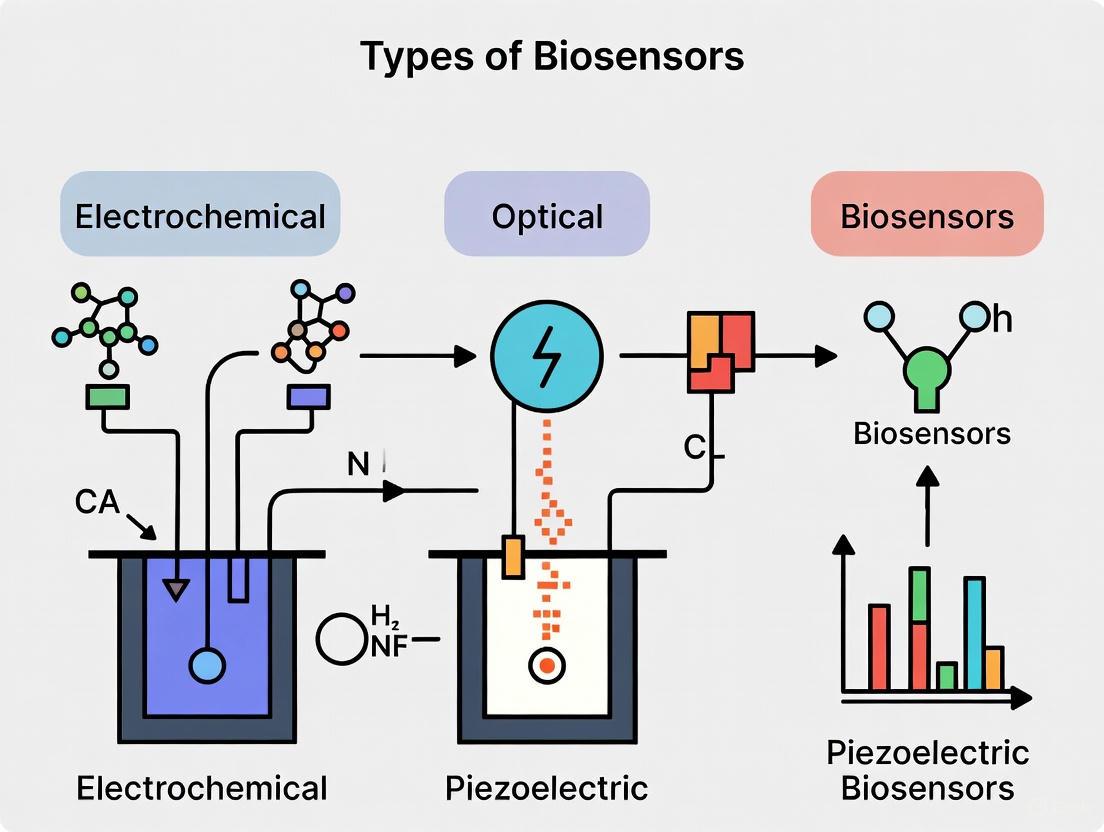
This article provides a comprehensive analysis of the three primary biosensor types—electrochemical, optical, and piezoelectric—tailored for researchers and drug development professionals.
Electrochemical, Optical, and Piezoelectric Biosensors: A Guide for Biomedical Research and Development
Abstract
This article provides a comprehensive analysis of the three primary biosensor types—electrochemical, optical, and piezoelectric—tailored for researchers and drug development professionals. It explores the fundamental principles and components of each technology, details their methodological applications in infectious disease, chronic condition monitoring, and drug discovery, addresses key challenges and optimization strategies including AI integration and nanotechnology, and offers a comparative validation against traditional diagnostic methods. The content synthesizes current market trends and scientific advancements to serve as a foundational resource for the development of next-generation diagnostic tools.
Core Principles and Components of Biosensing Technologies
A biosensor is an integrated analytical device that converts a biological response into a measurable electrical signal [1]. This sophisticated technology combines a biological sensing element with a physical transducer to detect and quantify biological or chemical substances with high specificity and sensitivity [2]. The fundamental concept was pioneered by Professor Leland C. Clark Jr., who is widely regarded as the father of biosensors for his groundbreaking work on oxygen electrodes in 1956 and subsequent development of the first functional enzyme electrode for glucose detection in 1962 [3]. Biosensors have evolved significantly through multiple generations, from early mediator-less systems to modern approaches incorporating nanomaterials and artificial mediators to enhance analytical performance [3].
The significance of biosensors extends across numerous fields, including medical diagnostics, environmental monitoring, food quality control, and biotechnology [2]. In healthcare, they enable rapid disease diagnosis and continuous monitoring of physiological parameters, while in environmental science, they detect contaminants and pathogens with remarkable precision. The global biosensor market continues to expand as technological advancements improve their capabilities, making them increasingly indispensable in both developed and resource-limited settings [4].
Core Components of a Biosensor
Every biosensor operates through the coordinated function of three fundamental components that form the essential triad: the bioreceptor, transducer, and signal processor. This integrated system transforms a biological recognition event into a quantifiable output that users can interpret.
Bioreceptor
The bioreceptor is the biological recognition element that selectively interacts with the target analyte (the substance of interest) [3]. It consists of a biologically derived or biomimetic material that possesses specific binding affinity or catalytic activity toward the analyte [1]. The bioreception process generates a physiological change that initiates the sensing mechanism.
Common types of bioreceptors include:
- Enzymes: Biological catalysts that convert specific substrates into products; for example, glucose oxidase is used in glucose biosensors to catalyze the oxidation of glucose [1] [3].
- Antibodies: Proteins that recognize and bind to specific antigens with high specificity, forming the basis of immunosensors used in medical diagnostics like pregnancy tests that detect human chorionic gonadotropin (hCG) protein [1].
- Nucleic acids (DNA or RNA): Sequences that hybridize with complementary strands, enabling genetic detection [3].
- Cells and microorganisms: Whole biological units that respond to environmental changes or specific analytes [2].
- Aptamers: Engineered oligonucleotides or peptides that bind specific targets with antibody-like specificity [3].
The bioreceptor must be carefully selected and immobilized to maintain its stability and functionality while ensuring direct contact with the transducer element [2].
Transducer
The transducer serves as the signal conversion unit, transforming the biological recognition event into a measurable signal [1]. When the analyte interacts with the bioreceptor, the resulting physicochemical changes (such as heat evolution, light absorption, electron transfer, or mass change) are detected by the transducer and converted into an electrical signal [1] [2].
Transducers are categorized based on their operating principles:
- Electrochemical transducers: Detect changes in electrical properties due to biochemical reactions, including:
- Optical transducers: Utilize light-based detection methods such as absorption, fluorescence, luminescence, or surface plasmon resonance [1] [2].
- Piezoelectric transducers: Operate on acoustic principles, detecting mass changes through frequency variations in quartz crystal microbalances (QCM) or surface acoustic wave (SAW) devices [2].
- Calorimetric transducers: Measure heat produced or absorbed during biochemical reactions [1].
The transducer's performance directly determines key sensor parameters including sensitivity, detection limit, and dynamic range [3].
Signal Processor
The signal processor comprises the electronic systems that amplify, process, and convert the transduced signal into a user-interpretable format [1] [3]. This component typically includes amplification circuits to enhance weak signals, analog-to-digital converters for digital processing, and microprocessors that apply algorithms to quantify the signal relative to analyte concentration [2].
The processed information is then displayed through an interface such as a digital readout, graphical representation, or simple positive/negative indicator [3]. In modern biosensors, signal processors may incorporate sophisticated data analysis techniques, including machine learning algorithms for colorimetric biosensors that analyze color variations in different color spaces (RGB, CMYK, HSB/HSL) to improve quantification accuracy [5]. Advanced systems may also transmit data wirelessly to other devices for remote monitoring and data storage [4].
Figure 1: Core operational workflow of a biosensor showing the sequential process from analyte recognition to signal readout.
Classification and Types of Biosensors
Biosensors are systematically categorized based on their transduction mechanisms and biological recognition elements. Understanding these classifications helps researchers select appropriate biosensor types for specific applications. The primary classification is according to the transducer technology, which significantly influences the sensor's performance characteristics and suitable use cases.
Table 1: Fundamental Biosensor Types Based on Transduction Mechanism
| Transducer Type | Working Principle | Measurable Parameters | Key Applications |
|---|---|---|---|
| Electrochemical [2] | Measures electrical changes from biochemical reactions | Current (amperometric), potential (potentiometric), impedance (impedimetric) | Glucose monitoring (diabetes management), environmental pollutants, point-of-care testing |
| Optical [2] | Detects light-based interactions | Absorption, fluorescence, luminescence, reflectance | Infectious disease detection, cancer biomarkers, environmental pollutants, foodborne pathogens |
| Piezoelectric [2] | Measures mass changes via acoustic principles | Frequency, resonance | Protein, hormone, and nucleic acid detection; drug discovery; food quality control |
| Calorimetric [1] | Detects heat changes from reactions | Temperature, heat flux | Enzyme activity monitoring, metabolic studies |
Electrochemical Biosensors
Electrochemical biosensors represent the largest and most commercially successful category of biosensors [2]. These devices incorporate a biological recognition element integrated with an electrochemical transducer that converts the biological response into an electrical signal [3]. The first generation of these biosensors operated without mediators, where the products of enzymatic reactions diffused to the transducer surface [3]. Subsequent generations incorporated artificial mediators and nanomaterials to enhance electron transfer efficiency and overall performance [3].
A prominent example is the amperometric glucose biosensor, which utilizes the enzyme glucose oxidase to catalyze glucose oxidation while using electrons to reduce the flavin adenine dinucleotide (FAD) component of the enzyme to FADH₂ [1]. The electrode then reoxidizes FADH₂ in several steps, generating a current proportional to glucose concentration [1]. This principle has been successfully adapted for continuous glucose monitoring systems that help millions of diabetes patients manage their blood sugar levels [5].
Optical Biosensors
Optical biosensors utilize various light properties to detect and quantify analytes through phenomena such as absorption, fluorescence, reflectance, or light scattering [2]. These platforms enable highly sensitive, multiplexed detection of multiple analytes by employing different monitoring wavelengths and parameters including wavelength shifts, intensity changes, spectral distribution, or light polarity [2].
Recent advances include genetically encoded fluorescent biosensors (GEFBs) that incorporate fluorescent proteins (FPs) whose properties change in response to specific stimuli [6]. These include Förster resonance energy transfer (FRET)-based sensors like ABACUS for abscisic acid, where analyte binding induces conformational changes that alter energy transfer between donor and acceptor fluorescent proteins [6]. Another category includes intrinsic sensors like roGFP, where the fluorescent protein itself changes its spectral properties in response to stimuli such as redox potential [6]. Optical biosensors have found significant applications in medical diagnostics for detecting infectious diseases, cancer biomarkers, and genetic disorders [2].
Piezoelectric Biosensors
Piezoelectric biosensors operate on mass-based detection principles using acoustic wave technology [2]. These systems employ piezoelectric materials that generate electrical signals in response to applied mechanical forces [2]. Sensor modules attached to piezoelectric surfaces facilitate interactions between analytes and sensing molecules, generating mechanical vibrations that translate to measurable electrical signals proportional to analyte mass [2].
Common implementations include quartz crystal microbalances (QCM) and surface acoustic wave (SAW) devices, which function as mass-to-frequency transducers [2]. These platforms are particularly valuable for detecting and quantifying various biomarkers in clinical samples, including proteins, hormones, nucleic acids, and infectious agents [2]. Additional applications span drug discovery, environmental monitoring, and food quality control, where label-free detection provides significant advantages [2].
Figure 2: Classification of biosensors based on transduction mechanisms, showing main categories and subtypes.
Advanced Developments and Nanostructured Materials
The integration of nanomaterials has revolutionized biosensor technology, addressing key challenges in signal capture, transduction efficiency, and detection limits [3]. Nanostructured materials ranging from zero- to three-dimensional configurations offer exceptional properties including high surface-to-volume ratios, enhanced conductivity, mechanical robustness, and color tunability that significantly improve biosensor performance [3].
Nanomaterial-Enhanced Biosensors
Various nanomaterials have been successfully incorporated into biosensing platforms, each contributing unique advantages:
Nanoparticles (NPs): Noble metal and metal oxide nanoparticles provide high stability and carrier capacity, enhancing signal amplification and catalytic activity [3]. Gold nanoparticles, in particular, have been widely utilized for their excellent biocompatibility and surface functionalization properties.
Carbon Nanotubes (CNTs): These tubular carbon structures offer exceptionally large surface areas coupled with high electrical and thermal conductivity, making them ideal for electrochemical sensing applications [3]. Both single-walled and multi-walled CNTs have been employed to improve electron transfer kinetics and biomolecule immobilization.
Quantum Dots (QDs): Semiconductor nanocrystals with size-tunable fluorescence emissions enable highly sensitive optical detection with multiplexing capabilities [3]. Their color variability and photostability make them superior to traditional fluorescent dyes for many applications.
Nanowires (NWs) and Nanorods (NRs): These one-dimensional nanostructures provide high detection sensitivity due to their dimensional compatibility with biological molecules and pronounced field-effect properties [3].
Nanozymes in Biosensing
A significant advancement in nanobiosensing is the development of nanozymes—functional nanomaterials that mimic enzymatic activity [5]. First recognized in 2004, nanozymes demonstrate intrinsic peroxidase-like activity and offer remarkable advantages including tunable catalytic activity, controllable synthesis, exceptional environmental stability, ease of modification, and cost-effective large-scale production [5]. These artificial enzymes have been applied in chemical sensors and biosensors for colorimetric detection of diverse targets including pH, ions, H₂O₂, glucose, viruses, bacteria, cancer cells, and pesticides [5].
In glucose monitoring, nanozyme-based colorimetric biosensors have shown particular promise for noninvasive applications using body fluids such as sweat, tears, and saliva [5]. These systems often employ machine learning algorithms for quantitative analysis, including convolutional neural networks (CNN), artificial neural networks (ANN), and support vector machines (SVM) to interpret color variations in different color spaces and mitigate environmental interference [5].
Table 2: Nanomaterials Used in Advanced Biosensors and Their Functions
| Nanomaterial | Key Properties | Primary Functions in Biosensors |
|---|---|---|
| Gold Nanoparticles [3] | High stability, good biocompatibility, surface plasmon resonance | Signal amplification, biomolecule immobilization, colorimetric detection |
| Carbon Nanotubes [3] | Large surface area, high electrical conductivity | Electron transfer enhancement, biomolecule support matrix |
| Quantum Dots [3] | Size-tunable fluorescence, photostability | Fluorescent labeling, multiplexed detection |
| Graphene Oxide [5] | High surface area, quenched fluorescence | Sensing platform, fluorescence resonance energy transfer (FRET) acceptor |
| Magnetic Nanoparticles [3] | Superparamagnetism, biocompatibility | Target separation, signal enhancement |
| Polymer-coated Nanoparticles [5] | Tunable surface chemistry, stability | Enzyme mimics (nanozymes), catalytic detection |
Experimental Protocols and Methodologies
Development of Glucose Biosensors
The development of biosensors follows a systematic approach involving careful selection of biological elements, immobilization methods, transducer design, and integration into a functional device [2]. The glucose biosensor serves as an exemplary model to illustrate these development protocols.
Bioreceptor Selection and Immobilization: Glucose biosensors typically employ the enzyme glucose oxidase (GOx) as the bioreceptor [1] [5]. This enzyme specifically catalyzes the oxidation of β-D-glucose to D-glucono-1,5-lactone while simultaneously reducing molecular oxygen to hydrogen peroxide [1]. The enzyme must be properly immobilized near the transducer surface while maintaining its catalytic activity. Common immobilization techniques include:
- Physical adsorption onto transducer surfaces
- Covalent bonding using cross-linking agents such as glutaraldehyde
- Entrapment within polymer matrices or membrane structures
- Encapsulation in sol-gel composites
Transducer Integration and Signal Generation: In electrochemical glucose biosensors, the transducer typically consists of a three-electrode system (working, reference, and counter electrodes) patterned on a flexible substrate such as polyethylene terephthalate (PET) [4]. As glucose oxidase catalyzes substrate oxidation, it uses two electrons to reduce FAD (a component of the enzyme) to FADH₂ [1]. The electrode then reoxidizes FADH₂ through multiple steps, generating a current proportional to glucose concentration [1]. In this configuration, the electrode serves as the transducer while the enzyme functions as the bioreceptor [1].
Performance Optimization: Key parameters optimized during development include:
- Sensitivity: Current output per unit glucose concentration
- Linear range: Concentration range over which response remains linear
- Response time: Duration to reach 95% of steady-state signal
- Selectivity: Minimal interference from similar molecules (e.g., ascorbic acid, uric acid)
- Stability: Operational and storage lifetime
Colorimetric Nanozyme-Based Glucose Detection
Recent protocols have incorporated nanozymes for colorimetric glucose detection in noninvasive applications [5]. The methodology typically involves:
Nanozyme Synthesis:
- Preparation of peroxidase-mimicking nanoparticles (e.g., cerium oxide, platinum, or carbon-based nanomaterials) through controlled chemical synthesis
- Surface functionalization to enhance stability and biocompatibility
- Characterization of catalytic activity using standard peroxidase substrates
Assay Configuration:
- Incorporation of glucose oxidase and nanozymes in a sensing matrix
- Optimization of reagent concentrations and reaction conditions
- Immobilization on appropriate substrates (polymers, paper, or textiles) for specific applications [4]
Detection and Quantification:
- Introduction of glucose-containing samples (blood, sweat, tears, or saliva)
- Enzymatic generation of H₂O₂ through glucose oxidase activity
- Nanozyme-catalyzed oxidation of chromogenic substrates (e.g., TMB, ABTS) by H₂O₂
- Color development measured visually or using digital imaging
- Application of quantification algorithms analyzing color values in RGB, CMYK, or other color spaces [5]
- Implementation of machine learning approaches for improved accuracy under varying conditions [5]
Flexible Biosensor Fabrication for Point-of-Care Testing
Flexible biosensors represent a growing area of research, particularly for wearable health monitoring applications [4]. Fabrication protocols vary based on substrate materials:
Polymer-Based Biosensors:
- Substrate selection: Polyethylene terephthalate (PET), polyethylene naphthalate (PEN), polyimide (PI), or polydimethylsiloxane (PDMS) [4]
- Electrode patterning: Screen printing, inkjet printing, or photolithography
- Bioreceptor immobilization: Surface modification followed by enzyme/antibody attachment
- Microfluidic integration: For controlled sample handling in devices like sweat sensors [4]
Paper-Based Biosensors:
- Substrate preparation: Chromatography or filter paper with defined porosity
- Hydrophobic patterning: Using wax printing or photoresist to create fluidic channels
- Reagent deposition: Spotting of recognition elements and signal generators
- Assembly: Layering and lamination for multi-analyte detection
Textile-Based Biosensors:
- Substrate functionalization: Cotton, polyester, or nylon fabrics
- Conductive element integration: Using conductive inks or threads
- Biocomponent attachment: Ensuring stability during wear and movement
Research Reagent Solutions
Successful biosensor development and implementation require specific research reagents and materials that enable precise biological recognition and efficient signal transduction. The following table outlines essential research solutions used in biosensor construction and experimentation.
Table 3: Essential Research Reagents and Materials for Biosensor Development
| Reagent/Material | Function | Application Examples |
|---|---|---|
| Glucose Oxidase [1] [5] | Biological recognition element | Glucose biosensors for diabetes management |
| Nanozymes (e.g., Cerium oxide, Platinum nanoparticles) [5] | Enzyme mimics for signal generation | Colorimetric detection, noninvasive glucose monitoring |
| Fluorescent Proteins (e.g., GFP, edCerulean, edCitrine) [6] [7] | Optical signal generation | Genetically encoded fluorescent biosensors (GEFBs), FRET-based sensors |
| Gold Nanoparticles [3] | Signal amplification, colorimetric detection | Lateral flow assays, electrochemical enhancement |
| Carbon Nanotubes [3] | Electron transfer enhancement | Electrochemical biosensors, conductive composites |
| Quantum Dots [3] | Fluorescent labeling | Optical biosensors, multiplexed detection |
| Polymer Substrates (PET, PEN, PDMS) [4] | Flexible support material | Wearable biosensors, microfluidic devices |
| Chromogenic Substrates (TMB, ABTS) [5] | Color development in presence of catalysts | Colorimetric detection, nanozyme-based assays |
Applications in Research and Healthcare
Biosensors have enabled significant advancements across multiple disciplines, with particularly transformative impacts in healthcare, environmental monitoring, and biomedical research. Their ability to provide rapid, sensitive, and specific detection of analytes makes them invaluable tools for both fundamental investigations and practical applications.
In medical diagnostics, biosensors facilitate disease detection, therapeutic monitoring, and health management [1] [4]. Continuous glucose monitoring systems for diabetes patients represent the most successful commercial application, with electrochemical biosensors tracking blood glucose levels to inform insulin administration [1] [5]. Beyond glucose monitoring, biosensors detect specific proteins, hormones, and nucleic acids for conditions ranging from infectious diseases to cancer, enabling early diagnosis and improved treatment outcomes [2]. Pregnancy tests that detect human chorionic gonadotropin (hCG) protein in urine demonstrate the practical implementation of antibody-based biosensors in over-the-counter diagnostics [1].
Environmental monitoring represents another significant application area, where biosensors detect contaminants including pesticides, heavy metals, and toxic metabolites in water sources and ecosystems [1]. The portability and field-deployable nature of many biosensor platforms enables on-site analysis without the need for complex laboratory infrastructure, providing rapid assessment of environmental quality and contamination events [2].
In research settings, genetically encoded fluorescent biosensors (GEFBs) have revolutionized the study of biological processes by enabling real-time visualization of molecular dynamics in living cells and organisms [6] [7]. These tools allow researchers to quantify concentrations of ions, sugars, peptides, ATP, reactive oxygen species, and phytohormones with high spatiotemporal resolution [7]. For example, FRET-based biosensors like ABACUS and MatryoshCaMP6s have provided unprecedented insights into hormone signaling and calcium dynamics in plant and animal systems [6] [7].
The recent COVID-19 pandemic has highlighted the critical importance of point-of-care testing (POCT) systems, where biosensors offer significant advantages including small sample requirements, user-friendly operation, and rapid results without sophisticated instrumentation [4]. Flexible biosensors incorporating polymer, paper, or textile substrates show particular promise for wearable health monitoring applications, enabling continuous physiological assessment without restricting user mobility [4].
Future Perspectives and Challenges
Despite significant advancements, biosensor technology continues to face several challenges that drive ongoing research and development efforts. Key areas of focus include improving stability and longevity of biological recognition elements, enhancing sensitivity and detection limits for trace analytes, reducing interference from complex sample matrices, and enabling reliable multiplexed detection of multiple analytes simultaneously [3].
Future developments will likely focus on several promising directions:
- Multiplexed sensing platforms capable of simultaneously monitoring multiple biomarkers for comprehensive health assessment [4]
- Advanced nanomaterials with tailored properties for specific sensing applications [3]
- Closed-loop systems that integrate detection with therapeutic intervention, such as artificial pancreas devices for diabetes management [5]
- Noninvasive monitoring technologies utilizing alternative body fluids including sweat, tears, saliva, and interstitial fluid [5] [4]
- Intelligent biosensors incorporating machine learning algorithms for improved data analysis and interpretation [5]
- Miniaturized and implantable devices for continuous long-term monitoring of chronic conditions [3]
The convergence of biosensor technology with advances in materials science, nanotechnology, artificial intelligence, and wireless communications promises to yield increasingly sophisticated monitoring systems that will transform healthcare, environmental protection, and fundamental biological research in the coming decades.
Electrochemical biosensors are analytical devices that integrate a biological recognition element with an electrochemical transducer to convert a biological interaction into a quantifiable electrical signal [8] [9]. These biosensors are characterized by their analytical simplicity, portability, and cost-effectiveness, making them exceptionally suitable for point-of-care diagnostics, environmental monitoring, and food safety applications [8] [10]. The core principle involves the detection of specific analytes—such as pathogens, DNA, cancer biomarkers, or small molecules—through changes in the electrical properties at the electrode-solution interface when a biological recognition event occurs [11]. This process hinges on the immobilization of biorecognition elements (e.g., enzymes, antibodies, DNA strands) onto the conductor or semiconductor electrode surface, which, upon binding with the target analyte, instigates a physicochemical change measurable as current, voltage, or impedance [11].
The significance of electrochemical biosensors within the broader biosensor landscape—which includes optical and piezoelectric varieties—lies in their distinct operational advantages. Unlike optical biosensors that often require complex instrumentation and labels, or piezoelectric biosensors that measure mass changes, electrochemical biosensors offer a direct, label-free route to monitor biointeractions with instrumental simplicity and high sensitivity [8] [12]. Their mechanism is fundamentally governed by the principles of current, voltage, and impedance measurement, each providing a unique window into the kinetics and thermodynamics of biological binding events. The ensuing sections will delve into the specific principles, measurement techniques, and experimental protocols that underpin these powerful analytical tools.
Core Measurement Principles and Transduction Mechanisms
The operational foundation of electrochemical biosensors rests on tracking modifications in electrical parameters at the electrode surface resulting from biorecognition events. These changes are transduced into measurable signals through several primary mechanisms.
Voltammetric and Amperometric Principles (Current Measurement)
Voltammetric and amperometric biosensors function by measuring Faradaic current arising from the electrolysis caused by electrochemical oxidation or reduction of an electroactive species at the working electrode [8]. The key distinction lies in the applied potential profile. In voltammetry, the applied potential is varied over time (ramped), and the resulting current is measured [8]. Common voltammetric techniques include cyclic voltammetry (CV), linear sweep voltammetry, square wave voltammetry, and differential pulse voltammetry [8]. In contrast, amperometry involves applying a constant potential and measuring the steady-state current [8]. The measured current is directly proportional to the concentration of the electroactive species, which can be the target analyte itself or a redox probe whose electron transfer is modulated by the biorecognition event. Enzymes are frequently employed as biological elements in these sensors to catalyze reactions that produce or consume electroactive species, thereby amplifying the signal and enhancing sensitivity [8]. For instance, the pioneering glucose biosensor relies on the enzyme glucose oxidase to produce hydrogen peroxide, which is then amperometrically detected [10].
Potentiometric Principles (Voltage Measurement)
Potentiometric biosensors measure the accumulation of an electrical charge at the electrode surface under conditions of negligible current flow [8]. This is achieved using an electrochemical cell with two reference electrodes, often ion-selective electrodes (ISEs) [8]. The core measurable is the potential difference (electromotive force, EMF) between the indicator and reference electrodes, which relates to the analyte concentration via the Nernst equation [13]:
E_cell = E⁰_cell - (RT/nF) ln Q
where E_cell is the measured cell potential, E⁰_cell is the standard cell potential, R is the gas constant, T is the temperature, n is the number of electrons transferred, F is the Faraday constant, and Q is the reaction quotient [13]. In biosensing, enzymes are commonly used to catalyze reactions that generate or consume ions (e.g., H⁺, NH₄⁺), leading to a detectable potential shift in the surrounding medium [8]. These sensors boast advantages such as small size, rapid response, and resistance to color or turbidity interferences in samples [8].
Impedimetric Principles (Impedance Measurement)
Impedimetric biosensors utilize Electrochemical Impedance Spectroscopy (EIS) to probe the electrical resistance and capacitance of the electrode-electrolyte interface [8] [13] [14]. EIS operates by applying a small-amplitude sinusoidal AC potential excitation across a frequency range and measuring the current response [13] [14]. The impedance (Z), which is the extended concept of resistance to AC circuits, is calculated as the ratio of the voltage to the current. In a linear system, the current response will be a sinusoid of the same frequency but shifted in phase (Φ) [13] [14]. This relationship is captured by:
Z = E/I = Z₀ exp(jΦ) = Z₀ (cosΦ + j sinΦ)
where Z₀ is the magnitude and Φ is the phase shift [13]. The impedance can be broken down into a real part (Z_real, resistance) and an imaginary part (Z_imag, capacitive reactance) [14].
EIS can be performed in two primary modes. In Faradaic EIS, a redox probe like [Fe(CN)₆]³⁻/⁴⁻ is added, and the electron transfer resistance (R_ct) is monitored. A binding event on the electrode surface typically hinders electron transfer, increasing R_ct [8] [14]. In non-Faradaic EIS, no redox couple is used; instead, the sensor monitors changes in the electrical double-layer capacitance (C_dl) caused by the target binding, which alters the dielectric properties or thickness of the interfacial layer [8] [14]. EIS is a powerful, label-free technique sensitive to surface phenomena, making it ideal for monitoring binding events in real-time without the need for labels [8] [13].
Table 1: Comparison of Core Electrochemical Biosensor Measurement Principles
| Measurement Type | Measured Quantity | Applied Excitation | Key Principles | Common Techniques |
|---|---|---|---|---|
| Voltammetric/Amperometric | Current | Varied (Voltammetry) or Constant (Amperometry) Potential | Measurement of Faradaic current from redox reactions; current proportional to analyte concentration [8]. | Cyclic Voltammetry (CV), Differential Pulse Voltammetry, Amperometry [8]. |
| Potentiometric | Potential (Voltage) | Zero (or negligible) Current | Measurement of charge accumulation at electrode; potential related to concentration via Nernst equation [8] [13]. | Ion-Selective Electrodes (ISEs) [8]. |
| Impedimetric | Impedance (Z) | Sinusoidal AC Potential | Measurement of resistive and capacitive properties of electrode interface; sensitive to surface binding events [8] [13] [14]. | Electrochemical Impedance Spectroscopy (EIS) [8]. |
Diagram 1: Core signaling pathways and logical relationships in electrochemical biosensing, showing how a biorecognition event is transduced and measured via different electrical principles to yield a quantitative output.
Experimental Protocols for Key Measurements
Implementing electrochemical biosensing requires meticulous experimental design, from electrode modification to final signal measurement. Below are generalized protocols for key measurement techniques.
Electrode Modification and Preparation
The foundation of a sensitive and specific biosensor is a properly functionalized electrode. A typical workflow for a gold electrode is as follows:
- Electrode Pre-treatment: Clean the bare gold electrode with alumina slurry (e.g., 0.05 µm) on a microcloth, followed by sequential sonication in ethanol and deionized water for 2-5 minutes each to remove adsorbed particles [14].
- Surface Characterization: Perform Cyclic Voltammetry (CV) in a 5 mM K₃[Fe(CN)₆]/K₄[Fe(CN)₆] solution containing 0.1 M KCl. Scan between -0.2 V and +0.6 V (vs. Ag/AgCl) at a scan rate of 50 mV/s. A reversible redox peak is indicative of a well-cleaned surface.
- Formation of a Self-Assembled Monolayer (SAM): Immerse the clean electrode in a 1-10 mM solution of a thiolated molecule (e.g., 6-mercapto-1-hexanol or a carboxy-terminated alkanethiol) for 12-24 hours to form a dense, organized SAM [8].
- Biorecognition Element Immobilization: For a carboxy-terminated SAM, activate the carboxyl groups with a mixture of EDC (1-ethyl-3-(3-dimethylaminopropyl)carbodiimide) and NHS (N-hydroxysuccinimide) for 15-30 minutes. Then, incubate the electrode with a solution containing the biorecognition element (e.g., antibody, DNA probe) for 1-2 hours, allowing for stable amide bond formation.
- Surface Blocking: To minimize non-specific adsorption, block the remaining active sites on the electrode surface by incubating with a blocking agent such as Bovine Serum Albumin (BSA, 1% w/v) or ethanolamine for 30-60 minutes.
Protocol for Faradaic Impedimetric Detection
This protocol is widely used for label-free detection of pathogens, DNA, and proteins [8] [14] [11].
- Baseline Measurement: After electrode modification and blocking, record the EIS spectrum in a solution containing a redox probe (e.g., 5 mM [Fe(CN)₆]³⁻/⁴⁻ in 0.1 M PBS, pH 7.4). The applied AC potential amplitude is typically 5-10 mV, with a frequency range from 0.1 Hz to 100,000 Hz at the open-circuit potential.
- Target Incubation: Expose the functionalized electrode to the sample solution containing the target analyte (e.g., pathogen, cancer biomarker) for a defined period (e.g., 15-60 minutes) at room temperature.
- Post-Incubation Measurement: Gently rinse the electrode with buffer to remove unbound species. Record the EIS spectrum again in the fresh redox probe solution under identical parameters.
- Data Analysis: Fit the obtained EIS data (commonly represented in a Nyquist plot, where
-Z_imagis plotted againstZ_real) to an appropriate equivalent circuit model. The Randles circuit (with components for solution resistanceR_s, charge transfer resistanceR_ct, constant phase elementCPE, and Warburg impedanceW) is frequently used [13] [14]. The primary analytical signal is the increase inR_ctdue to the insulating layer formed by the target binding, which hinders electron transfer of the redox probe. The change inR_ctis proportional to the target concentration.
Protocol for Voltammetric Detection
Voltammetric techniques are powerful for detecting electroactive species or reactions facilitated by enzymes.
- Electrode Preparation: Modify the electrode with the biorecognition element as described in Section 3.1.
- Baseline Measurement (Optional): Perform a CV scan in pure buffer to establish the background current.
- Target Incubation and Reaction: Incubate the electrode with the target analyte. In enzyme-based sensors, this step leads to the production of an electroactive product (e.g., H₂O₂ from oxidase enzymes).
- Signal Measurement: Transfer the electrode to a clean electrochemical cell containing buffer. For direct detection of a product like H₂O₂, Amperometry (a subset of voltammetry) can be performed by applying a constant potential (e.g., +0.7 V vs. Ag/AgCl for H₂O₂ oxidation) and recording the steady-state current. Alternatively, Differential Pulse Voltammetry (DPV) can be used by applying a series of potential pulses with increasing baseline potential and measuring the current just before the pulse is reversed. The peak current in DPV is highly sensitive and proportional to the concentration of the electroactive species.
Table 2: Key Experimental Parameters for Different Electrochemical Techniques
| Technique | Key Instrument Parameters | Primary Output Signal | Data Representation | Typical Analytical Use | ||
|---|---|---|---|---|---|---|
| Cyclic Voltammetry (CV) | Scan Rate (e.g., 50 mV/s), Potential Window | Current vs. Potential | Voltammogram (I-E curve) | Assessing electrode reversibility, studying reaction mechanisms [11]. | ||
| Electrochemical Impedance Spectroscopy (EIS) | AC Amplitude (e.g., 10 mV), Frequency Range (e.g., 0.1 Hz - 100 kHz) | Impedance (Z) & Phase (Φ) vs. Frequency | Nyquist Plot (-Zimag vs Zreal) or Bode Plot ( | Z | & Φ vs log f) [13] [14]. | Label-free detection of binding events, surface characterization [8] [14]. |
| Amperometry | Constant Applied Potential | Current vs. Time | Chronoamperogram (I-t curve) | Detection of electroactive products from enzymatic reactions (e.g., glucose sensing) [8] [11]. |
Essential Research Reagent Solutions and Materials
The development and operation of high-performance electrochemical biosensors rely on a suite of specialized reagents and materials. The selection of these components is critical for ensuring sensor sensitivity, specificity, and stability.
Table 3: Key Research Reagent Solutions and Materials for Electrochemical Biosensors
| Item Name | Function/Explanation | Example Use Cases |
|---|---|---|
| Screen-Printed Electrodes (SPEs) | Disposable, mass-producible electrodes integrating working, reference, and counter electrodes. Enable portability and miniaturization of biosensing platforms [8]. | Point-of-care testing, field deployment [8]. |
| Redox Probes (e.g., [Fe(CN)₆]³⁻/⁴⁻) | Electroactive molecules used in Faradaic EIS and voltammetry. Their electron transfer efficiency is modulated by binding events on the electrode surface, providing the measurable signal [8] [13]. | Charge transfer resistance (Rct) measurement in impedimetric immunosensors [8] [14]. |
| EDC/NHS Crosslinkers | Carbodiimide chemistry reagents used to activate carboxyl groups on electrode surfaces for covalent immobilization of biomolecules (e.g., antibodies, DNA) containing primary amine groups [11]. | Immobilization of biorecognition elements on SAM-modified gold or carbon electrodes [11]. |
| Thiolated Molecules (Alkanethiols) | Form Self-Assembled Monolayers (SAMs) on gold surfaces, providing a well-ordered, tunable interface for subsequent biomolecule attachment and for minimizing non-specific binding [8]. | Creating a bifunctional SAM on gold electrodes for probe immobilization [8]. |
| Blocking Agents (e.g., BSA, Ethanolamine) | Used to passivate unreacted active sites on the modified electrode surface after biorecognition element immobilization. This step is crucial for reducing background noise from non-specific adsorption of non-target molecules [11]. | Improving specificity in immunosensors and DNA sensors [11]. |
Diagram 2: Experimental workflows for EIS and Voltammetry, outlining the key steps from signal application to data analysis.
Electrochemical biosensors, founded on the robust principles of current, voltage, and impedance measurement, represent a cornerstone of modern analytical technology. The versatility of voltammetric, potentiometric, and impedimetric techniques provides researchers with a powerful toolkit for developing sensitive, specific, and label-free detection assays for a vast array of targets, from pathogens and DNA to disease biomarkers. As the field progresses, the integration of advanced nanomaterials, sophisticated data analysis techniques like machine learning, and the development of fully integrated, automated platforms will further solidify the role of electrochemical biosensors in advancing point-of-care diagnostics, personalized medicine, and environmental monitoring [10] [9]. Their unique position within the biosensor spectrum—bridging high performance with instrumental simplicity—ensures they will remain at the forefront of sensing technology for years to come.
Optical biosensors represent a powerful class of analytical devices that transform a biological recognition event into a quantifiable optical signal, enabling the highly sensitive, specific, and often label-free detection of chemical and biological substances [15]. These devices integrate a biorecognition element (such as an enzyme, antibody, nucleic acid, or whole cell) with an optical transducer system that leverages the fundamental interactions between light and matter [15] [16]. The operational principle hinges on detecting changes in the properties of light—including its intensity, phase, polarization, wavelength, or spectral distribution—that occur when the bioreceptor interacts with the target analyte [2]. These measurable changes can manifest as alterations in the refractive index at a sensor surface, the absorbance of specific light wavelengths by the analyte, or the scattering of light by particles or molecular complexes [15].
The significant advantage of optical biosensors lies in their ability to provide real-time, quantitative information on binding kinetics and analyte concentration without the need for extensive sample preparation or molecular labels in many configurations [15] [17]. This capability, combined with their high sensitivity and potential for miniaturization, has positioned optical biosensors as indispensable tools across diverse fields. Applications span from drug discovery and therapeutic drug monitoring to clinical diagnostics, environmental monitoring, and food safety [15] [17] [18]. The technological evolution of these sensors is further propelled by multidisciplinary advances in microelectronics, microelectromechanical systems (MEMS), micro/nano-technologies, and nanomaterial integration, which collectively enhance their performance, robustness, and accessibility for point-of-care testing [15] [19] [20].
Foundational Optical Phenomena in Biosensing
Refractive Index-Based Sensing
Refractive index (RI) sensing forms the cornerstone of many label-free optical biosensors. This methodology detects analytes by measuring changes in the local refractive index induced by the binding of biomolecules to the functionalized sensor surface [21]. The most prominent technique in this category is Surface Plasmon Resonance (SPR). SPR exploits the evanescent wave phenomenon, where photons from polarized light, under conditions of total internal reflection, are converted into surface plasmons—coherent oscillations of free electrons at a metal-dielectric interface [15] [17]. The resonance condition, which is highly sensitive to changes in the refractive index within the evanescent field (typically extending hundreds of nanometers from the surface), is monitored in real time [15] [21]. When biomolecules bind to the surface, the resulting increase in mass density alters the refractive index, causing a shift in the resonance angle or wavelength, which is directly proportional to the bound mass [15] [17]. This allows for the detailed determination of association and dissociation kinetics (kon, koff) and the equilibrium dissociation constant (KD) for molecular interactions [17].
A related phenomenon, Localized Surface Plasmon Resonance (LSPR), occurs on metallic nanoparticles rather than continuous thin films. The LSPR condition depends on the nanoparticles' size, shape, composition, and the local dielectric environment [21]. Binding events near the nanoparticle surface cause shifts in the LSPR extinction peak, enabling highly sensitive detection with simpler instrumentation than traditional SPR [21]. Other refractive index-based sensing platforms include interferometers (e.g., Mach-Zehnder Interferometer (MZI)), ring resonators, and photonic crystal cavities, all of which transduce a refractive index change into a measurable shift in an optical signal, such as an interference pattern or resonance wavelength [20] [21].
Absorbance and Fluorescence-Based Sensing
Sensing modalities based on absorbance (or colorimetry) and fluorescence rely on the direct interaction of light with the analyte or with a label that reports on the presence of the analyte. Absorbance-based biosensors measure the attenuation of light at specific wavelengths as it passes through a sample, which occurs due to the analyte's intrinsic ability to absorb light or due to a chromogenic reaction (e.g., an enzyme-linked reaction that produces a colored product) [19] [22]. The intensity of the color developed, measured by absorbance, is quantitatively related to the analyte concentration. This principle is widely employed in microfluidic paper-based analytical devices (μPADs) and portable point-of-care tests because the results can often be read with the naked eye or a simple smartphone camera, making the technology highly accessible and cost-effective [19].
Fluorescence-based biosensors, on the other hand, depend on the emission of light from a fluorophore after it has been excited by a higher energy light source [19] [22]. The presence or concentration of the analyte can modulate the fluorescence signal by affecting the fluorophore's intensity, lifetime, or spectral shift. The analyte might be intrinsically fluorescent, or it can be detected using a fluorescently labeled biorecognition element (e.g., a tagged antibody). In some advanced formats, the binding event itself influences the fluorophore's environment, leading to changes in the signal without physical separation steps. Fluorescence detection is renowned for its exceptionally high sensitivity, capable of detecting single molecules under ideal conditions, which makes it suitable for detecting low-abundance biomarkers [22].
Scattering-Based Sensing
Scattering-based biosensors utilize the elastic or inelastic scattering of light to identify and quantify analytes. Elastic scattering, such as Rayleigh scattering, occurs when light is scattered by particles or molecules without a change in wavelength. The intensity and direction of the scattered light provide information about the size, shape, and concentration of the scattering particles. This principle can be harnessed to detect larger complexes, such as viruses or aggregates, formed during a binding event [21].
A particularly powerful technique is Surface-Enhanced Raman Scattering (SERS). SERS is an inelastic scattering process where molecules adsorbed on rough metallic surfaces or nanoparticles experience a dramatic enhancement (by factors of up to 1010–1011) of their inherent Raman signal [20] [21]. Raman scattering provides a unique vibrational "fingerprint" for each molecule, allowing for highly specific multiplexed detection. The immense signal enhancement in SERS enables the detection of very low analyte concentrations, down to the single-molecule level in some cases, making it a potent tool for trace analysis in complex biological matrices [21].
Table 1: Comparison of Core Optical Biosensing Modalities
| Sensing Modality | Measured Parameter | Typical Biorecognition Elements | Key Advantages | Common Applications |
|---|---|---|---|---|
| Refractive Index (SPR/LSPR) | Resonance angle/wavelength shift [15] [17] | Antibodies, nucleic acids, proteins [15] | Label-free, real-time kinetics, high sensitivity [17] | Drug discovery, protein-protein interactions [17] |
| Absorbance (Colorimetric) | Change in light absorption/color intensity [19] | Enzymes, aptamers [19] [22] | Low cost, simple instrumentation, portable [19] | Point-of-care glucose/uric acid tests [19] |
| Fluorescence | Change in fluorescence intensity/lifetime [22] | Antibodies, aptamers, enzymes [22] | Extremely high sensitivity, multiplexing potential [22] | Pathogen detection, high-sensitivity immunoassays [22] |
| Scattering (SERS) | Intensity of inelastically scattered light [21] | Antibodies, aptamers [21] | Molecular fingerprinting, ultra-high sensitivity [21] | Trace analyte detection, chemical imaging [21] |
Quantitative Performance of Optical Biosensor Platforms
The performance of optical biosensors is quantified by several key parameters, including sensitivity, detection limit, and dynamic range. Recent advancements in nanotechnology and sensor design have led to remarkable improvements in these metrics. Sensitivity in refractive index-based sensors is often defined as the shift in resonance wavelength (nm) or angle (deg) per unit change in the refractive index of the surrounding medium (RIU) [21]. For instance, state-of-the-art SPR sensors have demonstrated sensitivities exceeding 200 deg/RIU, while advanced LSPR and interferometric sensors report wavelength sensitivities ranging from hundreds to thousands of nm/RIU [21]. The detection limit, which is the lowest concentration of an analyte that can be reliably distinguished, is a critical figure of merit. Modern optical biosensors have achieved detection limits for various biomarkers ranging from picomolar (10-12 M) to attomolar (10-18 M) concentrations, and in some specialized systems, down to the single molecule or virus particle level [21].
Table 2: Exemplary Performance Metrics of Advanced Optical Biosensor Platforms
| Technology Platform | Optical Structure | Bioassay Analyte | Detection Limit | Sensitivity | Year [Ref.] |
|---|---|---|---|---|---|
| Whispering Gallery Mode | Microtoroid | Single protein–protein interaction (~15.2 kDa) | 2.5 nm nanoparticle radius | Not Specified | 2016 [21] |
| Plasmonic Resonance (SPR) | Prism coupled | Hemoglobin and urine glucose | Not Specified | 200 deg/RIU | 2022 [21] |
| Plasmonic Resonance (SPR) | Prism coupled | Cancer biomarkers | 4.84 × 10⁻⁶ RIU | 206.26 deg/RIU | 2021 [21] |
| Photonic Crystal Array | Nanocavity | Human IgG molecules | 1.5 fg | 2.3 ± 0.24 × 10⁵ nm/M | 2011 [21] |
| Photonic Crystal Array | Ring-shaped resonators | Cancer biomarkers | Not Specified | 308.5 nm/RIU | 2023 [21] |
| Localized SPR (LSPR) | Gold Nano-islands | Anti-Dengue virus IgG | 0.08 nM (in serum) | Not Specified | 2021 [21] |
Experimental Protocols for Key Optical Biosensing Techniques
Protocol: Surface Plasmon Resonance (SPR) for Kinetic Analysis
This protocol outlines the steps to characterize the binding kinetics between a protein target immobilized on a sensor chip and a small molecule drug candidate in solution using an SPR biosensor [15] [17].
Sensor Surface Functionalization: A carboxymethylated dextran-coated gold sensor chip is activated using a mixture of N-ethyl-N'-(3-dimethylaminopropyl)carbodiimide (EDC) and N-hydroxysuccinimide (NHS). The protein target is then diluted in a suitable low-salt buffer (e.g., sodium acetate, pH 5.0) and injected over the activated surface, resulting in covalent immobilization via primary amines. Any remaining active esters are deactivated with ethanolamine. A control flow cell is subjected to the activation and deactivation process without protein to serve as a reference for nonspecific binding and bulk refractive index shifts [17].
System Preparation and Equilibration: The SPR instrument is primed with a running buffer, typically HEPES-buffered saline (HBS) or Phosphate-buffered saline (PBS). The temperature of the instrument and the sample compartment is set to a constant value (e.g., 25°C). The functionalized sensor chip is equilibrated with a continuous flow of running buffer until a stable baseline is achieved.
Ligand Binding Cycle (Association and Dissociation):
- Association Phase: A solution of the ligand (drug candidate) at a specific concentration is injected over both the target and reference surfaces at a constant flow rate. The binding reaction is monitored in real time as an increase in the SPR response (expressed in Resonance Units, RU).
- Dissociation Phase: The ligand injection is stopped, and the flow of running buffer is resumed. The dissociation of the bound complex is monitored as a decrease in the SPR signal over time.
- Surface Regeneration: After the dissociation phase, the sensor surface is regenerated by injecting a short pulse of a regeneration solution (e.g., glycine-HCl, pH 2.0-3.0) that disrupts the protein-ligand interaction without denaturing the immobilized protein. This returns the SPR signal to the baseline, making the surface ready for the next analyte injection. This cycle is repeated for a series of ligand concentrations (e.g., ranging from low nM to high μM) in a randomized order [17].
Data Analysis: The reference flow cell data is subtracted from the target flow cell data to correct for bulk refractive index changes and nonspecific binding. The resulting sensorgrams for the different concentration series are globally fitted to a suitable interaction model (e.g., 1:1 Langmuir binding) using the instrument's software to determine the association rate constant (kon), dissociation rate constant (koff), and the equilibrium dissociation constant (KD = koff/kon) [17].
Protocol: Colorimetric μPAD for Uric Acid Detection
This protocol describes the fabrication and use of a microfluidic paper-based analytical device (μPAD) with a colorimetric readout for detecting uric acid, a biomarker for gout and renal disorders [19].
μPAD Fabrication: A hydrophobic barrier pattern (e.g., channels and detection zones) is created on chromatographic paper using wax printing or wax dipping. The paper is heated to allow the wax to penetrate through its thickness, creating well-defined hydrophilic detection zones surrounded by hydrophobic boundaries [19].
Bioreceptor Immobilization: An enzyme cocktail containing the enzyme uricase and a colorimetric probe system is prepared. The probe system typically includes horseradish peroxidase (HRP) and a chromogen, such as 3,3',5,5'-Tetramethylbenzidine (TMB). The uricase enzyme catalyzes the oxidation of uric acid, producing hydrogen peroxide (H2O2) as a byproduct. The H2O2 is then used by HRP to oxidize TMB, resulting in a blue-colored product. This reagent mixture is drop-casted onto the hydrophilic detection zones of the μPAD and allowed to dry at room temperature [19].
Sample Analysis: A small volume (typically 5-10 μL) of the standard or sample (e.g., serum or urine) is applied to the sample inlet of the μPAD. The sample migrates via capillary action to the detection zone containing the dried reagents. The enzymatic reaction occurs, leading to the development of a blue color whose intensity is proportional to the uric acid concentration [19].
Signal Acquisition and Quantification: After a fixed incubation period (e.g., 5-10 minutes), the detection zone is imaged using a flatbed scanner or a smartphone camera under controlled lighting conditions. The digital image is analyzed using image processing software (e.g., ImageJ) to measure the mean intensity or RGB values of the colored spot. A calibration curve is constructed by plotting the signal intensity against known concentrations of uric acid standards, and this curve is used to determine the concentration of uric acid in unknown samples [19].
Workflow and Signaling Visualization
The following diagram illustrates the general workflow for developing and utilizing an optical biosensor, from surface functionalization to data analysis, integrating the key components and processes.
Optical Biosensor Workflow Diagram
The diagram above outlines the six critical steps in a typical optical biosensing experiment, highlighting the interplay between the operational protocol and the essential hardware components involved in each stage.
The foundational signaling principle for many label-free biosensors like SPR is the evanescent wave, as depicted in the following diagram.
Evanescent Wave Sensing Principle
This diagram illustrates the core physics behind label-free detection methods like SPR. The evanescent field probes a very small volume near the sensor surface, making the system exquisitely sensitive to changes—such as the binding of an analyte to an immobilized receptor—that alter the local refractive index.
The Scientist's Toolkit: Essential Research Reagents and Materials
The development and implementation of robust optical biosensors rely on a carefully selected set of reagents and materials. The following table details key components of the research toolkit.
Table 3: Essential Research Reagents and Materials for Optical Biosensor Development
| Item Name | Function/Description | Key Characteristic/Justification |
|---|---|---|
| Carboxymethylated Dextran Sensor Chip (e.g., CM5) | Provides a hydrogel matrix on a gold film for covalent immobilization of bioreceptors via amine coupling [17]. | Creates a hydrophilic, low non-specific binding environment that maintains protein activity and allows for high binding capacity. |
| EDC/NHS Crosslinker Kit | Activates carboxyl groups on the sensor chip surface, enabling covalent attachment of proteins and other biomolecules containing primary amines [17]. | Essential for stable, oriented immobilization of bioreceptors, which is critical for consistent assay performance and surface regeneration. |
| Anti-Mouse IgG Antibody | Used for capture-based assays, where it is immobilized to selectively bind and orient mouse monoclonal antibodies, which serve as the primary bioreceptor [17]. | Increases flexibility by allowing different mouse monoclonal antibodies to be used on the same surface without direct covalent immobilization. |
| HBS-EP+ Running Buffer | A standard buffer (HEPES pH 7.4, NaCl, EDTA, Surfactant P20) for continuous flow in SPR and other biosensors [17]. | Maintains physiological pH and ionic strength, while the surfactant minimizes non-specific binding to the sensor surface. |
| Glycine-HCl (pH 2.0-3.0) | A low-pH regeneration solution used to break the bond between the analyte and immobilized bioreceptor without permanently damaging the surface [17]. | Enables multiple uses of the same sensor surface, which is vital for kinetic screening of multiple compounds. |
| Uricase Enzyme | A critical biorecognition element in enzymatic biosensors for uric acid. It catalyzes the oxidation of uric acid, producing H2O2 [19]. | Provides high specificity for the target analyte (uric acid), enabling the development of selective colorimetric or fluorescent assays. |
| Chromogen (e.g., TMB) | A substrate that changes color upon enzymatic reduction (e.g., by HRP in the presence of H2O2) in colorimetric assays [19]. | Generates a measurable signal (absorbance change) that is easily quantified with simple optics, ideal for point-of-care devices. |
| Gold Nanoparticles (AuNPs) | Serve as transducers in LSPR biosensors and signal amplifiers in colorimetric and SERS-based assays due to their strong plasmonic properties [21]. | Their localized surface plasmon resonance is highly sensitive to the local dielectric environment, enabling ultra-sensitive detection. |
| Specific Aptamers | Synthetic single-stranded DNA or RNA molecules that bind to a specific target (proteins, small molecules) with high affinity; used as bioreceptors [22]. | Offer high stability, reusability, and ease of chemical synthesis and modification compared to traditional antibodies. |
Piezoelectric biosensors represent a prominent category of analytical devices that function by converting a mechanical resonance into a quantifiable electrical signal. These sensors are a cornerstone of modern affinity-based detection systems, enabling the direct, label-free monitoring of biointeractions in real-time. The core of this technology hinges on the piezoelectric effect, a physical phenomenon where certain anisotropic materials generate an electrical charge in response to applied mechanical stress, and conversely, undergo mechanical deformation when subjected to an electric field [23] [24]. This reversible effect allows these materials to act as highly sensitive transducers.
Within the broader taxonomy of biosensors, which includes optical and electrochemical variants, piezoelectric biosensors are primarily classified as mass-based devices [2]. Their operational principle is fundamentally governed by the relationship between the mass of a substance bound to the sensor's surface and the resultant shift in the sensor's characteristic resonant frequency. When compared to other biosensor types, such as electrochemical biosensors that measure current or potential from redox reactions, or optical biosensors that rely on changes in light properties, piezoelectric biosensors offer distinct advantages. These include the elimination of labeling reagents, simplified assay formats, and the ability to provide detailed kinetic information on binding events as they occur [12]. This direct measurement capability makes them invaluable tools for researchers and drug development professionals who require precise monitoring of molecular interactions, cellular activities, and pathogen detection.
Fundamental Principles and Theory
The operational foundation of piezoelectric biosensors is built upon well-established physical principles and equations that describe the relationship between mass adsorption and the sensor's oscillatory behavior.
The Piezoelectric Effect and Core Equations
The piezoelectric effect is exhibited by non-centrosymmetric (anisotropic) crystals, such as quartz, zinc oxide, or barium titanate [23] [24]. When an alternating voltage is applied to the electrodes coated on such a crystal, it induces high-frequency mechanical oscillations at its resonant frequency. The most critical relationship for biosensing applications is defined by the Sauerbrey equation, which quantitatively links the change in resonant frequency (Δf) to the mass (Δm) bound to the crystal surface [12] [24]:
Where:
- Δf is the measured change in resonant frequency.
- f₀ is the fundamental resonant frequency of the crystal.
- Δm is the mass change on the surface.
- A is the active electrode area.
- ρq is the density of quartz.
- μq is the shear modulus of quartz.
A simplified form of this equation uses a numerical constant, where a frequency shift of 1 Hz corresponds to a mass change of approximately 17.7 ng/cm² for a standard 5 MHz crystal and 4.4 ng/cm² for a 10 MHz crystal [12]. It is crucial to note that the Sauerbrey equation is strictly valid for rigid, thin layers oscillating in a gaseous medium. When measurements are conducted in a liquid phase, which is common for biological assays, the viscosity and density of the liquid significantly influence the oscillation. This scenario is described by the Kanazawa equation, which accounts for the damping effect of a liquid medium on the resonator's frequency [12] [24].
Table 1: Key Parameters in Piezoelectric Biosensor Operation
| Parameter | Symbol | Typical Values/Units | Significance in Biosensing |
|---|---|---|---|
| Fundamental Resonant Frequency | f₀ | 5 - 20 MHz | Determines mass sensitivity; higher frequency offers greater sensitivity. |
| Frequency Change | Δf | Hertz (Hz) | Primary measured signal; directly proportional to bound mass. |
| Mass Sensitivity | - | ~4.4 ng/cm²/Hz (for 10 MHz) | Minimum detectable mass change per unit area. |
| Liquid Penetration Depth | δ | ~180 nm (for 10 MHz in water) | Depth of shear wave penetration into the liquid medium. |
The Quartz Crystal Microbalance (QCM) Platform
The most prevalent implementation of this technology is the Quartz Crystal Microbalance (QCM). A typical QCM sensor comprises a thin, AT-cut quartz disc coated with metal electrodes (often gold) on both sides [12]. The biological recognition element (e.g., an antibody, DNA strand, or aptamer) is immobilized on the electrode surface. As analyte molecules from the solution bind to this recognition layer, the effective mass on the crystal increases, leading to a decrease in its resonant frequency. This frequency shift is monitored in real-time, providing a direct measure of the binding event's kinetics and affinity [23].
Figure 1: Fundamental working principle of a piezoelectric biosensor, showing the transduction from mass binding to a measurable electrical signal.
Key Materials and Instrumentation
The performance and applicability of a piezoelectric biosensor are heavily influenced by the materials used for the transducer and the design of the electronic measurement system.
Piezoelectric Materials
A variety of inorganic and organic materials exhibit piezoelectric properties suitable for biosensing. Quartz is the most classical and widely used material due to its excellent stability and commercial availability [24]. Other common inorganic materials include lead zirconate titanate (PZT), aluminum nitride, and lithium niobate, each offering different properties in terms of sensitivity and biocompatibility [23] [24]. There is also growing interest in organic polymers like polyvinylidene fluoride (PVDF) and its copolymers, which offer flexibility and ease of fabrication [24]. Recent research has even explored piezoelectric effects in biological structures, such as tobacco mosaic viruses and DNA-adsorbed films [24].
Measurement Setups: Active vs. Passive Methods
Two primary methodological approaches are employed to drive the piezoelectric crystal and measure its response:
Active Methods: In this approach, the piezoelectric crystal is incorporated as the frequency-determining component in an oscillator circuit (e.g., a gate oscillator). The output frequency of this circuit is directly measured using a frequency counter [12]. This method is widely used for its relative simplicity. Sensitivity can be enhanced by mixing the output signal with a stable reference frequency to generate a lower, more easily processed difference frequency.
Passive Methods: This approach involves impedance analysis, where the sensor is probed with a spectrum of frequencies, and its electrical impedance is measured [12]. This provides a complete profile of the resonator's behavior, including not only the resonant frequency but also parameters related to energy dissipation (the D factor), which is crucial for characterizing soft, viscoelastic biological layers like cells or polymer films. The QCM-D (Quartz Crystal Microbalance with Dissipation monitoring) technique is a sophisticated implementation of this concept, where the crystal is "pinged" and the decay of its oscillation is analyzed [12].
Table 2: Comparison of Piezoelectric Biosensor Measurement Methods
| Feature | Active Method (Oscillator-Based) | Passive Method (Impedance Analysis) |
|---|---|---|
| Principle | Crystal is part of an active oscillation circuit; output frequency is counted. | Crystal is probed with an AC signal; impedance spectrum is analyzed. |
| Primary Output | Resonant frequency (f). | Resonant frequency (f) and Dissipation (D). |
| Information Depth | Primarily mass loading. | Mass loading and viscoelastic properties of the adlayer. |
| Complexity & Cost | Generally simpler and lower cost. | More complex instrumentation, higher cost. |
| Ideal For | Rigid, thin films; detection in air or low-viscosity liquids. | Soft, hydrated layers (e.g., cells, polymers); complex liquid environments. |
Experimental Protocols and Methodologies
Developing a functional piezoelectric biosensor involves a sequence of critical steps, from surface preparation to data analysis. The following protocol details the construction of a typical QCM-based immunosensor for pathogen detection.
Protocol: QCM Immunosensor for Bacterial Detection
Objective: To detect Salmonella typhimurium using a QCM immunosensor with signal amplification via antibody-functionalized gold nanoparticles [23].
Figure 2: Experimental workflow for a QCM immunosensor with nanoparticle amplification.
Materials and Reagents:
- QCM Sensor Chips: Gold-coated AT-cut quartz crystals (e.g., 10 MHz).
- Biological Reagents:
- Biorecognition Element: Monoclonal or polyclonal antibodies specific to Salmonella typhimurium.
- Analyte: Salmonella typhimurium culture, serially diluted.
- Signal Amplifier: Colloidal gold nanoparticles (e.g., 20-40 nm diameter) conjugated with secondary anti-Salmonella antibodies.
- Chemical Reagents:
- Linkers: Thiol-based self-assembled monolayer (SAM) compounds (e.g., 11-mercaptoundecanoic acid).
- Immobilization Agents: Cross-linkers like EDC (1-Ethyl-3-(3-dimethylaminopropyl)carbodiimide) and NHS (N-Hydroxysuccinimide) for covalent coupling.
- Blocking Agent: Bovine Serum Albumin (BSA) or casein.
- Buffers: Phosphate Buffered Saline (PBS) for dilution and washing.
Procedure:
- Sensor Surface Functionalization: The gold electrode of the QCM crystal is cleaned and immersed in a solution of a thiolated carboxylic acid (e.g., 11-mercaptoundecanoic acid) to form a self-assembled monolayer (SAM). This SAM presents carboxyl groups for subsequent antibody immobilization [23].
- Antibody Immobilization: The carboxylated surface is activated using a mixture of EDC and NHS. The specific anti-Salmonella antibody is then flowed over the surface, forming stable amide bonds and covalently attaching to the sensor chip. The surface is thoroughly washed with buffer to remove unbound antibodies.
- Surface Blocking: Any remaining non-specific binding sites on the gold surface are passivated by injecting a solution of BSA or casein. This step is critical to minimize background noise and ensure that subsequent frequency shifts are due to specific binding events.
- Baseline Establishment: A stable baseline frequency (f₀) is established by flowing a clean, analyte-free buffer over the sensor surface.
- Analyte Binding (Detection): Samples containing different concentrations of Salmonella typhimurium are injected over the sensor surface. The binding of bacterial cells to the immobilized antibodies causes an increase in surface mass, recorded as a frequency shift (Δf₁). The sensorgram (a plot of Δf vs. time) is monitored in real-time.
- Signal Amplification: To enhance sensitivity, a solution of gold nanoparticles conjugated with secondary antibodies is injected. These nanoparticles bind to the captured bacteria, forming a "sandwich" complex and adding significant mass, which results in a further, larger frequency shift (Δf₂) [23].
- Regeneration (Optional): For reusable sensors, the surface can be regenerated by injecting a low-pH glycine buffer or a mild detergent solution to dissociate the antibody-antigen complex without damaging the immobilized antibody layer.
Data Analysis: The total frequency shift (Δf = Δf₁ + Δf₂) is calculated for each bacterial concentration. A calibration curve is constructed by plotting Δf against the logarithm of the bacterial concentration (in colony-forming units per mL, CFU/mL). The limit of detection (LOD) can be determined, which, using this amplification method, can be as low as 10-20 CFU/mL [23].
The Scientist's Toolkit: Essential Research Reagents and Materials
The development and execution of experiments with piezoelectric biosensors require a suite of specialized materials and reagents. The following table details key components for a typical research setup.
Table 3: Essential Research Reagent Solutions for Piezoelectric Biosensor Development
| Item / Reagent | Function / Purpose | Examples & Technical Notes |
|---|---|---|
| Piezoelectric Crystals | Core transducer element; generates signal from mass binding. | AT-cut quartz crystals with gold electrodes (5-20 MHz); higher frequency for greater mass sensitivity. |
| Biorecognition Elements | Provides selectivity by binding the target analyte. | Antibodies, single-stranded DNA/RNA, aptamers, molecularly imprinted polymers (MIPs), whole cells. |
| Surface Functionalization Kits | Modifies electrode surface for stable bioreceptor immobilization. | Thiol-based SAM kits (e.g., for gold), silane-based kits (e.g., for silicon/oxide); includes linkers with -COOH, -NH₂, or -OH termini. |
| Immobilization Chemicals | Covalently couples biorecognition elements to the functionalized surface. | EDC/NHS crosslinking kit for carboxyl-amine coupling; glutaraldehyde for amine-amine coupling. |
| Blocking Agents | Reduces non-specific adsorption to minimize background noise. | Bovine Serum Albumin (BSA), casein, salmon sperm DNA, or proprietary commercial blocking buffers. |
| Nanoparticle Amplifiers | Enhances signal by increasing mass bound per recognition event. | Gold nanoparticles, magnetic nanoparticles; functionalized with secondary antibodies or other ligands. |
| Flow Cell & Microfluidics | Enables controlled delivery of samples and reagents to the sensor surface. | Peristaltic or syringe pumps with tubing; PDMS-based microfluidic chips for low sample consumption. |
| QCM-D Instrumentation | Drives the piezoelectric crystal and measures frequency (f) and dissipation (D) shifts. | Commercial systems from vendors like Biolin Scientific (QSense) or AWSensors. |
Current Applications and Future Outlook
Piezoelectric biosensors have found significant utility across a spectrum of fields due to their label-free, real-time sensing capabilities.
Medical Diagnostics and Point-of-Care Testing: These sensors are increasingly used in portable diagnostic devices to detect biomarkers in blood, saliva, or urine with high sensitivity. For instance, devices measuring cardiac biomarkers can provide instant results at the bedside, reducing reliance on central laboratories [25]. Their application extends to monitoring antibody levels for diagnosing infectious diseases like tularemia [23] and detecting cancer biomarkers [24].
Drug Discovery and Cellular Studies: The QCM-D technology is particularly valuable for monitoring cellular responses in real-time, including the adhesion, spreading, and morphological changes of cells upon exposure to drug candidates [12]. This provides critical information on cytotoxicity and drug efficacy.
Food Safety and Environmental Monitoring: Piezoelectric biosensors are deployed to detect pathogenic microbes (e.g., E. coli O157:H7) and toxins in food products [25] [23]. In environmental monitoring, they are used to detect pollutants like heavy metals and organic toxins in water sources [25] [2].
The future of piezoelectric biosensors is closely tied to trends in miniaturization, multiplexing, and integration with other analytical techniques. The market for these sensors is projected to grow significantly, from an estimated 1,320.6 USD Million in 2025 to 2,500 USD Million by 2035, at a CAGR of 6.6% [26]. Key developments include their integration into wearable health devices for continuous physiological monitoring and their combination with microfluidic systems to create compact Lab-on-a-Chip platforms [25] [26]. Ongoing materials science research on polymers and composites will further enhance sensitivity and open up new application vistas in personalized medicine and advanced diagnostics.
Biosensors are powerful analytical devices that combine a biological recognition element with a physicochemical transducer to detect target analytes with high specificity [27] [16]. The biorecognition element is the cornerstone of a biosensor, responsible for the selective sequestration of the target bioanalyte, while the transducer converts this biological interaction into a quantifiable signal [27]. The selection of an appropriate biorecognition element is arguably the most critical decision in biosensor design, as it directly influences key performance parameters including sensitivity, selectivity, reproducibility, and reusability [27]. This technical guide provides an in-depth examination of the primary classes of biorecognition elements—antibodies, enzymes, nucleic acids, aptamers, and molecularly imprinted polymers (MIPs)—framed within the context of electrochemical, optical, and piezoelectric biosensing platforms. Intended for researchers, scientists, and drug development professionals, this review synthesizes current knowledge to inform the strategic selection and application of these elements in advanced biosensor development.
Fundamental Biosensor Principles and Bioreceptor Classification
At its core, a biosensor integrates a bioreceptor and a transducer into a single device [2]. The bioreceptor, or biorecognition element, provides analyte specificity through biochemical mechanisms, while the transducer translates the physicochemical change resulting from this interaction into a measurable electrical signal [28] [16]. This signal is subsequently processed, amplified, and displayed in a user-friendly format [2].
Biosensors are characterized by several critical performance parameters [2]:
- Sensitivity: The magnitude of signal change per unit change in analyte concentration.
- Selectivity: The ability to distinguish the target analyte from interfering substances in a complex sample matrix.
- Detection Limit: The lowest concentration of analyte that can be reliably detected.
- Reproducibility: The ability to fabricate multiple sensors with identical performance characteristics.
- Response Time: The time required to obtain a measurable signal after analyte introduction.
- Stability and Lifetime: The operational longevity of the biosensor under defined storage and use conditions.
Biorecognition elements can be broadly categorized into three classes [27]:
- Natural Biorecognition Elements: Biologically derived constructs such as antibodies and enzymes that leverage naturally evolved physiological interactions.
- Synthetic Biorecognition Elements: Artificially engineered structures like Molecularly Imprinted Polymers (MIPs) designed to mimic biological recognition.
- Pseudo-Natural Biorecognition Elements: Artificially engineered supramolecular structures using natural subunits, such as aptamers, which bridge the natural and synthetic domains.
Table 1: Overview of Biosensor Transduction Mechanisms Relevant to Biorecognition Elements
| Transducer Type | Measurement Principle | Typical Applications | Compatible Biorecognition Elements |
|---|---|---|---|
| Electrochemical | Measures electrical changes (current, potential, impedance) from bio-recognition events [29]. | Glucose monitoring, environmental pollutants, infectious disease diagnosis [29] [2]. | Enzymes, Antibodies, Nucleic Acids, Aptamers, Cells [29]. |
| Optical | Detects changes in light properties (wavelength, intensity, polarization) [2] [30]. | Detection of disease biomarkers, pathogens, environmental toxins [2] [30]. | Antibodies, Nucleic Acids, Aptamers [30]. |
| Piezoelectric | Measures mass change on sensor surface via resonant frequency shift [28] [12]. | Pathogen detection, gas sensing, real-time monitoring of affinity binding [28] [12]. | Antibodies, Nucleic Acids, Aptamers, Cells [12]. |
In-Depth Analysis of Biorecognition Elements
Antibodies
Antibodies are ~150 kDa, Y-shaped glycoproteins produced by the immune system, comprising two heavy and two light chains with antigen-binding domains located at the variable regions of the "arms" [27]. Their function as bioreceptors relies on affinity-based recognition, where the biosensor signal depends on the formation of a stable antibody-antigen immunocomplex [27]. This interaction is characterized by high specificity and strong binding affinity, often in excess of 10⁸ L/mol, approximating an irreversible association [16].
Antibodies are typically immobilized onto sensor surfaces via covalent linkage to form brush-like arrays [27]. In piezoelectric immunosensors, for instance, antibodies are fixed to the crystal surface, and the binding of antigen causes a measurable decrease in resonant frequency proportional to the mass bound [28] [12]. While optical transduction methods like Localized Surface Plasmon Resonance (LSPR) also effectively monitor these binding events in real-time [30], a significant challenge with antibodies is that their binding does not inherently produce an electronically measurable signal, necessitating sophisticated transducer interfaces [28].
Experimental Protocol: Piezoelectric Immunosensor for Antigen Detection [28] [12]
- Antibody Immobilization: Covalently immobilize specific antibodies onto the gold electrodes of a quartz crystal (e.g., AT-cut, 10 MHz) using standard crosslinking chemistry (e.g., EDC-NHS).
- Baseline Establishment: Place the crystal in an oscillator circuit and flow buffer solution over the surface to establish a stable resonant frequency baseline.
- Sample Exposure: Introduce the sample containing the target antigen (e.g., mycobacterial antigen for tuberculosis diagnosis) over the antibody-functionalized surface.
- Signal Measurement: Monitor the decrease in resonant frequency (Δf) in real-time according to the Sauerbrey equation: Δf = -2.26×10⁻⁶ × f₀² × (Δm/A), where f₀ is the fundamental frequency, Δm is the mass change, and A is the piezoelectrically active area [12].
- Regeneration (for reusability): Apply a regeneration solution (e.g., low pH buffer) to dissociate the antibody-antigen complex without denaturing the immobilized antibody.
Diagram 1: Antibody-based piezoelectric immunosensor workflow
Enzymes
Enzymes are biocatalytic proteins that achieve analyte specificity through binding cavities buried within their three-dimensional structure, utilizing hydrogen-bonding, electrostatics, and other non-covalent interactions [27]. Unlike antibodies, enzymatic biosensors are biocatalytic—the enzyme captures and catalytically converts the target analyte into a measurable product [27]. This catalytic activity enables signal amplification, potentially leading to lower detection limits compared to simple binding assays [16].
Enzymes are often embedded within transducer surfaces to create short diffusion pathways between the biorecognition element and transducer [27]. The first biosensor, developed by Clark and Lyons, was an electrochemical enzyme biosensor that used glucose oxidase to measure blood glucose [29]. Enzymes can be utilized in multiple detection mechanisms: (1) measuring product formation from analyte conversion, (2) detecting enzyme inhibition or activation by the analyte, or (3) monitoring modification of enzyme properties upon analyte interaction [16]. A significant advantage is that enzymes are not consumed in reactions, enabling continuous monitoring, though sensor lifetime remains limited by enzyme stability [16].
Experimental Protocol: Amperometric Glucose Biosensor [29]
- Enzyme Immobilization: Co-immobilize glucose oxidase and a mediator (e.g., ferrocene derivatives) onto a carbon or platinum working electrode.
- Electrochemical Setup: Place the enzyme electrode in an electrochemical cell with Ag/AgCl reference and platinum counter electrodes.
- Calibration: Add standard glucose solutions and apply a fixed potential (e.g., +0.7 V vs. Ag/AgCl).
- Signal Measurement: Measure the resulting current from the oxidation of hydrogen peroxide (H₂O₂) produced in the reaction: Glucose + O₂ → Gluconolactone + H₂O₂.
- Sample Analysis: Introduce unknown samples and measure the amperometric signal, correlating current to glucose concentration via the calibration curve.
Nucleic Acids
Nucleic acid-based biosensors, termed genosensors, exploit the complementary base-pairing rules of DNA or RNA to achieve specificity [27] [16]. These systems utilize immobilized single-stranded DNA (ssDNA) probes that hybridize with complementary target sequences [27]. Recent advances include engineered nucleic acids like Locked Nucleic Acids (LNA) and Peptide Nucleic Acids (PNA), which offer enhanced binding affinity and stability compared to natural nucleic acids [27].
The primary limitation of nucleic acid biorecognition elements is their narrow application range, being predominantly suitable for detecting complementary nucleic acid sequences [27]. However, they are invaluable for pathogen detection, genetic disorder diagnosis, and gene expression monitoring. In one advanced implementation, thiolated oligonucleotide probes are immobilized on gold nanoparticles within LSPR biosensors, where hybridization with target DNA causes a measurable shift in the plasmon resonance wavelength [30].
Experimental Protocol: LSPR DNA Biosensor Functionalization [30]
- Surface Preparation: Clean and activate Au-Ag/TiO₂ or similar LSPR-active thin films using oxygen and argon plasma treatment.
- Probe Immobilization: Functionalize the surface by flowing thiolated oligonucleotide probes through a microfluidic chamber mounted on the LSPR transducer.
- Kinetic Monitoring: Monitor the LSPR shift in real-time during probe immobilization to assess binding kinetics and surface coverage.
- Hybridization Assay: Introduce target DNA sequences and monitor subsequent LSPR shifts indicating hybridization events.
- Specificity Testing: Validate sensor specificity using non-complementary DNA sequences to confirm absence of signal.
Aptamers
Aptamers are single-stranded DNA or RNA oligonucleotides (typically ~100 base pairs) selected for high-affinity binding to specific target molecules through the Systematic Evolution of Ligands by Exponential Enrichment (SELEX) process [27]. During SELEX, a library of random oligonucleotides undergoes iterative selection rounds against the target analyte, with binding sequences being amplified between rounds [27]. Aptamers represent a pseudo-natural recognition element, offering the binding capabilities of antibodies with the stability and production advantages of nucleic acids [27].
Aptamers can be generated against diverse targets including metal ions, small molecules, proteins, and whole cells [27]. Their relatively small size compared to antibodies enables higher surface density on sensors. Additionally, aptamers can undergo conformational changes upon target binding, which can be transduced into measurable signals. Aptasensors can employ various detection strategies, including label-free electrochemical platforms and cantilever-based systems [16]. When combined with nucleic acid enzymes like DNAzymes, aptamers can provide both target recognition and signal generation within a single molecule [16].
Diagram 2: SELEX process for aptamer development
Molecularly Imprinted Polymers (MIPs)
MIPs are fully synthetic biorecognition elements created by polymerizing functional monomers around a template molecule (the target analyte) [27] [31]. After polymerization and template removal, the resulting polymer matrix contains cavities complementary in size, shape, and functional group orientation to the target molecule [27]. These synthetic recognition sites operate through mechanisms including non-covalent bonding, electrostatic interactions, and size exclusion [27].
The tunability of MIPs represents a significant advantage, as researchers can select functional monomers, crosslinkers, and polymerization conditions to optimize performance for specific targets [27]. MIPs are particularly valued for their durability, cost-effectiveness, and stability under harsh chemical and physical conditions where biological receptors would denature [31]. A major benefit is that specific biorecognition element-bioanalyte pairs do not need to be biochemically identified beforehand, as the MIP is synthetically fabricated around the target [27].
Experimental Protocol: MIP Synthesis and Application [27]
- Template-Monomer Complexation: Pre-assemble the target analyte (template) with functional monomers in solution through non-covalent interactions.
- Polymerization: Add cross-linking monomer and initiator, then polymerize via thermal or UV initiation around the template molecule.
- Template Extraction: Remove the template molecules using appropriate solvents, leaving behind specific recognition cavities.
- Sensor Integration: Incorporate the MIP particles into or onto the transducer surface (electrode, quartz crystal, or optical fiber).
- Rebinding Studies: Expose the MIP-sensor to samples containing the target analyte and measure the signal generated from analyte binding.
Table 2: Comparative Analysis of Biorecognition Elements for Biosensing Applications
| Parameter | Antibodies | Enzymes | Nucleic Acids | Aptamers | MIPs |
|---|---|---|---|---|---|
| Affinity/Specificity | High (nM-pM) [27] | High (substrate specific) [27] | High (sequence specific) [27] | High (nM-pM) [27] | Moderate to High [31] |
| Production Cost | High (animal hosts) [27] | Moderate (recombinant) [27] | Low (synthetic) [27] | Moderate (SELEX process) [27] | Low (chemical synthesis) [31] |
| Stability | Moderate (sensitive to temperature/pH) [16] | Moderate (sensitive to denaturation) [27] | High (thermostable) [27] | High (thermostable, tolerant to denaturants) [27] | Very High (tolerant to harsh conditions) [31] |
| Development Time | Months [27] | Weeks to Months | Days | Weeks (SELEX) [27] | Days to Weeks [27] |
| Target Range | Proteins, cells, peptides [27] | Substrates, inhibitors, modulators [16] | Complementary nucleic acids [27] | Ions, small molecules, proteins, cells [27] | Virtually any molecule [27] |
| Key Advantage | High specificity and affinity | Catalytic amplification | Programmable complementarity | Tailorability, stability | Robustness, cost-effectiveness |
| Primary Limitation | Susceptible to denaturation, batch variability | Limited to catalyzed reactions | Limited application range | SELEX can be complex | Occasional cross-reactivity |
Advanced and Emerging Biorecognition Elements
Beyond the classical bioreceptors, several advanced recognition elements are gaining traction in biosensor development. Artificial binding proteins, engineered from small protein scaffolds, offer advantages over traditional antibodies including smaller size (<100 amino acids), enhanced stability, absence of disulfide bonds, and efficient production in bacterial systems [16]. These can be selected using display technologies like phage display, ribosome display, or yeast display [16].
Cell-based and tissue-based bioreceptors leverage the innate sensitivity of living systems to their environment [16]. Whole cells can detect global parameters like toxicity, stress conditions, and organic pollutants, while tissues provide a natural enzymatic environment with cofactors already present [16]. Microbial biosensors specifically exploit bacterial responses to environmental substances [16]. Additionally, organelles such as mitochondria have been utilized for detecting calcium concentrations with high spatial resolution due to their specialized functions within cells [16].
The frontiers of biorecognition include nanozymes (nanomaterial-based enzyme mimics) and glyco-ligands that recognize carbohydrate-binding proteins [32]. These innovative elements, particularly when integrated with microfluidics and flexible electronics, are paving the way for next-generation wearable and point-of-care biosensing platforms [32].
The Scientist's Toolkit: Essential Research Reagents and Materials
Table 3: Key Research Reagent Solutions for Biosensor Development
| Reagent/Material | Function/Application | Examples/Specifications |
|---|---|---|
| Quartz Crystal Microbalance (QCM) | Mass-sensitive transducer for piezoelectric biosensors [12]. | AT-cut quartz crystals (5-20 MHz) with gold electrodes [12]. |
| LSPR Thin Films | Optical transducer for label-free detection [30]. | Au-Ag/TiO₂ nanocomposite films produced by magnetron sputtering [30]. |
| Thiolated Oligonucleotides | Surface functionalization of gold surfaces in optical and electrochemical sensors [30]. | Synthetic DNA with thiol modifier at 5' or 3' end for Au-S bonding [30]. |
| EDC/NHS Chemistry | Covalent immobilization of biomolecules on carboxyl-functionalized surfaces [12]. | Crosslinking reagents for amine-carboxyl conjugation. |
| SELEX Kit | In vitro selection of aptamers against target molecules [27]. | Random oligonucleotide library, amplification reagents, separation matrices. |
| MIP Polymerization Components | Synthesis of molecularly imprinted polymers [27]. | Functional monomers (e.g., methacrylic acid), crosslinkers (e.g., EGDMA), initiators. |
| Microfluidic Chips | Controlled fluid delivery for real-time binding studies [30]. | PDMS-based modules with microchannels for sample introduction. |
| Electrochemical Cells | Setup for amperometric, potentiometric, and impedimetric measurements [29]. | Three-electrode system: working, reference, and counter electrodes. |
The strategic selection of appropriate biorecognition elements is fundamental to successful biosensor design and directly determines analytical performance across electrochemical, optical, and piezoelectric platforms. While antibodies and enzymes remain staples of biosensing with their exceptional specificity and catalytic activity respectively, emerging alternatives like aptamers and MIPs offer compelling advantages in stability, production cost, and application range. The optimal choice depends critically on the specific application requirements, sample matrix, and desired operational lifetime. Future directions in biorecognition technology point toward engineered protein scaffolds, integrated multi-analyte detection systems, and innovative synthetically-derived receptors that will further expand the capabilities of biosensors in biomedical diagnostics, environmental monitoring, and drug development.
Translating Technology into Biomedical Applications and Workflows
The growing global burden of infectious diseases, including COVID-19, HIV, tuberculosis (TB), and malaria, has significantly accelerated the development of rapid, accurate, and accessible diagnostic technologies. Point-of-care (POC) biosensors represent a transformative approach to disease management by enabling testing at or near the patient location, thus bypassing the need for centralized laboratory facilities [33]. These devices provide rapid results—often within minutes—allowing for immediate clinical decision-making and timely medical interventions [34]. The core principle of biosensors involves the combination of a biological recognition element with a physicochemical detector that translates the biorecognition event into a measurable signal [19].
The ideal POC biosensor for infectious disease detection must meet several critical criteria: high sensitivity and specificity, rapid response time, user-friendly operation, portability, and cost-effectiveness [33]. Additionally, these devices must perform reliably in diverse environments, including resource-limited settings where laboratory infrastructure may be limited [34]. Recent advancements in biosensor technology have focused on improving these attributes through innovations in materials science, nanotechnology, and signal transduction mechanisms [19].
The COVID-19 pandemic has particularly highlighted the crucial role of rapid POC testing in public health response, demonstrating how widespread deployment of these devices can facilitate epidemic control through early detection and isolation of cases [34]. For diseases like HIV, TB, and malaria, POC biosensors offer the potential to expand testing coverage, improve linkage to care, and ultimately reduce disease transmission in vulnerable populations [33] [34].
Fundamental Biosensor Principles and Transduction Mechanisms
Biosensors are analytical devices that integrate a biological recognition element with a transducer to detect the presence or concentration of a specific analyte. The biological element—which may include antibodies, nucleic acids, enzymes, or aptamers—provides specificity by binding selectively to the target pathogen or biomarker [19] [35]. The transducer then converts this binding event into a quantifiable signal that can be measured and interpreted.
Classification by Transduction Mechanism
Biosensors for infectious disease detection are primarily categorized based on their transduction principles, with electrochemical, optical, and piezoelectric systems representing the most prominent technologies for POC applications [33] [19] [24].
Electrochemical biosensors measure electrical signals (current, potential, or impedance) generated from biochemical reactions occurring at electrode surfaces. These sensors typically employ enzymes or other biorecognition elements that catalyze reactions producing or consuming electrons, thereby generating measurable electrical signals proportional to the target analyte concentration [36]. For example, enzyme-based electrochemical sensors leverage the specific binding capabilities of enzymes with their substrates, where the resulting biochemical reaction produces an electroactive species that can be detected at the electrode surface [36]. Recent advances have focused on enhancing sensor performance through surface modifications, novel immobilization techniques, and the integration of nanomaterials to increase stability, sensitivity, and accuracy in detecting critical health biomarkers [36].
Optical biosensors detect changes in light properties resulting from the interaction between the biological recognition element and the target analyte [19]. These sensors utilize various optical phenomena including fluorescence, surface plasmon resonance (SPR), chemiluminescence, and colorimetric changes [19] [35]. For instance, colorimetric assays induce visible color changes that can be interpreted with the naked eye or simple smartphone-based readers, making them particularly suitable for low-resource settings [19]. Photoactivatable aptamer-based biosensors represent a cutting-edge development in optical sensing, offering precise spatiotemporal control through light activation [35]. These systems incorporate photoresponsive elements that undergo conformational or functional changes upon light exposure, enabling highly sensitive and specific detection of targets including viruses and bacteria [35].
Piezoelectric biosensors operate based on the piezoelectric effect, where certain materials generate an electrical charge in response to applied mechanical stress [24] [37]. In these systems, the binding of target analytes to the sensor surface increases the mass load, leading to changes in the resonance frequency of the piezoelectric material [24]. The quartz crystal microbalance (QCM) is a prominent example that measures mass changes through frequency shifts quantitatively described by the Sauerbrey equation [24] [37]. These sensors are valuable for POC applications due to their simplicity, portability, and ability to provide rapid results without complex instrumentation [24].
Table 1: Fundamental Principles of Major Biosensor Types for POC Infectious Disease Detection
| Biosensor Type | Transduction Mechanism | Measurable Signal | Key Advantages |
|---|---|---|---|
| Electrochemical | Electron transfer during biochemical reactions | Current, potential, or impedance changes | High sensitivity, portability, low cost, compatible with miniaturization |
| Optical | Changes in light properties | Fluorescence, absorbance, refractive index, colorimetric changes | Versatile, high specificity, visual readout possible, multiplexing capability |
| Piezoelectric | Mass-based mechanical stress | Resonance frequency shift | Label-free detection, real-time monitoring, high sensitivity to mass changes |
Biosensor Architectures for Specific Infectious Diseases
COVID-19 Detection
The COVID-19 pandemic has driven unprecedented innovation in POC biosensor development, particularly for detecting SARS-CoV-2 antigens or nucleic acids. Electrochemical biosensors have emerged as prominent tools for rapid COVID-19 diagnosis, with many platforms targeting the spike protein, nucleocapsid protein, or specific RNA sequences of the virus [33]. These sensors often incorporate antibodies or aptamers as recognition elements immobilized on electrode surfaces, with signal amplification strategies employing nanomaterials to enhance detection limits [33].
Optical biosensors for COVID-19 detection have largely focused on lateral flow assays (LFAs) that produce colorimetric readouts visible to the naked eye [34]. These tests have been widely deployed due to their simplicity, low cost, and rapid result turnaround (typically 15-30 minutes). Recent advancements include the integration of LFAs with smartphone cameras for quantitative analysis and data sharing, enhancing their utility for both clinical use and public health surveillance [34]. Photoactivatable aptamer-based sensors represent a more sophisticated approach, offering improved sensitivity and dynamic response through light-controlled activation mechanisms [35].
Piezoelectric biosensors have also been explored for COVID-19 detection, particularly using QCM platforms functionalized with antibodies or DNA probes specific to SARS-CoV-2 components [24]. These label-free systems can directly measure the mass increase associated with virus binding, providing quantitative detection without the need for secondary labels or complex sample processing.
HIV Detection
POC biosensors for HIV detection primarily target viral antigens (e.g., p24), antibodies against the virus, or viral RNA [33] [34]. Rapid HIV tests based on optical lateral flow immunoassays have become standard in many clinical and community settings, enabling same-visit diagnosis and significantly improving linkage to care [34]. These tests typically use colloidal gold or latex nanoparticles as colorimetric labels, producing visible lines on test strips when HIV antibodies or antigens are present in the sample.
Electrochemical biosensors for HIV detection offer enhanced sensitivity, particularly for early infection when p24 antigen levels are low but antibodies may not yet be detectable [33]. Nanomaterial-enhanced electrodes, including those modified with graphene, carbon nanotubes, or metal nanoparticles, have demonstrated exceptional performance for ultrasensitive HIV detection, with some platforms achieving detection limits comparable to laboratory-based molecular methods [33] [19].
Emerging piezoelectric systems for HIV detection focus on monitoring viral load through QCM platforms functionalized with HIV-specific probes [24]. These systems show promise for monitoring disease progression and treatment efficacy, particularly in resource-limited settings where conventional laboratory testing may be unavailable.
Tuberculosis Detection
Tuberculosis diagnosis presents unique challenges due to the complex nature of the causative agent, Mycobacterium tuberculosis, and the frequently paucibacillary nature of clinical samples [33]. POC biosensors for TB detection typically target mycobacterial antigens, secreted proteins, or specific DNA sequences [33].
Electrochemical biosensors have shown considerable promise for TB diagnosis, with platforms detecting specific TB antigens such as ESAT-6 and CFP-10 [33]. These sensors often employ antibodies or aptamers immobilized on nanostructured electrodes, leveraging the large surface area of nanomaterials to enhance detection sensitivity. Enzyme-linked electrochemical sensors have also been developed that detect TB-specific enzymatic activities or metabolic products [36].
Optical biosensors for TB include lateral flow assays that provide rapid results for TB antigen detection, particularly useful in peripheral healthcare settings [34]. More advanced optical platforms incorporate upconversion nanoparticles (UCNPs) that convert near-infrared light to UV or visible light, enabling background-free detection with high sensitivity [35]. These systems can be integrated with portable readers for quantitative analysis in field settings.
Piezoelectric sensors for TB detection primarily focus on QCM platforms functionalized with TB-specific molecular recognition elements [24]. These systems can potentially detect entire TB bacilli through mass measurement, offering an alternative to conventional microscopy without the need for staining or complex sample processing.
Malaria Detection
Malaria diagnostics primarily target Plasmodium antigens, with histidine-rich protein 2 (HRP2) being the most common biomarker for P. falciparum detection [33]. Optical lateral flow assays dominate the POC landscape for malaria, providing rapid detection of parasitemia in blood samples within 15-20 minutes [34]. These tests have revolutionized malaria management in endemic regions, enabling prompt treatment and reducing unnecessary antimalarial drug use.
Electrochemical biosensors for malaria detection offer quantitative capabilities that can correlate signal intensity with parasitemia levels, providing potential tools for treatment monitoring [33] [36]. These platforms often detect Plasmodium lactate dehydrogenase (pLDH) or HRP2 using enzyme-linked assays that generate electroactive products, with detection limits surpassing those of conventional rapid diagnostic tests [36].
Advanced optical biosensors incorporating photoactivatable aptamers have been explored for malaria detection, targeting specific Plasmodium antigens or DNA sequences with high specificity [35]. These systems enable precise control over the sensing process through light activation, reducing background signals and improving detection accuracy in complex biological samples like blood.
Table 2: Characteristic Performance Metrics of POC Biosensors for Target Infectious Diseases
| Disease | Target Biomarker | Detection Limit | Assay Time | Sample Type |
|---|---|---|---|---|
| COVID-19 | Spike protein, Nucleocapsid protein, RNA | ~1-100 pg/mL (antigen), ~10-100 copies/μL (RNA) | 5-30 minutes | Nasopharyngeal swab, saliva |
| HIV | p24 antigen, antibodies, RNA | ~0.1-10 pg/mL (p24), ~10-100 copies/mL (RNA) | 10-30 minutes | Blood, serum, oral fluid |
| Tuberculosis | ESAT-6, CFP-10, DNA, lipoarabinomannan | ~0.1-10 ng/mL (antigens), ~1-10 CFU/mL (bacteria) | 15-60 minutes | Sputum, serum |
| Malaria | HRP2, pLDH, DNA | ~0.1-10 ng/mL (HRP2), ~1-100 parasites/μL | 10-20 minutes | Whole blood |
Experimental Protocols for Biosensor Development and Evaluation
Fabrication of Electrochemical Biosensors
Materials and Reagents:
- Electrode system (working, counter, and reference electrodes)
- Biorecognition elements (antibodies, aptamers, or nucleic acid probes)
- Cross-linking agents (e.g., EDC/NHS for carboxyl-amine conjugation)
- Blocking agents (e.g., BSA, casein, or ethanolamine)
- Electrochemical redox mediators (e.g., ferricyanide, ferrocene derivatives)
- Nanomaterials for signal amplification (e.g., gold nanoparticles, graphene, carbon nanotubes)
Procedure:
- Electrode Pretreatment: Clean electrode surfaces through mechanical polishing (if applicable) and electrochemical cycling in acid solution or solvent to ensure reproducible surface conditions.
- Biorecognition Element Immobilization: Apply appropriate immobilization strategy based on biorecognition element properties:
- Physical Adsorption: Incubate electrodes with biorecognition element solution (1-100 μg/mL) for 1-2 hours at room temperature.
- Covalent Attachment: Activate electrode surface functional groups using cross-linkers, then incubate with biorecognition element solution for 2-12 hours at 4°C.
- Affinity-Based Immobilization: Utilize pre-functionalized surfaces (e.g., streptavidin-coated electrodes for biotinylated probes).
- Blocking: Incubate modified electrodes with blocking solution (1-5% BSA or casein) for 30-60 minutes to minimize nonspecific binding.
- Sensor Assembly: Integrate functionalized electrodes into appropriate housing with defined sample chamber and electrical connections.
- Calibration: Characterize sensor response using standard solutions with known target concentrations to establish calibration curve.
- Performance Evaluation: Assess sensor sensitivity, specificity, stability, and reproducibility using spiked samples and clinical specimens.
Development of Optical Biosensors with Photoactivatable Aptamers
Materials and Reagents:
- Synthetic aptamers with appropriate modifications (e.g., thiol, amino, or biotin)
- Photocleavable linkers (e.g., o-nitrobenzyl or coumarin derivatives)
- Signal reporters (fluorescent dyes, enzymes, or nanoparticles)
- Solid supports (paper membranes, glass slides, or plastic chips)
- Light source with specific wavelength (UV: 365 nm, visible: 460 nm, or NIR)
Procedure:
- Aptamer Functionalization: Chemically modify aptamer sequences with photocleavable linkers at strategic positions to control target binding accessibility.
- Sensor Assembly: Immobilize functionalized aptamers on solid support using appropriate chemistry:
- For paper-based platforms: Deposit aptamer solutions on specific zones and allow to dry.
- For chip-based platforms: Pattern aptamers on surface using microfluidic dispensing or printing.
- Integration of Signal System: Incorporate optical signal generation elements:
- Colorimetric Systems: Co-immobilize enzyme substrates or gold nanoparticles.
- Fluorescent Systems: Attach fluorophores or upconversion nanoparticles.
- Chemiluminescent Systems: Include luminol-based reagents or enzyme-luminophore combinations.
- Photoactivation Optimization: Determine optimal light exposure parameters (wavelength, intensity, duration) for controlled activation of aptamer function.
- Assay Protocol Development: Establish standardized procedure for sample application, incubation, photoactivation, and signal detection.
- Reader Integration: Implement appropriate detection system (smartphone camera, portable fluorimeter, or naked-eye interpretation) for signal quantification.
Implementation of Piezoelectric QCM Biosensors
Materials and Reagents:
- QCM crystals with appropriate fundamental frequency (typically 5-15 MHz)
- Biorecognition elements for target capture
- Flow cell or sample chamber assembly
- Frequency measurement instrumentation
- Reference sensors for nonspecific binding correction
Procedure:
- Crystal Preparation: Clean QCM crystals using oxygen plasma treatment or piranha solution followed by thorough rinsing and drying.
- Surface Functionalization: Modify crystal surfaces to facilitate biorecognition element immobilization:
- Gold Surfaces: Utilize thiol-gold chemistry for probe attachment.
- Silica Surfaces: Employ silane chemistry with appropriate functional groups.
- Biorecognition Element Immobilization: Apply capture probes to functionalized surfaces at optimal density to maximize target binding while maintaining activity.
- Sensor Calibration: Establish mass-frequency relationship using the Sauerbrey equation and validate with standard protein or particle solutions.
- Fluidic System Integration: Assemble flow system that delivers sample and washing solutions to sensor surface while maintaining stable oscillation.
- Measurement Protocol:
- Establish baseline frequency in buffer solution.
- Introduce sample and monitor frequency shift in real-time.
- Rinse with buffer to remove unbound material and record stable frequency.
- Regenerate surface if necessary for reusable sensors.
- Data Analysis: Calculate mass bound based on frequency shift, correcting for viscosity effects when measuring in complex samples.
Visualization of Biosensor Mechanisms and Workflows
Biosensor Operational Workflows
The diagram illustrates the fundamental operational principles of the three main biosensor types used in POC infectious disease detection. Each pathway begins with sample introduction and progresses through target recognition, signal generation, and final quantification, highlighting the distinct mechanisms employed by each biosensor technology.
Integrated POC Biosensor System
This diagram presents a comprehensive workflow for integrated POC biosensor systems, highlighting the three essential modules: sample preparation, detection, and output. The dashed lines represent feedback mechanisms and data exchange that enhance system performance and reliability in real-world applications.
Research Reagent Solutions and Essential Materials
The development and implementation of POC biosensors for infectious disease detection require specialized reagents and materials optimized for each biosensor platform. The following table details key research reagent solutions essential for experimental work in this field.
Table 3: Essential Research Reagents for POC Biosensor Development
| Reagent Category | Specific Examples | Function in Biosensor System | Application Notes |
|---|---|---|---|
| Biorecognition Elements | Antibodies, aptamers, nucleic acid probes, enzymes | Molecular recognition of target pathogens or biomarkers | Selection depends on stability, specificity, and compatibility with transduction mechanism |
| Signal Transduction Materials | Redox mediators, fluorescent dyes, enzymes (HRP, ALP), nanoparticles | Generation of measurable signal from binding event | Must provide sufficient signal-to-noise ratio for sensitive detection |
| Immobilization Matrix Components | SAM-forming thiols, silanes, polymers, hydrogels, nanomaterials | Secure biorecognition elements to transducer surface | Critical for maintaining biorecognition element activity and orientation |
| Nanomaterials for Signal Amplification | Gold nanoparticles, graphene, carbon nanotubes, quantum dots, UCNPs | Enhance signal intensity and improve detection limits | Surface functionalization required for biocompatibility and specific binding |
| Substrate Materials | Paper membranes, glass, plastics, gold electrodes, QCM crystals | Physical support for biosensor construction | Selection impacts fluidics, surface chemistry, and manufacturing scalability |
| Photoactivatable Components | o-nitrobenzyl derivatives, coumarin, azobenzenes, diarylethenes | Enable light-controlled activation of sensing elements | Wavelength specificity allows spatiotemporal control of sensing process |
The field of POC biosensors for infectious disease detection continues to evolve rapidly, driven by persistent global health challenges and technological advancements. Electrochemical, optical, and piezoelectric biosensors each offer distinct advantages for detecting pathogens such as COVID-19, HIV, tuberculosis, and malaria at the point of care [33] [19] [24]. Current research focuses on enhancing sensitivity, specificity, and reliability while reducing cost and complexity to enable widespread deployment, particularly in resource-limited settings [34].
Future developments in POC biosensing are likely to emphasize several key directions. First, the integration of artificial intelligence and machine learning algorithms will enhance data analysis, improve diagnostic accuracy, and enable predictive analytics for disease surveillance [38] [39]. Second, multiplexing capabilities will expand, allowing simultaneous detection of multiple pathogens or biomarkers from a single sample [33] [34]. Third, connectivity features will strengthen through integration with mobile health platforms and electronic health records, facilitating real-time data sharing and remote monitoring [34]. Finally, innovations in materials science, particularly in nanotechnology and synthetic biology, will yield increasingly sophisticated biosensing platforms with enhanced performance characteristics [19] [35].
The ongoing convergence of these technological advances holds promise for creating a new generation of POC biosensors that are not only highly accurate and affordable but also seamlessly integrated into digital health ecosystems. Such systems will significantly impact global health by enabling earlier detection of infectious diseases, more timely interventions, and improved outcomes for patients worldwide.
Biosensors represent a transformative force in modern healthcare, enabling the continuous, real-time monitoring of chronic diseases that are paramount to global health. These analytical devices, which combine a biological recognition element with a physicochemical detector, are revolutionizing the management of conditions like diabetes, cardiovascular diseases, and cancer [40]. The global biosensors market, valued at a substantial USD 30 billion in 2024, reflects this technological surge, projected to reach USD 75.2 billion by 2035 [40]. This growth is fundamentally driven by the escalating prevalence of chronic diseases, a paradigm shift toward preventive and personalized medicine, and burgeoning demand for faster, more accessible diagnostic solutions at the point of care [40].
Continuous monitoring moves beyond episodic snapshots of health status, providing a dynamic stream of physiological data. This capability is critical for diseases characterized by fluctuations that traditional single-timepoint tests can miss. The core biosensor technologies enabling this revolution are predominantly electrochemical, optical, and piezoelectric systems, each with distinct operating principles and application landscapes [41] [42]. This whitepaper provides an in-depth technical examination of these biosensor platforms, focusing on their application in monitoring glucose, cardiac biomarkers, and cancer diagnostics, complete with structured data, experimental protocols, and visual workflows for the research community.
Core Biosensor Technologies in Chronic Disease Monitoring
Biosensors are classified based on their transduction mechanism. The selection of technology is dictated by the specific analyte, required sensitivity, the biological matrix, and the intended use setting (e.g., implantable, wearable, or clinical lab).
Table 1: Core Biosensor Transduction Technologies
| Technology | Principle of Operation | Key Advantages | Primary Chronic Disease Applications |
|---|---|---|---|
| Electrochemical | Measures electrical current (amperometric), potential (potentiometric), or impedance change from a biochemical reaction [43]. | High sensitivity, portability, low cost, ease of miniaturization for wearables/implantables [40] [43]. | Glucose monitoring (CGM systems) [43], Cardiac troponin detection [44]. |
| Optical | Detects changes in light properties (absorbance, fluorescence, luminescence) upon analyte interaction [43]. | High specificity, potential for multiplexing, resistance to electromagnetic interference. | Cancer biomarker detection (miRNA, proteins) [45], Non-invasive glucose monitoring (under development) [43]. |
| Piezoelectric | Measures change in the oscillation frequency of a crystal (e.g., Quartz Crystal Microbalance - QCM) due to mass loading from analyte binding [37] [24]. | Label-free detection, real-time monitoring of binding events, high sensitivity to mass change. | Detection of pathogens, cancer biomarkers, and research use in cardiac biomarker detection [44] [37]. |
Figure 1: Biosensor Technology Classification and Workflow. The diagram illustrates the primary transducer types (Electrochemical, Optical, Piezoelectric), their respective measurable signals, and leading applications in chronic disease monitoring.
The Scientist's Toolkit: Key Research Reagent Solutions
The development and performance of biosensors are critically dependent on the reagents and materials used. The table below details essential components referenced in the literature.
Table 2: Essential Research Reagents and Materials for Biosensor Development
| Item | Function/Application | Technical Note |
|---|---|---|
| Glucose Oxidase (GOx) | Biological recognition element for enzymatic glucose biosensors [43]. | Catalyzes oxidation of glucose to gluconolactone; used in first-generation electrochemical sensors [43]. |
| Cardiac Troponin I/T (cTnI/cTnT) | Gold-standard protein biomarkers for myocardial infarction [44]. | Targets for antibody-based biosensors (immunosensors); high specificity for cardiac tissue is critical [44]. |
| MicroRNAs (e.g., miR-21, miR-92a) | Nucleic acid biomarkers for early cancer detection (e.g., colorectal, gastric) [45]. | Detected using DNA-based probes (aptamers) or CRISPR-Cas systems in optical/electrochemical platforms [45]. |
| Gold Nanoparticles (AuNPs) | Nanomaterial for signal amplification and electrode modification [46]. | Enhances electrical conductivity, provides a surface for bioreceptor immobilization, and can be used in optical assays [46]. |
| Graphene & Carbon Nanotubes (CNTs) | Nanomaterials to enhance sensor sensitivity and surface area [40] [46]. | Improve electron transfer in electrochemical sensors and can serve as a substrate for bioreceptor attachment [40]. |
| Quartz Crystal Microbalance (QCM) | Piezoelectric transducer platform [37] [24]. | The core of mass-sensitive biosensors; frequency shift (Δf) is proportional to mass bound (Sauerbrey equation) [37]. |
Continuous Glucose Monitoring (CGM) for Diabetes Management
Diabetes management has been revolutionized by CGM systems, which provide a dynamic profile of glucose levels throughout the day and night, enabling tighter glycemic control and reducing long-term complications [43] [47].
Technical Protocols and Methodologies
Protocol 1: Electrochemical CGM Sensor Fabrication and Operation (Minimally Invasive) This protocol outlines the development of a standard subcutaneous CGM sensor, as used in commercial systems like FreeStyle Libre (Abbott) and Dexcom G7 [40] [43].
Sensor Fabrication:
- Electrode Preparation: A thin, flexible electrode is fabricated from precious metals (Pt, Au) or carbon inks. The working electrode is often modified with nanomaterials (e.g., CNTs, graphene) to increase surface area and sensitivity [43] [47].
- Enzyme Immobilization: Glucose Oxidase (GOx) is immobilized onto the working electrode surface. This is a critical step, often achieved via cross-linking with glutaraldehyde, entrapment within polymer matrices (e.g., Nafion), or covalent attachment [43].
- Membrane Assembly: A semi-permeable membrane (e.g., polyurethane) is coated over the enzyme layer. This membrane controls the diffusion of glucose and oxygen from the interstitial fluid to the enzyme layer, extending the sensor's linear range and biocompatibility. It also blocks interference from other molecules (e.g., acetaminophen) [43].
Implantation & Operation:
- The sensor is inserted subcutaneously, typically into the abdomen or arm, where it measures glucose in the interstitial fluid.
- GOx catalyzes the oxidation of glucose, producing gluconolactone and hydrogen peroxide (H₂O₂). The subsequent electrochemical oxidation of H₂O₂ at the working electrode generates an amperometric current proportional to the glucose concentration [43].
- This signal is processed by an onboard electronic unit and wirelessly transmitted to a display device (e.g., smartphone, dedicated receiver).
Calibration: Some systems require periodic calibration with fingerstick blood glucose measurements to ensure accuracy, though newer generations are moving towards factory calibration [43].
Figure 2: Minimally Invasive Electrochemical CGM Workflow. The diagram details the operational sequence from glucose diffusion to signal transmission in a subcutaneous enzymatic CGM sensor.
Protocol 2: Non-Invasive Optical Glucose Sensing (Research Focus) While not yet commercially mature for CGM, optical methods offer a truly non-invasive approach [43].
- Principle: This often relies on affinity sensing, using a receptor like Concanavalin A (ConA) which has specific glucose-binding sites.
- Assay Setup: A closed compartment contains a competitive binder (e.g., fluorescein-labeled dextran) and ConA. In the absence of glucose, the dextran binds to ConA, causing fluorescence quenching or a Förster Resonance Energy Transfer (FRET) effect.
- Measurement: As glucose concentration increases, it displaces the fluorescent dextran from ConA binding sites. This leads to an increase in fluorescence intensity or a change in FRET efficiency, which is measured and correlated to glucose levels [43].
Biosensors for Cardiac Biomarker Detection
The rapid and accurate diagnosis of acute myocardial infarction (AMI or heart attack) is critical, as timely intervention is lifesaving. Biosensors for cardiac biomarkers, particularly at the point-of-care, are a major focus to reduce the time to diagnosis [44].
Technical Protocol: Electrochemical Immunosensor for Cardiac Troponin (cTnI)
Cardiac troponin I and T are the gold-standard biomarkers for AMI due to their superior cardiac specificity [44].
Sensor Fabrication:
- Working Electrode Modification: A screen-printed or gold electrode is modified with a conducting nanomaterial (e.g., graphene oxide, AuNPs) to enhance the electroactive surface area and facilitate electron transfer [44].
- Antibody Immobilization: A capture antibody specific for cTnI is immobilized on the modified electrode surface. This is typically done through EDC-NHS chemistry to form amide bonds, or by exploiting the affinity of proteins for Au or carbon surfaces [44].
Assay Procedure (Sandwich Immunoassay):
- Sample Incubation: A drop of blood serum or plasma is placed on the sensor. cTnI in the sample binds to the immobilized capture antibodies.
- Washing: Unbound components are washed away.
- Labeling Incubation: A detection antibody, conjugated with an enzyme label (e.g., Horseradish Peroxidase - HRP), is introduced. This forms an antibody-cTnI-antibody "sandwich" complex on the electrode surface.
- Washing: A second wash removes unbound detection antibodies.
- Electrochemical Measurement: An electrochemical substrate (e.g., H₂O₂ with a mediator like ferrocene) is added. The enzyme label catalyzes a reaction that generates an electroactive product, producing a current proportional to the cTnI concentration [44].
Table 3: Key Cardiac Biomarkers and Their Detection Characteristics
| Biomarker | Molecular Weight | Key Clinical Characteristics | Biosensor Detection Method |
|---|---|---|---|
| Cardiac Troponin I (cTnI) | 23 kDa | Rises 4-6h post-AMI, peaks at 12-24h, remains elevated for 10-21 days. Gold standard specificity [44]. | Electrochemical immunosensor (most common) [44]. |
| Cardiac Troponin T (cTnT) | 37 kDa | Similar kinetics to cTnI, also highly specific [44]. | Electrochemical immunosensor. |
| Creatine Kinase MB (CK-MB) | 86 kDa | Rises 5-6h post-AMI, returns to normal in 32-72h. Lower specificity than cTn [44]. | Less common, used for monitoring reinfarction. |
| Myoglobin | 17.6 kDa | Rises very early (2-3h) but lacks cardiac specificity; indicates muscle damage [44]. | Optical or electrochemical sensors. |
Biosensors in Cancer Diagnostics
The early detection of cancer through specific biomarkers in liquid biopsies (blood, saliva) is a frontier in biosensor application. The focus is on detecting ultra-low levels of nucleic acids (miRNA, ctDNA), proteins, and exosomes [45].
Technical Protocol: Fluorescent Biosensor for Colorectal Cancer miRNA
MicroRNAs (e.g., miR-21, miR-92a) are stable, dysregulated in cancer, and ideal targets for early diagnosis [45].
Probe Design: A DNA probe complementary to the target miRNA (e.g., miR-92a-3p) is designed. This probe may be tagged with a fluorophore and a quencher, or it may be immobilized on a nanostructured platform like a metal-organic framework (MOF) to enhance signal output [45].
Sample Preparation & Incubation: Total RNA or exosomal RNA is extracted from a patient's plasma or serum sample. The sample is incubated with the fluorescent biosensor system.
Hybridization & Signal Generation: Upon hybridization of the target miRNA with the DNA probe, a conformational change occurs. In a molecular beacon setup, this separates the fluorophore from the quencher, restoring fluorescence. In other systems, hybridization triggers a catalytic hairpin assembly (CHA) or enzyme-assisted amplification, leading to a significant fluorescence increase [45].
Detection & Quantification: The fluorescence intensity is measured using a spectrophotometer or a miniaturized optical reader. The signal is proportional to the concentration of the target miRNA. Achievable detection limits have been refined to the attomole (aM) level, providing exceptional sensitivity for early-stage cancer detection [45].
Figure 3: Fluorescent miRNA Biosensor Workflow for Cancer Detection. The process from sample collection to signal measurement for detecting cancer-specific microRNAs using a fluorescent probe system.
The field of biosensors for continuous disease monitoring is advancing at an unprecedented pace, driven by convergence of biotechnology, materials science, and data analytics. Electrochemical biosensors currently dominate the market for managed conditions like diabetes, with CGM systems becoming smaller, more accurate, and longer-lasting [40] [43]. Optical biosensors are pushing the boundaries of sensitivity in cancer diagnostics, enabling the detection of minuscule amounts of nucleic acid and protein biomarkers for early intervention [45]. While less commercially prevalent, piezoelectric platforms offer valuable, label-free insights for research and development of assays for pathogens and biomarkers [37] [24].
Future development will be shaped by several key trends: the integration of artificial intelligence (AI) for predictive analytics and personalized alert thresholds; the move towards multi-analyte or multiplexed sensors that provide a more holistic health picture from a single sample; and the relentless push for miniaturization and enhanced connectivity to support the ecosystem of telemedicine and digital health [40] [42]. Overcoming challenges related to long-term stability in vivo, foreign body response, and secure data management will be crucial for the next generation of these transformative diagnostic tools. For researchers and drug developers, mastering these core technologies is essential for contributing to the future of personalized, proactive healthcare.
Biosensors in Drug Discovery and Therapeutic Monitoring Workflows
Biosensors are analytical devices that integrate a biological recognition element with a physicochemical transducer to detect and quantify specific analytes [2]. In the pharmaceutical industry, their significance is paramount, enabling high-throughput drug screening, real-time monitoring of biomolecular interactions, and personalized therapeutic drug monitoring [48] [49]. This technical guide details the application of electrochemical, optical, and piezoelectric biosensors within drug discovery and development workflows, providing a structured overview of their principles, applications, and experimental protocols tailored for research scientists and development professionals.
Fundamental Biosensor Types and Principles
Biosensors are classified based on their transduction mechanism, each offering distinct advantages for pharmaceutical applications. The core components include a bioreceptor (e.g., enzyme, antibody, DNA) and a transducer that converts the biological interaction into a quantifiable signal [2] [49].
Table 1: Core Characteristics of Major Biosensor Types in Pharmaceutical Research
| Biosensor Type | Transduction Principle | Key Measurable Parameters | Advantages in Drug Workflows |
|---|---|---|---|
| Electrochemical | Measures changes in electrical properties due to biochemical reactions [48]. | Current (Amperometric), Potential (Potentiometric), Conductivity (Conductometric) [48] [50]. | High sensitivity, fast response, ease of miniaturization, suitable for complex biological fluids [48]. |
| Optical | Detects changes in optical properties upon analyte interaction [48]. | Fluorescence intensity/lifetime, color, refractive index (e.g., Surface Plasmon Resonance) [48] [2]. | High sensitivity and specificity; label-free detection possible with SPR [48]. |
| Piezoelectric | Measures mass changes via oscillation frequency shift on a crystal surface [48] [37]. | Frequency change (Δf) proportional to mass change (Δm) [37]. | Label-free, real-time monitoring of binding kinetics and affinity [48] [37]. |
Electrochemical Biosensors
These sensors are highly versatile. Amperometric sensors, such as the ubiquitous glucose biosensor, measure current generated from redox reactions [48] [50]. Potentiometric sensors detect potential differences resulting from ionic concentration changes [50], while conductometric sensors measure changes in electrical conductivity [48].
Optical Biosensors
Techniques like Surface Plasmon Resonance (SPR) are pivotal for label-free analysis of biomolecular interactions in real-time, allowing researchers to determine the kinetics of drug-target binding [48]. Fluorescence-based sensors offer exceptionally high sensitivity for detecting low-abundance biomarkers [48].
Piezoelectric Biosensors
These mass-based biosensors, commonly using a Quartz Crystal Microbalance (QCM), operate on the principle that the resonance frequency of a quartz crystal decreases when mass is added to its surface [48] [37]. This relationship is quantitatively described by the Sauerbrey equation, which directly links the frequency shift (Δf) to the mass change (Δm) [37].
Diagram 1: Piezoelectric Biosensor Working Principle. The binding of the target analyte to the immobilized bioreceptor increases the mass on the crystal surface, leading to a measurable decrease in its resonance frequency.
Applications in Drug Discovery
Biosensors are indispensable in modern drug discovery, accelerating the identification and optimization of lead compounds.
High-Throughput Screening (HTS)
Electrochemical and optical biosensors are engineered into multi-well plate formats to rapidly screen vast compound libraries. They can detect enzymatic activity or receptor-ligand binding, identifying potential drug candidates based on their functional effects [48].
Biomolecular Interaction Analysis
Understanding the binding kinetics (association/dissociation rates) and affinity between a drug candidate and its target is critical. SPR optical biosensors and QCM piezoelectric sensors excel in this area, providing real-time, label-free data on these interactions [48] [37]. This information is vital for selecting lead compounds with optimal binding characteristics.
Table 2: Biosensor Applications in Key Drug Discovery Stages
| Drug Discovery Stage | Biosensor Type | Specific Application | Measured Output |
|---|---|---|---|
| Target Identification | Optical (SPR), Piezoelectric (QCM) | Validation of target-biomarker interactions [48] [37]. | Binding affinity, stoichiometry. |
| Lead Screening | Electrochemical (Amperometric), Optical (Fluorescence) | High-throughput screening of compound libraries for activity [48]. | Enzyme inhibition, receptor activation. |
| Lead Optimization | Optical (SPR), Piezoelectric (QCM) | Kinetic profiling of drug-target binding [48] [37]. | Association (kon) and dissociation (koff) rate constants. |
| Cell-Based Assays | Electrochemical, Optical (Fiber optic) | Real-time monitoring of cellular responses, cytotoxicity [51]. | Changes in ion flux, metabolite concentration, cell viability. |
Protocol: Kinetic Binding Analysis Using Surface Plasmon Resonance (SPR)
Objective: To determine the binding kinetics and affinity of a small molecule inhibitor to an immobilized protein target.
Methodology:
- Immobilization: The protein target is covalently immobilized on a dextran-coated gold sensor chip [48].
- Baseline: Running buffer is flowed over the chip to establish a stable baseline.
- Association: The drug candidate (analyte) in solution is injected over the chip surface at a constant flow rate. Binding causes an increase in the SPR response (Resonance Units, RU).
- Dissociation: The flow is switched back to running buffer, and the decrease in RU is monitored as the complex dissociates.
- Regeneration: The chip surface is regenerated using a mild acidic or basic buffer to remove all bound analyte without denaturing the immobilized protein.
- Analysis: Sensorgrams (response vs. time plots) for a series of analyte concentrations are globally fitted to a 1:1 binding model to calculate the association rate (kon), dissociation rate (koff), and the equilibrium dissociation constant (KD = koff/kon).
Applications in Therapeutic Drug Monitoring
Therapeutic Drug Monitoring (TDM) ensures drug efficacy and minimizes toxicity by maintaining serum drug concentrations within a therapeutic window. Biosensors facilitate this through point-of-care and continuous monitoring [48] [49].
Specific Drug Monitoring
Immunosensors and aptamer-based biosensors are commonly used for TDM due to their high specificity [48]. For example, biosensors can monitor concentrations of drugs like antibiotics (e.g., vancomycin) or anticonvulsants (e.g., phenytoin), enabling personalized dosage adjustments [48].
Wearable and Continuous Monitoring
The integration of biosensors with wearable devices is transformative. Continuous Glucose Monitors (CGMs), which are amperometric enzymatic biosensors, track glucose levels in interstitial fluid in real-time, revolutionizing diabetes management [48] [49]. Similar technologies are being developed for other drugs and biomarkers.
Protocol: Quartz Crystal Microbalance (QCM) for Therapeutic Antibody Detection
Objective: To quantify the concentration of a therapeutic antibody in a serum sample.
Methodology:
- Sensor Functionalization: A gold-coated QCM crystal is cleaned and functionalized with a self-assembled monolayer (e.g., thiolated Protein A/G) to orient and immobilize the target antigen [37].
- Baseline Measurement: The crystal's fundamental resonance frequency (f0) is measured in air or a buffer solution.
- Antigen Immobilization: The antigen specific to the therapeutic antibody is introduced and captured by Protein A/G.
- Sample Exposure: The serum sample, potentially containing the therapeutic antibody, is flowed over the sensor surface. Antibody binding to the antigen increases the mass on the crystal.
- Frequency Measurement: The change in resonance frequency (Δf) is measured in real-time.
- Quantification: The frequency shift is quantified. Using the Sauerbrey equation, Δf is converted to the mass of the bound antibody, which is proportional to its concentration in the sample [37]. A calibration curve with known antibody standards is required for accurate quantification.
Diagram 2: QCM Workflow for Antibody Detection. The protocol involves surface functionalization, analyte binding, and quantitative measurement via frequency shift.
The Scientist's Toolkit: Essential Research Reagents and Materials
Successful implementation of biosensor-based assays requires careful selection of high-quality reagents and materials.
Table 3: Key Research Reagents and Materials for Biosensor Experiments
| Item | Function/Description | Example Use Case |
|---|---|---|
| Bioreceptors | Biological elements that provide specificity by recognizing the target analyte [49]. | |
| ∙ Monoclonal Antibodies | High-specificity proteins that bind to a single epitope of an antigen [48]. | Immunosensors for drug or biomarker detection [48]. |
| ∙ Oligonucleotide Aptamers | Short, single-stranded DNA/RNA molecules that bind targets with high affinity [48] [49]. | Synthetic recognition element for small molecule drugs. |
| ∙ Enzymes | Biological catalysts that convert a specific substrate, generating a measurable product [48]. | Glucose oxidase in amperometric glucose sensors [48]. |
| Transducer Materials | The core physical component that converts the biological event into a signal. | |
| ∙ Gold/Silver Films (~50-100 nm) | Thin metal layers used as substrates for SPR and QCM transducers [37]. | SPR chip for binding kinetics studies. |
| ∙ Carbon/Platinum Electrodes | Working electrodes for electrochemical detection [50]. | Amperometric sensor for detecting redox-active species. |
| Surface Chemistry Reagents | Chemicals used to immobilize the bioreceptor and minimize non-specific binding. | |
| ∙ Self-Assembled Monolayer (SAM) Kits | Alkanethiol solutions that form ordered monolayers on gold for functionalization [37]. | Preparing a QCM crystal for antigen immobilization. |
| ∙ PEG-based Blocking Agents | Polymers used to create a non-fouling, hydrophilic surface [49]. | Reducing non-specific adsorption of serum proteins in TDM assays. |
| ∙ EDC/NHS Crosslinkers | Carbodiimide chemistry for covalent immobilization of biomolecules [51]. | Coupling antibodies or antigens to a sensor surface. |
The field of biosensors is rapidly evolving, driven by advancements in nanotechnology, artificial intelligence (AI), and materials science [51] [52]. The integration of AI and machine learning is enhancing data analysis, enabling the identification of complex patterns in sensor data for improved diagnostic accuracy [52]. Wearable and implantable biosensors are moving towards multi-analyte continuous monitoring, providing a more comprehensive view of a patient's physiological status [49] [52]. Furthermore, the emergence of quantum sensors promises unprecedented sensitivity, potentially capable of detecting single molecules, which could revolutionize early disease diagnosis and ultra-sensitive drug monitoring [52].
In conclusion, electrochemical, optical, and piezoelectric biosensors are powerful and versatile tools that have become integral to modern drug discovery and therapeutic monitoring workflows. Their ability to provide rapid, sensitive, and specific analytical data is accelerating the development of new therapeutics and paving the way for more personalized and effective patient care.
The Rise of Wearable Biosensors for Remote Patient Monitoring and Vital Signs Tracking
The integration of wearable biosensors into remote patient monitoring (RPM) represents a paradigm shift in modern healthcare, enabling a transition from reactive to proactive and personalized medicine. These devices leverage advanced transduction principles—electrochemical, optical, and piezoelectric—to enable the continuous, non-invasive tracking of vital signs and biomarkers directly from the patient's home environment. This technical guide provides an in-depth analysis of the operational mechanisms, experimental methodologies, and key technological advancements underpinning these biosensor classes. Furthermore, it explores the critical role of artificial intelligence (AI) in data analytics and the emerging trends shaping the future of digital health, framed within the context of a broader thesis on biosensor research and development.
Wearable biosensors are compact, non-invasive devices designed to monitor and measure physiological parameters in real-time by converting biological responses into quantifiable electrical signals [53]. The core of their functionality lies in the synergy between a biorecognition element and a transducer. The biorecognition element, such as an enzyme, antibody, or nucleic acid, selectively interacts with the target analyte. The transducer then converts this biological interaction into a measurable electrical signal, such as a change in current, voltage, or frequency [54]. The market for these vital signs monitoring devices is experiencing substantial growth, projected to expand from USD 8.6 Billion in 2025 to USD 17.8 Billion by 2035, driven by the rising demand for real-time health monitoring and the increasing prevalence of chronic diseases [55].
The significance of wearable biosensors is profoundly evident in the evolution of Remote Patient Monitoring (RPM). By 2025, RPM is characterized by smarter wearables, AI-powered analytics, and seamless integration with hospital electronic health records (EHRs) [56]. This evolution allows for the management of chronic conditions like diabetes, hypertension, and heart failure outside traditional clinical settings, reducing hospital visits and enabling earlier interventions [56]. The subsequent sections will dissect the core technologies making this revolution possible.
Core Biosensor Technologies: Principles and Methodologies
Biosensors are fundamentally classified based on their transduction mechanism. Understanding these principles is essential for researchers developing new sensing platforms or adapting existing ones for novel biomarkers.
Electrochemical Biosensors
Electrochemical biosensors are the most widely employed technology in wearable health monitoring, renowned for their ease of miniaturization, cost-effectiveness, and ability to provide quantitative data [54]. They operate by measuring electrical signals generated from electrochemical reactions involving the target analyte.
- Principle of Operation: A biorecognition element (e.g., an enzyme) is immobilized on a working electrode. When the target analyte interacts with this element, it catalyzes a redox reaction, leading to a change in electrical properties (current, potential, or impedance) that is measured against a reference electrode [54].
- Common Techniques:
- Amperometry: Measures the current produced by an electrochemical reaction at a constant applied potential. The current is directly proportional to the analyte concentration. This is the primary technique used in continuous glucose monitors (CGMs) [54].
- Voltammetry: Applies a varying potential and measures the resulting current, providing information about the analyte's identity and concentration based on its redox potential.
- Electrochemical Impedance Spectroscopy (EIS): A label-free method that applies a small amplitude AC potential and measures the impedance of the electrochemical interface. Binding of the target analyte alters the interfacial properties, changing the impedance [54].
Experimental Protocol for an Enzyme-Based Amperometric Glucose Sensor:
- Electrode Preparation: A carbon or gold working electrode is cleaned and functionalized.
- Enzyme Immobilization: Glucose oxidase (GOx) is immobilized onto the electrode surface using a cross-linking agent like glutaraldehyde or within a polymer matrix (e.g., Nafion).
- Sensor Calibration: The sensor is exposed to standard solutions with known glucose concentrations. The amperometric current is measured at a fixed potential (e.g., +0.6 V vs. Ag/AgCl), and a calibration curve of current vs. concentration is established.
- Measurement: The sensor is deployed in the target medium (e.g., sweat or interstitial fluid). The oxidation of glucose by GOx produces hydrogen peroxide (H₂O₂), which is oxidized at the electrode, generating a current proportional to the glucose level.
- Data Acquisition: A potentiostat records the current in real-time, and the data is transmitted wirelessly to a smartphone or monitoring device.
Optical Biosensors
Optical biosensors detect analytes by measuring changes in light properties (intensity, wavelength, phase, or polarization) resulting from the interaction between the biorecognition element and the target.
- Principle of Operation: These sensors typically use a light source (e.g., LED) and a photodetector. The biological binding event alters the optical characteristics of the sensor interface, which is transduced into a measurable signal [53].
- Common Techniques:
- Pulse Oximetry: Uses red and infrared light to measure heart rate and oxygen saturation (SpO₂) based on the different light absorption spectra of oxygenated and deoxygenated hemoglobin [53].
- Surface Plasmon Resonance (SPR): Detects changes in the refractive index on a sensor surface, often a thin gold film, when molecules bind to it. While common in laboratory settings, miniaturized versions are emerging for wearables [57].
- Fluorescence-based Sensors: Measure the fluorescence intensity or lifetime of a fluorophore that is modulated by the analyte concentration.
Piezoelectric Biosensors
Piezoelectric biosensors are mass-sensitive devices that utilize materials which generate an electrical charge in response to applied mechanical stress (the direct piezoelectric effect).
- Principle of Operation: The most common platform is the Quartz Crystal Microbalance (QCM). A quartz crystal resonator is coated with a biorecognition element. When a target analyte binds to the surface, the added mass causes a decrease in the crystal's resonance frequency [37]. The relationship between the frequency shift (Δf) and the mass change (Δm) is quantitatively described by the Sauerbrey equation: ∆f = -2f₀²∆m / [A(ρₚμₚ)^(1/2)] where f₀ is the fundamental frequency, A is the active area, and ρₚ and μₚ are the density and shear modulus of the quartz, respectively [37].
- Applications: These sensors are highly sensitive and can detect pathogens, proteins, and other biomarkers. They are particularly valuable for point-of-care testing due to their simplicity and potential for portability [37].
Visualization of a Quartz Crystal Microbalance (QCM) Biosensor Workflow:
QCM Biosensor Workflow Diagram
Quantitative Data and Technical Specifications
The performance and application of different biosensor types can be compared through their key technical parameters. The table below summarizes the operating principles, key specifications, and common applications of the three core biosensor technologies.
Table 1: Comparative Analysis of Core Biosensor Technologies for Wearables
| Biosensor Type | Transduction Principle | Key Measurands | Common Biofluids | Advantages | Limitations |
|---|---|---|---|---|---|
| Electrochemical | Measurement of current, potential, or impedance from redox reactions [54]. | Glucose, Lactate, Cortisol, Drugs (e.g., antibiotics) [54]. | Sweat, Interstitial Fluid, Saliva, Tears [54]. | High sensitivity, ease of miniaturization, low cost, quantitative output. | Susceptible to biofouling; limited analyte range for enzymes. |
| Optical | Measurement of changes in light properties (absorbance, fluorescence) [53]. | Oxygen Saturation (SpO₂), Heart Rate, biomarkers via fluorescence/SPR [53] [57]. | Skin (reflection), Tears, Sweat. | Immunity to electromagnetic interference, potential for multiplexing. | Sensitivity to ambient light, more complex instrumentation. |
| Piezoelectric (QCM) | Measurement of frequency shift due to mass change on sensor surface [37]. | Pathogens (e.g., Campylobacter), Proteins, Volatile Organic Compounds [37] [57]. | Gases, Liquids (requires viscosity correction). | Label-free detection, high mass sensitivity. | Sensitive to environmental noise (temperature, viscosity). |
The following table outlines the essential reagents and materials required for the development and validation of a standard wearable electrochemical biosensor, as detailed in the experimental protocols.
Table 2: Research Reagent Solutions for Wearable Electrochemical Biosensor Development
| Item Name | Function/Brief Explanation |
|---|---|
| Bioreceptors | Enzymes (e.g., Glucose Oxidase), Antibodies, Aptamers. The molecular recognition element that provides specificity to the target analyte [54]. |
| Cross-linking Agents | Glutaraldehyde, NHS/EDC. Used to create stable covalent bonds for immobilizing bioreceptors onto the electrode surface [54]. |
| Polymer Matrices | Nafion, Chitosan, Polyvinylidene fluoride (PVDF). Used to entrap enzymes, enhance biocompatibility, and prevent interference (e.g., Nafion blocks uric acid) [54]. |
| Electrode Materials | Screen-printed Carbon, Gold, Silver/Silver Chloride (Ag/AgCl). Form the basis of the electrochemical cell (working, counter, and reference electrodes) [54]. |
| Flexible Substrates | Polydimethylsiloxane (PDMS), Polyimide, Polyethylene Terephthalate (PET). Provide flexibility and comfort for wearable devices, conforming to the skin [53]. |
| Potentiostat | The core electronic instrument that applies a potential and measures the resulting current in amperometric/voltammetric experiments [54]. |
The Role of Artificial Intelligence and Data Analytics
The raw data generated by wearable biosensors gains clinical value through advanced analytics. Artificial Intelligence (AI) and Machine Learning (ML) are now central to interpreting complex physiological signals and converting them into actionable insights [56].
In RPM, AI algorithms are employed for pattern recognition and predictive analytics. For instance, AI can spot unusual patterns in a heart patient's vital signs, predicting potential adverse events before symptoms become apparent and prompting pre-emptive medical intervention [56]. A systematic review of AI-driven biosensing for mental health revealed that models using data from wearables can predict conditions like stress, depression, and anxiety by analyzing features such as heart rate variability (HRV), electrodermal activity (EDA), and physical activity levels [58] [59].
Visualization of an AI-Integrated Biosensing System for Mental Health Monitoring:
AI-Driven Mental Health Monitoring Pipeline
Emerging Trends and Future Outlook
The field of wearable biosensors is rapidly advancing, with several key trends shaping its future:
- Smarter Multi-Sensing Wearables: Devices are evolving beyond single-parameter monitoring. The latest wearables can track multiple vitals simultaneously, including ECG, respiratory rates, and blood glucose, by integrating various sensor types [56].
- AI-Powered Monitoring and Closed-Loop Systems: The integration of AI is moving beyond analytics towards creating closed-loop systems. For example, an AI could not only detect a dangerous glucose level but also automatically instruct an insulin pump to deliver a dose [56] [54].
- Advanced Biosensor Materials and Platforms: Research is focused on overcoming stability and power supply limitations. Innovations include energy-harvesting techniques (e.g., piezoelectric generators using body motion), protective nanocoatings for enzymes, and the seamless integration of biosensors into textiles [53].
- Expansion into Mental Health: There is a growing application of wearable biosensors for the objective monitoring of mental health conditions, providing quantitative benchmarks for disorders like depression and anxiety [58] [59].
- Enhanced Data Security and Interoperability: With increasing data generation, 2025 is seeing the implementation of stricter security protocols, including end-to-end encryption and biometric logins, to protect patient privacy. Furthermore, seamless integration of RPM data directly into Electronic Health Records (EHRs) is becoming standard, providing a comprehensive view of patient health [56].
Wearable biosensors, underpinned by sophisticated electrochemical, optical, and piezoelectric transduction mechanisms, are fundamentally transforming the landscape of remote patient monitoring and vital signs tracking. The convergence of these sensing technologies with advancements in materials science, miniaturization, and, most critically, artificial intelligence is creating a new paradigm of predictive, personalized, and participatory healthcare. While challenges related to long-term stability, power management, and data security persist, the relentless pace of innovation promises a future where continuous, clinical-grade health monitoring is accessible to all, empowering individuals and improving global health outcomes.
Application in Food Safety and Environmental Monitoring for Public Health
Biosensors are analytical devices that integrate a biological recognition element with a physicochemical transducer to detect target analytes. The fundamental principle involves the specific interaction between a biorecognition element (such as an enzyme, antibody, aptamer, or nucleic acid) and the target analyte, which produces a physicochemical change that the transducer converts into a quantifiable electrical, optical, piezoelectric, or thermal signal [60]. Since the invention of the first biosensor by Clark and Lyons in 1962 for glucose measurement, the field has experienced phenomenal advances through the integration of electrochemistry, nanotechnology, and bioelectronics [29]. The global biosensor market has demonstrated significant growth, with electrochemical biosensors specifically showing an annual growth of 6.7% in 2023 [61]. These technologies have become indispensable tools in diverse fields including drug discovery, biomedicine, food safety, and environmental monitoring due to their advantages of high sensitivity, specificity, rapid response, cost-effectiveness, and potential for miniaturization and point-of-care testing [29] [60].
Table 1: Fundamental Components of a Biosensor System
| Component | Description | Examples |
|---|---|---|
| Biorecognition Element | Biological molecule that specifically interacts with the target analyte | Enzymes, antibodies, DNA/RNA aptamers, whole cells [60] |
| Transducer | Converts the biological interaction into a measurable signal | Electrochemical (electrode), optical (photodetector), piezoelectric (crystal) [61] [60] |
| Signal Processor | Amplifies and interprets the signal into user-readable format | Potentiostats, microcontrollers, software algorithms [62] |
Biosensor Classification and Operating Principles
Biosensors can be classified according to their transduction mechanism or the type of biorecognition element utilized. The primary transduction platforms include electrochemical, optical, and piezoelectric systems, each with distinct operating principles and performance characteristics [29] [60]. Electrochemical biosensors measure electrical changes (current, potential, or impedance) resulting from biological recognition events and are further categorized into amperometric, voltammetric, potentiometric, and impedimetric sensors [60]. Optical biosensors detect changes in light properties (absorbance, fluorescence, luminescence, or refractive index) during biomolecular interactions, with surface plasmon resonance (SPR) and biolayer interferometry (BLI) being prominent examples [61] [62]. Piezoelectric biosensors utilize materials that generate an electric charge when subjected to mechanical stress, enabling the detection of tiny forces or pressure changes resulting from binding events [25].
The performance of biosensing platforms depends critically on the kinetics of molecular interactions occurring at the sensor-sample interface. These interactions between receptor [B] and target analyte [A] to form a complex [AB] are characterized by association (kₑₙ) and dissociation (kₒₚₚ) rate constants, with the equilibrium dissociation constant (KD = kₒₚₚ/kₑₙ) defining the affinity of the interaction [62]. A lower KD value indicates higher affinity, which is crucial for detecting low analyte concentrations. Understanding these parameters is essential for rational biosensor design, particularly for applications requiring high sensitivity and specificity in complex matrices like food and environmental samples [62].
Figure 1: Core biosensor operational principle showing signal transduction pathway
Biosensor Applications in Food Safety
The integration of biosensors and the Internet of Things (IoT) in food packaging represents a groundbreaking advancement for enhancing food safety and traceability worldwide [61]. Biosensors embedded directly into food packaging materials provide continuous real-time monitoring of packaged food conditions by detecting pathogens, spoilage markers, toxins, and environmental changes [61]. When coupled with IoT networks, these biosensors enable data transmission to cloud-based platforms, providing stakeholders across the food supply chain with real-time insights into food storage and transportation conditions, facilitating proactive decision-making [61].
Pathogen Detection
Pathogen biosensors (PBs) are electrochemical biosensors developed using pathogen-targeted biological recognition elements such as enzymes, antibodies, nucleic acids, and aptamers to detect foodborne pathogens [61]. These biosensors are fabricated with electrochemical transducing materials including graphene, carbon nanotubes, MXenes, and conductive polymers [61]. When biological recognition elements bind to food pathogen cells like E. coli, Salmonella, and Listeria, they produce electrochemical signals that correlate with microbial loads and contamination levels [61]. For instance, surface plasmon resonance (SPR) biosensors can detect E. coli O157:H7 with a sensitivity of 14 CFU/mL within 2 hours, while rGO-TiO₂-based biosensors can identify Salmonella enterica with a remarkable sensitivity of 10 CFU/mL in just 5 minutes [61].
Mycotoxin Detection
Advanced biosensor technology has emerged as a crucial solution for detecting mycotoxins, which are toxic secondary metabolites produced by filamentous fungi that contaminate approximately 25% of the world's cereal crops annually [60]. Traditional detection methods like enzyme-linked immunosorbent assay (ELISA) and high-performance liquid chromatography (HPLC) are limited by prolonged analysis time, inadequate sensitivity, high costs, and operational complexity [60]. Biosensors overcome these limitations through their high sensitivity, rapid response, and cost-effectiveness. For mycotoxin detection, optical, electrochemical, and photoelectrochemical biosensors represent the primary modalities, with nanomaterials enhancing detection performance through their exceptional physicochemical properties and high surface area-to-volume ratios that improve bioreceptor immobilization and signal amplification [60].
Table 2: Performance Characteristics of Food Safety Biosensors
| Target Analyte | Biosensor Type | Recognition Element | Sensitivity | Response Time | Reference |
|---|---|---|---|---|---|
| Salmonella enterica | rGO-TiO₂ electrochemical | Antibody | 10 CFU/mL | 5 min | [61] |
| E. coli O157:H7 | CuO₂-Mxenes electrochemical | Aptamer | 30 CFU/mL | 50 min | [61] |
| Listeria monocytogenes | ZnO_NW/Au immunosensor | Antibody | 8.3 × 10² CFU/mL | 15 min | [61] |
| Aflatoxins | Electrochemical nanobiosensor | Antibody | Varies with design | < 30 min | [60] |
| Ochratoxin A | Optical aptasensor | DNA aptamer | Varies with design | < 30 min | [60] |
Biosensor Applications in Environmental Monitoring
Environmental monitoring represents a critical application domain for biosensors, particularly for detecting pesticides, heavy metals, organic pollutants, and toxins in water, soil, and air [25] [29]. Biosensors offer significant advantages over traditional analytical methods like HPLC, capillary electrophoresis, and mass spectrometry, which are characterized by complexity, time-consuming procedures, requirement for high-end instruments, and specialized operational capabilities [29]. Piezoelectric and magnetostrictive biosensors are increasingly deployed in water treatment plants and industrial sites to provide continuous data on pollutant levels, helping prevent environmental hazards and ensuring regulatory compliance [25].
Pesticide Detection
Acetylcholinesterase (AChE) inhibition-based biosensors have been extensively developed for detecting organophosphate and carbamate pesticides in the environment [29]. These biosensors operate on the principle that pesticides inhibit the AChE enzyme, reducing its catalytic activity toward substrates like acetylcholine, which can be measured electrochemically [29]. Recent advances in AChE inhibition-based biosensors include improvements in immobilization methods and different fabrication strategies to enhance sensitivity, stability, and reproducibility [29]. Similarly, piezoelectric biosensors have been developed for detecting organophosphate and carbamate pesticides based on mass changes occurring from enzyme inhibition [29].
Heavy Metal and Toxin Detection
Magnetostrictive biosensors excel in detecting environmental toxins like heavy metals and organic pollutants by utilizing materials that change shape or magnetic properties under magnetic fields [25]. These sensors are highly sensitive and can detect biological interactions without direct contact, making them suitable for continuous monitoring of water quality [25]. Industries adopting these sensors report enhanced safety and reduced cleanup costs, with sensors capable of detecting minute pollutant concentrations at parts-per-billion levels [25].
Experimental Protocols and Methodologies
Bio-Layer Interferometry (BLI) for Biomolecular Interaction Studies
BLI is a well-established laboratory technique for studying biomolecular interactions critical for biosensor development [62]. The protocol involves the following steps:
- Baseline Establishment: Immerse the biosensor tip with immobilized ligand into buffer solution to establish an optical baseline [62].
- Loading Phase: Load the ligand onto the biosensor surface through covalent coupling or affinity capture [62].
- Association Phase: Expose the loaded biosensor to the analyte solution and monitor binding in real-time through wavelength shift interference patterns [62].
- Dissociation Phase: Transfer the biosensor to buffer solution to monitor dissociation of the analyte-ligand complex [62].
- Regeneration: Apply regeneration solution to remove bound analyte without damaging the immobilized ligand [62].
- Data Analysis: Determine kinetic parameters (K_D, kₑₙ, kₒₚₚ) by fitting association and dissociation curves to appropriate binding models [62].
This technique supports parallel sample analysis with low sample volume, facilitating testing of multiple experimental designs in multi-well plates [62]. The output parameters from BLI studies can be directly correlated with biosensor key performance indicators including sensitivity, selectivity, response time, hysteresis, and operating range [62].
Multi-Enzyme Biosensor for Nucleoside Analog Detection
A chemometric framework using multiple enzyme biosensors has been developed for detecting and quantifying nucleoside analogs in pharmaceutical and clinical applications [63]. The experimental methodology involves:
- Enzyme Selection: Choose three deoxynucleoside kinases (dNKs) with distinct kinetic profiles for target nucleosides - Thermotoga maritima thymidine kinase 1 (TK1) with exclusive activity for thymidine analogs, human deoxycytidine kinase (dCK) with complementary activity for deoxycytidine analogs, and Drosophila melanogaster deoxynucleoside kinase (dNK) with broad activity for all substrates [63].
- Kinetic Characterization: Determine Michaelis-Menten parameters for each enzyme-substrate pair through time-resolved kinetic measurements [63].
- Sample Incubation: Incubate unknown analyte samples with each kinase separately and monitor substrate conversion through spectrophotometric absorbance changes [63].
- Data Fusion: Compare observed time-resolved kinetics of unknown analytes with known substrate interactions across all three enzymes using computational frameworks based on Kullback-Leibler divergence to quantify uncertainty [63].
- Probability Estimation: Apply Bayes Theorem to combine experimental information from each kinase, yielding updated probability distributions for analyte identification and quantification [63].
This approach successfully identified single component analytes with >75% probability and quantified binary mixtures of nucleosides and analogs at physiologically relevant concentrations (0.5-10 μM) [63].
Figure 2: Generalized experimental workflow for biosensor development and application
The Scientist's Toolkit: Essential Research Reagents and Materials
Table 3: Essential Research Reagent Solutions for Biosensor Development
| Reagent/Material | Function | Application Examples |
|---|---|---|
| Biorecognition Elements | Specifically bind target analytes to initiate detection | |
| Enzymes (Glucose oxidase, Acetylcholinesterase) | Catalyze substrate conversion with high specificity | Glucose biosensors, pesticide detection [29] [63] |
| Antibodies (Monoclonal, Polyclonal) | Bind antigen epitopes with high affinity and specificity | Pathogen detection, mycotoxin biosensors [61] [60] |
| DNA Aptamers (ssDNA/RNA oligonucleotides) | Fold into 3D structures for specific target binding | Mycotoxin detection, small molecule sensors [60] |
| Transducer Materials | Convert biological interactions to measurable signals | |
| Carbon-based Electrodes (Graphene, CNTs) | Provide high surface area and excellent conductivity | Electrochemical biosensors [61] [60] |
| Metal Electrodes (Au, Pt) and Nanoparticles | Facilitate electron transfer and signal amplification | Impedimetric and amperometric sensors [61] [60] |
| Piezoelectric Crystals (Quartz) | Generate electrical charge under mechanical stress | Mass-sensitive detection platforms [25] |
| Signal Generation Systems | Produce detectable signals proportional to analyte concentration | |
| Electrochemical Substrates (Ferrocene derivatives) | Undergo redox reactions for electron transfer | Mediated electron transfer in enzyme electrodes [29] |
| Fluorescent Dyes and Quantum Dots | Emit light at specific wavelengths upon excitation | Optical biosensors, fluorescence-based detection [29] |
| Enzymatic Substrates (TMB, ABTS) | Produce colored products upon enzymatic conversion | Colorimetric detection in immunoassays [60] |
| Supporting Reagents | Enable proper functioning and stability of biosensors | |
| Immobilization Matrices (Nafion, Chitosan) | Entrap and stabilize biorecognition elements | Enzyme and antibody immobilization [29] [62] |
| Blocking Agents (BSA, Casein) | Prevent non-specific binding to sensor surfaces | Improving selectivity in complex samples [62] |
| Buffer Systems (PBS, HEPES) | Maintain optimal pH and ionic strength | Preserving bioreceptor activity and stability [62] |
Biosensor technology represents a powerful and versatile analytical tool with significant applications in food safety and environmental monitoring for public health protection. The integration of electrochemical, optical, and piezoelectric transduction platforms with advanced biorecognition elements enables sensitive, specific, and rapid detection of pathogens, toxins, pesticides, and other contaminants [61] [60]. Ongoing research focuses on enhancing biosensor performance through the incorporation of artificial intelligence, sustainable nanomaterials, IoT connectivity, and point-of-care testing capabilities [61] [60]. As these technologies continue to evolve, biosensors are poised to play an increasingly critical role in ensuring food safety, monitoring environmental quality, and protecting public health through early warning systems and real-time analytical capabilities.
Overcoming Limitations and Enhancing Performance with Advanced Strategies
Addressing Stability and Scalability Challenges in Clinical Translation
The clinical translation of biosensors, particularly piezoelectric variants, represents a frontier in modern diagnostics, offering unprecedented opportunities for real-time health monitoring and point-of-care testing. However, this transition from laboratory research to clinical implementation faces significant challenges in stability and scalability that must be systematically addressed. This technical guide examines the fundamental barriers impeding widespread clinical adoption of piezoelectric biosensors, including material degradation, signal drift, bioreceptor instability, and manufacturing inconsistencies. We present validated experimental protocols for assessing and enhancing sensor performance, alongside innovative strategies leveraging advanced materials engineering, machine learning integration, and modular design principles. Within the broader context of biosensor research encompassing electrochemical, optical, and piezoelectric systems, this analysis provides researchers and drug development professionals with a comprehensive framework for overcoming critical translational hurdles, ultimately facilitating the development of robust, clinically viable diagnostic platforms.
Biosensors are analytical devices that combine a biological sensing element with a physical transducer to detect and quantify biological or chemical substances [2]. The global biosensors market is projected to grow from \$31.8 billion in 2025 to \$76.2 billion by 2035, reflecting a compound annual growth rate (CAGR) of 9.1% [64]. Within this expanding field, piezoelectric biosensors represent a specialized category that operates on the principle of generating an electrical charge in response to applied mechanical stress, enabling the detection of analytes through mass-based sensing mechanisms [24] [37].
Despite their significant potential in medical diagnostics, particularly for point-of-care testing, most promising research findings on piezoelectric biosensors remain confined to scientific publications without achieving practical clinical impact [24] [37]. The transition from laboratory validation to commercial clinical application requires overcoming substantial challenges in both stability—the ability of a biosensor to maintain its performance characteristics over time and under varying conditions—and scalability—the capacity for mass production while maintaining consistent quality and functionality [65]. These challenges are particularly pronounced for piezoelectric systems compared to more established electrochemical counterparts, which currently dominate over 70% of the biosensors market share due to their proven reliability in critical applications like glucose monitoring [66].
Table 1: Comparative Analysis of Biosensor Technologies in Clinical Translation
| Technology | Key Strengths | Stability Challenges | Scalability Considerations |
|---|---|---|---|
| Piezoelectric | Self-powering capability, mass-based detection, flexible form factors | Material fatigue, temperature sensitivity, signal drift in viscous media | Complex manufacturing processes, limited standardized production protocols |
| Electrochemical | High sensitivity, established manufacturing protocols, miniaturization potential | Enzyme degradation, electrode fouling, reference electrode instability | Well-established scale-up processes, dominant in glucose monitoring systems |
| Optical | High sensitivity, multiplexing capability, remote sensing potential | Photobleaching, light source instability, complex optical alignment | High production costs, challenges in miniaturization without performance loss |
Stability Challenges in Piezoelectric Biosensors
Stability constitutes a multidimensional challenge for piezoelectric biosensors, encompassing material integrity, signal consistency, and bioreceptor functionality throughout the device lifecycle.
Material-Level Stability
Piezoelectric materials, whether inorganic crystals (e.g., quartz, lithium niobate), ceramics (e.g., lead zirconate titanate), or organic polymers (e.g., polyvinylidene fluoride), exhibit inherent vulnerabilities that compromise long-term stability [24] [37]. These materials function through non-centrosymmetric crystal structures that generate electrical charges under mechanical deformation, but this fundamental property can degrade through multiple mechanisms:
Environmental Degradation: Exposure to moisture, temperature fluctuations, and biological fluids can disrupt crystalline structures and polarization alignment, particularly in flexible polymer-based systems designed for wearable applications [67] [68]. For instance, polyvinylidene fluoride (PVDF) and its copolymers experience depoling at elevated temperatures (above 80-100°C), limiting their utility in sterilization processes essential for clinical applications [37].
Mechanical Fatigue: Continuous flexing in wearable sensors induces microcracks and delamination in piezoelectric thin films, progressively diminishing electromechanical coupling efficiency [67]. Recent studies of flexible piezoelectric pulse sensors demonstrate approximately 15-20% signal attenuation after 10,000 bending cycles, highlighting durability concerns for long-term monitoring applications [68].
Interface Instability: The critical interface between piezoelectric elements and electrodes suffers from adhesion failure and interfacial charge accumulation, particularly under dynamic loading conditions common in physiological monitoring [67].
Analytical Signal Stability
Beyond material concerns, piezoelectric biosensors exhibit several signal stability challenges that directly impact measurement reliability:
Temperature Dependence: The piezoelectric coefficient (d) and electromechanical coupling factor (k) display significant temperature sensitivity, with quartz crystal microbalances (QCM) exhibiting frequency drifts of 0.1-1 Hz/°C depending on crystal cut and orientation [24]. This dependency introduces substantial analytical error in clinical environments where temperature control is often imperfect.
Viscosity Interference: The Sauerbrey equation, which relates mass adsorption to frequency shift in QCM systems, assumes rigid mass attachment and becomes inaccurate in viscous biological fluids [24] [37]. The Kanazawa-Gordon equation partially addresses this limitation by accounting for liquid damping effects, but practical implementation remains challenging with complex biofluids like blood or serum that exhibit variable viscosity [37].
Non-Specific Binding: In clinical samples, fouling by proteins, lipids, and cellular components creates non-mass-related frequency shifts that mimic target analyte binding, generating false-positive signals and reducing signal-to-noise ratios over extended use [65].
Bioreceptor Stability
The biological recognition elements (enzymes, antibodies, aptamers) immobilized on piezoelectric transducers represent additional stability limitations:
Denaturation and Degradation: Antibodies and enzymes progressively lose activity when exposed to physiological temperatures, pH variations, and proteolytic enzymes, with typical functional half-lives of several days to weeks depending on immobilization methodology [65].
Immobilization Inconsistency: Irregular attachment of bioreceptors creates heterogeneous binding sites with varying affinity and accessibility, leading to signal drift between manufacturing batches and during extended storage [65].
Diagram 1: Stability challenge framework for piezoelectric biosensors
Scalability Challenges in Manufacturing and Implementation
Transitioning from laboratory prototypes to mass-produced clinical devices introduces multifaceted scalability challenges that impact both technical performance and commercial viability.
Manufacturing Scalability
The fabrication of piezoelectric biosensors involves sophisticated processes that resist standardization at industrial scales:
Material Synthesis Consistency: Batch-to-batch variations in piezoelectric polymer synthesis (e.g., PVDF β-phase content) or ceramic crystal structure create performance inconsistencies that complicate quality control [68]. For example, the poling process for aligning dipole moments in ferroelectric materials exhibits positional variations across large production batches, leading to device-to-device response variations of 10-25% in current manufacturing environments [67].
Miniaturization Limitations: As device footprints shrink to enable minimally invasive monitoring and reduce material costs, maintaining consistent piezoelectric response becomes increasingly challenging due to edge effects and increased susceptibility to manufacturing defects [68]. Feature sizes below 100 μm experience disproportionate performance degradation in high-volume production.
Assembly Complexity: Integrating piezoelectric elements with microfluidic channels, electronics, and housings requires specialized alignment and bonding techniques that are difficult to automate while maintaining sub-micron precision essential for consistent analytical performance [65].
Analytical Validation Scalability
Establishing consistent performance across production batches presents distinct challenges:
Calibration Standardization: Implementing uniform calibration protocols across mass-produced sensors is complicated by the inherent device-to-device variations in piezoelectric response [65]. Current approaches require individual calibration of each unit, increasing production costs by 15-30% compared to electrochemical systems with more predictable response characteristics [64].
Quality Control Metrics: Traditional quality assessment methods (e.g., impedance spectroscopy, resonance frequency tracking) provide limited predictive value for long-term clinical performance, necessitating accelerated aging studies that delay time-to-market [65].
Regulatory and Commercial Scalability
The path to regulatory approval and commercial adoption presents additional scalability hurdles:
Regulatory Stringency: Medical devices require extensive testing and validation to demonstrate safety and effectiveness, with piezoelectric biosensors facing particular scrutiny due to their relative novelty in clinical settings [64]. The regulatory pathway can require 3-5 years and investments exceeding \$10-50 million depending on device classification and intended use [64].
Integration With Clinical Workflows: Successful scaling requires compatibility with existing hospital infrastructure and diagnostic protocols, which are often optimized for established technologies rather than novel piezoelectric platforms [65].
Table 2: Scalability Assessment of Piezoelectric Biosensor Manufacturing Approaches
| Manufacturing Aspect | Laboratory Scale | Pilot Scale | Industrial Scale | Key Scaling Challenges |
|---|---|---|---|---|
| Material Synthesis | Gram-level batches with extensive characterization | Kilogram batches with statistical process control | Continuous production with real-time monitoring | Maintaining β-phase content in polymers; consistent poling efficiency |
| Device Fabrication | Manual assembly with microscope alignment | Semi-automated assembly with jig-based alignment | Fully automated robotic assembly | Yield optimization; contamination control in cleanroom environments |
| Performance Validation | Individual device characterization with research-grade instruments | Statistical sampling with dedicated test equipment | 100% automated functional testing | Developing rapid, predictive quality metrics; calibration standardization |
| Sterilization | Laboratory ethylene oxide or radiation treatments | Validated sterilization cycles for small batches | Automated, validated sterilization processes | Material compatibility; maintaining piezoelectric properties post-sterilization |
Experimental Protocols for Stability and Scalability Assessment
Rigorous experimental characterization is essential for identifying and addressing stability and scalability limitations. The following protocols provide standardized methodologies for evaluating key performance parameters.
Protocol for Accelerated Aging Studies
Objective: To predict long-term stability by subjecting piezoelectric biosensors to elevated stress conditions while monitoring performance degradation.
Materials:
- Piezoelectric biosensor prototypes (minimum n=20 per test condition)
- Environmental chambers with temperature and humidity control
- Impedance analyzer (e.g., Keysight E4990A)
- Reference analyte solutions at clinically relevant concentrations
- Statistical analysis software (e.g., JMP, Minitab)
Methodology:
- Baseline Characterization: Measure initial resonance frequency (Fr), motional resistance (Rm), and static capacitance (C0) for all devices using impedance analysis. Record response to reference analyte solutions to establish baseline sensitivity.
- Stress Conditioning: Subject devices to controlled stress conditions:
- Thermal Stress: 55°C, 80% relative humidity for 168 hours
- Mechanical Stress: 10,000 flexion cycles at 1 Hz frequency (for wearable configurations)
- Chemical Stress: Continuous exposure to phosphate-buffered saline (pH 7.4) at 37°C
- Intermediate Measurements: Extract subsets of devices (n=5) at 24, 72, and 168 hours for performance assessment without stress interruption.
- Post-Stress Analysis: Complete comprehensive performance characterization following stress exposure, comparing to baseline measurements.
- Data Analysis: Calculate degradation rates for each parameter. Use Arrhenius modeling for thermal stress data to extrapolate failure rates under normal storage and use conditions.
Acceptance Criteria: Commercial viability typically requires less than 15% degradation in primary performance parameters after accelerated aging equivalent to 2 years of normal use.
Protocol for Manufacturing Consistency Assessment
Objective: To evaluate performance variability across production batches and identify critical process control parameters.
Materials:
- Piezoelectric biosensors from multiple production batches (minimum 3 batches, 30 devices per batch)
- Automated test equipment for high-throughput characterization
- Design of Experiment (DoE) software
- Statistical process control charts
Methodology:
- Sampling Strategy: Implement stratified random sampling from each production batch, ensuring representation from different positions within production runs.
- Performance Mapping: Measure key parameters including:
- Resonance frequency distribution within and between batches
- Piezoelectric coefficient (d33 or d31) variation
- Analytical response to standardized reference materials
- Signal-to-noise ratio under standardized conditions
- Statistical Analysis:
- Calculate within-batch and between-batch coefficients of variation
- Perform analysis of variance (ANOVA) to identify significant batch effects
- Establish process capability indices (Cp, Cpk) for critical parameters
- Root Cause Analysis: For parameters showing excessive variation, conduct designed experiments to identify influential process factors.
Acceptance Criteria: For clinical applications, between-batch coefficient of variation should typically not exceed 10-15% for primary analytical parameters.
Strategic Approaches for Enhanced Stability and Scalability
Addressing the stability and scalability challenges requires integrated approaches spanning materials science, engineering, and data analytics.
Material Innovation Strategies
Advanced material systems offer promising pathways to improved stability:
Composite Architectures: Combining piezoelectric ceramics with polymer matrices creates materials with enhanced mechanical durability and reduced temperature sensitivity [68]. For example, barium titanate-polyvinylidene fluoride composites demonstrate 40% improvement in fatigue resistance compared to pure polymer systems while maintaining flexibility essential for wearable applications [37].
Surface Functionalization: Implementing precisely engineered interface layers between piezoelectric elements and biological environments reduces non-specific binding while maintaining detection sensitivity. Polyethylene glycol (PEG) grafting and zwitterionic polymer brushes have demonstrated 70-90% reduction in protein fouling in QCM-based biosensors [65].
Stabilized Bioreceptors: Engineering bioreceptors for enhanced stability through chemical modification, site-directed mutagenesis, or alternative recognition elements (e.g., aptamers, molecularly imprinted polymers) extends functional lifetime. Thermostable aptamers selected through in vitro evolution techniques maintain binding affinity after 30 days at 40°C, addressing a critical limitation of antibody-based detection [69].
Engineering and Design Solutions
System-level engineering approaches directly address scalability constraints:
Modular Design: Implementing standardized, interchangeable components separates the stable piezoelectric transducer from the more vulnerable biological recognition elements, enabling independent optimization and replacement [65]. This approach facilitates regulatory approval by limiting revalidation requirements to specific modules rather than complete system reevaluation.
Advanced Manufacturing Integration: Adopting semiconductor-inspired fabrication techniques, including photolithography, chemical vapor deposition, and wafer-level processing, enables reproducible mass production with minimal performance variation [64]. These methods have demonstrated 5-8% device-to-device variation in pilot-scale production compared to 15-25% with conventional approaches.
Multi-parameter Sensing: Incorporating reference sensors and compensation algorithms mitigates environmental interference. Temperature-compensated crystal oscillators (TCXO) and dual-resonator designs (one active, one reference) effectively correct for temperature and matrix effects, improving measurement accuracy by 60-80% in variable environments [24].
Data-Driven Performance Optimization
Machine learning and advanced analytics transform stability assessment and enhancement:
Predictive Degradation Modeling: Training algorithms on high-dimensional performance data from accelerated aging studies enables accurate prediction of remaining functional lifetime based on limited early-life measurements [67]. Recent implementations demonstrate 85-92% accuracy in predicting 6-month stability based on 2-week performance data.
Adaptive Calibration: Self-calibrating systems that continuously adjust response models based on reference measurements and environmental conditions maintain accuracy despite component aging [67]. These approaches are particularly valuable for continuous monitoring applications where sensor replacement is impractical.
Anomaly Detection: Unsupervised learning algorithms identify subtle performance deviations indicative of impending failure, enabling proactive maintenance or replacement before analytical reliability is compromised [67].
Diagram 2: Strategic framework for stability and scalability enhancement
The Scientist's Toolkit: Essential Research Reagents and Materials
Successful development of clinically viable piezoelectric biosensors requires carefully selected materials and reagents optimized for stability and manufacturing compatibility.
Table 3: Essential Research Reagents for Piezoelectric Biosensor Development
| Category | Specific Examples | Function | Stability Considerations |
|---|---|---|---|
| Piezoelectric Materials | Quartz (AT-cut), Lithium Niobate, Polyvinylidene Fluoride (PVDF), Lead Zirconate Titanate (PZT) | Signal transduction through mechanical-to-electrical conversion | Temperature stability, hysteresis, aging characteristics, depoling temperature |
| Biorecognition Elements | Monoclonal antibodies, DNA aptamers, engineered enzymes, molecularly imprinted polymers | Target analyte specificity and binding | Thermal stability, resistance to proteolysis, binding affinity retention |
| Immobilization Chemistry | Silane coupling agents, NHS-ester linkers, thiol-gold chemistry, polydopamine coatings | Stable attachment of bioreceptors to transducer surfaces | Hydrolytic stability, orientation control, surface density consistency |
| Interface Materials | Polyethylene glycol (PEG) brushes, zwitterionic polymers, hydrogel matrices | Reduction of non-specific binding and biofouling | Long-term hydration stability, mechanical integrity, permeability |
| Encapsulation Systems | Medical-grade epoxies, parylene coatings, silicone elastomers | Protection from biological environment and mechanical stress | Biocompatibility, moisture barrier properties, adhesion durability |
| Reference Materials | Certified analyte standards, buffer solutions with defined viscosity | System calibration and performance validation | Storage stability, lot-to-lot consistency, matrix matching |
The clinical translation of piezoelectric biosensors represents a complex interplay between technological capability and practical implementation constraints. While significant challenges remain in achieving the stability and scalability required for widespread clinical adoption, integrated approaches combining advanced materials, innovative engineering, and data-driven optimization offer promising pathways forward. The unique value proposition of piezoelectric platforms—particularly their self-powering capability, mass-based detection mechanism, and flexibility for wearable applications—justifies continued investment in addressing these translational barriers.
Future progress will likely emerge from interdisciplinary collaborations that bridge the traditional boundaries between materials science, clinical chemistry, and manufacturing engineering. Specifically, developments in synthetic biology may yield increasingly stable recognition elements, while advances in additive manufacturing could enable more reproducible sensor fabrication at commercial scales. Additionally, the growing integration of machine learning throughout the sensor lifecycle—from design optimization to in-use calibration—promises to mitigate stability limitations through computational means rather than purely material solutions.
As the broader biosensor market continues its rapid expansion, with electrochemical systems maintaining dominance in the near term, piezoelectric technologies occupy a strategic niche where their unique capabilities address unmet clinical needs. By systematically addressing the stability and scalability challenges outlined in this technical guide, researchers and developers can accelerate the transition of piezoelectric biosensors from promising laboratory demonstrations to essential clinical tools that enhance diagnostic capabilities and improve patient outcomes across diverse healthcare settings.
Biosensors represent a cornerstone of modern analytical science, integrating a biological recognition element with a transducer to convert a biological event into a measurable signal. The performance of these biosensors is critically dependent on the properties of the materials used in their construction. Nanomaterials have emerged as transformative components in biosensor design due to their unique physical, chemical, and electrical properties that arise at the nanoscale. The integration of gold nanostructures, graphene, and carbon nanotubes (CNTs) has specifically demonstrated remarkable capabilities for enhancing biosensor sensitivity, selectivity, and overall performance across electrochemical, optical, and piezoelectric platforms [70] [71]. These materials help bridge the gap between the bioreceptor and transducer, often existing at the same scale as the biological molecules being detected, thereby improving the efficiency of signal transduction [70].
The exceptional properties of these nanomaterials—including high surface-to-volume ratios, superior electrical conductivity, tunable optical characteristics, and mechanical strength—enable the development of biosensors with unprecedented capabilities. Recent advances have leveraged these properties to create sensing platforms that achieve ultra-sensitive detection of biomarkers, pathogens, and other analytes at concentrations previously undetectable, thereby opening new possibilities in medical diagnostics, environmental monitoring, and pharmaceutical development [71] [72] [73]. This technical guide explores the fundamental principles, experimental methodologies, and performance characteristics of biosensors incorporating gold nanostructures, graphene, and CNTs, with a specific focus on their application within electrochemical, optical, and piezoelectric sensing paradigms.
Fundamental Properties of Sensing Nanomaterials
The enhanced performance of nanomaterial-based biosensors stems from the intrinsic properties of the constituent materials. Understanding these fundamental characteristics is essential for selecting appropriate nanomaterials for specific biosensing applications and for designing optimal sensor architectures.
Gold Nanostructures: Gold nanomaterials exhibit exceptional plasmonic properties that make them ideal for optical biosensing applications. When fabricated into structures such as nanoholes, nanoslits, or porous films, they support surface plasmon resonance (SPR) and extraordinary optical transmission (EOT) effects that are highly sensitive to changes in the local refractive index caused by biomolecular binding events [74] [72]. The intensity sensitivity of gold nanoslit arrays, for instance, has been shown to reach approximately 4000%/RIU (refractive index unit), with narrower slit widths yielding higher sensitivity due to their narrower resonant bandwidth [74]. Additionally, gold nanostructures offer excellent electrochemical properties, including high conductivity and biocompatibility, which facilitate electron transfer in electrochemical biosensors and enable efficient biomolecule immobilization while maintaining biological activity [72].
Graphene: This two-dimensional carbon allotrope possesses a unique combination of properties that make it exceptionally suitable for biosensing applications. Its high electrical conductivity and exceptional charge carrier mobility enable highly sensitive electrochemical detection and efficient performance in field-effect transistor (FET) configurations [75] [76]. Graphene's large specific surface area (theoretically ~2630 m²/g) provides ample space for biomolecule immobilization, while its atomic thickness allows for extremely efficient gating and sensitivity to surface charges. The material's mechanical flexibility and substantial optical transparency further expand its utility into flexible electronics and optical biosensing platforms [75] [76]. Variants such as graphene oxide (GO) and reduced graphene oxide (rGO) offer additional functional groups for biomolecule conjugation, while graphene nanoribbons (GNRs) and quantum dots (GQDs) provide tunable band gaps and quantum confinement effects that can be exploited for specific sensing applications [75].
Carbon Nanotubes (CNTs): These cylindrical nanostructures, composed of rolled graphene sheets, exhibit exceptional electronic properties, including ballistic electron transport and high carrier mobility, which make them ideal transducers in FET-based biosensors [77] [78]. CNTs can be metallic or semiconducting depending on their chirality, offering versatility in sensor design. Their high aspect ratio and large surface area facilitate extensive interaction with target analytes, while their nanoscale diameter enables them to interface effectively with biological molecules. Single-walled carbon nanotubes (SWCNTs) exhibit strong optical absorption and fluorescence quenching capabilities in the near-infrared region, making them valuable for optical biosensing applications [77] [78]. The mechanical robustness of CNTs further enhances the durability of biosensing platforms.
Table 1: Comparative Properties of Key Nanomaterials in Biosensing
| Property | Gold Nanostructures | Graphene | Carbon Nanotubes (CNTs) |
|---|---|---|---|
| Electrical Conductivity | High (~4.5×10⁷ S/m) | Excellent (~10⁸ S/m) | Metallic or semiconducting; ballistic transport |
| Optical Properties | Strong SPR/EOT effects | Optical transparency; fluorescence quenching | NIR fluorescence; Raman enhancement |
| Surface Area | Moderate | Very high (2630 m²/g) | High (~1300 m²/g) |
| Biocompatibility | Excellent | Excellent | Good with functionalization |
| Functionalization | Thiol chemistry | Oxygen groups; π-π stacking | Defect site chemistry; π-π stacking |
| Mechanical Properties | Good | Exceptional strength; flexibility | High tensile strength; flexibility |
Nanomaterial-Specific Biosensing Mechanisms and Experimental Protocols
Gold Nanostructures
Gold nanostructures enhance biosensing performance primarily through plasmonic effects in optical biosensors and by increasing the electroactive surface area in electrochemical biosensors. The plasmonic enhancement mechanism relies on the excitation of surface plasmons—collective oscillations of conduction electrons—when incident light strikes the nanostructured gold surface at specific angles and wavelengths. Biomolecular binding events alter the local refractive index, causing measurable shifts in the resonance conditions [74]. For nanoslit arrays, this manifests as intensity changes in the extraordinary optical transmission, with sensitivity inversely proportional to resonant bandwidth [74].
Experimental Protocol: Fabrication of Porous Gold Electrochemical Immunosensor
This protocol details the creation of an ultra-sensitive immunosensor for detecting vascular endothelial growth factor (VEGF) using a porous gold electrode fabricated via dealloying [72].
Substrate Preparation: Clean FTO (fluorine-doped tin oxide) substrates (0.8 × 1.25 cm²) by sequential scrubbing with acetone, ethanol, and deionized water, followed by ultrasonication for 15 minutes and oven drying.
Metal Deposition: Using physical vapor deposition (PVD) at 1 × 10⁻⁶ Torr, deposit a silver film (25 nm thickness) followed by a gold film (5 nm thickness) onto the FTO substrates at a controlled growth rate of 0.1 nm/s.
Thermal Annealing: Anneal the Ag-Au coated electrodes in a furnace at 550°C for 2 hours to form semi-spherical Ag-Au alloy nanoparticles through thermal reorganization.
Dealloying Process: Immerse the annealed electrode in 65% nitric acid at room temperature for 15 minutes to selectively remove silver, creating a nanoporous gold structure. Rinse thoroughly with deionized water to remove residual acid.
Surface Functionalization:
- Apply 50 µL of mercaptoacetic acid (MAA, 14 mmol/L) to the working electrode for 2 hours to form a self-assembled monolayer.
- Wash with ethanol to remove unbound MAA.
- Activate carboxylic groups with 50 µL of EDC/NHS (50 mM, 1:1 ratio) in PBS buffer (pH 6.0) for one hour.
- Immobilize 50 µL of VHH anti-VEGF antibody (10 µg/mL) overnight at 4°C.
- Block non-specific binding sites with 50 µL of gelatin solution (20 mg/mL in PBS) for 45 minutes.
Antigen Detection: Introduce various concentrations of VEGF antigen in PBS to the functionalized surface for 45 minutes at 4°C. Perform electrochemical detection using cyclic voltammetry (CV) and electrochemical impedance spectroscopy (EIS) in a solution containing 5 mM K₃[Fe(CN)₆]/K₄[Fe(CN)₆] and 0.1 M KCl [72].
This protocol yields an immunosensor with an impressive detection limit of 0.05 pg/mL and a wide linear range from 0.1 pg/mL to 0.1 µg/mL for VEGF, significantly below the clinical threshold for cancer detection [72].
Graphene-Based Biosensors
Graphene enhances biosensing through multiple mechanisms, including its exceptional electrical properties in field-effect transistors, efficient electron transfer in electrochemical sensors, and fluorescence quenching capabilities in optical platforms. In graphene field-effect transistors (GFETs), biomolecules binding to the graphene surface alter its local electrostatic environment, changing the carrier concentration and conductivity in the channel region [76]. This enables real-time, label-free detection with high sensitivity. For electrochemical sensors, graphene's large surface area and excellent conductivity facilitate enhanced electron transfer between immobilized biomolecules and the electrode surface [75] [76].
Experimental Protocol: Graphene Field-Effect Transistor for DNA Detection
This protocol outlines the development of a GFET biosensor for sensitive DNA detection, leveraging graphene's tunable band structure and high carrier mobility [76].
Graphene Synthesis and Transfer: Synthesize high-quality graphene via chemical vapor deposition (CVD) on copper foil. Spin-coat a PMMA support layer on the graphene/copper stack, then etch the copper in ammonium persulfate solution. Transfer the PMMA/graphene stack to a SiO₂/Si substrate with pre-patterned electrodes, then remove the PMMA support with acetone.
Device Fabrication: Pattern source and drain electrodes (typically Cr/Au, 5/50 nm) using photolithography and electron-beam evaporation. Define the graphene channel using oxygen plasma etching. For back-gated configurations, use the heavily doped silicon substrate as the gate electrode with the SiO₂ layer as the gate dielectric.
Surface Functionalization:
- For DNA sensing, incubate the GFET with a solution of probe DNA (1 µM in PBS buffer) functionalized with pyrene groups for 2 hours at room temperature, enabling π-π stacking with the graphene surface.
- Alternatively, use PBASE (1-pyrenebutyric acid N-hydroxysuccinimide ester) chemistry: incubate with 2 mM PBASE in methanol for 1 hour, then with amine-modified probe DNA (1 µM in PBS) for 2 hours.
- Block non-specific binding sites with 1% BSA solution for 30 minutes.
Hybridization and Measurement: Introduce target DNA at various concentrations in appropriate hybridization buffer (e.g., SSC buffer) for 1 hour at controlled temperature. Monitor the device transfer characteristics (ID-VG) before and after hybridization using a semiconductor parameter analyzer. The Dirac point shift or conductance change indicates successful hybridization [76].
GFET DNA sensors have demonstrated detection limits for HIV-1 gene sequences down to femtomolar concentrations, significantly surpassing traditional fluorescence-based methods [76].
Carbon Nanotube-Based Biosensors
Carbon nanotubes enhance biosensing primarily through their exceptional electronic properties in FET configurations, their near-infrared fluorescence capabilities for optical sensing, and their high surface area for biomolecule immobilization. In CNT-FET biosensors, binding of charged biomolecules to functionalized CNT surfaces alters the local electrostatic potential, effectively gating the transistor and modulating its conductance [77] [78]. Semiconducting single-walled CNTs (SWCNTs) are particularly valuable due to their sensitivity to surface charges and environmental changes.
Experimental Protocol: CNT-FET Biosensor for Protein Detection
This protocol describes the fabrication and functionalization of a CNT-FET biosensor for sensitive protein detection, such as cytokines or disease biomarkers [78].
CNT Synthesis and Deposition: Synthesize high-purity SWCNTs via CVD using iron nanoparticles as catalysts at 900°C with methane carbon source. Alternatively, use commercially available SWCNT suspensions. Prepare CNT solution by dispersing SWCNTs in dichloroethane with 0.1% poly(m-phenylenevinylene-co-2,5-dioctoxy-p-phenylenevinylene) (PmPV) via ultrasonication for 30 minutes followed by centrifugation to remove aggregates.
Device Fabrication:
- Pattern interdigitated electrodes (Cr/Au, 5/50 nm) on a SiO₂/Si substrate using photolithography and lift-off processes.
- Deposit the CNT suspension between electrodes via dielectrophoresis (3 Vpp, 2 MHz for 1 minute) or drop-casting followed by rinsing with solvent to remove polymer residues.
- For liquid-gated configurations, define a microfluidic chamber over the CNT channel using PDMS or photoresist.
Surface Functionalization:
- Incubate the CNT-FET with 2 mM PBASE in dimethylformamide (DMF) for 2 hours to create a linking layer.
- Rinse with DMF followed by methanol to remove unbound PBASE.
- Incubate with specific antibodies or aptamers (10 µg/mL in PBS) for 2 hours at room temperature, allowing the amine groups of biomolecules to react with the NHS ester of PBASE.
- Block non-specific sites with 1% BSA or casein solution for 1 hour.
Biosensing Measurements:
- For real-time detection, flow sample solutions through the microfluidic channel while monitoring the device conductance at fixed drain-source voltage (typically 0.1-0.5 V) and liquid gate voltage (near the subthreshold region).
- Measure transfer characteristics (IDS-VLG) before and after analyte exposure to determine threshold voltage shifts.
- For multiplexed detection, employ an array of CNT-FETs functionalized with different recognition elements [78].
CNT-FET biosensors functionalized with appropriate antibodies have demonstrated detection of proteins like SARS-CoV-2 spike protein with detection limits in the attomolar range, enabling early disease diagnosis [78].
Table 2: Performance Comparison of Nanomaterial-Based Biosensors
| Nanomaterial | Biosensor Type | Target Analyte | Detection Limit | Linear Range | Reference |
|---|---|---|---|---|---|
| Porous Gold | Electrochemical immunosensor | VEGF | 0.05 pg/mL | 0.1 pg/mL - 0.1 µg/mL | [72] |
| Gold Nanoslit Array | Optical (SPR) | Anti-BSA | <100 pM | N/R | [74] |
| Graphene FET | Electronic | DNA | Femtomolar | N/R | [76] |
| Graphene Electrochemical | Enzymatic | Glucose | 0.1 mM | Up to 10 mM | [75] |
| CNT-FET | Electronic | SARS-CoV-2 spike protein | Attomolar | N/R | [78] |
| CNT Optical | Fluorescence | Various biomarkers | Single molecule | N/R | [77] |
Advanced Integration Strategies and Hybrid Systems
The integration of multiple nanomaterials in hybrid architectures has emerged as a powerful strategy to overcome the limitations of individual nanomaterials and create biosensors with enhanced capabilities. These hybrid systems leverage the complementary properties of different nanomaterials to achieve superior performance characteristics.
Gold-Graphene Hybrids combine the plasmonic enhancement of gold nanostructures with the exceptional electronic properties of graphene. In one approach, gold nanoparticles deposited on graphene FETs serve as anchoring sites for biomolecules while simultaneously enhancing the local electric field, resulting in improved sensitivity for protein detection [76]. The gold nanoparticles increase the probe density and facilitate electron transfer, while graphene provides the high-mobility channel for transduction. Similarly, in electrochemical sensors, gold nanostructures electrodeposited on graphene electrodes significantly increase the electroactive surface area and enhance electron transfer kinetics [72] [76].
CNT-Graphene Hybrids integrate the one-dimensional quantum confinement of CNTs with the two-dimensional characteristics of graphene. In these systems, CNTs bridge graphene sheets, preventing restacking and maintaining high surface area while creating additional charge transport pathways [78]. The coupling of carboxylated graphene quantum dots (cGQDs) with CNTs in FET configurations has demonstrated enhanced sensitivity for bacterial toxin detection, where the cGQDs provide abundant functional groups for biorecognition element immobilization while the CNTs ensure efficient charge transport [78].
CNT-Metal Nanoparticle Composites combine CNTs with gold or other metal nanoparticles to create synergistic effects. The gold nanoparticles decorated on CNT surfaces enhance biomolecular loading capacity and facilitate electron transfer in electrochemical sensors [78]. In FET configurations, these nanoparticles can act as floating gates, amplifying the response to target binding events. The incorporation of metal nanoparticles also introduces localized surface plasmon resonance effects that can be exploited in optical detection schemes [78].
Floating-Gate CNT-FET Architectures represent an advanced integration strategy where an additional gate electrode is incorporated to improve signal stability and enable memory-like sensing functions. These architectures have shown particular promise for detecting cancer biomarkers, infectious disease antigens, and neurodegenerative disease markers with unprecedented precision [78]. The floating gate stores charge in response to biomarker binding, creating a persistent signal that can be measured without continuous biomarker presence, thus enabling intermittent monitoring scenarios.
Dual-Microfluidic Field-Effect Biosensors (dual-MFB) incorporate CNTs or graphene within sophisticated microfluidic architectures to improve specificity for small-molecule detection by mimicking natural binding sites [78]. These systems enable precise control over sample delivery, washing, and regeneration steps, making them suitable for automated, continuous monitoring applications in complex biological matrices.
Research Reagent Solutions and Essential Materials
Successful implementation of nanomaterial-enhanced biosensors requires specific reagents and materials that facilitate nanomaterial processing, functionalization, and biosensing operation. The following table summarizes key research reagents and their functions in biosensor development.
Table 3: Essential Research Reagents for Nanomaterial Biosensor Development
| Reagent/Material | Function | Application Examples |
|---|---|---|
| Mercaptoacetic Acid (MAA) | Forms self-assembled monolayers on gold surfaces; provides carboxylic groups for biomolecule conjugation | Surface functionalization of gold electrodes in electrochemical immunosensors [72] |
| EDC/NHS | Carbodiimide crosslinker; activates carboxylic groups for amide bond formation with primary amines | Antibody immobilization on gold and graphene surfaces [72] |
| PBASE | Pyrene-based linker; π-π stacks with graphene/CNT surfaces while NHS ester reacts with amine groups | Immobilization of antibodies and aptamers on CNT-FET and GFET biosensors [78] |
| Polyethyleneimine (PEI) | Polymer dopant; modulates CNT conductivity and enhances biosensing performance | n-type doping of CNTs in FET configurations [78] |
| Graphene Oxide (GO) | Graphene derivative with oxygen functional groups; facilitates biomolecule conjugation through epoxy and carboxyl groups | Intermediate for biosensor fabrication; can be chemically reduced to rGO [75] |
| Aptamers | Single-stranded DNA or RNA molecules that bind specific targets; offer high stability and tunability | Recognition elements in FET, electrochemical, and optical biosensors [78] |
| VHH Antibodies | Single-domain heavy-chain-only antibodies; offer small size and high stability | Recognition elements in immunosensors, particularly for cancer biomarkers [72] |
Comparative Performance Analysis and Applications
The integration of gold nanostructures, graphene, and CNTs has demonstrably enhanced biosensor performance across multiple parameters, including sensitivity, detection limit, response time, and multiplexing capability. Quantitative comparison of these platforms reveals their respective strengths and optimal application domains.
Sensitivity and Detection Limits: Gold nanostructure-based biosensors, particularly those employing porous architectures or optimized nanoslit designs, have achieved exceptional detection limits for proteins, with VEGF detection demonstrated at 0.05 pg/mL [72]. This ultra-high sensitivity stems from the combination of large surface area for biomolecule immobilization and efficient signal transduction. Graphene-based biosensors leverage the material's exceptional electrical properties to achieve femtomolar detection limits for DNA sequences and attomolar sensitivity for some proteins in FET configurations [76] [73]. CNT-FET biosensors have similarly demonstrated attomolar sensitivity for viral proteins, benefiting from the high carrier mobility and quantum confinement effects in semiconducting SWCNTs [78].
Response Time and Real-Time Monitoring: Nanomaterial-enhanced biosensors generally exhibit rapid response times due to their nanoscale dimensions and efficient binding kinetics. Gold nanoslit arrays enable real-time monitoring of antigen-antibody and DNA-DNA interactions, with response times on the order of seconds to minutes [74]. GFETs and CNT-FETs provide essentially real-time electronic detection, with response times potentially under one second for some analytes, enabling dynamic monitoring of biomolecular interactions [76] [73]. This rapid response is particularly valuable for point-of-care diagnostics and monitoring of time-critical biological processes.
Multiplexing Capability: The miniaturization potential of nanomaterial-based biosensors facilitates the development of multiplexed arrays for simultaneous detection of multiple analytes. Gold nanostructure microarrays with 10 × 10 sensing elements have been demonstrated for parallel monitoring of multiple biomolecular interactions [74]. GFET arrays with 256 individually addressable sensors on a single chip have been developed for simultaneous monitoring of cardiac, Alzheimer's, and cancer biomarkers [73]. Similarly, CNT-FET arrays functionalized with different antibodies or aptamers enable multiplexed pathogen detection [78].
Applications in Medical Diagnostics: The enhanced sensitivity of nanomaterial-based biosensors has enabled significant advances in medical diagnostics. Gold nanostructure immunosensors are being applied for cancer biomarker detection, with VEGF monitoring providing valuable prognostic information for various cancers [72]. Graphene-based biosensors are being developed for non-invasive glucose monitoring, COVID-19 detection, and neurological disorder diagnostics [73]. CNT-FET biosensors show promise for early cancer detection through miRNA profiling, infectious disease diagnosis, and neurodegenerative disease monitoring [78]. Commercial developments include CE-marked and FDA-cleared graphene biosensor devices for wound monitoring, neural diagnostics, and rapid disease detection [73].
The integration of gold nanostructures, graphene, and carbon nanotubes has unequivocally advanced the field of biosensing, enabling unprecedented levels of sensitivity, miniaturization, and functionality. These nanomaterials have transformed biosensor design across electrochemical, optical, and piezoelectric platforms, providing solutions to longstanding challenges in biomarker detection, point-of-care diagnostics, and real-time biological monitoring.
Future developments in this field will likely focus on several key areas. Advanced material integrations combining the strengths of multiple nanomaterials in optimized architectures will continue to push detection limits toward single-molecule sensitivity [73]. Scalable manufacturing approaches will be essential to translate laboratory demonstrations into commercially viable diagnostic platforms, with printed, flexible electronics offering particular promise for high-volume production [78] [73]. Multiplexed systems for comprehensive biomarker panels will enhance diagnostic accuracy and enable personalized medicine approaches [71] [73]. Implantable and wearable formats will expand biosensing from in vitro diagnostics to continuous health monitoring, with graphene's flexibility and biocompatibility making it particularly suitable for such applications [75] [73].
The convergence of nanomaterial-based biosensing with artificial intelligence and data science represents another promising direction, enabling the extraction of meaningful patterns from complex biomarker data [71]. As these technologies mature and overcome current challenges in reproducibility, standardization, and regulatory approval, nanomaterial-enhanced biosensors are poised to fundamentally transform healthcare delivery, environmental monitoring, and biomedical research.
The Role of Artificial Intelligence in Signal Processing and Pathogen Classification
The convergence of artificial intelligence (AI), advanced signal processing, and biosensing technologies is revolutionizing the identification and classification of pathogenic microorganisms. For researchers and drug development professionals, this integration addresses critical challenges in diagnostic speed, accuracy, and scalability, particularly when facing novel or antibiotic-resistant pathogens. This technical guide examines how AI methodologies are being leveraged to interpret complex signals from biosensing platforms—including electrochemical, optical, and piezoelectric systems—to achieve unprecedented precision in pathogen detection. By framing this discussion within the broader context of biosensor research, we explore the technical foundations, experimental protocols, and computational architectures that are shaping the next generation of diagnostic tools for clinical and public health applications.
AI-Driven Signal Processing in Microbiology
The Signal Processing Pipeline for Pathogen Data
The analysis of pathogen-related data through AI involves a multi-stage signal processing pipeline that transforms raw sensor outputs into actionable diagnostic information. Foundational models and deep learning architectures form the core of this pipeline, enabling the interpretation of complex, multi-modal biological signals [79].
- Data Acquisition and Preprocessing: Signals are acquired from various biosensor platforms, such as quartz crystal microbalances (QCM) in piezoelectric systems or sequence readers in genomic applications. Raw signals often require substantial preprocessing—including noise reduction, normalization, and feature extraction—to enhance the signal-to-noise ratio before analysis. For piezoelectric sensors, this involves interpreting frequency shifts (Δf) and dissipation factors (D) that correlate with mass binding events on the sensor surface [12].
- Multimodal Data Fusion: Advanced AI systems integrate diverse data streams—genomic sequences, mass-sensitive sensor readings, and optical signals—to create a comprehensive pathogenic profile. Cross-modal data fusion algorithms are essential for reconciling these different data types and resolving discrepancies that may arise from any single modality [79].
- Feature Learning and Representation: Instead of relying on manually engineered features, modern AI implementations use unsupervised and self-supervised learning approaches to automatically discover relevant patterns in biosensor data. For genomic applications, transformer-based models like the Nucleotide Transformer learn contextual embeddings of DNA sequences, capturing biological significance without explicit human guidance [80].
Core AI Architectures for Biological Signal Interpretation
Table 1: AI Architectures for Pathogen-Related Signal Processing
| Architecture | Primary Application | Key Advantages | Implementation Examples |
|---|---|---|---|
| Transformer-Based Models | Genomic sequence analysis | Captures long-range dependencies in DNA/protein sequences | PathoLM, Nucleotide Transformer [80] |
| Convolutional Neural Networks (CNNs) | Signal pattern recognition in biosensors | Robust to translational variance in signal patterns | QCM signal interpretation [12] |
| Hierarchical Probabilistic Models | Metagenomic pathogen identification | Integrates taxonomic and ecological constraints | Taxon-aware Compositional Inference Network (TCINet) [81] |
| Multimodal Large Language Models | Integrated analysis of diverse data types | Processes text, genomic, and sensor data simultaneously | Emerging systems for public health biosurveillance [82] [79] |
AI-Enhanced Pathogen Classification Methodologies
Advanced Computational Frameworks
Contemporary pathogen classification has evolved beyond traditional alignment-based methods, embracing sophisticated AI frameworks that offer improved sensitivity, especially for novel or divergent organisms.
The PathoLM framework exemplifies this transition, leveraging a pre-trained genome foundation model adapted for pathogenicity determination. This model utilizes a transformer architecture pre-trained on extensive genomic corpora, then fine-tuned specifically for identifying pathogenic sequences in both bacterial and viral genomes. The approach demonstrates robust zero-shot and few-shot capabilities, enabling reliable pathogen identification even with limited labeled examples—a common challenge in diagnostic settings facing emerging threats [80].
For metagenomic applications, the AI-assisted architecture presented by Shihezi University researchers introduces three synergistic innovations: a structured probabilistic model that formulates pathogen detection as a hierarchical inference task, the Taxon-aware Compositional Inference Network (TCINet) for producing taxonomic embeddings from sequencing reads, and a Hierarchical Taxonomic Reasoning Strategy (HTRS) that refines predictions through compositional constraints and evidence propagation across taxonomic hierarchies [81]. This unified framework combines probabilistic modeling, deep learning, and structured reasoning to deliver interpretable results suitable for clinical diagnostics.
Experimental Protocol: AI-Assisted Metagenomic Pathogen Identification
Table 2: Key Research Reagents and Computational Tools
| Item | Function | Specification Notes |
|---|---|---|
| Oxford Nanopore/Illumina Sequencers | Generate raw sequencing reads from samples | Oxford Nanopore preferred for rapid turnaround (<24h); Illumina for high-output requirements [83] |
| PATRIC Database | Source of pathogenic genome sequences for model training | Curated bacterial pathogens, especially ESKAPEE group [80] |
| NCBI Genomic Database | Source of non-pathogenic sequences for control and balanced training | Provides negative cases for binary classification tasks [80] |
| Nucleotide Transformer Model | Pre-trained DNA language model | Provides foundational sequence understanding; can be fine-tuned for specific pathogenic targets [80] |
| QCM-D Instrumentation | Measures frequency shift (Δf) and dissipation (D) for piezoelectric sensing | Enables real-time monitoring of binding events; commercial systems available from Biolin Scientific [12] |
Sample Preparation and Data Acquisition:
- Sample Collection: Clinical specimens (e.g., respiratory swabs, wastewater concentrates) are collected using standardized protocols to ensure representative microbial recovery while minimizing contamination [81].
- Nucleic Acid Extraction: Implement optimized DNA extraction protocols, preferably using amplification-free approaches to reduce bias and preserve quantitative integrity of microbial DNA content [81].
- Library Preparation and Sequencing: Prepare sequencing libraries compatible with either Oxford Nanopore Technologies (for rapid <24h turnaround) or Illumina platforms (for high-output requirements), following manufacturer protocols with appropriate quality controls [83].
Computational Analysis:
- Data Preprocessing: Raw sequencing reads undergo quality filtering, adapter trimming, and noise reduction. For piezoelectric sensor data, this involves converting resonant frequency shifts to mass measurements using modified Sauerbrey equations accounting for liquid-phase viscoelastic effects [12].
- AI-Based Classification:
- For genomic data, implement the PathoLM framework using a fine-tuning approach with pathogen-specific datasets, including approximately 30 species of viruses and bacteria, with special emphasis on ESKAPEE pathogens [80].
- For metagenomic applications, deploy the TCINet architecture, which processes sequencing reads to produce taxonomic embeddings while estimating abundance distributions via masked neural activations that enforce sparsity and interpretability [81].
- Hierarchical Reasoning: Apply the Hierarchical Taxonomic Reasoning Strategy (HTRS) to refine predictions by enforcing compositional constraints, propagating evidence across taxonomic hierarchies, and calibrating confidence using entropy and variance-based metrics [81].
- Validation and Interpretation: Compare model predictions against known reference standards, calculating performance metrics including accuracy, F1-score, and area under the receiver operating characteristic curve (AUC-ROC).
Figure 1: AI-Assisted Pathogen Classification Workflow
Integration with Biosensing Platforms
Piezoelectric Biosensors and AI Signal Interpretation
Piezoelectric biosensors, particularly quartz crystal microbalance (QCM) systems, represent a prominent biosensing platform that benefits substantially from AI-enhanced signal processing. These sensors operate on the principle that the oscillation frequency of a piezoelectric crystal is affected by mass changes on the sensor surface, enabling real-time monitoring of molecular binding events without labels [24] [37].
The fundamental relationship between mass change (Δm) and frequency shift (Δf) is described by the Sauerbrey equation: Δf = -2f₀²Δm / [A(ρᵩμᵩ)¹ᐟ²] where f₀ is the fundamental resonance frequency, A is the active area, ρᵩ is quartz density (2.648 g/cm³), and μᵩ is the shear modulus of quartz (2.947×10¹¹ g/cm·s²) [37].
In liquid-phase applications relevant to pathogen detection, the Kanazawa-Gordon equation modifies this relationship to account for liquid viscosity (ηl) and density (ρl): Δf = -f₀³ᐟ²(ηlρl/πρᵩμᵩ)¹ᐟ² [37].
AI algorithms enhance piezoelectric biosensing through:
- Real-time signal discrimination: Differentiating specific pathogen binding events from non-specific interactions or background noise through pattern recognition in frequency and dissipation signals [12].
- Multi-analyte deconvolution: Resolving complex signals from multiple simultaneous binding events, enabling multiplexed pathogen detection from single samples.
- Quality control: Automatically identifying sensor fouling or performance degradation through anomalous signal patterns.
Comparative Performance of AI-Enhanced Detection Platforms
Table 3: Performance Metrics of AI-Enhanced Pathogen Detection Methods
| Method | Sensitivity | Time to Result | Key Advantages | Limitations |
|---|---|---|---|---|
| AI-Metagenomic Sequencing | High (especially for novel pathogens) | 24-48 hours | Culture-independent, comprehensive pathogen profile | Computational intensity, requires sequencing infrastructure [81] |
| Piezoelectric Biosensors + AI | Moderate to High | Minutes to Hours | Label-free, real-time monitoring, portable formats possible | Surface functionalization challenges, matrix effects [24] [12] |
| PathoLM Genomic Classification | High for known pathogens | Hours | Leverages existing genomic data, minimal data requirement for fine-tuning | Limited to sequence-based identification only [80] |
| Traditional Culture-Based Methods | Variable | Days to Weeks | Gold standard, provides viable organisms for testing | Time-consuming, limited scope [81] |
Implementation Considerations for Research and Clinical Settings
Data Requirements and Computational Infrastructure
Successful implementation of AI-driven pathogen classification systems requires careful consideration of data and infrastructure requirements. The PathoLM approach demonstrates that pre-trained foundation models can significantly reduce the need for large, labeled datasets—a critical advantage for rare or emerging pathogens where training data may be limited [80]. However, model performance remains dependent on data quality and diversity, necessitating comprehensive reference databases such as PATRIC for pathogenic sequences and NCBI for non-pathogenic controls.
For large-scale public health implementation, such as the proposed national biosurveillance network in the U.S., the computational infrastructure must support processing billions of genetic reads daily from distributed sampling nodes (e.g., airport wastewater, clinical specimens) [83]. This requires scalable cloud architectures and optimized AI algorithms capable of operating within resource constraints.
Integration with Existing Diagnostic Workflows
Integrating AI classification systems with established laboratory workflows requires both technical and operational adaptations. For clinical laboratories, the most feasible approach involves hierarchical implementation:
- Front-line screening using rapid, targeted tests (e.g., PCR, lateral flow) for common pathogens.
- AI-metagenomic analysis reserved for PCR-negative or complex cases where comprehensive pathogen identification is necessary.
- Piezoelectric biosensors deployed for specific applications requiring continuous monitoring or rapid, label-free detection.
This tiered approach maximizes resource utilization while providing comprehensive diagnostic coverage. The estimated investment for a national-scale AI-enhanced metagenomic surveillance system is approximately $100 million annually—comparable to the cost of a single F-35 fighter jet—covering traveler surveillance, airplane wastewater monitoring, and respiratory sample sequencing [83].
Future Directions and Research Opportunities
The integration of AI with signal processing for pathogen classification continues to evolve rapidly, with several promising research directions emerging. Multimodal large language models capable of processing diverse data types—including genomic sequences, biosensor signals, and clinical metadata—represent the next frontier in comprehensive pathogen assessment [82] [79]. Additionally, the development of explainable AI (XAI) methodologies is crucial for clinical adoption, as diagnostic decisions require transparent rationale rather than black-box predictions [82].
For piezoelectric and other biosensing platforms, research opportunities include the development of AI-enhanced materials design to optimize sensor surfaces for specific pathogen capture, and adaptive sampling protocols that use real-time AI analysis to dynamically adjust sensor parameters for improved signal acquisition. The convergence of these technologies promises to transform pathogen detection from reactive identification to proactive forecasting, potentially preventing outbreaks before they achieve significant community transmission [84] [83].
Figure 2: AI Signal Processing for Piezoelectric Pathogen Detection
Optimizing Bioreceptor Immobilization Techniques for Improved Selectivity and Lifespan
The performance of biosensors—analytical devices that combine a biological sensing element with a physicochemical transducer—is fundamentally dictated by the method used to secure the bioreceptor to the transducer surface [85]. Bioreceptor immobilization is not merely a procedural step but a critical determinant of the final biosensor's analytical performance. Effective immobilization ensures that bioreceptors, such as antibodies, enzymes, or DNA strands, remain stable and active while being optimally oriented and accessible to their target analytes [86]. This directly enhances the sensitivity, specificity, and stability of the biosensing interface. In contrast, poorly controlled immobilization can lead to random probe orientation, denaturation of biological elements, and high levels of non-specific adsorption (NSA), ultimately compromising the sensor's selectivity and operational lifespan [87] [86]. Within the broader context of biosensor research—encompassing electrochemical, optical, and piezoelectric platforms—the development of robust and reproducible immobilization strategies is therefore paramount for transforming laboratory prototypes into reliable tools for clinical diagnostics, environmental monitoring, and drug development.
Foundational Immobilization Techniques
Before delving into advanced nanostructures, it is essential to understand the foundational methods for attaching bioreceptors to sensor surfaces. These classical strategies offer varying degrees of control, simplicity, and stability.
Physical Adsorption: This simplest approach relies on non-covalent interactions—such as electrostatic, hydrophobic, or van der Waals forces—to attach bioreceptors directly to the sensor surface. While rapid and straightforward, physisorption often suffers from poor reproducibility and stability, as the immobilized layer can be easily desorbed by changes in pH or ionic strength. Furthermore, biomolecules like antibodies can denature upon direct contact with metallic surfaces, losing their biological activity [86].
Covalent Bonding: Covalent immobilization involves forming strong chemical bonds between functional groups on the bioreceptor (e.g., amino, carboxyl, or thiol groups) and reactive sites on the appropriately modified sensor surface. This method yields a robust and stable bioreceptor layer. A common implementation involves using a cross-linker, such as 3-aminopropyltriethoxysilane (APTES), to functionalize a silica surface with amine groups, which can then be activated to bind proteins [88]. The primary challenge with this method is controlling the orientation of the bioreceptor, as random attachment can block the active binding sites [86].
Affinity-Based Immobilization: This strategy leverages high-affinity biological interactions, such as the biotin-streptavidin system, to immobilize bioreceptors. The sensor surface is first modified with one partner (e.g., streptavidin), which then captures a biotinylated bioreceptor. This method offers excellent control over orientation and preserves biological activity. The biotin-streptavidin bond is one of the strongest non-covalent interactions in nature, making it a reliable and widely used tool in biosensor development [88].
Table 1: Comparison of Foundational Immobilization Techniques
| Immobilization Technique | Mechanism | Advantages | Disadvantages |
|---|---|---|---|
| Physical Adsorption | Non-covalent interactions (electrostatic, hydrophobic) | Simple, fast, no chemical modification needed | Weak stability, random orientation, prone to desorption and denaturation |
| Covalent Bonding | Formation of strong chemical bonds (e.g., via APTES) | High stability, robust sensing interface | Requires surface activation; risk of random orientation |
| Affinity-Based | High-specificity binding (e.g., biotin-streptavidin) | Excellent orientation, high stability, preserves activity | Requires bioreceptor modification (e.g., biotinylation) |
Advanced Surface Engineering Strategies
To overcome the limitations of classical methods, researchers have developed sophisticated surface engineering strategies that provide nanoscale control over the biosensing interface.
Tetrahedral DNA Nanostructures (TDNs)
Tetrahedral DNA Nanostructures (TDNs) represent a powerful approach from the field of DNA nanotechnology. They are rigid, three-dimensional scaffolds formed by the self-assembly of four specifically designed oligonucleotides. Each vertex of the tetrahedron can be functionalized with a bioreceptor, such as a DNA probe, while one vertex is typically modified with a thiol group for anchoring to gold surfaces [87].
- Mechanism and Advantages: The rigid, well-defined geometry of TDNs holds the bioreceptor probes in an upright orientation, ensuring consistent spacing between probes. This controlled spatial presentation significantly improves target accessibility and hybridization efficiency. Furthermore, the dense, negatively charged DNA backbone of the TDN effectively minimizes non-specific adsorption of biomolecules from complex samples like serum, thereby enhancing selectivity [87].
- Design and Assembly: The four DNA strands (typically 40-60 bases long) are designed with complementary domains to hybridize and form a pyramidal structure. Computational software is often used to optimize the sequences, ensuring uniform melting behavior and avoiding unwanted secondary structures. The synthesis occurs in a single step by mixing the strands in an appropriate buffer [87].
Diagram 1: Workflow for TDN-based biosensor fabrication.
Self-Assembled Monayers (SAMs) and Silanization
Self-assembled monolayers (SAMs) are highly ordered molecular assemblies that form spontaneously when molecules with a specific head group are adsorbed onto a substrate.
- Thiol-Based SAMs on Gold: Alkanethiols are widely used to form SAMs on gold surfaces. In biosensing, a mixed SAM often consists of a thiolated bioreceptor (e.g., a DNA probe) and a spacer molecule like mercaptohexanol (MCH). The spacer fills the empty spaces on the gold, helps achieve optimal probe density, and further reduces non-specific binding [86].
- Silanization on Oxide Surfaces: For silica, glass, or metal oxide surfaces, silanization with agents like APTES is a standard functionalization method. APTES reacts with surface hydroxyl groups to form a monolayer terminating in amine groups, which can subsequently be used for covalent attachment of biomolecules [88]. The quality of the APTES layer is critical and depends heavily on the protocol. Recent studies have systematically compared ethanol-based, methanol-based, and vapor-phase deposition, finding that a methanol-based protocol (0.095% APTES) can significantly improve the limit of detection by forming a more uniform monolayer [88].
DNA Hydrogels and Other 3D Scaffolds
Moving beyond 2D surfaces, three-dimensional scaffolds like DNA hydrogels can dramatically increase the loading capacity of bioreceptors. DNA hydrogels are cross-linked polymeric networks with high water content. They can be engineered to be responsive, meaning their structure changes upon recognition of a specific target analyte, which can be transduced into a measurable signal for direct detection or used for signal amplification [87]. This 3D architecture is capable of both recognizing targets and transducing signals through structural transformation, making it particularly useful for detecting larger biomarkers or for applications where signal amplification is necessary.
Technique-Specific Optimization for Biosensor Platforms
The optimal immobilization strategy is often influenced by the transducer platform's physical principles and material composition.
Optical Biosensors
Optical biosensors, such as those based on surface plasmon resonance (SPR) or silicon photonics, rely on the evanescent field—a decaying electromagnetic field that extends hundreds of nanometers from the sensor surface—to detect changes in refractive index caused by binding events [86] [89]. For these platforms, the immobilization layer must be thin, uniform, and stable to ensure that binding events occur within the sensitive evanescent field region. As reviewed by [86], thiol-based self-assembly on gold is a cornerstone of SPR biosensor functionalization. For waveguide-based sensors, APTES silanization is a common and critical first step, with recent work showing that optimized deposition can lead to a threefold improvement in the limit of detection [88].
Piezoelectric Biosensors
Piezoelectric biosensors, like the quartz crystal microbalance (QCM), operate by measuring the change in oscillation frequency of a crystal when mass binds to its surface. The primary requirement for immobilization on a QCM sensor is the formation of a robust and specific binding layer that minimizes viscous damping [90] [91]. Antibodies are frequently immobilized on QCM chips via SAMs or protein A layers to ensure oriented binding. A notable strategy for enhancing signal, especially for larger analytes like bacteria, is the use of nanoparticle-amplified assays. For instance, a second antibody conjugated to a gold or magnetic nanoparticle can be used to form a "sandwich" on the captured analyte, significantly increasing the mass change and thereby lowering the detection limit to as low as 10-20 colony forming units per mL [90].
Electrochemical Biosensors
Electrochemical biosensors transduce a biological binding event into an electrical signal (current, potential, impedance). A key challenge for these sensors, especially for nucleic acid detection, is controlling the probe orientation and density to ensure efficient electron transfer and minimize background noise [87]. Here, TDNs have proven exceptionally effective. Their rigid structure keeps DNA capture probes upright and well-spaced, which reduces entanglement and improves the efficiency of target hybridization and subsequent redox reactions, leading to higher sensitivity and a lower limit of detection [87].
Table 2: Advanced Strategies and Their Application Across Biosensor Platforms
| Advanced Strategy | Core Principle | Exemplary Performance |
|---|---|---|
| Tetrahedral DNA Nanostructures (TDNs) | Rigid 3D scaffold for upright probe presentation; reduces NSA. | Used for detecting cfDNA, ctDNA, miRNAs; improves hybridization efficiency and sensor stability [87]. |
| Optimized APTES Silanization | Formation of a uniform amine-terminated monolayer on oxides for covalent linking. | Methanol-based protocol (0.095% APTES) achieved a 3x lower LOD (27 ng/mL) for streptavidin detection on an optical biosensor [88]. |
| Nanoparticle-Amplified Piezoelectric Sensing | Mass-based signal amplification using antibody-conjugated nanoparticles. | Enabled detection of Salmonella typhimurium with an LOD of 10-20 CFU/mL in food samples [90]. |
Experimental Protocols for Key Techniques
This protocol details the optimized method for creating a high-quality APTES monolayer on a silica-based optical biosensor.
- Support Materials: Silica or glass substrate; Acetone and 2-propanol (IPA) for cleaning; (3-Aminopropyl)triethoxysilane (APTES); Methanol (anhydrous).
- Procedure:
- Substrate Cleaning: Clean the substrate successively in acetone and IPA using sonication for 15 minutes each. Dry under a stream of nitrogen or inert gas.
- Oxygen Plasma Treatment: Treat the clean, dry substrate with oxygen plasma for 5 minutes to activate surface hydroxyl groups.
- Prepare APTES Solution: Prepare a fresh 0.095% (v/v) solution of APTES in anhydrous methanol.
- Silane Deposition: Immerse the activated substrate in the APTES solution for 30 minutes at room temperature.
- Rinsing and Curing: Remove the substrate and rinse it thoroughly with pure methanol to remove any physisorbed silane. Cure the functionalized substrate at 100-110 °C for 10-15 minutes to complete the covalent bonding.
- Characterization: The quality of the monolayer can be verified using Atomic Force Microscopy (AFM) for uniformity and contact angle measurements to confirm the change in surface energy.
This protocol describes the formation of TDNs and their immobilization on a gold electrode for an electrochemical biosensor.
- Support Materials: Four designed and synthesized oligonucleotides ( strands 1-4); Tris-EDTA (TE) buffer or phosphate buffer; Magnesium chloride (MgCl₂); Gold electrode/substrate; 6-Mercapto-1-hexanol (MCH).
- Procedure:
- TDN Assembly: Mix the four oligonucleotide strands (typically at 0.5-1 µM concentration each) in an assembly buffer (e.g., TM buffer: 20 mM Tris, 50 mM MgCl₂, pH 8.0). Heat the mixture to 95 °C for 5-10 minutes and then cool rapidly to 4 °C to facilitate controlled hybridization and structure formation.
- Surface Immobilization: Incubate the freshly cleaned gold electrode with the prepared TDN solution for several hours (e.g., 6-12 hours) at room temperature. The thiol group at one vertex of the TDN will chemisorb onto the gold surface.
- Backfilling with Spacer: Rinse the electrode with buffer to remove loosely bound structures. Incubate the electrode with a 1-10 mM solution of MCH for 30-60 minutes to form a mixed SAM that passivates the remaining gold surface, minimizing non-specific adsorption.
- Sensor Ready: The biosensor is now ready for use. The bioreceptors at the other vertices of the immobilized TDNs are presented in a consistent, upright orientation for target capture.
Diagram 2: TDN and MCH immobilization on a gold surface.
The Scientist's Toolkit: Essential Research Reagents
Table 3: Key Reagents for Bioreceptor Immobilization
| Reagent / Material | Function in Immobilization |
|---|---|
| APTES (3-Aminopropyl)triethoxysilane) | A silane coupling agent used to functionalize silica/glass surfaces with reactive amine (-NH₂) groups for covalent binding [88]. |
| Mercaptohexanol (MCH) | A short-chain alkanethiol used as a spacer molecule in SAMs on gold. It displaces non-specifically adsorbed DNA and passivates the surface to reduce NSA [87] [86]. |
| Sulfo-NHS Biotin | A chemical modifier used to introduce biotin groups onto proteins or nucleic acids (biotinylation), enabling subsequent affinity-based immobilization on a streptavidin-coated surface [88]. |
| Tetrahedral DNA Nanostructures (TDNs) | Pre-assembled, rigid DNA scaffolds used as a spacer to control the orientation and density of DNA probes on the sensor surface, enhancing hybridization efficiency and reducing background noise [87]. |
| Gold Nanoparticles | Nano-sized carriers used to amplify signals in piezoelectric and optical biosensors by increasing the mass or altering the refractive index upon binding in a sandwich assay format [90]. |
The relentless pursuit of more sensitive, specific, and stable biosensors has driven the evolution of bioreceptor immobilization from simple adsorption to sophisticated bio-interface engineering. Techniques such as TDNs, optimized SAMs/silanization, and 3D hydrogels represent the forefront of this progress, offering unprecedented control over the molecular architecture of the sensing layer. The choice of immobilization strategy must be carefully aligned with the transducer platform—be it optical, piezoelectric, or electrochemical—and the specific application requirements. As these advanced techniques continue to mature and become more standardized, they will undoubtedly accelerate the translation of biosensor technology from research laboratories into widespread commercial and clinical applications, ultimately empowering professionals in diagnostics and drug development with more reliable and powerful analytical tools.
Strategies for Minimizing Matrix Effects and Non-Specific Binding in Complex Samples
Matrix effects and non-specific binding (NSB) represent two of the most significant challenges in the development of reliable biosensors for complex biological samples. Matrix effects occur when components in a sample matrix alter the analytical signal, leading to inaccurate measurements of the target analyte [92] [93]. These effects can manifest as either suppression or enhancement of the signal, fundamentally compromising the accuracy, sensitivity, and reliability of biosensing platforms. Simultaneously, non-specific binding refers to the undesirable adsorption of non-target molecules to the sensor surface, which generates false-positive signals and reduces the signal-to-noise ratio [94]. Together, these phenomena pose substantial barriers to the translation of biosensors from controlled laboratory settings to real-world applications in clinical diagnostics, environmental monitoring, and food safety.
The impact of matrix effects is particularly pronounced in complex samples such as serum, plasma, urine, and saliva, where diverse components including proteins, lipids, salts, and other biomolecules can interfere with detection mechanisms. For instance, studies on cell-free biosensors have demonstrated that clinical samples can inhibit reporter production by more than 90%, with serum and plasma showing almost complete (>98%) inhibition of signal generation [92]. This interference highlights the critical importance of developing robust mitigation strategies tailored to different biosensor platforms—electrochemical, optical, and piezoelectric—each of which faces unique challenges and requires specialized approaches to ensure analytical validity across diverse sample types.
Fundamental Mechanisms and Challenges
Understanding Matrix Effects
Matrix effects stem from the complex physicochemical interactions between sample components and the biosensor's detection system. In electrochemical biosensors, matrix components can foul electrode surfaces, alter charge transfer kinetics, or compete with target analytes for binding sites [93] [94]. For optical biosensors, interfering compounds may absorb or scatter light, autofluoresce, or quench signal generation, thereby distorting the analytical measurement [95]. Piezoelectric biosensors, which rely on mass-sensitive detection, are susceptible to viscosity changes and non-specific mass deposition from complex matrices [12] [96].
The severity of matrix interference varies significantly across different sample types. Research on transcription-translation (TX-TL) cell-free systems revealed substantial variation in matrix effects: serum and plasma demonstrated >98% inhibition, urine caused >90% inhibition, while saliva showed relatively lower interference (40-70% inhibition) [92]. This variability underscores the necessity for sample-specific mitigation strategies and thorough validation protocols when developing biosensing platforms for particular applications.
Mechanisms of Non-Specific Binding
Non-specific binding primarily occurs through physicochemical interactions between interfering molecules and the sensor surface. The dominant mechanisms include hydrophobic interactions between non-polar regions of proteins and sensor surfaces, electrostatic interactions with charged surface groups, formation of hydrogen bonds, and van der Waals forces [94]. These interactions are influenced by the physicochemical properties of both the sensor surface and the potential interfering molecules present in the sample.
The impact of NSB is particularly problematic in immunosensors, where non-target proteins can adsorb to electrode surfaces, compromising the assay sensitivity and specificity. As noted in research on electrochemical immunosensors, "a poor signal response may be due to the denaturation or loss of affinity and specificity of antibodies and proteins when they are adsorbed onto the electrode surface, an incorrect orientation of antibodies in its adsorbed state which leads to an increase of the steric hindrance, and cross-reactivity from antibodies to other non-specific molecules present in the sample instead of the antigen of interest" [94]. This highlights the multifaceted nature of NSB and the importance of addressing both the sensor surface properties and the biological recognition elements.
Platform-Specific Mitigation Strategies
Electrochemical Biosensors
Electrochemical biosensors, particularly electrochemical immunosensors (EIs), face significant challenges from matrix effects and NSB due to the complexity of biological samples and the sensitivity of electrochemical measurements to surface fouling. Mitigation strategies for these platforms primarily focus on surface modification and sample preparation.
Surface Modification Techniques:
- Physical modifications: Include blocking buffer solutions and avidin-coated surfaces that prevent NSB through physical barriers [94].
- Chemical modifications: Employ self-assembled monolayers (SAMs), polyethylene glycol (PEG) coatings, diazonium salt chemistry, and nanostructured coatings to create surfaces that resist protein adsorption [94]. PEG and its derivatives are particularly effective due to their hydrophilic nature and chain flexibility, which create a steric and thermodynamic barrier to protein adsorption.
- Nanomaterial-enhanced surfaces: Utilize carbon nanostructures, metallic nanoparticles (Au/Ag), and magnetic beads to improve electrode performance while reducing NSB through optimized surface chemistry [94].
Advanced Assay Designs: Sandwich ELISA-type formats with electrochemical detection incorporate multiple safeguards against matrix effects. These systems often employ biotinylated capture antibodies and enzyme-labeled detection antibodies (e.g., horseradish peroxidase, HRP), which provide amplification of the specific signal while allowing thorough washing steps to remove non-specifically bound components [94]. The high affinity of the avidin-biotin system further enhances specificity by ensuring proper orientation and stability of the capture antibodies.
Optical Biosensors
Optical biosensors, including fiber optic and surface plasmon resonance (SPR) platforms, offer advantages for complex sample analysis but require specialized mitigation approaches.
Fiber Optic Biosensors utilize various strategies to minimize matrix interference:
- Evanescent wave designs: Where the sensing region is restricted to a small volume near the fiber surface, reducing bulk matrix effects [95].
- Chemical sensing layers: Immobilized enzymes or antibodies combined with selective membranes that filter interfering compounds [95].
- Classification into intrinsic and extrinsic sensors: Intrinsic sensors confine interactions within an optical element, while extrinsic sensors use the fiber to convey light to an external sensing region, allowing optimization for specific sample types [95].
Surface Plasmon Resonance (SPR) Biosensors employ:
- Reference channels: For differential measurement to compensate for bulk refractive index changes.
- Surface chemistry optimization: SAMs with oligo(ethylene glycol) termini effectively resist protein adsorption [95].
- Regeneration protocols: Carefully developed to remove bound analyte without damaging the sensing surface.
The selection of appropriate immobilization methods for biological recognition elements (enzymes, antibodies, aptamers) is crucial for maintaining both activity and specificity in optical biosensors [95].
Piezoelectric Biosensors
Piezoelectric biosensors, particularly quartz crystal microbalance (QCM) platforms, face unique challenges from matrix effects due to their sensitivity to mass changes and viscoelastic properties.
Impedance Analysis Compensation: A critical advancement in piezoelectric sensing involves combining resonant frequency measurements with impedance analysis to distinguish mass binding from viscoelastic effects [12] [96]. This approach enables the identification and subtraction of interfering signals, allowing more accurate quantification of specific binding events. As demonstrated in HIV-1 Vif protein detection, impedance analysis helps isolate the frequency signal generated specifically by the binding event from non-specific interference [96].
Surface Functionalization Strategies:
- Directed immobilization: Using recombinant antibodies (e.g., scFvs, single-domain antibodies) for high-density, oriented surface coverage that reduces non-specific adsorption [96] [23].
- SAMs with specific terminal groups: To create controlled surface properties that promote specific binding while resisting NSB.
- Nanoparticle amplification: Employing antibody-functionalized gold or magnetic nanoparticles to enhance specific signals, effectively improving sensitivity and reducing the impact of matrix interference [23]. For example, QCM immunosensors using gold nanoparticle amplification have achieved detection limits as low as 10-20 colony forming units/mL for Salmonella typhimurium in food samples [23].
Table 1: Comparison of Mitigation Strategies Across Biosensor Platforms
| Strategy Category | Electrochemical | Optical | Piezoelectric |
|---|---|---|---|
| Surface Modification | SAMs, PEG coatings, nanomaterials | SAMs, hydrogel layers | SAMs, oriented antibodies |
| Signal Compensation | Internal standards, standard addition | Reference channels, differential measurement | Impedance analysis, overtone monitoring |
| Assay Design | Sandwich immunoassays, enzyme labels | Evanescent wave sensing, quenching systems | Nanoparticle amplification, mass enhancement |
| Sample Processing | Dilution, filtration, extraction | Microfluidic separation, filtration | Pre-concentration, viscosity adjustment |
Experimental Protocols for Matrix Effect Evaluation
Standard Addition Methodology
The standard addition method provides a robust approach for quantifying and compensating for matrix effects in complex samples. This protocol is widely applicable across different biosensor platforms.
Procedure:
- Sample Preparation: Divide the sample into multiple equal aliquots (typically 4-6 aliquots).
- Standard Spiking: Spike increasing known concentrations of the target analyte into each aliquot, keeping one unspiked as a control.
- Analysis: Measure the response for each spiked sample using the biosensor platform.
- Data Analysis: Plot the measured signal against the added analyte concentration. The absolute value of the x-intercept represents the original analyte concentration in the sample.
- Matrix Effect Assessment: Compare the slope of the standard addition curve to that of standards in pure buffer. The difference indicates the extent of matrix effects.
This method effectively accounts for both multiplicative (slope change) and additive (intercept change) matrix effects, providing accurate quantification even in strongly interfering matrices [97].
Surface Blocking and NSB Evaluation Protocol
Comprehensive evaluation of NSB is essential for optimizing sensor surface modifications. This protocol systematically assesses different blocking strategies.
Procedure:
- Surface Preparation: Functionalize sensor surfaces according to the intended design (e.g., with SAMs, polymer coatings, or immobilized capture molecules).
- Blocking Treatment: Apply potential blocking agents such as:
- Bovine serum albumin (BSA) at 1-5% in buffer
- Casein at 0.5-2% in buffer
- PEG derivatives or commercial blocking mixtures
- Incubate for 30-60 minutes at room temperature
- NSB Challenge: Expose blocked surfaces to complex samples (e.g., serum, plasma, urine) or individual potential interferents.
- Quantification:
- For electrochemical sensors: Measure non-faradaic current or impedance changes
- For optical sensors: Quantify background signal increase
- For piezoelectric sensors: Monitor frequency shift due to non-specific adsorption
- Optimization: Compare NSB levels across different blocking strategies and select the most effective approach.
This protocol enables systematic optimization of surface treatments to minimize NSB while maintaining specific binding capacity [94].
Research Reagent Solutions Toolkit
Table 2: Essential Reagents for Mitigating Matrix Effects and NSB
| Reagent Category | Specific Examples | Function and Application |
|---|---|---|
| Surface Blockers | BSA, casein, milk proteins | Form protective layers on surfaces to prevent NSB |
| Polymer Coatings | PEG, OEG, pluronics | Create steric and thermodynamic barriers to protein adsorption |
| SAM Components | Alkanethiols with EG3-EG6 termini, carboxylated thiols | Provide controlled surface chemistry for specific immobilization |
| Crosslinkers | DSU, glutaraldehyde, EDC/NHS | Enable covalent attachment of recognition elements |
| Enzyme Inhibitors | RNase inhibitors, protease inhibitors | Protect biological components from degradation in complex samples |
| Nanoparticles | Gold nanoparticles, magnetic beads | Enhance specific signals and enable separation techniques |
| Internal Standards | Isotopically labeled analogs, structural analogs | Correct for variability in sample preparation and analysis |
Integrated Workflow for Comprehensive Mitigation
Effective management of matrix effects and NSB requires an integrated approach spanning sample preparation, sensor design, and data analysis. The following workflow visualization illustrates a systematic strategy for addressing these challenges across different stages of biosensor development and application.
Integrated Workflow for Matrix Effect and NSB Mitigation
This integrated workflow emphasizes the importance of addressing matrix effects and NSB at multiple stages: beginning with appropriate sample preparation techniques such as dilution, solid-phase extraction (SPE), or QuEChERS methods [93] [97]; proceeding to sophisticated surface engineering approaches including SAMs, polymer coatings, and nanomaterials [94]; implementing robust assay designs with internal controls and signal amplification strategies [94] [23]; and concluding with advanced signal processing methods incorporating mathematical modeling and compensation algorithms [93] [97].
Matrix effects and non-specific binding present formidable challenges in biosensor development, particularly for applications involving complex biological samples. The strategies outlined in this technical guide—spanning electrochemical, optical, and piezoelectric platforms—provide a comprehensive framework for addressing these issues. Key findings demonstrate that successful mitigation requires an integrated approach combining appropriate sample preparation, strategic surface engineering, optimized assay design, and sophisticated signal processing techniques.
The continuing evolution of biosensor technologies will undoubtedly yield new materials, methods, and instrumentation to further enhance robustness against matrix effects and NSB. Emerging trends in nanotechnology, artificial intelligence, microfluidics, and surface chemistry hold particular promise for next-generation biosensors capable of reliable performance in even the most challenging sample matrices. Through systematic application of the principles and protocols described herein, researchers can advance the development of biosensors that fulfill their potential for rapid, accurate, and robust analysis across diverse fields including clinical diagnostics, environmental monitoring, and food safety.
Benchmarking Biosensor Performance Against Established Diagnostic Methods
The accurate detection and quantification of biological and chemical analytes is a cornerstone of modern biomedical research, clinical diagnostics, and drug development. For decades, scientists has relied on established techniques including enzyme-linked immunosorbent assays (ELISA), polymerase chain reaction (PCR), and various culture-based methods. However, the emergence of biosensor technologies—spanning electrochemical, optical, and piezoelectric principles—offers compelling alternatives that address many limitations of these conventional approaches. This whitepaper provides a comprehensive technical comparison between these analytical platforms, framing the discussion within the context of a broader thesis on biosensor research and development. Designed for researchers, scientists, and drug development professionals, this guide synthesizes current data, detailed methodologies, and practical considerations to inform strategic decisions in analytical protocol selection.
Core Principles and Technologies
Conventional gold standards
- ELISA (Enzyme-Linked Immunosorbent Assay): This immunoassay relies on the specific binding between an antigen and an antibody, with an enzyme conjugate producing a measurable colorimetric, chemiluminescent, or fluorescent signal. It is widely used for protein detection and quantification [98] [99].
- PCR (Polymerase Chain Reaction): This molecular technique amplifies specific DNA sequences through thermal cycling, enabling the detection of trace amounts of genetic material from pathogens, or the analysis of gene expression [100] [98].
- Culture-Based Methods: These involve cultivating microorganisms (e.g., bacteria, algae) on growth media to enable visual identification, counting, and further biological characterization. They are considered the historical reference for microbiological analysis [101] [102].
Classes of biosensors
Biosensors are analytical devices that integrate a biological recognition element (e.g., antibody, enzyme, nucleic acid) with a physicochemical transducer that converts the biological response into a quantifiable signal [103] [104].
- Electrochemical Biosensors: Measure changes in electrical properties (current, potential, impedance) resulting from biorecognition events. They are noted for high sensitivity, portability, and ease of miniaturization [104].
- Optical Biosensors: Transduce binding events into optical signals, utilizing principles including surface plasmon resonance (SPR), colorimetry, fluorescence, and photonic crystal effects [100] [99]. They enable label-free, real-time monitoring.
- Piezoelectric Biosensors: Detect mass changes on a sensor surface through shifts in the resonance frequency of a piezoelectric crystal, as exemplified by the quartz crystal microbalance (QCM) [24].
Quantitative Performance Comparison
The following tables summarize key performance metrics for biosensors versus conventional methods across various application domains.
Table 1: General performance comparison of analytical techniques across key metrics.
| Technique | Detection Limit | Analysis Time | Multiplexing Capability | Real-Time Monitoring | Key Applications |
|---|---|---|---|---|---|
| Optical Biosensors | ~10 CFU/mL (bacteria) [100] | Minutes to Hours [100] | High [100] | Yes [102] [100] | Pathogen detection, protein-protein interactions, drug discovery [100] [103] |
| Electrochemical Biosensors | High sensitivity for exosomes, miRNAs [104] | Minutes [104] | Moderate to High [104] | Yes [104] | Tumor biomarker detection, toxin screening [104] |
| Piezoelectric Biosensors (QCM) | Mass-dependent (ng range) [24] | Minutes to Hours [24] | Low | Yes [24] | Detection of pathogens, cancer biomarkers [24] |
| ELISA | ~10⁷ exosomes/μL [104] | 2-4 Hours [99] | Low | No | Protein and hormone quantification, clinical serology [98] [99] |
| PCR (qPCR) | Very High (few DNA copies) [100] | 1-3 Hours [100] | Moderate (with probes) | Yes (qPCR only) | Pathogen identification, gene expression analysis, genetic testing [100] [98] |
| Culture-Based Methods | Varies (single organism) [101] | 2-5 Days [101] | No | No | Microbial viability, infectious disease diagnosis, antibiotic susceptibility testing [101] [102] |
Table 2: Comparison based on practical implementation and cost.
| Parameter | Biosensors (Optical/Electrochemical) | ELISA | PCR | Culture-Based Methods |
|---|---|---|---|---|
| Equipment Cost | Moderate to High [100] [104] | Low | Moderate | Low |
| Assay Cost per Sample | Low to Moderate | Moderate | Moderate | Low |
| Throughput | High (automation compatible) | High (plate-based) | Moderate | Low |
| Ease of Use | Varies (can be designed for PoC) [24] | Standardized | Requires skilled operator [100] | Requires skilled technician [101] |
| Sample Preparation | Often minimal; can be integrated [104] | Required | Extensive (nucleic acid extraction) [100] | Required (enrichment) [101] |
Experimental Protocols for Comparative Studies
Protocol: Comparing biosensor and ELISA for biomarker quantification
This protocol is adapted from a study comparing a photonic crystal (PC) biosensor with certified ELISA for measuring ferritin and transferrin receptor [99].
1. Objective: To evaluate the correlation and total analytical error of a PC biosensor relative to a certified ELISA for quantifying clinical biomarkers in patient serum.
2. Materials:
- Research Reagent Solutions:
- Functionalized Iron-Oxide Nanoparticles (fAb-IONs): Antibody-conjugated particles for target antigen extraction and pre-concentration [99].
- PC Biosensor Chip: A surface functionalized with capture antibodies specific to the target analyte (e.g., ferritin) [99].
- Detection Antibodies: Complementary antibodies for signal generation on the biosensor.
- Certified ELISA Kit: Commercial kit including pre-coated plates, standards, controls, and enzyme-conjugated antibodies.
- Magnetic Separation Rack: For isolating nanoparticle-bound complexes.
3. Methodology: - Sample Preparation: Extract target antigens from patient serum samples using fAb-IONs. Separate the immuno-complexes using a magnetic rack [99]. - PC Biosensor Assay: - Introduce the extracted complexes to the PC biosensor surface. - The detection antibody, affixed to the sensor, binds the captured antigen. - Measure the shift in the resonant wavelength of the PC, which is proportional to the mass of bound material, using a dedicated instrument (e.g., BIND) [99]. - Quantify analyte concentration by comparing signals to a standard curve of known protein concentrations. - ELISA Assay: - Perform the assay according to the manufacturer's instructions, involving sample incubation, washing, conjugate binding, and substrate development. - Measure the optical density (e.g., absorbance) using a plate reader. - Data Analysis: Calculate systematic error (SE), random error (RE), and total calculated error (TEcalc) for both methods. Compare TEcalc to the total allowed error (TEa) based on established clinical quality specifications [99].
Protocol: Real-time cytotoxicity monitoring with biosensor vs. endpoint assay
This protocol is based on a study using the xCELLigence system to monitor tenocyte proliferation and drug cytotoxicity [102].
1. Objective: To compare real-time impedance-based biosensing with a conventional endpoint viability assay (WST-1) for screening drug cytotoxicity.
2. Materials:
- Research Reagent Solutions:
- xCELLigence RTCA System: Instrument and specialized E-plates containing integrated microelectrodes.
- Conventional Cell Culture Plates: 24-well plates for parallel experiments.
- Test Compounds: e.g., Ketorolac tromethamine, Bupivacaine, Methylprednisolone, Betamethasone at clinical concentrations and dilutions.
- WST-1 Cell Proliferation Reagent: A tetrazolium salt cleaved by mitochondrial dehydrogenases in viable cells.
3. Methodology: - Cell Seeding: Seed human tenocytes into both the xCELLigence E-Plate and a conventional 24-well plate at an optimized density (e.g., 2 x 10⁴ cells/cm²) [102]. - Real-Time Monitoring (xCELLigence): - Place the E-Plate in the station for continuous, label-free monitoring. - The system records Cell Index (CI), a measure of cell adhesion, viability, and morphology, at set intervals. - After 24 hours, add the drug treatments. Monitor the CI in real-time as the drugs take effect. - Endpoint Assay (WST-1): - Treat cells in the 24-well plate with identical drug concentrations at the same time point. - Incubate for the desired duration (e.g., 7 days), changing medium as needed. - At the endpoint, add WST-1 reagent and measure the absorbance of the formed formazan product. - Data Analysis: Correlate the time-dependent CI profiles from the biosensor with the endpoint absorbance data from the WST-1 assay using statistical methods (e.g., Pearson’s correlation). Compare dose-response relationships and IC₅₀ values derived from both methods [102].
Workflow and Signaling Pathways
The fundamental difference between conventional methods and biosensors lies in their operational workflow. The following diagrams illustrate the procedural and mechanistic distinctions.
Diagram 1: Workflow comparison between conventional methods and biosensors.
Diagram 2: Core signaling principles of major biosensor types.
Discussion and Future Perspectives
The comparative data and protocols indicate that biosensors offer significant advantages in speed, real-time monitoring capability, and potential for point-of-care use. Their label-free nature and lower reagent consumption also make them attractive for high-throughput screening in drug discovery [103]. However, conventional methods like ELISA and PCR remain highly reliable, standardized, and widely available, making them suitable for many centralized laboratory applications.
The integration of biosensors with microfluidic devices for sample handling, the use of nanomaterials to enhance sensitivity, and the application of Artificial Intelligence (AI) for data analysis and even sensor design are key trends that will further establish biosensors as indispensable tools [100] [105]. AI, in particular, can move beyond simple data analysis to assist in the selection of analytes, the development of recognition elements, and the enhancement of signal transduction, leading to a new generation of intelligent sensing systems [105].
The choice between biosensors and conventional methods is not a simple substitution but a strategic decision based on the specific requirements of the experiment or diagnostic need. While ELISA, PCR, and culture methods provide well-characterized and validated platforms, biosensors excel in applications demanding speed, continuous monitoring, and portability. For researchers and drug development professionals, the ongoing advancement in electrochemical, optical, and piezoelectric biosensing technologies promises to unlock new possibilities in real-time biomarker analysis, personalized medicine, and decentralized diagnostics, ultimately accelerating the pace of scientific discovery and clinical translation.
The global biosensors market is experiencing robust growth, driven significantly by the dominance of electrochemical biosensors. This whitepaper delves into the quantitative market data, core technological principles, and detailed experimental protocols for the three primary biosensor types: electrochemical, optical, and piezoelectric. Aimed at researchers and drug development professionals, this guide provides a comparative analysis of these technologies, highlighting why electrochemical variants currently lead the market and what future trends are shaping the field. The global biosensors market, valued at USD 32.3 billion in 2024, is projected to reach USD 68.5 billion by 2034, growing at a compound annual growth rate (CAGR) of 7.9% [106].
The biosensors market is segmented by technology, application, and end-user, with electrochemical biosensors commanding the largest revenue share. The table below summarizes the key market data and segment valuations.
Table 1: Global Biosensors Market Size and Segment Analysis (2024-2034)
| Market Segment | 2024 Value (USD Billion) | Projected 2034 Value (USD Billion) | CAGR / Key Statistics |
|---|---|---|---|
| Total Biosensors Market | 32.3 [106] | 68.5 [106] | CAGR 7.9% [106] |
| Electrochemical Segment | 13.4 [106] | Information Missing | 41.6% Revenue Share [106] |
| Blood Glucose Application | 13.6 [106] | Information Missing | (Largest application segment) [106] |
| Point-of-Care End Use | 16.4 [106] | Information Missing | (Largest end-use segment) [106] |
| Optical Biosensor Market | 5.63 (in 2025) [107] | 14.43 (by 2033) [107] | CAGR 16.98% (2026-2033) [107] |
Note on Revenue Share: The search results indicate that the electrochemical biosensors segment accounted for a 41.6% revenue share in 2024 [106]. This figure is the most current and directly supported by the available data. The specific "72% revenue share" mentioned in the title is not reflected in the provided search results.
The demand for biosensors is primarily fueled by the rising global prevalence of chronic diseases, such as diabetes and cardiovascular conditions, and the growing need for rapid, point-of-care diagnostic tools [106] [108]. North America is the largest market, while the Asia-Pacific region is emerging as the fastest-growing market due to increasing healthcare investments and awareness [106] [109].
Core Biosensor Technologies: A Comparative Analysis
Biosensors are analytical devices that combine a biological recognition element with a transducer to detect chemical or biological substances. The table below compares the three major types based on their transduction mechanism [2].
Table 2: Core Biosensor Technology Comparison: Principles, Advantages, and Applications
| Biosensor Type | Transduction Principle | Key Advantages | Common Applications |
|---|---|---|---|
| Electrochemical | Measures electrical changes (current, potential, impedance) from bio-recognition events [2] [110]. | High sensitivity, easy miniaturization, cost-effective, robust [110] [108]. | Glucose monitoring, point-of-care testing, environmental pollutants [2] [111]. |
| Optical | Detects analytes based on changes in light properties (absorption, fluorescence) [2]. | High specificity, capacity for multi-analyte detection, label-free analysis [2] [107]. | Infectious disease detection, cancer biomarkers, foodborne pathogens [2]. |
| Piezoelectric | Measures change in mass via frequency shift of a piezoelectric crystal upon analyte binding [2] [37]. | Direct mass detection, real-time monitoring, label-free [37] [12]. | Pathogen detection, gas sensing, study of molecular interactions [2] [37]. |
The Dominance of Electrochemical Biosensors
Electrochemical biosensors have achieved market dominance due to several key factors highlighted in Table 2. Their robustness, excellent detection limits, and easy miniaturization make them ideal for portable and point-of-care devices [110]. The most prominent success story is the glucose monitor, a cornerstone of diabetes management, which has paved the way for widespread commercial adoption and continuous technological refinement [106] [110]. Furthermore, their close link to low-cost microelectronic production methods makes them economically viable for large-scale manufacturing [110].
Experimental Protocols and Workflows
This section provides detailed methodologies for developing and working with the featured biosensors, essential for research and development.
Generalized Biosensor Development Workflow
The development of any biosensor follows a common set of steps, from selection of components to final packaging [2]. The following diagram illustrates this generalized workflow.
Detailed Protocol: Electrochemical Biosensor for Enzyme Inhibition-Based Drug Detection
Electrochemical biosensors based on enzyme inhibition are powerful tools for pharmaceutical analysis, enabling the detection of drugs that act as enzyme inhibitors [111]. The following workflow and protocol detail this process.
Objective: To detect and quantify a drug (inhibitor) by measuring its inhibitory effect on an immobilized enzyme, using a standard three-electrode electrochemical cell.
Materials:
- Three-Electrode System: Working electrode (e.g., Gold, Glassy Carbon), Reference electrode (e.g., Ag/AgCl), Counter electrode (e.g., Platinum) [110].
- Potentiostat: Instrument for applying potential and measuring current.
- Target Enzyme: Selected based on the drug target (e.g., Acetylcholinesterase for Alzheimer's drugs like Donepezil) [111].
- Enzyme Substrate.
- Drug/Inhibitor Solution: The analyte of interest.
- Buffer Solution: To maintain optimal pH and ionic strength.
Procedure:
- Electrode Modification: Immobilize the selected enzyme onto the surface of the working electrode using a suitable method (e.g., cross-linking, adsorption, covalent binding) [110] [111].
- Baseline Response (I₁): Place the modified electrode in an electrochemical cell containing buffer and a fixed concentration of the enzyme's substrate. Apply the appropriate potential and record the amperometric current generated by the enzymatic reaction. This is the baseline current, I₁ [111].
- Inhibition/Incubation: Incubate the modified electrode in a solution containing the drug (inhibitor) for a defined period. The inhibitor will bind to the enzyme, reducing its activity.
- Post-Inhibition Response (I₂): Wash the electrode gently to remove unbound inhibitor. Re-immerse it in the substrate solution and measure the new amperometric current, I₂ [111].
- Data Analysis and Quantification:
- Calculate the percentage of inhibition (%I) using the formula: %I = [(I₁ - I₂) / I₁] × 100 [111].
- Generate a calibration curve by plotting %I against the logarithm of the inhibitor concentration. This curve can be used to determine unknown concentrations of the drug.
- Diagnosis of Inhibition Type: To determine the mechanism of inhibition (reversible vs. irreversible), repeat the experiment while varying the incubation time and the concentration of the enzyme. For an irreversible inhibitor, the I₅₀ (concentration for 50% inhibition) decreases with longer incubation time, while it remains constant for a reversible inhibitor [111].
Detailed Protocol: Piezoelectric Biosensor using Quartz Crystal Microbalance (QCM)
Piezoelectric biosensors like QCM are mass-sensitive devices that operate by measuring frequency changes on a quartz crystal resonator [37] [12].
Objective: To detect the binding of a target analyte (e.g., antibody, pathogen) to a recognition molecule (e.g., antigen, antibody) immobilized on a QCM sensor surface.
Materials:
- QCM Sensor Crystal: Typically an AT-cut quartz crystal with metal electrodes (often gold) [12].
- QCM Measurement System: An oscillator circuit or impedance analyzer capable of measuring resonant frequency (f) and, optionally, dissipation (D) [12].
- Recognition Molecule: Specific to the target analyte.
- Immobilization Reagents: e.g., self-assembled monolayer (SAM) linkers.
- Buffer Solutions: For sample dilution and rinsing.
- Analyte Solutions: Samples containing the target molecule.
Procedure:
- Sensor Functionalization: Immobilize the specific recognition molecules (e.g., antibodies, DNA probes) onto the gold surface of the QCM crystal. This is often done by creating a self-assembled monolayer (SAM) that provides a stable, functionalized surface for biomolecule attachment [12].
- Baseline Measurement: Place the functionalized crystal in the QCM holder and initiate the flow of a pure buffer solution. Measure and record the stable baseline resonant frequency (f₀).
- Sample Injection & Binding: Introduce the sample solution containing the target analyte over the sensor surface. As analyte molecules bind to the immobilized recognition elements, mass is added to the crystal surface.
- Real-Time Monitoring: Continuously monitor the decrease in resonant frequency (Δf). According to the Sauerbrey equation, this shift is directly proportional to the mass bound to the surface, allowing for real-time monitoring of the binding event [37] [12].
- Rinsing and Regeneration: After binding is complete, rinse with buffer to remove any weakly associated or non-specifically bound molecules. The final frequency shift is used for quantification. For reversible binding, the surface may be regenerated using a mild eluent to remove the bound analyte, making the sensor reusable.
- Data Analysis: The Sauerbrey equation (Δf = -C · Δm) is used, where C is the mass sensitivity constant of the crystal and Δm is the mass change per unit area. A calibration curve with known analyte concentrations is required for quantitative analysis [37].
Important Consideration: The Sauerbrey equation is strictly valid for rigid, thin films in air/gas phase. Measurements in liquid or with viscoelastic biolayers require more complex analysis, often involving the simultaneous measurement of dissipation (D) to account for energy losses (QCM-D technology) [12].
The Scientist's Toolkit: Essential Research Reagents and Materials
Successful biosensor development and experimentation rely on a suite of specialized materials and reagents.
Table 3: Essential Research Reagents and Materials for Biosensor Development
| Item / Reagent Solution | Function / Explanation | Representative Examples / Notes |
|---|---|---|
| Biorecognition Elements | The biological component that provides specificity by interacting with the target analyte. | Enzymes (e.g., Glucose Oxidase), Antibodies, Nucleic Acids, Aptamers, Whole Cells [110]. |
| Immobilization Matrices | A medium or method to stably fix the biorecognition element onto the transducer surface. | Polymers, Sol-Gels, Self-Assembled Monolayers (SAMs), cross-linking agents like glutaraldehyde [110]. |
| Electrode Systems | The core of electrochemical biosensors; apply potential and measure current. | Working Electrode (e.g., Gold, Glassy Carbon), Reference Electrode (e.g., Ag/AgCl), Counter/Auxiliary Electrode (e.g., Platinum) [110]. |
| Piezoelectric Crystals | The transducer in piezoelectric biosensors; oscillates at a frequency sensitive to surface mass. | Quartz Crystal Microbalance (QCM) with gold electrodes; AT-cut crystals for stable temperature performance [37] [12]. |
| Signal Transduction Labels | Used in some optical or electrochemical assays to amplify the detection signal. | Enzymatic labels (e.g., Horseradish Peroxidase), Fluorescent dyes, Magnetic nanoparticles [110] [107]. |
| Buffer & Stabilizing Solutions | Maintain the correct pH and ionic strength to preserve biological activity and ensure assay reproducibility. | Phosphate Buffered Saline (PBS), HEPES; often containing stabilizers like BSA to prevent non-specific binding. |
The biosensors market is on a strong growth trajectory, with electrochemical biosensors expected to maintain their leadership due to their established infrastructure, continuous miniaturization, and expansion into new point-of-care applications [106] [108]. Parallelly, optical biosensors are projected to grow at a faster rate (CAGR 16.98%), driven by demands for high-throughput and multiplexed detection in advanced diagnostics [107]. While piezoelectric biosensors currently have more limited commercial penetration in medical diagnostics, they remain invaluable research tools for label-free, real-time interaction analysis, with potential for growth in specialized applications [37] [24].
Key future trends include the deeper integration of nanotechnology and microfluidics to enhance sensitivity and reduce sample volumes, the rise of wearable and connected biosensors for continuous health monitoring, and the application of artificial intelligence for complex data analysis and predictive diagnostics [106] [108] [109]. For researchers and drug development professionals, a deep understanding of the principles, protocols, and materials underlying these technologies is crucial for driving the next wave of innovation in biosensing.
Biosensors are analytical devices that combine a biological recognition element with a physicochemical transducer to detect specific analytes. The performance and reliability of these biosensors, whether electrochemical, optical, or piezoelectric, are quantitatively assessed through several critical metrics. Among these, Limit of Detection (LOD), Sensitivity, Specificity, and Reproducibility are paramount for evaluating analytical performance, determining clinical utility, and guiding regulatory approval. These metrics collectively determine a biosensor's ability to accurately, reliably, and consistently detect target analytes at relevant concentrations in real-world samples, thereby bridging the gap between laboratory innovation and practical application [112] [27].
The intense focus on achieving lower LODs has driven significant advances in biosensor sensitivity. However, this pursuit must be balanced with practical needs and actual use cases. A biosensor with an exceptionally low LOD may not always meet practical requirements if it sacrifices detection range, ease of use, or market readiness. Similarly, high sensitivity is futile without corresponding specificity to distinguish target analytes from interfering substances in complex matrices. Furthermore, reproducibility ensures that the biosensor's performance is consistent across multiple fabrications and deployments, which is crucial for clinical and commercial viability [112]. This review provides an in-depth technical examination of these core metrics, framed within the context of electrochemical, optical, and piezoelectric biosensors, to equip researchers and developers with the knowledge to holistically evaluate and optimize biosensor performance.
Core Performance Metrics Defined
Limit of Detection (LOD)
The Limit of Detection (LOD) is the lowest concentration of an analyte that can be reliably distinguished from its absence (a blank sample). It represents a key measure of a biosensor's ability to detect trace amounts of a target substance. The LOD is typically determined from the mean response of blank samples plus three times the standard deviation of the blank (LOD = meanblank + 3σblank). For biosensors, a lower LOD is generally desirable, particularly for applications like early disease diagnosis where biomarkers are present at minute concentrations. However, the "LOD paradox" highlights that an ultra-low LOD is not always optimal if it compromises other critical factors like dynamic range, robustness, or practical utility [112].
Sensitivity
Sensitivity refers to the magnitude of the biosensor's output signal change per unit change in analyte concentration. In quantitative terms, it is the slope of the calibration curve (signal vs. concentration). A highly sensitive biosensor produces a significant signal shift for a small change in analyte concentration, enabling precise quantification. For optical biosensors like Surface Plasmon Resonance (SPR), sensitivity is often expressed as the resonance angle shift per refractive index unit (Δθ/RIU) [113]. In electrochemical systems, it may be the change in current or impedance per decade of concentration [114].
Specificity
Specificity is the biosensor's ability to respond exclusively to the target analyte and not to other non-target substances present in the sample matrix. This metric is primarily determined by the selectivity of the biorecognition element (e.g., antibody, aptamer, enzyme). High specificity minimizes false-positive results caused by cross-reactivity with interfering compounds. It is often validated by testing the biosensor's response against structurally similar molecules or complex sample backgrounds like blood, saliva, or environmental water [27] [114].
Reproducibility
Reproducibility denotes the precision and consistency of biosensor performance across multiple identical sensors, different operators, various laboratories, or over time. It encompasses both the manufacturing reproducibility (the ability to fabricate sensors with identical performance characteristics) and analytical reproducibility (the consistency of results for the same analyte concentration under the same conditions). It is usually reported as the relative standard deviation (RSD or %CV) of repeated measurements. High reproducibility is essential for the commercial scalability and regulatory acceptance of any biosensing platform [27].
Metric Evaluation Across Biosensor Types
The following tables summarize the typical performance ranges and influencing factors for the key metrics across major biosensor platforms, synthesized from recent literature.
Table 1: Performance Metrics and Characteristics by Biosensor Type
| Biosensor Type | Typical LOD Range | Sensitivity Influencers | Specificity Determinants | Reproducibility Challenges |
|---|---|---|---|---|
| Electrochemical [115] [114] | nM to fM | Electrode material, nanomaterial enhancement, surface area, transducer mode (e.g., EIS, voltammetry). | Bioreceptor affinity/selectivity (aptamer, antibody), surface functionalization, minimization of non-specific binding. | Electrode fouling, consistent bioreceptor immobilization, stability in complex matrices. |
| Optical (SPR, OCB) [116] [117] [113] | nM to pM (SPR); ng/mL range (OCB) | Plasmonic material (Ag, Au), 2D nanomaterials (MoSe₂, graphene), optical cavity design, signal processing. | Bioreceptor layer (e.g., ssDNA, antibody), functionalization chemistry (e.g., thiol-tethering). | Uniformity of thin-film layers, stability of light source/detector, consistent surface functionalization. |
| Piezoelectric (QCM) [118] [12] | ng/cm² mass change | Crystal resonant frequency (f₀), surface chemistry, oscillator circuit stability, viscoelastic effects in liquid. | Surface-immobilized biorecognition element, strategies to mitigate non-specific adsorption. | Crystal-to-crystal variability, consistency of mass deposition, damping effects in liquid media. |
Table 2: Representative Performance Data from Recent Studies
| Biosensor Platform | Target Analyte | Reported LOD | Reported Sensitivity | Key Enhancement Strategy |
|---|---|---|---|---|
| MoSe₂-based SPR [113] | SARS-CoV-2 | 2.53 × 10⁻⁵ (Relative) | 197.70 °/RIU | Use of 2D material (MoSe₂) and ssDNA functionalization. |
| Optical Cavity (OCB) [117] | Streptavidin | 27 ng/mL | N/R | Optimized methanol-based APTES surface functionalization. |
| PZ Phase Shift [12] | Carbaryl (pesticide) | 0.14 ng/mL | N/R | Phase shift measurement method using a 100 MHz resonator. |
| Thin Film with Wavelet Filtering [116] | Model Biomolecules | Improved by almost an order of magnitude vs. RIFTS/IAW | N/R | Morlet wavelet convolution and phase analysis for noise reduction. |
| Electrochemical Aptamer-based [115] | Sepsis biomarkers (e.g., CRP, PCT) | Promising LOD, rapid response (specific values N/R) | High | Aptamer specificity combined with electrochemical transduction. |
Abbreviations: LOD: Limit of Detection; N/R: Not Explicitly Reported in Retrieved Excerpts; SPR: Surface Plasmon Resonance; OCB: Optical Cavity-based Biosensor; PZ: Piezoelectric; RIU: Refractive Index Unit; RIFTS: Reflective Interferometric Fourier Transform Spectroscopy; IAW: Interferogram Average over Wavelength; APTES: (3-Aminopropyl)triethoxysilane; CRP: C-reactive protein; PCT: Procalcitonin.
Experimental Protocols for Metric Validation
Protocol for Determining LOD and Sensitivity
This protocol outlines the standard procedure for establishing the calibration curve, determining sensitivity, and calculating the LOD.
- Preparation of Standard Solutions: Prepare a series of standard solutions with known concentrations of the target analyte, covering the expected dynamic range of the biosensor. Include a blank solution (containing all components except the analyte).
- Biosensor Measurement: For each standard solution (including the blank), acquire the biosensor's response signal (e.g., frequency shift for QCM, current for electrochemical, angle shift for SPR). Each concentration should be measured in replicates (n ≥ 3).
- Calibration Curve: Plot the average response signal against the analyte concentration. Fit an appropriate function (e.g., linear, sigmoidal) to the data. The slope of the linear region of this curve is the analytical sensitivity.
- LOD Calculation: Calculate the standard deviation (σ) of the response from the blank measurements. The LOD is derived from the calibration curve as the concentration corresponding to the signal equal to the mean blank response + 3σ.
Protocol for Assessing Specificity
Specificity is validated by challenging the biosensor with potential interferents.
- Interferent Selection: Identify and obtain substances likely to be present in the sample matrix and which may cross-react or interfere. These can include structurally similar molecules, high-abundance proteins (e.g., BSA in serum), or salts.
- Control and Test Measurements:
- Measure the response for a specific, known concentration of the target analyte.
- Separately, measure the response for the same concentration of each potential interferent.
- Measure the response for a mixture containing the target analyte and the interferents.
- Data Analysis: A biosensor with high specificity will show a significant signal for the target analyte but a negligible signal (comparable to the blank) for the interferents alone. The signal from the mixture should be close to that of the target analyte alone, indicating minimal interference.
Protocol for Evaluating Reproducibility
Reproducibility is assessed at multiple levels.
- Intra-assay Precision (Repeatability): Using a single biosensor unit, measure the same sample (low, mid, and high concentrations within the dynamic range) multiple times (e.g., n=10) in a single session. Calculate the %CV for the responses at each concentration.
- Inter-assay Precision: Using the same biosensor unit, measure the same sample concentrations over multiple days (e.g., 5 days). Calculate the %CV across the different days for each concentration.
- Sensor-to-Sensor Reproducibility: Fabricate multiple biosensor units (e.g., n=5). Measure the same sample concentration with each unit under identical conditions. Calculate the %CV of the responses across the different units. A low %CV in all three tests indicates high reproducibility.
Biosensor Signaling and Workflow Visualization
The following diagrams illustrate core concepts and experimental workflows in biosensor evaluation.
Core Biosensor Architecture and Metrics
Biosensor Core Components and Metrics
Piezoelectric (QCM) Biosensor Measurement
Piezoelectric Mass Detection Principle
The Scientist's Toolkit: Research Reagent Solutions
Table 3: Essential Materials and Reagents for Biosensor Development
| Item | Function/Application | Example Use Case |
|---|---|---|
| Biorecognition Elements | Provides high specificity for the target analyte. | Antibodies for immunosensors; Aptamers (from SELEX) for various targets [27]. |
| (3-Aminopropyl)triethoxysilane (APTES) | A silane coupling agent for surface functionalization, creating amino groups for biomolecule immobilization. | Forming a linker layer on optical cavity biosensors for streptavidin detection [117]. |
| Transition Metal Dichalcogenides (e.g., MoSe₂) | 2D nanomaterials used to enhance signal transduction. | Boosting sensitivity in SPR biosensors for viral detection [113]. |
| Gold Electrodes/Surfaces | Inert, biocompatible surface for functionalization; excellent conductor for electrochemistry; supports SPR. | Electrodes in electrochemical impedance spectroscopy (EIS) and as a surface in QCM and SPR [12] [114]. |
| Quartz Crystal Microbalance (QCM) Chip | The piezoelectric transducer platform that resonates at a fundamental frequency. | Mass-sensitive detection of biomolecular interactions in label-free format [118] [12]. |
The rigorous evaluation of LOD, Sensitivity, Specificity, and Reproducibility is non-negotiable for the advancement of viable biosensor technologies. While the drive for lower LODs and higher sensitivity is a powerful engine for innovation, it must be balanced against the practical requirements of specificity and reproducibility to ensure real-world applicability. As the field progresses, the integration of advanced materials like 2D TMDs and novel signal processing techniques, coupled with robust experimental protocols and validation, will continue to push the boundaries of what biosensors can achieve. A holistic approach to performance metric evaluation, as outlined in this guide, is therefore fundamental to translating promising biosensor research from the laboratory bench into successful clinical and commercial diagnostics.
Biosensors, analytical devices that combine a biological recognition element with a physicochemical detector, have revolutionized diagnostic medicine, environmental monitoring, and biomedical research [119]. These devices leverage specific biochemical reactions mediated by isolated enzymes, immunosystems, tissues, or whole cells to detect target analytes [2]. The global biosensors market has demonstrated substantial growth, propelled by technological advancements in diagnostics, increasing prevalence of chronic diseases, and growing adoption of point-of-care testing and wearable health devices [120].
This technical guide examines the regional adoption dynamics of three primary biosensor technologies—electrochemical, optical, and piezoelectric—across North America and Asia-Pacific markets. Understanding these regional variations is crucial for researchers, scientists, and drug development professionals seeking to align technological capabilities with geographic market opportunities, collaborative ventures, and regulatory pathways.
Market Size and Growth Trajectory
The global biosensors market has exhibited robust growth patterns across multiple reporting periods, with consistent projections indicating sustained expansion through 2035. The following table summarizes current market assessments and future projections from leading industry analysts:
| Source | Base Year | Market Value (Base Year) | Forecast Period | Projected Market Value | CAGR | Key Technologies |
|---|---|---|---|---|---|---|
| MarketsandMarkets [121] | 2025 | USD 34.5 billion | 2025-2030 | USD 54.4 billion | 9.5% | Electrochemical, Optical |
| Research and Markets [66] | 2024 | USD 30.6 billion | 2024-2030 | USD 49.6 billion | 8.4% | Electrochemical, Optical, Piezoelectric |
| Straits Research [122] | 2024 | USD 28.22 billion | 2025-2033 | USD 56.41 billion | 8.0% | Electrochemical, Optical, Thermal |
| Future Market Insights [64] | 2025 | USD 31.8 billion | 2025-2035 | USD 76.2 billion | 9.1% | Electrochemical, Optical, Piezoelectric |
| Roots Analysis [123] | 2025 | USD 5.9 billion | 2025-2035 | USD 14.0 billion | 9.03% | Optical, Electrochemical, Thermal |
| Coherent Market Insights [124] | 2025 | USD 32.31 billion | 2025-2032 | USD 61.02 billion | 9.5% | Electrochemical, Optical, Piezoelectric |
| Mordor Intelligence [120] | 2025 | USD 28.50 billion | 2025-2030 | USD 42.20 billion | 8.17% | Electrochemical, Optical, Piezoelectric |
Technology Segmentation and Market Share
Biosensor technologies are segmented primarily by their transduction mechanisms, with electrochemical biosensors commanding the dominant market position across all regions:
- Electrochemical Biosensors: This category holds the largest market share, estimated between 40.6% to over 70% of the global market [66] [124] [120]. Their dominance is attributed to high sensitivity, short response times, cost-effectiveness, and established applications in glucose monitoring for diabetes management [121] [124].
- Optical Biosensors: Projected to grow at the highest CAGR during forecast periods, optical biosensors are gaining traction due to their label-free detection capabilities, high sensitivity, and real-time monitoring advantages [121] [122]. They are particularly valuable in drug discovery, protein interaction studies, and environmental monitoring [2] [119].
- Piezoelectric Biosensors: Utilizing mass-based detection principles, these sensors find applications in clinical diagnostics, food quality control, and environmental monitoring [2]. While representing a smaller market segment, they offer unique advantages for specific research applications.
Regional Market Analysis
North American Biosensors Market
Market Size and Growth Projections
North America maintains its position as the dominant regional market for biosensors, characterized by advanced healthcare infrastructure, significant R&D investments, and early adoption of innovative technologies:
| Metric | Value | Source |
|---|---|---|
| Market Share (2025) | 44.9% of global market | [124] |
| Regional Market Value (2024) | USD 28.22 billion (global) | [122] |
| Projected Regional Value (2030) | USD 18,941.4 million | [122] |
| Forecast CAGR | 7.63% (2025-2030) | [122] |
Technology Adoption Patterns
The North American market exhibits sophisticated adoption patterns across biosensor technologies:
- Electrochemical Biosensors: Hold approximately 71.1% revenue share in the region, driven largely by continuous glucose monitoring systems for diabetes management [64]. The United States accounts for the majority of this adoption, with established regulatory pathways and reimbursement structures supporting widespread implementation.
- Optical Biosensors: Experience growing penetration in research laboratories and pharmaceutical development, particularly for drug discovery applications, target identification, and biomolecular interaction analysis [125] [2]. Surface Plasmon Resonance (SPR) systems represent a well-established segment within this category.
- Piezoelectric Biosensors: Find specialized applications in environmental monitoring, complying with EPA regulations for air and water quality assessment [125]. Quartz Crystal Microbalance (QCM) systems are utilized for detection of pollutants, pathogens, and contaminants.
Application Drivers and Research Focus
North American adoption is propelled by several key factors:
- High prevalence of chronic diseases (diabetes, cardiovascular conditions) requiring continuous monitoring [122] [124]
- Robust digital health infrastructure supporting integration of wearable biosensors [125]
- Stringent environmental regulations (Clean Air Act, Clean Water Act) driving monitoring requirements [122]
- Significant investment in biotechnology R&D from both public and private sectors [124]
- Established regulatory frameworks with FDA oversight ensuring device safety and efficacy [121]
Asia-Pacific Biosensors Market
Market Size and Growth Projections
The Asia-Pacific region represents the fastest-growing market for biosensors, with expansion rates exceeding global averages:
| Metric | Value | Source |
|---|---|---|
| Market Growth Rate | Highest CAGR globally | [121] [122] |
| Regional Market Value (2021) | USD 4,874.7 million | [122] |
| Projected Regional Value (2030) | USD 10,327.9 million | [122] |
| Forecast CAGR | 8.7% (2025-2030) | [122] |
Technology Adoption Patterns
Asia-Pacific exhibits distinct technology adoption patterns reflecting regional priorities and infrastructure development:
- Electrochemical Biosensors: Dominate the medical diagnostics segment, particularly in glucose monitoring, with increasing localization of manufacturing capabilities in China, India, and South Korea [124] [120]. Cost-effective solutions tailored to emerging market needs drive adoption.
- Optical Biosensors: Experience rapid growth in pharmaceutical research and environmental monitoring applications, with Japan, China, and Australia leading implementation [123]. Government investments in research infrastructure support this trend.
- Piezoelectric Biosensors: Find emerging applications in industrial process control and food safety monitoring across the region [2]. Growing manufacturing sector and export quality requirements propel adoption.
Application Drivers and Research Focus
Asia-Pacific market dynamics are shaped by region-specific factors:
- Large population base with increasing healthcare accessibility and rising disposable income [121] [120]
- Government initiatives promoting domestic medical device manufacturing and digital health infrastructure [124]
- Rising prevalence of lifestyle diseases associated with urbanization and demographic transitions [122]
- Expanding biotechnology sector with growing R&D capabilities [123]
- Increasing environmental monitoring requirements driven by industrial expansion and pollution concerns [125]
Technical Protocols for Biosensor Implementation
Experimental Workflow for Biosensor Deployment
The following diagram illustrates the comprehensive workflow for biosensor implementation in research and clinical settings:
Electrochemical Biosensor Protocol
Working Principle
Electrochemical biosensors operate on the principle of oxidation-reduction reactions, where the biological recognition event generates an electrical signal proportional to analyte concentration [2] [119]. The general reaction can be represented as: [ \text{Analyte} + \text{Biological Recognition Element} \rightarrow \text{Redox Reaction} \rightarrow \text{Measurable Current} ]
Detailed Methodology
Electrode Preparation:
- Clean working electrode (gold, carbon, or platinum) with alumina slurry and ultrasonicate
- Functionalize electrode surface with nanomaterials (graphene, carbon nanotubes, or metal nanoparticles) to enhance surface area and electron transfer kinetics
Bioreceptor Immobilization:
- Apply enzyme solution (e.g., glucose oxidase for glucose sensing) to electrode surface
- Use cross-linking agents (glutaraldehyde or EDC-NHS chemistry) to stabilize biological component
- Employ entrapment methods within polymer matrices (Nafion, chitosan) or layer-by-layer assembly
Electrochemical Measurement:
- Utilize three-electrode system (working, reference, and counter electrodes) in electrochemical cell
- Apply potential and measure current response using amperometric, potentiometric, or impedimetric techniques
- Record signal using potentiostat/galvanostat instrumentation
Data Analysis:
- Construct calibration curve from standard solutions of known concentration
- Calculate unknown sample concentrations using regression analysis
- Determine sensor sensitivity, detection limit, and linear range
Optical Biosensor Protocol
Working Principle
Optical biosensors detect analytes through changes in optical properties resulting from biomolecular interactions [2] [119]. Surface Plasmon Resonance (SPR) systems measure changes in refractive index, while fluorescence-based sensors detect light emission upon binding events.
Detailed Methodology
Sensor Chip Functionalization:
- Clean gold sensor chip with piranha solution and UV ozone treatment
- Form self-assembled monolayer (SAM) of alkanethiols on gold surface
- Activate carboxyl groups with EDC/NHS chemistry for biomolecule attachment
Ligand Immobilization:
- Dilute capture molecule (antibody, DNA probe, or receptor) in appropriate immobilization buffer
- Inject ligand solution over sensor surface at controlled flow rate
- Monitor immobilization level through response unit changes in real-time
- Deactivate remaining active esters with ethanolamine solution
Analyte Binding Measurement:
- Establish stable baseline with running buffer
- Inject analyte samples at various concentrations for association phase
- Switch to running buffer for dissociation phase monitoring
- Regenerate surface with appropriate regeneration solution
Kinetic Analysis:
- Reference-subtract sensorgrams to remove bulk refractive index effects
- Fit binding data to appropriate interaction models (1:1 Langmuir, bivalent analyte, etc.)
- Calculate kinetic parameters (association rate kₐ, dissociation rate k𝒹) and equilibrium constants (KD)
Piezoelectric Biosensor Protocol
Working Principle
Piezoelectric biosensors operate on mass-based detection principles, where analyte binding to the sensor surface alters the resonant frequency of a piezoelectric crystal [2]. Quartz Crystal Microbalance (QCM) systems measure frequency changes proportional to mass changes according to the Sauerbrey equation.
Detailed Methodology
Crystal Preparation:
- Clean AT-cut quartz crystals with piranha solution followed by oxygen plasma treatment
- Evaporate gold electrodes onto both sides of crystal for electrical connection
- Characterize fundamental resonance frequency and quality factor before modification
Surface Modification:
- Form self-assembled monolayer of thiolated capture molecules on gold surface
- Alternatively, deposit polymer thin films using spin-coating or electropolymerization
- Characterize modified surface using AFM, SEM, or contact angle measurements
Mass Measurement:
- Mount crystal in flow cell with temperature control
- Establish stable baseline frequency in appropriate buffer solution
- Introduce analyte solutions at controlled concentrations and flow rates
- Monitor frequency (Δf) and dissipation (ΔD) changes in real-time
Data Interpretation:
- Calculate mass changes using Sauerbrey equation for rigid films
- Apply viscoelastic models (Voigt model) for soft, hydrated films
- Correlate mass uptake with analyte concentration for quantitative analysis
Research Reagent Solutions for Biosensor Development
The following table details essential reagents and materials required for biosensor implementation across the three technology platforms:
| Reagent/Material | Function | Application Examples | Regional Considerations |
|---|---|---|---|
| Enzymes (Glucose oxidase, Horseradish peroxidase) | Biological recognition element for specific analyte detection | Electrochemical glucose biosensors, Food toxicity testing | North America: Strict purity requirements; Asia-Pacific: Cost-effective alternatives emerging |
| Antibodies (Monoclonal, Polyclonal) | High-specificity capture molecules for immunoassays | Optical SPR biosensors, Medical diagnostics | North America: Established suppliers; Asia-Pacific: Growing domestic production |
| Gold Nanoparticles | Signal amplification, enhanced electron transfer | Electrochemical and optical biosensors | Both regions: Widely available with quality variations |
| SAM-forming Thiols | Create ordered molecular interfaces on gold surfaces | QCM, SPR, electrochemical platforms | North America: Comprehensive product ranges; Asia-Pacific: Increasing availability |
| EDC/NHS Cross-linkers | Covalent immobilization of biomolecules | All biosensor types requiring surface attachment | Both regions: Standard chemical suppliers |
| Nafion Membranes | Permselective coatings to reject interferents | Electrochemical biosensors for complex samples | North America: Dominant supplier; Asia-Pacific: Local alternatives developing |
| Quantum Dots | Fluorescent labels for optical detection | Optical biosensors, Multiplexed assays | North America: Technology leaders; Asia-Pacific: Growing manufacturing capability |
| Carbon Nanotubes/Graphene | Enhanced electrode materials, increased surface area | Electrochemical biosensors | Both regions: Active research and production capabilities |
Regional Technology Integration Pathways
Signaling Pathways for Biosensor Applications
The following diagram illustrates the integrated signaling pathways and application workflows for biosensor technologies across regional implementations:
Strategic Implementation Considerations
Successful regional implementation of biosensor technologies requires addressing several critical factors:
- Regulatory Alignment: North American implementations must navigate FDA premarket approval processes, CLIA regulations, and quality system requirements [121]. Asia-Pacific deployments require understanding of diverse national regulatory frameworks, with China's NMPA and India's CDSCO presenting distinct pathways.
- Technology Transfer Protocols: Establish standardized procedures for transferring biosensor technologies between regions, addressing differences in manufacturing capabilities, quality control standards, and technical support infrastructure.
- Local Validation Requirements: Design validation studies that meet regional expectations for clinical performance, environmental testing, or food safety applications. North America typically requires more extensive multi-site clinical validation, while Asia-Pacific may prioritize cost-effectiveness and operational simplicity.
- Data Integration Frameworks: Develop compatible data management systems that address regional variations in electronic health record systems, data privacy regulations, and connectivity infrastructure.
The global biosensors market demonstrates distinct regional adoption patterns for electrochemical, optical, and piezoelectric technologies, with North America maintaining leadership in advanced applications and Asia-Pacific exhibiting accelerated growth in cost-effective solutions. Electrochemical biosensors continue to dominate both markets, particularly in medical diagnostics, while optical biosensors show promising growth in research and pharmaceutical applications. Understanding these regional dynamics enables researchers and drug development professionals to strategically align technology development with market opportunities, regulatory requirements, and implementation pathways. Future market evolution will be shaped by converging trends in miniaturization, artificial intelligence integration, and expanding non-medical applications across both regions.
Regulatory Hurdles and Pathways to Commercialization for Medical Devices
The journey from a novel biosensor concept to a commercially available medical device is a complex interdisciplinary endeavor, fraught with significant regulatory challenges. For researchers and scientists developing advanced biosensing platforms—whether electrochemical, optical, or piezoelectric—navigating the regulatory landscape is as critical as the technological innovation itself. Regulatory frameworks are designed to ensure safety and efficacy, but their complexity often creates substantial hurdles that can delay market entry for years. The global biosensors market, projected to grow from $30.6 billion in 2024 to $54.4 billion by 2030, reflects the immense potential and competitive nature of this field [66] [121]. Success in this landscape requires a strategic approach to regulatory planning that begins early in the development process. This guide provides a comprehensive framework for biosensor researchers to understand and navigate the regulatory pathways, transforming compliance from a barrier into a strategic advantage.
Understanding the Regulatory Framework
Medical Device Classification Foundations
At the core of all regulatory strategy lies device classification—a risk-based system that determines the level of scrutiny and evidence required for market approval. In the United States, the Food and Drug Administration (FDA) categorizes devices into three primary classes, with regulatory requirements escalating with risk [126].
- Class I (Low Risk): These devices pose minimal potential for harm and are subject to general controls. Examples include routine bandages and surgical masks. Most Class I devices are exempt from premarket notification [510(k)] requirements [126].
- Class II (Moderate Risk): This category encompasses devices where general controls alone are insufficient to ensure safety and effectiveness. Special controls such as performance standards, post-market surveillance, and patient registries may be required. Most Class II devices require 510(k) clearance, demonstrating substantial equivalence to a legally marketed predicate device. Examples include catheters and continuous glucose monitors [126].
- Class III (High Risk): These devices sustain or support life, present potential unreasonable risk of illness or injury, or implement new technologies with insufficient existing predicates. Class III devices require Premarket Approval (PMA), the most rigorous regulatory pathway demanding valid scientific evidence of safety and effectiveness, typically including clinical data. Examples include implantable pacemakers and spinal cord stimulators [126].
Table 1: FDA Medical Device Classification and Regulatory Implications
| Device Class | Risk Level | Regulatory Pathway | Examples | Evidence Requirements |
|---|---|---|---|---|
| Class I | Low | General Controls | Bandages, surgical masks | Minimal, often exempt from 510(k) |
| Class II | Moderate | 510(k) or De Novo | Catheters, glucose meters | Performance testing, substantial equivalence to predicate |
| Class III | High | Premarket Approval (PMA) | Implantable pacemakers, HIV tests | Clinical data, extensive scientific evidence |
Strategic Regulatory Pathways
Selecting the appropriate regulatory pathway is a pivotal decision that significantly influences development timelines, costs, and market positioning. Beyond the fundamental classification-driven pathways, several strategic options exist for novel biosensor technologies [126]:
The De Novo Pathway: This pathway provides a route to market for novel low-to-moderate risk devices that lack a predicate but do not warrant the rigorous PMA process. Successful De Novo classification not only grants market authorization but also creates a new predicate for future 510(k) submissions. This pathway has become increasingly attractive for novel biosensor technologies, particularly after 2021 regulatory updates, though it requires higher proof requirements [126].
Breakthrough Device Designation (BDD): This program targets devices that provide more effective treatment or diagnosis of life-threatening or irreversibly debilitating diseases. Benefits include prioritized FDA communication, earlier and more interactive engagement, and streamlined clinical evidence requirements. The standards for BDD approval have become stricter, requiring strong evidence of a device's potential impact on patient outcomes [126].
Safer Technologies Program (STeP): For devices that may not qualify for BDD but offer significant safety improvements, STeP provides expedited review. This program focuses on reducing device failure modes, hazards, or user errors that impact patient safety [126].
Early engagement with regulatory bodies through the Pre-Submission (Q-Sub) process is highly advantageous. This free, non-binding process offers opportunities for direct interaction with the FDA through questions and teleconferences, with an average review time of about 70 days. For many early-stage companies, Pre-Submissions are preferred over the more formal 513(g) Request due to their flexibility, faster feedback, and opportunity to clarify misunderstandings before formal submissions [126].
Biosensor-Specific Commercialization Considerations
Technology-Specific Regulatory Challenges
The unique characteristics of different biosensor modalities present distinct regulatory considerations that researchers must address during development:
Electrochemical Biosensors: Dominating the current market with over 70% share in 2024, these sensors face particular challenges in stability and reproducibility [66]. Enzyme-based transducers are expensive due to high costs of sourcing, extraction, isolation, and purification. Additionally, biological materials can be denatured under environmental conditions (pH, temperature, or ions), creating hurdles for consistent performance [121].
Optical Biosensors: As the fastest-growing segment with the highest CAGR during the forecast period, these sensors offer high sensitivity but face challenges related to sample matrix effects and complex sensor surface functionalization [127] [121]. Their susceptibility to interference compounds requires robust validation protocols.
Piezoelectric Biosensors: These mass-sensitive devices face unique validation challenges in liquid biological environments where viscosity and density effects complicate signal interpretation [24] [12]. According to recent research, "The simple interpretation of resonant frequency changes according to the Sauerbrey equation fails in case of thick viscoelastic layers adhering to the PZ sensing surface," which is typical for biolayers consisting of biopolymers or cells [12].
Evidence Generation Strategy
A comprehensive evidence strategy is fundamental to regulatory success, particularly for novel biosensor platforms. This encompasses both non-clinical and clinical validation requirements:
Analytical Performance Validation: Rigorous testing must establish performance characteristics including sensitivity, specificity, accuracy, precision, and limits of detection and quantification. For biosensors, stability testing under varying environmental conditions (temperature, humidity) is particularly critical given the sensitivity of biological recognition elements [127].
Biological Safety Assessment: Biocompatibility evaluation per ISO 10993 standards is essential for devices contacting patients. This includes assessments for cytotoxicity, sensitization, and irritation, with more extensive testing required for implantable applications [128].
Software Validation: For biosensors with digital components or algorithm-based interpretation, comprehensive software validation per IEC 62304 is mandatory. This is particularly relevant for AI/ML-based biosensors, which face increasing FDA scrutiny regarding security and performance [126].
Clinical Validation: The level of clinical evidence required depends on device classification, intended use, and technological novelty. For higher-risk or novel biosensors, this may involve prospective clinical trials comparing performance to a reference standard. Clinical evidence must demonstrate that the device is safe and effective for its intended use in the target population [126] [128].
Table 2: Essential Testing Protocols for Biosensor Commercialization
| Testing Category | Key Standards | Critical Parameters | Technology-Specific Considerations |
|---|---|---|---|
| Analytical Performance | CLSI EP Guidelines | Sensitivity, specificity, precision, accuracy, LoD, LoQ | Matrix effects, cross-reactivity, hook effect |
| Biological Safety | ISO 10993 | Cytotoxicity, sensitization, irritation | Leachables/extractables for polymer components |
| Electrical Safety | IEC 60601 | Electrical isolation, leakage currents | Compatibility with other medical equipment |
| Software Validation | IEC 62304 | Requirements specification, risk management, verification | Algorithm transparency, cybersecurity for connected devices |
| Usability Engineering | IEC 62366 | Use error identification, mitigation | User interface design for point-of-care applications |
| Stability | ICH Guidelines | Shelf life, real-time/accelerated stability | Recognition element degradation over time |
Implementation and Best Practices
Integrated Development Approach
Successful commercialization requires integrating regulatory strategy with product development from conception. A siloed approach where regulatory considerations are an afterthought consistently leads to costly delays and redesigns [129]. Development should follow a structured phase-gate process with clear regulatory milestones:
- Concept Phase: Initial regulatory assessment, classification determination, and high-level strategy development.
- Design and Development: Implementation of design controls, preliminary verification testing, and early regulatory interactions.
- Verification and Validation: Comprehensive testing execution, clinical evaluation, and submission preparation.
- Regulatory Review and Approval: Submission to regulatory bodies, response to queries, and post-market planning.
Engaging with Notified Bodies (for CE marking) early in the development process is particularly crucial for higher-risk devices. As one industry report notes, "If you have received information from a Notified Body that there is a 6-month lead time between application and stage 1 audit, these 6 months can be used to finalise documentation. This is more efficient than having all documentation ready for audit, then engaging with a Notified Body and having to wait an additional 6 months" [128].
Quality Management Systems
Implementing a robust Quality Management System (QMS) is not merely a regulatory requirement—it is a strategic competitive advantage. Organizations with strong quality systems are twice as likely to meet their compliance goals [129]. A modern QMS should be built on several key principles:
- Design Controls: A systematic approach to design development that ensures user needs are translated into design requirements that are properly verified and validated.
- Risk Management: Comprehensive risk analysis and mitigation throughout the product lifecycle per ISO 14971.
- Supplier Management: Rigorous control over supply chain partners, particularly for critical biological components like enzymes and antibodies.
- Document Control: Meticulous management of design history files, device master records, and other technical documentation.
Companies that use purpose-built quality management solutions are twice as likely to meet their quality goals compared to those relying on generic tools. Despite this, 56% of companies still use paper-based or general-purpose tools for clinical data collection, and 69% lack confidence that their current QMS can support projected growth [129].
The Scientist's Toolkit: Research Reagent Solutions
Table 3: Essential Research Reagents for Biosensor Development
| Reagent/Material | Function | Application Examples | Regulatory Considerations |
|---|---|---|---|
| Piezoelectric Crystals (Quartz) | Signal transduction via mass detection | QCM immunosensors for pathogen detection | Material biocompatibility, sourcing documentation |
| Biological Recognition Elements (Antibodies, Aptamers) | Target analyte binding with high specificity | Electrochemical aptamer-based sensors for biomarkers | Characterization, stability, batch-to-batch consistency |
| Enzyme Conjugates (Glucose Oxidase, HRP) | Signal generation through catalytic activity | Electrochemical glucose monitors, ELISA | Purity, activity validation, thermal stability |
| Nanomaterials (Nanoparticles, Nanowires) | Signal amplification, surface area enhancement | Optical biosensors with enhanced sensitivity | Safety data, characterization, potential leaching |
| Self-Assembled Monolayers (SAMs) | Controlled surface functionalization | Improved bioreceptor orientation and stability | Reproducibility, characterization methods |
| Microfluidic Components | Sample handling, fluid control | Point-of-care diagnostic cartridges | Manufacturing validation, durability testing |
Navigating the regulatory pathway for medical device biosensors demands a strategic, integrated approach that aligns technical development with regulatory requirements from the earliest stages. For researchers developing electrochemical, optical, and piezoelectric biosensors, understanding the classification system, selecting optimal pathways such as De Novo or Breakthrough Designation, and generating robust evidence are critical success factors. The regulatory landscape continues to evolve, particularly for emerging technologies like AI-driven biosensors and wearable devices. Success requires viewing regulatory strategy not as a compliance burden but as an integral component of product development that ultimately brings innovative diagnostics to patients safely and efficiently. By adopting the frameworks and best practices outlined in this guide, biosensor researchers can transform regulatory hurdles into navigable pathways, accelerating the delivery of transformative technologies to the global healthcare market.
Conclusion
Electrochemical, optical, and piezoelectric biosensors each offer a unique set of advantages that make them powerful tools for modern biomedical research and clinical diagnostics. Electrochemical sensors lead in commercial adoption, particularly for glucose monitoring, while optical sensors show the fastest growth potential for non-invasive, high-accuracy applications, and piezoelectric sensors provide high-precision, rapid response capabilities. The future of this field hinges on overcoming challenges in clinical translation and scalability through the convergence of nanotechnology, artificial intelligence, and improved data integration. For researchers and drug development professionals, the ongoing innovation in biosensor technology promises to unlock new possibilities in personalized medicine, real-time health monitoring, and decentralized diagnostics, fundamentally reshaping patient care and therapeutic development.
References
- 1. | PPTX Biosensor [https://www.slideshare.net/slideshow/biosensor-46487511/46487511]
- 2. of Types : Biosensors , Optical , Electrochemical ... Piezoelectric [https://www.rfwireless-world.com/articles/biosensor-types-and-working-principles]
- 3. A Review on Biosensors and Recent Development of Nanostructured... [https://pmc.ncbi.nlm.nih.gov/articles/PMC7915135/]
- 4. Frontiers | Flexible Biosensors Based on Colorimetry, Fluorescence, and Electrochemistry for Point-of-Care Testing [https://www.frontiersin.org/journals/bioengineering-and-biotechnology/articles/10.3389/fbioe.2021.753692/full]
- 5. Nanozyme-based colorimetric biosensor with a systemic quantification algorithm for noninvasive glucose monitoring [https://www.thno.org/v12p6308.htm]
- 6. Focus on biosensors : Looking through the lens of quantitative biology... [https://pmc.ncbi.nlm.nih.gov/articles/PMC10095858/]
- 7. Using Genetically Encoded Fluorescent Biosensors for Quantitative ... [https://link.springer.com/protocol/10.1007/978-1-0716-0880-7_14]
- 8. sciencedirect.com/topics/engineering/ electrochemical - biosensors [https://www.sciencedirect.com/topics/engineering/electrochemical-biosensors]
- 9. Recent Advances in Electrochemical : Biosensors ... Applications [https://pubmed.ncbi.nlm.nih.gov/34562926/]
- 10. Engineered smart nano-bio-physio sensing platforms as emerging point-of-care technologies: materials, mechanisms, and applications - ScienceDirect [https://www.sciencedirect.com/science/article/abs/pii/S0010854525009282]
- 11. -Based Electrochemical for the Detection... | IntechOpen Biosensors [https://www.intechopen.com/chapters/1202097]
- 12. Piezoelectric biosensors: shedding light on principles and applications - PMC [https://pmc.ncbi.nlm.nih.gov/articles/PMC10920441/]
- 13. Spectroscopy (EIS): Electrochemical ... Impedance Principles [https://pmc.ncbi.nlm.nih.gov/articles/PMC8512860/]
- 14. spectroscopy (EIS) | PDF Electrochemical impedance [https://www.slideshare.net/slideshow/eis-ppt-presentation-final/151063030]
- 15. sciencedirect.com/topics/nursing-and-health-professions/ optical ... [https://www.sciencedirect.com/topics/nursing-and-health-professions/optical-biosensor]
- 16. - Wikipedia Biosensor [https://en.wikipedia.org/wiki/Biosensor]
- 17. Optical biosensors in drug discovery | Nature Reviews Drug Discovery [https://www.nature.com/articles/nrd838]
- 18. Optical Biosensors for Therapeutic Drug Monitoring - PMC [https://pmc.ncbi.nlm.nih.gov/articles/PMC6955905/]
- 19. A Review on Optical Biosensors for Monitoring of Uric Acid and Blood Glucose Using Portable POCT Devices: Status, Challenges, and Future Horizons - PMC [https://pmc.ncbi.nlm.nih.gov/articles/PMC12025047/]
- 20. Next-Generation Optical Biosensors: Cutting-Edge Advances in Optical Detection Methods | Plasmonics [https://link.springer.com/article/10.1007/s11468-025-02870-3]
- 21. Advancements and Perspectives in Optical - PMC Biosensors [https://pmc.ncbi.nlm.nih.gov/articles/PMC11170745/]
- 22. Recent Advances in Optical Biosensors for Environmental Monitoring and Early Warning - PMC [https://pmc.ncbi.nlm.nih.gov/articles/PMC3859100/]
- 23. Overview of Piezoelectric Biosensors, Immunosensors and DNA Sensors and Their Applications - PMC [https://pmc.ncbi.nlm.nih.gov/articles/PMC5873027/]
- 24. Piezoelectric Chemosensors and Biosensors in Medical Diagnostics | MDPI [https://www.mdpi.com/2079-6374/15/3/197]
- 25. And Magnetostrictive Piezoelectric in the Real World... Biosensors [https://www.linkedin.com/pulse/piezoelectric-magnetostrictive-biosensors-real-world-5-dhmkf]
- 26. Based Piezoelectric Market Size & Future Growth 2035 Biosensors [https://www.wiseguyreports.com/reports/piezoelectric-based-biosensors-market]
- 27. Guide to Selecting a Biorecognition for Element - PMC Biosensors [https://pmc.ncbi.nlm.nih.gov/articles/PMC6416154/]
- 28. Biosensors Based on Piezoelectric Crystal Detectors: Theory and Application [https://www.tms.org/pubs/journals/JOM/0010/Kumar/Kumar-0010.html]
- 29. Recent Advances in Biosensor Technology for Potential Applications – An Overview - PMC [https://pmc.ncbi.nlm.nih.gov/articles/PMC4754454/]
- 30. | Free Full-Text | Biosensors Issues on the Surface... Critical [https://www.mdpi.com/2079-6374/14/4/159/xml]
- 31. Comparison of MIP -, Antibody - and Aptamer -Based Biosensors for... [https://www.springerprofessional.de/en/comparison-of-mip-antibody-and-aptamer-based-biosensors-for-diag/50187278]
- 32. Frontiers | Innovative Biorecognition for Next-Generation... Elements [https://www.frontiersin.org/research-topics/75267/innovative-biorecognition-elements-for-next-generation-biosensors]
- 33. - Point - of for care diagnosis: recent... biosensors infectious disease [https://pubmed.ncbi.nlm.nih.gov/40860064/]
- 34. Testing in the Real World: 5 Uses... Point Of Care Infectious Disease [https://www.linkedin.com/pulse/point-care-infectious-disease-testing-real-world-mkwzf/]
- 35. Photoactivatable Aptamer-Based Biosensors for Point-of-Care Testing: Advances and Applications [https://www.mdpi.com/2079-6374/15/6/336]
- 36. Enzyme-Based Electrochemical Sensing Systems for On-Site... [https://pubmed.ncbi.nlm.nih.gov/41055066/]
- 37. Piezoelectric Chemosensors and Biosensors in Medical Diagnostics - PMC [https://pmc.ncbi.nlm.nih.gov/articles/PMC11940703/]
- 38. 2025 Trends in Biotech and Life Sciences Research | Blog | ZAGENO [https://go.zageno.com/blog/2025-trends-in-biotech-and-life-sciences-research]
- 39. Diagnostics Market Insights Infectious : Innovations... Disease 2025 [https://www.pharmiweb.com/press-release/2025-10-16/infectious-disease-diagnostics-market-insights-2025-innovations-redefining-disease-detection]
- 40. Decoding the Future of Diagnostics: An In-Depth... - PharmiWeb.com [https://www.pharmiweb.com/press-release/2025-07-08/decoding-the-future-of-diagnostics-an-in-depth-look-at-the-global-biosensors-market]
- 41. Sensors | SpringerLink Glucose [https://link.springer.com/chapter/10.1007/978-3-319-27413-3_12]
- 42. Market Size, Trend, Demand Analysis Till 2034 Biosensor [https://www.emergenresearch.com/industry-report/biosensors-market]
- 43. Technologies for Continuous : Current Problems... Glucose Monitoring [https://pmc.ncbi.nlm.nih.gov/articles/PMC3005068/]
- 44. Biosensing Platforms for Cardiac Detection - PMC Biomarker [https://pmc.ncbi.nlm.nih.gov/articles/PMC10918812/]
- 45. Applications and development trend of biosensors in the detection and diagnosis of gastrointestinal tumors | BioMedical Engineering OnLine | Full Text [https://biomedical-engineering-online.biomedcentral.com/articles/10.1186/s12938-025-01371-y]
- 46. Frontiers | Nano-enabled biosensors in early detection of plant diseases [https://www.frontiersin.org/journals/nanotechnology/articles/10.3389/fnano.2025.1545792/full]
- 47. for Diabetes Management Based on... Continuous Glucose Monitoring [https://orbit.dtu.dk/en/publications/continuous-glucose-monitoring-for-diabetes-management-based-on-mi]
- 48. of Chemical Types and Their Applications | Fiveable Biosensors [https://fiveable.me/biomedical-instrumentation/unit-8/types-chemical-biosensors-applications/study-guide/4XXGH1BJEWXU2b5V]
- 49. Innovations in Biosensor Technologies for Healthcare Diagnostics and... [https://pmc.ncbi.nlm.nih.gov/articles/PMC11360123/]
- 50. and Their Applications | PPT Biosensors [https://www.slideshare.net/slideshow/biosensors-and-their-applications/236406552]
- 51. Editorial: Insights in biosensors and biomolecular electronics 2024: novel developments, current challenges, and future perspectives - PMC [https://pmc.ncbi.nlm.nih.gov/articles/PMC12423070/]
- 52. Future Biomarker Technologies 2025-2030: Quantum Sensors, AI & Next-Gen Detection | Motif | Motif - AI Research Assistant [https://motif.bio/blog/future-biomarker-technologies-2025-2030]
- 53. and Their Use in Healthcare Wearable Biosensors Monitoring [https://digitalhealth.folio3.com/blog/wearable-biosensors-and-their-use-in-healthcare-monitoring/]
- 54. Wearable Electrochemical Biosensors for Advanced Healthcare Monitoring - PMC [https://pmc.ncbi.nlm.nih.gov/articles/PMC11727287/]
- 55. Devices Market Size & Share Vital -2035 Signs Monitoring 2025 [https://www.futuremarketinsights.com/reports/vital-signs-monitoring-devices-market]
- 56. : what’s changing in Remote patient monitoring 2025 [https://continentalhospitals.com/blog/remote-patient-monitoring-whats-changing-in-2025/]
- 57. Biosensors in Microbial Ecology: Revolutionizing Food Safety and Quality [https://www.mdpi.com/2076-2607/13/7/1706]
- 58. Fusing Wearable Biosensors with Artificial Intelligence for Mental Health Monitoring: A Systematic Review [https://www.mdpi.com/2079-6374/15/4/202]
- 59. Fusing Wearable Biosensors with Artificial Intelligence for Mental Health Monitoring: A Systematic Review - PMC [https://pmc.ncbi.nlm.nih.gov/articles/PMC12025234/]
- 60. Frontiers | Advanced biosensor technology for mycotoxin detection [https://www.frontiersin.org/journals/nutrition/articles/10.3389/fnut.2025.1596690/full]
- 61. IoT-Enabled Biosensors in Food Packaging: A Breakthrough in Food ... [https://pmc.ncbi.nlm.nih.gov/articles/PMC12027264/]
- 62. An Experimental Framework for Developing Point-of-Need Biosensors: ... [https://ncbi.nlm.nih.gov/pmc/articles/PMC9688365]
- 63. Quantitative Detection of Nucleoside Analogs by Multi-Enzyme Biosensors using Time-Resolved Kinetic Measurements - PMC [https://pmc.ncbi.nlm.nih.gov/articles/PMC4939070/]
- 64. Market Size & Demand Forecast Biosensors -2035 2025 [https://www.futuremarketinsights.com/reports/biosensors-market]
- 65. in the application of Challenges technology in the biosensor ... clinical [https://colab.ws/articles/10.3389%2Ffsens.2025.1641221]
- 66. Global Market Report Biosensors : 2025 Electrochemical [https://www.globenewswire.com/news-release/2025/04/21/3064484/28124/en/Biosensors-Global-Market-Report-2025-Electrochemical-Biosensors-Dominate-with-Over-70-Market-Share-in-2024.html]
- 67. Recent development of piezoelectric biosensors for physiological signal detection and machine learning assisted cardiovascular disease diagnosis - PMC [https://pmc.ncbi.nlm.nih.gov/articles/PMC10561672/]
- 68. Piezoelectric biosensors for healthcare applications - ScienceDirect [https://www.sciencedirect.com/science/article/abs/pii/B9780443216589020015]
- 69. Aptamer-Based Electrochemical for Sepsis Diagnosis... Biosensors [https://pubmed.ncbi.nlm.nih.gov/40710052/]
- 70. Nanomaterials-based biosensor and their applications: A review - ScienceDirect [https://www.sciencedirect.com/science/article/pii/S2405844023071372]
- 71. Advances and applications of nanophotonic biosensors | Nature Nanotechnology [https://www.nature.com/articles/s41565-021-01045-5]
- 72. - Gold immunosensing: ultra- nanostructure ... enhanced sensitive [https://pmc.ncbi.nlm.nih.gov/articles/PMC11608251/]
- 73. & Medical Diagnostics Market Size, Share... Graphene Biosensors [https://www.usdanalytics.com/industry-reports/graphene-in-biosensors-and-medical-diagnostics-market]
- 74. Intensity sensitivity of gold and its application for... nanostructures [https://opg.optica.org/oe/fulltext.cfm?uri=oe-17-25-23104&id=192299]
- 75. Innovations in graphene -based electrochemical in... biosensors [https://pmc.ncbi.nlm.nih.gov/articles/PMC11982133/]
- 76. in biosensing-Bohrium Graphene [https://www.bohrium.com/paper-details/graphene-in-biosensing/811649393491968001-2025]
- 77. Carbon nanotubes as optical biomedical sensors - PubMed [https://pubmed.ncbi.nlm.nih.gov/23906934/]
- 78. Carbon Nanotube-Based Field-Effect Transistor Biosensors for Biomedical Applications: Decadal Developments and Advancements (2016–2025) - PMC [https://pmc.ncbi.nlm.nih.gov/articles/PMC12109531/]
- 79. Frontiers | Multimodal AI Innovations for Signal Processing [https://www.frontiersin.org/research-topics/73475/multimodal-ai-innovations-for-signal-processing]
- 80. Advancements in Pathogen Detection through AI - Simple Science [https://scisimple.com/en/articles/2025-09-09-advancements-in-pathogen-detection-through-ai--a37ld7j]
- 81. Frontiers | Enhancing pathogen identification through AI -assisted... [https://www.frontiersin.org/journals/microbiology/articles/10.3389/fmicb.2025.1634194/full]
- 82. Call for Papers IEEE Journal of... | IEEE Signal Society Processing [https://signalprocessingsociety.org/newsletter/2025/05/call-papers-ieee-journal-selected-topics-signal-processing-jstsp-special-series]
- 83. Scaling Pathogen Detection with AI and Metagenomics: A Roadmap... [https://globalbiodefense.com/2025/09/04/scaling-pathogen-detection-ai-metagenomics-us-biosurveillance/]
- 84. The Role of AI in Pathogen Detection and Epidemic Prediction [https://www.news-medical.net/health/The-Role-of-AI-in-Pathogen-Detection-and-Epidemic-Prediction.aspx]
- 85. An overview of biomolecules, immobilization methods and... | CoLab [https://colab.ws/articles/10.1108%2FSR-04-2018-0084]
- 86. Biochemistry strategies for label-free optical sensor biofunctionalization... [https://link.springer.com/article/10.1007/s00216-021-03751-4]
- 87. Exploring DNA Nanostructures as Surface Engineering Techniques for Optimizing Nucleic Acid Biosensor Performance [https://www.mdpi.com/2673-3293/6/4/40]
- 88. Improvement of the optical cavity-based biosensor’s limit of detection... [https://www.nature.com/articles/s41598-025-92151-0?error=cookies_not_supported]
- 89. Optical Biosensors: A Revolution Towards Quantum Nanoscale Electronics Device Fabrication - PMC [https://pmc.ncbi.nlm.nih.gov/articles/PMC3205924/]
- 90. Overview of Piezoelectric Biosensors, Immunosensors and DNA Sensors and Their Applications - PMC [https://www.ncbi.nlm.nih.gov/pmc/articles/PMC5873027/]
- 91. Piezoelectric quartz crystal biosensors - ScienceDirect [https://www.sciencedirect.com/science/article/abs/pii/S0039914097003925]
- 92. Evaluating and mitigating clinical samples on TX-TL... matrix effects [https://www.nature.com/articles/s41598-022-17583-4?error=cookies_not_supported&code=640504c2-4289-498f-8618-c9338e7047b5]
- 93. demystified: Strategies for resolving Matrix in... effects challenges [https://pubmed.ncbi.nlm.nih.gov/37897324/]
- 94. Suppressing Non - Specific of Proteins onto Electrode... Binding [https://www.mdpi.com/2079-6374/9/1/15]
- 95. Optical biosensors for food quality and safety assurance—a review - PMC [https://pmc.ncbi.nlm.nih.gov/articles/PMC3550887/]
- 96. Piezoelectric biosensors for biorecognition analysis: Application to the kinetic study of HIV-1 Vif protein binding to recombinant antibodies - ScienceDirect [https://www.sciencedirect.com/science/article/abs/pii/S0168165607003203]
- 97. Advanced Strategies for Matrix Mitigation Effect [https://www.numberanalytics.com/blog/advanced-strategies-for-matrix-effect-mitigation]
- 98. Western Blot, ELISA, SPR, Biosensor Assay or PCR: Which Technique Should I Use? [https://bitesizebio.com/19759/western-blot-elisa-or-pcr-which-technique-should-i-use/]
- 99. (PDF) Comparison of Methods Study between... - Academia.edu [https://www.academia.edu/84918046/Comparison_of_Methods_Study_between_a_Photonic_Crystal_Biosensor_and_Certified_ELISA_to_Measure_Biomarkers_of_Iron_Deficiency_in_Chronic_Kidney_Disease_Patients]
- 100. Research Progress on Multiplexed Pathogen Detection Using Optical Biosensors [https://www.mdpi.com/2079-6374/15/6/378]
- 101. Harmful Microalgae Detection: Biosensors Some Conventional... versus [https://pmc.ncbi.nlm.nih.gov/articles/PMC9103738/]
- 102. between xCELLigence Comparison technology and... biosensor [https://josr-online.biomedcentral.com/articles/10.1186/s13018-017-0652-6]
- 103. Application of Biosensors in Drug Development [https://www.longdom.org/open-access/application-of-biosensors-in-drug-development-92483.html]
- 104. Frontiers | Advances in electrochemical for the detection... biosensors [https://www.frontiersin.org/journals/chemistry/articles/10.3389/fchem.2025.1556595/full]
- 105. LightCounting :: May 2025 Optical Biosensors enabled by integrated optics and AI [https://www.lightcounting.com/research-note/may-2025-optical-biosensors-enabled-by-integrated-optics-and-ai-400]
- 106. Size & Biosensors Report, Market – 2034 Share 2025 [https://www.gminsights.com/industry-analysis/biosensors-market]
- 107. Market by Applications: Malaysia, Hong Kong... Optical Biosensor [https://www.linkedin.com/pulse/optical-biosensor-market-applications-malaysia-hong-hshne]
- 108. North America Electrochemical : Size... Biosensors Market 2025 [https://www.linkedin.com/pulse/north-america-electrochemical-biosensors-market-2025-size-eb5rc/]
- 109. Size, Electrochemical , Trends 2035 Biosensors Market Share [https://www.marketresearchfuture.com/reports/electrochemical-biosensors-market-2792]
- 110. Electrochemical Biosensors - Sensor Principles and Architectures - PMC [https://pmc.ncbi.nlm.nih.gov/articles/PMC3663003/]
- 111. Recent Advances in Electrochemical Biosensors Based on Enzyme Inhibition for Clinical and Pharmaceutical Applications - PMC [https://pmc.ncbi.nlm.nih.gov/articles/PMC5795370/]
- 112. The LOD paradox: When lower isn't always better in biosensor ... [https://pubmed.ncbi.nlm.nih.gov/39151260/]
- 113. Frontiers | Mathematical modeling of a MoSe₂-based SPR biosensor ... [https://www.frontiersin.org/journals/bioengineering-and-biotechnology/articles/10.3389/fbioe.2025.1547248/full]
- 114. Electrochemical Impedance Spectroscopy-Based Biosensors for Label-Free Detection of Pathogens - PMC [https://pmc.ncbi.nlm.nih.gov/articles/PMC12293632/]
- 115. Electrochemical Aptamer-Based Biosensors for Sepsis Diagnosis: Recent Advances, Challenges, and Future Perspectives (2020–2025) - PMC [https://pmc.ncbi.nlm.nih.gov/articles/PMC12292998/]
- 116. Morlet Wavelet Filtering and Phase Analysis to Reduce the Limit of... [https://pmc.ncbi.nlm.nih.gov/articles/PMC8403169/]
- 117. Improvement of the optical cavity-based biosensor’s limit of detection using optimal 3-aminopropyltriethoxysilane process | Scientific Reports [https://www.nature.com/articles/s41598-025-92151-0]
- 118. Piezoelectric Biosensors - an overview | ScienceDirect Topics [https://www.sciencedirect.com/topics/engineering/piezoelectric-biosensors]
- 119. in Biophysics: A Comprehensive Guide Biosensors [https://www.numberanalytics.com/blog/ultimate-guide-biosensors-biophysics]
- 120. Biosensors Market Dominated by Electrochemical Sensors with 72% Revenue Share, as Global Biosensors Market Size is set to Surpass USD 42B by 2030, Says Mordor Intelligence [https://www.prnewswire.com/news-releases/biosensors-market-dominated-by-electrochemical-sensors-with-72-revenue-share-as-global-biosensors-market-size-is-set-to-surpass-usd-42b-by-2030-says-mordor-intelligence-302618373.html]
- 121. Biosensors Market Size, Share, Trends & Growth 2030 [https://www.marketsandmarkets.com/Market-Reports/biosensors-market-798.html]
- 122. Biosensors Market Size & Outlook, 2025-2033 [https://straitsresearch.com/report/biosensors-market]
- 123. Global Biosensors Size, Share & Market Report 2035 Analysis [https://www.rootsanalysis.com/reports/global-biosensors-market.html]
- 124. Biosensors Market Size, Share, Trends & Forecast, 2025-2032 [https://www.coherentmarketinsights.com/market-insight/biosensors-market-1647]
- 125. Smart North By Application | Applications... America Biosensor Market [https://www.linkedin.com/pulse/north-america-smart-biosensor-market-application-applications-x5fce]
- 126. Navigating Regulatory Pathways: Implications for Medical ... Device [https://www.universitylabpartners.org/blog/navigating-regulatory-pathways-implications-for-medical-device-startups]
- 127. Advances and challenges in biosensor-based diagnosis of infectious diseases - PMC [https://pmc.ncbi.nlm.nih.gov/articles/PMC4104499/]
- 128. Strategy for Regulatory : Medical Guide Devices 2025 [https://lfhregulatory.co.uk/regulatory-strategy-medical-devices-2025/]
- 129. Industry Report | Greenlight Guru 2025 Medical Device [https://www.greenlight.guru/state-of-medical-device]