Flow-Injection Analysis (FIA) Biosensor Systems: Advanced Monitoring and Control for Fermentation Processes
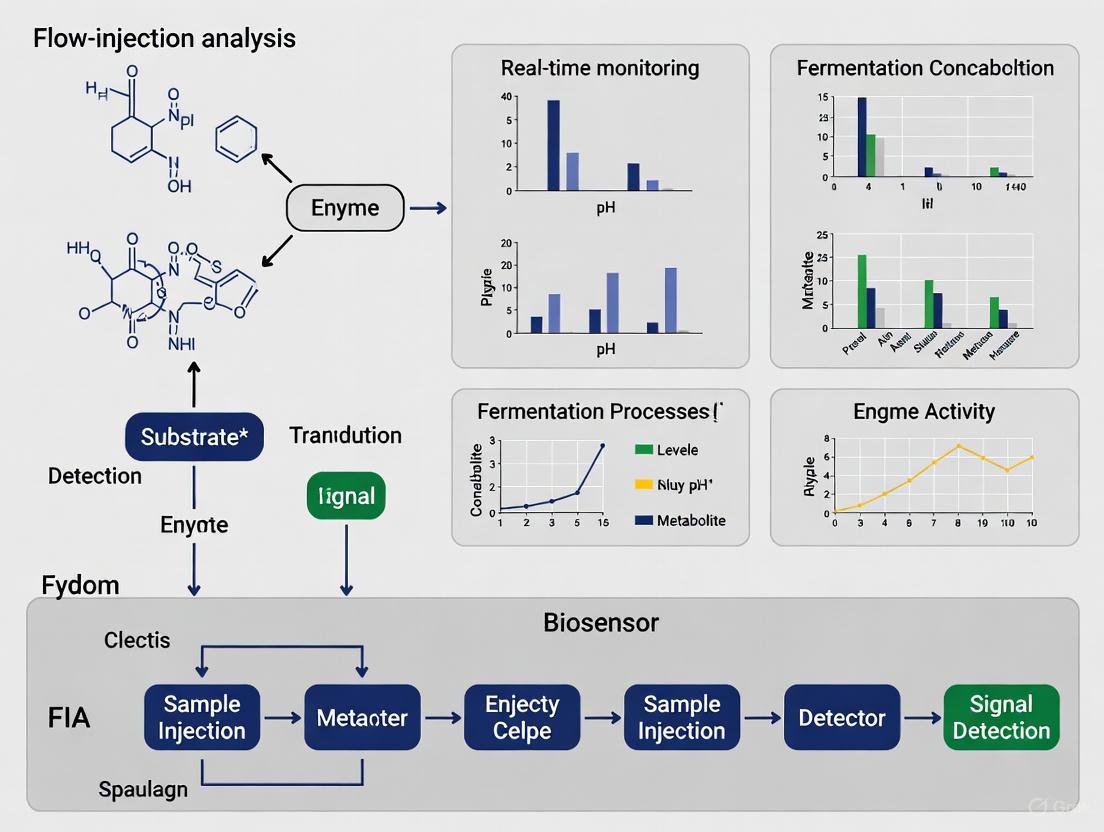
This article provides a comprehensive examination of Flow-Injection Analysis (FIA) biosensor systems for fermentation monitoring and control, tailored for researchers, scientists, and drug development professionals.
Flow-Injection Analysis (FIA) Biosensor Systems: Advanced Monitoring and Control for Fermentation Processes
Abstract
This article provides a comprehensive examination of Flow-Injection Analysis (FIA) biosensor systems for fermentation monitoring and control, tailored for researchers, scientists, and drug development professionals. It explores the foundational principles of FIA and biosensor integration, highlighting how this combination addresses classical monitoring challenges. The content details methodological designs and specific applications, from amino acid and ethanol sensing to on-line process monitoring. It further delves into critical troubleshooting and optimization strategies to enhance sensor stability and selectivity. Finally, the article offers a rigorous validation and comparative analysis against traditional methods like HPLC, establishing the reliability and industrial relevance of FIA biosensor systems for modern bioprocessing.
Core Principles: How FIA Biosensors Solve Fundamental Challenges in Fermentation Monitoring
Core Concepts: The FIA-Biosensor Synergy
Flow Injection Analysis (FIA) is an automated analytical technique wherein a precise volume of a liquid sample is injected as a discrete "plug" into a continuously flowing, non-segmented carrier stream [1]. This carrier stream transports the sample toward a detector, often passing through mixing points where it combines with reagents to form a product that can be measured [1]. The fundamental principle of FIA is the controlled, reproducible dispersion of the sample bolus as it travels through the flow manifold, which provides exact timing for fluidic manipulations and reaction conditions [1].
A biosensor is an analytical device that integrates a biological recognition element (such as an enzyme, antibody, or whole cell) with a physicochemical transducer (e.g., electrochemical, optical, thermal). The transducer converts the biological response into a quantifiable signal proportional to the concentration of the target analyte [2] [3] [4].
The integration of these two technologies creates a FIA biosensor system, where the biosensor acts as a selective detector within an automated flow manifold. This synergy leverages the specific advantages of both components [5] [6]:
- The FIA system provides automated, high-speed sample processing with excellent repeatability, minimal sample and reagent consumption (operating at microliter levels), and containment of chemicals, which reduces waste [1] [7].
- The biosensor provides the high selectivity and sensitivity needed for direct analysis of complex matrices like fermentation broths, often without extensive sample pretreatment [2] [4].
This combination is particularly powerful for fermentation research, where it enables on-line monitoring of key process variables. Samples can be continuously and automatically withdrawn from the bioreactor, analyzed with a response time of just seconds to minutes, and the results fed back for process control [2].
Applications in Fermentation Research and Bioprocess Monitoring
FIA biosensor systems are highly versatile and have been applied to monitor a wide range of analytes critical to fermentation and bioprocess optimization. The following table summarizes key applications and the specific biosensor technology used.
Table 1: Key Applications of FIA Biosensors in Fermentation and Bioprocess Monitoring
| Analyte Category | Specific Analytes | Biosensor Type / Recognition Element | Application Context | Reference |
|---|---|---|---|---|
| Substrates & Metabolites | Glucose, Sucrose, Lactate, Ethanol | Enzyme thermistor; Amperometric enzyme electrodes (e.g., Glucose Oxidase); Microbial sensors | Monitoring of alcoholic fermentation; Bioprocess status evaluation | [2] [4] [8] |
| Penicillin G, Penicillin V | Enzyme thermistor with immobilized β-lactamase or penicillin acylase | Industrial-scale fermentation of antibiotics | [2] | |
| Maltose, Lactose | Microbial sensors with immobilized microorganisms (e.g., Gluconobacter oxydans) | Simultaneous determination of mono- and disaccharides in bioprocesses | [4] | |
| Organic Acids | Malic Acid, Lactic Acid | Amperometric enzymatic biosensors | Monitoring of malolactic fermentation in winemaking | [8] |
| Other Process Markers | Urea | Enzyme thermistor with urease | Monitoring of haemodialysis treatments; Characterization of biocatalysts | [2] |
| Glycerol | Amperometric enzyme electrode | Alcoholic fermentation monitoring | [4] | |
| Aspartame | Amperometric bienzymatic biosensor (α-chymotrypsin & alcohol oxidase) | Detection in fermented beverages | [9] |
In-depth Protocol: Monitoring a Key Fermentation Parameter
This protocol details the setup and operation of a bienzymatic FIA biosensor for the determination of aspartame, representative of the methods used to monitor substrates and metabolites in fermentation products [9].
Experimental Protocol: Determination of Aspartame in Beverages Using an Amperometric Bienzymatic FIA Biosensor
1. Principle Aspartame is first hydrolyzed to methanol and L-aspartyl-L-phenylalanine by the enzyme α-chymotrypsin (CHY). The methanol is subsequently oxidized by alcohol oxidase (AOX) to formaldehyde and hydrogen peroxide. The generated hydrogen peroxide is detected amperometrically at a platinum working electrode poised at +700 mV vs. Ag/AgCl. The anodic current is proportional to the aspartame concentration [9].
2. Apparatus and Reagents Research Reagent Solutions and Essential Materials
Table 2: Key Research Reagents and Materials
| Item | Function / Specification |
|---|---|
| Peristaltic Pump | Propels the carrier buffer through the FIA system at a constant flow rate. |
| Rheodyne Injector | Equipped with a 100 µL sample loop for precise and reproducible sample introduction. |
| Enzyme Reactor Columns (x2) | Borosilicate columns (3 mm i.d. x 25 mm length) packed with immobilized enzyme beads. |
| Electrochemical Flow Cell | Houses the working (Pt), reference (Ag/AgCl), and counter (stainless steel) electrodes. |
| Potentiostat | Applies the constant potential (+700 mV) and measures the resulting current. |
| Aminopropyl Glass Beads | Support material for the covalent immobilization of the enzymes. |
| Glutaraldehyde (GA) | Cross-linking agent for activating the beads and covalently binding the enzymes. |
| α-Chymotrypsin (CHY) | Hydrolyzes aspartame to methanol and L-aspartyl-L-phenylalanine. |
| Alcohol Oxidase (AOX) | Oxidizes methanol to formaldehyde and hydrogen peroxide. |
| Phosphate Buffer Saline (PBS) | 0.1 M, pH 8.0; serves as the carrier stream and reaction medium. |
3. Immobilization of Enzymes (Covalent Binding)
- Activation of Beads: Incubate the aminopropyl beads in 0.1 M PBS (pH 7.5) overnight at 4°C. Wash the beads with the same buffer. Activate the beads by adding 2% (v/v) glutaraldehyde solution and mix gently on a roller mixer for 120 minutes at room temperature [9].
- Enzyme Immobilization: Wash the activated beads thoroughly with PBS (pH 7.5) to remove excess glutaraldehyde. Prepare separate solutions of CHY (250 U/mL) and AOX (100 U/mL) in PBS. Incubate each enzyme solution with the activated beads for 180 minutes at 4°C with gentle mixing [9].
- Packing Reactors: Wash the immobilized enzyme beads with cold PBS to remove any unbound enzyme. Pack the CHY-beads and AOX-beads separately into the two borosilicate glass columns to create Reactor I (CHY) and Reactor II (AOX). Store the columns in PBS at 4°C when not in use [9].
4. FIA Biosensor Assembly and Operation
- Manifold Configuration: Assemble the FIA manifold as shown in Figure 1. The carrier stream (0.1 M PBS, pH 8.0) is pumped through the system sequentially passing the injection valve, Reactor I (CHY), Reactor II (AOX), and finally the electrochemical cell [9].
- Optimal Operational Conditions:
- Analysis: Once a stable baseline is achieved, inject standards or samples (100 µL) into the carrier stream. Record the peak current response. The analytical signal is the height of the current peak.
5. Calibration and Validation
- Prepare a series of aspartame standards in the concentration range of 0.01 – 1.2 mM.
- Inject each standard in triplicate and plot the average peak current against concentration to obtain a calibration curve.
- The system typically achieves a limit of detection of 0.005 mM [9].
- For real sample analysis (e.g., fermented beverages), dilute the sample appropriately with the carrier buffer to fit the linear range of the calibration curve. Minimal sample pretreatment is required [9].
Figure 1: FIA Biosensor System Workflow. The sample is injected into a carrier stream which transports it through two enzymatic reactors before detection in an electrochemical flow cell.
Instrumentation and Key Considerations
System Components and Detection Modes
A typical FIA biosensor system consists of several core components, as illustrated in Figure 1. The choice of detector is determined by the specific reaction being monitored [7].
Table 3: Common Detection Methods in FIA Biosensor Systems
| Detection Method | Transducer Principle | Example Analytes | Advantages |
|---|---|---|---|
| Amperometry | Measures current from oxidation/reduction of an electroactive species at a constant potential. | Glucose, Ethanol, Hydrogen Peroxide, Ascorbic Acid [9] [10] [8] | High sensitivity, good selectivity with proper potential control, adaptable to miniaturization. |
| Enzyme Thermistor (Thermal) | Measures the heat change (enthalpy) of an enzymatic reaction. | Penicillin, Glucose, Sucrose, Lactate, Urea [2] | Label-free; universal for reactions with enthalpy change. |
| Potentiometry | Measures potential difference across an ion-selective membrane at zero current. | Various ions, Ammonia [7] | Wide linear range, simple instrumentation. |
| Spectrophotometry | Measures absorbance of light by a colored reaction product. | Total Sugars, p-Nitrophenol [1] [7] | Widely available, robust. |
| Chemiluminescence | Measures light emission from a chemical reaction. | Ascorbic Acid, ATP [1] [7] | Extremely high sensitivity, low background. |
Critical Experimental Factors and Optimization
Successful implementation of an FIA biosensor requires careful optimization of several parameters [9]:
- Flow Rate: Affects reaction time, dispersion, and sample throughput. Lower flow rates increase residence time in enzyme reactors, allowing for more complete reaction, but reduce sampling rate [9].
- Carrier pH and Ionic Strength: Must be compatible with the optimal activity and stability of the immobilized biological element (enzyme, cell) [9] [10].
- Immobilization Efficiency: The method and yield of enzyme immobilization directly impact the sensitivity, operational stability, and lifetime of the biosensor [9].
- Interference Elimination: The complex matrices common in fermentation samples may contain electroactive interferents (e.g., ascorbic acid, uric acid). Strategies such as incorporating dialysis units, anion-exchange columns, or using permselective membranes on the electrode are often employed to improve selectivity [7] [10].
Figure 2: Bienzymatic Detection Principle. Sequential enzymatic reactions convert the target analyte (aspartame) into an electrochemically detectable product (H₂O₂).
The synergy between Flow Injection Analysis and biosensors creates a powerful analytical platform ideally suited for the demands of modern fermentation research. FIA biosensor systems provide a means to obtain rapid, specific, and automated quantitative data on critical process variables, enabling real-time bioprocess monitoring and control. The technology's versatility, derived from the wide array of available biological recognition elements and detector types, allows it to be tailored to a vast spectrum of analytes, from traditional substrates and metabolites to more complex proteins and pollutants. As the field advances, further integration with novel nanomaterials, automated flow programming, and miniaturized systems promises to enhance the sensitivity, robustness, and applicability of FIA biosensors in industrial and research settings.
In the field of fermentation research and industrial bioprocessing, the ability to monitor critical process variables in real-time is paramount. Flow-injection analysis (FIA) biosensor systems have emerged as powerful analytical tools that address this need by offering a combination of rapid response, full automation, and high sample throughput. These integrated systems facilitate precise control over fermentation processes, leading to optimized yields and consistent product quality in the production of substances ranging from lactic acid to therapeutic proteins [11] [12]. This application note details the operational advantages, quantitative performance metrics, and practical implementation protocols for FIA-biosensor systems within fermentation environments.
Key Advantages and Performance Metrics of FIA-Biosensor Systems
FIA-biosensor systems merge the specificity of biological recognition elements with the efficiency of automated flow-based analysis. The core benefits of this integration are summarized below, with supporting quantitative data presented in Table 1.
- Rapid Response and High Throughput: The flow-injection format eliminates the need for lengthy incubations or separations, enabling single analyses to be completed in minutes. This facilitates a high frequency of sampling, which is crucial for tracking dynamic fermentation processes. One system demonstrated the capability to analyze up to 30 samples per hour, allowing for near-real-time monitoring [12].
- Automation and Operational Stability: These systems can operate continuously with minimal human intervention. A key feature is their exceptional long-term stability; for instance, biosensors for monitoring glucose and L-lactate have exhibited excellent stability during continuous operation for at least 45 days, while a penicillin biosensor could be used for control for about two months [11] [12]. This robustness is essential for prolonged fermentation campaigns.
- High Sensitivity and Selectivity: Enzymatic biosensors provide high specificity for their target analytes, even in complex matrices like fermentation broth. For example, a spatially separated L-lactate biosensor showed no significant changes in response after 350 measurements and retained 96.9% of its initial signal after 7 months of storage, highlighting its reliability [13].
Table 1: Performance Metrics of Representative FIA-Biosensor Systems in Fermentation Monitoring
| Target Analyte | Detection Principle | Linear Range | Sample Throughput | Operational Stability | Application Example |
|---|---|---|---|---|---|
| Glucose & L-Lactate [11] | Amperometric enzyme electrode (GOD, LOD) | Glucose: 2–100 g L⁻¹L-Lactate: 1–60 g L⁻¹ | Sequential hourly analysis | >45 days of continuous operation | Lactic acid fermentation with Lactobacillus casei |
| Penicillin G [12] | Potentiometric enzyme electrode (Penicillinase) | Not Specified | ~30 samples/hour | ~2 months | Fermentation with Penicillium chrysogenum |
| L-Lactic Acid [13] | Amperometric (O₂ consumption) | Not Specified | High-throughput FIA | 93.8% signal after 350 measurements; 96.9% after 7 months storage | Wine, saliva, and dairy analysis |
The following diagram illustrates the core workflow of a FIA-biosensor system and how its components work in concert to deliver these key advantages.
Detailed Experimental Protocol: On-line Monitoring of Lactate and Glucose
This protocol is adapted from a system used for the on-line sequential analysis of glucose and L-lactate during a lactic acid fermentation with Lactobacillus casei in a recycle bioreactor [11].
Research Reagent Solutions
Table 2: Essential Materials and Reagents
| Item | Function / Description |
|---|---|
| Enzyme Electrodes | Biosensing elements with immobilized Glucose Oxidase (GOD) and L-Lactate Oxidase (LOD). |
| Amperometric Detector | Measures the electrical current generated by the enzymatic reaction at the electrode surface. |
| Data Acquisition Card | Interface for converting analog sensor signals to digital data (e.g., 12-bit card with 16 analog inputs). |
| Peristaltic Pump & Tubing | Drives the carrier buffer and sample stream through the FIA system. |
| Fermentation Broth Samples | The process stream from the bioreactor, containing the analytes of interest. |
| Phosphate Buffer (0.05 M, pH 7.4) | Carrier stream; provides a stable pH and ionic strength for biosensor operation. |
| Standard Solutions | Known concentrations of glucose and L-lactate for system calibration. |
Step-by-Step Procedure
System Setup and Calibration:
- Install the enzyme electrodes (glucose oxidase and L-lactate oxidase) into the flow cell connected to the amperometric detector.
- Prime the FIA system with phosphate buffer (0.05 M, pH 7.4) carrier stream using the peristaltic pump until a stable baseline signal is achieved.
- Inject a series of standard solutions of known glucose and L-lactate concentrations (e.g., covering the range of 2–100 g L⁻¹ for glucose and 1–60 g L⁻¹ for L-lactate) to construct a calibration curve.
On-line Sampling and Analysis:
- Integrate the FIA system with the recycle stream of the bioreactor. A sampling loop automatically draws a small, representative sample from the fermentation broth at set intervals (e.g., every hour).
- The injected sample is carried by the buffer stream to the enzyme electrodes. The analyte (glucose or lactate) diffuses into the enzyme layer, where it is converted, producing an electroactive species (e.g., H₂O₂).
- The amperometric detector applies a constant potential and measures the resultant current, which is proportional to the analyte concentration.
Data Acquisition and Process Control:
- The analog signal from the detector is digitized by the data acquisition card and recorded by custom software (e.g., developed in Visual C++).
- The software correlates the peak height or area of the FIA signal with the concentration using the pre-established calibration curve.
- The calculated concentrations of glucose and lactate are outputted. This data can be used to monitor the progression of the fermentation, such as glucose consumption and lactate production.
System Maintenance:
- To ensure long-term stability, the system performs automated rinsing between samples to prevent carryover or fouling.
- The biosensor's activity is monitored periodically with standards. The robust design of the enzyme electrodes, often with covalently immobilized enzymes, allows for continuous operation over several weeks without significant loss of performance [11] [12].
Advanced System Design: The Spatially Separated Biosensor
A significant innovation in FIA-biosensor technology is the spatial separation of the biorecognition element from the transducer. The following diagram details the architecture and operational principle of this high-performance design.
This design, as utilized in a high-performance L-lactate biosensor, involves an easily replaceable mini-reactor placed in the flow path before the electrochemical detector [13].
- Biorecognition Module: The mini-reactor is a tube filled with a support material like mesoporous silica powder (SBA-15), to which Lactate Oxidase (LOx) is covalently immobilized. This configuration allows for a large amount of enzyme to be packed (e.g., ~270 µg per reactor), far exceeding what can be loaded onto a single electrode surface.
- Transduction Module: The stream exiting the reactor flows to a detector cell containing a screen-printed electrode. The detection principle is based on the amperometric monitoring of oxygen consumption at a low applied potential (-900 mV), which minimizes interference from other electroactive compounds in the sample matrix [13].
- Key Advantages:
- Enhanced Stability: The large enzyme load and protective solid support contribute to exceptional operational stability (retaining 93.8% initial signal after 350 assays) and storage stability [13].
- Easy Maintenance: The biorecognition and detection modules are independent. A depleted enzyme reactor can be replaced quickly without replacing the entire sensor, simplifying maintenance and reducing downtime.
FIA-biosensor systems provide a technologically advanced solution for mastering fermentation control. Their core strengths—rapid response, full automation, and high sample throughput—directly address the critical needs of modern bioprocessing. The robust performance and long-term stability demonstrated by these systems, particularly with advanced designs like spatially separated biosensors, make them indispensable tools for researchers and industry professionals aiming to optimize product yield, ensure consistent quality, and accelerate development timelines in drug production and other fermentation-based industries.
The integration of biosensors with Flow-Injection Analysis (FIA) represents a pivotal advancement in analytical biotechnology, particularly for fermentation research. This synergy combines the specificity of biological recognition with the automation and reproducibility of flow-based systems. The evolution began with early enzyme electrodes that provided the fundamental principle of coupling biological elements with transducers [14]. The subsequent incorporation of these biosensors into FIA systems addressed critical limitations in manual fermentation monitoring, enabling real-time, on-line analytics essential for understanding and controlling complex bioprocesses [15] [16]. This combination has established a robust framework for monitoring key metabolic parameters like glucose, lactate, and ethanol directly from fermentation broths, transforming our approach to bioprocess optimization and scale-up [11] [16].
Historical Development of Biosensing Technologies
The First Generation: Foundation with Enzyme Electrodes
The conceptual foundation for modern biosensors was laid by Clark and Lyons in 1962 with their pioneering work on enzyme electrodes [14]. Their initial glucose biosensor comprised an oxygen electrode, an inner oxygen semipermeable membrane, a thin layer of glucose oxidase (GOD), and an outer dialysis membrane. This configuration operated on the principle that GOD catalyzes the oxidation of glucose to gluconolactone, consuming oxygen in the process. The accompanying reduction in oxygen concentration, measured amperometrically, provided a correlate to glucose concentration [14]. A significant limitation of this first-generation approach was its dependence on ambient oxygen levels, which, if fluctuating, adversely affected sensor accuracy. Furthermore, the necessity for membranes made large-scale manufacturing challenging.
A transformative breakthrough came with the introduction of redox mediators, such as ferricyanide and ferricinium ions, giving rise to second-generation biosensors [14]. These mediators shuttled electrons from the reduced enzyme cofactor (e.g., FADH₂ in GOD) directly to the electrode surface, operating at a lower detection potential that minimized interference from other electroactive compounds. This innovation eliminated the need for membranes, paving the way for simpler device architectures. Concurrently, the adoption of screen-printing technology enabled the mass production of inexpensive, disposable electrode strips, dramatically reducing costs and facilitating the move from clinical laboratories to point-of-care and industrial settings [14]. The landmark ExacTech glucose meter, commercialized by MediSense, exemplified this successful fusion of mediator chemistry and screen-printing, bringing biosensing to home use.
The Third Generation and FIA Integration
Third-generation biosensors focused on direct electrical wiring of enzymes to the electrode surface, eliminating the need for diffusional mediators [14]. Strategies included chemically modifying enzymes with relay units or immobilizing them within redox hydrogels. While improving stability for in vivo applications, these sophisticated designs also found a perfect application niche in FIA systems. The integration of biosensors with FIA created a powerful analytical platform that merged the specificity of biological recognition with the automation, high throughput, and reproducibility of flow-based analysis [17] [16]. This was particularly impactful for fermentation monitoring, where FIA-based biosensors could provide sequential, on-line measurements of multiple analytes like glucose and lactate directly from complex bioreactor media [11].
Application in Fermentation Monitoring and Control
The application of FIA-biosensor systems in fermentation research has revolutionized bioprocess monitoring by providing real-time analytics that guide effective process control.
Monitoring Metabolites in Lactic Acid Fermentation
A prime example is the automated FIA system developed for on-line monitoring of glucose and L-lactate during lactic acid fermentation by Lactobacillus casei subsp. rhamnosus [11]. This system used enzyme electrodes with immobilized glucose oxidase and L-lactate oxidase for amperometric detection. Integrated with a recycle batch bioreactor, the system performed automatic sampling and sequential analysis every hour. Key performance metrics are summarized in the table below.
Table 1: Analytical Performance of a FIA-Biosensor System for Lactic Acid Fermentation Monitoring
| Parameter | Glucose | L-Lactate |
|---|---|---|
| Detection Range | 2–100 g L⁻¹ | 1–60 g L⁻¹ |
| Analysis Time | Sequential hourly sampling | Sequential hourly sampling |
| Stability | > 45 days of continuous operation | > 45 days of continuous operation |
| Correlation | Good agreement with standard reducing sugar analysis | Good agreement with standard L-lactate analysis |
The study demonstrated complete sugar utilization and maximal L-lactate production within 13 hours of fermentation, highlighting the system's effectiveness in tracking process progression [11].
Ethanol Monitoring in Fermentation Broths
Similar principles have been applied to monitor ethanol, a key metabolite in alcoholic fermentations and biofuel production. A robust microbial biosensor was constructed using the bacterium Gluconobacter oxydans combined with carbon nanotubes in a bionanocomposite [18]. Ferricyanide was used as a mediator to enhance the sensitivity of ethanol oxidation. When integrated into an FIA system, this biosensor achieved a low detection limit of 5 µM and a linear range from 10 µM to 1 mM. The system exhibited a high sample throughput of 67 samples per hour and outstanding operational stability, with a signal decrease of only 1.7% over 43 hours of continuous operation [18]. Results from analyzing actual fermentation samples showed excellent agreement with those from high-performance liquid chromatography (HPLC), validating the biosensor's accuracy and reliability for real-world applications.
Toxicity Assessment in Bioprocess Streams
Beyond metabolite quantification, FIA-biosensor systems are valuable for assessing water toxicity, which is relevant for evaluating the impact of inhibitory compounds on microbial cultures. An automated FIA analyzer was developed using bioluminescent Vibrio fischeri cells as a whole-cell biosensor [19]. The system injected 100 µL of bacterial suspension into a carrier stream containing the test sample. The percentage inhibition of bioluminescence, compared to a non-toxic control, was used to quantify toxicity. The system was validated with heavy metals like Hg²⁺, Cu²⁺, and Pb²⁺, showing dose-dependent responses in the range of 1.0×10⁻² M to 1.0×10⁻⁵ M, with mercury being the most toxic [19]. This application underscores the versatility of FIA-biosensor platforms in addressing diverse analytical needs in biotechnology.
Experimental Protocols for FIA-Biosensor Systems
Protocol 1: Assembly and Operation of a FIA-Biosensor for Toxicity Monitoring
This protocol outlines the procedure for constructing and operating an FIA system using Vibrio fischeri for toxicity assessment, based on the work detailed in [19].
Research Reagent Solutions:
- Carrier Solution: 2% NaCl in deionized water for baseline bioluminescence.
- Toxicant Stock Solutions: 0.0200 M Hg²⁺, Cu²⁺, and Pb²⁺, prepared from HgCl₂, Cu(SO₄)·5H₂O, and Pb(NO₃)₂·H₂O, respectively.
- Vibrio fischeri Culture: Grown in DSMZ No 6904 broth for 20 h at 24°C, centrifuged, and resuspended in artificial seawater.
Procedure:
- System Setup: Assemble a single-line FIA manifold comprising a peristaltic pump, an injection valve, a mixing coil (100 cm, 0.8 mm i.d.), and the detector flow cell.
- Detector Preparation: Use a wall-jet flow cell positioned against a photomultiplier tube (PMT) for bioluminescence detection. Maintain a constant temperature of 20°C using a thermostated aluminum frame.
- System Operation: a. Propel the carrier solution (or toxic sample) at a constant flow rate of 1.5 mL/min. b. Load the injection valve sample loop with 100 µL of the stirred V. fischeri suspension. c. Inject the bacterial suspension into the carrier stream. d. Mix the cells with the carrier in the mixing coil before reaching the flow cell. e. Record the bioluminescence peak height.
- Data Analysis: Calculate the percentage inhibition of bioluminescence using the formula:
% Inhibition = (Peak_non-toxic - Peak_toxic) × 100 / Peak_non-toxic
Protocol 2: On-line Monitoring of Glucose and Lactate in a Bioreactor
This protocol describes the setup for sequential, on-line monitoring of glucose and L-lactate during a fermentation process, adapted from [11].
Research Reagent Solutions:
- Carrier Buffer: 0.1 M Phosphate Buffer Saline (PBS), pH 7.3.
- Standard Solutions: Glucose and L-lactate standards prepared in the concentration ranges of 2–100 g L⁻¹ and 1–60 g L⁻¹, respectively.
Procedure:
- Biosensor Fabrication: Prepare separate enzyme electrodes by immobilizing glucose oxidase and L-lactate oxidase on the surface of amperometric electrodes.
- FIA System Configuration: Integrate the enzyme electrodes into a flow system with a data acquisition card for automated control. Program the software for sequential sampling from the bioreactor every hour.
- Calibration: Calibrate the biosensors by injecting standard solutions of glucose and L-lactate into the FIA system to establish the calibration curves.
- On-line Monitoring: a. Connect the FIA system to the recycle batch bioreactor via a sampling line. b. Initiate the automated program to draw a sample from the bioreactor at predetermined intervals. c. Inject the sample into the carrier stream, which sequentially passes over the glucose and lactate biosensors. d. Record the amperometric signals, which are proportional to the analyte concentrations. e. Correlate the biosensor data with standard offline methods (e.g., HPLC) for validation.
The Scientist's Toolkit: Essential Research Reagents and Materials
The development and implementation of effective FIA-biosensor systems rely on a core set of reagents and materials. The following table details these essential components and their functions.
Table 2: Key Research Reagent Solutions for FIA-Biosensor Development
| Reagent/Material | Function/Application | Examples from Literature |
|---|---|---|
| Enzymes (Oxidases) | Biological recognition element; catalyzes oxidation of specific analyte (e.g., glucose, lactate, ethanol). | Glucose Oxidase, L-Lactate Oxidase, Alcohol Oxidase [11] [20] |
| Microbial Cells | Whole-cell biosensor; provides metabolic pathways for detecting non-specific parameters like toxicity. | Vibrio fischeri (toxicity), Gluconobacter oxydans (ethanol) [19] [18] |
| Redox Mediators | Shuttles electrons from enzyme to electrode; enables 2nd generation biosensors with lower operating potentials. | Ferricyanide, Ferrocene derivatives [14] [18] |
| Immobilization Matrix | Stabilizes and retains biological element on the transducer surface. | Glutaraldehyde-BSA, Chitosan, Redox Hydrogels [18] [20] |
| Carbon Nanomaterials | Enhances electrode conductivity and surface area; improves sensitivity. | Carbon Nanotubes (CNTs) [21] [18] |
| Screen-Printed Electrodes | Low-cost, disposable, mass-producible sensor platform. | Cobalt-phthalocyanine (CoPC) modified electrodes [20] |
Workflow and System Architecture
The operational logic and component relationships of a generic FIA-biosensor system for fermentation monitoring can be visualized as follows. This architecture underpins the protocols and applications described in this article.
Diagram 1: FIA-Biosensor System Workflow. The diagram illustrates the automated flow of sample and carrier through the system, leading to detection and data processing.
Flow-injection analysis (FIA) biosensor systems represent a powerful analytical technology that combines the automation and reproducibility of flow injection with the specificity of biological recognition elements. These systems are particularly valuable in fermentation research, where they enable real-time monitoring of key analytes like sugars, alcohols, and organic acids without requiring extensive sample preparation. The core principle involves injecting a precise volume of sample into a continuous flowing carrier stream, which then transports it to a biosensor for detection and quantification. This integration provides researchers with a robust platform for obtaining rapid, sequential analyses with high sensitivity and minimal reagent consumption, making it ideal for monitoring dynamic bioprocesses [22] [23].
The significance of these systems in fermentation research and drug development lies in their ability to provide near real-time data on critical process parameters. This facilitates better process control, optimization of yield, and assurance of product quality and consistency [24] [4]. The following sections provide a detailed breakdown of the core components, along with application-focused protocols and technical specifications.
Core Component Breakdown
The FIA Manifold
The FIA manifold serves as the fluidic heart of the system, responsible for the automated and precise transport of the sample from the point of injection to the detector. Its primary function is to present a reproducible, well-defined sample zone to the biosensor for analysis.
- Carrier Stream Reservoir: Contains a suitable buffer solution (e.g., phosphate buffer) that serves as the liquid vehicle for transporting the sample.
- Peristaltic Pump: Generates a pulsation-free, constant flow of the carrier stream, ensuring highly reproducible sample residence times and dispersion.
- Injection Valve: Introduces a precise, discrete volume of the sample into the moving carrier stream without stopping the flow. This is typically achieved using a rotary valve with a fixed-volume sample loop.
- Mixing Coil: A length of narrow-bore tubing, often coiled to promote radial mixing. It facilitates the dilution and homogenous mixing of the sample zone with the carrier stream and any required reagents [19].
The configuration can be a simple single-line system for direct detection or incorporate additional streams for reagent addition or dilution. A key operational parameter is the flow rate, typically optimized between 0.5 mL min⁻¹ and 2.0 mL min⁻¹, which controls the analysis time and the degree of sample-reagent interaction [25] [19].
Figure 1: Workflow of a basic single-line FIA manifold.
The Biosensor
The biosensor is the recognition center of the system, providing the analytical specificity. It consists of a biological recognition element in intimate contact with a transducer. The biological element selectively interacts with the target analyte, and the transducer converts this biological event into a measurable electrical or optical signal [23].
Biological Recognition Element: This component defines the sensor's specificity. Common types used in fermentation monitoring include:
- Enzymes (e.g., Glucose Oxidase, Alcohol Dehydrogenase): Catalyze a specific reaction involving the target analyte, producing a detectable product like H₂O₂ or NADH [4].
- Whole Microbial Cells (e.g., Gluconobacter oxydans, Saccharomyces cerevisiae): Utilize the organism's metabolic pathways to metabolize the analyte, resulting in a change in O₂ consumption, CO₂ production, or bio-luminescence [19] [4].
- Antibodies: Used in immunosensors for specific detection of proteins or toxins [23].
Transducer Platform: This is the component that translates the biological event into a quantifiable signal. The most common types are:
- Electrochemical Transducers: Screen-printed carbon electrodes (SPCEs) are widely used due to their low cost, disposability, and ease of modification. They can be functionalized with nanomaterials like nanoporous platinum to enhance sensitivity and enable non-enzymatic detection [25] [26].
- Optical Transducers: These measure changes in light properties, such as the inhibition of bioluminescence from Vibrio fischeri in toxicity assays [19].
The Detector
The detector is the signal processing unit of the system. Its role is to capture the signal generated by the transducer, condition it, and convert it into a user-interpretable output, typically a peak on a chromatogram or a digital readout.
Flow Cell: A critical component where the actual measurement occurs. It is designed to house the biosensor and ensure efficient contact between the sample stream and the active sensing surface. Common designs include:
Signal Processing Electronics: This includes:
- Potentiostat: For amperometric or voltammetric detection, it applies a constant potential (e.g., 0.6 V vs. Ag/AgCl [25]) and measures the resulting current.
- Photomultiplier Tube (PMT): An extremely sensitive device for detecting low-level light signals in optical systems, such as bioluminescence-based biosensors [19].
- Data Acquisition System: Converts the analogue signal from the transducer into a digital output, which is then processed and displayed by dedicated software, often controlling the entire FIA system [19].
Quantitative System Performance Data
The performance of FIA biosensor systems is characterized by several key metrics, which are summarized in the table below for different applications relevant to fermentation monitoring.
Table 1: Performance Metrics of FIA Biosensor Systems for Various Analytics
| Target Analyte | Biosensor Type | Linear Range | Response Time | Sample Throughput | Key Reference |
|---|---|---|---|---|---|
| Reducing Sugars (Glucose/Fructose) | Non-enzymatic, nanoporous Pt/SPCE | Not Specified | < 5 seconds | High | [25] |
| Ethanol | Microbial (C. tropicalis) / Amperometric | 0.5 - 10 mM | ~ 40 seconds | Not Specified | [4] |
| Water Toxicity (Heavy Metals) | Whole-cell (V. fischeri) / Optical | 10 µM - 10 mM | ~ 40 seconds | ~90 samples/hour | [19] |
| Glucose | Enzyme (Glucose Oxidase) / Amperometric | Not Specified | Not Specified | Not Specified | [4] |
Detailed Experimental Protocol: Determination of Reducing Sugars in Fermentation Media
This protocol outlines the methodology for the rapid, non-enzymatic determination of reducing sugars (e.g., glucose, fructose) in potato juice, a relevant model for complex fermentation feedstocks, using a nanoporous platinum-modified screen-printed carbon electrode (Pt/SPCE) in an FIA system [25].
Research Reagent Solutions
Table 2: Essential Materials and Reagents
| Item | Specification/Function |
|---|---|
| Screen-Printed Carbon Electrode (SPCE) | Low-cost, disposable transducer platform. |
| Hexachloroplatinic Acid (H₂PtCl₆) | Precursor for electrodeposition of nanoporous platinum. |
| Phosphate Buffer (pH 7.4) | Carrier stream and supporting electrolyte; provides optimal pH and ionic strength. |
| Glucose & Fructose Standards | For construction of the calibration curve. |
| Potato Juice Sample | Real-world, complex sample matrix; requires minimal preparation (e.g., filtration). |
| Peristaltic Pump | Drives the carrier stream at a constant flow rate (e.g., 0.5 mL min⁻¹). |
| Flow Cell (e.g., Zensor SF-100) | Houses the SPCE and forms a thin-layer compartment for detection. |
| Potentiostat | Applies +0.6 V (vs. Ag/AgCl reference) and measures the amperometric current. |
Step-by-Step Procedure
Biosensor Fabrication (Pt/SPCE Modification):
- Prepare an electroplating solution containing H₂PtCl₆ and H₂SO₄.
- Immerse the working electrode of the SPCE into the plating solution.
- Apply a constant potential or use a pulsed potentiostatic method to electrodeposit a nanoporous platinum structure onto the carbon surface. This high-surface-area coating acts as the catalyst for the non-enzymatic oxidation of reducing sugars.
FIA System Assembly & Operation:
- Install the modified Pt/SPCE into the flow cell, ensuring a leak-free seal.
- Connect the flow cell to the FIA manifold. The manifold should be configured with a single channel.
- Fill the carrier reservoir with 0.1 M Phosphate Buffer (pH 7.4).
- Set the peristaltic pump to a constant flow rate of 0.5 mL min⁻¹.
- Connect the electrodes from the flow cell to the potentiostat.
- Set the operating potential of the potentiostat to +0.6 V versus the integrated Ag/AgCl reference electrode.
Calibration and Sample Analysis:
- Allow the system to equilibrate until a stable baseline is achieved.
- Using the injection valve, inject a series of standard solutions of glucose and fructose (e.g., 5 - 50 µL volumes) to generate a calibration curve of peak current versus concentration.
- Inject filtered or centrifuged potato juice or fermentation broth samples directly into the FIA system without further dilution or complex preparation.
- The amperometric current, resulting from the catalytic oxidation of reducing sugars at the Pt surface, is recorded as a sharp peak. The peak height or area is proportional to the concentration of reducing sugars in the sample.
Data Analysis:
- Measure the peak current for each standard and sample.
- Construct a calibration curve from the standard solutions.
- Determine the concentration of reducing sugars in the unknown samples by interpolating from the calibration curve.
Figure 2: Key phases of the experimental protocol for reducing sugar analysis.
The integration of a robust FIA manifold, a specific biosensor, and a sensitive detector creates a powerful analytical tool for fermentation research and development. The detailed breakdown of components and the provided protocol for sugar analysis demonstrate how this technology delivers rapid, reproducible, and automated quantification of critical process analytes. By enabling near real-time monitoring with minimal sample preparation, FIA biosensor systems empower scientists to accelerate bioprocess optimization, enhance product quality control, and streamline drug development workflows.
In fermentation research, achieving consistent and reliable online monitoring has been historically hampered by two persistent challenges: the incompatibility of sensitive biological components with sterilization processes and the gradual degradation of biosensor signal over time. These limitations curtail the operational lifespan of biosensors and impede the collection of robust, long-term data during critical bioprocesses.
This application note details a novel biosensor architecture for Flow-Injection Analysis (FIA) systems that strategically overcomes these hurdles. By implementing a spatially separated design and advanced enzyme immobilization techniques, we present a methodology that ensures exceptional operational stability, reusability, and resilience in demanding fermentation environments.
Technical Solutions and Experimental Protocols
Core Innovation: Spatially Separated FIA Biosensor Design
The fundamental design innovation involves decoupling the biosensor's biorecognition element from its transducer.
- Replaceable Mini-Reactor: The enzyme (e.g., Lactate Oxidase, LOx) is immobilized in a dedicated mini-reactor, a small tube filled with a functionalized mesoporous silica powder (SBA-15), which is placed in the flow stream upstream of the detector [13].
- Detection Electrode: A silver amalgam screen-printed electrode (AgA-SPE) serves as the transducer, amperometrically monitoring the consumption of oxygen [13].
- Sterilization Advantage: This spatial separation allows the robust, non-biological detection electrode to be sterilized using conventional methods (e.g., autoclaving), while the enzyme-loaded mini-reactor, which is sensitive to extreme heat, can be aseptically introduced or replaced post-sterilization. This preserves full enzymatic activity.
The workflow of the system is as follows:
Protocol: Fabrication of the High-Stability LOx Mini-Reactor
This protocol details the construction of the lactate-sensing mini-reactor, which is central to the system's performance [13].
- Step 1: Support Functionalization. Activate 10 mg of mesoporous silica powder (SBA-15) by incubating with 2% (v/v) (3-aminopropyl)triethoxysilane (APTES) in ethanol for 2 hours under gentle agitation. This introduces amine groups onto the silica surface.
- Step 2: Cross-Linking. Wash the amine-functionalized SBA-15 and resuspend in a 2.5% (v/v) glutaraldehyde (GA) solution in phosphate buffer (0.1 M, pH 7.0). Incubate for 1 hour. GA acts as a cross-linker.
- Step 3: Enzyme Immobilization. Wash the activated support to remove excess GA. Incubate with a solution of Lactate Oxidase (LOx, from Aerococcus viridans, ~45 U/mg) in phosphate buffer (0.1 M, pH 7.0) overnight at 4°C. Each mini-reactor immobilizes approximately 270 µg of LOx.
- Step 4: Reactor Assembly. Pack the resulting SBA-15/APTES/GA/LOx composite into a narrow-bore PEEK tube (e.g., 2 cm length, 1 mm internal diameter) and seal with porous frits.
Protocol: System Assembly and FIA Operation
- Step 1: FIA Setup. Configure a standard FIA system comprising a peristaltic pump or automated syringe pump (e.g., LSPone for precision flow control [27]), an injection valve with a 100 µL sample loop, and the amperometric detector equipped with the AgA-SPE.
- Step 2: Integration. Connect the custom-fabricated LOx mini-reactor between the injection valve and the detector cell.
- Step 3: Measurement. Use a carrier stream of 0.1 M phosphate buffer (pH 7.0) at a flow rate of 0.5 mL/min. Inject samples and record the amperometric signal at the AgA-SPE held at a constant potential of -900 mV vs. Ag/AgCl. This potential is applied for the reduction of oxygen, the decrease of which is proportional to the lactate concentration in the sample [13].
Performance Data and Stability Metrics
The implemented design directly addresses long-term stability issues. Systematic evaluation demonstrates superior performance over traditional biosensor configurations.
Table 1: Quantitative Stability Performance of the FIA Biosensor [13]
| Performance Metric | Result | Testing Conditions |
|---|---|---|
| Operational Stability | 93.8% of initial signal retained | After 350 consecutive measurements |
| Storage Stability | 96.9% of initial signal retained | After 7 months at 4°C |
| Sample Throughput | ~30-40 samples per hour | Flow rate of 0.5 mL/min |
Table 2: Research Reagent Solutions for FIA Biosensor Fabrication
| Reagent / Material | Function in the Protocol | Key Characteristic |
|---|---|---|
| Mesoporous Silica (SBA-15) | High-surface-area support for enzyme immobilization | Large surface area (~600 m²/g) maximizes enzyme loading [13] |
| Lactate Oxidase (LOx) | Biorecognition element; catalyzes lactate oxidation | Specificity for L-lactic acid; from Aerococcus viridans [13] |
| (3-Aminopropyl)triethoxysilane (APTES) | Silane coupling agent; functionalizes silica surface | Introduces primary amine groups for covalent binding [13] |
| Glutaraldehyde (GA) | Homobifunctional crosslinker | Links amine groups on APTES and enzyme, creating stable bonds [13] |
| Silver Amalgam SPE (AgA-SPE) | Amperometric transducer; detects oxygen consumption | High stability, low background noise, and resistance to fouling [13] |
| Conductive Polymer Ink (PEDOT:PSS) | Alternative electrode material (for flexible arrays) | Enables printing of flexible biosensors on various substrates [28] |
Discussion
The data confirms that the spatial separation of the biorecognition and detection functions is a highly effective strategy. Immobilizing a large quantity of enzyme (≈270 µg per reactor) within a protective mesoporous matrix is the key to achieving the documented long-term stability, as it mitigates the effects of gradual enzyme inactivation or leaching that plague surface-immobilized biosensors [29] [13].
The relationship between the system's design and its performance is illustrated below:
This biosensor configuration is ideally suited for the prolonged monitoring demands of fermentation research, enabling reliable quantification of key analytes like lactate in complex matrices such as wine, dairy products, and biological fluids [13]. The principles outlined here can be adapted for other enzyme systems, paving the way for robust, multi-analyte FIA monitoring platforms.
System Design and Real-World Implementation in Bioprocessing and Biomedicine
Flow-injection analysis (FIA) integrated with biosensors represents a powerful analytical technology for fermentation research, enabling rapid, automated, and continuous monitoring of critical process parameters. These systems are characterized by their high sample throughput, minimal reagent consumption, and ability to provide real-time data essential for optimizing fermentation processes and ensuring product quality [30] [31]. The core of such systems lies in the biosensor, an analytical device that combines a biological recognition element (BRE) with a physicochemical transducer to produce an electronic signal proportional to the concentration of a target analyte [23]. The choice of transducer—amperometric, potentiometric, or impedimetric—defines the operational principles, performance characteristics, and suitable applications within the fermentation environment. This document details the configuration strategies for these transducer types within FIA systems, providing application notes and experimental protocols tailored for researchers and scientists in fermentation and pharmaceutical development.
Biosensor Transducer Types: Principles and Performance
Electrochemical biosensors are predominantly used in FIA systems due to their simplicity, sensitivity, and ease of miniaturization. They are classified based on the electrical parameter measured [32] [33].
- Amperometric Biosensors operate by applying a constant potential to the working electrode and measuring the resulting current generated from the oxidation or reduction of an electroactive species involved in the biological recognition process [23]. The current is directly proportional to the analyte concentration.
- Potentiometric Biosensors measure the potential difference between a working electrode and a reference electrode at near-zero current. This potential is related to the analyte concentration by the Nernst equation, often responding to ion accumulation or pH changes resulting from enzymatic reactions [23].
- Impedimetric Biosensors are label-free devices that measure the impedance (the resistance to alternating current) of an electrochemical system. The binding of a target analyte to the bioreceptor on the electrode surface alters the electrical properties, such as charge transfer resistance, which can be correlated to the analyte concentration [34] [33].
The table below summarizes the key characteristics and performance metrics of these transducers for fermentation monitoring.
Table 1: Comparative Performance of Electrochemical Transducers in FIA Biosensors for Fermentation
| Transducer Type | Measured Signal | Detection Principle | Linear Range Example | LOD Example | Key Advantages | Common Fermentation Targets |
|---|---|---|---|---|---|---|
| Amperometric | Current (A) | Redox reaction rate of electroactive species (e.g., H₂O₂, [Fe(CN)₆]³⁻/⁴⁻) | Glucose: 0.01–1.0 mM [30] | Aspartame: 0.005 mM [31] | High sensitivity, excellent linearity, low detection limits | Glucose, ethanol, lactose, aspartame [30] [31] |
| Potentiometric | Potential (V) | Ion activity change (e.g., H⁺, NH₄⁺) at electrode interface | Information not available in search results | Information not available in search results | Simple instrumentation, wide dynamic range, miniaturization | Urea, ethanol, acetic acid [35] |
| Impedimetric | Impedance (Ω) | Change in charge transfer resistance (Rct) upon analyte binding | C. jejuni: 10²–10⁹ CFU/mL [34] | C. jejuni: 10² CFU/mL [34] | Label-free, real-time monitoring, study of binding kinetics | Pathogens (e.g., Campylobacter jejuni), protein biomarkers [34] [33] |
Experimental Protocols for FIA-Biosensor Configuration
Protocol: Configuring a Bienzymatic Amperometric FIA Biosensor for Aspartame
This protocol outlines the steps for developing a bienzymatic amperometric biosensor within an FIA system for determining aspartame in fermented beverages [31].
Workflow Overview:
Detailed Methodology:
I. Bioreceptor Immobilization and Reactor Column Preparation
- Support Activation: Activate aminopropyl-functionalized silica or chitosan beads by incubating with 2% (v/v) glutaraldehyde in phosphate buffer (50 mM, pH 7.0) for 120 minutes at room temperature with gentle agitation [31].
- Enzyme Immobilization:
- Wash the activated beads thoroughly with the same phosphate buffer to remove excess glutaraldehyde.
- Incubate the beads with a solution of α-chymotrypsin (CHY, 250 U/mL) for 180 minutes.
- Separately, incubate another batch of activated beads with a solution of alcohol oxidase (AOX, 100 U/mL) for 180 minutes.
- Reactor Packing: Pack each set of immobilized enzyme beads into separate, small-volume columns (e.g., 1-2 cm bed length). Connect these two columns in series within the FIA manifold, with the CHY column preceding the AOX column [31].
II. FIA System and Amperometric Detection Setup
- Manifold Configuration: Use a standard FIA system comprising a autosampler, a peristaltic pump, an injection valve with a 100 µL sample loop, the enzyme reactor columns, and the amperometric detector [31].
- Detection Settings: Use a platinum or glassy carbon electrode as the working electrode. Apply a constant potential of +0.7 V (vs. Ag/AgCl reference electrode) for the oxidation of hydrogen peroxide. The carrier stream should be a 50 mM phosphate or Tris-HCl buffer, pH 8.0, delivered at a flow rate of 0.5 mL/min [31].
III. Calibration and Analysis
- Calibration: Inject a series of standard aspartame solutions in the concentration range of 0.01 to 1.2 mM. Record the peak current generated from the produced H₂O₂ after the enzymatic reactions. Construct a calibration curve by plotting the peak current against aspartame concentration [31].
- Sample Analysis: Filter beverage samples (e.g., fermented low-sugar drinks) through a 0.45 µm membrane filter and dilute if necessary. Inject the prepared sample into the FIA system and determine the aspartame concentration from the calibration curve [31].
Protocol: Configuring an Impedimetric FIA Biosensor for Pathogen Detection
This protocol describes the development of a phage protein-based impedimetric biosensor for detecting foodborne pathogens like Campylobacter jejuni, which is critical for ensuring the safety of fermented food products [34].
Workflow Overview:
Detailed Methodology:
I. Electrode Nanomodification and Bioreceptor Immobilization
- Electrode Preparation: Clean a glassy carbon electrode (GCE) sequentially with alumina slurry (1.0, 0.3, and 0.05 µm) and sonicate in ethanol and deionized water. Dry under a nitrogen stream [34].
- Nanostructuring: Deposit multi-walled carbon nanotubes (MWCNTs) onto the GCE surface to create a high-surface-area, conductive platform.
- Linker Attachment: Incubate the modified electrode with 1-pyrenebutanoic acid, succinimidyl ester (PBSE) to create an amine-reactive surface [34].
- Protein Immobilization: Immobilize the genetically engineered FlaGrab phage protein onto the PBSE-modified electrode. The GST-tag on the FlaGrab protein allows for oriented immobilization, preserving its binding affinity for C. jejuni flagella [34].
II. Impedimetric Measurement in FIA System
- FIA Integration: Integrate the modified electrode as the working electrode in a flow cell. Incorporate a reference electrode (Ag/AgCl) and a counter electrode (Pt wire). Connect the flow cell to an FIA system with a peristaltic pump and injection valve.
- EIS Measurements: Use electrochemical impedance spectroscopy (EIS) for detection. The measurement is performed in a solution containing a redox probe, typically 5 mM K₃[Fe(CN)₆]/K₄[Fe(CN)₆] (1:1) in PBS. Apply a small AC voltage amplitude (10 mV) over a frequency range from 0.1 Hz to 100 kHz, superimposed on a DC potential (often the formal potential of the redox couple) [34] [33].
- Data Acquisition: Monitor the change in charge transfer resistance (Rct) at the electrode surface, which increases as bacterial cells bind to the FlaGrab protein, hindering electron transfer of the redox probe [34].
III. Calibration and Specificity Testing
- Calibration: Inject standard suspensions of C. jejuni (e.g., 10² to 10⁹ CFU/mL) and record the Rct value after each injection. Plot the change in Rct (ΔRct) against the logarithm of the bacterial concentration [34].
- Specificity Assessment: Test the biosensor against non-target bacteria (e.g., Listeria monocytogenes, Salmonella enterica) to confirm that the signal is specific to C. jejuni [34].
The Scientist's Toolkit: Essential Research Reagent Solutions
Table 2: Key Reagents and Materials for FIA-Biosensor Development
| Item Name | Function/Application | Example from Protocols |
|---|---|---|
| Glutaraldehyde | Cross-linking agent for covalent enzyme immobilization on amine-functionalized supports. | Activation of beads for α-chymotrypsin and alcohol oxidase immobilization [31]. |
| Aminopropyl-functionalized Silica/Chitosan Beads | Solid support for enzyme immobilization, providing high surface area and chemical functionality. | Used as the matrix for packing enzyme reactor columns [31]. |
| PBSE (1-Pyrenebutanoic acid, succinimidyl ester) | A molecular linker for orienting bioreceptors; pyrene group π-stacks on CNTs, NHS ester reacts with amines. | Immobilization of FlaGrab phage protein on carbon nanotube-modified electrodes [34]. |
| FlaGrab Phage Protein | Genetically engineered bioaffinity recognition element (BioAff-BRE) for specific binding to C. jejuni. | Bioreceptor in impedimetric biosensor for pathogen detection [34]. |
| Ferro/Ferricyanide Redox Probe | Electroactive marker used in faradaic impedimetric sensing to monitor changes in charge transfer resistance (Rct). | [Fe(CN)₆]³⁻/⁴⁻ used in EIS measurements for C. jejuni detection [34] [33]. |
| Multi-Walled Carbon Nanotubes (MWCNTs) | Nanomaterial for electrode modification to enhance surface area, improve electron transfer, and boost signal. | Nanostructuring the surface of glassy carbon electrodes [34]. |
Within the development of flow-injection analysis (FIA) biosensor systems for fermentation research, enzyme immobilization is a critical enabling technology. It confers stability, allows for reuse, and facilitates the integration of the biological recognition element with the physicochemical transducer [36]. For fermentation monitoring, which demands continuous, real-time, and off-line measurements of key analytes like glycerol, amino acids, and alcohols, the choice of immobilization technique and reactor configuration directly impacts the biosensor's sensitivity, operational stability, and lifetime [37] [38]. This document details application notes and standardized protocols for three pivotal immobilization strategies—covalent binding, entrapment, and the use of expanded micro-bed reactors—specifically tailored for integration into FIA biosensing systems for advanced fermentation research and drug development.
Core Techniques & Mechanisms
The selection of an immobilization technique involves a trade-off between enzyme activity, stability, and the practical constraints of the biosensor design. The following sections delineate the core principles and relative advantages of each key method.
Table 1: Comparison of Core Enzyme Immobilization Techniques
| Technique | Mechanism | Advantages | Disadvantages | Ideal Use in FIA Biosensors |
|---|---|---|---|---|
| Covalent Binding | Formation of stable covalent bonds between enzyme functional groups (e.g., -NH₂, -COOH) and reactive supports [39] [36]. | Strong binding minimizes enzyme leaching; high stability under flow conditions; long operational lifetime [36] [40]. | Can potentially modify the enzyme's active site, reducing activity; requires activated supports; procedure can be complex [36]. | Wall-coated microreactors; systems requiring extreme durability for continuous, long-term fermentation monitoring [41]. |
| Entrapment | Enzyme physically confined within a porous polymer network or gel matrix (e.g., alginate, silica) [39] [36]. | Mild immobilization conditions; universal for many enzymes; protects enzyme from harsh environments and microbial degradation [36] [40]. | Diffusion limitations for substrate and product can slow response time; possible enzyme leakage from large pores; lower mechanical stability [36]. | Detection of small molecules where diffusion is not limiting; single-use or disposable sensor cartridges. |
| Expanded Micro-Bed Reactors | Enzymes immobilized on lightweight, micro-sized particles that are fluidized by the upward flow of the liquid stream [42]. | Excellent mass transfer; reduced pressure drop; avoids clogging and channeling; high surface area for immobilization [42]. | Complex hydrodynamics; potential for particle attrition and wash-out; can be difficult to scale uniformly. | Handling complex fermentation broths with particulate matter; applications demanding very high catalytic efficiency and minimal back-pressure [42]. |
Experimental Protocols
Protocol: Covalent Immobilization on Plasma-Activated Polymer Surfaces
This protocol describes a method to enhance the loading and activity of enzymes covalently bound to poly(methyl methacrylate) (PMMA) surfaces, a common material for microfluidic biosensor chips, through oxygen plasma micro-nanotexturing [41].
Principle: Oxygen plasma treatment simultaneously cleans, activates, and creates a micro-nanotextured surface on PMMA, increasing the surface area available for binding. Carboxyl groups introduced onto the surface are then activated to form amide bonds with primary amines on the enzyme [41].
The Scientist's Toolkit:
- Materials: PMMA substrate; Oxygen plasma cleaner (Reactive Ion Etching mode); Horseradish Peroxidase (HRP) or target enzyme; EDC (1-Ethyl-3-(3-dimethylaminopropyl)carbodiimide); NHS (N-Hydroxysuccinimide); 0.1 M phosphate buffer (pH 7.4).
- Key Reagent Functions:
- Oxygen Plasma: Creates micro-nanotexture and introduces carboxyl (-COOH) groups on the polymer surface.
- EDC/NHS: Activates surface carboxyl groups, forming an NHS-ester intermediate for efficient covalent coupling with enzyme amine groups.
Procedure:
- Surface Pretreatment: Clean PMMA substrates with ethanol and deionized water. Dry under a stream of nitrogen gas.
- Plasma Micro-Nanotexturing: Place the PMMA substrate in the plasma chamber. Treat with oxygen plasma (e.g., 100 W, 0.2 mbar) for 10 minutes to achieve optimal surface roughness and functionalization [41].
- Surface Activation: Immediately after plasma treatment, incubate the substrate in a fresh solution of EDC/NHS (typically 50 mM EDC, 25 mM NHS in MES buffer, pH 5.0) for 30-60 minutes at room temperature to activate the carboxyl groups.
- Enzyme Immobilization: Rinse the activated substrate with immobilization buffer (0.1 M phosphate, pH 7.4). Incubate with the enzyme solution (e.g., 1 mg/mL HRP in phosphate buffer) for 2 hours at room temperature or overnight at 4°C.
- Washing and Storage: Rinse thoroughly with buffer to remove physically adsorbed enzymes. The prepared biosensor element can be stored in buffer at 4°C.
Application Note: This method yields a five-fold enhancement in immobilized enzyme activity compared to untreated surfaces and allows the microreactor to be reused over 16 times without significant loss of activity, making it ideal for durable FIA systems [41].
Protocol: Fabrication of a Packed-Bed Micro-IMER using Covalent Immobilization
This protocol outlines the creation of a capillary-based packed-bed Immobilized Enzyme Reactor (μIMER) with enzymes covalently bound to porous silica microbeads, suitable for the proteolytic digestion of proteins in fermentation broth analysis [39] [43].
Principle: A capillary is packed with functionalized silica beads that provide a high surface area. Enzymes are covalently attached to these beads, creating a high-density enzymatic reactor through which the sample is perfused, allowing for efficient, rapid digestion [39].
Procedure:
- Support Functionalization: Pack a fused silica capillary (e.g., 100 µm i.d.) with 3-aminopropyl-functionalized silica beads (5 µm diameter, 100 Å pore size).
- Support Activation: Flush the packed capillary with a 5% (v/v) solution of 3-glycidoxypropyltrimethoxysilane in toluene. React for 4 hours at room temperature to introduce epoxide groups [39].
- Enzyme Immobilization: Flush the capillary with the enzyme solution (e.g., 1 mg/mL trypsin in 0.1 M carbonate buffer, pH 9.0). Recirculate the solution through the reactor for 4-24 hours at 37°C to allow covalent coupling between the enzyme's amine groups and the support's epoxides.
- Washing: Flush the μIMER with buffer to remove any uncoupled enzyme. The reactor is now ready for integration into an FIA/MS or LC system.
Application Note: Such monolithic trypsin reactors have demonstrated complete digestion of model proteins like bovine serum albumin in 120 minutes with a sequence coverage of over 97%, showcasing high efficiency for proteomic analysis in fermentation studies [39].
Protocol: Establishing an Expanded Micro-Bed Reactor
This protocol describes the setup of an expanded (fluidized) bed reactor, which is advantageous for handling crude fermentation broths that may clog traditional packed beds [42].
Principle: Enzymes are immobilized on low-density, micro-sized carrier particles. An upward flow of the liquid sample is applied at a velocity sufficient to fluidize the particle bed, reducing diffusion limitations and preventing channeling and clogging [42].
Procedure:
- Carrier Preparation: Select low-density, porous microcarriers (e.g., agarose-based or hollow glass beads). Immobilize the target enzyme onto the carriers using a suitable technique, such as covalent binding (see Protocol 3.1).
- Reactor Configuration: Place the enzyme-loaded carriers into a vertical column reactor.
- System Operation: Pump the fermentation broth or substrate solution upwards through the reactor. Precisely control the flow rate to expand the bed to approximately 1.5-2 times its settled volume, ensuring good mixing and mass transfer without washing the carriers out of the reactor.
- Monitoring: The effluent from the reactor is directed to the detector (e.g., an amperometric flow-cell for electrochemical biosensing).
Application Note: Expanded bed reactors are particularly valuable in upstream bioprocessing for the direct extraction and conversion of products from complex, particulate-laden feeds, minimizing pre-processing steps [42].
Application in Fermentation Monitoring: A Case Study
Monitoring Glycerol in Alcoholic Fermentation via FIA Amperometric Biosensor
Glycerol is a crucial secondary product of alcoholic fermentation, influencing the taste and quality of wine. Its concentration is dependent on fermentation parameters like pH and temperature, making it a valuable marker for process control [37].
Biosensor Configuration & Performance: A bienzymatic FIA system was developed using glycerokinase (GK) and glycerol-3-phosphate oxidase (GPO) co-immobilized on a membrane in conjunction with a platinum-based hydrogen peroxide electrode [37]. The system demonstrated high performance for off-line monitoring of fermentation samples.
Table 2: Performance Metrics of the Glycerol FIA Biosensor [37]
| Parameter | Specification / Value |
|---|---|
| Detection Principle | Amperometric detection of H₂O₂ produced by the GK/GPO enzyme cascade. |
| Linear Range | 2 × 10⁻⁶ to 1 × 10⁻³ mol/L |
| Detection Limit | 5 × 10⁻⁷ mol/L |
| Sample Volume | 250 µL (injection loop) |
| Flow Rate | 0.5 mL/min |
| Lifetime | Up to 1 month (GPO membrane); >350 assays |
| Key Stabilizer | Storage in buffer with 1% DEAE-dextran and 5% lactitol. |
Experimental Workflow: The process for constructing and operating this biosensor for fermentation monitoring is summarized below.
Flow-injection analysis (FIA) biosensor systems represent a powerful analytical technology for the monitoring of key metabolites in fermentation processes. These systems provide researchers with the capability for rapid, specific, and cost-effective determination of analyte concentrations, which is crucial for optimizing fermentation conditions and ensuring product quality and yield. The core principle involves the automated injection of a sample into a continuous flowing carrier stream, which then passes through a biosensor detection system. The integration of immobilized enzyme reactors within FIA systems allows for high specificity towards target metabolites like glucose, lactate, and ethanol, transforming them into easily detectable signals, typically through amperometric or spectrophotometric means. The FIA format offers significant advantages, including high sample throughput, minimal sample consumption, reduced detector fouling compared to batch systems, and the potential for full automation, making it exceptionally suitable for the demanding environment of fermentation research and control [13] [44] [45].
This article presents detailed application notes and protocols for monitoring four critical metabolites—glucose, lactate, and ethanol, with a conceptual framework for penicillin—using FIA biosensor systems. The content is structured to provide practicing scientists and drug development professionals with actionable methodologies, supported by quantitative data and visualized experimental workflows.
Case Study 1: L-Lactate Monitoring in Wine and Saliva Using a Spatially Separated FIA Biosensor
Experimental Protocol
Principle: The assay is based on the enzymatic oxidation of L-lactate to pyruvic acid by Lactate Oxidase (LOx), with subsequent amperometric detection of the accompanying oxygen consumption [13].
Procedure:
- Biosensor Assembly: Construct a mini-reactor by packing a tube with mesoporous silica powder (SBA-15) that has been functionalized with (3-aminopropyl)triethoxysilane (APTES) and glutaraldehyde (GA) for the covalent immobilization of LOx. Connect this mini-reactor upstream of a silver amalgam screen-printed electrode (AgA-SPE) in a FIA system.
- System Operation: Use a carrier buffer stream (e.g., 0.1 M phosphate buffer, pH 7.4) at a fixed flow rate. Inject samples automatically into the stream.
- Detection: As the sample passes through the mini-reactor, lactate is converted, consuming oxygen. The downstream AgA-SPE transducer detects the decrease in oxygen concentration via its four-electron reduction at a working potential of -900 mV vs. an Ag pseudo-reference electrode.
- Calibration: Construct a calibration curve by injecting standard solutions of known L-lactate concentration and plotting the resulting peak amperometric current against concentration.
Key Findings and Performance Data
This spatially separated design, which decouples the biorecognition element from the transducer, allows for a high enzyme load (approximately 270 µg of LOx per mini-reactor). This configuration resulted in exceptional stability and performance, as summarized in Table 1 [13].
Table 1: Performance characteristics of the L-Lactate FIA biosensor.
| Parameter | Value / Outcome | Notes |
|---|---|---|
| Detection Principle | Amperometric detection of O₂ consumption | Reduction at -900 mV vs. Ag/AgCl |
| Linear Range | Information not specified in search results | --- |
| Operational Stability | 93.8% of initial signal retained | After 350 successive measurements |
| Storage Stability | 96.9% of initial signal retained | After 7 months of storage |
| Tested Applications | Saliva, wine, dairy products | Successfully quantified LA |
Case Study 2: Simultaneous Monitoring of Glucose, Ethanol, and Lactate
Experimental Protocol
Principle: This multi-analyte system uses a parallel configuration of specific immobilized enzyme reactors. The detection is based on the amperometric measurement of hydrogen peroxide produced by the respective oxidase enzymes at a common working electrode [44].
Procedure:
- System Setup: Configure a FIA system with a parallel arrangement of enzyme reactors. Each reactor is immobilized with a specific oxidase:
- Glucose Oxidase (GOD) for glucose.
- Alcohol Oxidase (AOD) for ethanol.
- Lactate Oxidase (LOx) for lactate.
- Interference Removal: Incorporate urate-eliminating reactors and an ascorbate-eliminating reactor placed before the sample injection valve to remove common interferents from samples like serum.
- Detection and Separation: The sample is injected and split to pass through the respective enzyme reactors. Each enzyme reaction produces hydrogen peroxide. The H₂O₂ from all channels is detected at a single amperometric electrode (e.g., Pt working electrode) held at +0.65 V vs. Ag/AgCl. The physical separation in parallel channels allows for simultaneous quantification.
Key Findings and Performance Data
This integrated system demonstrates the power of FIA for multi-parameter monitoring, which is highly valuable in complex matrices like fermentation broth and serum. The analytical performance is summarized in Table 2 [44].
Table 2: Performance of the simultaneous glucose, ethanol, and lactate FIA system.
| Analyte | Linear Range | Precision (RSD) | Sample Type |
|---|---|---|---|
| Glucose | 0.02 - 10 mM | 1.4% (at 1 mM) | Alcoholic beverages, serum |
| Ethanol | 5x10⁻⁴ - 0.1% (v/v) | 0.5% (at 5x10⁻³ % v/v) | Alcoholic beverages, serum |
| Lactate | 0.005 - 1 mM | 1.1% (at 0.05 mM) | Alcoholic beverages, serum |
Case Study 3: Monitoring of Low Glucose Concentrations in Fermentation Broth
Experimental Protocol
Principle: This sensor uses an immobilized glucose oxidase (GOD) reactor integrated into a FIA system, with post-column reaction and spectrophotometric detection of the colored product formed from the hydrogen peroxide generated [45].
Procedure:
- Enzyme Reactor Preparation: Prepare a packed-bed or expanded-bed column with immobilized Glucose Oxidase.
- FIA Configuration: Integrate the enzyme column into the FIA system. After the enzyme reactor, incorporate a post-column reaction step where the produced H₂O₂ reacts with reagents (e.g., 4-aminoantipyrine and peroxidase) to form a colored compound.
- Detection: The colored product is then detected spectrophotometrically at its specific absorption wavelength.
- Application: The system is calibrated with standard glucose solutions and then used for direct quantification of glucose in fermentation media samples taken from a fed-batch fermentation process.
Key Findings
The study demonstrated that the configuration of the enzyme reactor significantly impacts the sensitivity of the assay. The packed-bed reactor was found to be more sensitive, capable of detecting glucose concentrations as low as 0.1 mg/L. The expanded-bed mode, while less sensitive (detection limit of 5 mg/L), could be more suitable for dealing with samples containing particulate matter. The system was successfully used to monitor glucose concentrations under typical fed-batch fermentation conditions [45].
Conceptual Framework: Penicillin Monitoring
While specific protocols for penicillin were not detailed in the search results, the principles of FIA biosensor systems can be directly extended to its monitoring. A conceptual protocol can be proposed:
Principle: Penicillin can be monitored using the enzyme penicillinase (β-lactamase), which hydrolyzes penicillin to penicilloic acid. This reaction results in a local pH change, which can be detected potentiometrically using a pH electrode or a field-effect transistor (FET) integrated into a FIA system.
Proposed Workflow: A FIA system would be configured with an immobilized penicillinase reactor. As the sample passes through the reactor, the pH change resulting from the enzymatic conversion would be detected by a pH-sensitive transducer. The signal, proportional to the penicillin concentration, would be recorded and quantified against a standard curve.
The Scientist's Toolkit: Essential Research Reagents and Materials
The following table lists key materials used in the featured FIA biosensor experiments, along with their critical functions.
Table 3: Key research reagents and materials for FIA biosensor development.
| Material / Reagent | Function in the Experiment |
|---|---|
| Lactate Oxidase (LOx) | Biorecognition element; catalyzes the oxidation of L-lactate to pyruvic acid, consuming oxygen [13]. |
| Glucose Oxidase (GOD) | Biorecognition element; catalyzes the oxidation of glucose to gluconolactone, producing hydrogen peroxide [44] [45]. |
| Alcohol Oxidase (AOD) | Biorecognition element; catalyzes the oxidation of ethanol to acetaldehyde, producing hydrogen peroxide [44]. |
| Mesoporous Silica (SBA-15) | Solid support for enzyme immobilization; its high surface area allows for a large enzyme load, enhancing biosensor stability and signal [13]. |
| Screen-Printed Electrode (AgA-SPE) | Electrochemical transducer; used for the amperometric detection of oxygen consumption at a defined potential [13]. |
| (3-Aminopropyl)triethoxysilane (APTES) | Silane coupling agent; functionalizes the silica support with amine groups for subsequent enzyme cross-linking [13]. |
| Glutaraldehyde (GA) | Cross-linking agent; links the amine groups of the functionalized support to the amine groups of the enzyme, enabling covalent immobilization [13]. |
| Urate/Ascorbate Eliminating Reactors | Sample pre-treatment modules; remove interfering species (uric acid, ascorbic acid) from complex samples like serum to ensure assay accuracy [44]. |
Application Notes
The integration of bienzymatic and microbial biosensors into Flow-Injection Analysis (FIA) systems represents a significant advancement for the real-time monitoring of fermentation processes. These systems merge the high selectivity of biological recognition elements with the automation and reproducibility of FIA, enabling precise control over critical parameters such as nutrient levels and metabolic by-products [11]. For fermentation research, this translates to enhanced product yields, improved process consistency, and deeper insights into cellular physiology.
Bienzymatic biosensors leverage sequential enzyme reactions to detect substrates that are not directly amenable to single-enzyme analysis. A key application in fermentation is the simultaneous monitoring of glucose and L-lactate, crucial metrics in lactic acid fermentations. These sensors typically employ oxidases coupled with peroxidase or direct amperometric detection of consumed oxygen or generated peroxide [11]. The coupling of multiple enzymes expands the range of detectable analytes and can improve selectivity by mitigating interference from complex fermentation broths [46].
Microbial Whole-Cell Biosensors (MWCBs) utilize living microorganisms as sensing elements, genetically engineered to produce a quantifiable signal in response to specific analytes or physiological conditions. In fermentation, MWCBs are uniquely powerful for monitoring cellular stress responses and the bioavailability of key metabolites. Unlike enzyme sensors that often measure a single analyte, MWCBs can report on the overall physiological state of the culture, such as nutrient starvation (physiological stress), DNA damage (genotoxicity), and protein misfolding (cytotoxicity) [47] [48]. This multimodal response information is vital for optimizing cell viability and productivity in industrial bioprocesses.
Key Advantages for Fermentation Research
- Real-Time Analytics: FIA biosensor systems facilitate near-continuous, on-line measurements, moving beyond the delays inherent in offline sampling and laboratory analysis [11].
- High Operational Stability: Bienzymatic sensors, when properly immobilized, have demonstrated excellent stability for extended periods, with some systems operating reliably for over 45 days [11].
- Multimodal Physiological Insight: Advanced MWCBs, such as the three-colour RGB-S reporter, can simultaneously track multiple stress response pathways (e.g., RpoS, SOS, RpoH) in individual cells, revealing population heterogeneity and spatiotemporal dynamics within fermenters [48].
Quantitative Performance Data
The following tables summarize the analytical performance of representative bienzymatic and microbial biosensors relevant to fermentation monitoring.
Table 1: Performance of a Bienzymatic FIA System for Fermentation Monitoring
| Analyte | Enzyme(s) Used | Detection Principle | Linear Range | Stability | Application Context |
|---|---|---|---|---|---|
| Glucose | Glucose Oxidase | Amperometric | 2 - 100 g L⁻¹ | >45 days | Lactic acid fermentation by Lactobacillus casei [11] |
| L-Lactate | L-Lactate Oxidase | Amperometric | 1 - 60 g L⁻¹ | >45 days | Lactic acid fermentation by Lactobacillus casei [11] |
Table 2: Characteristics of a Multimodal Microbial Whole-Cell Biosensor (RGB-S Reporter)
| Stress Response Pathway | Reporter Promoter | Fluorescent Protein | Indicator Of | Example Inducers |
|---|---|---|---|---|
| RpoS (General Stress) | PosmY | mRFP1 (Red) | Physiological Stress (Starvation, Osmotic) | Glyphosate, Stationary Phase [48] |
| SOS (DNA Damage) | PsulA | GFPmut3b (Green) | Genotoxicity | Nalidixic Acid, Ciprofloxacin, UV [48] |
| RpoH (Heat Shock) | PgrpE | mTagBFP2 (Blue) | Cytotoxicity (Protein Misfolding) | Methanol, Ethanol, 2-Propanol [48] |
Experimental Protocols
Protocol 1: On-Line Monitoring of Glucose and L-Lactate in a Lactic Acid Fermentation Bioreactor Using a Bienzymatic FIA System
This protocol is adapted from Kumar et al. (2001) for monitoring a recycle batch fermentation with Lactobacillus casei [11].
I. Biosensor and FIA System Preparation
- Enzyme Immobilization: Immobilize glucose oxidase and L-lactate oxidase separately on pre-activated membranes. Assemble these membranes on amperometric electrodes (e.g., Pt working electrode vs. Ag/AgCl reference) within flow cells.
- FIA Manifold Configuration: Integrate the enzyme electrodes into a dual-channel FIA system. The system should include a peristaltic pump, an injection valve with a fixed sample loop (e.g., 20 µL), and a carrier buffer stream (e.g., 0.1 M phosphate buffer, pH 7.0). Connect the system to a data acquisition card and computer for automated control.
- Calibration: Prior to fermentation, calibrate the biosensors by injecting standard solutions of glucose (2-100 g L⁻¹) and L-lactate (1-60 g L⁻¹) to establish the calibration curves.
II. Integration with Fermentation Bioreactor
- Sample Stream: Connect a sterile, closed-loop sample stream from the bioreactor to the FIA injection valve. Include an in-line filter to remove cells and prevent clogging.
- Automated Sequencing: Program the FIA software for sequential hourly analysis of glucose and L-lactate. The system should automatically aspirate sample, inject it into the carrier stream, record the peak current from the electrode, and flush the system.
III. Data Collection and Validation
- On-Line Monitoring: Initiate the fermentation process and start the automated FIA sampling sequence. The system will generate a time-course profile of glucose consumption and L-lactate production.
- Validation with Reference Methods: Periodically, collect manual samples from the bioreactor for offline analysis using standard methods (e.g., HPLC or spectrophotometric assays for reducing sugars and L-lactate) to validate the biosensor data.
Protocol 2: Profiling Multimodal Stress Responses in Fermentation Using a Three-Colour Microbial Biosensor
This protocol employs the RGB-S reporter E. coli strain to monitor cellular stress in real-time during fermentation [48].
I. Bacterial Strain and Cultivation
- Strain Preparation: Transform E. coli with the RGB-S reporter plasmid, which contains the three promoter-fluorescent protein fusions (PosmY::mRFP1, PsulA::GFPmut3b, PgrpE::mTagBFP2). Maintain selection with kanamycin.
- Inoculum Preparation: Grow an overnight culture of the reporter strain in a suitable medium (e.g., LB with kanamycin). Dilute the culture into fresh fermentation medium to the desired starting OD600.
II. Stress Induction and Monitoring
- Bulk Measurement (Fermentation Broth):
- Sample Collection: At designated time points or upon perturbation (e.g., nutrient feed, product accumulation), collect broth samples.
- Fluorescence Quantification: Transfer samples to a black-walled microtiter plate. Measure fluorescence in a plate reader using appropriate filter sets (e.g., Ex/Em ~584/607 nm for RFP, ~488/511 nm for GFP, ~399/454 nm for BFP). Normalize fluorescence intensities to the OD600 of the sample.
- Single-Cell Analysis (Flow Cytometry or Microscopy):
- Sample Fixation (Optional): For flow cytometry, cells can be fixed briefly with paraformaldehyde if immediate analysis is not possible.
- Data Acquisition: Analyze samples using a flow cytometer equipped with three lasers or by fluorescence microscopy. This allows for the detection of heterogeneous stress responses within the population, such as stratified subpopulations in biofilms.
III. Data Interpretation
- Kinetic Analysis: Plot normalized fluorescence over time to observe the dynamics of each stress pathway activation.
- Multimodal Mapping: For each condition, create a profile of the relative induction of the RpoS (R), SOS (G), and RpoH (B) responses. This can reveal if a stressor (e.g., 2-propanol) triggers a unimodal, bimodal, or triple-modal response.
Signaling Pathways and Workflows
Diagram 1: Comparative Workflows for Bienzymatic and Microbial Biosensors in Fermentation Monitoring.
Diagram 2: Signaling Pathways in the RGB-S Three-Colour Microbial Stress Biosensor.
The Scientist's Toolkit: Research Reagent Solutions
Table 3: Essential Reagents and Materials for FIA Biosensor Fermentation Research
| Item | Function / Application | Specific Example / Note |
|---|---|---|
| Glucose Oxidase | Bienzymatic Sensor | Key enzyme for amperometric detection of glucose in fermentation broth [11]. |
| L-Lactate Oxidase | Bienzymatic Sensor | Key enzyme for amperometric detection of L-lactate, a primary product in lactic acid fermentations [11]. |
| RGB-S Reporter Plasmid | Microbial Biosensor | Plasmid encoding the three promoter-fluorescent protein fusions (PosmY::mRFP1, PsulA::GFPmut3b, PgrpE::mTagBFP2) for multimodal stress sensing [48]. |
| Permselective Membranes (e.g., Nafion/Cellulose Acetate) | Selectivity Enhancement | Used to coat electrochemical biosensors to exclude interfering anionic compounds (e.g., ascorbate, uric acid) present in complex media [46]. |
| Immobilization Matrices (e.g., Metal-Organic Frameworks - MOFs) | Enzyme Stabilization | Novel nanostructured substrates used to immobilize and stabilize enzymes, enhancing their operational lifetime and activity retention [49]. |
| Nalidixic Acid | Control Inducer (SOS Response) | Antibiotic used as a positive control to induce the SOS (GFP) pathway in the RGB-S reporter [48]. |
| Glyphosate | Control Inducer (RpoS Response) | Herbicide used as a positive control to induce the RpoS (RFP) general stress pathway [48]. |
| Microfluidic Bead-Based Immunosensor Components | Alternative Detection | System for detecting specific biomarkers (e.g., α-fetoprotein) using signal amplification with gold nanoparticle-HRP conjugates, illustrating an alternative biosensor format [50]. |
Within the framework of advanced fermentation research, the implementation of robust monitoring strategies is paramount for understanding and controlling bioprocesses. This document details practical setups for on-line and off-line fermentation monitoring, with a specific emphasis on the integration of Flow-Injection Analysis (FIA) biosensor systems. These automated solutions are particularly valuable for quantifying key analytes like glucose, ethanol, ammonia, and phosphate in near real-time, directly addressing the industry's need for reliable on-line measurements of broth composition [51] [52]. The following sections provide a structured comparison of monitoring approaches, a detailed FIA biosensor protocol, and a discussion of implementation considerations to guide researchers and scientists in drug development and other bioprocessing fields.
Classification of Fermentation Monitoring Approaches
Fermentation monitoring strategies are categorized based on the sample handling method and its proximity to the bioreactor. Understanding these categories is crucial for selecting the appropriate technique for a given process parameter.
Table 1: Classification of Fermentation Monitoring Methods
| Method | Sample Handling | Data Frequency | Key Advantages | Key Challenges | Common Applications |
|---|---|---|---|---|---|
| In-line (In-situ) | Measurement occurs directly inside the bioreactor [53]. | Continuous, real-time [53]. | No sample removal; ideal for automated control [53]. | Sensor must withstand sterilization (CIP/SIP); potential for fouling and drift [53] [52]. | pH, dissolved oxygen (DO), temperature, conductivity [53]. |
| On-line | Sample is automatically diverted from the process via a bypass stream and may be returned [53] [54]. | Continuous or frequent, near real-time [54]. | Automated; external instrument allows for easier maintenance [54]. | Requires a specifically designed or modified bioreactor; risk of blockages [53] [52]. | Broth composition (e.g., sugars, metabolites) via FIA or NMR [51] [55]. |
| At-line | Sample is manually removed and analyzed in close proximity to the process [53] [54]. | Periodic, delayed (minutes to hours) [53]. | Faster than off-line; suitable for parameters not measurable in-situ [53]. | Requires manual intervention and sterile sampling; not true real-time [53]. | Blood gas analyzers, bench-top chemistry analyzers. |
| Off-line | Sample is manually removed and transported to a distant laboratory for analysis [53] [54]. | Low, significantly delayed (hours to days) [53] [54]. | High precision for complex analyses; uses specialized lab equipment [53]. | Time delay prevents real-time control; risk of sample degradation [53]. | Biomass concentration, substrate/product titer via HPLC/MS, enzyme activity [52]. |
Experimental Protocol: On-line Monitoring with a Flow-Injection Analysis (FIA) Biosensor System
This protocol outlines the setup and operation of a modular FIA system for the on-line monitoring and control of fermentation processes, based on the work of Garn et al. [51].
Principle
An automated system uses a sterile cross-flow microfilter to continuously extract cell-free broth from a fermenter. This sample is then injected into a carrier stream that transports it to a biosensor or detector for rapid quantification of specific analytes, enabling real-time process control.
Research Reagent Solutions and Key Materials
Table 2: Essential Materials for FIA Biosensor Setup
| Item | Function / Specification |
|---|---|
| Bioreactor | Equipped with ports for in-line probe integration and sample bypass stream. |
| In-line Sterilizable Cross-flow Microfilter | For continuous, aseptic extraction of cell-free broth from the fermenter [51]. |
| Degassing Unit | Removes gas bubbles from the liquid stream to prevent signal interference [51]. |
| Automated Selection Valve | Allows for injection of process samples, calibration standards, and reagents [51]. |
| Dilution Module | Automatically conditions and dilutes samples to match the analyzer's working range [51]. |
| FIA Manifold & Biosensor/Detector | The core analytical unit (e.g., enzyme reactor with spectrophotometric UV/VIS detector) [51]. |
| Peristaltic or Syringe Pump | Provides precise, multidirectional fluid management for aspiration and dispensing [54]. |
| Data Acquisition & Control System | PLC/SCADA system for data logging and triggering automated control actions [53]. |
Step-by-Step Procedure
System Setup and Sterilization:
- Integrate the in-line cross-flow microfilter into the bioreactor. The entire fluid path, including the filter, must be sterilized in place (typically via Steam-In-Place, SIP) along with the fermenter.
- Connect the external FIA components (degasser, dilution module, injection valve, detector) using tubing with minimal dead volume. Ensure all connections are secure.
- The FIA biosensor system is a reagentless analytical device, where the biological recognition element (e.g., enzyme) is retained in direct spatial contact with the transducer, distinguishing it from analytical systems that incorporate additional separation steps like FIA with post-column reagent addition [56].
Calibration:
- Using the automated selection valve, inject a series of standard solutions with known analyte concentrations into the FIA manifold.
- Construct a calibration curve by plotting the detector response (e.g., peak height or area) against analyte concentration.
On-line Sampling and Analysis:
- Initiate the sampling pump to draw broth from the fermenter through the cross-flow microfilter. The typical analysis frequency for such a system is up to 30 samples per hour [51].
- The cell-free permeate is routed through the degassing unit and, if necessary, the dilution module.
- The injection valve introduces a precise volume of the conditioned sample into the carrier stream.
- The sample plug is transported to the biosensor/detector (e.g., an immobilized enzyme reactor coupled to a spectrophotometric flow cell), where the analyte is quantified.
Data Acquisition and Process Control:
- The output signal from the detector is sent to the data acquisition system.
- The concentration data can be used by the process control system (e.g., PLC/SCADA) in a feedback loop to adjust process parameters such as nutrient feed rates, thereby controlling the fermentation.
System Maintenance:
- Perform preventative maintenance at specified intervals. This includes regular calibration and cleaning to prevent drift, signal loss, or blockages, which are common challenges in industrial environments [53].
Diagram: FIA Biosensor System Workflow for On-line Fermentation Monitoring.
Implementation and Integration for Process Control
Data Analysis and Fault Detection
On-line data from FIA systems and other sensors often contains noise that must be filtered using analogue circuits or software algorithms before being used for control or modeling [52]. Furthermore, sensors are a common point of failure. Rates of failure for some fermentation instruments, such as dissolved-oxygen probes, can be as high as 20-50% [52]. Strategies to mitigate this include cross-checking independent measurements and building hardware redundancy.
Comparison of On-line Analytical Techniques
While FIA biosensors are highly effective for specific analytes, other on-line techniques are available. The table below compares FIA with another emerging method.
Table 3: Comparison of On-line Monitoring Techniques
| Feature | Flow Injection Analysis (FIA) with Biosensor [51] | Non-invasive Low-Field NMR [55] |
|---|---|---|
| Principle | Automated wet-chemical analysis / biosensing | Magnetic resonance spectroscopy |
| Analytes | Glucose, ethanol, ammonia, phosphate, etc. | Glycerol, glucose, itaconic acid, lipids |
| Sensitivity | e.g., 5 mg/L for glucose and ethanol | Chemically specific, suitable for opaque media |
| Temporal Resolution | ~30 samples/hour | 15 seconds - 8 minutes per spectrum |
| Key Advantage | High specificity and frequency for target analytes | Non-invasive; multi-analyte capability |
| Key Challenge | Risk of blockages; membrane fouling | Lower spectral resolution vs. high-field NMR |
Pathway to Process Control
Integrating on-line monitoring data is the foundation for advanced process control strategies, moving from basic environmental control to direct biological control.
Diagram: Hierarchy of Fermentation Process Control and Data Integration.
Enhancing Performance: Strategies for Robustness, Selectivity, and Longevity
Flow-injection analysis (FIA) integrated with biosensors provides a powerful platform for the rapid and automated monitoring of metabolites in fermentation processes. The performance of these systems—encompassing sensitivity, sample throughput, and reproducibility—is critically dependent on the optimization of three fundamental hydraulic parameters: flow rate, injection volume, and reactor length. This protocol details a systematic approach for optimizing these parameters to enhance the efficiency of FIA-biosensor systems for fermentation research and development.
The Critical Role of FIA in Fermentation Monitoring
In biomanufacturing, achieving precise optimization and efficient scale-up of fermentation processes is a core challenge. Online monitoring technologies provide the essential data foundation for real-time characterization of microbial metabolic states [57]. FIA systems are particularly valuable in this context, as they offer an excellent alternative for connecting external biosensors to bioreactors for on-line analysis. Their primary advantage lies in the ability to continuously withdraw and analyze samples from the bioreactor, with response times minimized to a few seconds depending on the sensor type [2]. The versatility of FIA allows several columns with immobilized enzymes to be coupled in serial or parallel configurations, creating sophisticated sensing systems ideal for tracking fermentation metabolites and substrates such as glucose, sucrose, lactate, and penicillin [2] [58].
Quantitative Optimization of FIA Parameters
The following table summarizes experimentally determined optimal values for key FIA parameters from recent biosensor applications.
Table 1: Experimentally Optimized FIA Parameters for Various Biosensor Systems
| Analytical Target | Optimal Flow Rate (mL/min) | Optimal Injection Volume (μL) | Reactor Configuration | Key Performance Outcome |
|---|---|---|---|---|
| Aspartame [9] | 0.5 | 100 | Two serial enzyme reactor columns | High sensitivity, LOD: 0.005 mM |
| Hydroquinone [59] | Optimized via central composite design | 20 | Not specified | Low detection limit (10 μg L⁻¹) |
| Organophosphorus Pesticides [60] | 1.2 | 200 | Immobilized enzyme reactor | Distinctive detection of multiple analytes |
| Aspartame [20] | 0.2 | 50 | Co-immobilized bienzymatic biosensor | Sample throughput: 40 h⁻¹ |
Flow Rate Optimization
Flow rate directly governs the residence time of the sample zone within the biosensor flow cell, impacting reaction time between the analyte and biorecognition element, peak shape, and dispersion.
- Low Flow Rates (e.g., 0.2 mL/min): Provide longer residence times, allowing for more complete enzymatic reactions and higher conversion yields, which is crucial for bienzymatic or multi-step processes [20]. This can enhance sensitivity but reduces sample throughput.
- Medium Flow Rates (e.g., 0.5 mL/min): Often represent a compromise, offering a balance between sufficient reaction time and reasonable analysis speed. This rate was optimal for a bienzymatic aspartame biosensor, providing a stable baseline and high signal-to-noise ratio [9].
- High Flow Rates (e.g., >1.0 mL/min): Increase sample throughput and produce sharper peaks but reduce reaction time, potentially leading to decreased signal sensitivity [60].
Recommendation: Perform a univariate study across a range from 0.2 to 1.5 mL/min, monitoring the change in peak height and analysis time to identify the optimum for your specific biosensor and application.
Injection Volume Optimization
Injection volume is a primary factor controlling sample dispersion and the initial analyte mass presented to the biosensor, directly influencing sensitivity.
- Small Volumes (e.g., 20-50 μL): Minimize sample dispersion and reagent consumption, and enable higher sampling frequencies. A 50 μL volume was successfully used with a screen-printed biosensor for aspartame determination [20].
- Larger Volumes (e.g., 100-200 μL): Increase the amount of analyte, leading to higher signals and improved sensitivity and lower limits of detection. A 100 μL volume was used for a sensitive aspartame biosensor (LOD 0.005 mM) [9], while a 200 μL volume was applied for the detection of organophosphorus pesticides [60].
Recommendation: The choice involves a trade-off between sensitivity and sample throughput/sample consumption. If sensitivity is paramount, larger volumes (100-200 μL) are preferable. For high-throughput analysis or with limited sample, smaller volumes (20-50 μL) are ideal.
Reactor Length and Configuration
The reactor, often containing immobilized enzymes, provides the environment for the biochemical reaction. Its geometry and length significantly impact reaction efficiency and dispersion.
- Enzyme Reactor Columns: A common configuration is to pack immobilized enzymes into small column reactors. The high enzyme concentration within a small volume and intense mass transfer in a packed reactor result in rapid and extensive substrate conversion compared to a diffusion-controlled membrane [9]. The cited aspartame biosensor uses two separate columns (3 mm inner diameter, 25 mm length) packed with α-chymotrypsin and alcohol oxidase beads, connected in series [9].
- Co-Immobilized Biosensors: An alternative is the co-immobilization of multiple enzymes directly on the transducer surface, as seen in a bienzymatic aspartame biosensor where carboxyl esterase and alcohol oxidase were co-immobilized with glutaraldehyde on a screen-printed electrode [20]. This design eliminates the need for separate reactors, potentially reducing dead volume and system complexity.
Recommendation: For complex, multi-step reactions, serial enzyme reactor columns can be highly effective. For simpler, bienzymatic systems, a co-immobilized approach may streamline the FIA manifold.
Experimental Protocol: Systematic Optimization of an FIA-Biosensor System
This protocol outlines the steps for optimizing the hydraulic parameters of a FIA system coupled with a biosensor for fermentation metabolite monitoring.
Materials and Equipment
Table 2: The Scientist's Toolkit: Essential Research Reagents and Equipment
| Item | Function/Description | Example from Literature |
|---|---|---|
| Peristaltic Pump | Drives the carrier buffer at a constant flow rate. | Minipuls 3 (Gilson) [9] [20] |
| Injection Valve | Introduces a precise volume of sample into the carrier stream. | Rheodyne injector [9]; Omnifit valve [20] |
| Enzyme Reactor | Contains the immobilized biological recognition element. | Borosilicate column (3 mm i.d. x 25 mm length) [9] |
| Flow Cell | Houses the working, reference, and counter electrodes. | Electrochemical cross-flow cell [9]; Wall-jet flow cell [20] |
| Potentiostat | Applies potential and measures the resulting current. | Metrohm Autolab [9] [20] |
| Carrier Buffer | Transports the sample; pH and ionic strength can affect response. | 0.1 M Phosphate Buffer Saline (PBS), pH 7.3-8.0 [9] [20] |
| Glutaraldehyde (GA) | Cross-linking agent for covalent enzyme immobilization. | 2% GA for bead activation [9]; 0.25% in enzyme mix [20] |
| BSA | Used with GA to form a stable enzymatic biocomposite layer. | 0.6% BSA used in biosensor preparation [20] |
Step-by-Step Optimization Procedure
- System Assembly: Set up the FIA manifold in the desired configuration (e.g., with enzyme reactor columns or a single integrated biosensor). Ensure all tubing connections are secure to minimize dead volume and peak broadening.
- Baseline Stabilization: Pump the carrier buffer through the system at a medium flow rate (e.g., 0.5 mL/min) until a stable baseline is achieved on the potentiostat recorder.
- Flow Rate Optimization (Univariate)
- Inject a fixed, medium concentration of your target analyte (e.g., 0.3 mM aspartame [9]) using a fixed injection volume (e.g., 100 μL).
- Measure the peak current (height) and analysis time (width) at different flow rates (e.g., 0.2, 0.5, 0.8, 1.1, 1.4 mL/min).
- Plot peak height and sample throughput (analysis time⁻¹) against flow rate. The optimal flow rate is often a compromise that provides high sensitivity and acceptable throughput.
- Injection Volume Optimization (Univariate)
- Using the optimal flow rate from Step 3, inject your standard analyte solution at different volumes (e.g., 20, 50, 100, 150, 200 μL).
- Record the peak height for each injection.
- Plot peak height versus injection volume. The optimal volume is typically the smallest volume that yields a sufficiently high and reproducible signal for your required detection limit, thereby saving reagents and samples.
- Robustness Testing (Factorial Design)
- Once preliminary optimum values are identified, a robust-ness test using an experimental design (e.g., a Plackett-Burman design) can be applied to verify that the system performance is insensitive to small, unintentional variations in these parameters [59].
Workflow Visualization
The following diagram illustrates the logical sequence for the optimization process.
The strategic optimization of flow rate, injection volume, and reactor configuration is not a mere procedural formality but a fundamental requirement for developing high-performance FIA-biosensor systems. By systematically tuning these parameters, as demonstrated in various biosensor applications, researchers can tailor system performance to meet specific analytical needs, whether the priority is extreme sensitivity, high sample throughput, or minimal reagent consumption. The integration of such optimized systems into fermentation monitoring platforms paves the way for more efficient, data-driven, and intelligent bioprocess control.
For researchers employing flow-injection analysis (FIA) in fermentation research, maintaining biosensor stability over extended operational periods presents a significant challenge. The performance decay in enzyme and cell-based biosensors directly impacts the reliability of real-time data critical for bioprocess optimization and pharmaceutical development. Sensor degradation stems primarily from the denaturation of biological recognition elements (enzymes, transcription factors, whole cells) and fouling of transducer surfaces when exposed to complex fermentation broths [61] [62] [63]. In FIA systems, where samples are automatically and repeatedly injected into a flowing carrier stream, these challenges are exacerbated by continuous flow conditions and the need for minimal downtime [64]. Advancements in material science, immobilization techniques, and bio-inspired design are now providing robust solutions to these persistent problems, enabling the development of biosensors capable of withstanding the demanding environment of fermentation monitoring for applications ranging from glycerol tracking in 1,3-propanediol production to real-time therapeutic metabolite sensing [61] [65] [64].
Key Stabilization Techniques and Performance Metrics
The longevity of biosensors in FIA systems is quantified through several key performance parameters. Operational stability refers to the retention of biological activity over time and multiple uses, often reported as percentage signal retention after a specified number of assays or time duration. Shelf-life indicates the sensor's stability during storage, while response time must remain sufficiently fast for high-throughput FIA [62]. The dynamic range and limit of detection must not significantly degrade for the sensor to remain analytically useful [62]. The table below summarizes quantitative stability improvements achieved through various stabilization approaches documented in recent literature.
Table 1: Performance Metrics of Stabilized Biosensors for Fermentation Monitoring
| Stabilization Technique | Biosensor Type | Analyte | Operational Stability / Lifespan | Key Improvement | Reference Context |
|---|---|---|---|---|---|
| Nanoporous Gold + Polymer Coating | Electrochemical Aptamer-based | Kanamycin (antibiotic) | 7 days in live blood vessels (>15x improvement) | Bio-inspired gut mucosa protection | [65] |
| Covalent Immobilization | Enzyme-based (dehydrogenase) | Glycerol | >100 assays | Stable enzyme-electrode linkage | [64] |
| Lyophilization (Freeze-Drying) | Cell-free systems | Heavy metals, pathogens | Months (with proper storage) | Preserved biochemical machinery without refrigeration | [66] |
| Hydrogel Entrapment | Whole-cell based | Various metabolites | 2-3 weeks continuous operation | Maintained cell viability and nutrient exchange | [62] |
| Nanomaterial Enhancement | Enzyme-based (general) | Glucose, lactate, etc. | 70-90% signal retention after 30 days | Increased enzyme loading and stability | [61] [67] |
The Scientist's Toolkit: Essential Reagents for Biosensor Stabilization
Table 2: Key Research Reagent Solutions for Biosensor Stabilization
| Reagent / Material | Function in Stabilization | Example Application |
|---|---|---|
| Polycarbamoyl Sulfonate (PCS) Hydrogel | Enzyme entrapment matrix; enhances biocompatibility and prevents leaching | Immobilization of glycerol dehydrogenase in amperometric biosensors [64] |
| Nanoporous Gold | High-surface-area electrode material; mimics gut microvilli structure | SENSBIT platform for continuous molecular monitoring in blood [65] |
| Hyperbranched Poly(Ethylene Glycol) (PEG) | Anti-fouling polymer coating; reduces non-specific protein adsorption | Coating for implantable sensors to mitigate biofouling [65] [63] |
| Lyophilization Protectants (e.g., Trehalose) | Stabilizes biomolecules during freeze-drying and storage | Preservation of cell-free biosensors for environmental testing [66] |
| Functionalized Nanotubes/Graphene | Signal-amplifying transducers with tunable surface chemistry | Enhancing electron transfer in electrochemical enzyme biosensors [61] [63] |
| Covalent Cross-linkers (e.g., Glutaraldehyde) | Forms stable bonds between enzymes and support matrices | Creating robust enzyme membranes on transducer surfaces [61] [64] |
Advanced Protocols for Biosensor Stabilization
Protocol: Covalent Immobilization of Dehydrogenase Enzymes for FIA Systems
This protocol details the covalent immobilization of glycerol dehydrogenase (GDH) onto a polycarbamoyl sulfonate (PCS) hydrogel-modified electrode, adapted from successful implementations for continuous glycerol monitoring in fermentation processes [64].
Materials Required:
- Glycerol dehydrogenase (GDH, E.C. 1.1.1.6) and diaphorase (DP, E.C. 1.8.1.4)
- Polycarbamoyl sulfonate (PCS) prepolymer
- Glutaraldehyde solution (2.5% v/v in phosphate buffer)
- Polyethyleneimine (PEI)
- Flow cell with amperometric detection (typically set at +300 mV vs. Ag/AgCl)
Procedure:
- Electrode Pretreatment: Clean the working electrode (typically gold or carbon) following standard electrochemical protocols (e.g., polishing, sonication).
- Hydrogel Formation: Prepare a 10% (w/v) PCS prepolymer solution in 0.1 M phosphate buffer (pH 7.4). Add 0.1% (v/v) polyethyleneimine as a cross-linking promoter.
- Enzyme Mix Preparation: Prepare a solution containing 25 U/mL GDH and 15 U/mL diaphorase in 0.1 M phosphate buffer (pH 7.4).
- Co-immobilization: Mix the PCS prepolymer and enzyme solutions at a 1:1 ratio. Apply 5 μL of the mixture to the pretreated electrode surface.
- Cross-linking: Expose the coated electrode to glutaraldehyde vapor in a closed container for 5 minutes to form stable covalent linkages.
- Curing and Storage: Allow the biosensor to cure at 4°C for 12 hours in a humid chamber. Store in 0.1 M phosphate buffer (pH 7.4) at 4°C when not in use.
Validation in FIA: Integrate the biosensor into a flow injection analysis system with a carrier buffer containing 2 mM NAD+ and 1 mM potassium ferricyanide. The system should achieve a throughput of approximately 9 samples per hour with a linear range for glycerol of 0.05-5 mM, demonstrating stability for over 100 injections [64].
Protocol: Bio-inspired Nanoencapsulation for Enhanced Sensor Longevity
This protocol describes the creation of a nanostructured sensor inspired by the human gut's protective mechanisms, based on the SENSBIT platform which demonstrated remarkable stability for in vivo monitoring [65].
Materials Required:
- Nanoporous gold electrode (pore size 50-200 nm)
- Thiolated DNA or RNA aptamer specific to target molecule
- Hyperbranched poly(ethylene glycol) (PEG) polymer
- Acrydite-modified molecular probes
Procedure:
- Aptamer Functionalization: Incubate the nanoporous gold electrode with 1 μM thiolated aptamer solution in immobilization buffer for 2 hours to form self-assembled monolayers.
- Polymer Coating: Prepare a 5 mg/mL solution of hyperbranched PEG in saline-sodium citrate buffer. Dip-coat the aptamer-functionalized electrode and incubate for 1 hour.
- Characterization: Validate the coating uniformity using electrochemical impedance spectroscopy, confirming a charge transfer resistance (Rct) increase of 50-70% due to the polymer layer.
- Performance Testing: Calibrate the sensor in undiluted human serum or fermentation broth, challenging it with multiple cycles of target analyte exposure (e.g., antibiotic concentration spikes).
This approach has demonstrated the ability to maintain over 60% of original signal after 7 days in live animal blood vessels and over 70% signal in human serum after 30 days, representing an order-of-magnitude improvement in sensor longevity [65].
Implementation Workflows and Functional Mechanisms
The strategic integration of stabilization methods is critical for developing robust FIA biosensor systems. The following diagram illustrates the complete workflow from biosensor construction to deployment in a fermentation monitoring setup.
The protective mechanisms employed in advanced biosensors often mimic biological systems. The following diagram illustrates the bio-inspired protection strategy used in the SENSBIT platform, which mimics the human gut's approach to protecting sensitive receptors.
Emerging Trends and Future Perspectives
The field of biosensor stabilization is rapidly evolving with several promising trends. Artificial intelligence and machine learning are now being deployed to predict optimal surface functionalization strategies and biomaterial configurations, potentially reducing development time from years to months [63]. Researchers are using ML algorithms to analyze complex relationships between surface properties and sensor performance metrics, enabling predictive optimization of biosensor interfaces [67] [63].
Cell-free biosensing systems represent another frontier, eliminating viability constraints associated with whole-cell sensors while maintaining sophisticated detection capabilities [62] [66]. These systems leverage the essential biochemical machinery of cells without maintaining cell viability, making them particularly robust for detecting toxic compounds in fermentation broths [66]. Recent advances have demonstrated successful lyophilization of cell-free sensors, enabling room-temperature storage and distribution - a critical advantage for resource-limited settings [66].
Advanced nanomaterials continue to push the boundaries of biosensor stability. Nanodiamond-based sensors with nitrogen-vacancy centers are emerging as promising platforms for detecting intracellular elusive bio-signals, providing enhanced precision and effectiveness in diagnostics [68]. The integration of these diverse technological advances points toward a future where biosensors in FIA systems can maintain calibration and functionality throughout extended fermentation cycles, providing researchers with unprecedented continuous data streams for bioprocess optimization and pharmaceutical development.
Flow-injection analysis (FIA) biosensor systems represent a powerful tool for researchers and drug development professionals requiring real-time monitoring of critical metabolites during fermentation processes. These systems provide exceptional analytical capabilities through screen-printed amperometric biosensors that offer high reliability and robustness for on-line monitoring during microbial fermentations [69]. The core technology utilizes catalytic metallised carbon-based inks, enabling working potentials as low as +350 mV (Ag/AgCl) while maintaining linear response ranges from 0.1 to 25 mM for target analytes like glucose [69]. Operational stability has been demonstrated over extended periods, with research showing single-sensor functionality maintained throughout seven-day continuous operation in FIA systems [69].
However, the complex matrix of fermentation broths presents significant challenges for analytical accuracy. These heterogeneous mixtures contain numerous interfering compounds—including proteins, lipids, media components, metabolic byproducts, and cellular debris—that can compromise biosensor performance through multiple mechanisms. Cross-reactivity occurs when structurally similar molecules interact with the biological recognition element, while fouling progressively degrades sensor response through the accumulation of macromolecular deposits on the electrode surface. Signal interference arises from electroactive compounds that undergo oxidation or reduction at the applied potential, generating background current that obscures the target analyte signal. Effectively managing these interference mechanisms is paramount for obtaining reliable data in fermentation research and development, particularly when monitoring low analyte concentrations such as the 0.1-5 mg/L glucose levels critical in fed-batch fermentation systems [45].
Key Interference Mechanisms and Strategic Mitigation Approaches
Table 1: Interference Mechanisms in Fermentation Broths and Corresponding Mitigation Strategies
| Interference Mechanism | Impact on Biosensor | Mitigation Strategy | Typical Performance Improvement |
|---|---|---|---|
| Cross-reactivity with analogous substrates | False positive readings; inflated analyte measurements | Enzyme purification; multi-enzyme biosensor arrays; computational correction algorithms | Selectivity coefficients improved by 2-3 orders of magnitude |
| Fouling (proteins, cells, debris) | Signal drift; reduced sensitivity; prolonged response time | Nafion coatings; size-exclusion membranes; pulsed waveform operation; periodic cleaning protocols | Operational stability extended from hours to 7+ days [69] |
| Electrochemical interferents (ascorbate, urate, metabolites) | Increased background current; reduced signal-to-noise ratio | Permselective membranes (e.g., cellulose acetate); low working potential (+350 mV) [69]; | Background current reduction of 70-90%; detection limits lowered to 0.1 mg/L [45] |
| Matrix effects (pH, ionic strength) | Altered enzyme activity; shifted calibration curves | Online dilution; pH buffering; internal standard addition | Measurement accuracy improved from ±25% to ±5% in variable matrices |
| Microbial contamination | Progressive degradation of biological recognition element | Bacteriostatic agents (e.g., sodium azide); sterile filtration; cold storage | Biosensor lifetime extended by 30-50% |
The strategic implementation of these mitigation approaches enables researchers to maintain analytical accuracy throughout extended fermentation processes. The selective permeability of Nafion and cellulose acetate membranes effectively excludes negatively charged interferents and macromolecules while allowing target analyte passage. Enzyme purification techniques reduce cross-reactivity by removing contaminating activities from biosensor preparations, while multi-enzyme systems can correct for interfering reactions through differential substrate specificity. The integration of pulsed waveform operation combined with periodic cleaning protocols addresses the inevitable fouling that occurs in protein-rich fermentation broths, enabling the demonstrated seven-day operational stability [69]. For electrochemical interferents, the combination of permselective membranes with optimized low working potentials significantly reduces background current, enabling detection of glucose at concentrations as low as 0.1 mg/L in fermentation media [45].
Experimental Protocols for Interference Management
Protocol 1: Preparation of Anti-Interference Membranes for Glucose Biosensors
Objective: To fabricate a multi-layer membrane system for selective glucose detection in complex fermentation broths.
Materials:
- Cellulose acetate (MW: 50,000 Da)
- Nafion perfluorinated resin solution (5 wt% in lower aliphatic alcohols)
- Glucose oxidase (EC 1.1.3.4, ≥250 U/mg)
- Bovine serum albumin (Fraction V, ≥96%)
- Glutaraldehyde solution (25% in H₂O)
- Phosphate buffer saline (PBS, 0.1 M, pH 7.4)
- Screen-printed carbon electrodes (SPCEs, 4 mm diameter)
Procedure:
- Cellulose acetate inner membrane: Dissolve 3.0 g cellulose acetate in 50 mL acetone with stirring for 2 hours at 40°C. Spin-coat onto cleaned SPCEs at 2000 rpm for 30 seconds. Air-dry for 1 hour.
- Enzyme layer preparation: Prepare solution containing 10 mg glucose oxidase, 5 mg BSA, and 1.0 μL glutaraldehyde (0.5% final concentration) in 1.0 mL PBS. Mix gently and apply 5.0 μL to cellulose acetate membrane. Cross-link for 24 hours at 4°C.
- Nafion outer membrane: Dilute Nafion stock to 1.0% with ethanol. Apply 3.0 μL to enzyme layer and allow to dry for 2 hours at room temperature.
- Conditioning: Hydrate completed biosensor in PBS for 12 hours at 4°C before calibration.
Validation: Test biosensor response in fermentation broth spiked with 1.0 mM ascorbic acid. Signal variation should be <5% compared to PBS control.
Protocol 2: FIA System Configuration for Fermentation Monitoring
Objective: To establish a flow-injection analysis system with minimized interference for continuous fermentation monitoring.
Materials:
- Assembled glucose biosensors (from Protocol 1)
- Peristaltic pump with minimum pulse generation
- Injection valve with 20-μL sample loop
- PBS carrier stream (0.1 M, pH 7.4, 0.5 mL/min)
- Amperometric detector with Ag/AgCl reference electrode
- Data acquisition system
Procedure:
- System assembly: Connect carrier stream reservoir to injection valve via peristaltic pump. Connect biosensor to detector system within a flow cell (dead volume <10 μL).
- Hydrodynamic optimization: Adjust flow rate between 0.3-1.0 mL/min to balance analysis speed (10-15 samples/hour) and sensitivity.
- Potential optimization: Apply working potential from +0.25 to +0.45 V vs. Ag/AgCl to maximize glucose response while minimizing interferent oxidation.
- In-line filtration: Install 0.45-μm cellulose membrane filter prior to injection valve to remove particulate matter.
- Standard addition calibration: Implement periodic standard injections (every 10 samples) to correct for sensitivity drift.
Validation: System should maintain stable baseline with <3% signal variation during 8-hour continuous operation with fermentation broth samples.
Research Reagent Solutions for Interference Management
Table 2: Essential Research Reagents for Managing Biosensor Interference
| Reagent/Category | Specific Examples | Function in Interference Management |
|---|---|---|
| Permselective Membranes | Nafion, cellulose acetate, polyurethane, polypyrrole | Exclude interferents based on size/charge; prevent fouling by macromolecules |
| Enzyme Stabilizers | Bovine serum albumin, trehalose, polyethylenimine | Maintain enzyme activity in harsh fermentation conditions; reduce inactivation |
| Cross-linking Agents | Glutaraldehyde, PEG-diglycidyl ether | Immobilize biological recognition elements; prevent leaching into broth |
| Electrochemical Mediators | Ferrocene derivatives, osmium complexes, Prussian blue | Lower operating potential; minimize direct oxidation of interferents |
| Antimicrobial Agents | Sodium azide, gentamicin, thimerosal | Prevent microbial degradation of biosensor components |
| Blocking Agents | Casein, ethanolamine, SuperBlock | Reduce non-specific binding to sensor surfaces |
| Detergents/Surfactants | Tween-20, Triton X-100, CHAPS | Improve wettability; reduce hydrophobic interactions with foulants |
The strategic selection and combination of these reagents enables researchers to customize interference management approaches for specific fermentation matrices. Permselective membranes form the first line of defense, with Nafion particularly effective for excluding negatively charged compounds like ascorbic acid and uric acid, while cellulose acetate provides superior protection against fouling by proteins and polysaccharides [69]. Enzyme stabilizers maintain the functional integrity of biological recognition elements throughout extended fermentation processes that may span several days, with trehalose demonstrating exceptional capability for preserving glucose oxidase activity. Cross-linking agents create stable biorecognition layers resistant to the proteolytic activity present in many fermentation broths. Electrochemical mediators such as Prussian blue enable significant reduction of operating potentials—to as low as 0.0 V vs. Ag/AgCl in some configurations—dramatically diminishing the electrochemical response to interfering compounds [69]. Antimicrobial agents prevent microbial colonization of biosensor surfaces, while blocking agents and detergents work synergistically to minimize non-specific binding that contributes to signal drift over time.
Visual Workflows for Interference Management Strategies
Figure 1: Integrated Interference Management Workflow for FIA Biosensor Systems. This comprehensive workflow illustrates the sequential stages for managing interference in complex fermentation broths, beginning with physical filtration to remove particulate matter, followed by automated dilution to reduce matrix effects, multi-layer membranes for selective permeability, optimized electrochemical detection, and computational signal correction.
Figure 2: Stratified Membrane Architecture for Selective Analyte Detection. This detailed schematic illustrates the mechanism of action for multi-layer membranes in excluding interferents while permitting target analyte passage. The Nafion outer layer electrostatically repels negatively charged compounds, the enzyme layer provides biological recognition specificity, and the cellulose acetate inner membrane provides size-based exclusion of macromolecules.
Effective management of cross-reactivity and interference is fundamental to obtaining reliable analytical data from FIA biosensor systems deployed in complex fermentation broths. The integrated approach combining physical separation (filtration), chemical exclusion (permselective membranes), electrochemical optimization (low detection potentials), and computational correction provides a robust framework for maintaining analytical accuracy throughout extended fermentation processes. The protocols and strategies outlined in this application note enable researchers to achieve the detection sensitivity required for monitoring critical metabolites at physiologically relevant concentrations—as demonstrated by the capability to detect glucose at concentrations as low as 0.1 mg/L in fermentation media [45]. Implementation of these interference management strategies ensures that FIA biosensor systems can deliver on their potential for providing continuous, real-time process analytical technology (PAT) for advanced fermentation research and pharmaceutical development, with demonstrated operational stability exceeding seven days of continuous monitoring [69].
The optimization of flow-injection analysis (FIA) biosensor systems for fermentation research presents a complex multivariable challenge. Parameters such as flow rates, immobilization chemistry, detection potentials, and biorecognition element density interact in ways that traditional one-variable-at-a-time approaches cannot efficiently unravel. Design of Experiments (DoE) provides a systematic, statistical framework for navigating this complexity, enabling researchers to identify significant factors and locate optimal conditions with minimal experimental runs. For fermentation monitoring where real-time, accurate quantification of metabolites like lactic acid is essential, a well-executed DoE approach can dramatically enhance biosensor performance, reliability, and throughput.
Two particularly powerful DoE methodologies are the Plackett-Burman Design (PBD) for factor screening and the Central Composite Design (CCD) for response surface optimization. PBD acts as an efficient screening filter. As demonstrated in the optimization of a glycolipopeptide biosurfactant fermentation medium, a PBD can screen 12 different trace nutrients in only 20 experimental runs, successfully identifying five significant elements (nickel, zinc, iron, boron, and copper) that profoundly impacted yield [70]. Once significant factors are identified, CCD characterizes the complex, often non-linear, relationships between these factors and the responses of interest. It achieves this by fitting a second-order quadratic model, enabling precise prediction of the true optimum conditions [71] [59]. The synergy of these two methods—PBD for efficient screening followed by CCD for detailed optimization—forms a robust strategy for refining complex analytical systems like FIA biosensors.
Theoretical Foundations of PBD and CCD
Plackett-Burman Design (PBD)
Plackett-Burman Design is a two-level fractional factorial design specifically engineered for the rapid screening of a large number of factors. Its primary objective is to identify the few significant factors from a group of many potential candidates with a minimal number of experimental trials. A PBD for k factors requires only N experimental runs, where N is a multiple of 4 and greater than k (e.g., for 11 factors, 12 runs may suffice) [70] [72].
The core principle of PBD is to evaluate each factor at a high (+1) and low (-1) level. The statistical analysis then focuses on identifying the main effects of these factors on a chosen response variable (e.g., biosensor current, peak height, or signal-to-noise ratio). The design is highly efficient because it does not attempt to resolve interaction effects between factors at the screening stage; its goal is simply and quickly to detect which factors produce large, significant main effects worthy of further investigation [70]. This makes PBD an ideal first step in optimization, preventing wasted resources on insignificant variables.
Central Composite Design (CCD)
Central Composite Design is the most popular class of designs for fitting second-order response surface models. When a response is suspected to have curvature (a common scenario in optimized systems), a first-order model is insufficient. CCD is structured to efficiently estimate the parameters of a quadratic model of the form:
Y = β₀ + ΣβᵢXᵢ + ΣβᵢᵢXᵢ² + ΣΣβᵢⱼXᵢXⱼ
A CCD consists of three distinct parts [71] [59]:
- A factorial or fractional factorial design (2ᵏ points) that estimates linear and interaction effects.
- Center points (n₆ replicates at the midpoint of the factor ranges) which provide an estimate of pure error and model stability.
- Axial or "star" points (2k points) located at a distance ±α from the center along each factor axis, which allow for the estimation of quadratic effects.
The value of α is chosen to make the design rotatable, ensuring the prediction variance is the same for all points equidistant from the center. This arrangement allows a CCD to model curvature within the experimental region with a relatively modest number of runs, providing a comprehensive map of the response surface that leads directly to the identification of optimum conditions [59].
Application in FIA Biosensor Optimization: A Case Study
To illustrate the practical application of PBD and CCD, we present a protocol for optimizing a high-performance amperometric L-lactate biosensor for FIA, used in fermentation and clinical monitoring [13].
Initial Screening with Plackett-Burman Design
Objective: To identify critical factors significantly affecting the biosensor's peak current response. Selected Factors: Eleven factors were selected for initial screening, including chemical and flow-related parameters. Experimental Setup: A PBD was constructed with 12 randomized experimental runs. The biosensor response (peak current, µA) was recorded for each run. Statistical Analysis & Results: Main effects analysis was performed. The Pareto chart or regression coefficients table identified the following factors as statistically significant (p < 0.05):
Table 1: Results of Plackett-Burman Screening Design for Lactate Biosensor Optimization
| Factor | Name | Main Effect | p-value | Conclusion |
|---|---|---|---|---|
| A | LOx Immobilization pH | 0.45 | < 0.01 | Significant |
| B | APTES Concentration | 0.32 | 0.02 | Significant |
| C | Glutaraldehyde Concentration | 0.15 | 0.21 | Not Significant |
| D | Flow Rate | -0.51 | < 0.01 | Significant |
| E | Detection Potential | 0.68 | < 0.001 | Significant |
| F | Injection Volume | 0.09 | 0.45 | Not Significant |
| ... | ... | ... | ... | ... |
Conclusion: Factors A, B, D, and E were selected for further optimization via CCD. Insignificant factors (C, F, etc.) were fixed at their mid-level values for subsequent experiments.
Response Surface Optimization with Central Composite Design
Objective: To model the response surface and find the optimum levels of the four significant factors that maximize the peak current. Experimental Setup: A four-factor, face-centered CCD (α=±1) with 30 experimental runs (16 factorial points, 8 axial points, and 6 center points) was executed. The design and responses are shown in Table 2.
Table 2: Central Composite Design Matrix and Responses for Biosensor Optimization
| Run | X₁: pH | X₂: APTES (%) | X₃: Flow (mL/min) | X₄: Potential (mV) | Response: Peak Current (µA) |
|---|---|---|---|---|---|
| 1 | -1 (7.0) | -1 (1.0) | -1 (0.5) | -1 (-800) | 1.52 |
| 2 | +1 (9.0) | -1 (1.0) | -1 (0.5) | -1 (-800) | 1.98 |
| 3 | -1 (7.0) | +1 (5.0) | -1 (0.5) | -1 (-800) | 1.65 |
| ... | ... | ... | ... | ... | ... |
| 16 | +1 (9.0) | +1 (5.0) | +1 (1.5) | +1 (-1000) | 2.45 |
| 17 | -1 (7.0) | 0 (3.0) | 0 (1.0) | 0 (-900) | 2.10 |
| 18 | +1 (9.0) | 0 (3.0) | 0 (1.0) | 0 (-900) | 2.95 |
| ... | ... | ... | ... | ... | ... |
| 30 | 0 (8.0) | 0 (3.0) | 0 (1.0) | 0 (-900) | 3.02 |
Model Fitting and Analysis: A second-order polynomial model was fitted to the data. Analysis of Variance (ANOVA) was used to validate the model. The final simplified model in coded units was: Peak Current (µA) = +3.01 + 0.45A + 0.21B - 0.32C + 0.60D - 0.25A² - 0.18B² - 0.22*D² The model's high R² value (e.g., 0.98) and non-significant lack-of-fit (p > 0.05) confirmed its adequacy for prediction [70] [72].
Optimization and Validation: The model was used to generate response surface plots and pinpoint the optimum conditions: pH 8.5, APTES 4.2%, Flow Rate 0.7 mL/min, and Detection Potential -950 mV. A validation experiment at these settings yielded a peak current of 3.15 µA, which agreed closely with the predicted value of 3.08 µA.
Diagram 1: DoE Workflow for FIA Biosensor Optimization. This chart outlines the sequential protocol for using PBD and CCD.
Detailed Experimental Protocol
Protocol 1: Executing a Plackett-Burman Screening Design
Goal: Identify the most influential factors affecting FIA biosensor signal from a list of 7-11 potential variables. Materials:
- FIA biosensor system with electrochemical detector
- Standard solution of target analyte (e.g., L-lactate)
- Reagents for varying factors (buffers, modifiers, etc.)
Procedure:
- Factor Selection: Define
kfactors to be investigated (e.g., pH, ionic strength, flow rate, injection volume, temperature, detector potential). - Design Generation: Use statistical software (Minitab, JMP, Design-Expert) to generate a PBD for
kfactors inNruns (e.g., 12 runs for 11 factors). - Level Assignment: Define realistic high (+1) and low (-1) levels for each factor based on preliminary experiments or literature.
- Randomization & Execution: Randomize the run order to minimize confounding from external noise. Perform the experiments according to the randomized list, measuring the primary response (e.g., peak height, peak area, signal-to-noise).
- Data Analysis: Input the response data into the software. Perform regression analysis or generate a Pareto chart of the standardized effects. Factors with p-values less than 0.05 are typically considered significant.
Protocol 2: Performing Optimization with a Central Composite Design
Goal: Develop a quantitative model of the biosensor's response and find the factor levels that maximize (or minimize) the response. Materials:
- FIA biosensor system
- Reagents for the significant factors identified in PBD
Procedure:
- Factor Selection: Use the 3-5 most significant factors from the PBD study.
- Design Generation: Create a CCD for the selected factors. A standard CCD with 6 center points is typically robust.
- Experiment Execution: Run all experiments in the CCD matrix in a fully randomized order. Measure all relevant responses.
- Model Fitting & ANOVA: Fit a second-order quadratic model to the data. The ANOVA should show a significant model (p < 0.05), a non-significant lack-of-fit (p > 0.05), and a high R² value.
- Response Surface Analysis: Use 2D contour plots and 3D surface plots to visualize the relationship between factors and the response.
- Optimization: Use the software's numerical optimization function to find the specific factor levels that achieve the desired goal (e.g., "maximize peak current").
- Validation: Conduct at least three independent experimental runs at the predicted optimum conditions. Compare the average observed response with the model's prediction to validate the model's accuracy.
The Scientist's Toolkit: Essential Reagents and Materials
Table 3: Key Research Reagent Solutions for FIA Biosensor Development and Optimization
| Reagent/Material | Function/Application | Example from Literature |
|---|---|---|
| Lactate Oxidase (LOx) | Biorecognition element; catalyzes oxidation of L-lactate. | Immobilized on mesoporous silica in a mini-reactor [13]. |
| Mesoporous Silica (SBA-15) | High-surface-area support for enzyme immobilization. | Used to create an LOx-based mini-reactor, increasing enzyme loading and stability [13]. |
| (3-Aminopropyl)triethoxysilane (APTES) | Silane coupling agent; functionalizes surfaces with amine groups. | Used to amine-functionalize silica before enzyme cross-linking [13]. |
| Glutaraldehyde (GA) | Homobifunctional crosslinker; links amine groups on APTES to enzyme amines. | Used to covalently immobilize LOx on the silica support [13]. |
| Multi-Walled Carbon Nanotubes (MWCNTs) | Electrode nanomaterial; enhances conductivity and surface area. | Used in a nanocomposite for a DNA biosensor to improve sensitivity [72]. |
| Hydroxyapatite Nanoparticles (HAPNPs) | Biomaterial for immobilization; offers biocompatibility and multiple adsorption sites. | Used in a nanocomposite for DNA probe immobilization [72]. |
| Polypyrrole (PPY) | Conductive polymer; improves electron transfer and biocompatibility. | Used in a nanocomposite to form a stable film on the electrode [72]. |
Diagram 2: FIA Biosensor Subsystems and Key Factors. This diagram shows the spatially separated architecture of a typical FIA biosensor and the factors targeted for optimization.
The sequential application of Plackett-Burman and Central Composite Designs provides a powerful, efficient, and statistically sound framework for optimizing complex FIA biosensor systems. The case study and protocols detailed herein demonstrate how this approach can systematically enhance analytical performance, turning a prototype biosensor into a robust tool for fermentation monitoring, clinical diagnostics, and pharmaceutical research. By adopting this structured DoE methodology, researchers can accelerate development cycles, improve resource allocation, and achieve superior, reproducible results.
In fermentation research, achieving high-fidelity data from flow-injection analysis (FIA) biosensor systems is paramount for accurate process monitoring and control. The core challenge lies in optimizing signal quality—maximizing detection sensitivity for target analytes while effectively suppressing noise originating from complex sample matrices and electronic instrumentation. This Application Note provides established protocols and data analysis techniques to enhance the performance of FIA biosensor systems, specifically within the demanding environment of fermentation broth analysis. The methodologies outlined herein are designed to enable researchers and scientists to obtain reliable, high-quality data for critical decision-making in bioprocess development and drug manufacturing.
Signal Processing and Noise Reduction Techniques
Noise Reduction via Moving Average Filter
A primary technique for enhancing the signal-to-noise ratio in FIA biosensor outputs is the application of a moving average filter. This digital signal processing method smooths the data by averaging a defined number of sequential data points, effectively reducing high-frequency random noise. The selection of the window size (the number of points in the average) is critical: a window too small yields insufficient noise reduction, while one too large can distort the peak shape and compromise analytical accuracy.
Protocol 2.1.1: Implementing a Moving Average Filter
- Data Acquisition: Acquire the raw signal from the FIA biosensor potentiostat at a consistent sampling rate. Ensure data is timestamped.
- Window Size Selection: Begin with a window size of 5-10 data points. The optimal size is dependent on the peak width and sampling rate.
- Algorithm Application: For a window size of
n, create a new smoothed dataset where each data pointiis calculated as the average of raw pointsitoi+n-1. - Validation: Compare the smoothed signal to the raw signal. The characteristic FIA peak shape (sharp rise, stable plateau, exponential decay) must be preserved. Optimize the window size to achieve significant noise attenuation without peak broadening or distortion.
Table 1: Impact of Moving Average Window Size on Signal Quality
| Window Size (Data Points) | Noise Reduction Efficacy | Impact on Peak Shape & Analysis Time | Recommended Use Case |
|---|---|---|---|
| 5 - 20 | Moderate | Minimal peak broadening; fast processing | Standard operation; sharp, well-resolved peaks. |
| 30 - 50 | High | Noticeable peak broadening; slower processing | Noisy baselines; broad peaks where shape integrity is less critical. |
| >100 | Very High | Significant distortion risk; slow processing | Not generally recommended for FIA peak analysis. |
The moving average computation is a widely used noise reduction method. The larger the interval in the moving average, the smoother the detection signal. The window size must be optimized for the specific FIA system, as it directly impacts the accuracy of automatic peak detection algorithms [73].
Advanced Signal Processing for Overlapped Peaks
Increasing sample throughput in FIA often involves reducing injection intervals, which can lead to overlapping peaks and a subsequent decrease in quantitation accuracy. Advanced chemometric techniques can effectively deconvolute these signals.
Protocol 2.2.1: Addressing Peak Overlap with Chemometrics
- Problem Identification: Visually inspect the fiagram for peaks that do not return to baseline before the next peak begins.
- Model Selection: Apply multivariate calibration models. Partial Least Squares (PLS) Regression has been successfully used to accurately quantify analytes from overlapped FIA peaks [73].
- Model Training: Develop a calibration model using standard samples with known concentrations that exhibit the peak overlapping phenomenon.
- Prediction: Use the trained PLS model to predict concentrations in unknown samples from their overlapped FIA signals, thereby maintaining accuracy despite the compromised chromatographic separation.
Maximizing Analytical Sensitivity in Complex Matrices
The complex, high-ionic-strength environment of fermentation broth and seawater presents significant challenges, including physical matrix effects like the Schlieren effect and chemical interference such as the salt effect, which alter reaction kinetics and equilibria [73]. These interferences can lead to severe quantification errors, with overestimation exceeding 40% in some cases [73]. The Feedback Standard Addition Method coupled with FIA (FB-SAM/FIA) is a powerful approach to counteract these issues.
Protocol 3.1: Feedback Standard Addition Method (FB-SAM/FIA)
- Principle: This method automates the standard addition technique by using an in-house program to feedback the peak height of the sample and automatically prepare a spiked sample, correcting for matrix effects in real-time [73].
- System Setup: Configure the FIA system with a feedback loop that controls a standard solution pump based on the peak height of the initial sample injection.
- First Injection: Inject the untreated sample and record the peak height.
- Feedback & Second Injection: The software calculates the required standard spike to achieve a target signal increase and automatically prepares and injects the spiked sample.
- Calculation: The analyte concentration in the original sample is calculated by the system based on the response from the spiked sample. This method has been shown to suppress quantification errors to within -7.8% to 1.3%, even in high-salinity matrices [73].
Table 2: Comparison of Quantification Methods in Complex Matrices
| Analytical Method | Reported Error in High-Ionic-Strength Media | Key Advantage | Key Disadvantage |
|---|---|---|---|
| Absolute Calibration | Up to ~40% overestimation [73] | Simple, fast | Prone to matrix effects |
| Manual Standard Addition | Low (when properly applied) | High accuracy | Time-consuming, labor-intensive, low throughput |
| FB-SAM/FIA | -7.8% to +1.3% [73] | Automated, high accuracy, high throughput (3 samples/h) | Requires sophisticated flow setup and control software |
Experimental Protocols for FIA Biosensor Operation
General FIA Biosensor Setup for Fermentation Monitoring
The following protocol details the setup and execution of an amperometric FIA biosensor for monitoring key fermentation analytes like glucose or L-lactic acid.
Protocol 4.1.1: Amperometric Biosensor Operation in FIA Mode
Apparatus:
Biosensor Configuration:
- Integrated Enzyme Electrode: Co-immobilize enzymes (e.g., Alcohol Oxidase, Carboxyl Esterase) on the working electrode surface using a cross-linking agent like glutaraldehyde (GA) with Bovine Serum Albumin (BSA) [20].
- Spatially Separated Bioreactor: For enhanced stability, immobilize enzymes (e.g., Lactate Oxidase, α-Chymotrypsin) on a solid support (e.g., mesoporous silica SBA-15 or GA-activated beads) and pack them into a mini-reactor column placed in the FIA line prior to the detector [13] [9].
Carrier Buffer: Use a 0.1 M phosphate buffer solution (PBS), typically at pH 7.3-8.0, depending on enzyme optimum. Supplement with 0.05 M KCl if needed [20] [9].
Operation:
- Set a constant flow rate (e.g., 0.2 - 0.5 mL/min) [20] [9].
- Apply the appropriate detection potential (e.g., +600 mV to +700 mV vs. Ag/AgCl for H₂O₂ oxidation, or -900 mV for O₂ reduction) [13] [20].
- Allow the baseline to stabilize (~60 s).
- Inject samples and standards via the injection loop.
- Record the peak current (or height). The analytical signal is the difference between the steady-state or peak current and the baseline.
Protocol for Biosensor Validation and Optimization
Protocol 4.2.1: Determining Key Analytical Figures of Merit
- Linearity & Sensitivity: Inject a series of standard solutions across the expected concentration range. Plot the peak response (e.g., nA) versus concentration (µM or mM). Perform linear regression to obtain the slope (sensitivity) and linear dynamic range [20] [9].
- Limit of Detection (LOD): Calculate LOD as 3.3 × σ/S, where σ is the standard deviation of the response of the blank and S is the slope of the calibration curve [20].
- Stability: Continuously inject a standard solution at regular intervals (e.g., every 30 min) over several hours or days. The operational stability is expressed as the percentage of the initial signal retained after a certain number of measurements (e.g., >93% after 350 measurements) [13].
- Sample Throughput: Calculate as the number of samples analyzed per hour (h⁻¹), considering peak width and injection frequency. Throughput of 40 h⁻¹ has been demonstrated for aspartame biosensors [20].
The Scientist's Toolkit: Research Reagent Solutions
Table 3: Essential Materials and Reagents for FIA Biosensor Development
| Item | Typical Specification / Example | Function in FIA Biosensor System |
|---|---|---|
| Enzymes | Lactate Oxidase (LOx), Alcohol Oxidase (AOX), Glucose Oxidase (GOx), Carboxyl Esterase (CaE) | Biological recognition element; confers selectivity by catalyzing a specific reaction with the target analyte [13] [20]. |
| Cross-linker | Glutaraldehyde (GA), 25% solution in water [20] [9] | Immobilizes enzymes on electrode surfaces or solid supports, forming stable covalent bonds [13]. |
| Stabilizer | Bovine Serum Albumin (BSA) [20] | Used with GA to create a robust, cross-linked protein matrix for enzyme immobilization, enhancing activity and stability. |
| Support Material | Mesoporous silica (e.g., SBA-15), Amine-functionalized cellulose beads [13] [9] | Provides a high-surface-area solid support for covalent enzyme immobilization in spatially separated mini-reactors. |
| Buffer Salts | Phosphate Buffered Saline (PBS), 0.1 M, pH 7.3-8.0 [20] [9] | Carrier stream solution; maintains stable pH and ionic strength for optimal enzymatic and electrochemical activity. |
| Mediator | Cobalt-phthalocyanine (CoPC) [20] | Facilitates electron transfer between the enzymatic reaction and the electrode surface, often allowing for a lower working potential. |
Workflow and System Diagrams
Diagram 1: FIA biosensor system workflow.
Diagram 2: Data analysis and signal processing pathway.
Establishing Reliability: Method Validation and Benchmarking Against Standard Techniques
Flow-injection analysis (FIA) biosensor systems represent a powerful analytical technology for fermentation research, enabling rapid, automated, and real-time monitoring of key process analytes. These systems combine the continuous flow and precise timing of FIA with the biological recognition capabilities of biosensors, creating a robust platform for bioprocess control [7] [74]. The integration of biosensors into FIA systems offers significant advantages over traditional analytical methods, including reduced analysis time, minimal sample and reagent consumption, high sample throughput, and the potential for online monitoring without extensive sample pretreatment [7] [9] [25]. For researchers and drug development professionals, ensuring the reliability and accuracy of these analytical systems through comprehensive validation is paramount for successful fermentation process development and optimization.
This document establishes standardized validation protocols for assessing four critical performance parameters of FIA biosensor systems: linearity, sensitivity, detection limit, and reproducibility. The protocols are framed within the context of fermentation monitoring, with examples drawn from relevant biosensor applications for substrates such as sugars, alcohols, and artificial sweeteners.
The table below defines the key validation parameters and summarizes representative data from published FIA biosensor studies relevant to fermentation analysis.
Table 1: Key Validation Parameters and Representative Data from FIA Biosensor Studies
| Parameter | Definition | Representative Biosensor Data |
|---|---|---|
| Linearity | The ability of the biosensor to produce a response that is directly proportional to the analyte concentration across a specified range. It is typically expressed as the correlation coefficient (R²) of the calibration curve. | Aspartame Bienzymatic Biosensor: Linear range of 0.01–1.2 mM [9]. Ethanol Microbial Biosensor: Linear range of 10 μM to 1.5 mM [75]. Reducing Sugars Sensor: Two linear response ranges reported for β-D-glucose [76]. |
| Sensitivity | The slope of the calibration curve within the linear range, indicating the change in sensor response per unit change in analyte concentration. | β-D-Glucose Biosensor: Sensitivity of 17.46 ± 0.12 μA/M in the low concentration region [76]. |
| Detection Limit (LOD) | The lowest concentration of an analyte that can be reliably distinguished from a blank sample. It is often calculated as 3× the standard deviation of the blank response divided by the sensitivity. | Aspartame Bienzymatic Biosensor: LOD of 0.005 mM [9]. β-D-Glucose Biosensor: LOD of 4.7 × 10⁻⁴ M [76]. |
| Reproducibility | The precision of the biosensor system, measured by the repeatability (within-day) and intermediate precision (between-day) of responses to the same analyte concentration. Expressed as relative standard deviation (RSD%). | β-D-Glucose Biosensor: Reproducibility with a standard deviation of 2.9% (95% confidence level) [76]. Reducing Sugars FIA System: Sensor demonstrated long-term stability [25]. |
Detailed Experimental Validation Protocols
Protocol for Linearity and Sensitivity Assessment
This protocol outlines the procedure for establishing the linear dynamic range and sensitivity of a FIA biosensor, using a bienzymatic aspartame biosensor as a model [9].
- Principle: A series of standard solutions with known concentrations of the target analyte are injected into the FIA system. The resulting peak signals (e.g., current in nA or μA) are plotted against concentration to generate a calibration curve. The linear range is defined where the response is proportional to concentration, and the sensitivity is the slope of this linear region.
- Materials:
- FIA system comprising a carrier buffer reservoir, peristaltic pump, injection valve with sample loop, enzyme reactor column(s) or biosensor flow cell, and detector (e.g., amperometric, spectrophotometric) [7] [9].
- Stock standard solution of the analyte (e.g., 10 mM aspartame in appropriate buffer).
- Carrier buffer (e.g., 0.1 M Phosphate Buffer Saline, pH 8.0).
- Methodology:
- System Setup: Assemble the FIA system. For a bienzymatic aspartame sensor, this involves connecting two enzyme reactor columns in series: Reactor I (immobilized α-chymotrypsin) and Reactor II (immobilized alcohol oxidase), followed by an amperometric flow cell poised at +700 mV vs. Ag/AgCl [9].
- Preparation of Standards: Prepare at least five standard solutions covering the expected concentration range (e.g., 0.01, 0.05, 0.2, 0.5, 1.0 mM) by serial dilution of the stock solution with the carrier buffer.
- Analysis: Condition the system by running the carrier buffer until a stable baseline is achieved. Inject each standard solution in triplicate using the sample injection valve (e.g., 100 μL loop). Record the peak response (e.g., height or area) for each injection.
- Data Analysis: Calculate the average response for each concentration. Plot the average response (y-axis) against the analyte concentration (x-axis). Perform linear regression analysis on the data points that form a straight line. The coefficient of determination (R²) should be ≥ 0.995 for acceptable linearity. The slope of the linear regression line is the sensitivity of the method.
Protocol for Detection Limit (LOD) Determination
This protocol describes the standard method for determining the LOD of a FIA biosensor system.
- Principle: The LOD is based on the signal-to-noise ratio. It is calculated by measuring the response of multiple blank injections (a matrix without the analyte) and determining the standard deviation of this response.
- Materials:
- FIA biosensor system (as described in 3.1).
- Blank solution (carrier buffer only).
- Low concentration standard solution near the expected LOD.
- Methodology:
- System Setup: Use the same FIA system configuration as for linearity assessment.
- Blank Analysis: Inject the blank solution a minimum of 10 times. Record the response for each injection.
- Calibration at Low Concentration: Inject a low-concentration standard solution in triplicate to establish the sensitivity (S) in the low concentration range.
- Data Analysis: Calculate the standard deviation (σ) of the responses from the blank injections. The LOD is then calculated using the formula: LOD = 3.3 × σ / S, where S is the sensitivity (slope of the calibration curve at low concentrations) [9] [76].
Protocol for Reproducibility Evaluation
This protocol assesses the precision of the FIA biosensor system in terms of repeatability and intermediate precision.
- Principle: Reproducibility is evaluated by repeatedly analyzing samples at identical concentrations within a short period (repeatability) and over different days (intermediate precision). The results are expressed as the Relative Standard Deviation (RSD%).
- Materials:
- FIA biosensor system.
- Standard solutions at low, medium, and high concentrations within the linear range.
- Methodology:
- Repeatability (Within-day Precision): On a single day, using the same instrument and operator, prepare and inject one concentration level (e.g., medium concentration) a minimum of 6 times. Calculate the RSD% for the measured peak responses.
- Intermediate Precision (Between-day Precision): Over three separate non-consecutive days, using the same FIA system but with recalibration, prepare and inject the same three concentration levels (low, medium, high) in triplicate each day. For each concentration level, calculate the overall RSD% from all data collected across the three days.
- Data Analysis: An RSD% of less than 5% is generally considered acceptable for biosensor systems, indicating good reproducibility [76].
Workflow and System Configuration Diagrams
FIA Biosensor Process Flow
Bienzymatic FIA System Layout
The Scientist's Toolkit: Essential Research Reagents and Materials
Table 2: Key Research Reagent Solutions for FIA Biosensor Assembly and Validation
| Item | Function/Application | Example from Literature |
|---|---|---|
| Enzyme Immobilization Support | Solid support for covalent attachment of biological recognition elements (enzymes). Provides stability and reusability. | Primary amine-containing spherical cellulose beads [9]. |
| Glutaraldehyde (GA) | Crosslinking agent for activating support surfaces and covalently immobilizing enzymes. | 2% GA solution for bead activation [9]. |
| Enzyme Stocks (CHY, AOX) | Biological recognition elements that confer specificity to the target analyte. | α-Chymotrypsin (250 U/mL) and Alcohol Oxidase (100 U/mL) for an aspartame biosensor [9]. |
| Carrier Buffer | Continuous phase that transports the sample through the FIA manifold. Maintains optimal pH and ionic strength for enzymatic reactions and detection. | 0.1 M Phosphate Buffer Saline (PBS), pH 8.0 [9]. |
| Standard Analytic Solutions | Used for system calibration and validation parameter assessment (linearity, LOD, etc.). | Aspartame standards (0.01-1.2 mM) in buffer [9]. |
| Electrochemical Cell | The transducer that converts the biochemical reaction into a quantifiable electrical signal. | Flow cell with Pt working electrode, Ag/AgCl reference electrode, and stainless steel counter electrode [9]. |
Within the broader scope of thesis research focused on developing flow-injection analysis (FIA) biosensor systems for fermentation monitoring, this application note provides essential foundational protocols. The accurate, parallel quantification of ethanol and key metabolic byproducts is critical for validating the performance of novel biosensor platforms. This document details standardized methods for gas chromatography (GC) and high-performance liquid chromatography (HPLC), establishing reliable benchmark techniques against which FIA biosensor data can be correlated. The protocols herein are designed for fermentation researchers and drug development scientists requiring robust analytical validation in complex biological matrices.
Experimental Protocols
Protocol 1: Ethanol Quantification in Biological Fluids by SPME-GC-FID
This protocol describes a highly sensitive method for detecting ethanol in aqueous biological matrices (e.g., PBS, artificial sweat) using Solid-Phase Microextraction Gas Chromatography with Flame Ionization Detection (SPME-GC-FID). It is optimal for applications where low detection limits are critical, such as forensic analysis or monitoring low-level fermentation kinetics [77].
- 1. Materials and Reagents
- Biological Samples: Phosphate-Buffered Saline (PBS), artificial sweat, or other aqueous fluids.
- SPME Fiber: A suitable coating for volatile organics (e.g., Carboxen/Polydimethylsiloxane).
- Internal Standard (Optional): A suitable volatile organic compound not present in the sample.
- Vials: 10-20 mL glass headspace vials with crimp-top seals.
- 2. Sample Preparation
- Pipette 2 mL of the aqueous sample into a headspace vial.
- Seal the vial immediately with a PTFE/silicone septum cap.
- For quantitative analysis, prepare a calibration curve using ethanol standards in the same matrix as the samples (e.g., PBS) across the expected concentration range.
- 3. SPME Extraction
- Condition the SPME fiber according to the manufacturer's instructions.
- Insert the SPME needle through the vial septum.
- Expose the fiber to the sample headspace. Typical extraction parameters are 10-15 min at a moderate temperature (e.g., 40°C), with constant agitation if available [77].
- Retract the fiber and withdraw the needle from the vial.
- 4. GC-FID Analysis
- Instrument Setup: Use a capillary GC column (e.g., DB-624). Set the FID temperature to 250-300°C.
- Injection: Inject the SPME fiber into the GC injector port in splitless mode for 1-2 min for thermal desorption. A typical injector temperature is 220-250°C.
- Oven Program: A typical temperature gradient is:
- Initial: 40°C (hold 2 min)
- Ramp: 15°C/min to 120°C
- Ramp: 40°C/min to 240°C (hold 2 min)
- Detection: Ethanol is detected by the FID. Identify ethanol by its retention time compared to known standards.
- 5. Data Analysis
- Quantify ethanol by comparing the peak area of the sample to the calibration curve. The method provides a linear range for ethanol in various matrices with detection limits as low as 0.22 mg/L in aqueous solution [77].
Table 1: Performance Metrics of SPME-GC-FID for Ethanol Detection in Different Matrices [77]
| Matrix | Linear Range | Limit of Detection (LOD) | Intra-Day Precision (% CV) |
|---|---|---|---|
| Aqueous Solution | Not specified | 0.22 mg/L | < 6.5% |
| PBS Solution | Not specified | 0.96 mg/L | < 15.5% |
| Artificial Sweat | Not specified | 1.29 mg/L | < 15.5% |
Protocol 2: Ethanol and Acetaldehyde Profiling by Enzymatic HPLC-FLD
This protocol utilizes pre-column enzymatic conversion followed by HPLC with fluorimetric detection (HPLC-FLD) for specific and sensitive simultaneous determination of ethanol and its primary metabolite, acetaldehyde. This is particularly useful for metabolic flux studies in fermentation [78].
- 1. Materials and Reagents
- Enzymes: Alcohol Dehydrogenase (ADH).
- Co-factor: Nicotinamide Adenine Dinucleotide (NAD).
- HPLC Mobile Phase: Appropriate buffer (e.g., phosphate or acetate buffer), filtered and degassed.
- Derivatization Agent: A fluorogenic reagent that reacts with acetaldehyde.
- 2. Derivatization and Reaction
- Mix a fixed volume of sample (e.g., 100 µL of fermented broth supernatant or blood) with the reaction mixture containing ADH and NAD.
- Incubate at 37°C for 15-30 minutes to allow for complete enzymatic conversion of ethanol to acetaldehyde.
- The reaction is stopped, and the mixture is centrifuged to remove precipitated proteins.
- 3. HPLC-FLD Analysis
- Instrument Setup: A reversed-phase C18 column is recommended. The fluorescence detector is set at specific excitation/emission wavelengths optimal for the acetaldehyde derivative (e.g., Ex: 340 nm, Em: 455 nm).
- Injection: Inject a precise volume (e.g., 20 µL) of the supernatant.
- Chromatography: Use an isocratic or gradient elution with the prepared mobile phase at a flow rate of 1.0 mL/min.
- Detection: Acetaldehyde (representing the original ethanol concentration) is detected by its fluorescence.
- 4. Data Analysis
- Quantify ethanol by measuring the resultant acetaldehyde peak area and comparing it to a calibration curve prepared from ethanol standards subjected to the same derivatization procedure. The method has a reported quantitation limit of 6 mg/dL for ethanol in blood and shows excellent correlation (r² = 0.993) with standard enzymatic methods [78].
Protocol 3: GC-MS-Based Metabolite Profiling for Fermentation Monitoring
Gas Chromatography-Mass Spectrometry (GC-MS) is a powerful tool for profiling primary metabolites in fermentation broths. This protocol is a cornerstone for systems biology and provides a comprehensive snapshot of the yeast metabolome, which can be correlated with ethanol tolerance and production [79] [80] [81].
- 1. Materials and Reagents
- Extraction Solvent: Cold methanol, often combined with water and chloroform in a specific ratio (e.g., 2.5:1:1 methanol:chloroform:water) for efficient metabolite extraction [79].
- Derivatization Reagents: Methoxyamine hydrochloride in pyridine and a silylating agent such as N-Methyl-N-(trimethylsilyl)trifluoroacetamide (MSTFA).
- 2. Sample Preparation and Extraction
- Quench fermentation culture rapidly (e.g., in cold methanol).
- Centrifuge to pellet cells.
- Extract metabolites from the cell pellet using the pre-chilled extraction solvent.
- Centrifuge and collect the supernatant. Evaporate the solvent to dryness under a gentle nitrogen stream.
- 3. Chemical Derivatization
- Dissolve the dried extract in methoxyamine solution to protect carbonyl groups and vortex. Incubate (e.g., 90 min with shaking).
- Add the silylation agent MSTFA to trimethylsilylate acidic protons. Incubate (e.g., 30 min at 37°C) [80].
- 4. GC-MS Analysis
- Instrument Setup: Use a standard non-polar or mid-polar GC column (e.g., DB-5-MS). Set the MS source temperature.
- Injection: Inject 1 µL sample in split or splitless mode.
- Oven Program: A common gradient is:
- Initial: 60°C (hold 1 min)
- Ramp: 10°C/min to 325°C
- Final Hold: 5-10 min
- Mass Spectrometry: Acquire data in full-scan mode (e.g., m/z 50-600). Use electron impact ionization (EI) at 70 eV.
- 5. Data Processing
- Use deconvolution software to identify metabolites by comparing mass spectra and retention indices to commercial or public libraries (e.g., NIST, Golm Metabolome Database). Multivariate statistical analysis (e.g., Partial Least Squares) can then correlate lipid composition (e.g., phosphatidylcholine/inositol ratios) with fermentation kinetic parameters like maximum ethanol concentration (R² = 0.91) [79].
The Scientist's Toolkit: Research Reagent Solutions
Table 2: Essential Reagents and Materials for Ethanol and Metabolite Analysis
| Item | Function / Application | Justification |
|---|---|---|
| SPME Fiber (e.g., CAR/PDMS) | Extracts and pre-concentrates volatile ethanol from sample headspace. | Minimizes matrix effects, enhances sensitivity for GC analysis [77]. |
| Alcohol Dehydrogenase (ADH) & NAD | Enzymatically converts ethanol to acetaldehyde for detection. | Provides high specificity in HPLC-FLD methods for ethanol and its metabolite [78]. |
| Methoxyamine & MSTFA | Derivatizes polar metabolites for GC-MS analysis. | Increases volatility and thermal stability of sugars, organic acids, and amino acids [80]. |
| Internal Standards (e.g., deuterated ethanol, PA 12:0-12:0) | Added in known amounts to samples for quantification. | Corrects for losses during sample preparation and analytical variability [79] [77]. |
| Artificial Matrices (PBS, Artificial Sweat) | Used for method development and calibration. | Mimics the complexity of biological samples, improving quantitative accuracy in real applications [77]. |
Workflow and Data Correlation
The following diagram illustrates the integrated experimental workflow for analyzing ethanol and metabolites, and how data from different techniques can be correlated to provide a systems-level view of fermentation.
Integrated Analysis Workflow for Fermentation Monitoring
This workflow demonstrates how GC and HPLC protocols provide complementary data. The quantitative ethanol data from GC-FID and HPLC-FLD can be integrated with the broad metabolite profile from GC-MS. Multivariate statistical analysis, such as Partial Least Squares (PLS) regression, is then used to build correlation models. These models can reveal how specific metabolite levels (e.g., membrane lipids like phosphatidylcholine) are linked to ethanol tolerance and production [79]. Ultimately, these robust correlations are used to validate and calibrate the rapid, on-line measurements provided by FIA biosensor systems.
Flow-injection analysis (FIA) biosensor systems represent a powerful tool for real-time monitoring in fermentation research, enabling rapid and sequential measurement of key analytes like glucose, lactate, and ethanol [82] [11] [83]. However, the accuracy of these systems is critically dependent on their performance with real, complex fermentation samples. The sample matrix—comprising microbial cells, proteins, nutrients, and metabolic by-products—can significantly alter the analytical signal, leading to inaccuracies that compromise process control [84] [85]. This application note details the essential protocols of recovery and interference studies, providing a framework for validating FIA biosensor accuracy within the complex matrices encountered in fermentation.
Quantitative Performance of FIA Biosensors in Fermentation Monitoring
The core strength of FIA biosensor systems lies in their ability to provide rapid, online measurements. The following table summarizes documented performance characteristics for systems monitoring critical fermentation parameters.
Table 1: Performance Metrics of FIA Biosensor Systems for Fermentation Analytes
| Analyte | Detection Principle | Linear Range | Detection Limit | Analysis Frequency | Reference |
|---|---|---|---|---|---|
| Glucose | Spectrophotometric FIA | Not Specified | 5 mg/L | Up to 30 samples/hour | [82] |
| Glucose | Amperometric Enzyme Electrode (GOx) | 2–100 g/L | Not Specified | Sequential hourly analysis | [11] |
| L-Lactate | Amperometric Enzyme Electrode (LOD) | 1–60 g/L | Not Specified | Sequential hourly analysis | [11] |
| Ethanol | Spectrophotometric FIA | Not Specified | 5 mg/L | Up to 30 samples/hour | [82] |
| Phosphate | Spectrophotometric FIA | Not Specified | 1 mg/L | Up to 30 samples/hour | [82] |
| Ammonia | Spectrophotometric FIA | Not Specified | 50 mg/L | Up to 30 samples/hour | [82] |
The Critical Role of Recovery and Interference Studies
For a FIA biosensor, the "complex matrix" is the fermentation broth. This environment introduces two primary types of systematic error:
- Proportional Systematic Error (Recovery): Caused by matrix components that interact with the analyte or the biosensor's biorecognition element (e.g., enzyme), effectively making a portion of the analyte undetectable. This error scales with analyte concentration [86].
- Constant Systematic Error (Interference): Caused by matrix components that are directly detected by the sensor or that inhibit the sensor's biochemistry. This error is typically constant regardless of the analyte concentration [86].
The following workflow outlines the logical process for designing and executing these validation studies.
Validation Workflow for FIA Biosensors
Experimental Protocols
Protocol 1: Recovery Experiment for Proportional Systematic Error
Purpose: To estimate the proportional systematic error caused by the fermentation matrix and quantify the percentage of analyte that is accurately recovered by the FIA biosensor [86].
Procedure:
- Sample Preparation: Select a representative, filtered fermentation broth sample with a known, low baseline concentration of the target analyte (A_baseline).
- Spike Solution: Prepare a high-purity standard solution of the target analyte at a known, high concentration (C_added).
- Test Pairs: For each of three different baseline samples, prepare two test aliquots:
- Test Sample A (Spiked): Add a small, precise volume (e.g., 0.1 mL) of the spike solution to a large volume (e.g., 0.9 mL) of the baseline sample.
- Test Sample B (Diluted): Add the same small, precise volume of a suitable blank solvent (e.g., buffer) to another large volume of the same baseline sample. This controls for the dilution effect.
- Analysis: Analyze both Test Sample A and Test Sample B in duplicate using the FIA biosensor system.
- Calculation:
- Calculate the measured concentration difference: Δ [Measured] = [Spiked Sample A] - [Diluted Sample B].
- The theoretically expected increase from the spike is: Δ [Expected] = C_added × (V_spike / V_total).
- Calculate the percent recovery for each sample pair: % Recovery = (Δ [Measured] / Δ [Expected]) × 100.
- Report the mean % Recovery across all sample pairs. A mean recovery of 100% indicates no proportional error.
Protocol 2: Interference Experiment for Constant Systematic Error
Purpose: To estimate the constant systematic error caused by a specific interferent present in the fermentation matrix [86].
Procedure:
- Interferent Selection: Identify potential interferents relevant to fermentation (e.g., ascorbic acid, other sugars, metal ions, or cellular debris from lysed cells).
- Sample Preparation: Select a fermentation broth sample with a known concentration of the target analyte.
- Test Pairs: For each of three different samples, prepare two test aliquots:
- Test Sample A (Interferent Added): Add a precise volume of a solution containing the suspected interferent at a physiologically relevant high concentration to the sample.
- Test Sample B (Control): Add the same volume of a pure solvent to another aliquot of the same sample.
- Analysis: Analyze both Test Sample A and Test Sample B in duplicate using the FIA biosensor system.
- Calculation:
- Calculate the difference in measured concentration for each pair: Bias = [Sample A] - [Sample B].
- Average the bias values from all sample pairs. This average bias represents the constant systematic error caused by the interferent.
- Compare this bias to the allowable error for the assay (e.g., based on clinical or process control guidelines). If the bias exceeds the allowable limit, the interference is significant and must be mitigated.
Impact of Complex Matrices on Analytical Performance
The challenges of complex matrices are not unique to fermentation. Studies on microplastics analysis provide a clear, quantitative analogy for how matrix complexity impacts analytical performance, directly informing FIA biosensor validation.
Table 2: Matrix Effect on Analytical Performance: A Microplastics Case Study [84] [85]
| Matrix | Relative Processing Time | Recovery for Particles >212 μm | Recovery for Particles <20 μm |
|---|---|---|---|
| Drinking Water (Simple) | 1x (Baseline) | High | High |
| Surface Water | 4x | ~60-70% | As low as 2% |
| Fish Tissue | 9x | ~60-70% | As low as 2% |
| Sediment (Most Complex) | 16x | Reduced by ≥1/3 | As low as 2% |
These data highlight two critical points for fermentation researchers:
- Sample processing and extraction (e.g., filtration, dilution) from a complex matrix is a primary source of analyte loss and increased labor.
- Recovery is highly dependent on the effective "size" or accessibility of the analyte within the matrix, with smaller fractions being most vulnerable to loss.
The following diagram illustrates how these matrix effects create a cascade of analytical challenges that recovery and interference studies are designed to diagnose.
Matrix Effect Challenges in Analysis
The Scientist's Toolkit: Research Reagent Solutions
The following table lists key materials and their functions for conducting the validation experiments described in this note.
Table 3: Essential Reagents and Materials for Recovery and Interference Studies
| Reagent / Material | Function in Protocol | Key Considerations |
|---|---|---|
| High-Purity Analytic Standards | Spike solution for recovery studies; calibration. | Purity must be certified to avoid introducing error. |
| Potassium Hydroxide (KOH) | Simulated matrix for tissue digestion studies [84]. | Used to test sensor robustness against harsh matrices. |
| Calcium Chloride (CaCl₂) Solution | Density separation agent for sediment matrices [84]. | Used to test sensor compatibility with extraction chemicals. |
| Hydrogen Peroxide (H₂O₂) | Component for organic matter digestion (e.g., Fenton's reagent) [84]. | Tests for chemical interferents in the biosensor pathway. |
| Ascorbic Acid Standard | Common biochemical interferent for electrochemical sensors [86] [87]. | Tests selectivity and potential for false positives. |
| Lipid Emulsions (e.g., Liposyn) | Simulates lipemic/foamy fermentation broths [86]. | Tests for physical fouling and non-specific binding. |
| Precision Pipettes & Vials | Critical for all sample and spike preparation steps. | Accuracy and precision are paramount for valid results. |
Evaluating Sample Throughput and Cost-Effectiveness vs. Traditional Methods
Flow-injection analysis (FIA) biosensor systems represent a significant technological advancement for monitoring bioprocesses, particularly in fermentation research. These systems combine the specificity of biological recognition elements with the automation and efficiency of flow-based analysis [24]. For researchers and drug development professionals, optimizing the rate of sample analysis (throughput) and minimizing operational costs are critical parameters that directly impact research scalability and efficiency. This document provides a detailed evaluation of sample throughput and cost-effectiveness of FIA biosensor systems compared to traditional analytical methods, supported by experimental data and implementable protocols.
A primary advantage of FIA biosensor systems is their ability to automate analyses that are traditionally manual and time-consuming. The core principle involves the injection of a discrete sample volume into a continuous, moving carrier stream that transports the sample to a biosensor detector [20]. This automation enables rapid, sequential analysis of multiple samples with minimal operator intervention, significantly increasing sample throughput compared to traditional methods like High-Performance Liquid Chromatography (HPLC) [20]. Furthermore, the miniaturization and potential for reusability of biosensors contribute to reduced reagent consumption and per-sample cost, enhancing overall cost-effectiveness for long-term fermentation studies [50].
Comparative Data Analysis: Throughput and Cost
The following tables summarize a direct performance and cost comparison between a representative FIA biosensor system and a traditional HPLC method for the detection of analytes like aspartame, a model for various metabolites in fermentation broths [20].
Table 1: Analytical Performance and Throughput Comparison
| Parameter | FIA Biosensor System | Traditional HPLC |
|---|---|---|
| Sample Throughput | 40 samples per hour [20] | 4-8 samples per hour (estimated) |
| Analysis Time per Sample | ~90 seconds | ~15-30 minutes |
| Detection Limit (Aspartame) | 0.2 μM [20] | Comparable (method-dependent) |
| Linear Range (Aspartame) | 5 - 600 μM [20] | Varies, often wider |
| Assay Time | Rapid (~20s response time) [20] | Slow (includes column equilibrium) |
| Automation Level | High (full automation possible) | Moderate (often requires manual injection) |
Table 2: Cost and Practicality Comparison
| Parameter | FIA Biosensor System | Traditional HPLC |
|---|---|---|
| Sample Volume | Low (μL scale for injection) [20] | Moderate to High (mL scale) |
| Reagent Consumption | Low (continuous flow of buffer) [50] | High (organic solvents) |
| Operator Skill Level | Moderate | High |
| Equipment Footprint | Compact | Large |
| Sensor Reusability | High (e.g., >100 analyses) [20] | Column has limited lifespan |
| Sample Pretreatment | Often none or simple dilution [20] | Frequently required (e.g., filtration) |
Key Findings from Comparative Data
- Throughput Advantage: The FIA biosensor system offers a five to tenfold increase in sample throughput compared to HPLC, which is crucial for high-frequency monitoring in fermenters where metabolite concentrations can change rapidly [20].
- Economic Efficiency: The significant reduction in analysis time per sample directly translates to lower labor costs. Combined with minimal reagent consumption and reduced waste disposal costs, the FIA biosensor system presents a more cost-effective solution for routine monitoring [50] [20].
- Operational Simplicity: The ability to analyze samples with little to no pre-treatment streamlines the workflow, reduces potential error sources, and allows for near real-time process control [20].
Experimental Protocol: FIA Biosensor for Metabolite Detection
This protocol details the setup and operation of a bienzymatic FIA biosensor for the detection of an analyte such as aspartame, a model system that can be adapted for other metabolites in fermentation broths.
The Scientist's Toolkit: Research Reagent Solutions
Table 3: Essential Materials and Reagents
| Item | Function/Description |
|---|---|
| Screen-Printed Electrode (SPE) with CoPC mediator | The solid-state transducer platform. Cobalt-phthalocyanine (CoPC) lowers the working potential for peroxide detection [20]. |
| Alcohol Oxidase (AOX) | Enzyme that catalyzes the oxidation of methanol, producing hydrogen peroxide [20]. |
| Carboxyl Esterase (CaE) | Enzyme that catalyzes the hydrolysis of aspartame to release methanol and L-Asp-L-Phe [20]. |
| Glutaraldehyde (GA) & Bovine Serum Albumin (BSA) | Cross-linking reagents for forming a stable enzymatic layer on the electrode surface [20]. |
| Phosphate Buffered Saline (PBS), pH 7.3 | Carrier stream and dilution buffer, maintaining optimal pH for enzymatic activity [20]. |
| Flow Injection Analysis Manifold | Includes peristaltic pump, injection valve with sample loop, and a flow cell housing the biosensor [20]. |
| Potentiostat | Instrument for applying a constant potential (+600 mV vs. Ag/AgCl) and measuring the resulting current from peroxide oxidation [20]. |
Biosensor Preparation and FIA Setup
Diagram Title: Biosensor Prep and FIA Setup Workflow
Procedure:
- Biosensor Fabrication: a. Prepare an immobilization mixture containing 7.7 IU of Alcohol Oxidase (AOX), 18.7 IU of Carboxyl Esterase (CaE), 0.1% Bovine Serum Albumin (BSA), and 0.25% Glutaraldehyde (GA) in a phosphate buffer (pH 7.3) [20]. b. Pipette 4 µL of the mixture onto the surface of a cobalt-phthalocyanine (CoPC) modified screen-printed electrode, ensuring full coverage of the working electrode. c. Allow the biosensor to cure at room temperature for one hour until the enzymatic layer is stable. Store prepared biosensors at -20°C in sealed bags when not in use [20].
FIA System Assembly: a. Set up the flow injection manifold as depicted in the logical workflow diagram. The system should consist of a peristaltic pump, an injection valve with a 50 µL sample loop, and a wall-jet flow cell [20]. b. Connect the tubing and prime the system with the carrier buffer (0.1 M PBS, pH 7.3, with 0.05 M KCl). c. Place the prepared biosensor into the flow cell and connect the electrodes to the potentiostat.
System Operation: a. Set the potentiostat to apply a constant potential of +600 mV versus the integrated Ag/AgCl reference electrode [20]. b. Start the peristaltic pump to maintain a constant carrier buffer flow rate of 0.2 mL/min. c. Once a stable baseline is achieved (typically within 60 seconds), inject standards or samples using the injection valve. d. The analytical signal is the peak current height, which is proportional to the analyte concentration.
Signaling Pathway and Detection Principle
The detection is based on a bienzymatic cascade reaction that generates a measurable electrochemical signal.
Diagram Title: Bienzymatic Biosensor Signaling Pathway
Principle Explanation:
- Analyte Cleavage: The target analyte (aspartame) is hydrolyzed by Carboxyl Esterase (CaE), resulting in the production of methanol and a dipeptide (L-Asp-L-Phe) [20].
- Enzymatic Amplification: The released methanol is subsequently oxidized by Alcohol Oxidase (AOX). This reaction consumes oxygen and produces hydrogen peroxide (H₂O₂) [20].
- Electrochemical Detection: The hydrogen peroxide is electrochemically oxidized at the surface of the CoPC-modified screen-printed electrode, which is held at a constant potential of +600 mV. The resulting current is directly proportional to the concentration of hydrogen peroxide, which in turn is proportional to the original concentration of the analyte [20].
Validation and Method Comparison Protocol
To rigorously evaluate the FIA biosensor against a traditional method like HPLC, a side-by-side comparison using spiked and real samples is essential.
Procedure for Method Validation
Calibration:
- Analyze a series of standard solutions of the target analyte (e.g., 0-1000 µM aspartame) using both the FIA biosensor and the reference HPLC method [20].
- For the FIA biosensor, construct a calibration curve by plotting the peak current against analyte concentration.
- For HPLC, plot the peak area or height against concentration.
Analysis of Real Samples:
- Collect samples from the fermentation broth at various time points.
- Centrifuge the samples to remove cells and other particulates. For the FIA biosensor, dilute the supernatant with the carrier buffer as needed. For HPLC, apply any necessary standard pre-treatment [20].
- Analyze each prepared sample in triplicate using both the FIA biosensor system and the HPLC system.
Data Analysis:
- Calculate the concentration of the analyte in each sample using the respective calibration curves.
- Determine key analytical figures of merit for both methods, including sensitivity (slope of the calibration curve), limit of detection (LOD), and linear range [50].
- Assess the correlation between the results from the two methods using statistical analyses such as linear regression (e.g., FIA result vs. HPLC result). A strong correlation (e.g., R² > 0.98) validates the accuracy of the FIA biosensor [88] [20].
FIA biosensor systems present a compelling alternative to traditional analytical methods for fermentation monitoring, offering superior sample throughput and significant cost-effectiveness. The documented protocol for a bienzymatic biosensor demonstrates a practical approach to achieving rapid, automated analysis with minimal sample preparation. The high degree of automation and reusability of these systems makes them ideally suited for long-term fermentation studies where frequent sampling is required for precise process control. By adopting FIA biosensor technology, research and development teams can enhance the efficiency and scalability of their bioprocess development workflows.
Flow-injection analysis (FIA) biosensor systems represent a powerful synergy of automated fluid handling and biological recognition, offering high-throughput, precise, and real-time analytical capabilities. Within fermentation research, where monitoring key biochemical parameters is crucial for process control and optimization, these systems provide a significant advantage over traditional, labor-intensive methods [89]. This application note details a successful industrial application of an FIA biosensor system for the monitoring of penicillin-V in fermentation broth, a critical parameter in pharmaceutical production. The case study is framed within a broader thesis on FIA biosensors, highlighting the system's design, long-term performance, and reliability against standard methods like HPLC [90]. The integration of an immobilized enzyme biosensor within the FIA framework exemplifies a robust approach to automated, on-line fermentation monitoring, demonstrating the practical utility of this technology for researchers and drug development professionals.
Successful Industrial Application: Penicillin-V Fermentation Monitoring
The documented FIA biosensor system was designed for the specific and continuous measurement of penicillin-V during its production in a fermentation bioreactor [90]. The core innovation was the development of a specialized biosensor, where penicillinase (β-lactamase) was immobilized via cross-linking directly onto the sensitive tip of a pH glass electrode. This configuration eliminated the need for a separate, on-line enzyme reactor, streamlining the system design.
This biosensor was incorporated into a flow-injection analysis manifold within a magnetically stirred detection cell. The FIA system operated by injecting a discrete sample plug from the fermentation broth into a continuous carrier stream, which transported it to the biosensor for detection. The principle of detection is based on the enzymatic hydrolysis of penicillin-V by the immobilized penicillinase, which produces penicilloic acid and leads to a local pH change in the microenvironment of the electrode. This pH shift is potentiometrically detected by the underlying pH electrode, with the signal being proportional to the concentration of penicillin-V in the sample [90].
Performance Data and Validation
The performance of the FIA biosensor system was rigorously validated against established standard methods, demonstrating its suitability for industrial application. Key quantitative performance metrics are summarized in Table 1.
Table 1: Performance Metrics of the FIA Biosensor for Penicillin-V Monitoring
| Performance Parameter | Result | Context / Validation |
|---|---|---|
| Analytical Technique | Potentiometric detection (pH change) | Based on immobilized penicillinase enzyme [90] |
| Comparison Method | High-Performance Liquid Chromatography (HPLC) | Used for result validation [90] |
| Application | Penicillin-V in fermentation broth; Urea in human serum | Demonstrates system versatility [90] |
| Key Achievement | On-line measurement through automation | Enabled continuous, real-time monitoring [90] |
The results obtained from the FIA biosensor showed excellent agreement with those from HPLC and spectrophotometric methods, confirming the analytical accuracy of the system [90]. The successful on-line measurement and automation highlight the system's capability for real-time, continuous monitoring, which is a critical requirement for effective fermentation process control in pharmaceutical development.
Experimental Protocols
Detailed Methodology: FIA Biosensor for Penicillin-V
The following protocol provides a detailed methodology for setting up and operating the FIA biosensor system for penicillin-V monitoring, as derived from the cited literature [90].
Biosensor Fabrication
- Enzyme Immobilization: Prepare a solution containing penicillinase. Using a cross-linking agent (e.g., glutaraldehyde), immobilize the enzyme directly as a fine film onto the sensitive bulb of a commercial pH glass electrode.
- Curing and Storage: Allow the cross-linked enzyme film to cure under controlled conditions (e.g., at 4°C for 12 hours). Store the fabricated biosensor in a suitable buffer (e.g., 0.1 M phosphate buffer, pH 7.0) at 4°C when not in use to maintain stability.
FIA System Configuration
- Manifold Assembly: Construct the FIA manifold comprising a peristaltic pump to propel the carrier stream, an injection valve for sample introduction, and a length of narrow-bore tubing serving as the reaction coil.
- Integration of Detection Cell: Place the fabricated biosensor into a magnetically stirred flow-through detection cell. This cell should be designed to ensure consistent flow and minimal dispersion of the sample plug past the sensitive surface of the biosensor.
- Carrier Stream: Use an appropriate buffer solution (e.g., 0.1 M phosphate buffer, pH 7.0) as the carrier stream at a flow rate typically between 1.0 - 2.0 mL/min.
Measurement and Calibration Procedure
- System Equilibration: Initiate the carrier stream flow and allow the biosensor signal to stabilize until a steady baseline is achieved.
- Sample Injection: Using the injection valve, introduce a defined volume (e.g., 20-100 µL) of standard or sample (fermentation broth supernatant) into the carrier stream.
- Signal Recording: Monitor the potentiometric output (mV) from the biosensor. The signal will typically manifest as a peak, the height of which is proportional to the penicillin-V concentration.
- Calibration Curve: Construct a calibration curve by injecting a series of penicillin-V standards of known concentration. Plot the peak height (or area) against concentration to establish the working range.
Complementary Protocol: Automated Amperometric System for Winemaking
Another exemplary application of automation in fermentation is a fully automated amperometric biosensor system for winemaking, which utilizes FIA principles [91]. This protocol outlines its operation.
System Setup
- Biosensor Configuration: The system employs screen-printed electrodes (SPEs) onto which specific enzymes (e.g., for glucose, ethanol, lactic acid) are immobilized.
- Fluid Handling: Integrate precision pumps and selector valves to automate sample handling, including necessary dilution steps, before injection into the FIA circuit.
- Central Management Unit: Utilize a central software-driven unit to coordinate the operations of multiple local measurement units and the fluid handling system.
Operational Workflow
- Automated Sampling: The system automatically draws a sample from the fermentation vessel.
- Conditioning and Injection: The sample is conditioned (e.g., diluted) as programmed and then injected into the FIA carrier stream.
- Amperometric Detection: The sample plug flows over the enzyme-based SPE, and the electrochemical reaction (e.g., oxidation of H₂O₂ generated by an oxidase enzyme) is measured amperometrically.
- Data Output: The current signal is processed by a microcontroller and reported to the central manager. Experimental trials have demonstrated high agreement with laboratory methods, with low uncertainty (0.4–2%) and significantly reduced measurement time and operator involvement [91].
Visualization of Workflows
FIA Biosensor System for Fermentation Monitoring
The following diagram illustrates the logical workflow and components of a typical FIA biosensor system as applied to fermentation monitoring.
Logical Pathway of Biosensor Signal Transduction
This diagram details the core signaling pathway at the heart of the immobilized enzyme biosensor.
The Scientist's Toolkit: Research Reagent Solutions
The successful implementation of FIA biosensor systems relies on a suite of essential materials and reagents. Table 2 details key components, their specific functions, and application notes relevant to fermentation monitoring.
Table 2: Essential Research Reagents and Materials for FIA Biosensor Systems
| Item | Function / Role | Application Notes |
|---|---|---|
| Biological Recognition Element (BRE) | The core sensing component that provides selectivity by interacting with the target analyte. | In the featured case, penicillinase was used. For other fermentation targets (e.g., glucose, ethanol, lactate), corresponding oxidoreductases or hydrolases are selected [90] [56]. |
| Cross-linking Reagents | To immobilize the BRE directly onto the transducer surface, creating a stable and reusable biosensor film. | Glutaraldehyde is a common cross-linker, often used with bovine serum albumin (BSA) to form a robust enzymatic matrix on the electrode [90]. |
| Carrier Buffer Solution | The continuous liquid stream that carries the sample plug through the FIA manifold; it establishes the baseline chemical environment. | Typically a phosphate buffer (e.g., 0.1 M, pH 7.0). The pH and ionic strength must be optimized for the specific enzyme's activity and stability [90] [89]. |
| Enzyme Substrates / Standards | Pure analytical standards of the target analyte used for system calibration and validation. | Penicillin-V standard solutions are required to generate the calibration curve. Results are validated against reference methods like HPLC [90]. |
| Flow-Cell with Transducer | The physical device where the biochemical signal is converted into an electrical signal. | The featured case used a pH glass electrode in a stirred flow cell. Other systems may use screen-printed electrodes (SPEs) for amperometric detection [91]. |
| Microdialysis / Filtration Unit | For sample preparation prior to injection, especially for complex matrices like fermentation broth. | A dialysis unit can be inserted post-injection to remove macromolecules and particulates, avoiding tedious decolorization or filtration steps and reducing biofouling [89]. |
Conclusion
Flow-Injection Analysis biosensor systems represent a powerful, synergistic technology that successfully addresses the critical need for rapid, specific, and automated monitoring in fermentation and biomedical processes. By integrating the high throughput and reproducibility of FIA with the exceptional selectivity of biosensors, these systems offer a compelling alternative to traditional, more labor-intensive methods. The future of FIA biosensors points toward greater miniaturization, the development of multi-analyte sensing platforms, and enhanced robustness for long-term, sterile on-line monitoring. For biomedical and clinical research, these advancements promise not only to streamline drug development bioprocessing but also to open new avenues for real-time metabolic monitoring and personalized medicine applications, ultimately accelerating innovation and improving process control.
References
- 1. Flow injection analysis [https://en.wikipedia.org/wiki/Flow_injection_analysis]
- 2. The development and applications of thermal biosensors ... [https://www.sciencedirect.com/science/article/abs/pii/S0167779999013785]
- 3. Principles and applications of biosensors for bioprocess ... [https://pubmed.ncbi.nlm.nih.gov/7641291/]
- 4. Biosensors as Analytical Tools in Food Fermentation Industry [https://link.springer.com/chapter/10.1007/978-1-4419-7347-4_22]
- 5. Biosensors and flow injection analysis [https://www.sciencedirect.com/science/article/pii/095816699290122Y]
- 6. Biosensors based on flow-through systems [https://pubmed.ncbi.nlm.nih.gov/9002196/]
- 7. Flow Injection Analysis - an overview [https://www.sciencedirect.com/topics/medicine-and-dentistry/flow-injection-analysis]
- 8. Progress in Electrochemical (Bio)Sensors for Monitoring ... [https://www.mdpi.com/2227-9040/7/4/66]
- 9. Amperometric bienzymatic biosensor in flow injection ... [https://pmc.ncbi.nlm.nih.gov/articles/PMC10786783/]
- 10. Improvement of the selectivity of an FIA amperometric ... [https://www.sciencedirect.com/science/article/abs/pii/095656639380011D]
- 11. An automated flow injection analysis system for on-line ... [https://link.springer.com/article/10.1023/A:1016699701903]
- 12. Potentiometric biosensor for control of biotechnological ... [https://www.sciencedirect.com/science/article/abs/pii/S0003267098002062]
- 13. High-performance amperometric biosensor for flow ... [https://www.sciencedirect.com/science/article/abs/pii/S0013468623002207]
- 14. Over-the-Counter Biosensors: Past, Present, and Future - PMC [https://pmc.ncbi.nlm.nih.gov/articles/PMC3705519/]
- 15. Flow injection analysis and biosensors: Applications for ... [https://www.sciencedirect.com/science/article/pii/0168165690900198]
- 16. for process monitoring | Journal of Industrial Microbiology... Biosensors [https://link.springer.com/article/10.1007/BF01569620]
- 17. Flow Injection Analysis - an overview [https://www.sciencedirect.com/topics/chemistry/flow-injection-analysis]
- 18. (PDF) Analysis of ethanol in fermentation samples by a robust... [https://www.academia.edu/13687621/Analysis_of_ethanol_in_fermentation_samples_by_a_robust_nanocomposite_based_microbial_biosensor]
- 19. Development of a Fully Automated Flow Injection Analyzer ... [https://pmc.ncbi.nlm.nih.gov/articles/PMC3231189/]
- 20. Bienzymatic Biosensor for Rapid Detection of Aspartame ... [https://www.mdpi.com/1424-8220/14/1/1028]
- 21. A Review of Graphene-Integrated Biosensors for Non-Invasive ... [https://pmc.ncbi.nlm.nih.gov/articles/PMC12608150/]
- 22. Biosensors and flow injection analysis [https://www.sciencedirect.com/science/article/abs/pii/095816699290122Y]
- 23. Biosensors in food processing - PMC - PubMed Central [https://pmc.ncbi.nlm.nih.gov/articles/PMC3671056/]
- 24. Biosensors for fermentation control [https://www.sciencedirect.com/science/article/abs/pii/095816699390122D]
- 25. Electrochemical flow injection analysis for the rapid ... [https://www.sciencedirect.com/science/article/abs/pii/S0308814620317817]
- 26. what is Flow injection analysis? [https://www.zensorrd.com/Article12.html]
- 27. New research in continuous biosensing: Long-term stability [https://amf.ch/new-research-in-continuous-biosensing-long-term-stability/]
- 28. Simple Fabrication of Flexible Biosensor Arrays Using ... [https://pmc.ncbi.nlm.nih.gov/articles/PMC7263197/]
- 29. Stability in biosensors derived from domain map analysis of ... [https://pmc.ncbi.nlm.nih.gov/articles/PMC11077358/]
- 30. Offline glucose biomonitoring in yeast culture by... [https://pubmed.ncbi.nlm.nih.gov/21485034/]
- 31. bienzymatic Amperometric in flow injection analysis... biosensor [https://link.springer.com/article/10.1007/s10068-023-01347-5]
- 32. Current Developments in Biosensor Applications and ... [https://www.intechopen.com/chapters/1210649]
- 33. Hybrid Impedimetric Biosensors for Express Protein ... [https://www.mdpi.com/2072-666X/15/2/181]
- 34. A Bacteriophage Protein-Based Impedimetric ... [https://pmc.ncbi.nlm.nih.gov/articles/PMC11352438/]
- 35. Application of microbiological sensors in fermentation ... [https://www.sciencedirect.com/science/article/abs/pii/S0003267000813410]
- 36. Immobilized Enzymes in Biosensor Applications [https://www.mdpi.com/1996-1944/12/1/121]
- 37. Development of a biosensor for monitoring of glycerol ... [https://www.sciencedirect.com/science/article/abs/pii/S0956566398000554]
- 38. Biosensors in Fermentation Applications [https://www.intechopen.com/chapters/52219]
- 39. IV. Recent developments in immobilized enzyme reactors ... [https://pmc.ncbi.nlm.nih.gov/articles/PMC2766777/]
- 40. Enzyme Immobilization Technologies and Industrial ... [https://pmc.ncbi.nlm.nih.gov/articles/PMC9933091/]
- 41. Enhanced Immobilization of Enzymes on Plasma Micro ... [https://pmc.ncbi.nlm.nih.gov/articles/PMC11477641/]
- 42. The rise of continuous flow biocatalysis – fundamentals, very ... [https://pubs.rsc.org/en/content/articlehtml/2020/re/d0re00335b]
- 43. Microfluidic Immobilized Enzymatic Reactors for Proteomic ... [https://www.mdpi.com/2072-666X/13/2/311]
- 44. Simultaneous determination of glucose, ethanol and ... [https://pubmed.ncbi.nlm.nih.gov/1366445/]
- 45. Monitoring of low concentrations of glucose in fermentation ... [https://pubmed.ncbi.nlm.nih.gov/10570797/]
- 46. Addressing the Selectivity of Enzyme Biosensors: Solutions ... [https://pmc.ncbi.nlm.nih.gov/articles/PMC8123588/]
- 47. Microbial Whole-Cell Biosensors - PubMed Central - NIH [https://pmc.ncbi.nlm.nih.gov/articles/PMC8376793/]
- 48. A three-colour stress biosensor reveals multimodal ... [https://www.nature.com/articles/s41522-023-00424-1]
- 49. Enzymatic optical biosensors for healthcare applications [https://www.sciencedirect.com/science/article/pii/S2590137022001716]
- 50. Critical overview on the application of sensors and biosensors ... [https://pmc.ncbi.nlm.nih.gov/articles/PMC7112812/]
- 51. A flow injection analysis system for fermentation monitoring ... [https://pubmed.ncbi.nlm.nih.gov/18588123/]
- 52. Fermentation Monitoring - an overview [https://www.sciencedirect.com/topics/biochemistry-genetics-and-molecular-biology/fermentation-monitoring]
- 53. Bioprocess Monitoring and Control (Off-Line, At-Line, On- ... [https://www.hamiltoncompany.com/knowledge-base/article/bioprocess-monitoring-and-control?srsltid=AfmBOoq1thvd_ZGUdTw0fNMq7hWquPv4xJhnZqZ8vhnAqLOLftSqyJO-]
- 54. A guide to Inline, Online, Atline, and Offline monitoring [https://amf.ch/technical-note/a-guide-to-inline-online-atline-and-offline-monitoring/]
- 55. Online monitoring of fermentation processes via non- ... [https://pubmed.ncbi.nlm.nih.gov/25850822/]
- 56. In-vivo continuous monitoring with biosensors based on ... [https://www.frontiersin.org/journals/sensors/articles/10.3389/fsens.2025.1579359/full]
- 57. on online monitoring, artificial intelligence, and digital twin ... [https://pubmed.ncbi.nlm.nih.gov/40170318/]
- 58. Development of an alcohol fermentation control system ... [https://www.sciencedirect.com/science/article/abs/pii/S0925400501005408]
- 59. Optimisation of a flow injection system with electrochemical ... [https://www.sciencedirect.com/science/article/abs/pii/S0003267002015428]
- 60. A dual amperometric/potentiometric FIA-based biosensor ... [https://www.sciencedirect.com/science/article/abs/pii/S092540050300426X]
- 61. Advances in Enzyme-Based Biosensors: Emerging Trends ... [https://www.mdpi.com/2673-4591/106/1/5]
- 62. Challenges and Opportunities in Smart Biosensing for ... [https://pmc.ncbi.nlm.nih.gov/articles/PMC12455640/]
- 63. AI-Enhanced Surface Functionalization in Biosensors [https://www.sciencedirect.com/science/article/abs/pii/S0165993625003887]
- 64. A filtration probe-free on-line monitoring of glycerol during ... [https://www.sciencedirect.com/science/article/abs/pii/S0141022908000057]
- 65. Long-lasting nano biosensor offers continuous real-time ... [https://www.aol.com/long-lasting-nano-biosensor-offers-200700222.html]
- 66. Recent Advances in Developing Cell-Free Protein ... [https://www.mdpi.com/2079-6374/15/8/499]
- 67. Advancements in enzyme-based wearable sensors for ... [https://www.sciencedirect.com/science/article/abs/pii/S0026265X2400362X]
- 68. A revolution for biosensors in capturing elusive bio-signals ... [https://www.sciencedirect.com/science/article/pii/S0169409X25000754]
- 69. Development of a mass-producible glucose biosensor and ... [https://www.sciencedirect.com/science/article/pii/0003267095005145]
- 70. Plackett-Burman Design and Response Surface Optimization ... [https://pmc.ncbi.nlm.nih.gov/articles/PMC5459940/]
- 71. Perspectives on systematic optimization of ultrasensitive ... [https://pmc.ncbi.nlm.nih.gov/articles/PMC11403992/]
- 72. Response surface methodology optimized electrochemical ... [https://www.sciencedirect.com/science/article/abs/pii/S0039914021000205]
- 73. Feedback standard addition method coupled flow injection ... [https://www.sciencedirect.com/science/article/abs/pii/S0026265X23003399]
- 74. Trends in Flow-based Biosensing Systems for Pesticide ... [https://www.mdpi.com/1424-8220/6/10/1161]
- 75. Ethanol Gluconobacter biosensor designed for flow injection... - Peeref [https://www.peeref.com/works/15638628]
- 76. Determination of beta-D-glucose using flow injection ... [https://pubmed.ncbi.nlm.nih.gov/15018961/]
- 77. Development and Optimization of a SPME-GC-FID Method ... [https://www.mdpi.com/2227-9717/12/2/247]
- 78. Article Quantifying ethanol by high performance liquid ... [https://www.sciencedirect.com/science/article/abs/pii/0741832994900868]
- 79. Ethanol Production and Maximum Cell Growth Are Highly ... [https://pmc.ncbi.nlm.nih.gov/articles/PMC3536072/]
- 80. Gas chromatography mass spectrometry–based metabolite ... [https://www.nature.com/articles/nprot.2006.59]
- 81. Extending the breadth of metabolite profiling by gas ... [https://www.sciencedirect.com/science/article/abs/pii/S0165993608000083]
- 82. A flow injection analysis system for fermentation monitoring and control - PubMed [https://pubmed.ncbi.nlm.nih.gov/18588123/?dopt=Abstract]
- 83. Biosensors for process monitoring - Journal of Industrial Microbiology & Biotechnology [https://link.springer.com/article/10.1007/BF01569620?error=cookies_not_supported&code=55a50231-4f7d-48fe-9c83-d9004fcc0c77]
- 84. The influence of complex matrices on method performance in ... [https://pmc.ncbi.nlm.nih.gov/articles/PMC10441247/]
- 85. The influence of complex matrices on method performance ... [https://www.sciencedirect.com/science/article/abs/pii/S0045653523011426]
- 86. Interference and Recovery Experiments - Westgard QC [https://www.westgard.com/lessons/basic-method-validation/lesson27.html]
- 87. Application of Electrochemical Biosensors in Clinical ... [https://pmc.ncbi.nlm.nih.gov/articles/PMC6807684/]
- 88. A performance comparison between fluorescent ... [https://www.nature.com/articles/s41598-022-21581-x]
- 89. Flow Injection Analysis - an overview [https://www.sciencedirect.com/topics/food-science/flow-injection-analysis]
- 90. Application and automation of flow injection analysis (FIA) ... [https://pmc.ncbi.nlm.nih.gov/articles/PMC2547958/]
- 91. Winnie: A Sensor-Based System for Real-Time Monitoring ... [https://www.mdpi.com/2076-3417/15/21/11317]