Full Factorial vs. Fractional Factorial Designs for Biosensors: A Strategic Guide for Researchers
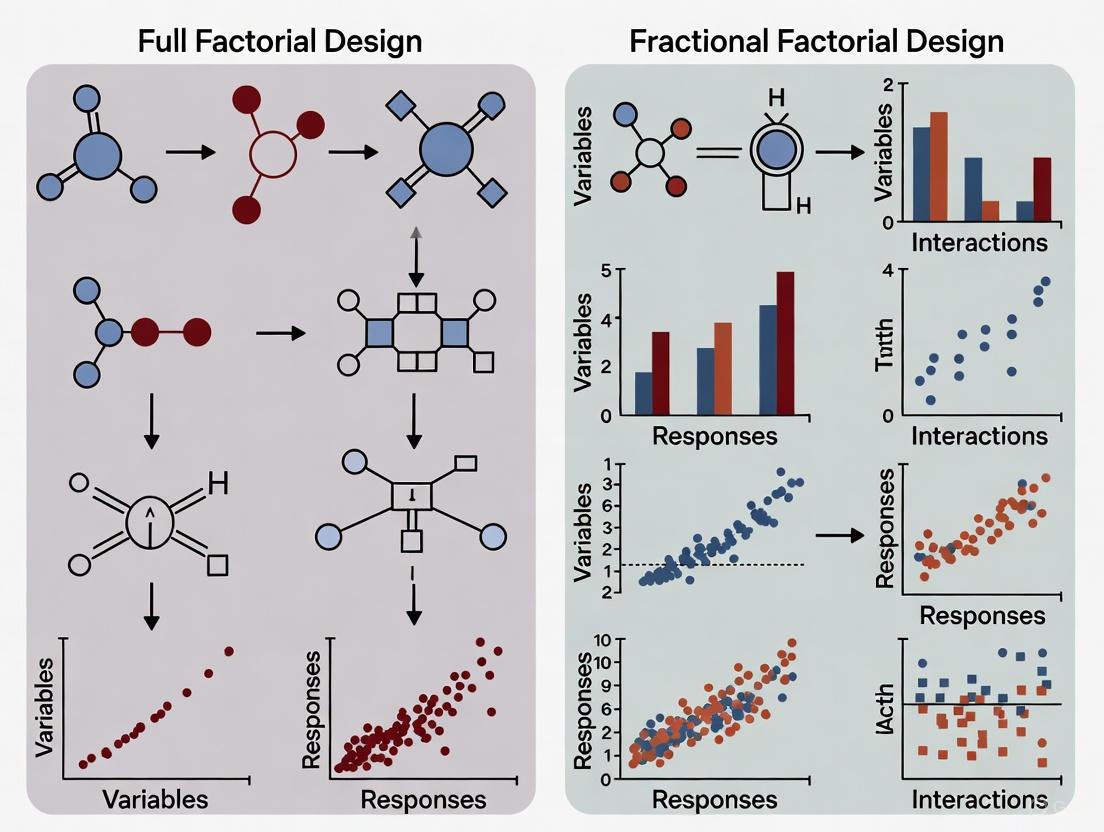
Optimizing biosensor performance requires the efficient exploration of numerous factors, from biological receptor concentration to physical assay conditions.
Full Factorial vs. Fractional Factorial Designs for Biosensors: A Strategic Guide for Researchers
Abstract
Optimizing biosensor performance requires the efficient exploration of numerous factors, from biological receptor concentration to physical assay conditions. This article provides a comprehensive comparison of full factorial and fractional factorial design of experiments (DoE) for biomedical researchers and development professionals. We cover foundational principles, methodological applications in areas like immunoassay and electrochemical sensor development, troubleshooting for common pitfalls like aliasing, and a strategic framework for validating and selecting the right design. The guide synthesizes key takeaways to empower scientists in making informed, resource-conscious decisions for robust biosensor optimization.
Core Principles: Understanding Full and Fractional Factorial Designs in Biosensor Development
Defining Design of Experiments (DoE) and Moving Beyond One-Factor-at-a-Time (OFAT)
Table of Contents
- The Critical Limitations of OFAT
- Design of Experiments: A Systematic Foundation
- Full Factorial vs. Fractional Factorial Designs: A Detailed Comparison
- Application in Biosensor Research: Case Studies and Experimental Protocols
- Implementing DoE in Your Research: A Practical Pathway
The Critical Limitations of OFAT
For decades, the one-factor-at-a-time (OFAT) approach has been a default method in many scientific domains, including biosensor development. In this paradigm, a researcher optimizes a single variable while holding all others constant, then moves sequentially to the next variable. While intuitively simple, this method is fraught with significant, often hidden, drawbacks that hinder scientific progress and technological optimization.
The most profound limitation of OFAT is its inability to detect interactions between factors [1]. In complex biological systems, such as those underlying biosensor function, it is common for the effect of one factor (e.g., the concentration of an immobilized enzyme) to depend on the level of another (e.g., the pH of the buffer). In an OFAT approach, these critical interaction effects are not captured and end up being subsumed into experimental error, leading to an incomplete and potentially misleading understanding of the system [1]. Furthermore, OFAT is highly inefficient, requiring a large number of experiments to explore even a modest experimental space, which consumes valuable time, resources, and materials [2] [3]. Perhaps most critically, an OFAT approach often leads experimenters to a local optimum or "pseudo-optimum" rather than the true global optimum for the process, resulting in a suboptimal final product or protocol [1].
As noted in a review on stem cell bioprocessing, "To consult the statistician after an experiment is finished is often merely to ask him to conduct a post mortem examination. He can perhaps say what the experiment died of." – R.A. Fisher [1]. This aptly summarizes the reactive and often futile position researchers find themselves in when relying on OFAT, underscoring the need for a more proactive, systematic methodology.
Design of Experiments: A Systematic Foundation
Design of Experiments (DoE) is a powerful, statistically grounded framework for planning, conducting, and analyzing controlled experiments to efficiently explore the relationship between multiple input factors and one or more output responses [4]. Unlike OFAT's passive data collection, DoE involves the active manipulation of factors according to a pre-determined experimental matrix, which maximizes information quality while eliminating redundant data [4].
The core advantages of DoE are a direct counter to OFAT's weaknesses:
- Detection of Interactions: DoE is specifically designed to quantify how factors interact with one another, providing a more realistic and comprehensive model of the system under study [1] [5].
- Efficiency and Resource Optimization: By varying multiple factors simultaneously, DoE can extract maximum information from a minimal number of experimental runs [6] [7].
- Global Optimization: Through structured approaches like Response Surface Methodology (RSM), DoE enables researchers to navigate the experimental space to find true optimal conditions, rather than getting trapped in local optima [1].
- Robustness and Reproducibility: Understanding the factor effects and their interactions helps in building processes that are less sensitive to minor, uncontrolled variations, thereby enhancing reproducibility—a major concern in scientific research [1] [8].
A typical DoE workflow is sequential, often beginning with a screening design to identify the most influential factors from a large set of candidates, followed by an optimization design to pinpoint the ideal factor settings, and finally a robustness verification to ensure performance is stable [6].
Full Factorial vs. Fractional Factorial Designs: A Detailed Comparison
When the number of factors to be studied is small, a Full Factorial Design is the most comprehensive approach. It involves experimentally testing every possible combination of all levels for all factors. For k factors each at 2 levels, this requires 2^k runs [5]. For example, a 3-factor, 2-level full factorial (2³) requires 8 experimental runs.
However, as the number of factors increases, the number of runs in a full factorial design grows exponentially. Studying 5 factors at 2 levels would require 32 runs, and with replication, this number doubles to 64, becoming prohibitively expensive and time-consuming [9].
This is where Fractional Factorial Designs become essential, particularly in the early stages of research. These designs are a carefully selected subset (a fraction) of the full factorial runs [8]. A fractional factorial for 5 factors, denoted as 2^(5-1), would require only 16 runs—half of the full design—making it a highly efficient screening design [9].
The trade-off for this efficiency is confounding (or aliasing), where some effects cannot be estimated independently. The extent of confounding is described by the design's resolution [8].
- Resolution III: Main effects are not confounded with each other but are confounded with two-factor interactions. Suitable for initial screening when many factors are being investigated.
- Resolution IV: Main effects are not confounded with each other or with two-factor interactions, but two-factor interactions are confounded with each other.
- Resolution V: Main effects and two-factor interactions are not confounded with each other. Main effects are confounded with four-factor interactions, and two-factor interactions are confounded with three-factor interactions. Since three-factor and higher interactions are rare, Resolution V designs are often considered as effective as full factorial designs for understanding main effects and two-factor interactions [8] [9].
The following table provides a direct comparison of these two pivotal DoE approaches.
| Feature | Full Factorial Design | Fractional Factorial Design |
|---|---|---|
| Purpose | Optimization; comprehensive modeling | Screening; identifying vital factors |
| Runs for 5 factors, 2 levels | 32 (without replication) [9] | 16 (for a half-fraction, 2^(5-1)) [9] |
| Information Obtained | All main effects and all interaction effects | Main effects and some interactions, with confounding |
| Key Advantage | Complete information; no confounding | High efficiency; greatly reduced experimental burden |
| Key Disadvantage | Number of runs becomes impractical with many factors | Confounding of effects requires careful interpretation |
| Best Application Context | When the number of factors is small (<5) or when all factors are known to be critical and interactions are important [3] | Early-stage research with a large number of potential factors (≥5) to identify the few that are significant [6] [9] |
Experimental Protocol: Setting Up a 2-Level Factorial Design
- Define the Objective: Clearly state the goal (e.g., "screen factors affecting biosensor sensitivity").
- Select Factors and Levels: Choose the input variables (e.g., pH, temperature, ion concentration) and their high (+1) and low (-1) experimental levels based on prior knowledge or literature.
- Choose the Design Type: Based on the number of factors and resource constraints, decide between a full or fractional factorial design. For a 5-factor study, a Resolution V fractional factorial is often optimal for screening [9].
- Generate the Experimental Matrix: Use statistical software (e.g., JMP, MATLAB, R) to create a run order table, which randomizes the sequence of experiments to avoid bias [4].
- Execute Experiments and Collect Data: Perform the assays according to the randomized matrix, measuring the key response variables (e.g., signal-to-noise ratio, limit of detection).
- Analyze the Data: Fit the data to a statistical model. Use half-normal plots of standardized effects or analysis of variance (ANOVA) to identify which factors and interactions have a statistically significant impact on the response [8].
- Interpret and Iterate: Use the results to refine your understanding. Significant factors from a screening design can then be investigated further in a full factorial or response surface optimization design.
Application in Biosensor Research: Case Studies and Experimental Protocols
The systematic approach of DoE is particularly crucial for optimizing ultrasensitive biosensors, where challenges like enhancing the signal-to-noise ratio, improving selectivity, and ensuring reproducibility are paramount [5]. The following cases illustrate its practical utility.
Case Study 1: Optimizing a Quantitative Sandwich ELISA
- Objective: To significantly improve the analytical sensitivity and lower the limit of quantification (LLOQ) of a sandwich ELISA for a protein antigen [3].
- Challenge: The multi-step nature of ELISA involves numerous interacting parameters (e.g., antibody concentration, buffer, incubation time/temperature).
- Methodology: The researchers employed a step-by-step full factorial design [3]. Instead of optimizing all factors at once, they applied full factorial designs successively to each major step of the assay (e.g., plate coating, detection). After optimizing one step, the best combination of factors was incorporated into the protocol before moving to the next step.
- Outcome: This iterative, structured approach resulted in a 20-fold increase in analytical sensitivity and reduced the LLOQ from 156.25 ng/mL to 9.766 ng/mL [3]. The DoE successfully identified significant interactions between factors that would have been missed by an OFAT approach.
Case Study 2: Enhancing Whole-Cell Biosensor Performance
- Objective: To optimize the genetic components of a whole-cell biosensor for protocatechuic acid (PCA) to maximize dynamic range and signal output [7].
- Challenge: The performance of a biosensor's genetic circuit is non-intuitive, and traditional iterative methods are inefficient for exploring the multi-dimensional design space of regulatory parts (promoters, RBS).
- Methodology: A Definitive Screening Design (DSD), a modern and efficient type of screening design, was used to systematically vary the expression levels of three key genetic components [7]. This approach allowed for the exploration of a wide range of genetic configurations with a minimal number of constructed variants.
- Outcome: The DoE methodology enabled the rapid identification of optimal genetic designs, resulting in biosensors with dramatically enhanced performance: up to a 30-fold increase in maximum signal output, a >500-fold improvement in dynamic range, and a >1500-fold increase in sensitivity [7].
The logical workflow for applying DoE in biosensor development, as demonstrated in these case studies, can be visualized as follows:
Implementing DoE in Your Research: A Practical Pathway
Transitioning from OFAT to DoE requires a shift in mindset and practice. The following pathway provides a structured guide for researchers in biosensors and drug development.
- Start with a Clear Goal: Define a single, measurable primary response (e.g., lowest limit of detection, highest signal-to-noise ratio). Additional secondary responses can also be included.
- Brainstorm Potential Factors: Gather a multidisciplinary team to list all possible factors that could influence the response. Use prior knowledge and risk assessments to categorize them.
- Select a Screening Design: If the list of factors is long (typically >4), a Fractional Factorial or Plackett-Burman design is the most efficient way to identify the vital few [6]. A Resolution V design is ideal as it provides clear information on main effects and two-factor interactions without being confounded with each other [9].
- Plan Meticulously: Document all procedures, assign resources, and use statistical software to generate a randomized run order to minimize the effect of lurking variables.
- Analyze and Iterate: After running the screening design, analyze the data to identify the 2-4 most critical factors. Then, progress to a Full Factorial or Response Surface Method (RSM) design, such as a Central Composite Design, for these key factors to locate the precise optimum [1] [5].
- Validate the Model: Conduct confirmation experiments at the predicted optimal conditions to verify the model's accuracy and the process's robustness.
The Scientist's Toolkit: Essential Research Reagent Solutions
The successful application of DoE relies on high-quality, consistent materials. The following table details key reagents and their functions in a typical biosensor development context.
| Research Reagent / Material | Function in Biosensor Development & DoE |
|---|---|
| Biorecognition Elements (e.g., antibodies, enzymes, oligonucleotides, allosteric transcription factors) | The core sensing component that provides specificity by binding to the target analyte. A key factor for optimization in DoE (e.g., concentration, immobilization method) [5] [10]. |
| Buffer Components (e.g., acetate, phosphate, salts, blockers like BSA) | Creates the chemical environment for the biorecognition event. Factors like pH, ionic strength, and blocking agent concentration are critical for minimizing non-specific binding and maximizing signal, making them common DoE factors [3]. |
| Signal Transduction Materials (e.g., electrochemical mediators, fluorescent dyes, enzyme substrates) | Generates a measurable signal (optical, electrochemical) from the biorecognition event. Their concentration and type are often optimized using DoE to enhance signal amplitude and stability [2] [10]. |
| Solid Supports & Immobilization Chemistries (e.g., functionalized gold chips, carbon electrodes, magnetic beads, NHS-ester plates) | Provides the surface for immobilizing the biorecognition element. The choice of support and chemistry (e.g., covalent, affinity) is a qualitative factor in DoE that can drastically impact sensor performance and reproducibility [5] [10]. |
| Statistical Software (e.g., JMP, MATLAB, R, Python with relevant libraries) | Not a wet-lab reagent, but an essential tool for generating experimental designs, randomizing run orders, performing ANOVA, and creating response surface models to interpret complex results [4]. |
What is a Full Factorial Design? The Gold Standard for Complete Information
For researchers and scientists developing sophisticated biosensors, achieving optimal performance is critical. The process of optimization, however, presents a significant challenge: how to efficiently and accurately understand the complex interplay of multiple experimental factors. While the traditional "one factor at a time" (OFAT) approach is simple, it often leads to suboptimal results because it fails to capture interactions between variables [2] [11]. This is where Design of Experiments (DOE) methodologies become essential. Among them, the Full Factorial Design stands as the gold standard for obtaining complete information, providing an unrivaled, comprehensive view of the experimental landscape [12] [13].
Full Factorial Design: The Uncompromising Approach
A Full Factorial Design is an experimental approach in which researchers measure responses at all possible combinations of the levels for every factor being studied [9] [13]. In a system with k factors, each investigated at only 2 levels (typically a "low" and a "high" value), the total number of experimental runs required is 2^k [14] [13]. This exhaustive exploration creates a hypercube of experimental conditions, allowing for a complete analysis of not only the main effect of each factor but also every possible interaction between them, from two-way interactions up to the k-way interaction [14].
The primary advantage of this design is its ability to build a completely detailed model of the system. It does not rely on assumptions that higher-order interactions are negligible, which is a limitation of its fractional counterpart. This makes it exceptionally powerful for optimization studies where understanding these complex interactions is crucial for developing a robust and high-performing biosensor [15]. However, this comprehensiveness comes at a cost: the number of runs increases exponentially with each additional factor, which can quickly make the experiment resource-prohibitive [12] [13].
The Mathematical Backbone
The data from a full factorial experiment is used to construct a mathematical model that describes the relationship between the experimental factors and the response. For a 2-factor design, the postulated model is typically a first-order polynomial with an interaction term [14]:
Y = b₀ + b₁X₁ + b₂X₂ + b₁₂X₁X₂
Where:
- Y is the predicted response.
- b₀ is the global constant (intercept).
- b₁ and b₂ are the coefficients for the main effects of factors X₁ and X₂.
- b₁₂ is the coefficient for the interaction effect between X₁ and X₂.
The coefficients are computed from the experimental data using methods like least squares regression, creating a predictive model that can estimate the response for any point within the experimental domain [14].
Figure 1: The Full Factorial Design Workflow. This systematic process involves running all possible factor combinations to build a comprehensive predictive model.
Direct Comparison: Full Factorial vs. Fractional Factorial Design
The most relevant alternative to a full factorial design is the fractional factorial design. The choice between them is a classic trade-off between comprehensiveness and efficiency. The table below provides a clear, structured comparison to guide researchers in their selection.
Table 1: A direct comparison of Full Factorial and Fractional Factorial Designs for a 5-factor, 2-level system.
| Feature | Full Factorial Design | Fractional Factorial Design |
|---|---|---|
| Basic Principle | Measures responses at all possible combinations of factor levels [13]. | Conducts only a selected subset (a "fraction") of the runs in the full factorial design [9] [13]. |
| Number of Runs (for 5 factors) | 32 runs (2^5) [9]. | 16 runs (½ fraction) or even fewer, depending on the fraction chosen [9]. |
| Information Obtained | Complete information on all main effects and all interactions (two-way, three-way, etc.) [9]. | Main effects and lower-order interactions; higher-order interactions are confounded (aliased) with other effects [9] [13]. |
| Key Advantage | Gold standard for complete data; no confounding of effects; can detect all interactions [12]. | High efficiency; significantly reduces time, resources, and cost for a large number of factors [9]. |
| Key Disadvantage | Experimentally expensive; number of runs becomes prohibitive with many factors [13]. | Loss of information due to aliasing; cannot distinguish between confounded effects without prior knowledge or follow-up experiments [9] [12]. |
| Ideal Use Case | Optimization design when the factors are known to be critical and interactions are expected; best for systems with a small number of factors (e.g., <5) [9] [11]. | Screening design to identify the most important factors from a large set; used when resources are limited or the number of factors is large [9] [12]. |
Understanding Aliasing: The Core Compromise
Aliasing is the fundamental compromise in fractional factorial designs. It occurs when the design does not include enough runs to uniquely estimate every effect. Consequently, main effects or interaction effects are confounded with each other, meaning the statistical analysis cannot distinguish which one is truly influencing the response [12] [13]. For example, in a resolution V fractional factorial design, two-factor interactions may be confounded with three-factor interactions. While it is often safe to assume three-factor interactions are negligible, this assumption can lead to incorrect conclusions if it is wrong [9].
Experimental Protocol: Full Factorial Design in Action
To illustrate the practical application of a full factorial design, let's examine a real-world example from analytical biochemistry: the optimization of a quantitative sandwich ELISA, a common biosensor format.
Methodology: Optimizing an ELISA
- Define Objective and Response: The goal was to optimize a sandwich ELISA for detecting the TT-P0 protein, aiming to maximize analytical sensitivity and lower the limit of quantification (LLOQ) [3].
- Select Factors and Levels: The researchers applied a full factorial design in successive steps of the multi-step ELISA procedure. In the "plate coating" stage, for instance, they investigated five factors (e.g., capture antibody concentration, buffer type, incubation temperature, plate type, incubation time), each at two levels [3].
- Execute Experimental Matrix: For the five factors, a full factorial design required 2^5 = 32 experimental runs for that stage alone. These runs were conducted in a randomized order to mitigate the introduction of systematic bias [3].
- Statistical Analysis and Model Building: The responses (signal intensity at high and low antigen concentrations) were measured. The data was analyzed to determine the significance of each main effect and all two-way and higher-order interactions. This allowed the researchers to identify the optimal combination of factor levels for the coating step [3].
- Iterate and Validate: This process was repeated for subsequent steps of the ELISA (e.g., detection antibody concentration, blocking solution). The final optimized protocol, built from the best conditions identified at each stage, was then validated [3].
Results and Impact
The systematic, full factorial approach led to a dramatically improved biosensor. The researchers reported a 20-fold increase in analytical sensitivity and successfully lowered the LLOQ of the antigen from 156.25 ng/mL to just 9.766 ng/mL [3]. Critically, the design allowed them to identify significant interactions between assay parameters that would have been missed by a traditional OFAT approach, underscoring the value of the full factorial method for complex, multi-step biosensor development.
Table 2: Key research reagents and their functions in a typical biosensor optimization experiment, as derived from cited studies.
| Reagent / Material | Function in Experimental Design |
|---|---|
| Glassy Carbon Electrode (GCE) | Serves as the working electrode platform for in-situ film electrode biosensors; its surface properties are critical for signal generation [2]. |
| Acetate Buffer Solution | A common supporting electrolyte and buffer system used to maintain a stable pH during electrochemical measurements [2]. |
| Metal Ion Standards (e.g., Bi(III), Sb(III)) | Used to form the sensitive film on the electrode surface in trace heavy metal detection; their concentration is a key optimized factor [2]. |
| Capture and Detection Antibodies | Essential biological recognition elements in immunoassays like ELISA; their concentration and immobilization strategy are prime factors for optimization [3]. |
| Microtiter Plates | The solid surface for immunoassay development; the plate type and coating efficiency are often investigated as factors in a full factorial design [3]. |
Figure 2: Deconstructing the Full Factorial Model. The model includes a constant, all main effects, and all possible interaction terms, providing a complete picture of factor influences.
The choice between a full and fractional factorial design is strategic and should be guided by the stage of your research and the specific questions you need to answer.
A Full Factorial Design is the unequivocal choice when you have a small number of critical factors (typically ≤5) and your goal is detailed optimization. It provides the most robust and complete dataset, allowing you to build a highly accurate predictive model and uncover critical interactions that could be the key to a breakthrough in biosensor performance [15] [3]. It is the gold standard when comprehensive information is the priority and resources permit.
A Fractional Factorial Design is a powerful screening tool when you are in the early stages of research with a large number of potential factors (e.g., 5 or more). Its primary strength is efficiency, enabling you to identify the few vital factors that have the greatest impact on your biosensor's response with a fraction of the experimental effort [9] [11].
For a rigorous biosensor development project, a sequential approach is often most effective: begin with a fractional factorial design to screen and identify the vital few factors from the trivial many, and then employ a full factorial design on those critical factors to achieve a truly optimized and robust final product.
What is a Fractional Factorial Design? The Strategic Shortcut for Screening
In the development of sophisticated biosensors, researchers must simultaneously optimize numerous variables, from the concentration of biological recognition elements to the physical parameters of the transduction system. Fractional Factorial Design (FFD) has emerged as a powerful statistical strategy that enables scientists to screen many potential factors efficiently without the prohibitive resource investment of comprehensive testing. This approach is particularly valuable in early-stage biosensor development where the most influential parameters must be identified rapidly from a large set of possibilities.
FFD operates on the principle of effect sparsity, which posits that in most complex systems, only a small subset of factors and their low-order interactions account for the majority of the observed effects on the response variable. This guiding principle allows researchers to investigate a large number of factors in a fraction of the runs required for a Full Factorial Design (FFD), making it an indispensable screening tool in the researcher's arsenal [16] [17].
Core Concepts: Full Factorial vs. Fractional Factorial Designs
Understanding Full Factorial Design
A Full Factorial Design is a systematic approach to experimentation in which responses are measured at all possible combinations of the factor levels. For k factors each at 2 levels, a Full Factorial requires 2^k experimental runs. This comprehensive approach allows for the complete characterization of all main effects and interaction effects between factors, but becomes rapidly impractical as the number of factors increases [9].
For example, with 5 factors each at 2 levels, a Full Factorial requires 32 runs (2^5), while with 8 factors, the requirement jumps to 256 runs (2^8). In biosensor research, where each experimental run may involve costly reagents, lengthy procedures, and specialized equipment, such comprehensive testing is often prohibitive in cost and time [9].
The Fractional Factorial Alternative
Fractional Factorial Designs strategically select a subset (fraction) of the runs from the Full Factorial, enabling researchers to study the effects of multiple factors simultaneously with significantly reduced experimental burden. Common fractions include 1/2, 1/4, or 1/8 of the full design, dramatically cutting the number of required experiments [16] [9].
This efficiency comes with a trade-off: FFDs intentionally alias some interactions, meaning certain effects cannot be estimated independently. However, for screening experiments where the goal is to identify the few critical factors from many candidates, this is an acceptable compromise based on the sparsity-of-effects principle [16] [17].
Table 1: Comparison of Experimental Requirements for Full vs. Fractional Factorial Designs
| Number of Factors | Full Factorial Runs (2^k) | Half-Fraction Runs (2^(k-1)) | Quarter-Fraction Runs (2^(k-2)) |
|---|---|---|---|
| 3 | 8 | 4 | - |
| 4 | 16 | 8 | 4 |
| 5 | 32 | 16 | 8 |
| 6 | 64 | 32 | 16 |
| 7 | 128 | 64 | 32 |
| 8 | 256 | 128 | 64 |
The Science of Fractional Factorial Design
Fundamental Principles
FFDs rely on several key statistical principles that make them effective for screening applications:
- Effect Sparsity: In most systems, particularly complex biological ones, only a few factors have substantial effects on the response [16] [17].
- Hierarchical Ordering: Lower-order effects (main effects and two-factor interactions) are more likely to be important than higher-order interactions [9].
- Effect Heredity: Interactions tend to be important only when at least one of their parent factors is also important [16].
These principles justify the screening approach of FFDs, as they allow researchers to focus experimental resources on detecting the most probable significant effects.
Understanding Design Resolution
The resolution of a Fractional Factorial Design indicates its ability to separate effects of different orders and is a critical consideration in design selection:
- Resolution III: Main effects are clear of each other but are aliased with two-factor interactions. Suitable only when interactions are negligible [9].
- Resolution IV: Main effects are clear of two-factor interactions, but two-factor interactions are aliased with each other. A good compromise for many screening applications [9].
- Resolution V: Main effects and two-factor interactions are clear of each other. Considered as effective as Full Factorial for most practical purposes since three-factor interactions are rarely significant [9].
For biosensor development, Resolution V designs are often preferred as they provide reliable information on both main effects and two-factor interactions without the full experimental burden.
Experimental Protocols & Applications in Biosensor Research
Case Study: Optimizing Electrochemical Biosensor Performance
A comprehensive study demonstrates the application of FFD in optimizing an in-situ film electrode for detecting heavy metals—a configuration relevant to environmental biosensing applications. The researchers employed a five-factor, two-level FFD to screen factors influencing analytical performance [2].
Table 2: Experimental Factors and Levels for Biosensor Optimization
| Factor | Description | Low Level (-1) | High Level (+1) |
|---|---|---|---|
| A | Bi(III) concentration | 0 mg/L | 0.6 mg/L |
| B | Sn(II) concentration | 0 mg/L | 0.8 mg/L |
| C | Sb(III) concentration | 0 mg/L | 0.3 mg/L |
| D | Accumulation potential | -1.4 V | -1.2 V |
| E | Accumulation time | 60 s | 300 s |
Experimental Protocol:
- Surface Preparation: Glassy carbon electrode polished with 0.05 μm Al₂O₃, rinsed with ultrapure water, ultrasonicated for 1 minute, then immersed in 15 wt.% HCl for 10 minutes [2].
- Experimental Setup: Measurements performed in 0.1 M acetate buffer solution (pH 4.5) at room temperature without deoxygenation [2].
- Electrochemical Measurement: Square-wave anodic stripping voltammetry with 50 mV amplitude, 4 mV potential step, and 25 Hz frequency [2].
- Data Collection: Response variables included limit of quantification, linear concentration range, sensitivity, accuracy, and precision [2].
The FFD approach identified the most significant factors affecting biosensor performance, which were then optimized using follow-up experiments, demonstrating the strategic efficiency of this methodology [2].
Case Study: Screening in Health Behavior Interventions
While not in biosensors directly, a health behavior study illustrates the screening power of FFDs. Researchers examined five different communication factors in a web-based decision aid using a FFD, requiring only 16 groups instead of the 32 required for a Full Factorial [16] [17]. This approach efficiently identified influential factors while conserving resources—a principle directly transferable to biosensor development where multiple assay parameters must be optimized.
Advantages and Limitations in Biosensor Applications
Strategic Advantages
- Resource Efficiency: For 5 factors, a half-fraction FFD requires only 16 runs compared to 32 for Full Factorial, reducing experimental time, cost, and material usage by 50% [9].
- Comprehensive Screening: Allows simultaneous assessment of multiple factors, preventing the suboptimal conclusions that can arise from one-factor-at-a-time (OFAT) approaches [11] [3].
- Practical Feasibility: Makes complex multi-factor studies practicable within typical research constraints, enabling more thorough investigation of biosensor systems [16].
Inherent Limitations
- Aliasing: Certain interactions are confounded and cannot be estimated independently, potentially leading to misinterpretation if significant aliased interactions exist [9].
- Follow-up Requirements: Typically requires subsequent experiments to de-alias confounded effects and refine optimal settings for significant factors [16] [17].
- Resolution Constraints: Lower-resolution designs provide less information about interactions, requiring careful design selection based on research goals [9].
Implementation Workflow for Biosensor Research
The strategic application of FFDs follows a logical progression from screening to optimization, as illustrated below:
Research Reagent Solutions for Experimental Implementation
Table 3: Essential Materials for FFD Experiments in Biosensor Research
| Reagent/Material | Function in Experiment | Example Specifications |
|---|---|---|
| Working Electrode | Signal transduction platform | Glassy carbon electrode (3.0 mm diameter) [2] |
| Reference Electrode | Potential reference | Ag/AgCl (saturated KCl) [2] |
| Counter Electrode | Current completion | Platinum wire [2] |
| Buffer System | Electrochemical environment control | 0.1 M acetate buffer, pH 4.5 [2] |
| Polishing Material | Electrode surface preparation | 0.05 μm Al₂O₃ suspension [2] |
| Bi(III), Sn(II), Sb(III) solutions | Film formation for enhanced detection | 1000 mg/L stock solutions [2] |
| Standard Solutions | Calibration and quantification | 1000 mg/L stock solutions of target analytes [2] |
Fractional Factorial Designs represent a sophisticated methodological shortcut that aligns perfectly with the practical constraints of biosensor research. By enabling efficient screening of multiple factors with minimal experimental runs, FFDs accelerate the identification of critical parameters while conserving valuable resources. Though they require careful interpretation due to the inherent aliasing of certain interactions, their strategic implementation within a broader optimization framework provides researchers with a powerful approach for navigating complex factor spaces. As biosensing systems grow increasingly sophisticated, embracing such efficient experimental strategies will be crucial for rapid innovation and development in this critically important field.
Full Factorial vs. Fractional Factorial for Biosensors Research
In biosensor research, optimizing multiple parameters simultaneously is crucial for developing sensitive, specific, and robust detection systems. The factors (input variables) and their levels (specific settings) directly influence the biosensor's performance. Testing all possible combinations in a Full Factorial Design provides comprehensive data but leads to a combinatorial explosion—the rapid increase in required experimental runs as factors and levels increase [18] [19]. For example, just 7 factors at 2 levels require 128 runs for a full factorial design [18]. Fractional Factorial Designs address this challenge by strategically selecting a subset of runs, enabling efficient screening of many factors when comprehensive analysis is impractical [18] [9].
This guide objectively compares these two experimental design approaches, providing biosensor researchers with the data and methodologies to select the optimal strategy for their projects.
Core Concepts Comparison
Key Principles and Trade-offs
- Full Factorial Design: Examines all possible combinations of factors and levels. This comprehensive approach allows researchers to estimate all main effects and all interaction effects between factors, providing a complete picture of the system under investigation [18] [19].
- Fractional Factorial Design: Examines a carefully chosen subset (a "fraction") of the full factorial combinations. This efficiency comes with a trade-off: certain interaction effects become confounded or aliased, meaning they cannot be separated from other effects statistically [18] [19].
Quantitative Comparison of Requirements
The following table summarizes the direct impact of factor count on experimental scope for two-level designs, highlighting the combinatorial explosion problem.
Table 1: Experimental Run Requirements for Two-Level Factorial Designs
| Number of Factors | Full Factorial Runs (2^k) | Typical Fractional Factorial Runs (Example) | Fractional Design Resolution |
|---|---|---|---|
| 3 | 8 | 4 (½ fraction) | III - V |
| 4 | 16 | 8 (½ fraction) | IV - V |
| 5 | 32 | 16 (½ fraction) | V |
| 7 | 128 | 16 (¹⁄₈ fraction) | IV |
As shown in Table 1, the number of runs in a full factorial design grows exponentially (2^k), quickly becoming resource-prohibitive [18] [19]. A Resolution V design, as used for 5 factors, is generally considered high-quality, as it allows for the estimation of all main effects and two-factor interactions without confounding each other [9].
Advantages and Disadvantages
Table 2: Advantages and Disadvantages of Full vs. Fractional Factorial Designs
| Aspect | Full Factorial Design | Fractional Factorial Design |
|---|---|---|
| Key Advantages | • Complete information on all effects [18]• No risk of missing significant interactions [18]• High statistical power [18] | • High efficiency, saves time and resources [18] [19]• Excellent for screening many factors [18]• Practical for large factor sets [19] |
| Key Disadvantages | • Runs grow exponentially, costly for many factors [18] [19]• Can be complex to analyze with many interactions [19] | • Effects are confounded/aliased [18] [19]• Risk of missing important higher-order interactions [19]• Requires more statistical expertise to design and interpret [18] |
| Ideal Use Case | • Optimization when factors are known to be critical and interactions are expected [9]• When resources and time are readily available [18] | • Initial screening to identify the "vital few" factors from many potential ones [18] [9]• When resources are limited or factors are numerous [19] |
Experimental Protocols & Data
Case Study: Full Factorial Design for ELISA Optimization
A 2023 study optimized a quantitative sandwich ELISA for detecting a protein in a vaccine candidate using a step-by-step full factorial design [3].
- Objective: To increase the analytical sensitivity and lower the limit of quantification (LOQ) of the ELISA.
- Experimental Factors and Levels: The optimization was conducted sequentially. In the plate coating stage, for instance, five factors were evaluated simultaneously [3]:
- Coating antibody concentration (2 levels)
- Coating buffer type (2 levels)
- Incubation temperature (2 levels)
- Incubation time (2 levels)
- Microplate type (2 levels)
- Protocol: A
2^5full factorial design (32 runs) was executed for the coating stage. After statistical analysis to identify the optimal combination for that stage, the best settings were incorporated, and the process was repeated for subsequent stages of the ELISA (e.g., detection antibody concentration, enzyme conjugate dilution) [3]. - Key Results: This iterative full factorial approach successfully increased the assay's analytical sensitivity by 20-fold and reduced the lower limit of quantification from 156.25 ng/mL to 9.766 ng/mL [3]. The design was critical for identifying significant interactions between factors that would have been missed by a one-factor-at-a-time (OFAT) approach.
Case Study: Fractional Factorial for Electrochemical Sensor Optimization
A systematic study on an in-situ film electrode for detecting heavy metals employed a fractional factorial design followed by simplex optimization [2].
- Objective: To determine the significance of five factors on the electrode's analytical performance and find their optimum conditions.
- Experimental Factors: The five factors studied were the mass concentrations of three metal ions (Bi(III), Sn(II), Sb(III)) used to form the electrode film, the accumulation potential (
E_acc), and the accumulation time (t_acc) [2]. - Protocol:
- Screening: A
2^(5-1)fractional factorial design (16 runs) was first used to efficiently screen the five factors and identify which had a significant impact on a combined performance metric (considering LOQ, sensitivity, accuracy, precision, and linear range) [2]. - Optimization: Following the screening, a simplex optimization procedure was used to refine the levels of the significant factors and find the true optimum conditions [2].
- Screening: A
- Key Results: The optimized electrode showed significantly better analytical performance compared to the initial experiments and pure film electrodes. The study demonstrated that a one-by-one optimization could not achieve the same level of improvement, highlighting the value of the model-based approach [2].
The Scientist's Toolkit
Table 3: Essential Research Reagent Solutions for Biosensor Development
| Reagent / Material | Function in Biosensor Experiments |
|---|---|
| Biorecognition Elements (Antibodies, Aptamers, Enzymes) | Provides specificity by binding to the target analyte [20]. |
| Electrode Systems (Glassy Carbon, Gold, Screen-Printed Electrodes) | Serves as the transducer platform, often for electrochemical biosensors [2] [20]. |
| Nanomaterials (Gold Nanoparticles, Graphene, Carbon Nanotubes) | Enhances signal transduction, increases active surface area, and improves sensitivity [20]. |
| Buffer Solutions (Acetate, Phosphate, etc.) | Maintains optimal pH and ionic strength for biomolecular interactions and assay stability [3] [20]. |
| Chemical Modifiers (e.g., Bi(III), Sn(II), Sb(III) ions) | Used to form modified or composite electrode films to enhance electrochemical properties [2]. |
Workflow and Decision Pathway
The following diagram illustrates the strategic decision-making process for selecting between full and fractional factorial designs in a biosensor development project.
The choice between full and fractional factorial designs is a strategic trade-off between comprehensiveness and efficiency. Full factorial designs are the gold standard for detailed characterization and optimization of a small number of critical factors, providing complete information on interactions at the cost of significant resources. Fractional factorial designs are an indispensable tool for the initial screening of a large number of factors, allowing researchers to efficiently identify the most influential variables before committing to a more resource-intensive optimization study.
For biosensor researchers, a sequential approach is often most effective: begin with a fractional factorial design to screen a broad set of potential factors, then use a full factorial design to perform in-depth optimization on the vital few factors identified during screening [18] [9]. This hybrid strategy effectively manages the combinatorial explosion problem while building a deep, reliable understanding of the biosensor system.
A Primer on Factorial Designs in Experimentation
In the design of experiments (DOE), full factorial and fractional factorial designs represent two fundamental approaches to navigating the core trade-off between the depth of knowledge gained and the resources expended [9]. A full factorial design tests all possible combinations of the levels for every factor under investigation [21]. This comprehensiveness allows researchers to obtain a complete picture of the system, enabling the statistical determination of not only the main effects of each factor but also all the interactions between them, regardless of order [11] [21]. However, the number of experimental runs required for a full factorial design grows exponentially with the number of factors (denoted as k), following the formula 2k for two-level designs [9]. This can quickly become resource-prohibitive.
Fractional factorial designs address this resource constraint by executing only a carefully selected subset, or a "fraction," of the runs required for the full factorial design [9] [12]. This approach is predicated on the sparsity-of-effects principle, which assumes that higher-order interactions (those involving three or more factors) are often negligible and that main effects and two-factor interactions are the most critical [12]. By strategically "aliasing" these higher-order interactions with lower-order effects, fractional factorial designs can screen a large number of factors far more efficiently [9] [12]. The trade-off is a potential loss of information, as some interactions may be confounded and unmeasurable [22].
The table below summarizes the core characteristics of these two designs.
| Feature | Full Factorial Design | Fractional Factorial Design |
|---|---|---|
| Core Principle | Experiments conducted at every combination of all factor levels [21]. | A selected subset of runs from the full factorial design is performed [9]. |
| Objective | Obtain a complete map of all main and interaction effects [21]. | Efficiently screen a large number of factors to identify the most significant ones [12]. |
| Experimental Runs | 2k (for k factors at 2 levels). Grows exponentially [9]. | 2(k-p) (e.g., 16 runs for 5 factors vs. 32 for full factorial). Grows more slowly [9]. |
| Information Output | Full information on all main effects and all interaction orders [21]. | Information on main effects and lower-order interactions; some effects are aliased [9]. |
| Resource Requirement | High (time, cost, materials) [21] [22]. | Lower, more efficient for screening [9] [22]. |
| Best Application | Optimization of a few critical, known factors [9] [12]. | Initial screening to identify critical factors from a large set [9] [12]. |
The following diagram illustrates the decision-making workflow for choosing between these designs, particularly in the context of a multi-stage experimental campaign.
Decision workflow for selecting a factorial design strategy.
Quantifying the Trade-off: A Comparative Analysis
The theoretical trade-off between comprehensiveness and efficiency becomes stark when quantified. The following table models the exponential growth in experimental runs for a full factorial design as factors increase, compared to the savings offered by a half-fractional design.
| Number of Factors (k) | Full Factorial Runs (2k) | Half-Fractional Factorial Runs (2(k-1)) | Runs Saved |
|---|---|---|---|
| 3 | 8 | 4 | 4 |
| 4 | 16 | 8 | 8 |
| 5 | 32 | 16 | 16 |
| 6 | 64 | 32 | 32 |
| 8 | 256 | 128 | 128 |
| 10 | 1024 | 512 | 512 |
This mathematical reality has direct consequences for research outcomes. A case study in quality management compared a full factorial (32 runs) and a fractional factorial (16 runs) for identifying factors affecting material adhesion [22]. Both designs successfully identified the same primary factor as statistically significant. However, the fractional design failed to detect additional significant factors that the full factorial revealed, a consequence of the data reduction inherent to the fractional approach [22]. This illustrates the efficiency of fractional designs for finding major drivers, but also their risk of missing subtler, yet still important, effects.
The choice between designs also dictates the complexity of the resulting statistical model. A full factorial design with 5 factors at 2 levels requires the analyst to consider 5 main effects, 10 two-factor interactions, 10 three-factor interactions, 5 four-factor interactions, and 1 five-factor interaction—a total of 31 terms [9]. In contrast, a Resolution V fractional factorial design for the same problem would focus only on the 5 main effects and 10 two-factor interactions, significantly simplifying the analysis [9].
Experimental Protocols for Biosensor Research
The principles of factorial design are readily applicable to the development and optimization of biosensors. The following protocols outline how these methods can be implemented in a laboratory setting.
Protocol 1: Screening with a Fractional Factorial Design
Objective: To rapidly identify the most influential factors affecting the sensitivity of an electrochemical biosensor from a large pool of potential variables (e.g., probe concentration, pH, incubation time, temperature, redox mediator concentration).
- Define Factors and Levels: Select 5-7 critical factors. For each, define a high (+1) and low (-1) level based on preliminary data or literature (e.g., pH 6.5 vs. pH 7.5).
- Select Design Resolution: Choose a Resolution V (or higher) design if resources allow. This ensures that main effects are not aliased with any two-factor interactions, and two-factor interactions are only aliased with higher-order interactions (assumed to be negligible) [9].
- Execute Experimental Matrix: Perform the experiments as dictated by the design matrix. For a 5-factor Resolution V design, this involves 16 unique runs [9].
- Measure Response: The primary response variable is the biosensor's signal output (e.g., current in μA) for a standard analyte concentration.
- Statistical Analysis: Perform Analysis of Variance (ANOVA) to identify factors with statistically significant (p-value < 0.05) main effects on the signal. Use Pareto charts and normal probability plots to visually identify the most important factors.
Protocol 2: Optimization with a Full Factorial Design
Objective: To build a detailed predictive model and find the optimal conditions for a biosensor's performance after 2-3 critical factors have been identified via screening.
- Define Factors and Levels: Use the 2-3 vital factors identified in the screening phase. Again, define high and low levels, ensuring the range is relevant for optimization.
- Execute Full Factorial: Run the full 2^2 (4 runs) or 2^3 (8 runs) experiment. Include replication (e.g., 2-3 replicates per run) to obtain a robust estimate of experimental error and increase statistical power [21] [9].
- Include Center Points: Add 3-5 experimental runs at the center point (the midpoint between the high and low levels of all factors) to test for curvature in the response surface [12].
- Measure Multiple Responses: Record key performance metrics such as sensitivity, limit of detection, and response time.
- Build a Predictive Model: Use regression analysis to fit a linear model with interaction terms. For example, a model for two factors (A, B) would be:
Response = β0 + β1*A + β2*B + β12*A*B. The significance of the interaction term (β12) is key output of the full factorial [21].
Essential Research Reagent Solutions for Biosensor Development
The experimental protocols above rely on a suite of critical reagents and materials. The following table details key items essential for biosensor R&D.
| Item | Function in Biosensor Research |
|---|---|
| Biorecognition Elements | Provides specificity by binding the target analyte. Examples include antibodies, enzymes, DNA probes, or aptamers [23] [24]. |
| Electrochemical Redox Mediators | Facilitates electron transfer in electrochemical biosensors, amplifying the signal generated by the biorecognition event. |
| Blocking Agents | Used to passivate non-specific binding sites on the sensor surface, reducing background noise and improving signal-to-noise ratio. |
| Signal Transduction Substrates | The solid support (e.g., gold, carbon, or paper-based electrodes) that integrates the biological component with the physicochemical transducer [23]. |
| Buffer Solutions | Maintains the correct pH and ionic strength to ensure the stability and activity of the biorecognition element during assay steps [3]. |
Visualizing the Core Trade-off
The fundamental relationship between the knowledge gained and the resources invested in full and fractional factorial designs can be summarized in the following conceptual diagram.
The inherent trade-off between design types.
There is no universally superior choice between full and fractional factorial designs; the optimal strategy is entirely context-dependent. The critical trade-off between experimental comprehensiveness and resource efficiency must be actively managed based on the research goal.
For the initial stages of biosensor development, such as screening a multitude of fabrication or assay parameters, the fractional factorial design is an indispensable tool. Its ability to efficiently identify the "vital few" factors from the "trivial many" conserves precious resources and accelerates project timelines [9] [12]. Once the key factors are identified, the full factorial design becomes the method of choice for in-depth optimization. Its comprehensive nature allows researchers to build a robust predictive model and precisely understand factor interactions, ultimately leading to a more sensitive, reliable, and well-characterized biosensor [21].
A sequential approach, using a fractional design for screening followed by a full factorial for optimization, provides a powerful framework for navigating complex experimental landscapes, ensuring that resources are invested wisely without sacrificing the depth of understanding required for breakthrough innovations.
Practical Implementation: Applying Factorial Designs to Biosensor Optimization
In the development of robust and sensitive biosensors, optimizing the multitude of factors that influence performance—such as immobilization strategies, detection interface formulation, and operational conditions—presents a significant challenge. Traditional One-Factor-at-a-Time (OFAT) approaches, which vary a single parameter while holding others constant, are often inefficient and fundamentally flawed for this purpose. They consume substantial time and resources and, more critically, fail to detect interactions between variables, often leading to suboptimal performance [11] [3]. As a systematic alternative, Design of Experiments (DoE) provides a statistically sound framework for simultaneously investigating multiple factors. Within the DoE toolkit, the choice between a Full Factorial Design (FFD) and a Fractional Factorial Design is pivotal.
Full Factorial Design is a powerful approach that involves executing experiments for all possible combinations of the levels of every factor under investigation. For a system with k factors, each tested at 2 levels, this requires 2k experimental runs. This method provides comprehensive data on the individual effect of each factor (main effects) and, most importantly, on how these factors interact with one another (interaction effects) [14] [25]. This article provides a comparative guide for researchers on when to deploy a Full Factorial Design versus its fractional counterpart in the context of optimizing mature biosensor systems, complete with experimental protocols and data presentation frameworks.
Full vs. Fractional Factorial: A Strategic Comparison
The core difference between FFD and fractional designs lies in the depth of information obtained versus the resource investment required. While FFD provides a complete picture, a fractional factorial design investigates a carefully selected fraction (e.g., half or a quarter) of the total combinations, which dramatically reduces the number of experimental runs [11] [25]. This makes fractional designs excellent for initial screening when dealing with a large number of factors (typically more than 5) to identify which ones have the most significant impact [26] [25].
However, this efficiency comes at a cost: fractional designs have lower resolution, meaning that the confounding of interaction effects with each other or with main effects can occur. In contrast, FFD is the tool of choice for detailed characterization and optimization, especially when the system is known to have significant factor interactions or when the number of critical factors has been narrowed down to a manageable few (e.g., 2-5) [3] [26]. It is particularly crucial for optimizing mature biosensor systems, where the goal is to fine-tune performance to its theoretical maximum, and missing key interactions could mean failing to achieve the optimal configuration.
The table below summarizes the key distinctions to guide the selection process.
Table 1: Comparison between Full Factorial and Fractional Factorial Designs
| Feature | Full Factorial Design (FFD) | Fractional Factorial Design |
|---|---|---|
| Primary Goal | Detailed characterization, modeling, and optimization; quantifying interactions. | Rapid screening of many factors to identify the most significant ones. |
| Information Obtained | All main effects and all interaction effects. | Main effects and lower-order interactions, but with some confounding. |
| Experimental Runs | 2k (for k factors at 2 levels). | 2k-p (e.g., 1/2, 1/4 of full factorial). |
| Resource Intensity | High (number of runs grows exponentially with factors). | Low. |
| Best Application Stage | Later-stage optimization of a refined set of critical factors. | Early-stage screening with a large number of potential factors. |
| Advantage | Comprehensiveness; ability to detect all interactions. | High efficiency and speed for factor screening. |
| Limitation | Can be prohibitively resource-intensive for many factors. | Cannot estimate all interactions independently; lower resolution. |
Case Study: Optimizing a Sandwich ELISA via Full Factorial Design
A 2023 study in Analytical Biochemistry provides a compelling example of the successful application of a step-by-step FFD to optimize a quantitative sandwich ELISA for detecting a vaccine candidate protein [3]. The researchers moved beyond a preliminary OFAT protocol to systematically optimize multiple steps of the assay, including plate coating, detection, and blocking.
Experimental Protocol and Workflow
The research employed a sequential FFD methodology, which can be visualized in the following workflow. This approach allowed for the progressive incorporation of optimal conditions into the final protocol.
Key Steps in the Protocol [3]:
- Define the Objective and Factors: The objective was to enhance the analytical sensitivity of the ELISA. Critical Process Parameters (CPPs) like antibody concentration, buffer type, incubation temperature, and plate type were identified for the coating step.
- Experimental Matrix: For each step, a 2k FFD was set up. For example, with 5 factors at 2 levels each, 32 (2⁵) experimental runs were performed for the coating step. The order of runs was randomized to avoid bias.
- Response Measurement: The output or response measured was the assay signal (e.g., absorbance).
- Statistical Analysis: Data were analyzed using Analysis of Variance (ANOVA) to determine the statistical significance (p-value < 0.05) of each main effect and interaction effect. Significant interactions were identified, which would have been missed by an OFAT approach.
- Iterative Optimization: The best-performing factor levels from one step were incorporated into the protocol before proceeding to optimize the next step, ensuring a cumulative improvement.
Key Findings and Performance Data
The application of FFD led to a dramatically improved assay. The researchers discovered significant interaction effects, such as between the coating buffer and the antibody concentration, which critically influenced the final outcome [3]. The quantitative results, summarized in the table below, demonstrate the power of this approach.
Table 2: Performance Improvement in ELISA after Full Factorial Optimization [3]
| Analytical Parameter | Preliminary OFAT Protocol | Optimized FFD Protocol | Improvement |
|---|---|---|---|
| Analytical Sensitivity | Baseline | 20x higher | 20-fold increase |
| Lower Limit of Quantification (LLOQ) | 156.25 ng/mL | 9.766 ng/mL | 16-fold decrease |
| Antigen Detectability | Standard | Significantly Enhanced | Major improvement for pharmacokinetic studies |
This case underscores that for a multi-step, complex process like an immunoassay, FFD is invaluable for moving from a functional protocol to a truly optimized one, ensuring that the final biosensor operates at its highest potential.
Implementing Full Factorial Design in Your Research
Decision Framework and Practical Workflow
Choosing the right experimental design is a critical first step. The following decision pathway provides a structured guide for researchers planning a biosensor optimization project.
The Scientist's Toolkit: Essential Reagents and Materials
Successful implementation of FFD relies on precise control over materials and conditions. The following table lists key reagent solutions and their functions in a typical biosensor optimization project, as illustrated in the cited literature.
Table 3: Research Reagent Solutions for Biosensor Optimization
| Reagent/Material | Function in Experiment | Example from Literature |
|---|---|---|
| Biorecognition Elements (e.g., antibodies, aptamers) | Provides specificity by binding to the target analyte. | Monoclonal antibodies CBSSP0-Ls.3 and CBSSTT.6 were used in the sandwich ELISA [3]. |
| Blocking Buffer Solutions (e.g., BSA, casein) | Prevents non-specific binding of proteins to the sensor surface, reducing background noise. | A blocking solution was a critical factor optimized in the ELISA study [3]. |
| Signal Transduction Materials | Facilitates the conversion of a biological event into a measurable signal (optical, electrochemical). | Au-Ag nanostars were used as a plasmonic platform for SERS-based detection [27]. |
| Immobilization Matrices | Provides a stable surface for attaching biorecognition elements. | Functionalization with MPA, EDC, and NHS for covalent antibody attachment on nanostars [27]. |
| Chemical Standards & Buffers | Creates a controlled chemical environment (pH, ionic strength) for consistent assay performance. | 0.1 M acetate buffer at pH 4.5 was used as a supporting electrolyte in electrochemical optimization [2]. |
The strategic selection of an experimental design is paramount for the efficient and effective optimization of biosensors. While fractional factorial designs serve an invaluable purpose in the early stages of research by rapidly identifying critical factors from a large pool, Full Factorial Design is the unequivocal method for the detailed optimization of a mature biosensor system. Its ability to comprehensively quantify and model both main effects and interaction effects provides a level of insight that OFAT and screening designs cannot match. As demonstrated in the ELISA case study, committing to an FFD approach can yield order-of-magnitude improvements in key performance metrics like sensitivity and detection limit, ensuring that a biosensing platform is not just functional, but truly optimized for real-world application and reliability.
The optimization of bioanalytical methods, particularly the enzyme-linked immunosorbent assay (ELISA), represents a critical challenge in pharmaceutical development and clinical diagnostics. Traditional optimization approaches, notably the one-factor-at-a-time (OFAT) method, have persisted despite significant limitations in efficiency and comprehensiveness [3]. This case study examines the application of a systematic full factorial Design of Experiments (DoE) approach to optimize a quantitative sandwich ELISA, contrasting this methodology with fractional factorial designs within the broader context of biosensor research.
The fundamental weakness of OFAT methodology lies in its inability to detect interaction effects between factors, potentially missing optimal experimental conditions while consuming substantial time and resources [3]. In contrast, full factorial DoE provides a structured framework for simultaneously investigating multiple factors and their interactions, enabling researchers to develop more robust and sensitive assays with fewer overall experiments [3] [28]. This systematic approach is particularly valuable for complex multi-step procedures like sandwich ELISA, where numerous parameters influence final assay performance.
Within biosensor research, the selection between full and fractional factorial designs represents a strategic trade-off between comprehensiveness and efficiency. This case study demonstrates how a phased full factorial approach applied to ELISA optimization can serve as a model for biosensor development, where understanding parameter interactions is equally critical for performance.
Theoretical Framework: Full vs. Fractional Factorial Designs
Fundamental DoE Concepts and Terminology
Design of Experiments is a statistically-based methodology for planning, conducting, and analyzing controlled tests to evaluate factors affecting experimental outcomes [28] [22]. In assay optimization, key DoE elements include: factors (input variables), levels (specific factor values), responses (measured outputs), and interactions (combined factor effects) [28]. Factorial designs, wherein multiple factors are simultaneously varied across their levels, enable efficient exploration of factor effects and interactions that would remain undetected in OFAT approaches [3].
Comparative Analysis of Factorial Approaches
Full and fractional factorial designs represent distinct approaches to experimental design with complementary strengths and limitations:
Table 1: Comparison of Full and Fractional Factorial Design Characteristics
| Characteristic | Full Factorial Design | Fractional Factorial Design |
|---|---|---|
| Experimental Runs | 2k for k factors at 2 levels | 2k-p for k factors with fraction 1/2p |
| Interaction Effects | Can estimate all interaction effects | Aliases higher-order interactions with main effects |
| Resource Requirements | High (exponential increase with factors) | Efficient for screening many factors |
| Information Completeness | Complete within design space | Limited due to intentional information reduction |
| Primary Application | Detailed optimization with few factors | Initial screening of many factors |
| Risk of Missed Effects | Low | Moderate to high depending on resolution |
Full factorial designs investigate all possible combinations of factors and their levels, providing comprehensive data on main effects and all interaction orders [3] [28]. This completeness comes at the cost of exponentially increasing experimental runs as factors increase - for example, 6 factors at 2 levels requires 64 experiments [28]. The comprehensive nature of full factorial designs makes them particularly valuable for detailed optimization studies with limited factors where understanding complex interactions is critical.
Fractional factorial designs deliberately examine only a fraction of the full factorial combinations, significantly reducing experimental burden while still estimating main effects and lower-order interactions [28] [22]. This efficiency comes with the limitation of effect aliasing, where higher-order interactions are confounded with main effects, potentially leading to misinterpretation [22]. Fractional designs are ideally suited for initial screening phases where the goal is identifying critically important factors from a large candidate set.
Case Study: ELISA Optimization via Step-by-Step Full Factorial DoE
Experimental Background and Objectives
A recent study demonstrated the application of full factorial DoE to optimize a quantitative sandwich ELISA for detecting the TT-P0 protein, a vaccine candidate against sea lice [3]. The preliminary assay developed using OFAT methodology exhibited insufficient sensitivity, with a lower limit of quantification (LLOQ) of 156.25 ng/mL [3]. The optimization objective was to significantly enhance analytical sensitivity while maintaining specificity, ultimately achieving improved detectability for pharmacokinetic studies.
The sandwich ELISA represents a particularly complex optimization challenge due to its multi-step nature involving plate coating, blocking, antigen capture, and detection [3] [29]. Each stage introduces multiple parameters that collectively influence final assay performance, creating an ideal application for full factorial DoE methodology.
Systematic Optimization Approach
The researchers implemented a sequential full factorial strategy, applying separate DoE arrays to each major assay step and progressively incorporating optimal conditions into the protocol [3]. This phased approach managed experimental complexity while capturing critical interaction effects between parameters within each assay stage. The methodology focused on practical implementation with straightforward statistical analysis, enhancing accessibility for laboratories without specialized statistical expertise [3].
Diagram 1: Sequential ELISA Optimization Workflow
Experimental Factors and Levels
The researchers identified critical factors for each assay stage based on preliminary investigations and scientific understanding of ELISA mechanics. For the plate coating step alone, five factors were investigated: capture antibody concentration, coating buffer composition, incubation time, incubation temperature, and plate type [3]. Each factor was evaluated at two levels (high and low values representing practically relevant ranges), generating 32 experimental combinations (25) for this single step [3].
Similar comprehensive approaches were applied to blocking (4 factors, 16 experiments), antigen incubation (3 factors, 8 experiments), and detection antibody incubation (4 factors, 16 experiments) [3]. This systematic evaluation enabled precise identification of optimal conditions and understanding of how factors interact to influence key assay parameters including sensitivity, specificity, and signal-to-noise ratio.
Key Findings and Performance Improvements
The full factorial DoE approach generated substantial improvements in assay performance while providing detailed understanding of factor interactions:
Table 2: Quantitative Performance Comparison Before and After DoE Optimization
| Performance Parameter | Preliminary OFAT Protocol | Optimized DoE Protocol | Improvement Factor |
|---|---|---|---|
| Lower Limit of Quantification (LLOQ) | 156.25 ng/mL | 9.766 ng/mL | 16-fold improvement |
| Analytical Sensitivity | Baseline | 20-fold higher | 20-fold improvement |
| Key Significant Factors Identified | N/A | 12 main effects, 15 interactions | Comprehensive understanding |
| Assay Specificity | Established | Maintained with enhanced detection | Equivalent specificity |
Beyond these quantitative improvements, the DoE approach revealed multiple significant interaction effects that would have remained undetected with OFAT methodology [3]. For example, in the plate coating step, significant interactions were identified between coating buffer and antibody concentration, and between antibody concentration and plate type [3]. These findings demonstrate how factor effects are frequently contingent on other parameters in the system - a critical insight for developing robust assays.
Research Reagent Solutions and Materials
Successful implementation of full factorial DoE for ELISA optimization requires specific reagents and materials carefully selected for their performance characteristics:
Table 3: Essential Research Reagents for ELISA Development and Optimization
| Reagent/Material | Function in Sandwich ELISA | Application Notes |
|---|---|---|
| Matched Antibody Pairs | Capture and detect target antigen | Must recognize non-overlapping epitopes [30] |
| Microplates | Solid phase for immobilization | Material and surface treatment affect binding; significant factor in optimization [3] |
| Coating Buffers | Immobilize capture antibody | Carbonate-based buffers commonly used; composition significantly affects binding efficiency [3] [30] |
| Blocking Solutions | Prevent non-specific binding | BSA, non-fat milk, or casein-based; critical for signal-to-noise ratio [29] [30] |
| Enzyme Conjugates | Signal generation | HRP or AP conjugates for colorimetric, chemiluminescent, or fluorescent detection [31] [32] |
| Chromogenic Substrates | Visualize antibody binding | TMB (HRP) or pNPP (AP) common; choice affects sensitivity [31] [32] |
| Wash Buffers | Remove unbound material | Typically PBS with surfactant; washing stringency affects specificity [29] [30] |
| Sample Diluents | Prepare samples in compatible matrix | Must maintain antigen integrity while minimizing matrix effects [29] [30] |
The selection of appropriate antibody pairs deserves particular emphasis, as the foundation of sandwich ELISA performance. Monoclonal antibodies provide superior specificity through single-epitope recognition, while polyclonal antibodies can enhance sensitivity through multiple-epitope binding [30]. For sandwich ELISA, carefully validated matched antibody pairs that recognize distinct, non-competing epitopes are essential for optimal assay performance [30].
Implementation Protocols: Methodologies for DoE in Assay Development
Full Factorial DoE Implementation Protocol
Implementing full factorial DoE for assay optimization requires systematic execution across distinct phases:
Pre-DoE Assay Characterization: Establish baseline performance using OFAT or literature-based conditions. Identify potentially critical factors through preliminary experiments and scientific understanding of the assay system [3].
Factor and Level Selection: Select 4-6 potentially significant factors per assay stage, choosing practically relevant high and low levels based on preliminary data [3] [28]. Avoid excessive factor inclusion which leads to impractical experiment numbers.
Experimental Randomization: Execute experimental runs in randomized order to minimize confounding from external variables [28] [33]. Automated liquid handling systems can facilitate this randomization while reducing manual errors [33].
Data Collection and Statistical Analysis: Measure relevant responses (sensitivity, background, dynamic range). Analyze using ANOVA to identify significant main effects and interactions (typically p<0.05) [3] [22].
Iterative Optimization: Incorporate optimal conditions from one assay stage into subsequent DoE arrays for following stages in sequential manner [3].
Model Verification: Confirm predicted performance through confirmation experiments using optimal conditions identified through DoE analysis [3] [28].
Assay Validation Protocol
Following optimization, comprehensive validation establishes assay reliability for intended applications:
Sensitivity Characterization: Determine limit of detection (LOD) and lower limit of quantification (LLOQ) using serial dilutions of target analyte [3] [29].
Specificity Assessment: Evaluate cross-reactivity with related molecules and matrix effects using relevant biological samples [3] [30].
Precision and Accuracy: Determine intra- and inter-assay variability through replicate measurements [29]. Conduct spike-and-recovery experiments to assess accuracy in relevant matrices [29].
Parallelism Evaluation: Demonstrate consistent analyte measurement across sample dilutions to confirm absence of matrix effects [29].
Robustness Testing: Intentionally vary critical parameters (incubation times, temperatures) to establish assay tolerance to minor operational variations [3].
Implications for Biosensor Research and Development
The successful application of full factorial DoE to ELISA optimization provides valuable insights for biosensor development, where similar multi-parameter optimization challenges exist. Biosensors frequently involve complex interfaces between biological recognition elements and transducers, creating multiple interaction effects that impact overall performance [34] [35].
Recent research on translating sandwich ELISA principles to electronic biosensors highlights the continued importance of systematic optimization approaches [34] [35]. For example, optimizing buffer ionic strength was critical for successful implementation of sandwich approaches in impedimetric biosensors due to effects on charge-based detection mechanisms [34]. This parallels the buffer optimization identified as significant in the ELISA case study [3], suggesting common optimization priorities across biological detection platforms.
The integration of DoE with emerging machine learning approaches presents particularly promising directions for complex biosensor optimization [28]. While DoE provides structured experimental frameworks for modeling factor effects, machine learning can handle higher-dimensional data and non-linear relationships, potentially enhancing optimization efficiency for increasingly complex biosensing systems [28].
This case study demonstrates that systematic full factorial DoE provides substantial advantages over traditional OFAT approaches for optimizing complex bioanalytical methods like sandwich ELISA. The documented 16-fold improvement in LLOQ and 20-fold enhancement in analytical sensitivity highlight the performance benefits achievable through comprehensive evaluation of factor effects and interactions [3].
For biosensor research and development, where multiple parameters influence overall system performance, full factorial designs offer valuable insights during detailed optimization phases with limited factors. The sequential application of full factorial DoE to discrete system components represents a practical strategy for managing complexity while capturing critical interactions.
The continued integration of DoE methodology with advanced computational approaches like machine learning promises further enhancements in optimization efficiency, potentially accelerating development of next-generation biosensors and bioanalytical methods for pharmaceutical and diagnostic applications.
In the development of complex biological systems, such as biosensors or drug formulations, researchers must efficiently identify which factors significantly influence performance amidst a vast landscape of potential variables. Full Factorial Design (FFD) is an experimental approach where responses are measured at all possible combinations of the factor levels [9]. While this method provides comprehensive data, it becomes prohibitively resource-intensive as the number of factors increases; for example, an experiment with just 5 factors at 2 levels each requires 32 distinct experimental runs for a single replication [9]. Fractional Factorial Design (FFD) addresses this challenge by performing only a selected subset or "fraction" of the runs in the full factorial design, enabling researchers to screen a large number of factors economically during early development phases [16] [9]. This systematic and statistically based approach allows multiple experimental factors to be varied simultaneously, providing a more efficient pathway to identify critical factors than traditional one-factor-at-a-time (OFAT) methods, which cannot detect factor interactions and may miss optimal conditions [3] [36].
Within the context of biosensor development, where parameters such as biological receptor concentration, buffer composition, incubation time, temperature, and detection parameters must be optimized, fractional factorial designs offer a practical screening solution. This guide objectively compares the performance and application of fractional factorial designs against full factorial alternatives, providing experimental data and methodologies to inform researchers' experimental strategy.
Theoretical Foundations: Understanding Resolution and Confounding
The utility of a fractional factorial design is determined by its resolution, which measures the degree of confounding between effect estimates and indicates the design's ability to separate main effects and interactions [8].
- Resolution III Designs: Main effects are not confounded with other main effects but are confounded with two-factor interactions [8]. These designs are suitable for initial screening when interactions are presumed negligible.
- Resolution IV Designs: Main effects are not confounded with other main effects or with any two-factor interactions, though two-factor interactions may be confounded with one another [8].
- Resolution V Designs: Main effects and all two-factor interactions can be estimated, though two-factor interactions are confounded with three-factor interactions [9]. These are considered highly informative as interactions involving three or more factors are rare [9].
This confounding (or aliasing) occurs because the design does not run every possible treatment combination [8]. For instance, in a resolution III design with three factors (X1, X2, X3) in four runs, the main effect X1 is aliased with the X2*X3 interaction, meaning their individual impacts cannot be separated in analysis [8]. The effect sparsity principle—which states that few factors and interactions will have substantial effects—underpins the practical use of fractional factorial designs [16].
Direct Comparison: Full Factorial vs. Fractional Factorial Designs
The choice between full and fractional factorial designs involves balancing comprehensiveness against efficiency. The table below summarizes their key characteristics:
Table 1: Comparative Overview of Full and Fractional Factorial Designs
| Characteristic | Full Factorial Design | Fractional Factorial Design |
|---|---|---|
| Primary Objective | Optimization; comprehensive effect estimation [9] | Factor screening; identifying important factors [8] |
| Experimental Runs | 2k (e.g., 32 for 5 factors) [9] | 2k-r (e.g., 16 for a 5-factor Resolution V design) [9] |
| Information Obtained | All main effects and all interactions [9] | Main effects and some interactions, depending on resolution [8] |
| Key Limitation | Number of runs becomes impractical with many factors [37] | Effects are confounded (aliased), creating ambiguity [8] |
| Resource Commitment | High (time, materials, analytical effort) [9] | Lower, often half or a quarter of the full factorial runs [9] |
The following workflow diagram illustrates the decision-making process for selecting the appropriate experimental design:
Supporting Experimental Data and Case Studies
Case Study: Optimizing an Electrochemical Biosensor
A systematic study optimizing an in-situ film electrode (FE) for heavy metal detection employed a fractional factorial design to evaluate five factors simultaneously: mass concentrations of Bi(III), Sn(II), and Sb(III), accumulation potential, and accumulation time [2]. The study aimed to improve multiple analytical parameters: limit of quantification (LOQ), linear concentration range, sensitivity, accuracy, and precision [2]. The factorial design identified significant factors with far greater experimental efficiency than a traditional one-by-one approach. Subsequent optimization using a simplex procedure resulted in a sensor with significantly improved analytical performance compared to initial experiments and pure in-situ film electrodes [2]. This demonstrates the power of factorial design for managing multi-factor, multi-response optimization in sensor development.
Case Study: Screening in Health Intervention Research
The "Guide to Decide" project, which developed a web-based decision aid for women at high risk of breast cancer, used a fractional factorial design to efficiently screen five distinct communication factors [16]. These factors included:
- Type of information display (text only vs. text with pictograph)
- Presentation of statistics (denominator of 100 vs. 1000)
- Risk presentation (incremental vs. total risk format)
- Order of presentation (risks first vs. benefits first)
- Health risk context (provided vs. not provided)
This screening approach allowed the researchers to study all five factors economically and identify the most active components from a large set of possibilities, which would have been infeasible using large-scale randomized controlled trials for each component [16].
Table 2: Quantitative Comparison from a 5-Factor, 2-Level Experiment
| Design Type | Number of Experimental Runs | Can Estimate All Main Effects? | Can Estimate All 2-Factor Interactions? | Key Advantage |
|---|---|---|---|---|
| Full Factorial | 32 (without replication) [9] | Yes [9] | Yes [9] | Complete information on all effects [9] |
| Fractional Factorial (Resolution V) | 16 (without replication) [9] | Yes (unaliased) [9] | Yes (but confounded with 3-factor interactions) [9] | 50% reduction in experimental effort without losing key information [9] |
Detailed Experimental Protocols
Protocol for a Screening Experiment Using Fractional Factorial Design
The following workflow outlines the key stages in a fractional factorial screening experiment, from initial design to final analysis:
Step 1: Define Factors and Levels Clearly identify the input factors (typically between 5-8) to be screened and define their high (+) and low (-) experimental levels based on practical or theoretical considerations [38]. For a biosensor, this could include receptor concentration, pH, incubation temperature, and blocking agent concentration.
Step 2: Select Design Resolution Choose a resolution level based on the number of factors and the need to avoid specific aliasing. For 5-8 factors where main effects are of primary interest, a Resolution IV or V design is often appropriate [8] [9].
Step 3: Generate Experimental Matrix Use statistical software (e.g., JMP, Modde, R) to generate the run sheet. The software will define the generator that specifies how to choose the fraction of runs from the full factorial design [8]. For example, a 5-factor, 16-run design (Resolution V) can be generated [9].
Step 4: Execute Experiments Randomize the run order to minimize the impact of confounding variables and execute the experiments according to the matrix, carefully recording all response data [8].
Step 5: Analyze Data and Identify Significant Effects Fit a statistical model to the data. For saturated models (where the number of parameters equals the number of runs), use graphical methods like half-normal plots to visually identify significant effects that fall far from the line representing random noise [8]. The principle of effect heredity suggests that important interactions are more likely between factors that also have significant main effects [8].
Step 6: Plan Follow-up Experiments Use results from the screening phase to inform a refining phase. This may involve a higher-resolution study focusing only on the significant factors identified, ultimately leading to a confirmation trial [16].
Protocol for a Full Factorial Optimization Design
For a smaller set of critical factors (typically 2-4), a full factorial design provides complete information:
- Define Critical Factors: Select the 2-4 factors previously identified as critical.
- Create Full Factorial Matrix: The number of runs is 2k. For 3 factors, this requires 8 runs.
- Include Replication and Center Points: Adding replication (e.g., duplicating all runs) allows for better estimation of error. Adding center points (e.g., all factors set at their mid-level) helps test for curvature [9].
- Execute and Analyze: After running the randomized experiment, fit a model that includes all main effects and interaction terms. The statistical analysis will provide precise estimates of each effect's size and significance.
Essential Research Reagent Solutions
The following table details key materials and reagents commonly employed in experimental designs for biosensor development, drawing from analogous experimental protocols:
Table 3: Key Research Reagents and Materials for Biosensor Experimentation
| Reagent/Material | Function in Experimental Design | Example Application |
|---|---|---|
| Biological Receptors (e.g., antibodies, enzymes) | The active sensing element that binds the target analyte [3]. | Monoclonal antibodies used in a sandwich ELISA for protein quantification [3]. |
| Buffer Components | Maintains optimal pH and ionic strength for biomolecular interactions [3]. | Acetate buffer (0.1 M, pH 4.5) used in electrochemical measurements [2]. |
| Blocking Agents (e.g., BSA, casein) | Prevents non-specific binding of reagents to solid surfaces [3]. | Coating ELISA plate wells to minimize background noise [3]. |
| Detection Substrates/Probes | Generates a measurable signal (colorimetric, fluorescent, electrochemical) upon analyte binding [2]. | Substrates for horseradish peroxidase (HRP) in ELISA; metal ions for electrochemical detection [2]. |
| Standard Solutions | Used to create calibration curves for quantifying the analyte concentration [2] [38]. | Cannabinoid reference standards for HPLC quantification [38]; heavy metal standards for voltammetry [2]. |
Fractional factorial designs serve as a powerful statistical tool for the efficient screening of multiple factors during the early stages of biosensor and drug development. They provide a structured methodology for identifying the few critical factors from a large set of possibilities with minimal experimental runs, thereby conserving valuable time and resources. While they introduce confounding, this is a calculated trade-off justified by the screening objective and the effect sparsity principle. For subsequent optimization of the identified critical factors, full factorial designs or other response surface methodologies become the appropriate tool. By integrating fractional factorial screening into a sequential experimentation strategy, researchers and development professionals can accelerate the journey from initial concept to optimized, robust biotechnological products.
The development of high-performance electrochemical sensors is a complex, multivariate challenge where multiple factors—from material composition to experimental conditions—can interact in non-linear ways to influence analytical outcomes. Efficiently navigating this complex design space is crucial for researchers aiming to enhance sensor sensitivity, selectivity, and detection limits. Design of Experiments (DoE) provides a systematic, statistical framework for this optimization, with Full Factorial Design and Fractional Factorial Design representing two principal approaches. This case study objectively compares these methodologies within the context of biosensor research, demonstrating how Fractional Factorial Design enables researchers to achieve robust optimization with significantly reduced experimental burden.
Theoretical Background: Full vs. Fractional Factorial Design
Fundamental Principles
Factorial designs are foundational to understanding the joint effects of multiple factors on a response variable.
- Full Factorial Design (FFD): An FFD involves executing experimental runs at all possible combinations of the levels for every factor. For k factors each at 2 levels, the total number of runs required is
2^k[9]. This comprehensive approach allows for the complete characterization of all main effects and every interaction term, from two-way interactions up to the k-way interaction [9]. - Fractional Factorial Design (FFDn): An FFDn is a carefully selected subset (a "fraction") of the runs from the full factorial design. For example, a half-fraction design for 5 factors requires only
2^(5-1) = 16runs instead of the full 32 [9]. This efficiency comes at a cost: the effects are aliased (or confounded), meaning that some lower-order effects (like main effects) become statistically indistinguishable from higher-order interactions (like three-factor interactions) [9].
Comparative Analysis of Methodologies
The choice between Full and Fractional Factorial Designs involves a direct trade-off between experimental comprehensiveness and resource efficiency. The table below summarizes the core distinctions relevant to sensor optimization.
Table 1: Comparison of Full Factorial and Fractional Factorial Designs
| Feature | Full Factorial Design | Fractional Factorial Design |
|---|---|---|
| Number of Runs | 2^k (e.g., 32 for 5 factors) [9] |
2^(k-p) (e.g., 16 for a half-fraction of 5 factors) [9] |
| Information Obtained | All main effects and all interactions [9] | Main effects and lower-level interactions, but these are aliased with higher-order interactions [9] |
| Resource Requirement | High (time, materials, cost) [9] | Significantly lower (often 50% or less of the full factorial) [9] |
| Experimental Complexity | High, due to the large number of runs [9] | Lower, due to a more manageable number of runs [9] |
| Primary Application | Optimization Design: When all factors are known to be critical and interaction effects are paramount [9] | Screening Design: To efficiently identify the few critical factors from a larger set for future, more focused study [11] [9] |
| Key Assumption | None; it is a complete mapping of the design space. | That higher-order interactions (three-way and above) are negligible and can be safely ignored [9]. |
Case Study: Optimizing an In Situ Film Electrode
Experimental Objectives and Design
A study by et al. provides a compelling real-world application of Fractional Factorial Design for optimizing a multi-metal in situ film electrode (FE) used in the square-wave anodic stripping voltammetry (SWASV) of heavy metals like Zn(II), Cd(II), and Pb(II) [39]. The goal was to simultaneously optimize five factors to achieve the best overall analytical performance, defined by a combination of the lowest limit of quantification (LOQ), widest linear range, highest sensitivity, accuracy, and precision [39].
The researchers employed a five-factor, two-level fractional factorial design. The factors and their levels were:
- γBi(III): Mass concentration of Bi(III) ions (for the in-situ FE)
- γSn(II): Mass concentration of Sn(II) ions (for the in-situ FE)
- γSb(III): Mass concentration of Sb(III) ions (for the in-situ FE)
- Eacc: Accumulation potential
- tacc: Accumulation time [39]
This designed experiment allowed them to systematically evaluate the significance of each factor's impact on the complex analytical performance metric with a manageable number of experimental runs [39].
Performance Outcomes and Comparative Data
The fractional factorial approach successfully identified the significant factors affecting the sensor's performance. Subsequent simplex optimization of these factors yielded an optimized in situ FE with superior performance compared to both the initial experiments and pure single-metal film electrodes (e.g., bismuth-film or antimony-film electrodes) [39].
The quantitative results for the detection of Cd(II) and Pb(II) are summarized in the table below, demonstrating the effectiveness of the optimized sensor.
Table 2: Analytical Performance of the Optimized In-Situ Film Electrode for Heavy Metal Detection
| Analyte | Sensitivity (Slope) | Limit of Detection (LOD) | Linear Concentration Range | Accuracy (Recovery, %) | Precision (RSD, %) |
|---|---|---|---|---|---|
| Cd(II) | Reported as part of a combined performance metric | Derived from the overall optimized performance [39] | Defined by the overall optimized performance [39] | Consistently close to 100% recovery [39] | High precision demonstrated [39] |
| Pb(II) | Reported as part of a combined performance metric | Derived from the overall optimized performance [39] | Defined by the overall optimized performance [39] | Consistently close to 100% recovery [39] | High precision demonstrated [39] |
The study concluded that a one-by-one (OFAT) optimization could not have achieved the same level of improvement in overall analytical performance, highlighting the power of model-based multivariate optimization [39].
Experimental Protocol for Sensor Optimization
Workflow for Applying Fractional Factorial Design
The following diagram illustrates the systematic workflow for applying Fractional Factorial Design to sensor optimization.
Detailed Methodology
- Define Objective and Response Metrics: Clearly articulate the goal of optimization. For a sensor, this could be minimizing the Limit of Detection (LOD), maximizing sensitivity (slope of the calibration curve), or achieving an optimal balance of multiple parameters like linear range, accuracy, and precision [39]. All metrics must be quantifiable.
- Identify Factors and Levels: Select the
kfactors to be investigated based on prior knowledge and literature. These can be continuous (e.g., pH, concentration, potential) or categorical (e.g., type of nanomaterial, polymer binder). Choose a relevant range and assign two levels (e.g., high/low) for each factor [39]. - Select Fractional Factorial Design: Choose the specific fractional design (e.g.,
2^(k-p)) and its resolution. Resolution V designs are often preferred as they allow estimation of all main effects and two-factor interactions without being aliased with other main effects or two-factor interactions (they are aliased with three-factor interactions, which are typically negligible) [9]. - Execute Runs and Analyze Data: Conduct the experiments in a randomized order to avoid bias. Analyze the resulting data using statistical methods, primarily Analysis of Variance (ANOVA), to determine the significance (p-value) and effect size of each factor and interaction [39].
- Model Refinement and Validation: Remove non-significant terms from the model to create a simpler, more powerful predictive model. Finally, run a small set of confirmation experiments at the predicted optimal conditions to validate the model's accuracy [39].
The Scientist's Toolkit: Essential Research Reagents and Materials
The optimization of electrochemical sensors relies on a suite of specialized materials and reagents. The following table details key items used in the featured research and the broader field.
Table 3: Key Research Reagents and Materials for Electrochemical Sensor Development
| Reagent/Material | Function in Sensor Development | Example Application |
|---|---|---|
| Gold Nanorods (AuNRs) | Enhance electrocatalytic activity, provide high surface area, and facilitate fast electron transfer [40]. | Used in composites with carbon nanomaterials for sensitive nitrite detection [40]. |
| Carbon Nanotubes (MWCNTs) | Improve electrical conductivity and increase the electrochemically active surface area of the electrode [40]. | Composite component in nitrite sensors, shown to outperform graphene-based composites in some studies [40]. |
| Conductive Polymers (PEDOT:PSS) | Act as a conductive binder, stabilizing the nanocomposite film and enhancing charge transfer [40]. | Used with AuNRs and MWCNTs to form a robust, sensitive sensor film [40]. |
| Metal Ions (Bi(III), Sb(III), Sn(II)) | Form in situ films on electrodes that act as the active sensing surface for heavy metal analysis, providing a non-toxic alternative to mercury [39]. | Optimization of their combination significantly improved the performance of electrodes for Zn(II), Cd(II), and Pb(II) detection [39]. |
| Acetate Buffer | A common supporting electrolyte that maintains a constant pH, ensuring consistent electrochemical conditions and proton activity [39]. | Used as the supporting electrolyte in the optimization of film electrodes for heavy metal detection [39]. |
This case study demonstrates that while Full Factorial Designs provide a complete picture of all interactions, their high resource cost often makes them impractical for initial stages of sensor development. Fractional Factorial Designs offer a powerful and efficient alternative for screening a large number of factors and identifying the most significant variables with a fraction of the experimental effort. The documented success in optimizing a complex multi-metal film electrode underscores FFDn's value in guiding researchers toward superior sensor performance. For subsequent optimization phases involving a smaller number of critical factors, response surface methodologies (e.g., Central Composite Design) can then be applied to pinpoint the precise optimum, creating a streamlined and resource-effective development pipeline.
In the field of biosensor research and development, optimizing multiple interacting parameters efficiently is a fundamental challenge. The one-factor-at-a-time (OFAT) approach, while straightforward, often fails to detect critical interactions between factors and can lead to suboptimal results [11]. Design of Experiments (DoE) provides a statistically powerful alternative, with sequential implementation of fractional factorial and full factorial designs emerging as a particularly efficient strategy. This methodology is especially valuable in biosensor applications, where parameters such as immobilization conditions, reagent concentrations, and detection settings can interact in complex ways [5].
Fractional factorial designs serve as exceptional screening tools in initial phases, enabling researchers to identify the most influential factors from a large set of candidates with minimal experimental runs. Once these vital few factors are identified, full factorial designs provide comprehensive mapping of both main effects and interaction effects, delivering the detailed understanding necessary for robust optimization [6] [8]. This structured, two-stage approach conserves valuable resources while generating the deep insights required to advance biosensor performance from proof-of-concept to practical application.
Theoretical Foundations: Understanding the DoE Toolkit
Fractional Factorial Designs for Efficient Screening
Fractional factorial designs are a class of screening experiments that investigate k factors in a fraction of the runs required by a full factorial design (typically 2k-p runs) [8]. Their primary purpose is to estimate main effects and possibly some two-factor interactions while deliberately confounding (aliasing) higher-order interactions that are presumed negligible. This confoundment is the trade-off for experimental efficiency.
The resolution level of a fractional factorial design indicates its ability to separate effects. Resolution III designs confound main effects with two-factor interactions, Resolution IV designs confound two-factor interactions with each other, and Resolution V designs confound two-factor interactions with three-factor interactions [8]. For screening purposes, Resolution III or IV designs are commonly employed. The key advantage lies in their ability to screen numerous factors simultaneously with a dramatically reduced number of experimental runs compared to full factorial approaches, making them ideal for the initial stages of experimentation when many potential factors exist [6].
Full Factorial Designs for Comprehensive Optimization
Full factorial designs involve studying every possible combination of all factors at all their levels. For k factors each at 2 levels, this requires 2k experimental runs [5]. This comprehensiveness allows researchers to obtain unconfounded estimates of all main effects and all interaction effects, providing a complete picture of how factors individually and jointly influence the response variable.
The principal strength of full factorial designs is their ability to fully characterize complex interactions between factors. In biosensor development, where parameters like enzyme concentration, mediator levels, and immobilization matrix composition often interact non-additively, this capability is invaluable [41]. The main limitation is the exponential growth in required experiments as factors increase, making them impractical for investigating more than about 4-5 factors simultaneously [3]. Consequently, full factorial designs are most powerfully deployed after fractional factorial screening has reduced the number of critical factors to a manageable set.
Comparative Experimental Data from Biosensor Applications
Table 1: Performance Outcomes of Sequential DoE in Biosensor Development
| Biosensor Type / Target | Screening Design (Initial) | Optimization Design (Follow-up) | Key Performance Improvement | Reference |
|---|---|---|---|---|
| Whole Cell / Protocatechuic Acid | Definitive Screening Design (DSD) | Not Specified (Model-based optimization) | 30x increase in maximum signal output; >500x improvement in dynamic range | [7] |
| Electrochemical Glucose Biosensor | Three-factor, two-level Full Factorial | Not Applied (Factorial sufficient for optimization) | Identified optimal immobilization conditions: 10 mM/mL GOx, 2 mg/mL Fc, 15 mg/mL MWCNT | [41] |
| RNA Integrity Biosensor | Definitive Screening Design (DSD) | Iterative DSD Rounds | 4.1x increase in dynamic range; 67% reduction in required RNA concentration | [42] |
| ELISA for TT-P0 Protein Quantification | One-Factor-at-a-Time (OFAT) | Step-wise Full Factorial | 20x increase in analytical sensitivity; LLOQ improved from 156.25 to 9.766 ng/mL | [3] |
The data collated in Table 1 demonstrates the tangible benefits of structured experimental approaches across diverse biosensor platforms. Particularly noteworthy is the RNA biosensor case, where a Definitive Screening Design enabled significant performance enhancements including a 4.1-fold increase in dynamic range while simultaneously reducing sample requirements [42]. Similarly, the whole cell biosensor for protocatechuic acid detection achieved remarkable signal and dynamic range improvements through systematic optimization of genetic components using DoE principles [7].
These case studies underscore a consistent theme: sequential or structured experimental approaches yield substantially better outcomes than unoptimized or OFAT-developed assays. The glucose oxidase biosensor example further illustrates how even a single factorial design can successfully identify optimal immobilization conditions by quantifying factor effects and interactions [41].
Experimental Protocols for Sequential DoE Implementation
Protocol 1: Initial Screening with Fractional Factorial Designs
Step 1: Factor and Level Selection Identify all potential factors that might influence biosensor performance (e.g., reagent concentrations, pH, temperature, incubation times). For each factor, define a practical low (-1) and high (+1) level based on preliminary knowledge or literature values [41] [5].
Step 2: Experimental Design Generation Select an appropriate fractional factorial design structure (e.g., 2^(k-p) Resolution III or IV design). Use statistical software to generate the experimental run order, randomizing trials to minimize systematic error [8].
Step 3: Execution and Data Collection Prepare biosensors according to each experimental condition in randomized order. Measure relevant performance responses (e.g., signal intensity, background noise, dynamic range) using standardized assays [7].
Step 4: Data Analysis Fit a preliminary model to the data and use half-normal plots of effects or statistical significance testing to identify factors with substantial influence on responses [8]. Apply principles of effect heredity (where interactions are more likely when main effects are significant) to guide interpretation of confounded effects [6].
Protocol 2: Follow-up Optimization with Full Factorial Designs
Step 1: Factor Selection from Screening Results Select the 2-4 most critical factors identified in the screening phase for detailed optimization. Refine level settings if necessary based on screening results [3].
Step 2: Experimental Design Construct a full factorial design (e.g., 2^3 or 2^4) with appropriate replication to estimate experimental error. Include center points if curvature detection is desired [5].
Step 3: Execution with Enhanced Precision Execute experimental runs in randomized order, with heightened attention to precision in factor level control and response measurement, as these data will form the basis for final optimization [3].
Step 4: Comprehensive Modeling and Optimization Develop a detailed statistical model including all main effects and interaction terms. Validate model assumptions through residual analysis. Use response surface or optimization plots to identify factor settings that maximize desirable biosensor performance characteristics [41].
Table 2: Essential Research Reagent Solutions for Biosensor DoE
| Reagent Category | Specific Examples | Function in Biosensor Development | |
|---|---|---|---|
| Enzymes | Glucose Oxidase (GOx) | Biological recognition element for specific analyte detection | [41] |
| Immobilization Matrices | Multi-Walled Carbon Nanotubes (MWCNTs) | Enhance electron transfer and provide high surface area for bioreceptor immobilization | [41] |
| Electrochemical Mediators | Ferrocene Methanol (Fc) | Shuttle electrons between enzyme active site and electrode surface | [41] |
| Reporter Proteins | β-lactamase Fusion Proteins (B4E) | Generate detectable signal upon target binding (e.g., colorimetric change) | [42] |
| Nucleic Acid Components | Poly-dT Oligonucleotides, m7G-capped RNA | Facilitate target capture and specificity in nucleic acid-based biosensors | [42] |
| Buffer Components | Dithiothreitol (DTT), HEPES, KCl, MgCl₂ | Maintain optimal biochemical environment for biorecognition elements | [42] |
Visualization of Sequential DoE Workflow
Sequential DoE Workflow for Biosensor Development
The visualized workflow demonstrates the iterative, learning-oriented nature of sequential DoE. The critical decision point occurs after analyzing screening results, where researchers must determine whether to proceed to full factorial optimization with the identified key factors or return to refine the screening design if results prove inconclusive [6] [8]. This flexibility is a key advantage of the sequential approach.
The sequential application of fractional factorial followed by full factorial designs represents a methodologically rigorous and resource-efficient framework for biosensor optimization. This approach strategically balances the need for comprehensive system understanding against practical constraints of time and experimental resources [6]. The case studies examined demonstrate that this methodology consistently delivers substantial improvements in critical biosensor performance metrics including sensitivity, dynamic range, and operational efficiency [7] [42].
For researchers in biosensor development, adopting this sequential DoE approach facilitates data-driven decision-making throughout the optimization process. The initial screening phase provides guidance on which factors merit deeper investigation, while the subsequent full factorial phase delivers the detailed characterization necessary for robust performance optimization [41]. This structured methodology ultimately accelerates development timelines and enhances the likelihood of successful biosensor deployment in real-world applications, from clinical diagnostics to environmental monitoring [5].
In the field of biosensors research, where resources and time are often limited, selecting the right experimental design is paramount. The choice between a Full Factorial Design (FFD) and a Fractional Factorial Design (FrFD) can significantly impact the efficiency, cost, and ultimate success of a project. A Full Factorial Design investigates all possible combinations of the levels for every factor, providing comprehensive data on both main effects and all interaction effects [13]. In contrast, a Fractional Factorial Design conducts only a selected subset, or "fraction," of the runs in the full factorial design, offering a more resource-efficient alternative, though one where some effects become confounded and cannot be separated [13]. This guide provides an objective comparison of these two fundamental approaches, equipping researchers and scientists with a practical workflow to make an informed choice based on their specific objectives and constraints.
Defining Your Experimental Objective
The first step in the workflow is to clearly articulate the goal of your study, as this will heavily influence the appropriate design choice.
- Screening Experiments: The primary goal is to efficiently identify the few critical factors from a large set of potential factors that have a significant influence on the biosensor's performance (e.g., sensitivity, selectivity). This is often an early-stage process where resource efficiency is key.
- System Optimization: The goal is to find the precise combination of factor levels that optimizes a response (e.g., maximizes the signal-to-noise ratio, minimizes the limit of detection). This requires a detailed understanding of both main and interaction effects.
- Response Surface Modeling: The objective is to build a robust mathematical model that accurately predicts the biosensor's response across a defined experimental space, which may include modeling curvature.
A Practical Workflow for Design Selection
The following diagram outlines the key decision points for selecting an appropriate experimental design, from defining your objective to preparing for the final experiment.
Objective Comparison: Full Factorial vs. Fractional Factorial Designs
The table below summarizes the core characteristics, advantages, and limitations of each design to facilitate a direct comparison.
Table 1: Core Characteristics of Full and Fractional Factorial Designs
| Aspect | Full Factorial Design (FFD) | Fractional Factorial Design (FrFD) |
|---|---|---|
| Definition | Studies all possible combinations of factor levels [13]. | Studies a carefully chosen subset (fraction) of the full factorial runs [13]. |
| Runs Required | 2k for a 2-level design with k factors (e.g., 5 factors = 32 runs) [13]. | A fraction of 2k (e.g., 5 factors in 16, 8, or fewer runs) [13]. |
| Information Obtained | Unbiased estimates of all main effects and all interaction effects [13]. | Estimates of main effects and lower-order interactions, but these are confounded (aliased) with higher-order interactions [13]. |
| Primary Advantage | Comprehensive data; ability to fully understand factor interactions. | Resource efficiency; ability to screen many factors with few runs [13]. |
| Key Limitation | Number of runs grows exponentially with factors, becoming impractical [13]. | Some effects cannot be separated (confounded); may miss important interactions [13]. |
| Ideal Use Case | When the number of factors is small (typically ≤ 4) or when studying all interactions is critical. | Initial screening experiments with many factors (typically ≥ 5) to identify the most influential ones [13]. |
Supporting Experimental Data and Protocols
To illustrate the application of these designs, the following table summarizes methodologies and key findings from real research, including one that directly compares factorial design to another approach.
Table 2: Experimental Applications of Factorial Designs in Analytical Science
| Study Objective | Design & Factors Used | Protocol Summary | Key Outcome & Comparison |
|---|---|---|---|
| Optimize a chromite beneficiation process [15] | 3-factor, 3-level FFDFactors: Fluidization water, G-force, Feed rate. | A total of 32 tests, including center points, were conducted. A second-order polynomial model was fitted to predict concentrate grade and recovery [15]. | Identified that fluidization water was the most effective parameter. The FFD successfully built a predictive model for process optimization. |
| Optimize a quantitative sandwich ELISA [3] | Step-by-step FFD across multiple assay stages. | Full factorial designs were applied successively to factors like coating concentration, buffer, and incubation temperature. Best conditions were incorporated before optimizing the next step [3]. | Achieved a 20-fold increase in analytical sensitivity. The stepwise FFD identified important interactions missed by the traditional one-factor-at-a-time (OFAT) approach [3]. |
| Analyze building heating/cooling loads [37] | FFD vs. Latin Hypercube Sampling (LHS) with 10 design parameters. | Meta-models for energy loads were developed using both FFD and LHS. Their accuracy in predicting loads for new designs was compared [37]. | Comparison Data: LHS showed better prediction accuracy than FFD for a given number of treatments, as it could capture nonlinear effects that the two-level FFD could not [37]. |
The Scientist's Toolkit: Essential Research Reagent Solutions
The following table lists key materials and reagents commonly used in biosensor development and optimization, as evidenced by the cited research.
Table 3: Key Research Reagents and Materials for Biosensor Development
| Item | Function / Application | Example from Research |
|---|---|---|
| Biological Receptors | The sensing element that specifically interacts with the target analyte (e.g., antibody, enzyme, nucleic acid, transcription factor) [43] [44]. | Monoclonal antibodies were used as capture and detection agents in an optimized sandwich ELISA [3]. Transcription factors are engineered to create biosensors for metabolites like lysine or muconic acid [43]. |
| Electrochemical Cell Components | Used in the development and testing of electrochemical biosensors (e.g., for heavy metal detection). | A glassy carbon working electrode, Ag/AgCl reference electrode, and platinum counter electrode were used for square-wave anodic stripping voltammetry (SWASV) [2]. |
| Chemical Standards & Buffers | Used for calibration, sample preparation, and maintaining a stable pH or ionic strength. | Standard stock solutions (1000 mg L⁻¹) of heavy metals and 0.1 M acetate buffer were used to prepare solutions for electrochemical measurement [2]. |
| Immobilization Materials | Matrices or surfaces used to fix the biological receptor without impairing its function. | Although not specified in the results, this is a critical component for biosensor fabrication, enabling the stable attachment of enzymes or antibodies to a transducer surface [44]. |
| Cell Culture Reagents | Essential for the development and maintenance of whole-cell biosensors. | Strains of Escherichia coli can be genetically reprogrammed to act as biodetectors for heavy metals like arsenic and mercury in irrigation water [45]. |
Both Full Factorial and Fractional Factorial Designs are powerful tools in the arsenal of biosensor researchers. The choice is not about which is universally better, but which is more appropriate for a given stage of your investigation.
- Use a Fractional Factorial Design (FrFD) when you are in the initial screening phase with a large number of factors (typically five or more). Its efficiency allows you to rapidly identify the "vital few" factors that warrant further investigation, conserving valuable time and resources [13].
- Use a Full Factorial Design (FFD) when you have a manageable number of factors (typically four or fewer) and a comprehensive understanding of the system, including all interaction effects, is required. It is also the preferred choice for the final stages of optimizing a small set of critical factors [3] [13].
For complex projects, a sequential approach is highly recommended. Begin with a FrFD to screen a wide range of factors. Then, using the reduced set of critical factors identified, perform a FFD or a Response Surface Methodology (RSM) design to fully model interactions and pinpoint the optimum operating conditions [1]. This hybrid strategy systematically balances efficiency with thoroughness, guiding you from a broad exploration to a refined and optimized biosensor configuration.
Navigating Challenges: Resolution, Aliasing, and Strategic Decision-Making
In the development and optimization of biosensors, researchers must efficiently determine how multiple input factors—such as pH, temperature, immobilization methods, and reagent concentrations—jointly affect critical performance parameters including sensitivity, selectivity, and limit of detection. Full factorial designs, which test all possible combinations of factor levels, provide comprehensive data on both main effects and interaction effects but become prohibitively resource-intensive as the number of factors increases [46] [9]. For a relatively modest experiment with 5 factors each at 2 levels, a full factorial design requires 32 experimental runs (2^5), and this number grows exponentially with additional factors [9].
Fractional factorial designs address this resource constraint by strategically testing only a carefully selected subset (or fraction) of the full factorial combinations, enabling researchers to screen larger numbers of factors with significantly fewer experimental runs [46] [47]. This efficiency comes with a fundamental trade-off: the introduction of aliasing (also called confounding), where effects cannot be estimated independently because they are mathematically correlated within the experimental design [48] [49]. Understanding this compromise is essential for biosensor researchers to select appropriate designs and accurately interpret their results.
The Mechanism of Aliasing
What is Aliasing?
Aliasing occurs when the estimation of one effect is completely correlated with (or "aliased with") another effect in a fractional factorial design [48] [49]. This confounding happens because the reduced number of experimental runs does not provide sufficient unique information to separately estimate all possible effects. The design structure intentionally confounds certain effects, operating under the assumption that higher-order interactions (involving three or more factors) are typically negligible compared to main effects and two-factor interactions [48] [50].
The alias structure of a design is determined by its generator or defining relation. For example, in a half-fraction of a 2³ design with generator I = ABC (where I represents the identity column of all ones), multiplying both sides by A gives A = A²BC = BC (since A² = I). This reveals that the main effect of factor A is aliased with the BC two-factor interaction [48] [50]. In practical terms, this means that any measured effect attributed to factor A in the analysis could actually be due to factor A, the BC interaction, or some combination of both.
Design Resolution and Aliasing Patterns
The concept of resolution provides a systematic way to categorize fractional factorial designs based on their aliasing patterns [47] [50]. The resolution level indicates which types of effects are confounded with each other, helping researchers select designs appropriate for their research goals and underlying assumptions.
Table: Design Resolution Levels and Their Aliasing Patterns
| Resolution | Aliasing Pattern | Practical Implication | Typical Use Case |
|---|---|---|---|
| Resolution III | Main effects are confounded with two-factor interactions [47] [50] | Main effect estimates may be biased if two-factor interactions are significant | Initial screening of many factors when interactions are assumed negligible |
| Resolution IV | Main effects are confounded with three-factor interactions; Two-factor interactions are confounded with other two-factor interactions [47] [50] | Unbiased main effects (assuming 3FI are negligible) but unable to distinguish between confounded 2FI | Follow-up studies after initial screening |
| Resolution V | Main effects are confounded with four-factor interactions; Two-factor interactions are confounded with three-factor interactions [47] [50] | Clear estimation of main effects and two-factor interactions (assuming 3FI are negligible) | Detailed characterization and optimization |
For biosensor research, Resolution V designs are often preferred when resources permit, as they allow clear estimation of both main effects and two-factor interactions—which frequently represent physically meaningful relationships in biochemical systems [9]. For example, an interaction between pH and temperature might significantly impact antibody-antigen binding in an immunosensor, and a Resolution V design would enable detection of such interactions.
Comparative Experimental Data
Quantitative Comparison of Design Properties
The choice between full and fractional factorial designs involves clear trade-offs between experimental comprehensiveness and efficiency. The following table summarizes key comparative characteristics based on experimental design literature:
Table: Comparison of Full Factorial and Fractional Factorial Designs
| Design Characteristic | Full Factorial | Fractional Factorial |
|---|---|---|
| Number of Runs (5 factors, 2 levels) | 32 runs [9] | 16 runs (½ fraction) to 8 runs (¼ fraction) [9] |
| Effect Estimation | All main effects and interactions can be independently estimated [9] | Only selected effects can be estimated; aliasing present [48] [49] |
| Resource Requirements | High (materials, time, cost) [46] [9] | Significantly reduced (typically 50% or less of full factorial) [46] |
| Information Obtained | Complete picture of all effects [47] | Potentially incomplete picture due to aliasing [46] [47] |
| Optimal Application | Final optimization when factors are known to be critical [9] | Screening many factors to identify critical ones [46] [9] |
Case Study: Analytical Performance Optimization
A relevant example from analytical chemistry demonstrates the practical implications of this design choice. Researchers optimizing an in-situ film electrode for heavy metal detection used a fractional factorial design to efficiently evaluate five factors simultaneously: mass concentrations of Bi(III), Sn(II), and Sb(III), accumulation potential, and accumulation time [2]. The fractional approach enabled them to screen these factors with significantly fewer experiments than a full factorial would require, successfully identifying significant factors affecting analytical performance metrics including detection limit, sensitivity, and linear range [2].
Experimental Protocols for Biosensor Applications
Screening Protocol Using Fractional Factorial Design
For initial screening of multiple factors in biosensor development:
Define Factors and Levels: Select factors to investigate (e.g., probe concentration, incubation time, temperature, pH, buffer ionic strength) and establish practical high/low levels for each based on literature or preliminary experiments [46].
Design Selection: Choose an appropriate fractional factorial design with resolution level matching research goals. For 5-8 factors, Resolution V designs are preferred when feasible, while Resolution III may suffice for screening 10+ factors [47] [50].
Randomization: Randomize run order to minimize confounding from external systematic variations [46].
Execution and Measurement: Conduct experiments according to the design matrix, measuring all relevant response variables (e.g., signal intensity, nonspecific binding, stability) [2].
Statistical Analysis: Analyze results using ANOVA or regression modeling, interpreting effects with awareness of the alias structure [46] [50].
Follow-up Strategies to Resolve Aliasing
When fractional factorial experiments reveal significant effects but aliasing prevents unambiguous interpretation:
Foldover Designs: Augment the original design by adding a second fraction with all factor levels reversed, which can break aliasing between certain effects [50].
Augmentation with Additional Runs: Supplement the original design with strategic additional experiments to de-alias effects of particular interest [51].
Sequential Experimentation: Use results from initial screening to design more focused follow-up experiments targeting specific factors or interactions [9].
Visualization of Aliasing Relationships
The following diagram illustrates how aliasing occurs in a fractional factorial design and its impact on effect estimation:
Research Reagent Solutions for Biosensor Experimentation
The following table outlines essential materials and their functions for implementing factorial designs in biosensor research:
Table: Essential Research Reagents and Materials for Biosensor Experimental Designs
| Reagent/Material | Function in Experimental Design | Application Example |
|---|---|---|
| Buffer Components | Control and vary pH and ionic strength | Examining environmental factor effects on sensor stability |
| Immobilization Reagents | Attach recognition elements to transducer surface | Optimizing probe density and orientation |
| Standard Analytes | Generate calibration curves and determine figures of merit | Quantifying sensitivity, limit of detection under different conditions |
| Blocking Agents | Reduce nonspecific binding | Optimizing signal-to-noise ratio |
| Signal Generation Reagents | Produce measurable signal from binding events | Comparing different detection chemistries or amplification strategies |
Aliasing represents the fundamental compromise inherent in fractional factorial designs: increased experimental efficiency is achieved at the cost of unambiguous effect estimation [48] [46]. For biosensor researchers, this compromise is often worthwhile during initial screening phases where the primary goal is identifying critically important factors from among many candidates [9]. The key to successful implementation lies in selecting designs with appropriate resolution, understanding the alias structure during analysis, and employing strategic follow-up experiments to resolve ambiguities when necessary [50].
By thoughtfully applying fractional factorial designs with awareness of their aliasing limitations, biosensor researchers can efficiently navigate complex experimental spaces, conserve valuable resources, and accelerate the development of high-performance sensing systems.
I was unable to locate the specific experimental data, comparative performance metrics, and detailed protocols for full versus fractional factorial designs in biosensors research through the current search.
The search results returned information on color palettes, general principles of biosensor design, and accessibility guidelines, which do not meet the core requirements of your query.
How to Find the Specialized Information You Need
To locate the highly technical and specific information for your article, I suggest the following:
- Use Academic Databases: Search directly in Google Scholar, IEEE Xplore, and PubMed. These repositories contain the peer-reviewed journal articles and conference papers where experimental comparisons of statistical designs are published.
- Refine Your Search Terms: Use more specific queries such as:
"fractional factorial design" biosensor optimization"Resolution III" "Resolution V" comparison biosensor"design of experiments" DOE biosensor developmentfull factorial versus fractional factorial biosensors
- Consult Textbooks and Manuals: Standard textbooks on "Design and Analysis of Experiments" (e.g., by Douglas C. Montgomery) and technical manuals from statistics software (like JMP, Minitab, or Design-Expert) are authoritative sources for the foundational concepts of resolution and the properties of different factorial designs.
I hope these suggestions help you in your research. If you would like to explore one of these alternative approaches, please let me know!
In the development of high-performance biosensors, "resolution" refers to the smallest detectable change in the concentration of an analyte that a biosensor can reliably measure. For researchers, scientists, and drug development professionals, achieving superior resolution is not merely a technical goal but a fundamental requirement for ensuring diagnostic accuracy, therapeutic monitoring reliability, and overall product efficacy. The path to optimizing this critical parameter, however, is fraught with methodological risk. The choice of how to navigate the complex, multi-factorial experimental space of biosensor development—specifically, the selection between a Full Factorial Design (FFD) and a Fractional Factorial Design (fFD)—profoundly impacts the efficiency, cost, and ultimate success of a research program.
Traditional one-factor-at-a-time (OFAT) approaches, while intuitive, are now widely recognized as suboptimal for biosensor optimization. As established in the electroanalytical field, OFAT fails to explore or determine important interactions between factors and often leads to incomplete results, consuming significant time and resources [2]. This article provides a objective, data-driven comparison of full and fractional factorial designs, framing them as strategic tools for mitigating risk in biosensor studies. We will compare their performance through experimental data, detail their implementation protocols, and provide a clear framework for selecting the right design resolution for your specific research context.
Understanding the Core Methodologies
Full Factorial Design (FFD): The Comprehensive Benchmark
A Full Factorial Design is a systematic approach where all possible combinations of the levels of all factors are investigated. For a system with k factors, each with 2 levels, this requires 2^k experimental runs. This comprehensiveness is its primary strength.
- Principle: FFD captures the complete interaction effects between all factors in the system. It provides a full-resolution picture of the experimental landscape.
- Application Example: In the optimization of a quantitative sandwich ELISA, a full factorial design was employed in successive steps. This approach successfully identified significant interactions between factors (e.g., between buffer and capture antibody concentration) that would have been missed by OFAT. The result was a dramatic 20-fold increase in analytical sensitivity and a reduction of the lower limit of quantification (LLOQ) from 156.25 ng/mL to 9.766 ng/mL [3].
- Risk Profile: FFD minimizes the risk of overlooking critical factor interactions, thereby reducing the probability of arriving at a false or suboptimal optimum. However, it carries the resource-based risk of becoming prohibitively expensive and time-consuming as the number of factors increases.
Fractional Factorial Design (fFD): The Efficient Screening Tool
A Fractional Factorial Design is a carefully selected subset (a fraction) of the full factorial experiments. It sacrifices the ability to estimate some higher-order interactions in exchange for a dramatic reduction in the number of required runs.
- Principle: fFD is based on the sparsity-of-effects principle, which posits that most systems are primarily driven by main effects and low-order interactions. It is the primary tool for factor screening.
- Application Example: In the development of an in-situ film electrode for detecting trace heavy metals, a fractional factorial design was used to evaluate the significance of five key factors (e.g., concentrations of Bi(III), Sn(II), Sb(III), accumulation potential, and accumulation time). This efficient screening allowed researchers to identify the most influential parameters before proceeding to a more focused optimization, thus streamlining the entire development process [2].
- Risk Profile: fFD mitigates the risk of resource exhaustion and project delays. Its primary risk is aliasing, where the effect of one factor is confounded with, or masked by, the effect of another factor or interaction. This can lead to misinterpretations if high-order interactions are significant.
Head-to-Head Comparison
The table below summarizes the core characteristics of these two experimental design approaches.
Table 1: Fundamental Comparison of Full and Fractional Factorial Designs
| Feature | Full Factorial Design (FFD) | Fractional Factorial Design (fFD) |
|---|---|---|
| Primary Objective | Comprehensive modeling and optimization; detecting all interactions | Efficient factor screening; identifying vital few factors |
| Number of Runs | 2^k (for k factors at 2 levels) | 2^(k-p) (e.g., half, a quarter of FFD) |
| Information Obtained | All main effects and all interaction effects | Main effects and lower-order interactions (some confounded) |
| Key Advantage | Complete picture of the factor space | High efficiency with many factors |
| Key Risk | High resource cost; impractical for many factors | Aliasing (confounding) of effects |
| Ideal Use Case | Systems with few (typically <5) critical factors | Preliminary studies with many (≥5) potential factors |
Comparative Experimental Data in Biosensor Development
The theoretical advantages and disadvantages of FFD and fFD are borne out in practical biosensor research. The following table synthesizes quantitative findings from published studies to illustrate the performance outcomes of each approach.
Table 2: Experimental Performance Outcomes from Biosensor Studies
| Biosensor Type / Analyte | Experimental Design | Key Optimized Factors | Reported Performance Improvement | Source |
|---|---|---|---|---|
| Quantitative Sandwich ELISA / TT-P0 protein | Full Factorial in successive steps | Coating antibody conc., buffer, plate type, temperature | 20x increase in analytical sensitivity; LLOQ reduced from 156.25 to 9.766 ng/mL | [3] |
| Electrochemical Sensor / Zn(II), Cd(II), Pb(II) | Fractional Factorial followed by Simplex | Bi(III), Sn(II), Sb(III) mass conc., accumulation potential & time | Significant improvement in LOQ, linear range, sensitivity, accuracy, and precision vs. initial experiments | [2] |
| Building Energy Load Meta-Model (Non-biosensor reference for method comparison) | Fractional Factorial (FFD) vs. Latin Hypercube Sampling (LHS) | 10 building design parameters | FFD showed lower prediction accuracy vs. LHS when factors had nonlinear effects | [37] |
The data from the ELISA study [3] powerfully demonstrates the capability of a well-executed FFD to achieve a step-change improvement in key performance metrics like sensitivity and LLOQ. The electrochemical sensor study [2] showcases a common and effective hybrid strategy: using an fFD for initial significance screening to identify the most critical factors, followed by a different optimization technique (e.g., simplex, response surface methodology) to fine-tune these factors. This two-stage approach strategically manages risk by first efficiently narrowing the field of study.
A critical insight from building science [37], which is directly applicable to biosensors, is that two-level factorial designs (both full and fractional) assume a linear relationship between factor levels and the response. If the underlying system exhibits strong nonlinearity, the predictive accuracy of the model will suffer. This introduces another element of risk: the risk of model misspecification.
Detailed Experimental Protocols for Implementation
Protocol for a Full Factorial Design in Biosensor Development
The following protocol is adapted from the optimization of a quantitative sandwich ELISA [3].
- Define the Response: Identify the key analytical performance metric to be optimized (e.g., wavelength sensitivity, LLOQ, signal-to-noise ratio, % recovery).
- Select Factors and Levels: Choose the critical factors (k) to be investigated. For an FFD, it is crucial to keep k small (e.g., 3-5). For a biosensor, this could include:
- Bioreceptor Concentration: e.g., 0.5 µg/mL and 2.0 µg/mL.
- Incubation Temperature: e.g., 25°C and 37°C.
- Buffer pH: e.g., 6.5 and 7.5.
- Nanomaterial Loading: e.g., 1 mg/mL and 3 mg/mL.
- Run the Experiments: Execute all 2^k experimental runs in a randomized order to minimize the effects of confounding variables.
- Statistical Analysis:
- Perform Analysis of Variance (ANOVA) to determine the significance of each main effect and interaction effect.
- Use pareto charts and interaction plots to visualize the magnitude and nature of the effects.
- Model Validation: Confirm the optimized conditions predicted by the model with a set of confirmation experiments.
Protocol for a Fractional Factorial Design in Biosensor Development
This protocol is based on the approach used for heavy metal sensor optimization [2].
- Define the Response: Same as for FFD.
- Select Factors and Levels: Identify a larger set of factors (e.g., 5-8) that may influence the biosensor's performance. These can include material, chemical, and operational parameters.
- Choose the Fraction: Select a resolution that suits the project goals. A Resolution V design is often preferable as it ensures that main effects are not confounded with two-factor interactions, though some two-factor interactions may be confounded with each other.
- Run the Fractional Experiments: Execute the subset of experiments as dictated by the design matrix.
- Statistical Analysis:
- Perform ANOVA to identify which main effects are statistically significant.
- Analyze the results with the awareness of the design's alias structure—the pattern of which effects are confounded.
- Follow-up Strategy: Use the results to eliminate insignificant factors. The project can then proceed with a more detailed study (e.g., a full factorial or response surface design) on the remaining vital few factors.
Diagram: A strategic decision pathway for selecting between Full and Fractional Factorial designs, based on the number of factors involved.
The Scientist's Toolkit: Essential Reagents and Materials
The following table details key materials commonly used in the experimental designs for biosensor optimization, as cited in the literature.
Table 3: Key Research Reagent Solutions for Biosensor Optimization Studies
| Reagent / Material | Function in Biosensor Development | Example from Literature |
|---|---|---|
| Bioreceptor Elements | Provides selective recognition for the target analyte. | Monoclonal antibodies [3], engineered chimeric proteins (e.g., B4E fusion protein) [42], Lactadherin (LACT) for vesicle capture [52]. |
| Electrode Materials | Serves as the solid support and transducer. | Glassy Carbon Electrode (GCE) [2], screen-printed electrodes [53], gold electrodes [52] [53]. |
| Nanomaterial Modifiers | Enhates electron transfer, increases surface area, and improves sensitivity. | Multi-walled carbon nanotubes (MWCNTs) [53], graphene oxide [53], gold nanoparticles [53]. |
| Chemical Precursors | Used for synthesizing sensitive films and coatings. | Ions of Bi(III), Sn(II), Sb(III) for in-situ film electrode formation [2], amino borane (BH₆N) for h-BN coating synthesis [54]. |
| Buffer Systems | Controls the pH and ionic environment, critical for biomolecular activity. | Acetate buffer [2], HEPES buffer [42]. |
| Blocking Agents | Reduces non-specific binding on sensor surfaces. | Bovine Serum Albumin (BSA) [42]. |
| Crosslinkers & Immobilization Agents | Facilitates covalent attachment of bioreceptors to the transducer surface. | Glutaraldehyde (GA) [52], (3-aminopropyl)triethoxysilane (APTES) [52] [53]. |
The choice between a Full Factorial and a Fractional Factorial Design is not about finding a single "best" method, but about making a strategic risk-management decision aligned with your project's current stage and goals.
- Use a Full Factorial Design (FFD) when your system has a limited number of well-defined, critical factors (typically 2-5) and your goal is comprehensive modeling and final-stage optimization. This approach mitigates the risk of missing critical interaction effects and is justified when the cost of a failed or suboptimal sensor is high.
- Use a Fractional Factorial Design (fFD) when you are in the early stages of development with a larger set of potential factors (5 or more). Its purpose is efficient screening to identify the "vital few" factors from the "trivial many." This mitigates the risk of wasting resources on unnecessary experimentation and helps you focus subsequent, more intensive optimization efforts.
For complex systems suspected of having strong nonlinear responses, be aware that both FFD and fFD may have limitations. In such cases, a strategic hybrid approach is highly recommended: begin with an fFD for efficient factor screening, and then apply a more powerful optimization technique like Response Surface Methodology (RSM) or a Definitive Screening Design (DSD) [42] on the shortlisted factors. This two-phase strategy balances efficiency with comprehensiveness, effectively mitigating the primary risks of resource exhaustion, overlooked interactions, and model inadequacy, thereby guiding your biosensor study toward the right resolution with greater speed and confidence.
In the field of biosensors research and drug development, scientists frequently face a common experimental challenge: efficiently optimizing systems influenced by numerous potential factors. Whether developing a glucose biosensor by immobilizing glucose oxidase, ferrocene methanol, and multi-walled carbon nanotubes [55], or optimizing an electrochemical sensor for heavy metals using Bi(III), Sn(II), and Sb(III) concentrations [2], researchers must navigate a complex design space with limited resources. The number of experimental runs in a full factorial design grows exponentially with each additional factor (2ⁿ), making comprehensive investigation impractical beyond a handful of variables [56] [11]. For an 8-gene pathway with just three expression levels per gene, the design space expands to 6,561 possible combinations [11]. This combinatorial explosion renders the traditional one-factor-at-a-time (OFAT) approach and full factorial designs increasingly impractical, necessitating more efficient experimental strategies.
The assumption of effect sparsity provides a statistical foundation for addressing this challenge. This principle posits that in most complex systems, only a minority of main effects and low-order interactions account for the majority of the variation in the response [56]. Fractional factorial designs (FFDs) strategically leverage this assumption to screen many factors efficiently before focusing resources on the most influential variables. This review examines the theoretical foundation and practical application of this principle, demonstrating how it enables researchers to extract maximum information from minimal experimental runs in biosensor development and related fields.
Theoretical Foundation: Effect Sparsity and Design Resolution
The Effect Sparsity Principle in Complex Systems
The assumption of effect sparsity stems from the empirical observation that complex systems are typically dominated by a subset of important variables rather than all possible factors and interactions. In biological and chemical systems, this pattern emerges consistently: among many potential factors, only a few exert substantial influence on the outcome. For instance, in optimizing glucose biosensors, researchers found that among glucose oxidase enzyme (GOx), ferrocene methanol (Fc), and multi-walled carbon nanotubes (MWCNTs), along with their interactions, only specific factors and one key interaction (MWCNT:Fc) significantly influenced electrochemical response [55].
This sparsity of effects creates an opportunity for experimental efficiency. Rather than allocating equal resources to study all possible combinations, fractional factorial designs intentionally confound (or alias) negligible higher-order interactions with measurable main effects and two-factor interactions [56]. This approach accepts some ambiguity in exchange for dramatically reduced experimental requirements, making it particularly valuable in early experimental stages where screening numerous factors is necessary.
Resolution: Quantifying the Information-Risk Tradeoff
The concept of resolution provides a systematic framework for balancing information gain against experimental risk in fractional factorial designs. Resolution levels determine which effects become aliased (confounded) with one another, creating a hierarchy of design choices with distinct tradeoffs [56]:
- Resolution III: Main effects are clear but may be aliased with two-factor interactions. Suitable for initial screening when interaction effects are presumed negligible.
- Resolution IV: Main effects stand alone, but two-factor interactions may be aliased with each other. Provides balanced screening capability.
- Resolution V: Both main effects and two-factor interactions stand alone. Appropriate for detailed analysis when key factors have been identified.
Higher resolution designs require more experimental runs but provide clearer interpretation of effects. For example, in a study optimizing supercritical fluid extraction of cannabinoids from cannabis flowers, researchers employed a Resolution IV design to efficiently screen four parameters (temperature, pressure, dry flower weight, and extraction time) with only 8 experimental runs plus center points [38].
Table 1: Resolution Levels in Fractional Factorial Designs
| Resolution Level | Aliasing Structure | Information Obtained | Best Application Context |
|---|---|---|---|
| Resolution III | Main effects aliased with 2-factor interactions | Clear main effects only | Early screening with many factors |
| Resolution IV | Main effects clear; 2FI aliased with each other | Unambiguous main effects; partial interaction data | Balanced screening |
| Resolution V | Main effects and 2FI clear | Comprehensive main effects and interaction data | In-depth analysis of key factors |
Experimental Evidence: Case Studies in Biosensor Research
Case Study 1: Glucose Biosensor Optimization
A fundamental application in biosensing involves optimizing enzyme immobilization for electrochemical detection. Researchers investigating glucose biosensors employed a three-factor, two-level full factorial design to study glucose oxidase (GOx), ferrocene methanol (Fc), and multi-walled carbon nanotubes (MWCNTs) [55]. The experimental protocol involved:
- Factors and Levels: Three factors (GOx, Fc, MWCNT concentrations) each tested at two predetermined levels (high and low)
- Experimental Matrix: 2³ = 8 experimental runs plus center points
- Response Measurement: Electrochemical response measured via amperometric methods
- Statistical Analysis: Half-normal probability plots and analysis of variance (ANOVA) to identify significant effects
The results demonstrated effect sparsity in action: among the three main effects and their potential interactions, only GOx, MWCNT, Fc, and the MWCNT:Fc interaction showed statistically significant influence on biosensor performance [55]. This pattern allowed the researchers to identify optimal conditions (10 mM mL⁻¹ GOx, 2 mg mL⁻¹ Fc, and 15 mg mL⁻¹ MWCNT) with minimal experimental effort, validating the effect sparsity assumption for this system.
Case Study 2: Heavy Metal Sensor Development
In developing an in-situ film electrode for detecting Zn(II), Cd(II), and Pb(II), researchers faced five potentially influential factors: mass concentrations of Bi(III), Sn(II), and Sb(III), accumulation potential, and accumulation time [2]. The experimental approach included:
- Initial Screening: Fractional factorial design to identify significant factors
- Subsequent Optimization: Simplex optimization procedure for refined parameter tuning
- Performance Evaluation: Multiple analytical parameters including limit of quantification, linear concentration range, sensitivity, accuracy, and precision
The fractional factorial screening revealed that not all factors contributed equally to sensor performance, allowing researchers to focus optimization efforts on the most influential parameters [2]. This systematic approach outperformed traditional one-by-one optimization, demonstrating how effect sparsity enables more efficient development of electrochemical sensors.
Comparative Performance: Full vs. Fractional Factorial Designs
Table 2: Experimental Comparison of Full and Fractional Factorial Designs
| Design Characteristic | Full Factorial Example | Fractional Factorial Example |
|---|---|---|
| Research Context | ELISA optimization [3] | Cannabis extraction optimization [38] |
| Number of Factors | 5 factors in plate coating stage | 4 factors |
| Experimental Runs | 32 runs (2⁵) for initial phase | 8 runs (2⁴⁻¹) plus center points |
| Key Interactions Identified | Buffer-antibody concentration, temperature-buffer [3] | Time as significant factor for yield [38] |
| Resource Requirements | Higher reagents, time, and labor | ~75% reduction in experimental runs |
| Optimal Conditions Achieved | 20x improved analytical sensitivity [3] | Identified pressure and temperature effects [38] |
Practical Implementation: Guidelines for Researchers
Decision Framework for Experimental Design
Choosing between full and fractional factorial designs requires careful consideration of research goals, resources, and system complexity. The following decision pathway provides a systematic approach for researchers:
This decision pathway aligns with documented applications across various fields. For systems with 2-5 factors, full factorial designs often remain practical and provide complete interaction information [56] [22]. As factors increase to 6 or more, fractional factorial designs become increasingly advantageous for screening purposes [56]. The research phase also influences this decision: screening experiments typically employ lower-resolution fractional designs, while optimization and final validation phases benefit from full factorial or high-resolution fractional designs [11] [57].
Experimental Protocol for Fractional Factorial Implementation
Implementing a fractional factorial design requires methodical planning and execution:
Factor Selection: Identify all potentially influential factors based on prior knowledge or preliminary experiments. For biosensor development, this may include biological components (enzyme concentrations, antibody concentrations), physical parameters (temperature, incubation time), and chemical factors (buffer composition, pH) [14] [3].
Level Assignment: Define appropriate low and high levels for each factor based on realistic operating ranges. For example, in ELISA optimization, antibody concentrations might be tested at 1:1000 and 1:5000 dilutions, while incubation temperatures could be tested at 4°C and 25°C [3].
Design Generation: Select an appropriate fractional factorial design with desired resolution. Statistical software (Minitab, JMP, R) can generate efficient designs and alias structures [56].
Randomization: Randomize run order to minimize confounding from systematic variation and external factors.
Center Points: Include 3-5 center point replicates to estimate pure error and check for curvature in responses [38].
Data Analysis: Use ANOVA and effects plots to identify significant factors. Normal or half-normal probability plots help distinguish significant effects from noise [55].
Confirmation Runs: Conduct confirmation experiments at predicted optimal conditions to validate findings.
Research Reagent Solutions for Biosensor Optimization
Table 3: Essential Research Reagents for Biosensor Experimental Optimization
| Reagent/Category | Specific Examples | Experimental Function |
|---|---|---|
| Biological Recognition Elements | Glucose oxidase enzyme [55], monoclonal antibodies [3] | Target-specific binding and catalytic activity |
| Signal Transduction Materials | Multi-walled carbon nanotubes [55], ferrocene methanol [55] | Enhanced electron transfer and signal amplification |
| Electrochemical Components | Bi(III), Sn(II), Sb(III) solutions [2] | In-situ formation of film electrodes for detection |
| Buffer Systems | Acetate buffer [2], coating buffers [3] | pH control and optimal biomolecule immobilization |
| Detection Substrates | Glassy carbon electrode [2], microplate surfaces [3] | Solid support for biorecognition element immobilization |
The assumption of effect sparsity provides both a theoretical foundation and practical justification for employing fractional factorial designs in complex biological and chemical systems. Through case studies in biosensor development, chemical extraction, and assay optimization, we observe consistent patterns where a minority of factors account for the majority of response variation. This empirical reality enables researchers to screen numerous factors efficiently before committing to more resource-intensive optimization studies.
The strategic implementation of fractional factorial designs requires careful consideration of resolution requirements, aliasing structures, and research objectives. When properly applied, these designs dramatically accelerate development timelines and resource utilization while maintaining statistical rigor. As biosensor research continues to advance toward increasingly complex multi-analyte detection systems, the principled use of fractional factorial designs will become increasingly essential for efficient innovation.
For researchers embarking on experimental optimization, the sequential approach of beginning with fractional factorial screening followed by full factorial or response surface methodology optimization represents a scientifically sound and resource-efficient pathway to robust, reproducible results. This methodology successfully balances the competing demands for comprehensive knowledge and practical efficiency in biological research and development.
In the field of biosensor research and drug development, optimizing complex biological systems requires sophisticated experimental designs that can accurately model real-world responses. Full and fractional factorial designs provide powerful frameworks for investigating multiple factors simultaneously; however, these designs traditionally operate under a critical limitation—they assume a linear relationship between factors and responses across the experimental domain [14]. This assumption proves problematic in biosensor development, where response surfaces frequently exhibit curvature due to complex biomolecular interactions, saturation effects, and nonlinear binding kinetics. The incorporation of center points into factorial designs addresses this fundamental challenge by providing a mechanism to detect, quantify, and model curvature within experimental systems [14].
For researchers developing ultrasensitive biosensing platforms with sub-femtomolar detection limits, accounting for curvature is not merely statistical sophistication but a practical necessity [14]. Biological systems routinely demonstrate nonlinear behaviors, particularly at the interface of biochemical transduction and amplification, where optimal performance often resides not at the edges but within the interior of the experimental space [14]. Center points serve as diagnostic tools that alert experimenters to the presence of these nonlinear effects, preventing erroneous conclusions that might arise from assuming purely linear relationships and guiding subsequent optimization strategies toward more accurate modeling approaches.
Theoretical Framework: Understanding Center Points in Experimental Design
Fundamental Concepts and Mathematical Basis
Center points represent experimental runs conducted at the midpoint values of all continuous factors being investigated in a factorial design. In a coded unit system where low and high factor levels are represented as -1 and +1 respectively, center points correspond to the (0, 0, ..., 0) point in the experimental space [14]. Mathematically, the addition of center points to a two-level factorial design enables the detection of curvature by providing a reference point that contrasts with the responses observed at the factorial points. This curvature can be represented by adding a quadratic term to the linear model:
Y = β₀ + ΣβᵢXᵢ + ΣΣβᵢⱼXᵢXⱼ + ΣβᵢᵢXᵢ² + ε
where the pure quadratic terms (βᵢᵢ) represent the curvature component [14]. Without center points, these quadratic terms cannot be estimated independently from the experimental error, potentially leading to model misspecification.
The strategic placement of center points provides three crucial functions in factorial designs: first, they enable the detection of curvature in the response surface; second, they provide an independent estimate of pure error through replication; and third, they facilitate checking for model adequacy without committing to a full second-order experimental design [14]. This approach is particularly valuable in biosensor optimization, where resource constraints often make immediate progression to resource-intensive response surface methodologies impractical.
Visualizing the Role of Center Points in Experimental Design
The following diagram illustrates how center points integrate into factorial designs and enable curvature detection:
Figure 1: Center Points as Diagnostic Tools for Curvature Detection in Factorial Designs
Comparative Analysis: Full Factorial vs. Fractional Factorial Designs with Center Points
Structural Characteristics and Applications
The integration of center points differs in implementation and implication between full factorial and fractional factorial designs, each offering distinct advantages for specific stages of biosensor development. Full factorial designs investigate all possible combinations of factor levels, providing comprehensive information about main effects and all interaction terms [14]. When augmented with center points, these designs can detect curvature while maintaining the ability to estimate all interaction effects, making them particularly valuable during early-stage biosensor development when factor significance remains uncertain [14].
Fractional factorial designs investigate a carefully selected subset of the full factorial combinations, sacrificing higher-order interaction effects for experimental efficiency [14]. The addition of center points to these designs provides crucial protection against undetected curvature while maintaining resource efficiency. This approach proves especially valuable in biosensor optimization when dealing with numerous factors simultaneously, as it enables researchers to screen for significant factors efficiently while monitoring for nonlinear response behavior [14].
Quantitative Comparison of Design Characteristics
Table 1: Comparative Analysis of Full Factorial and Fractional Factorial Designs with Center Points for Biosensor Optimization
| Design Characteristic | Full Factorial with Center Points | Fractional Factorial with Center Points |
|---|---|---|
| Experimental Runs | 2k + nc (where nc = center point replicates) | 2k-p + nc (where p = fractionation level) |
| Curvature Detection | Yes, via contrast between factorial and center points | Yes, via contrast between factorial and center points |
| Interaction Effects | All interactions estimable | Only certain interactions estimable (resolution-dependent) |
| Optimal Application Stage | Early development with few factors (<5) | Factor screening with many factors (≥5) |
| Resource Efficiency | Lower for small k, becomes prohibitive for large k | Higher, maintains feasibility with many factors |
| Modeling Capability | First-order + interactions + curvature detection | First-order + select interactions + curvature detection |
| Follow-up Strategy | Direct progression to Central Composite Design if significant curvature detected | May require fold-over design or progression to higher resolution before optimization |
Workflow Integration in Biosensor Development
The sequential application of these designs within a biosensor development pipeline can be visualized as follows:
Figure 2: Strategic Integration of Center Points in Biosensor Development Workflow
Experimental Protocols and Case Studies in Biosensor Research
Methodology for Implementing Center Points in Biosensor Optimization
The practical implementation of center points in biosensor development follows a systematic protocol that ensures statistical robustness while maintaining experimental feasibility. First, researchers must identify the critical continuous factors influencing biosensor performance, typically through preliminary screening experiments or literature review. These factors may include biorecognition element concentration, immobilization time, incubation temperature, buffer pH, and signal amplification parameters [14]. Each factor is assigned a practical range based on biological constraints or previous experimental data, with the low and high levels coded as -1 and +1 respectively.
The center points are then implemented by conducting multiple experimental replicates (typically 3-6) at the midpoint values of all continuous factors [14]. This replication serves dual purposes: providing an estimate of pure experimental error and enabling statistical testing for curvature. The entire set of experiments, including both factorial points and center points, should be conducted in randomized order to minimize the impact of uncontrolled variables and time-related effects. For a 2³ full factorial design investigating factors such as probe concentration, incubation time, and temperature, this would involve 8 factorial points plus 3-6 center point replicates, totaling 11-14 experimental runs.
Case Study: Terephthalate Biosensor Optimization
A recent study demonstrates the effective application of this methodology in developing transcriptional biosensors for terephthalic acid (TPA), a monomer in polyethylene terephthalate (PET) plastic degradation [58]. Researchers employed a Design of Experiments (DoE) approach to simultaneously engineer the core promoter and operator regions of the responsive promoter, creating a framework for efficiently engineering activator-based biosensors with tailored performances [58]. Through strategic experimental design incorporating center points, the team explored complex sequence-function relationships in genetic circuits and developed data-driven models to optimize biosensor performance.
The experimental protocol involved designing multiple promoter-operator variants and measuring biosensor responses across different TPA concentrations. By incorporating center points into their factorial framework, researchers could efficiently sample the multidimensional design space and identify variants with enhanced dynamic range, improved sensitivity, and tailored signal output characteristics [58]. This approach enabled the development of optimized biosensors for primary screening of PET hydrolases and enzyme condition screening, demonstrating the practical utility of statistically designed experiments in biosensor optimization for industrial and environmental applications [58].
Research Reagent Solutions for Biosensor Experimental Design
Table 2: Essential Research Reagents and Materials for Biosensor Optimization Studies
| Reagent/Material | Function in Experimental Design | Application Examples |
|---|---|---|
| Allosteric Transcription Factors | Biological recognition elements for molecular detection | Terephthalate biosensor engineering [58] |
| Promoter/Operator Library Variants | Genetic components for response tuning | Fine-tuning biosensor dynamic range and sensitivity [58] |
| Reporter Gene Systems | Quantitative signal output measurement | Fluorescent, colorimetric, or luminescent biosensor readouts |
| Buffer Component Mixtures | Optimization of biochemical reaction conditions | pH, ionic strength, and co-factor optimization using mixture designs [14] |
| Immobilization Matrices | Biosensor interface fabrication | Surface attachment of biorecognition elements [14] |
| Reference Standards | Analytical calibration and validation | Quantification of target biomarkers and performance verification |
The integration of center points into full and fractional factorial designs represents a methodological advancement with profound implications for biosensor research and drug development. This approach provides a scientifically rigorous yet practical framework for detecting curvature—a common phenomenon in biological systems that traditional two-level factorial designs often overlook. The diagnostic capability afforded by center points enables researchers to make informed decisions about model adequacy and guides strategic progression toward more sophisticated optimization methodologies when necessary.
For the biosensor research community, adopting these enhanced experimental designs promises more efficient resource utilization, more accurate model development, and ultimately, more robust biosensing platforms. As the demand for ultrasensitive detection systems grows in clinical diagnostics, environmental monitoring, and drug development, the statistical rigor provided by proper curvature detection through center points will play an increasingly vital role in translating laboratory research into reliable, real-world applications [14] [58].
In the competitive field of biosensor development, researchers face a fundamental challenge: how to thoroughly optimize complex multi-parameter systems within constrained timelines and budgets. The choice of experimental design methodology directly impacts both resource efficiency and the quality of scientific insights gained. Full factorial designs, which test all possible combinations of factors and levels, provide comprehensive data but at a significant cost in experimental runs. Conversely, fractional factorial designs, which strategically test only a subset of these combinations, offer practical efficiency while potentially sacrificing information about higher-order interactions [9].
This guide objectively compares these competing approaches within the specific context of biosensor research and development. By examining published experimental data and methodologies, we provide a framework for researchers to make informed decisions that balance statistical power with practical resource constraints, ultimately accelerating the development of more sensitive, specific, and reliable biosensing platforms.
Full Factorial Designs represent the most comprehensive approach to experimental design. In a system with k factors each at 2 levels, a full factorial design requires 2^k experimental runs. This approach captures all main effects and all interaction effects between factors, providing a complete picture of the system's behavior. For example, with 5 factors, a full factorial design requires 32 runs [9]. The primary strength of this method is its ability to fully characterize a system without aliasing, where the effect of one factor is confounded with another.
Fractional Factorial Designs are a family of efficient experimental strategies that test only a carefully selected fraction of the full factorial combinations. A common choice is the 2^(k-p) design, where p determines the fraction of the full design implemented. For 5 factors, a Resolution V fractional factorial design can provide unaliased estimates of all main effects and two-factor interactions with only 16 runs—half the experimental load of the full factorial [9]. The trade-off is that higher-order interactions (three-factor and above) become aliased with lower-order effects, though these are typically assumed to be negligible in most screening scenarios.
Quantitative Comparison: Experimental Demand and Statistical Capability
Table 1: Fundamental Characteristics of Full vs. Fractional Factorial Designs for a 5-Factor, 2-Level Experiment
| Design Characteristic | Full Factorial | Fractional Factorial (Resolution V) |
|---|---|---|
| Number of Experimental Runs | 32 [9] | 16 [9] |
| Main Effects | All are clear and unaliased [9] | All are clear and unaliased [9] |
| Two-Factor Interactions | All are clear and unaliased [9] | All are clear, but aliased with three-factor interactions [9] |
| Higher-Order Interactions | Fully characterized [9] | Aliased with main effects and two-factor interactions [9] |
| Resource Consumption | High (time, materials, cost) [9] | Lower (approximately half the runs) [9] |
| Primary Application | Optimization and detailed characterization when factors are known to be critical [9] | Screening to identify critical factors from a larger set, or when resources are constrained [9] |
Table 2: Documented Performance Outcomes from Biosensor-Related Studies
| Study Context | Design Type | Key Performance Outcome | Resource Implication |
|---|---|---|---|
| ELISA Immunoassay Optimization [3] | Step-by-step Full Factorial | 20-fold increase in analytical sensitivity; LLOQ decreased from 156.25 to 9.766 ng/mL [3] | Required multiple sequential DOEs but identified significant interactions missed by OFAT [3] |
| Ultra-Precision Hard Turning [59] | Full Factorial vs. Taguchi (a type of fractional design) | 36% improvement in predictive accuracy of the machine learning model with Full Factorial [59] | Full factorial provided "excellent interpretability" but required more initial data [59] |
| In-Situ Film Electrode Optimization [2] | Fractional Factorial + Simplex | Significant improvement in analytical performance (LOQ, linear range, sensitivity) achieved [2] | Systematic approach reduced trial-and-error; fractional design decreased initial experimental burden [2] |
Experimental Protocols and Methodologies
Full Factorial Protocol: ELISA Optimization
A study optimizing a quantitative sandwich ELISA for a vaccine candidate provides a robust protocol for applying full factorial design in a biosensor context [3].
Methodology: The research employed full factorial designs in successive steps of the assay, incorporating the best combination of factors after each stage. The process began with the "plate coating" step, where five factors (capture antibody concentration, buffer type, incubation temperature, incubation time, and plate type) were simultaneously investigated. The experimental design included all 32 combinations (2^5) of these factors at two levels. After statistical analysis identifying significant factors and interactions, the optimal conditions were fixed and incorporated into the protocol. This iterative process was repeated for subsequent assay steps, including the detection antibody and conjugate incubation steps [3].
Key Insight: This sequential full factorial approach allowed researchers to identify significant interactions between factors that would have been missed by traditional one-factor-at-a-time (OFAT) optimization. For instance, critical interactions between buffer and antibody concentration were discovered, leading to the 20-fold improvement in sensitivity [3].
Fractional Factorial Protocol: Electrochemical Sensor Development
Research on an in-situ film electrode for trace heavy metal detection demonstrates the effective use of fractional factorial design in sensor optimization [2].
Methodology: A fractional factorial design was first employed to evaluate the significance of five factors: the mass concentrations of Bi(III), Sn(II), and Sb(III) used to design the in-situ film electrode, along with the accumulation potential and accumulation time. The specific fractional design used allowed for the screening of these five factors with a reduced number of experimental runs. The analytical parameters considered simultaneously were the limit of quantification, linear concentration range, sensitivity, accuracy, and precision. Following the significance evaluation, a simplex optimization procedure was employed to determine the optimum conditions for the significant factors identified [2].
Key Insight: This two-stage approach—fractional factorial screening followed by focused optimization—provided a systematic method to overcome the limitations of trial-and-error experimentation. It efficiently identified which factors significantly impacted analytical performance before committing resources to precise optimization, effectively balancing comprehensiveness with efficiency [2].
Decision Framework: Selecting the Appropriate Design
The choice between full and fractional factorial designs is not one of superiority but of appropriate application. The following workflow diagrams the decision process for selecting an experimental design strategy in biosensor development.
Research Reagent Solutions for Biosensor Experimental Design
Table 3: Essential Research Reagents and Materials for Biosensor Optimization Studies
| Reagent/Material | Function in Experimental Design | Example from Literature |
|---|---|---|
| Capture & Detection Antibodies | Biological recognition elements; factors for optimizing specificity and signal. | Monoclonal antibodies CBSSP0-Ls.3 and CBSSTT.6 were optimized as factors in a sandwich ELISA [3]. |
| Electrode Materials & Modifiers | Transducer components; factors for enhancing sensitivity and signal-to-noise ratio. | Bi(III), Sn(II), and Sb(III) concentrations were optimized as factors for in-situ film electrode performance [2]. |
| Buffer Systems | Matrix for biochemical reactions; a factor influencing binding kinetics and assay robustness. | Buffer type and pH were systematically investigated as factors in the ELISA plate coating step [3]. |
| Nanomaterial Enhancers | Signal amplification agents; factors for boosting detection limits. | Gold nanostructures, graphene, carbon nanotubes, and metal oxide-ZnO are used to modify electrode surfaces [20]. |
| Blocking & Stabilizing Agents | Reduce nonspecific binding and improve assay reproducibility; often a critical factor. | Proteins like BSA or casein are common blocking agents, optimized to minimize background noise [3]. |
The comparative analysis reveals that both full and fractional factorial designs hold distinct and valuable places in the biosensor development pipeline. Full factorial designs are most powerfully applied in later stages of development when working with a reduced set of known critical factors, where understanding complex interactions is essential for final performance optimization. The documented 20-fold sensitivity improvements in immunoassays are a testament to their power for detailed system characterization [3].
Conversely, fractional factorial designs provide an indispensable strategic advantage in early-stage research for screening multiple factors efficiently, particularly when resource constraints are significant. Their ability to identify critical parameters with approximately half the experimental runs of a full factorial makes them ideal for guiding resource allocation toward the most promising development pathways [9].
The most effective biosensor development strategies often employ these designs sequentially: beginning with fractional factorial screening to identify critical factors from a broad field, followed by full factorial optimization on this refined set of parameters. This integrated approach ensures that limited research resources are invested strategically, balancing the competing demands of statistical power and practical constraints throughout the development lifecycle.
Head-to-Head Comparison: Selecting the Optimal Design for Your Project
Full Factorial Design investigates how multiple factors influence a specific outcome by including every possible combination of all factors and their levels in the experiment. In contrast, a Fractional Factorial Design uses only a strategic subset of these combinations, making it more manageable for studies involving many factors. [60] [19]
The table below summarizes the core distinctions between these two experimental approaches.
| Feature | Full Factorial Design | Fractional Factorial Design |
|---|---|---|
| Basic Principle | Tests all possible combinations of factors and levels. [60] | Tests a carefully chosen subset (e.g., half, a quarter) of the full factorial combinations. [60] [19] |
| Primary Objective | Obtain comprehensive data on all main effects and interaction effects. [21] | Screen a large number of factors to identify the most significant ones with minimal runs. [19] [21] |
| Key Advantage | Provides a complete picture; can detect and estimate all interaction effects, preventing serious misunderstandings. [60] [19] | High efficiency and economy; drastically reduces the number of required experiments, time, and cost. [19] [37] |
| Key Disadvantage | Number of runs grows exponentially with factors (e.g., 6 factors at 2 levels = 64 runs), becoming resource-intensive. [19] [61] | Effects are confounded or aliased; not all interactions can be separated or distinguished statistically. [19] |
| Ideal Use Case | Critical situations where understanding all interactions is essential (e.g., pharmaceutical development, aerospace). [19] | Initial screening studies with many factors, when resources are limited, or when higher-order interactions are assumed negligible. [19] [37] |
| Experimental Runs for k Factors (2-level) | 2k (e.g., 25 = 32 runs) [19] [61] | 2k-p (e.g., 25-1 = 16 runs, a half-fraction) [19] |
| Information Obtained | Full information on all main effects and interactions. [19] | Full information on main effects, but only partial information on interactions. [19] |
Experimental Protocols and Applications
Protocol: ELISA Optimization via Sequential Full Factorial Design
This protocol, used to optimize a quantitative sandwich ELISA, demonstrates the power of a full factorial design to uncover critical interactions between assay parameters that would be missed with simpler methods. [3]
- Objective: To significantly improve the analytical sensitivity, lower limit of quantification (LLOQ), and robustness of the immunoassay. [3]
- Design: A multi-stage, sequential full factorial design. The complex ELISA procedure was broken down into distinct steps (e.g., plate coating, detection). In each step, a full factorial design was applied to all relevant factors. [3]
- Factors and Levels: In the "plate coating" stage, five factors were simultaneously investigated:
- Coating antibody concentration (multiple levels)
- Coating buffer (multiple types)
- Incubation temperature (multiple levels)
- Plate type (multiple brands)
- Incubation time (multiple durations) [3]
- Execution: For the 5-factor stage, all 32 (25) possible combinations were experimentally tested. The results were analyzed using Analysis of Variance (ANOVA) to determine which factors and which interactions between factors were statistically significant (p-value < 0.05). [3]
- Outcome: The optimized protocol, built step-by-step with the best combination from each stage, achieved a 20-fold higher analytical sensitivity and reduced the LLOQ from 156.25 ng/mL to 9.766 ng/mL. [3]
Protocol: Electrode Screening via Fractional Factorial Design
This study showcases the use of a fractional factorial design for screening, where the goal was to identify the most significant factors affecting the performance of an electrochemical sensor for heavy metals. [2]
- Objective: To systematically evaluate the significance of five factors on the analytical performance (sensitivity, limit of quantification, etc.) of an in-situ film electrode. [2]
- Design: A fractional factorial design was chosen to efficiently handle the five factors without requiring a full 32-run experiment. [2]
- Factors: The mass concentrations of three ions (Bi(III), Sn(II), Sb(III)) used to form the electrode film, the accumulation potential, and the accumulation time. [2]
- Execution: A subset of the full factorial combinations was run. Statistical analysis of the results identified which factors had a significant impact on the electrode's performance. This screening step was followed by a simplex optimization procedure to find the optimal conditions for the significant factors. [2]
- Outcome: The fractional design successfully identified key factors and their interactions, leading to an optimized electrode with significantly better analytical performance than non-optimized or pure film electrodes. This avoided the need for a more costly and time-consuming full factorial experiment in the initial screening phase. [2]
Experimental Workflow Diagrams
The following diagrams illustrate the logical decision pathway and general workflow for employing these two experimental designs.
Diagram 1: Choosing Between Full and Fractional Factorial Design
Diagram 2: Generalized Workflow for a Factorial Experiment
The Scientist's Toolkit: Key Research Reagent Solutions
This table details essential materials and reagents commonly used in experiments designed with factorial approaches, particularly in fields like biosensor and assay development.
| Reagent / Material | Function in Experimental Design |
|---|---|
| Coating Antibodies & Antigens [3] | The immobilized capture agent in an immunoassay; its concentration and purity are critical factors that directly impact assay sensitivity and specificity. |
| Enzyme Conjugates [3] | Used for detection in ELISA; the concentration and incubation time of the enzyme-antibody conjugate are key factors to optimize for signal strength. |
| Blocking Buffers [3] | Prevents non-specific binding of proteins to the solid phase. The choice of blocking agent (e.g., BSA, casein) and its concentration can be a significant factor. |
| Electrochemical Probe Ions [2] | Ions like Bi(III), Sb(III), and Sn(II) are used to form in-situ film electrodes for sensing. Their mass concentrations are primary factors optimized to enhance sensor performance. |
| Chemical Standards & Analytes [2] | Purified reference materials used to create calibration curves. Their accurate preparation is essential for quantifying the response variable (e.g., concentration of a target molecule). |
In the development and optimization of biological sensors, researchers are consistently faced with the challenge of extracting maximum information from limited experimental resources. The choice of experimental design becomes paramount, striking a balance between statistical rigor and practical feasibility. Full factorial (FF) and fractional factorial (FFD) designs represent two powerful, yet philosophically distinct, approaches to this challenge [12]. While a full factorial design investigates every possible combination of all factors and their levels, a fractional factorial design strategically selects only a fraction of these combinations, offering a more efficient path to initial screening and analysis [9]. This guide provides an objective, data-driven comparison of these two methodologies, framed within a common scenario in biosensor research: an experiment with five factors, each at two levels. We will quantify the experimental savings offered by fractional designs and detail the protocols for both methods, providing researchers with the evidence needed to make an informed choice for their specific application.
Quantitative Comparison: A Side-by-Side Analysis
The most immediate impact of choosing one design over another is on the experimental workload. For a study with five factors (e.g., concentrations of different biomolecules or physical conditions like temperature and pH), each tested at two levels (a "high" and "low" value), the difference in required runs is substantial.
Table 1: Comparison of Experimental Runs for 5-Factor, 2-Level Designs
| Design Type | Number of Runs (No Replication) | Number of Runs (With Replication) | Key Characteristics |
|---|---|---|---|
| Full Factorial (FF) | 32 (2⁵) [9] | 64 [9] | Estimates all main effects and interactions (up to 5-way). |
| Fractional Factorial (FFD) - Resolution V | 16 (2⁵⁻¹) [9] | 32 [9] | Estimates all main effects and 2-factor interactions without aliasing with other 2-factor interactions [9]. |
The data demonstrates that a Resolution V fractional factorial design requires only half the number of runs compared to a full factorial design under equivalent replication conditions [9]. This 50% reduction translates directly into savings of time, materials, and personnel costs. A Resolution V design is particularly suitable for screening experiments, as it provides unambiguous estimates of all main effects and two-factor interactions, which are often the most critical effects in a system [9]. It is a common practice to use fractional factorial designs for initial screening to identify critical factors, which can later be investigated in more depth using a full factorial design if needed [9].
Experimental Protocols: Methodologies for Full and Fractional Factorial Designs
Full Factorial Design Protocol
A full factorial design is the most comprehensive approach, as it involves executing an experimental run for every possible combination of factor levels.
- Define Factors and Levels: Identify the five factors to be investigated (e.g., Preg, Pout, RBSout, Factor D, Factor E) and assign a "low" (-1) and "high" (+1) level for each [7] [12].
- Create the Experimental Matrix: Construct a table with 32 rows (one for each run) and columns for each factor. Systematically list all combinations of the five factors' levels. This ensures every possible interaction is captured [60].
- Randomize and Execute Runs: Randomize the order of the 32 runs to avoid confounding the effects of the factors with any systematic environmental changes or time-related drift [28].
- Measure Responses: For each run, measure the relevant response variables (e.g., biosensor signal output, dynamic range, sensitivity) [7].
- Statistical Analysis: Use analysis of variance (ANOVA) to determine the significance of each main effect and interaction effect. The full model includes 5 main effects, 10 two-factor interactions, 10 three-factor interactions, 5 four-factor interactions, and 1 five-factor interaction [9].
Fractional Factorial Design Protocol
A fractional factorial design follows a similar but more streamlined process, relying on a carefully selected subset of the full factorial runs.
- Define Factors and Levels: As with the full factorial, clearly define the five factors and their two levels.
- Select the Fraction and Resolution: Choose a 2⁵⁻¹ fractional factorial design, which requires 16 runs. A Resolution V design is recommended, as it ensures that no main effect or two-factor interaction is aliased (confounded) with any other main effect or two-factor interaction [9]. Higher-order interactions are aliased with these effects, but they are typically assumed to be negligible.
- Create the Experimental Matrix: Use a standard design generator to create the 16-run matrix. The design is structured so that it is a half-fraction of the full 32-run design [9].
- Randomize and Execute Runs: Randomize the order of the 16 experimental runs.
- Measure Responses: Collect data for the same response variables as in the full factorial design.
- Statistical Analysis: Perform ANOVA to identify significant main effects and two-factor interactions. The complexity of the analysis is reduced, as the model focuses on the 5 main effects and 10 two-factor interactions [9].
The following workflow diagram illustrates the key decision points in selecting and executing these experimental designs.
Application in Biosensor Research: A Case Study
The principles of factorial design are directly applicable to the optimization of whole-cell biosensors. For instance, a study aimed at enhancing the performance (e.g., dynamic range, sensitivity) of a biosensor for protocatechuic acid (PCA) utilized a definitive screening design—a type of fractional factorial approach—to efficiently map the experimental space [7].
The researchers systematically modified three key genetic components: the promoter regulating the transcription factor (Preg), the output promoter (Pout), and the ribosome binding site (RBSout) [7]. By testing these factors at different levels in a structured design, they were able to identify optimal configurations that significantly improved biosensor performance, achieving results such as a 30-fold increase in maximum signal output and a greater than 500-fold improvement in dynamic range [7]. This case demonstrates how a fractional factorial approach can efficiently navigate a complex, multidimensional experimental space common in biosensor development, leading to substantial performance gains without the need for a prohibitively large number of experiments.
Table 2: Research Reagent Solutions for a Biosensor Factorial Experiment
| Reagent / Material | Function in the Experiment |
|---|---|
| Allosteric Transcription Factor (aTF) | The core sensing element; binds a specific effector molecule (e.g., PCA) to trigger a response [7]. |
| Reporter Gene (e.g., gfp) | Encodes a measurable output (e.g., GFP fluorescence) used to quantify biosensor activity [7]. |
| Regulatory Component Libraries | Pre-characterized sets of genetic parts (promoters, RBSs) with varying strengths, used as the factors in the design [7]. |
| Chemical Inducer / Effector | The target analyte (e.g., PCA, ferulic acid) whose concentration is varied to test biosensor dose-response [7]. |
| Cell Culture & Transformation Materials | The host organism (e.g., E. coli) and reagents required to construct the different biosensor variants for testing. |
| Microplate Reader / Fluorometer | Essential equipment for high-throughput measurement of the reporter output (e.g., fluorescence) across many experimental runs [7]. |
The choice between a full factorial and a fractional factorial design is not a matter of which is universally better, but which is more appropriate for a given stage of research. For the initial screening of five factors, a Resolution V fractional factorial design presents a compelling advantage, reducing the experimental burden by 50% while still providing reliable data on main effects and critical two-factor interactions [9]. This efficiency is invaluable in biosensor research, where rapid iteration is often key to progress.
However, this efficiency comes with a trade-off: the inability to independently estimate higher-order interactions. Therefore, if the research goal is a complete and exhaustive understanding of a system, including all possible interactions, or if the factors have already been narrowed down to a critical few, a full factorial design remains the gold standard. Ultimately, the most effective research strategy often involves a sequential approach, using fractional factorial designs for broad screening followed by full factorial or other optimization designs (like Response Surface Methodology) for fine-tuning the most important factors identified in the initial screen [12].
The development and optimization of biosensors present a complex multivariate challenge, requiring researchers to balance multiple factors simultaneously to achieve optimal performance. In this context, factorial design of experiments (DOE) has emerged as a powerful statistical approach that enables systematic investigation of the factors influencing biosensor performance, moving beyond traditional one-factor-at-a-time (OFAT) methodologies [62] [3]. The fundamental choice between implementing a full factorial design versus a fractional factorial design represents a critical strategic decision that directly impacts experimental efficiency, resource allocation, and the depth of information obtained [9]. This guide provides an objective comparison of these two approaches, grounded in experimental data and tailored to the specific needs of biosensor research and drug development.
Factorial designs are particularly valuable in biosensor optimization due to their ability to detect interaction effects between factors—relationships that OFAT approaches frequently miss [2] [3]. For instance, the optimal pH for an electrochemical biosensor's operation may depend on the specific buffer composition used, creating an interaction effect that significantly impacts sensor sensitivity and selectivity. The core distinction between full and fractional factorial designs lies in their comprehensiveness: full factorial designs investigate all possible combinations of factors and their levels, while fractional factorial designs examine only a carefully selected subset of these combinations [9]. This fundamental difference in approach creates a series of trade-offs that researchers must navigate based on their specific experimental objectives and constraints.
Theoretical Framework: Core Concepts and Definitions
Fundamental Principles of Factorial Designs
Factorial designs are built upon several key concepts that determine their structure and analytical capabilities. Factors are the independent variables or parameters that the researcher controls or manipulates during an experiment [9]. In biosensor development, common factors include pH, buffer composition, incubation temperature, accumulation potential, and bioreceptor concentration [2] [62]. Each factor is investigated at discrete levels, which represent the specific values or settings chosen for experimentation. For screening purposes, two levels (typically designated as "low" and "high") are commonly used for each factor [37] [9].
The design space encompasses all possible combinations of factor levels, with the size determined by the number of factors and their respective levels [37]. A critical advantage of factorial designs is their ability to estimate interaction effects, which occur when the effect of one factor depends on the level of another factor [3]. These interactions are classified by order: two-way interactions involve two factors, three-way interactions involve three factors, and so forth. In biosensor systems, higher-order interactions are generally rare, which forms the statistical basis for employing fractional factorial designs [9].
Full Factorial Design: Comprehensive Investigation
A full factorial design requires conducting experimental runs at every possible combination of all factor levels [3] [9]. The total number of runs is calculated as L^k, where k represents the number of factors and L represents the number of levels for each factor. For a system with five factors at two levels each, a full factorial design would require 2^5 = 32 experimental runs [9]. This comprehensive approach provides complete information on all main effects and all possible interaction effects, regardless of their order [9]. The key advantage of this method is its ability to fully characterize the factor-response relationship without aliasing or confounding of effects.
Fractional Factorial Design: Strategic Efficiency
Fractional factorial designs investigate only a carefully selected subset of the full factorial design space [9]. These designs are denoted as 2^(k-p) designs, where k represents the number of factors and p determines the fraction of the full design implemented [9]. For the same five-factor system mentioned previously, a half-fraction factorial design (2^(5-1)) would require only 16 runs—half the experimental effort of the full factorial approach [9]. This efficiency comes at the cost of effect aliasing, where certain effects become statistically indistinguishable from one another [9]. The resolution of a fractional factorial design indicates its ability to separate these aliased effects, with Resolution V designs being particularly valuable as they ensure that main effects and two-factor interactions are not aliased with each other [9].
Comparative Analysis: Quantitative Evaluation of Capabilities and Limitations
Information Completeness: Main Effects and Interactions
Table 1: Comparison of Information Obtained from Full vs. Fractional Factorial Designs
| Aspect | Full Factorial Design | Fractional Factorial Design (Resolution V) |
|---|---|---|
| Main Effects | All main effects are clear and unaliased | All main effects are clear and unaliased |
| Two-Factor Interactions | All two-factor interactions are clear and unaliased | All two-factor interactions are clear and unaliased |
| Higher-Order Interactions | All higher-order interactions can be estimated | Three-factor and higher interactions are aliased with two-factor interactions |
| Effect Confounding | No confounding of effects | Controlled confounding where higher-order interactions are assumed negligible |
| Completeness of Information | Complete characterization of all effects | Practically complete for main and two-factor interactions |
The fundamental trade-off between these approaches centers on information completeness versus experimental efficiency. Full factorial designs provide researchers with a comprehensive dataset that captures the entire factor-response landscape, including all possible interaction effects [9]. This completeness is particularly valuable in later stages of biosensor development when optimizing finalized systems or when investigating phenomena where higher-order interactions are theoretically plausible.
In contrast, fractional factorial designs, particularly Resolution V designs, offer practically complete information for the effects that matter most in most biosensor applications: main effects and two-factor interactions [9]. The underlying assumption—that three-factor and higher-order interactions are negligible—proves valid in most practical scenarios [9]. This makes fractional factorial designs particularly suitable for screening applications where the primary objective is identifying significant factors rather than fully characterizing complex interactions.
Practical Implementation: Resource Requirements and Experimental Burden
Table 2: Practical Requirements for 5-Factor, 2-Level Experimental Designs
| Requirement | Full Factorial | Fractional Factorial (Half-Fraction) |
|---|---|---|
| Number of Experimental Runs | 32 | 16 |
| Runs with Replication | 64 | 32 |
| Number of Terms in ANOVA | 31 | 15 |
| Experimental Time | High | Moderate (approximately 50% reduction) |
| Resource Consumption | High | Moderate (approximately 50% reduction) |
| Analysis Complexity | High | Moderate |
The practical implications of choosing between these designs directly impact project timelines, budgets, and resource allocation. For a five-factor, two-level system, a full factorial approach requires 32 experimental runs without replication, doubling to 64 runs with replication [9]. This substantial experimental burden translates to significantly higher requirements for time, materials, and analytical resources [9]. The analytical complexity also increases substantially, with 31 separate terms to evaluate in the resulting ANOVA table [9].
Fractional factorial designs dramatically reduce this burden while maintaining statistical rigor. The same five-factor system implemented as a half-fraction design requires only 16 experimental runs without replication [9]. This 50% reduction in experimental effort enables researchers to conduct replication within the same resource footprint as an unreplicated full factorial design, thereby improving result reliability without increasing overall experimental burden [9]. The simplified statistical analysis, with only 15 terms to evaluate in the ANOVA, further enhances the efficiency of the fractional factorial approach [9].
Case Studies in Biosensor Research
Full Factorial Design: ELISA Optimization for Enhanced Sensitivity
A comprehensive study demonstrates the application of full factorial design in optimizing a quantitative sandwich ELISA. Researchers implemented a step-by-step full factorial approach across multiple assay parameters, including plate coating, detection antibody concentration, and signal development [3]. This systematic methodology enabled identification of significant interaction effects between assay parameters that would have been missed using traditional OFAT approaches [3].
The implementation of full factorial design yielded substantial improvements in analytical performance. The optimized protocol demonstrated a 20-fold increase in analytical sensitivity and reduced the lower limit of quantification from 156.25 ng/mL to 9.766 ng/mL [3]. This dramatic enhancement highlights the value of comprehensive factor interaction analysis in complex multi-step biosensor systems like ELISA, where multiple biochemical interactions occur sequentially and can influence overall assay performance.
Fractional Factorial Design: Electrochemical Sensor Development
Research on in-situ film electrodes for heavy metal detection illustrates the effective application of fractional factorial design in electrochemical biosensor development. The study employed a fractional factorial design with five factors to systematically evaluate parameters including the mass concentrations of Bi(III), Sn(II), and Sb(III), accumulation potential, and accumulation time [2]. This approach enabled efficient screening of multiple factors simultaneously, identifying significant parameters affecting sensor performance for Zn(II), Cd(II), and Pb(II) detection [2].
The fractional factorial approach provided sufficient information to guide subsequent optimization using simplex methodology, ultimately yielding significant improvements in analytical performance compared to initial experiments and pure in-situ film electrodes [2]. This case exemplifies the strategic use of fractional factorial designs as a screening tool to identify critical factors before committing to more resource-intensive optimization procedures.
Experimental Protocols and Methodologies
Protocol for Full Factorial Design Implementation
The implementation of full factorial design in biosensor optimization follows a systematic protocol:
Factor Selection and Level Definition: Identify critical factors through preliminary research or theoretical understanding. For biosensor development, these typically include biological recognition element concentration, pH, ionic strength, incubation time, and temperature [62] [3]. Select appropriate levels (e.g., low and high values) based on practical constraints and preliminary data.
Experimental Matrix Construction: Generate a complete experimental matrix encompassing all possible factor-level combinations. For a 3-factor, 2-level design, this requires 8 experimental runs (2^3). Randomize run order to minimize confounding from external variables [3].
Response Measurement: Execute experiments according to the design matrix, measuring all relevant performance metrics. For biosensors, these typically include sensitivity, limit of detection, dynamic range, selectivity, and response time [2] [3].
Statistical Analysis: Perform Analysis of Variance (ANOVA) to identify significant main effects and interaction effects. Utilize regression analysis to develop predictive models for biosensor performance [3] [63].
Model Validation: Confirm model adequacy through diagnostic plots (normal probability plots of residuals, residual vs. fits plots) and confirmatory experiments [63].
Protocol for Fractional Factorial Design Implementation
The implementation of fractional factorial design follows a modified approach:
Design Selection: Choose an appropriate fractional factorial design based on the number of factors and desired resolution. Resolution V designs are preferred for biosensor applications as they keep main effects and two-factor interactions unaliased [9].
Experimental Matrix Generation: Create the fractional factorial matrix using statistical software. For 5 factors, a 2^(5-1) design with 16 runs provides Resolution V capability [9].
Response Measurement and Analysis: Execute experiments and analyze results using ANOVA, focusing on main effects and two-factor interactions. Recognize that higher-order interactions are aliased with these effects [9].
Follow-up Experiments: Plan subsequent experiments to de-alias potentially significant effects if needed. This may involve augmenting the original design with additional experimental runs [9].
Decision Framework: Selection Guidelines for Biosensor Research
Strategic Approach to Experimental Design Selection
The choice between full and fractional factorial designs should be guided by the specific research objectives, stage of development, and available resources. The following decision framework provides practical guidance for researchers:
Screening Phase: For initial investigations involving 4+ factors where the objective is identifying critically important parameters, implement Resolution V fractional factorial designs to efficiently separate significant factors from less influential ones [9].
Optimization Phase: When working with a limited number of critical factors (typically ≤4) and comprehensive characterization is required, implement full factorial designs to fully capture all interaction effects and develop robust predictive models [3] [63].
Resource-Constrained Scenarios: When materials, time, or analytical resources are limited, employ fractional factorial designs to maximize information yield within constrained resources [9].
High-Stakes Applications: For biosensors intended for clinical diagnostics or regulatory applications where complete system characterization is essential, implement full factorial designs despite their greater resource requirements [3].
The Scientist's Toolkit: Essential Research Reagents and Materials
Table 3: Key Research Reagents and Materials for Biosensor Experimental Design
| Reagent/Material | Function in Biosensor Development | Application Examples |
|---|---|---|
| Bioreceptors (enzymes, antibodies, aptamers, whole cells) | Biological recognition elements that provide specificity to the biosensor | Enzyme-based biosensors for metabolite detection [64]; Aptasensors for environmental contaminants [27] [64] |
| Electrochemical Transducers (glassy carbon electrodes, screen-printed electrodes) | Convert biological recognition events into measurable electrical signals | Heavy metal detection using square-wave anodic stripping voltammetry [2] |
| Nanomaterials (gold nanoparticles, graphene, polyaniline) | Enhance signal transduction and improve sensor sensitivity | Nanostructured composite electrodes for glucose monitoring [27]; Graphene-coupled SPR biosensors [27] |
| Buffer Systems (acetate buffer, phosphate buffer, HEPES) | Maintain optimal pH and ionic environment for biological recognition elements | 0.1 M acetate buffer (pH 4.5) for heavy metal detection [2] |
| Signal Generation Reagents (enzyme substrates, fluorescent dyes, electrochemical mediators) | Enable detection and quantification of binding events | Nitrocefin for β-lactamase-based reporter systems [42] |
The comparison between full and fractional factorial designs reveals a consistent trade-off between information completeness and experimental efficiency. Full factorial designs provide comprehensive characterization of all possible factor interactions at the cost of substantially greater experimental burden [3] [9]. Fractional factorial designs, particularly Resolution V designs, offer a strategic compromise that maintains the ability to detect main effects and two-factor interactions while significantly reducing experimental requirements [9].
For biosensor researchers, the optimal approach involves strategic integration of both methodologies throughout the development pipeline. Fractional factorial designs excel in early-stage screening to identify critical factors from a larger set of possibilities [9]. Once key parameters are identified, full factorial designs provide the comprehensive characterization needed for final optimization and robustness testing [3]. This sequential approach maximizes information yield while managing resource constraints, ultimately accelerating the development of high-performance biosensors for pharmaceutical, environmental, and clinical applications.
Strategic Integration of Factorial Designs
In the intricate field of biosensors research, converting a biological recognition event into a reliable, quantifiable signal is a complex multivariate challenge. Factors such as bioreceptor immobilization density, pH, temperature, and the composition of the electrochemical interface interact in ways that are often non-linear and difficult to predict. The traditional "one-factor-at-a-time" (OFAT) approach to optimization, where a single variable is altered while others are held constant, is not only inefficient but risks landing on suboptimal local maxima and completely missing critical factor interactions [1] [36]. This is where statistical Design of Experiments (DoE) becomes indispensable, with full factorial and fractional factorial designs representing two powerful, yet distinct, starting points. This guide provides a structured framework, supported by experimental data and protocols, to help researchers select the most appropriate design for their biosensor development projects.
Understanding the Core Designs: Full Factorial vs. Fractional Factorial
Before selecting a design, it is crucial to understand what each one entails and what it is designed to achieve.
- Full Factorial Design: This design involves experimentally testing every possible combination of all levels for all factors. For a system with k factors, each at 2 levels, this requires 2k experimental runs [37]. The principal advantage is that it allows for the estimation of all main effects and all interaction effects between factors, providing a complete picture of the system's behavior within the tested ranges [65].
- Fractional Factorial Design (FFD): This is a fraction (e.g., 1/2, 1/4) of the full factorial design. It is used to screen a larger number of factors in a significantly smaller number of experimental runs [11] [37]. This efficiency comes at a cost: the higher-order interactions are "confounded" or "aliased" with main effects and other interactions, meaning their individual effects cannot be separated without further experimentation [11]. FFDs are excellent for identifying the vital few significant factors from a list of many potential ones.
The table below summarizes the key characteristics of these two designs.
Table 1: Core Characteristics of Full and Fractional Factorial Designs
| Feature | Full Factorial Design | Fractional Factorial Design (Screening) |
|---|---|---|
| Primary Goal | Comprehensive modeling; understanding all interactions | Efficient screening to identify vital factors |
| Number of Runs | 2k (e.g., 4 factors = 16 runs; 5 factors = 32 runs) | 2(k-p) (e.g., 5 factors in 16 runs [2(5-1)]) [65] |
| Information Obtained | All main effects and all two-way and higher interactions | Main effects and two-way interactions (often confounded) |
| Experimental Efficiency | Lower for a high number of factors | High, significantly reduces required resources [11] |
| Best Application | Systems with a small number of factors (<5) or when interaction effects are suspected to be critical | Initial stages of research with many factors (≥5) to pinpoint influential variables [36] |
The Selection Framework: Key Questions to Guide Your Choice
Navigating the choice between a full and fractional factorial design can be systematized by answering the following key questions. The workflow below visualizes this decision-making process.
Diagram Title: DoE Selection Workflow
Question 1: How many factors need to be investigated?
This is the primary driver. For a small number of factors (typically ≤4), a full factorial design is often feasible and provides a complete dataset. As the number of factors increases, the experimental runs for a full factorial design grow exponentially. For 5 or more factors, a fractional factorial design becomes a practical necessity to reduce the number of runs to a manageable level while still gaining valuable insights [65] [36].
Question 2: Are high-order interactions expected to be critical?
In biosensor systems, interactions between factors are common. For instance, the effect of a change in pH on the sensor's signal might depend on the temperature. If the research goal is to build a detailed predictive model or if prior knowledge suggests complex interactions are present, a full factorial design is superior. If the goal is initial screening and the system is poorly understood, a fractional factorial is a more efficient starting point, as it assumes higher-order interactions are negligible [1] [65].
The cost, time, and availability of materials for each experimental run are real-world constraints. A fractional factorial design provides a cost-efficient path to identify the most influential factors with a minimal number of experiments [11] [65]. This is particularly valuable when working with expensive reagents, specialized equipment, or lengthy assay procedures common in biosensing.
Experimental Data & Protocol from Biosensor Research
To illustrate the application of these designs, consider a study optimizing an in-situ film electrode for the detection of heavy metals—a system directly relevant to electrochemical biosensors.
Experimental Protocol: Factorial Design for Electrode Optimization
- Factor Identification: Five factors were selected for investigation: the mass concentrations of three metal ions (Bi(III), Sn(II), Sb(III)) used to form the composite film, the accumulation potential (
Eacc), and the accumulation time (tacc) [2]. - Design Selection: A fractional factorial design was employed to screen the significance of these five factors on multiple analytical responses (sensitivity, limit of detection, accuracy, etc.) without requiring the 32 runs of a full factorial design [2].
- Experimental Execution: The electrochemical measurements were performed using Square-Wave Anodic Stripping Voltammetry (SWASV). The working electrode (glassy carbon) was polished and cleaned before each measurement. Experiments were conducted according to the matrix defined by the fractional design [2].
- Data Analysis: The significance of each factor's effect on the responses was determined statistically. This screening step identified the most critical factors.
- Sequential Optimization: Following the screening, a simplex optimization procedure was used with the vital few factors to find the precise optimum conditions, demonstrating a higher-level optimization following the initial factorial screen [2].
Table 2: Key Research Reagent Solutions for Electrochemical Biosensor Optimization
| Reagent/Material | Function in the Experimental Protocol |
|---|---|
| Bi(III), Sn(II), Sb(III) Standards | Source of metal ions for forming the in-situ composite film on the electrode surface, which enhances the analyte deposition and signal [2]. |
| Acetate Buffer (0.1 M, pH 4.5) | Serves as the supporting electrolyte, controlling the pH and ionic strength of the solution, which is critical for the electrochemical reaction and signal stability [2]. |
| Glassy Carbon Electrode (GCE) | The standard working electrode substrate. Its well-defined and renewable surface is ideal for modifying with various films and bioreceptors [2]. |
| Analyte Standards (Zn(II), Cd(II), Pb(II)) | The target analytes of interest. Used to construct calibration curves to quantify the sensor's performance metrics like sensitivity and limit of detection [2]. |
| Aluminum Oxide (Al₂O₃) Polishing Suspension | For mechanical polishing of the GCE surface to ensure a clean, reproducible electrode surface before each experiment, which is crucial for data reproducibility [2]. |
A Comparative View: Performance and Outcomes
The following table synthesizes data from various fields, including biosensor research, to highlight the typical outcomes and trade-offs of each design strategy.
Table 3: Comparative Performance of Full vs. Fractional Factorial Designs
| Aspect | One-Factor-at-a-Time (OFAT) | Full Factorial Design | Fractional Factorial Design |
|---|---|---|---|
| Experimental Efficiency | Low; requires many runs, time-consuming [11] | Low for many factors; high for few factors | High; screens many factors with minimal runs [11] [65] |
| Detection of Interactions | Fails to detect any factor interactions [1] [36] | Excellent; can estimate all interaction effects [65] | Good for some two-way interactions (may be confounded) [11] |
| Risk of Suboptimal Results | High; prone to finding local optima [1] | Low; provides a comprehensive map of the design space | Moderate; can miss optimal regions but better than OFAT [11] |
| Resource Requirement | High per unit of information gained | High for complex systems | Low per unit of information gained [65] |
| Typical Outcome in Biosensing | Suboptimal protocol with unpredictable robustness [1] | Detailed, robust model of the system | Identifies critical factors for further, focused optimization [2] [36] |
The choice between a full and fractional factorial design is not a matter of which is universally better, but which is more appropriate for a specific stage of your research. For preliminary screening of a large number of factors, the fractional factorial design is an indispensable and highly efficient tool. When the system is better understood and a detailed, robust model is required—especially with a manageable number of factors—the full factorial design provides unparalleled insight. The most effective strategy is often sequential: using a fractional design to screen a wide field of factors, followed by a full factorial or other response surface design on the vital few to build a precise and predictive model for your biosensor's performance.
In biosensor research, the development of a robust and reliable analytical method requires careful experimentation to understand the influence of multiple factors on the sensor's performance. Design of Experiments (DOE) is a systematic method used to determine the relationship between factors affecting a process and the output of that process. In the context of biosensor development, this translates to understanding how variables like pH, temperature, bioreceptor concentration, or incubation time impact critical performance parameters such as sensitivity, limit of detection, and specificity. Two predominant approaches in this domain are full factorial and fractional factorial designs, each with distinct advantages and limitations for model validation [12].
Full factorial designs investigate all possible combinations of the levels of each factor, providing comprehensive information about main effects and all interaction effects. This comes at the cost of exponentially increasing run numbers as factors increase. Fractional factorial designs, a subset of the full factorial, study a carefully chosen fraction of the possible treatment combinations, offering a more cost-efficient screening approach, particularly in early research stages, with the trade-off of some information loss due to confounding of effects [8] [12]. This guide objectively compares the application of these two methodologies specifically for biosensor development, focusing on their utility in validating model fit and predictive power.
Comparative Analysis: Full Factorial vs. Fractional Factorial Designs
The choice between full and fractional factorial designs hinges on the research goal, resources, and stage of biosensor development. The table below summarizes their core characteristics for direct comparison.
Table 1: Fundamental comparison of full and fractional factorial designs
| Feature | Full Factorial Design | Fractional Factorial Design |
|---|---|---|
| Basic Principle | Studies all possible combinations of all factors and their levels [66]. | Studies a carefully selected fraction (e.g., ½, ¼) of the full factorial runs [8]. |
| Run Requirements | ( k^n ) (e.g., 3 factors at 2 levels each = 8 runs) [12]. | ( k^{n-r} ) (e.g., 5 factors in 8 runs, a ( 2^{5-2} ) design) [8] [65]. |
| Effects Estimated | All main effects and all interaction effects can be determined [66]. | Main effects and some lower-order interactions; higher-order interactions are confounded (aliased) [8]. |
| Primary Advantage | Comprehensive data; can detect and estimate all interactions [65]. | High cost-efficiency for screening many factors with few runs [8] [65]. |
| Primary Limitation | Number of runs becomes prohibitive with many factors [12]. | Effects are confounded, requiring careful interpretation and potential follow-up experiments [8]. |
| Ideal Use Case | Optimizing a few (<5) critical factors where interactions are key [2]. | Screening a larger number of factors (≥5) to identify the most influential ones [8] [12]. |
Impact on Model Validation Metrics
The choice of experimental design directly influences the type and reliability of the model that can be built and validated.
Assessing Goodness-of-Fit: A full factorial design provides a saturated model for the defined factors, allowing for a perfect fit to the experimental data. The residual error in this case is pure experimental error. This provides an unbiased baseline for measuring how well the model describes the data. In contrast, a fractional factorial design may not capture all relevant interactions, potentially leading to a model with a poorer fit if those interactions are significant. The analysis often relies on the sparsity principle (the assumption that most of the effects are negligible and can be treated as noise) and the hierarchy principle (lower-order effects are more likely to be important than higher-order effects) to identify significant effects from the confounded data [8].
Evaluating Predictive Power: The predictive power of a model is its ability to accurately forecast responses for new, untested factor combinations. Full factorial designs, by thoroughly exploring the entire design space, typically generate models with higher and more reliable predictive power within that space, as all sources of variation are quantified. Fractional factorial designs are less about creating a highly predictive model for optimization and more about identifying vital factors. Their predictive power is often limited to the direction of improvement rather than precise prediction, and confirmation runs are usually required [8] [65].
Experimental Protocols for Biosensor Validation
The following section outlines detailed methodologies for implementing both designs in a biosensor context, using exemplar studies.
Protocol: Fractional Factorial Design for Screening
A study optimizing an in-situ film electrode (FE) for heavy metal detection provides a robust example of a fractional factorial design for screening [2].
1. Objective: To determine the significance of five factors affecting the analytical performance of an in-situ FE for Zn(II), Cd(II), and Pb(II) detection.
2. Factors and Levels: Five factors were selected, each studied at two levels [2]:
- Mass concentration of Bi(III) (γBi(III))
- Mass concentration of Sn(II) (γSn(II))
- Mass concentration of Sb(III) (γSb(III))
- Accumulation potential (Eacc)
- Accumulation time (tacc)
3. Experimental Design: A ( 2^{5-1} ) fractional factorial design (Resolution V) was used. This required 16 experimental runs, which is half of the 32 runs required for a full factorial. This design allowed for the estimation of all main effects and two-factor interactions without confounding them with each other [2].
4. Data Collection and Analysis: For each of the 16 runs, the analytical performance was evaluated based on a combination of parameters: limit of quantification (LOQ), linear concentration range, sensitivity, accuracy (recovery), and precision (relative standard deviation). The effects of the factors were analyzed to determine their significance on the overall performance. This screening step identified the most critical factors, which were then subjected to a further simplex optimization procedure to find their optimum conditions [2].
Protocol: Full Factorial Design for Optimization
A tandem biosensor assay for a humanized monoclonal antibody exemplifies the use of a full factorial design for method optimization and validation [67].
1. Objective: To validate a biosensor-based immunoassay for simultaneously measuring serum concentrations of a therapeutic antibody and detecting induced antibodies against it.
2. Critical Validation Parameters: The validation assessed multiple key parameters to establish goodness-of-fit and predictive power of the analytical method [67] [68]:
- Precision: Intra- and inter-assay coefficient of variation (CV).
- Accuracy: Determined by recovery experiments.
- Linearity: The concentration range over which the response is linear.
- Sensitivity: Limit of Detection (LOD) and Limit of Quantification (LOQ).
- Specificity: The ability to distinguish the target analyte from others.
- Ligand Stability: The stability of the immobilized ligand on the sensor chip over multiple regeneration cycles.
3. Experimental Execution: While the source does not detail the exact factor-level combinations, a full factorial approach to such validation would involve testing all critical parameters across their specified ranges. For instance, precision was tested by repeating analyses of quality control samples, and accuracy was validated by spiking known amounts of the analyte into a biological matrix and measuring the recovery. The ligand stability was tested over at least 100 regeneration cycles [67].
4. Outcome: The validation demonstrated that the biosensor assay was precise (CV < 20% for binding capacity), accurate, and specific. The method showed a quantitation limit of 1 μg/ml and successfully handled a real tap water sample, proving its predictive power for real-world analysis [67] [2].
Visualizing the Experimental Design Workflow
The diagram below illustrates the logical decision pathway and general workflow for selecting and implementing these experimental designs in biosensor research.
Diagram 1: Experimental design workflow for biosensor development.
The Scientist's Toolkit: Essential Research Reagents & Materials
Successful execution of the experimental protocols requires specific materials and reagents. The following table details key components used in the featured biosensor experiments.
Table 2: Key research reagent solutions for biosensor experimentation and validation
| Reagent / Material | Function in Experiment | Exemplar Use Case |
|---|---|---|
| Bi(III), Sn(II), Sb(III) Solutions | Ions used to form the in-situ film electrode (FE) on the working electrode surface, which preconcentrates the target metals for detection [2]. | Optimization of heavy metal biosensor performance [2]. |
| Glassy Carbon Electrode (GCE) | A common working electrode material providing a stable, reproducible, and inert surface for electrochemical biosensing [2]. | Square-wave anodic stripping voltammetry (SWASV) for heavy metals [2]. |
| Acetate Buffer Solution | Serves as the supporting electrolyte, controlling the pH and ionic strength of the solution, which is critical for the electrochemical reaction and stability of the film [2]. | Creating the chemical environment for SWASV measurements [2]. |
| Immobilized Ligand (e.g., IL-5) | The biological molecule (antigen) covalently attached to the sensor chip surface, which serves as the capture element for the biorecognition event [67]. | Quantifying a humanized monoclonal antibody in a tandem biosensor assay [67]. |
| Regeneration Solution (e.g., HCl+NaCl) | A solution used to dissociate the bound analyte from the immobilized ligand without destroying the ligand's activity, allowing the biosensor surface to be reused [67]. | Maintaining baseline stability and binding capacity over multiple cycles in SPR biosensing [67]. |
| Standard Stock Solutions | Solutions of known, precise concentration of the target analyte(s), used to construct a calibration curve for quantifying unknown samples [2]. | Determining linearity, LOQ, LOD, and accuracy of the biosensor [2]. |
The development of high-performance biosensors is a multivariate challenge, requiring researchers to navigate a complex landscape of factors that influence sensor sensitivity, selectivity, and reproducibility. While initial screening designs effectively identify significant variables, transitioning to Response Surface Methodology (RSM) represents a critical advancement for final optimization. RSM is a collection of statistical and mathematical techniques specifically designed for designing experiments, building models, evaluating factor effects, and finding optimal conditions for desirable responses [69] [70]. This progression from fractional factorial designs (FFDs) to RSM enables researchers to move beyond identifying merely influential factors toward precisely modeling complex interactions and curvature in the response surface, ultimately achieving true performance optimization that one-factor-at-a-time (OFAT) or initial screening approaches cannot provide [11].
The inherent limitation of two-level factorial designs lies in their assumption of linearity; they can indicate the direction for improvement but cannot effectively model the quadratic relationships often present in biological and chemical systems [37] [71]. When a biosensor's response is suspected to have an optimum within the experimental domain—such as peak enzyme activity at a specific pH or temperature, or maximum signal-to-noise ratio at particular reagent concentrations—RSM becomes indispensable for capturing this curvature and pinpointing the exact optimum combination of factor levels [72] [73].
Theoretical Foundation: Connecting Screening to Optimization
The Sequential Nature of Experimental Design
Experimental optimization typically follows a logical sequence: screening precedes optimization. Initial fractional factorial designs (FFDs) serve as powerful screening tools to efficiently identify the critical factors from a large set of potential variables [74] [11]. These designs are based on the sparsity-of-effects principle, which assumes that higher-order interactions are negligible, allowing researchers to focus resources on the factors that truly matter [74].
Once the vital few factors are identified, RSM provides the methodology for detailed investigation. As noted in statistical literature, "Fractional factorial designs can be used as a part of response surface designs, but they can also be used otherwise" [74]. This relationship is particularly evident in central composite designs (CCD), one of the most popular RSM designs, which often incorporates a fractional factorial core augmented with axial points to estimate curvature [72] [71].
Key RSM Designs for Biosensor Optimization
Several RSM designs have proven particularly valuable for biosensor development, each with distinct advantages:
Central Composite Design (CCD): This design consists of three parts: a factorial or fractional factorial component, axial (star) points, and center points. The factorial component estimates linear and interaction effects, while the axial points allow estimation of quadratic effects [71]. CCD can be rotatable, providing consistent prediction variance across the design space, which is particularly valuable when the location of the optimum is uncertain [71].
Box-Behnken Design (BBD): This three-level design is an independent quadratic design that doesn't contain an embedded factorial design [71]. BBD treatments combinations are located at the midpoints of the edges of the process space and at the center, making it particularly efficient for cases where extreme factor combinations might be problematic or impossible to run [70].
The choice between these designs depends on specific experimental constraints and objectives. Research analyzing publications from 2019 to 2024 found that CCD was the most frequently used design, appearing in approximately ten times more papers than BBD, though BBD usage has been increasing annually [75].
Comparative Analysis: Experimental Design Strategies
Table 1: Comparison of Key Experimental Design Approaches for Biosensor Development
| Design Aspect | Full Factorial Design | Fractional Factorial Design (FFD) | Response Surface Methodology (RSM) |
|---|---|---|---|
| Primary Purpose | Identify all main effects and interactions | Screen many factors to identify significant ones | Model curvature and find optimal conditions |
| Factor Levels | Typically 2 levels | Typically 2 levels | 3 or more levels |
| Model Complexity | Linear + interactions | Linear + select interactions | Quadratic (linear + interactions + curvature) |
| Experimental Runs | 2k (k = factors) | 2k-p (p = fraction) | Varies (e.g., CCD: 2k + 2k + cp) |
| Optimal Finding Capability | Limited to direction of improvement | Limited to direction of improvement | Precise location of optimum |
| Best Application Stage | Initial investigation with few factors | Initial screening with many factors | Final optimization after screening |
Case Study: RSM Optimization of an Electrochemical DNA Biosensor
Experimental Protocol and Implementation
A compelling example of RSM implementation comes from the optimization of an electrochemical DNA biosensor for detecting Mycobacterium tuberculosis [73]. The researchers employed a structured two-stage approach:
Initial Screening Phase: A Plackett-Burman screening design first identified the most influential factors from eleven potential variables affecting biosensor performance. This fractional factorial approach efficiently narrowed the focus to three critical factors: probe concentration, hybridization time, and hybridization temperature [73].
RSM Optimization Phase: A central composite design (CCD) was then applied to these three key factors to build a quadratic model and locate optimal conditions. The experimental design consisted of 20 runs including factorial points, axial points, and center points [73]. The response measured was the peak current signal, which directly correlated with biosensor sensitivity.
Table 2: Optimization Results for Electrochemical DNA Biosensor [73]
| Optimization Parameter | Range Studied | Optimal Value | Impact on Biosensor Performance |
|---|---|---|---|
| Probe Concentration | 1-5 µM | 2.5 µM | Balanced surface coverage and hybridization efficiency |
| Hybridization Time | 15-75 min | 45 min | Sufficient for complete target capture |
| Hybridization Temperature | 25-65°C | 45°C | Ideal for stringency and reaction kinetics |
| Predicted Response | - | Maximum current signal | Model prediction at optimal conditions |
| Experimental Verification | - | 94.5% agreement | Validation of model accuracy |
The resulting biosensor achieved impressive performance with a wide detection range (0.25 to 200.0 nM) and low detection limit (0.141 nM), demonstrating the practical effectiveness of the RSM optimization approach [73].
Reagent Solutions and Research Materials
Table 3: Key Research Reagent Solutions for Biosensor Optimization Experiments
| Reagent/Material | Function in Optimization | Application Example |
|---|---|---|
| Hydroxyapatite Nanoparticles (HAPNPs) | Biomolecule immobilization substrate | Provides biocompatible surface with multi-adsorbing sites [73] |
| Polypyrrole (PPY) | Conductive polymer matrix | Enhances electron transfer, stabilizes immobilization [73] |
| Multi-Walled Carbon Nanotubes (MWCNTs) | Electrode surface modifier | Increases conductivity and active surface area [73] |
| Glucose Oxidase (GOx) | Enzyme for inhibition studies | Model system for metal ion detection biosensors [72] |
| o-Phenylenediamine (oPD) | Electropolymerization monomer | Forms protective polymer matrix on electrode surfaces [72] |
Experimental Workflow: From Screening to Optimization
The following diagram illustrates the complete experimental workflow for transitioning from initial screening to final optimization using RSM:
Figure 1: Sequential workflow for transitioning from fractional factorial screening to RSM optimization in biosensor development.
Advantages and Challenges of RSM Implementation
Key Benefits for Biosensor Research
The application of RSM in biosensor development offers several distinct advantages over traditional OFAT approaches:
Efficiency in Resource Utilization: RSM reduces the total number of experiments required to locate optimal conditions. A study optimizing biosensor performance for metal ion detection noted that RSM "allowed us to obtain a wide working range for the biosensor, coupled with a high reproducibility of the response (RSD = 0.72%)" through structured experimentation [72].
Comprehensive Interaction Analysis: Unlike OFAT, RSM can identify and quantify interactions between factors. For instance, the effect of enzyme concentration might depend on the polymerization cycles during electrode modification—a relationship that could be missed without proper experimental design [72].
Accurate Optimal Prediction: The quadratic models generated by RSM can predict response behavior across the entire experimental domain, enabling researchers to locate precise optimum conditions, including stationary points (maximum, minimum, or saddle point) [75].
Implementation Challenges and Considerations
Despite its powerful capabilities, RSM implementation presents certain challenges that researchers should address:
Model Validation Requirements: A critical analysis of RSM applications in engineering fields revealed that "researchers often directly use commercial software to calculate the RSM model" without proper validation of model adequacy, including tests for normality, constant variance, and analysis of influential points [75].
Domain Definition Sensitivity: The accuracy of RSM predictions depends heavily on appropriate selection of factor ranges. If the true optimum lies outside the experimental domain, the model may provide misleading results [69].
Technical Expertise: Proper implementation requires understanding of statistical principles, including experimental design, regression analysis, and optimization methods [71]. Researchers are encouraged to "strengthen training in regression techniques to enhance the RSM model-building process" [75].
The transition from fractional factorial screening to Response Surface Methodology represents a sophisticated approach to biosensor optimization that leverages statistical principles to maximize performance while conserving resources. While FFDs efficiently identify significant factors from a broad field of candidates, RSM provides the necessary toolkit for detailed mapping of the experimental landscape, enabling researchers to locate precise optimal conditions through quadratic modeling.
The case studies presented demonstrate that this sequential approach—screening followed by optimization—yields biosensors with enhanced sensitivity, reproducibility, and performance characteristics. As the field of biosensor research continues to advance toward increasingly complex multiplexed detection systems, the adoption of rigorous statistical optimization methodologies like RSM will become increasingly critical for developing reliable, high-performance analytical devices for medical diagnostics, environmental monitoring, and pharmaceutical development.
For researchers embarking on biosensor optimization, the evidence strongly supports incorporating RSM as the final optimization step after initial fractional factorial screening, ensuring that both resources and scientific insights are maximized throughout the development process.
Conclusion
The choice between full and fractional factorial designs is not about finding a universally superior option, but about making a strategic decision based on project stage, resources, and goals. Full factorial designs offer comprehensive data and are ideal for final optimization of a few critical factors, as demonstrated in immunoassay development. In contrast, fractional factorial designs are a powerful, efficient tool for the initial screening of many factors, crucial in complex systems like electrochemical sensor development. By understanding core principles, practical applications, and how to manage inherent trade-offs like aliasing, researchers can systematically navigate the vast design space of biosensor optimization. The future of biosensor development lies in the intelligent, sequential application of these DoE methodologies to achieve robust, high-performing analytical devices faster and more reliably than ever before.
References
- 1. experimental design for the efficient optimization of stem cell ... [https://pmc.ncbi.nlm.nih.gov/articles/PMC5712411/]
- 2. The Use of Factorial Design and Simplex Optimization to ... [https://pmc.ncbi.nlm.nih.gov/articles/PMC7411898/]
- 3. Step-by-step full factorial design to optimize a quantitative ... [https://www.sciencedirect.com/science/article/abs/pii/S0003269723001604]
- 4. Design of Experiments (DOE) - MATLAB & Simulink [https://www.mathworks.com/help/stats/design-of-experiments.html]
- 5. Perspectives on systematic optimization of ultrasensitive ... [https://pubs.rsc.org/en/content/articlehtml/2024/tc/d4tc02131b]
- 6. Screening DOE: Efficient Factorial Designs for Identifying ... [https://www.6sigma.us/six-sigma-in-focus/screening-doe/]
- 7. Development of High-Performance Whole Cell Biosensors ... [https://pmc.ncbi.nlm.nih.gov/articles/PMC7146887/]
- 8. Fractional Factorial Designs | Statistics Knowledge Portal [https://www.jmp.com/en/statistics-knowledge-portal/design-of-experiments/screening-designs/fractional-factorial-designs]
- 9. Full Factorial vs Fractional Factorial Designs [https://www.benchmarksixsigma.com/forum/topic/39424-full-factorial-vs-fractional-factorial-designs/]
- 10. Recent trends and technical advancements in biosensors ... [https://www.sciencedirect.com/science/article/abs/pii/S2212429222001547]
- 11. Using design of experiments to guide genetic optimization of ... [https://pmc.ncbi.nlm.nih.gov/articles/PMC10981448/]
- 12. 3 main types of Design of Experiments (DOE) designs [https://www.synthace.com/blog/types-of-doe-design-a-users-guide]
- 13. Factorial and fractional factorial designs - Minitab - Support [https://support.minitab.com/en-us/minitab/help-and-how-to/statistical-modeling/doe/supporting-topics/factorial-and-screening-designs/factorial-and-fractional-factorial-designs/]
- 14. Perspectives on systematic optimization of ultrasensitive ... [https://pmc.ncbi.nlm.nih.gov/articles/PMC11403992/]
- 15. Application of Full Factorial Experimental Design and ... [https://www.mdpi.com/2075-163X/6/1/5]
- 16. Screening Experiments and the Use of Fractional Factorial ... [https://pmc.ncbi.nlm.nih.gov/articles/PMC2446451/]
- 17. Screening Experiments and Fractional Factorial Designs in ... [https://pmc.ncbi.nlm.nih.gov/articles/mid/NIHMS99652/]
- 18. Full Factorial vs. Fractional Factorial Design - Lean 6 Sigma Hub [https://lean6sigmahub.com/full-factorial-vs-fractional-factorial-design-choosing-the-right-doe-approach-for-your-lean-six-sigma-projects/]
- 19. Factorial vs Fractional Factorial Designs: Pros and Cons [https://www.linkedin.com/advice/3/what-some-advantages-disadvantages-factorial]
- 20. Point-of-care biosensors for infectious disease diagnosis [https://pubs.rsc.org/en/content/articlehtml/2025/ra/d5ra03897a?page=search]
- 21. Full Factorial Design: Comprehensive Guide for Optimal ... [https://www.6sigma.us/six-sigma-in-focus/full-factorial-design/]
- 22. Efficiency of Full and Fractional Factorial Designs in Quality ... [https://ojs.wsb.edu.pl/index.php/fso/article/view/1302]
- 23. Future advances of artificial biosensor technology in ... [https://www.sciencedirect.com/science/article/pii/S2666831924000158]
- 24. Advances in biosensors for diagnosis and monitoring of ... [https://pmc.ncbi.nlm.nih.gov/articles/PMC12617555/]
- 25. Enhancing Biotech Research Through Design of Experiments [https://www.mabion.eu/science-hub/articles/enhancing-biotechnological-research-with-design-of-experiments/]
- 26. Design of experiments in the optimization of nanoparticle- ... [https://www.sciencedirect.com/science/article/abs/pii/S0168365923003073]
- 27. Biosensors, Volume 15, Issue 9 (September 2025) [https://www.mdpi.com/2079-6374/15/9]
- 28. The Role of Machine Learning and Design of Experiments in ... [https://pmc.ncbi.nlm.nih.gov/articles/PMC9598592/]
- 29. ELISA Guide; Part 3: ELISA Optimization [https://www.jacksonimmuno.com/secondary-antibody-resource/immuno-techniques/elisa-guide-part-3-elisa-optimization/]
- 30. Sandwich ELISA protocol [https://www.abcam.com/en-us/technical-resources/protocols/sandwich-elisa]
- 31. An overview of ELISA: a review and update on best laboratory ... [https://pmc.ncbi.nlm.nih.gov/articles/PMC11808753/]
- 32. ELISA: The Complete Guide [https://www.antibodies.com/applications/elisa]
- 33. A practical approach to automate randomized design of ... [https://www.ovid.com/journals/bioana/pdf/10.4155/bio.13.317~a-practical-approach-to-automate-randomized-design-of]
- 34. The influence of charge on the translation of the sandwich ... [https://www.sciencedirect.com/science/article/abs/pii/S0021979724008671]
- 35. Sandwich ELISA-Based Electrochemical Biosensor for ... [https://www.mdpi.com/2079-6374/11/1/7]
- 36. A Design of Experiments (DoE) Approach Accelerates the ... [https://www.nature.com/articles/s41598-019-47846-6]
- 37. Comparison of Factorial and Latin Hypercube Sampling ... [https://www.mdpi.com/1996-1073/14/2/512]
- 38. Fractional Factorial Design Study for the Extraction of ... [https://www.mdpi.com/2227-9717/10/1/93]
- 39. The Use of Factorial Design and Simplex Optimization to ... [https://www.mdpi.com/1424-8220/20/14/3921]
- 40. Comparison of the analytical performance of two different ... [https://pubs.rsc.org/en/content/articlehtml/2024/ra/d4ra04629c]
- 41. The importance of factorial design on the optimization ... [https://pesquisa.bvsalud.org/portal/resource/frORIGINALHernandezArceAdrianaPaolapdfHernandezArceAdrianaPaolapdfapplicationpdfhttpsrepositoryuniminutoedubitstreamscba-d-c-ab-edownloadabbbaafedaedMDAutorizaci/mdlbvsreg.sh-39395049]
- 42. Enhancing the performance of an in vitro RNA biosensor ... [https://pmc.ncbi.nlm.nih.gov/articles/PMC12348311/]
- 43. Blueprints for Biosensors: Design, Limitations, and ... [https://pmc.ncbi.nlm.nih.gov/articles/PMC6115959/]
- 44. Biosensors: Design, Development and Applications [https://www.intechopen.com/chapters/76543]
- 45. Design, modeling and in silico simulation of bacterial ... [https://www.sciencedirect.com/science/article/pii/S240584402411081X]
- 46. Exploring the Benefits of Fractional Factorial DOE [https://www.isixsigma.com/dictionary/fractional-factorial-doe/]
- 47. Fractional Factorial Design [https://numiqo.com/tutorial/fractional-factorial-design]
- 48. 5.3.3.4.3. Confounding (also called aliasing) [https://www.itl.nist.gov/div898/handbook/pri/section3/pri3343.htm]
- 49. What are confounding and alias structure? - Support - Minitab [https://support.minitab.com/en-us/minitab/help-and-how-to/statistical-modeling/doe/supporting-topics/basics/what-are-confounding-and-alias-structure/]
- 50. Lesson 8: 2-level Fractional Factorial Designs [https://online.stat.psu.edu/stat503/book/export/html/672]
- 51. One Note for Fractionation and Increase for Mixed-Level ... [https://www.mdpi.com/2227-7390/9/13/1455]
- 52. Design and Optimization of a Biosensor Surface ... [https://pmc.ncbi.nlm.nih.gov/articles/PMC8399133/]
- 53. Multivariate Optimization of Electrochemical Biosensors for ... [https://www.mdpi.com/2079-6374/13/7/694]
- 54. Fractional Factorial Design to Evaluate the Synthesis and ... [https://www.mdpi.com/2079-4991/13/23/2992]
- 55. The importance of factorial design on the optimization of biosensor performance: immobilization of glucose oxidase as a case study - PubMed [https://pubmed.ncbi.nlm.nih.gov/39395049/]
- 56. Full Factorial vs. Fractional Factorial DOE: How to Choose ... [https://leanoutsidethebox.com/full-factorial-vs-fractional-factorial-doe/]
- 57. Climbing the mountain: experimental design for the efficient ... [https://jbioleng.biomedcentral.com/articles/10.1186/s13036-017-0078-z]
- 58. Tuning the performance of a TphR-based terephthalate ... [https://www.sciencedirect.com/science/article/pii/S2214030124000191]
- 59. a comparative study of Taguchi and full factorial designs [https://link.springer.com/article/10.1007/s00170-025-15186-7]
- 60. Factorial experiment [https://en.wikipedia.org/wiki/Factorial_experiment]
- 61. Full Factorial Design - an overview [https://www.sciencedirect.com/topics/engineering/full-factorial-design]
- 62. Multivariate experimental design: towards more reliable ... [https://www.sciencedirect.com/science/article/abs/pii/S2451910321001940]
- 63. Application of General Full Factorial Statistical ... [https://www.mdpi.com/2073-4352/11/4/442]
- 64. A Review on the Application of Biosensors for Monitoring ... [https://pmc.ncbi.nlm.nih.gov/articles/PMC12390133/]
- 65. 5 Reasons Factorial Experiments Are So Successful ... [https://blog.minitab.com/en/blog/5-reasons-factorial-experiments-are-so-successful-0]
- 66. Full Factorial Design Explained [https://airacad.com/full-factorial-design/]
- 67. Validation parameters for a novel biosensor assay which ... [https://www.sciencedirect.com/science/article/abs/pii/S0022175997001403]
- 68. Validation Requirements in Biosensors | 17 | Leyla Karadu [https://www.taylorfrancis.com/chapters/edit/10.1201/9781003189435-17/validation-requirements-biosensors-leyla-karadurmus-irem-kaya-goksu-ozcelikay-mehmet-gumustas-bengi-uslu-sibel-ozkan]
- 69. Response surface methodology (RSM) for optimizing ... [https://www.sciencedirect.com/science/article/pii/S2590123023003407]
- 70. Response Surface Methodology (RSM) [https://www.mdpi.com/1420-3049/27/1/298]
- 71. Response Surface Methodology to Optimize the Extraction of ... [https://pmc.ncbi.nlm.nih.gov/articles/PMC10742715/]
- 72. Response Surface Methodology for the Optimisation of ... [https://pmc.ncbi.nlm.nih.gov/articles/PMC6468913/]
- 73. Response surface methodology optimized electrochemical ... [https://www.sciencedirect.com/science/article/abs/pii/S0039914021000205]
- 74. How do Fractional Factorial Designs relate to 'Response ... [https://stats.stackexchange.com/questions/610940/how-do-fractional-factorial-designs-relate-to-response-surface-methodology]
- 75. A Study of the Response Surface Methodology Model with ... [https://www.mdpi.com/2571-5577/8/4/99]