Non-Specific Adsorption: Mechanisms, Impacts, and Strategies to Overcome False Positives in Diagnostic Assays
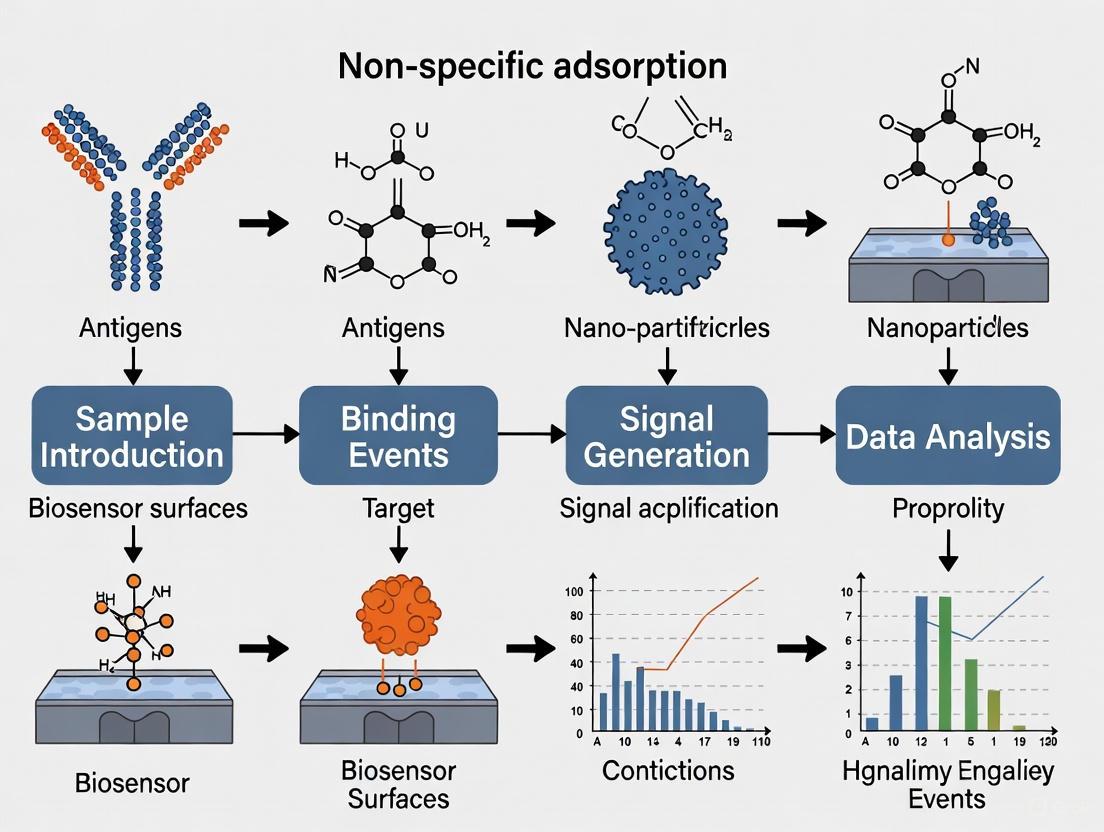
This article provides a comprehensive analysis of non-specific adsorption (NSA) as a critical source of false positives in diagnostic testing.
Non-Specific Adsorption: Mechanisms, Impacts, and Strategies to Overcome False Positives in Diagnostic Assays
Abstract
This article provides a comprehensive analysis of non-specific adsorption (NSA) as a critical source of false positives in diagnostic testing. Tailored for researchers, scientists, and drug development professionals, it explores the fundamental physicochemical mechanisms of NSA, evaluates current methodological approaches for its reduction in biosensors and immunoassays, and presents practical troubleshooting and optimization strategies for assay development. The content further covers validation techniques and comparative analyses of materials and additives, synthesizing key insights to guide the development of more reliable and accurate diagnostic tools for clinical and research applications.
The Unseen Foe: Understanding the Fundamental Mechanisms of Non-Specific Adsorption
Non-specific adsorption (NSA) is a persistent and critical challenge that negatively affects the performance of biosensors, leading to decreased sensitivity, specificity, and reproducibility [1]. In diagnostic contexts, NSA occurs when molecules such as proteins, lipids, or other biomolecules adhere to sensing surfaces through non-targeted interactions, producing background signals that are often indistinguishable from specific binding events [1]. This phenomenon is a primary mechanism behind false-positive results in diagnostic testing, where a test incorrectly indicates the presence of a disease or condition [2] [3]. The consequences of false positives are far-reaching, including unnecessary therapeutic interventions, patient psychological distress, increased healthcare costs, and mismanagement of resources [3]. Fundamentally, NSA arises through two distinct physical processes: physisorption (physical adsorption) and chemisorption (chemical adsorption) [4] [5]. A precise understanding of their differing mechanisms, energies, and impacts is essential for developing more accurate and reliable diagnostic tools.
Fundamental Mechanisms: Physisorption and Chemisorption
The adsorption process can be best understood by examining the potential energy curve of a molecule approaching a surface, which reveals the interplay between physisorption and chemisorption [4].
Physisorption
Physisorption, or physical adsorption, is characterized by weak, attractive van der Waals forces (or London dispersion forces) between the adsorbate and the surface [5]. These forces arise from induced dipole moments and do not involve significant electronic rearrangement or chemical bond formation.
- Energetics: The potential energy curve for physisorption shows a shallow minimum at a relatively large distance from the surface (typically >0.3 nm) [4]. The enthalpy of adsorption is low, generally in the range of 20–40 kJ/mol [5].
- Reversibility: Due to the low energy involved, physisorption is typically a reversible process [5].
- Specificity: It is non-specific; nearly any molecule can physisorb to any surface given sufficient surface area [5].
- Layers: Physisorption can result in multilayer adsorption as weak forces allow molecules to accumulate on top of an initial layer [5].
Chemisorption
Chemisorption, or chemical adsorption, involves the formation of a chemical bond—often covalent—between the adsorbate and the surface atoms [5]. This process is defined by much stronger interactions and significant electronic reorganization.
- Energetics: The potential energy curve features a deep, narrow minimum at a short distance from the surface, representing the chemical bond length [4]. The enthalpy of adsorption is high, typically ranging from 40 to 400 kJ/mol [5].
- Reversibility: Chemisorption is often irreversible or not easily reversible under normal conditions due to the high strength of the bonds formed [5].
- Specificity: It is highly specific and depends on the chemical compatibility and electronic structure of the interacting pair [5].
- Layers: Only a monolayer can form because chemical bonds are saturated once all surface sites are occupied [5].
The Combined Potential Energy Landscape
For molecules capable of both interactions, the potential energy diagram is a combination of the two curves [4]. The system first encounters the shallow physisorption well. To reach the deep chemisorption well, the molecule must overcome an energy barrier, the activation energy for chemisorption. Physisorption often acts as a crucial precursor state, facilitating the eventual chemisorption event [4].
Diagram: Combined potential energy curve for physisorption and chemisorption. The molecule first enters the shallow physisorption well. To reach the stable chemisorbed state, it must overcome an activation energy barrier [4].
Quantitative Comparison of Adsorption Mechanisms
The table below summarizes the core differentiating characteristics of physisorption and chemisorption, which dictate their respective roles in non-specific adsorption.
Table 1: Characteristic Differences Between Physisorption and Chemisorption [5]
| Feature | Physisorption | Chemisorption |
|---|---|---|
| Forces Involved | Weak van der Waals forces | Strong chemical bond formation |
| Enthalpy of Adsorption | Low (20–40 kJ mol⁻¹) | High (80–240 kJ mol⁻¹) |
| Reversibility | Reversible | Irreversible |
| Specificity | Not specific | Highly specific |
| Temperature Dependence | Favored at low temperature | Favored at high temperature (up to a limit) |
| Activation Energy | Not appreciable | High activation energy often involved |
| Effect of Pressure | A decrease in pressure causes desorption | A decrease in pressure does not cause desorption |
| Layer Formation | Multilayer formation possible | Only unimolecular layer |
Link to Diagnostic False Positives and Biosensor Performance
In biosensors, NSA leads to elevated background signals that are frequently indiscernible from the specific binding signal of the target analyte, directly causing false-positive results [1] [6]. This compromises key analytical figures of merit, including the limit of detection, dynamic range, selectivity, sensitivity, and reproducibility [1].
The impact of fouling on the analytical signal varies with the biosensing platform:
- In electrochemical biosensors, fouling degrades the sensing interface, causes signal drift, and can restrict the conformational change of structure-switching aptamers, leading to passivation [6].
- In Surface Plasmon Resonance (SPR) biosensors, the adsorption of foulant molecules and the specific binding of the target analyte produce similar changes in reflectivity, confounding signal interpretation [6].
- In optical biochips, non-specific adsorption of probe materials (e.g., quantum dots) to functional groups on the substrate (e.g., Si–OH on glass) generates a high background, reducing detection sensitivity and increasing the false-positive risk [7].
Table 2: Consequences of False-Positive Results in Diagnostics [2] [3]
| Consequence | Impact on Patient & Healthcare System |
|---|---|
| Unnecessary Therapeutic Interventions | Patients may receive wrong medications or undergo invasive procedures with associated risks and side effects. |
| Psychological Impact | Erroneous diagnosis of a severe condition causes undue anxiety, distress, and emotional trauma. |
| Increased Healthcare Costs | Accumulation of redundant follow-up tests, interventions, and hospital stays strains financial resources. |
| Mismanagement of Resources | In high-volume settings, false positives waste valuable time, lab supplies, and bed capacity. |
| Delays in Correct Diagnosis | Attention is diverted from the actual etiology, leading to protracted suffering and health complications. |
| Reputational Damage | Frequent false positives can undermine trust in a laboratory, provider, or entire testing method. |
Experimental Protocols for Investigating and Mitigating NSA
Protocol: Functionalizing Glass Substrates to Reduce NSA
This protocol details the creation of a dense, negatively charged film on glass slides to suppress the non-specific adsorption of quantum dots (QDs) and other probe materials, thereby enhancing immunoassay sensitivity [7].
Materials and Reagents:
- Substrate: Soda-lime glass slides.
- Cleaning Solution: Piranha solution (a mixture of concentrated sulfuric acid (H₂SO₄) and hydrogen peroxide (H₂O₂)). Caution: Piranha solution is highly corrosive and must be handled with extreme care.
- Polyelectrolytes: Poly(diallyldimethylammoniumchloride) (PDDA) as a cationic layer, and Poly(styrene sulfonic acid) sodium salt (PSS) or meso-tetra (4-sulfonatophenyl) porphine dihydrochloride (TSPP) as anionic layers.
- Buffers: Phosphate-buffered saline (PBS), borate buffer.
Functionalization Workflow:
- Substrate Cleaning: Clean glass slides in piranha solution to remove organic residues and generate a hydrophilic surface rich in Si–OH groups. Rinse thoroughly with deionized water and dry.
- Cationic Layer Deposition: Immerse the cleaned slides in an aqueous solution of PDDA (e.g., 2 mg/mL in 0.5 M NaCl) for a set time (e.g., 20 minutes) to adsorb a thin, positively charged layer. Rinse with water to remove loosely bound molecules.
- Anionic Layer Deposition (Self-Assembly): Immerse the PDDA-coated slides into an anionic solution (e.g., 2 mg/mL PSS in 0.5 M NaCl, or 0.5 mg/mL TSPP in deionized water) for a set time (e.g., 20 minutes). Rinse thoroughly. This results in a dense, negatively charged surface (SO₃²⁻).
- Multi-Layer Construction (Optional): For optimized performance, a multi-layer structure can be built. A highly effective strategy involves depositing 2 layers of TSPP followed by 4 layers of PSS. This combines the high charge density of TSPP with the spacing provided by PSS to avoid fluorescence resonance energy transfer (FRET) quenching of QDs [7].
- Biochip Assembly: Immobilize the capture bioreceptors (e.g., antibodies) on the functionalized surface for use in assays like quantum dot fluorescence immunosorbent assay (QD-FLISA).
Evaluation of NSA Reduction:
- The efficacy of the coating is quantified by measuring the photoluminescence (PL) intensity from non-specifically adsorbed QDs on coated versus uncoated substrates.
- The optimized TSPP/PSS co-treated substrate demonstrated a reduction in NSA by 300 to 400-fold compared to untreated glass, enabling a more sensitive detection of C-reactive protein (CRP) with a limit of detection (LOD) of 0.69 ng/mL [7].
Diagram: Experimental workflow for creating a low-NSA biochip via self-assembled polyelectrolyte layers [7].
The Scientist's Toolkit: Essential Reagents for NSA Reduction Experiments
Table 3: Key Research Reagent Solutions for NSA Studies
| Reagent / Material | Function in NSA Reduction | Specific Example |
|---|---|---|
| Blocking Proteins | Passive method: Physically coats surface vacancies to prevent subsequent NSA of probe molecules or sample proteins [1]. | Bovine Serum Albumin (BSA), Casein, other milk proteins [1]. |
| Polyelectrolytes | Active/Passive method: Used in self-assembled layers to create a dense, charged barrier that electrostatically repels NSA [7]. | Poly(styrene sulfonic acid) sodium salt (PSS), Poly(diallyldimethylammoniumchloride) (PDDA) [7]. |
| Specialty Dyes/Molecules | Passive method: Can be used in self-assembly to create highly charged, non-fouling surfaces due to specific functional groups [7]. | meso-tetra (4-sulfonatophenyl) porphine dihydrochloride (TSPP) [7]. |
| Zwitterionic Materials | Passive method: Forms a hydrated layer via strongly bound water molecules, providing a physical and energy barrier to protein adsorption [6]. | Peptides, polymers with mixed positive/negative charges [6]. |
| Quantum Dots (QDs) | Signal Probes: High-photoluminescence nanomaterials used to quantify NSA and assay sensitivity; their NSA on substrates creates false signals [7]. | Aqueous CdSe/ZnS QDs, QD-antibody probes [7]. |
| Functionalized MOFs | Sensing Platform: Metal-Organic Frameworks with Open Metal Sites offer high surface area and tailored reactivity for selective analyte capture, reducing NSA [8]. | MOFs with open copper or zinc sites [8]. |
Distinguishing between physisorption and chemisorption is fundamental to diagnosing and addressing the root causes of non-specific adsorption in diagnostic platforms. The weak, reversible nature of physisorption makes it a pervasive contributor to background noise, while the strong, specific binding of chemisorption can lead to persistent surface fouling that is difficult to remove. Both mechanisms converge to generate the false-positive signals that undermine diagnostic reliability. The experimental strategies outlined, such as engineered surface functionalization with charged polymers, represent a proactive approach to mitigating this risk. By leveraging a mechanistic understanding of adsorption forces, researchers can design biosensing interfaces that maximize specific biorecognition while minimizing deleterious non-specific interactions, thereby paving the way for more accurate, robust, and clinically trustworthy diagnostics.
In diagnostic research, the accurate detection of specific biomarkers is paramount. This process is governed by molecular-level interactions between the sensor's surface, the target analyte, and the complex matrix of the surrounding sample. Hydrophobic, ionic, and van der Waals interactions are the primary non-covalent forces that mediate these events. While essential for specific biorecognition, these same forces are also responsible for non-specific adsorption (NSA), a pervasive phenomenon where non-target molecules inadvertently adhere to the sensor surface [1] [9]. NSA leads to elevated background signals, false positives, and a reduced signal-to-noise ratio, ultimately compromising the sensitivity, specificity, and reliability of diagnostic tests [1] [10] [11]. The clinical consequences are significant, potentially resulting in misdiagnosis, unnecessary treatments, and increased healthcare costs. For researchers and drug development professionals, a deep understanding of these forces is not merely academic; it is a critical prerequisite for designing robust biosensors and immunoassays that deliver accurate and trustworthy results.
Fundamental Forces Driving Non-Specific Adsorption
Non-specific adsorption is primarily a form of physisorption, where molecules adhere to a surface through weak, reversible interactions, unlike the strong, specific covalent bonds of chemisorption [1]. The following sections dissect the core forces involved.
Hydrophobic Interactions
Hydrophobic interactions describe the tendency of non-polar molecules or regions of molecules to associate with each other in an aqueous environment. This phenomenon is not driven by an attractive force between the non-polar species themselves, but by the thermodynamics of the water solvent. When non-polar surfaces are introduced to water, the highly ordered hydrogen-bonding network of water is disrupted. To minimize this disruptive effect and maximize entropy, water molecules expel the non-polar entities, forcing them to coalesce. In the context of biosensing, hydrophobic patches on proteins or other biomolecules can spontaneously adhere to hydrophobic areas on a sensor surface to minimize their shared contact with water [1]. This association is a major contributor to NSA, as it can cause a wide range of non-target molecules to foul the sensing interface.
Ionic Interactions (Electrostatic Forces)
Ionic interactions arise from the attraction between positively and negatively charged chemical groups. Many biomolecules, such as proteins, carry a net surface charge that is dependent on the pH of their environment relative to their isoelectric point. Similarly, sensor surfaces can be functionalized with or inherently possess charged groups. While these forces can be harnessed for specific immobilization of biorecognition elements (e.g., using charged surfaces to attract oppositely charged antibodies), they are a double-edged sword. In complex biological samples like serum or saliva, non-target molecules with complementary charges can be electrostatically attracted to the sensor surface [1] [12]. This non-specific electrostatic binding is a common methodological cause of false positives in immunosensors [1].
van der Waals Forces
van der Waals forces are a collective term for weak, short-range electromagnetic interactions between atoms and molecules. They encompass three distinct types:
- Keesom forces: Interactions between two permanent molecular dipoles.
- Debye forces: Interactions between a permanent dipole and an induced dipole in a neighboring molecule.
- London dispersion forces: Transient, attractive forces arising from temporary dipoles induced by the instantaneous uneven distribution of electrons in any molecule, polar or non-polar [13].
These forces are universally present and play a role in the adhesion of virtually any molecule that comes sufficiently close to a surface [1] [13]. For biosensors, this means that even molecules without strong hydrophobic or ionic character can physisorb onto sensing surfaces via these weak, non-specific forces, contributing to background noise.
Table 1: Characteristics of Molecular Forces in NSA
| Molecular Force | Nature of Interaction | Role in NSA | Dependence |
|---|---|---|---|
| Hydrophobic | Entropic-driven association of non-polar groups in water | Adsorption of non-polar molecules/regions to hydrophobic surfaces | Solvent entropy, surface hydrophobicity |
| Ionic (Electrostatic) | Attraction between opposite charges; repulsion of like charges | Adsorption of charged, non-target biomolecules to charged surfaces | Surface charge, solution pH, ionic strength |
| van der Waals | Weak, transient dipole-dipole interactions | Universal, weak adsorption of any molecule in close proximity | Molecular polarizability, distance |
Experimental Methodologies for Investigating and Mitigating NSA
Understanding and quantifying NSA is essential for developing reliable diagnostics. The following section outlines key experimental approaches for its analysis and reduction, complete with detailed protocols.
A Representative Protocol: Reducing NSA in MIP-Based Electrochemical Sensors
Molecularly Imprinted Polymer (MIP)-based sensors are highly selective but can suffer from NSA due to functional groups outside the imprinted cavities [12]. The following protocol details a method to mitigate this using surfactant immobilization.
1. Objective: To fabricate a MIP-based electrochemical sensor for tryptophan with minimized non-specific adsorption through the integration of sodium dodecyl sulfate (SDS). 2. Materials:
- Monomer Solutions: Aniline (for conductive polymer MIPs) or o-phenylenediamine (for non-conductive MIPs).
- Cross-linker/Template: Target analyte (e.g., Tryptophan) mixed with monomer.
- Electrolyte: Phosphate Buffered Saline (PBS), pH 7.0, or lithium perchlorate (LiClO₄).
- Surfactant Solution: 10 mM Sodium Dodecyl Sulfate (SDS) in deionized water.
- Electrode System: Glassy carbon working electrode, platinum counter electrode, and Ag/AgCl reference electrode. 3. Methodology:
- Step 1: MIP Electropolymerization. Prepare a monomer solution containing your target analyte (template). Using cyclic voltammetry (CV), deposit the polymer film directly onto the working electrode. A typical CV protocol involves scanning between -0.2 V and +1.0 V (vs. Ag/AgCl) for 15-20 cycles at a scan rate of 50 mV/s.
- Step 2: Template Removal. After polymerization, rinse the electrode thoroughly with a deionized water and ethanol mixture to extract the template molecules, leaving behind specific recognition cavities.
- Step 3: Surfactant Immobilization (for Conductive MIPs). Immerse the MIP-functionalized electrode in the 10 mM SDS solution. The anionic SDS molecules will electrostatically bind to positively charged sites on the conductive polymer (e.g., polyaniline), effectively blocking these sites from non-specifically binding interferents.
- Step 4: Control Experiment. Fabricate a Non-Imprinted Polymer (NIP) sensor following the same procedure but without the addition of the template molecule. This control helps distinguish specific binding from NSA. 4. Validation: The success of NSA reduction is confirmed by challenging the sensor with a solution containing common interferents (e.g., tyrosine, uric acid). A significant decrease in the signal from interferents for the SDS-modified MIP compared to the unmodified MIP or NIP indicates successful suppression of NSA [12].
Quantifying NSA: Key Analytical Techniques
Researchers employ various analytical techniques to detect and quantify NSA, each with its own strengths.
Table 2: Analytical Techniques for NSA Detection and Measurement
| Technique | Principle | Application in NSA Analysis | Considerations |
|---|---|---|---|
| Electrochemical Impedance Spectroscopy (EIS) | Measures changes in electrical impedance at the electrode surface upon molecule adsorption. | Label-free detection of NSA; increased impedance indicates fouling. | High sensitivity; suitable for real-time monitoring. |
| Surface Plasmon Resonance (SPR) | Detects changes in the refractive index on a sensor surface upon mass adsorption. | Real-time, label-free monitoring of both specific binding and NSA. | Requires specialized, expensive instrumentation. |
| Atomic Force Microscopy (AFM) | Uses a physical probe to scan topography and measure interaction forces at the nanoscale. | Directly maps and measures adhesion forces from NSA on surfaces. | Provides nanoscale resolution; can be low-throughput. |
| Fluorescence Microscopy | Visualizes and quantifies adsorbed molecules that are fluorescently labeled. | High-sensitivity imaging of the distribution and density of non-specifically bound proteins. | Requires labeling, which may alter adsorption behavior. |
The Scientist's Toolkit: Research Reagent Solutions
Successfully controlling the nano-bio interface requires a strategic selection of reagents and materials. The following table details key components used to study and mitigate NSA.
Table 3: Essential Research Reagents for NSA Mitigation
| Reagent / Material | Function / Purpose | Example in Context |
|---|---|---|
| Blocking Proteins (BSA, Casein) | Passive method: Physically adsorbs to vacant surface sites, preventing non-target protein adhesion. | Used in ELISA and Western blotting to block unused plastic surface after antibody immobilization [1]. |
| Self-Assembled Monolayers (SAMs) | Chemical method: Creates a dense, ordered, hydrophilic layer that resists protein adsorption via hydration. | Alkanethiol SAMs with oligo(ethylene glycol) termini on gold surfaces to create non-fouling interfaces [1] [14]. |
| Surfactants (SDS) | Active/Passive method: Electrostatically binds to charged polymer sites, shielding them from interferents. | SDS immobilized on conductive polyaniline-based MIPs to eliminate NSA for tryptophan sensing [12]. |
| PEG-based Linkers | Chemical method: Forms a hydrated, steric barrier that reduces the approach and binding of foulants. | Functionalizing gold surfaces with PEG-thiols to minimize NSA in complex media like serum [1]. |
| Non-Conductive Polymers (PolyDA) | Physical method: Forms a low-fouling film; NSA is controlled by optimizing polymerization parameters. | Polydopamine films where the number of CV scans during electropolymerization is tuned to minimize NSA [12]. |
The molecular forces of hydrophobic, ionic, and van der Waals interactions form the fundamental basis of the non-specific adsorption problem that plagues diagnostic biosensing. For researchers developing the next generation of assays, moving beyond simply observing NSA to actively engineering surfaces that counteract these forces is critical. This involves a multifaceted strategy: leveraging advanced materials like graphene for its tunable chemistry [15], implementing robust blocking protocols using reagents like BSA or SDS [1] [12], and employing sophisticated analytical techniques to rigorously validate sensor surfaces against real clinical samples [11] [9]. By systematically designing diagnostics with an explicit focus on controlling the nano-bio interface, the field can overcome the challenge of false positives, thereby enhancing the accuracy, reliability, and clinical impact of biosensor technology.
Non-specific adsorption (NSA) represents a fundamental challenge in diagnostic assay development, directly contributing to false positive results, compromised analytical accuracy, and diminished reproducibility. This technical guide examines the mechanisms through which NSA manifests in biosensing platforms, quantifying its impact on critical performance parameters including sensitivity, specificity, and predictive values. Through systematic analysis of current research and experimental evidence, we detail material science solutions and methodological frameworks designed to mitigate NSA-induced artifacts. The insights presented herein provide researchers and drug development professionals with practical strategies to enhance diagnostic reliability in complex biological matrices.
Non-specific adsorption (NSA) refers to the accumulation of non-target molecules (e.g., proteins, lipids, cellular debris) on biosensor interfaces or assay components through non-covalent interactions including electrostatic forces, hydrophobic interactions, hydrogen bonding, and van der Waals forces [6]. This phenomenon poses a significant barrier to diagnostic accuracy because adsorbed molecules can generate signal indistinguishable from specific target recognition, leading to false positive readings and erroneous data interpretation [7] [6]. In electrochemical biosensors, NSA fouls electrode surfaces, impairing electron transfer kinetics and reducing signal-to-noise ratios over time [6]. Similarly, in optical platforms like surface plasmon resonance (SPR), non-specifically adsorbed molecules produce refractive index changes that mimic target binding events, complicating signal quantification [6].
The analytical consequences of NSA extend throughout the assay validation process. When non-target molecules occupy binding sites or modify surface properties, they can sterically hinder target-receptor interactions, potentially leading to false negatives at low analyte concentrations [6]. This dual capacity to generate both false positives and false negatives fundamentally undermines assay reliability and contributes to the broader reproducibility crisis affecting biomedical research [16] [17]. The following sections examine the quantitative relationship between NSA and established assay performance metrics, providing a framework for diagnosing and addressing NSA-related artifacts in diagnostic development.
Quantifying the Impact of NSA on Diagnostic Accuracy
Fundamental Metrics: Sensitivity and Specificity
Sensitivity and specificity represent cornerstone parameters for evaluating diagnostic test performance. Sensitivity (true positive rate) measures the proportion of actual positives correctly identified, calculated as TP/(TP+FN), where TP represents true positives and FN represents false negatives [18] [19]. Specificity (true negative rate) measures the proportion of actual negatives correctly identified, calculated as TN/(TN+FP), where TN represents true negatives and FP represents false positives [18] [19]. These prevalence-independent metrics describe intrinsic test characteristics under ideal conditions but fail to capture NSA-related performance degradation in complex biological samples [19] [20].
NSA directly compromises specificity by increasing false positive rates through non-target molecule adsorption [6]. This relationship establishes an inverse correlation between NSA and specificity—as non-specific binding increases, specificity decreases proportionally. The impact on sensitivity is more complex; while moderate NSA may inflate apparent sensitivity through false signal amplification, substantial interfacial fouling can impair bioreceptor function and reduce true positive detection [6]. This paradoxical effect creates challenges for developers optimizing assays for clinical deployment, as initial performance in clean buffers may not translate to complex matrices like blood, serum, or milk [6].
Predictive Values and Prevalence Dependence
Unlike sensitivity and specificity, positive predictive value (PPV) and negative predictive value (NPV) incorporate disease prevalence into their calculations, providing clinically actionable metrics for test interpretation [19] [20]. PPV represents the probability that subjects with a positive screening test truly have the disease [PPV = TP/(TP+FP)], while NPV represents the probability that subjects with a negative screening test truly do not have the disease [NPV = TN/(TN+FN)] [20]. These metrics prove particularly vulnerable to NSA-induced false positives, especially when screening for rare conditions where even minimal non-specific binding can dramatically reduce PPV [21].
Table 1: Impact of NSA on Diagnostic Performance Metrics
| Metric | Definition | Impact of High NSA | Clinical Consequence |
|---|---|---|---|
| Sensitivity | Ability to correctly identify true positives | Potential initial artificial increase followed by decrease due to surface fouling | Missed diagnoses when sensitivity decreases |
| Specificity | Ability to correctly identify true negatives | Significant reduction due to false positives | Unnecessary confirmatory testing and patient anxiety |
| Positive Predictive Value (PPV) | Probability positive test indicates true disease | Substantial reduction, especially for low-prevalence conditions | Low confidence in positive results |
| Negative Predictive Value (NPV) | Probability negative test indicates no disease | Moderate reduction when sensitivity compromised | Reduced confidence in ruling out disease |
The relationship between NSA and predictive values follows mathematically from the false positive paradox. When testing for rare conditions (low pre-test probability), even highly specific tests produce predominantly false positives when NSA contributes minimally to the error rate [21]. For example, with a 99.9% accurate test applied to a condition with 1:1,000,000 prevalence, a positive result has only 0.1% probability of being correct due to false positives overwhelming true positives in the population [21]. This statistical reality underscores why NSA mitigation proves critical for tests targeting low-prevalence biomarkers in early disease detection or screening contexts.
Case Example: PSA Density Testing
A recent study of prostate-specific antigen (PSA) density testing illustrates the practical impact of imperfect specificity. Using a cutoff of ≥0.08 ng/mL/cc for prostate biopsy recommendation, researchers reported 98% sensitivity but only 16% specificity, resulting in 1,400 false positives among 1,663 disease-free individuals [19]. While this example stems from the test's biological limitations rather than NSA specifically, it demonstrates how low specificity generates overwhelming false positives that complicate clinical decision-making—precisely the same pattern observed with NSA-contaminated assays [19].
Mechanisms of NSA and Material Solutions
Physicochemical Basis of Non-Specific Interactions
NSA occurs through multiple simultaneous interaction mechanisms between sample matrix components and sensing interfaces. Electrostatic interactions drive adsorption when surfaces carry net charge opposite to abundant serum proteins like albumin [6]. Hydrophobic interactions promote accumulation of non-polar molecules on hydrophobic surfaces, while hydrogen bonding and other dipole-dipole interactions facilitate binding to polar surface groups [6]. The relative contribution of each mechanism depends on surface chemistry, buffer composition, pH, ionic strength, and the specific biofluid being tested [6].
The resulting fouling layer evolves dynamically over time, initially comprising loosely-bound molecules that may gradually undergo conformational changes, multipoint attachment, and eventual formation of an irreversible fouling layer that permanently degrades sensor performance [6]. This progression explains why NSA effects may be negligible in short-term experiments but devastating in prolonged incubations or point-of-care devices intended for extended monitoring applications.
Antifouling Materials and Surface Modifications
Material science approaches to NSA mitigation focus on creating surfaces that minimize non-covalent interactions with non-target molecules. Recent advances include:
Polymer brushes: Dense surface-grafted polymers like polyethylene glycol (PEG) and zwitterionic materials create steric hindrance and form hydration layers that resist protein adsorption [6]. These brushes can be applied through surface-initiated atom transfer radical polymerization (SI-ATRP) for precise thickness control [6].
Negatively charged films: Self-assembled layers of poly(styrene sulfonic acid) sodium salt (PSS) or sulfonated porphyrins (TSPP) create strong negative surface potential that repels negatively charged serum proteins [7]. One study demonstrated a 300-400 fold reduction in quantum dot adsorption on glass substrates modified with PSS or TSPP, respectively [7].
Biomimetic coatings: Zwitterionic materials mimicking cell membrane composition provide excellent antifouling properties through superhydrophilicity and electrostatically-induced hydration layers [6].
Cross-linked protein films: Layers of bovine serum albumin (BSA) or casein can passivate surfaces against non-specific binding while providing functional groups for bioreceptor immobilization [6].
Table 2: Antifouling Coating Technologies for Biosensing Applications
| Coating Type | Mechanism of Action | Advantages | Limitations |
|---|---|---|---|
| PEG/Polymer Brushes | Steric hindrance, hydration layer | Well-established, tunable thickness | Oxidation susceptibility, complex grafting |
| Zwitterionic Materials | Electrostatically-induced hydration | Superior antifouling, stability | More complex synthesis and immobilization |
| Negatively Charged Polymers (PSS) | Electrostatic repulsion | Simple self-assembly, effective for blood components | pH-dependent performance, limited to negatively charged foulants |
| Cross-linked Protein Films | Passivation, competitive binding | Simple implementation, low cost | Potential immunogenicity, batch variability |
| Hybrid Materials | Multiple simultaneous mechanisms | Enhanced protection, tunable properties | More complex characterization and optimization |
NSA Reduction in Glass Substrate Biochips
A systematic investigation into glass substrate modification demonstrates the efficacy of combined coating approaches. Researchers created a layered structure beginning with 2 layers of TSPP (providing high sulfonate group density) followed by 4 layers of PSS (increasing distance from the glass surface to minimize fluorescence resonance energy transfer with quantum dot labels) [7]. This optimized configuration reduced non-specific adsorption by approximately 400-fold compared to untreated glass and achieved a limit of detection (LOD) of 0.69 ng/mL for C-reactive protein (CRP)—a 7.5-fold improvement over TSPP-only modified surfaces [7]. The successful implementation highlights how rational design of antifouling interfaces can directly enhance analytical sensitivity while suppressing false positives.
Experimental Protocols for NSA Evaluation
Standardized NSA Assessment Workflow
Rigorous evaluation of NSA requires standardized protocols that replicate intended use conditions. The following workflow represents current best practices for quantifying non-specific binding during assay development:
Surface Preparation: Apply candidate antifouling coatings to sensor substrates using controlled deposition methods (e.g., spin coating, dip coating, self-assembly) with appropriate quality control metrics [7].
Negative Control Testing: Incubate functionalized surfaces with sample matrix lacking the target analyte (e.g., analyte-free serum, buffer, or surrogate biofluid) using the same incubation times, temperatures, and washing procedures intended for the final assay [6].
Signal Measurement: Quantify non-specific signal using the detection modality planned for the assay (electrochemical, optical, etc.). For optical methods, measure reflectivity or fluorescence intensity; for electrochemical platforms, monitor current changes or impedance spectra [6].
Benchmarking: Compare signals from negative control samples against positive controls containing known target concentrations. Calculate signal-to-noise ratios (SNR) and set acceptability thresholds based on intended application (typically SNR > 3-5 for detection limits) [6].
Longitudinal Stability: Assess NSA progression over time by measuring negative control signals at multiple timepoints from minutes to hours, depending on intended assay duration [6].
This workflow should be implemented using relevant biological matrices rather than simplified buffer systems to accurately predict real-world performance. For blood-based applications, testing should include whole blood, plasma, and serum from multiple donors to account for biological variability [6].
Protocol for Functionalized Glass Slide Preparation
The following detailed protocol for creating low-NSA glass substrates has demonstrated efficacy for fluorescence-based immunoassays [7]:
Materials:
- Clean glass slides (e.g., Sail Brand, CAT. NO. 7101)
- Poly(styrene sulfonic acid) sodium salt (PSS)
- Meso-tetra(4-sulfonatophenyl)porphine dihydrochloride (TSPP)
- Poly(diallyldimethylammoniumchloride) (PDDA)
- Sodium hydroxide (NaOH), hydrogen peroxide (H₂O₂)
- Ultrapure water
Procedure:
- Surface Cleaning: Immerse glass slides in piranha solution (3:1 concentrated H₂SO₄:H₂O₂) for 30 minutes at 80°C. CAUTION: Piranha solution is extremely corrosive and requires appropriate personal protective equipment. Rinse thoroughly with ultrapure water and dry under nitrogen stream [7].
Cationic Layer Deposition: Immerse cleaned slides in 0.5% w/v PDDA solution containing 0.5 M NaCl for 20 minutes to create a positively charged surface. Rinse with ultrapure water and dry [7].
Anionic Layer Assembly:
- For TSPP deposition: Immerse PDDA-coated slides in 2 mM TSPP solution for 40 minutes. Rinse and dry.
- For PSS deposition: Immerse slides in 0.5% w/v PSS solution containing 0.5 M NaCl for 20 minutes. Rinse and dry [7].
Multilayer Construction: For combined coatings, alternate between cationic and anionic layers until desired thickness achieved. The optimal configuration identified was 2 layers of TSPP followed by 4 layers of PSS [7].
Characterization: Verify layer quality using water contact angle measurements (should decrease with increasing hydrophilicity) and ultraviolet-visible spectroscopy to confirm porphyrin deposition [7].
This functionalization protocol creates a dense negatively charged surface that electrostatically repels negatively charged proteins and nanoparticles, significantly reducing non-specific adsorption compared to untreated glass [7].
Diagram 1: NSA assessment methodology for diagnostic development
The Researcher's Toolkit: Essential Reagents and Materials
Successful NSA management requires appropriate selection of reagents and materials throughout assay development. The following table catalogues essential components for implementing effective antifouling strategies:
Table 3: Research Reagent Solutions for NSA Mitigation
| Reagent/Material | Function | Application Notes |
|---|---|---|
| Poly(ethylene glycol) (PEG) | Polymer brush forming hydration barrier | Various molecular weights available; thiol- or silane-terminated for surface grafting |
| Zwitterionic compounds | Superhydrophilic antifouling coating | Carboxybetaine, sulfobetaine, or phosphorylcholine-based polymers |
| Poly(styrene sulfonic acid) sodium salt (PSS) | Negatively charged polymer for electrostatic repulsion | Use in layer-by-layer assembly with cationic partners like PDDA |
| Bovine serum albumin (BSA) | Blocking agent for passivation | Typically used at 1-5% w/v in buffer; potential for specific interactions |
| Casein | Phosphoprotein blocking agent | Effective for immunoassays; lower potential for specific interactions than BSA |
| Tween-20 | Nonionic surfactant reducing hydrophobic interactions | Typical concentration 0.05-0.1% v/v; may disrupt some membrane proteins |
| Triton X-100 | Nonionic detergent for blocking hydrophobic surfaces | Use at 0.1-0.5% v/v; more effective for membrane protein assays |
| Poly(diallyldimethylammonium chloride) (PDDA) | Cationic polymer for layer-by-layer assembly | Forms stable multilayers with anionic polymers like PSS |
Non-specific adsorption represents a fundamental challenge to diagnostic accuracy, directly manifesting as false positives that degrade specificity, reduce positive predictive value, and compromise analytical reproducibility. Through systematic investigation of NSA mechanisms and targeted implementation of antifouling strategies—including polymer brushes, zwitterionic coatings, and charged layer-by-layer assemblies—researchers can significantly suppress non-specific binding artifacts. The experimental frameworks and material solutions detailed in this technical guide provide a pathway toward enhanced assay reliability in complex biological matrices. As diagnostic technologies evolve toward increasingly sensitive detection platforms, robust NSA mitigation will prove essential for translating promising assays from controlled laboratory environments to clinically impactful applications.
Non-specific adsorption (NSA) of proteins represents a critical barrier in the development of reliable biosensors for diagnostic applications. This phenomenon leads to false-positive signals, reduced sensitivity, and compromised reproducibility, particularly in microfluidic immunosensors analyzing complex biological samples [1] [6]. This case study examines the mechanisms of NSA, explores quantitative impacts on sensor performance, details experimental methodologies for its investigation, and synthesizes the most promising mitigation strategies. The insights provided are essential for researchers and drug development professionals aiming to improve the accuracy and reliability of diagnostic platforms.
NSA, often termed biofouling, occurs when proteins or other biomolecules physisorb onto a biosensor's surface through non-covalent interactions such as hydrophobic forces, ionic interactions, and van der Waals forces [1]. Unlike specific binding, NSA is an indiscriminate process that obscures the true analytical signal. In the context of a broader thesis on diagnostic errors, NSA is a primary contributor to false positives, as the signals from non-specifically adsorbed molecules are often indistinguishable from those generated by target analytes [1] [6]. This directly impacts key analytical figures of merit, including the limit of detection, dynamic range, and selectivity [1].
The problem is exacerbated in microfluidic systems due to their high surface-to-volume ratio and the laminar flow regime, which limits convective mass transport to the sensor surface and can create a diffusion boundary layer that further complicates the binding kinetics [22]. For immunosensors, which rely on the specific interaction between an antibody and its target antigen, methodological NSA can arise from surface denaturation of immobilized antibodies, substrate "stickiness," and the adsorption of non-target molecules to vacant spaces on the sensor surface [1].
The accumulation of non-target species on a biosensor interface is driven by a complex interplay of physicochemical interactions. Understanding these mechanisms is the first step toward developing effective countermeasures.
Primary Interaction Forces
- Electrostatic Interactions: Charged functional groups (e.g., NH2+, COO−, PO43−) on protein surfaces can be attracted to oppositely charged surfaces on the sensor [6]. This is a dominant mechanism for metallic surfaces like stainless steel, which possess charged metal oxide layers [23].
- Hydrophobic Interactions: Non-polar regions on proteins and hydrophobic sensor surfaces tend to associate in an aqueous environment to minimize interfacial energy. Hydrophobic surfaces are known to adsorb twice as much protein and induce conformational changes and denaturation, leading to stronger, more stable adhesion [24].
- Van der Waals Forces: These weak, universal forces contribute significantly to the physisorption of biomolecules, particularly at the nanoscale [1] [6].
- Hydrogen Bonding: Polar groups on proteins can form hydrogen bonds with complementary groups on a functionalized sensor surface, further strengthening adhesion [6].
The Vroman Effect and Corona Formation
The protein layer on a surface is not static. The Vroman effect describes the dynamic exchange where small, highly mobile proteins (e.g., albumin) initially adsorb to a surface but are later displaced by proteins of higher binding affinity [24]. This results in a constantly evolving "protein corona," which dictates the ultimate biological identity of the sensor interface in a complex sample [24]. The corona is divided into a "hard corona" of tightly bound, stable proteins and a "soft corona" of weakly associated, rapidly exchanging molecules [24]. This dynamic nature makes the study and control of NSA particularly challenging.
Quantitative Analysis of NSA Impact
The detrimental effects of NSA are not merely theoretical; they have been rigorously quantified using various sensing platforms. The following table summarizes key findings from recent studies, illustrating how surface chemistry and environmental conditions directly influence the degree of protein adsorption.
Table 1: Quantitative Studies of Protein NSA on Different Surfaces
| Protein Analyte | Sensor Surface/Substrate | Measurement Technique | Key Quantitative Finding on NSA | Experimental Conditions |
|---|---|---|---|---|
| Human Serum Albumin (HSA) | Silica-coated Au Nanodisks | LSPR [25] | Larger measurement responses at lower ionic strength | 10 mM Tris buffer, pH 7.5; Variable NaCl |
| Human Serum Albumin (HSA) | Titania-coated Au Nanodisks | LSPR [25] | Adsorption independent of ionic strength | 10 mM Tris buffer, pH 7.5; Variable NaCl |
| Human Serum Albumin (HSA) | Silica & Titania | QCM-D [25] | Trend similar to LSPR, but magnitude of response varied | 10 mM Tris buffer, pH 7.5; Variable NaCl |
| Cardiac Troponin I | DNA-based SAM on Gold | Microfluidic EIS [26] | 1 ng/mL Troponin caused a significant impedance shift | Serum samples; PDMS microchannel |
| Human Serum Albumin (HSA) | DNA-based SAM on Gold | Microfluidic EIS [26] | 1000 ng/mL HSA led to negligible impedance change | Serum samples; PDMS microchannel |
The data reveals that surface properties are paramount. The ionic-strength-dependent adsorption of HSA on silica suggests a strong electrostatic component, whereas its behavior on titania points toward different interaction forces [25]. Furthermore, the successful suppression of HSA NSA by a DNA-based self-assembled monolayer (SAM), while retaining specific troponin I detection, highlights the potential of advanced antifouling coatings [26].
Experimental Protocols for Investigating NSA
A multi-technique approach is required to thoroughly characterize NSA, as no single method provides a complete picture. The following workflow and reagent toolkit are foundational for rigorous NSA research.
Core Experimental Workflow
- Surface Functionalization: Prepare the sensor surface with an antifouling coating and immobilize the biorecognition element (e.g., antibody).
- Protocol for DNA-based SAM on Gold Electrodes [26]:
- Clean gold electrodes with oxygen plasma treatment.
- Incubate with a solution of thiolated single-strand DNA (ssDNA) oligomers to form a dense, well-ordered SAM. Co-immobilization with shorter hydrocarbon thiols can improve the brush-like structure.
- Activate the surface for antibody coupling using carbodiimide chemistry (e.g., EDC/NHS).
- Covalently immobilize the capture antibody onto the functionalized SAM.
- Protocol for DNA-based SAM on Gold Electrodes [26]:
- Control Sample Preparation: Prepare solutions of known foulants (e.g., HSA at 1000 ng/mL) and target analytes (e.g., troponin I at 1 ng/mL) in a relevant buffer or diluted serum [26].
- Real-Time Measurement: Introduce samples under controlled flow conditions in a microfluidic channel.
- For Electrochemical Impedance Spectroscopy (EIS): Apply a small sinusoidal voltage over a frequency range and measure the impedance. NSA will cause a shift in the Nyquist plot, specifically increasing the charge-transfer resistance [26].
- For Localized Surface Plasmon Resonance (LSPR): Monitor the shift in the extinction maximum wavelength (λmax). An increase in the local refractive index due to protein adsorption causes a positive Δλmax shift [25].
- For Quartz Crystal Microbalance with Dissipation (QCM-D): Track changes in resonance frequency (Δf, related to mass) and energy dissipation (ΔD, related to viscoelasticity). NSA will typically decrease the frequency and may increase dissipation [25] [27].
- Data Analysis: Compare the sensor response for foulants versus the target analyte. A effective antifouling surface will show a minimal response to the foulant and a significant, specific response to the target.
The Scientist's Toolkit: Key Research Reagents
Table 2: Essential Reagents for NSA Research
| Reagent / Material | Function in NSA Studies | Technical Notes |
|---|---|---|
| Thiolated DNA Oligomers | Form conductive, densely-packed SAMs on gold that resist NSA. | The negatively charged backbone promotes charge transfer and hydration, reducing protein adhesion [26]. |
| Polyethylene Glycol (PEG) | A classical polymer coating that creates a hydrated, steric barrier to protein adsorption. | Effective but can oxidize in vivo; newer alternatives like zwitterionic materials are emerging [1]. |
| Bovine Serum Albumin (BSA) | Used as a blocking agent to passively occupy vacant surface sites and prevent subsequent NSA. | A common, low-cost protein; however, its effectiveness is limited compared to advanced synthetic coatings [1]. |
| Human Serum Albumin (HSA) | A model foulant protein for testing NSA in clinically relevant scenarios. | Represents a highly abundant serum protein that can easily foul sensors [25] [26]. |
| Carbodiimide Chemistry (EDC/NHS) | Enables covalent coupling of antibodies or other bioreceptors to functionalized surfaces (e.g., -COOH groups). | Critical for creating a stable, oriented sensing layer that minimizes non-specific interactions [26]. |
Mitigation Strategies: From Passive to Active
Strategies to combat NSA can be broadly classified into two categories: passive methods that prevent adhesion and active methods that remove adsorbed molecules.
Passive Methods: Surface Coatings
Passive methods aim to create a thin, hydrophilic, and neutrally charged boundary layer that minimizes intermolecular forces with proteins [1].
- Chemical Coatings:
- Self-Assembled Monolayers (SAMs): As demonstrated in [26], thiolated hydrocarbons and oligonucleotides on gold form highly ordered, brush-like layers that physically and electrostatically repel proteins.
- Zwitterionic Polymers: Materials bearing both positive and negative charges (e.g., poly(carboxybetaine)) are exceptionally effective at binding water molecules via electrostatically-induced hydration, creating a formidable energy barrier to protein adsorption [6].
- Hybrid Surface Technologies: In liquid chromatography, surfaces that hybridize organic polymers with inorganic silica have shown remarkable success in reducing analyte loss by shielding charged metallic impurities [23].
- Physical Blocking:
- The use of blocker proteins like BSA, casein, or milk proteins is a traditional and easy method. These proteins adsorb to remaining vacant sites on the surface after functionalization, "blocking" them from further NSA [1]. However, this layer can be unstable and desorb over time.
Active Removal Methods
Active methods dynamically remove adsorbed molecules after they have adhered to the surface, typically using externally applied forces.
- Electromechanical Transducers: These devices generate surface forces (e.g., shear waves) that can overpower the adhesive forces of weakly physisorbed molecules, "scrubbing" them from the sensor interface [1].
- Hydrodynamic Removal: This relies on manipulating the fluid flow within a microchannel to generate high shear forces. For instance, pulsed flows or specific channel geometries can create vortices that enhance the removal of non-specifically bound molecules [1].
The following diagram synthesizes the complete workflow from the initial NSA challenge to the selection and application of these mitigation strategies.
The challenge of protein NSA in immunosensors and microfluidic systems remains a significant hurdle in the development of robust diagnostic tools. This case study has outlined the core mechanisms, quantitative impacts, and a suite of experimental methods for its investigation and mitigation. The trend is moving from simple passive blocking toward the rational design of sophisticated antifouling coatings, such as DNA-based SAMs and zwitterionic polymers, and the integration of active removal techniques [1] [26] [6].
Future progress will likely be driven by high-throughput screening of new materials, machine learning-assisted evaluation of coating efficacy, and the development of universal functionalization strategies that are compatible with complex detection schemes like coupled electrochemical-SPR biosensors [6]. Acknowledging and systematically addressing the pervasive challenge of NSA is not merely an academic exercise; it is a fundamental requirement for translating biosensor research from the laboratory into clinical and point-of-care settings where diagnostic accuracy is paramount.
Combatting Interference: Methodological Approaches to Reduce Non-Specific Binding
In diagnostic biosensing, non-specific adsorption (NSA) presents a fundamental challenge, directly leading to false positives and compromised analytical accuracy. NSA occurs when non-target molecules, such as proteins, indiscriminately adhere to a biosensor's surface through physisorption, generating background signals that are often indistinguishable from specific target binding [1]. This phenomenon negatively impacts key performance metrics, including sensitivity, specificity, and reproducibility, ultimately risking diagnostic misinterpretation [1] [6]. The problem intensifies when analyzing complex biological matrices like blood, serum, or milk, where a high concentration of interfering species exists [6]. Passive reduction methods, which aim to prevent this interference by coating the surface with blocking agents or engineered layers, constitute a primary defense strategy. This guide details the mechanisms, materials, and methodologies for implementing these critical passive NSA reduction techniques within a diagnostic research framework.
Fundamental Mechanisms of Non-Specific Adsorption
Non-specific adsorption is primarily driven by physisorption, a process governed by a combination of weak intermolecular forces [1]. These include:
- Hydrophobic Interactions: Non-polar regions on proteins interact with non-polar sensor surfaces.
- Electrostatic (Ionic) Interactions: Charged residues on biomolecules are attracted to oppositely charged surfaces.
- van der Waals Forces: Universal, though weak, electromagnetic interactions between molecules.
- Hydrogen Bonding: Dipole-dipole interactions between hydrogen donors and acceptors on the surface and in solution.
When a biosensor surface is exposed to a complex sample, these forces can cause proteins and other biomolecules to adhere to vacant spaces on the surface, non-immunological sites, and even immunological sites of a bioreceptor, thereby obstructing target binding and generating false-positive signals [1]. Passive methods work by creating a physical and chemical barrier that minimizes these interactions, forming a thin, hydrophilic, and neutrally charged boundary layer that is thermodynamically unfavorable for protein adsorption [1].
Passive methods can be broadly sub-categorized into physical methods, which use blocker proteins, and chemical methods, which employ synthetic polymers, molecular layers, and other linker molecules to modify the surface [1]. The following table summarizes the main categories and their characteristics.
Table 1: Categories of Passive NSA Reduction Methods
| Method Category | Key Examples | Primary Mechanism of Action | Key Characteristics |
|---|---|---|---|
| Physical (Protein Blockers) | Bovine Serum Albumin (BSA), Casein, Skim Milk [1] [28] | Adsorbs to vacant surface sites via hydrophobic interactions, creating a biologically inert layer. | Easy to use, cost-effective; can sometimes exhibit mild non-specific binding itself [1]. |
| Chemical (Polymeric Coatings) | Polyethylene Glycol (PEG), Dextran, Chitosan [28] | Forms a hydrated, steric barrier that reduces molecular interactions and provides antifouling properties. | Highly effective; requires surface chemistry for immobilization; tunable properties [28]. |
| Chemical (Orientation Systems) | Protein A/G, Biotin-Streptavidin, Covalent Crosslinkers [28] | Controls the orientation of capture antibodies (e.g., via Fc binding), maximizing efficiency and reducing NSA. | Improves assay sensitivity and reproducibility; can be combined with antifouling layers [28]. |
Detailed Analysis of Blocking Agents and Surface Coatings
Protein-Based Blocking Agents
Protein blockers are the most straightforward and widely used method to prevent NSA in diagnostic assays like ELISA and Western blotting [1] [28].
- Bovine Serum Albumin (BSA): A globular protein that readily adsorbs to hydrophobic polystyrene surfaces (common in microplates), effectively "blocking" these areas from further non-specific protein attachment. Its mechanism involves covering vacant spaces and providing a less "sticky" surface [28].
- Casein and Skim Milk: Casein, a phosphoprotein found in milk, is a primary component of commercial blocking buffers. Skim milk contains casein and other proteins. They are effective and inexpensive, but their complex composition can sometimes lead to cross-reactivity or background in certain applications [1] [28].
The underlying assumption is that these agents will saturate the surface more quickly and reversibly than the target analytes or interferents, thereby stabilizing specific antigen-antibody interactions [1].
Synthetic and Polysaccharide-Based Coatings
Beyond simple protein blockers, advanced materials provide more robust antifouling properties.
- Polyethylene Glycol (PEG) and its Derivatives: PEG is a gold-standard polymer for creating nonfouling surfaces. Its high hydrophilicity and chain flexibility lead to the formation of a tightly bound water layer, creating a steric and energetic barrier that prevents protein adsorption. Recent developments include PEG-grafted copolymers that enable multivalent antibody conjugation, simultaneously minimizing NSA and enhancing immunoassay sensitivity [28].
- Polysaccharides: Materials like dextran, chitosan, and hyaluronic acid have been successfully used to create hydrogel-like surfaces that resist non-specific protein adsorption. For instance, chitosan-coated surfaces enhance specific protein immobilization while preventing non-specific interactions, making them a promising alternative ELISA platform [28].
- Polymer Brushes: Dense layers of polymer chains tethered to a surface can provide highly effective nonfouling surfaces, significantly improving the signal-to-noise ratio in assays like ELISA [28].
Antibody Orientation Strategies
A critical aspect of surface engineering is ensuring the proper orientation of capture antibodies. Random immobilization can block antigen-binding sites and increase NSA.
- Protein A/Protein G: These bacterial proteins bind with high affinity to the Fc region of antibodies, ensuring a uniform orientation that presents the antigen-binding sites outward, thereby enhancing binding efficiency and assay sensitivity [28].
- Biotin-Streptavidin System: Biotinylated antibodies can be immobilized onto streptavidin-coated surfaces. The strong biotin-streptavidin interaction provides stable and oriented antibody attachment, though it requires an extra biotinylation step [28].
- Covalent Cross-linking: Antibodies can be covalently attached to surfaces via specific chemical groups. This method can be combined with antifouling polymer coatings to simultaneously enhance antibody orientation and prevent NSA [28].
Table 2: Performance Comparison of Selected Passive NSA Reduction Coatings
| Coating Material | Reported Efficacy / Performance Data | Compatibility / Considerations |
|---|---|---|
| BSA | Standard blocker in ELISA; significantly reduces background vs. unblocked surfaces [28]. | Universal; low cost; potential for low-level immunological cross-reactivity. |
| PEG-grafted Copolymer | Demonstrates significant enhancement in immunoassay sensitivity by improving antibody accessibility and avidity [28]. | Requires surface chemistry for grafting; highly effective for nonfouling. |
| Chitosan | Effective as an ELISA platform coating; enhances protein immobilization while reducing NSA [28]. | Biocompatible and biodegradable; offers an alternative to synthetic polymers. |
| Protein G-expressing Cells | Fixed on microplates, this strategy enhances antibody-coating capacity via uniform Fc-specific binding [28]. | Eliminates need for purified Protein G; high-surface-area substrate. |
Experimental Protocols for Evaluating NSA Reduction
Standardized Workflow for Coating Application and Testing
A rigorous protocol is essential for evaluating the efficacy of any passive NSA reduction method. The following diagram outlines a generalized experimental workflow.
Diagram Title: Workflow for Evaluating Antifouling Coatings
Key Methodology: Evaluating Fouling with Electrochemical Impedance Spectroscopy (EIS)
Principle: EIS is a powerful, label-free method to monitor changes at an electrode surface. The formation of an insulating protein layer through NSA increases the system's electron transfer resistance (R~et~), which is measurable as an increase in impedance [6].
Detailed Protocol:
- Electrode Preparation: Clean and characterize the baseline of the working electrode (e.g., gold, glassy carbon).
- Baseline Measurement: Record the EIS spectrum of a redox probe (e.g., [Fe(CN)~6~]^3-/4-^) in a clean buffer solution. Fit the data to an equivalent circuit to determine the initial R~et~.
- Coating Application: Apply the passive reduction method (e.g., BSA blocking, PEG grafting) to the electrode surface according to your established protocol.
- Post-Coating Measurement: Wash the electrode and record the EIS spectrum again in the same redox probe solution. A well-applied, non-fouling coating may cause a slight, stable increase in R~et~.
- Fouling Challenge: Incubate the coated electrode in the complex sample of interest (e.g., 100% serum, undiluted milk) for a defined period (e.g., 30-60 minutes).
- Post-Fouling Measurement: Thoroughly rinse the electrode with buffer and record the EIS spectrum a third time.
- Data Analysis: A significant increase in R~et~ between the post-coating and post-fouling measurements indicates substantial NSA and fouling. A coating that maintains a stable, low R~et~ is considered effective.
Data Interpretation: The efficacy of the coating is quantified by the minimal change in R~et~ after exposure to the complex sample, demonstrating its resistance to passivation by non-specifically adsorbed molecules [6].
The Scientist's Toolkit: Essential Reagents and Materials
Table 3: Key Research Reagent Solutions for Passive NSA Reduction
| Reagent/Material | Function/Explanation | Common Application Context |
|---|---|---|
| Bovine Serum Albumin (BSA) | Standard blocking agent; adsorbs to hydrophobic surfaces to prevent subsequent NSA. | ELISA, immunosensor development, Western blotting. |
| Casein (from Skim Milk) | Cost-effective protein blocker; covers surface vacancies via physisorption. | General-purpose immunoassay blocking. |
| Polyethylene Glycol (PEG) | Synthetic polymer forming a hydrated, steric antifouling barrier. | High-performance biosensors, surface plasmon resonance (SPR). |
| Protein A / Protein G | Bacterial proteins for oriented antibody immobilization via Fc region binding. | Immunosensors, ELISA, where antibody orientation is critical. |
| Biotinylated Antibodies & Streptavidin-Coated Surfaces | System for highly stable and oriented antibody immobilization. | Assays requiring high stability and low background (e.g., microfluidic biosensors). |
| Chitosan | Natural polysaccharide used for surface coating to enhance specific binding and reduce NSA. | Alternative ELISA platforms, biocompatible sensor coatings. |
| Ethanolamine | Small molecule used for blocking residual reactive groups after covalent immobilization. | Blocking unreacted NHS-esters on activated surfaces. |
Passive reduction methods, including surface coatings and blocking agents, are indispensable tools for mitigating non-specific adsorption and its detrimental consequence: false positives in diagnostic research. From foundational protein blockers like BSA and casein to advanced engineered surfaces based on PEG and orientation systems, these strategies form the first line of defense in ensuring the accuracy and reliability of biosensors. The selection of an appropriate method depends on the transducer platform, the complexity of the sample matrix, and the required sensitivity. As diagnostics advance toward analyzing more complex samples at lower analyte concentrations, the continued development and intelligent application of these passive NSA reduction methods will remain a cornerstone of robust assay design.
The pursuit of reliable diagnostic biosensors is fundamentally compromised by a persistent phenomenon: non-specific adsorption (NSA). This process, also referred to as non-specific binding or biofouling, occurs when molecules such as proteins, metabolites, or other matrix components from a sample adhere indiscriminately to a sensor's surface through physisorption [1]. These non-specific interactions generate background signals that are often indistinguishable from the specific signal of the target analyte, leading to false positives, reduced sensitivity, and compromised diagnostic accuracy [1] [29]. The consequences are particularly acute in clinical settings, where false positives can trigger unnecessary treatments, and in drug discovery, where they can misdirect entire research programs [30]. This whitepaper details how advanced surface functionalization strategies, primarily Self-Assembled Monolayers (SAMs) and polymer brushes, are engineered to counteract NSA, thereby enhancing the fidelity of diagnostic and research tools.
Core Principles: SAMs and Polymer Brushes as Non-Fouling Barriers
Self-Assembled Monolayers (SAMs)
SAMs are highly ordered, dense molecular assemblies that form spontaneously when molecules with a specific head-group (e.g., thiols for gold surfaces) chemisorb onto a substrate [31]. A well-constructed SAM presents a controlled interface that can be tailored with specific terminal functional groups (e.g., hydroxyl, carboxyl) for biomolecule immobilization while simultaneously minimizing empty spaces where non-specific adsorption could occur [32] [33]. The quality of the underlying gold substrate is paramount, as defects or rough surfaces lead to imperfect SAM formation and increased vulnerability to NSA [32].
Polymer Brushes
Polymer brushes consist of polymer chains that are tethered by one end to a surface at a high density, creating a hydrated, brush-like layer [1]. The most prevalent anti-fouling polymers are poly(ethylene glycol) (PEG) and its derivatives, as well as zwitterionic polymers (e.g., sulfobetaine, carboxybetaine) [34]. These materials create a physical and energetic barrier that repels biomolecules. The mechanism involves forming a highly hydrated layer through hydrogen bonding (PEG) or electrostatic interactions (zwitterions), which creates a thermodynamic barrier that discourages protein adsorption due to the significant entropy loss required for displacement of water molecules [1] [34].
Quantitative Performance of Anti-Fouling Strategies
The effectiveness of various surface functionalization strategies can be evaluated through key performance metrics, as summarized in the table below.
Table 1: Performance Comparison of Anti-Fouling Surface Strategies
| Strategy | Key Materials | Reported Performance | Detection Context | Citation |
|---|---|---|---|---|
| Electrokinetic Stringency on SAMs | AC electric field, Joule heating, electrothermal flow | 60% reduction in background noise from clinical urine samples; capable of single-base mismatch discrimination. | Electrochemical detection of bacterial 16S rRNA | [35] |
| Ternary SAM | Thiolated DNA aptamer, 1,6-hexanedithiol (HDT), 1-mercapto-6-hexanol (MCH) | No change in signal after exposure to high concentration of BSA; attomolar detection limits in serum and urine. | Impedimetric detection of human thrombin | [34] |
| Differential MIP Sensor | Molecularly Imprinted Polymer (MIP) vs. Non-Imprinted Polymer (NIP) | Interference level from NSA reduced to 5-10% of that in normal MIP mode. | Capacitive and QCM detection of 2,4-D | [29] |
| Short-Chain SAM for Reusability | 3-Mercaptopropionic acid (3-MPA) | Reusable for 50 regeneration cycles with a Relative Standard Deviation (RSD) of < 0.82%. | Surface Plasmon Resonance (SPR) | [33] |
Detailed Experimental Protocols
Protocol 1: Fabrication of a Ternary SAM-Based Aptasensor
This protocol, adapted from the development of an anti-fouling impedimetric aptasensor for human thrombin, details the creation of a robust ternary SAM layer [34].
Objective: To construct a stable, low-fouling electrochemical aptasensor on a screen-printed gold electrode (SPE) using a ternary mixture of aptamer, HDT, and MCH.
Materials:
- Reagents: Thiol-modified aptamer, 1,6-hexanedithiol (HDT), 1-mercapto-6-hexanol (MCH), Tris-EDTA (TE) buffer, phosphate buffer saline (PBS), potassium sulfate, potassium ferri/ferrocyanide.
- Equipment: Screen-printed gold electrodes (SPE), electrochemical workstation with impedance capabilities.
Procedure:
- Electrode Pretreatment: Clean the gold SPE electrochemically by cycling in 0.5 M sulfuric acid or by applying a fixed potential to ensure a clean, oxide-free surface.
- Ternary SAM Formation: Co-immobilize the thiolated aptamer and HDT onto the gold surface by incubating the electrode in a mixed solution containing a defined molar ratio of aptamer to HDT (e.g., 1:5 to 1:50) in TE buffer for a set period (e.g., 18 hours) at room temperature.
- Surface Passivation: Rinse the electrode and subsequently incubate it in a 1 mM solution of MCH for 30-60 minutes. This step passivates any remaining pinhole defects in the SAM and displaces any non-specifically adsorbed aptamer, forming a well-ordered, ternary mixed monolayer.
- Sensor Storage: Store the modified aptasensor in an appropriate buffer (e.g., TE or PBS) at 4°C. Studies show such sensors can maintain stability and anti-fouling performance for up to 28 days [34].
- Measurement: Perform Electrochemical Impedance Spectroscopy (EIS) in a solution containing a redox probe (e.g., [Fe(CN)₆]³⁻/⁴⁻). The binding of the target (thrombin) increases the charge transfer resistance (Rct), which is measured as the analytical signal.
Protocol 2: In-situ Electrokinetic Stringency Control on SAM Biosensors
This protocol leverages AC electrokinetics to actively remove non-specifically bound molecules directly on a functional SAM-based electrochemical biosensor, significantly enhancing signal-to-noise in complex samples [35].
Objective: To integrate an active stringency control method for the discrimination of single-base mismatches and reduction of matrix effects in clinical samples.
Materials:
- Reagents: SAM-based electrochemical biosensor with immobilized DNA capture probes, hybridization buffer, clinical sample (e.g., urine).
- Equipment: Biosensor with integrated microelectrodes, AC power supply, potentiostat.
Procedure:
- Hybridization: Introduce the sample containing the target nucleic acid (e.g., bacterial 16S rRNA) to the biosensor and allow hybridization to occur under standard conditions.
- Electrokinetic Washing: Apply a low-voltage AC signal (e.g., 1-10 Vrms, 1-100 kHz) across the integrated microelectrodes.
- Joule Heating: The AC field induces Joule heating, causing a localized temperature rise. The magnitude can be estimated by ΔT = σVrms²/8k, where σ is buffer conductivity and k is thermal diffusivity [35]. This temperature increase raises the stringency, destabilizing imperfectly matched duplexes.
- Electrothermal Flow: The same AC field, in conjunction with the induced temperature gradient, generates bulk electrothermal fluid motion. The resulting shear forces help to physically dissociate and wash away non-specifically bound molecules from the sensor surface.
- Electrochemical Detection: Proceed with the standard enzymatic or redox-based electrochemical detection protocol. The electrokinetic wash step selectively removes mismatched hybrids and matrix contaminants, leaving behind only the specific signal.
The Scientist's Toolkit: Essential Research Reagent Solutions
Table 2: Key Reagents for Constructing Anti-Fouling Biosensors
| Reagent / Material | Function / Explanation | Example Use Case |
|---|---|---|
| Alkanethiols (e.g., MCH, MCU) | Forms a hydrophilic, protein-resistant SAM; passivates unoccupied gold sites to prevent NSA. | Binary SAMs (probe/MCH) for DNA sensors [32]. |
| 1,6-Hexanedithiol (HDT) | A dithiol that forms "bridges" on the gold surface, creating a dense, cross-linked layer with superior anti-fouling properties. | Key component in ternary SAMs with aptamers and MCH [34]. |
| Poly(Ethylene Glycol) (PEG) | Gold standard polymer for anti-fouling; forms a hydrated brush that sterically and thermodynamically hinders protein adsorption. | PEGylated surfaces for SPR sensors in complex media [1]. |
| Zwitterionic Polymers (e.g., Sulfobetaine) | Create an electrostatically neutral, highly hydrated surface via strong ion hydration, providing exceptional resistance to biofouling. | Zwitterionic polymer brushes for electrochemical sensors in blood plasma [34]. |
| Blocking Proteins (e.g., BSA, Casein) | Passive method that adsorbs to residual hydrophobic surfaces, "blocking" them from subsequent non-specific protein binding. | Common blocker in ELISA and other immunoassays [1]. |
| Triton X-100 (Detergent) | A non-ionic detergent that attenuates aggregation-based inhibition (ABI) by integrating into or disrupting colloidal aggregates. | Used in high-throughput screening to minimize false positives from aggregating ligands [30]. |
Signaling Pathways and Workflow Visualizations
Non-specific adsorption remains a formidable obstacle in the development of robust diagnostic biosensors and reliable drug discovery assays. The strategic implementation of advanced surface functionalization—using well-engineered SAMs or sophisticated polymer brushes—provides a powerful means to combat this issue. These technologies create a controlled, bio-inert interface that maximizes specific recognition while minimizing confounding background signals. The continuous refinement of these passive anti-fouling layers, complemented by innovative active removal techniques like electrokinetic stringency control, is pushing the boundaries of detection limits and reliability. As these functionalization strategies become more robust and accessible, they pave the way for the next generation of point-of-care diagnostics and high-throughput screening tools that can perform accurately in the most complex clinical and biological environments.
Non-specific adsorption (NSA), often referred to as biofouling, represents a persistent challenge in microfluidic biosensing that directly compromises diagnostic accuracy. This phenomenon occurs when proteins, cells, or other biomolecules physisorb to sensor surfaces through hydrophobic forces, ionic interactions, van der Waals forces, and hydrogen bonding [1]. In diagnostic applications, NSA creates elevated background signals that are indistinguishable from specific target binding, leading to false positives, reduced sensitivity, and compromised specificity [1]. The problem is particularly acute in microfluidic systems due to their high surface-area-to-volume ratios, which amplify the relative impact of any surface fouling [1]. While passive methods like surface coatings and blocker proteins (e.g., BSA) have traditionally been used to prevent NSA, these approaches often prove insufficient for highly sensitive applications [1]. Consequently, active removal methods that dynamically dislodge weakly adhered molecules using precisely controlled shearing forces have emerged as a more effective strategy for maintaining sensor integrity and diagnostic reliability.
Fundamental Principles of Active Removal
Defining Active vs. Passive NSA Reduction
Active removal methods fundamentally differ from passive approaches in their mechanism and application. Passive methods aim to prevent NSA by creating a surface that resists adsorption through chemical coatings or physical barriers [1]. These include surface functionalization with hydrophilic polymers, chemical passivation, or the use of protein blockers like casein or bovine serum albumin (BSA) that occupy potential binding sites [1]. In contrast, active methods employ externally applied forces to remove already-adsorbed molecules after the fact, dynamically clearing surfaces during operation [1]. The most prominent active techniques utilize transducers to generate precisely controlled shearing forces—either electromechanical or acoustic—that overcome the adhesive forces binding non-specifically adsorbed molecules to sensor surfaces [1].
Shear Forces as a Removal Mechanism
The physical principle underlying active removal is the application of shear stress sufficient to overcome the physisorption forces responsible for NSA. Shear stress (τ) is defined as the frictional force per unit area exerted by a fluid moving parallel to a surface [36]. When this stress exceeds the adhesion strength between adsorbed molecules and the surface, desorption occurs. The efficiency of removal depends on several factors including the magnitude and distribution of shear stress, the duration of application, and the specific binding characteristics of the adsorbed species [1]. Microfluidic systems are particularly well-suited for implementing shear-based removal due to the predictable laminar flow regimes and the ability to generate high local shear stresses with minimal fluid volumes [36].
Electromechanical Shearing Methods
Fundamental Operating Principles
Electromechanical shearing methods utilize transducers that convert electrical energy into mechanical motion or force to dislodge non-specifically adsorbed molecules. These systems typically employ piezoelectric or electrostatic actuators integrated within microfluidic channels to generate localized high-frequency oscillations or surface displacements [1] [37]. The resulting mechanical vibrations create transient velocity gradients and shear forces at the fluid-solid interface that efficiently remove weakly bound molecules while leaving specifically bound targets intact [1]. The effectiveness of electromechanical removal depends on factors including oscillation frequency, amplitude, device geometry, and the viscoelastic properties of both the surface and the adsorbed molecules.
Implementation and Experimental Protocols
Implementing electromechanical shearing requires careful integration of actuators with microfluidic architectures. A typical configuration involves patterning interdigitated transducers (IDTs) onto the substrate surface, which generate surface acoustic waves when powered by an alternating current [37]. For example, in a documented experimental setup, researchers fabricated delay-line sensors with IDTs having operating frequencies of 38.0 MHz and 45.6 MHz, spaced at intervals between 0.7 mm and 1.1 mm [37]. The fabrication process involved depositing and patterning chromium-gold electrodes on a lithium niobate (LiNbO₃) piezoelectric substrate using standard photolithographic techniques [37]. The microfluidic channel, typically fabricated from polydimethylsiloxane (PDMS), was then aligned and bonded to cover the active sensor area [37].
In a standard experimental protocol, the electromechanical system is characterized by measuring the transmission coefficient (S21) between emitter and receiver IDTs using a vector network analyzer [37]. The acoustic loss in the fluid (L) is calculated as the difference between S21 amplitudes measured in air and in fluid, providing a quantitative measure of energy transfer efficiency [37]. To evaluate NSA reduction performance, researchers typically first allow non-specific adsorption to occur under static or low-flow conditions, then apply the electromechanical shearing while quantifying removed material through optical, electrical, or mass-sensitive detection methods [1] [37].
Acoustic Shearing Methods
Fundamental Operating Principles
Acoustic shearing methods utilize high-frequency sound waves to generate pressure gradients and streaming effects that produce shear forces capable of removing non-specifically adsorbed molecules. Unlike electromechanical approaches that primarily rely on surface vibrations, acoustic methods create bulk fluid motion and cavitation effects through the propagation of pressure waves [38]. Two primary configurations dominate microfluidic applications: surface acoustic wave (SAW) devices that generate waves propagating along the chip surface, and bulk acoustic wave (BAW) devices that establish standing waves through the fluid volume [38] [39]. Both approaches transfer momentum from the acoustic field to the fluid, creating microscale vortices and streaming patterns that generate localized shear stresses at surfaces [38].
The effectiveness of acoustic shearing depends on multiple parameters including frequency, power input, fluid properties, and device geometry. In SAW-based lysis applications, for instance, operating at 9.5 MHz with appropriate power input creates rotational vortices within droplets that generate shear stresses estimated at approximately 85 Pa—sufficient for mechanical disruption of mammalian cells [38]. The relationship between acoustic energy and shear stress is frequency-dependent, enabling tunable removal forces by simply adjusting the driving frequency [38].
Implementation and Experimental Protocols
Implementing acoustic shearing typically involves integrating piezoelectric transducers with microfluidic channels. In a representative SAW setup, researchers have coupled a lithium niobate piezoelectric wafer with a disposable superstrate containing phononic lattices that shape the acoustic field [38]. The fabrication process involves depositing IDT electrodes on the piezoelectric substrate using photolithography and metal evaporation, then bonding a PDMS microfluidic channel aligned to the active area [38] [39]. For low-cost applications, devices have been successfully implemented using off-the-shelf components, with total costs as low as €9 per device [39].
A typical protocol for assessing acoustic shearing efficiency involves first introducing a solution containing known concentrations of target and non-target molecules to allow adsorption under controlled conditions [38]. The acoustic field is then activated at specific frequencies and power levels while monitoring removal efficiency. For example, in cell lysis applications, researchers have quantified efficiency by measuring the transition from turbid to translucent suspensions as cells are disrupted [38]. In biosensing applications, reduction in non-specific background signals is typically measured using optical, electrical, or mass-sensitive detection methods before and after acoustic treatment [1].
Table 1: Comparison of Acoustic Shearing Experimental Parameters
| Application | Frequency | Power/Voltage | Shear Stress | Efficiency | Reference |
|---|---|---|---|---|---|
| Cell Lysis | 9.5 MHz | Not specified | ~85 Pa | Complete lysis in <3 seconds | [38] |
| Bead Trapping | 7.5 MHz | 23.7 V~pp~ | Not specified | Stable trapping achieved | [39] |
| NSA Reduction | 38-45.6 MHz | Not specified | Not specified | Significant reduction in background signals | [1] [37] |
Comparative Analysis of Methodologies
Performance Metrics and Quantitative Comparison
Evaluating the effectiveness of active removal methods requires multiple performance metrics, including removal efficiency, specificity, throughput, and impact on specific binding. The table below summarizes key quantitative findings from the literature:
Table 2: Performance Comparison of Active Removal Methods
| Method | Removal Efficiency | Throughput | Specific Binding Preservation | Key Limitations | |
|---|---|---|---|---|---|
| Electromechanical Shearing | >90% reduction in NSA reported in model systems | ~100 cells/sec in cytometry applications | High when properly tuned | Complex fabrication; positioning sensitivity | [1] [40] [37] |
| Acoustic Shearing | Near-complete cell lysis in <3 seconds | Processing of µL samples in minutes | Excellent with frequency control | Heating effects; complex field patterning | [38] [1] |
| Hydrodynamic Shearing | Moderate (flow-dependent) | Limited by pressure constraints | Variable depending on flow conditions | Lower efficiency for strongly adsorbed species | [1] |
The selection of an appropriate active removal method depends heavily on the specific application requirements. Electromechanical approaches offer precise localization and are particularly effective for integrated biosensors where specific transducer elements can be positioned adjacent to critical sensing areas [1] [37]. Acoustic methods provide broader coverage and are highly effective for bulk removal applications, such as clearing large surface areas or processing complex samples [38] [1]. Hybrid approaches that combine multiple mechanisms are increasingly being explored to leverage the complementary advantages of different techniques.
Implementation Considerations and Challenges
Successful implementation of active removal methods requires careful consideration of several practical challenges. Bubble formation represents a significant operational hurdle in microfluidic assays, particularly in acoustic and electromechanical systems where cavitation or heating can nucleate gas bubbles [41]. Effective mitigation strategies include microfluidic device degassing, plasma treatment, channel pre-wetting with surfactant solutions, and careful control of input power [41]. Device integration and packaging also present challenges, particularly for electromechanical systems that require precise alignment between transducers and microfluidic channels [37]. Material compatibility must be considered, as high-frequency oscillations or powerful acoustic fields can potentially damage delicate surface functionalization chemistries or even structural components [1] [41].
The "slip" phenomenon at fluid-solid interfaces presents another consideration in acousto-microfluidics, where reduced acoustic energy transmission can diminish shearing efficiency [37]. Recent research has revealed that slip dynamics in acousto-microfluidics are highly analogous to Amontons-Coulomb laws for dry friction between solids, characterized by a "cone of friction" that divides slip and no-slip regions based on the relationship between local fluid pressure and shear stress [37]. Understanding these fundamental interactions enables more predictable device performance and more reliable active removal systems.
The Scientist's Toolkit: Essential Research Reagents and Materials
Successful implementation of active removal methodologies requires specific materials and reagents optimized for microfluidic applications. The following table summarizes essential components:
Table 3: Key Research Reagent Solutions for Active Removal Applications
| Reagent/Material | Function/Application | Implementation Example | Reference |
|---|---|---|---|
| Polydimethylsiloxane (PDMS) | Microfluidic channel fabrication | Device bonding and sealing using plasma activation | [42] [41] |
| Lithium Niobate (LiNbO₃) | Piezoelectric substrate for acoustic wave generation | Surface acoustic wave (SAW) devices for particle manipulation | [38] [37] |
| Water-Glycerol Solutions | Viscosity and density modification for shear stress tuning | Investigating slip dynamics in acousto-microfluidics | [37] |
| Triton X-100 | Nonionic detergent for bubble reduction and NSA attenuation | Converts inhibitory aggregates to non-binding coaggregates | [30] |
| Human Serum Albumin (HSA) | Carrier protein that prevents aggregation and NSA | Functions as reservoir for free inhibitor, preventing self-association | [30] |
| Methylcellulose | Viscoelastic fluid for shear deformation studies | Cell focusing and deformation in shear flow deformability cytometry | [40] |
| Polystyrene Beads | Calibration and system characterization | Reference particles for electrical volume determination | [40] |
Diagnostic Applications and Case Studies
Reducing False Positives in Nucleic Acid Detection
The integration of active removal methods with advanced detection techniques has demonstrated significant improvements in diagnostic reliability. A notable example comes from CRISPR/Cas12a-based microfluidic detection of human papillomavirus type 16 (HPV-16), where non-specific adsorption caused elevated background signals that compromised assay accuracy [43]. Researchers developed an on-chip assay integrated with a transition state molecular switch (OCTMS-CRISPR) that performed dual-screening through DNA hybridization and Cas12a recognition [43]. This approach suppressed background signals on microfluidic chips while maintaining the specificity and sensitivity of trans-cleavage activity, achieving a limit of detection reaching 7.64 pM (average fluorescence intensity) and 9.91 fM (pixel counting) [43]. The system successfully detected five HPV subtypes and distinguished base mismatches at varying positions and quantities, demonstrating the power of integrated specific and non-specific adsorption control.
Cell Analysis and Mechanical Phenotyping
Active shearing methods have enabled advanced cell analysis applications where non-specific adhesion would otherwise compromise results. Researchers have developed single-cell electro-mechanical shear flow deformability cytometry that simultaneously characterizes both electrical and mechanical properties of single cells at high speed (>100 cells/sec) [40]. In this system, cells flowing along a microchannel are deformed by shear forces created by a viscoelastic fluid and channel wall, while electrical impedance measurements determine shape changes and dielectric properties [40]. The technique successfully measured changes in electro-mechanical properties of cells under different treatment conditions, including osmotic shock, glutaraldehyde cross-linking, and cytoskeletal disruption [40]. This application highlights how controlled shear forces can enable precise measurements without the confounding effects of non-specific adhesion to channel surfaces.
Integrated Sample Preparation and Analysis
Perhaps the most compelling demonstrations of active removal methods come from integrated systems that perform multiple functions using the same underlying mechanism. Researchers have implemented nucleic acid-based tests for malaria detection using phononic lattices patterned on a disposable chip [38]. The system uses acoustic fields to first create rotational vortices that mechanically lyse both red blood cells and parasitic cells in a drop of blood, followed by using different acoustic fields and frequencies to heat the sample and perform real-time PCR amplification [38]. This integrated approach detected approximately 30 parasites in a microliter-sized blood sample without requiring lytic reagents or enrichment steps, demonstrating sensitivity comparable to laboratory-based PCR tests [38]. The system successfully switched between lysis and heating functions simply by changing the input frequency, showcasing the versatility of properly engineered active removal and manipulation methods.
Active removal methods based on electromechanical and acoustic shearing forces represent a powerful approach for addressing the persistent challenge of non-specific adsorption in microfluidic diagnostics. These techniques offer dynamic, tunable, and effective means for reducing background signals and false positives while preserving specific binding interactions. As microfluidic biosensors continue to advance toward clinical implementation, the control of NSA will become increasingly critical for achieving the reliability and reproducibility required for diagnostic applications. Future developments will likely focus on multimodal approaches that combine the strengths of different active removal methods, along with smarter control systems that dynamically adjust shearing parameters based on real-time monitoring of surface conditions. The integration of these advanced active removal capabilities with emerging detection technologies will accelerate the development of robust, commercial-ready diagnostic platforms that deliver on the promise of microfluidics for precise, reliable, and actionable diagnostic information.
Visualizations
Workflow for Active Removal Implementation
Acoustic Shearing Mechanism
Non-specific adsorption (NSA) is a pervasive challenge in diagnostic research and drug discovery, representing a critical source of false positives and unreliable data. NSA occurs when molecules indiscriminately adhere to surfaces through physisorption mechanisms such as hydrophobic interactions, ionic interactions, van der Waals forces, and hydrogen bonding [1]. This phenomenon is particularly problematic for biosensors, where the adsorption of non-target biomolecules to sensing interfaces leads to elevated background signals that are often indistinguishable from specific binding events [1] [6]. The consequences of NSA include compromised sensitivity and specificity, reduced reproducibility, and ultimately, inaccurate diagnostic conclusions that can derail research and development efforts.
The colloidal aggregation of organic ligands in aqueous environments represents a particularly notorious manifestation of NSA in drug discovery [30]. These aggregation-prone inhibitors self-assemble into large colloidal assemblies that nonspecifically inhibit target proteins, leading to false positives in high-throughput screening campaigns [30]. The aggregates may modulate enzyme activity through multiple mechanisms, including protein unfolding, altered dynamics, or physical separation of enzymes from their substrates [30]. Understanding and mitigating these nonspecific interactions is therefore paramount for ensuring the fidelity of diagnostic and drug discovery platforms.
Mechanisms of NSA and Its Impact on Research
Fundamental Mechanisms Driving NSA
The accumulation of non-target sample components on biosensing interfaces occurs primarily through physical adsorption, driven by several interconnected mechanisms [6]. Electrostatic interactions play a significant role, particularly when surfaces carry a net charge that can attract oppositely charged molecules from the sample matrix. Hydrophobic interactions represent another major driver, especially for amphiphilic molecules or in aqueous environments where the exclusion of nonpolar regions from water promotes adsorption to hydrophobic surfaces. Additionally, hydrogen bonds and other dipole-dipole interactions, along with van der Waals forces, contribute to the complex interplay of energies that facilitate NSA [6]. The relative contribution of each mechanism depends on the specific physicochemical properties of both the surface and the potentially adsorbing molecules.
In the context of ligand-protein interactions, NSA often occurs through aggregation-based inhibition (ABI), where hydrophobic compounds form sub-micrometer colloidal aggregates that promiscuously adsorb and inhibit various target proteins [30]. These aggregates, typically ranging from 90-600 nm in diameter with an average around 250 nm, exhibit amorphous or spherical micellar morphologies depending on the specific compound [30]. The critical aggregation concentration (CAC), which for common research compounds like CE3F4R and ESI-09 is approximately 150 μM, defines the threshold above which nonspecific aggregation-based interactions begin to dominate over specific binding events [30].
Consequences for Diagnostic Assays and Drug Discovery
The impact of NSA on biosensor performance is multifaceted and severe [6]. In electrochemical biosensors, fouling dramatically alters the characteristics of the sensing interface and impedes electron transfer rates at the electrode surface [6]. For aptamer-based biosensors, non-specifically adsorbed molecules may restrict the conformational changes necessary for target binding, thereby diminishing the specific signal [6]. In immunosensors utilizing detection methods like surface plasmon resonance (SPR), the adsorption of foulant molecules produces nearly identical signals to specific analyte binding, making discrimination impossible without additional controls [6].
The problem extends to false-positive results in cell viability assays, where serum albumin itself can reduce tetrazolium salts like XTT and MTT, leading to overestimation of cell numbers and underestimation of cytotoxic effects [44]. This reductive activity originates from the free cysteine residue in albumin and cannot be inactivated by proteolytic digestion, presenting a fundamental challenge for assay interpretation [44]. For microfluidic biosensors, the small dimensions and laminar flow characteristics further exacerbate mass transport limitations and boundary layer effects that intensify NSA-related problems [22].
Table 1: Types of Non-Specific Adsorption in Immunosensing
| Type | Description | Impact on Assay |
|---|---|---|
| Molecules on vacant spaces | Adsorption to unmodified areas between recognition elements | Increased background signal, reduced signal-to-noise ratio |
| Molecules on non-immunological sites | Binding to non-specific regions of capture antibodies | Masked specific binding, altered binding kinetics |
| Molecules on immunological sites (accessible) | Binding to antibody recognition sites without blocking antigen access | Modified apparent affinity, altered dose-response relationships |
| Molecules on immunological sites (blocking) | Binding that physically prevents antigen access to recognition sites | False negatives, reduced dynamic range |
Chemical Additives for NSA Suppression
Triton X-100: Mechanisms and Applications
Triton X-100 is a nonionic surfactant with a molecular structure consisting of a hydrophilic polyethylene oxide chain and a hydrophobic aromatic hydrocarbon group [45] [46]. This amphiphilic nature enables it to effectively solubilize proteins and other biomolecules without causing denaturation, making it particularly valuable for biochemical applications [45]. In the context of NSA suppression, Triton X-100 primarily functions by converting inhibitory, protein-binding aggregates into non-binding coaggregates, thereby preventing nonspecific adsorption to target proteins [30]. The surfactant achieves this through its ability to interact with both hydrophobic surfaces and aqueous environments, effectively disrupting the colloidal assemblies responsible for aggregation-based inhibition.
The efficacy of Triton X-100 is concentration-dependent and follows a biphasic pattern [47]. At optimal concentrations, it significantly improves wettability and reduces contact angles – for example, decreasing the water contact angle on polyethylene from 101.5° to 30.2° at 1.21% V/V concentration [47]. This enhancement of surface wettability facilitates better ionic transport and reduces nonspecific binding. However, exceeding the optimal concentration range leads to increased viscosity and potential micelle formation that can impede molecular interactions and mass transport [47]. This complex relationship between concentration and performance underscores the importance of careful optimization for specific applications.
Table 2: Applications of Triton X-100 in NSA Suppression
| Application | Mechanism of Action | Optimal Concentration Range |
|---|---|---|
| Attenuation of aggregation-based inhibition | Converts protein-binding aggregates to non-binding coaggregates [30] | 0.01-0.1% (v/v) in enzymatic assays [30] |
| Membrane protein solubilization | Extracts proteins from lipid bilayers while maintaining native structure [45] | Varies by protein system; requires empirical determination [45] |
| Immunoassay enhancement | Reduces non-specific binding, improves signal-to-noise ratio [45] | Typically 0.05-0.5% in ELISA and Western blotting [45] |
| Microfluidic biosensors | Improves wettability of hydrophobic surfaces, reduces fouling [47] | 0.122%-1.210% V/V for polyethylene separators [47] |
| Antigen retrieval techniques | Permeabilizes membranes and unmasks epitopes in IHC/IF [45] | 0.1-0.5% in staining protocols [45] |
Human Serum Albumin: Mechanisms and Applications
Human Serum Albumin (HSA) is a globular monomeric plasma protein with a molecular weight of 66.5 kDa, consisting of 585 amino acid residues organized into three predominant domains [48] [49]. Its structure includes 17 disulfide bridges and one free cysteine residue (Cys-34), which contributes to its ligand-binding capabilities and antioxidant functions [48] [49]. As a tool for NSA suppression, HSA operates through two primary mechanisms: serving as a reservoir for free inhibitor that prevents self-association, and competitively binding hydrophobic compounds that might otherwise participate in nonspecific interactions [30]. This makes HSA particularly effective against aggregation-prone inhibitors that rely on colloidal assemblies for their nonspecific activity.
HSA's effectiveness stems from its remarkable ligand-binding capacity and promiscuity [49]. The protein possesses multiple binding sites for diverse molecules including fatty acids, small aromatic compounds, hormones, and various drugs [48] [49]. This allows it to sequester potential interferents from complex biological matrices, preventing their adsorption to sensing surfaces or target proteins. However, this same binding capacity introduces the risk of false negatives when HSA inadvertently captures specific inhibitors or target analytes, reducing their available concentration for legitimate interactions [30]. Additionally, the free cysteine residue (Cys-34) in HSA can cause redox-based interference in colorimetric assays such as MTT and XTT, leading to false-positive signals independent of the intended biological activity [44].
Diagram 1: HSA NSA Suppression Mechanism. Human Serum Albumin prevents non-specific adsorption by sequestering free ligand molecules, competing with both self-association into aggregates and specific binding to target proteins.
Experimental Protocols for NSA Evaluation and Suppression
Detecting Aggregation-Based Inhibition
Objective: To identify compounds that exhibit aggregation-based inhibition (ABI) through colloidal assembly formation, a common source of NSA in drug discovery [30].
Materials:
- Test compound (e.g., CE3F4R or ESI-09)
- Target protein (e.g., EPAC1 cAMP-binding domain)
- Dynamic Light Scattering (DLS) instrument
- Transmission Electron Microscopy (TEM) system
- NMR spectrometer with STD capability
- Triton X-100 (0.01% final concentration)
- Human Serum Albumin (0.1-1 mg/mL)
Procedure:
- Prepare aqueous solutions of the test compound across a concentration range (e.g., 50-500 μM) in appropriate buffer.
- For DLS analysis, measure particle size distribution to detect sub-micrometer aggregates (typically 90-600 nm) [30].
- For TEM imaging, apply samples to grids, stain, and image to visualize aggregate morphology (amorphous or spherical) [30].
- Determine Critical Aggregation Concentration (CAC) using NMR:
- Acquire 1H NMR spectra at increasing compound concentrations.
- Monitor deviations from linearity in peak intensity vs. concentration plots.
- Perform Saturation Transfer Difference (STD) NMR: apply selective saturation at -1 ppm (off-resonance from compound signals) with 2-second saturation time; observe STD signals appearing above CAC [30].
- Evaluate attenuation by additives:
- Repeat binding studies in presence of 0.01% Triton X-100.
- Repeat binding studies in presence of HSA (0.1-1 mg/mL).
- Note: Triton X-100 converts inhibitory aggregates to non-binding coaggregates; HSA acts as reservoir preventing self-association [30].
Interpretation: Compounds showing concentration-dependent aggregate formation above CAC that is attenuated by Triton X-100 or HSA likely exhibit ABI. Bell-shaped dose-response curves with dissociation at high concentrations suggest competitive sequestration by non-binding aggregates [30].
Evaluating NSA in Biosensor Platforms
Objective: To quantify and mitigate NSA in biosensor systems, particularly microfluidic immunosensors [22].
Materials:
- Microfluidic biosensor device
- Target analyte (e.g., SARS-CoV-2 spike protein)
- Interfering proteins (e.g., BSA, lysozyme, serum samples)
- Triton X-100 solutions (0.01-0.1%)
- HSA solutions (0.1-1 mg/mL)
- Phosphate buffered saline (PBS) or similar running buffer
- Detection system (SPR, electrochemical, or fluorescent)
Procedure:
- Surface Preparation:
- Functionalize biosensor surface with specific capture probe (antibody, aptamer, etc.).
- Block remaining reactive sites with inert protein (casein) or synthetic blocking agents.
- Baseline Establishment:
- Flow running buffer through microfluidic channel until stable baseline achieved.
- For SPR, monitor resonance units (RU); for electrochemical, monitor current/potential.
- NSA Challenge:
- Introduce complex sample matrix (e.g., diluted serum, protein mixture) without target analyte.
- Monitor signal change indicating non-specific adsorption.
- Vary flow rates (0.5-50 μL/min) to assess shear-dependent adsorption [22].
- Mitigation Testing:
- Incorporate Triton X-100 (0.01-0.1%) in running buffer and samples.
- Incorporate HSA (0.1-1 mg/mL) in running buffer and samples.
- Pre-treat surface with HSA (1 mg/mL, 30 minutes) before assay.
- Quantitative Analysis:
- Compare signal amplitudes with and without mitigations.
- Calculate signal-to-noise ratios for specific vs. non-specific binding.
- Perform regeneration studies to assess NSA reversibility.
Interpretation: Effective NSA suppressors should reduce non-specific signal by ≥70% without compromising specific binding signal. Note that excessive Triton X-100 may increase viscosity and impede mass transport, while HSA may sequester small molecule analytes [30] [47].
Comparative Analysis and Implementation Guidelines
Strategic Selection of NSA Suppressors
The choice between Triton X-100 and HSA for NSA suppression depends on multiple factors, including the specific application, detection methodology, and sample composition. Triton X-100 is generally preferred for membrane protein studies, immunoassays, and enzymatic screens where aggregation-based inhibition is a primary concern [30] [45]. Its mechanism of directly disrupting colloidal aggregates makes it particularly effective against promiscuous inhibitors that operate through nonspecific adsorption mechanisms. However, researchers should be cautious of its potential to alter protein conformation at higher concentrations and interfere with certain detection methods.
Human Serum Albumin finds its greatest utility in serum-based assays, cell viability studies, and systems where oxidative interference might compromise results [49] [44]. Its ability to sequester hydrophobic compounds and reactive oxygen species provides dual functionality in complex biological matrices. The major limitation of HSA stems from its potential to bind specific inhibitors and therapeutic compounds, potentially leading to false negatives by reducing the free concentration of active molecules [30]. Additionally, the reductive capacity of its Cys-34 residue can artificially elevate signals in tetrazolium-based assays like MTT and XTT [44].
Table 3: Comparative Profile of Triton X-100 and Human Serum Albumin
| Characteristic | Triton X-100 | Human Serum Albumin |
|---|---|---|
| Primary Mechanism | Converts binding aggregates to non-binding coaggregates [30] | Competitively binds free inhibitor, prevents self-association [30] |
| Optimal Concentration | 0.01-0.1% (v/v) for most applications [30] [45] | 0.1-1 mg/mL (0.01-0.1%) [30] |
| Key Advantages | Directly targets colloidal aggregates; improves wettability [30] [47] | Biocompatible; additional antioxidant functions [49] |
| Key Limitations | Can denature some proteins at high concentrations; environmental concerns [45] | May cause false negatives by binding specific inhibitors; redox interference in assays [30] [44] |
| Ideal Applications | Membrane protein studies; high-throughput screening; immunoassays [30] [45] | Serum-based assays; cell culture; oxidative stress models [49] [44] |
| Compatibility Issues | May interfere with fluorescence detection; not suitable for structural biology in some cases | Reduces activity in tetrazolium assays (MTT, XTT) [44] |
The Researcher's Toolkit: Essential Reagents for NSA Management
Table 4: Research Reagent Solutions for NSA Suppression
| Reagent | Function in NSA Suppression | Application Notes |
|---|---|---|
| Triton X-100 | Nonionic surfactant that disrupts colloidal aggregates [30] [45] | Use at 0.01-0.1%; monitor for potential protein denaturation at higher concentrations [30] |
| Human Serum Albumin | Transport protein that sequesters aggregation-prone compounds [30] [49] | Effective at 0.1-1 mg/mL; may need N-ethylmaleimide treatment to prevent redox interference in assays [44] |
| Bovine Serum Albumin (BSA) | Economical alternative to HSA with similar NSA suppression mechanism [1] [49] | Standard blocking agent at 1-5% for ELISAs and Western blots; shares 76% sequence identity with HSA [49] |
| Casein | Milk protein used as physical blocker of vacant surface sites [1] | Effective for reducing background in immunoassays; may require preparation in specific buffers for optimal performance |
| Dynamic Light Scattering | Technique for direct detection of colloidal aggregates [30] | Identifies particles 90-600 nm; essential for characterizing aggregation-prone compounds [30] |
| Saturation Transfer Difference NMR | Method for identifying compounds that form high-molecular-weight aggregates [30] | Detects saturation transfer to aggregates; no STD signals below critical aggregation concentration [30] |
Diagram 2: NSA Suppressor Selection Guide. Decision tree for selecting appropriate NSA suppression strategies based on assay type, detection method, and sample composition.
The strategic implementation of chemical additives like Triton X-100 and Human Serum Albumin represents a critical frontline defense against non-specific adsorption in diagnostic research and drug discovery. While both compounds effectively suppress NSA through distinct mechanisms—Triton X-100 by converting protein-binding aggregates to non-binding coaggregates, and HSA by serving as a competitive sink for free inhibitors—their application requires careful optimization to avoid introducing new artifacts [30]. The concentration-dependent effects of these additives necessitate empirical determination of optimal working conditions for each experimental system, particularly given Triton X-100's tendency to increase viscosity at higher concentrations and HSA's potential to cause redox interference in certain assays [47] [44].
Future directions in NSA suppression will likely focus on engineered surfactants with improved specificity and reduced environmental impact, addressing some of the limitations associated with Triton X-100 [45]. Similarly, recombinant albumin variants with modified cysteine residues or tailored binding pockets may offer enhanced performance while mitigating assay interference [49] [44]. The integration of machine learning approaches to predict aggregation-prone compounds and optimize suppressor combinations holds particular promise for preemptively addressing NSA in high-throughput screening environments [6]. As diagnostic platforms continue to evolve toward greater sensitivity and miniaturization, the development of robust, standardized protocols for NSA suppression will remain essential for ensuring data quality and reproducibility across the research continuum.
Assay Optimization: Practical Strategies for Troubleshooting and Minimizing NSA
In diagnostic research, the integrity of analytical results is paramount. Non-specific adsorption (NSA) represents a significant yet frequently overlooked source of error, where analyte molecules adhere irreversibly to container surfaces through hydrophobic, ionic, or van der Waals interactions. This phenomenon directly causes false negatives through analyte loss and can indirectly contribute to false positives by altering apparent concentrations of interferents or creating carryover effects [50] [51]. The problem is particularly acute for biomolecular analytes such as peptides and proteins, which exhibit complex structural characteristics that promote multiple interaction mechanisms with contact surfaces [52]. For instance, studies have demonstrated that the peptide DAMGO, used in μ-opioid receptor affinity assays, shows significant adhesion to polymer 96-well plates, compromising quantitative accuracy in LC-MS/MS-based procedures [53]. Within the context of diagnostic research, such inaccuracies can skew clinical interpretations, leading to incorrect patient diagnoses and inappropriate treatment decisions. Consequently, systematic evaluation of container materials emerges as a fundamental requirement for ensuring analytical reliability across pharmaceutical development and clinical diagnostics.
The Science of Non-Specific Adsorption
Fundamental Mechanisms
Non-specific adsorption occurs through multiple physicochemical mechanisms that vary in their relative contribution depending on the analyte properties and surface characteristics. Hydrophobic interactions represent the predominant mechanism for many polymeric containers, particularly with peptide and protein analytes containing non-polar regions [52]. Electrostatic interactions occur between charged functional groups on analyte molecules and oppositely charged surfaces, while hydrogen bonding can facilitate adsorption when polar groups on both surfaces and analytes interact. The complex three-dimensional structure of proteins and peptides enables multiple simultaneous interactions, significantly increasing their adsorption potential compared to small molecules [52].
The degree of NSA is influenced by both analyte properties and surface characteristics. Critical analyte properties include hydrophobicity (often quantified as HPLC index), isoelectric point, molecular weight, and structural complexity [51]. Research has demonstrated that parameters such as HPLC index and amino acid length show significant correlation with adsorption degree (p<0.05), though these parameters collectively explain only approximately 30% of adsorption variability, indicating the involvement of other complex factors [51]. Surface characteristics affecting NSA include surface energy, roughness, functional group composition, and zeta potential. These factors collectively determine the thermodynamic favorability of adsorption processes and the kinetics of analyte-surface interactions.
Impact on Diagnostic Reliability
The consequences of NSA extend throughout the analytical workflow, directly impacting key diagnostic reliability metrics. Reduced sensitivity occurs as target analytes are lost to container surfaces, particularly critical for low-abundance biomarkers. Poor precision results from variable adsorption across sample containers, while non-linear calibration curves emerge due to concentration-dependent adsorption patterns [52]. Compromised accuracy manifests as both false negatives (from significant analyte loss) and false positives (from interferent adsorption/desorption dynamics or altered apparent concentrations) [50].
In one documented case, DAMGO adsorption to polymer 96-well plates resulted in substantial signal loss in LC-MS/MS-based μ-opioid receptor affinity assays, potentially leading to incorrect affinity determinations [53]. Similarly, studies have reported significant recovery variations for hydrophobic peptides like glucagon, bovine insulin, and melittin across different container types, with recovery correlating strongly with relative hydrophobicity [52]. These inaccuracies directly translate to diagnostic errors when analytical results inform clinical decision-making, underscoring the critical importance of adsorption mitigation in diagnostic applications.
Comparative Analysis of Container Materials
Common Laboratory Plastics
Laboratory containers are manufactured from various polymer materials, each with distinct chemical and physical properties that influence their susceptibility to NSA. The selection of appropriate container materials requires understanding these characteristics and their compatibility with specific analytical applications.
Table 1: Properties of Common Laboratory Plastics
| Plastic Type | Chemical Compatibility | Autoclavable | Transparency | NSA Risk | Primary Applications |
|---|---|---|---|---|---|
| Polypropylene (PP) | Resistant to most acids, bases; not for strong oxidizers | Yes (121°C) | Translucent | Moderate to Low (varies by modification) | Pipette tips, microcentrifuge tubes, storage containers, 96-well plates |
| Polystyrene (PS) | Moderate resistance; not for strong acids, bases, or organic solvents | No | Transparent | High (standard) | Petri dishes, culture tubes, disposable pipettes |
| Low-Density Polyethylene (LDPE) | Inert to biological fluids, weak acids/bases | No | Translucent | Moderate | Transfer pipettes, wash bottles, tubing |
| High-Density Polyethylene (HDPE) | Resistant to wide range of acids/bases | No | Translucent | Moderate | Laboratory bottles, containers |
| Polycarbonate (PC) | Limited chemical resistance; prone to attack by certain solvents | Yes (with caution) | Transparent | Low to Moderate | Safety goggles, centrifuge tubes, vacuum chambers |
| Polymethylpentene (PMP/TPX) | Good resistance to acids, bases, some solvents | Yes | Transparent | Low | Volumetric flasks, beakers, clear labware |
Standard polypropylene offers a favorable balance of chemical resistance, durability, and autoclavability, making it widely used for sample storage and processing [54]. However, its inherent hydrophobicity can promote adsorption of biomolecules. Polystyrene provides excellent optical clarity but exhibits poor chemical resistance and higher NSA potential [54]. Polyethylene variants (LDPE and HDPE) offer good chemical inertness but cannot withstand autoclaving. Polycarbonate and polymethylpentene provide alternatives with good durability and transparency, though with specific chemical compatibility limitations [54].
Specialized Low-Bind Materials
Recent advancements in polymer technology have yielded specialized low-bind surfaces designed specifically to minimize NSA. These materials employ various strategies including surface modification, chemical additives, and specialized manufacturing processes. Key approaches include:
- Surface Modification: Physical or chemical treatment of polymer surfaces to reduce hydrophobicity. This includes plasma treatment, photografting with hydrophilic monomers, and coating application [55] [56].
- Additive Incorporation: Blending polymers with surfactants or other additives that migrate to the surface and create a barrier against adsorption.
- Structural Optimization: Engineering surface topography at the nano-scale to reduce effective contact area with analytes.
Studies have demonstrated the efficacy of modified polypropylene in significantly improving peptide recovery. One investigation found that modified polypropylene materials yielded recoveries exceeding 80% within 24 hours, substantially outperforming standard polypropylene for challenging peptides [51]. Another study evaluating DAMGO adsorption across eight different 96-well plates identified Thermo Scientific (Cat. No 60180-P133) plates as showing no significant signal deviation, while Greiner Bio-One (Cat. No 655901) coated plates exhibited signal enhancement, illustrating the performance variability among specialized surfaces [53].
Quantitative Evaluation of Polypropylene Surfaces
Comparative Performance Data
Rigorous evaluation of container materials provides critical data for informed selection. Recent research has systematically quantified NSA across various polypropylene-based containers, revealing significant performance differences.
Table 2: Quantitative Evaluation of Polypropylene 96-Well Plates for DAMGO Recovery in LC-MS/MS Assays
| Plate Manufacturer/Type | Material Composition | Relative Recovery | Signal Deviation vs. Blank | Performance Notes |
|---|---|---|---|---|
| Thermo Scientific (Cat. No 60180-P133) | Polypropylene | ~100% | No significant deviation | Recommended for receptor affinity assays |
| Greiner Bio-One (Cat. No 655901) | Coated polystyrene | >100% (enhancement) | Significant enhancement | May cause issues in quantitative analysis |
| Standard Polypropylene (Various) | Polypropylene | 30-70% | Significant loss (6/8 tested plates) | Not recommended for critical applications |
| Protein Low-Bind Plate (Commercial) | Modified polypropylene | 85-95% | Minimal deviation | Suitable for most peptide applications |
The data reveal striking performance variations among different polypropylene plates. While the Thermo Scientific plate demonstrated near-ideal recovery characteristics, six of eight tested plates showed significant DAMGO signal loss, highlighting the importance of empirical testing rather than relying solely on material classification [53]. The signal enhancement observed with Greiner Bio-One coated plates illustrates that surface modifications can sometimes introduce new analytical challenges, potentially through leaching of coating components or other interfacial phenomena [53].
Impact of Experimental Parameters
The extent of NSA is influenced by multiple experimental factors that interact with material properties:
- Hydrophobicity Dependence: Peptide recovery strongly correlates with hydrophobicity. Studies show hydrophilic peptides like desmopressin (HPLC index 16.8) exhibit nearly complete recovery across containers, while hydrophobic peptides like melittin (HPLC index 124.4) show significant variability, with recovery ranging from 0% to 100% depending on surface characteristics [52].
- Organic Modifier Concentration: Increasing acetonitrile content in sample matrices improves recovery of hydrophobic peptides. Research demonstrates that teriparatide recovery reaches near-complete levels at ≥30% acetonitrile, though practical chromatographic considerations often limit usable concentrations to <25% to maintain adequate retention [52].
- Solution Additives: Acidic additives influence recovery, with formic acid generally providing better recovery than trifluoroacetic acid for many peptides, though with potential chromatographic peak shape trade-offs [52].
- Temporal Factors: Adsorption increases with contact time and is more pronounced for small sample volumes due to higher surface area-to-volume ratios [52] [51].
Experimental Protocols for Material Evaluation
Standardized Evaluation Workflow
Implementing a systematic evaluation protocol is essential for identifying suitable container materials for specific applications. The following workflow provides a comprehensive approach for assessing NSA:
- Sample Preparation: Prepare analyte solutions at concentrations spanning the expected working range, using the same matrix as intended applications. Include isotopically labeled internal standards where possible to account for variability.
- Container Conditioning: Pre-treat containers according to manufacturer specifications. Include a conditioning step with sample matrix if appropriate.
- Time-Course Exposure: Transfer samples to test containers and maintain under controlled conditions (temperature, humidity) for predetermined intervals (e.g., 1, 4, 8, 24 hours).
- Recovery Quantification: Analyze samples after each exposure interval using the intended analytical method (e.g., LC-MS/MS). Compare responses to reference samples analyzed immediately after preparation.
- Data Analysis: Calculate percentage recovery for each time point and container type. Statistically compare results across materials and conditions.
This methodology was effectively employed in evaluating DAMGO adsorption, where solutions were sequentially transferred across different well plates and recovery was quantified via LC-MS/MS, revealing significant differences among commercially available options [53].
Advanced Protocol with Surfactant Modification
For challenging applications with persistent NSA, surfactant modification provides an effective strategy. The following protocol, adapted from research on molecularly imprinted polymers, can be adapted for container surface evaluation:
- Surfactant Solution Preparation: Prepare 0.1-1.0% (w/v) solutions of ionic surfactants (SDS for anionic surfaces, CTAB for cationic surfaces) in appropriate solvent.
- Surface Treatment: Incubate test containers with surfactant solutions for 1-2 hours at room temperature with gentle agitation.
- Rinsing: Remove surfactant solutions and rinse containers thoroughly with purified water to remove unbound surfactant.
- Drying: Air-dry treated containers in a clean environment.
- Performance Evaluation: Assess NSA using the standardized workflow above, comparing treated and untreated containers.
Research demonstrates that surfactant modification effectively eliminates NSA by reacting with external functional groups responsible for non-specific binding [57]. In MIP systems, SDS or CTAB treatment specifically suppressed non-specific adsorption while preserving specific binding capacity, with the developed systems remaining stable even at elevated temperatures [57].
Mitigation Strategies and Best Practices
Material Selection Guidelines
Based on empirical evidence, the following guidelines support optimal material selection to minimize NSA:
- For Hydrophobic Peptides/Analytes: Select specially modified low-bind polypropylene surfaces with demonstrated high recovery for hydrophobic compounds. Empirical verification is essential, as performance varies significantly among products [52] [51].
- For High-Sensitivity Applications: Utilize containers with proprietary surface modifications specifically designed for protein and peptide applications, particularly when working with low sample volumes or low analyte concentrations [52] [56].
- For Automated Systems: Consider physical compatibility (dimensional stability, resistance to deformation) alongside adsorption characteristics when selecting plates or vials for robotic systems.
- For Method Development: Include container material as a critical variable during analytical method development and validation, assessing recovery across the concentration range [51].
Solution-Based Optimization
Complementing appropriate material selection, solution composition adjustments provide powerful tools for minimizing NSA:
- Organic Modifier Optimization: Incorporate sufficient organic modifier (acetonitrile, methanol) to minimize adsorption while maintaining chromatographic integrity. For many peptides, 20-30% acetonitrile provides an effective balance [52].
- Acidic Additive Selection: Utilize volatile acids (formic acid, acetic acid) rather than ion-pairing agents (trifluoroacetic acid) when compatible with analytical sensitivity and separation requirements [52].
- Competitive Blocking Agents: Implement biological blockers (BSA, rat plasma) or non-biological blockers (non-ionic surfactants) when absolute recovery is prioritized over potential interferences. Studies demonstrate that 0.1% rat plasma effectively prevents peptide loss to container surfaces [52].
- Solution Additives for Specific Applications: Consider specialized additives including fatty acids or surfactants for particularly challenging analytes, following empirical optimization [56].
The Scientist's Toolkit: Essential Research Reagents and Materials
Table 3: Key Materials and Reagents for NSA Evaluation and Mitigation
| Item | Function/Application | Usage Notes |
|---|---|---|
| Low-Bind Polypropylene Tubes/Plates | Sample storage and processing | Select products with documented high recovery for specific analyte class; verify performance empirically [51] [56] |
| Sodium Dodecyl Sulfate (SDS) | Anionic surfactant for surface modification | Effective for reducing NSA on positively charged surfaces; use at 0.1-1.0% concentration [57] |
| Cetyl Trimethyl Ammonium Bromide (CTAB) | Cationic surfactant for surface modification | Effective for reducing NSA on negatively charged surfaces; use at 0.1-1.0% concentration [57] |
| Acetonitrile (HPLC Grade) | Organic modifier for sample solutions | Reduces hydrophobic interactions; optimize concentration (typically 20-30%) to balance recovery and chromatographic performance [52] |
| Formic Acid (LC-MS Grade) | Acidic additive for sample solutions | Volatile acid that improves recovery for many peptides; typically used at 0.1-0.2% [52] |
| Bovine Serum Albumin (BSA) | Protein-based blocking agent | Competes with analyte for adsorption sites; use at 0.1-1.0% for critical applications [51] |
| Phosphate Buffered Saline (PBS) | Physiological buffer for sample preparation | Maintains biological compatibility; may increase NSA for some analytes compared to organic-rich solvents [52] |
| Reference Analytes | System suitability testing | Hydrophobic peptides (melittin, glucagon) and hydrophilic peptides (desmopressin) for evaluation of container performance [52] |
The selection of appropriate container surfaces represents a critical consideration in diagnostic research where analytical accuracy directly impacts clinical interpretations. Polypropylene materials demonstrate significant variability in their propensity for non-specific adsorption, necessitating empirical evaluation rather than assumption-based selection. Through systematic implementation of standardized testing protocols, strategic material selection, and optimization of solution conditions, researchers can effectively minimize NSA-induced errors, thereby enhancing diagnostic reliability by reducing both false positive and false negative results. The continued development and validation of low-bind surfaces, coupled with increased awareness of container effects throughout the research community, will contribute significantly to improving analytical accuracy across pharmaceutical development and clinical diagnostics.
Optimizing Liquid Chromatography-Mass Spectrometry (LC-MS) Parameters to Reduce Carryover
In diagnostics research and drug development, the integrity of quantitative bioanalysis is paramount. Carryover, the phenomenon where analytes from a previous sample are detected in subsequent runs, represents a critical source of false positives and data inaccuracy in Liquid Chromatography-Mass Spectrometry (LC-MS) [58]. This issue stems fundamentally from non-specific adsorption (NSA)—the physisorption of molecules to surfaces within the LC-MS system through hydrophobic forces, ionic interactions, and van der Waals forces [1] [30]. These nonspecific interactions cause "sticky" molecules to adhere to components like the autosampler needle, injection valve, and column, only to be released later and mistaken for a true signal [58]. This guide details a systematic approach to diagnosing and mitigating carryover, thereby safeguarding data against these deceptive false positives.
A Systematic Approach to Diagnosing Carryover
Troubleshooting carryover requires a logical, step-by-step methodology to isolate the contaminated component. The following workflow provides a robust framework for this investigation. The diagram below outlines a systematic procedure for pinpointing the source of carryover within an LC-MS system.
Logical Workflow for Troubleshooting Carryover
Step-by-Step Diagnostic Experiments
The diagnostic process involves performing three key experiments by removing or bypassing system components one-by-one, as systematically demonstrated in a study on neuropeptide Y (NPY) carryover [58]. After analyzing a high-concentration standard and observing carryover in a blank, the experiments are:
Experiment 1: Remove the Column [58]
- Methodology: Disconnect the analytical column and connect the autosampler outlet directly to the MS. Inject the high-concentration standard followed by a blank.
- Interpretation: If carryover is significantly reduced, the column (including the guard column) is a primary source. If it persists, the autosampler or lines are suspect.
Experiment 2: Bypass the Autosampler [58]
- Methodology: Manually inject the sample (e.g., using a syringe pump) directly into the LC flow path, bypassing the autosampler entirely. Follow with a blank.
- Interpretation: A reduction in carryover implicates the autosampler. Key components to clean or replace include the sampling needle, injection loop, and mechanical seals and valves [58].
Experiment 3: Replace with a New Column [58]
- Methodology: Replace the current column with a new one of the same type. Repeat the injection of standard and blank.
- Interpretation: Elimination of carryover confirms the original column as the source. The guard column and column frits are common sites for analyte trapping.
Practical Strategies for Carryover Reduction
LC Method Optimization
Chromatographic parameters are the first line of defense against carryover.
- Needle Wash Solution: Using a strong needle wash solvent (e.g., 50% aqueous acetonitrile) is critical to dissolve adsorbed analytes from the needle exterior [58].
- Gradient Elution: Employ a strong wash step at the end of the gradient. A common strategy is to ramp to a high percentage of organic solvent (e.g., 70-90%) and hold for 1-2 minutes to elute strongly retained compounds from the column [58].
- Column Flushing: For persistent carryover, offline flushing of the column with a strong solvent can be effective.
Chemical and Reagent Solutions
Certain additives can compete with analytes for adsorption sites or solubilize them to prevent sticking.
- Ionic Pairing Agents: Acids like formic acid (0.1%) can improve chromatography and reduce surface interaction for ionizable compounds [59].
- Carrier Proteins/Detergents: Adding proteins like bovine serum albumin (BSA) or non-ionic detergents like Triton X-100 to sample and blank matrices can be highly effective. BSA acts as a sacrificial competitor for non-specific binding sites, while Triton X-100 can integrate into aggregates or coat surfaces to prevent adsorption [1] [30]. As one study notes, these additives are useful for minimizing false positives but can potentially introduce false negatives by suppressing specific interactions [30].
Table 1: Key Research Reagent Solutions for Mitigating Non-Specific Adsorption
| Reagent | Function & Mechanism | Example Application |
|---|---|---|
| Triton X-100 (Non-ionic detergent) | Attenuates aggregation-based inhibition (ABI) by converting protein-binding aggregates into non-binding coaggregates [30]. | Added to mobile phase or sample at low concentrations (e.g., 0.001-0.01%) to reduce nonspecific binding. |
| Bovine Serum Albumin (BSA) | Carrier protein that acts as a sacrificial competitor for non-specific adsorption sites and a reservoir for free inhibitor, preventing self-association [1] [30]. | Used as a blocking agent in sample preparation (e.g., 0.1-1% solutions) to coat sticky surfaces. |
| Formic Acid | Ionic pairing agent that modifies analyte charge and hydrophobicity, improving chromatographic peak shape and reducing interaction with silanol groups on column surfaces [59]. | Typically used at 0.1% in aqueous and organic mobile phases for positive ion mode LC-MS. |
| Casein/Milk Proteins | Physical blocking agent that forms a passivating layer on surfaces, reducing available sites for physisorption [1]. | Common blocking agent in immunoassays; can be adapted for LC-MS sample preparation. |
Experimental Protocol for Carryover Assessment and Validation
Implementing a standard protocol for carryover checks is essential for method validation and quality control.
Sample Preparation:
- Prepare a high-concentration standard solution of the analyte. For a 1 µM NPY standard, a carryover of 4.05% was observed, which was severe enough to impede accurate quantitation [58].
- Prepare a blank matrix solution that matches the sample solvent (e.g., 50% aqueous acetonitrile, or a solution with 0.1 µM trypsin-digested BSA to minimize adsorption) [58].
LC-MS Analysis:
- Inject the high-concentration standard.
- Immediately follow with at least three consecutive injections of the blank solution [58].
- Use the same gradient elution program intended for the analytical method, ensuring it includes a strong wash step.
Data Analysis and Acceptance Criteria:
- Calculate Carryover: Determine the peak area of the analyte in the first blank injection and the peak area in the standard injection.
- Carryover (%) = (Peak Area Blank / Peak Area Standard) × 100% [58].
- Acceptance Criterion: A common goal is to reduce carry-over to less than 1% for viable quantitative analysis, though this may vary based on assay sensitivity [58]. The developed method for Exatecan and ARV-825 maintained carry-over within predefined acceptance criteria [60].
Within the broader thesis on diagnostics research, carryover is a direct manifestation of non-specific adsorption that generates false positives and compromises data fidelity. A systematic approach to diagnosing its source—whether in the MS, autosampler, or column—combined with strategic LC method optimization and the use of chemical mitigants like BSA and Triton X-100, is essential for robust LC-MS operation. By implementing the detailed protocols and troubleshooting workflows outlined in this guide, researchers can significantly reduce this pervasive risk, ensuring the accuracy and reliability of their quantitative results.
Buffer Composition and Additive Screening for Optimal Signal-to-Noise Ratio
In diagnostic research, the accuracy of a biosensor is paramount. A significant barrier to this accuracy is nonspecific adsorption (NSA), which refers to the unwanted accumulation of non-target molecules (e.g., proteins, lipids) on the sensing interface [6]. This fouling phenomenon is a primary cause of false positives, as it generates an analytical signal that is indistinguishable from the signal produced by the specific binding of the target analyte [6]. The consequences are dire: misdiagnosis, erroneous research data, and compromised drug development efforts.
The core mechanism of NSA involves a combination of electrostatic interactions, hydrophobic interactions, hydrogen bonding, and van der Waals forces between the sample matrix components and the biosensor surface [6]. In complex samples like blood, serum, or milk, the high concentration of interfering species, such as albumin or fats, exacerbates this problem. The resulting signal interference directly degrades the signal-to-noise ratio (S/N), a critical metric for evaluating data quality defined as the response amplitude divided by the noise of the measurement [61]. An optimal S/N, desirable above 5 and excellent above 12, is therefore not just a technical goal but a necessity for reliable diagnostics [61]. This whitepaper details how strategic buffer composition and additive screening can mitigate NSA, thereby optimizing S/N and reducing false positives.
Key Concepts: Signal-to-Noise Ratio and NSA
Quantitative Definition of Signal-to-Noise Ratio
The signal-to-noise ratio (S/N) is a quantitative measure of data quality. In assays such as Binding Affinity experiments, it is calculated using the residuals of a data fit. The formula is provided as:
[ S/N = \frac{\text{Response Amplitude}}{\text{Noise}} ]
Where the noise is derived from the standard deviation of replicates or, for fitted data, from the residuals ((r_i)) and their average ((\bar{r})) over (n) data points [61]. A high S/N indicates that the true signal (the specific binding event) is strong relative to the background noise (which includes contributions from NSA).
The Direct Impact of NSA on Diagnostic Signals
NSA impacts biosensors in two primary ways:
- Signal Addition: The non-specifically adsorbed molecules themselves produce a signal that interferes with or outweighs the signal from the target analyte, leading to false positives [6]. This is a particular challenge in optical biosensors like those using Surface Plasmon Resonance (SPR), where any change in mass on the surface contributes to the signal.
- Signal Masking: The fouling layer can passivate the biosensor surface, limiting the ability of the bioreceptor (e.g., antibody, aptamer) to bind its target. This steric hindrance or conformational restriction can lead to false negatives, especially at low analyte concentrations [6].
The following diagram illustrates how NSA leads to false positives across different biosensor types.
Experimental Protocols for Screening Buffer Compositions and Additives
Developing an effective buffer to suppress NSA requires a systematic, experimental approach. The following workflow provides a detailed methodology for screening buffer compositions and additives.
Workflow for Buffer and Additive Screening
Detailed Protocol for a NSA Challenge Assay
This protocol is designed to evaluate the efficacy of different buffer compositions in reducing non-specific adsorption on a functionalized glass substrate, adapted from a study that achieved a 300 to 400-fold reduction in adsorption [7].
Objective: To quantify the reduction in non-specific adsorption of quantum dots (QDs) or other probes on a treated glass surface when exposed to a complex matrix like serum.
Materials:
- Substrate: Soda-lime glass slides.
- Cleaning Solution: Piranha solution (a 3:1 mixture of concentrated sulfuric acid (H₂SO₄) to hydrogen peroxide (H₂O₂)). CAUTION: Piranha solution is extremely corrosive and must be handled with appropriate personal protective equipment (PPE) and protocols..
- Surface Modifiers: Poly(styrene sulfonic acid) sodium salt (PSS) and meso-tetra (4-sulfonatophenyl) porphine dihydrochloride (TSPP) [7].
- Buffers & Additives: A library of buffer candidates, varying in ionic strength, pH, and additives (e.g., BSA, casein, Triton X-100).
- Challenge Solution: Fetal bovine serum (FBS) or another relevant complex biological fluid.
- Probe: Aqueous quantum dots (QDs) or QD-antibody conjugates.
- Instrumentation: Fluorescence plate reader or microscope for quantifying probe adsorption.
Methodology:
- Substrate Preparation and Functionalization:
- Clean glass slides by immersing them in piranha solution for 1 hour to remove organic residues and hydroxylate the surface [7].
- Rinse the slides thoroughly with deionized water and dry under a stream of nitrogen.
- Functionalize the slides by creating a dense, negatively charged film. This can be done via layer-by-layer self-assembly.
- For a PSS-only coating: Immerse the slide in a solution of PSS (e.g., 2 mg/mL in water) for 20 minutes, then rinse.
- For a TSPP/PSS hybrid coating: First, immerse the slide in a TSPP solution to deposit 2 layers, then into a PSS solution to deposit 4 layers, rinsing between each immersion step [7].
Buffer Screening Assay:
- Place the functionalized slides into a multi-well plate or flow cell apparatus.
- Apply 100-200 µL of each candidate buffer to separate wells containing the functionalized slides. Include a negative control (e.g., pure assay buffer) and a positive control (e.g., a buffer known to cause high fouling).
- Add an equal volume of challenge solution (e.g., 50% FBS in buffer) to each well.
- Incubate for 1-2 hours at room temperature under gentle agitation to simulate binding conditions.
Quantification of Non-Specific Adsorption:
- Carefully aspirate the serum-buffer mixture and wash the slides three times with a mild washing buffer (e.g., PBS with 0.05% Tween-20) to remove loosely bound material.
- To quantify the remaining NSA, add a solution of aqueous QDs or QD-antibody probes to the wells and incubate for 30 minutes. The non-specifically adsorbed proteins from the serum will act as binding sites for the QDs.
- Perform a final wash step to remove unbound QDs.
- Measure the photoluminescence (PL) intensity of each well using a plate reader. A high PL intensity indicates high NSA, while a low intensity indicates an effective buffer and surface treatment.
Data Analysis:
- Calculate the signal from NSA as the raw PL intensity.
- The noise can be derived from the standard deviation of replicates for each buffer condition [61].
- Compute the S/N ratio for each buffer condition. The optimal buffer will be the one that yields the highest S/N ratio, indicating minimal NSA (low noise) while maintaining the ability to detect a specific signal if a target is present.
Data Presentation: Buffer Additives and Surface Treatments
Table: Buffer Additives for NSA Reduction
The following table catalogues common additives used in buffer formulations to minimize non-specific adsorption, along with their mechanisms and typical working concentrations.
| Additive Category | Specific Example | Mechanism of Action | Typical Working Concentration | Key Considerations |
|---|---|---|---|---|
| Detergents/Surfactants | Triton X-100, Tween-20, SDS | Disrupt hydrophobic interactions by solubilizing proteins and lipids. | 0.01% - 0.1% (v/v) | Can disrupt some protein-protein interactions; critical micelle concentration is key. |
| Carrier Proteins | Bovine Serum Albumin (BSA), Casein | Block exposed binding sites on the surface and the non-target proteins themselves. | 0.1% - 5% (w/v) | Must be highly pure to avoid introducing contaminants; a common standard. |
| Ionic Compounds | NaCl, KCl | Modulates electrostatic interactions by increasing ionic strength, shielding charges. | 150 - 500 mM | High salt can precipitate some proteins; requires optimization for each system. |
| Polymeric Coatings | Polyethylene Glycol (PEG), PSS [7] | Form a hydrated, steric barrier that prevents foulants from reaching the surface. | 0.1% - 1% (w/v) | PEG is a gold standard; PSS provides a dense negative charge. |
| Zwitterionic Compounds | Carboxybetaine, Sulfobetaine | Create a super-hydrophilic surface layer tightly bound to water molecules via electrostatically induced hydration. | Varies by compound | Highly effective antifouling properties; can require complex surface chemistry. |
Table: Quantitative Efficacy of Surface Modification Techniques
The effectiveness of the buffer is often contingent on the underlying surface chemistry. The table below summarizes quantitative data from a study on glass substrate modifications, demonstrating the profound impact of surface treatment on NSA.
| Surface Treatment | Description | Reduction in Adsorption (vs. Untreated Glass) | Limit of Detection (CRP) | Key Finding |
|---|---|---|---|---|
| Untreated Glass | Cleaned with piranha solution only. | Baseline | Not achieved (High background) | Significant NSA observed (PL count ~3x10⁴) [7]. |
| PSS-modified | Coated with poly(styrene sulfonic acid) sodium salt. | ~300-fold | 1.3 ng/mL | Dense negative charge repels negatively charged probes [7]. |
| TSPP-modified | Coated with sulfonated porphyrin. | ~400-fold | 5.2 ng/mL | More sulfonate groups, but can cause FRET quenching with QDs [7]. |
| TSPP/PSS Hybrid | 2 layers TSPP + 4 layers PSS. | Maximum reduction | 0.69 ng/mL | Optimal balance of charge density and distance to prevent FRET; most sensitive [7]. |
The Scientist's Toolkit: Essential Research Reagent Solutions
A well-equipped lab tackling NSA and S/N optimization should have the following reagents and materials on hand.
| Item | Function in NSA Reduction | Technical Notes |
|---|---|---|
| High-Purity BSA or Casein | Inexpensive and effective blocking agent to passivate surfaces and occupy protein-binding sites. | Use protease-free and IgG-free grades to prevent introducing new contaminants or background. |
| Non-Ionic Detergents (e.g., Tween-20, Triton X-100) | To disrupt hydrophobic interactions in solution and during wash steps. | Use at low concentrations to avoid disrupting sensitive biomolecular interactions. |
| PSS (Poly(styrene sulfonic acid) sodium salt) | Polymer for creating a dense, negatively charged antifouling surface on glass and other substrates [7]. | Effective for self-assembly layer-by-layer techniques. |
| TSPP (meso-tetra (4-sulfonatophenyl) porphine) | A porphyrin-based molecule for creating highly charged, self-assembled antifouling layers [7]. | Contains more sulfonate groups than PSS, but requires spacing from fluorescent probes to avoid FRET. |
| PEG-based Reagents (e.g., mPEG-Thiol, mPEG-Silane) | For forming a hydrated, steric barrier on gold or silicon/glass surfaces, respectively. | The molecular weight and grafting density significantly impact antifouling performance. |
| Zwitterionic Compounds (e.g., CBMA, SBMA) | For constructing ultra-low fouling surfaces via atom transfer radical polymerization (ATRP) or other grafting methods. | Represents the state-of-the-art in antifouling materials but can require complex synthesis [6]. |
| HPLC-Grade Water & Buffers | To ensure quiet baselines by minimizing contaminants that contribute to chemical noise. | Essential for all solution preparation; poor reagent quality directly increases noise [62]. |
Implementing Stringent Sampling and Automated Protocols to Limit Operator-Induced Error
In diagnostic research, the integrity of results is paramount. Non-specific adsorption (NSA) is a pervasive challenge that compromises this integrity by causing false positives, wherein molecules adhere to sensor surfaces through non-covalent interactions like hydrophobic forces or ionic bonding, rather than through specific biorecognition events [63]. This phenomenon decreases biosensor sensitivity, specificity, and reproducibility, leading to elevated background signals that are often indiscernible from true positive signals [63] [7]. The role of the human operator is critical; operator-induced errors during complex, multi-step sampling and assay procedures can significantly exacerbate NSA. Such errors introduce unintended variability, making it difficult to differentiate true analytical signals from noise [3]. This technical guide outlines a systematic framework for implementing stringent sampling and automated protocols to minimize these operator-induced errors, thereby mitigating the risk of false positives rooted in NSA.
Understanding the Adversary: Non-Specific Adsorption
Fundamental Mechanisms of NSA
NSA occurs when proteins, biomarkers, or other biomolecules present in a sample physisorb to a biosensor's surface or to the surrounding substrate. Unlike specific binding, this process is driven by:
- Physisorption: Weak intermolecular forces, including hydrophobic interactions, ionic interactions, van der Waals forces, and hydrogen bonding [63].
- Surface Chemistry: The inherent properties of common substrate materials (e.g., the Si–OH groups on glass slides) are prone to unwanted molecular adhesion [7].
Consequences of NSA in Diagnostic Research
The impact of NSA extends across the analytical workflow:
- False Positive Results: NSA generates a background signal that can be misinterpreted as a specific positive result, leading to incorrect diagnostic conclusions [7] [3].
- Degraded Sensor Performance: It negatively affects the limit of detection (LOD), dynamic range, and reproducibility of biosensors [63].
- Resource Mismanagement: False positives trigger unnecessary follow-up tests, consume valuable reagents, and waste time, increasing the financial and operational burden on research and clinical laboratories [3].
A clear understanding of error rates and their causes is the first step toward mitigation. The following tables summarize key quantitative data.
Table 1: Analytical Error Rates in Immunoassays and Contributing Factors [64]
| Parameter | Value/Description | Implication |
|---|---|---|
| Inherent Immunoassay Error Rate | 0.4% - 4% | Significantly higher than other routine clinical tests (e.g., liver function tests). |
| Common Interfering Substances | Endogenous immunoglobulin antibodies | Cause unpredictable, random interference. |
| Impact of Disease Prevalence | False positives are more likely when prevalence is low. | Bayesian reasoning is essential for interpreting results. |
Table 2: Common Operator-Induced Errors and Their Potential Consequences
| Error Type | Example | Potential Consequence |
|---|---|---|
| Cross-Contamination | Introducing trace genetic material from another sample [3]. | False positive molecular result. |
| Improper Surface Handling | Touching functionalized sensor areas; inconsistent washing [63]. | Increased NSA and high background signal. |
| Sample Degradation | Improper sample storage or handling [3]. | Amplification of non-target material, leading to false positives. |
| Reagent Mishandling | Using expired chemicals or miscalibrated instruments [3]. | Skewed results and inaccurate calibration. |
Core Strategy: Implementing Stringent Sampling Protocols
Standardizing the pre-analytical phase is crucial for minimizing initial introduction of variables that promote NSA.
Aseptic Technique and Contamination Control
- Environmental Controls: Perform sample preparation in clean environments, such as laminar flow hoods, to prevent environmental contamination [65].
- Technique: Use dedicated, filtered pipette tips and change them between every sample. Wear appropriate personal protective equipment (PPE) to prevent sample-to-sample and operator-to-sample contamination [3].
Standardized Sample Collection and Preparation
- Defined Procedures: Establish and validate clear, step-by-step protocols for sample collection, including the exact type of collection tube, required volume, and any immediate processing requirements (e.g., centrifugation, aliquoting) [65].
- Stable Storage Conditions: Define and strictly adhere to parameters for sample storage, including temperature and duration, to prevent sample degradation or aggregation that can increase NSA [3].
Core Strategy: Implementing Automated Protocols
Automation reduces the human variable, enhancing precision, reproducibility, and throughput.
Automated Liquid Handling Systems
- Function: These systems automate pipetting, dilution, and reagent addition.
- Benefits: They eliminate volumetric inconsistencies and drastically reduce the risk of cross-contamination compared to manual pipetting [3].
Automated Molecular Diagnostic Systems
- Function: Integrated platforms that automate nucleic acid extraction, amplification, and detection.
- Example: Systems like the BioCode MDx-3000 are designed for high-throughput, multiplex testing. Automation minimizes operator-dependent variability, reducing the likelihood of false positives caused by PCR contamination or pipetting errors [3].
An Integrated Experimental Protocol: Reducing NSA on a Glass Substrate
The following detailed protocol, adapted from Lv et al., demonstrates how stringent surface modification can directly combat NSA [7].
Aim: To functionalize a glass substrate with a dense, negatively charged polymer film to suppress NSA, enabling high-sensitivity quantitative detection of C-reactive protein (CRP).
Research Reagent Solutions
Table 3: Essential Materials and Their Functions [7]
| Material/Reagent | Function in the Protocol |
|---|---|
| Glass Slides (Sail Brand) | The base substrate for the biosensor. |
| Poly(styrene sulfonic acid) sodium salt (PSS) | Forms a dense, negatively charged (SO₃²⁻) layer to repel NSA. |
| meso-tetra (4-sulfonatophenyl) porphine (TSPP) | Alternative/co-monomer for creating a high-density negative charge layer. |
| Poly(diallyldimethylammoniumchloride) (PDDA) | Positively charged polymer used as an initial adhesion layer. |
| Calf Serum / Bovine Serum Albumin (BSA) | Used in blocking buffers to passivate any remaining adhesive sites. |
| Quantum Dots (QDs) | Fluorescent labels for detection in QD-FLISA. |
| CRP Antibodies & Antigens | The specific biorecognition elements for the immunoassay. |
Step-by-Step Workflow for Substrate Functionalization and Assay
Substrate Cleaning:
- Clean glass slides in a piranha solution (a 3:1 mixture of concentrated sulfuric acid to 30% hydrogen peroxide) for 30 minutes.
- Critical Note: Piranha solution is extremely corrosive and must be handled with extreme care in a fume hood. Rinse slides thoroughly with deionized water and dry under a stream of nitrogen.
Layer-by-Layer (LbL) Self-Assembly:
- Immerse the cleaned slides in a 0.5% (w/v) aqueous solution of PDDA (pH ~9.0, adjusted with NaOH) for 20 minutes to deposit a positively charged layer. Rinse and dry.
- Assemble the negative charge layers using one of two strategies, with the co-treatment proving most effective:
- PSS-only: Immerse in 1% (w/v) PSS for 20 minutes. Rinse and dry.
- TSPP-only: Immerse in a 1.5 × 10⁻³ M TSPP solution for 20 minutes. Rinse and dry.
- Co-treatment (Optimal): Immerse in 1.5 × 10⁻³ M TSPP for 20 minutes (2 layers), rinse, then immerse in 1% (w/v) PSS for 20 minutes (4 layers). Rinse and dry. This strategy balances high negative charge density with minimal fluorescence quenching.
Antibody Immobilization:
- Spot the capture antibody (e.g., McCRP1) onto the functionalized surface and incubate in a humidified chamber at 37°C for 1 hour.
Blocking:
- Incubate the surface with a blocking solution (e.g., 1% BSA or casein in PBS) for 1 hour at 37°C to passivate any remaining non-specific binding sites.
Immunoassay Execution (QD-FLISA):
- Sample Incubation: Apply clinical samples or CRP standards in buffer (or spiked calf serum) to the biochip and incubate for 1 hour at 37°C.
- Washing: Perform all washing steps using an automated plate washer or a standardized manual protocol with 0.05% PBST (PBS with Tween-20) to ensure consistency.
- Detection: Incubate with a QD-labeled detection antibody probe for 1 hour at 37°C. Wash again.
- Signal Measurement: Measure the photoluminescence (PL) intensity using a fluorescence scanner or microplate reader.
Experimental Workflow Visualization
The following diagram illustrates the logical flow of the substrate functionalization and assay process.
Key Quantitative Results
The efficacy of the protocol is demonstrated by the following data:
Table 4: Performance Metrics of NSA-Reducing Biochips [7]
| Substrate Treatment | Reduction in QD Adsorption vs. Untreated Glass | LOD for CRP (ng/mL) | Key Finding |
|---|---|---|---|
| Untreated Glass | Baseline (PL intensity ~30,000 counts) | Not specified (High NSA) | Significant non-specific adsorption. |
| PSS-only | ~300-fold | 1.3 | Effective NSA reduction. |
| TSPP-only | ~400-fold | 5.2 | Best charge density, but FRET quenching occurs. |
| TSPP/PSS Co-treatment | Maintains high reduction | 0.69 | Optimal balance, 1.9x more sensitive than PSS-only. |
The Path Forward: A Culture of Continuous Improvement
Mitigating operator-induced error is not a one-time project but an ongoing commitment.
- External Quality Assurance (EQA): Participate in EQA programs to obtain an independent assessment of laboratory performance and identify potential weaknesses in testing methods [3].
- Comprehensive Training: Implement regular, hands-on training programs for all personnel, emphasizing the underlying reasons for protocols (e.g., how a specific pipetting error can lead to NSA) [66].
- Root Cause Analysis: When errors occur, focus on identifying and correcting the systemic root cause (e.g., unclear instructions, poor workflow design) rather than attributing blame to individuals [67] [66].
The pursuit of diagnostic excellence demands a relentless focus on minimizing pre-analytical and analytical variability. NSA is a fundamental source of false positives that is acutely sensitive to operator-induced errors. By implementing the stringent sampling and automated protocols outlined in this guide—from rigorous surface engineering and standardized manual techniques to the integration of advanced automation—research organizations can significantly enhance the reliability, accuracy, and diagnostic power of their assays. This systematic approach to error reduction is indispensable for advancing robust drug development and delivering trustworthy diagnostic solutions.
Ensuring Accuracy: Validation Frameworks and Comparative Analysis of NSA Reduction Techniques
Non-specific adsorption (NSA) represents a fundamental challenge in diagnostic research, leading to false-positive signals that compromise assay sensitivity, specificity, and reproducibility. This technical guide examines how Surface Plasmon Resonance (SPR) and Ellipsometry—two prominent label-free biosensing technologies—can be employed to differentiate specific molecular binding from NSA. We detail experimental protocols, data interpretation strategies, and reagent solutions that enable researchers to identify and mitigate false positives arising from NSA, thereby enhancing the reliability of biosensing data in drug development and diagnostic applications.
Non-specific adsorption (NSA), also known as non-specific binding (NSB) or biofouling, occurs when molecules adhere to sensor surfaces through physisorption rather than specific biorecognition events [1]. This phenomenon poses a significant challenge for biosensors, particularly in diagnostic applications where it generates false-positive signals that are often indistinguishable from specific binding [1]. NSA arises from various molecular forces, including hydrophobic interactions, ionic interactions, van der Waals forces, and hydrogen bonding [68]. The consequences of NSA include elevated background signals, reduced dynamic range, higher limits of detection, and diminished reproducibility [1]. For researchers developing diagnostic assays, differentiating true positive signals from false positives caused by NSA is therefore critical for ensuring accurate data interpretation and reliable assay performance.
The following diagram illustrates how NSA leads to false positives in a typical biosensing experiment:
Surface Plasmon Resonance (SPR) for Differentiation
Fundamental Principles of SPR
Surface Plasmon Resonance is a powerful analytical technique that detects changes in the refractive index at the surface of a gold sensor chip when biomolecular binding occurs [69]. In SPR experiments, a ligand is immobilized on the sensor surface, and an analyte is flowed over this surface in solution. Binding events between the ligand and analyte cause changes in the refractive index that are measured in resonance units (RU), which are proportional to the mass concentration of bound analyte [69]. This label-free, real-time monitoring capability makes SPR particularly valuable for studying binding interactions, as it can detect very small changes in surface mass (approximately pg/mm²) with a temporal resolution of about 0.1 seconds [69].
Experimental Protocols for NSA Discrimination in SPR
Sensor Chip Preparation and Surface Chemistry
Proper sensor chip preparation is critical for minimizing and identifying NSA in SPR experiments. The most commonly used sensor chips feature a glass slide coated with a thin gold layer and modified with carboxymethyl-dextran (CM5 chips) [69]. Ligands can be immobilized through various covalent chemistries, with amine coupling being the most prevalent. For nano-sized analytes, chip selection becomes particularly important, as traditional dextran chips may sterically hinder access to immobilized ligands. In such cases, flat-surface chips (such as C1 chips) may be preferable, though they may exhibit higher non-specific binding [69].
Table 1: Common SPR Sensor Chips and Their Applications
| Chip Type | Surface Characteristics | Optimal Applications | NSA Considerations |
|---|---|---|---|
| CM5 | Carboxymethyl-dextran matrix | General purpose, protein studies | Dextran layer reduces some NSA |
| C1 | Flat surface | Large analytes, nanoparticles | Better ligand accessibility but potentially higher NSA |
| SA | Pre-immobilized streptavidin | Biotinylated ligands | Consistent orientation reduces methodological NSA |
| L1 | Lipophilic dextran | Membrane protein studies | Captures liposomes and micelles |
Running Buffer Optimization
Buffer composition significantly impacts NSA by influencing the charge and hydrophobic character of both the analyte and sensor surface [68]. The following optimization strategies are effective:
- pH Adjustment: Adjust buffer pH to fall within the isoelectric point range of your protein to neutralize overall charge and reduce electrostatic NSA [68].
- Salt Concentration: Increase ionic strength (e.g., with 150-200 mM NaCl) to shield charged groups and reduce charge-based interactions [68].
- Additives: Include non-ionic detergents like Tween 20 (0.005-0.01%) to disrupt hydrophobic interactions, or protein blockers like BSA (0.1-1%) to occupy non-specific binding sites [68].
Control Experiments
Well-designed control experiments are essential for differentiating specific binding from NSA [70]:
- Blank Surface Control: Flow analyte over a bare sensor surface without immobilized ligand to measure direct NSA to the chip surface.
- Reference Surface Control: Use a surface immobilized with an irrelevant ligand that does not specifically bind the analyte.
- Analyte Blocking Control: Pre-incubate the analyte with soluble ligand before injection to compete for binding sites; specific binding should be reduced while NSA remains unchanged.
Data Interpretation: Distinguishing Binding Signatures
SPR provides real-time binding data in the form of sensorgrams that display RU versus time. Specific binding and NSA often exhibit distinct kinetic signatures [70]:
- Specific Binding: Typically shows concentration-dependent, saturable binding with characteristic association and dissociation phases. The binding response can be fit to appropriate kinetic models.
- Non-Specific Binding: Often displays rapid, linear association with little concentration dependence and minimal dissociation during the wash phase.
The following workflow outlines the experimental process for SPR with integrated NSA controls:
Ellipsometry for NSA Discrimination
Fundamental Principles of Ellipsometry
Ellipsometry is an optical technique that measures changes in the polarization state of light upon reflection from a surface [71]. In biosensing applications, it detects the formation of biolayers resulting from biomolecular interactions by measuring two parameters: Ψ (amplitude ratio) and Δ (phase difference) [71]. These parameters provide rich information about the optical properties and thickness of molecular layers on the sensor surface. Modern ellipsometry systems can achieve fast measurements with data collection times in milliseconds, making them suitable for real-time monitoring of binding interactions [71].
Experimental Protocols for NSA Discrimination in Ellipsometry
Substrate Functionalization
Ellipsometry-based biosensing typically uses bare silicon wafer substrates that are functionalized to bind biomolecules [71]. The functionalization process involves creating a reactive surface (often with silane chemistry) that allows for the covalent attachment of recognition elements. Proper functionalization is crucial, as incomplete surface coverage can lead to exposed reactive sites that contribute to NSA.
Optical Configuration and Measurement
Advanced ellipsometry systems utilize photoelastic modulators (PEM) to achieve fast, sensitive measurements of Ψ and Δ parameters [71]. The biosensing model typically consists of a three-layer optical system: solution ambient-biolayer-substrate. By monitoring both Ψ and Δ simultaneously, researchers can obtain information about the refractive index of the solution, the effective thickness of the biolayer, and the surface mass density of adsorbed molecules over various interaction times [71].
Control Strategies
Similar to SPR, ellipsometry requires appropriate controls to differentiate specific binding from NSA:
- Baseline Measurement: Establish a stable baseline with running buffer before analyte injection.
- Specificity Controls: Use non-cognate analytes or functionally inactive mutants to assess non-specific interactions.
- Blocking Agents: Include non-interacting proteins (e.g., BSA, casein) in the running buffer to occupy non-specific binding sites.
- Surface Passivation: Treat surfaces with polyethylene glycol (PEG) or other passivating agents to reduce NSA.
Data Interpretation: Ellipsometric Signatures of NSA
In ellipsometry, specific binding and NSA can often be distinguished by their kinetic profiles and the magnitude of response:
- Specific Binding: Typically shows saturable binding kinetics with a well-defined endpoint. The measured effective thickness and surface mass density correspond to expected values for the specific interaction.
- Non-Specific Adsorption: Often exhibits continuous, non-saturable increase in layer thickness over time, indicating accumulation of randomly oriented molecules.
Table 2: Comparison of SPR and Ellipsometry for NSA Discrimination
| Feature | Surface Plasmon Resonance (SPR) | Ellipsometry |
|---|---|---|
| Detection Principle | Refractive index changes | Polarization state changes |
| Measured Parameters | Resonance Units (RU) | Ψ (amplitude ratio) and Δ (phase difference) |
| Information Obtained | Mass concentration | Thickness, refractive index, surface mass density |
| NSA Identification Methods | Kinetic analysis, control surfaces | Layer thickness analysis, optical properties |
| Advantages for NSA | Real-time kinetics, well-established protocols | Additional optical parameters, less susceptible to bulk effects |
| Limitations | Bulk refractive index sensitivity | Complex data interpretation, lower throughput |
Complementary Approaches and Emerging Techniques
Integrated SPR and Electrochemical Impedance Spectroscopy (EIS)
Research has demonstrated the complementarity of SPR and non-Faradaic Electrochemical Impedance Spectroscopy (EIS) for differentiating specific and non-specific binding [72]. In one study, while SPR effectively detected specific biorecognition events, EIS was more sensitive to limited nonspecific adsorption occurring through defects in functionalization layers [72]. This complementary approach is particularly valuable when working with complex samples or small molecular weight analytes, where NSA may contribute significantly to false-positive signals.
Research Reagent Solutions
The following table outlines essential reagents and materials for implementing NSA discrimination strategies in SPR and ellipsometry experiments:
Table 3: Essential Research Reagents for NSA Reduction
| Reagent/Material | Function | Application Notes |
|---|---|---|
| BSA (Bovine Serum Albumin) | Protein blocking agent | Typically used at 0.1-1% concentration to occupy non-specific sites |
| Tween 20 | Non-ionic surfactant | Disrupts hydrophobic interactions; use at 0.005-0.01% |
| Casein | Protein blocking agent | Effective alternative to BSA; particularly useful in immunoassays |
| PEG-Based Reagents | Surface passivation | Creates hydrophilic, non-fouling surfaces |
| CM5 Sensor Chips | SPR sensor surface | Carboxymethyl-dextran matrix for ligand immobilization |
| Silicon Wafers | Ellipsometry substrates | Require appropriate functionalization for specific binding |
| NaCl | Ionic strength modifier | Shields charge-based interactions; typically 150-200 mM |
Differentiating specific binding from non-specific adsorption is critical for generating reliable data in diagnostic research and drug development. Both SPR and ellipsometry offer powerful, label-free approaches to monitor molecular interactions in real-time, with each technique providing unique advantages for NSA identification. Through careful experimental design—including appropriate surface chemistry, buffer optimization, and control experiments—researchers can effectively distinguish true positive signals from false positives caused by NSA. The implementation of these validation techniques will enhance data quality and reliability, ultimately supporting the development of more robust diagnostic assays and therapeutic agents.
Non-specific adsorption (NSA), the undesirable adhesion of molecules to a biosensor's surface, is a pervasive source of false positives and inaccurate results in diagnostic research and drug development [63] [1]. This phenomenon, also referred to as biofouling, occurs when proteins or other biomolecules physisorb onto sensing surfaces via hydrophobic forces, ionic interactions, or van der Waals forces, creating background signals often indistinguishable from specific binding events [63] [1]. The consequences of NSA are particularly severe for affinity-based biosensors, such as immunosensors, where it can lead to elevated background noise, reduced dynamic range, poorer limits of detection, and compromised sensitivity, specificity, and reproducibility [63] [1]. Effectively mitigating NSA is therefore not merely an optimization step but a fundamental requirement for developing reliable diagnostic tools.
The methods for reducing NSA are broadly categorized into two paradigms: passive and active techniques [63] [1]. Passive methods are preventative, aiming to create a surface that inherently resists the adsorption of non-target molecules. In contrast, active methods are corrective, employing external energy to dynamically remove already-adsorbed molecules during or after the sensing process [63]. This review provides a comparative analysis of these two strategies, evaluating their mechanisms, performance, and applicability within modern biosensing and diagnostic research. The focus is placed on their efficacy in mitigating false positives, a critical concern for researchers and professionals in drug development.
Understanding Non-Specific Adsorption and Its Impact on Diagnostics
Mechanisms of Non-Specific Adsorption
NSA is primarily driven by physisorption, a process governed by weak intermolecular forces such as hydrophobic interactions, van der Waals forces, and hydrogen bonding [63] [1]. This differs from the specific, covalent binding (chemisorption) that characterizes the desired interaction between a bioreceptor and its target analyte. In complex biological samples like blood serum or cell lysates, a multitude of proteins and other molecules can compete for surface sites, leading to fouling [63].
In the context of immunosensors, NSA can be classified as either immunological or methodological [63]. Immunological non-specificity stems from cross-reactivity, which can only be addressed by changing the biorecognition elements. Methodological NSA, the focus of this analysis, arises from factors such as:
- Surface protein denaturation or mis-orientation
- Inherent substrate "stickiness"
- Non-specific electrostatic binding to charged surfaces
- Adsorption of molecules onto vacant spaces between immobilized bioreceptors [63]
Consequences: False Positives and Degraded Sensor Performance
The primary consequence of NSA is the generation of false-positive signals that are experimentally indiscernible from true positive signals, leading to incorrect diagnostic conclusions [63] [1]. For researchers in drug discovery, this is a critical failure mode. As highlighted in studies of drug-like molecules, ligand self-association into colloidal aggregates can cause nonspecific inhibition of target proteins, a classic false positive that can misdirect entire research programs [30].
The performance metrics adversely affected by NSA include:
- Sensitivity: Reduced due to increased background noise.
- Specificity/Selectivity: Compromised as non-target molecules generate signal.
- Reproducibility: Variability in fouling leads to inconsistent results.
- Dynamic Range: The effective working range of the sensor is compressed.
- Limit of Detection (LOD): Increased, making detection of low-abundance analytes more difficult [63] [1].
Table 1: Performance Degradation Due to Non-Specific Adsorption
| Performance Metric | Impact of NSA | Consequence in Diagnostics/Drug Development |
|---|---|---|
| Background Signal | Increases | Raises the signal baseline, obscuring low-concentration true positives |
| Signal-to-Noise Ratio | Decreases | Reduces confidence in positive results |
| Reproducibility | Decreases | Introduces variability between assays and laboratories |
| Limit of Detection | Increases | Hampers early disease detection or low-abundance biomarker discovery |
| Specificity | Decreases | Leads to false positives, misdiagnosis, and incorrect conclusions in screening |
Passive NSA Reduction Methods
Passive methods are the traditional and most widely adopted approach to combat NSA. The core principle is prevention by creating a physical or chemical barrier on the sensor surface [63] [1]. The goal of these anti-fouling coatings is to minimize the intermolecular forces between the surface and potential adsorbents, forming a thin, hydrophilic, and neutrally charged boundary layer that proteins and other biomolecules cannot easily adhere to [63] [1]. Under low shear stresses, such as during a wash step, any weakly adhered molecules can then be easily detached [63].
Key Techniques and Materials
Passive methods can be subdivided into physical and chemical strategies.
Physical Blocking: This involves the adsorption of blocker proteins onto surfaces to occupy potential NSA sites before the assay is run. Common reagents include [1]:
- Bovine Serum Albumin (BSA)
- Casein
- Other milk proteins (e.g., in commercial blocking buffers)
Chemical Surface Modification: This approach uses chemical coatings to create a non-fouling surface. These are often more stable and robust than physical blockers. Key examples include [63] [1]:
- Self-Assembled Monolayers (SAMs): Ordered organic films formed on gold or other substrates.
- Polymer Brushes: Grafted chains of polymers like poly(ethylene glycol) (PEG) that create a hydrated, steric repulsion layer.
- Hydrogels: Highly hydrated networks that resist protein adsorption.
Experimental Protocol: Application of a Passive Blocking Layer
A typical workflow for implementing a passive blocking method on a biosensor surface is as follows:
- Surface Preparation: Clean the sensor substrate (e.g., gold for SPR, glass for microfluidics) according to standard protocols (e.g., oxygen plasma treatment, piranha solution etch).
- Functionalization (if applicable): Immobilize the specific bioreceptor (e.g., antibody, DNA probe) onto the active sensing areas.
- Blocking: a. Prepare a blocking solution (e.g., 1-5% w/v BSA or casein in the assay buffer). b. Incubate the entire sensor surface with the blocking solution for 30-60 minutes at room temperature. c. Rinse the surface thoroughly with buffer (e.g., PBS) to remove unbound blocker proteins.
- Assay Execution: Proceed with the introduction of the sample and analyte detection.
Active NSA Reduction Methods
Active methods represent a more recent and dynamic paradigm for NSA reduction. Instead of preventing adsorption, they remove non-specifically adsorbed molecules after they have adhered to the surface [63]. This is achieved by applying external energy to generate sufficient surface shear forces to overpower the adhesive physisorption forces holding the unwanted molecules in place, effectively shearing them away [63] [1]. This approach is particularly advantageous when passive coatings are incompatible with the sensor's transduction mechanism or cannot provide complete fouling resistance.
Key Techniques and Technologies
Active removal methods are generally categorized as transducer-based or fluid-based.
Transducer-Based Methods: These integrate a transducer that generates mechanical forces at the microscale.
- Acoustic Wave Devices: Use surface acoustic waves (SAW) to create oscillatory motion and high shear forces at the liquid-solid interface, displacing weakly bound molecules [63].
- Electromechanical Methods: Utilize piezoelectric elements to vibrate the sensor surface or substrate, physically shaking off adsorbed species [63].
Fluid-Based Methods: Also known as hydrodynamic removal, this technique relies solely on controlled fluid flow within microfluidic channels to generate shear forces that scrub the surface [63] [1].
Experimental Protocol: Implementing Active NSA Removal in a Microfluidic Biosensor
The following protocol outlines how to integrate an active removal step into a microfluidic assay.
- Surface Functionalization: Introduce and immobilize bioreceptors within the microfluidic channel under controlled flow conditions.
- Sample Introduction & Incubation: Flow the complex sample (e.g., serum, lysate) through the channel and allow time for both specific binding and NSA to occur.
- Active Removal Phase: a. For hydrodynamic removal: Increase the buffer flow rate to a calculated high-shear rate for a set duration (e.g., 2-5 minutes). b. For acoustic removal: Activate the integrated interdigitated transducers (IDTs) to generate surface acoustic waves for a set duration while maintaining a low buffer flow.
- Signal Measurement: Measure the final signal after the active removal step. The specific binding, being stronger (often chemisorption), remains, while the weaker NSA is removed.
Comparative Performance Analysis
The choice between passive and active NSA reduction strategies involves trade-offs across multiple performance dimensions. The table below provides a structured comparison to guide researchers in selecting the appropriate method for their application.
Table 2: Performance Comparison of Passive vs. Active NSA Reduction Methods
| Parameter | Passive Methods | Active Methods |
|---|---|---|
| Primary Mechanism | Prevention via surface coating | Removal via external energy (shear forces) |
| Integration Complexity | Low to Moderate | Moderate to High (requires transducer/flow control) |
| Typical Efficacy (NSA Reduction) | High when optimized for surface chemistry | Can be very high, removes adsorbed material |
| Risk of Interface Modification | High (can alter surface properties) | Low (physical removal) |
| Real-Time Application | No (applied pre-assay) | Yes (can be applied during/after assay) |
| Impact on Specific Binding | Potential to sterically hinder target | Can disrupt weak specific interactions if over-applied |
| Best Suited For | Standardized assays (ELISA), stable surfaces | Complex samples, lab-on-a-chip systems, when coatings are not feasible |
| Key Limitations | Requires optimization, may reduce sensitivity | Added design complexity, potential for sample damage |
Quantitative Data and Case Studies
While the search results provide a rich qualitative framework, quantitative performance is highly dependent on the specific implementation. For instance, the efficacy of passive blocking with BSA can reduce background signal by over 80% in ELISA protocols, but this is highly variable. In active methods, the application of surface acoustic waves has been shown in literature to remove >90% of non-specifically adsorbed proteins from a sensor surface in microfluidic devices, significantly improving the signal-to-noise ratio [63].
A critical consideration is that additives used in passive blocking, such as detergents (e.g., Triton X-100) or carrier proteins like Human Serum Albumin (HSA), can also attenuate specific interactions. For example, HSA can minimize nonspecific ligand interactions by acting as a reservoir for the free inhibitor, preventing self-association that leads to false positives; however, this comes at the cost of potentially introducing false negatives by also suppressing legitimate specific interactions [30].
The Scientist's Toolkit: Essential Reagents and Materials
Successful implementation of NSA reduction strategies requires a set of key reagents and materials. The following table details essential items for a research laboratory working in this field.
Table 3: Research Reagent Solutions for NSA Reduction
| Reagent/Material | Type | Primary Function | Example Application |
|---|---|---|---|
| Bovine Serum Albumin (BSA) | Passive (Physical) | Blocks vacant surface sites by adsorbing to them | Standard blocking agent in ELISA, Western blot, and immunosensors [1] |
| Casein | Passive (Physical) | Blocks surfaces; often used as a non-animal alternative to BSA | Blocking agent in immunoassays, particularly for reducing background [1] |
| Polyethylene Glycol (PEG) | Passive (Chemical) | Forms a hydrated, steric repulsion layer that resists protein adsorption | Creating non-fouling SAMs or polymer brushes on gold/silicon surfaces [63] |
| Triton X-100 | Passive (Additive) | Nonionic detergent that disrupts hydrophobic interactions | Added to assay buffers (e.g., 0.005-0.1%) to prevent aggregation and adsorption [30] [73] |
| Tween 20 | Passive (Additive) | Nonionic detergent used to reduce non-specific binding | Common additive in washing and blocking buffers for immunoassays [73] |
| Pluronic F-127 | Passive (Chemical) | Nonionic surfactant polymer that adsorbs to surfaces and creates a neutral, hydrophilic layer | Coating microfluidic channels and surfaces to reduce protein adsorption [73] |
| SDS/DTT Mix (for SD-Test) | Diagnostic | Denatures proteins to distinguish specific binding from NSA/aggregation in fluorescence assays | Used in the SD-Test protocol for Monolith instruments to validate binding data [73] |
Both passive and active NSA reduction methods are critical tools in the quest for reliable and accurate biosensors. Passive methods offer a well-established, often simpler approach that is highly effective for many conventional diagnostic platforms. However, their main drawback is the potential for modifying the sensor interface and the need for extensive optimization to avoid hindering specific binding.
The emergence of active methods addresses several limitations of passive strategies, particularly for micro/nano-scale sensors and complex sample matrices. Their ability to provide real-time, in-situ cleaning without permanently altering the surface chemistry is a significant advantage, though it comes with increased system complexity and cost.
For researchers and drug development professionals, the optimal strategy may often lie in a hybrid approach. Combining a mild, compatible passive coating with a low-power active removal step can synergistically mitigate NSA more effectively than either method alone. This multi-layered defense is paramount for pushing the limits of detection and specificity, thereby minimizing false positives and accelerating the development of next-generation diagnostics and therapeutics. As the field advances, the integration of these methods with AI-driven data analysis to distinguish specific from non-specific signals will further enhance the fidelity of biosensing platforms [74] [75].
In the pursuit of reliable diagnostic and drug discovery outcomes, nonspecific adsorption (NSA) presents a formidable barrier. NSA refers to the undesirable accumulation of species other than the target analyte on sensing interfaces, a phenomenon that disproportionately impacts biosensors operating in complex matrices such as blood, serum, or milk [6]. The consequences of fouling are manifold: it can lead to signal drift, passivation of the biosensor surface, and critically, false positive results by generating a signal that mimics or overwhelms the specific biorecognition event [6]. In high-throughput drug screening, the issue is particularly acute, with false positives arising from NSA sometimes constituting over 95% of initial positive results, leading to significant wastage of time and resources [76].
To combat this, researchers routinely employ additives designed to suppress nonspecific interactions. Among the most common are nonionic detergents like Triton X-100 (TX-100) and carrier proteins such as human serum albumin (HSA) [30]. While these tools are undeniably effective in attenuating false positives, a growing body of evidence suggests their use is not without risk. This technical guide explores the dual nature of these additives, framing their application within the broader challenge of minimizing NSA-induced false positives in diagnostics research, while highlighting the often-overlooked potential for introducing false negatives.
The Mechanisms of NSA and Additive Intervention
How Nonspecific Adsorption Causes False Positives
Nonspecific adsorption arises from a combination of physical and chemical interactions between the biosensing interface and non-target components in a sample. These include electrostatic interactions, hydrophobic forces, hydrogen bonding, and van der Waals forces [6]. In diagnostic assays, proteins are common foulants due to their amphiphilic nature and large size.
The impact on the analytical signal is direct, as shown in Figure 1B for an SPR biosensor, where the adsorption of foulant molecules and the specific binding of the target analyte can produce nearly indistinguishable changes in reflectivity [6]. Similarly, in electrochemical biosensors, NSA can degrade the sensing interface, restrict the conformational freedom of structure-switching aptamers, and cause a signal drift that complicates data interpretation, potentially leading to false positive calls [6].
How Additives Attenuate NSA: A Thermodynamic Perspective
Additives like TX-100 and HSA mitigate NSA through distinct but complementary mechanisms, which can be rationalized using coupled thermodynamic cycles [30].
- Triton X-100 (Nonionic Detergent): TX-100 attenuates aggregation-based inhibition (ABI), a common source of false positives in drug screening, by converting inhibitory, protein-binding aggregates into non-binding coaggregates [30]. The detergent molecules effectively disrupt the colloidal aggregates responsible for nonspecific protein adsorption.
- Human Serum Albumin (Carrier Protein): HSA minimizes nonspecific interactions by functioning as a reservoir for free inhibitor, preventing ligand self-association [30]. Its role as a transport protein allows it to sequester hydrophobic compounds, thereby reducing their propensity to form aggregates.
The Flip Side: Additives as a Source of False Negatives
While the utility of additives in suppressing false positives is well-documented, their capacity to introduce false negatives is a significant and underappreciated concern.
Suppression of Specific Interactions
Both TX-100 and HSA are effective tools for minimizing false positives from nonspecific binding, but they achieve this at the potential cost of suppressing specific interactions, thereby generating false negatives [30]. This occurs through several mechanisms:
- Competitive Sequestration: HSA, as a natural transport protein, can specifically bind a wide variety of organic molecules. If a drug lead has affinity for albumin, it may be sequestered away from its intended target, leading to an underestimation of its potency [30].
- Micellar Solubilization: Nonionic detergents like TX-100 form micelles that can recruit hydrophobic inhibitors from the aqueous solvent. This can reduce the free concentration of a specific inhibitor available for target binding [30].
- Ligand Sink Effect: A class of aggregating ligands has been identified that exhibits negligible direct interaction with proteins but acts as a competitive sink for the free inhibitor, resulting in bell-shaped dose-response curves and potential false negatives at higher concentrations [30].
Impact on Drug Solubilization and Delivery
In pharmaceutical formulations, Triton surfactants are often used to enhance the solubility of poorly water-soluble drugs. However, the solubilization process itself can be a double-edged sword. Molecular dynamics simulations show that the solubilization of nonsteroidal anti-inflammatory drugs (NSAIDs) like meloxicam and celecoxib in Triton X micelles alters the micelles' structural properties, including their shape, size, and solvent accessible surface area (SASA) [77]. While this generally improves drug bioavailability, the changes in micellar structure could potentially alter drug release kinetics or availability, potentially leading to false assessments of drug efficacy in in vitro systems if not properly accounted for.
Experimental Protocols for Evaluating NSA and Additive Effects
Protocol for Evaluating NSA in Biosensors
A rigorous, multi-step protocol is essential for accurately evaluating NSA and the efficacy of antifouling strategies [6].
- Surface Preparation: Functionalize the biosensor surface (e.g., SPR chip, electrode) with the intended bioreceptor (antibody, aptamer, etc.).
- Baseline Establishment: Flow a running buffer compatible with the sample matrix over the surface to establish a stable baseline signal.
- Negative Control Exposure: Expose the functionalized surface to a sample matrix that is identical to the test sample but lacks the target analyte. For example, use analyte-free serum or plasma.
- Signal Monitoring: Monitor the signal (e.g., resonance units in SPR, current in EC) for a duration equivalent to the assay time. Any signal change is attributed to NSA.
- Regeneration and Replication: Regenerate the surface and repeat with multiple negative control samples (n ≥ 3) to ensure statistical significance.
- Data Analysis: Quantify the NSA signal relative to the specific signal obtained from known concentrations of the target analyte. A common benchmark is that the NSA signal should be less than 10% of the signal from the lowest target concentration to be measured.
Protocol for Validating Additive Use in Drug Screening
To ensure additives like TX-100 suppress NSA without compromising specific interactions, the following validation is recommended [30].
- Dose-Response without Additive: Perform a standard dose-response curve for the drug candidate against its target.
- Dose-Response with Additive: Repeat the dose-response experiment in the presence of a standard concentration of the additive (e.g., 0.01% TX-100).
- Critical Comparison: Compare the IC₅₀ values and maximal inhibition (or activation) between the two conditions.
- A significant rightward shift in the IC₅₀ and/or a decrease in maximal effect in the presence of the additive suggests the compound's activity is reliant on aggregation, or that the additive is interfering with a specific interaction.
- Orthogonal Confirmation: Use orthogonal biophysical methods like Dynamic Light Scattering (DLS) to confirm the presence of colloidal aggregates in the screening buffer and their dissolution upon additive introduction.
The Scientist's Toolkit: Key Research Reagent Solutions
Table 1: Essential reagents for studying and mitigating nonspecific adsorption.
| Reagent / Material | Function / Mechanism | Key Considerations |
|---|---|---|
| Triton X-100 [30] | Nonionic detergent; attenuates NSA by converting protein-binding aggregates into non-binding coaggregates. | Potential to introduce false negatives by micellar solubilization of hydrophobic specific inhibitors. |
| Human Serum Albumin (HSA) [30] | Carrier protein; acts as a reservoir for free inhibitor, preventing self-association and NSA. | Can sequester drug leads with albumin affinity, suppressing specific target signals. |
| Protein-LoBind Tubes [51] | Modified polypropylene sample containers; minimize NSA of peptides/proteins to container walls. | Can achieve >80% recovery of peptide solutions within 24 hours, reducing pre-analytical losses. |
| Dursan Coating [78] | Silicon-based CVD coating; creates a bio-inert, low-surface-energy surface on flow paths. | Reduces non-specific protein binding and carryover in HPLC and diagnostic tubing; highly corrosion-resistant. |
| C8 Chromatographic Column [51] | LC stationary phase; minimizes carryover and NSA of peptides during UPLC-MS analysis compared to C18 phases. | Often used with slow gradients and high flow rates to further reduce peptide adsorption. |
Visualization of NSA Impact and Additive Mechanisms
NSA Impact on Biosensor Signals
Mechanisms of Additive Action
Quantitative Data on Additive Effects and NSA Minimization
Table 2: Experimentally-determined parameters for NSA minimization strategies.
| System / Parameter Studied | Experimental Findings | Quantitative Result | Reference |
|---|---|---|---|
| Triton X-100 & Imipramine (Antidepressant) | Critical Micelle Concentration (cmc) reduction in mixed micelles vs. drug alone | Mixed cmc >10 times lower than pure drug cmc | [79] |
| Peptide Adsorption to Containers | Recovery rate using modified polypropylene (Protein-LoBind) vs. standard tubes | >80% recovery within 24 hours vs. significant losses in standard tubes | [51] |
| Peptide Carryover in UPLC-MS | Carryover reduction using C8 column, high flow rate, slow gradient, and strong needle wash | Minimal adsorption; carryover reduced to ~1/150 of original | [51] |
| Dursan Coating vs. Steel | Protein surface retention (QCMD); return to baseline after analyte contact | Dursan: returned to baseline.\nStainless Steel: retained protein, no baseline return. | [78] |
| EPAC Inhibitors CE3F4R & ESI-09 | Critical Aggregation Concentration (CAC) determined via NMR intensity analysis | CAC ~150 μM for both inhibitors | [30] |
The battle against nonspecific adsorption is fundamental to advancing the accuracy of diagnostics and the efficiency of drug discovery. Additives like Triton X-100 and human serum albumin are powerful, indispensable tools in this fight, expertly engineered to dismantle the colloidal aggregates and hydrophobic interactions that lead to false positives. However, as detailed in this guide, their application must be precisely calibrated. The same mechanisms that quell nonspecific binding can also, inadvertently, suppress the specific signals that researchers seek to measure, creating a risk of false negatives.
The path forward lies in a balanced and informed approach. Researchers must move beyond the simplistic view of these additives as a universal remedy and instead adopt a validation mindset. This involves:
- Systematically evaluating the impact of any additive on both specific and nonspecific binding events.
- Incorporating orthogonal, biophysical methods to understand the mechanisms at play.
- Embracing new materials, such as advanced inert coatings, that provide passive antifouling protection without the chemical complexity of additive solutions.
By acknowledging and actively managing this double-edged sword, scientists can better navigate the delicate balance between suppressing false positives and preserving true positives, ultimately leading to more robust, reliable, and translatable research outcomes.
In diagnostic research, the timely and accurate identification of disease biomarkers is paramount for clinical decision-making [1]. A persistent challenge that compromises this accuracy is non-specific adsorption (NSA), a form of biofouling where molecules indiscriminately adhere to sensor surfaces through physisorption [1]. This phenomenon is a notorious source of false positives in drug screening and diagnostic assays, as it generates elevated background signals that are often indistinguishable from specific binding events [1] [30]. The consequences are severe: compromised assay sensitivity and specificity, reduced dynamic range, poor reproducibility, and ultimately, misleading clinical data [1]. The problem is particularly acute for surface-based biosensors like immunosensors (e.g., ELISA, SPR), microfluidic biosensors, and electrochemical biosensors, which are mainstays in diagnostic applications [1]. This whitepaper establishes a risk-based framework for assay validation, defining the criteria for determining when strategies focused on minimizing NSA are sufficient to ensure diagnostic reliability.
Mechanisms of NSA and Its Impact on Diagnostic Assays
Fundamental Mechanisms Leading to False Positives
NSA occurs when atoms, ions, or molecules from a liquid or dissolved solid adhere to a surface via physisorption [1]. This process is driven by weak intermolecular forces, including:
- Hydrophobic forces
- Ionic interactions
- Van der Waals forces
- Hydrogen bonding [1]
This is distinct from chemisorption, which involves covalent chemical bonding. In the context of diagnostics, the molecules involved are often proteins that adsorb to the sensing surface from a complex biological medium [1]. A critical mechanism of false positives in drug discovery is ligand self-association into large colloidal assemblies that nonspecifically inhibit target proteins, a process known as aggregation-based inhibition (ABI) [30].
Practical Consequences in Key Assay Formats
The following table summarizes how NSA manifests as false positives across different diagnostic platforms:
Table 1: Impact of NSA on Different Diagnostic Assay Formats
| Assay Format | Primary NSA Mechanism | Consequence and False Positive Manifestation |
|---|---|---|
| Immunosensors | Methodological non-specificity (e.g., surface denaturation, substrate stickiness, electrostatic binding) [1] | High background signal; reduced dynamic range; false-positive biomarker detection [1]. |
| Clot-Based Assays | Interference from confounding factors like lupus anticoagulants or non-time-dependent inhibitors [80] | False positive for FVIII inhibitors in hemophilia, leading to incorrect clinical diagnosis and treatment [80]. |
| Drug Screening | Nonspecific enzyme-aggregate adsorption via Aggregation-Based Inhibition (ABI) [30] | Promiscuous inhibition of multiple unrelated targets, misidentifying non-specific compounds as hits [30]. |
A Risk-Based Framework for NSA Minimization
The decision of when NSA minimization is sufficient is not one-size-fits-all. It should be guided by a risk-based assessment centered on the assay's intended use. The following diagram illustrates the key decision pathways in this risk-based validation process.
Key Risk Factors and Decision Criteria
The logic in the diagram is driven by several key risk factors:
- Clinical vs. Research Use: Assays intended for clinical diagnostics, patient stratification, or pharmacokinetic/pharmacodynamic (PK/PD) studies represent the highest risk. Here, NSA minimization alone is not sufficient [80]. Specificity controls and orthogonal validation are mandatory.
- Quantitative vs. Qualitative Readouts: Quantitative assays, where the absolute value directly informs a decision (e.g., inhibitor titer in Bethesda Units), carry higher risk than qualitative assays used for simple yes/no or rank-order screening [80].
- Consequence of a False Positive: The framework requires an assessment of the potential harm of a false result. A false positive in a confirmatory diagnostic test for a disease biomarker is high risk, whereas a false positive in an early-stage research screen for compound libraries may be acceptable if managed appropriately [30].
Methodologies for NSA Minimization and Specificity Confirmation
Passive and Active Reduction Methods
NSA reduction strategies can be broadly categorized into passive and active methods, each with distinct mechanisms and applications.
Table 2: Methods for NSA Reduction in Diagnostic Assays
| Method Category | Specific Technique | Mechanism of Action | Best Use Context |
|---|---|---|---|
| Passive Methods (Surface Coating) | Protein Blockers (BSA, Casein) [1] | Adsorbs to vacant surface sites, creating a hydrophilic, non-charged boundary layer [1]. | Standard practice in ELISA, Western blotting; good first-line defense for many immunoassays. |
| Chemical Linkers (e.g., PEG, Self-Assembled Monolayers) [1] | Creates a well-hydrated, neutral or weakly negative brush layer to minimize intermolecular forces [1]. | Surface-based sensors (SPR, microfluidics) where a permanent, non-fouling coating is needed. | |
| Active Methods (Physical Removal) | Electromechanical Transducers [1] | Generates surface shear forces to overpower adhesive forces of NSA molecules [1]. | Micro/nano-scale sensors where coatings are not compatible or effective. |
| Acoustic Transducers [1] | Uses acoustic waves to create forces that shear away weakly adhered biomolecules [1]. | Lab-on-a-chip and point-of-care devices for dynamic, in-situ cleaning. | |
| Additive-Based Attenuation | Non-ionic Detergents (Triton X-100) [30] | Converts inhibitory, protein-binding aggregates into non-binding coaggregates [30]. | Standard addition to HTS buffers to disrupt colloidal aggregates and prevent ABI. |
| Carrier Proteins (Human Serum Albumin - HSA) [30] | Functions as a reservoir for free inhibitor, preventing self-association and coaggregation with the target [30]. | Used in screening buffers to minimize NSA; also mimics in vivo plasma protein binding. |
Experimental Protocols for Specificity Confirmation
For high-risk assays, the following protocols are essential to confirm that NSA minimization has been successful and that signals are specific.
Protocol for Detecting Aggregation-Based Inhibition (ABI)
- Dose-Response Curve: Perform an 8-point, 2-fold serial dilution of the inhibitor. A hallmark of ABI is a bell-shaped dose-response curve, where potency decreases at high concentrations due to the formation of non-binding aggregates that sequester the free inhibitor [30].
- Detergent Challenge: Repeat the dose-response in the presence of a non-ionic detergent like Triton X-100 (e.g., 0.01%). A significant right-shift or reduction in potency in the presence of detergent is a classic indicator of ABI [30].
- Direct Detection: Use Dynamic Light Scattering (DLS) to measure the hydrodynamic diameter of particles in the inhibitor solution. The presence of particles in the 90-600 nm range at relevant concentrations confirms aggregation [30].
Protocol for Orthogonal Assay Comparison (e.g., Inhibitor Validation)
As demonstrated in the HIRS study for Factor VIII inhibitors, a rigorous validation protocol involves multiple methods [80]:
- Primary Screening: Perform the primary, functional assay (e.g., modified Nijmegen-Bethesda clotting assay - NBA).
- Confirmatory Testing: Test all positive samples (e.g., ≥0.5 NBU) in a second, methodologically distinct assay.
- Chromogenic Bethesda Assay (CBA): Measures FVIII inactivation via a chromogenic substrate, less susceptible to interferents like lupus anticoagulants [80].
- Fluorescence Immunoassay (FLI): Directly detects antibodies that bind to FVIII (including non-neutralizing antibodies) using FVIII-coupled microspheres and a fluorescently-labeled secondary antibody [80].
- Interpretation: Specific, true-positive inhibitors are those that are positive across multiple platforms (e.g., NBA, CBA, and FLI). Isolated positives in a single assay, especially at low titers (0.5-1.9 NBU), may be false positives and must be interpreted with caution [80].
The Scientist's Toolkit: Essential Reagents for NSA Management
The following table catalogs key reagents used to manage and study NSA, along with their critical functions.
Table 3: Research Reagent Solutions for NSA Investigation and Mitigation
| Reagent / Material | Function in NSA Management | Key Considerations |
|---|---|---|
| Bovine Serum Albumin (BSA) | A common blocking protein that passively coats hydrophobic surfaces to reduce NSA [1]. | Inexpensive and effective, but can be incompatible with some sensor surfaces and may be susceptible to displacement. |
| Polyethylene Glycol (PEG) | A polymer used to create hydrophilic, non-fouling surfaces that resist protein adsorption [1]. | Effective at creating a steric and hydrative barrier; density and molecular weight are critical parameters. |
| Triton X-100 | Non-ionic detergent that attenuates Aggregation-Based Inhibition by converting protein-binding aggregates into non-binding coaggregates [30]. | A standard tool in HTS; can potentially introduce false negatives by suppressing specific interactions [30]. |
| Human Serum Albumin (HSA) | Carrier protein that minimizes NSA by acting as a reservoir for hydrophobic compounds, preventing their self-association [30]. | More physiologically relevant than detergents; also a major pharmacokinetic determinant, but can also mask specific binding. |
| Factor VIII Chromogenic Assay | Used as an orthogonal, chromogenic method to confirm positives from clot-based FVIII inhibitor assays, reducing false positives from interferents [80]. | More specific for FVIII inhibition but may not detect all true positives (e.g., some non-time-dependent inhibitors) [80]. |
| FVIII-coupled Microspheres | Key component in a Fluorescence Immunoassay (FLI) to detect antibodies that bind FVIII, differentiating specific immune responses from other inhibitors [80]. | Detects both neutralizing and non-neutralizing antibodies, providing a more complete picture of the immune response [80]. |
In establishing risk-based assay validation criteria, the sufficiency of NSA minimization is unequivocally determined by the assay's context of use. For low-risk, early-stage research, robust minimization using passive or active methods may be adequate. However, for high-stakes applications like clinical diagnostics and drug safety assessment, NSA minimization is a necessary but insufficient step. In these contexts, validation must be extended to include rigorous specificity controls, such as detergent challenges and, most critically, confirmation through orthogonal assay methods that operate on different physical or biochemical principles. This multi-layered approach is the only reliable strategy to mitigate the pervasive risk of false positives posed by non-specific adsorption, thereby ensuring the integrity of diagnostic data and the safety of patients.
Conclusion
Non-specific adsorption remains a persistent, multi-faceted challenge that directly compromises diagnostic accuracy through false positives. A successful mitigation strategy requires a holistic approach, integrating a fundamental understanding of interfacial interactions with robust methodological controls, systematic troubleshooting, and rigorous validation. The future of diagnostic reliability lies in the continued development of smart surfaces with engineered antifouling properties, the integration of active NSA removal technologies in point-of-care devices, and the establishment of universal standardization protocols for NSA evaluation. By addressing NSA proactively throughout the assay development lifecycle, researchers can significantly enhance the precision of diagnostic tools, thereby accelerating drug development and improving clinical decision-making.
References
- 1. Non-Specific Adsorption Reduction Methods in Biosensing [https://pmc.ncbi.nlm.nih.gov/articles/PMC6603772/]
- 2. Diagnostic testing: a key component of high-value care [https://pmc.ncbi.nlm.nih.gov/articles/PMC4942505/]
- 3. The Implications of False Positives in Diagnostic Testing [https://www.apbiocode.com/false-positives/]
- 4. 31.6: Atoms and Molecules can Physisorb or Chemisorb to ... [https://chem.libretexts.org/Bookshelves/Physical_and_Theoretical_Chemistry_Textbook_Maps/Physical_Chemistry_(LibreTexts)/31%3A_Solids_and_Surface_Chemistry/31.06%3A_Atoms_and_Molecules_can_Physisorb_or_Chemisorb_to_a_Surface]
- 5. Physisorption and Chemisorption- Definition, Differences ... [https://allen.in/jee/chemistry/physisorption-and-chemisorption]
- 6. Promising Solutions to Address the Non-Specific ... [https://www.mdpi.com/2227-9040/13/3/92]
- 7. Self-assembly strategy to reduce non-specific adsorption ... [https://www.sciencedirect.com/science/article/abs/pii/S0003267022009382]
- 8. Opportunities in functionalized metal-organic frameworks ... [https://www.sciencedirect.com/science/article/pii/S000186862500209X]
- 9. Nanomaterial and interface advances in immunoassay ... [https://pmc.ncbi.nlm.nih.gov/articles/PMC11218816/]
- 10. Biosensors, Artificial Intelligence Biosensors, False Results ... [https://www.mdpi.com/2075-4418/15/8/1037]
- 11. Challenges in the application of biosensor technology ... [https://www.frontiersin.org/journals/sensors/articles/10.3389/fsens.2025.1641221/full]
- 12. Improving MIP-based electrochemical sensors by ... [https://www.sciencedirect.com/science/article/abs/pii/S0026265X25024634]
- 13. What's the relationship between Van der Waals forces and ... [https://chemistry.stackexchange.com/questions/10210/whats-the-relationship-between-van-der-waals-forces-and-hydrophobic-interaction]
- 14. Point-of-care biosensors for infectious disease diagnosis [https://pmc.ncbi.nlm.nih.gov/articles/PMC12377050/]
- 15. Graphene-Based Biosensors: Enabling the Next ... [https://www.mdpi.com/2079-6374/15/9/586]
- 16. Reproducibility of science: Fraud, impact factors and ... [https://pmc.ncbi.nlm.nih.gov/articles/PMC6565841/]
- 17. False-positive pathology: improving reproducibility with the ... [https://www.nature.com/articles/s41374-019-0257-2]
- 18. Sensitivity and specificity [https://en.wikipedia.org/wiki/Sensitivity_and_specificity]
- 19. Sensitivity, Specificity, Positive Predictive Value, and ... [https://pmc.ncbi.nlm.nih.gov/articles/PMC8156826/]
- 20. Diagnostic Testing Accuracy: Sensitivity, Specificity, Predictive ... [https://www.ncbi.nlm.nih.gov/books/NBK557491/]
- 21. The simple math problem that blows apart the NSA's ... [https://theweek.com/articles/547119/simple-math-problem-that-blows-apart-nsas-surveillance-justifications]
- 22. The adsorption effect on chemical kinetics at the reaction ... [https://www.sciencedirect.com/science/article/abs/pii/S0924424724001687]
- 23. Managing nonspecific adsorption to liquid chromatography ... [https://www.sciencedirect.com/science/article/abs/pii/S0003267023002155]
- 24. The Protein Corona Paradox: Challenges in Achieving ... [https://www.mdpi.com/2313-7673/10/5/276]
- 25. Quantitative Comparison of Protein Adsorption and ... [https://pmc.ncbi.nlm.nih.gov/articles/PMC5948918/]
- 26. Microfluidic Impedance Biosensor Chips Using Sensing ... [https://www.mdpi.com/2079-6374/11/3/80]
- 27. Developments and Ongoing Challenges for Analysis ... [https://pmc.ncbi.nlm.nih.gov/articles/PMC8522203/]
- 28. Enhancing ELISA Sensitivity: From Surface Engineering to ... [https://pmc.ncbi.nlm.nih.gov/articles/PMC12293621/]
- 29. Elimination of the interference from non-specific adsorption ... [https://www.sciencedirect.com/science/article/abs/pii/S1572665724005204]
- 30. Mechanisms of Specific versus Nonspecific Interactions of ... [https://pmc.ncbi.nlm.nih.gov/articles/PMC7255057/]
- 31. Recent Advances in Functional Nanomaterials for ... [https://www.mdpi.com/1422-0067/24/13/10819]
- 32. Practical aspects of SAM-based electrochemical DNA ... [https://www.sciencedirect.com/science/article/abs/pii/S0263224125005718]
- 33. Reusable biosensors via in situ electrochemical surface ... [https://www.sciencedirect.com/science/article/abs/pii/S0956566309004242]
- 34. Optimisation and Characterisation of Anti-Fouling Ternary ... [https://www.mdpi.com/1424-8220/15/10/25015]
- 35. Electrokinetic Stringency Control in Self-Assembled ... [https://pmc.ncbi.nlm.nih.gov/articles/PMC3858494/]
- 36. Mechanosensing and Shear Stress in Microfluidics [https://elveflow.com/microfluidic-reviews/microfluidic-shear-stress-mechanosensing-review/]
- 37. Amontons-Coulomb-like slip dynamics in acousto- ... [https://www.nature.com/articles/s41467-022-28823-6]
- 38. Shaping acoustic fields as a toolset for microfluidic ... [https://pmc.ncbi.nlm.nih.gov/articles/PMC3458325/]
- 39. Low-cost acoustic force trap in a microfluidic channel [https://www.sciencedirect.com/science/article/pii/S2468067223000354]
- 40. Single-cell electro-mechanical shear flow deformability ... [https://www.nature.com/articles/s41378-024-00810-5]
- 41. factors shaping assay yield and variability in microfluidics ... [https://pubs.rsc.org/en/content/articlehtml/2025/lc/d5lc00575b]
- 42. A Microfluidic Design for Quantitative Measurements of ... [https://pmc.ncbi.nlm.nih.gov/articles/PMC11592243/]
- 43. CRISPR/Cas12a-based transition state molecular switch ... [https://www.sciencedirect.com/science/article/abs/pii/S014181302504108X]
- 44. Serum albumin leads to false-positive results in the XTT ... [https://pubmed.ncbi.nlm.nih.gov/17824385/]
- 45. Triton X-100 and Its Impact on Antigen-Antibody Interactions [https://eureka.patsnap.com/report-triton-x-100-and-its-impact-on-antigen-antibody-interactions]
- 46. Analysis of Non-Ionic Surfactant Triton X-100 Using ... [https://pmc.ncbi.nlm.nih.gov/articles/PMC6480021/]
- 47. Effect of Triton X-100 surfactant concentration on the ... [https://www.sciencedirect.com/science/article/pii/S2468217924001321]
- 48. Human serum albumin [https://en.wikipedia.org/wiki/Human_serum_albumin]
- 49. Structural and Biochemical Features of Human Serum ... [https://pmc.ncbi.nlm.nih.gov/articles/PMC8395139/]
- 50. How to Avoid False Positives and False Negatives in ... [https://www.acdlabs.com/blog/how-to-avoid-false-positives-and-false-negatives-in-analytical-chemistry/]
- 51. [Nonspecific adsorption evaluation and general ... [https://pubmed.ncbi.nlm.nih.gov/35791600/]
- 52. Strategies to Improve Recoveries of Proteins and Peptides ... [https://www.chromatographyonline.com/view/strategies-improve-recoveries-proteins-and-peptides-sample-containers-lc-ms-analyses]
- 53. evaluating polymer 96-well plates to reduce DAMGO loss ... [https://www.sciencedirect.com/science/article/pii/S2666831925001456]
- 54. Comparing Lab Plastics: PP, LDPE, HDPE, TPX, PC, and PS [https://www.ultident.com/blog/post/comparing-lab-plastics-properties-applications-and-limitations]
- 55. Fabrication of a polypropylene immunoassay platform by ... [https://www.sciencedirect.com/science/article/abs/pii/S0928493118319295]
- 56. Methods of use for low-bind polypropylene plates and vials [https://patents.google.com/patent/US11747341]
- 57. Innovative approaches to suppress non-specific adsorption ... [https://www.sciencedirect.com/science/article/abs/pii/S0956566324000563]
- 58. Troubleshooting Carry-Over in the LC-MS Analysis of ... [https://pmc.ncbi.nlm.nih.gov/articles/PMC7709882/]
- 59. Tips for Optimizing Key Parameters in LC–MS [https://www.chromatographyonline.com/view/tips-optimizing-key-parameters-lc-ms]
- 60. Development and optimization of a high-throughput LC-MS ... [https://pubmed.ncbi.nlm.nih.gov/39955884/]
- 61. Signal-to-noise ratio [https://support.nanotempertech.com/hc/en-us/articles/31873998007953-Signal-to-noise-ratio]
- 62. Enhancing Signal-to-Noise [https://www.chromatographyonline.com/view/enhancing-signal-noise]
- 63. Non-Specific Adsorption Reduction Methods in Biosensing [https://www.mdpi.com/1424-8220/19/11/2488]
- 64. When laboratory tests can mislead even when they appear ... [https://pmc.ncbi.nlm.nih.gov/articles/PMC6297641/]
- 65. Non-Confirming Food Samples: How to Handle False ... [https://fsns.com/non-confirming-food-samples-how-to-handle-false-positives/]
- 66. Reducing Human Error in Manufacturing [https://www.orcalean.com/article/reducing-human-error-in-manufacturing:-strategies-and-tools-for-success]
- 67. Best Methods to Reduce Human Error in Manufacturing [https://www.dozuki.com/blog/best-methods-to-reduce-human-error-in-manufacturing]
- 68. 4 Ways to Reduce Non-Specific Binding in SPR Experiments [https://nicoyalife.com/blog/4-ways-reduce-non-specific-binding-spr/]
- 69. Surface plasmon resonance as a high throughput method ... [https://pmc.ncbi.nlm.nih.gov/articles/PMC4656072/]
- 70. Understanding and Controlling Non-Specific Binding in ... [https://www.amerigoscientific.com/resource-understanding-and-controlling-non-specific-binding-in-spr-experiments.html?srsltid=AfmBOooku2OnETySgH0uPPUE9-IMWxCw_LNJeqr_-r0DaNGi_-wCmzBK]
- 71. Fast and Sensitive Ellipsometry-Based Biosensing [https://www.mdpi.com/1424-8220/18/1/15]
- 72. Complementarity of EIS and SPR to reveal specific and nonspecific ... [https://pubmed.ncbi.nlm.nih.gov/25126676/]
- 73. SD-Test [https://support.nanotempertech.com/hc/en-us/articles/19207937090321-SD-Test]
- 74. Biosensors, Artificial Intelligence Biosensors, False Results ... [https://pmc.ncbi.nlm.nih.gov/articles/PMC12025796/]
- 75. The convergence of traditional and digital biomarkers ... [https://www.sciencedirect.com/science/article/pii/S0956566323003299]
- 76. ChemFH: an integrated tool for screening frequent false ... [https://pmc.ncbi.nlm.nih.gov/articles/PMC11223804/]
- 77. Solubification of NSAIDs in Triton X-5, Triton X-114, and ... [https://biomedres.us/fulltexts/BJSTR.MS.ID.007922.php]
- 78. Solving Common Problems in Medical Diagnostics [https://www.silcotek.com/blog/solving-common-problems-in-medical-diagnostics]
- 79. Interaction of TX-100 and Antidepressant Imipramine ... [https://pmc.ncbi.nlm.nih.gov/articles/PMC8955380/]
- 80. Comparison of Clot-based, Chromogenic, and Fluorescence ... [https://pmc.ncbi.nlm.nih.gov/articles/PMC4477744/]