Optical vs Electrochemical Biosensors: A Comparative Analysis of Selectivity for Biomedical Applications
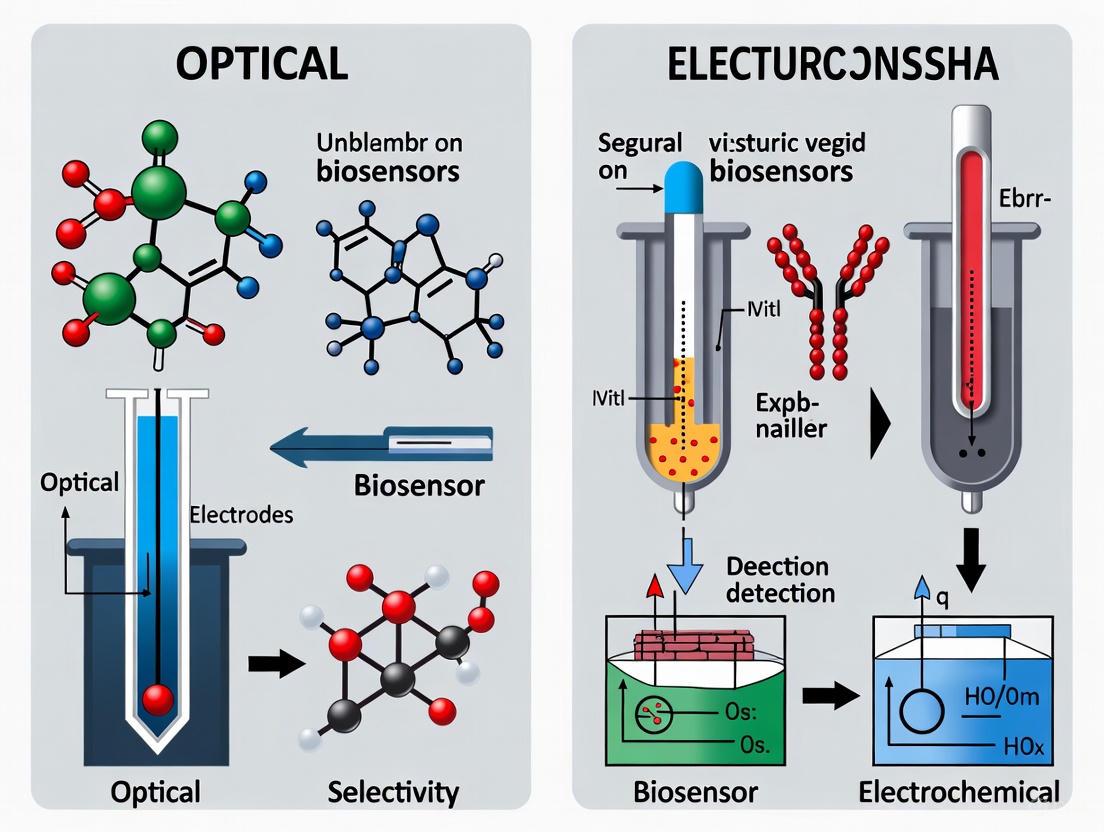
Selectivity, the ability to accurately detect a specific analyte within a complex sample, is a paramount characteristic of effective biosensors.
Optical vs Electrochemical Biosensors: A Comparative Analysis of Selectivity for Biomedical Applications
Abstract
Selectivity, the ability to accurately detect a specific analyte within a complex sample, is a paramount characteristic of effective biosensors. This article provides a comprehensive comparison of the selectivity mechanisms, performance, and optimization strategies for optical and electrochemical biosensors, tailored for researchers and drug development professionals. We explore the foundational principles governing selectivity in both sensor types, examine methodological advances and real-world applications in areas from neurotransmitter detection to therapeutic drug monitoring, and detail troubleshooting approaches to overcome common challenges like biofouling and matrix effects. A systematic validation and comparative analysis equips the reader with the criteria necessary to select the optimal biosensor platform for specific biomedical research or clinical diagnostic needs, ultimately guiding the development of more reliable and effective point-of-care tools.
The Fundamental Principles of Biosensor Selectivity: How Optical and Electrochemical Platforms Discern Their Targets
For researchers, scientists, and drug development professionals, the precise distinction between selectivity and specificity is a fundamental concept in biosensor development and validation. While often used interchangeably in casual discourse, these terms describe distinct performance characteristics with critical implications for interpreting sensor data, particularly in the comparative analysis of optical and electrochemical biosensing platforms.
This guide provides a structured glossary of essential metrics, detailing their definitions, measurement protocols, and significance. It frames these concepts within a broader thesis comparing how selectivity and specificity are engineered and evaluated in optical versus electrochemical biosensors, supported by experimental data and standardized methodologies.
Core Definitions and Conceptual Framework
Specificity vs. Selectivity: A Critical Distinction
In biosensing, specificity and selectivity refer to different hierarchical levels of a sensor's ability to distinguish an analyte.
- Specificity is the ideal, describing a biosensor's ability to recognize and respond to a single, exact target analyte within a complex mixture without any cross-reactivity. It is the characteristic of a perfect "key-and-lock" interaction, typically achieved by highly specific biological recognition elements like antibodies, enzymes, or aptamers that bind to a unique epitope or site on the target [1] [2].
- Selectivity, in contrast, is the practical reality. It describes a biosensor's ability to differentiate and quantify the target analyte in the presence of other similar interfering substances that may be present in the sample matrix. No sensor is perfectly specific, and selectivity quantifies its resilience to these interferents [1] [2].
Sensing strategies can be broadly split into two camps: those aiming for high specificity using a single, highly specific receptor (e.g., an antibody for a single biomarker), and those designed for selectivity from the outset, which use an array of cross-reactive receptors to generate a unique "fingerprint" for an analyte or sample state [2].
The Biosensor as an Integrated System
A biosensor is defined as a self-contained integrated device that combines a biological recognition element (bioreceptor) with a physicochemical transducer [3] [4]. The bioreceptor (e.g., enzyme, antibody, nucleic acid, aptamer) provides the specificity-conferring mechanism, while the transducer (e.g., optical, electrochemical) converts the biological event into a quantifiable signal [5]. The performance metrics for selectivity and specificity are thus dependent on both the quality of the bioreceptor and the efficiency of the transduction system.
Key Metrics Glossary and Measurement Protocols
A standardized set of metrics is crucial for the objective comparison of biosensor performance. The following table summarizes the core definitions, while subsequent sections detail experimental protocols.
Table 1: Essential Metrics for Biosensor Selectivity and Specificity
| Metric | Formal Definition | Significance in Biosensing |
|---|---|---|
| Specificity | The ability of a biosensor to assess an exact, single analyte in a mixture without cross-reactivity [1]. | Indicates the "ideal" performance of the biorecognition element. High specificity is crucial for diagnostics targeting a single, well-defined biomarker [2]. |
| Selectivity | The ability of a biosensor to differentiate the target analyte from other similar substances (interferents) in a mixture [1]. | Reflects practical performance in complex samples (e.g., blood, serum). Governed by both bioreceptor choice and transducer design [2]. |
| Limit of Detection (LoD) | The lowest analyte concentration that produces a signal discernible from the noise. Typically defined as a signal-to-noise ratio (S/N) > 3 or signal > 3 × standard deviation of the blank [1]. | Defines the ultimate sensitivity of the biosensor. A low LoD is essential for detecting biomarkers at trace levels in early disease states [6] [7]. |
| Limit of Quantification (LoQ) | The lowest analyte concentration that can be quantitatively measured with acceptable precision and accuracy. Defined as S/N > 10 or signal > 10 × standard deviation [1]. | The lower bound of the quantitative working range. Critical for applications requiring precise concentration measurements. |
| Sensitivity | The change in the output signal per unit change in analyte concentration (e.g., nA/mM for an amperometric sensor) [1]. | A calibration characteristic; determines how much the signal changes for a given change in concentration. Not to be confused with LoD. |
| Signal Resolution | The ability to produce a discernible output signal between two different analyte concentrations. Dependent on experimental noise; a change in signal ≥ 3 × standard deviations is considered resolvable [1]. | Determines the smallest concentration difference the sensor can reliably report. |
| Response Time (T90) | The time required for the sensor output to reach 90% of its new steady-state signal after a change in analyte concentration [1]. | Critical for real-time monitoring and kinetic studies. Faster response times are often associated with thin-film and nanomaterial-enhanced sensors [7]. |
| Settling Time | The time required for a sensor to reach a stable output after first being activated or wetted. Often defined as the time to reach within 10% of the final value (ST90) [1]. | Important for defining the readiness of a sensor after deployment, especially in point-of-care settings. |
Experimental Protocols for Key Metrics
Protocol for Measuring Selectivity
The selectivity of a biosensor is experimentally determined by challenging it with potential interferents.
- Sample Preparation: Prepare separate solutions containing: a) the target analyte at a known concentration within the linear range, and b) the target analyte at the same concentration but spiked with potential interferents (e.g., structurally similar molecules, ions, or proteins common to the sample matrix) at physiologically or environmentally relevant concentrations.
- Measurement: Measure the signal response for each solution.
- Calculation: Calculate the percentage interference or cross-reactivity using the formula:
- Cross-reactivity (%) = (Signal from Interferent / Signal from Target Analyte) × 100% A well-selective sensor will show minimal signal change (< 5-10%) in the presence of common interferents [3].
Protocol for Determining Limit of Detection (LoD) and Quantification (LoQ)
LoD and LoQ are determined from the calibration curve and blank sample measurements.
- Blank Measurement: Perform at least 10-20 replicate measurements of a blank solution (containing all components except the analyte).
- Calibration Curve: Measure the signal for a series of standard solutions with known low concentrations of the analyte to establish a linear calibration curve.
- Calculation:
Protocol for Measuring Response Time (T90)
The dynamic response time is critical for assessing sensor kinetics.
- Setup: The biosensor is placed in a solution with a stable baseline signal (e.g., buffer).
- Analyte Introduction: The analyte is rapidly introduced to achieve a final concentration that will produce a significant signal change, typically to the upper end of the linear range.
- Data Logging: Signal output is continuously recorded at a high frequency (e.g., 10-100 Hz).
- Analysis: The time difference between the moment of analyte introduction and the point where the signal reaches 90% of its final, stabilized value is recorded as the T90 response time [1].
The following diagram illustrates the core components of a biosensor and the logical workflow for characterizing its selectivity and specificity.
Comparative Analysis: Optical vs. Electrochemical Biosensors
The choice of transduction principle—optical or electrochemical—profoundly influences the strategies for achieving and evaluating selectivity and specificity.
Table 2: Selectivity and Specificity in Optical vs. Electrochemical Biosensors
| Feature | Optical Biosensors | Electrochemical Biosensors |
|---|---|---|
| Specificity Mechanism | Primarily derived from the biorecognition element (antibody, aptamer). Transduction (e.g., SPR, fluorescence) is often label-free and direct [8]. | Primarily derived from the biorecognition element. Can be enhanced by applied potential (in amperometry) to selectively redox-active species [3]. |
| Selectivity Challenges | Susceptible to optical interference from turbid or colored samples. Non-specific adsorption to the sensor surface can affect refractive index-based methods like SPR [8]. | Susceptible to electrochemical interference from other redox-active species in the sample matrix (e.g., ascorbate, urate) at the working potential [3]. |
| Selectivity Engineering | Use of specific fluorescent labels/dyes; surface functionalization to minimize fouling; wavelength filtering to isolate target signal [8] [9]. | Use of perm-selective membranes (e.g., Nafion); surface modifiers; tailored operating potentials; electrochemical mediators [3]. |
| Multiplexing Potential | High. Easily adapted for multi-analyte detection using different fluorescent labels or spatial addressing on arrayed platforms [2] [5]. | Moderate. Growing with the development of multi-electrode arrays (MEAs) and screen-printed electrodes with different modifications per electrode [10]. |
| Typical LoD | Very high sensitivity, often down to pico- or femtomolar levels, especially with fluorescence or plasmonic enhancement [7] [8]. | High sensitivity, capable of detection in the pico- and nanomolar range, enhanced by nanomaterials [6] [7]. |
| Response Time | Can be very fast (milliseconds to seconds) for direct label-free methods like SPR [8]. | Generally fast (seconds), dependent on mass transport and reaction kinetics at the electrode surface [3]. |
Experimental Data in Context
A systematic review on pathogen detection highlights that metal nanocluster-based optical and electrochemical biosensors can achieve impressive limits of detection (LoDs). For instance, a fluorescent biosensor detected E. coli at 14 CFU/mL, while an SPR-based sensor achieved an LoD of 94 CFU/mL for the same pathogen [7] [8]. These high sensitivities are contingent on high specificity bioreceptors (e.g., aptamers, antibodies) and careful engineering to mitigate selectivity issues from the sample matrix.
The concept of a "confusion matrix" and Receiver Operating Characteristic (ROC) curves is vital for validating specificity in a clinical context. The ROC curve plots the true positive rate against the false positive rate as the discrimination threshold is varied. The Area Under the Curve (AUC) quantifies the diagnostic's overall ability to distinguish between two states (e.g., diseased vs. healthy). An AUC of 1.0 represents a perfect test, while 0.5 is no better than chance [1]. This statistical tool is equally applicable to both optical and electrochemical biosensors to objectively compare their clinical specificity.
Essential Research Reagent Solutions
The following table details key reagents and materials essential for developing and testing biosensors, with a focus on evaluating selectivity and specificity.
Table 3: Key Research Reagents for Biosensor Characterization
| Reagent / Material | Function in Biosensor Development | Role in Selectivity/Specificity Analysis |
|---|---|---|
| High-Purity Bioreceptors (e.g., monoclonal antibodies, engineered aptamers) | Serves as the primary biological recognition element. | The foundation of sensor specificity. Purity and batch-to-batch consistency are critical for reproducible performance and minimal cross-reactivity [2]. |
| Chemical Interferents (e.g., Ascorbic Acid, Uric Acid, Albumin) | Used to prepare challenge solutions for selectivity testing. | Essential for experimentally determining a sensor's selectivity. These compounds are common interferents in biological samples and are used to quantify cross-reactivity [3]. |
| Perm-Selective Membranes (e.g., Nafion, Chitosan) | Coated onto the transducer surface (often electrochemical). | Improves selectivity by blocking access of large, negatively charged molecules (like proteins) or specific interferents to the sensing surface [3]. |
| Blocking Agents (e.g., BSA, Casein) | Used to passivate unused binding sites on the sensor surface. | Critical for reducing non-specific adsorption (NSA), a major factor that degrades both specificity and selectivity, particularly in complex samples like serum [5]. |
| Nanomaterial Enhancers (e.g., Gold Nanoparticles, Graphene Oxide) | Used to modify the transducer to enhance signal and improve immobilization. | Can enhance sensitivity and lower LoD. Their surface chemistry can also be tuned to improve selectivity by favoring the binding of the target analyte over interferents [7] [9]. |
| Standardized Buffer Solutions | Provide a consistent chemical environment for testing and calibration. | Allow for the measurement of intrinsic sensor performance (LoD, sensitivity) without the variable complexity of real samples, establishing a baseline before selectivity testing [3]. |
Selectivity is a paramount characteristic of any biosensor, defining its ability to accurately distinguish a target analyte from other interfering substances in complex sample matrices. In optical biosensing, selectivity originates from the synergistic combination of biological recognition elements and transducer-specific physicochemical principles. This guide provides a systematic comparison of the core selectivity mechanisms underpinning four dominant optical biosensing techniques: fluorescence, surface plasmon resonance (SPR), colorimetry, and surface-enhanced Raman spectroscopy (SERS). The selective performance of these optical methods is often contrasted with electrochemical biosensors, which primarily rely on the specificity of biorecognition elements (e.g., antibodies, aptamers) coupled with electrochemical transduction, but can be more susceptible to non-specific adsorption and interferents in complex media [6] [11]. Optical biosensors offer distinct advantages in label-free detection, real-time monitoring, and multiplexing capabilities, which will be explored in the context of their fundamental selectivity mechanisms.
Comparative Analysis of Selectivity Mechanisms
Table 1: Core Selectivity Mechanisms and Performance Parameters of Major Optical Biosensors
| Biosensing Technique | Primary Selectivity Basis | Key Biorecognition Elements | Typical Limit of Detection (LOD) | Label-Free Capability | Susceptibility to Interference |
|---|---|---|---|---|---|
| Fluorescence | Specific binding + spectral signature of fluorophore | Antibodies, Aptamers, Enzymes | Low pM to fM range [12] | No (typically requires label) | High (from autofluorescence, light scattering) |
| Surface Plasmon Resonance (SPR) | Refractive index change at sensor surface | Antibodies, DNA, Molecularly Imprinted Polymers | ~1 pg/mm² [13] | Yes | Medium (non-specific adsorption) |
| Colorimetry | Specific binding-induced visual/spectral change | Enzymes, Antibodies, Aptamers | nM to pM range [11] | No (typically uses enzyme/nanoparticle labels) | Medium (turbidity, sample color) |
| Surface-Enhanced Raman Spectroscopy (SERS) | Specific binding + vibrational fingerprint | Antibodies, Aptamers, PNA [14] | Single molecule to fM levels [12] [14] | Yes (for label-free SERS) | Low (sharp Raman peaks minimize background) |
Table 2: Experimental Data from Representative Studies Demonstrating Biosensor Selectivity
| Biosensing Technique | Target Analyte | Experimental LOD | Demonstrated Selectivity Against | Reference/Platform |
|---|---|---|---|---|
| Fluorescence | miRNA-92a-3p (Colorectal Cancer) | 0.047 pM | Distinguished CRC patients from healthy controls [15] | Ratio fluorescence biosensor [15] |
| SPR (PCF-SPR) | General Biomoelcules | High Wavelength Sensitivity: 143,000 nm/RIU | Detection in complex refractive index range (1.32-1.44) [16] | Optimized bowtie-shaped PCF [16] |
| Colorimetry | α-Fetoprotein (AFP) | 16.73 ng/mL | Specific antigen-antibody binding [17] | Au-Ag Nanostars SERS Platform (Intrinsic mode) [17] |
| SERS | SARS-CoV-2 RNA | 112 pM | Fully matched vs. mismatched/random sequences [14] | PNA-based SERS biosensor [14] |
Fundamental Principles and Experimental Protocols
Fluorescence Biosensing
The selectivity of fluorescence biosensors operates on two levels. The primary level is the specific binding between the biorecognition element (e.g., an antibody or aptamer) and its target analyte. The secondary level is the spectral characteristics of the fluorophore itself, which allows for discrimination based on excitation and emission wavelengths, enabling multiplexed detection [12] [11]. The requirement for a fluorescent label, however, can potentially modify the binding kinetics and is susceptible to environmental quenching and autofluorescence from the sample matrix.
Representative Experimental Protocol for miRNA Detection using a Ratio Fluorescence Biosensor [15]:
- Probe Design: A specific molecular beacon or hairpin DNA probe is designed to complement the target miRNA sequence (e.g., miR-92a-3p).
- Nanomaterial Synthesis: A nano-platform (e.g., UiO-66-NH2 MOF) is synthesized to serve as a quenching substrate and to facilitate further functionalization.
- Sensor Fabrication: The fluorescently labeled DNA probe is immobilized onto the nanomaterial surface.
- Hybridization and Signal Generation: The sensor is incubated with the sample. In the presence of the target miRNA, hybridization occurs, causing a conformational change in the probe (e.g., catalytic hairpin assembly), which alters the fluorescence signal (e.g., recovery of fluorescence).
- Ratiometric Detection: The fluorescence intensity at two different wavelengths is measured. The ratio of these intensities is used for quantification, which minimizes the effects of environmental fluctuations and improves accuracy.
- Specificity Validation: The sensor's selectivity is tested against other miRNAs with similar sequences (e.g., single-base mismatches) to confirm specific binding.
Surface Plasmon Resonance (SPR) Biosensing
SPR biosensors are fundamentally label-free. Their selectivity is derived entirely from the immobilization of a high-affinity bioreceptor on a thin metal film (typically gold). When target analytes bind to these receptors, they cause a local change in the refractive index at the metal surface, which is detected as a shift in the resonance angle or wavelength [13]. This allows for real-time monitoring of binding kinetics. Photonic Crystal Fiber (PCF)-SPR sensors enhance this interaction by confining light and analyte within the fiber's structure, boosting sensitivity [13] [16]. A major selectivity challenge is mitigating non-specific adsorption of other molecules onto the sensor surface.
Diagram 1: SPR biosensor working principle and signal transduction.
Representative Experimental Protocol for PCF-SPR Biosensing [13] [16]:
- Sensor Design and Simulation: A PCF structure (e.g., bowtie-shaped) is designed and optimized using numerical simulations (e.g., Finite Element Method in COMSOL) to achieve high sensitivity.
- Metal Coating: The surface of the PCF (often a polished side) is coated with a thin, nanoscale layer of plasmonic material (e.g., gold, sometimes with graphene or TMDC overlayers).
- Bioreceptor Immobilization: A specific biorecognition element (e.g., antibody, aptamer) is functionalized onto the metal surface via chemical linkers (e.g., thiol chemistry).
- Flow System Setup: The PCF-SPR sensor is integrated into a flow cell system with pumps and tubing to control the introduction of sample and buffer solutions.
- Optical Measurement: A broadband light source is launched through the PCF, and the output spectrum is recorded by a spectrometer. The resonance wavelength dip is tracked in real-time.
- Analyte Detection & Regeneration: The sample is injected. Binding events cause a shift in the resonance wavelength. The sensor surface is regenerated using a mild acidic or basic solution to dissociate the bound analyte for reuse.
Colorimetric Biosensing
Colorimetry relies on visual or spectroscopic detection of a color change induced by the analyte. Selectivity is conferred by the biorecognition event (e.g., antibody-antigen binding), which then triggers a color-generating reaction. This is commonly achieved through enzyme labels (e.g., HRP catalyzing a TMB substrate) or the aggregation/dispersal of metallic nanoparticles (e.g., gold nanoparticles) [11]. Lateral Flow Immunoassays (LFIAs) are a classic example. While highly user-friendly, their selectivity can be compromised by sample turbidity or colored interferents.
Surface-Enhanced Raman Spectroscopy (SERS)
SERS biosensors possess a dual-layer selectivity mechanism. The first layer is the specific capture of the target analyte by a bioreceptor (antibody, aptamer, or Peptide Nucleic Acid (PNA)). The second, and more powerful, layer is the intrinsic "vibrational fingerprint" of the target molecule itself, which provides unique Raman spectra for unambiguous identification [12] [14]. The enormous signal enhancement (10⁶–10⁸) provided by plasmonic nanostructures (e.g., Au/Ag nanoparticles) allows for ultra-sensitive, single-molecule detection. PNA probes, with their neutral backbone, offer superior selectivity for distinguishing matched from mismatched nucleic acid sequences compared to DNA probes [14].
Diagram 2: SERS biosensor working principle and signal transduction.
Representative Experimental Protocol for a Label-Free PNA-SERS Biosensor [14]:
- Substrate Preparation: Glass substrates are thoroughly cleaned and functionalized to facilitate the adhesion of gold nanoparticles (AuNPs).
- AuNP Deposition: Colloidal AuNPs are drop-cast onto the functionalized glass slide to create a uniform, enhancing substrate.
- PNA Probe Immobilization: Thiolated Peptide Nucleic Acid (PNA) probes are immobilized onto the AuNP surface via gold-thiol bonds. PNA is used for its high affinity and resistance to enzymatic degradation.
- Hybridization: The PNA-functionalized substrate is incubated with the sample containing the target RNA. Hybridization occurs between the PNA probe and the complementary RNA sequence.
- Label-Free SERS Measurement: The substrate is directly analyzed using a Raman spectrometer. The laser excites the sample, and the intrinsic SERS signal from the nucleobases of the captured RNA target is collected, generating its unique vibrational fingerprint.
- Data Analysis: Principal Component Analysis (PCA) and Principal Component Regression (PCR) are often applied to the spectral data to enhance discrimination and enable sensitive, quantitative analysis.
The Scientist's Toolkit: Essential Research Reagents and Materials
Table 3: Key Reagent Solutions for Optical Biosensor Development
| Reagent/Material | Core Function | Example Use Case |
|---|---|---|
| Gold Nanoparticles (AuNPs) | Plasmonic material for signal enhancement in SPR, SERS, and colorimetric sensors. | SERS substrate [14], Colorimetric LFIA [11] |
| Peptide Nucleic Acid (PNA) | Synthetic DNA analog with neutral backbone; provides high affinity and specificity for nucleic acid targets. | Capture probe for SARS-CoV-2 RNA in SERS [14] |
| Polydimethylsiloxane (PDMS) | Flexible, transparent polymer substrate for wearable and microfluidic sensor integration. | Flexible optical sensor substrate [18] |
| Photonic Crystal Fiber (PCF) | Specialized optical fiber that guides light; used to create highly sensitive SPR platforms. | Core component of PCF-SPR sensors [13] [16] |
| Monoclonal Antibodies | High-specificity biorecognition elements for targeting proteins and other antigens. | Detection of α-fetoprotein in SERS immunoassay [17] |
| Transition Metal Dichalcogenides (TMDCs) | 2D materials (e.g., MoS₂) used to enhance sensitivity in SPR and photoelectrochemical sensors. | Performance-enhancing overlay in SPR sensors [13] |
The accurate detection of specific biomarkers, drugs, or pathogens in complex biological matrices is a fundamental challenge in analytical science and clinical diagnostics. Selectivity, the ability of a sensor to distinguish its target from interfering species, is a cornerstone of reliable biosensing. While optical biosensors are widely used, electrochemical biosensors offer distinct advantages for miniaturization, point-of-care deployment, and real-time, in vivo monitoring [11]. Their growing importance in therapeutic drug monitoring, personalized medicine, and infectious disease diagnosis makes a deep understanding of their selectivity mechanisms critical for researchers and drug development professionals [19] [20].
This guide provides a critical comparison of three advanced electrochemical platforms celebrated for their molecular discrimination capabilities: Electrochemical Aptamer-Based (E-AB) sensors, Electrochemical DNA (E-DNA) sensors, and biosensors employing Electrochemical Impedance Spectroscopy (EIS). We dissect the core biochemical and biophysical principles that underpin their selectivity, supported by experimental data and protocols, to inform their application in next-generation biomedical research.
Comparative Analysis of Core Selectivity Mechanisms
The following table summarizes the key characteristics, selectivity mechanisms, and performance metrics of E-AB, E-DNA, and EIS biosensors.
Table 1: Comparative analysis of E-AB, E-DNA, and Impedance Spectroscopy biosensors
| Feature | Electrochemical Aptamer-Based (E-AB) Sensors | Electrochemical DNA (E-DNA) Sensors | Impedance Spectroscopy (EIS) Biosensors |
|---|---|---|---|
| Core Selectivity Mechanism | Aptamer conformational change upon target binding [21] | DNA hybridization or structure switching [19] | Biorecognition-induced interfacial property change [22] |
| Typical Biorecognition Element | DNA or RNA aptamers (ssDNA/RNA) [21] | DNA probes (ssDNA) [19] [23] | Antibodies, aptamers, enzymes [22] |
| Signal Transduction | Change in electron transfer rate (ket) of a redox tag (e.g., Methylene Blue) [21] [24] | Redox tag proximity modulation or blocking upon hybridization [19] | Change in charge transfer resistance (Rct) or interfacial capacitance [25] [22] |
| Key Performance Differentiator | Real-time, reversible, in vivo monitoring [19] [24] | High specificity for nucleic acid sequences; versatile platform [19] | Label-free, highly sensitive to surface phenomena [22] |
| Representative Experimental LOD | Vancomycin: ~1 µM (in whole blood) [24] | Varies by target; can detect specific DNA sequences [23] | Pathogens: Often in PFU/mL or CFU/mL range [22] |
| Time Resolution | <2 seconds (with FFT-EIS) [24] | Minutes to hours [23] | Minutes (spectrum acquisition) [22] |
| Reversibility | High (non-covalent binding) [19] | Low to moderate (depends on design) [19] | Often low (irreversible binding) [22] |
Experimental Protocols for Investigating Selectivity
A rigorous assessment of selectivity is paramount for validating any biosensor. The following protocols are standard for evaluating the mechanisms outlined above.
Protocol for E-AB Sensor Selectivity and Signal Optimization
This protocol outlines steps to confirm an E-AB sensor's response is due to specific aptamer-target binding.
- Objective: To measure the specific binding of a target molecule (e.g., vancomycin) using an E-AB sensor and optimize the signal by characterizing the electron transfer rate.
- Materials:
- Fabricated E-AB Sensor: Gold electrode modified with a thiolated, Methylene Blue (MB)-tagged aptamer [21] [24].
- Potentiostat: Capable of performing Cyclic Voltammetry (CV) and Fast Fourier Transform Electrochemical Impedance Spectroscopy (FFT-EIS) [24].
- Analyte Solutions: Target molecule (vancomycin) in a relevant matrix (e.g., buffer, whole blood). Control solutions: structural analogs and unrelated molecules in the same matrix [24].
- Method:
- Baseline Measurement: Immerse the sensor in the plain matrix (e.g., whole blood at 37°C). Using FFT-EIS, acquire an impedance spectrum at the MB's formal potential (typically around -0.285 V vs. Ag/AgCl). Apply a small AC perturbation (e.g., 10 mV) superimposed on the DC bias across a frequency range (e.g., 1 Hz to 1 kHz) [24].
- Target Exposure: Introduce the target molecule at a physiologically relevant concentration. Monitor the impedance in real-time.
- Selectivity Challenge: Rinse the sensor and repeat with control solutions containing potential interferents.
- Data Analysis:
- Fit the obtained impedance spectra to a Randles equivalent circuit to extract the charge transfer resistance (Rct) [24].
- Calculate the electron transfer rate (ket) using the formula: ( k{et} = \frac{RT}{F^2} \cdot \frac{1}{R{ct} \cdot A \cdot \Gamma} ) where R is the gas constant, T is temperature, F is Faraday’s constant, A is electrode area, and Γ is the surface coverage of the redox tag [24].
- A decrease in Rct (and increase in ket) upon target addition indicates specific binding-induced folding. The sensor is selective if Rct remains unchanged with interferents.
Protocol for EIS Biosensor Selectivity Assessment
This protocol tests the specificity of a label-free EIS biosensor by measuring non-specific binding.
- Objective: To confirm that a change in impedance is due to specific binding of the target pathogen to an immobilized antibody, and not non-specific adsorption.
- Materials:
- Functionalized EIS Sensor: Gold or screen-printed electrode modified with a self-assembled monolayer (SAM) and a specific capture antibody [22].
- Potentiostat with EIS Capability [25].
- Analyte Solutions: Target pathogen (e.g., E. coli), non-target pathogen (e.g., S. aureus), and bovine serum albumin (BSA) in a complex matrix like PBS or diluted blood [22].
- Method:
- Baseline in Matrix: Record a EIS spectrum (e.g., 0.1 Hz to 100 kHz) in the measurement matrix to establish a baseline Rct.
- Exposure to Non-Target: Incubate the sensor with a high concentration of the non-target pathogen or a protein like BSA for a set time (e.g., 30 minutes).
- Wash and Re-measure: Gently rinse the sensor with buffer and record a new EIS spectrum. A significant change in Rct indicates substantial non-specific adsorption, highlighting a need for better surface passivation.
- Target Measurement: Finally, expose a fresh, similarly prepared sensor to the specific target pathogen. A significantly larger Rct shift compared to the non-target control confirms specific binding and sensor selectivity [22].
Visualization of Signaling Pathways and Workflows
The diagrams below illustrate the core signaling mechanisms and experimental workflows for the discussed biosensor platforms.
E-AB Sensor Signaling Mechanism
Diagram 1: E-AB target-induced folding. In the unbound state (1), the aptamer is unfolded, and the redox tag (Methylene Blue) is far from the electrode, resulting in slow electron transfer. Upon target binding (2), the aptamer folds, bringing the tag closer to the surface, which significantly increases the electron transfer rate (ket), measurable via SWV or EIS [21] [24].
Impedance Spectroscopy Biosensing Workflow
Diagram 2: EIS label-free detection workflow. The process begins (1) with a baseline impedance measurement of the functionalized electrode, yielding a specific charge transfer resistance (Rct). (2) Introduction of the target analyte causes binding events that hinder ion flow or electron transfer at the interface. (3) Re-measurement shows an increased Rct, the magnitude of which is proportional to the target concentration, enabling label-free quantification [25] [22].
The Scientist's Toolkit: Key Research Reagent Solutions
Successful development of these biosensors relies on a set of core materials and reagents, each serving a critical function.
Table 2: Essential materials and reagents for electrochemical biosensor development
| Item | Critical Function | Application Notes |
|---|---|---|
| Gold Electrodes | Provides a stable, inert, and easily functionalizable surface for thiol-based chemistry [21] [24]. | Used in E-AB and many EIS sensors. Requires careful cleaning before use. |
| Thiolated Aptamers / DNA | The biorecognition element; thiol group allows for covalent attachment to gold surfaces via self-assembled monolayers (SAMs) [21]. | Probe packing density on the electrode is a critical parameter for signal optimization [21]. |
| Methylene Blue | A redox reporter tag; its electron transfer rate (ket) changes with proximity to the electrode surface [21] [24]. | The most common redox tag used in E-AB and E-DNA sensors. |
| Self-Assembled Monolayer (SAM) Reagents | Passivates the electrode surface to prevent non-specific binding and defines the electrochemical environment [21]. | Often alkanethiols like 6-mercapto-1-hexanol (MCH). Length of carbon chain affects electron tunneling [21]. |
| Potentiostat with EIS & FFT | Core instrumentation for applying potentials and measuring electrochemical currents and impedance [24]. | FFT-EIS capability is essential for high time-resolution (seconds) in vivo measurements [24]. |
E-AB, E-DNA, and EIS biosensors each offer powerful, yet distinct, pathways to achieving high selectivity in electrochemical sensing. E-AB sensors excel in dynamic, real-time applications such as in vivo therapeutic drug monitoring due to their reversible, conformation-based signaling and recent advancements in calibration-free operation [19] [24]. E-DNA sensors provide a robust platform for detecting specific nucleic acid sequences and other targets via structure-switching mechanisms [19]. In contrast, EIS-based biosensors offer a highly sensitive, label-free approach ideal for detecting larger entities like pathogens and proteins by monitoring subtle changes in interfacial properties, though they can be more susceptible to non-specific binding effects [22].
The choice of platform is dictated by the specific application requirements: E-AB for pharmacokinetic studies requiring seconds resolution, E-DNA for genetic targets, and EIS for highly sensitive, direct pathogen detection. Future developments in artificial intelligence, nanomaterial integration, and novel bioreceptor engineering will further sharpen these selectivity mechanisms, solidifying the role of electrochemical biosensors in precision healthcare and diagnostic medicine [19] [26].
The performance of any biosensor is fundamentally dictated by its biorecognition element (BRE), the molecular component responsible for the selective binding of a target analyte [27] [28]. Within the context of optical and electrochemical biosensing platforms, three classes of bioreceptors are predominantly employed: antibodies, aptamers, and enzymes. The choice between them significantly influences key sensor parameters such as sensitivity, specificity, stability, and overall suitability for point-of-care (POC) applications [11] [29]. Antibodies, with their high specificity and well-established use in clinical diagnostics, have long been the gold standard. However, challenges such as production complexity, batch-to-batch variability, and environmental sensitivity have prompted the exploration of alternatives [27] [30]. Aptamers, single-stranded DNA or RNA molecules selected via the Systematic Evolution of Ligands by Exponential Enrichment (SELEX), offer advantages like ease of synthesis, superior stability, and flexible modification [31] [32]. Enzymes, as catalytic bioreceptors, provide the unique advantage of signal amplification through their catalytic activity [11]. This guide provides a objective comparison of these three bioreceptors, integrating experimental data and methodologies to illustrate their performance within optical and electrochemical biosensing platforms, thereby informing strategic selection for research and development.
Fundamental Characteristics and a Direct Comparison
The core properties of antibodies, aptamers, and enzymes dictate their integration into sensor designs. Antibodies are proteins produced by the immune system that bind to specific antigens with high affinity; their binding relies on structural complementarity and non-covalent interactions [32] [30]. Aptamers are synthetic nucleic acids that fold into specific three-dimensional structures to bind targets, with interactions driven by electrostatic forces, van der Waals forces, hydrogen bonding, and shape complementarity [31]. Enzymes are protein catalysts that accelerate the conversion of a specific substrate to a product, enabling the generation of a detectable signal [11].
Table 1: Inherent Properties of Antibodies, Aptamers, and Enzymes.
| Property | Antibodies | Aptamers | Enzymes |
|---|---|---|---|
| Nature | Proteins (Immunoglobulins) | Single-stranded DNA or RNA | Proteins (Catalysts) |
| Production | In vivo (Animals/Hybridomas); Complex and costly [30] | In vitro (SELEX); Chemical synthesis; Standardized and inexpensive [31] [32] | In vivo (Microbial/Animal cells); Can be complex |
| Molecular Weight | Large (~150 kDa) | Small (~10-30 kDa) [30] | Variable, often large |
| Stability | Sensitive to temperature and pH; Prone to denaturation [27] | Thermally stable; Can be regenerated after denaturation [32] [30] | Generally sensitive to temperature and pH |
| Modification | Limited; Possible via protein chemistry | Highly flexible; Easy chemical modification (e.g., with fluorophores, linkers) [27] [31] | Can be modified, but may affect activity |
| Target Range | Primarily immunogenic molecules; Limited for small targets [27] | Broad (proteins, small molecules, ions, cells) [31] [32] | Specific substrates for catalytic reaction |
| Key Binding Driver | Structural complementarity | Folding into 3D structure for target recognition [27] [31] | Active site specificity for substrate |
| Typical Development Timeline | Several months | A few weeks [32] | Variable |
The following diagram illustrates the fundamental working principles of biosensors based on these three bioreceptors.
Performance Comparison in Biosensing Platforms
Comparative Analysis of Real-World Experimental Data
Direct comparative studies and data from individual sensor developments highlight the performance disparities between these bioreceptors. For instance, a head-to-head study comparing an aptamer and an antibody for detecting the human epidermal growth factor receptor 2 (HER2) cancer biomarker on an impedimetric platform revealed clear differences [30]. The aptasensor demonstrated a superior limit of detection (LOD) and, crucially, could be regenerated and reused, while the immunosensor could not. Furthermore, the aptasensor showed better long-term storability [30]. Such comparative data is vital for making an informed choice.
Table 2: Experimental Performance Comparison of Biosensors using Different Bioreceptors.
| Bioreceptor | Target Analyte | Sensor Platform | Limit of Detection (LOD) | Dynamic Range | Key Findings |
|---|---|---|---|---|---|
| Aptamer [30] | HER2 Protein | Electrochemical Impedimetric | Not specified, but lower than antibody counterpart | N/A | Better LOD, reusability, and storability than antibody. |
| Antibody [30] | HER2 Protein | Electrochemical Impedimetric | Not specified | N/A | Could not be regenerated for reuse. |
| Aptamer [27] | Fumonisin B1 (FB1) | Fluorescent (with GO) | 0.15 ng/mL | 0.5–20 ng/mL | High specificity in food samples. |
| Aptamer [27] | Fumonisin B1 (FB1) | Fluorescent (with Nucleases) | 0.45 pg/mL | 1 pg/mL – 100 ng/mL | Enzyme-assisted signal amplification greatly enhanced sensitivity. |
| Aptamer [28] | Fumonisin B1 (FB1) | Electrochemical | 0.306 fg/mL | 0.500 fg/mL – 1 ng/mL | Demonstrates ultra-high sensitivity achievable with aptamers. |
| Aptamer [31] | Arginine (L-Arg) | Electrochemical (DPV) | 31 pM | 0.0001–10 μM | High sensitivity for a small molecule. |
Suitability for Optical vs. Electrochemical Platforms
Both optical and electrochemical biosensors benefit from the unique properties of each bioreceptor, though the integration strategies differ.
Optical Biosensors: These sensors detect changes in light properties such as fluorescence, color, or refractive index [27] [11]. Antibodies are widely used in colorimetric lateral flow assays (e.g., pregnancy tests) and surface plasmon resonance (SPR) due to the high specificity [11] [32]. Aptamers are highly suited for fluorescent sensors, as they can be easily labeled with fluorophores; their conformational change upon target binding can precisely alter the distance in a FRET pair, leading to highly sensitive "signal-on" or "signal-off" detection [27] [32]. Enzymes are ideal for colorimetric and chemiluminescent assays, where their catalytic activity converts a substrate into a colored or light-emitting product, providing inherent signal amplification [11].
Electrochemical Biosensors: These sensors transduce a biological binding event into an electrical signal (current, potential, impedance) [11] [29]. Antibodies are used in label-free impedimetric sensors, where the binding of a large protein antigen insulates the electrode surface, increasing the electron transfer resistance [31] [29]. Aptamers excel in electrochemical platforms due to their small size and flexible chemical modification, which allows for efficient electron transfer. Their folding upon target binding can significantly alter the electrical interface, leading to high sensitivity in differential pulse voltammetry (DPV) or EIS measurements [31]. Enzymes like glucose oxidase are the classic choice for amperometric biosensors, where the enzyme generates an electroactive product (e.g., H₂O₂) that is detected at the electrode, producing a current proportional to the target concentration [11].
Detailed Experimental Protocols
To illustrate how these bioreceptors are utilized in practice, below are detailed methodologies for two key experiments cited in this guide.
This protocol details the direct comparative study between an aptamer and an antibody for cancer biomarker detection.
- Electrode Modification: A glassy carbon electrode (GCE) is first polished and cleaned. It is then modified with a nanocomposite of sulfur/nitrogen-doped graphene quantum dots and gold nanoparticles (SNGQDs@AuNPs), followed by the deposition of a cobalt porphyrin binuclear framework (CoP-BNF).
- Bioreceptor Immobilization: The amine-functionalized HER2 aptamer (HB5) is covalently attached to the carboxylic acid groups on the modified electrode surface using a standard EDC/NHS cross-linking chemistry. For the comparative immunosensor, the anti-HER2 antibody (Trastuzumab) is immobilized similarly.
- Blocking: The electrode surface is treated with Bovine Serum Albumin (BSA) to block any non-specific binding sites.
- Target Detection and Measurement: The fabricated sensor is incubated with solutions containing varying concentrations of the HER2 protein. Electrochemical Impedance Spectroscopy (EIS) is performed in a solution containing [Fe(CN)₆]³⁻/⁴⁻ as a redox probe. The increase in electron transfer resistance (Rₑₜ) upon HER2 binding is measured and correlated to the analyte concentration.
- Regeneration Study (for Aptasensor): The aptasensor is regenerated by immersing it in a low-pH glycine-HCl buffer to dissociate the bound HER2. The EIS response is then measured again to confirm the return to the baseline, demonstrating reusability.
This protocol describes a "signal-on" fluorescent sensor that combines an aptamer with graphene oxide and nucleases for amplified detection.
- Aptamer Labeling: A specific ssDNA aptamer against FB1 is labeled with a carboxy-X-rhodamine (ROX) fluorophore at one end.
- Fluorescence Quenching: The ROX-labeled aptamer is introduced into a solution of Graphene Oxide (GO). The aptamer adsorbs onto the GO surface via π-π stacking, bringing the ROX fluorophore close to the GO, which quenches its fluorescence via FRET.
- Target Binding and Signal Recovery: Upon the addition of the FB1 mycotoxin, the aptamer preferentially binds to its target, folding into a specific 3D structure. This conformational change pulls the ROX fluorophore away from the GO surface, restoring fluorescence.
- Enzymatic Signal Amplification: Nucleases (e.g., DNase I) are added to the solution. These enzymes digest the aptamer-FB1 complex, releasing FB1 and the short DNA fragment with the ROX label. The released FB1 can bind another intact aptamer, and the cycle repeats. The short DNA fragment re-adsorbs onto GO, leading to fluorescence quenching again. This enzymatic recycling amplifies the signal response, significantly improving sensitivity.
- Measurement: The fluorescence intensity is measured over time, with the signal being directly proportional to the FB1 concentration in the sample.
The workflow for this sophisticated aptasensor is outlined below.
The Scientist's Toolkit: Essential Research Reagents and Materials
The development and implementation of biosensors rely on a suite of specialized reagents and materials. The following table details key components referenced in the experimental protocols.
Table 3: Essential Reagents and Materials for Biosensor Development.
| Item | Function/Application |
|---|---|
| Glassy Carbon Electrode (GCE) | A common working electrode platform for electrochemical biosensors due to its excellent conductive properties and wide potential window [30]. |
| EDC & NHS | Cross-linking agents used to activate carboxylic acid groups on sensor surfaces for the covalent immobilization of amine-functionalized bioreceptors (antibodies, aptamers) [30]. |
| Bovine Serum Albumin (BSA) | A blocking agent used to cover non-specific binding sites on the sensor surface, thereby reducing background noise and improving signal-to-noise ratio [30]. |
| Graphene Oxide (GO) | A nanomaterial used in optical and electrochemical sensors for its excellent quenching properties in FRET-based assays and its large surface area for biomolecule adsorption [27]. |
| [Fe(CN)₆]³⁻/⁴⁻ Redox Probe | A standard electrochemical mediator used in EIS and voltammetry to characterize electrode modifications and monitor binding events that hinder electron transfer [30]. |
| Gold Nanoparticles (Au NPs) | Functional nanomaterials used to enhance electron transfer in electrochemical sensors and as colorimetric labels or plasmonic components in optical sensors [29]. |
| Fluorophore (e.g., ROX, FAM) | A fluorescent dye used to label bioreceptors (especially aptamers) for detection in fluorescence-based optical biosensors [27]. |
| Nuclease (e.g., DNase I) | An enzyme used in signal amplification strategies to digest nucleic acid bioreceptors, enabling target recycling and enhancing detection sensitivity [27]. |
Antibodies, aptamers, and enzymes each occupy a critical and distinct niche in the biosensing landscape. Antibodies remain a powerful choice for applications demanding proven, high-affinity recognition, particularly in clinical immunoassays. However, their limitations regarding stability, cost, and production are driving a shift towards aptamers in many emerging applications. Aptamers demonstrate compelling advantages in terms of stability, design flexibility, and performance in novel sensor designs, often matching or surpassing antibodies in sensitivity and specificity, as shown in direct comparisons [30]. Enzymes provide an unparalleled capability for catalytic signal amplification. The optimal choice of bioreceptor is not universal but is contingent on the specific requirements of the assay, including the target analyte, the desired sensor platform (optical or electrochemical), and the constraints of the operating environment (e.g., POC vs. central lab). This comparative analysis provides a framework for researchers, scientists, and drug development professionals to make an informed selection, ultimately guiding the development of more sensitive, robust, and deployable biosensing technologies.
The accurate detection of specific analytes within complex biological media represents a central challenge in biosensor development. Selectivity, defined as the ability of an analytical method to detect the target analyte without being influenced by other sample constituents, is particularly crucial for applications in medical diagnostics, environmental monitoring, and food safety [33]. Complex media such as blood, saliva, wound exudate, or food samples contain numerous interfering substances that can generate false positive or negative signals, potentially compromising diagnostic outcomes. Optical and electrochemical biosensors employ distinct physical principles and biorecognition elements to address this selectivity challenge, each with inherent advantages and limitations. This review provides a comprehensive theoretical and experimental comparison of these two dominant biosensing platforms, focusing specifically on their fundamental mechanisms for achieving selectivity in complex matrices. By examining the underlying signaling pathways, experimental validations, and performance characteristics, this analysis aims to equip researchers and drug development professionals with the critical knowledge needed to select appropriate biosensing platforms for their specific applications.
Theoretical Foundations of Biosensor Selectivity
Fundamental Transduction Principles
Biosensors integrate a biorecognition element (e.g., enzyme, antibody, aptamer) with a transducer that converts the biological interaction into a quantifiable signal [34]. The theoretical basis for selectivity begins with this biorecognition layer, which provides the primary specificity for the target analyte. Subsequent transduction mechanisms then determine how selectively this biological interaction is translated into a measurable output.
Electrochemical biosensors primarily monitor electrical changes resulting from biorecognition events, typically measuring current (amperometric), potential (potentiometric), or impedance (impedimetric) [11] [34]. Their selectivity is governed by both the biochemical specificity of the recognition element and the electrochemical window within which measurements occur. Third-generation electrochemical biosensors achieve particularly high selectivity through direct electron transfer (DET) between the enzyme's active site and the electrode, eliminating the need for mediators that can reduce specificity [35] [33].
Optical biosensors transduce biorecognition events into measurable light signals through various mechanisms including surface plasmon resonance (SPR), chemiluminescence (CL), fluorescence (FL), and colorimetric changes [11]. Their selectivity derives from the specific binding event combined with the unique optical properties of the signal generated, which can be tuned to specific wavelengths to minimize background interference from complex media.
Table 1: Fundamental Principles Governing Selectivity in Biosensors
| Feature | Electrochemical Biosensors | Optical Biosensors |
|---|---|---|
| Primary Transduction Mechanism | Measurement of electrical parameters (current, potential, impedance) | Measurement of light properties (intensity, wavelength, polarization) |
| Primary Selectivity Source | Specificity of biorecognition element + applied potential | Specificity of biorecognition element + optical signature |
| Signal-to-Noise Optimization | Control of applied potential, use of permselective membranes | Wavelength selection, temporal resolution, background subtraction |
| Key Advantage for Complex Media | Compatible with turbid, optically opaque samples [34] | Minimal interference from electroactive compounds |
| Major Challenge in Complex Media | Interference from electroactive species (e.g., ascorbic acid, uric acid, acetaminophen) [33] | Background fluorescence, light scattering, sample turbidity |
Signaling Pathways and Selectivity Mechanisms
The fundamental signaling pathways for electrochemical and optical biosensors diverge significantly after the initial biorecognition event, leading to their distinct selectivity profiles. The diagram below illustrates the parallel pathways through which each platform achieves selective detection.
For electrochemical biosensors, the pathway involves translating the biorecognition event into an electrical signal through various mechanisms. First-generation sensors detect consumption or production of electroactive species (e.g., O₂, H₂O₂), while second-generation systems employ synthetic redox mediators to shuttle electrons [35]. Third-generation systems achieve the highest selectivity through direct electron transfer between the enzyme and electrode, operating at lower potentials that minimize interference from other electroactive compounds [33]. Key selectivity-enhancing strategies include permselective membranes that exclude interferents based on size or charge, and careful control of the applied potential to favor the target reaction [33].
For optical biosensors, selectivity is achieved through the unique optical signatures generated by specific labels or by the binding event itself. Label-free optical techniques like SPR detect refractive index changes near the sensor surface, while labeled approaches use enzymes, fluorescence tags, or nanoparticles that produce distinct optical signals [11]. Selectivity is enhanced through wavelength selection to isolate the signal from background interference, and temporal resolution to distinguish the specific signal kinetics from non-specific binding events. However, optical approaches remain vulnerable to interference from sample turbidity, autofluorescence, and light-scattering compounds [11].
Experimental Approaches for Selectivity Validation
Methodologies for Assessing Selectivity
Rigorous experimental protocols are essential for validating biosensor selectivity in complex media. Standardized approaches include interference testing, recovery studies, and comparison with reference methods [33].
A fundamental methodology for electrochemical biosensors involves testing potential interferents commonly found in the target application matrix. For clinical biosensors, this includes challenging the sensor with physiological concentrations of compounds such as ascorbic acid, uric acid, and acetaminophen [33]. For optical biosensors, similar challenges are performed with optically active interferents, including compounds with native fluorescence or those that cause light scattering. The following experimental workflow outlines a comprehensive selectivity validation protocol applicable to both biosensor platforms.
Quantitative Comparison of Selectivity Performance
Experimental data from comparative studies reveals distinct selectivity profiles for electrochemical and optical biosensors across various applications. The following table summarizes key performance metrics reported in the literature for both sensor types when challenged with complex media.
Table 2: Experimental Selectivity Performance in Complex Media
| Application Context | Biosensor Type | Key Interferents Tested | Signal Change with Interferents | Reference Method Correlation |
|---|---|---|---|---|
| Chronic Wound Monitoring [6] | Electrochemical | Proteases, cytokines, growth factors | <10% signal change for most interferents | Not specified |
| Chronic Wound Monitoring [6] | Optical | Proteases, cytokines, growth factors | <15% signal change for most interferents | Not specified |
| Implantable Clinical Sensors [33] | Electrochemical | Ascorbic acid, uric acid, acetaminophen | 15-25% signal change without membranes | HPLC (R² = 0.95-0.98 with membranes) |
| Food Bioprocess Monitoring [35] | Electrochemical enzyme-based | Other sugars, organic acids, preservatives | 5-12% signal change in complex food samples | Standard enzymatic assays (R² = 0.97-0.99) |
| Environmental Monitoring [36] | Inhibition-based electrochemical | Other pesticides, heavy metals, organic matter | 20-50% cross-reactivity for class-specific sensors | GC-MS (qualitative agreement only) |
| Point-of-Care Clinical Diagnostics [11] | Optical (LFIA) | Hemoglobin, lipids, bilirubin | Visual readout unaffected at physiological levels | Laboratory immunoassay (>95% agreement) |
| Point-of-Care Clinical Diagnostics [11] | Optical (SERS-based) | Hemoglobin, lipids, bilirubin | <8% signal change at physiological levels | Laboratory immunoassay (R² = 0.98-0.99) |
The data indicates that while both platforms can achieve high selectivity, their performance depends significantly on the application context and implemented enhancement strategies. Electrochemical biosensors generally demonstrate slightly better rejection of optical interferents but require more sophisticated engineering to address electrochemical interferents. Optical biosensors typically show more consistent performance across different sample matrices but can be compromised by specific optical properties of the sample.
Enhancement Strategies for Complex Media
Both biosensor platforms employ specialized enhancement strategies to improve selectivity in challenging matrices:
Electrochemical biosensors utilize:
- Permselective membranes (e.g., Nafion, cellulose acetate) that exclude interferents based on size or charge [33]
- Sentinel sensors with inert proteins that measure background signal from interferents for subtraction [33]
- Enzyme-assisted interference elimination (e.g., ascorbate oxidase to remove ascorbic acid) [33]
- Potential step methods that exploit different reaction kinetics between analyte and interferents [36]
Optical biosensors employ:
- Wavelength optimization to minimize absorption and autofluorescence from sample matrix [11]
- Background subtraction algorithms using reference channels [37]
- Time-resolved detection to distinguish specific signal kinetics from fast background processes [11]
- Plasmonic enhancement to amplify specific signals over background [37]
Research Reagent Solutions for Selectivity Enhancement
Table 3: Essential Reagents for Selectivity Optimization in Biosensor Research
| Reagent Category | Specific Examples | Function in Selectivity Enhancement |
|---|---|---|
| Permselective Membranes | Nafion, cellulose acetate, polyurethane, chitosan | Exclude interfering substances based on size, charge, or hydrophobicity [33] |
| Redox Mediators | Ferrocene derivatives, Prussian blue, toluidine blue, quinones | Lower operating potential to minimize interference from electroactive compounds [35] [33] |
| Enzyme Inhibitors | Ascorbate oxidase, urease, catalase | Convert specific interfering compounds to inactive forms [33] |
| Nanomaterial Enhancers | Metal nanoparticles, carbon nanotubes, graphene, MOFs | Increase surface area, improve electron transfer, provide specific binding sites [35] [37] |
| Blocking Agents | Bovine serum albumin (BSA), casein, skim milk | Reduce non-specific binding on sensor surfaces [33] |
| Affinity Tags | Biotin-streptavidin, His-tag/NTA, cysteine-based orientation | Control bioreceptor orientation to enhance accessibility and specificity [38] [39] |
| Optical Labels | Fluorescent dyes, SERS tags, enzyme labels (HRP, ALP), gold nanoparticles | Generate specific optical signatures distinguishable from background [11] |
Both electrochemical and optical biosensing platforms offer distinct pathways to address the fundamental challenge of selectivity in complex media. Electrochemical biosensors provide advantages in turbid samples and offer sophisticated interference rejection through potential control and permselective membranes, but require careful engineering to mitigate effects of electroactive interferents. Optical biosensors excel in minimizing interference from electroactive compounds and offer multiple dimensions for signal discrimination through wavelength selection and temporal resolution, but remain vulnerable to sample turbidity and autofluorescence. The choice between these platforms for specific applications depends critically on the nature of the target matrix, the predominant interferents present, and the available strategies for signal enhancement. Future developments in nanomaterial integration, biomolecular engineering, and multi-modal sensing are likely to further bridge the selectivity gap between these platforms, enabling increasingly accurate detection in even the most challenging complex media.
Methodological Advances and Applications: Achieving High-Selectivity Detection in Real Samples
Biosensors represent a powerful tool in analytical chemistry, with aptasensors emerging as a particularly promising class. Aptasensors utilize nucleic acid aptamers as their biorecognition element; these are short, single-stranded DNA or RNA oligonucleotides that bind to specific targets with high affinity and selectivity [40] [41]. Their selection via the Systematic Evolution of Ligands by Exponential Enrichment (SELEX) process allows for the development of receptors for a wide range of targets, from small molecules to whole cells [42] [41]. This review focuses on optical aptasensors, which transduce the binding event between the aptamer and its target (neurotransmitters or mycotoxins) into a measurable optical signal. We will objectively compare their performance, particularly in terms of selectivity, against electrochemical alternatives, providing a structured analysis of experimental data and methodologies to inform researchers and drug development professionals.
The core advantage of optical aptasensors lies in their ability to provide highly sensitive and selective detection without the need for electrical wiring, enabling applications in complex media and even potential for multiplexing and spatial resolution [42]. Furthermore, aptamers themselves offer significant benefits over traditional antibodies, including ease of chemical synthesis, superior stability, low immunogenicity, and minimal batch-to-batch variation [28] [27] [41]. This makes them ideal bioreceptors for robust and reliable biosensing platforms.
Fundamentals of Optical Aptasensing
Signaling Mechanisms and Transduction Principles
Optical aptasensors operate by converting the specific aptamer-target binding event into a quantifiable change in an optical property. Common transduction mechanisms include:
- Fluorescence: These sensors often rely on Förster Resonance Energy Transfer (FRET), where a fluorophore and a quencher are in close proximity, leading to quenched fluorescence. Target binding induces a conformational change in the aptamer (a "structure-switching" mechanism), altering the distance between the fluorophore and quencher and resulting in a measurable change in fluorescence intensity [27]. Nanomaterials like graphene oxide (GO) are frequently integrated as highly efficient quenchers to enhance sensitivity [27].
- Colorimetry: These sensors produce a visible color change that can often be detected with the naked eye or a simple spectrophotometer. The signal is typically generated through the aggregation or dispersion of metallic nanoparticles (e.g., gold nanorods) upon target-induced aptamer conformational change [27].
- Surface Plasmon Resonance (SPR) and Surface-Enhanced Raman Spectroscopy (SERS): SPR sensors detect changes in the refractive index on a sensor surface functionalized with aptamers when target binding occurs [28]. SERS utilizes nanostructured metallic surfaces to greatly enhance Raman scattering signals, providing a unique vibrational fingerprint for the target molecule with ultra-high sensitivity [28] [27].
The Scientist's Toolkit: Essential Research Reagents
The development and operation of high-performance optical aptasensors rely on a suite of specialized reagents and materials. The table below details key components and their functions in typical experimental setups.
Table 1: Key Research Reagent Solutions for Optical Aptasensor Development
| Reagent/Material | Function in Optical Aptasensors | Example Applications |
|---|---|---|
| Nucleic Acid Aptamers | Molecular recognition element; binds target with high specificity and affinity. | Detection of dopamine, serotonin, fumonisin B1, aflatoxins [42] [27]. |
| Fluorophores (e.g., FAM, ROX) | Emits light upon excitation; signal reporter in fluorescence-based assays. | Labeling aptamers in FRET-based sensors [27]. |
| Graphene Oxide (GO) | Nanomaterial used as a fluorescence quencher; also protects aptamers from nuclease digestion. | Signal quenching and amplification in fluorescent fumonisin B1 sensors [27]. |
| Gold Nanoparticles | Provides a strong colorimetric signal based on aggregation state; can also be used in SERS. | Colorimetric detection of mycotoxins and neurotransmitters [27]. |
| CRISPR-Cas Systems (e.g., Cas12a) | Provides enzymatic signal amplification; cleaves reporter molecules upon activation. | Ultra-sensitive fluorescent detection of fumonisin B1 [27]. |
| Microfluidic Chips (e.g., PDMS) | Enables precise fluid handling, automation, and real-time analysis in miniaturized devices. | Integration with plasmonic sensors for dopamine detection in whole blood [43]. |
Experimental Protocols for Optical Aptasensing
To illustrate the practical implementation of these sensors, we detail two representative experimental workflows: a fluorescence-based aptasensor for a mycotoxin and a nanoplasmonic aptasensor for a neurotransmitter.
Protocol 1: Fluorescent Aptasensor for Fumonisin B1 (FB1) Using Graphene Oxide
This protocol is adapted from a study that developed a nuclease-triggered "signal-on" sensor for FB1 [27].
- 1. Aptamer Labeling: The FB1-specific aptamer is synthesized with a carboxy-X-rhodamine (ROX) fluorophore attached to its 5' or 3' end.
- 2. Sensor Preparation: The ROX-labeled aptamer is incubated with a solution of graphene oxide (GO). The π–π stacking interaction between the nucleobases of the single-stranded aptamer and the GO surface causes the aptamer to adsorb onto the GO, bringing the ROX fluorophore close enough for its fluorescence to be quenched.
- 3. Target Detection and Signal Amplification:
- The sample containing FB1 is introduced to the aptamer/GO complex.
- FB1 binds to its aptamer, inducing a conformational change that forms a stable aptamer-FB1 complex. This complex has a lower affinity for GO, causing it to desorb from the surface. The spatial separation of ROX from the GO quencher restores fluorescence ("signal-on").
- To amplify the signal, nucleases (e.g., DNase I) are added to the solution. These enzymes digest the aptamer-FB1 complex, releasing FB1 to bind another aptamer and restart the cycle, while the released ROX-labeled short DNA fragments re-adsorb onto GO, quenching the fluorescence again. The kinetic measurement of the fluorescence signal provides a highly sensitive quantification of FB1.
- 4. Data Analysis: The fluorescence intensity is measured over time. The rate of signal increase or the maximum fluorescence intensity achieved is correlated with FB1 concentration using a pre-established calibration curve.
Diagram 1: FB1 Fluorescent Aptasensor Workflow.
Protocol 2: Nanoplasmonic Aptasensor for Dopamine Detection
This protocol outlines the experimental steps for a highly selective, plasmonic-based aptasensor functionalized for dopamine, as demonstrated in a recent high-impact study [43].
- 1. Sensor Surface Functionalization:
- The pristine gold surface of the nanoplasmonic sensor is thoroughly cleaned.
- A thiol-terminated ssDNA aptamer (e.g., 44-mer or 57-mer) is activated using Tris(2-carboxyethyl)phosphine (TCEP) to reduce disulfide bonds.
- The activated aptamers are incubated with the gold sensor surface, forming a covalent Au-S bond and creating a self-assembled monolayer of dopamine-specific receptors.
- 2. Surface Passivation: To prevent non-specific adsorption of proteins or other biomolecules from complex samples, the sensor surface is passivated by incubating with a short thiolated molecule like 6-mercapto-1-hexanol (MCH). This step is critical for maintaining selectivity in biological fluids.
- 3. Microfluidic Integration and Measurement: The functionalized sensor is integrated into a polydimethylsiloxane (PDMS) microfluidic chip. This allows for controlled delivery of samples and buffers.
- 4. Real-Time Detection: A broad-spectrum light source is used to illuminate the sensor. The reflected light is collected by a spectrometer.
- The binding of dopamine to the surface-immobilized aptamers causes a change in the local refractive index.
- This change manifests as a shift in the wavelength of the narrowband hybrid plasmonic resonance.
- The resonance wavelength shift is monitored in real-time and is directly proportional to the concentration of dopamine in the sample.
- 5. Selectivity Testing: The sensor's selectivity is validated by challenging it with solutions of structurally similar molecules (e.g., norepinephrine, epinephrine, ascorbic acid) and measuring the negligible response compared to that of dopamine.
Diagram 2: Dopamine Nanoplasmonic Aptasensor Setup.
Performance Data: Optical vs. Electrochemical Aptasensors
A critical comparison of sensor performance is essential for selecting the appropriate technology. The following tables summarize key analytical figures of merit for the detection of mycotoxins and neurotransmitters using both optical and electrochemical aptasensors, with a specific emphasis on selectivity.
Selectivity and Performance in Mycotoxin Detection
Table 2: Comparison of Aptasensors for Fumonisin B1 (FB1) Detection
| Transduction Method | Aptasensor Type | Limit of Detection (LOD) | Dynamic Range | Key Selectivity Findings | Sample Matrix |
|---|---|---|---|---|---|
| Fluorescence [27] | Optical | 0.15 ng/mL | 0.5 – 20 ng/mL | High specificity for FB1 over other mycotoxins (not explicitly quantified). | Wheat |
| Fluorescence [27] | Optical | 0.45 pg/mL | 1 pg/mL – 100 ng/mL | -- | Corn flour, oat flour, wheat flour |
| Colorimetry [27] | Optical | 0.38 pg/mL | 5×10⁻⁴ – 50 ng/mL | -- | Wheat and corn |
| SERS [27] | Optical | 3 pg/mL | 10 – 500 pg/mL | -- | Maize |
| Photoelectrochemical (PEC) [28] | Electrochemical | 0.016 pg/mL | 0.001 – 100 ng/mL | -- | Skim milk |
| Electrochemical Impedance (EIS) [28] | Electrochemical | 3.4 pg/mL | 10 pg/mL – 100 ng/mL | -- | Maize |
Selectivity and Performance in Neurotransmitter Detection
Table 3: Comparison of Aptasensors for Neurotransmitter Detection
| Analyte | Transduction Method | Aptasensor Type | Limit of Detection (LOD) | Key Selectivity Findings | Sample Matrix |
|---|---|---|---|---|---|
| Dopamine [43] | Nanoplasmonic | Optical | Sub-nanomolar (in PBS); ~1 nM (in whole blood) | High selectivity against structurally similar catecholamines (norepinephrine, epinephrine) and metabolites. | PBS, Artificial Cerebrospinal Fluid, Whole Blood |
| Dopamine [42] | Fast-Scan Cyclic Voltammetry (FSCV) | Electrochemical | High sensitivity (specific LOD not provided) | Suffers from overlapping electrochemical signatures of catecholamines (DA, NE, EP), making distinction difficult. | Brain tissue / in vivo |
| Various NTs (e.g., Glutamate, GABA) [42] | Fluorescence / Colorimetry | Optical | Varies by design | Capable of distinguishing molecules differing by a single functional group (e.g., Glu vs. GABA). | In vitro settings, cell cultures |
Discussion: The Selectivity Advantage of Optical Platforms
The experimental data and protocols highlight a consistent and critical theme: optical aptasensors offer a distinct advantage in achieving high selectivity, particularly in complex biological and environmental samples. This advantage is rooted in the fundamental transduction mechanism.
Mechanism of Selectivity: Optical aptasensors primarily rely on target-induced conformational changes in the aptamer structure. This physical change is highly specific to the target molecule and is transduced into a signal via distance-dependent phenomena (FRET) or changes in refractive index (SPR) [27] [43]. This is a direct physical measurement of the binding event. In contrast, electrochemical aptasensors often rely on measuring redox currents or impedance changes, which can be less specific. As noted in the search results, neurotransmitters like dopamine, epinephrine, and norepinephrine have very similar redox potentials, leading to significant challenges in distinguishing them electrochemically without additional separation steps [42] [43].
The Role of Sensor Design: The performance of the nanoplasmonic dopamine sensor [43] is a testament to how optical platforms can overcome historical selectivity challenges. The combination of a high-affinity aptamer with a label-free plasmonic transducer and a rigorous surface passivation protocol effectively minimized non-specific binding, enabling direct detection in unprocessed whole blood—a feat that remains difficult for many electrochemical sensors.
Trade-offs and Context: It is important to note that electrochemical sensors excel in other areas, such as ease of miniaturization, low cost, and rapid response times [44] [45]. They are the foundation of widely commercialized devices like glucometers. However, for applications where differentiating between structurally similar molecules in a complex mixture is paramount—such as in neuroscience research or specific diagnostic assays—optical aptasensors provide a more reliable and robust solution.
Within the broader thesis comparing biosensor platforms, optical aptasensors establish a strong position for applications demanding uncompromising selectivity. The experimental data and methodologies presented demonstrate their capability to detect challenging targets like neurotransmitters and mycotoxins with high specificity and sensitivity, directly in complex matrices such as blood and food. While the choice between optical and electrochemical platforms will always be application-dependent, weighing factors like cost, portability, and required sensitivity, the unique selectivity conferred by the combination of aptamer bioreceptors and optical transduction methods makes optical aptasensors an indispensable tool in the researcher's and developer's arsenal. Future directions will likely involve further integration with microfluidics for automated analysis, the use of predictive algorithms to optimize aptamer sequences, and the development of multiplexed arrays for high-throughput screening [41] [43].
The management of chronic diseases and therapeutic drug monitoring demand diagnostic tools that are not only highly sensitive and specific but also capable of delivering rapid results at the point of care. Electrochemical biosensors have emerged as powerful analytical platforms that meet these demanding requirements, offering significant advantages for the detection of clinically relevant antibodies and drugs directly in complex biological matrices such as serum [46] [47]. These devices integrate biological recognition elements with electrochemical transducers, converting specific binding events into quantifiable electrical signals that can be detected with high precision [48]. The unique properties of electrochemical biosensors—including rapid response, high sensitivity, miniaturization potential, cost-effectiveness, and user-friendly operation—have positioned them as transformative technologies for precise diagnostic applications and therapeutic drug monitoring in critical disease areas such as autoimmune disorders, cancers, and viral infections [46].
This comparison guide objectively evaluates the performance of electrochemical sensing platforms against alternative methodologies, with particular emphasis on their capability for selective detection of antibodies and drugs in serum. The analysis is framed within the broader context of ongoing research comparing the selectivity profiles of electrochemical versus optical biosensors, providing researchers and drug development professionals with experimental data and protocols to inform their diagnostic platform selection.
Fundamental Principles: Electrochemical Sensing Mechanisms
Electrochemical biosensors function by detecting changes in electrical properties resulting from specific binding events between a recognition element and its target analyte. The fundamental components include a biological recognition layer (containing antibodies, aptamers, enzymes, or peptides), an electrochemical transducer (electrode), and a signal processing system that converts the biochemical interaction into a measurable electrical output [47] [11]. The strategic design of these components enables the development of platform technologies that can be adapted across various clinical applications.
Primary Electrochemical Transduction Mechanisms
- Amperometric/Potentiometric Methods: Measure current or potential developed during redox reactions of electroactive species [11] [48].
- Voltammetric Techniques (including Differential Pulse Voltammetry and Cyclic Voltammetry): Apply potential sweeps and measure resulting current to study redox properties and electroactive molecule behavior [48].
- Electrochemical Impedance Spectroscopy (EIS): Monitors changes in surface conductivity and charge transfer resistance resulting from binding events at the electrode-solution interface [49].
The critical advantage of electrochemical biosensors lies in their compatibility with miniaturized, portable systems that maintain high sensitivity while offering cost-effective manufacturing potential. Furthermore, their operational mechanism often confers inherent resistance to matrix effects and nonspecific binding when properly engineered, enabling direct analysis in complex biological fluids like serum with minimal sample preparation [47] [50].
Comparative Analysis: Electrochemical vs. Optical Biosensing Platforms
The selection between electrochemical and optical biosensing platforms represents a fundamental consideration in clinical biosensor design. While both approaches offer specific advantages, their performance characteristics differ significantly in key operational parameters critical for clinical monitoring applications.
Table 1: Performance Comparison of Electrochemical and Optical Biosensors for Clinical Monitoring
| Parameter | Electrochemical Biosensors | Optical Biosensors | Clinical Implications |
|---|---|---|---|
| Sensitivity | Exceptional (fg/mL to pg/mL range) [48] [51] | Moderate to High (ng/mL to pg/mL range) [6] [52] | Electrochemical platforms enable ultra-early disease detection and therapeutic drug monitoring |
| Selectivity in Serum | High (resistant to fouling with proper engineering) [50] [49] | Variable (often compromised by background absorption/autofluorescence) [11] | Electrochemical sensors more suitable for direct analysis in complex matrices |
| Portability | Excellent (miniaturized systems with simple electronics) [46] [47] | Moderate (often requires bulky optical components) [11] | Electrochemical better suited for point-of-care and decentralized testing |
| Multiplexing Capability | Developing (array electrodes with specific coatings) [47] | Established (multiple wavelengths/SERS tags) [52] [49] | Optical currently superior for parallel biomarker panels |
| Sample Processing | Minimal often required (direct serum analysis possible) [50] [49] | Often required (dilution or pretreatment to reduce interference) [11] | Electrochemical offers simpler workflow for rapid testing |
| Cost Per Test | Low (inexpensive electrodes and electronics) [47] [51] | Moderate to High (expensive detectors/labels) [11] | Electrochemical more accessible for resource-limited settings |
The comparison reveals that electrochemical biosensors generally offer superior sensitivity, better performance in complex matrices like serum, and greater suitability for point-of-care applications. Optical platforms, particularly those based on surface-enhanced Raman spectroscopy (SERS), maintain advantages in multiplexing capability and provide complementary verification approaches [11] [49].
Experimental Protocols: Methodologies for Selective Detection in Serum
Protocol 1: Electrochemical Immunosensor for Carcinoembryonic Antigen (CEA) Detection
This protocol details the development of a label-free electrochemical immunosensor for detecting CEA, a key diagnostic biomarker for various cancers, in human serum samples [48].
Electrode Modification Process:
- Glassy Carbon Electrode (GCE) Preparation: Polish the GCE with alumina slurry, followed by sequential sonication in ethanol and deionized water.
- Surface Functionalization: Deposit sodium alginate (SA) layer onto GCE via drop-casting, then incubate with gold nanoparticles (AuNPs) to enhance conductivity.
- Nanocomposite Integration: Modify electrode with gamma-manganese dioxide/chitosan (γ-MnO₂-CS) nanocomposite to increase surface area and provide binding sites.
- Antibody Immobilization: Covalently attach anti-CEA antibodies to the modified electrode surface using EDC/NHS chemistry.
- Blocking: Treat with bovine serum albumin (BSA) to minimize nonspecific binding sites.
Detection Methodology:
- Employ Cyclic Voltammetry (CV) and Differential Pulse Voltammetry (DPV) in ferricyanide/ferrocyanide solution.
- Monitor current variations at oxidation peak resulting from CEA antibody-CEA antigen complex formation.
- Quantify CEA concentration based on signal reduction proportional to target concentration.
Performance Characteristics:
- Linear detection range: 10 fg/mL to 0.1 µg/mL
- Limit of detection: 9.57 fg/mL
- Serum compatibility: Demonstrated with clinical samples
Protocol 2: Conformational Change-Based E-DNA Sensor for miRNA Detection
This protocol describes a robust approach for direct microRNA detection in whole human serum using an electrochemical DNA (E-DNA) sensor that leverages structural reorganization upon target binding [50].
Sensor Fabrication:
- Electrode Modification: Clean gold electrodes and immobilize thiolated, methylene blue-tagged DNA probe complementary to target miRNA via self-assembled monolayer formation.
- Surface Passivation: Treat with mercaptohexanol to displace nonspecifically adsorbed probes and minimize fouling.
Detection Mechanism:
- In the absence of target miRNA, the probe structure positions the redox tag near the electrode surface, generating strong faradaic current.
- Upon miRNA hybridization, conformational change displaces the redox tag from electrode surface, significantly reducing electron transfer efficiency.
- Measure signal reduction using Square-Wave Voltammetry (SWV).
Performance Characteristics:
- Detection range: 0.1-100 nM in whole serum
- High selectivity: Effectively discriminates closely related miRNA sequences
- Fouling resistance: Maintains performance in undiluted biological fluids
Protocol 3: Electrochemical Aptasensor for Chemotherapeutic Drug Monitoring
This protocol outlines the development of electrochemical aptasensors for specific detection of chemotherapeutic drugs (Paclitaxel and Leucovorin) in biological samples [51].
Aptamer Selection and Sensor Fabrication:
- Aptamer Identification: Employ Systematic Evolution of Ligands by Exponential Enrichment (SELEX) process against target drugs.
- Electrode Functionalization: Immobilize thiol-labeled aptamers onto gold screen-printed electrodes via gold-thiol self-assembly.
- Surface Passivation: Treat with mercapto-1-hexanol to block uncovered surface areas.
Detection Approach:
- Monitor changes in charge transfer resistance using Electrochemical Impedance Spectroscopy (EIS).
- Alternatively, use voltammetric techniques to measure current changes upon drug binding.
- Quantify drug concentration based on signal change proportional to target concentration.
Performance Characteristics:
- Paclitaxel detection: Linear range 10-1000 pg/mL, LOD 0.02 pg/mL
- Leucovorin detection: Linear range 3-500 pg/mL, LOD 0.0077 pg/mL
- Selectivity: High specificity against other chemotherapeutic compounds
- Real sample application: Recovery rates 91.3-109% in biological matrices
Signaling Mechanisms and Experimental Workflows
The selective detection capabilities of electrochemical biosensors derive from sophisticated signaling mechanisms that translate molecular recognition events into measurable electrical signals. The following diagrams illustrate key operational principles for the major sensor types discussed in this guide.
Diagram 1: Electrochemical immunosensor operation showing the label-free detection mechanism based on immunocomplex formation that creates steric hindrance, limiting redox probe access to the electrode surface and producing measurable current reduction.
Diagram 2: Conformational change-based E-DNA sensor operation showing the signal-off mechanism where target hybridization induces a structural change that displaces the redox tag from the electrode surface, reducing electron transfer efficiency.
Performance Data: Quantitative Comparison of Detection Platforms
Direct comparison of experimental performance data provides critical insights for researchers selecting appropriate sensing platforms for specific clinical applications. The following table summarizes key performance metrics from recently developed electrochemical biosensors for antibody and drug detection in serum.
Table 2: Experimental Performance Metrics of Electrochemical Biosensors for Clinical Targets
| Target Analyte | Sensor Type | Linear Detection Range | Limit of Detection (LOD) | Selectivity Performance | Sample Matrix |
|---|---|---|---|---|---|
| Carcinoembryonic Antigen (CEA) [48] | Label-free Immunosensor | 10 fg/mL – 0.1 µg/mL | 9.57 fg/mL | Not specified | Human serum |
| miRNA-29c [50] | E-DNA Sensor | 0.1 – 100 nM | Not specified | Effective discrimination of closely related sequences | Whole human serum |
| Paclitaxel [51] | Electrochemical Aptasensor | 10 – 1000 pg/mL | 0.02 pg/mL | High specificity against other chemotherapeutic drugs | Biological samples |
| Leucovorin [51] | Electrochemical Aptasensor | 3 – 500 pg/mL | 0.0077 pg/mL | High specificity against other chemotherapeutic drugs | Biological samples |
| SARS-CoV-2 Antibodies [49] | Peptide-based EIS Sensor | Not specified | 0.43 – 8.04 ng/mL (variant-dependent) | High specificity in complex serum matrices | Human serum |
The data demonstrates the exceptional sensitivity of electrochemical platforms, with detection limits extending into the femtogram and picogram per milliliter ranges across diverse analyte classes. This performance, combined with demonstrated functionality in complex biological matrices, highlights their suitability for demanding clinical applications requiring high sensitivity and robustness.
The Scientist's Toolkit: Essential Research Reagents and Materials
Successful development of electrochemical biosensors for clinical monitoring requires carefully selected materials and reagents optimized for specific detection applications. The following table catalogues essential components and their functions based on the experimental protocols analyzed.
Table 3: Essential Research Reagents for Electrochemical Biosensor Development
| Material/Reagent | Function | Application Examples |
|---|---|---|
| Gold Nanoparticles (AuNPs) | Enhance conductivity, increase surface area, facilitate biomolecule immobilization [48] [49] | Electrode modification, signal amplification |
| Chitosan (CS) | Biocompatible polymer providing 3D structure for biomolecule retention [48] | Matrix for nanocomposite formation, electrode modification |
| Sodium Alginate (SA) | Biodegradable macromolecule providing stable matrix for immobilization [48] | Electrode modification, biomolecule stabilization |
| Manganese Dioxide (MnO₂) | Enhances electrode sensitivity and surface area through catalytic properties [48] | Nanocomposite formation, signal enhancement |
| Methylene Blue | Redox tag for electron transfer modulation in conformational change sensors [50] | E-DNA sensors, signal transduction |
| 4-Mercaptobenzoic Acid (MBA) | Stabilizer for nanoparticle functionalization, SERS reporter [49] | Electrode modification, Raman signal generation |
| Thiol-modified Aptamers | Covalent attachment to gold surfaces via gold-thiol self-assembly [51] | Aptasensor fabrication, biorecognition layer |
| Mercapto-1-hexanol | Surface passivation to minimize nonspecific binding [51] | Blocking agent in aptasensor development |
| Screen-Printed Electrodes | Disposable, cost-effective electrode platforms for mass production [51] | Sensor substrate, point-of-care device development |
This toolkit provides researchers with a foundational inventory for developing electrochemical sensing platforms, with each component serving specific functions in sensor fabrication, signal enhancement, or performance optimization.
Electrochemical biosensing platforms demonstrate compelling advantages for clinical monitoring applications requiring selective detection of antibodies and drugs in serum. Their exceptional sensitivity, compatibility with miniaturized systems, inherent resistance to matrix effects, and cost-effectiveness position them as superior alternatives to optical approaches for many point-of-care diagnostic applications.
The experimental data and protocols presented in this comparison guide provide researchers with validated methodologies for developing high-performance electrochemical sensors. The critical success factors include strategic nanomaterial integration for signal enhancement, appropriate surface chemistry to minimize fouling, and selection of optimal electrochemical techniques tailored to specific detection requirements.
Future developments in this field will likely focus on enhancing multiplexing capabilities, integrating artificial intelligence for data analysis, advancing continuous monitoring platforms, and developing standardized manufacturing processes to facilitate regulatory approval and clinical adoption [47]. As these technologies mature, electrochemical biosensors are poised to fundamentally transform clinical monitoring paradigms across diverse therapeutic areas, enabling more personalized, precise, and accessible patient care.
The pursuit of high selectivity—the ability to accurately distinguish a target analyte from a complex mixture of similar molecules—is a central challenge in biosensor development. For researchers and drug development professionals, this parameter dictates the reliability of a diagnostic result or the validity of a scientific finding. The integration of engineered nanomaterials into biosensing platforms has provided revolutionary tools to address this challenge. Among the plethora of available nanomaterials, graphene oxide (GO), gold nanoparticles (AuNPs), and diamond nanoparticles (nanodiamonds, NDs) have emerged as particularly powerful candidates due to their unique and complementary properties. This guide provides a objective comparison of these three nanomaterials, framing their performance within the broader context of optical versus electrochemical biosensing strategies. Each material enhances selectivity through distinct mechanisms: GO via its versatile surface chemistry and energy transfer capabilities, AuNPs through their localized surface plasmon resonance, and nanodiamonds via their robust and biocompatible carbon scaffold. The following sections will dissect their individual contributions, supported by experimental data and protocols, to inform material selection for next-generation biosensing applications.
Material Fundamentals and Selectivity Mechanisms
Each nanomaterial possesses a unique set of physicochemical properties that directly influences its mechanism for enhancing biosensor selectivity. The table below summarizes these fundamental characteristics.
Table 1: Fundamental Properties of Graphene Oxide, Gold Nanoparticles, and Diamond Nanoparticles
| Property | Graphene Oxide (GO) | Gold Nanoparticles (AuNPs) | Diamond Nanoparticles (NDs) |
|---|---|---|---|
| Primary Composition | Carbon, oxygen, hydrogen (oxidized graphene) [53] | Metallic gold [54] | sp³-hybridized carbon [55] |
| Key Structural Features | 2D sheet with oxygen-containing functional groups (e.g., carboxyl, epoxy, hydroxyl) [53] [56] | Spherical, rod, or other shapes; tunable size [54] | Spherical nanocrystals; typically 4-5 nm in detonation synthesis [57] |
| Core Selectivity Mechanism | High biomolecule affinity via π-π stacking & hydrogen bonding; fluorescence quenching for FRET [53] | Localized Surface Plasmon Resonance (LSPR); high conductivity; facile bioconjugation [54] [58] | Biocompatible sp³ carbon scaffold enabling stable covalent C-C linkages for biofunctionalization [55] [57] |
| Inherent Advantages | Excellent water dispersibility, biocompatibility, large surface area [53] [56] | Exceptional stability, tunable optics, high conductivity, low toxicity [54] | Wide potential window, low background current, high chemical/electrochemical stability [55] |
The following diagram illustrates the core selectivity mechanisms by which each nanomaterial operates within a biosensing context.
Comparative Performance Analysis
The performance of graphene oxide, gold nanoparticles, and nanodiamonds can be evaluated across several key metrics relevant to biosensor selectivity and overall function. The following table provides a comparative summary based on experimental data from the literature.
Table 2: Performance Comparison of GO, AuNP, and ND-based Biosensors
| Performance Metric | Graphene Oxide (GO) | Gold Nanoparticles (AuNPs) | Diamond Nanoparticles (NDs) |
|---|---|---|---|
| Detection Limit (Representative) | Excellent (pM-fM for DNA) [53] | Excellent (e.g., Cystatin C detection) [58] | Good (e.g., 10 pM for DNA) [57] |
| Signal-to-Noise Ratio | High (background fluorescence quenching) [53] | High (strong LSPR & SERS enhancement) [54] | Very High (inherently low background current) [55] |
| Stability in Buffer | Good | Good | Excellent (hydrolytically stable C-C bonds) [57] |
| Reproducibility | Moderate (can vary with synthesis batch) | High | High [55] |
| Biocompatibility / Toxicity | Generally safe (specific forms tested & declared non-toxic) [59] | High (low toxicity, good biocompatibility) [54] [58] | Exceptional (low toxicity, high biocompatibility) [55] |
| Ease of Functionalization | High (multiple oxygen-containing groups as handles) [56] | Very High (easy surface modification with thiols) [54] | Moderate (requires specific chemistry like UV-alkene) [57] |
Experimental Protocols for Assessing Selectivity
To ensure the comparative data is grounded in practical methodology, this section outlines standard experimental protocols used to evaluate the selectivity of biosensors employing these nanomaterials.
Graphene Oxide-based FRET Biosensor for DNA Detection
This protocol leverages GO's preferential affinity for single-stranded DNA (ss-DNA) over double-stranded DNA (ds-DNA) and its fluorescence quenching capability [53].
- Probe Design and Labeling: A ss-DNA probe, complementary to the target DNA sequence, is labeled with a fluorescent dye (e.g., FAM or Cy5) at its 5' or 3' end.
- Sensor Assembly: The fluorescently labeled ss-DNA probe is adsorbed onto the GO surface in a buffer solution. The close proximity quenches the dye's fluorescence via FRET.
- Target Introduction and Hybridization: The sample containing the target DNA is introduced. Upon hybridization with the probe, a rigid ds-DNA structure is formed.
- Signal Detection: The formation of ds-DNA causes desorption from the GO surface due to weaker binding affinity, leading to the recovery of fluorescence, which is quantified. Selectivity is tested against non-complementary and single-base mismatched DNA sequences.
Gold Nanoparticle-based LSPR Immunosensor for Protein Detection
This protocol utilizes the LSPR of AuNPs, which is sensitive to changes in the local refractive index caused by binding events [54] [60].
- Surface Functionalization: AuNPs are immobilized on a glass substrate. A specific antibody against the target protein (antigen) is conjugated to the AuNP surface, typically via thiol-gold chemistry.
- Baseline Measurement: The LSPR absorption peak of the antibody-conjugated AuNPs is measured using UV-Vis spectroscopy.
- Antigen Binding: The sensor is exposed to the sample. Binding of the target antigen to the antibody layer alters the local refractive index, resulting in a measurable redshift of the LSPR peak.
- Selectivity Test: The sensor is exposed to solutions containing potential interfering proteins of similar size and isoelectric point. The specificity of the LSPR shift is confirmed by a significant response only to the target antigen.
Nanodiamond-based Impedimetric Biosensor for Pathogen Detection
This protocol exploits the stable biofunctionalization of NDs and their use in electrochemical impedance spectroscopy (EIS) [57].
- Electrode Seeding: A conductive electrode (e.g., gold or glassy carbon) is nanostructured by seeding it with a dense layer of NDs via sonication in a methanol-DMSO mixture.
- Biofunctionalization: Antibodies specific to the target pathogen (e.g., E. coli O157:H7) are covalently immobilized onto the hydrogenated ND surface using UV-alkene chemistry, which creates a stable C-C bond.
- Impedance Measurement: The ND-seeded electrode is immersed in a low-conductivity solution, and the baseline charge transfer resistance (Rₑₜ) is measured via EIS using a redox probe like [Fe(CN)₆]³⁻/⁴⁻.
- Pathogen Capture and Detection: The sensor is incubated with the sample. Pathogen binding to the antibodies hinders the access of the redox probe to the electrode surface, increasing Rₑₜ. The change in Rₑₜ (ΔRₑₜ) is correlated to pathogen concentration. Selectivity is validated by testing against non-target bacteria.
The Scientist's Toolkit: Essential Research Reagents
Successful implementation of the aforementioned protocols requires a set of key reagents and materials. The following table lists these essential components and their functions.
Table 3: Essential Research Reagents for Nanomaterial-Enhanced Biosensors
| Reagent / Material | Function | Example Use Case |
|---|---|---|
| Graphene Oxide Dispersion | The core 2D nanomaterial serving as a quencher and bio-adsorbent. | FRET-based DNA/aptasensors [53] [56]. |
| Citrate-capped Gold Nanoparticles | Stable, readily functionalizable AuNPs for optical and electrochemical sensing. | LSPR-based immunosensors [54] [58]. |
| Detonation Nanodiamond Powder | Source of nanodiamonds for electrode modification. | Impedimetric biosensors with enhanced stability [55] [57]. |
| Specific Antibodies | Biological recognition elements for high-specificity binding. | Functionalization of GO, AuNPs, or NDs for immunosensors [57] [60]. |
| Thiolated DNA or Proteins | Facilitates strong self-assembled monolayers on Au surfaces via Au-S bonds. | Immobilizing probes on AuNPs for DNA sensors or immunosensors [54]. |
| UV Light Source (254 nm) | Required to initiate the radical reaction for covalent immobilization on NDs. | UV-alkene biofunctionalization of nanodiamond surfaces [57]. |
| Electrochemical Redox Probes | Molecules used to probe electron transfer kinetics at the electrode interface. | EIS and voltammetric detection (e.g., [Fe(CN)₆]³⁻/⁴⁻) [60]. |
Optical vs. Electrochemical Biosensors: A Platform Comparison
The choice of nanomaterial is often intertwined with the choice of transducer platform. The following diagram and analysis compare the optical and electrochemical biosensing pathways where these nanomaterials are most effectively applied.
Optical Biosensors (e.g., FRET, LSPR): This pathway is characterized by its reliance on light-matter interactions. Graphene Oxide is a quintessential component in FRET-based optical sensors due to its superior and universal fluorescence quenching ability [53]. Gold Nanoparticles are the cornerstone of LSPR-based sensors, where their strong interaction with light generates a highly sensitive optical signal [54]. The primary advantage of optical pathways is the potential for high sensitivity and the ability to perform multiplexed detection using different wavelengths. However, they can sometimes be limited by photobleaching and the need for complex instrumentation.
Electrochemical Biosensors (e.g., Amperometry, EIS): This pathway measures electrical changes resulting from a biorecognition event. Gold Nanoparticles are widely used here for their excellent conductivity, which facilitates electron transfer and amplifies the electrochemical signal [58] [60]. Nanodiamonds excel in this domain due to their wide potential window, remarkably low background current, and the exceptional stability of their biointerfaces, which is critical for continuous monitoring and sensing in complex media [55] [57]. GO, when reduced, can also serve as a competent electrode material. Electrochemical sensors are prized for their portability, low cost, and simplicity, making them ideal for point-of-care applications.
The integration of graphene oxide, gold nanoparticles, and diamond nanoparticles has undeniably pushed the boundaries of biosensor selectivity. Each material offers a distinct and powerful toolkit for researchers. Graphene oxide provides a versatile platform for optical assays leveraging molecular interactions and FRET. Gold nanoparticles stand out for their unparalleled optical and electronic properties, bridging both optical and electrochemical sensing modalities. Diamond nanoparticles offer a paradigm of robustness and biocompatibility, particularly for electrochemical sensors requiring long-term stability and a low noise floor.
The choice between them is not a matter of identifying a single "best" material, but rather of matching material properties to the specific application requirements. For ultra-sensitive, one-time optical detection, GO or AuNPs may be superior. For continuous monitoring in harsh biological environments or where minimizing background signal is paramount, NDs present a compelling advantage. The future of this field lies not only in the continued refinement of these individual materials but also in the intelligent design of hybrid systems. Combining the unique strengths of two or more nanomaterials—for instance, the LSPR of AuNPs with the stable biointerface of NDs, or the quenching capability of GO with the conductivity of AuNPs—promises to unlock a new generation of biosensors with unprecedented selectivity, sensitivity, and functionality for advanced research and clinical diagnostics.
Biosensor performance in real-world samples remains a formidable challenge in analytical chemistry. Traditional biosensing approaches, such as ELISA and other immunochemical methods, are cumbersome, multi-step processes limited almost exclusively to laboratory settings due to their susceptibility to interfering species in complex biological samples [61]. The core of this problem lies in signal transduction; most biomolecules, including antibodies, do not produce an easily measured signal upon target binding [61]. While various adsorption-based methods (e.g., surface plasmon resonance, quartz crystal microbalance) have been developed, they are easily foiled by false positives in contaminant-ridden "real" samples like blood serum, which contains thousands of distinct protein components [61].
Folding-based biosensors represent a transformative approach to this fundamental problem by linking biomolecular recognition to large-scale, binding-induced conformational changes that generate a specific, readily detected output signal [61]. These sensors utilize engineered nucleic acids (DNA/RNA aptamers) or polypeptides that undergo significant structural reorganization—essentially folding or unfolding—upon binding their specific targets. This review provides a comprehensive comparison of how this folding-based paradigm is implemented in both optical and electrochemical sensing platforms, with a particular focus on achieving reagentless, single-step operation capable of functioning directly in challenging clinical and environmental samples.
Operational Principles: How Folding-Based Architectures Achieve Selectivity
Fundamental Signaling Mechanism
The operational principle of folding-based biosensors centers on a binding-induced conformational change that physically alters the relationship between a signaling moiety (a redox reporter for electrochemical sensors or a fluorophore/quencher pair for optical sensors) and the sensor surface or a quenching entity [61] [62].
In the electrochemical implementation, an electrode-bound, redox reporter-modified (e.g., with methylene blue or ferrocene) nucleic acid or peptide probe is engineered to undergo an analyte binding-induced conformational change. This change significantly alters the electron transfer efficiency between the redox reporter and the electrode surface, generating a measurable electrochemical signal without requiring the target analyte to undergo a chemical transformation [62]. Because signaling is tied to a specific conformational change rather than non-specific adsorption, these platforms exhibit remarkable resistance to fouling in complex media [62].
Optical folding-based sensors, such as molecular beacons, operate on a similar principle but transduce the binding event through changes in fluorescence. Typically, the probe is designed with a stem-loop structure that positions a fluorophore in close proximity to a quencher. Target binding induces a conformational shift (unfolding or folding) that separates the fluorophore from the quencher, resulting in a measurable increase in fluorescence intensity [61].
Table 1: Core Characteristics of Folding-Based Biosensor Platforms
| Feature | Electrochemical Platform | Optical Platform (e.g., Molecular Beacons) |
|---|---|---|
| Signal Transduction | Change in electron transfer efficiency to electrode | Change in fluorescence intensity or wavelength |
| Typical Reporter | Methylene blue, Ferrocene | Fluorophore/Quencher pairs (e.g., FAM/Dabcyl) |
| Key Advantage | Minimal electroactive interferants in complex samples | High sensitivity and spatial resolution |
| Main Challenge | Potential electrode fouling over time | Optical interferants (absorbance, autofluorescence) |
| Sample Compatibility | Excellent in blood, soil extracts, foodstuffs [61] | Limited in colored or turbid samples [61] |
Advanced Engineering: DNA Origami Platforms
Recent innovations have dramatically enhanced these basic principles. DNA origami-based biosensors represent a cutting-edge evolution, creating nanostructured platforms such as lilypad-like structures—flat, circular surfaces approximately 100 nanometers in diameter tethered to a gold electrode via a DNA linker [63]. Both the lilypad and electrode contain short DNA strands capable of binding to a target analyte. Upon binding, the lilypad is pulled down to the gold surface, bringing numerous reporter molecules (often 70 or more) into contact with the electrode and generating a substantial increase in faradaic current [63].
This architecture offers significant advantages. The large surface area enables substantial signal amplification and can readily accommodate larger molecules like proteins. Furthermore, the system exhibits remarkable modularity; by simply changing the adapters (e.g., adding biotin or DNA aptamers), the same platform can be reconfigured to sense different targets without complete redesign [63]. Evidence suggests these sensors can be reused at least four times with only minor performance degradation [63].
Comparative Analysis: Electrochemical vs. Optical Implementations
Performance Metrics and Experimental Data
Direct comparisons between electrochemical and optical folding-based biosensors reveal distinct operational profiles. A comparative study utilizing graphene oxide (GO) as a universal substrate for both sensor types provided quantitative insights into their respective capabilities for detecting thrombin.
Table 2: Quantitative Comparison of GO-Based Thrombin Sensors [64]
| Parameter | Electrical Sensor (Graphene FET) | Optical Sensor (Fluorescence Quenching) |
|---|---|---|
| Aptamer Concentration | 100 pM | 100 nM |
| Detection Limit for Thrombin | 250 pM | 5 nM |
| Response Time | < 5 minutes | ~ 5 minutes (equilibration) |
| Key Mechanism | Change in electrical resistance | Fluorescence recovery upon binding |
| Signal-to-Noise | High | Moderate (can be affected by background) |
The data demonstrates that while both platforms successfully detect the same target, the electrochemical approach achieves significantly lower detection limits while requiring less probe material. This enhanced sensitivity, coupled with the natural advantage of electrochemical sensors in rejecting optical interferants common in clinical samples (such as hemoglobin or colored compounds), makes them particularly suited for point-of-care applications in complex matrices like blood, crude soil extracts, and foodstuffs [61] [62].
Selectivity in Complex Environments
The critical advantage of folding-based architectures is their exceptional selectivity, which stems from a dual-filtering mechanism. First, the biorecognition element (aptamer or engineered protein) must specifically bind the target molecule. Second, this binding must induce the correct conformational change to generate a signal [61]. This two-step requirement dramatically reduces false positives from non-specific adsorption, a common failure mode for adsorption-based sensors like SPR or QCM [61].
Electrochemical implementations particularly excel in complex environments because electroactive interferants are relatively rare in biological samples compared to optical interferants [61]. This fundamental advantage has enabled the demonstration of quantitative, real-time monitoring of specific small molecules directly in microliters of flowing, unmodified blood serum—a challenging environment that often confounds optical sensors due to scattering, absorbance, and autofluorescence [61] [62].
Experimental Protocols for Sensor Development
Fabrication of Electrochemical DNA (E-DNA) Sensor
1. Electrode Preparation:
- Clean a gold electrode surface thoroughly using chemical (piranha solution) and electrochemical (cycling in sulfuric acid) methods.
- Form a self-assembled monolayer by incubating the electrode with a solution containing a thiol-modified DNA probe and a co-adsorbate (e.g., 6-mercapto-1-hexanol) to minimize non-specific binding [61].
2. Probe Design:
- Design a stem-loop DNA sequence where the stem portion holds a redox reporter (e.g., ferrocene or methylene blue) in proximity to the electrode surface.
- In the absence of the target, this configuration facilitates efficient electron transfer, producing a strong faradaic current.
3. Measurement:
- Monitor the faradaic current using electrochemical techniques such as alternating current voltammetry or square wave voltammetry.
- Upon target binding, the conformational change moves the redox reporter away from the electrode, significantly decreasing the current signal [61].
Fabrication of DNA Origami Biosensor
1. DNA Origami Synthesis:
- Mix a long single-stranded DNA scaffold (e.g., M13mp18) with hundreds of short staple strands in a magnesium-containing buffer.
- Thermally anneal the mixture from 95°C to 20°C over several hours to facilitate self-assembly into the desired nanostructure (e.g., a lilypad shape) [63].
2. Functionalization:
- Conjugate aptamers or other recognition elements to specific staple strands during the design phase.
- Attach redox reporters (e.g., methylene blue molecules) to the lilypad structure at precise locations.
3. Electrode Immobilization:
- Tether the DNA origami structure to a gold electrode via a thiol-modified DNA linker.
- Characterize the surface assembly using electrochemical impedance spectroscopy.
4. Detection:
- Measure the faradaic current of the redox reporters in the absence of the target.
- Introduce the target analyte, which induces a conformational change that brings the lilypad closer to the electrode surface.
- Quantify the increased electron transfer efficiency, which manifests as a higher faradaic current, proportional to the target concentration [63].
Visualization of Signaling Pathways and Workflows
The Scientist's Toolkit: Essential Research Reagents
Table 3: Key Research Reagents for Folding-Based Biosensor Development
| Reagent/Material | Function | Example Application |
|---|---|---|
| Thiol-modified DNA probes | Covalent immobilization on gold electrodes via self-assembled monolayers | E-DNA sensor fabrication [61] |
| Redox reporters (Methylene Blue, Ferrocene) | Electron transfer mediators for electrochemical signaling | Electrochemical detection in E-DNA and DNA origami sensors [61] [63] |
| DNA origami scaffold (M13mp18) | Structural foundation for complex nanoscale assemblies | Creation of lilypad sensors for enhanced signal amplification [63] |
| Graphene Oxide (GO) | Versatile substrate with fluorescence quenching and conductivity properties | Comparative studies of electrical and optical sensing platforms [64] |
| Co-adsorbates (6-mercapto-1-hexanol) | Minimize non-specific adsorption and optimize probe orientation | Improving signal-to-noise ratio in electrochemical sensors [61] |
| Aptamers (e.g., Thrombin Binding Aptamer) | Target recognition elements with high specificity and stability | Specific detection of proteins in complex media [64] |
Folding-based biosensors represent a significant advancement in reagentless sensing technology, with both electrochemical and optical implementations offering distinct advantages. The electrochemical platform demonstrates superior performance in complex biological samples, exhibiting higher sensitivity, greater resistance to fouling, and better compatibility with point-of-care applications. Optical sensors, while highly sensitive in controlled environments, face limitations in turbid or autofluorescent samples. The emerging DNA origami platform combines the best of both approaches, offering modular design, substantial signal amplification, and reusability. For researchers and drug development professionals, electrochemical folding-based biosensors currently provide the most promising path toward reusable, multifunctional sensing platforms capable of near real-time monitoring directly in challenging clinical and environmental samples.
The evolution of biosensing technologies has fundamentally transformed monitoring approaches across medical specialties, enabling precise, real-time tracking of pathological conditions and therapeutic agents. This guide objectively compares the performance of optical and electrochemical biosensors within three distinct clinical domains: chronic wound management, prostate cancer therapeutics, and opioid monitoring. The core thesis centers on the comparative selectivity of these sensing modalities—a critical parameter determining their suitability for complex biological environments. Selectivity, defined as a sensor's ability to distinguish target analytes from interfering substances in a complex matrix, directly dictates clinical reliability. Optical sensors transduce biological binding events into measurable light signals, while electrochemical sensors convert them into electrical signals; this fundamental difference drives significant variation in their selectivity profiles, interference susceptibility, and optimal application contexts. The following analysis synthesizes experimental data and performance metrics to establish a framework for sensor selection based on rigorous comparative evidence.
Case Study 1: Monitoring Chronic Wound Biomarkers
Chronic wounds, including pressure ulcers, diabetic ulcers, and venous ulcers, represent a substantial healthcare burden, affecting approximately 6.5 million patients in the United States alone with annual treatment costs exceeding $25 billion [65] [66]. Effective management requires continuous monitoring of biomarkers indicative of healing progression, infection status, and tissue regeneration. Traditional assessment methods relying on visual inspection suffer from significant inter-observer variability, creating an urgent need for objective monitoring technologies [6].
Comparative Sensor Performance Analysis
Research indicates both optical and electrochemical platforms can detect key chronic wound biomarkers, including growth factors, cytokines, proteases, and extracellular matrix components, though with distinct performance characteristics. The table below summarizes experimental findings from direct comparative studies:
Table 1: Performance comparison of optical vs. electrochemical sensors for chronic wound biomarkers
| Performance Parameter | Optical Sensors | Electrochemical Sensors |
|---|---|---|
| Detection Limit | nM to pM range | fM to pM range |
| Selectivity in Complex Media | Moderate (vulnerable to background absorption/light scattering) | High (with proper electrode functionalization) |
| Multiplexing Capability | High (multiple wavelengths/regions) | Moderate (multiple electrode arrays) |
| Measurement Duration | Seconds to minutes | Seconds |
| Sample Preparation Needs | Often requires extensive preparation | Minimal preparation typically needed |
| Portability | Moderate (some systems bulky) | High (easily miniaturized) |
| Real-Time Monitoring | Limited for continuous monitoring | Excellent for continuous monitoring |
| Susceptibility to Environmental Interference | Sensitive to ambient light, turbidity | Minimal with proper shielding |
Electrochemical sensors demonstrate superior low-concentration detection limits, reaching femtomolar (fM) ranges for specific biomarkers due to enhanced signal-to-noise ratios in complex wound fluid environments [6]. Their minimal sample preparation requirement and portability make them particularly suitable for point-of-care chronic wound monitoring applications. Optical platforms, particularly those based on surface plasmon resonance (SPR) and surface-enhanced Raman spectroscopy (SERS), excel in multiplexed biomarker detection, enabling simultaneous tracking of multiple healing parameters across different wavelengths or spatial regions [11] [6].
Experimental Protocols for Chronic Wound Biomarker Detection
Optical SERS Protocol for Protease Detection:
- Substrate Preparation: Fabricate Au-Ag nanostars with sharp-tipped morphology via seed-mediated growth to enhance plasmonic effects [17].
- Functionalization: Immobilize protease-specific peptide substrates on nanostars via thiol-gold chemistry.
- Sample Incubation: Apply 10µL wound fluid sample to functionalized substrate for 15 minutes at 37°C.
- Signal Acquisition: Measure SERS spectrum using 785nm laser excitation; protease activity correlates with Raman peak intensity shifts at 1350cm⁻¹.
- Quantification: Compare peak intensity ratios to calibration curve constructed with synthetic protease standards.
Electrochemical Impedance Protocol for TNF-α Detection:
- Electrode Modification: Deposit graphene-polyaniline nanocomposite on screen-printed carbon electrodes via electro-polymerization [6].
- Antibody Immobilization: Covalently conjugate anti-TNF-α antibodies using EDC/NHS chemistry to carboxylic groups.
- Blocking: Treat with 1% BSA for 30 minutes to minimize non-specific binding.
- Measurement: Incubate 5µL wound fluid sample for 10 minutes, then measure impedance changes at 0.2V in 5mM Fe(CN)₆³⁻/⁴⁻ solution.
- Data Analysis: Calculate TNF-α concentration from charge-transfer resistance (Rct) values using Nyquist plot fitting.
Case Study 2: Monitoring Prostate Cancer Therapeutics
The prostate cancer treatment landscape has expanded dramatically beyond traditional androgen deprivation therapy to include novel agents such as androgen-receptor pathway inhibitors (ARPIs), radioligands, immunotherapy, and chemotherapeutic agents [67]. Therapeutic drug monitoring (TDM) is crucial for optimizing dosing regimens, managing side effects, and combating drug resistance. Biosensors offer promising alternatives to conventional methods like liquid chromatography-mass spectrometry (LC-MS) for real-time monitoring of drug levels and resistance biomarkers.
Advanced Detection Platforms for Prostate Cancer Management
Metasurface Fluorescence Biosensors: Recent breakthroughs in optical sensing demonstrate unprecedented sensitivity for prostate cancer biomarkers. Researchers have achieved single-microRNA detection at sub-attomolar concentrations using optimized all-dielectric nanostructured surfaces [68]. This platform combines reverse transcription of miRNAs, polymerase chain reaction with suppressed false reactions, and highly efficient fluorescence detection on metasurface biosensors. The system demonstrated specific discrimination of cancer-correlated miRNA hsa-miR-15a-5p at concentrations as low as 0.5 attomolar (equivalent to 1 miRNA copy per test) with statistical significance above the 3σ threshold from negative controls [68].
Electrochemical Approaches for Drug Monitoring: Electrochemical sensors have been developed for monitoring prostate cancer drugs like abiraterone and enzalutamide. These platforms typically utilize molecularly imprinted polymers (MIPs) or antibody-functionalized electrodes that provide excellent selectivity in serum samples. The table below compares performance metrics for prostate cancer therapeutic monitoring:
Table 2: Sensor performance for prostate cancer drug and biomarker monitoring
| Analyte Category | Specific Target | Sensor Technology | Detection Limit | Selectivity Against Interferents |
|---|---|---|---|---|
| Biomarker | miRNA-15a-5p | Metasurface Fluorescence | 0.5 aM | Distinguishes from miRNA-143-3p at 100:1 ratio |
| Biomarker | PSA | Electrochemical Impedance | 0.15 ng/mL | <5% signal change from human serum albumin |
| Drug | Abiraterone | MIP-Electrochemical | 0.8 nM | No interference from steroids at physiological levels |
| Drug | Enzalutamide | Aptamer-Based Electrochemical | 1.2 nM | Retains performance in 50% synthetic serum |
| Resistance Marker | AR-V7 mRNA | Electrochemical RNA Sensor | 50 copies/µL | Specific to splice variant vs. full-length AR |
Experimental Protocols for Prostate Cancer Biomarker Detection
Metasurface Fluorescence miRNA Detection Protocol:
- Sample Preparation: Extract miRNA from plasma samples using magnetic bead-based isolation with spiked synthetic recovery controls [68].
- Reverse Transcription: Convert miRNA to cDNA using sequence-specific stem-loop primers and optimized RT enzyme to minimize false priming.
- PCR Amplification: Perform 45-cycle PCR with primers designed to generate 80-100bp amplicons compatible with metasurface detection while suppressing non-specific amplification.
- Metasurface Functionalization: Immobilize cysteine-streptavidin (Cys-SA) binding molecules on silicon nanocolumn metasurface substrates via silane chemistry.
- Hybridization Detection: Introduce biotinylated amplicons to functionalized metasurface; capture occurs via biotin-streptavidin binding followed by fluorescence measurement with appropriate DNA probes.
- Data Analysis: Quantify net fluorescence intensities after background subtraction; apply Hill equation fitting to determine concentration (KD = 11.7 aM for 45 PCR cycles) [68].
Electrochemical AR-V7 mRNA Detection Protocol:
- Electrode Preparation: Fabricate gold nanoparticle-modified screen-printed gold electrodes through electrochemical deposition.
- Probe Immobilization: Thiolate AR-V7-specific DNA capture probes onto electrode surface via self-assembled monolayer formation overnight.
- Sample Processing: Isolate mRNA from circulating tumor cells using immunomagnetic separation followed by heat lysis.
- Hybridization: Incubate 10µL sample containing target mRNA with electrode for 30 minutes at 42°C in hybridization buffer.
- Signal Generation: Add horseradish peroxidase-conjugated detection antibody in blocking buffer; incubate 20 minutes.
- Measurement: Record amperometric response at -0.2V in H₂O₂-containing solution using chronoamperometry.
- Quantification: Compare current response to calibration curve from 10-10,000 copies/µL synthetic AR-V7 RNA standards.
Case Study 3: Monitoring Opioids and Pain Management Biomarkers
Opioid therapy for chronic pain presents significant clinical challenges, with an estimated 3-4% of the adult U.S. population prescribed long-term opioid therapy and serious risks including overdose and opioid use disorder [69]. Biosensors for opioid monitoring must address dual applications: monitoring serum levels for therapeutic drug monitoring and detecting misuse or abuse patterns. The CDC Guideline for Prescribing Opioids emphasizes the need for careful risk-benefit consideration, making precise monitoring tools increasingly valuable [69].
Sensor Technologies for Opioid Detection
While search results provide limited specific experimental data on opioid biosensors, established literature indicates both optical and electrochemical platforms have been developed for opioids like morphine, oxycodone, and fentanyl. Optical approaches often utilize immunoassay formats with fluorescent, colorimetric, or chemiluminescent detection, while electrochemical methods frequently employ enzyme-linked assays or aptamer-based sensors with voltammetric or impedimetric readouts.
Performance requirements for clinical opioid monitoring differ significantly based on context. Therapeutic monitoring requires quantification within specific concentration windows (e.g., 10-100 ng/mL for morphine in pain management), while overdose detection demands higher sensitivity thresholds (1-5 ng/mL for fentanyl). Both sensor types must demonstrate exceptional specificity to distinguish between opioid analogs and metabolites while minimizing interference from endogenous compounds and concomitant medications.
Experimental Design Considerations for Opioid Sensors
Critical Selectivity Parameters:
- Cross-Reactivity Assessment: Sensors must be validated against structurally similar opioids (e.g., morphine vs. codeine, hydrocodone) and major metabolites (e.g., morphine-3-glucuronide, morphine-6-glucuronide).
- Matrix Effects: Performance must be characterized in relevant biological matrices (serum, urine, saliva) with attention to protein binding and pH variations.
- Dynamic Range: Optimal sensors should cover concentrations from sub-therapeutic to toxic levels with appropriate resolution across the clinical range.
- Concomitant Medication Interference: Testing against common co-administered drugs (benzodiazepines, antidepressants, acetaminophen) is essential.
Table 3: Key requirements for opioid monitoring sensors
| Performance Parameter | Therapeutic Monitoring Need | Overdose Detection Need |
|---|---|---|
| Detection Limit | 1-10 ng/mL | 0.1-1 ng/mL |
| Dynamic Range | 10-500 ng/mL | 0.1-100 ng/mL |
| Time to Result | <30 minutes | <5 minutes |
| Multiplexing Capability | Moderate (opioid + metabolites) | Low (single primary analyte) |
| Specificity Requirements | High (distinguish analogs) | Very High (minimize false positives) |
| Sample Type | Serum/Plasma | Whole Blood/Saliva |
| Regulatory Status | FDA clearance desirable | CLIA-waived potential |
Cross-Case Analysis: Optical vs. Electrochemical Sensor Selectivity
Synthesizing performance data across the three clinical case studies reveals consistent patterns in the selectivity profiles of optical versus electrochemical biosensing platforms.
Comparative Selectivity Performance Metrics
Table 4: Overall selectivity comparison between optical and electrochemical biosensors
| Selectivity Factor | Optical Sensors | Electrochemical Sensors | Clinical Implications |
|---|---|---|---|
| Matrix Interference Resistance | Moderate (affected by turbidity, color) | High (with proper membrane filtration) | Electrochemical preferred for complex samples like wound fluid |
| Molecular Specificity | Very High (with optimized recognition elements) | High (dependent on electrode functionalization) | Both suitable with careful bioreceptor selection |
| Multiplexing Capability | Excellent (spatial/wavelength encoding) | Good (potential with electrode arrays) | Optical superior for multi-analyte panels |
| Stability in Biological Media | Moderate (fouling affects signal) | Good (regeneration possible) | Electrochemical better for continuous monitoring |
| Detection Limit in Complex Media | pM-aM range (sample-dependent) | fM-pM range (more consistent) | Electrochemical superior for trace analysis |
| Approximate Cost per Test | $15-50 | $5-20 | Electrochemical more cost-effective for routine use |
Technology Selection Framework
Based on the comparative analysis, the following framework emerges for selecting between optical and electrochemical biosensing platforms:
Optical sensors are preferable when:
- Ultra-high sensitivity is required (single-molecule detection for research applications)
- Multiplexed detection of multiple biomarkers is essential
- Sample matrix is relatively clean or can be extensively processed
- Resources allow for more sophisticated instrumentation
Electrochemical sensors are preferable when:
- Maximum resistance to matrix effects is needed for complex biological fluids
- Point-of-care deployment with minimal sample preparation is required
- Continuous monitoring or frequent testing is necessary
- Cost constraints are significant
- Miniaturization and portability are priorities
The Scientist's Toolkit: Essential Research Reagents and Materials
Successful implementation of biosensing platforms requires specific reagent systems and materials optimized for each detection methodology. The following table catalogues essential components referenced across the case studies:
Table 5: Essential research reagents for biosensor development
| Reagent/Material | Function | Application Examples | Key Characteristics |
|---|---|---|---|
| Au-Ag Nanostars | Plasmonic enhancement substrate | SERS-based detection of wound biomarkers [17] | Sharp-tipped morphology for intense local field enhancement |
| Silicon Nanocolumn Metasurfaces | Fluorescence signal enhancement | Single-miRNA detection [68] | All-dielectric structure with high enhancement factor |
| Graphene-Polyaniline Composites | Electrode modification for enhanced electron transfer | Electrochemical cytokine sensors [6] | High surface area, excellent conductivity |
| Stem-loop RT Primers | miRNA reverse transcription | Prostate cancer miRNA detection [68] | Specific structural design for short RNA templates |
| Molecularly Imprinted Polymers (MIPs) | Synthetic recognition elements | Drug monitoring sensors | Thermal/chemical stability vs. biological receptors |
| EDC/NHS Chemistry | Covalent immobilization of biomolecules | Antibody functionalization [6] | Carboxyl-to-amine crosslinking |
| Cysteine-Streptavidin Conjugates | Surface binding layer | Metasurface functionalization [68] | Thiol group for surface attachment, biotin binding capability |
| Screen-Printed Electrode Arrays | Disposable sensor substrates | Point-of-care diagnostic devices | Mass producible, customizable electrode materials |
This comparative analysis demonstrates that both optical and electrochemical biosensing platforms offer distinct advantages for selective monitoring across diverse clinical applications. Optical systems, particularly metasurface-enhanced fluorescence and SERS platforms, achieve extraordinary sensitivity reaching single-molecule detection limits, making them invaluable for fundamental research and low-abundance biomarker discovery. Electrochemical platforms demonstrate superior performance in complex biological matrices with greater resistance to interferents, offering practical advantages for point-of-care deployment and continuous monitoring applications. The selection between these technologies should be guided by specific application requirements including target abundance, sample complexity, multiplexing needs, and operational constraints rather than presumptions of universal superiority. Future developments in hybrid approaches combining optical and electrochemical detection principles may further enhance selectivity profiles to address increasingly challenging clinical monitoring scenarios.
Troubleshooting and Optimization Strategies: Enhancing Selectivity and Combating Interference
Biofouling presents a fundamental barrier to reliable biosensing across medical, environmental, and research applications. The nonspecific adsorption of proteins, cells, and other biological components onto sensor surfaces significantly degrades analytical performance by reducing sensitivity, selectivity, and operational stability. This comparative analysis examines how functionalized monolayers and polymers are being deployed to mitigate fouling in two dominant biosensing platforms: optical and electrochemical systems. The strategic implementation of anti-fouling surface chemistry represents a critical advancement in the journey from laboratory prototypes to robust, real-world biosensing applications, particularly for complex sample matrices such as blood, serum, and environmental samples [70] [71].
The selection between optical and electrochemical transduction mechanisms carries significant implications for fouling management strategies. While both platforms face similar challenges from nonspecific adsorption, their fundamental detection principles and operational requirements dictate distinct material solutions and engineering approaches. This review systematically compares these developing anti-fouling strategies, providing researchers with experimental data and design principles to guide the development of fouling-resistant biosensing platforms.
Comparative Analysis: Anti-fouling Performance of Optical vs. Electrochemical Biosensors
Table 1: Performance comparison of optical and electrochemical biosensors employing anti-fouling strategies
| Sensor Characteristic | Optical Biosensors | Electrochemical Biosensors |
|---|---|---|
| Primary Anti-fouling Mechanisms | Evanescent wave detection [72]; Nanomaterial-enhanced interfaces [18]; Non-fouling polymer coatings [18] | Conformational change sensing [70]; Polydopamine imprinted films [71]; Redox reporter positioning [70] |
| Fouling-Resistant Materials | Polydimethylsiloxane (PDMS) [18]; MXenes [73] [18]; Hydrogels [18]; Polydopamine [17] | Molecularly imprinted polymers (MIPs) [71] [52]; Poly-L-methionine [47]; PEG-based monolayers; Nanostructured composites [71] |
| Detection Limit in Complex Media | Not specified | miRNA-29c: 0.1 nM in whole human serum [70]; E. coli: 1.5 CFU/mL in human urine/serum [71] |
| Signal Stability in Biofluids | Limited by environmental fluctuations and motion artifacts [18] | Maintains >90% signal integrity in serum via conformational change mechanism [70] |
| Key Advantages for Fouling Resistance | Distance-dependent detection minimizes bulk interference [72]; Natural immunity to electromagnetic interference [18] | Structurally-driven signal generation resists nonspecific adsorption [70]; Regenerative surfaces possible [47] |
Table 2: Experimental validation of anti-fouling strategies in real-sample applications
| Anti-fouling Strategy | Sensor Platform | Target Analyte | Matrix | Performance Metrics | Reference |
|---|---|---|---|---|---|
| Conformational change-based E-DNA sensor | Electrochemical | miRNA-29c | Whole human serum | Linear range: 0.1-100 nM; Excellent recovery (±10%); High specificity against mismatched sequences | [70] |
| Bacteria-imprinted polydopamine | Electrochemical | E. coli | Human urine and serum | Detection limit: 1.5 CFU/mL; Wide linear range: 5.0-1.0×10⁷ CFU/mL; High precision and recovery | [71] |
| Evanescent wave detection | Optical (SPR, waveguide, fiber) | Various biomarkers | Clinical samples | Label-free detection; Real-time monitoring; Reduced bulk solution interference | [72] |
| MXene-integrated flexible substrates | Optical wearable | Physiological biomarkers | Sweat/skin interface | Enhanced functionality and adaptability; Sensitivity maintained in dynamic environments | [18] |
Anti-fouling Mechanisms and Experimental Methodologies
Electrochemical Biosensing Approaches
Conformational Change-Based Sensing
A groundbreaking approach to fouling resistance employs binding-induced conformational changes in nucleic acid probes. This mechanism fundamentally circumvents fouling challenges by making signal generation dependent on specific structural rearrangements rather than surface accessibility [70].
Experimental Protocol for E-DNA Sensor Fabrication:
- Electrode Preparation: Polish gold electrodes (2 mm diameter) sequentially with 1 μm, 0.3 μm, and 0.05 μm alumina slurries for 5 minutes each
- Surface Functionalization: Immerse electrodes in 100 nM thiolated methylene blue-tagged DNA probe solution
- Self-assembly: Allow monolayer formation for 1 hour at room temperature
- Backfilling: Treat with 1 mM 6-mercapto-1-hexanol solution to passivate uncovered gold surfaces
- Hybridization Detection: Measure square-wave voltammetry signals before and after miRNA-29c introduction
The sensing mechanism capitalizes on distance-dependent electron transfer. In the absence of target, the flexible DNA probe positions the redox tag (methylene blue) near the electrode surface, enabling efficient electron transfer. Upon target hybridization, the probe undergoes a conformational change that displaces the redox reporter from the electrode surface, significantly reducing the faradaic current [70]. This structural switching provides inherent fouling resistance because nonspecific adsorbents cannot induce the specific conformational change required for signal generation.
Molecular Imprinting and Nanocomposite Modification
Molecular imprinting technology creates synthetic receptors with tailor-made binding cavities complementary to target analytes. When combined with nanocomposite materials, these platforms demonstrate exceptional fouling resistance in complex samples [71].
Experimental Protocol for Bacteria-Imprinted Sensor:
- Nanocomposite Synthesis: Prepare magnetic graphene oxide-ionic liquid-palladium (MGO-IL-Pd) nanocomposite
- Electrode Modification: Deposit nanocomposite onto glassy carbon electrode to create modified surface (MGCE)
- Template Assembly: Immobilize E. coli cells onto modified electrode surface
- Polymerization: Electropolymerize dopamine to form polydopamine film around bacterial templates
- Template Removal: Extract bacterial cells to create cavities with high shape complementarity
- Detection: Monitor square wave voltammetry signals upon bacterial rebinding
The bacteria-imprinted polydopamine sensor demonstrates remarkable specificity, discriminating between template bacteria and non-target microorganisms based on size, shape, and surface functionality complementarity. The synergistic combination of the magnetic nanocomposite modifier and imprinted polymer cavities enables detection as low as 1.5 CFU/mL in human urine and serum samples [71].
Optical Biosensing Approaches
Evanescent Wave Detection Platforms
Evanescent wave-based optical biosensors inherently resist bulk solution fouling through their distance-dependent detection principle. These sensors exploit the electromagnetic field that extends approximately 100-300 nm from the sensor surface, effectively ignoring interferents in the bulk solution [72].
Primary EV Biosensing Platforms:
- Surface Plasmon Resonance (SPR): Measures refractive index changes within evanescent field
- Optical Waveguide Sensors: Confine light within waveguides, detecting surface binding events
- Optical Fiber Sensors: Utilize fiber optics for remote sensing capabilities
Recent innovations integrate nanomaterials to enhance sensitivity while maintaining fouling resistance. Plasmonic nanostructures, dielectric metasurfaces, and 2D materials boost the evanescent field strength, improving signal-to-noise ratios despite potential nonspecific adsorption [72].
Flexible Material Integration for Wearable Sensing
Wearable optical biosensors leverage advanced material science to create fouling-resistant interfaces for continuous monitoring applications. These platforms combine flexible substrates with nanostructured materials to maintain performance during prolonged skin contact [18].
Key Material Innovations:
- Polymer Substrates: PDMS, polyimide, and PET provide flexibility with tunable surface chemistry
- MXenes: Two-dimensional nanomaterials offering exceptional conductivity and functionalization capacity
- Hydrogels: Hydrated networks that resist protein adsorption through biomimetic interfaces
- Textile Integration: Fiber-based sensors that minimize irritation and maximize user compliance
The ZnO-PDMS nanocomposite platform demonstrates exceptional antifouling performance in dental applications, maintaining >95% cell viability after 72 hours while accurately detecting volatile sulfur compounds [18]. This highlights the potential of material-driven fouling resistance in challenging biological environments.
The Scientist's Toolkit: Essential Research Reagents and Materials
Table 3: Key research reagents and materials for anti-fouling biosensor development
| Material/Reagent | Function | Application Examples |
|---|---|---|
| Thiolated DNA probes | Self-assembling recognition elements | E-DNA sensors [70] |
| Polydopamine | Versatile imprinting polymer | Bacteria-imprinted sensors [71] |
| MXenes (Ti₃C₂Tₓ) | 2D conductive nanomaterials | Flexible optical sensors [73] [18] |
| Magnetic graphene oxide (MGO) | Nanocomposite foundation | MGO-IL-Pd modified electrodes [71] |
| PDMS | Flexible, transparent substrate | Wearable optical sensors [18] |
| 6-Mercapto-1-hexanol | Monolayer backfilling agent | Blocking nonspecific binding [70] |
| Methylene blue | Redox reporter tag | Electron transfer modulation [70] |
| Gold electrodes | Electrochemical sensing platform | E-DNA and aptamer sensors [70] |
The strategic implementation of functionalized monolayers and polymers has dramatically advanced anti-fouling capabilities in both optical and electrochemical biosensors. Electrochemical platforms demonstrate particular strength in complex media through innovative mechanisms like conformational change sensing and molecular imprinting, achieving remarkable detection limits in undiluted biological fluids. Optical platforms leverage evanescent wave detection and flexible material integration to minimize fouling interference in continuous monitoring scenarios.
Future research directions should focus on multifunctional coatings that combine fouling resistance with self-cleaning capabilities, intelligent surfaces that adapt to changing environmental conditions, and standardized validation protocols for assessing anti-fouling performance across diverse sample matrices. The convergence of nanotechnology, polymer science, and transducer design promises to overcome the persistent challenge of biofouling, enabling the next generation of reliable, real-world biosensing applications.
The accurate detection of biomarkers in complex biological fluids is a cornerstone of modern diagnostics and drug development. However, the presence of matrix effects—whereby various components in a sample interfere with the measurement of an analyte—poses a significant challenge to the reliability of biosensing platforms. Matrix effects arise from the diverse composition of biological samples, including proteins, lipids, salts, enzymes, and other biomolecules that can alter biosensor performance by inhibiting recognition elements, fouling sensor surfaces, or interfering with signal transduction [74] [75]. These effects are particularly pronounced in point-of-care (POC) settings where minimal sample processing is desired. For researchers comparing the selectivity of optical versus electrochemical biosensors, understanding and mitigating these interferences is paramount. This guide systematically compares the effects of serum, blood, and saliva matrices on biosensor performance and evaluates the efficacy of various mitigation strategies, providing critical experimental data to inform sensor selection and protocol development.
Matrix Effects Across Biological Fluids: A Comparative Analysis
The composition of biological fluids directly determines the nature and extent of their interference with biosensor function. The table below summarizes the primary interferents and their mechanisms of action across serum, plasma, and saliva.
Table 1: Matrix Effects in Common Biological Fluids
| Biological Fluid | Major Interferents | Primary Interference Mechanisms | Impact on Biosensor Performance |
|---|---|---|---|
| Serum & Plasma | Proteins (e.g., albumin), phospholipids, salts [76] | Ion suppression/enhancement, sensor surface fouling, non-specific binding [75] [76] | Strong inhibitory effect; >98% inhibition of cell-free protein production reported [74] |
| Saliva | Mucins, bacteria, food debris, enzymes [75] | Increased viscosity, non-specific binding, potential degradation of biological recognition elements [74] | Moderate inhibitory effect; ~70% inhibition of luciferase and ~40% inhibition of sfGFP reported [74] |
The data reveal a critical trend: serum and plasma exhibit the most severe matrix effects, nearly completely suppressing signal in unoptimized systems. Saliva, while less inhibitory, still presents significant challenges that must be addressed for quantitative analysis.
Optical vs. Electrochemical Biosensors: A Selectivity Comparison in Complex Matrices
The core of the selectivity research thesis lies in how different transduction principles withstand matrix effects. Both optical and electrochemical biosensors are widely used for POC applications, but they interact with sample matrices in distinct ways [11].
Optical Biosensors
Optical biosensors transduce binding events into measurable signals based on light absorption, emission, or scattering. Common modalities include:
- Colorimetric: Often used in lateral flow immunoassays (LFIAs); signal can be obscured by colored sample components or affected by turbidity [11].
- Fluorescence (FL): Offers high sensitivity but can suffer from autofluorescence of matrix components (e.g., hemoglobin) and light scattering [11].
- Surface-Enhanced Raman Spectroscopy (SERS): Provides a unique fingerprint signal with high specificity, which can mitigate some interferences. SERS-based platforms have been developed for sensitive detection in complex media [17] [11].
- Chemiluminescence (CL): This method is less prone to optical background from the sample, as it does not require an excitation light source, potentially reducing background noise [11].
Electrochemical Biosensors
Electrochemical biosensors measure electrical signals (current, potential, impedance) resulting from biochemical interactions. Key advantages in managing matrix effects include:
- Robustness to Optical Interferents: Inherently unaffected by sample color or turbidity [11].
- Surface Fouling Challenges: The electrode surface is highly susceptible to passivation by proteins and other macromolecules, leading to signal drift [75].
- Miniaturization: Electrochemical systems can be easily miniaturized and integrated with microfluidics for automated sample preparation, which is a key strategy for reducing matrix interference [11].
Table 2: Comparative Analysis of Biosensor Modalities in Complex Matrices
| Feature | Optical Biosensors | Electrochemical Biosensors |
|---|---|---|
| Key Strengths | Multiplexing capability, well-established bioassays (e.g., LFIA), diverse sensing modalities [11] | Minimal instrumentation, low cost, insensitive to sample color/turbidity [20] [11] |
| Vulnerability to Matrix | Scattering from particulates, autofluorescence, absorption of light [11] | Surface fouling, interference from electroactive species (e.g., ascorbate, urate) [75] |
| Sample Prep Needs | Often requires clarification (e.g., filtering) for turbid samples [11] | Often requires surface protection or pre-treatment to minimize fouling [75] |
| Example Performance | SERS-based immunoassay for α-fetoprotein: LOD of 16.73 ng/mL in buffer [17] | Microfluidic biofuel cells: operation in complex biological fluids [17] |
The following diagram illustrates the logical workflow for selecting a biosensor modality based on the sample matrix and key performance requirements, a critical decision point in research.
Experimental Strategies for Mitigating Matrix Effects
Sample Preparation and Pre-Treatment
The first line of defense against matrix effects is to remove or reduce interferents before the sample contacts the biosensor.
- Dilution: A simple and effective method to reduce the concentration of interferents, though it simultaneously dilutes the analyte, potentially impacting sensitivity [76].
- Protein Precipitation (PPT): Effectively removes proteins from samples like serum and plasma. It can be performed using organic solvents (e.g., acetonitrile, methanol) or acids, and is amenable to automation in 96-well plates [75].
- Solid-Phase Extraction (SPE): Provides a more selective clean-up than PPT by leveraging specific interactions between the analyte, interferents, and the sorbent material. Online SPE can be coupled with analysis for automation [75].
- Ultrafiltration: Removes high-molecular-weight interferents like proteins while retaining smaller analytes.
Sensor Surface Engineering and Assay Chemistry
Modifying the sensor interface or the assay itself can confer inherent resistance to fouling and interference.
- Surface Passivation: Blocking the sensor surface with inert proteins (e.g., bovine serum albumin), polyethylene glycol (PEG), or other polymers minimizes non-specific binding [74].
- Use of RNase Inhibitors: For cell-free biosensors and other systems reliant on RNA, the addition of RNase inhibitors is crucial. One study found that commercial RNase inhibitors could partially restore cell-free activity in serum, plasma, and urine. Notably, the same research developed an E. coli strain that produces its own RNase inhibitor, avoiding the glycerol-induced inhibition from commercial buffers and improving performance [74].
- Selection of Internal Standards: In quantitative mass spectrometry, the use of isotope-labeled internal standards is the gold standard for compensating for matrix effects, as they co-elute with the analyte and experience identical ionization suppression/enhancement [76]. This principle can be adapted for other biosensing platforms.
Signal Processing and Data Analysis
- Background Subtraction: Measuring the signal from a blank sample (lacking the analyte) and subtracting it from the test sample's signal can correct for constant background interference [76].
- Standard Addition: The analyte is added at known concentrations to the sample itself. This method accounts for the matrix effect specific to that sample but is more labor-intensive [76].
Table 3: Efficacy of Mitigation Strategies by Fluid Type
| Mitigation Strategy | Serum/Plasma | Saliva | Key Experimental Findings |
|---|---|---|---|
| Sample Dilution | Moderate efficacy [76] | High efficacy [74] | Simple first approach; trades sensitivity for reduced interference. |
| Protein Precipitation | High efficacy [75] | Not Primary | Removes primary interferents (proteins, phospholipids). |
| Surface Passivation | High efficacy [74] | Moderate efficacy | Critical for preventing fouling on electrochemical and optical surfaces. |
| RNase Inhibition | Critical for nucleic-acid systems [74] | Potentially useful | Restored ~70% of activity in urine, ~40% in plasma in cell-free systems [74]. |
| Standard Addition | High efficacy [76] | High efficacy | Accounts for sample-specific effects but is resource-intensive. |
Case Study: Experimental Protocol for Evaluating Matrix Effects
The following workflow and detailed protocol provide a template for systematically evaluating matrix effects, a critical step in any biosensor development or comparison study.
Detailed Protocol: Post-Extraction Spike Method [76] [75]
This method quantitatively evaluates the matrix effect by comparing the analytical response of an analyte in a clean solution versus in a biological matrix.
Sample Preparation:
- Control Solution: Prepare the target analyte in a pure buffer (e.g., phosphate-buffered saline) at a concentration within the dynamic range of your biosensor.
- Test Matrix Solution: Spike the same concentration of the target analyte into the biological matrix of interest (e.g., serum, saliva). If possible, use a blank matrix from which the analyte has been removed.
- If a blank matrix is unavailable, a surrogate matrix or the method of standard addition can be used [76].
Biosensor Analysis:
- Analyze both the control and test solutions using the same biosensor platform and identical experimental conditions (e.g., incubation time, temperature, volume).
- For a robust analysis, perform this in triplicate or more to ensure statistical significance.
Data Analysis and Calculation:
- Record the signal output (e.g., fluorescence intensity, current, voltage) for both the control and test samples.
- Calculate the percentage Matrix Effect (ME%) using the formula: ME% = (SignalinMatrix / SignalinBuffer - 1) × 100%
- Interpretation: An ME% of 0% indicates no matrix effect. A negative value indicates signal suppression, while a positive value indicates signal enhancement.
The Scientist's Toolkit: Essential Reagents for Matrix Management
Table 4: Key Research Reagent Solutions for Mitigating Matrix Effects
| Reagent / Material | Function | Example Application |
|---|---|---|
| RNase Inhibitors | Protects RNA-based assays from degradation by ribonucleases present in biological samples. | Essential for cell-free biosensor function in clinical samples; shown to restore ~70% activity in urine [74]. |
| Protease Inhibitor Cocktails | Prevents proteolytic degradation of protein-based recognition elements (e.g., antibodies, enzymes). | Used in biosensor assays to maintain biorecognition element integrity during incubation [74]. |
| Surface Passivation Agents | Reduces non-specific adsorption of proteins and other biomolecules to the sensor surface. | Bovine Serum Albumin (BSA) or casein for blocking; PEG-based coatings for creating anti-fouling surfaces [74]. |
| Phospholipid Removal Plates | Selectively removes phospholipids from samples, a major source of ion suppression in mass spectrometry. | Sample pre-treatment for LC-MS/MS analysis of plasma/serum, improving sensitivity and reproducibility [76]. |
| Isotope-Labeled Internal Standards | Compensates for analyte recovery and matrix effects during quantification by mirroring the analyte's behavior. | Gold-standard method in LC-MS/MS; added to each sample before processing to correct for losses and ion suppression [76]. |
Matrix effects present a formidable but surmountable challenge in the application of biosensors to serum, blood, and saliva. The severity of interference is highly fluid-dependent, with serum and plasma demonstrating the most pronounced inhibitory effects. The choice between optical and electrochemical biosensors involves a critical trade-off: optical methods are vulnerable to turbidity and autofluorescence, while electrochemical platforms are more susceptible to surface fouling. No single mitigation strategy is universally optimal; a combination of sample pre-treatment, strategic sensor design, and careful data calibration is often required.
For researchers focused on the selectivity of biosensor platforms, these findings underscore that performance in a clean buffer is a poor predictor of real-world utility. Rigorous evaluation using the post-extraction spike method or its equivalents in relevant biological matrices is essential. Future advancements will likely hinge on the development of more robust biorecognition elements, innovative anti-fouling materials, and integrated microfluidic systems that automate sample preparation, ultimately delivering on the promise of reliable, point-of-care diagnostics.
The performance of a biosensor is fundamentally dictated by the affinity and stability of its biorecognition element (BRE). These molecular components are responsible for the specific and selective binding of the target analyte, forming the critical first step in the sensing process. Within the context of optical and electrochemical biosensors, two prominent classes of BREs are high-affinity antibodies and nucleic acid aptamers. Antibodies, with their well-established role in immunoassays, offer high specificity and are the cornerstone of many clinical diagnostics. Aptamers, often termed "synthetic antibodies," are single-stranded DNA or RNA oligonucleotides selected in vitro through a process called Systematic Evolution of Ligands by Exponential Enrichment (SELEX). Their programmable nature, superior stability, and ease of modification make them increasingly attractive for modern biosensing applications [77] [78]. This guide provides a objective comparison of these two bioreceptors, focusing on their development pathways—hybridoma technology for antibodies and SELEX for aptamers—and their subsequent performance when integrated into optical and electrochemical biosensor platforms. The analysis is framed within a broader thesis on biosensor selectivity, underscoring how the choice of bioreceptor influences analytical performance in complex matrices.
Bioreceptor Comparison: Aptamers vs. Antibodies
The selection between aptamers and antibodies requires a nuanced understanding of their inherent properties, production workflows, and performance characteristics. The table below provides a direct, data-driven comparison to inform this decision.
Table 1: Comprehensive Comparison of Aptamers and Antibodies as Bioreceptors
| Feature | Aptamers | Antibodies |
|---|---|---|
| Chemical Nature | Short ssDNA or RNA oligonucleotides [77] | Large protein molecules (~150 kDa) [77] |
| Production Process | Fully synthetic via SELEX [77] [79] | Biological (animal immunization, hybridoma, and cell culture) [77] |
| Development Timeline | Weeks [77] | Months [77] |
| Batch Consistency | High (controlled chemical synthesis) [77] [80] | Variable (subject to biological variability) [77] |
| Size | Small (5–15 kDa) [77] | Large (~150 kDa) [77] |
| Target Range | Proteins, small molecules, toxins, ions, cells, non-immunogenic targets [77] [78] | Mostly proteins and larger antigens [77] |
| Stability | Thermally stable; reversible folding; resistant to harsh pH and denaturants [77] [80] | Sensitive to temperature and pH; susceptible to irreversible denaturation [77] |
| Modification | Easily and precisely modified with labels, drugs, or nanomaterials [77] [80] | Modifications are more limited and complex [77] |
| Tissue Penetration | Better due to small size [77] | Limited due to large size [77] |
| Immunogenicity | Very low [77] | May trigger immune responses [77] |
| Cost | Relatively low (chemical synthesis) [77] | Higher (animal/cell-based production) [77] |
| Typical Affinity (Kd) | pM to nM range [81] [79] | pM to nM range [77] |
| Regeneration & Reusability | High (stable under regeneration conditions) [81] | Low (prone to degradation) [77] |
Analysis of Key Performance Differences
The data in Table 1 highlights several critical trade-offs. Antibodies currently dominate the market, particularly in clinical diagnostics like ELISA, due to their well-understood properties and high specificity for immunogenic targets. However, their biological production leads to batch-to-batch variability, and their proteinaceous nature makes them susceptible to degradation, limiting the shelf-life and robustness of sensors, especially in point-of-care settings [77].
Aptamers offer distinct advantages in stability, production consistency, and target range. Their ability to be selected against small molecules or non-immunogenic targets opens avenues for sensing applications inaccessible to antibodies [78]. Furthermore, their small size enhances tissue permeability for in vivo applications, and their low immunogenicity is beneficial for therapeutic diagnostics [77]. A significant operational advantage is their reusability; aptasensors can often withstand regeneration conditions that would denature an antibody, allowing for multiple analysis cycles with a single sensor [81].
Experimental Protocols for Bioreceptor Development
The journey to a high-performance bioreceptor begins with its selection and optimization. The following sections detail the standard protocols for generating high-affinity antibodies and aptamers.
Protocol 1: Monoclonal Antibody Production via Hybridoma Technology
This classical method is the gold standard for producing monospecific antibodies with defined affinity.
1. Immunization:
- Procedure: A target antigen (purified protein, peptide, etc.) is mixed with an adjuvant and injected into a host animal (typically a mouse or rabbit). Booster injections are administered over several weeks to stimulate a robust immune response and affinity maturation of B-cells.
- Purpose: To generate a diverse pool of B-cells producing antibodies against the target.
2. Cell Fusion:
- Procedure: Spleen cells from the immunized animal, rich in antigen-specific B-cells, are fused with immortal myeloma cells using polyethylene glycol (PEG). This creates hybridoma cells.
- Purpose: The B-cells provide antibody-producing capability, while the myeloma cells confer immortality, allowing for continuous culture.
3. Selection and Cloning:
- Procedure: The cell mixture is placed in a hypoxanthine-aminopterin-thymidine (HAT) selection medium. Only successfully fused hybridomas survive. Surviving cells are serially diluted and cultured so that each well originates from a single cell.
- Purpose: To isolate individual clones, each producing a single, monospecific monoclonal antibody.
4. Screening and Expansion:
- Procedure: The supernatant from each clone is screened for target binding using ELISA or other immunoassays. Clones showing high affinity and specificity for the target are selected and expanded in culture.
- Purpose: To identify and scale up the production of the most promising antibody candidates.
5. Purification and Characterization:
- Procedure: Antibodies are purified from the culture supernatant using Protein A or G affinity chromatography. The purified antibody is then characterized for its affinity (e.g., by Surface Plasmon Resonance), specificity (cross-reactivity tests), and isotype.
- Purpose: To obtain a pure, well-characterized bioreagent for integration into biosensors.
Protocol 2: Aptamer Selection via Systematic Evolution of Ligands by Exponential Enrichment (SELEX)
SELEX is an in vitro iterative process that enriches a random oligonucleotide library for sequences that bind tightly to a specific target. The following diagram and protocol describe a common bead-based SELEX variant.
Diagram Title: SELEX Workflow for Aptamer Discovery
1. Library Preparation:
- Procedure: A synthetic oligonucleotide library is created, consisting of a central random region (20–80 nucleotides) flanked by constant primer binding sites for amplification.
- Purpose: To provide a highly diverse starting pool (10^13–10^15 unique sequences) from which binders are selected [81] [79].
2. Incubation:
- Procedure: The library is incubated with the target molecule, which is often immobilized on a solid support like magnetic beads to facilitate separation. A negative selection (counterselection) step may be included by first incubating the library with the support matrix alone to remove non-specific binders.
- Purpose: To allow the formation of aptamer-target complexes [81] [79].
3. Partitioning:
- Procedure: Unbound sequences are physically separated and discarded. In bead-based SELEX, this is achieved using a magnetic field. In Capillary Electrophoresis (CE)-SELEX, bound and unbound species are separated based on differences in electrophoretic mobility, a highly efficient method [77] [79].
- Purpose: To isolate the small fraction of sequences that bind to the target.
4. Elution:
- Procedure: Target-bound sequences are recovered, typically by denaturing the aptamer-target complex (e.g., using heat, denaturants, or altered pH).
- Purpose: To harvest the candidate aptamer pool for amplification.
5. Amplification:
- Procedure: The eluted sequences are amplified using Polymerase Chain Reaction (PCR for DNA aptamers) or Reverse Transcription-PCR (RT-PCR for RNA aptamers).
- Purpose: To enrich the population of binding sequences for the next selection round.
6. Purification:
- Procedure: The double-stranded DNA product from PCR is converted back to a single-stranded DNA library, often through enzymatic or chemical methods.
- Purpose: To regenerate the functional library for subsequent selection rounds.
7. Iteration:
- Procedure: Steps 2–6 are repeated for multiple rounds (typically 5–20). The stringency of selection (e.g., through increased washing vigor, reduced incubation time, or decreased target concentration) is increased in later rounds to favor the enrichment of the highest-affinity binders [81] [77].
- Purpose: To progressively evolve the pool towards sequences with high affinity and specificity for the target.
8. Sequencing and Characterization:
- Procedure: After the final round, the enriched pool is cloned and sequenced using high-throughput sequencing (HTS). Candidate aptamers are synthesized and their affinity (Kd), specificity, and secondary structure are characterized.
- Purpose: To identify individual aptamer sequences and validate their performance as bioreceptors [81].
Biosensor Integration and Selectivity Performance
The true test of a bioreceptor occurs upon its integration into a biosensor. The transduction mechanism—optical or electrochemical—imposes different requirements and reveals distinct advantages for each bioreceptor type. The following table compares their performance in these platforms, a key aspect of selectivity research.
Table 2: Performance of Aptamers vs. Antibodies in Optical and Electrochemical Biosensors
| Performance Metric | Aptamer-based Sensors (Aptasensors) | Antibody-based Sensors (Immunosensors) |
|---|---|---|
| Sensor Regeneration & Reusability | High. Withstand multiple regeneration cycles due to thermal stability [81]. | Low. Antibodies are prone to irreversible denaturation upon regeneration [77]. |
| Stability & Shelf-Life | Superior. Long-term stability at room temperature; can be shipped without cold chain [77] [80]. | Inferior. Requires cold storage; limited shelf-life due to protein degradation [77]. |
| Design Flexibility | High. Structure-switching aptamers can be engineered for label-free detection; easy incorporation of signal tags [78] [79]. | Moderate. Conjugation chemistry can be challenging; limited options for engineering functional switches. |
| Susceptibility to Environmental Conditions | Low. Generally resistant to pH and temperature variations encountered in sensing [77]. | High. Performance is highly dependent on maintaining physiological pH and temperature [77]. |
| Performance in Optical Biosensors | Excellent for fluorescence-based sensors (e.g., using FRET with graphene oxide quenching) [27]. Strong performance in SPR and SERS [78] [11]. | The gold standard for many colorimetric assays (e.g., Lateral Flow Immunoassays) and ELISA [11]. |
| Performance in Electrochemical Biosensors | Excellent. Easy to label with redox reporters; structure-switching can directly modulate electron transfer [78] [27]. | Well-established. Often used with enzyme labels (e.g., horseradish peroxidase) for amperometric detection [11]. |
Selectivity in Complex Matrices
Selectivity, the sensor's ability to respond only to the target analyte in the presence of interferents, is paramount. Both bioreceptors can achieve high specificity, but their mechanisms differ. Antibody selectivity is derived from complementary determining regions (CDRs) that form a 3D pocket for the antigen. Aptamer selectivity arises from their unique 3D conformation (hairpins, G-quadruplexes, etc.) that allows for precise molecular recognition through van der Waals forces, hydrogen bonding, and electrostatic interactions [81] [77]. A key advantage of the SELEX process is the ability to incorporate counterselection steps, which proactively remove sequences that bind to common interferents or the immobilization matrix, thereby directly engineering high selectivity into the aptamer pool from the outset [81].
The Scientist's Toolkit: Essential Research Reagent Solutions
The following table lists key reagents and materials essential for developing and working with these high-affinity bioreceptors.
Table 3: Essential Research Reagents for Bioreceptor Development and Biosensing
| Reagent/Material | Function | Key Considerations |
|---|---|---|
| Oligonucleotide Library | The starting pool for SELEX, containing a vast diversity of random sequences. | The length of the random region (e.g., 30-60 nt) and design of constant primer regions critically influence library complexity and success [81]. |
| Magnetic Beads (e.g., Streptavidin-coated) | A solid support for immobilizing biotinylated targets during SELEX or for separation in biosensor assays. | Bead size and surface chemistry affect binding kinetics and non-specific adsorption. Enables efficient partitioning in SELEX [81] [79]. |
| Modified Nucleotides | Incorporated into aptamers during or post-SELEX to enhance nuclease resistance and stability in biological fluids. | Common modifications include 2'-Fluoro, 2'-O-Methyl ribose, and locked nucleic acids (LNA). Can also be used to introduce functional groups for sensor immobilization [80]. |
| PCR/RT-PCR Reagents | Enzymes, primers, and nucleotides for amplifying DNA or RNA pools during SELEX. | High-fidelity polymerases are preferred to minimize mutation. Optimization is required to prevent amplification bias and by-products [81]. |
| Hybridoma Cell Line | An immortalized cell line producing a single, specific monoclonal antibody. | Requires careful maintenance in culture and cryopreservation. The source (e.g., mouse, rabbit) can affect antibody properties. |
| Protein A/G Agarose | Affinity chromatography media for purifying antibodies from serum or cell culture supernatant. | Binds the Fc region of antibodies, allowing for high-purity isolation. Choice between Protein A or G depends on antibody species and isotype. |
| Labeling Kits (e.g., Fluorescent, Redox) | Chemical kits for conjugating signal-generating molecules (fluorophores, enzymes) to bioreceptors. | Aptamers are easily labeled during solid-phase synthesis. Antibody labeling requires careful chemistry to avoid compromising the antigen-binding site. |
The choice between SELEX-derived aptamers and high-affinity antibodies is not a simple declaration of a superior technology, but a strategic decision based on the specific requirements of the biosensing application. Antibodies remain a powerful and reliable choice, particularly for well-characterized protein targets and in established diagnostic formats like ELISA and lateral flow tests. Their main drawbacks are rooted in their biological production.
Aptamers represent a versatile and robust alternative, offering significant advantages in stability, production consistency, and design flexibility. Their performance in both optical and electrochemical biosensors is proven, often enabling sensor regeneration, miniaturization, and operation in non-ideal conditions. For novel targets, especially small molecules or those with low immunogenicity, and for applications demanding a highly stable, reusable, and cost-effective bioreceptor, the SELEX process provides a compelling path forward. The ongoing integration of machine learning and computational tools into SELEX is set to further accelerate the discovery of high-performance aptamers, solidifying their role in the next generation of selective biosensors [79].
The accurate detection of low-abundance molecular biomarkers is a cornerstone of modern diagnostics and drug development. A significant challenge in this endeavor is achieving a high signal-to-noise ratio, which is crucial for specificity and reliability. Signal amplification techniques have emerged as powerful strategies to overcome this hurdle, enabling the sensitive and selective detection of targets ranging from nucleic acids to proteins. This guide provides an objective comparison of two dominant amplification paradigms: enzyme-assisted reactant recycling and CRISPR-Cas systems. Framed within ongoing research on optical versus electrochemical biosensor selectivity, this article synthesizes current experimental data and protocols to serve researchers, scientists, and drug development professionals in selecting and optimizing the appropriate signal amplification technology for their specific applications.
Fundamental Principles
Enzyme-Assisted Reactant Recycling describes a class of techniques where a target analyte, such as a specific DNA or RNA sequence, acts as a catalyst. It triggers a reaction cycle without being consumed, allowing a single target molecule to generate multiple copies of a reporter molecule per unit time. Common formats include catalytic hairpin assembly (CHA) and DNAzyme-driven reactions, often augmented with enzymes like nucleases (e.g., λ-exonuclease, nicking endonucleases) to cleave and recycle components, leading to exponential signal growth [82] [83] [84].
The CRISPR-Cas System, derived from a prokaryotic adaptive immune system, has been repurposed for diagnostic sensing. Its power lies in the trans-cleavage activity of certain Cas proteins (e.g., Cas12, Cas13). Upon recognizing its specific target sequence via a guide RNA, the Cas protein becomes activated and indiscriminately cleaves surrounding reporter molecules (ssDNA for Cas12, ssRNA for Cas13). This creates a massive, localized signal amplification from a single recognition event [85] [86] [87].
Performance Data and Selectivity in Biosensing Platforms
The following table summarizes key performance metrics and selectivity features of the two techniques, highlighting their utility in both optical and electrochemical biosensors.
Table 1: Comparative Performance of Signal Amplification Techniques
| Feature | Enzyme-Assisted Recycling | CRISPR-Cas Systems |
|---|---|---|
| Core Mechanism | Target-catalyzed recycling of reactants, often aided by nucleases [82] [84]. | RNA-guided target recognition triggering non-specific trans-cleavage of reporters [86] [87]. |
| Typical Limit of Detection (LoD) | miRNA-21: ~60 fM (Cascade with λ-Exo & MCHA) [83].p53 gene: 0.77 fM (combined with CRISPR) [88]. | Varies with target and pre-amplification; can detect down to attomolar (aM) levels with pre-amplification [89] [87]. |
| Key Contribution to Selectivity | AND-gate operation: Can be designed to require two inputs (e.g., a specific enzyme AND a specific miRNA) for activation, drastically reducing off-target signals [82]. | Programmable guide RNA: The crRNA sequence can be designed for single-nucleotide specificity, distinguishing between closely related homologs [86] [88]. |
| Compatibility with Optical Detection | High. Commonly used with fluorescence [83] and colorimetry (e.g., TMB/H₂O₂ reaction) [84]. | High. Widely used with fluorescence [89] [86] and colorimetric lateral flow assays [89]. |
| Compatibility with Electrochemical Detection | High. Cleavage events can be transduced into measurable current or impedance changes [6]. | Excellent (Emerging field of EC-CRISPR). Activation of Cas trans-cleavage alters electrode surface properties, enabling ultrasensitive detection [87]. |
| Reported Signal-to-Background Ratio | Significantly improved in vitro and in vivo for spatially selective imaging [82]. | Inherently high due to the Cas protein's silent state until a specific target is bound, minimizing background noise [85] [86]. |
The choice between optical and electrochemical transduction intersects with the choice of amplification technique. Optical biosensors, particularly fluorescence, are a natural fit for both technologies due to the ease of designing quenched reporter probes [11]. Electrochemical biosensors (EC-biosensors) offer advantages in point-of-care settings, including portability and minimal instrumentation. The integration of CRISPR-Cas with EC-biosensors is a rapidly advancing frontier, showing promise for detecting pathogens and cancer biomarkers with high sensitivity [87]. Enzyme-assisted systems also translate well to EC platforms, where enzymatic cleavage can directly modulate electron transfer on an electrode surface [6] [83].
Experimental Protocols and Workflows
Enzyme-Assisted Reactant Recycling for miRNA Detection
This protocol, adapted from recent studies, details a cascade amplification strategy for the ultrasensitive detection of miRNA, combining a DNAzyme, λ-exonuclease-assisted recycling, and a mismatched catalytic hairpin assembly (MCHA) [83].
1. Principle: The target miRNA (e.g., miRNA-21) activates a Cu²⁺-dependent DNAzyme, which cleaves a substrate strand to release a trigger DNA (tDNA). The tDNA then initiates a λ-exonuclease digestion cycle on a hairpin (H0), regenerating tDNA and producing an initiator DNA (iDNA). The iDNA subsequently triggers an MCHA circuit between two other hairpins (H1 and H2), leading to a strong fluorescent signal.
2. Key Reagents and Solutions:
- Buffers: DNA stock buffer (e.g., 50 mM Na₂HPO₄, 500 mM NaCl, pH 7.6), reaction buffer (e.g., 25 mM Tris-HCl, 50 mM NaCl, 2 mM MgCl₂, 1 mM DTT, pH 9.4).
- DNA Oligonucleotides: Cu²⁺-dependent DNAzyme complex (Enzyme strand and Substrate strand), hairpin probes (H0, H1, H2).
- Enzymes: λ-Exonuclease (λ-Exo).
- Equipment: Fluorescence spectrometer, thermocycler or water baths.
3. Step-by-Step Procedure: 1. DNAzyme Cleavage: Mix the DNAzyme complex (5.0 μmol·L⁻¹) with the target miRNA at varying concentrations and 5.0 mmol·L⁻¹ ascorbic acid in reaction buffer. Incubate at 25°C for 30 minutes to allow cleavage and release of tDNA. 2. λ-Exo Digestion and Recycling: Take an aliquot of the cleavage reaction and mix it with H0 (10.0 μmol·L⁻¹) in λ-Exo digestion buffer. Incubate at 25°C for 30 minutes to allow hybridization. Then, add λ-Exo (2 U/μL) and incubate at 37°C for 1 hour to initiate the digestion and recycling process, producing multiple iDNA strands. 3. Enzyme Inactivation: Heat the reaction to 80°C for 10 minutes to inactivate the λ-Exo. 4. MCHA Signal Amplification: After the mixture cools to room temperature, add H1 and H2 (to a final concentration of ~200 nM each) and incubate at 25°C in the dark for 2 hours to allow the MCHA circuit to proceed. 5. Detection: Measure the fluorescence intensity (excitation/emission specific to the fluorophore, e.g., FAM) using a spectrometer. The signal ratio (F/F₀, where F and F₀ are the fluorescence intensities in the presence and absence of the target, respectively) is used for quantification.
The workflow of this cascade amplification is visualized below.
CRISPR-Cas12a System for Nucleic Acid Detection
This protocol outlines the use of the CRISPR-Cas12a system for detecting specific DNA sequences, often coupled with an isothermal pre-amplification step to achieve ultra-high sensitivity [86] [87] [88].
1. Principle: A guide RNA (crRNA) complexes with the Cas12a enzyme to form a ribonucleoprotein (RNP). Upon recognizing a complementary double-stranded DNA target with a compatible PAM sequence, the Cas12a RNP is activated. This activation triggers its trans-cleavage activity, leading to the rapid degradation of a single-stranded DNA (ssDNA) reporter probe labeled with a fluorophore and a quencher, resulting in a fluorescent signal.
2. Key Reagents and Solutions:
- Buffers: NEBuffer 2.1 or similar (for Cas12a activity).
- CRISPR Components: LbCas12a or AsCas12a enzyme, synthetic crRNA designed for the target.
- Reporter Probe: ssDNA oligonucleotide (e.g., 5-6 nt) labeled with a fluorophore (e.g., FAM, HEX) and a corresponding quencher (e.g., BHQ1).
- Pre-amplification Reagents (Optional): Recombinase Polymerase Amplification (RPA) or Loop-mediated Isothermal Amplification (LAMP) kit if high sensitivity is required.
- Equipment: Real-time PCR machine (for fluorescence monitoring) or a fluorescence plate reader; incubator set to 37-42°C.
3. Step-by-Step Procedure: 1. Sample Pre-amplification (Optional but common): Amplify the target DNA using an isothermal method like RPA or LAMP according to the manufacturer's instructions. This step generates a large number of double-stranded DNA targets for the CRISPR system to detect. 2. CRISPR-Cas12a Reaction Setup: In a reaction tube, combine the following: * Cas12a enzyme (e.g., 50-100 nM) * crRNA (e.g., 50-100 nM) * ssDNA reporter probe (e.g., 500 nM - 1 µM) * Suitable reaction buffer * The pre-amplified product or the native target DNA 3. Incubation and Signal Generation: Incubate the reaction mixture at 37°C (for LbCas12a) and monitor the fluorescence in real-time or take an endpoint measurement after 10-60 minutes. 4. Detection: The increase in fluorescence over time (kinetic read) or at a fixed endpoint is directly correlated with the presence and concentration of the target DNA.
The core mechanism of the CRISPR-Cas12a detection system is illustrated in the following diagram.
The Scientist's Toolkit: Essential Research Reagents
Successful implementation of these signal amplification techniques requires a set of core reagents. The following table lists essential materials and their functions.
Table 2: Key Research Reagent Solutions for Signal Amplification
| Reagent / Material | Function / Application | Specific Examples |
|---|---|---|
| Nicking Endonucleases | Cleave specific sequences within a DNA strand, enabling reactant recycling in enzyme-assisted circuits [84] [88]. | Nt.AlwI, Nt.BstNBI, Nt.BbvCI |
| Exonucleases | Processively digest DNA from the ends, used for target recycling and background reduction [83]. | λ-Exonuclease (λ-Exo) |
| DNA Polymerases (Isothermal) | Amplify nucleic acids at constant temperature for CRISPR pre-amplification [89] [87]. | phi29 (RCA), Bst (LAMP), Recombinase (RPA) |
| Cas Effector Proteins | Core enzymes for CRISPR-based detection; their trans-cleavage activity generates the signal [86] [87]. | Cas12a (LbCas12a, AsCas12a), Cas13a (LwCas13a) |
| Synthetic Guide RNAs (crRNA) | Programmable component of CRISPR systems that confers specificity to the target sequence [86] [88]. | Custom-designed crRNA targeting a specific gene (e.g., p53, bacterial 16s rRNA). |
| Fluorescent Reporter Probes | Signal-generating molecules cleaved during the amplification process. | ssDNA probes (for Cas12; FAM/TAMRA or FAM/BHQ1) [83] [87]. |
| Specialized DNA Oligos | Structured probes that form the foundation of enzyme-free circuits like CHA [82] [84]. | Hairpin DNA (H1, H2), DNAzyme complexes. |
Both enzyme-assisted recycling and CRISPR-Cas systems offer powerful, yet distinct, pathways to achieve the high signal-to-noise ratios demanded by cutting-edge biosensing applications. Enzyme-assisted systems excel in creating complex logical gates (e.g., AND-gates) for spatially selective imaging and can be exquisitely tailored for specific reaction kinetics [82]. In contrast, CRISPR-Cas systems provide a more modular and programmable platform, where sensitivity and specificity can be easily adjusted by designing new guide RNAs, making them exceptionally versatile for multiplexed detection of various pathogens and genetic biomarkers [86] [87].
The integration of these amplification techniques with both optical and electrochemical transducers continues to push the boundaries of detectability. The choice between them is not merely a matter of sensitivity but depends on the specific application requirements, including the need for multiplexing, the complexity of the sample matrix, the desired format (e.g., point-of-care device vs. lab-based instrument), and the cost constraints. As research progresses, the convergence of these technologies—such as using enzyme-assisted circuits for pre-amplification before CRISPR-Cas detection—promises to deliver a new generation of biosensors with unparalleled fidelity and power for clinical and research diagnostics [88].
Biosensor performance is fundamentally governed by the stability of its signal transduction mechanism. In the comparative analysis of optical and electrochemical biosensors, two platform-specific phenomena emerge as critical determinants of selectivity and reliability: quencher stability in Förster Resonance Energy Transfer (FRET)-based optical sensors and electrode passivation in electrochemical sensors. FRET operates through non-radiative energy transfer between a donor fluorophore and an acceptor quencher molecule, with efficiency highly dependent on their proximity (typically 1-10 nm), spectral overlap, and relative orientation [90] [91]. This distance-dependent mechanism provides an exquisite tool for monitoring molecular interactions but introduces vulnerabilities related to quencher photostability and environmental sensitivity. Conversely, electrochemical biosensors transduce biological recognition events into measurable electrical signals, but their performance is frequently compromised by electrode passivation—the formation of insulating layers on electrode surfaces that impede electron transfer and reduce faradaic efficiency [92] [93]. This comparative guide examines the distinct troubleshooting approaches required for these platform-specific challenges, providing researchers with experimental data and methodologies to optimize biosensor selectivity and operational stability.
FRET Biosensors: Quencher Stability and Performance Optimization
Fundamental Principles and Quenching Mechanisms
FRET biosensors function as "spectroscopic rulers," exploiting distance-dependent energy transfer between donor and acceptor molecules. The efficiency of this energy transfer (E) is quantitatively described by the equation E = R₀⁶/(R₀⁶ + R⁶), where R represents the donor-acceptor distance and R₀ is the Förster distance at which efficiency reaches 50% [90] [91]. R₀ itself depends on the quantum yield of the donor, the spectral overlap integral, and the relative orientation of the dipoles (κ²). Quencher molecules function by accepting energy from excited donors through dipole-dipole interactions, then dissipating this energy through non-radiative pathways. The stability of this quenching process is paramount for maintaining sensor integrity, as decomposition or modification of the quencher molecule leads to false-positive signals through restored donor fluorescence. Organic quenchers like Dabcyl are frequently employed in molecular beacon architectures, where their performance depends on maintaining optimal spectral overlap with the donor emission [94]. Nanomaterial quenchers, including gold nanorods (GNRs), offer alternative mechanisms such as surface energy transfer and demonstrate enhanced photostability but require precise control over their plasmonic properties [95].
Troubleshooting Quencher Instability: Key Parameters and Experimental Assessment
Table 1: Critical Parameters Affecting Quencher Stability in FRET Biosensors
| Parameter | Impact on Quencher Stability | Experimental Assessment Method |
|---|---|---|
| Spectral Overlap | Inefficient energy transfer with poor overlap; reduced signal-to-noise ratio | Measure donor emission and acceptor absorption spectra; calculate overlap integral [91] |
| Quencher Concentration | Incomplete quenching at low concentration; self-quenching at high concentration | Titration experiments to determine optimal donor:acceptor ratio [95] |
| Environmental Factors | pH-/ion-sensitive fluorophore/quencher performance; altered fluorescence | Fluorescence lifetime imaging (FLIM) under varying buffer conditions [90] |
| Photostability | Progressive signal degradation under prolonged illumination; quencher bleaching | Time-lapse fluorescence microscopy with controlled illumination intensity [91] |
| Dipole Orientation | Reduced FRET efficiency with unfavorable relative orientation (κ² factor) | Time-resolved anisotropy measurements; molecular dynamics simulations [94] [91] |
Experimental Protocol for Evaluating Quencher Stability
Objective: Systematically evaluate quencher stability and FRET efficiency in buffer and complex biological matrices.
Materials:
- FRET Biosensor: Incorporates donor fluorophore (e.g., EGFP, CdSeTe/CdS/ZnS QDs) and acceptor quencher (e.g., Dabcyl, GNRs) [95] [94]
- Spectrofluorometer: For fluorescence emission scanning and time-based measurements
- Buffer Systems: Phosphate-buffered saline (PBS) at varying pH (6.5-8.5) and biological fluids (e.g., diluted serum, urine) [71] [94]
Methodology:
- Sample Preparation: Dilute the FRET biosensor to working concentration in relevant buffer systems and biological matrices.
- Baseline Measurement: Record fluorescence emission spectrum of donor-alone control (400-650 nm) with donor-specific excitation.
- FRET Efficiency Calculation:
- Measure donor fluorescence intensity in the presence (FDA) and absence (FD) of acceptor
- Apply formula: E = 1 - (FDA/FD) [91]
- Photostability Assessment:
- Continuously irradiate sample at donor excitation wavelength
- Monitor donor and acceptor fluorescence intensities at 1-minute intervals for 30 minutes
- Calculate signal decay half-life
- Environmental Stability:
- Incubate biosensor in different pH buffers and biological fluids for 2-24 hours
- Measure FRET efficiency at predetermined time points
- Data Analysis: Plot FRET efficiency versus time to quantify signal stability; compare performance across conditions
Expected Outcomes: Stable quencher systems will maintain consistent FRET efficiency (>80% of initial value) throughout the testing period, while unstable systems will show progressive efficiency loss, particularly in complex biological matrices and under continuous illumination.
Electrochemical Sensors: Electrode Passivation and Mitigation Strategies
Passivation Mechanisms and Impact on Sensor Performance
Electrode passivation represents a primary failure mode in electrochemical biosensors, characterized by the accumulation of insulating materials on the electrode surface that increase charge transfer resistance and reduce faradaic efficiency [92] [93]. In electrocoagulation processes, this phenomenon manifests as the buildup of metal (oxyhydr)oxides and precipitate layers on sacrificial anodes, directly impeding the production of metal coagulant ions essential for sensing applications [93]. The passivation layer composition varies with electrode material; aluminum electrodes typically form Al₂O₃ and Al(OH)₃ layers, while iron electrodes develop various Fe(III) (oxyhydr)oxide species [93]. These surface layers (SLs) function as physical barriers to ion transport, necessitating increased overpotential to maintain current flow and consequently elevating energy consumption while diminishing treatment and sensing efficiency. The passivation process is influenced by multiple operational parameters including current density, solution pH, electrode material, and the presence of specific anions and cations that either accelerate or mitigate passivation formation [92].
Troubleshooting Electrode Passivation: Key Parameters and Characterization Methods
Table 2: Critical Parameters Affecting Electrode Passivation in Electrochemical Sensors
| Parameter | Impact on Passivation | Experimental Assessment Method |
|---|---|---|
| Current Density | Higher densities accelerate passivation; increased precipitate formation | Electrochemical impedance spectroscopy (EIS); chronoamperometry [93] |
| Electrode Material | Varying passivation layer composition and adhesion properties | X-ray photoelectron spectroscopy (XPS); scanning electron microscopy (SEM) [93] |
| Solution Chemistry | Specific ions (e.g., Cl⁻, CO₃²⁻) significantly impact passivation rate | Inductively coupled plasma (ICP) analysis of metal ion concentration [93] |
| Operating Mode | Polarity reversal (PR) can redistribute or reduce passivation layers | Mass measurement of surface layers; faradaic efficiency calculation [93] |
| pH | Affects solubility of metal ions and precipitation kinetics | Potentiometric titration; surface charge measurement [92] |
Experimental Protocol for Quantifying and Mitigating Passivation
Objective: Characterize electrode passivation and evaluate the efficacy of polarity reversal for passivation mitigation.
Materials:
- Electrochemical Cell: Configured with sacrificial electrodes (Al or Fe, 1-2 cm² surface area)
- Potentiostat/Galvanostat: For applying controlled current/potential and performing electrochemical measurements
- Electrolyte Solution: Synthetic wastewater or target buffer with/without depassivating agents (e.g., NaCl, Na₂CO₃) [93]
- Analytical Balance: For precise measurement of electrode mass changes
Methodology:
- Electrode Preparation: Polish electrodes to uniform surface finish, clean ultrasonically, and dry before initial weighing.
- Baseline Measurement:
- Record initial electrode mass
- Perform electrochemical impedance spectroscopy (EIS) in operating solution to establish baseline charge transfer resistance
- Passivation Induction:
- Apply constant current density (e.g., 10-50 A/m²) for defined duration (e.g., 30-60 minutes) under DC mode
- Monitor potential change over time to track increasing overpotential
- Passivation Characterization:
- Carefully remove electrode, rinse gently, dry, and measure mass gain
- Calculate mass of accumulated surface layers (SLs)
- Perform EIS again to quantify increase in charge transfer resistance
- Optionally characterize surface morphology and composition via SEM/EDS
- Mitigation Testing (Polarity Reversal):
- Repeat passivation induction with polarity reversal (PR) mode (e.g., 30-second switch intervals)
- Compare final SL mass, faradaic efficiency, and energy consumption with DC mode
- Faradaic Efficiency Calculation: FE = (mactual / mtheoretical) × 100%, where mactual is measured dissolved metal, mtheoretical is calculated from total charge passed [93]
Expected Outcomes: Effective passivation mitigation strategies like polarity reversal for Al electrodes should demonstrate ≥30% reduction in SL mass accumulation and corresponding improvement in faradaic efficiency compared to DC operation [93]. The effectiveness varies significantly between electrode materials, with Al typically showing better response to polarity reversal than Fe.
Comparative Analysis: Troubleshooting Approaches and Sensor Selection
Direct Comparison of Platform-Specific Challenges
Table 3: Direct Comparison of Quencher Stability vs. Electrode Passivation Challenges
| Aspect | FRET Quencher Stability | Electrode Passivation |
|---|---|---|
| Primary Mechanism | Photophysical degradation; environmental sensitivity | Insulating surface layer formation; reduced ion transport |
| Key Performance Metric | FRET efficiency; signal-to-noise ratio | Faradaic efficiency; charge transfer resistance |
| Time Scale of Onset | Minutes to hours (progressive) | Minutes to hours (cumulative) |
| Primary Influencing Factors | Spectral overlap; illumination intensity; buffer composition | Current density; electrode material; solution ions; pH |
| Detection Method | Fluorescence spectroscopy; lifetime imaging | Electrochemical impedance; potential monitoring |
| Mitigation Strategies | Optimized donor-acceptor pairs; nanomaterial quenchers; environmental control | Polarity reversal; chloride addition; hydrodynamic optimization |
| Impact on Selectivity | False positives from quencher degradation | Reduced signal from hindered electron transfer |
Decision Framework for Biosensor Selection
The choice between FRET-based optical sensing and electrochemical detection platforms should be guided by application-specific requirements and the capacity to manage platform-specific vulnerabilities. FRET biosensors offer superior spatial resolution and compatibility with live-cell imaging, making them ideal for intracellular monitoring where the biochemical environment can be controlled [90] [91]. However, they present significant challenges in complex biological fluids where environmental factors can compromise quencher stability. Electrochemical platforms demonstrate robust performance in complex matrices like wastewater and biological fluids, but require careful management of operational parameters to mitigate passivation effects [71] [93]. The troubleshooting investment differs substantially—FRET systems demand extensive molecular optimization and characterization, while electrochemical systems necessitate electrochemical engineering and periodic electrode maintenance or replacement.
The Scientist's Toolkit: Essential Research Reagents and Materials
Table 4: Key Research Reagents and Materials for Biosensor Troubleshooting
| Reagent/Material | Function/Application | Specific Examples |
|---|---|---|
| Donor Fluorophores | FRET energy donor; signal generation | EGFP [94]; CdSeTe/CdS/ZnS QDs [95] |
| Acceptor Quenchers | FRET energy acceptor; signal modulation | Dabcyl [94]; Gold Nanorods (GNRs) [95] |
| Sacrificial Electrodes | Anodic dissolution for electrochemical sensing | Aluminum (Al); Iron (Fe) electrodes [93] |
| Depassivating Agents | Mitigate electrode passivation | Chloride ions (NaCl) [93] |
| Passivation Enhancers | Accelerate passivation for study | Carbonate ions (Na₂CO₃) [93] |
| Molecular Linkers | Connect sensor components; control spacing | AAASSGGGASGAGG; LEAPAPA [94] |
| Buffer Systems | Maintain optimal pH and ionic environment | Phosphate buffers; biological fluids [94] |
Schematic Representations of Core Mechanisms and Workflows
FRET Quenching and Sensor Activation Mechanism
Electrode Passivation and Mitigation Strategy
This comparative analysis demonstrates that effective troubleshooting in biosensor platforms requires fundamentally different approaches tailored to the specific signal transduction mechanism. FRET biosensor performance is predominantly limited by molecular-level quencher stability issues, where strategic optimization of donor-acceptor pairs and environmental control can preserve selectivity and sensitivity [95] [91]. In contrast, electrochemical sensor reliability is primarily constrained by electrode-level passivation phenomena, necessitating electrochemical engineering solutions such as polarity reversal and operational parameter optimization [92] [93]. The selection between these platforms should be guided by the application environment, available troubleshooting resources, and the capacity to implement platform-specific mitigation strategies. Future developments in nanomaterial quenchers with enhanced photostability and advanced electrode designs with anti-fouling properties promise to address these fundamental limitations, potentially expanding the application of both sensing platforms in complex biological and environmental matrices.
Validation and Comparative Analysis: Benchmarking Selectivity Performance Across Platforms
Biosensor technology has revolutionized diagnostic medicine, environmental monitoring, and food safety through its ability to provide rapid, sensitive, and specific detection of target analytes. The performance and practical utility of these analytical devices are quantified through several Key Performance Indicators (KPIs), with Limit of Detection (LOD), Linear Range, and Cross-Reactivity standing as fundamental metrics for evaluating biosensor selectivity [6] [96]. These KPIs collectively determine a biosensor's ability to accurately identify and measure specific substances amidst potential interferents in complex sample matrices.
The ongoing scientific discourse between optical and electrochemical biosensing platforms necessitates a clear understanding of how these KPIs interrelate and influence overall sensor selectivity [11]. While much research emphasis has traditionally been placed on achieving ultra-low LODs, a balanced approach that considers the practical requirements of the detection scenario is increasingly recognized as essential for developing effective biosensing systems [97]. This comparison guide examines the theoretical foundations, experimental determinations, and practical trade-offs of these core selectivity KPIs within the context of optical versus electrochemical biosensing technologies, providing researchers and drug development professionals with a framework for objective performance evaluation.
Theoretical Foundations of Selectivity KPIs
Limit of Detection (LOD)
The Limit of Detection (LOD) represents the smallest concentration of an analyte that a biosensor can reliably distinguish from a blank sample with no analyte [98]. Following IUPAC definitions, LOD is expressed as a concentration value and is fundamentally tied to the probabilities of false positives (α) and false negatives (β) in detection decisions [98]. The conventional approach for estimating LOD from a calibration curve uses the formula:
CLoD = k × sB / a
Where sB is the standard deviation of the blank measurements, a is the analytical sensitivity (slope of the calibration curve), and k is a numerical factor (typically 3) chosen according to the desired confidence level [98]. This statistical foundation highlights that LOD is not merely about signal amplification but about the reliable discrimination between signal and noise in analytical measurements.
Linear Range
The Linear Range is defined as the concentration interval over which the analytical response demonstrates a direct proportional relationship to analyte concentration [99]. This range is bounded at the lower end by the LOD and/or Limit of Quantification (LOQ), and at the upper end by signal saturation, beyond which the response plateaus or declines [98] [99]. Within the linear range, quantification is most accurate and reliable because a constant sensitivity factor can be applied. The width of this range determines the biosensor's versatility across different application contexts, from trace detection to monitoring elevated physiological or pathological concentrations [1].
Cross-Reactivity
Cross-Reactivity quantifies a biosensor's response to structurally similar compounds compared to its response to the target analyte [100]. In competitive immunoassay formats, cross-reactivity is typically calculated as:
Cross-reactivity (CR) = IC50(target analyte) / IC50(tested cross-reactant) × 100%
Where IC50 represents the concentration causing a 50% decrease in the detected signal [100]. While traditionally viewed as an undesirable property, strategic exploitation of cross-reactivity can be powerful in array-based sensing approaches that use pattern recognition to distinguish complex samples [101]. Cross-reactivity is not an immutable property of the biorecognition element but can be modulated by changing assay formats, reagent concentrations, or reaction conditions [100].
Experimental Protocols for KPI Determination
Standard Protocol for LOD Determination
Establishing a statistically robust LOD requires careful experimental design and execution. The following protocol, adapted from international guidelines, ensures reliable LOD determination [98]:
Blank Measurement Replication: Perform a minimum of 10-20 independent measurements of a blank solution (containing all matrix components except the target analyte).
Calibration Curve Construction: Prepare and measure a minimum of 5 standard solutions spanning the expected low concentration range. The number of replicates per concentration should be sufficient for statistical significance (typically n≥3).
Statistical Analysis: Calculate the mean (
yB) and standard deviation (sB) of the blank measurements. Perform linear regression on the calibration data to determine the slope (a) of the calibration function.LOD Calculation: Apply the formula CLoD = k × sB / a, where k=3 corresponds to a 99.7% confidence level for distinguishing the analyte from the blank, assuming a normal distribution of the blank signal.
Validation: Confirm the calculated LOD experimentally by analyzing samples spiked at or near the determined LOD concentration to ensure the required reliability in detection.
Protocol for Establishing Linear Range
Determining the linear range involves characterizing the biosensor's response across a wide concentration spectrum [98] [99]:
Sample Preparation: Prepare a series of standard solutions with concentrations spanning several orders of magnitude, from below the expected LOQ to beyond the anticipated saturation point.
Measurement and Replication: Measure each concentration in replicate (typically n≥3) to account for experimental variability.
Regression Analysis: Perform linear regression analysis on the response data. The linear range is identified as the concentration interval where the coefficient of determination (R²) exceeds 0.990-0.995, and residual analysis shows no systematic pattern.
LOQ Determination: The Limit of Quantification (LOQ) is typically defined as the concentration where the signal-to-noise ratio reaches 10:1 (LOQ = 10 × sB / a), representing the lower boundary of reliable quantification [1].
Upper Limit Identification: The upper limit of the linear range is identified as the concentration where the measured response deviates systematically from linearity by more than 5-10%.
Protocol for Cross-Reactivity Assessment
Evaluating cross-reactivity systematically tests a biosensor's specificity against potential interferents [100]:
Interferent Selection: Identify structurally similar compounds, metabolites, or commonly co-existing substances that could potentially interfere with detection.
Dose-Response Curves: For both the target analyte and each potential cross-reactant, generate full dose-response curves. In competitive assays, this involves measuring signal inhibition across a concentration series.
IC50 Determination: Calculate the half-maximal inhibitory concentration (IC50) for the target analyte and each cross-reactant from their respective dose-response curves.
Cross-Reactivity Calculation: For each cross-reactant, compute the percentage cross-reactivity using the formula: CR = (IC50target / IC50cross-reactant) × 100%.
Matrix Effects Evaluation: Repeat the assessment in relevant sample matrices (e.g., serum, urine, food extracts) to account for potential matrix-mediated effects on cross-reactivity.
Table 1: Comparative Analysis of Optical vs. Electrochemical Biosensors for Selectivity KPIs
| Performance Parameter | Optical Biosensors | Electrochemical Biosensors | Key Trade-offs |
|---|---|---|---|
| Typical LOD Range | nM to fM (e.g., SPR, fluorescence) [6] | nM to pM (amperometric) [6] | Optical often achieves lower LOD, but requires complex instrumentation |
| Linear Range Span | 3-4 orders of magnitude [11] | 2-5 orders of magnitude [11] | Electrochemical offers wider dynamic range in some configurations |
| Cross-Reactivity Control | Tunable via reagent concentration and assay format [100] | Modulatable through surface chemistry and potential [11] | Both allow strategic manipulation, but mechanisms differ |
| Susceptibility to Interference | Sample turbidity, autofluorescence [11] | Electroactive interferents, matrix effects [11] | Interference sources differ, requiring distinct mitigation strategies |
| Ease of Miniaturization | Moderate (e.g., smartphone detection) [11] | High (miniaturized electrodes, portable potentiostats) [11] | Electrochemical superior for compact, portable POC devices |
| Multiplexing Capability | High (colorimetric, SERS arrays) [101] [11] | Moderate (multi-electrode arrays) [11] | Optical better suited for high-density parallel detection |
Comparative Analysis: Optical vs. Electrochemical Biosensors
LOD Performance Comparison
The pursuit of lower LODs has been a driving force in biosensor research, with both optical and electrochemical platforms demonstrating remarkable sensitivity. Optical biosensors, particularly those based on surface plasmon resonance (SPR) and fluorescence detection, frequently achieve LODs in the nM to fM range, capitalizing on advanced signal amplification strategies and high-quality optical components [6] [11]. These systems excel in applications requiring exceptional sensitivity, such as detection of low-abundance biomarkers for early disease diagnosis.
Electrochemical biosensors typically operate in the nM to pM range for many applications, leveraging the high efficiency of electrochemical reactions and advanced electrode modifications [6] [11]. While sometimes exhibiting marginally higher LODs compared to the most sensitive optical systems, electrochemical platforms achieve excellent sensitivity while maintaining advantages in miniaturization, portability, and cost-effectiveness [11].
The critical consideration for both platforms is aligning the achieved LOD with clinical or analytical requirements. For instance, a biosensor with pM sensitivity provides no practical advantage if the target analyte's clinically relevant range is in the nM regime, while adding unnecessary complexity and cost [97].
Linear Range Characteristics
The Linear Range determines a biosensor's operational window and significantly impacts its practical utility. Electrochemical biosensors often demonstrate wider dynamic ranges, sometimes spanning up to 5 orders of magnitude, particularly in amperometric configurations where electron transfer rates remain proportional to analyte concentration across a broad span [11]. This makes them suitable for applications requiring quantification of analytes with widely varying concentrations.
Optical biosensors, especially label-free systems like SPR, may exhibit somewhat narrower linear ranges (typically 3-4 orders of magnitude) due to saturation effects at the sensing surface when receptor sites become fully occupied [11]. However, innovations in detection schemes and data processing continue to expand the usable range of optical platforms.
Cross-Reactivity and Specificity Considerations
Both optical and electrochemical biosensors face selectivity challenges from sample matrix components, but the nature of these interferences differs. Optical platforms may be affected by sample turbidity, autofluorescence, or light scattering, particularly in complex biological or environmental samples [11]. These issues can often be mitigated through sample pretreatment, optical filters, or the use of longer-wavelength probes.
Electrochemical systems are susceptible to interference from electroactive species (e.g., ascorbic acid, uric acid) present in samples, which can generate non-specific signals [11]. Strategic electrode modification with permselective membranes (e.g., Nafion) or the use of specific electrochemical potentials can significantly enhance selectivity.
A paradigm shift is occurring in how cross-reactivity is perceived, with researchers recognizing that rather than being solely a liability, cross-reactivity can be harnessed to create broad-specificity arrays that detect classes of compounds [101]. This approach is particularly valuable in applications such as antibiotic class detection or environmental contaminant screening, where identifying the presence of any member of a chemical family is more important than quantifying a specific compound [100].
Diagram 1: The diagram illustrates how fundamental biosensor components (boxes) influence the core selectivity KPIs (ellipses), which collectively determine the overall selectivity (octagon) of a biosensing system.
The Researcher's Toolkit: Essential Reagents and Materials
Table 2: Key Research Reagent Solutions for Biosensor Development
| Reagent/Material | Function in Biosensor Development | Representative Examples |
|---|---|---|
| Biorecognition Elements | Molecular components that specifically bind the target analyte | Antibodies [101], aptamers, enzymes, DNA probes [96] |
| Signal Transduction Materials | Interface biological recognition with measurable signals | Noble metal nanoparticles (Au, Ag) [9], redox mediators, fluorophores [11] |
| Immobilization Matrices | Provide stable surface for bioreceptor attachment while maintaining activity | Hydrogels, self-assembled monolayers, conducting polymers [96] |
| Reference Electrodes | Maintain stable potential in electrochemical systems | Ag/AgCl electrodes, pseudo-reference electrodes [11] |
| Optical Components | Enable excitation and detection of optical signals | LEDs, lasers, photodiodes, filters [11] |
| Microfluidic Components | Enable precise fluid handling and sample processing | PDMS chips, paper substrates, capillary systems [11] |
Strategic KPI Optimization in Biosensor Design
Balancing the LOD Paradox
A critical challenge in biosensor development lies in balancing the pursuit of lower LODs with other practical considerations. The "LOD paradox" describes the situation where extremely low detection limits provide no additional clinical utility while potentially compromising other performance attributes such as detection range, robustness, or cost-effectiveness [97]. Strategic biosensor design requires matching the LOD to the clinically or analytically relevant concentration range of the target analyte.
For example, while a biosensor capable of detecting cardiac troponin at fM concentrations represents a technical achievement, the clinical decision thresholds for myocardial infarction occur in the pM range, making the extreme sensitivity potentially redundant for this application [97]. Similarly, glucose monitoring for diabetes management requires precision in the physiologically relevant range (1-20 mM) rather than ultralow LODs [1].
Harmonizing Linear Range with Application Requirements
The required linear range varies significantly across different application domains. Therapeutic drug monitoring may require quantification across a relatively narrow concentration window, while environmental contaminant screening often demands detection across several orders of magnitude [97]. Understanding the expected concentration distribution in target samples is essential for optimizing the linear range.
Both optical and electrochemical platforms offer strategies for extending linear ranges, including signal dilution approaches, multiplexed assays with different receptor densities, and mathematical transformations of nonlinear response curves [11]. The choice among these strategies involves trade-offs between complexity, cost, and analytical performance.
Engineering Selectivity Through Cross-Reactivity Management
Rather than viewing cross-reactivity as an inherent limitation to be minimized, forward-thinking biosensor design embraces the strategic management of cross-reactivity patterns to achieve desired selectivity profiles [101] [100]. Several factors influence cross-reactivity in both optical and electrochemical platforms:
- Bioreceptor Selection: Monoclonal antibodies typically offer higher specificity, while polyclonal antibodies and aptamers may provide broader recognition profiles that can be advantageous for class-specific detection [101].
- Assay Format and Conditions: Competitive versus non-competitive formats, reagent concentrations, and reaction times significantly impact observed cross-reactivity [100].
- Transducer Selection: Different transduction mechanisms exhibit varying susceptibility to specific interferents, enabling selection of the most appropriate platform for a given sample matrix [11].
Diagram 2: This decision pathway illustrates how different application priorities should guide the selection between optical, electrochemical, and array-based biosensing platforms.
The comparative analysis of LOD, Linear Range, and Cross-Reactivity as Key Performance Indicators reveals that optimal biosensor design requires a balanced, application-focused approach rather than singular optimization of any individual parameter. While optical biosensors frequently excel in achieving ultra-low LODs and are well-suited for high-sensitivity laboratory applications, electrochemical platforms offer compelling advantages in portability, cost-effectiveness, and wider dynamic ranges that make them ideal for point-of-care testing.
The evolving understanding of cross-reactivity as a modulatable property rather than a fixed limitation opens new possibilities for designing biosensors with tailored selectivity profiles. By strategically balancing these three critical KPIs against the specific requirements of the intended application—whether maximum sensitivity, broad quantification range, operational convenience, or class-specific detection—researchers can develop biosensor systems that deliver meaningful analytical performance in real-world scenarios. Future advancements will likely focus on developing multiplexed systems that leverage the complementary strengths of both optical and electrochemical transduction principles while implementing intelligent signal processing to further enhance selectivity and reliability across diverse application domains.
The fundamental distinction between optical and electrochemical biosensors lies in their transduction mechanism—the process that converts a biological recognition event into a measurable signal. Optical biosensors detect analytes by measuring changes in the properties of light, such as its intensity, wavelength, or polarization, resulting from the interaction between the target molecule and a biological recognition element immobilized on a sensing surface [102] [11]. In contrast, electrochemical biosensors measure electrical signals—current, potential, or impedance—generated by biochemical reactions involving the target analyte [102] [103]. This core difference in operational principle dictates their respective analytical strengths, limitations, and ideal applications, particularly in fields like clinical diagnostics, drug development, and point-of-care (POC) testing [11] [20].
This guide provides a direct, data-driven comparison of the analytical figures of merit for these two predominant biosensor classes, offering researchers a framework for selecting the appropriate technology for their specific needs.
Comparative Analysis of Key Analytical Figures of Merit
The performance of a biosensor is quantified by its analytical figures of merit. The table below provides a consolidated, quantitative comparison of these critical parameters for optical and electrochemical biosensors.
Table 1: Direct Comparison of Analytical Figures of Merit for Optical and Electrochemical Biosensors
| Analytical Figure of Merit | Optical Biosensors | Electrochemical Biosensors |
|---|---|---|
| Detection Mechanism | Interaction of light with the target molecule (e.g., absorbance, fluorescence, SPR) [102] | Measurement of electrical signals from redox reactions (e.g., amperometry, potentiometry) [102] [103] |
| Sensitivity | Very High (e.g., femtomolar detection possible) [104] [11] | High (e.g., picomolar to femtomolar detection demonstrated) [104] [105] |
| Selectivity | High; can be engineered via biorecognition elements (antibodies, aptamers) [11] | High; primarily conferred by the specificity of the biorecognition element [105] |
| Limit of Detection (LOD) | Extremely low; e.g., 0.03 pg/mL for influenza virus [20] | Extremely low; e.g., 0.001–5.00 ng/mL for 8-OHdG biomarker [105] |
| Dynamic Range | Wide [102] | Limited to moderate [102] |
| Multiplexing Capability | High; allows for simultaneous detection of multiple analytes [102] [106] | Limited; supports limited multiplexing capabilities [102] |
| Response Time | Slower (typically minutes) [102] | Faster (typically seconds) [102] |
| Sample Requirement | Often requires purified samples to avoid background interference [102] | Can work with complex, crude samples (e.g., blood, urine) [102] [105] |
Experimental Protocols for Performance Validation
To obtain the figures of merit listed above, standardized experimental protocols are employed. The following workflows are typical for each sensor type.
Protocol for Optical Biosensor Analysis (e.g., Fluorescence-Based Immunosensor)
This protocol is common for sandwich-type fluorescence immunoassays [11] [20].
- Sensing Surface Preparation: A glass or gold substrate is functionalized with capture antibodies (or aptamers) specific to the target analyte. This often involves chemical linkers to immobilize the biorecognition element [11].
- Blocking: The surface is treated with a blocking agent (e.g., Bovine Serum Albumin or casein) to cover any non-specific binding sites and minimize background signal.
- Sample Incubation & Analyte Binding: The sample containing the target analyte is introduced to the sensing surface and incubated, allowing the analyte to bind to the capture probes.
- Labeling: A detection antibody conjugated with a fluorophore (e.g., a near-infrared dye to reduce autofluorescence) is added, which binds to a different epitope of the captured analyte, forming a "sandwich" complex [20].
- Signal Transduction & Detection: The surface is illuminated with light at the excitation wavelength of the fluorophore. The emitted fluorescent light is collected using a photodetector (e.g., a photomultiplier tube or CMOS sensor in a smartphone). The intensity of the emitted light is proportional to the analyte concentration [11] [9].
- Data Analysis: A calibration curve is constructed by plotting the fluorescence intensity against known concentrations of the analyte. This curve is used to interpolate the concentration of unknown samples.
Protocol for Electrochemical Biosensor Analysis (e.g., Amperometric Immunosensor)
This protocol details the creation of a sensor for a biomarker like 8-hydroxy-2'-deoxyguanosine (8-OHdG) [105].
- Electrode Fabrication: A three-electrode system (Working, Counter, and Reference Electrode) is fabricated, often using Printed Circuit Board (PCB) technology with gold electrodes to ensure stability and low sheet resistance [105].
- Working Electrode Modification: The Working Electrode (WE) is modified with nanomaterials to enhance surface area and electron transfer. For instance, Zinc Oxide Nanorods (ZnO NRs) are grown on the gold surface to provide a pathway for antibody immobilization [105].
- Biorecognition Element Immobilization: The specific antibody for the target analyte (e.g., anti-8-OHdG) is immobilized onto the nanostructured WE surface.
- Blocking: The electrode is blocked with a protein solution to prevent non-specific adsorption.
- Sample Incubation & Electrochemical Measurement: The sample is introduced. Upon antigen-antibody binding, the electron transfer resistance at the electrode surface changes. The measurement is performed using electrochemical techniques such as Electrochemical Impedance Spectroscopy (EIS) or amperometry in a solution containing a redox probe like (\text{[Fe(CN)}_6]^{3-/4-}) [105].
- Signal Analysis: The change in current (amperometry) or charge transfer resistance (EIS) is measured. This change is correlated with the analyte concentration using a pre-established calibration curve.
The following diagram illustrates the core signaling pathways and logical relationships for both sensor types.
The Scientist's Toolkit: Essential Research Reagent Solutions
The performance of biosensors is heavily dependent on the materials and reagents used in their construction. The table below details key components and their functions.
Table 2: Key Reagent Solutions for Biosensor Development
| Reagent/Material | Function | Example in Context |
|---|---|---|
| Biorecognition Elements | Provides high selectivity by specifically binding to the target analyte. | Antibodies, aptamers, enzymes, or molecularly imprinted polymers (MIPs) are immobilized on the transducer [11] [103]. |
| Nanomaterials | Enhances sensitivity by increasing surface area, improving electron transfer, or acting as a label. | Gold nanoparticles (AuNPs), graphene oxide, Zinc Oxide Nanorods (ZnO NRs), and carbon nanotubes are widely used [104] [105] [103]. |
| Redox Probes | Facilitates the electron transfer measured in electrochemical sensors. | Potassium ferricyanide/ferrocyanide ((\text{[Fe(CN)}_6]^{3-/4-})) is a common probe used in solution to monitor the electrochemical reaction [105]. |
| Fluorescent Labels | Serves as the signal generator in many optical biosensors. | Fluorescent dyes (e.g., near-infrared fluorophores), quantum dots, or enzyme substrates that produce a fluorescent product are typical labels [11] [20]. |
| Blocking Agents | Reduces non-specific binding, which is critical for achieving a low background and high signal-to-noise ratio. | Bovine Serum Albumin (BSA), casein, or synthetic blocking buffers are used to cover unused active sites on the sensor surface [105]. |
| Solid Substrates | Provides the physical platform for sensor construction. | Printed Circuit Boards (PCB) for robust, mass-producible electrodes; paper or flexible polymers for low-cost, disposable POC devices [105]. |
The choice between optical and electrochemical biosensors is not a matter of superiority, but of application-specific suitability. Electrochemical biosensors excel in settings where speed, portability, cost-effectiveness, and operation with complex biological fluids are paramount, making them ideal for point-of-care diagnostics and home-testing kits [102] [104]. Optical biosensors, with their superior multiplexing capabilities, very wide dynamic range, and high sensitivity, are often the tool of choice for laboratory-based biomarker validation, advanced diagnostics, and research requiring simultaneous multi-analyte profiling [102] [106].
The future of biosensing lies in the convergence of these technologies. Emerging trends include the development of hybrid systems that merge electrochemical transduction with optical readouts, and the deep integration of both sensor types with wearable platforms, artificial intelligence, and the Internet of Things (IoT) for real-time health monitoring [104] [107]. Advancements in nanomaterials and biorecognition elements will continue to push the limits of sensitivity and specificity for both platforms, further solidifying their critical role in modern scientific research and clinical practice.
The accurate detection of target analytes within complex biological and food matrices represents a significant challenge in biosensor development. Complex samples like blood, urine, and food extracts contain numerous interfering substances that can compromise assay accuracy through matrix effects, non-specific binding, and signal suppression or enhancement. Validation parameters, particularly recovery rates and specificity, are critical for assessing biosensor performance under realistic conditions. Recovery rates indicate the accuracy of measurements by quantifying the percentage of a known, added analyte that can be detected, while specificity reflects the sensor's ability to distinguish the target from structurally similar interferents. Within the broader thesis comparing optical versus electrochemical biosensing platforms, this review objectively evaluates how these technologies manage complex matrix challenges, supported by experimental data on their validation performance across different sample types.
The fundamental operational differences between optical and electrochemical biosensors dictate their respective strategies for handling complex matrices. Optical biosensors transduce biological recognition events into measurable optical signals such as fluorescence, colorimetric changes, or surface plasmon resonance shifts. These signals can be susceptible to matrix interference from colored substances, particulate matter, or autofluorescent compounds present in biological samples. In contrast, electrochemical biosensors convert recognition events into electrical signals (current, potential, impedance), which are generally less affected by optical properties like sample turbidity or color. This fundamental distinction often gives electrochemical platforms an inherent advantage in analyzing opaque or complex media without extensive sample pretreatment, though both platforms have seen significant advancements in mitigating matrix effects through innovative interface engineering and recognition elements.
Performance Comparison: Recovery Rates and Specificity
Table 1: Performance of Optical Aptasensors in Complex Matrices
| Target Analyte | Sensor Type | Recognition Element | Sample Matrix | Recovery Rate (%) | Limit of Detection (LOD) | Key Interferents Tested | Specificity Assessment | Reference |
|---|---|---|---|---|---|---|---|---|
| Fumonisin B1 (FB1) | Fluorescent Aptasensor | DNA Aptamer | Maize Samples | 92.5 - 108.2% | 0.15 ng/mL | Aflatoxin B1, Ochratoxin A | High specificity for FB1; <5% signal change from interferents | [27] |
| Fumonisin B1 (FB1) | Fluorescent Aptasensor (CRISPR-Cas12a) | DNA Aptamer | Corn Samples | 94.6 - 106.3% | 0.08 ng/mL | Zearalenone, Deoxynivalenol | Significant signal only with target FB1 | [27] |
| Fumonisin B1 (FB1) | Fluorescent Aptasensor (Enzyme-assisted) | DNA Aptamer | Cereal Samples | 90.8 - 105.7% | 0.12 ng/mL | Not Specified | Demonstrated via spiked recovery in real samples | [27] |
| E. coli | Electrochemical (Mn-ZIF-67) | Anti-O Antibody | Tap Water | 93.1 - 107.5% | 1 CFU/mL | Salmonella, P. aeruginosa, S. aureus | >80% signal difference from non-target bacteria | [108] |
| Tau-441 Protein | Electrochemical Immunosensor | Anti-Tau Antibody | Human Serum | >95% (in PBS) | 0.14 fM | Tau-217, Tau-181, Amyloid beta | <5% cross-reactivity with non-target proteins | [109] |
| Salmonella | SERS Aptasensor | DNA Aptamer | Food Samples | Data not specified in source | Not Specified | Other foodborne pathogens | Multiplex detection capability demonstrated | [109] |
Table 2: Performance of Electrochemical Biosensors in Complex Matrices
| Target Analyte | Sensor Type | Transduction Method | Sample Matrix | Recovery Rate (%) | Linear Range | Real Sample Application | Reference |
|---|---|---|---|---|---|---|---|
| Various Contaminants | General Electrochemical | Amperometry / DPV | Food Matrices | ~90 - 110% (Typical) | Wide, analyte-dependent | Pesticides in fruit, toxins in grains | [110] |
| Hg²⁺ | Electrochemical | Square-Wave Voltammetry (SWV) | Dairy Products | Data not specified | Not Specified | Heavy metals in milk | [111] |
| Zearalenone | Photoelectrochemical (PEC) | Photocurrent Measurement | Cereal Crops | Data not specified | Not Specified | Mycotoxins in corn, wheat | [111] |
| Pathogenic Bacteria | Electrochemical (Graphages) | Impedimetry / Amperometry | Food & Water | High (Qualitative) | Pathogen-dependent | E. coli, Salmonella in various foods | [109] |
| Tyramine | Electrochemical | Chronoamperometry | Fish Samples | Data not specified | Not Specified | Biogenic amines in spoiled fish | [111] |
| Aflatoxin B1 | Ratiometric Aptasensor | DPV / Photoelectrochemistry | Agri-products | Data not specified | Not Specified | Mycotoxins in nuts, cereals | [111] |
Experimental Protocols for Key Validation Studies
Protocol 1: Nuclease-Triggered Fluorescent Aptasensor for FB1 in Maize
This protocol details the methodology for validating a graphene oxide (GO)-based fluorescent aptasensor for fumonisin B1 (FB1) detection in maize, achieving recovery rates of 92.5 - 108.2% [27].
- Sample Preparation: Maize samples were first ground into a fine powder. A representative sub-sample was spiked with known concentrations of FB1 standard and allowed to equilibrate. The mycotoxins were then extracted using a methanol/water (70:30, v/v) solution by vigorous shaking for 20 minutes, followed by centrifugation at 10,000 × g for 15 minutes. The supernatant was filtered, diluted with an appropriate buffer to reduce matrix concentration, and used for analysis.
- Detection Procedure: The ROX (carboxy-X-rhodamine)-labeled FB1-specific aptamer was first incubated with the processed sample extract. GO solution was then added, leading to the adsorption of unbound aptamer and consequent fluorescence quenching. In the presence of the FB1 target, the aptamer undergoes a conformational change, binds FB1, and forms a complex that resists GO adsorption, resulting in a restored fluorescence signal. The addition of a nuclease (e.g., DNase I) digests the aptamer-FB1 complex, releasing FB1 and allowing the cleaved fragments to be re-adsorbed by GO, providing a signal amplification mechanism.
- Recovery Rate Calculation: Blank maize samples were spiked with FB1 at low, medium, and high concentrations within the sensor's dynamic range (e.g., 1, 5, and 15 ng/mL). The concentration of FB1 in the spiked samples was determined using the sensor's calibration curve. The recovery rate was calculated as (Measured Concentration / Spiked Concentration) × 100%.
- Specificity Testing: Specificity was evaluated by testing the sensor's response against other common mycotoxins (e.g., Aflatoxin B1, Ochratoxin A, Zearalenone) at concentrations equivalent to or higher than the FB1 test level. The fluorescence signal generated by these interferents was compared to the signal from FB1 to assess cross-reactivity.
Protocol 2: Mn-ZIF-67 Electrochemical Biosensor forE. coliin Tap Water
This protocol outlines the procedure for validating a highly sensitive electrochemical biosensor using a Mn-doped ZIF-67 metal-organic framework for E. coli detection in tap water, with recoveries of 93.10 –107.52% [108].
- Sensor Fabrication: The Mn-ZIF-67 nanocomposite was synthesized hydrothermally from cobalt and manganese precursors with 2-methylimidazole. This material was then drop-casted onto a glassy carbon electrode surface. Anti-E. coli O-specific antibodies were immobilized onto the modified electrode surface using a cross-linking agent (e.g., EDC/NHS chemistry) to ensure specific recognition.
- Sample Preparation and Analysis: Tap water samples were spiked with known concentrations of E. coli (in CFU/mL). The analysis involved incubating the spiked sample on the antibody-functionalized electrode. Bacterial binding to the antibody introduces a barrier to electron transfer, increasing the charge-transfer resistance (Rct) measured via Electrochemical Impedance Spectroscopy (EIS).
- Quantification and Recovery: The increase in Rct was correlated with the bacterial concentration using a calibration curve. Recovery was determined by comparing the measured E. coli concentration from the spiked tap water sample against the known spiked concentration.
- Specificity and Selectivity Assessment: The biosensor's specificity was rigorously tested against non-target bacteria, including Salmonella typhimurium, Pseudomonas aeruginosa, and Staphylococcus aureus. The Rct response for these bacteria was compared to the response for E. coli at the same cell density. The sensor maintained over 80% signal difference from non-targets, confirming high specificity imparted by the anti-O antibody.
Signaling Pathways and Experimental Workflows
Fluorescent Aptasensor Workflow for FB1: This diagram illustrates the nuclease-triggered "signal-on" fluorescent detection of Fumonisin B1 (FB1) in a complex maize matrix, integrating a signal amplification step [27].
Electrochemical Biosensor for E. coli: This workflow details the specific detection of E. coli in tap water using an antibody-functionalized Mn-ZIF-67 modified electrode, highlighting the selectivity mechanism [108].
The Scientist's Toolkit: Essential Research Reagent Solutions
Table 3: Key Reagents for Biosensor Validation in Complex Matrices
| Reagent / Material | Function in Validation | Example Use Case |
|---|---|---|
| Specific Aptamers | Serve as synthetic biorecognition elements for binding targets (e.g., FB1) with high affinity and specificity. | Selection via SELEX; used in fluorescent and electrochemical aptasensors for mycotoxin detection [27]. |
| Anti-O Antibody | Provides high specificity for targeting the O-polysaccharide antigen on the surface of E. coli bacteria. | Conjugated to Mn-ZIF-67 MOF in electrochemical biosensors for pathogen detection [108]. |
| Graphene Oxide (GO) | Quenches fluorescence via FRET and protects aptamers from nuclease digestion; enhances sensor robustness. | Used in fluorescent aptasensors for FB1 as a quenching platform and for signal modulation [27]. |
| Mn-doped ZIF-67 (Co/Mn ZIF) | A metal-organic framework (MOF) that enhances electron transfer, surface area, and catalytic performance on electrode surfaces. | Serves as the sensitive interface in electrochemical biosensors for E. coli detection [108]. |
| Nucleases (e.g., DNase I) | Enzymes that digest DNA; used in signal amplification strategies by cleaving aptamer-target complexes. | Triggers recycling amplification in fluorescent aptasensors for lower LOD [27]. |
| CRISPR-Cas12a System | Provides a highly specific nucleic acid recognition and signal amplification module for trans-cleavage activity. | Integrated with aptamers for amplified fluorescent detection of mycotoxins like FB1 [27]. |
| Redox Mediators (e.g., [Ru(NH₃)₆]³⁺) | Facilitate electron transfer in electrochemical systems, acting as reporters for binding events. | Used in signal amplification strategies for various electrochemical biosensors [111]. |
The comparative analysis of validation data demonstrates that both optical and electrochemical biosensors can achieve satisfactory recovery rates (typically 90-110%) and high specificity in complex matrices like food, water, and biological fluids. The choice between platforms depends heavily on the specific application and sample matrix. Optical sensors, particularly fluorescence-based aptasensors, offer high sensitivity and the potential for multiplexing but often require careful sample cleanup to mitigate optical interference. Electrochemical biosensors leverage their inherent advantage with turbid and colored samples, show excellent compatibility with miniaturized, portable systems for point-of-care testing, and continue to benefit from advancements in nanomaterial-based signal amplification. Future developments will likely focus on further improving robustness and specificity through novel recognition elements and multi-modal sensing approaches to meet the stringent demands of real-world sample analysis.
In the field of biosensor research, the development of high-performance detection systems requires robust statistical validation to quantify selectivity and sensitivity. Confusion matrices and Receiver Operating Characteristic (ROC) analysis provide fundamental frameworks for evaluating binary classification performance, enabling direct comparison between emerging optical and electrochemical biosensing platforms. These statistical tools allow researchers to move beyond simple accuracy metrics and gain deeper insights into how well their sensors distinguish between true signals and background noise, which is particularly crucial when detecting low-abundance biomarkers in complex biological samples [11] [112].
As biosensors increasingly incorporate machine learning algorithms for signal processing and pattern recognition [113] [112] [114], the importance of standardized performance evaluation has grown significantly. These metrics provide critical validation for claims about sensor performance and enable meaningful comparisons between different technological approaches. This guide examines the application of these statistical validation methods specifically within the context of biosensor selectivity research, with comparative experimental data from recent studies.
Fundamental Concepts: Confusion Matrix and ROC Analysis
The Confusion Matrix Framework
A confusion matrix is a tabular visualization of a classification model's performance, comparing predicted labels against true labels. For binary classification tasks fundamental to biosensor applications (e.g., disease present/absent, target analyte detected/not detected), the matrix organizes results into four key categories [115] [116]:
- True Positives (TP): Cases correctly identified as positive (e.g., target biomarker correctly detected)
- True Negatives (TN): Cases correctly identified as negative (e.g., correctly confirmed absence of target)
- False Positives (FP): Cases incorrectly identified as positive (e.g., non-specific binding misinterpreted as signal)
- False Negatives (FN): Cases incorrectly identified as negative (e.g., failed detection of present biomarker)
This framework enables calculation of multiple performance metrics that provide different perspectives on biosensor effectiveness, with the "positive" class typically representing successful detection of the target analyte [116].
ROC Curve and AUC Interpretation
The Receiver Operating Characteristic (ROC) curve graphically represents the trade-off between a classifier's sensitivity and specificity across all possible classification thresholds [115]. It plots the True Positive Rate (TPR), also known as sensitivity or recall, against the False Positive Rate (FPR), which is calculated as 1 - specificity [116].
The Area Under the ROC Curve (AUC) provides a single scalar value measuring overall classifier performance across all thresholds, with 1.0 representing a perfect classifier and 0.5 indicating performance equivalent to random chance [115]. For biosensor applications, the ROC curve helps researchers select optimal decision thresholds that balance the clinical or analytical consequences of false positives versus false negatives [112].
Key Performance Metrics Derived from Confusion Matrix
Table 1: Key Performance Metrics for Binary Classification
| Metric | Formula | Interpretation in Biosensing Context |
|---|---|---|
| Accuracy | (TP+TN)/(TP+TN+FP+FN) | Overall correctness of detection across all samples |
| Precision | TP/(TP+FP) | Reliability of positive detection calls |
| Sensitivity/Recall | TP/(TP+FN) | Ability to detect true positive cases |
| Specificity | TN/(TN+FP) | Ability to reject true negative cases |
| F1-Score | 2×(Precision×Recall)/(Precision+Recall) | Balanced measure of precision and recall |
These metrics collectively provide a comprehensive picture of classification performance. For instance, in disease detection applications, high sensitivity is often prioritized to avoid missing true cases, while in other contexts where false alarms are costly, high precision may be more valuable [114] [116].
Experimental Comparison: Optical vs. Electrochemical Biosensors
Performance Comparison Using Standardized Metrics
Recent studies applying confusion matrix and ROC analysis to biosensor validation enable direct comparison between optical and electrochemical platforms. The quantitative metrics derived from these analyses reveal distinct performance characteristics across sensing modalities.
Table 2: Performance Comparison of Optical and Electrochemical Biosensors
| Biosensor Platform | Application | Best-Performing Algorithm | Reported Accuracy | Precision | Sensitivity/Recall | AUC |
|---|---|---|---|---|---|---|
| SERS Optical Biosensor [113] | SARS-CoV-2 protein detection | DeepATsers (CNN+GAN) | 0.9750 | N/A | N/A | N/A |
| SPR Optical Biosensor [114] | DNA detection and classification | Random Forest | 0.94 (classification), 0.96 (detection) | 0.96 | N/A | 0.97 |
| OECT Electrochemical Sensor [117] | Cation recognition | Artificial Neural Network | N/A | N/A | N/A | N/A |
| Electrochemical Sensor with AI [112] | Disease biomarker detection | CNN | 0.9778 (liver disease) | N/A | N/A | N/A |
Detailed Experimental Protocols
Deep Learning-Enhanced SERS Biosensor Protocol
The DeepATsers model for SARS-CoV-2 detection exemplifies rigorous validation methodology for optical biosensors [113]:
Sensor Platform: One-pot surface-enhanced Raman scattering (SERS) biosensor using silver-deposited, antibody-immobilized microstructured DVD-R substrate integrated with Raman reporter-labeled silver nanoparticles.
Data Acquisition: SERS spectra recorded in wavenumber range 320 cm⁻¹ to 1650 cm⁻¹ under 785 nm excitation with resolution <10 cm⁻¹, focusing on characteristic peaks at 1078 cm⁻¹ and 1582 cm⁻¹.
Dataset Preparation: Limited experimental dataset of 126 spectra augmented to 780 spectra using Generative Adversarial Network (GAN) with KL divergence value of 0.02, significantly improving average classification accuracy from 0.6000 to 0.9750.
Model Training: Combined convolutional neural network (CNN) and GAN architecture compared against supervised machine learning methods (RF, GBM, SVM, KNN) with and without augmented spectral datasets.
Validation: Independent experimental spectra of SARS-CoV-2 Omicron variant used for final model verification.
SPR-Based DNA Biosensor Protocol
The surface plasmon resonance (SPR) biosensor for DNA detection demonstrates comprehensive confusion matrix application [114]:
Sensor Platform: SPR-based optical biosensor utilizing label-free, gold-based plasmonic principles with varying gold thicknesses.
Data Collection: Reflective angles of 632.8 nm light measured at different DNA attachment stages (bare, immobilized with ssDNA, hybridized with dsDNA).
Feature Engineering: t-SNE feature extraction and min-max normalization applied to differentiate classifiers of low variance.
Model Evaluation: Multiple classifiers (SVM, DT, MLP, KNN, LR, RF) evaluated using confusion matrix metrics with 10-fold cross-validation.
Performance Assessment: Random Forest classifier achieved best performance with accuracy of 0.94 for DNA classification and 0.96 for DNA detection, with AUC of 0.97.
OECT-Based Cation Recognition Protocol
The organic electrochemical transistor (OECT) platform illustrates electrochemical sensor validation [117]:
Sensor Platform: PEDOT:PSS-based OECT with concentric electrode geometry (70 μm) with central platinum drain electrode and outer annular source electrode.
Electrical Characterization: Transient currents recorded using parameter analyzer with gate voltage stepped-frequency waveform (200 ms duration, 100 periods).
Data Analysis: Principal component analysis (PCA) applied to cluster electrochemical data between Ca²⁺-, K⁺-, and Na⁺-rich electrolytes.
Pattern Recognition: Artificial neural network (ANN) with 77 nodes in hidden layer trained with scaled conjugate gradient backpropagation (70% training, 15% validation, 15% testing).
Experimental Workflow and Signaling Pathways
Binary Classification Validation Workflow for Biosensors
The following diagram illustrates the generalized experimental workflow for statistical validation of biosensor performance using confusion matrix and ROC analysis:
Performance Evaluation Logic Pathway
The relationship between confusion matrix components and derived performance metrics follows this logical pathway:
Essential Research Reagent Solutions
Table 3: Key Research Reagents and Materials for Biosensor Validation
| Reagent/Material | Function in Experimental Protocol | Example Applications |
|---|---|---|
| Silver/Gold Nanoparticles [113] [9] | SERS substrate enhancement; signal amplification | SARS-CoV-2 protein detection [113]; Antioxidant detection [9] |
| Functionalized Gold Surfaces [114] | SPR substrate for biomolecular attachment | DNA detection and classification [114] |
| PEDOT:PSS Conductive Polymer [117] | OECT channel material for ion-to-electron transduction | Cation recognition in electrolytes [117] |
| Specific Antibodies [113] | Biorecognition elements for target capture | SARS-CoV-2 immunoassay [113] |
| DNA Probes [114] | Recognition elements for nucleic acid targets | DNA hybridization detection [114] |
| Metal Chloride Salts [117] | Electrolyte solutions for electrochemical characterization | Cation recognition studies [117] |
The application of confusion matrix and ROC analysis provides essential statistical rigor for comparing optical and electrochemical biosensor platforms. The experimental data compiled in this guide demonstrates that both sensing modalities can achieve high performance metrics when combined with appropriate machine learning algorithms and validation methodologies.
Optical biosensors, particularly SERS and SPR platforms, show exceptional accuracy in protein and nucleic acid detection, with recent studies reporting values up to 0.9750 [113] and 0.96 [114] respectively. Electrochemical platforms like OECTs offer complementary advantages in ionic sensing [117], with AI-enhanced electrochemical sensors achieving up to 0.9778 accuracy in disease detection [112]. The choice between optical and electrochemical approaches ultimately depends on the specific application requirements, target analytes, and operational constraints.
As biosensor technology continues to evolve toward point-of-care applications [11] [118], these statistical validation frameworks will play an increasingly critical role in translating laboratory research into clinically viable diagnostic tools. The standardized performance metrics enabled by confusion matrix and ROC analysis allow researchers to make meaningful comparisons across technological platforms and accelerate the development of more selective, sensitive, and reliable biosensing systems.
Selectivity, the ability of a biosensor to accurately detect a specific target analyte in the presence of interfering substances, represents a fundamental performance criterion in diagnostic and research applications. For researchers and drug development professionals, the choice between optical and electrochemical biosensing platforms hinges on a deep understanding of their selectivity characteristics, which are intrinsically linked to their underlying transduction mechanisms. This analysis synthesizes the core selectivity attributes of both biosensor types, providing a structured framework to guide experimental design and technology selection. The biological recognition elements—including enzymes, antibodies, DNA, and aptamers—form the initial selectivity filter in both platforms [119]. However, the subsequent signal transduction mechanism, whether optical or electrochemical, introduces distinct pathways and vulnerabilities that ultimately define the selectivity profile of the final analytical device. This review provides a comparative SWOT analysis, supported by experimental data and methodologies, to elucidate the factors governing selectivity in optical and electrochemical biosensors.
Comparative Analysis of Selectivity Profiles
The selectivity of a biosensor is governed by the synergy between its biorecognition element and its transduction mechanism. The table below summarizes the core selectivity characteristics of optical and electrochemical biosensors, highlighting their distinct advantages and challenges.
Table 1: Core Selectivity Characteristics of Optical and Electrochemical Biosensors
| Feature | Optical Biosensors | Electrochemical Biosensors |
|---|---|---|
| Primary Selectivity Mechanism | Specific binding-induced changes in optical properties (e.g., refractive index, fluorescence) [11] [18]. | Specific binding-induced changes in electrical properties (e.g., current, impedance) at the electrode-solution interface [119] [120]. |
| Key Advantage | Label-free techniques (e.g., SPR) enable real-time monitoring of biomolecular interactions without modifiers [11]. | Inherent specificity of redox reactions or interfacial changes; can be enhanced by applied potential to minimize interferents [119]. |
| Common Interferents | Autofluorescence from samples, light scattering from particulate matter, ambient light [11]. | Electroactive species in sample (e.g., ascorbate, urate) that can undergo non-specific redox reactions [119] [120]. |
| Typical Signal-to-Noise Management | Spectral filtering, time-resolved detection, and spatial separation [18]. | Use of selective membranes (e.g., Nafion), surface modifiers, and potential control [119]. |
Experimental Data and Performance Comparison
Quantitative data from the literature demonstrates how selectivity translates into analytical performance. The following table compiles experimental results for the detection of various analytes, showcasing detection limits and the selectivity metrics used in each study.
Table 2: Experimental Selectivity Performance of Optical and Electrochemical Biosensors
| Analyte | Biosensor Type | Biorecognition Element | Limit of Detection (LOD) | Selectivity Metric / Key Finding | Citation |
|---|---|---|---|---|---|
| Fumonisin B1 (FB1) | Fluorescent Aptasensor | DNA Aptamer | 0.15 ng/mL | Excellent specificity against other mycotoxins (AFB1, OTA); validated in maize samples [27]. | |
| Fumonisin B1 (FB1) | Electrochemical Aptasensor | DNA Aptamer | 0.5 ng/mL | High specificity against OTA, ZEN, and AFB1; used for beer analysis [27]. | |
| Prostate-Specific Antigen (PSA) | Electrochemical Immunosensor | Antibody | 0.28 ng/mL (8.78 fM) | High sensitivity achieved with Au nanofiber-modified SPCE, demonstrating clinical potential [119]. | |
| Dopamine (DA) | Electrochemical Sensor | Fe/N-doped Graphene | 27 pM | Distinguished DA from ascorbic acid and uric acid due to enhanced active site exposure [119]. | |
| Lactate | Electrochemical Sensor | Lactate Oxidase (LOX) | 0.083 mmol/L | High specificity for lactate in sweat; stable performance in flexible, wearable format [119]. | |
| Endotoxin | Electrochemical Aptasensor | Aptamer | 0.55 fg/mL | Ultra-high sensitivity and specificity using MOF/Ag-P-N-CNT nanohybrids [119]. |
Detailed Experimental Protocols for Selectivity Assessment
To ensure the reliability and reproducibility of selectivity data, standardized experimental protocols are essential. The following sections detail two key methodologies commonly used to quantify selectivity in biosensor research.
Protocol for Evaluating Specificity Against Structural Analogs
This protocol is designed to test whether a biosensor responds to molecules that are structurally similar to the target analyte, a critical validation for drug development and clinical diagnostics.
- Sensor Preparation: Fabricate and characterize the biosensor according to the established protocol (e.g., immobilize the antibody, aptamer, or enzyme on the transducer surface).
- Control Measurement: Record the baseline signal (optical or electrochemical) in an appropriate buffer solution.
- Target Analyte Challenge: Introduce the target analyte at a known, physiologically relevant concentration and record the specific signal response.
- Washing Step: Rinse the sensor surface thoroughly with buffer to remove unbound analyte and return the signal to baseline.
- Interferent Challenge: Introduce a potential interferent (e.g., a metabolic byproduct, a co-administered drug, or a structural analog of the target) at a concentration equal to or higher than the target. The solution should contain only the interferent, not the target.
- Signal Measurement and Comparison: Record the sensor response. A highly selective sensor will show a negligible response compared to its response to the target analyte.
- Calculation of Selectivity Coefficient: Calculate the signal ratio: ( \text{Response}{Interferent} / \text{Response}{Target} ). A lower coefficient indicates higher selectivity. This process is repeated for all potential interferents of interest [27].
Protocol for Real-Time, Label-Free Selectivity Monitoring (SPR)
This protocol leverages Surface Plasmon Resonance (SPR) to monitor binding events in real-time without labels, providing rich kinetic data on specificity.
- Surface Functionalization: Immobilize the biorecognition element (e.g., an antibody) onto the gold sensor chip via standard amine-coupling or thiol-based chemistry.
- Baseline Stabilization: Flow a continuous stream of running buffer over the sensor surface until a stable baseline resonance signal (Response Units, RU) is achieved.
- Association Phase: Inject the sample containing the target analyte over the sensor surface for a fixed period. The binding event causes an increase in the local refractive index, leading to a shift in the SPR angle, which is monitored in real-time.
- Dissociation Phase: Switch back to running buffer. The decrease in signal as the analyte dissociates from the immobilized ligand is observed.
- Regeneration: Inject a mild regeneration solution (e.g., low pH buffer) to remove all bound analyte from the surface without denaturing the immobilized ligand, returning the signal to baseline.
- Specificity Test: Repeat steps 3-5 using solutions containing non-target proteins or potential interferents at the same or higher concentrations. The sensor is considered selective if significant binding responses are observed only for the target analyte and not for the non-target species [11].
Visualizing Selectivity Mechanisms and Workflows
The following diagrams illustrate the core signal transduction pathways and experimental workflows that underpin selectivity in optical and electrochemical biosensors.
Biosensor Selectivity Transduction Pathways
Experimental Workflow for Selectivity Assessment
The Scientist's Toolkit: Essential Reagents and Materials
The following table details key reagents and materials critical for developing and optimizing selective biosensors, along with their primary functions.
Table 3: Essential Research Reagent Solutions for Selective Biosensing
| Reagent/Material | Function in Selectivity Enhancement | Example Use Case |
|---|---|---|
| Nucleic Acid Aptamers | Single-stranded DNA/RNA molecules that bind targets with high specificity and affinity; offer better stability and easier modification than antibodies [119] [27]. | Selective detection of small molecules like mycotoxin Fumonisin B1 (FB1) in food safety assays [27]. |
| Gold Nanoparticles (AuNPs) | Enhance electron transfer in electrochemical sensors; serve as quenching agents or plasmonic cores in optical sensors due to high conductivity and unique optical properties [119]. | Used as signal amplification carriers for ultrasensitive PSA detection in an electrochemical immunosensor [119]. |
| Graphene Oxide (GO) | In fluorescent aptasensors, GO quenches fluorophore-labeled probes; target binding causes conformation change and fluorescence recovery, reducing background noise [27]. | Serves as a nanoquencher in "signal-on" fluorescent biosensors for FB1, improving signal-to-noise ratio [27]. |
| Metal-Organic Frameworks (MOFs) | High surface area and tunable porosity allow for high loading of signal elements (e.g., enzymes, nanoparticles), amplifying the specific signal from target binding [119]. | MOF/AgNP nanohybrids used in a sandwich electrochemical aptasensor for ultra-sensitive endotoxin detection [119]. |
| Nafion Membrane | A charged perfluorosulfonate polymer coating that repels interfering anionic species (e.g., ascorbate, urate) at physiological pH, reducing fouling in electrochemical sensors [120]. | Coated on electrode surfaces for selective detection of neurotransmitters like dopamine in biological fluids [120]. |
| Polydimethylsiloxane (PDMS) | A flexible, optically transparent polymer used as a substrate for wearable optical biosensors, offering good biocompatibility and conformal contact with skin [18]. | Used as a flexible substrate in fluorescent dental protectors for detecting volatile sulfur compounds [18]. |
Comprehensive SWOT Analysis
Based on the synthesized data and protocols, the following SWOT analysis provides a strategic overview of the selectivity profiles for optical and electrochemical biosensors.
Optical Biosensors
- Strengths:
- Label-Free Capability: Techniques like SPR and interferometry allow for real-time, kinetic monitoring of specific biomolecular interactions without the need for fluorescent or enzymatic labels, preserving biomolecule native state and simplifying assays [11].
- Immunity to Electrochemical Interference: Inherently unaffected by electroactive species that commonly plague electrochemical sensors in complex biological samples, a significant advantage for in vivo or serum applications [18].
- Multiplexing Potential: Capable of simultaneous detection of multiple analytes through spectral separation (e.g., different fluorescence wavelengths) or spatial resolution on a single chip platform [121] [18].
- Weaknesses:
- Susceptibility to Optical Interference: Signal can be adversely affected by ambient light, sample autofluorescence (e.g., from biomatrix components), and light scattering from particulate matter or air bubbles, which can mask the specific signal [11].
- Sample Matrix Effects: Complex, turbid, or colored samples can absorb or scatter incident light, leading to significant background noise and reduced sensitivity, often requiring extensive sample pre-processing [11].
- Instrument Complexity: High-sensitivity detection systems (e.g., for fluorescence, SERS) often require sophisticated, bulky, and expensive optical components (lasers, spectrometers), which can hinder miniaturization and point-of-care deployment [11].
- Opportunities:
- Integration with Wearable Platforms: The compatibility of flexible, transparent polymers (e.g., PDMS, hydrogels) with optical sensing enables the development of comfortable, skin-conformal sensors for long-term, non-invasive health monitoring [18].
- Advanced Nanomaterials: The use of novel materials like quantum dots for stable fluorescence, upconversion nanoparticles to minimize background, and SERS substrates for enormous signal enhancement can dramatically improve selectivity and sensitivity [27] [18].
- Smartphone-Based Detection: Leveraging ubiquitous smartphone cameras and processors as portable detectors for colorimetric or fluorescent assays can democratize optical sensing for low-resource settings [11].
- Threats:
- Photo-bleaching: Fluorophores and some nanomaterials used as labels can lose their emissive capability upon prolonged light exposure, leading to signal drift and unreliable quantitative data over time.
- Surface Fouling: Non-specific adsorption of proteins and other biomolecules to the sensor surface can cause a non-selective drift in the optical signal (e.g., refractive index change in SPR), requiring robust surface passivation strategies [11].
Electrochemical Biosensors
- Strengths:
- Minimal Sample Preparation: Tolerant to turbid or colored samples, as the electrochemical measurement is not affected by the optical properties of the sample matrix, making it suitable for direct analysis of blood, urine, or food samples [120].
- Inherent Signal Control: The ability to apply a controlled potential at the working electrode allows for the selective oxidation or reduction of the target species, while ignoring non-electroactive interferents, thus enhancing selectivity [119].
- Ease of Miniaturization and Portability: Electrochemical transducers are inherently compatible with microfabrication techniques, enabling the development of compact, low-cost, and portable point-of-care diagnostic devices and wearable monitors [119] [122].
- Weaknesses:
- Vulnerability to Electroactive Interferents: Species like ascorbic acid, uric acid, and acetaminophen, which are common in biological fluids, can be oxidized or reduced at similar potentials to the target analyte, generating a non-specific faradaic current and false positives [119] [120].
- Electrode Fouling: The electrode surface can be passivated by the non-specific adsorption of proteins or other macromolecules, which insulates the surface, reduces electron transfer kinetics, and degrades sensor performance over time [120].
- Signal Instability: Electrochemical systems can be sensitive to environmental fluctuations such as pH and ionic strength, which can affect the electrochemical reaction rates and the double-layer structure, leading to signal drift [122].
- Opportunities:
- Novel Nanomaterials: The integration of advanced materials like MXenes, doped graphene, and nanocomposites can drastically improve selectivity by enhancing electrocatalysis, providing selective permseparation, and offering more sites for biomolecule immobilization [119] [73].
- Wearable and Implantable Systems: The low power requirements and miniaturization potential make electrochemical sensors ideal for continuous monitoring in wearable sweat sensors and implantable devices for diabetes management (continuous glucose monitors) and other chronic diseases [122] [18].
- Artificial Intelligence (AI) Integration: Machine learning algorithms can be employed to deconvolute complex signals from multi-analyte environments or to correct for drift and interference, thereby improving the accuracy and effective selectivity of the sensor [123].
- Threats:
- Complex Surface Modification: Reproducible and stable functionalization of electrode surfaces with biorecognition elements and anti-fouling layers remains a technical challenge, which can affect the batch-to-batch reproducibility and long-term stability of sensors [119].
- Limited Multiplexing Capability: While possible, simultaneous detection of multiple analytes is generally more challenging than in optical systems, as it often requires spatially separated electrodes or distinct redox labels, adding complexity to the device design [122].
Conclusion
The choice between optical and electrochemical biosensors is not a matter of one being universally superior to the other, but rather hinges on the specific selectivity requirements of the application. Optical biosensors often provide excellent sensitivity and multiplexing capabilities, while electrochemical platforms excel in miniaturization, portability, and operational simplicity in complex biological fluids. The ongoing integration of novel nanomaterials, sophisticated bioreceptors like aptamers, and innovative antifouling strategies is rapidly closing the performance gap, pushing the boundaries of selectivity for both platforms. Future directions will likely see a convergence of these technologies into hybrid systems, the increased use of machine learning for data analysis to deconvolute complex signals, and a stronger emphasis on developing robust, calibration-free, and reagentless sensors for real-time, in vivo monitoring. These advances promise to deliver powerful tools for researchers and clinicians, enabling more precise drug development and personalized medicine approaches.
References
- 1. Biosensors Metrics Glossary of Definitions - Zimmer & Peacock [https://www.zimmerpeacocktech.com/knowledge-base/faq/biosensors-glossary/]
- 2. Selectivity and Specificity: Pros and Cons in Sensing - PMC [https://pmc.ncbi.nlm.nih.gov/articles/PMC6173322/]
- 3. Electrochemical biosensors: recommended definitions and ... [https://www.sciencedirect.com/science/article/abs/pii/S0956566301001154]
- 4. Electrochemical biosensors: recommended definitions and ... [https://enpc.hal.science/hal-00862855v1]
- 5. A Closer Look at Biosensors: A Practical Tutorial for ... [https://www.spectroscopyonline.com/view/a-closer-look-at-biosensors-a-practical-tutorial-for-spectroscopists]
- 6. Comparative analysis of electrochemical and optical ... [https://www.sciencedirect.com/science/article/pii/S095656632400099X]
- 7. Optical and Electrochemical Biosensors for Detection of ... [https://www.mdpi.com/2079-6374/15/7/460]
- 8. Optical Biosensor - an overview [https://www.sciencedirect.com/topics/engineering/optical-biosensor]
- 9. An Overview of Optical and Electrochemical Sensors and ... [https://pmc.ncbi.nlm.nih.gov/articles/PMC7915219/]
- 10. Biosensors, Volume 15, Issue 4 (April 2025) – 66 articles [https://www.mdpi.com/2079-6374/15/4]
- 11. Electrochemical vs. Optical Biosensors for Point-of-Care ... [https://www.mdpi.com/2227-9040/11/10/546]
- 12. Recent advances in optical biosensing approaches for ... [https://www.sciencedirect.com/science/article/pii/S2590137022001625]
- 13. Advances in PCF-SPR sensors: a comprehensive review of ... [https://www.sciencedirect.com/science/article/abs/pii/S0263224125025850]
- 14. PNA-SERS Biosensor for Label-Free Detection of SARS- ... [https://www.sciencedirect.com/science/article/pii/S2666053925000876]
- 15. Applications and development trend of biosensors in the ... [https://pmc.ncbi.nlm.nih.gov/articles/PMC12131493/]
- 16. A highly optimized and sensitive bowtie shape-based SPR ... [https://pubs.rsc.org/en/content/articlelanding/2025/na/d4na00812j]
- 17. Biosensors, Volume 15, Issue 9 (September 2025) [https://www.mdpi.com/2079-6374/15/9]
- 18. Recent Advances in Flexible Materials for Wearable ... [https://pmc.ncbi.nlm.nih.gov/articles/PMC12467128/]
- 19. Continuous monitoring of biomolecular targets in vivo ... [https://www.sciencedirect.com/science/article/pii/S2451910325001243]
- 20. A comparison of optical, electrochemical, magnetic, and ... [https://pmc.ncbi.nlm.nih.gov/articles/PMC6736529/]
- 21. Electrochemical aptamer-based biosensors [https://en.wikipedia.org/wiki/Electrochemical_aptamer-based_biosensors]
- 22. Electrochemical Impedance Spectroscopy-Based Biosensors ... [https://pmc.ncbi.nlm.nih.gov/articles/PMC12293632/]
- 23. Overview of Electrochemical DNA Biosensors - PubMed Central [https://pmc.ncbi.nlm.nih.gov/articles/PMC3348825/]
- 24. Calibration-Free, Seconds-Resolved In Vivo Molecular ... [https://pmc.ncbi.nlm.nih.gov/articles/PMC10463274/]
- 25. Applications of electrochemical impedance spectroscopy in ... [https://www.sciencedirect.com/science/article/pii/S2666053924000213]
- 26. Biosensors Global Market Report 2025: Electrochemical [https://www.globenewswire.com/news-release/2025/04/21/3064484/28124/en/Biosensors-Global-Market-Report-2025-Electrochemical-Biosensors-Dominate-with-Over-70-Market-Share-in-2024.html]
- 27. A comprehensive review on optical and electrochemical ... [https://www.frontiersin.org/journals/nutrition/articles/10.3389/fnut.2025.1596673/full]
- 28. A comprehensive review on optical and electrochemical ... [https://pmc.ncbi.nlm.nih.gov/articles/PMC12351934/]
- 29. Electrochemical protein biosensors for disease marker ... [https://www.nature.com/articles/s41378-024-00700-w]
- 30. Aptamer versus antibody as probes for the impedimetric ... [https://www.sciencedirect.com/science/article/abs/pii/S0162013422000538]
- 31. A Brief Review of Aptamer-Based Biosensors in Recent Years [https://pmc.ncbi.nlm.nih.gov/articles/PMC11852377/]
- 32. Aptamers and antibodies in optical biosensing [https://link.springer.com/article/10.1007/s44371-025-00094-2]
- 33. Addressing the Selectivity of Enzyme Biosensors: Solutions ... [https://pmc.ncbi.nlm.nih.gov/articles/PMC8123588/]
- 34. Electrochemical Biosensors - Sensor Principles and ... [https://pmc.ncbi.nlm.nih.gov/articles/PMC3663003/]
- 35. Immobilization of Enzyme Electrochemical Biosensors and ... [https://pmc.ncbi.nlm.nih.gov/articles/PMC10526424/]
- 36. Sensitivity and selectivity of electrochemical enzyme ... [https://www.sciencedirect.com/science/article/pii/S0039914097003135]
- 37. A review of electrochemical and optical biosensor [https://www.sciencedirect.com/science/article/abs/pii/S0026265X23008664]
- 38. Immobilization strategies to develop enzymatic biosensors [https://www.sciencedirect.com/science/article/abs/pii/S073497501100156X]
- 39. Study and optimization of the selectivity of an odorant ... [https://www.sciencedirect.com/science/article/abs/pii/S0956566324008868]
- 40. Insulin Quantification Through Electrochemical and Optical ... [https://link.springer.com/article/10.1007/s10439-025-03881-1]
- 41. Recent Advances in the Optimization of Nucleic Acid ... [https://www.mdpi.com/2079-6374/15/10/641]
- 42. Aptamer based biosensor platforms for neurotransmitters ... [https://www.sciencedirect.com/science/article/abs/pii/S0165993623001085]
- 43. Nanoplasmonic aptasensor for sensitive, selective, and real ... [https://pmc.ncbi.nlm.nih.gov/articles/PMC11373595/]
- 44. Recent advances and challenges in electrochemical ... [https://pmc.ncbi.nlm.nih.gov/articles/PMC7446658/]
- 45. Electrochemical sensors: Types, applications, and the ... [https://www.sciencedirect.com/science/article/pii/S0956566324011060]
- 46. Next-generation clinically relevant antibody detection [https://www.sciencedirect.com/science/article/pii/S2211383525005672]
- 47. Electrochemical Biosensors: A Prospective Insight to ... [https://www.sciencedirect.com/science/article/abs/pii/S2451910325001358]
- 48. A novel electrochemical immunosensor based on ... [https://www.nature.com/articles/s41598-025-09547-1]
- 49. Peptide-based biosensors for variant-specific detection of ... [https://pubs.rsc.org/en/content/articlehtml/2025/ma/d5ma00485c]
- 50. Conformational change-based electrochemical biosensor for ... [https://pubs.rsc.org/en/content/articlehtml/2025/ra/d5ra06247k?page=search]
- 51. Design of electrochemical aptameric biosensor for the ... [https://www.nature.com/articles/s41598-025-16913-6]
- 52. Optical and Electrochemical Biosensors for Detection of ... [https://pmc.ncbi.nlm.nih.gov/articles/PMC12293134/]
- 53. Biosensors based on graphene oxide and its biomedical ... [https://pmc.ncbi.nlm.nih.gov/articles/PMC7102652/]
- 54. Gold nanoparticles (AuNPs): A versatile material for ... [https://www.sciencedirect.com/science/article/pii/S2666831924000419]
- 55. Electrochemical sensors and biosensors based on ... [https://www.sciencedirect.com/science/article/abs/pii/S2352492823008334]
- 56. Insight into the biosensing of graphene oxide: Present and ... [https://arabjchem.org/insight-into-the-biosensing-of-graphene-oxide-present-and-future-prospects/]
- 57. Nanostructuring of Biosensing Electrodes with ... [https://pmc.ncbi.nlm.nih.gov/articles/PMC4004312/]
- 58. Gold nanoparticle electrochemical biosensors for cystatin C [https://pubmed.ncbi.nlm.nih.gov/41151645/]
- 59. Graphenea's graphene oxide declared safe and non-toxic [https://www.graphenea.com/blogs/graphene-news/graphenea-s-graphene-oxide-declared-safe-and-non-toxic?srsltid=AfmBOor4aoqYZvZtIk1lGd8Qn4J06a5oaAKlCUGa_rO8usuTBE43v7PU]
- 60. Enhancing Sensitivity and Selectivity: Current Trends in ... [https://www.mdpi.com/2079-6374/14/10/496]
- 61. Folding-based electrochemical biosensors: the case for ... [https://pmc.ncbi.nlm.nih.gov/articles/PMC2948786/]
- 62. Reagentless and reusable electrochemical affinity ... [https://www.sciencedirect.com/science/article/abs/pii/S2451910318302825]
- 63. DNA Origami Suggests Route to Reusable, Multifunctional ... [https://merkin.caltech.edu/news/dna-origami-suggests-route-to-reusable-multifunctional-biosensors]
- 64. Comparison of Optical and Electrical Sensor ... [https://pmc.ncbi.nlm.nih.gov/articles/PMC9688426/]
- 65. Prevalence and incidence of chronic and related... wounds [https://systematicreviewsjournal.biomedcentral.com/articles/10.1186/s13643-016-0329-y]
- 66. The humanistic and economic burden of chronic : a protocol... wounds [https://pmc.ncbi.nlm.nih.gov/articles/PMC5259833/]
- 67. Emerging treatment options for prostate cancer - PMC [https://pmc.ncbi.nlm.nih.gov/articles/PMC10718079/]
- 68. Single-MicroRNA Detection on High-Selectivity ... [https://pmc.ncbi.nlm.nih.gov/articles/PMC12613836/]
- 69. CDC Guideline for Prescribing Opioids for Chronic Pain [https://www.cdc.gov/mmwr/volumes/65/rr/rr6501e1.htm]
- 70. Conformational change-based electrochemical biosensor ... [https://pmc.ncbi.nlm.nih.gov/articles/PMC12548363/]
- 71. An ultrasensitive and selective electrochemical biosensor ... [https://www.nature.com/articles/s41598-025-28920-8]
- 72. Evanescent wave-based optical biosensors for innovations ... [https://www.sciencedirect.com/science/article/pii/S2090123225005053]
- 73. Recent advances in biosensors based on the electrochemical ... [https://pubs.rsc.org/en/content/articlehtml/2025/an/d5an00235d]
- 74. Evaluating and mitigating clinical samples matrix effects on ... [https://www.nature.com/articles/s41598-022-17583-4]
- 75. Matrix Effects—A Challenge toward Automation of ... [https://www.sciencedirect.com/science/article/pii/S1535553510000158]
- 76. Compensate for or Minimize Matrix Effects? Strategies ... [https://pmc.ncbi.nlm.nih.gov/articles/PMC7412464/]
- 77. Recent Advances in the Optimization of Nucleic Acid ... [https://pmc.ncbi.nlm.nih.gov/articles/PMC12564743/]
- 78. Aptamer-based biosensors: from SELEX to biomedical ... [https://www.sciencedirect.com/science/article/pii/S0165993625002171]
- 79. Designing the Future of Biosensing: Advances in Aptamer ... [https://pmc.ncbi.nlm.nih.gov/articles/PMC12562710/]
- 80. Recent advances in aptamer discovery, modification and ... [https://www.sciencedirect.com/science/article/pii/S2405580824002164]
- 81. SELEX: Critical factors and optimization strategies for ... [https://pmc.ncbi.nlm.nih.gov/articles/PMC9788027/]
- 82. Enzyme-activated DNA sensor based on reactant recycle ... [https://www.sciencedirect.com/science/article/abs/pii/S0003267024013588]
- 83. A Cascade Signal Amplification Strategy for the ... [https://pmc.ncbi.nlm.nih.gov/articles/PMC10605925/]
- 84. Catalytic hairpin assembly-triggered endonuclease-mediated cascade... [https://jast-journal.springeropen.com/articles/10.1186/s40543-024-00467-9]
- 85. Application of CRISPR Cas Systems for Biosensing - PMC [https://pmc.ncbi.nlm.nih.gov/articles/PMC10376997/]
- 86. Recent Advances in the CRISPR/Cas-Based Nucleic Acid ... [https://pmc.ncbi.nlm.nih.gov/articles/PMC11507162/]
- 87. Recent advances in electrochemical-based CRISPR/Cas ... [https://www.sciencedirect.com/science/article/abs/pii/S0963996925015510]
- 88. Programmable no-nonspecific genetic analytical system ... [https://www.nature.com/articles/s41598-025-24565-9]
- 89. - CRISPR -Based Bacterial Detection: A Scoping Review... Cas Systems [https://pmc.ncbi.nlm.nih.gov/articles/PMC9221980/]
- 90. Expanding Horizons in Advancements of FRET Biosensing ... [https://pmc.ncbi.nlm.nih.gov/articles/PMC12293601/]
- 91. Exploring the landscape of FRET-based molecular sensors [https://www.sciencedirect.com/science/article/abs/pii/S0734975024001605]
- 92. Current status of electrode corrosion passivation and its ... [https://www.sciencedirect.com/science/article/abs/pii/S025527012500042X]
- 93. Uncovering the key determinants of electrode passivation ... [https://www.sciencedirect.com/science/article/abs/pii/S0013935125011405]
- 94. An intramolecular FRET biosensor for the detection of SARS ... [https://pubs.rsc.org/en/content/articlehtml/2025/nr/d4nr05040a]
- 95. Electrochemiluminescence energy transfer-promoted ... [https://www.nature.com/articles/srep01529]
- 96. Introduction to biosensors - PMC [https://pmc.ncbi.nlm.nih.gov/articles/PMC4986445/]
- 97. When lower isn't always better in biosensor research and ... [https://www.sciencedirect.com/science/article/abs/pii/S0956566324006766]
- 98. On the Determination of Uncertainty and Limit of Detection in ... [https://pmc.ncbi.nlm.nih.gov/articles/PMC6068557/]
- 99. Linear range: Significance and symbolism [https://www.wisdomlib.org/concept/linear-range]
- 100. Changing Cross-Reactivity for Different Immunoassays ... [https://www.mdpi.com/2076-3417/11/14/6581]
- 101. Redefining antibody cross-reactivity as an advantage for ... [https://www.sciencedirect.com/science/article/abs/pii/S0167779925001829]
- 102. Optical vs. Electrochemical Biosensors: Key Differences | RF Wireless World [https://www.rfwireless-world.com/terminology/other-wireless/optical-vs-electrochemical-biosensors]
- 103. Critical overview on the application of sensors and biosensors ... [https://pmc.ncbi.nlm.nih.gov/articles/PMC7112812/]
- 104. Biosensor Market Size, Growth, Share & Industry Trends ... [https://www.mordorintelligence.com/industry-reports/biosensor-market]
- 105. Controlling parameters and characteristics of ... [https://www.nature.com/articles/s41598-019-43680-y]
- 106. Optical sensors for transdermal biomarker detection: A review - ScienceDirect [https://www.sciencedirect.com/science/article/abs/pii/S0956566324008510]
- 107. Wearable biosensors in modern healthcare: Emerging ... [https://www.sciencedirect.com/science/article/pii/S2666831925000888]
- 108. High-performance electrochemical biosensor comprising ... [https://www.nature.com/articles/s42004-025-01703-y]
- 109. Biosensors, Volume 15, Issue 7 (July 2025) – 74 articles [https://www.mdpi.com/2079-6374/15/7]
- 110. Electrochemical biosensors: The beacon for food safety ... [https://www.sciencedirect.com/science/article/pii/S0308814625005357]
- 111. Electrochemical Biosensors Driving Model Transformation ... [https://www.mdpi.com/2304-8158/14/15/2669]
- 112. AI-Empowered Electrochemical Sensors for Biomedical ... [https://pmc.ncbi.nlm.nih.gov/articles/PMC12384469/]
- 113. DeepATsers: a deep learning framework for one-pot SERS ... [https://www.nature.com/articles/s41598-025-96557-8]
- 114. Machine learning for detecting DNA attachment on SPR ... [https://www.nature.com/articles/s41598-023-29395-1]
- 115. Understanding the Confusion Matrix and ROC Curve in R [https://changjunlee.com/blogs/posts/4_confusion_mat_and_roc]
- 116. Confusion Matrix: How To Use It & Interpret Results ... [https://www.v7labs.com/blog/confusion-matrix-guide]
- 117. A Neural Network to Decipher Organic Electrochemical ... [https://www.mdpi.com/2673-3978/4/2/7]
- 118. Research progress of electronic nose technology in ... [https://www.nature.com/articles/s41378-023-00594-0]
- 119. Research Progress of Electrochemical Biosensors for ... [https://pmc.ncbi.nlm.nih.gov/articles/PMC12024860/]
- 120. Biomedical field applications of electrochemical biosensors ... [https://www.sciencedirect.com/science/article/abs/pii/S2451910325000973]
- 121. Optical Biosensor Market Report | Global Forecast From ... [https://dataintelo.com/report/optical-biosensor-market]
- 122. Electrochemical Biosensors Market Hits New High [https://www.openpr.com/news/4199946/electrochemical-biosensors-market-hits-new-high-major-giants]
- 123. Recent advances in electrochemical biosensors for ... [https://www.sciencedirect.com/science/article/pii/S2790676025000093]