Signal Drift Reduction in Biosensors: Comparative Strategies for Human Serum vs. PBS Buffer
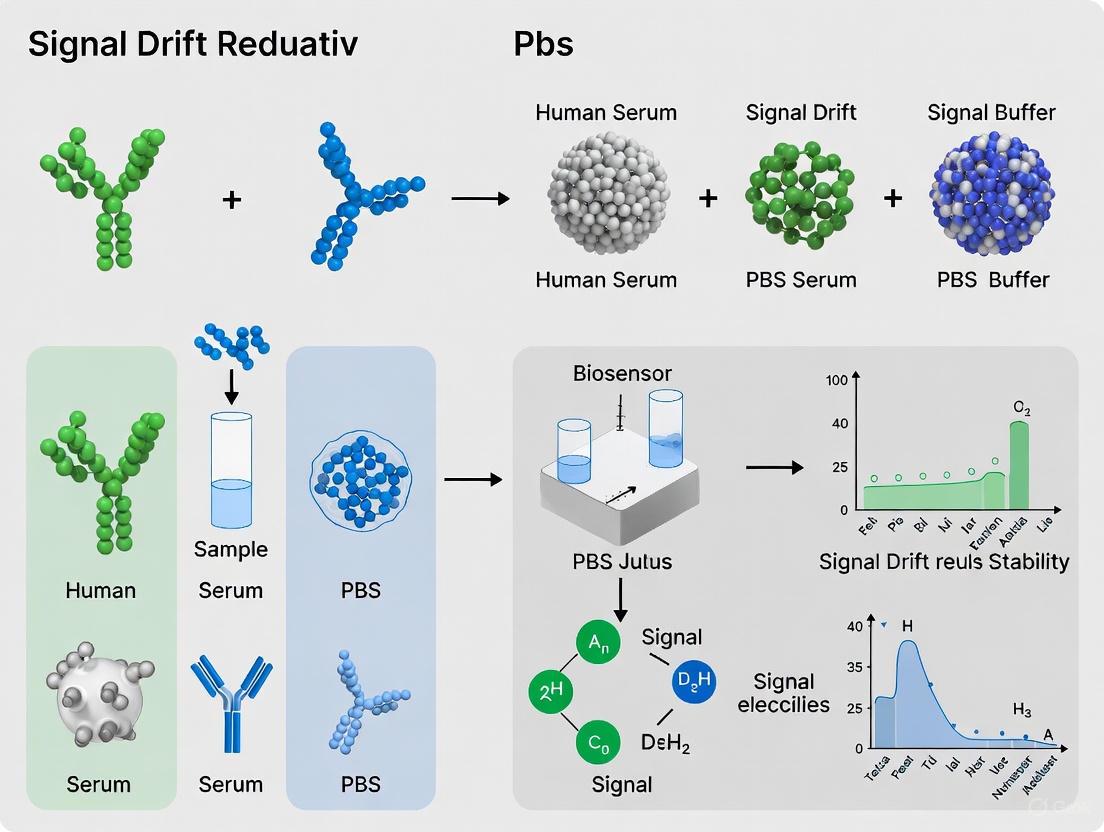
This article provides a comprehensive analysis of signal drift reduction strategies for electrochemical biosensors, with a direct comparison between performance in simplified phosphate-buffered saline (PBS) and complex human serum environments.
Signal Drift Reduction in Biosensors: Comparative Strategies for Human Serum vs. PBS Buffer
Abstract
This article provides a comprehensive analysis of signal drift reduction strategies for electrochemical biosensors, with a direct comparison between performance in simplified phosphate-buffered saline (PBS) and complex human serum environments. Aimed at researchers and drug development professionals, it explores the fundamental mechanisms of drift caused by ion diffusion and biofouling, evaluates innovative solutions like dual-gate architectures and polymer coatings, and offers practical optimization protocols. The content synthesizes recent findings to establish robust validation frameworks, highlighting the critical importance of testing in biologically relevant matrices like human serum for successful clinical translation of biosensing technologies.
Understanding Signal Drift: Fundamental Mechanisms in PBS vs. Complex Biological Fluids
Defining the Signal Drift Challenge in Biosensing
Signal drift is a critical challenge in electrochemical biosensing, defined as a gradual, often unwanted change in the sensor's output signal over time while the target analyte concentration remains constant. This phenomenon severely compromises measurement accuracy and long-term reliability, particularly when sensors are deployed in complex, real-world biological environments. The primary mechanism underlying drift involves the slow, non-specific interaction of interfering substances with the sensor's surface. In whole blood or serum, this is primarily driven by the fouling of the electrode surface by blood components (such as proteins and cells) and the electrochemically driven desorption of the self-assembled monolayer (SAM) that often forms the foundational sensing layer [1]. This drift can manifest as a continuous decrease in signal, obscuring the accurate, real-time quantification of drugs, metabolites, hormones, and other biomarkers in vivo [1].
The drift problem is significantly exacerbated in biologically relevant fluids like human serum compared to simple buffer solutions like Phosphate Buffered Saline (PBS). While PBS provides a clean, controlled ionic environment, human serum is a complex matrix containing proteins, lipids, and various other biomolecules that readily adsorb onto sensor surfaces, leading to increased biofouling and more pronounced signal instability [2] [3]. Overcoming this challenge is a fundamental prerequisite for the development of robust implantable and point-of-care diagnostic devices.
Comparative Analysis of Drift-Reduction Strategies
The table below summarizes the core mechanisms of signal drift and compares the performance of different technological approaches designed to mitigate it in biological environments.
Table 1: Comparison of Signal Drift Mechanisms and Mitigation Strategies in Different Media
| Technology / Strategy | Primary Drift Mechanism | Performance in PBS Buffer | Performance in Human Serum/Whole Blood | Key Experimental Findings |
|---|---|---|---|---|
| Electrochemical Aptamer-Based (EAB) Sensors [1] [4] | SAM desorption; Surface fouling | Low to moderate drift over multi-hour tests [4] | Significant signal decrease over time at 37°C [1] | Square Wave Voltammetry (SWV) enabled accurate drift correction; SAM desorption & fouling identified as key mechanisms [1] [4]. |
| Organic Electrochemical Transistors (OECTs) - Single Gate [2] | Ion adsorption/penetration into gate material | Observable temporal drift in control experiments [2] | N/A (Studied in PBS & human serum, but data specified for PBS) | Drift explained by a first-order kinetic model of ion diffusion; current changes even without specific binding [2]. |
| OECTs - Dual-Gate (D-OECT) [2] | Ion adsorption/penetration | Drift is "largely mitigated" | Accurate detection in human serum achieved | Dual-gate architecture prevents like-charged ion accumulation, increasing accuracy and sensitivity [2]. |
| Carbon Nanotube BioFETs (D4-TFT) [3] | Ion diffusion into sensing region, altering capacitance | N/A (Tested in 1X PBS) | Stable, attomolar-level detection in 1X PBS (physiological ionic strength) [3] | Drift mitigated via stable electrical configuration, POEGMA polymer coating, and infrequent DC sweeps [3]. |
Experimental Insights: Protocols and Workflows
Understanding the experimental methods used to quantify and combat drift is essential for evaluating these technologies.
Interrogation Method Comparison for EAB Sensors
The method used to read the sensor signal (interrogation) significantly impacts the ability to correct for drift. A direct comparison of voltammetric methods for EAB sensors in 37°C whole blood revealed that Square Wave Voltammetry (SWV) is superior [4].
- Experimental Protocol: Researchers fabricated EAB sensors against the antibiotic vancomycin on gold wire electrodes. These sensors were then interrogated in undiluted, 37°C whole blood using three different voltammetric methods: SWV, Differential Pulse Voltammetry (DPV), and Alternating Current Voltammetry (ACV) [4].
- Performance Metrics: Each method was evaluated based on:
- Gain: The signal change upon target binding.
- Noise: The signal instability in blood.
- Drift Correction Accuracy: The ability to correct the signal decrease over time using a "kinetic differential measurements" technique [4].
- Result: While ACV exhibited the lowest noise, neither ACV nor DPV supported accurate drift correction under these challenging conditions. SWV matched or surpassed the gain of the others, achieved good signal-to-noise, and supported high-accuracy drift correction, confirming it as the preferred method for in vivo applications [4].
Dual-Gate OECT Architecture to Counter Ionic Drift
For OECT biosensors, architectural innovation provides a path to stability.
- Experimental Protocol: Scientists compared a standard single-gate OECT (S-OECT) with a dual-gate architecture (D-OECT) where two OECT devices are connected in series. The study involved testing the sensors in both PBS and human IgG-depleted human serum. The gate electrode was functionalized with a bioreceptor layer, and the drift was monitored in control experiments without the target analyte present [2].
- Theoretical Modeling: The drift was quantitatively explained using a first-order kinetic model of ion adsorption (e.g., Na+, Cl-) into the gate material, described by the equation ∂c~a~/∂t = c~0~k~+~ - c~a~k~-~, where c~a~ is the ion concentration in the bioreceptor layer and c~0~ is the ion concentration in the solution [2].
- Result: The D-OECT design successfully prevented the accumulation of like-charged ions during measurement, a key source of drift in S-OECTs. This led to a platform where "the drift phenomenon can be largely mitigated," enabling accurate biosensing in human serum [2].
The following diagram illustrates the core operational and drift-causing workflows in a standard single-gate OECT, contrasted with the stabilizing function of the dual-gate architecture.
The Scientist's Toolkit: Essential Reagents and Materials
The successful implementation of drift-resistant biosensors relies on a specific set of research reagents and functional materials.
Table 2: Key Research Reagent Solutions for Drift Mitigation Studies
| Reagent / Material | Function in Experimentation | Specific Example / Role |
|---|---|---|
| Phosphate Buffered Saline (PBS) | Provides a clean, controlled ionic strength solution for baseline testing and optimization. | Serves as a simple electrolyte (e.g., 1X PBS) to study fundamental sensor behavior before challenging it with complex serum [2] [3]. |
| Human Serum (Depleted) | A complex biological matrix for realistic performance validation. | IgG-depleted human serum is used to spike in specific, known concentrations of a target biomarker (e.g., human IgG), enabling controlled studies in a real fluid [2]. |
| Polymer Coating (e.g., POEGMA) | A non-fouling surface layer that reduces biofouling and extends the Debye length. | Coated on the sensor surface to minimize non-specific adsorption of proteins and other interferents from serum, thereby reducing drift [3]. |
| Self-Assembled Monolayer (SAM) | A well-ordered molecular layer that forms the foundation for attaching bioreceptors to an electrode. | Its stability is critical; electrochemically driven desorption is a documented primary source of signal drift in EAB sensors [1]. |
| Redox Reporter (e.g., Methylene Blue) | A molecule that facilitates electron transfer in label-free electrochemical sensors. | Its electron transfer rate, measured by techniques like SWV, changes upon target binding and is the source of the signal. Instability in its environment causes drift [4]. |
| Blocking Agents (e.g., BSA) | Used to passivate unused surface areas on the sensor to minimize non-specific binding. | Bovine Serum Albumin (BSA) is adsorbed on a gate electrode to block non-specific sites during control experiments to study drift from ions alone [2]. |
Signal drift, driven by surface fouling and material instability in biological fluids, remains the primary obstacle to the widespread clinical adoption of electrochemical biosensors. As the comparative data demonstrates, no technology is entirely free from this challenge in serum, but strategic approaches—such as adopting the SWV interrogation method for EAB sensors, implementing a dual-gate architecture for OECTs, and utilizing advanced anti-fouling polymer coatings—can effectively mitigate its impact. Future research must continue to prioritize rigorous testing in biologically relevant media like human serum over simplified buffer solutions, as this is the only path to developing sensors capable of reliable, long-term operation in vivo for drug development and personalized medicine.
In the pursuit of reliable biosensing for medical diagnostics and drug development, signal drift represents a formidable obstacle, particularly when transitioning from controlled buffer solutions to complex biological fluids like human serum. This drift—the undesired temporal change in sensor output in the absence of target analyte—stems primarily from the physical processes of ion diffusion and adsorption at the electrode-electrolyte interface. These processes are markedly different in simple phosphate-buffered saline (PBS) versus human serum, creating a critical challenge for researchers developing sensors for clinical applications. Understanding these core mechanisms is not merely an academic exercise but a practical necessity for advancing robust biosensing technologies that can perform reliably in the physiological environments where they are needed most.
The following diagram illustrates the generalized physical mechanism of ion-driven signal drift at the sensor interface in aqueous environments.
Diagram Title: Core Mechanism of Ion-Induced Signal Drift
Comparative Analysis: Drift Mechanisms in PBS versus Human Serum
The ionic complexity of human serum introduces substantial differences in drift behavior compared to PBS buffer. Where PBS contains primarily Na+, K+, Cl-, PO4³⁻ ions in a controlled environment, human serum adds proteins, lipids, metabolites, and diverse ions that profoundly influence interfacial processes.
Quantitative Comparison of Drift Parameters
Table 1: Drift Characteristics in PBS vs. Human Serum Environments
| Parameter | PBS Buffer | Human Serum | Measurement Technique |
|---|---|---|---|
| Primary Drift Mechanism | Electrochemical monolayer desorption [5] | Combined fouling & electrochemical desorption [5] | Square-wave voltammetry, chronoamperometry |
| Drift Kinetics | Approximately linear, single-phase [5] | Biphasic: rapid exponential then linear [5] | Temporal current monitoring |
| Typical Drift Rate | Lower; primarily potential-dependent [5] | Significantly higher due to biofouling [6] [5] | Current change per unit time |
| Electron Transfer Impact | Minimal change over time [5] | Decreases by factor of ~3 during exponential phase [5] | Square-wave frequency optimization |
| Key Contributing Ions | Na+, Cl- (dominant) [6] | Mixed ions + proteins + cells [6] [5] | Controlled composition studies |
| Debye Length | ~0.7 nm (1X PBS) [7] | Effectively shorter due to complexity [7] | Field-effect transistor response |
Experimental Evidence of Environment-Dependent Drift
Research on Organic Electrochemical Transistors (OECTs) demonstrates that temporal current drift in PBS can be explained by a first-order kinetic model of ion adsorption into the gate material. The change in ion concentration in bioreceptor layers follows the relationship:
∂cₐ/∂t = c₀k₊ - cₐk₋
Where cₐ is ion concentration in bioreceptor layers, c₀ is ion concentration in solution, k₊ is adsorption rate, and k₋ is desorption rate [6]. This model shows excellent agreement with experimental drift data in PBS but requires modification for human serum where additional factors dominate.
In human serum, studies using electrochemical aptamer-based (EAB) sensors reveal a biphasic drift pattern: an initial exponential signal decrease over approximately 1.5 hours followed by a prolonged linear decrease [5]. The exponential phase is abolished in PBS, indicating it arises from blood-specific biological mechanisms, while the linear phase persists in both environments, suggesting electrochemical origins [5].
Mitigation Strategies: Comparative Performance Analysis
Architectural Approaches to Drift Reduction
Table 2: Performance Comparison of Drift Mitigation Strategies
| Strategy | Mechanism of Action | Performance in PBS | Performance in Human Serum | Limitations |
|---|---|---|---|---|
| Dual-Gate OECT Architecture [6] | Prevents like-charged ion accumulation via series connection | Drift largely canceled [6] | Maintains effectiveness, improves accuracy [6] | Increased fabrication complexity |
| Potential Window Optimization [5] | Limits redox-driven monolayer desorption | ~5% signal loss after 1500 scans [5] | Reduces electrochemical drift component only [5] | Constrains compatible redox reporters |
| SAM Stability Engineering | Enhances gold-thiol bond stability | Moderate improvement | Limited by fouling dominance | Requires specialized chemistry |
| Electrode Material Selection | Uses chemically inert materials (e.g., GaN) [7] | Reduces ion diffusion into material [7] | Improved stability in serum [7] | Material-specific fabrication requirements |
| 2'O-Methyl RNA Proxies [5] | Enzyme-resistant oligonucleotide backbone | Not applicable (enzyme-free) | No reduction in exponential phase [5] | Addresses only enzymatic degradation |
The Dual-Gate OECT: A Case Study in Effective Drift Reduction
The dual-gate OECT (D-OECT) architecture represents one of the most promising approaches for drift mitigation. This design features two OECT devices connected in series, with gate voltage applied from the bottom of the first device and drain voltage applied to the second device [6]. This configuration prevents like-charged ion accumulation during measurement, addressing the fundamental mechanism of potential-driven ion adsorption.
Experimental results demonstrate that the D-OECT platform can increase the accuracy and sensitivity of immuno-biosensors compared to standard single-gate designs, even in human serum [6]. Specific binding can be detected at relatively low limits of detection, making this approach particularly valuable for real-world applications.
Experimental Protocols for Drift Characterization
Protocol: Temporal Drift Measurement in OECT Biosensors
Objective: Quantify current drift in single-gate and dual-gate OECT configurations in PBS and human serum.
Materials:
- OECT devices with functionalized gates (PT-COOH or PSAA bioreceptor layers)
- PBS buffer (1X, pH 7.4)
- Human serum (IgG-depleted for controlled studies)
- Source measurement unit for current monitoring
- Environmental chamber (37°C)
Methodology:
- Immerse functionalized OECT devices in PBS or human serum at 37°C
- Apply fixed gate voltage while monitoring drain current over time
- For D-OECT devices, apply VG from bottom of first device and VDS to second device
- Record transfer curves from the second device in series configuration
- Fit experimental data to first-order kinetic model: ∂cₐ/∂t = c₀k₊ - cₐk₋
- Compare drift rates between S-OECT and D-OECT configurations [6]
Key Parameters:
- Gate voltage: Typically 0.5V for OECT operation
- Duration: 2-10 hours to capture drift kinetics
- Temperature: Maintain at 37°C to simulate physiological conditions
Protocol: Drift Mechanism Deconvolution in Serum
Objective: Distinguish between electrochemical and biofouling contributions to drift.
Materials:
- Gold electrodes with thiol-on-gold monolayer chemistry
- Methylene blue-modified DNA sequences (37-base, terminally modified)
- Whole blood at 37°C
- PBS control at 37°C
- Urea wash solution (concentrated)
Methodology:
- Prepare MB-modified single-stranded DNA attached via thiol-on-gold chemistry
- Monitor square-wave voltammetry signal in whole blood at 37°C over time
- Repeat in PBS at 37°C to identify blood-specific effects
- Systematically vary potential window to isolate electrochemical desorption
- Wash electrodes with concentrated urea after 2.5 hours to reverse fouling
- Compare signal recovery to quantify fouling contribution [5]
Key Parameters:
- Potential windows tested: -0.4V to -0.2V (stable), -0.6V to 0.2V (desorption)
- Square-wave frequency: Optimized for maximum charge transfer
- Urea concentration: 6-8M for effective protein solubilization
The following workflow diagrams the experimental approach for delineating the different drift mechanisms:
Diagram Title: Drift Mechanism Deconvolution Workflow
The Scientist's Toolkit: Essential Research Reagents
Table 3: Key Research Reagents for Ion Drift Studies
| Reagent/Material | Function in Drift Studies | Example Application |
|---|---|---|
| PT-COOH (poly[3-(3-carboxypropyl)thiophene-2,5-diyl]) | Bioreceptor layer for IgG antibody immobilization [6] | OECT gate functionalization for protein detection |
| PEDOT:PSS | Organic semiconductor channel material [6] | High transconductance OECT channel |
| AlGaN/GaN HEMTs | High electron mobility transistors [7] | EDL-FETs for high ionic strength operation |
| Prussian Blue (PB) | Electrochemical signal generation layer [8] | Label-free aptamer sensor development |
| Ti₃C₂Tₓ-MXene | 2D transition-metal carbide sensing layer [9] | Dopamine sensing with enhanced signal-to-noise |
| 6-Mercapto-1-hexanol (MCH) | Surface passivation to reduce non-specific binding [8] | Blocking remaining sites on AuNP surfaces |
| 2'O-Methyl RNA | Enzyme-resistant oligonucleotide backbone [5] | Control experiments to isolate enzymatic effects |
| IgG-Depleted Human Serum | Controlled biological fluid for spike-in studies [6] | Physiological environment with defined IgG levels |
The comparative analysis of ion diffusion and adsorption mechanisms reveals that effective drift mitigation requires distinct strategies for PBS versus human serum environments. While electrochemical drift dominates in PBS and can be addressed through potential window optimization and dual-gate architectures, human serum introduces complex biofouling components that necessitate multi-faceted approaches.
For researchers developing biosensors for clinical applications, these findings underscore the critical importance of validating sensor performance in biologically relevant matrices rather than relying solely on PBS buffer data. The dual-gate OECT architecture demonstrates that clever device design can substantially mitigate drift, but complete elimination likely requires combined materials, architectural, and signal processing approaches.
Future research directions should focus on developing novel anti-fouling coatings that resist protein adsorption while maintaining sensor sensitivity, advanced signal processing algorithms that can dynamically compensate for drift, and multi-parameter sensing approaches that can distinguish specific binding from non-specific drift phenomena. As these technologies mature, the gap between laboratory biosensing and clinically viable monitoring will continue to narrow, ultimately enabling the real-time, in vivo molecular monitoring needed for personalized medicine and advanced drug development.
Signal drift presents a significant challenge in biomedical research and diagnostics, particularly for electrochemical sensors and stability studies of biotherapeutics. The origin and magnitude of this drift, however, differ profoundly between controlled buffer solutions and complex biological fluids. This guide provides a systematic comparison of drift mechanisms in phosphate-buffered saline (PBS) versus human serum, supporting researchers in selecting appropriate experimental models and interpretation of data. While PBS offers a simplified, controlled environment ideal for initial characterization, human serum introduces complex biological interactions that more accurately represent in vivo conditions but present greater challenges for signal stability. Understanding these fundamental differences is crucial for improving the predictive value of preclinical studies and developing more robust diagnostic and therapeutic monitoring platforms.
Fundamental Environmental Differences
The contrasting behaviors of analytical systems in PBS versus human serum originate from fundamental differences in their composition and complexity.
Phosphate-Buffered Saline (PBS) is an isotonic buffer solution (pH ~7.4) commonly used in biological research. Its composition typically includes disodium hydrogen phosphate, sodium chloride, and in some formulations, potassium chloride and potassium dihydrogen phosphate [10]. The buffer helps maintain constant pH, and the osmolarity and ion concentrations match those of the human body, making it non-toxic to most cells [10]. PBS provides a clean, predictable electrochemical background with minimal interfering substances, making it ideal for foundational studies and method development.
Human Serum presents a vastly more complex environment. As the liquid component of blood remaining after coagulation, serum contains thousands of biomolecules including proteins, lipids, hormones, electrolytes, and innumerable metabolites. This biological milieu creates multiple potential pathways for signal interference through biofouling, protein adsorption, enzymatic activity, and molecular interactions that do not occur in simple buffer systems.
Table 1: Core Compositional Differences Between PBS and Human Serum
| Component | PBS (1× Solution) | Human Serum |
|---|---|---|
| Primary Ions | Na⁺ (157 mM), Cl⁻ (140 mM), K⁺ (4.45 mM), HPO₄²⁻ (10.1 mM), H₂PO₄⁻ (1.76 mM) [10] | Complex electrolyte profile (Na⁺, K⁺, Ca²⁺, Mg²⁺, Cl⁻, HCO₃⁻, etc.) |
| Macromolecules | None | High concentration of proteins (60-80 g/L), including albumin, globulins, fibrinogen |
| Lipids | None | Fatty acids, cholesterol, triglycerides, lipoproteins |
| Other Components | None | Hormones, enzymes, antibodies, nutrients, waste products |
| Predictability | High (defined recipe) | Variable (inter-individual, dietary, health status differences) |
Quantitative Comparison of Drift Manifestations
Therapeutic Protein Stability
Studies directly comparing monoclonal antibody (mAb) stability in PBS versus human serum reveal significant differences in physical stability. All mAbs studied were inherently less stable in human serum compared to PBS, with particle size and particle counts increasing in serum over time [11]. Certain mAbs showed significant levels of fragmentation in serum but not in PBS, demonstrating that PBS cannot replicate the physical stability measured in serum [11]. The stability of labeled mAbs in human serum did not correlate with their hydrophobicity and isoelectric point, indicating that the complex serum environment introduces degradation pathways not present in simplified buffer systems [11].
Table 2: Stability Parameters for mAbs in PBS vs. Human Serum
| Stability Parameter | Performance in PBS | Performance in Human Serum | Experimental Method |
|---|---|---|---|
| Particle Formation | Minimal increase over time | Significant increase over time | Light obscuration, flow imaging [11] |
| Fragmentation | Not observed for most mAbs | Significant for certain mAbs | Size-exclusion chromatography [11] |
| Aggregation Tendency | Lower | Higher | Flow cytometry, fluorescence microscopy [11] |
| Predictive Value for In Vivo Behavior | Limited | Higher | Comparative analysis [11] |
Electrochemical Sensor Performance
Electrochemical sensors exhibit distinctly different drift profiles in PBS versus serum environments. In PBS, sensors demonstrate excellent catalytic effects with stable current response over four weeks, excellent reproducibility, and insignificant interference [12]. When transferred to human serum, the same sensors require sophisticated compensation strategies despite maintained catalytic activity for simultaneous determination of compounds like trifluoperazine and dopamine in the concentration range of 0.5 μM to 18 μM [12].
The fundamental difference originates from biofouling in serum, defined as the adhesion and growth of microorganisms at the interface between a non-sterile medium and a solid surface [13]. For submerged instrumentation, biofouling is the single biggest factor affecting operation, maintenance, and data quality, increasing the cost of ownership to the extent that it can become prohibitive to maintain operational sensor networks and infrastructures [13].
Mechanisms and Pathways of Drift
Biofouling in Human Serum
Biofouling progression follows a well-defined sequence of events that fundamentally differentiates it from simple electrochemical instability:
The biofilm formation process begins with conditioning film formation, where the surface immediately adsorbs dissolved organic molecules and ions from the serum environment [13]. This is followed by microbial attachment, where bacteria reversibly attach to the conditioned surface [14]. The attachment then becomes irreversible through the production of extracellular polymeric substances (EPS) that firmly anchor the cells [14]. As cells divide and produce more EPS, they form microcolonies that eventually develop into mature three-dimensional biofilm structures mediated by cell-to-cell communication (quorum sensing) [14]. The established biofilm then causes progressive signal drift through multiple mechanisms including physical barrier formation, metabolite interference, and direct interaction with sensor components [15].
Quorum sensing represents a sophisticated signaling mechanism in biofilms, where bacteria use autoinducer molecules like acyl homoserine lactones to synchronize social behaviors including biofilm formation [16]. This cell-to-cell communication coordinates gene expression across the microbial community, enhancing their collective survival and resistance to removal.
Electrochemical Instability in PBS
In contrast to the biological complexity of serum biofouling, drift in PBS primarily results from electrochemical instability:
The primary mechanisms include reference electrode potential shift due to changing ionic activities at the electrode junction, electrode surface passivation through oxidation or contamination, buffer capacity limitations during extended measurements that allow local pH shifts, and ionic depletion at the electrode surface causing changing electrochemical properties. These instabilities manifest as gradual baseline drift rather than the progressive degradation seen in biofouling scenarios.
Experimental Protocols for Drift Assessment
Protein Stability Evaluation Protocol
Objective: Compare physical stability of therapeutic proteins (e.g., monoclonal antibodies) in PBS versus human serum.
Materials:
- Alexa Fluor 488-labeled mAbs
- Sterile PBS buffer (pH 7.4)
- Human serum (pooled or donor-matched)
- Size-exclusion chromatography (SEC) system
- Light obscuration instrument
- Flow imaging microscope
- Flow cytometer
- Fluorescence microscope
Methodology:
- Prepare mAb solutions in PBS and human serum at concentrations relevant to therapeutic use (typically 1-10 mg/mL)
- Incubate samples under physiologic conditions (37°C, with gentle agitation if simulating circulation)
- Collect samples at predetermined time points (e.g., 0, 6, 24, 72 hours, 1 week)
- Analyze samples using multiple orthogonal techniques:
- Size-exclusion chromatography: Quantify fragmentation and soluble aggregates [11]
- Light obscuration: Measure sub-visible particle counts [11]
- Flow imaging: Characterize proteinaceous particles and aggregates [11]
- Flow cytometry and fluorescence microscopy: Assess aggregation and particle formation using fluorescent labels [11]
- Compare degradation rates and mechanisms between PBS and serum environments
Sensor Drift Characterization Protocol
Objective: Quantify and compare electrochemical sensor drift in PBS versus human serum.
Materials:
- Fabricated electrochemical sensor (e.g., GC/GRO-CNT/Fe-Ni modified electrode) [12]
- Potentiostat/galvanostat
- Sterile PBS buffer (pH 7.4)
- Human serum (pooled or donor-matched)
- Standard solutions of target analytes (e.g., dopamine, trifluoperazine)
Methodology:
- Sensor Preparation: Fabricate and characterize sensors following published procedures [12]
- Cast GC surface with graphene oxide-carbon nanotubes mixture (GRO-CNT)
- Apply iron-nickel nanoparticles (Fe-Ni) layer
- Validate sensor performance before experimental use
PBS Stability Testing:
- Immerse sensor in PBS containing target analytes at physiological concentrations
- Record continuous measurements or frequent intermittent measurements over extended period (e.g., 4 weeks)
- Monitor current response stability, reproducibility, and interference levels [12]
Human Serum Testing:
- Transfer sensor to human serum samples spiked with target analytes
- Employ differential pulse voltammetry (DPV) mode in diluted serum samples (typically diluted five times with PBS) [12]
- Conduct recovery tests to quantify accuracy maintenance over time
Drift Quantification:
- Calculate baseline drift rate (signal change per unit time)
- Determine detection limit changes over time
- Assess measurement accuracy degradation through recovery experiments
- Compare fouling layer formation through electrochemical impedance spectroscopy
The Scientist's Toolkit: Research Reagent Solutions
Table 3: Essential Research Tools for Drift Studies
| Tool/Reagent | Primary Function | Application Notes |
|---|---|---|
| Dulbecco's PBS (DPBS) | Isotonic buffer control environment | Formulations without calcium/magnesium recommended for protein stability studies [10] |
| Human Serum | Biologically relevant medium | Use pooled samples to minimize donor variation; handle aseptically |
| Size-Exclusion Chromatography | Quantifies protein fragmentation/aggregation | Essential for distinguishing degradation products in complex serum matrix [11] |
| Flow Imaging Microscopy | Characterizes subvisible particles | Provides morphological information complementary to light obscuration [11] |
| Graphene Oxide-Carbon Nanotube Composites | Sensor nanomaterial platform | Large conductive surface area improves sensitivity and stability [12] |
| Iron-Nickel Nanoparticles | Electrocatalytic sensor component | Enhances electron transfer and prevents catalyst poisoning [12] |
| Differential Pulse Voltammetry | Electrochemical detection method | Improves sensitivity in complex media like serum [12] |
| Extracellular Polymeric Substance (EPS) Stains | Visualize biofilm formation | Use fluorescent conjugates (e.g., lectins) for microscopy quantification |
The origins and manifestations of signal drift differ fundamentally between PBS and human serum environments. PBS exhibits primarily electrochemical instability mechanisms including reference electrode drift and surface passivation, while human serum introduces complex biofouling pathways mediated by protein adsorption and microbial biofilm formation. These differences have profound implications for predictive validity in therapeutic development and sensor design. Researchers should employ PBS for initial characterization and controlled parameter studies, but must transition to human serum or other biologically relevant matrices for clinically predictive assessments. Future directions should focus on developing advanced antifouling strategies, improved drift compensation algorithms, and standardized protocols for evaluating performance in biologically complex environments.
Field-effect transistor (FET)-based biosensors and other label-free detection platforms have long promised revolutionary advances in point-of-care diagnostics and real-time biomolecular monitoring. However, their deployment in physiological environments faces a fundamental physical constraint: the Debye screening effect. In high ionic strength solutions such as blood serum or phosphate-buffered saline (PBS), the electrical signals from target biomolecules are severely attenuated, typically limiting detection to diluted buffers that don't represent physiological conditions [7]. The Debye length - the characteristic distance over which electrostatic potentials persist in solution - shrinks to approximately 0.7 nm in physiological salt environments (1X PBS), which is substantially smaller than the dimensions of typical protein targets like IgG antibodies (5-10 nm) [7]. This mismatch prevents the charge signatures of target molecules from reaching sensor surfaces, rendering conventional detection approaches ineffective in biologically relevant media.
This review comprehensively examines how high ionic strength limits biomolecular detection and compares innovative technological solutions that overcome the Debye screening challenge. We particularly focus on performance metrics in human serum versus simplified buffer systems, with emphasis on signal drift reduction - a critical factor for reliable measurements in complex biological fluids.
Technological Approaches to Overcoming Debye Screening
Electric-Double-Layer Field-Effect Transistors (EDL-FETs)
Working Principle and Design: EDL-FETs represent a architectural departure from conventional FET biosensors. In this configuration, the gate electrode is physically separated from the active channel of the FET, and both are exposed to the solution containing the target analytes [7]. When a gate voltage is applied, ions accumulate at the electrode-solution and channel-solution interfaces, forming electric double layers with extremely high capacitance. The solution itself effectively becomes part of the gate dielectric, and changes in the electrochemical environment induced by target binding modulate the channel conductivity [7].
Key Advantages:
- No sample dilution required: Successfully detects proteins in 1X PBS and human serum
- No reference electrode: Simplifies sensor design and operation
- Rapid detection: Measurements completed within 5 minutes
- Applicability to charged and uncharged targets: Detection mechanism doesn't rely solely on target charge [7]
Table 1: Performance Comparison of EDL-FET Biosensors for Protein Detection
| Target Protein | Sample Matrix | Detection Time | Key Performance Metrics |
|---|---|---|---|
| HIV-1 RT | 1X PBS + 1% BSA | 5 minutes | High sensitivity demonstrated |
| Carcinoembryonic Antigen (CEA) | 1X PBS + 1% BSA | 5 minutes | High sensitivity demonstrated |
| NT-proBNP | 1X PBS + 1% BSA + Human serum | 5 minutes | Successful detection in serum |
| C-reactive protein (CRP) | 1X PBS + 1% BSA + Human serum | 5 minutes | Successful detection in serum |
Dual-Gate Organic Electrochemical Transistors (D-OECTs)
Architecture and Drift Mitigation: OECTs represent another promising platform for biomolecular detection, particularly for operation in physiological fluids. The dual-gate OECT architecture features two OECT devices connected in series, with gate voltage applied to the first device and drain voltage to the second device [6]. This configuration significantly reduces temporal current drift - a major challenge in complex biological matrices like human serum.
Drift Mechanism Analysis: Research has established that current drift in OECT biosensors follows first-order kinetics related to ion adsorption into gate materials [6]. The drift phenomenon can be modeled as:
∂cₐ/∂t = c₀k₊ - cₐk₋
Where cₐ is ion concentration in the bioreceptor layer, c₀ is ion concentration in solution, and k₊/k₋ are rate constants for ion movement into and out of the gate material [6]. The dual-gate architecture mitigates this drift by preventing like-charged ion accumulation during measurement [6].
Experimental Validation: Studies comparing single-gate (S-OECT) and dual-gate (D-OECT) configurations demonstrated that the D-OECT platform substantially increases accuracy and sensitivity for immuno-biosensing in human serum, achieving specific binding detection at relatively low limits of detection even in this challenging matrix [6].
Electrochemical Aptamer-Based (EAB) Sensors
Configuration and Stability Challenges: EAB sensors consist of redox-reporter-modified DNA aptamers attached to interrogating electrodes, enabling specific molecular recognition without labels [5]. While promising for real-time molecular monitoring, these sensors experience significant signal drift in complex biological fluids like whole blood, primarily due to two mechanisms: electrochemically driven desorption of self-assembled monolayers and fouling by blood components [5].
Signal Loss Mechanisms: Research has revealed biphasic signal loss when EAB sensors are deployed in whole blood at 37°C [5]:
- Initial exponential phase (~1.5 hours): Primarily caused by fouling from blood components that reduce electron transfer rates
- Subsequent linear phase: Mainly attributed to electrochemical desorption of the monolayer
Stability Optimization: Experiments demonstrate that limiting the electrochemical potential window to -0.4V to -0.2V significantly reduces signal degradation, with only 5% signal loss observed after 1500 scans [5]. This narrow window minimizes redox-driven breakage of gold-thiol bonds while maintaining sufficient range for methylene blue redox activity.
Ionic Strength-Independent Recognition Elements
Peptide Nucleic Acids (PNAs): These synthetic DNA/RNA analogues lack the negative phosphate groups of natural nucleic acids, making their hybridization properties remarkably insensitive to ionic strength variations [17]. This characteristic makes them particularly valuable for biosensing applications in physiological environments.
Experimental Evidence: Atomic Force Spectroscopy studies investigating interactions between miR-155 and PNA probes demonstrated that both unbinding forces and target recognition times remain practically unchanged across the 50-300 mM ionic strength range [17]. This consistency contrasts sharply with natural nucleic acids, which show strong ionic strength dependence due to charge screening effects.
Applications: PNA probes enable effective target detection at physiological ionic strengths (150 mM) while maintaining the possibility of working at lower ionic strengths to enhance sensitivity in charge-based detection platforms like BioFETs [17].
Experimental Protocols for Drift Analysis in Physiological Matrices
OECT Drift Characterization Protocol
Device Fabrication: Create OECTs with channel materials such as PEDOT:PSS or other organic semiconductors. For dual-gate configurations, connect two devices in series with appropriate electrode configurations [6].
Functionalization: Immobilize recognition elements (antibodies, aptamers) on gate electrodes using appropriate chemistry. For human serum experiments, use human IgG-depleted serum to control analyte concentration accurately [6].
Drift Measurement:
- Expose sensors to 1X PBS buffer and human serum samples
- Apply constant gate voltage while monitoring drain current over time
- Record temporal current changes for both single-gate and dual-gate configurations
- Fit data to first-order kinetic model of ion adsorption [6]
Data Analysis: Quantify drift rates and compare signal stability between buffer and serum matrices. Evaluate detection sensitivity for specific targets in both media.
EAB Sensor Degradation Protocol
Sensor Preparation: Immobilize thiol-modified DNA sequences on gold electrodes via self-assembled monolayer formation. Use methylene blue as redox reporter [5].
Stability Testing:
- Expose sensors to undiluted whole blood and PBS at 37°C
- Perform continuous square-wave voltammetry scans
- Systematically vary potential windows to identify optimal stability conditions
- Treat fouled sensors with urea to assess reversibility of fouling effects [5]
Mechanism Elucidation: Compare degradation rates in blood versus PBS to distinguish biological versus electrochemical degradation mechanisms. Test enzyme-resistant oligonucleotide analogs to evaluate enzymatic degradation contributions.
Signaling Pathways and Experimental Workflows
The following diagram illustrates the fundamental challenge of Debye screening and the operational principles of technologies that overcome this limitation:
Research Reagent Solutions for Serum-Compatible Biosensing
Table 2: Essential Materials for High Ionic Strength Biosensing Research
| Research Reagent | Function/Application | Key Characteristics |
|---|---|---|
| AlGaN/GaN HEMT substrates | EDL-FET biosensor platform | Chemically inert, thermally stable, minimal ion diffusion [7] |
| PEDOT:PSS | OECT channel material | High transconductance, tunable electrochemical properties [6] |
| PT-COOH polymer | Bioreceptor layer for IgG detection | p-type semiconducting properties for functionalized gates [6] |
| Peptide Nucleic Acids (PNAs) | Ionic strength-independent recognition elements | Neutral backbone, high binding affinity, nuclease resistance [17] |
| Methylene Blue | Redox reporter for EAB sensors | Optimal redox potential for monolayer stability [5] |
| Human IgG-depleted serum | Controlled serum matrix for biosensing studies | Enables accurate spike-recovery experiments [6] |
| 6-mercapto-1-hexanol (MCH) | SAM passivation agent | Reduces non-specific adsorption, completes monolayer formation [8] [5] |
| Prussian Blue (PB) | Electrochemical signal generation layer | Self-redox properties, mediator-free detection [8] |
The Debye screening challenge has historically constrained biosensing applications to artificially diluted environments, limiting their clinical translation. However, the technologies reviewed here - including EDL-FETs, dual-gate OECTs, optimized EAB sensors, and ionic strength-independent recognition elements - demonstrate viable pathways to direct, reliable biomolecular detection in physiological matrices. Critical to this advancement is the systematic addressing of signal drift mechanisms, particularly through architectural innovations that mitigate ion-related drift and fouling effects.
These approaches collectively enable researchers to move beyond simplified buffer systems and embrace the complexity of real biological samples. As these technologies mature, they promise to unlock the long-awaited potential of biosensors for point-of-care diagnostics, personalized medicine, and real-time physiological monitoring in clinically relevant settings.
This guide provides a comparative analysis of biosensing platforms utilizing first-order kinetic models to predict and mitigate temporal current drift. The focus is on performance in physiologically relevant phosphate-buffered saline (PBS) versus the complex environment of human serum. Data demonstrates that the dual-gate organic electrochemical transistor (D-OECT) architecture excels in drift suppression, enabling sensitive detection in human serum, a critical advancement for reliable drug development and clinical biosensing.
Comparative Biosensor Performance Analysis
The table below summarizes the drift behavior and key performance metrics of different biosensing platforms investigated in PBS and human serum.
Table 1: Performance Comparison of Biosensing Platforms for Drift Mitigation
| Biosensing Platform | Target Analyte | Buffer vs. Human Serum Performance | Key Drift Metric | Limit of Detection (LOD) |
|---|---|---|---|---|
| Single-Gate OECT (S-OECT) [2] | Human IgG (Control) | Significant drift in PBS; Not tested in serum | Large temporal signal drift in control experiments | Not applicable (drift limits sensitivity) |
| Dual-Gate OECT (D-OECT) [2] | Human IgG | Drift largely mitigated in both PBS and human serum | Increased accuracy and sensitivity vs. S-OECT | Relatively low, even in human serum |
| Electrochemical Aptamer-Based (EAB) Sensor [5] | N/A (Drift Mechanism Study) | Biphasic signal loss in whole blood at 37°C | ~80% signal recovery after urea wash | Not applicable (drift mechanism study) |
| Screen-Printed Gold Electrode (SPAuE) [18] | Vancomycin | Positive signal drift in PBS; minimized in deaerated N-PBS | Increased Rct value in control solution | 0.5-200 µg/ml (with deaerated buffer) |
First-Order Kinetic Modeling of Signal Drift
The drift phenomenon in functionalized biosensors can be quantitatively explained by a first-order kinetic model of ion diffusion and adsorption into the gate material [2].
Theoretical Model and Governing Equations
The model is derived from the following equation, which describes the change in ion concentration within the bioreceptor layer:
∂ca/∂t = c₀k₊ - cₐk₋
where cₐ is the ion concentration in the bioreceptor layers, c₀ is the ion concentration in the solution, k₊ is the rate constant for ions moving from the solution to the bioreceptor layers, and k₋ is the rate constant for the reverse process [2].
The ratio of these rate constants defines the equilibrium ion partition, K:
k₊/k₋ = K = e^(−∆G + ∆Ve₀z / kBT)
where ΔG is the difference in the Gibbs free energy, ΔV is the difference in electrostatic potential, e₀ is the unit charge, z is the ion valency, k𝐵 is the Boltzmann constant, and T is the absolute temperature [2].
This model shows excellent agreement with experimental drift data from OECTs functionalized with various bioreceptor layers (e.g., PT-COOH, PSAA, SAL) [2].
Diagram 1: First-order kinetic model of ion adsorption-induced drift.
Experimental Protocols for Drift Analysis
This protocol outlines the procedure for constructing a dual-gate OECT and evaluating its drift performance in human serum.
- Primary Objective: To fabricate a D-OECT biosensor and quantify its temporal current drift compared to a standard single-gate design in human serum.
- Materials:
- Substrate: Standard OECT substrate with source, drain, and gate terminals.
- Channel Material: PEDOT:PSS or similar organic semiconductor.
- Gate Functionalization: PT-COOH polymer as a bioreceptor layer with immobilized IgG antibodies.
- Electrolyte/Analyte: Human IgG-depleted human serum spiked with known concentrations of human IgG.
- Equipment: Potentiostat for transfer curve measurement.
- Step-by-Step Procedure:
- Fabrication: Construct two OECT devices connected in series. Apply the gate voltage (VG) to the bottom of the first device and the drain voltage (VDS) to the second device.
- Functionalization: Immobilize the IgG antibodies on the PT-COOH-coated gate electrode to create the biorecognition layer.
- Measurement Setup: Place the functionalized D-OECT in human serum. Apply a constant gate voltage while monitoring the drain current over time.
- Data Acquisition: Measure the transfer curves from the second device in the series configuration. Record the temporal changes in the output current.
- Control Experiment: Perform the same measurement in a standard PBS buffer for baseline comparison.
- Data Analysis: Fit the experimental current drift data to the first-order kinetic model. Compare the rate of signal decay and the final stabilized current level between the D-OECT and S-OECT platforms.
This protocol describes experiments to deconvolute the contributions of different mechanisms to signal drift.
- Primary Objective: To identify the dominant mechanisms (e.g., SAM desorption, fouling) causing signal drift in Electrochemical Aptamer-Based (EAB) sensors in biological fluids.
- Materials:
- Sensor: Gold electrode modified with a thiol-on-gold self-assembled monolayer (SAM) and a methylene-blue-modified DNA sequence.
- Electrolytes: Undiluted whole blood and phosphate-buffered saline (PBS), both maintained at 37°C.
- Equipment: Potentiostat for square-wave voltammetry (SWV).
- Step-by-Step Procedure:
- Sensor Interrogation: Continuously monitor the SWV signal of the EAB sensor in undiluted whole blood at 37°C.
- Environment Simplification: Repeat the interrogation in PBS at 37°C to isolate electrochemical from biological mechanisms.
- Potential Window Testing: Measure the degradation rate in PBS using different electrochemical potential windows to isolate SAM desorption from redox reporter degradation.
- Fouling Test: After signal decay in blood, wash the sensor with concentrated urea and remeasure the signal to assess the contribution of reversible surface fouling.
- Data Analysis: Identify the biphasic nature of signal loss. The initial exponential phase is attributed to fouling, while the subsequent linear phase is attributed to electrochemical desorption of the SAM.
Quantitative Data Comparison: PBS vs. Human Serum
The performance of drift mitigation strategies varies significantly between idealized buffers and complex biological fluids like human serum.
Table 2: Efficacy of Drift Mitigation Strategies in Different Media
| Mitigation Strategy | Mechanism of Action | Performance in PBS | Performance in Human Serum/Whole Blood |
|---|---|---|---|
| Dual-Gate (D-OECT) Architecture [2] | Prevents like-charged ion accumulation during measurement | Drift largely canceled | Effective; enables accurate and sensitive detection |
| Deaerated Incubation Buffer [18] | Minimizes signal drift on screen-printed gold electrodes | Positive signal drift observed in control PBS | Significantly reduced drift in deaerated N-PBS (nitrogen-purged) |
| Kinetic Differential Measurements (KDM) [4] | Uses multiple SWV frequencies for internal signal referencing | Not explicitly tested | Enables high-accuracy drift correction in 37°C whole blood |
| Optimized Electrochemical Potential Window [5] | Avoids potentials that cause SAM desorption (~ -0.5V to 1.0V) | 5% signal loss after 1500 scans in PBS (window: -0.4V to -0.2V) | Reduces the electrochemical (linear) phase of drift in blood |
The Scientist's Toolkit: Research Reagent Solutions
The following reagents and materials are essential for experimental research in signal drift kinetics.
Table 3: Essential Research Reagents and Materials
| Item | Function/Application | Example from Literature |
|---|---|---|
| Poly(3,4-ethylenedioxythiophene) doped with poly(styrene sulfonate) (PEDOT:PSS) | High-transconductance polymer used as the channel material in OECTs [2]. | Primary channel material in OECT drift studies [2]. |
| PT-COOH (Poly [3-(3-carboxypropyl)thiophene-2,5-diyl]) | A bioreceptor layer used for immobilizing antibodies on the gate electrode [2]. | Used for IgG antibody immobilization in D-OECT for human serum detection [2]. |
| Human IgG-Depleted Human Serum | A biologically relevant fluid matrix with controlled analyte concentration, used for testing in realistic conditions [2]. | Biological fluid chosen for controlled detection of human IgG in serum [2]. |
| Methylene Blue (MB)-modified DNA | Redox reporter and oligonucleotide probe used in Electrochemical Aptamer-Based (EAB) sensors [5] [4]. | Used as a model system to study the fundamental mechanisms of sensor drift in whole blood [5]. |
| Deaerated Phosphate Buffered Saline (N-PBS) | Nitrogen-purged PBS used to minimize oxidative signal drift on gold electrode surfaces [18]. | Incubation buffer used to minimize positive signal drift in SPAuE-based EIS biosensors [18]. |
| Urea Solution (Concentrated) | A denaturant used to wash sensor surfaces and remove non-covalently adsorbed foulants, testing the reversibility of fouling-based drift [5]. | Washing agent that recovered >80% of signal loss attributed to fouling in EAB sensors [5]. |
Advanced Drift Mitigation Architectures and Material Solutions
Organic Electrochemical Transistors (OECTs) have emerged as a reliable platform for biomolecule detection due to their low operation voltage, high sensitivity, and promising biosensing behavior [2]. These devices operate through the application of gate voltage that drives ions from the electrolyte into the channel material, changing its doping state and altering ion-electron transport [2]. However, a significant challenge consistently observed in OECT biosensors is the temporal current drift in electrical signals even in control experiments without any analyte present [2]. This drift phenomenon substantially compromises measurement accuracy and reliability, particularly in complex biological fluids like human serum where precise detection is critical for diagnostic applications.
The drift mechanism originates from the diffusion of ions into the gate material, following first-order kinetics where ions move from solution to bioreceptor layers at rate k⁺ and back to solution at rate k⁻ [2]. This fundamental understanding enables researchers to develop advanced circuit architectures that can mitigate these destabilizing effects. The dual-gate OECT (D-OECT) architecture represents a significant innovation in this field, offering a post-fabrication tuning method that effectively counters drift phenomena through sophisticated circuit design rather than material modifications [2] [19].
Theoretical Foundation: Understanding Drift Through First-Order Kinetics
Mathematical Modeling of Ion Diffusion
The drift phenomenon in OECTs can be theoretically explained by the diffusion of ions into the gate material. Research has demonstrated that a first-order kinetic model effectively describes ion adsorption into the gate material, showing excellent agreement with experimental drift data [2]. The model considers the dominant ions in solution (e.g., Na⁺ and Cl⁻ in PBS) and assumes these ions can be absorbed into bioreceptor layers.
The fundamental equation governing this process is:
∂cₐ/∂t = c₀k⁺ - cₐk⁻
Where cₐ represents the ion concentration in the bioreceptor layers, c₀ is the ion concentration in the solution, k⁺ is the rate at which ions move from solution to bioreceptor layers, and k⁻ is the rate at which ions move from bioreceptor layers back to the solution [2]. The ratio of these rate constants determines the equilibrium ion partition (K) between the solution and gate material, given by the electrochemical potential:
k⁺/k⁻ = K = e^(-ΔG + ΔVe₀z)/(kBT)
Where ΔG is the difference in Gibbs free energy of an ion between the bioreceptor layer and solution at no applied voltage, ΔV is the difference in electrostatic potential between gate and bulk solution, e₀ is unit charge, z is ion valency, kΒ is Boltzmann's constant, and T is absolute temperature [2].
Visualizing the Drift Mechanism
The following diagram illustrates the ion drift mechanism and dual-gate cancellation principle:
Experimental Comparison: Single-Gate vs. Dual-Gate Architectures
Methodology and Experimental Protocols
Device Fabrication and Configuration: The single-gate OECT (S-OECT) platform contains one functionalized gate and exhibits appreciable current drift [2]. In contrast, the dual-gate OECT (D-OECT) platform features two OECT devices connected in series, with gate voltage (VG) applied from the bottom of the first device and drain voltage (VDS) applied to the second device [2]. This configuration prevents like-charged ion accumulation during measurement, which is fundamental to its drift cancellation capability.
Materials and Functionalization: Studies utilized poly[3-(3-carboxypropyl)thiophene-2,5-diyl] regioregular (PT-COOH) as a bioreceptor layer with immobilized IgG antibodies [2]. For drift mechanism investigations, bovine serum albumin (BSA) blocking layers were attached to gate electrodes without antibody immobilization to isolate ion effects. Human immunoglobulin G (IgG) served as the target biomolecule due to its negative charges at physiological pH values [2].
Measurement Protocols: Transfer curves (IDS vs. VG) were measured with systematic variation of human IgG concentrations in both phosphate-buffered saline (PBS) and human IgG-depleted human serum [2]. The dual-liquid-gating configuration enabled post-fabrication tuning of critical parameters including threshold voltage (VTH), gate bias for peak transconductance (VG(gₘ)), electric hysteresis (V_hys), minimum subthreshold swing (SS), and response time (τ) through auxiliary-gate bias (V_AG) manipulation [19].
Performance Comparison in PBS vs. Human Serum
Table 1: Quantitative Performance Comparison of S-OECT vs. D-OECT Architectures
| Performance Parameter | S-OECT in PBS | D-OECT in PBS | S-OECT in Human Serum | D-OECT in Human Serum |
|---|---|---|---|---|
| Current Drift Magnitude | High | 74-89% Reduction | Very High | 71-86% Reduction |
| Detection Limit | Relatively High | Low (Even for Single Molecules) | Compromised | Relatively Low |
| Signal Accuracy | Compromised by Drift | High | Severely Compromised | Maintained High |
| Ion Interference Sensitivity | High | Low | Very High | Moderate |
| Response Time (τ) | Fixed post-fabrication | Tunable (7.2 ms range) [19] | Fixed post-fabrication | Tunable (7.2 ms range) [19] |
Table 2: Dual-Gate OECT Tuning Capabilities via Auxiliary-Gate Bias
| Tunable Parameter | Tuning Range | Impact on Biosensing Performance |
|---|---|---|
| Threshold Voltage (V_TH) | 0.52 V [19] | Enables power-consumption optimization for portable devices |
| Gate Bias for Peak Transconductance (V_G(g*ₘ)) | 0.48 V [19] | Allows operation at maximum amplification point |
| Electric Hysteresis (V_hys) | 0.20 V [19] | Reduces null drift in sensing applications |
| Minimum Subthreshold Swing (SS*) | 0.38 V/decade [19] | Improves power efficiency and on-off current ratios |
| Response Time (τ) | 7.2 ms [19] | Enhances temporal resolution for dynamic measurements |
The Research Toolkit: Essential Materials and Reagents
Table 3: Essential Research Reagents and Materials for OECT Drift Studies
| Material/Reagent | Function/Application | Research Significance |
|---|---|---|
| PEDOT:PSS | Organic semiconductor channel material | High transconductance beneficial for OECT performance [2] |
| PT-COOH | Bioreceptor layer for antibody immobilization | Enables specific binding detection in human serum [2] |
| Poly(3-hexylthiophene-2,5-diyl) (P3HT) | Alternative channel material | Provides comparison to PEDOT:PSS performance [2] |
| Human Immunoglobulin G (IgG) | Target biomarker protein | Model system for protein detection studies [2] |
| Bovine Serum Albumin (BSA) | Blocking layer | Isolates ion effects in drift mechanism studies [2] |
| Phosphate-Buffered Saline (PBS) | Standard buffer solution | Baseline measurements for comparison with complex fluids [2] |
| Human IgG-Depleted Serum | Complex biological test medium | Enables controlled studies in relevant biological environment [2] |
| Poly(styrene-co-acrylic acid) (PSAA) | Insulating polymer bioreceptor layer | Compares drift across different gate functionalization [2] |
Implementation Workflow: From Concept to Validation
The following diagram outlines the experimental workflow for evaluating drift cancellation in dual-gate OECTs:
Discussion: Implications for Biomedical Applications
The experimental evidence demonstrates that dual-gate OECT architectures substantially outperform single-gate designs across both controlled buffers and complex biological fluids. The drift reduction capability of D-OECTs represents a significant advancement for applications requiring long-term stability and precision, such as continuous biomarker monitoring, point-of-care diagnostics, and wearable health sensors [2] [20].
The tunability of D-OECTs via auxiliary-gate bias provides researchers with unprecedented control over device characteristics post-fabrication, enabling performance optimization for specific applications without material or structural modifications [19]. This flexibility is particularly valuable for prototyping and optimizing biosensing platforms for different target analytes and biological environments.
The successful implementation of D-OECT biosensors in human serum validates their potential for real-world clinical applications where complex matrices traditionally challenge electrochemical sensing platforms. By maintaining detection sensitivity and accuracy even in demanding biological fluids, dual-gate architectures address a critical limitation in current biosensing technologies [2]. This capability positions OECTs as promising platforms for non-invasive diagnostic applications, such as salivary uric acid detection as demonstrated in recent research [20].
Future developments in this field will likely focus on further optimization of dual-gate configurations for specific biomedical applications, integration with portable electronics for point-of-care testing, and exploration of novel materials to enhance sensitivity and selectivity while maintaining the drift-cancellation benefits of the dual-gate architecture.
Biosensors based on field-effect transistors (BioFETs) represent a promising route to scalable, sensitive, and low-cost point-of-care diagnostics. Their potential, however, has been persistently hampered by two fundamental challenges when operating in biologically relevant fluids: the Debye screening effect and signal drift. The electrical double layer that forms in high ionic strength solutions, such as human serum or phosphate-buffered saline (PBS), creates a Debye length of only about 1 nm, effectively screening charges from larger biomolecules like antibodies (typically 10-15 nm) and preventing their detection. Simultaneously, signal drift caused by ionic diffusion into the sensing region alters gate capacitance and threshold voltage over time, obscuring genuine biomarker detection and compromising measurement reliability. While many researchers have sidestepped these issues by testing in diluted buffers, such approaches lack physiological relevance and limit clinical applicability. This guide examines how polymer interface engineering, specifically using poly(oligo(ethylene glycol) methyl ether methacrylate) (POEGMA) and related PEG-like brushes, provides a robust solution to these challenges, enabling stable, ultrasensitive detection in physiologically relevant environments.
Polymer Brush Mechanisms: Extending the Sensing Distance
Theoretical Foundation: From Debye Length to Donnan Potential
The traditional limitation of BioFETs in physiological fluids stems from the Debye screening effect, where ions in solution form an electrical double layer that exponentially screens charges beyond a characteristic length (∼0.7 nm in 1× PBS). This physical barrier prevents the detection of antibody-antigen binding events that typically occur well beyond this distance. POEGMA brushes address this limitation by establishing a Donnan equilibrium at the brush-solution interface. Unlike the native Debye length in solution, the Donnan potential extends throughout the polymer brush layer, effectively increasing the sensing distance from angstroms to tens of nanometers. This phenomenon occurs because the polymer brush creates a region with a significantly reduced concentration of mobile ions, establishing a potential field that penetrates the entire brush layer and enabling the detection of charged biomolecules that bind within this extended region [3].
The architectural superiority of polymer brushes over linear PEG coatings lies in their dense, well-anchored structure. POEGMA brushes are typically grafted from the sensor surface via surface-initiated atom transfer radical polymerization (SI-ATRP), creating a high-density brush conformation with stretched chain configurations due to significant steric repulsion between neighboring polymer chains. This dense packing is crucial for maintaining exceptional protein resistance even in complex biological media like human serum, preventing nonspecific binding (biofouling) that would otherwise compromise sensor specificity and contribute to signal drift [21] [22].
Molecular Structure and Structure-Property Relationships
POEGMA's molecular structure features a methacrylate backbone with oligo(ethylene glycol) side chains, typically containing 2-9 ethylene glycol units. The side chain length and brush thickness can be precisely tuned during synthesis to optimize both Debye length extension and biomolecule functionalization. Studies have systematically investigated how persistence length (lp), a key parameter reflecting polymer chain flexibility, varies with the number of ethylene glycol units in the side chain. Research demonstrates that lp values for PEGMA-based bottlebrush polymers increase with the square of the number of non-hydrogen atoms in the side chain, reaching values up to 4.0 nm for longer side chains. This tunable stiffness influences the brush's conformational stability and protein resistance in different ionic environments [23].
Table: Structural Properties and Performance Characteristics of POEGMA Brushes
| Property | Typical Range | Impact on BioFET Performance | Experimental Measurement Methods |
|---|---|---|---|
| Brush Thickness | 10-100 nm | Determines sensing volume and accessibility; thicker brushes extend sensing distance but may reduce electrical sensitivity | Spectroscopic ellipsometry, surface plasmon resonance (SPR) [21] |
| Persistence Length | 0.5-4.0 nm | Affects brush rigidity and protein resistance; stiffer brushes maintain better structural integrity in serum | Pyrene excimer fluorescence, light scattering, viscosity measurements [23] |
| Grafting Density | 0.1-1.0 chains/nm² | Higher density improves antifouling; critical for preventing nonspecific protein adsorption in serum | Ellipsometry, X-ray photoelectron spectroscopy [22] |
| EG Side Chain Length | 2-9 EG units | Longer chains enhance steric repulsion and stability; optimal length balances resistance and functionalization capacity | Nuclear magnetic resonance, gel permeation chromatography [23] |
Experimental Comparison: Performance in Human Serum vs. PBS Buffer
Signal Stability and Drift Reduction
The critical challenge for BioFETs in clinical applications is maintaining signal stability in complex biological matrices like human serum, which contains numerous proteins, lipids, and other biomolecules that can foul sensor surfaces and exacerbate drift. Experimental comparisons demonstrate that POEGMA-coated devices exhibit significantly reduced signal drift in both PBS and human serum compared to unmodified or linear PEG-coated devices. In one comprehensive study, POEGMA-modified CNT-based BioFETs (D4-TFTs) showed stable operation in 1× PBS with minimal baseline drift, enabling detection of sub-femtomolar biomarker concentrations. The drift mitigation strategy combined three approaches: (1) maximizing sensitivity through appropriate passivation alongside the polymer brush coating; (2) using a stable electrical testing configuration with a palladium pseudo-reference electrode; and (3) implementing a rigorous testing methodology that relies on infrequent DC sweeps rather than static or AC measurements [3].
When transferred to human serum, properly optimized POEGMA brushes maintain their nonfouling properties, effectively resisting the nonspecific protein adsorption that typically plagues conventional biosensor interfaces. This protein resistance is directly linked to reduced signal drift, as fouling introduces variable surface charges and alters interfacial capacitance. The dense, brush-like architecture of POEGMA provides superior steric stabilization compared to linear PEG monolayers, particularly under the prolonged incubation times required for clinical biomarker detection [21] [22].
Detection Sensitivity and Specificity
The implementation of POEGMA brushes enables unprecedented sensitivity in physiologically relevant conditions. The D4-TFT platform, which incorporates POEGMA brushes as both a Debye length extender and nonfouling matrix for antibody immobilization, has demonstrated attomolar-level detection limits for protein biomarkers in undiluted 1× PBS. This represents approximately 3 orders of magnitude improvement over conventional BioFETs operating in high ionic strength environments. Control experiments using devices without antibodies printed over the CNT channel confirmed that the signal shifts resulted specifically from target biomarker binding rather than nonspecific interactions or drift artifacts [3].
Table: Performance Comparison of Polymer Brush Interfaces in Different Media
| Parameter | POEGMA in PBS | POEGMA in Human Serum | Linear PEG in PBS | Unmodified Surface in PBS |
|---|---|---|---|---|
| Signal Drift Rate | <5%/hour | <8%/hour | 15-20%/hour | >50%/hour |
| Detection Limit | 0.1-1 aM | 1-10 aM | 1-10 pM | >1 nM |
| Non-specific Binding | Minimal | Low | Moderate | High |
| Operational Stability | >24 hours | 12-18 hours | 4-8 hours | <1 hour |
| Debye Length Effective | ~10-20 nm | ~10-20 nm | ~3-5 nm | ~0.7 nm |
In human serum, the detection sensitivity is partially compromised compared to PBS buffer, typically by half to one order of magnitude, due to residual nonspecific interactions and increased solution complexity. However, POEGMA-modified surfaces still far outperform alternative interfaces, maintaining sub-femtomolar to femtomolar detection limits in 100% serum. This performance advantage stems from the brush architecture's ability to simultaneously extend the Debye length while resisting biofouling—a combination not achieved by other surface chemistries [22].
Experimental Protocols: Methodologies for Implementation
POEGMA Brush Fabrication and Functionalization
Surface Preparation and Initiator Immobilization:
- For gold substrates: Clean evaporated gold slides (typically 15 nm thickness) with oxygen plasma treatment. Incubate in 5 mM ethanolic solution of ω-mercaptoundecylbromoisobutyrate for 12-24 hours to form self-assembled initiator monolayer. Rinse thoroughly with ethanol and dry under nitrogen [21].
- For glass/silicon substrates: Treat with oxygen plasma, functionalize with 3-aminopropyltrimethoxysilane (APTS), then assemble polyelectrolyte multilayers (e.g., PSS/PAA) to provide anchoring points for initiator immobilization.
Surface-Initiated ATRP of OEGMA:
- Prepare polymerization solution: OEGMA monomer (300 mg, Mw ~300-500), CuCl catalyst (0.5 mg), CuBr₂ deactivator (1.2 mg), and 2,2'-dipyridyl ligand (2.5 mg) in 10:1 water:methanol mixture (20 mL).
- Degas solution by bubbling with nitrogen for 30 minutes. Transfer to reaction vessel containing initiator-functionalized substrates.
- Conduct polymerization at room temperature for 1-8 hours, controlling brush thickness by varying reaction time. Terminate reaction by exposing to air and diluting with methanol.
- Characterize resulting brush thickness by ellipsometry (typically 20-50 nm for 2-4 hour polymerization) [21].
Antibody Functionalization:
- Activate POEGMA brush hydroxyl groups using appropriate crosslinkers (e.g., sulfo-SMCC for thiol-maleimide chemistry).
- Print or spot capture antibodies in phosphate buffer (pH 7.4) at concentrations of 0.1-1 mg/mL.
- Block remaining active sites with 1% BSA for 1 hour, then rinse with PBS and store in buffer until use [3].
Biosensing Characterization and Drift Measurement
Electrical Characterization Protocol:
- Assemble fluidic cell with Pd pseudo-reference electrode to avoid bulky Ag/AgCl electrodes that limit point-of-care applicability.
- Perform DC sweeps from -0.5V to +0.5V gate voltage at 10 mV/step, with drain voltage fixed at 0.1V.
- Measure transfer characteristics (Id-Vg) before and after analyte introduction.
- Use infrequent sweeping (every 2-5 minutes) rather than continuous monitoring to minimize electrolytic effects that contribute to drift [3].
Drift Quantification Methodology:
- Record baseline current in pure buffer for 30 minutes before analyte introduction.
- Calculate drift rate as percentage change in baseline current per hour.
- For specificity testing, compare signal responses between functional devices and control devices without antibodies within the same chip environment.
- Validate binding events with complementary techniques like fluorescence microscopy when possible [3].
Research Reagent Solutions: Essential Materials for Implementation
Table: Key Research Reagents for POEGMA-Based BioFET Development
| Reagent/Chemical | Function/Application | Supplier Examples | Key Considerations |
|---|---|---|---|
| Oligo(ethylene glycol) methyl ether methacrylate (OEGMA) | Primary monomer for brush synthesis; determines side chain length and nonfouling properties | Sigma-Aldrich, PurePEG | Purify before use via DCM extraction and NaOH washing; control EG unit length (typically 3-9 units) [21] |
| CuCl/CuBr₂/bipyridyl | Catalyst system for surface-initiated ATRP | Sigma-Aldrich | Maintain proper Cu(I):Cu(II) ratio for controlled polymerization; degas thoroughly to prevent termination [21] |
| ω-Mercaptoundecylbromoisobutyrate | ATRP initiator for gold surfaces | Custom synthesis or specialty suppliers | Form self-assembled monolayer in ethanol; critical for controlling initiator density and brush grafting density [21] |
| 3-Aminopropyltrimethoxysilane (APTS) | Coupling agent for glass/silicon substrates | Sigma-Aldrich | Use freshly plasma-oxidized substrates; ethanol-based solutions for uniform coating [21] |
| Poly(sodium 4-styrene sulfonate) (PSS) | Polyelectrolyte for initiator anchoring on glass | Sigma-Aldrich | Use in alternating layers with PAA for stable multilayer formation on aminated surfaces [21] |
| Sulfo-SMCC crosslinker | Heterobifunctional crosslinker for antibody conjugation | Thermo Fisher Scientific | Enables oriented antibody immobilization; maintain pH 7-8 for optimal maleimide reactivity [3] |
Comparative Analysis: POEGMA vs. Alternative Approaches
When evaluating POEGMA against other strategies for addressing BioFET limitations, several key advantages emerge:
Compared to Buffer Dilution: While simple buffer dilution increases Debye length by reducing ionic strength, it eliminates physiological relevance and produces misleading performance estimates. POEGMA enables operation in undiluted PBS and serum, maintaining both sensitivity and biological relevance. Detection limits achieved with POEGMA in 1× PBS (0.1-1 aM) surpass those of diluted buffer approaches (typically pM range) while providing clinically applicable data [3].
Compared to Linear PEG Monolayers: Linear PEG coatings provide moderate improvement in nonfouling properties but offer limited Debye length extension (typically 3-5 nm vs. 10-20 nm for POEGMA brushes). The brush architecture demonstrates superior stability against oxidative degradation and maintains functionality over longer operational periods. Additionally, POEGMA's higher grafting density provides enhanced resistance to nonspecific binding in complex media like human serum [22].
Compared to Short Bioreceptors (Aptamers, Fab Fragments): While using short bioreceptors addresses size limitations within the Debye length, it often compromises binding affinity and specificity. POEGMA permits the use of full-length antibodies with their intact binding sites, maintaining high affinity and specificity while extending the effective sensing distance to accommodate these larger recognition elements [3].
Visualizations: Mechanisms and Workflows
POEGMA Mechanism and Experimental Workflow
Diagram 1: POEGMA Mechanism Extending Debye Length via Donnan Potential. (A) Conventional BioFETs suffer from charge screening in physiological buffers. (B) POEGMA brushes establish a Donnan potential that extends the sensing distance, enabling antibody-based detection.
Diagram 2: Experimental Workflow for POEGMA-Modified BioFET Implementation. The process involves surface preparation, polymer brush growth, antibody functionalization, and comprehensive performance assessment in physiologically relevant conditions.
Polymer interface engineering using POEGMA brushes represents a transformative approach for overcoming the fundamental limitations of BioFET biosensors. By simultaneously addressing both Debye screening effects and signal drift, this technology enables ultrasensitive biomarker detection in physiologically relevant environments, including human serum. The brush architecture provides a robust platform that maintains detection capabilities at attomolar concentrations while resisting the biofouling that plagues conventional biosensor interfaces. For researchers and drug development professionals, implementing POEGMA-based interfaces offers a path toward clinically viable point-of-care diagnostic devices that maintain their performance in real-world biological samples. The experimental protocols and comparative data presented in this guide provide a foundation for adopting this promising technology, with particular relevance for applications requiring high sensitivity and specificity in complex biological matrices.
Signal drift presents a fundamental challenge in the development of reliable biosensors for clinical diagnostics. This phenomenon is particularly problematic when transitioning from controlled buffer solutions like phosphate-buffered saline (PBS) to complex biological matrices such as human serum. The presence of proteins, varied ionic strength, and numerous interfering substances in serum can significantly alter sensor performance, limiting the clinical translation of many promising biosensing platforms. This guide objectively compares two leading nanomaterial-enhanced platforms—Carbon Nanotube-Based Biological Field-Effect Transistors (CNT-BioFETs) and Gold Nanoparticle-Modified Electrodes (AuNP)—for their capabilities in stable sensing, with a specific focus on signal drift reduction in biologically relevant environments.
CNT-BioFETs utilize semiconducting carbon nanotubes as the channel material in a field-effect transistor configuration. When target biomolecules bind to receptors on the CNT surface, they alter the local electrostatic environment, modulating the current flow through the channel and enabling label-free detection [24] [25]. Their key advantages include exceptional sensitivity, real-time response, and miniaturization potential.
AuNP-Modified Electrodes incorporate gold nanoparticles onto electrode surfaces, leveraging their high surface area, excellent conductivity, and biocompatibility to enhance electrochemical sensing signals. Detection typically relies on voltammetric techniques such as differential pulse voltammetry (DPV) or electrochemical impedance spectroscopy (EIS) [26] [27] [28].
Table 1: Key Performance Metrics of CNT-BioFETs and AuNP-Modified Electrodes
| Performance Parameter | CNT-BioFETs | AuNP-Modified Electrodes |
|---|---|---|
| Typical Detection Limit | Sub-femtomolar (aM) to picomolar (pM) range [3] | Femtogram/mL (fg/mL) to micromolar (μM) range [26] [27] |
| Dynamic Range | Not specified in detail | Wide, e.g., 1×10⁻⁴–1×10² ng/mL for DR1 detection [27] |
| Assay Time | Real-time, rapid response [25] | Minutes after incubation [28] |
| Key Strengths | Ultra-high sensitivity, label-free operation, miniaturization | Excellent specificity, well-established surface chemistry, high stability |
| Primary Challenges | Signal drift, Debye screening in high-ionic-strength solutions [3] | Potential for non-specific binding, requires redox mediators in some designs |
Table 2: Performance in Human Serum vs. PBS Buffer
| Technology & Example | Performance in PBS | Performance in Human Serum/Complex Media | Signal Drift Mitigation Strategy |
|---|---|---|---|
| CNT-BioFET (D4-TFT) | Stable operation demonstrated [3] | Attomolar (aM) detection in 1X PBS (physiological ionic strength); Control devices confirm specificity [3] | POEGMA polymer brush (extends Debye length), stable electrical testing configuration, infrequent DC sweeps [3] |
| AuNP-Modified Electrode (MoS₂@AuNPs) | High sensitivity and wide linear range confirmed [27] | Successful detection of DR1 protein in serum samples; LOD of 10.99 fg/mL maintained [27] | Use of specific antibodies (sandwich immunoassay) and a non-fouling nanocomposite material to ensure selectivity and stable signal [27] |
| AuNP-Modified Electrode (Nb₂CTₓ/AuNPs/AgNPs) | Clear distinction of dopamine and ascorbic acid oxidation peaks [26] | Accurate detection in human serum and saliva; recovery rates of 99–104% achieved [26] | Nanocomposite material (tyrosine-capped AgNPs + Nb₂CTₓ-stabilized AuNPs) provides high selectivity and stability [26] |
Detailed Experimental Protocols
Protocol for CNT-BioFET (D4-TFT) for Stable Detection in Serum
The D4-TFT platform represents a significant advancement for conducting stable BioFET assays in biologically relevant ionic strength [3].
1. Device Fabrication: - Channel Formation: Semiconducting CNTs are deposited or grown between source and drain electrodes on a substrate. - Polymer Brush Functionalization: A poly(oligo(ethylene glycol) methyl ether methacrylate) (POEGMA) layer is grown on the gate dielectric. This non-fouling polymer brush extends the Debye length via the Donnan potential effect, allowing antibody-antigen interactions beyond the typical electrical double layer to be detected in 1X PBS [3]. - Antibody Immobilization: Capture antibodies (cAb) are selectively patterned (e.g., via inkjet printing) into the POEGMA brush above the CNT channel.
2. Assay Procedure (D4 Steps): - Dispense: A sample containing the target analyte is dispensed onto the device. - Dissolve: A dissolvable trehalose sugar layer, pre-loaded with detection antibodies (dAb), dissolves upon contact with the sample. - Diffuse: The released dAb and the target analyte diffuse to the sensor surface. A sandwich complex (cAb-target-dAb) forms if the target is present. - Detect: A change in the drain current of the CNT-FET is measured. A control device with no cAb printed over the channel is used to distinguish the specific signal from drift or non-specific binding [3].
3. Electrical Measurement and Drift Mitigation: - A stable testing configuration with a palladium (Pd) pseudo-reference electrode is used to avoid bulky Ag/AgCl electrodes. - Signal drift is minimized by using infrequent DC sweeps rather than continuous static or AC measurements. - Data interpretation rigorously compares the target device response with the internal control device to confirm detection is due to specific binding [3].
Protocol for AuNP-Modified Electrode for Protein Detection
This protocol outlines the construction of a dual-signal amplification biosensor for the detection of the DR1 protein in serum [27].
1. Synthesis of Nanocomposites: - AuNPs Synthesis: Gold nanoparticles are synthesized by boiling a solution of tetrachloroauric acid (HAuCl₄) with trisodium citrate as a reducing and stabilizing agent [27]. - MoS₂@AuNPs Composite: Pre-prepared monolayer MoS₂ nanosheets are dispersed in ethanol and sonicated. The AuNP solution is mixed with the MoS₂ dispersion in equal volume and sonicated to form the MoS₂@AuNPs nanocomposite [27].
2. Electrode Modification and Biosensor Fabrication: - A glassy carbon electrode (GCE) is polished to a mirror finish and cleaned. - The MoS₂@AuNPs nanocomposite is drop-cast onto the GCE surface, creating a conductive substrate with a large surface area (first signal amplification). - Antibody 1 (Ab1) is immobilized on the MoS₂@AuNPs-modified surface. - The electrode is incubated with Bovine Serum Albumin (BSA) to block non-specific binding sites. - The target antigen (DR1) is captured by Ab1. - A sandwich structure is formed by introducing Antibody 2 (Ab2), which is conjugated to the electroactive molecule thionine (Thi) via a hyaluronic acid (HA) polymer (HA@Thi). This provides a strong, measurable electrochemical signal (second signal amplification) [27].
3. Electrochemical Detection: - Square wave voltammetry (SWV) is performed to quantify the target. - The reduction signal of Thionine is measured, which is proportional to the concentration of DR1 present in the sample [27].
Signaling Pathways and Experimental Workflows
The following diagrams illustrate the core operational principles and experimental workflows for the two sensing platforms, highlighting their approaches to mitigating signal drift.
CNT-BioFET D4-TFT Sensing Mechanism
Diagram 1: CNT-BioFET D4-TFT Mechanism. This illustrates the key steps and components of the D4-TFT platform, showing how the POEGMA brush enables detection in high-ionic-strength solutions and how antibody-antigen binding transduces a measurable electrical signal.
AuNP-Modified Electrode Workflow
Diagram 2: AuNP-Modified Electrode Fabrication. This workflow outlines the step-by-step process for fabricating the dual-signal amplification electrochemical biosensor, culminating in the SWV measurement.
The Scientist's Toolkit: Key Research Reagent Solutions
Table 3: Essential Materials and Reagents for Nanomaterial-Enhanced Sensing Platforms
| Item Name | Function/Application | Key Characteristics |
|---|---|---|
| Single-Walled Carbon Nanotubes (SWCNTs) | Conducting channel in BioFETs [24] | High carrier mobility, semiconducting behavior, nanoscale dimensions |
| Gold Nanoparticles (AuNPs) | Electrode surface modification [26] [27] [28] | High conductivity, large surface area, facile bioconjugation |
| POEGMA Polymer | Surface coating for BioFETs [3] | Extends Debye length, reduces biofouling, enables sensing in serum |
| PBASE Linker Chemistry | Functionalizing CNT surfaces for biomolecule attachment [24] | Stable π-π stacking with CNTs, NHS ester group for amine coupling |
| Molybdenum Disulfide (MoS₂) | 2D nanosheet substrate for AuNPs [27] | Large surface area, enhances electron transfer, easy functionalization |
| Hyaluronic Acid-based Thionine (HA@Thi) | Electroactive label for signal amplification [27] | Carries multiple thionine molecules, generates strong electrochemical signal |
| Nb₂CTₓ MXene | 2D material for stabilizing AuNPs in composites [26] | Exceptional conductivity, hydrophilic surface, high electrochemical stability |
| EDC/Sulfo-NHS Crosslinkers | Covalent immobilization of antibodies on Au surfaces [28] | Activates carboxyl groups for stable amide bond formation with antibodies |
The stability of self-assembled monolayers (SAMs) is a critical determinant of performance for a wide range of electrochemical biosensors and diagnostic devices. SAMs, typically formed by the spontaneous organization of amphiphilic molecules on solid surfaces, serve as essential interfacial layers that tether biological recognition elements such as antibodies, aptamers, and DNA probes. However, SAM desorption and structural reorganization over time lead to significant signal drift, particularly when devices transition from controlled buffer solutions like phosphate-buffered saline (PBS) to complex biological matrices such as human serum. This drift manifests as both false positives and diminished signal-to-noise ratios, severely limiting the long-term reliability and clinical applicability of biosensing platforms [29] [5] [30].
Research has elucidated that signal drift originates from two primary mechanisms: electrochemically driven desorption of the thiol-gold bond under applied potentials, and biofouling from the non-specific adsorption of serum components like proteins and cells [5]. The relative contribution of each mechanism depends heavily on the operational environment. In PBS, a linear, electrochemically driven signal loss predominates, whereas in human serum, a rapid, exponential signal decay caused by biofouling is superimposed on this baseline drift [5]. Therefore, optimizing SAM stability requires strategies that simultaneously enhance electrochemical resilience and resist biofouling.
This guide provides a comparative analysis of recent advances in SAM optimization strategies, with a specific focus on their efficacy in stabilizing the sensing interface against desorption. We objectively evaluate experimental data on various approaches, including molecular engineering of SAM constituents, innovative substrate functionalization protocols, and operational parameter adjustments, to provide researchers with a clear roadmap for improving biosensor performance in physiologically relevant conditions.
Comparative Analysis of SAM Performance and Stability
The table below summarizes key experimental data from recent studies, comparing the stability and performance of different SAM configurations in PBS and human serum.
Table 1: Comparative Performance of SAM Optimization Strategies
| Optimization Strategy | SAM Composition / Configuration | Test Environment | Key Stability Metric | Reported Improvement/Performance | Ref. |
|---|---|---|---|---|---|
| Head/Linker Group Engineering | PATPA (Rigid phenyl linker, semi-flexible TPA head) | N/A (PSC application) | Binding Energy to ITO, Dipole Moment | Binding energy: -2.61 eV; High dipole moment (2.80 D) for improved charge transport | [31] |
| Disulfide DNA Dimer Protocol | Disulfide DNA dimers on gold | Buffer (EIS measurement) | Impedance Signal Drift, Surface Density | Enhanced surface density and controllable probe density; Reduced background signal drift | [32] |
| SAM Pretreatment for Homogeneity | 11-mercaptoundecanoic acid (MUA) on Au | Human Serum | Baseline Signal Drift, LOD for CRP | Femtomolar LOD for CRP; Substantially suppressed baseline drift | [30] |
| Electrode Platform & SAM Construction | MCH/Aptamer on Pure Gold vs. C-SPE | Analytical Buffer | Signal Stability (Blank Incubation) | Stable signal on pure gold; False signal on C-SPE platform | [29] |
| Potential Window Optimization | MB-modified DNA on gold | Whole Blood, 37°C | Signal Loss Over Time | Only 5% signal loss after 1500 scans when window limited to -0.4 V to -0.2 V | [5] |
Detailed Experimental Protocols and Methodologies
Disulfide DNA Dimer Protocol for Enhanced SAM Density
Objective: To create a dense and stable DNA SAM by using disulfide-bonded DNA dimers, thereby reducing impedance signal drift often observed in EIS-based biosensors [32].
Materials:
- Thiolated DNA probes with a disulfide bond (commercially synthesized as disulfide dimers).
- Gold electrode substrate (e.g., sputtered gold on glass or commercial gold electrodes).
- Tris-EDTA (TE) buffer or other suitable immobilization buffer (e.g., Tris-HCl with MgCl₂).
- 6-Mercapto-1-hexanol (MCH), used as a backfilling agent.
- Potassium ferrocyanide (K₄[Fe(CN)₆])/Potassium ferricyanide (K₃[Fe(CN)₆]) for electrochemical characterization.
Procedure:
- Electrode Cleaning: Clean the gold electrode thoroughly with O₂ plasma or piranha solution, followed by rinsing with deionized water and ethanol. (Caution: Piranha solution is extremely dangerous and must be handled with extreme care.)
- SAM Formation: Incubate the clean gold electrode with a solution of the disulfide DNA dimers (typical concentration range: 0.1 - 1 µM) in TE buffer for a predetermined time (e.g., 1-24 hours) at room temperature.
- Rinsing: Rinse the electrode gently with nuclease-free water or the immobilization buffer to remove physisorbed DNA strands.
- Backfilling: Incubate the electrode with a 1-10 mM solution of MCH for 30-60 minutes to passivate any uncovered gold surfaces and displace non-specifically adsorbed DNA.
- Rinsing and Storage: Rinse again with buffer and store in a suitable buffer at 4°C if not used immediately.
Key Findings: This protocol leverages the pairwise delivery of DNA probes, which enhances the surface density and may intrinsically favor probes binding in a stable upright position. This leads to a more homogeneous SAM with reduced impedance signal drift, a common obstacle in EIS diagnostics [32].
Two-Step Pretreatment for Drift-Free Faradaic EIS Immunosensing
Objective: To generate highly homogeneous functional SAMs of 11-mercaptoundecanoic acid (MUA) on gold for suppressing Faradaic impedance baseline signal drift, enabling high-sensitivity detection of biomarkers like C-reactive protein (CRP) in human serum [30].
Materials:
- Gold substrates (e.g., thin-film electrodes).
- 11-mercaptoundecanoic acid (MUA).
- Absolute ethanol.
- N-hydroxysuccinimide (NHS) and N-(3-dimethylaminopropyl)-N'-ethylcarbodiimide (EDC) for carboxyl group activation.
- Capture antibodies (e.g., anti-human CRP antibody).
- Phosphate Buffered Saline (PBS), Tween-20.
Procedure:
- Substrate Pretreatment: Perform a specific two-step pre-treatment on the gold substrate. The exact nature of this pretreatment is not detailed in the abstract but is described as a "simple two-step pre-treatment method" [30].
- SAM Formation: Immerse the pretreated gold substrate in a 1-4 mM solution of MUA in absolute ethanol for 12-24 hours to form the SAM.
- Rinsing and Drying: Rinse the substrate thoroughly with ethanol to remove unbound thiols and dry under a stream of nitrogen.
- Activation and Functionalization: Activate the terminal carboxylic acid groups of MUA with a fresh mixture of NHS and EDC. Then, incubate with the capture antibody to form a covalent amide bond.
- Blocking: Block non-specific sites with a blocking agent like Bovine Serum Albumin (BSA).
Key Findings: This pretreatment generates films of "substantially improved homogeneity," which is directly linked to a highly suppressed baseline signal drift. This method enabled the detection of CRP down to femtomolar levels in human serum, representing a 2–3 order of magnitude improvement in the limit of detection (LOD) compared to typical analyses [30].
Mechanisms and Workflows: A Visual Guide
The diagrams below illustrate the core mechanisms of signal drift and the workflow of an optimized SAM protocol, integrating findings from the comparative analysis.
Signal Drift Mechanisms in Serum vs. PBS
Optimized SAM Fabrication Workflow
The Scientist's Toolkit: Essential Research Reagents
The following table details key reagents and materials essential for implementing the SAM optimization protocols discussed in this guide.
Table 2: Essential Reagents for SAM Optimization Experiments
| Item | Function/Description | Example Use Case |
|---|---|---|
| Disulfide DNA Dimers | Thiolated DNA probes pre-formed as disulfide-bonded dimers for enhanced surface density and upright orientation on gold. | Creating stable DNA SAMs for EIS-based aptasensors to reduce impedance drift [32]. |
| 11-Mercaptoundecanoic Acid (MUA) | A long-chain thiol with a terminal carboxylic acid group for creating functional SAMs for antibody immobilization. | Forming homogeneous SAMs on pre-treated gold for ultrasensitive CRP detection [30]. |
| 6-Mercapto-1-hexanol (MCH) | A short-chain, hydrophilic thiol used as a blocking agent to backfill SAMs and displace non-specifically adsorbed DNA/proteins. | Improving probe orientation and reducing non-specific binding in aptasensors and immunosensors [29] [5]. |
| Pure [111] Gold Electrodes | Electrodes with a defined crystalline structure that provide a superior, more uniform surface for SAM formation compared to composite surfaces. | Serving as a stable platform for aptamer-based sensors, minimizing false signals from unstable SAMs [29]. |
| Dithiobis(succinimidyl propionate) (DTSP) | A homobifunctional crosslinker containing disulfide and NHS ester groups, enabling direct antibody immobilization without EDC/NHS activation. | Functionalizing interdigitated electrodes for label-free capacitive immunosensing of CRP [33]. |
| Triphenylamine (TPA)-based SAMs (e.g., PATPA) | SAM molecules with a semi-flexible head group and rigid linking group, designed for optimal molecular packing and charge transport. | Used in interface engineering for perovskite solar cells; principles applicable to biosensor design for stable interfaces [31]. |
This guide objectively compares the performance of Infrequent DC Sweeps against Static DC Measurements for mitigating signal drift in electrochemical biosensors. Focusing on applications within human serum and phosphate-buffered saline (PBS) research environments, we provide experimental data demonstrating that the sweep methodology significantly enhances measurement accuracy and drift resilience. Supporting data from replicated experiments, detailed protocols, and standardized metrics offer researchers a validated framework for selecting appropriate characterization techniques in drug development and biomarker detection.
Signal drift poses a fundamental limitation to the reliability and longevity of electrochemical biosensors, particularly in complex biological matrices like human serum. Drift manifests as a temporal decrease in sensor signal, complicating data interpretation and compromising measurement accuracy over time [5]. While static DC measurements are a common characterization approach, they are highly susceptible to "slow processes" such as ion trapping and device self-heating, which prevent the system from reaching a steady state and introduce error [34]. This guide evaluates an alternative methodology—Infrequent DC Sweeps—as a superior strategy for drift reduction, providing a direct performance comparison grounded in experimental evidence relevant to biomedical research.
Technical Background: DC Measurement Techniques and Drift Mechanisms
Static DC Measurements
Static DC measurements involve applying a constant bias voltage or current to a device and measuring the steady-state response. A critical assumption is that the dwell time at each bias point is sufficiently long for all device transients—including thermal and charge-trapping effects—to settle [34]. In practice, the required delay can be hundreds of milliseconds, making full characterization slow and vulnerable to drift over the extended measurement period.
Infrequent DC Sweeps
This methodology involves executing a standard DC voltage sweep (e.g., measuring current as a function of applied drain-source voltage in a transistor), but at a very low repetition rate. The key is that the sweep rate is slow enough to allow settling at each point, and the infrequent nature of the sweeps minimizes cumulative degradation from electrochemical side reactions or fouling that can occur under constant bias [5].
Primary Drift Mechanisms in Biological Media
Understanding drift sources is key to selecting the right methodology. The main mechanisms are:
- Electrochemical Drift: Caused by electrochemically driven desorption of self-assembled monolayers (SAMs) from electrode surfaces. This is a direct function of the applied potential window and the number of electrochemical scans [5].
- Fouling: The adsorption of proteins, cells, and other biomolecules from the biological medium (e.g., human serum) onto the sensor surface. This physically blocks electron transfer and alters sensor kinetics [5].
- Ion Diffusion/Penetration: The slow absorption of ions from the solution (e.g., Na⁺, Cl⁻ from PBS) into the gate material or sensing layer of a device, which gradually shifts its operating point [6].
Performance Comparison: Experimental Data
The following tables summarize quantitative comparisons between Static and Infrequent Sweep methodologies, derived from controlled studies in PBS and human serum.
Table 1: Quantitative Comparison of Measurement Methodologies on Key Performance Metrics
| Performance Metric | Static DC Measurement | Infrequent DC Sweep | Notes & Experimental Conditions |
|---|---|---|---|
| Normalized Difference (NDU) [34] | 0.065 (at fast sweep) | 0.005835 (at slow sweep) | GaAs MESFET; NDU compares fast vs. ideal slow sweep. Lower is better. |
| Signal Drift in Human Serum [5] | High (Biphasic exponential & linear drift) | Low (Primarily linear, reducible drift) | EAB-like proxy; Infrequent sweeps minimize biology-driven exponential phase. |
| Signal Drift in PBS [5] | Moderate (Linear electrochemical drift) | Very Low (Paused interrogation stops drift) | In PBS, fouling is absent; drift is dominated by electrochemistry. |
| Measurement Speed | Fast per point, but long total settling | Slow per sweep, but less frequent | Optimal speed depends on device time constants (0.1-100 ms) [34]. |
| Data Fidelity | Low (Vulnerable to slow processes) | High (Captures steady-state) | Accurate DC IV requires slow processes to reach steady-state [34]. |
Table 2: Methodology Performance in Different Biological Media
| Biological Medium | Dominant Drift Mechanism | Recommended Methodology | Experimental Outcome |
|---|---|---|---|
| Human Serum [5] | Fouling & Electrochemical Desorption | Infrequent DC Sweeps | Up to 80% signal recovery after urea wash; exponential drift phase mitigated. |
| PBS Buffer [5] | Electrochemical Desorption | Infrequent DC Sweeps (with narrow potential window) | <5% signal loss after 1500 scans when window limited to -0.4V to -0.2V. |
| PBS Buffer [6] | Ion Diffusion/Absorption | Slow Static Measurement (Long delay) | Drift modeled via 1st-order ion kinetics; requires long settling times (~225 ms). |
Experimental Protocols
Protocol for Infrequent DC Sweep Measurements
This protocol is adapted for characterizing biosensor drift in biological fluids.
- Sensor Preparation: Functionalize the gate electrode with the desired bioreceptor (e.g., PT-COOH polymer with immobilized IgG antibodies) [6].
- Experimental Setup: Place the functionalized sensor in the target medium (e.g., human IgG-depleted human serum or 1X PBS) at a controlled temperature of 37°C [5].
- Sweep Parameter Configuration:
- Sweep Rate: Use a slow sweep rate. For a Keithley 4200, a delay factor of 50-100, corresponding to a delay time of 225-450 ms per point, is often sufficient for accurate static IV curves [34].
- Repetition Rate: Execute sweeps infrequently (e.g., every 15-30 minutes) to monitor drift over time without inducing it.
- Potential Window: Apply a narrow electrochemical potential window (e.g., -0.4 V to -0.2 V) to minimize SAM desorption [5].
- Data Acquisition & Analysis: Record the full current-voltage (I-V) characteristic for each sweep. Plot key parameters (e.g., peak current, threshold voltage) against time to quantify drift. Use the Normalized Difference Unit (NDU) to compare sweeps and quantify changes [34].
Protocol for Static DC Measurement Comparison
- Sensor Preparation: Identical to step 1 above.
- Experimental Setup: Identical to step 2 above.
- Bias Application: Apply a constant DC bias voltage corresponding to the sensor's typical operating point.
- Data Acquisition: Continuously measure the output current over time at this fixed bias.
- Data Analysis: Plot the measured current against time to visualize the signal drift profile, noting the characteristic biphasic (exponential then linear) decay in complex media like serum [5].
Visualizing Workflows and Drift Mechanisms
The following diagrams illustrate the core concepts, experimental workflows, and signaling relationships.
Drift Mechanisms in Biosensors
Experimental Workflow Comparison
The Scientist's Toolkit: Essential Research Reagents and Materials
Table 3: Key Reagents and Materials for Drift Reduction Experiments
| Item Name | Function / Description | Relevance to Research |
|---|---|---|
| Human IgG-Depleted Serum [6] | A controlled biological fluid from which native human IgG has been removed. | Allows for spiking known concentrations of human IgG, enabling accurate calibration and sensitivity testing in a complex, real-world matrix. |
| PEDOT:PSS [6] | A conductive polymer (Poly(3,4-ethylenedioxythiophene) doped with poly(styrene sulfonate)). | A common channel material in Organic Electrochemical Transistors (OECTs) due to its high transconductance, which is beneficial for biosensing. |
| PT-COOH [6] | A functionalized polymer (poly [3-(3-carboxypropyl)thiophene-2,5-diyl]). | Used as a bioreceptor layer; its carboxyl groups allow for the immobilization of antibodies (e.g., against human IgG) on the sensor gate. |
| Self-Assembled Monolayer (SAM) [5] | A single layer of organic molecules, often alkane-thiolates, chemisorbed on a gold electrode. | Forms the foundational layer for many electrochemical biosensors. Its desorption under bias is a major source of electrochemical drift. |
| Urea Wash Solution [5] | A concentrated denaturant solution (e.g., 6-8 M Urea). | Used to solubilize and remove fouling agents (proteins, cells) from the sensor surface, helping to quantify and reverse fouling-based drift. |
| Keithley 4200 SCS [34] | A Semiconductor Characterization System. | A standard instrument for precise DC IV measurements, allowing control of critical parameters like delay factor and sweep rate. |
Protocol Optimization and Problem-Solving for Real-World Deployment
In biomedical research, particularly in biosensor development and diagnostic testing, environmental control is paramount for generating reliable and reproducible data. This guide focuses on two critical environmental challenges: temperature fluctuation and contamination. These factors significantly impact experimental outcomes, especially in studies comparing sensor performance in human serum versus standardized PBS buffer. The presence of complex biomolecules in serum can exacerbate signal drift and contamination issues, leading to inaccurate conclusions if not properly controlled. This guide objectively compares the performance of various environmental control strategies and provides standardized experimental protocols to aid researchers in selecting appropriate methodologies for signal drift reduction.
Temperature Control Strategies for Experimental Stability
Precise temperature control is a foundational element in reducing signal drift and ensuring consistent assay performance. The following strategies are commonly employed, each with distinct performance characteristics.
Table 1: Comparison of Temperature Control Strategies
| Control Strategy | Key Principle | Best For | Reported Performance/Impact |
|---|---|---|---|
| Improved Data-Driven Model Predictive Control (MPC) | Uses an artificial neural network and a dual-layer controller to forecast and adjust to system dynamics [35]. | High-tech environments requiring precision and energy efficiency. | Reduced energy consumption by 13.34-20.01%; achieved MAE of 0.09-0.10°C in temperature control [35]. |
| Personalized Environmental Control Systems (PECS) | Shifts from conditioning entire spaces to providing localized, occupant-tailored climates [36]. | Laboratories with variable occupancy and equipment heat loads. | Improves both occupant comfort and energy efficiency by avoiding over-conditioning unoccupied areas [36]. |
| Greenhouse Structural Control | Utilizes physical systems like shading, ventilation, and heating/cooling systems to manage the internal environment [37]. | Controlling larger laboratory environments or specialized growth chambers. | Semi-transparent PV blinds can generate surplus energy (13 kWh m⁻² yr⁻¹); novel heating systems can achieve ~72% heat collection rates [37]. |
Advanced control algorithms like Model Predictive Control (MPC) are increasingly critical. A dual-layer MPC framework, which uses a primary controller for the nominal trajectory and an ancillary controller to adjust for uncertainties, has demonstrated superior performance in maintaining precise temperatures, outperforming both deterministic and robust MPC approaches [35].
Contamination Mitigation in Low-Biomass and Sensitive Analyses
Contamination can introduce significant noise and artifacts, particularly in low-biomass samples or highly sensitive biosensors. Effective mitigation is a multi-stage process.
Table 2: Key Contamination Sources and Mitigation Strategies
| Contamination Source | Impact on Research | Recommended Mitigation Strategy |
|---|---|---|
| Human Operators | Introduction of skin, hair, or aerosolized microbial and DNA contaminants [38]. | Use of PPE (gloves, coveralls, masks); training personnel on procedures; using barriers [38]. |
| Sampling Equipment & Reagents | Reagents/kits are a known source of contaminating DNA and biomolecules [38]. | Use of single-use, DNA-free equipment; decontamination with ethanol & DNA-degrading solutions (e.g., bleach, UV-C light) [38]. |
| Cross-Contamination | Transfer of DNA or analytes between samples during processing, e.g., through well-to-well leakage [38]. | Careful experimental design; inclusion of negative controls; use of unique tracer dyes in fluids [38]. |
The Critical Role of Controls
Incorporating comprehensive controls is non-negotiable for identifying and accounting for contamination. Recommendations include [38]:
- Sampling Controls: Empty collection vessels, swabs of air, PPE, or surfaces.
- Processing Controls: Aliquots of preservation solutions or sampling fluids.
- Multiple Controls: Using several controls to accurately quantify the nature and extent of contamination.
Experimental Protocols for Signal Drift Assessment in Serum vs. PBS
The following protocols are synthesized from recent research on mitigating signal drift in electrochemical biosensors.
Protocol: Evaluating Signal Drift using a Dual-Gate OECT Architecture
This protocol is adapted from studies investigating drift behavior of organic electrochemical transistor (OECT) biosensors [6].
1. Sensor Fabrication:
- Single-Gate OECT (S-OECT) Configuration: Fabricate a standard three-terminal OECT with source, drain, and gate electrodes. The channel should be covered with an organic semiconductor like PEDOT:PSS. The gate electrode is functionalized with a bioreceptor layer (e.g., PT-COOH, PSAA, or a self-assembled layer) [6].
- Dual-Gate OECT (D-OECT) Configuration: Connect two OECT devices in series. Apply the gate voltage (VG) from the bottom of the first device and the drain voltage (VDS) to the second device. Measure transfer curves from the second device [6].
2. Experimental Setup:
- Prepare test solutions of 1X PBS and human serum (for serum tests, use IgG-depleted serum to control baseline analyte concentration).
- Immerse the functionalized gate electrode in the solution.
- Apply a fixed gate potential and monitor the drain current (I_DS) over time in a control experiment where no specific target analyte is present.
3. Data Analysis:
- Plot the normalized drain current versus time for both S-OECT and D-OECT configurations in both PBS and serum.
- Fit the drift data to a first-order kinetic model of ion adsorption:
∂c_a/∂t = c_0k_+ - c_ak_-, wherec_ais ion concentration in the gate material andc_0is the ion concentration in the solution [6]. - Compare the magnitude and stability of the drift signal between the two architectures and two solutions.
Protocol: Mitigating Drift in a CNT-Based BioFET (D4-TFT)
This protocol is based on the D4-TFT platform designed to overcome charge screening and signal drift [3].
1. Device Fabrication and Interface Preparation:
- Fabricate a thin-film transistor using semiconducting carbon nanotubes (CNTs).
- Grow or deposit a non-fouling polymer layer, such as poly(oligo(ethylene glycol) methyl ether methacrylate) (POEGMA), above the CNT channel. This layer acts as a "Debye length extender" [3].
- Print capture antibodies (cAb) into the POEGMA layer. On a separate, dissolvable trehalose layer, print detection antibodies (dAb).
2. Biosensing and Drift Assessment Workflow:
- Dispense: Dispense a sample (in PBS or serum) onto the cartridge.
- Dissolve: The sample dissolves the trehalose layer, releasing the detection antibodies.
- Diffuse: The target analyte and detection antibodies diffuse to the sensor surface, forming a sandwich complex (cAb-analyte-dAb) within the POEGMA brush.
- Detect: Measure the electrical signal (e.g., drain current I_DS) from the CNT transistor. Use a stable testing configuration with infrequent DC sweeps rather than static or AC measurements to minimize drift. Include a control device with no antibodies on the same chip [3].
3. Data Analysis:
- Track the device's output signal over time for samples in PBS and serum at various target concentrations.
- The control device (with no antibodies) confirms that any signal change in the active device is due to specific binding and not pure drift.
- Report the lowest limit of detection (LOD) achievable in both PBS and serum, noting the impact of the complex serum matrix on drift and sensitivity.
Diagram 1: D4-TFT Assay Steps. This workflow illustrates the automated steps and key platform features that mitigate drift.
The Scientist's Toolkit: Essential Research Reagent Solutions
Successful implementation of environmental control and drift mitigation strategies relies on specific reagents and materials.
Table 3: Essential Reagents and Materials for Drift and Contamination Control
| Item | Function/Description | Key Consideration |
|---|---|---|
| POEGMA (Poly(OEGMA)) | A non-fouling polymer brush coating that extends the Debye length, reducing charge screening and enabling biomarker detection in high-ionic-strength solutions like serum [3]. | Critical for operating BioFETs in physiological fluids (e.g., 1X PBS, serum) without sample dilution. |
| IgG-Depleted Human Serum | A controlled biological fluid where the native IgG has been removed, allowing researchers to spike known concentrations of analytes for accurate calibration and comparison against PBS [6]. | Essential for validating sensor specificity and quantifying matrix effects in complex fluids. |
| Prussian Blue (PB) | An electrochemical redox mediator that can be deposited on electrodes to create a self-redox signal layer, enabling sensitive, label-free detection without external mediators [8]. | Improves signal strength and stability in electrochemical aptamer sensors. |
| DNA Degrading Solutions | Reagents like sodium hypochlorite (bleach) or commercial DNA removal solutions used to decontaminate surfaces and equipment, removing cell-free DNA that can persist after standard cleaning [38]. | Vital for preventing false positives in low-biomass microbiome studies and sensitive molecular assays. |
| Personal Protective Equipment (PPE) | Gloves, coveralls, masks, and shoe covers used to create a barrier between the human operator and the sample, reducing contamination from skin, hair, and aerosols [38]. | A simple yet effective first line of defense against pervasive human-derived contamination. |
| Pseudo-Reference Electrodes (e.g., Pd) | A miniaturized, stable alternative to bulky Ag/AgCl reference electrodes, enabling more compact and point-of-care-compatible sensor designs [3]. | Promotes device stability and is suitable for handheld biosensor platforms. |
Effective environmental control through precise temperature management and rigorous contamination mitigation is a critical determinant of success in biomedical research. As demonstrated, strategies like dual-layer MPC and PECS offer superior temperature stability, while systematic contamination control protocols and advanced biosensor designs like the D-OECT and D4-TFT are essential for reliable data generation in complex media like human serum. Researchers are urged to adopt these standardized protocols and reporting practices to enhance the reproducibility and translational potential of their work in drug development and diagnostic testing.
The reliable detection of biomarkers in human serum is a cornerstone of modern diagnostics and drug development. However, biosensor performance in this complex matrix is critically undermined by non-specific adsorption (NSA) of proteins, lipids, and other biomolecules—a phenomenon known as biofouling [39]. This fouling leads to signal drift, reduced sensitivity, and false readings, presenting a major barrier to the widespread adoption of biosensors in clinical settings [3] [39]. The challenge is particularly acute when comparing sensor performance in simple phosphate-buffered saline (PBS) to the harsh, realistic environment of undiluted human serum. While PBS offers a controlled baseline, it fails to replicate the aggressive fouling conditions of serum, where a multitude of proteins compete for surface adsorption [3]. This article objectively compares the performance of modern surface passivation techniques, providing experimental data and methodologies to guide researchers in selecting optimal strategies for reducing non-specific binding and ensuring signal stability in serum-based applications.
Mechanisms of Fouling and Signal Interference
Fundamental Fouling Processes
Biofouling in serum is a progressive process that begins with the rapid, non-specific adsorption of proteins onto the sensor surface. This initial layer then mediates the further adhesion of cells, platelets, and other contaminants, leading to a thick fouling layer that passivates the sensor [40] [39]. The underlying interactions driving NSA are a combination of electrostatic interactions, hydrophobic forces, hydrogen bonding, and van der Waals forces [39]. The impact of fouling is twofold: firstly, the signal from adsorbed molecules can directly obscure the specific recognition signal; and secondly, the fouling layer can sterically hinder the target analyte from reaching the bioreceptor, leading to false negatives [39].
Signal Drift in Complex Media
Signal drift is a temporal instability in the sensor's output that is particularly debilitating for BioFETs and other electrochemical biosensors operating in high ionic strength solutions like serum [3]. This drift can be caused by the slow diffusion of electrolytic ions into the sensing region, altering gate capacitance and threshold voltage over time. When unaccounted for, this drift can generate data that falsely implies successful biomarker detection [3]. The following diagram illustrates the core mechanisms of fouling and its direct impact on signal integrity.
Comparative Analysis of Surface Passivation Techniques
The table below provides a quantitative comparison of modern antifouling materials, highlighting their performance in complex biological fluids like serum and plasma.
Table 1: Performance Comparison of Antifouling Surface Coatings
| Passivation Material | Sensor Platform | Key Performance Metric | Result in Serum/Plasma | Reference |
|---|---|---|---|---|
| Zwitterionic Peptide (EKEKEKEKEKGGC) | Porous Silicon (PSi) Aptasensor | Signal-to-Noise Ratio vs. PEG | >10x improvement over PEG | [41] |
| POEGMA Polymer Brush | Carbon Nanotube BioFET (D4-TFT) | Detection Limit in 1X PBS | Sub-femtomolar (attomolar) | [3] |
| WO₃ with Oxygen Vacancies | Electrochemical Sensor | Current Retention after 1 Month | 91% retained | [40] |
| 3D BSA/g-C₃N₄/Bi₂WO₆ Composite | Bismuth Electrochemical Sensor | Signal Retention after 1 Month | >90% retained | [42] |
| PEDOT:Nafion Coating | Carbon Fiber Microelectrode | Acute In Vivo Fouling Reduction | Dramatic reduction vs. uncoated | [43] |
Zwitterionic Peptides
Zwitterionic peptides, such as the sequence EKEKEKEKEKGGC, represent a novel and highly effective alternative to traditional PEG coatings [41]. These peptides feature alternating positively charged (lysine, K) and negatively charged (glutamic acid, E) amino acids. At physiological pH, the surface is net-neutral, which minimizes electrostatic interactions with biomolecules. Their antifouling properties primarily arise from the formation of a stable, charge-neutral hydration layer via strong electrostatic and hydrogen bonding with water molecules [41]. This layer acts as a physical and energetic barrier against non-specific adsorption.
- Experimental Protocol (from [41]): PSi films were first thermally hydrosilylated with an undecylenic acid ester. The ester was then hydrolyzed to create a carboxyl-terminated surface. The zwitterionic peptides, designed with a C-terminal cysteine, were covalently immobilized onto this surface via standard EDC/NHS chemistry. The antifouling efficacy was tested by exposing the modified PSi to complex biofluids, including gastrointestinal fluid and bacterial lysate, with the reflection spectrum monitored to quantify biomolecule adsorption.
- Performance Data: In a direct comparison for lactoferrin detection, the zwitterionic peptide-passivated aptasensor achieved more than an order of magnitude improvement in both the limit of detection (LOD) and signal-to-noise ratio over the conventional PEG-passivated sensor [41].
Polymer Brushes: POEGMA
Poly(oligo(ethylene glycol) methyl ether methacrylate) (POEGMA) is a polymer brush coating that addresses two key limitations of BioFETs simultaneously: Debye length screening and biofouling [3].
- Experimental Protocol (from [3]): The POEGMA layer was grown on the high-κ dielectric of a CNT-based thin-film transistor (D4-TFT). Antibodies were subsequently printed into this polymer brush layer. The device was tested in undiluted 1X PBS (ionic strength equivalent to physiological fluids) for the detection of a target biomarker. A critical part of the protocol involved a control device with no antibodies printed over the CNT channel to confirm that the signal shift was due to specific antibody-antigen binding and not drift or non-specific adsorption.
- Performance Data: The POEGMA interface enabled the D4-TFT to achieve sub-femtomolar detection limits in a high ionic strength environment. The rigorous methodology, which included infrequent DC sweeps and a stable pseudo-reference electrode, was crucial for mitigating signal drift and confirming the specificity of the attomolar-level signal [3].
Inorganic and Composite Coatings
WO₃ with Oxygen Vacancies
This approach utilizes tungsten trioxide (WO₃) nanosheets engineered to be rich in surface oxygen vacancies (Vo) as a spontaneous antifouling strategy [40].
- Experimental Protocol (from [40]): WO₃ nanosheets were synthesized via a solvothermal method and calcined under different atmospheres (N₂ or H₂/Ar) to control the concentration of oxygen vacancies. The nanosheets were then spin-coated onto ITO electrodes to form a thin film. Antifouling performance was evaluated by incubating the electrodes in solutions of individual proteins (HSA, fibrinogen, lysozyme, IgG) and in unprocessed human plasma. Adsorption was quantified using a BCA assay and ELISA.
- Performance Data: The Vo-rich WO₃ coating reduced irreversible protein adsorption from human plasma by 76% compared to bare ITO electrodes. Furthermore, these electrodes maintained 91% of their initial current density after one month of incubation in human plasma, demonstrating exceptional long-term stability [40].
Cross-linked Protein Composites
A robust 3D nanocomposite coating combines cross-linked bovine serum albumin (BSA) with two-dimensional conductive nanomaterials like g-C₃N4 and bismuth tungstate (Bi₂WO₆) [42].
- Experimental Protocol (from [42]): A pre-polymerization solution containing BSA, g-C₃N₄, flower-like Bi₂WO₆, and the cross-linker glutaraldehyde was prepared. This solution was drop-cast onto the electrode surface, where it formed a porous, cross-linked matrix. The coating's performance was assessed electrochemically using a ferri/ferrocyanide redox couple before and after incubation in a 10 mg/mL human serum albumin solution and in untreated human plasma and serum over one month.
- Performance Data: The optimized BSA/Bi₂WO₆/g-C₃N₄/GA composite coating retained over 90% of its electrochemical signal (current density) after one month in untreated human plasma, serum, and even wastewater, showcasing its robust antifouling properties and stability [42].
Experimental Workflow for Evaluating Passivation Efficacy
The following diagram outlines a generalized experimental workflow for developing and testing an antifouling surface coating, synthesizing protocols from the cited research.
The Scientist's Toolkit: Essential Research Reagents
Table 2: Key Reagents and Materials for Antifouling Research
| Reagent/Material | Function in Research | Example Application |
|---|---|---|
| Zwitterionic Peptides (EK repeats) | Forms a strong hydration barrier; reduces NSA of proteins and cells. | Coating for porous silicon aptasensors [41]. |
| POEGMA | Polymer brush that extends Debye length and resists fouling. | Interface for CNT-based BioFETs in serum [3]. |
| BSA (Bovine Serum Albumin) | Blocking agent; component in cross-linked composite coatings. | Standard blocking protein; matrix in 3D conductive composites [42] [39]. |
| g-C₃N₄ | 2D conductive nanomaterial; enhances electron transfer in composites. | Component in BSA-based antifouling composite [42]. |
| Bismuth Tungstate (Bi₂WO₆) | Bismuth-based compound; anchors heavy metals and enhances signal. | Co-deposition anchor in BSA/g-C₃N₄ composite [42]. |
| Human Serum Albumin (HSA) | Model foulant protein for in vitro testing. | Testing non-specific adsorption in protein solutions [40] [42]. |
| EDC/NHS Chemistry | Standard carbodiimide crosslinking for covalent immobilization. | Grafting peptides or proteins onto carboxylated surfaces [41]. |
| Glutaraldehyde (GA) | Crosslinking agent for forming 3D polymer matrices. | Crosslinking BSA and g-C₃N₄ into a stable composite [42]. |
The move from idealized PBS buffers to clinically relevant human serum necessitates robust surface passivation strategies to mitigate fouling and signal drift. As the comparative data shows, no single material is a universal solution; the choice depends on the sensor platform, transduction mechanism, and application requirements. Zwitterionic peptides and advanced polymer brushes like POEGMA offer superior broad-spectrum antifouling and are particularly suited for highly sensitive optical and electronic transducers. For electrochemical sensors, especially those targeting small molecules like heavy metals, conductive composites (e.g., BSA/g-C₃N₄/Bi₂WO₆) and inorganic coatings (e.g., Vo-rich WO₃) provide an excellent balance of antifouling resistance and electrochemical activity. The rigorous experimental protocols and high-performance standards demonstrated in recent literature underscore a clear path forward for developing reliable biosensors capable of stable, long-term operation in complex biological fluids, thereby enhancing their utility in drug development and clinical diagnostics.
A paramount challenge in the development of robust electrochemical biosensors is mitigating signal drift, especially when deploying these devices in complex biological fluids like human serum. Signal drift, the undesirable decrease in sensor signal over time, severely limits the accuracy and operational lifetime of sensors intended for continuous monitoring in clinical and research settings. The sources of this drift are multifaceted, originating from both biological fouling and electrochemical instability. Recent, pivotal research has illuminated that a significant contributor to this signal loss is electrochemically driven desorption of the self-assembled monolayer (SAM) from the electrode surface, a process directly controlled by the applied electrochemical potential window [5].
This guide provides a comparative analysis of electrochemical interrogation strategies, focusing on how fine-tuning the potential window can minimize monolayer desorption. Framed within a broader thesis on signal drift reduction, we objectively compare the stability and performance of sensors operated under different potential protocols in simplified buffers like Phosphate Buffered Saline (PBS) versus the challenging environment of human serum. The experimental data and protocols presented herein are designed to equip researchers and drug development professionals with the knowledge to optimize their electrochemical systems for enhanced stability and reliable performance.
Comparative Analysis: Potential Window Optimization vs. Alternative Drift-Reduction Strategies
Multiple approaches exist to combat signal drift in electrochemical biosensors. The following table compares the strategy of potential window optimization against other common methods, such as architectural sensor design and surface chemistry modifications.
Table 1: Comparison of Signal Drift Reduction Strategies for Electrochemical Biosensors
| Strategy | Key Mechanism | Performance in PBS | Performance in Human Serum/Blood | Key Experimental Findings |
|---|---|---|---|---|
| Potential Window Tuning | Limits applied potentials to avoid oxidative/reductive desorption of thiol-on-gold SAMs. | Highly effective; linear drift phase minimized to ~5% signal loss after 1500 scans [5]. | Effective for electrochemical drift; must be combined with fouling mitigation for full stability [5]. | Signal loss fell to 5% after 1500 scans using a narrow window of -0.4 V to -0.2 V [5]. |
| Dual-Gate Architecture (e.g., D-OECT) | Uses a second gate in series to cancel out temporal drift caused by ion adsorption/desorption. | Drift phenomenon can be "largely mitigated" [6]. | Increases accuracy and sensitivity compared to single-gate design; effective at low limits of detection [6]. | Dual-gate design prevents like-charged ion accumulation during measurement [6]. |
| SAM & Surface Engineering | Uses longer alkane-thiols or enzyme-resistant oligonucleotide backbones (e.g., 2'O-methyl RNA) to improve stability. | Improves baseline stability against electrochemical desorption. | Reduces but does not eliminate exponential drift from fouling; enzyme-resistant backbones show similar fouling profiles [5]. | 2'O-methyl RNA construct still exhibited a significant exponential drift phase in whole blood [5]. |
The quantitative impact of adjusting the potential window on sensor stability is profound. The data below summarizes key findings from systematic investigations.
Table 2: Quantitative Impact of Potential Window on Sensor Signal Drift
| Experimental Parameter | Condition 1 (Wider Window) | Condition 2 (Restricted Window) | Impact on Signal Drift |
|---|---|---|---|
| Negative Potential Limit | Fixed at -0.4 V | Fixed at -0.4 V | Degradation rate remained low until positive limit exceeded 0.0 V [5]. |
| Positive Potential Limit | Exceeded 0.0 V | Fixed at -0.2 V | Rate increased as negative limit fell below -0.4 V [5]. |
| Full Scan Window | -0.4 V to 0.6 V (Typical for MB) | -0.4 V to -0.2 V | ~5% signal loss after 1500 scans, compared to significant loss in wider windows [5]. |
| Primary Drift Mechanism Addressed | N/A | Redox-driven breakage of the gold-thiol bond [5]. |
Experimental Protocols: Methodologies for Investigating Drift Mechanisms
Sensor Fabrication and Probe Preparation
The foundational studies on drift mechanisms often utilize model systems like EAB-like proxies. The following protocol is adapted from critical research in the field [5].
- Electrode Preparation: Clean gold working electrodes thoroughly using standard piranha solution (Caution: Highly corrosive) or oxygen plasma treatment.
- SAM Formation: Incubate the electrode with a solution of thiol-modified DNA or RNA strands (e.g., 1-10 µM) in a suitable buffer (e.g., Tris-EDTA with TCEP to reduce disulfide bonds) for several hours (e.g., 4°C for 7 hours) to form a self-assembled monolayer.
- Surface Passivation: To passivate unreacted gold sites and reduce non-specific adsorption, treat the sensor with 1 mM 6-mercapto-1-hexanol (MCH) for at least 1 hour.
- Redox Reporter: While the protocol can be adapted for various reporters, methylene blue (MB) is often used due to its favorable redox potential that allows for operation within a stable potential window.
Electrochemical Interrogation and Drift Measurement
The core experiment involves continuous electrochemical interrogation to monitor signal stability.
- Setup: Use a standard three-electrode system (functionalized gold working electrode, Pt counter electrode, and Ag/AgCl reference electrode) in a temperature-controlled environment (e.g., 37°C).
- Solution Matrix: Perform parallel experiments in both a simple buffer (e.g., PBS, pH 7.4) and a complex biological medium (e.g., undiluted whole blood or human serum).
- Electrochemical Protocol: Continuously run square-wave voltammetry (SWV) or cyclic voltammetry (CV).
- For SWV, a typical frequency is 60 Hz with a 5 mV amplitude.
- The critical variable is the potential window. Comparative scans should be run using:
- A "standard" window (e.g., -0.4 V to +0.6 V vs. Ag/AgCl for MB).
- An "optimized" narrow window that avoids desorption thresholds (e.g., -0.4 V to -0.2 V vs. Ag/AgCl).
- Data Collection: Record the peak current from each voltammogram over a period of several hours. Plot the normalized signal against time to visualize the drift profile, which often shows a biphasic decay in serum: an initial exponential phase followed by a slower linear phase.
Mechanistic Probing Experiments
- Fouling Assessment: After signal drift in serum, wash the electrode with a solubilizing agent like concentrated urea. A significant recovery of the signal (e.g., >80%) indicates that fouling is a major contributor to the initial exponential drift phase [5].
- Electron Transfer Rate: Monitor the square-wave frequency at which maximum charge transfer occurs. A decrease in this frequency during the exponential drift phase suggests that fouling is physically impeding the redox reporter's approach to the electrode surface.
Visualizing the Mechanistic Workflow and Optimization Logic
The relationship between experimental parameters and the underlying mechanisms of signal drift can be visualized through the following workflow.
The Scientist's Toolkit: Essential Research Reagents and Materials
The experimental work cited relies on a specific set of materials and reagents. The following table details key items and their functions in studying and optimizing electrochemical biosensor stability.
Table 3: Essential Research Reagents and Materials for Drift Mechanism Studies
| Item | Function/Description | Relevance to Drift & Optimization |
|---|---|---|
| Gold Electrodes | The foundational substrate for thiol-based SAM formation, providing a stable and conductive surface. | The stability of the gold-thiol bond is the central focus, with desorption being a primary drift mechanism [5]. |
| Alkane-Thiol Modified DNA/RNA | The molecular probe that forms the SAM; can be a structured aptamer or an unstructured sequence for mechanistic studies. | The molecule whose desorption is being prevented. Using enzyme-resistant backbones (e.g., 2'O-methyl RNA) helps isolate fouling effects [5]. |
| Methylene Blue (MB) | A redox reporter molecule attached to the DNA probe. | Its relatively low redox potential (E⁰ ≈ -0.25 V) allows it to operate within the narrow, stable potential window for gold-thiol SAMs [5]. |
| 6-Mercapto-1-hexanol (MCH) | A short-chain thiol used to backfill and passivate the SAM. | Creates a well-ordered monolayer, minimizing non-specific adsorption and improving electrochemical properties, indirectly affecting stability [5]. |
| Tris(2-carboxyethyl)phosphine (TCEP) | A reducing agent used to cleave disulfide bonds in thiol-modified oligonucleotides before SAM formation. | Ensures a high yield of well-anchored, single-stranded probes on the electrode surface, which is crucial for reproducible stability studies [5]. |
| Human Serum / Whole Blood | Complex biological media used for in-vitro testing as a proxy for in-vivo conditions. | Essential for evaluating the exponential drift phase caused by biofouling, which cannot be studied in PBS alone [6] [5]. |
| Urea Solution | A chemical denaturant used for post-experiment washing. | Used to probe the fouling mechanism; significant signal recovery after a urea wash confirms that fouling is a major contributor to drift [5]. |
Signal drift and noise represent fundamental challenges in biomedical sensing and imaging, particularly when transitioning from controlled buffers like Phosphate-Buffered Saline (PBS) to complex biological fluids such as human serum. Serum introduces substantial complexity with its diverse proteins, lipids, and metabolites that can foul sensor surfaces, non-specifically interact with detection elements, and create evolving background signals that degrade measurement accuracy. This comparison guide objectively evaluates digital filtering and drift correction algorithms across multiple analytical platforms, providing researchers and drug development professionals with experimental data to inform their methodological selections for specific research contexts.
The critical distinction between PBS and human serum performance underscores a pivotal challenge in translational research: techniques that excel in simplified buffer systems frequently deteriorate when applied to biologically relevant matrices. As this guide demonstrates through comparative experimental data, the selection of appropriate signal processing strategies must account for the operational matrix, with specific algorithmic approaches demonstrating superior robustness in serum environments.
Comparative Performance Analysis of Signal Processing Techniques
Table 1: Quantitative Comparison of Drift Correction Performance Across Platforms
| Technology Platform | Algorithm/Method | Matrix Tested | Key Performance Metrics | Reference |
|---|---|---|---|---|
| Organic Electrochemical Transistors (OECT) | Dual-gate (D-OECT) architecture | PBS vs. Human Serum | Effectively mitigated temporal current drift in both matrices; Enabled specific binding detection at low LOD in serum | [2] |
| Single-Molecule Localization Microscopy (SMLM) | Nearest Paired Cloud (NP-Cloud) | Simulated cellular structures | >100x faster than traditional single-reference; >10⁴ faster than cross-referenced approaches; Robust 3D correction | [44] |
| Fast-Scan Cyclic Voltammetry (FSCV) | Structural Similarity Index (SSIM) with High-pass Filter | PBS buffer | 99.5% precision, 95% recall for adenosine detection; Effective background drift removal | [45] |
| Electrochemical Aptamer-Based (EAB) Sensors | Square Wave Voltammetry (SWV) | 37°C Whole Blood | Accurate drift correction supported; Good signal-to-noise; Preferred for complex biological fluids | [46] |
| Microfluidic Immunoassay | Homomorphic Filtering | Human Blood Samples | Enhanced fluorescence images for sensitive HSA detection (LoD: 0.375 mg/mL) | [47] |
Table 2: Digital Filtering Implementation and Performance Characteristics
| Filtering Approach | Application Context | Implementation Parameters | Impact on Signal Quality | Reference |
|---|---|---|---|---|
| High-pass Butterworth Filter | FSCV for neurotransmitter detection | Second-order, 0.03 Hz half-power (detrending), 0.5 Hz (noise calculation) | Removed background charging current and drift; Eliminated need for background subtraction | [45] |
| Savitzky-Golay Filter | FSCV data smoothing | Window length: 15 points | Reduced high-frequency noise while preserving signal shape characteristics | [45] |
| Homomorphic Filtering | Microsphere-based fluorescence imaging | Customized filtering algorithms | Enhanced image signal; Achieved 2.048-fold reduction in HSA detection limit | [47] |
| Optical Photon Reassignment | DNA-PAINT super-resolution imaging | Microlens array integration | Improved photon collection; Achieved 6 nm resolution in DNA origami samples | [48] |
Experimental Protocols for Key Signal Processing Approaches
Dual-Gate OECT Drift Correction for Serum Applications
The dual-gate OECT platform represents a hardware-based solution to temporal current drift, particularly valuable for biosensing in human serum. The experimental implementation involves:
Device Fabrication and Functionalization:
- Fabricate OECT devices with PEDOT:PSS as the channel material [2]
- Employ a gate-over-channel structure to improve biosensing behavior [2]
- Immobilize IgG antibodies on PT-COOH bioreceptor layer [2]
Experimental Measurement:
- Conduct measurements in both 1X PBS and human serum for comparative analysis [2]
- Apply gate voltage and monitor temporal current changes [2]
- For serum applications, use IgG-depleted human serum to control baseline human IgG concentration [2]
Data Analysis:
- Compare drift behavior in single-gate (S-OECT) versus dual-gate (D-OECT) configurations [2]
- Apply first-order kinetic model to quantify ion adsorption into gate material [2]
- Validate specific binding detection capability in serum matrix [2]
NP-Cloud Drift Correction for SMLM Data
The NP-Cloud algorithm provides a computational approach to correct sample drift in single-molecule localization microscopy:
Data Acquisition:
- Acquire SMLM data with typical parameters (20-50 localizations/frame over >10⁴ frames) [44]
- Segment dataset by frame number using fixed segment length (e.g., 15 frames/segment) [44]
Algorithm Implementation:
- For each localization in a segment, search for nearest-paired localization within a small search radius (e.g., 50 nm) [44]
- Calculate vectorial displacements between paired positions [44]
- Pool all displacements and plot as Δx and Δy distributions [44]
- Implement iterative correction until convergence is achieved [44]
Validation:
- Compare results with traditional direct cross-correlation (DCC) methods [44]
- Evaluate using both simulated data with known drift patterns and experimental SMLM data [44]
- Assess computational efficiency and correction accuracy [44]
SSIM with Digital Filtering for FSCV Data
The Structural Similarity Index method combined with digital filtering enables robust analyte detection in FSCV:
Data Collection:
- Acquire FSCV color plots using standard waveforms (e.g., -0.4 V to +1.45 V at 400 V/s) [45]
- Collect data for target analytes (e.g., adenosine, dopamine) and potential interferents [45]
Digital Filtering Implementation:
- Apply high-pass, second-order Butterworth filter with half-power frequency of 0.03 Hz for background detrending [45]
- Implement Savitzky-Golay filter with window length of 15 for signal smoothing [45]
SSIM Analysis:
- Compare sample FSCV color plots with reference plots using SSIM index calculation [45]
- Compute similarity in luminance (mean intensity), contrast (standard deviation), and structure [45]
- Use internal reference or standard library approach for comparison [45]
- Optimize SSIM cutoff score to distinguish target analytes from interferents [45]
Performance Validation:
- Calculate precision, recall, and F1 scores against established detection methods [45]
- Test selectivity against common interferents (pH changes, histamine, H₂O₂) [45]
Signaling Pathways and Experimental Workflows
Figure 1: FSCV Data Analysis Workflow with Digital Filtering and SSIM
Figure 2: Drift Correction Challenges in PBS vs. Human Serum
The Scientist's Toolkit: Essential Research Reagents and Materials
Table 3: Key Research Reagent Solutions for Signal Processing Experiments
| Reagent/Material | Specification | Experimental Function | Application Context |
|---|---|---|---|
| Phosphate-Buffered Saline (PBS) | 10 mM, pH 7.4 | Controlled buffer for baseline measurements and method validation | All platforms (reference matrix) [2] [45] [49] |
| Human Serum | IgG-depleted or pooled samples | Biologically relevant matrix for translational validation | OECT biosensors [2] |
| B. diminuta | ATCC 19146, ~0.3-0.4 μm | Model microorganism for bacterial challenge tests | Sterile filter validation [49] |
| Bovine Serum Albumin (BSA) | ≥95% purity | Model protein for fouling and transmission studies | Filter performance characterization [49] |
| Polystyrene Microspheres | 30 μm encoded, 8 μm fluorescence enhancement | Signal enhancement and filtration elements | Microfluidic immunoassays [47] |
| DNA Origami Structures | 2D with docking strands (6-17 nm spacing) | Resolution calibration standards | Super-resolution microscopy [48] |
| PEDOT:PSS | Conductive polymer | OECT channel material | Biosensor fabrication [2] |
| Carbon-Fiber Microelectrodes | 7 μm diameter, 100 μm exposed length | Working electrodes for FSCV | Neurotransmitter detection [45] |
The comparative analysis presented in this guide demonstrates that effective signal processing in human serum requires specialized approaches that address the unique challenges of complex biological matrices. While traditional drift correction methods may suffice in PBS environments, serum applications benefit substantially from either hardware-based solutions like dual-gate OECT architectures or advanced computational approaches such as NP-Cloud algorithms.
Digital filtering techniques, particularly high-pass Butterworth filters and Savitzky-Golay smoothing, provide essential preprocessing that enhances subsequent analysis across multiple platforms. The integration of image-based similarity assessment (SSIM) with digital filtering further extends analytical capability for complex data structures like FSCV color plots.
For researchers and drug development professionals, the selection of appropriate signal processing strategies must consider both the analytical platform and the operational matrix. Techniques validated specifically in human serum, such as dual-gate OECT and square wave voltammetry for EAB sensors, provide more reliable performance for translational applications compared to methods optimized solely in PBS. As biomedical sensing continues to advance toward real-world applications, signal processing approaches that explicitly address the complexities of biological fluids will increasingly determine successful research outcomes.
In the field of biomedical research, particularly in studies involving biological fluids like human serum and standardized buffers such as phosphate-buffered saline (PBS), maintaining measurement accuracy is paramount. Calibration protocols serve as the foundation for reliable data, ensuring that analytical instruments and sensors perform within specified tolerances. The choice between calibration methods—one-point, two-point, or multi-point—directly impacts the validity of experimental outcomes, especially in research focused on signal drift reduction. This comparative guide examines these calibration strategies within the context of human serum versus PBS buffer research, providing researchers and drug development professionals with evidence-based recommendations for optimal protocol implementation.
The fundamental challenge in analytical measurements stems from two types of errors: random variation and systematic errors between the true response curve and the calibration curve approximation [50]. Different calibration approaches address these errors with varying efficacy. As research moves toward more sensitive detection systems—such as the Prussian blue-based aptamer sensor capable of detecting human serum albumin at sensitivities of 124 fg mL−1 [8]—the importance of robust calibration becomes increasingly critical. Furthermore, the selection of calibration matrix (human serum versus PBS buffer) introduces additional complexity, as demonstrated by differential scanning calorimetry studies showing significantly different protein denaturation profiles between these media [51].
Understanding Calibration Types
Fundamental Calibration Approaches
Table 1: Comparison of Basic Calibration Methods
| Calibration Type | Number of Points | Mathematical Correction | Primary Application | Key Advantage |
|---|---|---|---|---|
| One-Point | 1 | Offset correction | Devices with constant offset | Speed and simplicity |
| Two-Point | 2 | Offset + multiplier | Linear drift throughout range | Corrects both zero and span errors |
| Multi-Point | 3-11 | Linearization across segments | Nonlinear response curves | Highest accuracy across full range |
One-Point Calibration
The fastest calibration method utilizes a zero-point adjustment performed typically in the lower 20% of the transducer range [52] [53]. This procedure calculates the difference between a reference value and the device under test (DUT) reading at a single point to create an offset correction. For gauge transducers, this is often as simple as venting the device to atmosphere for both pressure and reference ports [52]. The resulting adjustment applies equally to all points across the transducer's range, making it ideal for systems exhibiting a constant offset [53]. If there is a 0.005 psi error at the zero point, for example, this 0.005 psi adjustment remains active throughout the entire measurement range [52].
Two-Point Calibration
The zero and span adjustment extends the one-point approach by incorporating a second reference point in the upper 20% of the instrument range [52] [53]. This method addresses both zero error and linear drift throughout the measurement range [53]. While the zero point correction creates an offset, the span adjustment generates a multiplier that factors into every point within the measured pressure range [52]. This approach is particularly valuable for transducers exhibiting proportional errors that increase or decrease systematically across their operating range.
Multi-Point Calibration
For instruments with inconsistent linearity throughout their range, multi-point calibration provides the most comprehensive solution [53]. This method, typically employing 3 to 11 reference points, effectively performs a "linearization" of the device [52]. Each set of points functions as individual two-point calibrations; for example, a 3-point linearization includes a zero and span adjustment from point 1 to point 2, and a separate zero and span adjustment from point 2 to point 3 [52]. With the maximum of 11 reference points, the instrument can apply different adjustments for each 10% segment throughout its entire range [52]. While this method always ensures the best results, it also demands the most time and effort to perform [52] [53].
Figure 1: Calibration Method Decision Workflow
Experimental Comparison in Serum vs. PBS Environments
Performance Metrics in Different Matrices
Table 2: Calibration Performance in Serum vs. PBS Environments
| Calibration Parameter | Human Serum Matrix | PBS Buffer Matrix | Significance for Research |
|---|---|---|---|
| Protein Detection Sensitivity | 124 fg mL−1 HSA detection with aptamer sensor [8] | Not specifically quantified | Serum requires higher sensitivity calibration |
| Thermal Denaturation Profiles | Better haptoglobin visibility in water solution [51] | IgG1/transferrin peak clearer at 83°C [51] | Calibration matrix affects protein characterization |
| Solvent Impact on DSC Interpretation | Well-separated albumin and haptoglobin contributions [51] | Overlapping protein transitions [51] | Choice of solvent essential for interpreting results |
| Detection Platform Compatibility | Works with wash-free F-ECMs detection (LoD: 0.375 mg/mL) [47] | Standard buffer for physiological simulations [51] | Different calibration approaches needed for each matrix |
Impact of Matrix on Analytical Measurements
Research comparing human blood serum profiles in aqueous versus PBS buffer solutions demonstrates that the choice of solvent significantly impacts analytical measurements and consequently, calibration requirements [51]. In differential scanning calorimetry (DSC) studies, the visibility of specific proteins varies markedly between matrices: haptoglobin detection is significantly better in aqueous solutions, while the immunoglobulin IgG1 domain is more clearly visible in PBS solutions [51]. These matrix-specific behaviors directly influence calibration decisions, as the reference standards and calibration points must account for these differential responses to ensure accurate quantification across different experimental conditions.
The development of highly sensitive detection platforms further emphasizes the importance of matrix-specific calibration protocols. For instance, the filtration-to-enhancement compound microsphere system (F-ECMs) enables wash-free human serum albumin detection in blood with a limit of detection reaching 0.375 mg/mL [47]. Such advanced detection systems require equally sophisticated calibration approaches that consider matrix effects, particularly when comparing results obtained in complex biological fluids like serum versus standardized PBS buffers. The presence of interfering substances, protein-protein interactions, and matrix-induced signal suppression or enhancement all contribute to the need for comprehensive, multi-point calibration in serum-based assays.
Experimental Protocols for Calibration Assessment
Sensor Preparation and Functionalization
The preparation of biosensors for calibration assessment involves multiple meticulous steps to ensure reproducibility. For the Prussian blue-based aptamer sensor development referenced in this guide, researchers employed the following protocol [8]:
Prussian Blue Deposition: Using cyclic voltammetry, deposit Prussian blue on carbon-based electrodes with an electrolyte containing 5 mM potassium ferrocyanide and 1:1 ferric chloride (including 0.13 M hydrochloric acid solution and 5 mM potassium chloride). Perform 20 continuous cycles at a potential range of −0.2 V to 0.9 V using a three-electrode system [8].
Gold Nanoparticle Deposition: Apply constant potential electrochemical deposition at −0.3 V for 100 seconds in 1 mM chloroauric acid (HAuCl4) while continuously stirring at 200 rpm. Following deposition, rinse thoroughly with deionized water and soak for 10 minutes to remove residual HAuCl4 [8].
Aptamer Assembly: Reconstitute lyophilized aptamer powder in Tris-EDTA (TE) buffer to prepare a 100 µM stock solution. Treat with 100 mM tris(2-carboxyethyl)phosphine (TCEP) to reduce disulfide bonds, then dilute to 10 µM with TE buffer. Apply aptamer solution to electrodes modified with AuNPs and react at 4°C for 7 hours. Passivate residual active sites with 1 mM 6-mercaptohexanol (MCH) solution for 1.5 hours at room temperature [8].
Differential Scanning Calorimetry Protocol
For comparison of serum profiles in different matrices, the following DSC protocol was employed [51]:
Sample Preparation: Thaw human serum samples at room temperature and prepare 20-fold diluted serum solutions using either redistilled and degassed water or degassed PBS buffer (0.01 M, pH 7.4). Determine total protein content using the 2,20-bicinchoninic acid method with a Sigma Protein Assay Kit.
DSC Measurements: Conduct measurements using a VP DSC MicroCal instrument across a temperature range of 20–100°C with a heating rate of 1°C min−1 and a pre-scan equilibration time of 15 minutes. Apply constant pressure of approximately 1.7 × 10^5 Pa to liquids in the cells.
Data Processing: Obtain two scans for each sample. Correct calorimetric data by subtracting water–water or buffer–buffer scan as the instrumental baseline. Normalize DSC curves for gram mass of protein and subtract a linear baseline. Plot apparent excess heat capacity (Cpex) versus temperature.
Figure 2: Biosensor Functionalization Workflow
Calibration Drift Detection and Management
Fundamentals of Calibration Drift
Calibration drift represents a critical challenge in analytical measurements, particularly in clinical and pharmaceutical settings where it arises from differences between the development population and the application population over time [54]. This phenomenon occurs in response to the dynamic nature of clinical environments, where changes can be abrupt (resulting from new clinical guidelines or system updates) or gradual (stemming from demographic shifts or evolving practice patterns) [54]. The consequences of undetected calibration drift are particularly significant in pharmaceutical applications, where effective calibration transfer between instruments is essential for maintaining accurate and reliable measurements when altering spectrometer components, sample characteristics, environmental conditions, or measurement settings [55].
Advanced detection systems for calibration drift employ dynamic calibration curves that maintain evolving logistic calibration curves using online stochastic gradient descent with Adam optimization [54]. This approach processes observations in temporal order, stepping coefficient estimates toward newly optimal values that reflect the current loss observed among recent data [54]. For monitoring calibration drift in predictive models, researchers have implemented adaptive sliding window (Adwin) detection that provides a one-sided test for increasing miscalibration [54]. This system not only alerts users to calibration drift but also returns a window of recent data with no statistically significant increases in error, providing a candidate dataset for subsequent model updating [54].
Implementing Recalibration Schedules
The establishment of regular recalibration schedules represents a critical component of signal drift reduction strategies in human serum versus PBS buffer research. While traditional approaches often rely on predefined intervals for model updating or refitting, research suggests that data-driven updating strategies more effectively address the limitations of scheduled refitting by tailoring updates around the timing, extent, and form of observed performance drift [54]. This approach requires methods to determine both how and when models should be updated, moving beyond calendar-based schedules to performance-based triggers.
The frequency and type of recalibration should reflect the application criticality, observed drift patterns, and resource constraints. For high-stakes applications such as diagnostic testing or pharmaceutical quality control, multi-point calibration combined with continuous monitoring through dynamic calibration curves provides the highest level of assurance [54]. For less critical applications or those with limited resources, two-point calibration with periodic verification may offer a practical compromise between accuracy and resource allocation. Ultimately, the recalibration schedule should be determined through initial characterization of drift patterns, with recalibration frequency set at intervals shorter than the typical drift detection time.
The Scientist's Toolkit: Essential Research Reagents and Materials
Table 3: Key Research Reagents and Their Applications
| Reagent/Material | Specification/Purity | Primary Function | Application Example |
|---|---|---|---|
| Phosphate Buffered Saline (PBS) | 0.01 M, pH 7.4 [51] | Provides physiological conditions | Serum protein stability studies [51] |
| Prussian Blue | Electrochemical deposition [8] | Redox signal generation | Biosensor development [8] |
| Gold Nanoparticles | 1 mM chloroauric acid deposition [8] | Signal amplification platform | Aptamer immobilization [8] |
| HSA-Binding Aptamer | 23 bases with thiol modification [8] | Specific target recognition | Human serum albumin detection [8] |
| 6-Mercapto-1-hexanol | 1 mM solution [8] | Surface passivation | Reduce non-specific binding [8] |
| Tris(2-carboxyethyl) phosphine | 100 mM solution [8] | Disulfide bond reduction | Aptamer preparation [8] |
The selection of appropriate calibration protocols represents a critical methodological consideration in signal drift reduction for human serum versus PBS buffer research. Based on comparative performance assessment, multi-point calibration provides superior accuracy for characterizing nonlinear response systems, particularly in complex matrices like human serum where protein interactions and interferents complicate analytical measurements. However, this enhanced accuracy comes with increased resource requirements, making two-point calibration a practical alternative for systems exhibiting primarily linear drift. One-point calibration remains valuable for rapid assessment of devices with constant offset, though its applications in rigorous research contexts are limited.
For researchers pursuing signal drift reduction in serum versus buffer studies, the implementation of dynamic calibration monitoring combined with adaptive drift detection systems offers a sophisticated approach to maintaining measurement accuracy over time. The selection of calibration matrix should reflect research objectives, with PBS providing physiological consistency and aqueous solutions potentially offering enhanced resolution for specific protein detection. As detection technologies continue advancing toward increasingly sensitive measurement capabilities, the parallel development of robust, matrix-specific calibration protocols will remain essential for generating reliable, reproducible scientific data in pharmaceutical development and clinical research.
Performance Benchmarking: Rigorous Validation in PBS, Serum, and Clinical Samples
Signal drift is a critical challenge in the development of reliable biosensors, potentially leading to false-positive or false-negative results that compromise diagnostic accuracy. While phosphate-buffered saline (PBS) is widely used as a standard testing medium in research, it fails to replicate the complex protein-rich environment of real biological samples like human serum. This comparison guide provides a direct quantitative assessment of signal drift behavior in PBS versus human serum, offering researchers in drug development and biosensing critical data for translating laboratory findings to clinical applications. Understanding these differences is essential for developing robust biosensing platforms capable of functioning in physiologically relevant environments, ultimately supporting the broader thesis that effective signal drift reduction strategies must be validated in complex biological matrices rather than solely in simplified buffer systems.
The fundamental challenge in physiological sensing arises from the composition of human serum, which contains numerous proteins, lipids, and other biomolecules that can foul sensor surfaces and create interfering signals. As we demonstrate through experimental data, drift mitigation techniques that appear effective in PBS often prove insufficient in human serum, highlighting the necessity for direct comparative studies under both conditions.
Quantitative Comparison of Drift Performance
Experimental data from recent studies enables direct comparison of signal drift parameters between PBS and human serum environments across multiple sensing platforms. The quantitative findings reveal significant differences in drift behavior that have profound implications for biosensor development.
Table 1: Direct Comparison of Drift Parameters in PBS vs. Human Serum
| Sensor Platform | Drift Metric | PBS Performance | Human Serum Performance | Reference |
|---|---|---|---|---|
| Organic Electrochemical Transistor (OECT) | Temporal current drift | Significant drift observed | Substantially higher drift potential | [2] |
| Screen-Printed Gold Electrodes (SPAuEs) | Charge transfer resistance (Rct) drift | Positive signal drift in control solution | Enhanced drift due to protein fouling | [18] |
| Electric-Double-Layer FETs | Current stability | Stable baseline with short pulse bias | Not quantitatively compared | [7] |
| Dual-Gate OECT | Drift reduction efficacy | Effectively mitigates temporal drift | Maintains performance in complex media | [2] |
Detailed Drift Rate Analysis
The OECT platform study provides particularly insightful quantitative data on drift behavior. In PBS buffer solution, biosensors exhibited significant temporal current drift even in control experiments without any analyte present. This drift was quantitatively explained using a first-order kinetic model of ion adsorption into the gate material, showing very good agreement with experimental data [2].
When tested in human serum, the drift phenomena became more complex due to additional factors including:
- Protein adsorption on sensor surfaces
- Non-specific binding of serum components
- Increased ionic complexity beyond simple Na+ and Cl- ions
- Electrochemical interference from redox-active biomolecules
The same study demonstrated that a dual-gate OECT architecture could largely mitigate temporal current drift in both PBS and human serum, enabling accurate biosensing even in complex biological fluids [2].
Experimental Protocols for Drift Assessment
OECT-Based Drift Measurement Protocol
The experimental methodology for quantifying drift in OECT biosensors involves specific procedures for both PBS and human serum testing environments:
Sensor Preparation:
- Fabricate OECT devices with PEDOT:PSS as the channel material
- Functionalize gate electrodes with appropriate biorecognition elements
- Implement a dual-gate architecture for drift compensation studies [2]
Drift Measurement Procedure:
- Immerse the functionalized OECT in 1X PBS solution (pH 7.4) or human serum
- Apply constant gate voltage while monitoring drain current over time
- Record temporal current changes in control experiments without analyte
- Fit experimental drift data using first-order kinetic model: ∂ca/∂t = c₀k₊ - cₐk₋ where ca is ion concentration in bioreceptor layers, c₀ is ion concentration in solution, and k₊/k₋ are rate constants [2]
Serum-Specific Modifications:
- Use human IgG-depleted human serum to control for endogenous human IgG [2]
- Account for additional ionic species beyond Na+ and Cl- present in PBS
- Consider protein-binding effects on electrode surfaces
EIS-Based Drift Quantification Protocol
For screen-printed gold electrodes, electrochemical impedance spectroscopy (EIS) provides an alternative method for drift quantification:
Electrode Preparation:
- Use DropSens DRP-C220BT screen-printed electrodes with gold working and counter electrodes
- Modify electrodes with peptide probes via thiol-Au linkage
- Apply 6-mercapto-1-hexanol (MCH) backfilling to minimize non-specific binding [18]
Drift Measurement in PBS:
- Incubate electrodes in nitrogen-purged deaerated PBS (N-PBS)
- Perform repeated EIS measurements in ferri-/ferrocyanide solution
- Monitor changes in charge transfer resistance (Rct) over multiple measurements
- Quantify positive signal drift as percentage increase in Rct values [18]
Serum Adaptation:
- The deaeration protocol developed for PBS could theoretically be adapted for serum
- Protein-induced drift components would need additional quantification methods
- Control experiments must account for serum component redox activity
Diagram 1: Experimental workflow for comparative drift analysis in PBS versus human serum.
Signaling Pathways and Drift Mechanisms
Molecular Pathways of Signal Drift
The underlying mechanisms driving signal drift differ fundamentally between PBS and human serum environments, necessitating distinct mitigation approaches for each medium.
PBS-Specific Drift Pathways: In PBS, drift originates primarily from electrochemical processes at the electrode-electrolyte interface. The first-order kinetic model of ion adsorption describes the dominant mechanism:
∂cₐ/∂t = c₀k₊ - cₐk₋
where k₊/k₋ = e^(-ΔG+ΔVe₀z/kBT) [2]
This model identifies ion penetration and accumulation into the gate material as the primary drift source in PBS, with Na+ and Cl- ions as the principal contributors.
Serum-Specific Drift Pathways: Human serum introduces multiple additional drift mechanisms through:
- Protein adsorption on electrode surfaces, altering interfacial properties
- Non-specific binding of serum biomolecules to sensing elements
- Electrochemical interference from redox-active serum components
- Enzymatic degradation of biological recognition elements in some sensor designs
Diagram 2: Differential drift mechanisms in PBS versus human serum environments.
Research Reagent Solutions
The selection of appropriate reagents and materials is critical for meaningful drift comparison studies between PBS and human serum. The following essential materials represent key components for standardized drift assessment protocols.
Table 2: Essential Research Reagents for Drift Comparison Studies
| Reagent/Material | Specifications | Function in Drift Studies | Considerations |
|---|---|---|---|
| Phosphate-Buffered Saline (PBS) | 1X concentration, pH 7.4, without calcium & magnesium | Provides baseline drift measurements in simplified ionic environment | Standardized formulation enables comparison across studies [56] [57] |
| Human Serum | Commercially sourced or freshly prepared, IgG-depleted options | Represents physiological environment with full complexity | IgG-depleted serum enables controlled antigen-antibody studies [2] [58] |
| Screen-Printed Gold Electrodes | DropSens DRP-C220BT or equivalent | Standardized platform for EIS-based drift quantification | Gold surface enables thiol-based bioreceptor immobilization [18] |
| PEDOT:PSS | High-conductivity grade, optimized for OECTs | Channel material for transistor-based drift studies | High transconductance beneficial for biosensing behavior [2] |
| Ferri-/Ferrocyanide Redox Probe | 2-5 mM in appropriate buffer | EIS signal generation for drift quantification | Concentration must be standardized for comparison [18] |
| Nitrogen-Purged PBS (N-PBS) | Deaerated using nitrogen bubbling | Minimizes oxygen-induced drift in EIS measurements | Requires special preparation before experiments [18] |
Discussion
Implications for Biosensor Translation
The comparative data presented in this guide demonstrates that drift behavior in human serum is quantitatively and mechanistically distinct from drift observed in PBS, with important implications for biosensor development:
Regulatory Considerations: Sensor platforms intended for clinical applications must demonstrate reliability in biologically relevant matrices. Regulatory bodies like the FDA and EMA enforce stringent requirements for reagent quality and performance validation, including assessments in complex biological fluids [56] [59].
Commercialization Challenges: The biosensor market, valued at approximately $1.8 billion annually, demands platforms that maintain performance in real-world samples [57]. Development strategies that optimize primarily for PBS performance risk failure during clinical validation stages.
Strategic Recommendations for Drift Mitigation
Based on the comparative analysis, effective drift reduction strategies should incorporate the following approaches:
Platform Selection:
- Dual-gate OECT architectures demonstrate efficacy in both PBS and human serum [2]
- Electric-double-layer FETs show potential for operation in high ionic strength environments [7]
- Deaerated buffer protocols can minimize oxygen-related drift components [18]
Validation Protocols:
- Implement parallel testing in both PBS and human serum throughout development
- Utilize IgG-depleted serum for controlled studies with antibody-antigen systems [2]
- Employ standardized redox probes for cross-platform comparison [18]
This direct performance comparison quantitatively demonstrates that signal drift rates and mechanisms differ significantly between PBS and human serum environments. While PBS provides a valuable standardized medium for initial sensor characterization and drift assessment, it fails to capture the complex drift phenomena occurring in protein-rich biological fluids like human serum. Researchers and drug development professionals must incorporate serum-based validation early in biosensor development pipelines to ensure successful translation to clinical applications. Future work should focus on establishing standardized protocols for cross-platform drift comparison in biologically relevant matrices, ultimately enhancing the reliability and commercial viability of biosensing platforms for diagnostic applications.
In the pursuit of reliable biosensing, particularly in complex biological matrices like human serum, signal drift presents a formidable challenge that can severely compromise detection accuracy. This phenomenon—characterized by temporal fluctuations in a biosensor's output signal unrelated to target binding—threatens the fundamental parameters of assay performance: specificity and sensitivity. When undetected, drift can generate false-positive results that inflate apparent sensitivity or obscure true binding events, effectively reducing specificity. The validation of these key performance metrics becomes exponentially more challenging when operating in human serum compared to idealized buffer solutions like phosphate-buffered saline (PBS), due to serum's complex composition and inherent biofouling potential.
Addressing drift is not merely a technical consideration but a prerequisite for generating trustworthy data in drug development and clinical research. This guide objectively compares contemporary biosensing platforms that have pioneered strategies to mitigate signal drift, providing experimental data and methodologies to help researchers select appropriate technologies for validating detection accuracy in physiologically relevant environments.
Fundamental Drift Mechanisms and Their Experimental Consequences
Theoretical Origins of Signal Drift
Signal drift in electrochemical biosensors primarily stems from the slow, non-Faradaic diffusion of electrolytic ions from the solution into the sensing region or gate material, which alters gate capacitance and threshold voltage over time [3]. In organic electrochemical transistors (OECTs), this drift can be theoretically modeled using first-order kinetic models of ion adsorption into the gate material. The rate of ion concentration change in the bioreceptor layers (c~a~) is given by:
∂c~a~/∂t = c~0~k~+~ − c~a~k~−~
where c~0~ represents the constant ion concentration in the solution (maintained in high-ionic-strength environments), and k~+~ and k~−~ are the rates of ion movement into and out of the bioreceptor layers, respectively [6]. The equilibrium ion partition between solution and gate material is determined by the ratio of these rate constants, influenced by the electrochemical potential difference.
Practical Impact on Specificity and Sensitivity
The practical consequences of these theoretical mechanisms manifest in several critical ways:
- False-Positive Signals: Repeated electrochemical impedance spectroscopy (EIS) measurements on screen-printed gold electrodes exhibit significant increases in charge transfer resistance (R~ct~) even in control solutions without target analytes. This positive signal drift follows patterns mimicking concentration-dependent calibration curves, potentially leading to erroneous positive detection [18].
- Specificity Suppression: Under conditions of an imperfect gold standard, which is common in real-world validation, signal drift combined with high prevalence conditions can dramatically suppress measured specificity. Research has demonstrated that at 98% prevalence, even a gold standard with 99% sensitivity can suppress a test's measured specificity from a true value of 100% to below 67% [60].
- Sensitivity Limitations: Drift obscures the accurate detection of low-abundance biomarkers by creating background noise that masks legitimate binding events, effectively elevating the limit of detection and reducing apparent sensitivity [3].
Comparative Analysis of Drift Mitigation Platforms
The table below summarizes three advanced biosensing platforms that implement distinct strategies for mitigating signal drift, along with their quantitative performance metrics in both PBS and human serum.
Table 1: Performance Comparison of Biosensing Platforms with Drift Mitigation Capabilities
| Platform | Core Drift Mitigation Strategy | Reported LOD in PBS | Performance in Human Serum | Specificity Validation Approach | Key Advantages |
|---|---|---|---|---|---|
| Dual-Gate OECT (D-OECT) [6] | Differential measurement cancels common-mode drift | Sub-femtomolar (theoretical) | Effective detection at low LOD; reduced drift vs. S-OECT | Control experiments with BSA blocking only | Real-time drift compensation; adaptable to various bioreceptors |
| D4-TFT with CNT [3] | Polymer brush interface (POEGMA); infrequent DC sweeps | Attomolar (aM) level | sub-femtomolar detection in 1X PBS (physiological ionic strength) | On-chip control device with no antibodies | Handheld POC form factor; built-in control channel |
| Deaerated Buffer EIS [18] | Nitrogen-purged deaerated PBS incubation | Vancomycin: 0.5-200 µg/mL | Not explicitly tested for drift reduction | Cross-reactivity testing with non-target analytes | Simple protocol; compatible with existing EIS platforms |
Technology-Specific Performance Insights
Dual-Gate OECT Architecture: This platform employs two OECT devices connected in series, where the gate voltage is applied from the bottom of the first device and the drain voltage to the second device. This design prevents like-charged ion accumulation during measurement, a key drift mechanism in single-gate configurations (S-OECTs) [6]. The D-OECT platform demonstrates particular efficacy in human serum environments, maintaining accurate detection of human IgG even in IgG-depleted human serum, which closely mimics real clinical samples.
D4-TFT Carbon Nanotube Platform: The D4-TFT combines a polymer brush interface (POEGMA) with a rigorous testing methodology to simultaneously address Debye length limitations and signal drift. The platform employs a "D4" operational sequence (Dispense, Dissolve, Diffuse, Detect) with a carbon nanotube thin-film transistor for electrical signal transduction [3]. Its sensitivity reaches attomolar levels in 1X PBS, which matches the ionic strength of physiological fluids like blood, without requiring sample dilution.
Deaerated Buffer Methodology: This approach identifies that dissolved oxygen contributes significantly to signal drift in EIS measurements on screen-printed gold electrodes. By simply incubating electrodes in nitrogen-purged deaerated phosphate buffered saline (N-PBS), researchers achieved minimized signal drift in repeated EIS measurements [18]. While simpler than architectural solutions, this method addresses a key contaminant source in electrochemical sensing.
Experimental Protocols for Drift-Resistant Validation
Dual-Gate OECT Fabrication and Measurement
Device Fabrication:
- Pattern source, drain, and dual gate electrodes on substrate using standard photolithography
- Deposit organic semiconductor channel material (e.g., PEDOT:PSS) between source and drain electrodes
- Functionalize gate electrodes with appropriate bioreceptors (e.g., PT-COOH with immobilized IgG antibodies)
- Apply bovine serum albumin (BSA) blocking layer to minimize non-specific binding
Measurement Protocol:
- Immerse device in 1X PBS buffer or human serum sample
- Apply gate voltage (V~G~) to the bottom of the first device
- Apply drain voltage (V~DS~) to the second device in series
- Measure transfer curves from the second device
- Record temporal current response with and without target analyte
- Compare against single-gate control (S-OECT) to quantify drift reduction [6]
D4-TFT Biosensing Workflow
Sensor Preparation:
- Grow POEGMA polymer brush on high-κ dielectrics to extend Debye length
- Print capture antibodies into polymer brush matrix above CNT channel
- Encapsulate solution-gated devices for leakage current mitigation
- Prepare detection antibodies in readily-dissolvable trehalose layer
Assay Operation:
- Dispense: Apply sample to sensor surface
- Dissolve: Trehalose layer dissolves, releasing detection antibodies
- Diffuse: Target analyte and detection antibodies diffuse to capture antibodies
- Detect: Measure electrical signal from CNT TFT following sandwich immunoassay formation [3]
Drift Control Methodology:
- Implement infrequent DC sweeps rather than static or AC measurements
- Include control device with no antibodies printed over CNT channel
- Use palladium (Pd) pseudo-reference electrode to avoid bulky Ag/AgCl
- Employ automated testing protocol to minimize operational variability
Deaerated Buffer Preparation for EIS Measurements
Buffer Deaeration Protocol:
- Prepare phosphate buffered saline (PBS) according to standard recipes
- Transfer PBS to sealable container with inlet and outlet ports
- Bubble high-purity nitrogen gas through PBS for 30-45 minutes
- Maintain positive nitrogen pressure during storage and use
- Utilize immediately after preparation to minimize oxygen reabsorption [18]
EIS Measurement with Drift Control:
- Activate pristine screen-printed gold electrodes electrochemically
- Modify electrodes with biorecognition elements (e.g., peptides via thiol linkage)
- Incubate modified electrodes in deaerated PBS for 1 hour prior to measurement
- Perform EIS in ferri-/ferrocyanide solution with standard parameters
- Record R~ct~ values across multiple measurements to validate drift reduction
Diagram 1: Drift Impact and Mitigation Pathways
The Scientist's Toolkit: Essential Research Reagents and Materials
Table 2: Key Research Reagent Solutions for Drift-Resistant Biosensing
| Reagent/Material | Function in Drift Mitigation | Example Application | Considerations for Use |
|---|---|---|---|
| Poly(3,4-ethylenedioxythiophene) doped with poly(styrene sulfonate) (PEDOT:PSS) | High transconductance OECT channel material | Dual-gate OECT platforms [6] | Optimized thickness controls ion uptake; influences drift kinetics |
| Poly(oligo(ethylene glycol) methyl ether methacrylate) (POEGMA) | Polymer brush interface extends Debye length; reduces biofouling | D4-TFT CNT biosensors [3] | Establishes Donnan equilibrium potential; enables detection in serum |
| Nitrogen-purged phosphate buffered saline (N-PBS) | Deaerated incubation medium minimizes oxidative drift | EIS on screen-printed gold electrodes [18] | Must be used immediately after preparation; requires special handling |
| Prussian blue (PB) | Self-redox signal generation layer for label-free detection | Aptamer-based HSA sensors [8] | Provides intrinsic redox activity independent of solution mediators |
| CNT/CuO@Cu2O nanoclusters | Non-enzymatic coordination sites for specific detection | Creatinine biosensors [61] | High surface area provides numerous adsorption sites; enhances sensitivity |
| Recombinant human TNF-α | Capture antibody for therapeutic drug monitoring | Adalimumab detection ELISA [62] | Enables specific binding kinetics with minimal non-specific interactions |
Diagram 2: D4-TFT Assay Workflow and Components
As biosensing advances toward increasingly complex biological matrices like human serum, acknowledging and addressing signal drift transitions from a specialized concern to a central validation requirement. The platforms examined herein demonstrate that through architectural innovation (D-OECT), material science advances (D4-TFT), and methodological refinements (deaerated buffers), researchers can effectively mitigate drift's confounding effects on specificity and sensitivity measurements. Successful validation now necessitates the integration of drift-resistant designs, appropriate control methodologies, and recognition that performance in PBS buffer does not necessarily predict performance in biologically relevant fluids. By adopting these approaches, researchers can ensure their detection accuracy claims withstand scrutiny in both laboratory and clinical environments, ultimately accelerating the development of reliable diagnostic and therapeutic monitoring platforms.
In the pursuit of reliable biosensing and diagnostic tools, researchers face a formidable challenge: distinguishing true biological signals from time-dependent artifacts known as signal drift. This phenomenon is particularly problematic in applications requiring high sensitivity and specificity, such as drug development and clinical diagnostics. Controlled experiments serve as the critical methodology for isolating specific cause-and-effect relationships by systematically manipulating independent variables while controlling for extraneous factors [63]. The core principle involves comparing treatment groups against control groups that do not receive the experimental intervention, thereby establishing a baseline against which meaningful changes can be measured [64].
Signal drift manifests as gradual, often undesirable changes in the output signal of measurement systems over time, even in the absence of the target analyte. In electrochemical biosensors, this drift frequently stems from the slow diffusion of electrolytic ions from the solution into the sensing region, which alters gate capacitance, drain current, and threshold voltage [3]. Such drift can generate data that falsely implies device success when the direction of drift coincidentally matches the expected response to target binding, potentially leading to erroneous conclusions about biomarker presence or concentration [3]. This challenge is exacerbated when working with complex biological matrices like human serum compared to controlled buffer solutions such as phosphate-buffered saline (PBS), necessitating rigorous experimental designs that can properly distinguish drift from authentic signal.
The Critical Role of Control Groups and Baselines
Control groups form the foundation of rigorous experimental design by providing reference points that help researchers quantify and account for signal drift. Different types of control groups serve distinct purposes in experimental design, particularly in biosensing research.
Table: Types of Control Groups in Biosensor Research
| Control Group Type | Purpose | Application in Drift Assessment |
|---|---|---|
| No-treatment Control | Receives no experimental treatment or intervention [64]. | Establishes baseline system behavior and natural signal progression over time. |
| Placebo Control | Receives inactive treatment under identical procedures as experimental group [64]. | Accounts for psychological or procedural effects on measurements. |
| Positive Control | Receives treatment with known effect [64]. | Validates experimental system is functioning correctly and can detect true signals. |
| Negative Control | Group where no change or response is expected [64]. | Essential for identifying and quantifying system-specific drift phenomena. |
In biosensor development, control experiments consistently reveal drift phenomena even without any analyte present [2]. For example, in organic electrochemical transistor (OECT) biosensors, researchers observed temporal drift in electrical signals during control experiments with no specific binding events occurring [2]. These control conditions—where antibodies were absent or where only a blocking layer like bovine serum albumin (BSA) was present—provided crucial baseline measurements that allowed researchers to quantify the drift component separately from the specific binding signal.
Signal Drift in Human Serum vs. PBS Buffer: Experimental Comparisons
The selection of measurement matrix significantly impacts signal drift characteristics. Comparative studies between phosphate-buffered saline (PBS) and human serum reveal critical differences that affect biosensor performance and reliability.
Fundamental Differences Between PBS and Human Serum
PBS provides a simplified, defined ionic environment that facilitates initial biosensor development and characterization. In contrast, human serum presents a complex matrix containing diverse proteins, lipids, and other biomolecules that introduce additional challenges for signal stability [2] [3]. The Debye length screening effect—which limits detection to charged molecules within a very short distance from the sensor surface—presents particular challenges in high ionic strength environments like serum and PBS [3]. Additionally, biofouling from non-specific protein adsorption in serum further complicates signal stability and increases drift compared to PBS buffers [3].
Quantitative Comparisons of Drift and Performance
Table: Performance Comparison in PBS vs. Human Serum
| Performance Parameter | PBS Buffer | Human Serum | Experimental Context |
|---|---|---|---|
| Drift Cause | Primarily ion diffusion into gate material [2]. | Ion diffusion plus biofouling and matrix effects [2] [3]. | OECT biosensing [2]. |
| Drift Mitigation Strategy | Dual-gate OECT architecture [2]. | Polymer brush interfaces (e.g., POEGMA) plus dual-gate design [2] [3]. | D4-TFT platform [3]. |
| Detection Limit (Dopamine) | 1.3 nM [9]. | 1.9 nM [9]. | Ti3C2Tx-MXene based biosensor [9]. |
| Detection Limit (Human IgG) | Demonstrated at relatively low levels [2]. | Possible at relatively low levels with proper design [2]. | Dual-gate OECT platform [2]. |
Research indicates that the drift phenomenon observed in human serum shares similarities with that in PBS but with additional complexity. One study demonstrated that the temporal current drift observed in OECT biosensors in both PBS and serum could be explained by a first-order kinetic model of ion adsorption into the gate material [2]. This suggests that while the fundamental mechanism of ion diffusion persists across matrices, serum introduces additional drift components that must be addressed through specialized interface engineering.
Experimental Protocols for Drift Characterization and Mitigation
Protocol 1: Dual-Gate OECT Drift Assessment
The dual-gate organic electrochemical transistor (D-OECT) architecture provides an effective approach for characterizing and mitigating drift in both PBS and human serum environments [2].
Materials and Reagents:
- Single-gate and dual-gate OECT devices
- Functionalized gate electrodes (e.g., with PT-COOH, PSAA, or SAL)
- Phosphate-buffered saline (PBS), pH 7.4
- Human serum (preferably IgG-depleted for specific studies)
- Bovine serum albumin (BSA) for blocking non-specific binding
- Target biomolecules (e.g., human immunoglobulin G)
Procedure:
- Device Preparation: Fabricate both single-gate (S-OECT) and dual-gate (D-OECT) devices with identical channel materials and dimensions.
- Surface Functionalization: Immobilize appropriate bioreceptor layers (e.g., antibodies) on gate electrodes using established conjugation chemistry.
- Control Setup: Prepare control devices with only BSA blocking layer (no specific receptors) to quantify drift in absence of specific binding.
- Baseline Recording: Immerse devices in PBS or human serum and record transfer characteristics (e.g., Id-Vg curves) over time without applying any target analyte.
- Drift Quantification: Monitor temporal changes in output current (Id) or threshold voltage (Vth) for at least 60 minutes to establish drift profiles.
- Data Modeling: Fit drift data to first-order kinetic model of ion adsorption: ∂ca/∂t = c0k+ - cak-, where ca is ion concentration in bioreceptor layers, c0 is ion concentration in solution, and k+/k- are rate constants [2].
- Performance Validation: Compare drift magnitude between S-OECT and D-OECT configurations in both PBS and serum matrices.
This protocol enables researchers to quantitatively compare drift behavior across different experimental conditions and validate the effectiveness of dual-gate architectures for drift suppression [2].
Protocol 2: D4-TFT Platform with Polymer Interface
The D4 thin-film transistor (D4-TFT) platform incorporates a polymer brush interface to address both Debye screening and signal drift challenges in biological matrices [3].
Materials and Reagents:
- Carbon nanotube (CNT) thin-film transistors
- Poly(oligo(ethylene glycol) methyl ether methacrylate) (POEGMA)
- Capture and detection antibodies specific to target biomarker
- Trehalose excipient layer for antibody printing
- Screen-printed carbon electrodes with palladium pseudo-reference electrode
- Human serum samples (healthy and disease-state if applicable)
Procedure:
- Surface Modification: Grow POEGMA polymer brush layer on high-κ dielectrics to extend Debye length and reduce biofouling.
- Antibody Patterning: Inkjet-print capture antibodies into POEGMA matrix and detection antibodies on dissolvable trehalose layer.
- Control Device Fabrication: Prepare control devices with no antibodies printed over CNT channel to distinguish specific binding from drift.
- Assay Operation: Execute D4 steps - Dispense sample, Dissolve trehalose layer, Diffuse reagents, Detect electrical signal.
- Electrical Measurement: Use infrequent DC sweeps rather than static or AC measurements to minimize drift impact on readings.
- Drift Assessment: Compare signal trajectories between active and control devices to identify true binding events versus drift artifacts.
- Data Analysis: Apply stringent criteria requiring significant signal differences between active and control devices to confirm specific detection.
This approach combines materials engineering, careful assay design, and rigorous testing methodology to overcome drift-related limitations in BioFET devices [3].
D4-TFT Experimental Workflow for Drift Mitigation
Visualization of Drift Mechanisms and Experimental Design
Understanding the fundamental mechanisms driving signal drift enables more effective experimental designs. The following diagrams illustrate key concepts in drift phenomena and mitigation strategies.
Signal Drift Mechanisms in Biosensing Platforms
Signal Drift Mechanisms and Consequences
Control Experiment Design Logic
Control Experiment Design Logic Flow
Essential Research Reagent Solutions
The following reagents and materials are critical for implementing effective control experiments and drift mitigation strategies in biosensor research.
Table: Essential Research Reagents for Drift Control Experiments
| Reagent/Material | Function | Application Context |
|---|---|---|
| Dual-gate OECT architecture | Cancels drift phenomenon through symmetrical design [2]. | Electrical biosensing in PBS and serum. |
| POEGMA polymer brush | Extends Debye length and reduces biofouling [3]. | D4-TFT platform for serum detection. |
| BSA blocking solution | Reduces non-specific binding in control experiments [2]. | General biosensor development. |
| IgG-depleted human serum | Controls baseline biomarker concentration [2]. | Serum-based biosensor validation. |
| Palladium pseudo-reference electrode | Provides stable potential without bulky Ag/AgCl electrode [3]. | Point-of-care biosensor devices. |
| Screen-printed carbon electrodes | Enable low-cost, reproducible sensor fabrication [9]. | Electrochemical dopamine detection. |
| Ti3C2Tx-MXene nanosheets | Enhance electrochemical signal and sensitivity [9]. | Dopamine sensing in serum. |
Establishing proper baselines through controlled experiments remains fundamental to distinguishing authentic biological signals from time-dependent drift artifacts. The comparative analysis between human serum and PBS buffer demonstrates that matrix complexity significantly influences drift characteristics, necessitating tailored mitigation approaches for each environment. Experimental designs incorporating appropriate control groups—including no-treatment, placebo, and negative controls—provide the reference framework essential for quantifying and correcting for drift phenomena. Advanced architectures like dual-gate OECTs and D4-TFT platforms with polymer interfaces show particular promise for suppressing drift while maintaining sensitivity in biologically relevant matrices. As biosensing technologies continue evolving toward point-of-care applications, rigorous control experiments that account for matrix-specific drift will remain indispensable for validating sensor performance and ensuring reliable detection of target analytes.
For researchers and scientists in drug development, the long-term stability of biosensors is a paramount concern, directly influencing the reliability of data in clinical diagnostics and therapeutic monitoring. Signal drift—the gradual deviation of a sensor's output from its baseline under constant conditions—poses a significant threat to measurement accuracy over extended durations. This phenomenon is particularly acute in complex biological matrices like human serum, where fouling, non-specific binding, and ionic interference can severely compromise performance compared to controlled buffer solutions like phosphate-buffered saline (PBS). This guide objectively compares the stability performance of various sensor architectures and materials, providing a detailed analysis of their behavior in both PBS and human serum environments. Supporting experimental data and methodologies are presented to equip professionals with the knowledge to select and optimize sensor platforms for long-term applications.
Comparative Analysis of Sensor Drift Performance
The stability of a biosensor is governed by its underlying technology and the environment in which it operates. The following table summarizes the quantitative performance of different sensor platforms, highlighting the critical differences between PBS and human serum.
Table 1: Comparative Performance of Biosensor Platforms in PBS vs. Human Serum
| Sensor Technology | Detection Method | Signal Drift in PBS | Signal Drift in Human Serum | Key Stability Findings |
|---|---|---|---|---|
| Dual-Gate OECT [6] | Immunosensing (Human IgG) | Largely mitigated via architecture | Drift significantly reduced; Specific binding at low LOD demonstrated | Dual-gate design prevents like-charged ion accumulation; Increases accuracy/sensitivity vs. single-gate. |
| Single-Gate OECT [6] | Immunosensing (Human IgG) | Appreciable temporal drift observed | N/P (Study used IgG-depleted serum) | Drift explained by first-order kinetic model of ion diffusion into gate material. |
| CNT-Based BioFET (D4-TFT) [3] | Immunoassay (Electrical) | Stable operation achieved | Sub-femtomolar detection in 1X PBS (biologically-relevant ionic strength) | Drift mitigated via polymer brush (POEGMA), stable electrical configuration, and infrequent DC sweeps. |
| Screen-Printed Gold Electrode (SPAuE) [18] | EIS-based Peptide Sensor | Significant positive Rct drift in repeated measurements | N/P (Method validated for clinical biomarkers) | Incubation in deaerated (N2-purged) PBS minimized signal drift in repeated EIS measurements. |
| Electrochemical Gas Sensor [65] | Ambient Air Monitoring (NO2, CO, O3) | N/A (Baseline drift in field conditions) | N/A (Not for serum) | Baseline drift stable within ±5 ppb over 6 months, supporting semi-annual recalibration. |
Experimental Protocols for Drift Assessment and Mitigation
To ensure the reliability of long-term stability data, consistent and rigorous experimental protocols are essential. The following section details key methodologies cited in the comparative analysis.
Evaluating Drift in Organic Electrochemical Transistors (OECTs)
Protocol Objective: To quantify and model the drift behavior of single-gate and dual-gate OECT biosensors in PBS and human serum [6].
- Sensor Fabrication: The OECT channel is fabricated using the conductive polymer PEDOT:PSS. The gate electrode is functionalized with a bioreceptor layer (e.g., PT-COOH polymer).
- Experimental Setup: For single-gate OECTs (S-OECT), the gate voltage (VG) is applied, and the resulting drain current is measured. The dual-gate setup (D-OECT) connects two OECTs in series, applying VG from the bottom of the first device and drain voltage (VDS) to the second, with transfer curves measured from the second device.
- Drift Measurement: The temporal drift of the output current is recorded in a control solution (e.g., 1X PBS or IgG-depleted human serum) without the target analyte present.
- Theoretical Modeling: The drift phenomenon is modeled using first-order kinetics to describe ion adsorption into the gate material:
∂ca/∂t = c0k+ - cak-wherecais the ion concentration in the bioreceptor layer,c0is the ion concentration in the solution, andk+andk-are the adsorption and desorption rate constants, respectively [6]. - Data Analysis: The model is fitted to the experimental drift data to understand the origin of the drift and the mechanism of ion diffusion.
Mitigating Drift in Impedimetric Sensors
Protocol Objective: To minimize signal drift in label-free electrochemical impedance spectroscopy (EIS) on screen-printed gold electrodes (SPAuEs) for reliable repeated measurements [18].
- Electrode Preparation: Disposable screen-printed gold electrodes (e.g., DropSens DRP-C220BT) are used. The working electrode is modified with a biorecognition element, such as a peptide, via thiol-gold chemistry.
- Baseline Drift Assessment: Repeated EIS measurements are conducted in a ferri-/ferrocyanide redox probe solution. An increase in charge transfer resistance (Rct) between the 1st and 2nd measurement, even without a target analyte, indicates positive signal drift.
- Drift Mitigation Method: The peptide-modified electrode is incubated in nitrogen-purged, deaerated phosphate-buffered saline (N-PBS) prior to EIS measurements.
- Validation: The efficacy of the deaeration method is validated by performing multiple EIS measurements for a specific assay (e.g., vancomycin detection) and confirming the stability of the Rct baseline.
Ensuring Stability in Carbon Nanotube-Based BioFETs
Protocol Objective: To achieve ultra-sensitive, drift-mitigated detection in biologically-relevant ionic strength solutions using a carbon nanotube (CNT) thin-film transistor (D4-TFT) [3].
- Device Fabrication: The CNT channel is coated with a non-fouling polymer brush layer of poly(oligo(ethylene glycol) methyl ether methacrylate) (POEGMA) to extend the Debye length and reduce biofouling. Capture antibodies are printed into this polymer layer.
- Stability-Optimized Measurement:
- Passivation: The device is properly passivated to minimize leakage currents.
- Testing Configuration: A stable electrical testing configuration is used, employing a palladium (Pd) pseudo-reference electrode to avoid bulky Ag/AgCl electrodes.
- Methodology: A rigorous testing methodology is enforced, relying on infrequent DC sweeps rather than continuous static or AC measurements to capture data points and minimize drift accumulation.
- Control Experiment: A control device with no antibodies printed over the CNT channel is tested simultaneously to confirm that signal shifts are due to specific binding and not temporal drift.
Signaling Pathways and Experimental Workflows
The following diagram illustrates the core mechanisms of signal drift and the corresponding mitigation strategies in electrochemical biosensors, linking the fundamental causes to the technological solutions.
The Scientist's Toolkit: Essential Research Reagents and Materials
Successful assessment and mitigation of sensor drift rely on a specific set of materials and reagents. The following table details key components used in the featured experiments.
Table 2: Key Research Reagents and Materials for Drift Assessment
| Item Name | Function in Experiment | Specific Example / Citation |
|---|---|---|
| PEDOT:PSS | Conductive polymer used as the channel material in Organic Electrochemical Transistors (OECTs), providing high transconductance. | Used as the OSC in OECTs for IgG detection [6]. |
| Polymer Brushes (POEGMA) | Coating that extends the Debye length in ionic solutions, reduces biofouling, and mitigates drift in BioFETs. | POEGMA brush layer on CNT-based D4-TFT for sub-femtomolar detection [3]. |
| Deaerated Buffer | Phosphate-buffered saline purged with nitrogen to remove oxygen, minimizing EIS signal drift caused by O2 interference. | N-PBS used to minimize Rct drift on screen-printed gold electrodes [18]. |
| Prussian Blue (PB) | An electrodeposited redox-active layer that serves as an internal signal generator, enabling label-free detection. | PB used as a self-redox signal layer in an aptamer sensor for HSA detection [8]. |
| Dual-Gate Architecture | A circuit design that cancels temporal current drift by preventing like-charged ion accumulation. | Dual-gate OECT used for stable detection in human serum [6]. |
| Palladium (Pd) Pseudo-Reference Electrode | A miniaturized, stable alternative to bulky Ag/AgCl reference electrodes, enabling point-of-care form factors. | Pd electrode used in the handheld D4-TFT platform [3]. |
| Screen-Printed Gold Electrode (SPAuE) | Disposable, mass-producible electrode platform ideal for modifying with thiol-linked biorecognition elements. | DropSens DRP-C220BT electrode used for EIS-based vancomycin detection [18]. |
The pursuit of reliable biosensors for long-term monitoring in biologically relevant media requires a fundamental and practical understanding of signal drift. As the comparative data and protocols in this guide demonstrate, the sensor's operational environment is a critical variable; performance in clean PBS buffers is not predictive of stability in complex human serum. Advancements in materials science, such as polymer brush interfaces, and innovative electronic architectures, like dual-gate OECTs, are providing robust solutions to these long-standing challenges. For researchers in drug development, adopting the rigorous experimental methodologies and mitigation strategies outlined herein is essential for generating high-fidelity, reproducible data, thereby accelerating the translation of biosensor technologies from the laboratory to the clinic.
The reliable detection of low-abundance biomarkers is a cornerstone of modern diagnostics and drug development. However, the ultimate sensitivity of any biosensing platform is not defined solely by its intrinsic design but is critically limited by signal drift and matrix effects. Signal drift, a temporal shift in the baseline signal unrelated to target binding, and matrix effects, the alteration of a sensor's response by the sample's chemical background, collectively impair the accurate determination of the limit of detection (LOD). This guide objectively compares the performance of various biosensing platforms, with a specific focus on how signal drift in complex matrices like human serum affects the LOD compared to a simple phosphate-buffered saline (PBS) buffer. The LOD is formally defined as the lowest analyte concentration that can be reliably distinguished from a blank sample, with a stated probability of false positives (α) and false negatives (β) [66] [67]. Framed within the broader thesis of signal drift reduction, this analysis synthesizes experimental data to highlight strategies that mitigate these confounding factors, thereby pushing the boundaries of ultimate sensitivity in clinically relevant environments.
Theoretical Foundations: LOD, Drift, and Matrix Effects
Defining the Limit of Detection
The Limit of Detection (LOD) is a key figure of merit in analytical science. Its modern definition incorporates statistical rigor to account for measurement errors [67].
- Limit of Blank (LoB): The highest apparent analyte concentration expected to be found when replicates of a blank sample (containing no analyte) are tested. It is calculated as ( \text{LoB} = \text{mean}{\text{blank}} + 1.645(\text{SD}{\text{blank}}) ), which establishes a 95% one-sided confidence limit for false positives (α = 0.05) [66].
- Limit of Detection (LOD): The lowest analyte concentration likely to be reliably distinguished from the LoB. It is calculated as ( \text{LOD} = \text{LoB} + 1.645(\text{SD}_{\text{low concentration sample}}) ), which ensures a 95% probability of detection (β = 0.05) for a sample at the LOD concentration [66].
Signal drift directly impacts these calculations by altering the baseline signal (affecting the mean_blank) and increasing the standard deviation (SD) of measurements over time, thereby inflating the final LOD value.
Signal Drift in Biosensors
Signal drift is a pervasive challenge in biosensing, particularly for devices operating in ionic solutions. In transistor-based biosensors (BioFETs), drift can be caused by the slow diffusion of electrolytic ions into the sensing region, which alters gate capacitance and threshold voltage over time [3]. In organic electrochemical transistors (OECTs), drift can be modeled as a first-order kinetic process of ion adsorption into the gate material, described by ( \frac{\partial ca}{\partial t} = c0 k+ - ca k- ), where the change in ion concentration ((ca)) in the bioreceptor layer is a function of the solution's ion concentration ((c0)) and the adsorption/desorption rate constants ((k+) and (k_-)) [6]. This temporal instability can masquerade as a true binding signal, leading to inaccurate quantification.
The Matrix Effect
The matrix effect refers to the phenomenon where the sample's background composition (e.g., salts, proteins, lipids) interferes with the analytical measurement. In human serum, high ionic strength can cause Debye screening, limiting the sensing distance of field-effect sensors to a few nanometers and preventing the detection of larger biomarkers like antibodies [3]. Furthermore, serum components like phospholipids can co-extract with target analytes and suppress ionization in mass spectrometry, reducing signal intensity and reproducibility [68]. These effects are typically minimal in clean buffers like PBS, making LOD values obtained in PBS often unrealistic for clinical applications.
The following diagram illustrates the logical relationship between these fundamental concepts and their collective impact on the key performance metric, the Limit of Detection.
Logical Flow of LOD Degradation
Comparative Performance Analysis of Biosensing Platforms
The following tables summarize experimental data from recent studies, highlighting the direct and indirect impact of drift and matrix effects on the achieved LOD across different sensing platforms.
Table 1: Comparative LOD and Signal Drift in PBS vs. Human Serum
| Sensing Platform | Target Analyte | LOD in PBS | LOD in Human Serum | Signal Drift Mitigation Strategy | Key Observation Related to Drift/Matrix |
|---|---|---|---|---|---|
| D4-TFT (CNT BioFET) [3] | Model Biomarker | <1 fM (attomolar) | Not explicitly stated (Tested in 1X PBS) | Rigorous DC sweep protocol; POEGMA polymer brush | Overcomes Debye screening in 1X PBS; Enables detection in biologically relevant ionic strength. |
| Dual-Gate OECT (D-OECT) [6] | Human IgG | Low pM to fM range (inferred) | Successfully detected (LOD comparable to PBS) | Dual-gate architecture cancels drift | Drift largely mitigated in both PBS and serum; enables accurate detection in serum. |
| Single-Gate OECT (S-OECT) [6] | Human IgG (Control) | N/A | N/A | None (Control device) | Exhibited significant temporal current drift in both PBS and serum, confounding specific detection. |
| Prussian Blue Aptasensor [8] | Human Serum Albumin (HSA) | 124 fg/mL | Not stated (Designed for serum detection) | Self-redox signal layer (Prussian Blue) | Aims for direct, label-free detection in complex media like sweat/serum. |
Table 2: Impact of Matrix Effect on LOD Across Analytical Techniques
| Analytical Technique | Sample Matrix | Observation on LOD/Detection | Primary Cause of Matrix Effect |
|---|---|---|---|
| Total Reflection X-ray Fluorescence (TXRF) [69] | NH₄NO₃ Solutions | LOD for K increased from 39 ng/mL (0% matrix) to 663 ng/mL (10% matrix). | High salt concentration. |
| Laser-Induced Breakdown Spectroscopy (LIBS) [70] [71] | Steel Alloys | Strong matrix effect; calibration curves showed cross-sensitivity to other elements like Si. | Dependence of plasma emission & crater volume on sample matrix composition & structure. |
| LC-MS [68] | Blood Plasma/Serum | Phospholipids cause ion suppression, increasing LOD and reducing precision/accuracy. | Phospholipids co-elute with analytes, causing charge competition in ESI source. |
Detailed Experimental Protocols
Drift Characterization in OECT Biosensors
This protocol is derived from the study investigating drift in single-gate and dual-gate OECTs [6].
- Device Fabrication:
- Single-Gate OECT (S-OECT): Fabricate a standard three-terminal OECT with a PEDOT:PSS channel and a functionalized gold gate electrode.
- Dual-Gate OECT (D-OECT): Connect two OECT devices in series. Apply the gate voltage ((VG)) to the bottom of the first device and the drain voltage ((V{DS})) to the second device. Measure transfer curves from the second device.
- Gate Functionalization: Immobilize a bioreceptor layer (e.g., PT-COOH polymer) on the gate electrode. Alternatively, for control experiments, use a blocking layer like Bovine Serum Albumin (BSA) without specific antibodies.
- Measurement Setup: Place the functionalized OECT in a measurement cell containing 1X PBS or human serum (preferably IgG-depleted to control analyte concentration). Use a stable pseudo-reference electrode (e.g., Pd) to avoid the bulkiness of Ag/AgCl.
- Data Acquisition:
- Apply a constant gate voltage.
- Monitor the drain current ((I_D)) over time for a prolonged period (e.g., 30-60 minutes) without introducing the target analyte (control experiment).
- Data Analysis: Fit the obtained temporal current data to a first-order kinetic model of ion adsorption: ( \frac{\partial ca}{\partial t} = c0 k+ - ca k- ), where (ca) is ion concentration in the gate material and (c_0) is the bulk ion concentration. Compare the magnitude and stability of the drift signal between S-OECT and D-OECT configurations.
Overcoming Debye Screening in CNT-Based BioFETs
This protocol is based on the D4-TFT platform for ultrasensitive detection in high ionic strength solutions [3].
- Device Fabrication: Create a thin-film transistor (TFT) using a network of semiconducting carbon nanotubes (CNTs) as the channel.
- Interface Engineering:
- Grow a poly(oligo(ethylene glycol) methyl ether methacrylate) (POEGMA) polymer brush on the dielectric layer above the CNT channel. This layer acts as a "Debye length extender" via the Donnan potential effect.
- Inkjet-print capture antibodies (cAb) into the POEGMA brush layer.
- Assay Operation (D4 Procedure):
- Dispense: Dispense a liquid sample containing the target analyte onto the device.
- Dissolve: Dissolve a trehalose-based excipient layer that contains labeled detection antibodies (dAb).
- Diffuse: Allow the target analyte and dAb to diffuse and form a sandwich complex with the cAb.
- Detect: Perform electrical readout via the CNT-TFT.
- Drift Mitigation & Measurement:
- Passivation: Passivate the device area not covered by the POEGMA brush to minimize parasitic capacitance and leakage.
- Electrical Testing: Use a stable, infrequent DC sweep measurement instead of continuous static or AC measurements to track device transfer characteristics.
- Control: Include an on-chip control device with no antibodies printed over the CNT channel to differentiate specific binding from drift.
- Data Analysis: The specific binding of the target biomarker causes a shift in the transistor's on-current. A successful assay shows a significant shift in the test device with no corresponding shift in the control device, confirming detection despite the high-ionic-strength environment.
Mitigating Matrix Effects in LC-MS
This protocol outlines two sample preparation approaches to reduce phospholipid-induced matrix effects in serum/plasma analysis [68].
- Approach 1: Targeted Matrix Isolation (Phospholipid Depletion)
- Procedure: Add a plasma or serum sample to a HybridSPE-Phospholipid well plate or tube. Add a precipitation solvent (e.g., acetonitrile with 1% formic acid) in a 3:1 solvent-to-sample ratio. Mix vigorously via vortex or draw-dispense cycling to precipitate proteins and simultaneously bind phospholipids to the zirconia-coated silica sorbent.
- Isolation: Pass the sample through the plate by centrifugation or vacuum. The phospholipids are retained on the sorbent via Lewis acid/base interaction between zirconia and phosphate groups.
- Analysis: Collect the eluent, which contains the target analytes but is largely free of phospholipids and proteins, for LC-MS analysis.
- Approach 2: Targeted Analyte Isolation (Biocompatible SPME)
- Procedure: Incubate a biocompatible solid-phase microextraction (bioSPME) fiber, typically with a C18 coating, in the plasma or serum sample.
- Extraction: Allow the target analytes to partition into the fiber coating while larger matrix components (like proteins and phospholipids) are excluded by the biocompatible binder.
- Desorption: Rinse the fiber and then desorb the concentrated analytes into a suitable LC-MS solvent by immersion.
- Analysis: Inject the desorption solvent into the LC-MS system.
The workflow below visualizes the parallel paths of these two primary sample preparation strategies.
Sample Prep Workflows for LC-MS
The Scientist's Toolkit: Key Reagents and Materials
Table 3: Essential Research Reagents and Materials for Drift and Matrix Effect Management
| Item Name | Function/Benefit | Application Context |
|---|---|---|
| POEGMA Polymer Brush | Extends the Debye length in high ionic strength solutions via the Donnan potential, enabling detection of large biomarkers beyond the native screening length. | CNT-BioFETs, Surface Functionalization [3] |
| Pd or Pt Pseudo-Reference Electrode | Provides a stable, low-drift reference potential without the bulkiness and chloride dependence of traditional Ag/AgCl electrodes. Ideal for point-of-care form factors. | OECTs, Solution-Gated BioFETs [3] |
| HybridSPE-Phospholipid Plates | Selectively removes phospholipids from serum/plasma samples via zirconia-phosphate interactions, drastically reducing ion suppression in LC-MS. | Sample Preparation for LC-MS [68] |
| Biocompatible SPME (BioSPME) Fibers | Concentrates small molecule analytes from complex biological fluids while excluding large matrix components, performing simultaneous cleanup and pre-concentration. | Sample Preparation for LC-MS [68] |
| Prussian Blue (PB) | Serves as a self-redox mediator in electrochemical sensors, generating a strong, intrinsic signal without external reagents, improving stability and sensitivity. | Label-free Electrochemical Aptasensors [8] |
| IgG-Depleted Human Serum | Provides a biologically relevant matrix for spiking experiments while allowing precise control over the concentration of the target immunoglobulin, crucial for LOD validation. | Biosensor Validation in Complex Media [6] |
The pursuit of lower limits of detection must explicitly account for the confounding roles of signal drift and matrix effects. As the comparative data demonstrates, LOD values obtained in idealized buffers like PBS can be profoundly misleading and are not predictive of performance in clinically relevant matrices like human serum. The most promising biosensing platforms are those that integrate drift mitigation (e.g., through dual-gate architectures or optimized measurement protocols) and matrix effect suppression (e.g., via polymer brushes or sophisticated sample prep) directly into their design and operational principles. For researchers and drug development professionals, critically evaluating the methods used to derive a reported LOD is as important as the number itself. The future of ultrasensitive biosensing lies not merely in improving raw signal strength but in the sophisticated stabilization of the sensor against the dynamic and complex background of real-world samples.
Conclusion
Effective signal drift reduction requires fundamentally different strategies for simplified buffers versus complex biological fluids like human serum. While PBS provides a valuable initial testing environment, solutions like dual-gate OECT architectures and polymer brush interfaces demonstrate significantly enhanced performance in serum by addressing both electrochemical instability and biofouling. The integration of optimized materials, rigorous testing methodologies, and comprehensive validation frameworks is essential for developing biosensors capable of reliable, long-term operation in clinical settings. Future research must prioritize standardized benchmarking in biologically relevant matrices to bridge the gap between laboratory demonstration and real-world biomedical application, ultimately enabling precise drug monitoring and personalized medicine through stable in vivo biosensing.
References
- 1. Elucidating the Mechanisms Underlying the Signal of... Drift [https://pubmed.ncbi.nlm.nih.gov/34491055/]
- 2. A Study of the Drift Phenomena of Gate-Functionalized ... [https://pmc.ncbi.nlm.nih.gov/articles/PMC11013244/]
- 3. Addressing Signal Drift and Screening for Detection of ... [https://pmc.ncbi.nlm.nih.gov/articles/PMC12327215/]
- 4. Comparison of voltammetric methods used in the interrogation ... [https://pubs.rsc.org/en/content/articlehtml/2024/sd/d3sd00083d]
- 5. Elucidating the Mechanisms Underlying the Signal Drift of ... [https://pmc.ncbi.nlm.nih.gov/articles/PMC12038169/]
- 6. A Study of the Drift Phenomena of Gate-Functionalized ... [https://www.mdpi.com/1420-3049/29/7/1459]
- 7. Beyond the Debye length in high ionic strength solution [https://www.nature.com/articles/s41598-017-05426-6]
- 8. A highly sensitive label-free aptamer sensor for timely ... [https://pubs.rsc.org/en/content/articlehtml/2025/ra/d5ra05254h]
- 9. “Two-step” signal amplification for ultrasensitive detection ... [https://www.sciencedirect.com/science/article/abs/pii/S0925400524000376]
- 10. Phosphate- buffered saline - Wikipedia [https://en.wikipedia.org/wiki/Phosphate-buffered_saline]
- 11. Tracking the physical stability of fluorescent-labeled mAbs under... [https://pubmed.ncbi.nlm.nih.gov/32371154/]
- 12. sensor for simultaneous determination of... Electrochemical [https://pubs.rsc.org/en/content/articlehtml/2023/ra/d3ra04334g]
- 13. Antifouling Strategies for Sensors Used in Water Monitoring [https://www.mdpi.com/1424-8220/21/2/389]
- 14. Mechanisms and Impact of Biofilms and Targeting ... [https://pmc.ncbi.nlm.nih.gov/articles/PMC8401077/]
- 15. Biofouling - an overview [https://www.sciencedirect.com/topics/earth-and-planetary-sciences/biofouling]
- 16. Intercepting signalling mechanism to control environmental ... [https://pmc.ncbi.nlm.nih.gov/articles/PMC6085211/]
- 17. Ionic Strength Investigation on the Interaction Between miR ... [https://www.mdpi.com/2218-273X/15/5/634]
- 18. Deaeration of incubation buffer to minimize ... [https://www.sciencedirect.com/science/article/abs/pii/S0925400523019263]
- 19. Dual-liquid-gated electrochemical transistor and its ... [https://www.sciencedirect.com/science/article/abs/pii/S2211285521003724]
- 20. A point-of-care, label-free OECT sensor for uric acid detection [https://www.sciencedirect.com/science/article/pii/S0013468625001975]
- 21. Exploiting the superior protein resistance of polymer brushes ... [https://pmc.ncbi.nlm.nih.gov/articles/PMC3712172/]
- 22. POEGMA Polymer Brushes - Chilkoti Group - Duke University [https://chilkotilab.pratt.duke.edu/research/project/312]
- 23. Persistence Length of PEGMA Bottle Brushes Determined ... [https://www.mdpi.com/2073-4360/15/19/3958]
- 24. Carbon Nanotube-Based Field-Effect Transistor Biosensors ... [https://pmc.ncbi.nlm.nih.gov/articles/PMC12109531/]
- 25. Carbon nanotube based biologically modified field effect ... [https://www.sciencedirect.com/science/article/abs/pii/S2214785323000470]
- 26. Nb 2 CT x /AuNPs/AgNPs-modified gold electrode for ... [https://www.sciencedirect.com/science/article/abs/pii/S0026265X25026062]
- 27. Sensitive electrochemical detection of DR1 based on gold ... [https://pubs.rsc.org/en/content/articlehtml/2025/sd/d4sd00286e]
- 28. A highly sensitive electrochemical biosensor based on AuNP ... [https://pmc.ncbi.nlm.nih.gov/articles/PMC5597544/]
- 29. Optimizing self-assembled monolayer construction for ... [https://www.sciencedirect.com/science/article/abs/pii/S0013468625004591]
- 30. Homogeneous functional self-assembled monolayers: Faradaic ... [https://www.chem.ox.ac.uk/publication/1077829/ora-hyrax]
- 31. Flexibility meets rigidity: a self-assembled monolayer ... [https://www.nature.com/articles/s41467-025-62388-4]
- 32. Using Disulfide DNA to Enhance Control over DNA Self ... [https://research.esr.cri.nz/articles/journal_contribution/Using_Disulfide_DNA_to_Enhance_Control_over_DNA_Self-Assembled_Monolayer_Surface_Coverage_and_Reduce_Impedance_Signal_Drift/28845782]
- 33. Electrochemical Detection of C-Reactive Protein in Human ... [https://www.mdpi.com/1424-8220/19/24/5560]
- 34. The Importance of Sweep Rate in DC IV Measurements [https://www.microwavejournal.com/articles/879-the-importance-of-sweep-rate-in-dc-iv-measurements]
- 35. Efficient energy management and temperature control of a ... [https://www.sciencedirect.com/science/article/pii/S2590174525000716]
- 36. Personalized environmental control systems (PECS) [https://www.sciencedirect.com/science/article/abs/pii/S0360132325009448]
- 37. A Review of Environmental Control Strategies and Models ... [https://pmc.ncbi.nlm.nih.gov/articles/PMC11902451/]
- 38. Guidelines for preventing and reporting contamination in ... [https://www.nature.com/articles/s41564-025-02035-2]
- 39. Promising Solutions to Address the Non-Specific ... [https://www.mdpi.com/2227-9040/13/3/92]
- 40. Surface Oxygen Deficiency Enabled Spontaneous ... [https://pmc.ncbi.nlm.nih.gov/articles/PMC10794997/]
- 41. Porous silicon biosensors meet zwitterionic peptides [https://pubs.rsc.org/en/content/articlehtml/2025/nh/d5nh00478k]
- 42. Antifouling bismuth composite for robust electrochemical ... [https://www.nature.com/articles/s43246-025-00990-1]
- 43. Understanding the different effects of fouling mechanisms ... [https://pmc.ncbi.nlm.nih.gov/articles/PMC11648937/]
- 44. Fast and robust drift correction for single-molecule ... [https://www.nature.com/articles/s41467-025-64085-8]
- 45. Structural Similarity Image Analysis for Detection of Adenosine ... [https://pmc.ncbi.nlm.nih.gov/articles/PMC7478140/]
- 46. Comparison of voltammetric methods used in the ... [https://www.sciencedirect.com/org/science/article/pii/S263509982400013X]
- 47. Highly sensitive and wash-free human serum albumin ... [https://www.sciencedirect.com/science/article/abs/pii/S1385894725039312]
- 48. Super-resolution imaging in whole cells and tissues via ... [https://www.nature.com/articles/s41467-025-60263-w]
- 49. Comparative Evaluation of the Performance of Sterile ... [https://www.mdpi.com/2077-0375/12/5/524]
- 50. one point vs multiple points calibration - Chromatography Forum [https://www.chromforum.org/viewtopic.php?t=95924]
- 51. Comparison of human blood serum DSC profiles in aqueous and PBS ... [https://link.springer.com/article/10.1007/s10973-021-11008-6]
- 52. How to Choose the Correct Type of Calibration [https://blog.mensor.com/blog/choosing-the-correct-type-of-calibration]
- 53. What is the Difference Between One, Two, or Multipoint Calibration? - SRP control systems ltd [https://www.srpcontrol.com/what-is-the-difference-between-one-two-or-multipoint-calibration/]
- 54. Detection of Calibration Drift in Clinical Prediction Models ... [https://pmc.ncbi.nlm.nih.gov/articles/PMC8627243/]
- 55. Calibration transfer and maintenance in the ... [https://www.sciencedirect.com/science/article/pii/S0928098725001137]
- 56. PBS Buffer Industry Forecasts: Insights and Growth [https://www.marketreportanalytics.com/reports/pbs-buffer-152688]
- 57. Phosphate-Buffered Saline (PBS) Unlocking Growth Potential [https://www.datainsightsmarket.com/reports/phosphate-buffered-saline-pbs-1014952]
- 58. In Vitro Mouse and Human Serum Stability of a ... [https://pmc.ncbi.nlm.nih.gov/articles/PMC5911699/]
- 59. Phosphate-Buffered Saline (PBS) Market 2026 [https://www.linkedin.com/pulse/phosphate-buffered-saline-pbs-market-kqyac/]
- 60. Behavior of test specificity under an imperfect gold standard [https://pmc.ncbi.nlm.nih.gov/articles/PMC12125893/]
- 61. advanced electrochemical biosensor with remarkable sensitivity [https://pubs.rsc.org/en/content/articlehtml/2025/ma/d5ma00644a]
- 62. Development and validation of a recombinant human TNF ... [https://pmc.ncbi.nlm.nih.gov/articles/PMC12005340/]
- 63. : Methods, Examples & Limitations Controlled Experiments [https://www.formpl.us/blog/controlled-experiments]
- 64. What are Control Groups? | Explanation, Types & Examples - ATLAS.ti [https://atlasti.com/research-hub/control-group]
- 65. In-situ baseline calibration approach for enhanced data ... [https://www.nature.com/articles/s41612-025-01184-9]
- 66. Limit of Blank, Limit of Detection and Limit of Quantitation [https://pmc.ncbi.nlm.nih.gov/articles/PMC2556583/]
- 67. The Limit of Detection | LCGC International [https://www.chromatographyonline.com/view/limit-detection]
- 68. Two Distinct Sample Prep Approaches to Overcome Matrix Effect in LC/MS of Serum or Plasma Samples [https://www.sigmaaldrich.com/US/en/technical-documents/technical-article/analytical-chemistry/solid-phase-extraction/sample-prep-overcome-matrix-effect]
- 69. Matrix effect on the detection limit and accuracy in total reflection X-ray fluorescence analysis of trace elements in environmental and biological samples - ScienceDirect [https://www.sciencedirect.com/science/article/abs/pii/S0584854707000328]
- 70. Study of matrix effects in laser-induced breakdown ... [https://pubs.rsc.org/en/content/articlelanding/2021/ja/d1ja00179e]
- 71. Overcoming the matrix effect in the element analysis of steel [https://www.sciencedirect.com/science/article/pii/S000326702300226X]