Surface-Initiated ATRP for Antifouling Surfaces: Mechanisms, Applications, and Advanced Design in Biomedical Research
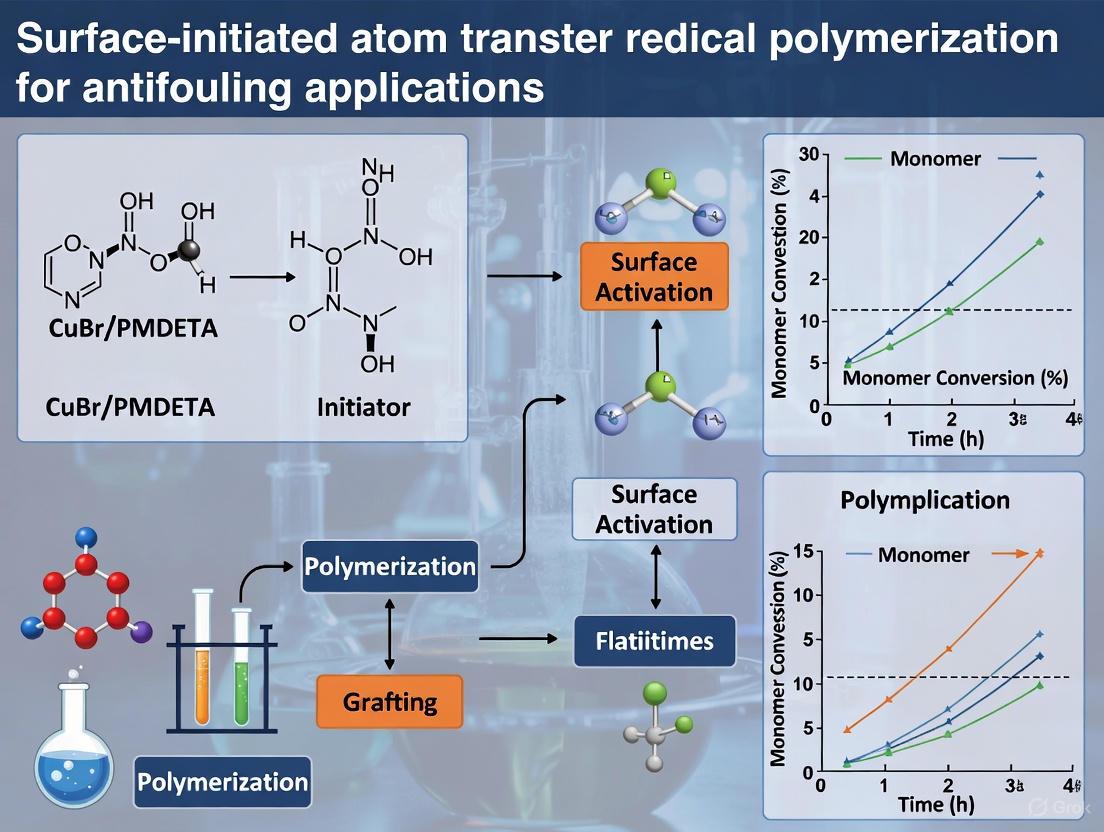
This article comprehensively reviews the application of surface-initiated atom transfer radical polymerization (SI-ATRP) for developing advanced antifouling surfaces.
Surface-Initiated ATRP for Antifouling Surfaces: Mechanisms, Applications, and Advanced Design in Biomedical Research
Abstract
This article comprehensively reviews the application of surface-initiated atom transfer radical polymerization (SI-ATRP) for developing advanced antifouling surfaces. Tailored for researchers and drug development professionals, it explores the foundational mechanisms of SI-ATRP, including recent advancements like Zn0-mediated and Cu0-mediated systems that enable simplified procedures and scalable fabrication. The scope covers methodological strategies for grafting polymer brushes from diverse substrates such as glass, gold, and silica nanoparticles, with a focus on high-performance zwitterionic and PEG-based coatings. It further addresses critical troubleshooting aspects for optimizing brush stability and performance, and validates these approaches through comparative analysis of real-world biomedical applications, including medical devices, sensors, and drug delivery systems, providing a holistic resource for designing next-generation antifouling materials.
SI-ATRP Fundamentals: Core Principles and Antifouling Mechanisms for Researchers
Atom Transfer Radical Polymerization (ATRP) is a cornerstone technique in modern polymer science, enabling the precise synthesis of polymers with controlled molecular architecture, narrow molecular weight distribution, and tailored functionality [1]. As a form of reversible-deactivation radical polymerization, its core principle is a dynamic equilibrium between active propagating radicals and dormant species, which drastically reduces the probability of irreversible termination events [2]. First reported independently by Mitsuo Sawamoto and Krzysztof Matyjaszewski in 1995 [1], ATRP has become indispensable for creating well-defined polymers for advanced applications, including particularly antifouling surface coatings for biomedical devices and analytical systems [3] [4].
The mechanism is fundamentally an inner-sphere electron transfer process catalyzed by a transition metal complex [2]. A dormant alkyl halide initiator (R-X) or polymer chain (R-P~n~-X) is activated by a transition metal catalyst in its lower oxidation state (e.g., Cu^I^/L), generating a propagating radical (R• or R-P~n~•) and an oxidized metal complex with a coordinated halide ligand (X-Cu^II^/L) [1] [2]. The radical can then add to monomer units (propagation) before being reversibly deactivated back to the dormant halide species. This rapid, reversible cycle establishes an equilibrium with a very low concentration of active radicals, which is crucial for suppressing termination reactions and achieving controlled polymer growth [1] [5]. The following diagram illustrates this core ATRP equilibrium and its connection to polymer growth.
Quantitative Kinetics of the ATRP Equilibrium
The degree of control in an ATRP reaction is governed by the kinetics of the activation-deactivation equilibrium. The key parameter is the ATRP equilibrium constant (K~ATRP~), defined as K~ATRP~ = k~a~/k~d~, where k~a~ is the activation rate constant and k~d~ is the deactivation rate constant [1]. A well-controlled polymerization requires K~ATRP~ to be small, favoring the dormant state and maintaining a low radical concentration to minimize termination [1] [5].
The concentration of the active propagating radical can be calculated using the following relationship derived from the equilibrium expression [1]: [ [\text{R-P}n^\bullet] = K{\text{ATRP}} \cdot [\text{R-P}n\text{-X}] \cdot \frac{[\text{Cu}^I\text{X/L}]}{[\text{Cu}^{II}\text{X}2/\text{L}]} ]
This equation highlights that the radical concentration depends not only on K~ATRP~ and the dormant species concentration, but also on the ratio of the activator to deactivator catalyst species. This ratio is crucial for tuning the polymerization rate and maintaining control.
Table 1: Key Kinetic Parameters and Their Influence on ATRP
| Parameter | Symbol | Typical Range/Value | Impact on Polymerization |
|---|---|---|---|
| Equilibrium Constant | K~ATRP~ = k~a~/k~d~ | Varies widely with catalyst/initiator [5] | Determines radical concentration and control. Too small: slow reaction. Too large: broad dispersity [1]. |
| Activation Rate Constant | k~a~ | Up to ~7.5 × 10³ M⁻¹s⁻¹ (measured by stopped-flow) [5] | Governs the rate of initiation and chain growth. |
| Deactivation Rate Constant | k~d~ | Very high (e.g., ~10⁷ M⁻¹s⁻¹ for active catalysts) [5] | Must be large to ensure fast deactivation and low dispersity. |
| Radical Concentration | [R-P~n~•] | Very low (µM to nM range) | Minimized by K~ATRP~ and deactivator concentration to reduce termination [1]. |
| Activator/Deactivator Ratio | [Cu^I^]/[Cu^II^] | Adjusted during reaction | Critical for controlling the polymerization rate; can be manipulated by adding reducing agents [2]. |
Components and Experimental Protocols
Essential Components for ATRP
A successful ATRP requires careful selection of five key components, each playing a critical role in establishing and maintaining the reversible equilibrium [1].
- Monomer: Common monomers are those that stabilize propagating radicals, such as styrenes, (meth)acrylates, (meth)acrylamides, and acrylonitrile [1]. The monomer's propagation rate constant (k~p~) influences the required balance between active and dormant species.
- Initiator: Typically an alkyl halide (R-X, where X = Cl, Br). The structure of R should resemble the growing polymer chain end for consistent kinetics. Alkyl bromides are generally more reactive than chlorides [1]. The initiator defines the number of growing chains and can be functionalized to create telechelic polymers or complex architectures like star polymers [1] [2].
- Catalyst: Most commonly a complex of copper (Cu/I/II) with a nitrogen-based ligand, though other metals like Fe, Ru, and Ni can be used [1] [2]. The catalyst's redox potential and halidophilicity determine K~ATRP~ and its activity [2].
- Ligand: Amine-based ligands (e.g., bipyridine, PMDETA, Me₆TREN) are standard for copper catalysts. The ligand solubilizes the metal salt in organic media and finely tunes its redox potential, thereby controlling the activation/deactivation kinetics [1] [5].
- Solvent: Various solvents can be used, including toluene, anisole, DMF, DMSO, and water. The solvent can influence the ATRP equilibrium constant, which generally increases with solvent polarity [1] [2]. Reactions can also be performed bulk (neat monomer).
Table 2: The Scientist's Toolkit: Essential Research Reagents for ATRP
| Reagent Category | Example Compounds | Primary Function in ATRP |
|---|---|---|
| Initiators | Ethyl 2-bromoisobutyrate, Methyl 2-bromopropionate [6] | Provides the initial dormant chain end; determines the number of polymer chains. |
| Catalyst Salts | Cu(I)Br, Cu(I)Cl, Cu(II)Br₂ [1] [2] | Forms the transition metal complex at the heart of the reversible redox cycle. |
| Ligands | 2,2'-Bipyridine (bpy), N,N,N',N'',N''-Pentamethyldiethylenetriamine (PMDETA), Tris(2-pyridylmethyl)amine (TPMA) [1] [5] | Modifies catalyst activity and solubility; crucial for adjusting K~ATRP~. |
| Monomers | Methyl methacrylate (MMA), Styrene, Poly(ethylene glycol) acrylate (PEO-based), N-Isopropylacrylamide (NIPAAm) [1] [3] | The building blocks of the polymer; determine the final material's properties. |
| Solvents | Anisole, DMF, Acetonitrile, Water [1] [2] | Reaction medium that can influence the position of the ATRP equilibrium. |
Representative Protocol: Synthesis of an Antifouling Triblock Copolymer
The following protocol is adapted from research by Wang et al. (2021) on synthesizing a PEO-PNIPAAm-PSPMAP tri-block copolymer for antifouling coatings with self-cleaning properties [3].
Objective: To synthesize a tri-block copolymer using ATRP, where a poly(ethylene oxide) (PEO) macroinitiator is used to grow blocks of poly(N-isopropylacrylamide) (PNIPAAm) and a sulfonate-containing monomer (SPMAP).
Materials:
- PEO Macroinitiator: Hydroxyl-terminated PEO functionalized with 2-bromoisobutyryl bromide.
- Monomer: N-isopropylacrylamide (NIPAAm), purified.
- Catalyst System: Cu(I)Br and a suitable ligand (e.g., PMDETA or Me₆TREN).
- Solvent: Anhydrous [N,N-Dimethylformamide] (DMF).
- Inert Atmosphere: Nitrogen or Argon gas.
Procedure:
- Macroinitiator Preparation: Synthesize the ATRP macroinitiator by reacting hydroxyl-terminated PEO with 2-bromoisobutyryl bromide in the presence of triethylamine in an ice bath. Purify the resulting bromoester-functionalized PEO by precipitation in cold diethyl ether [3].
- Reaction Setup: In a Schlenk flask or round-bottom flask equipped with a magnetic stir bar, combine the PEO macroinitiator, NIPAAm monomer, and ligand. Seal the flask with a rubber septum.
- Deoxygenation: Purge the reaction mixture with nitrogen or argon for at least 30-45 minutes to remove dissolved oxygen, which is a radical inhibitor.
- Catalyst Addition: Under a continuous flow of inert gas, add the Cu(I)Br catalyst directly to the flask. Alternatively, the catalyst can be added as a solution in a minimal amount of degassed solvent.
- Polymerization: Place the reaction flask in a pre-heated oil bath at the desired temperature (e.g., 60-90 °C) and stir for a predetermined time (e.g., several hours). The reaction can be monitored by sampling for monomer conversion (e.g., via ^1^H NMR).
- Work-up and Purification: After the reaction, cool the flask and dilute the mixture with THF. Pass the solution through a neutral alumina column to remove the copper catalyst. Precipitate the purified block copolymer (PEO-PNIPAAm-Br) into a non-solvent such as cold diethyl ether or hexane. Isolate the polymer by filtration or centrifugation and dry under vacuum.
- Second Block Extension: The resulting dormant PEO-PNIPAAm-Br can be used as a macroinitiator for a subsequent ATRP step with a monomer like SPMAP to form the final tri-block copolymer, following a similar deoxygenation and reaction procedure [3].
Application in Antifouling Surface Engineering
The precise control offered by ATRP makes it ideal for creating advanced polymer brushes for antifouling surfaces, a critical need in biomedical implants, drug delivery systems, and analytical devices [4]. Surface-Initiated ATRP (SI-ATRP) allows for the "grafting from" of dense polymer brushes directly from material surfaces [7].
In a key application, ATRP was used to synthesize a PEO-PNIPAAm-PSPMAP triblock copolymer for coating capillaries in electrophoresis. The polymer design incorporates multiple hydrophilic groups (ether, amide, sulfonic acid) that form a hydration layer, providing a physical and thermodynamic barrier against protein adsorption [3]. Furthermore, the PNIPAAm block confers a "self-cleaning" capability due to its temperature-responsive conformation changes, which help release any weakly adsorbed proteins, thereby extending the coating's lifespan [3]. Simulation studies of SI-ATRP have confirmed that the rapid activation-deactivation process gives all surface-grafted chains an equal opportunity to grow, leading to high grafting density and low dispersity—both essential for forming a uniform, effective antifouling barrier [7].
The following workflow summarizes the process of creating and applying such an antifouling coating via ATRP.
Surface-Initiated Atom Transfer Radical Polymerization (SI-ATRP) has emerged as a pivotal technique in polymer science for engineering surfaces with precise control over brush architecture. The "grafting-from" approach, wherein polymer chains grow directly from initiator-functionalized substrates, enables the fabrication of high-density polymer brushes that are mechanically robust and functionally versatile [8] [9]. This method overcomes the steric limitations of "grafting-to" approaches, where pre-synthesized chains attach to surfaces, thus allowing for significantly higher grafting densities [9]. The controlled nature of ATRP facilitates the synthesis of brushes with predetermined molecular weights, narrow molecular weight distributions, and complex architectures, making it particularly valuable for creating advanced functional surfaces [9] [10].
For antifouling research, achieving high surface coverage is critical, as it determines the effectiveness of the coating in preventing nonspecific adsorption of proteins, microorganisms, and other biological entities [11] [10]. The high grafting density afforded by SI-ATRP's grafting-from approach creates a dense, confluent layer of polymer chains that sterically hinders fouling agents from reaching the underlying substrate, while also providing chemical functionality to repel adhesive interactions [10]. This application note details the fundamental advantages, experimental protocols, and key applications of SI-ATRP for creating antifouling surfaces through the grafting-from technique.
The Grafting-from Principle and Its Technical Superiority
The grafting-from approach in SI-ATRP involves the covalent attachment of initiator molecules to a substrate surface, followed by in situ polymer chain growth from these immobilized initiation sites [9]. This method fundamentally differs from alternative grafting strategies:
Grafting-to: Involves attaching pre-synthesized, end-functionalized polymer chains to a complementary functionalized surface. This method suffers from steric hindrance and slow diffusion kinetics as the initial attached chains create a barrier that prevents additional chains from reaching the surface, resulting in limited grafting density (typically <0.1 chains/nm²) [9].
Grafting-through: Utilizes surface-bound monomer species that copolymerize with free monomers in solution. While chains grow from the surface, this method typically yields lower brush densities than grafting-from approaches [9] [10].
Grafting-from: Allows for high initiation efficiency because small monomer molecules can readily diffuse to the growing chain ends, enabling the formation of densely packed brushes with grafting densities often exceeding 0.3 chains/nm² [9]. The brush layer thickness can be precisely controlled by adjusting polymerization time, monomer concentration, and catalyst activity [8] [12].
Table 1: Comparison of Polymer Grafting Techniques
| Grafting Method | Typical Grafting Density | Advantages | Limitations |
|---|---|---|---|
| Grafting-from (SI-ATRP) | High (0.3-1.0 chains/nm²) | High brush density, precise thickness control, complex architectures | Requires surface initiator attachment, catalyst removal |
| Grafting-to | Low (<0.1 chains/nm²) | Pre-characterized polymers, simple procedure | Low grafting density due to steric hindrance |
| Grafting-through | Moderate (0.1-0.4 chains/nm²) | Direct surface incorporation | Limited control over brush density |
The following diagram illustrates the fundamental mechanism of the SI-ATRP 'grafting-from' process:
SI-ATRP Grafting-from Mechanism: The diagram illustrates the surface-initiated ATRP process where (1) initiators are immobilized on the substrate, (2) the catalyst activates dormant species, (3) monomers propagate from generated radicals, and (4) deactivation controls polymer growth for high-density brushes.
Experimental Protocols for High-Density Brush Synthesis
Surface Initiator Immobilization
The foundation of successful SI-ATRP lies in the uniform and dense attachment of initiator molecules to the substrate. The following protocol details the functionalization of silicon wafers, which can be adapted for other substrates with appropriate surface chemistry modifications:
Materials:
- Silicon wafers (or other substrates)
- (3-Aminopropyl)triethoxysilane (APTES, 99%)
- α-Bromoisobutyryl bromide (BIB, 98%)
- Triethylamine (TEA, ≥99.5%)
- Toluene (anhydrous)
- Dichloromethane (DCM, anhydrous)
- Ethanol (absolute)
Procedure:
- Substrate Cleaning and Hydroxylation: Clean silicon wafers with oxygen plasma treatment for 10 minutes to create a uniform hydroxylated surface [10]. Alternatively, use piranha solution (3:1 H₂SO₄:H₂O₂) for 30 minutes, followed by thorough rinsing with deionized water and drying under nitrogen stream.
Silane Coupling: Immerse the substrates in 2% (v/v) APTES solution in anhydrous toluene for 12 hours at room temperature under inert atmosphere [12]. This forms an amine-terminated self-assembled monolayer.
Initiator Attachment: Transfer the aminated substrates to a solution of α-bromoisobutyryl bromide (BIB, 0.1 M) and triethylamine (0.12 M) in anhydrous DCM. React for 4 hours at 0°C with gentle stirring [12]. The reaction converts surface amine groups to ATRP initiator sites.
Washing and Characterization: Wash the initiator-functionalized substrates sequentially with DCM, ethanol, and deionized water. Characterize the initiator layer by water contact angle measurement (should increase to ~54-60°) and X-ray photoelectron spectroscopy (XPS) to confirm the presence of bromine [13].
Iron-Based PhotoATRP in Microliter Volumes
Recent advances in ATRP methodologies have enabled more sustainable and accessible approaches. The following protocol describes a simplified iron-based photoATRP procedure that operates with microliter reagent volumes, ideal for high-throughput screening of antifouling coatings:
Materials:
- Initiator-functionalized substrates
- Monomer (e.g., methyl methacrylate, benzyl methacrylate)
- Iron(III) bromide (FeBr₃)
- Acetonitrile (or other suitable solvent)
- Visible light source (LED, 450-470 nm) or sunlight
Procedure:
- Reaction Mixture Preparation: Prepare the polymerization solution containing monomer (2-4 M) and FeBr₃ catalyst (50-200 ppm) in acetonitrile [12]. The solution should be purged with nitrogen for 10 minutes to remove oxygen.
Microliter-Scale Reaction Setup: Place a 20-50 µL droplet of the polymerization mixture on the initiator-functionalized substrate. Cover with a clean glass slide to create a "sandwich-like" configuration that spreads the solution evenly while minimizing oxygen diffusion [12].
Photopolymerization: Illuminate the reaction setup with visible light (wavelength 450-470 nm, intensity 10-30 mW/cm²) for 1-4 hours. The reaction can also be performed under direct sunlight for 2-6 hours [12].
Post-Polymerization Processing: Carefully separate the substrate from the glass slide and rinse thoroughly with an appropriate solvent to remove any non-grafted polymer and catalyst residues. Dry under a nitrogen stream.
Brush Characterization: Measure brush thickness by ellipsometry or atomic force microscopy. Determine grafting density using a combination of thickness measurements and gel permeation chromatography analysis of chains cleaved from the surface.
Table 2: Optimal Conditions for High-Density Brush Synthesis via SI-ATRP
| Parameter | Traditional Cu-ATRP | Fe-Based PhotoATRP | Effect on Brush Density |
|---|---|---|---|
| Catalyst System | CuBr/PMDETA (1000-5000 ppm) | FeBr₃ (50-200 ppm) | Higher catalyst activity increases initiation efficiency |
| Monomer Concentration | 2-5 M in appropriate solvent | 2-4 M in acetonitrile | Higher concentration favors thicker brushes |
| Reaction Time | 2-24 hours | 1-6 hours | Longer times increase thickness but may affect dispersity |
| Initiator Density | High (≥70% surface coverage) | High (≥70% surface coverage) | Critical for achieving high grafting density |
| Oxygen Control | Rigorous deoxygenation | Moderate (N₂ purging sufficient) | Oxygen inhibits polymerization, affects brush uniformity |
The experimental workflow for creating high-density brushes via SI-ATRP is summarized below:
SI-ATRP Experimental Workflow: The diagram outlines the key steps in creating high-density polymer brushes, from substrate preparation to final antifouling application.
Research Reagent Solutions Toolkit
Table 3: Essential Reagents for SI-ATRP and Their Functions in Antifouling Applications
| Reagent Category | Specific Examples | Function in SI-ATRP | Considerations for Antifouling |
|---|---|---|---|
| Initiators | α-Bromoisobutyryl bromide (BIB), (6-(2-Bromo-2-methyl)propionyloxy)hexyl trichlorosilane (BHTS) | Surface initiation sites for polymer growth | Alkyl halide structure affects initiation efficiency and brush density |
| Catalysts | CuBr/PMDETA, FeBr₃ | Mediates reversible activation/deactivation | Iron-based catalysts preferred for biocompatibility; low ppm concentrations reduce toxicity |
| Monomers | 2-(Methacryloyloxy)ethyl phosphorylcholine (MPC), Oligo(ethylene glycol) methacrylate (OEGMA), Zwitterionic monomers | Building blocks for antifouling polymer brushes | Hydrophilic/zwitterionic monomers create hydration layers that resist biofouling |
| Ligands | PMDETA, TPMA, 2,2'-Bipyridyl (bpy) | Coordinates metal catalysts, tunes redox potential | Affects catalyst stability and oxygen tolerance in aqueous polymerizations |
| Solvents | Water, methanol, acetonitrile, toluene | Reaction medium for polymerization | Aqueous systems preferred for biocompatibility; affects monomer solubility and brush morphology |
| Reducing Agents | Ascorbic acid, tin(II) 2-ethylhexanoate | Regenerates activator in ARGET ATRP | Enables very low catalyst concentrations (≤100 ppm) for biomedical applications |
Applications in Antifouling Surfaces
The high-density polymer brushes fabricated via SI-ATRP have demonstrated exceptional performance in antifouling applications across multiple domains:
Antimicrobial Surfaces: Grafting of bactericidal polymer brushes such as poly(2-(methacryloyloxy)ethyl]trimethylammonium chloride) (poly(QMA)) from poly(lactic acid) surfaces resulted in a three-order of magnitude increase in antimicrobial efficacy against Gram-negative bacteria such as Escherichia coli compared to unmodified surfaces [14]. The quaternary ammonium compounds in the dense brush structure penetrate bacterial cell membranes, causing cell lysis and death.
Protein-Resistant Coatings: Zwitterionic polymer brushes, including poly(sulfobetaine methacrylate) (pSBMA) and poly(carboxybetaine methacrylate) (pCBMA), grafted from various substrates exhibit ultralow fouling properties (protein adsorption <5 ng/cm²) due to their strong hydration layer [10]. The high grafting density achieved through SI-ATRP creates a physical and energetic barrier that prevents protein adhesion and subsequent biofilm formation.
Antiadhesive Medical Devices: Glass and polymer substrates modified with poly(2-methacryloyloxyethyl phosphorylcholine) (pMPC) brushes via SI-ATRP show significantly reduced platelet adhesion and activation, making them suitable for cardiovascular implants and diagnostic devices [10] [15]. The biomimetic phosphorylcholine groups create a cell membrane-like interface that resists cellular attachment.
Marine Antifouling Coatings: Zwitterionic polymer brushes grafted from surfaces demonstrate versatile inhibition of marine organism settlement while being environmentally benign compared to traditional biocidal coatings [15]. The high-density brush structure prevents adhesion of algae, barnacles, and other marine organisms through both steric repulsion and surface hydration effects.
The development of simplified ATRP systems, such as iron-based photoATRP that operates with minimal components (monomer, solvent, and FeBr₃ only), further enhances the practical application of these coatings by reducing complexity, minimizing waste production, and utilizing biocompatible catalyst systems [12]. These advances make SI-ATRP an increasingly accessible technology for creating high-performance antifouling surfaces across biomedical, industrial, and environmental applications.
Surface-initiated atom transfer radical polymerization (SI-ATRP) has emerged as a pivotal technique for crafting precisely controlled antifouling polymer brushes on inorganic substrates. This controlled radical polymerization method enables the growth of polymer chains with predetermined molecular weights, narrow dispersity, and high grafting density directly from nanoparticle surfaces, making it indispensable for creating advanced antifouling coatings. The technique's robustness stems from a reversible redox process mediated by transition metal catalysts that control radical polymerization, allowing exceptional command over brush architecture and functionality [8]. Within this framework, three principal polymer chemistries have demonstrated exceptional efficacy in mitigating biofouling: zwitterionic polymers, PEG-like derivatives, and stimuli-responsive polyelectrolyte brushes. These systems operate through distinct mechanisms—primarily by forming hydration barriers, creating steric hindrance, or dynamically responding to environmental triggers—to prevent the nonspecific adsorption of proteins, cells, and microorganisms that initiates the fouling process [16] [17].
Zwitterionic Polymer Brushes
Fundamental Antifouling Mechanisms
Zwitterionic polymers possess both positive and negative charged groups within the same monomer unit, creating a superhydrophilic surface that binds water molecules through strong electrostatic interactions. This results in the formation of a tightly bound hydration layer that acts as a physical and energetic barrier against fouling. The primary zwitterionic chemistries include poly(sulfobetaine methacrylate) (PSBMA), poly(carboxybetaine methacrylate) (PCBMA), and poly(2-methacryloyloxyethyl phosphorylcholine) (PMPC) [18] [19]. Recent ab initio investigations reveal that these polymers exhibit distinct hydration behaviors: PMPC forms strong hydrogen bonds with water molecules, while PCBAA (poly(carboxybetaine acrylamide) develops a thicker hydration layer. Both PSBMA and PMPC significantly deform ice clusters and promote surface lubrication, making ice formation energetically unfavorable within their hydration layers [18].
Performance in Complex Biological Environments
The antifouling performance of zwitterionic brushes demonstrates significant variation in salt solutions due to their ionic response mechanisms. Studies combining atomic force microscopy and molecular dynamics simulations show that PMPC and PSBMA surfaces in salt solutions exhibit significant accumulation of cations, resulting in a positive shift in surface potential. Divalent Ca²⁺ particularly enhances protein adhesion to polymer brushes through Ca²⁺ bridge formation, whereas monovalent Na⁺ can diminish salt bridges between zwitterionic brushes and proteins via competitive adsorption, thereby reducing protein adhesion [19]. This understanding is crucial for biomedical applications where salt concentrations vary considerably.
Table 1: Comparative Performance of Key Zwitterionic Polymers
| Polymer | Charged Groups | Key Antifouling Mechanism | Performance in Salt Solutions | Representative Applications |
|---|---|---|---|---|
| PMPC | Phosphorylcholine | Strong hydrogen bonding with water | Cation accumulation, positive surface potential shift | Blood-contacting devices, implant coatings [18] [16] |
| PSBMA | Sulfobetaine | Surface lubrication, ice cluster deformation | Cation accumulation, sensitive to Ca²⁺ bridges | Marine coatings, medical devices [18] [19] |
| PCBMA | Carboxybetaine | Thick hydration layer formation | Competitive adsorption with Na⁺ reduces protein adhesion | Implantable sensors, drug delivery systems [18] [19] |
Application Protocol: Tannic Acid/Zwitterionic Coating for Medical Devices
Principle: Exploit the adhesive capability of tannic acid (TA) and the antifouling properties of zwitterionic polymers to create hydrophilic, lubricious coatings on medical material surfaces [20].
Materials:
- Polyethylene terephthalate (PET) substrate (or other medical material)
- Tannic acid (TA) solution (2 mg/mL in buffer, pH ~7.4)
- Fe³⁺ solution (1 mg/mL)
- Poly(ethylenimine)-g-sulfobetaine methacrylate (PEI-g-SBMA) copolymer solution (5 mg/mL)
- Buffer solution (10 mM HEPES, pH 7.4)
Procedure:
- Substrate Preparation: Clean PET substrates thoroughly with ethanol and deionized water, then dry under nitrogen stream.
- TA-Fe³⁺ Layer Formation: Immerse substrates in TA solution for 30 minutes at room temperature to allow TA adsorption. Rinse gently with buffer to remove unbound TA.
- Complexation: Transfer substrates to Fe³⁺ solution for 20 minutes to form TA-Fe³⁺ complex layer via coordination interactions. Rinse with buffer.
- Zwitterionic Grafting: Incubate TA-Fe³⁺ modified substrates in PEI-g-SBMA solution for 12 hours at 4°C to allow zwitterionic copolymer anchoring through Schiff-base reaction.
- Post-treatment: Rinse thoroughly with deionized water to remove physically adsorbed polymers and dry under nitrogen.
Validation: Successful coating implementation is confirmed through elemental and morphological surface analysis (XPS, AFM), water contact angle reduction (improved hydrophilicity), friction coefficient measurements (enhanced lubrication), and bovine serum albumin (BSA) adsorption assays (antifouling capacity) [20].
PEG-like and Alternative Polymer Brushes
Beyond Conventional PEG Chemistry
While poly(ethylene) glycol (PEG) has been the historical gold standard for antifouling applications, recent studies have revealed significant limitations, including immunogenicity and unwanted immune responses. This has stimulated development of next-generation PEG-like polymers with enhanced properties [21]. A promising alternative is poly-(2-(methylsulfinyl)-ethyl glycidyl ether) (PMSOEGE), composed of a PEG backbone structure with sulfoxide-containing side chains. This innovative polymer demonstrates superior hydrophilicity compared to conventional PEG due to the presence of highly polar and hydrophilic sulfoxide structures. PMSOEGE exhibits significantly lower association with anti-PEG antibodies and, when coated onto iron oxide nanoparticles, shows substantially reduced cellular uptake by macrophages compared to PEGylated counterparts [21].
Amphiphilic Polymer Brush Systems
Amphiphilic asymmetric polymer brushes containing hetero side chains—typically hydrophobic polystyrene (PS) and hydrophilic poly(ethylene glycol) (PEG)—represent another advanced approach to fouling resistance. These systems can dynamically alter their physicochemical properties in response to environmental conditions. When prepared as uniform thin films via spin-casting, these brushes form smooth surfaces with roughness less than 2 nm. The surfaces demonstrate stimuli-responsiveness, enriching either PEG or PS chains at the film surface after exposure to selective solvents. Protein adsorption studies verify that these amphiphilic polymer brush films bearing PEG chains effectively lower or eliminate protein-material interactions, while cell adhesion experiments with HaCaT cells confirm their excellent antifouling ability [22].
Table 2: Comparison of PEG and Next-Generation Antifouling Polymers
| Polymer | Structure | Advantages | Limitations | Immunogenicity |
|---|---|---|---|---|
| Conventional PEG | Polyether backbone | Well-established chemistry, highly hydrophilic | Immunogenic, activates anti-PEG antibodies | High [21] |
| PMSOEGE | PEG backbone with sulfoxide side chains | Enhanced hydrophilicity, reduced antibody recognition | Novel chemistry, limited long-term stability data | Significantly reduced [21] |
| Amphiphilic Brushes | PEG/PS asymmetric brushes | Stimuli-responsive, tunable surface properties | Complex synthesis, potential hydrophobic domain fouling | Low [22] |
Stimuli-Responsive Polyelectrolyte Brushes
Response Mechanisms and Environmental Triggers
Stimuli-responsive polyelectrolyte brushes represent a sophisticated class of "smart" antifouling materials that dynamically alter their properties in response to environmental changes. These brush coatings can modify mechanical, molecular, and electrical properties of surfaces based on external stimuli including pH, ionic strength, temperature, and specific molecular recognition events [17]. The fundamental mechanism involves conformational changes in the grafted polymer chains—typically transitioning between collapsed and swollen states—that subsequently alter surface characteristics such as friction, adhesion, and molecular interaction capabilities. A key design parameter is grafting density, which determines the degree of chain confinement and significantly influences physicochemical behavior and responsiveness [17].
Functional Applications in Antifouling
The functional roles of polyelectrolyte brushes in antifouling applications can be categorized into three primary areas: mechanical property manipulation, molecular interaction control, and electrical property modulation. For mechanical properties, these brushes exhibit extremely low friction coefficients (as low as 0.001 in water) due to combined effects of limited interpenetration between opposing brushes and the hydration layer around polyelectrolyte charges [17]. In molecular interactions, brushes create reversible barriers that control protein adsorption and desorption through tunable electrostatic and steric interactions. Electrically, they modulate ionic transport and can function in energy conversion systems and ionic diodes, expanding their utility beyond traditional antifouling applications.
SI-ATRP Experimental Protocol for Antifouling Brushes
Surface-Initiated ATRP Methodology
Principle: SI-ATRP enables controlled growth of polymer brushes from inorganic nanoparticle surfaces through a reversible redox process mediated by transition metal catalysts, allowing precise control over brush thickness, density, and architecture [8].
Materials:
- Substrate: Inorganic nanoparticles (SiO₂, Au, Fe₃O₄, etc.)
- Initiator: ATRP initiator silane (e.g., (3-trimethoxysilyl)propyl 2-bromo-2-methylpropionate)
- Monomer: Zwitterionic (SBMA, CBMA, MPC), PEG-like, or stimuli-responsive monomers
- Catalyst System: Cu(I)Br, Cu(II)Br₂, appropriate ligand (PMDETA, HMTETA, etc.)
- Solvent: Deoxygenated water, methanol, or other suitable solvents
- Reducing Agent: Ascorbic acid (for ARGET ATRP)
Procedure:
- Surface Initiator Immobilization:
- Functionalize nanoparticle surfaces with ATRP initiator via silanization.
- For silica nanoparticles: Disperse in toluene, add initiator silane (1-5 mol%), react 12-24h at room temperature under inert atmosphere.
- Purify by repeated centrifugation/redispersion cycles with toluene and ethanol.
Polymerization Mixture Preparation:
- Prepare monomer solution in deoxygenated solvent (typically 1:1 water:methanol for zwitterionic monomers).
- Add ligand to monomer solution at molar ratio 1:1 to Cu catalyst.
- Degas solution via freeze-pump-thaw cycles or nitrogen bubbling for 30+ minutes.
SI-ATRP Polymerization:
- In Schlenk flask or glovebox, add initiator-functionalized nanoparticles to reaction vessel.
- Add catalyst (Cu(I)Br, typically 0.1 eq relative to initiator) and deoxygenated solvent.
- Degassed monomer/ligand solution is added via syringe.
- Seal reactor and polymerize at designated temperature (20-70°C) for 2-24 hours.
- For better control, use ARGET ATRP with Cu(II)Br₂ (0.01 eq) and ascorbic acid as reducing agent.
Post-Polymerization Processing:
- Open reactor to air to terminate polymerization.
- Purify brush-modified nanoparticles by extensive dialysis or centrifugation.
- Characterize brush thickness, grafting density, and molecular weight by SEC, TGA, AFM.
The Scientist's Toolkit: Essential Research Reagents
Table 3: Key Reagents for SI-ATRP Antifouling Brush Synthesis
| Reagent Category | Specific Examples | Function | Application Notes |
|---|---|---|---|
| ATRP Initiators | (3-trimethoxysilyl)propyl 2-bromo-2-methylpropionate, BiBADA | Surface anchoring points for polymer growth | Choice depends on substrate; silanes for oxides, thiols for gold [8] |
| Zwitterionic Monomers | SBMA, CBMA, MPC | Form superhydrophilic, antifouling brush layers | MPC shows strong hydrogen bonding; CBMA forms thick hydration layers [18] [19] |
| PEG-like Monomers | OEGMA, PMSOEGE precursors | Create alternative antifouling surfaces | PMSOEGE offers reduced immunogenicity vs conventional PEG [21] |
| Catalyst Systems | Cu(I)Br/PMDETA, Cu(II)Br₂/ligand with reducing agent | Mediate controlled radical polymerization | ARGET ATRP systems allow reduced catalyst loading [8] |
| Solvents | Water/methanol mixtures, DMF, acetonitrile | Reaction medium for polymerization | Solvent choice affects brush architecture and polymerization kinetics [8] |
The strategic application of SI-ATRP for fabricating zwitterionic, PEG-like, and stimuli-responsive polymer brushes provides a powerful toolbox for addressing diverse fouling challenges across biomedical, marine, and industrial applications. Zwitterionic polymers excel in aqueous environments through their superhydrophilic nature and strong hydration capabilities, while advanced PEG-alternatives address immunogenicity concerns associated with conventional PEG. Stimuli-responsive brushes offer dynamic, environmentally-adaptive antifouling properties for next-generation smart coatings. The continued refinement of SI-ATRP methodologies—particularly through techniques like ARGET ATRP that reduce catalyst loading and improve environmental compatibility—will further enhance the practical implementation of these advanced antifouling strategies. As research progresses, the integration of these brush systems into complex medical devices, separation membranes, and marine coatings promises to significantly impact fields ranging from healthcare to water purification and beyond.
Surface-Initiated Atom Transfer Radical Polymerization (SI-ATRP) is a powerful variant of controlled radical polymerization that enables the grafting of well-defined polymer brushes from inorganic surfaces. The core of this process is the catalytic complex, typically based on a transition metal such as copper, which mediates a dynamic equilibrium between active and dormant polymer chain ends. This control is paramount for creating tailored organic-inorganic hybrid materials with precise architecture, composition, and functionality for advanced applications, including antifouling coatings [9] [23]. In antifouling research, SI-ATRP allows for the design of surfaces with specific chemical and physical properties that can resist biofouling—the undesirable accumulation of microorganisms, algae, and barnacles on submerged surfaces [24] [25]. The catalytic complex's role is to govern the polymerization kinetics, determining the degree of control over molecular weight, polydispersity, and the final polymer brush structure, which directly influences the antifouling performance of the coated material [9].
Mechanistic Fundamentals of Copper-Catalyzed ATRP
The mechanism of copper-catalyzed ATRP is based on a reversible redox reaction mediated by a copper complex. This process establishes a dynamic equilibrium between dormant alkyl halide species and active radical species [26].
The Core ATRP Equilibrium
The fundamental ATRP equilibrium can be summarized as follows: Pn-X + CuI/L ⇌ Pn• + X-CuII/L
- Activation: A CuI/L complex (the activator) reacts with a dormant initiator or polymer chain end (Pn-X), undergoing a homolytic cleavage of the carbon-halogen bond. This inner-sphere electron transfer produces a propagating radical (Pn•) and an oxidized CuIIX2/L complex (the deactivator).
- Propagation: The generated carbon-centered radical (Pn•) adds to vinyl monomers, leading to chain growth.
- Deactivation: The propagating radical is rapidly recaptured by the X-CuII/L complex, reforming the dormant halide-capped chain and regenerating the CuI/L activator. This fast deactivation minimizes termination reactions, granting the polymerization its "controlled" character.
The equilibrium constant (KATRP) is typically low (10-9 to 10-4), ensuring a low concentration of active radicals and thus minimizing termination side reactions [26].
Figure 1: The core ATRP equilibrium. The CuI/L activator reacts with the dormant species to generate the propagating radical and the X-CuII/L deactivator, which rapidly re-captures the radical to reform the dormant chain.
Ligand Role in the Catalytic Complex
The ligand (L) is a critical component of the catalytic complex. Its primary functions are [26]:
- Solubilization: To solubilize the copper salt in the organic reaction medium.
- Tuning Reactivity: To adjust the redox potential of the copper center, thereby controlling the activity of the catalyst. The ligand structure significantly influences the activation rate constant (kact) and the equilibrium constant (KATRP).
- Stabilization: To form a stable complex with copper, preventing its precipitation or decomposition.
The activity of CuI/ligand complexes generally follows the trend: tetradentate > tridentate > bidentate ligands. For instance, complexes with Me6TREN (a tetradentate ligand) are among the most active, while those with bpy (a bidentate ligand) are less active [26].
Quantitative Data on Catalytic Systems
Table 1: Common Copper-Based Catalytic Systems and Their Performance in ATRP.
| Ligand Type | Example Ligand | Copper Salt | Typical [Cu] (ppm) | PDI Achievable | Key Advantages |
|---|---|---|---|---|---|
| Tetradentate | Me6TREN | CuIBr | 1 - 100 [27] | < 1.2 [26] | Very high activity; low catalyst loading |
| Tridentate | PMDETA | CuIBr | 50 - 1000 | < 1.3 | Good balance of activity and control |
| Bidentate | 2,2'-Bipyridine (bpy) | CuIBr | 1000+ | < 1.5 | Inexpensive; robust for less active monomers |
Table 2: Advanced Catalytic Methods for Reduced Copper Loadings.
| Method | Acronym | Mechanism | Typical [Cu] (ppm) | Reference |
|---|---|---|---|---|
| Activators Regenerated by Electron Transfer | ARGET ATRP | Reducing agent regenerates CuI from CuII | 1 - 100 | [27] |
| Initiators for Continuous Activator Regeneration | ICAR ATRP | Radical initiator regenerates CuI from CuII | 1 - 100 | [27] |
| Photoinduced Electron Transfer | PET-ATRP | Light excites photocatalyst to regenerate CuI | < 1000 | [28] |
Experimental Protocols for SI-ATRP in Antifouling Research
This section provides detailed methodologies for implementing copper-catalyzed SI-ATRP to create antifouling surfaces.
Protocol: SI-ATRP of Antifouling Polymer Brushes from Steel Substrates
Objective: To graft a poly(ethylene glycol) methacrylate (PEGMA) brush from a steel surface to create a fouling-release coating. Background: Polymer brushes like poly(PEGMA) create a hydrophilic, steric barrier that reduces protein adhesion and biofouling [9].
Materials:
- Substrate: DH34 steel coupon (e.g., 2 cm x 2 cm) [25].
- Monomer: Poly(ethylene glycol) methacrylate (PEGMA, 5 mL) [9].
- Initiator: 2-Bromoisobutyryl bromide (BiBB, "ATRP initiator").
- Catalyst: Copper(II) bromide (CuIIBr2) and Copper(I) bromide (CuIBr).
- Ligand: N,N,N',N'',N''-Pentamethyldiethylenetriamine (PMDETA).
- Solvent: Anisole (20 mL).
- Reducing Agent (for ARGET): Ascorbic acid or tin(II) 2-ethylhexanoate [27].
Procedure:
- Substrate Pretreatment: Clean the steel coupon sequentially with acetone, ethanol, and deionized water in an ultrasonic bath for 15 minutes each. Dry under a stream of N2 gas.
- Initiator Immobilization: a. Place the clean steel coupon in a round-bottom flask under N2 atmosphere. b. Using a syringe, add a solution of triethylamine (2 mmol) in dry THF (20 mL). c. Slowly add 2-bromoisobutyryl bromide (2 mmol) dissolved in dry THF (10 mL) dropwise over 30 minutes with constant stirring. d. React for 12 hours at room temperature. e. Rinse the functionalized substrate thoroughly with THF and methanol to remove physisorbed initiator. Dry under vacuum.
- Polymerization Solution Preparation (ARGET SI-ATRP): In a Schlenk flask, purged with N2, combine:
- PEGMA monomer (5 mL, purified by passing through a basic alumina column).
- Anisole (20 mL).
- PMDETA ligand (0.1 mmol).
- CuIIBr2 (0.05 mmol). Note: The initial addition of the more stable CuII species suppresses early termination via the Persistent Radical Effect [26].
- Polymerization: a. Degas the solution by performing three freeze-pump-thaw cycles. b. Under a positive flow of N2, add the reducing agent (ascorbic acid, 0.05 mmol) to reduce part of the CuII to the active CuI form [27]. c. Quickly immerse the initiator-functionalized steel substrate into the reaction mixture. d. Seal the flask and place it in an oil bath pre-heated to 60°C. e. Allow the polymerization to proceed for a predetermined time (e.g., 2-8 hours) to control brush thickness.
- Work-up: a. Remove the substrate from the reaction mixture and wash extensively with ethanol and water to remove any adsorbed catalyst and homopolymer. b. Characterize the modified surface by techniques such as ellipsometry (for brush thickness), FT-IR, and XPS.
Figure 2: SI-ATRP experimental workflow from substrate preparation to characterization.
Protocol: Synthesis of Copper-Containing Antifouling Coatings via Plasma Electrolytic Oxidation (PEO)
Objective: To create an antifouling coating by directly incorporating copper particles into a ceramic layer on steel. Background: This method leverages the intrinsic antifouling properties of copper ions, which are toxic to a broad spectrum of marine organisms [29].
Materials:
- Substrate: Zinc-aluminized steel [29].
- Electrolyte: An aqueous solution containing potassium hydroxide (KOH) and sodium silicate (Na2SiO3), with added copper particles or salt [29].
- Power Supply: High-voltage AC power source.
Procedure:
- Substrate Preparation: Clean the steel substrate as described in Protocol 4.1.
- PEO Coating Formation: a. Immerse the steel substrate as the anode in the electrolyte bath maintained at a low temperature (e.g., 20-30°C). b. Apply a high voltage (typically 200-600 V) to the system. This induces intense plasma discharges at the metal-electrolyte interface. c. The process is continued for a set time (e.g., 10-30 minutes), during which the substrate surface is melted and oxidized, forming a ceramic oxide layer that incorporates copper particles from the electrolyte.
- Post-treatment: Rinse the coated substrate with deionized water and dry. Note: As noted in the research, the incorporated copper particles can create a galvanic couple with the steel substrate, accelerating corrosion. Therefore, applying a protective topcoat is recommended for long-term durability [29].
The Scientist's Toolkit: Research Reagent Solutions
Table 3: Essential Reagents for Copper-Catalyzed SI-ATRP in Antifouling Applications.
| Reagent Category | Specific Example | Function in the Reaction | Handling Notes |
|---|---|---|---|
| Transition Metal Salt | Copper(I) Bromide (CuIBr) | Core of the catalytic complex; undergoes redox cycling. | Air-sensitive; must be stored and handled under inert atmosphere. |
| Ligands | Me6TREN, PMDETA, Bpy | Binds to copper; tunes catalyst activity and solubility. | Me6TREN is highly active; PMDETA offers a good balance. |
| Initiator | 2-Bromoisobutyryl bromide (BiBB) | Functionalizes the surface to start polymer brush growth. | Moisture-sensitive; corrosive. Use in a fume hood. |
| Monomer | 2-Hydroxyethyl methacrylate (HEMA), Poly(ethylene glycol) methacrylate (PEGMA) | Forms the polymer brush. Monomer choice dictates surface properties (e.g., hydrophilicity). | Purify before use to remove inhibitors (e.g., hydroquinone). |
| Solvent | Anisole, DMF, Water | Dissolves monomer, catalyst, and ligand. | Choice affects catalyst stability and monomer solubility. |
| Reducing Agent (for ARGET) | Ascorbic Acid, Tin(II) 2-ethylhexanoate | Regenerates CuI from CuII, allowing for low catalyst loadings. |
The copper catalytic complex is the cornerstone of successful SI-ATRP, dictating the control, efficiency, and final properties of the grafted polymer brushes. The development of methods like ARGET and ICAR ATRP has enabled the use of very low catalyst concentrations (ppm levels), making the process more environmentally and economically viable [27]. In antifouling research, this precise control allows for the rational design of surfaces grafted with non-toxic polymer brushes (e.g., PEG-based) or the direct incorporation of biocidal metals like copper into coatings [29] [9] [25]. A deep mechanistic understanding of the role of the metal and ligand is essential for selecting the optimal catalytic system for a given monomer and target application, paving the way for next-generation antifouling materials.
Surface-initiated atom transfer radical polymerization (SI-ATRP) has emerged as a powerful technique for engineering advanced functional surfaces in antifouling research. As a controlled radical polymerization method, SI-ATRP enables the precise grafting of polymer brushes with well-defined architecture, composition, and density from material surfaces [30] [9]. This precision is paramount for designing coatings that effectively resist the nonspecific adsorption of proteins, microorganisms, and other fouling agents—a critical challenge in biomedical devices, marine equipment, and drug delivery systems [10] [31]. The controlled nature of ATRP stems from a dynamic equilibrium between active radicals and dormant species, mediated by a transition metal catalyst complex (typically based on copper) [30]. This equilibrium minimizes chain termination reactions, allowing for the synthesis of polymer brushes with narrow molecular weight distributions and tailored functionality [9].
The versatility of SI-ATRP lies in its compatibility with an extensive range of substrates. Inorganic materials like glass, gold, and silica, as well as organic substrates such as natural fibers, can be functionalized to create robust organic-inorganic hybrid materials [30] [10]. The process typically employs one of three strategic approaches: the "grafting-from" method, where initiators are covalently anchored to the substrate and polymer chains grow directly from the surface; the "grafting-to" method, where pre-synthesized polymer chains are attached to the surface; or the less common "grafting-through" method [30] [32]. For antifouling applications, the "grafting-from" technique is particularly advantageous as it facilitates high grafting densities, resulting in dense polymer brush layers that effectively shield the underlying substrate from fouling agents [30] [33]. This application note provides a detailed guide to the substrate-specific protocols, performance data, and practical implementation of SI-ATRP for creating antifouling surfaces.
Substrate-Specific Functionalization Protocols
Glass Functionalization
Glass substrates are invaluable in biomedical and diagnostic applications due to their transparency, chemical inertness, and ease of sterilization [10]. Functionalizing glass with non-fouling polymer brushes via SI-ATRP can yield surfaces with ultra-low protein adsorption and enhanced biocompatibility.
Surface Pretreatment and Initiator Immobilization:
- Begin with thorough cleaning of glass substrates (e.g., microscope slides) using an oxygen plasma treatment or piranha solution (Caution: piranha solution is highly corrosive and must be handled with extreme care). This step cleans the surface and generates a high density of surface hydroxyl groups (-OH) [10].
- Silanize the activated glass surface by immersing it in a dry toluene solution containing a silane-based ATRP initiator, such as (3-aminopropyl)triethoxysilane (APTES), followed by reaction with 2-bromoisobutyryl bromide (BiBB) [10]. Alternatively, a macro-initiator can be coupled to the surface after depositing an allylamine plasma polymer thin film to create a substrate-independent platform [33].
- Confirm the successful immobilization of the initiator by characterizing the surface using techniques like X-ray Photoelectron Spectroscopy (XPS) to detect the bromine signal [33].
SI-ATRP Grafting (Example for Anti-fouling Coating):
- Prepare the polymerization mixture in a schlenk flask or vial. A typical recipe for a poly(N,N'-dimethylacrylamide) (PDMA) brush might include: N,N'-dimethylacrylamide (DMA) monomer, Cu(I)Br catalyst, N,N,N',N'',N''-pentamethyldiethylenetriamine (PMDETA) ligand, and a sacrificial initiator (e.g., ethyl α-bromoisobutyrate) in a water/methanol solvent mixture [33].
- Degas the solution thoroughly by purging with an inert gas (e.g., nitrogen or argon) to remove oxygen, which can inhibit the polymerization.
- Immerse the initiator-functionalized glass substrate into the reaction mixture and allow the polymerization to proceed at room temperature for a predetermined time (e.g., 1-4 hours) to achieve the desired brush thickness [33].
- Upon completion, remove the substrate and rinse it extensively with appropriate solvents (e.g., water, ethanol) to remove any physisorbed catalyst and unreacted monomer. The resulting glass surface will be modified with a dense, hydrophilic PDMA brush, proven to significantly reduce protein adsorption [33].
The following diagram illustrates the general workflow for functionalizing a glass substrate using the "grafting from" SI-ATRP technique.
Gold Functionalization
Gold nanoparticles (Au NPs) and surfaces are widely used in molecular diagnostics and drug delivery. SI-ATRP on gold often leverages the strong gold-sulfur chemistry for robust initiator attachment [30] [9].
Initiator Attachment via Thiol Chemistry:
- For gold substrates (e.g., QCM crystals or flat wafers), incubate with a solution of a thiol-functionalized ATRP initiator, such as a disulfide initiator or a initiator bearing a thiol group, in an organic solvent (e.g., ethanol, toluene) for several hours to form a self-assembled monolayer (SAM) [30] [33] [9].
- For gold nanoparticles (Au NPs), a phase transfer agent like tetraoctylammonium bromide (TOAB) may be used to transfer the nanoparticles to an organic phase for initiator coupling [9]. A common strategy involves first functionalizing carboxylated Au NPs with 2-(2-aminoethoxy)ethanol (AEE) using EDC/NHS coupling, followed by reaction with 2-bromopropionyl bromide (2-bpb) to install the initiating sites [9].
SI-ATRP on Gold Surfaces/Nanoparticles:
- A robust protocol for creating core-shell structures involves the polymerization of styrene from initiator-functionalized Au NPs using Cu(I)Br/PMDETA as the catalyst system in cyclohexane at 70°C [9].
- The ratio of initiator to Au NPs is critical. An excess of disulfide initiator leads to the formation of a core-shell structure, whereas a lower proportion can result in asymmetric structures where a single Au NP is attached to a polystyrene sphere [9].
- For advanced biomedical applications, such as siRNA delivery, multiple polymeric layers can be grafted using a disulfide initiator, which can be cleaved under cytoplasmic conditions to release the therapeutic payload [9].
Silica Functionalization
Silica nanoparticles and flat surfaces are among the most commonly modified substrates via SI-ATRP due to their well-established surface chemistry and widespread use [30] [9].
Surface Preparation and Initiator Fixation:
- Silica surfaces possess native silanol groups (-Si-OH) that serve as anchoring points. Clean the substrate and activate the silanols with an oxygen plasma treatment or by immersion in a basic hydrogen peroxide solution.
- React the activated surface with an initiator-functionalized alkoxysilane, such as (2-bromo-2-methyl)propionyloxyhexyltriethoxysilane (BHE), in anhydrous toluene under reflux conditions [30] [9]. This forms a covalent siloxane bond (Si-O-Si), tethering the initiator to the surface.
Polymer Brush Growth:
- A wide variety of monomers have been successfully grafted from silica, including methyl methacrylate (MMA), 2-hydroxyethyl acrylate (HEA), and N-isopropylacrylamide (NIPAM) [9].
- A typical procedure for grafting poly(NIPAM) involves using a catalytic complex of Cu(I)Cl/Cu(II)Br₂ and 2,2'-bipyridyl (bpy) in an aqueous solution at room temperature, offering an environmentally friendly pathway [9].
- The polymerization allows for precise control over brush thickness and morphology, enabling the production of hybrid nanomaterials that combine the rigidity of the silica core with the tailored functionality of the polymer shell [30].
Natural Fiber Functionalization
The modification of natural substrates, such as cellulose nanocrystals (CNCs), opens avenues for creating sustainable and functional nanomaterials [30].
Substrate Activation:
- Cellulose fibers contain abundant hydroxyl groups. Activation can be achieved through surface oxidation or direct functionalization with coupling agents.
- Immobilize the ATRP initiator by reacting the hydroxyl groups on cellulose with 2-bromoisobutyryl bromide (BiBB) in the presence of a base like triethylamine (TEA) [30].
SI-ATRP from Cellulose Surfaces:
- Conduct the polymerization in a suitable solvent. For instance, the grafting of polystyrene chains from cellulose nanocrystals has been achieved via SI-ATRP using Cu(I)Br/PMDETA as the catalyst in toluene at 90°C [30].
- This process can impart new properties to the natural fibers, such as enhanced dispersion in polymer matrices or introduction of stimuli-responsiveness, making them valuable for creating advanced bionanocomposites [30].
Performance Data and Antifouling Efficacy
The performance of SI-ATRP-grafted surfaces is quantitatively assessed through a range of biological and electrochemical assays. The data below summarizes the demonstrated efficacy of various functionalized surfaces against fouling organisms and corrosion.
Table 1: Quantitative Antifouling and Antimicrobial Performance of SI-ATRP Functionalized Surfaces
| Substrate | Grafted Polymer | Test Organism / Condition | Performance Result | Source |
|---|---|---|---|---|
| Stainless Steel | Hyperbranched Poly(viologen) | Pseudomonas sp. (bacteria) | >99.2% antibacterial efficiency | [31] |
| Stainless Steel | Hyperbranched Poly(viologen) | Amphora coffeaeformis (diatom) | Significant reduction in adhesion | [31] |
| Plastic (PVC) | PDMAPS (zwitterionic polymer) | Protein & Marine Algae | ≤5% attachment over 2 weeks | [34] |
| Plastic (PVC) | PDMAPS + Cyanine Photosensitizer | S. aureus (bacteria, NIR irradiation) | >99.99% bactericidal efficiency | [34] |
| Various* | Poly(N,N'-dimethylacrylamide) | Human Serum Albumin | Quantitative reduction in protein adsorption | [33] |
| Gold | Cationic Polymer Coating | siRNA Delivery (in vivo) | Significant tumor regression in murine model | [9] |
*Includes silicon, gold, and flexible polymeric films [33].
The mechanism of antifouling action depends on the polymer brush chemistry. Zwitterionic polymers like poly(3-(dimethyl-(2-(2-methylprop-2-enoyloxy)ethyl)azaniumyl)propane-1-sulfonate) (PDMAPS) create a super-hydrophilic surface that forms a tightly bound water layer, acting as a physical and energetic barrier to prevent the attachment of proteins and microorganisms [34]. In contrast, poly(ionic liquid) brushes and hyperbranched poly(viologen) brushes often combine bactericidal activity (e.g., through quaternary ammonium groups that disrupt bacterial cell membranes) with excellent antifouling properties [35] [31]. Furthermore, as shown in Table 1, these modified surfaces exhibit outstanding biocorrosion-inhibition properties in marine environments, protecting underlying metals like stainless steel from microbiologically influenced corrosion (MIC) [31].
The Scientist's Toolkit: Essential Reagents and Materials
Successful implementation of SI-ATRP requires a set of key reagents. The following table outlines essential materials and their specific functions in the functionalization process.
Table 2: Key Research Reagent Solutions for SI-ATRP Functionalization
| Reagent / Material | Function / Role | Example Use Case |
|---|---|---|
| 2-Bromoisobutyryl Bromide (BiBB) | Alkyl halide ATRP initiator | Immobilized on hydroxylated surfaces (glass, silica, cellulose) to initiate polymerization [9] [31]. |
| Thiol-functionalized Disulfide Initiator | Forms SAM on gold surfaces | Anchors initiator to gold nanoparticles or flat surfaces via Au-S bonds [9]. |
| (3-Aminopropyl)triethoxysilane (APTES) | Coupling agent | Provides amine groups on silica/glass for subsequent initiator attachment [10]. |
| Cu(I)Br / Cu(I)Cl | Catalyst (low oxidation state) | Forms the active catalytic complex with ligands to mediate atom transfer [30] [9]. |
| PMDETA, bpy, Me₆TREN | Ligands | Coordinate with copper catalyst to modulate its activity and solubility [30] [9]. |
| N,N'-Dimethylacrylamide (DMA) | Monomer | Forms hydrophilic, protein-resistant poly(DMA) brushes [33]. |
| DMAPS, SBMA | Zwitterionic monomers | Create ultra-low fouling surfaces via a bound water layer [34]. |
| Ascorbic Acid / Sn(EH)₂ | Reducing Agent | Regenerates Cu(I) from Cu(II) in ARGET ATRP, allowing use of low catalyst concentrations [10] [32]. |
Advanced Techniques and Practical Implementation Notes
Simplified and Advanced ATRP Methodologies
Recent advancements in SI-ATRP have simplified the procedure and expanded its applicability.
- ARGET ATRP (Activators Regenerated by Electron Transfer): This technique uses a reducing agent (e.g., ascorbic acid or tin(II) 2-ethylhexanoate (Sn(EH)₂) to continuously regenerate the active Cu(I) catalyst from its oxidized Cu(II) state. This allows reactions to proceed with catalyst concentrations as low as 10-100 parts per million (ppm), drastically reducing metal contamination and making the process more environmentally friendly and suitable for biological applications [10] [32]. ARGET ATRP also exhibits superior tolerance to oxygen, enabling polymerizations to be carried out in vials or jars without rigorous deoxygenation, a method often referred to as "grafting for everyone" [32].
- Fe⁰-Mediated ATRP: This approach uses zerovalent iron (Fe⁰) as both a supplemental activator and reducing agent (SARA ATRP). It has been used to synthesize poly(ionic liquid) brushes with unparalleled speed (up to 98 nm/h) while consuming only microliters of monomer solution, demonstrating excellent antibacterial and antifouling properties [35].
- Substrate-Independent Approach: A robust strategy for ensuring uniform coatings across diverse materials (e.g., hard inorganic vs. soft polymeric substrates) involves depositing a thin, adhesive allylamine plasma polymer film onto the target substrate. This film presents reactive amine groups across all surfaces, to which a bromine-functionalized macro-initiator is covalently coupled. This single platform then allows for the uniform growth of anti-fouling polymer brushes (e.g., PDMA) from any underlying material via SI-ATRP [33].
Critical Factors for Experimental Success
- Oxygen Removal: Despite the tolerance of techniques like ARGET ATRP, thorough degassing of monomer and catalyst solutions is still critical for achieving optimal control over the polymerization and preventing premature termination.
- Initiator Density: The density of initiators anchored to the surface directly influences the grafting density of the resulting polymer brush. Controlling initiator density (e.g., by mixing initiator-modified and inert silanes) allows for the tuning of brush conformation from "mushroom" to "brush" regimes, which profoundly affects antifouling performance and other surface properties [32].
- Characterization: A multi-technique approach is essential for verifying each step of the functionalization process. X-ray Photoelectron Spectroscopy (XPS) confirms the elemental composition and successful immobilization of the initiator (e.g., via Br signal) and polymer [31]. Ellipsometry and Atomic Force Microscopy (AFM) are used to measure the dry thickness and morphology of the polymer brushes, while Water Contact Angle (WCA) measurements provide insights into surface wettability changes [33] [31].
- Antifouling Testing: Validate the performance of functionalized surfaces using standardized assays, such as quartz crystal microbalance with dissipation (QCM-D) monitoring for protein adsorption [33], and bacterial adhesion assays (e.g., using E. coli or Pseudomonas sp.) and diatom settlement assays for marine antifouling performance [35] [31].
The following diagram summarizes the strategic decision-making process for selecting the appropriate SI-ATRP protocol based on the target substrate and application requirements.
Fabricating Antifouling Surfaces: Step-by-Step Methods and Biomedical Use Cases
Surface-initiated atom transfer radical polymerization (SI-ATRP) has emerged as a pivotal technique for crafting precision polymer brushes on inorganic substrates, enabling the rational design of antifouling surfaces with tailored molecular properties [8]. The core challenge of traditional ATRP—the requirement for relatively high catalyst concentrations—has been successfully addressed through advanced techniques that minimize catalyst usage while maintaining excellent control over polymer brush architecture. These developments are particularly relevant for antifouling applications, where dense, well-defined zwitterionic polymer brushes have demonstrated exceptional resistance to protein adsorption and bacterial attachment [10] [36]. The evolution toward low-ppm catalyst systems not only reduces metal contamination in the final material but also aligns with green chemistry principles, enhancing the biocompatibility and environmental sustainability of the resulting antifouling coatings [37] [38].
ARGET ATRP (Activators Regenerated by Electron Transfer)
ARGET ATRP significantly reduces catalyst loading by employing chemical reducing agents that continuously regenerate the active Cu(I) catalyst from its Cu(II) counterpart, which accumulates due to termination reactions [38]. This approach decreases catalyst concentrations from ~10,000 ppm to approximately 100-1,000 ppm while maintaining excellent control over polymer brush growth [9] [37]. The process utilizes environmentally friendly reducing agents such as ascorbic acid or tin(II) 2-ethylhexanoate, enabling the polymerization to proceed with greater tolerance to oxygen [38]. This technique is particularly valuable for creating thick, dense zwitterionic polymer brushes like poly(carboxybetaine) which have demonstrated outstanding antifouling performance even when synthesized under open-air conditions [36].
SARA ATRP (Supplemental Activators and Reducing Agents)
SARA ATRP utilizes zerovalent metals (typically copper) or other supplemental activators and reducing agents to maintain the critical equilibrium between active and dormant polymer chains with catalyst concentrations as low as 1-100 ppm [39] [37]. The metallic copper serves both as a supplemental activator and reducing agent, participating in comproportionation reactions with Cu(II) to generate the active Cu(I) catalyst complex [39]. This method provides exceptional control over molecular weight and dispersity while minimizing catalyst contamination in the final product. The simplicity of the SARA ATRP system, combined with its low catalyst requirements, makes it particularly suitable for biomedical applications where copper residues must be strictly controlled [38].
Photo-Induced ATRP
Photo-induced ATRP techniques, including both photo-ATRP and dual photoredox/copper catalysis, leverage light energy to regulate polymerization activity through various mechanistic pathways [40]. These systems offer spatiotemporal control, oxygen tolerance, and the ability to operate at ambient temperatures [40]. Recent breakthroughs have achieved remarkably low photocatalyst loadings down to 50 parts per billion (ppb) while maintaining excellent control over molecular weight distribution and chain-end fidelity [40]. The dual photoredox/copper system combines the advantages of visible light initiation with the robust deactivation capability of Cu(II) complexes, enabling well-controlled polymerization across a broad range of monomers [40]. The oxygen tolerance exhibited by these systems significantly simplifies experimental setup, making them particularly attractive for creating antifouling coatings on complex substrates [10].
The diagram below illustrates the core mechanistic pathways in dual photoredox/copper ATRP:
Comparative Analysis of Advanced SI-ATRP Techniques
Table 1: Technical Comparison of Advanced SI-ATRP Methods for Antifouling Applications
| Technique | Typical Catalyst Loading | Key Characteristics | Optimal Antifouling Applications | Control Parameters |
|---|---|---|---|---|
| ARGET ATRP | 100-1,000 ppm [9] [37] | Good oxygen tolerance; Chemical reducing agents; Simplified setup [36] [38] | Open-air fabrication of zwitterionic brushes; Large-area coatings [36] | Reducing agent type/conc.; Initiator density; Temperature |
| SARA ATRP | 1-100 ppm [37] | Zerovalent metal; Comproportionation; Limited oxygen tolerance [39] [38] | Biomedical devices requiring ultralow copper; Controlled brush architecture [38] | Metal surface area; Solvent polarity; Ligand structure |
| Photo-Induced ATRP | 50 ppb-50 ppm [40] | Spatiotemporal control; Oxygen tolerance; Ambient temperature [40] | Patterned antifouling surfaces; Gradient brushes; Temperature-sensitive substrates [10] [40] | Light wavelength/intensity; Photocatalyst selection; irradiation pattern |
Table 2: Performance Metrics of Advanced SI-ATRP Techniques
| Technique | Molecular Weight Control | Dispersity (Đ) | Grafting Density | Brush Thickness Range | Oxygen Tolerance |
|---|---|---|---|---|---|
| ARGET ATRP | Excellent | 1.1-1.3 [38] | High | 20-200 nm [36] | Moderate to High [36] |
| SARA ATRP | Excellent | 1.1-1.3 [37] | High | 10-150 nm | Low to Moderate |
| Photo-Induced ATRP | Good to Excellent | 1.1-1.4 [40] | Medium to High | 5-100 nm [10] | High [40] |
Experimental Protocols for Antifouling Applications
SI-ARGET ATRP Protocol for Poly(Carboxybetaine) Antifouling Brushes
This protocol enables the creation of thick, dense zwitterionic poly(carboxybetaine) brushes under open-air conditions, achieving exceptional antifouling performance with minimal catalyst loading [36].
Materials and Surface Preparation
- Substrate: Silicon wafer, glass slides, or gold surfaces
- Initiator: (11-(2-Bromo-2-methyl)-propionyloxy)undecyl trichlorosilane (BUTS) for silicon/glass or disulfide initiators for gold [8] [9]
- Monomer: Carboxybetaine (CBMA) - 2.0 M in aqueous solution
- Catalyst: Cu(II)Br₂ (100 ppm relative to monomer) complexed with tris(2-pyridylmethyl)amine (TPMA) ligand at 1:4 molar ratio [36]
- Reducing Agent: Ascorbic acid (500-1000 ppm relative to monomer) [36]
- Solvent: Water-methanol mixture (3:1 v/v) to enhance monomer and catalyst solubility [36]
Polymerization Procedure
- Surface Initiation Immobilization: Clean substrates in oxygen plasma for 20 minutes, then immerse in 2 mM initiator solution in anhydrous toluene for 12 hours under nitrogen atmosphere. Thoroughly rinse with toluene and ethanol, then dry under nitrogen stream [10].
Reaction Mixture Preparation: In a vial, dissolve CBMA monomer (2.0 M final concentration) in water-methanol solvent mixture. Add Cu(II)Br₂/TPMA catalyst complex (100 ppm) and ascorbic acid (500-1000 ppm). Vortex for 30 seconds to ensure complete mixing [36].
Open-Air Polymerization: Transfer 100 μL of reaction mixture per cm² of initiator-functionalized surface. Perform polymerization under ambient laboratory conditions (25°C, atmospheric oxygen) for 4-8 hours [36]. The small droplet volume enhances oxygen tolerance by limiting oxygen diffusion into the reaction mixture.
Post-Polymerization Processing: Rinse modified surfaces thoroughly with deionized water to remove unreacted monomer and catalyst residues. Characterize brush thickness by ellipsometry and antifouling performance by protein adsorption assays [36].
The workflow for this oxygen-tolerant SI-ARGET ATRP process is illustrated below:
Dual Photoredox/Copper SI-ATRP Protocol
This protocol leverages visible light activation and sub-ppm photocatalyst loadings to create well-defined polymer brushes with spatiotemporal control and high oxygen tolerance [40].
Materials and Setup
- Photocatalyst: 4DCDP-IPN (50 ppb-50 ppm relative to monomer) [40]
- Copper Catalyst: Cu(II)Br₂/TPMA (10-100 ppm)
- Light Source: Blue LED (λmax = 450-470 nm, 5-10 mW/cm² intensity)
- Monomer: Oligo(ethylene glycol) methyl ether methacrylate (OEOMA) or zwitterionic monomers
- Solvent: Water or methanol for hydrophilic monomers
Procedure
- Surface Preparation: Immobilize ATRP initiator on substrate following standard silanization or thiol-based protocols [10].
Reaction Solution: Dissolve monomer (2.0 M), Cu(II)Br₂/TPMA catalyst, and photocatalyst in deoxygenated solvent. The solution can be prepared under ambient conditions due to the oxygen tolerance of the system [40].
Photopolymerization: Transfer solution to initiator-functionalized surface and irradiate with blue LED light for 2-6 hours. Spatial control can be achieved using photomasks to create patterned antifouling regions [40].
Characterization: Analyze brush thickness, molecular weight, and dispersity by GPC after cleaving brushes from the surface.
The Scientist's Toolkit: Essential Research Reagents
Table 3: Essential Research Reagents for Advanced SI-ATRP
| Reagent Category | Specific Examples | Function in SI-ATRP | Application Notes |
|---|---|---|---|
| Initiators | BUTS, BPTS, BHE [8] | Surface anchoring points for polymer brush growth | Choice depends on substrate; silanes for oxides, disulfides for gold |
| Catalyst Complexes | Cu(I)Br/TPMA, Cu(II)Br₂/Me₆TREN [39] [40] | Mediates reversible activation/deactivation | Ligand structure controls activity and stability; TPMA for aqueous systems |
| Reducing Agents | Ascorbic acid, tin(II) 2-ethylhexanoate [38] | Regenerates Cu(I) from Cu(II) in ARGET ATRP | Concentration determines polymerization rate and control |
| Photocatalysts | 4DCDP-IPN, Eosin Y, Fac-Ir(ppy)₃ [40] | Absorbs light and initiates electron transfer in photo-ATRP | 4DCDP-IPN enables sub-ppm loadings; Eosin Y for green light |
| Monomers | CBMA, SBMA, OEOMA, HEMA [10] [36] | Building blocks for antifouling polymer brushes | Zwitterionic monomers (CBMA, SBMA) provide superior antifouling |
| Solvents | Water, methanol, water-methanol mixtures [36] | Reaction medium for polymerization | Protic solvents enhance oxygen tolerance; affect catalyst stability |
Implementation Considerations for Antifouling Research
When implementing advanced SI-ATRP techniques for antifouling applications, several critical factors determine success. Substrate preparation is paramount—consistent initiator deposition with high surface density ensures uniform brush formation [10]. For silicon and glass surfaces, oxygen plasma treatment followed by silanization with trichlorosilane-based initiators typically yields the most robust anchoring [10]. Gold surfaces benefit from thiol or disulfide initiators that form self-assembled monolayers [9].
Catalyst selection and optimization must balance activity against the need for minimal metal residues in biomedical applications. Copper-based catalysts complexed with nitrogen-based ligands like TPMA or Me₆TREN offer the best combination of control and water compatibility [39] [40]. For applications requiring ultralow copper content, photoredox systems with organic photocatalysts provide a promising alternative [40].
Monomer selection directly dictates antifouling performance. Zwitterionic monomers such as carboxybetaine (CBMA) and sulfobetaine (SBMA) have demonstrated exceptional resistance to protein adsorption and bacterial attachment [36]. These monomers polymerize effectively via SI-ATRP, forming brushes that strongly bind water molecules to create a physical and energetic barrier against fouling [10] [36].
Finally, polymerization conditions must be optimized for each specific application. While ARGET ATRP offers the simplest implementation for large surfaces, photo-ATRP provides unparalleled spatial control for creating patterned antifouling regions [40] [36]. The recent development of oxygen-tolerant systems has significantly simplified experimental setups, making these techniques accessible to researchers across materials science and biomedical engineering [40] [36].
The performance of surface-initiated atom transfer radical polymerization (SI-ATRP) is fundamentally governed by the effective covalent immobilization of alkyl halide initiators onto substrate surfaces. Within antifouling research, this initial surface functionalization step determines the density, stability, and ultimate functionality of the resulting polymer brush layer [30] [10]. A robustly anchored initiator layer is crucial for generating well-defined, dense polymer brushes that can effectively resist protein adsorption, bacterial adhesion, and biofilm formation [41]. This protocol details the critical covalent strategies for immobilizing alkyl halide ATRP initiators onto a range of material surfaces relevant to biomedical and marine applications, including stainless steel, titanium, glass, and silica nanoparticles.
The primary methodological approaches for integrating initiators onto surfaces encompass the "grafting-from" technique, where the immobilized initiator facilitates direct polymer chain growth from the surface; the "grafting-onto" method, which involves attaching pre-synthesized polymer chains to the surface; and the less common "grafting-through" approach [30] [9]. For antifouling coatings, the "grafting-from" method is predominantly favored as it overcomes steric limitations, enabling higher grafting densities essential for creating a protective barrier against fouling agents [30] [10]. The following sections provide a detailed guide to the chemical reactions, surface preparation techniques, and characterization methods required for successful initiator immobilization.
Key Immobilization chemistries and Substrate Protocols
The appropriate strategy for initiator immobilization is contingent on the chemical composition of the substrate. The following protocols outline standardized procedures for prevalent material types.
Protocol: Silanization of Oxidized Surfaces (Glass, Silica, Stainless Steel)
This protocol is applicable to surfaces rich in hydroxyl groups (-OH), such as glass, silica nanoparticles, or metals like stainless steel following plasma oxidation [30] [10].
Workflow Overview:
Materials:
- Substrate: Glass slide, silica wafer, or stainless steel coupon.
- Cleaning Agent: Hellmanex III solution, ethanol, acetone.
- Plasma Cleaner: with oxygen gas supply.
- Anhydrous Toluene: Ensure water content < 0.005%.
- Functional Silane: e.g., (3-(2-Bromoisobutyryl)oxypropyl) trichlorosilane (BPTS) or triethoxysilane analogs [8] [42].
- Inert Atmosphere: Nitrogen or argon glovebox.
Step-by-Step Procedure:
- Substrate Cleaning: Clean the substrate by sonicating in Hellmanex solution, followed by rinsing with deionized water, ethanol, and acetone. Dry under a stream of nitrogen gas.
- Surface Hydroxylation: Place the clean, dry substrate in a plasma cleaner. Treat with oxygen plasma for 5-10 minutes to generate a uniform, high-density layer of surface hydroxyl groups.
- Silanization Solution Preparation: In a glovebox, prepare a 2-5 mM solution of the initiator-functional silane (e.g., BPTS) in anhydrous toluene.
- Initiator Immobilization: Immerse the plasma-treated substrate in the silane solution. Seal the reaction vessel and allow the reaction to proceed for 12-16 hours at room temperature with gentle agitation.
- Post-Treatment and Curing: Remove the substrate from the solution and rinse thoroughly with toluene, followed by ethanol, to remove any physisorbed silane. Cure the substrate at 110-120 °C for 30 minutes to consolidate the siloxane bonds.
- Storage: Store the initiator-functionalized substrate in a clean, dry environment under vacuum or inert atmosphere until use.
Protocol: Biomimetic Anchoring on Metallic Substrates
This biomimetic approach utilizes catechol or barnacle cement proteins to anchor initiators to metallic surfaces like stainless steel, titanium, and gold, without requiring harsh pre-treatment conditions [41].
Workflow Overview:
Materials:
- Substrate: Stainless steel, titanium, or gold coupon.
- Biomimetic Anchor: Dopamine hydrochloride or purified barnacle cement (BC).
- Buffer Solution: 10 mM Tris-HCl buffer, pH 8.5.
- Alkyl Halide Reagent: 2-bromoisobutyryl bromide (2-BiB).
- Base: Triethylamine (TEA).
- Solvent: Anhydrous dichloromethane (DCM) or tetrahydrofuran (THF).
Step-by-Step Procedure:
- Substrate Preparation: Clean metallic substrates following the standard protocol (sonication in solvents, nitrogen drying).
- Adhesive Layer Deposition: Prepare a 2 mg/mL solution of dopamine hydrochloride in Tris-HCl buffer (pH 8.5). Immerse the clean substrate in this solution for 2-4 hours under ambient, agitated conditions to allow for the self-polymerization of dopamine and the formation of a polydopamine (PDA) adhesive layer. Alternatively, a barnacle cement solution can be used.
- Rinsing: After coating, rinse the substrate thoroughly with deionized water to remove any loosely bound adhesive and dry under a nitrogen stream.
- Initiator Coupling: In an inert atmosphere, prepare a solution of 2-BiB (50 µL) and TEA (100 µL) in 50 mL of anhydrous DCM. Transfer the adhesive-coated substrate to this solution and react for 6-8 hours at room temperature.
- Final Rinsing: Retrieve the substrate and rinse sequentially with DCM, ethanol, and acetone to quench the reaction and remove excess reagents.
Protocol: Immobilization on Gold via Thiol Self-Assembled Monolayers (SAMs)
Gold surfaces provide a highly ordered and well-defined platform for initiator immobilization via thiol-gold chemistry [30] [42].
Materials:
- Substrate: Gold-coated slide or gold nanoparticle solution.
- Thiol-functionalized Initiator: e.g., (11-(2-Bromo-2-methyl)propionyloxy)undecyl trichlorosilane (BUTS) or a disulfide initiator [30] [8].
- Solvents: Absolute ethanol, toluene.
Step-by-Step Procedure:
- Gold Substrate Cleaning: Clean gold substrates with oxygen plasma or by piranha solution treatment (Caution: Piranha solution is extremely corrosive), followed by extensive rinsing with water and ethanol.
- SAM Formation: Prepare a 1 mM solution of the thiol- or disulfide-functionalized initiator in absolute ethanol or toluene. Immerse the clean gold substrate in this solution for 24-48 hours at room temperature.
- Rinsing and Drying: Remove the substrate from the solution and rinse copiously with the pure solvent to displace any physically adsorbed molecules. Dry under a stream of nitrogen gas.
Quantitative Comparison of Immobilization Strategies
The selection of an immobilization strategy involves trade-offs between grafting density, stability, and substrate compatibility. The following table summarizes the key characteristics of the primary methods.
Table 1: Comparison of Covalent Alkyl Halide Initiator Immobilization Strategies
| Immobilization Strategy | Target Substrates | Key Chemical Reaction | Typical Anchor Molecule Example | Grafting Density | Stability |
|---|---|---|---|---|---|
| Silanization | Glass, Silica, Metal Oxides (OH-rich) | Condensation with surface -OH groups | (3-(2-Bromoisobutyryl)oxypropyl) trichlorosilane (BPTS) [8] | High [10] | High (Covalent Si-O bonds) |
| Biomimetic Anchoring | SS, Ti, Au, Polymers | Michael addition/Schiff base reaction to coating | Polydopamine (PDA) layer + 2-BiB [41] | Medium | Medium to High |
| Thiol SAMs | Gold, Silver | Coordinative Au-S bond | (11-(2-Bromo-2-methyl)propionyloxy)undecyl trichlorosilane (BUTS) [8] | Very High (Ordered SAM) | Medium (Sensitive to oxidants) |
The Scientist's Toolkit: Essential Research Reagents
A successful surface initiation experiment requires carefully selected reagents. The table below lists critical materials and their specific functions in the immobilization process.
Table 2: Essential Reagents for Initiator Immobilization
| Reagent / Material | Function / Role | Example & Notes |
|---|---|---|
| Alkyl Halide Initiator-Silane | Covalently links initiator to oxide surfaces | (3-(2-Bromoisobutyryl)oxypropyl) trichlorosilane (BPTS); Trichloro- vs. Triethoxy- affect reactivity and solution stability [8]. |
| 2-Bromoisobutyryl Bromide (2-BiB) | Derivatizes hydroxyl/amine groups on surfaces to ATRP initiators | Used for functionalizing biomimetic layers, polymers, or pre-coated surfaces; must be handled under inert atmosphere [41]. |
| Thiol/Disulfide Initiator | Forms self-assembled monolayers (SAMs) on gold | e.g., BrC(CH₃)₂C(O)O(CH₂)₁₁S-S(CH₂)₁₁OC(O)C(CH₃)₂Br; provides dense, well-ordered initiator layers [30]. |
| Biomimetic Anchor | Provides a universal, adhesive layer for initiator coupling | Dopamine Hydrochloride; polymerizes to polydopamine on surfaces. Barnacle Cement (BC); a natural, effective alternative [41]. |
| Coupling Base | Scavenges acid produced during initiator coupling reactions | Triethylamine (TEA); essential for reactions with 2-BiB to prevent side reactions and acid degradation of the surface [30]. |
Concluding Remarks
The covalent immobilization of alkyl halide initiators is a critical first step in fabricating advanced antifouling surfaces via SI-ATRP. The choice of strategy—silanization for oxides, biomimetic anchoring for complex metallics, or thiol chemistry for gold—directly influences the quality and performance of the final polymer brush coating. By adhering to these detailed protocols and selecting reagents from the toolkit, researchers can reliably create surfaces primed for growing well-defined antifouling polymer brushes, such as poly(2-hydroxyethyl methacrylate) (PHEMA) or poly(oligo(ethylene glycol) methacrylate) (POEGMA), paving the way for robust solutions in marine and biomedical applications.
Surface fouling presents a significant challenge across diverse fields, from marine transport to biomedical devices. Traditional antifouling strategies often rely on toxic biocides, raising substantial environmental concerns [43] [44]. Within this context, surface-initiated atom transfer radical polymerization (SI-ATRP) has emerged as a powerful technique for grafting precisely controlled polymer brushes onto substrates, enabling the development of advanced non-toxic antifouling surfaces [23] [9]. Among various materials, zwitterionic polymers, particularly poly(sulfobetaine methacrylate) (PSBMA), demonstrate exceptional fouling resistance due to their ability to form a strong hydration layer via electrostatic interactions with water molecules [45] [46]. This application note details the implementation of SI-ATRP for grafting PSBMA brushes, providing researchers with comprehensive protocols, performance data, and practical resources to develop superior antifouling coatings for marine, biomedical, and industrial applications.
Performance Data and Comparative Analysis
The efficacy of PSBMA brushes grafted via SI-ATRP has been quantitatively demonstrated against various fouling challenges. The following tables summarize key performance metrics from systematic evaluations.
Table 1: Fouling Resistance Performance of PSBMA-Modified Surfaces
| Fouling Challenge | Test Method | Performance Result | Reference |
|---|---|---|---|
| Protein Adsorption | Bovine Serum Albumin (BSA) adsorption test | >90% reduction compared to pristine surface | [45] |
| Marine Diatom Adhesion | Attachment density of Navicula spp. | ~80% reduction vs. control surfaces | [47] |
| Bacterial Attachment | E. coli adhesion assay | 3-order magnitude reduction in viable cells | [14] |
| Dynamic Alginate Fouling | Forward Osmosis (FO) flux decline test | Significantly lower flux decline (≤20%) vs. SiNP-modified (≥40%) and pristine TFC membranes (≥60%) | [45] |
Table 2: Surface Characteristics of PSBMA Brushes Grafted via SI-ATRP
| Surface Property | Measurement Technique | Key Finding | Impact on Fouling Resistance |
|---|---|---|---|
| Hydrophilicity | Water Contact Angle | Ultra-low contact angle (<10°) | Facilitates strong hydration layer formation |
| Surface Chemistry | X-ray Photoelectron Spectroscopy (XPS) | Presence of sulfobetaine moieties confirmed | Provides zwitterionic character for electrostatic hydration |
| Brush Morphology | Atomic Force Microscopy (AFM) | Smooth, uniform layer (Rq ~ 5-10 nm) | Eliminates topographic niches for fouling initiation |
| Surface Charge | Zeta Potential Measurement | Effectively neutral at physiological pH | Minimizes electrostatic foulant attraction |
The exceptional performance of PSBMA stems from its unique anti-polyelectrolyte effect, where the polymer chains expand in saline solutions, enhancing the hydration barrier precisely where needed most—in marine and biological environments [46]. Furthermore, comparative studies reveal that PSBMA brushes outperform other hydrophilic modifications, such as silica nanoparticles (SiNPs), by effectively shielding underlying surface carboxylic groups that would otherwise interact with organic foulants and calcium ions [45].
Experimental Protocols
Substrate Preparation and Initiator Immobilization
This protocol describes the functionalization of a silicon wafer/SiO₂ substrate with ATRP initiators via a metal-ion-mediated method [47].
- Substrate Cleaning: Immerse Si/SiO₂ substrates in freshly prepared piranha solution (3:1 v/v concentrated H₂SO₄:30% H₂O₂) for 30 minutes at 80°C. (Caution: Piranha solution is highly corrosive and reactive. Handle with extreme care and use appropriate PPE.) Rinse thoroughly with Milli-Q water and anhydrous ethanol, then dry under a stream of nitrogen.
- Surface Hydroxyl Activation: Treat the cleaned substrates with an oxygen plasma system for 5 minutes (100 W, 0.5 Torr) to maximize surface hydroxyl density.
- Initiator Immobilization:
- Prepare an ethanolic solution containing 1 mM copper (II) acetate (Cu(OAc)₂) and 2 mM α-bromoisobutyryl bromide (BiBB).
- Immerse the activated substrates in this solution for 24 hours at room temperature under an inert atmosphere.
- Remove the substrates and rinse copiously with ethanol to remove physisorbed species, then dry under vacuum.
Validation Tip: Confirm initiator attachment via XPS by detecting the presence of bromine (Br 3d) and a shift in the C 1s spectrum indicative of ester formation.
SI-ATRP of Sulfobetaine Methacrylate (SBMA)
This protocol details the grafting of PSBMA brushes from the initiator-functionalized surface [45] [47].
Table 3: Reaction Components for SI-ATRP of PSBMA
| Component | Role | Quantity | Purity/Handling |
|---|---|---|---|
| Sulfobetaine Methacrylate (SBMA) | Monomer | 2.0 g (8.6 mmol) | Purify by recrystallization from acetone |
| Milli-Q Water | Solvent | 6 mL | Degas by sparging with N₂ for 30 min |
| Methanol | Co-solvent | 4 mL | Degas by sparging with N₂ for 30 min |
| Copper (II) Bromide (CuBr₂) | Deactivator | 1.9 mg (8.6 μmol) | Store in desiccator, use as received |
| Copper (I) Bromide (CuBr) | Activator | 6.2 mg (43 μmol) | Purify by stirring in acetic acid |
| N,N,N',N'',N''-Pentamethyldiethylenetriamine (PMDETA) | Ligand | 15.0 μL (43 μmol) | Store under N₂, use as received |
Procedure:
- Catalyst Preparation: In a Schlenk flask, combine CuBr, CuBr₂, and PMDETA. Add 5 mL of the degassed water/methanol mixture (3:2 v/v). Stir under a nitrogen atmosphere until a homogeneous complex is formed (~15-30 minutes).
- Monomer Addition: Dissolve the SBMA monomer in the remaining 5 mL of degassed solvent. Transfer this monomer solution to the Schlenk flask containing the catalyst complex.
- Polymerization: Quickly introduce the initiator-functionalized substrate into the reaction mixture. Seal the flask and continue stirring at 30°C for a prescribed time (e.g., 1-4 hours) to control brush thickness.
- Termination: Remove the substrate from the reaction mixture and rinse extensively with Milli-Q water and ethanol to terminate the reaction and remove any physisorbed polymer or catalyst residues.
The following diagram illustrates the complete experimental workflow from substrate preparation to the final antifouling surface.
The Scientist's Toolkit: Essential Research Reagents
Successful implementation of SI-ATRP for PSBMA brushes requires carefully selected reagents and materials. The following table catalogs the essential components.
Table 4: Key Reagent Solutions for SI-ATRP of PSBMA
| Reagent / Material | Function | Critical Notes for Application |
|---|---|---|
| α-Bromoisobutyryl bromide (BiBB) | ATRP Initiator | Highly moisture-sensitive. Must be handled under inert atmosphere and stored in sealed vials. [14] [9] |
| Sulfobetaine Methacrylate (SBMA) | Zwitterionic Monomer | Purification via recrystallization from acetone is crucial to remove inhibitors and ensure controlled polymerization. [45] [47] |
| Copper (I) Bromide (CuBr) | Catalyst (Reductant) | Oxygen-sensitive. Must be purified (e.g., by stirring in acetic acid) and stored under nitrogen to maintain activity. [45] [9] |
| N,N,N',N'',N''-Pentamethyldiethylenetriamine (PMDETA) | Nitrogen-based Ligand | Forms soluble complex with copper catalysts. Degassing before use is recommended to prevent oxidation of Cu(I). [9] |
| Copper (II) Bromide (CuBr₂) | Deactivator | Added in small quantities to establish the ATRP equilibrium, improving control over polymer brush growth. [45] [48] |
| Water/Methanol Mixture | Solvent System | A 3:2 v/v ratio is optimal for dissolving both the hydrophilic SBMA monomer and the catalyst complex. Must be thoroughly degassed. [47] |
Advanced Design: Amphiphilic Zwitterionic Copolymers
A key challenge for pure PSBMA coatings in real-world marine applications is the unwanted adsorption of organic sediments, which can compromise long-term performance [47]. An advanced strategy to overcome this involves designing amphiphilic zwitterionic copolymers by incorporating hydrophobic monomers alongside SBMA.
Research demonstrates that copolymerizing SBMA with trifluoroethyl methacrylate (TFEMA) via SI-ATRP creates thin films with balanced marine antifouling properties [47]. The resulting poly(SBMA-co-TFEMA) brushes effectively inhibit both diatom adhesion and sediment adsorption. Optimization studies indicate that a SBMA:TFEMA molar ratio of 3:7 in the copolymer provides the optimal balance, leveraging the fouling resistance of zwitterionic groups and the anti-adhesive properties of the hydrophobic segments [47]. This copolymerization strategy significantly expands the utility and durability of zwitterionic coatings for complex fouling environments. The synthetic pathway for creating such a multifunctional coating is shown below.
Surface-initiated atom transfer radical polymerization (SI-ATRP) has emerged as a powerful technique for engineering surface properties to impart advanced functionalities, including superior antifouling characteristics [49] [50]. Traditional SI-ATRP methods, however, often face challenges in scalability and high catalyst consumption, limiting their practical application for large-area substrates such as water treatment membranes [51] [52]. The development of Cu(^0)-mediated SI-ATRP addresses these limitations by leveraging a catalytic system based on elemental copper (Cu(^0)), which enables a more controlled polymerization process with significantly reduced catalyst loading and enhanced potential for scaling up [53] [52]. This protocol details the application of Cu(^0)-mediated SI-ATRP for grafting zwitterionic polymer brushes onto large-area porous membranes, creating robust, scalable, and highly effective antifouling surfaces for biomedical and environmental applications [53].
Table 1: Key Advantages of Cu(^0)-Mediated SI-ATRP
| Feature | Traditional ATRP | Cu(^0)-Mediated SI-ATRP |
|---|---|---|
| Catalyst Amount | High (typically one catalyst per initiation site) | Low (catalytic amounts sufficient) [51] |
| Scalability | Challenging due to oxygen sensitivity and catalyst removal | Demonstrated for substrates up to 150 cm² [53] |
| Environmental Impact | High metal waste | "Greener" process due to reduced copper usage [51] [52] |
| Process Control | Good control over polymer growth | Excellent control, enabling low dispersity and precise brush architecture [54] [52] |
Theoretical Background and Mechanism
Cu(^0)-Mediated ATRP operates as a controlled radical polymerization technique. The mechanism relies on a redox reaction catalyzed by a transition metal, where Cu(^0) acts as a supplemental activator and reducing agent (SARA) [51] [52]. In this cycle, Cu(^0) regenerates the active Cu(^I) activator species from the deactivator Cu(^II), maintaining a low concentration of growing radicals and ensuring controlled polymer chain growth.
The surface-initiated (SI) variant of this process involves covalently attaching initiator molecules to the membrane surface. Polymerization then proceeds from these tethered initiators, forming dense, covalently bound polymer brushes. The use of zwitterionic monomers like sulfobetaine methacrylate (SBMA) is particularly effective for antifouling, as the resulting brushes create a hydration layer that acts as a physical and energetic barrier against the adsorption of proteins, microorganisms, and other foulants [53].
Research Reagent Solutions
The successful execution of this protocol requires the following key materials.
Table 2: Essential Research Reagents and Materials
| Reagent/Material | Function/Description | Key Consideration |
|---|---|---|
| Porous Membrane Substrate | Base material (e.g., Polysulfone, PET) for functionalization. | Requires surface chemistry amenable to initiator immobilization [55] [56]. |
| ATRP Initiator | Alkyl halide (e.g., 2-bromoisobutyryl bromide) that covalently anchors to the surface. | Forms the foundation from which all polymer chains grow [53] [56]. |
| Zwitterionic Monomer | Primary building block (e.g., SBMA) for the antifouling polymer brush. | Imparts strong hydration and fouling resistance [53]. |
| Cu⁰ Catalyst | Source of elemental copper (e.g., nanoparticles, wire, powder) [52]. | Serves as both activator and reducing agent; nanoparticles offer high surface area [53] [52]. |
| Ligand | (e.g., Me₆TREN) complexes with copper, tuning its redox potential. | Crucial for controlling polymerization rate and living character [52]. |
| Solvent | (e.g., IPA/Water mixture) dissolves monomer and other components. | Choice impacts monomer diffusion and reaction kinetics [52]. |
Scalable Coating Protocol
Surface Preparation and Initiator Immobilization
- Substrate Cleaning: Cut the porous membrane (e.g., polysulfone) to the desired size (up to 150 cm² has been demonstrated [53]). Clean thoroughly with ethanol and deionized water, then dry under a stream of nitrogen.
- Chloromethylation (for Polysulfone): To introduce initiation sites, immerse the membrane in a chloromethylation solution under mild conditions to generate surface benzyl chloride groups [56]. This serves as the active ATRP initiator.
- Washing: After the reaction, rinse the membrane copiously with an appropriate solvent (e.g., tetrahydrofuran) to remove any physisorbed initiator, then dry under vacuum.
Cu⁰-Mediated SI-ATRP of Zwitterionic Brushes
This procedure is adapted for grafting poly(sulfobetaine methacrylate) (PSBMA) brushes.
Table 3: Polymerization Reaction Setup
| Component | Quantity / Ratio | Notes |
|---|---|---|
| Sulfobetaine Methacrylate (SBMA) | 1.0 g | Purify by passing through an inhibitor-removal column. |
| Cu⁰ Nanoparticles | 25 mg | Supported on SiO₂ (e.g., 18-36% Cu by weight) [52]. |
| Me₆TREN Ligand | Molar ratio vs. Cu⁰: 0.41 [52] | Degas before use. |
| Solvent (IPA/Water) | 4.0 mL (e.g., 3:1 v/v) | Degas by bubbling with N₂ for 30+ minutes. |
Procedure:
- Reactor Setup: Place the initiator-functionalized membrane, Cu⁰ nanoparticles, and a magnetic stir bar into a sealed reaction flask.
- Solution Preparation: In a separate vial, dissolve the SBMA monomer and Me₆TREN ligand in the degassed solvent mixture.
- Assembly and Deoxygenation: Transfer the monomer/ligand solution to the reaction flask. Seal the system and purge with nitrogen or argon for at least 30 minutes to remove oxygen, which inhibits the reaction.
- Polymerization: Submerge the flask in an oil bath pre-heated to the desired temperature (e.g., 30-50°C) with mild stirring. Allow the reaction to proceed for a predetermined time (e.g., 1-4 hours) to control brush length.
- Termation: Open the flask to air to quench the polymerization. Remove the membrane and rinse thoroughly with deionized water and ethanol to remove all unreacted monomer, catalyst, and untethered polymer.
Characterization and Performance Data
Rigorous characterization confirms successful brush grafting and evaluates antifouling performance.
Table 4: Key Characterization Methods and Expected Outcomes
| Analysis Method | Purpose | Expected Outcome for Successful Grafting |
|---|---|---|
| X-ray Photoelectron Spectroscopy (XPS) | Elemental surface analysis. | Appearance of new elemental signals (e.g., N 1s, S 2p for PSBMA) [56]. |
| Fourier Transform Infrared (FTIR) | Identify chemical bonds and functional groups. | New absorption peaks corresponding to polymer brush (e.g., C=O stretch) [56]. |
| Water Contact Angle | Measure surface wettability. | Significant decrease for hydrophilic brushes (e.g., PSBMA) [53]. |
| Protein Adsorption Assay | Quantify antifouling performance (e.g., using BCA assay with BSA). | >80% reduction in protein adsorption compared to pristine membrane [53] [54]. |
| Colloid Probe Force Microscopy | Directly measure adhesion forces against foulants. | Drastically reduced adhesion force on brush-coated surfaces [53]. |
Troubleshooting and Technical Notes
- Inconsistent Brush Growth: Ensure complete and uniform deoxygenation of the polymerization solution. Inadequate purging is a common cause of failure.
- Low Grafting Density: Verify the efficiency of the surface initiator immobilization step. Incomplete chloromethylation will limit the number of potential grafting sites.
- Catalyst Removal: While Cu⁰-mediated ATRP uses less catalyst, thorough washing is essential. Using supported Cu⁰ nanoparticles (e.g., on SiO₂) facilitates easier separation and recovery [52].
- Scalability: The ambient temperature and low catalyst consumption of Cu⁰-SI-ATRP are key factors that enable the processing of large-area membranes, as demonstrated for samples up to 150 cm² [53]. For even larger scales, continuous flow reactors could be explored.
Surface-Initiated Atom Transfer Radical Polymerization (SI-ATRP) has emerged as a pivotal technique in the precise engineering of biomaterial surfaces, enabling groundbreaking advances in antifouling research. This controlled radical polymerization method allows for the growth of polymer brushes with well-defined architecture, composition, and functionality from inorganic substrates, facilitating the creation of tailored biointerfaces. Within biomedical applications, SI-ATRP-engineered surfaces are driving innovation across three critical domains: non-fouling diagnostic platforms that achieve unprecedented resistance to nonspecific protein adsorption, advanced drug delivery systems with enhanced therapeutic targeting and controlled release profiles, and functionalized tissue engineering scaffolds that promote specific cellular responses. The protocols and data presented in this application note provide researchers with validated methodologies for exploiting SI-ATRP to develop next-generation biomedical devices and materials with enhanced performance and biocompatibility. By enabling precise control over surface chemistry at the molecular level, SI-ATRP establishes a powerful platform for overcoming longstanding challenges in biofouling, drug delivery efficiency, and tissue-material interactions.
Non-fouling Diagnostic Platforms
Ultra-low fouling surfaces are critical for the performance of diagnostic platforms, particularly for applications in complex biological fluids where nonspecific adsorption can generate false-positive signals and reduce detection accuracy. SI-ATRP enables the grafting of dense polymer brushes that create a hydrated physical and energetic barrier against the nonspecific adsorption of proteins, cells, and other biomolecules.
Quantitative Performance of Antifouling Surfaces
The table below summarizes the comparative performance of SI-ATRP-engineered antifouling surfaces against conventional polyethylene glycol (PEG) coatings, as quantified through single-molecule imaging techniques.
Table 1: Quantitative Comparison of Antifouling Surface Performance
| Surface Coating | Substrate | Test Molecule | Concentration | Molecules Adsorbed | Surface Density | Reference |
|---|---|---|---|---|---|---|
| mPEG (conventional) | Quartz | Cy3-IgG | 100 nM | ~600 | ~5 pg/cm² | [57] |
| mPEG (cloud point) | Quartz | Cy3-IgG | 100 nM | 177 | ~1.5 pg/cm² | [57] |
| PMAP/TiO₂ | 1 nm TiO₂/Quartz | Cy3-IgG | 100 nM | 78 | ~0.5 pg/cm² | [57] |
| PMAP/TiO₂ | 1 nm TiO₂/Quartz | Cy3-14nt ssDNA | 10 nM | 5 ± 3.07 | N/D | [57] |
| PMAP/TiO₂ | 1 nm TiO₂/Quartz | Cy3-14nt ssDNA | 1000 nM | <100 | N/D | [57] |
Protocol: PMAP Coating on TiO₂ for Ultra-low Fouling Surfaces
This protocol describes the functionalization of TiO₂-coated substrates with a peptidomimetic antifouling polymer (PMAP) to create surfaces with exceptional resistance to nonspecific biomolecular adsorption, ideal for single-molecule imaging and diagnostic applications.
Materials Required:
- Quartz substrates
- Electron-beam deposition system
- Titanium source
- PMAP (peptidomimetic antifouling polymer)
- Dry toluene
- Oxygen plasma cleaner
- Absolute ethanol and acetone
Step 1: Substrate Preparation
- Clean quartz slides (1×1 cm) by sequential sonication in acetone, ethanol, and dichloromethane (10 minutes each).
- Dry slides under a stream of argon.
- Perform oxygen plasma activation for 15 minutes (0.5 sccm O₂ flow, 29.6 W power, 0.2 mbar pressure) to create a uniform hydroxylated surface.
Step 2: TiO₂ Layer Deposition
- Deposit a 1 nm titanium layer onto the activated quartz surface using electron-beam evaporation.
- Allow the deposited layer to oxidize naturally to TiO₂ or use a mild oxygen plasma treatment to ensure complete oxidation. Note: The 1 nm thickness optimizes both fluorescence signal and PMAP anchoring density.
Step 3: PMAP Grafting
- Prepare a 1% (v/v) solution of PMAP in dry toluene.
- Incubate the TiO₂-coated substrates in the PMAP solution at 60°C for 24 hours under an argon atmosphere.
- After incubation, sonicate the substrates for 1 hour to remove any physisorbed or polymerized PMAP.
- Rinse thoroughly with toluene and dry under a nitrogen stream. Critical Parameter: The 60°C temperature and 24-hour incubation are essential for achieving optimal polymer density and antifouling performance.
Quality Control:
- Validate surface homogeneity using contact angle measurements and X-ray photoelectron spectroscopy (XPS).
- Confirm antifouling performance by exposing to 100 nM Cy3-IgG for 5 minutes, followed by rinsing and quantification of nonspecifically bound molecules via total internal reflection (TIR) microscopy.
Drug Delivery Systems
SI-ATRP facilitates the development of sophisticated drug delivery systems by enabling precise control over polymer brush architecture on nanoparticle surfaces, which directly influences drug loading capacity, release kinetics, and targeting specificity. The grafting of functional polymer brushes from inorganic nanoparticles creates hybrid materials that can respond to physiological stimuli and provide sustained therapeutic release.
SI-ATRP in Delivery System Design
The "grafting from" approach of SI-ATRP is particularly valuable for creating high-density polymer brushes on nanoparticle surfaces, which is essential for efficient drug encapsulation and controlled release. Gold nanoparticles (Au NPs) grafted with poly(N-isopropylacrylamide) (PNIPAM) via SI-ATRP demonstrate temperature-responsive behavior, while cationic polymer brushes on Au NPs enable electrostatic complexation with siRNA for gene therapy applications [9]. Multilayered polymer coatings can be engineered using disulfide-linked initiators between layers, allowing for controlled disintegration under cytoplasmic conditions to release therapeutic payloads [9]. These functionalized hybrid nanomaterials represent a significant advancement over conventional delivery systems by addressing challenges such as rapid drug leakage and insufficient localization.
Protocol: SI-ATRP from Gold Nanoparticles for siRNA Delivery
This protocol describes the functionalization of gold nanoparticles with cationic polymer brushes via SI-ATRP for the development of an efficient siRNA delivery system capable of tumor regression.
Materials Required:
- Carboxyl-functionalized gold nanoparticles (15-20 nm)
- 2-(2-aminoethoxy)ethanol (AEE)
- N-(3-dimethylaminopropyl)-N'-ethylcarbodiimide hydrochloride (EDC)
- N-hydroxysuccinimide (NHS)
- 2-bromopropionyl bromide (2-bpb)
- Tetrahydrofuran (THF) and triethylamine (TEA)
- (Diethylamine)ethyl methacrylate (DAMA) and 2-hydroxyethyl methacrylate (HEMA) monomers
- Cu(I)Br catalyst and 2,2'-bipyridyl (bpy) ligand
- Disulfide initiator for multilayer systems
- Anhydrous solvents and argon gas
Step 1: Surface Initiator Immobilization
- Activate carboxyl groups on Au NPs using EDC/NHS chemistry in anhydrous DMF.
- Couple 2-(2-aminoethoxy)ethanol (AEE) to the activated surface, resulting in terminal hydroxyl groups.
- React hydroxyl-terminated Au NPs with 2-bromopropionyl bromide (2-bpb) initiator in THF/TEA (3:1 ratio) at 0°C for 4 hours.
- Purify initiator-functionalized Au NPs by repeated centrifugation and redispersion in anhydrous THF.
Step 2: SI-ATRP of Cationic Monomers
- Prepare reaction mixture containing initiator-functionalized Au NPs, DAMA and HEMA monomers (molar ratio 4:1), Cu(I)Br catalyst (10,000 ppm), and bpy ligand in anhydrous DMF.
- Conduct polymerization under argon atmosphere at 60°C for 8-12 hours with constant stirring.
- Terminate reaction by exposing to air and cooling on ice.
- Purify polymer-grafted Au NPs by dialysis against methanol for 24 hours.
Step 3: siRNA Complexation and Characterization
- Mix cationic polymer-grafted Au NPs with siRNA anti-c-Myc at varying N/P ratios (5:1 to 20:1) in PBS buffer.
- Incubate for 30 minutes at room temperature to form polyelectrolyte complexes.
- Characterize complex size and zeta potential using dynamic light scattering.
- Validate gene silencing efficiency in A549 tumor xenograft murine models.
Tissue Engineering Scaffolds
SI-ATRP enables precise control over the surface chemistry of tissue engineering scaffolds, allowing researchers to tailor cell-material interactions at the molecular level. By grafting polymer brushes with specific functionalities onto scaffold materials, it is possible to enhance protein adsorption, cell adhesion, and tissue integration while maintaining desirable mechanical properties.
Enhanced Cellular Adhesion and Angiogenesis
Recent research demonstrates that incorporating surface-modified inorganic nanoparticles into polymer scaffolds significantly enhances their biological performance. The table below summarizes key findings on cellular responses to hybrid scaffold materials.
Table 2: Cellular Response to Hybrid Tissue Engineering Scaffolds
| Scaffold Material | Modification | Cell Viability | Cell Adhesion | Angiogenesis | Mechanical Properties | Reference |
|---|---|---|---|---|---|---|
| SPI (Soy Protein Isolate) | None | Baseline | Baseline | Baseline | 3.16 MPa TS, 24.25% EAB | [58] |
| SPI-0.25% TiO₂ | Micro-TiO₂ (sonicated) | N/D | Enhanced | N/D | 3.16 MPa TS, 120.83% EAB | [58] |
| SPI-0.5% TiO₂ | Micro-TiO₂ (sonicated) | N/D | Enhanced | N/D | 4.58 MPa TS, 95.31% EAB | [58] |
| SPI-1% TiO₂ | Micro-TiO₂ (sonicated) | 118% | Significantly Enhanced | Significantly Enhanced | N/D | [58] |
| SF:TPU-3/7 (30% TPU) | None | 78.9% | Moderate | Moderate | N/D | [59] |
| SF:TPU-1/1 (50% TPU) | None | 94.7% | Highest | Highest | N/D | [59] |
| SF:TPU-7/3 (70% TPU) | None | 85.5% | High | High | N/D | [59] |
Protocol: SI-ATRP on Glass Substrates for Cell Culture Applications
This protocol describes the functionalization of glass substrates with polymer brushes via SI-ATRP to create surfaces with controlled cell adhesion properties for tissue engineering applications.
Materials Required:
- Glass coverslips or substrates
- Oxygen plasma system
- (3-Ethoxydimethylsilyl)propylamine (APDMS) silane
- ATRP initiator (e.g., 2-bromoisobutyryl bromide)
- Selected monomers (e.g., DMAEMA, HEMA, PEGMA)
- Cu(I)Br catalyst and appropriate ligand (e.g., PMDETA)
- Anhydrous toluene, DMF
- Reducing agent (e.g., ascorbic acid) for ARGET ATRP
Step 1: Glass Surface Activation and Silanization
- Clean glass substrates by sonication in acetone, ethanol, and dichloromethane (10 minutes each).
- Dry under argon stream and activate using oxygen plasma (15 minutes, 0.2 mbar, 29.6 W).
- Prepare 1% (v/v) APDMS solution in anhydrous toluene.
- Incubate activated glass substrates in APDMS solution overnight under argon atmosphere with stirring.
- Sonicate for 1 hour to remove physisorbed silane and heat at 110°C for 1 hour to complete covalent bonding.
Step 2: ATRP Initiator Immobilization
- Prepare 2 mM solution of 2-bromoisobutyryl bromide in anhydrous toluene containing 1% triethylamine.
- React APDMS-functionalized glass substrates with the initiator solution for 6 hours at room temperature under argon.
- Rinse thoroughly with toluene, ethanol, and DMF to remove unreacted initiator.
Step 3: Surface-Initiated ARGET ATRP
- Prepare polymerization solution containing monomer (e.g., DMAEMA, 2M in DMF), Cu(II)Br₂ catalyst (100 ppm), and PMDETA ligand (molar ratio 1:10 Cu(II):L).
- Add reducing agent (ascorbic acid, molar ratio 10:1 to Cu(II)) to activate the catalyst.
- Transfer initiator-functionalized glass substrates to the polymerization solution.
- Conduct polymerization at 60°C for 2-8 hours depending on desired brush thickness.
- Remove substrates and rinse extensively with DMF and ethanol to remove catalyst residues and physisorbed polymer.
Step 4: Cell Culture Validation
- Sterilize polymer brush-functionalized substrates by UV irradiation for 30 minutes.
- Seed with human umbilical vein endothelial cells (HUVEC) at density of 10,000 cells/cm².
- Assess cell viability after 72 hours using MTT assay.
- Evaluate cell morphology and adhesion using scanning electron microscopy.
The Scientist's Toolkit: Essential Research Reagents
The table below compiles key reagents and materials essential for implementing SI-ATRP in biomedical surface engineering, along with their specific functions in the experimental workflows.
Table 3: Essential Research Reagents for SI-ATRP in Biomedicine
| Reagent/Material | Function | Application Examples | Key Characteristics |
|---|---|---|---|
| APDMS Silane | Forms ordered monolayers on SiO₂ surfaces | Glass functionalization for biosensing | Single ethoxy group minimizes polymerization; enables uniform initiator attachment [60] |
| 2-Bromoisobutyryl Bromide | ATRP initiator for surface immobilization | Gold nanoparticle, glass, and silicon functionalization | Highly reactive toward hydroxyl and amine groups; efficient initiation site [9] |
| Cu(I)Br/Cu(II)Br₂ | Transition metal catalyst for ATRP | All SI-ATRP processes | Forms redox equilibrium with alkyl halides; controlled by ligand complexation [8] [9] |
| PMDETA/BPY Ligands | Nitrogen-based ligands for copper complexation | Catalyst stabilization in ATRP | Controls catalyst activity and solubility; affects polymerization rate [9] |
| DMAEMA Monomer | Cationic, pH-responsive monomer | Drug delivery systems, smart coatings | Tertiary amine groups provide pH responsiveness and cationic character [9] |
| HEMA Monomer | Hydrophilic, biocompatible monomer | Non-fouling surfaces, hydrogels | Hydroxyl groups provide hydrophilicity and post-polymerization modification sites [9] |
| PEGMA Monomer | Poly(ethylene glycol)-based monomer | Ultra-low fouling surfaces | Ethylene glycol side chains confer strong resistance to protein adsorption [57] |
| Ascorbic Acid | Reducing agent for ARGET ATRP | Catalyst regeneration in low-ppm ATRP | Maintains Cu(I) concentration; enables use of very low catalyst concentrations [10] |
Optimizing SI-ATRP: Solving Common Challenges for Robust Antifouling Performance
Surface-initiated atom transfer radical polymerization (SI-ATRP) has emerged as a powerful technique for engineering polymer brushes with precise architectural control to create advanced antifouling surfaces. This protocol details methodologies for manipulating key brush parameters—molecular weight (MW), dispersity (Đ), and grafting density—to optimize the performance of antifouling coatings. We provide step-by-step application notes for synthes well-defined polymer brushes on various substrates, with specific emphasis on marine antifouling and biomedical applications. The procedures include optimized reaction conditions, characterization methods, and troubleshooting guidelines to achieve reproducible results with controlled brush architecture.
SI-ATRP Fundamentals: SI-ATRP is a controlled radical polymerization technique that enables precise growth of polymer chains from substrate surfaces. The process employs a transition metal complex (typically copper-based) that mediates a reversible redox cycle between active radical and dormant species, allowing controlled chain extension with narrow molecular weight distribution [9]. This controlled nature makes SI-ATRP particularly valuable for creating well-defined polymer brushes with tailored properties for antifouling applications [23].
Architecture-Performance Relationship: In antifouling applications, the surface properties of coatings directly determine their performance. Brush architecture parameters significantly influence fouling resistance: molecular weight affects layer thickness, dispersity impacts uniformity, and grafting density determines surface coverage. Controlled polymer brushes grafted via SI-ATRP have demonstrated remarkable efficacy against various fouling organisms, with zwitterionic polymers showing particular promise for creating highly effective antifouling membranes [53].
Core Principles and Parameter Control
Relationship Between Brush Architecture and Antifouling Performance
The structural parameters of polymer brushes directly govern their interfacial behavior and fouling resistance:
- High grafting density creates a dense, confluent brush layer that provides a physical barrier against fouling organism attachment
- Low dispersity ensures uniform brush height and consistent surface properties
- Controlled molecular weight enables precise tuning of layer thickness to optimize steric repulsion effects
Poly(ionic liquid) brushes synthesized via SI-ATRP have demonstrated exceptional antifouling performance, achieving up to 99.2% antibacterial activity against Escherichia coli and below 5% attachment for proteins and marine algae over two-week periods [35].
Table 1: Key Brush Parameters and Their Impact on Antifouling Performance
| Parameter | Impact on Antifouling Properties | Optimal Range for Fouling Resistance |
|---|---|---|
| Molecular Weight | Determines brush layer thickness; affects steric hindrance | 50-200 kDa for zwitterionic brushes [53] |
| Dispersity (Đ) | Influences brush uniformity and predictability; lower Đ provides more consistent performance | <1.2 for highly uniform surfaces [9] |
| Grafting Density | Controls surface coverage and brush conformation; higher density prevents foulant penetration | >0.3 chains/nm² for effective antifouling [9] |
| Brush Thickness | Directly affects foulant repulsion; sufficient thickness prevents contact with substrate | 20-100 nm for marine applications [35] |
SI-ATRP Mechanism and Architecture Control
The SI-ATRP process employs a catalytic cycle that establishes dynamic equilibrium between active radicals and dormant species:
The controlled nature of this equilibrium enables precise regulation of brush parameters through manipulation of reaction conditions:
- Molecular Weight Control: Determined by the monomer-to-initiator ratio and reaction time
- Dispersity Control: Maintained through the radical deactivation-reactivation equilibrium
- Grafting Density: Governed by initiator surface density on the substrate
Experimental Protocols
Surface Preparation and Initiator Immobilization
Materials Required:
- Silicon wafers or membrane substrates (150 cm² for scalable production) [53]
- (3-Aminopropyl)triethoxysilane (APTES) for silica surfaces
- 2-Bromoisobutyryl bromide (BiBB) as ATRP initiator
- Anhydrous toluene and triethylamine (TEA)
- Nitrogen purge system
Step-by-Step Procedure:
Substrate Cleaning:
- Sonicate substrates in ethanol for 15 minutes
- Treat with oxygen plasma (100 W, 10 minutes) to generate surface hydroxyl groups
- Rinse with copious deionized water and dry under nitrogen stream
Aminosilane Functionalization:
- Prepare 2% (v/v) APTES solution in anhydrous toluene
- Immerse substrates in APTES solution for 12 hours at room temperature under nitrogen atmosphere
- Rinse thoroughly with toluene and ethanol to remove physisorbed silane
- Cure at 110°C for 30 minutes
Initiator Immobilization:
- Prepare reaction mixture: BiBB (5 mmol) and TEA (10 mmol) in 50 mL anhydrous THF
- Transfer aminosilane-functionalized substrates to reaction mixture
- React for 24 hours at 0°C under nitrogen protection
- Rinse sequentially with THF, methanol, and deionized water
- Dry under vacuum at room temperature for 6 hours
Quality Control: Verify initiator density by X-ray photoelectron spectroscopy (XPS); successful bromination shows Br3d signal at ~70 eV binding energy.
SI-ATRP with Controlled Parameters
Materials Required:
- Monomer: Sulfobetaine methacrylate (SBMA) for zwitterionic brushes [53]
- Catalyst: Copper(I) bromide (CuBr) and ligand (PMDETA or bipyridine)
- Solvent: Methanol/water mixture (50/50 v/v) for SBMA polymerization
- Reducing agent: Ascorbic acid (for ARGET ATRP)
- Deoxygenation system: Nitrogen or argon sparging
Molecular Weight Control Protocol:
Standard SI-ATRP for SBMA Brushes:
- Charge reactor with SBMA monomer (2.0 M final concentration in methanol/water)
- Add CuBr catalyst (50 ppm relative to monomer) and ligand (PMDETA, 2:1 ligand:Cu ratio)
- Degas solution by nitrogen bubbling for 30 minutes
- Immerse initiator-functionalized substrates in reaction solution
- Seal reactor and maintain at 25°C for predetermined time (2-8 hours)
- Remove substrates, rinse thoroughly with deionized water
- Characterize brush thickness by ellipsometry
Scalable Cu⁰-Mediated SI-ATRP [53]:
- Arrange copper plate (2×2 cm²) parallel to initiator-functionalized substrate (1-150 cm²)
- Adjust distance between plates (1-5 mm) to control brush gradient
- Prepare monomer solution: SBMA (2.0 M) in methanol/water with CuBr₂ (100 ppm) and PMDETA ligand
- Degas solution and introduce between parallel plates
- Polymerize at 25°C for 1-4 hours
- Remove substrates, rinse with deionized water, and characterize
Table 2: Optimization Parameters for Controlled Brush Architecture
| Parameter | Effect on Brush Properties | Optimization Strategy |
|---|---|---|
| Monomer Concentration | Higher concentration increases growth rate but may broaden dispersity | 1.5-3.0 M for balanced kinetics [53] |
| Catalyst Concentration | Lower concentrations reduce termination; ppm levels possible with ARGET | 50-1000 ppm Cu species [9] [53] |
| Reaction Time | Directly controls molecular weight and thickness | 1-8 hours depending on target thickness [35] |
| Temperature | Affects polymerization rate and control | 25-70°C; lower temps improve control [9] |
| Solvent System | Influences catalyst stability and monomer solubility | Methanol/water for hydrophilic monomers [53] |
| Cu⁰ Plate Distance | Creates thickness and property gradients | 1-10 mm for gradient brushes [35] |
The Scientist's Toolkit: Research Reagent Solutions
Table 3: Essential Materials for SI-ATRP Antifouling Brush Synthesis
| Reagent/Material | Function | Application Notes |
|---|---|---|
| SBMA (Sulfobetaine methacrylate) | Zwitterionic monomer for antifouling brushes | Excellent fouling resistance; polymerizes in methanol/water [53] |
| CuBr/CuBr₂ | Catalyst species for ATRP equilibrium | High purity (≥99.99%) essential for controlled polymerization |
| PMDETA Ligand | Copper complex ligand for catalytic activity | Forms active complex; 2:1 ratio to copper recommended |
| Bipyridine (bpy) | Alternative ligand system | Provides different activity and solubility profile |
| Ascorbic Acid | Reducing agent for ARGET ATRP | Enables use of very low catalyst concentrations (ppm levels) |
| Silicon Wafers | Model substrates for optimization | Ideal for method development and characterization |
| Polymeric Membranes | Application substrates for water treatment | Requires optimization for porous substrates [53] |
| Copper Plates (Cu⁰) | Mediator for Cu⁰-SI-ATRP | Enables scalable fabrication with minimal catalyst [53] |
Characterization and Performance Evaluation
Brush Architecture Analysis
Molecular Weight and Dispersity:
- Graft-to characterization: Cleave brushes from surface and analyze via GPC
- Ellipsometry: Measure dry and hydrated thickness; correlate to molecular weight
- Atomic Force Microscopy (AFM): Assess surface morphology and roughness
Grafting Density Calculation:
- Determine by combined ellipsometry and GPC: σ = (h·ρ·Nₐ)/(Mₙ) Where: h = brush thickness, ρ = polymer density, Nₐ = Avogadro's number, Mₙ = number-average molecular weight
Antifouling Performance Assessment
Protein Adsorption Test:
- Expose brushes to bovine serum albumin (1 mg/mL in PBS) for 1 hour
- Quantify adsorption by quartz crystal microbalance or fluorescence labeling
- Effective zwitterionic brushes show >90% reduction compared to unmodified surfaces [53]
Antibacterial Activity [35]:
- Challenge with Escherichia coli and Bacillus subtilis suspensions (10⁶ CFU/mL)
- Incubate for 24 hours at 37°C with shaking
- Plate serial dilutions on LB agar for viable count determination
- Calculate percentage reduction: (1 - CFUsample/CFUcontrol) × 100%
Marine Algae Attachment Assay:
- Immerse samples in natural seawater or synthetic marine medium with diatoms
- Incubate for 2 weeks with light/dark cycling
- Quantify attachment by chlorophyll extraction or direct counting
- High-performance brushes show ≤5% surface coverage [35]
Advanced Applications and Protocol Adaptations
Scalable Manufacturing for Water Treatment Membranes
The Cu⁰-mediated SI-ATRP protocol enables scaling to industrially relevant membrane sizes (up to 150 cm²) [53]. Key adaptations for large-scale implementation:
- Continuous Flow Systems: Maintain concentration gradients for uniform grafting
- Roll-to-Roll Processing: Compatible with flexible membrane substrates
- Quality Control Metrics: Implement rapid ellipsometry and contact angle measurements
Fe⁰-Mediated SI-ATRP for Enhanced Polymerization Rates
Recent advances demonstrate Fe⁰-mediated SI-ATRP achieving exceptional growth rates up to 98 nm/h while consuming only microliters of monomer solution [35]. This approach is particularly valuable for rapid prototyping and high-throughput screening of antifouling compositions.
Troubleshooting Common Challenges
Low Grafting Density:
- Cause: Incomplete initiator functionalization or surface contamination
- Solution: Optimize plasma treatment time and verify initiator coupling by XPS
High Dispersity (Đ > 1.3):
- Cause: Oxygen contamination or improper catalyst:ligand ratio
- Solution: Extend degassing time and precisely control stoichiometry
Non-uniform Brush Growth:
- Cause: Substrate heterogeneity or concentration gradients
- Solution: Implement agitation during polymerization and optimize substrate preparation
Polymer brushes, dense arrays of polymer chains tethered by one end to a surface, are pivotal in antifouling research. Their functionality, however, is often compromised in aqueous environments by hydrolytic degrafting—the cleavage of the covalent bonds anchoring the chains to the substrate. This process is mechanochemically accelerated by the tension inherent in stretched polymer brushes, leading to the irreversible loss of coating performance and the release of polymer chains into the surrounding medium [61]. For applications in biomedical devices and drug delivery systems, where long-term stability in physiological fluids is paramount, preventing this failure is critical. This Application Note details proven synthetic strategies and protocols to significantly enhance the hydrolytic stability of brushes prepared via Surface-Initiated Atom Transfer Radical Polymerization (SI-ATRP).
Stabilization Strategies: Mechanisms and Comparative Analysis
The primary site of failure for polymer brushes in aqueous environments is often the hydrolytically sensitive bond at the interface between the substrate and the initiator, or between the initiator and the polymer chain [61] [62]. The strategies outlined below are designed to fortify this vulnerable interface. The following table provides a comparative overview of the primary stabilization strategies.
Table 1: Strategies to Prevent Hydrolytic Degrafting of Polymer Brushes
| Strategy | Core Mechanism | Key Advantages | Reported Stability Outcome |
|---|---|---|---|
| Stable Macroinitiator Platforms [62] | Uses a robust, adhesive polymer layer (e.g., PGMA) as a macroinitiator, moving cleavage-prone bonds away from the substrate interface. | Provides a stable, versatile platform for re-growing brushes after degradation; strong substrate adhesion. | Full degradation of polyester brushes in seawater within 14 days without undesired degrafting, allowing substrate reuse. |
| Hydrolytically Stable Anchor Chemistry [61] | Replaces hydrolysis-prone silane esters (Si–O–C) with more stable silane ethers (Si–C) or uses dopamine-based anchors. | Directly addresses the weakness of conventional anchor chemistries; offers a permanent solution. | Significant enhancement in long-term stability, preventing detachment for months in aqueous environments. |
| Block Copolymer Architectures [61] | A hydrophobic block is grafted first, acting as a protective barrier that reduces water penetration and swelling at the anchor point. | Reduces tension at the anchor by limiting brush swelling; uses standard SI-ATRP methods. | Prevents detachment of poly(sulfobetaine methacrylamide) brushes after 3 months in seawater. |
The logical relationship and workflow for selecting and implementing these strategies are summarized in the diagram below.
Detailed Experimental Protocols
Protocol 1: Utilizing a PGMA-based Macroinitiator for Degradable Brushes
This protocol is ideal for creating brushes with designed degradation profiles (e.g., for drug delivery) while preventing random, undesired degrafting, and allows for substrate reuse [62].
Workflow:
- Substrate Preparation: Silicon wafers are cut into 1x1 cm pieces and cleaned with oxygen plasma or piranha solution to generate surface hydroxyl groups. (Caution: Piranha solution is extremely corrosive.)
- PGMA Adsorption: Spin-coat or dip-coat a thin layer of poly(glycidyl methacrylate) (PGMA, Mₙ ~10 kDa) from a 1 mg/mL solution in toluene onto the substrate. Anneal at 110°C for 10 minutes to promote physical adsorption.
- TRIS Functionalization: Immerse the PGMA-coated substrate in a 1M solution of tris(hydroxymethyl)aminomethane (TRIS) in methyl ethyl ketone (MEK) at 60°C for 2 hours. This ring-opens the epoxide groups of PGMA, creating a stable polyol layer.
- Initiator Immobilization: React the TRIS-modified surface with α-bromoisobutyryl bromide (BiBB, 10 equiv.) and triethylamine (TEA, 12 equiv.) in anhydrous tetrahydrofuran (THF) at 0°C for 2 hours, then at room temperature for 12 hours. This esterifies the hydroxyl groups, installing ATRP initiators.
- SI-Ring Opening Polymerization (SI-ROP): Conduct the polymerization under inert atmosphere. For poly(β-butyrolactone) (PβBL) brushes: Place the initiator-functionalized substrate in a Schlenk flask with distilled β-butyrolactone (200 equiv.) and 1,8-diazabicyclo[5.4.0]undec-7-ene (DBU, 1.0 equiv.) in dry dichloromethane. React for a predetermined time (e.g., 1-4 hours) to achieve the desired thickness.
- Characterization: Monitor brush thickness and morphology using spectroscopic ellipsometry and Atomic Force Microscopy (AFM).
Protocol 2: Employing Hydrolytically Stable Carbon-Silicon Anchor Chemistry
This protocol strengthens the most common weak point in brushes on silica or glass: the siloxy-anchor (Si–O–C) bond, by creating a more hydrolysis-resistant silicon-carbon (Si–C) bond [61].
Workflow:
- Surface Hydroxylation: Clean and activate a silicon wafer or glass slide in an oxygen plasma cleaner for 10 minutes to ensure a high density of surface Si-OH groups.
- Stable Initiator Anchoring: Instead of conventional alkoxy-silanes, use an alkyl trichlorosilane initiator with a direct Si-C bond. A representative example is 4-(Chloromethyl)phenyl trichlorosilane (CMPTS).
- In a nitrogen-filled glovebox, immerse the activated substrate in a 2 mM anhydrous toluene solution of CMPTS for 12-18 hours.
- The trichlorosilane group reacts with surface hydroxyls to form a robust siloxane network (Si-O-Si), while the chloromethylphenyl group provides the initiating site via a stable Si-C aromatic bond.
- Post-Anchoring Rinsing: Thoroughly rinse the functionalized substrate with anhydrous toluene, followed by ethanol, to remove physisorbed initiator molecules.
- Standard SI-ATRP: Proceed with standard SI-ATRP procedures. For an antifouling brush like poly(oligo(ethylene glycol) methacrylate) (POEGMA):
- Use a reaction mixture of OEGMA monomer, Cu(I)Br, and a suitable ligand (e.g., Me₆TREN) in a water/methanol solvent mixture.
- Degas the mixture and transfer it to the flask containing the initiator-bound substrate. Allow polymerization to proceed at room temperature for the desired duration.
- Characterization: Confirm the grafting density and brush thickness using ellipsometry and assess stability by immersion in buffer solutions (e.g., PBS, pH 7.4, 37°C) for extended periods.
Protocol 3: Implementing a Protective Hydrophobic Block Architecture
This strategy uses a two-step polymerization to shield the anchor point from water, reducing swelling-induced tension without changing the surface chemistry of the top block [61].
Workflow:
- Surface Initiation and First Block Polymerization:
- Functionalize a silicon substrate with a standard ATRP initiator (e.g., using (3-aminopropyl)triethoxysilane (APTES) and BiBB) as shown in Figure 1d [61].
- Perform the first SI-ATRP using a hydrophobic monomer such as methyl methacrylate (MMA) or styrene. This forms a dense, hydrophobic bottom block that is less susceptible to water penetration and swelling.
- Intermediate Cleaning: Carefully remove the substrate from the first polymerization mixture and clean it thoroughly with an appropriate solvent (e.g., THF for PMMA) to remove any physisorbed polymer or catalyst.
- Second Block Polymerization:
- Use the dormant chain ends of the hydrophobic first block as macroinitiators for a second SI-ATRP.
- Grow the desired antifouling polymer brush (e.g., poly(ethylene glycol)-based or zwitterionic polymer) as the second block.
- Characterization: Use techniques like X-ray Photoelectron Spectroscopy (XPS) to confirm the block structure and contact angle goniometry to verify the surface chemistry. Stability is tested via long-term immersion in aqueous media.
The Scientist's Toolkit: Essential Research Reagents
Table 2: Key Reagents for Synthesizing Stable Polymer Brushes
| Reagent / Material | Function / Role | Key characteristic for Stability |
|---|---|---|
| Poly(glycidyl methacrylate) (PGMA) [62] | A robust, adhesive macroinitiator platform that strongly physisorbs to various substrates. | Provides a stable base layer; enables reuse of the substrate after brush degradation. |
| 4-(Chloromethyl)phenyl trichlorosilane (CMPTS) [8] [61] | ATRP initiator forming a hydrolytically stable Si-C bond with silicon/glass substrates. | Replaces less stable Si-O-C linkages, drastically improving anchor longevity. |
| α-Bromoisobutyryl bromide (BiBB) [61] [62] | The most common ATRP initiator molecule, coupled to amine- or hydroxyl-functionalized surfaces. | Standard initiator; its stability is enhanced by the anchor chemistry it is attached to. |
| Tris(hydroxymethyl)aminomethane (TRIS) [62] | A polyol used to functionalize PGMA, providing hydroxyl groups for initiator coupling. | Creates a stable, hydrophilic layer for subsequent initiator immobilization. |
| Hydrophobic Monomers (e.g., MMA, Styrene) [61] | Used to grow a protective first block in a block copolymer architecture. | Reduces water penetration and swelling at the anchor point, mitigating tension-driven degrafting. |
Concluding Remarks
The undesired hydrolytic degrafting of polymer brushes is a critical failure mode that can be mitigated through rational molecular design. The strategies presented herein—employing stable macroinitiator platforms, optimizing anchor chemistry, and designing protective block copolymer architectures—provide researchers with a robust toolkit to significantly enhance the operational lifetime and reliability of antifouling coatings in aqueous and physiological environments. By implementing these protocols, scientists can develop more durable and effective surfaces for biomedical applications, drug delivery systems, and other advanced technologies where interfacial stability is paramount.
Confinement effects refer to the significant alterations in the structure, dynamics, and resulting properties of polymer systems when they are confined within spaces with dimensions ranging from the mesoscale to the nanoscale, such as within porous materials or on the surface of nanoparticles. When polymer chains are synthesized or placed within these restricted geometries, their fundamental behavior deviates from bulk properties due to factors like increased surface-to-volume ratios, enhanced interfacial interactions, and restricted chain mobility [63]. These effects are particularly critical in the field of surface-initiated atom transfer radical polymerization (SI-ATRP), a controlled radical polymerization technique that enables the precise growth of polymer brushes from inorganic nanoparticle surfaces [8].
Understanding and addressing the altered polymerization kinetics under confinement is paramount for advancing antifouling research, where polymer brush-modified surfaces can prevent the unwanted adhesion of proteins, bacteria, and other biological entities. The confined environment within a polymer brush layer or a porous membrane can dramatically influence reaction rates, monomer diffusion, termination pathways, and ultimately the molecular weight, dispersity (Đ), and chain end functionality of the synthesized polymers [63] [64]. This application note provides a detailed exploration of these confinement effects, complete with quantitative data and experimental protocols, framed within the broader context of developing advanced antifouling materials via SI-ATRP.
Theoretical Foundations and Key Concepts
Manifestations of Confinement Effects
Confinement effects manifest in several key ways that impact both the process of polymerization and the final properties of the polymer product. At the most fundamental level, chain conformation and dynamics are altered. Experimental and simulation studies on polymer microparticles and nanoparticles have demonstrated that confinement can avoid phase separation in otherwise immiscible polymer blends, leading to homogeneous blend microparticles or nanoparticles with tunable properties that can be controlled simply by adjusting the particle size or the relative mass fractions of the polymer components [63].
Furthermore, polymerization kinetics are notably affected. In confined spaces, the rate of radical termination can be suppressed due to the segregation of propagating radicals, a phenomenon often referred to as the "segregation effect" or "compartmentalization." This can lead to an increase in the overall rate of polymerization and the possibility of achieving higher molecular weights. The ATRP equilibrium constant ((K_{ATRP})), which is central to the control over the polymerization, can also be influenced by the local environment around the catalyst complex [64]. Finally, the final properties of the composite material, such as its mechanical strength, thermal stability, permeability, and fouling resistance, are directly impacted by the confinement-induced structure of the polymer [63] [65].
SI-ATRP and Confinement
SI-ATRP is a powerful technique for creating confined polymer systems by tethering polymer chains to a surface. The process involves the grafting-from of polymer brushes directly from initiator-functionalized nanoparticle substrates [8]. The resulting system, known as a "particle brush," is a quintessential example where polymer chains are confined by their covalent attachment to a surface and their mutual interactions with neighboring chains. These particle brushes act as one-component composite materials or multifunctional fillers for high-performance nanocomposites, driving innovation in nanotechnology, biotechnology, and materials engineering [8]. The kinetic parameters of ATRP, including the rate coefficient of propagation ((kp)), termination ((kt)), and activation/deactivation ((k{act}), (k{deact})), are all susceptible to modification under the spatial constraints of this brush layer [64].
Table 1: Key Kinetic Parameters in ATRP and Their Potential Alteration Under Confinement
| Kinetic Parameter | Symbol | Role in ATRP | Potential Effect of Confinement |
|---|---|---|---|
| Activation Rate Coefficient | (k_{act}) | Controls the generation of active radicals. | May be altered due to changed catalyst accessibility or local polarity. |
| Deactivation Rate Coefficient | (k_{deact}) | Controls the dormancy of propagating chains. | May increase due to higher local viscosity, reducing termination. |
| Propagation Rate Coefficient | (k_p) | Determines the rate of chain growth. | Can be affected by monomer diffusion limitations. |
| Termination Rate Coefficient | (k_t) | Leads to irreversible chain termination. | Often significantly suppressed due to segregation of radicals. |
| ATRP Equilibrium Constant | (K_{ATRP}) | (k{act}/k{deact}); defines the polymerization control. | Shifts due to changes in the local environment of the catalyst. |
Quantitative Data on Confinement Effects
Empirical studies across various systems have quantified the impact of confinement on material properties. The following table synthesizes data from composite membranes and nanoparticle systems, which are directly relevant to materials designed for antifouling applications.
Table 2: Quantitative Performance Enhancements in Mesocomposite and Nanocomposite Materials
| Material System | Modification/Confinement | Key Performance Change | Quantitative Improvement | Reference |
|---|---|---|---|---|
| Polysulfone (PSf) UF Membrane | Incorporation of 10 wt% mesoporous silica (MSP-1) | Figure of Merit (Water Flux × 12 kDa Dextran Rejection) | Increased by a factor of 2.8 (with porogen) to 6.3 (without porogen) | [65] |
| Polysulfone (PSf) UF Membrane | Incorporation of 10 wt% mesoporous silica (MSP-1) | Fouling Resistance (Flux Decline with Humic Acid) | Lower flux decline and higher rejections compared to neat membrane | [65] |
| Silver/Polysulfone (Ag/PSf) Membrane | Blending with 0.22 wt% 40 nm Ag nanoparticles (nAg) | Antibacterial Properties (Growth Reduction of Bacterial Colonies) | Up to 72% reduction in bacterial colony growth on membrane surface | [66] |
| Silica/SBR Masterbatch | Latex compounding with Si747 coupling agent (200 phr silica) | Silica Dispersion & Performance | Better silica dispersion, improved wet skid resistance, lower energy consumption vs. dry blending | [67] |
| Rubbery Epoxy Matrix | Incorporation of 5.0 wt% mesoporous silica (MSP) | Mechanical Properties (Tensile Strength & Modulus) | Tensile strength increased 2.7-fold; Modulus increased 3.2-fold | [65] |
The data in Table 2 underscores a consistent trend: strategic confinement of polymers and fillers within nanocomposite structures leads to substantial enhancements in performance, including improved separation efficiency, fouling resistance, and mechanical integrity.
Experimental Protocols
Protocol 1: SI-ATRP from Silica Nanoparticles for Antifouling Brushes
This protocol details the process of growing antifouling polymer brushes, such as poly(oligo(ethylene glycol) methyl ether methacrylate) (POEGMA), from silica nanoparticle surfaces using SI-ATRP [8].
1. Surface Initiator Immobilization: * Materials: Silica nanoparticles (e.g., 20 nm diameter), (3-(2-Bromo-2-methyl)propionyloxypropyl)triethoxysilane (BPE) as the ATRP initiator-silane, anhydrous toluene, anhydrous dimethylformamide (DMF). * Procedure: a. Dry silica nanoparticles (~1.0 g) under vacuum at 110 °C for 1 hour to remove adsorbed water. b. Disperse the dried nanoparticles in 100 mL of anhydrous toluene under an inert atmosphere (N₂ or Ar). c. Add a molar excess of BPE initiator (e.g., 3.0 mmol) relative to the estimated surface silanol groups to the dispersion. d. Reflux the reaction mixture at 80 °C for 18-24 hours with vigorous stirring to ensure homogeneous modification. e. Recover the initiator-functionalized nanoparticles (SiO₂-Br) by centrifugation (15,000 rpm, 20 minutes). Wash sequentially with fresh toluene, DMF, and methanol to remove physisorbed silane. Dry under vacuum at room temperature.
2. Polymer Brush Growth via SI-ATRP: * Materials: SiO₂-Br nanoparticles, OEGMA monomer (purified by passing through basic alumina), Cu(I)Br catalyst, Me₆TREN ligand, methanol/water mixture (4:1 v/v) as solvent. * Procedure: a. In a Schlenk flask, charge the Cu(I)Br catalyst and Me₆TREN ligand at a 1:1 molar ratio ([Monomer]:[Cu(I)]:[Ligand] typically 100:1:1). b. Add the solvent mixture (methanol/water) and degass by performing three freeze-pump-thaw cycles. c. In a separate flask, dissolve the OEGMA monomer in the same solvent and degass. d. Under an inert atmosphere, add the monomer solution and the SiO₂-Br nanoparticles (dispersed in a minimal amount of degassed solvent) to the Schlenk flask containing the catalyst/ligand complex. e. Seal the flask and let the polymerization proceed at room temperature for a predetermined time (e.g., 2-8 hours) with stirring. f. Terminate the reaction by exposing the mixture to air. Dilute with THF and recover the polymer brush-modified nanoparticles (SiO₂-g-POEGMA) by repeated cycles of centrifugation and re-dispersion in THF/ethanol to remove all catalyst and unreacted monomer. Dry the final product under vacuum.
Protocol 2: Fabrication of Antifouling Mesocomposite Ultrafiltration Membranes
This protocol describes the preparation of polysulfone-based mesocomposite membranes incorporating mesoporous silica particles, which exhibit enhanced flux and fouling resistance due to confinement-induced morphological changes [65].
1. Dope Solution Preparation: * Materials: Polysulfone (PSf) pellets, mesoporous silica particles (MSP-1, ~53 nm pore size), 1-methyl-2-pyrrolidinone (NMP) solvent, polyethylene glycol (PEG 400) as porogen (optional). * Procedure: a. Dry PSf pellets and MSP-1 particles at 80 °C overnight. b. Prepare a homogeneous dispersion of MSP-1 (e.g., 10 wt% relative to polymer) in NMP using a high-shear mixer or ultrasonic horn for 1 hour. c. Gradually add PSf (e.g., 15-20 wt% of the total dope solution) and PEG 400 (if used, e.g., 5 wt%) to the MSP-1/NMP dispersion. d. Stir the mixture thoroughly at 60 °C for 12-24 hours until a homogeneous, viscous casting solution is obtained. Ensure no air bubbles are present.
2. Membrane Casting and Phase Inversion: * Procedure: a. Cast the dope solution onto a clean glass plate using a doctor blade with a controlled gate height (e.g., 200 µm). b. Immediately immerse the glass plate with the cast film into a coagulation bath containing pure water at room temperature. c. Allow the phase inversion process to complete over 10-15 minutes, during which the polymer solidifies to form a porous membrane. d. Peel off the formed membrane from the glass plate and transfer it to a fresh water bath for 24-48 hours to leach out residual solvent and porogen. e. Dry the membrane at ambient temperature or in a controlled humidity environment.
The Scientist's Toolkit: Essential Research Reagents
Table 3: Key Reagent Solutions for SI-ATRP and Confinement Effect Studies
| Reagent / Material | Function / Role | Example & Notes |
|---|---|---|
| Initiator-Silanes | Covalently anchors ATRP initiators to inorganic surfaces. | BPE, BPTS; Critical for surface-initiated growth (SI-ATRP) from nanoparticles [8]. |
| Transition Metal Catalyst | Mediates the reversible redox cycle in ATRP. | Cu(I)Br; Often used with appropriate ligands to form the active complex. |
| Nitrogen-Based Ligands | Binds to the metal catalyst, tuning its activity and solubility. | Me₆TREN, TPMA, PMDETA; Ligand choice affects (K_{ATRP}) and control [64]. |
| Monomer | The building block of the polymer brush. | OEGMA (for antifouling), NIPAM (thermoresponsive), 4VP (functional); Requires purification. |
| Mesoporous Silica Particles | Additive to create confinement and enhance membrane properties. | MSP-1 (surfactant-templated); Improves flux, selectivity, and fouling resistance in composites [65]. |
| Reducing Agents | Regenerates the active Cu(I) state in low-catalyst ATRP. | Ascorbic acid, tin(II) 2-ethylhexanoate; Used in ARGET or SARA ATRP to reduce catalyst loading [64]. |
Workflow and Pathway Visualization
The following diagram illustrates the logical workflow and key interactions involved in designing an experiment to study confinement effects for antifouling applications, from material synthesis to performance evaluation.
The efficacy and safety of biomedical materials, particularly for applications such as antimicrobial packaging, drug delivery systems, and implantable devices, are critically dependent on their purity. The synthesis of advanced polymers often employs metal-based catalysts and initiators, residues of which can pose significant biocompatibility risks and potentially hinder material performance. Surface-Initiated Atom Transfer Radical Polymerization (SI-ATRP) is a powerful technique for grafting polymer brushes from surfaces to create well-defined organic-inorganic hybrid nanomaterials for antifouling and biomedical applications [9]. However, this method relies on transition metal complexes, typically comprising copper, which must be removed to meet stringent biomedical safety standards [9] [14]. This Application Note details established protocols for removing these metal catalyst residues, focusing on techniques compatible with thermally sensitive and biomedical-grade polymers, to ensure the production of safe, high-purity materials for antifouling research and beyond.
Key Catalyst Removal Techniques
The purification of biomedical-grade materials requires techniques that efficiently remove catalytic residues without damaging the functional polymer architecture. The following table summarizes the primary methods explored in this note.
Table 1: Key Catalyst Removal Techniques for Biomedical Polymers
| Technique | Target Contaminant | Key Mechanism | Removal Efficiency | Key Advantages |
|---|---|---|---|---|
| CO₂ Laden Water Extraction | Zinc-based catalysts (e.g., ZnGA) from polymer bulk [68]. | Solubilization of metallic compounds in pressurized CO₂-water solution. | ~90% removal of zinc glutarate (ZnGA) from PPC [68]. | Solvent- and acid-free; preserves polymer properties; green chemistry. |
| Liquid-Phase Washing (Post-SI-ATRP) | Copper catalyst complexes from SI-ATRP [9] [14]. | Solvent displacement and washing of immobilized catalysts. | Varies with solvent, washing cycles, and catalyst concentration. | Simple; applicable to surface-grafted materials; uses common lab solvents. |
| Mild Chemical Treatments (for Supported Catalysts) | Capping agents (e.g., PVP) from metal nanoparticle surfaces [69]. | Ligand displacement or mild decomposition using agents like NaBH₄ or tert-butylamine. | Enables complete exposure of active metal sites despite bulk removal of ~55% [69]. | Preserves nanoparticle size and morphology; critical for catalytic nanomaterials. |
CO₂ Laden Water Extraction for Bulk Polymer Purification
The presence of metal-based catalysts in biodegradable polymers can be a significant obstacle for food packaging and composting applications. A green approach using CO₂ laden water has been developed as an efficient solution for extracting these metallic compounds [68].
Principles and Applications This technique utilizes carbonated water under pressure to solubilize and remove metal carboxylates, such as zinc adipate (ZnAA) and zinc glutarate (ZnGA), from the polymer matrix. The method is particularly effective for polymers like poly(propylene carbonate) (PPC), which retains high levels of catalyst after polymerization [68]. The solubility of different zinc compounds in CO₂ laden water varies, making process optimization essential.
Quantitative Performance Data The efficiency of this method is pressure- and compound-dependent. The following table summarizes the solubility of different zinc compounds under specific conditions.
Table 2: Solubility of Zinc Compounds in CO₂ Laden Water (160 bar, 40 °C) [68]
| Zinc Compound | Solubility (mg/mL) |
|---|---|
| Zinc Adipate (ZnAA) | 0.66 |
| Zinc Glutarate (ZnGA) | 1.37 |
| Zinc Methyl Glutarate (ZnMGA) | 1.54 |
In a practical application, this technique successfully removed nearly 90% of the ZnGA catalyst from PPC (initial load: 2450 ppm) at 70 bar and 45 °C in static mode extraction. This represents a 70% improvement over conventional methods [68].
Impact on Material Properties Purification via CO₂ laden water significantly enhances the material's properties, making it more suitable for thermal processing and structural applications:
- Thermal Stability: The thermal decomposition temperature of PPC shifted markedly from 124 °C to 214 °C [68].
- Mechanical Properties: The tensile modulus increased from 1 MPa to 1.4 MPa [68].
Post-SI-ATRP Copper Catalyst Removal
SI-ATRP is extensively used to graft polymer brushes from surfaces for creating antifouling and antibacterial materials [9] [14]. A critical step after polymerization is the removal of the copper catalyst complex.
Principles and Procedures The "grafting-from" approach of SI-ATRP involves a dormant species reacting reversibly with a Cu(I) complex, which is oxidized to Cu(II) during initiation [9]. After the polymerization is complete, these copper species must be thoroughly removed from the material surface and any reaction solution. Standard protocol involves repeated washing with solvents that can solubilize and displace the catalyst complexes, such as methanol, water, or mixtures tailored to the polymer's hydrophilicity [9].
In a specific example, SI-ATRP was used to graft antimicrobial poly(QMA) brushes from poly(lactic acid) (PLA) surfaces. After polymerization, the modified PLA films underwent rigorous washing to remove copper residues, crucial for ensuring biocompatibility in biomedical and packaging applications [14].
Considerations for Catalyst Concentration Recent advancements in SI-ATRP have led to techniques that use drastically reduced catalyst concentrations (as low as 10-50 ppm) [9]. While these methods simplify the purification burden, diligent washing remains an essential and mandatory step in the protocol.
Experimental Protocols
Detailed Protocol: Catalyst Removal via CO₂ Laden Water
This protocol describes the purification of a bulk polymer, such as PPC, contaminated with a zinc-based catalyst (e.g., ZnGA) using a high-pressure extraction vessel [68].
Research Reagent Solutions
Table 3: Essential Materials for CO₂ Laden Water Extraction
| Item | Function |
|---|---|
| High-Pressure Extraction Vessel | Reactor capable of withstanding >160 bar. |
| CO₂ Supply (High Purity) | Source of carbon dioxide for creating the laden water. |
| Deionized Water | Solvent medium for the extraction. |
| Chiller and Heater | For maintaining precise temperature control (e.g., 40-45 °C). |
| High-Pressure Pump | For pressurizing the system. |
Step-by-Step Procedure
- Loading: Place the polymer pellets or powder (e.g., PPC with 2450 ppm ZnGA) into the high-pressure extraction vessel.
- Sealing and Purging: Seal the vessel and purge it with low-pressure CO₂ to displace air.
- Pressurization with Water: Fill the vessel with deionized water and then pressurize it with CO₂ to the target pressure (e.g., 70 bar) using the high-pressure pump.
- Equilibration: Maintain the system at the desired temperature (e.g., 45 °C) with continuous stirring or in static mode for a set period.
- Depressurization and Collection: Slowly release the CO₂ pressure and open the vessel to collect the purified polymer.
- Drying: Dry the purified polymer under vacuum to remove any residual moisture.
- Analysis: Verify the metal residue content via Inductively Coupled Plasma (ICP) analysis and characterize the polymer's thermal and mechanical properties.
Detailed Protocol: Washing SI-ATRP-Modified Surfaces
This protocol outlines the post-polymerization washing procedure for materials functionalized via SI-ATRP, such as PLA films grafted with antimicrobial brushes [14].
Step-by-Step Procedure
- Initial Rinse: Immediately after the SI-ATRP reaction is complete, transfer the functionalized material (e.g., PLA film) to a clean beaker.
- Solvent Washes: Subject the material to a series of sequential washes with appropriate solvents:
- Wash three times with methanol (or another solvent used in the polymerization) for 10 minutes per wash with gentle agitation.
- Wash three times with deionized water for 10 minutes per wash to remove polar residues and salts.
- Soxhlet Extraction (Optional): For the highest purity, perform a Soxhlet extraction with a suitable solvent (e.g., methanol or ethanol) for 12-24 hours to continuously remove trapped catalyst complexes.
- Final Rinse and Drying: Perform a final rinse with deionized water and dry the material under a stream of nitrogen or in a vacuum oven at room temperature.
Workflow and Data Analysis
Catalyst Removal Decision Workflow
The following diagram illustrates the logical decision process for selecting an appropriate catalyst removal strategy based on the material form and catalyst type.
Analytical Verification Methods
Rigorous analysis is required to confirm the success of catalyst removal and assess the final material's properties.
- Metal Content Analysis: Use Inductively Coupled Plasma Optical Emission Spectrometry (ICP-OES) or Mass Spectrometry (ICP-MS) to quantitatively measure residual metal (e.g., Zn, Cu) concentrations in the purified material [69].
- Thermal Analysis: Perform Thermogravimetric Analysis (TGA) to determine the thermal stability of the polymer and, in some cases, quantify the amount of residual capping agent based on weight loss [69].
- Mechanical Testing: Use a universal testing machine to perform tensile tests and measure the modulus, strength, and elongation at break to verify that purification has not compromised mechanical integrity [68].
- Surface Characterization: Employ X-ray Photoelectron Spectroscopy (XPS) to analyze the elemental composition of surfaces after SI-ATRP and washing, confirming the absence of copper signals [69].
Effective catalyst removal is a non-negotiable step in the manufacturing of safe and functional biomedical-grade materials. The techniques outlined here—CO₂ laden water extraction for bulk polymers and meticulous solvent washing for SI-ATRP-functionalized surfaces—provide robust, scalable, and efficient pathways to achieve high material purity. By integrating these purification protocols into the material development cycle, researchers can advance the application of renewable polymers and sophisticated hybrid nanomaterials in drug development, antimicrobial packaging, and antifouling coatings with greater confidence in their safety and performance.
Surface-Initiated Atom Transfer Radical Polymerization (SI-ATRP) has emerged as a powerful technique for crafting precisely controlled polymer brushes on substrates, a capability of paramount importance in antifouling research. These polymer brushes can be engineered to resist the non-specific adsorption of proteins, bacteria, and other biomolecules, making them invaluable for developing advanced medical devices, biosensors, and marine coatings. Traditional ATRP methods, however, often require stringent reaction conditions, including the use of an inert atmosphere to prevent oxygen inhibition. Oxygen readily quenths the radical species crucial for polymerization, leading to failed or poorly controlled reactions. This requirement for deoxygenation complicates experimental protocols, increases operational costs, and limits the technique's accessibility.
This document provides detailed application notes and protocols for implementing simplified SI-ATRP techniques that effectively circumvent the need for inert atmospheres. By focusing on the specific context of grafting antifouling polymer brushes, we outline methodologies that are robust, accessible, and compatible with a wide range of functional monomers. The subsequent sections will delineate key reagent solutions, provide a comparative analysis of simplified techniques, and offer step-by-step experimental protocols suitable for researchers and drug development professionals.
Research Reagent Solutions
The successful execution of oxygen-tolerant SI-ATRP relies on a carefully selected set of reagents. Each component plays a critical role in the polymerization mechanism and in mitigating the detrimental effects of oxygen. The table below catalogs the essential materials and their specific functions within the reaction system.
Table 1: Key Research Reagent Solutions for Simplified SI-ATRP
| Reagent Category | Specific Examples | Function | Compatibility Notes for Antifouling Research |
|---|---|---|---|
| Monomer | Poly(ethylene glycol) methacrylate (PEGMA), Hydroxyethyl methacrylate (HEMA), Zwitterionic monomers (e.g., sulfobetaine methacrylate) | The building block of the polymer brush; determines the antifouling properties of the final coating [1]. | PEG-based and zwitterionic monomers are renowned for their high hydration capacity and resistance to protein adsorption. |
| Initiator | Alkyl halide initiators tethered to a substrate (e.g., silicon wafer, gold surface). Common head groups include 2-bromoisobutyryl bromide (BiB) [1]. | Forms the covalent anchor point for polymer chain growth from the surface; determines the density of the polymer brush [1]. | The initiator layer must be stable under aqueous or biologically relevant conditions for antifouling applications. |
| Catalyst | Copper(I) bromide (CuBr) or other transition metal complexes (e.g., Fe, Ru) [1]. | Mediates the reversible activation/deactivation of polymer chains, enabling controlled growth [1]. | Copper-based systems are widely used; ligand choice is critical for solubility and activity. |
| Ligand | N,N,N',N'',N''-Pentamethyldiethylenetriamine (PMDETA), Tris(2-pyridylmethyl)amine (TPMA) [1]. | Binds to the metal catalyst, solubilizing it and tuning its redox potential for the activation/deactivation equilibrium [1]. | Must be compatible with the monomer and solvent system. More active ligands allow for lower catalyst concentrations. |
| Oxygen Scavenger / Reducing Agent | Ascorbic acid, tin(II) 2-ethylhexanoate, glucose with glucose oxidase | Consumes dissolved oxygen in the reaction mixture, protecting the radical species from quenching, and may regenerate the active Cu(I) catalyst state. | Must be non-toxic if the coatings are for biomedical use. Ascorbic acid is a common, effective choice. |
| Solvent | Water, Dimethylformamide (DMF), dimethyl sulfoxide (DMSO), methanol [1]. | Dissolves the monomer, catalyst, and ligand; facilitates mass transfer to the surface. | Water or aqueous mixtures are often preferred for grafting antifouling polymers like PEG. |
Comparative Analysis of Simplified Techniques
Several strategic approaches have been developed to suppress oxygen inhibition in ATRP, each with distinct advantages and operational considerations. The choice of technique depends on the desired level of control, polymer architecture, and specific application requirements. The following table provides a quantitative and qualitative comparison of the most prominent methods.
Table 2: Comparison of Oxygen-Tolerant SI-ATRP Techniques
| Technique | Core Principle | Typical Molar Ratios [Monomer]:[Initiator]:[Cu(II)]:[Ligand]:[Reducing Agent] | Key Advantages | Limitations |
|---|---|---|---|---|
| AGET ATRP (Activators Generated by Electron Transfer) | A stable Cu(II) complex is reduced in situ to the active Cu(I) species by a mild reducing agent (e.g., ascorbic acid) [1]. | 100:1:10:10:5 | Simplified setup; the Cu(II) precursor is air-stable, allowing for easy storage and handling. | Requires precise control of reducing agent amount to avoid excessive radical generation. |
| ARGET ATRP (Activators ReGenerated by Electron Transfer) | Uses a very large excess of a weak reducing agent (e.g., tin(II) ethylhexanoate) relative to the catalyst to continuously regenerate Cu(I) from Cu(II) [1]. | 100:1:0.1:0.1:10 | Extremely low catalyst loadings (ppm levels); highly tolerant to trace oxygen due to continuous regeneration. | The high excess of reducing agent may need to be purified from the final product for certain applications. |
| Photoinduced ATRP | Light energy is used to drive the reduction of the Cu(II) deactivator to the Cu(I) activator, providing spatiotemporal control [1]. | 100:1:1:1:0 | Exceptional control over initiation and polymerization rate; can be performed in open vessels with constant light. | Requires specialized light sources; reaction scale may be limited by light penetration. |
| Enzyme-Assisted ATRP | Enzymatic systems (e.g., glucose oxidase) are used to consume oxygen in situ by converting it to water, creating a self-deoxygenating environment. | 100:1:1:1:(Enzyme + Substrate) | Biocompatible and green process; highly effective oxygen scavenging. | Reaction kinetics can be slower; system complexity is increased by the addition of the enzymatic cascade. |
Detailed Experimental Protocol: ARGET SI-ATRP for Antifouling Brushes
This protocol details the grafting of a poly(PEGMA) brush from a silicon substrate using the ARGET ATRP method, which is highly robust against oxygen contamination and uses minimal catalyst.
Materials and Equipment
- Substrate: Silicon wafer functionalized with a 2-bromoisobutyrate-based ATRP initiator.
- Monomer: Poly(ethylene glycol) methyl ether methacrylate (PEGMA, Mn ~500 g/mol).
- Catalyst Stock: Copper(II) bromide (CuBr₂).
- Ligand: N,N,N',N'',N''-Pentamethyldiethylenetriamine (PMDETA).
- Reducing Agent: Ascorbic acid (AA).
- Solvent: Deionized Water / Methanol mixture (1:1 v/v).
- Other: Schlenk flask or a sealed reaction vial, nitrogen inlet (optional for initial purge), magnetic stirrer.
Reaction Setup and Procedure
- Solution Preparation: In a vial, dissolve PEGMA monomer (10.0 mmol, 5.0 g) in the water/methanol solvent mixture (20 mL). In a separate small vial, prepare the catalyst/ligand complex by dissolving CuBr₂ (0.010 mmol, 2.2 mg) and PMDETA (0.020 mmol, 4.2 µL) in 1 mL of the solvent mixture. Sonicate if necessary to ensure complete complexation.
- Reaction Assembly: Place the initiator-functionalized substrate at the bottom of a dry Schlenk flask or reaction vial. Add the monomer solution. Subsequently, add the catalyst/ligand solution. Finally, quickly add solid ascorbic acid (0.10 mmol, 17.6 mg) to the reaction mixture and seal the vessel.
- Initial Purge (Optional but Recommended): For enhanced reliability, purge the assembled reaction mixture with nitrogen or argon for 5-10 minutes before adding the ascorbic acid. After adding AA, seal the vessel.
- Polymerization: Place the sealed reaction vessel in an oil bath at 30°C with mild magnetic stirring (ensure the substrate is securely placed and not scratched). Allow the polymerization to proceed for 2-16 hours, depending on the desired brush thickness.
- Termination and Work-up: Carefully remove the substrate from the reaction mixture using tweezers. Rinse it thoroughly with copious amounts of the water/methanol solvent, then pure methanol, to remove any physisorbed monomer, catalyst, and polymer. Dry the substrate under a stream of nitrogen.
Characterization and Validation
- Ellipsometry: Measure the dry thickness of the polymer brush to determine the extent of polymerization.
- Contact Angle Goniometry: Assess the wettability of the surface; a successful PEG brush will exhibit a low water contact angle.
- Fourier-Transform Infrared Spectroscopy (FTIR): Confirm the chemical structure of the grafted polymer.
- X-ray Photoelectron Spectroscopy (XPS): Analyze the surface composition and check for the presence of residual catalyst.
Visualization of Experimental Workflow and Mechanism
The following diagrams, generated using Graphviz, illustrate the logical sequence of the experimental protocol and the core chemical mechanism of the ATRP activation/deactivation cycle that enables controlled growth.
ARGET ATRP Experimental Workflow
SI-ATRP Activation/Deactivation Equilibrium
This diagram depicts the key reversible reaction that confers control in ATRP. The rapid equilibrium between active radicals and dormant species gives all growing polymer chains an equal probability to propagate, leading to polymers with low dispersity and well-defined architecture [7] [1]. The "stop-continue" pace of this cycle is crucial for achieving high grafting density and uniform brushes [7].
Validating Antifouling Efficacy: Analytical Techniques and Comparative Performance Analysis
Surface fouling poses a significant challenge across biomedical devices, water treatment membranes, and marine coatings, leading to device failure, increased energy consumption, and health risks. Surface-initiated atom transfer radical polymerization (SI-ATRP) has emerged as a powerful technique for creating precisely controlled polymer brushes with exceptional antifouling properties [10]. This application note provides a comparative benchmarking of SI-ATRP against other surface modification techniques within the broader context of antifouling research, offering detailed protocols and performance data to guide researchers in selecting optimal surface modification strategies.
Fundamental Principles of Antifouling Surface Modification
Antifouling strategies are broadly categorized into passive and active approaches. Passive antifouling creates a physical or chemical barrier that prevents foulant adhesion, typically through hydrophilic polymer brushes that form a hydration layer via strong dipole-water interactions [70] [71]. Active antifouling incorporates biocidal or responsive elements that actively counteract fouling through chemical release or surface rearrangement [71]. Polymer brush-based modifications primarily function through passive mechanisms, with their efficacy determined by brush thickness, density, and chemical composition.
Comparative Analysis of Surface Modification Techniques
Table 1: Quantitative Performance Benchmarking of Antifouling Techniques
| Technique | Grafting Density | Fouling Reduction (%) | Contact Angle (°) | Flux Recovery Ratio (%) | Reference Surface |
|---|---|---|---|---|---|
| SI-ATRP | High | 95-99 | 30-54 | 97.4 (BSA) | Silicon wafer, membranes |
| SI-RAFT | Medium-High | 90-95 | 45-60 | ~90 (BSA) | Gold, silica |
| PRP | Medium | 85-92 | 50-65 | 94.0 (silica) | RO membranes |
| Physical Coating | Low | 70-80 | 60-75 | ~70 (BSA) | Various |
| Unmodified Surface | N/A | 0 | 70-90 | 50-60 | N/A |
Table 2: Process Characteristics and Application Suitability
| Technique | Brush Thickness Control | Structural Precision | Reaction Time | Catalyst Requirement | Scalability |
|---|---|---|---|---|---|
| SI-ATRP | Excellent | High | 1-24 hours | Copper catalyst | Moderate to high |
| SI-RAFT | Good | Medium | 2-48 hours | Radical initiator | Moderate |
| PRP | Fair | Low-Medium | <5 minutes | Photoinitiator | Excellent |
| Physical Coating | Poor | Low | Minutes | None | Excellent |
SI-ATRP demonstrates superior performance in creating high-density polymer brushes with precise architectural control, enabling thick, uniform coatings that resist protein adsorption, bacterial adhesion, and inorganic scaling [10] [72]. The technique's "living" character permits sequential monomer addition for block copolymer structures and post-functionalization [72]. Recent advances have addressed traditional limitations through reduced catalyst concentrations (ppm levels), metal-free systems, and oxygen-tolerant protocols [73] [74] [72].
Technique Selection Workflow
Detailed Experimental Protocols
Protocol 1: SI-ATRP for Antifouling Polymer Brushes
Materials: Silicon wafer/membrane substrate, (3-aminopropyl)triethoxysilane (APTES), 2-bromoisobutyryl bromide (BiBB), copper(II) bromide (CuBr₂), N,N,N',N'',N''-pentamethyldiethylenetriamine (PMDETA), ascorbic acid, monomer (e.g., HEMA, SBMA), appropriate solvents (toluene, methanol, DMF) [30] [72].
Procedure:
- Surface Hydroxylation: Clean substrate with oxygen plasma treatment (100 W, 5 min) to generate surface hydroxyl groups [10].
- Initiator Immobilization:
- Prepare 2% (v/v) APTES in dry toluene
- Immerse substrate for 12 hours at room temperature under nitrogen
- Rinse with toluene and methanol, dry under nitrogen
- React with 10 mM BiBB in toluene with triethylamine (3:1 molar ratio) for 24 hours [73]
- Polymer Brush Growth (Cu⁰-Mediated SI-ATRP):
- Prepare polymerization solution: monomer (2-4 M), CuBr₂ (100-500 ppm), ligand (PMDETA, 2:1 molar ratio to copper), ascorbic acid (reducing agent) in water/DMF mixture [53] [72]
- Degas solution with nitrogen for 30 minutes
- Assemble reaction cell with initiator-functionalized substrate and copper plate/sponge
- React for predetermined time (2-24 hours) controlling brush thickness [53]
- Post-treatment: Rinse thoroughly with appropriate solvent, characterize brush thickness, composition, and antifouling performance.
Optimization Notes: For high-thickness brushes (>300 nm), utilize microliter-volume PhotoATRP with 470 nm light (3.0 mW/cm²), CuBr₂/PMDETA catalyst (100-200 ppm), and HEMA monomer in DMF/water (4:1) [72].
Protocol 2: Photoinitiated Radical Polymerization (PRP) for Rapid Modification
Materials: Substrate, 4,4'-diaminobenzophenone (DABP), zwitterionic monomer (SBMA), UV light source (302 nm, 100 mW/cm²) [70].
Procedure:
- Photoinitiator Anchoring: React DABP (1 mM in acetone) with substrate surface for 1 hour
- UV-Induced Grafting: Prepare SBMA solution (10% w/v in water), immerse initiator-functionalized substrate, irradiate with UV for <5 minutes [70]
- Post-treatment: Rinse with deionized water, characterize.
SI-ATRP Process Visualization
The Scientist's Toolkit: Essential Research Reagents
Table 3: Key Reagents for Antifouling Surface Modification
| Reagent Category | Specific Examples | Function | Application Notes |
|---|---|---|---|
| Initiators | 2-bromoisobutyryl bromide (BiBB), (3-(2-Bromoisobutyryl)oxypropyl)dimethylethoxysilane | Surface initiation sites for ATRP | BiBB provides higher grafting density; silane-based initiators offer stability on oxide surfaces [8] [73] |
| Catalysts | CuBr₂/Cu⁰, PMDETA, TPMA | Mediate controlled radical polymerization | Cu⁰-mediated systems enable oxygen tolerance; PMDETA suitable for hydrophilic monomers [53] [72] |
| Monomers | HEMA, SBMA, PEGMA | Form antifouling polymer brushes | SBMA provides exceptional hydration; HEMA offers functionalizability; choose based on application environment [70] [72] |
| Reducing Agents | Ascorbic acid, triethylamine | Regenerate Cu¹ catalyst | Essential for ARGET and SARA ATRP; enables very low catalyst concentrations (ppm) [10] [74] |
| Solvents | Anisole, DMF, water | Reaction medium | Anisole for hydrophobic monomers; water/DMF mixtures for hydrophilic monomers [72] |
Performance Validation and Characterization
Antifouling performance should be quantified through standardized assays:
- Protein Fouling: BSA solution (1 g/L) filtration for 2 hours, calculate flux recovery ratio [70]
- * Bacterial Adhesion: *E. coli or S. aureus suspension (10⁸ CFU/mL) exposure, count adhered cells after 24 hours [10]
- Contact Angle Measurement: Assess surface hydrophilicity (target: <50°) [70] [72]
- Brush Characterization: Ellipsometry for thickness, FTIR for chemical composition, XPS for elemental analysis [73] [72]
Superior SI-ATRP performance is evidenced by high flux recovery ratios (>97% for BSA, >98% for gypsum scaling) compared to unmodified surfaces (50-60% recovery) [70]. Long-term stability tests demonstrate maintained antifouling performance after 30-day immersion and chemical cleaning [70].
SI-ATRP provides unmatched precision for engineering antifouling surfaces with high grafting density and molecular control, making it ideal for applications demanding maximum fouling resistance. While techniques like PRP offer advantages in scalability and speed for industrial applications, SI-ATRP remains the gold standard for high-performance applications in biomedical devices and precision separation systems. Recent advances in metal-free, oxygen-tolerant, and photo-mediated SI-ATRP protocols have significantly enhanced its practicality and expanded its potential for commercial implementation.
Surface-initiated atom transfer radical polymerization (SI-ATRP) has emerged as a powerful technique for grafting polymer brushes from material surfaces to confer antifouling properties, crucial for biomedical devices, biosensors, and drug delivery systems. The precise characterization of these brush layers—including their thickness, chemical composition, molecular weight, and grafting density—is fundamental to understanding and optimizing their performance. This application note provides detailed protocols and data interpretation guidelines for the complementary use of Spectroscopic Ellipsometry (SE), X-ray Photoelectron Spectroscopy (XPS), and Size Exclusion Chromatography (SEC) to comprehensively characterize SI-ATRP-synthesized antifouling polymer brushes. The focus is on poly(sulfobetaine methacrylate) (pSBMA) brushes, known for their excellent antifouling properties due to strong hydration via zwitterionic groups [75].
Analytical Techniques: Principles and Comparative Capabilities
The following table summarizes the key parameters and capabilities of each characterization technique.
Table 1: Overview of Key Analytical Techniques for Brush Characterization
| Technique | Primary Measured Parameters | Typical Sample Requirements | Information Depth | Key Outputs for Brush Characterization |
|---|---|---|---|---|
| Spectroscopic Ellipsometry (SE) | Change in polarization of light upon reflection | Solid, reflective substrate (Si, Au, etc.) | Several nm to >1 µm (depending on film) | Dry brush thickness, refractive index, growth kinetics |
| X-ray Photoelectron Spectroscopy (XPS) | Kinetic energy of emitted photoelectrons | Solid, vacuum-compatible, typically dry | 5–10 nm | Elemental composition, chemical states, confirmation of brush presence |
| Size Exclusion Chromatography (SEC) | Hydrodynamic volume of dissolved polymers | Soluble polymer chains | N/A (bulk solution measurement) | Molecular weight (Mn, Mw), Dispersity (Đ) |
Detailed Experimental Protocols
Substrate Preparation and SI-ATRP
This protocol is adapted from methodologies for creating universal antifouling brushes [75].
Materials:
- Substrates: Prime silicon wafers, sputtered gold, titanium oxide, or polymeric substrates (e.g., Teflon, polycarbonate).
- Initiator Anchor Molecule: Br-DOPA-Lysine-DOPA (BrYKY), a tripeptide ATRP initiator synthesized via solid-phase peptide synthesis.
- Monomer: Sulfobetaine methacrylate (SBMA).
- Catalyst System: Copper(I) bromide (CuBr), Copper(II) bromide (CuBr₂), 2,2'-Bipyridine (bpy).
- Solvents: Methanol, 2-Propanol, Ultra Pure Water (UP H₂O).
Procedure:
- Substrate Cleaning: Clean substrates (e.g., Si wafers) with a rigorous solvent series. Sonicate in acetone and methanol, followed by oxygen plasma treatment to ensure a clean, hydrophilic surface.
- Initiator Immersion: Immerse the clean substrates in a BrYKY solution (e.g., 1 mg/mL in a buffer at pH 8.5) for a predetermined time (e.g., 1-24 hours). The catechol groups in DOPA provide strong adhesion to a wide range of surfaces.
- BrYKY-coated Substrate Rinsing: Rinse the substrates thoroughly with UP H₂O and methanol to remove any physisorbed initiator, then dry under a stream of nitrogen.
- ATRP Reaction Mixture Preparation: In a Schlenk flask, dissolve the SBMA monomer in a solvent mixture (e.g., methanol/water 2:1 v/v). Degas the solution by bubbling with nitrogen or argon for at least 30 minutes.
- Catalyst Addition: Add the ligand (bpy) and copper salts (CuBr/CuBr₂) to the degassed monomer solution under an inert atmosphere.
- Polymerization: Transfer the initiator-functionalized substrates to the reaction flask. Allow the SI-ATRP to proceed for the desired time at a controlled temperature (e.g., 20-30°C).
- Termination and Cleaning: Remove the substrates from the reaction mixture and rinse extensively with UP H₂O and methanol to terminate the reaction and remove any physisorbed polymer or catalyst residues.
Spectroscopic Ellipsometry Protocol
Ellipsometry measures the change in polarization state of light reflected from a sample to determine film thickness and optical constants [76].
Sample Preparation: Brushes must be dry. Use SI-ATRP-modified wafers (Si, Au, TiO₂) with a known, clean backside.
Data Acquisition:
- Baseline Measurement: First, measure a clean, unmodified reference substrate to characterize the substrate's optical properties (e.g., native SiO₂ layer on Si).
- Sample Measurement: Measure the brush-coated sample at multiple angles of incidence (e.g., 55°, 65°, 75°) across a broad spectral range (e.g., 280–2500 nm) [76].
- Model Fitting:
- Construct an optical model: e.g., Substrate / Native Oxide / Brush Layer.
- For the polymer brush layer, use a transparent model like Cauchy or B-Spline to fit thickness.
- Fit the model to the experimental data (Ψ, Δ) to extract the brush thickness and refractive index.
Data Interpretation:
- Dry Thickness: The fitted thickness represents the dry state of the brush layer. This can be used to track brush growth over time.
- n-k Plane Method: For very thin (< 30 nm) or absorbing films, the n-k plane method of analysis can provide higher resolution and accuracy than standard regression methods, as it does not require oscillator fitting functions and can reveal interfacial layers [76].
X-ray Photoelectron Spectroscopy Protocol
XPS provides quantitative elemental and chemical state information from the top ~10 nm of a sample [77].
Sample Preparation: Samples must be solid and vacuum-compatible. Ensure they are thoroughly dry before introduction into the XPS load lock.
Data Acquisition:
- Survey Spectrum: Acquire a wide energy range scan (e.g., 0-1200 eV binding energy) to identify all elements present.
- High-Resolution Spectra: Acquire high-resolution spectra for core levels of interest: C 1s, O 1s, N 1s, S 2p, Br 3d.
- C 1s: Useful for identifying carbon species in the polymer backbone and contaminants.
- O 1s & N 1s: Key for identifying the zwitterionic betaine group.
- S 2p: A clear marker for the sulfobetaine moiety.
- Br 3d: Can be used to track the presence of the ATRP initiator.
Data Analysis:
- Charge Referencing: Reference all spectra to the C 1s peak of adventitious carbon (C-C/C-H) at 284.8 eV.
- Peak Fitting: Deconvolute high-resolution spectra using appropriate software. Fit the C 1s peak with components for C-C/C-H (284.8 eV), C-N/C-O (~286.3 eV), and O-C=O (~288.9 eV). The S 2p doublet (2p₃/₂ at ~167 eV) confirms the presence of the sulfonate group.
- Quantification: Calculate atomic percentages from the survey spectrum or high-resolution peak areas. The successful grafting of pSBMA is confirmed by a significant nitrogen signal and a sulfur signal with an S/N ratio close to 1:1 [75].
Size Exclusion Chromatography Protocol
SEC determines the molecular weight distribution of polymer chains cleaved from the surface.
Polymer Cleavage:
- Base Hydrolysis: Immerse brush-coated substrates in a strong basic solution (e.g., 1 M NaOH) for several hours to hydrolyze the ester linkage between the brush and the initiator.
- Acidification and Extraction: Neutralize the solution, extract the cleaved polymer, and precipitate it into a non-solvent (e.g., acetone).
- Purification: Re-dissolve and re-precipitate the polymer to remove salts and impurities.
SEC Analysis:
- System Calibration: Calibrate the SEC system with narrow dispersity poly(methyl methacrylate) standards.
- Sample Run: Dissolve the cleaved pSBMA in the eluent (e.g., 0.3 M NaNO₃ aqueous solution with 0.01% NaN₃) and filter through a 0.22 µm filter. Inject into the SEC system.
- Data Analysis: Use the calibration curve to determine the number-average molecular weight (Mₙ), weight-average molecular weight (Mᵥ), and dispersity (Đ = Mᵥ/Mₙ).
Data Correlation and Workflow Integration
The true power of this analytical triad is realized when data from all three techniques are correlated. The workflow below illustrates how these methods integrate to provide a complete picture of the brush layer.
Diagram 1: Integrated Characterization Workflow
- Grafting Density Calculation: Combine dry thickness (h) from SE with molecular weight (Mₙ) from SEC to calculate the grafting density (σ) of the brushes using the following relationship, assuming a dry bulk density (ρ) for the polymer: σ = (h * ρ * Nₐ) / Mₙ where Nₐ is Avogadro's number. A high grafting density is critical for effective antifouling performance [75].
- Surface Chemistry Validation: XPS confirms the chemical identity of the brush layer. The absence of initiator-specific elements (e.g., Br) and the presence of brush-specific elements (e.g., S, N in pSBMA) in the correct ratios validate successful polymerization and cleaning [75].
Research Reagent Solutions and Essential Materials
Table 2: Key Reagents and Materials for SI-ATRP and Characterization
| Item Name | Function / Role | Critical Notes |
|---|---|---|
| BrYKY Initiator | Bifunctional ATRP initiator anchor. DOPA provides universal adhesion; alkyl bromide initiates polymerization. | Synthesized via SPPS. Enables modification of inert polymers like Teflon [75]. |
| Sulfobetaine Methacrylate (SBMA) | Zwitterionic monomer for forming highly hydrated, antifouling polymer brushes. | Provides excellent antifouling properties due to strong water binding [75]. |
| Copper(I) Bromide (CuBr) | Catalyst for ATRP, often used with a Cu(II) salt to control the equilibrium. | Part of the redox-active catalyst system. Must be handled in an inert atmosphere. |
| 2,2'-Bipyridine (bpy) | Ligand for the copper catalyst, complexes with Cu ions to modulate their activity. | Critical for controlling the reaction kinetics and maintaining a "living" polymerization. |
| Methanol/Water Mixture | Common solvent system for ATRP of hydrophilic monomers like SBMA. | Ratio (e.g., 2:1) affects monomer solubility and polymerization rate. |
| Silicon Wafers (with native oxide) | Model substrate for characterization. Provides an atomically smooth, reflective surface. | Ideal for ellipsometry and XPS due to well-understood optical properties and conductivity. |
Troubleshooting and Best Practices
- Ellipsometry: For very thin brushes (<10 nm), use a multi-angle, multi-wavelength approach and consider the n-k plane analysis method to improve accuracy [76]. Ensure the optical model is physically realistic.
- XPS: If the sulfur signal is weak, ensure the analysis is performed with a monochromatic Al Kα source for higher resolution and that the brush layer is sufficiently thick (>~7-10 nm) to attenuate the substrate signal. Always use a charge neutralizer for insulating samples.
- SEC: For accurate pSBMA molecular weights, use an aqueous eluent with sufficient ionic strength (e.g., NaNO₃) to shield the polyzwitterion's charges and prevent unwanted interactions with the column matrix. Always calibrate with standards of similar chemistry and structure.
- Sample Contamination: Meticulous cleaning of substrates and reagents is paramount. Contaminants can poison the ATRP catalyst, leading to low conversion, or create false signals in XPS and SEC.
Biofouling, the unwanted adhesion of proteins, cells, and bacteria to surfaces, remains a significant challenge for biomedical devices, implants, and sensor technologies. It can compromise device functionality and lead to patient infections, necessitating the development of advanced antifouling surface coatings [78]. Surface-initiated atom transfer radical polymerization (SI-ATRP) has emerged as a powerful technique for creating precisely controlled polymer brushes on inorganic surfaces to combat biofouling [8] [11] [9]. This Application Note provides quantitative data and detailed protocols for evaluating the efficacy of antifouling surfaces grafted via SI-ATRP, focusing on protein adsorption and bacterial cell adhesion.
Quantitative Performance of Antifouling Surfaces
The efficacy of antifouling surfaces is quantitatively assessed through measurements of protein adsorption and bacterial adhesion. The data below summarize the performance of various coatings.
Table 1: Quantitative Protein Adsorption on Antifouling Surfaces
| Surface Coating | Protein Type | Reduction in Adsorption | Experimental Conditions | Reference |
|---|---|---|---|---|
| Methoxyethyl Polypeptoid | Lysozyme, Fibrinogen, Serum | "Significant reductions" | TiO₂ surface, in vitro | [78] |
| DOPA-Phe(4F)-Phe(4F)-OMe Tripeptide | General Model Proteins | "Significantly deters initial adhesion" (Single-cell force spectroscopy) | Glass substrate, Single-cell force spectroscopy | [79] |
| Poly(ethylene glycol) (PEG) Brush | General Model Proteins | "Significantly deters initial adhesion" (Single-cell force spectroscopy) | Polymer brush, Single-cell force spectroscopy | [79] |
Table 2: Bacterial and Cell Fouling Resistance
| Surface Coating | Cell/Bacteria Type | Performance Results | Experimental Conditions | Reference |
|---|---|---|---|---|
| Methoxyethyl Polypeptoid | 3T3 Fibroblast | Resistant to cell attachment for up to 7 days; Superior resistance for 6 weeks | TiO₂ surface, long-term in vitro | [78] |
| Methoxyethyl Polypeptoid | S. epidermidis (Gram+), E. coli (Gram-) | "Significantly reduced" attachment for up to 4 days | TiO₂ surface, continuous-flow conditions | [78] |
| DOPA-Phe(4F)-Phe(4F)-OMe / PEG | E. coli (Wild-type & Mutants) | Prevents initial adhesion; Adhesion force in the range of ~0.5 nN | Single-cell force spectroscopy | [79] |
Experimental Protocols
Protocol: Surface Modification via SI-ATRP for Antifouling Brushes
This protocol describes the grafting of polymer brushes from nanoparticles (e.g., Silica, Gold) or flat substrates to create antifouling surfaces [8] [9].
Key Reagents:
- ATRP initiator (e.g., (3-(2-Bromo-2-methylpropionyloxy)propyl trichlorosilane (BPTS) for silica)
- Monomer (e.g., oligo(ethylene glycol) methacrylate (OEGMA) for PEG-like brushes)
- Catalyst: Cu(^I)Br / Ligand (e.g., N,N,N',N'',N''-Pentamethyldiethylenetriamine (PMDETA) or 2,2'-Bipyridyl (bpy))
- Reducing agent (for ARGET ATRP)
- Solvents (e.g., Toluene, Anisole, DMF) degassed with N₂
Procedure:
- Substrate Preparation and Initiator Immobilization:
- Clean substrate (e.g., SiO₂ wafer, Au-coated sensor) thoroughly with organic solvents and O₂ plasma.
- Immerse the substrate in a 1-5 mM solution of the ATRP initiator (e.g., BPTS) in dry, degassed toluene for 2-24 hours under an inert atmosphere.
- Rinse the initiator-functionalized substrate extensively with toluene and ethanol to remove physisorbed initiator, then dry under a stream of N₂.
SI-ATRP Polymerization:
- In a Schlenk flask, dissolve the monomer (e.g., OEGMA, 100 eq) in a degassed solvent.
- Add the ligand (e.g., PMDETA, 2 eq) to the solution.
- Add the initiator-functionalized substrate to the flask and seal it with a rubber septum.
- Cycle the flask with N₂/vacuum several times to ensure an oxygen-free environment.
- In a separate vial, dissolve Cu(^I)Br (1 eq) in a small amount of degassed solvent. Transfer this catalyst solution to the Schlenk flask via a degassed syringe under a positive pressure of N₂.
- Place the reaction flask in an oil bath pre-heated to the desired temperature (e.g., 60-70°C) for a predetermined time (e.g., 1-24 hours) to control brush thickness.
Post-Polymerization Processing:
- Once the reaction is complete, open the flask and remove the substrate.
- Rinse the substrate thoroughly with the solvent and ethanol to remove all physisorbed monomers and catalyst residues.
- The modified surface can be characterized using ellipsometry (for thickness), XPS (for surface composition), and contact angle goniometry (for wettability) [78].
Protocol: Quantifying Protein Adsorption via Ellipsometry
This protocol measures the thickness of proteins adsorbed onto a surface to quantify fouling [78].
Key Reagents:
- Protein solution (e.g., 1 mg/mL Lysozyme or Fibrinogen in a suitable buffer like MOPS or HEPES)
- Buffer solution for rinsing and baseline (e.g., MOPS, PBS)
- Spectroscopic Ellipsometer
Procedure:
- Establish a Dry Thickness Baseline:
- Measure the dry thickness of the antifouling polymer brush in air at multiple angles (e.g., 65°, 70°, 75°) using a spectroscopic ellipsometer. Fit the data using an appropriate model (e.g., Cauchy model for the polymer layer).
Protein Adsorption:
- Incubate the modified substrate in the protein solution (e.g., 1 mg/mL) for a set time (e.g., 30 minutes to several hours) at a controlled temperature (e.g., 37°C).
Rinsing and Measurement:
- After incubation, rinse the substrate thoroughly with buffer solution and then U.P. water to remove loosely bound proteins.
- Dry the substrate under a stream of filtered N₂ gas.
- Re-measure the dry thickness of the surface using ellipsometry under identical conditions.
Data Analysis:
- The amount of adsorbed protein is proportional to the increase in dry thickness after protein exposure. Compare the thickness increase on the antifouling surface to an unmodified control surface to calculate the percentage reduction in adsorption.
Protocol: Assessing Bacterial Adhesion via Single-Cell Force Spectroscopy (SCFS)
This protocol uses Atomic Force Microscopy (AFM) to probe the adhesion forces between a single bacterial cell and a surface at the molecular level [79].
Key Reagents:
- Bacterial culture (e.g., E. coli wild-type and mutant strains)
- Liquid growth medium (e.g., LB broth)
- Phosphate Buffered Saline (PBS)
- AFM cantilevers (tipless, soft spring constant)
Procedure:
- Functionalize the AFM Cantilever:
- A single bacterial cell is attached to a tipless, PEG-functionalized AFM cantilever using a small amount of a non-interacting, UV-curable glue. This creates a bacterial probe.
Force Spectroscopy Measurements:
- Immerse the antifouling substrate and the bacterial probe in a liquid cell filled with PBS.
- Approach the surface with the bacterial probe until a predefined setpoint force is reached (e.g., 0.5 nN), allowing the cell to interact with the surface for a controlled contact time (e.g., 0.1-1 second).
- Retract the cantilever from the surface at a constant speed while recording the deflection of the cantilever.
Data Analysis:
- Convert the cantilever deflection versus displacement data into force-distance curves.
- The adhesion force is determined from the maximum retraction force peak in the force curve.
- Analyze hundreds of force curves across different locations on the surface to build a statistical distribution of adhesion forces.
- Compare the adhesion forces on antifouling surfaces (e.g., PEG brush, tripeptide) with control surfaces (e.g., glass) and using mutant strains (lacking specific appendages like fimbriae) to elucidate adhesion mechanisms.
Visualizing Processes and Workflows
SI-ATRP Grafting Process
Biofouling Assessment Workflow
The Scientist's Toolkit: Research Reagent Solutions
Table 3: Essential Reagents for Antifouling Surface Research
| Reagent / Material | Function / Application | Example Use Case |
|---|---|---|
| SI-ATRP Initiators | Provides covalent attachment point and initiation site for polymer growth from surfaces. | BPTS for silica surfaces; disulfide-based initiators for gold surfaces [9]. |
| Poly(ethylene glycol) methacrylate (OEGMA) | Monomer for creating non-fouling, protein-resistant polymer brushes. | Synthesis of PEG-like brushes via SI-ATRP for resisting non-specific protein adsorption [11] [9]. |
| Peptoid-based Polymers | Peptidomimetic polymers with high protease resistance and tunable side-chain chemistry. | Creating long-term fouling-resistant coatings on TiO₂; methoxyethyl side chain showed superior performance [78]. |
| DOPA-containing Peptides | Provides strong adhesive anchor to metal oxide surfaces in wet environments. | Mussel-inspired adhesive peptide (e.g., DOPA-Lys-DOPA-Lys) for immobilizing antifouling polymers on TiO₂ [78]. |
| Cu⁺/bpy or PMDETA Complex | Catalytic system for controlling the ATRP equilibrium and polymer growth. | Standard catalyst for SI-ATRP reactions to grow well-defined polymer brushes from surfaces [9]. |
Surface-initiated atom transfer radical polymerization (SI-ATRP) has emerged as a powerful technique for engineering advanced antifouling membranes with precisely controlled interface properties. This case study examines the application of SI-ATRP to develop polymer brush-modified membranes and evaluates their performance under dynamic fouling conditions relevant to industrial and environmental applications. The controlled nature of SI-ATRP enables the grafting of well-defined polymer brushes with tailored architecture, composition, and density, which directly governs the membrane's interaction with complex foulants [8] [10]. We present experimental protocols, performance data, and mechanistic insights from representative studies that demonstrate how SI-ATRP-modified membranes resist various fouling types in dynamic filtration scenarios.
SI-ATRP Modification Workflow and Mechanisms
Fundamental Modification Principles
The SI-ATRP process begins with immobilization of ATRP initiators onto membrane surfaces, typically through covalent bonding using silane chemistry or amidation reactions [8] [80]. Following initiator attachment, surface-initiated polymerization occurs in the presence of monomer solutions and ATRP catalysts, resulting in controlled polymer brush growth directly from the membrane surface [10]. Recent advances have enabled more practical SI-ATRP implementation through oxygen-tolerant systems [81] and scaling approaches [53], facilitating translation from laboratory research to potential industrial application.
Membrane Modification Workflow
The following diagram illustrates the comprehensive workflow for creating and evaluating SI-ATRP-modified antifouling membranes:
Diagram 1: Comprehensive workflow for SI-ATRP membrane modification and evaluation. The process begins with surface initiation, proceeds through controlled polymerization, includes thorough characterization, and concludes with performance evaluation under dynamic fouling conditions.
Experimental Protocols
Surface Initiation and SI-ATRP Grafting
Protocol 1: Initiator Immobilization on Polyamide Membranes
- Surface Activation: Clean commercial polyamide NF/RO membranes (e.g., NF90, ES20) with isopropanol and deionized water. For inorganic substrates, perform oxygen plasma treatment to enhance surface hydroxyl groups [82] [80].
- Aminosilanation: Immerse membranes in 2% (v/v) 3-aminopropyltrimethoxysilane (APTS) solution in toluene for 12 hours at room temperature to introduce amine functional groups [82].
- Initiator Attachment: React aminated membranes with α-bromoisobutyryl bromide (BiBB) (0.1 M in toluene) containing triethylamine (TEA) (0.15 M) as an acid acceptor for 4 hours at 0°C under nitrogen atmosphere. Alternatively, use environmentally friendly α-bromoisobutyric acid (Biba) with EDC/NHS chemistry for covalent bonding [80].
- Washing: Thoroughly rinse modified membranes with toluene, ethanol, and deionized water to remove unreacted initiator.
Protocol 2: SI-ATRP of Functional Monomers
- Solution Preparation: Prepare deoxygenated monomer solution containing: 1M target monomer (e.g., SBMA, HEMA, MEDSAH, HFBM), Cu(I)Br catalyst (20 mM), and 2,2'-bipyridyl (bipy) ligand (40 mM) in solvent (water/methanol mixture for hydrophilic monomers) [82] [80].
- Polymerization Reaction: Transfer initiator-functionalized membranes to reaction solution. For oxygen-tolerant UV-ATRP, conduct polymerization under UV irradiation (λ = 365 nm) in open atmosphere [81]. For conventional ATRP, maintain oxygen-free conditions with nitrogen purging.
- Reaction Control: Control brush thickness by varying polymerization time (typically 2-24 hours) at room temperature with constant agitation.
- Termination and Cleaning: Remove membranes from reaction solution and immerse in nitrogen-saturated solvent to terminate polymerization. Clean thoroughly with relevant solvents and deionized water to remove catalyst residues and unreacted monomers.
Dynamic Fouling Assessment
Protocol 3: Dynamic Biofouling Filtration Test
- Test System: Utilize cross-flow filtration equipment with effective membrane area ≥ 20 cm², pressure transducer, flow meters, and permeate collection system [82].
- Biofouling Simulation: Prepare feed solution containing Pseudomonas aeruginosa or Escherichia coli (10⁵-10⁶ CFU/mL) in synthetic wastewater or nutrient broth [82].
- Operation Conditions: Apply constant pressure (e.g., 0.5-1.0 MPa for NF/RO), cross-flow velocity (0.1-0.3 m/s), and temperature (25°C). Monitor permeate flux continuously for 24-48 hours.
- Performance Metrics: Calculate flux decline ratio (FDR) and flux recovery ratio (FRR) after hydraulic cleaning using:
- FDR = (1 - Jₜ/J₀) × 100%
- FRR = (Jᵣ/J₀) × 100% where J₀ is initial flux, Jₜ is flux at time t, and Jᵣ is flux after cleaning [80].
Protocol 4: Oil Fouling Resistance Evaluation
- Feed Solution: Prepare saline oily water containing 0.1% (v/v) dodecane and 0.1 M NaCl as model foulant [81].
- Testing Conditions: Conduct direct contact membrane distillation (DCMD) or cross-flow filtration for 20 hours at 40°C (feed) and 20°C (permeate) [81].
- Analysis: Monitor permeate flux stability and salt rejection. Perform underwater oil adhesion tests to assess oleophobicity at different salinities.
Performance Data and Comparative Analysis
Quantitative Antifouling Performance
Table 1: Dynamic fouling performance of SI-ATRP-modified membranes
| Membrane Type | Grafted Polymer | Test Conditions | Flux Decline Ratio (FDR) | Flux Recovery Ratio (FRR) | Reference |
|---|---|---|---|---|---|
| Polyamide NF | PSBMA/PHFBM (dual brush) | Synthetic wastewater, 24 h | 12.4% | 94.7% | [80] |
| Polyamide NF | PSBMA/PHFBM (dual brush) | Actual leachate, 3 cycles | - | 94.2% (maintained) | [80] |
| Polyamide RO | pMEDSAH (long chain) | Dynamic biofouling, 24 h | Significant reduction vs. control | >90% | [82] |
| Polyamide RO | pPEG (long side chain) | Dynamic biofouling, 24 h | Significant reduction vs. control | >90% | [82] |
| PVDF MD | PAA (salinity-responsive) | Saline oily water, 20 h | Stable flux | Stable salt rejection | [81] |
| Commercial NF270 | - | Petrochemical wastewater | - | 89% | [83] |
| SI-ATRP Modified | Poly-zwitterionic brush | Petrochemical wastewater | - | 92-95% | [83] |
Antifouling Mechanism Insights
Table 2: Structure-property relationships of SI-ATRP grafted polymers
| Grafted Polymer | Key Structural Features | Primary Antifouling Mechanism | Fouling Types Addressed |
|---|---|---|---|
| pMEDSAH (zwitterionic) | Strong electrostatic hydration (8 H₂O/monomer) | Hydration layer barrier, molecular repulsion | Biofouling, organic fouling [82] |
| pPEG | Long side chain flexibility, H-bonding (6 H₂O/unit) | Steric repulsion, hydration shield | Biofouling, protein fouling [82] |
| pHEMA | Moderate hydration (1 H₂O/unit) | Hydration layer formation | Bacterial adhesion, oil fouling [82] |
| PAA (polyacrylic acid) | Salinity-responsive conformation | Transition to superoleophobic surface at high salinity | Oil fouling in MD [81] |
| PSBMA/PHFBM (dual) | Zwitterionic + fluorinated segments | Hydration barrier + low surface energy | Complex organic-inorganic fouling [80] |
The Scientist's Toolkit
Essential Research Reagents and Materials
Table 3: Key reagents for SI-ATRP membrane modification
| Reagent Category | Specific Examples | Function | Considerations |
|---|---|---|---|
| Initiators | α-bromoisobutyryl bromide (BiBB), α-bromoisobutyric acid (Biba) | Surface initiation for brush growth | Biba is more environmentally friendly and stable than BiBB [80] |
| Silane Coupling Agents | 3-aminopropyltrimethoxysilane (APTS) | Anchor for initiator immobilization | Creates amine-functionalized surface [82] |
| Monomers | SBMA, MEDSAH (zwitterionic); HEMA, PEG (hydrophilic); HFBM (fluorinated) | Brush building blocks | Determine surface properties and fouling resistance [82] [80] |
| Catalysts | Cu(I)Br, Cu(II)Br₂ | Mediate reversible redox cycle | Cu(II) used in oxygen-tolerant systems [81] |
| Ligands | 2,2'-bipyridyl (bipy), tris(2-pyridylmethyl)amine (TPMA) | Complex with copper catalysts | Affect catalyst activity and control [80] |
| Membrane Substrates | Polyamide (NF90, ES20), PVDF, PSF | Base support for modification | Determine mechanical strength and chemical stability [81] [82] [80] |
This case study demonstrates that SI-ATRP-modified membranes exhibit superior antifouling performance under dynamic filtration conditions compared to unmodified counterparts. The precise control over polymer brush architecture enabled by SI-ATRP allows researchers to design membranes with specific antifouling mechanisms tailored to different fouling challenges. Zwitterionic polymers provide exceptional resistance to biofouling through strong hydration effects, while salinity-responsive brushes like PAA offer smart surfaces that adapt to feedwater conditions. Dual-defense strategies combining hydrophilic and low-surface-energy components demonstrate particular effectiveness against complex foulant mixtures in challenging applications like leachate treatment. The protocols and data presented herein provide a foundation for further development and optimization of SI-ATRP-modified membranes for specific industrial water treatment applications.
Surface-initiated atom transfer radical polymerization (SI-ATRP) has emerged as a powerful technique for engineering surfaces with polymer brushes to control biointerfacial interactions. These polymer brushes, dense arrays of polymer chains tethered to a surface, provide a versatile platform for designing antifouling materials that resist non-specific protein adsorption, bacterial adhesion, and biofilm formation in complex biological environments [84] [8]. The relevance of these materials extends across biomedical engineering and medicine, with applications in implants, drug delivery systems, biosensors, and artificial tissue engineering [84].
The controlled nature of SI-ATRP enables precise manipulation of brush properties—including thickness, density, composition, and functionality—which directly influence antifouling performance [30]. This application note examines the in vivo and clinical performance of polymer brushes, focusing on their behavior in complex biological milieus such as blood plasma, marine environments, and living systems. We provide structured quantitative data, detailed experimental protocols, and visualization tools to facilitate the adoption of these materials in research and clinical applications, framed within the context of a broader thesis on SI-ATRP for antifouling research.
Performance in Complex Biological Environments
Antifouling Efficacy in Blood Plasma
Blood plasma presents a formidable challenge for biosensors due to rapid fouling by proteins and other biomolecules. Polymer brushes, particularly zwitterionic types, have demonstrated exceptional resistance to fouling in this environment, enabling sensitive detection and monitoring of analytes.
Table 1: Antifouling Performance of Polymer Brushes in Blood Plasma
| Surface Modification | Protein Adsorption (ng/cm²) | Analyte Detection | Detection Limit | Reference |
|---|---|---|---|---|
| Bare Gold | 452 | Not detectable after plasma exposure | N/A | [85] |
| pCBAA Brush | 0.3 | Doxorubicin (Anticancer drug) | 0.05 µM | [85] |
| pCBAA Brush | 0.3 | Rhodamine 6G (Model analyte) | 1 µM in plasma | [85] |
| OEG SAM | 111 | Limited detection after plasma | N/A | [85] |
| C11 SAM | 263 | Not detectable after plasma | N/A | [85] |
The hierarchical modification strategy—employing a self-assembled monolayer (SAM) for analyte attraction capped with a zwitterionic poly(carboxybetaine acrylamide) (pCBAA) brush layer—is particularly effective. This design resists non-specific fouling while permitting target analytes to reach the sensor surface, enabling real-time therapeutic drug monitoring (TDM) of doxorubicin in undiluted human plasma [85].
Fouling-Resistant Coatings for Marine and Medical Devices
Biofouling is a significant problem for surfaces immersed in marine environments and for medical devices like membranes. Polymer brush coatings mitigate this by creating a kinetic barrier to fouling through strong water adhesion and steric repulsion.
Table 2: Fouling-Resistant Polymer Brush Coatings
| Application | Polymer Brush System | Key Performance Findings | Reference |
|---|---|---|---|
| Polyaramide Membranes | Poly(methacrylic acid) with perfluorinated side-chains | 6-fold greater reduction in fouling rate compared to PEG side-chains | [86] |
| Marine Applications | Poly(L-lysine)-g-poly(ethylene glycol) (PLL-g-PEG) | High resistance to protein adsorption and settlement of fouling organisms | [87] |
| Marine Applications | Azide-based platform (PEG, PVP, PVA, etc.) | Reduced fouling, though efficiency depended on the specific fouling species | [87] |
The exceptional performance of perfluorinated side-chains over traditional hydrophilic PEG coatings challenges the conventional wisdom that hydrophilicity alone dictates antifouling efficacy, suggesting that low surface energy and fouling-release properties are also critical [86] [87].
Experimental Protocols
Protocol 1: SI-ATRP of Zwitterionic Brushes for SERS Biosensing
This protocol details the creation of a hierarchically modified SERS substrate for ultrasensitive detection in blood plasma, based on the work of [85].
Materials:
- Substrate: Gold film or nanoparticle substrate.
- Cleaning: Piranha solution (3:1 conc. H₂SO₄:30% H₂O₂) CAUTION: Handle with extreme care.
- SAM Formation: Alkanethiol ATRP initiator (e.g., 11-(2-bromo-2-methyl)propionyloxy)undecyl dimethylchlorosilane (BUCS) or similar).
- Monomer: Carboxybetaine acrylamide (CBAA) monomer.
- Catalyst System: CuIBr and ligand (e.g., N,N,N',N'',N''-pentamethyldiethylenetriamine, PMDETA).
- Solvents: Deionized Water, Methanol, Tris Buffer (pH 8.5).
Procedure:
- Substrate Preparation: Clean the gold substrate in piranha solution for 1 hour. Rinse thoroughly with deionized water and methanol, and dry under a stream of nitrogen.
- Initiator Immobilization: Immerse the clean gold substrate in a 1 mM ethanolic solution of the ATRP initiator thiol for 24 hours at room temperature. Subsequently, rinse the substrate with ethanol to remove physically adsorbed initiator and dry under nitrogen.
- SI-ATRP of pCBAA:
- Prepare the polymerization solution in a Schlenk flask: Degas a mixture of CBAA monomer (1.0 M), CuIBr (1000 ppm relative to monomer), and PMDETA ligand (in a 1:1 molar ratio with CuIBr) in a water/methanol (1:1 v/v) solvent under an inert atmosphere (e.g., N₂ or Ar) for 30 minutes.
- Transfer the initiator-functionalized substrate to the flask and seal it.
- Allow the polymerization to proceed at room temperature for 2-8 hours, depending on the desired brush thickness.
- Terminate the reaction by exposing the flask to air and removing the substrate.
- Rinse the modified substrate copiously with deionized water to remove any unreacted monomer and catalyst residues.
Validation:
- Confirm brush growth and low fouling via Surface Plasmon Resonance (SPR), showing protein adsorption of less than 1 ng/cm² after exposure to undiluted human plasma [85].
- Test SERS functionality by measuring characteristic analyte peaks (e.g., doxorubicin at 442 cm⁻¹) in spiked plasma samples.
Protocol 2: Engineering Fouling-Resistant Membranes with SI-ATRP
This protocol describes the modification of polyaramide membranes to reduce biofouling, as reported by [86].
Materials:
- Substrate: Thin-film composite (TFC) polyaramide membrane.
- Initiator Functionalization: 3,5-Diaminobenzoic acid, 2-bromo-2-methylpropionyl bromide, anhydrous triethylamine (TEA).
- Monomer: Sodium methacrylate.
- Catalyst System: CuIBr, CuIIBr₂, and 2,2'-Bipyridine (Bipy).
- Post-Functionalization: Polyethylene glycol monomethyl ether (PEG), 1H,1H-perfluoro-1-nonanol.
Procedure:
- Membrane Functionalization: Synthesize a brominated polyamide (Br-polyamide) membrane by incorporating an ATRP initiator (e.g., derived from 3,5-diaminobenzoic acid and 2-bromo-2-methylpropionyl bromide) during the interfacial polymerization process.
- SI-ATRP of Poly(Methacrylic Acid):
- Place the Br-polyamide membrane in a reaction vessel containing the degassed polymerization mixture: sodium methacrylate, CuIBr, CuIIBr₂, and Bipy in a water/methanol solvent.
- Conduct the polymerization at room temperature for a controlled duration to achieve the target brush thickness (e.g., ~50 nm).
- Remove the membrane and rinse thoroughly with deionized water.
- Side-Chain Functionalization (Optional): Activate the poly(methacrylic acid) brushes using a carbodiimide coupling agent (e.g., DCC). React with desired side-chains, such as PEG or perfluoro-1-nonanol, to fine-tune surface properties.
Validation:
- Characterize brush thickness using ellipsometry.
- Evaluate fouling resistance in a tangential flow system, quantifying the reduction in fouling rate compared to an unmodified membrane. Brushes with perfluorinated side-chains have been shown to reduce the fouling rate 6-fold more efficiently than PEGylated surfaces [86].
The Scientist's Toolkit: Essential Research Reagents
Table 3: Key Reagent Solutions for Antifouling Polymer Brush Research
| Reagent Category | Specific Examples | Function in Experiment |
|---|---|---|
| ATRP Initiators | BUCS, BPTS, BHE, BiBADA [8] [30] | Forms covalent bond with substrate surface to initiate polymer brush growth. |
| Zwitterionic Monomers | Carboxybetaine acrylamide (CBAA) [85] | Confers extreme hydrophilicity and ultralow fouling against complex biofluids. |
| Hydrophilic Monomers | 2-Hydroxyethyl methacrylate (HEMA), Oligo(ethylene glycol) methyl ether methacrylate (OEGMA) [88] [30] | Imparts fouling resistance through strong hydration and steric repulsion. |
| Stimuli-Responsive Monomers | N-isopropylacrylamide (NIPAM) [30] | Creates "smart" brushes with temperature-dependent properties. |
| Catalyst Systems | CuIBr/PMDETA, CuIBr/Bipy [30] [85] | Mediates the controlled radical polymerization via a reversible redox cycle. |
Visualizing Workflows and Structures
Hierarchical SERS Substrate Design
SI-ATRP Reaction Mechanism
Conclusion
Surface-initiated ATRP has firmly established itself as a versatile and powerful methodology for engineering precision antifouling surfaces, crucial for advancing biomedical technologies. The synthesis of well-defined polymer brushes with controlled architecture and functionality allows for the creation of highly effective non-fouling coatings, with zwitterionic polymers demonstrating exceptional performance. The ongoing development of simplified and scalable ATRP techniques, such as metal-mediated and low-catalyst processes, is successfully bridging the gap between academic research and commercial application. Future directions should focus on expanding the library of biocompatible and degradable monomers, integrating smart stimuli-responsive capabilities for on-demand functionality, and conducting more long-term in vivo studies to validate material stability and efficacy. These advancements promise to unlock new frontiers in the design of medical devices, targeted drug delivery systems, and advanced diagnostic platforms, ultimately improving patient outcomes.
References
- 1. Atom transfer radical polymerization [https://en.wikipedia.org/wiki/Atom_transfer_radical_polymerization]
- 2. Atom Transfer Radical Polymerization (ATRP) [https://www.cmu.edu/maty/chem/fundamentals-atrp/atrp.html]
- 3. Novel antifouling polymer with self-cleaning efficiency as ... [https://www.sciencedirect.com/science/article/abs/pii/S0039914020307840]
- 4. Anti-fouling Coatings of Poly(dimethylsiloxane) Devices for ... [https://pmc.ncbi.nlm.nih.gov/articles/PMC4414934/]
- 5. Understanding the Mechanistic Parameters [https://www.cmu.edu/maty/development-atrp/understanding_mechanistic_parameters.html]
- 6. Mapping the multi-step mechanism of a photoredox catalyzed... [https://pubs.rsc.org/en/content/articlehtml/2020/sc/d0sc01194k]
- 7. Influence of activation/deactivation process on surface ... [https://www.sciencedirect.com/science/article/pii/S2666542524001097]
- 8. Surface-initiated atom transfer radical polymerization for ... [https://www.sciencedirect.com/science/article/pii/S2949944524000169]
- 9. Surface-Initiated Atom Transfer Radical Polymerization for ... [https://www.mdpi.com/1996-1944/12/18/3030]
- 10. Advances in Glass Functionalization through RDRP ... [https://pmc.ncbi.nlm.nih.gov/articles/PMC12344650/]
- 11. Surface-initiated atom transfer radical polymerization for ... [https://www.nature.com/articles/pj201624]
- 12. Simplified surface-initiated iron-based photoinduced ATRP ... [https://www.sciencedirect.com/science/article/abs/pii/S0014305725002496]
- 13. Supramolecular Polymer Brushes Grafted via Atom ... [https://pmc.ncbi.nlm.nih.gov/articles/PMC11984309/]
- 14. Surface-initiated atom-transfer radical polymerization (SI- ... [https://pubmed.ncbi.nlm.nih.gov/34929482/]
- 15. Direct polymer brush grafting to polymer fibers and films by ... [https://www.nature.com/articles/pj201761]
- 16. Antifouling Zwitterionic Polymer Coatings for Blood- ... [https://pubmed.ncbi.nlm.nih.gov/39871120/]
- 17. Responsive Polyelectrolyte Brushes in Applications [https://pmc.ncbi.nlm.nih.gov/articles/PMC12548512/]
- 18. Ab Initio Investigations of Zwitterionic Polymers and Their ... [https://pubs.rsc.org/en/content/articlelanding/2025/ta/d5ta04860e]
- 19. Atomistic Insights into the Ionic Response and Mechanism ... [https://ui.adsabs.harvard.edu/abs/2025Small..2106233S/abstract]
- 20. Preparation of hydrophilic and antifouling coatings via ... [https://pubs.rsc.org/en/content/articlelanding/2025/ra/d5ra00643k]
- 21. Enhanced Hydrophilicity and Antifouling Performance ... [https://pubmed.ncbi.nlm.nih.gov/41019823/]
- 22. Spin-Casting Polymer Brush Films for Stimuli-Responsive ... [https://pubmed.ncbi.nlm.nih.gov/26905980/]
- 23. Surface-initiated atom transfer radical polymerization—a ... [https://pubs.rsc.org/en/content/articlelanding/2009/sm/b821815c]
- 24. Assessing Efficacy of “Eco-Friendly” and Traditional ... [https://www.mdpi.com/2077-1312/11/1/217]
- 25. Antifouling Systems Based on Copper and Silver ... [https://pmc.ncbi.nlm.nih.gov/articles/PMC9320147/]
- 26. Development of ATRP - Matyjaszewski Polymer Group [https://www.cmu.edu/maty/development-atrp/development-ATRP.html]
- 27. Atom transfer radical addition and polymerization reactions ... [https://pubmed.ncbi.nlm.nih.gov/18497922/]
- 28. Leveraging reactivity to gain precise control over ... [https://pubs.rsc.org/en/content/articlehtml/2025/sc/d5sc04652a]
- 29. Corrosion and antifouling properties of copper-containing ... [https://www.sciencedirect.com/science/article/pii/S0257897224002615]
- 30. Surface-Initiated Atom Transfer Radical Polymerization for ... [https://pmc.ncbi.nlm.nih.gov/articles/PMC6766320/]
- 31. Functionalization of Stainless Steel with Hyperbranched ... [https://pmc.ncbi.nlm.nih.gov/articles/PMC12156994/]
- 32. ATRP from surfaces - Matyjaszewski Polymer Group [https://www.cmu.edu/maty/atrp-how/procedures-for-initiation-of-ATRP/atrp-from-surfaces.html]
- 33. A substrate-independent method for surface grafting ... [https://www.sciencedirect.com/science/article/abs/pii/S1742706111004375]
- 34. A dual-enhancement antibacterial strategy for ... [https://www.sciencedirect.com/science/article/abs/pii/S246851942400051X]
- 35. Grafting of Poly(ionic liquid) Brushes through Fe0-Mediated... [https://pubmed.ncbi.nlm.nih.gov/38442040/]
- 36. Antifouling Surface Coating Using Droplet-Based SI ... [https://pubmed.ncbi.nlm.nih.gov/31117731/]
- 37. Atom transfer radical polymerization in dispersed media ... [https://www.sciencedirect.com/science/article/pii/S0032386123002434]
- 38. Recent Advances in the Application of ATRP ... [https://www.mdpi.com/2073-4360/15/5/1234]
- 39. ATRP in Protic Media - Matyjaszewski Polymer Group [https://www.cmu.edu/maty/chem/fundamentals-atrp/protic-media.html]
- 40. Highly efficient dual photoredox/copper catalyzed atom ... [https://www.nature.com/articles/s41467-024-49509-1]
- 41. Biomimetic anchors for antifouling and antibacterial polymer brushes on stainless steel - PubMed [https://pubmed.ncbi.nlm.nih.gov/21563843/]
- 42. Surface-Immobilized Photoinitiators for Light Induced ... [https://pmc.ncbi.nlm.nih.gov/articles/PMC8839765/]
- 43. Progress in anti-biofouling materials and coatings for the ... [https://www.sciencedirect.com/science/article/abs/pii/S1001074225003109]
- 44. Polymers for anti-fouling applications: a review - RSC Publishing [https://pubs.rsc.org/en/content/articlehtml/2025/va/d5va00034c]
- 45. Comparison of organic fouling resistance of thin-film ... [https://www.sciencedirect.com/science/article/abs/pii/S0376738817313947]
- 46. Salt-responsive zwitterionic polymer brushes with anti- ... [https://www.sciencedirect.com/science/article/abs/pii/S2211339817300540]
- 47. Formation of Amphiphilic Zwitterionic Thin Poly(SBMA- co ... [https://pubmed.ncbi.nlm.nih.gov/38314692/]
- 48. Surface-Initiated Atom Transfer Radical... - McMaster Experts [https://experts.mcmaster.ca/scholarly-works/1244400]
- 49. - Surface ... initiated Atom Transfer Radical Polymerization [https://orbit.dtu.dk/en/publications/surface-initiated-atom-transfer-radical-polymerization-a-techniqu]
- 50. - Surface for... initiated atom transfer radical polymerization [https://www.nature.com/articles/pj201624?error=cookies_not_supported&code=07fff5aa-1b80-4e2a-95b1-b373abb5ad67]
- 51. Recent Advances in the Application of ATRP in the Synthesis of Drug Delivery Systems - PMC [https://pmc.ncbi.nlm.nih.gov/articles/PMC10007417/]
- 52. Supported Cu0 nanoparticles catalyst for controlled radical polymerization reaction and block-copolymer synthesis | Scientific Reports [https://www.nature.com/articles/s41598-017-10760-w]
- 53. Scalable Zwitterionic Polymer Brushes for Antifouling ... [https://collaborate.princeton.edu/en/publications/scalable-zwitterionic-polymer-brushes-for-antifouling-membranes-v/]
- 54. Conducting Polymer-Infused Electrospun Fibre Mat ... [https://pmc.ncbi.nlm.nih.gov/articles/PMC9775683/]
- 55. Fabrication of Robust and Antifouling Superhydrophobic Surfaces via... [https://pubmed.ncbi.nlm.nih.gov/25832484/]
- 56. Modification of Polysulfone Membranes via Surface - Initiated ... Atom [https://www.peeref.com/works/11157052]
- 57. New Antifouling Platform Characterized by Single- ... [https://pmc.ncbi.nlm.nih.gov/articles/PMC3985779/]
- 58. Tissue Engineering Scaffold Material with Enhanced Cell ... [https://pubmed.ncbi.nlm.nih.gov/36285828/]
- 59. A study on the cellular adhesion properties of a hybrid ... [https://www.nature.com/articles/s41598-025-01545-7]
- 60. Efficient Chemical Surface Modification Protocol on SiO2 ... [https://www.mdpi.com/1424-8220/21/23/8156]
- 61. Synthetic strategies to enhance the long-term stability of ... [https://pubs.rsc.org/en/content/articlehtml/2022/tb/d1tb02605d]
- 62. Polyester Brush Coatings for Circularity: Grafting ... [https://pmc.ncbi.nlm.nih.gov/articles/PMC10653273/]
- 63. Confinement effects on the structure and dynamics ... [https://impact.ornl.gov/en/publications/confinement-effects-on-the-structure-and-dynamics-of-polymer-syst/]
- 64. Kinetics of Atom Transfer Radical Polymerization [http://ui.adsabs.harvard.edu/abs/2017EurPJ..89..482K/abstract]
- 65. Polymer mesocomposites: Ultrafiltration membrane ... [https://www.sciencedirect.com/science/article/abs/pii/S0376738813009381]
- 66. Study Effect of nAg Particle Size on the Properties and ... [https://pmc.ncbi.nlm.nih.gov/articles/PMC8840566/]
- 67. Preparation and performance of silica/SBR masterbatches ... [https://www.sciencedirect.com/science/article/pii/S1359836815004011]
- 68. A new solution for removing metal-based catalyst residues ... [https://pubs.rsc.org/en/content/articlelanding/2016/gc/c5gc01687h]
- 69. Colloidal Au Catalyst Preparation: Selective Removal of ... [https://pmc.ncbi.nlm.nih.gov/articles/PMC5873436/]
- 70. Versatile surface engineering of reverse osmosis ... [https://www.sciencedirect.com/science/article/abs/pii/S0376738825008324]
- 71. a review focusing on active and passive anti-fouling strategies [https://pubs.rsc.org/en/content/articlehtml/2025/ta/d5ta03722k]
- 72. Facile fabrication of high thickness hydrophilic polymer ... [https://www.sciencedirect.com/science/article/pii/S0014305724001617]
- 73. Visible Light-Induced Metal Free Surface Initiated Atom ... [https://www.mdpi.com/2073-4360/9/2/58]
- 74. Current status and outlook for ATRP [https://www.sciencedirect.com/science/article/pii/S0014305724002623]
- 75. Universal Surface-initiated Polymerization of Antifouling ... [https://pmc.ncbi.nlm.nih.gov/articles/PMC3351008/]
- 76. Comparison of three methods for ellipsometry ... [https://www.sciencedirect.com/science/article/abs/pii/S0040609017306521]
- 77. Ellipsometry and XPS comparative studies of thermal and ... [https://pmc.ncbi.nlm.nih.gov/articles/PMC3869373/]
- 78. Protein, cell and bacterial fouling resistance of polypeptoid ... [https://pmc.ncbi.nlm.nih.gov/articles/PMC3070312/]
- 79. Factors influencing initial bacterial adhesion to antifouling ... [https://www.sciencedirect.com/science/article/pii/S2589004224000245]
- 80. A Dual Defense Strategy Against Complex Fouling in ... [https://www.sciencedirect.com/science/article/abs/pii/S0376738825011457]
- 81. grafted PVDF membranes by oxygen tolerant UV-assisted ... [https://www.sciencedirect.com/science/article/abs/pii/S2214714425012450]
- 82. Effect of polymer structure modified on RO membrane ... [https://www.sciencedirect.com/science/article/abs/pii/S0376738818328965]
- 83. Ultra-permeable nanofiltration membranes with superior ... [https://www.sciencedirect.com/science/article/pii/S1385894725109911?dgcid=rss_sd_all]
- 84. Synthesis and specific biomedical applications of polymer ... [https://www.sciencedirect.com/science/article/pii/S2666523923001782]
- 85. Hierarchical zwitterionic modification of a SERS substrate ... [https://www.nature.com/articles/ncomms13437]
- 86. Fouling-resistant polymer brush coatings [https://www.sciencedirect.com/science/article/abs/pii/S0032386111007580]
- 87. Reducing Biofouling with Polymer Brushes [https://surface.mat.ethz.ch/research/polymer-brushes/reducing-biofouling-with-polymer-brushes.html]
- 88. PHEMA polymer brush/Ag nanoparticle hybrids for SERS ... [https://www.sciencedirect.com/science/article/pii/S0003267025010475]