Whole Cell vs. Enzymatic Biosensors for Pesticide Detection: A Comparative Guide for Researchers
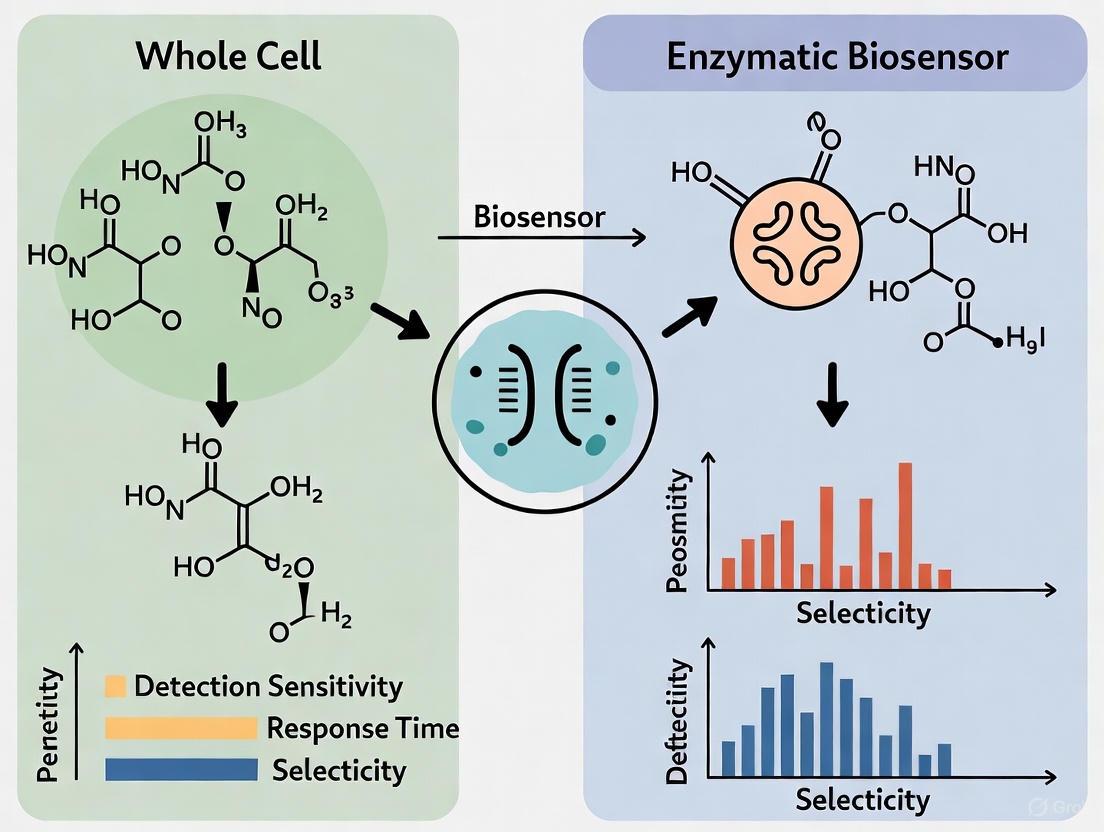
This article provides a comprehensive analysis for researchers and scientists on the two predominant biosensing technologies for pesticide monitoring: enzymatic and whole-cell biosensors.
Whole Cell vs. Enzymatic Biosensors for Pesticide Detection: A Comparative Guide for Researchers
Abstract
This article provides a comprehensive analysis for researchers and scientists on the two predominant biosensing technologies for pesticide monitoring: enzymatic and whole-cell biosensors. We explore the foundational principles of each technology, detailing how enzymatic biosensors leverage isolated enzyme kinetics while whole-cell systems utilize complex cellular machinery. The scope covers the latest methodological advances, including genetic engineering of microbial chassis and nanozyme development, alongside practical applications in environmental and food safety monitoring. A critical comparative evaluation addresses key performance metrics—sensitivity, specificity, stability, and real-world applicability—empowering professionals to select optimal biosensor configurations for specific research and development objectives in biomedical and environmental health.
Core Principles: How Enzymatic and Whole-Cell Biosensors Work
The detection of pesticides and other environmental contaminants relies heavily on biosensor technology, which connects a biological recognition element to a signal transducer. Within this field, two distinct technological paradigms have emerged: biosensors based on isolated enzymes and those utilizing whole-cell systems. The fundamental distinction lies in the complexity of the biological recognition element. Isolated enzyme biosensors employ purified enzyme molecules, such as acetylcholinesterase (AChE), to catalyze specific reactions with a target analyte, generating a measurable product [1] [2]. In contrast, whole-cell biosensors use living microbial or other cells as integrated sensing machines, where the recognition of a target substance is coupled to an internal response, such as the expression of a reporter gene [3] [4].
The choice between these paradigms is central to the design of any biosensing strategy for pesticide research. Isolated enzyme systems offer high catalytic efficiency and rapid response, leveraging the specificity of enzyme-substrate interactions [1]. Whole-cell systems, on the other hand, provide a more robust sensing platform that can mimic biological effects and self-replicate, but often with slower response times [3]. This technical guide provides an in-depth comparison of these technologies, detailing their components, operational principles, and experimental implementation to inform their application in pesticide detection.
Isolated Enzyme Biosensors: Principles and Components
Core Architecture and Working Principle
An isolated enzyme biosensor functions by integrating a biological recognition element (the enzyme) with a physicochemical transducer [1]. Its operation follows a defined sequence:
- Recognition: The target analyte (substrate) specifically binds to the enzyme's active site.
- Catalysis: The enzyme catalyzes the conversion of the substrate into one or more products.
- Transduction: A physicochemical change resulting from the reaction—such as the production or consumption of electrons, protons, heat, or light—is detected by the transducer.
- Signal Output: The transducer converts this change into a quantifiable electrical or optical signal proportional to the analyte concentration [1].
A key application in pesticide detection is the inhibition-based biosensor. For organophosphorus and carbamate pesticides, the enzyme acetylcholinesterase (AChE) is commonly used. In its standard activity, AChE hydrolyzes the neurotransmitter acetylcholine. In a biosensor, this reaction produces a detectable product, such as thiocholine from acetylthiocholine. When pesticides are present, they inhibit AChE, leading to a measurable reduction in product formation and signal output, which correlates with the pesticide concentration [1] [5].
Transducer Mechanisms and Immobilization Techniques
The transducer is critical for signal conversion. Common transducer types in enzyme biosensors include:
- Electrochemical Transducers: The most common type, which includes:
- Optical Transducers: Measure changes in light properties, such as absorbance, fluorescence, or chemiluminescence, due to the enzymatic reaction [1] [2].
- Thermal Transducers (Thermistor): Detect the heat released or absorbed during the enzymatic catalysis [1].
To ensure stability and reusability, the enzyme must be effectively immobilized onto the transducer surface. Key immobilization strategies are compared in the table below [1].
Table 1: Enzyme Immobilization Techniques for Biosensor Fabrication
| Technique | Mechanism | Advantages | Limitations |
|---|---|---|---|
| Covalent Bonding | Formation of stable covalent bonds between enzyme and functionalized support. | Strong attachment; high stability; minimal enzyme leakage. | Potential loss of enzyme activity due to harsh conditions. |
| Entrapment | Enzyme physically confined within a polymeric network or gel. | Mild conditions; protection of enzyme from the external environment. | Diffusion limitations for substrate and product; possible leaching. |
| Physical Adsorption | Enzyme bound via weak forces (Van der Waals, ionic). | Simple procedure; no chemical modification. | Weak binding; enzyme desorption over time. |
| Cross-linking | Enzymes linked to each other or to a support via cross-linking agents. | High enzyme loading; stable matrix. | Can reduce enzymatic activity; may be difficult to control. |
Whole-Cell Biosensors: Engineering Cellular Machinery
Synthetic Biology Design Principles
Whole-cell biosensors (WCBs) are constructed using synthetic biology to engineer genetic circuits within a host organism (the "chassis cell"), such as E. coli or yeast. These circuits comprise two core functional elements [3]:
- Sensing Element: This is typically a transcription factor or a riboswitch that acts as the molecular "lock" for the "key" (the target analyte, e.g., a pesticide or heavy metal). The sensing element regulates the expression of a downstream reporter gene.
- Reporting Element: This is a gene that codes for a easily detectable protein, such as a fluorescent protein (e.g., GFP), an enzyme that catalyzes a colorimetric reaction, or a gas.
When the target analyte enters the cell and binds to the sensing element, it triggers a conformational change. This change allows RNA polymerase to bind to the promoter and transcribe the reporter gene, leading to the production of the reporter protein. The resulting signal (e.g., fluorescence intensity) is quantitatively related to the analyte concentration [3] [4].
Advanced Circuit Engineering for Performance Enhancement
A significant challenge in WCB design is balancing high sensitivity with low background signal leakage. Advanced regulatory circuits have been developed to address this. For instance, a dual-input promoter was engineered for ultra-trace cadmium detection (LC100-2 biosensor), incorporating the LacI protein as both a signal amplifier and a negative feedback module [4]. This design dramatically improved sensitivity while minimizing background leakage, demonstrating the power of sophisticated genetic circuit design in creating high-performance biosensors.
Comparative Analysis: Performance and Applications
The technical distinctions between isolated enzyme and whole-cell biosensors lead to direct differences in performance metrics and suitability for specific applications in pesticide research.
Table 2: Quantitative Comparison of Isolated Enzyme and Whole-Cell Biosensors
| Parameter | Isolated Enzyme Biosensors | Whole-Cell Biosensors |
|---|---|---|
| Response Time | Seconds to minutes [1] | Minutes to hours [3] |
| Operational Stability | Moderate to low (enzyme denaturation) [1] | High (self-regenerating) [3] |
| Detection Limit | ~0.38 pM for OPs (fluorescence-based) [5] | ~0.00001 nM for Cd²⁺ (engineered circuit) [4] |
| Specificity | Very high (enzyme-substrate specificity) [1] | Can be engineered; may detect class effects [3] |
| Sample Compatibility | Can be affected by matrix interferents [1] | High, due to cellular homeostasis [3] |
| Lifespan & Storage | Limited (requires stable enzyme storage) [1] | Long (cells can be revived from frozen stocks) [3] |
| Cost & Production | Enzyme purification can be costly [1] | Low cost; mass-produced via cell division [3] |
| Toxicity Assessment | Measures specific biochemical interaction | Can report on integrated bioavailability and cellular toxicity |
Experimental Protocols for Biosensor Implementation
Protocol for Fabricating an Acetylcholinesterase (AChE) Inhibition Biosensor
This protocol details the creation of a sensor for organophosphorus pesticides based on AChE inhibition and electrochemical detection [1] [5].
Research Reagent Solutions:
- Acetylcholinesterase (AChE): Biological recognition element; catalyzes substrate reaction.
- Acetylthiocholine (ATCh) or Acetylcholine: Enzyme substrate; reaction produces detectable signal.
- Electrode (e.g., Glassy Carbon, Screen-Printed): Signal transducer platform.
- Immobilization Matrix (e.g., Chitosan, Nafion, BSA-Glutaraldehyde): Stabilizes enzyme on electrode.
- Buffer (e.g., Phosphate Buffer Saline, PBS): Maintains stable pH for enzyme activity.
- Nanomaterial (e.g., Graphene, Carbon Nanotubes, Metal Nanoparticles): Enhances electron transfer and sensor sensitivity.
Procedure:
- Electrode Pretreatment: Clean the working electrode (e.g., glassy carbon) by polishing with alumina slurry and rinsing with deionized water.
- Nanomaterial Modification (Optional): Deposit a suspension of nanomaterials (e.g., graphene oxide) onto the electrode surface and allow to dry to enhance the surface area and conductivity.
- Enzyme Immobilization: Apply a mixture of AChE and the immobilization matrix (e.g., a solution of AChE in chitosan) onto the modified electrode surface. Allow the matrix to cross-link or solidify, entrapping the enzyme.
- Sensor Calibration: Immerse the biosensor in a stirred buffer solution. Apply a constant potential and record the background current. Add successive aliquots of the substrate (ATCh) and record the steady-state current generated from the enzymatic production of thiocholine.
- Inhibition Assay: Incubate the biosensor with a sample containing the potential pesticide (inhibitor) for a fixed time (e.g., 10-15 minutes). Wash the sensor and repeat the calibration step with ATCh.
- Data Analysis: Calculate the percentage of enzyme inhibition using the formula:
% Inhibition = [(I_control - I_sample) / I_control] * 100, whereI_controlis the current before inhibition andI_sampleis the current after inhibition. Quantify pesticide concentration by comparing against a calibration curve of inhibition vs. standard pesticide concentration.
Protocol for a Whole-Cell Biosensor for Heavy Metal Detection
This protocol outlines the use of a genetically engineered bacterial biosensor for detecting heavy metal ions, a common co-contaminant with pesticides [3] [4].
Research Reagent Solutions:
- Engineered Chassis Cells (e.g., E. coli): Contain genetic circuit for sensing and reporting.
- Selection Antibiotic: Maintains plasmid stability in culture.
- Inducer/Analyte Standard: Pure standard for calibration (e.g., Cd²⁺ solution).
- Growth Media (e.g., LB Broth): Supports cell growth and maintenance.
- Multi-well Plate (e.g., 96-well): Platform for high-throughput assay.
- Microplate Reader: Instrument to quantify optical signals (fluorescence/absorbance).
Procedure:
- Cell Culture: Inoculate a culture of the engineered biosensor strain in a growth medium containing the appropriate antibiotic to maintain the sensor plasmid. Grow overnight to stationary phase.
- Sensor Induction: Dilute the overnight culture in fresh, pre-warmed medium. Aliquot the diluted cells into a multi-well plate. Add the sample or a series of standard solutions containing the target analyte (e.g., Cd²⁺) to the wells. Include a negative control (no analyte) and a positive control if available.
- Incubation and Signal Development: Incubate the plate at the optimal temperature for the chassis cell with shaking, typically for several hours to allow for gene expression and signal development.
- Signal Measurement: Place the plate in a microplate reader. Measure the fluorescence intensity (e.g., excitation/emission for GFP) or absorbance of the culture in each well.
- Data Analysis: Subtract the signal from the negative control (background) from all samples. Plot the corrected signal against the known concentrations of the standard to generate a calibration curve. The concentration of the analyte in unknown samples can be determined by interpolating from this curve.
The Scientist's Toolkit: Essential Research Reagents
The development and deployment of biosensors require a suite of specialized reagents and materials. The following table details key solutions and their functions in biosensor research.
Table 3: Key Research Reagent Solutions for Biosensor Development
| Reagent/Material | Function/Explanation | Primary Application |
|---|---|---|
| Acetylcholinesterase (AChE) | Key biorecognition element; its inhibition by OPs/carbamates is the basis of detection. | Enzyme Inhibition Biosensors [1] [5] |
| Glucose Oxidase (GOx) | Model enzyme for biosensor development; catalyzes glucose oxidation. | Medical Diagnostics, Biosensor Fundamentals [1] [7] |
| Transcription Factors (e.g., MerR, CadR) | Natural or engineered proteins that bind specific analytes and regulate gene expression. | Whole-Cell Biosensor Sensing Elements [3] [4] |
| Reporter Proteins (e.g., GFP, RFP) | Generate a measurable optical signal (fluorescence) upon gene expression. | Whole-Cell Biosensor Reporting Elements [3] [8] |
| Molecularly Imprinted Polymers (MIPs) | Synthetic, stable polymers with cavities complementary to a target molecule. | Biomimetic Recognition Element in Sensors [9] |
| Nanozymes (e.g., CuO NPs, SACe-N-C) | Nanomaterials with enzyme-like catalytic activity; offer enhanced stability. | Stable Alternatives to Natural Enzymes [5] |
| Carbon Nanotubes / Graphene | Enhance electrical conductivity and provide a high surface area for immobilization. | Electrochemical Transducer Enhancement [1] [10] |
| Nicotinamide Adenine Dinucleotide (NAD+) | Coenzyme required for the activity of many dehydrogenase enzymes. | Enzyme-Based Electrochemical Gas Sensors [6] |
Enzymatic biosensors are analytical devices that integrate a biological enzyme as the primary recognition element with a physicochemical transducer to produce a measurable signal proportional to the concentration of a target analyte [11]. The defining characteristic of these biosensors is their reliance on the specific catalytic reaction mediated by the immobilized enzyme, which selectively converts the target substrate into a measurable product [12]. This catalytic mechanism stands in sharp contrast to affinity-based biosensors (e.g., immunosensors or DNA sensors) that depend on binding events without substrate conversion. The exceptional specificity of enzymatic biosensors originates from the lock-and-key relationship between the enzyme's active site and its specific substrate, enabling accurate detection even within complex sample matrices like environmental water, food products, or biological fluids [12] [13].
In the broader context of pesticide detection research, enzymatic biosensors represent a sophisticated alternative to whole-cell biosensing systems. While whole-cell biosensors (utilizing algae, cyanobacteria, or bacteria) often detect herbicides through non-specific inhibition of photosynthetic electron transport in photosystem II (PSII), enzymatic biosensors typically employ enzyme inhibition principles or occasionally direct substrate conversion for specific pesticide quantification [14]. This targeted approach offers potentially higher specificity for individual pesticides or well-defined pesticide classes, though it may sacrifice the broad-spectrum detection capability of some whole-cell systems that respond to multiple pesticides sharing a common inhibition mechanism [14] [15].
Core Mechanism and Signal Transduction
Fundamental Operating Principle
The operational mechanism of enzymatic biosensors follows a consistent sequence: (1) diffusion of the target analyte (substrate) to the biologically active surface, (2) specific recognition and catalytic conversion of the substrate by the immobilized enzyme, (3) transduction of the biochemical signal into a measurable physical signal, and (4) signal processing and readout [13]. The catalytic reaction typically generates or consumes a detectable species (electroactive products, protons, light, or heat), with the reaction rate being proportional to the substrate concentration according to Michaelis-Menten kinetics [12].
The mechanism of signal generation varies significantly based on the transducer type. Electrochemical biosensors dominate the field due to their high sensitivity, ease of miniaturization, and cost-effectiveness [12] [16]. These are frequently categorized into amperometric, potentiometric, conductometric, and impedimetric systems. Optical biosensors represent another major category, capitalizing on phenomena such as absorbance, fluorescence, chemiluminescence, or surface plasmon resonance to detect the products of enzymatic reactions [12].
Enzyme Inhibition-Based Detection for Pesticides
A substantial segment of enzymatic biosensors for pesticide detection operates on the principle of enzyme inhibition rather than direct substrate conversion [14]. In this configuration, the measurable signal (typically the rate of substrate conversion by the enzyme) decreases upon exposure to pesticides that act as enzyme inhibitors. The degree of inhibition correlates with the pesticide concentration, enabling quantification [14] [13]. This approach is particularly relevant for detecting organophosphate and carbamate insecticides, which are potent acetylcholinesterase (AChE) inhibitors, as well as herbicides that target specific plant enzymes [14].
Key advantages of inhibition-based biosensors include their ability to detect pesticides that are not direct enzyme substrates and their compatibility with a wide range of transducer types. However, a significant challenge is the limited specificity, as different pesticides may inhibit the same enzyme, making it difficult to identify the specific inhibitor in a sample [14]. Additionally, the detection requires a reversible inhibition mechanism to allow biosensor regeneration, or single-use configurations must be employed.
Table 1: Common Enzyme Classes Used in Biosensors and Their Detection Mechanisms
| Enzyme Class | Example Enzymes | Target Analytes | Detection Mechanism | Application in Pesticide Detection |
|---|---|---|---|---|
| Oxidoreductases | Glucose Oxidase, Polyphenol Oxidase, Tyrosinase | Glucose, Phenolic compounds, Catechol | Amperometric detection of electron transfer via mediators or direct electron transfer | Detection of herbicides like atrazine via inhibition of tyrosinase [12] [14] |
| Hydrolases | Acetylcholinesterase, Alkaline Phosphatase, Organophosphohydrolase | Acetylcholine, Organophosphates | Potentiometric detection of pH change or amperometric detection of electroactive products | Direct detection of organophosphates or inhibition-based detection [14] [13] |
| Lyases | 5-enolpyruvylshikimate-3-phosphate synthase (EPSPS) | Glyphosate | Optical or electrochemical detection of reaction products | Direct detection of glyphosate herbicide [14] |
Experimental Implementation and Methodologies
Biosensor Fabrication Protocol: Enzyme Immobilization
A critical determinant of enzymatic biosensor performance is the method employed for enzyme immobilization on the transducer surface. The immobilization strategy must preserve enzymatic activity while ensuring strong attachment and stability. A representative protocol based on recent research for constructing a glucose biosensor using glucose oxidase (GOx) immobilized in a polyacrylic acid/carbon nanotube (PAA/CNT) composite is detailed below [16]:
Materials Required:
- Pt disk electrodes (3 mm diameter) or screen-printed Pt electrodes
- Carboxylated single-walled carbon nanotubes (1.0-3.0 at % carboxylic acid)
- Glucose oxidase (GOx) from Aspergillus niger
- Polyacrylic acid (PAA, average M_r ~250,000)
- Sodium phosphate buffer (0.1 M, pH 7.0)
- Polishing suspension (0.4 μm alumina powder)
Step-by-Step Procedure:
Electrode Pretreatment: Polish the Pt disk electrode on a pad soaked with alumina suspension to create a fresh, clean surface. Rinse thoroughly with deionized water.
CNT Layer Formation: Apply 5 μL of a homogenous, ultrasonicated CNT suspension (5 mg mL⁻¹ in deionized water) onto the Pt disk surface. Allow to dry completely, forming a thin, adherent, nano-porous CNT film.
Enzyme Loading: Apply 5 μL of GOx solution (20 mg mL⁻¹ in 0.1 M sodium phosphate buffer, pH 7.0) onto the CNT-modified electrode. Dry at room temperature, allowing the enzyme to adsorb into the CNT matrix.
Polymeric Encapsulation: Apply 5 μL of diluted PAA suspension (0.5 mg mL⁻¹) over the GOx-CNT layer and dry. This PAA topcoat serves as a protective barrier against enzyme leakage while permitting substrate diffusion.
Conditioning: Immerse the completed biosensor in stirred 0.1 M sodium phosphate buffer (pH 7.0) for 30 minutes to remove loosely attached components.
This fabrication approach exemplifies a simple "drop-and-dry" immobilization technique that combines adsorption (enzyme onto CNTs) with entrapment (behind a PAA membrane), resulting in biosensors with excellent operational stability and sensitivity down to 10 μM glucose [16].
Amperometric Measurement Protocol
Amperometric detection represents one of the most common transduction methods for enzymatic biosensors, particularly for pesticide detection [14]. The following protocol describes the measurement setup for a typical oxidase-based biosensor:
Apparatus and Reagents:
- Potentiostat connected to a three-electrode electrochemical cell
- Biosensor as working electrode (WE)
- Ag/AgCl reference electrode (RE)
- Pt wire counter electrode (CE)
- 0.1 M sodium phosphate buffer (pH 7.0) as electrolyte
- Standard solutions of the target analyte
Measurement Procedure:
Instrument Setup: Connect the biosensor as the working electrode in the three-electrode cell configuration. Set the working electrode potential to the optimal value for detecting the enzymatic product (e.g., +0.6 V vs. Ag/AgCl for anodic detection of H₂O₂ generated by oxidase enzymes) [16].
Baseline Establishment: Immerse the electrode system in stirred buffer and apply the set potential until a stable baseline current is established.
Standard Additions: Introduce successive aliquots of standard analyte solutions into the cell under continuous stirring. The enzyme catalyzes the conversion of the analyte, producing an electroactive product (e.g., H₂O₂ from glucose oxidase reaction).
Current Measurement: Record the steady-state oxidation current resulting from the electrochemical detection of the enzymatic product at each analyte concentration.
Calibration Curve: Plot the measured current (or current change) against analyte concentration to generate a calibration curve for quantitative analysis.
For inhibition-based pesticide detection, the procedure is modified to include:
Initial Activity Measurement: Determine the baseline enzyme activity by measuring the current response to a fixed concentration of the enzyme's substrate.
Inhibition Phase: Expose the biosensor to the sample containing the pesticide inhibitor for a fixed incubation period.
Residual Activity Measurement: Re-measure the enzyme activity using the same substrate concentration after inhibition.
Inhibition Calculation: Calculate the percentage inhibition as [(I₀ - Iᵢ)/I₀] × 100%, where I₀ is the initial current and Iᵢ is the current after inhibition. The percentage inhibition is then correlated with pesticide concentration using a calibration curve.
Performance Data and Comparative Analysis
Analytical Performance of Representative Enzymatic Biosensors
The analytical performance of enzymatic biosensors varies significantly based on the enzyme, immobilization method, transducer type, and target analyte. The following table summarizes performance metrics for representative enzymatic biosensors reported in recent literature, with particular emphasis on systems applicable to pesticide detection.
Table 2: Performance Metrics of Representative Enzymatic Biosensors
| Target Analyte | Enzyme Used | Transducer Type | Linear Range | Detection Limit | Application Demonstrated |
|---|---|---|---|---|---|
| Phenolic Compounds | Polyphenol Oxidase (PPO) | Electrochemical | N/A | 0.13 μM (for catechin) | Food quality control in kombucha samples [12] |
| D-2-hydroxyglutaric acid (D2HG) | D-2-hydroxyglutarate Dehydrogenase (D2HGDH) | Amperometric with electron mediator | 0.5-120 μM | N/A | Detection in fetal bovine serum and artificial urine [12] |
| Catechol | Tyrosinase (TYR) | Personal Glucose Meter (PGM) adaptation | N/A | N/A | TYR activity and inhibitor detection [12] |
| Atrazine | Acetolactate Synthase (ALS) | Heterogeneous assay | N/A | N/A | Herbicide detection [14] |
| Glyphosate | 5-enolpyruvylshikimate-3-phosphate synthase (EPSPS) | Heterogeneous assay | N/A | N/A | Herbicide detection [14] |
Comparative Analysis: Enzymatic vs. Whole-Cell Biosensors for Pesticide Detection
When evaluating biosensing platforms for pesticide detection, understanding the relative advantages and limitations of enzymatic versus whole-cell approaches is essential for selecting the appropriate technology for specific applications.
Table 3: Enzymatic vs. Whole-Cell Biosensors for Pesticide Detection
| Parameter | Enzymatic Biosensors | Whole-Cell Biosensors |
|---|---|---|
| Specificity | High specificity for target enzyme substrates or inhibitors; can distinguish between closely related chemical structures [14] | Broader specificity; often detect entire classes of pesticides sharing a mode of action (e.g., PSII inhibitors) [14] [15] |
| Detection Mechanism | Direct enzyme inhibition or substrate conversion | Typically inhibition of photosynthetic electron transport or metabolic pathways [14] |
| Response Time | Minutes to tens of minutes | Can be slower (tens of minutes to hours) due to diffusion barriers and complex physiological responses [14] |
| Lifespan & Stability | Moderate stability (days to weeks); enzyme activity degrades over time | Can be more robust; living cells can maintain functionality longer under proper conditions [14] |
| Complexity | Relatively simple system with single biological component | Complex system with multiple interacting components and metabolic pathways [14] |
| Primary Applications in Pesticide Detection | Detection of specific herbicides (e.g., atrazine, glyphosate) and insecticides (organophosphates, carbamates) via enzyme inhibition [14] | Broad-spectrum detection of photosynthetic inhibitors (e.g., diuron, atrazine) and other metabolic disruptors [14] [15] |
| Key Advantage | High specificity, well-defined mechanism, rapid response for certain systems | Broader detection capability, can indicate biological availability and toxicity [14] |
| Principal Limitation | Limited to detecting compounds that interact with specific enzymes; enzyme stability issues | Less specific, longer response times, complex maintenance requirements [14] |
The Scientist's Toolkit: Essential Research Reagents and Materials
Successful development and implementation of enzymatic biosensors requires specific materials and reagents that ensure optimal performance, stability, and reproducibility. The following toolkit compiles essential components referenced across multiple studies.
Table 4: Essential Research Reagents for Enzymatic Biosensor Development
| Category/Reagent | Specific Examples | Function/Purpose | Application Notes |
|---|---|---|---|
| Enzyme Materials | Glucose Oxidase, Tyrosinase, Polyphenol Oxidase, Acetylcholinesterase, Alkaline Phosphatase | Biological recognition element; provides specificity through catalytic action or inhibition | Select based on target analyte; consider purity, specific activity, and inhibition characteristics [12] [14] [16] |
| Electrode Materials | Pt disk electrodes, Screen-printed electrodes (SPE), Gold electrodes, Carbon-based electrodes | Signal transduction platform; serves as base for enzyme immobilization and electron transfer | Screen-printed electrodes enable mass fabrication and disposable applications [12] [16] |
| Nanomaterials | Carbon nanotubes (CNTs), Graphene, Gold nanoparticles, Two-dimensional materials | Enhance surface area, improve electron transfer efficiency, facilitate enzyme immobilization | CNTs create nanoporous films for high enzyme loading; functionalized CNTs enable covalent immobilization [16] |
| Immobilization Matrices | Polyacrylic acid (PAA), Chitosan, Polyaniline, Nafion, Self-assembled monolayers (SAMs) | Entrap and stabilize enzymes on transducer surface; prevent enzyme leakage while allowing substrate diffusion | PAA forms protective topcoats; optimal concentration critical (0.5 mg/mL in drop-and-dry methods) [16] |
| Electron Mediators | Methylene Blue, Ferrocene derivatives, Hexacyanoferrate, Quinones | Shuttle electrons between enzyme active site and electrode surface; enhance signal intensity | Particularly important for oxidoreductases without direct electron transfer capability [12] |
| Buffer Systems | Phosphate buffer, Tris buffer, Acetate buffer | Maintain optimal pH for enzyme activity; provide consistent ionic environment | Typical concentration 0.1 M, pH optimized for specific enzyme (e.g., pH 7.0 for many oxidases) [16] |
Enzymatic biosensors represent a sophisticated technology platform that leverages the exceptional specificity of biological catalysis for analytical detection. Their core mechanism, centered on enzyme-substrate recognition and catalytic conversion, provides fundamental advantages in specificity and design flexibility compared to whole-cell alternatives. In pesticide detection research, enzymatic biosensors offer the potential for targeted detection of specific herbicide and insecticide classes through well-defined inhibition mechanisms, complementing the broader-spectrum detection capabilities of whole-cell systems.
Despite significant advances, challenges remain in enhancing enzyme stability, improving immobilization techniques, and expanding the repertoire of detectable pesticides. Future directions will likely focus on integrating novel nanomaterials to enhance sensitivity, developing multiplexed platforms for simultaneous detection of multiple pesticides, and creating more robust immobilization strategies for field-deployable devices. As these technologies mature, enzymatic biosensors are poised to play an increasingly important role in environmental monitoring, food safety, and public health protection through their unique combination of biological specificity and analytical precision.
The detection of pesticide residues represents a critical challenge in ensuring environmental safety and food security. Within this field, two principal biosensing architectures have emerged: enzymatic biosensors and whole-cell biosensors. While enzymatic biosensors utilize isolated enzymes as recognition elements, whole-cell biosensors employ living microorganisms as integrated sensing systems. The fundamental distinction lies in their biological complexity; enzymatic biosensors rely on single enzyme-target interactions, whereas whole-cell biosensors exploit the full metabolic and regulatory capabilities of living cells [14] [17].
For pesticide detection, enzymatic biosensors typically function on the principle of enzyme inhibition. Neurotoxic insecticides such as organophosphates and carbamates are detected through their inhibition of acetylcholinesterase (AChE), while herbicides like atrazine and diuron are detected via their inhibition of photosystem II (PSII) or enzymes such as tyrosinase [14] [17]. These systems offer direct measurement capabilities but often lack specificity, as multiple compounds can inhibit the same enzyme. Moreover, they require enzyme purification and stabilization, increasing complexity and cost [14].
In contrast, whole-cell biosensors leverage cellular transcription factors and genetic circuits to detect target compounds, converting this recognition into measurable signals through synthetic biology approaches. These systems benefit from inherent amplification through gene expression, self-replication of sensing components, and the protective intracellular environment that enhances stability [3]. This architectural comparison frames the subsequent detailed examination of whole-cell biosensor design, which offers distinct advantages for implementation in pesticide monitoring programs.
Table 1: Core Architectural Comparison Between Biosensor Types for Pesticide Detection
| Feature | Enzymatic Biosensors | Whole-Cell Biosensors |
|---|---|---|
| Recognition Element | Purified enzymes (e.g., AChE, tyrosinase, PSII) | Transcription factors, riboswitches, cellular metabolic pathways |
| Detection Principle | Mainly enzyme inhibition | Ligand-induced gene expression |
| Specificity | Lower - multiple inhibitors affect same enzyme | Higher - can be engineered for specific targets |
| Production Cost | Higher - requires enzyme purification | Lower - cells self-replicate all components |
| Stability | Moderate - enzymes require stabilization | High - intracellular environment provides stability |
| Sample Pre-treatment | Often required | Minimal due to cellular anti-interference capabilities |
| Multi-analyte Detection | Challenging | Enabled through complex genetic circuits |
Core Architectural Components of Whole-Cell Biosensors
The architecture of synthetic biological whole-cell biosensors comprises three fundamental components: sensing elements that detect target substances, genetic circuits that process this information, and reporting elements that generate measurable outputs. This modular organization enables the engineering of sophisticated detection systems for diverse pesticides and other contaminants [3].
Sensing Elements: Transcription Factors and Riboswitches
Sensing elements serve as the molecular recognition interface between the target analyte and the biosensor system. In whole-cell biosensors, these primarily consist of transcription factors and riboswitches that undergo conformational changes upon binding specific ligands [3].
Transcription factors are proteins that bind to specific DNA sequences upstream of genes, regulating their transcription. In biosensor design, the transcription factor and its corresponding inducible promoter sequence are identified and placed upstream of a reporter gene. When the target substance is present, it binds to the transcription factor, altering its ability to bind the promoter region and thereby activating or repressing transcription of the reporter gene. For pesticide detection, transcription factors can be engineered to recognize specific compounds. For instance, the TtgR transcription factor from Pseudomonas putida has been utilized to develop biosensors responsive to various flavonoids and bioactive compounds [18]. More than 300 prokaryotic transcription factors have been discovered, with databases such as CollecTF, P2TFA, porTF, and portTF providing resources for identifying factors that recognize specific targets [3].
Riboswitches represent another class of sensing elements. These are untranslated regions of mRNA containing sequences with specific conformations that can bind target molecules. When a riboswitch undergoes a conformational change upon ligand binding, it exposes or hides the ribosome binding sites of mRNA, thereby activating or inhibiting the translation process. This provides a direct means of regulating gene expression at the translational level in response to target analytes [3].
Reporting Elements: From Fluorescence to Gas Production
Reporting elements convert the internal recognition event into a detectable signal. The most common reporting elements are optical, particularly fluorescent proteins such as enhanced green fluorescent protein (eGFP) and red fluorescent proteins. These provide visual signals that can be quantified with high sensitivity using fluorometers [3] [18]. For example, in the TtgR-based biosensor system, eGFP serves as the reporter, with fluorescence intensity correlating with the concentration of target flavonoids [18].
Beyond fluorescence, other reporting mechanisms include gas production, colorimetric changes, and electrochemical signals. The choice of reporter depends on the application context; for instance, field-deployable devices may benefit from visual color changes, while laboratory settings can utilize more sophisticated fluorescent measurements [3].
Chassis Cells: Selection and Optimization
Chassis cells provide the cellular environment in which the biosensor components operate. Escherichia coli is frequently used due to its well-characterized genetics and ease of manipulation, as demonstrated in biosensors for heavy metals and flavonoids [4] [18]. Other microorganisms such as yeast (Saccharomyces cerevisiae) have also been employed, particularly for eukaryotic protein processing capabilities [3].
The selection of appropriate chassis cells is critical for biosensor performance, as cellular metabolism, membrane permeability, and background activity can all influence signal-to-noise ratios and detection limits. In some cases, chassis cells are engineered to enhance performance by reducing background expression or improving substrate uptake [3] [4].
Genetic Circuit Design: From Simple Switches to Complex Logic
Genetic circuits form the information processing core of whole-cell biosensors, linking sensing to reporting through programmed gene expression. These circuits have evolved from simple inducible systems to sophisticated networks incorporating amplification, logic operations, and feedback control.
Basic Circuit Configurations
The simplest genetic circuit consists of a sensing element directly controlling a reporter gene. For example, a transcription factor responsive to a target pesticide regulates the expression of a fluorescent protein. While straightforward, such designs often suffer from limited sensitivity and high background noise [3].
More advanced configurations incorporate signal amplification. In the LC100-2 biosensor for ultra-trace cadmium detection, the LacI protein serves as both a signal amplifier and a negative feedback module. The circuit employs a dual-input promoter (PT7-cadO-lacO-cadO) regulated by both Cd²⁺ and IPTG, with the structure "CadR-PJ23100-PT7-cadO-lacO-cadO-mRFP1-LacI" [4]. This design achieved a remarkable detection limit of 0.00001 nM for Cd²⁺, with sensitivity 3748 times greater than the basic construct [4].
Figure 1: Genetic Circuit Architecture with Signal Amplification and Feedback
Engineering Specificity and Sensitivity
Transcription factor engineering enables the customization of biosensor specificity and sensitivity. Several molecular approaches have been successfully employed:
Truncation: Shortening transcription factors to optimize performance. Tao et al. optimized specificity for cadmium and mercury ions by truncating 10 and 21 amino acids from the C-terminal of the CadR transcription factor [3].
Chimerism: Combining target recognition domains from one transcription factor with gene expression regulation domains from another. Mendoza et al. created a mercury-specific biosensor by replacing the gold ion recognition domain of GolS77 with the mercury ion recognition domain of MerR [3].
Functional Domain Mutation: Site-specific mutation of functional domains. Kasey et al. constructed a saturated mutation library of all five amino acid sites within the recognition domain of the MphR transcription factor, screening for mutants with enhanced specificity and sensitivity for macrolides [3].
Whole-Protein Mutation: Random mutation of the entire transcription factor protein. Chong et al. used error-prone PCR to introduce random mutations into DmpR genes, screening for transcription factors with improved performance and specific response to organophosphorus compounds [3].
De Novo Design: Creating entirely novel transcription factors. Chang et al. proposed a strategy for designing transcription factors from scratch by fusing single-domain antibodies to monomer DNA binding domains, creating sensors for new target ligands [3].
These engineering approaches have been successfully applied to pesticide detection systems. For instance, engineered TtgR variants with modified ligand-binding pockets demonstrated altered sensing profiles for flavonoids, enabling the development of biosensors with tailored specificity for compounds like resveratrol and quercetin [18].
Table 2: Transcription Factor Engineering Strategies for Enhanced Biosensor Performance
| Engineering Strategy | Mechanism | Application Example | Performance Outcome |
|---|---|---|---|
| Truncation | Shortening transcription factor length | CadR TF with 10-21 amino acids removed from C-terminal | Enhanced specificity for Cd²⁺ and Hg²⁺ over Zn²⁺ |
| Chimerism | Combining domains from different TFs | MerR recognition domain fused to GolS77 regulatory domain | Converted gold sensor to mercury sensor |
| Functional Domain Mutation | Site-specific mutation of binding pocket | Saturated mutagenesis of MphR's five binding amino acids | Increased specificity and sensitivity for macrolides |
| Whole-Protein Mutation | Random mutation throughout protein | Error-prone PCR on DmpR genes | Improved induced expression level for organophosphorus |
| De Novo Design | Creating novel TFs from scratch | Fusion of antibodies to DNA-binding domains | Transcription factors for new target ligands |
Experimental Protocols for Whole-Cell Biosensor Construction and Implementation
The development and application of whole-cell biosensors follows a systematic experimental pipeline from genetic construction to performance validation. Below are detailed protocols for key processes in biosensor implementation.
Biosensor Assembly and Transformation Protocol
Materials:
- E. coli BL21(DE3) or DH5α competent cells (chassis cells)
- Plasmid vectors (e.g., pCDF-Duet for sensing elements, pZnt-eGFP for reporting)
- Restriction enzymes (NdeI, NotI, BglII, XbaI)
- Ligase enzyme
- PCR components: template DNA, primers, Hotstar Taq polymerase, PfuTurbo for mutagenesis
- LB media: tryptone, yeast extract, sodium chloride
- Selection antibiotics [18]
Procedure:
- Genetic Element Amplification: Amplify transcription factor genes (e.g., ttgR) and corresponding operator sequences (e.g., PttgABC) via PCR using genomic DNA from source organisms (e.g., Pseudomonas putida) as template [18].
Plasmid Construction: Digest plasmid vectors and amplified DNA fragments with appropriate restriction enzymes (NdeI/NotI for sensing elements, BglII/XbaI for reporter elements). Purify fragments using gel elution kits and ligate using ligase enzyme [18].
Transformation: Introduce constructed plasmids into E. coli chassis cells via heat shock or electroporation. Plate transformed cells on LB agar containing appropriate selection antibiotics [18].
Colony Screening: Pick individual colonies, culture in liquid LB media with antibiotics, and verify plasmid construction through DNA sequencing [18].
Biosensor Performance Assay Protocol
Materials:
- Biosensor cell cultures
- Target analytes (pesticides, flavonoids, heavy metals)
- Dimethyl sulfoxide (DMSO) for stock solutions
- Fluorescence spectrometer (e.g., FluoroMate FC-2)
- Spectrophotometer for OD600 measurements [18]
Procedure:
- Culture Preparation: Inoculate biosensor cells from glycerol stocks into LB media with appropriate antibiotics. Grow overnight at 37°C with shaking at 250 rpm [18].
Exposure Experiment: Dilute overnight cultures in fresh media and grow until OD600 reaches approximately 0.3. Add target compounds (0.005–5 mM range) dissolved in DMSO. Include DMSO-only controls [18].
Signal Measurement: Incubate exposed cultures for 1-3 hours. Measure fluorescence intensity using excitation at 480 nm and emission at 510 nm. Simultaneously measure OD600 to normalize for cell density [18].
Data Analysis: Calculate induction coefficient as (eGFP intensity with chemical exposure)/(eGFP intensity without chemical exposure), with compensation for OD600 values. Generate dose-response curves by plotting induction coefficient against analyte concentration [18].
Specificity and Cross-Reactivity Testing Protocol
Materials:
- Biosensor cell cultures
- Panel of structurally related and unrelated compounds
- Positive and negative control compounds [18]
Procedure:
- Compound Panel Preparation: Prepare stock solutions of test compounds at maximum concentration (e.g., 5 mM) in appropriate solvents [18].
Exposure and Measurement: Expose biosensor cells to each compound individually using the biosensor performance assay protocol. Include known activators as positive controls and solvent-only as negative controls [18].
Specificity Calculation: Calculate response ratios for each compound relative to the positive control. Compounds eliciting less than 10-15% of the positive control response are typically considered non-cross-reactive [18].
Computational Validation: Perform in silico docking studies to understand structural basis of specificity. Use molecular modeling software to simulate transcription factor-ligand interactions and identify key binding residues [18].
Advanced Applications: Multi-Analyte Detection and Field Deployment
Whole-cell biosensors have evolved beyond single-analyte detection to incorporate sophisticated multi-analyte capabilities and field-deployable formats. These advancements address critical needs in pesticide monitoring where multiple contaminants may coexist and where on-site analysis provides significant advantages over laboratory-based methods.
Multi-Analyte Detection Systems
The integration of artificial neural networks (ANNs) with biosensor arrays enables the discrimination of multiple insecticides in complex mixtures. This approach utilizes the varying inhibition patterns of different acetylcholinesterase (AChE) variants toward organophosphates and carbamates. In one implementation, four AChE biosensors based on enzymes from different sources (electric eel, bovine erythrocytes, rat brain, and Drosophila melanogaster) were combined with ANN analysis to simultaneously detect paraoxon and carbofuran in mixtures with concentrations of 0–20 μg L⁻¹, achieving prediction errors of 0.9 μg L⁻¹ for paraoxon and 1.4 μg L⁻¹ for carbofuran [17].
Further refinement using genetically engineered AChE variants from Drosophila melanogaster (wild-type and mutants Y408F, F368L, F368H, and F368W) improved resolution for binary paraoxon and carbofuran mixtures at lower concentrations (0–5 μg L⁻¹), with prediction errors of 0.4 μg L⁻¹ for paraoxon and 0.5 μg L⁻¹ for carbofuran. Remarkably, this system was adapted to discriminate between two organophosphates (malaoxon and paraoxon) in mixtures, demonstrating versatility within the same insecticide class [17].
Figure 2: Multi-Analyte Detection System Using Biosensor Arrays and ANN
Field-Deployable Formats and Commercial Applications
Whole-cell biosensors have been implemented in various field-deployable formats including test strips, kits, and increasingly in wearable devices such as masks, hand rings, and clothing [3]. These formats leverage the key advantages of whole-cell systems: minimal sample preprocessing, stability in variable environmental conditions, and visual signal outputs that don't always require sophisticated instrumentation.
For photosynthetic herbicide detection, biosensors based on algae, cyanobacteria, thylakoids, or chloroplasts have been developed, primarily monitoring inhibition of photosynthetic electron transport through amperometric measurements or chlorophyll fluorescence [14]. These systems are particularly amenable to field deployment as they can utilize visual color changes or simple fluorometers for detection.
The integration of whole-cell biosensors into microfluidic devices and lab-on-a-chip systems further enhances their field applicability by enabling automated sample processing and multiplexed analysis. Such integrated systems represent the cutting edge of biosensor technology for environmental monitoring [3].
The Scientist's Toolkit: Essential Research Reagents and Materials
The construction and implementation of whole-cell biosensors requires specialized reagents and materials. The following table details essential components for biosensor development, particularly focused on pesticide detection applications.
Table 3: Essential Research Reagents for Whole-Cell Biosensor Development
| Reagent/Material | Specification/Example | Function in Biosensor Development |
|---|---|---|
| Chassis Cells | E. coli BL21(DE3), DH5α strains | Host organisms for genetic circuit implementation |
| Plasmid Vectors | pCDF-Duet, pZnt-eGFP | Carriers for sensing and reporter genetic elements |
| Restriction Enzymes | NdeI, NotI, BglII, XbaI | Molecular tools for plasmid construction |
| Polymerases | Hotstar Taq (amplification), PfuTurbo (mutagenesis) | DNA amplification and engineering |
| Culture Media | Lysogeny Broth (tryptone, yeast extract, NaCl) | Cell cultivation and maintenance |
| Target Compounds | Flavonoids, pesticides, heavy metal ions | Analytes for biosensor validation |
| Solvents | Dimethyl sulfoxide (DMSO) | Preparation of analyte stock solutions |
| Detection Instrumentation | Fluorescence spectrometer | Measurement of reporter signals |
| Engineering Templates | Genomic DNA from Pseudomonas putida | Source of natural transcription factors |
| Selection Agents | Appropriate antibiotics | Maintenance of plasmid integrity |
Whole-cell biosensors represent a sophisticated architecture for pesticide detection that leverages cellular regulatory mechanisms through synthetic biology. Their modular design—comprising sensing elements, genetic circuits, and reporting systems—enables customization for diverse detection scenarios. When compared to enzymatic biosensors, whole-cell systems offer advantages in specificity engineering, self-replication, reduced production costs, and robustness in complex sample matrices.
The future development of whole-cell biosensors will likely focus on enhancing sensitivity through improved genetic circuit design, expanding the range of detectable pesticides through transcription factor engineering, and creating increasingly field-deployable formats for on-site monitoring. As synthetic biology tools advance, the integration of more complex computational capabilities within living cells may further blur the distinction between biological sensors and analytical instruments, creating powerful new tools for environmental protection and food safety.
This technical guide examines the core performance drivers of enzymatic and whole-cell biosensors within pesticide research. It provides a comparative analysis of specificity, sensitivity, and signal transduction mechanisms, underpinned by experimental protocols and quantitative data. Enzymatic biosensors typically achieve higher specificity through inhibitor-based recognition, whereas whole-cell systems offer broader biological relevance by detecting photosynthetic inhibition. Advancements in chemical signal amplification, nanomaterials, and genetic engineering are pushing detection limits to sub-picomolar concentrations, enabling these biosensors to serve as rapid, cost-effective early-warning systems that complement traditional chromatographic methods [19] [14] [17].
Biosensor performance is quantifiably evaluated through three interdependent parameters: sensitivity, specificity, and the efficiency of signal transduction. Sensitivity defines the lowest detectable concentration of an analyte, often expressed as the limit of detection (LOD). Specificity refers to the biosensor's ability to distinguish the target analyte from other interfering substances in a complex sample matrix. Signal transduction encompasses the process of converting the biorecognition event into a quantifiable physical signal, such as an electrical current or optical change [19] [17].
In the context of pesticide detection, the choice between enzymatic and whole-cell biosensors fundamentally shapes these performance parameters. Enzymatic biosensors often exploit the direct inhibition of a purified enzyme (e.g., acetylcholinesterase for neurotoxic insecticides, tyrosinase for herbicides), providing a highly specific molecular interaction. In contrast, whole-cell biosensors typically utilize photosynthetic organisms (e.g., algae, cyanobacteria) or their subcellular components (e.g., thylakoids, chloroplasts) to detect compounds that inhibit photosystem II (PSII), offering a more holistic measure of toxicity but potentially sacrificing molecular specificity [14] [17].
Specificity in Biosensor Design
Specificity is engineered into the biological recognition element. For pesticide detection, the mode of action of the herbicide or insecticide directly informs the choice of biorecognition element.
Enzymatic Biosensors
These biosensors achieve specificity by utilizing enzymes that are known targets of pesticides.
- Acetylcholinesterase (AChE) Inhibition: This is the standard mechanism for detecting neurotoxic organophosphates (OP) and carbamates (CB). The enzyme's active site binds these inhibitors, leading to irreversible (OP) or reversible (CB) inactivation. The degree of inhibition correlates with pesticide concentration [17].
- Photosystem II (PSII) Enzymes: Enzymes like tyrosinase or peroxidase are used to detect herbicides like atrazine and diuron, which inhibit the photosynthetic electron transport chain by binding to the D1 protein in PSII [14] [17].
- Enhancement Strategies: To overcome cross-reactivity, researchers use arrays of biosensors featuring genetically engineered mutant enzymes with varying inhibitor sensitivities. Data from these arrays are processed with chemometric methods like artificial neural networks (ANNs) to resolve mixtures of insecticides, such as paraoxon and carbofuran [17].
Whole-Cell Biosensors
These biosensors trade some molecular specificity for biological relevance.
- PSII-Based Detection: Whole-cell biosensors primarily detect the gross physiological effect of herbicides that inhibit photosynthesis. They measure the decrease in chlorophyll fluorescence or photosynthetic oxygen evolution, which is a generic response to all PSII-inhibiting herbicides [14].
- Specificity Limitations: This approach is less specific than enzymatic inhibition, as any stressor affecting photosynthesis can produce a false positive. However, it provides a "biologically relevant" integrated response to toxicity, which is valuable as an early-warning signal [14] [17].
Table 1: Specificity Comparison of Biosensor Types for Common Pesticides
| Biosensor Type | Biorecognition Element | Target Herbicide Examples | Mechanism of Action | Specificity Level |
|---|---|---|---|---|
| Enzymatic | Acetylcholinesterase (AChE) | Paraoxon, Carbofuran | Inhibition of enzyme activity | High (Molecular-level) |
| Enzymatic | Tyrosinase, Peroxidase | Atrazine, Diuron | Inhibition of PSII-associated enzymes | High (Molecular-level) |
| Whole-Cell | Algae, Cyanobacteria | Atrazine, Diuron | Inhibition of photosynthetic activity | Moderate (Pathway-level) |
| Organelle-Based | Thylakoids, Chloroplasts | Atrazine, Diuron | Inhibition of electron transport in PSII | Moderate (Pathway-level) |
Sensitivity and Signal Transduction Mechanisms
Sensitivity is predominantly enhanced at the signal transduction step, where a single biorecognition event is amplified into a strong, detectable signal.
Signal Amplification Strategies
A key strategy for enhancing sensitivity is chemical signal amplification, which maximizes the signal output per binding event [19].
- Polymerization-Based Amplification: This method uses radical initiators conjugated to probe molecules. Upon target recognition, a polymerization reaction is triggered, growing a long-chain polymer (e.g., poly-HEMA) from monomer molecules. The polymer formation, detectable as opaqueness or a mass change, dramatically amplifies the initial signal, enabling detection limits as low as 1 fM for DNA and 2.19 fmol/spot for immunoassays [19].
- Nanocatalyst-Based Amplification: Nanomaterials like Au/Pt or porous Pt nanoparticles act as peroxidase mimics. When conjugated to detection probes, these catalysts drive the oxidation of chromogenic substrates (e.g., TMB), producing a intense color signal. This method has achieved detection limits of 3.1 pg/mL and 0.8 pg/mL in sandwich-type lateral flow immunoassays [19].
- Enzymatic Amplification: Directly inspired by ELISA, this approach conjugates enzymes to detection antibodies or probes. The enzyme catalyzes the repeated turnover of a substrate into a colored, fluorescent, or chemiluminescent product, leading to significant signal accumulation [19] [17].
Transduction Modalities
The physical method of signal detection is chosen based on the application and required sensitivity.
- Electrochemical (Amperometry): The most common method for enzymatic and whole-cell biosensors. It measures the electrical current generated from redox reactions, such as the oxidation of phenolic products from enzyme activity or the reduction of oxygen in photosynthetic systems. It is known for its high sensitivity and portability [14] [17].
- Optical: Includes fluorescence, chlorophyll fluorescence, and colorimetry. For whole-cell biosensors, the inhibition of photosynthesis is directly measured by the decrease in chlorophyll fluorescence. Fluorescence-based genetic biosensors like SweetTrac1 also transduce substrate binding into fluorescence intensity changes [14] [20].
- Piezoelectric: Measures changes in the resonance frequency of a crystal due to mass loading from binding events, but is less frequently used [17].
Table 2: Quantitative Performance of Selected Biosensors for Pesticide Detection
| Biosensor Design | Transduction Method | Target Analyte | Reported Limit of Detection (LOD) | Reference |
|---|---|---|---|---|
| AChE-based (Enzymatic) | Amperometry | Carbaryl, Phoxim | Low μg/L range | [17] |
| AChE Mutant Array + ANN | Amperometry | Paraoxon, Carbofuran | 0.4 - 1.6 μg/L | [17] |
| PSII-based (Algal, Whole-Cell) | Chlorophyll Fluorescence | Diuron | Varies by strain & setup | [14] |
| Thylakoid-based | Amperometry | Phenylurea derivatives | ~10⁻¹¹ M | [14] |
| Polymerization-based DNA sensor | Opaqueness | DNA Target | 1 fM | [19] |
| Nano-catalyst Immunoassay | Chromogenesis | Protein Antigen | 0.8 - 3.1 pg/mL | [19] |
Experimental Protocol: Acetylcholinesterase Inhibition Assay
This protocol is typical for detecting neurotoxic insecticides [17].
- Immobilization: The AChE enzyme is immobilized on the surface of an electrochemical transducer (e.g., a screen-printed carbon electrode).
- Baseline Measurement: The amperometric response is recorded after adding the substrate, acetylthiocholine. The enzymatic hydrolysis produces thiocholine, which is oxidized at the electrode, generating a measurable baseline current (I₀).
- Inhibition Step: The biosensor is incubated with the sample containing the pesticide inhibitor for a fixed time (e.g., 10-15 minutes).
- Measurement Step: The substrate is added again, and the new amperometric response (I₁) is measured. The enzyme inhibition is irreversible for OPs and reversible for CBs.
- Quantification: The percentage of inhibition is calculated as
% Inhibition = [(I₀ - I₁) / I₀] * 100. This value is correlated with pesticide concentration using a pre-established calibration curve.
Experimental Protocol: Photosynthetic Activity Measurement
This protocol is used for whole-cell and organelle-based biosensors detecting PSII inhibitors [14].
- Preparation: Algal cells, thylakoid membranes, or chloroplasts are immobilized on a transducer or held in a cuvette.
- Baseline Measurement: For amperometry, the baseline rate of photosynthetic oxygen evolution is measured under illumination. For optical methods, the baseline level of chlorophyll fluorescence (F₀) or the variable fluorescence (Fᵥ) is recorded.
- Exposure: The sample containing the herbicide is introduced to the system.
- Inhibition Measurement: The decrease in the rate of oxygen evolution or the quenching of chlorophyll fluorescence is measured over time.
- Quantification: The percentage inhibition of photosynthetic activity is calculated and correlated with herbicide concentration.
Visualization of Biosensor Workflows
The Scientist's Toolkit: Research Reagent Solutions
This table details essential materials and their functions for developing and operating biosensors in pesticide research.
Table 3: Essential Research Reagents for Biosensor Development
| Reagent / Material | Function in Biosensor | Specific Example Applications |
|---|---|---|
| Acetylcholinesterase (AChE) | Biological recognition element for neurotoxic insecticides (OPs, CBs). | Purified from electric eel, bovine erythrocytes, or genetically engineered Drosophila mutants for enhanced specificity [17]. |
| Tyrosinase / Peroxidase | Biological recognition element for herbicides inhibiting photosynthetic enzymes. | Detection of atrazine and diuron via enzyme inhibition assays [14] [17]. |
| Algal Cells / Cyanobacteria | Whole-cell biorecognition element for photosynthetic inhibitors. | Used in amperometric or fluorescence-based biosensors to detect PSII inhibitors like diuron [14]. |
| Thylakoid Membranes / Chloroplasts | Subcellular biorecognition element offering higher relevance than enzymes but simpler than whole cells. | Isolated from spinach or peas for amperometric detection of herbicides [14]. |
| Nanoparticles (Au/Pt, Porous Pt) | Signal amplification labels; act as nanocatalysts in chromogenic reactions. | Conjugated to antibodies or probes in lateral flow immunoassays to lower detection limits to pg/mL levels [19]. |
| Circularly Permuted GFP (cpsfGFP) | Core component of genetically encoded biosensors; transduces binding events into fluorescence. | Used in transporter biosensors like SweetTrac1 to monitor substrate transport in live cells [20]. |
| Chromogenic Substrates (TMB) | Enzyme substrates that produce a visible color change upon catalytic reaction. | Used in ELISA-style and nanocatalyst-based signal amplification systems [19] [17]. |
| Artificial Neural Networks (ANNs) | Chemometric tool for data analysis to enhance specificity and resolve pesticide mixtures. | Used with arrays of AChE variants to discriminate between paraoxon and carbofuran in mixtures [17]. |
The selection between enzymatic and whole-cell biosensors for pesticide detection involves a fundamental trade-off between molecular specificity and biological relevance. Enzymatic biosensors, particularly those employing mutant enzymes and chemometric analysis, offer high specificity and sensitivity, making them ideal for identifying specific pesticide residues. Whole-cell biosensors provide a integrated measure of toxicity, valuable for environmental monitoring and rapid screening. Future advancements will likely focus on integrating these platforms with novel signal amplification strategies like polymerization and nanocatalysts, and sophisticated data modeling tools such as the OmicSense platform [21], to create robust, field-deployable devices that deliver actionable data for agricultural and public health protection.
Design and Deployment: Building and Applying Pesticide Biosensors
Enzyme Selection and Immobilization Techniques (e.g., Acetylcholinesterase for OPs)
The intensive use of pesticides in agriculture has created an urgent need for rapid, sensitive, and cost-effective monitoring tools to detect these toxic compounds in environmental and food samples [15]. While whole-cell biosensors leverage living microorganisms as the sensing element, enzymatic biosensors utilize isolated enzymes as their biorecognition component, offering distinct advantages including higher stability, faster response times, and often simpler operational requirements [14]. This technical guide focuses on the core aspects of developing effective enzymatic biosensors, with particular emphasis on enzyme selection and immobilization techniques, framed within the context of academic research comparing whole-cell versus enzymatic approaches.
Enzymatic biosensors function on the principle of detecting changes in enzyme activity upon interaction with a target analyte. For pesticide detection, this typically occurs through inhibition-based detection, where the pesticide molecule binds to the enzyme and suppresses its catalytic activity, or biocatalytic detection, where the enzyme directly converts the pesticide into a measurable product [22]. The success of these biosensors hinges critically on two fundamental parameters: the judicious selection of an appropriate enzyme with high sensitivity and specificity toward the target pesticides, and the implementation of an effective immobilization strategy that preserves enzymatic activity while ensuring operational stability [23].
Enzyme Selection for Pesticide Biosensors
The selection of an appropriate enzyme is the cornerstone of developing a sensitive and selective biosensor. The biorecognition element must demonstrate high affinity for the target analyte while maintaining stability under operational conditions.
Acetylcholinesterase for Organophosphate and Carbamate Detection
Acetylcholinesterase (AChE) is the most extensively utilized enzyme for detecting organophosphate (OP) and carbamate pesticides, which function as neurotoxins by inhibiting this essential enzyme in the nervous system [22]. The mechanism involves hydrolysis of the neurotransmitter acetylcholine; when OP or carbamate pesticides are present, they phosphorylate or carbamylate the active site of AChE, leading to enzyme inhibition. This inhibition is measured quantitatively, typically by monitoring the reduction in hydrolysis products of substrates like acetylthiocholine [24]. AChE-based biosensors effectively provide a "biologically relevant" detection method, as they directly measure the compound's toxicity mechanism.
The sensitivity of AChE-based biosensors varies significantly depending on the enzyme source. For instance, AChE from electric eel, human erythrocytes, or Drosophila melanogaster exhibits different inhibition patterns and sensitivity levels to various pesticides [22]. Genetic engineering has enabled the development of mutant AChE enzymes with enhanced sensitivity toward specific pesticide classes, thereby improving biosensor performance [22].
Other Enzymes for Herbicide and Broad-Spectrum Detection
Beyond AChE, several other enzymes play crucial roles in detecting different pesticide classes:
- Photosystem II (PSII) Components: Enzymes and photosynthetic complexes such as tyrosinase, peroxidase, and chloroplasts are utilized for detecting herbicide classes like triazines and phenylureas. These compounds inhibit the photosynthetic electron transport chain, particularly in PSII, which can be measured via amperometric detection of oxygen evolution or chlorophyll fluorescence [14].
- Organophosphorus Hydrolase (OPH): Unlike inhibition-based approaches, OPH functions biocatalytically by hydrolyzing various OP pesticides (e.g., paraoxon, methyl parathion) to produce p-nitrophenol, which is electrochemically measurable [22].
- Other Inhibitable Enzymes: Enzymes including alkaline phosphatase, urease, and laccase have been employed for detecting pesticides that specifically inhibit their activity, broadening the spectrum of detectable compounds [22].
Table 1: Key Enzymes for Pesticide Detection Biosensors
| Enzyme | Target Pesticide Classes | Detection Mechanism | Typical Substrates |
|---|---|---|---|
| Acetylcholinesterase (AChE) | Organophosphates, Carbamates | Inhibition | Acetylthiocholine, Acetylcholine |
| Tyrosinase | Atrazine, Phenylureas | Inhibition | Phenolic Compounds |
| Peroxidase | Triazines, Phenols | Inhibition | Hydrogen Peroxide, Organic Peroxides |
| Organophosphorus Hydrolase (OPH) | Organophosphates | Biocatalysis | Paraoxon, Parathion |
| Alkaline Phosphatase | Various Herbicides | Inhibition | p-Nitrophenyl Phosphate |
| Photosystem II Complex | Triazines, Phenylureas | Inhibition (Photosynthetic) | Water (O₂ evolution measured) |
Enzyme Immobilization Techniques
Immobilization of enzymes onto transducer surfaces is critical for biosensor stability, reusability, and functionality. The chosen method significantly impacts enzyme orientation, activity retention, and operational lifetime.
Porous Silicon-Based Immobilization
Porous silicon (PSi) has emerged as an exceptional substrate for enzyme immobilization due to its high surface area, tunable pore morphology, and biocompatibility [24] [25]. The large internal surface area of PSi allows for high enzyme loading capacity, while the controllable pore geometry enables optimal enzyme confinement.
Physical Adsorption: This straightforward approach involves dropping enzyme solution onto the PSi surface and allowing physical adsorption through hydrophobic interactions and hydrogen bonding. Studies have demonstrated that AChE physically adsorbed on mesoporous silicon retained significant activity, with enhanced stability—maintaining 50% activity up to 90°C, reusability for three cycles, and a shelf-life of 44 days [24]. While simple to implement, physical adsorption may result in enzyme leaching over extended use.
Covalent Attachment: For enhanced stability, covalent immobilization prevents enzyme leaching. Two primary strategies have been developed for PSi functionalization:
Hydrosilylation Approach: Hydrogen-terminated PSi undergoes reaction with ω-alkenoic acid (e.g., undecylenic acid) to create acid-terminated surfaces (PSi-COOH). The carboxylic groups are then activated with N-hydroxysuccinimide (NHS) and N-ethyl-N'-(3-dimethylaminopropyl)-carbodiimide (EDC) to form reactive succinimidyl esters, which subsequently react with amine groups on enzyme lysine residues to form stable amide bonds [25].
Silanization Approach: PSi surfaces are first hydroxylated in piranha solution, followed by silanization with 3-aminopropyltriethoxysilane (APTES) to form amine-terminated surfaces (PSi-NH₂). AChE is then attached through aminolysis with enzyme carboxylic acid groups, again using NHS/EDC chemistry [25].
Comparative studies indicate that the orientation and surface coverage of immobilized AChE differ between these methods, directly impacting enzymatic activity. Contact angle measurements revealed that hydrosilylated surfaces are more hydrophobic (75°), while APTES-silanized surfaces are more hydrophilic (42°), influencing enzyme orientation and active site accessibility [25].
Nanomaterial-Enhanced Immobilization
Incorporating nanomaterials into biosensor design has significantly improved performance characteristics. Noble metal nanoparticles (especially gold and silver), carbon nanotubes, graphene, and nanohybrids provide enhanced electrical conductivity, increased surface area, and improved enzyme stability [26]. These nanomaterials facilitate better enzyme loading, more efficient electron transfer in electrochemical biosensors, and can be functionalized with various groups for optimized enzyme binding.
Table 2: Comparison of Enzyme Immobilization Techniques
| Immobilization Method | Mechanism of Attachment | Advantages | Limitations | Stability Performance |
|---|---|---|---|---|
| Physical Adsorption on PSi | Hydrophobic interactions, Hydrogen bonding | Simple procedure, Minimal enzyme modification, Cost-effective | Enzyme leaching over time, Random orientation | 50% activity retention at 90°C, Reusable for 3 cycles, 44-day shelf life [24] |
| Covalent (Hydrosilylation) | Amide bond formation via NHS/EDC | Stable attachment, Prevents enzyme leaching, Enhanced operational stability | Complex multi-step process, Requires surface chemistry expertise | Improved long-term stability, Controlled orientation |
| Covalent (Silanization) | Amide bond formation via NHS/EDC | Stable attachment, Hydrophilic surface properties | Requires surface oxidation, Potential for multilayer formation | Enhanced pH stability (broad pH 4-9) |
| Nanomaterial-Based | Various (adsorption, covalent) | Enhanced sensitivity, Larger surface area, Improved electron transfer | Higher cost, Complex characterization | Increased reusability cycles, Extended shelf life |
Experimental Protocols and Methodologies
AChE Immobilization on Porous Silicon via Physical Adsorption
Materials and Instrumentation:
- Acetylcholinesterase (AChE) from human erythrocytes or Electric eel
- P-type silicon wafers (resistivity 1-20 Ω·cm)
- Hydrofluoric acid (HF, 48%) electrolyte solution
- Ethanol, acetone, deionized water
- Acetylthiocholine iodide, DTNB (Ellman's reagent)
- Field emission scanning electron microscope (FE-SEM), FT-IR spectrometer
Protocol:
- Porous Silicon Fabrication: Cut silicon wafer into 1×1 cm² chips. Clean by ultrasonication in acetone for 5 minutes, rinse with deionized water, and dry with nitrogen gas. Create a back ohmic contact using silver paste. Electrochemically anodize the silicon wafer at a current density of 20 mA/cm² in HF electrolyte solution (HF:H₂O:C₂H₅OH = 1:1:2 v/v) for 30 minutes in dark conditions [24].
- Surface Characterization: Verify pore formation and morphology using FE-SEM. Typical pore sizes should range between 2-50 nm with porous layer thickness of 3-4 μm [24].
- Enzyme Immobilization: Apply 20 μL of AChE solution (0.03 units/mL) directly onto the PSi surface and allow to dry at room temperature. Optimize enzyme loading by testing volumes between 10-30 μL [24].
- Activity Assay: Assess immobilized AChE activity using Ellman's spectrophotometric method. Incubate the immobilized enzyme with acetylthiocholine iodide (substrate) and DTNB in Tris/HCl buffer (pH 8.0). Measure the yellow anion formation at 412 nm after 10 minutes incubation at 37°C [24] [25].
Covalent Immobilization of AChE via Hydrosilylation and Silanization
Materials: Additional to 4.1: Undecylenic acid, APTES, NHS, EDC, nitrogen gas supply
Hydrosilylation Protocol:
- Surface Preparation: Prepare hydrogen-terminated PSi as in step 1 of 4.1.
- Hydrosilylation Reaction: React fresh hydrogen-terminated PSi with 10% undecylenic acid in deoxygenated toluene under nitrogen atmosphere for 12-18 hours at room temperature to form PSi-COOH surfaces [25].
- Activation: Activate carboxylic groups with NHS (0.1 M) and EDC (0.2 M) in buffer for 1 hour to form PSi-COOSuc.
- Enzyme Coupling: Incubate activated surface with AChE solution (in phosphate buffer, pH 7.4) for 2 hours at 4°C. Wash thoroughly to remove unbound enzyme.
Silanization Protocol:
- Surface Hydroxylation: Oxidize PSi surface in piranha solution (3:1 H₂SO₄:H₂O₂) for 1 hour to create Si-OH terminated surface.
- Silanization: Immerse hydroxylated PSi in 2% APTES in toluene for 2 hours at room temperature to form PSi-NH₂ surface.
- Enzyme Coupling: Activate carboxylic groups on AChE using NHS/EDC, then incubate with PSi-NH₂ surface for 2 hours at 4°C [25].
Biosensor Performance and Selectivity Enhancement
Analytical Performance of Enzymatic Biosensors
Enzymatic biosensors for pesticide detection have demonstrated impressive analytical performance, often with limits of detection (LOD) significantly lower than maximum residue limits set by regulatory bodies [26]. For instance, AChE-based biosensors utilizing noble metal nanoparticles have achieved LODs as low as 1.0 nM for carbamate pesticides and 19-77 ng/L for organophosphorus pesticides in food matrices like apples and cabbage [26]. The sensitivity is markedly influenced by both the immobilization matrix and transducer type, with electrochemical transducers being most prevalent (71.18%), followed by fluorescent (13.55%) and colorimetric (8.47%) detection [26].
Addressing Selectivity Challenges
A significant limitation of enzyme-based biosensors, particularly those utilizing AChE, is their group selectivity rather than compound-specific detection. Various strategies have been developed to enhance selectivity:
- Chemometric Approaches: Combining multiple biosensors with different enzyme isoforms or mutants in array formats, with data interpretation using artificial neural networks (ANNs) or partial least squares (PLS) algorithms. This approach has successfully discriminated between paraoxon and carbofuran in binary mixtures with prediction errors of 0.4 μg/L and 0.5 μg/L, respectively [22].
- Sentinel Sensors: Incorporating reference sensors lacking the biorecognition element to measure signals from interfering compounds, which are then subtracted from the biosensor response [27].
- Permselective Membranes: Applying Nafion or cellulose acetate membranes to block interfering anionic compounds like ascorbic acid and uric acid, particularly crucial for complex sample matrices [27].
- Enzyme Engineering: Utilizing genetically modified enzymes with altered selectivity profiles or enhanced stability. For instance, thermophilic enzymes from extremophile organisms offer superior thermal and operational stability [28].
Research Reagent Solutions Toolkit
Table 3: Essential Research Reagents for Enzyme-Based Biosensor Development
| Reagent/Chemical | Function/Application | Examples/Specifications |
|---|---|---|
| Acetylcholinesterase (AChE) | Primary biorecognition element for OP and carbamate pesticides | Sources: Electric eel, human erythrocytes, Drosophila melanogaster (0.03 units/mL typical concentration) |
| Acetylthiocholine iodide | Enzyme substrate for activity measurement | Concentration: 1.8 mM in Tris/HCl buffer (pH 8.0) |
| DTNB (Ellman's reagent) | Chromogenic agent for thiol group detection | Concentration: 0.3 mM, detects thiocholine product at 412 nm |
| Porous Silicon (PSi) | High-surface-area substrate for enzyme immobilization | Pore size: 2-50 nm, Thickness: 3-4 μm, Fabricated by electrochemical etching |
| NHS/EDC chemistry | Carbodiimide crosslinking for covalent immobilization | NHS: 0.1 M, EDC: 0.2 M in buffer for carboxylic acid activation |
| APTES (3-Aminopropyltriethoxysilane) | Silanizing agent for surface amine functionalization | 2% in toluene for surface modification |
| Undecylenic acid | Hydrosilylation agent for carboxylic acid termination | 10% in deoxygenated toluene under nitrogen atmosphere |
| Gold Nanoparticles (AuNPs) | Nanomaterial for signal enhancement and improved immobilization | Various sizes (10-50 nm), functionalized with thiol groups |
Comparative Analysis: Enzymatic vs. Whole-Cell Biosensors
Within the broader thesis context comparing whole-cell versus enzymatic biosensors for pesticide detection, each approach presents distinct advantages and limitations. Enzymatic biosensors typically offer faster response times (minutes versus hours), simpler operation, and direct correlation between signal and target analyte concentration [14]. Conversely, whole-cell biosensors, utilizing microorganisms like algae or bacteria, can provide information about bioavailability and cumulative toxic effects, but often require more stringent maintenance conditions and exhibit longer response times [14].
For pesticide detection specifically, enzymatic biosensors based on AChE inhibition have demonstrated superior sensitivity toward neurotoxic insecticides, while photosynthetic whole-cell biosensors show particular effectiveness for herbicide detection targeting photosynthetic pathways [14]. The immobilization challenges also differ significantly: enzyme immobilization focuses on preserving catalytic activity and orientation, while whole-cell immobilization must maintain cell viability and membrane integrity.
Signaling Pathways and Experimental Workflows
AChE Inhibition Detection Pathway
The diagram illustrates the dual pathways in AChE-based biosensors: the normal catalytic cycle (solid lines) and the inhibition mechanism by pesticides (dashed red lines). In normal operation, AChE hydrolyzes acetylthiocholine (ACh) to produce thiocholine, which reacts with DTNB to generate a yellow-colored anion measured at 412 nm. When pesticides are present, they bind irreversibly to AChE's active site, diminishing substrate hydrolysis and resulting in reduced color formation proportional to pesticide concentration [24] [22].
Enzyme Immobilization Workflow
This workflow outlines the key decision points in immobilizing enzymes on porous silicon substrates. Following PSi fabrication and characterization, researchers select between physical adsorption for simplicity or covalent attachment for enhanced stability. Both pathways converge on activity validation before biosensor deployment, with the choice dependent on application-specific requirements for stability versus simplicity [24] [25].
Enzyme selection and immobilization techniques represent fundamental determinants in the performance of enzymatic biosensors for pesticide detection. Acetylcholinesterase remains the predominant choice for neurotoxic insecticide detection, while immobilization on porous silicon substrates—either through physical adsorption or covalent attachment—provides a robust platform maintaining enzymatic activity and stability. The integration of nanomaterials and advanced selectivity enhancement strategies, including enzyme arrays with chemometric analysis, continues to push the boundaries of detection sensitivity and specificity. Within the comparative framework of whole-cell versus enzymatic biosensors, the techniques outlined here highlight the distinct advantages of enzymatic approaches for rapid, sensitive detection of specific pesticide classes, while acknowledging the complementary value of whole-cell systems for assessing broader toxicological effects. As research advances, protein engineering of specialized enzyme mutants and development of novel nanomaterial composites promise further enhancements in biosensor performance for environmental monitoring and food safety applications.
The engineering of microbial chassis through the incorporation of synthetic genetic circuits and reporter genes represents a cornerstone of modern biosensor technology. Framed within the critical research context of comparing whole-cell and enzymatic biosensors for pesticide detection, this whitepaper provides an in-depth technical examination of chassis selection, circuit design, and implementation strategies. Whole-cell biosensors leverage cellular metabolism to detect bioavailable pollutants and can be engineered for functionality in extreme environments, while enzymatic biosensors offer superior specificity for individual compounds. This guide details the fundamental principles and advanced methodologies for constructing robust, sensitive, and specific microbial biosensing systems, complete with standardized protocols and quantitative performance data to aid researchers in the development of next-generation environmental monitoring tools.
The pervasive issue of pesticide contamination in aquatic ecosystems underscores the urgent need for effective monitoring technologies. Conventional analytical methods, such as gas chromatography (GC) and liquid chromatography-mass spectrometry (LC-MS), are sensitive but require complex sample processing, expensive equipment, and trained personnel, making them unsuitable for rapid, on-site testing [15] [29]. Biosensors—analytical devices that combine a biological recognition element with a physicochemical transducer—offer a promising, cost-effective alternative.
The debate between whole-cell and enzymatic biosensors is particularly relevant for pesticide detection. Enzymatic biosensors utilize purified enzymes as recognition elements, providing high specificity and rapid response times. Their catalytic activity leads to measurable changes, such as pH shifts or electron release. However, they can be sensitive to environmental conditions like temperature and pH, and enzyme production can be costly [30]. Whole-cell biosensors, which employ live microorganisms as the sensing element, are particularly beneficial for detecting the bioavailable fraction of pollutants and assessing overall toxicity. They are generally more robust and cost-effective but may offer less specificity than their enzymatic counterparts and require careful management of cell viability [15] [30]. The choice between these systems hinges on the specific application, with enzymatic sensors preferred for high-specificity detection and whole-cell systems suited for environmental monitoring where bioavailability is a key concern [30].
Systematic Selection of a Microbial Chassis
The host organism, or chassis, is as critical to biosensor performance as the genetic circuit itself. Selecting an appropriate chassis requires a systematic evaluation of its ecological, metabolic, and genetic characteristics to ensure survival and function in the target environment [31].
A Conceptual Framework for Chassis Selection
A structured framework for chassis selection should prioritize the following constraints [31]:
- Safety and Biocontainment: The chassis must be non-pathogenic. Engineered strains should incorporate multiple biocontainment strategies—such as toxin-antitoxin systems, auxotrophies, or inducible kill-switches—to prevent uncontrolled proliferation and horizontal gene transfer in the environment. The NIH guideline of an escape frequency below 1 in 10^8 cells is a standard benchmark [31].
- Ecological Persistence: The chassis must be able to survive the biotic (e.g., competition, predation) and abiotic (e.g., temperature, pH, salinity) stresses of its deployment niche. For instance, a biosensor intended for saline environments requires a halotolerant chassis [31].
- Metabolic Persistence: The primary metabolism of the chassis must be compatible with the environment. An obligate aerobe is unsuitable for anoxic soils or sediments. Genome-scale metabolic models (GEMs) can be used to interrogate an organism's metabolic potential and predict its growth on available substrates [31].
- Genetic Tractability: The chassis requires a well-annotated genome and established DNA delivery protocols (e.g., transformation, conjugation). The availability of broad-host-range plasmids and tools for genomic integration (e.g., CRISPR-based systems, transposases) is essential for circuit implementation [31].
Case Study: Chassis for Hypersaline Environments
Conventional chassis like Escherichia coli often fail under environmental stress. For monitoring pesticides in high-salinity environments (e.g., saline-alkali soil, seawater), the halotolerant bacterium Halomonas cupida J9 has been successfully engineered as a chassis. This strain grows robustly at NaCl concentrations of 3–17% and has been equipped with a toolkit of genetic engineering parts, making it an ideal foundation for biosensors in hypersaline ecosystems [32].
Table 1: Key Constraints in Microbial Chassis Selection for Environmental Biosensing
| Constraint | Description | Considerations and Tools |
|---|---|---|
| Safety & Biocontainment | Prevent uncontrolled proliferation and gene transfer. | Use of non-pathogenic strains; toxin-antitoxin systems, auxotrophy, inducible kill-switches; target escape frequency < 1x10⁻⁸ [31]. |
| Ecological Persistence | Ability to survive biotic/abiotic stresses in the target niche. | Benchtop incubation studies with environmental samples; amplicon sequencing to monitor survival; selection of extremophiles for harsh conditions [31]. |
| Metabolic Persistence | Compatibility of chassis metabolism with environmental conditions. | Genome-scale metabolic modeling (GEMs); analysis of nutrient availability and oxygen gradients; understanding of metabolic switching [31]. |
| Genetic Tractability | Ease of genetic manipulation and circuit integration. | Fully sequenced and annotated genome; robust conjugation/transformation protocols; broad-host-range plasmids; CRISPR and transposase tools [31]. |
Design of Genetic Circuits and Reporter Systems
The core of a biosensor is a genetic circuit that senses an input (e.g., a pesticide) and transduces it into a measurable output.
Sensing Modules: Transcription Factors and RNA Aptamers
Sensing modules are typically based on protein or RNA components that undergo a conformational change upon ligand binding.
- Transcription Factor (TF)-Based Sensors: These are highly versatile. A TF specific to a target molecule, upon binding, will activate or repress the transcription of a downstream reporter gene. For example, a biosensor for
p-nitrophenol (pNP)-substituted organophosphates was constructed using the pNP-responsive transcription regulator PobR and its cognate promoter [32]. Dynamic regulation of PobR expression levels can be used to fine-tune sensor performance and minimize background signal. - RNA Aptamer-Based Sensors: These utilize synthetic RNA strands that bind to a specific target. In one design, binding of a pesticide to an RNA aptamer triggers a conformational change that physically blocks the Ribosome Binding Site (RBS), suppressing the translation of a reporter protein like EGFP. The reduction in fluorescence is proportional to the pesticide concentration [29].
Reporter Modules: Fluorescent Proteins and Beyond
The reporter gene generates a quantifiable signal upon sensor activation. Fluorescent proteins are the most common due to their ease of detection.
- Fluorescent Proteins (FPs): Proteins like Green Fluorescent Protein (GFP) provide a direct visual output. The halotolerant biosensor J9U-pBBR-pobRA-gfp, for instance, uses GFP to report the presence of pNP [32].
- FRET-Based Reporters: Förster Resonance Energy Transfer (FRET) pairs can be engineered for biosensors with exceptionally large dynamic ranges. A "chemogenetic" approach creates a reversible interaction between a fluorescent protein (e.g., eGFP) and a synthetic fluorophore-labeled HaloTag. This design can achieve near-quantitative FRET efficiency (≥94%), leading to highly sensitive biosensors for metabolites like NAD+ and ATP [33]. The color of such biosensors can be readily tuned by changing the FP or the synthetic fluorophore.
Table 2: Performance Metrics of Featured Whole-Cell Biosensors
| Biosensor Name | Chassis | Sensing Element | Reporter | Target Analyte | Linear Detection Range | Limit of Detection (LOD) | Application Context |
|---|---|---|---|---|---|---|---|
| J9U-mpd-pBBR-P3 pobRA-gfp [32] | Halomonas cupida J9U | TF PobR / Promoter P3 | GFP | Methyl Parathion (MP) | 0.1 - 20 µM | 0.1 µM | Seawater, high-salinity river water |
| J9U-mpd-pBBR-P17 pobRA-gfp [32] | Halomonas cupida J9U | TF PobR / Promoter P17 | GFP | Methyl Parathion (MP) | 0.1 - 20 µM | 0.1 µM | Seawater, high-salinity river water |
| PestiGuard [29] | E. coli BL21 | RNA Aptamer | EGFP | Pesticides | Not Specified | Not Specified | Crop testing (cost < $1 per test) |
| ChemoG5 [33] | In vitro / Cellular | FP-HaloTag FRET pair | FRET (eGFP-SiR) | Calcium, ATP, NAD+ | Large dynamic range | Not Specified | Fundamental cell physiology research |
Experimental Protocols and Workflows
Protocol: Construction and Testing of a TF-Based Whole-Cell Biosensor
The following protocol outlines the key steps for creating and validating a transcription factor-based biosensor, as exemplified by the halotolerant sensor for organophosphates [32].
Circuit Design and Vector Assembly:
- Design: Identify a ligand-responsive transcription factor (e.g., PobR for pNP) and its native promoter (PpobA). Clone this regulatory element upstream of a reporter gene (e.g., gfp) in a suitable expression vector.
- Assembly: Use standard molecular biology techniques (PCR, restriction digestion, ligation) or Gibson Assembly to construct the plasmid. Verify the final plasmid sequence through sequencing.
Chassis Transformation and Strain Validation:
- Transformation: Introduce the constructed plasmid into the chosen chassis organism (e.g., Halomonas cupida J9U) via electroporation or chemical transformation.
- Validation: Confirm successful integration and circuit stability using colony PCR and analytical digestion to check for the presence and correct size of the genetic construct.
Culture Conditions and Induction:
- Pre-culture: Grow the transformed biosensor strain in an appropriate medium (e.g., LB with necessary antibiotics and NaCl for halotolerant strains) overnight.
- Main culture: Dilute the pre-culture into fresh medium and grow to mid-log phase (OD600 ~0.5).
- Exposure: Aliquot the culture into multi-well plates. Add a range of concentrations of the target analyte (e.g., methyl parathion from 0.1 to 60 µM) to induce the biosensor. Include a negative control without the analyte.
Signal Measurement and Data Analysis:
- Measurement: After a defined incubation period (e.g., several hours), measure the fluorescence output (e.g., GFP fluorescence: excitation ~485 nm, emission ~510 nm) and optical density (OD600) using a microplate reader.
- Normalization: Normalize the fluorescence readings to the cell density (e.g., Fluorescence/OD600) to account for differences in cell growth.
- Dose-Response: Plot the normalized fluorescence against the analyte concentration to generate a dose-response curve. Fit the data to a suitable model (e.g., sigmoidal curve) to determine key performance parameters like dynamic range, sensitivity, and limit of detection (LOD).
Diagram 1: Whole-cell biosensor construction workflow.
Protocol: Tuning Biosensor Performance
A biosensor's performance is characterized by several key metrics that can be engineered [34]:
- Dynamic Range: The ratio between the maximal and minimal output signals. This can be tuned by modifying promoter strength, ribosome binding site (RBS) sequences, or the copy number of the sensor plasmid.
- Operating Range: The concentration window of the analyte where the biosensor functions optimally.
- Sensitivity/Response Threshold: The lowest concentration of analyte that produces a detectable signal. Engineering the ligand-binding domain of the transcription factor or using directed evolution can enhance sensitivity.
- Response Time: The speed at which the biosensor produces a signal after analyte exposure. This can be influenced by factors like protein expression and turnover rates.
- Signal-to-Noise Ratio: The ratio of the specific signal to the background (leaky) signal. Strategies to reduce background noise include optimizing TF expression levels and using repressor-based systems [32].
The Scientist's Toolkit: Research Reagent Solutions
Table 3: Essential Reagents for Biosensor Construction and Analysis
| Reagent / Material | Function / Application | Example from Literature |
|---|---|---|
| Broad-Host-Range Plasmids | Enable genetic circuit maintenance in diverse, non-model chassis organisms. | Plasmids with origins like RSF1010 [31]. |
| pNP-Responsive Genetic Circuit | Core sensing module for detecting p-nitrophenol and its derivative pesticides. | PobR transcription factor and PpobA promoter [32]. |
| Halotolerant Chassis | Host organism for biosensors deployed in high-salinity environments. | Halomonas cupida J9U [32]. |
| Fluorescent Reporter Proteins | Generate measurable optical output upon sensor activation. | Green Fluorescent Protein (GFP), EGFP [32] [29]. |
| Synthetic Fluorophores for HaloTag | Enable tunable, high-efficiency FRET in chemogenetic biosensor designs. | Silicon Rhodamine (SiR), Janelia Fluor (JF) dyes [33]. |
| Microplate Reader | Instrument for high-throughput, quantitative measurement of fluorescence and cell density. | Used for generating dose-response curves [32]. |
Visualization of Biosensor Signaling Pathways
Diagram 2: TF-based biosensor signaling pathway.
The strategic engineering of microbial chassis with sophisticated genetic circuits and reporter genes is pivotal for advancing biosensor capabilities. The integration of synthetic biology with ecologically relevant, non-model chassis opens new frontiers for environmental monitoring, particularly in the detection of pesticides under challenging real-world conditions. The quantitative data, standardized protocols, and design principles outlined in this guide provide a foundation for researchers to develop robust, specific, and sensitive biosensing systems. Future progress will likely involve the creation of multiplexed sensors for multiple analytes, the further exploration of extremophile chassis, and the integration of biosensors with portable electronics and machine learning algorithms for fully autonomous environmental surveillance.
The escalating need for precise pesticide monitoring in food and environmental safety has driven biosensor technology toward a new paradigm centered on advanced material integration. Metal-organic frameworks (MOFs), nanomaterials, and nanozymes represent a transformative trio in this evolution, creating sensing platforms that bridge the performance gap between traditional enzymatic and whole-cell biosystems [35]. These sophisticated materials address fundamental limitations of biological elements—such as poor environmental stability, limited shelf life, and complex production requirements—while enhancing sensitivity, selectivity, and practical deployability [14] [36].
This technical guide examines the integration of these advanced materials within the specific context of pesticide detection, providing researchers with a comprehensive framework for designing next-generation biosensing platforms. By systematically exploring material properties, synthesis approaches, and functional mechanisms, we establish how MOF-nanomaterial-nanozyme composites are redefining the boundaries of analytical performance in environmental monitoring and food safety applications.
MOF-Based Composites: Synthesis and Functional Mechanisms
MOF Enabling Technologies
Metal-organic frameworks (MOFs) are crystalline porous materials formed through coordination bonds between metal ions/clusters and organic linkers, possessing exceptionally high surface areas, tunable porosity, and structural diversity [35]. These properties make them ideal platforms for biosensor development, particularly through the creation of composite structures that leverage synergistic effects between components.
Table 1: MOF-Based Composite Configurations for Biosensing
| Composite Type | Structural Composition | Key Properties | Primary Functions in Biosensing |
|---|---|---|---|
| MOF-Enzyme Composites | Natural enzymes encapsulated within MOF matrices | Enhanced enzyme stability, protection from degradation, maintained bioactivity | Biocatalytic recognition with improved operational lifespan |
| MOF-Nanozyme Composites | MOFs functionalized with catalytic nanomaterials | Intrinsic enzyme-mimicking activity, environmental stability | Signal generation/catalysis without biological components |
| MOF-Support Structures | MOFs as carriers for nanoparticles, quantum dots, or dyes | High surface area, molecular sieving, concentration effect | Analyte enrichment, signal amplification, interference reduction |
Synthesis Strategies for MOF Composites
The formation of functional MOF composites employs several well-established techniques, each offering distinct advantages for specific biosensing applications:
De Novo Encapsulation: This one-pot synthesis approach involves crystallizing MOFs around pre-existing biological elements, particularly enzymes. The process forms a protective framework that preserves enzymatic activity while allowing substrate diffusion, significantly enhancing stability against thermal denaturation and protease degradation [35].
Post-Synthetic Modification: After MOF synthesis, this method involves functionalizing the framework with catalytic nanoparticles, fluorescent tags, or recognition elements through surface adsorption, covalent bonding, or pore infiltration. This approach enables precise control over composite functionality without compromising the MOF's structural integrity [35] [37].
Biomimetic Mineralization: Inspired by natural biomineralization processes, this technique grows MOF structures directly on biological templates such as enzymes or cells, creating composite materials with optimized bio-interfaces and enhanced catalytic performance [35].
Nanomaterial and Nanozyme Architectures for Sensing
Classification and Properties of Nanozymes
Nanozymes—nanomaterials with enzyme-mimicking properties—have emerged as powerful alternatives to natural enzymes, offering superior stability, tunable activity, and cost-effective production [36] [38]. Their classification spans multiple material categories, each with distinct catalytic mechanisms and application profiles.
Table 2: Nanozyme Categories for Pesticide Detection
| Nanozyme Category | Representative Materials | Mimicked Enzyme Activity | Detection Targets | Reported LOD |
|---|---|---|---|---|
| Carbon-Based Nanozymes | Graphene quantum dots, Carbon dots [36] | Peroxidase, Oxidase | Dichlorvos, Paraoxon, Glyphosate | 0.778 μM (Dichlorvos) [36] |
| Metal-Based Nanozymes | Pt NPs, Au NPs, Cu complexes [36] | Peroxidase, Catalase | Glyphosate, Malathion, Dursban | 0.15 μg/mL (Dursban) [36] |
| MOF-Based Nanozymes | Zr-MOF, Pr₆O₁₁/Zr-MOF [39] | Oxidase, Peroxidase | Organophosphorus pesticides | 1.47 μg/mL (Organophosphorus) [39] |
| Single-Atom Nanozymes (SAzymes) | Fe-N-C, Pt/CeO₂ [38] | Multiple enzyme activities | OPPs, Carbamates, Acetamiprid | 1.9 pg/mL (OPs) [36] |
Signal Amplification Mechanisms
Advanced biosensing platforms employ sophisticated signal amplification strategies to achieve exceptional sensitivity in pesticide detection:
Enzymatic Cascades: These systems combine multiple enzyme activities (natural or nanozyme) to create reaction networks where the product of one catalytic reaction serves as the substrate for the next, resulting in exponential signal amplification [37].
Nanomaterial-Enhanced Electron Transfer: Conductive nanomaterials such as graphene derivatives, carbon nanotubes, and metal nanoparticles facilitate rapid electron transfer between recognition elements and transducer surfaces, significantly enhancing electrochemical signals [37].
Multimodal Sensing: This approach integrates multiple detection principles (e.g., colorimetric/fluorescence, fluorescence/photothermal) within a single platform, enabling cross-validation and significantly improved reliability and sensitivity [36] [40].
Nanozyme Sensing Mechanisms: Diagram illustrating nanozyme classification and their signal amplification pathways for pesticide detection.
Whole Cell vs. Enzymatic Biosensors: An Advanced Materials Perspective
The integration of advanced materials has fundamentally transformed the traditional dichotomy between whole-cell and enzymatic biosensors, creating hybrid systems that transcend the limitations of both approaches.
Performance Comparison and Material-Enabled Enhancement
Table 3: Whole Cell vs. Enzymatic Biosensors with Material Enhancement
| Parameter | Traditional Enzymatic Biosensors | Material-Enhanced Enzymatic Biosensors | Traditional Whole-Cell Biosensors | Material-Enhanced Whole-Cell Biosensors |
|---|---|---|---|---|
| Sensitivity | Moderate (μM-mM) | High (pM-nM) [36] | Low-moderate | Moderate-high |
| Stability | Days-weeks (enzyme denaturation) | Months (MOF protection) [35] | Weeks (viability maintenance) | Enhanced (material scaffolding) |
| Specificity | High (enzyme-substrate) | Very high (additional molecular recognition) [38] | Moderate (cellular metabolism) | Enhanced (targeted pathways) |
| Response Time | Seconds-minutes | Seconds (enhanced electron transfer) [37] | Minutes-hours | Reduced (improved interfaces) |
| Environmental Tolerance | Narrow (pH, temperature) | Broad (nanozyme stability) [36] | Moderate (cellular stress) | Improved (protection) |
Material-Mediated Convergence
The distinction between whole-cell and enzymatic biosensors is blurring through the application of advanced materials:
MOF-Encapsulated Whole Cells: This approach preserves cellular viability and metabolic functions while providing physical protection and enhanced stability, effectively creating a hybrid system that leverages cellular complexity with material robustness [35] [14].
Nanozyme-Cell Hybrids: Integration of nanozymes with cellular systems creates biosensors that combine the specific metabolic responses of whole cells with the catalytic power and stability of nanozymes, enabling detection mechanisms not possible with either component alone [14] [36].
Biomimetic Interfaces: Advanced materials can be engineered to mimic cellular environments or enzymatic active sites, creating systems that transcend biological limitations while maintaining biological recognition principles [38].
Experimental Protocols and Methodologies
Protocol 1: MOF-Enzyme Composite Biosensor for Organophosphate Pesticides
This protocol details the synthesis of a Zr-MOF-based acetylcholinesterase (AChE) biosensor for organophosphate pesticide detection [35] [39]:
Materials Required:
- Zirconium chloride (ZrCl₄) and terephthalic acid (for MOF synthesis)
- Acetylcholinesterase (AChE) from electrophorus electricus
- Acetylthiocholine iodide (ATCh) substrate
- Phosphate buffer saline (PBS, 0.1 M, pH 7.4)
- Electrode system (glassy carbon or screen-printed electrodes)
- Electrochemical workstation
Procedure:
- MOF Synthesis: Prepare UiO-66 MOF by dissolving ZrCl₄ (0.5 mmol) and terephthalic acid (0.5 mmol) in DMF (20 mL) with 0.5 mL acetic acid as modulator. Heat at 120°C for 24 hours, then centrifuge and wash with DMF and methanol [39].
Enzyme Encapsulation: For de novo encapsulation, add AChE (5 mg/mL) to the MOF precursor solution before heating. For post-synthetic immobilization, incubate pre-formed MOF with AChE solution in PBS (4°C, 12 hours) [35].
Electrode Modification: Deposit 5 μL of MOF-AChE composite suspension onto polished glassy carbon electrode, allow to dry, then crosslink with glutaraldehyde vapor (0.5%, 30 minutes) [35].
Electrochemical Measurement: Perform amperometric measurements in PBS containing 0.5 mM ATCh at applied potential of +0.7 V vs. Ag/AgCl. Monitor current decrease after pesticide exposure (10-30 minutes incubation) [35] [39].
Quantification: Calculate pesticide concentration from inhibition percentage: % Inhibition = [(I₀ - Iₑ)/I₀] × 100, where I₀ and Iₑ are currents before and after pesticide exposure.
Validation: Test with spiked real samples (vegetable extracts) with standard addition method. Compare with GC-MS for validation [39].
Protocol 2: Nanozyme-Based Multimodal Sensor for Glyphosate Detection
This protocol describes the development of a colorimetric/fluorescent nanozyme sensor using carbon dot-based nanozymes [36] [40]:
Materials Required:
- Citric acid and urea (for carbon dot synthesis)
- Praseodymium oxide (Pr₆O₁₁) and Zr-MOF precursors
- Glyphosate standard solutions
- 3,3',5,5'-Tetramethylbenzidine (TMB) substrate
- H₂O₂ (30%)
- UV-vis spectrophotometer and fluorescence spectrometer
Procedure:
- Nanozyme Synthesis: Prepare carbon dots by pyrolyzing citric acid (2 g) and urea (1 g) at 200°C for 30 minutes. Dissolve resulting powder in DI water and dialyze (MWCO 1000 Da) to obtain pure carbon dots [40].
Composite Formation: For enhanced activity, synthesize Pr₆O₁₁/Zr-MOF composite by solvothermal reaction of ZrCl₄ with terephthalic acid in presence of Pr₆O₁₁ nanoparticles (140°C, 24 hours) [39].
Colorimetric Assay: In a 1 mL reaction system, mix nanozyme (50 μg/mL), TMB (0.4 mM), H₂O₂ (1 mM), and glyphosate sample in acetate buffer (0.1 M, pH 4.0). Incubate at 35°C for 15 minutes, then measure absorbance at 652 nm [36] [39].
Fluorescence Detection: For multimodal sensing, excite carbon dot nanozymes at 360 nm and measure fluorescence emission at 460 nm before and after glyphosate addition. Glyphosate quenches fluorescence via inner filter effect [40].
Dual-Mode Quantification: Construct calibration curves for both colorimetric and fluorescent signals. Use ratiometric analysis (Abs₆₅₂nm/Fl₄₆₀nm) for improved accuracy in complex matrices [36].
Smartphone Detection: Develop RGB color analysis using smartphone camera and color analysis app for field detection. Establish correlation between RGB values and glyphosate concentration [39].
Experimental Workflows: Diagram showing key steps for MOF-enzyme (top) and nanozyme multimodal (bottom) biosensor preparation and operation.
The Scientist's Toolkit: Essential Research Reagents and Materials
Table 4: Critical Research Reagents for Advanced Biosensor Development
| Reagent/Material | Function/Application | Technical Notes | Commercial Examples/Sources |
|---|---|---|---|
| Zr-MOF (UiO-66) | Porous scaffold for enzyme immobilization | High chemical stability, large surface area (~1000 m²/g) | Sigma-Aldrich, BASF Basolite |
| Carbon Dots (CDs) | Fluorescent nanozymes with peroxidase activity | Tunable surface functionalization, excellent biocompatibility | Custom synthesis recommended |
| Single-Atom Nanozymes (SAzymes) | Maximum atom utilization efficiency | Fe-Nx sites mimic natural enzyme active centers | Emerging technology, limited commercial availability |
| Acetylcholinesterase (AChE) | Recognition element for organophosphate/carbamate pesticides | Electric eel source most common for biosensors | Sigma-Aldrich, Type VI-S |
| TMB (3,3',5,5'-Tetramethylbenzidine) | Chromogenic substrate for peroxidase-like nanozymes | Produces blue color (652 nm) upon oxidation | Thermo Fisher, Sigma-Aldrich |
| Screen-Printed Electrodes | Disposable electrochemical platforms | Enable field-deployable sensing, various carbon/ink formulations | Metrohm DropSens, PalmSens |
Future Perspectives and Research Directions
The integration of MOFs, nanomaterials, and nanozymes represents a rapidly evolving frontier with several promising research trajectories:
Artificial Intelligence-Guided Design: Machine learning algorithms are being employed to predict optimal material combinations and structures for specific pesticide detection applications, accelerating the development process and enhancing performance [36].
Multiplexed Detection Platforms: Advanced material systems enable simultaneous detection of multiple pesticide classes through spatially resolved sensing elements or differential signal responses, providing comprehensive contamination profiling [37].
Sustainable Material Development: Research focus is shifting toward biodegradable MOFs and environmentally benign nanomaterials to reduce the ecological impact of deployed biosensors while maintaining high performance [35].
Field-Deployable Integrated Systems: The convergence of advanced materials with microfluidic technologies, smartphone-based detection, and portable instrumentation is creating truly field-deployable systems that maintain laboratory-level accuracy [39] [41].
Single-Atom Nanozyme Optimization: SAzymes represent the ultimate in catalytic efficiency, with ongoing research focused on controlling coordination environments to precisely mimic natural enzyme active sites for unprecedented selectivity [38].
The strategic integration of MOFs, nanomaterials, and nanozymes is fundamentally advancing biosensing capabilities, creating a new generation of analytical platforms that transcend traditional boundaries between biological and synthetic sensing paradigms. As these technologies mature, they promise to deliver sophisticated detection solutions that address pressing global challenges in food safety, environmental monitoring, and public health protection.
Biosensor technology has emerged as a transformative tool for environmental monitoring and food safety, offering rapid, sensitive, and portable analysis compared to traditional laboratory-based methods. Within this field, a critical technical distinction exists between two primary sensing platforms: enzymatic biosensors and whole-cell biosensors. Enzymatic biosensors utilize isolated enzymes as specific biorecognition elements, providing high catalytic efficiency and specificity for target analytes. In contrast, whole-cell biosensors employ living microorganisms as integrated sensing systems, leveraging their metabolic pathways and genetic regulatory networks to detect contaminants. This technical guide provides an in-depth analysis of both platforms through specific application case studies in water quality assessment, food safety monitoring, and on-site screening, with a particular focus on pesticide detection. The content is structured to enable researchers and scientists to make informed decisions regarding biosensor selection and implementation based on performance characteristics, operational requirements, and specific application contexts.
Technical Foundations of Biosensor Platforms
Enzymatic Biosensors: Mechanism and Components
Enzymatic biosensors function based on the specific catalytic activity of enzymes toward target compounds. These systems typically employ oxidoreductases such as acetylcholinesterase (AChE), glucose oxidase, or tyrosinase, which generate measurable electrochemical or optical signals during substrate conversion [1]. The fundamental architecture consists of three key components: (1) a biological recognition element (enzyme), (2) a transducer that converts biochemical reactions into quantifiable signals, and (3) an immobilization matrix that stabilizes the enzyme while maintaining its catalytic activity [1].
For pesticide detection, the inhibition mechanism is predominantly utilized. Acetylcholinesterase (AChE)-based sensors operate by measuring the decrease in enzymatic activity when exposed to organophosphate and carbamate pesticides [5] [1]. The standard reaction pathway involves AChE catalyzing the hydrolysis of acetylcholine to thiocholine and acetate. In the presence of pesticides, AChE activity is inhibited, reducing thiocholine production and consequently decreasing the electrochemical signal, which correlates with pesticide concentration [5]. Recent advancements have incorporated nanomaterials to enhance signal transduction and improve detection sensitivity. For instance, metal-organic frameworks (MOFs) have been successfully employed to immobilize and stabilize enzymes, significantly extending biosensor operational lifespan while maintaining high catalytic efficiency [35].
Whole-Cell Biosensors: Design Principles and Configuration
Microbial Whole-Cell Biosensors (MWCBs) are constructed using engineered bacteria, yeast, or algae that function as complete sensing systems. Unlike enzymatic biosensors that rely on single molecular interactions, MWCBs employ integrated genetic circuits that respond to target presence through programmable biological outputs [42]. A standard MWCB configuration comprises three modular components: (1) a sensing module that detects the target analyte and triggers intracellular signaling, (2) a genetic circuit that processes this signal and amplifies the response, and (3) a reporter module that generates a detectable output such as fluorescence, bioluminescence, or color change [42].
The operational principle of MWCBs leverages natural cellular response mechanisms to environmental stressors. For pesticide detection, specific genetic elements responsive to chemical stress or damage are fused to reporter genes. Upon exposure to target pesticides, cellular stress response pathways activate transcription of reporter genes, generating quantifiable signals proportional to contaminant concentration [2] [42]. A significant advantage of MWCBs is their self-replication capability, which provides a renewable sensing element and reduces long-term operational costs [2] [42]. Furthermore, their ability to detect bioavailability and complex mixture effects makes them particularly valuable for environmental risk assessment.
Figure 1: Comparative Architecture of Whole-Cell vs. Enzymatic Biosensors
Comparative Performance Analysis: Quantitative Metrics
Table 1: Performance Comparison of Whole-Cell vs. Enzymatic Biosensors for Pesticide Detection
| Performance Parameter | Whole-Cell Biosensors | Enzymatic Biosensors | Application Context |
|---|---|---|---|
| Detection Limit | ~3 ng/mL for pyrethroids [2] | 0.38 pM for organophosphates [5] | Food & Water Samples |
| Response Time | Minutes to hours [42] | 5-30 minutes [43] [44] | On-site Screening |
| Stability | Moderate (cell viability dependent) [42] | Variable (enzyme dependent); Enhanced with MOF immobilization [35] | Field Deployment |
| Multiplexing Capability | High (multiple genetic circuits) [42] | Limited (single enzyme specificity) [1] | Complex Matrices |
| Target Range | Broad class detection [2] | Specific compound/mode of action [5] | Regulatory Compliance |
Table 2: Application-Based Biosensor Selection Guide
| Application Scenario | Recommended Platform | Rationale | Key Technical Considerations |
|---|---|---|---|
| Regulatory Compliance Testing | Enzymatic | High specificity for target compounds [5] | Requires validation against standard methods [45] |
| Toxicity Screening | Whole-Cell | Measures bioavailability & complex effects [42] | Correlates with biological impact [2] |
| On-Site/Rapid Screening | Enzymatic | Faster response times [43] [44] | Portability and minimal sample prep [5] |
| Continuous Monitoring | Whole-Cell | Self-replicating sensing elements [42] | Long-term stability in changing conditions [42] |
| Complex Matrices | Enzymatic (with nanomaterials) | Enhanced specificity with nanozymes [35] | Resistance to matrix interference [5] |
Application Case Studies
Water Quality Monitoring: Emerging Contaminants Detection
Case Study: Aptamer-Based Biosensor for Pharmaceutical Contaminants in Wastewater
The increasing presence of pharmaceutical residues in water systems represents a significant challenge for environmental monitoring. A recent implementation of nucleic acid-based biosensors demonstrates the application of aptamer technology for detecting antibiotics in wastewater treatment plant effluents [2] [44]. The biosensor utilizes synthetic single-stranded DNA aptamers selected through Systematic Evolution of Ligands by Exponential Enrichment (SELEX) to specifically bind to target pharmaceutical compounds such as ciprofloxacin.
Experimental Protocol:
- Aptamer Immobilization: Thiol-modified aptamers are immobilized on gold nanoparticle-modified electrodes via self-assembled monolayer formation
- Sample Introduction: Water samples are introduced without pre-concentration at flow rates of 1.5 mL/min
- Signal Transduction: Binding events are measured via electrochemical impedance spectroscopy
- Quantification: Charge transfer resistance values are correlated with contaminant concentration using a calibration curve
This approach achieved detection limits of 10 pg/mL for ciprofloxacin, significantly below the regulatory thresholds, with complete analysis within 15 minutes [2]. The system successfully addresses the limitation of traditional methods like HPLC-MS, which despite high accuracy, require complex sample preparation, sophisticated instrumentation, and extended analysis times [2] [44].
Food Safety: Pesticide Residue Screening in Tea
Case Study: Acetylcholinesterase-Based Sensor for Multi-Pesticide Detection
Tea quality and safety are significantly impacted by pesticide residues, with contamination occurring throughout the cultivation and processing chain. An innovative approach combining enzymatic biosensors with microfluidic technology has been developed for simultaneous detection of organophosphorus and carbamate pesticides in tea leaves [43] [5].
Experimental Protocol:
- Sample Preparation: Tea leaves (1.0 g) are extracted with 10 mL ethanol via vortex mixing for 2 minutes
- Microfluidic Analysis: Extract is introduced into a polydimethylsiloxane (PDMS) microchip integrated with AChE and chromogenic substrate
- Inhibition Assay: AChE activity is measured via colorimetric change at 412 nm
- Smartphone Detection: Color intensity is quantified using a smartphone camera and dedicated application
This system demonstrated detection limits of 0.08 mg/L for malathion with analysis completed within 10 minutes, successfully addressing the need for rapid screening at production sites [5]. The method effectively overcomes limitations of conventional techniques like GC-MS and ICP-MS, which despite high precision, require intricate pretreatment, substantial operational expenses, and are inadequate for swift on-site analysis [43].
On-Site Screening: Microbial Whole-Cell Biosensor for Field Deployment
Case Study: Engineered E. coli for Pyrethroid Insecticide Detection in Agricultural Runoff
The detection of pesticide runoff in agricultural areas requires robust, field-deployable solutions that can provide real-time contamination assessment. A label-free whole-cell biosensor was developed using engineered Escherichia coli with an optical transducer for monitoring pyrethroid insecticides in water samples [2] [42].
Experimental Protocol:
- Biosensor Preparation: Engineered E. coli containing a pyrethroid-responsive genetic circuit is immobilized on a paper-based substrate
- Sample Exposure: Water samples (100 µL) are applied directly to the biosensor pad
- Incubation: The system is incubated at 30°C for 90 minutes to allow genetic response
- Signal Detection: Green fluorescent protein (GFP) expression is quantified using a portable fluorometer
This biosensor achieved a detection limit of 3 ng/mL for pyrethroid insecticides and maintained functionality for 30 days with proper storage, demonstrating exceptional potential for long-term environmental monitoring programs [2]. The system's key advantage lies in its ability to detect biologically active concentrations of contaminants, providing more relevant toxicological data compared to mere chemical concentration measurements [42].
Figure 2: Generalized Workflow for Biosensor Application in Environmental Monitoring
The Scientist's Toolkit: Essential Research Reagents and Materials
Table 3: Key Research Reagent Solutions for Biosensor Development
| Reagent/Material | Function | Application Examples |
|---|---|---|
| Acetylcholinesterase (AChE) | Enzyme bioreceptor for pesticide detection | Inhibition-based detection of organophosphates and carbamates [5] [1] |
| Nucleic Acid Aptamers | Synthetic recognition elements | Specific binding to pharmaceuticals, heavy metals, and agricultural contaminants [2] [44] |
| Metal-Organic Frameworks (MOFs) | Enzyme immobilization matrices | Enhanced enzyme stability and sensor longevity [35] |
| Gold Nanoparticles | Signal amplification and immobilization surface | Enhanced electrochemical signal transduction [5] |
| Microfluidic Chips | Miniaturized analysis platforms | Portable on-site detection with minimal sample volume [5] [44] |
| Reporter Genes (GFP, lux) | Visual signal generation in whole-cell biosensors | Quantitative measurement of cellular response [42] |
Implementation Challenges and Future Perspectives
Despite significant advancements in biosensor technology, several challenges remain for widespread implementation in monitoring programs. For enzymatic biosensors, issues of enzyme stability under variable environmental conditions and interference from complex matrices continue to present obstacles [35] [1]. Whole-cell biosensors face challenges related to genetic stability of engineered organisms and longer response times compared to enzymatic systems [42]. Furthermore, regulatory acceptance requires extensive validation against standard methods, with recent reviews indicating that only 1 out of 77 biosensor studies conducted direct testing on naturally contaminated samples [45].
Future development trajectories focus on the integration of advanced materials and digital technologies. The incorporation of nanozymes (nanomaterials with enzyme-like activity) addresses stability concerns while maintaining catalytic efficiency [35] [1]. Similarly, the convergence of biosensors with microfluidic systems enables miniaturization and automation, facilitating high-throughput analysis [5] [44]. Emerging trends also include the integration of artificial intelligence for data interpretation and the development of multifunctional biosensors capable of simultaneous detection of multiple contaminant classes [43] [42]. Wireless connectivity and IoT-enabled biosensor networks represent the next frontier for real-time environmental monitoring, potentially revolutionizing how water quality and food safety are managed across the entire supply chain [45].
Overcoming Technical Hurdles: Stability, Sensitivity, and Specificity
Enzyme-based biosensors leverage the exceptional specificity and catalytic efficiency of biological enzymes to detect target analytes, serving as powerful tools in medical diagnostics, environmental monitoring, and food safety [1]. However, their widespread adoption, particularly in field applications such as pesticide detection, is hampered by several inherent limitations. Enzyme instability—the susceptibility of enzymes to denature under suboptimal environmental conditions (e.g., temperature, pH)—poses a significant challenge to the longevity and reliability of these devices [1]. Furthermore, the operational lifespan of enzymatic biosensors can be severely compromised by the presence of inhibitors in the sample matrix, which can be the target analytes themselves or interfering substances [17] [46]. Finally, the high cost and complexity associated with enzyme purification and biosensor fabrication present economic barriers to their scalable deployment [1] [47].
These challenges frame a critical technological debate: the choice between whole-cell biosensors and purified enzymatic biosensors. Whole-cell biosensors, which utilize intact microorganisms or plant cells as the recognition element, offer advantages such as lower cost due to eliminated purification needs, inherent enzyme stability within the native cellular environment, and the presence of natural co-factors [14]. Conversely, purified enzyme biosensors typically provide superior selectivity, faster response times resulting from direct substrate access, and a more straightforward engineering and optimization process [1] [14]. This whitepaper delves into the core challenges of enzyme instability and cost, exploring advanced technological solutions and providing a detailed experimental framework for researchers working at this intersection of biotechnology and sensor development.
Core Mechanisms of Enzyme Instability in Biosensing
The performance degradation of enzymes in biosensors is primarily driven by two phenomena: denaturation and inhibition. Understanding these mechanisms is the first step toward mitigating them.
Enzyme Denaturation and Loss of Function
Enzyme denaturation involves the disruption of the three-dimensional structure of the enzyme protein, leading to a loss of its catalytic activity. In biosensors, this often results from exposure to non-physiological conditions during operation or storage. Key factors include:
- Temperature: Most enzymes have a narrow optimal temperature range. Exceeding this range can break the weak non-covalent interactions (hydrogen bonds, hydrophobic interactions) that maintain the protein's native structure [1].
- pH: Extreme pH levels can alter the charge state of amino acid residues, disrupting ionic bonds and causing conformational changes [1].
- Chemical Denaturants: Interfaces or sample components can expose enzymes to denaturing agents.
A fragile enzyme losing its functional structure is analogous to a key being warped, it can no longer fit into its lock (the substrate) to perform its function. This directly translates to a biosensor with a drifting baseline and a decaying signal over time.
Inhibition in Detection and Interference
Inhibition is the reduction of enzyme activity by specific molecules that bind to the enzyme. In biosensing, this is a double-edged sword. It is the fundamental detection principle for many biosensors targeting pesticides like organophosphates and carbamates, which are potent inhibitors of enzymes like acetylcholinesterase (AChE) [17] [46]. However, inhibition can also be a major source of interference and false positives when non-target compounds in a complex sample matrix (like tea extracts or soil samples) also inhibit the enzyme [43].
Inhibition can be reversible or irreversible [46]. Irreversible inhibitors, such as many organophosphorus pesticides, form a stable covalent bond with the active site of the enzyme, permanently inactivating it. This is a critical challenge for reusability and the operational lifespan of a biosensor, as the sensing layer may need to be regenerated or replaced after a single use [46].
Table 1: Common Enzymes Used in Pesticide Detection Biosensors and Their Inhibitors
| Enzyme | Primary Inhibitors (Pesticide Classes) | Mode of Action | Impact on Biosensor |
|---|---|---|---|
| Acetylcholinesterase (AChE) | Organophosphates, Carbamates [17] [46] | Irreversible (OP) / Reversible (CB) covalent modification of active site serine [46] | Permanent/partial deactivation; limits reusability |
| Tyrosinase | Phenolic compounds, certain herbicides [1] [14] | Binding to active site copper or enzyme oxidation [14] | Signal suppression; potential interference in complex samples |
| Photosystem II (PSII) | Triazines, Phenylureas (e.g., Atrazine, Diuron) [14] | Binds to D1 protein, blocks electron transport [14] | Loss of photosynthetic activity; used in whole-cell/organelle sensors |
| Alkaline Phosphatase (ALP) | Various organophosphates [14] [17] | Competitive or non-competitive inhibition | Signal reduction; used in heterogeneous assays |
The following diagram illustrates the core working principle of an inhibition-based biosensor and the fundamental difference between how a substrate is converted versus how an inhibitor acts.
Advanced Strategies for Stabilizing Enzymes in Biosensors
Significant research efforts are focused on developing novel materials and techniques to enhance enzyme stability and overcome the limitations of cost and sensitivity.
Advanced Immobilization Techniques and Nanomaterials
Effective enzyme immobilization is arguably the most critical strategy for enhancing stability and reusability. It confines the enzyme to the transducer surface while preserving its activity [1]. Advanced methods include:
- Covalent Bonding: Creates stable bonds between enzyme functional groups and a functionalized transducer surface, preventing enzyme leaching [1].
- Entrapment in Gels or Polymers: Encapsulates enzymes within a porous matrix (e.g., silica gels, polymers), protecting them from harsh environments while allowing substrate diffusion [1].
- Adsorption on Nanostructured Materials: Uses nanomaterials like graphene, carbon nanotubes, metal-organic frameworks (MOFs), and gold nanoparticles to provide a high surface area for loading and a favorable microenvironment for the enzyme [1] [47] [48]. Nanomaterials can also facilitate electron transfer in electrochemical biosensors, improving sensitivity [47] [46].
The use of nanozymes—engineered nanomaterials with enzyme-like catalytic activity—is a particularly promising innovation. Nanozymes mimic natural enzymes but offer greater stability, tunable properties, and resistance to denaturation, making them suitable for harsh conditions or long-term use [1].
Engineering and Computational Approaches
- Protein Engineering and Directed Evolution: This involves creating mutant libraries of enzymes and screening for variants with enhanced stability, specificity, or resistance to inhibitors [49]. For instance, genetically engineered variants of acetylcholinesterase from Drosophila melanogaster with different sensitivities have been used in array-type sensors to discriminate between different insecticides [17].
- Use of Whole Cells and Organelles: As an alternative to purified enzymes, whole cells (e.g., algae, cyanobacteria) or subcellular components (e.g., thylakoids, chloroplasts) can be used as the biological element. These systems naturally contain the target enzymes (like PSII) within a protective environment, offering inherent stability and often lower production costs [14]. They are particularly effective for detecting photosynthetic inhibitors like atrazine and diuron [14].
- Novel Quantification Methods: Optimizing immobilization requires precise measurement of enzyme loading. Emerging techniques like Time-Domain Nuclear Magnetic Resonance (TD-NMR) relaxometry offer a non-invasive method for directly quantifying enzyme adsorption within porous carriers, which can accelerate the optimization of biocatalytic processes [50].
Table 2: Performance Comparison of Stabilization Strategies for Enzymatic Biosensors
| Stabilization Strategy | Key Advantage | Reported Impact on Stability/Performance | Associated Challenges |
|---|---|---|---|
| Nanozymes | High stability, tunable activity, cost-effective [1] | Superior durability in harsh conditions (e.g., extreme pH/temp) [1] | Potential for lower catalytic efficiency & specificity vs. natural enzymes |
| Graphene-based Electrodes | High conductivity, large surface area, biocompatible [47] | Enables roll-to-roll printing of low-cost, sensitive biosensors [47] | Requires process optimization for reliable, large-scale manufacturing |
| Directed Evolution | Creates enzymes tailored for specific stability needs [49] | Can generate mutants resistant to aggregation & denaturation [49] | High-throughput screening is complex and resource-intensive |
| Whole-Cell (PSII-based) | Maintains enzyme in native environment; low-cost [14] | Suitable for detection of photosynthetic inhibitors (herbicides) [14] | Slower response time; lower selectivity due to complex matrix |
Experimental Protocol: Inhibitor Detection with an Acetylcholinesterase Biosensor
This section provides a detailed methodology for constructing and testing an inhibition-based electrochemical biosensor for the detection of organophosphate pesticides, incorporating best practices for enzyme stabilization.
Materials and Reagents
Table 3: Research Reagent Solutions for AChE Biosensor Fabrication
| Reagent / Material | Function / Explanation | Typical Specification / Comment |
|---|---|---|
| Acetylcholinesterase (AChE) | Biological recognition element. Catalyzes hydrolysis of acetylcholine. | Source: Electric eel or recombinant. Use a purified lyophilized powder. Store at -20°C. |
| Acetylthiocholine (ATCh) | Enzyme substrate. Hydrolyzed to thiocholine and acetate. | Electrochemical probe. Replace acetylcholine for amperometric detection. |
| Screen-Printed Electrode (SPE) | Disposable transducer platform. | Pre-fabricated with Carbon, Gold, or Graphene-based working electrode [47]. |
| Graphene-based Ink | Nanomaterial for electrode modification. | Enhates surface area, electron transfer, and enzyme loading [47]. |
| Glutaraldehyde | Cross-linking agent. | Creates covalent bonds between enzyme amino groups and functionalized electrode surface [51]. Use a low concentration (e.g., 0.25-2.5%). |
| 5,5'-dithio-bis(2-nitrobenzoic acid) (DTNB) | Chromogenic/electroactive agent. | Reacts with thiocholine to produce 2-nitrobenzoate-5-mercaptothiocholine and TNB²⁻, which is measured amperometrically. |
| Organophosphate Standard | Target inhibitor analyte. | E.g., Paraoxon or chlorpyrifos-oxon. Prepare serial dilutions in buffer. Handle with extreme care. |
Step-by-Step Workflow
The following diagram outlines the complete experimental workflow, from biosensor fabrication to data analysis.
Procedure Details:
- Electrode Modification (Step 1): Deposit a suspension of graphene-based ink onto the working electrode of the SPE. Allow it to dry under ambient conditions. This step creates a high-surface-area, conductive nanostructured layer.
- Surface Functionalization (Step 2): Apply a small volume (e.g., 5-10 µL) of glutaraldehyde solution (e.g., 1% v/v) onto the modified electrode. Incubate for 30 minutes, then rinse thoroughly with phosphate buffer (50 mM, pH 7.4) to remove unbound cross-linker.
- Enzyme Immobilization (Step 3): Pipette a precise volume of AChE solution (e.g., 100 mU in 10 µL of phosphate buffer) onto the glutaraldehyde-activated electrode. Incubate for 1 hour at room temperature in a humid chamber to allow covalent bonding. Rinse again with buffer to remove any physically adsorbed enzyme.
- Baseline Activity Measurement (Step 4): Place the biosensor in an electrochemical cell containing a known concentration of acetylthiocholine (ATCh, e.g., 1 mM) and DTNB (e.g., 0.5 mM) in phosphate buffer. Apply a suitable potential (e.g., +0.4 V vs. Ag/AgCl) and record the steady-state amperometric current (I₀). This represents the 100% activity signal.
- Inhibition Phase (Step 5): Incubate the biosensor with the sample or pesticide standard solution for a fixed period (e.g., 10 minutes). This allows the inhibitor to bind to the enzyme.
- Residual Activity Measurement (Step 6): Rinse the biosensor gently with buffer to stop the inhibition reaction. Re-immerse it in the fresh ATCh/DTNB solution and record the new steady-state current (Iᵢ).
- Data Analysis (Step 7): Calculate the percentage of enzyme inhibition using the formula: % Inhibition = [(I₀ - Iᵢ) / I₀] × 100%. A calibration curve is constructed by plotting % Inhibition against the logarithm of the inhibitor concentration, enabling the quantification of unknown samples.
The challenges of enzyme instability, inhibition, and cost in biosensors are being actively addressed through a multi-disciplinary approach that integrates materials science, nanotechnology, and protein engineering. While purified enzyme biosensors offer unmatched selectivity and speed for targeted analysis, whole-cell biosensors present a robust and cost-effective alternative for broader screening applications, particularly in environmental monitoring like pesticide detection.
Future progress will likely be driven by several key trends:
- The rise of nanozymes and biomimetic materials that bypass the inherent fragility of natural enzymes [1] [48].
- Increased integration of machine learning and artificial intelligence to analyze complex data from biosensor arrays, enabling the discrimination of multiple inhibitors simultaneously [43] [17].
- Advanced manufacturing techniques, such as roll-to-roll printing of graphene-based electrodes, which promise to make high-performance biosensors truly disposable and deployable at a massive scale [47].
The choice between whole-cell and enzymatic biosensors is not a matter of one being superior to the other, but rather of selecting the right tool for the specific application, weighing the requirements for stability, cost, selectivity, and speed. The ongoing research and development efforts detailed in this whitepaper are steadily expanding the boundaries of what is possible, paving the way for a new generation of robust, affordable, and intelligent biosensing platforms.
For researchers developing biosensors for pesticide detection, the choice between whole-cell and enzymatic systems is fundamental. While enzymatic biosensors utilize purified enzyme components, whole-cell biosensors employ living microorganisms, such as bacteria, as integrated sensing machinery that possess both receptors and transducers [2]. This living component necessitates rigorous maintenance of cell viability, which directly dictates biosensor performance, reliability, and applicability in real-world scenarios like hypersaline environments [32]. This technical guide details the core principles of sustaining cell viability, framing them within the critical context of biosensor development for pesticide research.
Core Principles of Cell Culture Maintenance
Maintaining optimal cell viability requires the replication of a controlled in vitro environment that supports robust cellular metabolism and proliferation. The key pillars of this environment are sterility, precise incubation conditions, and consistent nutrient management [52].
Ensuring a Sterile Environment
Contamination by bacteria, fungi, or mycoplasma compromises experimental integrity and can lead to complete culture loss. Fundamental sterile techniques must be employed:
- Biosafety Cabinets (BSCs): All handling of cell cultures should occur within a Class II BSC, which provides a sterile workspace by filtering airborne contaminants [52].
- Surface and Equipment Sterilization: Work surfaces and equipment must be disinfected with 70% ethanol before and after all procedures [52].
- Aseptic Technique: Researchers must use sterile pipettes, culture vessels, and gloves to prevent microbial introduction during handling [52].
Optimizing Incubation Conditions
Cells require precise environmental control to mimic physiological conditions. Key parameters must be continuously monitored and maintained:
- Temperature: Most mammalian cells thrive at 37°C, and deviations can induce cellular stress and dysfunction [52].
- CO₂ Concentration: A 5% CO₂ environment is standard for maintaining the physiological pH (typically 7.2–7.4) of bicarbonate-buffered culture media [52].
- Humidity: Incubators should maintain ~95% relative humidity to prevent media evaporation and consequent osmotic stress on cells [52].
Nutrient Supply and Waste Management
Cell culture media provide the essential foundation for survival and growth, and its effective management is a balance between supplying nutrients and removing toxic by-products.
Key Components of Culture Media
Culture media is a complex mixture designed to support cellular metabolism:
- Amino Acids: Serve as the building blocks for protein synthesis and cell survival [52].
- Glucose: The primary energy source for cell metabolism [52].
- Serum: Supplements like Fetal Bovine Serum (FBS) provide essential growth factors and hormones [52].
- Buffering Agents: Components like bicarbonate or HEPES regulate pH stability within the culture environment [52].
Media Change Protocols
Regular media changes are critical to avoid nutrient depletion and the accumulation of metabolic waste, which can lower pH and induce cellular stress [52].
- Frequency: Depending on cell type and density, media should typically be changed every 48–72 hours [52].
- Strategy: While a complete media change may be necessary to remove toxic by-products, a partial change (e.g., removing and replacing only 50% of the media) can prevent sudden environmental shifts that stress cells [52].
Table 1: Optimal Environmental and Nutrient Parameters for Mammalian Cell Culture
| Parameter | Optimal Range | Function |
|---|---|---|
| Temperature | 37°C | Mimics in vivo physiological temperature |
| CO₂ | 5% | Maintains pH in bicarbonate-buffered systems |
| pH | 7.2 - 7.4 | Optimal range for enzymatic and metabolic activity |
| Humidity | ~95% | Prevents evaporation and osmotic stress |
| Media Change Frequency | Every 48-72 hours | Replenishes nutrients, removes metabolic waste |
Advanced Monitoring and Control Techniques
Moving beyond traditional offline measurements is crucial for advanced biosensor development and scale-up. On-line sensing techniques minimize measurement delay and provide a continuous flow of information, enabling real-time process control [53].
Spectroscopic On-Line Sensors
These non-invasive or minimally invasive tools offer significant potential for industrial application and sophisticated research [53]:
- Dielectric Spectroscopy (Capacitance): Measures viable cell density and biomass by detecting intact cell membranes. This is one of the few commercially available on-line methods for viability estimation [53].
- Raman Spectroscopy: Provides molecular-level information about the culture, allowing for simultaneous estimation of multiple biological variables, including metabolite concentrations [53].
- Fluorescence Spectroscopy: Can monitor intrinsic fluorophores (e.g., NAD(P)H) to gain insights into the metabolic state of the cells, which is a key indicator of viability [53].
Experimental Protocols for Viability Assessment
Selecting an appropriate method for determining cell viability is crucial for evaluating biosensor performance. Different methods can yield varying results based on the drug's mechanism of action or the specific cell line used [54].
Comparative Analysis of Viability Assays
- XTT/MTT Assays: These colorimetric assays measure the metabolic reduction of a tetrazolium dye, which correlates with NADH activity. However, they can be unreliable for certain drug classes (e.g., CDK4/6, Aurora A, PARP inhibitors) as these compounds may induce cell size growth and increase individual mitochondrial activity without a proportional change in cell number, leading to overestimated viability [54].
- Quantitative Nuclei Imaging: This method uses fluorescent stains (e.g., Hoechst) or fluorescent protein tags (e.g., H2B-mRuby) to directly count nuclei, providing a more direct measure of cell number. It is less susceptible to metabolic artifacts [54].
- Trypan Blue Dye Exclusion: A benchmark method that differentiates between viable and non-viable cells based on membrane integrity. It provides an exact count of viable cells but is labor-intensive and not suited for high-throughput screening [54].
Research indicates that using the Area Under the Curve (AUC) metric for dose-response data, rather than IC₅₀ values, dramatically improves consistency between different viability measurement methods [54].
Table 2: Comparison of Common Cell Viability Assessment Methods
| Method | Principle | Advantages | Limitations |
|---|---|---|---|
| XTT/MTT | Metabolic reduction of a dye | High-throughput, relatively simple | Can be unreliable with certain drugs; indirect measure |
| Quantitative Nuclei Imaging | Direct counting of stained nuclei | Most direct count, high-content data | Requires specialized equipment and image analysis |
| Trypan Blue Exclusion | Membrane integrity | Considered a benchmark, direct viable count | Labor-intensive, low-throughput, operator-dependent |
| On-line Capacitance | Dielectric properties of viable cells | Real-time, non-invasive, on-line data | Measures biomass, not direct count; requires calibration |
Protocol: Quantifying Viability via Nuclei Imaging
This protocol is adapted from a study comparing drug toxicity measurements [54].
- Cell Seeding: Seed cells expressing a fluorescent nuclear marker (e.g., H2B-mRuby) or wild-type cells into a multi-well imaging plate. For wild-type cells, a nuclear stain such as Hoechst-33342 will be used later.
- Treatment: Apply the experimental treatment (e.g., a pesticide sample) to the cells across a range of concentrations, including negative (vehicle) and positive (cytotoxic) controls.
- Incubation: Incubate the plate for the desired exposure period (e.g., 24-72 hours) under standard culture conditions (37°C, 5% CO₂).
- Staining (if not using fluorescent protein): For wild-type cells, add Hoechst-33342 dye to the culture media at a working concentration of 1-5 µg/mL and incubate for 15-30 minutes at 37°C.
- Image Acquisition: Using an automated fluorescence microscope or imaging station, acquire high-resolution images from multiple fields per well using the appropriate excitation/emission channels for the fluorophore (e.g., H2B-mRuby or Hoechst).
- Image Analysis: Utilize image processing software (e.g., CellProfiler, ImageJ) to perform automated cell segmentation and count the number of nuclei per well.
- Data Calculation: Normalize the nucleus counts from treated wells to the average count from the negative control (vehicle) wells to calculate the percentage of viable cells.
Application in Biosensor Development for Pesticide Research
The principles of viability maintenance are not merely supportive but are central to the engineering and deployment of effective whole-cell biosensors.
The Case for Whole-Cell Biosensors in Extreme Environments
A key application is in monitoring pesticides in challenging environments. For instance, a novel halotolerant whole-cell biosensor was constructed using the salt-tolerant chassis Halomonas cupida J9 for detecting p-nitrophenol-substituted organophosphate pesticides (OPs) in hypersaline ecosystems [32]. This was necessary because previously constructed biosensors using lab-born E. coli strains could not function under high salt stress [32]. The halotolerant biosensor maintained a linear detection range of 0.1–60 µM for p-nitrophenol and 0.1–20 µM for methyl parathion in high-salinity media, demonstrating the critical importance of matching the cellular host to the application environment to ensure viability and, thus, sensor functionality [32].
Fine-Tuning Biosensor Performance
Maintaining viability also extends to genetic circuit design. A unified biosensor design demonstrated that fine-tuning the expression level of the transcriptional regulator gene, by using different constitutive promoters, allows for customization of key sensor parameters like dynamic and operational range [55]. This capability is vital for restoring biosensor response in a heterologous host and for adapting the sensor to detect metabolites at different concentration thresholds, ensuring the sensor operates within a range where the cell remains viable and responsive [55].
The Scientist's Toolkit: Research Reagent Solutions
Table 3: Essential Reagents and Materials for Cell Culture and Biosensor Development
| Item | Function / Application |
|---|---|
| HEPES Buffer | An additional pH stabilizer, particularly useful when working outside a CO₂-regulated environment [52]. |
| Fetal Bovine Serum (FBS) | Supplies a complex mixture of growth factors, hormones, and lipids essential for the development of many cell types [52]. |
| Hoechst-33342 | Cell-permeant nuclear stain that binds to DNA, used for quantitative nuclei imaging and viability assessment [54]. |
| Halomonas cupida J9 Chassis | A halotolerant bacterial chassis enabling the development of whole-cell biosensors for functioning in high-salinity environments [32]. |
| Fluorescent Proteins (e.g., H2B-mRuby, eGFP) | Used for labeling cellular components (e.g., nuclei) or as reporters in genetic biosensor circuits for real-time monitoring [54] [33]. |
| Synthetic Constitutive Promoters | Genetic parts used to fine-tune the expression levels of biosensor components, customizing dynamic range and restoring function in heterologous hosts [55]. |
Logical Frameworks and Workflows
The following diagrams illustrate the core decision-making framework for selecting a biosensor type and a generalized experimental workflow for assessing pesticide toxicity.
Biosensor Selection Logic
(Biosensor Selection Logic: A flowchart guiding the choice between whole-cell and enzymatic biosensors based on environmental conditions and monitoring requirements.)
Viability Assessment Workflow
(Viability Assessment Workflow: A flowchart comparing the parallel steps for quantifying cell viability using quantitative nuclei imaging and metabolic dye-based assays.)
The transition of biosensors from controlled laboratory settings to real-world applications in complex matrices like blood, urine, and agricultural samples presents a significant challenge: maintaining high specificity against interference and cross-reactivity. This technical review examines the sources of nonspecific interactions in biological and environmental samples and evaluates mitigation strategies, with a focused comparison on the inherent advantages and limitations of whole-cell versus enzymatic biosensors. As the field advances toward point-of-care and in-field diagnostics—exemplified by the pressing need for reliable pesticide detection in the agroindustry—the development of robust, fouling-resistant interfaces and optimized biological recognition elements becomes paramount for commercial viability and clinical adoption.
Biosensors are defined as independently integrated receptor transducer devices that provide selective quantitative or semi-quantitative analytical information using a biological recognition element [56]. The core challenge in deploying these devices for real-world diagnostics and environmental monitoring, such as for pesticides in the banana agroindustry where over 76 kg of active pesticide ingredients may be applied annually per hectare [57], is the matrix effect. This phenomenon occurs when components in a sample (e.g., serum, plasma, urine, or soil extracts) interfere with the analyte detection, potentially affecting sensitivity, specificity, and sensor response [56] [58]. Matrix molecules can interact with the sensor surface, causing nonspecific adsorption and changes in sensor response, often resulting in signal drift [56]. In biological matrix environments, biorecognition elements may exhibit different selectivity compared to controlled conditions, potentially leading to cross-reactivity and nonspecific interactions.
The fundamental structure of a biosensing device includes a bioreceptor layer immobilized on a sensing surface to selectively capture a target analyte, a transducer that converts the biochemical detection event into a measurable signal, and a signal readout unit [56]. This review will systematically address the interference challenges specific to complex matrices and present engineered solutions to enhance specificity, with particular attention to the context of pesticide detection and the comparative analysis of whole-cell and enzymatic biosensor architectures.
Understanding Matrix Effects and Cross-Reactivity
Matrix effects arise from the complex composition of real-world samples, which contain a multitude of biomolecules and compounds that can interfere with biosensor function. The table below categorizes the primary sources of interference in complex matrices.
Table 1: Primary Sources of Interference in Complex Matrices
| Source of Interference | Description | Impact on Biosensor |
|---|---|---|
| Nonspecific Adsorption | Binding of non-target proteins (e.g., albumin) or other biomolecules to the sensor surface [56]. | Reduces sensitivity and detection thresholds by limiting analyte access to the sensor surface; causes signal drift. |
| Enzymatic Degradation | Presence of nucleases (e.g., RNases) or proteases in clinical samples that degrade biological recognition elements [58]. | Diminishes signal output by destroying bioreceptors or reporter systems; leads to false negatives. |
| Chemical Interference | Substances that alter the local chemical environment (e.g., pH, ionic strength) or directly inhibit biorecognition elements [58]. | Can denature sensitive biological components; alters reaction kinetics and transducer signal. |
| Cross-Reactivity | Non-selective binding of the bioreceptor to structurally similar molecules that are not the primary target [56]. | Reduces specificity and leads to false positive results. |
The Pesticide Detection Context
The challenge of matrix effects is particularly acute in agricultural monitoring. In Costa Rica, a leading banana exporter, pesticides like fungicides (Mancozeb, 26.1 kg/hectare), nematicides (Terbufos, 4.18 kg/hectare), and insecticides (Bifenthrin, 1.08 kg/hectare) are used intensively [57]. Detection is complicated by the complex chemical background of fruit extracts, soil, and water samples. Furthermore, regulations such as Maximum Residue Levels (MRLs) set by the European Commission demand high specificity and low detection limits, as exceedances have been documented (e.g., chlorothalonil detected at 0.06 mg/kg in beet against an MRL of 0.01 mg/kg) [57]. This regulatory and environmental landscape makes the mitigation of cross-reactivity not merely a technical goal but a regulatory necessity.
Comparative Analysis: Whole-Cell vs. Enzymatic Biosensors
The choice between whole-cell and enzymatic biosensors involves a fundamental trade-off between robustness and simplicity, particularly evident in complex matrices.
Enzymatic Biosensors
Enzymatic biosensors, such as the pioneering glucose biosensor that has dominated the market for decades, utilize isolated enzymes as recognition elements [56] [57].
- Advantages: They typically offer rapid response times and can be highly specific for their target analyte under ideal conditions. Their simplicity facilitates miniaturization and integration into point-of-care devices.
- Challenges in Matrices: Isolated enzymes are highly susceptible to inhibition and degradation by proteases or harsh chemical conditions in samples. They also lack the internal cofactor regeneration systems present in living cells, which can limit their operational stability [58].
Whole-Cell Biosensors
Whole-cell biosensors utilize living microorganisms engineered to produce a detectable signal in response to a target analyte.
- Advantages: The cellular membrane provides a natural barrier that can protect internal genetic circuits from degradative enzymes and some chemical inhibitors present in the matrix. Cells can house multi-step enzymatic pathways and self-replenish cofactors, offering potential for longer functional lifetimes and detection of a broader range of compounds [58].
- Challenges in Matrices: They are generally slower than enzymatic sensors due to the time required for analyte uptake and signal generation. They can be vulnerable to general toxicity of the sample matrix, which can kill the cell and abolish sensor function. Furthermore, analytes must be able to cross the cellular membrane to be detected [58].
The Emergence of Cell-Free Biosensors
Cell-free expression systems represent an emerging hybrid approach, employing the transcriptional and translational machinery of cells without the constraints of a cell wall or maintenance of viability [58]. These systems are abiotic and non-replicating, endure no evolutionary pressure, and can detect molecules that do not cross cellular membranes or are toxic to living cells [58]. However, they are exceptionally vulnerable to matrix effects; one study reported that serum, plasma, and urine inhibited reporter production by over 90% [58]. This vulnerability makes them a critical platform for studying and developing mitigation strategies.
Diagram: Biosensor Architectures and Their Interaction with Complex Matrices
Experimental Strategies and Protocols for Mitigation
Sample Pre-Treatment and Inhibitor Use
A direct approach to mitigating matrix effects is the pre-treatment of samples with inhibitors of degradative enzymes.
Protocol: Evaluating RNase Inhibition in Cell-Free Systems
- Objective: To assess the effectiveness of commercial RNase inhibitors in restoring biosensor function in clinical samples.
- Materials: Cell-free expression system (E. coli TX-TL extract), reporter plasmid (sfGFP or Luc), pooled human serum/plasma/urine/saliva, commercial RNase inhibitor (e.g., Murine RNase Inhibitor), buffer controls.
- Method:
- Prepare the core cell-free reaction mix with optimized buffer, building blocks, salts, and energy source [58].
- Add clinical samples to the reaction mix as 10% of the final reaction volume.
- In the test condition, supplement with RNase inhibitor. Include controls with no sample and no inhibitor.
- Incubate the reactions and monitor reporter production (e.g., fluorescence for sfGFP, luminescence for Luc) over time.
- Data Analysis: Quantify the matrix effect as
% Inhibition = (1 - Signal_with_sample / Signal_control) * 100. Calculate the recovery potential of the inhibitor as% Recovery = (Signal_with_sample_and_inhibitor - Signal_with_sample) / (Signal_control - Signal_with_sample) * 100[58].
Critical Consideration: The commercial buffer of enzymatic inhibitors can itself be detrimental. One study found that glycerol present in a commercial RNase inhibitor buffer accounted for a ~50% reduction in cell-free protein production independently [58]. This highlights the need for buffer optimization or the engineering of novel inhibitor production strains.
Surface Engineering and Antifouling Strategies
Preventing nonspecific adsorption is critical for maintaining sensor specificity and sensitivity.
- Protocol: Engineering a Strain for In-situ RNase Inhibition
- Objective: To create an E. coli strain that produces its own RNase inhibitor during extract preparation, eliminating the need for commercial additives and their detrimental buffers.
- Method:
- Genetically engineer an E. coli strain to constitutively or inductibly express a potent RNase inhibitor protein.
- Culture the engineered strain and produce the cell-free extract using standard protocols (e.g., French press method) [58].
- Validate the performance of the new extract by comparing reporter production in the presence of clinical samples against extracts from a wild-type strain, both with and without commercial RNase inhibitor.
- Outcome: This approach has been shown to yield higher reporter levels and temper interpatient variability associated with matrix effects, particularly in plasma samples [58].
Bioreceptor Selection and Engineering
The choice of bioreceptor directly influences cross-reactivity.
- Aptamers vs. Antibodies: While LFAs traditionally use antibodies, aptamers (synthetic single-stranded DNA or RNA molecules) are emerging as more stable alternatives with comparable specificity and lower production costs [56]. They can be selected in vitro (SELEX) under conditions that mimic the complex matrix, potentially yielding receptors with higher inherent robustness.
- Nanomaterial-Based Non-enzymatic Sensors: For pesticide detection, non-enzymatic sensors where a nanomaterial selectively catalyzes an analyte are being developed to overcome the instability of enzymatic receptors like cholinesterase [57]. These can offer improved stability in harsh environmental samples.
Diagram: Experimental Workflow for Mitigating Matrix Effects
The Scientist's Toolkit: Key Reagents and Materials
The following table details essential reagents for developing robust biosensors for complex matrices, particularly in pesticide research.
Table 2: Key Research Reagent Solutions for Mitigating Matrix Effects
| Reagent/Material | Function/Role | Specific Example & Consideration |
|---|---|---|
| RNase Inhibitors | Protects RNA-based components and cell-free systems from degradation by nucleases in samples. | Commercial inhibitors (e.g., Murine RNase Inhibitor). Caution: Glycerol in storage buffer can inhibit cell-free reactions; consider buffer exchange or engineered strains [58]. |
| Protease Inhibitors | Prevents proteolytic degradation of protein-based bioreceptors (enzymes, antibodies). | Cocktails targeting bacterial and mammalian proteases. Note: Efficacy can be variable and may not significantly improve performance in all systems [58]. |
| Antifouling Polymers | Forms a passive barrier on the sensor surface to reduce nonspecific adsorption of proteins and other biomolecules. | Poly(ethylene glycol) (PEG), zwitterionic polymers, and hydrogel-based coatings [56]. |
| Synthetic Bioreceptors | Provides stable, customizable recognition elements less prone to denaturation than biological receptors. | Molecularly Imprinted Polymers (MIPs) and synthetic aptamers selected against targets in complex media [56]. |
| Stable Reporter Systems | Generates a detectable signal resilient to matrix quenching. | Firefly luciferase and superfolder GFP (sfGFP); require validation for stability in the target matrix [58]. |
| Engineered Cell-Free Extracts | Provides a robust, abiotic biosensing chassis with inherent resistance to matrix inhibitors. | Extracts from engineered E. coli strains that express endogenous RNase inhibitors, improving performance in serum, plasma, and urine [58]. |
Enhancing the specificity of biosensors in complex matrices is a multi-faceted challenge that requires an integrated approach spanning material science, genetic engineering, and analytical chemistry. The choice between whole-cell and enzymatic biosensors involves a critical trade-off: whole-cell systems offer inherent protection and self-regeneration but suffer from slower kinetics and analyte uptake limitations, while enzymatic sensors provide speed and simplicity but greater vulnerability to degradation. The systematic evaluation of matrix effects and the development of robust mitigation strategies—such as engineered biological components, advanced antifouling interfaces, and optimized sample handling—are paramount. As research advances, the unification of these strategies will accelerate the translation of biosensors from laboratory prototypes to reliable tools for healthcare, environmental monitoring, and food safety, ultimately fulfilling their promise for decentralized and point-of-care testing.
Signal Amplification and Noise Reduction in Whole-Cell Systems
Within the ongoing research comparing whole-cell and enzymatic biosensors for pesticide detection, a critical technical frontier involves enhancing the performance of whole-cell systems through advanced signal amplification and noise reduction. Whole-cell biosensors (WCBs) utilize live microbial cells, such as bacteria, algae, or yeast, as integrated sensing elements. These systems function as complex machinery, inherently containing both receptors and transducers [2]. Their key advantage in environmental monitoring, particularly for pesticides, lies in their ability to report on the bioavailable fraction of a contaminant—the fraction that actually interacts with living organisms—rather than just the total chemical concentration [59] [60]. Furthermore, their ability to self-replicate provides a renewable supply of biorecognition elements, potentially reducing long-term costs [2].
However, the journey from a cellular response to a reliable, analytical signal is fraught with challenges. Native biological systems often produce weak signals and operate against a background of significant cellular noise, which can obscure detection, especially at the low concentrations typical for pesticides in environmental samples [34]. Therefore, sophisticated strategies for signal amplification and noise reduction are not merely beneficial but essential for developing WCBs that are sufficiently sensitive, robust, and accurate for real-world application. This technical guide delves into the core principles and methodologies for achieving this, providing a direct comparison with the often simpler, but less biologically relevant, signal generation of enzymatic biosensors.
Core Performance Metrics for Whole-Cell Biosensors
The performance of a whole-cell biosensor is quantitatively evaluated using a set of key metrics that directly reflect its signal strength and clarity. These metrics are crucial for benchmarking different sensor designs and for comparing whole-cell systems to enzymatic alternatives.
Table 1: Key Performance Metrics for Whole-Cell and Enzymatic Biosensors
| Metric | Definition | Importance in Whole-Cell Systems | Typical Advantage vs. Enzymatic |
|---|---|---|---|
| Dynamic Range | The span between the minimal and maximal detectable signal outputs [34]. | Indicates the concentration range over which the sensor provides a quantifiable response. | Can be engineered for a wider range to reflect complex biological effects. |
| Operating Range | The concentration window of the analyte where the biosensor performs optimally [34]. | Defines the practical utility for detecting pesticides at environmentally relevant levels (e.g., ng/L to μg/L) [2]. | Better reflects bioavailability and integrated toxicity. |
| Response Time | The speed at which the biosensor reacts to changes in analyte concentration, typically measured as the time to reach maximum output [34]. | Governed by cellular processes like transcription and translation; slower than enzymatic sensors but more informative of chronic effects. | Enzymatic sensors are generally faster [14]. |
| Signal-to-Noise Ratio (SNR) | The ratio of the power of the meaningful signal to the power of the background noise [34]. | Critical for distinguishing a true positive response from stochastic cellular fluctuations. Low SNR is a major challenge. | Enzymatic systems typically have higher SNR due to simpler mechanics. |
| Limit of Detection (LOD) | The lowest analyte concentration that can be reliably distinguished from a blank sample [2]. | Determines the sensor's sensitivity for early warning of pesticide contamination. | Can be higher (less sensitive) than enzymatic but measures biologically relevant concentrations. |
| Induction Coefficient | The ratio of the maximum signal output (e.g., when analyte is present) to the basal signal output (no analyte) [59]. | A direct measure of signal amplification; a high coefficient indicates strong induction and low background leakage. | Can be engineered to very high levels (e.g., >1000-fold) [59]. |
Engineering Strategies for Signal Amplification
Signal amplification in WCBs focuses on maximizing the output signal per molecule of target analyte. This is achieved through genetic circuit design and coupling with external devices.
Genetic Circuit Design and Optimization
The core of signal amplification lies in the synthetic genetic circuits introduced into the microbial host.
- Promoter and RBS Engineering: The choice of promoter (e.g., inducible by the target pesticide or a metabolic intermediate) and the strength of the Ribosome Binding Site (RBS) are primary levers for tuning sensor performance. Weakening the promoter or RBS controlling the repressor protein can drastically reduce background leakage, while using a strong RBS for the reporter gene (e.g., a fluorescent protein) can boost the maximum signal output [34] [59]. For instance, systematic optimization of the AtBigR regulatory system from Agrobacterium tumefaciens for supersulfide detection achieved an induction coefficient exceeding three orders of magnitude by tuning these elements [59].
- Transcriptional and Translational Amplification: Employing positive feedback loops within the genetic circuit can lead to a nonlinear, amplified response to the presence of the analyte. Furthermore, the use of multiple reporter genes or the incorporation of protein degradation tags can be used to fine-tune the amplitude and kinetics of the output signal.
- Reporter Gene Selection: The choice of reporter is critical. Fluorescent proteins (e.g., mKate, GFP) are common, but enzymes such as luciferase or alkaline phosphatase can provide catalytic amplification, where a single enzyme molecule generates many detectable product molecules over time [2].
External Signal Amplification via Bioelectronic Interfaces
A powerful method to overcome inherently weak cellular signals is to interface the WCB with electronic signal amplification systems.
- Organic Electrochemical Transistors (OECTs): Recent breakthroughs have demonstrated the coupling of whole-cell biosensors with OECTs. In this configuration, the electrical current generated by the microbial cells (e.g., via extracellular electron transfer in response to a toxin like arsenite) serves as the input for the OECT. The OECT can then amplify this weak signal by factors of 1,000 to 7,000, dramatically improving the limit of detection [61]. This approach effectively separates the biological recognition element from the signal amplification step, allowing each to operate in its optimal environment.
Diagram: Strategic Engineering for Enhanced Whole-Cell Biosensor Performance
Diagram Title: Engineering Strategies for Enhanced Biosensor Performance
Methodologies for Noise Reduction
Noise, or undesired signal variance, can originate from stochastic gene expression, environmental fluctuations, or complex sample matrices. Reducing it is paramount for achieving a high Signal-to-Noise Ratio (SNR).
Minimizing Basal Expression Leakage
A primary source of noise in inducible genetic circuits is the basal expression of the reporter gene in the absence of the analyte (leakage). Strategies to mitigate this include:
- Promoter and RBS Tuning: As mentioned for amplification, using weaker promoters and RBS sequences for the repressor or actuator components can effectively silence the circuit in the "off" state [59].
- Advanced Regulatory Systems: Employing regulatory systems with inherently low leakage, such as the recently optimized AtBigR system, which was engineered to have "negligible background leakage," is a direct path to lower noise [59].
- Multi-Layer Control: Incorporating multiple levels of regulation (e.g., transcriptional and post-translational) can improve the tightness of control over reporter gene expression.
Host Chassis and Cultivation Conditions
The choice of microbial host and its growth conditions significantly impact sensor stability and noise.
- Engineered Host Strains: Using well-characterized, robust host chassis like E. coli BL21 or E. coli Nissle 1917, which are engineered for genetic stability and consistent protein expression, can reduce performance variability [59].
- Standardized Cultivation: Maintaining optimal and consistent conditions for cell growth (e.g., temperature, nutrient availability, growth phase at time of assay) is critical for obtaining reproducible results with low background noise.
High-Throughput Screening and Directed Evolution
Engineering low-noise, high-performance biosensors is an iterative process. Leveraging high-throughput techniques like fluorescence-activated cell sorting (FACS) combined with directed evolution allows researchers to screen massive libraries of genetic variants to select for mutants with improved characteristics, such as lower background expression and higher induced signal [34].
Experimental Protocol: Development of a Whole-Cell Biosensor
The following detailed protocol is adapted from a recent study that developed a highly specific whole-cell biosensor for supersulfides, illustrating the practical application of the above principles [59]. The same conceptual workflow is directly applicable to developing biosensors for pesticides.
Table 2: Research Reagent Solutions for Whole-Cell Biosensor Development
| Reagent / Material | Function / Application | Example from Literature |
|---|---|---|
| Repressor Gene (e.g., AtBigR) | The core sensing element; encodes a transcription factor that responds to the target analyte. | Agrobacterium tumefaciens BigR repressor protein for supersulfide sensing [59]. |
| Reporter Gene (e.g., mKate) | Encodes a measurable output (e.g., fluorescence) upon activation/inactivation of the repressor. | mKate (red fluorescent protein) used as the quantitative output signal [59]. |
| Plasmid Vector (e.g., pBBR1MCS-2) | A medium-copy plasmid to host the genetic circuit. | pBBR1MCS-2 vector used for constructing the sensor circuit [59]. |
| Host Chassis (e.g., E. coli BL21) | The microbial cell that houses the genetic circuit and executes the sensing function. | E. coli BL21 (DE3), MG1655, and Nissle 1917 strains evaluated as hosts [59]. |
| Inducer (Target Analyte) | The substance to be detected; it triggers the response in the genetic circuit. | Elemental sulfur (S8) and lithium polysulfides used as model supersulfide inducers [59]. |
| Culture Medium (e.g., LB) | Provides nutrients for the growth and maintenance of the host cells. | Lysogeny Broth (LB) used for cultivating E. coli sensor cells [59]. |
Protocol: Construction and Optimization of a Whole-Cell Biosensor
Step 1: Genetic Circuit Assembly
- Clone the identified repressor gene (e.g., AtBigR) under the control of a constitutive promoter (e.g., lacUV5) on a plasmid.
- Clone the cognate promoter of this repressor (P_AtBigR) upstream of a reporter gene (e.g., mKate).
- Transform the constructed plasmid into the selected microbial host chassis (e.g., E. coli BL21). The resulting system is repressed in the absence of the target, producing minimal background signal.
Step 2: Initial Characterization and Induction Assay
- Inoculate cultures of the sensor strain and grow them to the mid-logarithmic phase under appropriate conditions (e.g., in LB medium with antibiotic selection).
- Expose the cultures to a range of concentrations of the target analyte (e.g., a pesticide standard) and include a negative control without the analyte.
- Incubate for a predetermined period to allow for genetic response and reporter protein synthesis.
- Measure the output signal (e.g., fluorescence using a plate reader) for all samples.
Step 3: System Optimization via RBS and Promoter Engineering
- To improve the dynamic range and reduce noise, create a library of sensor variants with different RBS strengths controlling the repressor gene.
- Use predictive computational tools to design RBS libraries or test known RBS sequences.
- Screen the library using the assay from Step 2 to identify variants with the highest induction coefficient (signalwithanalyte / signalwithoutanalyte). The variant from the study [59] achieved a >1000-fold induction after optimization.
Step 4: Validation in Complex Matrices
- To test robustness and noise in real-world conditions, apply the optimized sensor to samples that mimic the final application, such as spiked environmental water, soil extracts, or food samples (e.g., tea leaves [43]).
- Compare the sensor's performance against standard analytical methods like GC-MS or HPLC-MS to validate its accuracy and determine the actual Limit of Detection (LOD) in a complex matrix [60].
Diagram: Whole-Cell Biosensor Development and Assay Workflow
Diagram Title: Whole-Cell Biosensor Development Workflow
Comparative Analysis: Whole-Cell vs. Enzymatic Biosensors for Pesticides
When framed within the broader thesis of biosensor selection for pesticide research, the choice between whole-cell and enzymatic systems hinges on the trade-off between biological relevance and analytical simplicity.
- Biological Relevance: Whole-cell biosensors are unparalleled in their ability to report on bioavailability and integrated toxicity. They can detect compounds that inhibit photosynthesis (e.g., using algae or cyanobacteria [14]) or disrupt metabolic pathways, providing a more holistic risk assessment than a single enzyme's activity [2] [60]. Enzymatic biosensors, often based on the inhibition of acetylcholinesterase (AChE) or tyrosinase, are highly specific to their inhibitor class but may miss other toxicants and do not account for bioavailability [17] [1].
- Signal Amplification and Noise: Enzymatic biosensors typically have faster response times and can be more easily amplified using nanomaterials (e.g., graphene, carbon nanotubes) within the transducer [1] [48]. Their noise is often simpler, stemming from electrochemical or optical interference. In contrast, signal amplification in WCBs is a genetic endeavor, and noise reduction requires control over complex cellular processes. However, the integration of WCBs with OECTs demonstrates that external electronic amplification can bridge this performance gap effectively [61].
- Robustness and Scalability: Enzymatic sensors can suffer from enzyme instability and denaturation. Whole-cell systems, with their self-replicating ability, can be more robust and cost-effective for large-scale, long-term monitoring [2]. However, they can be more susceptible to interference from environmental factors (e.g., pH, toxicity) that affect cell viability [60].
In conclusion, while enzymatic biosensors may offer superior performance in controlled, targeted analysis, whole-cell biosensors, especially when enhanced with advanced signal amplification and noise reduction techniques, provide a powerful and complementary technology for assessing the complex biological impact of pesticides in the environment.
Head-to-Head Comparison: Selecting the Right Tool for the Task
Biosensors have emerged as powerful analytical tools for detecting a wide range of analytes, with particular significance in environmental monitoring of pesticides. Within this domain, two principal architectures have gained prominence: enzymatic biosensors and whole-cell biosensors. These systems differ fundamentally in their design, operation, and performance characteristics, presenting researchers with distinct advantages and limitations for specific applications. This technical guide provides an in-depth comparative analysis of these biosensor types, focusing on the critical performance parameters of response time, cost, lifespan, and detection range within the context of pesticides research.
Enzymatic biosensors typically employ isolated enzymes, such as acetylcholinesterase (AChE), as their recognition element, which directly interacts with target analytes to generate a measurable signal [1] [2]. In contrast, whole-cell biosensors (WCBs) utilize living microorganisms—including bacteria, fungi, or algae—that have been engineered to produce a detectable response when exposed to specific pesticides [62] [2] [63]. The selection between these platforms involves careful consideration of their operational characteristics relative to research requirements and application environments.
The following sections present a detailed technical comparison structured to assist researchers and scientists in making evidence-based selections for their specific pesticide detection needs. The analysis synthesizes current research findings to evaluate both the quantitative performance metrics and the underlying biological mechanisms that dictate sensor functionality across diverse experimental and field conditions.
Comparative Performance Analysis
The performance characteristics of enzymatic and whole-cell biosensors for pesticide detection vary significantly due to their fundamentally different biological architectures. The table below provides a systematic comparison of their key attributes:
Table 1: Performance Comparison of Biosensor Types for Pesticide Detection
| Performance Parameter | Enzymatic Biosensors | Whole-Cell Biosensors |
|---|---|---|
| Response Time | Seconds to minutes [1] | Minutes to hours [2] [63] |
| Cost | Moderate to high (enzyme purification required) [1] | Low (self-replicating biological components) [2] [64] |
| Lifespan | Days to weeks (enzyme instability) [1] [65] | Weeks to months (continuous self-renewal) [2] [64] |
| Detection Range | Narrow (substrate-specific) [1] | Broad (can detect multiple classes via synthetic biology) [63] |
| Detection Mechanism | Enzyme inhibition (e.g., AChE) or substrate metabolism [1] [2] | Stress responses, metabolic activity, or genetic regulation [2] [63] |
| Sensitivity | High (direct catalytic activity) [1] | Variable (depends on cellular permeability and genetic circuitry) [63] |
| Environmental Robustness | Limited (sensitive to pH, temperature, inhibitors) [1] | Higher (cellular protective mechanisms) [62] [63] |
The differential performance stems from fundamental biological differences: enzymatic biosensors benefit from direct molecular recognition, enabling rapid response times, while whole-cell biosensors leverage living systems' inherent adaptability and self-regeneration, offering extended lifespans and broader detection capabilities [1] [2] [63]. For pesticide detection specifically, enzymatic platforms typically employ inhibition-based mechanisms (e.g., acetylcholinesterase for organophosphates), whereas whole-cell systems utilize engineered genetic circuits that trigger measurable outputs (e.g., fluorescence) upon exposure to target compounds [2] [63].
Experimental Protocols
Enzymatic Biosensor Protocol for Pesticide Detection
This protocol details the development of an acetylcholinesterase (AChE)-based biosensor for organophosphate and carbamate pesticide detection through enzyme inhibition monitoring [1] [2].
Table 2: Key Reagents for Enzymatic Biosensor Construction
| Reagent | Function | Specifications |
|---|---|---|
| Acetylcholinesterase (AChE) | Biorecognition element | Source: Electrophorus electricus; Activity: ≥1000 U/mg |
| Acetylthiocholine iodide | Enzyme substrate | Purity: ≥99%; Storage: -20°C, desiccated |
| Transducer electrode | Signal transduction | Material: Glassy carbon or gold; Diameter: 3 mm |
| Immobilization matrix | Enzyme stabilization | Options: Chitosan hydrogel, Nafion, or glutaraldehyde-crosslinked BSA |
| Phosphate buffer | Reaction medium | Concentration: 0.1 M; pH: 7.4 |
Procedure:
- Electrode Preparation: Polish the transducer electrode with 0.3 μm and 0.05 μm alumina slurry sequentially, followed by rinsing with distilled water and drying under nitrogen gas [1].
- Enzyme Immobilization: Prepare 10 μL of AChE solution (5 U/μL in 0.1 M phosphate buffer, pH 7.4). Mix with 5 μL of immobilization matrix (e.g., 1% chitosan solution). Deposit 5 μL of the mixture onto the electrode surface and allow to dry at 4°C for 2 hours [1].
- Baseline Measurement: Immerse the biosensor in 10 mL of 0.1 M phosphate buffer (pH 7.4) containing 0.1 M KCl. Add acetylthiocholine iodide to a final concentration of 1 mM. Record the amperometric current at +0.7 V versus Ag/AgCl reference electrode for 60 seconds to establish baseline enzyme activity [2].
- Inhibition Phase: Incubate the biosensor for 10 minutes in sample solution containing suspected pesticide inhibitors. For quantitative analysis, prepare standard solutions of pesticides (e.g., chlorpyrifos) at concentrations ranging from 0.1-100 μg/L [2].
- Post-Inhibition Measurement: Reassess enzyme activity using the same conditions as step 3. Calculate the percentage inhibition using the formula: % Inhibition = [(I₀ - I₁)/I₀] × 100, where I₀ is initial current and I₁ is post-inhibition current [2].
- Regeneration: For reusable biosensors, regenerate the enzyme activity by incubating in 10 mM hydroxylamine solution for 5 minutes, followed by rinsing with phosphate buffer [1].
Whole-Cell Biosensor Protocol for Pesticide Detection
This protocol utilizes engineered Pseudomonas putida as a whole-cell biosensor platform with synthetic auxotrophies for growth-coupled detection of pesticides and their metabolites [63].
Table 3: Key Reagents for Whole-Cell Biosensor Construction
| Reagent | Function | Specifications |
|---|---|---|
| Engineered P. putida SENS | Biosensing strain | Contains synthetic auxotrophy and msfGFP reporter [63] |
| De Bont Minimal (DBM) Medium | Defined growth medium | Contains all nutrients except carbon source [63] |
| Target pesticide | Analyte | Purity: Analytical standard; Concentration: Prepare stock in appropriate solvent |
| Microtiter plates | Cultivation vessel | Sterile, black-walled with clear bottom for fluorescence reading |
| Plate reader | Detection instrument | Capable of measuring OD600 and fluorescence (excitation: 485 nm, emission: 510 nm) |
Procedure:
- Strain Preparation: Inoculate P. putida SENS strain from glycerol stock into 5 mL of DBM medium supplemented with 15 mM succinate as carbon source. Grow overnight at 30°C with shaking at 200 rpm [63].
- Sensor Calibration: Harvest cells in mid-exponential phase (OD600 ≈ 0.6) by centrifugation at 5,000 × g for 5 minutes. Wash twice with carbon-free DBM medium to remove residual carbon sources [63].
- Exposure Experiment: Dispense 180 μL of carbon-free DBM medium into each well of a 96-well microtiter plate. Add 20 μL of pesticide solutions at varying concentrations (typically 0.1-100 μg/L). Inoculate each well with 20 μL of washed cell suspension to a starting OD600 of 0.05 [63].
- Incubation and Monitoring: Incubate the plate at 30°C with continuous shaking in a plate reader. Measure both OD600 (biomass formation) and fluorescence (msfGFP signal) every 30 minutes for 24-48 hours [63].
- Data Analysis: Calculate the relationship between pesticide concentration and sensor response. For growth-coupled detection, endpoint OD600 values after 24 hours correlate with analyte concentration. For fluorescence-based detection, use the normalized fluorescence (fluorescence/OD600) to eliminate biomass effects [63].
- Validation: Validate biosensor performance against standard analytical methods such as HPLC or GC-MS for specific pesticides to establish detection limits and accuracy [63].
Signaling Pathways and Experimental Workflows
Enzymatic Biosensor Signaling Pathway
Enzyme Inhibition Pathway
The diagram illustrates the inhibition-based signaling mechanism in enzymatic biosensors. Pesticides bind to the active site of acetylcholinesterase, reducing the enzyme's catalytic efficiency in converting acetylthiocholine to thiocholine [1] [2]. This reduction in product formation directly decreases the electrochemical oxidation current measured at the electrode surface, providing a quantifiable signal proportional to pesticide concentration [2].
Whole-Cell Biosensor Sensing Mechanism
Cellular Sensing Mechanism
This visualization depicts the multi-stage sensing mechanism in whole-cell biosensors for pesticides. The target analyte first enters the cell through passive or active transport mechanisms [63]. Inside the cell, the pesticide or its metabolic products activate specific promoter elements within engineered genetic circuits [66] [63]. This activation triggers the expression of reporter genes (e.g., msfGFP), resulting in measurable fluorescent signals that correlate with pesticide concentration [63].
Experimental Workflow Comparison
Experimental Workflow Comparison
The workflow highlights key procedural differences between the two biosensor platforms. While both begin with sample collection and preparation, enzymatic biosensors typically enable direct measurement within minutes due to immediate enzyme-analyte interactions [1] [2]. In contrast, whole-cell biosensors require an incubation period of several hours to allow for cellular uptake, genetic circuit activation, and reporter protein expression [63]. This fundamental difference in detection mechanisms significantly impacts their respective response times and applicability for rapid versus endpoint measurements.
The Scientist's Toolkit
Table 4: Essential Research Reagents and Materials for Biosensor Development
| Item | Function | Application Context |
|---|---|---|
| Acetylcholinesterase (AChE) | Recognition element for organophosphate/carbamate pesticides | Enzymatic biosensors [1] [2] |
| Glucose Oxidase (GOx) | Model enzyme for biosensor optimization | Enzymatic biosensor development [1] [65] |
| Engineered P. putida SENS strain | Versatile microbial platform for broad chemical detection | Whole-cell biosensors [63] |
| Engineered E. coli with EET pathways | Bioelectronic sensing with multichannel detection | Whole-cell bioelectronic sensors [64] |
| msfGFP reporter gene | Fluorescent output for quantitative measurement | Whole-cell biosensor readout [63] |
| Microfluidic/Lab-on-a-chip devices | Miniaturization and automation of biosensing platforms | Both biosensor types [62] [67] |
| Electrochemical transducers | Convert biochemical signals to electrical readings | Primarily enzymatic biosensors [1] [2] |
| Encapsulation materials (alginate, chitosan) | Cell immobilization and protection | Whole-cell biosensor deployment [62] |
| Nanomaterials (graphene, CNTs) | Signal amplification and electrode modification | Enhanced sensitivity for both platforms [1] [2] |
This toolkit comprises essential reagents and materials critical for developing and deploying both enzymatic and whole-cell biosensors. The selection includes biological recognition elements, reporter systems, transducers, and advanced materials that enhance biosensor performance, stability, and applicability in pesticide detection research [1] [62] [2]. These components form the foundation for constructing robust biosensing platforms capable of detecting pesticides across diverse concentration ranges and environmental conditions.
In the development of biosensors for pesticide detection, a fundamental tension exists between specificity and broad-range detection. This dichotomy is particularly pronounced when comparing two principal biosensor architectures: enzymatic biosensors, prized for their high specificity and rapid response, and whole-cell biosensors, valued for their functional robustness and capacity for broad-spectrum sensing [68] [2]. The choice between these strategies is not a matter of superiority but of application-specific suitability. This guide provides a technical framework for researchers and drug development professionals to define the ideal use case for each approach, grounded in the latest advances and practical experimental data. The decision matrix hinges on analytical requirements, the operational environment, and the fundamental nature of the target analyte, whether it is a single chemical species or a class of related compounds.
Technical Foundations: Working Principles and Signaling Pathways
Fundamental Mechanisms of Biosensor Operation
Biosensors function by integrating a biological recognition element with a transducer that converts a biochemical interaction into a quantifiable signal [68] [2]. The architecture of this interface dictates the sensor's core capabilities and limitations.
- Enzyme-Based Biosensors: These sensors typically utilize purified enzymes like acetylcholinesterase (AChE) as their recognition element. The detection mechanism can follow two primary pathways: (1) Substrate Detection, where the enzyme catalyzes the conversion of a target substrate (e.g., a pesticide) into a measurable product, or (2) Inhibition Detection, where the target analyte (e.g., an organophosphate) inhibits the enzyme's activity, leading to a measurable reduction in signal [69] [1]. The signal transduction is often electrochemical or optical [1].
- Whole-Cell Biosensors: These sensors employ living microbial cells as integrated sensing systems. The core component is often a transcription factor (TF) that is naturally responsive to a target ligand. Upon binding the ligand (e.g., a pesticide or its degradation product), the TF activates the transcription of a reporter gene, such as green fluorescent protein (gfp), resulting in a measurable fluorescence signal [70] [68]. This design leverages the cell's innate machinery for signal amplification and processing.
Signaling Pathways in Whole-Cell and Enzymatic Biosensors
The following diagrams illustrate the distinct operational workflows for whole-cell and enzymatic biosensors.
Quantitative Performance Comparison
The theoretical pathways translate into distinct, measurable performance characteristics. The following table summarizes key quantitative metrics for the two biosensor types, derived from recent research.
Table 1: Performance Metrics of Whole-Cell vs. Enzymatic Biosensors for Pesticide Detection
| Performance Metric | Whole-Cell Biosensor (Example: pNP-substituted OPs) | Enzymatic Biosensor (Example: AChE-based) |
|---|---|---|
| Detection Limit | 0.1 μM for Methyl Parathion (MP) [70] | 2.5 ppm for Malathion [69] |
| Linear Range | 0.1–60 μM for pNP; 0.1–20 μM for MP [70] | Varies; can be limited by enzyme kinetics and diffusion [71] |
| Response Time | Hours (e.g., 4-6 h for Cd²⁺ sensor [72]) | Minutes (e.g., 5 min for paper sensor [69]) |
| Key Advantage | Broad specificity for a class of compounds (e.g., pNP-OPs) [70] | High specificity for a single compound or direct inhibitor [1] |
| Key Limitation | Longer response time due to cellular processes | Susceptible to interference in complex matrices [2] |
Defining the Ideal Use Case: A Decision Framework
Ideal Use Cases for Specific Detection (Enzymatic Biosensors)
Specific detection is paramount when the target is a well-defined single analyte and the analytical context demands speed and a direct mechanism of action.
- Point-of-Use and Medical Diagnostics: The rapid response time and high specificity of enzymatic biosensors make them ideal for applications where speed is critical. This includes food safety checks at processing facilities, emergency detection of nerve agents, and clinical diagnostics [68] [69]. A paper-based AChE biosensor, for instance, can detect malathion in as little as 5 minutes [69].
- Quantification in Regulated Matrices: When monitoring for a specific, regulated pesticide (e.g., chlorpyrifos) in food products, the high specificity of an aptamer-based biosensor (LOD of 0.051 ng/mL) prevents cross-reactivity with other chemicals, ensuring accurate compliance testing [73].
- Integration into Portable Devices: The simplicity of the signal transduction mechanism (e.g., electrochemical) allows for easy miniaturization into handheld devices, which is a hallmark of point-of-use diagnostics [68] [1].
Ideal Use Cases for Broad-Range Detection (Whole-Cell Biosensors)
Broad-range detection is superior for environmental screening and complex industrial processes where the target is a class of pollutants or the operating conditions are challenging.
- Environmental Health and Ecosystem Screening: Whole-cell biosensors excel at assessing overall contamination from a family of related chemicals. A biosensor engineered to detect
p-nitrophenol (pNP), a common degradation product of OPs like methyl parathion and fenitrothion, can provide a holistic measure of contamination from this entire class, which is more informative for ecological risk assessment than quantifying individual compounds [70]. - Functional Analysis in Complex Matrices: These biosensors report on the bioavailable and potentially toxicologically relevant fraction of a sample, as they respond only to compounds that can enter the cell and interact with the transcription factor. This provides more biologically relevant data than chemical methods that measure total concentration [70].
- Operation in Extreme Environments: By using extremophile chassis, such as Halomonas cupida, whole-cell biosensors can be engineered to function in harsh conditions like high salinity, where traditional enzymatic biosensors might fail due to enzyme denaturation. This enables direct monitoring of hypersaline wastewater or saline-alkali soils without sample dilution [70].
Experimental Protocols for Key Methodologies
Protocol: Construction and Testing of a TF-Based Whole-Cell Biosensor
This protocol outlines the creation of a broad-specificity biosensor for p-nitrophenol-substituted organophosphates, as exemplified by Liu et al. [70].
- Step 1: Chassis and Circuit Preparation. Select a suitable host chassis; for harsh environments, a halotolerant strain like Halomonas cupida J9U is ideal. Clone the genetic circuit containing a pNP-responsive transcription factor (PobR) and its cognate promoter (PpobR) fused to a reporter gene (e.g., gfp) into a broad-host-range vector [70].
- Step 2: Transformation and Validation. Introduce the constructed plasmid into the host chassis via transformation or conjugation. Verify successful construction by PCR amplification (using primers specific to the pobRA-gfp insert) and DNA sequencing [70].
- Step 3: Dose-Response Characterization. Grow the biosensor strain in appropriate media and expose it to a concentration gradient of the target analyte (e.g., 0.1–60 μM pNP or MP). Incubate for a defined period to allow for gene expression and signal development [70].
- Step 4: Signal Measurement and Analysis. Measure the fluorescence output (e.g., GFP intensity) using a microplate reader. Plot the fluorescence against the analyte concentration to generate a dose-response curve and calculate key parameters like Limit of Detection (LOD) and linear dynamic range [70].
- Step 5: Specificity and Robustness Testing. Challenge the biosensor with structurally similar and dissimilar compounds (e.g., fenitrothion vs. chlorpyrifos) to confirm broad specificity for the target class. Test performance in real-world matrices, such as seawater or soil extracts, to validate robustness [70].
Protocol: Development of an Enzyme-Based Paper Biosensor
This protocol details the creation of a specific, portable biosensor for acetylcholinesterase inhibitors, based on the work of Istamboulie et al. [69].
- Step 1: Biosensor Component Optimization. Systematically optimize the concentrations of the key components: Acetylcholinesterase (AChE) enzyme, the substrate acetylthiocholine iodide (ATCh), and the chromophore DTNB. The goal is to achieve a strong, clear color change in the absence of inhibitor. A typical optimized mixture may contain 12 U/mL AChE, 4 μg/mL DTNB, and 4 μg/mL ATCh [69].
- Step 2: Immobilization on Paper Matrix. Autoclave filter paper discs (e.g., Munktell No. 1) for sterility. Pipette a mixture of AChE and DTNB onto the paper and dry in a desiccator. Subsequently, apply the substrate ATCh to the paper and dry again. Stabilizers like glucose (15% w/v) can be added to the AChE-DTNB mixture to enhance shelf-life [69].
- Step 3: Assay Execution. Apply the sample (e.g., water extract) to the bioactive paper. If pesticides are present, they will inhibit AChE. The addition of a developer solution will then produce a color change. The intensity of the yellow color from the TNB chromophore, measured visually or with a portable spectrophotometer at 405 nm, is inversely proportional to the pesticide concentration [69].
- Step 4: Calibration and Quantification. Develop a calibration curve by testing the paper sensor with standard solutions of a known pesticide (e.g., malathion). The detection limit can be determined as the concentration that causes a statistically significant inhibition of the enzyme activity compared to a control [69].
Advanced Optimization and Enhancement Strategies
Engineering Improved Performance
Both types of biosensors can be significantly enhanced through rational design and engineering.
- Circuit Optimization in Whole-Cell Biosensors: The performance of a biosensor is highly dependent on the expression levels of its regulatory components. Using a Design of Experiments (DoE) methodology, researchers can systematically vary genetic parts (promoters, RBS) to map the design space efficiently. This approach has been used to increase the dynamic range of biosensors by over 500-fold and sensitivity by more than 1500-fold [74].
- Incorporation of Feedback Amplifiers: Adding genetic circuits, such as a positive feedback amplifier, to a whole-cell biosensor can expand its linear response range, increase the output signal intensity (by 1.11–2.64 times), and reduce the response time, while maintaining high sensitivity and specificity [72].
- Mathematical Modeling for Enzymatic Biosensors: Computational modeling of the reaction-diffusion processes within an enzymatic biosensor can guide the optimization of its configuration. Models can predict how factors like membrane thickness affect the sensitivity, linear range, and response time, helping to overcome limitations posed by enzyme kinetics and diffusion barriers [71].
The Scientist's Toolkit: Essential Research Reagents
Table 2: Key Reagent Solutions for Biosensor Development
| Reagent / Material | Function in Research | Example Use Case |
|---|---|---|
| Halotolerant Chassis (e.g., Halomonas cupida) | Provides robust cellular machinery for operation in high-salinity environments. | Constructing biosensors for monitoring pesticide degradation in hypersaline wastewater [70]. |
| Transcription Factor / Promoter Pairs (e.g., PobR/PpobR) | Forms the core genetic circuit for ligand recognition and signal initiation. | Engineering broad-range detection for p-nitrophenol-based organophosphates [70]. |
| Acetylcholinesterase (AChE) | Enzyme bioreceptor that is inhibited by organophosphate and carbamate pesticides. | Developing specific, rapid-response biosensors for food safety and environmental testing [69] [1]. |
| Nanozymes & Nanomaterials (e.g., CIT-NaYF₄:Yb³⁺, Tm³⁺) | Synthetic materials with enzyme-like activity; enhance signal transduction and stability. | Serving as fluorescent labels in aptasensors or improving electrode conductivity in electrochemical sensors [73] [1]. |
| Stabilizers (e.g., Glucose, Trehalose, BSA) | Preserves the activity of biological components during storage and operation. | Extending the shelf-life of paper-based enzymatic biosensors to 60 days at 4°C [69]. |
The choice between a specific enzymatic biosensor and a broad-range whole-cell biosensor is a strategic one, dictated by the analytical question at hand. Enzymatic biosensors are the definitive tool for rapid, specific quantification of a target analyte in settings that demand speed and portability. Conversely, whole-cell biosensors offer a powerful, biologically relevant solution for screening compound classes and functioning in challenging environments where system robustness is key. Future advancements will continue to blur these lines, with engineered cells hosting multiple, specific sensing circuits, and stabilized enzymes enabling broader-range detection. The ongoing integration of synthetic biology, nanomaterials, and sophisticated computational modeling promises a new generation of biosensors that are not only more sensitive and robust but also capable of providing increasingly complex information about environmental and biological systems.
The quantitative analysis of pesticides in environmental and food matrices relies heavily on a trio of established analytical techniques: gas chromatography-mass spectrometry (GC-MS), high-performance liquid chromatography (HPLC), and enzyme-linked immunosorbent assay (ELISA). These methods represent the gold standard in regulatory and monitoring programs worldwide, providing the sensitivity and specificity required for compliance with stringent safety standards. However, the emergence of biosensor technology, particularly whole-cell and enzymatic biosensors, presents a paradigm shift in detection methodologies. These biosensors are promoted as rapid, cost-effective, and field-deployable alternatives. This technical guide provides an in-depth benchmarking analysis of these traditional methods against the burgeoning field of biosensors, framing the comparison within the context of a broader thesis on whole-cell versus enzymatic biosensors for pesticide research. We dissect the fundamental principles, operational parameters, and performance metrics of each technique, providing researchers and drug development professionals with a critical framework for method selection and development.
Traditional Analytical Methods: Principles and Protocols
Chromatography-Mass Spectrometry Platforms
Gas Chromatography-Mass Spectrometry (GC-MS) is a workhorse for analyzing volatile and semi-volatile organic compounds. Separation occurs in the GC column where compounds are partitioned between a stationary phase and an inert gaseous mobile phase. The separated analytes are then ionized and fragmented in the MS, producing a mass spectrum that serves as a unique fingerprint for identification and quantification.
- Typical Experimental Protocol for GC-MS:
- Sample Preparation: Solid samples (e.g., soil, sediment) are homogenized. Liquid samples may require filtration or pH adjustment.
- Extraction: Analytes are extracted using techniques like QuEChERS (Quick, Easy, Cheap, Effective, Rugged, Safe) or solid-phase extraction (SPE) with organic solvents.
- Clean-up: Co-extracted matrix interferences are removed using dispersive SPE with primary secondary amine (PSA) or other sorbents.
- Derivatization: For non-volatile pesticides, a derivatization step is introduced to increase volatility and thermal stability.
- Instrumental Analysis: The purified extract is injected into the GC-MS system. Quantification is achieved by comparing the peak areas of target analytes to a calibration curve of known standards.
High-Performance Liquid Chromatography (HPLC) and its variants are preferred for thermally labile, polar, or non-volatile pesticides that are not amenable to GC. Separation is based on the differential interaction of analytes between a liquid mobile phase and a solid stationary phase.
- Typical Experimental Protocol for HPLC-DAD: As demonstrated in a study comparing HPLC with ELISA for chlorpyrifos ethyl, the protocol involves [75]:
- Extraction: Sediment samples are extracted with solvents like acetone and dichloromethane. Water samples may undergo liquid-liquid extraction.
- Concentration: The extract is concentrated to near dryness using a rotary evaporator and reconstituted in a solvent compatible with the HPLC mobile phase.
- Analysis: The sample is injected into the HPLC system equipped with a C18 reverse-phase column. Detection is performed using a diode array detector (DAD), which captures UV-Vis spectra for identification and quantification. The limit of detection (LOD) for chlorpyrifos ethyl via this method was benchmarked at 0.37 µg L⁻¹ in water [75].
Immunoassay Platform
Enzyme-Linked Immunosorbent Assay (ELISA) is an antibody-based technique that leverages the specific binding between an antigen (pesticide) and its antibody. It does not involve chromatographic separation.
- Typical Experimental Protocol for a Competitive ELISA (as used for Imidacloprid) [76]:
- Coating: A hapten-protein conjugate (e.g., OVA-Hapten) is immobilized on the wells of a microtiter plate.
- Blocking: Remaining protein-binding sites are blocked with a protein like bovine serum albumin (BSA).
- Competitive Reaction: Samples or standards containing the target pesticide are mixed with a specific antibody and added to the wells. Free pesticide and the immobilized conjugate compete for a limited number of antibody binding sites.
- Washing: Unbound components are removed by washing.
- Detection: An enzyme-labeled secondary antibody is added. After a second wash, a substrate is added. For colorimetric ELISA (Co-ELISA), 3,3',5,5'-Tetramethylbenzidine (TMB) is used, producing a color change measurable by absorbance. For chemiluminescence ELISA (Cl-ELISA), a luminol-based substrate is used, and light emission is measured.
- Quantification: The signal is inversely proportional to the pesticide concentration in the sample. The LOD for Imidacloprid via Cl-ELISA was reported as 0.19 µg/L, significantly lower than the 1.56 µg/L for Co-ELISA [76].
Biosensor Platforms: Emerging Alternatives
Biosensors are defined as analytical devices that combine a biological recognition element with a physicochemical transducer. In pesticide detection, two primary classes are relevant to this thesis: enzymatic and whole-cell biosensors.
Enzymatic Biosensors
These sensors use isolated enzymes as the recognition element. Detection is often based on the inhibition of the enzyme's activity by the target pesticide.
- Common Enzymes and Targets:
- Acetylcholinesterase (AChE) & Butyrylcholinesterase (BChE): For neurotoxic organophosphates and carbamates [17].
- Tyrosinase, Peroxidase, Laccase: For phenolic and other herbicide classes [14].
- Photosystem II (PSII) Complexes: For herbicides like atrazine and diuron that inhibit photosynthetic electron transport [14] [17].
- Transduction Methods: Amperometry is most common, measuring the current change from a redox reaction. Optical methods based on fluorescence or chemiluminescence are also used.
Whole-Cell Biosensors
These utilize living microorganisms (e.g., bacteria, algae) as the sensing element. The cellular response to toxicants, such as the induction of stress pathways, is linked to a measurable signal.
- Common Cells and Mechanisms:
- Photosynthetic Cells (Algae, Cyanobacteria): Measure the inhibition of chlorophyll fluorescence by herbicides [14].
- Engineered Bacterial Biosensors: Bacteria like E. coli are genetically modified to produce a reporter signal (e.g., luminescence, color) in response to cellular damage or specific contaminants.
- Example Protocol (Optical Whole-Cell E. coli Biosensor): A biosensor was developed for the pyrethroid metabolite 3-phenoxybenzoic acid (3-PBA) using E. coli surface-displaying a anti-3-PBA nanobody (VHH) [77].
- Biosensor Preparation: Cells are engineered to express a fusion protein of a membrane-anchoring domain and an anti-3-PBA VHH. Cells can be colored by co-expressing a chromoprotein like amilCP for visual detection.
- Agglutination Assay: The cells are mixed with a 3-PBA-protein conjugate (e.g., 3-PBA-BSA), which cross-links the cells via the surface VHH, causing visible agglutination.
- Competitive Detection: Free 3-PBA in a sample competes for VHH binding sites, disrupting cross-linking and preventing agglutination, leading to pellet formation. The LOD for this assay was optimized to 3 ng/mL [77].
Comparative Benchmarking Analysis
Performance Metrics and Operational Parameters
The following table provides a direct, quantitative comparison of the key characteristics of traditional methods and biosensors.
Table 1: Benchmarking of Pesticide Detection Methods
| Parameter | GC-MS / HPLC-MS | ELISA | Enzymatic Biosensors | Whole-Cell Biosensors |
|---|---|---|---|---|
| Limit of Detection (LOD) | Very High (ppt-ppb) [14] | High (ppb) e.g., 0.19 µg/L for Cl-ELISA [76] | Moderate to High (ppb) [14] [17] | Moderate (ppb) e.g., 3 ng/mL for 3-PBA [77] |
| Selectivity/Specificity | Excellent (Mass spectrum fingerprint) | High (Antibody-specific) | Moderate (Class-selective, inhibition-based) | Low to Moderate (Responds to stressor classes) [78] |
| Analysis Time | Hours to days (incl. prep) [75] | 1-2 hours [76] | Minutes to hours | Minutes to a few hours [77] [78] |
| Throughput | Low to Moderate | High (96-well plate) | Low to Moderate | Low to Moderate |
| Cost per Analysis | High (Equipment, solvents, skilled labor) | Moderate | Low | Very Low |
| Portability / On-Site Use | No (Lab-bound) | Possible (Kit formats) | Yes | Yes |
| Sample Preparation | Extensive (Extraction, clean-up) [75] | Minimal (Dilution often sufficient) [75] [76] | Minimal | Minimal |
| Key Advantage | Gold standard for sensitivity, specificity, and multi-residue analysis. | High throughput, well-established, good sensitivity. | Rapid, low-cost, mechanism-based (inhibition) detection. | Provides biologically relevant toxicity data, low-cost. |
| Key Limitation | Expensive, time-consuming, requires skilled operators. | May suffer from cross-reactivity, single-analyte focus. | Limited specificity, enzyme stability. | Less specific, longer response time, complex maintenance. |
Experimental Workflow Comparison
The diagram below visualizes the logical relationship and procedural complexity of the different detection pathways, from sample to result.
Diagram 1: Workflow comparison of pesticide detection methods.
The Scientist's Toolkit: Essential Research Reagents and Materials
Table 2: Key Research Reagent Solutions for Pesticide Detection Development
| Item | Function | Example Use Case |
|---|---|---|
| Hapten-Protein Conjugates (e.g., OVA-Hapten) [76] | Serve as the immobilized antigen in competitive ELISA and some biosensors. | Coating antigen for imidacloprid detection in Cl-ELISA [76]. |
| Monoclonal/Polyclonal Antibodies | Provide high specificity for target analytes in immunosensors and ELISA. | Anti-3-PBA VHH for whole-cell biosensor agglutination assay [77]. |
| Enzymes (AChE, Tyrosinase, Peroxidase) [14] [17] | Biological recognition element in enzymatic biosensors, inhibited by pesticides. | AChE for detection of organophosphate and carbamate insecticides [17]. |
| Whole Cells (Engineered E. coli, Algae) [14] [77] [78] | Act as the living sensing element in whole-cell biosensors, responding to toxicity. | E. coli with stress-responsive promoters (e.g., RecA, KatG) for soil ecotoxicity assessment [78]. |
| Chromogenic/Luminescent Substrates (TMB, Luminol) [76] | Generate a measurable signal (color/light) in ELISA and optical biosensors. | TMB for colorimetric ELISA; Luminol-based reagents for chemiluminescent ELISA [76]. |
| SPE Cartridges & Sorbents (PSA, C18) [75] | Clean-up and preconcentrate samples for chromatographic analysis. | Removing organic acids and pigments during sample prep for HPLC [75]. |
The benchmarking analysis unequivocally demonstrates that the choice between traditional methods and biosensors is not a matter of superiority but of application context. GC-MS and HPLC-MS remain indispensable for unambiguous identification, quantification, and multi-residue analysis required for regulatory compliance and method validation. ELISA strikes a powerful balance between sensitivity, throughput, and relative simplicity, making it ideal for targeted screening campaigns. In the context of the whole-cell vs. enzymatic biosensor debate, the data reveals a functional divergence: enzymatic biosensors excel in providing rapid, mechanism-based (e.g., inhibition) detection for specific pesticide classes, while whole-cell biosensors offer a unique value proposition by reporting on the integrated biological toxicity and stress response, which is crucial for ecological risk assessment [78].
The future of pesticide detection lies not in the displacement of one technology by another, but in their strategic integration. Chromatographic methods will continue to serve as the definitive reference. Meanwhile, advances in biosensor design—such as the use of nanomaterials to enhance sensitivity, mutant enzymes to improve selectivity, and multiplexed whole-cell arrays for comprehensive toxicity profiling—are rapidly closing the performance gap [14] [17]. The ultimate toolkit for researchers and environmental monitors will be a synergistic one, where robust, field-deployable biosensors are used for high-frequency, early-warning screening, with positive results triggering confirmatory analysis via traditional laboratory-based methods. This hybrid approach maximizes efficiency, reduces costs, and provides a more holistic understanding of pesticide presence and impact.
The increasing detection of emerging contaminants (ECs), particularly pesticides, in aquatic environments poses a significant threat to global water safety, human health, and ecosystem sustainability [2]. Monitoring these pollutants is essential, yet conventional analytical techniques like gas chromatography-mass spectrometry (GC-MS) and liquid chromatography-tandem mass spectrometry (LC-MS/MS), while highly accurate and sensitive, present limitations for routine widespread monitoring due to their high costs, complex sample preparation, time-consuming protocols, and requirement for skilled personnel and laboratory settings [2] [60].
Biosensors have emerged as a powerful biotechnological alternative, offering advantages of cost-effectiveness, simplicity, portability, and potential for real-time, on-site analysis [2] [60]. For researchers and scientists focused on pesticide detection, selecting the appropriate biosensor type is a critical decision that directly impacts the success and applicability of their monitoring efforts. This guide provides a structured framework for selecting between two primary biosensor categories—enzymatic and whole-cell biosensors—within the specific context of pesticide research and environmental monitoring.
Biosensor Fundamentals and Classification
A biosensor is an analytical device that integrates a biological recognition element (bioreceptor) with a physicochemical transducer to produce a measurable signal proportional to the concentration of a target analyte [2]. The core components and working principle are illustrated below.
Biosensors are primarily classified based on their bioreceptor and their transduction mechanism [2] [1].
- Bioreceptor Types: This includes enzymes, antibodies, nucleic acids (aptamers), and whole microbial cells. This guide focuses on enzymatic and whole-cell biosensors for pesticide detection.
- Transduction Mechanisms: The transducer converts the biological interaction into a quantifiable signal. Common types include:
- Electrochemical: Measures electrical properties (current, potential, impedance) changes [2] [1].
- Optical: Detects changes in light properties (absorbance, fluorescence, chemiluminescence) [2] [8].
- Thermal: Measures heat change from biochemical reactions [1].
- Piezoelectric: Detects mass changes on the sensor surface [22].
Comparative Analysis: Enzymatic vs. Whole-Cell Biosensors
The choice between enzymatic and whole-cell biosensors involves trade-offs between specificity, sensitivity, stability, and informational output. The table below summarizes their core characteristics for pesticide monitoring.
Table 1: Core Characteristics of Enzymatic and Whole-Cell Biosensors for Pesticide Monitoring
| Feature | Enzymatic Biosensors | Whole-Cell Biosensors |
|---|---|---|
| Bioreceptor | Purified enzymes (e.g., Acetylcholinesterase, Tyrosinase) [22] [1] | Live microorganisms (e.g., bacteria, algae) [2] |
| Detection Principle | Catalytic activity or inhibition of the enzyme [2] [22] | Cellular metabolic activity, stress response, or genetic regulation [2] |
| Primary Output | Concentration of a specific pesticide or class [22] | Gross toxicity or class-specific biological effect [2] |
| Development & Cost | Complex enzyme purification and immobilization [2] | Easier and lower-cost cultivation; self-replication [2] |
| Stability & Lifespan | Limited by enzyme denaturation [1] | Higher robustness; can regenerate [2] |
| Key Advantage | High specificity and sensitivity; rapid response [2] [1] | Biological relevance; detects bioavailability; multi-analyte capability [2] |
| Key Limitation | Narrow target scope; susceptible to inhibition interferents | Longer response time; less specific; complex data interpretation [2] |
Enzymatic Biosensors: Mechanisms and Applications
Enzymatic biosensors for pesticides predominantly operate on an inhibition mechanism [22] [1]. The enzyme's natural catalytic activity is suppressed upon binding with the target pesticide, leading to a measurable decrease in signal output.
A prominent example is the detection of neurotoxic organophosphorus (OP) and carbamate pesticides using acetylcholinesterase (AChE)-based biosensors [22]. AChE normally catalyzes the hydrolysis of acetylcholine, producing electrochemically active products. When AChE is inhibited by OP or carbamate pesticides, this reaction is suppressed, resulting in a reduced signal that correlates with the pesticide concentration [22]. Other enzymes like tyrosinase, laccase, and peroxidase are used for detecting phenolic pesticides [22].
Table 2: Key Enzymes Used in Biosensors for Pesticide Detection
| Enzyme | Target Pesticide Classes | Example Transducer | Detection Mechanism |
|---|---|---|---|
| Acetylcholinesterase (AChE) | Organophosphates, Carbamates [22] | Electrochemical (Amperometric) [22] | Inhibition of enzyme activity [1] |
| Tyrosinase | Phenolic compounds [22] | Optical (Absorbance) | Inhibition of enzyme activity [22] |
| Photosystem II (PSII) | Triazines, Phenylureas [22] | Optical (Fluorescence) | Inhibition of electron transport [22] |
| Urease | Various classes (via pH change) | Electrochemical (Potentiometric) | Enzyme inhibition [1] |
| Alkaline Phosphatase | Organophosphates [22] | Electrochemical | Inhibition of enzyme activity [22] |
Whole-Cell Biosensors: Mechanisms and Applications
Whole-cell biosensors utilize live microorganisms as integrated sensing systems. The cellular response to pesticide exposure—such as changes in metabolic activity, induction of stress pathways, or activation of reporter genes—serves as the detection signal [2]. A key advantage is their ability to report on the bioavailable fraction of a contaminant and its integrated biological effect [2].
These biosensors can be engineered for specificity by incorporating genetic elements that are responsive to specific compounds or for generality by using pathways that respond to broad cellular stress, providing a measure of gross toxicity [2].
Decision Framework and Selection Guidelines
The following framework guides the selection process based on primary research objectives.
Define the Analytical Question
The initial and most critical step is to precisely define the analytical goal. Key questions to consider include:
- What is the required information? Is the goal to identify and quantify a specific pesticide, or to assess the cumulative toxic effect of a mixture?
- What is the required specificity? Is detection of a single compound, a class of compounds, or an overall toxicity index sufficient?
- What is the application context? Is the biosensor for laboratory use, field deployment, or integration into a continuous monitoring system?
Selection Pathway
Framework Application Scenarios
Scenario 1: Regulatory Compliance and Specific Contaminant Tracking
- Goal: Quantify a specific, known pesticide (e.g., chlorpyrifos) in water samples to check against regulatory limits [60].
- Recommended Choice: Enzymatic Biosensor. The high specificity of an AChE-based sensor, potentially enhanced with mutant enzymes for improved selectivity, is ideal for this task [22].
Scenario 2: Screening for Unknown or Complex Mixtures
- Goal: Assess the combined toxic effect of pesticide mixtures in agricultural runoff where composition is unknown.
- Recommended Choice: Whole-Cell Biosensor. Its ability to report integrated biological effects makes it a superior screening tool to identify "hotspot" samples that require further, detailed analysis [2] [60].
Scenario 3: On-Site, Rapid Detection for Precision Agriculture
- Goal: Direct, in-field detection of pesticide residues on food products, such as fruit peels [79].
- Recommended Choice: Enzymatic Biosensor. Its rapid response, portability, and compatibility with miniaturized systems (e.g., screen-printed electrodes integrated into a glove) are decisive advantages for this application [79] [1].
Detailed Experimental Protocols
Protocol for an Enzymatic Biosensor: On-Glove Detection of Organophosphorus Pesticides
This protocol is adapted from a published study for detecting dichlorvos directly on fruit peels [79].
Objective: To detect and quantify organophosphorus pesticides (e.g., dichlorvos) on the surface of apples and oranges using an inhibition-based enzymatic biosensor integrated into a glove.
Research Reagent Solutions and Materials:
- Bioreceptor: Butyrylcholinesterase (BChE) enzyme [79].
- Transducer: Screen-printed electrode (SPE) modified with a bio-hybrid probe of Prussian blue and Carbon black [79].
- Immobilization Matrix: Not specified in detail, but the enzyme is integrated with the nanomaterials on the SPE.
- Substrate: Acetylthiocholine (or similar cholinesterase substrate).
- Pesticide Standard: Dichlorvos solution for calibration.
- Supporting Equipment: Portable potentiostat for electrochemical reading.
Procedure:
- Fabrication: The SPE is modified with Prussian blue and Carbon black. The BChE enzyme is then immobilized onto this nanostructured surface to create the biosensing strip [79].
- Integration: The biosensing strip is attached to the index finger of a glove.
- Sampling and Analysis: The user simply scrubs the fruit's surface with the biosensor strip on the glove finger.
- Measurement: The glove is connected to a portable potentiostat. An amperometric measurement is performed. The degree of enzyme inhibition, calculated from the reduction in electrochemical signal compared to a baseline, is correlated with the pesticide concentration on the peel [79].
- Quantification: The concentration is determined using a pre-established calibration curve, achieving a detection limit in the nanomolar (high ppt) range [79].
Protocol for a Whole-Cell Biosensor: Label-Free Optical Detection of Pyrethroid Insecticide
This protocol is based on a study using E. coli for pyrethroid detection [2].
Objective: To detect pyrethroid insecticides in water samples using a genetically engineered bacterial whole-cell biosensor with an optical transducer.
Research Reagent Solutions and Materials:
- Bioreceptor: Genetically engineered Escherichia coli (E. coli) cells. The engineering involves introducing a plasmid that links the cellular response to the pesticide with the production of a reporter protein [2].
- Transducer: Optical system (e.g., fluorometer, spectrophotometer, or microplate reader).
- Reporter Protein: A fluorescent protein (e.g., Green Fluorescent Protein, GFP).
- Growth Medium: Lysogeny broth (LB) with appropriate antibiotics for culture maintenance.
- Pesticide Standard: Pyrethroid insecticide (e.g., permethrin) for calibration.
Procedure:
- Cell Culture and Preparation: The engineered E. coli strain is cultured to the desired growth phase (e.g., mid-log phase) [2].
- Exposure: A water sample (or standard) is mixed with the bacterial cell suspension in a multi-well plate.
- Incubation: The mixture is incubated for a specified period (e.g., 1-2 hours) to allow the cellular response to develop.
- Signal Measurement: The fluorescence intensity (or other optical signal like bioluminescence) is measured using a microplate reader. The signal intensity is proportional to the level of cellular stress or the specific induction caused by the pesticide [2].
- Quantification: The pesticide concentration is determined from a calibration curve, with reported detection limits as low as 3 ng/mL for specific pyrethroids [2].
Advanced Applications and Future Directions
Research is continuously addressing the limitations of both biosensor types and expanding their capabilities.
Enhancing Enzymatic Biosensors:
- Nanozymes: Using engineered nanomaterials with enzyme-like catalytic activity to improve stability and reduce cost [1].
- Enzyme Arrays and Chemometrics: Employing multiple enzymes (e.g., wild-type and mutant AChEs) in array formats combined with artificial neural networks (ANNs) to discriminate between different insecticides in a mixture [22].
- Wearable Integration: Developing compact, portable platforms like the on-glove biosensor for decentralized analysis by non-specialists [79].
Advancing Whole-Cell Biosensors:
- Multiplexing: Engineering cells to express multiple, spectrally compatible biosensors, allowing simultaneous quantification of different analytes or nodes in a signaling network [8].
- Compartmentalized Targeting: Targeting biosensors to specific cellular organelles to observe differential analyte accumulation, providing deeper insights into subcellular toxicodynamics [8].
A promising future approach is the tiered monitoring strategy, where robust and informative whole-cell biosensors are used for large-scale initial screening of samples, and highly specific enzymatic (or other) biosensors are deployed for confirmatory analysis of suspicious samples, creating a powerful and efficient monitoring system [60].
Conclusion
The choice between whole-cell and enzymatic biosensors is not a matter of universal superiority but of contextual fit. Enzymatic biosensors excel in applications demanding high specificity and rapid response for known single analytes, such as monitoring specific organophosphate pesticides. In contrast, whole-cell biosensors are unparalleled for assessing bioavailability, cumulative toxicity, and detecting a broader spectrum of contaminants in environmental samples. Future advancements will likely converge on hybrid systems that integrate the precision of enzymes with the functional richness of cellular systems. The integration of synthetic biology, AI-driven data interpretation, and advanced nanomaterials will further push the boundaries of sensitivity, portability, and multiplexing. For the research community, this evolution promises powerful new tools for safeguarding public health and ensuring environmental sustainability through precise and accessible pesticide monitoring.
References
- 1. Advances in Enzyme-Based Biosensors: Emerging Trends ... [https://www.mdpi.com/2673-4591/106/1/5]
- 2. A Review on the Application of Biosensors for Monitoring ... [https://pmc.ncbi.nlm.nih.gov/articles/PMC12390133/]
- 3. Advances in Synthetic-Biology-Based Whole-Cell Biosensors [https://pmc.ncbi.nlm.nih.gov/articles/PMC10178329/]
- 4. Whole-cell biosensors with regulatory circuits based on a ... [https://www.sciencedirect.com/science/article/pii/S2405805X25001498]
- 5. Research Advances in Nanosensor for Pesticide Detection in ... [https://pmc.ncbi.nlm.nih.gov/articles/PMC12298915/]
- 6. Design and Construction of Enzyme-Based ... [https://pmc.ncbi.nlm.nih.gov/articles/PMC10780131/]
- 7. Synergistic convergence of materials and enzymes for ... [https://www.nature.com/articles/s43246-024-00557-6]
- 8. Looking through the lens of quantitative biology [https://pmc.ncbi.nlm.nih.gov/articles/PMC10095858/]
- 9. Research progress on molecularly imprinted polymers (MIPs) [https://www.sciencedirect.com/science/article/abs/pii/S030881462502388X]
- 10. Biosensor nanoengineering: Design, operation, and ... [https://www.sciencedirect.com/science/article/pii/S2666351120300401]
- 11. Biosensors—Publication Trends and Knowledge Domain ... [https://pmc.ncbi.nlm.nih.gov/articles/PMC6603684/]
- 12. -Based Enzyme and Their Applications - PMC Biosensors [https://pmc.ncbi.nlm.nih.gov/articles/PMC10136108/]
- 13. Enzymatic Biosensors [https://www.sciencedirect.com/science/article/abs/pii/B9780128031001000037]
- 14. Herbicide detection: A review of enzyme- and cell-based ... [https://www.sciencedirect.com/science/article/abs/pii/S0013935124002342]
- 15. Harnessing the power of biosensors for environmental ... [https://pmc.ncbi.nlm.nih.gov/articles/PMC11991957/]
- 16. Cheap and Sustainable Biosensor Fabrication by Enzyme ... [https://pmc.ncbi.nlm.nih.gov/articles/PMC9202243/]
- 17. Advances in Enzyme-Based Biosensors for Pesticide ... [https://pmc.ncbi.nlm.nih.gov/articles/PMC6022933/]
- 18. Engineered TtgR-Based Whole-Cell Biosensors for ... [https://www.mdpi.com/2079-6374/15/8/554]
- 19. Sensitivity-Enhancing Strategies in Optical Biosensing - PMC [https://pmc.ncbi.nlm.nih.gov/articles/PMC7884068/]
- 20. Development and quantitative analysis of a biosensor ... [https://pmc.ncbi.nlm.nih.gov/articles/PMC8794804/]
- 21. A quantitative prediction method utilizing whole omics data ... [https://www.nature.com/articles/s41598-024-84323-1]
- 22. Advances in Enzyme-Based Biosensors for Pesticide ... [https://www.mdpi.com/2079-6374/8/2/27]
- 23. Guide to Selecting a Biorecognition Element for Biosensors [https://pmc.ncbi.nlm.nih.gov/articles/PMC6416154/]
- 24. Acetylcholinesterase immobilization and characterization ... [https://pmc.ncbi.nlm.nih.gov/articles/PMC4793299/]
- 25. Comparative investigation of two methods for ... [https://www.sciencedirect.com/science/article/abs/pii/S0169433216329002]
- 26. Recent Advances in Nanomaterial-Based Biosensors for ... [https://pmc.ncbi.nlm.nih.gov/articles/PMC9405907/]
- 27. Addressing the Selectivity of Enzyme Biosensors: Solutions ... [https://www.mdpi.com/1424-8220/21/9/3038]
- 28. Enzymes as Sensors [https://www.sciencedirect.com/science/article/abs/pii/S0076687917300411]
- 29. Description | HK-Joint-School - iGEM 2025 [https://2025.igem.wiki/hk-joint-school/description]
- 30. Enzymatic vs Whole-Cell Biosensors: Which Performs Better? [https://synapse.patsnap.com/article/enzymatic-vs-whole-cell-biosensors-which-performs-better]
- 31. A Framework for the Systematic Selection of Biosensor ... [https://pmc.ncbi.nlm.nih.gov/articles/PMC9486965/]
- 32. Creating a novel halotolerant whole-cell biosensor for ... [https://www.sciencedirect.com/science/article/abs/pii/S0956566325011170]
- 33. A general method for the development of multicolor ... [https://www.nature.com/articles/s41589-023-01350-1]
- 34. Challenges and Opportunities in Smart Biosensing for ... [https://pmc.ncbi.nlm.nih.gov/articles/PMC12455640/]
- 35. Enzyme and nanozyme biosensors based on MOFs for ... [https://www.sciencedirect.com/science/article/abs/pii/S0165993625002493]
- 36. Nanozyme-Powered Multimodal Sensing for Pesticide ... [https://pmc.ncbi.nlm.nih.gov/articles/PMC12154461/]
- 37. Multidimensional signal amplification architectures in ... [https://pubs.rsc.org/en/content/articlehtml/2025/ra/d5ra05209b?page=search]
- 38. Recent trends and advances in single-atom nanozymes for ... [https://pubs.rsc.org/en/content/articlehtml/2025/ra/d5ra00474h]
- 39. Efficient and accessible detection of organophosphorus ... [https://www.sciopen.com/article/10.26599/NR.2025.94907620]
- 40. Nanozyme-Powered Multimodal Sensing for Pesticide ... [https://www.mdpi.com/2304-8158/14/11/1957]
- 41. Breakthrough Biosensor Uses Nanomaterials to Detect ... [https://globalbiodefense.com/2025/09/04/breakthrough-biosensor-nanomaterials-dna-detection/]
- 42. Recent advances in microbial whole-cell biosensors for ... [https://www.sciencedirect.com/science/article/abs/pii/S0956713525005432]
- 43. Research Progress of Biosensors in the Detection ... [https://www.mdpi.com/2079-6374/15/12/778]
- 44. Biosensor Technologies for Water Quality: Detection of ... [https://www.mdpi.com/2079-6374/15/3/189]
- 45. A systematic review of electrochemical biosensors for ... [https://www.sciencedirect.com/science/article/abs/pii/S0956713525004724]
- 46. Recent advances in biosensors based on enzyme inhibition [https://www.sciencedirect.com/science/article/abs/pii/S095656631530258X]
- 47. Novel Cost-Efficient Graphene-Based Impedance Biosensor ... [https://pmc.ncbi.nlm.nih.gov/articles/PMC8350578/]
- 48. Biomaterials and biosensing technologies in the detection ... [https://www.sciencedirect.com/science/article/abs/pii/S0010854525006800]
- 49. An enzyme-based biosensor for monitoring and engineering ... [https://pmc.ncbi.nlm.nih.gov/articles/PMC8020752/]
- 50. A novel method for quantifying enzyme immobilization in ... [https://www.sciencedirect.com/science/article/abs/pii/S1369703X25002839]
- 51. Development of a low-cost, disposable biosensor for ... [https://link.springer.com/article/10.1007/s44373-025-00053-7]
- 52. Best Practices for Preparing and Maintaining Cell Culture ... [https://gmpplastic.com/blogs/useful-articles-on-lab-supplies-faq-section/best-practices-for-preparing-and-maintaining-a-cell-culture-environment?srsltid=AfmBOor5Rk4ILbRVKFSCq2C5qJrTGziUPjXDEOEmVHBKuF89yuwZqnNv]
- 53. Sensors and Techniques for On-Line Determination of Cell ... [https://pmc.ncbi.nlm.nih.gov/articles/PMC9774925/]
- 54. Improving the power of drug toxicity measurements by ... [https://www.nature.com/articles/s41420-024-01950-3]
- 55. A unified design allows fine-tuning of biosensor ... [https://pmc.ncbi.nlm.nih.gov/articles/PMC7593625/]
- 56. Transformative biomedical devices to overcome biomatrix ... [https://www.sciencedirect.com/science/article/abs/pii/S0956566325002477]
- 57. What are the Main Sensor Methods for Quantifying Pesticides ... [https://pmc.ncbi.nlm.nih.gov/articles/PMC6680408/]
- 58. Evaluating and mitigating clinical samples matrix effects on ... [https://pmc.ncbi.nlm.nih.gov/articles/PMC9374283/]
- 59. Development and application of a highly specific whole ... [https://www.sciencedirect.com/science/article/abs/pii/S0956566325006050]
- 60. Harnessing the power of biosensors for environmental ... [https://link.springer.com/article/10.1007/s00253-025-13461-x]
- 61. New method developed to dramatically enhance bioelectronic ... [https://news.rice.edu/news/2025/new-method-developed-dramatically-enhance-bioelectronic-sensors]
- 62. engineering encapsulation for whole-cell biosensors [https://www.sciencedirect.com/science/article/pii/S0167779925004470]
- 63. A versatile microbial platform as a tunable whole-cell ... [https://www.nature.com/articles/s41467-024-52755-y]
- 64. Multichannel bioelectronic sensing using engineered ... [https://www.nature.com/articles/s41467-025-62256-1]
- 65. In-vivo continuous monitoring with biosensors based on ... [https://www.frontiersin.org/journals/sensors/articles/10.3389/fsens.2025.1579359/full]
- 66. Engineering chimeric signaling proteins for microbial ... [https://www.sciencedirect.com/science/article/pii/S0167779925003208]
- 67. Immune Cell Dynamics and Diagnostic Capabilities [https://link.springer.com/article/10.1007/s44174-025-00490-3]
- 68. Blueprints for Biosensors: Design, Limitations, and ... [https://pmc.ncbi.nlm.nih.gov/articles/PMC6115959/]
- 69. Portable Bioactive Paper-Based Sensor for Quantification of ... [https://pmc.ncbi.nlm.nih.gov/articles/PMC3736481/]
- 70. Creating a novel halotolerant whole-cell biosensor for ... [https://www.sciencedirect.com/science/article/pii/S0956566325011170]
- 71. Nonlinear effects of diffusion limitations on the response ... [https://www.sciencedirect.com/science/article/abs/pii/S0013468617308344]
- 72. Improvement of a highly sensitive and specific whole-cell ... [https://www.sciencedirect.com/science/article/pii/S2405805X2300025X]
- 73. Development of a novel nucleic acid aptamer biosensor for ... [https://www.sciencedirect.com/science/article/pii/S0889157525005915]
- 74. Development of High-Performance Whole Cell Biosensors ... [https://pmc.ncbi.nlm.nih.gov/articles/PMC7146887/]
- 75. Comparative evaluation of ELISA kit and HPLC DAD for the ... [https://www.sciencedirect.com/science/article/abs/pii/S003991401300742X]
- 76. Comparison of Chemiluminescence Enzyme Immunoassay ... [https://pmc.ncbi.nlm.nih.gov/articles/PMC9818176/]
- 77. A label-free optical whole-cell Escherichia coli biosensor ... [https://www.nature.com/articles/s41598-019-48907-6]
- 78. Biosensor-Based Assessment of Pesticides and Mineral ... [https://www.mdpi.com/2227-9040/12/5/73]
- 79. Organophosphorus pesticide detection directly on fruit peels [https://www.sciencedirect.com/science/article/pii/S0039914024014723]